James Halstead Share Blog – Final Results Year Ended 2018

James Halstead have now released their final results for the year ended 2018.

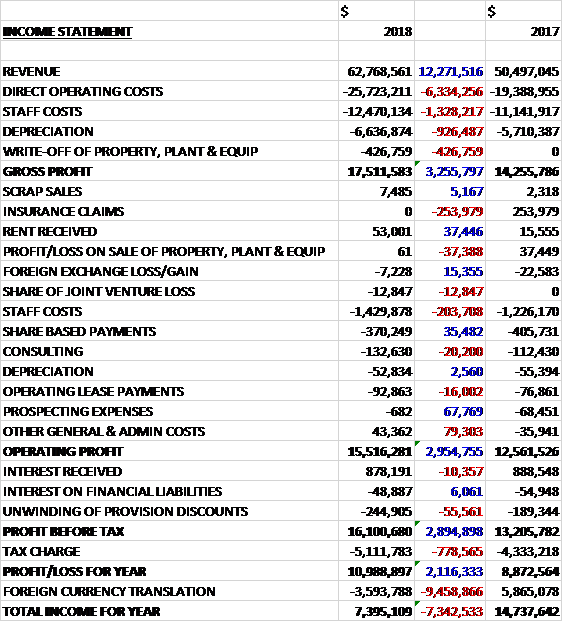
Revenues increased when compared to last year as a £2.1M decline in Asian revenue was more than offset by a £6M growth in European revenue, a £2.4M increase in UK revenue and a £2.3M growth in ROW revenue. Staff costs increased by £1.1M, R&D costs were up £474K and other cost of sales increased by £7.2M to give a gross profit £293K lower than last year. Operating lease rentals increased somewhat, selling and distribution costs were up £291K, depreciation grew by £225K but other admin expenses declined by £832K which meant that the operating profit was £136K lower. The pension interest cost fell by £209K, however, which meant that after tax expenses declined by £112K the profit for the year was £36.7M, a growth of £198K year on year.

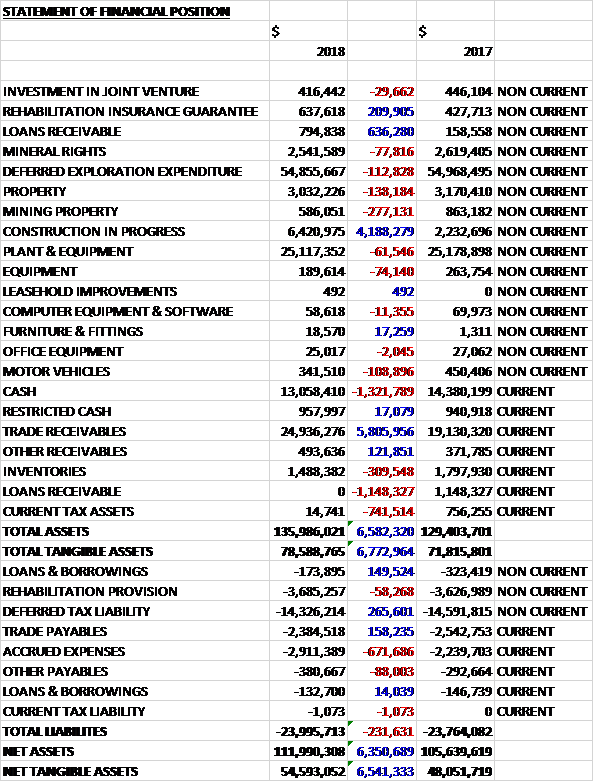
When compared to the end point of last year, total assets decreased by £3.5M driven by a £1.9M decline in cash, a £1.8M fall in inventories and a £1.5M decrease in deferred tax assets, partially offset by a £913K growth in prepayments and accrued income. Total labilities also declined during the year due to an £8.7M decline in trade payables, a £6.4M fall in pension obligations, a £1.7M decrease in accruals and a £1.2M fall in derivative financial liabilities. The end result was a net tangible asset level of £125.6M, a growth of £14.8M year on year.

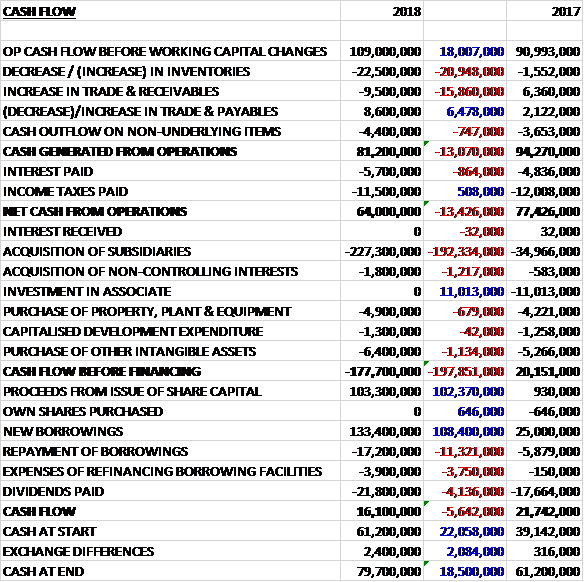
Before movements in working capital, cash profits increased by £685K to £51M. There was a cash outflow from working capital and despite tax payments reducing by £1M the net cash from operations was £28.6M, a decline of £8.3M year on year. The group spent just £3.6M on capex to give a free cash flow of £25.3M. This didn’t quite cover the dividends of £27.2M which meant there was a cash outflow of £1.7M in the year and a cash level of £50.7M at the year-end.

Over the year the group have benefited from exporting products in an environment of a weaker sterling, but against this raw material prices have continued to rise. The adverse raw material price affect from forex movements was £1.8M. This was mitigated somewhat by higher sales prices outside the UK but it did affect profitability within the UK where they took the decision to hold back on price increases. A favourable mix of sales largely offset the bottom line effect of these raw material costs.
The launch in May of Palettone was costly but worthwhile for the longer term. The costs of development trials, sampling, marketing material and related expenditure were around £2M and the product has just been launched into the global market place. The timing was important due to the closure of one of the group’s competitor’s factories.

Within Europe, the Karndean ranges aimed at the wholesale market were launched at the beginning of the year and the Expona Domestic range was launched in January with the Palettone in May. The gestation period for a new launch is generally a number of months so the impact from such major product changes has only been partly felt this year. Sales increased by 2% across the business but profitability was negatively affected by changes in forex rates and price increases from suppliers. All the key markets grew with the exception of Benelux with France in particular showing good growth.

The Australian business had a record year in both terms of turnover and profits. The ongoing projects that the business continues to win and supply include the Howard Soloman Aged Care Facility in Western Australia and the Australian Embassy in Port Moresby. Another installation is the Pier 33 Yacht Club in Queensland. Given that the group are the only manufacturer with warehousing in every state and with the sales reps local to each major city, the business is soundly based for continued growth. During the year they added warehousing in South Australia and this has enhanced their offering with the Angaston, Strathalbyn, Goolwa and Barossa hospitals all examples of penetration in this region.

New Zealand had another year of modest (1%) growth which showed good growth on the North Island offset by contraction on the South Island which continues to be slow. Product mix has had some negative impact on margin locally for bought in products as one key supplier had some supply interruptions and the shortfalls in this product were made up with greater sales of lower margin products. The UK manufactured products continue to have a dominating market share and the New Zealand social housing contract referred to last year continues to be an important component of this.

The group have changed the management structure of the Asian business to align it with the larger Australian business. Plans are in place to extend the footprint of the Hong Kong operation both in China and in other Key Asian markets. The presence of Chinese manufactured products makes many of these markets very price sensitive and the restructuring of this part of the business continues to ensure their response to these market pressures is robust. Projects such as the HPA Electronics Factory in Malaysia, Hamazushi Chain stores across Japan, the Water Market in Macau and Chengdu Woman and Children’s Hospital in China are some of the new installations they have been involved with.

In the UK there was a dearth of large government funded projects as spending cuts are applied across the board. Nevertheless sales into the refurbishment sector remained strong and Polyflor was able to make the most out of a weak market. Their UK sales were 3% ahead of the prior year. New products such as the barefoot safety flooring, Polysafe Quattro and Palletone collection helped sales.

During the year research was undertaken into the development of a totally new format of manufacturing flooring, the results of which are now under board consideration. They plant to acquire a new production plant and their technical teams are working with suppliers on a final specification. To pave the way for this, they have spent many months removing old and surplus equipment to create space for this facility on the Radcliffe site.

In the early part of the year they upgraded the chilling units at the Radcliffe site which reduced energy consumption. Their non-directional sheet vinyl plant was modified with increased automation allowing them to achieve 96% utilisation. Over the coming year this should ensure 25% higher output for the same man-hours. Their high voltage and low voltage equipment was completely revamped which will again reduce downtime and improve quality control. At the same time they installed new LED lighting across the site which improves visibility at a reduced cost and negated the energy cost increases.

Investment at Teesside has continued. They have completed the upgrade to allow in-line register emboss on their sheet as well as upgrading their inspection to an in-line facility. The former offers payback with improved designs and the latter with reduced manpower. In addition they have increased the number of racks in the warehouse at Teesside to give them greater capacity and flexibility in their distribution and have also replaced their chilled water system for cooling rolls on the finishing line.

Notable projects in the year included the new Kellogg HQ in Manchester, the S4C HQ in Carmarthen which used the new Palettone, Adidas UK HQ in Stockport and Alexander McQueen Head Office in London.

The Scandinavian business posted a 6% increase in turnover. Sweden had a record year for sales and profitability along with growth in sales of UK manufactured products. The Norwegian business had a change in management late in the year following the death of the MD. During the year the business was refocussed on the core portfolio of Polyflor vinyl sheet. One highlight was one of the first Palletone specs for Helly Hanson in Oslo. Sales in this business fell back slightly, however, as major projects were keenly contested. Nevertheless projects such as the FlipZone Trampoline park in Bergen and supplying the Swedish government controlled pharmacy Apoteket were examples of their presence.

Turnover in the Canadian business continued to grow with 15% growth in sales. The mining sector continues to be subdued and the growth comes from the sales force obtaining specs from end users. During the year they relocated to larger premises and they have added more sales reps with a team now based in British Colombia. In the year they had products installed in the Canadian Hockey Hall of Fame and in CBC’s radio studios.

In India the introduction of general sales tax in July 2017 severely disrupted the performance of the business for much of the year. As the year progressed the business community overcame the initial shock and following a reduction in the GST rates applicable to the group’s product, business activity increased considerably in the latter months of the year allowing it to break even for the year as a whole.

This level of activity has continued in the first months of the new year. The portfolio of projects continues to increase monthly as the sales extend Polyflor’s footprint across the country. Healthcare remains at the core of opportunities but the year has seen sales to the Indian Space Research Organisation, Goldman Sachs’ offices in Bangalore and the Chaitanya Bharati Institute of Technology. Although competition from both global and local players is tough throughout the market they are seeing increasing levels of specifications for their products which bodes well for the future.

In the ROW, in order to further support their activities they opened Polyflor PZE in Dubai in February 2018 as a representative office to support their trade in the region and enable them to employ local sales staff. They won the contract to supply Al Hokair Play Centres across Saudi Arabia and the UAE and they have every expectation of increased penetration of these markets.

The Palettone range is a premium homogenous sheet vinyl collection. It is the largest new range by any manufacturer in this core product area for many years and offers a collection of 50 colours optimised for the global market. In recent years a lot of competitor focus has been in the area of luxury vinyl tile but vinyl sheet continues to be a large sector of the market. The feedback received so far since the launch has apparently been very good.

As the Brexit deadline grows nearer, the board remain vigilant for issues that may arise. They believe they are well placed in that they export to far more countries outside than the EU than inside and they have attained full Authorised Economic Operator status with HMRC. It is considered, depending on the exact details of Brexit, that this will minimise the risk of any post-Brexit border delays.

Trading since the year-end continues to be solid, particularly in the UK. Given the adverse raw material price increases over the last year they have increased their prices which their trade partners have accepted. In addition, they have updated their product portfolio and to date the new products have received a very good reaction from customers. The board are therefore confident of continued progress in the coming year.

At the current share price the shares are trading on a PE ratio of 21.8 which falls to 20.1 on next year’s consensus forecast. After a 4.3% increase in the final dividend the shares are yielding 3.5% which increases to 3.6% on next year’s forecast. At the year-end the group had a net cash position of £50.7M compared to £52.5M at the end of last year.

Overall then, this has been a bit of a mixed year for the group. Profits saw a modest rise due to a reduction in pension costs, without which there would have been a modest fall. Net assets rose but the operating cash flow declined. This was due to working capital movements, however, and cash profits were higher this year. The group remains very cash generative but the free cash flow didn’t quite cover the dividends this year.

The issue seems to be due to increased costs, due to supplier price rises, adverse forex movements and the launch of the Palettone range at the end of the year. UK margins in particular have been squeezed due to the weak pound and a lack of government infrastructure spend. On the other hand, the rest of Europe, Australia and Canada all seem to be performing well. This remains a high quality company but the shares are not cheap with a forward PE of 20.1 and yield of 3.6%. It is worth noting the big pile of net cash, however. I would like to get back in to this share but think perhaps I can do so at a better valuation?

On the 7th December the group released a trading update covering the first five months of the year. Following a £2M investment in Palettone, customer interest has already exceeded their expectations and examples of installations are the Charite Universitatsmedizin in Berlin and the Theatre du Petit Saint Martin in Paris. In addition Polysafe Verona Pure Colour has been installed in a nursing home in Dublin.

Trading to date has been encouraging and they have traded ahead of last year in terms of turnover and profits. The board is confident in the prospects of the company.

On the 30th January the group released a trading update covering the first half of the year.  Trading was encouraging in the first five months of the year but December was disappointing, having been impacted by the UK and relates in part to fewer trading days and year-end stock reductions by UK distributors.  Trading in January is ahead of the comparative period, however.  In addition they have seen margin improvement and profit for the half year will be at a record level.  Confidence in full year progress continues.

Newmark Security Share Blog – Final Results Year Ended 2018

Newmark Security have now released their final results for the year ended 2018.

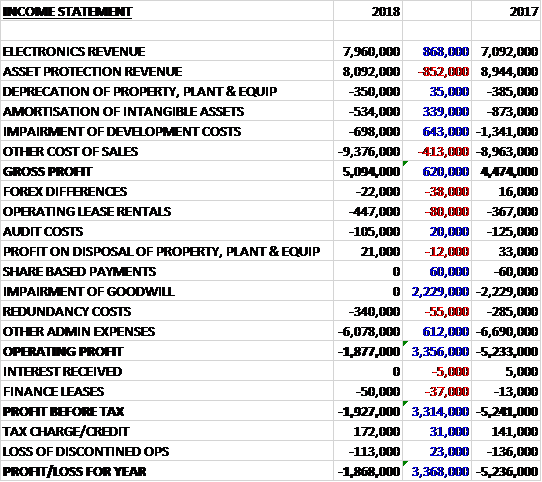
Revenues were broadly flat year on year as an £852K decline in asset protection revenue was offset by an £868K increase in electronics revenue. Amortisation was down £339K, impairment of development costs decreased by £643K but other cost of sales were up £413K to give a gross profit £620K higher. Operating leases increased by £80K but share based payments were down £60K. There was no impairment of goodwill, however, which cost £2.2M last year and but redundancy costs increased by £55K. Other admin expenses fell by £612K to give an operating loss that showed a £3.4M improvement. Finance lease costs increased modestly but tax charges came down to give a loss for the year of £1.9M, an improvement of £3.4M year on year.

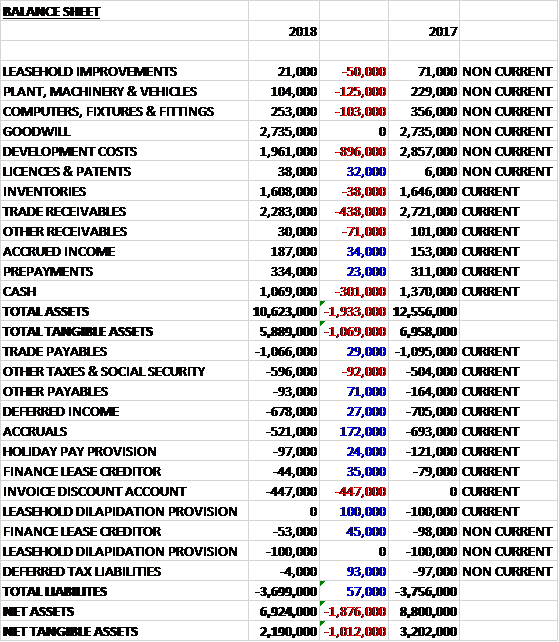
When compared to the end point of last year, total assets declined by £1.9M driven by an £896K decrease in development costs, a £438K decline in trade receivables, a £301K fall in cash, a £125K decrease in plant, machinery and vehicles, and a £103K decline in computers, fixtures and fittings. Total liabilities were broadly flat as a £447K growth in the invoice discount account was offset by a £172K decrease in accruals, a £100K fall in the leasehold dilapidation provision and a few smaller declines. The end result was a net tangible asset level of £2.2M, a decline of £1M year on year.

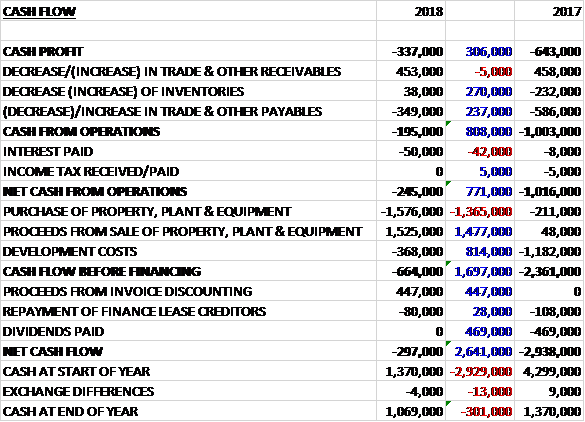
Before movements in working capital, cash losses improved by £306K to £337K. There was a cash inflow from working capital and after interest payments increased by £42K the net cash outflow from operations was £245K, an improvement of £771K year on year. The group spent £1.6M on fixed assets but recouped £1.5M from asset sales and after £368K was spent on development costs there was a cash outflow of £664K before financing. The group received £447K from invoice discounting but paid back £80K of finance leases which gave a cash outflow of £297K and a cash level of £1.1M at the year-end.

Overall revenue in the electronic division increased by 12% as the decline in the legacy Janus range of access control products was offset by the growth in the Sateon range driven by the release of the latest Advance variant in the second half of the previous year. Within this, sales of access control increased by just 1% but sales of workforce management increased by 25% driven by additional sales relating to announcements made regarding supply agreements to strategic partners and organic growth, particularly in the US.

Overall revenue in the asset protection division decreased by 10% with a 17% decrease in product sales mainly due to the lower revenue from time delayed cash handling equipment sales to the Post Office.

The electronic division saw revenues increase by 12.2%. This was a turn around year for the division. The investment made in product development has started to be repaid and this increase in revenue, combined with a reduction in overheads has delivered a significant reduction in Grosvenor’s losses. Several potential high volume supply agreements have been executed in HCM and although these did not play any major part in this year’s results, they are expected to contribute significantly towards the overall revenue ambitions for 2019.

Sateon Advance has continued the encouraging start it displayed since its launch in H2 last year and several more major opportunities for both Sateon Advance as a complete solution and the OEM variants of the Advance Access Control hardware are currently being investigated. Negotiations are currently underway with one of the UK’s largest security systems integrators and several US-based global Access Control providers. The product has delivered a large volume of new systems and displayed patterns of repeat business from customers throughout the UK.

The research into opportunities for aaS revenues in new markets, facilitated through the provision of the GT-10 Android terminal, has shown there is likely to be a higher return on investment in their existing markets by leveraging their core competencies. Both HCM, particularly in the US, and to a lesser degree Access control sectors, demonstrate a trend towards the downstream provision of cloud first and even cloud only services. Therefore, a decision has been taken to focus on their aaS development on existing products, services and sectors rather than diversified markets.

Within Access Control, the decision was made to retire the legacy Janus range with no new systems installed or operating licenses issues and consequently revenue declined by 32% to £1.3M. Market pricing for hardware for site extensions or replacements has been increased to reflect the higher costs of manufacturing and supporting legacy products in lower volumes and, therefore, it is expected that this product family will yield a greater gross margin contribution. Existing Janus systems will now require either an extended support agreement or upgrading to Sateon to ensure continuity of service to end users. The Janus to Sateon upgrade programme continues to help drive revenues for the latter.

Sateon has continued its robust growth trajectory with an increase of 32% to £2.6M. Sateon Advance has proven to be the most successful variant of the product to date and continues to grow in terms of both revenues and number of systems installed. During the year a review was conducted on Sateon to test its future set and technical stability versus market expectations and it was concluded that the product was mature and that all necessary development was complete. A final release including bug fixes was released in the first half of 2019.

Development work has continued to create non-proprietary variance of the Advance hardware range to allow it to be integrated with third party vendor’s software. By adopting an open protocol approach, incremental revenue is being generated as new channels are developed. A major European Workforce Management software provider has selected Advance as an OEM product to integrate with their proprietary access control solution. This partner’s spend increased 80% to £710K in the year. Negotiations are now underway with major global third party access control providers to supply this line as OEM products which would integrate with their various software platforms.

Grosvenor’s collaboration with US-based UniKey Technologies to launch a frictionless door experience was put on hold as their product development and delivery was slower than expected and failed to satisfy the board’s fiscal tests. The market for biometric credentials is dynamic, driven in part by consumer adoption of biometric technologies on smart devices. The business is taking an open protocol stance and is able to integrate any third party point of entry reader or device into either its Access Control or HCM range of products.

Across both the UK and US businesses, revenues from Human Capital Management products and services increased by 25%. In EMEA, HCM providers have a requirement for an Access Control offering as they seek additional revenues through diversification. In the US, however, it is recognised that the HCM sector generally and its sub sections, are large enough for software vendors operating in those markets to meet their revenue ambitions by crossing into immediately adjacent spaces, rather than follow the broader diversification seen in Europe.

The UK HCM business saw revenues grow by 18% to £2.9M. The Linux-based IT series sales increased 33% with organic growth being shown across the majority of clients. A new supply agreement with Workforce Software, helped bolster these figures although revenues from this client will not reach full potential until future years.

The GT-10 continues to provide new opportunities both in the UK and US. During the year a contract was signed to provide a variant of the GT-10 to a major European HCM partner and during 2019 this will become their flagship product. In the US, a supply agreement was reached with Ultimate Software to supply an OEM variant of the GT-10 which will be known as the UltiPro and will host Ultimate’s flagship SaaS solution that allows customers to access greater people management functionality in the cloud. Revenues came on stream in June. The US based business has also experienced good organic growth with increases in spend being seen in almost all of the client base so that revenues increased 46% to £1.2M.

In the Asset Protection division revenues decreased by 9.5% to £8M. Products revenue declined by 17% partly due to the decreased contribution from time delayed cash handling equipment sales to the Post Office so that cash handling equipment sales decreased by 42%. Overall revenue in all other product groups increased by 12%. The revenue in the year was characterised by numerous small projects with the absence of larger longer term high value projects and continued to be affected by branch closures in the banking sector. This was mitigated somewhat by staff reduction which resulted in cost savings.

During the year new products were developed with the focus on providing counter terror security equipment for staff and customer protection. The distribution agreement entered into with Gunnebo in the previous year to distribute their security doors and partitioning range within the UK increased exposure into new markets but sales have been disappointing to date. This complements the existing Safetell product range and the increased product offering allows entry into new market sectors. A three year fixed price supply contract with a financial institution ended in October but margins on this contract had been reduced due to imported component price increases directly related to the exchange rate.

A programme of product re-certification to the latest UK security standards which started in the previous year was continued which, when completed, will assist in moving the business forward as their focus is moved to the increased level of crime and threat of terrorism in the UK. The final element of the process will be completed in the second half of 2019.

Service revenue was 5% higher. Safetell continues to upgrade old legacy systems as customers invest in sites without the need to completely replace rising screens. TC105 control system upgrades will continue as customers decide to reinvest in the protection that rising screens provide.

In May the group acquired a new office property for £1.2M and after incurring refurb costs they entered into a sale and leaseback arrangement in September. The lease arrangement is for 15 years with increases in the annual rental rate at the five and ten year marks.

There were a number of exceptional items during the year. There were redundancy costs of £140K and impairments to development costs of £698K. In addition the remaining costs of the Hong Kong office closed last year came to £113K.

The group recognises that future access control revenues will be seen through sales of the current variant of the Sateon platform, the Janus C4 that will be introduced in the current year. They have therefore taken the decision to write off £698K which relates to sums capitalised for previous versions of the platform which have now been superseded. This is not the first time so it seems the group are not impairing their assets correctly.

The Janus upgrade programme has continued to contribute access control revenues as end users migrate to Sateon. Development work on Sateon has now been completed and a new access control platform is currently being developed with a third party supplier of security management systems to take advantage of the growing desire for fully integrated security and building management systems. It is expected that this new offering will be brought to market in H2 2019 and will sit alongside Sateon as two distinct platforms.

In Human Capital Management the GT-10 terminal continues to provide major opportunities with new and existing partners. Supply agreements have been executed in the year with two major software partners and a Linux port of the Android based terminal is currently being developed. The IT31 is to undergo a mid-life refresh which is expected to create new revenue opportunities and increase contribution with existing clients. During the year two new products were developed in the asset protection division with the focus on providing counter terror security equipment for staff and customer protection.

Going forward the board expects revenue growth in the electronic division following the completion of the two major supply agreements mentioned above, and recovery of sales in the asset protection division boosting both the current and future years. The development of the new access control platform being developed should also be completed in the year and the board expects improved financial results in the year. Whether they are expected to turn a profit is not mentioned, however.

As the group is loss making there is no point looking at PE ratios and there is no dividend on offer here. I can find no forecasts for the group.

Overall then this has been another difficult, but improving, year for the group. Losses and the operating cash outflow both improved but net assets deteriorated further. The Electronic division seems to be fairly healthy as the increased sales of the Sateon platform offset declines in Janus, and going forward the new supply agreements stand it in good stead. The asset protection division looks a little more flimsy, being affected by lower deliveries to the Post Office and banks, although again a recovery is being forecast.

I think the group may be on the cusp of real recovery but with no forecasts available to me and no current trading to base this on, I am going to have to stay out I think.

Solid State Share Blog – Final Results Year Ended 2018

Solid State has now released their final results for the year ended 2018.

Revenues increased when compared to last year as a £2.6M decline in computing product revenue was more than offset by a £3.8M growth in power product revenue, a £3.2M increase in electronic component and modules revenue and a £1.8M growth in communications product revenue. There was a £296K swing to forex losses but a £75K decline in R&D and a £175K decrease in reorganisation costs which meant that after other cost of sales increased by £5.4M, gross profit was £716K higher. Share based payments increased by £150K, acquisition costs were up £89K and other admin expenses grew by £704K, partly reflecting the full year impact of the Crewkerne and Leominster facilities along with cost inflation, which meant that the operating profit was £222K lower. Tax charges declined by £167K, however, to give a profit for the year of £2.2M, a decline of just £46K year on year.

When compared to the end point of last year, total assets increased by £2.4M driven by a £1.6M growth in trade receivables and a £1.2M increase in inventories. Total liabilities also increased due to a £507K growth in contract liabilities and a £407K increase in other tax and social security payables. The end result was a net tangible asset level of £11.9M, a growth of £1.4M year on year.

Before movements in working capital, cash profits increased by £468K to £3.5M. There was a cash outflow from working capital, however, due to increased lead times on cells and various electronic components, and even after a £218K positive swing to tax receipts, the net cash from operations was £1.4M, a decline of £7.8M year on year. The group spent £402K on fixed assets and £349K on intangible assets to give a free cash flow of £684K which didn’t cover the dividends of £1M so there was a cash outflow of £334k and a cash level of £575K at the year-end.

The profit in the distribution division was £1M, a growth of £148K year on year reflecting the growth in revenue through winning larger volume contracts, albeit in order to win some they had to offer some volume discounts. New initiatives in the prior year began to yield results and are expected to contribute significantly next year.
The profit in the Manufacturing division was £2.2M, broadly flat when compared to last year on billings that were up 13%. Bookings showed growth of just 3%, however, which was below expectations and is expected to result in a slower start to next year.

The computing business unit achieved a stable performance but revenues declined due to £3.5M of non-recurring revenue from the rail sector. Excluding this, and revenues were up 3%. While there was rail sector sales in the current year, the revenue from this sector was significantly down as an initial product rollout finished. These revenues were only partly replaced with sales at a more normalised margin for computer sales resulting in an adverse impact on the performance of the business.

An initial contract has been secured from a new customer in the rail sector. The business will supply them with a suite of computer and monitor equipment that will be integrated into rail coaches to provide video security. Further bookings and revenues are projected for 2019 on this programme. The business has seen an increase in demand for AI solutions that are image/video centric.

The business started delivery of a complex computing solution to the MOD via a major defence contractor. The solution includes TEMPEST products, which is a certification relating to a cyber security accreditation on information systems through preventing leaking emanations such as unintentional radio or electrical signals, sounds and vibrations. Discussions have started with other government departments which also have requirements to protect computer systems installed overseas.

In the Power business unit, they have now completed the transfer of all battery production to Crewkerne and performance continues to improve as they make operational efficiencies. The operation has seen the integration of the latest ISO standard and has approval to build equipment intended for use in potentially explosive atmospheres.

They have continued to see margin pressure on lower value battery solutions and the business is increasingly focused on more complex integrated solutions. There has been a sustained recovery in the oil and gas sector as customers progress through restocking phases to new longer term programmes. New technologies including lithium solutions to service the oil and gas sector present an opportunity for further value added enhancements and the associated margin improvement. Product endurance and reliability are critical to customers given the financial consequences of downhole failure.

The development of a battery solution for a major UK smart warehouse solutions provider has progressed well in the year; initial trials of the pack integrated into the customer’s robotic platform have been successful. After the year-end the business has taken significant production orders from the customer and their robot manufacturer and the production is scheduled to start towards the end of the year. A novel battery reblocking design provides the potential for annuity revenues for extended periods and delivering improved life costs for the end customer.

The business has also secured a further twelve month production contract from an existing customer operating in the aerospace sector. This order reflects an improved commercial relationship as a valued supply partner to the customer.

In the communications business the plans to build the order book for the antenna products is taking more time than the board had expected due to the inability to gain significant traction in North America where US domestic policy has seen the group lose out to US competitors on larger US government funded programmes.
Notwithstanding this, communications revenue was up on last year with strong radio sales and the delivery of a highly complex antenna programme to a major European defence prime contractor. The solution integrates advanced materials, cutting edge antenna design and complex software programming and will open doors to comparable future projects.

During the year the group’s customer, the Met Office, won an award from the Environment Agency with the group’s antenna team being specifically identified as a key supplier of radar antenna technology. The project involved the upgrade of the 16 weather radar systems in the UK National Weather Radar Network.

The radio business delivered two important programmes to the MOD permitting very high bandwidth real time video distribution in the harshest environments. They provided multi input multi output data radios that have the ability to form self-healing mesh networks covering a wide geographic region on land, sea and air and crucially in urban environments. They are now seeing prospective requirements where the proprietary radio solution has been designed into the end user solution.

They have established new business relationships with complementary companies providing mission planning computers, digital mapping solutions and optical sensors positioning the business as a subsystem provider of both the data links and situational awareness product. This will allow this part of the communications business to move up the value chain, generating larger contracts and improved margins.

Lessons have been learned on larger projects to ensure they have been de-risked with appropriate payment milestones against engineering deliverables. Going forward the business will be cautious in predicting significant sales growth from the antenna products. That said, prospects remain good and the business will continue to compete for high margin contracts.

As described above the group have taken a significant production order from a major UK smart warehouse technology solutions provider to supply them with battery packs to power autonomous robots operating in cold conditions. Production is expected to start towards the end of the year. This strengthens the order book increasing board confidence of remaining on track to meet expectations. The business intends to build on this success to expand the group’s capabilities in the provision of power solutions for select autonomous systems operating in harsh environments.

After the year-end the group signed a major exclusive distribution agreement with VPT, a US-based manufacturer of power supplies to the military, aerospace and space industries. The expansion of services in the value added distribution division and in particular the formation of their component sourcing and obsolescence team is starting to deliver a brand new source of recurring revenue to the group which whilst still small, is margin enhancing and has significant growth potential.

As indicated above the communications business has faced several challenges during the year. To address these, they have re-organised the team, and while they do not expect the recovery to deliver material improvements in performance in the coming year, they believe it positions them well for targeting new opportunities.

The group has an open order book of £23M compared to £20.7M at the end of last year and the group finished the year in a strategically stronger position. The management have refocussed the manufacturing division, with an emphasis on new customer lead generation via marketing initiatives and concentration on developing opportunities for higher margin business. The antenna team in the communication business is now seeing an improved level of enquiries, all of which gives the board confidence in the prospects for next year.

At the current share price the shares are trading on a PE ratio of 12.3 which falls to 11.6 on next year’s consensus forecast. After no change in the dividend, the shares are yielding 3.8% which is also forecasted to remain the same next year. At the year-end the group had a net cash position of £600K compared to £900K at the end of last year.

On the 6th September the group released a trading update. There was a positive start to the year which gives the board confidence in their prospects for the year as a whole.

On the 17th October the group released a trading update covering the first half of the year. Revenues will be ahead of last year at around £23.5M reflecting good trading in both divisions. The Distribution division has had a particularly strong period, delivering growth in both revenues and margins. In addition, they benefited from a one-off client order of £1M. The securing of the VPT franchise contract is expected to positively impact H2.

Revenues in the manufacturing division were lower than last year but they have seen an improvement in the gross margin due to sales mix which has ensured consistent group margins compared to last year. Looking forward the strong order book in the power business is expected to result in an improved manufacturing revenue performance in the second half.

Entering the second half, the board considers prospects for the year to be positive and expects the group to exceed market expectations for the current year. The open order book at the period-end stood at £29.6M compared to £18M at the same point of last year.

On the 9th November the group announced the acquisition of Pacer Technologies for a cash consideration of £3.7M. Pacer is well established in the specialist markets of Optoelectronics and displays and the acquisition significantly enhances the group’s exposure to the medical sector. The acquisition is expected to be earnings enhancing in the first full year and it will form part of the distribution division operating as a separate business. Last year the business generated pre-tax profits of £431K and the acquisition generated goodwill of £2.6M so seems pretty good value.

Overall then this has been a bit of a mixed year for the group. Profits were down modestly but net assets improved. The operating cash flow deteriorated but this was due to stock build and cash profits increased. Some free cash was generated but this did not cover the dividend, although it should be noted that cash profits did. The sluggish performance seems to have been due to a lack of rail orders to replace the large projects last year and a difficulty in penetrating the US antenna market.
There have been some good new contracts, such as the batteries for the warehouse company and the VPT contract which are contributing to a record order book. Indeed this year seems to be going quite well and with a forward PE of 11.6 and yield of 3.8% these shares may be worth a buy.

QinetiQ Share Blog – Final Results Year Ended 2018

QinetiQ has now released their final results for the year ended 2018.

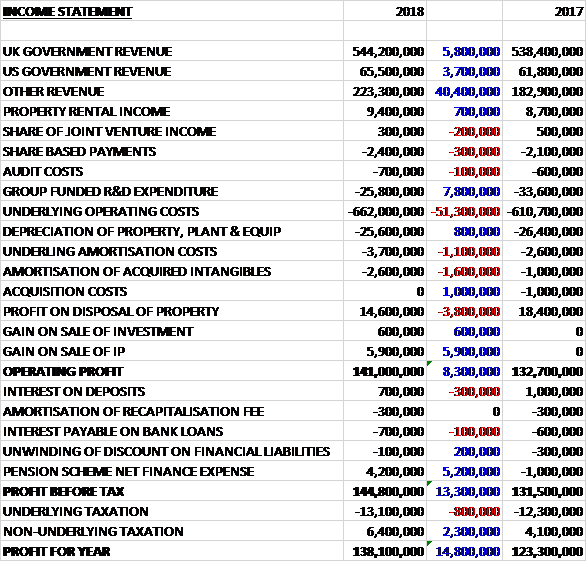
Revenues increased when compared to last year with a £5.8M growth in UK government revenue, a £3.7M increase in US government revenue, a £700K growth in property rental income and a £40.4M increase in other revenue. Group funded R&D expenditure increased by £7.8M but share based payments increased by £300K and other underlying operation costs were up £51.3M. Depreciation was down £800K but underlying amortisation costs were up £1.1M and the amortisation of acquired tangibles increased by £1.6M. There was a £3.8M fall in the profit from property sales but also a £1M fall in acquisition costs and £6.5M was made on the sale of IP and investments to give an operating profit £8.3M higher. There was a £5.2M positive swing to a net pension scheme income and tax charges declined by £1.5M to give a profit for the year of £138.1M, a growth of £14.8M year on year.

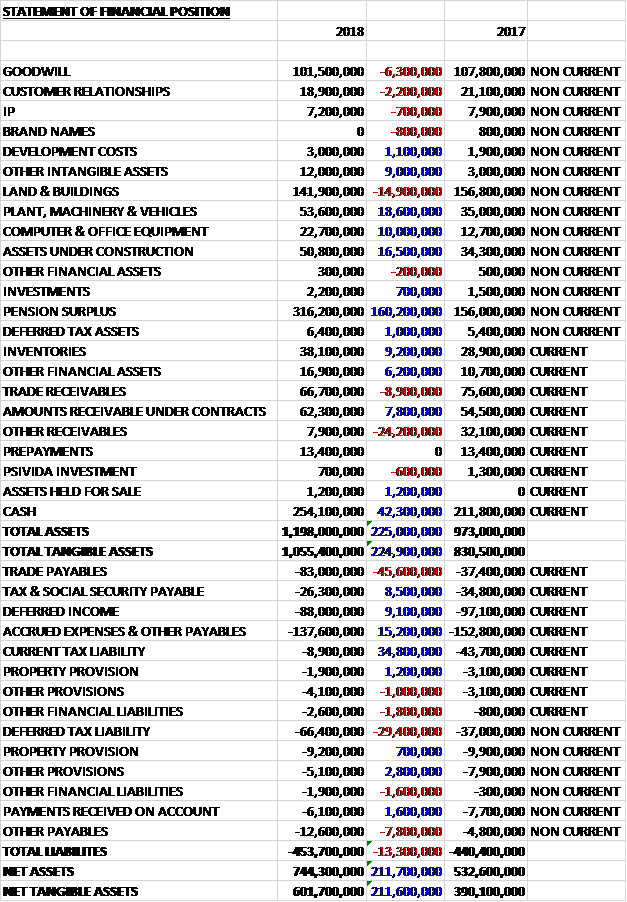
When compared to the end point of last year, total assets increased by £225M driven by a £160.2M increase in the pension surplus, a £42.3M growth in cash, an £18.6M increase in plant & machinery, a £16.5M growth in assets under construction and a £10M increase in office equipment, partially offset by a £24.2M decrease in other receivables relating to the insurance payout following the unfavourable court decision in the US, and a £14.9M decline in land and buildings. Total liabilities also increased during the year as a £34.8M decline in current tax liabilities relating to the settlement of a tax liability in the US related to an unfavourable court decision and a £15.2M fall in accrued expenses and other payables were more than offset by a £45.6M increase in trade payables and a £29.4M growth in deferred tax liabilities. The end result was a net tangible asset level of £601.7M, a growth of £211.6M year on year.

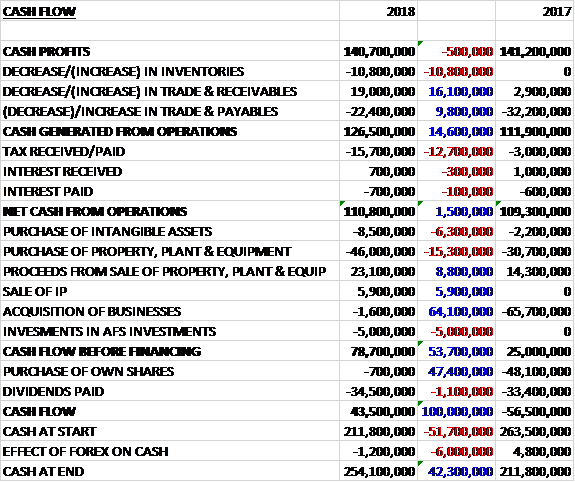
Before movements in working capital, cash profits declined by just £500K to £140.7M. There was a cash outflow from working capital but this was lower than last time so even after tax payments increased by £12.7M the net cash from operations was £110.8M, a growth of £1.5M year on year. The group spent £8.5M on intangible assets, £46M on fixed assets, £5M on available for sale investments and £1.6M on acquisitions. Offsetting this the group brought in £23.1M from the sale of fixed assets and £5.9M from the sale of IP to give a free cash flow of £78.7M. Of this, £34.5M went on dividends to give a cash flow of £43.5M and a cash level of £254.1M at the year-end.
Capital expenditure increased from £32.9M to £80.4M to support the development and modernisation of capabilities for long-term UK MOD contracts and expansion into high growth international markets. Capex is expected to be in the £80M to £100M range in 2019 with the capex associated with the LTPA recovered in full under existing LTPA contract terms.

The operating profit in the EMEA Services division was £94.3M, a growth of £1.6M year on year. Orders for the year were down £165M to £355.9M due in part to the award in the prior year of the £109M Naval Combat System Integration Support Services contract and £55M of Strategic Enterprise contracts. Excluding this there was slower H1 orders offset in part by stronger order performance in H2. Revenues increased by 4% on an organic basis driven by the International and Maritime, Land and Weapons businesses.

At the start of 2019, 75% of the division’s revenue was under contract compared to 79% at the start of last year which reflects the lower value, shorter dated orders in 2018 and an increasing international mix in the business. The increase in profit was due to a number of one-off items including a £5.3M credit relating to the release of engine servicing obligations, a £4.7M credit related to settlement of a contractual dispute, a £2.7M charge relating to property liabilities and a number of other contract related releases. Excluding these, profits fell by £3.4M due to the lower baseline profit rate single source contracts, in line with expectations.

The baseline profit rate which applies to pricing discussions is a three year rolling average so whilst the input rate for 2019 increased from 6.44% to 7.94% the rolling average fell from 7.46% to 6.81%. The impact of changes to the single sourcing pricing regulations is expected to intensify this year with the anticipated repricing on the remainder of the LTPA representing a headwind of around £6M to operating profits in the division.

In the Air and Space business the group is building on the investment made as part of the 2017 amendment to the LTPA in test aircrew training and have begun marketing the new enhanced offer which uses their new aircraft and syllabus. In November they signed the first multi-year contract with the Royal Netherlands Air Force for £6M and have subsequently signed a contract with Armasuisse which is responsible for defence procurement in Switzerland, and are in close dialogue with a number of other potential customers.

The business completed the implementation of Strategic Enterprise, securing customer endorsement and achieving dull operating capability, a major milestone under the contract. Strategic Enterprise has been a significant achievement for the group with over £250M of orders placed under the framework. The group have been invited by the MOD to negotiate the Engineering Delivery Partner programme on a sole source basis through which the MOD will procure its engineering services which the group will deliver with Atkins and BMT.

The business continues to deploy significant resources to develop the gridded ion energy electric propulsion system to be used on ESA’s BepiColombo mission to Mercury which is scheduled to launch in October 2018, and the module has now been shipped to the launch site. Technical qualification for the propulsion system needs to be completed and accepted by the customer before approval can be given to launch.

In the Maritime, Land and Weapons business the investment in the air ranges they are making as part of the 2017 amendment will allow the group to deliver more complex trials. Using their facilities at MOD Aberporth, they worked in partnership with the MOD and MBDA, the manufacturer of the Brimstone 2 missile, to provide the capability assurance required to ensure the missile can be integrated onto Typhoon.

In January they won an order from a key international customer to perform submarine research, modelling and testing and as part of an ongoing programme of work they provided test and evaluation services on the escape systems of the new class of submarines being built for the Italian Navy. In addition they are leading a new framework programme providing the UK MOD with access to key industry, academia and SME expertise.

The business is working with MBDA and the MOD to develop a new joint UK energetics strategy. As part of this, they have secured a significant contract for weapon test and evaluation and completed the refurbishment of an Environmental Test Centre. Following the delivery of the Dragon Fire design review, the MOD has agreed to place the second year of funding with the Dragon Fire consortium which the group provides with high energy laser source expertise.

In the Cyber, Information and Training business, orders were lower than last year due to fewer research related orders from the UK MOD. The business is focused on bidding and winning more transformational deals with new customers. Major deals being bid for include work for client side support for BATCIS with an estimated contract value of between £50M and £95M, the new Defence Operational Training, synthetic training environment and continuation of the Rockwell Collins partnership for the next generation of position, navigation and timing receivers.

The business is bidding for Serapis, the replacement for the MOD’s current communications and information systems R&D framework run by the group. During the period they were awarded a £4M consultancy contract to the UK Space Agency utilising their experience in satellite communications. They have developed a cyber test and evaluation service to enable organisations to test and rehearse cyber defence scenarios to better understand vulnerabilities and responses to them. Finally, they are responding to customer needs and building a new capability hub in Lincoln to address new requirements for the Electronic Warfare community based around RAF Waddington.

In the international business, the year marked a significant one in Australia. Overall record orders were complemented with significant contract wins and an increase in revenue of around 30%. They were awarded their second test and evaluation facilities operations contract in Australia to run the mine warfare maintenance facilities in Sydney. They achieved an A$16M increase in their contract under AIR7000 to provide support relating to the procurement of maritime patrol aircraft in Australia. The group, as part of a consortium led by Nova Systems, has been selected by the Australian DoD as one of four Major Services Providers enabling it to bid for larger strategic contracts.

The Advisory Services business increased its international consulting contract wins and entered a number of new Middle Eastern and European countries. As a result the business doubled the size of its order intake in the year. In Sweden, they secured three new international customers at their Flight Physiological Centre that they operate on behalf of the Swedish FMV. The centre also conducted its first space mission training.

The operating profit in the Global Products division was £28.2M, an increase of £4.6M when compared to last year. Orders increased from £154.4M to £231.3M, including more than $50M of orders for maritime systems in the US and a $25M spacecraft docking mechanism order from the ESA. The division had 51% of its revenue for 2019 under contract at the beginning of the year compared to 55% at the same point of last year reflecting the shorter contact cycle of the division and an overall increase in expected revenues.
Revenue was up 7% driven by the impact of Target Systems. Like for like revenues declined by 4% due to lower robot sales. Despite this, like for like profits were up £2.7M due to improved profitability at Opta Sense and high margins in the QTS business in Q4.

In the North American business the group were unsuccessful on the US DOD’s Man-Transportable Robotic System program of record. Despite this they are well placed for the remaining programmes and were selected as one of two suppliers for the EMD phase of the Common Robotic System programme of record. The EMD will last round ten months during which time the DOD will test and evaluate robots from the two suppliers. The total budget for the programme is approximately $400M over seven years.

They secured over $20M of orders for Talon robots and more than $20M of orders for their Q-Nets and Armor products. They won a total of more than $50M of orders for maritime systems in the US including for aircraft launch and recovery equipment for the new class of aircraft carriers.

The performance of the OptaSense business improved as they saw the impact of returning confidence in the oil field market and its diversification into adjacent markets started to reap rewards. The business has made multiple significant deliveries to infrastructure customers during the year. The largest single system awarded has been delivered to Turkey, they have had significant deliveries into the Middle East and the first significant award and first phase delivery into the US. Oil field activity in North America continues to increase while the adoption in the Middle East and Asian markets becomes more embedded.

In the Space Products business, during the year they were awarded a €25M contract from the ESA for their International Berthing and Docking Mechanism. They are engaged in discussions with other potential users of the system both in the commercial and government sectors for the supply of docking modules, potentially creating a new revenue stream for the business. They secured a €3M contract with the ESA for the prelim design activities on the Altius earth observation satellite which will study the distribution of ozone in the stratosphere. The business also secured a number of new contracts, the most significant of which was COLIS, a €6M project to build a Colloid Light Scattering instrument for investigating the effect of density and temperature on colloidal structures.

In the EMEA Products business, the performance of Targets Systems, which was acquired in December 2016, continued to exceed expectations. During the year it won work from two new customers, the Korean Air Force and the Japanese Self Defence Force. It was also awarded a five year framework for the Dutch Navy for the majority of its maritime targets in addition to as long term framework with the US Targets Management Office. The business reached its production milestones with its Hammerhead and Banshee targets.

The business is supporting the Canadian government with trials of their counter-UAV system Obsidian which tracks drones. The group are collaborating with Isotropics in the development of electromagnetic lenses for use in electronically steered flat panel satellite antennas. This technology enables high throughput satellite comms in the growing areas of communications on the move and consumer broadband. They are also launching their new iridium based phone for military, emergency services and users working in challenging environments such as oil and gas or mining.

Headwinds in the UK come from the lower baseline profit rate set by the Single Source Regulations Office which made for a tougher trading environment in the year. This headwind is expected to intensify in 2019 with the anticipated remainder of the LTPA which was not part of the December 2016 amendment but it should moderate in 2020 enabling growing revenue to deliver increased profitability.

After the year-end the group entered into an agreement to acquire EIS Aircraft Operations for €70M. The business is a provider of airborne training services based in Germany, delivering threat representation and operational readiness for military customers. It generated €5.4M EBITDA last year and the legal approvals are expected to close towards the end of H2 2019.

Priorities for 2019 include the repricing of the LTPA with UK MOD, accelerate international growth and continue investment driving sustainable growth. Going forward with more than two thirds of 2019 revenue under contract they enter the year in a position of strength and are maintaining expectations for group performance. The board expect the global products division to make continued progress with further organic growth partially offset by a translational impact from forex.

At the current share price the shares are trading on a PE ratio of 14.3 which increases to 16.1 on next year’s consensus forecast. At the year-end the group had a net cash position of £266.8M compared to £221.9M at the end of last year. After a 5% increase in the total dividend the shares are yielding 2.3% which remains the same on next year’s forecast.

On the 25th July the group released a trading update covering Q1 2019 which was as expected with no change to expectations for group performance for the year. The EMEA services division continued to deliver against their growth strategy, increasing both revenue and orders organically. Revenue under contract is in line with expectations for this point in the year.

The division on the competition for the Battlefield and Tactical Communications and Information Systems contract worth up to £95M over five years. This is the largest competitive win since the implementation of their new growth strategy. They won a five year contract to build and maintain a synthetic environment to provide test and reference services for a new ground based air defence system; and with their partners Atkins and BMT they have been confirmed preferred bidder by the MOD for the Engineering Delivery Partner programme.

The global products division has continued to grow orders and revenues organically. The North American business delivered a good performance driven by demand for their robots and survivability products. Following its integration the Target Systems business has continued to grow and is leveraging wider group capability to enhance its portfolio. It reached a significant milestone in the development of a new supersonic aerial target and won its first orders for an enhanced Banshee aerial target from a Scandinavian customer.

On the 18th October the group confirmed the completion of the EIS Aircraft Operations business.

On the 22nd October the group announced the acquisition of 85% of Inzpire Group with an agreement to acquire the remaining 15% after two years for a total consideration of £23.5M. The business has a five year track record of consistent revenue growth and is expected to deliver £2M of EBITDA this year.
The business is a provider of operational training and mission systems for military customers. Around 75% of its revenue comes from airborne training and evaluation services, primarily for the RAF. The balance of revenue is from the sale of aviation mission system products ranging from standalone tablets to full mission support systems integrated with aircraft avionics.

Overall then this has been a bit of a mixed year for the group. Profits were up but this was mainly due to the sale of IP, financial gains from the pension scheme and one-off tax income. Excluding this, there was a modest rise. Net assets grew strongly and the operating cash flow improved, although this was entirely due to working capital movements and cash profits fell ever so slightly. Still, a decent amount of free cash was generated.

The EMEA Services division saw profits increase due to one-off items. Excluding this, there was a decline due to the lower baseline profit rates on single source contracts, which will only intensify in the coming year. Global products seems to be doing fine, boosted by increased profitability at OptaSense and QTS. The coming year will probably be quite difficult but once the baseline profits are sorted for the single source contracts, the rest of the business seems to be doing well. At some point these shares could be a decent buy but with a forward PE of 16.1 and yield of 2.3% they look a little expensive at the moment.

Wynnstay Share Blog – Interim Results Year Ending 2018

Wynnstay has now released their interim results for the year ending 2018.

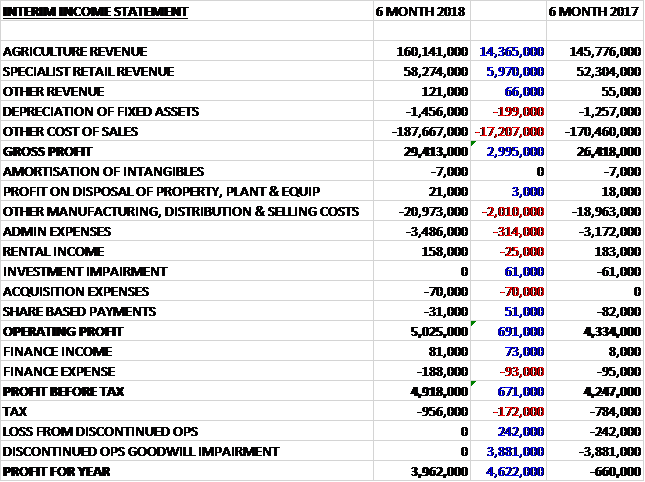
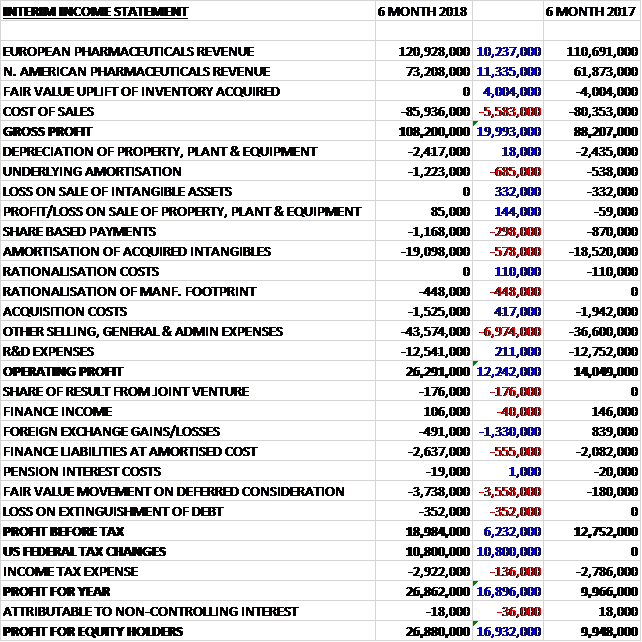
Revenues increased when compared to the first half of last year with a £14.4M growth in agriculture revenue, a £6M increase in specialist retail revenue and a £66K increase in other revenue. Depreciation was up £199K and other cost of sales increased by £17.2M to give a gross profit £3M higher. Manufacturing, distribution and selling costs grew by £2M and admin expenses were up £314K which meant that the operating profit grew by £691K. There was a modest increase in finance expenses and tax charges grew by £172K to give a profit for the period of £4M, a growth of £499K year on year.

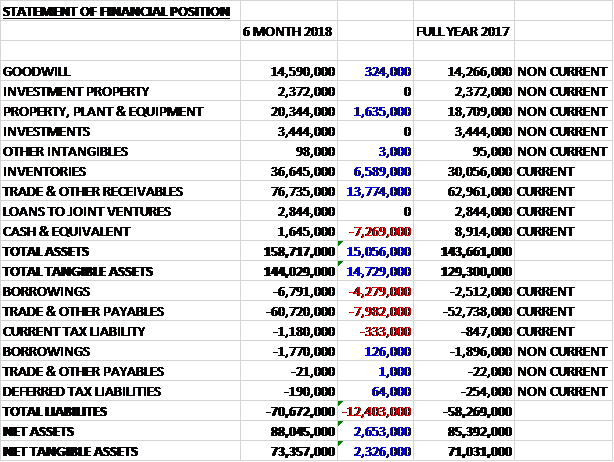
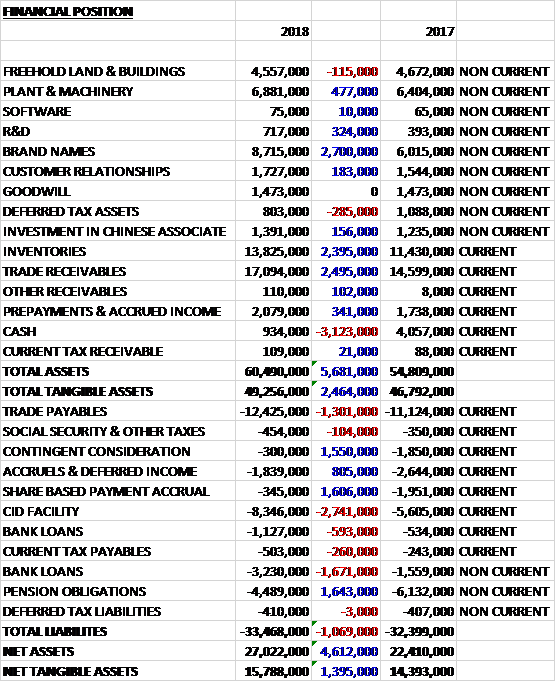
When compared to the end point of last year, total assets increased by £15.1M driven by a £13.8M growth in receivables, a £6.6M increase in inventories and a £1.6M increase in property, plant and equipment partially offset by a £7.3M decrease in cash. Total liabilities also increased due to an £8M increase in payables and a £4.2M growth in borrowings. The end result was a net tangible asset level of £73.4M, a growth of £2.3M over the past six months.

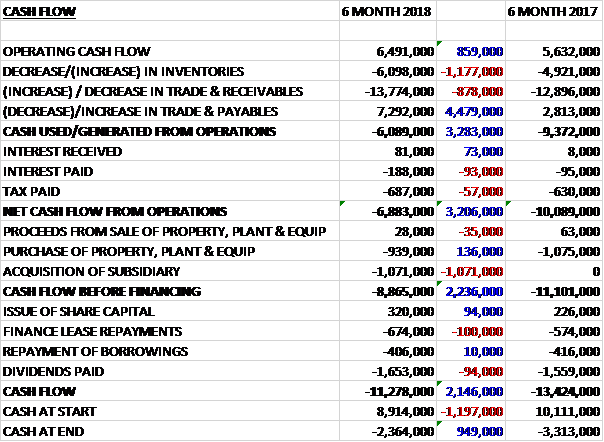
Before movements in working capital, cash profits increased by £859K to £6.5M. There was a cash outflow from working capital but this was less than last time and the net cash outflow from operations was £6.9M, an improvement of £3.2M year on year. The group spent £939K on property, plant and equipment along with £1.1M on acquisitions to give a cash outflow of £8.9M before financing. The group spent £674K on finance lease repayments, £406K on loan repayments and £1.7M in dividends to five a cash outflow of £11.3M and a cash level of -£2.4M at the period-end.

The profit in the Agricultural division was £2.1M, an increase of £513K year on year, helped by increased feed volumes. The trading environment across the sector began to recover during 2017, and stronger output prices for both arable and livestock farmers have driven a broad recovery in demand for agricultural inputs. Demand was strongest in the livestock sector where there was also a higher feed requirement as a result of the extended winter period. While the late spring led to delayed demand for arable inputs, sales were in line with last year. Grain volumes improved in the late spring period, although margins remain under pressure in a relatively flat market.

The feeds business benefited from strong demand for compound, blended and straight feed products, as improved output prices encouraged livestock farmers to return to more typical feeding regimes. Demand for ruminant feeds was also boosted by the long winter period, although some extra costs were incurred in meeting this demand. Bagged feed sales which are principally sold through the store network, reached record highs, also benefiting from the extended winter period. They also saw volume growth in monogastric feeds, with further expansion of feeds for free range egg production.

Glasson grain delivered a solid performance with an increase in volumes in all products, although there was some margin pressure in fertilizer. The Montrose mill acquisition positions the business as the second largest fertilizer blender in the UK. The manufacture of certain products for Youngs animal feeds has boosted the output of specialist corn milling activities and they are starting to see the benefits come through.

The late spring affected demand for arable products in the first half. April and May were very busy months, however, and on a year to date basis, arable product sales are now at normal levels. Demand for spring cereal seed has been very strong, partly reflecting a change in cropping pattern as some arable enterprises deal with blackgrass weed problems associated with autumn cropping. Herbage sales are currently at lower levels than last year, reflecting the general trend in the UK but the group expect an increase in demand later in the year, subject to autumn weather conditions. Inclement weather also reduced usage of agrochemicals and despite a strong demand in May, sales remain behind budget.

Improved grain prices stimulated trading activity and volumes for Grain Link have risen above the previous year. The previously subdued activity and flat market prices, however, have had a negative impact on margins. Forward grain prices remain strong which is an encouraging sign for arable farmers and bodes well for the sector.
The group have started work on a major warehouse expansion project at their arable site near Shrewsbury. This will enable them to increase production of processed seed in 2019 and they will also be enlarging their retail facilities at the same site.

The profit in the Specialist retail division was £3.1M, an increase of £188K when compared to the first half of last year. Sales across the network of Wynnstay stores increased strongly over the first half with like for like sales up 8%. Demand for feed was a key driver of this increase as farmers battled inclement weather, but increased spending was evident more broadly, including supplements and hardware products, reflecting the general improvement in sentiment at farm level.

The acquisition of a further eight stores was part of the expansion plan in the South West where they were underrepresented. The new outlets were previously loss making and will require investment to fully develop. The board anticipate them making a positive earnings contribution in 2019, however. With the addition of these new stores the network now stands at 60 outlets.

In November the group acquired a mill and related processing facilities in Scotland from Origin for £550K, all in deferred consideration, which represents the book value of the mill. Origin was required to dispose of the mill for competition remedy purposes. The mill contributed a profit of £159K in the half year so this looks to be a good acquisition.

In April 2018 the group acquired eight former Countrywide Farmers agricultural retail stores for £681K, which broadly represents the value of the stores. In addition the group completed a number of smaller acquisitions for £529, including deferred consideration of £189K. After the period-end, in May, Glasson Grain acquired Fertlink, a 50% joint venture fertilizer manufacturing facility established between Glasson and NW Trading. The acquisition will increase the fertilizer division’s sales volumes and allow it to better service the market on the East side of the UK. There was no consideration but due to the fact that there were net liabilities, the acquisition generated goodwill of £266K.

Ken Greetham retired in early July, after ten years as CEO. At the same time Gareth Davies, joint MD of Wynnstay Agricultural supplies was appointed as CEO designate.
Going forward, the improvement in output prices for farmers provides a robust backdrop for the UK industry. While Brexit negotiations remain underway, the full implications on some UK farming practices are difficult to predict but it is widely accepted that the existing financial support mechanisms provided as part of the Common Agricultural Policy will focus on output parameters rather than area and historical factors. The group expect an even greater emphasis on efficiency and productivity as farmers compete in a market with changing competitive dynamics.

Current trading is in line with overall budgets and despite short term costs associated with the integration of the newly acquired Country stores, the board believes that the group remain well positioned to meet current market expectations for the full year.

At The current share price the shares are trading on a PE ratio of 13.2 which falls to 11.8 on the full year consensus forecast. After a 5% increase in the interim dividend, the shares are yielding 3.1% which remains the same for the full year. At the period-end the group had a net debt position of £6.9M compared to £8.3M at the same point of last year.

Overall then this has been a good period for the group. Profits were up, net assets increased and the operating cash outflow improved. The outflow was entirely due to seasonal working capital movements and cash profits comfortably covered expenses. Both divisions fared well, benefiting from the improved market, especially for livestock feed. Going forward, conditions in H2 have started well and the forward PE of 11.8 and yield of 3.1% looks decent value. I continue to hold

On the 22nd November the group released a trading update covering the whole year. Trading across both the agriculture and specialist retail divisions has continued strongly with farmer confidence and spending patterns continuing to recover as output prices have strengthened. As a result the board bow expects to report pre-tax profit ahead of current expectations.

Strong feed sales, both direct to farm, and through the retail stores have been a key driver of this performance. Feed volumes and margins benefited from both the improvement in underlying market demand and the extended warm dry summer, which limited forage availability. Fertilizer volumes, which have been expanded through acquisitions within the Glasson business, were also boosted by weather conditions in Q4 and seed sales were also strong over this period. The integration and turnaround of stores acquired from Countrywide Farmers is proceeding to plan and they are expected to make a positive contribution in 2019.

The board believes the general agricultural and commodity outlook in the UK remains positive, and that the group is well placed to take advantage of the opportunities that are expected to present themselves.

Cranswick Share Blog – Final Results Year Ended 2018

Cranswick has now released their final results for the year ended 2018.

Revenues increased when compared to last year with a £180.7M growth in UK revenue, a £16.9M increase in European revenue and a £3.1M growth in ROW revenue. Depreciation was up £8M, cost of inventories increased by £138M, other cost of sales increased by £45.5M and there was a £6.3M detrimental movement in the value of the biological assets which meant that the gross profit was £21.6M higher. Selling and distribution costs increased by £4.8M, but R&D costs declined by £1.6M before an £8.6M increase in other admin expenses saw operating profit £10.3M higher. Interest costs were down £238K but tax charges were up £2.9M and there was no contribution from the discontinued operation which meant that the profit for the year was £70M, a growth of £2.8M year on year.

When compared to the end point of last year, total assets increased by £40.4M driven by a £17M growth in assets under construction, a £16.5M increase in cash, an £11.8M growth in plant & equipment, and an £8.1M increase in trade receivables, partially offset by a £7.2M decline in land & buildings, a £2.9M decrease in inventories, a £2.3M fall in customer relationships and a £1.8M fall in biological assets. Total liabilities declined during the year as a £6.8M increase in trade payables, a £2.9M growth in current tax liabilities and a £2.7M increase in tax and social security payables was more than offset by a £15M reduction in the revolving credit facility, a £7M decline in accruals and a £5.4M decrease in deferred consideration. The end result was a net tangible asset level of £323.7M, a decline of £60.8M year on year.

Before movements in working capital cash profits increased by £25.1M to £133M. There was a cash outflow from working capital but this was less than last year and after tax payments increased by £788K the net cash from operations was £111.7M, a growth of £39.3M year on year. The group spent £58.7M on capex and £5.3M on acquisitions to give a free cash flow of £48.4M. Of this, £15M was used to pay back loans and £18.2M on dividends which left a cash flow of £16.5M and a cash level of £20.6M year on year.

Stronger pricing in the first half reflected partial recovery of higher input costs compared to those in the same period of last year. Input costs eased in the second half which was reflected in a downward trend in selling prices.

Like for like revenues in fresh pork increased by 10%. Performance was comfortably ahead of the overall market which saw a modest decline. During the year the group launched new added value summer ranges and developed new processing techniques which have delivered improved texture and succulence. The Ballymena butchery hall extension was completed resulting in capacity being increased from 8,000 to 12,000 pigs per week. A new Deboflex shoulder deboning line was commissioned at the Hull facility during the year and this is performing well. Further investment is being made in the Hull facility to lift pig chill capacity and to upgrade the rapid chill system to improve yields. The lairage is also being expended and improved with both projects due for completion in Q2 2019.

Total export revenue grew by 30% with a modest decline in sales to Far Eastern markets of 6% offset by a doubling in sales to other export markets, most notably the US and Europe. Growth in these two markets reflected stronger volumes and higher prices in Europe resulting from favourable exchange rates. Far Eastern volumes improved quarter by quarter and returned to growth in the second half of the year. Excluding acquisitions, like for like export sales were up 21%. The Ballymena facility is now approve to export directly to China and the first shipments were made in Q4. The group are growing their e-commerce business in China and exports to Japan are growing strongly with a focus on supplying premium outdoor bread pork to the food service sector.

The group are investing £4M in their Wayland farming operation to increase breeding and finishing capacity of premium pigs in response to customer demand. Productivity improvements in the outdoor herd lifted output by more than 10% compared to last year. The UK pig price rose steadily in the early part of the year but fell back through the second half.

Total convenience revenue increased by 12% with like for like revenues up 10%. This positive performance reflected the full contribution of new business wins in the previous year and growth was comfortably ahead of the market which was flat. Cooked meat sales were strong reflecting the benefit of the new business wins referred to above. New product launches in the fast growing ready to cook and slow cook ranges also helped underpin the strong growth in this category. A further £11M of capex was made across the three cooked meats facilities during the year. The group are growing sales through business to business and manufacturing sales too, particularly with ready meals, pizzas and sandwich manufacturers.

Sales of continental products were 4% higher with higher prices resulting in forex movements offsetting lower volumes following the loss of pizza toppings business with one retail customer. New business winds with other retailers, including new platter range launches and pre-pack corned beef, boosted sales. After a challenging first half the category returned to volume growth in H2. The business continues to explore opportunities in the food service sector with sales through this channel growing strongly underpinned by new business with one of the group’s leading quick service restaurant customers. The Woodall’s range of British charcuterie products continued to perform well, with a new listing now secured with a key retail customer.

The new £28M facility based in Bury is now being commissioned. The site will consolidate production from the two existing facilities, lift capacity by around 70%, add new capability and drive efficiency improvements on existing product ranges. Transfer of all production from the current facilities is expected to be completed by the end of Q1 2019.

Total revenue in gourmet products increased by 22% with like for like revenue up 20%. All categories delivered strong double-digit volume growth reflecting strong underlying market group of the premium tier of each category and market share gains due to business wins and new product launches.

Strong sausage sales growth reflected the contribution from the new Butcher’s Choice business launched with one of their largest retail customers mid-way through the previous year together with new business wins launched in summer 2017. The peak Christmas trading period was very busy for the Hull and Norfolk facilities with two additional production lines installed at the Hull fresh port facility to accommodate the seasonal spike in demand.

Good bacon sales growth reflected the significant business win in Q4 last year for gammon and wet cure bacon with one of the site’s principal retail customers. Consumers continue to switch from standard tier products into the premium ranges, encouraged by new product launches, multi-buy mechanics and low pricing.

Pastry sales grew well, reflecting the contribution from new business with a good to go customer launched at the start of the year. The business also has developed a range of frozen products for one of the group’s retail customers. These new business wins augmented continued growth with the site’s anchor retail customer. New product listings over the Christmas period also contributed to a strong full year performance from the pastry business.

Poultry sales increased by 22% with like for like revenue up 17%. The Crown business continued to make progress. The management team has been strengthened and investment has been made at the Weybread primary processing facility in Norfolk to drive efficiencies and lift throughput. More birds are being portioned due to new contracts secured and closer ties continue to be developed with the Hull cooked poultry facility. Shortly after the year-end Crown secured a contract to supply fresh whole birds to one of the group’s strategic retail customers. Although the volume of business is initially modest, it represents an important milestone in the business’ evolution and complements the chicken which Crown supplies to their cooked poultry business to service the same customer.

Plans for the new primary chicken processing facility in Suffolk are being developed. Planning approval for the site was confirmed shortly after the year-end and work at the site is due to start shortly. The facility is scheduled for completion in late 2019 and will double the existing capacity with further room for expansion.
Sales of premium cooked poultry grew strongly in the year, reflecting underlying market growth and the launch of contracts with two of the group’s principal retail customers. Further lines have been added since these contracts were launched and there is a strong new product development pipeline to drive further growth both with retail customers and in the business’ core food service and quick service restaurant categories.

The capex of £59M was the highest ever. The expenditure on the new site for Continental Products was the main item and it is now complete and being commissioned as planned. The major investment going forward is in the poultry business. This will comprise a new processing facility, for which planning consent has recently been received, and expansion of the associated activities.

Going forward, trading in the current year will be weighted more towards the second half and has started in line with management expectations.

At the current share price the shares are trading on a PE ratio of 20.8 which falls to 19 on the next year’s consensus forecast. At the year-end the group had a net cash position of £20.6M compared to a net debt position of £11M at the end of last year. After the full year dividend was increased by nearly 22% the shares are yielding 1.9% which increases to 2% on next year’s forecast.

On the 24th May the group announced that director James Brisby sold 25,472 shares at a value of £831K for personal financial planning.

On the 8th June it was announced that director Adam Crouch sold 13,500 shares at a value of £461K. Apparently also for “personal financial planning”.

On the 30th July the group released a trading update covering Q1 2019 which was in line with management expectations. Revenue was 3.2% ahead of the same period last year with positive contributions from each of the group’s product categories. Total export revenues were also modestly ahead. The UK pig price increased slightly during the period in line with the normal seasonal cycle, albeit the average price was lower than during the same period last year with the fall reflected in lower selling prices.

During the period the group commissioned its new continental products factory in Bury which provides substantial additional capacity to support future growth. Work has recently started on the new poultry primary processing facility in Suffolk.

Notwithstanding the substantial ongoing capex programme across the group, net funds stood at £8M at the end of the quarter. The outlook for the current year remains unchanged.

On the 21st August the group announced that director Martin Davey sold 15,000 shares at a value of £501K.

On the 19th September it was announced that COO Chris Aldersley sold 6,360 shares at a value of £211K.

Overall then this has been another strong year for the group. Profits have increased, net assets grew and the operating cash flow improved with loads of free cash being generated. All divisions saw an increase in revenues, although the continental products division only saw modest growth due to the loss of a pizza toppings contract. This is a great company, it never seems to over stretch itself and generates plenty of cash to plough back into growing the business. As usual quality comes at a premium with a forward PE of 19 and yield of 2%. Another issue is the recent selling by directors who all seem to be selling shares recently. This is never a good sign but I am continuing to hold for now I think.

Swallowfield Share Blog – Final Results Year Ended 2018

Swallowfield have now released their final results for the year ended 2018.

Revenues declined somewhat year on year as a £6.6M growth in UK revenue was offset by a £6.1M decline in EU revenue and an £800K fall in ROW revenue. Cost of sales also declined somewhat with a £77K fall in R&D costs to give a gross profit £218K lower. Amortisation increased by £343K but there was a £113K positive swing to a forex gain and other commercial and admin costs declined by £1.7M. There were no acquisition costs, which accounted for £343K last year but there was a Sterling share club write-off, which cost £279K to give an operating profit £1.4M higher. There was an increase in dividend income from the 19% shareholding in Shanghai Colour Cosmetics Technology but tax charges grew by £348K to give a profit for the year of £3.5M, a growth of £988K year on year.

When compared to the end point of last year, total assets increased by £5.7M driven by a £2.7M increase in brand names, a £2.5M growth in trade receivables and a £2.4M increase in inventories, partially offset by a £3.1M fall in cash. Total liabilities also increased during the year as a £1.6M decline in contingent consideration, a £1.6M fall in share based payment accruals and a £1.6M decrease in pension obligations was more than offset by a £2.7M increase in the CID facility, a £2.3M growth in bank loans and a £1.3M increase in trade payables. The end result was a net tangible asset level of £15.8M, a growth of £1.4M year on year.

Before movements in working capital cash profits declined by £1.7M to £4.9M. There was a cash outflow from working capital reflecting the timing of the three big contracts in the manufacturing business, but tax charges fell by £380K to give a net cash outflow from operations of £281K, a £4.1M detrimental movement year on year. The group spent £1.6M on fixed assets, £3.9M on intangible assets and £1.9M on acquisitions which meant there was a cash outflow of £7.4M before financing. They took out £5M of new borrowings and paid out £963K in dividends which meant that there was a cash outflow of £3.1M and a cash level of £934K at the year-end.

The profit for the brands business was £4.8M, a growth of £1.9M year on year. All major brands are showing year on year growth and the Fish acquisition has been integrated into the portfolio during H2.

The group are focusing on developing sales in new international markets. Bi-lingual pack formats have been developed for specific brands. The launch of Dirty Works into France and Belgium has been followed by new distribution in the Middle East. The range of bath solutions, Dr Salts, has launched successfully in South Africa and the Real Shaving Company has launched in New Zealand.

The profit for the manufacturing business was £2.6M, a decline of £2.2M compared to last year. Despite a satisfactory H1 performance the business was adversely affected by material cost inflation and this, combined with delays in the production of three major new contracts, resulted in the lower profit. Actions have been taken to mitigate the inflationary headwinds and the new contracts will contribute to business results in 2019.

The group have won significant volumes within the aerosol category with two brand owners. They have also developed a new lip care line for a major global brand. All three of these contracts went into full production as they entered the new financial year.

The group have completed a major refurbishment of their R&D lab in Wellington. They have also invested in both new robotics to drive line efficiency and improved packing automation for hot pour products at their Tabor site in the Czech Republic. At the UK sites they have made specific investment to improve capacity and flexibility to support new customer requirements.

In February the group acquired the Fish brand, a range of male haircare and styling products.

During the year there was an exceptional cost of £279K which is the costs of writing off the investment in Sterling Shave Club and having certain posts duplicated to ensure a smooth transition in key management roles.

After five years in the role, CEO Chris How has decided to retire. The group have appointed Tim Perman as CEO who joins from PZ Cussons where he was group category and brand director and global beauty director.

The board expect the strong momentum from the owned brands business to continue, supported by a stream of new products and continued support from retail customers. The manufacturing business is expected to remain challenging due to prevailing market conditions and ongoing cost inflation. Significant actions are being taken to mitigate these challenges and they expect the profitability of this segment of the business to improve in H2 2019. In line with the rest of the industry, however, the group continues to be challenged by low consumer confidence, global inflationary pressures and the uncertainty of Brexit.

At the current share price the shares are trading on a PE ratio of 12.8 which falls to 9.7 on next year’s consensus forecast. At the year-end the group had a net debt position of £11.8M compared to £3.6M at the end of last year. After a 19% increase in the dividend the shares are yielding 2.4% which increases to 2.7% on next year’s forecast.

Overall then this has been a bit of a mixed year for the group. Profits increased due to lower admin costs and net assets improved. The operating cash flow deteriorated though, even before the large outflow of cash through working capital, and there was a cash outflow at the net operating level. The brands business seems to be doing well but the manufacturing business has struggled with higher costs and the timing of large contracts. The latter issue will reverse in the coming year.
This is a tricky one. I would like to see some real growth and cash generation but it does sound as though the coming year will be an improvement. With a forward PE of 9.7 and yield of 2.7% I’m tempted to get back in here. Maybe I need an intervention!

On the 15th November the group released a trading update covering the first four months of the year which were in line with expectations. They continued to see strong momentum in their brands business which is benefiting from another year of sales growth in Christmas gifting ranges.

The manufacturing business remains challenging with a general softening in demand due to the current retail environment and low consumer confidence. Price increases and cost base optimisation are being implemented and expected to have a positive impact in H2 and volumes generated by three previously announced contract wins are also making a positive contribution.

While the board are conscious of the continuing macro uncertainty overall they expect to maintain their progress and are well positioned to deliver against their expectations for the full year.

Dechra Pharmaceuticals Share Blog – Final Results Year Ended 2018

Dechra Pharmaceuticals have now released their final results for the year ended 2018.

Revenues increased when compared to the last year due to a £31.8M growth in European revenue and a £16.1M increase in North American revenue. Cost of sales also increased to give a gross profit £30.7M higher. R&D amortisation charges fell by £3.4M but other pharmaceutical R&D charges increased by £3.3M to give a broadly stable picture. Underlying amortisation increased by £658K and other “underlying” admin expenses were up £10.2M. The amortisation of other acquired intangibles was £17.1M higher, acquisition expenses were up £1M and there was a £2.9M charge related to the rationalisation of a manufacturing organisation which was partially offset by an £809K reduction in other rationalisation costs. All of this gave an operating profit that was £886K higher. There was a £699K increase in forex gains and a £1.1M positive swing on the unwinding of discounts on contingent consideration. This was offset by a £1.8M increase in finance expenses from loans and a £400K loss on the extinguishment of debt. Tax charges swung £9.7M to the positive, which included the revaluation of deferred tax following changes in US corporate tax rates, which meant that the profit for the year was £36.1M, a growth of £10M year on year.

When compared to the end point of last year, total assets increased by £379M driven by a £210K increase in acquired intangibles, a £101.1M growth in goodwill, a £30.1M increase in inventories, an £18.5M increase in cash and a £16.3M growth in trade receivables. Total liabilities also increased as a £6.4M decline in other payables was more than offset by a £110M increase in the bank loan, a £47.5M growth in deferred tax liabilities (entirely due to the increase in intangible assets), an £11.6M increase in trade payables and a £9.6M growth in accruals. The end result was a net asset level (excluding goodwill) of £275.7M, an increase of £101.2M year on year.

Before movements in working capital cash profits increased by £18M to £109M. There was a cash outflow from working capital and after an £864K increase in interest payments was mostly offset by a £508K fall in tax payments the net cash from operations declined by £13.4M year on year to £64M. OF this, £4.9M went on fixed assets, £1.3M on development expenditure, £6.4M on other intangible assets and £229.1M on acquisitions. This meant that before financing there was a cash outflow of £177.7M. The group also spent £21.8M on dividends. To pay for all of this, they took out a net £112.3M of new loans and received £103.3M from the issue of new shares which meant that there was a cash inflow of £16.1M for the year and a cash level of £79.7M at the year-end.

The operating profit in the European Pharmaceuticals business was £77M, a growth of £16.3M year on year with £9.5M of this increase coming from acquisitions. Segment revenues increased by 11.4% with like for like revenues up 3.7%. This performance was in line with management expectations with the majority of countries performing ahead of the market. With the consolidation of vet practices they are starting to adapt the support model with an increase in key account managers and resource for the technical support team. Whilst consolidators put pressure on margins, they deliver volume.

Companion animal products continues to perform well, especially endocrinology and anaesthesia and analgesia. Food producing animal products delivered growth of 0.4% with an ongoing pressure on antibiotic reduction. The board believe the FAP antibiotic range is now aligned for best prescribing practice and the overall portfolio is in a strong position to deliver future growth, enhanced by the range of in-house developed poultry vaccines. Equine products have performed well and sales of Osphos have continues to grow as clinical merits are more widely appreciated. The performance from nutrition was pleasing as they have addressed historic supply and palatability issues by delivering growth of 4.4%. They have now launched their refreshed cat diets with new modern packaging design to keep the product fresh once opened. They are currently embarking on a similar programme for their dog diets.

The operating profit in the North American Pharmaceuticals business was £48.3M, an increase of £5.1M when compared to last year. Revenues increased by 18.2% at constant currency. The US was the main driver of this growth but Canada also performed well. With the exception of the Carprofen chews and caplets, where sales and margin were affected by distributors marketing their own brands, growth was delivered across the entire range. Strong performers were Amoxi-Clac, following the launch of the smallest tablet size which completes the range; Vetivex IV critical care fluids, and Zycortal suspension which benefited from increased market share and additional demand in Q4 due to a competitor product being out of stock.

Sales leverage is being realised from the enlarged sales team which has benefited from a significant amount of investment over recent years. To mitigate the activity of distributors selling their own competitive products they have realigned their terms. Incorporation of vet practices in the US continues which means that the group has increased their focus on corporate account management.

Over the two years of ownership of Brovel, the Mexican subsidiary, the group have made significant changes. They have recruited completed new management. Following the registration of several Dechra products they are now able to transform the business into the Dechra brand, delisting a number of the original, low value, Brovel farm animal range. They expect Mexico to make a more meaningful contribution to their North American segment performance in 2019.

The group has identified some changes in the market. A recent significant move is the leading US vet company is taking a small presence in the UK and a significant presence in mainland Europe. Also, vet distributors who operate in Western Europe and North America are changing and beginning to increase focus on the sales and marketing of their own products. There is also ongoing consolidation of distributors, especially in the US.

Significant new product registrations were achieved in Europe including Solacyl, a water soluble powder and anti-inflammatory for turkeys; Diatrim, an antibiotic for the treatment of a wide range of infections such as cattle mastitis; Avishield IBH120, their second EU registered poultry vaccine; Avishield ND B1, their third poultry vaccine; and Tiasol, a solution to treat various infections such as swine dysentery and colitis in pigs and treatment of respiratory disease in poultry. Additionally more than 60 registrations were achieved for existing products in new EU territories.

Internationally there have been over twenty product registrations across Australia, Kazakhstan, Malaysia, New Zealand, Russia, South Korea and Thailand. In North America they have extended the range of Vetivex critical care fluids and have launched the full range of Amoxi-Clav tablets. They have also developed in house Redonyl Ultra, a soft chew dermatological supplement with an active supplement sourced through a licensing agreement with Premune AB. In Mexico Osphos, Vetoryl, Canaural and Fothyron have all been approved.

In addition to their pipeline they have in-licensing deals with Redonly Ultra, a dermatological supplement from Premune AB which has been launched in the EU; Vetradent, a water additive to combat biofilms from Kane Biotech, extending their dental range, has been launched in the US; and BioEquin, the first equine vaccing from Bioveta for herpes, has been launched in Germany. They have an agreement in place to access additional equine vaccines from the Bioveta pipeline for the major EU markets.

At the start of the year the group established DVP International in order to generate a material presence in markets outside Western Europe and North America. Good progress has been made in establishing the business with an objective of targeting the registration of their existing portfolio into target markets. The Australian business has performed well with sales growth in line with the market. They have made significant improvements to their manufacturing facility to improve efficiency and they have sufficient capacity to deliver future growth.

There were a number of non-underlying items as usual. There was an £18.7M amortisation of acquired intangibles. The fair value uplift of inventory acquired through business combinations of £5.1M is to record the inventory acquired at fair value and its subsequent release into the income statement. Expenses of £3.1M related to acquisition activities includes legal and professional fees during the acquisitions of AST and Le Vet (£2.8M) and others (£300K). There was also a £2.9M cost related to the rationalisation of a manufacturing organisation.

In February the group completed the buy-out of the remaining minority interest (4.87%) in Genera for £1.8M. Also in February they acquired the share capital of AST Farma and Le Vet, developers of generic and niche pharmaceutical products predominantly for companion animals for £229M in cash and £82.7M in shares. Both businesses are based in the Netherlands and the acquisition generated goodwill of £102.3M. Together they contributed £7.4M of operating profit in the four and a half months of ownership and would have contributed £17.3M had they been a part of the group all year.

In December the group acquired RxVet, a vet pharmaceuticals company based in New Zealand, for a total of £300K in cash. No goodwill was generated and the business contributed £11K in operating profit. Had they been part of the group for the whole year, the business would have contributed £100K.

There is some deferred and contingent consideration associated with the acquisitions. There is £22.8M for Tri-Solfen which is expected to be payable over a number of years and relates to development milestones and sales performance. During the year the development milestones have been re-measured and are now expected to happen later than initially anticipated. There is a consideration of £1.1M payable for StrixNB and DispersinB under the same terms as above.

There is a consideration of £6.6M for a new licensing agreement for an Ifate sodium injectable solution which relates to development milestones and a consideration of £2.8M for Phycox relates to sales performance. Finally there was £1.7M of other contingent consideration payable.

It is refreshing to see a clear outline of the risks that Brexit could cause the business. The primary focus is on addressing Brexit risk in the supply chain. This includes transferring UK registered market authorisations for products that are sold in the EU to an EU entity and duplication of product release testing for products that are transferred between the UK and EU.

The group has implemented a hard Brexit mitigation plan which will provide an EU based lab testing facility and staff for batch testing if this is required and the transfer of product registrations to an EU domiciled legal entity within the group. This will entail an upfront investment of £200K in capital and £1M in one-off expenses. If EU batch testing and increased customs duties is required this will result in additional operating costs of around £800K. In addition they continue to monitor the potential impact of US sanctions on their existing business with Iran where they currently sell £1.3M of products that are on the UN exempt sanctions list.
Going forward the new financial year has started well and in line with management expectations.

At the current share price the shares are trading on a PE ratio of 65.6 which falls to 26.8 on next year’s consensus forecast. After a 19% increase in the dividend the shares are yielding 1.1% which increases to 1.2% on next year’s forecast.

On the 8th October the group announced the acquisition of Caledonian Holdings for a cash consideration of £4.4M. The business supplies equine vet practices in New Zealand and Australia. Their range of equine drugs will enhance the existing portfolio and will enable the group to grow market penetration in Asia.

On the 19th October the group released a trading update covering Q1 which was in line with management expectations with year on year above market growth in both Europe and North America. The board is confident of achieving their expectations for the current year and in the continued out-performance of the markets in which it operates.
Also on the 19th October the group announced the acquisition of Laboratorios Vencofarma do Brasil for a total consideration of £37.8M. The business has a large portfolio of vaccines and other food producing animal products which it sells predominantly within Brazil. It also has a small range of companion animal products. The group will invest significantly over the next three years to develop the business and its presence in South America.

Overall then this has been a decent year for the group. Profits were up due to the US deferred tax credit, otherwise they were broadly flat, not helped by the large increase in amortisation following the acquisitions. Net assets increased but net operating cash flow declined due to working capital movements. Europe seems to be performing OK, driven by companion animal products and North America also seems to be doing fairly well as strength in the US and Canada offset slower conditions in Mexico, although the work done on improving Bovel should help there.

The group is looking to expand internationally which is a good thing but it is mostly through acquisitions. I would prefer a more measured approach personally but I suppose this is personal preference. The trend of distributors marketing their own products is a concern and I’m sure this is something we will likely hear more of. This is a good company and I have owned shares in them for nearly ten years. They are now very expensive, however, with a forward PE of 26.8 and yield of 1.2% so I sadly think it might be finally time to take profits.

On the 19th December the group announced that director Tony Griffin sold 5,000 shares at a value of £106K. He now owns 70,606 shares in the company.

On the 14th January the group released a trading update covering the first half of the year which was in line with management expectations.  Reported group net revenue increased by 18% with the same increase in the European net revenues, including the acquisitions RX Vet, AST Farma, Caledonian Holdings and Venco.  Like for like European net revenues increased by 4%.  The North American segment reported net revenue growth of 18% which was driven by the expansion of the US direct sales force which is continuing to generate significant sales growth and was further helped by the temporary absence from the market of a competitor product to Zycortal.

Games Workshop Share Blog – Final Results Year Ended 2018

Games Workshop has now released their final results for the year ended 2018.

Revenues increased when compared to last year with a £33M growth in trade revenue, a £17.1M increase in retail revenue and an £11.6M increase in online revenue. Depreciation was up £414K, amortisation increased by £1.4M, cost of inventories grew by £3.7M and other cost of sales increased by £13.5M to give a gross profit £42.7M higher. Redundancy costs were down £771K and impairment costs fell by £833K but development costs grew by £1.3M and other operating costs were up £8.6M. Royalty income was £2.4M higher to give an operating profit £36.3M ahead. Interest charges increased by £135K and tax charges were £7M higher to give a profit for the year of £59.7M, a growth of £29.1M year on year.

When compared to the end point of last year, total assets increased by £29.4M driven by a £7.7M growth in inventories, a £10.6M increase in cash, a £5M growth in plant, equipment and vehicles, a £2.2M increase in land and buildings and a £1.2M growth in development costs, partially offset by a £1.9M reduction in the loan to shareholders. Total liabilities also increased due to a £3.6M growth in trade payables, a £2M increase in current tax liabilities, a £1.6M growth in other payables and a £1.3M increase in accruals.

Before movements in working capital, cash profits increased by £37.8M to £87M. There was a cash outflow from working capital and tax payments increased by £6.7M to give a net cash from operations of £70M, a growth of £26.1M year on year. The group spent £14.7M on property, plant and equipment, £5.4M on product development expenditure and £1.5M on software to give a free cash flow of £48.5M. Of this, £38.7M was paid out in dividends to give a cash flow of £10.8M and a cash level of £28.5M at the year-end.

The operating profit in the trade division was £32.9M, a growth of £14.9M year on year with growth in every major country they sell their products in. Sales to trade accounts that sell primarily online continue to perform well.

The operating profit in the retail division was £7.2M, an increase of £6.7M when compared to last year. The group opened a net 27 new stores with the vast majority of those being in North America. Over the coming year the focus will be North America and Germany.

The operating profit in the online division was £27.9M, a growth of £9.1M when compared to 2017. Sales of the Forge World range grew by 4% and the Citadel range by 52%.
The operating profit in the product and supply division was £23.9M, an increase of £7.6M when compared to last year.

The operating profit from royalties was £9.1M, a growth of £2.2M year on year due to the strong performances of Total War: Warhammer II and Warhammer: Vermintide 2.
Gross margin declined in the year from 72.4% to 71.4% as a result of some of the teething problems a step change in volumes brings. It has also been affected by the sales mix of new and existing product as well as channel mix changes. Other costs have increased due to investment in the store opening programme and the centrally managed operations and support teams. They also paid out £4.8M in discretionary bonuses to staff.

During the year the group launched a new edition of Warhammer 40,000. They also released additional specialist games such as the standalone box game Necromunda. Another such title, Adeptus Titanicus, is coming in 2019. They also launched a combat game for two platers, Warhammer Underworlds and announced the relaunch of their Warhammer: Age of Sigmar.

There has been quite a lot of capex this year. They invested £8.9M in the design studio with a further £3.1M spent on tooling for new plastic miniatures. They are currently expanding their manufacturing facility to ensure they can make all of the models that they need and are also working on a significant project to upgrade their core IT systems that interface with the manufacturing and warehouse systems. The project to upgrade the IT infrastructure and software for the warehouse that supports the online store was delivered in September 2017.

During the year they purchased two acres of land next to their HQ in Nottingham for £1.7M and later this year will have redeveloped this to increase their manufacturing capacity and improve their R&D capabilities. The total cost of the new facility, including the purchase of the land, will be around £9M. The manufacturing investment included doubling the number of plastic injection moulding machines as well as increasing the average staffing levels. Production payroll costs have increased by £2M. Total warehousing costs have increased by £2.5M.

The board continue to believe that there are great opportunities for growth, particularly in North America, Germany and Asia. Going forward, however, it is unrealistic to assume that the group can continue to grow at rates they have reported over the past two years.

At the current share price the shares are trading on a PE of 16.8 which increases to 18.2 on next year consensus forecast. After a hike in the dividend the shares are yielding 4.1% which reduces to 3.9% on next year’s forecast. At the year-end the group had a net cash position of £28.5M compared to £17.9M at the end of last year.

On the 19th September the group released a trading update where they said that trading is in line with board expectations and cash generation remained strong.

On the 27th September the group announced that ex-Chairman Tom Kirby was selling around £20M if shares representing around 1.6% of the total share capital. He continues to hold 4.8% of the capital and has agreed to a lock-up on his remaining shares for 180 days.

On the 18th October the group released another trading update where they state that trading has continued well. Compared to the same period last year, sales are ahead but profits are flat. The board remains aware that there are some uncertainties for the rest of the year, however, which sounds a bit ominous.

Overall then this has been an incredibly good year for the group. Profits are up, net assets increased and the operating cash flow improved with oodles of free cash being generated. All divisions and regions saw improvements and the slight reduction in gross margin is probably to be expected. So, this is a stonking buy then? Well, I’m not sure. The question is, how sustainable is this performance? The shares are no longer a bargain with a forward PE of 18.2 and yield of 3.9%, although with a chunk of net cash this is by no means expensive, but more worryingly they are talking of future uncertainties this year. It looks as though profits won’t grow and I am a little concerned this is being lined up for a profits warning. I could be wrong but I have made so much from this share over the past couple of years and I want to err on the side of caution and lock that profit in.

On the 27th November the group announced that CEO Kevin Rountree sold 17,659 shares at a value of £511K in order to fund a house purchase. Following the sale he now owns 14,555 shares.

On the 7th December the group released a trading update covering the half year. Prelim estimates indicate sales of £124M and an operating profit of £41M which are in line with expectations.

Sylvania Platinum Share Blog – Final Results Year Ended 2018

Sylvania Platinum have now released their final results for the year ended 2018.

Revenues increased by $12.3M when compared to last year. Direct operating costs were up $6.3M, staff costs increased by $1.3M, depreciation increased by $926K and there was a $427K write-off of property, plant and equipment to five a gross profit $3.3M higher. There were a $68K reversal of prospecting expenses but there were no insurance claims, which brought in $254K last year, staff costs were up $204K and other general costs increased by $186K to give an operating profit $3M higher. Tax charges increased by $779K and there was a $56K increase in the unwinding of provision discounts which meant that the profit for the year was $11M, a growth of $2.1M year on year.

When compared to the end point of last year, total assets increased by $6.6M driven by a $5.8M growth in trade receivables, and a $4.2M increase in construction in progress, partially offset by a $1.3M reduction in cash. Total liabilities also increased during the period due to a $672K growth in accrued expenses. The end result was a net tangible asset level of $54.6M, a growth of $6.5M year on year.

Before movements in working capital cash profits increased by $4.1M to $22.9M. There was a modest cash outflow from working capital but finance revenue increased by $174K and tax payments fell by $163K to give a net cash from operations of $15M, a growth of $3M year on year. The group spent $7.6M on property, plant and equipment, $363K on exploration, $208K on rehabilitation insurance, $665K in loan repayments to TS and $6.1M on the Lesedi acquisition. They did receive $1.2M in loan repayments from Ironveld, however, to give a free cash flow of $1.3M. Some $1.4M was spent on share buybacks to give a cash outflow of $230K for the year and a cash level of $14M at the year-end.

Overall despite a production wobble due to delays at Millsell where licensing of the newly constructed tailings facility was protracted, and at Tweefontein where power supply was erratic, the group have come in within their revised guidance, albeit at the lower end. Reliable power supply presents a serious cause for concern while the ongoing issues at their national power utility continues to hamstring opportunities in the mining sector.

The SDO delivered 71,026 ounces in the year which was a fifth year of record production. A 6% improvement in tons treated helped to mitigate the impact of an 11% lower feed grade and a 3% decrease in recovery efficiency associated with a delay in authorisation of the water use license at the Millsell operation. After the approval of the license in January 2018 the tailings dam at Millsell has been operating well and feed grades have returned to planned levels. The planned closure of the Steelpoort plant in June 2017 had a further impact on PGM production but this was mitigated by the acquisition of Lesedi.

The SDO cash costs increased by 20% in Rand terms while the dollar cost increased by 27% to $543 per ounce. The cost increases were largely due to one-off costs associated with ensuring the Lesedi operation’s profitability and the delayed commissioning of the tailings dam at Millsell. Overall group cash costs increased by 25% to $567 per ounce as Steelpoort, among the lowest costs plants, came to the end of its life. The acquired Lesedi plant has a much higher operating cost, although the group have identified a number of cost saving strategies and is making steady progress in that regard.

The average gross basket price for the year was $1,135 per ounce, a 21% increase on the prior year. Although the Platinum and Palladium prices fell sharply in H2, the group benefited from the higher Rhodium price.

Project Echo is proceeding well with the Millsell and Doornbosch MF2 modules commissioned during the year. While commissioning of Millsell did not proceed as planned, it is on track to deliver as promised. Tweefontein was deferred due to power problems which they may have to endure for longer than previously expected. As a result the roll out of Mooinooi is being fast tracked and they are looking at an opportunity to place MF2 at Lesedi.

They plan to move the redundant chrome separation plant from Steelpoort to Lesedi to allow for a higher chrome feed into the plant that will also enable chrome removal.
The group cannot develop their exploration assets with the current platinum price below $800 an ounce. The Department of Mineral resources has not communicated any progress in the appeal lodged in June against the decision to grant a mining right application to the company. The group’s environmental consultants are apparently following up regularly on this matter. No further work has been done on phase one of the Grasvally Bulk sample. They have received word that the mining right for the project has been granted.

In November the group acquired Phoenix Platinum for a consideration of $6.3M. In the eight months since acquisition the business contributed a profit of $329K to the group’s results. No goodwill was generated. Lesedi’s integration has been relatively smooth. With the plant producing the highest number of ounces ever achieved in December. The synergies are proving their worth.

The company began a share buyback programme during the year. Due to their initial domicile in Australia, 40% of shareholders owned 3% of the register with little opportunity to trade. It was impractical to maintain a register of shareholders outside the UK trading platform and the programme aimed to assist this group of shareholders to obtain fair value at minimal cost. Around 57% of non-UK shareholders were bought out. At the close of the period, the cost of the programme amounted to $369K with 2,281,570 shares bought. This rose to $388K and 2,397,481 on conclusion of the programme.

The past year has ended with the platinum price the same as it was after the 2008 financial crisis and they don’t expect this to improve while supply continues to exceed fundamental demand. The board remain concerned about the platinum price but their revenues have increased due to higher rhodium and palladium prices.
The board expect a further increase in production when they realise the full year benefits of Lesedi, the parts of project Echo that are due to be completed alongside ongoing efficiency improvements in the plants and they have set a production guidance of between 76,000 and 78,000 ounces in 2019. They expect a 6% to 10% increase in output due to the further roll out of project Echo.

At this point they do not see a recovery in the price of platinum going forward but they anticipate a modest improvement in net profit.
At the current share price the shares are trading on a PE ratio of 5.9 but this increases to 6.9 on next year’s consensus forecast. After re-writing the dividend policy, a maiden dividend has been announced which represents a yield of 2%. This is expected to remain the same next year.

Overall then this has been a fairly decent year for the group. Profits increased, net assets grew and the operating cash flow improved with a small amount of free cash being generated. The production levels have been maintained despite the closure of Steelpoort, issues with the licensing of the new tailings facility and power supply problems at Tweefontein, the latter of which seems to be an ongoing issue. The acquisition of Lesedi offset all these issues but it should be noted that Lasedi is currently much higher cost than Steelpoort was, although this is being addressed.

The improvement in profit is also due to an increase in the basked price. This is entirely due to the higher price of Rhodium as Platinum did not have a good year. Project Echo seems to be progressing OK but while the platinum price remains low these shares are a little risky. That being said it is a well-run company with a forward PE of 6.9 and maiden dividend of 2% so I am tempted to hold on here.

On the 31st October the group released a trading update covering Q1. The group produced 19,137 ounces which was the second highest quarterly production, although down slightly on Q4, impacted by some operational instability and teething issues at Doornbosch and Mooinooi which have since been resolved. Group EBITDA was $7.1M with operating costs down 2% in rand terms and 12% in dollar terms.

PGM feed grades remained static but the PGM plant feed tons and recovery efficiencies were both 3% lower. The lower feed tons was primarily due to the downtime and feed instability associated with the commission of a new process coil at Doornbosch as well as come operational challenges at Mooinooi during September. Recovery efficiencies were impacted by a lower percentage of fresh current arisings feed to some operations as well as oil contaminated feed material received at Mooinooi that negatively affected the PGM flotation process.

The cash costs for the period in rand terms increased 2% which was attributable to lower ounce production. In USD terms the cash costs decreased by 8%, however, to $508 per ounce due to forex movements. Capex reduced 20% in line with the Project Echo construction plan.

Operational challenges experienced at Millsell after the commissioning of the MF2 module earlier this year resulted in some design changes and upgrades to flotation mechanisms which will enable improved PGM recoveries in Q2. Process circuit modifications, using enhanced fine screening technology, at Doornbosch, Millsell and Tweefontein will be completed in Q2 and optimisation of these new circuits will be done after commissioning in order to further improve feed grades.

The MF2 module for Mooinooi, which is being fast tracked to counter the delay in the execution of the Tweefontein module is progressing well. The Lesedi chrome plant project, comprising of the dismantling and relocation of the redundant Steelpoort chrome circuit, has started and is expected to be completed in H2 of this year. This will enable chrome removal ahead of Lesedi’s PGM plant, aligned to the standard SDO operating model, and will contribute to higher feed grades.

The gross basket price decreased by 2% to $1,149 per ounce which, along with the lower production figures, saw net revenue reduce by 14% to $17.2M, although this was in line with board expectations.

Platinum has remained in the $800 range but Palladium has continued its steady increase, up 15%. Rhodium increased 10% and appears to be continuing this upward trend. In light of the current South African political environment the exchange rate remains just as volatile for most of the quarter and continues to be monitored.

On the 31st January the group released an update for Q2.  The SDO delivered 14,907 ounces, a 22% decrease over Q1.  The feed grade decreased 5% and PGM plant feed tonnes decreased by 15% which together with the 3% decrease in recovery efficiency resulted in the reduction in ounces produced. 

The lower PGM plant feed tonnes was primarily due to significant downtime experienced during November and December at Lesedi due to water shortages in the area.  This resulted in the plant only being able to treat 45,800 tonnes compared to a planned 86,700.  Significant downtime and feed instability at Doornbosch’s dump re-mining where the current dump is reaching its end of life also contributed to the decrease. 

Lower production at both Tweefontein and Millsell host mines during the quarter following safety stoppages and PGM reed grades and recovery efficiencies across operations were lower due to the lower percentage of fresh current arisings feed received from the host mines during their annual mining break. 

The total operating costs for the period decreased 6% in ZAR terms but due to lower production, the unit cost increased by 22%.  In USD terms costs increased by 19% to $606 per ounce.  A three year wage agreement was concluded with the union for the Western Operations which is in line with the SDO cost forecasts going forward. 

Extreme summer heat conditions presented a challenge at many operations in terms of water availability but Lesedi in particular was badly affected due to the absence of current arisings or tails slurry from the host mine.  Mitigating actions to address the water shortage include both optimising of process parameters to reduce water consumption, as well as evaluating and implementing alternative water supply measures.  The Lesedi team have drilled several new boreholes and engaged with host mines and neighbouring operations in order to secure adequate water for continuous operation and will continue these initiatives.  Since January, after some rain and supply improvements, water availability improved significantly but the issue has not been fully resolved and will remain a key focus area. 

At the Doornbosch operation at the current dump, which is at the end of its life, the lower mining benches and coarser dump material associated with the final clearing of the dump floor impacted negatively on hydro mining feed stability and caused downtime when pipe lines choked and the team had to perform certain system upgrades during recent months to address this.  Since mid-January the upgraded system has been commissioned and is performing significantly better which should improve performance during the next quarter, especially when the new dump re-mining is planned to start in Q4.

The commissioning of the enhanced processed circuit modifications that use enhanced fine screening technology for more efficient upgrading of PGMs at Doornbosch, Millsell and Tweefontein was completed towards the end of Q2 and the optimisation of these new circuits should assist in improving feed grades and production in the coming quarters.  The project Echo MF2 module for Mooinooi is progressing well and scheduled to be commissioned in Q4.

The Lesedi chrome plant project, comprising of the dismantling and relocation of the redundant Steelpoort chrome circuit, has started and is expected to be completed in the second half.  This will enable chrome removal ahead of Lasedi’s PGM plant, aligned with the standard operating model, and will contribute to higher feed grades and production.

The gross basked price for the quarter was $1,204 per ounce, a 5% increase on Q1.  Palladium and Rhodium continued their upward trend, continuing into January but Platinum remained under pressure.   The decline in revenue was due to the decrease in production.  Total operating costs decreased by 6% in ZAR terms but cash costs per ounce were up 22% as a result of the lower ounces.  In dollar terms, cash costs increased from $531 to $635 per ounce.  The all in sustaining cots also increased as a result of the increase in capex and lower production, growing from $593 per ounce to $821 per ounce. 

The cash balance at the period-end was $20.2M, a $2.5M increase.  The operating cash flow was $5.4M with a $2.9M net increase in working capital movements.

At Grasvally the mining right granted in Q4 has been executed and is being registered in the Mining Titles Office and rehabilitation of the historical mining area has now commenced.  Sales agreements are in place and the historical dump material will soon be sold as low grade chrome ore.  The group has appointed a consulting company to prepare financial models as a back up to a possible sale process of the resource.