Tristel Share Blog – Final Results Year Ended 2018

Tristel has now released their final results for the year ended 2018.

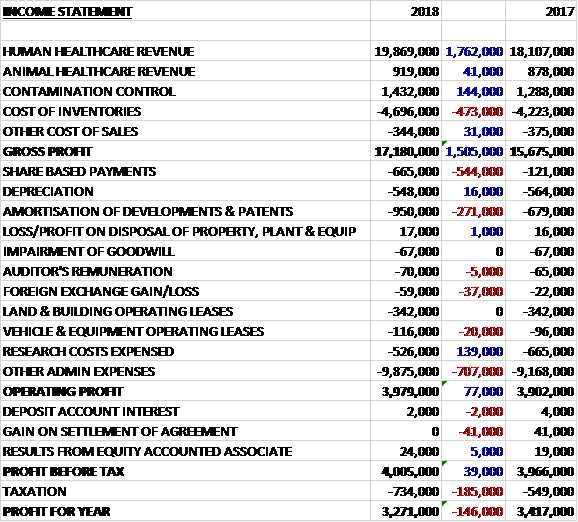
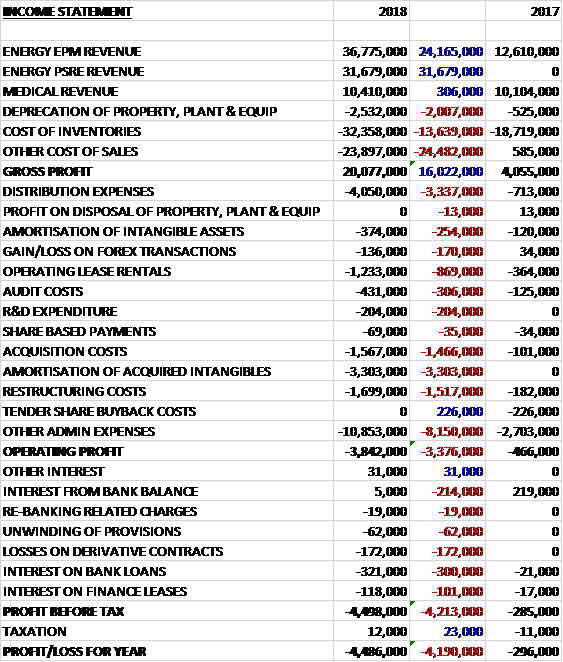
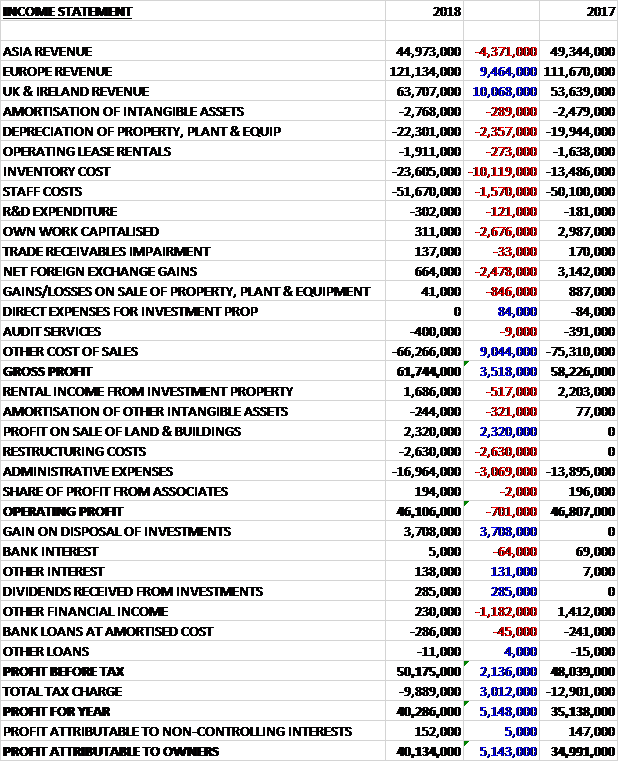
Revenues increased when compared to last year with a £1.8M growth in human healthcare revenue, a £144K increase in contamination control revenue and a £41K growth in animal healthcare revenue.  Cost of inventories were up £473K but other cost of sales reduced slightly to give a gross profit £1.5M higher.  Share based payments were up £544K, amortisation charges increased by £271K but research costs were down £139K before a £707K growth in other admin expenses meant that the operating profit was £77K higher.  There was no gain on the settlement of an agreement, which brought in £41K last time and tax charges increased by £185K mainly relating by movements in deferred tax, which meant that the profit for the year was £3.3M, a decline of £146K year on year.

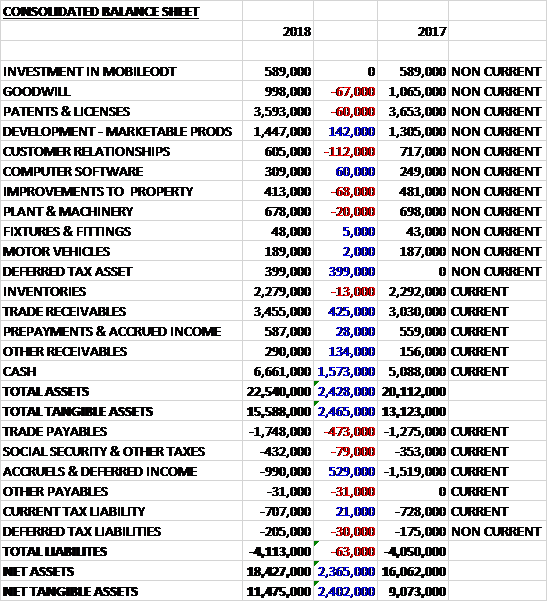
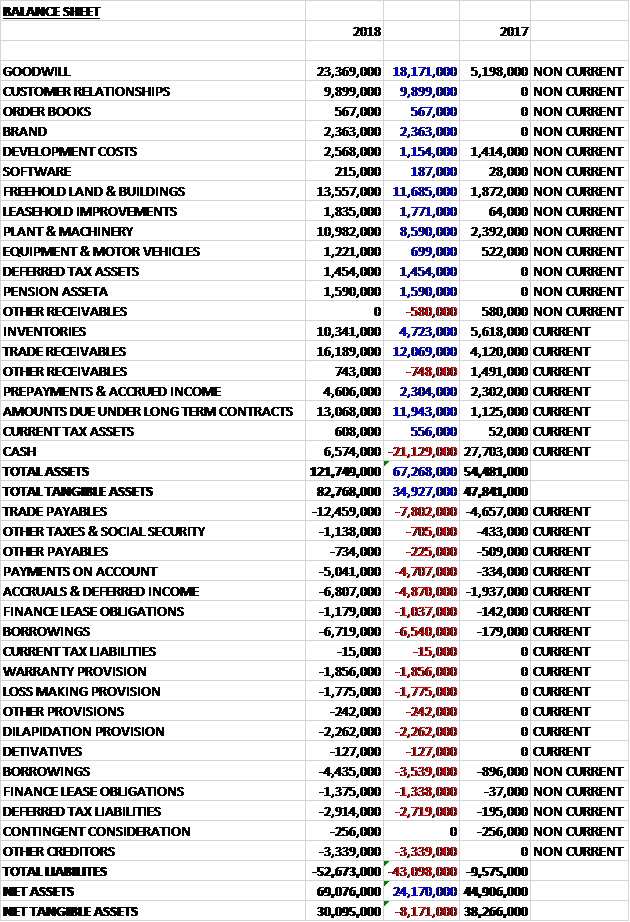
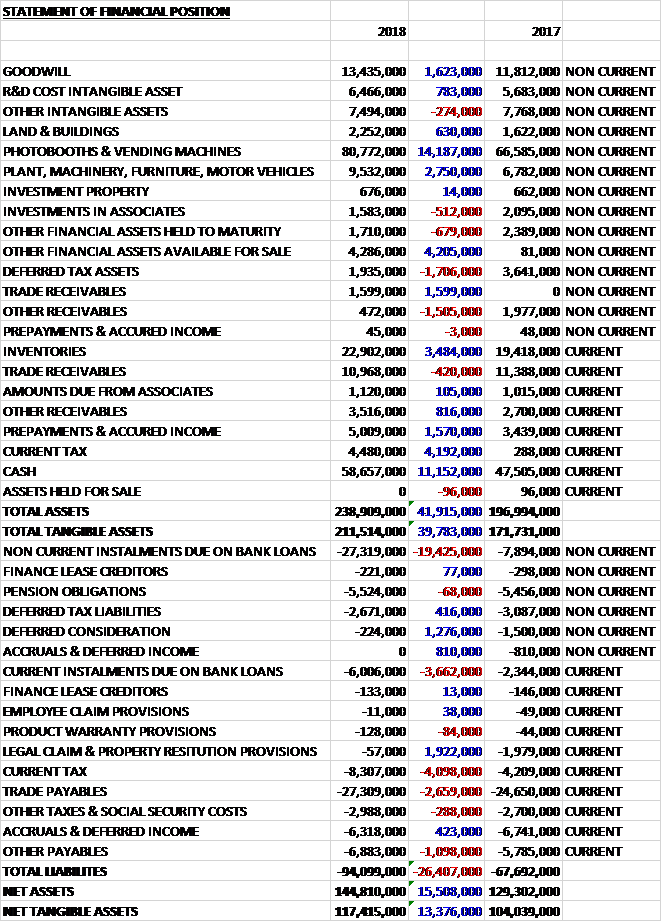
When compared to the end point of last year, total assets increased by £2.4M driven by a £1.6M growth in cash, a £425K increase in trade receivables, a £399K growth in deferred tax assets and a £142K increase in development costs.  Total liabilities also increased slightly as a £529K decline in accruals and deferred income was offset by a £473K increase in trade payables and smaller increases in other liabilities.  The end result was a net tangible asset level of £11.5M, a growth of £2.4M year on year.

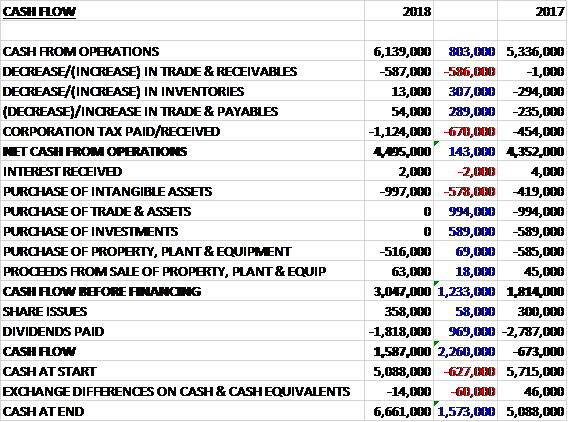
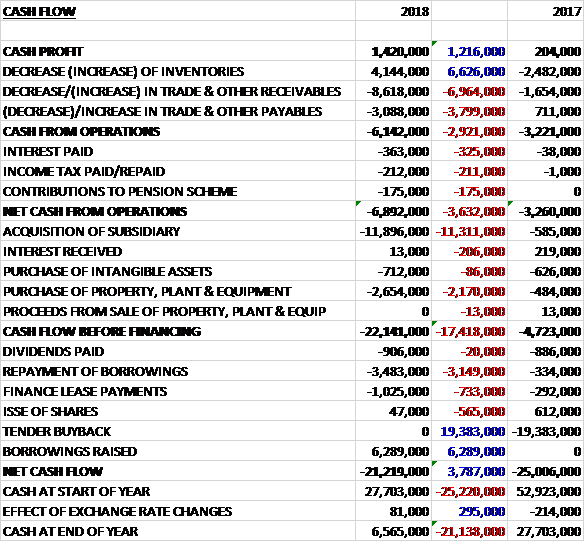
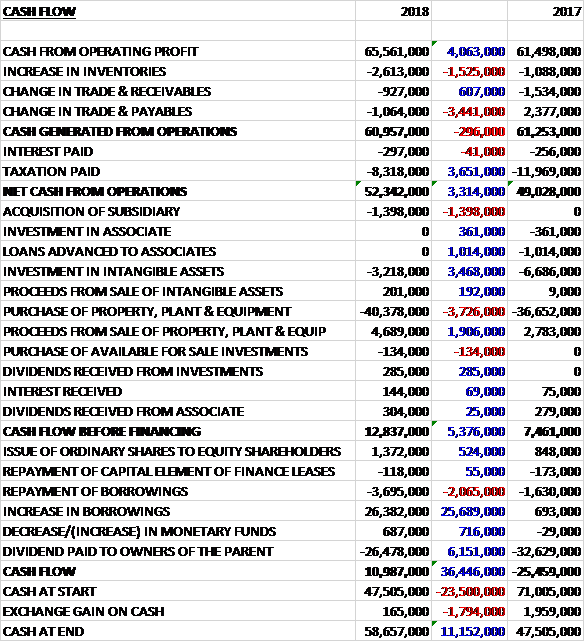
Before movements in working capital, cash profits increased by £803K to £6.1M.  There was a cash outflow from working capital but this was broadly similar to last year.  Tax payments increased by £670K to give a net cash from operations of £4.5M, a growth of £143K year on year.  The group spent £997K on intangible assets and a net £453K on property, plant and equipment to give a free cash flow of £3M.  Of this £1.8M was spent on dividends which gave a cash flow of £1.6M and a cash level of £6.7M at the year-end.

Overseas sales were ahead by 19% but UK sales only advanced by 2% due to the high market penetration in the UK.  Gross margin remained static at 77%.  They have seen an increase in the cost of componentry as a result of the scarcity of certain chemicals and an increase in the cost of cardboard and plastics.  Offsetting this they acquired the Hong Kong distributor, gaining their gross profit. 

The gross profit in the Human Healthcare division was £15.7M, a growth of £1.5M year on year.  UK sales remained unchanged but direct sales to the EU were up 26% and to ROW countries increased by 11%.  Sales to EU distributors were up 15% and sales to ROW distributors increased by 32%.

The gross profit in the Animal Healthcare division was £550K, a decline of £105K when compared to last year.  Direct sales to UK customers declined by 16%.  Direct sales to the EU fell by 40% (although this was just £2K).  Direct sales to ROW customers were up 8%.  Sales to UK distributors were up 9% but sales to EU distributors declined by 1%.

The gross profit in the Contamination Control division was £922K, an increase of £128K when compared to 2017.  UK sales were up 11%.  Direct sales to the EU increased by 89% and direct sales to ROW countries were up 444%, albeit from a low base.  Conversely, sales to EU distributors were down 36% and there were no sales to ROW distributors (£1K last year).

The group have invested £981K in regulatory and product enhancement programmes with £500K of that relating to the US (the same as last year).  Although no revenues have been earned in the US to date, progress has been made to build a commercial platform from which to enter the market.  During the year they received their first regulatory approval from the EPA for their foam-based Duo product and will start manufacture and marketing on a limited scale during the year ending 2019. 

Since the year-end they have made a second submission to the EPA to extend Duo’s product claims as an intermediate level disinfectant and they are well advanced in generating the data for their first submission for a 510 approval from the FDA.  This is also for Duo and will position the product as a high level disinfectant.  They have a partnership with Parker labs which means they have put in place manufacturing capability and a national distribution network.  They have granted Parker marketing rights for Duo’s use in ultrasound where they are the market leader in the US for ultrasound conductive gels, the contract is royalty-based.

A further investment of £120K was made in MobileODT, the Israeli diagnostic tool business that the group has a 3% stake in. They have expanded their commercial collaboration with the business to include a version of their Duo product labelled for use with their mobile colposcope.  After the year-end, the group have also become MODT’s distributor for EVA in the UK, Australia and New Zealand.

The group have advised their continental customers to increase their stockholdings over the coming months in preparation for possible disruption to the supply chain.  Based on available advice they believe that they will be able to CE mark their disinfectants and sell them in Europe irrespective of the outcome of the Brexit negotiation.  The only certainty is that they will experience turbulence this year and their normally predictable pattern of trade will be disrupted to some extent.  Notwithstanding this near-term uncertainty the outlook for the group remains positive. 

At the current share price the shares are trading on a PE ratio of 34.8, falling to 25 on next year’s forecast.  After a 13.6% increase in the dividend, the shares are yielding 1.8% which increases to 2.1% on next year’s forecast.  At the year-end the group had a net cash position of £6.7M.

On the 19th November the group announced the acquisition of European distributors Ecomed in Belgium, France and the Netherlands.  The business is the group’s exclusive distributors and Benelux and France and is both cash generative and profitable.  Of their €3.1M of sales, €2.5M were Tristel products and in the first half of this year they generated an EBITDA of €570K.  The board expect the acquisition to contribute earnings of at least £250K this year and in subsequent years to be materially earnings enhancing.  The office and logistics hub in Antwerp will be beneficial post-Brexit.

A consideration of €5M is to be paid upon completion, of which €3.4M is payable in cash and €1.6M from the issue of 573,860 new shares.  Additional deferred consideration of up to €1.8M may be paid before July 2019 based on audited EBITDA in 2018 exceeding €840K and sales growth of 15% being achieved in 2019.  France in particular is an underdeveloped market for the group with sales there only a fraction of those in Germany.

On the 11th December the group released a trading update.  They expect pre-tax profit (excl. share based payments) for the first half to be no less than £2.2M compared to £2M last year.  This figure takes account of the transaction costs arising from the Ecomed acquisition with the period only including one month’s full profit contribution from them.  The integration of these new businesses is progressing well.  Overall the group is performing in line with management expectations and the US regulatory approvals project is progressing as planned.

Overall then this has been a decent year for the group.  Profits did decline but this was due to a higher deferred tax charge and pre-tax profits saw a modest rise despite rising costs.  Net assets improved and the operating cash flow increased with a decent amount of free cash being generated.  The US applications seem to be progressing well but there is real uncertainty on the horizon in the form of Brexit.  The first half of the coming year has started well but the shares are highly priced with a forward PE of 25 and yield of 2.1%.  Tricky one this but I still think the shares are on the expensive side.

Paypoint Share Blog – Interim Results Year Ending 2019

Paypoint has now released their interim results for the year ending 2019.

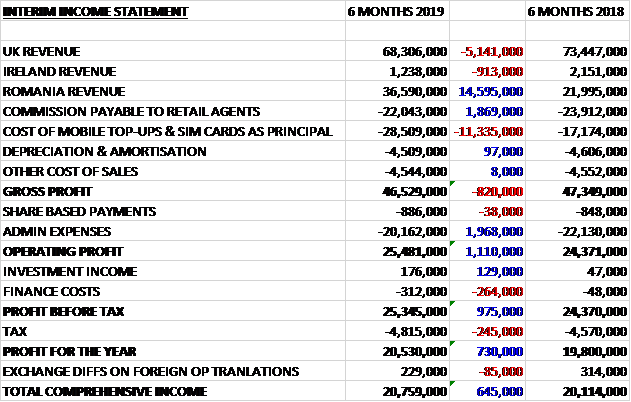
Revenues increased when compared to the first half of last year as a £5.1M decline in UK revenue and a £913K fall in Irish revenue was more than offset by a £14.6M growth in Romanian revenue. Commission payable to retail agents decreased by £1.9M but the cost of mobile top-ups and sim cards as principal increased by £11.3M which meant that the gross profit was down £1.1M. Admin expenses fell by £2M, however, to give an operating profit £1.1M above that of last time. Investment income was up £129K but finance costs increased by £264K and tax charges grew by £245K to give a profit for the period of £20.5M, a growth of £730K year on year.

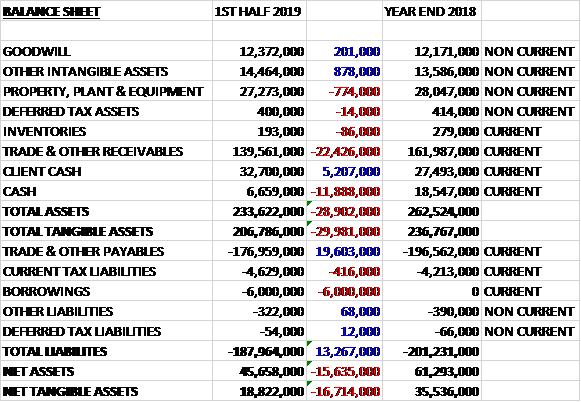
When compared to the end point of last year, total assets declined by £28.9M, driven by a £22.4M decline in receivables and an £11.9M decrease in cash, partially offset by a £5.2M increase in client cash. Total liabilities also declined as a £6M increase in borrowings was more than offset by a £19.6M fall in payables. The end result was a net tangible asset level of £18.8M, a decline of £16.7M over the past six months.

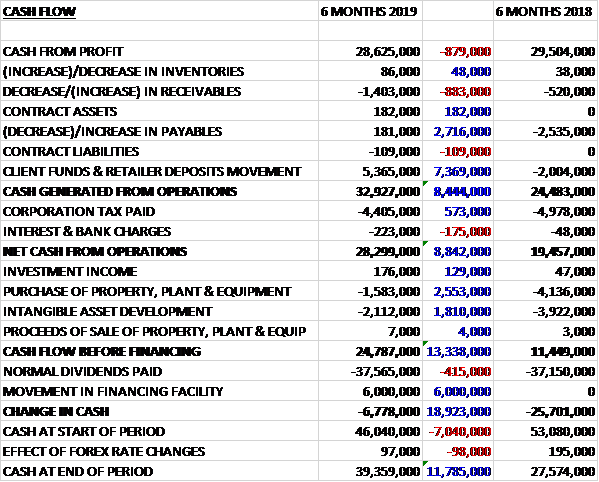
Before movements in working capital, cash profits declined by £879K. There was a cash inflow from working capital and tax payments fell by £4.4M to give a net cash from operations of £28.3M, a growth of £8.8M year on year. The group spent £2.1M on intangible asset development and £1.6M on property, plant and equipment (capex is expected to increase in the second half to around £8.8M) to give a free cash flow of £24.8M. This did not cover the £37.6M paid out in dividends so the group took out £6M of financing to give a cash outflow of £6.8M and a cash level of £39.4M at the period-end.

Overall net revenue was down 1.6% due to the £2.2M impact of the closure of the Department of Work and Pensions’ SPS and the £500K impact from the revised Yodel commercial terms. Underlying net revenue growth was 3.2% as a £400K increase in UK retail services and a £1.7M growth in Romania was partially offset by a £300K reduction in UK bill payments and top-ups.

The net revenue in the Bill and General division was £25.4M, a decline of £1.3M year on year. Net revenue in the UK fell by £2.3M, largely due to the closure of SPS worth £2.2M, whereas Romanian net revenue increased by £1M as a result of the Payzone acquisition and continued organic growth including adding ten new clients which increased market share in the country from 24% to 38%. The Multipay service continued to perform well and increased transactions by 56%.

The net revenue in the top-ups and e-money division was £10.7M, a growth of £400K when compared to the first half of last year. UK net revenues declined by £200K as a result of the expected ongoing decline in UK mobile top up volumes, offset partially by good growth of 10% in UK e-money transactions. Romanian revenues were up £600K driven by a growth in transactions following the acquisition.

Net revenue in retail services overall was flat. In the UK, ATM revenues declined by £100K despite an increase in the number of transactions. Services fees increased by £1.4M driven by the rollout of the PayPoint One terminal, partially offset by lower SIM activation revenue. Card payments rebate revenue was flat but parcels net revenue reduced by £1.4M, partially reflecting the £500K impact of the revised terms with Yodel along with a 16% decline in parcel volumes through Yodel. Net revenue in Romania increased by £100K.

Going forward, a good performance in the first half underpins the board’s confidence that there will be progression in pre-tax profit in the full year. The New carrier partnership with Ebay is now live in 2,500 sites ahead of the festive season and the group remain focused on delivering at least two additional carriers in 2019. E-money and MultiPay volumes grew strongly and a further six clients were secured including Monzo.

At the current share price the shares are trading on a PE ratio of 12.7 which falls to 12.6 on the full year forecast. After an increase in the dividend the shares are yielding 10.4%. I can’t find a forecast for the dividends so if we assume the normal dividends are kept the same the forward yield is 5.8%.

Overall then this has been a bit of a subdued period for the group. Profits did increase, but this was due to a one-off VAT refund. Net assets deteriorated and although the operating cash flow improved, this was due to working capital movements and cash profits declined. A decent amount of free cash was generated but dividends weren’t covered entirely. The reduction in net revenue seems to be due to the SPS closure and revised Yodel terms. Excluding these items, there was growth, mainly due to the acquisition in Romania.

I think there is potential for the parcels business to take off at some point but this company does not seem to be growing at the moment. The forward PE of 12.6 and yield of 5.8% is not that taxing, however.

On The 24th January the group released a trading update for the quarter ending December 2018.  Underlying net revenue increased by 1.4% to £30.9M.  Including the impact of £1.3M from the closure of the Simple Payment Service and the renegotiated Yodel parcel fees, net revenue declined by 2.8%. 

UK retail services net revenue increased by £400K to £9.7M driven by good growth in service fee revenue which increased by 31% to £2.6M.  There was an increase of 1,455 PayPoint One terminal sites over the quarter.  Given the strong momentum over the quarter, the year-end target of 12,400 sites has been increased to 12,700.  The sales effort in the quarter continued to focus on extending penetration of the Base version of the EPoS solution charged at £10 a week to replace the legacy T2 devices and as a result, the average weekly service fee per site reduced from £15.01 to £14.89.

Card payment transactions grew by 23% to 28.8 million, driving a £200K increase in net revenue.  ATM performance was strong despite the difficult market conditions with transactions increasing by 3.1% to 10.6 million.  ATM net revenue declined by £200K primarily due to the reduced Link interchange fee which became effective in July. 

Strong momentum continued in the Parcels business.  The group delivered a first Christmas with new partner Ebay, with over 2,500 sites processing Ebay parcels and volumes are expected to grow as awareness of the service increases.  A third party has now been added to the Collect+ network and is expected to go live before the end of the year.  As anticipated, Yodel volumes continued to decline albeit at a lower rate, resulting in overall parcel volumes reducing by 3.2% to 6.8 million in the quarter.

 Bill payment underlying net revenue was flat at £13.2M despite a 1.5% decline in transactions.  The group has continued to execute its strategy to diversify its client portfolio to smaller higher margin customers.  In the quarter, they added five new clients.  Multi Pay drove a strong performance in energy transactions as businesses increasingly adopts their omni-channel platform, where transactions increased by 44% to 8 million. 

Overall top-up and e-money transactions declined by 15% to 11.1 million.  As expected this was driven by the continued declined in the prepaid mobile sector.  E-money transactions, however, continued to grow strongly with transactions increasing by 13%.  Top-up and e-money net revenue declined by nearly 3% with the reduction in volumes offset by increased average top-up values and the growth of e-money transactions which have a higher net revenue per transaction.

In Romania, net revenue increased by £200K to £3.7M.  The migration of the Payzone network is making good progress, increasing operational efficiency and profitability.  Romanian sites reduced from 18,984 to 18,317 in line with rationalisation plans to remove unprofitable sites.  Transaction volumes declined by 2% primarily due to telecom operators switching customers to post-paid bills and new EU legislation reducing roaming charges.

At the period-end the group had a net cash position of £52.1M including £42.3M of client cash and retailer deposits.  Seems like much of the same to me and the board’s expectations for the full year remain in line with the previous outlook.

Colefax Share Blog – Final Results Year Ended 2018

Colefax have now released their final results for the year ended 2018.

Revenues increased when compared to last year due to a £4.3M growth in decorating revenue, a £1M increase in fabric revenue and a £270K increase in furniture revenue. Cost of inventories increased by £925K and other cost of sales grew by £2.8M to give a gross profit £1.9M higher. Distribution and marketing costs declined by £211K and there was a £1.3M reduction in exchange losses. This was offset by a £256K loss on disposal of assets and a £1.2M growth in other admin costs to give an operating profit £1.8M higher. Finance costs were broadly flat but tax charges declined by £155K which meant there was a profit for the year of £3.8M, a growth of £1.9M year on year.

When compared to the end point of last year, total assets increased by £614K driven by a £2.5M growth in cash, a £191K increase in prepayments and accrued income and a £148K increase in inventories, partially offset by a £727K decline in leasehold improvements, a £461K decrease in trade receivables and a £405K decline in other receivables. Total liabilities declined during the year as a £734K growth in accruals and a £519K increase in trade payables was more than offset by a £1.2M improvement on the forward currency contracts and a £723K decrease in the deferred tax liability. The end result was a net tangible asset level of £27.4M, a growth of £1.5M year on year.

Before movements in working capital, cash profits increased by £2M to £7.7M. There was a cash inflow from working capital and the tax payment reduced by £336K which meant that the net cash from operations was £7.9M, a growth of £5.1M year on year. The group spent £2.4M on property, plant and equipment to give a free cash flow of £5.5M. Of this, £2.2M was spent on share buy backs and £488K on dividends to give a cash flow of £2.9M for the year and a cash level of £9.2M at the year-end.

The overall improvement in profit has three main reasons – losses on hedges put in place prior to Brexit reduced by just over £1M to £959K and have now come to an end; the decorating division delivered an exceptional performance, increasing profits by nearly £800K and in the core fabric division, sales in the main US market increased by 6%. Profits were also aided by a £350K deferred tax benefit relating to the reduction in the US corporate tax rate.

Sales in the Fabric division were up 1.5% or 3.3% at constant currency. The operating profit increased by 32% to £3.7M due to the reduction in hedging losses. Excluding this, operating profit declined by 3% to £4.7M reflecting unfavourable forex movements. The main reason for the increase in sales was an improvement in trading conditions in the US which increased by 6% following last year’s 8% decline. Sales in the second half of the year increased by 8% compares to 4% in the first half. The improving trend reflects the strength of the US economy and in particular the housing market.

Sales in the UK increased by 1% despite increasingly challenging trading conditions at the top end of the market. High rates of stamp duty continue to weigh on the number of housing transactions and the situation is not being helped by Brexit uncertainty. They are currently refurbishing their trade showroom in Chelsea Harbour which is expected to be completed by the end of August.

Sales to continental Europe increased by 3.5% but were flat at constant currency. Despite increased optimism in the first half, overall market conditions have remained difficult and seem unlikely to improve in the short term. This is especially true in France, Germany and Italy, and despite some improvement in the wider economy, in France sales reduced by 2%. In Germany sales were flat and in Italy they declined by 1%. Sales in the ROW decreased by 8% mainly due to the Middle East where contract orders can cause significant sales fluctuations from year to year.

Sales in the Furniture division increased by 11% and the operating profit was £130K, a growth of £107K year on year. The increase was achieved despite challenging market conditions in the UK and the order book at the year-end was significantly ahead of the prior year. Export sales account for just 13% of total furniture sales and represent a growth opportunity given the current weakness of sterling.

Decorating sales increased by 53% and pre-tax profit was up £793K at £901K. Last year the business moved to a new showroom and offices in Belgravia. This was the first full year of operation at the new premises and the board are pleased with the performance. The new showroom is popular with customers and a more selective approach to antique sales meant they have exceeded expectations. Several major contracts were completed during the year and although customer deposits remain healthy, they expect activity to return to more normal levels next year.

Going forward, the largest market, the US, is showing signs of continued growth which should underpin the performance this year. In addition they no longer have any hedging contracts put in place prior to the Brexit referendum and will benefit from the current weakness of sterling. In the UK and Europe they are experiencing increasingly difficult trading conditions and they expect this to offset some of the expected growth in the US. In addition, they expect their decorating division to return to a more normal level of activity following an exceptional performance in 2018.

At the year-end the group had a net cash position of £9.2M compared to £6.7M at the end of last year. After the dividend increased by 4%, the shares are yielding 0.8% which increases to 0.9% on next year’s consensus forecast. At the current share price the shares are trading on a PE ratio of 15.8 which rises to 16 on next year’s forecast.

On the 13th September the group released a trading update where they said that trading since the year-end had been in line with expectations. In the fabric division, sales in the US in the first four months of the year increased by 4% on a constant currency basis. In the UK, sales decreased by 3% and in Europe they decreased by 5%. Whilst the group are optimistic about continued growth in the US, they expect trading conditions in the UK and Europe to remain relatively challenging.

Overall then this has been a good performance from the group. Profits were up, net assets increased and the operating cash flow improved with a decent amount of free cash being generated. The core US market is performing well but conditions are far more subdued in the UK and the rest of Europe. The stellar performance in decorating is unlikely to be repeated but the group should benefit in the coming year from the lack of hedging losses. The forward PE of 16 and yield of 0.9% are not that cheap and on balance I feel the group is a little too dependent on the US market, albeit this is performing well. Tough but I’d like to see the price come down a bit before buying in.

Avon Rubber Share Blog – Final Results Year Ended 2018

Avon Rubber has now released their final results for the year ended 2018.

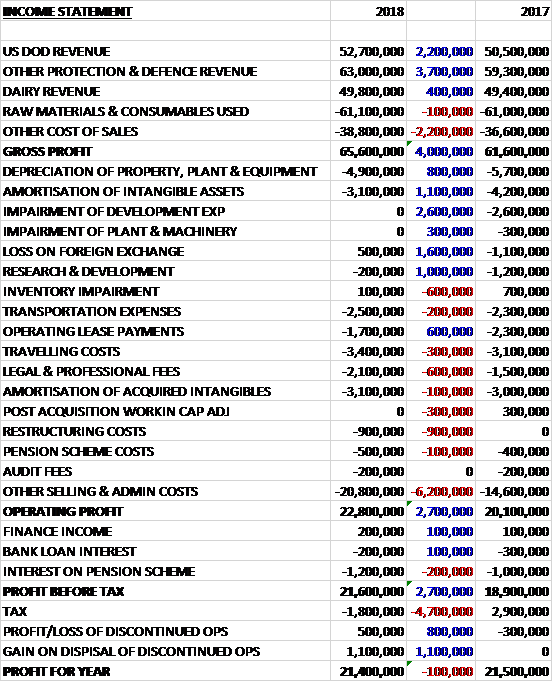
Revenues increased when compared to last year due to a £2.2M increase in US DOD revenue, a £3.7M growth in other protection and defence revenue and a £400K rise in dairy revenues. Cost of sales also increased to give a gross profit 4M higher. Depreciation was down £800K and underlying amortisation fell by £1.1M. There was also a £1.6M positive swing to a forex gain and a £1M decline in R&D expenditure along with a lack of impairments, which accounted for £2.9M last year. There was, however, £900K of restructuring costs and a £6.2M increase in other selling and admin costs to give an operating profit that was £2.7M higher. There was a £4.7M increase in tax charges which meant that the continuing profit for the year was £19.8M, a decrease of £2M year on year.

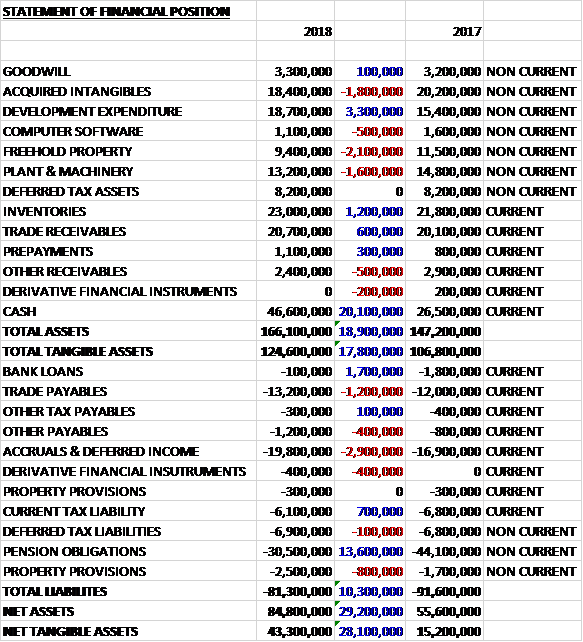
When compared to the end point of last year, total assets increased by £18.9M driven by a £20.1M growth in cash, a £3.3M increase in development expenditure and a £1.2M growth in inventories partially offset by a £2.1M decline in freehold property, a £1.8M decrease in acquired intangibles and a £1.6M fall in plant and machinery. Total liabilities declined during the year as a £2.9M growth in accruals and deferred income and a £1.2M increase in trade payables was more than offset by a £13.6M decrease in pension obligations and a £1.7M decline in bank loans. The end result was a net tangible asset level of £43.3M, a growth of £28.1M year on year.

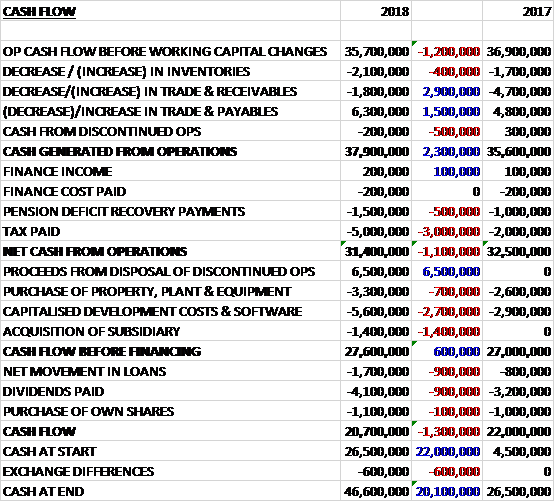
Before movements in working capital, cash profits declined by £1.2M to £35.7M. There was a cash inflow from working capital but pension deficit payments increased by £500K and there was a £3M increase in tax payments to give a net cash from operations of £31.4M, a decline of £1.1M year on year. The group received £6.5M in consideration for the disposal but spent £1.4M on acquisitions, £3.3M on fixed assets and £5.6M on development costs and software which meant that there was a free cash flow of £27.6M. This easily covered the £4.1M of dividend payments along with £1.1M of share purchases and £1.7M of loan repayments which gave a cash flow of £20.7M and a cash level of £46.6M at the year-end.

The operating profit in the Protection division was £19.5M, a growth of £3.3M year on year, although £2M of this increase was due to last year’s impairment costs. Revenues grew by 10% at constant currency with military up 8%, a 28% growth in law enforcement and a 10% decline in fire.

DOD revenue grew by £2.2M reflecting higher M50 mask system volumes and increased volumes of spares and accessories more than offsetting unfavourable currency movements. DOD spares and development costs revenue decreased by £3.6M due to last year including higher development costs relating to the M69 air crew mask. Having received orders for 219,000 M50 mask systems during the year, they entered the new financial year with an order book of 89,000. Revenue from their ROW military business declined by £300K as initial revenue from sales of their powered and supplied air range and the MCM100 underwater rebreather largely offset the non-repeat revenue last year from the 37,000 FM50 general purpose marks delivery.

The increase in law enforcement revenue was driven by strong performances in hoods and mask systems across all regions as they continue to make progress in converting police forces to their products. In North America, they also benefited from increased sales of filters and spares to their expanding customer base. Initial sales of their supplied and powered air ranges also contributed to the growth in the year and their expanded product range provides a foundation for future growth.

The decline in Fire revenue was due to tougher market conditions in North America as customers delayed purchasing on older legacy ranges in advance of the new 2019 compliant products. The NFPA approval of Magnum later in the year will offer greater opportunity for growth in the business as they expect fire services to return to the market to procure the updated and compliant SCBA range.

The Argus thermal imaging camera technology has made a significant cumulative contribution to Fire market sales. During the year they launched the Mi-TIC E L camera which can now be sold into the US market. This model is the most cost effective entry level solution for fire services.

During the period the group signed a five year contract with the UK MOD for the resupply and in-service support of its General Service Respirator. They expect that this will generate further opportunities to deepen their relationship with the MPOD. Likewise the launch of the MCM100 underwater rebreather has provided further opportunities to establish and strengthen relationships with a number of European and ROW militaries and demonstrate their innovation and delivery capabilities.

This year has seen an expanded market demand for their protection products as the needs of the law enforcement community to meet the CNRN threats has increased. This has been reflected in the significant sales momentum in the US for their supplied and powered air products, following NIOSH safety approval in March, and the strong sales performance of hoods and mask systems in Europe, the Middle East and Asia. They have seen good market penetration with US law enforcement municipalities and in the medium term they expect their share of the market to grow.

The operating profit in the Dairy division was £6M, a decline of £300K when compared to last year, entirely due to last year’s post acquisition working capital adjustment. The underlying operating profit was flat (although at constant currency it increased by 6.7%). At constant currency, revenues grew by 4%. Interface grew revenue by 3%, PCI by 2% and Farm Services by 20%. The growth reflects the current stable global dairy market conditions and the improved trading conditions in North America in the second half of the year. The closing order book declined by 31% to £2.5M, however.

The growth in Interface revenue was driven by a stronger performance in North America in the second half of the year and strong growth in Latin America, Europe, the Middle East and Asia Pacific. North American revenues overall declined by 2% reflecting the weaker market conditions in the first half of the year. In Europe, revenue grew by 7%. Latin America grew liner revenues by 12% reflecting market share gains in Brazil, and Asia Pacific liner revenues increased by 8% as a result of stronger market conditions in China.

The sales of their Precision, Control and Intelligence range have continued to perform well across their key markets. Revenue grew by 2% at a constant currency rate as dairy farmers continued to invest in their PCI products to drive farm efficiency. This was driven by growth in Europe of 3.6% and of 10.5% in the Middle East along with market share gains in Latin America driving growth of 17.6%.

Farm Services saw revenue growth of 20% to £5.2M, reflecting the ongoing success of Cluster Exchange which saw a 14% growth in cluster points in the period. North America saw a growth of 21% and Europe 19%. The extension of Farm Services to include Pulsar Exchange and Tax Exchange provides opportunities for growth in future years. At the year-end, Cluster Exchange had grown to 40,000 cluster points on 2,100 farms.

In March the group disposed of Avon Engineered Fabrications, its US based hovercraft skirt and bulk liquid storage tank business. The business made a profit this year of £500K and the group made a £1.1M gain on disposal (net of tax).

In June the group acquired the assets relating to Merrick’s calf nurser product line. The consideration was $1.8M in cash and associated costs of acquisition were $300K. The acquisition involved the purchase of tooling equipment at a value of £1.2M and customer lists, order books and brands at a value of £400K. There was no goodwill generated. The group has been a long standing manufacturer of the rubber component of the calf nurser product and the acquisition enables them to take full control of the distribution.

The restructuring costs this year of £900K represent a charge in respect of the relocation of the West Palm Beach assembly facility. To achieve a greater level of production efficiency, they relocated this facility to their main US manufacturing facility in Cadillac, Michigan. During the year they worked with a local partner to install a production assembly line in Kazakhstan for the production of escape hoods for the oil and gas sector.

The development expenditure in the year has focused on Protection products with significant investment in the UK GSR, MCM100 and next generation hood programmes. They also invested in obtaining NIOSH safety approval for their supplied and powered air range and preparing their upgraded Magnum SCBA for NFPA verification. Development expenditure in the dairy business included the upgraded milk meter equipment and subsequent ICAR approval together with the PCI heavy duty equipment for North America to meet the needs of their larger industrial farm customers.

They continued to work with the DOD on a number of potentially significant new platform programmes including the M69 aircrew mask, the M53A1 mask and powered air system and a follow on M50 mask system contract. They currently expect to enter into multi-year contracts with the DOD for the M69 aircrew mask and the M53A1 mask and powered air system in the new year with production starting in the second half. They are also in discussions to put in place a follow on contract for the M50 mask system following the conclusion of the initial ten year contract in July.

After the year-end the high court handed down a judgement involving the pension schemes. This concluded that pension schemed should be amended to equalise pension benefits for men and women. The board are working with advisers to understand the extent to which the judgement chrystallises any additional liabilities for the group’s pension scheme. They are early in the evaluation process but they estimated that the additional liability could be in the region of £3M which is likely to be recognised in H1 2019.

Going forward the opening order book of £37.8M (23% higher than last year) provides good visibility as they enter the next year and they are well positioned to continue their strong momentum into 2019. Within the protection division, first deliveries of the M69 aircrew masks, the M53A1 mask and powered air system, and the UK General Service Respirator of the UK MOD will be made in 2019. The revenue opportunities from new products and customers is expected to offset the impact of the anticipated reduction in M50 mask system volumes. Alongside this they expect continued sustainable growth from the widening customer and product base in Law Enforcement and following the launch of the upgraded Magnum SCBA they expect a stronger performance in the fire business. There also remains a healthy pipeline of potential further contract opportunities.

Dairy market conditions have remained stable, although there has been some recent market caution around expectations for future feed prices. In this environment, they currently expect that the growth trends experienced by the business will continue into the New Year.

At the current share price the shares are trading on a PE ratio of 19.6 which falls to 16.7 on next year’s consensus forecast. At the year-end the group had a net cash position of £46.5M compared to £24.7M at the end of last year. After a 30% increase in the dividend the shares are yielding 1.3% which increases to 1.6% on next year’s forecast and dividends are expected to grow ahead of earnings in the near term.

On the 14th November the group announced that non-executive director Petrus Vervaat acquired 2,000 shares at a value of £27K.

Overall then this has been a bit of a mixed year for the group, although it seems conditions in the dairy market at least improved in the second half. Profits were down due to higher tax charges. Pre-tax profits increased but this was mainly due to a lack of impairments and underlying profits were fairly flat. Net assets increased, however, and although the operating cash flow declined somewhat, plenty of free cash was generated.

The protection division is ticking along well, boosted by a good showing in the law enforcement market. The fire protection market was subdued but should improve next year with new models coming out. The Dairy market was broadly flat but discounting the effect of detrimental forex movements, underlying profits improved driven by a good showing in the farm services division. The forward order book looks good but the shares are not cheap with a forward PE of 16.7 and yield of 1.6%. Despite this, the quality on offer here temps me to buy back in.

On the 7th January the group announced a sole source supply contract to supply the US DoD with the M69 Joint Service Aircrew Mask for Strategic Aircraft, related accessories and engineering support.  The contract has a maximum value of $92.7M over a duration of up to seven years, being a five year base period plus two further one-year option periods.  The group expects to receive the first order under this contract shortly with deliveries expected to commence in H2 of this year.  This is a significant new multi-year mask system platform for Avon Protection and extends their capabilities into the important aviation sector.  They are continuing to pursue a number of other opportunities with the DoD and ROW military customers, both to extend their portfolio further and broaden their customer base.

On the 31st January the group released a trading update.  The protection business saw a solid start to the year with a strong performance in the military business underpinning expected revenue growth in the first half of the year.  Following the award of the M69 Aircrew Mask contract from the US DoD the first order is expected soon with deliveries commencing in the second half.  They are making good progress on a number of other opportunities with ROW military customers and the DoD, including the multi-year M53A1 mask and the powered air system and the M50 sustainment contract.

They continue to see a strong pipeline of law enforcement and fire opportunities but the recent partial US government shut down is impacting the timing of orders from these customers and the group’s ability to obtain export licenses for US manufactured products.  As a result they now expect their law enforcement and fire revenues to be more weighted to the second half of the year.

Global dairy market conditions softened in Q1 with falling milk prices impacting farmer confidence.  This has impacted trading in all three business lines, and particularly precision, control and intelligence given the longer replacement cycle for these products.  They expect upward pressure on feed prices in Q2 to have a further adverse impact on dairy market conditions and they now expect milkrite and Interpuls revenues for the full year to be flat on a constant currency basis with a low single digit decline in the first half.

The continued strong momentum in the protection business is expected to offset the tougher dairy market conditions so the board remain confident of achieving current year expectations.

On the 1st February the group received its first orders under the M69 aircrew mask contract for 7,000 mask systems and related accessories worth $17.8M.  Deliveries under these orders will start in the second half of the year and will contribute to the expected military revenues in 2019.

On the 26th March the group announced that they had been awarded a sole source contract to supply the DOD with the M53A1 mask and powered air system and related accessories.  The framework contract includes the ST54 self-contained breathing apparatus and has a maximum value of $246M over a duration of up to seven years, being a five year base plus a further two years extension.

The group expects to receive the first order under this contract shortly, with deliveries expected to start in the second half of 2019 and will contribute to the expected military revenues for this year.

On the 28th March the group announced that it had received its first order worth $20.2M under the M53A1 mask and powered air system framework contract with the DOD.

Telecom Plus Share Blog – Interim Results Year Ending 2019

Telecom Plus have now released their interim results for the year ending 2019.

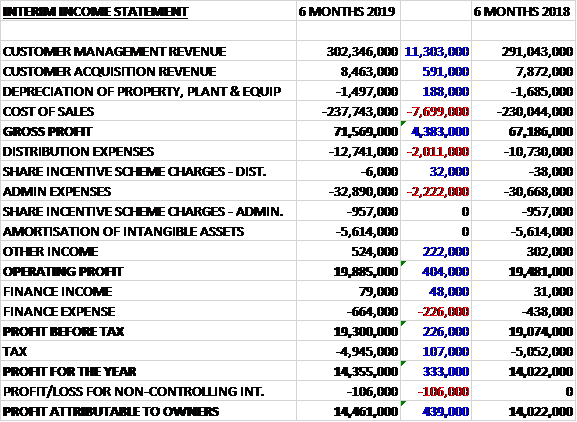
Revenues increased when compared to last year and with cost of sales only increasing by £7.5M the gross profit was £4.4M higher. Distribution expenses grew by £2M and admin expenses were up £2.2M so that after other income grew by £222K the operating profit was £404K higher. Finance expenses were up £226K but tax charges reduced by £107K to give a profit for the period of £14.5M, a growth of £439K year on year.

When compared to the end point of last year, total assets declined by £43.6M driven by a £47.5M fall in prepayments and accrued income, a £5.6M decrease in the energy supply contract and a £2.2M fall in inventories, partially offset by a £4.6M growth in cash and a £4.4M increase in receivables. Total liabilities also declined during the period as a £10.1M growth in bank loans was more than offset by a £50.8M decrease in accrued expenses and deferred income. The end result was a net tangible asset level of £39.9M, a decline of £2.2M over the past six months.

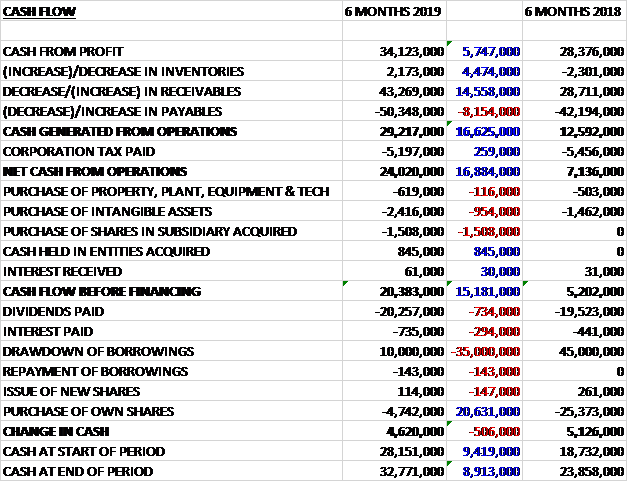
Before movements in working capital, cash profits increased by £5.7M to £34.1M. There was a cash outflow from working capital but this was lower than last time and after tax payments declined by £259K the net cash from operations was £24M, a growth of £16.9M over the past six months. The group spent £619K on fixed assets, £2.4M on intangible assets and a net £663K on acquisitions to give a free cash flow of £20.4M. This only just covered the dividends of £20.3M but the group also purchased £4.7M of their own shares and paid out £735K in interest. After a £10M drawdown of borrowings, there was a cash flow of £4.6M and a cash level of £32.8M at the period-end.
The growth in revenue was slightly above the increase in service numbers with the impact of higher energy prices being largely offset by a continuing decline in average energy usage due to warmer weather and the impact of energy efficiency initiatives. There was a 0.5% increase in gross margins due to improved commercial terms from their key suppliers and industry wide energy price increases.

Admin expenses grew by £2.2M due to a growth in the volume and range of services, higher technology costs as they accelerate their programme to update their core CRM systems, the costs associated with rolling out smart meters, higher regulatory costs and annual inflation-linked increases in staff pay.
In the Energy market, rising commodity, regulatory and distribution costs have led to a significant narrowing of the gap between the Big 6 and the bottom of the market and is expected to narrow further once the price cap takes effect in January. In spite of this reducing gap, customer switching has reached record levels with industry churn now exceeding 20% per annum with significant variation between suppliers (the group has a churn of 12%). As a result some independent suppliers are now struggling to meet their financial obligations with a number having withdrawn from the market.

During the period the group continued their smart meter rollout programme, taking the installed base to 29% of their residential meter portfolio, although this is below where they had planned to be due to challenges with getting their third party meter operators to deliver the agreed schedule. As a result they have established their own licensed meter operator to implement the programme more efficiently. This new venture is on track to install its first smart meters before Christmas with a rapid ramp up in volumes over the course of the coming year. The rollout of second generation smart meters has been subject to further delay but volume installations are expected to start in Q1.

Since acquiring Glow Green in May they have secured improved commercial terms with a number of their main suppliers, supported their move to a larger warehouse and started work on improving the effectiveness of their online customer acquisition process. In addition they have recently introduced a new CRM platform.
These were all prerequisites to supplying boilers directly to their members, being able to maintain and service them and to launching an integrated boiler care product, all of which have significant business potential. Their plans for moving into these markets are progressing well and they should launch these services during the course of next year.

The penetration of Telecoms amongst their membership base has more than doubled over the past six years to 38%. As a result of a number of improvements they made to their tariffs in the Spring, over 70% of new members applied for a mobile service from them during the first half. As average fixed line call revenues follow a gentle downward trend, they continue to ensure that growing their mobile base remains a priority. In a broadly flat overall market, they were pleased to achieve a net increase of 10,000 broadband services, taking their installed base to over 293,000. Of these, around 33% are currently taking one of their fibre options compared to 60% amongst new members.

They remain encouraged by the high level of interest in their home insurance service and have deployed a fully automated marketing and quote & buy system which is delivering conversion rates approaching 30%. As a result they have now issued around 10,000 policies which recent sales running at an annualised rate that will see this total double over the next year. Early indications show that the book they are building is of a high quality with a loss ratio well below the industry average. This should enable then to expand their insurance panel and further increase the current conversion ratio.

Around 97% of policy holders are subsequently renewing their insurance at expiry which gives the board confidence that over time this new service will generate significant value. Their focus in 2019 is to continue building scale for their home insurance product whilst working towards launching other complementary insurance products, starting with boiler cover.

The group saw a particularly strong demand for their Cash Back card during the period. This was relaunched in March, offering savings to members and is proving to be an effective acquisition tool and is one of the key drivers of their performance during the first half.

In May the group acquired 75% of Glow Green Ltd, a small supplier and installer of domestic gas boilers and warranty plans for the consideration of £1.5M plus £500K repayable working capital loan facility. They also acquired 75% of Cofield Ltd as part of the transaction. Cofield was under the same ownership and is a small online retailer of central heating equipment to the plumbing industry.

Going forward, growth in the first half was encouraging and the board look forward to the introduction of the energy price cap at the end of 2018 which will further improve their competitive position. They are on track to deliver growth in customer and service numbers that are materially up on last year and expect adjusted pre-tax profit to remain in the range previously guided at £55M to £60M. It has been a number of years since the overall outlook has appeared this positive.

At the current share price the shares are trading on a PE ratio of 36.7 which falls to 24 on the consensus full year forecast. After a 4.2% increase in the interim dividend the shares are yielding 3.6% which increases to 3.7% on the full year forecast. Net debt at the period-end stood at £16.9M compared to £11.2M at the year-end.

Overall then this seems to have been a decent period for the group. The net asset level did deteriorate somewhat but profits were up and the operating cash flow improved with the free cash flow covering the dividends. The price cap being introduced next year should help further improve the group’s competitive position and things are looking rather rosy. The shares aren’t cheap though with a forward PE of 24 and yield of 3.7% and they are looking just a bit expensive for my tastes.

On the 17th April the group released a trading update covering the year.  Full year pre-tax profits are expected to be towards the lower end of previous guidance at around £56M.  This reflects the impact of a warm winter and the Ofgem price cap and modest initial losses associated with the expansion into related areas such as Glow Green and Boiler and Home Cover insurance.  Net debt increased from £11.2M to £38M reflecting higher working capital requirements associated with changes to the phasing of certain energy industry payments, higher technology investment, smart meter rollout costs and the share buyback.  A further modest increase in working capital is anticipated over the course of the coming year.

The board are encouraged by the profit outlook for the current year.  The combination of accelerating growth in customer numbers and a small increase in their gross margins due to the improved supplier agreement with npower, mean that they expect profits of between £60M and £65M for 2020.

They saw an acceleration in customer growth during the course of the year, notwithstanding a significant and persistent gap between the low introductory fixed price deals available and standard variable prices charged by the big 6.  Although this gap narrowed in Q4 following the introduction of the Ofgem price cap, it has since started to widen again, driven by the questionable pricing strategy adopted by some independent suppliers who continue to sell energy at zero margins.

Customer numbers increased by 4% and service numbers by 8.2%.  In addition, they saw a further improvement in the quality of the customer base with 26.6% of their membership having now switched all their core services to Telecom Plus.  Their own churn fell slightly and remains well below the levels of many other independent suppliers.

This growth has been driven by growing activity in their distribution channel with increasing numbers of partners taking advantage of their Quick Income Plan which enables them to combine the benefit of receiving meaningful introductory payments from recommending their services and building a long term residual income for the future.

The Boiler and Home cover insurance product they launched last month has been designed primarily as a customer acquisition and retention tool rather than a profit centre.  Early sales are encouraging with around 150-250 policies per week.  The home insurance product is now making a modest contribution to profits which will become increasingly significant as the penetration of policies within the member base continues to grow.

Since the acquisition of the 75% holding of Glow Green, losses have been running slightly higher than expected (£1M) but they expect to reach break-even within the next few months. Since making the investment they have assisted them in securing improved customer financing and boiler procurement terms, upgrading their financial controls, optimising their marketing spend and implementing a new CRM platform.

The proposed merger between Eon and Innogy created an opportunity to initiate discussions with npower on the terms of their current wholesale energy supply arrangements with them which has resulted in a number of changes to the previous arrangements including an overall modest improvement to the commercial terms, including a small increase in the current level of discount received; the ability for them to switch from their current retail-minus wholesale pricing structure onto industry standard wholesale price arrangements from 2024; and a relaxation in the previous exclusivity obligations, giving them the freedom to source energy in the open market.  In return they agreed to delete their termination rights on any future change of control in the ownership of npower.

Going forward the board anticipate that the momentum that has been building over the past year will continue, with growth in customer and service numbers for the year ahead reaching 5% and 10% respectively. Despite the higher costs associated with multi-service customers, they are hugely encouraged by the continuing high proportion of new members choosing to switch all their services to them.

EasyJet Share Blog – Final Results Year Ended 2018

Easyjet has now released their final results for the year ended 2018.
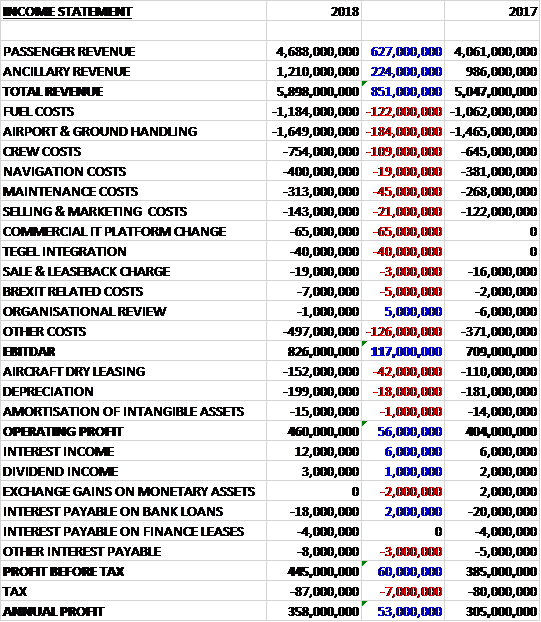
Revenues increased when compared to last year with a £627M growth in passenger revenue and a £224M increase in ancillary revenue. Fuel costs increased by £122M, airport and ground handling charges were up £184M, crew costs increased by £109M, maintenance costs grew by £45M and selling and marketing costs were up £21M. There was a £65M charge related to the commercial IT platform change and £40M was spent on the Tegel integration. Other costs were up £126M to give an EBITDA of £826M, an increase of £117M. Aircraft dry leasing charges grew by £42M and depreciation was up £18M to give an operating profit £56M higher. There was a small increase in interest income offset by a £7M growth in tax charges which meant the profit for the year was £358M, a growth of £53M year on year.
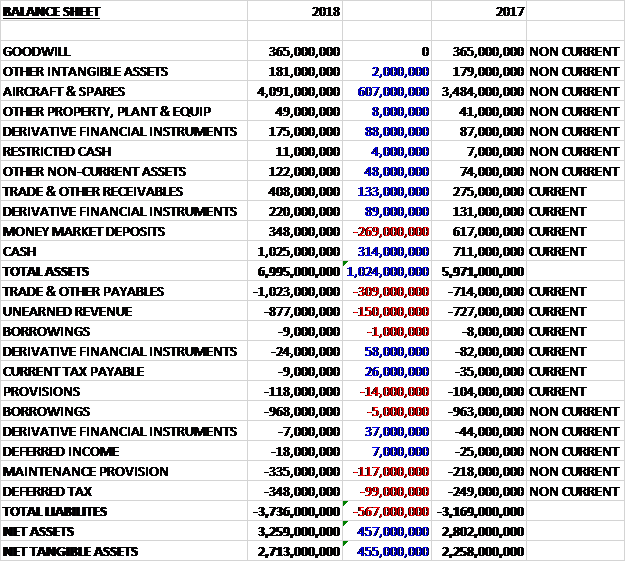
When compared to the end point of last year, total assets increased by £1.024BN, driven by a £607M increase in aircraft and spares, a £314M growth in cash, a £133M increase in receivables, and a £177M growth in derivative financial assets, partially offset by a £269M decline in money market deposits. Total liabilities also increased during the year as a £95M decline in derivative financial liabilities was more than offset by a £309M growth in payables, a £150M increase in unearned revenue, a £117M increase in the maintenance provision and a £99M growth in deferred tax liabilities. The end result was a net tangible asset level of £2.713BN, a growth of £455M year on year.
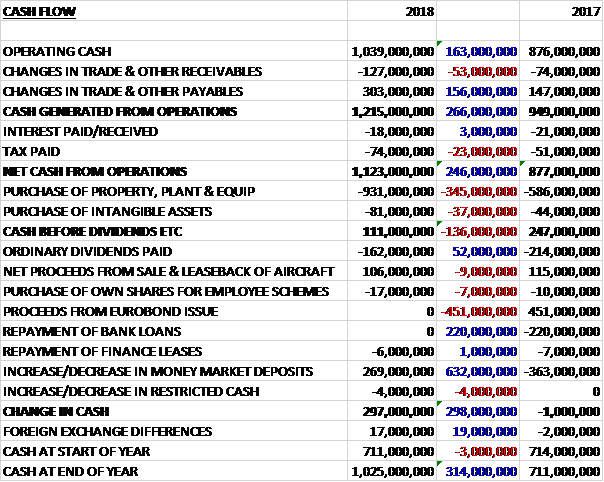
Before movements in working capital, cash profits increased by £163M to £1.039BN. There was a cash inflow from working capital and even after tax payments increased by £23M the net cash from operations was £1.123BN, a growth of £246M year on year. The group spent £931M on property, plant and equipment and £81M on intangible assets to give a free cash flow of £111M. They paid out £162M in dividends and received £106M from the sale and leaseback of aircraft and £269M from a decrease in money market deposits to give a cash flow of £297M and a cash level of £1.025BN at the year-end.

The total European short haul market grew by 5.6% and by 2.8% in the group’s markets. This was lower than in previous years reflecting a rising price of oil and the various issues affecting other airlines. Since the Brexit vote, Sterling has fallen significantly which has had an ongoing negative impact on profit.

Total revenue per seat grew by 6.4% to £61.94 and by 4.7% at constant currency. Passenger revenue grew by 15.4% driven by passenger growth of 10%, nearly half of which was due to Tegel; an increase in the load factor of 0.3% to a record 92.9%. Excluding Tegel this was up 1% to 93.6%; a good demand growth in the UK and France; the benefit of the Monarch and Air Berlin bankruptcies and Ryanair cancellations; and industrial action in France that led to a benefit of £20M as competitor airline and train customers switched to EasyJet.

Ancillary revenue was also very strong and grew 23% (18% excluding Tegel). This was driven by new bag segmentation leading to better conversion rates and improved bag pricing algorithms that better reflected demand, allocated seating demand driving higher conversion rates through pricing improvements and improvements to the website making it easier for customers to add ancillary products.

The growth in ancillary revenue was due to a number of initiatives such as improvements to the baggage options offered, with the introduction of 15Kg and 23Kg options, the continued enhancement of hands free and home puck-up services; continued multi-variant testing of their digital merchandising of ancillary products, leading to a 6% increase in allocated seat attachment rates; the launch of new partnerships such as insurance with Collinson and a two year partnership with Three Mobile who sponsor Hands Free for their UK customers/

In addition there was a trial of an inflight entertainment platform accessed through customers’ own devices, which has driven a 22% improvement in customer satisfaction for customers using the platform vs the average network; the growth of Worldwide by EasyJet, now offering connections to more than ten partner airlines across eleven airports in the network. Bag attachment rates for these bookings are 20% higher than the network average and the missed connection rate below 0.5%. there was growth in the inflight retail business, with inflight vouchers now available in the booking funnel and average transaction value increasing by 4%; and an increase in EasyJet Plus membership of 52%.

The headline cost per seat increased by 4.4% to £55.87, driven by exchange rates, underlying cost inflation and the cost of disruption which remains a major industry challenge. At constant currency it increased by 2.7% and 4.8% excluding fuel. The increase in costs was impacted by disruption with significant third party industrial action, particularly in France, air traffic control capacity constraints due to systems upgrades and weather, which meant a large increase in cancellations to 6,814. Also affecting the price was crew cost inflation, higher crewing levels to support resilience, general inflation and a negative impact from Airbus delivery delays resulting in lower than planned standby aircraft and wet leased aircraft. This was offset by total cost programme savings of £107M and better cost control in airport costs with lower navigation fees.

Total fuel costs increased by 11.5% as a result of capacity growth, higher emissions trading system costs and adverse forex movements. Fuel cost per seat at constant currency declined by 4.3% to £11.72. They have hedged 69% of fuel requirements for H1 2019 for $567 per tonne, 65% in H2 for $571 and 45% in 2020 for $654. The current price of fuel stands at $664 per tonne compared to $501 per tonne last year. Due to hedging, the actual price of fuel for the airline declined by $6 to $590 per tonne.
In December 2017 the group completed the acquisition of part of Air Berlin’s operations at Berlin Tegel airport. This resulted in them becoming the largest short haul operator in Berlin, leapfrogging Lufthansa and Ryanair. Their flying programme at Tegel started in early January, operating an adopted winter schedule with a fleet of mainly wet leased aircraft. As expected, this resulted in a dilutive impact to overall load performance and revenue per seat and an increase in cost per seat while the operation becomes established.

Overall progress to date has been in line with expectations and on track to demonstrate the value of the acquisition. Since start up, EasyJet has seen strong operational performance with on-time performance of 82% vs a network average of 75%. Brand consideration scores have also increased by 5pts in Germany as a result of their increased presence. Demand has been growing steadily with load factors reaching 86% over the summer period despite an inefficient schedule.

The headline profit impact was worse than first expected due to increases in unhedged fuel costs, airport charges and taxes as well as late competitive capacity in the market. Performance improved during the summer as the group took direct control of its revenue management system to improve data decisions and revenue profiles. The total loss for the year is better than originally expected at £152M due in part to faster than planned transition of crew and fleet. In 2019 their Tegel operations will benefit from a longer selling window, schedule improvements, a full flying programme, no planned wet lease costs and pricing optimisation. Schedule optimisation will continue into 2020.

In the UK there was a 4% increase in capacity, in part to match airport capacity increases at Luton; in France there was a 5% increase aligned with their strategy of regional growth; in Switzerland a growth of 7% including a focus at their base in Basel; in Italy a 10% increase in capacity as a result of consolidation in Venice; a 48% increase in Germany following the Air Berlin acquisition; a 3% increase in the Netherlands consolidating the position at Schipol, adding routes and frequencies; and a 6% increase in Portugal to strengthen connections to the rest of Europe.

The group see an opportunity to radically change their holiday offering. Currently only one in forty EasyJet customers book a hotel through the group which they plan to change by refining their current business model to capture more value through the customer journey, build the necessary infrastructure to directly curate their product offering, develop direct relationships with hotel partners, and build enhanced value from bundling.

They also plan to improve the profit made in this area by moving to a contribution rather than commission model. They have already spoken to a large number of hotel partners and are progressing well to develop stronger direct relationships with them. Their core focus will remain on flights but the holiday offering incorporates other aspects of the customer journey which can be sold to a customer base that is well aligned.

There was a 17% increase in business customers, driven in particular by strong business penetration on Berlin Tegel routes. The business pricing premium increased by 14% due to higher penetration and the benefit of cancellations by other airlines leading to late bookings and higher yields. High premiums were also generated from sales through indirect channels.

The group will extend their business offer through the development of business products, a recognition programme and improved back office functionality. The development will focus on improving connectivity to their customers through improved back office functionality including the development of an SME portal; a more personalised product offering including new business fares and bundles; and ongoing improvements to the schedule. Since may they have started to offer semi-automated invoicing, launched Flight Club for business partners, undertaken schedule analysis and adapted their schedule to prioritise business routes at certain times of the day.

Over the last few years the impact of increasing disruption has led to a declining trend in on time performance and customer satisfaction. During 2018, on time performance decreased by 1% to 75%. The group has begun a process of self-help which has already seen a strong improvement at Gatwick by 3% to 68% following the contract with DHL to provide ground handling, further investments in resilience and as a result of their partnership with Gatwick to resolve wider system issues. As a result of this improvement, they have now agreed with DHL to manage ground handling at Bristol and Manchester too.

As of the year-end the group had taken delivery of two A321s with a third since delivered. These aircraft are operated from Gatwick, enabling growth in a slot-constrained airport. The planes have a 51% higher seat capacity than the A319s and deliver 9% cost savings compared to an A320neo and 20% more than the A319.
The group is potentially going to be severely affected by Brexit. They have established an Austrian entity which will enable them to continue to operate flights domestically in the EU. In order to operate air services within the EU, however, they must comply with the requirement that a majority of shareholders must be nationals of a member state, Switzerland, Norway, Iceland or Liechtenstein. Already 47% of shares are hold by these nationals and they are trying to get this to increase to more than 50%.

The group is permitted to regulate the level of ownership by non-qualifying nationals by suspending rights to attend and vote at meetings and forcing the sale of shares. They currently have no intention of exercising these powers but this will be kept under review pending the outcome of Brexit.

As usual there are a number of non-headline items. The largest was a £65M commercial IT platform charge. During the year they decided to change their approach to technology development for their commercial IT platform through better utilisation and development of existing systems on a modular basis rather than working towards a full replacement of their core commercial platform. The charge was required to write down IT assets under development which will no longer be used by the business. A charge of £5M in relation to associated commitments was also incurred.

The next item was a £40M integration cost of the Tegel operation. This comprises £14M of engineering costs to align the technical specs of ex-Air Berlin aircraft with the rest of the EasyJet fleet, £10M of dry lease rental costs incurred prior to those aircraft being operational, £7M of crew costs and £9M of other costs including consultancy and legal fees.

The group incurred £19M of sale and leaseback costs relating to ten of their oldest A319 aircraft. This included a loss on disposal of £11M and an £8M maintenance provision. There were Brexit-related costs of £7M principally due to the cost of re-registering aircraft in Austria, and £2M of other non-headline costs.

Going forward the group’s capacity growth in the first half of next year is expected to be around 15% and 10% in the year as a whole. On a like for like basis, revenue per seat is expected to be down by low to mid-single digits including the effect of annualisation of one-off revenue benefits from this year, dilution from Berlin and the effect of Easter moving to the second half. On the same basis, total headline cost per seat excluding fuel is expected to be flat next year. Capex for the year is expected to be £1BN. There are initiatives targeted to deliver savings of over £100M in 2019, offsetting inflationary pressures.

Revenue per seat in H1 is expected to be down by mid-single digits mainly due to the new treatment of booking fee revenue which is now recognised at the time of flying and which will benefit the second half of the year, as well as the revised treatment of disruption costs which are now partially offset against revenue. Based on the current fuel price, fuel costs for next year are expected to be a headwind of between £50M and £100M and the forex impact is expected to be a headwind of around £10M.

At the current share price the shares are trading on a PE ratio of 12.2 which falls to 10.2 on next year’s consensus forecast. After a 43% increase in the dividend the shares are yielding 5.3% which increases to 5.4% on next year’s forecast. At the year-end the group had a net cash position of £396M compared to £357M at the end of last year. After allowing for the impact of aircraft operating leases etc, adjusted net debt increased by £325M to £738M, however.

On the 22nd November the group announced that CFO Andrew Findlay bought 3,500 shares at a value of £40K. He now owns 33,916 shares.

Overall then this has been a strong year for the group. Profits were up, net assets increased and the operating cash flow improved. There was a reduction in free cash, however, which didn’t cover the dividends. The markets are still quite healthy but there does seem to be some slow down. The group has benefited from some of their rivals going out of business or encountering other problems. The ancillary revenue is doing particularly well due to new bang segmentation and some other stuff. Costs have risen, however, mainly due to the increased disruption that the industry seems to be experiencing, along with the Tegel acquisition.

Tegel has obviously been dilutive this year but hopefully it will start contributing soon. The holidays and business travel initiatives have potential and the DHL ground handling contract really seems to have helped mitigate further on time issues at Gatwick. The company is obviously rather constrained by Brexit, and really doesn’t benefit from weakening sterling but and revenues per seat are expected to reduce in the first half of next year. Still, with a forward PE of 10.2 and yield of 5.4% this seems to be factored in any I am holding on here.

On the 22nd January the group released a trading update covering the most recent quarter.  Robust customer demand drove passenger and ancillary revenue growth which was in line with expectations. Underlying revenue per seat was positive but this was offset, as expected, by the impact of last year’s one-off revenue benefits, the dilutive impact of Tegel and new accounting standards delaying the recognition of revenue.  The group has made good progress with its cost and operational performance but both were affected by the impact of drone activity at Gatwick over Christmas. 

In the first half of 2019, booking levels remain encouraging despite the lack of clarity around Brexit.  Second half bookings continue to be ahead of last year and their expectations for the full year headline pre-tax profit are broadly in line with current market expectations. 

Total revenue in Q1 increased by 14%.  Passenger revenue was up 12% and ancillary revenue increased by 20%.  Passenger numbers increased by 15%, driven by an 18% increase in capacity, albeit this was slightly lower than expected due to late A321 deliveries from Airbus.  Load factor decreased by 2 percentage points to 89.7%, due to the one-off increase in prior year late demand and the dilutive effect of Tegel.

Total revenue per seat decreased by 4.2% at constant currency, affected by an increase in underlying revenue per seat of 1.5% due to robust underlying demand and disciplined capacity growth by competitor and continued growth in ancillary revenue per seat through better bag and allocated seating sales.  This was offset by the dilutive effect of Berlin Tegel, last year’s competitor bankruptcies and Ryanair cancellations, the £8M impact of the change in accounting standards, and the £5M impact from the drone issue at Gatwick. 

The group’s underlying cost performance has been solid and in line with expectations, before the impact of the drones at Gatwick.  Headline cost per seat excluding fuel at constant currency increased by 1% reflecting a £10M cost impact of the drones at Gatwick, the annualisation of crew pay deals, and ownership costs reflecting new aircraft and some additional leasing costs resulting from late Airbus deliveries. 

The group has entered into another planned sale and leaseback arrangement for ten A319 aircraft which has generated £120M in cash and further facilitates the fleet management strategy.  Six were completed in the quarter and a further four were finalised in January.  This is currently expected to lead to a small loss on disposal.

The group is well prepared for Brexit.  They now have 130 aircraft registered in Austria and has made good progress in ensuring they have a spare parts pool in the EU and in transferring crew licenses.

Going forward, despite the consumer and economic uncertainty created by Brexit, demand currently remains solid and forward bookings for the period after the end of March are robust.  For the full year 2019 the group expects capacity to grow by 10%.  Revenue per seat in the first half is expected to decrease by mid to high single digits reflecting a larger than previously anticipated phasing impact from H1 to H2 from the impact of new accounting standards and the shift of Easter into H2, both of which are expected to have a negative impact of £50M each which will reverse in the second half.  Due to a more competitive market in Berlin and constraints on their ability to deliver network optimisation as quickly as expected, they now expect to make a loss in Berlin in 2019.

Full year headline cost per seat excluding fuel at constant currency is expected to be flat and the full year fuel bill is expected to be £10M to £60M higher.  Forex movements will likely have a £10M adverse impact on pre-tax profits and overall the group’s expectations for the full year are broadly in line with market expectations.

On the 7th February the group released a trading update where they stated that they had made a good start to 2019.

On the 13th February the group confirmed that they were in discussions with Ferrovie dello Stato Italiane and Delta about forming a consortium to explore options for the future operations of Alitalia.

On the 8th March the group confirmed that Chief Commercial and Strategy officer Robert Carey acquired 7,500 shares at a price of £88.6K.

On the 18th March the group announced that discussions regarding the consortium to bid for Alitalia had been stopped.

On the 1st April the group released a trading update covering the first half of the year when they expect to deliver a performance in line with guidance with a loss of £275M before tax.  Revenue is expected to grow by 7.3% with seat capacity increasing by 14.5% as they complete the annualisation of their flying at Berlin.  Revenue per seat declined by 7.4%.  Underlying revenue is expected to be positive, offset by the impact of IFRS 15, the move of Easter into the second half, the dilutive impact of Tegel and the prior year impacts from the Monarch and Ryanair problems.

Headline costs are expected to increase by 18.8% due to increased capacity, higher fuel costs and a modest increase in cost per seat.  Headline cost per seat excluding fuel is expected to increase by 1.4%.  It is expected that the fuel bill will be around £37M higher and forex will have an £8M adverse impact.

While the group will deliver first half results in line with expectations, macroeconomic uncertainty and many unanswered questions surrounding Brexit are driving weaker customer demand and they are seeing increased softness in ticket yields.  Given this uncertainty, the board outlook for the second half is now more cautious.  Despite this, revenue per seat is expected to be slightly higher in H2 reflecting a weakening Q3 demand and an expected year on year uptick in Q4 driven by a programme of yield initiatives and an assumption of a more certain Brexit outlook.

There is no change to guidance for full year cost per seat excluding fuel and forex, which is expected to be flat. 

Cranswick Share Blog – Interim Results Year Ending 2019

Cranswick have now released their interim results for the year ending 2019.

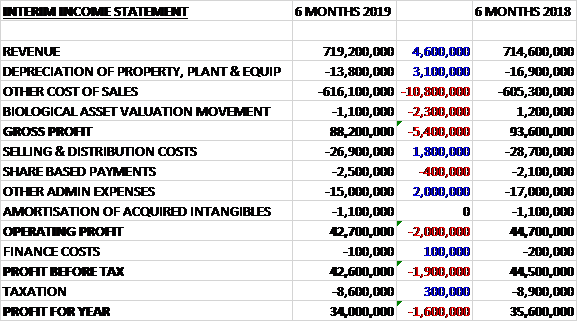
Revenue increased by £4.6M and depreciation was down £3.1M but other cost of sales increased by £10.8M and there was a £2.3M detrimental swing in the valuation of pigs which meant the gross profit declined by £5.4M. Selling and distribution costs declined by £1.8M and other admin expenses fell by £1.6M to give an operating profit £2M lower. Finance costs were down £100K and tax charges fell by £300K which meant that the profit for the period was £34M, a decline of £1.6M year on year.

When compared to the end point of last year, total assets increased by £27.8M driven by a £26.2M growth in property, plant and equipment, an £11.2M growth in inventories, a £1.8M increase in the value of pigs and a £2.2M increase in financial assets, partially offset by an £11.3M decline in cash. Total liabilities also increased during the period as a £2.5M decline in the current tax liability was more than offset by a £6.4M increase in financial liabilities. The end result was a net tangible asset level of £348.3M, a growth of £24.6M over the six month period.

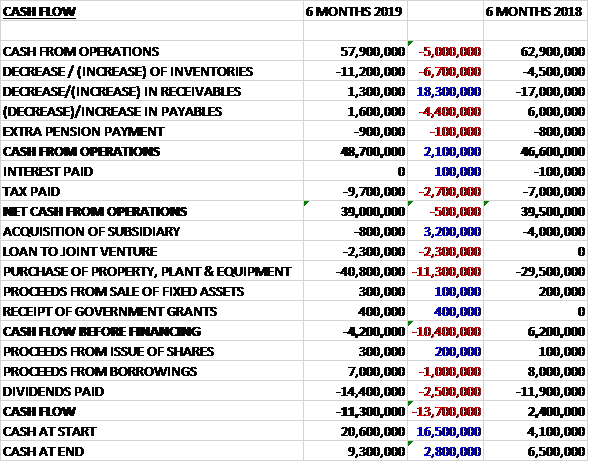
Before movements in working capital, cash profits declined by £5M. There was a cash outflow from working capital but this was less than last year. Tax payments increased by £2.7M, however, which meant that the net cash from operations was £39M, a decline of £500K year on year. The group spent £800K on acquisitions, loaned £2.3M to a joint venture and spent £40.8M on fixed assets to give a cash outflow of £4.2M before financing. They took out £7M of new borrowings but spent £14.4M on dividends to give a cash outflow of £11.3M and a cash level of £9.3M at the period-end.

Total fresh pork revenue fell by 5.5% reflecting lower wholesale and export demand with slightly fewer pigs processed. Retail sales increased by 4.7%, however, underpinned by strong volume growth as the World Cup and summer weather combined to deliver a strong BBQ season as well as good growth in added value convenience ranges. This growth was offset by lower sales of roasting joints and other more traditional products. Overall their retail sales growth was still comfortably ahead of the wider Fresh Port retail market performance.

The group invested £7M across the three pork primary processing facilities during the period, including spend on phase 1 of the extension to the Hull facility which is nearing completion and will further increase capacity and improve operational efficiencies.

Total export revenue reduced by 2.6% reflecting lower overall volumes. Export volumes to the key Far Eastern markets were 12.4% ahead of last year, however, driven by approval for direct export to China from the Ballymena site and for additional product lines from the Hull processing facility, secured in the second half of last year. Volume gains in these markets were offset by softer pricing.

The recent outbreak of African Swine Fever in China is disrupting local pork markets. The disease was also detected in the feral pig population in Belgium in September with the region having been quarantined. The group have implemented heightened biosecurity protocols. During the period they invested over £6M in their farming infrastructure to increase breeding and finishing capacity and a further £2M in a joint venture with one of their key commercial pig producers to increase capacity. The average UK pig price in the period was 8% lower but the price ended the period 1% higher than it started it, rising steadily through to the end of July before falling back.

Convenience revenue increased by 0.6% reflecting strong growth in continental products offset by lower cooked meats sales. Cooked meat sales were lower due to lower pricing and reduced promotional activity. The group continue to develop their Sous Vide and Slow Cook ranges and anticipate further penetration in this sector. A further £11M of capex was made across the three cooked meats facilities on cooking, cooling and slicing equipment to add capacity and improve efficiencies.

Continental products revenue grew strongly, with the new facility providing additional capacity for new olive business won in the period and increase sales of corned beef. Demand for summer eating ranges drove a 10% increase in the overall market for olives and continental meats, with the continental business outperforming the wider UK retail market. The new facility in Bury, which increases capacity by 70%, was commissioned in May with capex of £3M during the period to complete the £27M project. Although commissioning costs were higher than expected and expected efficiency improvements were no delivered immediately, the business is now making good progress towards achieving planned returns and revenue growth is ahead of expectations.

Gourmet products revenue increased by just 0.1% with moderate volume growth offset by lower prices. Strong sausage sales growth, which was well ahead of the market, was offset by lower sales of bacon and pastry products. Sausage sales growth reflected a strong promotional pipeline and the extended summer BBQ season. They secured additional business with their discount retail customers as they expand their premium ranges and they also secured a long term supply agreement with their largest food service customer.

Lower bacon volumes in the period reflected reduced levels of promotional activity from their retail customer as well as the delisting of another customer from April. As they move towards peak seasonal trading, promotional activity and sales volumes have increased with Christmas gammon sales expected to boost revenue. Pastry sales were lower reflecting a range review by the anchor customer but recent new listings with two of the business’ forecourt operators highlight the potential for this business to participate in the growing food to go market. A full Christmas order book and new product listings from the anchor customer from November will provide strong momentum for the pastry business through the second half of the year.

Poultry revenue increased by 19%. The ready to eat chicken category continues to grow ahead of the wider UK meat protein sector and fresh chicken continues to outperform with market volumes ahead by 6% and 3% respectively. Sales of premium cooked poultry grew strongly reflecting the full period benefit of business wins with two of the group’s principal retail customers in the prior year and the launch of new lateral sliced products with one of those customers during the period.

The fresh chicken business operated at full capacity during the period. It was affected during the warm summer by reduced bird growth and increased mortality. Also higher soft commodity prices increased feed costs and wholesale chicken prices were lower. The £60M investment in a new poultry processing facility in Suffolk is progressing to plan. Capex of £12M in the period included £11M on this project with the steelwork frame now under construction. The factory will be operational towards the end of next year and will be the most advanced and efficient facility in the UK. They have also committed to further substantial investment in their upstream agricultural operations to ensure they have a sustainable supply chain to serve the new facility.

There was a high level of capex in the period and future capex under contract at the period-end was a sizeable £35.4M compared to £11.2M at the same point of last year. The new £27M Continental Products facility in Bury was commissioned during the period. They have also invested heavily in their agricultural operations and construction of a £60M primary poultry processing facility in Suffolk due for completion towards the end of next year is now underway.

During the period the group exercised its call option to acquire the remaining 10% of Cranswick Gourmet Pastry Company for £800K reducing the contingent consideration balance to zero.

Going forward there will be challenges to be overcome, not least the uncertainty created by the ongoing Brexit discussions. There are a number of areas in which Brexit could affect the business including access to and the cost of labour, the potential for import tariffs on EU pork and continental food products and the valuation of Sterling against other currencies.

At the current share price the shares are trading on a PE ratio of 20.4 which falls to 18.7 on the full year consensus forecast. After a 5.3% increase in the interim dividend the shares are yielding 1.9% which increases to 2% for the full year. At the period-end the group had a net cash position of £2.2M compared to £20.6M at the year-end.

Overall then the group has struggled somewhat over the period. Profits declined due to increased cost of sales and the operating cash flow deteriorated with no free cash being generated. Both convenience and gourmet segments were flat during the period and while poultry saw revenues increase, fresh pork saw a decline due to lower wholesale and export demand. The group is currently undergoing heavy capex so doesn’t have much free cash, which is great but has its own risks and Brexit has the potential to throw a spanner in the works. This is still a quality company but I feel momentum has been lost somewhat and with a forward PE of 18.7 and yield of 2%, this doesn’t seem to be reflected in the share price and I am considering selling.

On the 7th February the group released a trading update covering Q3.  As expected, revenue was 2% lower compared to last year.  Strong growth in poultry and continental products was offset by lower sales from other pork related categories.  The UK pig price continued to ease, ending the quarter 7% down on last year with this downward trend being reflected in selling prices.  Performance over Christmas was robust.

Construction of the new poultry processing facility in Suffolk is continuing to plan with the exterior building works nearing completion and commissioning anticipated towards the end of the next financial year as previously indicated.  They have agreed a long term supply contract with Morrison Supermarkets to supply fresh poultry from this new facility.  They will shortly start supplying the same customer with a range of cooked poultry products from their added value poultry facility in Hull.

Net debt increased during the quarter, reflecting the seasonal increase in working capital and ongoing capex projects, but ended the period in line with the same stage last year.

Going forward, the board’s expectations for the performance this year is unchanged.  For the following year, the operating margin is likely to decline, reflecting the potentially challenging commercial landscape, together with start-up and commissioning costs associated with the new Suffolk facility, only partly offset by management actions.

Notwithstanding these challenges, the new facility and existing added value poultry facilities and broadening customer base, provide a solid platform to further develop their poultry business and drive future growth in this expanding category.

On the 12th February it was announced that non-executive director Tim Smith had purchased 1,500 shares at a value of £39K.

Avingtrans Share Blog – Final Results Year Ended 2018

Avingtrans has now released their final results for the year ended 2018.

Revenues increased when compared to last year due to a maiden £31.7M of Energy PSRE revenue a £24.2M increase in Energy EPM revenue and a £306K growth in Medical revenue. Depreciation was up £2M, cost of inventories increased by £13.6M and other cost of sales grew by £24.5M to give a gross profit £16M higher. Distribution expenses increased by £3.3M, operating lease rentals were up £869K and other underlying admin expenses grew by £8.2M. We also see a £3.3M amortisation of acquired intangibles, a £1.5M growth in restructuring costs and a £1.5M increase in acquisition costs to give an operating loss £3.4M greater than last time. There was a £214K decrease in loan interest income couple with a £300K increase in loan interest charges along with some other increased finance costs which meant that the loss for the year was £4.5M, a £4.2M deterioration year on year.

When Compared to the end point of last year, total assets increased by £67.3M driven by an £18.2M growth in goodwill, a £12.1M increase in trade receivables, an £11.9M increase in amounts due under long term contracts, an £11.7M increase in freehold land and buildings, and a £9.9M increase in customer relationships. Total liabilities also increased due to a £7.8M growth in trade payables, a £10.1M increase in borrowings, a £4.9M increase in accruals and deferred income and a £4.7M growth in payments on account. The end result was a net tangible asset level of £30.1M, a decline of £8.2M year on year.

Before movements in working capital, cash profits increased by £1.2M to £1.4M. There was a cash outflow from working capital and a £325K increase in interest, a £211K increase in tax payments and a £175K growth in pension scheme contributions to give a net cash outflow from operations of £6.9M, a deterioration of £3.6M year on year. The group spent £11.9M on acquisitions, £2.7M on fixed assets and £712K on intangible assets to give a cash outflow of £22.1M before financing. They raised a net £2.8M of new borrowings, paid out £906K in dividends and paid £1M on finance leases which gave a cash outflow of £21.2M for the year and a cash level of £6.6M at the year-end.
The operating loss in the Energy EPM division was £1.5M which represents the first time the business has been part of the group. The division bolstered its capacity in India with a new motor rewind centre and has now opened a new facility in China. Both of these will help secure end user business in the region and act as operational hubs for the sale of original equipment, engineering and tendering.

In the UK the business has recently signed an authorised channel and service partner agreement with Baker Hughes, a GE company, which has significant installed base in the country but no effective local facility to service, overhaul and upgrade their equipment. This partnership is thought of as a template for other such opportunities elsewhere.

The business has gained its first order from a Gen IV nuclear developer in the US for a future molten salt technology and also funding from the US Department of Energy to develop molten salt pump technology for advanced concentrated solar applications. With its new range of pumps and seal-less circulating pumps for natural gas and a range of renewable tech, the business is slowly reducing its reliance on coal fired power stations.

The operating profit in the Energy PSRE division was £425K, flat year on year. The Hayward Tyler fluid handling business in Scotland was moved into this division to support the nuclear decommissioning and reprocessing market in the UK which remains a key focus for the group. The group also has a keen interest in both the UK nuclear submarine fleet and associated facilities as well as developing new nuclear tech such as small modular reactors. This division has a good installed base on the UK sub fleet, is the chosen manufacturing partner for the Astute steam turbines and experience to support longer term nuclear tech.

Away from nuclear, the divisional brands also have a strong presence in the oil and gas market. This market remains challenging but activity is increasing and with the global demand for LNG still expected to grow significantly, the group is confident about future opportunities.

The division has seen an increase in the ratio of end user to OEM sales. In particular Peter Brotherhood saw increased aftermarket sales across its installed base, including on one occasion an entire replacement steam turbine. End user service arrangements have been signed to gain better access to the reciprocating compressor installed base and a refresh of the channel partners and agents has been concluded to allow complete focus on this aspect of the business. It has a well developed end user value proposition and with improved agility and customer relevance, is confident of further growth.

The Crown business remains a small but solid performer in the division with new applications becoming apparent for its smart pole solutions. The first of these was a previously won contract for Fluor, for flame-detector masts which are being deployed in a large scale petrochemical plant improve overall site safety.

The operating loss in the Medical division was £109K, a deterioration of £537K when compared to last year despite modest revenue growth. As the new equipment business develops into growing niche markets, the addition of Scientific Magnetics and the MR Resources pan-European partnership will underpin significant investment in this division.

Strategic progress at Scientific Magnetics is promising but the expected resulting orders have been slower to materialise than originally thought and this business made a loss for the year. They have continued to invest for the longer term, however, and in early 2018 they launched a Europe-wide NMR service and support offering with their US partner, MR Resources. This development will only start to bear fruit in the current year but this new service offering means that all three divisions have access to a solid aftermarket revenue stream.

Metalcraft’s UK business with Siemens for MRI components continues to be steady, but progress in China with other vacuum vessel customers such as Alltech was somewhat slower ramping up and was behind plan overall for the year. Composite Products had a solid year with deliveries to Rapiscan improving steadily and showing promise for next year. Other smaller accounts also supported revenues at this unit and a return to profit.

In the upstream oil and gas market exploration is now increasing 6% year on year which although still only half what it was at the beginning of the decade, marks a massive change over recent years. Operating expenditure is now being released to secure current operations, resulting in capex beginning to be slowly released for major new projects. The group is witnessing the front end of this activity through increased bidding and is optimistic regarding future projects. The ongoing investments in technologies such as the subsea boosting tech are now poised to move through the development phase to full deployment as the market reopens.

In the midstream market, although the market predictions for LNG and FRSU vessels remains bullish, in reality the supply chains remains stagnant. The group maintains a close eye on developments and supports projects at the appropriate level from early engineering studies. Timing remains challenging, but the group is confident of securing some projects.

Within the medical markets, the group are investigating a number of niche MRI applications such as veterinary imaging and their associated routes to market with the intention of pinpointing the most promising of these for future investment. Within NMR, their previous attempts to align with the market leader Bruker were unfruitful so they are now looking to align with new market entrant Q One Instruments of China and also with MR Resources of the US. Whilst early days for this initiative they are already winning support contracts for end users and the prospect list for Q One Instruments is promising.

The customer on time in full deliveries score declined from 99.7% last year to 84.2% this year due to lower performance in Hayward Tyler which was struggling with deliveries as a result of cash flow issues and a resulting creditor overhang. These statistics have been gradually improving since the acquisition.

In September 2017 the group acquired Hayward Tyler for a total consideration of £42M, generating goodwill of £18.2M. Since acquisition the business has made a loss of £3.5M. The business’ higher cost debt of £11.5M was repaid at acquisition and a further £10.7M absorbed with HTG costs of £3.7M also being incurred and paid. During the period £3M was removed from the creditor overhang with further right sizing restructuring costs of £1.7M and acquisition costs of £1.6M being paid alongside a further working capital investment of £4.4M

In February the group acquired Ormandy for a cash consideration of £135K, generating goodwill of £50K. Since the acquisition date the business has generated a loss of £16K. The business is now part of the PSRE division and manufactures off-site plant, heat exchangers and other heating, ventilation and air con products. Following the acquisition, the business has been trading out a few remaining loss making contracts and rebuilding its business to be in a profitable position but this has required a cash investment for working capital and initial underutilisation which has since improved.

Going forward the energy divisions has a strong emphasis on both the nuclear and off shore oil and gas markets, both of which are showing signs of regeneration. The medical division continues to focus on high integrity components and systems for medical, industrial and scientific equipment manufacturers. The board are not unduly concerned by Brexit since their direct EU exposure is rather limited and they have taken some initial evasive action in their supply chains. Similarly US government tariff change risks have been largely mitigated by an agile supply chain response but they will continue to monitor this situation closely.

The group is loss making which makes PE ratios a rather moot point but on next year’s forecast the shares are trading on a PE ratio of 20.3. At the year-end the group had a net debt position of £7.1M compared to a net cash position of £26.4M at the end of last year. At the current share price the shares are yielding 1.7% which increases to 1.8% on next year’s forecast.

On the 23rd October the group announced the acquisition of Tecmag of Texas for a total consideration of $243K. The business designs, manufactures, installs and tests instrumentation including full consoles, system upgrades and solid state probes, mainly for MRI and NMR systems. Last year the business had a pre-tax profit of $16K.
Overall then this has been a year of transition for the group, dominated by the acquisition of Hayward Tyler. The loss widened, net tangible assets declined and operating cash outflow worsened but the latter was due to working capital movements and cash profits improved. The only division to make a profit was the Energy PSRE division but profits were flat. This business is reliant on the oil and gas market. The medical division saw losses worsened as orders were slower to come by and the Energy EPM division made a loss on its first contribution. Obviously teething problems would be expected with such a transformational acquisition so I am sure things will improve but the forward PE of 20.3 and yield of 1.8% looks a bit expensive to me.

On the 14th January the group released a trading update covering the first half of the year where they stated that trading had been in line with expectations.  The former HT businesses are continuing to improve and are now fully integrated.  Peter Brotherhood’s large government contract is proceeding to plan and their progress has resulted in further enquiries from the customer.  Metalcraft’s 3M3 box contract is now in production with an expectation that they will achieve full current production capacity by the year-end.

Recent acquisitions are also integrating well. The performance of Ormandy is steadily improving and the outlook for the business is strong.  Integration is also underway at Tecmag.

Trifast Share Blog – Interim Results Year Ending 2019

Trifast have now released their interim results for the year ending 2019.

Revenues increased when compared to the first half of last year due to a £3.6M growth in UK revenue, a £2.2M increase in European revenue, a £991K growth in US revenue and a £436K increase in Asian revenue. Cost of sales increased by £5M to give a gross profit £2.2M higher. Distribution expenses were up £180K and “underlying” admin expenses increased by £1.3M. Share based payments were £164K higher, amortisation of acquired intangibles was £176K higher, acquisition expenses were up £177K and project Atlas costs came to £1.5M to give an operating profit £1M lower. Interest costs increased by £110K and tax charges were up £1.1M, in part due to a settlement last year, which meant that the profit for the year was £5.9M, a decline of £2.2M year on year.

When compared to the end point of last year total assets increased by £14.1M driven by a £6.7M growth in intangible assets and a £6.4M increase in inventories. Total liabilities also increased due to a £6.5M growth in borrowings, a £3.3M increase in dividends payable and a £726K growth in deferred tax liabilities. The end result was a net tangible asset level of £68.9M, a decline of £3M over the past six months.

Before movements in working capital, cash profits declined by £396K to £11.3M. There was a cash outflow from working capital but this was less than last time and after interest payments increased by £109K and tax payments were up £994K the net cash from operations was £4.6M, a growth of £1.2M year on year. The group spent £1.3M on fixed assets and £8.2M on acquisitions which meant that there was a cash outflow of £4.8M before financing. The group paid out £1.3M in dividends and took out £6.2M of new loans which gave a cash flow of £111K and a cash level of £26.7M at the period-end.

The pre-tax profit in the UK division was £4.5M, a growth of £351K year on year with the PTS acquisition contributing £500K with revenue up 10.8%, almost entirely due to the PTS acquisition. Strong organic growth in the distributor and other sales has been tempered by reductions in automotive volumes due to diesel-led transitory changes to product cycles and model builds. The temporary impact of these challenges is expected to continue into the second half of the year whilst platforms at a number of their key customers go through production changeover.

The pre-tax profit in the European division was £4.5M, an increase of £555K when compared to the first half of last year with revenues up 6.6%. This has arisen across a number of sectors with double digit growth in the automotive sector in the Netherlands; in the electronics sector in Hungary and in the general industrial sector in Germany. In Italy, ongoing volume reductions at a large domestic appliances customer have offset some of these gains.

The revenue gains have been tempered by increased costs as the group invests in future growth. Key investments have been made to their Dutch operations where they have expanded the warehousing; in Sweden where they have opened their Technical and Innovation centre in Gothenburg; in Hungary where they have been investing in cross-functional headcount to support the trading increase and in Spain where their newest greenfield site is continuing to develop and build the local market.

The pre-tax profit in the US division was £199K, a growth of £83K when compared to the first half of 2018 with revenues up 31% driven largely out of their ongoing penetration into the group’s existing automotive multinational OEM customers. The low underlying margins are to be expected in this region for the medium term given the level of investments for future growth being made.

The pre-tax profit in the Asian division was £4.9M, an increase of £538K when compared to the first half of 2018 with revenue up 3.9%. This has largely been driven out of the domestic appliances business in Singapore as well as an increase in distributor sales from Taiwan. In China, ongoing automotive wins have offset a decline in electronics sales following the local factory closure of one of their multinational OEMs operating in the region. Production volumes are now shifting to India and the group have already started to see some of this business coming back on line through their operations there.

In April the group acquired Precision Technology Supplies for an initial consideration of £8.5M with contingent consideration of £2.5M in cash payable depending on certain earn out targets. The acquisition generated goodwill of £2M. The business is based in the UK and is a distributor of stainless steel industrial fastenings and precision turned parts, primarily to the electronics, medical instruments, petrochemical, defence and robotics sectors. Last year the business made a pre-tax profit of £700K and since the data of acquisition at the start of the period it has contributed £500K to group pre-tax profits.

In Asia, over the course of this year the group will be completing the expansion at the Singapore facility through the acquisition of additional forging, packing and inspection equipment to bring that additional capacity fully online. In Europe, the Spain site continues to grow with revenues of £500K so far this year. In Italy investments have been made in plant and machinery to expand their manufacturing capacity. A warehouse expansion in the Netherlands is up and running and the new innovation and technical centre in Sweden is helping the group access the additional opportunities that the roll out of electrical vehicle technologies is providing.

Going forward, the second half of the year has started well with a healthy pipeline in place and the board remains confident on delivering their expectations for the year. Around 90% of the group’s automotive supply is outside the combustion engine, mainly in seating, console, dashboard and lighting systems which means that the increase in electric vehicle production is acting as a further growth opportunity although in the short term they expect reductions in automotive volumes in the UK due to diesel-led transitory changes to product cycles that will continue in the second half.

The more muted performance in domestic appliances and electronics this year reflected customer specific factors in Italy and China but the strong growth in these sectors in other regions provides confidence that these markets also continue to have attractive long term potential for the group.

As expected in the UK business they have seen the impact on their gross margins of input cost inflation as a result of the weak pound but notwithstanding the wider potential long term implications of Brexit on the UK economy, they believe that the shorter term operational and financial impact of any Brexit scenario will be manageable.

At the current share price the shares are trading on a PE ratio of 16.2 which falls to 14 on the full year forecast. At the period-end the group had a net debt position of £13.5M compared to £7.9M at the same point of last year. After a 9% increase in the interim dividend, the shares are yielding 2% which increases to 2.1% on the full year forecast.

Overall then this has been a bit of a mixed period for the group. Profits declined due to the Project Atlas costs and increased tax payments, net tangible assets declined and although the operating cash flow increased, this was due to working capital movements and cash profits fell, likely due to Project Atlas costs again. There was no free cash generated due to the acquisition. The European, US and Asian businesses are all performing well but there was no organic growth in the UK due to lower automotive production and increased costs relating to forex movements.

The second half has started OK and the shares are not cheap but probably priced about right with a forward PE of 14 and yield of 2.1%. I remain a holder but they aren’t really the strong hold for me that they were before.

On the 26th November the group announced that sales director Glenda Roberts sold 173,010 shares at a value of £354K. Following the sale she now owns 237,571 shares.

On the 14th February the group released a trading update.  Despite the macroeconomic backdrop impacting the outlook for industry as a whole, the group continues to trade in line with expectations.  Recent contract wins, and a strong pipeline gives them confidence as they look to the future.

As expected, the weakness in the UK automotive markets have remained, temporarily impacting revenues and profitability at a regional level.  Outside the UK, however, they are continuing to build their market share with both existing and new global Tier 1 and OEM customers.  Across the wider group, the sector and regional trends experienced in the first half have largely continued through the period.

PTS, which was acquired at the start of the year, has settled in well and is delivering strong year on year growth.  Project Atlas remains on track and on budget.  The board currently consider that both the operational and financial impact of any Brexit scenario will be manageable in the short term.  Longer term implications for the UK economy are harder to predict.

Photo-Me International Share Blog – Final Results Year Ended 2018

Photo-Me International have now released their final results for the year ended 2018.

Revenues increased when compared to last year as a £4.4M decline in Asian revenues was more than offset by a £10.1M growth in UK revenues and a £9.5M increase in European revenue. Depreciation was up £2.4M, inventory costs increased by £10.1M, staff costs were up £1.6M, own work capitalised decreased by £2.7M and net forex gains decreased by £2.5M. Other cost of sales declined by £9M, however, to give a gross profit £3.5M higher. The group made a £2.3M profit from the sale of their head office but saw £2.6M of restructuring costs, saw rental income fall by £517K and other admin expenses up £3.1M which meant the operating profit was £701K lower. The group made £3.7M from the disposal of investments but other financial income was down £1.2M. After tax charges fell by £3M due to a rate reduction in the UK and tax initiatives in France, however, the profit for the year was £40.1M, a growth of £5.1M year on year.

When compared to the end point of last year, total assets increased by £41.9M driven by a £14.2M increase in the value of photobooths and vending machines, an £11.2M increase in cash, a £4.2M growth in current tax assets, a £4.2M increase in financial assets held for sale and a £3.8M growth in inventories. Total liabilities also increased during the year due to a £23.1M growth in bank loans, a £4.1M increase in current tax liabilities and a £2.7M growth in trade payables. The end result was a net tangible asset level of £117.4M, a growth of £13.4M year on year.

Before movements in working capital cash profits increased by £4.1M to £65.6M. There was a cash outflow for working capital but tax payments were down £3.7M so the net cash from operations came in at £52.3M, a growth of £3.3M year on year. The group spent £1.4M on acquisitions, £3.2M on intangible assets and £40.4M on fixed assets, although they recouped £4.7M from the building sale. This gave a free cash flow of £12.8M. This did not cover the £26.5M paid out in dividends so the they took out a net £22.7M of new borrowings to give a cash flow of £11M and a cash level of £58.7M at the year-end.

Overall profits rose by 4.4% but this included a one-off investment gain of £3.7M relating to the shareholding in Max Sight and a £2.3M profit on the sale of the head office building, although they also included restructuring profits of £2.6M. At constant currency, profits were up just 2.5% and the underlying profit at constant currency declined by 1.6%.

The operating profit in the Asian division was £5.4M, a decline of £3M year on year with revenues down 8.8% reflecting the oversupply of photobooths in the Japanese market following the lower than expected take up of the new ID cards. The Japanese laundry market remains attractive due to lifestyle and other market dynamics and the size of residential housing where a lack of space makes it impractical to have a washing machine at home. The priority is to restructure the Japanese subsidiary before embarking of further expansion, however.

The operating profit in the European division was £31.9M, a fall of £2M when compared to last year due to non-recurring profits last year and an increase in costs this year partly due to higher R&D costs. Revenues were up 8.5%, driven by the rollout of the laundry operations in France, Portugal and Spain.

In France, 5,700 photobooths have now been upgraded with their secure and direct data transfer technologies for ANTS driving licence applications. These machines are performing well. The gradual rollout of the secure and direct data transfer technologies in Germany continued. The group are exploring opportunities to expand the range of services available via their photobooths and have entered into discussions with the Dutch government regarding deploying their direct transmission photo ID technology in the Netherlands.

In France, this technology has been deployed for driving license renewals for more than one year and they are now in discussions with the government to extend the technology to renewals and new passports and ID cards.

The laundry operations have expanded in France, Belgium, Portugal and Spain which resulted in a 40% increase in the number of operated laundry units. Much of the laundry expansion has been focused in France and Portugal where results have been encouraging. In France, new Revolution machines installations increased by 31% and revenue increased by 42%. In Portugal there was a 39% increase in revolution machines installed and a corresponding 56% inc4rease in revenue.

In Continental Europe they operated 63 unattended launderette shops compared with 44 at the end of last year. These sites have traded well in the period and they continue to see further opportunities to grow their launderette presence. They have set up Speedlab cube and Speedlab bio kiosk units at high footfall premises.
The operating profit in the UK and Irish division was £10.4M, a growth of £3.1M when compared to 2017, with revenues up 18%. Fowler, the commercial laundry and catering equipment business, along with Inox and Tersusm made a contribution of £1.3M to profits. This performance reflects the continued expansion of the laundry operations in Ireland and the UK and their B2B offering, as well as the rollout of the secure digital upload technology for the Irish Online Passport. Much of the laundry expansion has been focused on Ireland with a 67% increase in revolution revenue.

They continued the deployment of their encrypted photo ID upload technology for the Irish Online Passport Application Service, with 300 units now upgraded. In the UK they concluded discussions with the Passport Office regarding the deployment of this upload technology for its new online passport renewal service and in December they started the rollout of this technology to their UK photobooths. At the end of the year it had been deployed to 2,200 and they plan to deploy 4,000 by the end of December.

They continue to make good progress in expanding their laundry business, with 183 revolution units deployed in the period. They are looking for further sites including petrol forecourts, supermarket car parks etc and are in discussion with some major retailers. In July 2017 they acquired Inox and Tersus in the UK which provide design, procurement and installation of laundry and catering facilities for companies and institutions such as care homes and hospitals. These laundry units are either sold or operated by the group. Their intention is to merge the three UK B2B acquisitions to become the second largest operator in the UK in this sector.

In Q4 they reviewed the progress of their Photo-Me Retail Operations (the Asda acquisition) in order to reshape the digital printing operations and boost profitability. As previously announced, the decision was taken to refocus the business as an online and unattended digital printing kiosk service. As a result all the manned retail outlets have been closed. The board remains confident that the action take will improve the future profitability of these operations and the business is now profitable.

Excluding Japan, revenue for the ID business grew by 1.2% but including Japan it was down 1.9% to £149.3M. Total revenue for the revolution machines increased by 49% to £21.2M. The group increased its revolution estate by 32% globally and the continued, further accelerated, growth of this estate will be supported by increased production capacity. In H1 of this year, their manufacturing partner transferred production from Hungary to Poland, enabling them to increase production volumes. The early benefits of these additional volumes started to come through towards the end of the year.

The profit of the group’s B2B laundry services amounted to £1.3M and they continue to seek out further acquisition opportunities with a focus on continental Europe. In May they acquired La Wash, a Spanish B2B laundry provider, for a consideration of €4.8M. The business, which is a franchise model, had a pre-tax profit of €796K last year. Kiosk revenues increased by 24% to £16.5M, mainly due to the reorganisation of the retail sites where they have replaced manned sites with unattended vending machines.

The Japanese photo ID market continues to be highly competitive, with the highest density of photobooth units per person in the world. The number of booths increased significantly following the launch of the government’s My Number ID card programme but this is not compulsory and has now gained the momentum operators initially anticipated. During the coming year the group will invest in a thorough restructuring of the Japanese subsidiary which is expected to improve profitability going forward.

The planned restructuring will involve a management reorganisation, rationalisation of admin functions, the relocation of low revenue machines and removal of unprofitable units. In addition, the group will introduce a new photobooth to the country, the production of which is significantly cheaper than previous units deployed. The board expect these initiatives to enable their Japanese business to return to growth in the medium term and the underlying profit expectations for 2019 take into consideration this restructuring cost.

The group are in discussions with financial institutions to provide front-end retail banking services to customers via their photobooth network. The board believes this technology supports the changing dynamics for the retail banking industry and the need for financial institutions to use lower cost platforms to maintain their traditional network. In addition they also continue to identify opportunities to extend their biometric and 3D capture technology.

In July the group completed the sale of its head office building in Bookham. The freehold was sold to Shanly Homes for £2.5M which resulted in a profit on sale of £2.3M. The disposal was part of the group’s review of their property portfolio and consolidated their head office and UK operations into one location. The new HQ is in Epsom.

Going forward the board expect the laundry operations to contribute an increasingly significant share of group profits as they expand within existing markets and penetrate new ones. Alongside this, they expect their ID business to maintain its strong performance and their main focus will be on increasing their government partnerships for their secure ID upload technology. They expect their photobooth estate to continue to deliver steady cash flows.

In the UK, whilst there is a risk that departure from the EU may affect photo ID market growth, in the short term the group may benefit from an influx of blue passport renewals requiring photo ID. Furthermore, the group would benefit from forex translation if sterling were further devalued against the euro. Taking into account the restructuring of the Japanese subsidiary, the board now believes that pre-tax profit will be at least £44M and the board remain confident for the future.

At the current share price the shares are trading on a PE ratio of 12.3 which falls to 11.6 on next year’s consensus forecast. After a 20% increase in the total dividend the shares are yielding 6.9% which increases to 7.6% on next year’s forecast. This is in response to an earlier pledge a couple of years ago to increase the dividend by 20% in both 2017 and 2018. I suspect, given the current market conditions that the regret this slightly and are keeping the dividend flat for 2019. At the year-end the group had a net cash position of £26.7M compared to £39.2M at the end of last year.

On the 13th September the group announced that non-executive director Francoise Coutaz-Raplan sold 250,000 shares at a value of nearly £300K. He now owns 200,000 shares in the company.

On the 14th September the group announced that it had completed the sale of its 50% stake in Stilla Technologies, a French biotech company. The holding was acquired for €1.5M in 2015 and was sold for €5M. The sale on investment is €3.5M and proceeds from the sale will fund the group’s growth strategy.

On the 24th October the group released a trading update covering the first five months of the year which has been in line with expectations. Deployment of the encrypted photo ID upload technology has continued to progress well. In the UK, a total of 2,700 photo booths are now enabled for passport renewals and they are targeting 4,000 by the end of December.

In France, more than 80% of their photo booths have been upgraded with secure photo ID transfer technology for driving license renewals, and this should be deployed to all of them by the end of December. Discussions are continuing with the French government to extend this technology to include photo ID for new passports and ID cards. The group is also in advanced discussions with the Dutch government to deploy this technology in photo booths in the Netherlands for use in driving licenses.

In Japan the group has implemented its plan to restructure the subsidiary with a management reorganisation being completed. In addition, admin functions have been streamlined, low revenue machines have been relocated and unprofitable units have been removed. New units deployed will have significantly lower production costs which will offer a 35% faster ROI. Whilst the market in Japan remains very competitive, the benefits of the restructuring are becoming evident earlier than expected and the board is confident it will return to growth in 2019.

The group expects to benefit from a £700K contribution from the acquired La Wash business in 2019. Expansion of the revolution laundry operations has continued strongly, particularly in Portugal, Ireland and France, and there has been good expansion in the UK. They are investigating deployment of laundry operations into Germany and Italy.

The kiosk market is stable and has continued to perform as expected. In line with plan, the board expects the acquired Asda business to be profitable in 209 as the benefits of the actions taken last year come through. They will continue to opportunistically expand their kiosk presence and will present innovative products based on direct connectivity with smartphones. The first banking booth, which will provide front end retail banking services to customers will be piloted in Paris in collaboration with Anytime, a Belgian Fintech company.

The board maintains its guidance for the full year. Results for the first half will be in line with those of last year, excluding an exchange gain and a favourable litigation outcome in 2018 (so slightly below then).

Overall then this has been a rather difficult year for the group. Profits did increase but this was due to a lower tax charge and sale of investment with operating profits falling. Net assets continued to rise and the operating cash flow improved. The group did make some free cash but this didn’t come close to covering the dividends.

The Asian business struggled due to the oversupply issues in Japan, although this seems to be being remedied ahead of expectations. The European business saw a surprise (for me) fall in profits which was apparently due to increased costs which haven’t worked their way into revenues yet. The UK business performed quire well, however, boosted by the business to business laundry operations.

The shares are now looking quite cheap with a forward PE of 11.6 and yield of 7.6% but it seems clear that this business is not growing at the moment and given the cash hungry nature of the company and the growing debt to cover the dividends, that yield can’t really be sustainable. At least, the sensible thing would be to cut it. The value tempts me but this company seems to be running very hard to stand still, flogging off their investments and office buildings. I don’t really see this as a great investment at the moment.