TT Electronics Share Blog – Interim Results Year Ending 2018

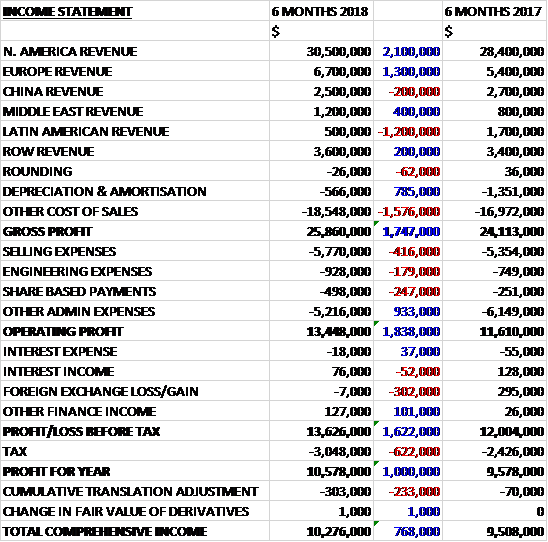
TT Electronics have now released their interim results for the year ending 2018.
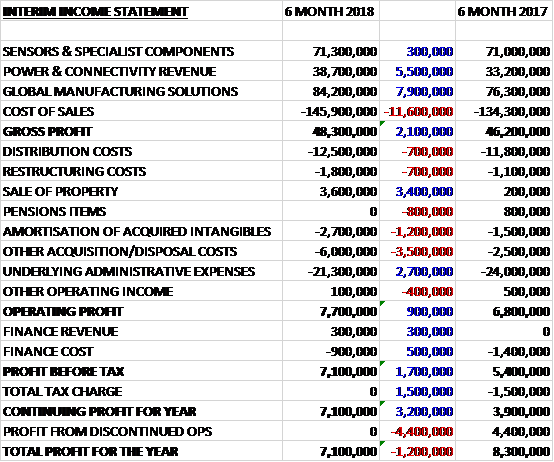
Revenues increased when compared to last year due to a £7.9M growth in global manufacturing solutions and a £5.5M increase in power and connectivity revenue with sensors and specialist components remaining broadly flat. Cost of sales also increased to give a gross profit £2.1M higher. Distribution costs increased by £700K, restructuring costs increased by £700K, there were no pension items, which brought in £800K last time, there was a £1.2M increase in the amortisation of acquired intangibles and a £3.5M growth in other acquisition and disposal costs, offset by a £3.4M increase in property sales and a £2.7M decline in other admin expenses. All this meant that the operating profit was £900K higher. Finance costs reduced somewhat and tax charges were down £1.5M. Offsetting this was the lack of £4.4M profit from discontinued ops and the profit for the period came in at £7.1M, a decline of £1.2M year on year.
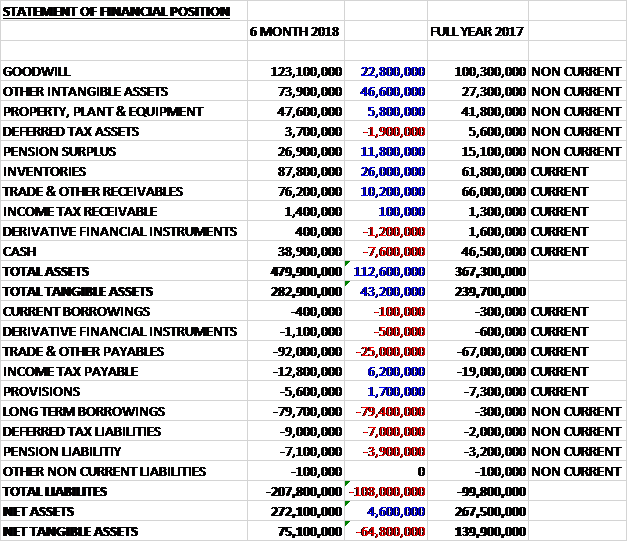
When compared to the end point of last year total assets increased by £112.6M driven by a £22.8M growth in goodwill, a £46.6M increase in other intangible assets, a £26M growth in inventories, an £11.8M increase in the pension surplus and a £10.2M growth in receivables, partially offset by a £7.6M decrease in cash. Total liabilities also increased due to a £79.5M increase in borrowings, a £25M growth in payables and a £7M increase in deferred tax liabilities. The end result was a net tangible asset level of £75.1M a decline of £64.8M over the past six months.
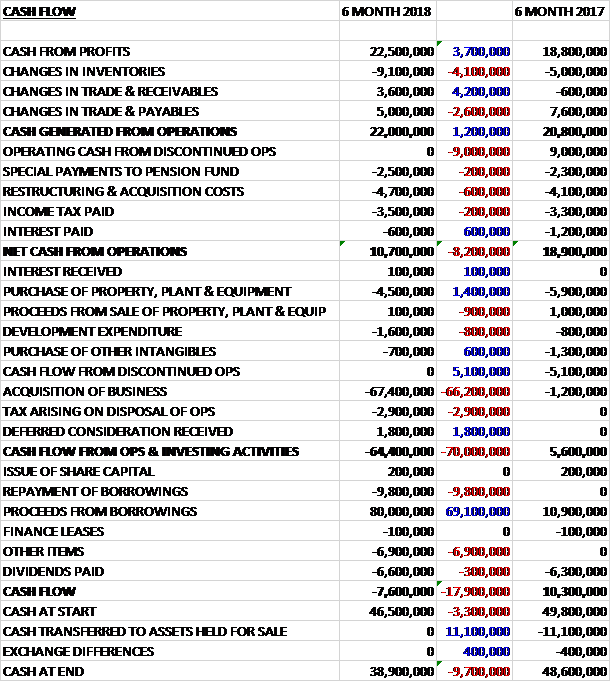
Before movements in working capital, cash profits increased by £3.7M to £22.5M. There was a slight cash outflow from working capital and a £9M reduction in the operating cash inflow from the disposal so the net cash from operations came in at £10.7M, a fall of £8.2M year on year. The group spent £4.5M on fixed assets, £1.6M on development expenditure and £700K on other intangible assets. They received £1.8M in deferred consideration but this was offset by a £2.9M tax payment relating to the disposal and a £67.4M payment for the acquisition. This meant that before financing there was a cash outflow of £64.4M. They took out a net £70.2M in new borrowings, paid out £6.6M in dividends and £6.9M on “other” items, whatever that refers to? The end result was a cash outflow of £7.6M in the first half and a cash level of £38.9M at the period-end.

The underlying operating profit at the Sensors and Specialist Components business was £9.9M, a growth of £1.3M year on year. The group have seen strong market demand continuing across the division and margins improved by 190 basis points due to increased volumes, operational efficiency and an improved product mix. In the UK facility they have continued to make capacity improvements which have enabled them to deliver a record output. In the US they have been increasing output to meet new demand for a high-reliability signal conditioning platform of products which precisely measure signals in electronic circuits. This platform of products is now in its ramp up phase and has contributed to growth in the period.

They continue to see growth in their automotive power inductors product line, driven by the technological advancements for electric and hybrid electric vehicles, and the team won a new European customers in the period. In the medical market the increasing demand for portable medical devices is resulting in increased demand for the group’s solutions. Customer wins have included two medical equipment manufacturers for applications in portable medical monitors.

They launched three new sensing and power management products from their new product and testing cell in Bedlington including a smaller sized power management component able to withstand high current surges in an electronic circuit. The power management component can be used in applications across aerospace, military, comms, medical and industrial markets where the proliferation of electronics requires more advanced and reliable circuitry components.

The underlying operating profit at the Power and Connectivity business was £2.5M, a decline of £900K when compared to the first half of last year although revenues increased by 17% due to the acquisitions. The fall relates largely to the absence of the high margin one-off sales relating to the last time buy activity in the US and £600K of additional one-off investment to meet customer schedules and build capacity to support anticipated future growth. The profit contribution from acquisitions was £1.1M.

The “more electric aircraft” continues to drive a pipeline of demand, Projects they have been working on include a development contract with a strategic partner for a fuel reduction initiative in aircraft, volume ramp-up of products linked to the A350 aircraft platform, and the extension of their capabilities into service support for engine test requirements. Growth in these areas is offsetting the expected reduction in revenue related to the 777 and A380 platforms.

To support current demand patterns and to provide capacity for future growth, they are transferring a number of product lines from the UK to Malaysia where they have established an aerospace capability. They have also established a new product introduction and prototype lab in the UK to service the pipeline of new business opportunities. During the period they won a supplier award from a global engine manufacturer for their work on hybrid microsystems.

Stadium’s Technology Products business forms the group’s new connectivity offering and has been incorporated into this division. Their connectivity offering allows systems to communicate with one another and transmit data wirelessly. Their solutions include connectivity, low power supplies and human machine interface products. The business is performing in line with expectations. They are increasing investment to support the development of these products and a range of new platform products.
The underlying operating profit at the Global Manufacturing Solutions business was £5.9M, an increase of £3.4M when compared to the first half of 2017 with organic revenue growth driven by demand in Asia and North American medical customers. The operating profit contribution from acquisitions was £300K. Margins increased by 360 basis points with the improvement particularly strong in China where the group have been adding more engineering services. The improvement in profitability was largely a result of operational leverage on revenue growth and efficiencies which have driven improvement in the European business. The improvement was also supported by a short term favourable purchase price variance and transactional forex gains of £500K which are not expected to recur.

The demand for technological advancements in the medical market, particularly in developing regions such as Asia, is driving demand for the group’s products. During the period they won a contract with a new medical customer for printed circuit board assembly for a new digital mammography device for breast screening. In the industrial market they won contracts with two new customers including a contract with a new Japanese customer to develop PCBAs for lumiscopes. In addition they have won a contract with a US based technology company for PCBAs for industrial radio remote controls.

They won a PCBA contract with an aerospace and defence customer that has been a longstanding customer in their Power and Connectivity division with the PCBAs used in navigation applications including in GPS systems.

They continue with their focus on operational improvement to drive margin improvement. During the period they closed the facility in Romania, moving product lines to the UK and China. Their European operations have been improving and during the period they won a new customer with a European marine company.

The group are changing their approach to business development to reflect the increasingly design-led focus of the business which requires them to develop more strategic relationships with their customers. They are providing their sales force with new tools and developing their skills through training to improve their success in selling engineered product solutions and higher-value components capabilities.

In April the group acquired Stadium PLC for £45.8M in cash and the assumption of net debt of £13.9M. The business contributed an operating profit of £1.2M in the two and a half month period since acquisition. Stadium is a provider of connectivity solutions across industrial, transportation, medical and aerospace and defence markets. The integration is progressing well with expect cost synergies to date being realised. Costs addressed include the removal of duplicate PLC costs and some initial procurement savings have been identified. The net cost synergy expectations remain unchanged but the evaluation of Stadium’s product capabilities combined with the group’s market presence and scale points to future potential revenue upside.

Previously Stadium split its revenues between Technology products and electronics assemblies. The technology products businesses are being integrated into the newly named Power and Connectivity division whilst electronic assemblies is being integrated into the global manufacturing solutions division.

In June the group acquired Precision Inc for an initial consideration of £17.6M in cash and up to an additional £3M of contingent consideration. In the month since acquisition the business contributed £100K in operating profit. The Stadium acquisition generated goodwill of £14.3M with the Precision acquisition generating £6.8M. Precision is a designer and manufacturer of precision electromagnetic product solutions for critical applications, primarily in medical markets. The business is being integrated into the Power and Connectivity division.

In October last year the group disposed of the Transportation Sensing and Control division to AVX Corp for £125.6M in cash. The gain on disposal was £26.3M and the business generated a profit of £4.4M in the first half of last year.

Going forward, the first half performance and order momentum give the board confidence of progress for the full year ahead of their prior expectations.
At the current share price the shares are trading on a PE ratio of 24.9 which falls to 16.4 on the full year forecast. After an 11% increase in the interim dividend the shares are yielding 2.5% which increases to 2.7% on the full year forecast. At the period-end the group had a net debt position of £41.2M compared to a net cash position £47M at the start of the year.

On the 9th August the group announced that non-executive director Neil Carson purchased 40,000 shares at a value of £103K.

Overall then it is quite hard to get at the underlying performance of this company as there is a lot of noise but it seems to have been a decent period. Profits declined but this was due to no contribution from the disposed business and continuing profits increased. The sale of a property broadly offset the increase in acquisition costs. Net tangible assets fell due to the acquisitions and the operating cash flow reduced, although again the continuing operating cash flow improved. There was no free cash due to the acquisitions but even excluding them, the free cash did not cover the dividends.

The Sensors and specialist components division performed well with strong underlying growth. The Global Manufacturing Solutions division also saw an improved performance due to increased demand from medical customers in Asia and North America, improved efficiencies and one-off forex gains. The Power and Connectivity division saw a worse performance, however, due to the non-repeat of a large US order this year and investments made to cover potential future growth – increased costs basically. With a forward PE of 16.4 and yield of 2.7% these shares aren’t a massive bargain but the expected outperformance is a positive and I continue to hold for now.

On the 13th November the group released a trading update to the end of October. Trading has continued to be positive. For the year to date organic revenue is up 5% with all three divisions growing over the last four months and good revenue, profit and order momentum across all three divisions is expected. They have continued to see positive order intake across all divisions and the order book continues to be strongly ahead of last year, supporting their confidence in the improved growth continuing for the remainder of the year and into the early part of next.

The integration of Stadium is progressing well and the acquisitions are performing in line with expectations. In response to opportunities in connected devices highlighted from the integration of Stadium, in October they opened an Advanced Technology Centre in China.

In November they signed an agreement to establish a joint venture with their long-term supply partner Uniroyal for sensing and power management devices. Uniroyal is the world’s second largest manufacturer in this growing technology. The partnership with combine the group’s design engineering and global distribution channels with Uniroyal’s penetration of the Asian market and higher volume manufacturing capabilities to target the automotive, industrial automation and other high volume market segments. Revenues from the joint venture are expected to start in H2 2019. They expect in invest $4.5M in 2019 and to significantly exceed their 12% roe capital hurdle in 2020.

Following a first half with good revenue growth and significant margin improvement, momentum has strengthened in H2. They are on track with their plans for the year as a whole and confident of meeting the enhanced expectations they set out at the interims. All this sounds very good, I might have taken profits too early? I am tempted to buy back in.

On the 7th December the group announced that non-executive director Jack Boyer purchased 11,792 shares at a value of £25K.

On the 4th January the group announced that non-executive director Michael Baunton purchased 5,000 shares at a value of £10K.

On the 28th January the group released a trading update to the end of December which was positive and in line with plans.  The year finished with a good performance across the business, in line with guidance, with good revenue growth and a strong order book.
IG Design Share Blog – Final Results Year Ended 2018

International Greetings have now released their final results for the year ended 2018.

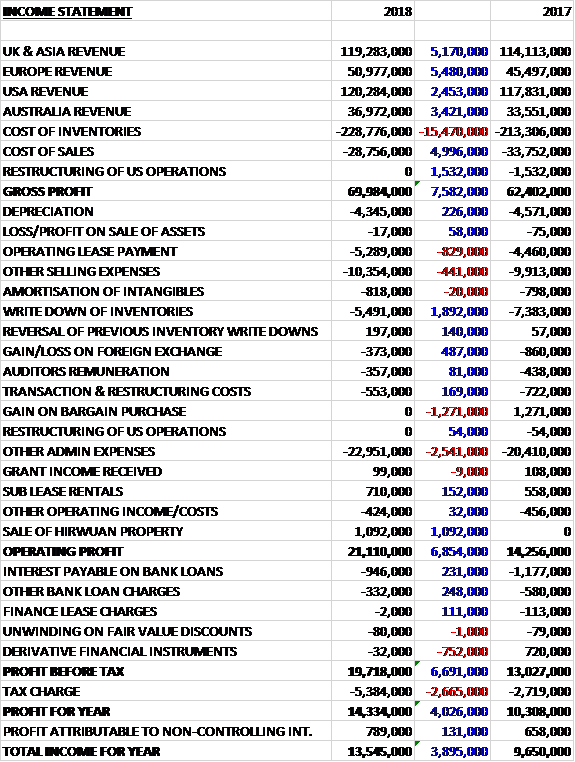
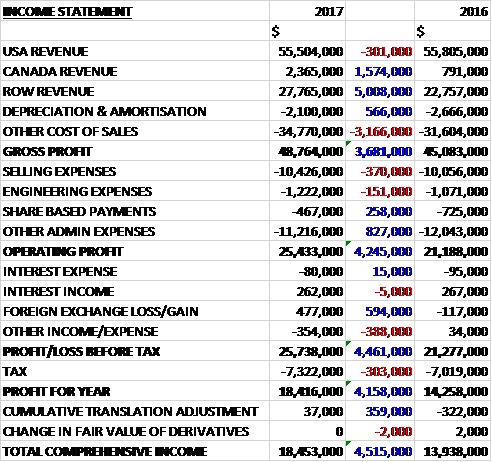
Revenues increased when compared to last year due to a £5.2M growth in UK and Asian revenue, a £5.5M increase in European revenue, a £3.4M growth in Australian revenue and a £2.5M increase in US revenue. Cost of inventories also increased but there were no US restructuring costs which were £1.5M last time so the gross profit was £7.6M higher. Operating lease payments increased by £829K and other selling expenses were up £441K. There was also no gains on bargain purchase, which brought in £1.3M last time. Offsetting this was a £1.9M reduction in inventory write-downs and a £487K improvement in the forex loss. Other admin expenses increased by £2.5M and after the group made £1.1M on the sale of the Hirwuan property, the operating profit was £6.9M higher. There was a £752K detrimental swing on derivative financial instruments and tax charges increased by £2.7M to give a profit for the year of £13.5M, a growth of £3.9M year on year.

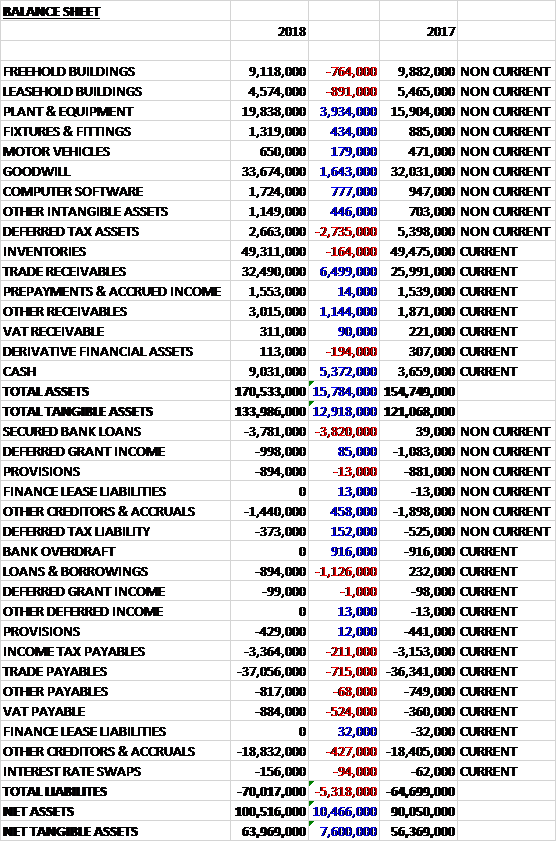
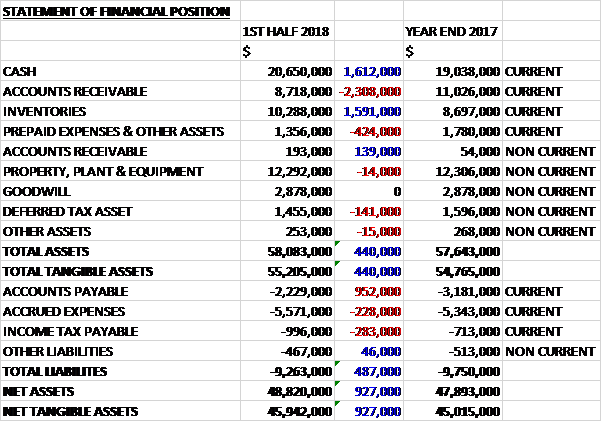
When compared to the end point of last year, total assets increased by £15.8M driven by a £6.5M increase in trade receivables, a £5.4M growth in cash, a £3.9M increase in plant and equipment, a £1.6M growth in goodwill and a £1.1M increase in other receivables, partially offset by a £2.7M decline in deferred tax assets as historical tax losses are used up. Total liabilities also increased during the year due to a £4.9M increase in borrowings. The end result was a net tangible asset level of £64M, a growth of £7.6M year on year.

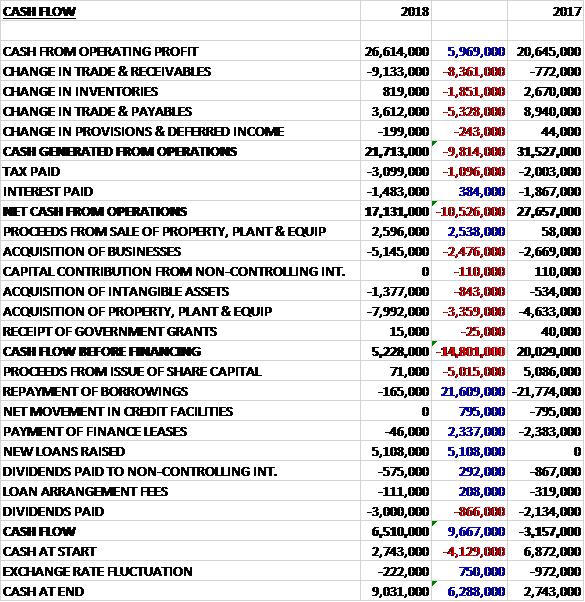
Before movements in working capital, cash profits increased by £6M to £26.6M. There was a cash outflow from working capital, however, and after tax payments increased by £1.1M the net cash from operations was £17.1M, a decline of £10.5M year on year. The group spent £8M on fixed assets, £1.4M on intangible assets and £5.1M on acquisitions but took £2.6M from the sale of assets to give a free cash flow of £5.2M. Of this, £3M went on normal dividends and £575K on dividends to non-controlling interests. After they took out £5.1M of new loans the cash flow was £6.5M and the cash level at the year-end was £9M.

The underlying result for the UK and Asia was £7.9M, a growth of £420K year on year. Last year the group decided to reorganise their three UK business under one overall leadership team. This year they began to see the tangible benefits of increased cohesiveness with a return to profit growth in the region and encouraging momentum across many areas of the UK business. They saw an excellent performance in their gift wrap and paper bag manufacturing operation in Wales and card, bag and cracker production facility in China.

An initiative to develop new income streams in adjacent categories and resulted in the UK manufacturing paper bags for the not for resale market, with a focus on the supply of higher end fashion and beauty brands. With production starting in September 2017 they are already providing retail brands with a significant volume of bags with orders in place which will grow the business further still in 2019.

The underlying result for Europe was £6.7M, an increase of £1.6M when compared to last year. This growth was supported by sales of bespoke gift products which have been especially strong with photo frames and photo based gift accessories achieving record volumes. Their efficiency has been further enhanced through their latest investment in a new printing press which started production in the Netherlands in March.

The underlying result for the US was £9.3M, a growth of £2.1M when compared to 2017. The year featured strong growth in their Creative Play product sales under the recently launched Anker Play Products brand which includes play themed educational, art and crafty and construction ranges for mass and value retailers. They plan to further develop sales of the brand within the Americas and throughout the global customer base.

Sales of dated products such as calendars grew and alongside the challenges of integrating a new business, the synergy opportunities that were identified during the acquisition of Lang have continued to be delivered with further areas of improvement. New initiatives include the investment in a new IT platform to enable their future growth trajectory to be efficiently delivered and supported by user friendly systems and enhanced commercial and operational capability.

The underlying result for Australia was £2.9M, an increase of £1.2M year on year. Having won a three year contract for the supply of greetings cards to Australia’s largest discount retailer in 2017 they saw the benefits of this flow through during the year combined with economies of scale. This has been further enhanced by the acquisition of Biscay in January with operational and commercial integration on track to complete during 2019.

The group remains focused on further improving margins in future years by driving operational efficiencies through sourcing and manufacturing as well as balancing the mix of products toward higher margin categories and channels such as increased sales of design group branded products. They anticipate the trend of overheads rising at a slower rate than sales growth to continue.

Over the year the group spent £9.4M on capex. Some £3-4M represented maintenance spend with the balance being spent on increasing capacity, improving efficiencies and developing new product offerings. Significant capital projects completed included the acquisition of a second printing press in the Netherlands which came on line at the year-end meaning the production efficiencies they will gain over the older press it replaces will benefit the coming year; the introduction of a new bag machine in the UK factory to provide not for resale branded bags for retails, which is now full operational and delivering profit in this new revenue stream; and an ERP system programme in the US which will support the delivery of operational efficiencies and future growth there.

During the year there were transaction costs of £553K relating to the acquisition of Biscay and some remaining costs from the Lang acquisition. There was also a benefit of £1.1M relating to the exceptional gain on the sale of the Hirwaun property in Wales and was inclusive of any restructuring costs related to the sale.
In January the group acquired Biscay Greetings, a greetings card and paper products business based in Australia. The acquisition was satisfied by a cash consideration of £5.1M and generated goodwill of 1.7M. In the quarter the business contributed £1.3M of revenue.

Going forward, with a strong order book in place and a positive start to the year the board are expecting further growth in 2019.

At the year-end there was a net cash position of £4.4M compared to £3M at the end of last year. At the current share price the shares are trading on a PE ratio of 26 which falls to 20 on next year’s consensus forecast. After a 33% increase in the dividends the shares are yielding 1.2% which increases to 1.5% on next year’s forecast.

On the 28th August the group announced the acquisition of Impact Innovations, a supplier of gift packaging and seasonal décor products in the US, for a total consideration of £56.5M. This is going to be paid for with a placing of up to £50M with institutional investors of 9,804,000 new shares. Last year, Impact recorded an underlying EBITDA of $15M and the directors believe the acquisition will create the world’s largest consumer gift packaging business, deliver significant earnings accretion over the next three years, deliver annual synergies in excess of $5M by year three; and enable expansion into the adjacent seasonal décor product category.
On the 16th October the group released a trading update covering the first half of the year. They have a positive performance in the period with reported overall revenue and margin, including the recent acquisition of Impact, significantly up on last year with growth across all regions. The integration of Impact is already underway with synergies on track to be delivered on time or earlier.

The new printing press in the gift wrap manufacturing operation in the Netherlands is now fully operational and supporting record production levels and improved efficiencies; the Biscay acquisition is now fully integrated with targeted synergies already beginning to deliver enhanced performance; the new IT system in the US has gone live on time and is now being run in parallel with the existing IT platform to ensure the processes are running smoothly; and the new revenue initiative in the factory in Wales to manufacture premium paper bags continues to deliver increased volumes with a strong pipeline of new customers to come.

The group is on track to achieve year on year profit growth in the full year and the EPS performance is in line with management expectations, delivering strong growth.
Overall then this seems to have been a decent year for the group with profits up and net assets increasing. The operating cash flow did decline but this was due to working capital movements and the free cash covered the dividends. All regions have performed well, particularly outside the UK, and this seems to have continued into this year. The acquisition is interesting but it is disappointing to see an equity raise, particularly one where the general punter can’t participate. The good performance comes at a price though and the shares are definitely not cheap with a forward PE of 20 and yield of 1.5%. Not sure whether to keep hold of these or not.

Ashley House Share Blog – Final Results Year Ended 2018

Ashley House have now released their final results for the year ended 2018.

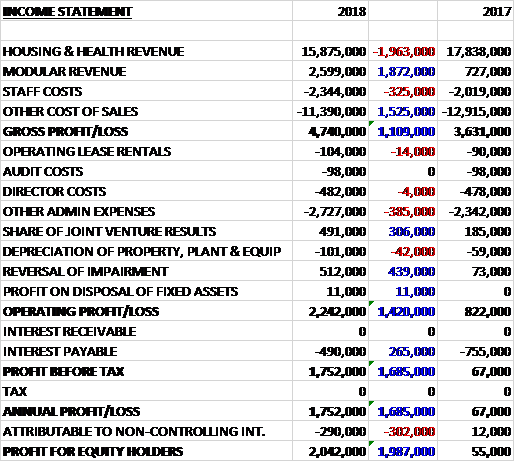
Revenues declined slightly when compared to last year as a £1.9M growth in modular revenue was offset by a £2M decline in housing and health revenue following the creation of the joint venture. Staff costs increased by £325K but other cost of sales were down £1.5M to give a gross profit £1.1M higher. Admin expenses increased by around £400K and depreciation was up £42K but the share of joint venture results increased by £306K and there was a £439K increase in the reversal of an impairment to give an operating profit £1.4M higher. Interest payments fell by £265K which meant that the profit for the year was £2M, a growth of £2M year on year.

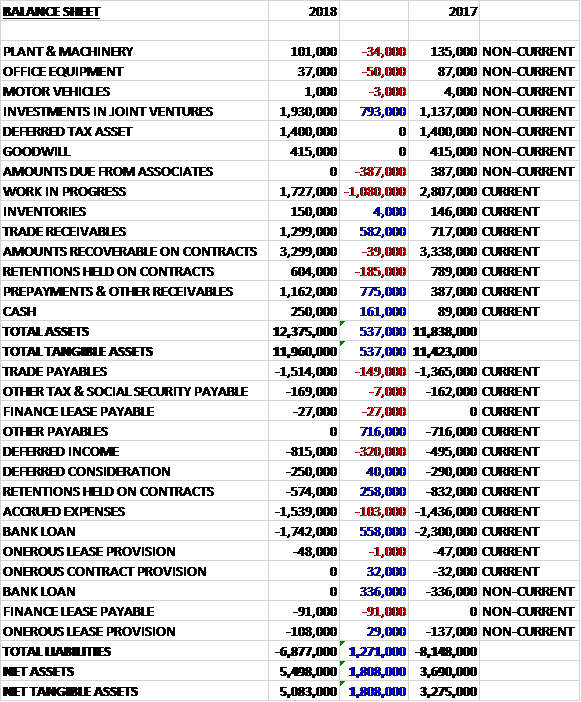
When compared to the end point of last year, total assets increased by £537K driven by a £793K growth in the investment in joint ventures, a £775K increase in prepayments and other receivables and a £582K increase in trade receivables, partially offset by a £1.1M fall in the value of work in progress. Tital liabilities declined during the period as a £320K increase in deferred income was more than offset by an £894K decrease in the bank loan, a £258K reduction in retentions held on contracts and a £716K fall in other payables. The end result was a net tangible asset level of £5.1M, a growth of £1.8M over the past six months.

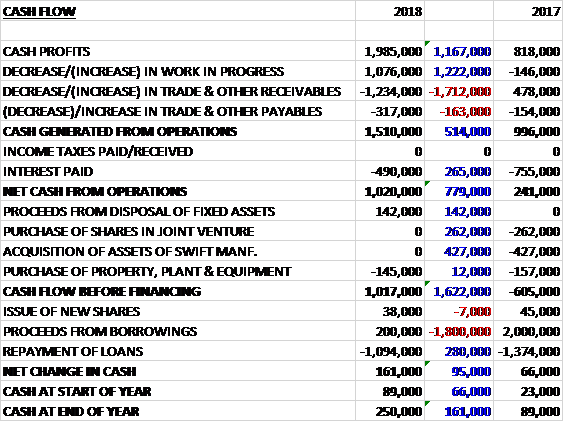
Before movements in working capital, cash profits increased by £1.2M to £2M. There was a cash outflow from working capital but interest payments reduced by £265K to give a net cash from operations of £1M, a growth of £779K year on year. The group only spent a net £3K on capex so there was a free cash flow of £1M. After most of this was used to pay back loans, the cash flow for the year was £161K and the cash level at the year-end was £250K.

In October the Prime Minister announced that the Local Housing Allowance cap that had threatened to restrict the amount of housing benefit available for schemes such as those developed by the group would not after all be imposed. The group was subsequently able to take three extra care schemes to financial close and on to site. This event has enabled the unblocking of the pipeline of extra care developments and with the threat to rental schemes significantly diminished the improved investability of those schemes has stimulated demand and the group have seen an increasing number of REITs as well as Housing Association clients keen to acquire this type of property.

In December a 50:50 joint venture was established with Morgan Sindall Investments to deliver extra care housing, care homes and supported living housing. The partner brings complementary quality and skills in supported living, long term strategic property partnerships with local authorities and the NHS, and a broad range of expertise in investing and managing institutional capital. The relationship between the two parties developed well so far and Morgan Ashley is already extending MSIL’s offer to Local Authority partners which is further extending its pipeline. With the first scheme already on site, future prospects are healthy.

During the year Morgan Ashley’s first scheme, an extra care facility on the Isle of Wight, reached financial close and commenced on site. The Ryde scheme comprises 75 extra care apartments with communal areas together with 27 affordable bungalows. The scheme will be operated by Southern Housing and owned and financed by Funding Affordable Homes.

The group has started on site with an extra care scheme in Scarborough. This is a collaboration with Home Group, Scarborough Council and North Yorkshire County Council and will provide 63 apartments for over 55s and those with extra care needs. The scheme will also see facilities including a restaurant and cage. Contracts have also been signed with the care provider HSN Care for a second care facility, this one located in Peterborough. The scheme will provide specialist accommodation for twelve disabled young adults. The modular component of the development is being built by F1 Modular. Both Scarborough and Peterborough sit outside the joint venture.

Despite the continuing limitations on government funding in primary care, the group have recently completed three health schemes. The first is a diagnostic treatment centre near Durham for City Hospitals Sunderland. The second is a GP surgery development in Essex and the third is Wales’ first fully integrated family centre and primary care centre in Swansea. All three schemes were funded by Assura.

F1M is now a 76% owned subsidiary of the group. While the business was lossmaking this year, recent orders have secured its activity for the coming months and the board expects it to contribute to profits in 2019.

The profit this year included the £512K write back of an impairment previously recorded against the carrying value of a loan receivable from an associated company. The group holds 33% of Partnering Health which provides out of hours and other medical services. Whilst management had expected to recover the full value of the loan in due course, the performance of that business improved during the past year such that is was able to advance significant repayments ahead od when it had previously been expected.

The housing and health pipeline now stands at £206.4M across 22 schemes compared to £212M across 28 schemes. Currently four are in the factory with a total development value of £8.6M. There are a further seven identified schemes at advanced stages with a total development value of £9.9M.

There is no doubt that government policy in recent times has hampered development opportunities but recent developments have enabled the group to push forward with its extra care and supported living pipeline. The outlook for the group has improved and the board is confident that the pipeline it has built in recent years can now be unblocked.

At the current share price the shares are trading on a PE ratio of 4.8 which falls to just 3.7 on next year’s consensus forecast. There are no dividends on offer here. At the year-end the group had a net debt position of £1.5M compared to £2.5M at the end of last year.

Overall then this has been a positive year for the group. Profits are up, net assets increased and the operating cash flow improved with a decent amount of free cash being generated. The outperformance seems to be down to the reversal of the housing allowance cap from the government, and aided by the joint venture. Things are starting to move here and the forward PE of 3.7 looks a bit unjustified to me. I’m happy to hold, might even buy some more.

Getech Share Blog – Interim Results Year Ending 2018

Getech has now released their interim results for the year ending 2018.

Revenues decreased by £176K when compared to the first half of the year but cost of sales also reduced to give a gross profit that was broadly flat. Depreciation and amortisation down £40K and exchange losses lessened by £53K but other admin costs were up £221K to give an operating loss £123K worse than last time. Finance costs reduced slightly and tax income increased by £59K to give a loss for the period of £280K, an increase of £53K year on year.

When compared to the end point of last year, total assets declined by £261K driven by a £515K decrease in cash and a £301K fall in current tax assets partially offset by a £405K growth in receivables and a £116K increase in intangible assets. Total liabilities also decreased during the period as a £130K increase in payables was more than offset by a £145K decline in borrowings. The end result was a net tangible asset level of £5.2M, a decline of £353K over the past six months.

Before movements in working capital cash profits reduced by £216K to record a cash loss. There was also a cash outflow from working capital but tax income increased by £36K to give a net cash from operations of £76K, a decline of £220K year on year. The group spent £420K on development costs and £25K on capex so there was a cash outflow of £369K before investing activities. They also repaid £145K of loans to give a cash outflow of £523K in the period and a cash level of £1.9M at the period-end.

Total sales closed in the first half rose 39% to £4.3M. This was driven by a significant increase in the number of customers purchasing multi-year subscriptions to the group’s products and software. The environment for oil and gas investment remaining challenging, particularly in relation to exploration expenditure. First half revenues were a little below those of last year but the £1.4M balance strengthens the group’s pipeline of recurring revenue. There was a $900K data sale that missed the period-end date but has now closed.

During the period demand for gravity and magnetic data was good and they added new data to their portfolio on the Irish Atlantic Margin. They also updated their global depth to basement product and completed enhancements of Colombian data. Demand for G&M data has continued despite oil price uncertainty but the broader budget constraints of their customers have lengthened the sale cycle. This creates financial volatility in their internal budgets which they are working to mitigate by growing their sources of recurring revenue.

Within Information Products, Globe 2018 was completed on time and in budget and delivered to customers in July. The product’s content and functionality has been expanded to include innovative new heat flow and palaeo-surface geology modules, and variety of interactive analytic capabilities have been added. These upgrades drawn on geoscience, G&M and software development expertise from across the group. Their customers have responded well to Globe’s repositioning with the majority signing multi-year contracts in the period.

During the period the group enhanced their software products to include a range of new customer-requested functionality and upgraded them to include support for Esri’s latest 10.6 release. In the period three exploration analyst customers took the strategic decision to significantly scale back their exploration activities. This impacted revenue but a significant proportion of this was offset by a new global customer for Exploration Analyst. Several regional and global software customers also upgraded to multi-year licenses and they expanded their exposure to onshore production operations by doubling the number of Unconventional Analyst license holders.

In Geospatial Services they won an additional support contract from a super-major. The transferable nature of their geospatial skills enables them to diversify revenues and in the period they undertook contracts in the environmental, utilities and maritime sectors.

To improve the profitability of their Geoscience Services they are repositioning this offering around the delivery of projects that integrate complex geoscience and geospatial insights. By taking steps in the period to consolidate their Henley and London activities into a single location, they anticipate that greater collaboration between the geoscience and geospatial teams will further support their efforts to transform what they do.

The group are promoting Sierra Leone’s fourth licencing round. This round enables them to broker potentially high value portfolio of seismic and well data to prospective investors. The dialogue around these data will continue through the recently announced industry consultation period.

The group enters the second half with a robust sales pipeline. The purchasing power of exploration and new venture teams remains constrained by budgets set in 2017 but the board are optimistic that as their customers gear up for their 2019 work programmes this will generate new demand for their value added offering.

Since this point of last year, oil prices have risen around 75%. With industry costs at a cyclical low and against budgets set a year or more previous, the increased oil price has transformed the cash generation of the group’s customers. The oil and gas sector has used this cash flow to repair balance sheets. There has also been a rise in production-focused M&A but despite falling rates of reserve replacement there has not yet been a sector-wide return to exploration.

The upstream investment environment for the group’s products therefore remains volatile but they expect 2019 budgets to set a clearer and more positive path. Evidence for this comes from their customers’ renewing investment in their tools and people which in H1 resulted in an increase in total sales through multi-year commitments.
In the second half the group are investing in further releases of their software, they have started work on the next release of Globe and are actively refreshing their data holdings. They are rationalising their office locations and using their products and geoscience-geospatial skills to reshape their services.

The group are following up leads in new geographies – the Middle East and Asia of note, exploring ways to expand access to their data products and solutions, and working to grow their software footprint in onshore US production.

At the period-end the group had a net cash position of £1.4M compared to £800K at the end of the first half of last year. Having considered the continued volatility of the oil and gas investment environment the board decided that it was not appropriate to pay a dividend at this time. At the current share price the shares are trading on a frankly ridiculous PE ratio of 88. I can find no forecasts.

Overall then this has been a poor period for the group. Losses worsened, net assets declined and the operating cash flow deteriorated with no free cash being generated. This seems to be due to the lumpy nature of the orders and sales closed actually increased with a robust pipeline in evidence. This seem to be improving as the constrained budgets of the group’s customers improve and oil prices increase. I feel like we have been here before though and without any forecasts it is very difficult to value so until I see some evidence that the group is actually making a profit I think I will steer clear for now.

On the 3rd January the group announced the sale of an integrated suite of geology, gravity and magnetic data and knowledge products.  The sale, made to a global oil and gas company, will generate gross income of $3.2M, the majority of which will be recognised in 2018.  On this basis, they expect 2018 revenue to exceed that in 2017 by at least 10%.  The sale also adds recurring revenue to 2019 via a new customer subscription to the Globe product.

Falling oil prices and forex volatility combined in Q4 to create a challenging environment.  Against this backdrop, the sales cycle lengthened but they were able to work with their customers to match their products to their most pressing needs.

On the 27th March the group released a trading update covering the year.  In the first half the group extended its pipeline of multi-year subscriptions to its information products and software which expended their recurring revenue.  The fragility of global growth was highlighted in Q4, however, with a decline in the oil price to a low of $50 per barrel which is thought to have lengthened and complicated the sales cycle.  Despite this the group ended the year with a significant sale of data and products which also added a new customer top Globe.

Group revenue is expected to rise by 11% with product sales remaining the key engine for growth, increasing by 24%.  In services, despite growth in gravity and magnetics and geospatial solutions, the geoscience service market remains challenging. 

Updates were delivered to their Global Depth to Basement product and they launched Tectonics Online, a new cloud-based platform through which customers can access the group’s plate-modelling expertise.  Their Data Assistant and Exploration Analyst software were both upgraded to ArcGIS Pro and an Unconventionals Analyst upgrade is scheduled for the spring.

In Services, utilisation grew for the group’s Gravity and Magnetic team and the Geospatial team won a new support contract with a supermajor and expanded its work in the energy infrastructure space to include sub-sea power cabling and terrestrial pipeline projects.  Both teams delivered revenue and profit growth but at the divisional level this was offset by a fall in Geoscience Service revenue.

To address the losses in Geoscience Services, in the second half the group restructured this team and in October they merged their London and Henley offices.  The total cost of this restructuring was £200K and it is expected to deliver a forward annualised fixed cost saving of £500K.  The team is now fully aligned with the group’s activities and they are awaiting award decisions on several potentially significant new projects. 

Cash profits are expected to total £1.2M compared to £600K last year and EBITDA is expected to also be £1.2M, an increase of £300K.  Cash held at the end of the year totalled £1.4M, a decrease of £1M dye to the timings of sales and a large receivables balance. During the year the group placed their Leeds office on the market for sale.  There have been numerous viewings but in the run up to Brexit, property investment has slowed. 

So far in 2019, crude prices have strengthened and the breadth of Q1 new sales activity has been greater than in recent years.  Balancing this, the lengthening of the sales cycle that emerged in Q4 has persisted into 2019 and the board believe that customers are cautious over the early release of their exploration and new business budgets. 

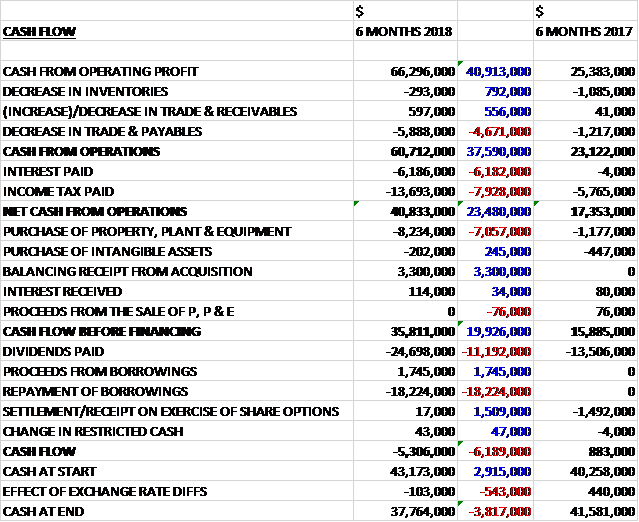
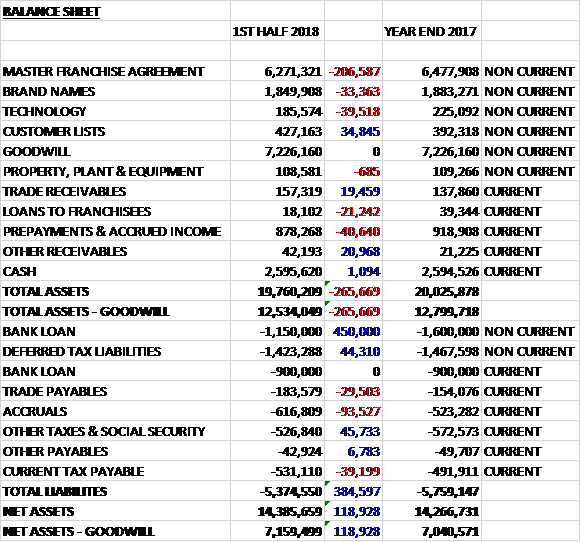
The Property Franchise Group Share Blog – Interim Results Year Ending 2018

The Property Franchise Group has now released their interim results for the year ending 2018.

Revenues increased when compared to the first half of last year as a £49K decline in franchise sales was more than offset by a £590K growth in management service fees and a £249K increase in other revenue. Cost of sales were broadly flat to give a gross profit £802K higher. Depreciation was £48K higher and other admin expenses were up £287K. There was no goodwill impairment, which cost £500K last time and no reduction in contingent consideration, which saw a £1.1M benefit last year so the operating profit declined by £212K. Finance costs were broadly flat but tax charges increased by £158K to give a profit for the period of £1.5M, a decline of £371K year on year.

When compared to the end point of last year, total assets declined by £266K, driven by a £207K decrease in the value of the master franchise agreement. Total liabilities also declined, mainly due to a £450K reduction in the bank loan. The end result was a net asset level (excluding goodwill) of £7.2M, a growth of £119K over the past six months.

Before movements in working capital, cash profits increased by £487K to £2.3M. There was a modest cash inflow from working capital which was slightly lower than last time and tax payments increased by £243K to give a net cash from operations of £2M, a growth of £147K year on year. The group spent £97K on intangibles and £15K on fixed assets to give a free cash flow of £1.8N. Of this, £450K was used to repay loans and the rest went on dividends to give a cash flow of £1K and a cash level of £2.6M at the period-end.

Lettings MSF grew by 6% and sales MSF grew by 5%. For EweMove, the total license fees and completion fees for the period was £920K, a 66% increase on the same period of 2017. Franchise sales fell by 50% to £100K with both a reduction in new recruits, and the increased proportion of experienced estate agents joining which involves a much smaller franchise fee.

Despite some market headwinds, due to the success the group have had with new transactions, they achieved a gain in the number of properties they are managing in the period. This was driven in part by the investment in PPC advertising that they have been encouraging their franchisees to make. Across the group they are now spending around £1M per annum on PPC advertising at a franchisee level and the campaigns have delivered over 26,000 leads in the period, a rising trend.

They have invested in a team to assist their franchisees in acquiring competitors’ portfolios of tenanted managed properties. Through this, they support them in identifying targets, assist with due diligence and put funding solutions together using high street banks and secondary funding sources. They also gift their franchisees cash back on these acquisitions to recognise that they are creating a stream of management service fees revenue for the franchisor over future years.

The governments proposed tenant fee ban, expected to take effect in spring 2019, will erode the profitability of small independent agents, and could encourage them to exit the lettings sector. The profitability of a property management business increases with size and the group are encouraging the stronger franchisees to scale up their business by buying out their less successful neighbours. The success of this programme is reflected in the decline in the number of trading offices in their traditional brands from 278 to 263.

Ewemove continued to increase its share of the online market with 114 franchise territories trading at the end of the reporting period. It is now the 5th biggest online player based on the number of new transactions. The business continued to trade profitably during the period, adding incremental value to the group. Alongside this they have benefited from the cross-fertilization of EweMove’s digital expertise.

Historically the group has experienced stronger trading in the second half of the year and they are seeing early indicators that this pattern will be maintained this year. Overall the board remains confident of delivering on market expectations for the full year.

As before they expect further trading headwinds in 2019 as a result of negative sentiment surrounding Brexit causing homeowners to postpone home moves, as well as the negative sentiment amongst buy to let landlords as a result of rising interest rates and the further reduction in tax relief on mortgage interest payments. They are also expecting to see an impact on group revenues from the government’s proposed tenant fee ban, the timing of which is expected to be April and will impact profit by around £750K gross in 2019, reducing to £500K net after mitigation factors are taken into account.

At the period-end the group had a net cash position of £500K compared to a net debt position of £700K at the same point of last year. At the current share price the shares are trading on a PE ratio of 12.5 which falls to 11.2 on the full year consensus forecast. After a 14% increase in the interim dividend the shares are yielding 5.4% which increases to 5.6% on the full year forecast.

Overall then this has been a good period for the group. Profits did reduce but this was due to a non-repeat of last year’s contingent consideration reduction and underlying profits increased. Net assets also grew, as did the operating cash flow with a decent amount of free cash being generated. The Ewemove business seems to be growing nicely, as did the underlying business with increased levels of PPC marketing helping.

The issue is the headwinds going forward. Brexit is always a dark cloud over businesses like this and the reduction of tax relief on mortgages really isn’t helping. In addition the introduction of the tenant fee ban ( a good idea in my view) is going to affect the group to the tune of £500K which is substantial. Still, with a forward PE of 11.2 and yield of 5.6% the shares look cheap. Not sure about this one at the moment.

On the 5th February the group released a trading update for the full year.  They performed well, outperforming the market.  EweMove traded profitably throughout the year and will show a significant improvement over last year.  Consequently the group expects to report trading in line with market expectations with a material improvement on 2017 with enhanced margins.  Revenue increased by 10% and the group finished the year with net cash of £2.2M.

Going forward, the early signs are that 2019 will be another challenging year for the property market with ongoing Brexit uncertainty having the potential to dampen sales volumes.  The tenant fee ban, due for introduction in June in England was previously expected in April and whilst it will reduce the group’s lettings revenues by £500K in the year, the impact will be less than expected.  Other regulatory changes proposed, aimed at professionalising the lettings sector should provide the group opportunities for growth as smaller outlets find increased regulation more challenging.  Overall though, the board has confidence for the year ahead.

Safestyle Share Blog – Interim Results Year Ending 2018

Safestyle has now released their interim results for the year ending 2018.

Revenues collapsed by £21.9M when compared to the first half of last year. Cost of sales also declined but obviously less than revenues and gross profit was down £13M. Share based payments saw a £756K reverse but there was £1.1M of litigation costs, £233K of restructuring costs, £184K operational costs, an £859K HSE fine, £468K of onerous lease provisions and a £163K growth in depreciation and amortisation. Other operating expenses were down £731K but the group saw a £14.5M detrimental swing to an operating loss. Tax costs reduced by £2.9M to give a loss for the period of £4.7M, a detrimental movement of £11.6M year on year.

When compared to the end point of last year, total assets declined by £3.7M, driven by a £6.4M decline in cash levels, partially offset by a £933K increase in current tax assets and an £816K growth in inventories. Total liabilities increased during the period as a £776K decline in tax liabilities was more than offset by a £2.5M growth in payables. The end result was a net tangible asset level of £13.2M, a decline of £5.6M over the past six months.

Before movements in working capital the group had a £14.8M swing to a cash loss of £5.3M. There was a modest cash inflow from working capital and after tax payments reduced by £304K the net cash outflow from operations was £5M. The group spent a net £1.4M on capex, mainly relating to the investment in the digital transformation project, to give a cash outflow of £6.4M before financing. This was also the total cash outflow for the period to leave the group with a cash level of £4.6M at the period-end.

Going forward there has been a steady improvement in the daily order intake which is almost 12% higher for September to date than it was at the start of July. This improvement in order intake has now flowed into revenue in the quarter, however, as the improvement came too late to affect the installation volumes which resulted in a weaker Q3 performance.

Overall the rate of market decline in the first half was 6% and the group’s market share has declined from 10.8% to 8.5%. The number of employees and agents working with the group declined sharply in Q1 which created a huge disruption in their operations and resulted in a material reduction in leads, sales and installation capacity.
Leads generated from direct response media represented a slight decline from 42,680 to 41,306 but leads from other sources, particularly canvass which was disrupted by the actions of Safeglaze, declined by 65%. Conversion of leads to orders improved by 18%, partially offsetting the reduction in leads. There was a 31% decline in the volume of orders to 21,724, a 29% decline in the volume of frames installed to 99,491 but a 3% growth in the average unit price to £616.

A price increase was implemented at the start of the year to negate cost increases as a result of Sterling weakness and commodity and silicone inflation. In addition there was a significant year on year increase in Pay Per Click rates driven by increased online competition; there has been an increased usage of scaffolding to ensure teams are safely working at height; and agent commission costs as a percentage of sales increased as the business responded to the more competitive environment, all of which helped to increase costs.

During the period there was a fine from the HSE of £900K following prosecution for a working at height accident in March 2017. Steps have been taken to avoid a recurrence. These measures include an increased use of scaffolding, investment in other solutions for working safely at height, establishing a new group health and safety function and significantly increased safety audits.

A turnaround plan has been developed. The first phase aimed to stabilise the business through the establishment of a new board, to resolve the litigation and to ensure they have sufficient liquidity in place whilst developing the next phase of the plan. With the group having now stabilised this phase is largely complete. The second phase which will run through 2019 is designed to return the group to profitability by recovering the momentum lost in their lead generation, sales, surveying and installation teams whilst also improving margins and making the business more efficient. The third phase of the plan aims to accelerate growth through a combination of brand investment, the establishment of a national training academy and leveraging their digital platform.

In May the group issued a claim seeking injunctive relief and damages against Safe Glaze UK. The claim asked the court to determine whether the group was entitled to injunctive relief and damages from what the group considers to be passing off, the misuse of confidential information, unlawful means conspiracy and malicious falsehood. They also applied for urgent interim relief pending the trial. A series of injunctions were put in place and in early September the group settled the claim. In the settlement, Safe Glaze agreed that the existing court injunctions will be replaced by appropriate undertakings to the court. The settlement should prevent the possibility of any acts of intimidation of Safestyle reps and Safe Glaze have agreed to change their name.

There have been a number of changes to the board. CEO Steve Birmingham and executive director Mike Robinson have left the group along with Chairman Steve Halbert and non-executive director Peter Richardson. Mike Gallacher was appointed CEO in May having most recently been CEO of First Milk Ltd, a dairy company owned by British family farms. Alan Lovell was appointed Chairman in July and has been chairman of Flowgroup. Rob Neale replaced Mike Robinson as CFO having most recently been head of leisure travel finance at Jet2.com

As they exit Q3, the opening order book will be higher than originally forecast and as that converts into revenue, the board still expects that the group will be generating modest operating profits in Q4. As a result they expect to report an underlying pre-tax loss for the full year in the region of £6.5M.

They are implementing their turnaround plans and are making progress in recruitment, process improvement, efficiencies and various other margin-enhancing initiatives. Notwithstanding an uncertain consumer environment and while they do not anticipate an immediate recovery back to 2016 and 2017 levels of financial performance, the board’s expectations of a return to profitability in 2019 remain unchanged.

As can be seen there were a number of non-recurring costs in the period. Litigation costs of £1.1M were incurred as a result of the Safe Glaze legal action and mostly refer to legal advisor fees. Fines of £859K relate to the HSE fine. Onerous leases of £468K represent an accrual for all rental costs up until the first lease break date for properties that were closed and restructuring and operational costs of £417K are expenses incurred as a result of changes being made to reduce the cost base of the business.

The board are not declaring an interim dividend for this year unsurprisingly.

Overall then this has been a disastrous period for the group. They have swung to a heavy loss and operating cash outflow and the net assets deteriorated. This is being blamed by the activities of a new competitor but it almost seems to have gone un-noticed that they have also received a hefty fine for unsafe working conditions. They have made wholesale changes to the board and expect Q4 to show a modest profit but this until this starts to show I feel it sensible to steer clear here.

On the 7th November the group announced that Chairman Alan Lovell purchased 30,000 shares at a value of £29K. He now owns 130,000 shares in the company.

On the 10th December the group announced that non-executive director Fiona Goldsmith purchased 20,000 shares at a value of £16.6K. This is her maiden purchase.

On the 17th December the group released a trading update. Since the commercial agreement, they have experienced a significant increase in their contracted workforce across their canvass, sales, surveying and installations operations which has resulted in an improved sales order intake that was in line with the same six week period last year.

Linked to this growth in workforce the group has invested more than budgeted in lead generation, commissions and overheads. Whilst management expects that turnover for the last month of the year will be head of previously forecast, the majority of the benefit will only occur in 2019.

As a result of the timing difference between incurring these higher costs and the installations taking place, the board now expects that they will deliver an underlying loss of between £8.2M and £8.6M this year. As a result of this, however, the board is confident that the recovering in performance in 2019 will be head of current market expectations.

Gem Diamonds Share Blog – Interim Results Year Ending 2018

Gem Diamonds have now released their interim results for the year ending 2018.

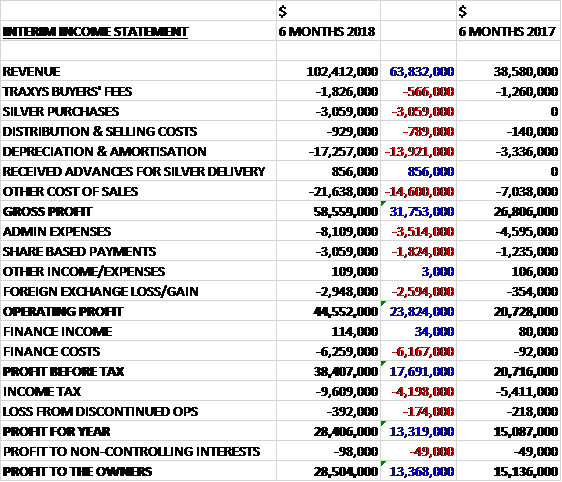
Revenues increased by $74.8M over the first half of last year and after cost of sales only increased by a fraction of that, the gross profit was $66.4M higher. Royalty and Selling costs grew by $6.3M but there was a $1M increase in the forex gain to give an operating profit $61M higher. The finance income and costs also both improved by tax payments increased by $22.1M to give a profit for the period of $24.2M, an improvement of $27.2M year on year.

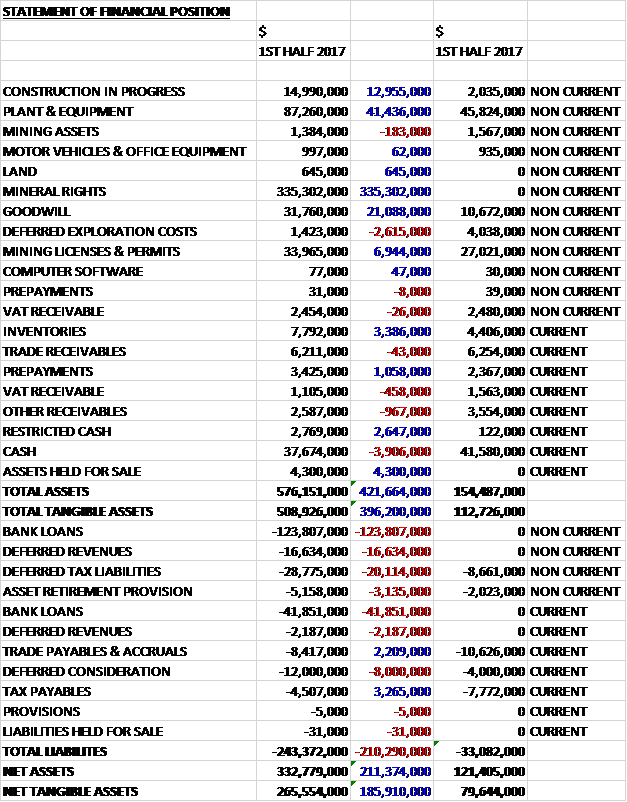
When compared to the end point of last year, total assets increased by $1.9M as a $22.8M growth in cash was mostly offset by a $14.4M decline in property, plant and equipment, a $2.2M decrease in inventories, a $1.5M fall in intangible assets and a $1.4M decrease in prepayments. Total liabilities also increased during the period as a $5M decline in loans was more than offset by a $10.2M increase in income taxes payable and a $2.7M growth in trade payables. The end result was a net tangible asset level of $226.4M, a decline of $2.3M over the past six months.

Before movements in working capital, cash profits increased by $57.7M. There was a cash inflow from working capital and finance costs reduced but tax payments were up $8.9M to give a net cash from operations of $97.6M, an increase of $63.4M year on year. The group spent $42.9M on waste costs and a net $9.1M on fixed assets to give a free cash flow of $45.7M. Of this, $15.5M went on payments to the Lesotho government and $3.3M on loan repayments which meant that there was a cash flow of $26.8M and a cash level of $70.5M at the period-end.

The global market for rough diamonds improved as the manufacturing sector reduced inventories. This resulted in a slight upward trend in overall rough diamond prices and the stabilisation of polished diamond prices. Financing challenges in the midstream segment persist forcing out smaller, less sophisticated operations.
Notwithstanding the impact of reduced tonnes treated, local currency inflation, increased ore mining handling distances and increased fuel prices of 15%, the direct cost per tonne treated decreased by 2%. This is a result of the cost savings derived from the business transform initiatives which delivered $1.2M of cost savings. There was an increase in the one-off repairs and maintenance costs due to the replacement of the cracked scrubber shell in Plant 2..

The Lesotho mine made an operating profit of $72.7M, a growth of $56.4M year on year. The mine treated a total of 2.5M tonnes of ore, of which 41% was sourced from the satellite pipe. Due to the amount of low grade material available to be treated, the contract with Alluvial ventures has been extended to the middle of 2020 when it is planned that all low grade material will have been treated.

During Q1 the Letseng plants continued to experience lower than planned availabilities. In May both plants were stopped for a major shutdown to repair various elements of the plant, including the replacement of the scrubber shell in Plant 2. The installation of the new shell was a complex operation owing to the concrete foundation of the scrubber installation requiring to be fully rehabilitated which delayed the planned shutdown by ten days thereby impacting ore tonnes treated in the period.

During the scrubber change out an initiative to run a bypass conveyor was implemented to mitigate the overall impact of lost tonnages. The shutdown was completed and the feed rate into the plant has since reverted to normal levels. The operation focuses on value over volume so will not be overfed to make up the shortfall of tonnage treated in the first half of the year. Improved plan availability will allow for more tonnage to be treated as the total run time of the plant improves without over-feeding the plant.

During the period 61,596 carats were recovered, an improvement of 22% when compared to the first half of 2017. The slightly lower tonnage treated was offset by a higher mine core factor and higher head feed grade owing to the volume of satellite material treated. The tailings re-treatment facility produced an additional 5,368 carats from recovery tailings material that was generated before the upgrade of the recovery process. The recovered grade for the period was 1.88 cpht against an expected grade of 1.83 cpht.

During the period work has continued to reduce diamond damage through initiatives underway that focus on blasting, crusher setup, screening efficiency and DMS feed control. The trend of improved large stone recoveries seen during the second half of last year continued during the period with a record recovery of ten diamonds greater than 100 carats, including the 910 carat Lesotho Legend which sold for $40M in March. There has also been an increase in the number of diamonds recovered in all size fractions above 20 carats.

The construction of the relocated mining complex required to make way for the expansion of the open pits has been completed below budget. The capital project for the extension of the tailings facility project was approved by the board in November for $13.7M. The extension is progressing well and will be completed during the first half of 2010.

Four tenders were completed during the period with a total of 61,696 carats sold in Antwerp. The average price for Letseng diamonds was $2,742 per carat compared to $1,779 per carat last time. During the period the group concluded a trial of three tender viewings in Tel Aviv. Based on the new customer base reached and the positive results from these viewings, the Tel Aviv viewings will continue four times a year. During the period one pink diamond of 8.52 carats was sold into a partnership agreement at a rough price of $375K. The group will also share in the revenue uplift at the time of the sale of the resultant polished diamonds.

The business transformation continued its momentum in the period and the target of $100M in revenue productivity improvements and cost savings to 2021 remains on track. Initiatives that will contribute $47M have been implemented. Of these, $4.7M relates to one-off savings and the balance relates to cumulative recurring benefits over the four year period. $10M of the initiatives have been cash flowed to date. Of the total $39.4M has primarily resulted from the implementation of initiatives in the mining and processing worksteams and $7.6M has resulted from improved working capital management, reduction of corporate overheads and the sale of non-core assets.

The group are targeting $31M of reduced mining costs. They are expecting to improve efficiencies and rates and review the tenure of the mining contractor; optimise support equipment requirements; improve haul roads to optimise truck speeds; increase truck capacity by 7% by installing greedy boards; and improve drill rates by 30% by modernising the drilling fleet with an autonomous system. So far they have implemented $15.6M due to optimising the mining fleet and support equipment, increasing truck capacity and improving haul road conditions.

They are targeting $6M by steepening current slope angles which should reduce waste tonnage and targeting $5M by changing blasting patterns and practices, accessories and explosive mix, leading to a reduction in blasting consumables by up to 30%. So far in this initiative they have saved $4.1M by reducing the number of primers used per blast hole by one unit and secured early settlement discounts with explosive suppliers.

They are targeting $16M through improved plant uptime due to improved maintenance scheduling, improved ore feed management, improved stability of the power supply and reducing operational delays. They are targeting $16M through additional throughput by deploying an XRT machine to re-treat tailings and renegotiate the Alluvial Ventures contract. So far they have implemented $18.3M from the re-treating of tailings by the new XRT sorting machine and the Alluvial Ventures contract has been renegotiated to realign the profit margin share and extend the tenure to mid-2020.

The group are targeting $16M from selling non-core mining fleet and redundant stock at Ghaghoo, reducing or eliminating the ongoing care and maintenance costs at Ghagoo and by selling other non-core assets across the group. So far they have gained $2.1M through the sale of the aircraft servicing Ghaghoo, certain non-core mining fleet and inventory.
They are looking to target $4M by implementing stricter spend control procedures on admin and support costs and downsizing the office footprint in the UK, South Africa and Botswana. So far the office footprints in the UK and Botswana have been reduced, the annual report publishing and printing costs have been lowered, reduced professional fees and applied strict spend controls through one centralised costs approval office.

In April, the prime minister of Lesotho announced their government’s intention to renew the lease until 2034
The Botswana mine made a loss of $2.6M, an improvement of $3.2M compared to the first half of last year. This included $285K of exceptional costs incurred due to the additional water pumping and sealing of the fissure as a result of the earthquake in 2017. The fissure was sealed for the second time in July. Last year saw $3M of exceptional costs at the mine. The Belgium business made a profit of $1.4M, an increase of $1.3M when compared to the first half of 2017.
At the year-end the investment property in Dubai was identified as held for sale. In July, after the period-end, an offer was accepted with the fair value of $615K.
The recoveries of large diamonds continued into H2 with a further two diamonds greater than 100 carats being recovered resulting in a record 12 diamonds greater than 100 carats being recovered to date this year.

At the period-end the group had a net cash position of $29.8M. At the current share price the shares are trading on a PE ratio of 42.7 which falls to 8 on the full year consensus forecast (back up to 12.3 in the next year). No dividends have been recommended.

On the 15th August the group announced the recovery of a 138 carat, top white colour Type IIa diamond. This represents the twelfth diamond over 100 carats this year.

Overall then this has been a strong period for the group. Profits were up and the operating cash flow grew with plenty of free cash being generated. The net asset base did deteriorate somewhat, however. The market for diamonds was decent but the group treated less in the way of ore due to the repairs to the plants. This was offset by increased grades of the material, however. The profit for the group increased by some $40M which is the price the Lesotho Legend achieved at auction. There is no doubt that the group performed well, with a PE ratio of just 8 being predicted this year but it seems that all of this outperformance can be attributed to the sale of this one diamond. The question therefore is, has the recovery techniques improved so such a degree that we can expect a diamond like this (or a few smaller ones) every year or is this just a one off? I am not sure, and the rate of recovery of these large diamonds seems to have slowed, but I am keeping hold of the shares for now.

On the 31st October the group released a trading update covering Q3. The demand and prices for Letseng’s diamonds has remained firm. The mine treated a total of 1.6=5m tonnes of ore during the period, 46% of which was sourced from the satellite pipe. Following the replacement of the scrubber shell and other significant maintenance during the major shutdown in plant 2 during Q2, plant utilisation and availability returned to nameplate capacity resulting in increased tonnages treated for the period. The negotiations relating to the renewal of the Letseng mining licence are continuing.

The group recovered 35,755 carats, 27% more than in Q2. They sold 30,275 carats, a 3% increase over Q2 but the total value declined by 12% to $55.7M representing a 14% decline in the price per carat to $1,841. The highest diamond price achieved was $60,428 per carat for a 138.2 carat type iia white diamond. The reduction in price achieved is a result of lower quality recoveries during the period. The group recovered two greater than 100 carat diamonds in the period.

Following improved mining efficiencies, strong production during the period and consistent grade recoveries, production guidance for the carats produced sand sold has been revised upwards from 114 to 120 kct and 112 to 118 kct respectively. Notwithstanding inflationary pressure on local costs, operating costs per tonne treated are expected to remain within guidance but the significant increase I fuel price of 24% has impacted waste cash costs resulting in guidance being increased from 31Maloti to 34Maloti.

After the period-end, a 357 carat diamond was recovered, bringing the total over 100 this year so far to thirteen. The group has approved a $3M pilot plant to be constructed. This project identifies diamonds within kimberlite ore and uses non-mechanical means of liberating the diamonds. It will be commissioned in Q2 2019

On the 19th December the group announced the recovery of a high quality 101 carat and 71 carat white Type IIa diamonds which brings the total to 14 higher than 100 carats over 2018.