Bonmarche Share Blog – Final Results Year Ended 2018

Bonmarche has now released their final results for the year ended 2018.

Revenue decreased by £4.1M when compared to last year. Depreciation was up £723K and amortisation increased by £432 but other cost of sales decreased by £3.4M to give a gross profit £2.2M lower than last year. There was a £1.1M positive movement to a gain on disposal of fixed assets, nothing was spent on implementing the new EPOS system, which cost £417K last time, and other admin expenses were down £2.1M. In addition, distribution costs fell by £556K which meant that the operating profit was £2.2M higher. After tax charges increased by £290K the profit for the year came in at £6.3M, a growth of £1.9M year on year.
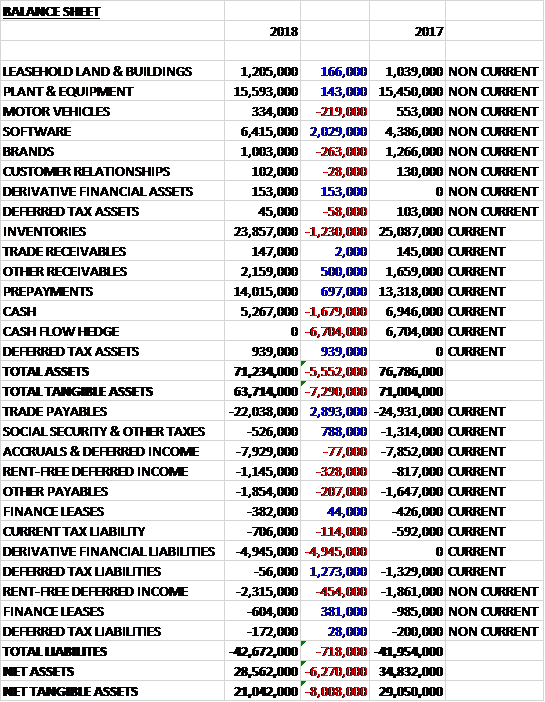
When compared to the end point of last year, total assets declined by £5.6M driven by a £6.7M reduction in the value of the cash flow hedge, a £1.7M fall in cash levels and a £1.3M decrease in inventories, partially offset by a £2M growth in the value of software. Total liabilities increased during the period was a £2.9M decline in trade payables and a £1.3M decrease in deferred tax liabilities was more than offset by a £5M growth in derivative financial liabilities.
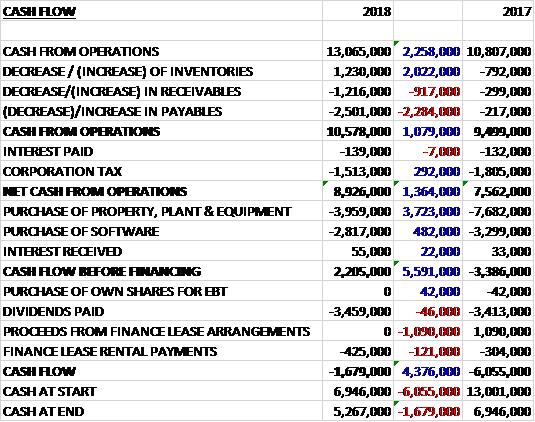
Before movements in working capital, cash profits increased by £2.3M to £13.1M. There was a cash outflow from working capital and after tax payments fell by £292K the net cash from operations came in at £8.9M, a growth of £1.4M year on year. The group spent £4M on property, plant and equipment along with £2.8M on software to give a free cash flow of £2.2M. This did not cover the £3.5M paid out in dividends or the £425K finance lease payments so there was a cash outflow of £1.7M and a cash level of £5.3M at the year-end.

Overall, whilst the high street challenges continued, online sales were more resilient due to the evolution of the group’s customers’ shopping habits and the improvements made to the online store. Overall demand was stronger during the first half and fell back noticeably and remained weak during autumn and winter.
Total sales for the year declined slightly (0.5%) but the gross margin was resilient in the face of adverse forex movements, mitigated through tight stock control and improvements to the loyalty scheme which led to lower discounting. Through improved operational efficiency and reduced market expenditure the group made some overhead cost savings.

Total like for like store sales declined by 4.5% year on year. The store like for like was strong in Q1 and September but weakened significantly in the second half of the year.

Total online sales increased by 34.5% when compared to last year and in the second half, when store sales were poor, online sales maintained a 30% growth rate against stronger H2 comparisons last year. Many improvements have been made to the online store which has led to a much better shopping experience and increased sales. Profitability has also improved, mainly due to more efficient marketing.

Key priorities for next year include introducing online exclusive ranges and brands to enhance the offer, improving online content, improving the checkout process, making the interaction between online and stores more seamless, and improving the delivery options for customers.

The devaluation of the pound against the dollar had a negative effect on margins but the decline this year was smaller than expected. The hedging policy has delayed the impact of the currency fluctuations but there will be a further negative impact in 2019 as hedges put into place this year mature.

The higher than expected margin was mainly due to a reduction in discounting compared to last year. This was achieved from a combination of factors. They bought a lower proportion of stock in advance of the selling season; there was a more agile buying approach, discounts given to loyalty club holders were more targeted and the promotional calendar was made more flexible.

Marketing costs were significantly lower than last year when around £1M was spent on a national TV advertising campaign which was not repeated. Some of the saving was spent in other forms of offline marketing such as the catalogues but some flowed through to the bottom line. Online marketing costs were also lower following the appointment of a new digital marketing agency and better management by the online team.

Denim was relaunched in all stores following a trial and this new range achieved a 50% increase in sales compared to the previous equivalent. Other highlight performances included leisurewear, driven by improved fabric quality and the introduction of stretch fabrics; casual blouses designed to complement the new denim offer; and swimwear due to improved fit. The discontinuation of peripheral product categories such as Ann Harvey menswear during the year have enabled better use of space.

There are still areas of the product proposition where there is scope to improve. The performance during the winter season on knitwear was poor as the ranges lacked enough warmer weight knitwear and they under estimated the extent to which their customers would choose separates and more versatile products that could be worn several ways, over traditional dresses and party wear categories which consequently sold poorly.

The focus of attention in the future will be on product categories in which the market share under-indexes the market, for example coats, and leisurewear, in respect of which there are further opportunities despite the strong performance this autumn. They under index in dresses which is the most searched for online category and they have identified the opportunity to improve their proposition, including the introduction of styles exclusively available online.

Going forward, whilst the board expect the market to remain difficult, trading since the beginning of the year has been stronger than in the second half of last year, and is in line with their expectations. The group will continue to improve their proposition through the implementation of a series of self-help initiatives which should make a difference to customers.

At the year-end the group had a net cash position of £4.3M compared to £5.5M at the end of last year. At the current share price the shares are trading on a PE ratio of 8.9 which falls to 7.8 on next year’s consensus forecast. After an 8.5% increase in the total dividend the shares are yielding 6.9%, increasing to 7.2% on next year’s forecast.

On the 26th July the group released a trading update covering Q1 of this year. Sales grew by 2.7%. Online sales were up 27.3% and store like for like sales were down 1.2%. Overall the board’s expectations for the full year remain unchanged.

Overall then this has been a bit of a mixed year for the group. Profits did increase marginally due to lower costs, mainly in relation to less discounting. Net assets declined and although the operating cash flow improved, there was still not enough cash to cover the dividends. During the year, online sales have been good but store sales have been poor, although this seems to be more of an industry-wide issue than anything specific to the group. The shares still look cheap, with a forward PE of 7.8 and yield (possibly unsustainable) of 7.2%. I am tempted to get back in here.

On the 27th September the group released a trading update covering the first half of the year. During Q2 online sales have continued to grow strongly in line with expectations but sales in the stores have not maintained their momentum gained during Q1 and are below expectations. The continuation of warm weather for an extended period may have delayed demand for early autumn stock but the board believe that the more dominant factor is that underlying consumer demand for the UK high street is weaker, impacting footfall.

In light of the recent downturn in store trading, the board has reviewed their forecasts for the rest of 2019. Online sales are expected to grow at least at the rate seen recently through improvements to the online shopping experience and the extension of online exclusive ranges. Due to the uncertainty regarding high street footfall, they believe it prudent to reduce the store sales forecast for the second half of the year. Planned group discretionary operating expenditure for the balance of the year has been reviewed and reduced where appropriate. As a result of these changes the underlying pre-tax profit for 2019 is now expected to be £5.5M compared to £8M last year.

The revision to the forecast also requires an increase in the provision for impairment of store fixed assets. All central overhead costs are now required to be allocated to stores which results in an increase in the provision of around £1M.

The board’s intention at this time is that the total dividend in respect of 2019 will be maintained at 7.75p per share, in line with 2018.

Dewhurst Share Blog – Interim Results Year Ending 2018

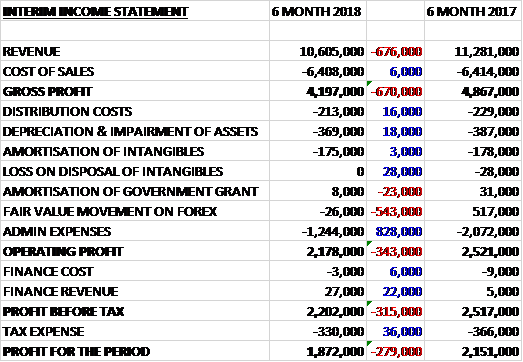
Dewhurst has now released their interim results for the year ending 2018.
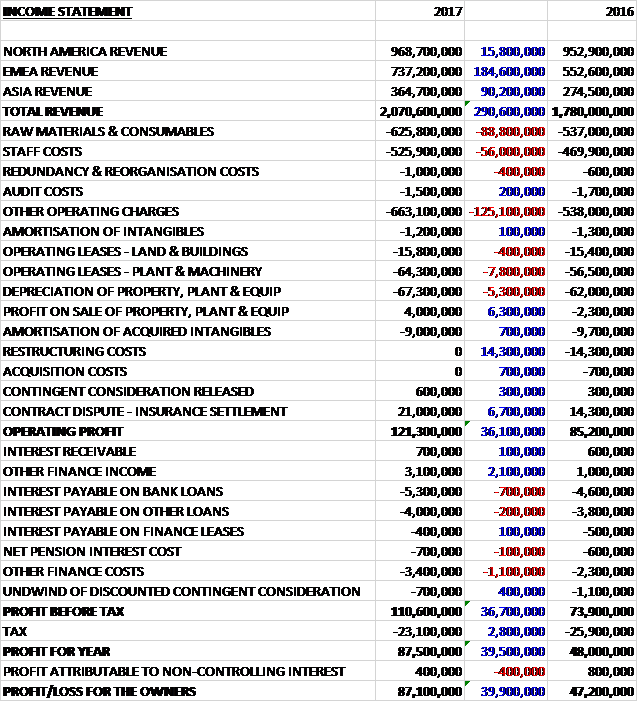
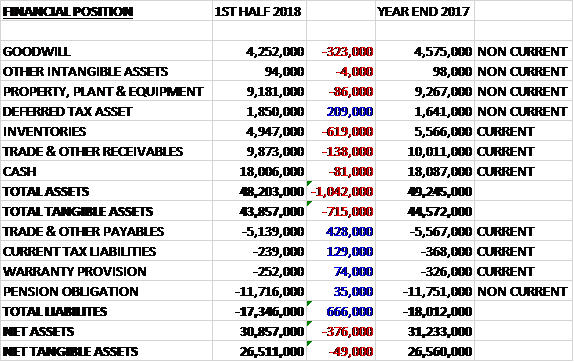
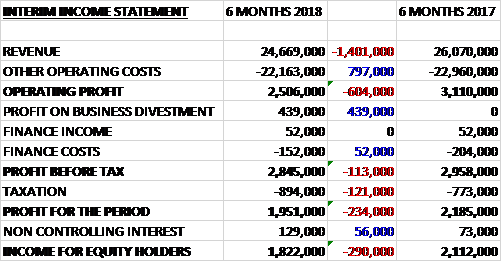
Revenue declined by £1.4M and operating costs fell by £797K which meant that the operating profit was £604K lower. There was a £439K profit on a business sale and finance costs declined by £52K but tax charges grew by £121K to give a profit for the period of £1.8M, a decline of £290K year on year.

When compared to the end point of last year, total assets declined by £1M, driven by a £619K fall in inventories, a £323K decrease in goodwill and a £138K decline in receivables, partially offset by a £209K growth in deferred tax assets. Total liabilities also declined during the period due to a £428K decrease in payables and a £129K fall in current tax liabilities. The end result was a net tangible asset level of £26.5M, broadly flat over the past six months.

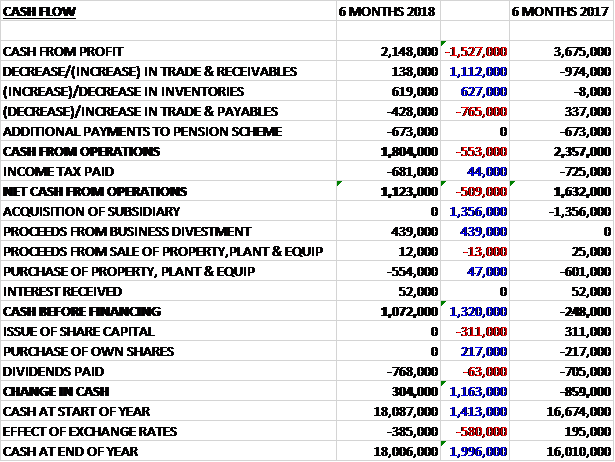
Before movements in working capital, cash profits declined by £1.5M to £2.1M. There was a cash outflow from working capital and the pension scheme payments but the working capital movements were more favourable than last year and after tax payments reduced by £44K the net cash from operations was £1.1M, a decline of £509K year on year. The group brought in £439K from a business divestment and spent a net £542K on capex to give a free cash flow of £1.1M. Of this, £768K was spent on dividends to give a cash flow of £304K and a cash level of £18M at the period-end.

Although sales and profit fell during the period, on a constant currency basis and adjusting for the divested business, underlying sales were slightly up. Demand for keypads was weak, which was the most significant contributor to sluggish sales and the strengthening sterling reduced profits by £200K. Canada continued its strong growth, the UK business was varied but overall up, and Australia was also mixed.

In most of the group’s markets, the business climate seems to be reasonably positive at present. The exception remains the UK where there is still some uncertainty about the short term and the economic situation is highly dependent on political decisions. Although keypad sales have picked up a little in the last couple of months, the board do expect a declining trend in the long term. Current exchange rate levels continue to be a drag on the group. The second half of the year may see a period of consolation but on balance the board are encouraged by the future growth prospects for the group.

At the current share price the shares are trading on a PE ratio of 21.4 which falls to 19.4 on the full year consensus forecast. After the interim dividend was maintained the same the shares are yielding 1.1% which is forecast to remain the same for the full year.

On the 4th June the group announced the acquisition of A&A Electrical Distributors for an initial consideration of £10.5M plus a deferred consideration based on profits generated over the next two years, with the expected consideration expected to be around £1.5M. It is expected that the acquisition will be immediately earnings enhancing.

The business is based in London and is a lift and electrical distribution company which works with lift companies operating in the UK and have been a long standing customer of Dewhurst. Last year the business made a profit of £3.3M but the acquired net assets are only around £800K, giving a goodwill generation of about £11.2M.

Overall then this has been a difficult period for the group. Profits fell, net tangible assets were broadly flat and the operating cash flow declined, although some free cash was generated.
The keypad demand has been weak and this is something it seems that the board expect to continue. These shares are not cheap with a forward PE of 19.4 and yield of 1.1% so this does not look very tempting at the moment.

XP Power Share Blog – Interim Results Year Ending 2018

XP Power has now released their interim results for the year ending 2018.
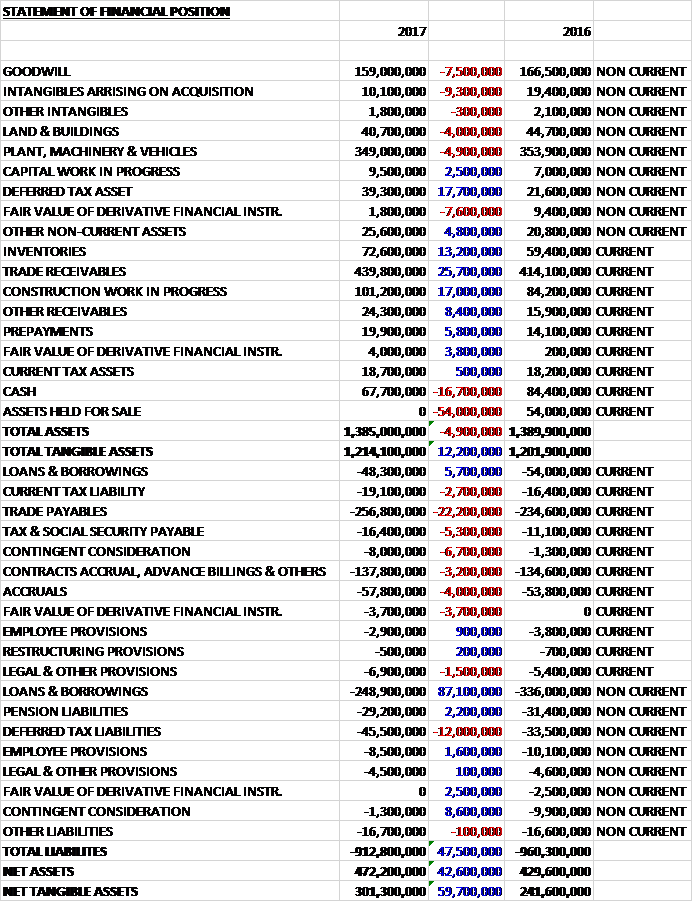
Overall revenues increased year on year as a £600K fall in Asian revenue was more than offset by a £13.3M growth in North American revenue and a £300K increase in European revenue. The purchase of inventories declined by £7.6M but this was more than offset by a £12M change in inventories and a £2.7M increase in other cost of sales to give a gross profit £5.9M higher. Amortisation was up £1.1M, depreciation increased by £200K and R&D expenses grew by £300K which meant that the operating profit rose by £4.4M. Finance costs were up £300K and tax expenses increased by £600K to give a profit for the period of £14.6M, a growth of £3.7M year on year.

When compared to the end point of last year, total assets increased by £50.9M, driven by a £16M growth in goodwill, a £12.8M increase in inventories, a £12.4M increase in intangible assets, a £6.2M growth in trade receivables and a £5.4M increase in property, plant and equipment, partially offset by a £2.9M decrease in cash. Total liabilities also increased during the period due to a £34.6M increase in borrowings and a £6.6M growth in payables. The end result was a net tangible asset level of £33.1M, a decline of £19.9M over the past six months.

Before movements in working capital, cash profits increased by £8.1M. There was a cash outflow from working capital and despite tax payments falling by £1M, the net cash from operations was £13M, a decline of £3.4M year on year. The group spent £2.8M on capex and £2.8M on R&D along with £35.6M on the acquisition to give a cash outflow of £28.1M. The group then took out a net £33.8M of net loans which helped pay for £9M of dividend payments and give a cash outflow of £2.8M for the half year and a cash level of £12.1M at the period-end.

Overall the reported order intake, revenues and earnings were comfortably ahead of the first half of last year, offsetting the impact of sterling appreciation. The group benefited from the continued momentum in the capital equipment markets and, significantly, new design wins entering their production phase. Order intake of £101.4M was 9% up on last time (10% like for like at constant currency)

The operating profit in the European business was £8.2M, a growth of £500K year on year with revenues up 11% The operating profit in the North American business was £16M, an increase of £1.5M when compared to the first half of last year. Revenues were up 44%, boosted by the acquisitions, with like for like revenues up 22%. This reflects the strong performance of the semiconductor equipment market. The operating profit in the Asian business was £1.8M, an increase of £700K when compared to the first half of 2017 with revenues increasing by just 1%
The group has felt the effect of strengthening pound against the dollar and the impact of changes in the key exchange rates led to a £1.6M reduction in pre-tax profit.

All sectors remain buoyant suggesting that the broad recovery seen in capital equipment markets last year is continuing. Revenues from healthcare customers increased by 14%, revenues from industrial customers grew by 10%, revenues from technology customers were up 13% and revenues from semiconductor manufacturer customers more than doubled with organic revenues up 68%. The robust organic growth rate was underpinned by a number of new programme wins by the engineering solutions group entering into production, expanding the market share, which remains relatively low.

The group are now seeing some shortages of components together with component price inflation. To date, the safety stocks have largely insulated them and their customers from these shortages but this caused a minor margin decline in the period which was partially offset by the strengthening sterling. The group are building a sufficient margin of safety stock on critical lines wherever possible

In May the group acquired Glassman High Voltage, a company that is a designer and manufacturer of high voltage, high power, power supplies. In addition, the acquisition also includes the purchase of the European sales business. The group made the acquisition because they share several customers and while there is no direct overlap in product lines, the power supply solutions of the two companies are complementary. The total consideration, paid in cash, was £35.8M and it generated goodwill of £15.5M. In the month or so after acquisition, the business generated a net profit of £300K. Last year’s Comdel acquisition is performing in line with expectations and made of net profit of £1.7M in the period.

In October last year the group started construction on a second factory at their existing site in Vietnam. They expect construction to be completed by Q4 this year with production scheduled to come on stream in H1 2019. It is estimated that the existing Asian manufacturing facilities have the capacity to produce $170M of end revenue of their own manufactured products. The second facility in Vietnam will add an additional capability of around $130M of revenue. It is estimated that the cost of the building and the initial equipment set will be around $6.5M, of which $1.5M has been incurred to date.

Going forward, while the board remain conscious of potential risks arising from component cost inflation and macroeconomic challenges, their strong order book (£85.5M compared to £80.3M last time) and design wins over recent years entering production, means that they anticipate the group’s performance over the full year will be in line with existing expectations.

At the end of the period the group had a net debt position of £46.5M compared to £8M at the same point of last year. After a 6% increase in the interim dividend the shares are yielding 2.2% which increases to 2.3% on the full year consensus forecast. At the current share price the shares are trading on a PE ratio of 24.6 which falls to 20.1 on the full year forecast.

Overall then this was a fairly decent result for the group. Profits were up, although the net tangible asset level deteriorated due to the acquisition. The operating cash flow also fell due to the stock build but cash profits were up. All businesses showed growth and all sectors remained buoyant with the semiconductor market being particularly strong. There are risks, such as the cost price inflation issue and the large acquisition along with the cyclicality of the markets; and the shares are rather expensive with a forward PE ratio of 20.1 and yield of 2.3% but I continue to hold for now.

On the 14th January the group released a trading update covering Q4.  They had a good finish to the year with trading in the full year in line with board expectations.  All regions and sectors recorded growth in the year.  Their industrial, healthcare and technology markets reported healthy demand across the year and Q4 but the impact of the weakness in the semiconductor manufacturing equipment sector meant that both total order intake and revenues in Q4 were lower than in Q3.

Order intake was £45.1M, 4% below that of Q4 2017 and 6% lower at constant currency.  This resulted in order intake for the full year of £198.4M, an increase of 8% or 12% at constant currency.  On a like for like basis, order intake was up just 1%.  Revenue in Q4 was 14% ahead of Q4 last year and revenue for the year as a whole increased by 17%.  On a like for like basis it was up 7%.

The trading performance of Glassman was in line with the pre-acquisition expectations, with orders and revenues for the seven months of £7.3M.  Integration is proceeding as planned and the sales team is already finding new opportunities for these products.  Net debt at the year-end was £52.5M compared to £10.1M at the end of last year.

Going forward, while the group is not immune from macroeconomic conditions, they are encouraged by their ongoing new design wins and health order book.  On this basis, and with the benefit of the Glassman acquisition, they expect further revenue growth in 2019.  This really doesn’t say much when you think about it!

Trifast Share Blog – Final Results Year Ended 2018

Trifast has now released their final results for the year ended 2018.
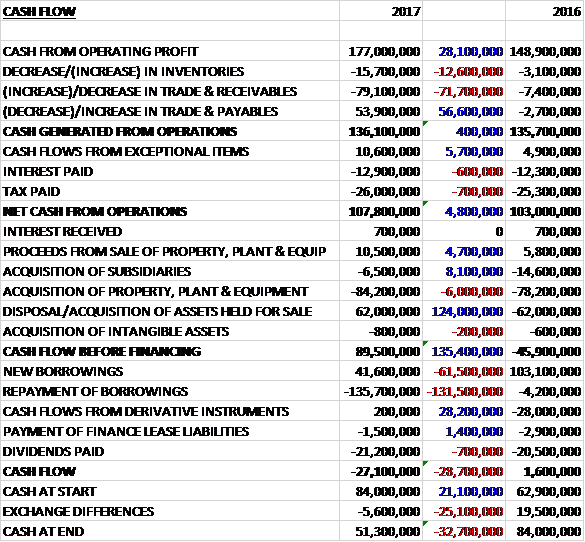
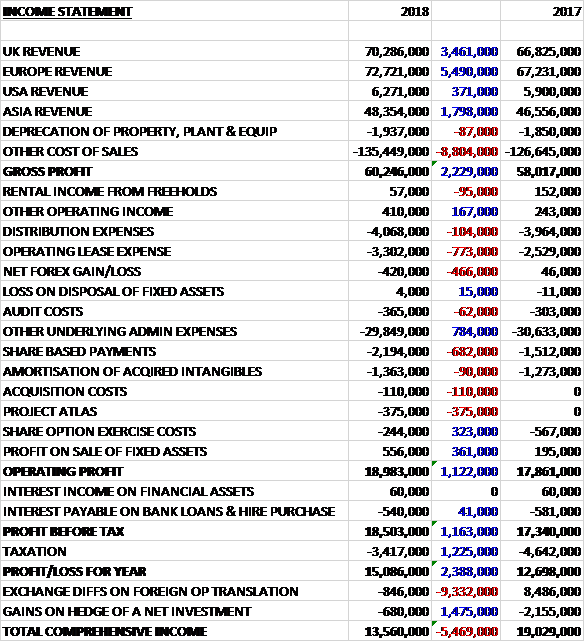
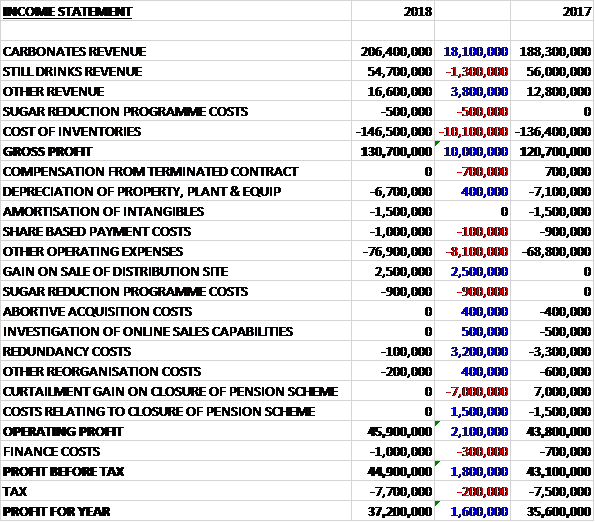
Revenues increased when compared to last year due to a £5.5M growth in European revenue, a £3.5M increase in UK revenue, a £1.8M growth in Asian revenue and a £371K increase in US revenue. Cost of sales was also up to give a gross profit £2.2M higher. There was a £773K increase in operating lease payments and a £466K negative swing to forex losses but other underlying admin expenses increased by £784K. Share based payments were also up £682K but there was a £361K increase in the profit from asset sales to give an operating profit £1.1M higher. Tax charges fell by £1.2M reflecting historic EU loss relief claims in the UK and EU dividend relief claims to cover dividends paid up to Trifast PLC up to 2009 (£1.2M net effect), which meant that the profit for the year was £15.1M, a growth of £2.4M year on year.

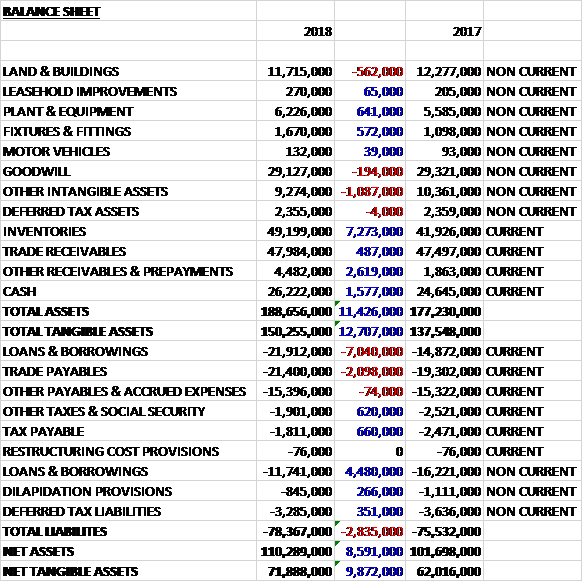
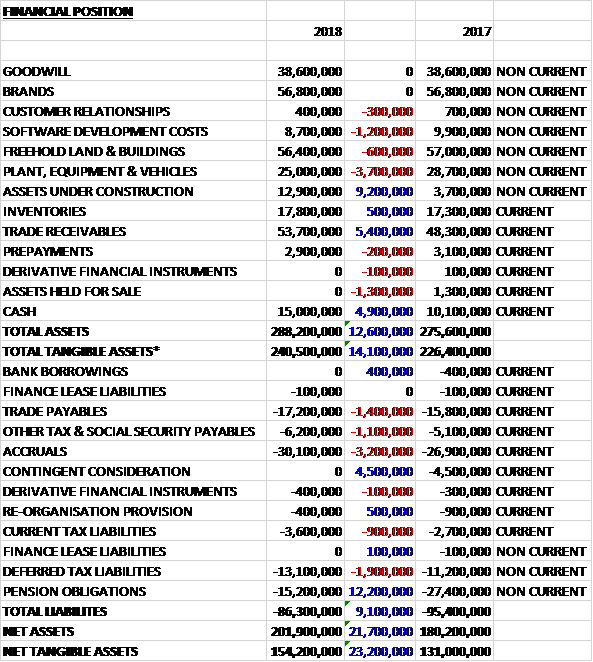
When compared to the end point of last year, total assets increased by £11.4M driven by a £7.3M growth in inventories, a £2.6M increase in prepayments and a £1.6M growth in cash, partially offset by a £1.1M decline in other intangible asserts. Total liabilities also increased during the year due to a £2.6M growth in borrowings and a £2.1M increase in trade payables. The end result was a net tangible asset level of £71.9M, a growth of £7.9M year on year.

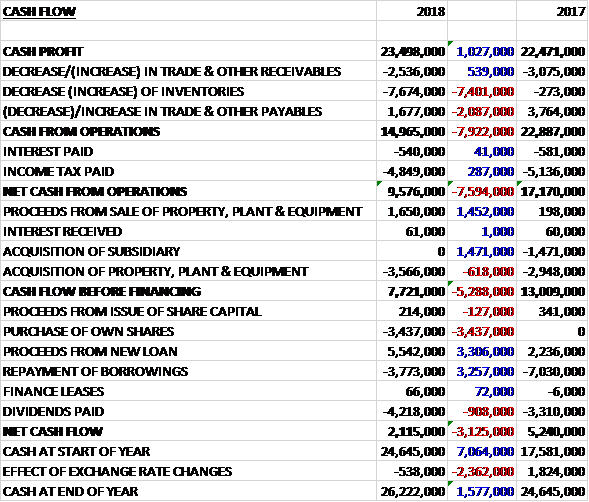
Before movements in working capital, cash profits increased by £1M to £23.5M. There was a cash outflow from working capital and despite tax payments reducing by £287K the net cash from operations was £9.6M, a decline of £7.6M year on year. The group made proceeds of £1.7M from the sale of assets but spent £3.6M on new property plant and equipment to give a free cash flow of £7.7M. Of this, £3.4M was spent purchasing shares, £4.2M on dividends but the group received a net £1.8M from new borrowings to give a cash flow of £2.1M and a cash level of £26.2M at the year-end.

The underlying profit in the UK business was £8.3M, a growth of £1.9M year on year despite the ongoing uncertainty surrounding Brexit. The biggest increase in revenue continues to be seen across the European distribution businesses, growing 23%. Outside of this, growth has largely come from increased sales to the core multinational OEMs across a number of sectors. In addition, there has been an operating margin increase reflecting the benefits of the revenue growth over a semi-fixed cost base.

The underlying profit in the European business was £9M, a decline of £712K when compared to last year. The business exited the year strongly, however, with revenues in H2 growing by 5.2% with full year revenues up 3.8% despite following abnormally high sales volumes in the Italian domestic appliances business last year as they supported a global product recall programme for a key customer. The most significant gains this year have arisen in the automotive sector in the Netherlands and Sweden, with these sites seeing revenue growth of 15.4% and 13.6% respectively.

The gross margin declined specifically within the Italian business where the impact of purchase cost increases in the second half of 2017 have continued into 2018. In addition to this there was a planned increase in fixed production costs as the group invested in manufacturing capacity to support future growth. Positive margin improvements in other parts of the European business have helped offset some of this decline.

The underlying profit in the US business was £52K, a decrease of £282K when compared to 2017, although revenues increased by 8%, driven predominantly by the automotive sector, as a strong second half offset a slow first half of the year due to Hurricane Harvey. Gross margins in the US have declined as a result of the product mix changes and an increased focus on the automotive sector, exaggerated by reduced sales volumes due to the hurricane as well as one-off set up costs relating to the start of production for one of the region’s biggest automotive customers. Low underlying operating margins continue to be expected in this region given the level of investment for future growth being made.

The underlying profit in the Asian business was £8.5M, an increase of £456K year on year. Trading has increased almost across the board with Shanghai showing the strongest revenue growth at nearly 10%. This is mostly in the automotive sector as the group expand into a number of their multinational OEM customers both locally and into Japan.

The group announced Project Atlas, a multi-year investment in their IT infrastructure and underlying business processes with a budgeted cost of up to £15M. So far they have incurred costs of £400K, largely relating to project team and consultancy costs. The project is about more than just an IT platform, with that element representing about a third of the overall cost. A significant proportion of the spend has been aligned to a review and redesign of their business processes which should drive improvements in their operating and commercial effectiveness. The board expects there to be material benefits of the investment programme. The estimated ROI is 25% per annum by 2023

During the year a factory previously rented to an automotive tier 1 company in Malaysia was sold for £1.7M, generating a profit of £600K.

In manufacturing, their capex plans will continue to increase capacity, most notably at both the Italian and Singapore sites. This will reduce the per part production costs by bringing more manufacturing in-house in the future. On the distribution side of the business, they have already expanded warehouse capacity in Shanghai and Northern Ireland to support the strong growth in those markets. In 2019 they will see further targeted expansions in some of their other high growth sites such as the Netherlands. Moving into their new sire in the US in April 2018 represents one of their biggest warehousing investments in recent years. This has increased capacity significantly, to not only better support existing trading levels but also to future-proof the business for further growth.

In Europe the group continue to invest in their expanding greenfield distribution site in Spain and the setup in November of a TR Innovation and Technical Centre in Gothenburg is already helping to develop their presence in this developing market.

In April the group acquired Precision Technology Supplies for an initial consideration of £8.5M and a further contingent consideration of up to £2.5M. Based in the UK, the business is a distributor of stainless steel industrial fastenings and precision turned parts, primarily to the electronics, medical instruments, petrochemical, defence and robotics sectors. Last year the business reported pre-tax profits of £700K and the acquisition generated goodwill of £2M so on the surface this seems like a decent price. The acquisition widens the group’s stock range, enhancing their customer offering and should provide support to the distributor sales.

Going forward, the current year has started well with a robust pipeline in place and the board remains confident of delivering on its expectations. Wider macroeconomic factors continue to exist that the group cannot fully mitigate, including the ongoing volatility in the forex and raw material markets, the expected wash through of input cost pressures in the UK due to the weakness of Sterling and the wider potential implication of Brexit.
After a 10% increase in the total dividend the shares are yielding 1.6% which increases to 1.7% on next year’s consensus forecast. At the current share price the shares are trading on a PE ratio of 19.3 which falls to 16.5 on next year’s forecast. At the year-end the group had a net debt position of £7.4M compared to £6.4M at the end of last year.

On the 14th June the group announced that Chairman Malcolm Diamond sold 250,000 shares at a value of £666K. No reason was given which is a little concerning.

Overall then this has been a good year for the group. Profits were up, net assets increased and although the operating cash flow was down, this was due to working capital movements and cash profits improved with a decent amount of free cash also being generated. The UK and Asian businesses did well, with particular growth in automotive but the European and US businesses both saw profits decline. In Europe this was put down to increased purchasing prices in Italy along with investment in future growth. Investment also affected the US, in addition to the effects of the hurricane in H1.

Project Atlas is a considerable use of future cash, with some £15M being invested but hopefully will aid the group in future but forex movements and raw material price hikes are risks going forward. The New Year seems to have started OK but the shares are not hugely cheap with a forward yield of 1.7% and PE ratio of 16.5. The director sale is also a concern, but overall I see nothing major here to force a sale.

On the 26th September the group released a trading update covering the year as a whole when trading was in line with management expectations. Demand remains reassuring across Asia and Europe and although relatively small, the US is growing well this year from a mix of increasing electronics and automotive sales. In the UK they have seen a solid performance across their major market with the exception being automotive where volumes are being hampered by diesel0led transitory reductions and changes to product cycles and model builds.

Globally automotive remains the strongest sector for organic growth as they continue to increase their market share and site penetration with their tier 1 and OEM customers. The increase in electric vehicle production is a significant growth opportunity for them providing additional access points as many more new platforms come on line, battery technology develops and the demand for charging stations accelerates.

The current solid revenue growth is not being reflected in operating margins, however, as they continue to invest for the future. Capital investments in Singapore, Italy and Taiwan are building their capacity and capabilities in these locations. The recent warehouse expansions in the US, Netherlands and Shanghai support the strong growth seen across those sites.

The PTS acquisition has settled well into the group and remains on target to be earnings enhancing in 2019.

In the UK they have seen the impact of input cost inflation in the period as a result of the weak pound but outside of this they believe that the operational and financial impact of any Brexit scenario will be manageable. They are also closely monitoring the escalating trade tensions between the US, Europe and China but they don’t expect the effects of this to be material for the group.

Overall the group remains on track to deliver results for 2019 in line with management expectations. This all looks fine, I am thinking of buying back in here.

AG Barr Share Blog – Final Results Year Ended 2018

AG Barr has now released its final results for the year ended 2018.

Revenue increased when compared to last year as a £1.3M reduction in still drinks revenue was more than offset by an £18.1M increase in carbonates revenue and a £3.8M growth in other revenue. There was a £500K cost associated with the sugar reduction programme and other cost of sales increased by £10.1M to give a gross profit £10M higher. Depreciation was down £400K but there was no compensation from terminated contracts, which brought in £700K last year, and other operating expenses grew by £8.1M. There was a £2.5M gain on the sale of the distribution site, however, and a £900K admin cost associated with the sugar reduction programme. We also see no pension income, which was £5.5M last time, and redundancy costs fell by £3.2M. All of this meant that the operating profit was £2.1M higher. Finance costs increased by £300K and tax charges were up £200K to give a profit for the year of £37.2M, a growth of £1.6M year on year.

When compared to the end point of last year, total assets increased by £12.6M driven by a £9.2M growth of assets under construction, a £5.4M increase in trade receivables and a £4.9M growth in cash partially offset by a £3.7M fall in plant, equipment and vehicles, a £1.3M decline in assets held for sale and a £1.2M decrease in software development costs. Total liabilities declined during the year as a £3.2M increase in accruals and a £1.9M growth in deferred tax liabilities were more than offset by a £12.2M decrease in pension obligations and a £4.5M decline in contingent consideration. The end result was a net tangible asset level of £154.2M, a growth of £23.2M year on year.

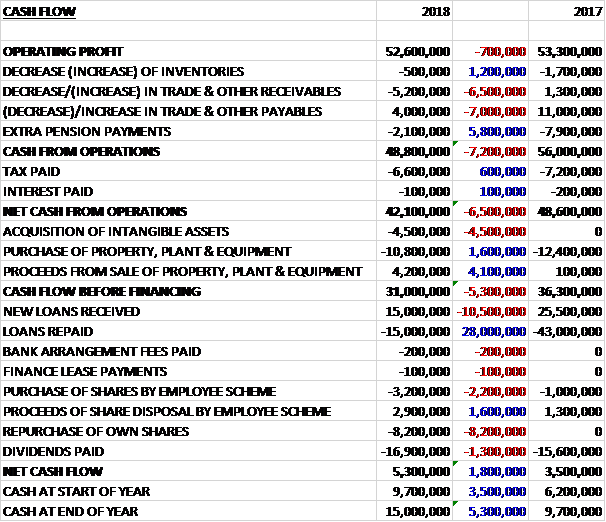
Before movements in working capital, cash profits declined by £700K to £52.6M. There was a cash outflow from working capital and despite tax and interest payments reducing by £700K the net cash from operations came in at £42.1M, a decline of £6.5M year on year. The group spent £4.5M on intangible assets, and £10.8M on property, plant and equipment, although they recouped £4.2M from the sale of a property to give a free cash flow of £31M. There was a neutral loan position but £8.2M was spent buying back shares and £16.9M was paid out in dividends. This all gave a cash flow of £5.3M and a cash level of £15M at the year-end.

The gross profit in the Carbonates division was £104.3M, a growth of £7M year on year. Irn-Bru sales were up 5.7% in volume and 8% in revenue. Barr Flavours, KA, Sun Exotic and OMJ have all delivered volume growth. The Rockstar brand had a strong year, delivering double digit volume gains and maintaining pricing in the face of strong completion.

The gross profit in the still drinks and water division was £18.1M, an increase of £1.1M when compared to last year. This is despite some supply driven constraints for Snapple in the earlier part of the year. Revenue was down 2.3% but margins improved considerably.

After several years of double digit revenue growth the international business grew revenue by just 3.8% as a result of the continued export drive by the Funkin business, tempered by complexities created by the reformulation programme and some local distributor changes.

The Funkin business continued to perform strongly with sales growth of 25%. The key on-trade business has grown volume and margins in each of its product segments, benefiting from continued cocktail growth. The drive into take-home with the brand has started with the launch of the shaker pack in supermarkets. A £4.5M cash earn-out accrued at the time of acquisition was paid to the previous owners of the brand during the year.

The UK soft drinks market has performed reasonably well across the last year with value growth of 2.9% and volume growth of 0.5%, reflecting the underlying inflationary environment. The key driver of value growth has been branded carbonates, where some significant reductions in promotional investment have led to higher realised prices but lower volumes. The water category continues to drive volume growth, generally at the expense of value. Against this backdrop the group saw value growth of 8.7% and volume up 7.7% with market share growth balanced across sales channels.

Irn-Bru sales were up 8%, Rubicon sales increased by 5.3% and Funkin sales grew by 25%. Across the franchise brands, Rockstar had a good year with sales up 14.3% due to product distribution growth and growth in new overseas territories. Snapple, however, saw a reduction in volumes as a result of retailer range rationalisation in a small number of European markets and some supply issues across Q2 and Q3. Overseas sales were up just 3.8%, reflecting the complexity of the reformulation programme created in their export led international model and some local distributor changes.

The group have announced a new long-term partnership agreement with San Benedetto. From January 2018, the group became the exclusive UK and Ireland distributor of San Benedetto’s Prima Spremitura sparkling citrus fruit drinks. The group have also added another new brand partner – Bundaberg Brewed Drinks. Starting in April 2018, they have entered into an exclusive long term agreement in relation to the brand in the UK. Best known for its Ginger Beer, the Australian brand is already established in the UK.

Over the past year the group has added further production capacity with the installation of a new PET bottling production line at Milton Keynes, at a capital cost of £10M. They have also started a replacement to their syrup room in Cumbernauld. Capex in 2019 is expected to be at a slightly higher level than this year, primarily driven by the phasing of the last payment on the PET line, the continuation of the syrup room upgrade and the ongoing maintenance and optimisation programmes.

Margins have been negatively impacted by the continued weakness in Sterling, affecting input costs such as sugar and packaging which are prices in Euros.

In response to changing consumer requirements, the group have extended their reformulation programme, taken in advance of the implementation of the soft drunks industry levy in April. They now expect that up to 99% of the portfolio will contain less than 5g of sugar per 100ml. Whilst it is still early days, apparently the consumer response to the new product has been encouraging.
During the period there was a £2.5M gain on sale made on the disposal of the Walthamstow distribution asset. There have so far been £1.4M of costs incurred as part of the ongoing sugar reduction programme which has exceeded the level of expenditure that would normally be incurred in the course of new product development.

Going forward the UK economic landscape is expected to remain uncertain for business as a whole with regulation, changing customer dynamics and consumer preferences adding further volatility to the soft drinks industry. The board remain confident in their ability to grow the business and deliver long-term value, however.

At the current share price the shares are trading on a PE ratio of 23.5 which falls to 21.9 on next year’s consensus forecast. After an 8% increase in the total dividend, the shares are yielding 2.4% which increases to 2.6% on next year’s forecast. At the year-end the group had a net cash position of £15M compared to £9.7M at the end of last year.
On the 30th May the group announced that finance director Stuart Lorimer purchased 7,164 shares at a value of just under £50K.

Overall then this has been a decent year for the group. Profits were up and net assets increased. The operating cash flow did decline but free cash generation remained healthy. The carbonates business did well, with all segments seeing growth and still drinks also performed well despite some supply issues around Snapple. The market in general has been OK, with lower promotional activity giving rise to higher values and the group has outperformed the market.

There are some issues, the continued weakness in Sterling is unhelpful and the reformulation programme obviously carries with it some risks. The share are also not cheap with a forward PE of 21.9 and yield of 2.6%. Despite this, there is net cash and these shares seem a solid prospect so I continue to hold.

On the 1st August the group released a trading update covering the first half of the year. Revenues are expected to increase by 5%. The soft drinks market as a whole was up 4.5% in value terms and 1.4% in volume. It benefited from hot early summer weather across the UK and the value increase associated with the implantation of the Soft Drinks Industrial Levy in April.

In the period they completed the implantation of their reformulation programme and have grown market share. The Irn-Bru brand in particular has continued its positive growth momentum, with regular Irn-Bru increasing its volume and value share of the total soft drinks market alongside strong growth in Irn-Bru Xtra.

There was further growth in Rubicon Spring and Street Drinks by Rubicon has recently been launched. The new partnership brands, San Benedetto and Bundaberg have made encouraging early progress and Funkin continues to perform strongly.

Going forward, the external landscape remains volatile. In addition they have seen the implementation of the Soft Drinks levy, the impact of which is still to be fully determined. The group have been investing in their brands and people which has a moderate impact on margins in the current year but overall full year profit expectations remain unchanged.

IQE Share Blog – Final Results Year Ended 2017

IQE has now released their final results for the year ended 2017.

Revenues increased when compared to last year as a flat CMOS++ revenue and a £4.8M fall in license income from joint ventures was more than offset by a £24.8M growth in photonic revenue, a £1.4M increase in IR revenue and a £337K growth in wireless revenue. Cost of inventories were up £10.2M, operating lease payments increased by £888K and other costs of sales increased by £6.2M to give a gross profit £4.5M higher. There was no gain on release of contingent consideration, which was £2.3M last year; there was a £2.7M swing to forex losses and a £4.6M increase in share based payments along with a £982K growth in amortisation. This was partially offset by a £3.3M decline in other general costs which meant the operating profit fell by £2.8M. Finance costs increased by £636K to five a profit for the year of £14.4M, a decline of £3.5M year on year.

When compared to the end point of last year, total assets increased by £58M, driven by a £9.5M growth in development costs, a £40.7M increase in cash, a £7.7M growth in plant and machinery, a £4M increase in trade receivables and a £5.2M increase in inventories, partially offset by a £5.2M decline in goodwill a £2.8M fall in prepayments and accrued income, a £1.9M decrease in leasehold improvements and a £1.6M fall in customer contracts. Total liabilities declined during the year as a £2.7M increase in tax and social security payables and a £3.2M growth in other payables was more than offset by a £44.5M decline in bank borrowings, a £5.3M fall in current tax liabilities and a £1.4M fall in onerous lease provisions. The end result was a net tangible asset level of £182.3M, a growth of £98.4M year on year.

Before movements in working capital, cash profits increased by £9.6M to £37M. There was a cash outflow from working capital, interest payments increased by £636K and tax payments were up £5M, due to the payment of unpaid US taxes, to give a net cash from operations of £21.7M, a growth of £1.6M year on year (going forward cash tax is expected to be between £1M and £2M. The group spent £14.5M on development expenditure, £2.4M on other intangible assets and £11.3M on property, plant and equipment to give a cash outflow of £6.4M before financing. The group issued £94.9M in new share capital which helped pay back loans of £47.6M and gave a cash flow of £40.9M and a cash level of £45.6M at the year-end. It is worth noting that as they were taken out as finance leases, some £6.6M of capex is hidden under repayment of borrowings.

The operating profit in the Wireless division was £13.7M, an increase of £678K year on year on sales that were broadly flat, affected by a £3M managed reduction of SMI inventories to focus capacity on the ramp in photonics. Following the launch of the iPhone in 2007 this market has enjoyed several years of double digit growth but market growth cooled since 2013 as the innovation cycle struggled to keep apace. Overall smartphone shipments were flat in 2017, which represents a core part of the group’s business.

Despite the lack of growth in smartphone sales, the increase in data traffic continues to drive the need for more sophisticated wireless chip solutions in handsets. This is driving the market towards 5G communication, which the group sees as a significant upside potential for its wireless business.

Infrastructure applications such as base stations, radar and CATV are a small but rapidly growing part of the business. In partnership with MACO Technologies the group has developed a low cost solution to accelerate the displacement of LDMOS. MACOM is in the process of qualifying this technology downstream and concluded a high volume chip fabrication partnership in late 2017 in anticipation of a production ramp on completion of the qualifications.

The fastest growing area of the wireless chip market has been for high performance filters. Although the primary materials technology for filters is made from compound semiconductor elements, the wafers have been fabricated using a less sophisticated process called sputtering, reflecting that producing a more sophisticated single crystal epitaxial solution has been a significant challenge. The group overcome these hurdles late 2017 and prototyped the key technologies. They are now engaged with multiple customers.

The operating profit in the Photonics division was £18.2M, a growth of £8.9M when compared to last year on sales that doubled. This was primarily driven by the adoption of the group’s VCSEL technology in a mass market customer application which ramped strongly in the second half of the year.

There is little doubt that sensing technologies will represent a major growth area in the near term which is reflected in the breadth of product development programmes in which the group is engaged and which now span multiple tear 1 OEMs who are targeting mass market ramps in 3D sensing applications over the next year and a half.

The InP business continues to perform well. This market is being driven by the need for higher speed, higher capacity fibre optic systems to address continuing growth in data traffic. To address the evolving market, the group has developed technologies which enable higher performance with lower manufacturing costs which includes a solution for Distributed Feedback Lasers for high speed FTTX chips. They are engaged in qualifications with several customers for this technology which are expected to ramp into production over the next year or so.

The operating profit in the IR division was £3.3M, an increase of £608K when compared to 2016 with a double digit growth in sales. The group is the global leader in the supply of wagers for advanced IR technology, primarily for see in the dark defence applications. They have secured several contract wins in this area. Beyond defence, the division has broadened its customer engagements into product development for mass market consumer applications. They are involved with a major OEM in developing IR products for applications such as sensing.

The operating loss in the CMOS++ division was £1.7M, an increase of £101K year on year on sales that were flat. The group is involved in multiple programmes which are developing the core technologies from which they expect highly significant revenue streams to emerge over the next three to five years.

The profit from license income from sales to joint ventures was £1.9M, a decline of £4.8M year on year reflecting that 2016 included a significant portion of up front license fees. Although initially realising license income through joint ventures, the group see opportunities to expand their model to third party license streams over the next few years and in due course for this to represent a significant part of the business.

Mass adoption of advanced solar wafers is hampered by the end system install costs. The terrestrial market remains an opportunity but focus has shifted to the space market, where the higher efficiency has a dramatic cost benefit on satellite payload. Product qualifications are underway with leading satellite manufacturers, paving the way for commercial revenues.
In November, the group issued 67.9 million new shares, raising gross proceeds of around £95M. This fund raise was primarily to finance a capacity expansion programme to deliver the scale needed to capture multiple high growth market opportunities, and in particular the continuing demand for VCSELs. In addition the fund raising is enabling the acceleration of product development and part of the proceeds was used to repay outstanding borrowings.

At the heart of the capacity expansion is the creation of a new foundry in Newport which will house up to 100 tools. The first five are now in-situ and on track for production in the second half of 2018 and a further five tools are scheduled for delivery in Q3. This new foundry is being supported by the Cardiff City Region City Deal which is funding the construction of the infrastructure. The group is leasing the building under an eleven year lease which has a three year rent free period and an option to purchase. The lead time to get new tools into production is nearly a year, from which time a fully utilised tool making VCSELs has a payback of about a year.

During the year the group identified historical tax liabilities dating back to 2013 in a US subsidiary which have been quantified at £4.7M. It was settled in full during the year and last year’s accounts have been restated which gave rise to a £748K reduction in profit and a £4.7M decrease in net assets. In addition, in 2016 the social security costs associated with outstanding share options were unrecorded which meant the income statement has been restated by £839K.

As usual there are a load of non-underlying items. There was a deferred tax charge of £7M relating to the impact of the change in US federal tax rates and the associated reduction in the value of the group’s deferred tax asset. Share based payments of £7.5M (!) have been deemed to be non-underling. Likewise for the £1.4M relating the amortisation of acquired intangibles. There were also a couple of other, smaller items.

Going forward, the board expects continued growth in 2018 driven by expansion of existing business and qualifications of new business steams. Photonics revenue is expected to grow between 35% and 60% based on the expansion of products currently in production and the completion of ongoing qualifications. The introduction of new technologies and additional marketing opportunities provide potential for even higher growth rates. Wireless revenue is expected to grow at under 5%. SMI inventories are expected to replenish with the potential for revenue expansion as GaN products make stronger contribution. IR revenue is expected to growth by between 5% and 15% with customer engagement broadening.

There is potential for strong growth in 2019. Increasing VCSEK adoption for 3D sensing is expected to accelerate across multiple smartphone OEMs along with the introduction of world facing 3D technology, and first deployment if LIDAR and other high volume sensing applications. There is the increasing deployment of InP for high speed FTTX and datacentre applications; increasing CS content in 5G communication systems, and increasing adoption of GaN for base stations and other high power RDF applications; and increasing use of IR products in mass market consumer applications.

In addition, revenues are expected from both power switching and non-terrestrial solar markets and multiple qualifications are in progress with DFB laser products. The expected compound growth rates over the next three to five years based on current products are: wireless up to 10%, photonics 40-60% and IR 5-15% with a potential for higher growth with new product introductions.
The current financial year has started in line with expectations.

At the current share price the shares are trading on a PE ratio of 54.5 which falls to 27.1 on next year’s consensus forecast. At the year-end the group had a net cash position of £45.6M compared to a net debt position of £39.5M at the end of last year.

On the 16th March the group announced that it has exercised its option to acquire and own the cREO technology and IP portfolio. They will pay a consideration of $5M either in cash or shares within six months. This technology, which the group had been licensed, offers an approach to the manufacture of a wide range of disruptive compound semiconductor on silicon products for the power switching and RF technologies markets.

On the 3rd April the group announced that long serving CFO Phillip Rasmussen died following a cycling accident. This really is tragic as he was a very enthusiastic driving force in the business.

On the 4th June the group released an update where they confirmed strong wireless activity and that they are actively engaged in VCSEL qualification programmes with over ten additional key VCSEL chip manufacturers which are progressing in line with board expectations. The commissioning of the new Newport foundry is progressing to plan, with the first five reactors now all on site and in various stages of acceptance testing. The second five reactors are expected to be delivered on site starting Q3 2018, with commissioning and qualification during the rest of 2018.
Following the tragic death of the CFO, the board have appointed Dr Godfrey Ainsworth as Executive Chairman and CEO Dr Drew Nelson will have oversight of the finance team, headed by finance director Neil Rummings.

Overall then I think this company is quite hard to get my head around. Profits declined, net assets grew due to the equity raise and the operating cash flow improved but the group is not cash generative with a cash outflow before financing. Operationally, the wireless division seems steady but there is growth from both photonics and IR. This is offset by the expected decline in licencing income. There is a big programme of capex here and, although, there may be a great deal of potential (it is hard to be sure) I feel the forward PE of 27.1 is a little rich.

On the 24th July the group released an update covering trading in the first half of the year. They expect to deliver a £3M increase in revenues to £73M despite a currency headwind of 9.5%, reflecting double digit sales growth on a constant currency basis in each of their three primary markets.

The wireless market grew by 11% at constant currency as the group delivered on their intention to replenish wireless inventory channels following the capacity allocation made to VCSEL production in H2 2017. The division has been underpinned by the renewal of the supplier agreement with their largest customer which has been extended for a further 15 months in addition to expanding to cover a wider range of products and increased share of the customer’s epiwafer requirements. As a consequence of this extension along with additional qualifications recently completed with other wireless customers, the board has approved a wireless expansion plan for their plant in Taiwan with the aim of increasing wireless capacity there by 40% in 2019.

The photonics division is expected to deliver growth of 30% at constant currency. Revenues from the largest customer were broadly flat as the supply chain absorbed inventory following a steep production ramp up for VCSELs relating to a 3D sensing application in H2 last year. The IR segment delivered growth of 11% and is expected to show further growth in the second half of the year.

The capacity expansion in Newport is proceeding according to plan. The first five reactors are now installed and are at various stages of qualification. A further five reactors will be delivered in the second half. Phase one will eventually deliver 20 reactor bays which are expected to be fully operational in H1 2019. Further reactors are planned to be installed through the remainder of 2019.

The group continues to trade in line with current market expectations.

On the 25th September the group announced the payment of a $5M IP purchase fee through the issue of IQE shares to Translucent in relation to the acquisition of cREO technology. They are confirming that they will issue 4,262,256 new shares. In March the group announced that it had exercised its option to acquire and own the cREO technology and had six months to pay the consideration.

On the 15th October the group announced that it had appointed Tim Pullen as CFO. He is currently CFO of ARM ltd so seems like a good fit.

Avon Rubber Share Blog – Interim Results Year Ending 2018

Avon Rubber has now released their interim results for the year ending 2018.

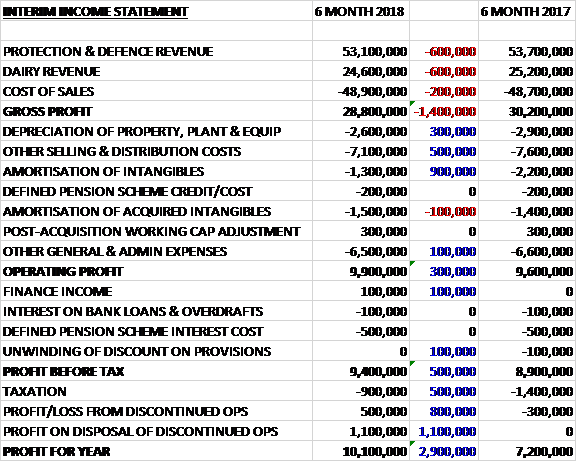
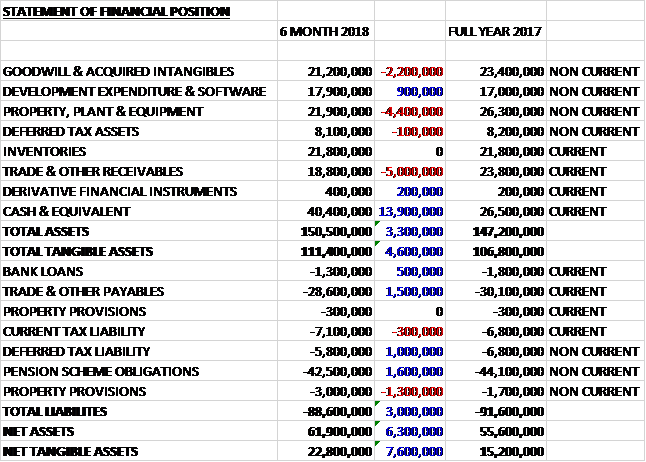
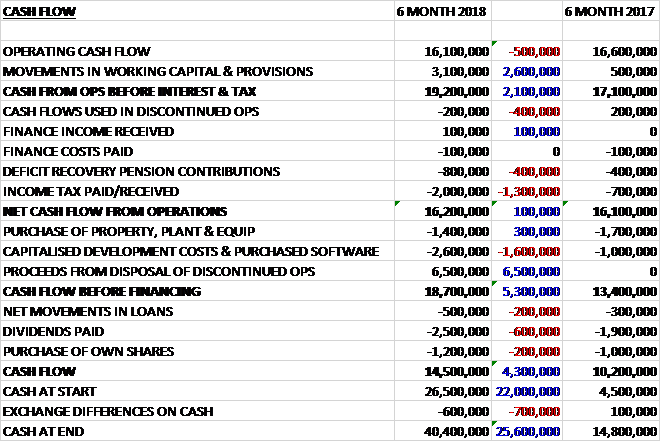
Revenues declined (although there was a growth at constant currency) when compared to the first half of last year with a £600K decrease in protection and defence revenue and a similar £600K fall in dairy revenue. Cost of sales grew by £200K which meant that the gross profit was £1.4M lower. Depreciation declined by £300K and other selling and distribution costs were down £500K. We also see a £900K decrease in amortisation to give an operating profit £300K higher. Finance income was slightly higher and tax charges fell by £500K to give a profit for the year of £8.5M, a growth of £1M year on year.

When compared to the end point of last year, total assets increased by £3.3M, driven by a £13.9M growth in cash, partially offset by a £5M decline in receivables, a £4.4M fall in property, plant and equipment, and a £2.2M decrease in intangible assets. Total liabilities declined during the period as a £1.3M growth in property provisions was more than offset by a £1.5M decline in payables, a £1.6M decrease in pension liabilities and a £1M fall in deferred tax liabilities. The end result was a net tangible asset level of £22.8M, a growth of £7.6M over the past six months.

Before movements in working capital, cash profits declined by £500K to £16.1M. There was a cash inflow from working capital and after tax payments increased by £1.3M and pension deficit recovery payments increased by £400K the net cash from operations was £16.2M, a growth of £100K year on year. The group spent £1.4M on property, plant and equipment, along with £2.6M on development costs and software. This was offset by the £6.5M received from the disposal of discontinued ops to give a free cash flow of £18.7M. Of this, £2.5M was paid out in dividends, £1.2M to buy back shares and £500K to repay borrowings which meant the cash flow for the half year was £14.5M and the cash level at the period-end was £40.4M.

The profit in the Protection division was £8.7M, a growth of £1.1M year on year. Revenues declined slightly but increased at constant currency with good growth in law enforcement more than offsetting declined in military and fire.

Military revenues were 6% lower. DoD revenues were flat with higher spares sales offsetting the planned lower shipment of M50 mask systems of 79,000. The ROW order book has grown strongly in the period driven by the initial MCM100 underwater rebreather orders. The lower first half ROW revenue arose due to delivery timings being weighted to the second half.

They received orders for 100,000 M50 mask systems in the period, resulting in an order book of 70,000 systems as they enter the second half, and since the period-end they have received a further order for 24,000 systems. They continue to pursue a number of identified opportunities with the DoD and ROW military customers and anticipate further orders, both for existing products and the new product portfolio.

Law enforcement revenue grew 42% on a constant currency basis to £18.6M. This was driven by strong performances in hoods and mask systems in Europe, the Middle East and Asia as they continue to make progress converting police forces to their products. In North America they also benefited from increased sales of filters and spares to the expanding customer base. Initial sales of their Powered Air range also contributed to the growth in the period and they see the new product range as a driver for growth moving forward.

Fire revenues reduced by 6% to £7.2M as the sector experienced tougher market conditions in North America. The group expect the launch of the Magnum SCBA later in the year to upgrade the existing product offering to their customers and support the medium term outlook for revenue growth.

The profit in the Dairy division was £2.6M, a decline of £400K when compared to the first half of last year although at constant currency there was a very modest increase. Revenue grew by less than 1% at constant currency as continued growth in Precision, control and Intelligence and Farm Services was offset by the performance of Interface in North America due to tougher market conditions as a result of increased feed costs squeezing farmer margins. With the softer market conditions in North America, they will continue to focus on managing the operating costs of the business in the second half.

Interface revenue was impacted by weaker market conditions in North America following the recent feed cost increases which are expected to continue in the second half. Market conditions in Europe, Middle East and Asia Pacific remain positive reflected in a constant currency revenue growth of 9% across these regions.

The Precision, Control and Intelligence range and sales have continued to perform well across the key markets. Revenue of £4.8M grew 5% at constant currency as dairy farmers continue to invest to drive farm efficiency. Farm Services has continued to show good growth with revenue of £2.6M up 29%, reflecting the success of Cluster Exchange which saw a 23% growth in cluster points. The extension of Farm Services to include Pulsator Exchange and Tag Exchange continues to progress in line with expectations.

During the period the most significant investments have been in the further development of the Magnum Self Contained Breathing Apparatus and MCM100 underwater rebreather product ranges. In Milkrite, investment has been focused on expanding the Precision and Intelligence heavy duty product range.
In March 2018 the group disposed of Avon Engineered Fabrications, their US-based hovercraft skirt and bulk liquid storage tank business. This non-core business was included in the Protection division. It was profit-making in the period though, with a £500K profit being made. The group made a profit on disposal of £1.1M and last year it made a loss of £300K.

Going forward the board remains confident on delivery of its current year expectations.

At the current share price the shares are trading on a PE ratio of 19.6 which falls to 19.3 on the full year consensus forecast. After a 30% increase in the interim dividend the shares are yielding 1% which increases to 1.1% on the full year forecast. At the period-end the group had a net cash position of £39.1M compared to £24.7M at the year-end.

On the 30th May the group announced that Chairman David Evans sold 5,000 shares at a value of £70K.

Overall then, this has been a decent period for the group, although they have suffered from detrimental forex movements. Profits were up due to lower costs, and net assets increased. The operating cash flow also increased but this was due to working capital movements and cash profits declined. Still, a good amount of free cash was generated. The protection business was strong, driven by increased sales to law enforcement. The dairy business found going a bit tougher, however, due to the increased feed costs in North America. The group remains very cash generative but the quality is reflected in the share price, with a forward PE of 19.3 and yield of 1.1%. Not great value, but I am holding on for now.

On the 17th July the group announced the receipt of an order for 93,000 M50 mask systems worth $25M from the US DoD. This order further contributes towards building the order book for 2019 and the group continue to pursue a number of identified opportunities with the DoD and ROW military customers to build the order book further.

On the 26th July the group announced that CFO Nicholas Keveth purchased 1,383 shares at a value of £20K.

Also on the 26th July it was announced that non-executive director Chloe Ponsonby purchased 1,400 shares at a value of £20K.

The Property Franchise Group Share Blog – Final Results Year Ended 2017

The Property Franchise group have now released their final results for the year ended 2017.

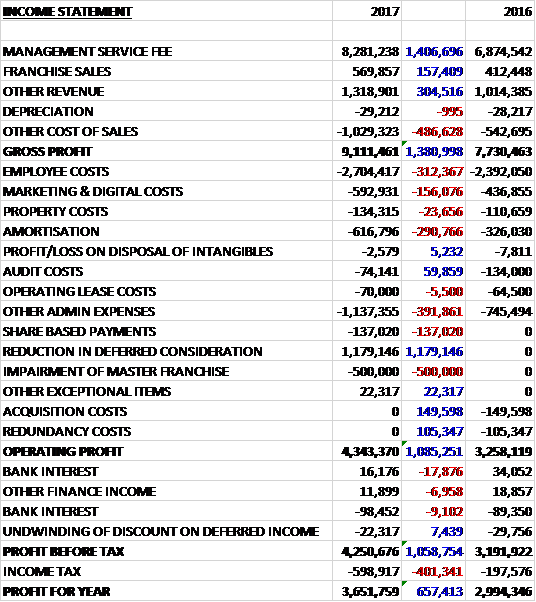
Revenues increased when compared to last year due to a £1.4M growth in management service fees, a £157K increase in franchise sales and a £305K growth in other revenue. Costs of sales increased by £487K so gross profit was £1.4m higher. Employee costs were up £312K, marketing and digital costs increased by £156K, and amortisation grew by £290K. There was £60K less spent on audit services this year but other admin expenses were up £392K. Share based payments were up £137K and there was a £500K impairment of the master franchise agreement but also a £1.2M reduction in deferred consideration, a £150K fall in acquisition costs and a £105K decrease in redundancy costs to give an operating profit £1.1M higher. We see a modest increase in interest costs and a £401K growth in tax charges which gives a profit for the year of £3.7M, an increase of £657K year on year.

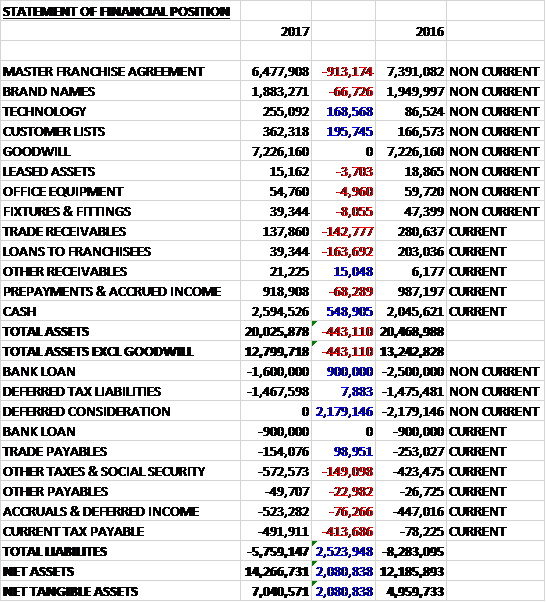
When compared to the end point of last year, total assets declined by £433K, driven by a £913K impairment of the master franchise agreement, a £164K fall in loans to franchisees and a £143K decrease in trade receivables, partially offset by a £549K increase in cash, a £196K growth in the value of customer lists and a £169K increase in technology relating to new websites. Total liabilities also decreased during the period as a £149K increase in other taxes and social security and a £414K growth in current tax payables were more than offset by a £2.2M decrease in deferred consideration and a £900K fall in the bank loan. The end result was a net tangible asset level of £7M, an increase of £2.1M year on year.

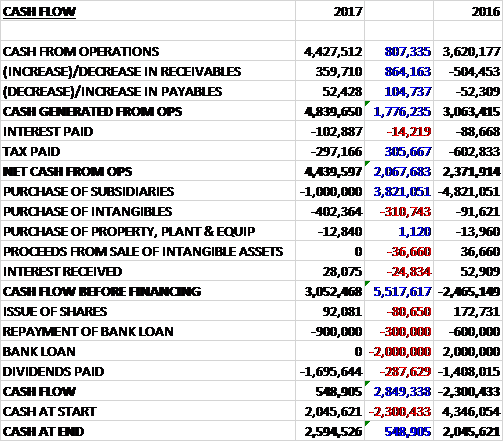
Before movements in working capital, cash profits increased by £807K to £4.4M. There was a cash inflow from working capital and after tax payments fell by £306K the net cash from operations was £4.4M, an increase of £2.1M year on year. The group spent £1M on acquisitions and £402K on intangible assets to give a free cash flow of £3.1M. Of this, £900K was used to pay off some of the loan and £1.7M was paid out in dividends which gave a cash flow of £549K and a cash level of £2.6M at the year-end.

The acquisition of EweMove delivered significant revenue growth and provided them with the digital marketing insight to leverage better performance in the traditional high street brands with all brands increasing revenues year on year. EweMove itself incurred losses in the first half of the year but with the departure of the founders at the end of June, and the arrival of a new MD, the business returned to profit in the second half.

Whitegates increased revenues by 14%, CJ Cole was up 9%, Parkers 6%, Martin & Co 5% and Ellis & Co 3%. The overall pattern was of revenue growth in a marketplace where many competitors were reported in reverse gear. The housing market was flat but the group concentrated on winning more sales instructions (up 23%) and growing their managed properties portfolio (up 8%).

The government has offered some clarity on its intention to ban tenant fees. The timing of the implementation of the ban appears to be Q1 2019 which means that trading in 2018 would be unaffected. They are already taking action to mitigate the effects of the ban which is expected to put at risk 16% of the franchisees lettings revenue and 9% at the group level. Mitigation factors include accelerating the size of the tenanted managed portfolio, developing income from financial services and conveyancing referrals.

During the year the group re-developed each of their five traditional brand websites, starting with Whitegates. Overall the website project generated 17,000 new business leads at an average cost to the franchisees of £24 per lead. The board believes that the new websites delivered a competitive advantage in the second half of the year.

There was a net exceptional income of £701K during the year, all relating to the EweMove acquisition. It consists of as reduction in deferred consideration of £1.2M and an impairment charge of £500K against the master franchise agreement following a revaluation due to evidence suggesting that the business’ value may have been impaired. A further amount of up to £7M in deferred consideration was due subject to various targets being met but a renegotiation took place and it was reduced to £1M which was paid during the year. No further payment is due.

At the current share price the shares are trading on a PE ratio of 13.2 which falls to 11.8 on next year’s consensus forecast. After a 15% increase in the dividend the shares are yielding 4.3% which increases to 5.3% on next year’s forecast.

Overall this has been a fairly productive year for the group. Profits were up, but underlying profits seem to have seen just a modest rise. Net assets increased though, due to the reduction in deferred consideration, and the operating cash flow improved with a decent amount of free cash being generated. All of the brands seem to have done fairly well, and Ewemove has now moved into profit which bodes well for the coming year. The ban on tenant fees, which is something I fully support generally, is not good for this company and offers some headwinds going into 2019. The forward PE of 11.8 and yield of 5.3% mark the shares as decent value, however, and I am tempted to get back in here.

Keller Share Blog – Final Results Year Ended 2017

Keller has now released their final results for the year ended 2017.

Revenues increased when compared to last year with a £184.6M growth in EMEA revenue, a £90.2M increase in Asia revenue and a £15.8M growth in North America revenue. Raw material costs increased by £88.8M, staff costs were up £56M and other operating charges increased by £125.1M. WE also see am £8.2M increase in operating lease costs and a £5.3M growth in depreciation. Offsetting this was a £6.3M profit on the sale of assets, a £14.3M reduction in restricting costs and a £6.7M increase in the insurance settlement following the contract dispute. All this meant that the operating profit grew by £36.1M. Finance income increased by £2.2M but interest payments grew by £800K and other finance costs were up £1.1M. After tax charges reduced by £2.8M, due to the credit for the revaluation of US deferred tax liabilities, however, the profit for the year was £87.1M, a growth of £39.9M year on year.

When compared to the end point of last year, total assets declined by £4.9M, driven by a £54M reduction in assets held for sale, a £16.7M decline in cash, a £9.3M fall in acquired intangibles and a £7.5M decrease in goodwill, partially offset by a £25.7M growth in trade receivables, a £17.7M increase in deferred tax assets, a £17M growth in construction work in progress and a £13.2M increase in inventories. Total liabilities also declined during the year as a £22.2M growth in trade payables was more than offset by a £92.8M fall in borrowings. The end result was a net tangible asset level of £301.3M, a growth of £59.7M year on year.

Before movements in working capital, cash profits increased by £28.1M to £177M. There was a cash outflow from working capital but the £600K increase in interest payments and £700K growth in tax payments were more than offset by the £5.7M increase in cash flows from exceptional items to give a net cash from operations of £107.8M, a growth of £4.8M year on year. The group made £10.5M from the sale of assets and £62M on an asset held for sale. They spent £6.5M on acquisitions, £84.2M on fixed assets and £800K on intangible assets to give a free cash flow of £89.5M. Of this, £21.2M was paid out in dividends and a net £94.1M was used to pay back borrowings. This gave a cash outflow of £27.1M and a cash level of £51.3M at the year-end.

The operating profit in the North America division was £78.7M, a decline of £8.2M year on year. In the first half, revenue decreased by 10% but the division returned to growth in the second half in revenue terms. Profits were still lower than in 2016, however, largely due to the impact of hurricanes Harvey and Irma in Q3 which has an estimate impact of £3M on profits. The year-end North American order book was 5% above last year, which, together with the improving trend in underlying trading, gives the board confidence for 2018.

The US construction market as a whole remains solid but with significant regional and sectoral variations. Residential construction grew by 10% but public expenditure on construction was down 3% and private non-residential spend was flat. The group’s US business had a mixed year. Hayward Baker produced record results and its business model of undertaking a wide variety of small to medium sized contracts across a broad range pf products continues to produce good results. Following some management changes early in the year, there was an improvement in the business’ Western region which disappointed over the past two years.

This strong performance was offset by lower profits at both Case and HJ Foundation which, between them, reported profits £16M lower than last year. For HJ Foundation the reduction reflects a return to more normal levels after the boom period in Miami which attracted a major competitor to the market. Case had a very disappointing year as a result of fewer large projects, particularly in Chicago, as well as some difficult projects. The business starts 2018 with a strong order book, however, and performance is expected to improve next year.

Bencor had a steady year, continuing work on the major remediation project at East Branch Dam and McKinney, which had a disappointing 2016, reported an improved result this year.

Suncoast, which mainly serves the residential construction market, had healthy revenue growth in 2017, benefitting from the continued increase in housing starts where it operates. The business faced some significant raw material price increases, however, which it was unable to recover from customers in full. As a result, profits were significantly lower than last year.

The Canadian business continues to operate in a difficult market and in June they announced changes in leadership and some other cost cutting measures. These, together with good progress on the major $43 Toronto subway contract, and the refocusing of the business towards urban areas, have resulted in the business returning to profit in the second half of the year.

The operating profit in the EMEA division was £53.3M, a growth of £23.1M when compared to last year. This increase is largely the result of two large projects, both of which were substantially complete at the year-end; the Caspian project and Zayed City in Abu Dhabi. Between them, these projects accounted for around £30M of profit and most of the year on year increase. As these are now mostly complete, the division profit in 2018 will be well down on 2017. 2018 is still expected to be better than 2016, however, as a result of a healthy order book and further improvements in the underlying business.

The core businesses in central Europe all performed well, reflecting strong project disciplines and growing construction markets in Germany, Austria, Poland. The South East Europe business unit, centred around Austria, had its best ever year with record revenue and profit. The UK had a solid year, working on a wide variety of commercial and infrastructure projects. They have seen a notable slowdown in orders in recent months, however, and expect 2018 to be a challenging year. The major infrastructure projects coming up in the UK should mean that the market should pick up in 2019.

The excellent execution of the major project in the Caspian region continued but it is now over 90% complete. The group had a very busy year in the Middle East, largely due to working on two major projects; an urban development project in Zayed City, Abu Dhabi, which is now complete, and the East Port Said development complex in Egypt which will complete in H1 2018. As a result revenue was more than double the 2016 total. There are a number of good prospects in the region and the current challenge for the business is to replenish the order book.

Tecnogeo in Brazil continues to struggle in a very difficult market. Franki Africa performed well, increasing profits. The £40M design and build contract for a foundation solution in the Clairwood Logistics Park development near Durban has exceeded original expectations. The division’s order book at the year-end is 20% down on last year reflecting the ending of some large projects.

The operating loss in the APAC division was £16.5M, an improvement of £1.5M when compared to 2016. The losses are largely as a result of two major contracts in Australia where adverse ground conditions, technical issues and a contractual dispute resulted in a total loss of £14M on these contracts. The group are changing the leadership of the division with Peter Wyton joining from AECOM in February 2018 as president.

The difficult markets in the region are slowly recovering, with encouraging signs of new Australian mining and infrastructure projects. The year-end order book was more than 20% above last year which means the board remains confident of a return to divisional profitability in 2018.

The group’s geotechnical business in Australia had an improved year and losses were materially reduced. Pricing remains challenging but investment in infrastructure in Australia is robust, the business has a good order book and they are hopeful of winning some major work on the Melbourne metro extension project. As a result, the board are confident that the business will return to profit in 2018.

It was a very mixed year for the near-shore marine businesses in Australia. Waterway was already having a difficult year in a tough east coast market before being hit by a negative arbitration outcome in December in connection with a contract dispute on a project in NSW. The business has subsequently negotiated a settlement with the customer and are undertaking remedial works.

Austral, which operates mainly in the west of Australia had an improved year and has been very busy bidding work in recent months as investment in the resources industry returns. The business has an excellent order book and is poised for a strong 2018.

Revenue in ASEA was broadly flat with a significant increase in Malaysia as a result of an improving market and the introduction of new products, offset by a significant decrease in Singapore following the downsizing of the piling business.

The business was still loss making in the year but at a lower level than 2016. It continued to be challenged by a very difficult pricing environment for heavy foundations projects, some legacy resource piling contracts and additional costs and teething problems associated with introducing new products. On the positive side, project execution improved in the second half. The ground improvement side of the business was profitable, helped by the large vibro-compaction constract at Changi airport. The Indian business performed well with revenues doubling and margin increasing.

During the year the group extended their branch network and product range. They have two new branches in Hamburg and Charlotte; brought their soil mixing capability into Singapore and Malaysia; won their first diaphragm wall jobs in India; and introduced new ground improvement techniques into South Africa. They also invested in a new marine team to leverage their experience in Australia in near-shore marine construction into new geographies.

In March the group acquired Geo Instruments, an instrumentation and monitoring company based in North America, for a cash consideration of £2.8M which generated £500K in goodwill. In the ten months of ownership, the business contributed a profit of £400K so it seems like a decent small acquisition. In January the group announced their intention to acquire Moretrench, a geotechnical contractor in the US. If completed this will further strengthen their US East Coast presence and add new specialist technical capabilities to the group.

There were a number of non-underling items in the year. Additional contingent consideration of £1.6M was provided, relating to the Geo Foundations and Ellington Cross acquisitions. There was a £21M profit relating to the contract dispute representing the gain on disposal of the freehold of the processing and warehousing facility near Bristol which was acquired in 2016 (£8M); rental income less operating costs to the date of disposal; and insurance recoveries in the period. In all, the group has recovered £35.3M of the original £54M provision relating to this dispute and they are not expecting any further recoveries.

Going forward, the year-end order book excluding the Caspian project was up 5%, giving the board confidence for the start of 2018. Most of their markets remain robust and bidding activity is at a healthy level. Overall, despite the completion of the Caspian project, they expect 2018 to be another year of underlying progress, albeit with forex movements offering headwinds. Two significant loss making contracts in the APAC division masked some good progress there and the board expect it to return to profit in 2018.

At the current share price the shares are trading on a PE ratio of 11.4 which falls to 10.4 on next year’s consensus forecast. After a 20% increase in the total dividend the shares are yielding 3.3% which increases to 3.4% on next year’s forecast. At the year-end the group had a net debt position of £229.5M compared to £305.6M at the end of last year.

On the 23rd May the group released a trading update covering the first four months of the year. They have made a positive start with like for like revenue growth and modest profit growth, despite the impact of poor weather across North America and Europe and the wind down of the Caspian project. Tendering activity and contract awards remain healthy and the order book of work to be undertaken over the next year is 4% higher than last year, excluding the Caspian project.

In North America the first two months of the year were impacted by poor weather, but trading improved notably in the next two months. The US construction market as a whole remains solid and continues to growth, although Suncoast is having to contend with rising steel prices. The integration of Moretrench has started well.

In EMEA, despite poor weather across most of Europe in Q1, the core business performed in line with expectations. The Middle East is having a quieter year following the completion of its two major projects and the Brazilian market remains challenging. Excluding the Caspian project, they continue to expect further progress in the region during the year.

In APAC, the actions taken to restructure the business are delivering results. Revenue growth is encouraging, particularly in Australia, as a result of a healthy level of infrastructure work and the continued upturn in investment from the resources industry. Although pricing remains challenging in certain market segments, the board continues to expect that the division will return to profitability in 2018.

Overall the group remains on course to meet the board’s expectations for the full year.

Overall then this has been a fairly decent year for the group. Profits were up, net assets increased and the operating cash flow improved with some decent amounts of free cash being generated (aided by the insurance pay out). The performance in the regions has been mixed. Profits were down in North America, mainly due to the impact of the hurricanes, although Q1 has been hit by poor weather too.

Profits in the EMEA division have been strong, mainly due to the performance of two large contracts which have now been finished. The APAC region is still struggling due to two loss making contracts and weakness in Singapore but there was some improvement in the year and the board are forecasting a return to profit.

It seems that there are a number of headwinds – notably the lack of no new large projects in the Middle East to replace the old ones, an increase in raw material costs and some continued weakness in APAC. This is balanced against the potential return to profit in the region and the decently performing underlying business. The forward PE of 10.4 and yield of 3.4% doesn’t look too expensive and is probably about right.

On the 29th May the group announced a 50:50 joint venture with Intrafor has been awarded a £113M contract for work on the metro tunnel project in Melbourne. The contract is to construct the substructure retention walls and foundation piling for the stations. It will require two diaphragm wall cutters, four wall grabs and up to 12 piling rigs. The joint venture is currently mobilising teams and equipment with work starting this month. The majority of packages will finish mid-2019 but it is anticipated work will continue through to 2020.