Vertu Motors Share Blog – Final Results Year Ended 2017.

Vertu Motors have now released their final results for the year ended 2017.

Revenues increased when compared to last year (like for like revenues were up £99.4M due to higher volumes of used cars )due to a £187.3M growth in used car revenue, a £112.9M increase in new car revenue, a £61.1M growth in new fleet and commercial revenue, and a £38M increase in after sales revenue. Cost of sales also increased which meant the gross profit was up £50.3M. Wages and salaries were up £26.6M, depreciation increased by £1.9M and operating leases were up £2.1M with other operating expenses increasing by £14.6M. This meant that the operating profit grew by £4.9M. Vehicle stocking interest increased by £1.1M following a temporary increase in inventory as the new car market softened, and tax charges were up £518K to give a profit for the year of £24M, a growth of £3.3M year on year.

When compared to the end point of last year, total assets increased by £28.5M driven by a £44.3M growth in land and buildings, an £18.1M increase in goodwill, a £12.1M growth in used vehicles, a £7M increase in franchise relationships and a £3.4M increase in trade receivables, partially offset by a £36.3M reduction in new vehicle inventories entirely relating to new vehicle stock, a £14.2M fall in other receivables, a £4.2M decline in the pension asset and a £4.1M decrease in cash. Total liabilities decreased during the year as a £27.9M decline in trade payables and a £3.8M fall in long term borrowings were only partially offset by a £5.9M growth in accruals, partly related to an increase in outstanding service plans. The end result was a net tangible asset level of £150.3M, a growth of £23.3M year on year.

Before movements in working capital, cash profits increased by £8.6M to £42.7M. There was a cash inflow from working capital but this was less than last year so after tax payments reduced by £1.6M but finance costs increased by £996K, the net cash from operations was £50M, a decline of £6.7M year on year. This almost exactly covered the £50M spent on acquisitions but not the £25.1M spent on property, plant and equipment or the £4.4M spent on acquiring freeholds which meant that there was a cash outflow of £28.2M before financing. In order to pay for all of this, plus the £5.4M of dividends, the group raised more equity which brought in £33.6M. Overall there was a cash ouflow of £4.1M for the year and a cash level of £39.8M at the year-end.

Of the operating profit of £31.8M, £231K of the £4.7M of growth came from acquisitions.

The gross profit in the Aftersales division was £123.4M, a growth of £20.5M year on year although margins declined slightly due to reduced parts margins as bonus income from manufacturers reduced. There was a 5.1% increase in like for like revenues with service revenues up 5.8% and service margins increasing. The accident repair centre revenues grew 2.9% and margins improved slightly.

Parts revenues grew 5.7% while margins fell from 23.2% to 21.9% due to reduced manufacturer rebates in several key franchises. Manufacturers are increasingly pursuing strategies to increase the efficiency of parts distribution networks and to reduce the supply push of parts into the network. Reduced rebates may arise from these changes but benefits such as a reduction in low margin sales, lower stockholding and obsolescence costs and reduced costs of funding working capital may also accrue to the retailer.

The gross profit in the used car division was £100.7M, an increase of £17.2M when compared to last year. The used vehicle market remained stable during the year from a pricing perspective but sales volumes in the market generally have increased around 6%, augmented by increased nearly new product entering the market as self-registered vehicles. The group saw a strong 7.1% like for like rise in new vehicles sales, benefited from increased and more effective used car marketing approaches. Like for like used car margins grew from 10.1% to 10.6% and gross profit per unit was up £78 to £1,263.

The group’s total new retail vehicle volumes grew by 4.4% but like for like volumes fell by 6.4%. The decline accelerated in the second half of the year with like for like new retail sales volumes down 4.2% in H1 and 8.9% in H2. This decline in volume reflected the impact of the fall of sterling against the Euro following Brexit. Average sales prices rose and some manufacturers started to reduce planned volumes into the UK. Margins were stable at 7.4% while gross profit per unit increased by £59 to £1,196. The like for like gross profit declined by £1M but total margins rose slightly to 7.5% due to the mix of new acquisitions.

The gross profit in the retail and Motability division was £68.3M, a growth of £9M when compared to 2016. Volumes of sales fell by 4.8% on a like for like basis against a 1.1% decline in UK Motability registrations reflecting franchise mix as manufacturers reacted to Sterling’s depreciation in different ways. The Motability market as a whole is seeing slight declines as a consequence of the replacement of the Disability Living Allowance by Personal Independence Payments as part of the UK benefits reform.

The gross profit in the fleet and commercial division was £21.1M, an increase of £3.5M year on year. Like for like sales volumes were down 1.5%. The commercial vehicle business continued to take market share with like for like volumes up 1.6% compared to a 1.2% in UK registrations as a whole. This growth was heavily skewed towards the first half, however, with a slowdown in the second half. One of the key drivers was the change in diesel engine specification in June 2016. The newer models are more expensive so many fleet operators accelerated purchases prior to the change which resulted in a market slowdown after June.

Fleet car supply saw declines in the first half but returned to growth in the second half. Overall like for like fleet volumes fell by 4.2% as the group maintained their pricing discipline in this competitive market. Total gross profit margins rose from 3% to 3.3% and like for like margins rose by 0.1%.

Brexit may impact the group in the areas of changing regulation, currency fluctuations and terms of trade for new vehicle imports to the UK. In the short term the biggest impact of Brexit is the weakening of sterling which reduces the attractiveness of the UK as a market to EU producing manufacturers. Vehicle price rises have been evident along with reducing volumes. In the medium term there could be consequences for the sector if tariffs were to be introduced on motor vehicles entering the UK but potential free trade agreements with non-EU countries may present opportunities for manufactures with non-EU production capacity and the future franchising strategy of the group will need to be aware of these developments.

The contractual relationships between manufactures and franchise partners are constructed within the framework of EU competition law so there is potential for the legal frameworks to evolve in a different direction. The board judge that it is unlikely to be a priority area for the UK government in the short term and the status quo is likely to remain as a result.

In common with most sector participants, the group is in the process of a major programme of capital investment. In particular substantial sums are being invested in increasing capacity and enhancing the retail environment of the JLR dealerships with the implementation of the “Arch” concept. After £25.7M was spent this year, £37.5M is expected to be spent in 2018, falling back down to £20.8M a year later.

During the year the main projects were the opening of major new city centre dealerships for JLR in Leeds and Nissan in Glasgow. These investments represent substantial increases in aftersales and sales capacity on the previous outlets. Both of these major projects were delivered on time and on budget. In addition, major redevelopments were also completed at Hereford Audi, the creation of a Ford store in Gloucester and the redevelopment of Nottingham VW North.

In 2018, major projects are expected to increase existing dealership capacity. These will include redevelopments of Reading Mercedes, Nelson Land Rover, Bradford JLR, Guiseley Land Rover, Shirley Ford and Bolton Ford. The board is confident that the significant decline in capex expected in 2019 will drive enhanced free cash flow from the business from that point in time.

In March 2016 the group acquired Sigma Holdings comprising three Mercedes outlets in Reading, Ascot and Slough, for a total consideration of £30.7M, generating goodwill of £11.9M. The business made a pre-tax profit of £1.2M in the year prior to acquisition. In May 2016 they acquired Leeds Jaguar from Inchcape for a consideration of £592K, generating goodwill of £500K. In June the group acquired Gordon Lamb comprising Toyota, LR, Skoda and Nissan outlets in Chesterfield along with a Skoda outlet in Derby. The consideration came to £18.8M which generated goodwill of £5.8M. The business made a pre-tax profit of £2.7M in 2015 so this looks to be a decent value acquisition. The board have indicated that they will continue to acquire dealerships.

In October 2016 the group disposed of their Fiat dealership in Newcastle; in December they disposed of their SEAT dealership in Barnsley and in January 2017 the disposed of their Peugeot dealership in Worksop. The group received £875K for these dealerships which is about the same as their fair value. In March 2017, after the year-end, the group disposed of their Peugeot dealership in Chesterfield, although they still own the freehold property which it operates from.

During the year the group undertook an equity placing of £35M to provide funds for further acquisitions, which I personally find rather disappointing to see.

In the two months following the end of the year, the group has continued to trade strongly with profits ahead of last year on a like for like and total basis. Margins strengthened and operating expenses on a like for like basis were reduced as efficiency programmes were delivered. Used cars continued to see like for like volume growth and margin improvement whilst service also witnessed growing revenues and stable margins on a like for like basis.

The March plate change month saw a record number of new vehicle registrations in the UK, aided by an element of pull forward of demand due to increasing vehicle excise duty from April, and the timing of Easter. April, as expected, saw a decline in new vehicle registrations of 28% which meant that overall, since the year-end, new vehicle registrations have declined by 3.5%. The group saw significant growth in new retail vehicle profit contribution in the period despite a 9.7% decline in like for like new retail volumes due to pricing discipline and cost controls.

At the current share price the shares are trading on a PE ratio of 7.3 which falls to 6.8 on next year’s consensus forecast. After a 7.7% increase in the total dividend, the shares are yielding 3.2% which increases to 3.3% on next year’s forecast. At the year-end the group had a net cash position of £21M compared to £23.1M, although this is greatly flattered by timing.

Overall then this has actually been a fairly decent year for the group. Profits were up, as were net assets, although this is to be expected given the equity raise. The operating cash flow did decline, but this was due to last year’s very favourable working capital movements and cash profits improved. The group did not generate any free cash, however, due to the continued investment in acquisitions.

Aftersales were strong, as were used car sales as the group improved their marketing. New car sales fared less well, however, with H2 worse than H1 due to forex movements after Brexit and the UK therefore becoming a less-desirable market. Motability sales were down due the benefits reform and a change in franchise mix; commercial sales were up but this masks a poor performance in the second half due to the new diesel engine specifications; and fleet sales were down but conversely there was an improvement in H2.

There is no doubt that Brexit could have a profound effect on this industry and the group is looking at some heavy capex spend in the coming year. Trading so far this year has been pretty good, however, despite the poor April new car sales figures. If the group can hit the forward PE of 6.8 and yield of 3.3% these actually look pretty good value. It is a risky play though given the macro economic issues currently prevalent.

On the 26th July the group released a statement covering the first four months of the year. They saw a strong performance in the plate change month of March followed by softer trading in April, May and June resulting from less favourable market conditions. The board believe that the market softening is linked to the Vehicle Excise Duty increase in April, the impact of sterling depreciation on new vehicle pricing and customer uncertainty regarding the general election and the macroeconomic environment. Pricing disciplines and cost control minimised the impact on the group’s profitability and they delivered higher like for like profits year on year.

As a result of the deteriorating market trends, the group saw a softening of new retail volumes and used vehicle margins, reflecting a downturn in consumer confidence from April onwards. Aftersales like for like revenues and profitability increased in the period, underpinned by the group’s retention strategies which make this growing revenue stream resilient. At this stage, the board expects the group’s trading performance for the year as a whole to be in line with market expectations.

The group is actively engaged in the disposal of freehold assets which are not required for the ongoing operations of the business. Two transactions which are contingent upon planning applications are currently being progressed which is expected to yield cash of around £7M this year. The group is also looking to start a share buyback programme for an amount of up to £3M.

This seems of a bit of a strange situation. So, we saw the group raise capital in the market and they are flogging off some of the freehold but at the same time they are buying back shares. Quite strange, and the market looks tough out there but the shares may now be cheap enough to look interesting?

On the 1st September the group announced they continued to trade in line with the trends set out in the last update and in line with market expectations. At the end of August they disposed of their freehold JLR dealership property in Leeds and entered into a sale and leaseback commitment for 15 years on the property. The consideration for the sale, settled in cash, was £14M which generated a profit of £4M on the sale.

I am not sure of the logic of doing sale and leasebacks when they continue to buy back shares. Surely the better option for the long-term health of the group would be to keep the freehold?

Harvey Nash Share Blog – Final Results Year Ended 2017

Harvey Nash has now released their final results for the year ended 2017.

Revenues increased by £107.8M when compared to last year. Staff costs were up £5.4M and other cost of sales increased by £94.9M to give a gross profit £7.6M above that of last year. Depreciation was down £175K but operating lease rentals were up £1M and other underlying admin costs increased by £7.4M. There was a bad debt write-off of £559K and a £99K impairment of goodwill but this was offset by a £539K release of accruals and the lack of £228K of a settlement of deferred consideration that took place last time which meant that the operating profit declined by £723K. Loan interested declined by £173K which meant that after tax charges fell by a little bit, the profit from continuing operations was £6.3M, a decline of £516K year on year.

When compared to the end point of last year, total assets increased by £8.2M driven by a £4.2M growth in goodwill due to forex movements, a £4.3M increase in accrued income, a £1.7M growth in cash and a £600K increase in other receivables, partially offset by a £3.4M decline in trade receivables. Total liabilities also increased during the year as a £6.6M reduction in other payables, mostly related to the costs of disposal, and a £3.6M decrease in the invoice discounting facility were more than offset6 by a £6.6M growth in trade payables and a £3.7M increase in accruals. The end result was a net tangible asset level of £7M, a growth of £3.5M year on year.

Before movements in working capital cash profits declined by £149K to £10.7M. There was a cash inflow from working capital due to a decrease in receivables and after interest was down £173K and tax payments reduced by £413K the net cash from operations came in at £14.4M, a growth of £2.3M year on year. The group spent £1M on capex, £439K on deferred consideration and an incredible £6.2M on disposing a subsidiary which meant there was a free cash flow of £6.8M. This covered the dividends of £2.8M and enabled the group to pay back some loans which meant there was a cash outflow of £143K for the year and a cash level of £20.3M at the year-end.

The operating profit in the UK and Ireland division was £3M, a decline of £486K year on year due to restructuring costs and the effect of the Brexit vote. Gross profit was broadly flat in a market that declined substantially. Demand for senior executive recruitment suffered most, particularly in the public sector, along with financial services in London. Other offices across the region reported a strong year of growth. Gross profit was positively influenced by forex movements and on a constant currency that was down somewhat too.

Gross profit from contracting was 2.4% higher but although permanent revenue improved in the second half, overall in the year it was down 6.6%. Gross profit from the UK business outside London grew by 5% while in London it declined by 3%. Gross profit in Ireland was flat on a constant currency basis but up 15% on actual currency terms.

The operating profit in the Benelux division was £4.9M, a growth of £1.1M when compared to last year, aided by the £500K release of accrued liabilities. This was supported by investment in fee earner headcount. In the Netherlands, new regulations governing temporary recruitment led to the development and launch of a new service offering which enabled the business to win new clients and gain market share. In Belgium the group continued to make good progress with gross profit increasing by nearly 9% on a constant currency basis.

The operating profit in the Nordics division was £594K, an increase of £185K when compared to 2016 with Sweden performing well, Norway reducing its losses following a strengthening of the management team and improved economic outlook, and Finland experiencing a decline in profits on a constant currency basis.

The operating profit in the Central Europe division was £606K, a decrease of £357K when compared to last year. This decline was due to a poor performance in the recruitment business in Germany, with shorter than expected temporary contract durations resulting in lower revenue, partly mitigated by a strong increase in permanent revenue. In Switzerland performance was solid despite the strength of the currency which has weakened recruitment demand for back-office staff, and a turnaround was achieved in Poland, with profits up year on year.

The operating profit in the US division was £745K, a fall of £641K year on year with a bad debt write-off of £1.5M. This figure includes a £500K impact from a major client going into administration with the remaining £1M resulting from a failure of internal control, specifically in segregation of duties and includes a charge of £600K relating to historic aged debts no longer collectable under contract terms. The board is now satisfied that the financial controls in the business are operating effectively.

Overall demand was strong in the US, particularly on the West Coast with digital transformation at large clients driving record results in executive search. The financial services division was more subdued but were it not for the significant bad debt write-off, overall results would have exceeded expectations.

The operating loss in the Asia Pacific division was £516K, a negative swing of £647K when compared to 2016, mainly due to a drop in performance in Hong Kong. Japan performed well, increasing gross profit by 21%, and Australia was profitable for the first time. The results from Vietnam were affected by increased costs as a result of the strength of the US dollar with gross profit falling by 21%. Management have taken a number of actions in Asia to improve performance in the coming year, including the closure of the Hong Kong office, steps to bolster Singapore profitability and the adjustment of client contracts in the Vietnam business to reflect the strength of the dollar.

The non-recurring items this year relate to a £600K write-off in the US arising on aged receivables no longer contractually enforceable after a review of the trade receivable ledger revealed uncollected historical invoices (how does this happen??), £100K of goodwill impairment in Nordics relating to a Polish acquisition and a £500K release of accrued liabilities aged beyond the local statutes of limitation in Benelux after Dutch accounting estimates were re-assessed to align more closely with local statutes of limitation.

After the year-end, following a disappointing performance in the year, the board have taken the decision to close the Hong Kong office with an anticipated restructuring cost of £500K. The board have also indicated that the group will move from the main market to AIM which seems like a bit of a backwards step. Going forward the board are confident of driving profitable growth in 2018. The current year has started well with performance marginally ahead of expectations.

At the current share price the shares are trading on a PE ratio of 9.2 which falls to 8.8 on next year’s consensus forecast. After a 7% increase in the final dividend, the shares are yielding 5.1% which increases to 5.4% on next year’s forecast. At the year-end the group had a net cash position of £5.6M compared to £200K at the end of last year.

Overall then this has been a rather mixed year for the group. Net assets increased, as did the operating cash flow with a decent amount of free cash being produced, although this was due to working capital movements and the cash profits were down modestly. Profits were also down, driven by the UK and Ireland, where restructuring and Brexit both took their toll; Central Europe, where the performance was poor in Germany; the US, affected by the bad debt write-off; and the poor performance in Vietnam and Hong Kong, the latter having now been closed.

There were some decent performances, however. The US saw a decent underlying demand, the Nordics did fairly well as Norway returned to profit, and there was a very strong performance in Benelux. Also, I can’t help but feeling that in some ways this company is quite badly run. The amount of cash spent on the German disposal is obscene and the US debt write-off seems to be something that shouldn’t be happening. Having said that, the valuation reflects that with a forward PE of 8.8 and yield of 5.4%. If there are no more skeletons in the closet, this could be a decent value play.

On the 29th June the group released a trading update where they stated that they are performing in line with management expectations so far and ahead of the prior year despite the macroeconomic headwinds such as the UK general election. The immediate outlook is positive with contractor work in progress comfortably ahead of last year.

The board are in the process of implementing a transformation programme including actions to streamline the business and reduce central overheads. Measures have already been undertaken which will result in a reduction in ongoing trading costs of about £1M in the current year. One-off cash costs of about £1.3M in relation to this exercise will be incurred in the current year in addition to the costs of closing the Hong Kong office and the proposed move to AIM.

On the 3rd July the group announced the acquisition of PAT Management, a Swedish HR consultancy company for an initial cash consideration of £1.7M and up to £1.7M of deferred consideration, potentially payable over the next three years. Last year the business delivered pre-tax profits of £570K.

Braemar Shipping Share Blog – Final Results Year Ended 2016

Braemar Shipping has now released their final results for the year ended 2017.

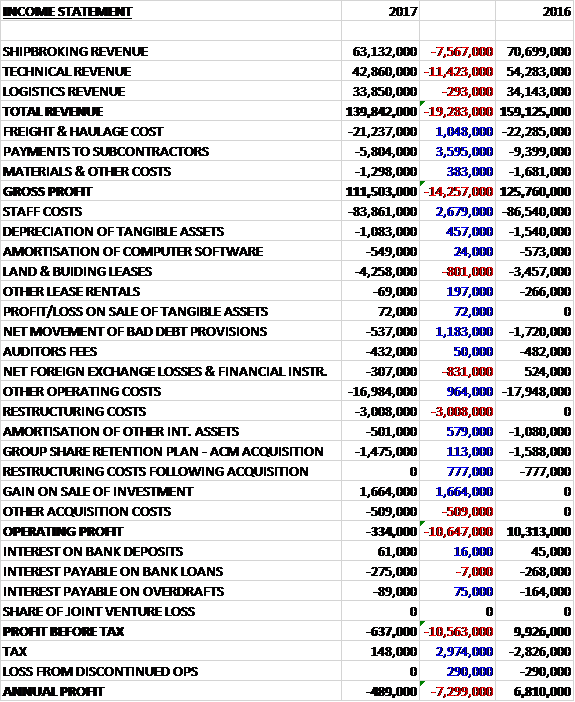
Revenues declined when compared to last year due to a £7.6M decrease in shipbroking revenue and an £11.4M fall in technical revenue. Freight and haulage costs were down £1M, payments to subcontractors decreased by £3.6M and materials costs fell by £383K to give a gross profit £14.3M below that of last year. We then see a £2.7M decline in staff costs, a £457K decrease in depreciation, a £1.2M fall in bad debt provisions and a £964K decrease in other operating costs, partially offset by an £801K growth in land and building leases and an £831K negative forex swing. There was also a £2.2M growth in restructuring costs and a £509K increase in other acquisition costs but amortisation was down £579K and there was a £1.7M gain on the sale of an investment which meant that the group made an operating loss, a negative swing of £10.6M. Interest costs were slightly lower and tax charges saw a £3M positive swing, all of which gave an annual loss of £489K, a negative swing of £7.3M year on year.

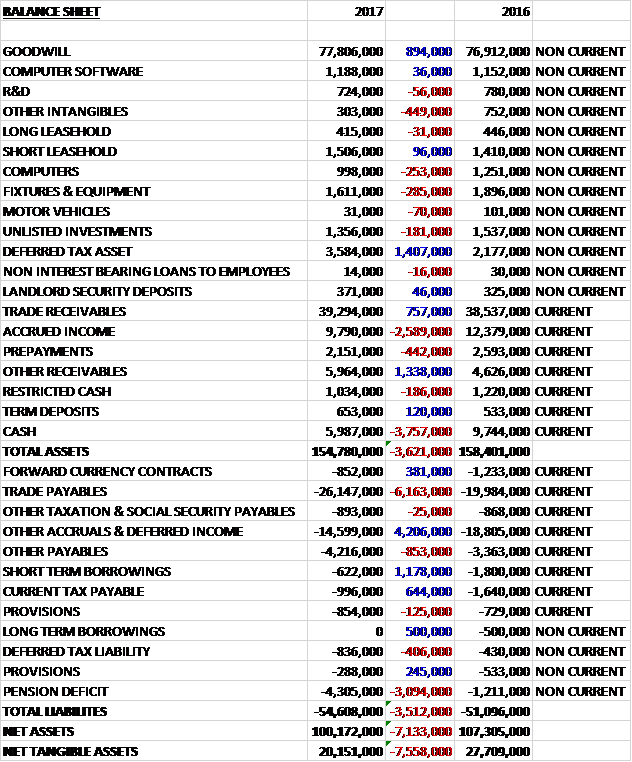
When compared to the end point of last year, total assets declined by £3.6M driven by a £2.9M decrease in accrued income, a £449K fall in other intangibles and a £442K decline in prepayments, partially offset by a £1.4M growth in deferred tax assets, a £1.3M increase in other receivables and an £894K growth in goodwill. Total liabilities increased during the year as a £4.2M decline in accruals and deferred income, a £1.2M fall in short term borrowings and a £644K decline in current tax payables were more than offset by a £6.2M growth in trade payables and an £853K increase in other payables. The end result was a net tangible asset level of £20.2M, a decline of £7.6m year on year.

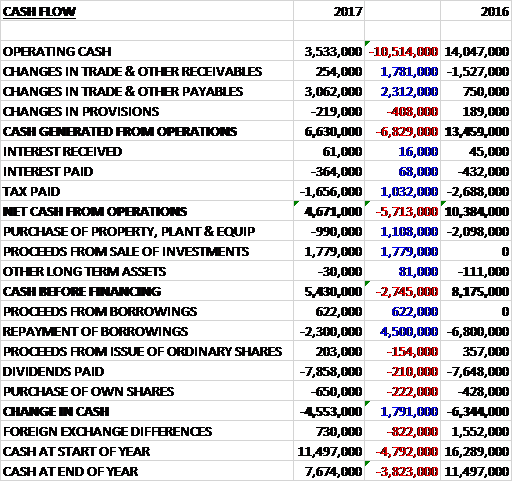
Before movements in working capital, cash profits fell by £10.5M to £3.5M. There was a cash inflow from working capital due to a rise in payables and after tax payments declined by £1M the net cash from operations came in at £4.7M, a decline of £5.7M year on year. The group spent £990K on capex but recouped £1.8M from the sale of the Baltic Exchange shares to give a free cash flow of £5.4M. This didn’t cover the £7.9M paid out in dividends and after the group also paid back some borrowings there was a cash outflow for the year of £4.6M and a cash level of £7.7M at the year-end.

The underlying operating profit in the Shipbroking division was £7.9M, a decline of £1.8M year on year. As expected the business faced tough market conditions marked by falling tanker rates and continued low offshore rates. Despite the fall in profits, transaction volumes increased in virtually all sectors. The total forward order book at the year-end was $39M, of which $20M relates to 2018.

The deep sea tanker market weakened in the year as the growth in tonnage drove freight rates down and the beneficial effects of low oil prices wore off. High product stocks and lower refinery runs caused product carrier earnings to fall steadily throughout the year and tanker asset values continued their steady decline since 2014.

Heavy delays to newbuildings under construction meant that tankers scheduled for delivery in 2016 slipped into 2017 resulting in lower overall fleet growth than expected. In 2017 there is expected to be a similar slippage and a slightly higher level of demolition but that overall capacity will increase. This fleet growth is likely to outweigh growth in seaborne trade volume but tankers trading should be protected to some extent by an average lengthening of voyage distance as Atlantic basin sweet light crudes replace lost heavy sour crude production in the Middle East. This year freight rates will reduce if seaborne imports are replaced from local stocks but will hold up is crude exports from the US, Nigeria or Libya rise to fill a void left by others. Refining margins could suffer if crude prices rise and the resulting drop in run rates could hurt the crude sector. Both crude and product tanker rates stand to recover once local product stocks are drained, however.

There has been a continued expansion to the fleet of LPG and LNG vessels which put pressure on freight rates in the spot market and challenged demand for time charters. Fixture volumes remained steady, however, and the teams overall maintained their level of earnings compared to the previous year. After a challenging first half to the year, the LNG shipping market saw charter rates improve modestly. The start-up of several new projects in the US, Australia and Malaysia has driven supply to record levels.

LPG rates weakened in the year with significant downward pressure felt in the VLGC sector. Despite the fall in earnings the spot market remained active, with seaborne LPG trade expanding during the year with most of the growth in LPG exports coming from production in the US. Saudi LPG exports rose but growth from the rest of the Middle East was flat.

The petrochemical market was turbulent during the year with a significant increase in the number of newbuild vessels adversely impacting freight. As the shipping surplus became evident, owners cancelled new-building orders during the year and there was limited new production in the petrochemical segment. This year there is likely to be a significant number of new vessels delivered into the market with apparently very limited product supply growth.

The offshore desk continued to experience challenging markets as global oil and gas exploration and production activity remained low. The team performed well in these tough market conditions to deliver a profitable result for the year. The board don’t expect much improvement in the market over the next year and it will take some time for any recovery to take effect once exploration and production expenditure increases.

Freight rates in the dry bulk market, which hit an all-time low during the year, were depressed in the first half due to over-capacity and weaker commodity demand in the core markets. Capesize time charters hit their lowest point in March 2016 while the main Panamax, Supramax and Handysize time charter indices all dropped to levels that did not cover daily operating costs. By the end of 2016, however, spot rates were hitting their best levels in two years with time charter rates and vessel values appreciating as the market recovered. The group cut staff numbers but despite this, the teams achieved a similar number of transactions compared to the previous year.

This year growth in dry bulk demand is expected to continue considering widely-expected economic recovery. In the short term the Chinese government’s strategy for the steel and coal sectors will ultimately determine import demand for the two largest dry bulk trades of coal and iron ore but there are also positive developments in grain and agricultural trade which are expected to continue growing.

The sale and purchase team concluded a higher volume of second hand and demolition vessel transactions compared with last year but the average value of vessels was reduced. Towards the end of the year an increased interest in the market for older vessels caused the second hand value of bulk carriers to rise substantially. There has also been some renewed interest in newbuild bulk carriers. As new ballast water treatment regulations come into effect in 2020 there is likely to be an increase in the scrapping of older vessels potentially either reducing the overall fleet or stimulating newbuild demand. Sale and purchase activity in the tanker market has been relatively quiet as tanker freight rates have remained at a level where owners have been able to achieve good earnings from the relatively new fleet.

The underlying operating loss in the Technical division was £2.9M, a detrimental movement of £8.1M when compared to last year. The performance of this division was severely affected by the slowdown in oil and gas exploration and production development activity where a significant proportion of revenue has previously been earned. Drilling activity has also reduced which affected service companies and suppliers with demand for offshore construction, heavy life vessels, supply boats and anchor handlers all reducing significantly. This fall in drilling activity caused a significant reduction in offshore energy premiums for insurance services businesses. Finally, although the world shipping fleet continued to grow there was a general downward trend in claim numbers and claim values with premium levels in the hull and machinery and cargo sectors continuing to decline.

The group has enacted a new structure for the division which will ultimately operate under one brand name. The substantial restructuring programme is now complete and they expect the effects of their actions to generate a £6M annualised cost saving.

The marine warranty surveying and engineering consultancy business was affected considerably by project delays and reduced activity due to the low oil price and reduced exploration and constructions activity in the region. They have reduced their cost base across all offices and the workforce is now scaled appropriately to operate in the current market conditions.

The consulting engineering business concluded its three year project for the design, site supervision and crew training for six LNG carriers in the first half of the year. On completion of this project and in response to the downturn in LNG sector activity, the board relocated staff to their integrated divisional London office. The office in Houston continued its involvement in the development of new technology for the containment of LNG which it started in 2015. Both teams are now focusing on growing their engineering activity and at the end of the year started to see an increase in tender enquiries in both the marine and onshore LNG markets.

The energy loss adjusting business reported a profitable performance in the year despite challenging market conditions. The office in the Middle East performed particularly well with a high level of utilisation. The hull and machinery damage surveying and marine consultancy experienced reduced activity with a lower level of instructions received. The business has also taken steps to address its cost base and saw an increase in utilisation as a result of these actions.

The incident response and environmental consultancy business carried out a routine level of work with no significant project work undertaken in the period. During the year, the business focused on developing its UK operations, particularly retained services and framework agreements with major customers. They terminated their activities in West and Central Africa at the end of contracted business. The business reset its cost base to cater for this change in focus while ensuring that it could still respond to larger incidents as required.

The underlying operating profit in the Logistics division was £1.3M, a decrease of £323K when compared to 2016. The shipping agency business achieved strong business development and an improved financial performance. They have won a number of substantial client accounts and are developing them internationally by delivering high levels of service. As well as maintaining their strong UK business their key focus remains on the expansion of their service in North America and Europe.

The freight forwarding business experienced a tough market this year resulting in a lower level of activity. They have performed a detailed review of all aspects of the business and they are implementing a business development programme across all service areas which they expect to generate and improved performance in the future.

The group incurred £2.5M of acquisition –related expenditure during the year. When they acquired ACM in 2014 they established a share plan to retain key staff and the charge in the year was £1.5M. The annual charge relating to these awards will reduce as these awards vest and they will incur about £1.1M in 2018. The rest of the expenditure relates to the amortisation of acquired intangibles and other activity.
The current financial year has started in line with board expectations.

The group made a loss so there is not much point trying to value it on the current PE ratio but on next year’s consensus forecast the group is trading on a PE of 11.4. After a cut in the dividend the shares are still yielding 5.1% which is expected to grow to 5.5% on next year’s forecast. The board is aiming to cover the dividend 1.5 times (which it certainly isn’t doing currently, it has been unsustainable for some time in my view) At the year-end the group had a net cash position of £7.1M compared to £9.2M at the end of last year.

Overall then this has been a tough year for the group. They were loss making, net assets declined and the operating cash flow decreased although they still made some free cash even if it was not enough to cover dividends. All divisions saw a deteriorating performance but the logistics division did the best as a struggling freight forwarding market dragged down a good performance in the port agency business.

The shipbroking division saw a decline in profits due to falling tanker rates and low offshore rates but it was the technical division which was the real driver of the poor performance. The division struggled with the continued low oil and gas price and the end of the lucrative LNG design contract. It has been restructured, however, so performance should improve in the coming year.

The forward PE stands at 11.4 and the yield is predicted to be 5.5% which, if achieved, actually looks decent value despite the terrible performance of the technical division. I am tempted to dip in here but it would be more prudent to wait for some signs of recovery. Tricky, not sure what to do!

On the 22nd June the group released a Q1 trading update. After a disappointing comparative period for last year, trading profit for the group has improved. While revenues were lower, profitability improved as the benefit of the cost savings measures taken last year were realised.

Trading in the shipbroking division has been good and results show a significant improvement on the prior year’s performance. The tanker desk has achieved improved trading volumes despite lower freight rates. The sale and purchase and project desks have started the year strongly and have concluded some significant new building and long term project business which will benefit future years. The dry cargo desk has shown a marked improvement in performance reflecting the recovering market and the offshore desk is ahead of the prior year with some increase in activity although the market remains low due to asset over capacity.

The performance of the technical services division shows a modest improvement. Solid revenue in the incident led business has offset a lower performance in offshore and engineering which are mainly influenced by energy related projects. The effect on profitability of lower project income is much reduced by the cost savings measures taken last year, however. Over the past few months there have been stronger signs of project related activity as evidenced by the volume of new tenders in the market. Conversion of these opportunities into income will take time but the overall market picture is more encouraging than it was a year ago.

Revenue in the logistics division is in line with prior year equivalent although there has been some margin degradation due to the business mix. Overall the end markets remain challenging and the board’s expectations for the year as a whole remains unchanged. This is a decent update I think actually. There are clearly still some problems but this is looking quite tempting.

N Brown Share Blog – Final Results Year Ended 2017

N Brown has now released their final results for the year ended 2017.

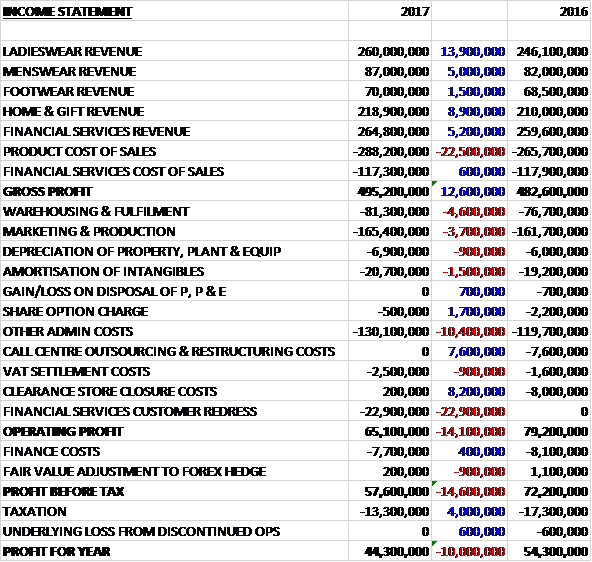
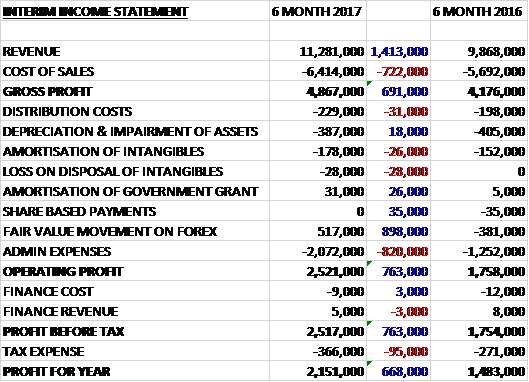
Revenues increased when compared to last year due to a £13.9M growth in ladieswear revenue, an £8.9M increase in home & gift revenue, a £5.2M growth in financial services revenue and a £5M increase in menswear revenue. Cost of sales also increased to give a gross profit £12.6M above last time. Warehousing and fulfilment costs increased by £4.6M, marketing and production costs were up £3.7M, depreciation and amortisation increased by £2.4M and other admin expenses were up £10.4M. There were no call centre restructuring costs, however, which accounted for £7.6M and no clearance store closure costs which were £8.2M last time. There was a £22.9M financial services customer redress, however, which cost £22.9M in the period to give an operating profit £14.1M below last year. Excluding those issues, operating profit was down £7M. Finance income was down £900K but tax charges reduced by £4M to give a profit for the year of £44.3M, a decline of £10M year on year.

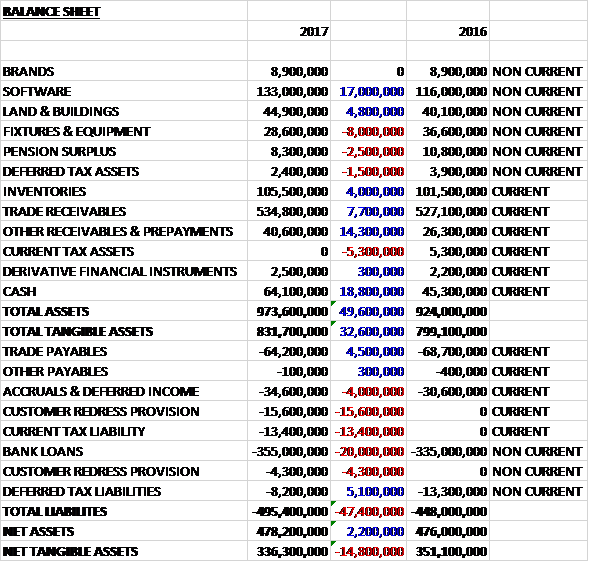
When compared to the end point of last year, total assets increased by £49.6M to £973.6M driven by an £18.8M increase in cash, a £17M rise in the value of software, a £14.3M growth in other receivables and a £7.7M increase in trade receivables, partially offset by an £8M reduction in the value of fixtures and equipment as £5.9M was reclassified at land and buildings. Total liabilities also increased during the year due to a £20M growth in bank loans, a £19.9M increase in the customer redress provision and a £13.4M growth in the current tax liability. The end result is a net tangible asset level of £336.3M, a decline of £14.8M year on year.

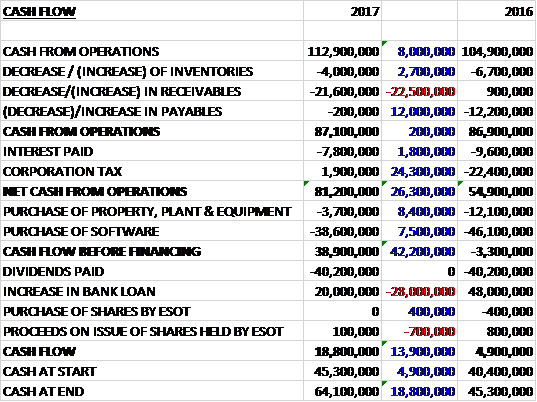
Before movements in working capital, cash profits increased by £8M to £112.9M. There was a cash inflow from working capital but this was less than last year so before tax and interest the cash from operations was broadly flat at £87.1M. Interest payments came down by £1.8M and there was a £24.3M swing to tax receipts so the net cash from operations came in at £81.2M, a growth of £26.3M year on year. They then spent £38.6M on software along with £3.7M on tangible assets to give a free cash flow of £38.9M. This didn’t quite cover the dividends of £40.2M but £20M of new loans meant that there was a cash flow of £18.8M for the year and a cash level of £64.1M at the year-end.

Ladieswear revenues were up 4.2% over the year but this masks a very good second half to the year with H2 revenues up 10.4% with significant market share gains. This has been driven by significant investments in improving the product ranges, strengthening internal design and increasing in-season flexibility. The menswear market share was flat.

The returns rate was down 70bp to 26.8% with the primary driver being the continued improvements in the product offering, including fit, quality and value for money. The ongoing increase in the proportion of cash customers also benefited the rate.

JD Williams revenue was up 4.7% with the JD Williams brand itself up 12% and Fifty Plus down 9%. They had particular success with their “The Cut” range, a collection of their best priced current season clothes which further reinforced their value for money credentials. Sales of these lines significantly exceeded expectations, up 72%. For Spring Summer they launched a new bridal range for JD Williams. The performance of Fifty Plus improved as they progressed through the year. In the first half, revenues were down 18% as they reduced marketing spend ahead of its migration into JD Williams. They then started the migration in Autumn which resulted in revenues up 1% in H2 with the migration due for completion by the start of the second half of 2018.

Simply Be had a strong performance with product revenue up nearly 10% with the number of active customers up 20%. The fast fashion sub-range continues to outperform significantly with demand up 67% in the second half, led by going out tops and the new under £30 party dress offer. Denim was a key category outperformer throughout the year with jeans up 14% in the second half.

Jacamo product revenue was up 4% at £65.3M with revenue performance strengthening throughout the year. Active customers grew double-digit year on year, although spend per customer was lower due to the subdued market backdrop, particularly in the first half. In late February they launched an unlimited next day delivery for £10 and customer take up has so far been encouraging. Strong AW16 product category performances were seen in denim, following the launch of their new range, and sportswear, driven by third-party brands and the relaunch of their own-brand Snowdonia.

Secondary brand revenue increased by 1.6%. Fashion World was the strongest performer, up mid-single digit year on year driven by increased spend per customer. Marisota, which is now predominantly used as a product brand focusing on fit solutions, saw a solid performance. Figleaves revenue was down slightly as they slowed marketing spend through the launch period of the new Demandware web platform which went live at the start of Autumn 2016. In February they hired a new CEO for the brand and the new management team will leverage the benefits of the Demandware platform and they expect this to improve the performance of the brand going forward. High and Mighty revenue was down as they continued to transition the brand from a predominantly stores to online model.

The traditional segment recorded revenue down 1.3% although this masked an improving trend as we progressed through the year with revenues down 4.2% in the first half but up 1.6% in the second half as actions taken to address performance worked well. These actions included a revamp of their marketing materials and the launch of new bespoke publications such as their Classic Detail catalogue. They also improved the product range. Looking forward the strategy remains unchanged – to hold overall revenues broadly flat through gaining share in this declining market.

At the start of 2017 the group added over 100 third-party brands across their categories such as Wrangler, Ben Sherman, Jack Wolfskin, Dune, Timberland, Ann Summers and Gossard. This also works the other way round and the group went live with a capsule Jacamo collection on ASOS in March with the very early performance being encouraging. Also, as part of a strategy to drive increased access to their brands, the group also announced a partnership with Tesco for Simply Be and Jacamo and capsule collections from both brands will be available through Tesco Direct and, on a trial basis, in store at a number of locations across Eastern Europe from May this year.

The international markets seem to be gaining traction with an operating profit of £1.9M compared to losses of £100K last year. US revenue was up 8.5% year on year but down 4.2% on constant currency terms. The operating loss increased by £300K to £1.3M as the performance in the second half was impacted by the launch of the new website, as expected. The majority of US customers are generated by the Simply Be brand but the performance of the JD Williams brand which launched in March 2016 has so far been encouraging. In Ireland, revenues were up 3.8% in constant currency terms and the increase in operating profit was driven by improvements in the product offering.

The performance of the store estate continues to be impacted by weak industry footfall. As a consequence they are not planning to open any new stores in the future. For the coming year some significant rate increases for some of the stores represent a further cost headwind. Overall the operating loss from the store estate increased by £1.2M to £2M.

The group had a good performance in Financial Services this year, driven by a significant improvement in the quality of the customer loan book. This resulted in revenue up 0.4%; within this interest payments were up mid single-digit whilst non-interest lines were down low double-digit. The improvement in the quality of the loan book is particularly reflected in the gross margin performance which was up 110bp to 55.7%.

Credit arrears were down 100bp driven by the improvement in the quality of the loan book and the credit provision rate was down even more, benefitting from several sales of high risk payment arrangement debt which the group sold for a slightly better rate than book value.

To date the group have introduced a new finance system, a new merchandise system, the Simply Be Euro foundation site and the new US website. The next release will be the High and Mighty website which remains on track for May. This release will also include the first go-live of the new financial services system so it is a significant milestone.

The group have made an adaptation to the rollout plan. Following the High and Mighty go-live, they have now decided that Fashion World will be migrated onto the new systems after peak trading in 2017. The pace of development will be unchanged, however, and new releases will be added to the High and Mighty and US websites on a monthly basis. They plan to migrate all brands onto the new platform by the end of Summer 2018 as previously guided and the overall programme costs and benefits and the timing of those benefits are all unchanged.

An exceptional charge of £22.9M was recognised reflecting the costs incurred or expected to be incurred in respect of payments for historic financial services customer redress payments. So far the group has paid out £3M in cash on this subject. There are two components of this cost, recompensing certain customers due to an error in the previous calculation for redress and the group’s estimate of the likely future costs arising from complaints relating to financial services products sold in the past. The cost of this second area increased during H2 due to a combination of the industry-wide deadline for complaints being a year later than previously indicated and a greater than expected volume of complaints due to wider public awareness of the deadline.

External costs related to tax are in respect of ongoing legal and professional fees which have been incurred as a result of the group’s ongoing disputes with HMRC regarding a number of historic tax positions. The board estimate that an unfavourable settlement of the tax cases could result in a charge to the income statement of up to £43.3M and a cash payment to HMRC of up to £16M. A favourable settlement of these cases would result in a repayment of tax of up to £54.1M and an associated credit to the income statement of up to £29M.

Going forward, performance in the new financial year has so far been encouraging and in line with board expectations. For 2018, the product gross margin is expected to fall by between 20 and 120bp with the key driver being increased input costs as a result of the depreciation of sterling. Financial services gross margin is expected to be flat to +100bp. Group operating costs are expected to increase by between 3.5% and 5.5% reflecting an element of IT double running costs. Net debt is expected to be between £300M and £320M reflecting the increased cash flow impacts of financial services customer redress payments coupled with further advance tax cash payments related to the ongoing disputes with HMRC.

At the current share price the shares trade on a PE ratio of 17.8 which falls to 12.7 on next year’s consensus forecast. After the final dividend was kept the same, the shares are yielding 5.1% which is also expected to remain the same next year. As of the year-end the group had a net debt position of £290.9M which represents a 0.4% increase year on year.

Overall this has been quite a tough year. Profits were down and net assets declined, although the operating cash flow did improve with some free cash being generated, although it did not cover the dividend payment. Most of the brands are doing well, with an improving situation throughout the year with the only real declines being at Figleaves and the US business which have both seen disruption due to the new systems being put in place. The stores are doing poorly, however, and are more loss making than last year. Financial services were broadly flat.

Trading seems to be doing Ok and improving then, but there are a number of one-off issues hanging over the group. The customer redress payments are growing and looking rather onerous, the debate with the HMRC rumbles on and seemingly could go either way and although it seems to have been handled well so far, the large scale IT systems upgrade is both costly and has the potential for disruption. With a forward PE of 12.7 and (uncovered) yield of 5.1% these shares look OK value but I am not sure they are cheap enough for the risk involved.

On the 20th June the group released a Q1 trading update. Group revenue was up 5.6% with product revenue increasing by 10.2% driven by strong ladieswear performance, and financial services revenue down nearly 5% as expected. In all, trading is on track to meet the board’s expectations for the year.

The strongest performance was from Simply Be, with revenues up more than 20% following the “We are Curves” campaign. Although Jacamo sales were only up 5.5%, this masks the fact that there was double digit growth in active customers which was offset by the reduction in sales of some larger ticket electrical goods. There was a 10.7% growth in the traditional segment reflecting the improvements made to product and marketing during the past two seasons, and JD Williams was up 12.7%. Even the poorest performer, Fifty Plus, still managed a 1.3% increase in sales.

International revenue was up 10% but down 2% in constant currency terms. Revenue from Ireland was up 9% at constant currency, driven by a strong ladieswear performance but revenue in the US was down 9% at constant currency. Following the delivery of the new technology platform, a step up in marketing investment is planned in Q2 to drive new customer recruitment going forward.

The group will be closing up to five Simply Be and Jacamo dual fascia stores. This decision takes into account weak high street footfall, together with significant future business rate increases for some stores. Together these stores accounted for the entire £2M operating loss of the store estate in 2017. The process will be completed by the end of August and the board expect an exceptional cost of between £10M and £14M, of which about 70% will be cash. During Q1, revenue from the store estate was slightly up year on year with the Simply Be/Jacamo stores recording mid-single digit growth and High and Mighty revenue down.

Revenue from the financial services business was down nearly 5%, in line with expectations. This was impacted by the lower interest revenue booked on payment arrangement debt due to the sale of some of this debt at the end of last year. Within the revenue performance, interest lines were down low single digits as a result of the debt sale whilst non-interest lines were down high teens percentage as a result of the better quality loan book which reduced admin fees.

The new High and Mighty website will go live shortly and the group remain on track to have all brands replatformed by the end of summer 2018 as previously disclosed. Aside from the exceptional costs in closing the underperforming stores, all other 2018 guidance is unchanged. Overall this update seems decent enough, steady as she goes.

On the 13th July the group announced that it had identified flaws in certain general insurance products which were sold between 2006 and 2014 following a review prompted by a recent industry-wide request from the FCA that firms ensure that general insurance products and add-ons offer value for their customers.

The group expects to incur an exceptional cost this year of between £35M and £40M but they anticipate that there may be mitigating actions to reduce the overall net costs. The cash flow impact of this is forecast to occur from 2019 onwards and they expect to fund the full cost of customer redress from existing resources. Other than this, they continue to demonstrate strong underlying trading performance in line with forecasts.

On the 1st December the group released a half-year trading update. Estimates indicate sales of around £109M and an operating profit of £38M. Over the first half they have seen sales and profit growth in all channels in constant currency terms with the momentum continuing throughout the period. These results are in line with expectations.

Serabi Gold Share Blog – Q1 Results Year Ending 2017

Serabi Gold has now released their Q1 results for the year ending 2017.

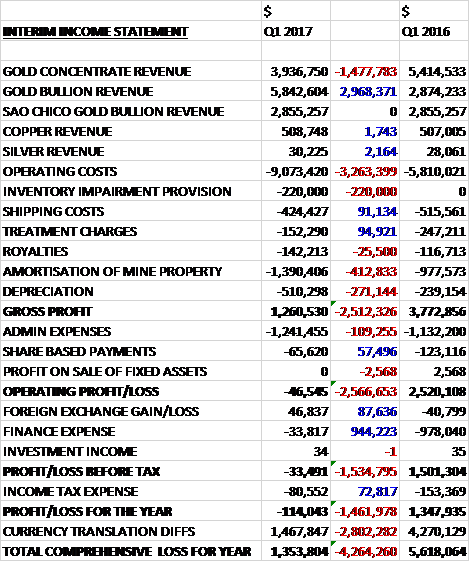
Revenues increased when compared to Q1 last year as a $1.5M decline in gold concentrate revenue was more than offset by a $3M growth in gold bullion revenue. Operating costs increased by $3.3M, there was an inventory impairment of $220K against the coarse ore stockpiles, amortisation was up $413K, reflecting the lower levels of inventory as the coarse ore stockpiles are depleted, and depreciation increased by $271K reflecting new equipment purchased and the strengthening Real, to give a gross profit $2.5M below that of last time. Admin expenses increased by $109K which meant there was a small operating loss, an adverse movement of $2.6M. Finance expenses declined by $944K, however, and after tax expenses fell by $73M the loss for the quarter came in at $114K, an adverse movement of $1.5M year on year.

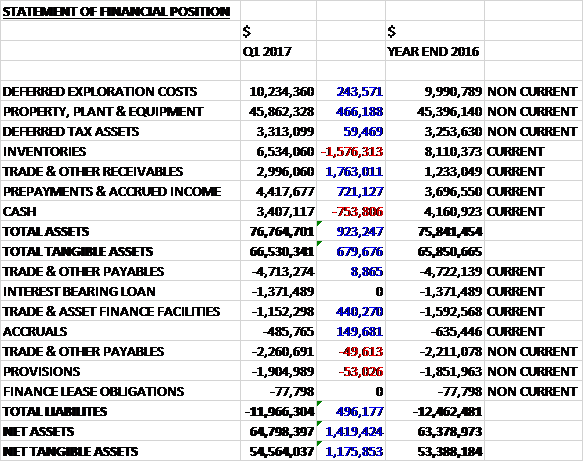
When compared to the end point of last year, total assets increased by $923K driven by a $1.8M growth in receivables, a $721K increase in prepayments and accrued income, a $466K growth in property, plant and equipment (aided by forex movements) and a $244K increase in deferred exploration costs, partially offset by a $1.6M fall in inventories due to a reduction in ore stockpiles. Total liabilities declined during the period due to a $440K fall in the trade and asset finance facilities along with a $150K decrease in accruals. The end result was a net tangible asset level of $54.6M, a growth of $1.2M over the past three months.

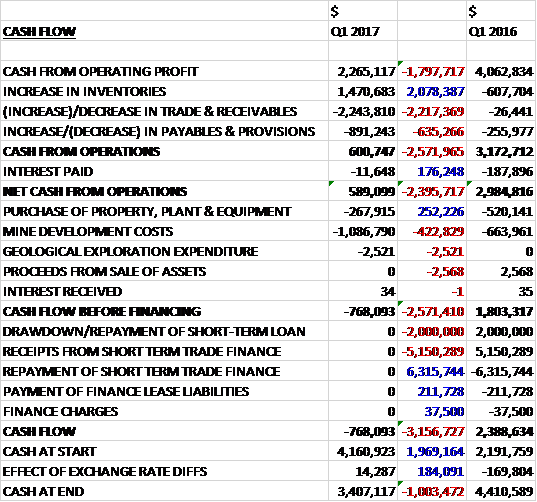
Before movements in working capital, cash profits declined by $1.8M to $2.3M. There was also a cash outflow from working capital and after interest payments reduced by $176K, the net cash from operations was $589K, a decline of $2.4M year on year. The group spent $1.1m on mine development costs and $268K on property, plant and equipment which meant that there was a cash outflow of $768K before financing. There was actually no financing arrangement changes during the quarter so this was also the total cash outflow for the period to give a cash level of $3.4M at the period-end.

The average gold price received reduced from $1,245 per ounce to $1,204. Conversely the AISC increased from $965 per ounce to $1,043.

In the quarter the group mined 36,918 tonnes of ore at a grade of 10.12g/t compared to 37,546 tonnes at 11.02 g/t in Q1 last year, although the grade was higher than Q2-Q4 2016. They milled 46,663 tonnes at a grade of 7.09g/t compared to 36,615 tonnes at 8.58g/t last time, with the increase reflecting the increased plant capacity, which produced 9,861 ounces of gold, a slight increase on the 9,771 produced in Q1 2016.

The main issue during the period has been a large increase in operating costs, over and above the growth in revenue. These costs have been severely impacted by the 19% strengthening of the Brazilian Real against the dollar. In addition, labour costs were affected by the 10% increase in salaries awarded in May as part of the national collective wage agreement and one-off termination costs of $417K following a reduction in headcount. There was also an increase in power costs following a decision taken that the group should use its own more expensive diesel generated power than rely on cheaper but less reliable grid derived power.

With the change in customer for the group’s concentrate during 2016, they no longer have need for the trade finance facility which was in place in Q1 2016. The convertible loan was settled in August and the group have not undertaken any hedging activity during the period.

Development of the Palito ore body is now well in advance of production requirements and as a result the group has been able to reduce development mining activity for a short period. As a result mine development of 1,669m during the quarter was about 13% lower than in Q1 last year allowing the company to use the surface ore stockpiles.

At Sao Chico, during the remainder of the year, management expects that monthly development and production rates will continue to stablise. They have been driving development galleries east and west towards additional ore shoots that have been identified by surface drilling. Management is confident that these shoots will provide additional mineable ore at Sao Chico. Underground drilling is being undertaken at Sao Chico for short term operational and mine planning purposes with a second parallel campaign being undertaken to test the deeper resource potential of the deposit.

As with the Palito ore body, development is significantly in advance of production so the group has been able to reduce the levels of development mining activity during the period with the result that 582m of horizontal development was completed compared with 1,025 for the corresponding quarter in 2016.

Milling rates of ore have increased by 15% from an average of 403 tonnes per day to 463tpd in Q1 2017. The introduction of the third ball mill at the end of June has had a significant effect on throughput rates. The increase in processing rates also reflects the improvements in operational efficiency of the process plant which has been assisted by the introduction of the gravity circuit and ILR for treating Sao Chico ore, reducing the levels of gold which would otherwise have been treated in the CIP circuit. The average daily process rates for the CIP circuit have increased by 14% to 518tpd.

The forecast gold production for 2017 is expected to be about 40,000 ounces and the cost guidance for the year is of an AISC of $950 to $975 per ounce. The cost profile is subject to change as a result of exchange rate variations and in particular the exchange rate between the Brazilian Real and the US dollar.

At the current share price the shares are trading on a PE ratio of 9.5 which apparently falls to 4.4 on the full year consensus forecast.

Overall then this has been a bit of a tricky period for the group. Operationally things have been fine with the increased capacity of the mill meaning that ore stockpiles are being run down. The group swung to a loss, however and the operating cash flow deteriorated with no free cash being generated. The reason for this is clear. Whilst the price achieved for gold sales was $1,204, down slightly, the costs have increased to $1,043 per ounce. The main reasons for this seem to be the strengthening of the Brazilian Real, the increased staff costs and the increased power costs as the group can no longer rely on grid power.

The forward PE of 4.4 looks very cheap but I have doubts as to whether this can be achieved. At $1,252 per ounce the gold price has improved slightly since the period-end and the Brazilian real has come off the boil somewhat in rec

On the 26th July the group released a trading update covering Q2. Overall production was 8,148 ounces of gold. Mine production totalled 42,075 tonnes at 7.8g/t of gold and 43,905 tonnes was processed through the plant for the combined mining operations with an average grade of 6.26g/t. Following a strong Q1 when the group produced nearly 10,000 ounces of gold, they had a satisfactory Q2 with further production of 8,148 ounces.

Mine production progressed well but grades were a little lower than scheduled for April and May, resulting in Q2 gold production being lower than Q1. The lower grades behind this were largely a result of an operational issue in the Sao Chico sector relating to a broken-down loader where planned higher grade stope production had to be replaced by lower grade development ore. Production improved significantly in June and the operational issue has now been fully resolved. The board therefore remain confident that full year production guidance will be achieved. At Palito, production remained steady.

At Palito the G3 vein has now been intersected on the -50mRL, the lowest level in the mine, with excellent grades being encountered. The other main vein is now being developed on the 30mRL, and it too is showing some good long term potential.

Overall then this has been a rather disappointing quarter but the situation seems to have improved in recent months so I am holding on for now.

Easyjet Share Blog – Interim Results Year Ending 2017

Easyjet has now released their interim results for the year ending 2017.

Revenues increased when compared to the first due to a £50M growth in seat revenue and a £6M increase in non-seat revenues. Fuel costs declined by £3M but all other costs grew with a £110M increase in airport and ground handling costs, a £43M growth in crew costs, a £24M increase in navigation costs, a £22M growth in maintenance costs and a £44M increase in other costs to give an EBITDA £184M worse than last time. There was also an £11M increase in depreciation, a £7M growth in aircraft dry leasing costs and a £13M increase in finance expense to give a pre-tax loss £218M higher than last time. After tax income increased by £41M the loss for the period came in at £192M, an increase of £177M year on year.

When compared to the end point of last year, total assets increased by £377M to £5.861BN, driven by a £380M increase in money market deposits, a £62M growth in property, plant and equipment and a £33M increase in receivables, partially offset by a £83M decline in derivative financial instruments and a £41M fall in cash. Total liabilities also increased during the period as a £107M decline in derivative financial liabilities, a £54M fall in payables and a £33M decrease in deferred tax liabilities was more than offset by a £730M growth in unearned revenue, partly as a result of Easter falling in April, and a £199M increase in borrowings. The end result was a net tangible asset level of £1.807BN, a decline of £370M over the past six months.

Before movements in working capital, cash profits increased by £98M to £643M. There was a cash outflow from working capital, which was broadly the same as last time and after a reduction in tax payments, the net cash from operations came in at £508M, a growth of £103M year on year. The group spent £279M on property, plant and equipment along with £23M on intangible assets which meant the free cash flow was £206M. This did not quite cover the £214M of dividends and despite £115M of cash from the sale and leaseback of some aircraft and the £451M proceeds from the Eurobond issue, an increase in money market deposits meant that there was a cash outflow of £49M in the period and a cash level of £673M at the period-end.

Within the headline pre-tax loss of £212M, the impact of Easter moving into the second half of the year apparently caused a loss of £45M and forex movements impacted losses negatively by £82M. The short haul market in the group’s markets grew by 9% with particularly strong growth in Spain and Germany.

Revenue per seat decreased by nearly 5% to £48.80 due to increased overall market capacity, along with low pricing sustained by a low fuel price; the movement of Easter into the second half of the year; and increased levels of disruption due to strikes, severe weather and airport issues. This was partially offset by good progress in growing non-seat revenue, which increased by 18% driven by improvements to inflight food and drink ranges; some recovery in markets after the shock events of last year; and an increased load factor, up 0.5ppts to 90.2%.

Headline cost per seat increased by 4.9% to £54.45 driven by a forex impact of £175M, partially offset by lower fuel prices. At constant currency the headline cost per seat decreased by 4.1% due to the reduced fuel prices with costs excluding fuel and forex movements flat. The 16% reduction in constant currency fuel price was helped by a lower hedged fuel price, mitigating market price increases. The group has hedged 83% of fuel requirements in the second half at $577 per tonne with 60% hedged in 2018 at $516 per tonne. During the period the average market fuel price increased from $409 per tonne to $500 per tonne.

The group’s business passenger segment has performed well during the period. The total number of business passengers has increased by 6.2% against a backdrop of capacity investment weighted towards leisure routes. Business passengers remained at 19% of the group’s customer base, reflecting the mix of routes flown. The business passenger premium has remained steady year on year, helped by the recovery from shock events and the move of Easter into April. The group is now looking to evolve the product offering, drive better distribution and reduce costs. A new organisational structure is now finalised, contracts with travel management companies are being renegotiated and six major new corporate and government contracts were signed in the period, for example with the state of the Netherlands.

In the period the group has seen strong growth in its ancillary revenue, offsetting pressure on ticket yields. For example, they have seen good early results from new initiatives in their baggage strategy. They also have opportunities to build on their partnerships with brands in car rental and hotels as well as exploring other value channels with a number of projects in the pipeline for the next year. Non-seat revenue increased by 18% driven by improvements to inflight food and drink ranges with premium products being added.

During the first half of the year the group has focused their growth on maintaining market share in the UK and Switzerland and growing in France. They also invested in high capacity growth in Venice and Naples to improve their number one position; and maintained share in the slot-constrained Berlin and Amsterdam where the airport is now at full capacity. Having capitalised on time-sensitive opportunities to bolster its positions in primary airports such as Amsterdam during the period, further capacity growth is likely to be at a lower rate in 2018.

The group are now seeing signs that competitors are reducing their growth rates or even overall capacity for the forthcoming summer. Vueling is expected to reduced its capacity by around 5%; Norwegian is focusing more on low cost long-haul, reducing its short haul network at Gatwick; the combination of Air Berlin and Lufthansa in Germany is expected to result in a reduction of around 20 aircraft; Alitalia is in a state of administration (again) in Italy; and Flybe is expected to reduce capacity in 2018.

In the UK the group increased their capacity by 8% with significant growth targeted at maintaining their share of the London market through Luton and Gatwick and increasing capacity at Bristol and Manchester. In France they increased capacity by 12%, significantly ahead of the overall market, to consolidate their presence in Paris and increase their share in the regions. In Italy they increased capacity by 6%, further increasing their investment in Venice, Naples and Milan Malpensa.

In Switzerland they increased capacity by 9% increasing their share in both Geneva and Basel, against an overall market growth of 8%. In Germany they increased capacity by 9% as they maintained their strong market share of the Berlin market. In the Netherlands they have increased capacity by 7% as they began to annualise the high growth from the previous two years, focusing on adding frequencies to existing destinations. In Portugal they increased capacity by 17% as they continued to establish their position at Lisbon and Porto; and in Spain they increased capacity by 16% as they continued to build their presence in Barcelona. In March they opened their first seasonal base in Majorca with three aircraft based there over the summer.

During the period, cancellations and delays increased by 18% to 3,302 and OTP was 80%. The challenges of working at Gatwick, where the group outperforms most of its direct competitors on OTP, continue to have an impact on the rest of the network. In addition the group was affected by severe weather at peak times of the year; strikes at French ATC, Italian ground handling and Berlin ground handling; and reduced capacity as French ATC perform systems upgrades at Bordeaux. Since the Gatwick North Terminal consolidation the group has been able to improve operations and customer experience with more efficient ground handling processes and consistent turn times.

There were a number of non-underlying costs during the period. The sale and leaseback of the group’s ten oldest A319 aircraft resulted in a loss on disposal of the assets of £10M and a £6M maintenance provision. This is the first of a rolling programme of about ten aircraft a year to 2021 to de-risk the exit from the business of the ageing A319 fleet.

The implementation of an organisational review has resulted in costs of £2M with a further £8M expected over two years. Following the Brexit vote, the group is in the proves of establishing an AOC in another EU member state which has incurred £1M in setup costs with the one-off costs expected to total £10M over three years, mostly driven by the costs to re-register aircraft.

As of the period-end the group was contractually committed to the acquisition of 157 A320 family aircraft at a cost of $14.1M with 14 in the second half of the year, 34 in 2018 and 109 before the end of 2022. The group has agreed to purchase 30 A321 NEO aircraft under its existing agreement with Airbus with the first arriving in summer 2018. This is a conversion of 30 existing A320 NEO orders and will increase their ability to grow in slot constrained airports and manage costs.

Going forward, forward bookings are ahead of last year, at 77% for Q3 and 55% for the half year. The group’s capacity growth in the second half of the year is expected to be at a similar level to the first six months and RPS in Q3 is expected to decline by low single digits. Headline cost per seat excluding fuel at constant currency for the full year is expected to increase by around 1% which is better than initially expected. Overall the board’s current expectations for the full year are in line with current market expectations.

At the current share price the shares are trading on a PE ratio of 11.6 which increases to 13.8 on the full year consensus forecast. After a 1.4% reduction in the dividends paid the shares are yielding 4.3% which falls to 2.9% on the full year forecast. At the period-end the group had a net debt position of £333M compared to £424M at the year-end.

Overall then this has been a bit of a difficult period for the group. Losses widened, not helped by unfavourable forex movements and Easter being in the second half of the year, although even excluding these effects, losses worsened. The net asset level also declined but the operating cash flow improved with some free cash being generated. Operationally the revenue per seat decreased at the same rate at which the costs increased with continued competition expansion driving down prices in a low fuel cost environment. The costs were up due to forex movements. Excluding these, and fuel costs, which came down, and costs per seat were flat.

The non-seat revenue did do quite a bit better, however, and going forward the board seem to be expecting their competition to slow their growth. Despite this, however, I don’t think that the forward PE of 13.8 and yield of 2.9% offer enough compensation for the issues here.

On the 2nd June the group announced that Chief Commercial Officer Peter Duffy sold 5,000 shares at a value of just under £71K.

On the 14th July the group announced that their application for an AOC certificate to Austria’s Federal Ministry for transport, Innovation and Technology for an airline operating license. The accreditation process is now well advanced and they hope to receive the AOC and license in the near future. This will allow them to establish a new airline, EasyJet Europe, which will have an HQ in Vienna and will enable them to continue to operate flights across Europe after the UK has left the EU.

On the 20th July the group released a trading update covering Q3 with headline pre-tax profit guidance for the full year expected to be between £380M and £420M. Although the board expect capacity to continue to put pressure on yields, their progress this year has enabled them to upgrade this year’s forecast and demonstrates that the group once again has positive momentum.

Seats flown increased by 9.5% in the quarter and passengers increased by 10.8% which means load factor has increased by 1.1 percentage points to 93.1%. Revenue per seat at constant currency increased by 2.2% to £55.7. This was driven by the movement of Easter into the quarter, which saw a benefit of £55M; the increased load factor; and an underlying revenue trend that continued to improve into the second half of the year. This was offset by a continued low fuel price environment which is sustaining inefficient capacity in the market, driving fares down.
The group has launched a new website in all markets with enhanced functionality that makes it easier to use across all devices and simpler for customers to add ancillaries, and they have further optimised pricing algorithms. This has driven increased conversion rates, particularly in bag revenue.

The headline cost per seat improved by 5.5% in the quarter at constant currency, to £48.98, due to low fuel prices and a strong underlying cost focus offsetting inflationary pressure. Excluding fuel at constant currency increased as expected by 1.6% with a 0.6% increase in the year to date. For the full year the group is on track to deliver savings of around £80M and they remain on track to deliver flat headline cost per seat, excluding fuel at constant currency, from 2015 to 2019 assuming normal levels of disruption.

During the quarter the group appointed DHL to take over their ground handling operations at Gatwick starting in November. Net cash at the period-end was £426M compared to £368M at the same point of 2016.

The group has also announced that it has been awarded an AOC in Austria along with an airline operating license by Austria’s Ministry for Transport. These allow them to establish a new airline, headquartered in Vienna, and will enable the group to continue to operate flights within Europe following the UK’s exit from the EU.

It is estimated that at current exchange rates and with jet fuel remaining between $450 and $520 per tonne, that the fuel bill for the second half of the year is likely to decease by between £150M and £165M compared to the same period last year. Exchange rate movements are likely to have around a £20M adverse impact to profits in the second half and a £100M adverse impact in the year as a whole.

About 67% of expected bookings for Q4 have been secured. Based on this, revenue per seat at constant currency for the second half is expected to decline by around 2% and cost per seat excluding fuel is expected to rise by 1% in the full year. With the ongoing low cost of fuel allowing capacity to stay in the market, the group currently expects continued pressure on yields into the next financial year.

On the 15th September the group announced that they had submitted a proposal to acquire parts of Air Berlin’s short haul business. With Ryanair’s well-publicised problems and Monarch’s collapse, I actually think things should be quite good for Easyjet and I have bought back in here.

On the 6th October the group released a trading update. Passenger numbers for the quarter were a record 24.1M, driving a record load factor of 95.6%. There was a year on ear reduction in revenue per seat at constant currency of 3.7% during Q4 and a reduction of 1.4% in H2, which is slightly better than guidance due to the high load factors and a strong ancillary revenue performance. The group have grown capacity by 8% in Q4.

Headline cost per seat excluding fuel at constant currency is expected to increase by around 1% for the full year, in line with guidance. Headline cost per seat at constant currency including fuel is expected to decrease by 4.4% and non-headline costs are expected to be around £23M. Exchange rate movements resulted in a net adverse impact of £100M on pre-tax profit but the fuel bull is expected to decrease by between £230M and £235M with the full year headline pre-tax profit expected to be between £405M and £410M, at the upper end of previous guidance. Net cash at the year-end is expected to be £357M.

The group plans to grow capacity by around 6% for the coming year. Whilst revenue momentum continues to improve, the board expect continued pressure on yields reflecting ongoing market capacity growth that is currently forecast to be around 5% in Q1. Based on today’s fuel prices, unit fuel costs for the year are expected to benefit the group by between £125M and £145M and the total expected forex impact us expected to be a headwind of around £20M.

On the 27th October the group announced that it has signed an agreement with Air Berlin to acquire part of its operations at Berlin Tegel for a consideration of €40M. The acquisition will result in them entering into leases for up to 25 A320 aircraft and taking over other assets including slots. This, in addition to the existing base at Berlin Schonefeld will mean that they would be the leading airline in the city.

Overall I feel that things are improving for Easy Jet and I have made a purchase. As an aside, the group’s insistence in using the world “easyjet” at every opportunity (without capitals) instead of terms like “the group” or “them” makes the updates very hard to read – one of the worst I have seen actually!

Cambria Automobiles Share Blog – Interim Results Year Ending 2017

Cambria Automobiles has now released their interim results for the year ending 2017.

Revenues increased when compared to the first half of last year due to a £15.1M growth in used vehicle revenue, a £12.6M increase in new car revenue and a £3.3M growth in aftersales revenue. Cost of sales also increased to give a gross profit £2.9M above that of last time. We also see no profits on the disposal of branches, which brought in £1.1M last time and other admin expenses increased by £2M to give an operating profit £386K lower year on year. After finance expenses fell by £155K the profit for the six month period came in at £4.3M, a decline of £224K year on year.

When compared to the end point of last year, total assets increased by £14.3M driven by a £15.8M growth in inventories and a £3.1M increase in property, plant and equipment, partially offset by a £2.6M decrease in cash and a £2M decline in receivables. Total liabilities also grew during the period as £5.5M decrease in borrowings was more than offset by a £16.2M growth in payables. The end result was a net tangible asset level of £24.4M, an increase of £3.7M over the past six months.

Before movements in working capital, cash profits increased by £816K to £6.7M. There was a cash inflow from working capital but this was less than last time and after tax payments increased by £744K, the net cash from operations was £8M, a decline of £2M year on year. The group spent £4.2M on property, plant and equipment to give a free cash flow of £3.7M. This was used to pay the £700K of dividends and repay £5.5M of borrowings to give a cash outflow of £2.6M for the half year and a cash level of £17.2M at the period-end.

The gross profit in the new vehicles business was £11.2M, a growth of £2.4M year on year. New vehicle revenue increased by 9.6% but total new vehicle sales volumes were down 4.6%. The average profit per unit sold soared by 34% reflecting a combination of like for like increase and the strengthening mix from the JLR and Aston Martin business acquired which sell at higher price points.

On a like for like basis, new volumes reduced by 12% with profit increasing by £700K as profit per unit increased by 24%. The like for like volume reduction was partly attributed to the reduction in unit sales from the Barnet JLR site during the disruptive building project, and partly attributable to reductions in unit sales from certain volume manufacturer partners. The achievement of annual new car volume related bonuses for the year has had a positive impact on the profit per unit.

The group’s sales of new vehicles to private individuals was 4.7% lower at 4,604 units as anticipated. New commercial sales reduced by 28% to 342 units and new fleet sales increased by 32% to 433 units. The new vehicle registration data showed continued growth in registrations which were up 5% in the period.

The gross profit in the used vehicles business was £11.6M, an increase of £300K when compared to the first half of last year. Revenues increased by 12% whilst the number of units sold decreased by 1% primarily as a result of the closure of Swindon Motor Park which was a high volume used car operation. The profit per unit sold increased by 3.5%. On a like for like basis, used car volumes increased by 1.3% and profit per unit increased by 2.3%.

The group have continued their focused strategy in the used car department to increase the efficiency which they source, prepare and market their used vehicles in order to drive the velocity trading principles. This has produced good results, increasing the number of units sold and the profitability of the used car department.

The gross profit in the aftersales business was £13.3M, a growth of £200K when compared to the first half of 2016. Revenues increased by 10% with like for like revenues up 2% but profits down £300K. The fire that took place in October at the Jaguar and Aston Martin aftersales workshop in Welwyn Garden City has had a significant impact on the profitability of that site, and whilst they have attempted to maintain a service level of their customers by utilising the Land Rover dealership, the constraint on both operations has been evident. The business interruption insurance claim has not been included in the figures and will not be recognised until they have finalised the claim. The site redevelopment is now ongoing and they will be back in occupation of the workshop by mid-June.

During the period there has been £4.2M of capex incurred and a number of other development projects initiated. The major redevelopment of the Barnet JLR site began in February and will complete by the end of May. There has been a number of other site refurbs progressing in the period. The Swindon JLR development will start in May with the aim of being in occupation before March 2018.

The development of the Barnet property began in February 2016. As a result of some small delays in the programme, the group took the decision not to take occupancy of the showroom in the plate change month of March, with occupation of the facility in April. There are still some ongoing external works to the site which will be completed in May. There has been a significant amount of disruption to the operation of the business during the building project as they have maintained the sales business on the development plot with the contractors working around them. Whilst the building work has significantly impacted the profitability of the site, it has remained profitable. The total build cost for the site is £7M, £700K of which is still to be paid on completion.

The planning process for the delivery of the new Swindon development has been ongoing for some time whilst they have been working with the Highways and Environment Agency to ensure that the development of the site integrates with other major developments that are taking place around the area. The planning process has taken much longer than anticipated, however, but they are now nearing the end and intend to have contractors on site by the end of May. It is their intention to be operating in the completed facility by February 2018 and the anticipated cost of the work is £6M.

The group are in the process of acquiring land in the Welwyn Garden City territory for the development of the new JLR and Aston Martin facilities, and in Solihull for the new Aston Martin business. The total purchase and development cost expected for the Welwyn Garden City site is £16M and the Solihull site is £4.5M. The group are aiming to complete these developments befre the end of 2018.

During the period the group concluded the closure of its Swindon Motor Park operation. Whilst there was no formal sale of the business, the associated that were employed directly in the SEAT business that occupied the site were transferred to another local dealer under TUPE. The closure of this business makes the land previously occupied by it available for the development of the new JLR facility.

The board anticipated that with the weakening of sterling there would be some downward pressure on the new car market this year but the March registration data showed the largest number of registrations since 1999. They were assisted by some pull forward of demand as a result of the changes to Vehicle Excise Duty from April and the April registrations were significantly down year on year.

They are still cautious on the consumer outlook this year and do not believe that the growth in new car registrations in the first half accurately reflect the level of retail consumer demand in the market. While the board remains cautious, the group’s performance in March and April was in line with the previous year and they are confident that full year results will be slightly ahead of current market expectations.

At the current share price the shares are trading on a PE ratio of 9.6 which falls to 8.2 on the full year consensus forecast. After a 25% increase in the interim dividend the shares are yielding 1.3% which increases to 1.4% on the full year consensus forecast. At the period-end the group had a net cash position of £3.3M compared to £300K at the same point of last year.

Overall then this has been a relatively decent period for the group. Whilst profits were down this was due to no profits from branch sales in the period and underlying profit increased. Likewise, whilst the operating cash flow deteriorated, this was due to changes in working capital and cash profits rose with some free cash being generated. The new vehicle business seems to be performing well as a better mix and some like for like price rises mean the increased profit per vehicle more than offset the reduced volumes, not helped by the disruption surrounding the building work.

The used vehicle business seems to be performing fairly well and although the aftersales business only saw modest increases, this was not helped by the fire. Going forward there will be a lot of capex being spent on the JLR sites and the building work is likely to lead to more disruption. Also, I don’t believe the full brunt of Brexit is being felt in this market yet. Despite these misgivings, the forward PE of 8.2 suggests a share that is pricing quite a lot of this in and it might be worth a punt?

On the 5th September the group released a trading update for the first eleven months of the year which was in line with expectations and ahead of the prior year. The board remain cautious on the consumer outlook and the trading environment in the period after March has been more challenging, particularly in the new car arena. The weakening in Sterling has led to inflation in the landed cost of imported vehicles which, combined with a level of consumer uncertainty in the market, has led to the reduction in new car sales. The performance in the period between April and July has been weaker than the prior year as a result of these market conditions.

Used vehicle sales continued to perform well and whilst unit sales were 5.5% down following the closure of Swindon Motor Park, the reduction in units has been more than offset by improved profit retention with gross profit per unit on both a total and like for like basis continuing to increase. This performance has grown the profit from the used car segment of the business.

The aftersales operations increased revenues by 1.7% on a like for like basis but like for like profitability decreased by 1.3%. This performance was impacted by a fire at the Welwyn Garden City JLR workshop in October. The work to rebuild the workshop was completed in June and they have since resumed normal operation. The business interruption insurance claim has been submitted and will be included in the full year results which will bring aftersales like for like profit in line with the prior year.

Whilst new vehicle unit sales for the period were down 17.6% on a like for like basis, the gross profit per unit in this department improved and the gross profit in the department improved. The reduction in volume was partly attributed to the reduction in unit sales from the Barnet JLR site during the disruption caused by the new building project, and partly attributable to reductions in unit sales from certain volume manufacturers. The achievement of annual new car volume related bonuses for the 2016 calendar year and Q1 2017 has had a positive impact on the profit per unit and therefore offset any reduction in the overall gross profit (although this is unlikely to continue going forward).

Heading into the important September trading period, the new car order book is building in line with their expectations in the current market conditions. Overall things don’t seem too bad here but tougher times seem probable over the next year.

Avon Rubber Share Blog – Interim Results Year Ending 2017

Avon Rubber has now released its interim results for the year ending 2017.

Revenues increased when compared to the first half of last year due to a £10.2M growth in protection and defence revenue, and a £4.6M increase in dairy revenue, both mainly as a result of currency movements. Cost of sales also increased to give a gross profit £5.7M higher. Depreciation was up £268K and other selling and distribution costs increased by £2M. We also see a £1.1M growth in the amortisation of intangibles, partially offset by a £257K decline in the amortisation of acquired intangibles, no integration costs (which counted for £508K last time) and a £300K post-acquisition working capital adjustment. After a £424K growth in other admin expenses, the operating profit was up £3M. Interest costs increased somewhat and tax charges saw a £1.8M negative swing which meant the profit for the period was £7.5M, a growth of £957K year on year.

When compared to the end point of last year, total assets increased by £8.4M to £138.7M driven by a £10.3M growth in cash, a £1.2M increase in inventories and a £400K increase in development expenditure, partially offset by a £2.3M decline in goodwill and acquired intangibles along with a £1M fall in property, plant and equipment. Total liabilities also increased during the period as an £800K decline in deferred tax liabilities was more than offset by a £1.9M growth in payables, a £1.6M increase in current tax liabilities and an £800K growth in pension scheme obligations. The end result was a net tangible asset level of £2.6M, a growth of £7.9M year on year.

Before movements in working capital, cash profits increased by £4.1M to £16.8M. There was a small inflow of cash from working capital but this was lower than last time and after a £2.4M detrimental swing to tax payments, the net cash from operations was £16.1M, a growth of £542K year on year. The group spent £1.7M on property, plant and equipment along with £1M on intangible assets so the free cash flow came in at £13.4M. Of this £1.9M was spent on dividends, £1M on shares and £300K in loan repayments. All of which meant the cash flow for the period was £10.2M and the cash level at the period-end was £14.8M.

The group benefited strongly from the weakening pound which accounted for £1.3M in extra underlying operating profit.

The Profit in the Protection and Defence division was £7.6M, a growth of £1M year on year excluding last year’s integration costs. M50 respirator sales to the DOD were, as expected, slightly lower at 93,000 systems. During the period the group received a further order for 131,000 systems, providing good visibility of revenue under this contract. Higher volumes of M61 filter pairs were secured allowing them to deliver 95,000 pairs during the period compared to 36,000 last time. The board continue to believe the end user demand for this product will grow as the deployment continues to expand and they anticipate further orders in the second half.

Sales to foreign military, law enforcement and first responder customers increased year on year as the portfolio continues to grow. The acquisition of Argus has seen the Mi-TIC product range contribute to the sales growth in the fire market, where they have also seen organic growth in sales of their Deltair Self Contained Breathing Apparatus. AEF has experienced a first half in line with the prior year, reflecting the variability in timing of certain DOD procurement programmes.

Order intake for the division totalled £67.1M compared to £55M last time. Of the closing order book of £32.5M, £19M is for delivery in the second half of the year. Negotiations with Middle East customers continue to make progress and they expect to receive orders this year. Significant military opportunities for high value sales of M53A1 respirators and the aircrew XM69 programme are materialising to offset the expected reduction in the JSGPM M50 respirator mask programme.

The profit in the dairy division was £3M, an increase of £500K when compared to the first half of last year. The market environment for the business has been positive following the improvement in milk prices. Following an extended period of market weakness, conditions for dairy farmers, particularly in Europe, have improved as milk prices have increased. The dairy business has become less dependent on OEMs as they continue to grow sales of their own high margin milkrite/Interpuls branded products and their market share continues to increase.

Following their strategy to expand farm services, the growth of their cluster exchange service remains at encouraging levels in both North America and Europe. They completed farm pilots for the Pulsator Exchange Service and will launch in North America during the second half of the year. The pilot farms for the Tax Exchange Service will be installed during the second half. The farm service model should lead to a more robust and sustainable business model with the potential to grow a significant recurring revenue stream which is less susceptible to a cyclical milk price.

The board are pleased with the integration of InterPuls into the wider dairy business and are on track to realise the long-term benefits that have been identified, in particular the sale synergies available in the North American market. InterPuls products are already being rolled out through Milkrite distribution channels with a pipeline of opportunities being developed.

In emerging markets, including China, Brazil and India, the number of dairy cows being milked using automated milking processes is growing rapidly. This is adding to the market potential for the products the group sells. The sales and distribution operations they have opened in China and Brazil are progressing as they expand their dealer and distribution networks in these regions.

After an increase in the pension deficit it was agreed to increase deficit repair contributions to £1.5M per annum from £700K per annum with the revised contributions payable half-yearly. During the period Rob Rennie and Andrew Lewis resigned and were replaced with Paul McDonald as CEO and Paul Rayner as Interim Finance Director so there might be quite some disruption due to this. In May it was announced that Nick Keveth will be joining the board as finance director when Paul will step down.

The first half of the year has been positive and the group have grown their order pipeline. With a continued strong US dollar against Sterling the board anticipate a forex tailwind in the year and against the backdrop of anticipated increases in US defence spending and continuing improvement in milk prices, the board remains confident of achieving current year expectations.

At the current share price the shares are trading on a PE ratio of 18.2 which falls to 16.8 on the full year consensus forecast. After a 30% increase in the interim dividend the shares are yielding 1% which increases to 1.1% on the full year forecast. At the period-end the group had a net cash position of £12.6M compared to £2M at the year-end.

Overall then this has been a strong period for the group. Profits increased, net assets grew and the operating cash flow increased with plenty of free cash being generated. The group has been benefiting from the weakness in Sterling and quite a large chunk of this good performance is due to that but they have also seen underlying growth with most of the protection and defence division seeing strong demand and the improving milk price driving growth in the dairy division. With a forward PE of 16.8 and yield of 1.1% these shares are not cheap but I am tempted to get back in to this top quality company.

On the 23rd May the group announced the award of a contract to supply about 37,000 of their FM50 respirators together with a range of related spares and accessories. They expect to fulfil the order during the first half of 2018 and it reflects their further expansion into foreign military markets.

On the 31st August the group announced that CEO Paul McDonald purchased 6,170 shares at a value of £58.5K.
On the 12th September the group announced that the division head of protection Leon Klapwijk purchased 7,325 shares at a value of £69K.

On the 15th September the group released a trading update covering the second half of the year where they stated that full year pre-tax profit would be in line with current market expectations. In Protection, over the year as a whole they expect to deliver 152,000 M50 mask systems and 144,000 spare filter pairs under their sole source contract with the US DoD. In addition, due to scheduling requirements, they now expect to fulfil the order for 37,000 FM50 general purpose masks announced in May during the current year. Order intake in the second half has continued to be strong across all three market segments, providing good visibility for next year.

The dairy market environment has continued to be positive with improved milk prices reflected in increased farmer confidence. The growth trends in the first half of the year have continued into the second half with strong growth in sales of Inter Puls products in particular. All this seems fine, I continue to hold.

Utilitywise Share Blog – Interim Results Year Ending 2017

Utilitywise has now released their interim results for the year ending 2017.

Revenues increased when compared to the first half of last year as a £1.8M decline in corporate revenue was more than offset by a £6.6M growth in enterprise revenue. Cost of sales also increased to give a gross profit that was broadly flat, up just £96K. We then see a £249K dilapidation provision release and a £223K decline in share option expenses but there was no contingent consideration release which brought in £5.7M last time, there was a £7.6M increase in the goodwill impairment and a £4.4M impairment of other intangible assets. There was also a £901K increase in restructuring and legal costs but other admin expenses remained flat. The finance income increased by £392K and the tax charges fell by £846K which meant that the loss for the period was £6.6M, a detrimental movement of £17M year on year.

When compared to the end point of last year, total assets declined by £5.2M driven by a £9M decrease in goodwill and a £4.9M decline in other intangible assets, partially offset by a £4.5M growth in current receivables and a £4.3M growth in accrued revenue. Total liabilities increased during the period as a £526K fall in provisions was more than offset by a £4.1M growth in borrowings and a £1.5M increase in payables. The end result was a net tangible asset level of £27.9M, a growth of £4.1M over the past six months.

Before movements in working capital, cash profits declined by £605K to £8.7M. As usual there was a large outflow of cash due to an increase in receivables but this was less than last year and after the tax payments increased by £877K there was a net cash outflow from operations of £139K, an improvement of £1.2M year on year. The group spent £161K on tangible assets and £528K on intangibles to give a cash outflow of £819K before financing. The group paid out £3.3M in dividends and paid for it by taking out a net £4M of new loans to give a cash flow of £74K and a cash level of £12.3M at the period-end.

The adjusted profit in the Enterprise division was £7.8M, a growth of £1.9M year on year. The total number of customers increased in the UK and Ireland by 13% and in Europe by 32% equating to an overall increase of 16%. The UK business also delivered a growth in EBITDA of 13% with the European business also contributing with a maiden £400K EBITDA. Enterprise revenue added to order book increased by 24% to £50.2M from an increase in energy consultant headcount of only 6%. Significant progress has been made with staff attrition issues and turnover fell from 39% last time to 25% in the period.

Previously the group negotiated terms with certain suppliers to accelerate cash payment terms in respect of same supplier renewals. Whilst this renegotiation has accelerated a proportion of those terms, on average same supplier renewals typically have longer dated billing profiles than acquisition contracts. Same supplier renewals made up 23% of the division total revenue which has contributed to the increase in the accrued revenue.

The adjusted loss in the Corporate division was £79K, a detrimental movement of £1.4M when compared to the first half of last year with revenues falling by 19%. This was primarily due to the Energy Services element of the business which saw a fall in revenues of 30% due to delays in the rollout of technology across certain customer retail sites as well as the prior year having the benefit of £600K of revenue from the ESOS which did not recur. The corporate procurement element of the business saw revenue fall by 2%. The fall in EBITDA was also impacted by investments to position the business for growth which started in the second half of the prior year.

Entering the second half of the year, the group now offers an intelligent platform that can provide customers with a single gateway and control over every operational system within their building. Two major high street retailers, for example, have been able to reduce their energy consumption by 15% and 23% respectively as a result of the solution provided by the group with a payback period of less than a year. Going forward the group’s investment in technology will provide it with a growing channel through which to engage with new customers and cross sell their services.

Exceptional charges in the period comprise an impairment charge in connection to the cost of t-mac and charges in relation to various legal, restructuring and other costs. Exceptional income in the period relates to an adjustment to a historic dilapidations provision. As a result of a significant shortfall in financial performance against previous expectations, an impairment was identified in t-mac. The pre-tax value of the impairment loss was £13.4M which was first allocated against goodwill and then the rest of the assets.

In order to strengthen the group’s commercial prospects the board has taken the decision to discontinue the practice of taking cash advances from suppliers which will have an impact on net debt and make the earnings look even more dubious. Last year these cash advances totalled £10.4M but the group apparently has to maintain commercial independence from its suppliers which is apparently what is behind this decision – I am not sure how this practice affected independence.

This means that the group will not seek previously planned cash advances totalling £9.2M during the second half and will actually repay a further £4.5M as the assumed volume of contracts delivered by the group for certain suppliers will not be met. This will obviously affect cash flow in the second half of the year. I fear we are not being told the whole story here and this is very disappointing.

There have been a lot of board changes recently. In October 2016 Brendan Flattery joined the board as CEO, replacing Geoff Thompson who took up the position of executive chairman. Richard Feigen stepped down as non-executive chairman on that date, remaining on the board as a non-executive director. In November, Simon Waugh jointed the board as a non-executive director. In January 2017, Richard Laker replaced Jon Kempster as CFO, in February Kathie Child-Villiers joined the board as a non-executive director and in April, Geoff Thompson took up the position of non-executive Chairman.

For what its worth at the current share price the shares are trading on a PE ratio of 8 which falls to 6.9 on the full year consensus forecast. At the period-end the group had a net debt position of £9.6M compared to £5.5M at the year-end. After a 5% increase in the interim dividend (that they can’t really afford) the shares are yielding 5.1% which increases to 5.3% on the full year forecast.

Overall then this has been a bit of a disappointing period for the group. If we ignore the impairments and various provision releases, the profit fell modestly but net tangible assets increased. The operating cash outflow improved but this was due to working capital movements and the cash profits declined. Needless to say, no free cash was generated. The Enterprise division seems to be ticking along OK with more customers and the European business now contributing but the corporate business fared less well with delays in the rollout of technology to a customer and now ESOS revenue.

The T-mac acquisition looks to have been a disaster and seems to have been considerably impaired but the real disappointment for me is the reversal of the decision to take some cash payments upfront from suppliers. Indeed, the group are actually paying some back. It seems to me that they have failed to meet targets with one supplier in particular. This is a real blow as it means the group is going to continue to fail to generate any cash. It therefore seems strange that they persist in paying a dividend which now stands at 5.3%. The forward PE looks cheap too, at 6.9 but these profits don’t seem real to me and I am not touching this until they can prove that they can generate cash.

On the 29th June the group announced that it had been made aware of a material level of under consumption in certain contracts placed with one of the major energy companies dealt with by the group. They have agreed to make repayments of commissions, previously paid to the group, totalling £7.6M before December 2020. As a result of changes in internal controls the board is confident that contracts placed after August 2016 will show more normal levels of consumption over the lives of the contracts.

The board feels it is prudent to reflect the full impact of the payments in the financial statements of the group at this stage but they believe they will receive some of the cash back from the energy company at the conclusion of the contracts. They will recognise an accounting charge for £11.2M in their income statement this year, of which £7.7M is an exceptional item and £3.5M will reduce the underlying profits.

This, sadly, seems to be another consequence of the opaque nature of profits at this company and the £3.5M hit to underlying profits in particular is a big concern. I have no desire to buy in here.

On the 31st July the group released a trading update covering the year. Based on trading in July to date and under the existing revenue recognition policy, the group now expects that its revenue for the year will be around £4M below previous management expectations. The shortfall mostly comprises revenue from same supplier renewals contracts which form a substantial proportion of the revenue secured by the group in the final months of the year. Substantially all of the shortfall in revenue will impact on profits.

They are also adopting a new accounting standard regarding revenue from contracts with customers, as a result of which they will change their accounting policy in respect of timing of recognition of revenue related to renewals contracts. Had they adopted this standard last year, the fall in signed renewals contracts against expectations would not have materially impacted group revenue or profits this year.

They currently recognise revenue on the signature by a customer of a renewal contract with their existing supplier. Furthermore, they currently recognise revenue upon the start of a new customer contract. Under the new standards, revenue in respect of renewal contracts will be recognised at the start of the contract rather upon signature.
Whilst the profit warning is clearly disappointing, the new revenue recognition standards are a step in the right direction, although more could still be done in my view.

On the 24th August the group released a trading update covering the year as a whole where they performed in line with the revised expectations. They expect to report group revenue 3% higher but pre-tax profits 40% lower than last year, primarily due to an adjustment recognised in respect of projected under-consumption of contracts and the deferral of certain significant renewals contracts.

The enterprise division delivered a strong underlying operating performance despite the issues. Additions to the gross order book totalled £99.2M, an increase of 17% as a result of a number of planned productivity improvement initiatives which included enhanced operational management and a reduction in sales force headcount. The order book also increased by 17% on a like for like basis. The European operation performed well with an increase in revenue and operating profit compared to the prior year.

The corporate division saw a decline in revenue but the profit of the division in H2 was broadly in line with H1 as the business continued to build a pipeline of future work.

The board expects net debt to be around £19M compared to £5.5M at the end of last year. The main reason for the increase during the year was the decision to discontinue the acceptance of advance cash receipts from certain energy suppliers in respect of new business not yet written. The year-end net debt is lower than expectations due to £1M of legacy supplier cash advances that remained outstanding which is now expected to be repaid during 2018.

On the 17th January the group released an update. After a review their results will reflect a change to the accounting policy of the group regarding the estimation and recognition of revenue on contracts. The proposed change will reduce the initial revenue recognition value of new contracts which would then positively impact the final revenue adjustment value at the end of the contracts. It will have no impact on the cash flows of the group. Work is ongoing with the auditors to finalise the value of amendments in respect of 2017 and earlier years.

The cumulative impact of the non-cash accounting adjustments is expected to have a material negative impact on group equity but it is not yet known whether there will be a material impact on the profit for the group in 2017. There is likely to have a material impact on reported revenue and profit in 2018, however.

The group’s lender is aware of all related developments and discussions are ongoing with the bank. It may become necessary to obtain waivers of breaches and amendments to the group’s banking covenants.

To be honest this should hardly come as a surprise as the group has been over-aggressive with its revenue recognition policies for years. In fact it should actually improve the reporting of the group. I am not rushing to buy quite yet, until we can see the actual impact and what the bank decides to do.