IQE Share Blog – Final Results Year Ended 2016

IQE has now released its final results for the year ended 2016.
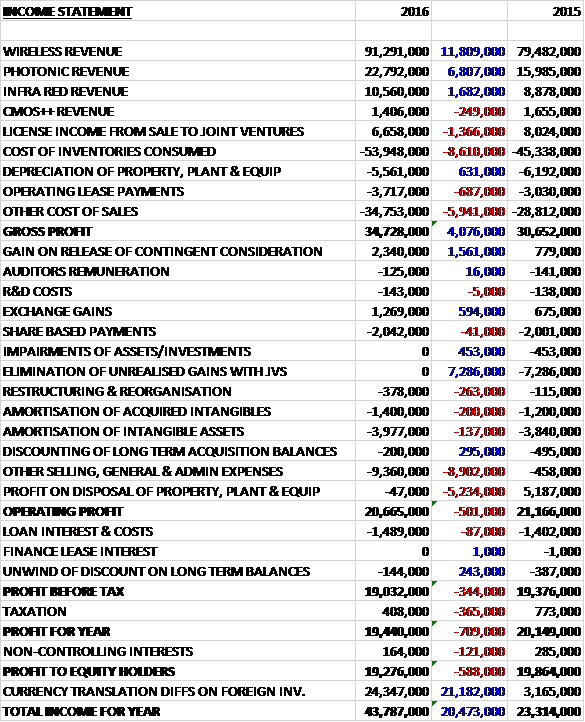
Revenues increased when compared to last year, aided by currency benefits as a £1.4M decline in licence income and a £249K fall in CMOS++ revenue was more than offset by an £11.8M growth in wireless revenue, a £6.8M increase in photonic revenue and a £1.7M growth in IR revenue. Cost of inventories were up £8.6M and other cost of sales increased by £6M to give a gross profit £4.1M above that of last year. The profit from the reduction in deferred consideration was up £1.6M, exchange gains increased by £594K, there were no investment impairments which were £453K last time, and no joint venture unrealised gains (£7.3M).

Offsetting this was an £8.9M increase in other general costs, partly related to currency movements, and a £5.2M reduction in the profit on disposal of fixed assets which saw operating profit fall by £501K. Finance costs fell slightly but tax income was down £365K to give a profit for the year of £19.3M, a decline of £588K year on year.
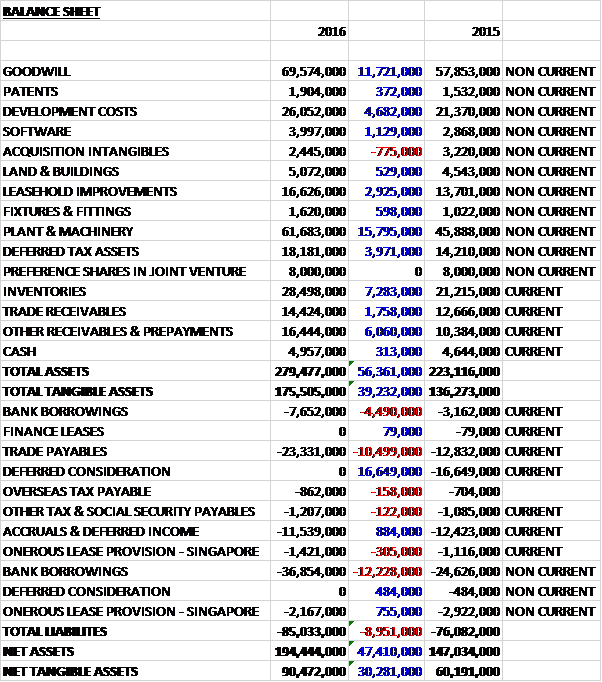
When compared to the end point of last year, total assets increased by £56.4M driven by a £15.8M growth in plant and machinery, an £11.7M increase in goodwill, a £7.3M growth in inventories, a £4.1M growth in development costs, a £3.9M increase in deferred tax assets and a £6.1M increase in other receivables and prepayments. Total liabilities also increased during the year as a £16.6M reduction in deferred consideration was more than offset by a £16.7M increase in bank borrowings and a £10.5M growth in trade payables. The end result was a net tangible asset level of £90.5M, a growth of £30.3M year on year.
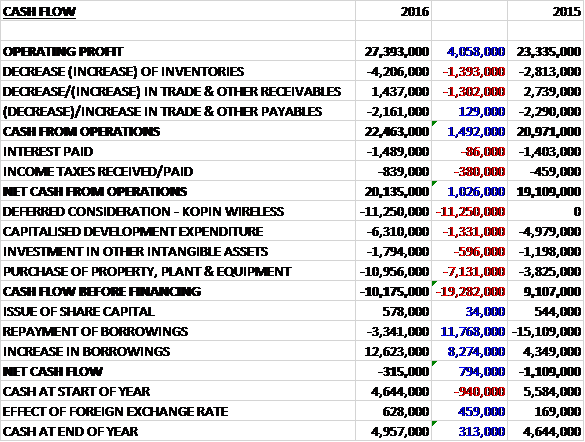
Before movements in working capital, cash profits increased by £4.1M to £27.4M. There was a cash outflow from working capital and tax payments increased by £380K to give a net cash from operations of £20.1M, a growth of £1M year on year. The group spent £6.3M on development expenditure, £1.8M on other intangible assets and £11M on property, plant and equipment, along with £11.3M on deferred consideration for Kopin. This meant that before financing there was a cash outflow of £10.2M. The group therefore took out a net £9.3M of new borrowings to give a cash outflow of £315K for the year and a cash level of £5M at the year-end.

The adjusted operating profit in the Wireless division was £8M, a growth of £803K year on year as the destocking that characterised last year was absent. The market cooled in 2013 as the innovation cycle slowed down but smartphone shipments increased by 2.8% in 2016 which is broadly in line with the group’s forecast for a mid-single digit rate of growth (a bit under I would say). The outlook for the wireless materials market has a good potential to return to double digit growth due to innovations in smartphone hardware such as the adoption of advanced photonics sensors, the adoption of GaN on Silicon technology for base stations, the transition to 5G communications and the adoption of compound semiconductors using cREO for other wireless communication chips.

The adjusted operating profit in the Photonics division was £6.9M, an increase of £2.6M when compared to last year with key milestones delivered on several major programmes during the second half, providing significant growth opportunities. The driver has been VCSEL and InP technologies which enable a broad range of applications from fibre optic communication to advanced sensors and industrial processes.

Vertical Cavity Surface Emitting Lasers (VCSEL) is the key enabling technology behind a number of high growth markets including 3D sensing, data communications, data centres, gesture recognition, health, cosmetics, illumination and heating applications. The group is the market leader for outsourced VCSEL materials. Indium Phosphide (InP) enables fibre to the premises. The continued development of this technology to achieve higher performance at lower costs plus the growth in data traffic is finally leading to the extension of the fibre optic network to the premises. The group has developed laser technologies with differentiated IP which underpins their high growth expectations for this business. Other drivers in this market include optical interconnects, 3D sensing, gesture recognition, laser projection and LEDs.

The adjusted operating profit in the IR business was £2.2M, a growth of £1M when compared to 2015. Significant contract wins and progress in a number of development programmes underpin the continued growth of this business and progress towards new high volume applications. The group is the technology leader in this market with the launch of the industry’s first 150mm indium antimonide wafers, a major milestone in reducing the overall cost of chips. This was followed up with a number of significant contract wins. In addition there has been significant work in developing these materials for consumer sensing applications which will drive much higher volumes in the future. The board expect this market to grow at a rate of about 5-10% for the near future.

The adjusted operating loss in the CMOS++ business was £1.6M, a decline of £91K year on year. The group is involved in multiple programmes which are developing the core technologies from which they expect significant revenue streams to emerge over the next three to five years.

The profit from license income sales to joint ventures was £6.7M, a decrease of £1.4M when compared to last year but this was higher than expected.

The advanced solar technology has been hampered by global macroeconomics as the cost of oil has fallen. The terrestrial market remains an opportunity but as a result of the shifting macroeconomics, focus has shifted to the space market where these advanced materials are used to power satellites where the higher efficiency has a dramatic cost benefit on payload. Product qualifications are underway with satellite manufacturers, paving the way for commercial revenues.

There have been a number of milestones this year. Good progress with new cREO technology delivered some early wins, including delivering a step change in GaN on silicon technology (the elimination of parasitic channel) and engagement in development programmes for advanced RF filter applications. A key customer is engaged in end market qualification using the group’s GaN on Silicon material, signifying that this technology is close to commercialisation. The UK joint venture was a catalyst in securing £300M of funding towards the continued development of a UK CS cluster and the Singapore joint venture has been selected as a partner in a major programme for CS on silicon technology.

The group generated a non-cash profit of £2.3M arising from a reduction in the estimated remaining deferred consideration settled via a trade discount. The consideration has now been fully settled. The restructuring and reorganisation costs of £400K reflect some one-off costs relating to staff, facility and asset write downs associated with the restructuring of the manufacturing operations. The gain on disposal of fixed assets from 2015 related to a non-cash exceptional gain of £4.8M relating to the group’s contribution to the creation of a joint venture.

Going forward, the current financial year has started well and the group is trading in line with expectations. The board remain confident that they are on track to achieve expectations for the full year and expect to benefit from strong cash flows.

If we exclude the profit from the deferred consideration elimination, the shares are trading on a PE ratio of 23.6 which falls to 17.8 on next year’s consensus forecast. At the year-end the group was in a net debt position of £39.5M compared to £23.2M at the start of the year although if we include the deferred consideration, there was a 2% decline in net debt and a lot of the increase was actually down to currency movements. No dividends were declared for the year.

Overall then this has been a decent year for the group. It is quite hard to get at the underlying profits but if we strip away this year’s gain on the release of contingent consideration and last year’s profit from sale of items to the joint venture, underlying profits did grow. Net assets also increased, as did the operating cash flow although no free cash was generated. The wireless division is slowing down somewhat and has been overtaken by the photonics division which seems to be going very well. The IR business is still small but seems to be growing nicely too. All this is positive then but the valuation is also rather high. There is quite a bit of debt and a forward PE of 17.8 is tempting me to get out while the going is good.

On the 19th May the group announced that Finance Director Philip Rasmussen and Operations Director Howard Williams both sold 1,900,000 shares at a value of £1.3M each. The transactions are apparently for future retirement planning purposes and leaved Philip with 1,573,357 shares and Howard with 2,392,965. As it happens, I agree with the directors and think that it would be sensible to bank profits here given the shares have more than doubled.

On the 20th July the group released a trading update covering the first half of the year. They expect to deliver around £70M in revenues, reflecting increased sales in each of the three primary markets. Notably, photonics continued to deliver strong double digit growth, enjoying the early phase of a significant ramp in VCSEL wager supply for mass market consumer applications. As a result, overall wafer sales are expected to grow by around 16%. This has also been supplemented by £1M of license income, although this was below the £3.5M received in the first half of last year.

The group is engaged in a range of programmes which provide significant upside potential to its near and mid-term growth expectations. The start of the mass market ramp for VCSEL wafers marks an inflection point in the commercialisation of this technology. The group has secured multiple multi-year contracts for this ramp which reflects its strong competitive advantages including its technology leadership and its proven track record in delivering wafers into high volume consumer markets.

As a result the board has now approved a capacity expansion plan to meet higher levels of expected demand for H2 2018. This follows increased investment during the first half of 2017 in operating costs, product development and working capital. As part of the expansion plan the ground announced that it has agreed terms for the lease of a new premises in South Wales. The lease is with the Cardiff City Region, is for eleven years and provides the group with an option to extend or purchase the freehold. They have also placed orders for new MOCVD equipment. Following the devaluation of Sterling, currency provided a tailwind of about 10% year on year.

Overall, all business units have progressed in line with expectations but the photonics unit has been the stand out with continued strong double digit growth, accelerating towards the end of the period. In light of recent progress and its increasingly confident outlook, the board expects the group will now exceed market expectations for the full year and whilst it is early into the start of the mass-market adoption of their technology, it is possible that with the current contract momentum, a more significant upgrade to current market expectations could be delivered for 2018.

So, there is a lot to digest here. It seems clear that there is potential for exciting growth here, and the last sentence sounds very bullish. It should also be noted, that it sounds as though here will be quite a big demand for cash this year so I very much doubt there will be any free cash available again, and the shares are now looking rather expensive. In conclusion, however, I regret taking profits here and feel the upside potential is still potentially significant so I have bought back in (at a much higher price than I sold 🙁 )

On the 28th July the group announced that CEO Andrew Nelson sold 5,800,000 shares in the company at a value of £6.15M. In addition Chairman Godfrey Ainsworth sold 1,000,000 shares at a value of £1.05M. These disposals are apparently for future retirement planning purposes and in the case of the CEO, the sale was used to secure the required funds to repay an existing loan which was used to purchase shares in the first place. It is his intention that he will repay the existing loan ahead of the repayment date. They have no plans to sell any more shares and after the transaction, Dr. Nelson still holds 29,459,218 shares and Dr Ainsworth has 2,154,197 shares.

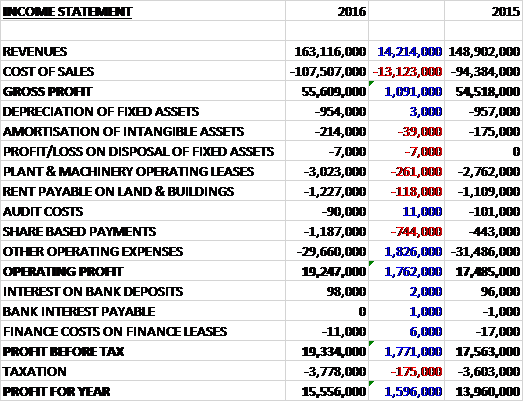
Safestyle Share Blog – Final Results Year Ended 2016

Safestyle has now released its final results for the year ended 2016.

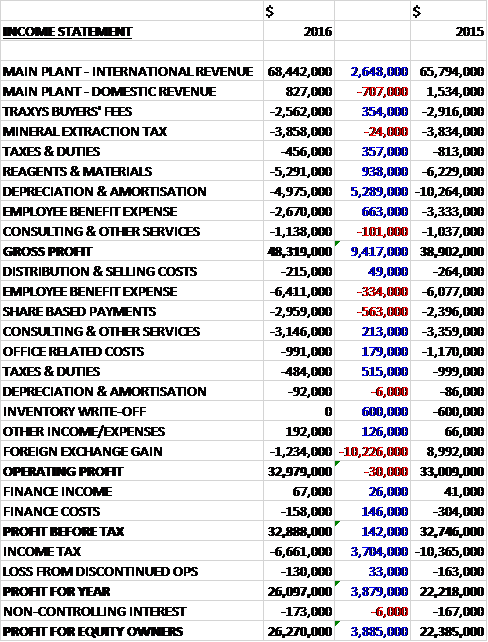
Revenues increased by £14.2M when compared to last year and after cost of sales grew by £13.1M, the gross profit was up £1.1M. There was a £261K increase in operating lease costs, a £118K growth in rent charges and a £744K increase in share based payments, offset by a £1.8M decline in other operating expenses to give an operating profit £1.8M above last time. Finance charges barely moved by tax costs increased by £175K to give a profit for the year of £15.6M, a growth of £1.6M year on year.

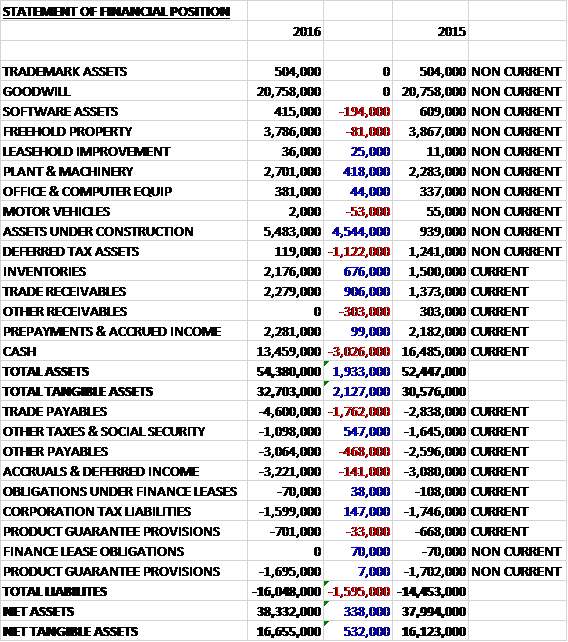
When compared to the end point of last year, total assets increased by £1.9M driven by a £4.5M growth in assets under construction, a £906K increase in trade receivables, a £676K growth in inventories and a £418K increase in plant and machinery, partially offset by a £3M decrease in cash, a £1.1M fall in deferred tax assets and a £303K decline in other receivables. Total liabilities also increased during the year as a £547K decline in tax and social security payables was more than offset by a £1.8M growth in trade payables and a £468K increase in other payables. The end result was a net tangible asset level of £16.7M, a growth of £532K year on year.

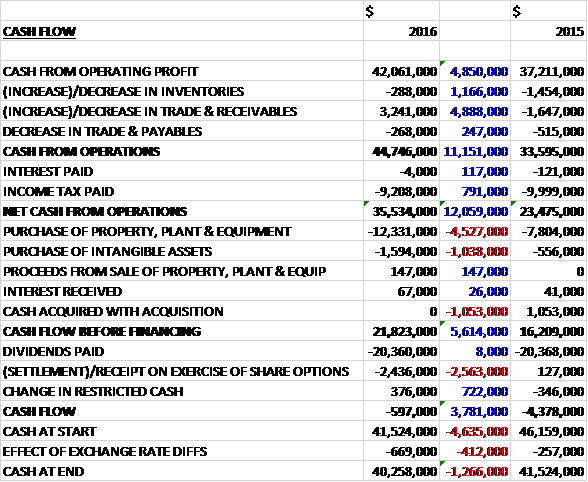
Before movements in working capital, cash profits increased by £5.4M to £24.3M. There was a cash outflow from working capital and a £353K increase in taxes paid which meant that the net cash from operations came in at £17.2M, a growth of £2.6M year on year. The group spent £5.9M on property, plant and equipment, mainly reflecting the factory expansion, to give a free cash flow of £11.4M. They paid back £108K on finance leases and spent £14.4M on dividends to give a cash outflow for the year of £3M and a cash level of £13.5M at the year-end.

During the year the volume of frames installed increased by 3.2% to 288,460 and the average unit sales price was up 6.4% to £565 following a price list increase at the start of 2016 to counteract the additional costs of the new consumer finance products introduced and also reflecting the growth in conservatory upgrades. The market share has continued to increased, up from 9.5% last year to 10.2% in 2016.

The group continued to expand their sales branch network during the year with new openings in Guildford and Norwich. In addition they added an installation depot in South Wales in February 2017 to increase their capacity in that region. There still remain significant opportunities to widen their sales network over the course of the coming year.

They have continued to increase their activity in generating enquiries from digital media and direct response channels, which accounted for 41% of all orders compared to 37% in the prior year. Lead generation from door canvassing remains an important part of the marketing mix, however, and the value of business from this source increased by 9%. The planned increased investment in direct and digital marketing will remain an important factor in 2017 as they aim to reduce lead generation costs.

The weakness in Sterling following Brexit resulted in increased raw material costs in the second half of the year. These have been fully offset through a price increase at the start of 2017, however. Going forward, the strength of their market position, low cost manufacturing capabilities and the track record of sustainable price increases leave the group well positioned to manage any further input cost pressures.

The investment in the expansion of the manufacturing facility is near completion and remains on plan and budget and scheduled to be fully operational in the summer of 2017. They have received and installed the new glass toughening furnace, high speed cutting table and high speed IGU line. By June they will have transferred the existing glass manufacturing process to the new factory. The manufacture of both the frames and double glazed units on a single site will reduce handling, improve quality, increase efficiency and enhance capacity as the group broadens their product range and continue to grow market share.

Following the launch and proof of concept of their conservatory upgrade product in 2015, growth accelerated in 2016 and they installed 551 conservatory upgrades against a target of 450. They expect continued growth in 2017 as the contribution from this revenue stream increases. The new premium products and colours introduced in 2016 have steadily gained traction and are contributing to the broader product offering and appeal.

So far in 2017, order intake is up 4% broadly reflecting the increase in selling prices and more than offsetting the higher raw material costs resulting from the weaker pound. The board are mindful of the uncertainty in the macroeconomic outlook but remain confident of delivering growth over the year ahead.

At the current share price the shares are trading on a PE ratio of 16.7 which falls to 14.6 on next year’s consensus forecast. After a 10.3% increase in the final dividend the shares are yielding 3.6% which increases to 3.9% on next year’s forecast.

Overall this has been another successful year for the group. Profits increased, net assets grew and the operating cash flow was up with plenty of free cash being generated. The group’s market share improved and the conservatory upgrade business seems to be doing well. There are headwinds in the form of raw material cost increases due to the strength of sterling but the group seems to be quite good at mitigating these effects and so far in 2017, price increases have been outpacing raw material hikes. The new factory expansion should also be coming on stream this year which should help with efficiencies. Going forward the PE is 14.6 and yield is 3.9% which looks about right to me and I continue to hold.

On the 18th May the group released a trading update. The year started positively with robust order intake in Q1, however recent trading has been weaker than expected reflecting the latest FENSA stats which have shown a significant contraction in the overall market. As a result, compared to a strong equivalent trading period last year, the group has seen more modest overall growth of 2% in order intake for the first four months of the year.

They expect to grow revenues in the first half but anticipate profits will be lower due to a combination of lower than planned volumes and some parallel running costs following investment in the new production facilities. There are a number of initiatives underway and combined with the impact of enhanced production productivity, the board expect an improved performance in the second half.

They continue to gain market share and build their order book during the period and whilst they are currently operating in a more challenging trading environment, the board are confident of delivering full year results broadly in line with market expectations.

This is a bit of a shame. There is no doubt this remains a great company in good shape but I am a little worried that the fall in demand has been very recent. I think the prudent thing to do would be to take profits now and wait to see if this is a blip or the start of something more serious.

On the 18th July the group released a half year trading update. Since their last trading update, the group has continued to trade in line with earlier months with order intake levels continuing 2% up year on year. Within this overall figure, however, the trend from week to week during Q2 has been more volatile than experienced for a long time. Furthermore, market stats show a market decline in volumes terms of over 10%. Against this backdrop of patchier consumer demand, it is clear that the group has taken further market share.

The group expect to report marginal revenue growth in the first half but with reduced profits. Given the uncertain market conditions and weaker consumer confidence, the board consider it prudent to expect only modest revenue growth again in the second half. This would result in profits for the year being lower than previously anticipated and broadly in line with last year. Cash flow has continued to be strong and they had net cash of £17.7M at the period end compared to £23.6M at the same point of 2016 reflecting the investment in new production facilities and the special dividend.

In anticipation of a continuation of the recent weaker trading environment, the board have taken action to reduce their operating costs in the second half. Long term, this may well turn out to be a buying opportunity but the market is just too uncertain at the moment. The group continues to outperform its peers but in a falling market, this doesn’t really help. I remain on the side lines for now.

Central Asia Metals Share Blog – Final Results Year Ended 2016

Central Asia Metals has now released its final results for the year ended 2016.

Revenues increased when compared to last year as a $707K decline in domestic revenue was more than offset by a $2.6M growth in international revenue. Buyers fees fell by $354K, taxes and duties were down $357K, reagents and materials declined by $938K and depreciation and amortisation decreased by $5.3M following the extension to the life of the mine at Kounrad,to give a gross profit $9.4M above last year. Share based payments increased by $563K but taxes and duties declined by $515K and there was no inventory write-off which accounted for $600K last year. There was a $10.2M adverse swing to a forex loss, mainly due to last year’s devaluation of the Tenge, however, which meant that the operating profit was flat on last year. We then see a $146K reduction in finance costs and a $3.7M decline in income tax charges, mainly relating to a deferred tax credit this year (something to do with depreciating the Kounrad assets since the date of the acquisition following the increase of the fair value of the assets), so the profit for the year came in at $26.3M, a growth of $3.9M year on year.

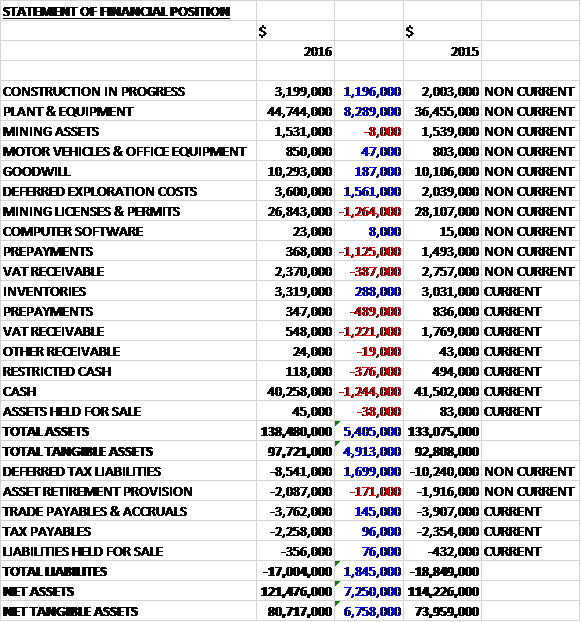
When compared to the end point of last year, total assets increased by $5.4M driven by an $8.3M growth in plant and equipment, a $1.6M increase in deferred exploration costs and a $1.2M growth in construction in progress, partially offset by a $1.2M decline in cash, a $1.2M fall in VAT receivable, a $1.3M decrease in mining licenses and permits and a $1.6M decline in prepayments. Total liabilities declined during the year, mainly as a result of a $1.7M decrease in deferred tax liabilities. The end result was a net tangible asset level of $80.7M, a growth of $6.8M year on year.

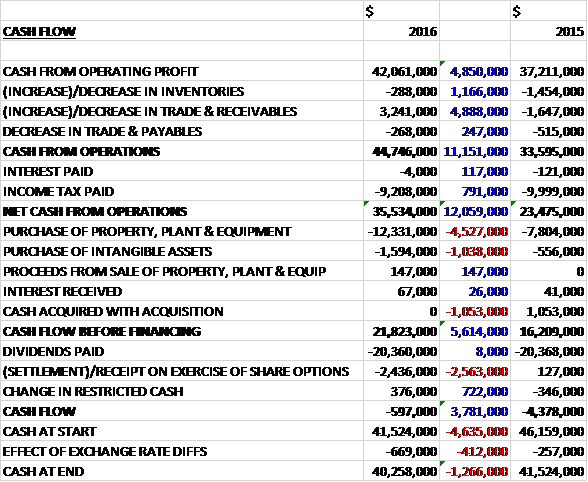
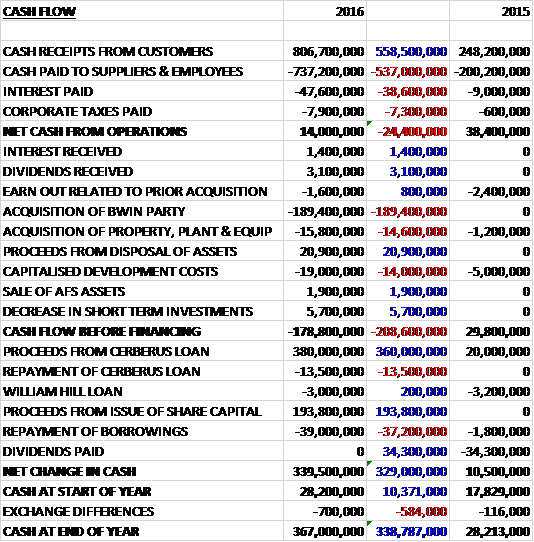
Before movements in working capital, cash profits increased by $4.9M to $42.1M. There was a cash inflow from working capital and after tax payments fell by $791K the net cash from operations came in at $35.5M, a growth of $12.1M year on year. The group spent $12.3M on property, plant and equipment along with $1.6M on intangible assets to give a free cash flow of $21.8M. Most of this ($20.4M) was paid out in dividends but $2.4M was used to settle share options so there was a cash outflow of $597K for the year and a cash level of $40.3M at the year-end.

Last year was another challenging year for the copper price with it reaching seven year lows of $4,311 per tonne in January 2016. The price increased in Q4, ending the year at a price of $5,500 per tonne. The movement seemed to signify renewed positive market sentiment and that outlook has continued into 2017.

The pre-tax profit from the Kounrad operation was $46.1M, a growth of $2.4M year on year. The total production was 14,020 tonnes with the total quantity of copper being sold 13,938. This represents an increase of 1,949 tonnes and 1,898 tonnes respectively. The average gross price achieved from the sale of copper was $4,994 per tonne compared to $5,336 per tonne last year.

C1 cash costs were around $0.43 per pound compared to $0.60 last year (why we can’t have these in per tonnes I really don’t know). The decrease was mainly due to the devaluation of the Tenge in August 2015 since when it has remained relatively stable. There was also very little in the way of inflation on the expenditure at Kounrad.

In Q4 the group materially completed its stage 2 expansion on schedule, ab out 30% under budget. This expansion will enable them to start leaching operations in the Western Dumps in Q2 and in doing so, has extended the life of the operation to beyond 2030. The devaluation of the currency played a significant part in the reduced capex against budget but they also secured some cost improvements based on revised engineering solutions.

The pre-tax loss at the Cooper Bay operation was $799K, an increase of $71K when compared to last year. The team has demonstrated that there is a project worth $34.1M based on a copper price of $3 per pound. Given the current uncertainty with regards the near and medium term expectations for the metal, the board has recommended that the project remains in the development pipeline while they review their options.

In November they signed a framework agreement to acquire an 80% effective interest in the Shuak copper exploration property in northern Kazakhstan which has the potential to host significant copper oxide mineralisation to which they can apply their experience from Kounrad. They intend to start field-based exploration work in Q2 and during the 2017 exploration season, they plan to implement a 1,800m trenching programme and to undertake 22,000m of drilling. The exploration budget is about $1.3M.

Following the receipt of the regulatory approvals required for the Kounrad Stage 2 expansion in November 2015, management has extended the useful economic lives of certain property, plant and equipment. The original estimate of ten years of useful economic life has now been increased through to 2034 which represents the end of the subsoil user license. This change was applied from the start of 2016 and has resulted in a reduction in the depreciation charge.

At the year-end the group was owed $2.8M in VAT receivables. Since the year-end an amount of $238K has been paid and the group are working closely with their advisors to recover the remaining portion. The planned means of recovery will be through a combination of the local sales of copper cathode to offset the VAT liabilities and by a continued dialogue with the authorities.

In December the group signed an agreement to sell its entire interest in Monresources in Mongolia for a cash consideration of $100 and deferred consideration depending on future events. Following unsuccessful attempts to dispose of the Ereen project, the group has taken the decision to exit its position in Zuunmod. After the period end, under the terms of the Shuak framework agreement, the group reduced its interest in Shuak to 80% with 20% being held by local partners.

Going forward the group has a cooper production target of 13,000 to 14,000 tonnes. Leaching from the Western Dumps is on track to start in April and the Shuak exploration programme will commence in Q2. Over the coming years, the proportion of copper that is produced from the Eastern Dumps will fall as production from the Western Dumps gradually increases.
This will result in slightly higher electricity consumption and additional labour to manage the Western Dump operations. After completing the stage 2 expansion capex programme the group are now fully invested at Kounrad with only annual sustaining capex at a cost of about $2M going forward.

At the current share price the shares are trading on a PE ratio of 12.8 which falls to 9.8 on next year’s consensus forecast. After a 24% increase in the total dividend, the shares are yielding 6.6% which increases to 7% on next year’s forecast. The net cash position at the year-end was $40M compared to $42M at this point of last year.

On the 4th April the group released a Q1 production update. Copper production was 3,357 and sales were 2,839 tonnes compared to 3,207 tonnes and 2,550 tonnes respectively in Q1 2016. During the quarter the group carried out a piping modification that allowed the operation of a hybrid intermediate leaching circuit, enabling a higher overall recovery of copper from the covered winter block. The impact of the PLS grade into the SX-EW plant was positive and resulted in a record copper output for the month of February of 1,074 tonnes.

The renewal of 850 cathodes in the EW facility as partial replacement of the circuit inventory was undertaken during the quarter. A further 1,400 pieces are expected on site in July and will be fitted shortly afterwards, thus completing the first five year replacement programme of all anodes and cathodes. Full preparations were undertaken on the Western Dumps pipeline and pumping system in readiness for commissioning of the stage 2 expansion in April. Taking seasonal variations into account, the group is on track to achieve its 2017 copper production guidance of between 13,000 and 14,000 tonnes.

Overall then this has been a good year for the group. Profits did rise but this was really only because of a deferred tax credit and otherwise they would have been flat. Net assets increased, however, and the operating cash flow grew with generous amounts of free cash being generated. The average price obtained for the copper wasn’t great, a $4,994 per tonne but the fact that it is now around $5,730 bodes well for this year. The production and sales of copper both increased during the year.

The stage 2 expansion seems to have been completed without a hitch and this should be the end to the high levels of capex being spent on Kounrad which should enable to group to move on with some other projects. Looking at the wording being used, the Copper Bay projects looks fairly unlikely to go ahead at the moment but the Shauk project looks to be progressing. The Western Dump costs will add a bit to the operating costs but while the Tenge remains devalued, the cost levels are actually very good here. I continue to hold.

On the 5th July the group released an operations update for the first half of the year. Copper production was up 2% to 7,027 tonnes with production in Q2 of 3,670 tonnes. In April the group begun irrigating the Western Dumps and during Q2 about 1,300 tonnes of copper cathode have been recovered. In the first half the group saw sales of copper cathode increased by 8% to 6,870 tonnes.

They have been undertaking geological mapping and is nearing completion of a TEM-FAST geophysics programme, which has been designed primarily to ascertain the depth and extent of the saprolite weathering horizon. The 2017 drilling programme of about 4,700 metres has recently started together with an initial 7,000 metre CHT drilling programme.

As of the period-end the group had net cash of $41.7M and they are on course to achieve their full year production guidance of between 13,000 tonnes and 14,000 tonnes of copper cathode. All seems to be ticking along OK here. Following the recent price reduction I am tempted to buy some more actually.

TT Electronics Share Blog – Final Results Year Ended 2016

TT Electronics has now released its final results for the year ended 2016.

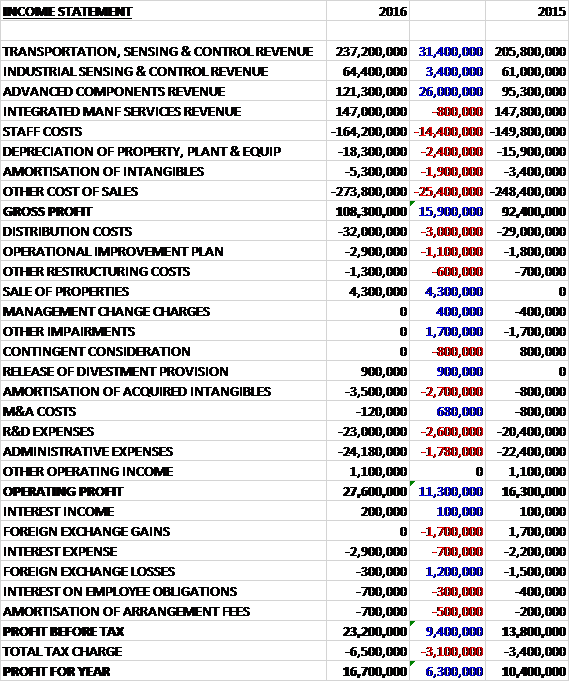
Revenues increased when compared to last year, entirely due to forex movements and the acquisition (they were otherwise flat) as an £800K decline in IMS revenue was more than offset by a £31.4M growth in transportation, sensing & control revenue; a £26M increase in advanced components revenue and a £3.4M growth in industrial sensing & control revenue. Staff costs increased by £14.4M, depreciation was up £2.4M, amortisation increased by £1.9M and other cost of sales grew by £25.4M to give a gross profit £15.9M above that of last time. We then see distribution costs up £3.3M, R&D expenses increasing by £2.6M and other underlying admin expenses up £1.8M. In addition there was a £1.1M growth in costs associated with the operational improvement plan, a £600K increase in other restructuring costs and a £2.7M increase in the amortisation of acquired intangibles offset by a £4.3M profit on the sale of a property and a £1.7M reduction in impairments. All of which meant that the operating profit grew by £11.3M. Interest expenses increased by £700k due to the higher level of debt and tax charges were up £3.1M to give a profit for the year of £16.7M, a growth of £6.3M year on year.

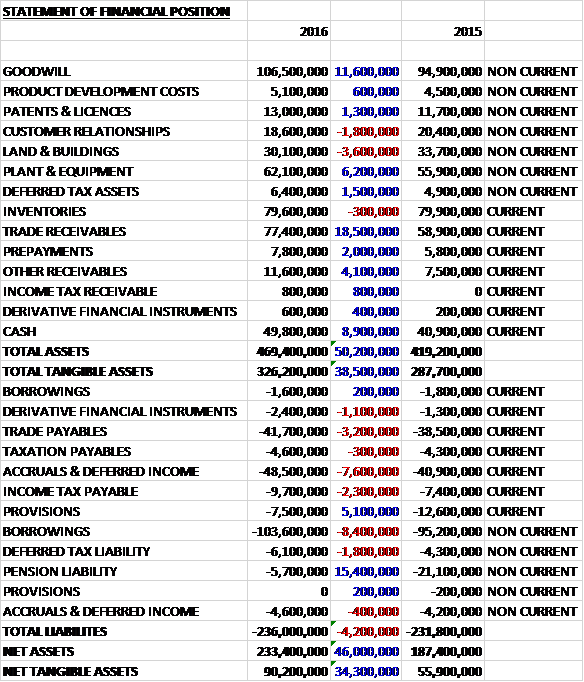
When compared to the end point of last year, total assets increased by £50.2M driven by an £11.6M growth in goodwill, an £18.5M increase in trade receivables, an £8.9M growth in cash, a £6.2M increase in plant & equipment and a £4.1M growth in other receivables. Total liabilities also increased during the year as a £15.4M decline in pension liabilities and a £5.1M decrease in provisions was more than offset by a £7.6M growth in accruals and deferred income, an £8.2M increase in borrowings and a £3.2M increase in trade payables. The end result was a net tangible asset level of £90.2M, a growth of £34.3M year on year.

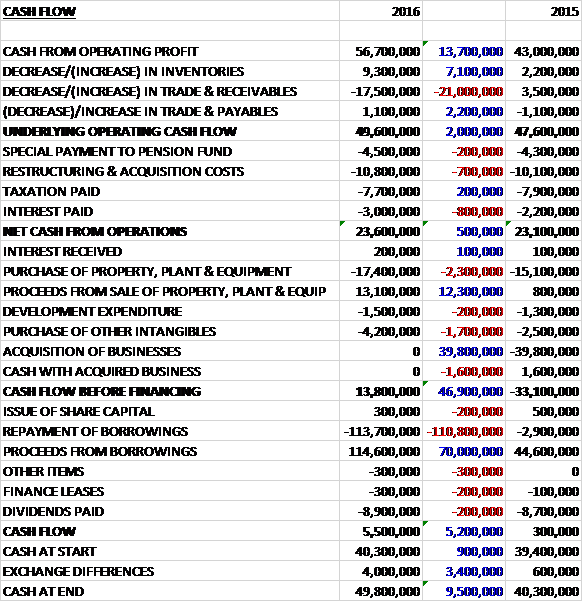
Before movements in working capital, cash profits increased by £13.7M to £56.7M. There was a cash outflow from working capital and after restructuring costs increased by £700K and interest payments grew by £800K, the net cash from operations came in at £23.6M, a growth of £500K year on year. The group spent £17.4M on property, plant and equipment but received £13.1M from the sale of fixed assets which included £12.3M from the sale of surplus sites in Weybridge, Fullerton and Werne. They also spent £1.5M on development expenditure and £4.2M on other intangibles to give a free cash flow of £13.8M. This was used to pay £8.9M of dividends so the cash flow for the year was £5.5M and the cash level at the year-end was £49.8M, boosted by £4M of positive forex movements.

Overall, underlying operating profit increased by £9.6M. Of this, £3.2M was due to favourable forex movements, £3.4M was the contribution from the acquired Aero Stanrew and £3M was from self-help actions and underlying business performance.

The underlying operating profit in the Transportation, Sensing and Control division was £3.2M, a positive swing of £4.6M year on year including a £600K forex benefit, with the division returning to profitable growth faster than expected. Revenues increased by 4% on an organic basis as a result of market demand in Europe and China together with new contract wins in China to service the growing domestic market. The business has maintained their strong position in Europe while driving growth in China and securing their first major win in the US where they see opportunity to grow market share over the medium term.

They have seen good growth in China with five new customers won during the year for position sensors in chassis applications in addition to further revenue growth with a number of existing customers. They have seen the ramp up of a new pedal platform and global crankshaft platform which has increased volumes sold in China. The European operations have also performed strongly with significant ramp up of new contracts during the year including for remote lights, LED lighting solutions and a chassis height sensor solution.

During the year they also launched a new automotive actuator to deliver significant improvements to their next generation haptic accelerator pedals offering power efficient transmission and a significant weight reduction from previous generation offerings, improving their customers’ fuel efficiency. New changes in emissions legislation have refocused industry efforts on turbo charged engines where the group has won a new contract for their high temperature sensors for a leading German OEM. They also have a wide range of products for exhaust after treatment including fluid quality sensors which they offer in Europe, India and Korea.

The underlying operating profit in the Industrial Sensing and Control division was £11.9M, an increase of £500K when compared to last year although it fell by 8% on a constant currency basis. Revenues also decreased with the fall in large part a result of challenging North American industrial markets, although the division returned to modest growth in the second half of the year. The optoelectronics offerings that combine the use of electronics and light have seen good growth through the year, improving the mix of business towards higher reliability and precision offerings which have a higher margin.

During the year the business launched a number of new products to support future growth including a component that transfers electrical signals between two isolated circuits using light, to support satellites, and spacecraft. We also launched a high-performance industrial pressure transmitter for a range of industrial applications including chemical plants, mining, power generation and plastics manufacturing.

During the year the business won a contract with an American computer hardware, software and electronics customer to design and deliver circuit board assemblies to be used in ATMs for detecting currency, cheques and deposit envelopes. They have a longstanding relationship with this customer for delivering individual IR emitting and detecting components as well as cable assemblies which are all core components in the new circuit board assembly contract.

The underlying operating profit in the Advanced Components business was £10.3M, a growth of £4.3M when compared to 2015 with £3.4M of that due to the Aero Stanrew acquisition, £200K from positive forex movements and £700K coming from organic improvements. The division released eleven new products during the year, further enhancing its position as global leader in circuit protection, detection and power management across aerospace and defence, transportation and industrial markets. The group continue to see strong demand for wire wound resistors targeted at the smart metering business, as a result of European legislation.

They are experiencing good growth in automotive electro-magnetics due increasing demand for high quality components for power management as their customers manage the increasing power requirement and increasing electronic content in cars. Their electromagnetic capabilities have been enhanced by the acquisition of Aero Stanrew and additional product launches including two power inductors and a transformer targeting demanding high temperatures in automotive and industrial applications.
This year they launched mag-Net, a new connector which forms part of a soldier system for the digital battlefield and enables communications for soldiers. It is currently being used in equipment trials with a large customer in the defence industry.

The underlying operating profit in the IMS business was £5.9M, a growth of £200K year on year but the constant currency profit declined by 11%. Revenues also decrease on a constant currency basis. Revenues in China were strong with new customers won in transportation and medical markets but the division was faced with challenging industrial markets in the US which resulted in a volume reduction as project revenues ended as expected.

In China good progress with operational efficiency measures supported a strong contribution to the divisional performance. The impact of the reduction in volume in the US was mitigated in large part through a 22% headcount reduction and other cost reduction actions. In the medical market they have seen strong growth in life sciences, ophthalmology and direct patient care, including winning a new contract with an Australian optometry equipment provider. The UK site in Rogerstone and the Chinese site in Suzhou collaborated on a cabin lighting project for a customer. In addition, the business has been supporting good growth in Advanced Components by providing specialist manufacturing capabilities for engine test equipment.

During the year they won a number of new customers in Asia in addition to expanding existing customer relationships. Sales in Asia increased by 17% at constant currency. In particular they have seen strong growth in the Chinese rail market where new business included a three year contract to provide design and manufacturing services for the Chinese metro lines. They have also started to win new customers across Asia Pacific as a result of focused sales efforts to meet growing regional demand which includes a Korean semiconductor customer won during the year.

Aero Stranrew was acquired in December 2015. In its full year of ownership, the business has been integrated, has performed well, achieved strong order growth and is on track to deliver return on invested capital in excess of the cost of capital this year. The group continue to look for new acquisition opportunities to accelerate growth due to organic top line growth being flat.

As usual there was a plethora of non-underlying costs. Restructuring costs related to further costs incurred on the operational improvement plan initiated last year, costs associated with other site restructuring and a credit of £4.3M arising on the sale of properties. Acquisition costs amounted to £3.8M which included a credit of £900K relating to the release of a provision established for warranty liabilities arising from a divestment that is no longer required, £3.5M amortisation of acquired intangibles and £1.2M of other costs, relating primarily to the integration of Aero Stanrew.

The triennial valuation of the UK pension scheme in 2016 showed a deficit of £46M compared with £19.1M and the group agreed additional fixed contributions extending to 2020. These amount to £4.7M, £4.9M, £5.1M and £3.9M. In addition they have set aside £3M over the last three years to be used in agreement with the trustees for reducing the long term liabilities of the scheme.

Going forward, despite uncertain end markets, the group enter the year with good momentum in operational efficiency improvement and a robust order book, giving them confidence of making further progress in 2017.

At the current share price the shares are trading on a PE ratio of 19.2 which falls to 14.5 on next year’s consensus forecast. At the year-end the group had a net debt position of £55.4M compared to £56.1M at the start of the year. After an increase in the final dividend the shares are yielding 2.8% which increases to 3% on next year’s forecast.

Overall then this has been a decent year for the group. Profits were up, net assets increased and the operating cash flow recovered, although the only reason free cash was generated was due to the property sales. Transportation sensing and advanced components both performed well with the former doing well in China and the latter benefiting from the Aero Stranrew acquisition. Industrial Sensing and IMS both struggled, however, due to a challenging North American industrial market. The pension scheme seems to be causing some problems too, and is looking rather expensive over the next few years.

There is no doubt that performance seems to be improving but the group has benefited from favourable exchange rates and last year’s acquisition. Organic growth seems much harder to come by and I feel that a forward PE of 14.5 and yield of 3% is a little expensive.

On the 12th May the group released a trading update covering the first four months of the year. Trading has been in line with expectations overall with revenues 10% higher than last year but just 1% up on an organic basis. The order book is strongly ahead of the prior year, giving them a better visibility in the outturn for 2017. During the period they acquired the assets of Cletronics, a small US-based manufacturer of electromagnetic components for the aerospace industry, for $1.2M.

On the 19th July the group announced that it had entered into a conditional agreement for the sale of its Transportation Sensing and Control division to AVX for a cash consideration of £118.8M, a value of about 11x the underlying EBIT. The proceeds will be used to pay down the existing debt and fund further investment to accelerate growth through capex and acquisitions. The pattern of trade across the remaining business has been good and the order book remains strongly ahead.

This disposal really repairs the balance sheet and leaves the shares looking decent value. It would be nice to get hold of an updated forecast but of course being a private investor I can’t do that! Shame.

Serabi Gold Share Blog – Year Ended 2016

Serabi Gold has now released its final results for the year ended 2016.

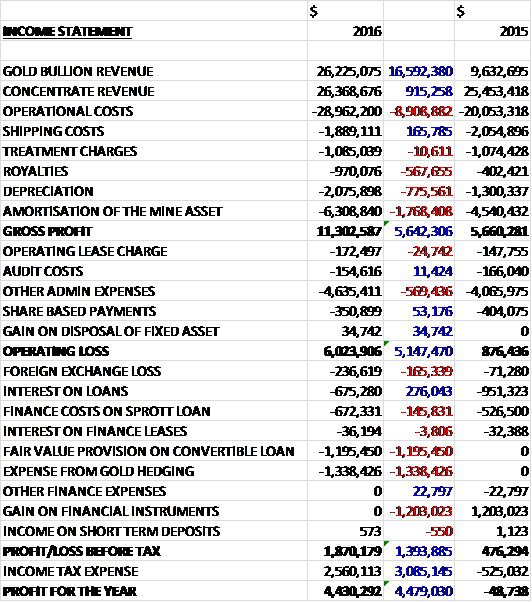
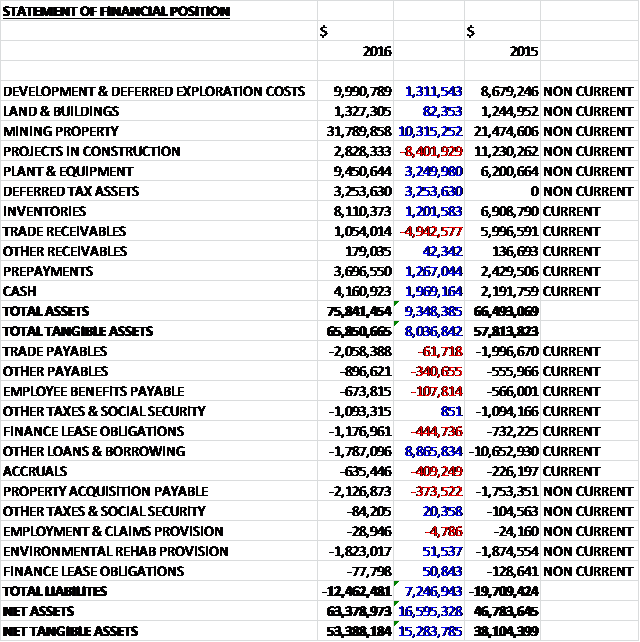
Revenues increased when compared to last year with a $16.6M growth in gold bullion revenue and a $915K increase in concentrate revenue. Operational costs increased by $8.9M due to growing labour costs and the fact that Sao Chico only entered commercial production at the start of 2016, royalties were up $568K, depreciation increased by $776K and amortisation grew by $1.8M to give a gross profit $5.6M above that of last year. Admin expenses increased by $570K reflecting expenses for old tax settlements which meant that the operating profit was up $6M. We then see a $1.2M fair value provision on the convertible loan as the group’s share price increased, a $1.3M expense from gold hedging and the lack of a $1.2M gain on financial instruments which occurred last year, offset by a $3.1M positive swing to a tax income as tax losses were recognised. The end result was a net tangible asset level of $4.4M, an improvement of $4.5M year on year.

When compared to the end point of last year, total assets increased by $9.3M driven by a $10.3M growth in the value of mining properties, a $3.2M increase in plant and equipment, a $3.3M growth in deferred tax assets and a $2M increase in cash, partially offset by an $8.4M decline in projects in construction and a $4.9M fall in trade receivables relating to the new contract with a new customer for concentrate sales. Total liabilities declined during the year, mainly due to an $8.9M decrease in other loans and borrowings. The end result was a net tangible asset level of $53.4M, a growth of $15.3M year on year.

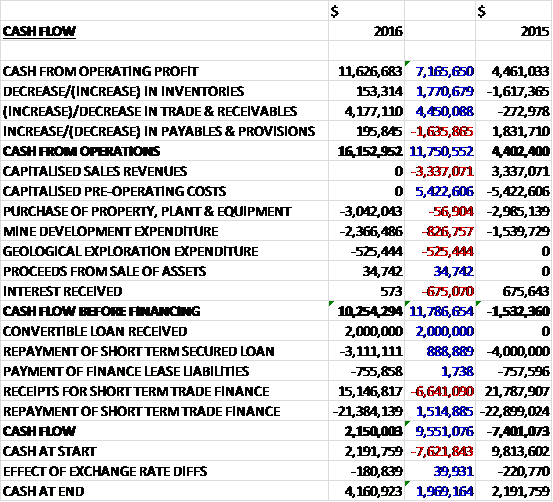
Before movements in working capital, cash profits increased by $7.2M to $11.6M. There was a cash inflow from working capital and the cash from operations came in at $16.2M, a growth of $11.8M year on year. The group spent $3M on property, plant and equipment, $2.4M on mine development expenditure and £525K on geological exploration which meant that the free cash flow was $10.3M. Of this, $3.1M was used to pay back the short term secured loan, $756K went on finance lease payments and a net $6.2M went on the repayment of short term trade finance. After a $2M convertible loan was received, the cash flow for the year was $2.2M and the cash level at the year-end was $4.2M.

With the Palito and Sao Chico mines now operating at planned levels and 40,000 ounces of gold production forecast for 2017, the focus is now on evaluation of the existing discoveries and other exploration opportunities that exist around both mines and successful development of these will bring a further opportunity to increase production.
Total gold production for Q4 was 9,413 ounces, making the total gold production for the year 39,390 ounces, representing a 21% increase over 2015 with Sao Chico not yet in production in Q1 2015 and commercial production starting at the start of 2016. The ore generated from Sao Chico in 2016 has continued to be derived principally from development operations rather than stoping, although this is now changing.

About 158,900 tonnes of ore was extracted in 2016 compared to 135,800 in 2015. The introduction in Q2 2016 of increased processing capacity eliminated limitations in the amount of ore that can be processed and allowed the increased levels of ore from Sao Chico to be accommodated. The mine production for Q4 2016 from Palito was some 28% higher than Q4 2015.

Average mined grades in Q4 at Palito were lower than in preceding quarters as a result of ore being cemented in two stopes. The production shortfall was partially compensated by increased production of development ore at a lower grade. Overall the mined grade at Palito averaged 9.62g/t for 2016, a reduction of 4% year on year.
At Sao Chico mined grade in Q4 2016 was 14.38g/t which is 48% higher than Q4 2015. This ore grade is considered to be a one-off event reflecting particularly high-grade areas that were being mined in the quarter and management consider that the normal mined grade at the mine will be between 9 and 10g/t over the life of the mine. The average grade in 2016 as a whole was 10.12g/t, an improvement of 17% over 2015. The improvement reflects the fact that during 2015 Sao Chico was primarily in development and higher grade ore from stoping operations only started to be produced in Q2 2016.

At Palito the group focused on opening up new sectors in the mine as well as continuing to develop the existing sectors. With four sectors now being developed underground at the mine, during 2016 the group has completed about 7,350m of horizontal development, representing an increase of 8% over the prior year.

The Senna zone is now in underground development and to date has been very successful. Mine development is ongoing and all ore being mined from the sector is currently from development activity with stoping yet to start. Based on the ore grades recovered from the earlier open pit operation and deeper exploration drill holes, management is hopeful of the long term potential within the zone which has the benefit of an independent access from the surface.

In the Chico da Santa sector, the 114mRL has been developed on the Ipe, Jatoba and Mogno veins. Good grades have been encountered in all three veins, although they tend to be slightly narrower than the veins being mined elsewhere at Palito. The development towards Palito South has not been advanced significantly during the year as it is awaiting underground diamond drilling to test the down-dip continuity of the G3 vein at depth. Management hopes that subject to available cash resources, a drilling programme can be undertaken in 2017 to evaluate the area further.

Underground drilling is being used to evaluate numerous known but underexplored veins and together with these two sectors, the group hopes to open up numerous new mining faces in the upper levels. These have the advantage of being in close proximity to existing mine infrastructure and will not require any new ramp development.
At Sao Chico the main ramp has now reached the 71mRL, about 170m below the surface, and will continue to be deepened during 2017. During the year the decision to implement sublevel open stoping as the main mining method was taken which resulted in the development of sublevels with 12m vertical spacings floor to floor.

The gold grades within this alteration zone are quite erratic and are hosted in three steeply plunging pay shoots. Outside the pay shoots the vein is continuous but with low gold grades and as a result it will be unavoidable that as the mine development passes between the pay shoots, lower grade ore has to be mined. The central pay shoot is the most established of the three high grade shoots and is some 100m long. The group has focused on developing this part of the main vein and some consistent higher grade development ore is being generated as a result.

During Q2 the group started underground exploration drilling of the central pay shoot targeting its down dip extension. The drilling has intersected the Main Vein in all holes and is confirming the belief that the Sao Chico main vein is a regional shear structure. This bodes well for the continuation and strike extension outside the immediate and current mine limits.

The gold production of 39,390 ounces this year came from the processing of 158,966 tonnes or ore with an average grade of 8.11g/t compared to 130,299 tonnes at 8.43g/t last year reflecting the increased levels of ore being produced at Sao Chico.

Further improvements undertaken within the process plant during 2016 have included the installation of additional flotation capacity and automation, along with new carbon screens within the CIP tanks to improve the inter-tank flow rates. A carbon regeneration kiln was installed, commissioned and became operational during Q4 which will regenerate fouled carbon, reducing the need to purchase fresh carbon and is also expected to enhance gold recoveries.

Milling rates for ROM ore have increased by 22% to 435tpd. The introduction of the third ball mill at the end of June has had a significant impact on throughput rates. The average daily rate was 460tod in H2. The increase in processing rates also reflects the improvements in the operational efficiency of the process plant which have been assisted by the introduction of the gravity circuit and ILR for treating Sao Chico ore, reducing the levels of gold that would otherwise have been treated in the CIP circuit. This improved efficiency has also allowed the rate of processing of the flotation tails to be maintained at similar levels to 2015. As of the year-end there were about 20,800 tonnes of flotation tails with an average grade of 2.5g/t waiting to be processed.

Much of the group’s expenditure is incurred in Brazilian Reais and they therefore have significant exposure to the changes in exchange rates. Whilst the 20% strengthening of the Real between the beginning and end of 2016 has negatively impacted on the performance, when looking at the unit costs of production compared with 2015, the underlying trend has been for an overall reduction in unit costs when look at in local currency terms. The total all in sustaining cost of production during the year was $965 per tonne compared to $892 per tonne in 2015.

At Sao Chico in the second half of 2016 the level of stoping activity began to increase and the long term balance between developing mining and stoping rates only started to be reached at the end of the year. During 2017 management expects that monthly development and production rates will continue to stabilise. The group is driving development galleries east and west towards additional ore shoots that have been identified by surface drilling.
Management is confident that these ore shoots will provide additional mineable ore at Sao Chico. Underground drilling is being undertaken for short term operational and mine planning purposes with a second parallel campaign being undertaken to test the deeper resource potential of the deposit.

Mine-site geophysical studies undertaken during Q3 over the Currutela and Piuai discoveries and other areas close to the current Palito mine have been designed to improve the drill targeting of a planned 2017 surface drilling campaign. Management feel that this drilling campaign could prevent sufficient confidence to justify commencement of new mine portals and underground exploration development drives to access and fully evaluate any new discoveries that are considered to be potentially commercially viable. In time these discoveries could become established as new near-mine satellite deposits adding incremental production.

The group started the first phase of an increased exploration effort during the second half of the year with some initial geophysics programmes around the two mines. The results at Palito from the down the hole electromagnetic programmes have helped them better understand the size and location of existing discoveries and will help them plan the next phase of evaluation those. At Sao Chico the work was suspended because of weather conditions but the initial signs have been encouraging and continue to support the belief that the current Sao Chico mine is just a small part of a larger regional structure. In this respect, the acquisition of the exploration rights during 2016 over exploration tenements surrounding the current Sao Chico operations was very important.

Whilst currently the immediate focus of management is to evaluate the near-mine potential within two to three km of its existing operations, on a wider regional basis the group is developing plans to progress the evaluation of its whole tenement package. They have flown about 14,650 hectares of airborne VTEM surveys but has had limited funds to follow up on many of the areas of interest that were highlighted. Conscious that the exploration tenements it holds are only granted for limited terms, the group is keen to implement, as and when funding is available, a regional exploration programme to highlight the tenement areas that have the highest potential.

As consideration for an extension of the repayment terms agreed with Sprott in January the group granted to Sprott call options to acquire 2,500 ounces of gold from the company at a price of $1,125 per ounce, exercisable at any time up to June 2017. The grant of the call options and its settlement occurred within the financial period and the group has recorded for the value of the cash settlement due as a finance expense in the income statement.
During the year the group repaid $3.1M in capital repayments as well as $150K of a total amount of $433K relating to a cash settlement liability for call options over 2,500 ounces of gold which were granted to and exercised by Sprott during the year.

In August the group issued 42.3M new shares following the decision of Frateli to convert its $2M convertible loan into shares. Under the terms of the loan they had the right to convert the shares at 3.6p per share. The group anticipates that while it may seek to raise further finance in the future it now has access to sufficient funding for its immediate needs.

Going forward the group is currently forecasting gold production for 2017 to be approximately 40,000 ounces with all in sustaining costs expected to be between $950 to $975 per ounce. The group’s cost profile is subject to change as a result of exchange rate variations. At the current share price the shares trade on a PE ratio of 9.6 which falls to 4.5 on next year’s consensus forecast.

Overall then this has been a year of consolidation as the Sao Chico mine finds its feet and starts contributing to the group result. Due to this, profits were up, net assets increased, aided by the strengthening of the Real and the operating cash flow improved with decent levels of free cash being generated. This year the group produced just under 40K ounces of gold at a cost of $965 per ounce, and this is broadly what they expect to do again in 2017.

The Q4 grades are a bit of a red herring with the Palito grade temporarily lower and the Sao Chico grade temporarily higher. A lot depends obviously on the price of gold but also on the strength of the Real with further appreciation making costs rise to uncomfortable levels. Overall though, I like the calm exploration strategy here and with a forward PE of 4.5 this looks pretty good value to me.

On the 12th April the group released details of progress in Q1. It was a strong quarter with production of 9,861 ounces of gold, in line with guidance. Mine production totalled 36,918 tonnes at 10.12g/t and 46,663 tonnes of ore was processed through the plant at a combined grade of 7.09g/t. As of the period-end there were coarse ore stocks of about 13,000 tonnes with an average grade of 4g/t and about 17,000 tonnes of flotation tails with an average grade of 2.5g/t. This stock is not being consumed as quickly as forecast and for now the operation remains plant constrained.

The grade of 12.64g/t achieved at Sao Chico was well above the 10.12g/t average achieved last year but was below the 14.38g/t achieved in Q4, perhaps suggesting it is moving away from the high-yield area. At Palito the grade was 9.07g/t which was above the 7.38g/t achieved in Q4 last year but below the 9.62g/t average.

Ore development and production from Sao Chico continued in line with schedule and good mined grades, at an average of over 12g/t, was achieved for the quarter. The main ramp has now reached the 56mRL with the main vein being intersected early in April. Stope ore production is currently focused on the 140mRL whilst development is progressing on five levels below and is ahead of stoping activity.

Due to the wet season arriving early, the exploration programme at Sao Chico had to be suspended but initial results that have become available are promising. The survey was designed to traverse the known orebody to provide focus to the east and west of the current strike.
The results to date show two good anomalies 600m to the north and 300m to the south of the current workings which look even stronger than the orebody being mined. These anomalies appear to suggest a geometry consistent with the known orebody and could suggest parallel mineralisation. They are set to recommence the programme this coming quarter.

Exploration and evaluation drilling underground continued with about 1,950 metres of diamond drilling completed. This is focusing on deeper drilling into inferred resources in the Senna, Pipocas and G3 veins in the Palito orebody, and similarly the down dip extension of the main vein in the Sao Chico orebody with a view to converting substantial inferred resource to indicated status.

Overall things seem to be ticking along fairly well and I now hold the shares.

James Halstead Share Blog – Interim Results Year Ending 2017

James Halstead has now released their interim results for the year ending 2017.

Revenues increased by £4.9M when compared to the first half of last year so after cost of sales grew by £4.7M, gross profit was up £200K. Finance costs increased by £39K and tax charges grew by £229K to give a profit for the period of £17.7M, broadly flat year on year with a decline of just £47K.

When compared to the end point of last year, total assets increased by £266K driven by a £7.5M growth in cash, a £1.2M increase in derivative financial assets and a £792K growth in property, plant and equipment, partially offset by a £9M decrease in receivables and an £880K decline in inventories. Total liabilities also increased during the period as a £2.7M growth in pension obligations and a £987K increase in current tax liabilities was only partially offset by a £2M decline in payables and a £1.4M fall in derivative financial liabilities. The end result was a net tangible asset level of £94.3M, broadly flat year on year.

The cash generated from operations increased by £135K to £31.2M. After tax was paid(slightly less than last time), the net cash from operations was £26.7M, a growth of £301K over the past six months. The group spent £2.1M on capex so there was a free cash flow of £24.7M. Of this, £17.6M was spent on dividends to give a cash flow of £7.2M and a cash level of £51.6M at the period-end.

The benefits of weaker sterling on exports have been beneficial and exports recorded growth of just over 12%, although in constant currency this would have been 2.5%. Offsetting this was a 7% decline in UK turnover that the board believe is a result of destocking. During the period one of their significant customers, a subsidiary of SIG, drastically destocked and faced buying restrictions. The business was sold to a private equity investor in February and it is hoped that more regular trading patterns may arise.

The Australia and New Zealand businesses have both seen growth in sales and profitability with the business benefiting from last year’s restructuring. The move to a new Auckland warehouse took place smoothly, resulting in a lower cost operation in the future.

The European businesses are on a par with last year. They have a busy six months ahead with the launch of key Luxury Vinyl Tile, Loose Lay and Heterogeneous products. Having been launched at exhibitions in January and February and being well received, it is anticipated that the benefits from sales of these products will be seen in the second half of the year.

Scandinavia followed a very quiet beginning to the year with a strong performance in Q2 and both sales and profits are ahead of the equivalent period last year. Felleskjopet Agri, a cooperative owned by Norwegian farmers is one project of note that they were involved in.

The business in Canada saw local sales increase and the group have expanded their staff representation in the country to include British Columbia, an area previously handled by a distributor. As the resources sector continues to suffer the business relating to portable buildings has retrenched but contracts into other sectors such as retail and commercial buildings have been developed over the last four years such that portable buildings are now a minor part of the business.

The fledgling India business has continued to extend its roots in the period. A team of salespeople operating across the area means that they are obtaining specifications and enquiries at a far higher level. Deliveries continue to grow, particularly into the healthcare sector, but also into industrial and pharmaceutical customers. Examples such as the Ayurdundra Hospital and Guwahati, the ESIC hospital in Bhubaneswar and Barclays bank in Delhi are a few of them.

Going forward the UK market is solid but there is some upward price pressure on raw materials and overseas sourced goods. Overall this is offset by opportunities for overseas exports from a weaker sterling. Taking into account these points and with the positive feedback from the range of revamps that have been presented to the trade the board continue to be confident of progress through the year.

At the current share price the shares are trading on a PE ratio of 28.8 which falls to 27.1 on this year’s consensus forecast. After a 7% increase in the interim dividend, and including the special dividend, the shares are yielding 4.1% which falls to 2.7% on the full year forecast. At the period end the group had a net cash position of £51.6M.

Overall then performance has been rather static during the period. Profits were flat, as were net assets. The operating cash flow saw a modest increase, however, and the group remained very cash generative. Export sales rose during the period, flattered by the recent weakness of sterling but UK sales declined, apparently as a result of customer destocking. Going forward there is likely to be some price pressure from raw materials but there are some new ranges being launched which might provide some momentum. The forward PE is 27.1, although the large pile of cash should be noted here, and the yield is 2.7%. Overall I think I would rather wait and see how the second half goes before jumping in.

On the 1st August the group released a trading update covering the year as a whole. Last time it was noted that a slowdown in the UK market and adverse price pressure on raw material and overseas sourced goods were holding back the benefits of export currency gains. This continued into H2 and was exacerbated by a number of major distributors in the UK reducing stock levels. Notwithstanding this, the board are confident of reporting record profits for the year. Despite this, things seem to be getting tougher here – I am not sure these shares offer good value at the moment.

XPP Power Share Blog – Final Results Year Ended 2016

XP Power has now released their final results for the year ended 2016.

Revenues increased when compared to last year with an £11.2M rise in industrial revenue, a £5.3M growth in technology revenue and a £3.6M increase in healthcare revenue. Cost of sales also increased to give a gross profit £7.4M higher. Depreciation was up £200K along with rent and lease expenses with other distribution and marketing costs increasing by £4.2M. There was a £600K increase in amortisation charges but the R&D expense was down £500K to give an operating profit £2.4M higher. After the tax expense increased by £800K the profit for the year was £21.3M, a growth of £1.6M year on year.

Compared to the end point of last year total assets increased by £20M driven by a £4.3M growth in cash, a £4M increase in trade receivables, a £3.5M growth in inventories and a £3.2M increase in development costs. Total liabilities also increased during the year as a £2.5M decline in bank loans was more than offset by a £2.1M growth in current tax liabilities and a £1.5M increase in payables. The end result was a net tangible asset level of £55M, a growth of £12.8M year on year.

Before movements in working capital, cash profits increased by £7.7M to £37.8M. There was a cash outflow from working capital but tax payments fell by £600K to give a net cash from operations of £27.7M, a growth of £6.8M year on year. The group spent £2.6M on property, plant and equipment along with £4.2M on R&D which meant that the free cash flow was £21M. Of this, £3.7M was used to pay back borrowings and £12.9M paid out in dividends to leave a healthy cash flow of £4.4M and a cash level of £9.2M at the year-end.

While overall the market for industrial electronics remained challenging during the year, trading conditions improved in the second half and the group had some positive momentum in order intake and revenues. They have also delivered their highest ever level of own designed product which now represent 73% of the total and they expect this to increase again in 2017.

The European business contributed £11.6M, a growth of £4.9M year on year in challenging market conditions. The industrial, healthcare and technology sectors all grew in the region and the group gained increased traction with some of the bigger blue chip clients, which they expect to drive further European growth in 2017.

The North American business contributed £21.6M, an increase of £7M when compared to last year but it did benefit from incremental revenues from the acquisition of EMCO at the end of 2015. Without this, revenues would have been flat year on year. Order intake was strong in the second half of the year with $51.6M booked compared with $47M in the first half. The region now has the benefit of good momentum going into 2017 with some promising new programmes where they expect volumes to ramp up significantly during the year.

Technology held its own and the industrial sector rebounded to represent 35% of revenues in the region compared to 31% last year. Healthcare also performed well in absolute terms as a number of new programmes ramped up but it did not match the pace of the recovery seen in the industrial sector.

The Asian business contributed £3.5M, growth of £2.1M when compared to 2015. The customers driving this increase generally sell their end products outside of the emerging markets. Industrial and technical sectors showed good growth whilst healthcare remained flat year on year.

Production volumes of magnetics windings at the Vietnam facility have continued to ramp up and in 2016 they produced 4.9M windings compared to 4.3M in 2015. They have been actively transferring the lower power/lower complexity products from China to Vietnam to improve the cost position and free up capacity in China. Over the year they manufactured 377,700 power supplies in their Vietnam facility compared to 172,500 in 2015.

The group continue to make improvements in their manufacturing facilities where they are applying more lean process principles. Their internal yields continue to improve and they have redesigned some of their processors to reduce product lead times to provide improved customer service and reduced freight costs. They expect to derive cost benefits from their lean manufacturing initiatives as they trade through 2017.

Their longer term planning indicates that they will need additional manufacturing capacity in the first half of 2019. They have therefore allocated $1.5M of their capital budget in Q4 of 2017 to break ground on a second factory at the Vietnam site.

In the summer the group engaged with electronic components distributer Electrocomponents. With this appointment they now have a presence in three leading global high service level/online distribution channels, making their product more readily available to a larger number of small and medium sized customers. They are experiencing excellent growth through these channels, allowing their direct sales teams to concentrate on larger accounts.
The weakening of Sterling since the Brexit vote has obviously had a material effect on the presentation of the group’s results. About 75% of revenues are denominated in US dollars but the majority of cost of sales and a large proportion of operating expenses are also denominated in dollars which means that the gross margin percentage could be about 130 basis points lower.

In the UK business invoiced in sterling, which is about 13% of worldwide revenues, margins were reduced in the second half of the year as the associated product cost is denominated in dollars. They have therefore been raising prices as customers place new orders to compensate for this effect. Whilst no customer is ever happy with a price increase, the reasons for doing so are well understood and the group expect to recover a significant portion of their margin losses in the UK in 2017.

The board do not consider that the broader economic impacts of Brexit on their business will be material. Evidence to date is that some of the UK customers are benefiting from the weakening of sterling. The group’s products are made in Asia and are already imported into warehouses in Germany and the UK so they could ship their product destined for the EU directly to Germany or another appropriate location.

Going forward the group have made it clear that they are going to put more emphasis on growth through acquisitions which is a bit of a shame I think.

The group entered 2017 with a strong order backlog and despite the mixed global economic picture, they have established positive momentum in the new year. The further utilisation of lower cost production in Vietnam is giving them a competitive advantage and they will begin work on a second factory at the site towards the end of 2017 to address their future growth requirements.

At the current share price the shares trade on a PE ratio of 18.9 which falls to 17.7 on next year’s consensus forecast. After an 8% increase in the total dividend, the shares are yielding 3.4% which increases to 3.6% on next year’s forecast. At the year-end the group had a net cash position of £3.7M compared to a net debt position of £3.7M at the end of last year.

Overall then this has been another year of steady progress. Profits increased, net assets grew and the operating cash flow increased with plenty of free cash being generated. All regions saw profits rise but the North American performance was due to the prior acquisition and the underlying business was flat. Pleasingly the strong momentum from the second half of the year has continued into 2017 but this steady performance and net cash doesn’t come cheap with forward PE of 17.7 and yield of 3.6 pricing some of this in. Still, this is a good company and I am happy to continue holding.

On the 11th April the group announced a trading update covering Q1. Trading has been strong as the positive momentum from the second half of last year continued into this year. Revenue growth accelerated once again to £39.6M in the quarter, up 40% from those achieved a year ago, although there was some assistance from forex movements and on constant currency terms revenue was up 23%. Order intake was up 36% at constant currency to £47M. The group had a net cash position of £8.8M at the period-end compared to £3.7M at the year-end. Overall results are in line with expectations which is good so I continue to hold.

On the 20th June it was announced that several directors sold a lot of shares, equivalent to just over 3% of the company. Chairman James Peters sold 400,000 shares at a value of £9.6M. He retains 1,529,279 shares. CEO Duncan Penny sold 120,000 shares at a value of £2.9M which leaves him with 206,990 shares. President of global sales and marketing Michael Laver sold 71,994 shares at a value of £1.7M which leaves him with just 39,500 shares and VP of Asia Andy Sng Seng Kok sold 11,000 shares at a value of 264K which leaves him with 30,000 shares. This is a substantial sale and a shame to see but a lot of the directors still hold substantial shareholdings.

On the 8th October the group released a trading update covering Q3. The order intake for the nine months of the year was up from £137.5M to £153.3M and on a like for like basis it increased by 8%. Revenues on a like for like basis increased by 11%. Net debt increased from £46.5M to £49.3M over the quarter.

Overall order intake remains healthy but the rate of growth has moderated slightly during the period. Production volumes in China and Vietnam remain robust and the board are encouraged by their design win pipeline and overall momentum across the business. The board expects the group’s performance for the full year to be in line with current expectations.

I still believe this company is a sound one and a good investment but I have made a good profit here over the past year and now that growth is slowing I feel it might be time to take this off the table and await a better valuation.