Cohort Share Blog – Final Results Year Ended 2017

Cohort has now released their final results for the year ended 2017.
Revenues were broadly flat, increasing slightly as a £13.1M decline in SCS revenue and a £4.4M fall in SEA revenue was offset by a £1.1M increase in MCL revenue, a £478K growth in MASS revenue and a maiden £16M revenue contribution from EID. Cost of inventories declined by £11.8M but staff costs were up £3.8M and other cost of sales grew by £2.8M to give a gross profit £5.5M higher. R&D costs increased by £2.5M, amortisation was up £4.9M, there were a small increase in operating lease payments and £2.6M was spent on the reorganisation of SCS, including a £1M charge for the onerous lease at the former operating site in Theale. Acquisition costs fell by £694K, however, which meant that the operating profit declined by £4.3M. Tax charges fell by £1.1M which meant that the profit for the year was £3.7M, a decline of £4.1M year on year.
When compared to the end point of last year, total assets increased by £3.2M driven by a £5.1M growth in prepayments and accrued income, a £4.2M increase in trade receivables, a £4.1M increase in EID intangible assets, a £3.3M increase in inventories and a £2.2M growth in goodwill, partially offset by an £11.1M decrease in cash and a £3.4M fall in MCL intangible assets. Total liabilities were broadly flat as a £5M reduction in the option remaining on MCL shares was offset by a £3.6M growth in accruals and deferred income and a £2.2M advance receipt. The end result was a net tangible asset level of £27.4M, a growth of £6.1M year on year.
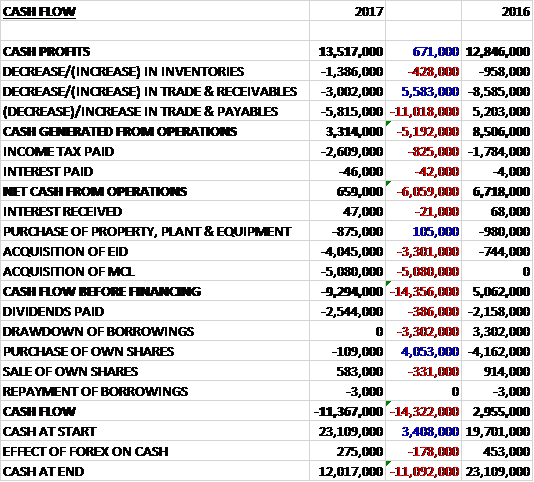
Before movements in working capital, cash profits increased by £671K to £13.5M. There was a big cash outflow from working capital, however, and after tax payments increased by £825K the net cash from operations was £659K, a decline of £6.1M year on year. The group spent £875K on capex, £4.1M on the EID acquisition and £5.1M on the acquisition of MCL shares so before financing there was a cash outflow of £9.3M. The group spent £2.5M on dividends and after some movements in shares the cash outflow for the year was £11.4M and the cash level at the year-end declined to £12M.

EID contributed a maiden £4.2M operating profit to the group, although the group is only entitled to 57% (£2.4M) of this. This represented a contribution for the ten months since acquisition which exceeded expectations in Euro terms and was further enhanced by the weak sterling. The business saw a significant level of higher margin naval support activity, for both domestic and export customers. The tactical division, where it delivers mostly off the shelf products, delivered on a significant contract for the Egyptian Army.

The combination of this support activity and higher volumes of export product deliveries drove an unusually high net martin of over 26%. The business has secured nearly £19M of orders since joining the group which included over £8M from the Portuguese MoD and follow on orders from Egypt of nearly £1.5M. The closing order book of £27.6M gives a good underpinning for the coming year and some very good prospects, especially in naval systems, are expected to add to this so the board expect revenue to grow in the coming year. The mix of work is expected to change, however, with lower levels of support activity which means the net margin is expected to return to historic levels.

The operating profit at MASS was £5.9M, broadly flat year on year with a decline of just £48K despite this year including £500K of profits from SCS’s former training support division which transferred to MASS in November. Like for like revenues declined as a low margin, non-core service they had provided for many years was halted. This was combined with an increase in overheads, partly as a result of one-off costs and partly due to business development and project support in the Cyber division.

During the year the business secured a number of significant contracts in the growth areas of secure information systems and cyber. This included the Metropolitan Police Services Digital Forensic managed service for nine years (£8.6M) and a ten year secure information management service for the RAF’s Sentry Platform (£12.5M), the latter being an extension of existing work. The order intake included over £8M of other renewals and extensions of existing work and more is expected in the coming year.

The MPS win opens up a significant new market for both similar and new offerings to other UK police forces as well as overseas customers. The operating cash flow this year was slightly weaker than last with a build-up of working capital at the end of the year linked to higher activity. The business is currently investing in facility upgrades to enable it to offer a more comprehensive cyber service which completed towards the end of the year. The division enters the current year with a strong order book and pipeline of opportunities, including exports, though the latter are always unpredictable in terms of timing.

The operating profit at MCL was £2.1M, a growth of £649K when compared to last year with revenues up 8% mostly due to increased support services for the UK MOD, primarily in the land environment. The business secured a number of orders in the year including a further £15M of hearing protection systems and other equipment development, production and support for specialist military users.

The closing order book of £15.M, up from £7M last time, along with further recent wins of around £6M shows improved visibility and gives the board confidence that the division will continue to grow in the coming year, although they expect margin percentages to be lower due to the level of bought-in content. The small operating cash flow was expected, reflecting their peak of activity at the end of the year.

The operating loss at SCS was £455K, a detrimental movement of £1.7M year on year. There was a steep decline in demand from the UK MOD for the business’ services so it was restructured with the profitable parts being moved to MASS and SEA with the rest being closed.

The operating profit at SEA was £5.3M, a decline of £148K when compared to 2016 reflecting a growth in the transport business offset by a significant contraction in their research activities. The year has seen a reduced predictability of the revenue stream, especially in the software solutions and product division where the timeframe from order win to delivery is usually a few weeks to months. They expect to see this continue in the medium term whilst they await the new major stages of the UK submarine fleet’s external communications system, the Vanguard Class upgrade and the new Dreadnought class. In the meantime the business is seeking to expand their export business, especially in maritime markets.

The maritime business remained steady with the expected decline in the UK submarine communications activity offset by increased delivery of torpedo launcher systems for export customers. The sub communications work has moved from design and testing to delivery. They continue to have good levels of redesign and upgrade work whilst the engineering team await the next major activity on the Vanguard class in the near future.

The level of torpedo launcher activity, as expected, increased as they completed design and moved to the first production systems for two export customers. The level of this activity will be sustained for the coming year and the business is tracking opportunities to win further export orders with the potential to provide growth in 2019 and beyond. In the maritime division, the business suffered project losses on a one-off development project for a specialist sonar array, a contract inherited with the J&S business acquired in 2014. This programme is expected to conclude in 2018 and no further losses are expected.

The Software, Simulation and Product division, increased revenue by around £2M in the year. This growth was mostly from increased orders for enforcement systems in the UK and overseas, as well as an important follow on order for Digital Traffic Enforcement Systems at TFL.

For some years the business has been a provider of research to the UK MOD in the areas of sonar, maritime and land. The former to areas continue to provide revenue streams as well as providing expertise for their development of low profile sonar array systems, now being sold as the Krait array, to a number of customers around the world.
In the land domain, they have led a team of suppliers over a period of eight years on two major research programmes into Dismounted Soldier Systems. The last of those research programmes completed last year. A follow on programme was expected but various internal and budget issues on the side of the customer have delayed it. The timing of the programme remains uncertain and initial work is now likely to be delayed into 2019. The impact of this delay resulted in most of the revenue fall seen in the business.

The subsea division also had a tough year with revenue dropping by a third to £2M as the low oil price continued to hold back spending from oil producers in the North Sea. Despite this, the vision largely maintained its profitability by a combination of some cost reduction, including redeploying staff to support the maritime division and improved gross margin. The latter arose from an increase in the proportion of refurbishment and repair activity.

The business absorbed the former SCS divisions of Capability Development and Air Systems which added £300K of profit to the result of SEA. The closing order book of £44M (£55.6M) includes nearly £24M of revenue to be delivered in the coming year and along with good order prospects, gives the board reasonable confidence that it will return to growth in the coming year.

In January 2017 the group acquired the 50% of MCL it did not already own for £5.1M as per the original sale and purchase agreement in 2014. They are also expected pay £465K earn out in respect of the closing order book at the end of April. In addition, the non-controlling interest is entitled to the cash in MCL which is estimated at just under £2M, which will be paid before the end of July. As of the year-end, the group held 57% of EID and has agreement with the government to acquire a further 23% to take their holding to 80% at a cost of €4.4M. Despite these commitments, the group still expects to grow their net funds in the coming year.

Going forward, recent contract wins have given a positive start to the year and the board considers that the order book (£136.5M compared to £116M, with the increase entirely attributable to EID) and near term prospects provide a good base for future progress.

At the current share price the shares trade on a PE ratio of 45.5, including restructuring but this falls to 14.4 on next year’s consensus forecast. After an 18% increase in the total dividend, the shares are yielding 1.7% which increases to 2% on next year’s forecast. The dividend has been growing faster than earnings in recent years so going forward the board expects the rate of growth to reduce over the coming years to align more closely with earnings growth – I hope they stick to this! At the year-end the group had a net cash position of £8.5M compared to £19.8M at the end of last year.

On the 1st August the group announced that EID had been awarded a contract by the Portuguese Navy for the supply of integrated communication systems to the Tejo Class Coastal Patrol Vessels, worth a total of €4.6M. The contract encompasses the supply of radio equipment, ICCS, integration engineering and logistic services. It also includes additional supplies for the second batch of the Viana do Castelo Oceanic Patrol Vessels currently being built in Portugal.

Further to this, SEA has been awarded a contract by Hyundai Heavy Industries, which around £5M, for the supply of torpedo launcher systems for the SE Asian market. These will be fitted to new ships that HHI are currently building. The system is based on the product in service with the UK Royal Navy and is currently being supplied to the navies of Malaysia and Thailand. The system is unique in that it can be configures to fire any NATO standard light weight torpedo, enabling customers to choose the best weapon independently and to potentially switch during the life of the ship.

Overall then this has been a bit of a mixed year for the group. Profits were down but this was due the increased amortisation following the EID acquisition, along with the recognition of the onerous lease at SCS. Net assets increased and although the operating cash flow declined, this was due to working capital movements and cash profits grew, although no free cash was generated.

The EID acquisition seems to have got off to a flying start, and indeed without it these results would have looked a lot worse. The margins are not going to be as high going forward, but there will be the recognition of more earnings if the further share acquisition goes through. MCL was the other good performer, as they provided more support services to the MOD but again margins are expected to be lower, but all of the earnings will be recorded by the group.

The MASS division was flat, but without the contribution from the old SCS business there would have been a decline in profits as they invest for future growth. The SEA business saw a bit of a disappointing year as research activities declined considerably and the low oil price continued to take its toll. The SCS business performed disastrously and was closed, with the profitable bits moving to SEA and MASS. The shares are not glaringly cheap with a forward PE of 14.4 and yield of 2% but I do feel the company is moving forward, slowly. A tricky one but on balance I remain a holder.

On the 7th September the group released a Q1 update. Import contract awards announced since the final results include EID to supply integrated communications systems to the Portuguese Navy, SEA to provide torpedo launcher systems for the SE Asian market and MCL to supply further hearing protection and communication ancillaries to the UK MOD. Including these wards, the order book stood at £149M at the end of July, underpinning a slightly higher proportion of revenue compared to this time last year. The pipeline of orders and expected renewals give them confidence that the overall performance will be in line with the board’s expectations.

On the 27th November the group announced that it had acquired a further 23% of EID for a cash consideration of €4M which brings the total holding up to 80% with the Portuguese government holding the rest. The group remains on course to meet the board’s expectations for the year.
Games Workshop Share Blog – Final Results Year Ended 2017

Games Workshop has now released their final results for the year ended 2017.

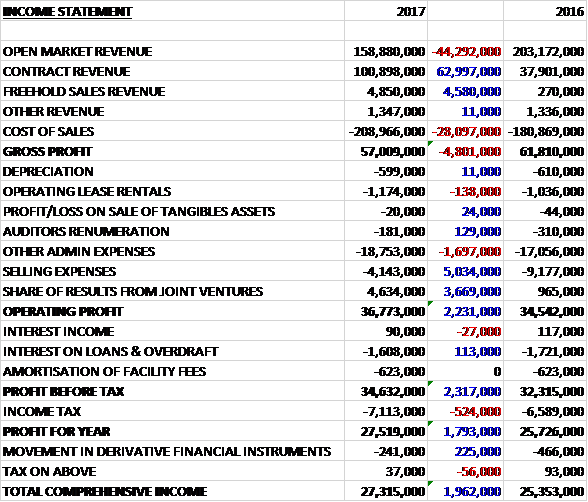
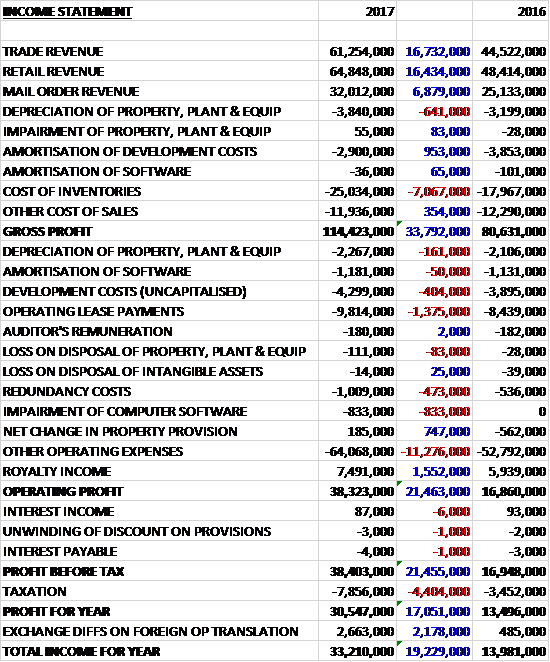
Revenues increased when compared to last year due to a £16.7M growth in trade revenue, a £16.4M increase in retail revenue and a £6.9M growth in mail order revenue. Depreciation was up £641K and cost of inventories increased by £7.1M but amortisation declined by £953K and other cost of sales fell by £354K to give a gross profit £33.8M higher. Operating lease payments grew by £1.4M and there was an £833K impairment of computer software, relating to the replacement of the ERP system, along with an £11.3M increase in other operating expenses but there was a £747K positive shift in property provision changes and royalty income was up £1.6M which meant that the operating profit grew by £21.5M with £7M of that due to favourable forex movements. Finance costs were broadly flat but tax charges grew by £4.4M to give a profit for the year of £30.5M, a growth of £17.1M year on year.

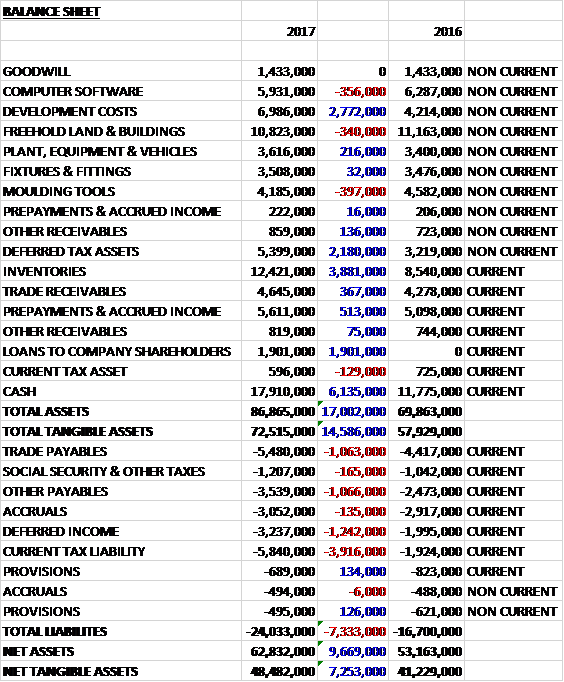
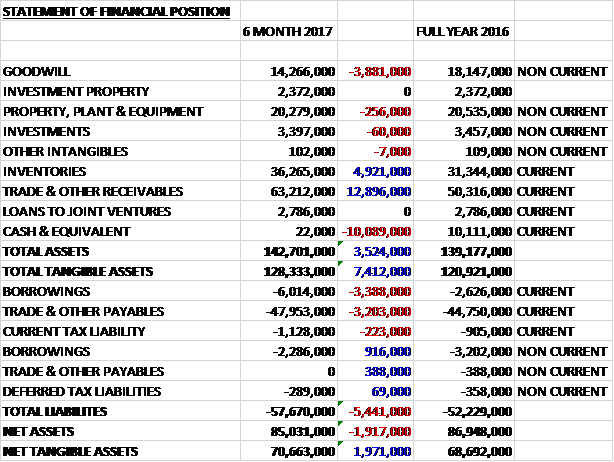
When compared to the end point of last year, total assets increased by £17M driven by a £9.1M growth in cash, a £3.9M increase in inventories, a £2.8M growth in development costs, a £2.2M increase in deferred tax assets and a £1.9M loan to company shareholders. Total liabilities also increased during the period due to a £3.9M growth in current tax liabilities, a £1.2M increase in deferred income a £1.1M growth in trade payables and a £1.1M increase in other payables. The end result was a net tangible asset level of £48.5M, a growth of £7.3M year on year.

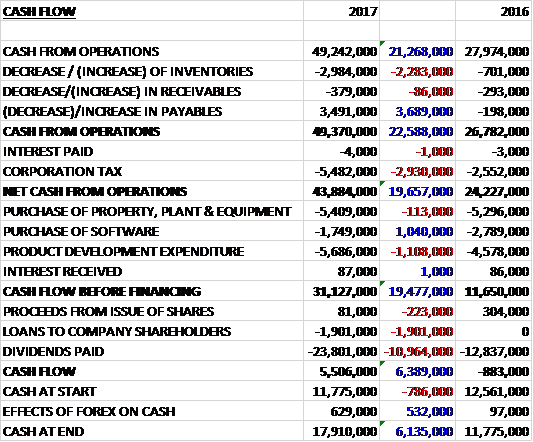
Before movements in working capital, cash profits increased by £21.3M to £49.2M. There was a broadly neutral working capital position compared to an outflow last year buy tax payments increased by £2.9M to give a net cash from operations of £43.9M, a growth of £20M year on year. The group spent £5.4M on tangible assets, £5.7M on development costs and £1.7M on software which meant that the free cash flow was £31.1M. Of this, £25.7M was spent on dividends to leave a cash flow of £5.5M and a cash level of £17.9M at the year-end.

As a business with 75% of sales made overseas, the results have benefited from favourable forex movements. Overall, sales growth in each division at constant currency was around 20%. The step increase in volume across all channels was a significant challenge for the factory and warehousing but have managed with only the necessary increases in resources. They have a flexible structured resource plan to meet any future volu8me changes.
During the year they released over 400 new models across their core systems and added 17 new paint colours to their range. They also launched new editions of their White Dwarf magazine and Blood Bowl game which have both sold well. In March they refocused the Black Library team to ensure they continue to produce bestselling novels and their design to manufacture teams have been working collaboratively on the new edition of Warhammer 40,000: Dark Imperium, released in June.

The operating profit in the Trade division was £18M, a growth of £7.3M year on year. Revenue from the UK and Central Europe increased by £6.5M and revenue from North America grew by £7.7M. All other territories were relatively minor but all saw growth. In addition, the new country managers in China, Singapore, Hong Kong, Japan and Malaysia have all reported double digit growth. The group will continue to invest in Asia with more localised content in the coming year.

The operating profit in the Retail division was £461K, a positive movement of £4.4M when compared to last year. Overall retail sales grew by 21% at constant currency with like for like sales up 16%. Revenues from the UK increased by £3.1M, revenues from the rest of Europe grew by £3.9M, revenues from North America were up £6.2M and revenues from Australia and New Zealand increased by £2.3M. Theo opened a net 11 new stores during the year and the main focus for store openings in the year ahead will be North America and Germany.
The operating profit in the Mail Order division was£18.8M, a growth of £5M when compared to 2016. Sales grew by 27% with sales of Forge World up 23% and the Citadel range up 31%. In the second half of the year they refreshed their home page.

The operating profit in the product and supply division was £16.3M, an increase of £8.3M year on year. They launched a dispenser of eight products called Battle for Vedros in toy shops in North America in June 2016 and a small range called Build and Paint globally in September. Although not delivering huge value to the group, they have proven that they should continue to support a range of products aimed at new customers.
The group received royalty income of £6.9M, an increase of £1.6M when compared to last year. They have had a solid year thanks to the ongoing success of Total War: Warhammer: End Times and Warhammer 40,000: Fireblade. The income is split 80% PC and console, 13% mobile and 7% other.

The replacement of the European ERP system is ongoing. From April 2017, the moved to a more agile methodology for implementing it. The revised plan will ensure they introduce business benefits as they go along rather than just at the end of the project. The estimated cost is now £9M as opposed to £6M. There is also a mail order warehouse system replacement ongoing with an estimated cost of £1.2M that is scheduled to go live in Autumn 2017.
As a result of a procedural oversight, 6p per share of the dividend paid in June is being treated as an unlawful dividend and is shown as a loan to company shareholders on the balance sheet. Although they always had sufficient reserves to pay it, at the time it was made this needed to be demonstrated by reference to interim accounts prior to payments. Those accounts were not filed with Companies House until after the dividend was paid. No fines or other penalties have been incurred but this seems a bit sloppy.

The group announced that Chairman Tom Kirby was retiring after the AGM and will not seek re-election as a non-exec but will become a consultant to the company for a year. Nick Donaldson will become Chairman having been a non-executive director since April 2002. I do hope his pre-able will be as entertaining as Tom’s.
Going forward, following the group’s good performance this year trading has continued strongly into 2018 such that sales and profits to date are well above the same period of the prior year and are likely to be above market expectations. There continues to be some uncertainty for the rest of the year, however.

At the current share price the shares are trading on a PE ratio of 17 which falls to 16.2 on next year’s consensus forecast. After an increase in the total dividend the shares are yielding 4.6%, increasing to 5.6% on next year’s forecast. At the year-end the group had net cash of £17.9M compared to £17.8M at the end of last year.

Overall then this has been a very strong year for the group. Profits are up, net assets increased and the operating cash flow grew with a decent amount of free cash being generated. All divisions saw growth and even the retail business is making a modest profit. It is quite hard to pin down exactly why the company has outperformed.
There is now doubt that forex movements have helped but the underlying performance is still very strong. There have been some refreshes in ranges but it’s hard to see how that has had such in effect. In any case, the shares are no longer the bargain they once were but are not excessively expensive either, with a forward PE of 16.2 and dividend yield of 5.6%. I continue to hold.

On the 5th September the group announced that trading in Q1 has continued strongly. Sales and profits for the year to date are therefore well above the same period last year. Great stuff.

On the 19th October the group released an update where they stated that sales have continued strongly and given the high operational gearing of the business, profits to date continue to be well above the same period last year.

Telford Homes Share Blog – Final Results Year Ended 2017

Telford Homes have now released their final results for the year ended 2017.

Revenues increased when compared to last year as a £44.3M decline in open market revenue was more than offset by a £63M growth in contract revenue and a £4.6M increase in freehold sales revenue. Cost of sales also increased, however, and gross profit declined by £4.8M. Admin expenses increased by £1.7M, mainly due to higher employee costs, but selling expenses fell by £5M due to the move towards build to rent contracts and less open market sales, and the share of profits from joint ventures increased by £3.7M to give an operating profit £2.2M higher. Loan interest declined by £113K but tax charges grew by £524K to give a profit for the year of £27.5M, a growth of £1.8M year on year.

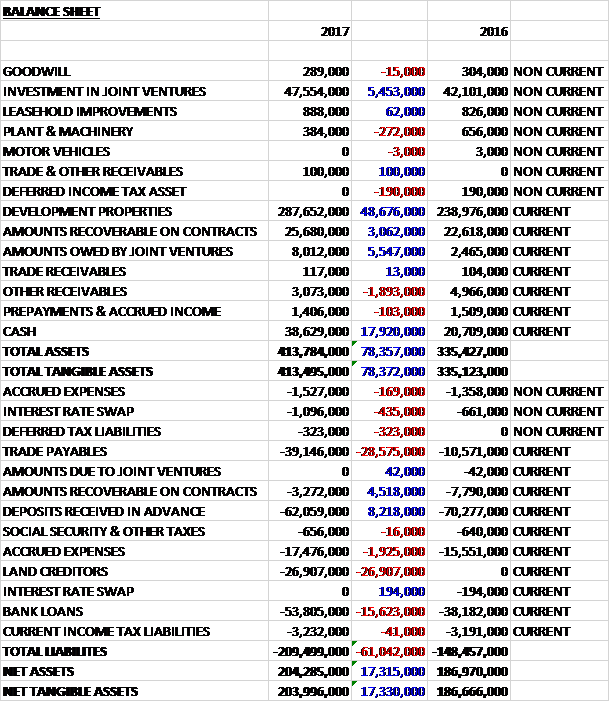
When compared to the end point of last year, total assets increased by £78.4M driven by a £48.7M growth in development properties, a £17.9M increase in cash, a £5.4M growth in investments in joint ventures, a £5.5M increase in amounts owed by joint ventures and a £3.1M growth in amounts recoverable on contracts, partially offset by a £1.9M decline in other payables. Total liabilities also increased during the year as a £28.6M increase in trade payables, a £26.9M growth in land creditors relating to a development site where the group has exchange contracts with completion due on vacant possession of the site expected in the next few months, and a £15.6M increase in bank loans was partially offset by an £8.2M decline in deposits received in advance and a £4.5M fall in amounts recoverable on contracts. The end result was a net tangible asset level of £204M, a growth of £17.3M year on year.

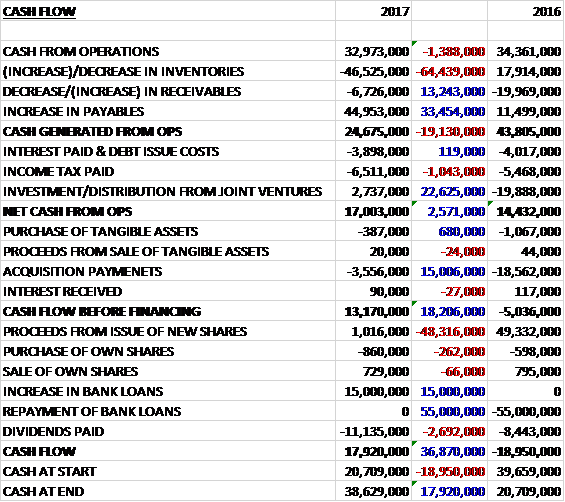
Before movements in working capital, cash profits declined by £1.4M to £33M. There was a cash outflow from working capital, mainly due to a big increase in inventories and after tax payments increased by £1M and there was a £22.6M positive swing to a cash distribution from joint ventures, the net cash from operations came in at £17M, a growth of £2.6M year on year. The group spent £387K on tangible assets and £3.6M on acquisition payments to give a free cash flow of £13.2M. There was a £15M increase in bank loans which helped pay for the £11.1M of dividends which meant that there was a cash flow of £17.9M and a cash level at the year-end of £38.6M.

Despite uncertainty in relation to the outcome of the EU referendum and tax changes impacting primarily UK based individual investors, the underlying market has remained resilient. Any potential dampening effect of these factors has been outweighed by the structural imbalance between supply and the need for new homes in London. Although the Brexit result created a degree of uncertainty, this has not to date been a significant cause for concern for the group. They chose to defer launches for a short period but demand remained buoyant and neither have they seen significant pressure on labour availability or materials due to the result. They will continue to monitor the negotiations with the EU, looking for assurances as soon as possible on the rights of EU workers to remain in the UK.

Sales to overseas investors remained robust. They have seen particular success over the last three years in selling to investors based in China. This is despite any tempering of demand in relation to leaving the EU or the additional 3% stamp duty, both of which have been offset by favourable movements in exchange rates. They have, however, seen a reduction in the number of UK based investors, who have been deterred by the increase in stamp duty and the reducing ability to benefit from tax relief on mortgage interest. The board believe that the attractive yields brining institutional investors into the market should also encourage individuals to invest again once their confidence returns.

The group’s customer mix has moved significantly towards institutional build to rent investors, with this sector representing 77% off sales generated compared to 24% last year. Individual investors accounted for 20% with owner-occupiers at just 3%. In total the group exchanged contracts for the sale of 501 open market properties. Unless they are cash buyers, owner-occupiers are typically unable to purchase more than six months ahead of completion but over the last few weeks the group have launched the residual availability at Bermondsey Works, leading to 22 owner-occupier reservations, most of which were purchased under the government’s help to buy scheme.

The group have seen robust demand from individual investors underpinned by a thriving rental market, including a number of repeat purchases. The last significant launch to individual investors was the second phase of City North in Finsbury Park in November 2016 which secured 73 new sales for a combined value of over £43M. Subsequent to this, developments that could have been more widely launched for sale have instead been sold to build to rent investors as part of the new strategic focus.

The number of open market residential completions was lower than the prior year at 289 (482) but the average selling price was higher at £531K (£417K). The reduction in completions is down to availability of finished stock with fewer units available. The increase in average price is a function of the mix of developments completing in each year in terms of product and their location with relatively modest price inflation.

The reduction in open market completions was more than offset by an increase in both subsidised affordable housing revenue and build to rent revenue recognised in the year. They exchanged contracts to deliver 400 affordable homes (87) and entered into three new build to rent contracts to deliver 387 build to rent homes (156) over the next few years.
During the year the group sold one small undeveloped site for £5M as a result of a change in strategic direction where smaller sites have become less attractive to build out and the group is able to leverage its greater size to focus on larger scale developments. The group has also continued its programme of disposing of older freehold assets generating revenue of £4.9M.

The decrease in gross profit margin was as expected. The margin achieved on open market completions fell from 27.3% to 25.4% but remained above the target of 24% when appraising new sites. The margin is expected to trend down towards the target margin over time as older developments which benefitted from more significant sales price inflation and minimal build cost inflation are replaced with sites appraised more recently.

Also, a greater proportion of the revenue this year is generated from build to rent contracts which attract a lower gross margin to compensate for the advantages of being forward funded. The group expects build to rent transactions to achieve a gross margin of around 12.5% which represents the 24% target margin less savings in selling expenses and interest costs of around 8% for a net difference of 4% offset by an improved return on capital. The margin achieved on the build to rent revenue this year was well ahead of the target at 16% due to some land being purchased at more advantageous rates prior to becoming part of the build to rent portfolio. Future margins are expected to be closer to the target.

The group increased their presence in the London build to rent sector over the last year. Since February 2016 they have entered into four build to rent transactions comprising nearly 500 homes, together worth over £230M. In December they exchanged contracts for the sale of the Forge to M&G Real Estate. The sale consisted of the freehold interest in the land and construction of 125 homes for £48.6M. This was the third build to rent transaction, and the second with M&G. At the end of March, their joint venture, Chobham Farm North, exchange contracts on their fourth significant build to rent transaction. Contracts were exchanged for the sale of 112 of the 297 open market homes at New Garden Quarter for a consideration of £53.7M. The sale to Notting Hill Housing, was for the first phase of open market homes at this development and removed the need for debt finance.

As well as the focus on increasing their presence in build to rent, the group are expanding their geographical reach beyond their historical heartland of boroughs in the East of London. An example of this is the South Kilburn site in partnership with Brent, a borough in which they have not previously developed.

In 2015 the group acquired the regeneration business of United House Developments. Completion of one of the developments, Gallions Quarter, was conditional on the business securing a legal interest in the site. In July 2016 those conditions were met and the group completed the acquisition of Gallions Quarter for a consideration at that time of £3.6M. Revenue and profit recognised since the acquisition are minimal and not significant to the group.

In February 2017 the group added to the pipeline with the acquisition of a sizeable development site, the former London Electricity Board building, for £30.2M. The anticipated gross development value of the site is about £95M. Subject to planning permission, the group expect to start work on site in 2018 to finish in 2021. After the year-end they have exchanged contracts to acquire Stone Studios in Hackney Wick for 120 homes plus commercial space, and been selected as the preferred partner of Brent to develop 236 homes in South Kilburn. Both sites have full planning consent and they expect to start on the site later this year.

Going forward, the board expect that over the next few years build to rent could represent as much as half of their total revenue pipeline. They are comfortable with the development pipeline and have avoided acquiring land at inflated prices. Prospects spanning a variety of locations are being evaluated on an ongoing basis and in greater numbers than last year. Over 80% of the expected gross profit for 2018 has been secured and they are on track to deliver over £40M of pre-tax profit.

The group start the new financial year with an order book of future sales £33M lower than last year at £546M. Following some recent land acquisitions, the development pipeline stands at £1.5BN of future revenue and the average anticipated price of the open market homes in the pipeline is £527K, up from £513K. The board expects 2018 to show significant growth in pre-tax profits with more growth the following year.

At the current share price the shares are trading on a PE ratio of 10.8 which falls to 8.4 on next year’s consensus forecast. After a 10% increase in the total dividend the shares are yielding 4% which increases to 4.3% on next year’s forecast. At the year-end, net debt stood at £14.3M compared to £17.3M at the end of last year. Gearing is expected to increase to enable the growth expected over the next few years.

On the 5th June the group announced that it has signed a pre-construction development agreement with Greystar, a global real estate company, to deliver 894 build to rent homes, together with extensive facilities at Nine Elms in Battersea. The pre-construction development agreement means that the group will assist Greystar in pursuing a detailed planning consent for the site. Once consent has been secured, the pre-construction development agreement will lead to Telford Homes entering a full design and build contract with Greystar to deliver the development for a fixed price.

On the 8th June the group announced that Planning and Design Director David Durant sold 375,000 shares at a value of £1.5M. This is quite a hefty sale!

On the 13th July the group released an AGM trading statement. Since they reported their final results, they have achieved further momentum in the build to rent sector and they are assessing a number of new development opportunities to add to the pipeline. They are still on track to achieve £40M of pre-tax profit in 2018 and £50M in 2019. They expect less than a quarter of the forecast open market handovers for the year to occur in the first half, however, and as a result full year profits will be significantly weighted to the second half. Whilst there is some political and economic uncertainty, the group is hopeful of greater stability in the months ahead.

Overall then this has been a decent year despite the turmoil surrounding the Brexit vote. Profits were up, net assets increased and the operating cash flow grew with dividends being covered by free cash flow. Investor demand remains robust from overseas despite the headwinds from stamp duty increases etc and the decline in open market completions was offset by increases in affordable homes and build to rent.

Margins are declining but the group is on track to increase profits this year and next. I am a bit concerned about the AGM comment surrounding the current uncertainty, and indeed there is uncertainty in the market but a forward PE of 8.4 and yield of 4.3% seems to compensate for this. I remain a holder.

On the 11th October the group released a trading update covering the first half of the year. Despite the underlying need the homes for sale market in London has been somewhat subdued by economic and political uncertainty around Brexit negotiations and the election outcome. This has mainly affected demand at higher price points and tax changes affecting buy to let investment have also reduced the number of UK based investors that are active in the market.
The group has experienced limited impact from the market uncertainty to date due to the lower average price point and sales to build to rent investors. They have a development pipeline of over 4,000 homes to be delivered across London and the average expected price of the open market homes in that pipeline is £530K.

As expected, there have been no significant sales launches in the last nine months due to developments that would have launched being sold to institutional build to rent investors. They have residual availability at a number of forward sold schemes, however, and have recently opened furnished show homes at both Bermondsey Works and Manhattan Plaza. This has generated increased interest in both developments and the group continues to make regular sales across a limited unsold portfolio. Despite the subdued market at higher prices, the group has achieved success with its limited number of penthouse apartments, securing the sales off-plan at Stratford Central.

Whilst the build to rent sector is a strategic focus for the group, they will still be developing homes for open market sale and there are two development launches planned for Q1 2018. The second phase of New Garden Quarter in Stratford is expected to be marketed to investors starting in the UK and then internationally where demand remains high. In addition, Bow Garden Square will be marketed from an on-site sales centre predominantly to owner-occupiers. The expected average price at New Garden Quarter is £550K and at Bow Garden Square it is less than £500K.

The group is considering numerous opportunities to add to its development pipeline both for build to rent and open market sales. Since April they have acquired Stone studios in E9 which will deliver 120 new homes and over 50,000 square feet of commercial space, and has been selected as the preferred partner at South Kilburn, a redevelopment in partnership with Brent which will deliver 236 new homes. At South Kilburn they expect to take a full legal interest very soon and work is already underway on the site.

The group’s reported profits in any given period are driven by the number of open market completions and there were far fewer of these in the first half of the year than expected in the second half. This is due to development timings which are all on track and in accordance with the original programmes but do not fall equally across the year.
As a result of the imbalance of completions across the year, pre-tax profits for H1 2018 will be significantly lower than in the second half and also lower than in H1 last year, but entirely in line with expectations. The group is on track to deliver full year pre-tax profit of £40M in accordance with market expectations and the board’s longer term outlook is unchanged.

Arbuthnot Share Blog – Interim Results Year Ending 2017

Arbuthnot has now released their interim results for the year ending 2017.

Interest income increased by £6.1M when compared to the first half of last year and with interest expense falling by £1.3M the net interest income grew by £7.4M. Conversely, fee and commission income declined by £1.5M with the expense broadly flat the net fee and commission income declined by £1.5M to give an operating income £5.9M higher overall. There was no income from the VISA Europe sale which brought in £1.7M last time but rental income from the new investment property brought in £1.1< and there was a £1.9M increase from the profit from the associate. It should be noted, however, that the increase is due the change in ownership of Secure Trust and last year’s income from the bank comes under discontinued operations, which fell by £11.2M. Last time there were a few one-off investments and group bonuses relating to the EL sale, which accounted for £2.3M last time that was not repeated. Other Operating expenses grew by £6M, however, to give a pre-tax profit£4.9M higher. Tax charges fell by £449K but when we add on the profit from Secure Trust last year, the profit for the period came in at £2.4M, a decline of £8.3M year on year.

When compared to the same period of last year, total assets increased by £253.3M, driven by a £222.2M growth in loans to customers, a £55.4M increase in debt securities held to maturity and a £10M growth in intangible assets, partially offset by a £10M decline in cash and a £5M decrease in investments in associates. Total liabilities also increased during the period due to a £294.9M growth in deposits from customers and a £4.6M increase in deposits from banks. The end result was a net tangible asset level of £217.3M, a decline of £57.6M year on year.

The interest received declined by £67M with the interest paid down £13.1M. Fees and commissions received fell by £8M but rental income was up £1.1M, cash payments to employees and suppliers declined by £47.1M and tax payments decreased by £6.1M to give a cash flow before asset changes of £6.3M, a decrease of £7.6M year on year. Due mainly to a large increase in amounts due to customers, the net cash from operations came in at £120.9M, a positive movement of £192.2M year on year. The group spent £8.8M on computer software and £361K on property, plant and equipment. They also purchased a net £52.6M worth of debt securities and paid out £2.7M in dividends to give a cash flow for the half year of £56.5M and a cash level of £289.2M at the period-end.

The profit from Secure Trust, which is now accounted for as an associate, was £2.1M, a decline of £7.3M due to the sale of the shares in the business. There is a major uncertainty surrounding the associate income, however. At this stage it is estimated using the full year market consensus of the equity research performed on the business with an assumed straight line growth in profits over the first half of the year as Secure Trust is not scheduled to release its results until 22nd August. Given the majority of profits come from Secure Trust still, this is a major problem with the results in my view.

The profit from the Private bank was £4.8M, a growth of £327K year on year with the prior year figures including a gain of £1.7M relating to the sale of VISA shares. The forward looking indicators of the bank suggest that it is continuing to grow at a solid rate. Customer deposits, assets under management and loans have all increased by over 25% to £1.2BN, £1BN and £880M respectively. The private bank grew the number of new customers and wrote record volumes of new loans, with new originations reaching £76M in the period, an increase of 27%. The bank has experienced a significant level of loan repayments, however, which meant the loan book remained at a similar level to last year.

The commercial bank broke even during the period. Its customer balances have continued to grow at healthy rates and at the end of June its loan book had increased by £131M to £147M, and its deposit book by £137M to £160M. The business is now showing good signs of momentum and has a strong pipeline of business for the remaining months of the year.
In April the group completed the acquisition of Renaissance Asset Finance, a lender of specialist assets including vintage and high value cars and business assets. The business has shown that its distribution networks remain strong but prior to its acquisition, its certainty of funding was not clear and as a consequence, its balance sheet reduced in size as it was not able to meet all broker enquiries. At the time of the completion of the acquisition, the loan book had fallen to £57M. During its first two months as part of the group it has rebounded well and returned to growth and closed the period at £60M, an increase of 5% in its first two months.

Going forward, the short term geopolitical and macroeconomic environment seems more uncertain than it has for a number of years. The group remains focused on developing new areas of growth to diversify its income streams, however, and as a result of this, they remain confident that it is well place to take advantage of any opportunities that may arise.

At the current share price the shares are trading on a forward PE ratio of 31. After an increase in the interim dividend, the shares are yielding 2.3% which remains the same for the full year consensus forecast.

Overall then, this was a period defined by the fact that Secure Trust Bank is no longer a subsidiary. Like for like profits did increase but this was only due to income received for the investment property, otherwise they would have declined. Net assets fell and although the operating cash flow improved, cash profits were down. Albeit a decent amount of free cash was generated. The private bank seems to be growing nicely with the commercial bank gaining traction but the forward PE of 31 and yield of 2.3% seems a bit expensive to me but I must admit I find this hard to value.

On the 11th October the group announced a trading update covering Q3. Overall the lending pipeline remains strong, with aggregate volumes of written loans 75% higher than at the same time in the prior year. As the commercial bank is a new business, its repayment cycle is not yet at maturity so its loan book continues to grow in line with new business volumes. The private bank has experienced a steady flow of loan repayments, a trend which has continued into Q3 as older loans have been repaid, leading to a lower level of loan book growth. Overall the loan portfolio is 33% higher.
The Term Funding Scheme remains open for banks to access cheaper liquidity. This has manifested itself in the deposit markets where customer rates continue to fall. The overall cost of funds for the group has fallen by 30% from the prior year to a rate of 0.49%.

Following positive feedback from potential customers, the commercial bank is investing in infrastructure to launch a commercial property fund. They are also in dialogue with management teams which should further assist the business to diversify its asset base and earnings.

On the 22nd February the group released a trading update covering the year. They continued to trade well in Q4 and a result full year profits are in line with expectations. As previously announced they continue to explore opportunities to develop new businesses organically with the launch of these new businesses in 2018 being supported by certain upfront investment.
Solid State Share Blog – Final Results Year Ended 2017

Solid State has now released their final results for the year ended 2017.

Revenues increased when compared to last year as a £149K decline in distribution revenue was more than offset by a £3.4M growth in manufacturing revenue. Cost of sales also increased, to give a gross profit £568K higher. There was a £162K growth in the amortisation charge but a £174K reduction in share based payments. Other admin expenses were up £500k, however, so the operating profit was broadly flat, increasing by just £35K. Finance costs fell by £70K but tax charges increased by £119K, due to deferred tax credits last year, which meant that the profit from continuing operations was £2.2M, a decline of £224K year on year.

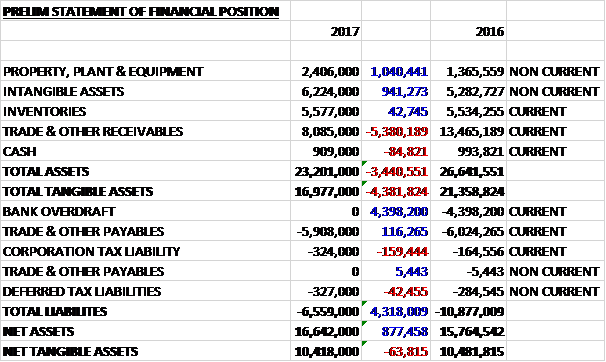
When compared to the end point of last year, total assets declined by £3.4M driven by a £5.4M decrease in receivables, partially offset by a £1M growth in property, plant and equipment, along with a £941K increase in intangible assets. Total liabilities also declined, mainly due to a £4.4M reduction in the bank overdraft. The end result was a net tangible asset level of £10.4M, broadly flat year on year with a fall of just £64K.

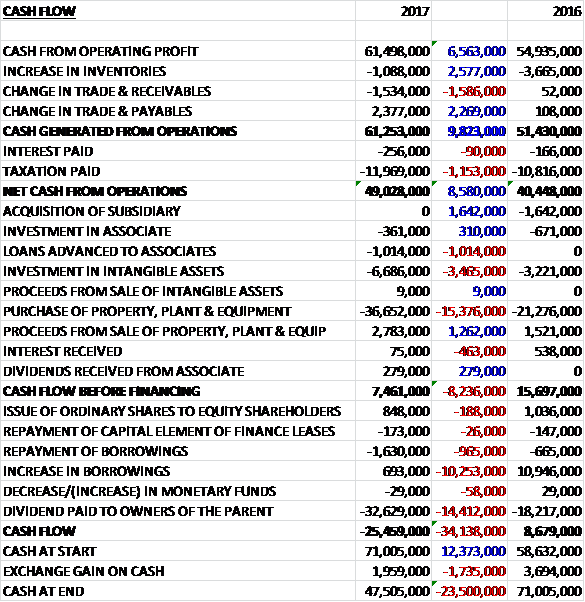
Before movements in working capital, cash profits declined by £2.7M to £3.1M. There was a cash inflow from working capital due to a large decline in receivables and after tax payments increased by £211K, the net cash from operations was £9.1M, a growth of £7.4M year in year. The group spent £1.5M on property, plant and equipment, £426K on intangible assets and £2.1M on acquisitions to give a free cash flow of £5.3M. Of this, £1M was spent on dividends so the cash flow for the year was £4.3M and the cash level at the year-end was £909K.

The revenue delays on a number of the antenna projects have been more than offset by the additional batteries revenue from the Creasefiled acquisition. The gross margin did falls somewhat, however, reflecting the changing mix of sales combined with the additional Creasefield sales which are typically lower than the average margins for the manufacturing division.

The profit in the distribution division was £896K, a decline of £70K year on year with billings flat as the business investing in staff to accelerate growth next year. During the year the group recruited experts in the area of sourcing and obsolescence to form the sourcing and obsolescence team which provides a new revenue stream for the division.

The division also invested heavily in its technical field sales team increasing the resource by about 25% to give greater account coverage, improved service and to take advantage of the cross-selling opportunities within the group which adds about £250K per annum in costs. The outlook for next year is strong with the Electronic Component Supply Network reporting that early indications suggest the upper limit of the industry wide growth forecast of 4.3% may be understated. The division is now well positioned to exceed this industry wide forecast and has seen a strong start to Q1 with record order intake in the first two months of the year.

The profit in the manufacturing division was £2.2M, an increase of £27K when compared to last year. The division saw billings increase by £3.3M but the Creasefield acquisition added £4.2M of revenue which mitigated for delays in a number of antenna contracts seen in the communications business. The discontinued SEMS business unit contributed £7.3M of revenue in the prior year which has not recurred as a result of the termination of the business unit, although this is not included in the above figure and like for like revenues declined due to the antenna contract delays.

The computer business unit has geared up with additional sales resource in the second half of the year, responding to increased demand as a result of directed marketing efforts including advanced use of SEO and Google Adwords.
The Creasefield battery business was acquired in May, complementing the existing battery business unit. This has resulted in an extension of market reach, with a customer base extending beyond the oil and gas sector to include Medical, Aerospace, Utilities and Defence sectors. The facility has brought increased capacity, technical resources and long standing supplier relationships. In addition it has brought exposure to new battery chemistries and charging technologies, significantly adding to the capacity and capability of their batteries business unit.

As part of the acquisition integration plan they transferred their battery business unit in Reddich into the Creasefield Crewkerne facility, incurring £200K of one off costs (their strategy involves an acquisition a year so these costs are not one-off!). The acquisition added £200K to profits this year. Margins at Creasefield are typically lower than the other business units of the manufacturing division albeit this is an area of focus for improvement. The year saw a demonstrable recovery of the oil and gas sector, where the group produces power solutions for pipeline inspection gauges, with strong battery bookings from customers in this sector in Q4. Strong orders were received in the latter part of the year as prime contractors rebuilt stock levels.

In the communications business, the antenna manufacturing was relocated to a purpose built facility in Hertfordshire in January 2017, after a capital investment of around £1M. The new facility is able to design, manufacture and test complex systems and is large enough to accommodate antennas with a dish diameter of up to three metres. In addition, environmental testing facilities have been relocated to the site and will be commissioned later this year alongside vibration testing facilities for use across the group. Investment has continued with the addition of technical and commercial staff and the business unit is resourced for growth.

Steatite has won the persistent systems franchise for distribution of the secure wave relay mesh network mobile, providing HD video and voice in the most severe environments. They have also secured contracts to supply radio systems to the MOD both directly and through contractors. An important export order for the mesh radio solution was secured in the Asia Pacific region with strong potential for additional systems. A long standing relationship with the provider of an advanced satellite communications system has secured ongoing business with the MOD for maritime applications both surface and underwater.

On commercial grounds the group made the decision to close the self-funded Steatite Electronic Monitoring Systems business unit in the latter part of the year, allowing the manufacturing division to concentrate on its core activities. Following the termination of the MOJ contract, the board had decided it was appropriate to explore if the group could commercialise the IP they developed as part of the contract. At the end of the year, however, the board took the decision that returns would not be sufficient to warrant continued investment and development in the SEMS market.

Going forward, the group finished the year in a stronger position, having focused investment on the areas that will deliver the future strategic goals of profitable organic and acquisitive growth. Additionally the group has made significant investment in the management, sales and operational teams to position it to deliver the future growth in 2018 in line with expectations. The board believe that the group, with its diversified structure, increasing export sales, new opportunities with battery chemistries, additional antenna capability and higher margin products, is now well placed to deliver organic growth.

Activity levels are encouraging across both divisions. Leading edge indicators which include the open order book (up 16%) give the board confidence in the prospects for the group next year and trading in line with market expectations.

At the current share price the shares are trading on a PE ratio of 17.5 which falls to 14.4 on next year’s consensus forecast. After the final dividend was kept the same, the shares are yielding 2.5% which increases to 2.6% on next year’s forecast. The board has now agreed a new dividend policy whereby they will target a dividend cover between 2.5 and 2.75 adjusted earnings in future periods. At the year-end the group had a net cash position of £900K compared to £3.8M at the end of last year.

Overall then, results have been a bit flat this year. Profits were flat, net tangible assets were stable and although the operating cash flow improved due to a big decline in receivables, cash profits fell. There was a decent amount of free cash generated, but again this was due to the collection of receivables, without which there would not have been any.

The distribution division saw a small decline in profits due to investments targeting future growth with the board expecting growth next year. The manufacturing division saw a modest increase in profits due to the Creasefield acquisition, without which there would have been a like for like decline due to delays in antenna orders. Going forward, the group does seem well placed to grow in the coming year, assuming their markets remain decent. With a forward PE of 14.4 and dividend yield of 2.6% this looks OK value. I’m in two minds over this one!

On the 23rd October the group released a trading update covering the first half of the year. Group revenue increased by 12% to £22.5M reflecting strong organic growth in the distribution division of 20% and a 7% increase in the manufacturing division. Product line margins in both divisions have been maintained but changes in product mix affect overall group gross margin and in this period, the combination of the increased proportion of distribution sales and change in mix of sales in the manufacturing business has resulted in a group gross margin of 28%, down from 31%.

The investment in and restructuring of the communications business unit and Leominster operations is now complete and has positioned the group for future growth. Despite an improvement in revenues relative to last year, the lead time to win and deliver some of the complex antenna programmes is taking longer than expected, resulting in a performance below management expectations. The prospect pipeline remains strong, positioning the business unit for a stronger 2019.

Planned investment to drive long term organic growth and margin enhancement across the group increased overheads from the start of the year. The benefits of these initiatives are starting to be realised and good progress is being made in implementing the margin enhancement strategy through additional added value services and operational efficiencies, the benefits of which should be seen in the next financial year.

As a result of the product mix and increases to overheads through the investment in growth and margin initiatives, the board expects pre-tax profit to be slightly lower than current market expectations for the full year, although the open order book at £18M is higher than the £14.8M at this point of last year.

Amino Technologies Share Blog – Interim Results Year Ending 2017

Amino Technology has now released their interim results for the year ending 2017.

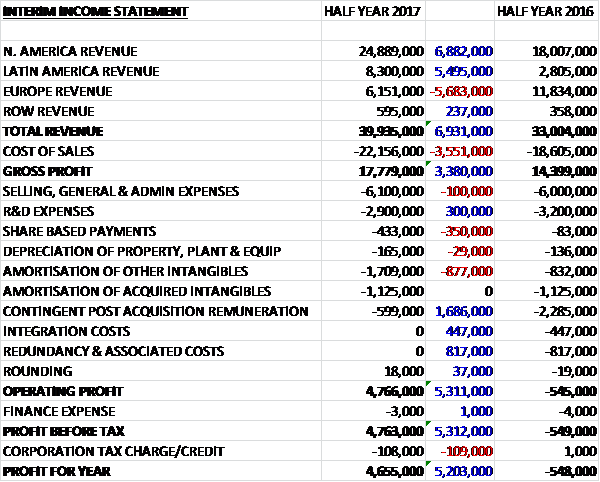
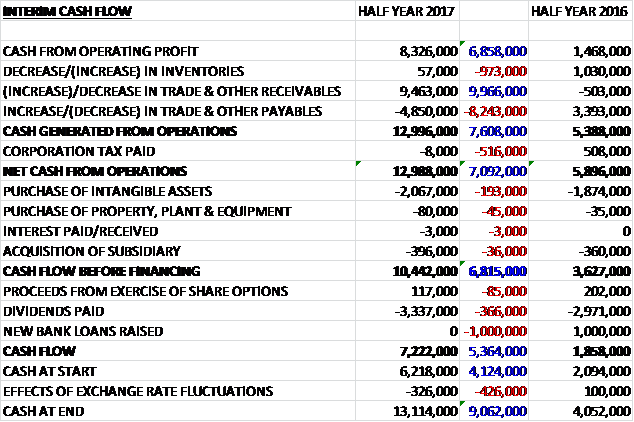
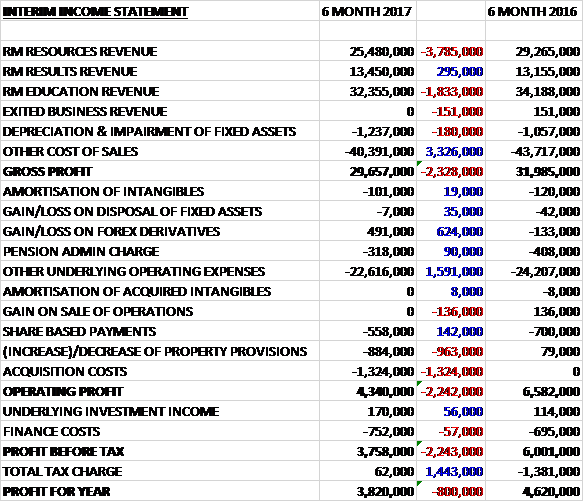
Revenues increased when compared to the first half of last year as a £5.7M decline in European revenue was more than offset by a £6.9M growth in North American revenue and a £5.5M increase in Latin American revenue. Cost of sales increased by £3.6M to give a gross profit £3.4M higher than last time. Admin costs were broadly flat, R&D expenses fell by £300K but share based payments increased by £350K and the amortisation of other intangibles grew by £877K. A few one-off costs declined, however, with contingent post acquisition remuneration down £1.7M, integration costs falling by £447K and redundancy costs decreasing by £817K to give an operating profit £5.3M higher. Tax charges were up £109K and the profit for the half year came in at £4.7M, a positive movement of £5.2M year on year.

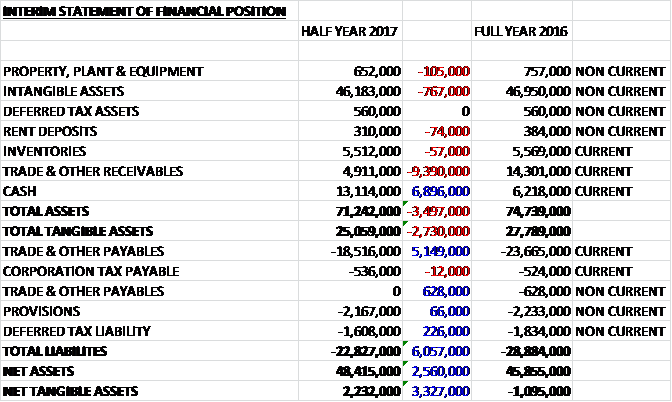
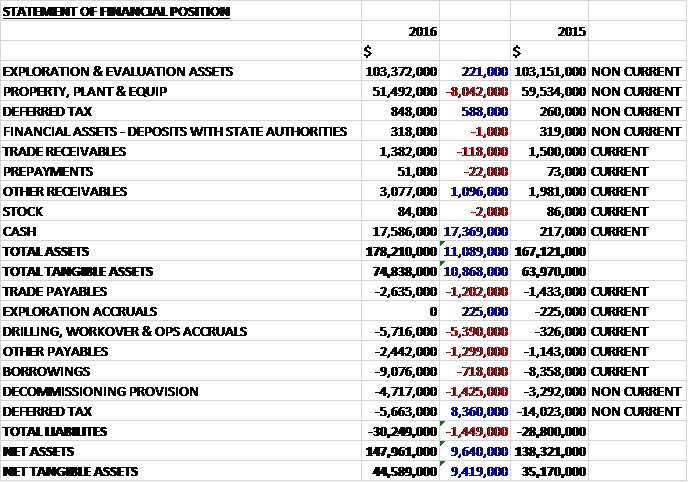
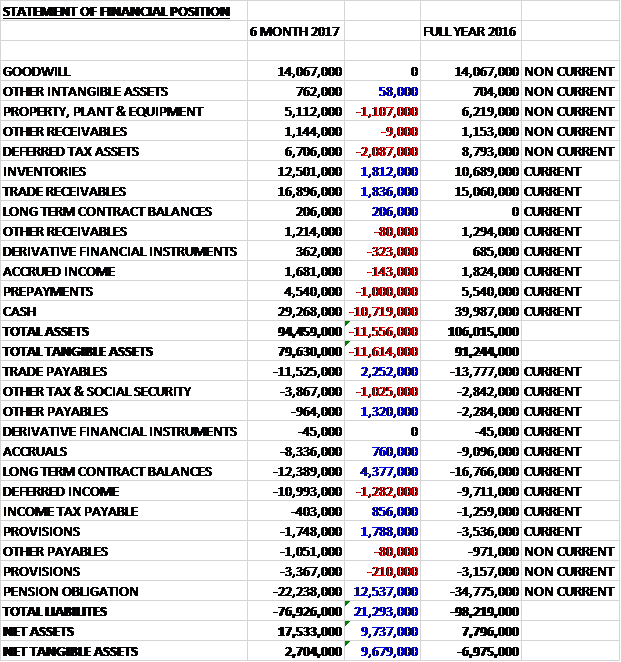
When compared to the end point of last year, total assets declined by £3.5M driven by a £9.4M decrease in receivables and a £767K decline in intangible assets, partially offset by a £6.9M increase in cash. Total liabilities also declined during the year due to a £5.7M fall in payables. The end result was a net tangible asset level of £2.2M, a positive movement of £3.3M over the past six months.

Before movements in working capital, cash profits increased by £6.9M to £8.3M. There was a cash inflow from working capital but tax payments increased by £516K to give a net cash from operations of £13M, a growth of £7.1M year on year. The group spent £2.1Mon intangible assets and £396K on acquisitions which meant that the free cash was £10.4M. Of this, £3.3M was spent on dividends to give a cash flow of £7.2M for the half year and a cash level of £13.1M at the period-end.

At constant currency there was underlying revenue growth of 4%. Sales of IP devices were strong, particularly in North and Latin America, which reported overall revenue growth of 38% and 196% respectively. In North America, sales through distribution partners showed good momentum and a major customer also placed follow-on orders for devices after the deployment of their Enable virtual set top box software platform. In addition there are an increasing number of opportunities arising from the migration of old style cable TV networks to IP-based service delivery, often over new fibre infrastructure. After the period-end they secured orders from a new customer, US regional operator Muscatine Power and Water, as a direct result of this migration.

The Latin American market saw regulatory change which is presenting new opportunities for the group to build on its existing foothold. Revenue growth for the period was driven by a mix of new customer wins and continued demand from established operators for IP devices and the Enable software platform.

European sales were 48% lower, principally due to the change of ownership of a key customer impacting the timing of orders which the board now expect to recover over the medium term. During the period they progressed well with the implementation of their first full end to end multiscreen entertainment service to Delta, however. This comprises both the Move cloud TV platform delivering TV to mobile devices, as well as TV services delivered to the home via a 4K UHD compatible Amino IPTV device. Beyond this, they see new opportunities in an increasingly disrupted global market where traditional operator business models face continued pressure from OTT subscription video on demand providers such as Amazon and Netflix.

The group’s customer offering has broadened in line with the industry-wide shift to IP and cloud based TV service delivery. Their portfolio has been enhanced during the period by the addition of a new compact 4K UHD Android TV device to meet the needs of the growing number of operators who are planning to deploy Android to support their TV offering.

They have also positioned their Enable software platform as a virtual set top box to provide operators with a cost effective means of delivering new and unified TV experiences across legacy devices already installed in customer homes. During the period the Chilean operator GTD deployed this solution across its customer base. The pipeline of qualified software opportunities arising from planned upgrades to legacy devices in 2018 is significant.

Software and Services revenues declined by 41% to £3M. Last time they included £2M of one-off revenue from Enable software contracts that did not repeat. Excluding these, recurring software and service revenues grew by 30%. Devices revenue increased by 11% to £36.9M. Gross margins are expected to be lower in the second half as a result of the shift in product mix towards newer product lines and industry wide pricing pressures for certain components.
Exceptional items this time included £600K contingent post-acquisition remuneration in respect of the Entone acquisition. The final retention plan payment is due in August and is expected to result in a maximum cash payment of £1.2M.

Going forward, the sales pipeline is robust and the board are confident that they will deliver gull year profits in line with market expectations.

At the current share price the shares are trading on a PE ratio of 14.1 which falls to 13.8 on the full year consensus forecast. At the period-end the group had a net cash position of £13.1M, aided by the timing of some large orders, compared to £3.1M at the same period of last year. After a 10% increase in the interim dividend the shares are yielding 3.3% which increases to 3.5% on the full year forecast.

On the 18th July the group announced that non-executive director Michael Bennett sold 1M shares at a value of £1.9M. This is quite a hefty sale.

Overall then this has been a pretty decent period for the group with profits up, net assets increasing and the operating cash flow growing with plenty of free cash being generated. The cash flow was aided by the timing of that large order and forex has also been a strong tailwind for the group but the underlying performance seems to have improved modestly. Things seem to be going very well in the Americas but the European division struggled due to a major customer being taken over. The board seem to think this will recover, however.

The forward PE of 13.8 and yield of 3.5% are probably about right. I am tempted to buy in here but am a little put off by the large director sale. It may be more prudent to wait and see, a tricky one!

On the 9th August the group announced that non-executive director Michael Bennett sold 1,000,000 shares at a value of £1.9M. This is another large sale.

On the 15th August the group announced that CEO Donald McGarva purchased 2,780 shares at a value of nearly £5K. This is a drop in the ocean as he holds 445,428 shares.

On the 30th August the group announced that Michael Bennett continued to sell off his holding with a disposal of 600,000 shares at a value of £1.1M.

On the 5th September the group announced that non-executive director Michael Bennett sold 50,000 shares at a value of £98K.

On the 5th December the group released a trading update covering the full year. They expect to report a full year performance that demonstrates customer traction for their IP/Cloud video software solutions despite industry-wide memory cost headwinds. Gross profit and pre-tax profit are expected to be in line with expectations whilst revenue is expected to be similar to the previous year. They enter 2018 with a solid backlog and excellent pipeline which provides the board with confidence for the year ahead.

On the 6th June the group released a trading update covering the first half of the year. During the period they booked over 40% more orders than in the first half of last year. This, along with good pipeline coverage, means that the board’s expectations remain unchanged.

They expect to have revenues weighted to the second half of the year and so, expect year on year revenues to be down £9.9M. Earlier this week they announced that Kabelnoord, the leading Dutch cable operator, is to deploy the group’s MOVE end to end multiscreen video platform in H2.

Revenues from software and services sold on a standalone basis continued to increase to around $5M. Net cash at the period-end was £11.3M, a decline of £1.8M.

Wynnstay Share Blog – Interim Results Year Ending 2017

Wynnstay has now released their interim results for the year ending 2017.

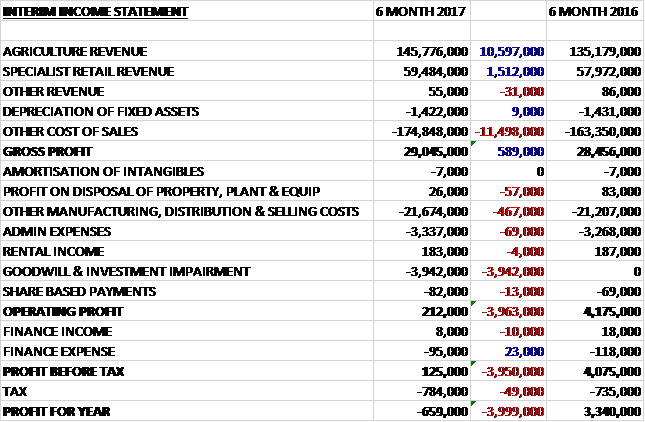
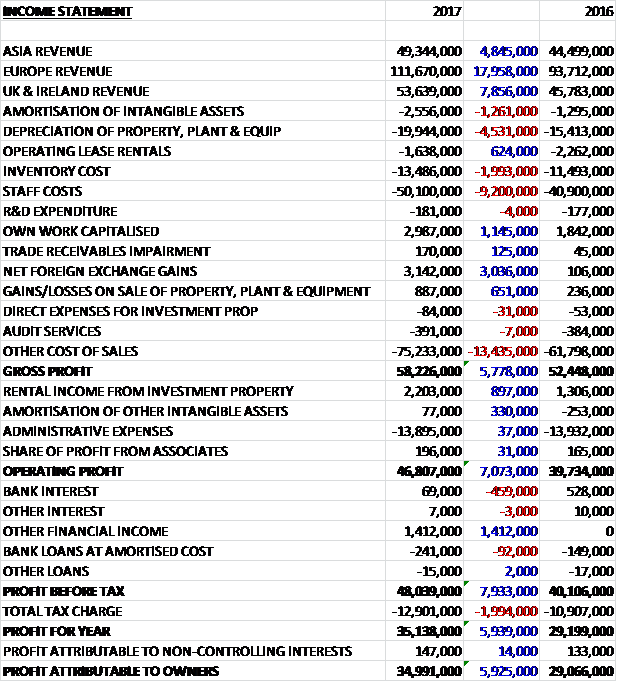
Revenues increased when compared to the first half of last year with a £10.6M growth in agriculture revenue and a £1.5M increase in specialist retail revenue. Cost of sales also increased, which meant that the gross profit grew by £589K. Manufacturing, distribution and selling costs grew by £524K and admin expenses were up £69K. During the period there was also a £3.9M goodwill impairment which meant that the operating profit was down £4M. Finance expenses saw a modest decline but this was more than offset by a £49K growth in tax charges to give a loss for the period of £659K, a detrimental movement of £4M year on year. Excluding the goodwill impairment, this would have been a profit of £3.3M, a decrease of just £57K year on year.

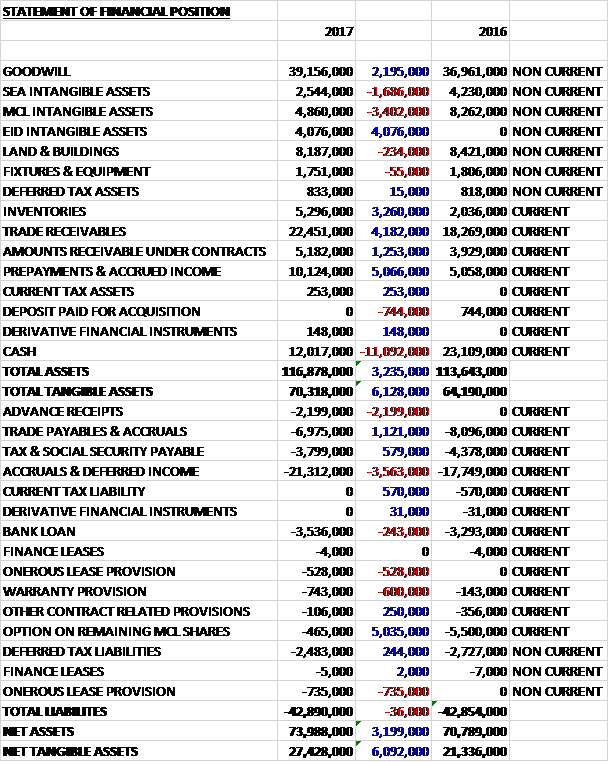
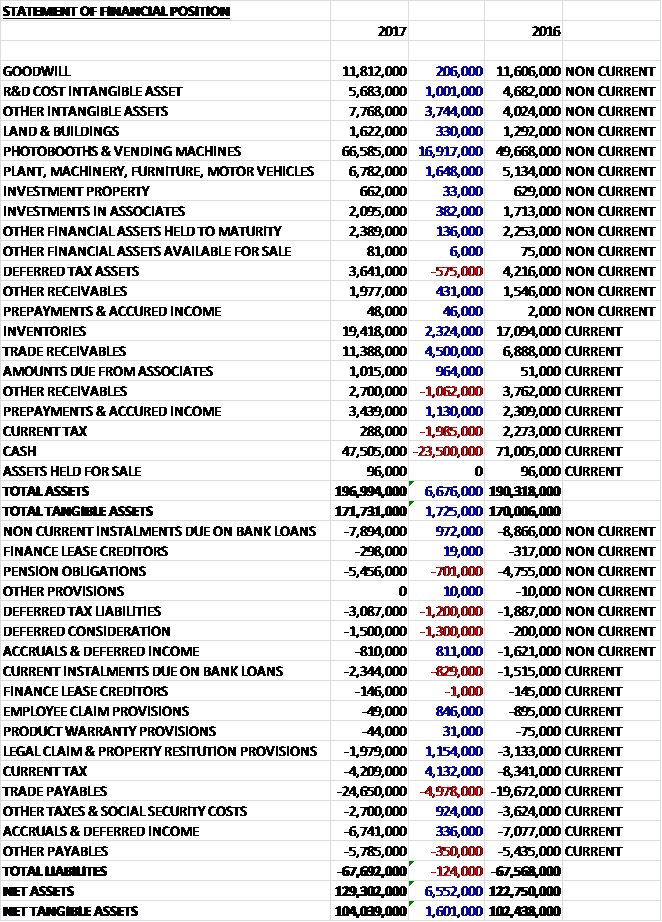
When compared to the end point of last year, total assets increased by £3.5M driven by a £12.9M growth in receivables and a £4.9M increase in inventories, partially offset by a £10.1M fall in cash and a £3.9M decrease in goodwill. Total liabilities also increased during the period due to a £2.5M growth in borrowings and a £2.8M increase in payables. The end result was a net tangible asset level of £70.7M, a growth of £2M over the past six months.

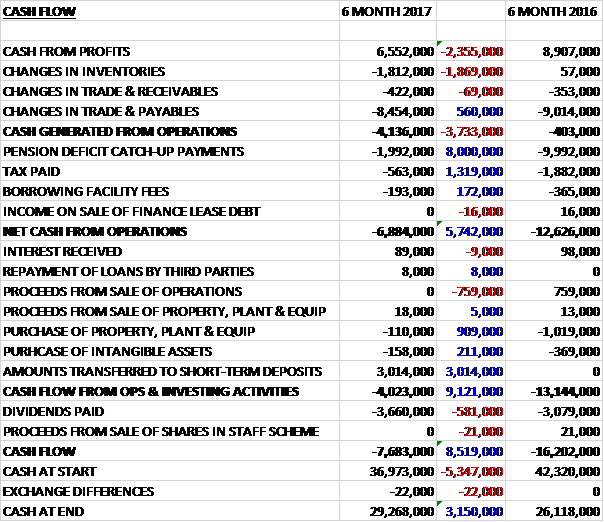
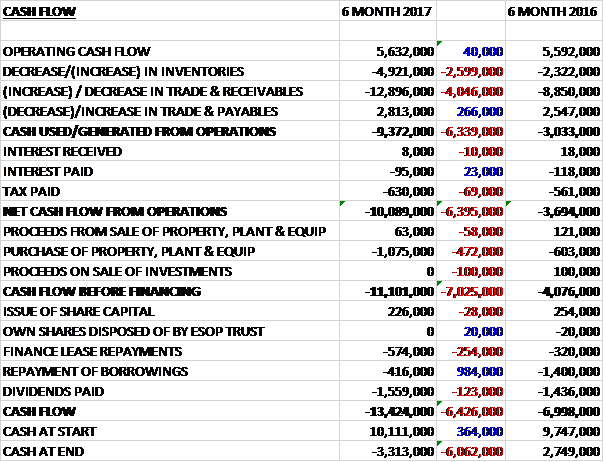
Before movements in working capital, cash profits were broadly flat, increasing by just £40K. There was a cash outflow from working capital which was greater than last time and after tax payments increased by £69K the next cash outflow from operations was £10.1M, an increase of £6.4M year on year. The group spent £1.1M on property, plant and equipment which meant that before financing there was an outflow of £11.1M. The group also spent £574K on finance lease payments, £416K on loan repayments and £1.6M on dividends which meant that there was a cash outflow of £13.4M during the half year and a cash level of -£3.3M at the period-end.

The profit in the Agriculture business was £1.5M, a decline of £280K year on year with low volumes of traded grain and margin pressures in other products affecting the result. The last two years have been particularly challenging for livestock and arable farmers. There has been some improvement in grain and milk prices since last autumn but they have not recovered to levels previously seen. The improvement in output prices has lifted farmer confidence, however, and helped to generate greater demand for most inputs with the group benefiting from the increased volume of feed and arable products but pressure on margins continued.

Strong demand for feed products over the winter months led to an overall increase in feed volume in the period, reflecting the national trend. The early 2017 spring tempered feed demand and in April, total volumes reduced reflecting the decrease in sheep feed. This contrasted with April volumes last year which benefited from inclement weather conditions. The improved milk price supports ongoing demand for dairy feed as producers return to more traditional feeding patterns. As expected the bagging facility commissioned ahead of the winter period helped to improve supply chain efficiencies of bagged product to farm and through the network of retail stores.

Glasson grain performed well in the period. Fertilizer volumes increased significantly but margins remained under pressure. Sales of traded materials and specialist products were slightly lower than the previous year but the business remains well placed in the market.

The smaller grain harvest from last year limited the volume of cereals marketed through the Grain Link and Woodheads businesses and, as a result, the contribution from these activities was below last year’s level. Arable crops have benefited from recent rainfalls which should support prospects for a good 2017 harvest but it is still too early to make firm predictions. Demand for fertilizer was strong over the winter period as farmers ordered ahead of anticipated price increases. Aided by an early spring, overall group volumes exceeded the previous year.
Sales of cereal seed were also buoyant although slightly lower in volume than the record performance last year. There is ongoing demand for herbage seed and agrochemicals as they enter the busy spring growing season.

The profit in the Specialist Retail business was £2.7M, a growth of £270K when compared to the first half of last year, reflecting improved results at Wynnstay Stores. At Wynnstay Stores, like for like sales improved by over 2%. There was a strong performance from key agricultural products, reflecting improved farmer sentiment. This was particularly evident in increased demand for milk powders, animal health and hardware products. They completed the refurbishment of their store at Craven Arms, Shropshire, in the period and will be relocating their store in Denbighshire during the summer.

As previously reported, certain stores at Just for Pets did not deliver the expected performance and, overall, trading remained subdued. This resulted in a loss from the chain during the first half. The board is reviewing the options for the business and it is implementing restructuring measured in the second half. During the year the group made a goodwill impairment of £3.9M relating to Just for Pets.

Going forward, it is encouraging to see an improvement in output prices for farmers but the current oversupply of many commodities in the global market and the negotiations for Brexit will being further challenges for many farmers. This provides for a challenging backdrop for the agricultural supply industry and will affect the rate of recovery of the sector.

At the current share price the shares are trading on a PE ratio of 17.8 which falls to 16.7 on the full year consensus forecast. After an increase in the interim dividend the shares are yielding 2.3% which increases to 2.4% on the full year forecast. Net debt at the period-end was £8.3M compared to £3.9M at this point of last year, reflecting higher levels of working capital utilisation, partly as a result of commodity price inflation.

Overall then this was a bit of a mixed period for the group. Excluding the goodwill impairment, profits declined modestly but net tangible assets improved. The operating cash outflow worsened due to working capital movements – the cash profit performance was broadly flat. The Agriculture business saw profits declined as a lower grain harvest affected traded grain volumes and margin pressures affected other products. An improved farmer sentiment saw Wynnstay stores have a good period but this masked problems at Just for Pets which recorded a loss in the period.

The forward PE of 16.7 and yield of 2.4% mean the shares are not exactly cheap and despite an improved farmer sentiment and better harvest this year, I am not sure this fully takes into account the issues at Just for Pets and other macroeconomic risks.

On the 14th September the group announced that they are appointing administrators to the Just for Pets business which generated an operating loss of £250K in the first half of the year. Management expects to recognise exceptional charges relating to the write-off of net assets of £2.2M and associated costs. This is a real shame that they could not make it work as the stores offered an interesting diversion from the core business.

On the 10th October the group announced that terms had been agreed by the administrators for the sale of 18 stores to PSR Trading. The remaining seven stores are expected to be closed.