Omega Diagnostics Share Blog – Final Results Year Ended 2017

Omega Diagnostics has now released their final results for the year ended 2017.
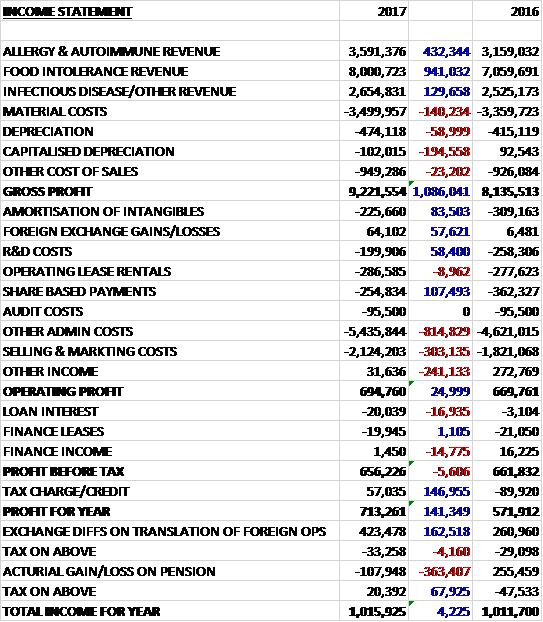
Revenues increased when compared to last year due to a £941K growth in food intolerance revenue, a £432K increase in allergy and autoimmune revenue and a £130K growth in infectious disease revenue. Material costs increased by £140K, depreciation was up £254K, partly as less was capitalised, and other cost of sales grew by £23K to give a gross profit £1.1M ahead of last year. Amortisation declined by £84K and share based payments were down £107K but other admin costs grew by £815K relating to a salary benchmarking exercise and management training programme, selling and marketing costs were up £303K due to a need to upskill the German sales management and other income fell by £241k as last year included the final amortisation of a grant received in 2014, which meant that operating profit increased by just £25K. Finance income fell by £15K and loan interest grew by £17K to give a pre-tax profit broadly flat but a £147K positive swing to a tax credit, mainly due changes in the over/under provision of tax, meant that the profit for the year was £713K, a growth of £141K year on year.

When compared to the end point of last year, total assets increased by £2M driven by a £2.2M growth in development costs, a £244K increase in prepayments and other receivables and a £366K growth in inventories, partially offset by a £622 decline in trade receivables and a £565K fall in cash. Total liabilities also increased during the year due to a £274K growth in deferred tax, a £238K increase in deferred income and a £228K growth in accruals and other payables. The end result was a net tangible asset level of £16.7M, a growth of £1.2M year on year.

Before movements in working capital, cash profits increased by £394K to £1.8M. There was a cash outflow from working capital but tax receipts reduced by £117K and there was a modest increase in finance costs to give a net cash from operations of £2M, a growth of £527K year on year. This didn’t quite cover the £2.1M of development costs and the £591K spent on property, plant and equipment so there was a cash outflow of £688K before financing. The group also paid out £142K in finance leases but received £163K from new finance leases which meant there was a cash outflow of £667K for the year and a cash level of £737K at the year-end.

The pre-tax loss in the Allergy and Autoimmune division was £455K, an increase of £77K year on year. Sales comprised of Allergy sales, up £460K to £3M, and autoimmune products, broadly flat at £560K. The allergy sales continue to be derived almost exclusively from the business in Germany where domestic sales increased by 3% in euro terms with the reported sterling increase being 15%.

Following the CE0-marking of 41 allergens the group have continued to develop further tests. A further 11 allergens have been optimised and they are on target to deliver another 20 this year. In addition to the Allersys programme, the Allergodip development pipeline has now been extended with the addition of four new panels. The introduction of a mobile phone app that allows quantification of the test result will assist in the marketing of the test to resource-poor countries with limited lab facilities.

The pre-tax profit in the Food Intolerance division was £3.1M, a growth of £565K when compared to last year. Sales of Food Detective reduced by 10% to £2.1M as the group took a conscious decision to reduce pipeline stocking in two of their key markets. Sales of Foodprint grew by 34% to £4.7M, however, with strong performances in Europe, North America and the Middle East. The group sold a further eight instruments in the year, taking the cumulative number of installations to 176 and revenue per instrument increased by 29% to £23K.

The CNS lab service showed an increase of 7% in sales to £620K, dominated by the markets in the UK and Ireland and they produced and sold 7,167 patient reports in the year, maintaining an average price of £86 per report.
Food Intolerance will continue to be a key growth driver and contributor to the bottom line. This has been reflected in the increase in operating and marketing resource to provide high level scientific support for the CNS product range. The growth trajectory is expected to continue with this core business supported by increasing the range of products and services in the health and wellbeing market, which now extends to 80 countries.

Management believe that there are further significant opportunities for growth in the business and have made progress in North America where customers are evaluating their products. In China they are in advanced discussions with a partner company which could provide access to a large market which is increasingly aware of food intolerance testing. In relation to the Food Detective product, the group has been in discussions with LRQA regarding use of the self-test version of the kit. They have agreed a timescale to complete some corrective actions to LRQA’s satisfaction but in the event that they are unable to achieve this, the CE-mark for the self-test kit will be suspended which will have a modest impact on profits – sounds ominous.

The pre-tax loss in the Infectious Disease business was £615K, an increase of £350K when compared to 2016. Sales were up 5% due to the weakening of sterling against the other currencies. In addition to the malaria rapid tests, they are also evaluating additional rapid tests for dengue fever, syphilis, leptospira, Brucella and S. Typhi.
The landscaper for CD4 testing has changed over the past six months. Amongst policy makers there has been a shift in strategy for utilising CD4 testing in the care of people living with HIV. This has resulted in a series of regional workshops being held across Africa that the group has been invited to participate in. The resulting output will see an increasing emphasis being placed on CD4 testing to help those people who present for care in the advanced stages of the disease with very low CD4 cell counts, representing about 30% of the overall HIV total. It is unclear to me exactly what this means for the group but it seems that it is a fast moving area and further delays would be very unhelpful.

The group achieved a significant milestone in attaining formal design freeze with their VISITECT CD4 test for monitoring the immune status of people living with HIV following the successful manufacture of three pilot batches. Devices from these batches were tested at three UK hospital sites on sufficient numbers of patients to demonstrate that they now have a method for manufacturing devices which consistently meet their design goal specs regarding sensitivity and specificity.

They have now moved into the validation and verification phase of the programme which can be summarised with the manufacturing of validation batches to confirm manufacturing robustness, utilising validation batches to verify performance; external performance evaluation trials and CE mark.

In India, in January the group received certificates of accreditation from BSI confirming their quality management system is compliant with various standards. In March they underwent an annual inspection from the Indian FDA confirming that the facility is compliant with GMO processes and they were issued with a manufacturing license which is valid until the start of 2021. They have launched three VISITECT malaria tests which are currently available for general sale through business to business channels in countries that do not require individual product registration and they are in the process of being evaluated to enable them to participate in higher volume tender business.

The group have explored a number of routes in the last year on how best to take their partnership with IDS forward. Whilst IDS previously expressed an interest in acquiring the allergy business, it was decided that the better course of action would be an enlarged distribution model. The board believed they have now agreed the main outline terms which should enable the formal contract negotiations to proceed so hopefully something will be decided soon.
At the current share price the shares are trading on a PE ratio of 35 but this falls to 16.9 on next year’s consensus forecast.

Today the group has announced the placing of up to 13,116,881 new shares at 18p per share and a subscription of up to 1,166,666 to raise up to £2.6M alongside an open offer to raise about £1M. The issue price represents a discount of about 6.5% to the previous share price.

In 2013 the group raised funds for the development and commercialisation of Visitect CD4. Since then, the development phase encountered some technical challenges which are now thought to be resolved. These issues extended the cost and timeframe of commercialisation which it is hoped will occur by late calendar year 2017.

This time, the placing will go towards increasing FoodPrint traction in the US, developing product enhancements that meet the US lab environment and investing into more automated manufacturing capacity; increasing the number of allergens in the Allersys range from 41 to 100; fund certain identified investment opportunities for Allergodip which involve adding new panels and developing a mobile app; and accelerate the pipeline for launching a range of rapid diagnostic tests to two or three per year to include Syphilis, Dengue, S.Typhi, Leptospirosis and Brucella.

Richard Sneller and Legal and General, two large shareholders, are both taking part as are most of the directors and it is nice to see an open offer being included so that us normals can take part too. Assuming full take up of the open offer, the enlarged share capital is expected to be 128,752,672 which will mean the new shares represent about 15.5% of the enlarged share capital.

Going forward, trading in Q1 of the current year is in line with management expectations. The Allersys reagents are now CE-market with the menu continuing to grow, VISITECT CD4 has achieved design freeze, the manufacturing facility in India is now fully validated, and VISITECT Malaria has been CE-marked.

Food intolerance continues to keep up its good performance and the board expect to see this continuing in the year ahead with the strategic marketing initiatives being planned as part of the accelerated growth strategy. With renewed effort regarding the ongoing relationship with IDS, they are looking forward to the eventual launch of the initial range of Allersys tests and hope to deliver VISITECT CD4 to the market by the end of the calendar year.
On the 6th July the group announced that it has concluded the sale and leaseback of a building in Germany. They will receive gross proceeds of €800K and have entered into a contract with the landlord to lease the facility back over 15 years. I am not really a big fan of these kinds of arrangements as it seems to prioritise short term gains over long-term stability in my view.

Overall then this has been another year of fairly slow, steady progress. Profits were up due to tax rebates, otherwise they were broadly flat. Net assets did improve, however, as did the operating cash flow but the group remains unable to generate any free cash. The Food intolerance division remains the only one that makes a profit and that business seems to be very strong but in order to make any progress it seems clear that the allergy business needs to thrash out a deal with IDS and the infectious disease business needs to get the VISITECT CD4 to market. The forward PE of 16.9 suggests some of this is going to happen and if so, the group does seem in a good position. It is a bit disappointing that they need to return to the market to raise more equity but I still have faith and remain a holder.

On the 23rd October the group released a trading update covering the first half of the year. Turnover is expected to be £7.1M, in line with last year in constant currency terms and 4% ahead on an actual basis. Pre-tax profit is in line with expectations.

Food Intolerance saw a 4% increase in revenues at £4.1M. They continue to see strong growth in North America with their microarray-based Food Print test. They are focusing resources more closely into this market. They were able to complete the actions required by LRQA on the self-test version of Food Detective within the agreed time scale and they are awaiting their final review outcome.

Allergy/Autoimmune saw an 11% reduction in revenues to £1.7M. Apparently a significant amount of above average rainfall in July was a contributing factor (there is no indication of why that should have had an effect) and they are expecting a better performance in the second half of the year. The reduction in euro-denominated revenue was mitigated by the weakening of Sterling, however.

In Infectious disease, revenues increased by 1% to £7.1M. The business has started to benefit from the initial sales of the VISITECT range of Malaria tests manufactured in India.

The group has raised £3.3M from a placing and €800K from the sale and leaseback of their German factory. These funds were raise to enable them to accelerate growth. They have signed a supply agreement with a new partner in the US for Food Print which brings the number of partners in the country up to three.

For Allersys, they remain on plan to increase the number of CE-marked allergens that have been developed for use on the instrument to 50-60 allergens by the end of the year. They have had two positive meetings recently with IDS and, subject to finalising a global distribution agreement, they are now confident that they can commercialise their range of products within the current year on terms which are beneficial to both parties.

They have manufactured bulk components for three validation batches of Visitect CD4 which have passed QC testing at external sites and have now been assembled into devices. The first two batches of assembled devices have passed final QC testing. A third batch will begin external testing soon. They have started using these validation batches to verify performance and this programme of testing is about 50% complete. External performance evaluations are underway at two UK hospitals which is expected to be completed within the next few weeks. The external performance evaluation in India is now complete and the data is being fully analysed with performance as expected on an initial review of the data. They therefore remain confident in their ability to CE-mark the test before the end of the year.

Trading in the first half of the year was in line with last year but the board expect a stronger second half. The outturn for the year, however, remains dependent on one of more of the above products delivering a material contribution to results, which sounds a bit shaky to me. Nevertheless the small investment here is remaining.

On the 29th November the group announced that it has CE-market its VISITECT Cd4 test for helping to manage people living with HIV, following successful performance evaluations in India and the UK. This means that the tests are available for general sale through business to business channels in countries not requiring individual product registration. The technical file forms the basis of the additional regulatory approval the company will seek through the WHO prequalification programme. A successful completion of this process will enable the group to become eligible for public sector procurement. The group expects this process will be completed during Q2 of next year.

In addition, they are looking to expand their VISITECT product portfolio and are working on an additional version of the test which utilises a 200 cells/mm3 cut-off. Recent global health guidelines confirm an opportunity also exists for a test that can indicate advanced HIV disease and the group is working to ensure it has a product portfolio encompassing both existing and new opportunities.

The early opportunities are likely to lead to modest sales during the next twelve months but the board anticipate generating significant demand once they have completed all the regulatory hurdles.

Telecom Plus Share Blog – Final Results Year Ended 2017

Telecom Plus has now released their final results for the year ended 2017.

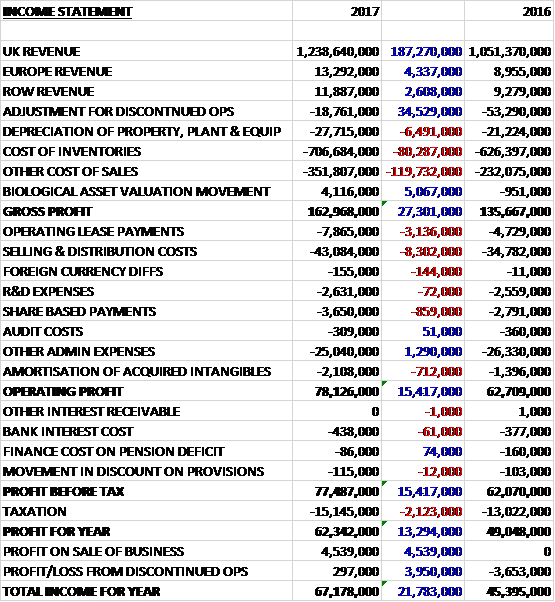
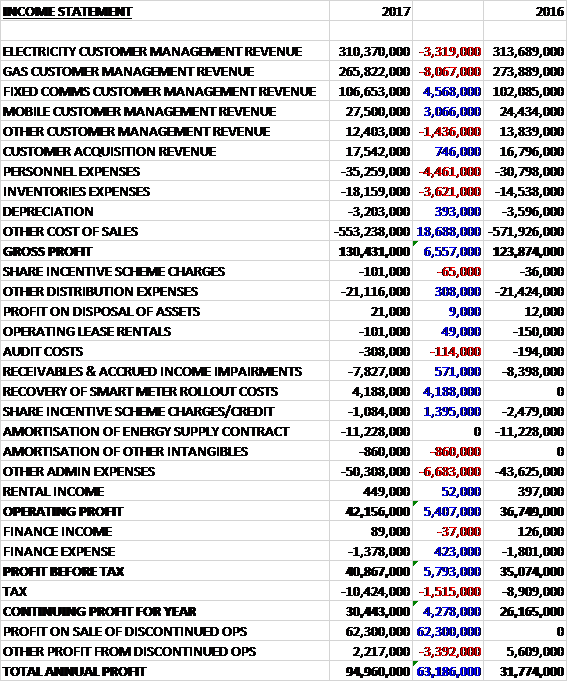
Revenues fell when compared to last year as a £4.6M growth in fixed communications and a £3.1M increase in mobile revenues were more than offset by an £8.1M decrease in gas revenues a £3.3M fall in electricity revenue due to lower energy prices and a reduction in average energy usage, and a £1.4M decline in other customer management revenue. Personnel expense were up £4.5M and inventory costs increased by £3.6M but other cost of sales declined by £18.7M to give a gross profit £6.6M above that of last year. Distribution expenses saw a modest decline but the group received £4.2M in smart meter rollout cost recoveries and the share incentive scheme cost declined by £1.4M, offset by a £6.7M growth in other admin expenses due to investment in staff and higher IT charges, to give an operating profit £5.4M higher. Finance costs decreased by £423K but tax charges grew by £1.5M which meant that the profit from continuing business for the year came in at £30.4M, a growth of £4.3M year on year.

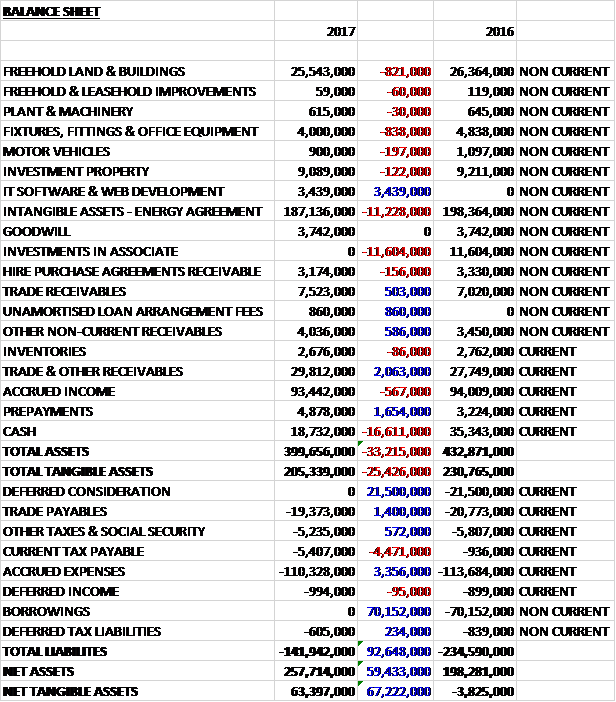
When compared to the end point of last year, total assets declined by £33.2M driven by a £16.6M fall in cash, an £11.6M reduction in the investment in the associate and an £11.2M decrease in the energy agreement intangible asset, partially offset by a £3.4M growth in IT software assets and a £2.1M increase in receivables. Total liabilities also declined during the year as a £4.5M growth in current tax payables was more than offset by a £70.2M reduction in borrowings, a £21.5M fall in deferred consideration and a £3.4M decline in accrued expenses. The end result was a net tangible asset level of £63.4M, a growth of £67.2M and much more healthy than last time.

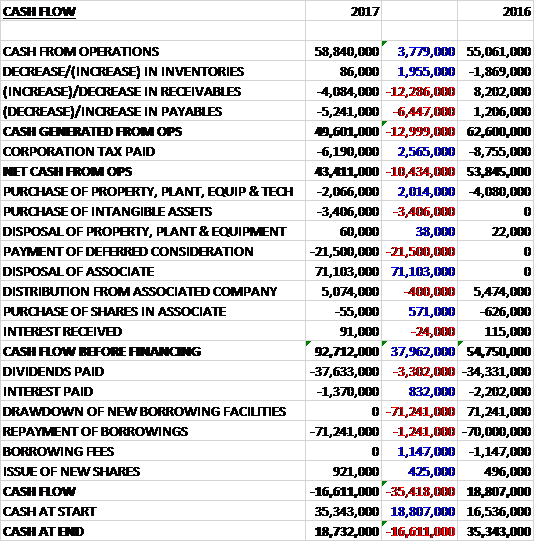
Before movements in working capital, cash profits increased by £3.8M to £58.8M. There was a cash outflow from working capital, however, and even after tax payments declined by £2.6M the net cash from operations came in at £43.4M, a decline of £10.4M year on year. The group spent £2.1M on property, plant and equipment; £3.4M on intangible assets and £21.5M on deferred consideration but received £71.1M from the sale of an associate and £5.1M in distributions from the associate to give a cash flow of £92.7M before financing. This allowed the group to spend £71.2M on loan repayments and £37.6M on dividends to five a cash outflow of £16.6M for the year and a cash level of £18.7M at the year-end.

The percentage of new members taking the double gold bundle is increasing. The Q4 figure of 55.1% is significantly higher than the 47.7% achieved in Q4 last year. The average revenue per member, however, has fallen from £1,226 last year to £1,191 in 2017. All the core services the group provides grew during the year with the highlight being a 19% rise in the number of mobile services, reaching a penetration in the residential club of 35% as the board made a strategic decision to place mobile at the heart of their retail position and to improve its competitive position.

The small decrease in revenue during the year has been driven mainly by lower average energy prices as a result of retail gas price reductions in 2016, and reduced average energy usage due to the continuing impact of energy efficiency measures across the industry combined with a steadily increasing number of LED light bulbs installed due to project daffodil. This was partly offset by an increase in telephony revenues resulting from an increasing penetration of fibre broadband and some higher fixed monthly charges, and the overall increase in the number of services provided to members.

The record gap between standard variable energy tariffs and aggressively prices introductory deals started to narrow during the autumn but this happened too late to provide any positive impact on Q3. At the beginning of Q4 the group responded to this by making a change to their partner compensation plan and this, combine with the more competitive market position, led to an increase in partner activity as the quarter progressed and services increased by more than 107,000 in the year as a whole.

The 20% stake in Opus Energy was sold in February, resulting in the receipt of £71.1M in cash and an exceptional profit from the sale of £62.3M. The business is a decent provider of profit to the group, however, so this revenue stream will be missed.

The group had previously announced their intention to carry out a tender offer under which they would return to shareholders the cash they received from sale of their stake in Opus. They have now decided to reduce the maximum size of this offer to £25M.

The board are encouraged by the results from the soft launch of their home insurance service. They expect volumes will start to improve from their current low levels as they start marketing the new service more proactively, and remain confident that insurance has the potential to make a material contribution to the financial performance in due course.

Project Daffodil, the free LED lightbulb service, has gathered momentum and have now been provided in over 40,000 households. This has been a major factor behind the improvement in the quality of new members joining the club as well as encouraging existing members to add additional services in order to take advantage of this benefit.
The mobile app that was launched a year ago has gained widespread acceptance, with around 65,000 members using it each month to submit meter readings, top up their mobile, track their mobile usage and find their nearest cashback retail outlets. More functionality will be added in due course, including being able to manage their insurance cover.

The smart meter rollout programme has been hampered by the persistent failure of one of the meter operators to meet the agreed service levels. In addition to slowing their rollout programme, this also affected their ability to install pre-payment meters in a significant part of the country during the second half of the year, leading to a small rise in delinquency levels. They have now appointed a new meter operator to take over this work and have now installed over 100,000 meters to about 10% of the current base.

The group experienced a reduction in the number of registered partners, largely due to their decision last autumn to provide automatic refunds to many of those who join the business but find themselves unable to build a secure part-time additional income. These early refunds, combined with the natural underlying level of cancellations led to a larger reduction in the total number of registered partners than would have otherwise been the case.

Based on recent levels of partner activity, the board expect the number of service they supply will increase by between 5% and 10% over the coming year. The modest growth in the number of services added over the past few years combined with higher customer acquisition costs and an increasing investment in IT meant that profits for the coming year are likely to be at a similar level to the year just ended. The benefit from faster organic growth will, if current trends continue, be reflected in the results for the following year.

After taking off the smart meter roll out cost recovery the shares are trading on a PE ratio of 33.8 which falls to 20.3 on next year’s consensus forecast. After a 4.3% increase in the total dividend the shares are yielding 4.4% which increases to 4.5% on next year’s forecast. At the year-end the group had a net cash position of £18.7M.

Overall then this has been a bit of a flat year for the group. Excluding the recovery of smart meter costs, profit was broadly flat, net assets improved considerably due to the Opus sale but operating cash flow declined due to working capital movements – cash profits grew and there was a decent amount of free cash generated. Operationally, there has been increased activity but there was a lower average revenue per customer due to reduced energy prices and usage. The home insurance initiative looks interesting but will not benefit the group in the coming year.

The Opus sale is a bit of a shame. It has really improved the balance sheet but Opus was a decent, profitable part of the business so the income from there will be lost. Next year is likely to be flat with regards profits and the forward PE of 20.3 does not look that cheap. The yield of 4.5% is better, and it does look just about sustainable so the shares might be an income play. Not too excited but might keep a watch for a lower entry price.

Trifast Share Blog – Final Results Year Ended 2017

Trifast has now released their final results for the year ended 2017.

Revenues increased when compared to last year with a £13.2M growth in European revenue, an £8M increase in Asian revenue, a £2.7M growth in UK revenue and a £1.3M increase in US revenue. Depreciation was up £493K and other cost of sales increased by £14.6M to give a gross profit £10m ahead of last year. Distribution expenses grew by £762K, there was a £615K reduction in net forex gains and other underling admin expenses were up £4.5M. There was a £567K share option exercise cost that did not occur last year but the operating profit grew by £4M. Interest payable declined by £270K but tax charges increased by £1.8M to give a profit for the year of £12.7M, a growth of £2.5M year on year.

When compared to the end point of last year, total assets increased by £19.2M driven by a £7M growth in cash, a £5.6M increase in trade receivables, a £2.5M growth in inventories, a £1.9M increase in goodwill and a £1.6M growth in plant and equipment. Total liabilities also grew during the year as a £2.4M reduction in borrowings and a £1.3M fall in contingent consideration was more than offset by a £2.1M increase in trade payables, a £2.2M growth in other payables and a £1.2M increase in other taxes and social security payables. The end result was a net tangible asset level of £62M, a growth of £16.5M year on year.

Before movements in working capital, cash profits increased by £4.8M to £22.5M. There was a modest cash inflow from working capital and interest payments fell by £314M. Tax payments increased by £2.1M, however, and the net cash from operations was £17.2M, a growth of £5.3M year on year. The group spent £2.9M on property, plant and equipment along with £1.5M on acquisitions to give a free cash flow of £13M. Of this, a net £4.8M was used to pay back loans and £3.3M went on dividends to give a cash flow for the year of £5.2M and a cash level of £24.6M at the year-end.

The underling profit in the UK division was £6M, a growth of £307K year on year on a stronger than expected sales performance. The TR fastenings business got off to a solid start in Q1 as customer demand increased in the automotive, general industrial, aerospace and defence sectors. Following quieter trading mid-year the region returned to a growth position for the year-end with excellent results achieved in Q4. Belfast delivered steadier year following a couple of years of rapid growth and is now in the process of reviewing options for additional space.

Product based European distributor sales have exceeded expectations with Lancaster Fastener having their best year ever, growing by 16% to £5.7M. Although automotive was still growing, the group experienced some delays with one of the major OEMs revising forecasts for two production builds which resulted in a two to three month reduction against the original forecast. The electronics sectors saw a slight decline this year and other sectors remained flat.

Gross margins were positively impacted by 100bps due to transaction gains on Euro sales as well as a broadening of the product mix. The underlying operating margin remained consistent reflecting the ongoing investments being made.

Towards the end of the year the business had already started to see some pricing increase requests being made from suppliers. Looking ahead, the board recognise that these inflationary pressures will continue to rise if the current Sterling weakness persists. They are already working to manage this risk but as a business they expect this could lead to a temporary depression of the UK gross margin in 2018. Currently the UK economy is continuing to grow, albeit more slowly, despite the wider uncertainty that exists.

The profit in the Europe division was £8.1M, an increase of £2.5M when compared to last year with strong revenue growth reflecting the ongoing success at TR Kuhlmann where a first year of trading in the group has driven non-organic regional revenue growth up by more than 5%. On the organic side, growth has been spread across a number of the European entities, but most specifically in Sweden in the automotive sector, and in Hungary in electronics.
During the year the group established a greenfield site in Barcelona to serve existing and known customers, primarily in the tiered automotive sector. By the end of the year, it was fully operational with first invoicing taking place in April.

Underlying operating margins have also continued to improve, up 160bps. The largest driver of this increase is in Italy where the first half saw favourable cost variances for both raw material and finished goods. Whilst purchase price inflation in the second half had eroded some of these gains by the year-end, the board expect their ongoing investments in capacity to help mitigate some of this impact going forward.

Over the course of the year, VIC has received significant capex of £1.7M for production equipment, a heat treatment plant, quality inspection equipment, an automated packing machine and zero-defect checking machines. This investment plan will continue to roll out into 2018 to drive production volumes and efficiencies going forward. The recent establishment of the Spanish business and the acquisition of Kuhlmann have provided the group with a good foothold in two of the region’s key markets from which they can grow and they are searching for another acquisition in the area.

The profit in the US division was £309K, a decrease of £68K when compared to 2016. The profit in the Asian division was £7.1M, an increase of £1.2M year on year.

At the current share price the shares are trading on a PE ratio of 21.1 which falls to 17.1 on next year’s consensus forecast. After an increase in the dividend the shares are yielding 1.6% which increases to 1.7% on next year’s forecast.

On the 27th July the group released a trading update from the AGM. They have entered the current year with a robust pipeline. Trading in the first four months of the year continues to perform well in line with management expectations.

On the 25th September the group released a trading update covering the first half of the year where they stated that the dynamics of their business continue to match management expectations. The positive benefits of the capital investment campaign are now revealing themselves. For example, TR VIC in Italy has just installed its £1M new heat treatment plant, along with additional production plant for more complex valued added components supported by new automated inspection and packing machines. This expansion allows them to further the growth market sectors in Europe.

They continue to identify and evaluate appropriate target acquisitions but as a result of conducting their due diligence, they ultimately withdrew from the two negotiations that took place this year, which is actually quite encouraging as far as I’m concerned. The visibility of the order pipeline remains very encouraging and the board is confident that the group will deliver its expectations for the year as a whole.

Cranswick Share Blog – Final Results Year Ended 2017

Cranswick has now released their final results for the year ended 2017.

Revenues increased when compared to last year with a £187.3M growth in UK revenue, a £4.3M increase in Europe revenue and a £2.6M growth in ROW revenue. Depreciation was up £6.5M, cost of inventories increased by £80.3M and other cost of sales grew by £119.7M but there was a £5.1M swing to the positive for the biological asset valuation movement which meant that gross profit was up £27.3M. Operating lease payments grew by £3.1M and selling and distribution costs increased by £8.3M with share based payments up £859K. The amortisation of acquired intangibles increased by £712K but other admin expenses were down £1.3M to give an operating profit £15.4M above that of last year. Finance charges were flat but tax charges grew by £13.3M to give a profit from continuing operations of £62.3M, a growth of £13.3M year on year.

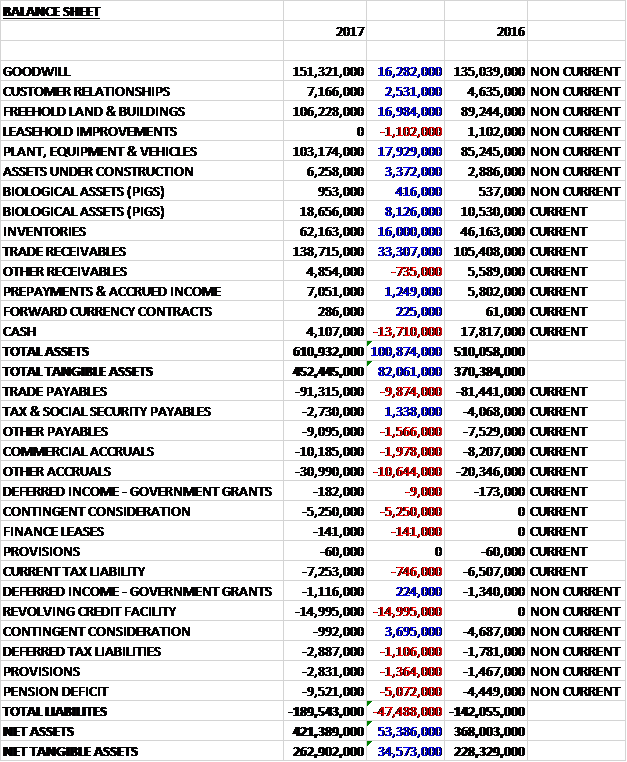
When compared to the end point of last year, total assets increased by £100.9M driven by a £33.3M growth in trade receivables, a £17.9M increase in plant, equipment and vehicles, a £16.3M increase in goodwill, a £16M growth in inventories, a £17M increase in freehold land and buildings an £8.5M increase in the value of the pigs, partially offset by a £13.7M decrease in cash. Total liabilities also increased during the year due to a £15M increase in the revolving credit facility, a £10.6M growth in other accruals and a £9.9M increase in trade payables. The end result was a net tangible asset level of £262.9M, a growth of £34.6M year on year.

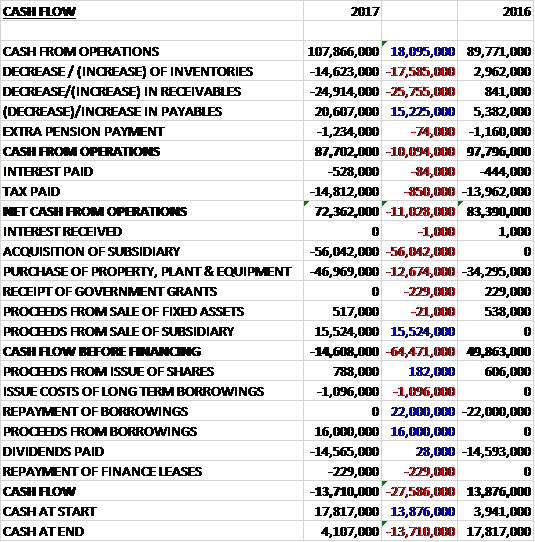
Before movements in working capital, cash profits increased by £18.1M to £107.9M. There was a cash outflow from working capital with an increase in inventories and receivables and after tax payments grew by £850K the net cash from operations was £72.4M, a growth of £11M year on year. The group spent £47M on property, plant and equipment along with a net £40.5M on acquisitions to give a cash outflow of £14.6M before financing. The group then took out £15M in new borrowings to pay for the £14.6M spent on dividends so there was a cash outflow of £13.7M and a cash level of £4.1M at the year-end.

Total revenues were up 22% and like for like revenues increased by nearly 13% on volumes that were 15% higher due to new contract wins, strong export sales and a greater number of pigs being processed through the three primary processing facilities. The operating margin at 6.1% was 29 basis points lower with the delay in recovering rising input costs through the second half of the year being partly mitigated by a positive contribution from the rapidly growing poultry and export business and a strong operational performance across each of the businesses.

Fresh pork revenue increased by 6.7%. Excluding the contribution from Ballymena like for like revenue growth was 2.1%. Performance was comfortably ahead of the overall UK Fresh pork category with market data showing a decline of 4% due to lower promotional expenditure and lower sales traditional roasting joints. Total export revenue grew by more than 38% reflecting growth in Far Eastern markets of 49% together with a 15% increase into other export markets.

A major overhaul of the Norfolk facility was completed in the year. Work is also underway at Ballymena to extend the butchery operations which will enable more pigs to be processed through the facility more efficiently. They are also planning to extend their Hull facility with work expected to start in the next financial year. Improvements in productivity together with rising pig prices resulted in an improved contribution from pig production in the year.

The UK pig price increased by 34% during the year rising steadily through to the end of December before stabilising in Q4 with the average price being 8% higher year on year. This reflected a more pronounced increase in the EU reference price due to strong demand from China and tighter supply in European markets.

Convenience revenue increased by 20% reflecting new business wins and new product launches, well ahead of the UK market. Cooked meats performed strongly reflecting new business wins coming on stream throughout the period. Three major new contracts, with business secured for the long-term and with built in pricing models to address raw material price movements, leave the cooked meats category in robust share headlining into the new year. The ongoing capital investment programme resulted in £19M being spent across the three sites during the period to upgrade the facilities, add capacity and introduce new capability to slow cook and BBQ ranges which have been added to the portfolio of products following recent contract wins.

Revenue from continental products also grew strongly and the two Manchester facilities are now operating at full capacity. To enable the business to continue to grow and develop, a new £25M facility is being built in the North West of England which will consolidate production from these two sites. The new site, located in Bury, will increase current capacity by about 70% and will enable existing and new product ranges to be produced more efficiently.

Gourmet products saw revenue increased by 16% with all categories in growth. Sausage sales were very strong. New contract wins with the group’s two largest retail customers for their Butcher’s Choice ranges, with together delivered 350 tonnes per week of incremental volume, underpinned this performance. Sausage production recommenced at the Norfolk facility early in the year to meet the increase in demand. Sales of premium burgers from the Lazenby’s facility also grew strongly. New mixing and blending equipment has been commissioned to support the next phase of growth and development of the facility with £6M being invested across the two sausage sites during the year.

The premium bacon sector continues to outperform the overall category but slower year on year growth compared to previous periods highlighted the recent trend by the retail customers to move away from promotional mechanics and multi-buy offers. Growth accelerated in the second half of the year following a new contract win. Pastry returned to volume growth in the second half of the year driven by a strong promotional plan with the business’ anchor customer and a new contract win in the food to go market. Further improvements to operational efficiencies throughout the year allied to an improved top line performance leave the business well placed to drive further volume growth next year.

Excluding Crown, poultry revenue increased by nearly 18%, comfortably ahead of the overall UK market. Sales of fresh poultry reflected strong volume growth. Crown made a very positive contribution to the group during the period with the number of birds processed increasing by 9% since the acquisition. Sales of premium cooked poultry also grew strongly. The £9M capital investment programme which was completed at the start of the year has enabled new business to be secured and produced more efficiently. More recently, contracts have been secured with two of the group’s principal grocery retail customers.

During the year the triennial valuation of the pension scheme was completed. Following a review of the valuation a new contribution schedule was agreed to further reduce the deficit. From 2017 to 2022, cash contributions will be increased from £1.3M to £1.8M per annum.

In November the group acquired Dunbia Ballymena for a total consideration of £18.1M including a deferred consideration of £1.3M. The business is a primary pig processor and establishes a presence in Northern Ireland. The acquisition generated goodwill of £9.5M with the deferred consideration contingent on gaining a licence to export to China.

On the 23rd July 2016 the group disposed of its shareholding in the Sandwich Factory for a total cash consideration of £15.5M. This represented a profit on disposal of £4.5M and the group also disposed of £7M of goodwill. The business made a profit of £297K this year before it was sold and last year made an underlying profit of £982K.
Going forward, the current year has started positively for the group and the board believes they are well positioned to meet the challenges that lie ahead.

At the current share price the shares are trading on a PE ratio of 22.5 which falls to 20.9 on next year’s consensus forecast. After a 20% increase in the final dividend, the shares are yielding 1.6% which increases to 1.7% on next year’s forecast. At the year-end the group had a net debt position of £11M compared to a net cash position of £17.8M at the end of last year.

Overall then this has been an excellent year for the group. Profits were up, net assets increased and although the operating cash flow declined this was due to working capital movements and cash profits increased. After acquisitions, the group didn’t generate any free cash, however. There was a good operational performance across all businesses but with a forward PE of 20.9 and yield of 1.7% this is included in the price. Nevertheless, this is a high quality business and might just be worth it.

On the 24th July the group released a Q1 trading update. Revenue in the period was 27% ahead of the same period last year. Like for like revenue grew 21% compared to the same period last year, underpinned by strong domestic volume growth with all product categories making a positive contribution. Rising input costs were partially mitigated during the period.

During the period further progress has been made on the new continental products factory in Bury which will consolidate current production from the existing two facilities and provide substantial additional capacity. Ongoing investment in the pork processing facilities at Preston and the recently acquired Ballymena site will increase pig processing capacity and drive further efficiencies.

At the end of the quarter net debt stood at £18m compared to £11M at the end of last year and the board is confident in the outlook for the year, which remains unchanged.

International Greetings Share Blog – Final Results Year Ended 2017

International Greetings has now released their final results for the year ended 2017.

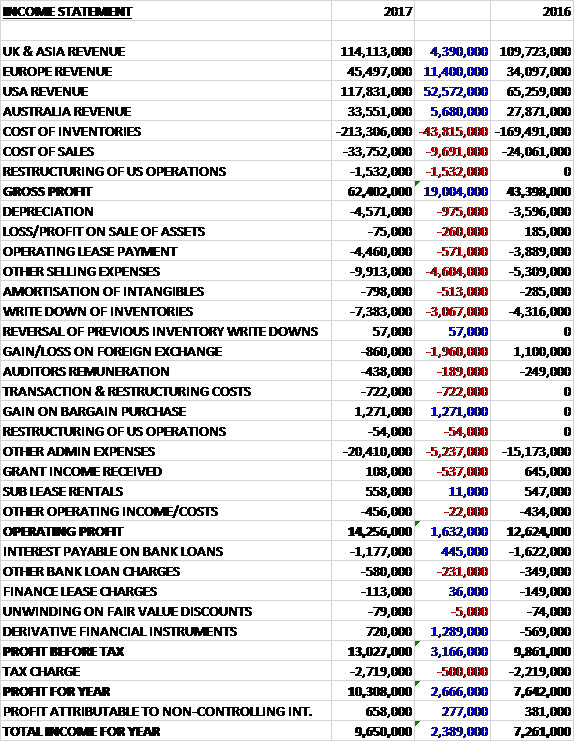
Revenues increased when compared to last year with a £52.6M growth in US revenue, an £11.4M increase in European revenue, a £5.7M increase in Australia revenue and a £4.4M growth in UK revenue. Cost of inventories were up £43.8M with £1.1M of this relating to an exceptional change due to the change of life of certain printing consumables, and other cost of sales increased by £9.7M with £1.5M being spent on the US restructuring to give a gross profit £19M above that of last year. Selling expenses were up £6.4M, there was a £3.1M growth in inventory write-downs and a £2M detrimental swing to forex losses with other admin expenses up £5.2M. There was a £1.3M gain on the bargain purchase, however, and the operating profit grew by £1.6M. The bank loan interest declined by £445K and there was a £1.3M positive swing with regards derivative financial instruments which meant that after the tax charge grew by £500K the profit for the year was £9.7M, a growth of £2.4M year on year.

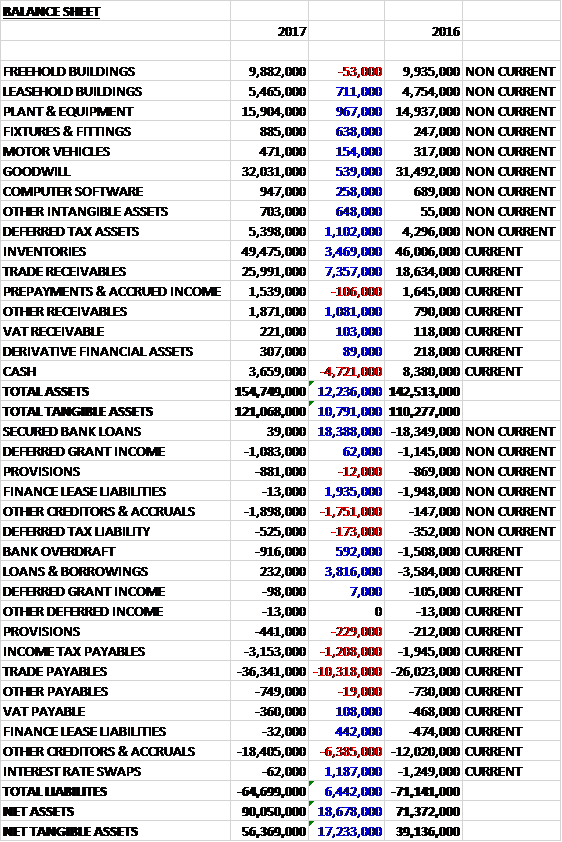
When compared to the end point of last year, total assets increased by £12.2M driven by a £3.5M growth in inventories, a £7.4M increase in trade receivables, a £1.1M growth in deferred tax assets, and a £1.1M increase in other payables, partially offset by a £4.7M fall in cash. Total liabilities declined during the year as an £22.2M decline in bank loans, a £1.9M fall in finance lease liabilities and a £1.2M decrease in interest rate swaps was only partially offset by a £10.3M increase in trade payables, an £8.1M growth in other payables and accruals and a £1.2M increase in income tax payables. The end result was a net tangible asset level of £56.4M, a growth of £17.2M year on year.

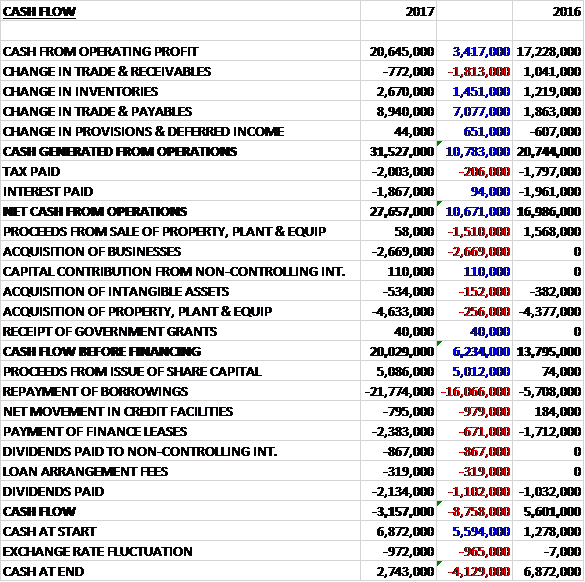
Before movements in working capital, cash profits increased by £3.4M to £20.6M. There was a cash inflow from working capital, in particular a large increase in payables and after tax payments increased by £206K the net cash from operations was £27.7M, a growth of £10.7M year on year. The group spent £4.6M on property, plant and equipment, £534K on intangible assets and £2.7M on acquisitions to give a free cash flow of £20M. The group received £5.1M from the issue of share capital, paid out £2.4M on finance leases, £2.1M on dividends and repaid £21.8M of borrowings to give a cash outflow for the year of £3.2M and a cash level of £2.7M at the year-end.
Weaker sterling has boosted the translational value of overseas earnings and the group made an acquisition in the year but even at constant exchange rates, like for like underlying profit improved by 21% (although this figure does annoyingly exclude LTIP charges which increased during the year.

The profit in the UK and Asian division was £5.4M, a decline of £159K year on year, driven down by the investments made in the business. There was a successful year in the Celebrations products categories with sales underpinned by a good manufacturing performance from the gift wrap manufacturing operation in Wales and card, back and cracker production in facility in China. Next year will see the first UK manufactures retail collateral products including bags produced for fashion and beauty retailers to provide to their customers. Whilst the group’s share of the UK market for gift packaging is substantial, the board believe there remains scope for profitable growth across these and other categories.

The profit in the European division was £4.5M, a growth of £1.6M when compared to last year and the group are now trading with each of the continent’s top ten retail groups in their product categories. The group sustained double digit momentum in Poland and Slovakia, underpinned by their strong trading partnerships with the major retail groups who have expended into these markets as well as local companies.

The profit in the US division was £6.1M, an increase of £2.7M when compared to 2016 reflecting organic sales growth across all channels as well as the acquisition of Lang. This year has seen the expansion of the product offering to include design coordinated ranges of partyware, giftware, celebrations and stationary products to both regional and national retailers. There has also been good momentum in sales growth achieved with the Creative Play products and see considerable scope for expansion across all of the group’s markets.

The profit in the Australian division was £1.7M, an increase of £216K year on year. The group have won a three year contract for the supply of greetings cards to Australia’s largest discount retailer, which counteracted headwinds with more commoditised Christmas product. This opportunity required investment in infrastructure and in-store fixturing, the benefits of which should begin to flow through during the coming year.

In July 2016 the group raised £5.3M by way of a share placing of 3,000,000 new shares a £1.75 per share. Also in July they acquired Lang Companies for a cash consideration of £2.7M. The business is a supplier of branded consumer home décor and lifestyle products based in the US. There was a bargain purchase profit of £1.3M and the business contributed profits of £528K to the group so this really does seem like an excellent acquisition.

The board have approved the investment in the Netherlands in a second high speed, HD printing press. Once in place in 2019, this additional press will reduce risk, increase efficiency and sustain further growth in profitability. In the US the business case for the final phase to update the printing capability is still under appraisal but likely to take place later than previously expected.

At the year-end the group had a net cash position of £3M compared to a net debt position of £17.5M at the end of last year although average leverage throughout the year stands at 2.3x EBITDA compared to 3.2x last year. At the current share price the shares are trading on a PE ratio of 27.6 which falls to 17.6 on next year’s consensus forecast. After an 80% increase in the dividend, the shares are yielding 1.3% which increases to 1.5% on next year’s forecast.

Overall then this has been another year of strong progress for the group. Profits were up, net assets increased and the operating cash flow improved with plenty of free cash being generated. The group has been helped by favourable forex movements and a recent acquisition but the underlying performance is still strong. All regions saw growth in profits except the UK, apparently because of the investments made. It is also worth noting that the group did get a cheeky placing away during the year which would have further boosted the reported results. The shares are no longer that cheap but with a forward PE of 17.6 they still look reasonable value and I am tempted to buy a few.

On the 29th August the group released a trading update covering Q1 trading, which was in line with management expectations with a strong pipeline built in all regions. Group sales, combined with overall customer order levels already received give the directors confidence in the outcome for the full year.

In the Americas, sales volume growth together with product mix is continuing to enhance margins across the broadening customer base. The region has achieved noteworthy momentum in the Creative Play categories. The investment in the gift wrap converting facilities continues to deliver production efficiencies. The region is also benefiting from further synergies from the Lang acquisition, in line with management plans.

In the UK, trading is line with expectations. The investment in the manufacturing of not for sale consumables is fully on schedule and on budget. The order book for these new products is building strongly and the initial shipments are scheduled to take place in H2.

Continental Europe is on course to achieve record sales and production levels across the core gift packaging product categories. The group’s second efficient printing press is on schedule and on budget to be installed in time for the main production in 2019. Additionally, sales of both stationary and gift products are encouraging, especially to the existing base of multiple retail customers.

Australia has seen particularly strong growth in the higher margin independent store sector. Having won a major new contract for the supply of every day greetings card with Australia’s largest discounter, they are benefitting from the economies of scale that this opportunity presents, particularly leveraging their logistical capability and scale. Overall this sounds good, I continue to hold.

On the 21st September the group announced the acquisition of Biscay Greetings, a greetings card and paper products business based in Australia for a cash consideration of £5.5M, generating goodwill of £2.4M. An injection of working capital of up to £1.8M will also be required. Biscay provides greetings cards and related products across Australia and New Zealand and last year generated an operating profit of A$2.9M. While negligible to underlying earnings this year, the acquisition is expected to be earnings accretive from the next financial year.

The acquisition will approximately double the group’s market share in the value channel of the greetings card market in Australia and it seems like quite a good one to me.

On the 29th September the group announced that director Lance Burn sold 67,500 shares at a value of £233K and he no longer holds any shares, which is not a great indication!

Bonmarche Share Blog – Final Results Year Ended 2017

Bonmarche has now released their final results for the year ended 2017.

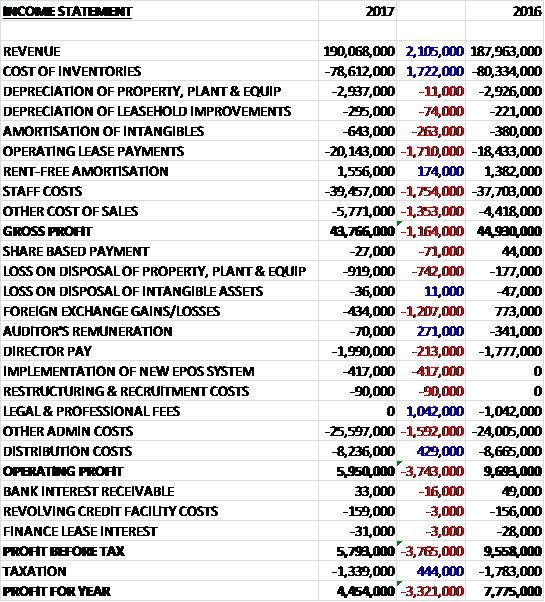
Revenues grew by £2.1M when compared to last year and cost of inventories declined by £1.7M. Amortisation increased by £263K, however, and operating lease payments grew by £1.7M, staff costs were up £1.8M, and other cost of sales grew by £1.4M to give a gross profit £1.2M below last year. The loss on disposal of property, plant and equipment increased by £742K, there was a £1.2M negative swing to forex losses, and £417K was spent on the implementation of the new EPOS system. There were no legal and professional fees, which accounted for £1M last year but other admin costs were up £1.6M, mainly due to the national TV advertising campaign. Distribution costs then declined by £429K to give an operating profit £3.7M below last year. Finance costs were only slightly up and tax charges decline by £444K which meant that the profit for the year came in at £4.5M, a decline of £3.3M year on year.

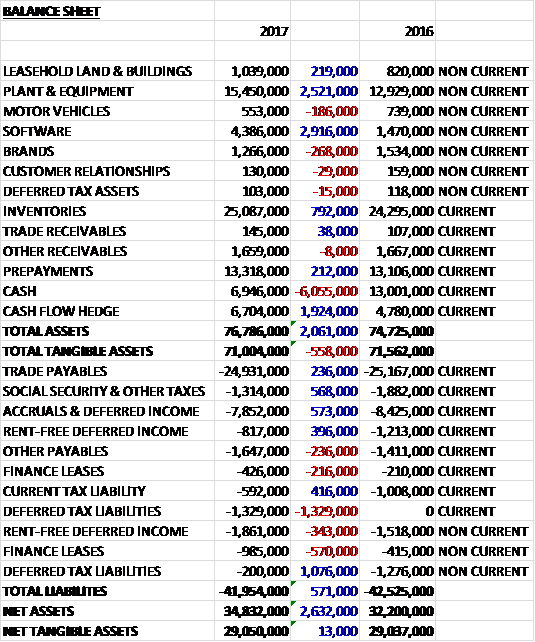
When compared to the end point of last year, total assets increased by £2.1M driven by a £2.9M growth in the value of software, a £2.5M increase in plant and equipment, a £1.9M growth in the value of the cash flow hedge and a £792K growth in inventories, partially offset by a £6.1M decrease in cash. Total liabilities declined during the year as a £1.1M decrease in deferred tax liabilities, a £573K decline in accruals and deferred income and a £568K fall in social security and other tax payables, partially offset by a £1.3M growth in deferred tax liabilities and a £570K increase in finance leases. The end result was a net tangible asset level of £29.1M, broadly flat year on year.

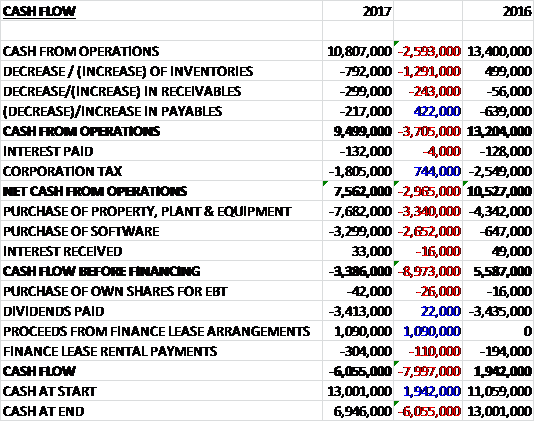
Before movements in working capital, cash profits declined by £2.6M to £10.8M. There was a cash outflow from working capital but corporation tax payments declined by £744K to give a net cash from operations of £7.6M, a decline of £3M year on year. The group spent all of this on £7.7M-worth of property, plant and equipment along with £3.3M on software but £4M of this capex was left over from last year which caused a cash outflow of £3.4M before financing. Despite this the group still paid out £3.4M in dividends and received £1.1M from finance lease arrangements relating to the new tills for the new EPOS system, to give a cash outflow of £6.1M and a cash level of £6.9M at the year-end.

Overall store like for like sales were down 4.3% or 4.7% on a 52-week basis compared to the general market which fell by just 4.1%, and online sales were up 2.2% which means that total like for like sales have declined by 3.8%. 2017 was a challenging year. The apparel market has been in decline with demand affected by consumers’ response to factors such as inflation, the Brexit vote and unseasonal weather patterns but the group’s objective was to grow by gaining market share which they have not achieved.

The group have identified a number of areas where they have not performed as well as they should. Long lead times and a supply base heavily dominated by China as a country of origin restricted their ability to react to changes in seasonal demand and offer diversity of product handwriting. Too significant a shift towards ranges with a casual end use did not perform well during the year due to the weather and this year’s casual ranges were no sufficiently appealing to their customers. Also, there was not enough focus on innovation which will be a key focus in the coming year.

The loyalty scheme did not contribute to sales growth during the year as the level of membership has not grown as the focus had drifted away from signing up new customers, certain elements of the scheme need modernising such as the online experience which is not seamlessly linked to the store experience, and the group are not fully utilising the data which the scheme provides. Also, they have said that basic retail disciples have not been maintained to a consistently high enough standard. A significant change to the retail management structure was completed just after the year-end.

They also identify some external factors which have not helped. BHS went into administration in April 2016 and cleared its residual stock at reduced prices which affected sales in April and May. During the second half of the year, however, their sales benefited and the board estimate that the net effect of BHS’s closure was neutral and during the coming year it should have a slightly positive effect on sales. Likewise, the weather pattern in the first half proved a disincentive for consumers to shop for seasonal clothing but the impact in the second half was neutral, if not a bit favourable.

During the year the group ceased trading through the shopping channel, ebay and Amazon as these channels generated insignificant profits. Although online sales grew, the board considered the low rate of growth to be a poor performance given the general trend of consumers increasingly switching channels. The performance did improve significantly during the year, however, with Q1’s 4.1% sales decline contrasting with the 15% growth in Q4. The board expect to see this trend continue as the benefits of the new Demandware web platform are realised.

As well as the general improvement seen across the group, the improvement in the online performance throughout the year reflects the steady progress made to improve the online offering, most notably launching a new site on a Demandware platform at the end of September, with no disruption as a result of this move. Having introduced the new platform, during the second half of the year, they began to unlock the benefits of the new features and the board believe the improved performance since Christmas is partly as a result of this.

The gross product margin was 58.6% in the year compared to 57.3% last year as a result of a higher bought in margin as the markdown level was slightly higher than in the previous year ad better than expected at the beginning of the year. Most of the stock is paid for in US dollars which were slightly more expensive this year which, on its own, would have reduced BIM. It is worth noting that the sharp fall in the value of Sterling did not significantly affect the group as they had contracted for the currency they needed when rates were higher. It will begin to affect them next year, however, and the full effect will be felt in 2019. This, in isolation, would represent a significant cost increase but the additional time in which to react will help the group mitigate the effect as much as possible.

In the autumn the group ran a three-week national advertising campaign using TV, radio and print media but the results were not conclusive enough to justify further expenditure so it looks like this will not be repeated in the immediate future. They have, however, improved both the effectiveness of their online marketing and their catalogue.

Shortly after the year-end the group introduced a proof of concept trial in 70 stores to test in-store online ordering through which a store colleague can order an item for a customer if it is not available at that time at the store. This appears to have been a success, proving popular with both staff and customers. They will roll this capability out to the remaining stores during H1 2018. They are also monitoring customer footfall and gauging the effectiveness of window displays.

In August Helen Connolly joined the group as CEO having most recently worked at Asda where she was senior buying director for the George clothing business.

There were a couple of exceptional items incurred during the year. The main one was £417K relating to training expenses incurred in relation to the implementation of a new EPOS system across the store estate. Other costs in relation to implementing this project have been treated as capex. There was also £90K of costs relating to the recruitment of the new CEO.

Going forward, trading since the start of the year has been in line with expectations. The board believe that the challenging market conditions are likely to continue but they are confident in their strategy and remain focused.
At the year-end the group had a net cash position of £5.5M compared to £12.4M at the end of last year. At the current share price the shares are trading on a PE ratio of 10.3 which falls to 7.5 on next year’s consensus forecast. After the final dividend was kept the same the shares are yielding 7.6% which increases slightly to 7.7% on next year’s forecast.

Overall then, this year has clearly been a difficult one for the group. Profits were down, net tangible assets were flat and the operating cash flow declined with no free cash being generated. Like for like sales from the stores fell and the online sales disappointed. There is evidence that this is being turned around, however. The board have identified a number of issues that are being addressed and most promising in my view is the fact that the disappointing online sales at the start of the year have reversed following the new IT systems. With a forward PE of 7.5, net cash on the balance sheet and dividend yield of 7.7%, these shares are certainly not expensive and I am inclined to continue to hold to see if the recovery has legs.

On the 27th July the group released a trading update covering Q1. Total sales increased by 7.6%. Store like for like sales were up 4.2% and online sales grew by 39%. This is in line with the board’s expectations so the full year forecast is unchanged.

QinetiQ Share Blog – Final Results Year Ended 2017

QinetiQ has now released their final results for the year ended 2017.

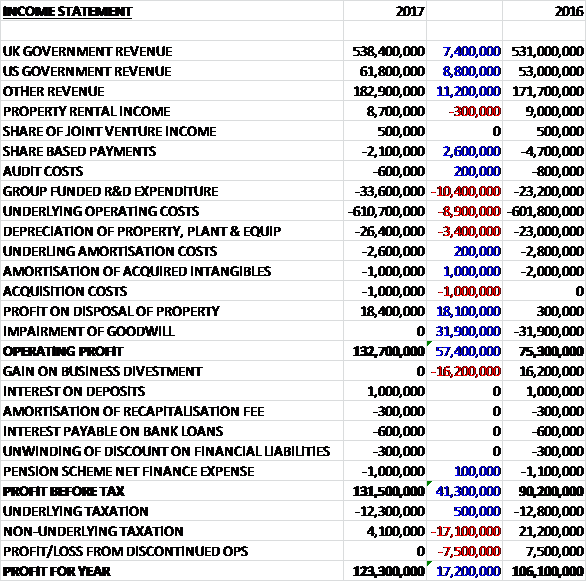
Revenues increased when compared to last year as a £300K decline in property rentals was more than offset by an £8.8M growth in US government revenue, a £7.4M increase in UK government revenue and an £11.2M increase in other revenues. Share based payments fell by £2.6M but group funded R&D exposure increased by £10.4M and other underlying operating expenses grew by £8.9M. Depreciation was also up £3.4M and there was £1M of acquisition expenses but the amortisation of acquired intangibles declined by £1M, there was an £18.1M increase in the profit on property disposals and there was no goodwill impairments which accounted for £31.9M last year. All of this meant that the operating profit grew by £57.4M. Conversely there was no gain on business divestments which brought in £16.2M in 2016, non-underlying tax income declined by £17.1M and there was no profit from the discontinued operations, which was £7.5M last time. Profits overall increased by £17.2M.

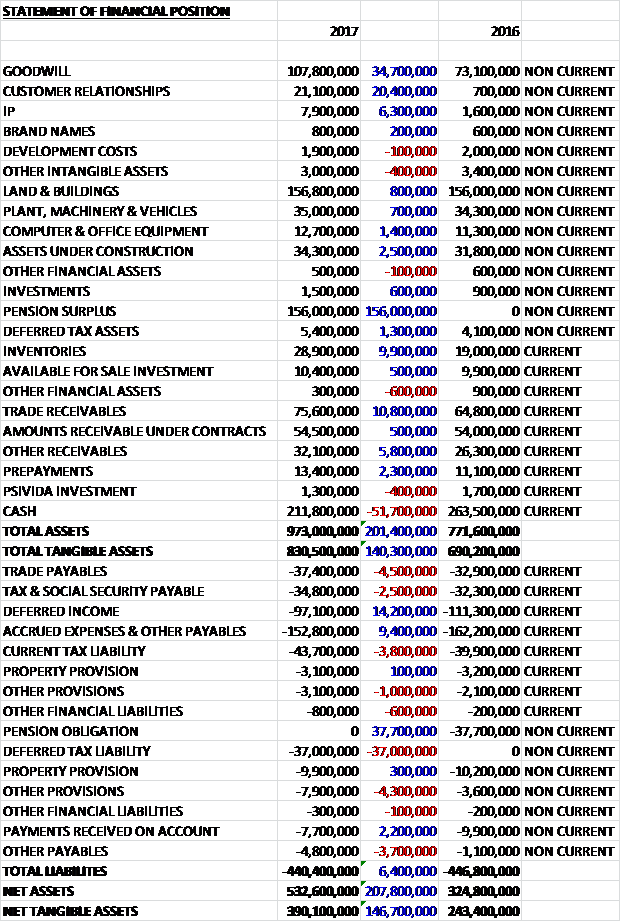
When compared to the end point of last year total assets increased by £201.4M, driven by a £156M pension surplus due to the performance of interest rate hedges, a £34.7M growth in goodwill, a £20.4M increase in customer relationships, a £10.8M growth in trade receivables, a £9.9M increase in inventories, a £6.3M increase in the value of IP, and a £5.8M growth in other receivables, partially offset by a £51.7M decline in cash. Total liabilities declined during the year as the £37.7M decline in the pension surplus, a £14.2M fall in deferred income and a £9.4M fall in accrued expenses and other payables was partially offset by a £37M increase in deferred tax liabilities, a £4.5M growth in trade payables and a £4.3M increase in other provisions. The end result was a net tangible asset level of £390.1M, a growth of £146.7M year on year.

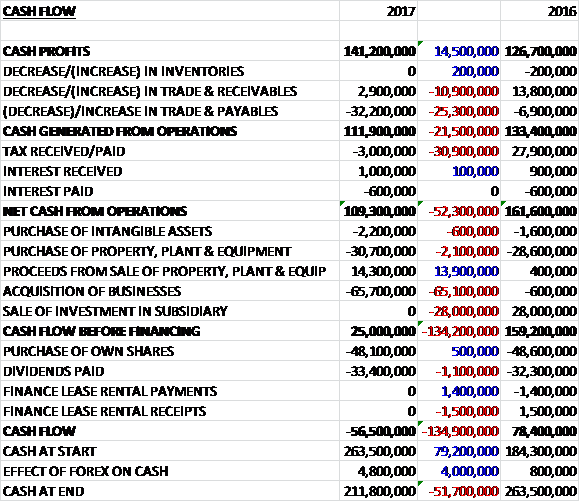
Before movements in working capital, cash profits increased by £14.5M to £141.2M. There was a cash outflow from working capital due to a decrease in payables and after tax swung to a charge, a detrimental movement of £30.9M, the net cash from operations came in at £109.3M, a decline of £52.3M year on year. The group spent £30.7M on property, plant and equipment, £2.2M on intangibles and £65.7M on acquisitions but received £14.3M on the sale of some property which gave a free cash flow of £25M. This did not cover the returns to shareholders, however, with a £33.4M dividend payment and £48.1M of share re-purchases meaning there was a cash outflow of £56.5M and a cash level of £211.8M at the year-end.

Excluding exchange rate changes, the £1.2M contribution from acquired businesses and last year’s profit from divested businesses, the organic constant currency operating profit increased by £3.4M to £112.6M.
The underlying operating profit in the EMEA Services division was £92.7M, a decline of £1.1M year on year despite being boosted by a £5.2M credit relating to the release of engine servicing obligations as they invest in new aircraft for test aircrew training (there was a £3M credit last year). Excluding those, and the effect of forex and acquisitions, underlying operating profit fell by £4.6M mainly due to the lower baseline profit rate for single source contracts. Revenues were flat as the impact of the RubiKon acquisition and favourable forex movements were largely offset by last year’s disposal.

Orders, excluding the £1BN LTPA amendment, grew 5% to £520.9M including the award of a £109M 11 year renewal from the MOD for the Naval Combat system Integration Support Services and an £80M of additional orders added to the Air Strategic Enterprise contract. The £1BN amendment to the LTPA signed during the year has significantly increased total EMEA services backlog. The remaining LTPA contract is due to be repriced in March.
As anticipated, the baseline profit rate for new and renewed single source contracts signed in 2018 will fall by 149 basis points from the 2017 baseline rate. Including the LTPA contract, 76% of the division’s revenue is derived from these contracts.

Within Air and Space, the Strategic Enterprise model for aircraft engineering services has now been in place for a year and £80M of additional contracts were added to the model during the year to provide in-service support for eight aircraft including the Apache, Puma and Merlin helicopters and Tornado fast jets, as well as test and evaluation services for the Wildcat Future Air to Surface Guided weapon programme.

The business is focused on the modernisation of test aircrew training provided by the Empire Test Pilots School which achieved approved training organisation status during the year allowing it to train civil test pilots. Investment in new aircraft and a revised syllabus will allow it to pursue opportunities for growth. During the year Boeing Defence UK identified MOD Boscombe Down which the group operate and manage on behalf of the MOD, as the preferred site for its future UK HQ and European hub for maintenance, repair and overhaul.

The business’ relationship with the ESA continues with their transceiver operating as part of the ExoMars mission to Mars, despite the lander on which it was mounted being lost. They are continuing to deploy significant resources to develop the gridded ion engine electric propulsion system for the flight module to be used on ESA’s mission to Mercury which is due to launch in October 2018.

They secured £2M of research funding to lead a team to upgrade the scale models used in the Farnborough wind tunnel using technology adapted from F1, leading to improved efficiency and increased capacity and they entered into a teaming agreement with Thales and Textron to provide an offer to the MOD for thee Air Support to Defence Operational Training programme.

In Maritime, Land and Weapons, the business delivered the trial of the new Spear 3 missile system planned for the UK’s F-35 Lightning II stealth fighter aircraft. They also secured an 11 year contract extension worth £109M for the Naval Combat Systems Integration and Support services. Later in the year the site hosted the Royal Navy’s Information Warrior exercise designed to develop and test new information warfare capabilities. The business is a member of a UK industrial consortium called Dragonfire which won a £30M contract for a Capability Demonstrator programme for laser technology. The demo is reliant on a QinetiQ-developed technology. They also won an £8M contract to implement and evaluate vehicle survivability for Sdtl, including installing a soft-kill defensive aids system on a Challenger 2 tank along with a £5M contract to deliver a real time simulation system for the Sentry E-3D aircraft to enable effective operations with NATO countries.

Within Cyber, Information and Training, the business won a £10M contract to link existing Typhoon synthetic training at RAF bases to the facility at RAF Waddington and delivered a cyber range for an army exercise as part of a growing capability to support customers in the test and evaluation of cyber operations. The business delivered their stand-off threat detection system to the US Transportation Security Administration for use at several high-profile events including the Presidential inauguration.

During the year the business secured contracts totalling £10M for secured navigation, working with European and UK government customers to enable the effective exploitation by users of the Galileo constellation of satellites which goes live in 2021. This included the first demonstration of accessing the encrypted Public Regulated Service in real-life applications. The business has built on this by agreeing a partnership to go to market with Rockwell Collins around the world.

Following the acquisition of RubiKon, the Australian business continued to develop its core capabilities, extending contracts for the provision of integrated engineering services at the Defence Science and Technology group’s Fisherman’s Bend workshop in Melbourne, and for aircraft structural integrity services. They also signed a new strategic support partnering contract for the replacement of the AP-3C Orion fleet with a combination of unmanned and manned aircraft. The Australian business also grew order intake, including contracts to support tanker aircraft, navy guided weapons systems, ground-based air defence and the Australian Artillery Regiment.

The Canadian business achieved its first home win with a contract to provide advice to the Royal Canadian Coast guard and a new office is being established in Malaysia to support sales and marketing in the region. Overall the revenue under contract for 2018 is in line with last year and the division is expected to deliver modest revenue growth this year but the lower baseline profit rate for single source contracts represents a headwind for operating margins.

The underlying operating profit in the Global Products division was £23.6M, a growth of £8.5M when compared to last year which included the impact of the acquisition of Meggitt Target Systems, favourable forex movements and £2.2M of credits relating to historical overseas contractual disputes. With these items removed, underlying operating profit increased by £3.6M driven by QNA and OptaSense. Organic constant currency revenues grew by 8% due to a strong performance in QNA, driven by product shipments relating to the new US aircraft carriers, together with growth in OptaSense. Orders reduced by £10M to £154.4M as a result of a strong comparative year which included a large pipeline contract in OptaSense and a five year £10M contract to provide materials research and advice to the MOD. Order flow in North America was strong including $41M of aircraft carrier orders during the year.

In North America, QNA delivered very good orders and revenue performance driven by the strength of their US military robot business, sales of aircraft armour and their continued role supporting the next generation of US aircraft carriers. In total the business was awarded more than $40M of orders for unmanned ground vehicles for the reset of robots previously used in operations for capability upgrades such as detection of CBRNE. The business is bidding for multi-year programmes of record that are under way now or will be under way this year. These will be funded out of the DOD’s base budget for TALON-class and Dragon Runner class systems.

In October they announced a partnership with Estonian company Milrem for Titan, a modular, hybrid military unmanned ground vehicle for dismounted troop support. QNA also confirmed a $41M contract with General Atomics which follows the initial $16M announced in 2015. The business will deliver control hardware and software for the Electromagnetic Aircraft Launch System to be installed on the next aircraft carrier.

In September the business launched a new meteorological sensing product that provides real-time atmospheric data in support of military requirements such as artillery fire support, tactical weather modelling and air drop. The Line Watch product which measures the current and voltage of power distribution lines is being piloted by ten utility companies following the delivery of the first production unit.

In international markets, robots, vehicle protection, and soldier protection systems remain relevant as security challenges and instability persists in the Middle East and elsewhere. In addition to product sales the business is building its base of contract R&D projects to drive technology development, explore new customer problems and expand its competitive offerings. Progress continues with awards for an airborne wind profiling radar, robotic enhancement projects, a turbine-based power and thermal management system and a number of other commercial research and development projects.

The OptaSense business grew last year, driven principally by strength in its pipeline sensing business and some recovery in the North American oil and gas market. They are delivering the system for the world’s largest distributed fibre sensing project for the 1,850km Trans-Anatolian Natural Gas Pipeline that runs from Azerbaijan to Europe. The business has also signed an agreement to work with Siemens to pursue new opportunities in the rail sector.

Additionally, the business is undertaking collaborative research with Stanford School of Earth, Energy and Environmental Sciences in California that includes the installation of a fibre-optic seismic array on the Stanford campus to better understand the complex geology of the Bay Area.

Within Space Products the business secured a €2M contract with the ESA to develop the next generation computer and power management system for their PROBA family of satellites in addition to other developing funding. Their P200 satellite was also listed in the NASA catalogue which will help facilitate the procurement of spacecraft by US federal agencies and their affiliates. Under contracts awarded during the year the business supported the development of a spacecraft for the Argentinian space programme and a satellite for a joint European and Chinese solar wind programme. They also secured funding to continue the development of their International Berthing and Docking mechanism for spacecraft.

Within EMEA products, the group acquired target systems business secured an early contract win in the UAE and completed their first commercial flight of the Banshee Jet 110 aerial target. During the year DARPA invested a further $3M in the group’s electric hub drive technology that will improve mobility and survivability of future military ground vehicles. The new agreement builds on previous contract awards and will take the technology from concept design to the building and testing phase including the production of two fully working units. Boldon James further expanded their product portfolio with the introduction of several new enhancements to their data classification offering.

Going forward, as a result of their contracted orders and pipeline of opportunities, as well as the expected full year contribution from the Target Systems acquisition, the division is expected to continue to grow in 2018.
One major development in the year was the signing of an 11 year £1BN amendment to the LTPA. The focus in 2018 is to re-price the remaining LTPA contract which is due in March and to work with the MOD to develop a long-term vision for the UK’s testing capabilities. This will provide a platform for growth in the UK T&E market which the group estimate to be double that which they currently access, and improve their ability to win work with customers outside the UK.

In December the group acquired Meggitt Target Systems for £60.3M. The business is a provider of unmanned aerial, naval and land-based target systems and services for test and evaluation and operational training and rehearsal. They provide systems to about 40 countries with operations in Canada and the UK. The acquisition generated £24.5M in goodwill and operating profit of £1M since acquisition. In January the group acquired RubiKon for £7.4M. The business provides solutions to complex logistics, supply chain management and procurement projects in defence, aerospace, mining and government markets in Australia. The acquisition generated goodwill of £3.9M and operating profit of £200K since acquisition.

Going forward, in EMEA services, revenue under contract is in line with the prior year and the division is expected to deliver modest revenue growth this year but the lower baseline profit rate for single source contracts represents a continued headwind for operating margins. The group’s global products division has shorter order cycles and is dependent on the timing of shipments of key orders but as a result of their contracted orders and pipeline of opportunities, as well as a full year contribution from the Target Systems acquisition, the division is expected to continue to grow in 2018.

Cash flow will reflect increasing investment with capex of £80M to £100M to support the amendment to the LTPA agreement compared to £33M this year but overall for 2018 the board are maintaining expectations for steady progress excluding the non-recurring benefits of 2017.

At the current share price the shares are trading on a PE ratio of 15.7 which increases to 16.1 on next year’s consensus forecast. After a 5% increase in the dividends, the shares are yielding 2.2% which increases to 2.4% on next year’s forecast. At the year-end the group had a net cash position of £221.9M compared to £274.5M at the end of last year.

Overall then this was a solid performance. Profits increased, net assets were up due to the good performance of the pension scheme, but the operating cash flow fell. This was due to working capital movements, however, and the cash profits increased. The free cash flow was not enough to cover the dividends and the increased capex next year suggests this is something that will continue. The EMEA Services division saw profits decline due to the lower baseline profit rate for the single source contracts. Orders were good but there will be a further headwind with more reductions in the baseline profit rate for single source contracts so it seems unlikely the division will grow profits in 2018. Global products performed well due to orders relating to the new US aircraft carriers for QNA and continued pipeline sensing business for OptaSence following a modest pick-up in the oil and gas market.

Going forward EMEA Services look as though they might drag on results but despite lower orders, the Global Products division is expected to grow, aided by the Meggitt acquisition. The shares are not particularly cheap with a forward PE of 16.1 and yield of 2.4% but there is plenty of net cash here and this is a strong, steady company. I am inclined to continue to hold.

On the 21st June the group announced that CFO David Smith purchased 17,416 shares at a value of just under £50K.

On the 13th July the group announced that CEO Steve Wadey purchased 15,000 shares at a value of £39K. This is nice to see, but not a huge buy.

On the 19th July the group released a trading update covering Q1. In the EMEA Services division, Q1 revenue under contract is similar to the position a year ago but orders have been slower than expected with some customer contract award decisions being deferred or delayed. Despite the somewhat slower start to the year for orders, the board continue to expect the division to deliver modest revenue growth this year. The lower baseline profit rate for single source contracts continues to represent a headwind for operating margins.

Revenue performance in Global Products during the quarter was similar to last year but the board expect the division to grow in 2018 as a result of their contracted orders and pipeline of opportunities, as well as the anticipated full year contribution from the recent acquisition. Overall they are reaffirming the previous outlook and expect steady progress in 2018, supported by revenue growth.

All this is OK but it seems to me that a lot more of the growth is being pushed back and there must be a risk that it doesn’t come. Growth here is sluggish at best and despite the solid, high quality nature of the company I remain on the side lines. The valuation is starting to look rather interesting, however, so I am keeping a keen eye on this company.

There have been a number of recent director share purchases. On the 21st July non-executive director Michael Harper purchased 5,000 shares at a value of £12K; Chairman Mark Elliott purchased 20,000 shares at $62K; and CEO Steve Wadey purchased 15,000 shares at £36K.

On the 8th September it was announced that CFO David Smith purchased 8,936 shares at a value of just under £20K.
On the 21st September it was announced that non-executive director Susan Searle purchased 7,500 shares at a value of £17K.

On the 29th September the group released a trading update covering the first half of the year where hey stated that trading had been in line with expectations and the outlook for overall group performance this year is unchanged.
The EMEA services division started the year in a strong position. Following stronger order intake in Q2, the revenue for the year under contract is as expected and the board reiterate their guidance for modest growth in revenue in 2018. The Global products division has been trading in line with expectations during the first half. As a result of its contracted orders and pipeline of opportunities, as well as the expected full year contribution from Target Systems, the division is expected to grow this year.

In the UK home market, they secured an £8M order from the MOD to provide naval combat systems expertise for Type 26 Global Combat Ship added to the £110M eleven year Naval Combat System Integration Support Services contract agreed last year; and an order from Boeing, worth approximately £25M, to continue to deliver wind tunnel testing for their commercial aircraft development until 2024.

In their US and Australian home markets, they were awarded a significant order for aircraft launch and recovery equipment for the new class of US Navy aircraft carriers; and an A$8M order to manage mine warfare maintenance facilities at HMAS Waterhen for the Australian DoD.

Overall this seems like a steady update and I am tempted to jump back in there at the lower share price.

Arbuthnot Banking Share Blog – Final Results Year Ended 2016

Arbuthnot Bank has now released their final results for the year ended 2016.

Interest revenues increased when compared to last year, mainly due to a growth in interest income on loans to customers. Net fee and commission income also grew with a £1.2M increase in trust and other fiduciary fee income which meant that the operating income grew by £6.8M. There was an £810K decrease in impairment losses on loans to customers but staff costs increased by £8.6M, including bonuses of £2.3M from the disposal of Everyday Loans, depreciation was up £291K, operating lease rentals increased by £669K and other admin expenses were up £1.8M. There were a couple of new profit streams, however. The first £2.1M in profits from associated was included this year as Secure Trust was mostly sold off, and there was a £1.1M rental income from the new investment property. We also see a one-off £1.6M of profit from the investment in Visa after Visa Inc purchased Visa Europe, and acquisition costs declined by £1.2M. After tax charges grew by £841K, there was a loss for the year of £541K, an improvement of £1.9M year on year.

When compared to the end point of last year, total assets declined by £966.3BN mainly due to the sale of STB shares, driven by a £419.2M decrease in commercial loans to customers, a £220.4M reduction in retail loans, a £165.7M fall in motor finance, a £172.9M decline in cash at central banks and a £118.5M fall in assets held for sale, partially offset by an £88.1M increase in residential mortgages, an £81.6M increase in investment in the associate, relating to Secure Trust Bank, and a £53.3M new investment property. Total liabilities also declined during the year as a £111.5M increase in current account deposits from customers was more than offset by a £605.5M fall in term deposits from customers, a £438.1M decline in notice account deposits from customers and a £52.1M decrease in deposits from banks. The end result was a net tangible asset level of £225.8M, a growth of £45.3M year on year.

The interest received fall by £62.6M but the interest paid declined by £15.7M, fees and commissions received increased by £21.9M and cash payments to employees and suppliers fell by £16.3M so that after tax payments declined by £4.4M, the cash profit declined by just £4.4M. There was an £855.4M decrease in loans to customers and a £41.8M decline in other assets but the amounts due to customers decreased by £932.2M and other liabilities decreased by £23.6M to give a net operating cash outflow of £33.2M, a detrimental movement of £268.1M year on year. The group spent £5.2M on computer software, £53.3M on an investment property and £89.4M on the purchase of debt securities, although there was proceeds of £69.8M from the redemption of debt securities. There was also £101.7M in proceeds from the sale of Everyday Loans and £148M in proceeds from the sale of Secure Trust bank shares but also a £194.3M reduction in cash with the deconsolidation of Secure Trust. This all meant that before financing there was a cash outflow of £55.1M. There was a £52.1M decrease in borrowings and £57.2M paid out in dividends to give a cash flow of £164.5M and a cash level of £232.7M at the year-end.

It is quite difficult to determine an underlying profit position given the number of transactions that has taken place over the year but from a pre-tax profit of £179K, we can take of the £2.3M of bonuses relating to the sale of ELL, add on £1.7M for a full year associate income from STV; deduct £1.6M which related to the profit on the Visa investment and perhaps take of the £398K in acquisition costs, although this is a little less clear-cut if there is a policy of acquisitions going forward. If we are prudent and leave those costs in, the underlying profit from continuing operations was £2.6M, an increase of £360K using the same measures the prior year.

The profit received from Secure Trust Bank was £2.1M, a reduction of £17.5M year on year due to the sale of the shares. The profit received from the Private Bank was £8.8M, an increase of £2.7M when compared to last year. The Dubai office contributed £900K of this profit, an increase of £800K year on year. Customer loans increased by 29% during the year.

The bank has continued their plan to diversify into other areas of financial services and has taken steps to in developing their commercial banking proposition. Initially the coverage was aimed at London and the SE but this has now been extended to the SW and NW. The team in Manchester has recently moved into their new premises in the building previously occupied by the Bank of England with the team seeking to provide a service to mainly owner managed commercial clients. The commercial banking division has seen its lending balances grow to £76M with deposits reaching £51M. In addition the division also has a healthy pipeline of approved lending that should see it grow substantially in 2017.

The private bank has continued to develop as planned. The loan book grew by £64M to £683M and deposits were £947M, an increase of £50M. Despite the market turmoil during the year, the investment management business grew assets under management by 25% to close the year at £920M. The loan to value decreased by 1% to 45% but overall the loan book remained well secured.
In December 2016 the group completed the purchase of a private banking loan portfolio from Duncan Lawrie Ltd for a consideration of £42.7M. The portfolio was purchased at a 5% discount following the decision by Duncan Lawrie to close their banking operations.

In June the group acquired premises in the West End of London, comprising 22,450 sq. feet of office space and about 7,000 sq. feet of retail space for £53.3M. The property is held as a leasehold from the Crown Estate with a review every five years. The property is currently fully tenanted, generating annual income of £1.8M. It is accounted for as an investment property and this year it generated £1M in profits. The intention is to create a small suite of offices from where the private bankers would be able to meet clients in the West End out of part of the building.

The group have also reached an agreement with the shareholders of Renaissance Asset Finance to acquire their lending business. The business provides lending solutions mainly to high net worth individuals and businesses seeking to purchase assets and equipment with relatively short term financing arrangements. This will open up new distribution channels for the group. The loan portfolio currently stands at £55M. The first payment in cash is estimated to be around £2.1M, equal to net assets of the business on completion. The remaining three payments are performance related with the maximum amount payable limited to £6.5M.

In June 2016 the group received €1.3M in cash following Visa Inc’s acquisition of Visa Europe. As part of the deal, they also received preference shares in Visa Inc which have been valued at their future conversion value into Visa inc common stock. The board have assessed the fair value of this investment as £569K.

In December 2015, STB agreed the sale of its non-standard consumer lending business, ELL to Non Standard Finance for £106.9M in cash. The disposal completed in April and on completion there was a realised gain on disposal of £116.8M. In June 2016 the group sold 6 million shares in STB which reduced their holding from 52% to 19%. From this date they accounted for their remaining shareholding as an associate. The group received £150M for the sale and realised a profit on the sale of £100.2M. The other associate, Tarn Crag recorded a loss of £197K.

The chancellor announced the introduction of a corporation tax surcharge applicable to banking companies with effect from the start of 2016. This is levied at a rate of 8% on the profits of banking companies after taking into account an allowance of £25M. This will increase the group’s future tax charges accordingly.

Going forward the short term economic outlook remains uncertain. The US seems to be taking a significantly more protectionist stance on their economy and the UK has triggered Article 50 to begin the process of exiting the EU.

The group actually made a loss this year so looking at PE ratios is not an option but on next year’s consensus forecast the shares are trading on a PE ratio of 30.6. After an increase in the dividend the shares are yielding 2.2% which increases to 2.4% on next year’s forecast.
On the 4th May the group released a statement covering the first part of the year. The group has made a good start. Lending balances are more than 36% higher than the previous year and are 16% higher than at the year-end. Customer deposits have increased beyond £1BN for the first time and now stand at £1.1BN.

Overall then this has been an important year for the group as they divested Secure Trust Bank which became an associate. This has obviously affected the performance with operating cash flow, net assets and profits all down. On a like for like basis, the underlying profit increased, however. The remaining bank seems to be performing well with loans to customers increasing and the Dubai office starting to contribute meaningfully to results. The group seem to be using the proceeds of the share sale to diversify somewhat with the new office building and Renaissance Asset Finance being the latest acquisitions. This good performance comes at a price, however, with forward PE at 30.6 and a yield of 2.4%. This seems a little bit too expensive to me.

Brooks MacDonald Share Blog – Interim Results Year Ending 2017

Brooks MacDonald has now released their interim results for the year ending 2017.

Revenues increased when compared to the first half of last year due to a £5M growth in investment management revenue, a £779K increase in Channel Islands revenue, a £640K growth in fund and property management revenue and a £228k increase in financial planning revenue. Amortisation grew by £508K, share based payments were up £266K and other admin costs grew by £5.3M. We also see a £109K gain from changes in the value of assets, a £207K reduction in impairment charges and a £1.3M gain from changes in the value of deferred consideration which meant that the operating profit grew y £2.4M, although discounting these non-core items the operating profit grew by £643K. There was a £133K reduction in finance costs of deferred consideration and the share of losses from the joint venture fell by £92K so that after tax charges grew by £481K the profit for the period came in at £6.6M, a growth of £2.2M year on year.

When compared to the end point of last year total assets decreased by £2M driven by a £1.1M decline in client relationship contracts, a £1.1M fall in available for sale financial assets and an £866K decrease in receivables, partially offset by a £1.1M growth in cash. Total liabilities also decreased during the year due to a £3.1M reduction in payables and a £2.8M fall in deferred consideration. The end result was a net tangible asset level of £21.9M, a growth of £4.7M year on year.

Before movements in working capital, cash profits increased by £1.8M to £10M. There was a cash outflow from working capital but this was less than last time and after taxes were broadly flat, the net cash from operations came in at £6.3M, a growth of £2.5M year on year. The group spent £440K on fixed tangible assets, £943K on intangible assets and £1.6M on deferred consideration although they received £1.2M in proceeds from the sale of available for sale financial assets which gave a free cash flow of £4.6M. This covered the £3.1M spent on dividends and the £541K spent on their own shares which meant there was a cash flow of £1.1M for the half year and a cash level of £20.5M at the period-end.

The pre-tax profit of the Investment Management business was £9.8M, a growth of £1.2M year on year as it continued to grow its professional connections. They have seen continued traction across all of their client service lines. In particular they have renewed their focus on the Bespoke Portfolio Service and continue to benefit from changes in the pension landscape as well as growth of ISAs. The pre-tax profit of the Financial Planning business was £177K, an improvement of £190K when compared to the first half of last year.

The pre-tax loss of the Funds and Property Management business was £17K, an improvement of £1.1M when compared to the first half of 2016. Funds had a strong period largely due to growth in the Multi Asset Funds and the Defensive Capital Fund which now exceeds £300M. The Levitas risk rated funds continue to grow in scale but at a slower rate than originally forecast at the time of acquisition which has resulted in a reduction of £1.3M in the estimated fair value of the deferred consideration payable. The property management business saw an increase in value of property assets under administration over the period to £1.21BN which has been reflected in an improvement in earnings.

The pre-tax profit of the International division was £339K, an increase of £152K year on year following the fall in revenue which resulted from the change in focus from advisory to discretionary clients in 2016.

Funds under management grew by over £1BN in the period and all three investment businesses, investment management and funds in the UK along with the Channel Island funds achieved double digit growth. This consisted of £332M of organic growth and £697M of investment growth. The discretionary funds under management rose to £9.33BN representing an increase of 12.4% compared to the WMA index which rose by 7.8%.

The group have made substantial progress on the delivery of their IT upgrade which is due to complete in July this year. They hope shortly after this to be able to merge their two back office departments into one entity which will enhance reporting for their clients. The board have also reviewed the opportunities offered by adding further UK regional offices to their existing geographic footprint and will be expanding their coverage through the opening of an office in Cardiff later in the year.

During the period the group disposed of its holding in the Student Accommodation fund at a market value of £484K, realising a gain of £13K; and its holding in GLIF at a market value of £735K, realising a loss of £9K. Also during the period the group acquired an offshore bond at a cost of £5K and concerted an existing loan of £150K issued to a third party into redeemable preference share capital. The loan was previously included within receivables and has been reclassified as an available for sale financial asset. The preference shares carry an entitlement to a fixed preferential dividend at a rate of 8% per annum.

It has been announced that Chris MacDonald will retire as CEO in April having led the business for the last 25 years. He will remain on the board as Deputy Chairman, however. Caroline Connellan will replace him as CEO having most recently been head of UK Premier and Wealth at HSBC.

As of the period-end the carrying amount of the group’s investment in joint venture North Row Capital has been further reduced to an estimated recoverable amount of zero by recognising an impairment loss of £193K. This arose as the forecast future cash flows from the partnership are estimated to accumulate slower than originally expected and as a result it is not expected that the group will realise a return on investment in the joint venture for the foreseeable future.

Going forward the group are on track to deliver in line with their expectations for the full year.
At the current share price the shares are trading on a PE ratio of 32.6 which falls to 21.8 on the full year consensus forecast. After a 25% increase in the interim dividend, the shares are yielding 1.6% which increases to 1.9% on the full year forecast.

On the 26th April the group released an announcement of funds under management for Q3. Discretionary funds under management totalled £9.932BN, an increase of 6.45% over the quarter. Of this, £291M was net new business and £311M investment performance. As a comparison the WMA index increased by 2.78% over the same period. Going forward, whist some concerns over client sentiment remain given the economic outlook, Brexit negotiations and upcoming elections, they are focused on maintaining the impetus during Q4.

Overall then this has been a very strong period for the group. Profits increased, net assets grew and the operating cash flow rose with plenty of free cash being generated. All parts of the business saw an improved performance with investment management doing very well and the funds and property management business nearly breaking even. This all comes at a price, however, and with a forward PE of 21.8 and yield of 1.9% these shares look a little pricey to me.

On the 27th July the group released a trading update covering the whole year where they state that underling profits will be in line with expectations. They enter the new financial year with strong momentum across the group while remaining cautious around markets and client sentiment. As of the year-end, discretionary funds under management totalled £10.5BN compared to £8.3BN at the same point of last year. Of this 26% growth, 11.5% was net new business and 14.5% was investment performance. This compares to the FTSE Private Investor Balanced Index which increased by 10.5% over the year. In Q4, FUM rise by 5.3% with 3.2% of this new business and 2% performance compared to the index which was up just 0.3% over the quarter.

Allowing for future growth, the group will be investing more broadly in their functional capabilities and as a priority will be focusing on enhancing their risk management and operational framework. They will be increasing their capabilities, including the appointment of a Chief Risk Officer and a COO. These initiatives will add about £4M to operating expenses in 2018, half of which will be repeated in subsequent years.

Also, following a review they have decided to deal proactively with certain legal matters arising from the former Spearpoint business which was acquired in 2012. These matters relate to a number of discretionary portfolios. The group intend to contact relevant clients shortly to explain how they propose to resolve these matters. While they are accepting no legal responsibility they are acting to protect their client’s best interest. They expect this exercise will cost £6.5M which will be taken as an exceptional item this year.