Orosur Mining Share Blog – Q3 Results Year Ending 2017

Orosur has now released their Q3 results for the year ending 2017.

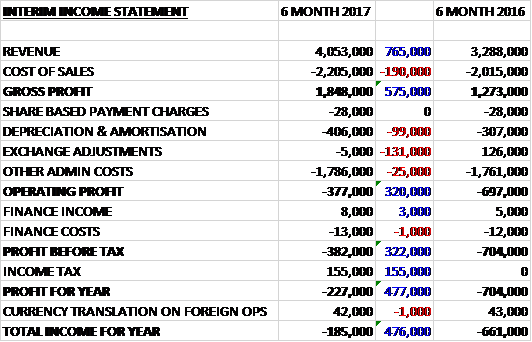
Revenues were broadly flat when compared to Q3 last year as a small increase in the price achieved was offset by a reduction in the quantity of gold sold but a $1.7M favourable movement in inventories was more than offset by a $1.1M increase in mining and transportation costs, a $649K growth in royalty taxes and a $242K increase in processing costs which meant that the gross profit declined by $280K. There was a $249K growth in lab income and other income, including the sale of a drill rig, and restricting costs fell by $73K but there was no Uruguay government settlement agreement which brought in $2.5M last time so the operating profit was down $2.4M. The net forex gain decreased by $300K which gave a profit for the period of $362K, a decline of $2.7M year on year.

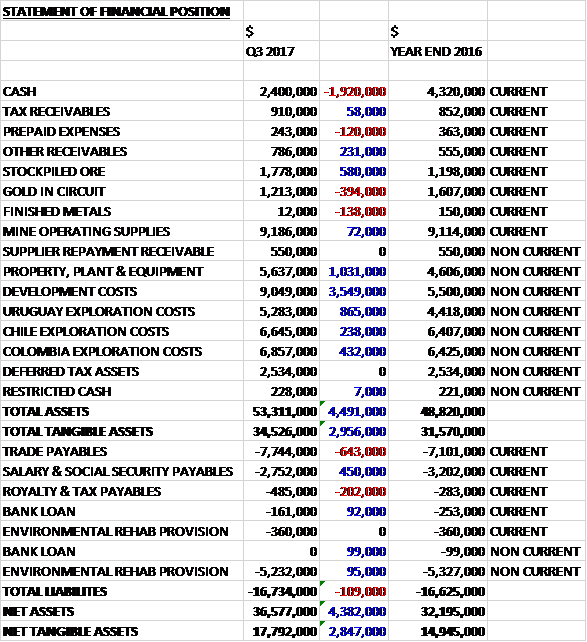
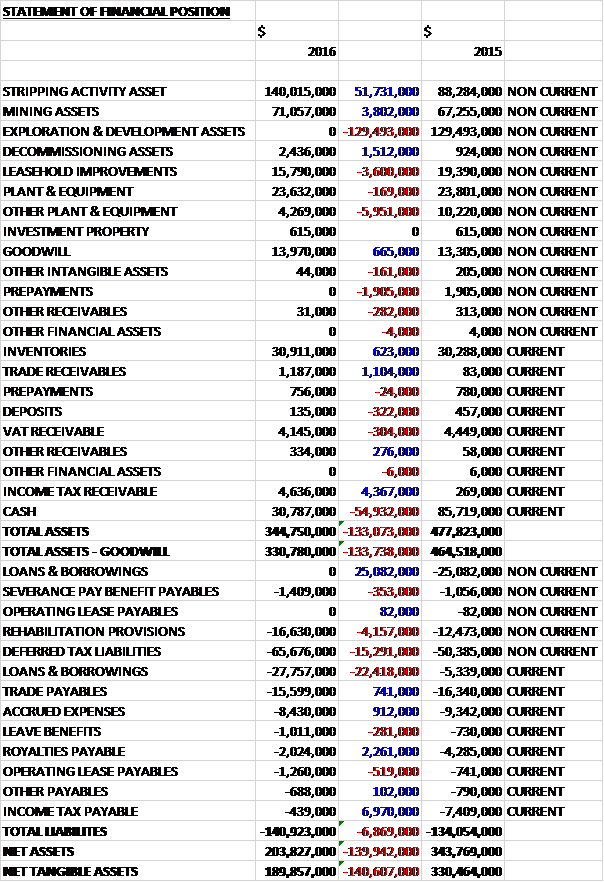
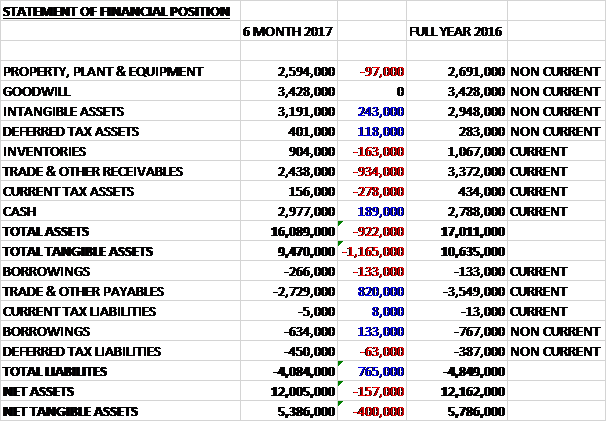
When compared to the end point of last year, total assets increased by $4.5M driven by a $3.5M growth in development costs, a $1M increase in property, plant and equipment and a $1.5M growth in exploration costs capitalised, partially offset by a $1.9M reduction in cash. Total liabilities increased modestly as a $450K decline in salary payables was more than offset by a $643K growth in trade payables. The end result was a net tangible asset level of $17.8M, a growth of $2.8M over the past nine months.

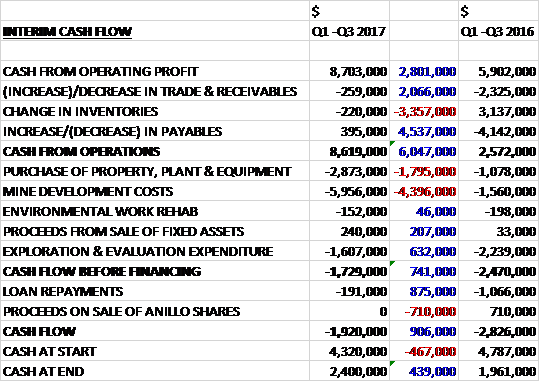
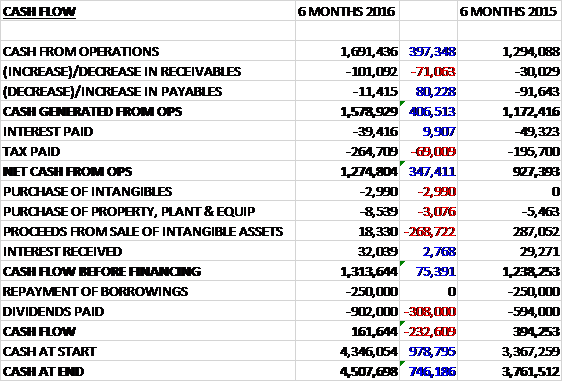
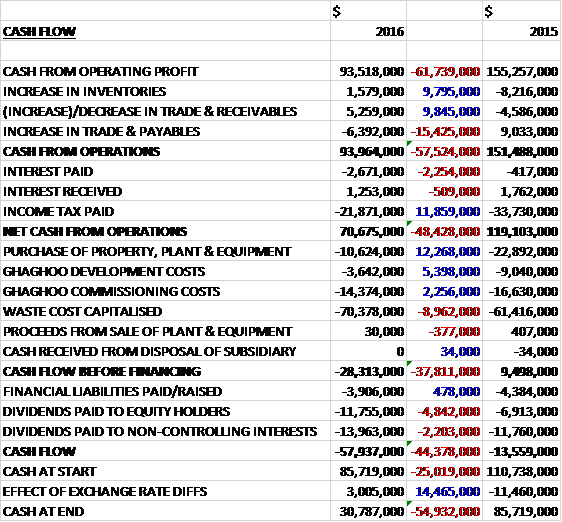
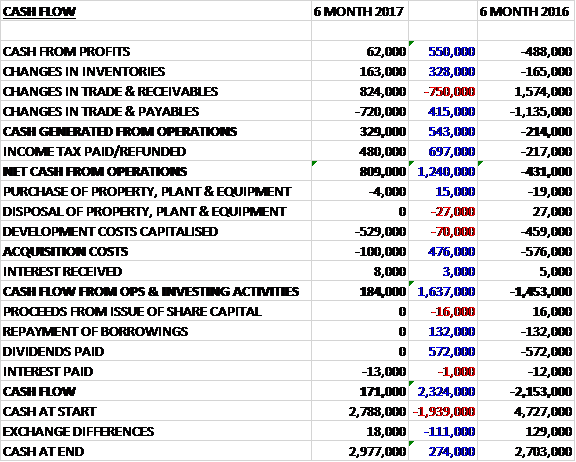
Before movements in working capital, cash profits increased by $2.8M to $8.7M. There was a modest cash outflow from working capital but this was much less than last time so the cash from operations came in at $8.6M, a growth of $6M year on year. The group then spent $2.9M on property, plant and equipment; $6M on mine development costs; and $1.6M on exploration and evaluation expenditure to give a cash outflow of $1.7M before financing. The group repaid $191K of loans to give a cash outflow of $1.9M for the nine month period and a cash level of $2.4M at the period-end.

This quarter has seen the commissioning of the SGW UG new mine. Availability of services such as water, power, access and ventilation have been implemented with about 60% of gold production for the quarter coming from the mine in its first quarter of production. Typically ore production and operational efficiencies are lower at the start of any new mine due to the low operational flexibility given the lack of available production stopes. As the mine development advances, efficiency is expected to improve and the company expects to see improvements as early as Q4.

Production for the quarter was 7,820 ounces of gold compared to 7,274 ounces in Q3 2016 as the lower grade ore processed during the quarter was offset by additional tonnes of ore being processed. The year to date production of 24,623 ounces is in line with expectations to reach the lower end of the group’s 35,000 to 40,000 ounce production guidance for the year. Some 226,193 tonnes of ore was processed at a grade of 1.15g/t compared to 194,352 tonnes at 1.24g/t in Q3 last year.

The average gold price realised for the quarter was $1,198 per ounce compared to $1,143 last time. The average operating cash cost was $858 per ounce compared to $803 last with the increase primarily due to higher mining and processing costs relating to additional tonnes transported and processed at lower grades. As a result of the additional capex associated with the SGW underground mine, including ramp, access and ventilation shaft work, all in sustaining costs increased from $978 per ounce to $1,289 per ounce, although this is lower than the $1,345 per ounce peak in Q2 2017.

The company’s forecast production guidance for the year remains between 35,000 ounces to 40,000 ounces at operating cash costs of between $800 to $900 per ounce. As previously announced, the group incurred higher unit costs during the transition and start of operations in the San Gregorio underground mine which are expected to decrease in Q4 given progress in the mine’s development.

During the quarter the group continued with investment related to the construction of the ramp, access and ventilation shaft at San Gregorio. In addition, they completed construction of phase 4A of the tailings dam.
Exploration drilling in and around the San Gregorio UG area has yielded positive results, intersecting gold mineralisation in every hole, which is expected to significantly enhance mine economics and increase reserves in the short and medium term. Further drilling is underway and ongoing. In Colombia the group finalised a geological model of its high grade Anza gold project to determine the exploratory potential. The project includes a gypsum mine which has environmental and mining permits granted by the Colombian authorities. As previously announced the group has taken over ownership of the mine. The gypsum permits can be readily expanded for additional tonnage, providing the ability for the group to fast track permitting for future gold mining operations.

In December Gladiator publicly announced that it had executed a binding agreement with a third party to dispose of its interest in the project in Uruguay and in February, without Orosur’s consent, they completed the sale of the interest to Metamila, a Belize-based company. The group considers this a breach of contract and intends to take all steps necessary to remedy the situation.

As of the period-end the group had $2.4M of cash with a $1.5M committed and undrawn line of credit with Santander also available. The group remains committed to developing SG UG without any external funding.
There was a loss last year but this year’s consensus forecast is showing that the shares are trading on a forward PE ratio of 2.5.

Overall then this has been a period of change for the group as the new mine was commissioned and started producing. Profits were down marginally even when last year’s Uruguayan government settlement was excluded but net assets increased along with the operating cash flow (although this was for Q1 to Q3 as no Q3 figure was included which makes me think it probably fell). No free cash was produced during this period.

The $1,198 per ounce price achieved is better than last year but doesn’t count the $1,289 AISC. This will come down going forward, however, as the mine starts to get into its groove. The lower grade is a bit concerning and is something that should be watched going forward. The forward PE of 2.5 seems to price in a lot of uncertainty, however, so these shares could be a risky value play I think.

On the 20th June the group released an update covering the year ended 2017. They have produced 35,371 ounces of gold with production in Q4 in line with expectations(initial guidance 35-40K ounces so at the below end of the guidance). The operating cash cost guidance of $800 to $900 per ounce guidance has been confirmed and the net cash at the year-end was $2.9M.

As far as exploration is concerned, in Uruguay the group is extended its mine life with a focus on the Central and East areas of SG UH. A consultant has been engaged to prepare a scoping study covering an expanded project which will include the neighbouring deposits of Veta Sur, Ombu and Veta A.

The deadline for Asset Chile to make its decision to finance Phase 2 in Anillo has been extended to December 2017. They are expected to cover the corporate and ongoing costs until then, estimated at $150K. Under the extension agreement, the group is now able to have open discussions with alternative partners to progress Anillo in the event Asset Chile do not elect to fund phase 2. The group plan to start a 15Km-30Km drilling campaign in Colombia.

AG Barr Share Blog – Final Results Year Ended 2017

AG Barr has now released their final results for the year ended 2017.

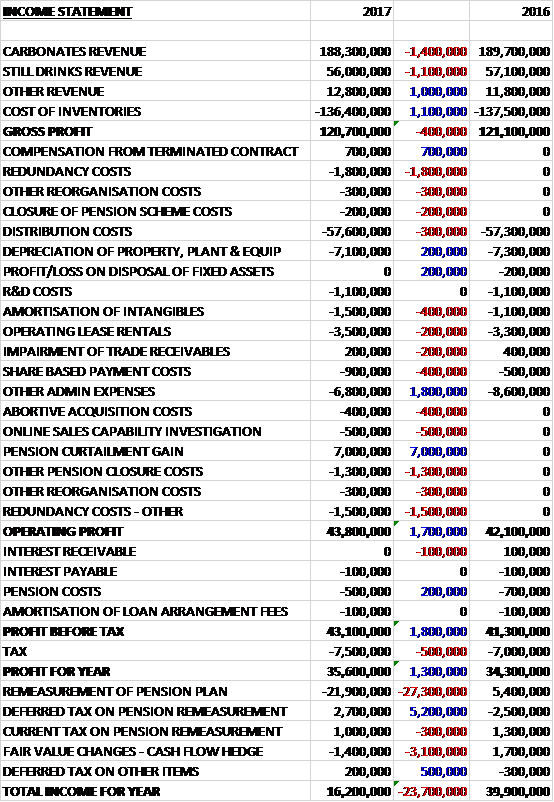
Revenues declined when compared to last year due to the extra week in 2016, with a £1.4M fall in carbonates revenue and a £1.1M decline in still drinks revenue, partially offset by a £1M growth in other revenue. Cost of sales also fell during the year to give a gross profit £400K below that of 2016. The group did get £700K in compensation from a terminated contract but suffered £1.8M of redundancy costs and fairly modest growth in distribution costs, amortisation, operating lease costs and share based payments, counteracted by a small fall in depreciation and a £1.8M decline in other admin expenses. We then see a £7M gain from the curtailment of the pension scheme offset by a £400K abortive acquisition cost, a £500K online sales capability investigation, £1.3M of other pension closure costs and £1.5M in other redundancy costs which meant that the operating profit grew by £1.7M. Finance costs fell somewhat, but tax charges increased by £500K to give a profit for the year of £35.6M, a growth of £1.3M year on year.

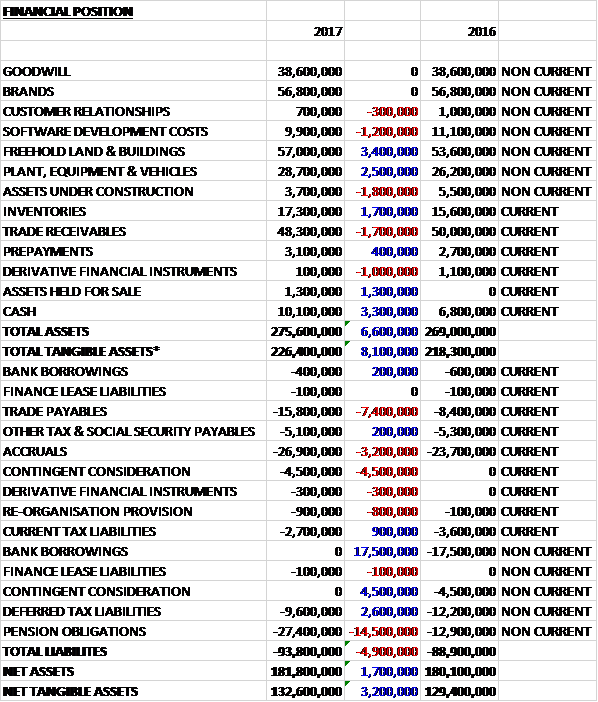
When compared to the end point of last year, total assets increased by £6.6M driven by a £3.4M growth in freehold land and buildings, a £3.3M increase in cash, a £2.5M growth in plant, equipment and vehicles, a £1.7M increase in inventories due to advance purchasing of mangos following a good harvest, and a £1.3M growth in assets held for sale, partially offset by a £1.8M decrease in the value of assets under construction, a £1.7M decline in trade receivables, a £1.2M fall in the software asset and a £1M decrease in the value of derivative financial instruments. Total liabilities also increased during the year as a £17.7M decline in bank borrowings, and a £2.6M fall in deferred tax liabilities were more than offset by a £14.5M increase in pension obligations, a £7.4M growth in trade payables due to the timing of the year-end, and a £3.2M increase in accruals. The end result was a net tangible asset level of £132.6M, a growth of £3.2M year on year.

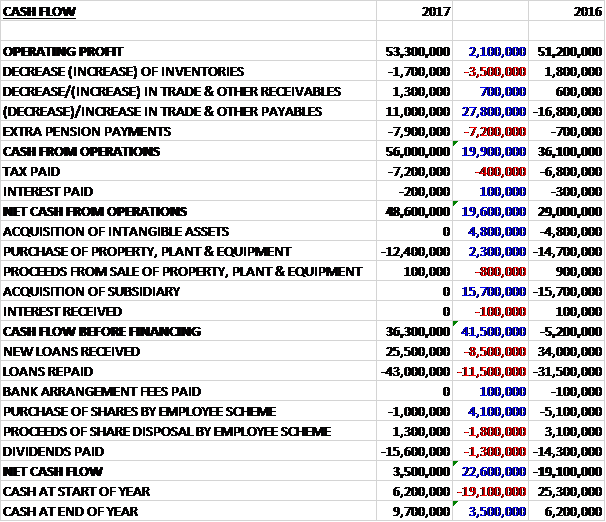
Before movements in working capital, cash profits increased by £2.1M to £53.3M. There was a cash inflow from working capital due to the increase in payables and even after £7.2M of extra pension payments the net cash from operations came in at £48.6M, a growth of £19.6M year on year. The group spent £12.4M on property, plant and equipment which meant that the free cash flow was £36.3M. Of this, £15.6M was spent on dividends and there was a net £17.5M repayment of loans to give a cash flow for the year of £3.5M and a cash level of £9.7M at the year-end.
The announcement of a soft drinks sugar tax and the devaluation of Sterling following the Brexit vote added additional headwinds in a soft drinks market already impacted by price deflation. The group maintained their market share across the period and the launches of IRN-BRU XTRA and Rubicon spring in particular, both no added sugar products, have proved successful.

The UK soft drinks market performed robustly over the past year with growth of 1.2% in value and 1.6% in volume. This total market position masks a higher degree of volatility than in prior years, however. Deflation has eased across the latter part of the year but the continued growth of the lower value water category has continued to impact the total market. Stills experienced volume growth of 3% and value growth of 1%, with water growth continuing to be the driving force. In contrast, the carbonates sector experienced modest inflation, growing value by just over 1% verses a flat volume position.

The gross profit in the Carbonates division was £97.3M, a decline of £1.3M year on year. The core business performed well, with both the IRN-BRU and Rubicon brands growing through a combination of innovation and distribution gains. The portfolio carbonates such as Barr, Tizer and KA have been impacted by retailer range reduction activity, however. The Rockstar brand delivered lower revenues due to competitor discounting and distribution reductions in several supermarkets. The second year of the Snapple partnership has seen success both in the UK and internationally with the new branding and reduced sugar offerings being well received by customers.

The gross profit in the still drinks division was £17M, a decline of just £100K when compared to last year with the new Rubicon light and fruity range performing well. There were, however, continued market-wide challenges in fruit juices and fruit drinks, however, with water remaining a very price competitive subcategory. The international business delivered double digit revenue growth through brand development in the established core markets, new distributor arrangements in existing markets and the opening up of new markets.

The gross profit in the Other division which includes Funkin cocktail and ice creams was £6.4M, a growth of £800K when compared to 2016. The Funkin business performed strongly with sales growth of 27%. The key on-trade business has grown in each of its product segments and the brand is on track to launch its first consumer retail product in Spring 2017. On the basis of the results and the achievement of agreed performance targets, there will be an associated cash earn out payment in 2018 which has been fully provided for.

In September the group signed a further exclusive extension with Rockstar for a further seven territories, including Russia. The Snapple brand has enjoyed growth of over 20% across the year with significant product innovation, packaging changes and further distribution growth in the UK and internationally.

The group have continued to invest in their asset base, including the installation of a new glass filling line at Cumbernauld, and are in the process of adding new PET capability at the Milton Keynes facility. The disposal of the Walthamstow site was completed in February after the year-end. The site sold for £3.8M, generating a gain on sale of £2.5M. The group have entered into a short term lease of the premises as they finalise their long-term plans for direct customer deliveries in the area.

A company-wide reorganisation took place during the period with the employee base reducing by around 100 at a one-off costs of £3.3M. This will generate ongoing savings of around £3M per annum. The majority of the redundancies have taken place and an element of the savings has been delivered this year.

The board has decided to return up to £30M to shareholders via an on-market share repurchase programme with his expected to start in spring 2017 and complete within two years.

There were a large number of “one-off” costs this year. There was £400K of acquisition fees incurred in relation to an unsuccessful acquisition; £500K of advisory costs have been incurred as part of a strategic review of the market threats posed by new and emerging digital trading models (this is stretching the term one-off in my opinion); £600K of redundancy costs were incurred, arising from a reorganisation of direct sales routes and a further £2.7M of redundancy costs were incurred following the announcement of a company restructuring,. Offsetting this was a £7M curtailment gain following the closure of the pension scheme to future accrual, itself partially offset by £1.5M of costs incurred in relation to the closure, including £1.3M of past service costs for one year’s additional service negotiated with the active members of the scheme.

At the current share price the shares are trading on a PE ratio of 25.3 which falls to 21.6 on next year’s consensus forecast. After an increase in the dividend the shares are yielding 2.2% which increases to 2.3% on next year’s forecast. At the year-end the group had a net cash position of £9.7M compared to a net debt position of £11.3M at the end of last year.

On the 3rd April the group announced that commercial director Jonathan Kemp sold 4,000 shares at a value of £23.3K.
Overall then this has been a mixed year for the group. Profits did rise but this seems to be as a result of the pension curtailment gain and underlying profits declined. Net assets did rise, however, as did the operating cash flow with oodles of free cash being generated. The overall market for soft drinks has been OK but the sugar tax and depreciation of Sterling have both been unhelpful. The carbonates division suffered from customers trimming their ranges which meant less sales for some of the more niche drinks the group produces.

The stills division was broadly flat but Funkin still saw some good growth. The board have signalled that they will return some £30M to shareholders which should support the share price, and this is still a quality, cash generative business – just the type of share I like to own. The valuation looks a bit steep to me though with a forward PE of 21.6 and yield of 2.3% not looking that good.

On the 24th July the group announced that non-executive director Pamela Powell purchased 5,000 shares at a value of £30K.

On the 25th July the group announced that Chairman John Nicolson purchased 6,000 shares at a value of £36K.

On the 2nd August the group released a trading update covering the first half of the year. A strong first half sales performance was supported by last year’s new product launches. Revenues is expected to increase by 8% against a market backdrop that saw an increase of 3.5%. They increased their investment in support of brand growth. This, combined with slightly later than expected phasing of price increases and higher operating costs, including the effect of the weakening sterling, had a moderate impact on margins during the period.

While the wider economic environment continues to be uncertain, the board remain confident they will deliver a full year performance in line with expectations.

Gattaca Share Blog – Interim Results Year Ending 2017

Gattaca has now released their interim results for the year ending 2017.

Revenues increased when compared to the first half of last year due to a £3M growth in engineering revenue and a £4.1M increase in technology revenue. Cost of sales also increased, however, and the gross profit declined by £1.1M. Share based payments reduced by £346K and the amortisation of acquired intangible decreased by £396K but acquisition and restructuring costs were up £212K and other admin expenses grew by6 £1M to give an operating profit £1.6M below last time. Finance income fell by £293K but finance costs were down £90K and tax expenses fell by £349K to give a profit for the period of £3.3M, a decline of £1.4M year on year.

When compared to the end point of last year, total assets declined by £2.4M driven by a £1.4M fall in acquired intangibles, a £1M decrease in cash and a £511K decline in other receivables, partially offset by a £407K growth in property, plant and equipment. Total liabilities also declined during the period as a £1.9M growth in the bank loan was more than offset by a £1.2M decline in payables, a £1.2M fall in current tax liabilities and a £689K decrease in deferred tax liabilities. The end result was a net tangible asset level of £33.4M, a growth of just £126K over the past six months.

Before movements in working capital, cash profits declined by £2.3M. There was a cash outflow from working capital and tax payments increased by £1.3M to give a net cash from operations of £3.3M, a decline of £10.5M year on year. The group spent £711K on property, plant and equipment along with £189K on intangible assets to give a free cash flow of £2.4M. This did not cover the £5.3M of dividends paid, however, so there was a cash outflow of £2.9M and a cash level of £14.3M at the period-end.

Overall, the performance in the period reflected the tougher UK trading conditions after the EU referendum. The softening in NFI was driven by near term uncertainty which led to elongated hiring decisions and some projects being delayed. The medium term outlook remains positive, however, with some signs of a return of confidence in recent weeks. With the integration of Networkers complete, the board now intend to consolidate their central cost base.

The operating profit for the Engineering division was £5.5M, a decline of £604K year on year. On a constant currency basis, Engineering NFI was down 4% as a 20% growth in engineering technology as the significant growth in demand for contractors in particular reflects the high volume of requirements and the shortage of candidates that exist in the market; and a 14% increase in aerospace, driven by strong demand from OEMs and their supply chains which they have targeted in recent years; was offset by other sectors, as offset by declines in other areas. After a challenging period in the UK following the Brexit vote, there are some recent signs of improving confidence.

In infrastructure, NFI was down 4% and whilst this business in the UK is benefiting from high demand for engineering staff in the private sector, especially across Highways Design and the Water Industry, some funding constraints in the public sector have resulted in certain projects being delayed in Highways Site and Rail. That said, with several major projects having been confirmed by the government, the division is in a strong position as this work starts to come through. This position is being replicated in the US with investments in offices and sales staff made in the period expected to start to deliver NFI growth on the back of major planned infrastructure upgrades.

In Maritime, NFI fell by 18%. The withdrawal of supply to some UK defence projects was partly offset by an increase in contractors on the offshore patrol vessel and Type 26 programmes. Contractor numbers continue to recover and this will accelerate towards the end of the year with the planned work on the Queen Elizabeth Aircraft Carriers. Internationally the group is well position to capitalise on some major ship building projects in North America.

Automotive NFI was down 14% where they have increased fulfilment and contractor numbers with major clients at lower margins. They have also seen a reduction in contingent business and permanent placements. The board expect to redress this trend over the next year.

Energy NFI was down 8%. Transmission and Distribution along with renewables remains the core growth markets, offset by continued lower demand in the oil and gas industry. The group continue to invest in the renewables sector with demand buoyant across both offshore and onshore wind programmes across the UK and Europe. In transmission and distribution the group continue to see extensive upgrades being carried out across Europe whilst in the nuclear sector they are anticipating opportunities as key projects come online such as Hinkley Point C.
In Asia they now have a sales team in Malaysia and after the period-end, they have established a team in China with some engineering placements being made in the first few weeks of trading. The solutions business which offers consulting services around clients’ employer brands has won new contracts in the period which they expect to start to contribute in the second half.

The operating profit for the Technology division was £2.5M, a decrease of £1.5M when compared to the first half of last year with technology NFI down 5% on a constant currency basis with the division also being impacted by Brexit, although again there are some signs of confidence returning. In the UK during the period the group delivered NFI growth in their Cloud, Cyber security, ERP contract business, offset by weakness in IT leadership, digital development and a reduction in the corporate accounts business.

In Cloud Infrastructure the group is starting to experience an increase in the contractor base, complemented by a steady improvement in the volume of permanent opportunities. The investment into the Cyber Security team is starting to gain traction as they build their capability in this area. After a couple of difficult years, the ERP business has stabilised and delivered 10% growth in the period within the Oracle and SAP contract resource market where they support consultancies and end users.

The leadership business is focused on the increasing need for staff within change and digital transformation. There has been a 14% growth in contract NFI during the period which is set to continue into H2, partially offset by a reduction in permanent placements. The digital development team was heavily reliant on a couple of corporate clients that have reduced demand significantly but there has been a growth in permanent roles. The group expect to return to growth in the contract business in the second half.

Corporate accounts were down 6% largely driven by the impact of the introduction of price caps in some of the NHS contracts. The international business acquired with Networkers is highly dependent on a small number of telecoms vendor clients which leads to a high degree of volatility. Telco NFI was down 5% on a constant currency basis.
Network Infrastructure was down 16%, partly due to the changing nature of the skillsets increasingly being sourced. This is reflected in the strong growth in the Operating and Billing support systems tem which grew NFI by 22%. The new teams’ focus on the Connected World and R&D are having success, growing NFI by 31% as they bring their experience supporting large system integrators and vendors to the SME market.

The group has recently established a technology sales business to support their technology clients with the need for sales staff at a senior level. Whilst it is still early days, they are experiencing strong demand, particularly in growing start up disruptive technology organisations. During the period the group have invested in 26 more sales people in their overseas locations to build scale and enable then to diversify their client base with a return on this spend now starting to come through. They have increased the number of contract and permanent accounts and are seeing the decline in Telco offset to some extent by the improvement in IT and Engineering internationally.

In the Americas they have increased the number of active contract clients from less than five at the time of the Networkers acquisition to more than twenty and have substantial retained permanent business to be billed in the second half of the year.

The integration of Networkers is now complete and annual cost savings will total £3.1M with £1.8M reinvested in the business. The final costs relating to the Networkers integration in the period were £600K higher than expected at £1.1M, mainly due to delays in the back office integration and additional redundancy costs.

After the period-end the group announced the acquisition of 70% of Resourcing Solutions, a niche engineering recruitment business, for £6.9M. The remaining 30% is subject to a put and call option exercisable from a year post-completion.

As previously announced, the board has reviewed its outlook for the rest of the year and now believes that profits will be about 10-15% below expectations. Whilst there are some signs of a return to confidence in recent weeks after the Brexit vote, it remains to be seen whether the uncertainty around a general election will have an effect.
At the current share price the shares are trading on a PE ratio of 9.9 which falls to 8.8 on the full year consensus forecast. After the interim dividend was kept the same, the shares are yielding 7.5% which is expected to remain the same for the full year. At the period-end the group had a net debt position of £27.9M compared to £24.8M at the same point of last year.

On the 26th April CEO Brian Wilkinson purchased 25,666 shares at a value of nearly £75K. He now owns 176,516 shares in the company.

Overall then this has been a fairly difficult period for the group what was characterised by delays to projects following the Brexit vote and an over-run of costs associated with the integration of Networkers. Profit was down during the period, as was the operating cash flow with the free cash not fully covering the dividends.

Within Engineering, infrastructure has been affected by public sector funding restraints which should be improved going forward; maritime was effected by projects coming to an end but again, the start of the QE Aircraft carrier project should put an end to that. Automotive suffered from lower margins and lower permanent placements and the energy market is continuing to be constrained by low demand from oil and gas.

Within Technology, the underperformance was caused by Digital Development which saw a big reduction in demand from key clients, and corporate accounts which suffered from NHS price caps. Overall though, despite the disappointing results, confidence is apparently returning to the market and the forward PE of 8.8 and dividend yield of 7.5% this share is looking cheap. The debt level is fairly high, though, so that should be taken into account. Not sure what to do here.

On the 3rd August the group released a trading update covering the year where they stated that they expect profits to be broadly in line with expectations. Total NFI fell by 4% in the year with a 5% reduction in H1 and a 3% decline in H2. Both Engineering and Technology saw decreases with Technology faring slightly worse.
There has been some recovery following the initial uncertainty surrounding Brexit but the impact on business confidence is unlikely to lead to an increase in customer demand in the near and medium term. As government sponsored infrastructure and defence programmes roll out, however, they expect to see a positive impact on the business which should offset any weakness in the overall economy.

There was a bit of a pick up in Q4, with NFI down just 2.4%, benefiting from an improvement in the US business. Engineering saw H1 down 4% and H2 down 1%. There was double digit percentage growth in Aerospace and Engineering Technology but this was offset by more challenging markets in infrastructure, maritime, energy and automotive as well as in Barclay Meade. The acquisition of Resourcing Solutions has strengthened the group’s position in rail and is delivering the benefits expected at the time of acquisition.

Technology declined by 6% in both H1 and H2. This was solely the result of a decline in Telco, down 10%, as demand for the group’s network infrastructure market declined and gains from their strategic segmentation could only partially offset this. In It they say H2 grow 1%, however, as the segmentation introduced last year started to show results.

The US business has grown by 52% in H2 and 21% for the full year. Year on year, NFI for the Americas region was up 29% in H2 and 9% in the year. Asia NFI for the year was up 2% while MEA was down 17% due to contract reductions in South Africa and weak demand in Oil and Gas in the Middle East. Total international NFI for the year was down 3% with a 7% fall in H1 and a 0.3% growth in H2.

Net debt stood at £41M, up from £28M at the end of the first half. The major driver of the increase was the acquisition of RSL for £11.5M but working capital was also a factor with debtor days increasing by two days over the six month period. Actions were implemented in May to improve performance in this area and they are having a positive effect.

Overall there is not much to get excited about here but the shares are starting to look cheap. Possibly for good reason?

Character Share Blog – Interim Results Year Ending 2017

Character has now released their interim results for the year ending 2017.

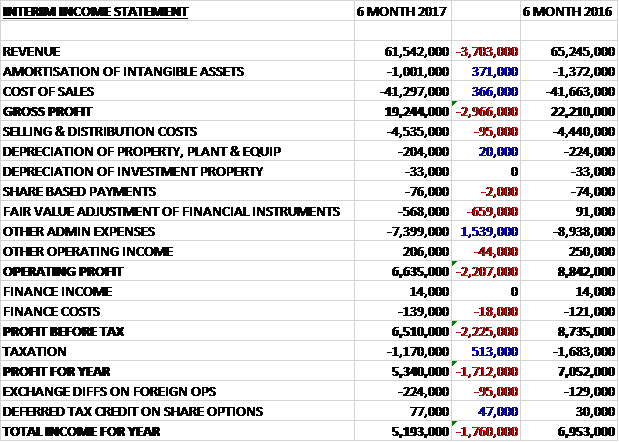
Revenues declined by £3.7M when compared to the first half of last year and after amortisation fell by £371K and other cost of sales decreased by £366K the gross profit was down £3M. There was a £659K detrimental movement in the hedging instruments but other admin expenses were down £1.5M which meant that the operating profit fell by £2.2M. Tax charges declined by £513K to give a profit for the period of £5.3M, a decline of £1.7M year on year.

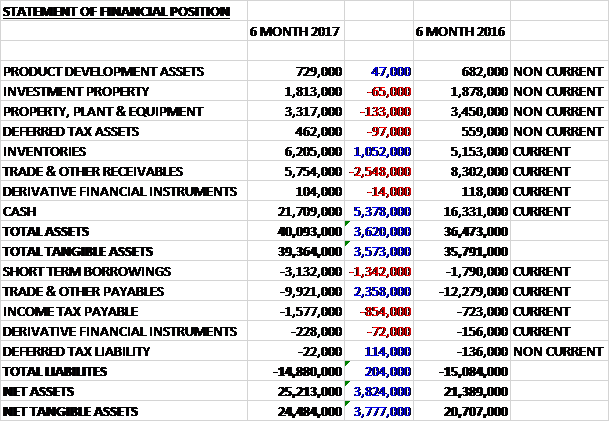
When compared to the end point of last year, total assets increased by £3.6M driven by a £5.4M growth in cash and a £1.1M increase in inventories, partially offset by a £2.5M decline in receivables. Total liabilities decreased during the period as a £1.3M growth in borrowings and an £854K increase in income tax payables were more than offset by a £2.4M fall in trade and other payables. The end result was a net tangible asset level of £24.5M, a growth of £3.8M year on year.

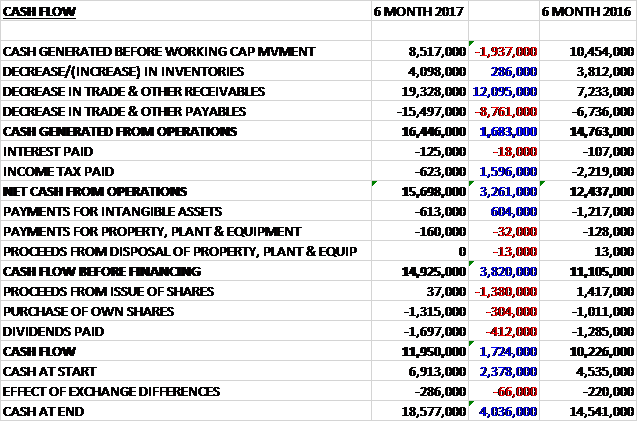
Before movements in working capital, cash profits declined by £1.9M to £8.5M. There was a cash inflow from working capital, however, mainly due to a large decrease in receivables and after tax payments declined by £1.6M the net cash from operations was £15.7M, a growth of £3.3M year on year. The group spent just £160K on property, plant and equipment along with £613K on intangible assets to give a free cash flow of £14.9M. The group then spent £1.3M on their own shares and £1.7M in dividends which left a cash flow of £12M and a cash level of £18.6M at the period-end.

During the period a number of macro-economic factors, particularly the weakness of sterling, have worked against the group as a significant proportion of purchases are made in US dollars. The board have instigated several specific measures to improve operational efficiency to mitigate the adverse effect of increased stock purchase costs arising as a result of the weakness of sterling. Apparently good progress has been made on these initiatives and material cost savings are now coming through.

The top performing brands in the period were Peppa Pig, Little Live Pets, Teletubbies, Mashems, Minecraft, Scooby Doo, Stretch and Fireman Sam. Peppa is consistently the top performing brand with Little Live Pets and Teletubbies rounding out the top three. The recently launched stretch range has already established itself as one of the group’s top brands in the UK and internationally.

As already communicated, the sales levels leading up to the Christmas period were marginally down compared to the same period in the prior year. The group adopted a cautious approach to purchasing stocks in the lead up to Christmas and their sales could have been marginally higher if they had not adopted this approach. Sales in the US were down compared to the first half of last year but the effect on profit was minimal as the margin in US sales is lower than other territories.
A number of new products are currently in development for launch this year across the core ranges – Peppa, Little Live Pets, Teletubbies, Stretch, Mashems and Minecraft. In particular there are a number of exciting developments on the Stretch range which the board believe will create a strong level of sales later this year and beyond. The second half of the year has started in line with budget and the board believe the group is on target to achieve current market expectations for the full year. Although it should be noted that the second half does have to see a considerable improvement to hit these targets.

After a 29% increase in the interim dividend the shares are yielding 3.2% which increases to 3.6% on the full year forecast. At the current share price the shares are trading on a PE ratio of 11.2 which falls to 10.3 on the full year forecast. At the period-end the group had a net cash position of £18.6M compared to £14.5M at the same point of last year.

On the 27th April the group announced that Finance Director Mark Dowding purchased 8,000 shares at a value of £37.6K to give him a total of 108,000 shares. Also, group marketing director Jeremiah Healy purchased 5,000 shares at a value of £23.5K top give him a total of 41,000 shares. Finally the group purchased 75,000 of its own shares for cancellation at a value of £352.5K.

Overall then this was a bit of a disappointing period for the group as profits declined year on year. Net assists did approve, however, and the operating cash flow increased with loads of free cash being generated. This was flattered by working capital movements, however, and the cash profit declined. The group is being affected by the Sterling depreciation as most of the purchases are made in dollars but the group have apparently taken steps to address this. Perhaps more concerning was the slightly lower Xmas sales and the reduction in revenue from the US, the reasons for which are not forthcoming.

Still, the group remains very cash generative and has a big cash pile so the forward PE of 10.3 and dividend yield of 3.6% still looks decent value. I remain a holder but am now more cautious.

On the 14th July the group announced that they have extended their master toy licence for Teletubbies for a further three years. The deal, which runs to 2020, is for worldwide manufacturing rights with UK distribution and will see the group adding further plush and plastic toys to the range. New lines such as Tiddlytubbies will be inspired by new elements from season two which launched earlier in 2017.

On the 6th September the group announced that it had been appointed the master toy distributor in the UK and Ireland for Pokemon. The agreement will see action figures, playsets, plus, role play and other toys based on the series joint their portfolio from summer 2018.

On the 15th September it was announced that, due to a loss of confidence in him by the senior executive team, Mark Dowding’s contract as Finance Director has been terminated and he ceased to be a director with immediate effect. Consequently, the joint MD Kiran Shah will assume the responsibility of Finance Director. This is all a little strange, there is not that much to go on as to whether this is serious or not.

On the 19th September the group announced that it had a solid finish to the year and pre-tax profits are expected to meet current market expectations. Conditions in the wider market remain challenging at the consumer level and one of the group’s major customers, Toys R Us has filed for Chapter 11 bankruptcy protection in North America. At this early stage they do not know the extent to which this will impact trading with them both in the UK and internationally so they don’t have reliable visibility on the important Christmas trading period, which is a real concern. I am not sure if I should look to sell some of these to be on the safe side.

On the 11th October the group announced that their international sales had been adversely affected by a combination of factors, not least the bankruptcy of Toys R Us, and the conservative approach taken by the international customers.

At this early stage in the group’s new financial year, the board considers that group performance for 2018 is now expected to be significantly below current market estimates. The directors consider this to be a temporary downturn and that they anticipate returning to growth during the second half of the year with an improved financial performance in 2019 as they are introducing new products which they believe to be very strong. Even in these tough trading conditions, they expect their cash flow to remain positive.

This is clearly disappointing but not altogether unexpected. I have sold around half my holding given the ongoing uncertainty.

Portmeirion Share Blog – Final Results Year Ended 2016

Portmeirion has now released their final results for the year ended 2016.

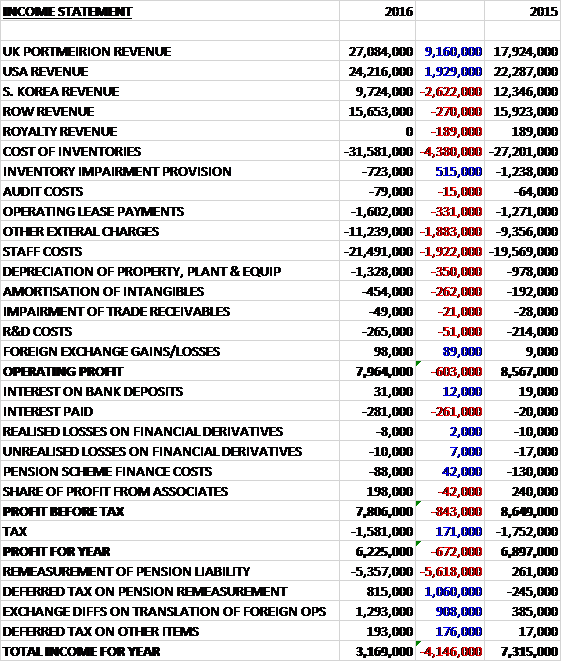
Revenues increased when compared to last year driven by the acquisition and favourable forex movements as a £2.6M decline in South Korean revenues, a £270K fall in ROW revenue and a £189K decrease in royalty revenue was more than offset by a £1.9M increase in US revenue and a £9.2M growth in UK revenue following the Wax Lyrical acquisition. Cost of inventories increased by £4.4M, however, staff costs were up £1.9M and other external charges grew by £1.9M to give an operating profit £603K lower than in 2015. Interest payments increased by £261K but tax charges were down £171K to give a profit for the year of £6.2M, a decline of £672K year on year.

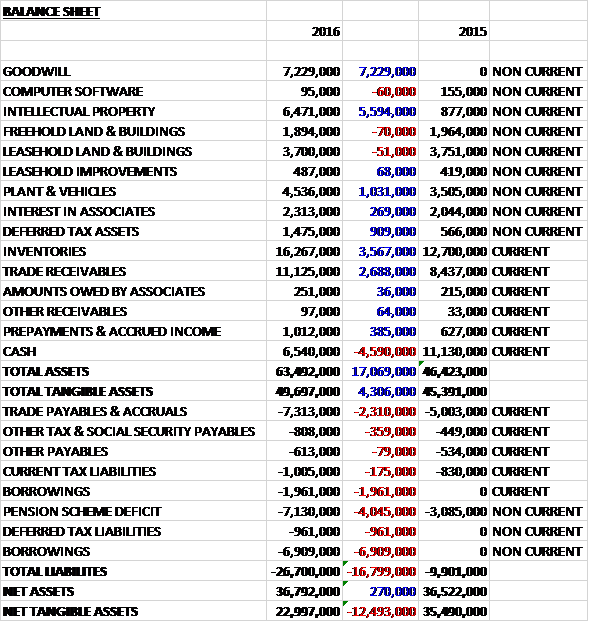
When compared to the end point of last year, total assets increased by £17.1M driven by a £7.2M growth in goodwill, a £5.6M increase in IP, a £3.6M growth in inventories, a £2.7M increase in trade receivables and a £1M increase in the value of plant and vehicles, partially offset by a £4.6M decrease in cash. Total liabilities also increased during the year due to an £8.9M increase in borrowings, a £4M growth in the pension liabilities and a £2.3M increase in trade payables and accruals. The end result was a net tangible asset level of £23M, a decline of £12.5M year on year.

Before movements in working capital, cash profits increased by £124K to £10.1M. There was a broadly neutral working capital position but the group paid out £463K more in contributions to the pension scheme. After tax payments fell by £425K the net cash from operations came in at £6.9M, a decline of £3.8M year on year. The group spent £744K on property, plant and equipment and after £16.7M was spent on the acquisition, before financing there was a cash outflow of £10.5M. The group also spent £3.2M on dividends so took out £8.8M of new borrowings to give a cash outflow of £4.7M and a cash level of £6.5M at the year-end.

The Brexit vote and the US presidential elections were major uncertainties in the two largest markets and South Korea continued to suffer economic problems which resulted in reduced demand for luxury products. Following a big sales increase in India last year, the region did not perform as well this year and returning sales in the country to the higher level will take time.

Like for like sales in the UK increased by just over 2% and the board remain cautious over the effect of Brexit. On a constant currency basis, sales in the US decreased by 3.7% but there are hopeful signs that the economy remains on the upswing despite some doubts remaining over how government policy will affect importers. Own internet sales in the UK and US increased by 31.8% to £3.3M during the year.

Sales into South Korea fell by a further 21% meaning that over the past two years sales have collapsed by £5.4M to £9.7M. The group are working closely with their distributor to try and rebuild sales. Sales in India were just £1.1M, a disastrous year on year fall of £4.7M with the performance of the Indian distributor being very disappointing. The group have therefore changed their distribution arrangements in the country. There were some increases into Europe and some Asian markets such as Hong Kong and Taiwan, however.

In May the group acquired Wax Lyrical for a total cash consideration of £17.5M. The business is the UK’s largest manufacturer of home fragrances and their products include scented candles and reed diffusers. In the prior year the business generated a pre-tax profit of £2.1M and the acquisition generated goodwill of £7.2M. Significant growth opportunities for Wax Lyrical’s products are envisaged within the group’s existing markets and they particularly expect to growth their sales through their existing UK customers, websites and retail outlets. During the period since the acquisition the business contributed £1.5M to profits.

The group have been working on production development. Last year saw new patterns released, of which Strawberry Thief, licensed from Morris and Co, is a good example. In the current year to date, Choices and Sara Miller have been well received amongst a number of new patterns, Wrendale continued to expand and they are pulling home fragrance products into their established ceramic ranges as they tie in more closely to Wax Lyrical.

The new kiln came on line just a few weeks before the board saw the reality of falling demand from India and South Korea. It has helped relieve a bottleneck, however, with the existing glost kiln, it is more efficient than the existing tunnel kilns and significantly more fuel efficient than the four intermittent kilns that they have had to use during high throughput periods. Average weekly production has been 130,000 and clearly putting more volumes through the factory would be a marginal cost benefit with a great effect on profits.

Trading in the first two months of 2017 was marginally ahead of the prior period on a like for like basis and 20% ahead including Wax Lyrical with the outlook positive and the issues experienced being overcome by proactive management.

At the current share price the shares are trading on a PE ratio of 14.7 which falls to 13.1 on next year’s consensus forecast. After a 7.5% increase in the total dividend the shares are yielding 3.7% which increases to 3.8% on next year’s forecast. At the end of the year the group had a net debt position of £2.3M compared to a net cash position of £11.1M at the end of last year.

Overall then this has been a difficult year for the group. Profits declined despite the additional contribution from Wax Lyrical, net assets decreased and the operating cash flow fell, although excluding the acquisition, the group remained fairly cash generative. The UK held up fairly well but the other main markets fared less well. South Korea and India in particular suffered particularly bad times. Hopefully the change in the distribution network will help the latter but there doesn’t seem to be much evidence of ideas in turning South Korea around.

The new year has started a bit better but until some real evidence of a turnaround in the core business has cropped up, I find it hard to buy back in here. The forward PE of 13.1 and 3.8% both look OK, however, and I have confidence that at some point this will look like good value.

On the 25th May the group released an AGM statement. Total group sales are up 26% in the first four months of the year and excluding Wax Lyrical on a translated currency basis total group sales are comfortably ahead of last year but on a constant currency basis they are flat. The board continue to expect pre-tax profit to be in line with market expectations for the full year.

On the 7th July the group released a trading update covering the first half of the year. Total group sales were up 16% but excluding Wax Lyrical sales, and at constant currency, they declined by 2%. Profit is still expected to be in line with market expectations, however.

Somero Share Blog – Final Results Year Ended 2016

Somero has now released their final results for the year ended 2016.

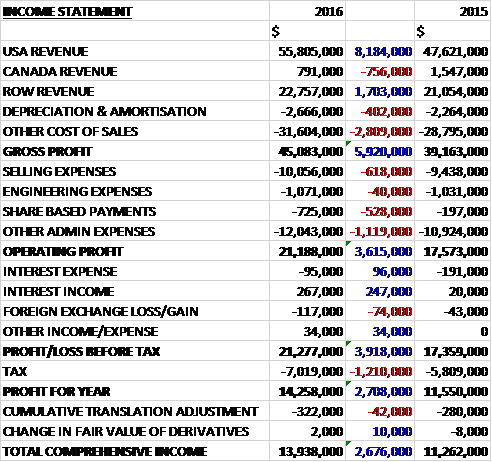
Revenues increased when compared to last year as a $756K decline in Canadian revenue was more than offset by an $8.2M growth in US revenue and a $1.7M increase in ROW revenue. Depreciation was up $402K and other cost of sales increased by $2.8M to give a gross profit $5.9M above that of last time. Selling expenses grew by $618K, share based payments increased by $528K and other admin costs were up $1.1M so the operating profit increased by $3.6M. We then see a $247K growth in interest income offset by a $1.2M increase in tax charges to give a profit for the year of $14.3M, an increase of $2.7M year on year.

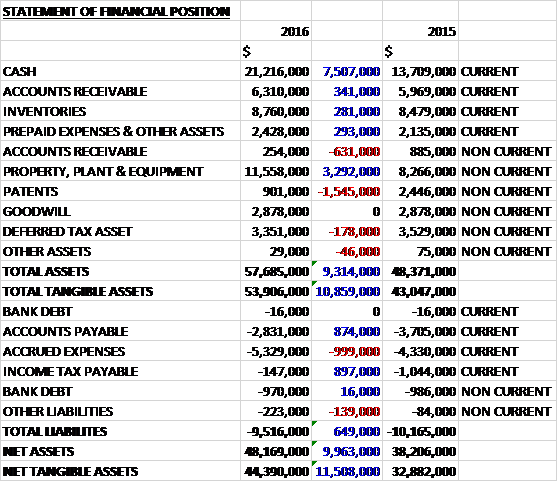
When compared to the end point of last year, total assets increased by $9.3M driven by a $7.5M growth in cash and a $3.3M increase in property, plant and equipment, partially offset by a $1.5M decline in the value of patents. Total liabilities fell somewhat during the year as a $1M growth in accrued expenses was offset by an $897K increase in income taxes payable and an $874K growth in accounts payable. The end result was a net tangible asset level of $44.4M, a growth of $11.5M year on year.

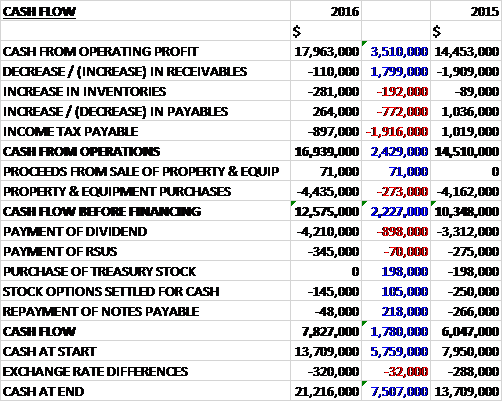
Before movements in working capital, cash profits increased by $3.5M to $18M. There was a cash outflow from working capital to give an operating cash flow of $16.9M, a growth of $2.2M year on year. The group spent $4.4M on capex which meant they had a free cash flow of $12.6M. Of this, $345K was used to pay the RSUS, $145K went on stock options settled for cash and $4.2M was paid out in dividends to leave a cash flow of $7.8M for the year and a cash level of $21.2M at the year-end. This is strong stuff.

The performance in the North American market continued to be strong with sales up 15%, reflecting a healthy commercial construction environment supported by the new political establishment. It was also driven by an abundance of commercial construction combined with a growing shortage of skilled labour in the concrete contractor industry that increased demand for Somero equipment. New products have also been a contributor to growth in the region as the new S-10A and S-940 laser screed machines have gained considerable traction in the market.

The group’s European market accelerated its recovery in the year with sales growing 40%. This growth was well balanced across the product line and on a geographic basis with particularly solid trading in Italy, Poland, UK, Spain and the Czech Rep.

The Chinese market stabilised in 2016 with a 5% increase in sales. The group recruited an experienced sales manager based in Shanghai to lead the sales team there and in late 2016 introduced their newly designed entry level S-158 laser screed machine and the S-940 laser screed machine to the country, two products that the board believe will attract new productivity oriented customers. Finally the long term financing programme continued to be a success which has earned the group $200K in interest income this year.

Sales in Australia improved substantially in the year, more than doubling to reach $2.3M. This was driven in part by improved economic conditions combined with the strengthening of the Australian dollar. Sales in the Middle East grew 7% to reach $2.9M with strong contributions from Turkey, the UAE and Saudi Arabia. In Latin America, sales declined 15% but the second half of the year was considerably improved from the start of the year reflecting noticeably improved activity levels across the region, including modest improvements in Brazil.

In South East Asia, sales more than halved to just $400K although the group continue to view the region as a growth opportunity. Sales in India also collapsed, down to just $100K although the group exited the year with a solid pipeline of opportunities, some of which were delayed as a result of the Indian banking system reforms that slowed bank financing approvals. As expected, sales in Russia improved only modestly to $200K given the continued unstable economic climate in the country.

During the year the group completed development of three new products. Their entry level S-158 laser screed machine targeted for the Chinese market, their new SP-16 concrete hose line-pulling and placing system and their next generation 3D profiler system. All three have been well received by the market with the S-158 launching at the end of 2016 in China and the SP-16 and 3D profiler system launching in January 2017 at the World of Concrete trade show. Additionally in the year they gained significant sales traction with products that were developed in the previous year, the S-10A and the S-940 laser screed machines with growth in sales of $4.6M.

It should be noted that the group is still rather reliant on a small number of customers. One represented 20% of total accounts receivable for example.

During the year the group completed their new global HQ and training facility in Fort Myers to provide a venue for customer training and product demonstration. In the coming year they plan to construct a training facility for $700K, located on the Fort Myers campus which is expected to enable them to launch the Somero Concrete Institute in Q2 2017.

Going forward the solid momentum in North America at the end of 2016 has carried over into 2017 driven by demand for replacement equipment, technology upgrades and interest in new products. The board remain encouraged by the solid level of non-residential construction activity in the US, a view that is supported by reports from customers of lengthy project backlogs that extend well into 2017. Proposals for US corporate tax reform and fiscal policy programmes to invest in US infrastructure are additional factors reinforcing their confidence in growth prospects in the region.

In Europe, the 2016 acceleration of recovery from the recession is expected to carry forward into 2017, driven by demand for replacement equipment, technology upgrades and interest in new products, much like in the US. In China the interest level in the group’s products remains healthy with a particularly solid interest in the S-158 entry level product which opens up the productivity oriented market segment that they expect will help them grow their customer base and offer future upsell opportunities. They also see traction with their market development activities to promote certain flatness standards. This points to solid growth prospects in China for the year ahead.

In Latin America, the group are expecting a stable performance from Mexico and Chile and they have begun to see modestly increased activity in Brazil, and are optimistic for a satisfactory contribution to growth from the other countries in the region. Overall the board are confident that the group is poised to deliver another year of profitable growth.

At the current share price the shares trade on a PE ratio of 17 which falls to 14.5 on next year’s consensus forecast. After a 61% increase in the dividends the shares are yielding 2.7% which increases to 2.8% on next year’s forecast. The board have approved an increase to the dividend payout ratio to 40% of net income. At the year-end the group had a net cash position of $20.2M Compared to $12.6M at the end of the prior year. After the year-end they paid off their outstanding mortgage totalling $1M which leaves them debt free.

Overall then this has been a very strong year for the group. Profits were up, net assets increased and the operating cash flow improved with plenty of free cash being generated. The good performance is being supported by a strong commercial construction market in the US where the group gets most of its revenue from. Australia and Europe also showed strength with Asia looking a bit more subdued as there seems to be some resistance to take on the group’s products in the less sophisticated emerging markets.

Going forward, as long as the US construction industry stays healthy, things should go well for Somero. For once, though, the valuation looks a bit more sensible as the forward PE of 14.5 and yield of 2.8% looks about right. It is worth noting the big piles of cash the group has, however, and I am happy to continue holding.

On the 5th June the group released a trading update for the first half of the year with strong trading in Europe, and solid contributions from the Middle East, Latin America and ROW markets. In North America, trading has been flat due in part to poor weather across the country that has delayed numerous project starts and ongoing political uncertainty. In China, trading at the start of the year has been slow but there have been some signs of improvement and early traction with the new entry-level products. Overall the trading to date is in line with expectations.

The added headcount has created a need for additional office space in the Florida HQ so the board has approved plans to build a $1.3M expansion to accommodate the planned growth. The project will be completed in the first half of 2018 with the majority of costs expected in that year. The board has also announced that they will be distributing $7.5M in the form of a special dividend representing a dividend per share of 13.3c.

I have to say the slow-down in the US is disappointing and a concern as it is the largest market by far. It sounds as though it may be temporary, however, so I remain a holder although I will be keeping a closer eye on developments.

On the 18th July the group released a trading update covering the first half of the year. Trading in June was stronger than both May and the period year comparison. This performance, together with the continuation of the positive global trading environment, margin improvement and solid operating cash flow generation has underpinned a positive outlook for the second half of the year and the group’s expectation that trading for the full year will be in line with market expectations.

On a regional basis, June trading activity in North America was at the highest levels of the year as weather conditions improved and projects started but H1 trading will show a slight reduction from prior year levels. Looking ahead the group remains encouraged by the healthy US commercial construction market, extensive project backlogs being experienced by customers and the high level of activity that is carrying into the second half.

First half trading in Europe was very strong, significantly increasing over the prior year, driven by broad-based geographic contributions. Latin America and ROW territories were also significant contributors to growth in the period with trading significantly higher when compared to the prior year. Trading in the Middle East ended the period slightly down from the prior year as a result of a number of opportunities in this territory having been carried over to the second half. In China, June trading was also at the highest level of the year (this isn’t saying much in the Northern hemisphere) and despite first half trading falling below last year, the group expects improvements in the second half.

Overall then, this seems to be a cautiously optimistic update and I continue to hold.

The Property Franchise Group – Final Results Year Ended 2016

The Property Franchise Group has now released their final results for the year ended 2016.

Revenues increased when compared to last year with a £684K growth in management service fees, a £96K increase in franchise sales and a £391K growth in other revenue. Cost of sales was also up to give a gross profit £956K above last time. Property costs declined by £69K but employee costs were up £39K, amortisation increased by £86K, audit costs grew by £85K and other admin expenses increased by £204K. We also see a £150K increase in acquisition costs partially offset by a £61K decline in redundancy costs to give an operating profit £531K above last time. We also see a £30K unwinding of the discount on deferred income and a £341K decrease in tax charges due to tax relief on share based payments and the effect of a change in the rate used for deferred tax, to give a profit for the year of £3M, a growth of £840K year on year.

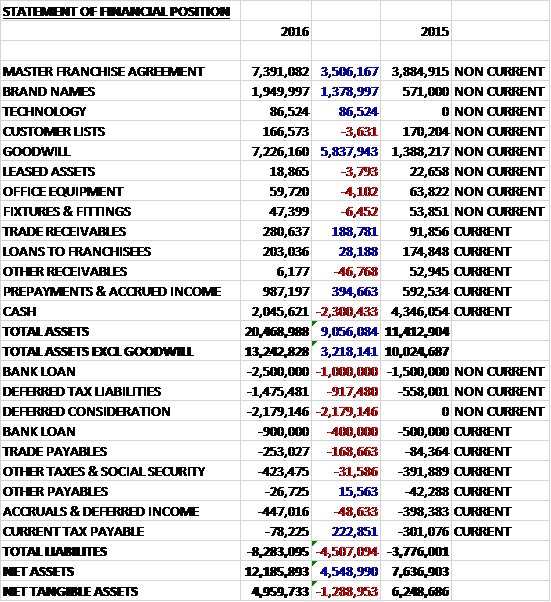
When compared to the end point of last year, total assets increased by £9.1M driven by a £5.8M growth in goodwill, a £3.5M increase in the value of the master franchise agreement and a £1.4M growth in the value of brand names. Total liabilities also increased during the year due to a £2.2M growth in deferred consideration, a £1.4M increase in the bank loan and a £917K growth in deferred tax liabilities. If we exclude goodwill (I am attributing face value to the master franchise agreement which I am slightly torn over) the net tangible asset level is £5M, a decline of £1.3M year on year.

Before movements in working capital, cash profits increased by £619K. There was a cash outflow from working capital movements but tax and interest both saw modest declines to give a net cash from operations of £2.4M, a growth of £211K year on year. The group spent £92K on intangibles along with just £14K on fixed tangible assets but also spent £4.8M on acquisitions so there was a cash outflow of £2.5M before financing. They took out a net £1.4M of new loans which paid for the £1.4M of dividends and the cash outflow for the year was £2.3M and the cash level at the year-end was £2M.

There were a number of headwinds for the housing market this year from tax changes and uncertainty surrounding Brexit. The additional rate of stamp duty on second homes and buy to let purchases for individuals had the effect of a rush to complete transactions before April 2016 which resulted in a surge in group sales in March followed by a comparatively quieter period. Summer uncertainty around the Brexit vote appeared to undermine consumer confidence and instruction levels fell for both sales and lettings before recovering in Q4.

In the autumn the government announced its intention to limit or ban tenant fees in England. At the time of writing the timetable and extent of any ban remains unclear. In Scotland, where a ban has existed since 2012, the experience has been that the impact on revenues were mitigated in just over a year.

Management service fees increased by 11% with lettings fees up 9% and sales fees increasing by 19%. The Xperience business delivered £1M of earnings. The brands were tilted 54% to 46% estate agency over lettings revenue and the group looked to increase its lettings income stream which now stands at 46% 54% respectively. Lettings revenue grew by 12% compared to 4% in the traditional Martin and Co business.

The group rolled out financial services to 2/3 of their traditional brand offices during the year. The proposition is a selection of mortgages and fee-free advice from partner London and Coventry whilst general insurance products will be tied to Legal and General which should add another revenue stream.

In September the group acquired Ewemove Sales and Lettings for a consideration of £5M in cash and £3M in shares. A further amount of up to £7M is due in 2018 subject to various targets. The acquisition generated goodwill of £5.8M. The board had observed a shift in the estate agency sector with the growth of online agents which don’t have physical premises and adopt pricing models based on listing fees rather than completions. They decided to acquire an operator rather than build their own. Following the acquisition the business contributed a profit of £100K. After the year-end the group announced that the deferred consideration payable to the founders of ESLL had been renegotiated to two cash payments of £500K in 2017.

The group have a clear brand strategy. Martin and Co is the national lettings brand; Ellis & Co, Parkers, CJ Hole and Whitegates are regional brands with a particular expertise in estate agency services and EweMove is the challenger brand.

At the current share price the shares trade on a PE ratio of 12 which falls to 10.3 on next year’s consensus forecast. After a 10% increase in the dividend the shares are yielding 4.2% which increases to 5.3% on next year’s forecast.

Overall then this has been a pretty decent year for the group. Profits and the operating cash flow both grew, although after the acquisition there was no free cash and the net tangible asset level declined due to the acquisition. There are various headwinds affecting the sector and the potential ban on tenant fees could affect income quite a bit. The Ewemove acquisition looks quite expensive but it is probably a good move to acquire a challenger brand with the way the market is going and I think the forward PE of 10.3 and yield of 5.3% adequately cover the risk. I am a holder.

On the 9th May the group released a trading update for Q1. The trading performance has been robust with like for like revenue increasing 4%. Management Service fees were unchanged with a growth in lettings of 7% offset by a 19% fall in sales due to a rush to complete transactions ahead of stamp duty changes in Q1 2016. EweMove has grown its revenue by 14% and its total number of franchise stands at 108.

The board have not seen any evidence that landlords are disposing of stock in increasing numbers. Their traditional brands have more than 400 more properties to let than at this point of 2016 and the tenanted managed portfolio across the whole group is up from 48,000 at the year-end to 49,000 at the end of the quarter. Against this backdrop, they are confident of delivering a performance in line with market expectations.

Spectris Share Blog – Final Results Year Ended 2016

Spectris has now released their final results for the year ended 2016.
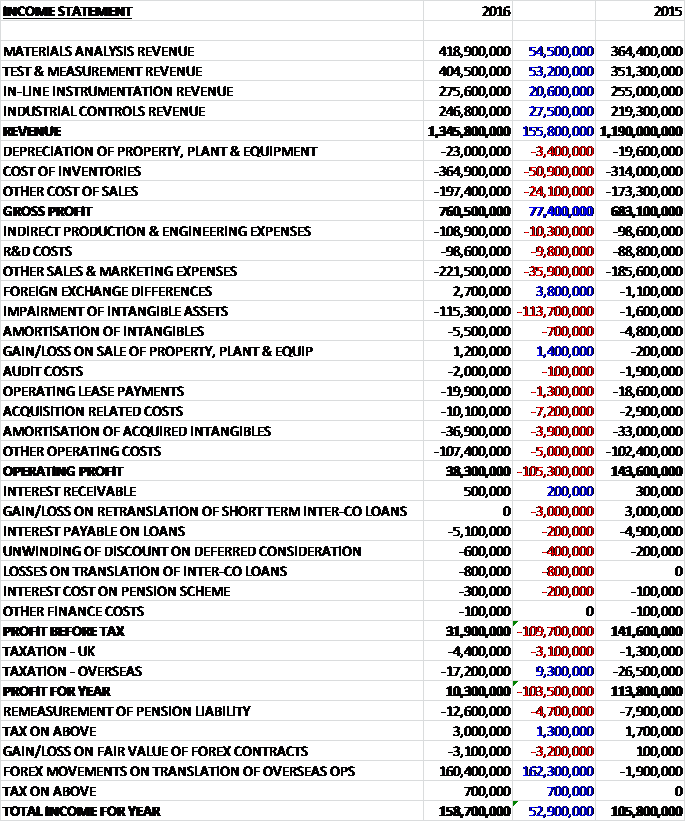
Revenues increased when compared to last year, mainly as a result of favourable currency movements with a £54.5M growth in Materials Analysis revenue, a £53.2M increase in Test and Measurement revenue, a £27.5M growth in Industrial Controls revenue and a £20.6M increase in In-line instrumentation revenue. Cost of inventories was up £50.9M and other cost of sales increased by £27.5M to give a gross profit £77.4M above that of last time. Indirect production costs grew by £10.3M, R&D costs were up £9.8M and other sales and marketing expenses increased by £35.9M. We then see a £113.7M increase in intangible asset impairments and a £7.2M growth in acquisition related costs which meant that the operating profit fell by £105.3M. Finance costs increased somewhat, mainly due to the lack of a gain on the retranslation of inter-company loans but tax charges declined by £6.2M to give a profit for the year of £10.3M, a decline of £103.5M.
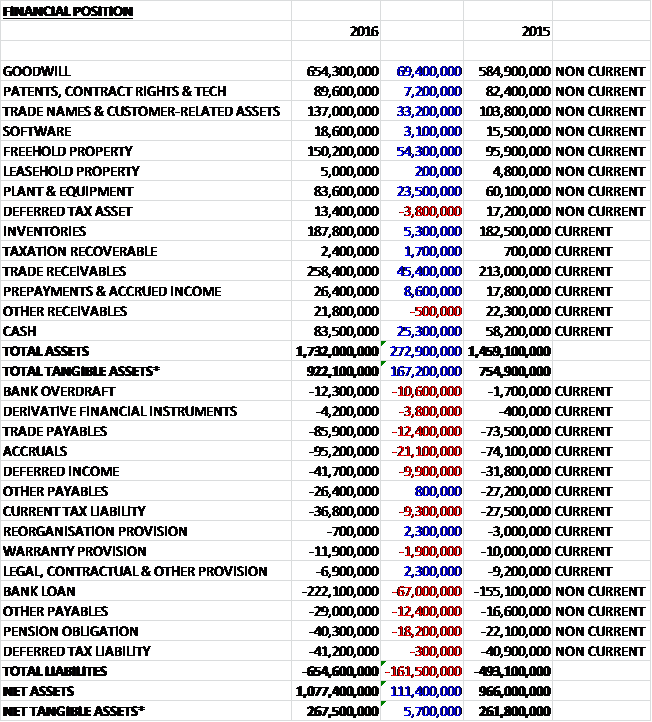
When compared to the end point of last year, total assets increased by £272.9M driven by a £69.4M growth in goodwill, a £54.3M increase in freehold property, a £45.4M growth in trade receivables, a £33.2M increase in trade mark values, a £25.3M growth in cash and a £23.5M increase in plant and equipment. Total liabilities also increased during the year due to a £67M growth in the bank loan, a £21.1M increase in accruals, an £18.2M growth in pension obligations, a £12.4M increase in trade payables and a £12.4M growth in other payables. The end result was a net tangible asset level of £267.5M, a growth of £5.7M year on year.
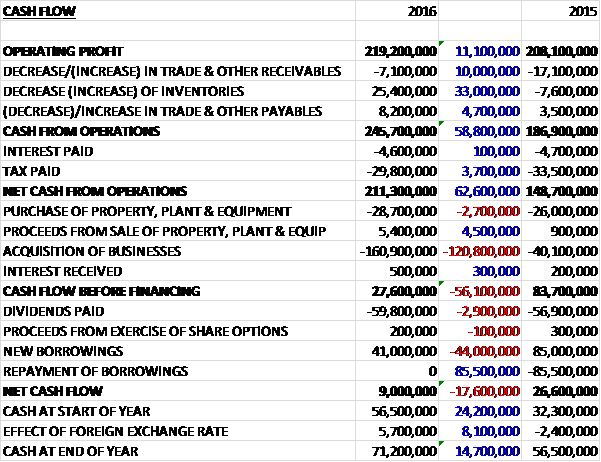
Before movements in working capital, cash profits increased by £11.1M to £219.2M. There was a cash inflow from working capital and tax payments declined by £3.7M to give a net cash from operations of £211.3M, a growth of £62.6M year on year. The group spent £28.7M on capex and £160.9M on acquisitions to give a free cash flow of £27.6M. This did not cover the £59.8M paid out in dividends so the group took out £41M of new loans to give a cash flow of £9M and a cash level of £71.2M at the year-end.

Overall the adjusted operating profit increased by 11% but acquisitions accounted for 4.6% of this growth and positive forex movements accounted for 12.5% so like for like profits actually declined by 6.2% during the year.
The operating profit in the Materials Analysis business was £76.2M, a like for like increase of £15.8M year on year although like for like sales growth was just 2% driven by China and Japan with North America and Europe down slightly. The growth in profits was mainly due to a better mix of product and cost cutting actions.

From the start of 2017 the group merged two of the segment’s operating businesses – Malvern Instruments and PANalytical. In November, PANAlytical launched Aeris a benchtop x-ray powder diffractometer and the target markets have been extended beyond the cement, minerals, metals and research markets traditionally associated with PANalytical to include the pharmaceuticals and fine chemicals markets where Malvern holds a leading position.

Sales to the pharmaceuticals and fine chemicals industries rose on a like for like basis during the year, particularly pleasing given last year benefited from the demand from regulatory compliance requirements in the Indian market. Asia saw particularly strong growth from China, India and Japan while European and North American sales were up modestly.

The metals, minerals and mining sector reversed its good 2015 performance and saw like for like sales decline. All regions experienced falls and large systems orders continued to be deferred or cancelled and the growth within the cement and building materials markets in North America and Europe in recent years has slowed. Aftermarket sales were solid, however, as customers’ production volumes continued at good levels.

Although there was reasonable sales growth to academic research institutes in North America and Asia, underlying demand was subdued with significant weakness in the UK. Sales to the semiconductor, electronics and telecoms industry grew strongly, particularly in Asia. Sales in North America were notably weaker year on year, however. Sales of the new ultra-high sensitivity particle counter products which were launched in 2015, performed well.

Going forward, the merger of Malvern and PANalytical is expected to begin to generate revenue synergies as they benefit from a more comprehensive offering to their customers. The underlying trading in conditions in the end markets will be the key driver of near term performance, however. Within pharmaceuticals the board expect regulatory scrutiny of manufacturing processes to continue to increase and drive demand for their material characterisation and clean room products and services. They expect these factors will more than offset what is likely to remain an unpredictable academic research market given public sector budget constraints in certain regions. The board are also seeing a cautiously improving investment client in the mining sector but do not expect to see a major pick-up in demand as yet.

The operating profit in the Test and Measurement business was £61.8M, a like for like decline of £7.8M excluding a £7.8M benefit from forex movements and a £5.1M increase from acquisitions. Like for like sales fell by 4% and only Asia showed any growth with sales in North America notably lower and European sales down modestly.

The underlying demand from the automotive sector remained healthy, particularly in R&D with one of the key drivers of demand being the electrification of power trains for deployment in electric and hybrid vehicles. This created opportunities for the group’s EDrive testing solution which enables the electric motor, inverter and battery data to be quickly evaluated. This also creates opportunities for the NVH service offering as engine noise is reduced from motor vehicles, noise evaluation and control shifts focus to sources elsewhere in the car such as tyres.

In machine manufacturing there was sales growth as a decline in North America was offset by increased sales to Asia and Europe. Sales to the aerospace sector decreased and were lower in each of the regions except North America due to the completion of several major R&D programmes. During the year the group custom-developed sensing solutions for Marenco’s new helicopter. Reflecting some pressure on public finances, sales to academic research institutes declined with weakness in demand in all regions except China. Sales to consumer electronics customers declined although sales patterns are lumpy reflecting the scheduling of projects by customers.

Sales of the environmental noise monitoring services declined partly due to a one-off major contract in 2015. The UK and Japan were the only major markets to deliver growth as the business secured a key contract to provide Heathrow Airport with 50 noise monitoring terminals, and launched Airport Noise Monitoring on Demand. They established a dedicated urban sales force to widen their market reach for noise monitoring equipment and services and secured orders during the year.

The weakness in the unconventional oil and gas markets continued during the year and the group saw a further sizeable decline in sales of their microseismic monitoring solutions, particularly in North America. As a result, they have looked to develop opportunities in other markets and are making progress in this regard in Latin America and the Middle East. Their performance was better in the mining sector where sales were flat, with demand for microseismic monitoring growing. For example they have been working more closely with Grasberg, the world’s largest copper-gold mine, supplying microseismic monitoring equipment and analytics for different phases of development as well as improving safety and efficiency.

Going forward the group expect the automotive and aerospace sectors to benefit from further growth in demand for engineering software applications. Additionally the continued robust investments in the development of electric and hybrid vehicles will support demand for their torque and eDrive solutions. The underlying business trends in the consumer electronics market remain healthy but market conditions in the oil and gas industry are expected to remain subdued. There may be more opportunities for the deployment of microseismic in the mining space, however.

The operating profit in the In-Line Instrumentation business was £41.2M, a like for like decrease of £3.8M excluding a £5.4M benefit from forex movements and a £600K contribution from acquisitions. Like for like sales declined by 4% as a small rise in North American sales was more than offset by declineS in Asia and Europe, reflecting ongoing weakness in capex across many heavy process industries.

In the pulp and paper market, like for like sales were down slightly. They continued to see a diversification away from graphic paper towards the tissue and pulp markets, translating into growth for their tissue business which is partly offsetting the decline in traditional coating bladed.

In the energy and utilities market, sales were down notably as the weak oil and gas markets continued to have an adverse impact on demand. There was a lack of new larger projects in the hydro-carbon processing sector but other areas such as industrial gasses, emissions monitoring and the Hummingbird OEM sensor business continued to perform well. In November the group launched their first moisture detector which allows the fast and accurate measurement of moisture in process applications. It is designed to integrate with their digital oxygen analyser as the measurement of both oxygen and moisture is a common requirement in many applications.

The group are continuing to see modest growth in the wind energy sector and have focused on wind farm owners and operators in addition to the traditional turbine OEM segment, in order to offer them a post-warranty solution for their turbine fleet that is OEM independent with this initiative having identified significant opportunities. They have also expended their offering to non-wind power applications in other industrial markets with the B&K Vibro business securing a condition monitoring contract with a biomass power plant in the UK and a contract to supply a turnkey condition monitoring and machine protection solution for remote monitoring at a polyethylene plant in Northern Asia.

Sales to the web and converting industries increased notably during the year with a particularly strong performance in Q4 after customers were delaying projects in 2015. They have seen a number of opportunities emerge in the medical market and in food, particularly in relation to snack products. For example, a medical tube manufacturer uses the group’s measurement and control system to control the critical dimensions and quality of tis extruded products and in India a snack manufacturer has improved quality and production efficiency with online moisture and oil measurement for crisps and snacks lines.

Going forward, the changing mix in the pulp and paper business is expected to continue in 2017 and the group expect to benefit from the combination of Capstone’s software tools with BTG’s instruments to capture new opportunities. They expect growth from the energy and utilities sector to be modest. The renewable energy sector remains healthy and the expansion of their offering to differing customer types and new areas of the market offer potential new sales opportunities but the oil and gas sector remains fragile.

The operating profit in the Industrial Controls business was £21.6M, a like for like fall of £15M excluding a £1.7M forex benefit and a £2.3M contribution from acquisitions. Like for like sales declined by 2% with a sharp decline in sales to North America. The poor profit performance was further exacerbated by the performance of Omega.
Omega derives the majority of its sales from the US and the weak US industrial environment impacted demand for its products. In addition, the implementation of a new ERP system at the business highlighted the need for certain processes to be improved with temporary additional resources required during the consolidation of two distribution centres on the US east coast. This resulted in significant inventory adjustments and higher labour costs. A new organisational structure and management team has been put in place and the focus is on remedial action to redesign the operational processes and improve customer service.

In Asia there was strong sales growth, in particular driven by continued good progress in the expansion of the group’s process measurement and control business outside the US. The internationalisation of Omega continues to produce promising results, with good sales growth in all major markets outside the US. In Europe overall segment sales were flat with a challenging year for their industrial networking business being partly offset by sales growth in process measurement and control products.

The increasing trend towards the industrial internet of things is benefiting their industrial automation and networking business and the group’s product development was focused on simplifying the integration of customer generated data and IoT cloud platforms. During the year they launched the latest version of their Crimson software, adding control capability to their products. This provides a key solution for customers as it removes the need to purchase standalone control components. They had further success with their networking products in the automotive industry, securing a contract for as major car maker’s new plant in Latin America.

The acquisition of Label Vision Systems in 2015 has delivered very positive results during 2016 with strong sales growth of its products as the market expands due to regulatory trends and quality requirements. It has been fully integrated into Microscan and this has enabled the expansion of LVS products into key international markets and to leverage the synergies between LVS and Microscan operations. Following the launch in 2015 of a scalable industrial barcode imager and smart camera platform, further developments were made this year with autofocus and smart camera versions.

Going forward, given the significant exposure to the US, performance will be largely driven by the performance of US industrial markets. The PMI manufacturing index has turned more positive recently but it is too early to assess the extent of any positive market momentum. At Omega the board expect the organisational changes to deliver an improvement in performance and to exit the year with margins at historic levels.

There were a number of impairments during the year. There was a £94.4M impairment charge relating to Omega as a consequence of the 2016 performance and lower projected cash flows. This has resulted in a reassessment of its expected future business performance in light of the trading environment and the actions required to improve profitability. There was also a £20.9M impairment charge relating to ESG due to the continuing difficult external market conditions caused by the low oil and gas prices.

In February the group acquired CAS Clean Air Service for £12M, generating goodwill of £5M. The business is based in Switzerland and extends the group’s capabilities in monitoring and calibration services in the life sciences market. In June the group acquired Integrated Process Systems, an Indian agent, for a total consideration of £900K, generating goodwill of £500K. It is being integrated into the Test and Measurement segment. Also in June the group acquired Capstone Technology Corporation for a total consideration of £14.8M, generating goodwill of £9.6M. The business is based in the US and is a provider of software solutions for process control optimisation and decision support, serving multiple industries such as pulp and paper, chemicals, utilities, oil and gas and beverages. It is being integrated into the in-line instrumentation segment.

In July the group acquired Sound and Vibration Technology for a consideration of £400K, generating £100K of goodwill. The business is based in the UK and provides sound and vibration test based solutions. Also in July the group acquired DISCOM for a total consideration of £20.4M, generating goodwill of £12.2M. The business is based in Germany and provides integrated solutions combining hardware and software to enhance production quality and identify potential problems in manufacturing processes. It is being integrated into the Test and Measurement segment.

In September the group acquired Millbook for a total consideration of £125.7M, generating goodwill of £54.1M. The business is based in the UK and extends the group’s capabilities to provide test, validation and engineering services to the automotive, transport and tyre, petrochemical, defence and securities industries. It is being integrated into the Test and Measurement segment. The revenue and operating profit contribution from the acquired businesses in the year was £28.9M and £2.1M respectively.

The year ended well with like for like sales growth in Q4 following challenging trading conditions in the first nine months of the year although end market growth in the near term is expected to be modest. Planned capex in 2017 is expected to be significantly higher than in 2016 at around £70M, primarily related to expansion opportunities at Millbrook and a number of infrastructure projects at HBM, Omega and Malvern Instruments.
At the current share price the shares are trading on a PE ratio of 26.3 (if we ignore the intangible impairment) and this falls to 19.7 on next year’s consensus forecast. At the year-end the group had a net debt position of £150.9M compared to £98.6M at the end of last year. After a 5% increase in the dividend the shares are yielding 2% which remains the same on next year’s forecast.

Overall then on the surface this has been a good year. Profits were up, excluding the impact of the impairments, net assets increased and the operating cash flow improved with some free cash being generated, although not enough to cover the dividends. Scratch beneath the surface, however, and it can be seen that favourable forex movements were responsible for the decent performance and like for like profits declined. The one sector that is doing fairly well is Materials Analysis which saw some modest sales growth which when mixed with cost cutting measures meant that profit grew nicely. Going forward, public spending restrictions are likely to hold back academic research demand, however.

All the other segments saw like for like profits decline. Both Test and Measurement, and In-line Instrumentation suffered from the weakness in the oil and gas industry – a driver that is likely to remain in the near term at least. Industrial Controls saw performance decline the most, affected by a weak US industrial environment and structural issues within the Omega business. Both of these drivers should improve in the coming year, however. So, with some markets remaining precarious I think the forward PE of 19.7 and dividend yield of 2% do not really properly account for the uncertainty and I do not hold.

On the 17th May the group released a trading update covering the first four months of the year. Reported sales were up 22% and like for like sales increased by 4% against a weak prior year comparator. Acquisitions contributed 5% to sales growth and forex movements positively impacted revenues by 13%. Like for like sales grew 11% in Asia Pacific, 4% in Europe and declined by 1% in North America.

In May the group completed the acquisition of Setpoint for a consideration of $10M. The business will become an integrated product line of Bruel and Kjaer Vibro, growing their presence in the condition monitoring market. Setpoint is a provider of vibration and condition monitoring solutions to process industries, primarily the oil and gas and power generation sectors. Its technology enables customers to improve machinery availability, productivity, and reliability by delivering accurate condition information.

The performance to date has been in line with expectations. Trading conditions in the period have improved but performance is still fairly mixed and as a result, the board’s underlying outlook for 2017 remains broadly unchanged.

On the 2nd June the group announced that Chairman Mark Williams acquired 15,000 shares at a value of just under £400K. This is quite a good buy in my opinion.

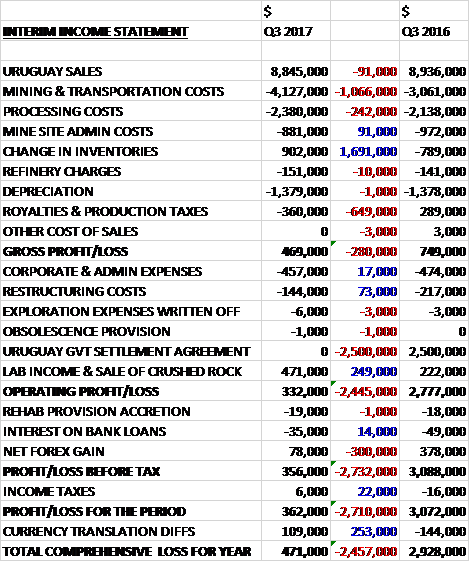
Gem Diamonds Share Blog – Final Results Year Ended 2016

Gem Diamonds has now released their final results for the year ended 2016.

Revenues declined by $60M when compared to last year and with cost of sales down by just $13.4M, mainly as a result of weaker Lesotho Loti, the gross profit reduced by $46.2M. There was a $4.8M fall in royalties and a $707K decrease in corporate expenses but this was offset by no reversal of accrued tax expenses, which brought in $8.1M last time, a $5.3M reduction in the forex gain and a $3.5M recycling of the forex translation reserve. The big cost this year, however, was the $172.9M impairment of assets to give an operating loss that was $232.3M worse than last time. Finance costs increased slightly but tax charges fell by $11.6M to give a loss for the year of $158.8M. Excluding the impairment, this was a profit of $14.1M, a decline of $38M year on year.

When compared to the end point of last year, total assets declined by $133.1M driven by a $129.5M impairment of the exploration and development assets, a $54.9M fall in cash and a $6M decline in other plant and equipment, partially offset by a $51.7M growth in the stripping activity asset, partially affected by forex movements. Total liabilities grew during the year as a $6.9M decline in income tax payable was more than offset by a $15.3M increase in deferred tax liabilities. The end result was a net tangible asset level of $189.9M, a decline of $140.6M year on year.

Before movements in working capital cash profits declined by $61.7M to $93.5M. There was a broadly neutral working capital position, interest payments increased by $2.3M but tax payments fell by $11.9M to give a net cash from operations of $70.7M, a decline of $48.4M year on year. The group spent $10.6M on property, plant and equipment along with $70.4M on waste costs capitalised. They also spent $14.4M Ghaghoo commissioning costs and $3.6M on development costs so before financing there was a cash outflow of $28.3M. They then paid $11.8M in dividends to shareholders along with $14M in dividends to non-controlling interests so there was a cash outflow of $57.9M for the year and a cash level of $30.8M at the year-end.

At Letseng, 108,206 carats were recovered from 6.6M tonnes of ore compared to 108,579 carats from 6.7M tonnes in the prior year with grades remaining steady at 1.63cpht. The average value achieved was $1,695 per carat compared to $2,299 in 2015 as fewer 100+ carat diamonds were recovered (just five compared to eleven in 2015) with the reduction more pronounced in H2. The largest diamond recovered was a 160.2 carat Type II white diamond. This poor recovery rate of large diamonds is consistent with the normal, short term variability of the resource and based on a detailed understanding of the resource, the board remain confident that the mine will continue to produce exceptional diamonds.

In local currency terms, costs per unit grew by 8% driven by local inflation of 5%, the one-off costs associated with the severe weather in July and an increase in explosive costs due to revised drill patterns to address diamond damage. Due to the weakening of the local currency, however, costs in US dollar terms actually fell.

Although the number of exceptional diamonds being recovered was lower than in prior years, an 11.8 carat pink diamond and a 160.2 carat type II white diamond were recovered during the year. These two diamonds, respectively, represent the highest $ per carat price achieved in the year. The pink diamond was sold for $187K per carat making it the third highest price per carat ever achieved at the mine while the white diamond was sold into a partnership arrangement where the group will participate in additional final polished margin.

In late July, extreme weather conditions were experienced across the Maluti Mountains in Lesotho where the mine is located, with excessive snowfall and severe winds limiting access to the mine and damaging the national grid power supply. Due to these setbacks, the board revives their targets downwards.

During the period, a post-investment review on the Plant 2 Phase 1 upgrade showed that the plant capability had improved by 12% in line with expectations. The impact of severe weather experienced in the year offset this improvement, however, and the board expect the full benefits to be evident in 2017.

The expansion of the open pits has necessitated the construction and relocation of an expanded mining support services complex. The first phase of this project was completed at a cost of less than $1M. Detailed design of the next phase has been completed and the construction (at a cost of $15.7) will start in 2017.

As part of optimising diamond liberation and reducing damage, the splitting of the front ends of Plant 1 and 2 started and is due for completion in Q1 2017. This provides the opportunity to dedicate ore treatment through the most suitable plant based on geo-metallurgical characteristics. Previously implemented workstreams targeting diamond damage reduction have had positive results. Diamonds continue to be damaged, however so the reduction in damage remains a key focus so a project has been initiated to investigate the implementation of a large diamond recovery capability.
To address major sources of downtime during the year, the primary crushing area structure was reinforced in December, thereby prolonging its life and deferring major capex by between eight and ten years.

At Ghaghoo, 40,976 carats were recovered from 217,372 tonnes of ore compared to 91,499 carats from 326,922 tonnes last year. The average value achieved was $152 per carat compared to $162 per carat in 2015. The recovered grade of 18.9cpht was below the reserve grade of 27.8cpht due to the high percentage of coarse breccia dilution encountered in the ore extracted near the contact zone from block 2, exacerbated by diamond lock up in the DMS tailings and mill oversize material Given the poor market for these types of diamonds, the mine was placed on care and maintenance in February 2017 with the flexibility to restart if prices recover.

At the start of 2016 the decision was made to downsize operations at the mine due to the underperforming smaller sized diamond market. The actions required to reduce the tonnage at the mine were completed and the operational improvements progressed well. Mill modifications yielded positive results with increased diamond liberation and the focus on cost discipline reduced operating costs. Despite this, the continued weakness in the market for the smaller diamonds which is expected to be further exacerbated by the increase in supply from three new mines entering the market in February 2017, the mine was placed on care and maintenance until conditions improve. The ongoing maintenance costs will be about $3M a year.

As part of initiating cost efficiencies across the group, the manufacturing operation in Antwerp was downsized during the year. Although they will continue to provide mapping and rough diamond analysis and manufacturing services, the back-end cutting and polishing functions were outsourced. In addition, the Calibrated operations was closed with an impairment cost of $2.1M. The business was set up to use laser diamond shaping and cutting technology as part of the integration of the group’s rough diamond analysis and manufacturing business. Due to the limited ability to develop this benefication opportunity in Lesotho, it was closed. $3.5M of foreign currency translation reserve was recycled through the income statement as the operation was based in South Africa.

After the year-end the outstanding balance of $2M on the three year unsecured project debt facility at Letseng was fully repaid. Following the decision to place the Ghaghoo mine on care and maintenance, the $25M term loan facility at Ghaghoo was settled in advance of its final payment date using the $35M revolving credit facility held at the company.

At the current share price the shares are trading on a PE ratio of 11.7 (excluding the impairment) but this grows to 15.6 on next year’s consensus forecast. There were no dividends recommended for 2016 but the consensus forecast is suggesting a forward yield of 3% for 2017.

On the 7th April the group announced the recovery of a 114 carat D colour Type II diamond of exceptional quality from Letseng.

Overall then this has been a difficult year for the group. Profits were down, net assets fell and the operating cash flow decreased with no free cash being generated. The issues are really two-fold. At Letseng the group has been affected by the fact that less high value diamonds are being recovered and really the mine has also been flattered by the depreciation of the Lesotho currency. This effect should be temporary, however, as the mining moves to other areas with higher quantities of large stones.

The issues at Ghaghoo may be more permanent. The group has been hit by a reduction in prices of it’s more commercial stones and this shows no sign of immediate improvement. The mine has therefore been put on care and maintenance. Overall, I feel that these issues are likely to weigh on the shares for some time. The recent high value recovery at Letseng is a positive and a few more of those, however, and the fortunes of the group could turn around.

On the 4th May the group announced the recovery of a high quality 80 carat D colour Type II diamond from the Letseng mine. This is not really that big but it is apparently one of the highest quality diamonds recovered at the mine and is entirely undamaged.

On the 23rd May the group released a trading update covering Q1 trading. Letseng has recovered larger better quality diamonds during the period and during April and May there was a notable improvement in size and quality of diamonds recovered. The market for Letseng’s diamonds remained firm over the period and this is expected to continue into the second half of the year. In addition, the revised life of mine plan was implemented during February with the objective of reducing waste tonnes mined and improve near term cash flows which is expected to benefit the group this year.

Letseng treated 1,667,000 tonnes of ore at a grade of 1.53cpht to recover 25,479 carats. This represents a 2% decline in tonnes treated and grade with a 4% fall in carats recovered. During the period engineering challenges were experienced at both Letseng plants that results in lower than planned plant availability. These are being addressed with the contracting partner and full year guidance remains unchanged. The contribution from the satellite pipe is expected to meet the original target of 1.8M tonnes for the year.

The lower grade mined was mainly due to the underperformance of the main pipe contact material. Mining activities have moved to the centre of the main pipe and grades are now returning to expected levels. During Q2 mining in the main pipe is moving into the higher grade K6 portion of the pipe.

The splitting of the front ends of plant 1 and plant 2 was completed at the end of the period. This has facilitated the treatment of discrete ore samples based on their individual geo-metallurgical characteristics to better understand the performance of the resource.

Bank funding for the construction of the Letseng mining support services complex valued at $16M was secured during the period. The funding is required to relocate the mining workshops, offices and related services within the mining area to allow the mine to effectively maintain the new and larger fleet of mining equipment as a result of the new waste cut backs required to extend the life of the open pit.

Three tenders have been held so far this year. 39,950 carats were sold for $65.4M, achieving an average price of $1,636 per carat compared to $1,695 per carat for the full year last year. The current average price achieved is up 13% from the $1,444 per carat achieved in Q4 2016. Contributing to this increase was an 8.65 carat pink diamond which achieved $164,855 per carat, making it the sixth highest achieved by a Letseng rough diamond, together with the sale of a number of other large high value white diamonds including a 114.38 Type II carat diamond which was sold into a partnership arrangement in May.

Overall then, the increased value of diamonds being mined is encouraging but there seem to be some issues with the plant, Ghaghoo is still on care and maintenance and there seems to be a lot of capex required for the relocation of the Letseng facilities. This might be worth a punt but its not without its risks!

On the 12th June the group announced the recovery of a high quality 105 carat D-colour Type IIa diamond and a 152 carat Type 1 yellow diamond which bodes well for an increased price per carat figure this time.

On the 6th July the group announced that it recovered a high quality 126 carat D colour Type IIa diamond from Letseng.

On the 25th July the group released a trading update covering the first half of the year. The market for both rough and polished diamonds remained cautious during the period but the strong demand for Letseng’s large high quality white rough diamonds has continued.

The price per carat achieved in the period was $1,779, an improvement on the $1,480 achieved in H2 last year. This positive trend has continued with the most recent July tender achieving an average price of $2,385 per carat. Contributing to the price was an 8.65 carat pink diamond which achieved $165K per carat.

At Letseng there was a 4% decline in the ore treated to 3,178,631 tonnes but the grade improved by 3% to 1.59c/t so the carats recovered declined by just 1% to 50,478. The lower than planned ore treated was due to reduced plant availability and downtime associated with the installation and commissioning of the split front ends for Plants 1 and 2. The availability issues have largely been address by the contractor. Despite improving, the grade was still below the expected reserve grade of 1.63c/t mainly due to the underperformance of the main pipe contact material and internal changes in the geology of this pipe. A core drilling programme will be implemented during the second half to improve confidence in the geology at depth. Overall guidance is maintained but at the lower end of the range.

At Ghaghoo, care and maintenance status was achieved ahead of plan by the end of March. During the period an earthquake occurred which caused superficial damage to the surface infrastructure and damage to the seal of the underground water fissure which led to an influx of water. This resulted in an increase in the water pumping costs of around $600K. The fissure will be required to be resealed and plans are underway to complete this during Q3.

Getech Share Blog – Interim Results Year Ending 2017

Getech has now released their interim results for the year ending 2017.

Revenue increased by £765K when compared to the first half of last year representing a six month contribution from Exprodat, being offset somewhat by a very challenging services market, and after cost of sales grew by just £190K, the gross profit was up £575K. There was a £99K increase in depreciation and amortisation, a £131K negative forex swing and a £25K increase in other admin costs to give an operating loss which was a £320K improvement on last time. Finance costs were broadly similar but the group did have a tax credit of £155K which meant that the loss for the period was £227K, an improvement of £477K year on year.

When compared to the end point of last year, total assets decreased by £922K, driven by a £934K decline in receivables, a £278K fall in current tax assets and a £163K decrease in inventories, partially offset by a £243K growth in intangible assets, a £118K increase in deferred tax assets and a £189K growth in cash. Total liabilities also declined during the period due to an £820K fall in payables. The end results was a net tangible asset level of £5.4M, a decline of £400K over the past six months.

Before movements in working capital, cash profits saw a positive £550K swing to £62K. There was a cash inflow from working capital and after the £480K tax rebate relating to refunds received from overpaid tax in the US along with R&D allowances, the net cash from operations was £809K, a positive swing of £1.2M year on year. The group spent £529K on development costs relating to the Globe platform and £100K on acquisition costs to give a free cash flow of £184K. After £13K of interest was paid, the cash flow for the period was £171K and the cash level at the period-end was £3M.

Under the new CEO, Jonathan Copus, the senior management team has been reshaped and underlying costs have been significantly lowered. The cost base has been achieved through the reduced use of contractors and by lowering the staff headcount by 18%. The full cash benefit of these steps will not be realised until the second half and redundancy costs were £451K in the first half with a further £26K to be incurred in H2.

Within the group’s newly defined products division, they are on track to deliver Globe Phase 2 in July. An additional supermajor joined the Globe sponsor group during the period which strengthened the customer base. The current phase of Globe investment is due to be completed before the end of the year and sponsor discussions regarding a series of enhanced forward work plans are underway. Software renewals remained strong and the customer list now totals 39 companies.

Within the services division the group have worked for the governments of Lebanon, Mozambique, Namibia, Pakistan and Sierra Leone. Closer to home they won a mandate to define and deliver a multi-faceted spatial data strategy for the UK Oil and Gas Authority which has also commissioned the group to complete technical work over the SW Approaches area. Revenues from the mining and nuclear sectors continue to diversify earnings away from oil and gas, and in partnership with Esri UK, they are working with TfL and Scottish Water.

The group has found that in the oil and gas exploration market, greater crude oil price stability and lower costs have opened up a margin against which companies are becoming increasingly confident to invest. The first beneficiary of this trend is production and development, however, so exploration budgets remain depressed. Industry redundancies have also made the geoscience consulting market more crowded which places downward pressure on day-rates. The group are working to extend the application of their core technical skills further along the oil and gas asset value chain and are actively targeting new areas under the wider natural resources industry including atomic energy, agriculture, forestry, mining, mater and environmental management.

Going forward any material recovery in discretionary exploration spending is likely to be a slow build but the board do take some cautious encouragement from recent trading. Since the period-end, their software and data sales have continued to grow and in March they signed an agreement with the OGA for them to license their UK MultiSat data across the North Sea with is the third sale of their products and services to the OGA so far this year.

The services market has shown signs of gradual improvement. The group recently signed consultancy agreements with RAK GAS and Victoria Oil and Gas. They have also been engaged by the government of Lebanon as a senior advisor to their offshore licensing activities. They have also shaped a new service to assist pipeline operators in their implementation of Esri’s new ArcGIS pipeline referencing software.

Beyond oil and gas the group are engaged in a broad range of discussions across the natural resources space. Their latest win was a contract secured through their Esri partnership to provide GIS content building and training to Scottish Water.

The group made a loss in the first half so PE ratios are not a good way to vale the shares at the moment – I have not been able to find any forecasts. There is currently no dividends being proposed here.

Overall then the period has been an improvement over last time but the pace of change has been slow. Losses did improve but it is hard to tell how much of this was organic and how much due to the Exprodat contribution. Net assets declined but the operating cash flow improved with the group just about breaking even at the cash profit stage. They even had some free cash following a tax rebate after overpaying in previous periods. Going forward, H2 seems to have started OK and costs should be reduced but the oil and gas exploration market is going nowhere fast and I feel the rate of change is a bit slow here so I am out.

On the 17th May the group announced the sale of a suite of geology, gravity and magnetic data products. Under a license agreement signed with a leading global resource company, the group has sold its Earth Systems Modelling Product, Depth to Basement data, a package of gravity and magnetic data and a resubscription to Globe. The sale will generate gross income of $900K, the majority of which will be recognised in 2017. The contract is in line with the board’s financial expectations for the current year.

On the 20th September the group released a trading update for the year as a whole. Against what remains a volatile market, they have worked to enhance their cash profitability through cost management and has strengthened the commercial positioning of their products. The net impact of these steps is partially obscured by exceptional costs and a year-end timing issue. I feel that could have been made a bit clearer!

During the year they closed sales with a total value of £8.5M, of which £7.7M will be recognised as revenue in 2017. A significant programme of cost saving measures implemented during the year resulted in underlying like for like costs being 32% down but restructuring costs (£500K), M&A payments (£500K), and debt repayments (£100K) resulted in an additional £1.1M cash outflow. Cash balances at the year-end totalled £1.7M, a reduction of £1.1M on the prior year reflecting the timing of several payment delays which have subsequently been received.

The group also announced that they are moving their year-end to December. I really hope they manage to publish meaningful comparisons to cover this – many companies don’t seem to bother.