Avingtrans Share Blog – Final Results Year Ended 2016

Avingtrans has now released their final results for the year ended 2016.

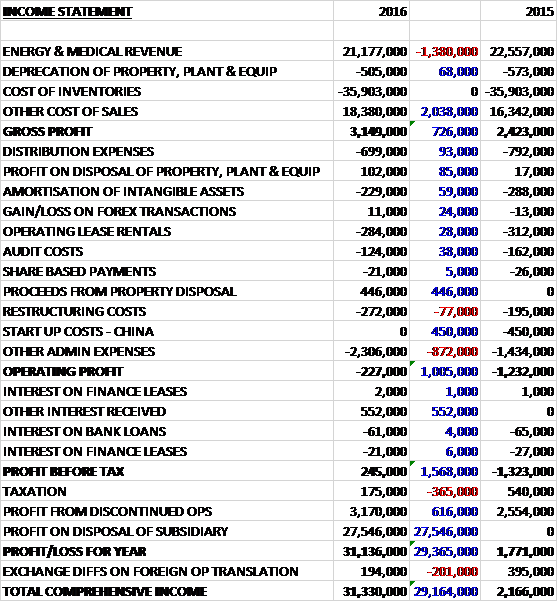
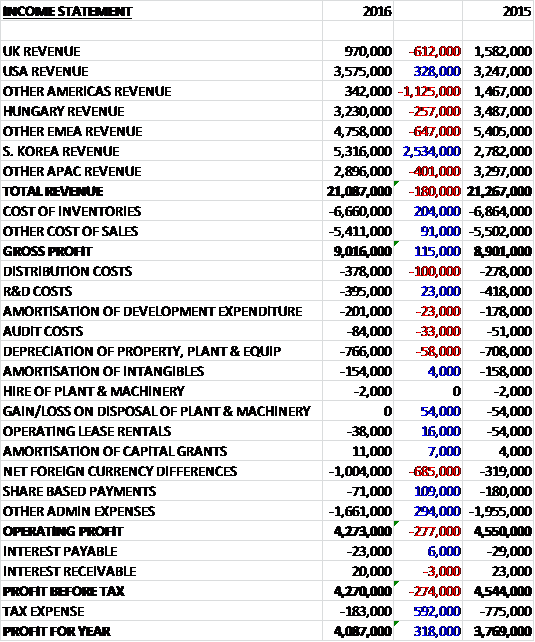
Revenues declined by £1.4M when compared to last year due to the continued subdued oil and gas market but cost of sales fell by £2M to give a gross profit £726K higher. Distribution expenses fell by £93K and there were small decreases in amortisation, operating lease rentals and audit costs with an £85K increase in profit on disposal of fixed assets. There was £446K in proceeds from a property disposal and no Chinese start-up costs which accounted for £450K last year but other admin expenses were up £872K to give an operating loss £1M down on 2015. The group received £552K in interest payments and but tax receipts fell by £365K with the tax position expected to normalise in the coming years, to give a profit from continuing operations of £420K, an positive movement of £1.2M year on year.

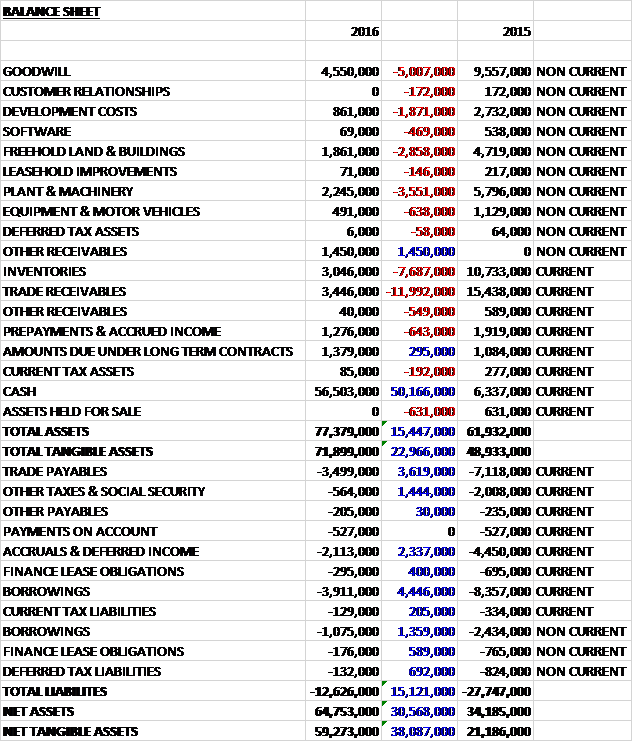
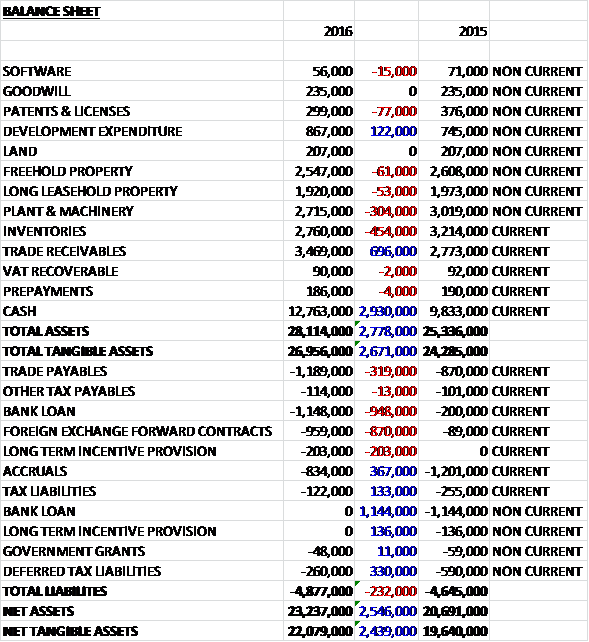
When compared to the end point of last year, total assets increased by £15.4M driven by a £50.2M increase in cash, partially offset by a £12M reduction trade receivables, a £7.7M fall in inventories, a £5M decline in goodwill and a £3.6M decrease in plant and machinery. Total liabilities declined during the year due to a £3.6M fall in trade payables, a £5.8M decrease in borrowings and a £2.3M decline in accruals and deferred income. The end result was a net tangible asset level of £59.3M, a growth of £38.1M year on year.

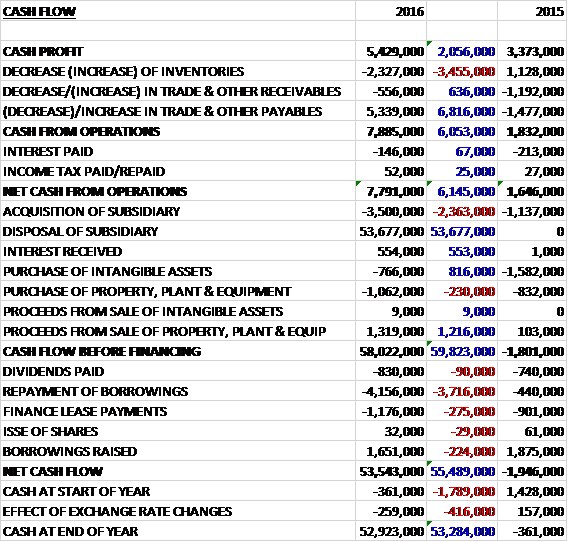
Before movements in working capital, cash profits increased by £2.1M to £5.4M. There was a cash inflow from working capital due to an increase in payables and after a small reduction in interest payments, the net cash from operations came in at £7.8M, a growth of £6.1M year on year. The group spent £3.5M on acquisitions but recouped £53.7M on disposals before spending £766K on intangible assets and receiving a net £257K from selling fixed assets. Before financing there was an income of £58M. The group paid out £830K in dividends, £1.2M on finance leases and a net £2.5M on repaying loans to give a cash flow for the year of £53.5M and a cash level of £52.9M at the year-end.

It is worth noting that there is one customer that accounts for more than 10% of total revenues which is always a risk.

The low oil price continued throughout the year, sapping any momentum in potential prospects for this sector, hence the downsizing of the Maloney business and the sale of the Aldridge manufacturing site. They have also countered the negative effects of the oil price, by focusing on the growth areas in the energy market such as energy storage, carbon capture and nuclear power life extension and decommissioning. The remaining effect of the oil price reduction mostly worked through Maloney in the period and whilst this supressed the revenue by 6% the underlying performance was a very modest profit for the year.

At Metalcraft Chatteris, business with Seamens and Cummins in the UK was steady and site delivery along with quality consistency were further improved. Pre-production activities started on the £47M ten year contract with Sellafield for the provision of 3M3 nuclear waste boxes, albeit that they have seen some changes to phasing of the production start-up. Whilst progress has been somewhat slower than anticipated the delays are not material for the project overall and they have made good progress with site preparations and pre-production tests. The production set-up and prototype testing will continue in the current year with series production expected to start next in the following year.

At Metalcraft Chengdu, results for the unit improved and they made good progress with the existing customers. The business won a £3M contract with Bruker for Nuclear Magnetic Resonance vessels and they have now begun preparations to start production of the Bruker systems in China later this year.

At Maloney Metalcraft, as already mentioned, the oil price effects continued to wash through the business leading to a loss at the site excluding the one-off sale of the building at Aldridge. There was a $2M contract win with HGC Gulf International, however, to supply gas treatment packages. The sector remains subdued but the recent £3.5M contract win with EDF shows that they have value beyond oil and gas.

Crown had a steady year in its core business. The Future Environmental Technologies partnership made progress during the year with the first carbon abatement project now running smoothly in Wales. This technology makes small to medium diesel generators “clean” which is important in a future where the energy grid is more fragmented and localised. Other projects with FET are now underway.

The retained part of the Composites business in Buckingham also made a loss for the year as the group extracted the aerospace related content to go with Sigma, and due to start-up costs for the £3M contract won with Rapiscan. By the year-end the business was running close to break-even with improving prospects.

The big event during the year was the disposal of the aerospace division which comprised Sigma Precision Components, C&H Precision Finishers and Hartshill Ventures for cash proceeds of £53.7M which generated a profit on disposal of £27.5M. The division made a profit of £3.2M in the year before being sold just before the year-end. Of the proceeds, £28M is being returned to shareholders by way of a tender offer.

Following the acquisition of the Rolls Royce pipe business the board felt that it had achieved the majority of the targets which it had set for the aerospace division and it was the right stage in its development to consider a disposal of the business. Subject to achieving an attractive valuation, they believed that shareholder value would be maximised over the long term by disposing of it and returning part of the proceeds to shareholders, with the group also reinvesting part of the proceeds into strengthening their position in the energy sector. They believe that the contract win by the energy business with Sellafield in 2015 demonstrated the significant opportunities available in that market if they were able to put more resources into that sector.

The disposal proceeds represent over twice the original shareholder equity invested in the business’ development. During the year they also sold the freehold of the Maloney Metalcraft building at Aldridge for £1.1M, limiting their exposure to the oil and gas market.

Due to the disposal the group had a net cash position of £51M at the year-end compared to net debt of £5.9M at the end of last year. At the current share price the shares are trading on a PE of 142.2 which increases to 172.1 on next year’s consensus forecast so unless I am missing something, these seem very expensive. After the final dividend was increased, the shares are yielding 1.7% which increases to 1.8% on next year’s forecast.

Overall then this has been a year of change for the group with the sale of the aerospace division, up to now the most profitable part of the company. Of the remaining business, the modest profit did increase although there was an operating loss. Net assets also increased due to the sale and the operating cash flow increased with decent amounts of free cash being generated (this is relating to the aerospace division too I think). The Sellafield contract is starting to ramp up but it looks to be at least another year until it contributes meaningfully and the delays already experienced are a bit of a concern. There do seem to be a number of other smaller contracts being won but the shares are expensive on a PE basis and the forward yield of 1.8% is nothing to write home about.

Having said that, management here have had a history of creating shareholder value so it might be worth backing them to do it again?

Fairpoint Share Blog – Interim Results Year Ending 2016

Fairpoint has now released its interim results for the year ending 2016.

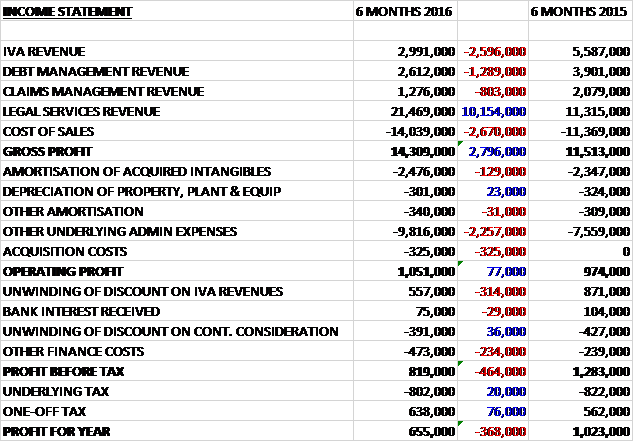
Revenues increased when compared to the first half of last year as a £2.6M decline in IVA revenue, a £1.3M decrease in debt management revenue and an £803K fall in claims management revenue was more than offset by a £10.2M growth in legal services revenue. Cost of sales also increased to give a gross profit £2.8M above that of last time. Amortisation increased by £129K and other underlying admin expenses were up £2.3M with £325K of acquisition costs also recorded which meant that the operating profit was broadly flat, increasing by just £77K. We then see a £314K reduction in the unwinding of the discount on IVA revenues and other finance costs increasing by £234K which meant that after tax charges declined by £96K the profit for the period came in at £655K, a reduction of £368K year on year.

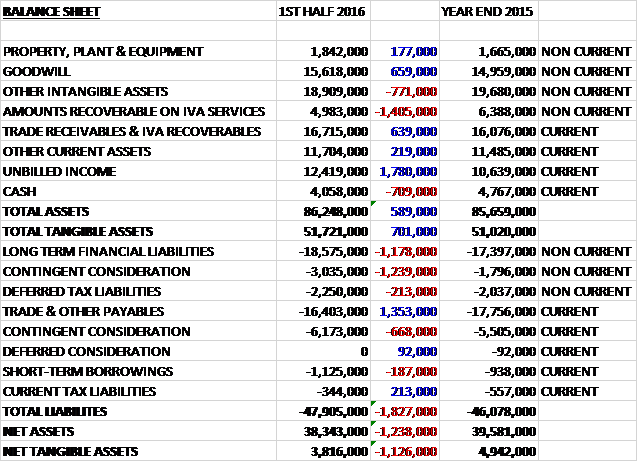
When compared to the end point of last year, total assets increased by £589K to £86.2M driven by a £1.8M growth in unbilled income, a £659K increase in goodwill and a £639K growth in receivables, partially offset by a £1.4M decline in amounts recoverable on IVA services a £771K fall in other intangible assets and a £709K decrease in cash. Total liabilities also increased during the period as a £1.4M decline in payables was more than offset by a £1.9M growth in contingent consideration and a £1.2M increase in long-term financial liabilities. The end result was a net tangible asset level of £3.8M, a decline of £1.1M over the past six months.

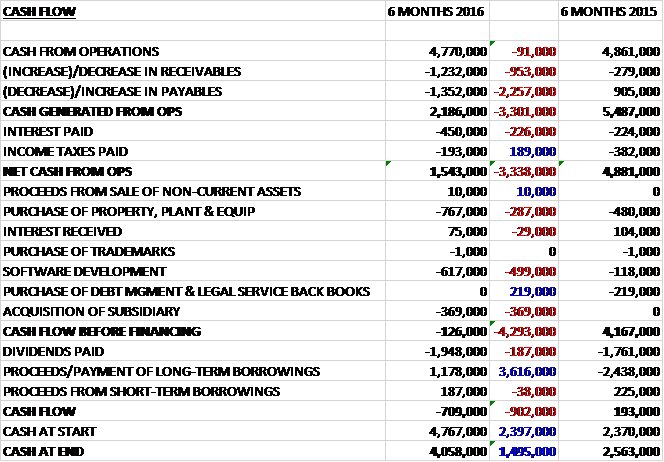
Before movements in working capital, cash profits were broadly flat, falling by just £91K. There was a cash outflow from working capital, partly reflected of working capital movements associated with the reduction in debt solutions activity, and after interest payments increased by £226K, the net cash from operations came in at £1.5M, a decline of £3.3M year on year. Of this £767K was spent on property, plant and equipment; £617K went on software development and £369K on an acquisition so that before financing there was a cash outflow of £126K. The group also paid out £1.9M in dividends and took out £1.2M of new borrowings to give a cash outflow of £709K and a cash level of £4.1M at the period-end.

The operating loss in the IVA division was £148K, a detrimental movement of £239K year on year as a result of fewer new cases as the group refrained from spending on uneconomic marketing activities in debt solutions. The total number of fee paying IVAs under management was 13,811 compared to 16,889 at this point of last year. The number of new IVAs written was 238 compared to 795 but the average gross fee per new IVA was £3,150 compared to £3,036. The portfolio of IVA cases continue to be cash generative and with debt solutions marketing on hold, the focus in this segment will be on cash generation.

The operating profit in the Debt Management business was £760K, a decline of £757K when compared to the first half of last year with a decreasing margin of 29% (compared to 39%) reflecting the decreasing profitability in this segment driven by the regulatory agenda which has increased call handling times, customer attrition and significantly increased risk and compliance overheads. The total number of DMPs under management was 13,252 compared to 20,730 with the orderly wind down of this segment as described below being underway and on track.

The operating profit in the Claims Management business was £263K, a fall of £129K when compared to the first half of 2015. As the claims management segment largely serves the IVA and DMP customer base, the lower profits are largely as a result of the declines in customer numbers in those areas.

The operating profit in the Legal Services business was £3M, a growth of £1.7M year on year on revenues that increased by 90% due to the Colemans acquisition last year (organic revenue was up 4%) despite conveyancing activity being impacted by the Brexit vote and election. During the period the group has focused its activity on investing in common processes, software and IT infrastructure, defining a pricing tariff for over 70 legal products and launching a new website. 80% of products are now administered on a single IT platform and they have extended the product range with the acquisition of a practice specialising in child abuse cases and substantial coverage has been achieved as a result of a new advertising approach.

Changes to the operation of whiplash claims relating to road traffic accidents have been proposed by the government. The board believes that its legal processing centre positions them advantageously to manage such legal work at low cost but the timetable for implementation appears to be lagging behind the scheduled start in April with the consultation process still awaited.
During the period the exceptional items of £325K relate to transaction and related professional services costs associated with the acquisition of a small legal practice specialising in child abuse cases.

David Broadbent has been appointed as CFO, replacing John Gittins who has now stepped down to pursue a portfolio career after having spent four years in the role. David joins from International Personal Finance where he served as finance director and chief commercial officer.

After the period-end, the group announced its decision to exist the debt management plan market due to regulatory changes impacting the whole sector. The FCA is driving a rigorous regulatory agenda in the DMP sector and this resulted in the decision to halt acquisition activity last year. The regulation has severely impacted the commerciality of the industry and has resulted in a reduction in profitability in the period. The ultimate outcome of the revised regulatory regime is expected to transfer competitive advantage to the charitable DMP sector, thus rendering the commercial DMP business model unsustainable. As a result, the group will conduct an orderly wind down of its DMP operations in the second half which will materially affect the results of the DMP segment as well as those of the claims segment given its dependency on selling services to DMP clients. DMP is now expected to make little or no profit contribution in the second half of the year.

It is expected that this restructuring will give rise to exceptional charges in the second half of about £2.5M, of which £1M will be cash outflow in 2016. The decision to exit the DMP market will also give rise to a non-cash impairment of the debt management intangible asset of £5.5M. From 2017 they will implement and benefit from a reduced cost base and a simplified business model focused on the legal services segment.

The group has also taken the decision to put market activity for IVA solutions on hold. The market conditions for debt solutions are likely to continue to be difficult until bank rate increases adversely affect the financial circumstances of home owners who typically have higher incomes which looks unlikely in the short term.

Currently the majority of legal services are trading in line with expectations but conveyancing volumes have been impacted by a slowdown in housing market transactions as a result of Brexit so the expectations for conveyancing has been adjusted materially downwards. Overall the group’s performance in H2 is likely to be similar to H1.

At the period-end the group had a net debt position of £15.6M compared to £5.2M at the same point of last year. At the current share price the shares are trading on an underlying PE of 4.9 but I can’t find a forecast for this year. After the interim dividend was maintained the shares are yielding 44.7% but obviously this won’t be maintained and once again I can’t find a forecast.
On the 10th October the group announced that Peter Watson, MD of Simpson Millar, sold 27,778 shares at a value of £20K.

On the 9th December the group released a trading update where they stated that trading in legal services in 2016 was in line with expectations to the end of October but the results for November are below plan and they are likely to be lower than expected in December as well. Trading across debt services is broadly in line with expectations and the closure of the debt management business remains on track for completion in early 2017. The planned benefit of the reduction in associated overheads is taking longer than expected, however.

As a result of these factors, the full year results for the group are likely to be materially below market expectations. The board is formulating plans to mitigate the potential impact on the financial performance of the group going forward, including the suspension of future dividends.

On the 28th December the group announced that CEO Chris Moat is stepping down with immediate effect. He will continue to provide continuing assistance on the closure of the DMP business. Non-executive Chairman David Harrel will assume the role of Executive Chairman alongside David Broadbent, CFO, who will assume a broader range of responsibilities on a temporary basis with the search for a new CEO underway.

So, things seem to be unravelling here. For what it’s worth in the first half profits were down along with net assets and operating cash flow with no free cash being generated. The IVA business has declined as interest rates remain low, the debt management business is in terminal decline and is being closed and as the claims management business relies on those, it is also suffering. The profit in the legal services business did increase but this seems to have been due to the Colemans acquisition and subsequently performance has deteriorated, presumably as a result of reduced conveyancing business. The CEO has now gone as has the dividend yield and with all parts of the business in free-fall I can’t see these as good value even at these low levels.

On the 28th March the group released an update covering 2016 results. It is expected that revenue will be £52.9M and adjusted pre-tax profit will be £4.9M, a decline of £5.6M year on year. The was an increase in legal services revenue as a result of the full year benefit of the Colemans acquisition offset by the expected significant reduction in revenues in the Debt Solutions division. There was an increase in admin costs of £4.9M which principally reflected the acquisition of Colemans.

The cost of exceptional items and impairment of acquired intangible assets is expected to be £11.8M comprising costs of £2.8M relating to the exit from the debt management business and £9M of impairments in respect of the debt solutions business. As previously announced, following the difficulties experienced in the year the board decided to suspend future dividends. Bet debt at the year-end was £19.9M compared to £13.6M in 2015.

In February 2017 the MOJ announced draft legislation which would result in an increase in the small claims track limit to £5K for road traffic accident claims and to £2K for other personal injury claims together with a range of other measures intended to address soft tissue claims arising from road traffic accidents. Essentially the changes mean that law firms will not be able to recover costs in affected cases from the losing party. The changes are expected to come into force in October 2018.

These changes are expected to have a potential impact of 4% of the group’s current legal services revenue, and it is expected that this impact will be largely mitigated through changes to pricing mechanisms and through improved operating efficiency.

David Broadbent, formerly the CFO, will assume the role of CEO and Mike Dunn will continue as interim CFO until a permanent replacement has been appointed.

Going forward, significant work has been performed over the last three months to improve the visibility of results and the forecasting of legal services revenues, including both billing and movements in work in progress. The analysis indicates that 2017 legal services revenues will be about 15% lower than in 2016. This reflects a reduction in the number of cases settling for value in 2017 and predominantly relates to complex personal injury cases which can take over four years to be closed. The performance of the division is then expected to improve from 2018 as a result of the current case load reaching maturity and an increase in the level of marketing spend to drive new business. Debt Solutions revenues will also decline as the group reduces its activities in that sector.

A restructuring exercise has started which is mainly focused on debt solutions and group overheads. It is expected that around £5M of annualised cost savings will be realised and the exercise is on track to complete by the end of March. The full benefit of the cost savings is not expected to be realised until the second half of 2017, however.

Overall, the performance in 2017 is expected to be well below 2016.
Management believes that the actions taken to reduce the cost base and improve operating efficiency coupled with the expected recovery in legal services revenue should deliver a much improved level of trading performance in 2018.

On the 29th March the group announced the disposal of its ancillary medico-legal business, PIX, for an enterprise value of £1.2M payable in cash. The business has been providing medical records, reporting services and disbursement funding support to certain departments of the group’s legal services division. The business was sold to Premex, whom the group has entered into a three year strategic partnership with for ongoing medical records and reporting services. The business made a profit of £100K last year.

Oh dear, this all sounds very dire. I am keeping well clear for now.

On the 28th June the group announced that it had been notified by its bank, AIB, that it is unwilling to provide the level of ongoing support requested by the company. As a result they are unable to sign off the audit of the accounts which means they are late publishing the annual report which means the shares have been suspended. They are currently in discussions with alternative providers of finance. This is another sorry tale but it seems the group is limping on for now at least.

On the 4th August the group announced that the ongoing support for their business outside the legal business is difficult due to the existence of the onerous lease on the head office which has an annual commitment of £1M for a further four years. As a result, the board have concluded that the holding company of the group is no longer able to continue trading as a going concern and has filed notice of intention to appoint administrators. Oh dear!

Bonmarche Share Blog – Interim Results Year Ending 2017

Bonmarche has now released its interim results for the year ending 2017.

Revenues declined by £3.9M when compared to the first half of last year. Staff costs increased by £823K and operating lease payments grew by £673K but depreciation was down £146K and other cost of sales fell by £1.5M to give a gross profit £3.6M below that of last time. We then see a £672K increase in forex gains and the lack of £1M of IPO fees incurred last year but there was a £417K charge relating to the implementation of the new EPOS system and other admin costs increased by £914K to give am operating profit £3.4M down. Finance costs remained broadly flat but tax charges fell by £919K which meant that the profit for the period was £1.5M, a decline of £2.5M year on year.

When compared to the end point of last year, total assets increased by £4.4M driven by a £4.7M increase in forex hedging assets, a £4M growth in property, plant and equipment and a £1.2M increase in intangible assets, partially offset by a £3.5M decline in receivables and a £2.6M fall in cash. Total liabilities also increased during the period as a £918K growth in deferred tax liabilities and a £1.1M increase in payables was only partially offset by a £607K decline in current tax liabilities. The end result is a net tangible asset level of £30.9M, a growth of £1.9M over the past six months.

Before movements in working capital, cash profits declined by £3.5M to £3.8M. There was a cash inflow from working capital but this was less than in the first half of last year and after tax payments fell by £275K, the net cash from operations was £7M, a decline of £5M year on year. This nearly covered the capex with £5.9M spent on property, plant and equipment along with £1.2M on intangible assets to give a cash outflow of £297K before financing. The group also spent £104K on finance leases and £2.2M in dividends to give a cash outflow of £2.6M and a cash level of £10.4M at the period-end.

During the period store only like for like sales declined by 8.6% with an 8.1% fall in Q1 and a 9% decrease in Q2. Online sales declined by 1.1% with a fall of 2.7% in Q1 and a growth of 2.3% in Q2 but the growth in Q2 is attributable to the disruption experienced last year relating to the launch of the responsive website rather than a pick-up in trading. According to Kantar data, the group’s market share declined from 3.3% to 3.2%.

Sales were affected by certain basic retail disciplines not being sufficiently co-ordinated or robust and the fact that there were parts of the plan that were not executed to the desired standard, which is now being addressed. Customers have provided more positive responses to updated products but there were too many repeats from previous seasons which slowed sales in t-shirts and tops in particular. There were also some high volume product lines which had not moved on enough compared to the previous season’s equivalent and long lead time and a supply chain dominated by Chinese factories restricted the ability to react to changes in seasonal demand.

The group was also affected by BHS, a significant competitor, going into administration in April. Over the following months it cleared its residual stock at discounted rates prior to closing its stores which affected sales in April and May. Also the weather was a major variable which adversely affected performance during the period. Summer 2016 was characterised by weather which was generally too cool to create demand for seasonal basics such as t-shirts and the warm weather in September delayed sales of products such as coats, although it did result in effective clearance of much of the remaining summer stock, albeit at discounted prices.

The performance of the online business during the period was poor. There are a number of factors being blamed for this, in addition to some of the issues affecting the traditional business. The Venda platform website is becoming an increasing barrier to progress and at the end of September they completed the move to a new Demandware platform. This has brought immediate benefits: the customer journey is simpler, the site responds faster, and they have seen the checkout abandonment rate improve. Alongside the website launch they have introduced improved delivery options for customers, most notably free returns by mail or to store (previously customers had to pay to post returned parcels).
By the end of the year the will stop selling through the Ideal World TV shopping channel which is expected to have a small impact on sales but a negligible impact on profit for 2018.

The gross margin increased slightly year on year. Whilst discounting levels were higher than in the previous year, this was more than offset by a higher margin before discounts, despite a slight rise in the cost of hedged dollars. The anticipated dollar requirement for the remainder of the year is fully covered by forward contracts, as is 80% of the expected requirement for next year. The increase in the bought-in margin was a result of some increases in selling prices and a reflection of the low-cost supply base. Although the low cost supply base is beneficial in delivering high margins, it is also inflexible.

The underlying operating expenses increased, however, due to the investment in new retail space, marketing, the new EPOS system and general inflationary pressures including the introduction of the national living wage. Over the past twelve months, they have opened 19 new stores and the national living wage added £600K to costs, £200K of which was mitigated through productivity savings with the further increase implemented in 2018 expected to be largely offset by savings too. Occupancy cost inflation added £400K to expenses, although the actual rent component was only £100K; TV advertising increased by £500K and the ongoing support fees for the EPOS system ware £200K higher than the old one with a one-off implementation cost of £400K to train staff.

Going forward, the group will continue to offer traditional lines but their proportion of the range will reduce progressively so that their products will comprise of more modern lines. During late September and early October they ran a three week national advertising campaign using TV, radio and print media. This followed a test carried out in norther regions which created an increased awareness of the brand there. The brand awareness score among women aged 50+ increased from 85.6 to 95 and website traffic increased by 35% during the campaign. It will take longer to determine the value and longevity of this reaction, however, which also coincided with more seasonally appropriate weather.

The group have identified that in the past they have relied too heavily on a need being created by seasonal weather and one of the requirements is to make the ranges more desirable so that purchases are being made as a result of customers wanting an item. Linked to this, they have noticed that customers are increasingly buying for immediate wear instead of buying in anticipation of wearing later in the season so they are changing their buying decisions to reflect this. These steps will not fully overcome the effect of seasonally inappropriate weather but they believe it will help mitigate it.

For the time being the group are continuing to maintain Ann Harvey as a sub-brand offering larger sized clothing in key stores and online but it represents only 1.2% of sales. As part of the streamlining of the business to focus on initiatives likely to most contribute to growth, they are discontinuing the menswear trial once the Christmas season collection is sold through as it lacks sufficient potential to justify its space in the stores and the resources required to effectively execute it. During the period it represented just 0.6% of sales.

The group have completed the replacement of the fascias of the remaining 40 stores, having begun the programme in 2015. All stores now have the new store front with the exception of two where obtaining planning permission is delaying completion and eleven which are excluded from the programme due to potential relocation.

Market conditions continue to be very difficult and data from the ONS suggest that apparel sales have been weak despite overall retail spending levels being reasonably robust. Despite the difficult trading conditions, the board remain confident that the business will resume growth in 2018. As the group approach the Christmas trading season they continue to face considerable uncertainty as to market conditions and the board believe that the clothing market generally will continue to be challenging. Recent trading has seen an improvement since September, reflecting better ranges and weather so the board’s view is that the full year pre-tax profit is likely to be between £5M and £7M.

At the period-end the group had a net cash position of £9.8M compared to £12.4M at the end of last year and £18.6M at this point of 2016. At the current share price the shares are trading on a PE ratio of 4.7 which increases to 9.2 on the full year forecast. After the interim dividend was maintained at the same level the shares are yielding 8.6% which declines slightly to 8.5% on the full year forecast.

Overall then this half year period has been a difficult one for the group. Net assets did improve due to favourable movements in the currency hedging instrument but profits were down and the operating cash flow declined with no free cash being generated. A lot of things have been blamed for the poor performance – bad weather of course, the closure of BHS, the national living wage age and the old website platform. There is also a problem that the range is just not innovative enough and the clothes are not that desirable.

They are apparently working through these issues and whilst conditions are difficult, the performance is apparently improving. The forward PE of 9.2 and dividend yield of 8.5% look very tempting but I think I would prefer to wait until the performance over the Christmas period is revealed in a couple of weeks before making a decision.

On the 20th January the group released a trading update covering Q3 and the Christmas period to Christmas Eve. Sales increased by 3.3% against the same period last year and store like for like sales grew by 0.8%. A less promotional stance was taken through the quarter and whilst this impacted overall sales volumes, it resulted in a stronger gross margin performance with product gross margin 2.2% higher than last time. Despite the robust like for like store performance, online performance was poor with sales down 3.8%.

Customers have responded well to the improved, more modern ranges in the core autumn/winter product categories of coats and knitwear. This was helped by more seasonally appropriate weather during the quarter which strengthened demand and to some degree counterbalanced the weakness experienced in the apparel market.

There remains a degree of uncertainty as to trading conditions as the group enters Q4 but the board’s expectations for the full year is unchanged, being pre-exceptional profit of between £5M and £7M.

Overall then, not a bad update – mostly due to the favourable weather. The online performance is cause for concern, however, and I don’t think there is much evidence of a turnaround here yet.

On the 19th April the group released a trading update for Q4. Sales increased by 2.7% with store like for like sales down 0.5% offset by a 15.2% increase in online sales which gives a 0.7% like for like growth. If we exclude the extra week, however, like for like sales were down 1.1%. The board expects that the pre-exceptional profit for the year will be slightly above £6M.

Store like for like sales fell in January but were stronger in February and March and the growth in online sales followed improvements made to their online offering. Whilst the board expect the apparel market to remain challenging during the coming year, they are actively taking measures to improve their proposition to customers and they expect to deliver growth in 2018 despite the challenging market.

Overall then it seems the online improvements have really made a difference and the store sales seem to have recovered in the last two months. It is very early days but this looks quite good – I am tempted to try again here and make a small purchase.

Character Group Share Blog – Final Results Year Ended 2016

Character Group has now released its final results for the year ended 2016.

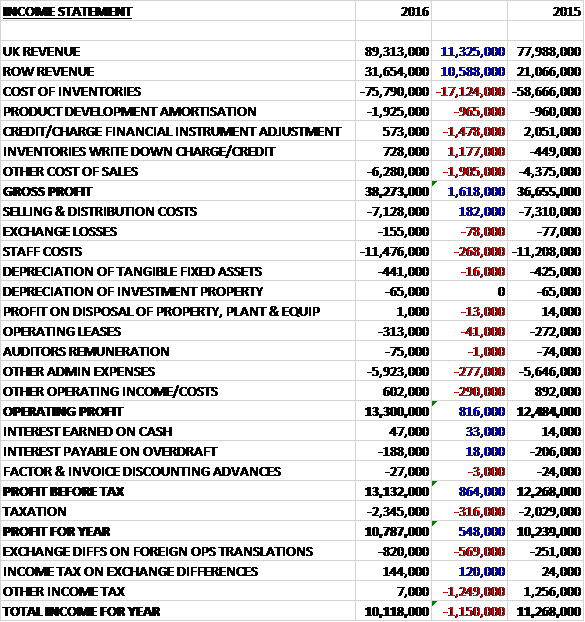
Revenues increased when compared to last year with an £11.3M growth in UK revenue and a £10.6M increase in ROW revenue, aided by the weakness of Sterling. Cost of inventories increased by £17.1M, amortisation was up £965K and other cost of sales grew by £2.2M to give a gross profit £1.6M ahead of 2015. Selling and distribution costs reduced by £182K but staff costs were up £268K and other operating expenses grew by £426K with a £290K fall in other operating income which meant that the operating profit was £816K higher. Finance costs were down marginally but tax charges increased by £316K to give a profit for the year of £10.8M, a growth of £548K year on year.

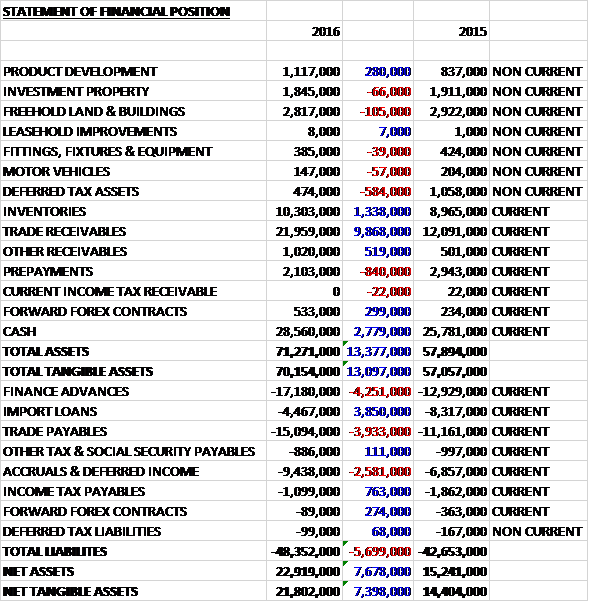
When compared to the end point of last year, total assets increased by £13.4M to £71.3M driven by a £9.9M growth in trade receivables, a £2.8M increase in cash and a £1.3M growth in inventories. Total liabilities also increased as a £3.9M reduction in import loans was more than offset by a £4.3M increase in finance advances, a £3.9M growth in trade payables and a £2.6M increase in accruals and deferred income. The end result was a net tangible asset level of £21.8M, a growth of £7.4M year on year.

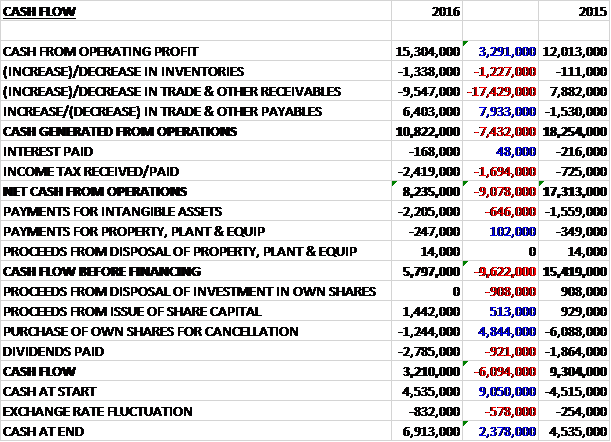
Before movements in working capital, cash profits increased by £3.3M to £15.3M. There was a cash outflow from working capital compared to an inflow last year and after tax payments increased by £1.7M the net cash from operations came in at £8.2M, a decline of £9.1M year on year. The group spent £2.2M on intangible assets and £247K on property, plant and equipment to give a free cash flow of £5.8M which easily paid for the dividends of £2.8M to give a cash flow for the year of £3.2M and a cash level of £6.9M at the year-end.

Peppa Pig remained the top brand this year and was joined by Little Live Pets and Teletubbies, relaunched at the start of the year, in the top three. The Little Live Pets range has recently been widened to include Snuggles My Dream Puppy which was names by the Toy Retailers association as one of the top 12 dream toys for 2016. Further additions to this range will be introduced in 2017.

The group also launched Stretch Armstrong on a global basis which saw initial sales exceed expectations. The Stretch product portfolio will be widened in the coming year and the board are excited about the brand’s potential to contribute significantly to future profitability.

During the year the group acquired 258,936 shares at a cost of £1.2M, although they seem to have raised £1.4M from new share capital so it seems a net gain in the number of shares in issue. They currently have an unutilised authority to buy back up to a further 2,791,298 shares and it remains part of the overall strategy to repurchase their shares when appropriate.

A significant proportion of the group’s purchases are made in US dollars so they are therefore exposed to currency fluctuations and the recent weakness in Sterling is not helpful. The increasing strength of the US dollar against sterling post-Brexit has the potential to cause an increase in the cost of sales, notably the factory cost of production and freight charges. A number of measures have been put in place to mitigate these effects and the growth in US sales has also helped maintain gross margin levels comparable with those achieved pre-Brexit.

Overall current trading continues to be in line with board expectations with pleasing levels of predictable contribution being generated from the established brands. The board are also satisfied with the inroads that they have made into overseas markets and expect this to be a prominent factor in delivering their growth ambitions going forward.

At the current share price the shares are trading on a PE ratio of 10.8 which falls to 10.3 on next year’s consensus forecast. After the final dividend was increased by 33%, the shares are trading on a PE ratio of 2.9% which increases to 3.2% on next year’s forecast.

On the 12th December it was announced that joint MD Kiran Shah sold 147,000 shares at a value of £772K. He still owns 2,140,001 shares and this is quite a substantial director sale.

Overall then this has been a fairly decent year for the group. Profits increased, net assets improved and although the operating cash flow deteriorated, this was due to working capital movements in cash profits increased with a decent amount of free cash being generated. The Teletubbies seem to be selling OK but the real breadwinner remains Peppa Pig, although Little Live Pets are doing well and Stretch Armstrong looks to have potential.

The deterioration in the value of Sterling is unhelpful but the group seem to have done a good job mitigating the effects. The large director sale is not a good sign but he has done this before so I am not overly concerned and with a forward PE of 10.3 and yield of 3.2% these shares look decent value to me and I am happy to remain invested.

On the 20th January the group released a trading update following their AGM. Whilst they are confident that the market expectations for 2017 shall be achieved, they expect the results for H1 to be lower than those reported in the first half of last year. In the four months to December, sales were marginally lower than the same period last year and UK gross margin was adversely affected by the devaluation of sterling. The steps taken to mitigate the reduction in margin are currently starting to take effect and they will be fully implemented in the second half. They are expecting both their international and domestic sales to grow in the remainder of the year.

The balance sheet, including the cash position continues to strengthen considerably and the reaction to the 2017 product ranges has apparently been excellent. This is a bit of a disappointing update but on the whole I am continuing to hold as the shares still look cheap.

On the 23rd January the group announced that finance director Mark Dowding purchased 9,554 shares at a value of £48K. He now owns 93,395 shares.

On the 14th March the group announced that finance director Mark Dowding purchased 6,605 shared at a value of £34K. He now owns 100,000 shares in the company. It was also announced that non-executive director Clive Crouch purchased 9,803 shares at a value of £50K which brings his holding up to 15,358 shares.

Telford Homes Share Blog – Interim Results Year Ending 2017

Telford Homes has now released their interim results for the year ending 2017.

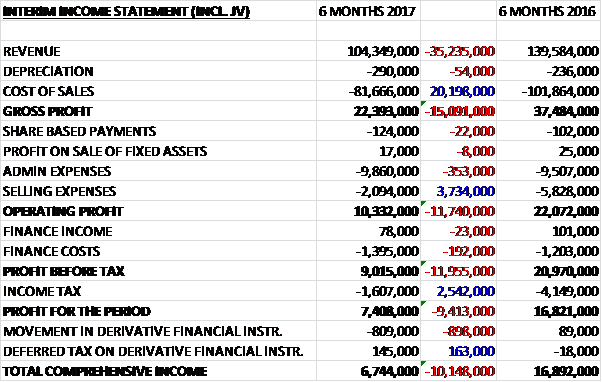
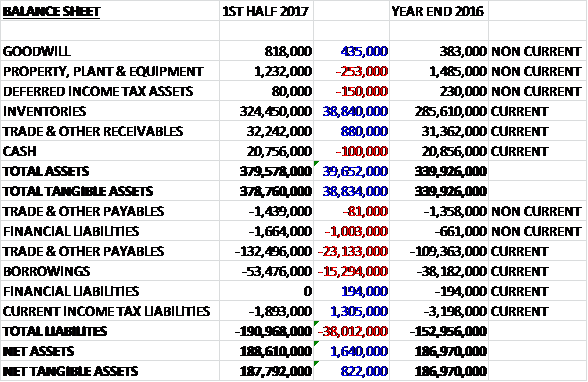
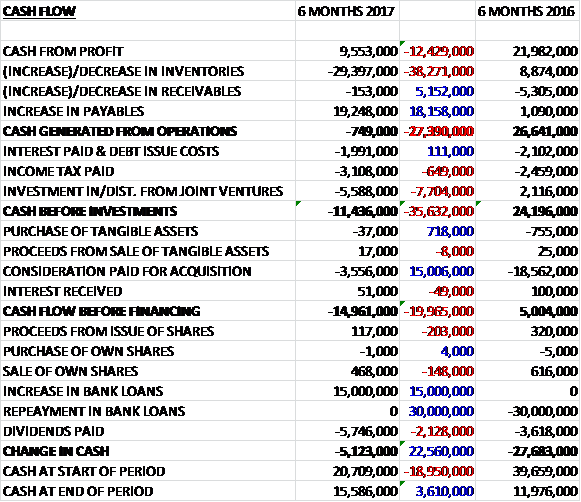
Revenues declined by £35.2M when compared to the first half of last year and cost of sales fell by £20.2M to give a gross profit some £15.1M below that of last time. Admin expenses increased by £383K mainly due to higher employee costs but selling expenses reduced by £3.7M due to the lower number of sales launches as the group took a cautious approach to the outcome of the EU vote, so the operating profit declined by £11.7M. Finance costs increased by £192K due to increased non-utilisation fees but tax charges fell by £2.5M to give a profit for the period of £7.4M, a decline of £9.4M year on year.

When compared to the end point of last year, total assets increased by £39.7M to £379.6M driven by a £38.8M growth in inventories. Total liabilities also increased during the period due to a £23.1M growth in payables and a £15.3M increase in borrowings. The end result is a net tangible asset level of £187.8M, a growth of just £822K over the past six months.

Before movements in working capital, cash profits declined by £12.4M to £9.6M. There was a cash outflow from working capital due to a large increase in inventories and after tax payments also grew and there was a net £7.7M investment in joint ventures which meant there was a net cash outflow of £11.4M, a detrimental movement of £35.6M year on year. The group also spent £3.6M on acquisitions to give a cash outflow of £15M before financing. The group increased bank loans by £15M and paid out £5.7M which meant that there was a cash outflow of £5.1M and a cash level of £15.6M at the period-end.

The reduction in profit during the period reflects the lower number of open market completions with just 85 in the first half compared to 282 in the first half of last year. Some of that reduction has been offset by ongoing profit recognition on an increased number of affordable homes under construction and the two current build to rent or PRS contracts. In the first two months of the second half, the group has achieved completion on over 100 additional open market homes.

In the last three months the group has experienced increased sales activity in respect of residual availability across a number of developments. Greater interest levels and more visitors to the Stratford sales centre have resulted in an increased number of reservations. Sales secured in recent months include three penthouse apartments at Horizons with an average price exceeding £1M, well in excess of the usual range.

Following the Brexit vote the group held back any significant sales launches whilst waiting for the immediate reaction to the outcome to become calmer. Although there is still uncertainty around the impact of leaving the EU, the market has settled in recent weeks and in early November the group launched the second phase of City North in Finsbury Park, a joint venture with the Business Design Centre. The development has 355 new homes together with a substantial commercial hub and incorporates a new entrance to the station. The group purchased its interest in the development from United House and went into the launch with 161 of the 308 open market homes already secured through previous sales activity.

The November launch exceeded the board’s expectations and in the space of three weekends the group sold a further 72 homes with combined sales in excess of £43M. This means that over £110M of open market revenue has now been secured on the development with final completions not due until 2020. The new sales were primarily to investors from the UK, China and Hong Kong. The net pricing achieved at City North was ahead of expectations with the average price achieved being £860 per square foot, near to the top end of the group’s price range. They have not had to discount prices below expected levels on any of their developments in contrast to the current market conditions for more expensive properties, although this has been helped somewhat by favourable exchange rates.

The group is increasing its involvement in the build to rent sector. These contracts are typically forward funding arrangements with a margin of around 12% to 13%. The margin recognised on build to rent schemes during the period was 12.8% compared to a residual gross margin on open market sale developments of 25.2% before sales and finance costs. This margin remains above target despite a large proportion of revenue arising from the Horizons development where a lower margin was accepted on the land purchase in return for land payments being made primarily from completion proceeds. The original target for Horizons has been exceeded due to a favourable balance between price inflation and cost inflation over the life of the development.

The group is very close to exchanging contracts on a third build to rent transaction and has recently started discussions on a fourth alongside looking at a number of options for partnership working outside of the existing development pipeline.

They are currently progressing the purchase of a significant site in East London alongside a joint venture partner and are in discussions on several other opportunities. The development pipeline at the period-end represented £1.42BN of future revenue to be recognised by the group and comprised over 4,000 homes including joint ventures. The average anticipated price of open market homes in the future development pipeline is £517K.

Over the last two years sales price inflation has slowed to a moderate by stable rate in low single digits. Build cost inflation is still evident but this has moderated and remains in line with board expectations. There have been indications of lower numbers of construction starts in recent months which should reduce any residual pressure on the availability of resources and their associated costs.

Net debt has increased to £32.7M compared to £17.3M at the year-end due to the investment in work in progress and lower numbers of open market completions, partially offset by an increase in deposits received on forward sales. There is still headroom of £125M on the debt facility which the group expects to utilise over the next few years.

Overall the board feel the group is well placed to deliver on their targets to exceed £50M of pre-tax profit by 2019 and currently have forward sales of over £700M and demand that remains strong from both owners and tenants.

At the current share price the shares trade on a PE ratio of 9.4 which falls to 9 on the full year consensus forecast. After an increase in the interim dividend, the shares are yielding 4.6% which increases to 4.9% on the full year forecast.
On the 21st December it was announced that group planning director David Durant sold 46,650 shares at a value of £146K and Land Director Henry Furlong sold 57,582 shares at a value of £180K. This doesn’t look that good to be honest.

The group has announced that it has exchange contracts for the sale of The Forge to M&G Real Estate, their second transaction with them. The Forge is their third build to rent development and the sale comprises the freehold interest in the land and the construction of 125 open market homes for £48.6M. The sale is on a forward funded basis and will comprise an initial land payment followed by regular payments throughout the construction period.

Overall then this has been a bit of a slow period for the group. Profits declined and the operating cash flow deteriorated, not helped by the investment in inventory. Net assets did show a small improvement, however. The sluggish performance is as a result of less open market completions as the group held back following the Brexit vote but the market seems to have settled since then and the City North development seems to be selling well, aided by a weak Sterling with increasing sales to Chinese investors.

I have mixed feelings about the increasing reliance on the build to rent sector. The forward sales should improve cash flow but the work will be lower margin so negatively impacts the return on investment. The recent director sales are a concern but the market looks OK and build cost inflation is manageable. With a forward PE of 9 and yield of 4.9% on balance I think the risks are priced in and I am happy to hold.

On the 1st February the group announced that it had exchanged contracts for the purchase of a significant development sire, the former London Electricity Board Building in Tower Hamlets for £30.2M. The 0.94 acre site is located in Bethnal Green. The expected gross development value of the scheme is about £95M and the group expects to start work on site in 2018 with completion anticipated in 2021.

On the 17th February the group announced that Land Director James Furlong sold 50,000 shares at a value of £178K. This seems a little ominous but I’m staying put for now.

On the 29th March the group announced that its joint venture, Chobham Farm, has exchanged contracts for the sale of the first phase of open market homes at New Garden Quarter, Stratford, to Folio London, a subsidiary of Notting Hill Housing Group, the other joint venture partner in Chobham Farm.

The contract represents the group’s fourth significant build to rent transaction and involves the sale of 112 of the 297 open market homes at New Garden Quarter for a cash consideration of £53.7M. The development is underway and completion of the build to rent homes is expected in 2018. The remaining open market units, which form part of the second phase, are expected to complete in 2019 and will be launched at a later stage from the group’s sales and marketing suite in Stratford.

The sale is on a forward funded basis and will comprise an initial upfront payment followed by regular payments throughout the remaining construction period. As a result of this transaction the joint venture will no longer require any external debt finance for the entire development. The group is now developing 483 build to rent homes across the four transactions and they continue to actively look for appropriate opportunities to increase this number in future.

e year as a whole. Pre-tax profit is expected to be slightly ahead of current market expectations following a strong performance in the second half of the year. In the last few months the non-prime London housing market has remained robust despite economic and political uncertainty.

The recent build to rent sales has increased the total number of homes in these schemes under construction to 483 representing a total contract value of £232M and the board expects further progress over the next year. The last significant launch was City North in Finsbury Park in November which achieved 73 new sales at a combined value of over £43M. Subsequent to this, new developments which would have been launched have instead ben sold for build to rent.

Total forward sales at the start of the coming year have declined by £29M to £550M and the average price in the development pipeline is within the group’s target range at £517K. At the start of February the group added to its pipeline through the purchase of a significant development site, the former London Electricity Board building in Tower Hamlets for £30.2M. The expected gross development value of the scheme is approximately £95M and subject to planning consent they expect to start work on site in 2018 with completion in 2021.

Other new opportunities are constantly being appraised and in greater numbers than during 2016. These include a mix of locations and developments that suit both individual purchasers and build to rent investors. The future build to rent strategy includes buying land in collaboration with investment partners to maximise value for both parties by designing a specific product from day one.

Going forward the group expects to develop even closer relationships and longer term partnerships with specific build to rent investors in the coming months as part of the plan to grow this area of the business. Over 80% of the anticipated gross profit for 2018 has been secured and the group in on track to deliver over £40M of pre-tax profit in that year. In addition for 2019 they have secured over 60% of anticipated gross profit and expect pre-tax profit to exceed £50M.
This all seems OK to me and I continue to hold.

On the 25th April the group announced that it had exchange contracts for the purchase of Stone Studios, a residential-led mixed use development site in Hackney Wick. The 1.06 acre site has detailed planning permission granted by the London Legacy Development Corp. The development will deliver 110 new open market homes and 10 affordable homes along with 54,218 sq.ft. of commercial space including 32,540 of affordable workspace. The gross development value of the scheme is expected to be over £80M and the group intends to start work later in 2017 with completion expected in 2020.
On the 4th May the group announced that it had been selected by Brent Council as their preferred partner to redevelop Gloucester House and Durham Court, a residential development site situated in South Kilburn. The 3.2 acre site has detailed planning permission and represents the second phase out of four for the regeneration of the area. The development will deliver 124 new open market homes, 102 affordable social rent homes and ten shared equity homes. The gross development value of the scheme is expected to be about £95M and the group intends to start work on site later this year with completion in 2021.

Cambria Automobiles Share Blog – Final Results Year Ended 2016

Cambria Autos has now released its final results for the year ended 2016.

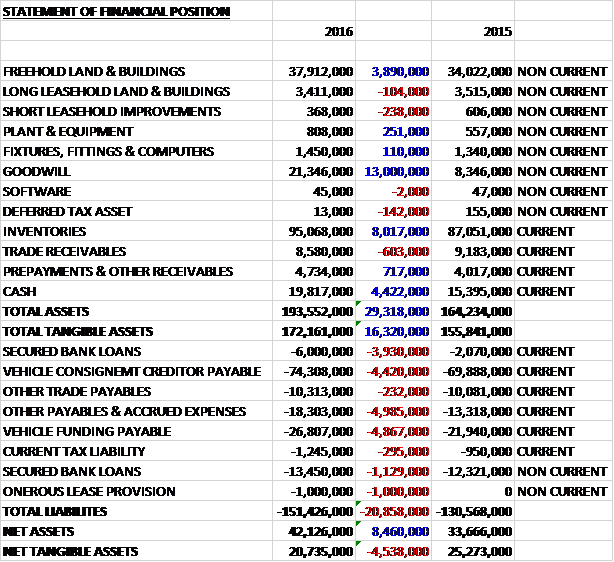
Revenue increased when compared to last year with a £59M growth in new car revenue, a £28.3M increase in used car revenue and a £4.9M growth in after sales revenue. Cost of sales also increased to give a gross profit £7.5M higher than in 2015. Staff costs increased by £3.1M and other admin expenses were up £1.6M but the group made £2M on the sale of businesses so the operating profit grew by £4M. Interest costs reduced slightly but tax charges grew by £883K to give a profit for the year of £9.3M, a growth of £3.2M year on year.

When compared to the end point of last year total assets increased by £29.3M driven by a £13M growth in goodwill, an £8M increase in inventories, a £4.4M growth in cash levels and a £3.9M increase in the value of freehold land and buildings. Total liabilities also increased due to a £5M growth in accrued expenses and other payables, a £4.9M increase in vehicle funding payable, a £4.4M growth in the vehicle consignment creditor payable, a £5.1M increase in secured bank loans and a £1M onerous lease provision relating to the JLR dealership acquired in Woodford. The end result is a net tangible asset level of £20.7M, a decline of £4.5M year on year.

Before movements in working capital, cash profits increased by £3.9M to £14.1M. There was a cash inflow from working capital due to an increase in payables and after tax payments increased by £922K and transaction costs grew by £730K, the net cash from operations came in at £16.7M, a growth of £1.7M year on year. The group spent £5.6M on property, plant and equipment along with a net £10.9M on new branches to give a free cash flow of just £464K which didn’t cover the £800K dividends. After new loans were taken out, the cash flow for the year was £4.4M and the cash level at the year-end was £19.8M.

During the year the like for like businesses contributed a £9.1M pre-tax profit, an increase of 28% year on year.

The gross profit in the New Car business was £19.3M, a growth of £3.8M year on year. On a like for like basis, new volumes rose by 2.9% and gross profit by £1.5M with an improvement in the gross profit per unit sold. This performance was delivered against an overall year on year increase of 3.9% in new UK car registrations, so slightly below the market although the private registrations element of the new car market increased by just 1.7% year on year. Including acquisitions, the sale of new vehicles to private individuals was 7.6% higher; fleet car and commercial vehicle sales increased by 6.9% and 32.5% respectively which has had a dilutive effect on overall new car gross margin.

The gross profit in the Used Car business was £23.7M, an increase of £2.9M when compared to last year. Like for like volumes were up 3.4% and like for like gross profit grew by £2.5M. The group has adopted a trading strategy which involves applying consistent controls to the level of used car stock being held, the pricing and presentation of the inventory and the penetration of finance and insurance products to the sale of used cars. The adoption of this trading style has resulted in the average gross profit on each unit increasing by 8.1% to £1,508 per unit.

The gross profit in the Aftersales business was £26.6M, an increase of £800K when compared to 2015 although like for like profit was flat despite a 1.9% increase in revenues. The aftersales margin was slightly diluted as the parts component of the revenue increased in mix terms. The margin in the parts element is smaller than that generated by service and bodyshop labour sales. The 0-3 year car parc continues to be replenished, as new car sales increases year on year and this gives the group confidence of further progress in guest relationship and retention and the aftersales business remaining strong.

During the year the group was partially through the building project related to its JLR dealership in Barnet and there is a further £4.1M of contract sum payments to be made under the terms of the agreement with the main contractor. The site should be complete in Q1 2017.

In January the group acquired a Land Rover dealership in Welwyn Garden City from Jardine for a consideration of £10.8M, generating £10M of goodwill. The business currently operates from leasehold premises under a short lease agreed with the vendor of the business. The existing Jaguar and Aston Martin businesses in Welwyn are located two miles from the Land Rover dealership. The group has agreed terms to acquire a freehold plot of land in the town to build a new facility for JLR and Aston Martin. The expected capital cost is £16M and the building will be completed in Q2 2018. The development will be funded through the existing revolving capital facilities and new term debt secured against the freehold of the property.

In July they completed the acquisition of the Jaguar and Land Rover dealership in Woodford from Pendragon for a cash consideration of £2.1M, generating goodwill of £3M. On assessment of the lease liability associated with the showroom premises in Woodford, the board made a £1M onerous lease liability which increased the goodwill (again showing what a ridiculous asset goodwill is). Since their acquisition, these businesses have contributed £631K to pre-tax profit.

In May the group opened the Aston Martin dealership in Solihull operating from a temporary facility. In order to secure the franchise for the territory, they acquired a freehold property and invested in a refurb of the facility while the permanent location in procured and built. The temporary facility has incurred a total spend of £1.6M and they are in advanced negotiations to secure some freehold land to build a new facility over the next two years. It is anticipated that the total investment in the permanent facility will be about £4.5M and on relocation of the business, the group intends to sell the temporary freehold property.

Following the Land Rover acquisition in Swindon last year, the group intends to redevelop its Swindon Motor Park location to provide a new JLR facility in line with the new brand requirements. It is expected that development will be completed in Q4 2017 and the planning and design processes are progressing well. Once the new development is complete, they will relocate the Land Rover business from the existing dealership property in Wootton Bassett. The expected investment in the site is £6M which will be funded from the facilities arranged in November 2015.

Overall then the group is investing £30.6M into these franchises of the next two years which is quite a considerable investment.

During the course of the year the group sold the Exeter and Croydon Jaguar businesses to the Land Rover franchise holder in each of those territories, realising a non-recurring income of just under £2M. These were positive earnings contributors to the group’s underlying performance in recent years so a bit of a shame but I doubt there is much they could have done to prevent the sale.

After the end of the year in late October the Welwyn Garden City Jaguar dealership workshop suffered fire damage. They are in the process of dealing with the aftermath of the fire which will impact the trading of the site for about four months while it is rebuilt and refurbished. They are working closely with their insurers to mitigate the financial impact on the group and don’t currently expect that these will be material.

Apparently it remains too early to assess the full implications of the Brexit vote but the economy is entering a period of uncertainty and sterling has depreciated considerably against the Euro which could impact the strategy adopted by the manufacturers of targeting the UK. The latest SMMT forecasts for new car registrations in 2017 show a 5% reduction on the 2016 closing forecast and from April to October 2016 there was a 2.7% year on year reduction in the private segment of the new car market. After the period-end in the important plate change month of September, trading was in line with expectations but October trading showed some softening in new car margins.

The group has a net cash position of £400K compared to £1M at the end of last year, although I suspect this is flattered somewhat by the timing of the year-end. At the current share price the shares are trading on a PE ratio of 8 which falls to 7.3 on next year’s consensus forecast. After a 20% increase in the total dividend, the shares are yielding 1.5% which increases to 1.6% on next year’s forecast.

On the 19th December it was announced that non-executive director Michael Burt sold 500,000 shares at a value of £285K. Apparently this decision to sell relates to a one-off change in his residential tax status and he has no plans to sell any more shares for the time being.

On the 4th January the group released a trading update. They have maintained the momentum from the results delivered last year and their trading performance in Q1 has been ahead of Q1 2016 on a total and like for like basis. After a strong September, there was some pressure on new car margins in October and on volumes in November. New vehicle unit sales for Q1 were down 9.4% on a like for like basis (0.7% total) but gross profit per unit improved in the group’s like for like businesses.

Used vehicle sales performed well with unit sales 2.5% ahead on a like for like basis and gross profit per unit continuing to increase. This performance has enhanced the profit from the used car segment of the business. The aftersales operations increased revenue by 13% (like for like 2.9%) with profitability up 6% but down 1.5% on a like for like basis, impacted by the fire at the Welwyn Garden City JLR workshop.

The board continues to believe that there may be some pressure on new car volumes and margins in 2017 as a result of the uncertainty in the economy and the forex volatility witnessed recently. The group’s trading performance in Q1 means that they are trading in line with market expectations for the full year, however.

Overall then this has been a decent year for the group. Profits increased as did the operating cash flow, although virtually all of this cash is ploughed back into the business (not necessarily a bad thing). The net tangible asset base did fall though due to the cash being spent on goodwill. Over the year new car profits grew, as did used cars which were helped by increased margins. The after sales business was flat however, due to lower services and body shop work.

The group is investing a lot into its existing franchises over the next two years – predicted to be about £30.6M over that time frame. This investment seems to be in response to requirements from JLR and is a substantial amount for a company of this size and adds some risk. The sterling depreciation is not helpful to the group as it makes the UK less attractive to foreign car makers and it is clear that the Brexit vote has caused some turbulence in the car market. So far this year, sales seem to be as expected with used car sales continuing to do well and new car sales dropping off a bit and aftersales being affected by the fire in Welwyn.

Going forward, the group are expecting 2017 to see pressure on volumes of new car sales and now doesn’t really seem to be the time for investing in businesses like this. With a forward PE of 7.3, however, quite a lot of this risk is already priced in so I’m caught in two minds over this one…

On the 7th March the group released a trading update covering the first five months of the year. They have maintained their momentum from the strong results delivered in the last year and the trading performance so far this year has been substantially ahead of the corresponding period last year. Used vehicle sales continued to perform well, with unit sales 0.6% ahead of the same period in the prior year while gross profit per unit continued to increase which has enhanced the profit from the used car segment.

The aftersales operations increased revenue by nearly 12% (like for like 2.6%) with profitability up by 3.8 Year on year (although like for like profits were down 2%), impacted by a fire in October at Welwyn Garden City Jaguar and Aston Martin which continues to affect the business. There will be a business interruption insurance claim which has not been reflected in this update.

Whilst new vehicle unit sales were down 2.9% (like for like down 11.1%) the gross profit per unit improved and the gross profit in this market also improved. Heading into the important March trading period, the new car order book is building well and is in line with expectations.

The board continues to believe that there may be some pressure on new car volumes and margins in 2017 with the current macroeconomic uncertainty in the economy. The group’s trading performance in the first five months of the year indicates that they are trading in line with market expectations, however, which already reflect these uncertainties.

Overall this seems OK, there is a big fall in new car like for like sales but aftersales continue to do OK – tricky one this, I will probably hold off.

Havelock Europa Share Blog – Interim Results Year Ending 2016

Havelock Europa has now released its interim results for the year ending 2016.

Revenues reduced when compared to last year as a result of a reduction in contracting spend from a major banking customer but cost of sales also fell and gross profits increased by £242K. There were no costs for board reorganisation this time, which accounted for £402K last time and other admin expenses reduced by £666K to give an operating loss which was £1.3M lower than last year. Finance costs also fell and there was no loss from discontinued operations (£136K) but there was also no tax rebate, which gave an income of £451K last time. All of this meant that the loss for the first half was £868M, an improvement of £1M year on year.

When compared to the end point of last year, total assets increased by £2M as a £2M reduction in cash was more than offset by a £1.9M growth in inventories, a £943K increase in receivables and an £851K growth in intangible assets. Total liabilities also increased during the period due to a £2.6M growth in borrowings and a £2.4M increase in pension obligations as a result of a fall in corporate bond yields. The end result was a net tangible asset level of £438K, a reduction of £3.7M over the period.

Before movements in working capital there was a cash outflow of £402K, an improvement of £1.4M. There was a large cash outflow from working capital, in particular a £1.9M increase in inventories to give a net cash outflow of £3.7M from operations, a detrimental movement of £1.1M year on year. The group then spent just £51K on property, plant and equipment along with £951K on intangible assets to give a cash outflow of £4.7M before financing. After some finance leases were paid back, there was a cash outflow of £4.8M and -£2.9M at the period-end.

The strong order book carried into this year, largely comprising public sector work, helped to offset the downturn in demand within the corporate sector, caused mainly by the major reduction in spending from a large banking customer with demand in the retail and lifestyle sector also being lower than expected. The reduction in overheads was helped by a credit on R&D costs, stronger margins from a richer mix of sales with fewer pure contracting sales, and simpler business processes.

Public sector volumes benefited from the strong order book taken into the year with the challenge in the second half being to ensure this is replenished for 2017. Public sector margins also benefited from the changes made to simplify and standardise the business.

As expected the corporate sector experienced significantly reduced volumes in the period and the group are working to develop this sector and increase their market share within the office fit out market. The retail and lifestyle sector had a challenging six months with customers continuing to re-evaluate their business case for proposed investments and searching for more cost effective solutions. To respond to this they are expanding their design capability and are increasingly working with clients early in the life cycle of a project and a key element of this will involve the business investing in a London design office which is expected to be operational in Q4 this year.

This new design office facility will also help with diversifying the customer base by bringing in additional clients. During this period they developed to major UK retailers into significant customers and are now beginning to grow a pipeline of opportunities. International retail continues to be a significant element of the business, again delivering over its 15% of turnover benchmark.

Operationally, the board have identified further cost savings within the infrastructure of the business which the manufacturing management team will be delivering. Additional savings and benefits will also accrue next year from the new ERP system which will be operational by the end of the year. This new system will provide the operational framework that will better enable them to continue the process of simplifying and standardising the business and delivering an enhanced customer experience.

Hew Balfour was appointed to the board in April as a non-executive director – he was previously CEO of the group from 1989 to 2010 so his arrival should shake things up a bit. In addition, Chairman David MacLellan is stepping down.

Going forward, although demand in the retail and lifestyle sector is subdued and the Brexit vote increased pricing pressure, demand in the public sector has been strong and overall, trading across the business remains in line with market expectations.

As the group is loss making, there is no PE ratio but based on the consensus forecast for the year as a whole, the forward PE ratio is 23.1. There are no dividends currently on offer here. Net debt at the end of the period stood at £3.6M compared to £3.1M at the same point of the prior year.

On the 20th December the group announced the appointment of Ian Godden as the new Chairman who is also subscribing to 3,000,000 new shares at 10p per share. Ian was previously a director of the group from 1995 to 2006 and on completion of the subscription he will own 7.69% of the company. This represents a premium to the previous share price of 8.5p per share.

Overall this has been a difficult period for the group as in improvement in public sector work was not enough to offset difficult market conditions in retail and a reduction in work from a large banking customer. The loss did improve on last year, however and although the operating cash outflow deteriorated cash losses also improved. The net asset situation deteriorated further, however. The group is looking to make further cost savings and the boardroom shake up might be a help but a forward PE of 23.1 looks a bit optimistic to me and doesn’t even offer good value if it is hit. I remain uninvested here.

On the 25th January the group released a trading update covering the full year. The board believe that results will be in line with market expectations. The benefits that have accrued from the measures taken in late 2015 are clear throughout the group and have enabled them to trade in line with market expectations despite the increasingly challenging retail sector. The current order book for 2017 currently stands at £21M.

On the 31st March the group announced the appointment of Donald Borland as CFO to succeed Ciaran Kennedy who is stepping down to take up the role of Director for Scotland at Clancy Docwra. Donald is a former Finance Director of Scottish real estate business Miller.

Cohort Share Blog – Interim Results Year Ending 2017

Cohort has now released its interim results for the year ending 2017.

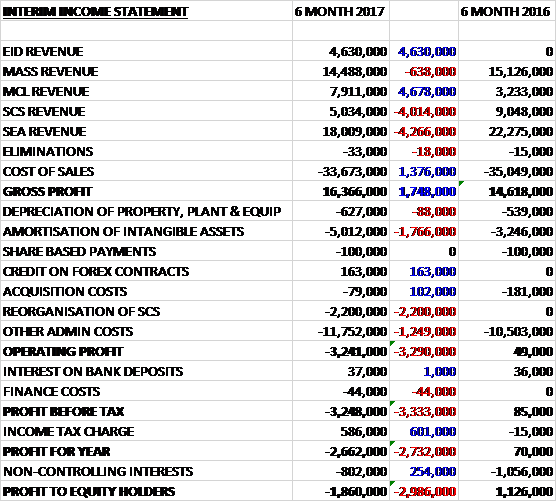
Revenues grew when compared to the first half of last year as a £4.7M growth in MCL revenue and a maiden £4.6M contribution from EID was partially offset by a £4.3M decline in SEA revenue, a £4M fall in SCS revenue and a £638K decrease in MASS revenue. Cost of sales declined to give a gross profit £1.7M ahead of last time. Amortisation charges grew by £1.8M and there were £2.2M of charges relating to the reorganisation of SCS which, along with a £1.2M growth in other admin costs, meant that the operating profit loss saw a £3.3M detrimental movement. The income tax rebate (relating to deferred tax) represented an improvement of £601K, however, to give a loss for the period of £1.9M, a detrimental movement of £3M year on year.

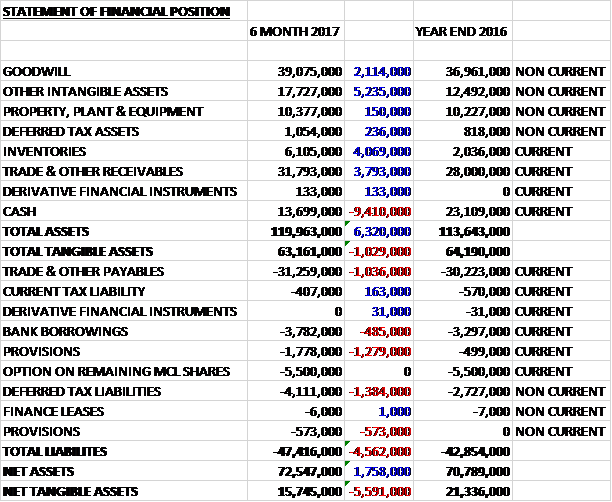
When compared to the end point of last year, total assets grew by £6.3M driven by a £2.1M rise in goodwill, a £5.2M increase in other intangible assets, a £4.1M growth in inventories and a £3.8M increase in receivables, partially offset by a £9.4M decline in cash levels. Total liabilities also grew during the period due to a £1.4M rise in deferred tax liabilities relating to the EID acquisition, a £1.9M increase in provisions and a £1M growth in payables. The end result was a net tangible asset level of £15.7M, a decline of £5.6M over the past six months.

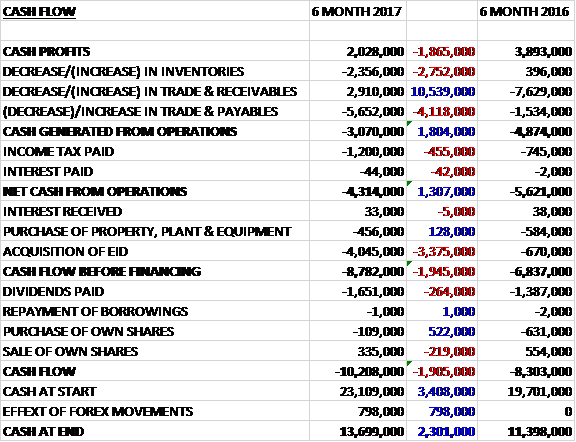
Before movements in working capital, cash profits declined by £1.9M to £2M. There was a large cash outflow from working capital, but less so than last year and after tax payments increased by £455K, the net cash outflow from operations was £4.3M, an improvement of £1.3M year on year. The group spent £456K on capex and £4M on the acquisition of EID to give a cash outflow of £8.8M before financing. The group then spent £1.7M on dividends to give a cash outflow of £10.2M and a cash level of £13.7M at the period-end – not a sustainable situation.

Adverse market conditions at SCS and delayed customer funded research work at SEA resulted in a weaker like for like group performance with the trading profit down 29% excluding the impact of EID.

The EID division contributed a maiden operating profit of £1.4M in the four months that it has been a part of the group. This strong performance resulted from long-term projects for various European navies and continued delivery of tactical communications systems for export customers including Egypt and Australia. Since acquisition, the business has secured nearly £5M of orders including £2.6M from its domestic customer, giving confidence in a strong second half.

The operating profit in the MASS business was £2.4M, broadly flat year on year with a £28K increase with electronic warfare countermeasures and software development work replacing education and other relatively low margin revenue. The business continues to grow its cyber offering with revenue in this market increasing by £1M to £3.4M. The business continues to be a key supplier to the UK MOD in a number of important strategic areas and this was recently underlined by the extension of its contract to support the Sentry air platform for a further nine years with a value of £12M. Of the closing order book of £43M, £11.7M is deliverable in the second half of the year which gives the board confidence it will have a stronger second half to the year.

The operating profit in the MCL division was £753K, a growth of £734K when compared to the first half of last year. The improved performance was a result of the delivery of Tactical Hearing Protection Systems to the British Army which started in the second half of last year. A further order has now been secured to extend deliveries to the end of the year and they expect follow-on orders to continue for some time thereafter.

MCL has continued to be a key supplier to the UK’s Special Forces and related agencies and has seen increased activity from these customers. Its strong position in this market was reinforced by the securing of a contract to design, develop, build and support an Airborne Tactical Communications System with an eventual value expected to be over £7M. As in the past, MCL’s performance is expected to be weighted to the second half and its closing order book of £4.5M, almost all of which is deliverable this year, along with a pipeline of opportunities that includes further hearing protection contracts, gives them confidence that the business will deliver a stronger second half.

The operating loss in the SCS business was £455K, a detrimental movement of £758K year on year. The division will be reported as part of MASS and SEA going forward. This performance reflects challenging market conditions and the loss of one of its air system contracts in a competitive renewal process.

The operating profit in the SEA division was £1M, a decline of £745K when compared to the first half of 2016 relating to reduced activity in the research division and the timing of deliveries of larger maritime projects. In the research division, following completion in March of a four year research programme, Delivering Dismounted Effect, the expected follow-on programme has been delayed by the customer until the end of this year. As a result there has been a sharp fall-off in activity levels that will persist into H2.

The closing order book of £45.8M includes £19.5M of revenue to be delivered in the second half, a significant proportion of which is higher margin maritime systems work for export customers. The pipeline of opportunities and the recently announced renewal and extension of the DTES solution for TfL gives the board confidence that the business will have a stronger second half. Challenges remain in the offshore energy market where the low oil price continues to put pressure on customer spending, although SEA’s activity in this area is continuing to generate profitable revenue. Overall they now expect SEA’s performance for the full year to be similar to last year.

Order intake for the first half was £37.1M excluding the acquired order book of EID (£23.1M) compared to £55.7M at this point of last year. The order intake in the first half was lower than last year with a number of contracts that had been expected to be renewed slipping into the second half. Some of these renewals are included in nearly £16M of orders received since the period-end. These include the nine year, £7M, DTES support contract for TfL, an order to extend elements of the Common External Communications System to the Royal Navy’s Trafalgar class subs and a number of longer term support contracts.

In June the group acquired a controlling interest in EID of 57% for a total of £5.2M, generating goodwill of £2.1M, and they have agreed in principal with the Portuguese government to increase their holding to 80% on the same terms and at the same Euro valuation. They expect the cash consideration for the additional 23% to be around £3.5M. In connection with this transaction, they have agreed terms of a shareholders agreement with the government, which will retain the remaining 20% of the business. The agreement will provide certain rights to them, but ensure Cohort has day to day management control over EID.

The group are also close to an agreement on acquiring the whole of the minority shareholding of MCL from its management and they expect to complete this by the end of December. The shares will be acquired on the basis agreed in the original agreement and the expected cost for the group will be £5.5M. This cost excludes the share of the surplus cash in the business as at the end of 2017 payable to the minority shareholders, which is estimated at £2M.

The reorganisation of SCS has now been completed, with the operating divisions being transferred to MASS (training support) and SEA (capability development and air systems). The board expect a positive contribution from this action in the second half trading performance, mostly from the saving in overheads, which is estimated at £1.6M per annum. The market for the consulting element of SCS has deteriorated over time and worsened considerably in the first half of this year, making a major restructuring essential. The cost of the reorganisation is estimated at £2.2M including redundancy and transition costs, asset write-downs and the provision for an onerous lease on its operating site at Theale. The group will look to mitigate this last cost by increasing the use of the site by other Cohort businesses as well as investigating other options such as sub-letting.

Going forward, the board are confident of a strong second half performance reflecting their normal seasonality, order book visibility, the benefit of a full second half contribution from EID and the elimination of SCS losses. £49.5M of the order book is deliverable in the second half and underpins nearly 80% of the consensus forecast revenue for the full year. Prospects for further order intake are encouraging. Overall, the order book and pipeline gives them confidence they will make further progress this year and they maintain their expectations for the full year.

The initial view on the impact of Brexit remains largely unchanged. The group are not exposed to significant amounts of EU revenue through their UK operations but the weakening of Sterling has resulted in an immediate improvement to the reported value of the Euro operating profit from EID, an increase of around £100K compared to initial assumptions. In the longer term, sustained weakness in Sterling would continue to be of net benefit, the enhancement to the export competitiveness outweighing any impact from increase cost inputs.

At the period-end the group had a net cash position of £9.9M compared to £11.4M at the same point of last year. At the current share price the shares are trading on a PE ratio of 21.7 which falls to 16.2 on the full year consensus forecast. After the interim dividend was increased by 16%, the shares are yielding 1.5% which increases to 1.7% on the full year forecast.

Overall then this has not been a great period for the group. The losses worsened, net assets declined and although the operating cash outflow improved, this was due to improvements in working capital outflows and cash profits reduced. The weakness came from the SCS business where a poor market and loss of a contract seem to have resulted in terminal losses as the group has now reorganised the division. The other poor performer was SEA, which has suffered from less research work, which will continue into the second half, and the slippage of some large maritime contracts which should improve in H2.

The other divisions saw improvements or flat performances and most are also expected to improve in the second half. The order intake has been disappointing but there seems to have been a lot of orders after the end of the first half which should make that look a bit more healthy. With a forward PE of 16.2 and yield of 1.7%, I am not sure if this offers good value and the group really needs to improve in the second half, although it does seem as though this is happening. Tricky, I continue to hold for now.

On the 9th January the group announced that the Portuguese government authorised the acquisition of tactical radios for their Army from EID. The details of the contract will be subject to negotiation but the approved value is €7.5M and delivery is expected to take place between 2017 and 2023.

On the 25th January the group announced that MASS has been selected to deliver the Met Police’s digital forensics managed service. The contract is expected to have a seven year duration and a value of about £15M with the option to extend for a further three years. The contract is available to other police forces within the UK which provides the possibility to increase the contract value during the ten year term to a national potential of around £230M.

On the 1st February the group announced that it had acquired the minority holding in its subsidiary MCL for a cash consideration of £5.1M in line with the arrangements stated at the time of the acquisition. The consideration has been paid out of existing financial resources and a further payment of £2M is expected to be made before the end of July reflecting a further earn out linked to the business’ order book. The impact of the acquisition is expected to be earnings enhancing in the remainder of the year.

On the 9th March the group announced that MCL had been awarded a contract by the MOD to supply and support hearing protection systems and communication ancillaries for specialist land, maritime and air applications. The initial value of the four year contract is £9.9M and it includes options for a one year extension and a complete mid-life enhancement of the capability. The contract follows previous MOD contract awards for hearing protection announced in 2015 with the solution being developed in partnership with a Danish audio technology company.

On the 2nd June the group released a contract announcement. MCL has been awarded two contracts by the MOD to supply and support hearing protection systems and communication ancillaries for land, maritime and air applications worth a combined £5.5M. They comprise a follow-on order worth £3.2M for Tactical Hearing Protection Systems for Dismounted Close Combat Users that provide hearing protection for RAF, Royal Navy and Reservist personnel; along with a new contract to provide Ear Communication Devices for RAF pilots and air crew with an initial value of £2.3M over five years with options for a further two years.