Games Workshop Share Blog – Interim Results Year Ending 2017

Games Worksop has now released its interim results for the year ending 2017.

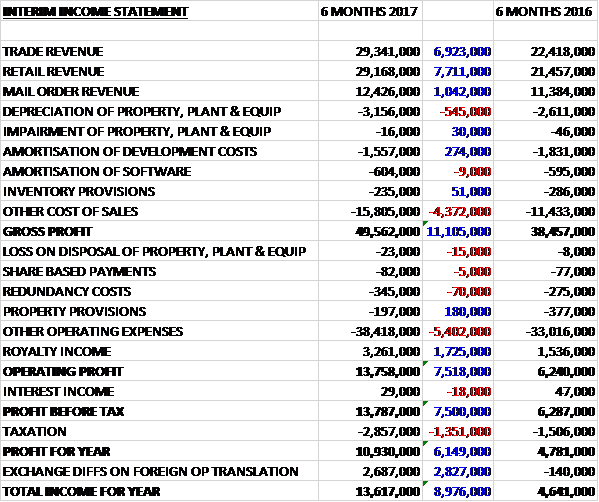
Revenues increased when compared to the first half of last year due to a £7.7M growth in retail revenue, a £6.9M increase in trade revenue and a £1M growth in mail order revenue. Amortisation declined by £265K but depreciation was up £545K and other cost of sales grew by £4.4M to give a gross profit £11.1M above that of last time. Other operating expenses grew by £5.3M but the royalty income increased by £1.7M to give an operating profit £7.5M ahead. After tax charges increased by £1.4M the profit for the period came in at £10.9M, a growth of £6.1M year on year although £644K of this was due to a change in accounting estimates.

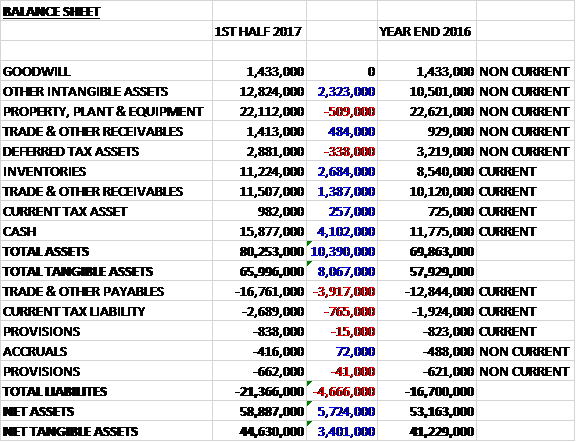
When compared to the end point of last year, total assets increased by £10.4M driven by a £4.1M growth in cash, a £2.7M increase in inventories, a £2.3M growth in intangible assets mostly due to the change in accounting estimates for amortisation, and a £1.4M increase in receivables. Total liabilities also increased during the period due to a £3.9M growth in payables and a £765K increase in current tax liabilities. This all meant that there was a net tangible asset level of £44.6M, a growth of £3.4M over the past six months.

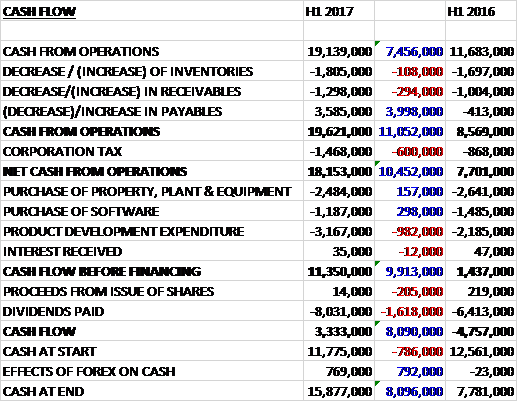
Before movements in working capital, cash profits increased by £7.5M to £19.1M. There was a small cash inflow from working capital compared to an outflow last time and after tax payments increased by £600K the net cash from operations was £18.2M, a growth of £10.5M year on year. The group spent £2.5M on fixed tangible assets, £1.2M on software and £3.2M on product development to give a free cash flow of £11.4M. This easily covered the £8M paid out in dividends to give a cash flow of £3.3M and a cash level of £15.9M at the period-end.

It is worth noting that of the £5M growth in operating profit before royalty payments, £3M was due to favourable forex movements with the constant currency figure being a growth of £2M which is still good but not quite as stellar as it first seems. The group does not hedge against currency movements so they received the whole benefit from the weaker sterling.

The operating profit in the trade division was £8.8M, a growth of £3M year on year with strong growth in revenues from all regions and the number of trade outlets increased by 60 accounts.

The operating loss in the retail division was £2.4M, an improvement of £683K when compared to the first half of last year with growth in sales from all regions. The group opened 17 stores including their first for some time in Singapore, Malaysia and Hong Long. After closing eight stores, their net number of stores at the end of the period is 460. The recruitment of new store managers remains a key area of focus.

The operating profit in the mail order division was £6.7M, an increase of £420K when compared to the first half of 2016. The Made to Order and Last Chance to Buy web store initiatives, aimed at ensuring customers have access to the broader range, have performed well.

The operating profit in the product and supply division was £6.1M, a growth of £1.4M year on year with £798K of that increase due to the change in accounting estimates for the amortisation of development costs and the depreciation of moulding tools. The group launched new editions of the White Dwarf Magazine and Blood Bowl game, the first of many new products from the specialist design studio. Both of these have sold through well. The group made £3M in royalty payments, an increase of £1.8M when compared to the first half of last year.

The capital expenditure contracted but not yet incurred is £996K which includes the replacement of the local area network for the HQ in Nottingham and tooling and machinery spend. It is worth noting that the group are still part way through the ERP change and this complicated project has the risk of widespread business disruption of it is not implemented well. Another risk is that they are changing their mail order warehouse system which carries risks associated with the transition.

At the current share price the shares are trading on a historic PE ratio of 19.9 but this doesn’t take into account the out-performance so far this year and the consensus forecast going forward for 2017 is 12.3. After an increase in the dividend the shares are now yielding 5.4% which increases to 6.6% for the full year. At the end of the period the group had net cash of £15.9M compared to £7.8M at this point of last year.

On the 17th January the group released a trading update covering the Christmas period to mid-January. They saw a significant increase in sales and profits compared to the same period last year and they believe profits for the year are likely to be above market expectations. Profits have further benefited from the continuing favourable impact of the weaker pound but the board remains aware that there is some uncertainty in the trading periods ahead for the rest of the year.

Overall then this has been a good period for the group. Profits increased, net assets grew and the operating cash flow increases with a decent amount of free cash being generated. All operating sectors improved, although it should be noted that the group really benefited from the weak pound and more than half of the growth has come from currency movements. Nonetheless the performance of the trade and royalty sectors looks very impressive. The forward PE of 12.3 and dividend of 6.6% make the shares look like they are still good value to me with the proviso that should sterling appreciate again, much of this would be reversed.

On the 6th March the group released a trading update where they stated that the sales and profit growth discussed in the last trading update continues and income from royalties is ahead of expectations. In light of this, profits for the year are likely to be materially above market expectations.

Sales and profits have further benefited from the continuing favourable impact of the weaker pound but the board remains aware that there is some uncertainty in the trading periods ahead.

On the 2nd June the group released a trading update covering the whole year. Sales and profit growth has continued and the board expect sales to be about £158M and pre-tax profits to be above market expectations at at least £38M, both benefiting from the continued weak sterling.

Orosur Mining Share Blog – Interim Results Year Ending 2017

Orosur Mining has now released its interim results for the year ending 2017.

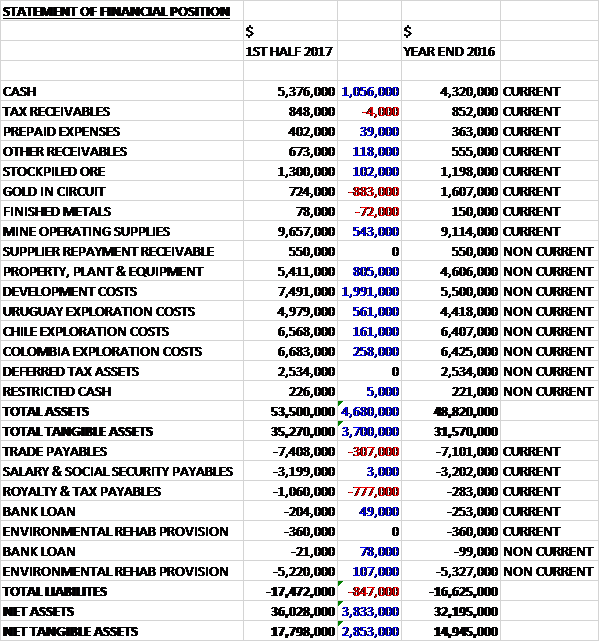
Revenues declined by $1.2M when compared to the first half of last year but cost of sales were considerably lower with mining & transportation costs down $3.4M, mine site admin costs falling by $1M, partly due to the $881K contingency recognised last time relating to a labour claim, a $1.2M positive change in inventories and a $799K reduction in depreciation due to the fact that Arenal had been mostly depreciated by Q2, only being partly offset by a $509K increase in royalty charges reflecting the fact the group has been paying royalties following the ending of the exemption in March 2016. Admin expenses were broadly similar to last year but restructuring costs improved by $2M as some redundancy costs provisioned for previously were not neaded, to give an operating profit of $4.4M, a positive movement of $2.7M. We then see a $412K derivative loss and a $370K swing to forex losses and after tax charges increased by $44K, the profit for the period came in at $3.7M, a positive movement of $6.3M year on year.

When compared to the end point of last year, total assets increased by $4.7M driven by a $2M growth in development costs, a $1.1M increase in cash and an $805K growth in property, plant and equipment, partially offset by an $883K reduction in the value of gold in circuit. Total liabilities increased modestly during the period due to a $777K growth in royalty and tax payments. The end result was a net tangible asset level of $17.8M, a growth of $2.9M over the past six months.

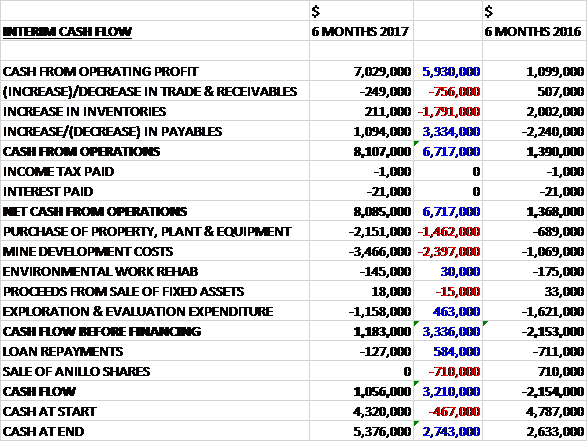
Before movements in working capital, cash profits increased by $5.9M to $7M. There was also a cash inflow from working capital due to an increase in payables and after both tax and interest remained steady there was a net cash inflow of $8.1M from operations, an increase of $6.7M year on year. The group spent $2.2M on property, plant and equipment; $3.5M on mine development costs, $1.2M on exploration (mostly in Uruguay and Colombia) and $145K on environmental work to give a free cash flow of $1.2M. After loan repayments of $127K there was a cash flow of $1.1M in the period and a cash level of $5.4M at the period-end.

The San Gregorio West Underground mine started full production at the end of November, in line with expectations following a safe and efficient transition.
During the period the group sold 17,919 ounces at an average price of $1,290 per ounce compared to 21,670 ounces at $1,127 per ounce in the first half of last year. During Q2, 232,964 tonnes of ore were fed into the plant at an average grade of 0.99g/t to produce 6,852 ounces of gold. This compared to 199,352 tonnes at 1.36g/t to produce 8,172 ounces in Q2 last year. The reduction in grade is largely related to the closure of the underground mining at Arenal Deeps and the start of mining at San Gregorio during the quarter.
The group were able to produce an additional 90,000 tonnes at 1.39g/t from Arenal which was not in the mine plan.

Total cash operating costs were $914 per ounce compared to $858 last time and the AISC for the quarter was $1,345 per ounce compared to $1,095 in Q2 last year. The key driver behind the higher costs was the development of San Gregorio which started production at the end of Q2 2017 as the underground staff and equipment were transferred from the Arenal operation to San Gregorio. Excluding the capex cost, the AISC in the quarter would have been $1,207 per ounce.

During Q2 the group intensified the investment in the construction of the ramp, access and finalised the construction of the ventilation shaft at San Gregorio. In addition they started the construction of the phase 4A of the tailings dam and continued during the current quarter.

At Minerales Cala in Uruguay, in September the group retained a 20% interest and Phase 3 of the option agreement has started and exploration work has been carried on based on a proposed budget and drilling programme submitted by Minerales Cala and Patagonia Gold. In October the group elected not to continue phase 3 expenditures and thus their interests in the project has been diluted and converted to a net smelter return royalty of 2%.

At Gladiator, also in Uruguay, in August, Gladiator announced its intention to dispose of its current interest under the option agreement and in September notified the group of an offer received from a third party proposing a purchase of all of its interest. The group have concluded that the offer is not compliant with the underlying option agreement, however, and cannot be accepted in its current form. In December Gladiator announced that it had executed a binding agreement with a third party to dispose of its interests so the group is in discussions with them regarding the matter and intends to “take all necessary steps to protect their interest in the project”.

At Anillo in Chile, in July the group accepted a request from Asset Chile to extend until March 2017 to allow them to decide on exercising their option to move to phase 2. In September 2016, Asset Chile contributed $120K to cover the minimum expenditure on the project. They have to complete their required contribution to phase 2 (up to $1.25M to fund 5,500m of RC drilling) in order to earn into a 32.5% interest if the group’s share in Anillo. In the event that Asset Chile does not complete the phase 2, they will forfeit their earn-in achievement to date.

At Pantanillo in Chile, in November the group signed the documents for the return of the project back to Anglo American and the transaction will close once they counter-sign. At Talco in Chile, the group’s option to acquire the remaining 75% of the Tellos ownership expired unexercised and they continue to look for opportunities to monetise this asset.

The company’s forecast production guidance for 2017 remains between 35,000 to 40,000 ounces of gold at operating cash costs of between $800 to $900 per ounce. The group incurred higher unit costs in Q2 due to the transition from the Arenal underground to the SGW underground mine which are expected to gradually decrease during the rest of the year.

The group made a loss last year so we don’t have a current PE ratio but at the current share price the consensus forecast is showing a forward PE of 3.2. At the period-end the group had a net cash position of $5.2M compared to $4M at the year-end.

On the 19th January the group announced an update of their exploration activities at the Anza gold project in Colombia. They have completed a preliminary geological model for the Aragon-Pastorere Trend Area of the project and a geological estimate of an exploratory gold potential has been prepared. This ranges between 1.6MT and 2.3MT averaging between 3.2 and 3.7g/t of gold. This estimate is based on current drilling and is expected to grow as future exploration drilling is conducted.

The group believes that the mineralised zones in the APTA continue, both at depth and at the surface, to the north and south of the limited area which has been analysed to date so there is potential for a much larger resource base to be identified. The APTA extends 2km along strike of the vein-like deposit but only accounts for a small portion of the total Anza project which covers about 105km2 in total.

Previous drilling of Anza has shown consistent high grade gold intercepts over significant widths as well as coincident zinc mineralisation. Anza is situated in a well-known geological setting in Colombia already hosting a number of substantial gold projects. It has existing mine and environmental permitting and its existing infrastructure including camps, roads, power and water are in good standing.

During 2017 the group plans to undertake a 15,000 to 30,000m drilling campaign to delineate maiden resources, further define and expand the potential mineralisation for APTA, test mineralisation in undrilled areas of the deposit where strong indications of economic gold occurrences exist and start initial drilling of nearby untested and highly prospective targets.

The site has environmental permits enabling both underground and open-pit mining operations. The Anza project includes two small underground gypsum mines, each of which also have environmental and mining permits granted by the Colombian authorities. Historically the gypsum mines have been operated by a third-party contractor but the group is currently in the process of taking over operatorship. The gypsum permits can be readily expanded, enabling them the ability to fast track permitting for future gold mining operations.
The group believes that Anza has significant upside and they expect the project to take a more prominent standing in their suite of South American gold assets in the months to come.

Overall then this has been a fairly positive period for the group at a time when they switched production to San Gregorio. Profits were up, net assets increased and the operating cash flow grew, aided by higher payables.
Discounting the working capital movement, the group was broadly free cash neutral. The $1,290 selling price is a bit higher than the current price and the AISC of $1,207 is also above the current price of gold, although the group say this will reduce in the second half.

The Anza project looks interesting and the transition to San Gregorio seems to have gone rather smoothly. The current price of gold is a bit on the low side, however, and I would like to see what a whole quarter of San Gregorio production looks like but I am starting to think a forward PE of 3.2 more than accounts for the risks and am tempted to hop back in here.

Goodwin Share Blog – Interim Results Year Ending 2017

Goodwin has now released its interim results for the year ending 2017.

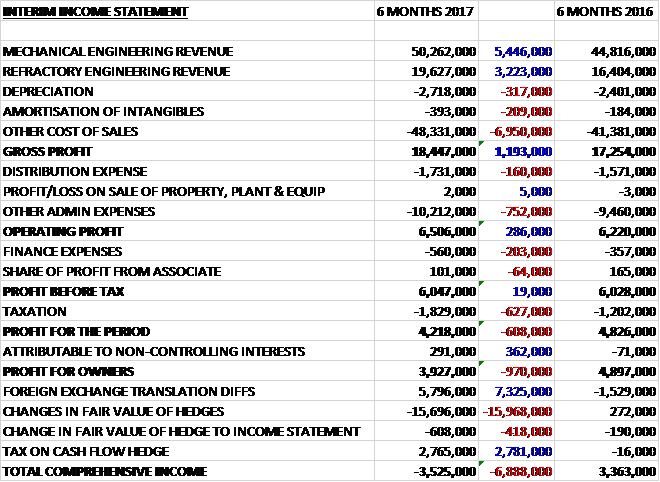
Revenues increased when compared to the first half of last year with a £5.4M growth in mechanical engineering revenue and a £3.2M increase in refractory engineering revenue. Depreciation was up £317K, amortisation grew £209K and other cost of sales increased by £7M to give a gross profit £1.2M above that of last time. Distribution expenses increased by £160K and admin costs were up £752K which meant that the operating profit grew by £286K. We then see a £203K increase in finance expenses, a £64K reduction in profits from the associate and a £627K increase in tax payments, all of which meant that the profit for the period was £3.9M, a reduction of £970K year on year.

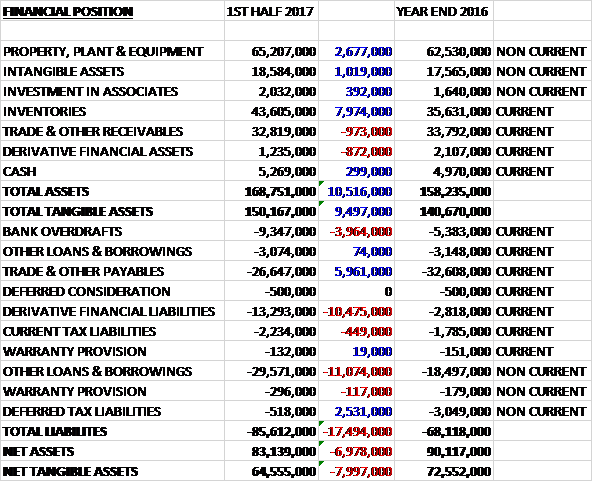
When compared to the end point of last year, total assets increased by £10.5M driven by an £8M growth in inventories, a £2.7M increase in property, plant and equipment due to forex movements and a £1M growth in intangible assets (again due to forex movements), partially offset by a £973K decline in receivables and an £872K fall in derivative financial assets. Total liabilities also increased during the period was a £6M decline in payables and a £2.5M fall in deferred tax liabilities were more than offset by a £10.5M increase in derivative financial liabilities, an £11.1M growth in loans and a £4M increase in the overdraft. The end result was a net tangible asset level of £64.6M, a decline of £8M over the past six months.

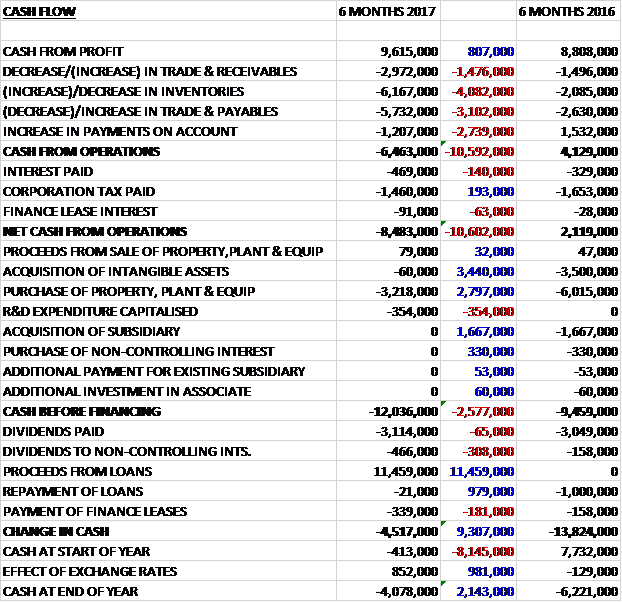
Before movements in working capital, cash profits increased by £807K to £9.6M. There was a huge increase in working capital cash outflows, however, and after an increase in interest payments broadly cancelled out a decline in tax payments, the net cash outflow from operations was £8.5M, a detrimental movement of £10.6M year on year. The group spent £3.2M on property, plant and equipment along with £354K on R&D and £60K on other intangible assets to give a cash outflow of £12M before financing. The group therefore took out £11.5M in more loans but paid out £3.5M in dividends so there was a cash outflow of £4.5M during the period and a cash level of -£4.1M at the period-end.

The profit in the Mechanical Engineering division was £4.8M, a decline of £557K year on year. The further depressed state of capex on oil, gas and mining projects will be a challenge to the division in 2017. The profit in the Refractory Engineering division was £2.2M, a growth of £625K when compared to the first half of last year with markets as a whole remaining stable.

The current workload stands at £84M and sales orders dispatched up to the period end were £69.9M but the margins are lower due to the increased competition in the tighter market. Growth areas in the refractory engineering products continue to provide good opportunity whilst a better base load within the longer term defence work has given some reassurance in comparison to the continued low new project and procurement activity in the oil, gas and mining industries.

The group’s capex is very much reduced, other than customer project financed development, they are restricting expenditure. With the likely continued low oil and gas and metal ore prices it would be unrealistic to expect any significant recovery in pre-tax profitability until after 2018.

The group have brought some new products to market such as their axial piston shut off and control valves, their new range of duplex and high impact resistant carbon steels and products that use their AVD vermiculite dispersions such as fire extinguishers, lithium battery transport bags and fire resistant paints. For all these products they have patents applied for and they should provide the group with a sound base to start growing again.

Following the Brexit vote, Sterling has depreciated against most major currencies. At the period-end the cash flow hedge reserve is significantly negative which reflects the marked to market values of currencies sold to/ purchased from the banks in relation to the group’s underlying currency sales and purchase requirements. Judging the future relationship of the major currency pairs apparently continues to be a challenge.

The mechanical engineering division companies with the exception of Easat Radar Systems are seeing their order backlog go down as it is likely to continue to do so during 2017. Goodwin International, which had the highest activity level in the oil and gas industry, has in part mitigated the severe purchasing activity decline in this sector by winning significant levels of business in the nuclear engineering sector, which has business to place for the next ten years. The hardest hit business is the foundry, Goodwin Steel Castings. Whilst over the past three years it has done better than most other competitive foundries it is now short of order input and as such is looking to ramp up new business for submarines in the UK and US following their recent approval to produce HY80 cast material.

At the current share price the shares are trading on a PE ratio of 14 but there are no forecasts for this company. As usual, no interim dividend was announced so the shares still yield 2.5%.

Overall then this was a difficult period for the group. Profits declined, not helped by increased tax charges, and net assets decreased. The operating cash outflow was a bit of a disaster but this seems to have been as a result of working capital movements and cash profits actually grew in the period. The refractory engineering business seems to be doing fine but the mechanical engineering business is really struggling in the face of reduced investment from the oil and gas industry. Management are not expecting a pick-up until 2018 at the latest so I don’t think the PE of 14 and yield of 2.5% fully reflect this.

On the 10th March the group released a trading update covering Q3. In the first nine months of the year revenue increased by £17.5M but pre-tax profit was down £800K to £8.2M due to much fiercer competition for the lower level of orders being placed in the oil and gas industry. The market remains very quiet and order input for the group as a whole is 10% lower than in Q3 last year. The refractory engineering businesses are still increasing sales volumes and profit, however.

Vertu Share Blog – Interim Results Year Ending 2017

Vertu Motors has now released its interim results for the year ending 2017.

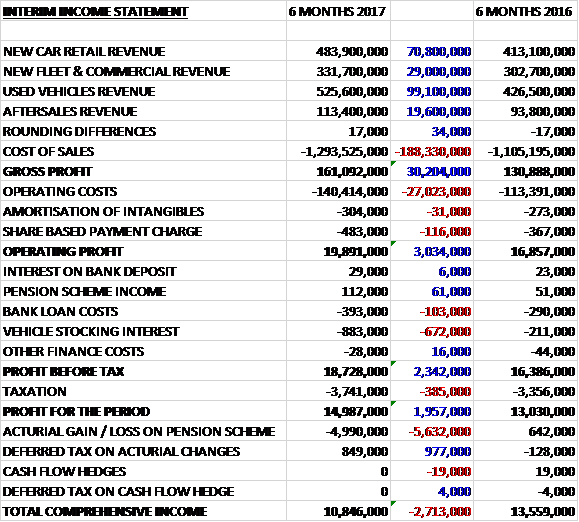
Revenues increased when compared to the first half of last year due to a £99.1M growth in used vehicle revenue, a £70.8M increase in new car retail revenue, a £29M growth in new fleet & commercial revenue and a £19.6M increase in aftersales revenue. Cost of sales also increased to give a gross profit £30.2M higher than last time. Operating costs increased by £27.1M which meant that the operating profit was £3M higher. Bank loan costs were up £103K, vehicle stocking interest increased by £672K due to higher pipeline stocks as new vehicle sales slowed along with the higher number of premium franchise operations which operate with higher vehicle stocking costs, and tax charges grew by £385K, all of which meant that the profit for the period was £15M, a growth of £2M year on year.

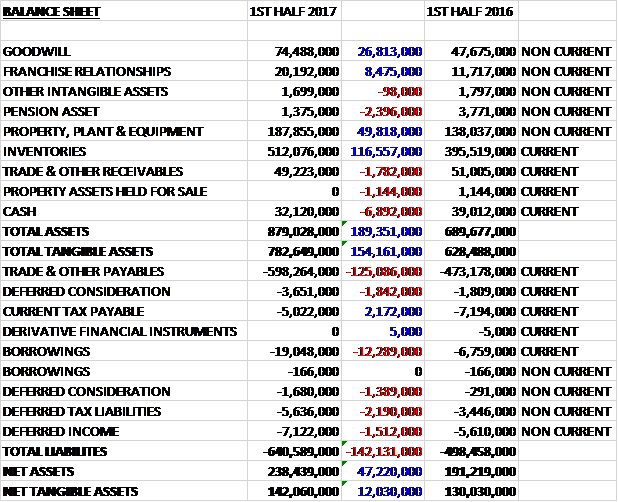
When compared to the same point of last year, total assets increased by £189.4M driven by a £116.6M growth in inventories, a £49.8M increase in property, plant and equipment, a £26.8M increase in goodwill and an £8.5M increase in the value of franchise relationships, partially offset by a £6.9M decline in cash. Total liabilities also increased due to a £125.1M growth in payables and a £12.3M increase in borrowings. The end result was a net tangible asset level of £142.1M, a growth of £12M year on year.

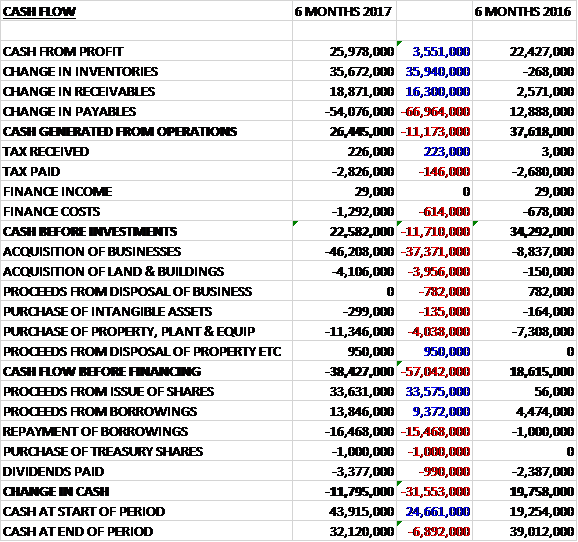
Before movements in working capital, cash profits increased by £3.6M to £26M. There was a small cash inflow from working capital but this was less than last year and after finance costs increased by £614K the net cash from operations was £22.6M, a decline of £11.7M year on year. This covered the £12.3M spent on property, plant & equipment and the £4.1M spent on land and buildings but not the £46.2M forked out on acquisitions so before financing there was a cash outflow of £38.4M. The group spent £3.4M on dividends and paid back a net £2.6M of borrowings so had to issue shares to receive £33.6M. This resulted in a cash outflow of £11.8M for the period and a cash level of £32.1M at the period-end.

After four years of growth, the UK private new retail market softened during the period, recording slight declines in registrations from April onwards which meant that there was a reduction of 0.8% for the period.

The gross profit in the aftersales business was £63.4M, a growth of £12.7M year on year with an increase of 6.8% on a like for like basis. A growing UK vehicle parc and the group’s retention initiatives, particularly the sale of service plans to both used and new car customers, have continued to contribute to these favourable trends. The group now has 97,427 customers paying monthly for their service and MOT through their own service plan products compared to 80,902 last year. In vehicle servicing, like for like service revenues grew by 6.6% with margins increasing as the group achieved higher levels of workshop efficiency as volumes increased.

The gross profit in the used car business was £52.3M, an increase of £10.3M when compared to the first half of last year with a like for like volume growth of 8.5%. This growth was driven in part by the increasing focus on effective marketing, particularly via the promotion of the group’s Bristol Street and Macklin Motors websites, through increasing marketing spend directly online and through TV ads.

In addition to the substantial volume growth the group delivered further used vehicle margin improvements with like for like gross profit per unit up 6.3%. This improvement reflecting strong pricing disciplines, a structured sales process underpinned by training and underlying balance of supply and demand in the wider used vehicle wholesale markets.

The gross profit in the new car business was £35M, a growth of £4.7M when compared to the first half of 2016. This growth was driven by acquisitions with like for like revenues and gross margins stable. UK private new vehicle registrations fell by 0.8% and the group’s like for like new vehicle volumes declined by 4.2%. Increasingly it became evident that as a result of the softening in the new car market, the market was becoming characterised by higher levels of self-registration by retailers with these vehicles registered as retail. These cars are then sold into the retail market as used cars.

The gross profit in the fleet and commercial business was £10.4M, an increase of £2.5M year on year with like for like gross profit up 13.2% and gross profit per unit increasing from £423 to £491. Overall UK registrations in the fleet car channel rose 6.1% whilst group like for like registrations fell 10.6%. This decline in market share reflected fewer deliveries in the low margin supply of vehicles to daily rental companies. This trend reflected the increasing management of used vehicle residual values by the group’s manufacturing partners through reducing overall supply volumes in this low margin channel including seeking to extend daily rental replacement cycles.

The group’s total commercial vehicle sales volume have grown by 13.4% and by 11.6% on a like for like basis. This strength reflects the group’s strong market position in new van supply and the excellent economic conditions in the UK in the period for business. During the period the UK light commercial vehicle registrations grew by 3.9% so the group’s market share has risen.

In March the group acquired Sigma Holdings which operates three Mercedes outlets in Reading, Ascot and Slough. The total consideration amounted to £21.7M including an initial consideration of £8.2M, a £10M bank facility repayable in November 2016 and a further £3.5M deferred over twelve months. This acquisition generated goodwill of £12M and in the prior year the business made a pre-tax profit of £1.2M. The board is pleased with the progress made to date to integrate and improve the performance of the business and they have traded in line with the performance targets put in place at the time of the acquisition.

In May the group acquired Leeds Jaguar from Inchape for £592K settled in cash which generated goodwill of £500K. Last year the business was at breakeven but the Jaguar franchise is currently witnessing a significant turnaround in profitability on the back of new products such as the F-PACE. This business, together with the existing Leeds Land Rover business will shortly be relocated to a freehold dealership in the centre of the city. The property has undergone major redevelopment to house these two businesses and to meet the latest manufacturer standards.

In June they acquired Gordon Lamb which operates the Toyota, Land Rover, Skoda and Nissan outlets in Chesterfield along with the Skoda outlet in Derby. The consideration amounted to £18.8M and generated goodwill of £5.8M with the business generating a pre-tax profit of £2.7M in the prior year. The integration of these businesses has gone well. Derby Skoda is currently in a short-term leasehold property outside of the city and it is planned to relocate this outlet to an existing group location in the centre of Derby in Q1 2017 which will significantly enhance the trading potential of the business and reduce ongoing operating costs.

Also in June the group acquired the freehold and long leasehold interests from Honda in two dealerships operated by the group in Derby and Nottingham for £3.2M. In August they opened the Morpeth Honda outlet alongside an existing Ford outlet. This is the group’s 13th Honda dealership, consolidating their position as Honda’s largest partner in Europe and completing full coverage of the NE market area from Tweed to the Tees.

A further development is nearing completion, the building of a new Nissan dealership in the centre of Glasgow. The group was awarded the whole of Glasgow as a market area for Nissan in April 2015 and the completion of this dealership will see the relocation of the business from a temporary North Glasgow site.

Investment continues to be made in the “Ford Store” concept which sell the full range of Ford product. The group is now reaping the rewards of the investment made in its Birmingham and Orpington Ford store operations. The group’s Gloucester Ford outlet is currently undergoing redevelopment into a Ford store and work will start shortly on a significant Ford store development in Bolton. Further investment has been made in expanding the aftersales capacity of the Ford division with new offsite aftersales facilities now in place at West Brom, Shirley and Orpington.

After the period-end, the group disposed of the Fiat dealership in Newcastle which comprised three sales outlets. In addition, Fiat sales will cease at the group’s sales outlets in Cheltenham and Derby at the end of December 2016 which will leave them with a single Fiat and Alfa Romeo sales outlet in Worcester and no Jeep representation.

The group undertook a £35M equity placing in March to finance further acquisitions and the majority of these funds were deployed during the period.
The group, in common with all sector participants, is in the process of a major programme of capital investment; developing new dealerships, increasing capacity in existing dealerships and responding to manufacturer partner led refurbishments of the existing dealership portfolio. In particular, substantial sums are being invested in increasing capacity and enhancing the retail environment of the JLR dealerships. The group spent £10.2M on this investment during the period with £17.8M expected to be spent in the second half. Next year, the spend is expected to be around £31M with £15.5M expected in 2019. The board is confident that the significant decline in future capital spend in 2019 will drive enhanced free cash flow at that point – up to then it looks like it will be constrained, however.

Following the EU referendum, the result has not materially impacted consumer confidence and the group has not yet experienced any significant change in consumer behaviour. The board believes that the main risks associated with the Brexit vote are significant changes in consumer behaviour and the impact of exchange rates on manufacturer volume strategies and vehicle pricing.

The board are confident regarding the sustainability of their performance in the aftersales and used vehicle market. The latest SMMT forecast for 2016 new vehicle registrations stands at 2.64M compared to 2.63M last year. The market is starting to see vehicle price increases reflecting the manufacturers’ reaction to declining Sterling rates. Lower margin channels such as fleet car supply and motability are likely to see more impact than higher margin channels. In 2017, there is expected to be a decline in registrations of around 6% which would equate to a new car market of around 2.5M units.

Profit in September was ahead of prior year levels on a like for like basis and recent acquisitions further bolstered the result. The service and used car performance continued to demonstrate strong underlying growth trends in September but like for like new car private volumes were down 1.7%, in line with the SMMT registration data. The group’s performance in the key September plate change month was strong and the board expects that full year results will be in line with market expectations.

At the current share price the shares trade on a PE ratio of 8.2 which falls to 7 on the full year consensus forecast. At the period-end the group had a net cash position of £12.9M compared to £23.1M at the start of the period. After the interim dividend was increased by 11%, the shares are yielding 3.1% which increases to 3.2% on the full year forecast.

Overall then this has been a period of progress for the group. Profits were up, net assets increased and although the operating cash flow declined, this was due to reducing payables and cash profits increased. After acquisitions, there was no free cash flow and I am not sure there is going to be enough for the big increase in capex over the next year or so – perhaps that is why the group approached the market for more money.

Aftersales were strong as the group signed up more customers to their service plans, used car sales performed well due to a concentration on more marketing and commercial sales saw a good performance due to the strength of the market in the country. The issue is the new car sales where like for like profits were stagnant. Indeed, since the period-end the market has declined further and is expected to further deterioration going forward. This is likely to be, at least in part, due to Brexit and the depreciation of Sterling.

The shares do seem good value with a forward PE of 7 and yield of 3.2% but the investment hinges on how bad one thinks the UK car market is going to get. I also don’t tend to like companies that have to go to the market for more cash by issuing more equity, I would rather they grow using internally generated cash flows. Overall I think it prudent to wait for some more clarity on the direction of the UK car market.

On the 1st March the group released a trading update ahead of the final results. The board expects trading to be in line with current market expectations with growth in revenues and profits. In the first five months of the year, like for like revenues were up 4.8% with service revenues up 6%. Sales volumes were mixed with a 7.8% increase in used car volumes and a 6.1% growth in new fleet cars being offset by a 9.3% reduction in new car sales, a 10.7% fall in new commercial vehicles and a 4.5% decline in motability vehicles.

In the period, the group’s aftersales focus continued to be on improving customer retention in the vehicle servicing departments through selling service plans to customers buying vehicles. This resulted in continued like for like growth of 6% in vehicle servicing revenues with like for like gross profits up 6.9%.

During the period the SMMT private new vehicle registrations fell by 1.1%. Amongst the group’s manufacturing partners there have been mixed responses to the post-Brexit currency conditions. Some manufacturers maintained prices, supported customer offers and grew market share whilst others have sought to increase prices and reduce consumer offers, losing share as a result. Overall new car prices are reported to have risen by 5.2% in the seven months following the referendum.

Some vehicles registered as retail as measured by the SMMT registration data are then sold to customers as used cars. In these circumstances the group’s new car sales volumes tend to lag the official registration data. Their total new retail vehicle volumes grew by 1.5% but like for like volumes fell by 9.3%. This was partially offset by higher like for like grows margins and like for like profit per unit increased by 6.5% to £1,324, more than offsetting the impact of higher sales prices on margins.

The used car market continued to demonstrate growth, augmented by higher levels of retailer self-registration sales, and continued price stability during the period. The group has continued to invest in increased marketing, as well as maintaining a focus on inventory management and pricing disciplines. As a consequence, like for like used vehicle volumes have increased in the period by 7.8% combined with stronger gross margins at 10.1%. This combination resulted in significantly higher profits generated from used vehicles.

The group’s fleet car business has returned to growth during the period with like for like sales volumes increasing by 6.1%, ahead of the UK market growth of 4.1%. As new car retail volumes have softened, so fleet sales have grown in importance to manufacturers as a distribution channel in the UK.

The UK light commercial van market declined by 1.4% during the period. One of the key drivers of this was the change in diesel engine specification in June to Euro 6. These models are more expensive so many fleet operators accelerated purchases prior to the change so benefiting from advantageous pricing on the run out of Euro 5 models. The group’s like for like van sales fell by 10.7% during the period. The changing mix between car and van sales resulted in a reduction in like for like fleet and commercial margins from 3.3% to 3.1%.

In common with most UK retailers there are several cost pressures facing the group. The main drivers of cost growth during the period have been employment and property related coasts. While they have maintained the ratio of operating expenses to revenue in the period at 9.7%, these pressures will continue with the forthcoming introduction of further taxes such as the apprenticeship levy, increases in the minimum wage rates and well documented rises in business rates. The group is maintaining strong cost control disciplines and a focus on productivity improvement in all areas to seek to mitigate these effects.

Going forward, the SMMT has forecast a fall in 2017 registrations of 5%, taking account of the post-referendum fall in Sterling and the impact on manufacturers who export to the UK. It should be noted that March registrations are expected to be strong. Changes in Vehicle Excise Duty will come into force at the start of April which increase the VED costs over the lifetime of many vehicles so customers may seek to purchase new vehicles before this happens, resulting in a pull forward of registrations into March and weakness in the immediate months afterwards.

The market for aftersales remains strong as the UK vehicle parc has continued to grow following several years of strong new vehicle markets. The board believe that the used car market provides an opportunity to continue to grow profits underpinned by strong consumer demand and pricing stability. The board is therefore confident of the prospects for the group as a whole but are more cautious about the new vehicle market.

Overall then, this is an interesting period for the group. There is no doubt that the new car market is under pressure but this is being offset by strength elsewhere. The cost price pressure are a concern too, and I am not sure how long the group can continue to mitigate this. Tricky one, I am tempted to buy but not sure if we are looking at the start of a Brexit-related downturn in the industry.

Real Good Food Share Blog – Interim Results Year Ending 2017

Real Good Food has now released its interim results for the year ending 2017.

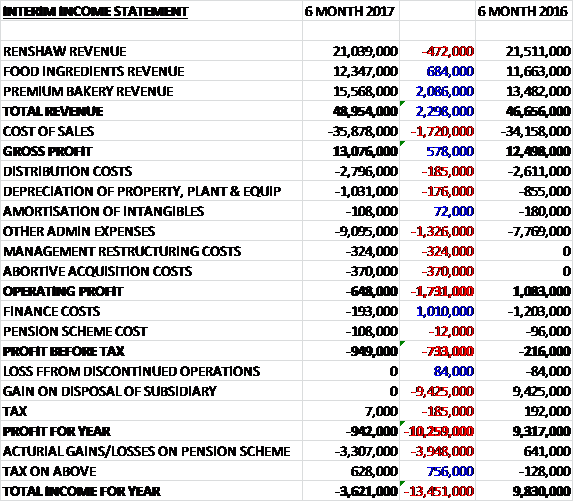
Revenues grew when compared to the first half of last year as a £472K decline in Renshaw revenue was more than offset by a £684K increase in food ingredients revenue and a £2.1M growth in premium bakery revenue. Cost of sales increased by £1.7M to give a gross profit £578K above that of last time. Distribution costs increased by £185K, depreciation was up £176K and other underlying admin costs grew by £1.3M. We also see £370K in abortive acquisition expense and £324K in management restructuring costs to give an operating loss of £648K, a detrimental movement of £1.7M. Finance costs were down £1M but tax income declined by £185K to give a loss for the period of £942K, an increase of £918K year on year.

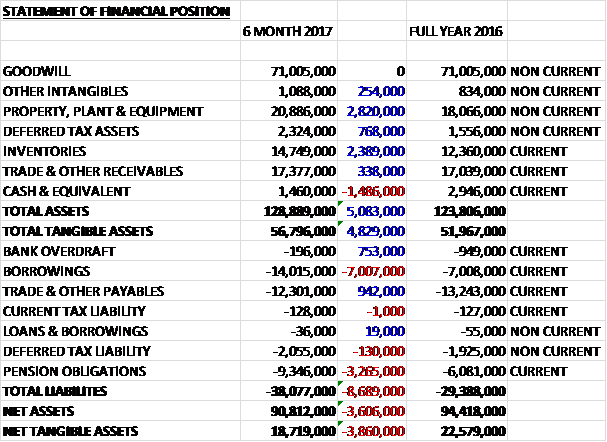
When compared to the end point of last year, total assets increased by £5.1M driven by a £2.8M growth in property, plant and equipment, a £2.4M increase in inventories and a £768K growth in deferred tax assets partially offset by a £1.5M decline in cash. Total liabilities also increased during the period as a £7M growth in borrowings and a £3.3M increase in pension obligations was partially offset by a £942K decline in payables. The end result was a net tangible asset level of £18.7M, a decline of £3.9M over the past six months.

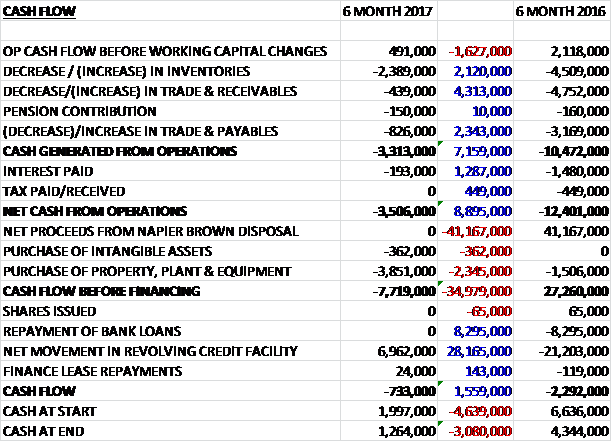
Before movements in working capital, cash profits declined by £1.6M to £491K. There was a cash outflow from working capital but this was less than last time and after interest payments reduced by £1.3M and tax charges declined by £449K there was a net cash outflow of £3.5M from operations, an improvement of £8.9M year on year. The group spent £3.9M on tangible fixed assets along with £362K on intangible assets to give a cash outflow of £7.7M before financing. The group took out £7M of new loans which meant that there was a cash outflow of £733K in the half and a cash level of £1.3M at the period-end.

The profit for the period declined due to increased expensed investment costs across the group, primarily in the development centre and in the US, which will drive future growth and operating efficiencies. It was also impacted by the performance of the food ingredients division which suffered volatile commodity pricings.

The operating profit of the Cake Decoration division was £2.8M. While the market was not as buoyant during the summer as in recent years, sales trends improved towards the autumn particularly with the return of the Great British Bake Off. The first half saw significant investment in the product ranges with the re-launch of the UK Renshaw Professional range and a new product, Renshaw Extra, targeted at the European market. Rainbow Dust Colours also re-launched its market leading edible colouring, Progel, for the European market. Significant investment was made in opening a new warehouse in New Jersey, as the base of the new Renshaw Americas business.

The operating loss of the Food Ingredients division was £684K. Difficult conditions continued in both of Garrett’s main commodity markets and this was followed by short term difficulties caused by the weakening of Sterling in September. Sugar supplies have become critically short which will constrain volumes, though markedly higher prices should improve margins. The dairy market has also seen upward price movement and it is likely to be six months before it stabilises. The price rises is both these markets will, in due course, provide the business with a number of opportunities, through its sourcing expertise. R&W Scott has performed solidly, increasing its delivered margin over last year while operationally it performed well.

The operating profit of the Premium Bakery business was £94K. Sales have performed well with Haydens strongly ahead of last year with good sales through Waitrose and new business gained at Marks and Spencer. Growth at Chantilly has been constrained by the delay in moving to new premises which is now timed for early 2017. While the outlook on sales remains positive, EBITDA will be more challenging in the second half as recent significant raw material inflation (butter and cream prices have doubled recently as a result of a sudden drop in milk production across the EU and the effect in the UK has been exacerbated by the weakness of sterling) is unlikely to be fully offset by price recovery until the New Year.

To date the key Q3 trading period is in line with expectations and the board anticipate significant growth in EBITDA in the second half. They face some challenges, however, due to the recent weakening of Sterling and increases raw material prices and the timing of price recovery. This, as well as the uncertainty in commodity pricing means that while they expect their year-end EBITDA to be ahead of last year, there is a risk that it could fall short of current market expectations.

At the current share price the shares trade on a PE ratio of 23.2 which falls to 12.8 on the full year consensus forecast. After a tiny maiden 0.04p interim dividend was announced, the shares are yielding 0.1% which increases to 0.4% on the full year forecast.

Overall then this has been a poor period for the group. The loss widened and net assets declined, not helped by increasing pension liabilities. The operating cash outflow was an improvement but this was entirely due to working capital movements and cash profits declined considerably. The poor performance is apparently due to increased investment costs and commodity price problems in the food ingredients business. Indeed, the cake decorating business is the only one that actually makes any profit and going forward the group is likely to be affected by increasing raw material prices, not helped by the reduction in the value of sterling. I don’t think a forward PE of 12.8 and yield of 0.4% adequately account for this risk and I am not investing in this company yet.

On the 2nd February the group released a trading update covering Q3. The overall trading environment for food manufactures remains difficult with the biggest factors affecting the group being the short term impact of high commodity prices, especially butter, sugar and oils, and a weakening of sterling following the Brexit vote. The cost of butter in particular has more than doubled in price. The timing of these factors was unfortunate as it coincided with the busy Q3 period but notwithstanding this margin pressure, the group remains confident that it will be reporting EBITDA in line with expectations.

Overall sales continue to grow, up 8% in Q3 and they have now implemented targeted price increased and expect margins to be largely restored by the start of the next financial year. This sounds like a short-term issue but conditions are certainly tough at the moment.

On the 5th April the group announced that it is acquiring an 84% interest in Brighter Foods for a total consideration of £9M to be paid in two equal instalments based upon its 2018 accounts. The consideration will be satisfied from the group’s existing debt facilities and is expected to be immediately earnings enhancing.

Brighter Foods creates and manufactures snack bars for the healthy snacking market which are target at areas such as diet control, gluten free, lactose free, no added sugar, sports nutrition, organic and fair trade. They manufacture both partner branded products and their own brands such as Wild Trail which is stocked in major retailers and health stores.

On the 29th June the group released a trading update and the raising of some more capital. It has raised a total of £15.5M of expansion capital from a new investor and two exiting investors by way of debt finance and new equity. The injection of capital will be raised by way of the issue of a secured loan note of up to £8.75M, redeemable after three years. In addition to subscribing for the loan notes, Downing has committed to subscribe to shares equivalent to 10% of the total capital for £2.75M at 35p per share. In addition they have taken out two £2M secured one year term loans from Napier Brown and Omnicane, two current shareholders.

In order to achieve the 2018 budget and take advantage of growth opportunities the group has decided to embark on an expansion plan at Renshaw and Haydens. The two main areas of investment are at Renshaw’s Crown Street site in Liverpool and Haydens in Devizes. Both of these businesses are seeing significant increases in forward demand, driven by international expansion and the launch of a mainstream retail brand at Renshaw and the acquisition of two major new retail customers at Haydens.

At Renshaw the group will invest about £7M in expanding capacity by over 50% as well as the installation of new soft icings sand discs production lines which support the strategy to broaden the offering to mainstream users.
At Haydens the acquisition of two new major customers has put short term pressure on operational capacity and the group will invest about £8M in order to reconfigure site operations including blast freezing capability and the installation of a new automated Yum Yum line. This is expected to take site capacity from £30M revenues to over £50M of revenues. Both of these investments, as well as increasing capacity, bring benefit in efficiency and mitigating the impact of the living wage increases.

The majority of the expansion is expected to be completed by the end of September 2017 at a cost of £15M with the additional capacity expected to start delivering significant returns in 2018. The loan notes carry an interest rate of 6.5% and Downing have been granted the right to appoint a new non-executive director with Judith Mackenzie joining with immediate effect.

This year the group expects to report revenues of £109M and EBITDA of between £5M and £5.4M following the impact on the food ingredients division of the volatile commodity markets and currency fluctuations as a result of the Brexit vote. Net debt at the period-end was £16.2M, partly due to some pre-payments relating to the expansion plan. In the first nine weeks of the new financial year the group has experienced strong growth in revenues across all three divisions.

Sales were up 15% in cake decoration, 9% in premium bakery and 87% in food ingredients following the Brighter Foods acquisition. (like for like sales were up 17%). EBITDA for the same period was 56% ahead.
Overall then, it is a shame that the group has had to raise further equity in order to hit budgets but this should stand them in good stead going forward.

On the 1st August the group announced that during the audit process, two substantial anticipated claims regarding their sugar purchase arrangements have not yet materialised with the effect that it will not meet its previously forecasted profit figures. In addition, the board have concluded that certain development costs, which had previously been capitalised in 2017, should have been expenses. They expect that the total of these adjustments will reduce EBITDA by around £2M in 2017.

As the injection of expansion capital was agreed about three months later than expected, this has resulted in some delay in the implementation of these projects, particularly at Renshaw. This, combined with slightly softer trading conditions in Q1, had adversely affected the board’s expectations for 2018 with EBITDA now expected to be about £2.3M lower than expected.

The board further announces that it has realised that certain payments made to some directors for consultancy services have not been separately disclosed in the related party transaction notes, including £1.2M to Pieter Totte in 2016 (that is quite some consultancy fee!). This has no impact on profit, however.

The group also announced that they had accepted the resignation of non-executive Peter Salter who will step down with immediate effect. Oh dear, what a catalogue of errors. I would suggest that this company shouldn’t be touched with a bargepole until it can sort itself out!

On the 29th August the group released a further update. A review has been undertaken by the new finance director which is expected to lead to additional audit adjustments relating to inter-company trading and consolidation. As a result, the board now expects EBITDA to be in the region of just £1M. They are in discussions with their bankers to vary certain conditions of their banking covenants, which sounds concerning but at least the major shareholders have indicated that they can provide further funds (no doubt diluting other current shareholders) should the need arise. I would not be touching this with a bargepole at the moment.

QinetiQ Share Blog – Interim Results Year Ending 2017

QinetiQ has now released its interim results for the year ending 2017.
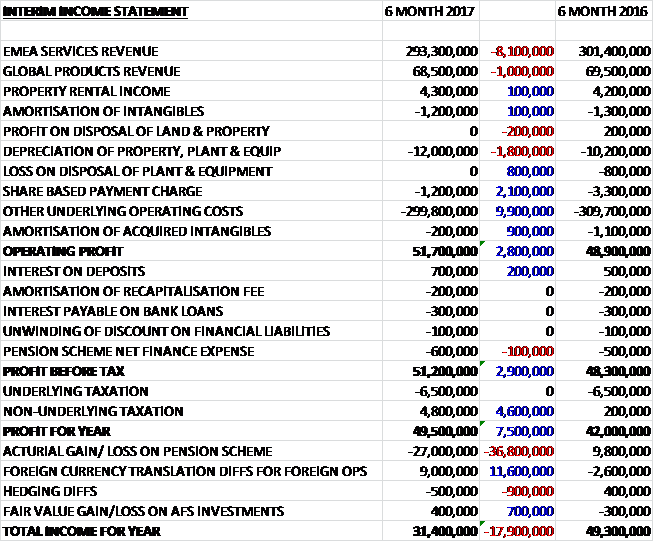
Revenue declined when compared to the first half of last year due to an £8.1M decline in EMEA services revenue due to the lumpy nature of revenues and a £1M fall in global products revenue. Depreciation increased by £1.8M but share based payments fell by £2.1M, amortisation of acquired intangibles decreased by £900K and other operating costs fell by £9.9M to give an operating profit £2.8M above that of last time. Underlying tax remained steady but non-underlying tax receipts increased by £4.6M to give a profit for the period of £49.5M, a growth of £7.5M year on year.
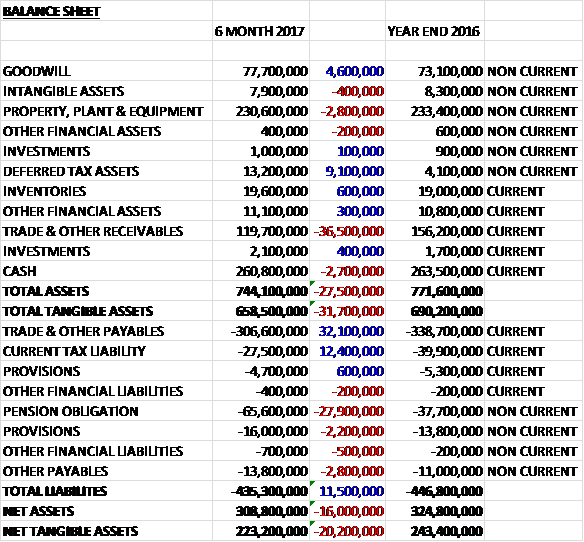
When compared to the end point of last year, total assets declined by £27.5M driven by a £36.5M fall in receivables, a £2.8M decrease in property, plant and equipment and a £2.7M reduction in cash, partially offset by a £9.1M increase in deferred tax assets and a £4.6M growth in goodwill. Total liabilities also declined during the period as a £32.1M decrease in payables and a £12.4M fall in current tax liabilities was partially offset by a £27.9M increase in pension obligations, a £1.6M growth in provisions and a £2.8M increase in other payables. The end result was a net tangible asset level of £223.2M, a decline of £20.2M over the past six months.
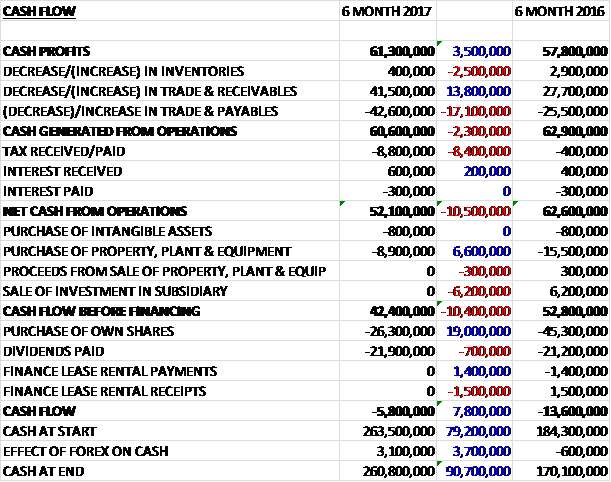
Before movements in working capital, cash profits increased by £3.5M to £61.3M. There was a modest cash outflow from working capital compared to an inflow last year but tax payments increased by £8.4M to give a net cash from operations of £52.1M, a decline of £10.5M year on year. The group spent just £8.9M on tangible assets and £800K on intangible assets to give a free cash flow of £42.4M. This was used to pay dividends of £21.9M and £26.3M was spent on buying back shares which meant there was a cash outflow of £5.8M during the period and a cash level of £260.8M at the period-end. Capital expenditure is expected to increase in future as the group invests in the LTPA and other long-term contracts.

In the UK in the short term there may continue to be some uncertainty and the potential for interruptions to order flow. The SSRO is developing a new methodology for calculating the baseline profit rate in future years, potentially introducing multiple profit rates. This baseline rate acts as the starting point for agreeing the profit rates of new and renewed contracts, and suppliers can both under or over perform the contracted rate. About 70% of the total EMEA Services revenue is derived from single source contracts, including the non-tasking element of the Long Term Partnering Agreement and they anticipate that the majority of their single source revenue will fall under the regulations within the next three years.

The underlying operating profit in the EMEA Services division was £43M, a growth of £300K year on year. Within air and space, the business is continuing to work in partnership with the MOD and the supply chain to deliver the Strategic Enterprise model which transforms the provision of aircraft test and evaluation and which has now been in place for a year. The model represents a new way of working under which they are paid on results and output rather than input. Under this model, contracts totalling £20M were won in the period to provide in-service support for Apache and Puma helicopters, as well as Tornado jets, and test and evaluation services for the Wildcat Future Air to Surface Guided Weapon programme. Since the end of the first half, the business has won a contract to provide safety advice for the Merlin helicopter programme under the Strategic Enterprise Model.

During the period the group secured £2M of research funding to lead a group from industry, academia and SMEs to upgrade the scale models used in the Farnborough wind tunnel using technology adapted from F1, leading to improved efficiency and increased capacity. The business also revealed a new material, Titan Weave, that will help reduce the weight of aircraft, while being three times stronger than current materials used to protect against bird strikes and other impacts.

In October, as part of its ExoMars mission, the ESA attempted to place its lander of the surface of Mars, equipped with a QinetiQ-built transceiver responsible for transmitting data back to earth. The lander was lost, but the transceiver operated successfully, providing data that helped scientists to understand what happened to the spacecraft in its final moments. The business also continues to deploy significant resources to develop the gridded ion engine electric propulsion system for the flight module to be used on ESA’s BepiColombo mission to Mercury.

The Maritime, Land and Weapons business was awarded an eleven year contract extension with £109M for the Naval Combat Systems Integration and Support Services based at Portsdown Technology Park.

In the weapons domain, the business won an £8M contract to implement and evaluate vehicle survivability for Dstl, including installing a Soft-Kill Defensive Aids System on a Challenger 2 Tank, international customers continue to want to use the group’s expertise for their own development, with the South Korean Agency for Defence Development committing to a £3M programme to test their latest warhead designs using the Long Test track at MOD Pendine.

In October, the Maritime, Land and Weapons business led a team from across the group to deliver Unmanned Warrior for the Royal Navy, a demonstration by 40 companies of how autonomous vehicles under the water, on the surface and in the air, can be used for future operations such as mine hunting. International delegations from the US, Canada and Australia visited the demonstration alongside senior MOD and UK Government Ministers. Next year, building on Unmanned Warrior and At Sea Demonstration 2015, another international exercise will be taking place at MOD Hebrides, Formidable Shield 2017.

In Cyber, Information and Training, although competition is fierce, the SDSR and the focus on counter-terrorism are likely to drive increases in budgets for C4ISR ad cyber security. The business was awarded an Open Source Intelligence contract to help customers keep pace with the rapidly evolving technical and social media landscape.

The business is continuing to see interest from regional and local government customers on initiatives to support local business growth, and is delivering training and simulation services to customers in North America, Europe and the Middle East. During the period they secured a number of contracts worth a total of £10M for secured navigation, working with the European GNSS Supervisory Authority to help enable the effective exploitation by users of Galileo – the European version of GTS which goes live in 2017. This included the first demonstration of accessing the encrypted Public Regulated Service via the cloud. The business is also working on collaboration with Lloyds Register to improve the security on board cyber-enabled ships.

QinetiQ Australia secured more than $30M of wins. These included support to tanker aircraft, the AP-3C Orion replacement, Navy guided weapons systems, ground-based air defence, the Australian Artillery Regiment, and a contract to extend the provision of technical advice at munitions manufacturing plants. The business also gained accreditation from Australia’s Defence Aviation Safety Authority to approve structural changes on all Australian Defence Force aircraft, building on its Aircraft Structural Integrity services contract which supports the airworthiness of military aircraft.

The Canadian business is recently established but has already secured cost engineering and award procurement software contracts. Additional consulting contracts are being pursued and the business is being positioned, through prime contractors and potential partners, for strategic campaigns. The advisory services business is delivering a major contract to provide early stage advice and business care support to a Middle Eastern client for a complex engineering project.

The underlying operating profit in the Global Products division was £8.9M, an increase of £1.8M when compared to the first half of last year, assisted by a credit of £1.3M relating to the resolution of an overseas licensing dispute. Orders grew from £57.6M to £92.5M mainly due to improved order flow in North America, in particular $28M of orders for next generation US aircraft carriers.

Excluding £4.5M of forex variance, there was an 8% decline in the organic revenue primarily due to lower robot shipments in the period and illustrating the lumpy nature of the revenue profile. At the beginning of the second half of the year, the division had 98% of its 2017 revenue under contract compared to 81% at this point of last year, although the delivery of this is dependent on the timing of the shipments in the remainder of the year.

In North America the period saw a strong orders performance, driven by awards in robotics, air and ground armour, R&D, and in particular for Advanced Launch and Recovery Equipment for US aircraft carriers. The ALRE equipment includes control hardware and software for the Electromagnetic Aircraft Launch System and the Advanced Arresting Gear to be installed on the next generation of US aircraft carriers. Demand for the reset and recapitalisation of robots previously used in operations has remained high, as has demand for capability upgrades such as detection of CBRNE.

The business is also positioning for multi-year programmes of record that will be funded out of the DoD’s base budget. Through both internal and external funding, QNA has added to the capability and strategic relevance of its robotic fleet, especially for the Talon family of robots, its flagship mid-sized offering. In October 2016 it announced a strategic partnership with the Estonian company Milrem for Titan, a modular, hybrid military unmanned ground vehicle for dismounted troop support.

Outside of robotics, the business launched in September a new meteorological product, iQ-3, that provides real-time atmospheric data in support of military requirements such as artillery fire support, tactical weather modelling and air drop. Its Line Watch product, which accurately measures the current and voltage of power distribution lines, is being piloted by ten North American utility companies.

Optasense is a distributed acoustic sending business. It continues to make progress in infrastructure security, delivering ahead of schedule on the world’s largest distributed fibre sensing project for the 1,850km Trans-Antolian Natural Gas pipeline that frons from Azerbaijan to Europe. Following the establishment of an advisory board to provide expertise in key target markets, the business has signed an agreement to work together with Siemens to pursue new opportunities in the rail sector. The business is also undertaking collaborative research with Stanford School of Earth, Energy and Environmental Sciences in California that includes the installation of a fibre-optic seismic array on the Stanford campus to better understand the complex geology of the Bay Area.

In Space Products, during the period the group’s P200 satellite was listed in the NASA catalogue which will help aid the procurement of spacecraft by US federal agencies. The business also won a $2M contract with the ESA to develop the next generation computer and power management for the Proba series of satellites.

In EMEA Products, during the period the US DARPA invested a further $3M in the group’s electric hub-drive technology that will improve mobility and survivability of future military ground vehicles. The new agreement builds on previous contract awards and will take the technology from concept design to the building and testing phase, including the production of two fully working units.

Internationally, ASX airborne surveillance products have been delivered and there has been further interest in wind farm radar impact assessments to help secure planning permissions in Europe and other regions including South Africa. Following the development of advanced materials for the Department of National Defence in Canada, the UK MOD has no placed an order for similar equipment as a technology demonstrator for the Royal Navy.

In November last year the group were awarded a £153M Strategic Enterprise contract that changed the way they deliver aircraft engineering services for the MOD to an output-based model where they are paid and measured on deliverables. In the first half of this year they added £20M of additional work into this model so they are now providing engineering services for nine aircraft types, both fixed and rotary wing. There are further opportunities to expand this contract, working with partners to pool skills and bring collaborative teams together across industry.

At the end of September they signed the 11 year, £109M contract extension for Naval Combat System Integration Support Services to the MOD, under which they lead the T&E, integration and development of mission systems that keep the UK’s warships at sea. This is an example of the focus on partnership within their customers and across the broader supply chain as they look to develop their Portsdown Technology Park site as the UK Centre of Excellence for maritime mission systems for the whole supply chain. While not delivering increased revenue in the short term, the extension of this contract for eleven years improves the security of future revenues and provides a platform to win incremental work.

Further work is underway with the Front Line Commands and prime contractors to develop the future vision for UK T&E to ensure it meets the needs of the UK defence plan, supports exports and international partnerships, and delivers the right outputs to enable future military capability.

In September 2016 the MOD announced that it was finalising the agreement of a £30M contract with UK Dragonfire, a UK industrial team led by MBDA and including QinetiQ, to conduct the Laser Capability Demonstrator Programme that will deliver a step change in the UK’s capability in high energy defensive laser weapon systems. Once under contract the group will provide the high-powered laser technology for this programme and conduct trial engagement of land and maritime targets that are due to take place at the ranges that they manage under the LTPA in 2019.

In July, QinetiQ, Thales and Textron AirLand announced that they will partner to bid for the MOD’s Air Support to Defence Operational Training programme. The team will propose a service using the Textron AirLand Scorpion jet equipped with Thales and QinetiQ sensors to train all three armed services. The competitive contract is expected to be awarded in September 2018 with a service delivery start in January 2020, and is expected to be worth up to £1.2BN over fifteen years. The group will provide the safe operation of aircraft – including maintenance, provision of pilots, and certification, as well as the integration of sensors, jamming pods and synthetic training capabilities.

During the period, a deferred tax asset of £4.1M has been recognised in respect of unused tax losses (£22M) expected to be utilised in the foreseeable future. The group also has current tax liabilities of £27.5M which decreased considerably during the period partly due to part settlement of a tax liability in respect of taxes payable in respect of the group’s acquisition of Dominion Technology in 2008. The funds required to make this part settlement were recovered from the vendors of Dominion (which had been included as a receivable). An insurance policy was taken out by the group at the point of acquisition and if the Tax Court’s decision is upheld, the funds required to fully settle this dispute will be provided by the insurers so an offsetting receivable for the residual balance is reported on the balance sheet.

The group bought back £29M of the previously announced £50M share repurchase by the period-end and they expect to complete the rest in the second half of the year.

As previously announced, CFO David Mellors will leave the group in December to become CFO of Cobham and will be replaced by David Smith, current CFO of Rolls Royce. He will be in the post no later than the start of March.

The group expect to pay about £7M in the second half relating to a court order over a very old overseas dispute over a contract signed in 2005. This payment, fully provided for in the accounts in prior years, must be made even though the group expects to make a court appeal.

Going forward, in 2017 the UK government’s strategic defence and strategic review, together with ongoing defence transformation, are expected to continue to have an impact on the UK defence market. This will provide future opportunities for EMEA Services to build on its strong record of delivering more for less, while recognising that there may continue to be some uncertainty and the potential for interruptions to order flow. At the end of September, revenue under contract for 2017 was in line with the prior year, and the division’s performance as a whole is expected to remain steady this year.

The Global Products division has shorter order cycles than EMEA Services. At the end of the period, 2017 revenue under contract was above that of a year ago, but the performance of global products remains dependent on the timing of shipments of key orders. Overall the board’s expectations for group performance this year remain unchanged.

At the period-end the group had a net cash position of £260.8M compared to £263.5M at the end of last year. At the current share price the shares trade on a PE ratio of 16.5 which increases slightly to 16.6 on the full year consensus forecast. After the interim dividend was increased by 5% the shares yield 2.2% which increases to 2.3% on the full year forecast.

On the 2nd December the group announced that it had been awarded a £1BN contract amendment to the LTPA from the UK MOD under which the Test and Evaluation services have been delivered since 2003, committing approximately half the core LTPA revenues until 2028. Under the amendment the group will modernise and operate the air ranges at MOD Aberporth and MOD Hebrides, and test aircrew training through the Empire Test Pilots’ School at MOD Boscombe Down. Efficiencies delivered through this programme will enable future MOD and QinetiQ investment in developing further Test and Evaluation services.

The MOD and QinetiQ have agreed to invest about £180M in modernising facilities, equipment and developing new ways of working as part of their wider strategy to lead and modernise test and evaluation across the lifecycle, from experimentation and research of new capabilities through to training and rehearsal of current capabilities.

On the 21st December the group announced that it has acquired Meggitt Defence Systems and Meggitt Holdings Canada from Meggitt for £57.5M. Meggitt Target Systems is an international provider of unmanned aerial, naval and land-based target systems and services for test and evaluation and operational training and rehearsal. The business is expected to generate about £28M of revenue and about £5.5M of operating profit in 2016.

The business provides target systems to about 40 countries from its operations in the UK and Canada, and performs on-site target services in fifteen of those countries. It will form part of the group’s new international business unit and will be reported within the Global Products division. The acquisition is expected to be EPS accretive in the first full year of ownership and will be financed from existing cash resources.

Overall then this has been a steady period for the group. Profits were up but net assets declined due to increased pension liabilities but although the operating cash flow declined, this was due to an increase in tax payments and a reduction in payables and the cash profits increased with plenty of free cash being generated. The EMEA services division was broadly flay but the global products division saw profits increase with particular strength in the US.

Going forward the SSRO new baseline profit rate may offer some uncertainty but the group seems to have been awarded some large contracts and with a forward PE of 16.6 and yield of 2.3% this is a solid beast, unlikely to show any exciting growth anytime soon but the steady nature of the work, backed by solid cash flows and balance sheet makes it safer than most – I continue to hold.

On the 16th January the group announced that non-executive director Paul Murray purchased 18,865 shares at a value of just under £50K which is nice to see, although not a huge amount.

On the 15th February the group released a trading update covering Q3. In December they were awarded a £1BN amendment to their LTPA with the MOD which commits about half of the core LTPA revenues until 2028.
They are already delivering against their commitment to modernise UK air ranges and the Empire Test Pilots School at Boscombe Down, including the purchase of new aircraft to meet the future training needs of test pilots and aircrew.

Also in December they completed the acquisition of Meggitt Target Systems which generates 90% of its revenue from outside the UK and forms part of the group’s international business unit. In January a consortium involving the group was awarded a £30M programme by the MOD to deliver a Laser Directed Energy Weapon Capability Demonstrator. QinetiQ’s role is to provide the high-powered laser technology for the programme and conduct trials at various ranges over land and water.

Underlying trading was as expected during the quarter. In EMEA Services, revenue under contract for the year is similar to the same time last year with resilient margins (does that means lightly lower?). The performance as a whole is expected to remain steady this year. The global products division has revenue under contract slightly ahead of this point of last year driven by improved order inflow in North America, although its performance remains dependent on the timing and shipment of key orders.

The incremental capex associated with the amendment to the LTPA contract is expected to be in the region of £10M this year. The group is completing the previously announced £50M share repurchase with £13M of the buyback remaining to date. Going forward, the board’s expectations for group performance in the current year remain unchanged from those set out at the interim results period.

Braemar Shipping Share Blog – Interim Results Year Ending 2017

Braemar Shipping has now released its interim results for the year ending 2017.

Revenues declined when compared to the first half of last year due to a £6.9M reduction in technical revenue and a £2.5M fall in shipbroking revenue. Cost of sales also declined but nowhere near as much to give a gross profit £7.4M lower. Operating costs fell by £1.6M, reflecting a reduction in the size of the board, amortisation of acquired intangibles reduced by £380K and there were no restructuring costs which accounted for £491K last time to give an operating profit that decreased by £5M. The tax charge declined by £1.3M to give a profit for the period of £113K, a fall of £3.8M year on year.

When compared to the end point of last year, total assets increased by £1.2M driven by a £2.4M growth in receivables, a £1.8M increase in deferred tax assets and a £572K growth in goodwill, partially offset by a £3.4M decline in cash. Total liabilities also increased during the period as a £5M growth in borrowings and a £4.3M increase in pension liabilities following a reduction in bond yields due to the interest rate cut, was partially offset by a £1.3M decline in payables and an £897K decrease in current tax payables. The end result was a net tangible asset level of £21.7M, a decline of £6M year on year.

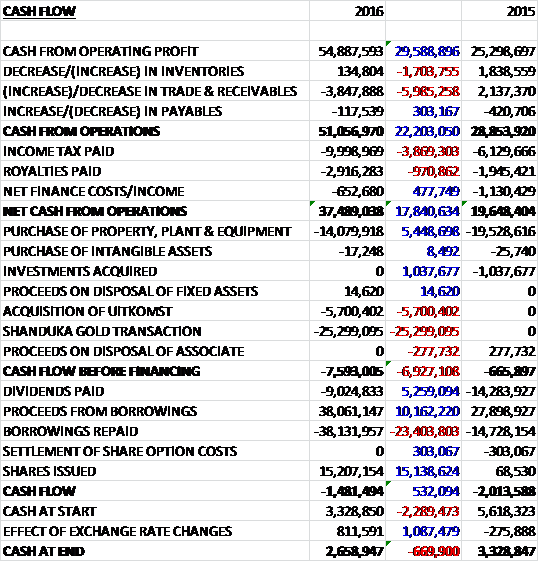
Before movements in working capital, cash profits declined by £5.7M to £2.4M. There was also a cash outflow from working capital but this was lower than last year and after tax payments increased by £303K there was a net cash outflow of £3M from operations, an improvement of £1M year on year. The group spent £349K on tangible assets and £166K relating to long-term receivables to give a cash outflow of £3.6M before financing. They took out a net £5.1M in new borrowings to pay for the £M of dividends that they couldn’t really afford so there was a cash outflow of £3.8M and a cash level of £8.1M at the period-end.

The operating profit in the Shipbroking division was £4M, a decline of £600K year on year. Rates in most shipping markets fell during the period. The teams continue to generate healthy transaction volumes but softer freight rates resulted in the decline in profit. A sustained weaker sterling exchange rate against the US dollar will benefit earnings, although the full beneficial impact will not be evident until next year due to the rolling hedging policy.
After a strong year last year, tanker freight rates softened quite significantly towards the end of the first half as new tonnage came into the market and port congestion eased. Nevertheless, oil and refined product trade flows remained strong and the teams performed well retaining a high market share and increasing deep sea transaction volumes.

The freight rates in the dry bulk market were depressed due to the continued over-capacity and weaker commodity demand in the core markets. The team concluded a higher volume of transactions although low freight rates led to weaker profits. A cost control programme has already been actioned but more recently the Baltic Dry Index has risen and now stands at 842 compared with 332 in March 216 and an average of 600 during the first half of the year. The increase is mostly felt in the Cape sector which should achieve an improved performance.

As expected the offshore department continued to experience low levels of activity as a result of reduced global oil and gas exploration and production development activity. The sale and purchase department concluded a significantly higher number of transactions for both second hand and demolition vessels but average vessel values on concluded business were lower commensurate with the market.

The operating loss in the Technical division was £2.1M, a detrimental movement of £5.2M when compared to the first half of last year as it suffered from the slowdown in oil and gas exploration activity. The team is implementing a restructuring programme to cut costs which incurred one-off costs of £1.5M following project completions and restructuring. This achieved office consolidation, reduced divisional headcount and annualised cost savings of around £3.2M.

Braemer Offshore was adversely affected by project delays and reduced activity in common with all regional service providers in the energy sector. Braemar Engineering concluded its three-year project for the design, site supervision and crew training for six LNG carriers. Following completion of this project and the current downturn in the oil and gas sector, the group restructured the team in the UK and relocated staff to the London office. They are focused on growing their engineering activity from both their offices in Houston and London.

Braemar Adjusting faced challenging conditions in the UK, US and Canadian offices although they have received recent instructions which should see an improvement in H2. The offices in the Middle East and Singapore have performed well with high staff utilisation. Braemar incorporating the Salvage Association continued to diversify its service offering but overall experienced a lower level of activity in the period. The number of instructions was similar to the same period last year but they experienced lower average incident value.

Braemar Howells carried out a routine level of work with no significant project work undertaken. They focused on the development of their UK operations, particularly retained services and framework agreements with major customers.

The operating profit in the Logistics division was £848K, a decline of £116K when compared to the first half of 2016. During the period the ship agency business generated growth through winning several global clients which has led to increased ship numbers. Despite a difficult market they are continuing to build their activities by expanding their presence in North America and the Far East as well as continuing to grow in Europe.

The freight forwarding business held its own in challenging markets. Freight rates were volatile, including an adverse impact from fluctuating exchange rates. They maintained their existing contract business and saw an improvement in contract cargoes, though pressure in the oil and gas sector continues to limit financial growth. They have invested in new logistics teams in Houston, Atlanta and Singapore and are starting to see growth in the client base in these areas.

The sale of the Baltic Exchange to the Singapore Exchange is expected to complete during the second half of the year. The group holds a 2% stake in the Baltic Exchange and if the transaction completed they would realise a one-off gain of £1.5M.

Going forward, the restructuring programme along with the shipbroking forward order book gives the board confidence for an improved performance in the second half so their expectations remain unchanged for the year as a whole.

At the current share price the shares are trading on a PE ratio of 14.5 which falls to 13.7 on the full year consensus forecast. After the interim dividend was maintained at the same level, the shares are yielding 8.5% which is expected to remain the same for the full year. At the period-end the group had a net cash position of £700K compared with net debt of £3.1M at this point of last year.

On the 23rd January the group issued a profits warning. The underlying pre-tax profit is now expected to be within the range of £3M to £3.5M. This excludes a one-off gain from disposal of its interest in the Baltic Exchange of £1.7M and one-off costs associated with restructuring of about £2.7M. This lower forecast is largely attributable to the Technical division and to a lesser extent, the freight forwarding element of the logistics business. The shipbroking division has traded well, met its objectives and is on track to meet expectations for the year.

The technical division has continued to underperform. The previously outlined weakness in the oil and gas sectors has worsened further than originally anticipated, impacting the division in several ways with a marked deterioration in replacement work. Accordingly they have significantly expanded the management actions originally announced to realign the business. This restructuring programme is now substantially complete and has resulted in significant reductions in its ongoing cost base. It is expected that the annualised cost savings will be over £6M for the next financial year.

Within the logistics division, the port agency business continued to perform strongly, although the freight forwarding business was affected by a reduction in market activity. Overall the logistics division performance has fallen but this will only have a small impact on the overall group results.

Sensibly the group has cut the final dividend payout (long overdue in my opinion) but after the share price fall, the shares are still yielding 5.7%. The group are not in any danger of going bust quite yet though – there is a net cash position of £1.6M at the end of December and they have an unused debt facility of £30M.

Following this profit warning, the shares are trading on a forward PE ratio of 17.6 which seems a bit expensive given the uncertainty surrounding the technical division. It seems that the crux of the problem is that the large LNG carrier project is coming to an end and there is just not enough work out there to replace it. The group have reacted quickly which should help costs going forward but also signals that the board see the issue as long-term. Overall, this is not something I am investing in quite yet.

Over the past few days some directors have been making share purchases as follows:

CEO James Kidwell 15,853 shares at a value of £40K
Non-Exec Jurgen Breuer 40,000 shares at a value of £100K
Chairman David Moorhouse 49,351 shares at a value of £125K

It also emerged that Kevin Gorman sold 15,356 shares for £47K which is a bit of a shame. Obviously they are reacting to the reduced share price following the profit warning. I still think the shares look overvalued given the market.

Pan African Resources Share Blog – Final Results Year Ended 2016

Pan African Resources has now released its final results for the year ended 2016.

Revenues increased when compared to last year as a £2M decline in platinum sales was more than offset by a £17.7M growth in Evander gold sales, an £8M increase in Barbeton gold sales and a maiden £4.6M contribution from the coal business. Salaries and wages fell by £2.8M, gold mining costs fell by £3.4M but gold processing costs increased by £2.6M. Mine admin costs declined by £1.1M and there was a £1.1M improvement in the inventory valuation adjustment but we see the first £4.3M of coal production costs to give a mining profit £30.1M above that of last year. Director pay and share option expenses increased by £4.6M, not helped by the increase in the share price and corporate office salaries increased by £665K. We also see a £7.8M increase in losses from realised financial instruments, a £1.4M reduction in the rehabilitation fund value increase, and a £1.2M growth in royalty costs, offset by a £1.8M positive rehabilitation provision adjustment which meant that the operating profit increased by £16.8M. After the lack of £1.1M of rehabilitation provision interest expense and a £4.1M increase in tax payments the profit for the year came in at £25.5M, a growth of £13.8M year on year.

When compared to the end point of last year, total assets increased by £15.3M to £252.7M driven by a £5.8M increase in mineral rights and mining properties, a £3.9M increase in capital under construction, a £4.5M growth in trade receivables and a £2.7M increase in the value of shafts and exploration, partially offset by a £2M decline in the value of building and infrastructure. Total liabilities also increased during the year as a £5.9M increase in the commodity zero cost collar, a £2.9M growth in the revolving credit facility, and a £4.2M increase in cash settled share options, partially offset by a £2.9M reduction in the gold loan. The end result is a net tangible asset level of £129.9M, a growth of £3.9M year on year.

Before movements in working capital, cash profits increased by £29.6M to £54.9M. There was a cash outflow from working capital with an increase in receivables and tax payments increased by £3.9M with a £970K growth in royalty payments to give a net cash from operations of £37.5M, a growth of £17.8M year on year. The group spent £14.1M on property, plant and equipment, £5.7M on the acquisition of Uitkomst and £25.3M on the Shanduka Gold transaction which meant that there was a cash outflow of £7.6M before financing. The group also spent £9M on dividends so issued new shares to raise £15.2M to give a cash outflow of £1.5M and a cash level of £2.7M at the year-end.

The group delivered record gold production with gold sales increasing by 16.5% to 204,928oz and but the effective gold price declined from $1,212 per ounce to $1,164 per ounce with all-in sustaining costs per ounce decreasing from $1,093 to $870. At the end of the year the gold spot price closed at $1,325 per ounce.

The mining profit at Barbeton was £40.2M, a growth of £13.5M year on year. Underground head grades improved from 10.9g/t to 11g/t with the amount of gold sold increasing by 7.1% to 113,281 ounces. There was £1.3M of one-off expansion capex relating to the Royal Sheba development costs and the completion of the BTRP power line extension and installation.

The mining profit at Evander was £9.7M, a positive movement of £18M when compared to last year with a 31% increase in production. Underground head grades improved from 4.6g/t to 5.7g/t due to establishing mining on 8 Shaft’s new 25 level. In addition the tailings retreatment plant assisted their production growth by achieving full nameplate capacity, producing 18,151 ounces of gold from tailing and surface feedstock out of a total of 91,647 ounces in the mine as a whole. The all in sustaining cost per ounce decreased from $1,380 to $1,023 and there was £365K of one-off expansionary capital relating to development costs associated with 8 Shaft’s 26 level.

Following the receipt of a positive high-level economic and technical assessment of the Elikhulu tailings retreatment project at Evander, the group is undertaking a definitive feasibility study which should be available in November 2016. The project will potentially treat slimes at a processing capacity of up to 12MT per annum at a head grade of 0.29g/t. The total mineral resource is 178.7MT at 0.29g/t with a life of operation of about 14 years and 1.7Moz of contained gold. The project is estimated to yield about 50Koz of gold per annum in the initial eight years of production while treating the Kinross and Leslie tailings storage facilities and then about 38Koz per annum from the remaining six years from processing the Winkelhaak tailings storage facility.

The mining loss at Phoenix Platinum was £288K, a detrimental movement of £1.6M when compared to 2015. The operation’s performance was hampered by the business rescue proceedings announced by IFM in August last year as well as the drought and water shortages affecting re-mining and processing. Samancor Chrome was the successful bidder for IFM’s assets and the group have reached an agreement with them, assigning the tailings treatment to them. Although the agreement doesn’t guarantee current arising feedstock to Phoenix – this will be dependent on how TC use the assets – it places Phoenix in a better position where it should be able to continue operations under similar conditions to those prior to the business rescue proceedings. Further, it ensures that Phoenix’s operations are safeguarded and they also have alternative sources of feedstock which are currently being processed.

Uitkomst made a maiden mining profit of £140K this year with 87,538 tonnes of coal produced from its underground operations and acquiring 48,564 tonnes of coal for further processing and blending, resulting in total coal sold of 136,102 tonnes. The group assumed effective control of the mine at the end of March for £9M. The mine produces between 30K to 35K tonnes of coal per month from its underground mining operation and has an estimated life of mine of 22 years at current production rates. The average revenue per tonne received was $48 whilst the cost per tonne was $45.

Locally conditions remain challenging. South Africa faces a possible sovereign credit rating downgrade to sub-investment grade as well as heightened political tension which could lead to further depreciation in the Rand.

During the year the group’s total gold resources increased by 9.4% to 34.9Moz but reserves decreased from 10.4Moz to 10Moz with a plan to increase these reserves in the next year. Platinum reserves decreased from 0.5Moz to 0.2Moz with resources remaining static whilst coal resources were recorded at 23.3MT.
Shanduka Gold is the group’s primary BEE shareholder with its sole assets being a 22.5% interest in PAF’s issued share capital and a notional vendor loan of R558M to its BEE shareholder, the Mabundu Trust. During the year the group acquired 49.9% of Shanduka but consolidates the full interest for accounting purposes.

At the year-end the group had a net debt position of £17.2M compared to £16.6M at the end of last year. At the current share price the shares are trading on a PE ratio of 9.4 which falls to 6.4 on next year’s consensus forecast. After the dividend was increased, the shares have a yield of 5.2% which increases to 5.7% on next year’s forecast.

On the 27th September the group announced that CEO Cobus Loots purchased 248,609 shares at a value of about £55K. Following the transaction he holds 480,184 shares. It was also announced that Finance Director Deon Louw purchased 137,450 shares at a value of £30K which represents his maiden share purchase.

On the 5th December the group announced the results of the feasibility study for the Elikhulu tailings project along with a production update. The board have approved the construction of the project with the planned start date being January 2017 with first gold forecast for Q4 2018 calendar year and full commissioning in December 2018. Annual recoverable gold of 56,000 ounces is expected for its initial eight years and 45,000 ounces for the remaining five years. Optimal plant capacity for the project allows 12M tonnes per annum throughput and the project is expected to add about 25% to the group’s production and reduce the all-in sustaining cost profile. The initial capital cost is expected to be about $120M and the project has a payback period of less than four years based on a gold price of $1,180 per ounce.

Rand Merchant Bank has provided the group with all necessary approvals for a £60.9M five year debt facility with will be dedicated to the funding of the project and will be repaid from the project’s cash flows generated during the initial five years of production. The group are evaluating a number of funding proposals to fund the balance of the initial capital requirement and do not expect any difficulty securing the balance on competitive terms. As the repayment profile is matched to the project’s cash flow generation, it is not expected to impact on the existing dividend policy.

The project entails establishing facilities and infrastructure at Evander to retreat gold plant tailings at a rate of 1M tonnes per month in addition to the existing production from the ETRP which will continue to operate independently to the project for the next 13 years. Three existing tailings storage facilities will be reclaimed.

In 2017, the capital requirement will be $50.2M with a further $69.7M required in 2018 which includes a contingency of $13.2M over those two years. There will then be a further requirement of $21.6K in 2021 and $7.8M in 2026 which is required to re-establish the hydro-mining infrastructure.

Phase 1 of the hydraulic mining at the Kinross tailings storage facility is scheduled to start in Q4 of the calendar year 2018 with commercial production expected to be reached in December. The project is expected to have an AISC of $523 over the life of the project and is expected to be highly cash generative from the start ($45.7M in 2019, tailing off a bit in subsequent years).

In the first half of the year, Barbeton is expected to produce 49,000 ounces, a reduction of 13% year on year with Evander falling by 7.4% to 42,000 ounces. Uitkomst is expected to produce 330,000 tonnes of coal and Phoenix production is expected to increase by 9.1% to 4,900 ounces of platinum. The previously guided gold production of about 200,000 ounces for 2017 is being revised down to 195,000 ounces with gold production in H2 being higher than in H1. This is in light of challenges experienced with the operational environment and underground operations in recent months.

Evander Mine’s 7 Shaft which is used to hoist ore from underground operations to the surface for processing is undergoing critical maintenance following the dislodgement of a steel shaft guide which damaged the shaft infrastructure. Even through primary repairs have been completed, the hoisting speed is curtailed until the full maintenance programme is completed with normal hoisting expected to be resumed in January. The mine experienced a material increase in safety stoppages during the past five months. The operation will issued with four regulatory notices which resulted in 13 lost production days compared to two lost days last time with the majority of these related to the Shaft 7 incident.

At Barbeton, three separate community protests relating to unrest as a result of poor government service delivery in the area and competing recruitment of interests from lobby groups was experienced which resulted in six days of lost production. Union related demands resulted in workers embarking on a go slow which also affected productivity.

Fairview mine experienced flexibility issues, specifically at its very high grade 11 block. Work is underway to develop a new production platform. Further flexibility improvements will be achieved via a new decline under development and a new refrigeration plant will also improve working conditions in this area. Six Section 54 regulatory notices which resulted in eight lost production data were encountered compared to three lost days last time.

At Uitkomst, production and performance remained in line with expectations. The colliery has also bought in additional coal from neighbouring mining operations to optimise its washing plant’s operations. If the current favourable coal price environment continues, the payback period for this acquisition is expected to be less than four years.

Phoenix Platinum processing capacity has increased from 25,000 tonnes per month to 30,000 tonnes following the installation of a scrubber in July 2016. The operation has experienced water constraints due to the persistent drought conditions during October and November but despite these challenge, production is expected to increase by 9.1% to 4,900 ounces in the first half.

Overall then this year has been very strong for the group. Profits increased, net assets grew and the operating cash flow improved, although no free cash was generated after the Shanduka Gold transaction was taken into account. The group produced 205K ounces of gold and although the sales price fell slightly to $1,164 per ounce, the cost per ounce declined even more, down to $870 per ounce. Both main mines saw their performance improve with Evander showing particularly good improvements due to better grades and the start of the retreatment plant operations. Phoenix Platinum fared less well due to the business review proceedings against IFM and water shortages.

So far in 2017, things have not gone quite as well, however. The Evander mine shaft failure and unrest at Barbeton mean the group is likely to produce less gold than last year and I suspect costs will have increased too. The Elikhulu tailings project also increases the risk here with substantial amounts of debt being taken on to fund it, although if all goes to plan it should be a good contributor going forward. The gold price is now about $1,203 per ounce so the group should be making decent money at this level so I guess the issue is, does the forward PE of 6.4 and yield of 5.7% sufficiently compensate for the increased risk associated with Elikhulu and the operational problems at both main gold mines experienced in the first half of 2017? I think they just about do…

On the 27th January the group released a trading update covering the first six months of the year. There was a 14% appreciation in the ZAR/GBP exchange rate during the period. EPS is expected to between 23% and 43% higher than last year in ZAR terms and between 45% and 65% higher in GBP terms. This is helped by the earnings accretive Shanduka transaction which reduced the number of shares in issue by 17.7%.
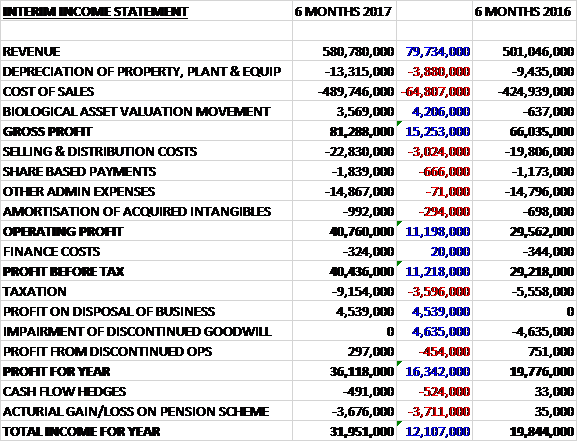
The Uitkomst Colliery, acquired in March, has performed well during the period, contributing about 8.5% of the group’s EPS. If the current favourable coal price environment continues, the payback period for this acquisition is expected to be less than the four years previously forecast.
Barberton Mines entered into a short tem gold price hedge in July 2015.
During the current period, the group recorded a pre-tax mark to market fair value gain of £5.3M due to a reduction in the gold price with the group receiving an average of $1,257 per ounce in the period.
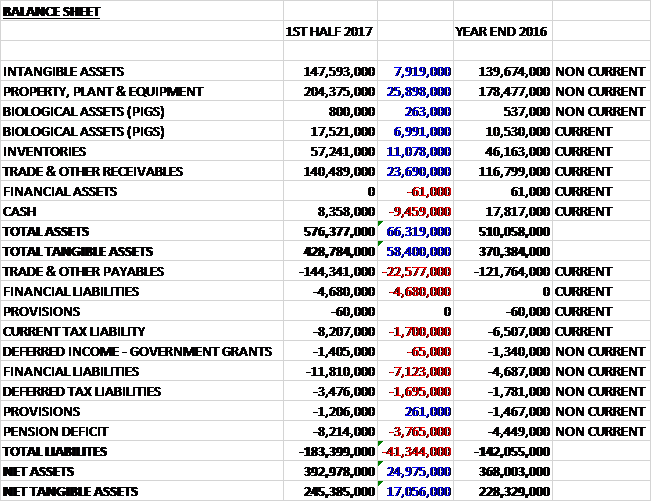
During the period gold production at Barberton fell 12.8% to 49,212 ounces; Evander mines declined by 6.5% to 42,401 ounces and platinum production at Phoenix grew by 1.8% to 4,575 ounces. The Uitkomst Colliery contributed 327,202 tonnes. The gold production in the second half is forecasted to exceed the first half performance.

Overall then the performance is not bad but it seems that Uitkomst and sterling depreciation is masking a less than stellar performance at the gold mines.

On the 20th February the group announced that in conjunction with the 7A shaft refurbishment programme, they initiated a number of studies to assess the conditions of the infrastructure which identified critical issues requiring remedial action to ensure safe and sustainable operation of these shafts.

The nature of these refurbishments require a suspension of Evander’s underground mining operations for up to 55 days but the tailings and surface operations will be unaffected. The cost of the programme is expected to be about £2.5M which will be funded from existing banking facilities. In light of these developments, the group have revised its gold production guidance for 2017 from 195,000 ounces to 181,000 ounces.

Overall this doesn’t sound great but should be a temporary issue.

Cranswick Share Blog – Interim Results Year Ending 2017

Cranswick has now released its interim results for the year ending 2017.

Revenue increased by £79.7M when compared to the first half of last year with £39.6M of that due to the Crown Chicken acquisition. Depreciation was up £3.9M and other cost of sales increased by £64.8M but there was a £4.2M positive movement in the value of biological assets to give a gross profit £15.3M above that of last time. Selling and distribution costs grew by £3M and share based payments were up £666K but other admin expenses were broadly flat to give an operating profit £11.2M ahead of last time. Finance costs were down £20K but tax charges increased by £3.6M to give a profit from continuing operations of £31.3M, a growth of £7.6M year on year.

When compared to the end point of last year, total assets increased by £66.3M driven by a £25.9M growth in property, plant and equipment, a £23.7M increase in receivables, an £11.1M growth in inventories, a £7.9M increase in intangible assets and a £7.3M growth in the value of the pigs, partially offset by a £9.5M decline in cash. Total liabilities also increased during the period due to a £22.6M growth in payables, an £11.8M increase in financial liabilities and a £3.8M growth in the pension deficit. The end result was a net tangible asset level of £245.4M, a growth of £17.1M over the past six months.

Before movements in working capital, cash profits grew by £14.8M to £54.6M. There was a cash outflow from working capital and after tax payments declined by £199K, the net cash from operations was £38.1M, a growth of £2.9M year on year. The group spent £24.5M on property, plant and equipment along with £39.3M on acquisitions but did receive £14.5M from the sale of discontinued operations to give a cash outflow of £10.9M before financing. After £11M was drawn down in borrowings to pay the £9.5M of dividends, there was a cash outflow of £9.5M and a cash level of £8.4M at the period-end.

Underlying revenue grew by 8% with corresponding volumes ahead 16% as the benefit of lower input prices in the early part of the year was passed on to customers. New contract wins and a greater number of pigs being processed underpinned the volume growth. Pig prices increased sharply during the period, particularly during Q2. The UK price rose 25%, but was on average still 5% lower than during the same period last year. The steep rise reflected an even more pronounced increase in its European equivalent of 41% resulting in the EU reference price reaching parity with the UK price by the period-end. The principal reason for the uplift was strong demand for European pig meat from China.

Improvements in productivity together with the rising pig price resulted in an improved contribution from pig production compared to the same period last year. Total export volumes grew by 23%. Volume growth to Far Eastern markets of 37% together with an 11% increase into the US was offset by a 4% decline in sales to other export markets. The strong growth in shipments to the Far East reflected an increase in pig numbers processed at the processing facilities and growth in the number of products being supplied.

Fresh pork revenues grew by 3% with volumes up 10%, driven by strong export growth, a buoyant wholesale market and the benefit of new, long-term retail contracts. The number of British pigs processed increased by 9% in the period against market data highlighting that UK retail fresh pork volumes fell 3% year on year with much of this decline due to lower promotional activity. The next phase of redevelopment of the Norfolk facility was completed shortly after the period-end. The £6M investment is to replace the previous abattoir has increased capacity, improved efficiencies and will facilitate the site’s push for USDA accreditation.

Sausage sales were 16% higher with volumes ahead by 40%. New contract wins with the group’s two largest retail customers for their “Butcher’s Choice” ranges, with together delivered 350 tonnes of incremental volume, underpinned this performance. Sausage production restarted at the Norfolk facility during the period to meet the increase in demand. Sales of premium beef burgers from the Lazenby’s facility also grew strongly with volumes up 24%. New mixing and blending equipment has been commissioned to support the next phase of growth and development of the facility, new product launches and increased volumes of festive garnish ranges will ensure the site has a busy run in to Christmas – over 40M pigs in blankets are being produced this year, double last year’s total.

Bacon sales were 4% lower despite strong volume growth of 8% as lower input prices were passed through to customers. The premium bacon sector continues to outperform the overall category, but slower year on year growth than in previous periods highlighted the recent trend by retailers to move away from promotional mechanics and multi-buy offers.

Cooked meat sales increased by 13% with volumes 17% higher reflecting new business wins coming on stream. Three major new contracts, with business secured for the long term and with built in pricing models to address raw material price movements, leave the cooked meats category in good shape heading into H2. The ongoing capital investment programme resulted in £13M being spent across the three cooked meats sites during the period to upgrade facilities, add capacity and introduce new capability to produce slow cook, sous vide, food on the go, and BBQ ranges which have been added to the portfolio of products following recent contract wins.

Sales in Crown fresh poultry grew by 8.3% in the period since acquisition compared to the same period in the prior year reflecting strong volume growth. The business is being integrated successfully and is forging strong links with their premium cooked poultry and pig farming operations.

Sales of premium cooked poultry grew by 13% supported by a 22% uplift in volumes. The £9M capital investment programme which was completed at the start of the current financial year has enabled new business to be secured and produced more efficiently by using the latest in-line cooking and spiral chilling techniques. This category is perfectly suited to the latest customer trends which are focused on quick, easy, healthy and tasty meal solutions, with convenient protein a core component. Latest market data shows the UK cooked poultry category has grown at 4% over the last year, and that growth is accelerating.

Sales of continental products increased by 14% with volumes up 18%. The business continues to source new products from a complex array of suppliers across the Mediterranean region. The Made in Manchester concept highlights the significant value add that the experienced and innovative teams at the two Manchester facilities bring to the fast growing category. The two facilities are now operating at full capacity. To enable the business to continue to grow, a new £25M facility will be built in the NW of England which will consolidate production from the two existing sites. The new site, based in Bury, will increase current capacity by about 70% and will enable the product ranges to be produced more efficiently.

Pastry sales were 1% ahead of the prior year in revenue terms with volumes 4% lower. Further improvements in operational performance at the site supported the modest sales growth in what is the quietest part of the year. New product lines continue to be launched and these, together with a strong Christmas and seasonal promotional programme, leave the business well placed to drive further volume growth moving into the second half of the year.
The group has spent a considerable amount on capex in the first half and future capex under contract stands at £10.4M compared to £4.3M at this point of last year.
In April the group acquired Crown Chicken for a cash consideration of £43.3M, generating goodwill of £12.9M. The principal activities of the business are the breeding, rearing and processing of fresh chicken, as well as milling grain for the production of animal fees. The acquisition provides the group with a fully integrated supply chain for its poultry business. In the six months since acquisition the business has contributed profit of £2.7M.

During the period the group disposed of its shareholding in the Sandwich Factory to Greencore for £16M, including £1M of contingent consideration. The disposal gave rise to a profit of £4.8M and the business made a profit of £297K during the period. At the end of the period the group had a net debt position of £2.9M compared to a net cash position of £17.8M at the end of last year.
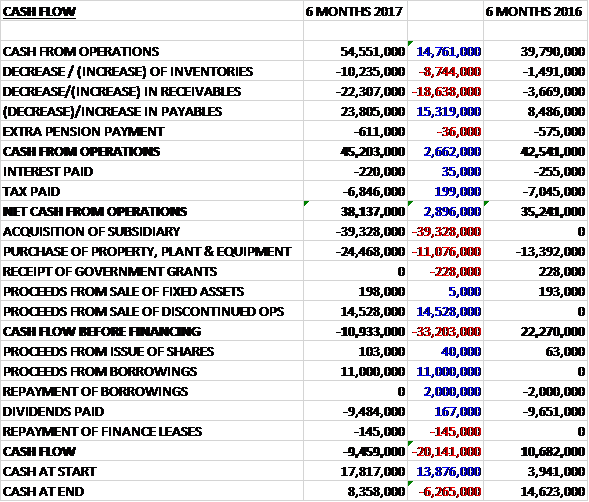
In November, after the period-end the group acquired Dunbia Ballymena for an initial cash consideration of £16.9M and a further contingent consideration of up to £1.3M. The principal activity of the business is primary pork processing and the acquisition enhances the group’s pig processing capability and establishes a significant presence in Northern Ireland.

Going forward the board believe that the group remains well positioned to deliver their expectations for the current year.

At the current share price the shares trade on a PE ratio of 24 which falls to 20.4 on the full year consensus forecast. After a 13% increase in the interim dividend the shares are yielding 1.6% which increases to 1.8% on the full year forecast.

Overall then this has been another strong period for the group. The profit increased, net assets grew and the operating cash flow increased, although after acquisitions no free cash was generated so this is very much still in the growth stage. Most categories performed well with just bacon and pastries showing no or negative growth with the former due to lower sales prices and the latter down to lower volumes. The group is investing a lot in capex and acquisitions at the moment which is good, but I feel that perhaps they shouldn’t bother with the limited dividend on offer here. This is all good but the forward PE of 20.4 and yield of 1.8% definitely prices this in so these look a bit expensive to me at the moment, not leaving much margin for error.

On the 2nd February the group released a Q3 trading update which was in line with board expectations. Total revenue was well ahead of last year, underpinned by strong volume growth and supported by a robust performance over Christmas. Export sales continued to grow strongly, with Far East revenues well ahead reflecting both ongoing demand from the region and increased output from the group’s two primary processing facilities. Input costs rose further during the period buy efficiency improvements, internal pig production and constructive pricing discussions with customers helped partially mitigate the impact.

Dunbia Ballymena performed in line with expectations since the acquisition and integration is proceeding to plan. Crown Chicken continued to contribute strongly during the period. The business is being integrated successfully and is forging strong links with the premium cooked poultry and pig farming operations.

Work has recently started on the new, purpose built continental products factory in Bury. This substantial investment will consolidate the group’s two existing facilities and provide additional capacity to support this growth category.

Net debt increased during the quarter and was above the level reported at the same stage last year. The board is confident in both the prospects for the remainder of the year and the continued long term success of the group. This all sounds fine – the increasing input costs could be the sign of an issue though.