Kalibrate Share Blog – Final Results Year Ended 2016

Kalibrate Technology has now released its final results for the year ended 2016.

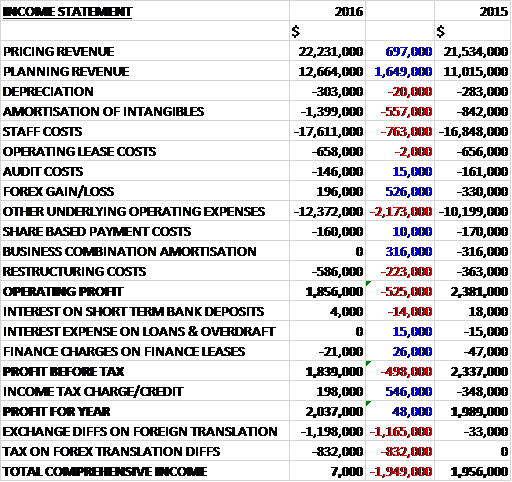
Revenues increased during the year with a $1.6M growth in planning revenue and a $697K increase in pricing revenue. Amortisation charges grew by $557K and staff costs were up $763K but there was a $526K swing to a forex gain. Other underlying operating expenses increased by $2.2m and there was a $223K growth in restructuring costs but there was no amortisation of acquired intangibles which accounted for $316K last year which meant that the operating profit was down $525K. Finance charges saw a modest decline but there was a $546K positive swing to an income tax credit due to tax losses being recognised which gave a profit for the year of $2M, a growth of just $48K year on year.

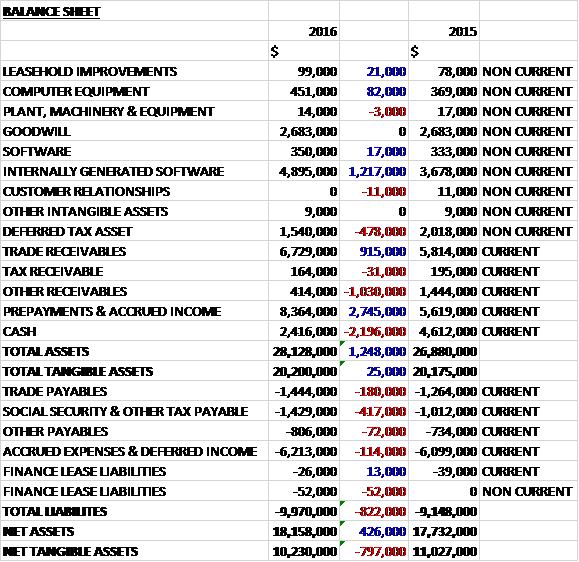
When compared to the end point of last year, total assets increased by $1.2M driven by a $2.7M growth in prepayments and accrued income, a $1.2M increase in software assets and a $915K growth in trade receivables, partially offset by a $1M decline in other receivables and a $478K fall in deferred tax assets. Total liabilities also increased during the year due to a $417K growth in social security and other taxes payable and a $180K increase in trade payables. The end result was a net tangible asset level of $10.2M, a decline of $797K year on year.

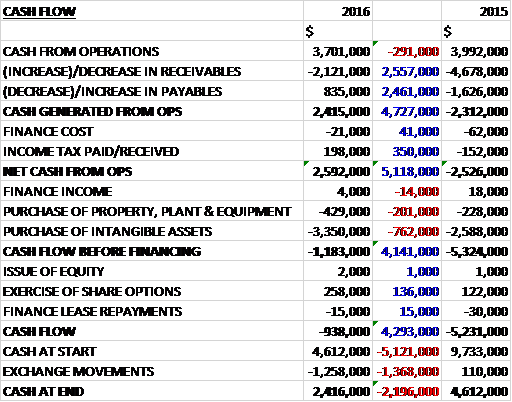
Before movements in working capital, cash profits declined by $291K to $3.7M. There was a cash outflow from working capital due to a growth in receivables but this was lower than last year and after a $350K positive swing to tax receipts, the net cash from operations came in at $2.6M, an improvement of $5.1M year on year. The group spent $3.4M on intangible assets and $429K on property, plant and equipment so that before financing there was a cash outflow of $1.2M. The group made $258K from the exercise of share options so the cash outflow for the year was $938K to give a cash level of $2.4M at the year-end.

The operating profit in the Pricing business was $727K, a decline of $1M year on year. During the year the group’s largest deals have come in the form of a perpetual license sales that have a recurring stream of associated software maintenance revenue. The core pricing platform was up 8% but a legacy service offering that provides significant recurring revenue at a low margin declined by about 22% in revenue terms.

In Q4 the group signed a $1.9M perpetual license contract with a US-based national fuel and convenience chain and a $1.6M perpetual licence deal with an independent refiner and B2B fuel retailer. They also continue to win new SaaS contracts, including a large multi-country European fuel retailer. There is ongoing progress in emerging markets with the first contract win in Chile with a multi-country South American fuel retailer and there is continued success in Mexico with one pricing and two planning contract wins following the entry into this market place in 2015. A first pricing perpetual license deal has been signed in China.

The operating profit in the Planning business was $1.9M, a growth of $389K when compared to last year. This has been largely driven by an increase in revenue following the consolidation of fuel and convenience retailers in the group’s core markets of Europe and North America. They have also signed several multi-year planning projects in Europe in this past year which provides a solid stream of recurring revenue.

A saleable bi-product of the planning business is the vast amount of traffic counts, demographic, retail volume statistical data that is collected as the group complete market study models for their clients. This data is then packaged into separate analytical offerings that clients purchase on a recurring basis although a relatively small segment it is growing.

In North America, pricing revenue was up 9% attributable to several significant perpetual license deals with four premier retailers and planning revenue increased by 9.7% mostly as a result of cross-selling planning products to existing pricing customers and due to the consolidation that continues throughout the region.

In Europe revenue was relatively flat year on year. This was mainly due to a large deal originally designed as perpetual that came in as SaaS, although this decrease was partially offset by the implementation of two large planning deals. The significant acquisition activity in the market has been driving considerable interest in the group’s planning segment. In Q2 2017 they will start another multi-year planning engagement with one of their pricing customers for a new significant cross-sell opportunity.

The most notable occurrence in the ROW market was the quick deregulation in Mexico. As the market deregulated, there was an immediate response from the retailers to accelerate their level of preparedness to meet the changing market requirements. The other significant deregulation revolves around the more measured approach demonstrated by the retailers in India. During the year the group re-entered and transacted business in China for a retail pricing contract. While it was a relatively small deal for them, it marked a in the way Chinese retailers view petroleum retail competition.

During the year the group sold ten clients under a SaaS contract for total booking of about $2M while four significant contracts were signed in North America as perpetual licenses. Even under a perpetual license arrangement, the group increased its recurring revenue as all licenses have a multi-year maintenance contract. They increased their annualised recurring revenue by $2M to $23M.

During the year the group introduced a new in-store merchandise pricing and promotion offering. This offering should assist convenience retailers in gaining more visibility into their merchandise categories within their stores. They have already experienced significant interest both from existing clients and new convenience store operators. They will therefore invest in this offering so as to ensure that they are able to capitalise on this anticipated demand.

Additionally, in the upcoming year the group will be modifying their existing wholesale pricing platform to accommodate global business to business pricing analytics for the oil and gas industry. They have witnessed clear global interest from existing clients and potentially new customers for this solution as evidenced by a deal signed in the second half of the year. These new offerings, in addition to the regular updates and enhancements to their cloud suite of products will provide the cornerstone of future global growth.

This coming year they will place particular emphasis on improving the global breadth of their business, focusing their attention on areas with higher growth potential. As such, they plan to increase investment from operating cash flow into the ROW, the merchandise pricing and promotion platform and they wholesale pricing solution.

Following the Brexit vote, sterling has lost a lot of value. They report in US dollars with about 15% of revenue and 27% of costs in sterling so they anticipate only a minimal impact going forward.

The restructuring costs relate to a plan where the group eliminated the long term cost associated with a group of employees in order to reallocate the capital resources towards the merchandise pricing offering and the global initiatives that include more global sales and support.

After the year-end the group formed an entity with its long-time agent in India to sell locally as they position the group for future growth in this recently deregulated market.

The board are confident in their ability to grow the group in accordance with expectations but increasingly their ability to do this requires them to secure significant wins from the emerging markets and countries with higher growth potential such as India, Asia and Africa. For the current financial year they are seeing encouraging signs that this will prove to be the case but often sales cycles in these markets tend to be more prolonged in terms of timing for closing deals.

At the current share price the shares are trading on a PE ratio of 12.5 but I can’t find any forecasts. There is no dividend on offer here. At the end of the year the group had a net cash position of $2.4M compared to $4.6M at the end of last year.

On the 24th January the group released a trading update covering the first half of the year. Revenue and EBITDA have been impacted by adverse forex movements coupled with delays to signing of certain new contract and the start of some backlog projects. A number of these are now expected to close and start in the second half of the year. As a result the board now expects revenue and EBITDA to be materially lower than market expectations at $14M and just $100K respectively.

Going into the second half contracted year to date revenue is $26M and the group enters the period with a strong pipeline. The range of outcomes for the full year will depend on the closing of further business, the timing of which is difficult to predict. The group are therefore reducing the cost base.

During the period the group saw encouraging sales in their core markets, particularly in their newer product offerings. In December they signed the first contract for their new merchandising pricing and promotion offering with Ricker’s, a fuel and convenience brand in Indianapolis. They are also making encouraging progress with their planned B2B/Wholesale pricing proposition which remains on track for launch in the summer of 2017.

The group also continue to push ahead with their strategy to invest in sales growth in their ROW region. Progress here has been slower than anticipated, however, with a larger portion of the delayed contracts located in these regions.

Overall then this has been a bit of a sluggish year for the group. Profits were up due to positive movements in deferred tax – pre-tax profits declined year on year. Similarly the operating cash increased but this was due to more favourable working capital movements and cash profits declined with no free cash being generated. The reduction in profit seems to have come from the pricing division but it is not clear as to why – perhaps the lower legacy sales have affected profits.

So far this year, things have been tough. The group has suffered with forex movements and delays in order and are not expecting to make much of a profit at all in the first half. They also don’t sound that confident about timings of orders in the second half and I can’t find any forecasts. All of this leads me to think that perhaps now is not the time to invest here.

On the 13th June the group announced a recommended cash offer to be bade by Hanover Active Equity Fund. Under the terms of the offer, Kalibrate shareholders will be entitled to receive 85.5p in cash per share, which is a premium of 50% over last night’s price and values the group at £29M. The directors intend to unanimously recommend that shareholders accept the offer and Hanover has received irrevocable undertakings representing about 40% of the issued share capital.

Berkeley Group Share Blog – Interim Results Year Ending 2017

Berkeley Group has now released its interim results for the year ending 2017.

Revenues increased by £274.7M and cost of sales grew by £162M to give a gross profit £112.2M above that of last time. There was no profit from the sale of financial assets which brought in £2.8M in the first half of 2016, share based payments increased by £4.1M and other operating expenses were up £4.2M. The share of results from joint ventures grew by £900K, however, and the operating profit increased by £101.6M. Finance income declined by £1.1M and other finance costs were up £1.1M reflecting land purchased on deferred settlement terms, with income tax increasing by £16.8M. All of this meant that the profit for the period was £310.5M, a growth of £82.7M year on year.

When compared to the end point of last year, total assets increased by £144.5M driven by a £100.5M growth in cash and a £90.1M increase in inventories, partially offset by a £32.4M decline in the value invested in joint ventures and a £12M fall in deferred tax assets. Total liabilities declined during the period as a £19.4M decrease in payables due to a reduction in land creditors, was only partially offset by a £6.1M growth in development obligation provisions. The end result was a net tangible asset level of £1.952BN, a growth of £156.3M over the past six months.

Before movements in working capital, cash profits increased by £108.5M to £402.2M. There was a cash outflow from working capital but this was less than last time so after tax payments increased by £12.1M and interest receipts fell by £1.2M the net cash from operations came in at £220.8M, a growth of £219.5M year on year. The group spent just £700K on capex and loaned a further £3.1M to joint ventures but got £40M in dividends from St. Edward to give a free cash flow of £257.5M. They then spent £20.1M buying their owns shares and £137M on dividends to give a cash flow of £100.5M and a cash level at the period-end of £207.9M.

During the period there was £1.373BN of residential revenue, and increase of £306.5M; £13M of commercial revenue, a decline of £4.5M; and £27.2M from the sale of ground rent assets, a decrease of £26.2M. Some 2,076 new homes were sold across the South East at an average selling price of £655K compared to 2,091 at £506K last time with the increase in average selling price as a result of mix with a higher number of schemes in Central London.

Excluding a hiatus around Brexit, reservations for the six month period remain in line with the beginning of the calendar year and are about 20% down on the same period last year as a result of the market adjusting to increased stamp duty and the economic uncertainty arising from Brexit. The underlying market has begun to adjust to these events and the group plans to launch new product in the New Year which will be delivered in the years beyond to 2018.

The two new sites launched in the last six months in Battersea and Kingston both saw sales volumes and prices in line with expectations. The group’s sales continue to be split evenly between owner-occupiers and investors with demand from both domestic and international purchasers robust. Help to Buy reservations accounted for just 75 sales in the period. At higher price points the group have absorbed the impact of the SDLT increases but this have been more than offset by increases elsewhere. Reservation cancellation rates are at normal levels following a temporary increase after the Brexit result. Build cost inflation has continued to ease and is currently running at around 4% per annum.

In the last two years the group completed the disposal of its historic ground rent asset portfolios and they are now being sold predominantly from current sites. The revenue from the commercial activities included the sale of 37,000 sqft of office, retail and leisure space across a number of the developments including Kew Bridge Road, Goodman’s Fields in Aldgate, Royal Wells Park in Kent and Chelsea Creek in Fulham. Last year the revenue came from the sale of 65,000 sqft of office, retail and leisure space.

The share of results from joint ventures increased by £900K to £4.5M. This reflects ongoing completions at Kensington High Street and Stanmore Place as well as the first completions at Green Park in Reading within St. Edward; and pre-development costs within St. William in the early stages of the joint venture.

St. Edward has four schemes currently in development at Stanmore Place, Kensington High Street, the Strand, and Green Park in Reading. 61 homes were sold in the period at an average selling price of £702K. During the period a resolution to grant consent for a development in Wallingford has been obtained which remains subject to a section 106 agreement. The site has come through strategic land holdings and is now included in the land bank. The business also controls a commercial site in Westminster which has a detailed planning consent but will not move into development until the premises are vacated by the current tenant.

Some 3,496 plots in the group’s land holdings relate to St. William schemes, across six developments. The group continues to work closely with National Grid to identify sites from across its portfolio to bring through into the joint venture. In August the business entered into a £150M facility with a number of banks for a term of three years and completed the acquisition of Prince of Wales Drive in Battersea which has now moved into production. Along with the joint venture funding already provided, the business has visibility over its financing arrangements as it continues to grow and develop its land bank.

The group’s land bank comprises 42,125 plots compared to 42,858 at this point of last year. The plots have an estimated future gross margin of £5.896BN compared to £6.146BN (£250M reduction) and includes the margin over their share of the joint ventures. They also hold a strategic pipeline of long term options for more than 5,000 plots.

The group acquired two new sites in the period as well as bringing a further two new sites through the strategic pipeline of long-term options. The four new sites added to the land bank include three sites in the South East – Leatherhead, Cranleigh and Wallingford and in London – Ealing, acquired on deferred terms. They have secured five new planning consents and a number of revised consents in the period. The new ones include St. Edward’s Wallingford site along with St. Williams’s site in Rickmansworth and developments in Blackheath, Woking ham and Kingston. The revised consents have sought to improve the development solution for each scheme to add value or reduce risk.

The group’s land holdings at the period-end are across 79 sties. If these, 56 have implementable planning consent and are in construction, 13 have at least a resolution to grant planning but the consent is not yet implementable and the remaining ten are in the planning process.

The board have reviewed the mechanism for making the remaining £10 per share payments under the shareholder returns programme. The current heightened uncertainty and the reduction in the share price means that they are looking to make the payments through a combination of dividends and share buy-backs as opposed to just dividends.

In 2015 the group dismissed finance director Mr. Simpkin who issued legal proceedings in the Employment Tribunal. In November 2015 he served high court proceedings against the company. There is preliminary hearing in July 2017 to consider the way in which the board exercised their discretion not to permit Mr. Simpkin to retain awards otherwise lost under various remuneration schemes. The reasons for his dismissal are expected to be dealt with at a later hearings. The proceedings are being defended by the company with the assistance of external advisers.

At the current share price the shares are trading on a PE ratio of 11 but this falls to 7.1 on the full year consensus forecast. At the end of the period they had a net cash position of £207.9M compared to £263.1M at the same point of last year.

Overall then this has been a decent period for the group. Profits increased, net assets grew and the operating cash flow was up with plenty of free cash being generated. It is worth noting that sales of ground rents did decline during the period, however. Going forward things seem a little more uncertain, the Brexit vote has certainly added nervousness in the market but the stamp duty increase seems to have had a greater effect with reservations 20% down on the same period last year and the value of the land bank also declined as the group did not replace developed land. With a forward PE of 7.1 the shares seem to be pricing in this uncertainty but having been already invested in two housebuilders I am not looking to increase my exposure at this point.

On the 17th March the group released a trading update covering the period to the end of February. The housing market in London has now stabilised. Overall, underlying reservations in the seven months since Brexit are down 16% with the last two months being ahead of last year. Enquiry levels remain robust, cancellation rates are at normal levels and pricing continues to be resilient and above business plan levels.

The reduction in reservations is across all price points and reflects the ongoing impact of both Brexit uncertainty and the changes in recent years to SDLT and mortgage interest deductibility. This has been partly offset by the continued availability of mortgage finance at low interest rates and favourable currency exchange rates. When couple with the planning environment and increased demands from the combination of affordable housing, CIL, sections 106 obligations and review mechanisms this has resulted in new starts in London falling by around 30%.

The group is onsite in production on 58 sites. There are a further 22 sites that are either in the planning process or they are unable to start onsite due to the number of pre-commencement conditions to be cleared or other enabling issues such as access or utilities. The group are in a strong position and forward sales are expected to be over £2.6BN at the end of April.

Pre-tax profits in 2017 are expected to be at the top end of market expectations with the actual outturn dependent on completion timing on the larger developments. A similar level of profitability is expected in 2018.

On the 4th April the group announced that Chairman Anthony Pidgley sold 1M shares at a value of £31.1M. That is a huge sale and really puts my off wanting to invest in the company at this time.

Victoria Oil and Gas Share Blog – Interim Results Year Ending 2016

Victoria Oil and Gas has now released its interim results for the year ending 2016.
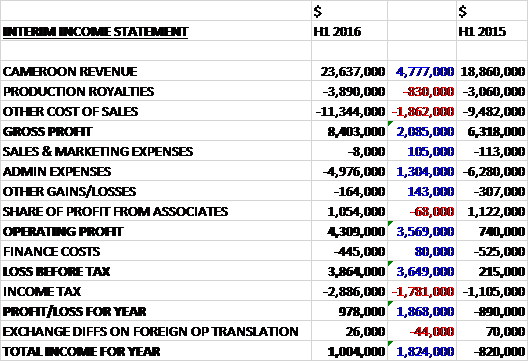
Revenues increased by $4.8M during the period and after royalties were up $830K and other cost of sales increased by $1.9M the gross profit was $2.1M ahead. Admin expenses fell by $1.3M, mainly as a result in a fall in share based payments, and other losses reduced by $143K to give an operating profit $3.6M above that of last time. Finance costs fell by $80K (although finance costs of the facility taken out for the drilling campaign have been capitalised which seems a bit dubious to me) but tax charges grew by $1.8M as the group fully utilised the deferred tax losses previously recognised over unused tax losses in Cameroon, to give a profit for the period of $978K, a positive movement of $1.9M year on year.
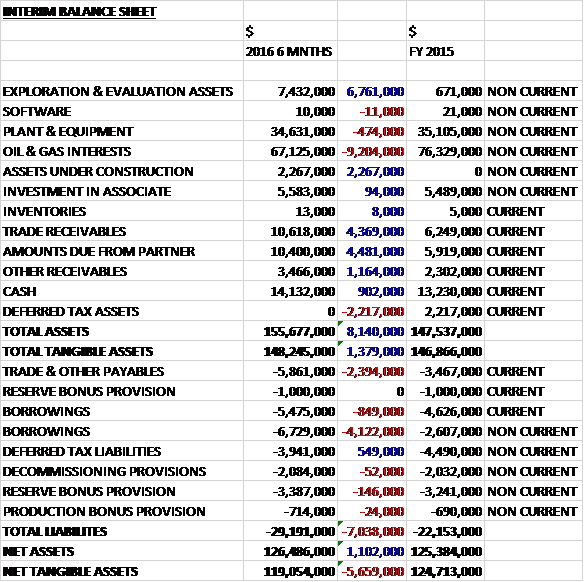
When compared to the end point of last year, total assets increased by $8.1M driven by a $6.8M growth in exploration assets, a $4.5M increase in amounts due from a partner (RSM, received post-period-end), a $4.4M growth in trade receivables (ENEO, also mostly received post period-end), a $2.3M increase in assets under construction and a $1.2M growth in other receivables, partially offset by a $9.2M reduction in the value of oil and gas interests and a $2.2M fall in deferred tax assets. Total liabilities also increased in the period due to a $5M growth in borrowings and a $2.4M increase in payables. The end result was a net tangible asset level of $119.1M, a decline of $5.7M over the past six months.
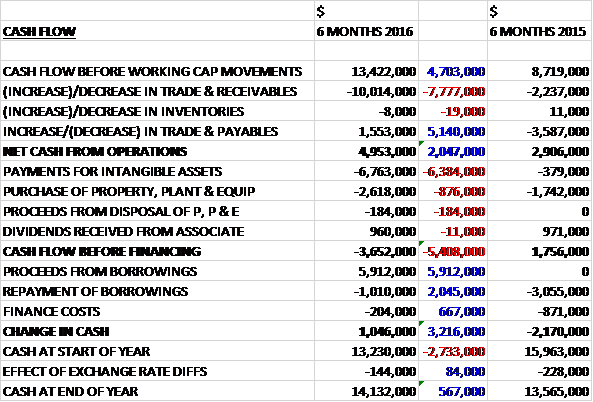
Before movements in working capital, cash profits increased by $4.7M to $13.4M. There was a big cash outflow from working capital due to a growth in receivables reflecting delays in payment from ENEO which has largely been rectified after the period-end, and the net cash from operations came in at $5M, a growth of $2M year on year. The group then spent $6.8M on intangible assets along with $2.6M on property, plant and equipment although they did receive $960K from an associate to give a cash outflow of $3.7M before financing. They took out a net $4.9M of new borrowings to give a cash flow for the period of $1M and a cash level at the period-end of $14.1M.

The Cameroon operation made a profit of $1.9M during the period. There was a 93% increase in the average daily production rate to 13.1mmscf per day with a total of 2,282mmscf of gas sold. Depressed heavy fuel oil prices creates substitution risk and pricing pressure, particularly to the thermal gas sales but this is largely mitigated by the long term gas sales agreement that the group enters into with their customers together with security of supply and environmental benefits. Of the total sales, thermal and retail power sales declined by 114mmscf to 529mmscf but grid power sales grew by 873mmscf to 1,753mmscf. In addition, the group sold 26,047bbls of condensate, a growth of 3,229bbls.

The increase in gas and condensate sales volumes is due to the fact that the group signed a two year take or pay agreement with ENEO and started with the supply of gas to generate electricity in March 2015. The current and prior periods both benefited from the gas consumed by ENEO but the take or pay consumption during the dry season, from January to June, is significantly higher than in the rainy season (which is included in last year’s figures as they cover a different time period.

Despite the fixed gas contracts they have in place with their customers, gas prices came under pressure during the period. The global downturn in oil prices impacts the price of competitive products which can affect the way their customers consume energy. They continue to monitor the impact of the price of HFO and engage with customers to maximise profitability.

The group will be drilling two wells intended to move some of their 2P reserves in the proven reserve category. One of the wells drilled will be a twin of the La-104 well drilled in 1957. The other well will be a step out well that will be drilled into a target that is intended to prove up more of their probable reserves. Both wells are intended to be production wells.

Significant preparation work for the drilling campaign has been completed during the period. The rail mounted rig was delivered to site during July and is currently being commissioned. Weather disruptions, including significant rains and a lightning strike have delayed commissioning but they are now in the testing and certification process and expect spudding to occur shortly.

The Phase II Bonaberi pipeline expansion is well underway and the group expect new customers will be receiving gas before the end of 2016. By the end of the period, 7km of pipeline had been laid and a further 3km was laid up to the end of August, The phased expansion will be completed and commissioned before the end of the year. Expansion of the process plant is scheduled to be performed in three phases. The first phase is to increase the plant capacity by 5mmscf per day to 25mmscf/d. The later phases will increase capacity to 40mmscf per day but are dependent on successful completion of the drilling programme.

The Russia and Kazakhstan operations made a loss of $464K during the period.
As of the end of September the group had $17.6M of commitments pertaining to the drilling programme, the majority of which is expected to be incurred during 2016. In addition to this, they are committed to performing seismic activities on the Matanda concession. The majority of the estimated costs of between $8M and $10M will be incurred during 2017 and 2018.

In April the group reached an agreement with Glencore to acquire a 75% interest in the Matanda block. It neighbours the Logbaba block and provides them with access to additional gas reserves in the area. They will be the operator of this block. The consideration for the transaction was nil but they have assumed the work programme obligations which include seismic work to be performed in the near term and further exploration costs. Included in the acquisition was drilling equipment with a market value of $3.8M but this equipment is included in the accounting records for $0.

Matanda covers an area over 60 times the size of Logbaba and is highly prospective for significant natural gas and condensate resources. The block, with four drilled wells and three discoveries, is estimated to hold P50 gas in volume of 1.8tcf and condensate in place of 136mmbbl.

In August 2016, after the period-end the group entered into formal mediation proceedings with a counterparty regarding the reserve bonus payments. A settlement was reached which resolves all of the outstanding issues and terminates the 1.2% royalty payable to the counterparty. The terms are confidential but the payment is about $10M, only half of which has been provided for.

After invoking a contractual default provision for their Logbaba partner, after the balance sheet RSM has settled all amounts due. RSM have filed an application for arbitration concerning the selection of the drilling rig and contractor for the current drilling programme but the group are confident of their position and will continue to work towards resolving this dispute.

In accordance with the Logbaba farm in agreement, the group is entitled to 100% of the revenues generated by the project until the initial exploration costs, which they incurred, are recovered. Thereafter revenues will be shared 60/40 with VOG receiving 60% which is the same manner that operating costs and post-exploration capital costs are shared. As of the end of May, the initial exploration costs were finally recovered and from June 2016 onwards, revenues are shared in accordance with participating interests of the parties. Therefore, in addition to the seasonal impact of the grid power customer, revenues and operating profits in the second half of 2016 will be impacted by this change.

During the period the group secured a debt facility of up to $26M. With this facility, operating cash flows and partner funding they intend to complete the planned gas expansion programme without recourse equity markets.

Ther have been a number of board changes during the period. Deputy Chairman Grant Manheim retired at the end of May; Ahmet Dik was appointed CEO in June; Finance Director Robert Palmer retired in June; Andrew Diamond joined as Finance director at the end of June and Roger Kennedy joined as a non-executive director in July.

The only forecast I can find seems to suggest the group will make a loss this year so using PE ratios is not going to be very useful. At the period-end the group had a net cash position of $1.9M compared to $6M at the end of last year. By the end of September 2016, however, there was a net cash position of $9M.

On the 27th October the group released an update covering Q3 2016. The average gas production was 7.14mmscf per day, a reduction of 1.05mmscf/d and there was a 12% decrease in gas sales to 630mmscf. Thermal gas sales increased by 76mmscf to 290mmscf representing good growth from the existing customer base, retail power was up 4mmscf to 31mmscf but grid power reduced by 601mmscf to 630mmscf due to the onset of the wet season (they were in line with expectations). The condensate sold fell by 5,768bbl to 6689bbl.
Revenue decreased by $6.1M to $4.7M with the collapse attributable to the reduction in gas sales due to the wet season and the fact that the group are now earning just 60% of revenues.

The Savannah drilling rig was delivered in July and rig up started in August. Two lightning strikes in August caused significant damage to electrical circuits and instrumentation, however. Some of this damage was not apparent until various components were tested individually during commissioning.
Almost all of the lightning related damage has now been repaired. The contractual arrangements on the drilling programme are such that the group only incurs major financial commitments once drilling starts so whilst the delays have been frustrating, they are not expected to suffer any significant cost increases.

The 3.17km of pipeline laid during the quarter, part of the Bonaberi expansion, brings the total pipe laid to 12.25km this year. Of this, 7.13km was commissioned be the period-end, bringing the group’s total commissioned pipeline network to 40.05km. The remaining 5.12km was commissioned shortly after the period-end. In Q4 they will focus on the branch lines to customers and the installation of the PRMS units at customer sites with the aim of bringing new customers online with gas before the end of the year.

Phase one of the gas plant expansion is progressing with the preliminary engineering phase. Further phases of the gas plant expansion will depend on the drilling programme results. At the period-end the group had a net cash position of $2.3M compared to $1.9M at the same point of last year and they had $14.1M of cash on hand.

On the 2nd November the group announced the spudding of the development wells La-107 and La-108. The budget total for the two well programme is about $40M which is expected to be funded by revenue and partner contributions. Drilling is expected to be completed in Q2 2017.

On the 28th November the group announced that it has drilled, cased and cemented the uppermost section of the well La-107 to a depth of 400m. Operations were then suspended as planned and the rig was skidded at a distance of 10m along the rail system to the La-108 well location. Well La-108 was spudded in November and has been drilled and cased to a depth of 400m.

On the 23rd December the group announced that it had completed both the phase II and III of the Bonaberi pipeline extension programme. Three of the new customers are now consuming gas for thermal applications and the remaining four thermal customers are scheduled to commission their burners during Q1 2017. The estimated consumption from the seven new customers will be 600,000scf per day.

Customers currently online or scheduled to be online in January are Maya & c, a palm oil refinery; OK Foods, a biscuit and sweet manufacturer; Agrocam, a packaging company; NAYA, a food processing company; Batoula, a plastic processing company; Bocom, a car battery recycling business; and Camaco, a cocoa processing group.

Drilling of wells La-107 and La-108 is continuing and the group is working with the contractors to make up for the delayed start to drilling. They have drilled and cased the 17.5” section of La-107 to 1,004m and are preparing to drill the 12.25” section to 1,600m where they will set the production casing prior to drilling the reservoir section. The 17.5” section of La-108 has also been drilled and cased to 1,173m and its 12.25” section will be drilled after the current section of La-107 is completed.

On the 3rd February the group released a Q4 operations update. The average gas production increased by 0.5mmscf per day to 7.64mmscf/d and there was a 4.5% increase in the gross gas sales to 654mmscf. This resulted in revenue of $4.6M, a $100K reduction when compared to Q3. So far this year, January has seen a monthly production record, however.

Thermal gas sales were in line with Q3 and were 24% above that of Q4 2015 as three new gas customers started consuming in December following the pipeline expansion. The impact of the new gas supply and the increased ENEO consumption as the dry season starts has already been seen during January with a record monthly supply figure of 14.5mmscf/d.

Grid power sales for the quarter were 12% up on Q4 2015 following increased usage by ENEO. The contract is a two year gas supply agreement which will expire in Q2 2017. Negotiations are underway with ENEO and Altaaqa to renew the contracts for the supply of gas and generation sets, installed at the Logbaba and Bassa power stations in Douala.

Retail power gas sales fell by 63mmscf to just 16mmscf. This reduced consumption is a result of the termination of the lease period of the generators used by these customers to generate electrical power for their operations. They were originally brought into the country to prove the concept of gas to power which resulted in the group being awarded the initial ENEO contract. The customers are individually in the process of purchasing their own generators which are sized appropriately and significantly more energy efficient and the board expect to have them consuming gas again in the future.

At the end of the quarter, well La-108 had been drilled and cased to 1,173m and the 12.25” hole section on well La-107 has been drilled to its target depth of 1,618m. Since the start of January, the La-108 well has been drilled to its 12.25” target depth of 1,953m. MPD technology will be employed during the drilling of the over-pressured Logbaba formation and DDV was set into the casing to assist with this. The addition of this technology to produce higher quality wells and reduce failure risk in the high pressure environment under which they are being drilled has added to the initial estimated budget. In addition, higher than expected non-productive time related to various operational uses has increased the schedule. The revised budget range for the two well programme has now been increased by about 15% to $40M-$48M.

About $23M has been spent to date on the project so the balance of the group’s $13-15M share of the programme will be funded by cash generated from operations and existing debt facilities. The gas processing plant expansion is progressing with the preliminary engineering phase being worked into the pending new flow line works to tie in the new wells.

At the year-end they had a net cash position of $1.3M compared to $2.3M at the end of last quarter and had a cash balance of $15.8M with undrawn lines of credit of $16M.

Overall then this has certainly been a period of progress for the group. In the first half, profits were up as was the operating cash flow but no free cash was generated and net assets declined. This was a long time ago, however, and since then grid power sales seem to have been decent but retail power has been hit by the end of the generator lease period – I must have missed the fact this was happening as it was a surprise to me. The group managed to sort out the royalty issue but this seems to have come at quite a substantial cost. Still, this is a positive development in my view. Also the Matanda acquisition seems a very shrewd bit of business – that looks a great purchase.

The Bonaberi pipeline expansion seems to be progressing well and should bring in more gas sales going forward and January which coincides with the start of the dry season has been very strong. It is important to remember though that the group is only earning 60% of the revenues from this compared to 100% in the last financial statements we have seen so revenues and profits are unlikely to be as strong. The delays and cost-overruns to the drilling in the drilling campaign are a pain too. In conclusion, things seem to be progressing OK here but I would like to see some financial statements where the group is earning its 60% share of revenues before jumping in I think.

On the 6th March the group announced that they had signed a farm-out agreement with Bowleven relating to the Bomono production sharing contract. Gas produced from the contract will be fed into the customer distribution network owned by VOG and first gas supply is expected to start following the granting of a provisional exploitation authorisation.

On completion, a Bowleven will have a 20% working interest in the Bomono PSC with VOG have an 80% working interest. Bowleven will remain as operator of the product despite owning just 20%. Gas from Bomono PSC will be sold to GDC less a tolling fee. The gas price paid will be a weighted average received by GDC(VOG) for its total domestic sales less a tolling fee for the use of the pipeline network.

The pipeline connection from the Bomono POSC to the main network will be managed and funded by VOG and they will complete the civil engineering works necessary for the gas processing plant installation at the Bomono site, the estimate cost of which will be $6M. Bowleven have agreed to pay VOG 50% of any deficit if the first three years of net income is less than the development expenditure incurred, up to a maximum of $2M.

Bowleven will receive a 3.5% royalty from VOG’s production share of hydrocarbons with an aggregate cap limiting the total royalty payments of $20M and Bowleven will also receive £100K of new shares in VOG.

As previously announced the detailed prospect inventory prepared indicates there is 146bcf and 263bcf of mean un-risked GIIP in the Tertiary and deeper Cretaceous reservoir intervals respectively. Overall this seems like a pretty good deal to me, although the royalty payments are a bit of a shame. The company is looking more and more investable.

On the 13th April the group released a Q1 operations update. There was a 10.7% increase in gas production from Logbaba to 14.57mmscf per day and the gross Logbaba gas sales increased by 22mmdcf to 1,152mmscf as a reduction in sales for grid power was more than offset by a growth in thermal power sales. Due to the fact that the group is now only earning 60% of revenues, however, the total net sales was 692mmscf compared to 1,131mmscf in Q1 2016. The gross amount of condensate sold declined by 4,775bbl with the net amount even lower. Phases 2 and 3 of the Bonaberi pipeline extension programme were completed by the end of 2016 and six new customers are now online and consuming gas.

Grid power sales were higher than Q4 but lower than Q1 last year. The ENEO contract expires in April 2017. Negotiations are well advanced and the board expects a renewal for the supply of gas to the Logbaba and Bassa power stations.

The group made $8.1M of net revenue, up from $4.6M in Q4 last year and had a net debt position of $10.7M compared to a net cash position of $1.3M at the end of December. The current cash position is $14.1M.
In the Logbaba drilling programme, significant gas-bearing sands have been identified in the La-108 well and once completed it is expected to contribute to an increase in proven reserves. At the end of Q4, La-108 had been drilled and cased to 1,173m. In this quarter the casing has been run and cemented in La-107 in preparation to drill the 8 ½ hole sections through the Logbaba gas-bearing reservoir sections.

As the La-108 8 ½ hole section was drilled through the Logbaba formation to a depth of 3,076m a mechanical problem with the drill string led to a gas kick and the well control incident. While the well was brought under control, the drill pipe became stuck in the well and the team was unable to retrieve it. In late March, a cement plug was placed in the 8 ½ hole and preparations were made to sidetrack the well to re-drill the Logbaba formation and complete the well which is ongoing.

The well control and pipe issues, coupled with the side track have resulted in a scheduled slippage of some five weeks and an estimated budget increase of about $8M, taking the expected cost to complete both wells to $56M. Planned completion of the wells is now mid Q3 but it is expected that the wells will be under test before this. The group’s share of well costs will be covered by cash generation and existing facilities.

The gas processing plant expansion is progressing the preliminary engineering phase underway. A 300m long, high pressure gas flowline is being installed from the new wells to the gas processing plant to utilise gas produced during flow tests and enable early production from wells La-107 and La-108. In addition, gas plant improvements such as installation of a heat exchanger and high and low pressure liquid separators are also being installed in anticipation of new production from the wells.

At Matanda, while the analysis is at an early stage, the board are encouraged by the indications of onshore prospects in the Northern area of the license. The evaluation is expected to yield an updated prospect inventory by Q3, from which drilling plans can be made. This will provide the opportunity to target the most attractive and lowest cost opportunities for early drilling with the aim of bringing further wells on production in 2018-2019.

Following the execution of the agreement with Bowleven, they announced significant board changes. The group is apparently continuing their good relationship with the board of Bowleven and progressing the project as intended.

Ashley House Share Blog – Interim Results Year Ending 2017

Ashley House has now released its interim results for the year ending 2017.

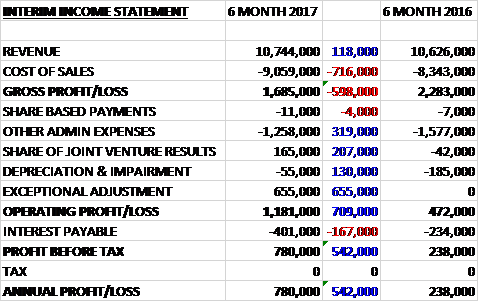
Revenue increased by £118K during the period but cost of sales grew by £716K so the gross profit was down £598K due to the increase in construction income which has a lower margin than pre-construction income. Admin costs declined by £315K, however, and the joint venture enjoyed a £207K swing to profit. There was also a £130K reduction in depreciation and impairments and a £655K exceptional adjustment relating to an agreement to cancel a historic liability with a counterparty, which meant that the operating profit grew by £709K. We then see a £167K increase in interest charges so the profit for the period came in at £780K, a growth of £542K year on year.

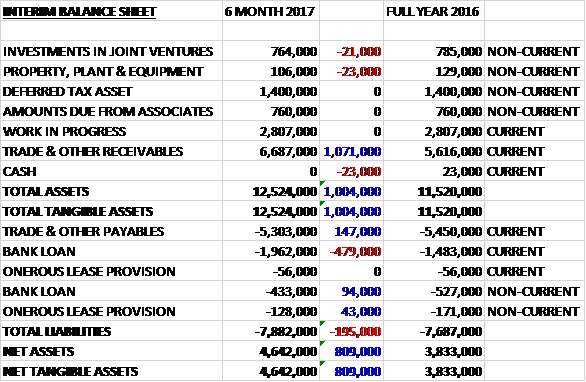
When compared to the end point of last year total assets increased by £1M driven by a £1.1M growth in receivables. Total liabilities also increased as a £385K growth in the bank loan was partially offset by a £147K decline in payables. The end result was a net tangible asset level of £4.6M, a growth of £809K over the past six months.

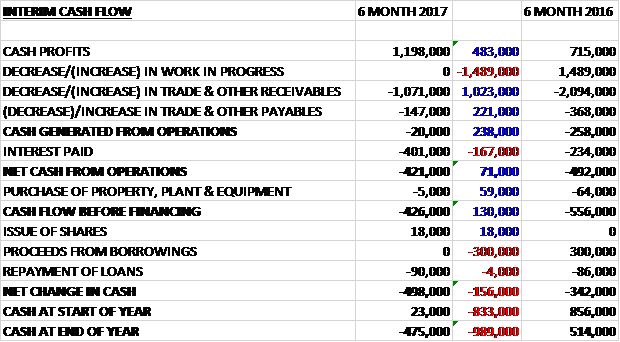
Before movements in working capital cash profits increased by £483K to £1.2M. There was a cash outflow from working capital, however, with a £1.1M growth in receivables and after interest payments grew by £167K there was a cash outflow from operations of £426K, a £130K improvement year on year. The group only spent £5k on capex and £90K in loan repayments so the cash outflow in the half was £498K and the cash level at the period-end was £475K.

The group continue to wait for full clarity on the government’s proposal to top up housing benefit at a local level to fund supported housing. A consultation process started in November where the government reiterated that it is committed to protecting and boosting the supply of supported housing.
Ashley House continues to work with their clients, both councils and registered providers, to find solutions to enable at least some of their pipeline schemes to proceed whilst this consultation continues.

This month’s announcement by the Homes and Communities Agency of grant funding for the next five years included Ashley House with £11.5M of funding for five of their current schemes. In addition, a registered provider partner has been awarded another £7.5M for another three of their schemes. The total of £19M of grant funding is an opportunity for the business to develop out these schemes once the government’s position on social rents becomes clear.

In each case the grant funding allows the rents to be around 20% lower than they would have been and makes the schemes acceptable to the Local Authority Housing Benefits team. It does not in itself close the gap created by the capping of housing benefits to local housing levels but it should help unlock schemes. Having successfully completed their extra care scheme in Harwich last month, they remain n site with the scheme in Walton on the Naze which is due to complete in the coming weeks. The board currently believe that three schemes in their extra care pipeline will be able to reach contract before the year-end, thereby qualifying for revenue recognition but they still all require local authority and partner board final approvals.

The group will continue to diversify in order to lessen the exposure to the risk of Government making changes that affect the fundamental elements of the business. They continue to work with a modular construction contractor through a joint venture company to increase the speed and efficiency of their existing build programmes which is enabling them to tap into a new range of products and development opportunities and start to move away from a reliance on government funded schemes.

In the Health segment they have started construction on two new schemes, a fully integrated GP surgery and family centre complex in Swansea and the redevelopment of an old school building into new surgery premises in Wivenhoe. The diagnostics and treatment centre in Durham will start on sire in the coming weeks. In addition they continue to support their partners Integrated Pathology Partnerships in the programme of creating new pathology labs.

There are currently three schemes on site – Walton on the Naze in extra care and the health schemes in Swansea and Wivenhoe compared to four last year – the Harwich extra care scheme was completed in December. There is a total forward pipeline of 25 schemes with £170.7M of revenue anticipated compared to 31 schemes worth £177.2M at this point of last year.

The ongoing government consultation relating to funding for supported housing means that a further complication is added to the process of contracting on schemes. Subject to the timing risk of some of these schemes, the board expects that the group will be profitable in the full year.

At the current share price the shares are trading on a PE ratio of 16.7 which falls to 2.7 on the full year forecast which I find hard to believe. At the period-end they had a net debt position of £2.4M compared to £2.6M at the same point of last year.

Overall then this has been a period where not a great deal has happened! Profits did increase but this was due to a historic liability being cancelled, without which profits fell due to an increase in interest costs. Net assets grew, however, as did cash profits, although there was still a cash outflow at the operating level reflecting increased receivables. The health projects seem to be ticking along OK but the issue really is the lack of clarity over how the government is going to top up housing benefit to fund supported housing – if indeed it is. I suspect this is why there is only one Extra care project on sire and the pipeline is not being replenished. The forward PE of 2.7 looks like a nonsense to me and I find it hard to want to invest here until there is more clarity over the future of the Extra Care schemes.

On the 14th March the group announced an acquisition and released a trading update. The trading update highlights the risk of delays to the closing of certain projects arising from ongoing uncertainty of government funding support for such projects which might result in revenues being delayed from this year into the next financial period. As a result, the board have been seeking revenues less dependent on government funding hence the acquisition.

The group, through their joint venture subsidiary, F1M, have acquired their former modular off-site construction partner. They have also increased their holding in F1M to 76%. F1M is the only modular contractor to hold a place on local government’s national framework for housing and is currently bidding to deliver mixed developments including private accommodation. The short term pipeline includes contracted housing for two local authorities, specialist units for a Welsh council, and a flow of work with an innovative retail developer delivering ready built retail pods. The business is seeking to extend its reach into schools, student accommodation and other similar products which are well suited for building in a factory before being transported to site.

It is also capable of delivering a significant proportion of the group’s own pipeline as they will use a mixture of off-site and traditional build methods for its schemes. It is this ability to provide an integrated approach involving a modular solution which was a key benefit in their recent bid win in York of a 70 bedroom care home. This scheme is expected to start onsite during the next financial year.

The business is being acquired by F1M from administration and produced a loss of £93K in 2015. F1M have agreed to pay £114K for the assets of the business and is entering into a new lease on the factory with an option to acquire the freehold over the next six months. The increase in holding in F1M from 52% to 76% was for a consideration of £250K, £240K of which is payable only when the enlarged F1M business is profitable.

Overall then this is a decent enough acquisition but it is for the future and it is looking increasingly likely that the group will not hit targets this year. I am steering clear for now.

On the 25th April the group announced that it had signed a new loan facility of £500K with the deputy Chairman secured against some assets of the company. This doesn’t quite sit that well to me.

Wynnstay Share Blog – Final Results Year Ended 2016

Wynnstay has now released its final results for the year ending 2016.

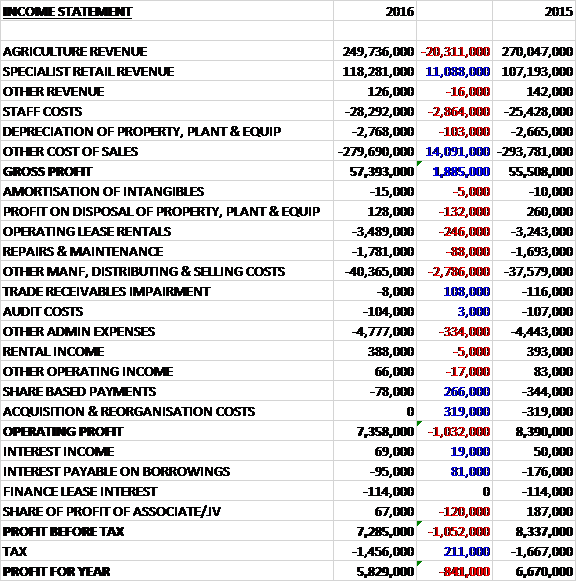
Revenues declined when compared to last year as an £11.1M growth in specialist retail revenue due to the prior year acquisitions was more than offset by a £20.3M decline in agriculture revenue. Staff costs increased by £2.9M, depreciation was up £103K but other cost of sales decreased by £14.1M to give a gross profit £1.9M above that of last year. Operating lease rentals grew by £246K and other manufacturing, distribution and selling costs were up £3M with admin expenses growing by £225K. We also see a £266K reduction in share based payments and no acquisition costs which accounted for £319K last time to give an operating profit £1M higher. Interest payments came down but there was a £120K reduction in the share of profits from associates which meant that after the tax charge declined by £211K the profit for the year was £5.8M, a decline of £841K year on year.

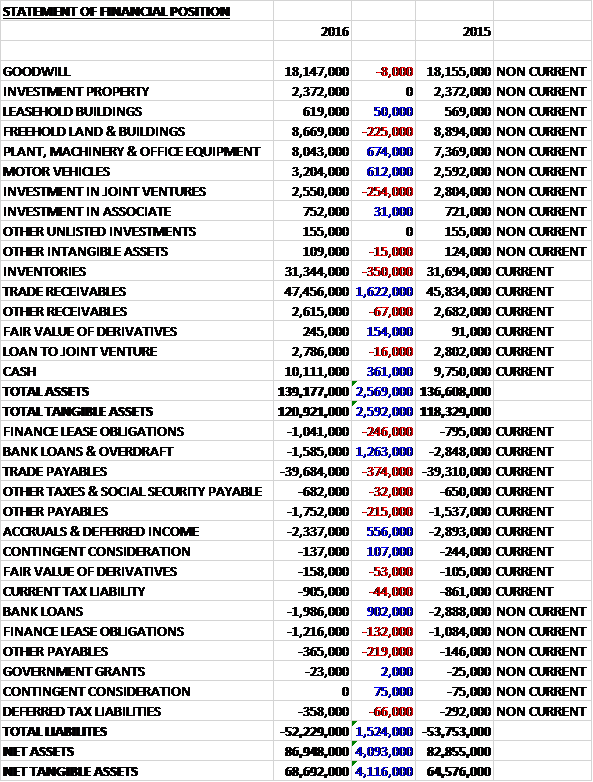
When compared to the end point of last year, total assets increased by £2.6M to £139.2M driven by a £1.6M growth in trade receivables, a £674K increase in property, plant & equipment, a £612K growth in motor vehicles and a £361K increase in cash partially offset by a £350K decline in inventories. Total liabilities declined during the year as a £2.2M fall in bank loans and a £556K decrease in accruals were partially offset by a £374K growth in trade payables. The end result was a net tangible asset level of £68.7M, a growth of £4.1M year on year.

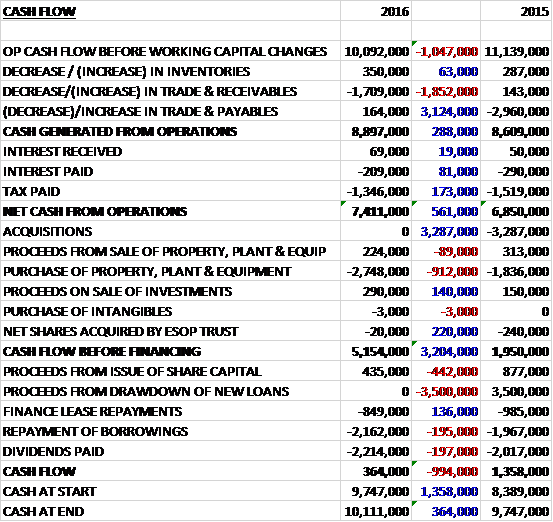
Before movements in working capital, cash profits declined by £1M to £10.1M. There was a cash outflow from working capital but this was less than last year and after tax payments declined by £173K and interest payments declined mostly the net cash from operations was £7.4M, a growth of £561K year on year. The group spent a net £2.5M on property, plant and equipment and had a free cash flow of £5.2M. Of this, £849K was used to repay finance leases, £2.2M went on repaying borrowings and £2.2M went on dividends to give a cash flow for the year of £364K and a cash level of £10.1M at the year-end.

The operating profit for the Agriculture division was £3M, a decline of £1.1M year on year as customers looked to cut costs. The downturn in farm output prices experienced over the last two years has been widely felt across most sectors. The downturn was especially evident in the dairy sector with milk prices falling below the cost of production for most farmers. The resultant fall in demand for feed and associated products has been felt nationally and the group’s feed activities were similarly affected. By contrast, despite low grain prices reducing crop farmers income, their arable activities contributed an improved performance over last year.

Demand for livestock feed was down year on year, mirroring national trends. As mentioned above, the reduced demand was particularly evident in the dairy sector, especially for blended feeds, some of which was replaced by straight feeds. This reduction reflected a decision on the part of the farmers to search for production efficiency and, for some, not to feed for marginal milk volume. The resultant reduction in UK milk yields was the catalyst for an upward movement in milk prices in the late summer, however. Feed demand over the winter period has improved and there are encouraging signs that demand will continue to strengthen.

Glasson’s contribution this year was lower than in the prior year with margin pressure across all products and a reduction in fertilizer volumes which was also evident in the Fert Link joint venture.

The group’s arable activities have continued to perform well despite the subdued market environment. Demand for all products was higher year on year which was reflected in volumes. As they expected, however, there was also some pressure on margins. Sales of cereal and herbage seed have been buoyant and broken previous records. Demand for fertilizer was subdued at the beginning of the year but they are well placed to satisfy the market. An active buying spell in the autumn helped increase volumes for the year as a whole ahead of the previous year.

Grain volumes were strong in the first half but the smaller 2016 harvest resulted in reduced activity in the second half on a like for like basis. During the year they started to combine the management of the Woodheads seed and grain business with the Wynnstay seed and Grain Link operations. They expect to complete this process over the coming months.

The operating profit for the Specialist Retail division was £4.5M, a fall of £538K when compared to last year reflecting margin pressure and opening costs in the new stores. The group have now completed the integration of the Agricentre business acquired in 2015, and all the outlets have been rebranded. The group expect the acquired stores to make a positive contribution to the results during 2017. In August they opened a new store next to the sedgemoor Livestock market near Bridgwater. It is a strategically important trading area and complements the newly acquired Agricentre stores.
Although total sales increased by 12%, like for like sales declined, primarily reflecting lower fertilizer sales and a reduced volume of hardware and ancillary products in the dairy sector.

The group added three Just for Pets stores during the year including one Bessie and Boo boutique store in Evesham. The contribution from the pet business is behind that of last year reflecting the opening costs and maturity curve associated with new outlets as well as a small reduction in like for like sales.

The Youngs Animal Feeds business performed in line with expectations and the group believe that there are further opportunities available to it as they continue to expend the specialist retail division as a whole.

The group have been investing significantly across the group and completed a major investment in new packaging facilities for bagged animal feed. This investment enables then to satisfy the growing requirement for bagged feed as they increase the number of their stores. Further investment is now targeted across their arable and feed operations to support growth and efficiencies within the group.

The Brexit vote brings a degree of uncertainty to the agricultural industry but the macroeconomics of food demand are encouraging. Over recent months there has been a recovery in output prices for farmers, mainly as a result of the devaluation of Sterling, and the new financial year has started in line with management expectations. The board remain optimistic of future improvement.

At the current share price the shares are trading on a PE ratio of 19 which falls to 18.5 on next year’s consensus forecast. After a 5% increase in the final dividend the shares are yielding 2.1% which increases to 2.2% on next year’s forecast. At the year-end the group had a net cash position of £4.3M compared to £2.1M at the end of last year.

Overall this has been a rather difficult year for the group. Profits declined and although the operating cash flow grew, this was due to more favourable working capital movements and cash profits fell. Having said that, the group did produce a very good level of free cash and the net asset level grew.

Both sectors saw declines. The agricultural business was hit by lower output prices for farmers, particularly in the dairy sector which saw demand for livestock feed tank. In the retail sector, the farm business saw margins under pressure due to the lower farm output prices and the pet business also saw a small like for like decline in revenue. The acquired stores should contribute to profits next year, however.

Brexit has been a double edged sword. Clearly it adds uncertainty to the industry with the fate of subsidies etc not yet known. The decline in Sterling has been a positive, however, and recent months have seen farm output prices rise with a recovery in the dairy market. This bodes rather well for this year and I do like this company – it seems very well run. My only issue really is the continuing uncertainty surrounding Brexit and the high valuation for the shares – a forward PE of 18.5 and yield of 2.2% look rather expensive to me.

On the 21st March the group released an AGM statement. The trading environment for farmers has continued to show signs of recovery, with farm output prices higher year on year, although from low comparatives. At this stage the board continue to remain encouraged that they are on track to return to growth this year.

In the Agriculture division, demand for ruminant feed has increased, reflecting national trends. Fertilizer sales have been good as farmers purchased ahead of expected price increase. Demand for spring seed is also encouraging and, as expected, the smaller 2016 harvest has meant that grain trading volumes in the period are behind the previous year.

Within the specialist retail operations, the agricultural retail activities have seen a small increase in like for like sales over recent months, mainly attributable to hardware products. Demand at Just for Pets, the pet products business, remains subdued, reflecting the challenging high street.

Overall then things seem to be improving but this doesn’t seem quite strong enough to encourage me to buy in here.

On the 24th May the group releases a trading update covering the first half of the year. Excluding Just for Pets, the group is expecting to show a better performance year on year. Trading headwinds for farmers have eased somewhat but the agricultural environment remains challenging with margin pressures a feature. Just for Pets has continued to experience subdued demand, reflecting general retail trends in the sector, and certain stores in particular have not delivered the expected performance, resulting in losses in this activity during the first half.

As a consequence the board now expects to book a goodwill impairment for the period which will result in the group’s reported profits being materially lower than in the first half of last year. Excluding this, the adjusted pre-tax profit will be marginally below last year, impacted by the performance of Just for Pets.

Colefax Share Blog – Interim Results Year Ending 2017

Colefax has now released their interim results for the year ending 2017.

Revenue increased by £1.5M due to forex movements (they declined at constant currency) when compared to the first half of last year and after operating costs increased by £2.9M, not helped by hedging losses following the decline in sterling (£755K), the operating profit was down £1.4M. Tax charges declined by £321K which gave a profit for the period of £1.3M, a decline of £1.1M year on year.

When compared to the end point of last year, total assets increased by £4.2M driven by a £3.4M growth in receivables, a £1.6M increase in property, plant & equipment and a £1.3M growth in inventories, partially offset by a £2.1M decline in cash. Total liabilities also increased during the period due to a £5.4M growth in payables and a £544K increase in deferred rent. The end result was a net tangible asset level of £24.6M, a decline of £1.7M over the past six months.

Before movements in working capital, cash profits declined by £1.1M to £3.2M. There was a cash outflow from working capital, but a bit less than last time and after tax payments were broadly flat, the net cash from operations came in at £1.4M, a decline of £857K year on year. This did not cover the £1.7M spent on capex so there was a cash outflow of £238K before financing. The group purchased £2.6M-worth of their own shares and paid out £244K in dividends to give a cash outflow of £3.1M in the period and a cash level of £8M at the period-end.

Sales in the fabric division increased by 4.7% but decreased by 7.3% on a constant currency basis. Excluding hedging losses of £755K operating profits decreased by 18.5% to £2.7M reflecting difficult trading conditions in the core US market. Sales in the US were down 10% on a constant currency basis, reflecting uncertain trading conditions in the run up to the election. The group have continued to invest in the US market, however, and opened their new showroom in Boston in October and will open another in Atlanta in February.

Sales in the UK were up 1% and so far do not seem to have been adversely affected by the Brexit vote. The group are concerned by the slowdown in high end housing transaction as a result of the increase in stamp duty, however, because trading tends to lag changes in the high end housing market.

Sales in Continental Europe were down 6% on a constant currency basis (but up 9% on a reported basis). Trading conditions overall remained challenging but there were some significant variations between countries. In the largest market France, sales increased by 4% which was better than expected due to a significant contract order in the period. In Germany, sales declined by 1.6% and in Italy, sales fell by 0.2%. Sales in the ROW decreased by 14% at constant currency.

Furniture sales decreased by 9% to £1.2M with all of the decline attributable to a contract order in the prior year. Operating profit was just £9K, a decline of £65K and the order book was down 6% at the period-end, although it is currently ahead of last year despite very competitive market conditions for high end furniture.

Decorating sales increased by 3% during the period and the division made a reduced loss of £84K, an improvement of £64K. The division has a demanding six months due to the preparations for the move out of its current base to new premises. The office move was completed in December and the new showroom will open in February. The business will continue to sell antiques but on a smaller scale and lower inventory. The board are optimistic about trading prospects at the new location. Customer deposits increased throughout the period and remain at a healthy level. The devaluation of Sterling has increased the attractiveness of the business to overseas customers.

The decision to hedge their US dollar exposure incurred £755K of losses during the period and will continue to adversely affect results this year and next with charges of £2M this year and £1.4M next. If sterling weakness persists beyond this time frame, the group will be a major beneficiary. The other major issue for the group has been the decline in fabric sales in the US market and this will weigh on results this year.

At the current share price the shares are trading on a PE ratio of 15.9 but this increases considerably to 25.9 on the full year consensus forecast. After a 5% increase in the interim dividend the shares are yielding 0.9% which remains the same for the full year forecast. At the period-end the group had a net cash position of £8M compared to £7.8M at the same period last year.

Overall then this has been a difficult period for the group. Profits were down, net assets declined and the operating cash flow reduced with no free cash being generated. The reduced profits were due to a terrible hedging arrangement and declines in US fabric sales. European fabric sales were also down along with furniture sales with that division barely making any profit at all. At least decorating improved but it is still loss making. A forward PE of 25.9 and yield looks really expensive to me given the current issues. I suppose the share price is being propped up by the share buying but this is not for me at the moment.

Waterman Share Blog – Final Results Year Ended 2016

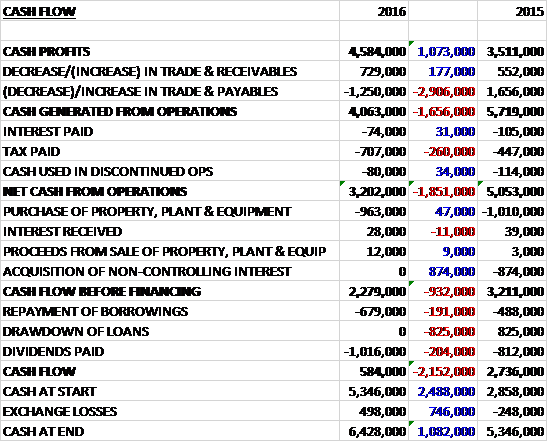
Waterman has now released its final results for the year ended 2016.

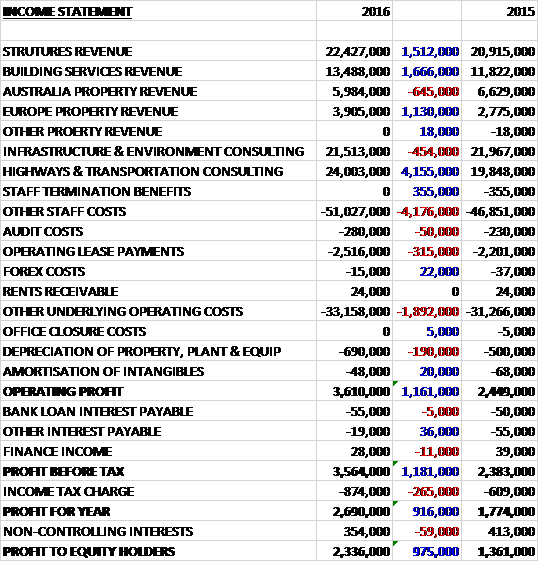
Revenues increased when compared to last year as a £645K decline in Australia property revenue and a £454K fall in infrastructure and environment consulting was more than offset by a £4.2M growth in highways and transportation consulting, a £1.7M increase in building services revenue, a £1.5M growth in structures revenue and a £1.1M increase in European property revenue. Staff costs were up £4.2M, operating lease payments grew by £315K and other operating costs increased by £1.9M to give an operating profit £1.2M above last time. There was a small reduction in finance costs but tax charges increased by £265K as a result of an increase in deferred tax to give a profit for the year of £2.3M, a growth of £975K year on year.

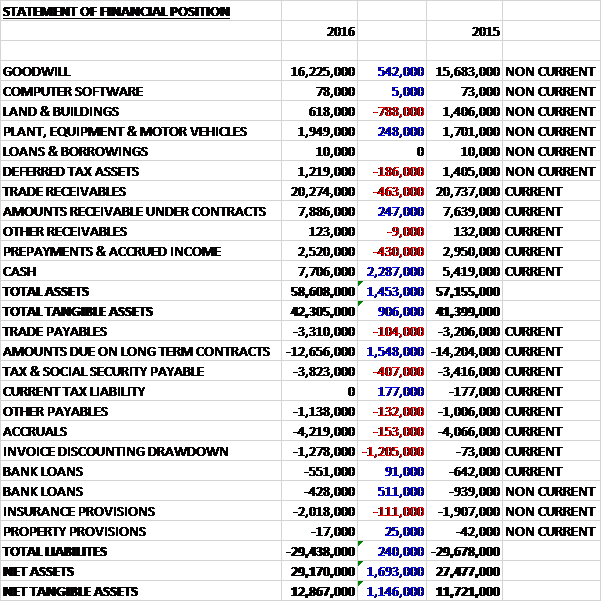
When compared to the end point of last year, total assets increased by £1.5M to £58.6M driven by a £2.3M growth in cash, a £542K increase in goodwill, a £248K growth in plant and equipment and a £247K increase in amounts receivable under contracts, partially offset by a £788K reduction in land and buildings due to an impairment on a Leeds freehold property following a change in its future use, a £463K fall in trade receivables and a £430K decline in prepayments and accrued income. Total liabilities declined during the period as a £1.2M growth in the invoice discounting drawdown and a £407K increase in tax payables were more than offset by a £1.5M decline in amounts due on long term contracts and a £600K fall in bank loans outstanding. The end result was a net tangible asset level of £12.9M, a growth of £1.1M year on year.

Before movements in working capital, cash profits increased by £1.1M to £4.6M. There was a cash outflow from working capital, however, due to a fall in payables and after tax payments grew by £260K the net cash from operations was £3.2M, a decline of £1.9M year on year. The group spent £963K on capex top give a free cash flow of £2.3M. Of this, £679K went on paying back borrowings and £1M was spent on dividends which left a cash flow of £584K and a cash level of £6.4M at the year-end.

The operating profit in the UK structures consulting business was £1.8M, a growth of £131K year on year following an investment in the recruitment of staff in the previous year. The group won awards for some of their work. New Ludgate was recognised as the best commercial building in London by the RICS and NEO Bankside was shortlisted for the Royal Institute of British Architects Stirling Prize.

The operating profit in the UK building services consulting business was £677K, an increase of £275K when compared to last year. London office development has continued to provide opportunities for the planning and design team and they have many different projects at different stages of the development cycle. The residential market has remained a buoyant source of revenue, London in particular. The workload on education projects has remained at a consistent level throughout the year.

The operating profit in the Australia business was £892K, a decline of £196K when compared to 2015 as the Sydney operation suffered a small loss. The board’s priority is to return this business to profit over the coming year.

The operating profit in the European business was £390K, a growth of £242K year on year. The Irish economy has continued to perform strongly and demand for the group’s services in the country continues to increase. Investment in commercial property remains strong and the residential sector is now becoming more active with output expected to double over the next three years. The property sector in Poland is less buoyant but there has been significant activity in the investment market.

The operating loss in the Infrastructure and Environmental Consulting business was £378K, an improvement of £412K when compared to last year and was not helped by a £300K one-off provision on a project and the impact of a slowdown in planning applications before the London Mayor elections and Brexit. Since June the situation has improved, however, and planning for development in London has returned to normal levels.

The operating profit in the highways and transportation outsourcing business was £921K, a growth of £134K when compared to 2015. The government’s renewed focus on infrastructure project, particularly in the highways market, may create a skills shortage in the future which will benefit the group and margins are likely to increase as they respond to market conditions. The year has seen continued demand for the group’s specialist secondment services but growth in headcount at the start of the year was tempered by some uncertainty around the Brexit vote although government investment in the highways programme and on major infrastructure projects has held up and demand for the group’s services to support public sector capex remains strong.

Reductions in Local Authority headcount and their revenue expenditure has been more than offset by the requirement to deliver a large capex programme and this capital rich/revenue poor status has increased demand. The group won a number of awards through their frameworks and they also secured positions on new framework contracts with Highways England and In Birmingham, West Yorkshire, Manchester and the South West. These long term contracts will provide access to new clients, including newly formed combined authorities and will secure a future pipeline of work.

Diversification into additional sectors, including water and environment, has also given them a broader offering and an expanded client base. The initiative is to establish the same track record and reputation that they have earned in their core highways and transportation market and achieve sustainable, organic growth in these new sectors over the medium term.
The group have recently announced new commissions including Tedding Film Studios and Mortlake Stag Brewery sites in West London (two residential developments totalling over 26.5 acres); Capital Dock for Kennedy Wilson, a 60,000m2 office and residential development which includes the tallest tower in Dublin; and Canary Wharf Group, to assist them with their plans for a further phase of the overall Canary Wharf development which is likely to involve over 200m2 of mixed use buildings.

In the three months since the Brexit vote, the group has continued to experience good levels of enquiries and new commissions and they have not yet noticed any significant change in trading activity. They await clarity on the government’s future plans including for infrastructure investment which will have a bearing on their medium term prospects. The outsourcing business continues to experience high levels of opportunities and has secured new public sector frameworks covering Swindon and W. Yorkshire. Overall the order book has remained at a consistent level year on year of £130M and beyond that the board looks to the future with measured optimism.

At the current share price the shares are trading on a PE ratio of 10.6 which is expected to remain flat on this year’s consensus forecast. After a 50% increase in the final dividend, the shares are yielding 3.7% which increases to 5% on this year’s forecast. At the year-end the group had a net cash position of £5.4M compared to £3.8M at the end of last year.

On the 15th November the group announced that it had been appointed to the MODs Army Basing Programme delivered by Aspire Defence which is set to vastly improve the quality of life for army soldiers. The group will be retained as engineering designer for over 50% of the development programme and the value of the whole construction programme is expected to be about £680M.

On the 9th December the group released a trading update covering the first four months of the year when overall performance was in line with board expectations with revenue slightly above the prior year period, in part due to beneficial forex movements.

As well as the Army Basing Programme, the group were also instructed to progress scheme and tender information for the planned 90,000m2 extension to the Brent Cross shopping centre for Hammerson and Standard Life; they have been appointed by Turner and Townsend to provide technical advice for the feasibility studies of each school under the priority schools building programme; and the group also notes the Autumn statement where the government confirmed its commitment to invest of 1.3BN to ease congestion on roads.

On the 30th January the group released a trading update covering the first half of the year. The board expect to report interim results in line with market expectations with revenue, profit and operating margin generally in line with last year. A continuing emphasis on working capital management has resulted in the group expecting to report net cash of £6.7M at the end of the period compared to £5.5M at the year-end.

Overall then this has been a good year for the group. Profits were up, net assets increased and although the operating cash flow declined, cash profits grew and there was plenty of free cash generated. All divisions saw some improvement except for Australia where the Sydney office incurred a loss. The Brexit vote doesn’t seem to have hurt the group too much but I suppose the work is fairly long term in nature so perhaps this won’t become apparent yet. So far this year, the performance seems to be rather flat but a forward PE of 10.6 and yield of 5% look decent value. Tricky one this, I am not sure if this year is just taking a breather or a sign that business has peaked.

Easyjet Share Blog – Final Results Year Ended 2016

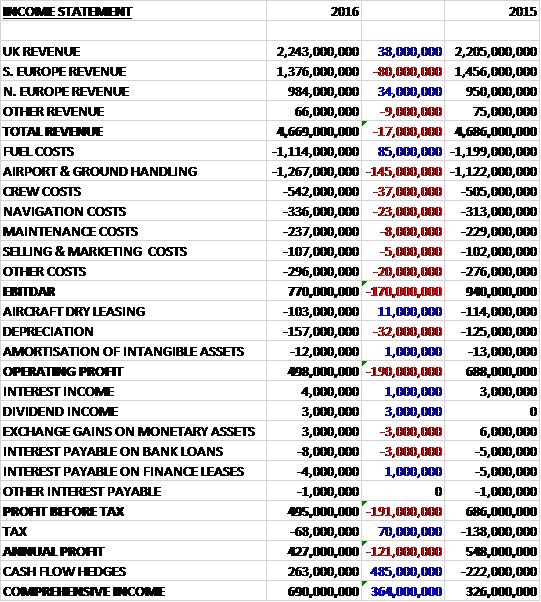
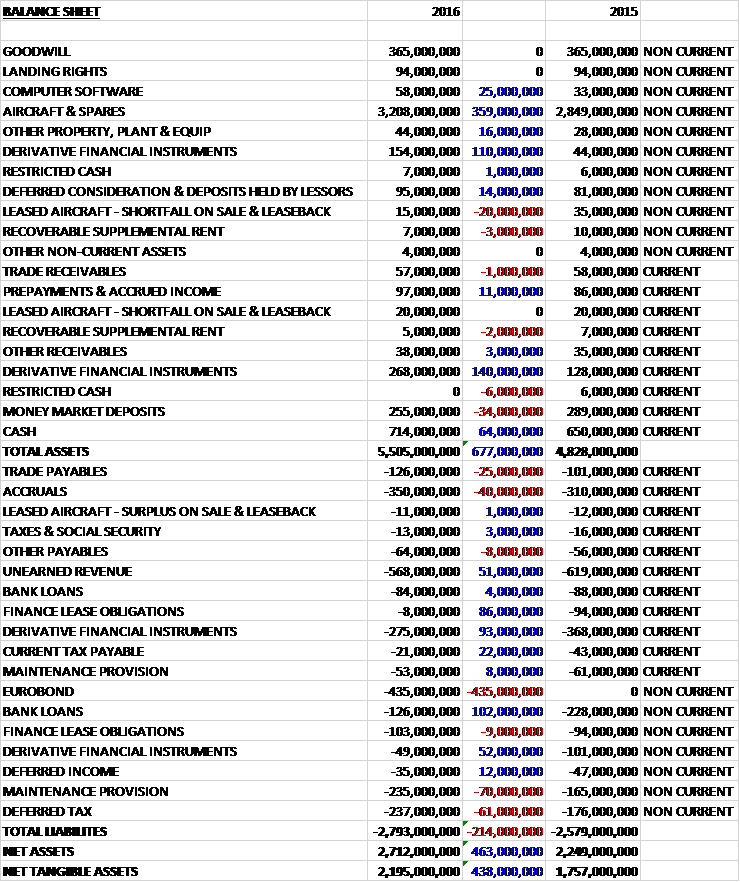
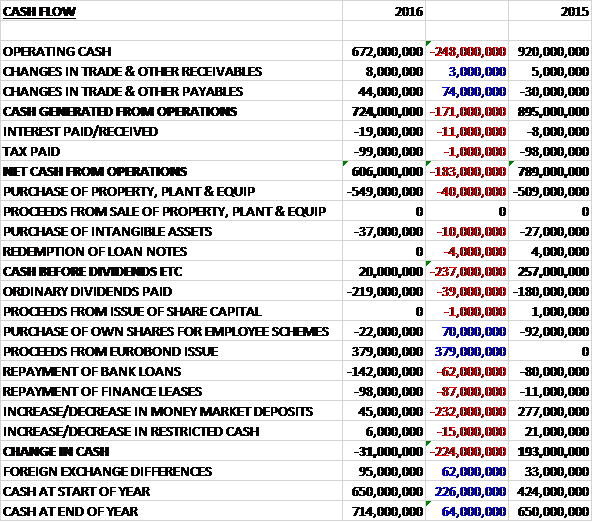
Easyjet has now released its final results for the year ended 2016.

Revenues declined when compared to the prior year as a £38K growth in UK revenue and a £34M increase in Northern Europe revenue was more than offset by an £80M fall in Southern Europe revenue and a £9M decrease in other revenue. Fuel costs were down £85M but airport and ground handling costs grew £145K, crew costs were up £37M, navigation costs increased £23M and other costs were up £33M to give an EBITDAR £170M down on last year. Aircraft dry leasing costs declined by £11M but depreciation was up £32M which meant that the operating profit fell by £190M. Finance costs were broadly flat but tax declined by £70M to give an annual profit of £427M, a decline of £121M year on year.

When compared to the end point of last year, total assets increased by £677M driven by a £359M increase in the value of aircraft and spares, a £250M growth in derivative financial assets and a £64M increase in cash, partially offset by a £34M decline in money market deposits and a £20M decline in the value of leased aircraft. Total liabilities also increased during the year as a £435M increase in Eurobonds, a £62M growth in the maintenance provision, a £61M increase in deferred tax liabilities and a £40M growth in accruals were partially offset by a £106M reduction in bank loans, a £145K fall in derivative financial liabilities and an £77M decline in finance lease obligations. The end result was a net tangible asset level of £2.195BN, a growth of £438M year on year.

Before movements in working capital, cash profits declined by £248M to £672M. There was a cash inflow from working capital, in particular an increase in payables and after interest payments grew by £11M the net cash from operations came in at £606M, a decline of £183M year on year. The group spent £549M on fixed assets along with £37M on intangibles to leave a free cash flow of just £20M. This didn’t even cover the £22M spent on shares for employee incentive schemes let alone the £219M spent on dividends. The group also repaid some bank loans and finance leases but gained proceeds of £379M from the issue of a Eurobond which meant that there was a cash outflow of £31M for the year and a cash level of £714M at the year-end.

The total European short haul market grew by 6% year on year and by 8% in the group’s markets, driven primarily by a continued low fuel price. The group grew capacity by 7% with a growth of 8% in the first half and 6% in the second half. The group’s competitors grew capacity by 8% with particularly strong growth in Spain and Germany. The group saw passenger numbers increase by 6.6% to 73.1M and load factor saw a 0.1pp increase to 91.6%. Capacity increased by 6.5% with growth focused on strengthening their number one positions at certain airports.

Revenue per seat declined by 6.4% to £58.46 due to increased market capacity and aggressive pricing stimulated by a sustained low fuel price; cooling of demand and reduced consumer confidence following multiple terrorism related incidents; higher holiday costs for UK travellers following the EU referendum and subsequent weakening of Sterling; and severe disruption during the year due to strikes, severe weather and airport issues which resulted in 8,349 flights being cancelled, delayed or diverted (compared to 6,789 last year).

Disruption due to air traffic and other strikes in Europe, as well as severe weather and runway closures at Gatwick, has severely impacted the group’s performance during the year. They cancelled 3,268 flights compared to 2,637 last year and on time performance was 77%, a decrease of 3pp from 2015. To secure better on-time performance they are focusing on reducing the number of events due to technical issues, using predictive maintenance and enhanced parts management; improve disruption management through better processes and communication with customers and influence structural improvements through discussions with airports, governments and the EU.

The total cost per seat improved by 2%, down to £52.26 and on a constant currency basis there was a 4.6% improvement. This reduction was due to lower fuel costs and excluding fuel, cost per seat increased by 2.6% (constant currency 1.1%). Overall there were forex cost headwinds of £112M. Airport and ground handling cost per seat increased by 6.1% and 1.5% at constant currency. Charges at regulated airports increased, primarily in Italy, combined with an increase in airport and ground handling costs at Gatwick which was the main reason for the increase in non-fuel costs.

There are a number of initiatives in place that will help to deliver cost per seat targets. They are now in their third year of a seven year contract at Gatwick. They are the largest operator in the airport and will be consolidating their position into one terminal in 2017 to enhance operational efficiency. They are also the largest operator in Luton where they are in year three of a ten year contract. As they grow their positions in new bases such as Amsterdam and Venice they will benefit from volume-related pricing agreements. In Ground Handling they annualised the benefit of their contract in Italy and saw savings from their growth airports in the UK, Netherlands and Germany. They expect to agree a number of new airport and ground handling contracts this year and next.

In maintenance, the new component support arrangement, which started in October 2015, combined with other parts and heavy maintenance contracts, delivered savings of around £40M during the year. This was supported by better distribution of parts across the network to enable faster repairs to aircraft. They have also begun using predictive analysis with the target to reduce parts failures and improve aircraft reliability.

To control costs of strikes, airport congestion and aircraft unavailability they are investing some of their cost savings to increase resilience in their operations, including more flexibility in the network. They are also implementing improvements to rosters and scheduling to improve fatigue management, better lifestyles for crew as well as increase their ability to recruit future talent. This will deliver passenger benefits and longer term cost improvements.

During the year the group added 106 routes to the network, slightly more than last year. They were focused on bases which supported the consolidation of their leading positions, including the UK, Switzerland and Italy; growing their market share in France; or allocated to new bases such as Amsterdam, Venice and Porto. In February they opened a new base in Barcelona and in April announced a plan to open a seasonal base in Palma Mallorca for summer 2017. They also discontinued 38 routes which did not meet expected return criteria or became secondary to a more attractive route elsewhere.

In the UK they increased capacity by 8%, maintaining market share on the London to Scotland routes while investing in growth in Luton, Bristol and Manchester. Their competitors increased their capacity in these markets by 9%. In Italy the group is the biggest operator at Milan Malpensa with 21 aircraft, recently opened a new base at Venice with four aircraft and added a fourth aircraft to the base in Naples. During the year they closed Rome Fiumicino which still remains an important part of the network. Overall they increased capacity in Italy by 1% against competitor growth of 8%.

The group sees opportunities to grow market share in France, leveraging their competitive market position against Air France, adding capacity at CdG through up-gauging and strengthening their domestic network. They are the number one carrier in Nice and increased capacity by 8% in the country against competitor growth of 5%. The group increased capacity by 7% in Switzerland, building and reinforcing their leading positions at both Geneva and Basel and their strategy is to continue to build consumer preference in the market. Competitor capacity declined by 1% in their markets, impacted by their strong action over the past two years.

They are targeting continued growth in Germany, taking share from the incumbent operators. They have increased capacity by 5% but competitor growth was 11%, with high growth at Berlin Schonefeld in particular. In the Netherlands, having opened a new base at Schiphol airport in 2015, they are now the second biggest operator and are continuing to invest in growth of their market share. They increased capacity by 24% against competitor growth of 8%. They increased capacity by 17% and 6% in Portugal and Spain respectively. They opened their new base at Barcelona in February with competitor growth 14% in Portugal and 16% in Spain.

The group expects to incur a number of non-underlying costs in 2017. As a result of the UK’s vote to leave the EU the group plans to establish an Air Operator Certificate in another EU member state. This will secure the flying rights of the 30% of their network that remains wholly within and between EU states. This one-off cost is expected to be around £10M over two years with the primary driver of the cost being the re-registering of aircraft in an EU jurisdiction.

They are planning to enter into a sale and leaseback arrangement for ten aircraft which is expected to take place in December 2016. Due to the age of the selected aircraft and the time of this transaction and maintenance provision accounting, they expect to incur a one-off non-cash charge of about £20M. I am really not a fan of the short-term sale and leaseback deals – I don’t think they worked well for the supermarket and I don’t think they work well here either. There will also be expenses associated with the implementation of the organisational review in 2017.

The group have continued to target business passengers, growing the number of passengers by 6% to 12.5M. They also signed 137 corporate agreements over the year, representing a 25% increase against the prior year. There has also been a growth in business specific fares throughout the year with a 14% increase in Flexi fares which carry a greater yield premium.

Non-fare revenue increased by 17% in the year. Some recent innovations have been a mobile-app only proposition, targeting customers who may wish to switch flights at short notice on the day of travel. This flexibility is offered for £15. Also investment continues to pay off on in-flight revenue with growth of over 30%. This year saw the introduction of pre-purchased in-flight vouchers, scaled through a targeted CRM programme.

The group continues to hedge its fuel requirement. In the first half of 2017, 83% of requirements are hedged at $664 per tonne; for the full year 81% is hedged at $617 per tonne and in 2018 47% is hedged at $510 per tonne. A $10 movement in fuel price impacts the fuel bill by $2.8M and a 1c movement in £/$ impacts the 2017 profit by £2M as the fuel is purchased in dollars. During the year the average market fuel price fell by 33% to $415 per tonne so considerably lower than the hedged price.

The group is contractually committed to the acquisition of 166 Airbus A320 aircraft with a total list price of $14.8BN before escalations and discounts. Some 21 aircraft will be delivered in 2017, 15 in 2018 and 130 in the subsequent years to 2022. Capex in 2017 is expected to be £650M but this increases to £1.1BN in 2018 with a similar figure expected for 2019.
The group raised a €500M bond in February for a seven year term with a fixed annual coupon rate of 1.75%, and after the year-end in October they issued a further €500M bond on improved terms.

In the first half of 2017, capacity is expected to increase by 9% with a similar increase expected for the full year. Based on the current market fuel prices they expected the unit fuel bill to decline by between £245M and £275M in 2017. Passengers will continue to benefit from the lower fuel cost and they therefore expect a mid to high single digit decline in revenue per seat at constant currency in the first half.

They are targeting a decline in total cost per seat at constant currency of about 3% based on jet fuel prices within a range of $400 per tonne to $520 per tonne. Cost per seat excluding fuel at constant currency is targeted to increase by about 1% for the full year at normal levels of disruption. Exchange rate movements are likely to have an adverse impact of about £70M during the first half of 2017 and £90M for the full year. Market demand is expected to remain strong.

At the current share price the shares are trading on a PE ratio of 8.7 but this increases to 13.5 on this year’s consensus forecast. After a 2.5% reduction in the annual dividend the shares are yielding 5.7% but this is expected to fall further to 4% on this year’s forecast. At the year-end the group had a net cash position of £213M compared to £435M at the same point of last year.

On the 24th January the group released a trading update covering Q1 where trading was in line with expectations. The number of passengers carried increased by 8.2% driven by a growth in capacity of 8.6% and a load factor decreasing by 0.3pp to 90%. Total revenue in the quarter increased by 7.2% to £997M reflecting the increase in passengers carried through the period but revenue per seat decreased by 8.2% at constant currency or 1.2% on a reported basis to £51.64 per seat. Non-seat revenue continued to rise, up 19%, driven by improvements to the inflight product ranges and attractive partner agreements.

Headline cost per seat improved by 2.1% at constant currency due to low fuel prices and an ongoing focus on underlying cost control. Excluding fuel, the headline cost per seat increased by 1.1%. The group delivered £14M of lean cost savings in the quarter through engineering and maintenance, volume-related airport savings and the benefit of ongoing fleet up-gauging. This offset general inflationary cost pressure as well as additional disruption cost mainly due to increasing EU 261 claim rates.

During the period the group issued another €500M bond at 1.125% coupon which seems pretty cheap. Cash deposits therefore increased to £1.337BN but net cash was £217M, down from the £266M recorded last time.

During the quarter the group achieved an on time performance of just 79% compared to 82% in Q1 last year, due to severe weather conditions in December when on time performance was just 73%.

The group entered into a sale and leaseback arrangement for ten A319 aircraft in early December which generated $144M in cash but incurred a non-cash charge of £16M. They have begun to implement the initial findings of the organisational review which has the objective of making their structure more efficient. Costs incurred to date have been immaterial but they continue to target a six to nine month payback period on any costs incurred.

The weakness of sterling and the impact of fuel combined are £35M worse than previously expected. It is estimated that at current exchange rates and with jet fuel remaining within the $520 to $600 per tonne range, the fuel bill for H1 is likely to decrease by between £70M and £80M. On a full year basis it is estimated that the fuel bill will decrease by between £215M and £240M. In addition, exchange rates movements are likely to have around a £75M adverse impact in the first half and £105M for the year as a whole.

The pricing and operating environment remains tough with fuel prices remaining low and continued strong growth in European short haul capacity. About 56% of expected bookings for Q2 have been secured, slightly ahead of the previous year. Revenue per seat in the first half is expected to decline by high single digits which reflects Easter moving into the second half of the year and some impact from the Berlin attack. Adjusting for these items, the year on year revenue per seat decline is expected to improve in Q2 compared to Q1. April is progressing well with the benefit of Easter.

Headline cost per seat excluding fuel is expected to increase by about 1% but the weakness of sterling is expected to impact pre-tax profit by around £105M in 2017.

Overall then this has been a rather challenging period for the group. Although net assets did improve, profits were down along with operating cash flow with no free cash being generated after employee share schemes were taken into account. We have a number of problems, the main one being the fact that revenue per seat is declining at a faster rate than costs, presumably partly due to the increased capacity from competitors who have not hedged their fuel requirements as much as Easy Jet.

These issues are compounded by Brexit, with the duel effect of adverse forex movements and the need to register some aircraft in EU jurisdictions which will add extra costs. Additionally there seems to be a high level of disruption at the moment with strikes and bad weather. The group is also embarking on a high level of capex, all of which makes for a rather risky time for the group. I don’t think this is fully covered by the forward PE of 13.5 and yield of 4% so I remain on the side lines for now.

On the 6th February the group released their passenger stats. Overall the total increased by 11% and the load factor grew by 1.2pp to 86.2%.

On the 6th March the group released its passenger stats for February. Overall passengers were up 8.2% and the load factor increased by 1.6pp to 92%.

On the 6th April the group released their passenger stats for March. The load factor increased by 1.4pp to 92.7% which is above average and looks fairly decent.

On the 5th May the group announced their passenger stats for April. The load factor increased by 2.5pp year on year to 92.9M and the total number of passengers grew by nearly 12%.

Serabi Gold Share Blog – Q3 Results Year Ending 2016

Serabi Gold has now released its Q3 results for the year ending 2016.

Revenues increased when compared to Q3 last year due to a $5.1M growth in gold bullion revenue due to an increase in Palito production and the fact that Sao Chico had not reached commercial production last year; and a $2.7M increase in gold concentrate revenue, in part due to the change in sales contract. Operating costs increased by $3.7M as Sao Chico’s costs were no longer capitalised and labour costs increased, amortisation charges grew by $1.7M both because Sao Chico entered commercial production and the new sales contract gave rise to a one-off amortisation charge due to the accelerated recognition of sales, and depreciation was up $308K to give a gross profit $1.9M ahead of last time. Admin expenses increased by $397K which meant that the operating profit grew by $1.5M. We then see an $853K swing to losses on derivatives relating to the Sprott and Fratelli call options and a $596K negative swing in gold trading costs relating to short term price differences between the contractual pricing arrangements with the end purchaser and the price ruling when the group draws down on the trade finance arrangement it has in place, along with a $278K tax charge which meant that the profit for the quarter was $465K, a growth of $114K year on year.

When compared to the end point of last year, total assets increased by $10.9M driven by a $4.7M growth in property, plant and equipment relating to both forex movements and additions, a $3M increase in receivables, a $1.1M growth in deferred exploration costs, a $957K growth in inventories and a $924K increase in cash. Total liabilities declined during the nine month period as a $4.1M decline in asset and finance facilities and a $2.6M fall in borrowings was partially offset by a $2.8M growth in payables relating to forex movements, higher production levels and increased salaries. The end result was a net tangible asset level of $51M, a growth of £12.9M over the period.

Before movements in working capital cash profits increased by $3.5M to $4.8M. There was a cash inflow from working capital, mainly due to a fall in inventories so the net cash from operations came in at $6.3M, a growth of $4.1M year on year. The group spent $713K on property, plant and equipment; $470K on development expenditure and $247K on exploration to give a free cash flow of $4.9M. They then repaid $1.3M of the loan and a net $5M of short term trade finance to give a cash outflow of $1.7M in the quarter and a cash level of $3.1M at the period-end.

During the first nine months of the year, the average gold price received was $1,256 per ounce. This compared to $1,156 received in the same period of the prior year. The average gold price in Q3 was $1,333 per ounce compared to $1,111 per ounce in Q3 last year). The total AISC of production was $951 per ounce compared to $894 last time. The group maintains its cost guidance for the full year of an AISC of $950 to $985 per ounce reflecting the continued strength of the Brazilian Real which has appreciated by 19% since March 2016.

During the quarter the group mined 43,133 tonnes of ore at a grade of 9.61g/t compared to 33,606 tonnes at 9.56g/t in the prior quarter. They milled 42,464 tonnes at a grade of 8.08g/t which produced 10,233 ounces of gold. This compared to 39,402 tonnes milled at 8.17g/t producing 9,896 ounces in Q2. The forecast gold production for 2016 as a whole is expected to be about 39,000 ounces. At Palito 31,916 tonnes was mined at 9.5g/t (25,198 tonnes at 10.48g/t in Q2) and at Sao Chico 11,217 tonnes was mined at 9.88g/t (8,408 tonnes at 6.81g/t).

At the end of the quarter, combined coarse ore stocks from the Palito and Sao Chico mines were about 11,000 tonnes with an average grade of 3.3g/t of gold compared to 14,800 tonnes at 3.66g/t at this point of last year.
At Palito, management expect that mine output for the year will be between 105Kt and 110Kt at an average grade of between 8.5g/t and 8.9g/t. During the year the group has focused on opening up new sectors in the mine as well as continuing to develop the existing sectors.

In September the group entered into a new contract for the sale of its copper concentrate. Under this new contract, the sale is recognised when the goods depart from Brazil whilst under the previous one the sale was only recognised when the goods arrived that the purchasers premises. Normally the group would recognise, on average, the sale of about 120 to 160 tonnes of concentrate per month but as a result of the new contract they recognised two shipments totalling 320 tonnes during September.

Further improvements were undertaken within the process plant during the year and a new carbon regeneration kiln is in the process of being installed and commissioned and will be operational during Q4. This kiln will regenerate fouled carbon reducing the need to purchase fresh carbon and is also expected to enhance gold recoveries.

Milling rates for ROM ore have increased by 23% to 438tpd so far this year. The introduction of the third ball mill at the end of June has had a significant effect on throughput rates with the average milling rate being 461tpd in Q3. The increase in processing rates also reflects the improvements in the operational efficiency of the process plant which has been assisted by the introduction of the gravity circuit and ILR for treating Sao Chico ore, reducing the levels of gold that would otherwise be treated in the CIP circuit. This improved efficiency has also allowed the rate of processing of the flotation tails to be maintained at similar levels to the corresponding period in 2015. The plant expansion is expected to provide sufficient extra capacity to process most of the stockpiled material of both coarse ore and flotation tails during the remainder of 2016.

At Sao Chico the main vein can vary from 1m to 8m wide but most commonly is a 2.5m alteration zone. The gold grades within the alteration zone are quite erratic and are hosted in three steeply plunging pay shoots. In these shoots the grades are often spectacular, in excess of 100g/t but outside the zones the vein is continuous but with low grades and as a result it is unavoidable that as the mine development passes between these areas, lower grade ore has to be mined. Whilst the alteration zone itself is readily identifiable the high grade zones are much less so therefore the mining operations require on-lode development at regular vertical intervals with regular channel sampling and in-fill drilling between these levels to best define the high grade gold mineralisation.

At Sao Chico, the mine develop has focussed on the central ore shoot of the main vein. The mine was primarily in development during 2015 and the early part of 2016 as the group sought to ensure that it secures a rolling medium production plan for up to two years into the future. It is only in the second half of 2016 that the level of stoping activity has begun to increase, and it is expected that the long term balance between development mining and stope mining rates will only be reached at the end of 2016 at which point management expect that monthly production rates will stabilise. The group is driving development east and west towards parallel vein structures that have been identified by surface drilling and they are confident that these ore shoots will provide additional mineable ore at Sao Chico.

Mine site geophysics studies undertaken during Q3 over the Currutela and Piuai discoveries and other areas close to the current Palito Mine have been designed to improve the drill targeting of a planned 2017 surface drilling campaign. Management feel that this campaign could provide sufficient confidence to justify the start of new mine portals and underground exploration drives to access and evaluate any new discoveries that are considered to be potentially commercially viable. In time these discoveries could become established as new near-mine satellite deposits adding incremental production.

All exploration has been on hold since the end of 2011 whilst the group concentrate its efforts ion bringing the Palito mine back into production. Whilst currently the immediate focus is to evaluate the near mine potential within two to three km of its existing operation, on a wider regional basis the group is developing plans to progress the evaluation of its whole tenement package. They have flown about 16,000 hectares of airborne VTRWM surveys but have limited funds and opportunity to follow up on many of the areas of interest. Conscious that the exploration tenements that they hold are only granted for limited terms, they are keen to implement, as and when adequate funding is available, a regional exploration programme to highlight those areas that should be prioritised.

It has always been the intention of the group to use cash flow generated from its production operations to advance its exploration opportunities. They will conduct DHEM in close proximity to the Palito mine and IP around Sao Chico during the second half of 2016 with the intention of using the results from these programmes to plan drilling campaigns that can be undertaken in 2017.

The group is paying off the Sprott loan and will repay the final $1.33M in Q4. In August Fratelli exercised their right to convert the outstanding $2M convertible loan – there is no more outstanding from that loan. During the period the group issued 42,312,568 shares following the decision of Fratelli to convert its $2M convertible loan into shares at a price of 3.6p per share.

The group made a loss last year so there is no current PE ratio but on the full year consensus forecast for 2016, the group is trading on a PE of 9.1.
On the 23rd January the group released an update covering Q4. In Q4, Palito produced 34,611 tonnes at a grade of 7.38g/t (down from 9.5g/t in the previous quarter) with Sao Chico producing 9,968 tonnes at 14.38g/t. 40,485 tonnes of ore was processed through the plant for the combined mining operations at a combined grade of 7.6g/t of gold which produced 9,413 ounces compared to 10,233 ounces in Q4 last year. At the year-end the combined surface stockpiles totalled 21,000 tonnes of ore at a grade of 4g/t. Despite the plant expansion to three ball mills, the easy and rapid ore development of the Senna vein due to its proximity to the surface, has meant increasing stock levels in the quarter.

At Palito the operation continues to perform steadily, although extracted mine grade during the quarter was lower than planned as a result of ore being cemented in two stopes. This ore is not lost and is being slowly recovered but not as fast as they had budgeted. The production shortfall was partially compensated by more development ore, albeit at a lower grade. The benefit of this is that the mine is now generating ore from four sectors with Senna playing an increasing role in the production plan. Production from stoping has not started there but in 2017 they will see a significant level of ore being produced from stoping at Senna.

At Sao Chico, ore production and development continued in line with plans and grades were excellent. The main ramp has now reached the 70mRL with the main vein intercepted.

In October and December the group suffered short-term breakdowns but were able to maintain throughput rates by having a third mill. An additional short term benefit of three mills operating has been the increased throughput capacity, allowing them to consume the low grade surface stock that had built up over the past three years.

At Senna, the results of the drilling were generally good, showing strong down-dip continuity in thickness and grade. Whilst this sector does not share quite the same high grades as seen in the main zone, the structure appears to be geometrically regular which benefits mining, and intersecting grades are in the 6g/t to 9g/t range over widths in excess of one metre. At Sao Chico, a total of 1,300m of down-dip drilling also gave satisfying results. In each case the main vein was intersected, confirming the strong structural continuity with a good range of grades being reported.

The quarter saw surface exploration re-start at Sao Chico. As reported last quarter, they acquired the exploration license to the west and south of the mine last year and they are very keen to test the potential continuation of the main vein into these areas. During the quarter they started a surface IP programme to the west and south, and although poor weather caused the work to be suspended it is expected that it will restart during Q2 2017. The purpose of the programme is to use IP to trace the trend of the main vein which has sufficient sulphides to provide a clear conductivity which in turn will be targeted by a subsequent drill programme.

Following the 39,390 ounces of gold produced in 2016 the board is forecasting 40,000 ounces in 2017 at an AISC of between $950 and $975 per ounce which is in line with the cost guidance of 2016.

Overall then this quarter has seen some pretty decent results. Profits were up, net assets increased and the operating cash flow improved with some free cash being generated. Both sales price and costs increased but the current price of $1,192 does not compare favourably with the $1,333 achieved in the quarter and is much closer to that of last year, although costs are not higher than in 2015 due to the Real appreciation.

The grade achieved at Palito has deteriorated due to ore being cemented in two stopes which meant that development ore at lower grades was used. Sao Chico saw the grade increase again, however, although how long this high grade seam will last I am not sure. The grades at Senna seem to be a little disappointing too, but with a forward PE of 9.1 the shares offer decent value. I am really torn here, I am minded to try and wait for the gold price to increase as I am worried about the increasing costs squeezing earnings.