Molins Share Blog – Interim Results Year Ending 2016

Molins has now released its interim results for the year ending 2016.

Revenues declined when compared to the first half of last year with a £3.6M fall in packaging machinery revenue and a £900K decrease in instrumentation and tobacco machinery revenue. Cost of sales also declined, however, to give a gross profit £1.5M below that of last time. Distribution costs fell by £400K which meant that the group made an operating loss, a £1.1M detrimental movement and the lack of any pension scheme expenses which cost £400K last year, meant that the loss for the period came in at £300K, a detrimental movement of £700K year on year for continuing operations.

When compared to the end point of last year, total assets declined by £13.3M to £68.6M, driven by a £10.6M elimination of the pension surplus and a £5.9M reduction in cash, partially offset by a £1.8M growth in inventories. Total liabilities also declined during the period as a £3.4M growth in the pension liability was more than offset by a £4.2M fall in deferred tax liabilities, a £4.1M decrease in borrowings and a £1.4M decline in payables. The end result was a net tangible asset level of £15.1M, a decline of £6.6M over the past six months.

Before movements in working capital, cash profits declined by £800K to £1.5M. There was a broadly neutral working capital position compared to an inflow last year but a £900K pension payment meant that after £800K less cash was used in discontinued operations, there was a net cash outflow of £100K from operations compared to an inflow of £400K last time. The group spent a net £600K on property, plant and equipment along with £800K on development costs so before financing there was a cash outflow of £1.4M. The group paid back £4.3M in loans and £300K on dividends so the cash outflow for the period was £6M and the cash level at the period-end was £4.3M.

The group just about broke even in the Packaging Machinery business which represented a deterioration of £1.1M when compared to the first half of last year. The division experienced a challenging first half of the year with order intake reduced in most regions, reflecting the continued deferral of customer investment decisions. Currently order books are lower than this time last year and the conversion of prospects to orders is more difficult to predict in the current environment. They have achieved a growth in the aftermarket business which is expected to continue into the second half, however.

The group made a profit of £200K in the Instrumentation and & Tobacco machinery business, a decline of £100K year on year. As expected, conditions in the tobacco sector continued to be a challenging and market opportunities for sales of cigarette making machines remain relatively low. Competitive pressures to secure machine orders have therefore resulted in reduced margins for those orders that are secured. Orders for the aftermarket activities remain quite strong, however, and demand for instrumentation activities held up in the period following better order take in the last few months of last year. The board believe there will some softening in the key Asia region for instrumentation in the second half, however.

Field trials of the Alto cigarette making machine were completed last year and orders for production machines were secured in the first half of this year. Optima, the new cigarette packing machine, began field trials this year which are ongoing and encouraging. These two major machine introductions, alongside other ancillary equipment, means that the division has completed a significant programme of development, expanding the addressable market. They also continue to enhance the product range of the instrumentation business to support its position in the tobacco sector and its expansion into new sectors.

The group continues to suffer from its huge pension plans. They are responsible for the payment of a statutory levy to the pension protection fund and the amount of this is dependent on a number of factors including a specific method of calculating a pension deficit for this purpose and a credit assessment of the company. The levy that will be paid this year will be considerably higher than that of last year. In addition, the UK pension scheme is subject to a formal triennial actuarial valuation and the deficit recovery plan is expected to be reassessed shortly (it currently stands at £1.8M per annum).

In June the group appointed Tony Steels as CEO and in the coming months, the primary focus will be to review the strategic direction of the business which they expect to be completed by the end of the year.

As in previous years, the full year trading performance will be significantly weighted towards the second half but the group are experiencing continuing delays in receiving orders and are therefore taking a more cautious view of the short-term training outlook so that the board has revised downwards its trading expectations for the current year.

At the current share price the shares trade on a PE ratio of 6.5 which increases to 18.4 on the full year consensus forecast. After the interim dividend was halved, the shares are yielding 5% which is expected to remain the same on the full year forecast. At the period-end the group had a net debt position of £4.6M compared to £3.2M at the end point of last year.

On the 12th December the group released a trading update for the year as a whole. Trading in Q4 has been materially lower than expected, partially due to an unfavourable sales mix and a number of deliveries delayed into the early part of 2017. As a result the board is revising downwards is expectations of full year performance.

Order intake in the last three months has been positive, however, at an increase of 80% over the same period last year, with the packaging business in particular benefiting from a strong period of conversion of prospects. The consequence of this recent order activity is that the group is expecting to enter 2017 with a significantly higher order book than it had entering this year.

Overall then this has been a difficult period for the group. Losses worsened, net assets worsened due to the pension schemes and the operating cash outflow grew. The packaging machinery division saw the worst of the decline as customers deferred investment decisions and the instrumentation and tobacco machinery division continued to be subdued in a difficult market for the tobacco industry. The pension scheme is another risk but the new CEO will hopefully bring a new impetus to the group. On a PE ratio of 18.4 and dividend yield of 5% the shares don’t look cheap but we have subsequently heard that Q4 has been poor and the performance for the year as a whole is not going to be good. Having said that, there is a glimmer of hope with the increased order intake.

Perhaps worth a punt when more clarity is available but the shares don’t look that cheap at the moment.

Getech Share Blog – Final Results Year Ended 2016

Getech has now released its final results for the year ended 2016.

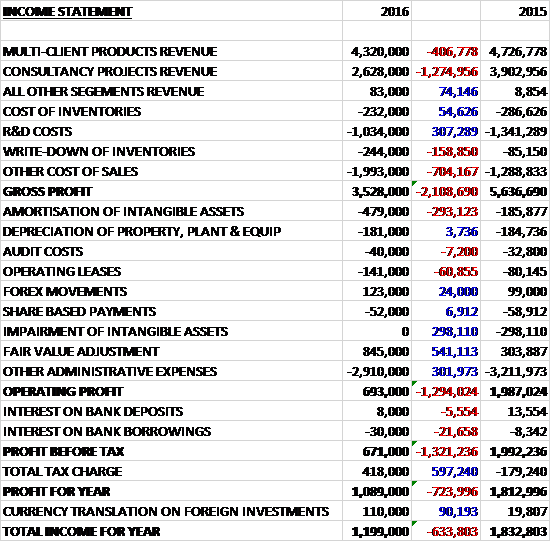
Revenues declined when compared to last year due to a £407K fall in multi-client products revenue and a £1.3M decrease in consultancy projects revenue. R&D costs fell by £307K but other cost of sales increased by £704K to give a gross profit £2.1M below that of 2015. Amortisation charges increased by £293K relating to the first full year of Globe platform amortisation costs, and operating leases grew by £61K but there was a £24K positive forex effect, a £541K growth in fair value adjustments, no impairments, which accounted for £298K last year, and a £302k reduction in other admin expenses to give an operating profit £1.3M down on last year. Interest charges grew but there was a £418K tax rebate compared to a £179K charge in 2015 so the profit for the year was £1.1M, a decline of £724K year on year.

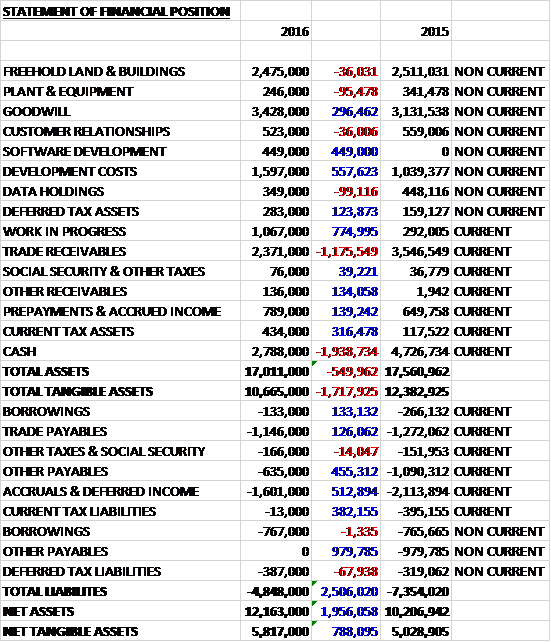
When compared to the end point of last year, total assets declined by £550K, driven by a £1.2M fall in trade receivables due to the payment of outstanding debtor balances from national oil companies, and a £1.9M decline in cash, partially offset by a £558K increase in the value of development costs, a £775K growth in work in progress due to the timing of the multi-client regional reports product cycle with several new reports nearing completion to be sold in 2017, and a £449K increase in software development. Total liabilities also declined during the year due to a £1.4M fall in other payables and a £513K decrease in accruals and deferred income, mainly relating to Globe deliverables. The end result was a net tangible asset level of £5.8M, a growth of £788K year on year.

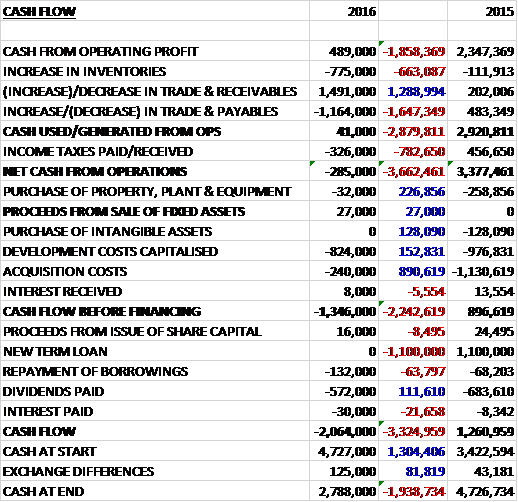
Before movements in working capital, cash profits declined by £1.9M to £489K. There was a cash outflow from working capital, which was greater than last year and after a £783K swing to tax payments, there was a net cash outflow from operations of £285K, a detrimental movement of £3.7M year on year. The group didn’t really spend anything of property, plant and equipment but development costs were £824K and £240K was spent on acquisitions to give a cash outflow of £1.3M before financing. After £572K was paid out in dividends and some borrowings were repaid, the cash outflow for the year was £2.1M and the cash level at the year-end came to £2.8M.

The profit in the multi-client products and service division was £2.9M, a decline of £272K year on year whilst the profit in the consultancy project division was £658K, a fall of £1.6M.

With oil prices remaining low and volatile during the year, the market backdrop remained challenging for the group. Budgets for drilling exploration wells did not say any significant signs of recovery and the market for proprietary consulting work remained week. The group’s clients continue to refresh and rework their views around the opportunity sets within and outside of their exploration portfolios, however, which has resulted in continued demand for their data and regional multi-client consulting activities.

During the year the group enhanced its capabilities in gravity and magnetics through the formation of a dedicated centre of excellence. As a low-cost alternative to seismic data, gravity and magnetic data continues to be seen as an attractive purchase of natural resource companies. As such, data sales remain an important revenue stream. In July 2016 they delivered the three-year Altimeter Gravity Programme which has provided a route for their customers to enhance the quality of their satellite data.

Globe, as a client-funded product suite, is now in its sixth year of support and continues to gain more interest and use. Activity through 2016 was pre-funded by a broad grouping of international oil company and large independent oil company customers.

Within consulting, the year saw the completion of work on the Angolan basin review for Sonangol which was one of the largest they have had. They have recently been awarded further consultancy work by the government of Sierra Leone.

The group has made a couple of acquisitions. ERCL was completed in 2015 and its operations were integrated into the group during 2016. The business has extended the group’s commercial reach beyond its traditional regional gravity and magnetics new business venture market into a more seismic-linked sphere where they are now able to offer detailed well planning, field development and asset and data management advice.
Under the ERCL brand the group continued to support the Mozambique government’s petroleum activities through the provision of commercial and geotechnical training and advice. As part of this work, the year saw the completion of the country’s fifth licencing round and work commenced on preparation of data products for future rounds.

In addition to this, ERCL recently won a World Bank contract to support the government of Sierra Leone in its petroleum activities and it has ongoing work in a number of other countries including Lebanon, Namibia, Palestine and Pakistan. They also provide exploration and development-based technical assistance to a range of independent upstream companies with recent activity including operations in China, Equatorial Guinea, Mexico, Morocco and Spain.

In June 2016, the group acquired Exprodat. The business specialises in the provision of services and consultancy relating to data management and the use of GIS. GIS is an industry-standard tool that is fundamental in supporting many aspects of oil and gas operations. The group already has a long standing GIS team but they had to date been focussed on servicing the group’s internal business needs so Exprodat brings an additional GIS resource that is dedicated to generating an external income stream for the group.

Exprodat has developed and licenses commercially several GIS software packages that support petroleum exploration. During the current downturn, the client retention of these subscription-based software products has been around 95% which brings a substantial client base to the group with a significant proportion of recurring revenue. The business also delivers GIS training in both public and private environments.

Following these acquisitions the group is now looking to extend its operations beyond its core oil and gas customer base and they are currently engaged in operations in the nuclear, mining, agriculture and water management industries. Although not yet significant as standalone revenue streams, the recent advances into these sectors highlight the fact that their geoscience and GIS skills have the potential to be applied to a much broader spectrum of activities. These opportunities are under investigation and have the potential to diversify the revenue base.

In the first half they implemented significant cost control measures which resulted in a material step-down in the cost structure with staff, general and admin costs lowered by 22% on an annualised basis. Having rationalised their cost base towards the end of the first half, there was an improved underlying performance in the second half with a profit of £530K compared to £140 in H1. The cost base is predominantly in Sterling but a significant proportion of revenues are denominated in dollars so recent forex movements have been favourable, adding £123K to annual profits.

During the year the group appointed Dr. Jonathan Copus as CEO in August 2016, having previously worked as an exploration geologist at Shell, an E&P sell ide analyst at a number of city companies and most recently as CEO at Salamander Energy, which was acquired by Ophir in 2015. Also, Chris Flavell has joined the board. He has 35 years of experience in operating E&P companies and consultancies, most recently managing Tullow Oil’s exploration geoscience team before leaving to form a geoscience-focussed recruitment consultancy. In addition, Raymond Wolfson, Colin Glass and Paul Carey are stepping down having spent considerable time at the company.

The oil price has strengthened recently which, combined with a reduced cost profile, should make future E&P investment more attractive. At the same time, the deep cuts to staffing in many companies meant that their capability to undertake exploration is severely curtailed. While the market is at best uncertain, the group has a pipeline of significant sales prospects awaiting approval. For the first time in several years, feedback from clients leaves the board encouraged by the market mood and the recent increase in the oil price gives their customers more confidence that their budgets will become available in 2017.

If we discount the fair value adjustment the shares are trading on a PE ratio of 50 and I have been unable to find a forecast for the coming year. Sensibly the group has opted not to pay a final dividend this year.

On the 29th November the group announced that director Peter Stephens acquired 300,000 shares at a value of £75K. He now holds 1,395,500 shares.

On the 13th December the group the group released a trading update. Following the rebound in profitability in the second half of last year, they have secured several strategically important new contracts and their day to day activities continue to be focused around the customer, profitability and diversified growth.

They have secured a new sale of Globe phase-two to a major, and have been contracted by the UK Oil and Gas Authority to develop and implement a GIS information management strategy. This work for the OGA extends their operations beyond their core exploration market, being focused on spatial data that spans the full E&P asset lifecycle. In addition, having won their first contract within the nuclear industry last year, they are currently at an advanced stage of discussions to expand on this work.

Going forward, although the outlook for the core exploration market remains uncertain, feedback from customers leaves the board cautiously encouraged by the market mood.

Overall then, this year has clearly been a difficult one for the group with continued low oil prices affecting client budgets considerably. Profits declined and there was a net operating cash outflow in the year. Net assets did improve, however, and the multi-client products and services have been holding up much better than the consulting products. The second half of the year did see an improvement, however, as the group cut costs and started expanding outside of their core oil and gas area.

So far this year, the oil price has improved and the group have won some new contracts. The current PE ratio of 50 is very expensive but given the improvements in the second half of last year, I would expect that to be lower this year – it is a shame there don’t seem to be any forecasts. There is also a director purchase and I have to say that these shares look more interesting now than they have done for some time – I’m thinking about dipping in here.

Harvey Nash Share Blog – Interim Results Year Ending 2017

Harvey Nash has now released its interim results for the year ending 2017.

Revenues increased when compared to the first half of last year mainly due to favourable currency movements as a £1.1M decline in Central Europe revenue was more than offset by a £37.4M growth in Benelux revenue, an £8.5M increase in UK & Irish revenue, a £1.7M growth in US revenue and a £1.5M increase in Nordic revenue. Cost of sales also increased to give a gross profit £2.9M above that of last time. Admin costs grew by £3.9M but the group benefited from there being no deferred consideration settlement which was £120K last time so that the operating profit decline by £982K. Interest charges remained broadly flat but there was no loss from discontinued operations, which was £707K last time but despite this, the profit for the half year was £200K lower at £2.6M.

When compared to the end point of last year, total assets increased by £4.7M driven by a £9M growth in receivables related to the devaluation of Sterling and a £3.1M increase in intangible assets related to the devaluation of sterling after the disposal of capitalised software costs related to discontinued operations, partially offset by a £7.6M decrease in cash. Total liabilities also increased during the period as a £1.6M growth in payables was only partially offset by a £582K reduction in borrowings. The end result was a net tangible asset level of £3.7M, a growth of £286K over the past six months.

Before movements in working capital, cash profits declined by £411K to £4.8M. There was a modest cash outflow from working capital but this was much lower than last time and after the group paid £660K less in taxes, the net cash from operations was £1.1M, a positive movement of £15.2M year on year. They spent £462K on capex and lost £6M in the disposal of a subsidiary! This meant that before financing, there was a cash outflow of £5.3M. After £1.7M was paid out in dividends and £1.5M of borrowings were paid back, the cash outflow for the period was £8.4M to give a cash level of £10.9M at the period-end.

The operating profit in the UK and Ireland division was £1.6M, a decline of £514K year on year with demand for permanent hiring subdued. The uncertainty from the EU referendum began to have an impact from Q4 last year. Despite this, contractor numbers were steady. Uncertainty impacted demand for executive recruitment in areas closely aligned with the public sector and financial services. A number of one-off costs, relating to the reduction of headcount in the business were also included in the operating profit figures. Growth came from offices outside London. Gross profit in the England regions and Scotland grew by 6.5% while London declined by 8.3% and Dublin was 11.6% lower. Following the Brexit vote, however, gross profit from permanent placements in London improved by 24.5% in July which is encouraging as the business enters the second half.

Results from Europe were lifted by growth in the Nordics and Benelux with generally favourable currency tailwinds. In constant currency, operating profit was held back by investment in fee-earning headcount and management to achieve critical mass in subscale locations. There were also one-off costs relating to the realignment of the German recruitment business following the disposal of Nash Technologies. Overall, operating profit grew by 6.6% but declined by 4.3% on a constant currency basis.

The operating profit in the Benelux division was £1.9M, broadly flat year on year with a growth of just £95K with an improvement noted in the Netherlands in particular. The majority of growth was derived from new client wins in contract recruitment and managed services with a 58% increase in permanent recruitments.

The operating profit in the Nordics division was £187K, an increase of £80K when compared to the first half of last year with Sweden posting a 6.7% growth in gross profit on a constant currency basis, driven mainly by specialist technical recruitment while executive recruitment was subdued with a decline of 6.6%. Growth also came from smaller offices in Denmark and Norway where the turnaround has been encouraging and the investment in management and fee-earners is beginning to pay off.

The operating profit in the Central Europe business was £407K, a fall of £22K when compared to the first half of 2016 despite currency tailwinds. In Switzerland, weak demand for permanent recruitment was linked to the strength of the currency, although tight control of costs resulted in a small improvement in the operating profit. In Germany, gross profit was 5.3% lower than the same period last year due to shorter than expected temporary contract durations. This has resulted in lower contractor numbers partly mitigated by a strong increase in permanent revenue.

The operating profit in the US division was £609K, a decline of £147K year on year held back by a bad debt write off. Strong market conditions in the country favoured permanent technology recruitment and executive search. The swing from temporary to permanent recruitment was significant, as client demand for software development skills particularly on the West Coast, continued to grow. The profit figure was also held hack by an increase in fee earners and record comparative figures.

The operating loss in the Asia Pacific business was £542K, a deterioration of £474K when compared to the first half of last year as strong growth in executive recruitment revenue in Japan and in technology recruitment in Australia was offset by weakness in Hong Kong, where it was down by 30%. The majority of the decline in profits came from Vietnam, however, where costs were impacted by adverse currency movements.

After eleven years with the group, CFO Richard Ashcroft has notified the company of his intention to sept down from the board next year.

As the group begin the seasonally stronger second half of the year, UK conditions remain challenging but broadly stable while there are opportunities for growth in mainland Europe, the US and Asia. Overall the board are confident that they are on track to achieve full year expectations.

At the current share price the shares are trading on a PE ratio of just 6.4 but this increases somewhat to 7.2 on the full year forecast. At the period-end the group had a net debt position of £6.8M compared to net cash of £170K at the year-end. After a 5% increase in the interim dividend, the shares are yielding 6.5% which increases to 6.7% on the full year forecast.

Overall then this has been a bit of a difficult period for the group. Profits were down and although net assets and the operating cash flow improved, the former is attributed to the devaluation of Sterling and the latter due to a more favourable movement in working capital with cash profits declining. There is not free cash after the disposal is taken into consideration but even excluding that, it does not cover the dividends.

Operationally, many regions struggled but the UK seems to be the largest contributor to the decline in profits, which is being blamed on Brexit. The currency devaluation in Vietnam has also taken its toll in the Asia Pacific region. The board expect to deliver results in line with expectations, however, and the shares look pretty good value at this level with a forward PE of 7.2 and 6.7%. I suppose the real question is whether things will get worse in the UK but I am tempted by the value on offer here.

On the 3rd March the group released a trading update ahead of their final results. The board expect to report pre-tax profit in line with market expectations. Overall gross profit increased by 8% but fell by 1% on a constant currency basis. While growth was held back in the UK and Ireland by Brexit uncertainty gross profit was up 4% in mainland Europe (constant currency). There was a 7% decline in ROW due to challenging market conditions in Hong Kong while in offshore services it was due to increased costs in Vietnam as a result of the depreciation in Sterling. The group had net cash of £5.5M at the year-end.

This all seems decent enough but it is clear that were it not for the deprecation in Sterling, there would be no growth here.

Photo-Me Share Blog – Interim Results Year Ending 2017

Photo-Me has now released its interim results for the year ending 2017.

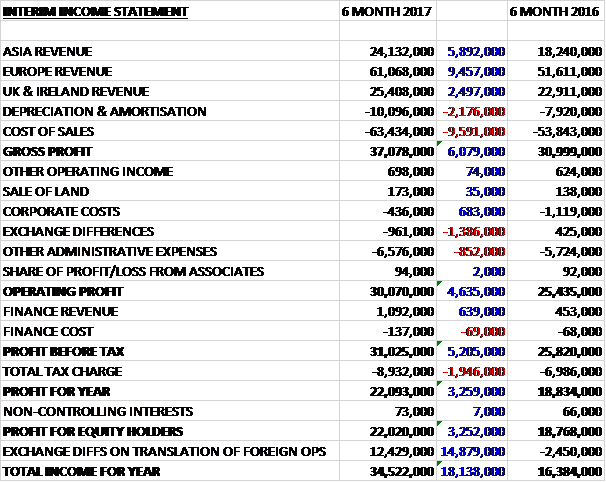
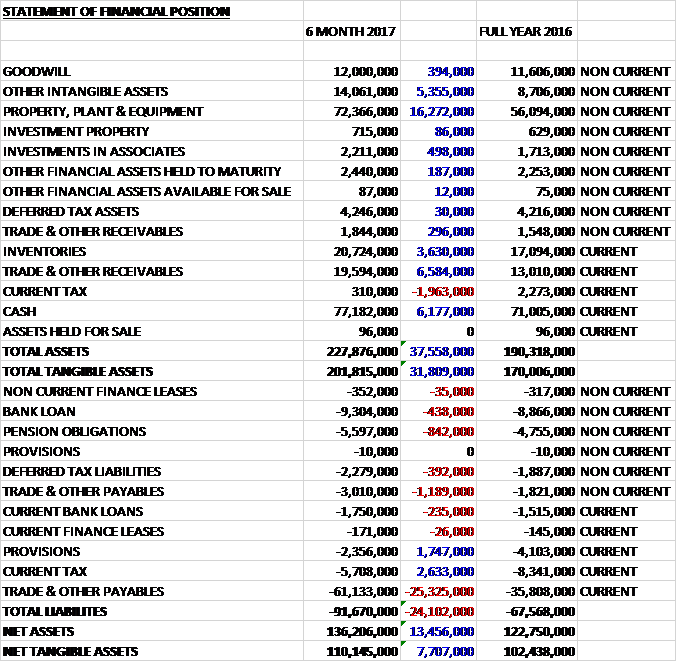
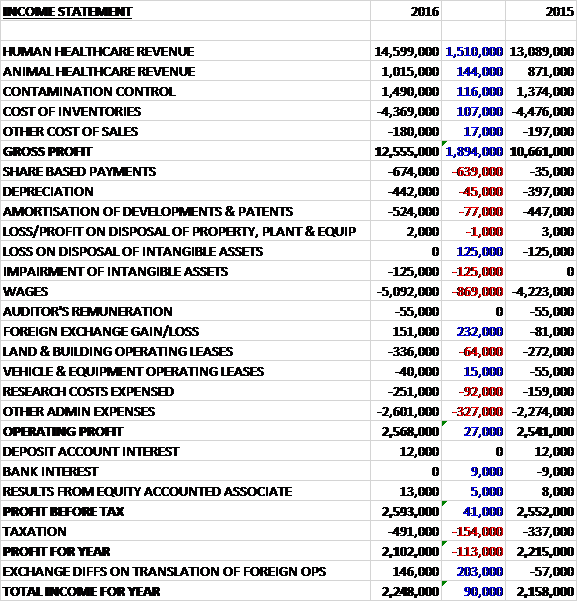
Revenues increased when compared to the first half of last year, mainly as a result of currency movements, with a £9.5M growth in European revenue, a £5.9M increase in Asian revenue and a £2.5M growth in UK & Ireland revenue. Depreciation was up £2.2M and other cost of sales increased by £9.6M to give a gross profit £6.1M above that of last time. Corporate costs reduced by £683K but there was a £1.4M negative shift due to forex movements and other admin expenses were up £852K so that the operating profit increased by £4.6M. The group also increased finance revenue by £639K but tax charges were up £1.9M to give a profit for the period of £22M, a growth of £3.3M year on year.

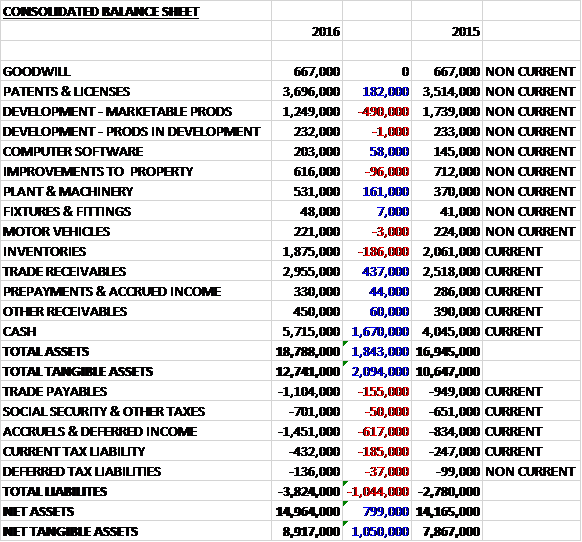
When compared to the end point of last year, total assets increased by £37.6M driven by a £16.3M growth in property, plant and equipment, at least partially related to forex movements; a £6.6M increase in receivables, a £6.2M growth in cash, a £5.4M increase in intangible assets and a £3.6M growth in inventories, partially offset by a £2M fall in current tax assets. Total liabilities also increased during the period as a £26.5M growth in payables was only partially offset by a £2.6M decline in current tax liabilities and a £1.7M fall in provisions. The end result was a net tangible asset level of £110.1M, a growth of £7.7M over the past six months.

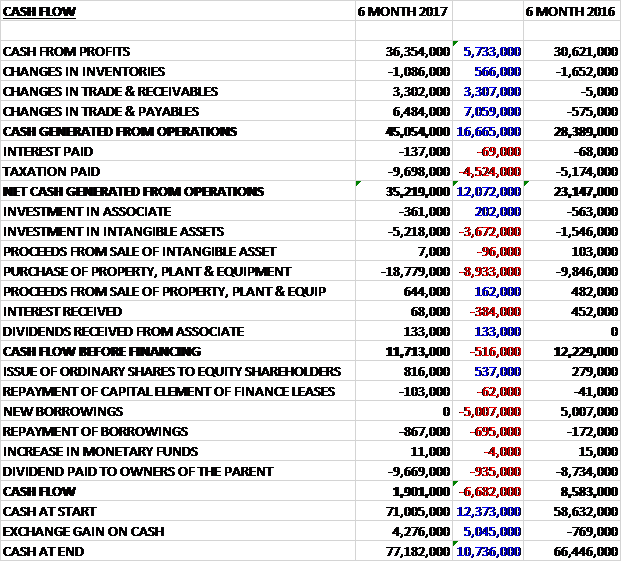
Before movements in working capital, cash profits increased by £5.7M to £36.4M. There was a cash inflow from working capital compared to a small outflow last time but tax payments increased by £4.5M to give a net cash from operations of £35.2M, a growth of £12.1M year on year. The group spent £18.8M on property, plant and equipment, along with £5.2M on intangible assets to give a free cash flow of £11.7M. Of this, £9.7M was spent on dividends which meant that the cash flow for the period was £1.9M and the cash level at the period-end stood at £77.2M.

The operating profit in the Asia business was £3.8M, a growth of £292K year on year. Japan, the largest territory in the region, was weaker in comparison with a strong first half of last year. This was primarily due to the delay to the My Number Programme, the new ID card system, and the group currently considers it prudent not to expect any contribution from this programme in the current year. Photobooth numbers have increased by some 7% in preparation for the launch of the programme which is expected to recommence at some stage in 2017. Good progress continues to be made in China where both revenues and profits increased by over 30% on a constant currency basis.

The operating profit in the European business was £22M, an increase of £4.4M when compared to the first half of last year with a 6.8% rise on constant currency basis, driven by the laundry division. The group took the decision this year to slow down the roll-out of the European photobooth estate in order to focus on upgrading its booths in terms of payments systems as well as new digital security features, particularly in France. In February they announced that they had obtained the first agreement with ANTS to allow the delivery of a digitised e-photo and e-signature for the purposes of driving licence applications enabling these documents to be sent from the booths via a secure server. They have invested in the upgrade of all their 7,800 units in France.

They have taken a cautious attitude to price increases in the photobooth estate in recent years, but increases from €5 to €6 in Holland and from CHF8 to CHF10 in Switzerland were implemented towards the end of the period.

The roll-out of the laundry product, predominantly using the same sites as the photobooth estate, continues to progress well and the group now has laundry operated units in ten countries. At the end of the half-year, across the group, the total number of laundry operated units increased by 51%. The results from the units in operation in France, Ireland and Portugal remain encouraging with monthly sales per unit of the more machines of €1,400 during the period. In the first half, laundry business takings increased by 79% to £9.9M.

The group now also has 34 laundrettes in towns across France, Belgium and Spain, and is targeting towns where there is no large supermarket nearby and limited competition. A new design for the shops has been created and it is now being rolled out starting with new locations. Results from these launderettes are solid. The ambition remains to expand this concept rapidly and reach a sizeable base of locations by 2020. Total sales of laundry equipment across the group increased by 77% to £2.3M.

Production of the Revolution 2 unit has recently started. Like the current units, it comprises two machines and a dryer but it has a footprint half the size of the current model. This smaller unit is expected to enable more rapid deployment for the product in its core markets and is likely to be more attractive in Far Eastern markets.

The group operates nearly 5,000 digital printing kiosks in Europe, mostly in France and Switzerland, an increase of 3.5% year on year. In response to growing consumer demand, they last year introduced a new kiosk designed by Starck which is fully integrated with major social media networks and enable easy photo printing from smartphones. Initial results from the Speedlab Cube and Speedlab Bio have been promising and these have been gradually rolled out during the first half.

The operating profit in the UK & Ireland business was £4.7M, a decline of £736K when compared to the first half of 2016 due to the acquired Asda photo division start-up costs, increased depreciation and slightly higher machine management costs in the core photo booth estate. The laundry business in Ireland continued to perform well and Fowler, the commercial laundry and catering equipment business acquired last year made good progress and contributed nearly £2M of revenue in the period.

Photobooth unit numbers were stable year on year and there was a continued reduction in the amusement machines and kids rides which generate minimal revenue and perform below group profitability standards due to increasing maintenance costs. They more than doubled the number of digital printing kiosks, however, by replacing 265 existing units in Morrisons with their own units.

Leveraging the secure technology developed for the ANTS solution, photobooths are being rolled out in Ireland in conjunction with the Ministry of Foreign Affairs and Trade in order to enable secure online passport applications. Initial results and testing have been very positive and in November, a memorandum of understanding was concluded between both parties sealing the five year arrangement.

In October the group acquired the photo division of Asda for a total consideration of £3.8M, of which £2.3M was deferred. They have already started the reconfiguration of layouts and equipment upgrades that are necessary to increase the appeal for customers and expand the profit going forward.

In addition to ID secure systems, the group has developed solutions for the transmission of secure payments and the automated distribution of high-value prepaid gift cards.

The group’s performance for the first half was ahead of board expectations, aided by favourable currency movements. The board now expect the group’s profits will significantly exceed current market expectations for the year as a whole.

At the current share price the shares are trading on a PE ratio of 21.3 which reduces to 17.9 on the full year consensus forecast. At the period-end the group had a net cash position of £68M compared to £62.4M at the year-end. Given this, I still don’t understand why the group feels the need to take out a loan. After the interim dividend was increased by 20% and a special dividend was paid during the year, the shares are yielding 5.6% which falls back to 4.2% on the full year forecast, presumably as the special dividend is not expected to be repeated.

Overall then this has been a decent half year for the group. Profits are up, along with net assets and the operating cash flow, although how much of this is due to favourable currency movements I am not sure. The performance in Asia has been OK but the delays to the Japanese ID cards are disappointing. Europe seems to be performing well with the laundry units starting to contribute but the UK saw a decline in profits due to higher photo booth costs and start-up costs related to Asda Photo.

The French digitised e-photo project looks like a good template for further similar schemes and the full year results are expected to be above expectations, again likely predominantly due to favourable forex movements. The forward PE of 17.9 doesn’t look great value but there is a lot of net cash on the balance sheet (assuming it is all really there – always a concern of mine when cash rich companies take out new loans) and the dividend yield of 4.2% is worth having. I am happy to hold here.

On the 23rd the group released a statement following the announcement that UK authorities would accept mobile phone photos for ID pictures. They confirmed they had continued to trade in line with their expectations since the interim results. They believe their latest technology represents a major growth opportunity as the most secure photo ID solutions available and that accepting photos from mobile phones for official documents is incompatible with developing security requirements.

Their solutions have been adopted in France as well as in Ireland where trials are underway for photobooth secure online passport applications. Furthermore it is currently in ongoing discussions with HM passport office in order to equip its photobooths in the UK with the technology used in France.

I have mixed feelings about this. Clearly this is not a good development as it will be much easier to use digital photos now. It seems unlikely to affect the group in the near term but longer term it could be an issue. I will not panic yet but this is not quite as strong a hold as it once was for me.

On the 7th March the group announced the sale of their head office for a consideration of £2.5M. The book value of the land being sold is £100K so there will be a profit on sale of £2.4M. The disposal is part of the group’s review of its property portfolio in order to group the activities of the head office and UK operations into one location.

On the 30th March the group announced that it was launching a rollout of their encrypted photo ID technology across Ireland in partnership with the Irish Government. The launch will see their secure digital upload system rolled out to over 150 photobooths, growing to 300 throughout the country by the end of 2017.

On the 2nd June the group released a trading update covering the whole year. The photo ID and laundry business continued to perform well. In France the vast majority of photo booths have been upgraded for ANTS to enable direct transmission of ID photos and data to the government database. In Ireland, the group’s encrypted photo ID upload technology, launched in partnership with the Irish Government for the new online passport application service, will be rolled out to 300 secure digital upload enabled photo booths by the end of 2017. They have now also started the roll out of the ANTS booths in Germany.

The expansion of the laundry business in Europe has continued with consistent expansion of estate owned and operated laundry units in operation, primarily located in France, Ireland, Belgium and Portugal. During the second half of the year they started deploying the Revolution laundry units in the UK with some 100 units now deployed. The first laundry shop opened in Japan in the last quarter and is proving to be successful. The board expects the year as a whole to be in line with market expectations with profits up about 20% compared to the prior year.

Murgitroyd Share Blog – Final Results Year Ended 2016

Murgitroyd has now released its final results for the year ended 2016.

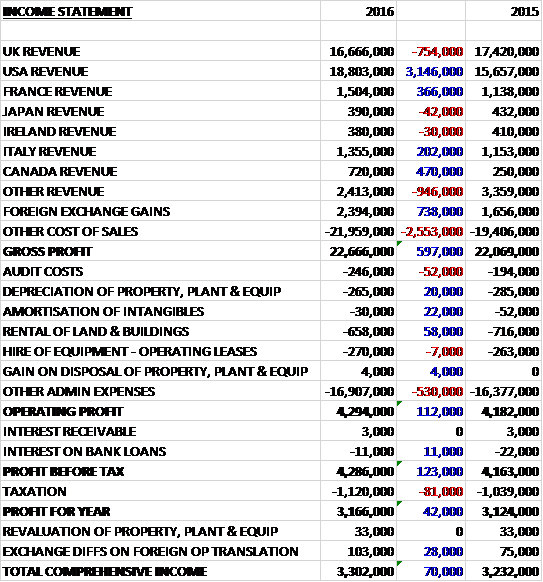
Revenues increased when compared to last year due to a £3.1M growth in US revenue, a £470K increase in Canadian revenue and a £366K growth in French revenue, partially offset by a £754K decline in UK revenue and a £946K reduction in other revenue. The group benefited from a £738K increase in forex gains but cost of sales increased by £2.6M to give a gross profit £597K above that of last time. Admin expenses also increased due to a greater investment in marketing and sales, and tax charges were up £81K which meant that the profit for the year was £3.2M, broadly flat year on year with a £42K increase.

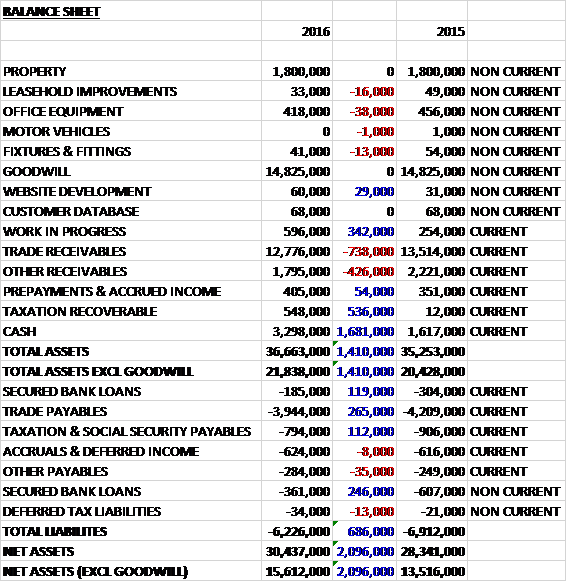
When compared to the end point of last year, total assets increased by £1.4M to £36.7M driven by a £1.7M increase in cash and a £536K growth in taxation recoverable, partially offset by a £738K decline in trade receivables and a £426K reduction in other receivables. Total liabilities declined during the period due to a £265K fall in trade payables and a £365K decline in secured bank loans. The end result was a net tangible asset level of £15.6M, a growth of £2.1M year on year.

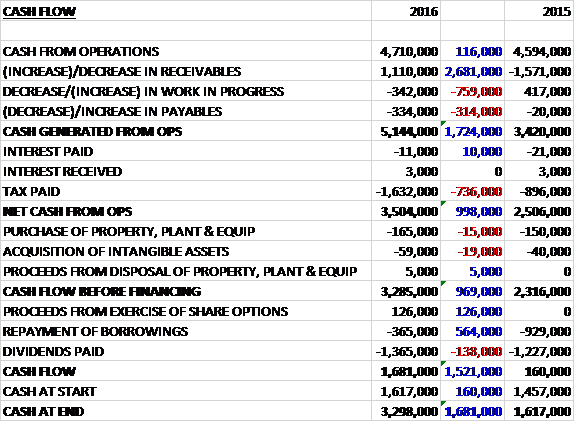
Before movements in working capital cash profits increased by £116K to £4.7M. There was a cash inflow from working capital due to a fall in receivables but tax payments increased by £736K and the net cash from operations came in at £3.5M, a growth of £998K year on year. The group spent £165K on property, plant and equipment along with £59K on intangible assets so there was free cash flow of £3.3M. Of this, £365K was used to pay back loans and £1.4M was spent on dividends to give a cash flow for the year of £1.7M and a cash level of £3.3M at the year-end.

The group continue to see good growth in the US which remains the main focus of business development activity and the growing presence there offsets continuing weaker European demand, including in the UK.

Of the total increase in revenue, nearly 32% was generated by the global support services group. Client wins in this area have resulted in a £3.4M increase in revenue over the past three years and the division now represents nearly a third of the total with further growth in this area anticipated. The rest of the increase was produced by the Attorney Practice Groups with last year’s productivity gains in this area having continued into this year.

It is apparently too early to say with certainty what the long term consequences of the Brexit vote will be on the business and the European IP market but management is confident that the geographic spread of their activities and customer base puts them in a strong market position. The stats show that there was an increase in CTM applications during the year, setting a new record. The EPO stats show a 1.6% increase in patent filings with some 24% of the total originating in the US.

Since the year-end, the group completed the acquisition of certain trade and assets from Dallas-based MDB Capital group and Managua-registered Patentvest for a consideration of $2.4M which is expected to be broadly earnings neutral in its first year.

During the year, Dr Christopher Masters and John Reid were appointed as non-executive directors. The board was further enhanced by the appointment of Gordon Stark as COO. It has also been confirmed that executive Chairman Ian Murgitroyd will move to a non-executive position at the AGM.

The new financial year has seen the group absorb one-off transaction and integration costs from the acquisition completed in June which will affect the interim results. Notwithstanding the uncertainty from the Brexit vote, including the volatility seen in forex markets, and continuing macro-economic challenges to be addressed across Europe, the board remain encouraged by their ability to win new business, particularly in the UK, and are committed to the delivery of sustainable higher earnings as well as increased revenue over the longer term.

At the current share price the shares are trading on a PE ratio of 15.4 which falls to 14.6 on next year’s consensus forecast. After an 8.5% increase in the total dividend the shares are yielding 3% which increases to 3.2% on next year’s forecast. The net cash position at the year-end was £2.75M compared to £706K at the end of last year.

Overall then this has been a solid year for the group. Profits were basically flat but net assets improved, as did the operating cash flow with a decent amount of free cash being generated. The market in general for the Murgitroyd seems rather subdued with growth in North America offsetting declines in the UK, and the Brexit vote may yet affect trading. With a forward PE of 14.6 and yield of 3.2% this is not a value play, nor necessarily a growth one but the group has net cash, generates free cash and seems like a safe place for the moment.

IG Design Group – Interim Results Year Ending 2017

International Greetings has now released its interim results for the year ending 2017.

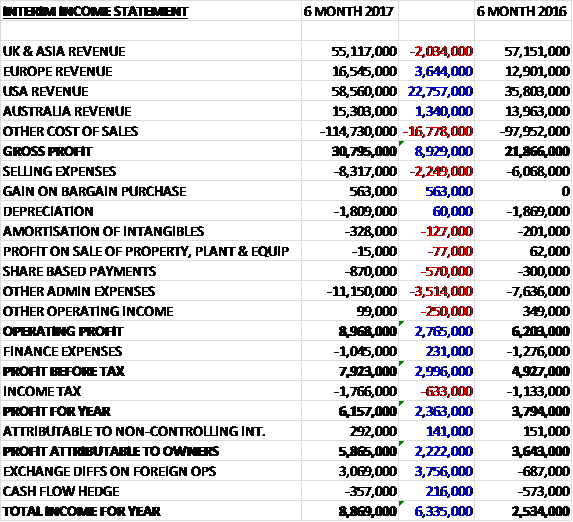
Revenues increased when compared to the first half of last year as a £2M decline in UK revenue due to scheduling of certain customer deliveries into the second half of the year, was more than offset by a £22.8M growth in US revenue, a £3.6M increase in European revenue and a £1.3M growth in Australian revenue due to favourable currency movements. Cost of sales also increased to give a gross profit £8.9M above that of last time. Selling expenses grew by £2.2M, share based payments were up £570K and other admin expenses increased by £3.5M, which will be higher in the second half, but the group benefited from a £563K gain on a bargain acquisition so that the operating profit grew by £2.8M. Finance expenses were down £231K but tax charges were up £633K which meant that the profit in the period was £5.9M, a growth of £2.2M year on year.

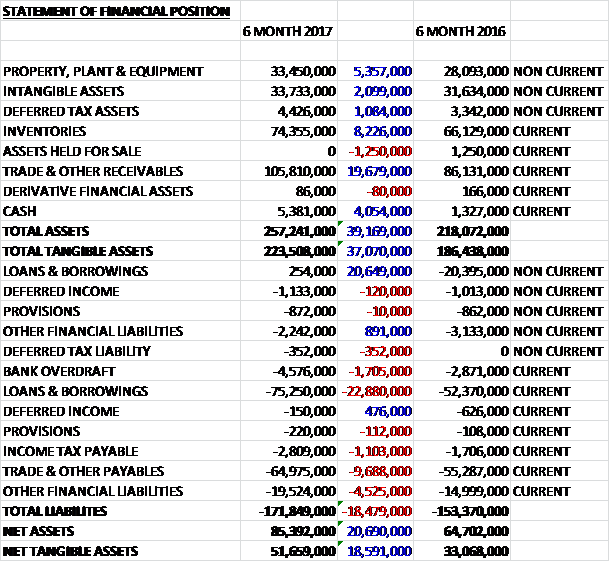
When compared to the end point of last year, total assets increased by £39.2M to £257.2M driven by a £19.7M growth in receivables, an £8.2M increase in inventories, a £5.4M growth in in property, plant & equipment and a £4.1M increase in cash. Total liabilities also increased during the period due to a £9.7M growth in payables, a £4.5M increase in other financial liabilities and a £2.1M growth in borrowings. The end result is a net tangible asset level of £51.7M, a growth of £18.6M over the past six months.

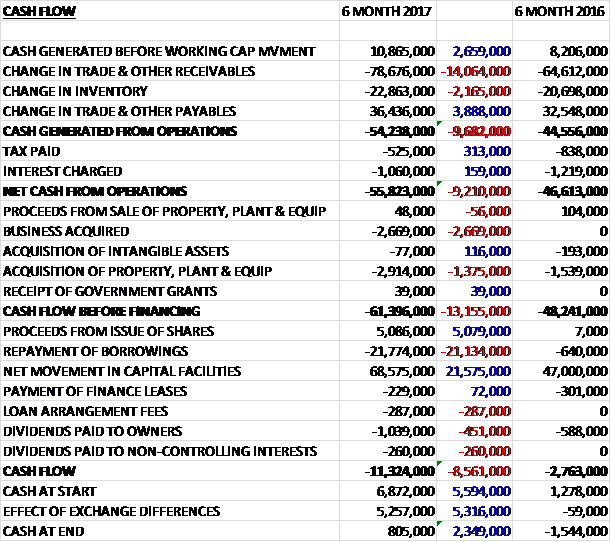
Before movements in working capital, cash profits grew by £2.7M to £10.9M. As usual there was a large outflow of cash from working capital but this was greater than last time and the net cash outflow from operations was £55.8M, an increase of £9.2M year on year. The group then spent £2.9M on property, plant and equipment along with a third of that going on updating the warehouse management system in Australia, with £2.7M on acquisition so that before financing there was a cash outflow of £61.4M. The group made £5.1M from new share issues and a net £47M from new loans so that after £1.3M was spent on dividends, there was a cash outflow of £11.3M in the period and a cash level of £805K at the end of the half year.

The profit in the UK and Asian business was £4M, a growth of £442K year on year despite the scheduling of certain customer deliveries into the second half of the year resulting in sales being 3.6% lower. The manufacturing facility in China has provided increased volumes of products to the UK business with record levels of bags and cards being produced. The profit in the European business was £1.3M, an increase of £423K when compared to the first half of last year with a strong order book in place for the balance of the year.

Excluding exceptional items, the profit in the US business was £3.8M, a growth of £2M when compared to the first half of 2016 with organic sales up 36%. There has been sales growth across all channels and product categories. They have begun to deliver fast payback from the investment programme in their US wrap manufacturing facilities and have identified further opportunities both in the US and through leveraging their capability across the group to accelerate growth across the Americas. The board are pleased with the smooth integration of the recently acquired Lang Group and are optimistic with prospects for commercial, operational and purchasing synergies to deliver enhanced profitability.

The profit in the Australian business was £1M, an increase of £511K year on year despite the timing of some customer delivery requirements impacting on sales revenues, which declined on a constant currency basis. The positive outcome is as a result of improved product mix and operational efficiency.

It is worth noting that the group expect by the year-end that all US tax losses will have been recognised with just £400K of tax loss effect unrecognised in the UK. This means that the effective tax rate will rise quickly in future periods especially if growth is heavily fuelled by the US business, which is the expectation. Cash tax is increasingly payable in most of the geographic regions of operations as historical losses are fully utilised.

In July the group acquired Lang Companies for a cash consideration of £2.7M. The business is a supplier of branded consumer home décor and lifestyle products based in the US. In the period since acquisition, it has contributed £761K of profit, with £563K of that relating to the bargain purchase as the group’s assets held more value than the consideration paid. The business is expected to be marginally earnings enhancing in the current year and more materially accretive in 2018.

Going forward the board is confident that the current rate of sales and gross margin will continue into the second half of the year, resulting in the annual financial performance of the group now expected to be above current market forecasts. While the timing of overheads and the acquisition of Lang part way through the year (excluding loss making months) has slightly flattered first half results, they are confident that the full year outlook for profit and EPS will continue to outperform.

The net debt position at the period-end was £76.4M compared to £78M at this point of last year despite forex movements adding an additional £7M to debt. At the current share price the shares are trading on a PE ratio of 22.9 but this falls to 17.3 on the full year consensus forecast. After an increase in the interim dividend the shares are yielding 1.2% which increases to 1.5% on the full year forecast.

Overall then this has been a positive period for the group. Profits were up and net assets increased. The cash flow is a bit of a concern as the operating cash outflow grew when compared to last year, apparently due to investment into the acquisition.
All regions saw performance improve with the US enjoying particularly strong growth, although it should be kept in mind that the tax losses from the region will have been used up by the end of the year. The performance for the full year is expected to be above forecasts but the shares no longer look cheap with a forward PE of 17.3 and yield of 1.5%. I think then that the valuation probably takes into account the outperformance.

On the 5th January the group released a trading update covering Q3, including the important Christmas trading period. Trading continued to be strong over the quarter and results remain in line with the upgraded expectations announced in November. The board remains confident in the full year outlook of the group.

On the 24th March the group released a trading update covering 2017. Group revenues are now expected to exceed £300M and profitability is expected to be ahead of market expectations. Cash generation is well ahead of previously expected levels. All regions continue to trade profitably. The group’s trading profit coupled with lower interest costs from a strong cash flow are expected to yield a profit outcome for the year that is significantly ahead of market expectations.

Profit growth in the Americas has been particularly strong due to the development of their product offering and customer base alongside significant advances in operational efficiency. The integration of Lang has progressed well with the realisation of synergies in line with those expected at this stage and more to come next year. Momentum in the region remains strong with numerous opportunities for further growth.

Markets in Australia were more challenging. The business has invested to reposition itself in less commoditised product categories, including the costs to win and then deliver on a three-year contract for the supply of cards to the country’ s largest discount retailer. This will supress performance for 2017 but provides good growth opportunities for 2018 and beyond. Scope remains to drive efficiency and focus on higher margin categories whilst leveraging group wide initiatives in product development and design.

The currency headwinds faced by the UK businesses were largely neutralised by a robust performance in the Celebrations product categories. A reorganisation and further integration of the three UK businesses is already in progress.

In continental Europe the group was able to grow revenue and profit during the period due to an excellent operational performance coupled with the strategy of focussing on growth retailers in the region. As well as expanding business within core markets in Western Europe, sales to Poland and Slovakia have also growth, yielding further incremental profitability.

All this sounds pretty good to me but the shares of run off a bit ahead of themselves now in my opinion.

On the 18th April the group released a trading update covering the year ended 2018. The group’s trading accelerated in the second half of the year with all regions delivering strong revenue growth and increased profits. As a result the board anticipates a full year of overall progress and performance in line with management expectations.

In the US the business has delivered significant overall profit growth during the year driven by increased revenues and margins resulting from improvements in the mix of product categories and customer channels. The project to upgrade IT systems to drive further efficiencies and provide a platform for significant further growth has progressed on time and on budget.

In Australia, organic sales and profits have advanced driven by growth from existing and new customers. The acquisition of Biscay Greetings in January has been integrated into the region’s operations with all anticipated synergies on track to be delivered in 2019.

In the UK the group benefited from the combining of its three businesses under one leadership team, delivering increased revenue and profits for the year. Production of a new product category (paper bags for the fashion and cosmetics industry) started in September. This operation offers incremental opportunities whilst leveraging many of the group’s existing capabilities. The UK is now well placed for future sales and profits growth.

In Continental Europe, a record overall performance was achieved as a result of stronger sales and improved efficiencies. Furthermore during the year a new high-speed printing press was installed which became operational in March which enhances both capacity and capability within the business.
This all seems fine and I continue to hold.

Origin Enterprises Share Blog – Final results Year Ended 2016

Origin Enterprises has now released its final results for the year ended 2016.

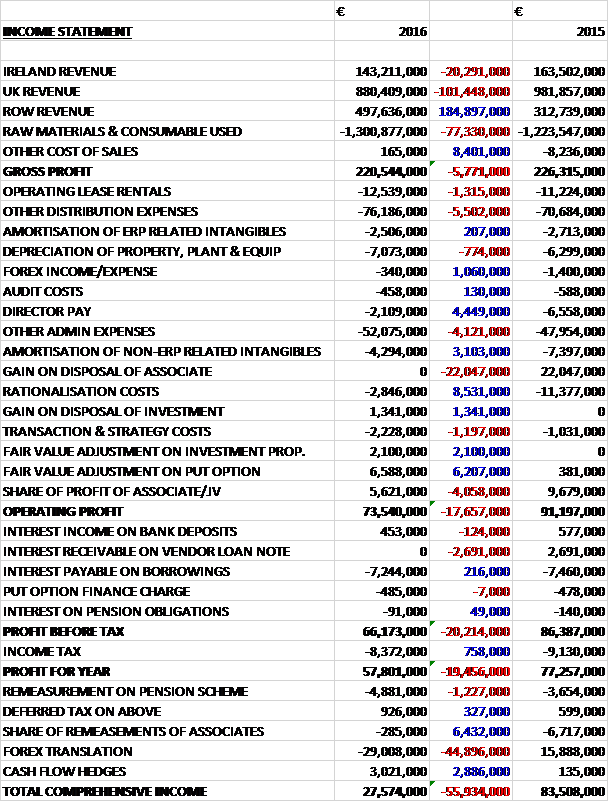
Revenues increased when compared to last year as a €20.3M decline in Irish revenues and a €101.4M fall in UK revenue was more than offset by a €184.9M growth in ROW revenues, with the growth entirely down to forex movements as constant currency revenues declined due to lower input prices and crop marketing volumes. Cost of sales also grew due to an increase in raw materials and consumables used so the gross profit fell by €5.8M. Distribution expenses were up €6.8M but there was a €1.1M positive forex movement. Amortisation declined by €3.1M, rationalisation costs were down €8.5M, there was a positive €6.2M movement in the fair value adjustment of the put option and a €2.1M positive movement in the fair value adjustment on investments.

There was no gain on disposal of an associate, however, which netted €22M last year and the share of joint venture profits declined by €4.1M due to the disposal of the Valeo Foods shareholding, all of which meant that the operating profit decreased by €17.7M. There was no interest receivables on the vendor loan note this time, which brought in €2.7M in 2015 but tax charges fell by €758K to give a profit for the year of €57.8M, a decline of €19.5M year on year.

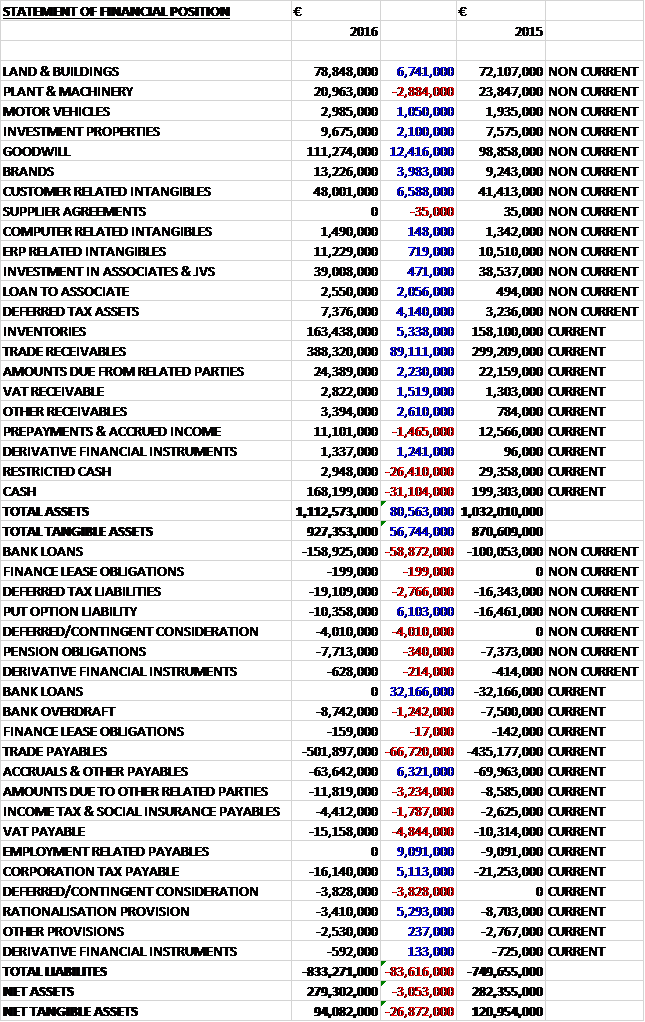
When compared to the end point of last year, total assets increased by €80.6M driven by an €89.1M growth in trade receivables, a €6.6M increase in customer related intangibles, a €12.4M increase in goodwill and a €6.7M growth in the value of land and buildings, partially offset by a €57.5M fall in cash. Total liabilities also increased during the year as a €66.7M growth in trade payables and a €26.7M increase in bank loans was only partially offset by a €9.1M decline in employment related payables. The end result was a net tangible asset level that decreased by €26.9M year on year.

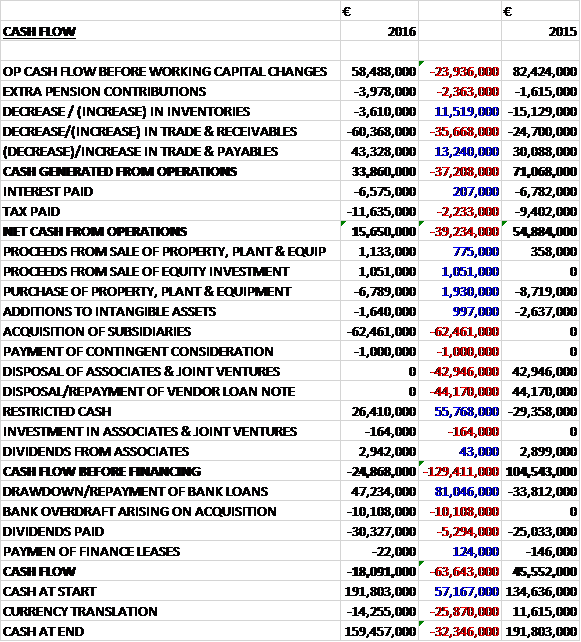
Before movements in working capital, cash profits declined by €23.9M to €58.5M. There was a cash outflow from working capital which was larger than last year, mainly as a result of a large growth in receivables, and after tax payments increased by €2.2M the net cash from operations came in at €15.7M, a decline of €39.2M year on year. The group spent a net €4.7M on property, plant and equipment along with €1.6M on intangible assets and €63.5M on acquisitions which meant that before financing there was a cash outflow of €24.9M. The group drew down a further €47.2M of bank loans and after dividends of €30.3M were paid and the €10.1M of overdraft acquired with the acquisition, the cash outflow for the year was €18.1M and the cash level at the year-end was €159.5M.

Agri-services had a challenging year. Underlying revenue decreased 3.7% due to the impact of lower input prices and crop marketing volumes. Underlying service revenue and input volumes increased 0.1% during the period, reflecting a 3.2% reduction in Ireland and the UK with a 12.2% increase in Central and Eastern Europe. The operating margin reduced, largely reflecting the impact of unseasonal weather and weaker primary producer returns.

In the UK Agrii performed robustly in a very difficult environment. The business recorded lower revenues and margins due to a combination of adverse weather and reduced farm profitability. Unseasonably lower temperatures and higher rainfall levels across the UK during Q2 and Q3 led to very late spring growing conditions which resulted in delayed and missed service and input application. Pressure on farm incomes and cash flow, combined with the more compressed nature of seasonal activity led to highly competitive trading conditions and lower demand across a variety of market sectors. Agronomy service revenue and crop protection volumes recovered well during Q4 following significant shortfalls in Q3. Seed and nutrition performed strongly for the year as a whole, growing market share despite the challenging backdrop.

In Poland the business achieved a satisfactory result in the context of extreme weather conditions which negatively impacted revenues, profits and margins. Service and input application was significantly curtailed following a combination of prolonged frost conditions and an absence of snow cover throughout Northern and Central Poland during March and April. This unusual weather pattern led to the loss of about 20% of total autumn and winter crop plantings in additions to a shorter growing season for spring cropping. The market backdrop was generally mixed reflecting weak farm sentiment due to poor crop potential and a delayed season. This, together with a reduced market for service and input application drove highly competitive trading conditions.

The group’s Romanian operations delivered a good maiden contribution this year. There was a strong organic performance with higher underlying revenues, volumes and margins reflecting growth in all service and input portfolios. Crop growing conditions were generally excellent throughout the period reflecting the benefit of good autumn establishment and favourable spring weather. Integration was advancing during the period with the initial areas of focus being organisational simplification, the introduction of enhanced technical support to the sales teams and product specialists, and the establishment of five knowledge transfer demonstration farms.

In Ukraine a more challenging market backdrop in the year drove a lower year on year operating profit result, with service providers responding competitively to the impacts of weaker local currency and on-farm cash flow pressures on primary producer economics. Soil fertility and seed technology applications maintained good development momentum during the period. New customer gains in the year were supported through the expansion of the agronomy sales force together with an extension of the regional distribution footprint of the business.

Business to Business agri inputs achieved a satisfactory performance in highly competitive market conditions. General uncertainty regarding fertilizer raw material price development and delayed seasonal timing due to late spring conditions, together with pressures on farm incomes, drove lower revenues, volumes and margins in the year. Weaker demand in the UK was partly offset by a robust volume performance in Ireland underpinned by higher livestock numbers with primary producers focused on maximising grass production to achieve higher milk volumes.

Amenity performed satisfactorily in the year with the professional channel continuing to provide growth opportunity supported by new customer development and the benefit of ongoing product and service innovation. Development continues to be positively supported through the formation of industry leading partnerships. During the year, Rigby Taylor became the official service provider to the UK FA pitch improvement programme, an initiative to improve playing surfaces in order to encourage increased participation in grass roots football. In 2016, the group completed the acquisition of UK-based Headland Amenity, a niche provider of turn management and maintenance solutions which should enhance the group’s sector position in the wider amenity market.

Against the backdrop of weaker returns from beef and dairy enterprises, Feed achieved a satisfactory performance underpinned by a modest volume increase in the period. Sport demand was robust at varying times during the year reflecting unsettled weather patterns, while price volatility drove generally weaker forward buying momentum. The John Thompson joint venture delivered a satisfactory performance during the year.

During the year the group made a number of acquisitions. In September 2015 they acquired Redoxim which is a provider of agronomy services, macro and micro inputs to arable, vegetable and horticulture growers based in Romania. In November they acquired the Kazgood group based in Poland. The business provides agronomy services, inputs, crop marketing solutions and is a manufacturer of micro nutrient applications. In December they acquired Comfert SRL. Based in Romania, the business is a provider of agronomy services, integrated inputs and crop marketing support to arable and vegetable growers.

In August 2015 the group acquired ReSo Seeds ltd, a UK-based mobile seed cleaning and processing specialist. Finally, in July 2016 they acquired Headland Amenity ltd, a UK-based supplier of products and synergistic programmes to improve sports turf surfaces. All of these business were acquired for €76.8M, including the debt acquired, and generated goodwill of €26.6M.

As can be seen there were a number of exceptional items this year (as in every year). Rationalisation costs comprise termination payments arising from the restructuring of agri-services in the UK; a gain on disposal of an investment in Adaptris has been recorded for €1.3M; transaction related costs principally comprise costs incurred in relation to the acquisitions during the year and strategy related costs relate to one-off costs associated with the Agri Services strategy review. Also, during the year the group conducted a valuation of their investment properties which resulted in an increase in the carrying value of the properties of €2.1M. Finally, the fair value gain on the put option liability relates to the movement in fair value of the liability in respect of the Agroscope acquisition.

Notwithstanding the fact that sector sentiment remains subdued reflecting the current pressures on farm incomes, the group is well positioned to respond to present market conditions and to benefit from a sustained improvement in primary producer returns.
At the current share price the shares are trading on a PE ratio of 16 which falls to 13.6 on next year’s consensus forecast. At the year-end, the group had net cash of €200K compared to €59.4M at the end point of last year. This figure considerably flatters the situation, however, and the average net debt during the year was €190M which was a similar level to 2015. After the dividend was kept the same this year, the shares are yielding 3.5% which is expected to remain the same again next year.

On the 25th November the group released a trading update covering Q1 2017. They had an encouraging start to the year with all businesses performing well in the seasonally quiet first quarter. A combination of generally favourable weather conditions and an improved planning environment for primary producers in the period in key geographies led to good early season activity levels on-farm resulting in higher demand for the group’s services and inputs. The total sown area for the principal autumn and winter crops is broadly equivalent to last year across the group’s markets. On the assumption of normal weather patterns, this cropping profile provides a solid foundation for the second half of the year.

Revenue from agri-services saw an 11% increase with underlying revenue up 1.3% reflecting higher seed, crop protection and fertilizer volumes, largely offset by lower fertilizer and feed prices and lower crop marketing volumes. Underlying service revenue and input volumes increased 7.2% in the year.

In the UK, Agrii delivered a satisfactory performance in the period, recording higher year on year revenues and margins. There was solid momentum across all service and input portfolios as favourable weather conditions supported crop planting activity in the quarter. Primary crop producers experienced a more stable planning and operating environment in the period with their margins currently benefitting from a combination of lower unit costs for key macro inputs and recent sterling depreciation.

Autumn and winter crop plantings are well advanced with estimates for the total sown area at 2.95M hectares, broadly similar to last year. In the case of winter wheat there is an estimated 1.4% increase in plantings but winter oil seed rape is showing an estimated reduction of 10%, largely due to agronomic and rotational crop planning decisions.

In Poland performance was satisfactory. This was against the backdrop of weak farm sentiment due to the impact of highly unseasonal weather patterns earlier in the calendar year which resulted in below average crop yield and quality. Agrii’s agronomy portfolios maintained development momentum in the period, reflecting more focused customer channel management in the enlarged business. There has been solid progress with respect to crop sowings in the period with total plantings for the principal autumn and winter crops estimated at 6M hectares compared with 5.9M for last year.

In Ukraine there was an improved Q1 performance with new season momentum supporting higher revenues and margins as the business benefits from the recent expansion of its distribution footprint. Market conditions continue to be impacted by currency weakness which is leading primary producers to adopt more concentrated or just in time procurement patterns.

While crop planting progress has been slower than anticipated due to below average rainfall in Central and Western Ukraine, autumn and winter sowings are expected to be head of last year. Total autumn and winter plantings for cereals and oil seed rape are estimated at 7.6M hectares compared with 5.8M hectares last year. Total forecast plantings for the growing season as a whole are expected to be equivalent to last year at about 21M hectares.

The Romanian business delivered a satisfactory performance. A combination of good early autumn planting and growing conditions together with new customer development supported higher underlying revenues, volumes and margins across all service and input portfolios. Recent rainfall has delayed the final harvesting of earlier spring sown crops and curtailed progress on new plantings. The total sown area for autumn and winter crops is estimated to be 3.15M hectares compared to 3.25M hectares last year. The shortfall is expected to be reflected in higher spring cropping.

Business to business agri inputs in the UK and Ireland achieved a good result in the period with performance benefitting from a combination of higher volumes and improved margins. Increased volumes were the principal driver supporting the performance of fertilizer in the period. Greater visibility on raw material pricing is providing confidence to primary producers to fix a portion of their nutrition requirements ahead of the main application period in the second half of the year. The amenity business performed satisfactorily in the period underpinned by continuing momentum within the professional sports turf channel. Headland Amenity, which was acquired in Q4 last year, performed well in the period with the integration progressing to plan. Feed ingredients delivered a satisfactory result supported by a stable year on year volume performance and John Thompson also delivered a satisfactory performance in the period.

Although sector sentiment remains subdued reflecting the current pressures on farm incomes, there has been an encouraging start to trading in Q1. The autumn and winter cropping profile established to date provides a solid foundation for the more important second half of the year.

Overall then this has been a difficult year for the group characterised by inclement weather across most of their markets. Profits are down, depending on which non-recurring items are omitted, net assets declined and the operating cash flow fell with even free cash before acquisitions not covering the dividends. In the UK, adverse weather and lower farm profits weighed down on profits with Poland also suffering from poor weather and progress in Ukraine being held back by a weak local currency and poor farm cash flow. The only area to see growth was Romania which benefitted from excellent growing conditions.

So far this year, the performance has been much better due to improved weather conditions. The UK was solid due to better weather but Poland still struggled due to weak sentiment and poor weather earlier in the year. Ukraine put in an improved performance but currency weakness is still a problem and Romania performed well due to new customers and better planting conditions, although recent rain has delayed harvests. Fertilizer volumes improved as there was greater transparency on raw material prices.

Pressure on farm incomes continued but so far this year seems to be improving and with a forward PE of 13.6 and yield of 3.5% these shares may be worth a go. The fact that they are reliant on the weather is a problem but assuming normal conditions return, this could be interesting.

Paypoint Share Blog – Interim Results Year Ending 2017

Paypoint has now released its interim results for the year ending 2017.

Revenues decreased when compared to the first half of last year as a result of the sale of Online due to a £5.1M fall in UK revenue and a £682K decline in Irish revenue, partially offset by a £3.6M growth in Romanian revenue, a £735K increase in North American revenue and a £337K growth in French revenue. Commission payable to retail agents fell by £2.5M but the cost of mobile top ups and sim cards increased by £1.9M, the cost of scheme sponsor changes grew by £376K and depreciation increased by £365K to give a gross profit of £50M. Admin expenses declined by £2.8M and there was no goodwill impairment this year which cost £18.2M last time so the operating profit increased by £20.7M. The share of Collect+ profit grew by £841K and after tax payments were up £546K the profit for the period came in at £19.7M, a growth of £21M year on year.

When compared to the end point of last year, total assets declined by £33.3M driven by a £32.7M fall in cash and an £8.9M decline in receivables, partially offset by a £3.6M growth in property, plant and equipment and a £1.7M increase in intangible assets. Total liabilities also declined during the period as a £22.9M fall in payables was only partially offset by a £1.9M growth in current tax liabilities. The end result was a net tangible asset level of £57.4M a decline of £14.4M over the past six months.

Before movements in working capital, cash profits grew by £3M to £28.4M. There was a large cash outflow from working capital with an £18.9M fall in payables related to the client settlement liability which was high last year due to the timing of Easter, but tax payments fell by £1.8M to give a net cash from operation of £9.1M, a decline of £15.3M year on year. The group spent £6.4M on property, plant and equipment (£3.7M relating to the freehold building adjacent to the Welwyn building which was being occupied on an operating lease) along with £2.7M on intangible asset development so that before financing, there was a cash flow of just £100K. This did not cover the £408K spent on share based remuneration settled in cash and after the group paid out £33.5M in dividends there was a cash outflow of £33.8M to give a cash level of £51.4M at the end of the period.

Bill and general transactions decreased by 4% compared to the same period of last year driven by a 6.7% reduction in UK and Irish transactions due to the continuing decline in energy transactions. A decrease in consumption, lower energy prices and higher average transaction values more than offset the impact from meter growth. Multi Pay continued to grow with total transactions for the period exceeding three million, despite the delay in the readiness of the Data Communications company, which is constricting the installation of smart meters. Strong growth in Romania continued as a result of increased market share of 23.1% and the addition of new clients with transactions increasing by nearly 12%. Despite this a growth in net revenue of 2.8% was achieved as a result of the transaction mix and changes to individual transaction commission caps.

Top-up transactions reduced as expected as a result of the continued decline in mobile top-up volumes in the UK and Ireland of over 14% and a decline in other top-ups. These declines were partly offset by an increase in Romanian mobile top-ups. Net revenue declined by 13.5%.

Retail services transaction volume increased by 11.8%. Card payment transactions increased by 14.7%, ATM transactions by 9.3% and parcels by 5.7%. Net revenue growth of 14.7% was greater than transaction growth and was driven by bonuses earned on SIM activations and increased retailer service fees for PayPoint One, card payment service fees and broadband enabled terminals.

Collect+ made a profit of £887K in the period compared to a £797K loss last time as last year suffered from a temporary increase in Yodel’s charges which ended in February this year. The group continue to discuss with Yodel new arrangements for the continuation of the service, following their proposed change in basis of charging for its logistics which would substantially increase the costs in the joint venture.

The mobile payments business saw net revenue increase by 42% to £4.6M. The group have continued to add parking contracts with councils and parking authorities with the increase in revenues reflecting the increase in transaction volumes as the business wins new clients and increases its penetration of existing clients. Consumers are able to pay with Apple Pay and Android Pay at a growing number of Pay By Phone locations, streamlining payment registration and increasing consumer satisfaction.

In the UK, PayPoint One has been well received by retailers but the revenue achieved in the period has been lower than expected as they stopped rolling out the older terminals at the start of the initial rollout of PayPoint One and demand for upgrades, which produce lower incremental revenues than new agents, was stronger than expected. Now that the rollout has gathered pace, focus has returned to the ATM and card payment products to drive growth in the second half.

Terminal sites overall have increased by 407 to 39,635. In the UK and Ireland, retail sites decreased by 0.4% as a consequence of the decision to stop the rollout of the old terminal before the new terminal rollout process was in full flow. As of the period-end, there were over 1,100 sites with PayPoint One terminals which are being introduced to both new and existing retailers. Card payment services, which include the contactless functionality were in 10,076 sites, a decrease of 35 sites in the period. The PPoS integrated solution, which combines a virtual terminal with a plug-in reader, was in 8,178 sites. Some of the terminals replaces by Paypoint One and PPoS will be redeployed in Romania and sites in the country have increased by 5.1% to 10,662.

The group expect to rollout PayPoint One to achieve around 4,000 sites by the end of the year; to develop advanced EPoS and to step up their installations of ATMs and card payment which will require increased costs as the rollout of Paypoint One and Epos accelerates and attention returns to increasing ATM and card payment site numbers.
Capital expenditure for the full year is expected to be between £15M and £20M, above the previous expectations because of the purchase of the freehold in Welwyn, further feature enhancements to Paypoint One and EpoS and ongoing development of an alternative payment service provider for Muiltipay to reduce risk of downtime.

Trading since the end of September has been in line with board expectations. Utility providers continue to install new prepay gas and electricity meters from which, together with MultiPay, they anticipate a beneficial impact on transaction volumes. Retail services has shown robust growth and with the launch of PayPoint One and Core Epos, will continue to benefit from growth opportunities. Mobile top-ups in the UK and Ireland continue to decline as mobile operators offer more airtime at lower cost and promote prepay less than contract, although top-up growth has been maintained in Romania.

At the current share price the shares are trading on a PE ratio of 16.1 which reduced so 14.8 on the full year forecast. After a 5.6% increase in the interim dividend and another special dividend the shares are yielding 8.2% which falls to a still-respectable 6.8% on the full year forecast.

Overall then this has been a rather mixed period for the group. Profits were up but this seems to be due to a reduction in admin expenses, perhaps following the sale of the online business. Net assets declined and the operating cash flow fell markedly due to a decrease in payables which meant that there was no free cash flow generated of note. The cash profits did increase, however. Geographically, it seems the Romanian business continues to grow strongly but the UK and Irish business seems to be flat lining.

The top-up revenues seem to be in terminal decline as people use mobile top up less and less in this country and the bill and general business seems to be rather flat, presumably as the group stopped the roll-out of older terminals to concentrate on Paypoint One. The retail services segment did perform well, however, and the group made some profit from Collect+ as the increased charges from Yodel ended – although the future of this joint venture does seem rather uncertain.

The mobile business sale continues but there doesn’t seem to be much interest. There are hardly any assets on the balance sheet relating to it now, though, so it wouldn’t take much to achieve a decent profit on disposal. The costs in the second half are likely to rise as the new terminals continue to be rolled out. The forward PE of 14.8 doesn’t look great value but there is a stonking yield of 6.8% (unlikely to be sustainable). This is really tricky, I am minded to sell up and re-enter of more signs of progress are seen.

On the 16th December the group announced that it had reached an agreement with Yodel for a new arrangement for Collect+. Paypoint and Yodel will retain 50:50 ownership of the brand through their joint venture company with the joint venture receiving royalties from both PayPoint and Yodel for each parcel they introduce. Yodel will take responsibility for the operations and contracts and as a consequence Paypoint will no longer bear the impact of logistics cost increases. Paypoint will be able to utilise its convenience retail network to sign agreements with other parcel carriers and to open Collect+ access to other carriers under license.

In recognition of Paypoint rights to extend network access to other carriers, they have committed to a progressive reduction of their charges over a two year period with the impact hopefully mitigated by additional volume growth from existing and new retailers through the continuing relationship with Yodel and additional volume and fees from other carriers.

PayPoint’s share of the result in the joint venture up to completion was a loss of £2M which includes increased charges from Yodel for the period to completion which will be booked in the second half of this year – up to now I was not aware they increased their charges again! All of the operations and contracts of the previous joint venture are transferring to Yodel for no consideration which will not result in a gain or loss to Paypoint.

I’m not sure what to make of all this but it doesn’t sound like Paypoint will be making much money from this.

On the 23rd December the group announced the sale of Mobile Payments to VW Financial Services for £26.5M paid in cash. A dividend of the gross sale proceeds which amounts to 38.9p per share will be paid. The sale marks the conclusion of the restructuring set out in the announcement made last year and follows the earlier sale of the Online business. The Mobile business is performing better than expected with a growth in revenue but the sale is in line with the group’s strategy of narrowing their focus on multi-channel payments in territories in which they have retail networks.

The aggregate pre-tax loss of the business was £2.6M in 2016 and the net book value on completion was £2.3M so although disappointing to see them exit the business, this looks to be a decent price.

On the 3rd January the group announced that Rachel Kentleton joined the board as executive director and will succeed George Earle as finance director.

On the 26th January the group released an update covering Q3 where trading was in line with board expectations with continued growth in retail services. Retail network transactions increased marginally and net revenue grew 6.7% contrasting with overall transaction decline and net revenue up just 0.2% caused by the sale of online payments and mobile payments. Transaction volume from retail services was up 11.8% with strong growth in parcels and card payments. Bill and general transactions increased 1.3%, excluding a reduction in cash-out transactions resulting from the two year government electricity rebate schemes which benefited prior periods (so bill and general transactions presumably declined then).

In the UK and Ireland, retail services transactions continued to grow, up 11.7%, helped by parcel volumes and card payment transactions. The Collect+ network expanded since the half year-end by 140 sites. Bill and general transactions were down 3.6%, mainly due to the impact of the government electricity rebate scheme but also as a result of smart meter rollout delays and lower energy consumption. Top-up transactions fell by 13.8% as the prepaid mobile sector continued to detract – these now only make up 7% of the total transactions.

In Romania, bill payments increased by 12.6%, top-ups were up 13.5% and retail services grew by over 28.7%. The terminal estate increased by 393 in the quarter and they continue to add new clients. Following the cash proceeds of £26.5M from the sale of the mobile business, which were subsequently paid out as a dividend post the period-end, net cash came in at £54.5M compared to £34.2M at the end of the first half.

Overall, the usual trends are still in evidence here – there was strong growth in Romania but a more mixed environment in the UK as top-up transactions continued to decline and bill transactions also fell. I continue to hold.

On the 26th May Finance Director Rachel Kentleton purchased 1,245 shares at a value of £12K.

On the 18th July the group announced that non-executive director Rakesh Sharma purchased 1,150 shares at a value of just under £10K.

On the 26th July the group released an update covering Q1. Overall the full year outlook remains in line with previous guidance. Group organic net revenue grew by 4.2% despite a 4.5% reduction in transaction volumes as a result of an expected decline in the UK prepay energy volume which was partially offset by growth in the net revenue per transaction through a shift to smaller but higher yielding clients.

UK and Ireland retail services net revenue was up 10.5%, driven by PayPoint One service fees, card payment transactions which grew by 8.3% and ATM transactions which increased by 5%. The PayPoint One terminal is now in operation in 5,000 sites, an increase of 1,296 since the start of the year. The group remain on target to reach 8,000 sites by the end of March 2018. Due to the strong take up by retailers, the group have standardised the service fees for legacy terminals across 14,000 sites which has led to a small number of retailers leaving with the network reducing by 449 to 28,727 outlets. The parcel service increased volume by 16.6%.

Net revenue in bill and general decreased by 2.7% as transaction volume declined by 11.2%, driven mainly by a 15% reduction in prepay energy volume, with the shift in mix towards smaller but high yielding clients partially offsetting the decrease in transactions. Top-up transactions declined by 14% as the prepaid mobile sector continued to contract. Romania continued to grow, net revenue reported in constant currency increased by 16% with total transactions increasing by 9%.

Overall this seems like a pretty decent update, I am tempted to get back in here.

On the 12th October the group announced that it had completed the acquisition of Payzone SA in Romania for an initial consideration of €1.6M payable in cash plus €500K to be deferred contingent on the collection of specific debts over the two years following completion. The business offers prepaid mobile top-ups, prepaid vouchers, bill payment collection on behalf of utility companies and international money transfer services through its retail network, available in 11,000 locations across Romania. The business made a pre-tax profit of €100K over the past six months but there should be operational efficiency benefits through the combination of the two businesses.