Tower Resources Share Blog – Interim Results Year Ending 2016.

Tower Resources has now released its interim results for the year ending 2016.

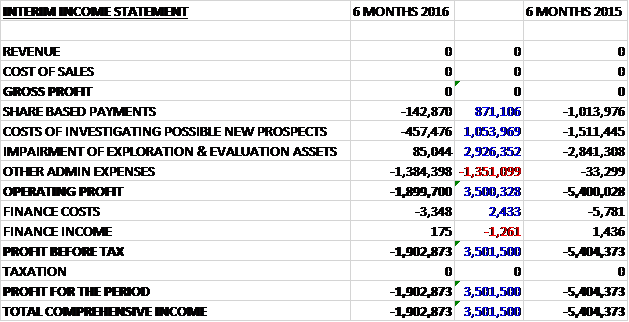
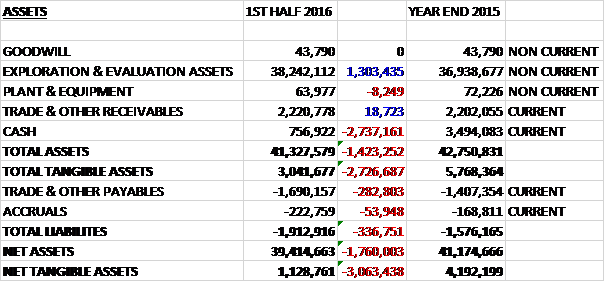
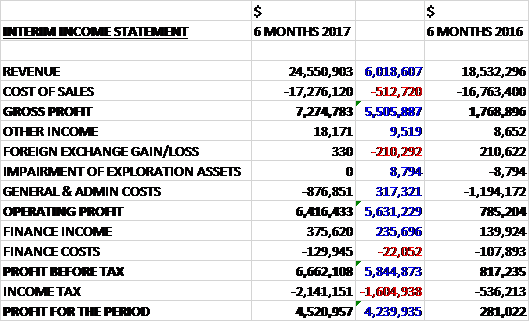
There were no revenues or therefore cost of sales. Share based payments reduced by $871K, costs of investigating possible new prospects declined by $1.1M and there was a small impairment reversal compared to a $2.8M impairment last time. Other admin expenses did increase by $1.4M, however, to give an operating loss $3.5M better than last time. There were no real finance costs or tax charges to speak of so the loss for the period was $1.9M, an improvement of $3.5M year on year.

When compared to the end point of last year, total assets declined by $1.4M driven by a $2.7M decrease in cash, partially offset by a $1.3M increase in the value of exploration and evaluation assets. Total liabilities increased during the period due to a $283K growth in payables and a $54K increase in accruals. The end result was a net tangible asset level of $1.1M, a decline of $3.1M over the past six months.

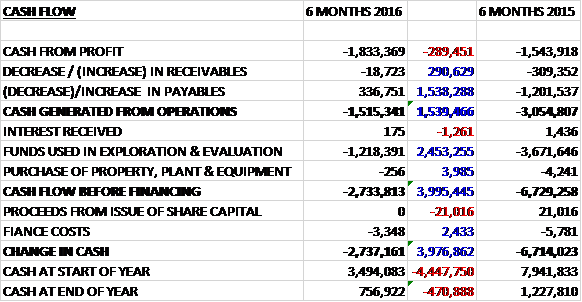
Before movements in working capital cash losses increased by $289K to $1.8M. There was a cash inflow from working capital due to an increase in payables which meant that the cash lost from operations was $1.5M, an improvement of $3.1M year on year. The group spent $1.2M on evaluation and exploration, the vast majority being in Cameroon, but not much else to give a cash outflow of $2.7M before financing. There was little in the way of finance costs so there was a cash outflow of $2.7M in the period and a cash level of $757K at the period-end.

Included in receivables is $1M of VAT due to the company from HMRC. HMRC have withheld VAT repayments pending the completion of an ongoing review. Whilst this review process remains ongoing, HMRC have since issued further assessments totalling £843K in respect of which the group continues to take professional advice.

Following a review, the group have identified that certain suppliers have incorrectly charged UK VAT on their fees totalling £903K. The suppliers concerned have filed letters disclosing this error with HMRC and are seeking reimbursement from HMRC. Settlement of these reclaims in full would mean that the group would be owed a net sum over and above the value of the VAT repayments being withheld, although there can be no certainty of the quantum of the repayment resulting from these reclaims until this part of the consultation has been concluded.

Peter Blackey, non-executive director, retired from the board following the AGM. He was a founder of Tower in 2005.

At the period-end, the group had a cash balance of $757K. Their operations are currently being financed by funds raised from private and public placings of shares and the directors recognise that they will need to raise additional funds within the next few months sufficient to meet their committed capex, although they are confident in their ability to do this.

The group is intending to raise $1.35M through a subscription of about 45.9M new shares at a placing price of 2.25p per share. They intend to make an open offer to raise a further $730K at the placing price. The group are reducing their cost base further but require a modest amount of further working capital to extend cash reserves into Q1 2017as the proceed with the farm out process of the Thali block. The placing represents a very heavy discount of 59% and is very dilutive, representing more than 60% of the enlarged share capital.

In Cameroon the next key step is the acquisition of modern 3D seismic to significantly improve subsurface imaging and resolution as the existing seismic data is 25 years old. A small in-country office has been established in Douala and is currently preparing to acquire a minimum of 100km2 of 3D seismic. To this end they have completed the lengthy ESIA and been granted a certificate of environmental conformity. The group is seeking a partner to cover these costs and the timing of operations will reflect these factors.

In South Africa uncertainty about the new mining legislation and its impact on the oil exploration sector has reduced industry activity to minor levels and it is hoped that this process will be brought to a conclusion in the next few months and provide greater certainty. The prospectivity evaluation is in progress and due to be completed before the end of the year. The group will seek a partner for the next programme of operational activity.

In February the group announced that they had agreed not to proceed with an application to convert the deep water frontier SW Orange Basin TCP into an exploration right. Consequently they were reimbursed by their partner $500K which was paid as part of the original farm in agreement which was also terminated. This allows the group to focus their efforts in South Africa on the Algoa-Gamtoos exploration right which offers greater near term potential.

In Zambia, future work commitments over the next two years potentially include airborne gravity data acquisition and a 2D seismic programme. The licenses can be relinquished at the end of each year if results are discouraging.
The government is working towards a new petroleum code which will give greater clarity. The group will engage with the appropriate ministries once a new cabinet is formed following the recent elections. They will also actively seek a partner for Blocks 40 and 41 so it is carried into the more expensive parts of the work programme and to re-coup an appropriate part of its investment.

On the 24th January the group announced the completion of the sale of Comet Petroleum for a cash consideration of £1, future contingent payments and an over-riding royalty interest of 10% over future production revenue from their assets in the SADR. The group have also completed an amendment agreement to eliminate the previously announced contingent payments due to the original vendors of Comet (former directors of Tower!) who will now share part of the above consideration, leaving an ORRI of between 5% and 10% depending on the asset. The carrying value of the assets in the latest accounts was $484K.

Overall then, the Cameroon assets offer some interest here but given that the group will definitely have to raise more capital and there doesn’t seem to be a queue of other companies looking to farm in to these assets, I don’t think this is any more than a real gamble right now.

On the 12th May the group announced that it had suspended trading on AIM pending clarification of its financial circumstances. They had been in advanced discussions with a potential partner in relation to the Thali asset but a final deadline for signature of a heads of agreement that would have triggered a deposit to the group has been missed. The financial condition and prospects of the company have therefore deteriorated leading to significant uncertainty and current employees have been provided with notice of termination of their employment. The board are now considering alternatives for the group, one of which may be the appointment of administrators. Oh dear, what a sorry tale.

Dewhurst Share Blog – Final Results Year Ended 2016

Dewhurst has now released their final results for the year ending 2016.

Revenues increased when compared to last year, primarily due to currency movements, as a £667K decline in keypad revenue was more than offset by a £1.4M growth in lift revenue and a £600K increase in transport revenue. Cost of inventories were up £912K, staff costs increased by £632K, there was a £307K detrimental forex movement and £413K less gained on the sale of fixed assets after last year’s property sale but R&D and audit costs both declined modestly and other operating costs fell £556K to give an operating profit £265K below that of last year. Tax charges also increased by £575K which meant that the profit for the year was £3.5M, a decline of £802K year on year.

When compared to the end point of last year, total assets increased by £5.3M driven by a £2.1M growth in trade receivables, a £1.7M increase in cash and a £749K growth in goodwill. Total liabilities also increased during the year due to a £4.2M growth in pension obligations and a £697K increase in trade payables. The end result was a net tangible asset level of £21M, a decline of £427K year on year.

Before movements in working capital, cash profits increased by £1.6M to £6.9M. There was a cash outflow from working capital which was greater than last year and after tax payments increased by £874K the net cash from operations was £2.8M, a decline of £793K year on year. The group spent £901K on property, plant and equipment along with £62K on development costs to give a free cash flow of £1.9M. Of this, £1.1M was spent on dividends to give a cash flow of £734K and a cash level of £16.7M at the year-end.

Lift businesses in the UK and Australia were both broadly flat, but there was good growth in North America. Transportation business grew during the year but keypad sales were down, although they recovered somewhat from the first half. There were significant currency swings during the year with the pound stronger in the first half and weaker in the second with forex movements having a £400K positive effect on profits compared to last year.

After a slow year last year, sales at Dewhurst UK Manufacturing grew by 12%. This growth was spread evenly between their home market and their export markets. They have taken the decision to open an office in the Middle East to support our activities in that region and are looking to have it operational from the start of 2017. There is currently an increase in the number of infrastructure projects in the UK. There has been growing investment in the transport network in London and they have been working closely with TFL and Crossrail on their ongoing projects.

The UniBlade family of products has grown during the year and they continue to see an increasing number of projects using these products. Significant installations include the office of Clifford Chance in Canary Wharf, Scotia Plaza in Toronto and the new Bloomberg office in Kings Cross. Activity in the rail industry has also increased and the group have won an important order for their US97 Rail Pushbutton, which has been fitted into the refurbished Virgin East Coast mainline trains. They have also added their range of trackside signal boxes and expect to see growing demand for these products through 2017.

The engineering team has had a busy year, predominantly adding to their range of existing products. They have developed a new version of their U95 pushbutton to meet the specific requirements of the Singapore market. A new pushbutton has also been developed for California where there was a need for a vandal resistant metal on metal button that meets the Californian Elevator Code. On top of this they have introduced new variants of UniBlade IDs and Blade Lanterns. The group have purchased a new folding machine during the year and expect to add more during 2017.

The market continued to be challenging for Thames Valley Controls and they continue to see a decline in sales, although the rate of decline was reduced. Order input was reasonably strong but in both the monitoring and controller markets they suffered from customers delaying projects. The year saw their new controller product, Ethos 2, come online with a good number of customers changing over to this new product. It is a touch screen that provides clear indication of the lift’s current status and functions. It also analyses the ride performance of the lift in real time which helps the engineer identify any issue before the passenger does. Demand for the newer monitoring products has been encouraging. Sales of CCTV products have grown substantially as have sales of autodialler products, both of which add security to passenger in lifts.

During the year the group experienced significant sales growth at Traffic Management Products, with an improvement of over 20% compared to last year. Over the last eighteen months the team have carried out an extensive reorganisation programme and in 2016 they started to see the benefits. The business is launching a series of architectural street bollards for use on pavements as well as a range of wooden bollards for use on paths and in parkland settings.

Sales at Dewhurst Hungary were down by around 7%. There was a reduction in demand for both the keyboard products and the ATM facia units. The reduction in sales was primarily in Q1 and since that time it has remained reasonably consistent. The group have continued their investment in the business with the purchase of a new laser marking machine which will help improve the appearance and durability of their laser market keys.

At Dupar Controls in North America, sales continued to grow, up by just under 10% reflecting the buoyant economy. A major investment in new computer software to help in their front end processes is just beginning to come on stream now. Early indications are that it will be a great benefit. Not only does it allow them to process drawings more quickly but it systematises the way that they produce their drawings which will reduce potential mis-communication.

After a slow start, interest in the new US1 Touch car operating panel has taken off in H2, The first installation has gone smoothly and forward orders for the product are now quite healthy which has given the board confidence to add two new sizes to the product range.

At Elevator Research and Manufacturing, sales grew by 10%. Sales of lift fixtures were slow but sales of the cab and door products were very buoyant. There are still significant challenges to overcome at the business in order to provide consistent levels of customer service but they are confident that they have the beginnings of a team who can achieve these goals.

Sales at Australian Lift Components fell marginally, primarily due to the increased competition that has been seen in the market. The steady growth in sales continued at Lift Material with another record year with a growth of just under 5%, the Escalator Product Group showing the greatest growth. At Dual Engraving, sales fell back from last year’s peak by around 10% as expected. The economy in Perth has slowed following the reduction in new mining infrastructure projects in the area but despite this, the business recorded profits broadly in line with expectations. Dewhurst Hong Kong saw sales grow by 6% with record profits being achieved. The growth was supported by work done in other Asian markets to increase sales outside the province.

Going forward, the weaker pound is going to benefit the reported figures and their competitiveness as long as it continues. Offsetting that, UK short term demand has been variable and there are indications of customer nervousness and indecision that are likely to affect medium term demand. Elsewhere, North America demand experienced a lull at the start of the year but the outlook remains positive and Australian demand is also encouraging. On balance the new financial year has started reasonably positively so the board are optimistic that they should have a better Q1 than last year but it is quite difficult to predict likely outcomes beyond that.

At the current share price the shares are trading on a PE ratio of 12.1 which falls to 10.2 on next year’s consensus forecast. After the final dividend was increased the shares are yielding 2.2% which increases to 2.4% on next year’s forecast. The group has no debt and £16.7M cash.

On the 1st February the group announced that it had signed an agreement to acquire 75% of P&R Liftcars. The business, based in Sydney, is a lift car interior manufacturer which works with all the major Australian lift companies. The founder will retain a 25% shareholding and will continue in the role of GM. There is a cash consideration of $1.5M and last year the business made a profit of $1M, excluding the employment costs of the owner-manager. This seems like a decent deal to me.

Overall then this seems to have been a decent-enough year. Profits were down but this seems to be due to the sale of a property last year, although there was a benefit from forex movements so perhaps underlying profits are broadly flat. Net assets declined due to the increase in pension liabilities and the operating cash flow declined, although this is due to increased tax payments and working capital movements with cash profits increasing – a decent amount of free cash was received.

Lifts in North America seem to have done well but I am a bit concerned that there now seems to be a bit of a lull – could this worsen? The transport business seems to have done well buy Keypads have declined. With a forward PE of 10.2 and yield of 2.4% this seems fairly sensibly priced and I continue to hold.

Laura Ashley Share Blog – Interim Results Year Ending 2017

Laura Ashley has now released its final results for the year ended 2016. For some strange reason the group seems to have neglected to provide a like for like contrast so these results represent 74 weeks of 2016 and 52 weeks of 2015!

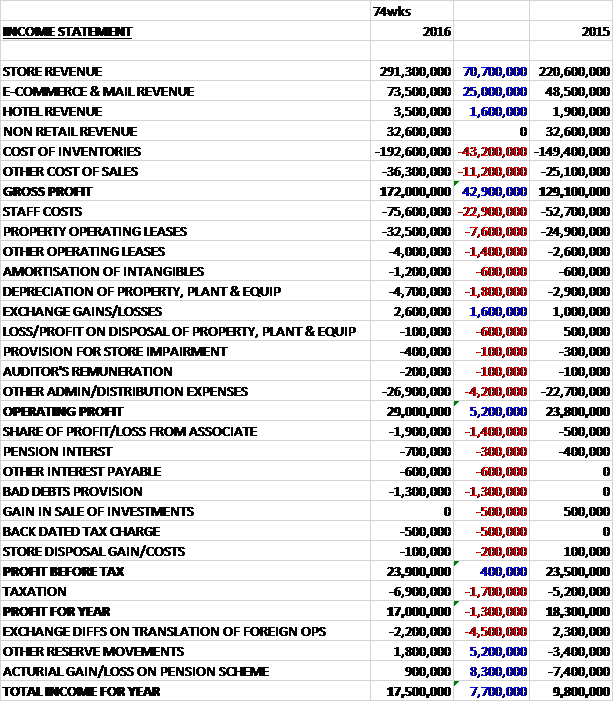
The gross profit increased by £42.9M and obviously admin costs increased, driven by a £22.9M growth in staff costs but there was a £1.6M increase in the exchange gain to give an operating profit £5.2M higher. The share of loss from associate increased by £1.4M and there was a £1.3M bad debt position along with a £500K back dated tax charge and the lack of a £500K gain on investment that occurred last year which meant that the profit for the period was £17M, a decline of £1.3M year on year.

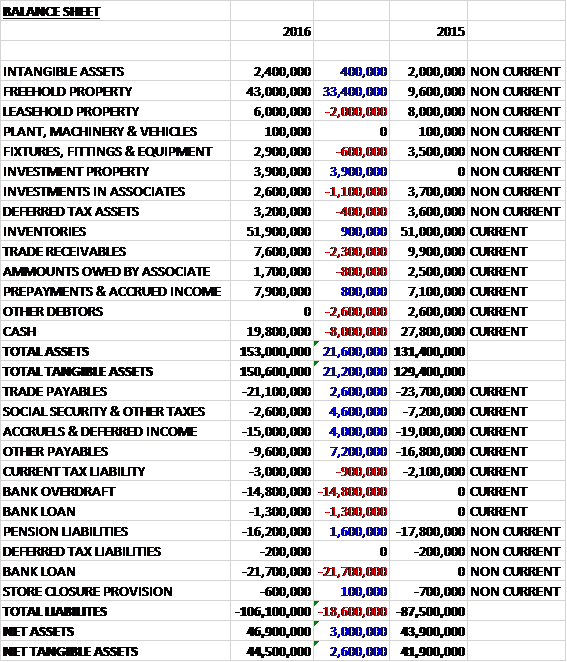
When compared to the end point of last year, total assets increased by £21.6M driven by a £33.4M growth in freehold property and a £3.9M increase in the value of investment properties, partially offset by an £8M decline in cash, a £2.6M fall in other debtors, a £2.3M decrease in trade receivables and a £2M decline in leasehold property. Total liabilities also increased during the period as a £7.2M decline in other payables, a £4.6M fall in social security and other tax payables, a £4M decrease in accruals and a £2.6M decline in trade payables were more than offset by a £14.8M growth in the bank overdraft and a £23M increase in bank loans. The end result was a net tangible asset level of £44.5M, a growth of £2.6M over the period.

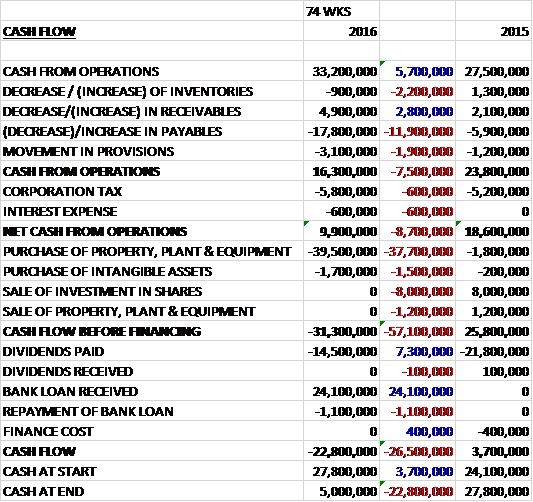
Again, a comparison with last year is nigh on impossible. Before movements in working capital, cash profits increased by £5.7M to £33.2M but there was a large cash outflow from working capital and after tax and interest payments both grew by £600K each, the net cash from operations came in at £9.9M, a decline of £8.7M year on year. This was totally dwarfed by the £39.5M spent on property, plant and equipment so after the group also spent £1.7M on intangible assets, there was a cash outflow of £31.3M before financing. The group paid out £14.5M in dividends it couldn’t really afford and after they took out a net £23M in new loans there was a cash outflow of £22.8M and a cash level of just £5M at the period-end.

Overall like for like sales grew by 4.1% with like for like e-commerce sales up 15.7%. During the period five stores were opened in the UK and eighteen closed, reducing total selling space by 4.2%. Furniture sales saw like for like growth of 4.3% with the availability of financing products helping the category to grow. Home accessory sales saw like for like growth of 6.8% based on new range additions, new product categories such as cookware and kitchen products as well as an enhanced seasonal offering. Decorating sales saw like for like growth of 1.6% and fashion sales were up 2.2% on a like for like basis as the group have started to partner with selected British retailers to give broader exposure to the ranges.

The profit from stores was £16.3M on a pro-rate basis, a decline of £3.3M year on year. The profit from e-commerce and mail order was £12.2M, a growth of £2.6M year on year. The loss from the hotel was £300K, an improvement of £100K when compared to last year.

Overseas there were 252 franchise stores compared to 303 at the start of 2015. Franchise and licensing revenue declined by £500K primarily due to the performance of a sluggish Japanese market and continued political instability and economic difficulties in other territories. During the period the group incurred an exceptional charge of £1.3M following a license partner in Australia being placed into administration. They have now signed a new license partner for the country and the board are confident that the business opportunity there will be optimised.

Trading for the first six weeks of the New Year is performing in line with management expectations.
On the 21st October the group announced that following the acquisition of Homebase by Wesfarmers, they will cease to trade in its concessions within the stores with the closures taking place in Q2. They do not expect there to be a material impact on the group and expect that the majority of trade they receive from the concessions will be redirected to other Laura Ashley stores and the website – it rather begs the question of why they had them in the first place if that is the case!

Laura Ashley has now released its interim results for the year ending 2017.

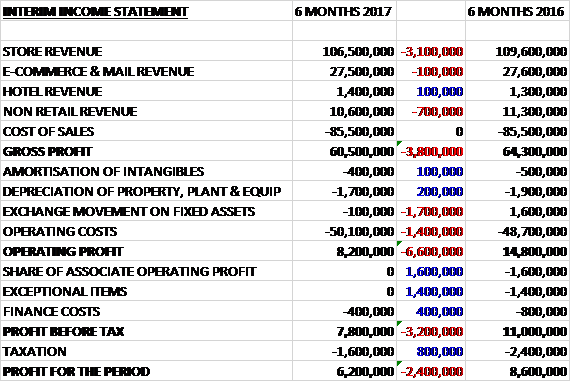
Revenues declined when compared to the first half of last year due to a £3.1M fall in store revenue and a £700K decrease in non-retail revenue. Cost of sales remained stable so the gross profit fell by £3.8M. Depreciation and amortisation decreased by £300K but there was a £1.7M detrimental movement of the effect of forex changes on fixed assets. Other operating costs were up £1.4M which meant that the operating profit declined by £6.6M. The losses from associates were eradicated this time, which accounted for £1.6M last year; there were no exceptional items, which were £1.4M last time and finance costs fell by £400K. Tax was also down, decreasing by £800K to give a profit for the period of £6.2M, a decline of £2.4M year on year.

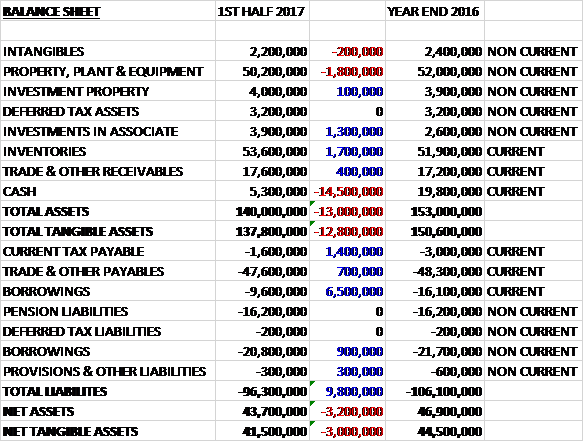
When compared to the end point of last year, total assets increased by £13M driven by a £14.5M decline in cash and a £1.8M decrease in property, plant and equipment partially offset by a £1.7M growth in inventories and a £1.3M increase in investments in an associate. Total liabilities also declined during the period due to a £7.4M decrease in borrowings and a £1.4M fall in current tax payables. The end result was a net tangible asset level of £41.5M, a decline of £3M over the past six months.

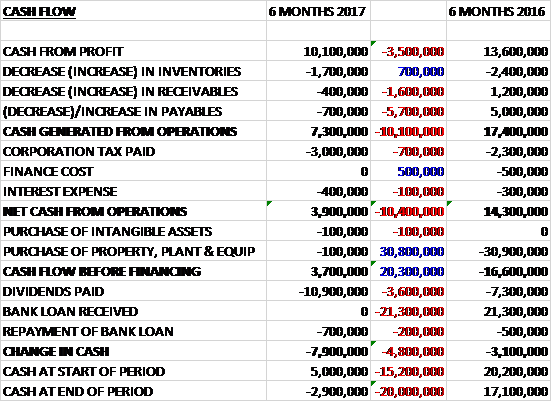
Before movements in working capital, cash profits declined by £3.5M to £10.1M. There was a cash outflow from working capital compared to an inflow last time and after tax payments increased by £700K the net cash from operations came in at £3.9M, a decline of £10.4M year on year. The group spent just £200K on capex so there was a free cash flow of £3.7M. This didn’t come close to covering the £10.9M of dividends paid out and after £700K of the bank loan was repaid there was a cash outflow of £7.9M and a cash level of -£2.9M at the period-end.

Margins have been affected in the period due to adverse currency rates and underlying cost increases due to the rise in the national living wage. Some 22 concession stores in Homebase will be closed by June following its acquisition by Bunnings. Actions are being taken to minimise the impact to profit of the closure of these concessions, although the board have previously stated that they don’t expect there to be a material effect.

The profit from stores was £6.1M, a decline of £5.9M year on year with like for like sales down 3.5%. Like for like furniture sales were down 8% although there was some performance in Q2. The new season product range has recently been launched and the early reaction is apparently encouraging so the board are hopeful of a stronger second half in this category. Like for like home accessory sales increased by 2.5% with the seasonal ranges being the most successful element. Decorating sales were down 6.4% but again the board are pleased with the early reactions to the new ranges. Like for like fashion sales were down 3.2%.

The profit from e-commerce and mail order was £6.8M, a growth of £300K when compared to the first half of last year as like for like sales grew by 2.1%. The group also continue to improve their reach and after already delivering to eight European countries they have added delivery to the Czech Rep and Hungary. New payment solutions will be added to the online platforms in Germany, Benelux and France over the coming months. The group also launched their digital platform in China in November which will continue to be developed during the current year.

The profit from non-retail activities was £5.4M, a growth of £500K excluding the loss from associate that was not repeated this time. At the period-end the number of franchised stores were broadly stable at 251. The group signed a new license partner for the Indian market which positions the brand for advancing in this country and they also now have a presence in China having launched a website there in November.

The board feel that given the continued market challenges that pre-tax profit for the year will fall below market expectations. Like for like sales so far in the second half of the year are down 0.6%.

At the period-end the group had net debt of £2.9M compared to net cash of £5M six months ago. At the current share price the shares are trading on a PE ratio of 10.1 but this rises to 18.5 on the full year consensus forecast. With an interim dividend of 0.5p per share the shares are yielding 8.8% which falls to 7.3% on the full year forecast.

Overall then this has been a difficult period for the group. Profits are down, net assets fall and the operating cash flow reduced. Although some free cash was produced, this was no-where near enough to cover the dividends. There are a number of issues affecting the group with the decline in the value of sterling pinching margins in the UK, along with the application of the national living wage increases. The group are also having to contend with the removal of their concessions from Homebase stores and I don’t really believe the board when they say that will have no real effect.

The profit for this year is coming in below expectations and although there is a stonking dividend yield of 7.3%, the forward PE of 18.5 suggests to me that this is not sustainable on the current trading and it is hard to see where a recovery is going to come from unless the overseas sales really take off. I am steering clear for now.

Redrow Share Blog – Interim Results Year Ending 2017

Redrow has now released its interim results for the year ending 2017.

Revenues increased by £136M when compared to the first half of last year and after cost of sales grew by £97M the gross profit was £39M higher than last time. Admin expenses were up £5M which gave an operating profit some £34M higher. Finance costs declined by £2M but tax charges increased by £7M which meant that the profit for the period was £112M, a growth of £29M year on year.

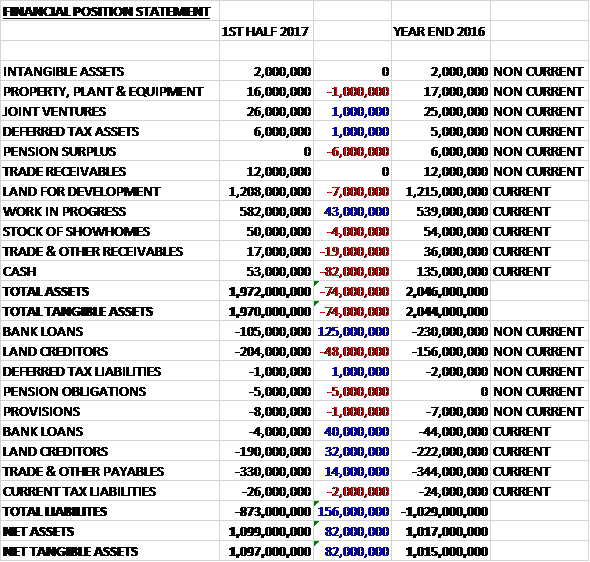
When compared to the end point of last year, total assets declined by £74M driven by an £82M fall in cash, a £19M decrease in receivables, a £7M reduction in land for development and a £6M elimination of the pension surplus, partially offset by a £43M growth in work in progress. Total liabilities also declined during the period as a £165M reduction in bank loans and a £14M fall in payables was partially offset by a £16M growth in land creditors. The end result was a net tangible asset level of £1.097BN, a growth of £82M over the past six months.

Before movements in working capital cash profits increased by £32M to £143M. There was a cash outflow from working capital but this was less than last time and after tax payments increased by £5M the net cash from operations was £105M, a growth of £102M year on year. There was no capex so this was all free cash which easily covered the £22M of dividend payments. The group also paid back £125M of loans so there was a cash outflow of £42M for the period and a cash level of £49M at the period-end.

Legal completions, including the Croydon JV, increased by 281 homes to 2,459 and for wholly-owned sites the increase was 238. The average selling price of the private homes increased by 12% to £344K, mainly due to geographic mix with 47% of turnover being generated in the South of the country as opposed to 38% last year.

Demand for new homes remains strong throughout the country on the back of improved mortgage availability and competitive mortgage rates. In the first half of the year, 865 of private reservations used Help to Buy, up from 746 in the same period last year. The value of private reservations increased by 13% on a like for like basis to £177M resulting in a record closing order book of £897M, up 35% on a like for like basis compared to the end of H1 2016.

The sales rate per outlet per week was up 5% which meant that a number of sites sold out earlier than expected. As a result, they were only operating 122 outlets at the end of the period compared to the 127 planned, although the number of outlets should increase in the second half subject to progressing a considerable number of sites through the planning process.

The group secured 1,760 plots for their current land holdings in the period. Of these, 1,352 were converted from the forward line pipeline. Over the same period the pipeline has remained unchanged with the potential for 25,600 plots with the land transferred to current land holdings being replaced by new additions.

In February the group purchased Radleigh Homes, a regional housebuilder based in the East Midlands which will give the group a new division in this area. The business completed 188 homes in 2016 and has a pipeline of over 1,300 plots with planning and a further 1,200 plots controlled under options in its strategic land pipeline.

The board are updating their medium term guidance as a result of the strength of their order book and sales rate, the recent acquisition and lower net debt expectations. In 2019 they expect to deliver turnover of £1.9BN, an operating margin of 19.5% and EPS of 77p. They enter the second half of the year with a record order book with many of their sites sold five to six months in advance. The strong advance sales have the effect of limiting availability but customer traffic and sales remain robust and the rate of sales since the start of 2017 at 0.73 is in line with last year.

At the current share price the shares are trading on a PE ratio of 8.9 which falls to 7.5 on the full year consensus forecast. After a 50% increase in the interim dividend the shares are yielding 2.4% which increases to 3.1% on the full year forecast. At the period-end the group has a net debt position of £56M compared to £183M at the same point of last year but the board expect a modest rise in net debt in H2 as a result of the recent acquisition and the ongoing investment in the business.

Overall then this has been a strong period for the group. Profits increased, net assets grew and the operating cash flow increased with plenty of free cash being generated which enabled the group to pay back some borrowing. Operationally things seem to be going well with completions up, the sales rate remaining steady and the average selling price increasing, although the latter is due to a change in mix.

Although it is important to remain vigilant about the unsteady macroeconomic environment, the forward PE of 7.5 and sensible yield of 3.1% meant that these shares still look decent value and I remain a holder.

On the 16th February the group announced a couple of director share sales. Matthew Pratt sold 15,300 shares at a value of £75K and William Heath sold 2,800 shares at a value of £14K. Not massive sales but not great to see nonetheless.

On the 9th May it was announced that director Barbara Richmond sold 120,000 shares at a value of just under £700K. This is a substantial sale.

On the 24th May the group announced that director William Heath sold 16,326 shares at a value of £93K.

Brooks MacDonald Share Blog – Final Results Year Ended 2016

Brooks MacDonald has now released their final results for the year ended 2016.

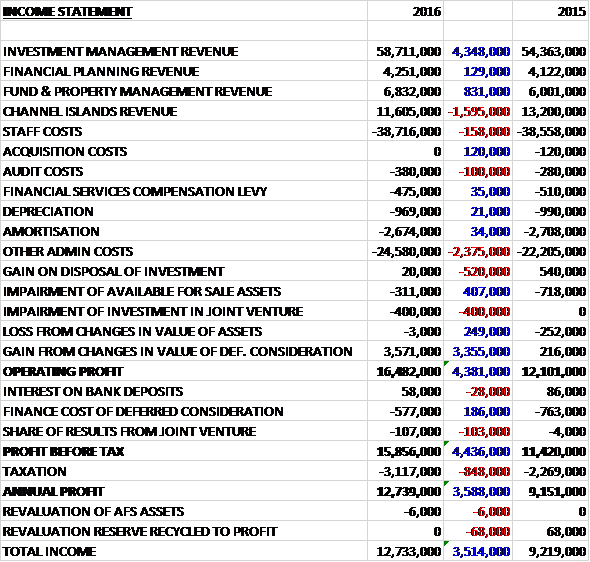
Revenues increased when compared to last year as a £1.6M decline in Channel island revenue was more than offset by a £4.3M growth in investment management revenue, an £831K increase in fund and property management revenue and a £129K growth in financial planning revenue. Staff costs increased by £158K and other admin costs were up £2.4M. There was also a £400K impairment in a joint venture relating to the investment in North Row Capital which was offset by a £407K reduction in the impairment of available for sale assets relating to the Student Accommodation Fund. We also see a £520K decline in gains on investment disposals as the disposal of Sancus Holdings was tied up, offset by a £249K reduction in losses from changes in asset values and a £3.4M increase in the gain from changes in the value of deferred consideration which meant that the operating profit grew by £4.4M when compared to 2015. The finance cost of deferred consideration also reduced, down by £186K, but tax charges grew by £848K, mainly due to under provision in previous years, which meant that the profit for the year was £12.7M, an increase of £3.6M year on year.

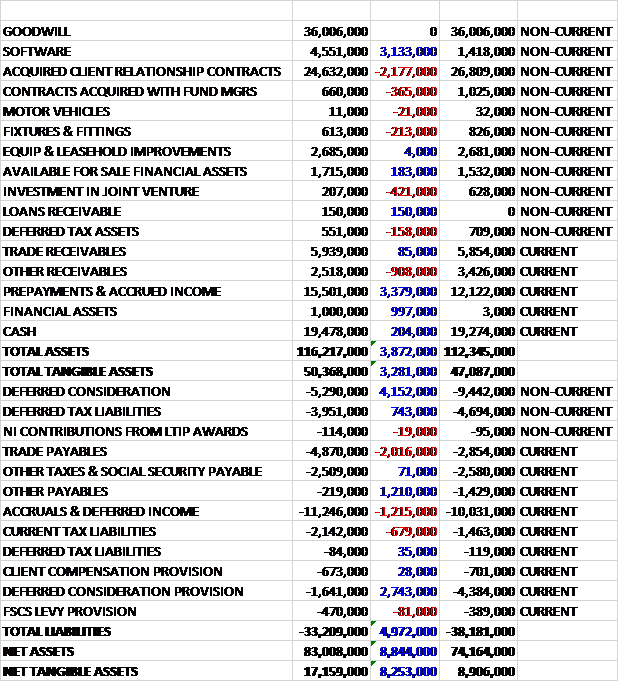
When compared to the end point of last year, total assets increased by £3.9M driven by a £3.4M growth in prepayments and accrued income, a £3.1M increase in the value of software and a £997K growth in financial assets, partially offset by a £2.2M decline in acquired client relationship contracts and a £908K reduction in other receivables. Total liabilities declined during the year as a £2M growth in trade receivables and a £1.2M increase in accruals and deferred income were more than offset by a £6.9M decline in deferred consideration and a £1.2M fall in other payables. The end result was a net tangible asset level of £17.2M, a growth of £8.3M year on year.

Before movements in working capital, cash profits remained broadly flat at £18.3M. There was a cash outflow from working capital, however, and tax payments increased by £1M to give a net cash from operations of £14.8M, a decline of £3.6M year on year. The group spent £3.3M on intangible assets, £751K on property, plant and equipment, £500K on available for sale financial assets, £1M on other financial assets and £3.9M on deferred consideration to give a free cash flow of £5.3M. Of this, £4.4M was spent on dividends and £1.1M on their own shares to give a cash flow for the year of £204K and a cash level of £19.5M at the year-end.

The profit in the Investment Management business was £17.8M, a growth of £2.1M year on year. The discretionary funds under management rose to over £8.3BN, an increase of £880M. This represents an increase of 12% of which 11.7% was new business and 0.3% investment growth. Growth was largely generated internally, predominantly via their work with professional introducers. The group continue to work with an increasing number of professional intermediaries.

The bespoke discretionary portfolio service now manages over £6.4BN and pension funds along with ISA portfolios remain a substantial growth opportunity here. The managed portfolio service saw assets exceed £617M and the board view this as a strong area of growth. The financial planning business continued the trend of the prior year. Consulting work rose while employee benefits had a difficult year. Work generated into the investment management business remains robust and they will be looking to launch a pension default fund for employee benefit clients early in the next year.

The loss in the Financial Planning was £60K, an improvement of £8K when compared to last year. Numbers of clients increased over the course of the year and the division remains a major introducer of new investment management funds to the group. During the year there was a further investment in systems and staff which meant that despite the small increase in revenues, there was not much of a movement in profits.

The loss in the Funds and Property Management business was £624K, an increase of £60K when compared to 2015. It has been a year of growth for the business across the range of funds it manages. Total Funds under management increased by 20% to £796M with the growth achieved both organically and through new investment into the funds with particularly strong flows into the multi asset funds.

The Ground Rents Income fund performed well during the year with an increase in the net asset value. It was the intention to launch two further property related funds in the second half of the year but due to the Brexit result, these were postponed and will be reviewed again next year. As mentioned below, the group incurred a £400K impairment charge on the investment in North Row Capital along with a £100K share of losses in the business.

The estates business had an improved year although the value of assets under management marginally declined to £1.1BN. Following a review of the business and some changes to the board, additional revenue streams were identified which saw an increase in turnover of 9% over the previous year despite the fall in the value of assets under management. As a result the estates business broke even for the year compared to a £400K loss last year.

The profit in the International business was £453K, a decline of £862K year on year. The business saw an increase in FUM during the year of 16% to £1.35BN with new business from a number of sources and new jurisdictions including South Africa and the conversion of previously non-managed advisory and execution clients.

The planned conversion of advisory accounts to discretionary accounts saw a significant reduction in the transactional income of the business with total revenues falling by 12%. Whilst the associated costs of the advisory clients have been reduced, these have not matched the timing of the loss of revenue together with the increased legal fees in the year, particularly dealing with some legacy issues prior to the acquisition hence the fall in profit.

The growth in the FUM and the expanded sources of international introductions together with the further rationalisation of the core client proposition in line with that offered in the UK means that the board believes the business will see an increase in profit in the next year.

Regulatory changes continue with a major focus on MiFID II. This has been postponed until January 2018 but the group are ensuring the business is well prepared for the substantial changes around transaction and client reporting.

The Brexit vote had an effect on results. In the first half the group decided to postpone the launch of two funds. In the second half, investment returns were challenging and in Q4 investor sentiment was weaker. Markets have improved since the referendum vote but sentiment remains volatile.

The group have continued with their IT system development with three external providers. The time scale for completion has now moved out to mid-2017, but this still remains on budget. In addition they have completed their brand refresh which modernises the look and feel of the marketing and has firmly positioned the business as an investment management business as this remains the key driver for growth. As such, they will be moving their funds and UK asset management business into one brand, Investment Management in early 2017.

The Student Accommodation Fund is promoted by the group. The shareholders of the fund approved a resolution in May to sell the underlying property portfolio to a third party. The shares will subsequently be compulsorily redeemed out of the remaining net assets of the fund following the sale, although the process had not been completed as of the year-end. The group has therefore estimated the fair value of the group’s investment at £471K based on the most recent information made available to investors. This has given rise to an impairment loss of £311K during the year.

During the year the group acquired 500,000 redeemable preference shares in an unlisted company at a cost of £500K. The shares are redeemable any time after five years from the date of issue and bear an entitlement to a fixed preferential dividend of 8% per annum of the nominal value of the shares.

An impairment loss of £400K was recognised during the year to reduce the carrying amount of the group’s investment in North Row Capital to its estimated recoverable amount. Based on the most recent forecasts, the future cash flows from the partnership will accumulate slower than originally anticipated and as a result it will take longer for them to realise a cash return on the investment in the joint venture.

Payments totalling £3.9M were made relating to deferred consideration which included the final payment of £524K to the vendor of JPAM, the final payment of £2.1M to vendors of DPZ and a further payment of £1.2M to the vendors of Levitas. There was an adjustment to reduce the fair value of deferred consideration in respect of Levitas by £3.3M. The amount payable is based on the incremental growth in FUM of the TM Levitas funds. As forecast growth was not achieved during the year, it was subsequently revised and the estimated future deferred consideration payments reduced accordingly. Adjustments were also made to reduce the fair value of deferred consideration attributable to DPZ by £225K and JPAM by £3K.

After the year-end the group disposed of its entire holding of GLIF shares for proceeds of £735K, representing a realised loss on disposal of £15K. The sale of the underlying property portfolio of the Student Accommodation Fund completed in July. The final net asset value of the fund had not been determined at the date of signing these financial statements but is expected to be available by the end of September with the final payment of the redemption monies expected in October 2016.

Going forward the group have made a good start to the new financial year with further organic growth in discretionary FUM.

At the current share price the shares are trading on a PE ratio of 27.5 which falls to 18.4 on next year’s consensus forecast. After a 15% increase in the total dividend, the shares are yielding 1.7% which increases to 2.2% on next year’s forecast. The group has no borrowings so had net cash of £19.5M at the year-end compared to £19.3M at the same point of last year.

On the 20th October the group released a funds under management statement for Q1. As of the period-end discretionary funds under management totalled £8.922BN, an increase of 7.5% in the quarter compared to the WMA balance index which increased 5.2%. This growth was a combination of new business (£170M) and the performance of the funds (£451M).
Notwithstanding potential market volatility, the board look forward with confidence as they continue to leverage the growing strength of the brand, investment offering and professional intermediary relationships.

On the same date the group announced that Caroline Connellan will be joining the group as CEO. She was most recently head of UK Premier and Wealth at HSBC. Chris Macdonald will remain with the group in his current role of CEO becoming Deputy Chairman with effect from April. It is the intention of the board that Chris will become Chairman in the future.

On the 26th January the group released a half year trading update. Over the last six months discretionary funds under management have risen by 12.4% to £9.33BN. This is compared to a rise in the WMA balanced index of 7.8% with increases seen across asset management, funds and international.

Net organic growth over the period was 4% against a backdrop of uncertainty following the Brexit vote and later surrounding the implications of a Trump presidency. These outcomes dented client sentiment and whilst portfolios have performed well, the board expect market volatility to remain. The group have continued to progress as planned with their IT system development whilst pursuing the core strategy of growing the business organically and trading in the first half is in line with management expectations.

Overall then this has been a decent performance for the group. Profits increased but this was due to changes in deferred consideration so without this, profits were flat. Net assets increased but the operating cash flow reduced. This was due to working capital movements, however, and without this cash profits were broadly flat with a decent amount of free cash being generated.

The Investment Management business has been the driver for growth with funds under management increasing due to new business. Financial planning saw no movement in its slightly loss making position as increased investment matched the revenue growth. The funds business saw losses widen, mainly as a result of the North Row impairment and loss for the year but the international business saw the biggest deterioration in performance due to the move of clients from advisory to discretionary products and increased legal fees due to a legacy issue.

The Brexit vote makes the market more volatile that it would otherwise been and so far this year there has been decent organic growth. With a forward PE of 18.4 and yield of 2.2% these shares are not cheap so it seems we are paying for quality. Tricky one this, overall I think the price is probably justified despite the market uncertainty.

Gemfields Share Blog – Final Results Year Ended 2016

Gemfields has now released its final results for the year ended 2016.

Revenues increased when compared to last year as a $15.4M decline in ruby revenues and a $2M fall in UK/Other revenue was more than offset by a $36.3M growth in emerald revenues and a $2.9M increase in Faberge revenue. Mineral royalties and taxes increased by $5.4M due to a higher tax rate at Montepuez, labour costs were up $3.3M, fuel costs grew by $1.1M, repairs and maintenance increased by $2M and security costs were up $1.7M but depreciation and amortisation declined by $4.5M due to the increased life of mine to give a gross profit $9.3M above last year. Selling, marketing and advertising costs fell by $1.7M but rent/rate costs grew by $1.6M and other selling and admin costs were up $2.3M to give an operating profit $9.5M higher. There was a $7.5M positive swing in forex differences by loan interest grew by $1.7M and tax charges increased by $4.4M to give a profit for the year of $11.9M, a growth of $8.2M year on year.

When compared to the end point of last year, total assets increased by $8.7M driven by a $7.1M growth in inventories due to the ramp-up in production at Montepuez and higher jewellery inventory at Faberge, a $13.5M increase in cash and a $3.4M increase in freehold land and buildings, partially offset by an $8.2M fall in deferred stripping costs, a £5.5M reduction in the value of evaluated mining properties and a £4.8M decrease in the value of plant and machinery. Total liabilities declined during the year as a $12.5M fall in deferred tax liabilities as the dollar strengthened against local currencies and a reduction in the Zambian tax rate, and a $5.3M decline in trade payables were partially offset by a $6.8M growth in borrowings and a $5.7M increase in other payables. The end result was a net tangible asset level of $265.8M, a growth of $11.5M year on year.

Before movements in working capital, cash profits increased by $5.4M to $71.4M. There was a cash outflow from working capital but this was much lower than last year so after tax payments increased by $6.5M the net cash from operations was $42M, a growth of $25.1M year on year. The group spent $1M on unevaluated mining projects, $1.4M on loans to Kariba, $5.9M on stripping costs and $11.9M on property, plant and equipment to give a free cash flow of $22.3M. The group paid $3.1M in interest and $11.5M to the non-controlling interests so that after a net $6.8M of new loans, there was a cash flow of $13.9M and a cash level of $41.7M at the year-end.

The market of worked emeralds, rubies and sapphires continued to expand during 2015. Global imports of increased by 13% compared to diamond imports which declined by 17%. The broader coloured gemstone and pearl market slowed slightly, by 5%. France’s imports doubles, UK imports were up 7% but Italy and Switzerland both slowed, down 13% and 6% respectively. China, India and the US remain the most significant consumer markets, however.

The profit at Kagem was $35.8M, a growth of $26.5M year on year. During the year the group produced 30M carats of emerald, broadly flat when compared to 2015, at an average grade of 241 carats per tonne (also broadly flat). The Chama pit contributed 27.1M carats and the bulk sampling projects 2.9M carats. The mine is apparently well positioned to increase production to more than 40M carats over the next three years.

Following the updated resource statement, Kagem changed its mine plan from previously undertaking significant high wall pushbacks to now undertaking continuous waste removal and mining. The previous high was pushback campaigns whose costs were capitalised as deferred stripping costs ceased in September 2015.

There was a marginal increase in unit operating costs from $1.48 per carat to $1.58 per carat, largely on account of the increased scale of in-house mining and exploration activities. The mine has also updated its mine plan and started continued waste stripping of the Chama pit over the life of the mine which has contributed to increased costs. Cash rock handling costs decreased by 15% to $2.48 per tonne with the increased scale of in-house mining and improved mine planning and design driving further efficiencies.

During the year a total of $6.1M was invested in new mining and ancillary equipment, deferred stripping costs and improving the mine’s facilities and infrastructure. Of this, $2.5M was spent on deferred stripping costs and $3.6M on additional mining equipment to increase production capacity and replace existing mining equipment.

Improvements to the wash plant continued resulting in a doubling of capacity with output increasing to 66 tonnes per hour. Fluorescence and colour-based optical sorting pilot tests were carried out during the period and delivered positive results, with the potential to implement further improvements into the system in the coming years. These improvements should deliver reduced maintenance costs and losses, and increased ore processing capacities.

Following the completion of the updated resource and reserve statement, further drilling was conducted at the Chama pit to establish depth continuity up to 950m on the down-dip side of this resource. An ore genesis model for Libwente is also being developed with more geological and exploration work to follow in the coming year.

There were four auctions held during the year with the latest being in May in India where commercial quality emeralds were offered which achieved $5.15 per carat compared to $4.32 per carat earlier in the year. The latest higher quality auction achieved $70.68 per carat compared to $58.42 earlier on.

The profit at Montepuez was $32.7M, a decrease of $6.3M when compared to last year. During the year the group produced 10.3M carats of ruby, a growth of 1.9M carats, mainly as a result of the upgrades to the wash plant design and this included a 68% increase in higher quality rubies recovered. They had a grade of 35 carats per tonne compared to 26 last time and unit operating costs were marginally lower at $2.54 per carat compared to $2.57 last time due to improved efficiencies of scale. Cash rock handling unit costs remained stable at $6.06 per tonne.

A new and potentially promising pit called Glass A, situated within the Maninge Nice Block was opened towards the end of the year but excavation was primarily focused on the Mugloto block (70%) with 23% coming from the Glass A pit in order to extract ore-bearing higher quality rubies.

During the year, upgrades to the wash plant consisted of replacing the old double deck screen with a new larger screen which resulted in improved screening performance and reduced carry over of unscreened material. New foundations were cast and the longwasher was replaced with a newer model. Construction of a new water treatment plant was commissioned towards the end of the year. This will improve the quality of water available for running the plant as well as the overall efficiency of the jigs. Further upgrades to the plant are planned for the coming year including the installation of a DMS plant and upgrades washing facilities. The upgraded plant is expected to be commissioned in the first half of 2017 calendar year.

During the year a total of $7.5M was invested in new mining and ancillary equipment, as well as in improved facilities and infrastructure. Of this, $5M was spent in expansion and exploration with the remaining $2.5M spent on replacing existing mining equipment.

Exploration undertaken during the year mainly consisted of drilling, bulk sampling and the study of aerial survey data. Exploration undertaken on the Maninge Nice block highlighted three new areas called Glass, Leopardo and Maninge Nice East. By the end of the year, a new bulk sampling pit was opened and designated as Glass B. This pit is currently undergoing top soil removal.

Two auctions were held during the year with a total of 1.7M carats of higher and commercial quality rubies placed on offer with the average sale value per carat being $45.50. The latest mixed auction achieved an average price of $26.02 per carat which was below the other auctions that took place.

The loss at Faberge was $10.9M, an improvement of $4.2M year on year. Faberge revenues increased by 33% and units sold grew by 81% with the operating costs falling by 2%. The business continued to expand its global presence during the year with an increased number of agreements with multi-brand retail partners. The total number of Faberge outlets increased from 20 to 32 during the year. The business refurbished both of its London stores with the Harrods refurb including relocating to an area of improved footfall and achieving 50% greater shop front in the Fine Jewellery Room. They closed their Geneva location during the year.

During the latter part of the year the business dedicated particular attention to building its digital footprint. An improved online presence and refreshed social media strategy saw online engagement greatly improve, paving the way for further development over the year ahead.

At Kariba, a new geological exploration programme is planned to start in October 2016 with the principal aim being to re-confirm the mineral resources available at the mine. Production of rough amethyst was 964,549kg, a reduction of 19,159kg year on year although the grade nearly doubled to 61kg per tonne. A total of 16.7M carats of higher quality rough amethyst was sold in Singapore in September 2015 and Lusaka in April 2016 for a total of $660K. At the year-end, mixed grade stock of rough amethyst ready to be sold, bagged and labelled was 310,000Kg.

A new sort house has been constructed where contractors sort under natural light conditions to address the market demand for specific high quality, small sizes of amethyst. Seven additional storage silos have been erected to increase the stock holding capacity to 800 tonnes and a new warehouse loading point on the main highway to Namibia is under construction. A solar power supply project is underway with a test phase being deployed at the employee accommodation complex.

In Ethiopia, the excavation of a further nine trenches in the Dogogo North Block statted in February and was completed in June. The exercise confirms the existence of contact zones between pegmatites and talc schists which offer potential areas for finding mineralised reaction zones. The occurrence of beryl has been recorded in some of these locales. A diamond drilling programme was planned for the Dogogo South Block to establish the dip continuity of the ore body identified during trenching and pitting with operations starting in July.

In Sri Lanka, equipped with renewed trading licenses the group finalised the standard operating procedures for trading operations and for positioning themselves to start procurement of gemstones early in the coming year. During the year, exploration activities were carried out on selected areas and reports have been submitted to the local authorities for license renewal. In Madagascar the group will not look to progress any further exploration programmes until it has all the relevant licenses in place and the assurance of some degree of political stability and support.

In September 2015 the group announced the agreement to acquire controlling interests in two emerald projects in Colombia. One of the projects relates to the acquisition of a 70% interest in the Coscuez emerald mine for a total consideration of $15M, to be paid in tranches of cash and shares. Completion of the transaction is subject to the resolution of a dispute between the current owners of the license and the government which was initially expected to be resolved by March 2016. These discussions are ongoing and resolution remains imminent, hopefully before the end of Q2 2017. The license covers an area of 47 hectares with the Coscuez mine having been in operation for over 25 years and known to have produced some fine emeralds.

The second project relates to selected exploration prospects held by ISAM Europea via the acquisition of 70% and 75% interests in two Colombian companies holding rights in respect of mining license applications. The licenses cover about 20,000 hectares and eight of the applications have been approved with the remaining assignments being reviewed by the Colombian Mining Authority. The total consideration payable is $7.5M to be paid in tranches of cash and shares.

Going forward, revenue growth is likely to be driven by a moderate increase in achievable prices and increased volumes of goods placed on offer. Faberge is targeting generic growth from directly operated retail boutiques in London and New York, alongside expansion of its global presence through agreements with multi-brand retail partners. Production-wise, Kagem is targeting 30 to 35M carats next year and Montepuez 10 to 12M carats supported by expansion measures including converting the current wash plant to an integrated processing unit with an additional dense medium separation, optical sorting and sorting facility within the wash plant that is expected to be commissioned by early calendar year 2017.

In 2017, at Kagem total capex is expected to be around $10M including some new mining fleet to support an increase in mining capacity. At Montepuez, total capex is estimated at $25M and includes converting the current wash plant to an integrated processing plant with an additional dense medium separation, optical sorting and sorting facility within the was plant and the first stages of a second plant which will be commissioned in 2018. There is an estimated $10M of capex to be spent on other assets such as Coscuez.

At the current share price the shares are trading on a PE ratio of 28.4 which increases to 49.2 on the full year forecast.

On the 30th September the group announced the results from the Jaipur commercial quality emerald and higher quality amethyst auctions. The emerald auction brought in $10.7M at $3.28 per carat, of which 81% were sold. The amethyst auction brought in $400K at $3.73c per carat, a very good price, with 86% being sold. The emerald price was a bit disappointing and worse than the last three auctions of commercial quality stones and there is evidence of a softening in demand for some of the lower qualities in some markets.

On the 18th October the group announced the resignation of COO Devidas Shetty to pursue opportunities outside of the business (well, duh!) CFO Janet Boyce will join the board.

On the 1st November the group released an update covering Q1 2017. They produced 6M carats of emeralds with an average grade of 174 carats per tonne compared to 7.5M carats at 237 carats per tonne in Q1 last year.

The difference is attributable to the varied nature of the mineralisation and a higher grade zone mined in the comparative period. Total operating costs declined by $1.2M to $10.2M with unit operating costs increasing from $1.52 per carat to $1.70. Cash rock handling unit costs increased from $2.05 per tonne to $2.37 due to harder rock mining at deeper levels.

Continued mining of new areas within the Chama pit with optimised production scheduling has assisted in further improving mining efficiencies and productivity. Exploration and bulk sampling activities in the Fibolele and Libwente sectors continued in the current quarter. Increasing the share of bulk emulsion explosives has further improved blasting performance and resulted in further optimised rock fragmentation leading to less wear and tear of fleet buckets and improved cost of production.

The group produced 4.5M carats of rubies with an average grade of 44 carats per tonne compared to 500K carats at 7 carats per tonne, supported by the processing of the higher grade but lower value amphibolite resources. Total operating costs declined by $300K to $5.87M with unit operating costs falling from $12.20 to $1.29 per carat as a result of the increase in the carats produced. Cash rock handling unit costs of $4.27 per tonne declined from $4.40 last time as a result of increased efficiencies and favourable exchange rate movements.

Operations at two new pits in the Mugloto and Glass areas started during the quarter and the stripping ratio decreased from 7.3 to 4.2 due to the mining of exposed ore that was stripped during the previous quarters. During the period the wash plant saw a 41% increase in the tonnes processed, attributable to improved production planning, a reduction in plant stoppages, the commissioning of a new water treatment plant and the processing of pre-screened material. Planned upgrades to the wash plant are currently being progressed and the enhanced plant is expected to be operational by the end of December.

At Faberge, the value of sales orders agreed during the quarter fell by 23% largely due to the opening of two significant wholesale partners in Q1 last tear. The average selling price per piece increased by 2% and the total operating costs for the quarter fell by 1% with the number of sales transactions increasing by 67%.

During the period the group continued pre-emptive exploration and mine planning activities in Colombia as part of the arrangements for future operations at Coscuez. Planning of equipment and workforce requirements has also been carried out. Several meetings with the present license owners were conducted to determine the mechanism of debt payment to the Colombian mining agency given that they are looking for financing the debt prior to completion.

In Sri Lanka the group announced the next phase of development by offering an expression of interest in the local media calling for interested parties to supply gemstones. In the first phase, a total of five suppliers have been appointed as preference suppliers. The authorities have renewed the exploration license for four blocks veering diverse minerals as a result of the completion of the first phase of exploration works.

In Ethiopia the drilling programme started at Dogogo South in July is now well underway with 1,855m of 3,500m completed. The objective of the programme is to confirm the depth continuity of the ore body that was exposed during the trenching and pitting exercise by intersecting it at 25 and 50 metres depth. Drilling completed so far confirms pegmatitic activity and the presence of reactions zones along 800m strike length. Bulk sampling is expected to ramp up in H2 2017.

On the 1st December the group announced that the latest higher quality emerald auction has been delayed until February. Apparently this is due to the new demonetisation programme in India which will acquire an adjustment period to allow companies to adapt to the new policies. The ruby auction will proceed as the customers are more diverse. There is no change to the revenue guidance for the year.

On the 19th December he group released the results for the mixed quality ruby auction held in Singapore. The auction generated revenues of $30.4M with a realised price of $27.79 per carat, selling 80% of the total on offer. The prices achieved continue to indicate good overall global demand but they are slightly lower than last time due to a different mix.
On the 6th February the group released a trading update covering Q2 2017.
The group produced 4.7M carats of emeralds with an average grade of 156 carats per tonne compared to 8.2M carats with a grade of 272 carats per tonne his time last year with the difference being attributable to the varied nature of the mineralisation and a lower grade zone mined in the current quarter. Total operating costs declined by $1.9M to $10.2M but unit operating costs increased from $1.48 per carat to $2.17 per carat with the increase being attributable to the lower number of carats recovered in the quarter. The cash rock handling unit cots were broadly flat at $2.88 per tonne.

During the period the group produced 1.1M carats of ruby at an average grade of 12 carats per tonne compared to 1.6M carats at 22 carats per tonne last time as a result of the lower grade but higher value material being processed. Total operating costs declined by $300K to $6.6M but unit operating costs grew from $4.31 per carat to $6 per carat as a result of the reduction in the number of carats produced. Cash rock handling unit costs declined from $5.02 per tonne to $4.90 per tonne.

Operations started at a new pit within the Mugloto area during the quarter. A new bulk sampling block called Maninge Nice East has also been opened. The wash plant saw 89,400 tonnes processed, a 25% increase year on year. This increase, despite the requisite shutdown period, is attributable to fewer plant stoppages, processing of pre-screened material and the addition of the newly installed water treatment plant to the circuit. Planned upgrades to the plant were completed by the end of December and the enhanced plant is expected to double the average operational throughput rate to 150 tonnes per hour once fully operational.

At Faberge sales orders agreed during the quarter increased by 95%, the number of sales transactions increased by 48% and the average selling price increased by 12%. The total operating costs for the quarter increased by 2%, however, largely due to an increased marketing and events spend.

The group continues to progress the conclusion of the Cosquez transaction with further due diligence at an advances stage. A misalignment of commercial objectives between the shareholders in the ISAM transaction, however, and project delays have led to an agreement not to complete this acquisition. They remain focused on finalising all matters in relation to the Conscuez transaction though.

In Ethiopia the drilling programme at the Dogogo South block was completed in December and Pegmatite was intersected in all sections along the 800m strike length. Furthermore a level plan at 1,300 metres reduced level confirms the presence of three sets of pegmatitic bodies. Drilling also confirms the depth continuity of the ore body that was exposed during trenching and pitting up to 50m depth. The group submitted an annual progress report, a work programme for 2017 and an application for the extension of its exploration license by a further year. Ground preparation is underway for the start of bulk sampling in the next year.

In Sri Lanka, while positive progress had been achieved last quarter, various factors have impacted the group’s ability to progress these projects to the extent they would have like to. The long term future of the project is therefore under review and a more definitive decision is likely to be made in the near term.

The exploration license 5061L in Mozambique was converted and issued by the ministry of mines in November, valid for 25 years. The license covers an area of 116sqkm. At the period-end the group had a net debt position of $46M which seems quite high.

Overall then, last year’s results were pretty good with increased profits, net assets and operating cash flow with some free cash being generated. The two main mines both seem to be ticking along well and Faberge, although still loss making seems to be improving. So far this year, however, the commercial emerald market seems to be softening and the group have put of an auction apparently related to the Indian demonetisation.

In the first half of the year emerald production has been lower as the group have moved on to a lower grade area. Ruby production has been mixed and was higher in Q1 but lower in Q2 as they moved to a lower grade but higher value area. The wash plant seems to be working well at Montepuez, however, which adds capacity. There has been some disappointment in some of the new areas with one of the Colombian deals falling through and operations in Sri Lanka being put under review.

The PE forecast for this year is around 49.2 which looks a bit too expensive to me given the problems in the new projects and reductions in production in the main mines.

On the 12th May the group released a Q3 update. Kagem produced 4.5M carats of emeralds with an average grade of 193 carats per tonne compared to 7.1M carats at 297 carats per tonne in Q3 2016. This decline is being attributed to the varied nature of the emerald mineralisation, high rainfall and a renewed focus on opening new areas for future production. Unit costs increased from $1.58 per carat to $2.13 due to the lower number of carats recovered in the quarter and cash rock handling costs increased from $2.62 per tonne to $3.55 due to the reduction in total rock handling following the higher rainfall.

An auction of higher quality emeralds was held in February which generated revenues of $22.3M at an average realised value of $63.61 per carat, the third highest price achieved to date.

The lower production from Kagem is expected to reduce the targeted total production for 2017 to between 20 and 25M carats. Added focus was placed on the improvement in operational efficiencies, containment of costs and exploration and bulk sampling activities at the Fibolele and Libwente sectors. These efforts have begun to deliver some positive results with production volumes trending upwards after the period-end.

Montepuez produced 1.2M carats of ruby with an average grade of 7 carats per tonne compared to 2M carats at 30 carats per tonne in Q3 2016. This is due to the lower grade but higher value ore being processed with the quantity of premium rubies recovered increasing by 92%. The unit operating costs increased from $2.9 per carat to $5.42 as a direct result of the decrease in carats produced but rock handling costs decreased from $10.18 per tonne to $5.37 due to the increase of rock handling whilst costs were maintained.

There was an increase of almost 170% in the tonnes processed which was attributable to the upgraded processing plant which, despite not yet reaching its target capacity, attained an average operational rate of 132 tonnes per hour during the quarter. This represents a 127% increase. The upgraded processing plant includes a new scrubber, de-grit unit and DMS unit. The processing of pre-screened material and an overall reduction in plant stoppages also contributed to the record tonnages. The construction of the Montepuez camp is proceeding to plan and is expected to be completed by June.

Given that the production focus will be on processing lower grade but higher value ore for the remainder of the year, the targeted total production is now estimated to be between 8 to 10M carats compared to previous guidance of 10 to 12M carats.

The number of Faberge pieces sold during the quarter increased by 63%, supported by an 18% increase in the number of sales transactions. Sales orders agreed declined by 39%, however. Total operating costs for the quarter fell by 13%.

In Ethiopia the geochemical analysis and interpretation of the drilled diamond core samples from the Dogogo south block has been completed. The data confirm the presence of three sets of pegmatitic bodies and the analysis confirms the presence of chromium in the ultramafic TMS formation and reaction zones were visually observed in the drilled core. Prelim ground work for a bulk sampling exercise is underway and following the progress of the exploration and the good standing of the project to date, the exploration license was renewed in January for a further year.

An exploratory pitting exercise was carried out in the Dogogo north block at the potential contact zones exposed during the trenching exercise. Beryl samples were recovered from some of the pits. A detailed geological mapping exercise was completed in the Nana block which covers 2km of prospective strike length of emerald mineralisation.

In Colombia the group and their prospective partner have made the joint decision to withdraw from the Coscuez transaction on the grounds that not all of the conditions precedent to the existing share purchase agreement were able to be satisfied within the stipulated timeline. In Sri Lanka, following on from the internal review of operations a decision was made not to progress the operations and the related facilities in Ratnapura and Colombo have since been closed.

Overall then there are a lot of moving parts here but it seems Montepuez is faring quite well, assuming the higher value ore will offset the lower grades but Kagem seems to be struggling a bit with the lower grade ore now being mined. The bad weather obviously doesn’t help but I am not sure the time is right to buy these shares.

On the 19th May the group announced that an offer had been made by Pallinghurst for the company. For each Gemfields share they are offering 1.91 Pallinghurst shares which values the shares at 38.5p and the entire company at £211.5M. From the outset Pallinghurst have been the largest shareholder and together with the irrevocable undertakings received so far, have 75.27% of the total share capital which means that the offer has become unconditional.

Pallinghurst have not engaged with the company with respect to the offer and the board strongly advise shareholders take no action at this time. I have to say that this seems very opportunistic and if I were a Gemfields shareholder I would be very vexed by this course of events – whether there is any defence to be made is another matter.

For what its worth there was also an Emerald auction held in India which took in revenues of $14.5M at a robust price of $4.68 per carat which is the second highest average price achieved for a commercial quality emerald auction. Also, all of the carats offered were sold which is a first for such an auction.

On the 31st May the group released a statement saying that an independent committee has concluded that the offer is derisory and clearly undervalues the company. They believe that the offer has the potential to dilute Gemfields shareholders with inferior assets that offer exposure to more volatile commodities with less attractive prospects. The offer would appear to have been driven by Pallinghurst’s proposed restructuring with seeks to preserve management’s own self interests at the expense of Gemfields shareholders. These are strong words and the committee strongly advises shareholders to take no action at this time.

Despite the fact the board believe the Pallinghurst offer undervalues the group it looks like it is a done deal. What a shame. It seems to me that Pallinghurst have acted very poorly here and this is a terrible deal for Gemfields shareholders.

Numark Security Share Blow – Interim Results Year Ending 2017

Newmark Security has now released its interim results for the year ending 2017.

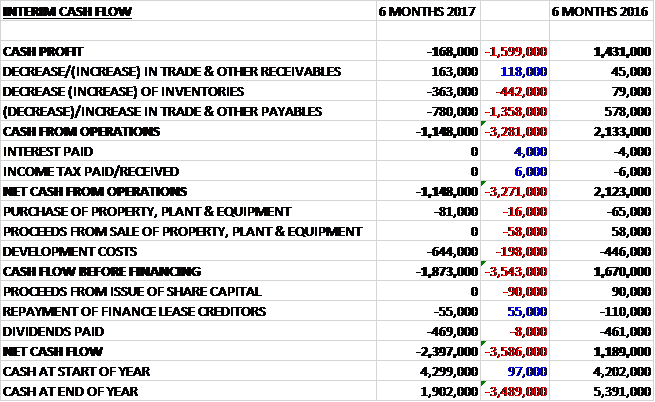
Revenues declined when compared to the first half of last year as a £3M fall in asset protection revenue was only partially offset by a £187K growth in electronics revenue, Cost of sales declined by £1.3M to give a gross profit £1.5M below that of last time. Admin expenses increased by £70K but tax charges declined by £82K to give a loss for the period of £816K, a detrimental movement of £1.5M year on year.

When compared to the end point of last year, total assets declined by £2M driven by a £2.4M reduction in cash, partially offset by a £369K growth in inventories. Total liabilities also declined due to a £791K fall in payables. The end result was a net tangible asset level of £4.3M, a decline of £1.3M over the past six months.

Before movements in working capital, cash losses saw a detrimental movement of £1.6M to -£168K. There was also a cash outflow from working capital compared to an inflow last time so the net cash outflow from operations came in at £1.1M, a detrimental movement of £3.3M year on year.
The group spent £644K on development costs and £81K on other capex so that before financing there was a cash outflow of £1.9M. After dividends were paid out too, there was a cash outflow of £2.4M and a cash level of £1.9M at the period-end.

Asset protection revenue was 39% lower, mainly as a result of the expected reduced contribution from sales of time-delay cash handling equipment to the Post Office which saw the sales of cash handling equipment fall 37%. Product division revenue was 31% lower. The lead up to the Brexit vote resulted in many customers putting plans on hold and afterwards there was the cancellation of planned work by several customers, including government departments, resulting in reduced orders. Sales were further reduced by the cancellation of a sales order for the supply of time delay cash handling equipment to a longstanding financial institution after they agreed to sell 300 of their high street branches.
Revenues from Eclipse Rising Screens were effected by reduced spending from two long standing financial institution customers. CounterShield revenue was lower as a result of a planned refurb programme for a large police force being delayed to the sale of their HQ. Sales of Fixed Glazing products were unchanged with increased competition from low cost counter suppliers.
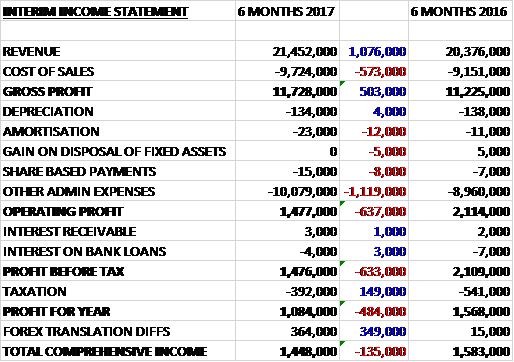
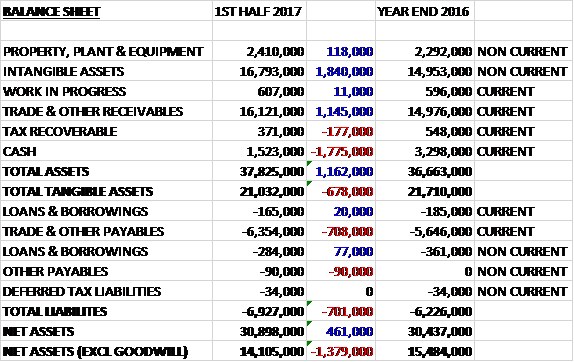
Sales within the service division in the first six months have been challenging with the impact of branch closures that have occurred in the banking sector. Towards the end of the period, they embarked on the installation of their new TC105 rising screen activation system which the board expect to provide good revenue streams over the next few years, replacing the now obsolete TC104. Pneumatic upgrades continue as budgeted. Action to readdress resources within the division have been taken and overhead were reduced by 7%. The new field management software has now been bedded in and provides invoice capture and cash flow advantages. They continue to explore and develop their other product offerings and to reduce their reliance on rising screen revenue streams in the future.
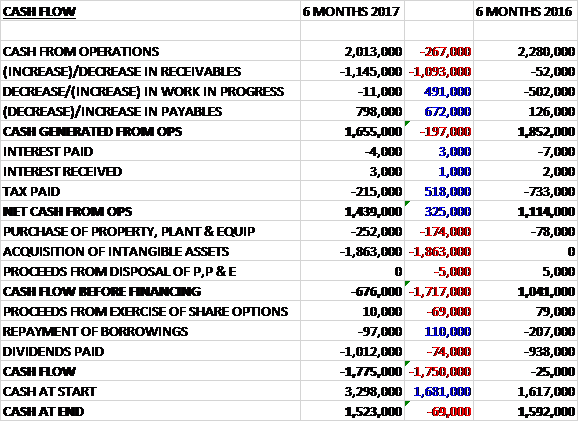
In Access Control, revenues from SATEON continued the strong growth trend shown in previous periods, increasing 80% compared to the corresponding period last year. Much of this growth came through the upgrade of existing JANUS sites with many end users keen to continue long standing relationships with the group. Notable projects included Greater Manchester Fire Service and a major defence contractor.

JANUS revenues continued to decline in line with expectations as less new projects were completed. The product remains the platform of choice, however, for many end users and a major rollout continued for one of the world’s largest data centres. Significant investment was made developing SATEON version 3.0 software and SATEON Advanced Hardware, both of which were released at the begging of H2, later than originally anticipated. SATEON Advanced Hardware in particular is expected to become the majority Access Control revenue generator through the second half of the year and into next.

In workforce management development resources were focussed on the GT-10 employee terminal, released towards the end of the first half. GT-10 has an Android based operating platform, allowing current and potential software partners to integrate their web-based offerings seamlessly, where they have existing Android based apps. First launched at a US trade show, negotiations have started with several potential major workforce management software providers in the US, UK, Europe and Middle East. In addition to existing markets, GT-10 provides an opportunity to generate revenue in new markets and the group has begun research into several vertical sectors to investigate the potential return on investment available.

Sales of existing RS and IT series of WFM terminals continued in line with management expectations. The group has recently secured a new £350K contract with a steel producer for the supply of its IT31 WFM terminals. This order will be shipped in two tranches with £200K realised in the current year and £150K next year.

In North America, business development activities increased to leverage the potential that exists for growing WFM revenues. The directors consider that the US market remains the region with the fastest growing growth opportunities. For the first half WFM revenues grew 11% and a number of marketing initiatives are planned for the second half to increase brand awareness through the sales channel and into end-user markets.

The Hong Kong business saw revenues fall well short of expectations. As revenues were not forecast to significantly improve over the short to medium term a decision was taken to withdraw from the country during the period.

The shares are trading on a historic PE rating of 5.1 but this is likely to be much higher this year – I cannot find a forecast but the management state that they expect to make a loss this year. There is no interim dividend proposed, which is usually the case.

Overall then this has been a pretty terrible period for the group. They made a loss, net assets reduced and there was on operating cash outflow. The Asset protection division has a disastrous year as the wind down of the Post Office contract was not counteracted. The group are also blaming Brexit and the closure of bank branches. The latter is also affecting the Access Control division and shows no sign of getting any better as banking moves more and more online. This looks dangerous, I am not investing here for now.

On the 10th May the group announced that they had acquired an office in Poole. They have had a presence in Poole for over ten years but their current rented premises will not be available from this summer. They have therefore taken the decision to purchase a property in the area. The property will be acquired from LINSAR for a consideration of £1.2M which will be funded 30% from existing cash reserves and 70% from a bank loan.

On the 23rd May the group announced that it had entered into a development and commercial partnership with UniKey Technologies to develop its access control technology and provide new products.

On the 11th August the group announced that they have exchange contracts for the sale and leaseback of their new premises in Poole. The property was sold for £1.5M and will result in the group realising £360K after costs, refurbishment and repayment of the bank loan used to purchase the property. The lease arrangement is for 15 years with stipulated increases to the annual rental rate at the five and ten year anniversaries of the start of the contract.

Murgitroyd Share Blog – Interim Results Year Ending 2017

Murgityroyd has now released their interim results for the year ending 2017.

Revenues increased by £1.1M when compared to the first half of last year, only about a quarter of which was due to the acquisition, with the rest of the growth due to the depreciation of Sterling, and cost of sales grew by £573K to give a gross profit £503K up. Admin expenses also grew, however, which meant that the operating profit declined by £637K. The tax charge declined by £149K which gave a profit for the period of £1.1M, a decline of £484K year on year.

When compared to the end point of last year, total assets increased by £1.2M driven by a £1.9M growth in intangible assets and a £1.1M increase in receivables partially offset by a £1.8M decline in cash. Total liabilities also increased due to a £798K growth in payables. The end result was a net tangible asset level of £14.1M, a decline of £1.4M over the past six months.

Before movements in working capital, cash profits declined by £267K to £2M. There was a modest cash outflow from working capital but after tax payments declined by £518K the net cash from operations comes in at £1.4M, a growth of £325K year on year. The group spent £1.9M on intangible assets and £252K on property, plant and equipment which meant that before financing there was a cash outflow of £676K. The group also paid out £1M in dividends which meant the cash outflow for the period was £1.8M and the cash level at the period-end was £1.5M.

As can be seen the profit declined during the period despite the forex tailwind. This reflects acquisition and integration costs, and additional investment in business development and marketing activities along with slower than expected underlying revenue growth. The professional fees in connection with the acquisition amounted to £57K and the net operating cost of the investment in Nicaragua totalled £216K. Measures have been taken to address the level of admin expenses in the second half of the year including the scale of investment in business development activities.

The central Scotland operations have recently been consolidated in Glasgow following the bringing together of the London operations in Croydon which has saved office rental costs of over £100K on an annual basis. Additional efficiencies will also accrue from the continuing automation of processes as well as a reduction in the scale of business development and marketing investment in the second half of the year. The introduction of a new online annuities platform in November 2016 is an example of the investment made in systems and has already directly led to new recurring GSS revenue being secured.

Revenue from the group’s GSS, employing paralegals, specialist formalities, search and docketing staff, and patent and TM admins continues to represent about 34% of total revenue with the remainder being produced by the attorney practice groups.

The EUIPO stats show that there was an increase in EU TM applications filed in 2016, up 4,600 to 135,000. During the year the group have therefore seen the sevenths consecutive year of growth with the number of applications filed setting a new record.

The full impact of the Brexit vote is not known and it is too early to evaluate with certainty the longer term consequences on the business and on the EUIP market more generally. Management remains confident however that the geographic spread of their activities and customer base puts them in a strong market position. After the UK’s exit from the EU the group will also continue to have both operations and subsidiaries in the bloc.

During the period the group acquired certain assets of MDB Capital and Patentvest based in Nacaragua for a total consideration of £1.8M. The business does not have any net assets so this entire total was recorded as goodwill. As expected the business made a loss in the first half but it is expected to be earnings neutral for the year as a whole and earnings enhancing thereafter.

Since September there has been a change in Government in the US, the UK’s exit from the EU is starting to take shape, the question of a second referendum on Scottish independence remains and volatility in forex markets have continued. We have also seen the first interest rate rise in the US and inflation beginning to rise on both sides of the Atlantic. The long-awaited introduction of the UPC may also finally take place in 2017, bringing with it new challenges and opportunities for patent attorneys in Europe. Trading in the second half of the year is expected to be in line with historic levels, and is in line with management’s revised expectations for 2017.

At the current share price the shares are trading on a PE ratio of 11.1 but this increases to 13.4 on the full year forecast. After the interim dividend was increased by 5.2% the shares are yielding 3% which grows to 3.1% on the full year forecast.

Overall then this has been a rather disappointing period for the group. Profit was down, net tangible assets declined and the operating cash flow fell with no free cash being generated after the acquisition. The acquired business has been a drag on results in the first half which should be negated in H2 but the flat underlying revenues (at constant currency) is more of a concern. With a PE of 13.4 and yield of 3.1% the valuation is probably about right given the uncertainty.

On the 6th April the group released an update covering trading in Q3. Revenue increased by 6% to £11.3M and the underlying trading result was much improved on the first half performance and ahead of revised internal forecasts for the period. This seems positive if the momentum can be kept going.

On the 3rd July the group released a trading update covering 2017. Total revenues in the second half were £22.8M, representing a 5% increase on the equivalent period last year. Trading for the second half has been in line with expectations and represents a significant improvement on the first half.