Ricardo Share Blog – Interim Results Year Ending 2017

Ricardo has now released its interim results for the year ending 2017.
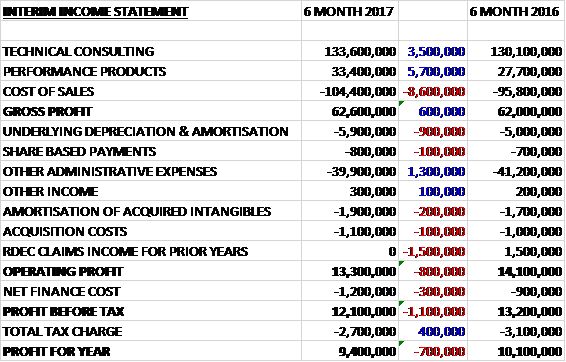
Revenues increased when compared to the first half of last year due to a £5.7M growth in performance products and a £3.5M increase in technical consulting. Cost of sales also increased to give a gross profit £600K higher than last time. Depreciation and amortisation was up £900K but other admin expenses declined by £1.2M. After the RDEC claims were not repeated this time, however, which brought in £1.5M in the first half of last year, the operating profit declined by £800K. Finance costs increased by £300K but the tax charge was down £400K to give a profit for the period of £9.4M, a decline of £700K year on year.
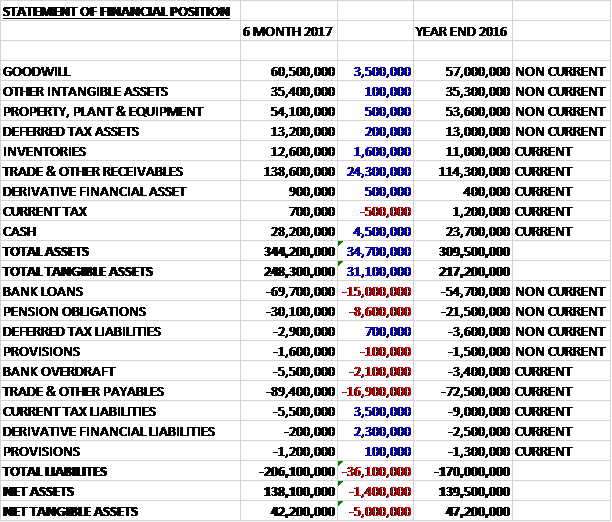
When compared to the end point of last year, total assets increased by £34.7M driven by a £24.3M growth in receivables, a £4.5M increase in cash, a £3.5M growth in goodwill and a £1.6M increase in inventories. Total liabilities also increased during the period was a £3.5M decline in current tax liabilities and a £2.3M fall in derivative financial liabilities were more than offset by a £15M increase in bank loans, a £16.9M growth in payables, an £8.6M increase in pension obligations and a £2.1M growth in bank overdrafts. The end result was a net tangible asset level of £42.2M, a decline of £5M over the past six months.
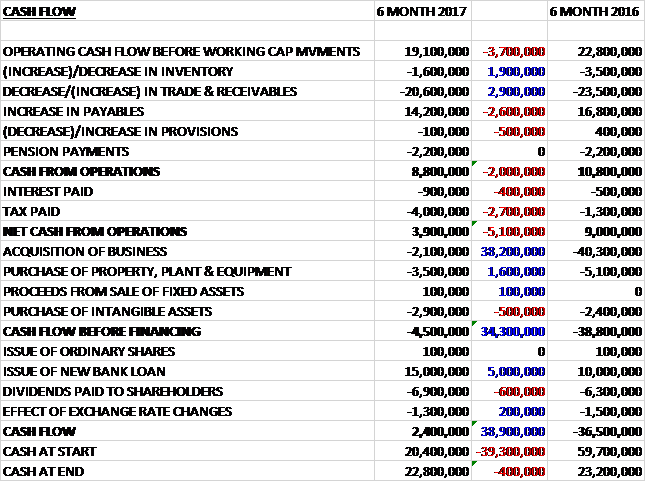
Before movements in working capital, cash profits fell by £3.7M to £19.1M. There was a cash outflow from working capital but this was less than last year but interest payments increased by £400K and tax payments were up £2.7M to give a net cash from operations of £3.9M, a decline of £5.1M year on year. The group spent £3.5M on property, plant and equipment; £2.9M on intangible assets and £2.1M on acquisitions to give a cash outflow of £4.5M before financing. They took out £15M on few loans which was used to pay the £6.9M of dividends and leave a cash flow of £2.4M for the half year and a cash level of £22.8M at the period-end.

On a like for like basis, pre-tax profits increased by £300K to £14.7M, taking into account constant currencies and contribution from Cascade.

The underlying operating profit in the Technical Consulting business is £12.9M, a growth of £600K year on year. The division experienced a low level of orders in Q1 but this recovered in Q2 and overall they were slightly ahead of the first half year which should put the business in a good position to grow in H2. The rail business is now completely integrated and has had a strong order intake in the period from a wide geographical spread of customers. Rail’s profit also benefited from favourable forex movements.

The US market remains challenging but the group’s focus continues to shift towards their operations in California where the market for new vehicle technologies provides greater opportunities. The energy and environment consulting business continued to broaden its customer base and reduce its reliance on the public sector. In November it was appointed as the UK’s National Atmospheric Emissions Inventory agency on behalf of the Department of BEI.

The performance of the business in Asia has been decent and they enter the second half of the year with a stronger order book than the prior period, particularly in the Rail business. The strategic consulting activities continue to make good progress.

The underlying operating profit in the Performance Products business was £3.4M, a growth of £400K year on year driven principally by increased volumes of engines in respect of the contract for McLaren, offset by lower one-off software license sales than the prior period.

Despite a slow start in Q1 the automotive business in the US and in Europe, order intake improved in Q2. The group have seen good levels of activity in Asia, particularly in China. They have secured a range of large programmes in the core powertrain areas of their business, especially in the engines sector across both light and heavy duty applications and are also seeing significant opportunities in the hybrid and electric systems sector. They continue to invest in advanced combustion and other key technologies in areas relating to improving overall vehicle efficiency such as intelligent driveline and electrification. The future of mobility solutions, including connected and autonomous vehicle technology in particular, is now attracting significant interest across all geographies.

The rail business continues to perform well, all the post-acquisition integration activities have been completed and the business has won significant levels of new orders in the UK, Europe and Asia. They are pursuing a range of large, long-term rail contracts, particularly in Asia and the Middle East, whilst also investing in the development of their portfolio of niche rail products such as PanMon and SmartFleet.

In Energy and Environment, they have secured a number of significant, multi-year contracts in the period through the provision of consultancy services to governments, their agencies and private sector clients. Growth in the environmental consulting business is focused on private sector and international expansion. Recently they have seen good growth in private sector and international projects and are well placed to support clients with the implementation of commitments agreed at COP21 and COP22.

Within the power generation business, the focus remains on growing the large-scale generator sales, together with consultancy on smart grids, energy economics and technologies. Across the renewables business, they continue to pursue a range of opportunities in off-shore win and energy storage applications.

Production of engines for the McLaren 650S, 675LT and 570S continue to meet the needs of the customer. The production of Bugatti transmissions also continues to meet the terms of the supply agreement. The group remains a key supplier to the motorsport sector and continues to manufacture for Formula 1 and the Porsche Cup whilst providing design and development services, including manufactured products, to GT3, LMP1, WRC, R5 Rally and also specification formula series such as Japanese Formula 14, Indy Lights and the Formula V8 3.5.

The total RDEC credit for the current period is £3M compared to £2M last time. This comprised of an estimated RDEC credit in respect of the current period of £2M, together with £1M arising from the routine amendment of open application in respect of previous accounting periods, as a result of further analysis of the qualifying expenditure incurred.

The automotive businesses in the US, the UK and the rest of Europe experienced a weaker than expected Q1 but performance improved in Q2. Going forward, overall they continue to trade in line with their expectations and have a record order book of £244M.

During the period, following formal accreditation by the UKAS to provide certified assurance services for the global rail sector, the group launched Ricardo Certification. The accreditation means that the business can perform notified body, assessment body and designated body roles on any rail project that is required to comply with relevant national and international technical rules. The accreditation also covers railway product certification services.

In July the group acquired Motorcycle Engineering Italia for an initial cash consideration of £2.1M, generating goodwill of £2.4M. The business was formed from the operating assets and employees of Exnovo, a vehicle design house, which creates aesthetics for global motorcycle and scooter brands. During the period the business made no profit but had it been purchased at the period-end, it would have contributed a £100K loss at the operating level.
At the current share price the shares are trading on a PE ratio of 18.8 which falls to 15.2 on the full year consensus forecast. After a 7% increase in the interim dividend the shares are yielding 2.2% which increases to 2.3% on the full year forecast. At the period-end the group had a net debt position of £47M compared to £32.2M at the same point of last year.

Overall then this has been a bit of a subdued period for the group. Profits declined, although excluding last year’s one-off RDEC claim it increased but having said that underlying RDEC was higher this time so perhaps without this profit would have fallen – all very confusing. Net assets also declined and the operating cash flow fell with no free cash being generated. It seems that Q1 was poor but Q2 better so perhaps performance will improve in H2. The performance products business is ticking along nicely due to higher volumes of McLaren engines and the rail business seems to be performing well with automotive a little more subdued.

With a forward PE of 15.2 and yield of 2.3% these shares aren’t that cheap and although it should improve in the second half, the performance hasn’t been that good here. Having said that, this remains a quality company and I am still invested for now.

On the 9th May it was announced that non-executive director William Spencer purchased 8,000 shares at a value of £73,200.

On the 6th July the group released a trading update for the year as a whole. Order intake was slightly ahead of the prior year at £360M but was significantly higher excluding the large multi-year transmission supply contract awarded in June 2016. The closing order book at the end of June is over £240M, an increase of £9M. At the end of the year net debt was £38M.

The rail and energy and environment business continue to perform strongly but the automotive business has had a disruptive year given the wider macro-economic factors, although it enters the new year with good momentum in Q4 and a good order book and pipeline. The performance products business continues to perform well with continued growth in McLaren volumes and a recent contract to supply transmissions to Aston Martin.

Overall this is not a bad update but the group seems to have lost a bit of momentum with the poorly performing automotive division. On the other hand the group has lost quite a lot of value recently and is starting to look a bit better on a value front. Tricky one this.

On the 2nd August the group announced that it had signed an agreement to acquire the US-based engineering firm Control Point which will become part of the group’s US subsidiary Ricardo Defence Systems and expand the range of opportunities that can be pursued within the US defence sector. New capabilities acquired include expanded vehicle engineering capabilities. Expertise in distributed software based systems and fleet management. The total cash consideration is $10.2M. It is hard to ascertain whether this is a good deal or not but the fall in the share price recently is starting to make these shares look interesting again.

Finsbury Share Blog – Interim Results Year Ending 2017

Finsbury Food has now released their interim results for the year ending 2017.

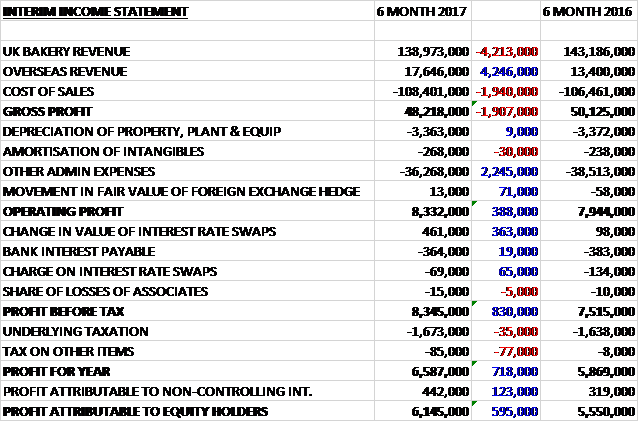
Revenues were broadly flat when compared to the first half of last year as a £4.2M decline in UK bakery revenue was offset by a £4.2M growth in overseas revenue. Cost of sales increased, however, so the gross profit fell by £1.9M. Admin expenses declined by £2.2M to give an operating profit £388K above last time. There was also a favourable £363K movement in the value of interest rate swaps and a £65K reduction in the charge on hedging items but tax charges increased by £112K to give a profit for the period of £6.1M, a growth of £595K year on year.

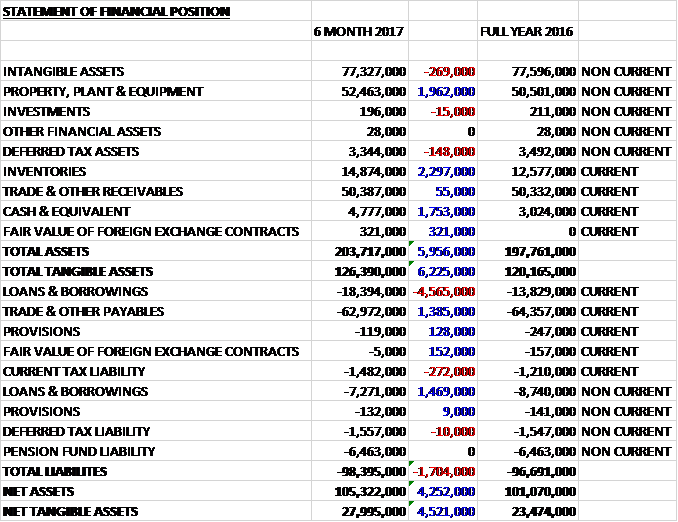
When compared to the end point of last year, total assets increased by £6M to £203.7M driven by a £2M growth in property, plant and equipment, a £2.3M increase in inventories and a £1.8M growth in cash. Total liabilities also increased as a £1.4M decline in payables was more than offset by a £3.1M growth in borrowings. The end result was a net tangible asset level of £28M, a growth of £4.5M over the past six months.

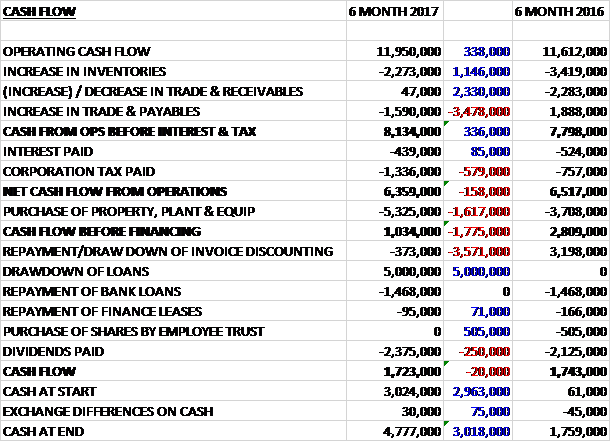
Before movements in working capital, cash profits increased by £338K to £12M. There was a cash outflow from working capital, but this was broadly the same as last time although tax payments grew by £579K to give a net cash from operations of £6.4M, a decline of £158K year on year. The group spent £5.3M on capex which gave a free cash flow of £1M. This did not cover the £2.4M paid out in dividends wo the group took out a net £3.5M of new borrowings to give a cash flow of £1.7M for the half year and a cash level of £4.8M at the period-end.

The underlying operating profit in the UK Bakery business was £7.4M, a growth of £159K year on year. The grocery cake market saw a year on year volume decline of 4.8% and a value decline of 1.5%, and the bread and morning goods grocery market sees year on year volume growth of 0.6% and a value decline of 0.2%. In cake, the group have followed the market. Celebration continues to perform but round cake has seen declines on the back of lower promotional activity, a common response to higher input prices. In bread the group’s focus is on more niche style bakery products as opposed to traditional bread and therefore revenue exceeded the market performance.

The UK bakery operating profit margin has increased to 5.3% due to operational efficiencies within the factories and includes the benefit of significant capex over the last two years. The group will continue to invest in automation and operational improvements to increase product capabilities and maintain margins.

The underlying operating profit in the overseas business was £968K, an increase of £200K when compared to the first half of last year. The business is heavily exposed to the Euro which has had a favourable impact on sales and profits. In Euro terms the business has performed well too, however.

The UK grocery market continues to be challenging even though the wider economic environment is improving slowly. Increasing commodity prices, the adverse impact on exchange rates and the national living wage means the group is working hard to mitigate input cost inflation through continued operational efficiency, investment in automation and price increases, all of which are ongoing. Despite this, the board expect the group’s steady performance to continue into the second half of the year.

At the current share price the shares are trading on a PE ratio of 17.7 which falls to 10.8 on the full year consensus forecast. At the period-end the group had a net debt position of £21M compared to £19.7M at the prior year-end. After a 7.5% increase in the interim dividend the shares are yielding 2.7% which increases to 2.8% on the full year forecast.

Overall then this has been a pretty decent performance in a tough environment. Profits were up, net assets increased and although the operating cash flow fell, this was due to an increase in tax payments and cash profits grew. There was some free cash generated, although this did not cover all of the dividends. The UK bakery business is performing OK with a decline in the market for cake being offset by growth in niche bread and some cost cutting. In Europe, the business is being aided by the weak pound.

The weak pound, however, is the source of some pressure for the group. This along with the living wage and some other issues mean that going forward times are going to be tough and the group are likely to have to put prices up. The forward PE of 10.8 looks decent enough, however, so although this is a tough time for the group, this may be valued in already?

On the 7th April the group announced that non-executive director Zoe Morgan purchased 49,047 shares at a value of £52K. Following the purchase she holds 70,028 shares in the company.

On the 17th July the group released a trading update covering the full year. Total company sales revenues grew to £314.3M, a like for like increase of 0.3% and the group is confident of delivering profits in line with market expectations. On a constant currency basis, revenues declined by 1.1% like for like.

Against a backdrop of UK retail food market deflation, the UK bakery division declined by 1.4% like for like but this improved through the year with a 2.9% decline in H1 turning into a 0.1% increase in H2. The overseas division grew by 17.3%, made up of 15.1% exchange rate benefit and just 2.2% organic growth. As noted previously, industry-wide challenges has necessitated price rises and as such the group has had “productive” discussions with its customers during the period. They continue to monitor the need for further action in light of unusual cost spikes, as is currently the case with butter.

This update really reiterates what a sluggish state the market is in at the moment. Whilst this remains a good company in my view, I just think there are too many headwinds to invest at this time.

On the 23rd August the group announced that it is proposing to close their Grain D’Or business, a provider of premium baked goods for the pastry sector based in London. The business has been historically loss making and despite a range of initiatives to improve the business, it still made a loss this year. So, fair enough then.

Molins Share Blog – Final Results Year Ended 2016

Molins has now released its final results for the year ended 2016.

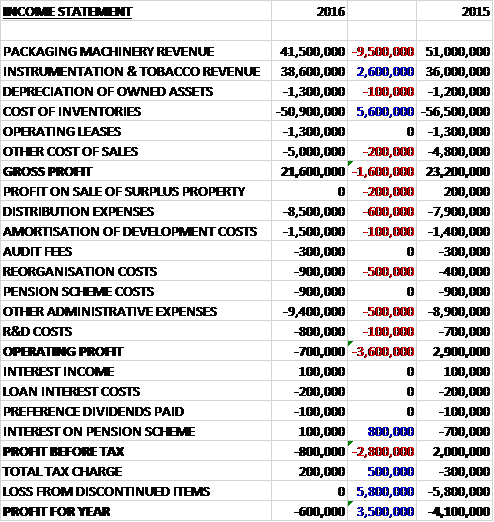
Revenues declined when compared to last year as a £2.6M growth in instrumentation and tobacco revenue was more than offset by a £9.5M decline in packaging machinery revenue. Cost of inventories declined by £5.6M but other cost of sales were up modestly to give a gross profit £1.6M below that of last year. Distribution expenses grew by £600K and reorganisation costs were up £500K with other admin expenses increasing by £600K which meant that the operating loss saw a detrimental movement of £3.6M. There was, however, an £800K positive swing to an interest income from the pension scheme and tax charges saw a positive movement of £500K which gave a loss for the year of £600K, a detrimental movement of £2.5M year on year.

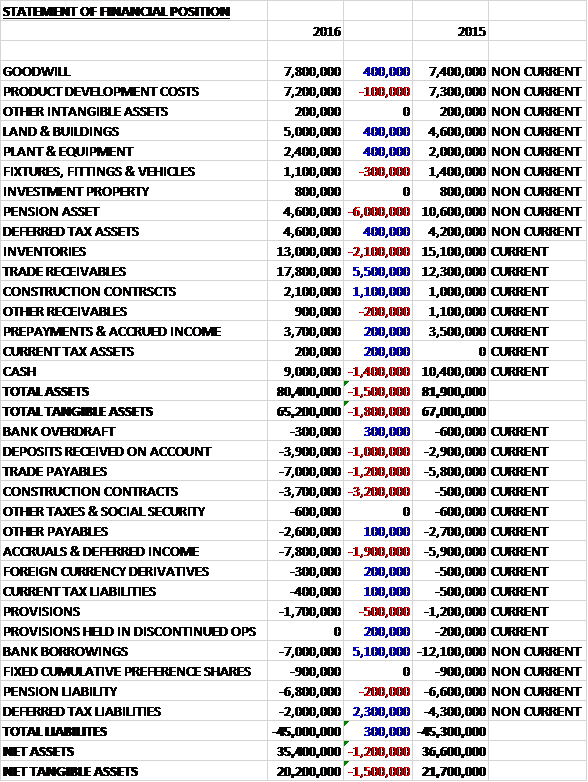
When compared to the end point of last year, total assets declined by £1.5M to £80.4M driven by a £6M decrease in the pension assets, a £2.1M fall in inventories and a £1.4M decline in cash, partially offset by a £5.5M growth in trade receivables and a £1.1M increase in construction contracts. Total liabilities saw a modest decline as a £5.1M fall in bank borrowings and a £2.3M decrease in deferred tax liabilities was mostly offset by a £3.2M increase in construction contract payables, a £1.9M growth in accruals and deferred income, a £1.2M increase in trade payables and a £1M growth in deposits received on account. The end result was a net tangible asset level of £20.2M, a decline of £1.5M year on year.

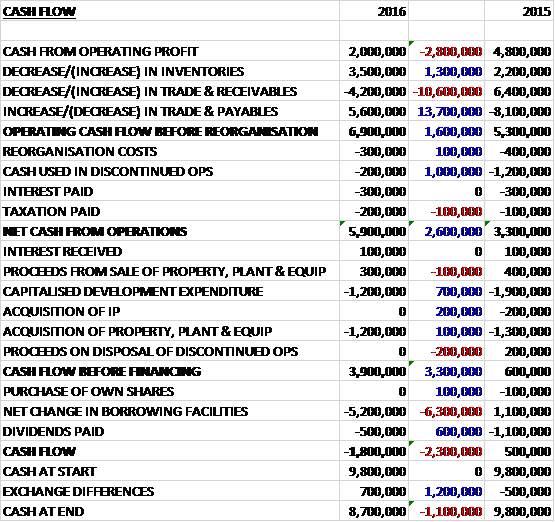
Before movements in working capital, cash profits declined by £2.8M to £2M. There was a cash inflow from working capital, however so the operating cash flow of continuing operations increased by £1.6M. The group spent £1M less cash in discontinued operations so the net cash from operations was £5.9M, a growth of £2.6M year on year. The group spent £1.2M on development expenditure and £1.2M on property, plant and equipment to give a free cash flow of £3.9M. Of this, £500K was paid out in dividends and £5.2M was used to pay back loans so there was a cash outflow of £1.8M and a cash level of £8.7M at the year-end.

The underlying operating profit in the Packaging and Machinery division was £700K, a decline of £3.2M year on year. The division started the year with a lower order book and although a large number of projects were discussed, conversions to orders were delayed and the operational efficiencies of the business suffered through under-utilisation. Towards the end of the year, the group reduced the cost base of the division which helped position the business more effectively for 2017.

Order intake in the last few months of the year started to improve, across all of the regions and most of the sectors. Overall order intake improved by 40% (28% at constant currency) leading to a significantly improved order book as they enter 2017. Order prospects remain positive and the division received a valuable pharmaceutical-related order in January 2017, although the board remain cautious until they see a longer trend of sustained order intake.

The underlying operating profit in the Instrumentation and Tobacco Machinery division was £400K, a growth of £300K when compared to last year. The increase arose from the instrumentation business entering the year with a stronger order book and converting that to sales. Overall order intake in the year was at broadly similar levels to the year before but order intake for services increased in the year.

Demand within the tobacco machinery business remained low for new machinery but the board remain encouraged by their introduction to the market of the Alto cigarette making machine and the Optima cigarette packing machine. The Optima machine is nearing the end of its field trials, the results of which have been very positive and enables them to market the product knowing that it is a strong machine that is taking them back into the cigarette packing market. The product portfolio of this division is strong and largely complete, and the focus is now on selling those products.

The group have continued to take steps to improve the efficiency of the division and have removed costs from some of the regional centres. Headcount reduced by a further 9% following a 20% reduction the year before.
Following the change in leadership the group is looking to develop their service offering and they have also changed their sales regions to the Americas, EMEA and Asia Pacific. Further investment will be made to support the growth markets with products which complement the product portfolio and broaden the customer base in their target markets. These investments are expected to be principally funded through cash generation by the group.

The pension schemes remain a major issue here and the value of the schemes liabilities currently stand at £397.3M with the main cause of the increase due to a decrease in the discount rate, reflecting lower interest rates at the year-end compared with the prior year. The level of deficit funding is currently £1.8M per annum, increasing by 2.1% per year with an estimated recovery period of 13 more years or so.

This year the non-underlying costs related to £900K of administration costs for the defined benefit pension scheme (these costs recur every year), reorganisation costs in the packaging machinery division of £800K, and instrumentation division of £100K.

Although trading was not strong during the year, emanating from a low order book as the group entered the year and the impact of delayed customer investment decisions during most of the year, order intake improved in Q4 and increased by 20% overall compared to the prior year, leading to a significantly higher order book as the group enters 2017.

As the group was loss making over the past year, there is no PE ratio but this is a cheap-looking 5.3 on next year’s consensus forecast. At the year-end, the group had a net cash position of £800K compared to a net debt position of £3.2M at the end of last year. It was decided not to declare a dividend this year.

Overall then this has been a difficult year for the group. They swung to a loss, net assets declined and cash profits fell. The cash generation, however, was actually pretty good with operating cash flows improving and some free cash being generated, although this was entirely due to favourable working capital movements. The Packaging and Machinery division saw a big fall in profits as less orders were received and some were delayed. The Instrumentation division did see a modest improvement but still remained subdued.

Going forward, however, I think things look a bit better. The new CEO seems to have injected some much needed umph to proceedings and the development of a services business looks to be sensible. The order intake has also much improved since the start of last year and with a forward PE of 5.3 this is looking rather tempting now.

On the 8th June the group announced that it had entered into an agreement with Coesia (GD) to sell their instrumentation and tobacco machinery division for a gross cash consideration of £30M. The net proceeds of the sale, expected to be £27.3M and similar to the book value of net assets being sold, will be used to invest in the group’s packaging machinery activities and to strengthen the balance sheet, leaving it in a net cash position.

The tobacco industry is undergoing a transformation with the introduction of vaping products set to progressively displace sales of traditional cigarettes. This change will require significant and timely investments in new product development.

The group has agreed to transfer the name “Molins” to GD following completion but they will retain the right to use the name for a period of six months after which they will have to change their name and remove all associated Molins branding.

Following the sale, with a strong order intake in the last few months of 2016 continuing in the first five months of 2017, the board believes the division is well placed to match 2015’s sales levels. Whilst the division’s profitability will, in the short term, be impacted by the allocation of all the group’s central costs, the impact of this is expected to be dissipates as the group grows. The first part of the year has resulted in order intake being at levels ahead of the same period last year.

In particular, order intake in the continuing group at the end of May was considerably ahead of order intake for the same period last year. Trading is as expected and ahead of last year in all parts of the continuing group so the sales in 2017 are likely to be significantly ahead of last year.

The group has agreed to make a one-off contribution to the pension fund of £2.7M and will continue to pay £1.8M per annum. If underlying operating profit in any year is more than £5.5M, the group will pay to the fund an amount of 33% of the difference between the profit and £5.5M.

Overall this seems to be a good deal to me. To be able to sell a division that needs a lot of investment to remain competitive for its net asset value seems like a very good thing and I am glad I bought in here (for now!)

On the 27th June the group released a trading update covering the first half of the year. They group entered 2017 with a strong order book that was substantially stronger than the start of 2016 with the increase arising in the Packaging Machinery division. The first part of the year has resulted in order intake in all parts of the group being at levels ahead of the same period of last year. In particular the order intake in the continuing group at the end of May was considerably ahead of order intake for the same period last year. Trading is as expected and head of last year in all parts of the group.

The group also announced thay entered into an agreement to sell a manufacturing facility in Canada for a gross consideration of £6.7M payable in cash with net proceeds expected to be £5.9M, generating a profit on the sale of £4.4M. The group is to enter into a ten year contract to lease a newly built facility about eight miles from their current location, still in Ontario, from a third party at an annual cost of £350K. They are expecting to spend about £1M adapting the building to their needs.

Origin Enterprises Share Blog – Interim Results Year Ending 2017

Origin Enterprises has now released their interim results for the year ending 2017.

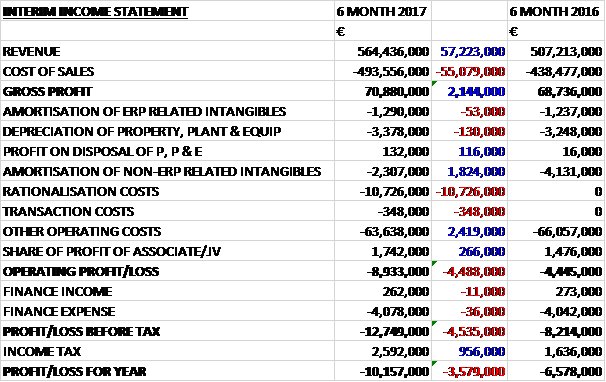
When compared to the first half of last year, revenues increased by €57.2M reflecting increased agronomy revenue and crop input volumes and cost of sales grew by €55.1M to give a gross profit €2.1M higher. Depreciation was up €130K and there were rationalisation costs of €10.7M but the amortisation of non-ERP related intangibles declined by €1.8M and other operating costs fell by €2.4M with the share of profit from associates increasing by €266K to give an operating loss €4.5M above that of last time. The tax income increased by €956K which meant that the loss for the period came in at €10.2M, an increase of €3.6M year on year.

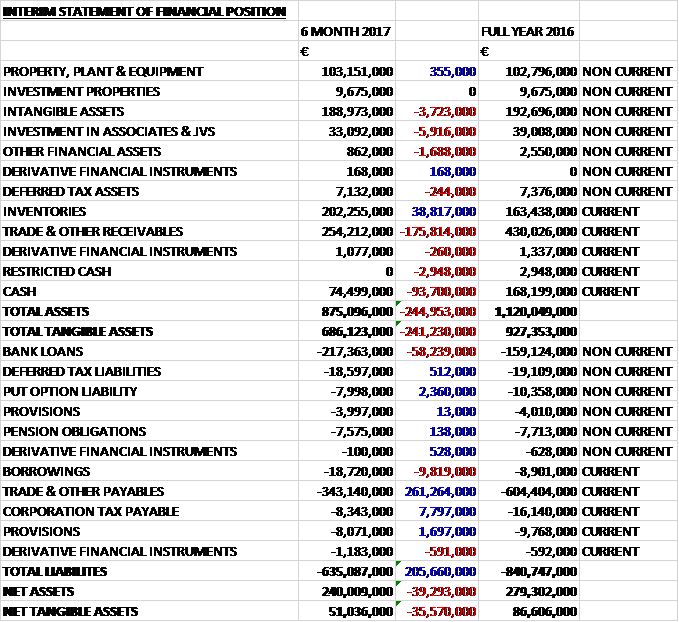
When compared to the end point of last year total assets declined by €245M driven by a €175.8M fall in receivables, a €93.7M decrease in cash, a €5.9M decline in investments in associates and a €3.7M decrease in intangible assets, partially offset by a €38.8M growth in inventories. Total liabilities also declined as a €68.1M growth in borrowings was more than offset by a €261.3M fall in payables and a €7.8M decrease in corporation tax payables. The end result was a net tangible asset level of €51M, a decline of €35.6M over the past six months.

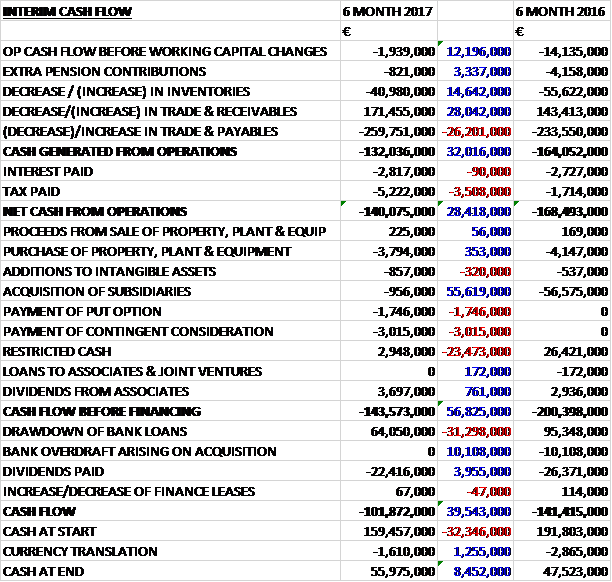
Before movements in working capital, cash losses improved by €12.2M to €1.9M. There was a big cash outflow from working capital, as usual in the first half of the year, but this was less than last time and even after tax payments increased by €3.5M the net cash outflow from operations came in at €140.1M, a €28.4M improvement year on year. The group spent €3.8M on property, plant and equipment, €857K on intangible assets and €956K on acquisitions along with €1.7M paying a put option and €3M on contingent consideration. They did get a €3.7M dividend from an associate, however, and the cash outflow before financing was €143.6M. The group drew down €64.1M in bank loans and paid out €22.4M in dividends which meant that the cash outflow for the period was €101.9M and the cash level at the period-end was €56M.

The segment result in the Agri-Services business was €2M, a positive movement of €3.8M year on year. In the UK and Ireland, volume growth was 12.6% in the period. A more favourable short term outlook for farm incomes is principally reflecting the positive impact on output prices of sterling weakness and tighter global dairy supply. This, together with generally settled autumn and winter weather supporting good crop establishment, drove good early season demand in advance of the main application period in the second half.

The agronomy services business performed very satisfactorily in the period, achieving volume growth and margin recovery across all service and input portfolios. On-farm activity was robust in the period, with the planted area for the principal autumn and winter crops at 2.95m hectares compared with 2.96m ha last time. In the case of winter wheat there is an estimated 1.4% increase in plantings. Winter oil seed rape sowings are currently estimated at 500K hectares, a reduction of about 10% due to rotational crop planning decisions. The total planted area for spring crops is expected to be about 1.4M hectares compared to 1.3M last time.

The business to business agri-inputs delivered a good result in the period with an improved performance principally underpinned by year on year growth in fertilizer volumes in the UK. Against the backdrop of highly competitive trading conditions, the fertilizer business recorded higher volumes and improved margins in the period. Strong early season demand reflected greater certainty in fertilizer raw material pricing which provided confidence to primary producers to fix a proportion of their nutrition requirements ahead of the main application period in the second half of the year.

Performance in Ireland was satisfactory and the board anticipate higher market volumes for the year as a whole with application expected to be positively influenced by higher livestock numbers and improved returns for primary dairy producers.

The amenity business delivered a good performance in the period, underpinned by further development momentum within the professional sports channel. Headland Amenity, acquired last year, is performing in line with expectations and the integration is progressing as planned. Feed Ingredients achieved a satisfactory result in the period underpinned by a stable volume performance. Spot demand was generally robust throughout the period while currency volatility impacted customer forward buying momentum.

In Central and Eastern Europe, underlying volume growth was 13.6% in the period. Overall there was a satisfactory performance in the seasonally quiet trading period, with good early season momentum in the case of value added crop technologies. Sentiment on farm is generally cautious as a result of the challenging year experienced by primary producers in 2016. A more concentrated or just in time demand profile for services and inputs is anticipated in the second half of the year.

The group’s Polish farm services business performed satisfactorily against lower demand in the period reflecting the impact of a very difficult growing season in 2016 and delayed autumn harvest conditions. The integration of Kazgod is substantially complete with strong profess achieved to date in relation to customer channel and service portfolio alignment. Autumn and winter crop plantings are equivalent to last year at about 5.3M Hectares with no significant establishment issues arising at this stage. The expansion of the seed processing and input formulation capacity started during the period with the €6M capital project expected to be operational early 2018.

The Romanian operations delivered a very satisfactory result in the period. Performance reflected increased volumes supported by new customer gains together with the benefit of higher margins. Autumn and winter crop establishment is generally satisfactory against the backdrop of weather related delays to cereal and oil seed rape plantings which is expected to result in a larger area devoted to spring cropping this year. Total plantings for the principal winter crops are estimated at 3.3M hectares compared to 3.25M last time. Integration is progressing to plan with the primary focus concentrated on the development of enhanced technical sales support together with the further development of trial demonstration farms and knowledge transfer infrastructure.

The group’s Ukrainian farm services business achieved higher revenues and margins in the period with performance underpinned by good momentum in the sale of value added technologies. Autumn and winter crop plantings are estimated at 7.6M hectares compared with 5.8M last year. Crops are generally well established and in good condition. Total crop plantings for the 2017 production year are expected to be in line with last year at about 22M hectares. The financing environment for primary producers is currently more favourable and is generally reflective of an improved macro-economic backdrop.

The segment result in the associates and joint ventures business was €1.7M, a growth of €266K when compared to the first half of last year with John Thompson delivering a satisfactory result in the period.
The rationalisation costs incurred during the period primarily comprise termination payments arising from the restructuring of Agri-Services in the UK.

In December the group announced the establishment of a dedicated digital, precision agriculture and crop science research partnership with University College Dublin. The five year development programme underpinning the research partnership will be financed by a €17.6M investment which is co-funded by Origin and Science Foundation Ireland. The aim of the programme is to build digitally based and user driven advisory tools that provide rapid and localised decision support for agronomists and farmers.

In March 2017 the group announced it has reached an agreement to acquire the fertilizer activities of Bunn Fertilizers for a consideration of £14.2M in cash which is less than the value of the assets acquired. The acquisition is expected to be earnings enhancing in the first full year of ownership. Also in March the group announced the acquisition of digital agricultural services group, Resterra, for a consideration of £11.4M and an additional deferred consideration of £4.8M.

Going forward the board believes that the performance in the period provides a solid foundation for the seasonally more important second half of the year when over 90% of earnings are typically generated.

At the current share price the shares are trading on a PE ratio of 18.3 which falls to 15.4 on the full year consensus forecast. At the period-end the group has a net debt position of €161.6M compared to a net cash position of €174K at the start of the year and €168.3M at the same point of last year. With the interim dividend staying the same, the shares are yielding 3% which is forecast to remain the same for the year as a whole.

Overall then this has been a bit of a mixed period for the group. Losses did increase but this was due to the rationalisation costs, without which there would have been an improvement. Net assets also declined during the period, as they usually do in the first half of the year. The operating cash outflow improved, however.

Conditions in the UK and Ireland continued to improve as sterling weakness, tighter global dairy supply and better weather all combined to see the market improve. Poland struggled a bit with lower demand and a delayed autumn harvest and while weather delays also affected Romania, new customer gains saw the performance improve. The Ukrainian business continued to recover. This actually all sounds rather positive for the second half of the year, although this could be baked into the share price already with a forward PE of 15.4 and yield of 3%. Tempted to buy in here.

On the 25th May the group released a trading update covering the first nine months of the year. Generally settled weather throughout the first nine months of the year combined with an improved short term planning environment for primary producers has supported higher demand for agronomy services and inputs across the group’s operations. The Q3 comparison was adversely impacted by weather and late spring growing conditions.

Overall there was a 4.1% increase in underlying revenue in Q3. Full year earnings guidance in adjusted EPS of between of between 44% and 46% reflects an underlying growth in group operating profit of between 8% and 11% on a constant currency basis.

In Agri-services revenues for Q3 were 1.2% lower at €548.7M due to forex movements with an underling increase of 4.1% reflecting increased demand for agronomy services and inputs. In the UK and Ireland the positive impact of sterling weakness on crop output values combined with a favourable year on year backdrop to global dairy markets were the principal drivers of an improved short term outlook for the incomes of crop and grassland farm enterprises. The generally settled weather for the majority of the period has supported good crop planting conditions resulting in favourable demand for agronomy services and crop inputs.

Underlying volume growth was 3.3% for the quarter due to higher crop protection volumes somewhat offset by a reduction in fertilizer volumes due to the earlier timing of sales in the first half of the year.

Integrated on-farm agronomy services recorded an improved performance in the quarter, achieving higher volumes and margins across all service and input portfolios. Core agronomy service revenue and crop protection volumes grew by over 20% in the quarter, albeit against an easy comparator. Trading conditions continue to remain highly competitive as the business prioritises its value added solutions approach.

Primary crop producers are experiencing a more stable short term planning environment with their margins currently supported by lower unit costs for key macro inputs and the positive impact of sterling depreciation on output values. Against this backdrop, together with the benefit of favourable weather, on-farm activity was robust during the quarter, resulting in a 7% increase in spring plantings. Business to business agri-inputs performed in line with expectations following a strong early season demand in the first half of the year.

Fertilizer performed solidly with lower volumes but improved margins. The reduction in volumes is mainly timing related as primary producers purchased a greater proportion of their overall full season nutrition requirements during the first half of the year. Speciality and bespoke nutrition applications continued to maintain a solid development momentum during the period. The board expect an overall increase in market volumes for the full year with application expected to be positively impacted by higher livestock numbers combined with improved profitability and returns in primary dairy enterprises.

Amenity delivered a satisfactory result in the period. The combination of a good business development performance and continuing momentum within the professional sports turf channel supported higher revenues and margins in Q3. Headland Amenity, acquired last year, is performing as expected.

Feed ingredients achieved a satisfactory performance supported by higher volumes. Increased feed consumption in the current year is largely being driven by a combination of higher dairy herd numbers along with improved returns and profitability in grassland farm enterprises.

Poland achieved a satisfactory result in Q3, recording higher volumes and margins against a weak comparative. Trading conditions remain highly competitive reflecting subdued farm sentiment and demand following a challenging 2016 season. Agronomy service and input demand is expected to be higher in Q4 due to greater seasonality and the more just in time demand profile in the current year.

Romania achieved a good result, recording higher revenue and margins. Performance in the quarter reflected good demand momentum across all service and product portfolios. Generally mild conditions throughout March and early April positively supported farmers crop planting programmes resulting in a 4% rise in spring plantings. Overall crop establishment and development remains satisfactory across most growing regions notwithstanding the impact of a brief period of low temperatures during late April.

Ukraine delivered a good performance recording higher revenues and margins. A general improvement in the macroeconomic backdrop in the country has led to a more stable economic environment which has benefited primary producers and supported demand for agronomy services and crop inputs. A combination of new customer gains, improved supply chain and customer fulfilment execution together with generally favourable weather conditions has supported good momentum in the sales of value added technologies. Autumn and winter crops are generally well established and in good condition with an increase in spring plantings of 4.8%.

In March the group announced the acquisition of the digital agricultural services group, Resterra. The business specialises in the delivery of bespoke precision agronomy applications and is a leading provider of agri-tech services to primary producers, input manufacturers and agri-services companies. Also in March they reached an agreement to acquire the fertilizer activities of Bunn, a provider of subscription fertilizer blends and nutrition management systems.

Based on a good Q3 performance and a normal profile for agronomy services and crop input activity in Q4, the group expects to achieve full year earnings guidance in adjusted EPS of between of between 44% and 46% reflects an underlying growth in group operating profit of between 8% and 11% on a constant currency basis.
This all sounds very positive.

On the 14th July the group announced that the CMA investigation into their acquisition of Bunn Fertilizer has found that it could reduce competition to supply fertilizers in certain regions of Scotland. The group is now considering the implications of the findings.

Waterman Share Blog – Interim Results Year Ending 2017

Waterman has now released their interim results for the year ending 2017.

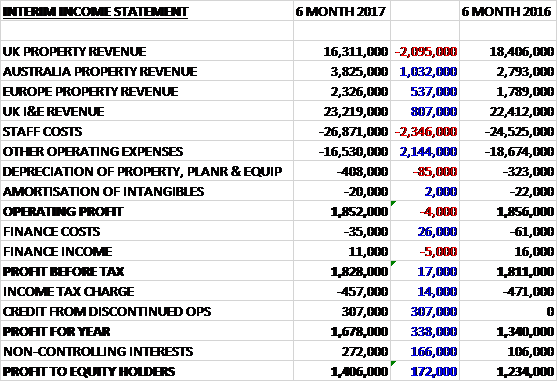
Revenues increased when compared to the first half of last year as a £2.1M reduction in UK property revenue was more than offset by a £1M growth in Australia property revenue, an £807K increase in UK I&E revenue and a £537K growth in European property revenue, aided by forex movements. Staff costs increased by £2.3M but other operating expenses reduced by £2.1M. An £85K growth in depreciation meant that the operating profit was broadly flat, falling by just £4K. Finance costs were down £26K and tax charges fell by £14K before a £307K credit from discontinued operations relating to forex gains on the liquidation of the Moscow entity meant that the profit for the period came in at £1.4M, a growth of £172K year on year.

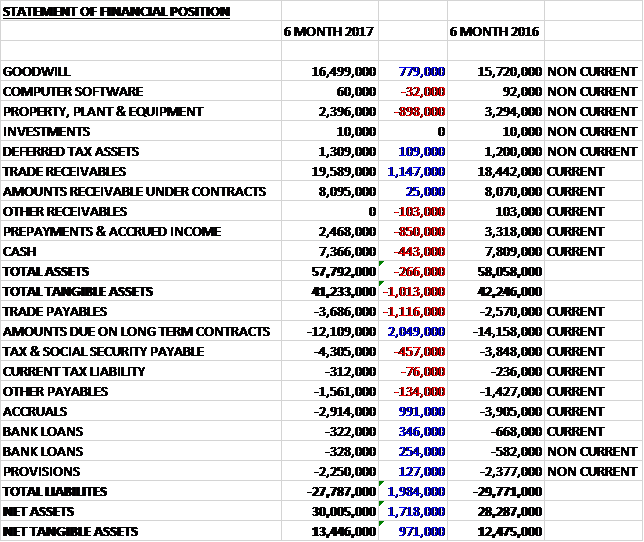
When compared to the end point of last year, total assets declined by £266K driven by an £898K fall in property, plant and equipment, an £850K decline in prepayments and a £443K decrease in cash, partially offset by a £1.1M growth in trade receivables and a £779K increase in goodwill. Total liabilities also declined during the period as a £2M decline in amounts due on long term contracts and a £991K fall in accruals was partially offset by a £1.1M growth in trade payables. The end result was a net tangible asset level of £13.4M, a growth of £971 over the past six months.

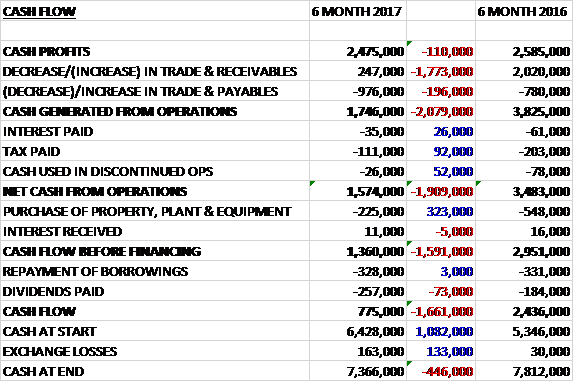
Before movements in working capital, cash profits declined by £110K to £2.5M. There was a cash outflow from working capital and after tax payments fell by £92K the net cash from operations was £1.6M, a decline of £1.9M year on year. The group spent just £225K on capex to give a free cash flow of £1.4M, of which £328K went on loan repayments and £257K was paid out in dividends. This all meant that there was a cash flow of £775K for the period and a cash level of £7.4M at the period-end.

The operating profit for the UK property business was £579K, a decline of £693K year on year with a fall in margins. The UK structural team have continued to perform well, securing new commissions from a range of clients including British Land, Land Securities, Hammerson, Lend Lease, AVIVA, Berkeley, Barratt and Kier. Whilst the building services team in London have suffered from delayed starts to projects in the commercial and residential markets during the period, it is expected that the situation will improve during the year. Outside London the regional offices have performed better with a wide range of projects in education, performing arts, leisure, student accommodation and healthcare markets.

The group have teamed up with Stanhope and Mitsui in a UK pilot of the National Australian Built Environment Rating System on the recently completed new Angel Court development designed by Waterman. This study will assess over a year long period the energy use within the completed building and compare that to the design parameters. The building will then be verified by an investment grade rating using the measured data. The London and Australian teams are both involved in this initiative.

The operating profit for the Australian business was £696K, a growth of £360K when compared to the first half of last year with some of that, but not all, coming from favourable forex movements. New commissions have continued to be won, particularly in the healthcare, judicial, residential and telecoms markets. They are currently working for Westpac Bank and Commonwealth Bank on their frameworks for upgrading their existing high street retail outlets and for Aldi on their store refurbishment programme.

The operating profit for the European business was £217K, an increase of £99K when compared to the first half of 2016. In Ireland, the group has designed the tallest and largest building project in Dublin which is currently undergoing construction. The Irish economy has been the fastest growing in the Eurozone for the last three years and the group is benefiting from the increasing demand for consulting engineering services for development in the residential, commercial offices, retail and leisure markets.

The operating profit in the UK I&E business was £585K a fall of £17K year on year following the investment in the recruitment of several senior staff to further expand the revenue from public sector frameworks and highways infrastructure. During the last six months the group has been appointed on a new four year framework for Swindon Borough Council and are currently discussing a two year extension to London Borough of Bexley framework where they have been providing services on the existing framework for 21 years.

The group’s pre-planning team which provides environmental impact assessments and sustainability advice on developments has been particularly busy over the past six months. Since Brexit the group have experienced an increase in activity by their clients. They are currently involved in Battersea Power Station, Canada Water for British Land, Ballymore’s Leamouth South scheme, Old Oak Park for Car Giant and London and Regional, and Brent Cross for Hammerson and Standard Life. These are all significant developments and they will provide future opportunities for the property teams.

The outsourcing team have started a programme to diversify their business model into new areas such as water and environmental services, as well as continuing to target their existing highways and transportation markets. They have made good progress and secured initial secondments into Natural Resource Wales and the Environment Agency.

Going forward the board anticipates that the group will continue to experience a stable trading outlook overall with revenue, profit and operating margin generally in line with the prior year. Whilst trading conditions in the UK are expected to remain challenging, there have been some recently announced large commissions such as the MOD’s Army Basing Programme, the planned extension to the Brent Cross shopping centre and technical advice for the feasibility studies of new schools.

In addition, the specialist highways and transportation outsourcing business is expecting an uplift in secondment activity following the announcement in the Autumn statement confirming the government’s commitment to invest over £1.3BN to ease congestion on roads. Overseas the contribution fr5om the offices in Australia and Ireland is expected to increase due to improved performance. The markets in these two countries are particularly buoyant with investment in public social infrastructure such as hospitals, schools and prisons, and in the private sector in residential, commercial and retail development. Whilst 2017 is proving to be a period of consolidation, the board looks to the future with measured optimism.

At the current share price the shares are trading on a PE ratio of 9.6 which rises to 9.8 on the full year consensus forecast. After a 33% increase in the interim dividend, the shares are yielding 4.7% which increases to 5.5% on the full year forecast. At the period-end the group had a net cash position of £6.7M compared to £6.6M at the same point of last year.

Overall then this has been a sluggish period for the group. Although overall profits increased, excluding the forex gain from the closed Russian business, they declined in the period. The operating cash flow also declined but the group still managed to retain a decent amount of free cash. The Australian and Irish businesses are both doing well, both benefiting from forex movements and increased volumes of work. In the UK times are harder with the I&E business remaining flat with more investments being made for future growth, and the UK property business suffered a decline, not helped by delays in building services projects.

Overall, there does not seem to be much if any growth here, with results weighed down by weakness in the UK. With a forward PE of 9.8 and dividend yield of 5.5%, it could be argued that this is already included in the price. There could be some decent value here but until there is some evidence of growth, I am a little reticent to buy and shares.

On the 28th March the group announced that it secured a two year extension to its existing partnership term contract with the London borough of Bexley until September 2019. It will involve the provision of traffic and transportation engineering services, civil engineering, highways and infrastructure, bridgeworks, drainage, principal designers and technical staff secondment. Over the past year the team has delivered the replacement of Bexley High Street Bridge, the second stage of Bexleyheath town centre revitalisation on public realm design adjacent to the new Crossrail station at Abbey Wood. The framework is expected to generate annual fees of around £1.7M.

On the 9th May the group announced that it had received an offer from CTI Engineering whereby Waterman shareholders will receive £1.40 per share which represents an 83% premium to the closing price on the prior day. This offer values the group at £43M. There only seems to be around 26% of shares acquired so far but this looks a good offer to me and I would not be surprised if it went through.

Keller Share Blog – Final Results Year Ended 2016

Keller has now released their final results for the year ended 2016.

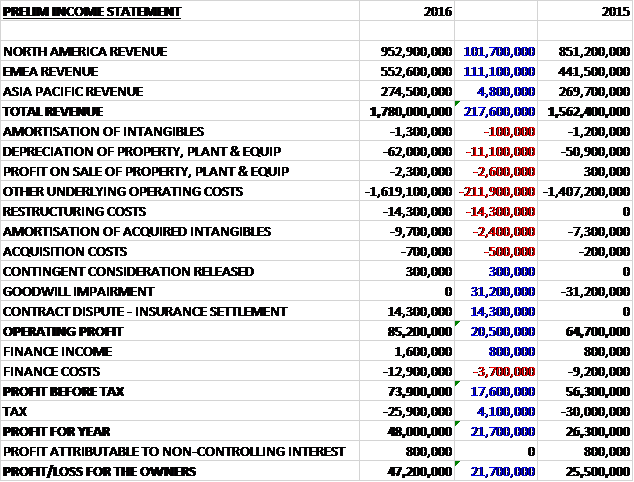
Revenues increased when compared to last year due to a £101.7M growth in North America Revenue, a £111.1M increase in EMEA revenue and a £4.8M growth in Asia Pacific revenue. Depreciation charges grew by £11.1M, there was a £2.3M loss on the sale of property, plant and equipment and other underlying operating costs increased by £211.9M. We also see £14.3M of restructuring costs, a £2.4M growth in amortisation of acquired intangibles and a £500K increase in acquisition costs being offset by the lack of any goodwill impairments which accounted for £31.2M last year and a £14.3M profit relating to the insurance settlement on the contract dispute. This all meant that the operating profit grew by £20.5M. Finance costs increased by £3.7M but tax charges reduced by £4.1M to give a profit for the year of £47.2M, a growth of £21.7M year on year. Excluding the big one-offs, however, and profit fell by £9.5M.

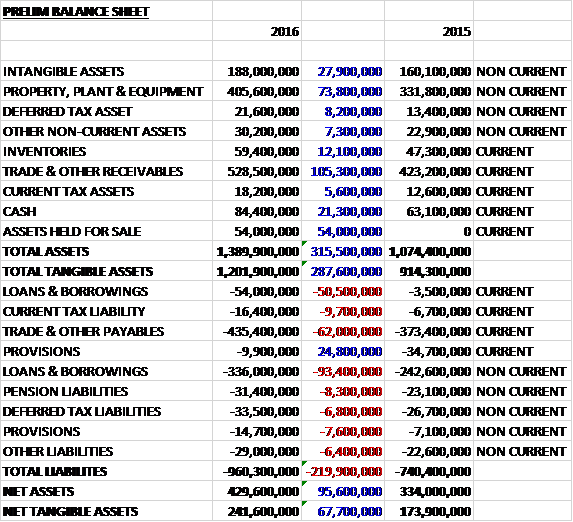
When compared to the end point of last year, total assets increased by £315.5M driven by a £100.3M growth in receivables, a £73.8M increase in property, plant and equipment, a £54M growth in assets held for sale, a £27.9M increase in intangible assets, a £21.3M growth in cash and a £12.1M increase in inventories. Total liabilities also increased during the year as a £17.2M decline in provisions was more than offset by a £143.9M growth in borrowings. The end result was a net tangible asset level of £241.6M, a growth of £67.7M year on year.

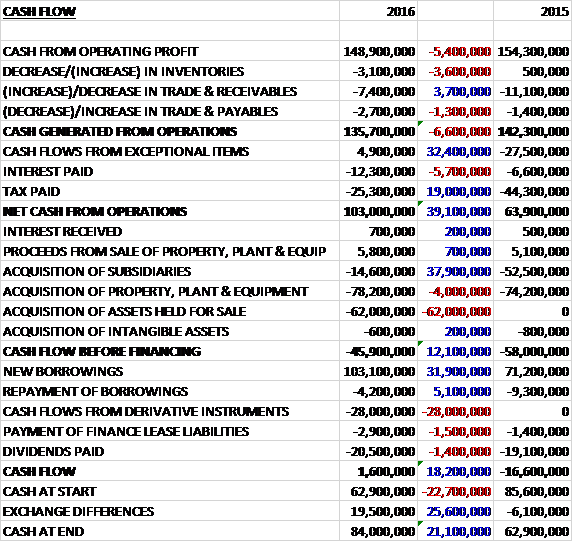
Before movements in working capital, cash profits declined by £5.4M to £148.9M. There was a cash outflow from working capital and interest costs increased by £5.7M. This was offset by a £32.4M positive swing to cash inflows from exceptional items and a £19M reduction in tax payments to give a net cash from operations of £103M, a growth of £39.1M year on year. The group spent a net £72.4M on property, plant and equipment, £14.6M on acquisitions and £62M on acquiring the building at the heart of the contract dispute. This meant that there was a cash outflow of £45.9M before financing. The group therefore took out a net £98.9M of new borrowings but saw a £28M cash outflow from derivative instruments and spent £20.5M on dividends to give a cash flow of £1.6M and a cash level of £84M at the year-end (aided by forex movements).

The operating profit in North America was £86.9M, a growth of £10.5M year on year although some £9.2M of that came from forex movements and the underlying profit growth at constant currency was £1.3M. The profit increase reflects a 4% growth in the US, partially offset by a deterioration in Canada which recorded a small loss.
The growth in the US was aided by a steadily growing construction market, driven by a growth in private construction. Hayward Baker increased profits despite fewer major contracts. Suncoast had an outstanding year, benefiting from the continued increase in housing starts where it operates, particularly in Texas. They installed new, more automated cut lines in their two largest facilities in the second half which should lead to significant productivity improvements.

These good performances were offset by reduced profits in the US piling businesses. Case and HJ Foundation returned to more normal levels of profitability due to fewer large jobs and increased competition in Chicago and Miami. McKinney had a number of poorly performing projects so the business was altered to introduce a more centralised management model. Bencor continued to perform well with its $135M project to repair and upgrade the East Branch Dam in Pennsylvania progressing to plan.

Canada continues to be a very tough market, particularly in the West. The business continued to struggle and recorded a small loss for the year. They have undertaken further cost reduction measures, reducing overheads and closing an office. Some C$8M of annualised costs have been taken out. The result was also adversely impacted by the delay in the C$43M project in Toronto in connection with the expansion of the city’s metro system. This was originally scheduled to begin in April 2016 but is now due to start in the spring of 2017.

The operating profit in the EMEA region was £30.2M, an increase of £8.9M when compared to last year and £2M of that increase came from forex movement. This much improved result reflects good performances from all the most significant European business and in particular, excellent project execution at the large project in the Caspian region.

The businesses in central Europe performed well, helped by slowly improving markets. Germany, Austria and Poland continue to benefit from the introduction of new products and ongoing improvements to existing products and techniques. All are also leading the way in helping businesses units elsewhere in the world to expand their product ranges, offering significant expertise, resources and training.

The UK also had a good year, working on a wide variety of commercial and infrastructure projects. The business had fewer poorly performing contracts than in recent years, following extensive work on tendering and execution disciplines. Whilst they have seen some market slowdown recently, much effort is currently being devoted to securing significant work on the major infrastructure projects coming up in the UK. The major project in the Caspian region was the group’s best performing contract during the year. They recently received noticed to proceed for a further $80M which will take the total project to around $180M.

The group had a difficult year in the Middle East and Africa. Revenue in the Middle East can be lumpy, being relatively dependent on large projects and there were few such projects in the first half of the year. The result also suffered from a poorly executed project completed in the first half. The revenue run rate improved in the second half and should improve significantly in 2017 following the award of two major projects; the £45M East Port Said development Complex in Egypt, and the £25M urban development project in Abu Dhabi.

Franki Africa had a very difficult year as the South African construction market contracted significantly as a result of the economic and political uncertainty in the country and many projects elsewhere in sub-Saharan Africa were delayed. Cost reduction measures allowed the business to record a small profit, however. The business recently started work on a £40M design and build contract for a foundation solution at the Clairwood Logistics Park development. This project is using a technique new to the South African market and has been introduced in conjunction with Keller experts from Europe.

The newly acquired business in Brazil saw difficult trading in a depressed economy with political challenges. The existing business is being integrated into Tecnogeo and operations from the Rio location have been transferred to Sao Paolo.

The operating loss in the Asia Pacific region was £18M, a detrimental movement of £29.7M when compared to 2015 with forex movements having a positive impact of £1.1M.

In May the group acquired the freehold of a processing and warehousing facility in Avonmouth for a consideration of £62M. The group’s final liability with regards the historic contract dispute involving the property is in part dependent on the value of the property. In order to maximise this value, the group decided to acquire the property with a view to marketing it to third parties. At the end of June the property was held at a fair value of £48M and had already been impaired by £14M by that point. As of the year-end, the fair value of the property based on an external valuation was £54M so there was a £6M impairment reversal.

As usual there were a number of exceptional items during the year. The £14.3M restructuring charge relates to asset write downs, redundancy costs and other reorganisation charges in markets experiencing significantly depressed trading conditions (Singapore, Australia, Canada and South Africa). This includes the write-down, redundancy of surplus equipment to current market values where it is not being relocated to more active parts of the group. Additional contingent consideration provided relates to the Bencor and Ellington Cross acquisitions.

The £14.3M of exceptional credits relate to the contract dispute settled in 2014. These credits are attributable to insurance proceeds received after an initial settlement with insurers, rental income less operating costs from the acquired warehouse facility and the release of the portion of the contract provision that was dependent on the valuation of the property. The contingent consideration provision released relates to amounts payable for the Austral, Franki Africa and Geo Foundations acquisitions. After the year-end the group received a further £5.9M of insurance proceeds relating to the contract dispute which will be recognised as an exceptional income in 2017.

In February the group acquired Tecnogeo, a business based in Brazil, for an initial cash consideration of £12.8M. Contingent consideration of up to £13.2M is payable based on total EBITDA in the two year period following acquisition. The acquisition generated goodwill of £6.6M. During the year, the business contributed £13.4M to revenues and a net loss of £800K. In April the group acquired Smithbridge, a business based in Australia, for an initial cash consideration of £1.8M which reflected the fair value of net assets acquired.

Conditions in the group’s major markets are not expected to change materially in 2017. The US construction market if forecast to continue to grow steadily and the group are well placed to benefit from any acceleration of infrastructure spending, although they think that this will likely be an opportunity for 2018 and beyond. The main European markets should continue to be relatively solid although they may see a slowdown in the UK. Elsewhere markets are expected to remain challenging and while they board expect to see a material improvement in the Asia Pacific results in 2017, they do not expect to see a return to profitability until 2018.

The group begin 2017 with a record order book with work to be undertaken over the next year 20% above last year on a constant currency basis. Also, the order book contains some major projects in some of the most challenging markets such as Australia, the Middle East, South Africa and Canada. The group are also beginning to see tangible results from a number of the strategic initiatives launched in the last year; product capabilities are being transferred faster, global product teams are positively impacting contract performance and real benefits are coming from improved procurement. As a result, the board is confident in the group’s prospects for 2017.

At the current share price the shares trade on an underlying PE ratio of 14.1 which falls to 9.8 on next year’s consensus forecast. After a 5% increase in the total dividend the shares are yielding 3.1% increasing to 3.3% on next year’s forecast. At the year-end the group had a net debt position of £305.6M compared to £183M at the end of last year, partly due to currency differences.

On the 12th April the group announced that it had acquired instrumentation and monitoring company GEO-Instruments in North America. The business supplies, manufactures, installs and integrates monitoring systems for buildings, excavations, bridges, railways, roads etc. It is based in Rhode Island and has annual revenues of around £4M so just a small acquisition.

On the 11th May the group released a trading update covering the first four months of the year. There has been no significant change in market trends since the final results. For the group as a whole, both revenue and profit are ahead of last year.

The North America division has had a solid start to the year but is behind the same period of 2016. EMEA has continued its growth trend of recent years, helped by ongoing good contract execution on large projects. Asia Pacific’s results show a significant year on year improvement with encouraging growth in revenue but, as expected, the division still recorded a loss in the period.

Tendering activity and contract awards remain generally healthy. The order book has increased during the year and, at the end of April, the group order book of work to be undertaken over the next year was 15% higher. As a result, the group remains on course to meet the board’s expectations for the full year.

Also the group has announced the sale of its processing and warehouse facility in Avonmouth for a cash consideration of £62M. They acquired the property in May 2016 following a dispute arising on a project completed in 2018 and since the acquisition they have received around £4M of rental income. The property was held on the balance sheet at a value of £54M so the sale realises a profit of £8M.

Avingtrans Share Blog – Interim Results Year Ending 2017

Avingtrans has now released their interim results for the year ending 2017. Following the disposal, management is reorganising the business into two core sectors: Energy and Medical. In Energy the group supply industry proves modules – in particular nuclear waste storage containers, as well as a variety of other niches in the renewable energy sector. In Medical they supply cryogenic vacuum vessels to markets such as MRI, nuclear magnetic resonance, proton therapy and related sectors.

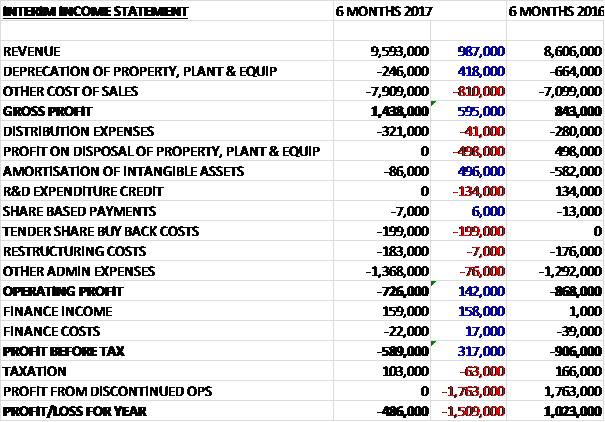
Revenues increased by £987K when compared to the first half of 2016 and although depreciation was own £418K, other cost of sales increased by £810K to give a gross profit £595K above that of last time. There was no profit on the disposal of fixed assets which brought in £498K last time but amortisation was down £496K. There was also no R&D credits which were £134K last time and there were £199K of tender share buy-back costs with other admin expenses up £76K to give an operating loss £142K lower. Finance income grew by £158K but tax credits were down £63K to give a loss for the period of £486K, a £254K decrease year on year.

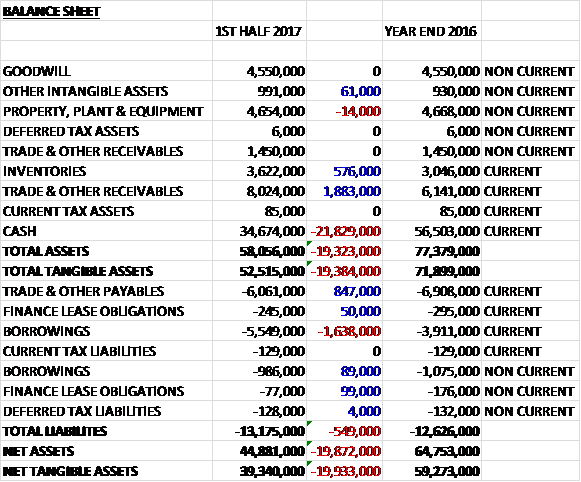
When compared to the end point of last year, total assets declined by £19.3M driven by a £21.8M fall in cash, partially offset by a £1.9M increase in receivables and a £576K growth in inventories. Total liabilities increased somewhat during the period as an £847K decline in payables was more than offset by a £1.6M growth in borrowings. The end result was a net tangible asset level of £39.3M, a decline of £19.9M over the past six months.

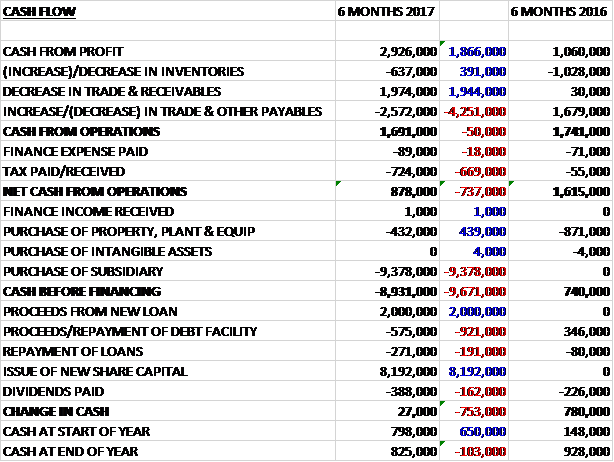
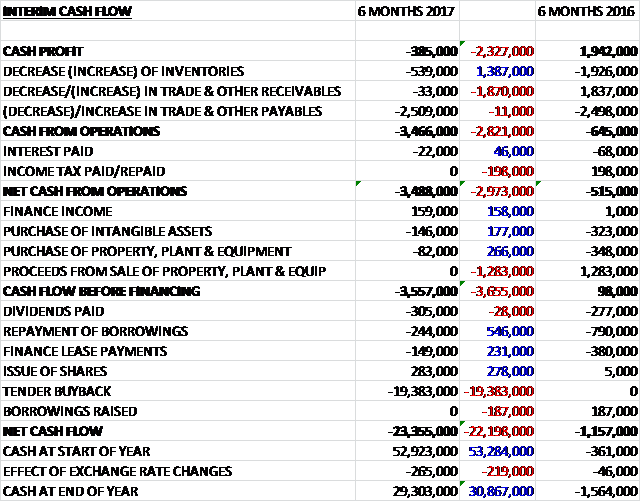
Before movements in working capital, cash losses reversed by $2.3M to £385K. There was a cash outflow from working capital and no tax receipts so there was a net cash outflow of £3.5M from operations. The group received £159K in finance income and spent £82K on intangible assets along with £146K on property, plant and equipment to give a cash outflow of £3.6M before financing. The group also spent £305K in dividends, £149K on finance leases, £244K in loan repayments and £19.4M on the tender buyback which meant a cash outflow of £23.4M and a cash level of £29.3M at the period-end.

The Energy and Medical business had an operating loss of £49K, an improvement of £379K year on year.
In Metalcraft, business with Siemens and Cummins in the UK was again steady. The contract with Sellafield to produce 3M3 boxes for the storage of intermediate level nuclear waste is progressing to plan. They have made good progress with facilities refurbishment and pre-production tests. The production set-up and prototyping phase will continue in the current year with series production expected to start in the 2018 calendar year. The total number of boxes required is now expected to be more than 70,000 over the entire programme life worth an estimated £3BN. The Chinese unit saw results improve with the preparation for the new contracts with Bruker and Wuhan for NMR vessels.

At Maloney Metalcraft, the low oil price continued to affect the business in the period, though this has largely washed through, with a limited restructuring completed, to stabilise their position in the new $50 a barrel oil reality. The gas project contracts with Samsung and JGC Gulf International progressed substantially in the period. Both have taken longer to complete than previously anticipated, however, due to customer originated programme changes. Work also commenced on the EDF contract.

Crown had a steady, if subdued, first half. The FET carbon abatement trial in Wales concluded successfully and they are working to turn this application into a product of the future with FET. This technology promises to make small to medium diesel generators clean. Other prospects with FET are also progressing, albeit slowly.
Composite Products’ performance in the period improved markedly as they began volume deliveries to Rapiscan. The second half performance will be similar and they expect further volume growth in the next year. Whitely Read Engineering has completed overspill activities from Metalcraft and Maloney.

The business is expected to be second half weighted, having won important projects last year which are in the process of ramping up – notably the pre-production phase of Sellafield 3M3 Box operations at Metalcraft. So far, this is progressing positively with Sellafield recently approving the first prototype unit. Crown is also expected to enjoy a stronger second half with new projects expected to convert to sales during this period.

After the period-end the group acquired a 94% majority stake in superconducting magnet and cryogenic systems company Spacy Cryomagnetics for a total consideration of £347K (although the group are also repaying an outstanding loan of £468K). The business designs, manufactures, tests and installs superconducting magnet systems for a range of applications, as well as providing consultancy services to companies such as Siemens and Rolls Royce. In addition, it will broaden the group’s capability in the supply of vacuum vessels and cryostats for science, space and astronomy projects. Last year the business made a profit of £41K.

A principal focus going forward will be further acquisitions in order to utilise the £28M of available cash. The group existed last year with almost £60M of LTAs signed and have since signed a Wuhan contract worth £9M and an extended contract with Siemens.

At the current share price the shares are trading on a PE ratio of 154.9 which increases to 226.1 on the full year consensus forecast – clearly these shares are being valued on what the group is going to do with that pile of cash. Net cash reduced from £51M to £27.8M following the tender offer which returned £19.4M to shareholders. After a 9% increase in the interim dividend, the shares are yielding 1.6% which remains steady on the full year forecast.

Overall then this is a company that seems to be in transition. The losses did improve during the period but the operating cash flow worsened, not helped by working capital movements. The various businesses seem to be ticking along with Maloney sill affected by the low oil price and progress at Crown seems to be rather slow. The group are winning some interesting looking contracts, however, and the second half is looking like improving. The shares are clearly priced for the anticipation of what the board are going to do with the cash, however, as the current business can’t really justify this rating despite the vital Sellafield contract. Overall I also continue to hold in anticipation.

On the 31st March the group announced they had made a bid for Hayward Tyler PLC, although there is no further information.

On the 26th June the group announced that they had secured a contract extension with Sellafield. The contract is worth an additional £11M in revenue to be spread over the three years to 2021. Overall, although revenue was slightly behind management outlook, they closed the year with pre-tax profits marginally head of internal expectations and net cash of £26.2M. They also reported a strong current order book for the energy and medical division.

On the 30th June the group announced the acquisition of Hayward Tyler. Under the terms of the scheme, shareholders will be entitled to receive one new share for every 4.755 scheme shares. This represents a premium of 14.7% to the Hayward Tyler closing price of 47p per share and the number of new Avingtrans shares expected to be issued is 11,533,278 which will result in scheme shareholders owning 37.6% of the total share capital of the enlarged group. This is not yet a done deal though so watch this space!

Dechra Pharmaceuticals Share Blog – Interim Results Year Ending 2017

Dechra Pharmaceuticals has now released their interim results for the year ending 2017.

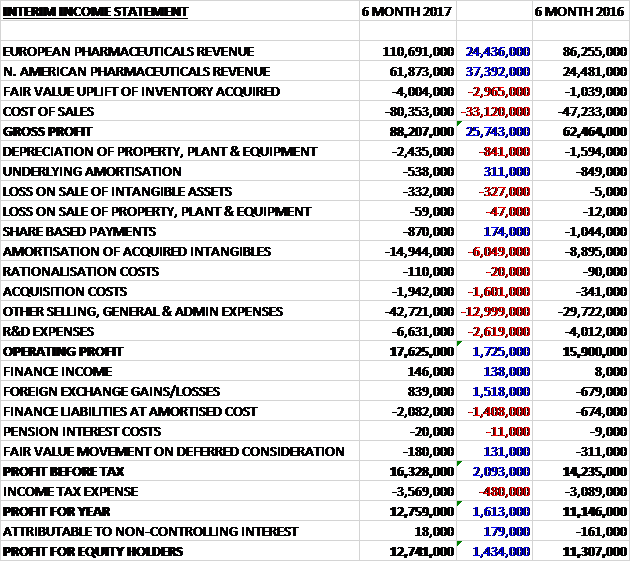
Revenues increased when compared to the first half of last year with a £37.4M growth in North American revenue (£25M attributable to the Brovel and Putney acquisitions) and a £24.4M increase in European revenue. Cost of sales also increases to give a gross profit £25.7M above that of last time. Depreciation was up £841K, the amortisation of acquired intangibles increased by £6M, acquisition costs grew by £1.6M, R&D expenses increased by £2.6M and other general costs grew by £13M which meant that the operating profit was £1.7M higher. A favourable movement in forex hedging generally offset a £1.4M growth in finance liabilities and after tax charges increased by £480K the profit for the period came in at £12.7M, a growth of £1.4M year on year.

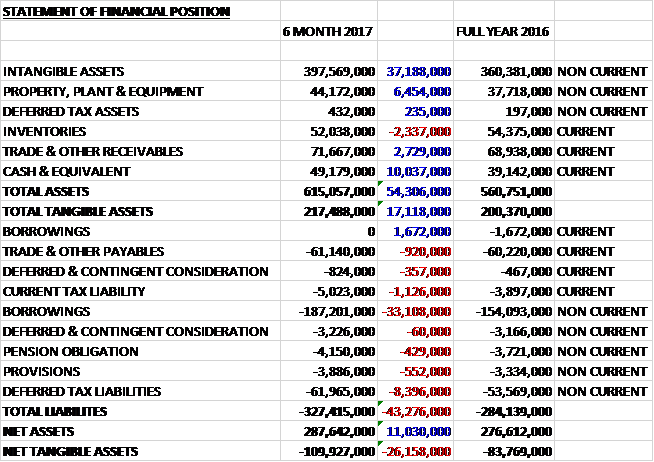
When compared to the end point of last year, total assets increased by £54.3M driven by a £37.2M growth in intangible assets, a £10M increase in cash, a £6.5M growth in property, plant and equipment and a £2.7M increase in receivables, partially offset by a £2.3M decline in inventories. Total liabilities also increased during the period due to a £31.4M growth in borrowings and an £8.4M increase in deferred tax liabilities. The end result was a net tangible asset level of -£109.9M, a deterioration of £26.2M over the past six months – I would like to see this debt stabilise now.

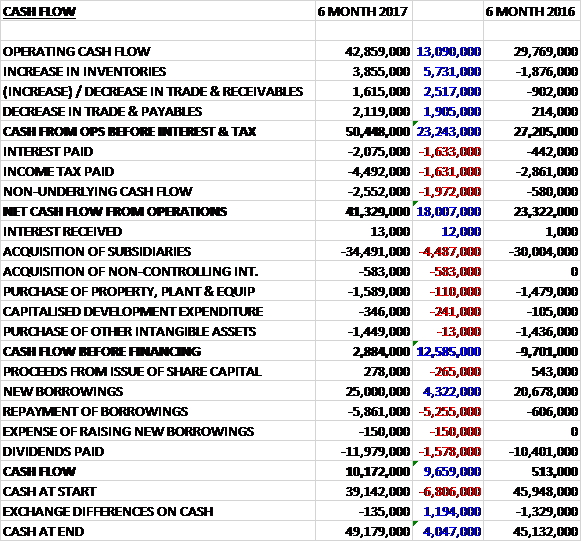
Before movements in working capital, cash profits increased by £13.1M to £42.9M. There was a cash inflow from working capital so despite interest payments increasing by £1.6M, tax payments growing by £1.6M and non-underlying cash flow increasing by £2M the net cash from operations was £41.3M, a growth of £18M year on year. The group spent most of this, £34.5M, on acquisitions along with £1.6M on fixed assets and £1.8M on intangibles to give a free cash flow of just £2.9M. This didn’t cover the £12M paid out in dividends so the group took out a net £19.1M of new borrowings to give a cash flow of £10.2M and a cash level of £49.2M at the period-end.

Not including acquisitions and forex movements, overall EU revenues increased by 5.9% and North American revenues were up 10.2%.

The operating profit for the European division was £30.8M, a growth of £6.1M year on year on revenues that increased by 12.5%. This was driven by companion animal growth of nearly 13% with strong performances from the majority of therapy areas. The core underlying EBIT growth was 6.9%. Several key products grew significantly, especially Cardisure, an anaesthetic, and Zycortal, an endocrine product launched last year.

Equine core sales increased by 8%, predominantly driven by European launches of Osphos. For the first time in three years, there was a growth from the pet diet range Specific which increased sales by 1.7%. This follows the transfer of the products into a new manufacturer and the reformulation of several lines in the range. The previously reported issue of a reduction in palatability of a number of therapeutic cat diets post reformulation has now been resolved with the reintroduction of the products to the market.

Farm animal product sales from the core business increased by 2.5% despite the planned reduction in production for the injectable antibiotics due to modifications in the manufacturing suite. The decline in sales reported last year in Germany due to antimicrobial resistance concerns slowed considerably. The issue remains that antibiotic sales continue to be under pressure, however, especially with recent government focus in Denmark and the UK.

Third party manufacturing revenues declined by 14.3% in the period predominantly due to one major account reducing its demand and by the rationalisation of a number of low value third party contracts to prioritise production of Dechra’s own products. The overall segment revenue benefited from an £11.3M contribution from the acquisitions of Genera and Apex.

The operating profit for the North American division was £18.1M, an increase of £9.4M when compared to the first half of last year with revenues more than doubling. The core underlying EBIT growth was 5.8%. Core sales of both companion animal and equine products increased revenue by 10.2% (at constant currency) despite the fact that a Levothyroxine based product was withdrawn from the market by the FDA. Zycortal and Vetivex were both launched in the US in the period. Equine sales grew by 67% driven by an excellent performance from Osphos.

Both the Mexican and Canadian businesses performed well. The overall segment revenue benefited from an outperformance by Putney. Market penetration of their products improved from the additional focus provided by Dechra’s sales and marketing team. Furthermore there was a one off benefit from opening new sales channels for these products resulting in a £3M uplift from stock sold into the distribution chain.

During the period the group received FDA approval for a generic antibiotic Amoxi-clav. This product was the first major approval from the Putney pipeline following the acquisition and the board expect additional approvals from Putney in H2. The group also received approval for Altidox, a new farm animal generic water soluble antibiotic in 13 EU countries. Osphos received approvals in Canada and Australia. Registrations were also gained from the Genera pipeline including Genoxytab, a farm animal intra-uterine antibiotic in four EU countries, and Canihelmin, a canine de-worming tablet in six EU countries. In addition, Apex received its first registration since acquisition for a liquid formulation of Benazepril, a companion animal cardiac medication. A number of new pharmaceutical product ideas have been screened and it is hoped that at least one will be introduced into the pipeline before the end of the year.

The implementation of the Oracle ERP solution has fallen behind schedule with “go-live” now expected in H1 2018. There are no fundamental issues with the project but detailed work flows and test plans identified the need to extend the implementation timetable.

In October the group acquired Apex Labs, a veterinary pharmaceuticals company based in Australia. The group paid £34.2M in cash and the acquisition generated goodwill of £9.8M. For some reason the results are reported in the EU segment and the business generated profits of £600K in the period. If the acquisition had been completed at the start of the year, it would have generated profit of £1.6M. The principal reason for the acquisition is to give the group direct access to the Australian companion animal and equine markets which they currently operate through partners. During the period the group purchased a further 1.74% of Genera for a consideration of £580K. They now own 95.13% of the business.

Despite the uncertainties surrounding Brexit and the reduction in antibiotic use, current trading is meeting management expectations. The core portfolio continues to grow, the product pipeline is delivering new products and good progress has been made on the rationalisation and integration of the recent acquisitions. The board are confident in their future prospects and the expectations for the full year.

At the current share price the shares are trading on a PE ratio of 120.5 but this falls to 28.4 on the full year consensus forecast – this is clearly not a value stock. After an increase in the interim dividend the shares are yielding 1.1% which increases to 1.2% on the full year forecast. At the period-end the group had a net debt position of £138M compared to just £17.8M at the same point of last year and £116.6M at the year-end.

Overall then this has been another period of progress for the group. Profits were up as was the operating cash flow, although not much in the way of free cash was generated and net liabilities increased again. The core business saw decent growth of 6% in Europe and 10% in North America with the performance in the former driven by strong companion animal and equine sales. Most products have done well in North America with Osphos proving particularly popular.

Although there was core growth, there is no doubt that the driver for most of the growth has been the recent acquisitions, however, and I do hope the group is not overextending itself – I would like to see some consolidation. The results have also been flattered by the weakening of Sterling and with a forward PE of 28.4 and yield of 1.2% there really is no room for error. This is a great company and one I am holding on to for now but the valuation is starting to look a bit full to me.

On the 21st March the group announced that executive director Anthony Griffin sold 3,500 shares at a value of £59K. He now owns 64,320 shares in the company.

On the 31st March the group announced that it had entered into a long term IP licensing agreement with Animal Ethics, an Australia-based company focused on developing ethical pain relief products in animal health. The agreement gives the group the right to sell and market Tri-Solfen for all animal species in all markets except Australia and New Zealand. Under the terms of the agreement the group has agreed to make milestone payments on signing, upon the first and second anniversaries of the agreement and on the first two major species approvals in markets with significant potential. Additionally a royalty will be paid on all net sales.

Separately the group has acquired 33% of the parent company of Animal Ethics for a total consideration of £11.1M. The business has developed a topical product which anaesthetises, relieves pain, controls bleeding and protects against infection. Its primary use is in sheep, pigs and cattle but other opportunities have been identified in horses and companion animals. It has already been registered for sheep in Australia with annualised sales of $4M. The development process is underway to register this product in global markets, with initial focus being for pigs in Europe and pigs and cattle in the US with the first registrations targeted for 2020.

This seems a decent acquisition for the future but I do help the group aren’t overextending.

On the 22nd June the group announced that CEO Ian Page sold 134,500 shares at a value of £2.6M. This is a substantial sale and is disappointing to see, suggesting he thinks they may have peaked.

On the 6th July the group released a trading update covering the full year with trading in line with management expectations. Overall reported revenue increased by 28% at constant currency driven by growth from the core portfolio, good market penetration from recent launches and the performance of acquisitions made last year.

European revenues were up 7% with non-contract manufacturing revenues increasing by 9% driven by a strong performance from the core companion animal business and strong contributions from the Geneva and Apex acquisitions. Revenue from food producing animal products saw a second successive year of growth despite the ongoing pressure to reduce antibiotic prescriptions.

The North American segment saw revenues up 93% and includes a good performance from the core companion animal and equine portfolios in both the US and Canada. Putney delivered a strong performance, benefiting from integration of the sales and marketing efforts of the enlarged Dechra team and Mexico also delivered good growth.

As announced last year, the group received FDA approval for a generic antibiotic Amoxi-clav which was the first major approval from the Putney pipeline following acquisition. Several other products received approval in numerous countries including Mexico, Australia, South Korea, Thailand, Canada and the EU.

Galliford Try Share Blog – Interim Results Year Ending 2017

Galiford Try has now released their interim results for the year ending 2017.

Revenues increased when compared to the first half of last year as a £25.7M decline in building construction revenue and a £7.9M fall in partnerships and regeneration revenue were more than offset by a £51.7M growth in Linden Homes revenue and a £34.2M increase in infrastructure construction revenue. Cost of sales also increased to give a gross profit £15.3M above that of last time. Share based payments grew by £600K, offset by a £600K reduction in amortisation but other admin expenses increased by £1.5M and there was a £4M reduction in the share of profit from joint ventures so that the operating profit was £9.9M higher. There was a slight reduction in finance charges, mainly due to a lower unwinding of discounted payables but tax expenses grew by £1.9M to give a profit for the period of £51M, a growth of £8.2M year on year.

When compared to the end point of last year, total assets declined by £11.9M driven by a £123.6M fall in cash partially offset by a £37.7M growth in amounts due from joint ventures, a £26.6M increase in prepayments and accrued income, an £18.3M growth in the amounts due from construction contracts, a £14.9M increase in the value of land and an £11.6M growth in work in progress. Total liabilities also fell during the period as a £59.7M decline in accruals and deferred income, a £9.5M fall in development land payables and an £18.4M decrease in borrowings were partially offset by a £46.9M growth in trade payables and a £12.8M increase in other payables. The end result was a net tangible asset level of £447.6M, broadly flat over the past six months.

Before movements in working capital, cash profits increased by £13.7M to £69.2M. There was a big cash outflow from working capital, however, and even after tax payments declined by £5.7M there was a net cash outflow from operations of £51.1M, an increase of £23.4M year on year. The group received £7M in dividends from joint ventures but spent £7.2M on available for sale financial assets. After a further £5.1M was spent on capex, there was a cash outflow of £56.4M. The group then repaid £19.1M of borrowings and paid out £46.4M in dividends to give a cash outflow of £123.6M in the period and a cash level of £42.7M at the period-end.

The profit at Linden Homes was £49.4M, a growth of £14.3M year on year. Housing market conditions have remained robust in all regions and demand has continued at a healthy level, supported by food mortgage availability. Unit completions increased from 1,171 to 1,391 but the average selling price declined by £8K to £287K due to a higher proportion of affordable homes being build – the underlying prices remained broadly flat.

The average number of outlets was similar to the same period last year and the rate of sale decreased marginally to 0.56, although since the start of the second half this has increased to 0.7 units per outlet per week. Overheads reduced during the period, giving rise to an increased margin of 18.2%.

The business continued to generate recurring revenue from land sales, mainly into joint venture projects. These profits represent the partner’s contribution to the uplift in land value at the point of entry into the joint venture, with Linden Homes’ share deferred until the units are sold. During the period they sold land totalling £10.3M, up from £5.6M last time. In response to increased market risk following the referendum they accelerated several joint venture sales which they had planned for the current year so the first half total is higher than expected in the second half.

Sales reserved, exchanged or completed are currently at £857M compared to £793M last time, of which £699K is for the current year, representing 72% of projected sales (broadly in line with last year). The total land bank is currently 14,250 plots compared to 15,500 at this point in 2016 and strategic land totalled 1,992 acres which is expected to generate around 11,400 plots – the land market remains benign.

The profit in the Partnerships and Regeneration business was £3.6M, a decline of £800K when compared to the first half of last year on lower revenues, driven by a decline in contracting revenue as some larger contracts concluded in the period.

Demand for affordable homes outpaces supply and client sentiment for mixed tenure investment has strengthened. The business secured an award of £18.8M under the Affordable Homes Programme to deliver shared ownership homes and they have extended their joint venture activity with provider clients. The business also continued to strengthen its relationship with the Extra Care charitable trust, agreeing two contracts, both worth £44M, to build new retirement villages near Bristol and in Bedfordshire. During the period the division also finished a contract with St. Mowden to build a £21M accommodation facility for staff at the Royal Centre for Defence Medicine in Birmingham.

The geographical expansion of the business continues with the new office in Bristol securing mixed tenure regeneration and contracting opportunities at good margins and the plans to open a new Southern and Midlands business are underway. The contracting order book increased 6% to £925M and mixed tenure sales currently reserved, exchanged or completed improved to £92M. The division’s land bank is 2,750 plots, an increase of 50.

The construction market remains stable with a pipeline of opportunities in the public and regulated sectors. The infrastructure pipeline is encouraging but the board remain cautious about the amount of time it takes to progress these projects. In Building, the number of opportunities from the public sector remains stable. Commercial projects suspended following the referendum have now been reactivated although for the medium term there remains a risk of weaker demand from private clients as businesses assess investments in the context of the current uncertainty. The order book fell £300M to £3.4BN with £500M of future work at the preferred bidder stage.

The profit in the Building Construction business was £800K, a decrease of £1.7M when compared to the first half of 2016. The group are making good progress on completing historical contracts and are working through closing remaining final accounts. These projects, won in a more difficult economic environment, continue to weigh down on profitability. Margins on new work are more robust with cost estimates reflecting the inflationary effect of weaker Sterling.

In the period the business won contracts worth over £250M including the £72M contract for the East Lothian Community Hospital; the £68M Park View Student Village for Newcastle Uni; the £40M private rental sector scheme for Dandara in Birmingham; and a £47M contract to build a commercial office space development in Cambridge on behalf of Brookgate. The business was also confirmed as one of six principal supply chain partners under the Department of Health’s new framework. The order book is currently £2.418BN, an increase of £15M.

The profit in the Infrastructure Construction business was £1.3M, a decline of £3.6M year on year. The market outlook remains positive across transport, energy and water with the business steadily increasing its portfolio of framework positions during the period. They have a position in the Natural Resources Wales framework delivering coastal and river defence schemes (up to £45M over four years); North Yorkshire Council’s carriageway planning and surfacing framework (up to £200M over two years); and was confirmed as a Tier 1 alliance partner to Scottish Water responsible for delivering its quality and standards capital investment programme up to 2021 (about £50M in value). In addition the business was appointed to Gatwick Airport’s capital delivery framework on three lots value up to £300M. The order book currently stands at £992M, a decrease of £320M.

PPI Investments made a loss of £200K, an improvement of £1.5M year on year. They continue to be active in Scotland on a wide array of hub projects. During the period they financially closed a number of schemes including East Lothian Community Hospital, West Calder High School and Inverurie and Foresterhills Health Centres. The business continues to monitor PF2 opportunities in England and they expect a programme of projects will be brought to market in the 2017 calendar year. They handed over all schools in the PSBP North East project and are therefore well placed when pipeline announcements are made. In addition they have been working on a number of student residencies schemes and more general development opportunities which will generate pipeline for the group’s construction business.

The construction business’ cash balance was lower than normal. This reflected the deferral of several contracts in the buildings division following the Brexit vote which will unwind as these projects get underway; also delayed receipts from some legacy projects, which caused the group to finance a higher than planned level of working capital by about £40M, and which will continue for several months pending resolution.

Going forward, Linden Homers has entered the second half with a strong forward order book, with total sales currently reserved, contracted and completed increasing by 8%. Following the strong first half operating margin the board expect to see a full year improvement in operating margin against 2016. The land market remains benign for all regions and the business continues to pursue opportunities to acquire prime sites in good locations at attractive hurdle rates while remaining disciplined in their expansion.

The housing white paper reaffirmed the significant opportunity the group see in their partnerships and regeneration business, underlining that affordable housing remains high on the political agenda. Over the remainder of the year, they expect the business to deliver revenue growth as they benefit from their geographic expansion and further margin improvement from a higher proportion of mixed-tenure revenue. The full year expectations remain unchanged.

Construction remains focused on risk management and the quality of its order book. Full year revenue is expected to be broadly in line with last year, underpinned by secured turnover of 94%. The board expect that the second half margin will continue to show the drag from legacy contracts but are encouraged by the performance of the newer work, which supports their target margins and should begin to improve reported results from 2018.

At the current share price the shares are trading on a PE ratio of 11.7 which falls to 10.2 on the full year consensus forecast. After a 23% increase in the interim dividend, the shares are yielding 5.7% which increases to 6.1% on the full year forecast. At the period-end the group had a net debt position of £113.8M compared to £95.7M at the same point of last year.

Overall then this has been a mixed period for the group. Profits did increase but net assets remained flat and there was an operating cash outflow, although this was due to working capital movements and cash profits increased. The business is basically being driven by the housebuilding arm which is enjoying a decent rise in profitability. This is being offset by a partnerships and regeneration business that saw the end of some larger contracts and the construction arm which is suffering due to low margin work being won when the market was poor. The partnerships business looks to be picking up but the construction division will be subdued for a while yet.

The shares are not expensive with a forward PE of 10.2 and yield of 6.1% but this is for a good reason in a highly cyclical business that is still struggling with legacy contracts. If the market holds following Brexit, these could be a bargain otherwise a value trap – could go either way really! I’m leaning towards the idea that one of the pure housebuilders would be a better bet.

On the 13th March the group announced that it had approached the board of Bovis to propose a merger. They have proposed that the equity would be split 52.25% to Galliford Try shareholders which would value Bovis at £1.191BN or 886p per share, a premium of 7% on the closing price on the prior day. This approach was later rejected with Bovis preferring to go it alone.

On the 3rd May the group announced a trading update for the first four months of the second half. There was a strong performance but the overall result will be impacted by non-recurring costs in construction of about £98M following a reappraisal of costs to complete and recoveries from legacy contracts. Otherwise the group outlook for the year is unchanged.

A reappraisal of costs to complete and recoveries from two major infrastructure joint venture projects has substantially increased the anticipated liability to conclude the legacy contracts in the group’s construction business. They estimate costs of about £98M, some 80% of which relates to their share of the two joint venture projects. One of these projects will finish on site in the summer of this year while the other, which represents the larger proportion of the costs, is scheduled to complete in mid-2018.

Linden homes is enjoying good trading conditions and continues to perform well. Sales rates for the period were 0.75, up from 0.56 sales per outlet in H1. The business enters the final months of the year with a strong forward order book. Sales reserved, exchanged or completed are currently £1,128M of which £893M relates to the current year, up 5% over last year. The business’ land bank is 11,300, down from 12,400 in line with the strategy to hold a shorter land bank equivalent to 3.5 years. Some 97% of plots have been secured for 2018, together with 76% for 2019.

The performance in Partnerships and Regeneration strengthened in the period. The order book increased by 6% to £980M with several new contract awards, including their largest ever contract at Great Eastern Quays worth £128M. Reflecting good growth in higher margin mixed tenure revenue they expect to report an increased operating margin. In line with their strategy of national expansion, they have agreed terms to acquire a mixed tenure developer in Hampshire with strong contracting, housebuilding and land acquisition capabilities. Sales reserved, contracted or completed stand at £127M, up 35% year on year. The land bank has increased from 2,700 plots to 2,900 plots.

Whilst construction’s result will be impacted by the non-recurring charge, the underlying business continues to perform well. Significant progress has been made through a strong focus on selective bidding and ensuring that new work contains sufficient allowances for risk, margin and inflation. Some 85% of the workload is now within these frameworks, lower risk public and regulated sector, and two-stage negotiated work. This focus is expected to deliver turnover growth by 2021 to £1.8BN, with an improvement in the operating margin to over 2%. The order book is up slightly to £3.5BN with 73% of next year’s revenue secured compared to 76% in the prior period.

Overall then, Linden Homes is expected to report an improvement in the full year operating margin, partnerships & regeneration remains on track to deliver revenue growth as the business benefits from geographic expansion and further margin improvement from a higher proportion of mixed tenure revenue; and construction’s underlying portfolio continues to perform well. The group is no longer undertaking large infrastructure jobs on fixed price contracts and there are no more similarly procured major projects in the current portfolio. This notwithstanding, there must remain some uncertainty over the final price to be paid for the current underperforming contracts.

On the 11th July the group released a trading update covering the year as a whole where they are predicting profits towards the upper end of market forecasts. The group had a modest net cash position at the year-end and expect to pay dividends in line with previous guidance.

Linden homes is expected to report a strong performance. Revenue growth has accelerated in the second half, driven by solid growth in volumes, with total completions up 7% to 3,296 units. Average sales rates in the second half were strong at 0.68 unites per week, up from 0.56 in the first half and the average private sales price was up 6% to £354K. The business had a strong forward order book at the end of the year with sales carried forward of £373M, although this was slightly lower than the £380M last time. All land plots have been secured for 2018 with 83% of plots secured for 2019 with the land bank standing at 10,650 plots.

Performance in Partnerships and Regeneration continued to improve with both revenue and margin increased over 2016, helped by growth in higher margin mixed tenure projects. The acquisition of the mixed tenure developer Drew Smith is expected to accelerate growth across the Southern region. As of the year-end, the contracting order book is up 23% at £1.05BN and the land bank remained stable at 2,700 plots.

In Construction, the underling portfolio of newer contracts continued to perform well. As announced, the division’s reported performance will be impacted by £98M non-recurring costs following a reappraisal of costs to complete, principally from two large legacy contracts. These also affected the business’ cash position which fell from £160M to £136M. They no longer undertake these types of fixed price contracts on large infrastructure projects. The business enters the new financial year with a stable order book of £3.5BN which includes 84% of projected revenue for 2018.

The group’s outlook for 2018 is unchanged. Linden Homes is expected to deliver further volume growth and improvement in the operating margin. Partnerships and Regeneration continues to enhance its position to benefit from the demand for affordable housing and Construction’s margin is expected to increase as they close out legacy positions.

Overall this all looks fairly decent, although the one-off issues surrounding legacy construction contracts continue to weigh on the group. This is certainly high risk at this point but if the price is right it might be worth a look.