Gemfields Share Blog – Interim Results Year Ending 2015

Gemfields have now released their interim results for the year ending 2015.

gemfieldsinterimincome

When compared to the first half of last year, revenues romped ahead, increasing by $37.7M to $103.4M.  We also saw a $7.2M increase in depreciation & amortisation, a $4.1M growth in mineral royalties & production taxes, a $1.8M increase in fuel costs and a $936K growth in repairs and maintenance. This was all counteracted by a $20.1M change in inventory, however, to give a gross profit some $39.7M higher at $67.8M.  We then see a near $4M increase in staff costs and a $1.2M increase in professional costs, partially mitigated by lower selling and advertising costs to give an operating profit $36.6M higher than in the first half of 2014 before an $882K increase in finance costs and a huge $13.9M hike in tax meant that the profit for the period was $21.8M higher at $23.2M, $16.3M of which was attributable to owners of the company.

gemfieldsinterimassets

When compared to the end point of last year, total assets increased by $44.4M to $471.1M driven by a $12.8M increase in cash levels, a $12.7M growth in inventories, presumably due the large number of unsold Emeralds from the last auction, a $10.8M increase in property, plant & equipment, a $4.4M increase in “other” non-current assets and a $4.2M growth in intangible assets, only partially offset by a $1.3M decline in deferred tax assets.  Liabilities also increased during the period with a $13.3M increase in borrowings and a net $11.6M growth in tax liabilities, partially offset by a $3.9M reduction in trade & other payables.  This gives a $19.7M increase in net tangible assets to $267.4M which seems pretty strong to me.

gemfieldsinterimcash

Before movements in working capital, cash profits increased by an impressive $42.6M when compared to the first half of last year, before a large increase in inventories, along with a smaller growth in payables meant that cash from operations was a more modest $23.3M higher at $43.7M before the tax bill dragged this down to $36.3M, a $17.9M increase.  The group spent the bulk of this on property plant and equipment ($17.3M, with $6.1M being spent at Montepuez) with another $10.2M being spent on stripping costs and $4.4M each being spent on intangible assets and new loans granted.  The upshot of this is that cash flow before financing was just $347K, albeit an $8.3M improvement on last time.  There was then interest to pay of $1.3M with a net $13.6M increase in borrowings meaning that the cash flow was $12.7M to give a total of just under $50M at the end of the period.  This is a decent cash pile but there is certainly no room to squeeze any shareholder returns into that.

At the Kagem Emerald mine in Zambia, significant progress was made on the fourth high wall pushback during the period which will extend the Chama pit by a further 75 metres.  More than 7.3MT of waste rock was removed and the 17 month stripping programme is currently running ahead of the original targeted completion date of September 2015.  During the first half of the year, $11.2M was invested in new mining equipment to support the scale of operations at the Channa pit as well as accelerating bulk sampling of the Libwente and Fibolele pits.  During the first half of the year the mine produced 12.1M carats at a grade of 202 carats per tonne compared to 10.4M carats at 267 carats per tonne produced during the same period of last year.  The gemstone deposit has a fairly considerable grade fluctuation and the overall grade was also impacted by the dilutive effect of the bulk sampling work being carried out at the Fibolele and Libwente pits.  Total operating costs were $1.81 per carat compared to $1.38 per carat last time round which reflects the pit expansion operations.  Cash rock handling unit costs fell to $2.92 per tonne from $3.52 per tonne, however, with the increased scale of mining operations delivering improved efficiencies.

The trial underground mining project at Kagem was placed on hold towards the end of the period as the continued viability of open pit operations, supported by robust emerald prices and the flexibility of extending the open pit operations as required, has negated the need for accelerated underground operations at this time.  Kagem increased its processing efficiencies following an upgrade of the washing plant facility and the associated security arrangements.  A climate controlled environment was also established within the picking belt facility which resulted in an improved working environment and better operating controls which helped lead to fewer breakdowns, reduced maintenance costs and more efficient gemstone recoveries.

The Libwente South Pit in the Kagem license was one of two bulk sampling projects at the mine and has recently been expanded in scale with the current project expected to handle 1.9MT of rock to produce 41,000 tonnes of reaction zone ore. The core drilling continued to extend to the TMS outline to identify additional prospective TMS resources in the area which resulted in the delineation of another bulk sampling pit targeting a shallow TMS body of depths between 6 and 24 metres with an average thickness of 16 metres. Gemstone production from bulk sampling at the Fibolele pit also increased during the period, mainly due to the increased width of the TMS being mined and yielded considerably improved grades which bodes well for the remainder of the Fibolele TMS belt.  A third bulk sampling phase has now been planned at the pit which will increase the pit size to 590 metres in length and 50 metres in depth.

There were two Emerald auctions held during the period.  In August an auction was held of lower quality emerald in Zambia that generated revenues of $15.5M at an average price of $3.61 per carat ($1.34 per carat if the Beryl is included) having sold 88% of the lots by value.  The other auction of higher quality Emeralds was held in November generating revenues of $34.9M at an average price of $65.89 per carat, which was a record high, having sold 89% of all lots by value.  In February, after the period end, the group held an auction of lower quality Emeralds which raised $14.5M at $3.72 per carat.

In Mozambique the bulk sampling programme at Montepuez continued to increase in scale and delivered pleasing results.  They were focused on alluvial deposits found within the Maninge Nice and Mugloto areas.  After a technical review the rock handling approach has been optimised and additions to the fleet have brought the total rock handling capacity to an average of 310,000 tonnes per month compared to 120,000 tonnes per month last year.  About 6.3M carats of ruby and corundum were produced during the period an increase from the 5.1M carats produced during last year with rock handling during the period hitting 1.5MT and total cash operating costs of $8.6M, nearly double that of last time.

About 171,000 tonnes of ore was processed by the washing plant with an average grade of 37 carats per tonne coming from the two areas.  Total investment in property, plant and equipment was $6.1M with much of this being spent on improved washing plant facilities and mining equipment which has increased the washing plant capacity.  An extensive exploration programme is underway across the entire license in order to generate a solid baseline geological map with sufficient data to better understand the extent and trend of the amphibolites, the gravel bed thickness and its distribution and indicative grades.  The group is aiming to complete its first resource statement for Montepuez in the second half of the year.  It is envisaged that a total of 25,000 metres will be drilled across the central part of the license with 7,000 metres being already completed in the first of three planned blocks with the initial drilling programme expected to be completed by December.  The study has already delineated significant paleo-channel deposits with occurrences of ruby mineralisation within the Mugloto area and these have been proven by bulk sampling.  Other areas with potential have been delineated as a result of the exploration programme.

Drilling in the Maninge Nice area recovered about 3,500 metres of core to date with the drilling mainly used to establish the continuity of mineralised amphibolite within the subsurface areas.  The boundary of the amphibolite body and the subsurface continuity of ruby mineralisation to below 30 metres have been delineated and established and white marble bands of up to 30m in thickness and to a depth of 45m with intermittent bands of amphibolite have been observed.

During the period an additional rinsing screen was added to improve the performance of the washing plant during the rainy season which helped drive the increased processing performance achieved.  A water reservoir and large dam have also been constructed next to the plant for the collection of rain water and seven water boreholes further supplement water supplies.  Further capacity increases and recovery improvements are being studied which will be an important step towards finalising the planned increase in washing capacity required for the potential ramp up in production expected at the license in future.

The second ruby auction was held in Singapore in December of higher quality material which generated $43.3M, a record total for any Gemfields auction yielding an average value of $688.64 per carat.  An exceptional 40.23 carat ruby, dubbed the Rhino Ruby, was part of this auction which was sold for an undisclosed price.  In honour of this stone, the group have committed to supporting the anti-rhino poaching aircraft operated by game reserves, contributing to its flying costs during 2015, which I think is a nice touch.  The next auction will be of lower quality ruby and corundum and is scheduled to take place in India in March with an auction of higher quality rubies scheduled to take place in Singapore in June – that might be the one to watch.

The mine’s camp site is due to undergo a significant upgrade in the coming year with the existing prefab structures being replaced by permanent infrastructure including improved roads, water purification capabilities, office units, accommodation units and leisure facilities.  Work has already begun on upgrading the CCTV equipment and sort house areas to reduce the risk of stock losses.  As we have seen before, site security has been an ongoing problem at the concession but a significant security presence and new infrastructure have resulted in an improvement.  There is now a plan to separate the security department into an independently functioning unit with personnel being inducted from the Mozambique military.

Kariba is the world’s largest Amethyst mine.  During the period the Curlew North, Francis West and Cha Cha pits have been actively developed with positive bulk sampling results achieved from the Cha Cha pit that means it is now an actively producing pit.  Production of amethyst increased significantly during the period to 574,000 Kg from a level of 223,000 Kg last year and about 8,000 tonnes of ore was processed by the washing plant with the highest recoveries achieved from the Curlew pit.  A total of 510 Kg of medium grade amethyst was sold during the period for $750K with the higher grade amethyst being sold at auction, generating $450K from 25.2M carats.  A new exploration programme is being put in place for 2015 to confirm the re-estimate of the mineral resources available at the mine.

The Kariba mine is working towards a cost effective solution for energy and has initiated a brief for a 1MW solar farm in conjunction with an Australian solar supplier and the Zambian national electric company.  The project aims to also offer excess capacity to the local community at a rate that will be subsidised by the Zambian government.  Kariba will lease two hectares of its land to the project and the Australian company will fund construction with Kariba signing an off-take agreement to purchase electricity.  The first phase of a new CCTC system was deployed during the period with 15 cameras monitoring key areas including the sort house, washing plant and stores with more extensive coverage being planned for 2015.  These infrastructure upgrades will further increase mining volumes and operational efficiencies.

At Faberge the value of sales during the period increased by 2.4% when compared to the same period in 2013, despite a material decrease in sales arising from Ukraine and Russia, and improved practices helped reduce losses by approximately 17%.  The business worked on expanding two important luxury categories namely Objets d’Art and high end Swiss timepieces which will be launched during the year.  For 2015 and beyond the business will position itself as the artist jeweller, painting with precious gemstones and enamels to create unique pieces of art.  It will also be partnering with leading multi-brand retailers and department stores.

During the period the group entered into a joint venture with EWGI, a Jersey registered company in order to progress opportunities in the Sri Lankan sapphire and gemstone sector, which will be 75% held by Gemfields.  The company has acquired 75% operating interests in 16 exploration licenses for $400K.  A gemstone trading company called Ratnapura Lanka Gemstones will also be established which will focus on sourcing rough sapphires from various sources in the local market.  A trading license has been obtained and a token shipment of sapphire has been made to the Gemfields UK office.  They are also in the process of establishing infrastructure in Sri Lanka and commencing preliminary geological assessment of the permits.

Additionally the group acquired controlling interests in two extra ruby deposits in Mozambique which are valid for an initial period of 25 years through a new company, Megaruma, that is 75% owned by the group.  The two licenses both border the existing Montepuez ruby deposit and cover about 19,000 hectares and 15,000 hectares.  In February the group also acquired a 75% interest in an emerald exploration license through an Ethiopian registered company, Web Gemstone Mining, for a total consideration of $254K.  The license covers an area of 200 square Km in Southern Ethiopia and potentially hosts emerald mineralisation within a geological lineament that stretches over 45 km.  Satellite imagery studies of the area have been completed and evidence of emerald mining in the belt is indicated by informal market reports and by the presence of several small pits.  Further exploration work in the area, including bulk sampling, will be carried out over the next 18 months.

During the year the Zambian joint venture entered into a $20M revolving credit facility with Barclays bank that bears interest at LIBOR plus 4.5%.  This loan replaced the previous loan that had a balance of $6.8M and will be used for Kagem’s working capital and capital expenditure requirements.  The outstanding balance on this new loan was $15M at the end of the period.

After the end of the reporting period the company has informed us that the tax regimes in both Zambia and Mozambique have seen legislative changes.  In Zambia the two-tier corporate income tax regime has been replaced by a mineral royalty tax regime and in Mozambique there has been a number of changes to the tax code including a reduction in the rate of production tax and the introduction of new taxes.  Management are awaiting additional regulations and guidance from the tax authorities in both countries before they understand the implications fully but this all sounds rather worrying.

The next auction will be of lower quality rubies and is scheduled to take place in India in either March or April with an auction of higher quality rubies scheduled to take place in Singapore in June, which would be more likely to give a boost to earnings and the share price.  The board expect a steady increase in demand with the associated increase on achievable price to continue for the foreseeable future and the company’s exploration and expansion could also yield positive results.

Overall then this seems like a good set of results.  Profits increased considerably and net assets improved to leave the balance sheet in a healthy state.  There seem to be quite a lot of sampling operations taking place, both in Zambia and Mozambique but although cash flow has improved there is still no free cash flow. The Faberge business looks unlikely to make money any time soon, though, and they have been hit by the Ukraine crisis as Russia is a large market.  At the auctions, the rubies are selling well and seem to bring in a lot of cash which boded well for the future when production is ramped up.  The Emerald auction was a bit more worrying, though, as the group failed to sell a lot of the total stones last time round.  Also, the news about the tax changes in both African countries outlines some of the risks in operating in such countries and is another potential cause for concern.

In conclusion then, there certainly seems to be a great deal of potential here and the ramp up of ruby production is cause for optimism and this seems like it should be a great investment at some point.  The niggling issues restrain me for the moment though and I would like to see some clarification over whether the lack of sales at the Emerald auction is a permanent change or a one-off and also over the changes to the tax regimes in the countries that the group operates in.

GEM1YRChart

Despite the recent short rally, these shares have gone no-where since June last year so I will keep an eye out for a potential break out.

On the 14th April the group released a market update covering the latest quarter.  There was an increase in quantity and quality of emeralds produced at Kagem, increasing from 3.6M carats last quarter to just under 10M carats this time.  The fourth phase of the wall pushback programme in the main Chama pit continued during the period with about 4M tonnes of waste removed, with a slightly accelerated rate meaning that this is likely to be completed ahead of schedule.  The exploration and bulk sampling activities at the Fibolele and Libwente pits are progressing well and the reduction of illegal mining within the boundaries of the license had made considerable progress given that Kagem has re-absorbed these areas into the site’s routine operations.

The February auction of lower quality emerald and beryl saw 3.9M carats being sold, representing 88% of the value offered but only 39% of the total weight offered.  The auction generated $14.5M with an average of $3.72 per carat, a new record for the lower quality stones.  The next auction of traded rough emerald is scheduled to take place alongside the Ruby auction in India in April.

In Mozambique, bulk sampling operations at the Montepuez ruby deposit continued. The core infrastructure is in place and progress is being made towards formalised mining.  The test work led to an enhanced understanding of the ore characteristics and improved throughput in the semi-mobile processing plant which saw an almost three-fold increase in processed tonnes when compared to the same quarter last year, although looking at the figures it seems that the grade of rock has declined somewhat.  Unlicensed mining activity and asset loss remains a key challenge at the mine but the new mining law may be a supportive mechanism in partly addressing these issues and in the meantime significant security presence and ongoing efforts have resulted in a strong improvement this quarter.

The group’s second auction of higher quality rough amethyst from the Kariba mine was held alongside the rough emerald auction with revenues of $450K were generated at a realised value of $1.77 per carat.  The Faberge Pearl Egg was unveiled at the Doha Jewellery & Watches Expo in Qatar and was sold within houses to local businessman Hussain Al-Fardan.  The new jewellery collections unveiled at the expo and presented to press in Basel were apparently well received and helped boost overall sales figures.  The new timepiece collections were also well received at the same show and the pear egg in particular has generated a lot of press attention.

In Sri Lanka the group is in the process of establishing initial infrastructure and initiating preliminary geological assessments in areas of interest with the placement of key management in progress.   At the end of the period the group held cash of $27.9M and total debt of $35.5M, including $20M of debt at Kagem.

On the 23rd April the group announced the results of its lower quality ruby auction held in India.  The auction generated $16.1M at $4.03 per carat and some 93% of the lots sold by value.  The group also offered traded rough emeralds at the auction which generated a further $1.6M.  The next auction to take place will be of higher quality ruby expected to take place before the end of June.

Overall these are good updates which shows the group is making steady progress and I am tempted to take a position here, funds permitting.  Funds permitted, so I did!

On the 23rd June the group announced its results for the latest auction of higher quality rubies in Singapore.  A total of 72,208 carats were offered compared to 85,491 last time but only 47,451 were sold, representing just 61% of lots.  Moreover, the average carat value realised was $617.42 compared to $688.6 last time with the auction yielding $29.3M, down from $43.3M.  This is despite the sale of an exceptional matching pair of rubies with a combined weight of 45 carats that were bought by Veersak Gems of Thailand and named the ‘Eyes of the Dragon’.

The CEO states that demand for fine gems remains healthy and the prices obtained were in line with expectations but there has been some softening in demand for certain darker tone and lower quality grades.  This seems like a disappointing auction result to me and I think I might look to sell out at roughly break even with a view to hopefully buying back in at a later date.

On the 22nd July the group released a JORC resource and reserves update for the Montepuez Ruby mine which is the first recorded mineral resource statement.  It was noted that to date, rubies from the mine differ geologically from many of the rubies traditionally available in the international markets in that they are amphibolite related rather than marble of basalt related.

The mineral resources statement is as follows (I have included the last estimates of probable reserves and grades in brackets):

Maninge Nice Primary 245M carats indicated and 44M carats inferred at a grade of 115.4 carats per tonne. (253M carats at 114.9 carats per tonne)

Maninge Nice Secondary 107M carats indicated at a grade of 349.8 carats per tonne. (107M carats at a grade of 58.3 carats per tonne)

Mugloto Secondary 72M carats indicated at a grade of 15.3 carats per tonne. (72M carats at a grade of 3.1 carats per tonne)

In total this relates to 289M carats indicated and inferred of the primary mineralisation type at a grade of 115.4 carats per tonne and 178M carats indicated and inferred of the secondary mineralisation type at a grade of 35.7 carats per tonne.  As we can see the total number of carats has increased at Maninge Primary and the grades have increased considerably at the other deposits.

The group are targeting an increase in mining capacity from 3.3M tonnes per annum currently to 5.6M tonnes per annum by July 2017 and to increase the annualised processing rate from 399K tonnes per annum of ore to 1.3M tonnes per annum.  This will be achieved by undertaking the following capital improvements:

The current wash plant is to be upgraded from 100 tonnes per hour to 150 tonnes per hour; a secondary was plant will be installed with a 250 tonnes per hour capacity; the ore stockpile areas will be expanded onto currently undisturbed land; the existing two-way haul road to the Mugloto pits on which the trucks are currently plying in a convoy system will be replace with two 12m wide one-way haul roads for laden and empty traffic movements; and the existing workforce will increase from 369 people to 1081.  The capital cost for the existing wash plant upgrade, the new wash plant and replacement sorting house is approximately $23M.

In total 27.5M tonnes of ore is expected to be processed over the 21 year life of the mine at an average grade of 15.7 carats per tonne and production is expected to make a step-change increase in the year ending 2017 from 11,865 carats in 2015 to 20,152 carats.  This is then expected to increase at a more modest rate to 20,520 carats by 2020.  Total operating profit in 2016 is expected to be $48M, increasing to $123M in 2017 and reach $220.2M by 2020 and this model assumes an average sales price of $389 per carat for high quality rubies and $1.30 per carat for lower quality rubies and corundum.

The total capital cost is estimated at $305M with $105M outlined for engineering and mining, $63M for the wash plant, $120M for sustaining and exploration capital for the ongoing operations and closure costs of $20M.  The bulk of the capital expenditure is expected to be incurred in the year ending 2016, with $49.2M to be spent, falling to $14.8M in 2017 and $11.3M by 2020.  So the mine is expected to be considerably profitable from 2016 onwards.

The price of $389 per carat seems very conservative considering the reduced price achieved at the last auction was $617.  To me this seems like a great update, I really like the way the information is set out in a clear and concise manner with very conservative cost models – other natural resources and oil companies can really take note of this!  The ruby mine has a long life ahead of it and should be very profitable even in a lower ruby price environment and I have re-entered after selling out following the last auction results.

On the 13th August the group released a statement covering trading in Q4 2015.

At Kagem the group produced 8.1M carats of emeralds at a grade of 222 carats per tonne compared to 6.2M carats at 271 carats per tonne in Q4 last year and 9.9M carats at 355 carats per tonne last quarter.  Total cash operating costs were $10.5M compared to $8.9M in the same quarter of last year and $11.4M last quarter ($1.58 per carat against $1.79 and $0.99 respectively).  The fourth phase high wall pushback programme being carried out in the Chama pit continued to be advanced during the period and the programme remains on schedule for completion at the end of September.  In addition, the exploration and bulk sampling activities at the Fibolele and Libwente pits are progressing well.  For the year as a whole, the auctions saw 16M carats being sold, representing 89% of the value offered and generating revenues of $64.9M.

At Montepuez, mining and bulk sampling operations continued to provide positive results and insight into the geology of the deposit and the ongoing test work has led to an enhanced understanding of the ore characteristics and improved throughput at the processing plant which saw a 10% increase in processed tonnes when compared to the same quarter of last year.  This quarter, the mine produced 700K carats compared to 200K carats in Q4 last year and 1.4M carats last quarter at a grade of 9 carats per tonne (compared to 18 and 3 respectively).  The gemstone cash unit cost increased considerably from $2.64 per carat last quarter to $8.57 per carat this quarter (although it remained below Q4 of last year) and the total cash operating cost increased from $3.7M to $6M.

The ruby auctions during the year saw 4.1M carats being sold representing 82% of the value offered and generating revenues of $88.5M.  Faberge took part in the art, antique and design fair “Masterpiece London” for the first time where jewellery, timepieces and objets d’art were showcased alongside loose gemstones from the mines of Gemfields. In addition to the new collection Secret Garden, a suite of exceptional coloured jewels inspired by the floral compositions of painter Marc Chagnal and the “Lady Compliquee”, a complicated timepiece featuring a peacock opening its feathers every hour; the first two pieces of objets d’art were unveiled.  The set, called the Faberge Four Seasons Eggs, comprises dour decorative eggs, each set with one of the four major gemstones – diamond, emerald, sapphire and ruby to represent the four seasons.

In Sri Lanka, the group continued the process of establishing initial infrastructure for trading operations and the placement of key management is in progress.  In Ethiopia, an exploration team was recruited and established on site to help develop a better understanding of the license area.  A base camp has been established on the concession and a team was stationed there in June.  Exploration work has commenced for 2016 with preliminary ground surveys and plan in place for Q1.  These include mapping, preparation of base plans, manual pitting and trenching.

At the year-end the group had cash of $28M and total debt of $45M so net debt of $17M.  Overall there was not really much new released in this update – the grades being mined at both mines seem to have fallen when compared to last quarter though, with the consequential increase in costs and decline in carats recovered – there was no explanation given for this but I am just about content to hold on to the shares given the exciting potential revealed from the resource statement last time.

On the 7th September the group announced the results from its auction of higher quality rough emeralds and higher quality amethyst.  The auction took place in Singapore  following seven successive emerald auctions held in Lusaka and the group sold some 88% of the value on offer which was broadly similar to the last two auctions.  The total realised from the auction was $34.7M and the average price per carat came in a $58.42 which, although below the $65.89 achieved last year, is broadly in line with the February 2014 auction.  The amethyst auction saw 11M carats placed on offer with 10.1M being sold generating revenues of $440K.  This represents an average value of 4.32c per carat, more than double the 1.77c achieved last time.

Considering the slow-down seen in China and the fall in the price of diamonds, these emerald prices actually look fairly robust.   I expect this is in part due to the fact the auction was held in Singapore rather than Zambia which I would have thought may have mitigated any price falls.  I am finding it hard to know what to do here, there is no doubt that this is a quality company but if the global financial problems do increase, the demand for emeralds and rubies are likely to take a hit.  Having said that, after dipping in and out of this share twice now, I am sorely tempted to dip back in.

On the 10th September the group announced that it had entered into binding agreements to acquire controlling interests in two emerald projects with operations and prospects located in the Boyaca state in Colombia.

The Coscuez Licence includes exclusive rights for the exploration, construction and mining of emerald deposits granted by the Colombian government within the area of Coscuez in San Pablo de Borbur, Boyaca.  In the past the area has hosted the Coscuez mine, one of history’s more significant emerald mines, having been in operation for over 25 years.  In 1990, open pit mining was replaced by small scale underground mining in the upper reaches of the deposit with extraction taking place from adits mines into the hillside.  Under the terms of the agreement, Esmeracol will transfer the license to a newly incorporated company imaginatively called Coscuez NewCo and Gemfields will acquire an indirect 70% interest in this company.   Further exploration activity needs to be carried out to support the development of a geological model and a prelim mine plan, all of which is likely to take up to two years.

The total consideration payable is $15M with the first tranche of $7.5M due on completion, $5M in cash and $2.5M in Gemfields shares.  A second tranche of $2.5M is due on the first anniversary of completion and a third and fourth tranche of $2.5M each upon attainment of agreed profit targets.  Completion is expected to occur by March 2016.

The second project comprises a number of new license applications and assignments to existing concession contracts administered by the Colombian Mining Agency.  The applicants for the mining licenses are a number of Colombian companies indirectly controlled by ISAM Europa.  Gemfields has acquired indirect 75% and 70% effective interests in underlying licence applications and assignments through two holding companies which own the assorted Colombian companies.  The total package of mining license applications and assigned concession contracts cover about 20,000 hectares in the Boyaca and other Colombian departments and comprise mostly greenfield sites, although small scale mining has occurred in some of the license area.  Eight of the assignments have been approved and issued so far with the remaining applications under review.

The total consideration payable is $7.5M with the first tranche of $450K being paid today.  A second tranche is payable upon granting of certain license applications, a third tranche is payable when bulk sampling commences on certain license areas, a fourth tranche is payable on the commencement of commercial mining and a fifth and sixth tranche (comprising more than half of the total consideration) is payable upon attainment of agreed revenue targets.

This is an interesting development and gives the company something to do after the Montepuez mine is up and running properly I suppose.  This is a completely new geographic area for the group so probably does come with some execution risk and without a) knowing why mining stopped at Coscuez or b) more about the slightly confusing arrangement  with the other licenses it is quite hard to know if this is good value or not.  Still, some further diversification is probably not a bad thing.

On the 23rd September the group released a Kagem Emerald Mine JORC Resources and Reserves Update.  In total the measured, indicated and inferred mineral resource is 1.8 billion carats at a grade of 281 carats per tonne.  The measured mineral resource is 290M carats at a grade of 345 carats per tonne, the indicated mineral resource is 1.33 billion carats at a grade of 335 carats per tonne, and the inferred mineral resource is 181M carats at a grade of 110 carats per tonne.  There are proven and probable reserves of 1.1 billion carats at a grade of 291 carats per tonne consisting of 276M carats or proven reserves at 300 carats per tonne and 840M carats of probable reserves at a grade of 288 carats per tonne.

The projected life of mine for the open pit operation is 25 years with the Chama pit is expected to be depleted by 2039 and the Fibolele pit by 2021.  They are producing a total of 1.1 billion carats and capacity is expected to increase from 90,000 tonnes per annum to 180,000 tonnes by July 2018 with the inclusion of the Fibolele pit.  The average annual production of emeralds and beryl is expected to be 44.7 million carats over the life of the mine and the projected real cash flow over its life is about $1.59BN.

The net present value is $520M based on a 10% base discount rate.  Kagem is expected to generate $4.322BN in gross revenue with total operating costs of $1.017BN, assuming an average sales price of $61.5 per carat (compared to $58.4 per carat at the last auction) for higher quality emeralds and $0.88 per carat for lower quality emeralds and beryl. The total capital expenditure is expected to be $516M over the life of the mine.  A substantial exploration programme using proven techniques is planned for the next few years to explore the rest of the license area to further determine the remaining resource potential.

Overall then, this mine is likely to generate a decent amount of cash flow over its life time and we can see that both production and profits are expected to ramp up over the next few years.  It has to be said, however, that the assumed sales price per carat seems rather aggressive.

UKMail Share Blog – Final Results Year Ending 2014

UK Mail provides express collection and delivery services for parcels, mail and palletised goods.  The group’s customers include banks, supermarkets, telecoms businesses and government.  The business works by collecting parcels and mail, which are sorted at the group’s sort centres before mail items are delivered the next day to a Royal Mail centre for final delivery.  Parcels are delivered to businesses and residential locations across the UK.  They have now released their final results for the year ending 2014.

ukmailincome

Overall revenues increased during the year, mainly driven by a £30.6M hike in parcels sales and helped by a £3.7M growth in mail revenue, only partially offset by small falls in Courier and Pallets revenue, although it should be pointed out that this year contained four extra working days than last which seems to have had an effect on sales and profits with up to a £2M increase in the latter attributable to this phenomenon (before tax).  Subcontractor costs and wages both increased too to give a gross profit £13.5M higher at £68.2M.  Operating lease rentals increased slightly, as did repairs and maintenance with a £500K charge for R&D occurring this year that did not happen in 2013 and other admin expenses also increased, up £7.2M and after some fairly insignificant finance costs, the profit before tax was £5M higher at £22.8M before the tax charge brought this down to a £17.5M profit for the year, an increase of £4M when compared to last year.  It’s worth noting though that the some £300K received in operating lease rentals may be coming to an end as an investment property being sublet has a lease that is due to expire.

ukmailassets

When compared to the end point of last year, total assets increased by £24.9M, driven by a £12.8M increase in freehold land and buildings, a £5.1M growth in trade receivables, a £3.7M increase in vehicles & equipment, and a £3.2M growth in internal software developments.  Liabilities also increased during the year due to an £11.5M increase in deferred compensation due to re-imbursements connected to the expenditure, business disruption costs and capital expenditure resulting from the compulsory purchase of the group’s national hub due to HS2 construction, a £3.2M growth in trade payables, and a £2.7M increase in other payables.  The end result is a £4.8M increase in net tangible assets to £54.8M which seems pretty good to me but it is worth noting that off balance sheet operating leases did increase and if they were to be included as liabilities, net tangible assets would have fallen by £1.4M to £18.4M.

ukmailcash

Before movements in working capital, cash profits increased by £6.9M to £31.7M.  An increase in receivables was counteracted by an increase in payables so that the cash generated from operations increased by £2.1M to £33.2M.  After tax, this was down to £28.2M, a £1.2M increase on last year.  The vast bulk of this cash, £23.5M, was spent on property, plant and equipment with a further £4.6M being spent on intangible assets relating to greater IT spend, before £10.6M received in deferred compensation meant that the cash flow before financing stood at £10.8M, all of this was spent on dividends with the finance lease payments pushing the cash flow into a negative £800K to give a cash pile of £27.4M so plenty of headroom there and it is good to see that the huge increase in capital expenditure was still covered just about by operational cash flow.

Operating profit at the Mail segment was £12.7M, a £2M increase when compared to last year.  There was a positive uplift in mail volumes driven by strong customer retention and new business wins, as the group’s volumes grew 2% against a backdrop of a market that fell 5%.  Operating margin improved from 4.4% to 5.2% and the segment has a healthy pipeline of new business opportunities.  During the year the group invested in two new mail sorting machines costing £900K in order to increase the efficiency of their operations.  Imail, the group’s web to print postal service showed healthy growth with monthly volumes in excess of 2M.  Additional services such as high speed insertion and a brand new website providing customers with enhanced personalisation options, innovative data services and a new suite of products have been introduced and the success of the offering means that the group have become the fastest growing digital printer of their type in the UK.  One area of expertise is small run printing and the group have decided to build on this to create “imailprint” which is a specialised printing service which can produce printed documents for general usage which the board see as a low risk, medium term growth opportunity.

Packets represent an exciting new growth area for the group and they have recently launched a new packets service, based on a new agreement with Royal Mail which will allow them to offer customers a two/three day, low cost delivery service.  The agreement enables the group to collect packets, using their nationwide network and sort them for final delivery for Royal Mail.  This combination allows the group to provide a profitable product to customers which can compete with the “lifestyle” couriers who provide a basic service at a low cost.  It is estimated that some £200M of the total £1.2BN packets markets is currently handled by these lifestyle couriers.  The board expect this new product to make a positive contribution next year with good medium term growth prospects once they are fully established in the market.

The Parcels business’ operating profit increased by £6.1M to £22.4M.  There was strong growth volume in both the B2B and B2C markets throughout the period with daily volumes increasing by 19% compared to last year.  This increase was driven by both good customer retention and a number of customer wins but there appears to be an on-going volume mix change towards the lower margin B2C segment.  This strong growth in volumes improves the operational gearing of the division so despite the change of the mix towards B2C and the competitive pricing environment, margins in the segment improved from 8.6% to 10.2%

Following the opening of the specialist distribution centre last year, the group have now introduced automated sorting capabilities for hanging garments as well as improved software which allows them to combine the parcels and courier networks.  One of the group’s brands, ipostparcels, is a low cost online collection and delivery service where growth slowed year on year as it became more established but Christmas volumes were double those achieved the year before.  The overall UK parcels market is growing rapidly but remains highly competitive but the group continues to win new customers and has expanded three sites in their network with up to eight highlighted for expansion next year.  In March an enhanced next day delivery service was introduced that will offer advance notice one hour delivery and collection windows that can easily be re-arranged and includes a texting service to inform customers that their delivery is ten minutes away.  Going forward, management expects Parcels growth to slow next year as capacity is partially constrained ahead of the above mentioned expansion.

Operating profit at the Courier business increased by £100K to £2.7M with an improving trend in revenues throughout the year.  Reduced operating costs helped increase the operating margin from 15.5% to 17%.  The group are continuing to focus on national contracts that can leverage the network and blue chip customer base.  The courier network also provides the istore service which involves the local storage of parts and components for which service engineers need easy access to complete timely service jobs.  The group provides the storage facilities in their parcels depots and the courier delivery service to the engineers.  This is a growing market in which UK Mail have developed a market leading position.


Operating profit at the Pallets business was £900K, an increase of £100K when compared to 2013.  It is based on a network of members and during the year the group experienced temporary gaps in the network which reduced input volumes and gave rise to additional delivery costs.  The gaps were resolved but it is taking time for new members to achieve the sales volumes that would be expected from established members but operating profits have started to recover as these plans have taken effect.  The board are convinced that the changes made to the business can make it successful in a market with good long term growth prospects.  The operating profit margin for this division is just 3.3%, albeit an improvement from the 2.7% last year.

Management see the integrated network of the parcels, mail and courier businesses as a key differentiator in the market which allows the group to provide services that other providers cannot and this year has seen the courier business become integrated with the others.  The group continued to invest in IT during the year and have introduced new data services and information to the end user with a key change being the introduction of one hour delivery slots.  About 20% of parcels volume are handled through automated facilities and the group intends in increase this to about 80% going forward which will involve the installation of further automated sorting equipment which has cost £3.3M this year and is expected to cost £16.7M next year with the total expected to be spent on land and buildings next year being some £35M, so this is a substantial investment for a company of this size.  The benefits of this investment are expected to be seen from September 2015 and it is estimated this this machinery will increase the central sorting capacity by 45%.

There were no customers that accounted for more than 5% of revenue so there seems a good mix of clients.  As with most companies, though, there are some risks to consider.  Due to the nature of the business, the group is susceptible to the general health of the UK economy and Royal Mail access cost represent a significant expense for the groups so they would be susceptible to any changes in this, although it is likely that they will be controlled by Ofcom to encourage competition.  The move to the new hub also comes with risks with potential unexpected costs and the possibility that management may be distracted from the day-to-day objectives to manage the move.  IT is also a very important part of the group’s operations and any interruption in these systems would be pretty disastrous.

The group does seem to have quite a lot of capital commitments totalling £29.9M and consisting of £17.1M in assets under construction and £12.8M under property, plant and equipment.  The vast majority of this expenditure will be incurred next year and it corresponds to no such commitments at the same point of last year.

As can be seen above, the group have had to relocate their Birmingham hub as a result of the HS2 link.  After an initial delay, a contractual agreement has been reached with the Secretary of State for Transport and they have commenced construction of a new enlarged regional hub near Coventry which should be fully operational by September 2015.  The group have agreed £9.5M for their current Heartlands site, £8.6M of which has already been received and £900K when they fully vacate the site, expected to be in late 2015.  It is expected that the costs of the move to the new site such as the IT data centre move and related staff costs that are occurring over the next two years will be compensated by the DfT.  The new automated hub should create extra capacity and reduce operating costs but there will be short term challenges involved with the move.

In April Carl Moore joined the board as Group Operations Director having been with the group since 2007 serving as Network director, before which he was held a number of senior positions in parcel distribution companies across the UK.

At the current share price the company trades on a P/E of 16.8 which increases to 17.1 on next year’s forecasts which doesn’t look all that cheap.  After increasing by 13.3%, the shares yield a decent 4%, covered 1.5 times by earnings, with the yield increasing to 4.1% on next year’s consensus forecast.  The group have a net cash position of £27M with no debt which was the same as at the end of 2013, they also have an undrawn overdraft facility of £5M and an undrawn committed money market facility of £7M in place until the end of November 2014.  To provide funding for the investment in the new hub and automation the group has now put in place a £25M five year revolving credit facility so it looks like they are going to invest more than their cash reserves.

Overall then this seems to be a decent update.  We have seen profits up, mainly due to more sales at the parcels business and the extra working days this year.  Net assets improved slightly but an increase in operating lease liabilities negates this improvement.   Operational cash flow improved but it was all swallowed up by capital expenditure leaving the compensation from HS2 to pay the dividends.  The mail business seems to be doing very well in a declining market with some interesting innovations that are venturing into marketing but management expect growth to slow at the star performer, parcels.  So, next year we are likely to see a slowdown in parcels growth and a big increase in capital expenditure, the benefits of which will not be seen until towards the end of 2015.  In conclusion, this is a company I like but I feel the timing is not quite right here yet so I will wait and see what happens.


Victoria Oil & Gas Share Blog – Interim Results Year Ending 2015

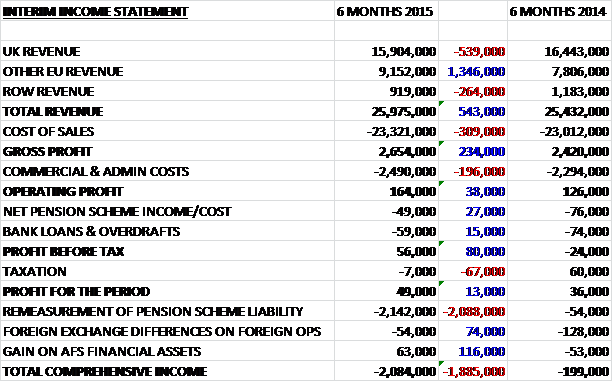
Victoria Oil and Gas has now release its interim results for the year ending 2015.

voginterimincome

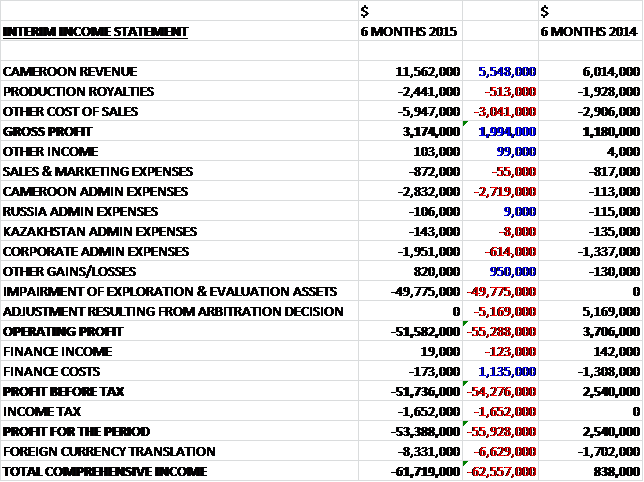
Revenues at the Cameroon assets increased by $5.5M when compared to the first half of last year but cost of sales also increased to give a gross profit nearly $2M higher than last time at $3.2M. Admin expenses then increased which were partially offset by a an $820K “other gain” to give an underlying operating profit about $344K more than last time before the big one-off factors came into play with the lack of the $5.2M arbitration decision adjustment and the $50M impairment of the Russian exploration and evaluation assets which meant that the operating loss was $51.6M during the period. A fall in finance costs was more than offset by an increase in tax to give a loss for the year of $53.4M, a $55.9M reversal on the first six months of 2014.

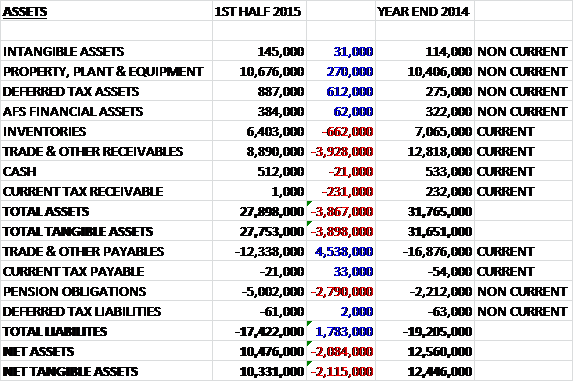
voginterimassets

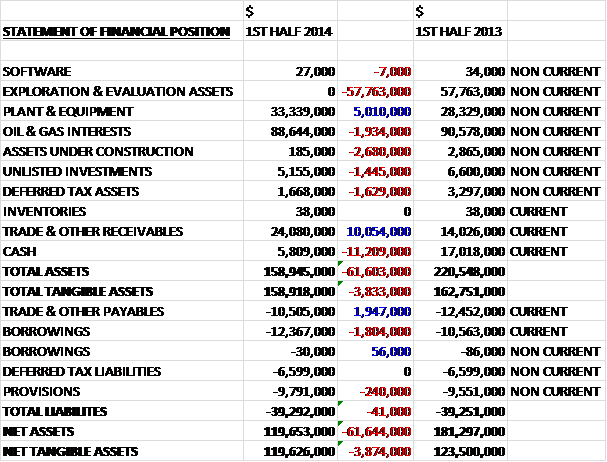
When compared to the end point of last year, total assets at the half year point were some $61.6M lower, driven predominantly by the full $57.8M impairment of the exploration and evaluation assets. We also saw an $11.2M decline in cash levels, a $2.7M fall in assets under construction as they were transferred to plant &equipment, a $1.9M decline in oil and gas interests, a $1.6M fall in deferred tax assets and a $1.4M decrease in the value of the unlisted investment. These falls were somewhat counteracted by a $10.1M increase in trade & other receivables which included $18.2M due from RSM, $17M of which was received after the period end, and a $5M growth in plant and equipment. Liabilities remained broadly flat as a $1.7M increase in borrowings was offset by a $1.9M fall in trade and other payables to give a net tangible asset level some $3.9M lower than last year at $119.6M.

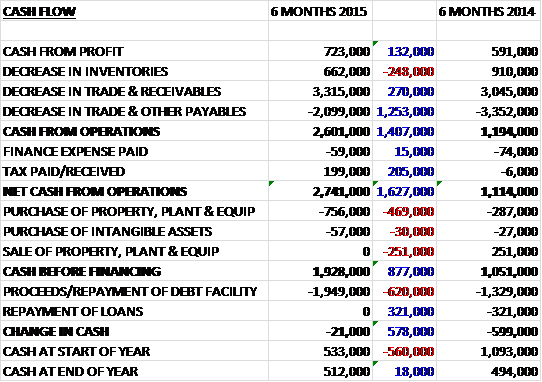
voginterimcash

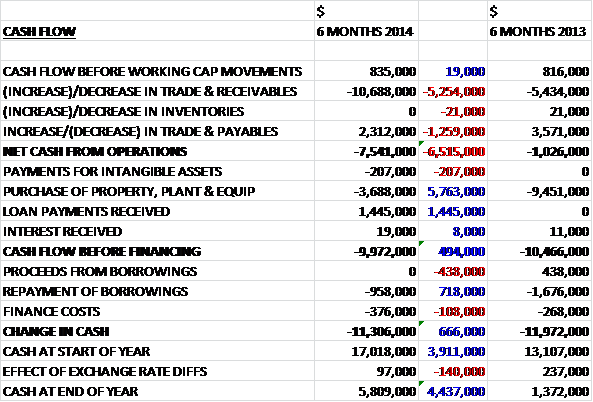
Before movements in working capital, cash profits were broadly flat at $835K. A huge increase in receivables, relating to the RSM situation as they did not pay any of their part of expenses pending the findings from Deloitte, meant that the net cash outflow from operations increased by $6.5M to $7.5M. The group then spent $3.7M on property, plant and equipment, relating mainly to the pipeline network in Cameroon, somewhat offset by a $1.4M receipt of loan payments received from the group’s unlisted investments. The group also paid back nearly one million dollars in borrowings and after finance costs of $376K there was an $11.3M outflow of cash for the six month period to leave the cash position at the half year point of $5.8M. Following the post balance sheet date receipt of receivables from RSM, however, this should now be a bit healthier.
The profit before tax of the Cameroon operation was just $169K, a big decline from the $4.7M enjoyed last year. During the year the group signed a legally binding term sheet with ENEO, Cameroon’s integrated utility company, to supply gas to two power stations, Logbaba and Bassa, located in Douala. The power stations will generate up to 50MW from Gensets supplied by Altaaqa. The agreement includes “take or pay” consumption rates at a price of $9/mmbtu and the power stations will consume about 9mmscf per day in the dry season and 3mmscf per day in the wet season. The contract is for two years and extendable by mutual agreement and it has the potential to treble the group’s current gas production with the 2015 production likely to amount to 10.4mmscf per day. So far this year, the group has been achieving a production rate of between 3.9 and 4.4mmscf per day, an increase from the 3.9mmscf per day reached at the end point of last year.
The group has already built and tested gas pipelines to both of the power stations with a completion certificate being issued for the Bassa station and the work at the Logbaba station should be complete in a couple of weeks. The project is scheduled to be online sometime during Q1 2015 which is a pretty quick turnaround really. There were a couple of issues during the period as the group managed to secure the release of some Gensets from local customs and the Wouri river crossing was delayed but the group does now have access to a wide base of thermal gas customers on the other side of the river. The company is also in the process of making the final connections to the Dangote cement plant, a major new thermal supply customer on this side of the river.
Post period end, the group conducted a workover of well La-106 where they performed cement remediation work. Initial flow tests of the well were 5 to 6mmscf per day and this well can provide back up to the La-105 well. Later on the specialist equipment and personnel used on the workover was utilised to add perforations to well La-105. The sands above the Upper Logbaba D Sand were perforated and in total 57 metres of additional perforations were shot. After shooting the perforations, a production log was run in the well to determine the contributions of the new zones to flow and as a baseline for future logs. The newly perforated zones are performing well and will significantly contribute to production in the future as the lower sands deplete. The company is also making plans for the drilling of future wells at Logbaba that are aimed at increasing reserves and production to meet the growing gas demand in Cameroon.
In all, the total gas sold during the period was 716mmscf with 13,221 bbls of condensate produced. Due to the fixed price contracts, the gas prices have remained unchanged during the period but the global downturn in oil prices has negatively impacted to condensate sales prices as it is linked directly to the price of Brent Crude. The loss before tax at the Russian project was $49.9M as the asset was completely impaired, this compares to a $129K loss in the first half of last year. The profit before tax in Kazakhstan was $113K, an improvement from the $430K loss incurred last time but I still have no idea what is going on in the country as the reports never make reference to it!
As has been seen, although the group continues to seek avenues for deriving value from the Siberian asset through a farm out, joint venture or sale it is considered that given the political issues in Russia and the weakness of the world price of oil it will be significantly more difficult to realise its carrying value. As a result of this, the directors have taken the decision to completely write down the asset. There may be an adjustment in future periods depending on the current efforts to derive value from the asset.
After the end of the balance sheet date, the group appointed John Bryant as an independent non-executive director. He has commercial and financial experience in developing and managing new businesses with over 40 years’ experience in the oil, gas and energy services sectors. Also in December, Deloitte released its final report regarding the RSM issue. It was decided that RSM was due to pay $10.1M for their share of cost and RSM have now transferred $10.6M to the group as of February. To date there is now just $1.2M of receivables still to be paid to the group which is real progress and it seems this may finally be resolved shortly with the Chairman stating that both companies are now working together to unlock the full potential of the Logbaba field.
Overall then, this was an OK update. The impairment of the Russian asset is clearly disappointing and leaves the group with all their eggs in one basket, being Cameroon. The cash performance was rather disappointing but after the period end, the agreement made with RSM will reverse those increasing receivables and really help cash flow in the near term. When RSM has paid off all of its expenses, however, they will revert back to being entitled to a percentage of revenues from the Cameroon field which may affect profits somewhat. The deal signed with ENEOS seems to be a really good one, and potentially transformational, increasing gas sales by as much as three-fold. In conclusion, I must say I am a but torn here, the new gas deals are exciting but there is still considerable risk tied into just one asset in Africa, albeit a relatively stable African company.

vogchart

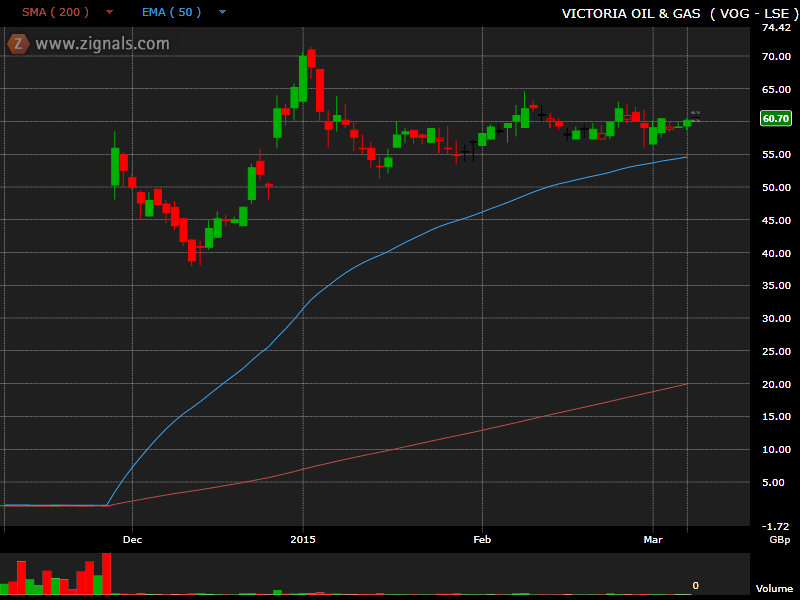
After the share consolidation at the end of last year, the shares have been trading sideways for some time – there is no rush for me to buy in here yet.

On the 9th March the group announced that it has issued completion certificates to ENEO for all pipeline construction work and pressure reduction and metering stations at both the Lopgbaba and Bassa power stations.  The work was completed ahead of schedule and the group is ready to connect to the Gensets that being installed by Altaaqa.  About 1.4km of pipeline was connected to the Magzi-Bassa valve station.  The pipeline is now gassed up and ready for the delivery of gas and this means that the group has completed all of its contractual responsibilities under the agreement.  A total of 22 Gensets have arrived and been cleared through customers, 16 of which are now onsite at the Bassa station with the other 6 at the Logbaba powerstation.  The remaining 17 Gensets are scheduled to arrive in Douala on March 15th and will be installed at the Logbaba station.  The target completion date remains the end of March so hopefully those extra Gensets will be cleared through customs at the same pace as the last lot.  This is all good news, there were numerous opportunities for over-runs here on this very important project.

On the 23rd March it was announced that the group is now supplying about 4.5 mmscf per day of gas to the Altaaqa Gensets installed at Bassa power station.  following the pipeline connection to the site and the successful installation of the Gensets, 20MW of power generated is now being fed into the grid.  Total gas production for the group has risen from 4.5mmsc/d to about 8.5mmsc/d.  With the Bassa power supply online, Altaaqa will now focus on completing the installation of the Gensets at the 30MW Logbaba power station with the original schedule of completion by the end of March now slipping slightly to the end of April due to shipping delays.  Despite the delays, things seem to be sliding into place for the company and I have made a small purchase here.

On the 17th April it was announced that gas supply to industrial customers in the Cameroon had risen to 9.4 mmscf/d on a seven day average basis following the increased production to feed the Bassa power station.  This marks a more than doubling of the production rate from the beginning of the year.  The take or pay obligations have now been satisfied at the Bassa power station following consistent generation of 20MW of power.  The completion of the Logbaba power station has now entered its final phase, with all remaining gensets being released from customs and installed by Altaaqa.  This installation is expected to be completed soon.

On the 23rd April the group announced that it had commenced supply of gas to the Logbaba power station and 30MW of power is now being generated there.  This means that the group’s responsibilities to deliver gas to both stations have now been met that triggers the take or pay conditions in the contract with ENEO.  The average gas production since the station went online now stands at 14.5 mmscf/d.  This all seems very positive, I wonder what the next target is?

On the 27th May the group announced that it had acquired the Logbaba gas processing plant from Expro Worldwide.  The plant currently processes gas extracted from the group’s wells, producing condensate which is sold to a local refinery and clean natural gas which is distributed to customers through the pipeline network in Douala.  It has been purchased for $2.578M using cash generated from operations and the board believe that the purchase will deliver significant cost savings.  They are now evaluating options for the plant expansion.

On the 9th June the group announced some new customers.  They have completed connections and are now supplying natural gas to three new industrial customers from its gas pipeline network including the new Dangote cement clinker plant on the southern shore of the Wouri river; New Foods, a food processing business owned by the Fokou group; and Sic Cacaos, a subsidiary of Barry Callebaut who are a Swiss-owned chocolate group and one of the world’s largest producers of cocoa.  The latter two customers have both converted from heavy fuel oil to natural gas and the total estimated additional daily consumption from the three new connections is 0.7mmscf.  May figures show a total monthly average of 12.4mmscf per day compared to just 4 in January which reflects some seasonal variations in demand from thermal customers and a steady build-up of gas consumption by ENEO.  Likewise condensate production has increased from 1,812 bbls in January to 5,366 bbls in May.

The gas supply to the Bassa and Logbaba power stations is steady and the group are now focussing on additional customers in the Bonaberi industrial area across the Wouri River.  They are expecting to exceed their 10.5mmscf per day target for 2015.  All of this sounds rather promising, although a lack of any financial numbers is probably keeping a lid on progress in the share price.

On the 23rd July the group released a Q2 operations update.  During the quarter the average gas consumption grew from 4.5mmscf per day in Q1 to 12.6mmscf per day with total gas sold romping ahead to 1,120mmscf from 405mmscf and condensate increasing from 6,345bbls to 13,455bbls.  Against the same quarter of last year, the comparison was even better.  This significant expansion follows the first grid power connections coming on line under the deal with ENEO and new thermal customers being connected.  Group cash was $14.2M at the end of the quarter, down from $15.6M at the end of the last quarter with a capital spend of $2.6M on the gas plant acquisition from Expro so underlying cash generation looks to be about $1.2M in the quarter, although it should be pointed out that it is the dry season that generates the most sales.  The cash received from gas and condensate sales was $9.8M compared to $5.1M in Q1 and operations remain in line with expectations for the next quarter.

At the beginning of the period, gas supply to both the Bassa and Logbaba power stations commenced and the successful running of maximum supply to both power plants met the requirements set by ENEO to trigger the minimum take or pay condition.  This agreement requires the supply of 10.1mmscf per day of gas to generate 50MW of power with ENEO consequently agreeing to take or pay 90% of total usage during the dry season and 30% in the wet season.  The Dangote cement plant was the largest of a number of new gas supply connections completed during the period.

As hinted at above, the Lopgbaba gas production plant was purchased from Expro using internal cash generated and the group is evaluating proposals for a long-term contract for the operation and maintenance of the plant with specialist service companies., including Expro itself.  The group is also studying options for the expansion of the gas production plant from its existing 20mmscf per day level up to 40mmscf per day.

Initial planning, well design and engineering for drilling the next two wells (LA107 and LA108) has been accelerated due to the demand for gas in Douala and the current schedule estimates spudding of the wells in H2 2016 and completion later in the year.  The company is also analysing techniques for conducting 2D and 3D seismic programmes in urban environments and for re-processing and extrapolating key historic seismic data to assist in sub-surface interpretations.  The Chairman has stated that they plan to fund this development programme from existing and future cash flows along with local lines of credit.

In addition, the group is in discussion with several groups for the provision of CNG solution whereby a technical partner will undertake all gas compression capital expenditure and logistical operations and it is expected that a preferred partner will be selected in the coming months.

Overall this seems like a decent update. The group is certainly coming along nicely operationally but until we see some actual accounts it is difficult to put a value on the company.  It seems as though underlying operations are cash flow positive now the new supply has started and the fact that there is no planned placing to drill the next two wells is welcome news.

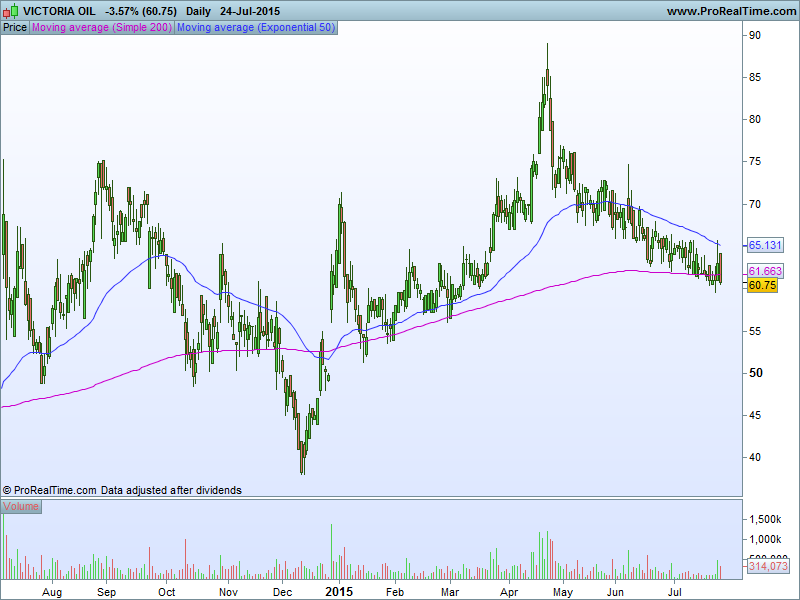
VICTORIA OIL

Despite the initial positive share price reaction to the update it would seem foolhardy to bet against this chart at the moment so I remain an observer for the time being.

Victoria Oil & Gas Share Blog – Final Results Year Ending 2014

Victoria Oil and Gas is a hydrocarbon developer with flagship assets in Cameroon. From gas production wells in the city of Douala, the group supplies energy products to major industries in the region through a pipeline network built by Victoria. They also produce thermal gas, condensate and gas for electricity generation. The company also holds 100% of the West Medvezhye oil and gas project near Nadym in Russia. They have now released their final results for the year ending 2014.

vogincome

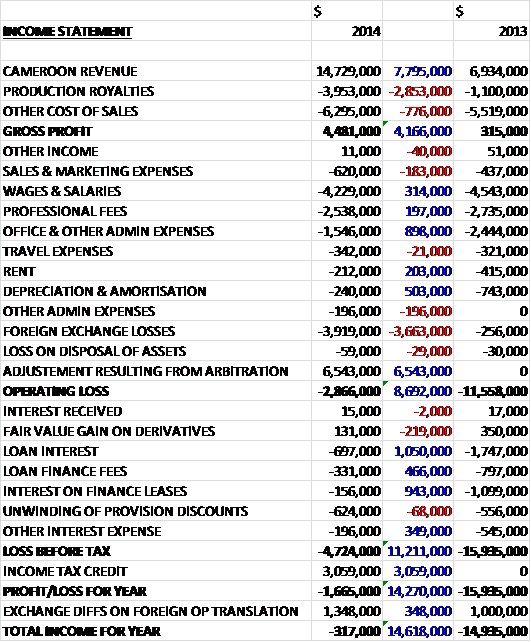
The only assets that produce any revenue are those in the Cameroon and sales there were some $7.8M higher than last year. Production royalties increased by $2.9M and other cost of sales grew by $776K due to increased depreciation charges, to give a gross profit $4.2M higher than in 2013. An increase in sales and marketing expenses were more than offset by a decline in admin costs as RSM regained their participating interest and became liable for 40% of the costs incurred on the Cameroon project, but a £3.7M adverse movement in foreign exchange took its toll, offset by the adjustment from the arbitration ruling so that the group recorded an operating loss of $2.9M, some $8.7M better than last time. As far as finance costs are concerned, loan interest decreased by more than a million dollars to $697K and there were also large falls in finance lease interest and loan finance fees. The group managed to get a $3.1M tax credit which meant that the loss for the year was just $1.7M, a massive $14.3M improvement on last year but a loss nonetheless.

vogassets

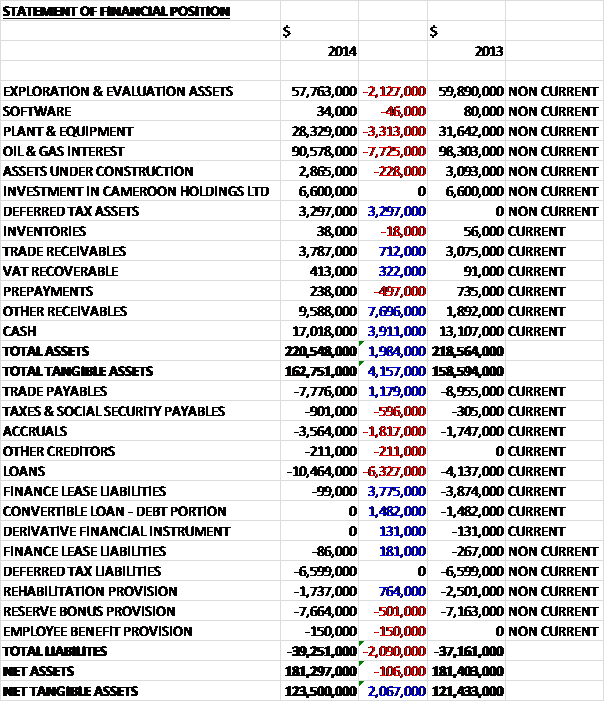
When compared to last year, total assets increased by nearly $2M driven by a $7.7M increase in other receivables, relating to money owed by RSM, a $3.9M growth in cash levels and a $3.3M hike in deferred tax assets as previous tax losses can be offset against future profits as it seems the venture is becoming profitable, partially offset by $7.7M decline in oil and gas interests due to the adjustment following the arbitration decision along with higher depreciation, a $3.3M fall in property, plant & equipment, due to the arbitration decision, and a $2.1M decline in exploration and evaluation assets, all of which relate to the West Medvezhye project in Siberia. Liabilities also increased due to a $6.2M increase in loans and a $1.8M growth in accruals, partially offset by a $3.8M decline in finance lease liabilities and the eradication of a $1.5M debt portion of a convertible loan. The end result is a $2.1M increase in net tangible assets to $123.5M which seems like a pretty strong balance sheet to me.

vogcash

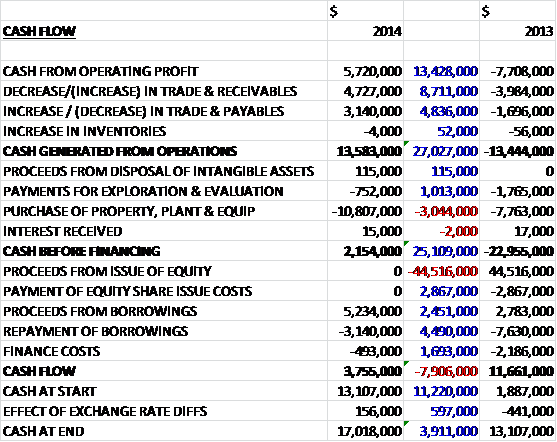
Before movements in working capital, there was a $13.4M positive swing in cash profits to $5.7M. Favourable movements in both receivables and payables meant that cash generated from operations was $13.6M, a $27M improvement. The vast bulk of this cash was spent on property, plant and equipment relating to the expansion of the pipeline network in Cameroon, with a further $752K going on evaluation and exploration which gave a cash flow before financing of $2.2M. There were $493K worth of finance costs and about $2.1M worth of new loans to give a cash flow of $3.8M for the year and a cash total of $17M at the end of the period which actually seems like a pretty good performance to me, although it seems a lot of the good performance is due to the receivables obtained from RSM. As of mid-October the cash levels stood at just $8.5M.
The group supplies customers gas for thermal use such as in boilers, process plants and furnaces. There are currently 18 customers in the medium to heavy industry category consuming the gas. Gas condensate is used as a cleaner and solvent, lantern and stove fuel and as a dilutent in heavy oil production. It can be taken by road tanker to various other parts of the country and 14,107 bbls were produced during the year. Gas is also supplied to generators for customer’s factories and plants. The first six Gensets were installed during the year at four customer sites, resulting in an immediate increase in gas supply. The group is looking to expand its gas to power business and develop the model as per customer needs. The aim is to also supply gas to Gensets at power stations in Douala which should help with the security of supply in the city and finally the group is evaluating a compressed natural gas project where it is transported by road tanker to customers without the capital intensive requirement of a pipeline. It is believed that this business will be commercially viable within a radius of about 200km of operations. The group has a good first mover advantage but other companies are drilling in the area so there could potentially be some competition in the future.
The Cameroon operations enjoyed a pre-tax profit of $4.6M, a $12M improvement on last year. The Logbaba gas project is 60% owned by the group and 40% by the troublesome RSM. The project achieved operational break even on a cash flow basis in February with an average 3.2 mmscf/d production rate achieved. By early July it had increased to 3.9 mmscf/d and the first Gensets were rolled out to major customers in Douala. It is thought that the group is currently only using about 20% of the capacity of the gas processing plant so sales have plenty of room for expansion. The group is going to undertake additional works on well La-106 in early 2015 to unlock further gas supply from the upper zones of the Logbaba structure.
Having seen the grid power supply issues that affect a lot of their customers, the group has begun the development of a gas to power strategy, hence the Genset scheme. A contract was signed with Energyst International for the operation and maintenance of six caterpillar generation units which have been rented in order to circumnavigate the import duty on shipment into Cameroon. Unfortunately the customs agents disputed this technique and the first Gensets were held at the port of Douala for over six months before being released in early 2014. These initial sets were used to prove the concept of the power generation model and following the success of the trial, the group is looking to source bespoke size Genset for future customers.
During the first part of the year, pipeline expansion was seen as the priority but operational priorities were subsequently reviewed and it was decided that the group should concentrate on near-term customer connections and to utilise the current pipeline infrastructure more economically with new pipework only prioritised if it could rapidly connect customers. In January 2014 the group signed a collaboration agreement with ENEO, the private-public partnership that operates Cameroon’s national electricity work to examine ways of increasing power supply by the use of Logbaba gas. The first project involves working with ENEO and some Genset providers to connect gas to rented Gensets for power generation at two power stations, Bassa and Logbaba in Douala. Currently these stations use Fuel Oil and by installing these units for an initial two year period, it should allow ENEO time to determine longer term solutions. The roll out of power should begin in early 2015.
Gas supply agreements were signed in January with Dangote for the provision of gas to a major cement plant under construction in Douala, and SOCAVER, the bottling plant operated by SABC. Following the period end, all six Genset were installed at customer sites with successful connection to the gas supply and Socapursel, a food manufacturing business, was also connected for thermal gas usage. The pipeline to the Dangote construction site was completed, ready for gas connection that is expected to occur in late 2014. A renegotiated agreement was signed with Energyst covering the supply of future Gensets, giving the group the flexibility for outright purchase or sale and leaseback arrangements to new customers as well as the existing rental model. Work has begun on the delivery of the next phase of Gensets to other thermal supply clients and new customers.

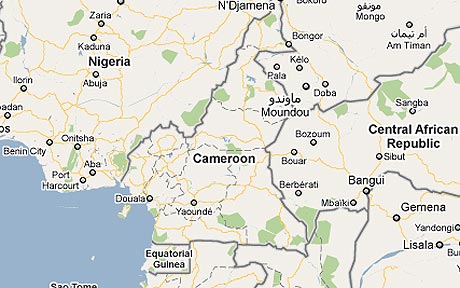
cameroon_1662560a
All pipe laying operations have now been outsourced to Britanica with a fixed cost per metre agreement with all work approved by Victoria management. Condensate production increased during the period as higher levels of gas were produced for delivery and 14,107 bbls of condensate was produced to be sold to refinery in Limbe, just north of Douala with the average price achieved during the year $106.14 bbl. The Wouri river crossing, connecting the far shore with the Logbaba pipeline started in July which will extend the reach of the gas supply network to a major new industrial area in the city. About 1.5km of pipeline on the far shore has already been laid so that three customers are ready for connection to the main pipeline when it is completed.
The Russian operation had a pre-tax loss of $336K, a $300K improvement on 2013. The West Medvezhye licence has been on the back burner for a while as the group concentrates on Cameroon but they have completed geochemical, passive seismic surveys and reprocessed seismic data in order to identify the location and size of prospects and to ultimately decide on the next drilling locations. The 100% owned asset has proven and provable reserves of 14.4 mmboe and the best estimate put prospective resources at around 1.4 bboe. Recently, relations between Russia and the West have deteriorated which clearly puts this project under some risk. The Kazakhstan operation suffered a pre-tax loss of $3.3M, a $3M widening when compared to last year. There is no other mention of this concession in report so I have no idea what is going on here.
An issue that has affected the group is that of the arbitration decision involving RSM, the partner on the Logbaba gas and condensate project. Some history to the dispute is that RSM failed to make cash calls as they became due to fund its portion of costs which led the board to believe that RSM had defaulted in meetings its obligations and had forfeited its 40% participating interest in the project which was a view that was challenged by RSM. In December 2013, the ICC found that RSM was in default for its non-payment of the cash calls but ruled that the forfeit of its interest had not been established to the level of certainty required under Texas law. Last year the accounts were prepared in the assumption that RSM had already forfeited its interest, so this has had to be changed for the accounts this year. This has led to a credit of $6.5M relating to RSM’s share of prior period operating expenses and led to a $13.7M negative adjustment to the balance sheet this year.
Following the arbitration decision, RSM has paid $4.1M in settlement of one outstanding cash call but the group has issued further cash calls of $24M relating to incurred expenses since the end of the first arbitration and $2M relating to an advance on RSM’s forecast expenses. Not surprisingly RSM failed to pay these cash calls as they fell due and the group issued notices of default for the overdue calls which led to further arbitration proceedings in January 2014. A settlement was reached whereby RSM will pay $16.3M towards the cash calls with an agreement for an audit to determine the final balance payable which meant that the group withdrew its notices of default against RSM. To date, RSM has paid the group a total of $20.8M towards its share of costs at the concession. The main financial effects to Victoria of RSM resuming its 40% participating interest is that the group is entitled to 100% of revenues from sales of hydrocarbons until its initial work commitment costs are recovered, after which RSM will become entitled to its share of revenues; the group’s responsibility for certain post-exploration costs is reduced to 60%; and the group is required to pay a royalty of 0.8% to RSM until they become entitled to their participating share of revenue.
One risk that the group faces is the political and regulatory risk of the territories in which it operates. Africa and Russia both present their fair share of these risks. There does seem to be a bit of customer risk with five clients contributing to 10% or more of the group’s revenue this year including the most important at 24%, which does actually spread the risk somewhat since the largest customer in 2013 made up 29% of total sales. The group seems to be having an increasing problem with late receivables. This year, average trade receivable days increased from 62 in 2013 to 115 with some $381K not impaired but overdue by more than 120 days. Likewise, there were $234K of other receivables older than 120 days compared to none last year and $866K is considered uncollectable and part of the cost pipeline. About 78% of trade receivables are owed by companies considered low risk buy the remaining 22% are made up of local Cameroonian companies that do not have state participation and are considered higher risk. Apparently if the funds owed are not forthcoming from RSM the company may have to look for further funding. Finally, another risk is clearly the fact that the group relies on just two wells in one producing region for all of its revenues. If something were to happen to the Cameroon wells, the consequences could be very serious for Victoria.
The borrowing structure seems to be rather complex. In January 2014 the group signed a loan agreement with BGFI of Cameroon worth $8.3M to fund pipeline extensions, customer connection work and installation of Gensets at customer premises. The facility is for a 6 month term, renewable for a further six months with interest payable at 7.25% per annum. A year after it was taken out, if the loan remains unpaid it converts to a three year term loan at the same interest rate repayable in monthly instalments. There is $5M outstanding on the loan currently and the intention is to let it run over into the three year loan. In 2007 the group created a $10M convertible loan note facility with UAE based Noor Petroleum, where a former company director was on the board. A total of $3M was drawn down against the loan in by the start of 2009. Under the terms of the agreement, the notes were due for repayment at the end of 2012 and bore interest at 2.5% per annum, payable biannually and convertible into shares of the company at a price of 16.5p. The loans remain outstanding but are no longer convertible into shares as the 2012 deadline passed. They are payable on demand and now accrue interest at 6.5% per annum with the balance outstanding now being $4.4M.
The group has a number of royalty obligations in place regarding the Logbaba projects. They are 8% to the state of Cameroon, 0.8% to RSM until they become entitled to their participating share of the interest (see above) and 8.3% which were assumed on acquisition of Bramlin or arose under commercial contracts for the provision of drilling and other services.
The group are making an effort to change the way that the company is perceived by trying to move it away from being an exploration and production company towards being an Energy Utility. I remain unconvinced about this but they have strengthened the board with the hiring of James McBurney as an independent non-executive director. Previously James headed up the European Natural Resources investment banking group at Bank of America and the board are looking to make additional appointments in the near future. The group are also planning to consolidate their shares to significantly reduce the number of shares in issue and have appointed a new broker and financial advisor. John Scott resigned as CEO during the year and the chairman, Kevin Foo took over as interim CEO as well as his current duties. I would suggest that the appointment of a full time CEO would enhance the group’s credentials.
As has been seen, now that the Cameroon operation is generating revenue, the board have recognised some tax losses against future profits with a $3.3M asset being recognised. The group does still have $8.5M of unused tax losses associated with this project though.
Overall then, this is an interesting company. The growth in supply of gas to customers in Cameroon seems to be a good approach and gives them a bit more to their earnings than just and exploration company. The reliance on the one assets, though, is a bit of a concern and the political problems in Russia are likely to make development of the second asset rather difficult. The ongoing issues with their partner on the Cameroon asset is a concern too. I suspect they will eventually scrape together the cash to pay for their part of the costs but in that eventuality, Victoria will lose a proportion of the earnings. Conversely if RSM do default then the group are likely to have to tap up shareholders for further cash to fund development. At this point there just seem to be a bit too many risks for me to jump in just yet but this has been added to my list.


Swallowfield Share Blog – Interim Results Year Ending 2015

Swallowfield have now released their interim results for the year ending 2015.

swallowfieldinterimincome15

Revenues were up £543K when compared to the first half of last year despite the weak Euro reducing sales revenue by £600K, with good growth in EU sales being partially offset by declines in UK and ROW sales.  Cost of sales increased slightly to give a gross profit some £234K higher.  Commercial and admin costs increased by £196K but both pension costs and interest costs reduced so that profit before tax was £80K higher, before the lack of the tax rebate achieved last time meant that profit for the period grew by just £13K to £49K.

swallowfieldinterimassets15

When compared to the end point of last year, total assets fell by £3.9M due to a £3.9M decline in receivables and a £662K fall in inventories, partially offset by £381K increase in tax assets, a £270K growth in the value of property, plant and equipment and a £62K increase in the value of the financial asset, relating to the re-measurement of the shareholding in Shanghai Colour Cosmetics.  Total liabilities also fell during the period as a £4.5M decline in payables was only partially offset by a £2.8M increase in pension liabilities.  The end result is a £2.1M fall in net tangible assets to £10.3M.  A little disappointing but this is still fairly strong for a company of this size.

swallowfieldinterimcash15

Compared to the first half of 2014, cash profits increased by £132K and with good control of working capital, particularly with a large decrease in receivables, the cash from operations increased by £1.4M to £2.6M.   A lower finance expense and a decent tax rebate meant that net cash from operations was some £1.6M higher at £2.7M.  Of this cash, £756K was spent on tangible assets and £57K on intangibles so that free cash flow was an impressive £1.9M.  This was used to repay the debt facility to give a small cash outflow of £21K, a £578K improvement on the first half of last year.

In collaboration with one of the group’s large customers, they have developed and produced an aerosolised post foaming shower gel in a plastic can which is apparently soft and warm to the touch and weighs about 18% less than the previous metal format.  Production started in December and it is now appearing in stores across the UK.  The group have also received some initial orders for their own brand product, the ‘Tru Shave’ brand, which will appear in value retail channels shortly and have begun discussions with a department store regarding the distribution of their new premium beauty brand, Bagsy, which will begin production in March but due to retailer decision making taking longer than expected, the sales and margin delivery may take longer than anticipated, pushing some of the benefits into next year.  It seems that the group are also considering some potential acquisitions should the right targets emerge.

The group are looking to develop a new high growth, high margin category by 2016.  In the first half of the year they ran production trials on aerosolised food and beverage products and expect to run production trials for another new product in the second half of the year, which sounds like an interesting development.  The consolidation of the Bedford facility into two buildings from three has now been completed with some production lines being relocated to the Czech site.  This should deliver full year savings of about £230K going forward.

During the period the group had one customer that accounted for 13.5% of revenues and one that represented 10.8% of sales which means they are still quite reliant on a few large customers but this was better than during the same period of last year when one accounted for 15.8%, another 11.4% and a third for 10.3% of sales.

It can be seen that the group suffered a relatively large increase in pension liabilities.  This was because that corporate bond yields, that are usually used as a proxy to determine the discount rate, were significantly lower than six months ago which has translated into higher liabilities.  The pension scheme is currently undergoing its latest triennial valuation, the results of which are expected to be finalised by the end of the year.

Looking ahead, the UK and European markets remain very competitive with pressure on pricing and continuing uncertainty surrounding the Euro.  The performance in the second half of the year remains dependent on the exact timing of planned product launches (we have already learned that the premium brand product sales are likely to slip into next year), the impact of wider economic condition and underlying consumer demand.  Overall for the current year, the board expects a strong profit before tax growth when compared to last year with a more significant full year benefit expected next year.

Due to the investments being made in the group, an interim dividend has not been declared.  Going forward it is intended that a dividend pay-out will be reinstated and be aligned to underlying earnings and the cash flow of the group.  At the period end, net debt stood at £3.1M, a £1.5M improvement on the same period of last year and a £1.9M improvement on the end point of last year.  It seems as though the board expect this to increase again in the second half of the year though, due to the brand launches and increased investment.

Overall then, this is a solid set of results but perhaps not as much progress has been made as was expected.  European sales were good, but revenues fell across other regions and profits were only slightly ahead of the same period last year.  Net assets actually fell, mainly due to the increase in pension liabilities but the strong cash generation, partially due to a good control on working capital, meant that the group could pay back some debt.  There does not seem to be much information about current trade and projects but some guidance has been given on future products, which sounds interesting.  There is just enough here I think to keep me holding in anticipation of a stronger second half to the year.

swallowfieldchart

The reaction to the interim results was not great with the market retracing after a good run but at the chart still looks OK for now.

On the 30th April the group announced that it had acquired the Real Shaving Company brand from Creightons.  The Real Shaving Company is a well-established premium brand in the male grooming sector whose products are distributed in the UK through major supermarkets and health & beauty retailers as well as the value retail sector.  They also sell their products into Canada and France.  The price comprises of an initial cash consideration of £900K with a further £100K contingent on the outcome of certain customer negotiations, plus stock at valuation, which is expected to be £170K to give a total cash consideration of up to £1.17M.  Underlying EBITDA of the brand for the year to March 2015 was £300K on sales of £800K and the acquisition is expected to be earnings enhancing in the first full year of ownership.

The acquisition will be financed with a new five year loan of £720K with the balance from existing facilities.  It enables the group to leverage already developed technologies such as plastic aerosols and gives them a presence in trade channels that they are trying to access with their other brands such as Bagsy and Tru.  It also enables them to leverage their existing capabilities in females shave formulations and gifting, neither of which currently feature in the brand’s product range.  This seems like a very good fit for the group at a decent price, whether they can afford even this modest acquisition remains to be seen, however.

On the 24th June the group announced that CEO Chris How’s wife purchased 10,000 shares at a cost of £11.4K.  After the purchase he has an interest in 60,000 shares.  Although this is quite a modest purchase, I still take it as a good sign, although the CEO still does not really have a very large holding here.

On the 8th July the group released a statement covering trading for the year ending 2015 in which they stated that profitability will be in line with market expectations.  Revenues for the full year are expected to increase by 0.8% or 2.7% on a constant currency basis and they have seen a slight softness in revenues versus expectations due to the delayed availability of some materials and the continued effect of the weak euro.  The net debt at the year-end stood at £5.4M which included the £1.2M spent on the acquisition compared to £5.1M at the end of last year so progress seems slow in bringing this down.

The recently acquired Real Shaving Company brand has now been integrated into the business ahead of schedule and customer response to the group’s plans for the brand have apparently been positive.  The development of the own brands continues to progress well with the first orders of the premium brand “Bagsy” having been shipped in recent weeks and the extension of the distribution of the value brand “Tru”.  The premium new male haircare brand has also been positively received by major retailers and will be launched in the autumn.

Going forward, it is expected that the challenging retail market conditions being experienced will continue in the medium term but the new strategy outlined last year will gain momentum and should improve profitability.  In addition, the new year is expected to benefit from further efficiencies and improved profitability, tighter control of working capital and new product developments.

Overall then, there seems to be pretty slow progress being made here but there is just about enough interesting new products and improved efficiencies going forward to keep me interested for now.

GlaxoSmithKline Share Blog – Final Results Year Ending 2014

GlaxoSmithKline has now released its final results for the year ending 2014.

gskincome

When compared to last year revenues in general fell, driven by a £1.1BN decline in respiratory sales, an £863M fall in established product sales, a £267M decline in other pharmaceuticals and a £269M fall in total wellness products.  Not all divisions fell, however, with the best performing being Oncology, up £233M and ViiV Healthcare, up £112M.  Cost of inventories and other cost of sales both fell and the gross profit was some £2.237BN lower at £15.7BN.  A £137M fall in advertising costs and a £588M decline in intangible impairments were offset by a £600M increase in other sales and admin prices which included a £114Mm charge for an additional catch up year of the US Branded Prescription Drug Fee in accordance with the final regulations issued by the IRS.

We also saw a £473M decline in R&D costs but there were several one-off costs that increased such as the re-measurement of contingent consideration due to the higher potential sales of ViiV healthcare products and a £313M charge relating to a change in value of financial instruments due to the currency hedge taken out to protect the Novartis deal, so this should be counteracted by the higher receipts from Novartis due to currency movements.  Compared to last year there was also a £1.169M fall in profits from disposals so that operating profit was nearly half that of last year at £3.597BN.  There were some improvements to finance cost but there was no profit on the disposal of an associate which equated to £282M last year.  There was very minimal tax to pay, however, as the charge fell by £882M to give a profit for the year £2.797BN lower than in 2013 at £2.831BN.

gskassets

When compared to last year, total assets fell by £1.435BN, driven by a £1.196BN decline in cash levels, a £975M fall in the value of patents, partly due to the transfer to assets held for sale, and partly due to amortisation with a small impairment of Lovaza; a £481M decline in goodwill which was moved to assets held for sale, a £410M fall in trade receivables and a £422M decline in other receivables reflecting the receipt of deferred receivables from Aspen in respect of the inventory and a manufacturing site which formed part of the disposal of the anti-coagulant business.  These declines were partially offset by a £1.155BN increase in assets held for sale, a £604M growth in deferred tax assets, a £539M increase in assets under construction and a £331M increase in inventories.

Conversely liabilities increased during the year driven by £990M increase in pension liabilities, a £661M increase in contingent consideration, a £385M increase in loans and a £277M growth in derivative financial instrument liabilities, partially offset by a £605M decline in other payables due to the lack of the £620M payable to non-controlling interests in the Indian subsidiary that was settled during this year, and a £755M decline in tax liabilities.  The end result is a net asset (excluding goodwill) level of £1.212BN, a £2.395M collapse when compared to 2013.  The group also has £701M of operating lease commitments, £310M of which are on the balance sheet.

gskcash

Before movements in working capital, cash profits were £2.696BN lower at £5.582BN.  A decrease in receivables and an increase in payables, however, improved this to £6.284BN, a £2.215BN decline from last year and after tax the net cash flow from operations was £5.176BN.  In a quirk of fate, the group spent the same amount as last year, £1.188BN, on property, plant and equipment.  The group then spent £563M on intangible assets and gained a net cash inflow from the purchase and disposal of businesses so that before financing there was still a fairly healthy cash inflow of £4.098BN.  This cash flow just about covered the £3.843BN spent on dividends but could not cover the £707M interest costs and the £679M purchase of non-controlling interests relating to the investment in the Indian subsidiary which meant there was a net cash outflow of £1.287BN.  The group still ended the year with £4.028BN of cash, though, so despite losing more than a billion pounds in cash, this was not a total disaster.

Trading conditions during the year have continued to be difficult, especially in the US but the group have apparently worked hard to improve their formulary positioning and coverage in the country and as they move into 2015 there are some encouraging signs of how this might help them regain market share and deliver an improved performance in the respiratory sector where Incruse Ellipta has been launced for COPD and Arnuity Ellipta was launched for asthma with a regulatory decision for the potentially important Mepolizumab pending.  Performance in Consumer Healthcare was impacted by some supply issues which seem to have been remedied, indicating a potentially improved performance in 2015 in the sector.  New products launched in the last five years contributed sales of £1.5BN, an increase from £1.4BN last year on a rolling basis with Arzerra, Lamictal XR, Potiga, Prolia and Votrient no longer being included in the calculation.   New respiratory drugs Breo Ellipta and Anoro Ellipta gained Medicare Part D coverage of 74% and 65% respectively which gives some early indication of how the new portfolio will help the group regain market share and deliver improved performance in respiratory.

In Europe rising public debt and government austerity programmes continue to create pressure on healthcare spending.  Spending on hospital medicines increased which was mostly driven by increased use of oncology and biological products but decreased in primary care.  In the US the focus on cost and value is leading payers to reduce price, restrict access and demand more differentiated products both within the private marketplace as well as for public programmes.  In Japan the Ministry of Health conducted a bi-annual review of medicine pricing resulting in a 2.7% reduction under the National Health Insurance pricing scheme with the premium for new drug development remaining in place.  In emerging markets countries such as Indonesia, China and India are looking to expand the population covered by government funded health schemes which suggests opportunities for high volume tenders but impacts pricing.  In some markets patents and data collection are less enforceable.  For example in India, Brazil and Argentina governments are considering practices that restrict the availability of patents.  In addition some countries are considering more widespread use of compulsory licensing where an individual or company can use another’s patent without their consent and pays the patent owner a set fee for the license.

Profits of US pharmaceuticals fell by £782M to £3.173BN; European pharmaceutical profits fell by just £72M to £2.205BN, Japan pharmaceutical profits fell by £102M to £466M and emerging market pharmaceutical profits increased by £7M to £993M.  In Respiratory the group expect to see a return to growth in sales in 2016.  Seretide/Advair sales were down 15% to £4.2BN, Flixotide/Flovent sales fell by 6% to £665M and Xyzal sales, almost exclusively made in Japan, were up 7% to £130M.  In the US respiratory sales fell by 18% due to continued pricing and contracting pressures in the market.  Sales of Advair were down 25% to £1.972BN with a 14% fall in volume and an 11% decline in price.  Flovent sales were down 6% while Ventolin sales increased by 18%.  The newly launched products, Breo Ellipta and Anoro Ellipa recorded sales of £29M and £14M respectively.

European respiratory sales fell by 3% largely due to increased competition.  Seretide sales fell by 5%, primarily due to falling prices as a result of competitive pressures and the transition to newer products in the portfolio during the latter half of the year.  Relvar Ellopta sales were £18M during the year.  In Emerging markets respiratory sales grew by 3% with Seretide sales increasing by 3% to £400M, helped by an improved performance in China.  Sales growth for Ventolin and Veramyst was offset by declines in Flixonase due to falls in Chinese revenues.  In Japan respiratory sales fell by 2% to £475M.  Sales of Relvar Ellipta offset the impact of increasing competition on Adoair, which fell 6% to £228M.  The growth in Xyzal, up 8%, was more than offset by lower sales elsewhere in the portfolio but new prescription share has increased to more than 56% following substantial increases in new prescriptions for Relvar after lifting of the “Ryotan” prescribing restrictions.

Oncology sales grew by 33% to £1.202BN with contributions from Votrient, up 33% to £410M and Promacta, up 34% to £231M.  Conversely sales of Arzerra fell by 24% while Tykerb declined by 11% to £171M.  New launches compensated for generic competition to both Hycamtin and Argatroban with Tafinlar and Mekinist recording sales of £135M and £68M respectively.  In the US, Oncology grew by 41% to £509M with contributions from Votrient, Promacta, Tafinlar and Mekinist.  In Europe sales grew by 29% to £417M led by Votrient while in Emerging Markets, sales were up 30% to £169M and in Japan sales grew 17% to £65M.

Sales in the Cardiovascular, metabolic and urology category were down 3% to £965M.  The Avodart franchise grew by 1% to £805M with a 17% growth in Duodart.  Sales of Levitra fell by 28% while sales of Prolia were down 10% to £41M following an agreement with Amgen to terminate joint commercialisation in selected markets.  Sales in the US were down 16% to £364M although emerging markets grew by 20% to £145M while Japan also grew with sales up 14% and European sales remained flat during the year.  Sales of immune-inflammation products increased by 40% to £214M, helped by a 25% sales increase for Benlysta, growing to £173M.  The other therapy areas saw sales fall by 2% largely reflecting generic competition to dermatology products.

Profits in the established products portfolio declined by £559M to £1.793BN and sales of the established products portfolio fell by 16% to £3.011BN.  Generic competition to Lovaza, whose sales more than halved to £240M, Seroxat and Valtrex all contributed to the decline.  Sales in the US fell by 31% to £854M while sales in Japan and Europe fell by 15% and 13% respectively.  Emerging markets fared slightly better, falling by just 1%.

Vaccine sales were down just 1% to £3.192BN although declines in Europe and Japan were partially offset by a small growth in emerging markets while US revenues were flat.  Infanrix grew by 2% to £828M with growth in the US being partially offset by declines in Europe and emerging markets.  Boostrix sales increased by 16% to £317M with growth in all regions except the US where sales fell by 7% due to the return of a competitor product.  Rotarix sales grew 7% to £376M driven by tender shipments in Europe and emerging markets, although there was a decrease in the US which was impacted by a CDC stockpile withdrawal in Q4.  Synflorix sales were also up, increasing by 4% to £398M mainly due to a strong tender performance in emerging markets.  Sales of the hepatitis vaccines fell by 6% to £558M, partly due to supply constraints affecting the US and emerging markets.  Fluarix and FluLaval sales fell by 9% to £215M due to lower production levels for the year and increased competition.  Cervarix sales declined 26% due to a fall in sales in emerging markets and Japan along with increased competitive pressures.

Profits at ViiV Healthcare grew by £92M to £977M.  Tivicay recorded sales of £282M and uptake has led the industry in the US, Germany and Japan compared to recent HIV medicine launches.  Sales of Triumeq, the new single pill treatment that was launched in the USA in August and in some European countries in September were £57M during the year.  Epzicom sales grew by 8% to £768M and Celsentri/Selzentry was flat at £136M.  Sales in North America grew by 28% driven by strong performances of Tivicay and Triumeq as well as continued growth from Epzicom with the former two performing strongly with patients switching therapies.  In Europe sales grew faster than the market as a result of an excellent performance from Tivicay, approved in January 2014, and successful initial uptake of Triumeq in countries where it has been launched.  Sales also grew in the International region owing to the growth of Celsentri, Kivexa and Tivicay which now contribute to over two thirds of the region’s revenue.  Japan and Australia, which launched Tivicay in the second half of the year have seen particularly impressive sales performance.

Consumer Healthcare profits fell by £172M to £657M but an improved performance was seen in Q4.  Oral Health sales grew by 4% to £1.797BN driven by strong growth of Sensodyne in Sensitivity and acid erosion which was up 11%, and gum health, also up 11%.  The brand maintained its leading position in the sensitive teeth category and consumption grew ahead of the market in all regions with the most notable successes seen in China and North America where Sensodyne Repair & Protect and Sensodyne Complete were key drivers.  The Nutrition category grew 10% to £633M led by Horlicks and Boost, which grew 11% and 9% respectively.

The leading UK protein brand, MaxiNutrition, was up 10% driven by strong innovation and increased distribution.  In Wellness, sales fell by 7% to £1.596BN, impacted significantly by supply, particularly in Smokers Health.  The gastro-intestinal products grew by 4% and despite the impact from supply constraints, ENO saw very strong growth in emerging markets, in India and Brazil particularly.  Pain management grew by 2% driven by double digit growth of Fenbid in China but offset by some supply interruption to Bactroban in the country.  Skin health sales were down 11% to £310M driven by Bactroban supply interruptions in China, partially offset by increased Physiogel sales.  It is expected that Flonase Allergy relief will be a growth driver for the division in 2015 and to provide a well-established allergy treatment to consumers as the group continues to lunch the brand as an over the counter product in various markets.

At a regional level, the US business declined 8% to £836M, impacted by supply issues, primarily in Wellness.  Oral health grew by 4%, led by very strong sales from Sensodyne.  In Europe, sales fell by 5% to £1.242BN due a combination of factors such as supply, competitive pressures, particularly in oral health, and political disruption in Eastern Europe.  ROW markets were up 4% to £2.258M despite an overall slowdown in emerging markets.  Of particular note was the India business which grew 12% during the year with a successful re-stage of Horlicks, focusing on its increased nutritional benefit and an improved formula that dissolves more easily in both hot and cold milk.  The group also launched a new variant, Horlicks Saffron and Almond, in India specifically designed to meet the unique tastes of Indian consumers.  There was a continued focus on new routes to market, expanding the distribution model to better reach rural consumers.  In Latin America, sales were up 4% with strong performances in Oral Health and Wellness.

Once again there were a lot of restructuring costs, totalling £750M this year which included £101M under the Operational Excellence Programme, £334M under the Major Change Programme, £243M under the Pharmaceuticals Restructuring Programme and £67M on pre integration planning on the proposed Novartis transaction, and more specifically the restructuring of the pharmaceuticals business in North America, Emerging Markets and Europe leading to staff reductions in sales force and administration; projects to rationalise core business services and to simplify or eliminate processes leading to staff reduction in support functions; transformation of the manufacturing and vaccines businesses to deliver a step change in quality, cost and productivity; and the rationalisation of the consumer healthcare business.  The Operational excellence programme has now been completed and has delivered £2.9BN in annual savings for a total cost of £4.7BN.  The major change programme is still ongoing and has so far delivered an additional £600M in annual savings for an expected cost of £1.5BN, with a further programme announced this year to refocus the pharmaceutical business expected to contribute a further £1BN of savings by 2017 at a cost of £1.5BN.

pills_2047897a

The group are working to simplify operations, reducing the number of third party suppliers who manufacture medicines on behalf of the company by a further 8% and they have reduced complexity in their supply base by standardising specifications for goods and materials that are purchased and integrated sourcing processes are being pursued.  The complexity of the pharmaceutical product portfolio was also addressed with a 19% reduction since 2012 that equates to more than 4,000 discontinued packs.

Some key challenges for the group this year have included increased pricing pressure in the US from market changes, competitor dynamics and contracting; continued pricing pressure in Europe due to government austerity programmes; unanticipated supply continuity challenges in consumer healthcare; disappointing phase 3 results for MAGE A3 and darapladib programmes and rebuilding in China following the criminal conviction of a China affiliate for violation of Chinese law

As with most UK companies with a pension scheme, it is currently running at a deficit which requires regular payments to reduce.  The liabilities on GSK are not as hefty as some other companies with £85M being paid this year with the same amount expected next year, although employer contributions as a whole are expected to be £320M in respect of defined benefit pension schemes and £70M in respect of post-retirement benefits.

This year has been fairly quiet as far as acquisitions and disposals are concerned, probably due to the impending Novartis deal.  £225M was received as contingent consideration on the Anti-coagulent business disposed of last year and costs of £141M have so far been incurred from the Novartis deal.  One large acquisition of non-controlling interests took place with regards to the Indian subsidiary where the group increased its holding from 51% to 75% for a total of £625M.

As part of the proposed Novartis transaction, a new consumer healthcare business will be created over which GSK will have majority control with a 63.5% interest.  In addition GSK will acquire Novartis’ global vaccines business, excluding the flu vaccines for an initial cash consideration of $5.25BN with subsequent potential milestone payments of up to $1.8BN and ongoing royalties.  GSK will divest its Oncology portfolio and future products in that category for a cash consideration of $16BN.  Under the terms of the transaction, up to $1.5BN could be returned to Novartis if certain conditions relating to the COMBI-d trial are not met.  The transaction is expected to be completed in the week commencing 2nd March and it is estimated that the deal will deliver annual cost savings of £400M, the delivery of which will be phased over the next five years.

The group seems to be doing a lot to try and open up further emerging markets.  In India they have created a network of over 13,000 rural sub-distributers who are delivering GSK products to village retailers.  In addition, local women have been trained in order to set up their own distribution businesses selling directly to households in areas that are not covered by local stores.  In Africa the group are investing to increase access to medicines, build capacity and deliver growth.  Over the next five years, £130M will be invested in Africa with £25M being spent to create the continent’s first non-communicable diseases open lab where GSK scientist and external researchers will work on understanding disease variations found in African patients in order to develop new medicines to address the specific needs of African patients.  Up to £100M is being invested to expand existing facilities in Kenya and Nigeria and to build new factories elsewhere to ensure local production of medicines in Africa required by African people and the facilities will make locally relevant products.

A lot of GSK’s problems are due to their most important drug running into sales problems.  Seretide/Advair sales fell by 20% to £4.229BN.  There are just no other drugs in the portfolio that come close to the success of this one, which is a big problem when sales are falling 20% a year.  Incidentally, the next largest drug, Avodart, saw revenues fall by 6% to £805M although on a constant currency basis, sales were broadly flat suggesting this drug still has some legs.  So are there any major drugs that saw sales increase?  Well, there are a number of promising candidates in the Oncology portfolio.  Votrient sales increased by 24% to £410M, Promacta sales were also up 24% to £231M and the new one, Tafinlar, grew sales from £16M last year to £135M this year.  It is unfortunate then that the Oncology portfolio will be lost in the deal with Novartis.  The only other big growth drug is Tivicay in the ViiV healthcare portfolio which grew from £19M in 2013 to £282M this year which is an exceptional performance and is now the second most important ViiV drug after Epzicom which saw sales increase 1% to £768M.

The pipeline does seem fairly strong.  Following approvals received in 2013 for respiratory products Breo Ellipta and Anoro Ellipta, Tafinlar and Mekinist in oncology and Tivicay in HIV, the group received approvals for Incruse Ellipta and Arnuity Ellipta in respiratory, Triumeq in HIV and Tanzeum for Type 2 diabetes this year.  They are waiting for FDA decisions on Breo Ellipta for use in asthma and mepolizumab for severe eosinophilic asthma with up to 25 phase 2 and 3 starts expected.  In the advanced pipeline, the board see significant potential from the shingles vaccine, a triple combination therapy for COPD and new long acting HIV treatment Cabotegravir and the potential Ebola vaccine that is now being tested in a phase 3 clinical trial could bring some Kudos to the group if it is successful.

As is normal for GSK and probably other similar companies, there are multiple legal and other disputes ongoing mostly relating to patents; product liability, principally relating to Avandia and Paxil; anti-trust, principally relating to Wellbutrin XL and Lamictal; government investigations, currently relating to the China settlement and SEC/DOJ and SFO related investigations; and contract terminations.  During the year a £301M fine was paid to the Chinese government with £248M being paid on the various other disputes, in particular the product liability case regarding Paxil and various other government investigations.  In China the group had offered money or property to non-government personnel in order to obtain improper gains and had been found guilty of bribing non-government personnel.  The UK and US authorities are also looking into some of the group’s operations.   During the year two sites received quality standard warning letters from the US FDA, one in Cork and one in Canada which the group is apparently taking comprehensive actions over.

In order to combat these problems, management has de-linked compensation for sales reps from the number of prescriptions written to remove any conflict of interest.  In addition the group has also stopped paying healthcare professionals to talk about their products.  Instead Medical Science Liaisons will be delivering talks to physicians about the group’s recently released medicines in the US.  One benefit of this is that internal experts may have a more direct knowledge of the clinical trials which led to approval of the medicine and thus far the programmes are attracting a similar number of attendees as the external presentations of the past.  In addition, staff are now required to undergo mandatory training on the group’s code of conduct and the group has enhanced its whistleblowing procedures.

Sir Philip Hampton has been selected to succeed Sir Christopher Gent as Chairman of the group at their next AGM in May.  Jing Ulrich, non-executive director will stand down at the AGM as does Tom de Swaan after spending nine year at the group.

Going forward, closing the Novartis deal is a key consideration as well as building on the new respiratory products, launching new products and making sure the supply issues in consumer healthcare are properly dealt with.  Some of the sales headwinds experienced this year will continue into 2015 with a greater impact in the first half of the year but a stronger performance is expected in the second half.  During the year the group will also make a decision on whether to undertake a minority IPO of ViiV Healthcare.

At the current share price the shares trade on a pretty expensive looking 26.5 P/E ratio, although clearly this is affected by one-off costs.  On next year’s consensus forecasts it reduces to 16.8 which is still not exactly cheap.  Conversely the dividend yield is currently at 5.2% which is an excellent return which is expected to stay the same next year, although this payout is not covered by earnings but is just about by free cash flow.  The group currently has net debt of £14.377BN, a big increase from the £12.645BN at the end of last year with a US Medium term note of £641M and a European medium term note of £1.239BN becoming payable this year.

Overall then there is no denying this was a difficult year for GSK.  Profits were down and net assets collapsed during the year with a near £1BN increase in pension liabilities not helping.  The cash flow was actually a little better than I was expecting as despite the large cash outflow, free cash flow nearly covers dividends and interest payments.  The real issue is the decline in prices and volumes of the main blockbuster respiratory drug in the US which is likely to continue into next year, although the supply problems of consumer healthcare products seems to have been sorted out.  The Novartis deal is clearly the main thing to happen during the year but it is a shame to see the successful Oncology portfolio leaving.  The other good performer was ViiV Healthcare, with some successful new launches during the year but a quick glance at the pipeline suggest there are not many new HIV drugs in development which is perhaps why the group are looking to offload the division.

Some of the new respiratory drugs that gained approval this year could have a good potential which could be a driver for growth in the future, though, so I will keep an eye on this.  I think that next year will probably be quite difficult for GSK too but that 5.2% dividend yield is enough to keep me holding here.

gskchart

The GSK chart actually looks quite promising.  After a decline through much of 2014, the shares have been recovering so far this year with both the share price and the 50 day EMA above the 200 day moving average.

On the 2nd March the group announced that it had completed the three-part transaction with Novartis.  As a reminder, they have acquired Novartis’ global vaccines business excluding the flu vaccines for an initial cash consideration of $5.25BN; completed the formulation of a consumer healthcare joint venture where the group has a 63.5% interest and divested the Oncology business for a cash consideration of $16BN.  The net after tax proceeds received today were $7.8BN and $1.5BN could potentially be returned if certain conditions relating to the COMBI-d trial are not met.  GSK plans to use the proceeds to fund a $4BN capital return to shareholders which is expected to be implemented through a B share scheme.

On the 13th March it was announced that GSK had sold 28.2M of its shares in Aspen for approximately £574M.  This sale represents half of the group’s holdings in Aspen and they have undertaken not to sell any more for the next 180 days.  Going forward, it is expected that the group will no longer account for Aspen as an associate.

On the 19th March it was announced that the Pulmonary Allergy Drugs Advisory Committee and Drug Safety and Risk Management Advisory Committee of the US FDA had advised that Breo Ellipta should be approved for adults with Asthma but not for children with the full decision to be made at the end of April.

On the 28th April the group presented data from a phase 3 study of its vaccine candidate for Shingles.  The two dose schedule reduced the risk of the virus by 97.2% in adults aged 50 and over with no serious side effects.  Additional trials are to evaluate the vaccine in people over 70 and those with compromised immune systems.

On the 30th April, the group announced that the US FDA approved Breo Ellipta for the once-daily treatment of patients aged 18 and over.  The data submitted did not show adequate risk-benefit to support the approval in patients aged between 12 and 17, however.  This follows the approval already granted for use of the drug with patients with COPD.

Ricardo Share Blog – Interim Results Year Ending 2015

Ricardo has now released its interim results for the year ending 2015.

ricardoincome

When compared to the first half of last year, revenues were up across both business segments and with cost of sales increasing by £6.9M the group recorded a gross profit £1.7M higher than last time. Admin expenses increased by £1M and there was also £500K of acquisition costs this year but with flat finance costs and tax charges the group still managed a £200K increase in profit for the period at £7.4M.

ricardoassets

When compared to the end point of last year, total assets at the half year point increased by £19.7M driven by a £7.4M increase in cash, a £5.6M growth in trade & other receivables, a £2.1M increase in inventories and sizeable increases in goodwill and other tangible assets. Total Liabilities also increased due to a £9M increase in bank loans and an £8.4M growth in trade & other payables. The end result is a £2.2M fall in net tangible assets to £63.6M so the balance sheet remains strong despite the small decline.

ricardocash

Before movements in working capital cash profits increased by £500K to £15.3M. Changes in working capital then broadly cancelled each other out so that net cash from operations increased by £4.9M to £15.2M. Of this cash, £5.2M was spent on property plant & equipment relating to the work on the vehicle emissions centre and expansion of the engine build facility as part of the supply agreement with McLaren. £3M was spent on acquiring intangible assets with the acquisition costing £1.9M in cash which all lead to a £5.2M cash flow before financing. The group then took out a new bank loan of £9M in order to cover the £5.7M of dividends and give a £7.4M cash inflow to leave the cash pile of £20M at the end of the half. It seems that the operational cash flow broadly covers the increased capital expenditure, the small acquisition and most of the dividends so the issue of new debt is intriguing – either the board are expecting a big cash out flow for the second half of the year or they are eyeing up a larger acquisition.
Operating profit at the Technical Consulting business increased by £1.3M to £6.9M. During the year the UK and German technical consulting businesses were reorganised to form a European technical consultancy division along with a separate motorcycle consultancy business incorporating the newly acquired Vepro, creating a critical mass of capability, expertise and global reach in motorcycle and scooter engineering. The European business is the main driver of profit generation with the US division much smaller in scope and performed at a similar level to the first half of last year with an encouraging pipeline of work and the environmental and strategic consulting businesses continued to make good progress. The sales offices in Asia continued to win significant orders for delivery elsewhere within the group including an order worth about £10M in January, after the end of the first half of the year.
In the Passenger Car market the group have experienced increasing levels of activity in the major automotive markets of China and Japan as well as in the US and UK. Fuel economy and CO2 emissions remain top drivers for projects. Ricardo have secured a range of large multi-year programmes in both vehicle systems and the core powertrain areas of their business, focusing on both new and existing product upgrades. Vehicle lighweighting also remains an area of growth and the group continue to invest in advanced combustion and other key technologies in areas related to overall vehicle efficiency improvement such as intelligent drivetrain and electrification. Autonomous vehicle technology is an exciting new area that is attracting interest in North America.
There has been strong growth in the commercial vehicle sector, particularly from the Asian markets and the group have secured a number of large engine and transmission orders across the medium and heavy duty sectors with interest continuing to be observed in Japan, China and Korea. Activities in the off-highway sector were largely driven by European based OEMs and the product offering focused on new powertrains and engine development, complete machine optimisation, cost effective after treatment solutions and hybridisation options, all of which attracted some interest during the year. The group is continuing to invest in energy recovery technology as part of their expansion into the wider off-highway sector.
The group’s expertise across the energy sector expanded with the acquisition of PPA. In power generation the focus remains on growing the large scale generator sets business and a number of large orders were won in Europe and Asia. Across the renewables sector the group continued to focus on offshore wind, energy storage and future cities programmes and have won a range of new contracts in these areas with electrical energy storage a key growth area in the US in particular. In defence, activities have been focused on the UK, US, Middle East and Asia. In the UK the network with the MOD has been broadened and relationships have been grown with defence contractors with the group focusing on developing products that can offer significant operational cost savings that can be integrated into existing vehicle platforms.
The rail business continued to develop in a variety of territories including North America, Europe and Asia. Recent projects have included engines, driveline, alternative fuels and strategic consultancy. Natural gas as a locomotive fuel and improving energy efficiency of current powertrains are seen as areas of growth. The group has attracted orders from a number of locomotive engine manufacturers who have to comply with ever tightening emissions regulations and satisfy their customer’s demands of for lower operating costs. Further growth is also expected in mass transit systems for large cities and high speed rail links. The key areas of growth within the marine sector are the efficiency of propulsion systems to improve fuel consumption and the implementation of a new ship energy management architecture. Growth is also being seen in emissions control as increasingly tough emissions legislation is implemented.
Growth in environmental consulting is focused on the private sector and expansion outside the UK. Key areas include air quality, waste and resources, sustainable transport and chemical risk. There has recently been announced a memorandum of understanding with the leading Saudi environmental services provider, Arensco, which will see a collaboration to provide environmental services capability to the Kingdom of Saudi Arabia.
Operating profit at the Performance Products business fell by £500K to £3.7M due to a change in programme mix despite the increase in revenues underpinned by increased activity on the McLaren engine programmes which offset a reduction in the delivery of monorail transmissions and defence vehicles. Production of the Porsche Cup and Bugatti transmissions has continued in line with the long term supply agreements and demand for engines from McLaren for both the 650S and P1 supercars has continued as expected. The group has started investing in the expansion of the engine build facility as part of the agreement that was agreed at the end of 2013. In motorsport this has been a busy year with manufacturing orders from Formula 1 customers and products such as the transmissions for the Japanese Super Formula 14, Indy Lights and the Renault World Series. Work has started on a new contract to design and manufacture a GT3 racing transmission for two new clients. In Rail the manufacture of monorail transmissions continued for contracts in Malaysia and Brazil.
During the period the group’s R&D department have been working on a number of initiatives. A prototype of the Adept 48V Mild Hybrid Electric Vehicle, which incorporates a 48 volt belt starter generator to reduce diesel engine turbo lag for downsized engines and a turbo generator to recover energy under high speed cruise situations, has been presented at a number of roadshows and initial feedback has been very positive regarding its driveability. The development for application of the TorqStor flywheel energy storage technology continues. In addition to an application for diggers in the construction industry, the group has shipped the first production intent prototype to Artemis Intelligent Power to be mated to its hydraulic transmission for use in rail diesel multiple units. Further tests should confirm a fuel economy saving of over 10%. Progress is also being made into applications using an electric generator to provide power for electric traction motors for on highway applications. The group’s wind turbine active bearing technology, MultiLife, improves the gearbox bearing life by up to 500%. It has been fully rig tested and is now ready for demonstration deployment in Ireland and will be fitted to an on shore turbine to commence trials in March.
Historically the group enjoys higher profits in the second half of the year and at the period end the order book stood at £138M, a decline of £4M compared to the end point of last year. After the period end, however, the group won a large contract which increased the order book to £152M, a record figure. Going forward the strategy will be to focus on the core areas of growth such as Transport, Security and Energy together with new opportunities in the area of Scarce Resources and Waste.
During the year the group acquired Vegro Ltd, a UK consultancy with motorcycle, power sport and niche vehicle expertise; and Power Planning Associates (PPA), a UK consultancy specialising in techno-economic and management consultancy services in the energy sector for a combined initial cash consideration of £3M (£500K of which was paid after the year-end) and a contingent consideration of £600K. The acquisitions came with intangible assets of £700K and generated goodwill of £2.2M. The acquired businesses contributed £400K of revenues and £100K of operating profit during the period since the purchase.
The shares yield 2.1% at the current share price and the group has net cash of £11M at the half year point, a decline of £1.6M when compared to the end of last year as the group drew down £9M on a committed bank facility that expires at the end of 2016. Interest is payable at a rather reasonable sounding 1.65% above LIBOR and there remains a further £26M undrawn.
This has been a decent update for the group. Profits increased fairly slowly despite the spend on the two small acquisitions. Net tangible assets fell slightly but the balance sheet remains strong and the group is generating broadly enough cash to cover capital expenditure, small acquisitions and dividends. It does seem to me that they may be targeting a larger acquisition given the increase in borrowings which otherwise seem unnecessary. Operationally, the consulting business continued to move ahead but the performance product business saw a modest decline in profits, presumably as the delivery of military vehicles slowed down. I would hope that the ramp up of the engine project for McLaren may combat this trend going forward though. The dividend yield is decent enough and I am more than happy to hold on to what is my second largest holding to see what plans they have for that cash.

ricardochart

After treading water for much of 2014, since the start of the year the shares seem to be on the move so this chart looks good to invest in.

As predicted above at the last update:

On the 17th April the group announced the acquisition of Lloyd’s Register Rail from Lloyds Register for a cash consideration of £42.5M which will be immediately earnings enhancing.  LR Rail is an established rail consultancy and assurance business with a wide range of international clients which recorded revenues of £48.1M and EBITDA of £3.7M last year and has a 12 month order book in excess of £50M.  It provides services ranging from assurance, rolling stock design, signalling & train control, intelligent rail systems, operational efficiency improvement and training.  Examples of the client base include Network Rail, Nederlandse Spoorwegen, Hitachi Rail Europe, Cross Rail, MTR and Etihad Rail.  The acquisition will be funded from the enlarged £75M bank facilities and should complete before July.  The group intends to establish a “Ricardo Rail” business and a standalone assurance management entity known as Ricardo Certification.

This acquisition does not come cheap but it does seem a good fit and should add to the bottom line shortly after acquisition.

On the 20th May the group released a trading update to May.  There has been a decent start to the second half of the year with order intake during the first four months higher than in the same period of last year with the order book standing at £152M compared to £141M at this point in 2014.  Significant orders won include three engine design and development projects for customers in Asia, two vehicle development projects across the UK and Europe and a contract for the UK government in the environmental consulting business.  In the US, orders continued to be slow in the traditional automotive market but a good pipeline is developing in the defence sector.  Total revenue in the first 10 months of the year is up 6% and profit is tracking in line with expectations. The Technical Consulting business performed well and the Performance Products business is on track with its preparations for the new McLaren contract next year.  Overall not a bad update, but the tone seems somewhat subdued and the difficult US market is a disappointment.  I will continue holding here for the time being but will watch closely as Ricardo has become one of my largest holdings.

On the 1st July the group announced a few board changes.  David hall has stepped down as Senior Independent director to be replaced by Peter Gilchrist.  In addition Hans Schopf has retired as non-executive director having been in the role since 2009.  He is being replaced by Laurie Bowen who is CEO Business Solutions, Cable & Wireless Communications.

On the 19th August the group announced the acquisition of Cascade Consulting, an environmental consultancy specialising in the UK water sector.  The acquisition follows the collaboration with Cascade that began in February and will bring additional capability and reach in the areas of water resource and water quality management, ecosystem services and environmental impact assessment.  The business has 34 employees and generates about £3M in annual revenues, so this is a small addition to the group.  I cannot find any indication of how much was spent on the acquisition.

Asian Citrus Share Blog – Interim Results Year Ending 2015

Asian Citrus have now released their interim results for the year ended 2015.

asiancitrusincome

When compared to last year, revenues fell by £16.4M driven predominantly by the £12.8M decline in the sales of oranges, although sales of processed fruit also fell by £3.6M.  To make matters worse, cost of sales increased due to increased fertilizer and pesticide usage following the typhoon and canker outbreak to give a gross loss of £13.3M, a reversal of £23.2M compares to the first half of last year.  Selling and admin costs were broadly flat and the non-cash loss on the biological asset values was better than last time which meant that because of this, the loss for the year was some £30.8M better at £23.5M.  Still a pretty terrible performance, though.

asiancitrusassets

When compared to the end point of last year, total assets collapsed by £21.8M.  This was driven by a £27.7M decline in cash levels somewhat offset by a £5.8M net increase in the value of biological assets.    Liabilities remained fairly flat, increasing by just £1.4M due to a growth in payables.  The end result is a £22.6M decline in net tangible assets to £569.3M which if accurate, seems pretty strong.

asiancitruscash

Before movements in working capital cash losses were £10.3M, a £22M detrimental swing when compared to the first half of 2014.  Due to movements in biological asset inventories, this improves somewhat to a £7.1M cash loss which was still £23.6M worse than last time.  The group then spent £16.1M on new biological assets, presumably to replace those lost in the storms and a further £5.6M on capital expenditure so that the cash outflow before financing was £27.6M, of which there was negligible amounts so that the cash outflow for the six month period was a pretty terrible £27.7M, some £24.3M worse than in the first half of last year.  The group apparently still has a pretty sizeable cushion though, with £153M cash left in the bank.  Although following recent scandals involving Chinese companies listed on AIM, one has to wonder whether this cash is really present.  The HK listing does help somewhat in this regard, though.

The Agricultural Produce business made a loss of about £22.7M, an improvement from the £57.6M loss incurred last year.  The production yield at the Hepu plantation decreased by 71% to just 7,146 tonnes, mainly due to the extensive damage from the impact of Typhoon Rammasun but the arrival of Typhoon Seagull in September didn’t help either.  The oranges the group did manage to sell suffered a 40% fall in average selling price due to their poor appearance following the canker outbreak.  The production yield at the Xinfeng plantation decreased by nearly 16% to 103,847 tonnes and was affected by cryogenic freezing rain (hail?) and frosts in early 2014 that affected the fruit blossom, although the average selling price for Xinfeng oranges did increase by 3%.  Conversely the drought and high temperatures from September to December caused a water scarcity for irrigation which impacted the size of the winter orange crop.

The Processed fruit business made a profit of about £450K, a decline from the £4.8M profit during the first half of 2014.  The fall was mainly due to a decrease in the sales of pineapple juice concentrate due to limited raw material supplies after Typhoon Rammasun destroyed a significant volume of the fruit crop.  The average utilisation of the BPG was approximately 83% and with costs remaining broadly flat, the business still managed a 12.5% margin, a decline from the 23% margin achieved last year.

During the period it seems that the group is having some trouble collecting receivables in a timely manner.  A total of £2.9M were overdue during the first half of this year out of a total of £10.2M compared to £1.4M out of £8.7M last time round.  Apparently these are from a variety of different customers, though, so there is hopefully not too much risk tied up here.

After 26,960 grapefruit trees were planted, the construction of the Hunan plantation is now complete with 1.05M summer orange trees and over 750,000 grapefruit trees, but as mentioned at the end of last year, operations were delayed but remain on schedule to begin production in 2016.  At the beleaguered Hepu plantation, after being replanted the first harvest of banana trees is now expected in September 2015.  In all, the Hepu plantation now has 975,000 summer orange trees, 268,557 winter orange trees and 221,769 banana trees.  The Hunan plantation has 1,049,875 summer orange trees and 750,320 grapefruit trees and the Xinfeng plantation has 1,600,000 winter orange trees.

Going forward high levels of costs are expected to be incurred in the short term and due to the weak condition of the trees it will take a number of years for harvests at both plantations to fully recover to previous levels.  In the second half of the year, management expects conditions to remain demanding so there doesn’t seem to be any near term improvement in sight.

The board have elected not to pay an interim dividend this year.  Whilst this has undoubtedly been a poor six months for the group, it does appear that there should be plentiful cash to pay a dividend if they were mindful to do so as the net cash position fell by £27.7M to £152.8M during the last six months.

Overall this performance is pretty terrible.  The group is loss making, net assets are down and there was an outflow of cash.  Going forward, there seems little prospect of a return to previous profitability in the short term and the sheer number of natural disasters to befall the Asian Citrus plantations is just incredible.  On the plus side, the banana crop should be ready by the end of the year as long as they don’t get uprooted in a bit of a breeze and if the accounts are to believed, there is still a strong balance sheet and plenty of cash.   I will not be investing here though until such a time that there at least a bit of good news.

asiancitruschart

Unsurprisingly the chart looks pretty terrible – I would touch this share with it looking like this.

On the 20th March the group announced that it had concluded negotiations on the pricing with its customers for the forthcoming summer orange crop.  They will supply 20,100 tonnes of oranges from the Hepu plantation which is a decrease of 59% when compared to the same period last year.  The production yield was impacted by the previously announced typhoons.  To heap more misery on investors, the average selling price of the orange crop is expected to be 33.5% lower than last year as  a result of the typhoon damage and poor appearance of the oranges due to the canker outbreak.  The board believes that these factors will continue to adversely affect the performance of the group’s operations going forward – no light at the end of the tunnel yet here then.

On the 15th April the group announced yet more bad news.  They have identified the presence of Huanglongbing, also known as Citrus Greening Disease which is a bacterial plant disease spread by the Asian Citrus Psyllid.  Once infected, the disease is fatal to trees and the only control is through pesticides against the insects that spread it.  It is thought that about 18% of the trees in the Xinfeng plantation will be affected and will have a significant impact on the 2015 winter harvest.   What else can possibly happen to Asian Citrus?  Perhaps a plague of locusts?

On the 7th May the group confirmed that the rate of infection of HLB disease is approximately 18% of the total orange trees in Xinfeng.  In order to prevent its spread and protect the unaffected trees, about 300,000 diseased trees will be removed this month.  The costs of the removal and additional pesticides is about £1.2M which will be incurred in Q4 this year.  Apparently the insurance policy does not cover damage from disease (just like it didn’t cover bad weather – I am not sure if it covers anything) so there will not be any reimbursement for these losses.  As a consequence of the above, there will be a significant reduction in the winter harvest at Xinfeng which will have an adverse effect on the results for the year ending 2016.  Certainly no light at the end of the tunnel yet here!

On the 5th June It was announced that the actual summer orange crop yield at the Hepu plantation was 19,132 tonnes compared to 49,540 tonnes last year and broadly in line (although actually a bit lower) than the previous guidance of 20,100 tonnes.  The annual production yield for the group decreased by 34% to 130,120 tonnes.  The board believes that the reduction yield of orange crop, citrus canker and Huanglongbing disease will continue to adversely influence the performance of the group’s agricultural produce operations.  This is pretty desperate stuff so I am very puzzled by the share price response to the announcement!

ASIAN CITRUS

Sometimes the stock market never ceases to amaze me.  Something seems to be going on but I am steering clear of this one.

On the 13th July it was announced that the company’s shares had been suspended on the Hong Kong exchange pending the release of an announcement in relation to the disposal of shares off market by a substantial shareholder.

Later in the day it was announced that Changjiang Tyling Management Company had purchased 179,252,394 shares representing over 14% of the total issued share capital from Market Ahead Investments ltd who used to be the largest shareholder.  Changjiang is half owned by Mr. Ng Ong Nee.  Market Ahead is majority owned by Mr. Tong Wang Chow who resigned as CEO last year so this transaction is basically transferring the old CEO’s share of the company to the new CEO so I don’t think much can be read into it.  The suspension in Hong Kong has now been lifted.

On the 9th September the group released a trading update for the full year.  It is anticipated that turnover in 2015 will be lower and the core loss for the year will be significantly higher than last year.  Turnover for the half year was down nearly 22% and the outturn for the full year will reflect a similar performance.  The core net loss is expected to be more than double the RMB193M reported in the first half.  This deterioration reflected the significant impact of the Huanglongbing disease infection at the Xinfeng plantation and the damage sustained from Typhoons Rammasun and Seagull which affected both production yield and selling price of the orange harvests, which were down 15% in the year.

The processed fruit business saw comparable sales tonnage decrease marginally compared to last year but was loss making due to the increased cost of raw materials owing to limited supplies, the increased material scrap and maintenance costs caused by low productivity of the production equipment and increased labour costs.  The assessment of the net change in fair value of biological assets for the year is still under review but I doubt it will be good!

What a shame, this company seemed to have real potential a few years ago but it is one thing after another and to be honest, anyone investing here at the moment  really needs to think long and hard about what they are doing!  Despite the dual listing in Hong Kong, this really is looking more and more like a dodgy Chinese investment with each update.

Interserve Share Blog – Final Results Year Ended 2014

Interserve have now released their preliminary results for the year ending 2014.

interserve2014income

When compared to last year, revenues increased across most business sectors with large increases seen in the UK and International Construction being the only one to suffer a small decline of £8M.  Cost of sales increased at a slower rate so that gross profit increased by £63.7M to £329.3M.  When compared to last time, the one-off costs were higher with a £15.6M increase in amortisation of acquired intangibles, an £8.2M of transaction costs relating to the Initial deal and a £10.2M of integration costs.  We also see other admin expenses increasing by £32.5M to give an operating profit some £800K lower than last year, although this is clearly due to the Initial transaction.  The main finance charges related to bank loan interest, increasing by £8.2M and a slightly lower tax charge meant that the profit for the year was some £5.1M lower than in 2013 at £49.9M, although clearly if the £18.4M of costs relating to the transaction were discounted, there is an improvement in underlying profits.

interserve2014assets

When compared to the end point of last year, total assets increased by a massive £495.3M.  This increase was driven by a £193.3M hike in receivables, a £153.4M increase in goodwill, an £84.5M increase in other intangible assets and a £39.4M growth in the value of property, plant and equipment, somewhat offset by a £21M fall in deferred tax assets.  As would be expected, liabilities also increased due to a £254.7M increase in borrowings and a £156M hike in payables. Due to the fact that some of the largest increases in assets were in goodwill, net tangible assets actually fell by £128.6M to -£44.9M and I would like to see the upcoming year as one of consolidation for the group as I am starting to feel a little uneasy about the balance sheet strength in the event of an unexpected downturn in economic activity.  The board have suggested they are still able to take advantage of further acquisition opportunities, however, so it seems they disagree with me.

interserve2014cash

Before movements in working capital, cash profits increased by £19.8M to £94.5M.  Unfortunately a huge increase in receivables meant that cash generated from operations was £41.2M, some £13.8M lower than last year.  When the hire fleet transactions and higher tax payment are included, this exacerbates the situation further with a £36.8M fall in net operational cash flow to just £700K.  The group then received more dividends from associates than last time which, along with the interest received and the operational cash flow nearly covers the capital expenditure but not the £10.4M spent on investments in joint ventures (reflecting increasing investments in property development schemes) and certainly not the £243.7M spent on acquisitions.  The resultant free cash flow swung to the negative of £32.9M to an outflow of £10.9M.  Further increased cash costs included interest and dividends and we also see that the group acquired a net £254.7M in new borrowings and £75.2M from the issue of new shares which meant a cash flow of £23.5M and a decent cash buffer of £76.6M at the end of the year.

The group ended the year with a record workload of £8.1BN, a 26% increase on last year.  The group’s strategy is to extend out from their core business to enter and grow in adjacent markets.  There is quite a disparity in margins earned by each of the group’s businesses.  UK support services delivered an operating margin of 4.8%, a slight improvement on last year’s 4.7%.  International support services improved margins from 4.4% last year to 4.8% this year.  Construction margins fared less well with the already thin UK construction margins falling from 1.8% to 1.6% and international construction margins falling from 5.1% to 4.7%.  The clear winner as far as operating margins are concerned, though, is the Equipment Services business that saw margins improve from 11.9% to 13.6%.

The UK Support Services division delivered a strong 24% increase in operating profit to £81.4M with a decent 9% increase in organic performance.  The healthcare business which supplies care in the home for patients grew well, benefiting from increased investment during the year and expects to expand further during 2015.  The group started to mobilise a new contract in the Justice sector after they secured a massive seven year contract worth £622M to provide probation and rehab services for low and medium risk offenders in five areas in England.  The group also remains one of the MODs key delivery partners, having won a new five year £322M contract to manage its National Training Estate with the option to extend for a further five years.  The defence portfolio includes Welbeck Defence Sixth Form College and the permanent overseas bases such as the Falklands.  The group were, however, unsuccessful in their bid for the new NTE contract that will result in a net reduction in the scale of their defence business in the near term.

Work winning was strong during the year at £2BN with a number of notable successes such as with the DLR, Exterion Media, Southampton NHS Trust and the RNLI.  Initial’s performance during the year was in line with expectations and while the first wave of integration and re-branding of the business is complete the final phase is due for completion in 2015.  Due to the acquisition the group has been able to increase its portfolio of private sector clients, and in the transport sector in the UK they now provide cleaning at 16 major Network Rail stations and recently agreed a two year extension of their contract for London Underground.  In addition they also won a new contract to deliver cleaning and security services for the DLR.  In Spain, the significant transport operations were added to by winning a contract to provide cleaning, maintenance and assistance to passengers with restricted mobility for airport operator Aena.

Other contract wins include a £35M contract extension with B&Q to provide services across its entire store estate, up from just 182 stores previously, along with new contracts with Alliance Boots and Southwark Council.  During the year the five year facilities management contract with the BBC was mobilised which involves the management and delivery of services across 150 locations.  The contract with the Foreign and Commonwealth office was also expanded and extended by two years to deliver support services in France as well as the UK estate, and the group were appointed by Sony Europe to support their business in 27 countries, providing services at 40 locations.

There was very strong growth in organic operating profit growth in International Support services, increasing by 37% which, together with the impact of businesses acquired in 2013, resulted in an overall growth of 80% to £7.4M.  Highlights during the year included a new three year contract to provide Qatar Shell GTL with a range of mechanical services and a five year facilities management contract with ExxonMobil in Qatar.  The group also secured a three year extension to the longstanding logistics and oilfield services contract with Occidental Petroleum in Oman.  Other contract wins included two mechanical services contracts with the UAE military, consultancy work for Dubai’s Roads and Transport authority and facilities management contracts for several schools and colleges in Qatar.

In Saudi Arabia, contracts were won to manage services at the IT and Communications Complex and King Abdullah Financial District in Riyadh.  Management are also encouraged by the recently launched joint venture with the Rezayat Group which will deliver facilities management services in Saudi Arabia.  The addition of Esg to the group also creates a platform to extend front line services into Saudi, where the group operates three further education colleges which complement the existing safety and management skills training activities in Qatar and Oman. With the two acquisitions last year the group have developed a greater reach and capability across the oil and gas services sector in the Gulf region.  The two businesses, TOCO and Adyard delivered strong work winning and started 2015 with record order books.  Key new wins included contracts with ZADCO, NABORS, GASCO, Hyundai Engineering & Construction, Asia Gulf Power Service, TAPCO, Gulf Petrochemical Services and Enerflex.

Against a backdrop of improving demand but increasing supply chain pressure, UK Construction performed well, growing revenue by 21% to £970.7M.  The growth was boosted by a strong performance from Paragon, the specialist fit out and refurbishment business the group acquired in 2013 and by the growing energy from waste activities.  Operating profits rose by £700K to £15.4M at a margin of just 1.6%.  Future workload grew 39% to £1.4BN, benefiting from the successful targeting of a mixture of new and existing frameworks.

The group made further progress in the EfW market, entering into an agreement with Derby City and Derbyshire County Councils to build and operate a new waste facility in the city in a joint venture with Shanks Group under a 27 year £950M PPP contract.  This adds to a pipeline of EfW projects that they already have underway in Glasgow, Peterborough, Rotherham and East Lothian together with a number of other opportunities in this growing sector.  In education the group were selected as a preferred bidder in the Priority School Building Programme to develop seven secondary schools across Hertfordshire, Luton and Reading.  Contracts were also won to build facilities for the Universities in Birmingham, Southampton and Wolverhampton.  In the health sector the group won significant contracts to design and build a cancer therapy facility for the Christie NHS foundation trust in Manchester and a centre of excellence for the Scottish National Blood Transfusion Service in Edinburg.

During the year the group was awarded a place on the Highways Agency’s four year collaborative delivery framework scheme valued between £25M and £50M which should provide opportunities on a large programme of infrastructure investment over the coming years.  Other contract wins include the construction of an advanced experimental station and electron microscopy facility on the Harwell Oxford Campus; two further city development schemes featuring a range of retail and leisure clients, a project to build a Premier Inn hotel in Edinburgh and the development of a multi-use project in Newcastle.  Since becoming part of the group, Paragon has won more than £160M of new work including contracts to fit out three floors of Markel Insurance’s Fenchurch Street offices and BWM’s UK HQ in Farnborough.

International Construction performed as expecting in a challenging but slowly improving market where competition remained high.  Volumes increased by 1% on a constant currency basis and strong work winning led to a 37% increase in the order book to £300M at the end of the year.  Profits, however, fell by £2.3M to £10.8M which is a little disappointing.  Key contract wins in the UAE included work with Halliburton, DP World, the UAE Roads and Transport Authority, Meraas and the RIVA Group.  Work was completed on the Beach retail and entertainment village and work was started on the £110M redevelopment, expansion and upgrade of the Mall of the Emirates on behalf of long standing client Majid Al Futtaim.

In Qatar the group was awarded a £323M contract to build Doha Festival City which will be the country’s largest retail and entertainment development.  Work was also won on the Msheireb Heart of Doha development and a project to build a central energy plant at Education City for the Qatar foundation.  In Oman, contract wins included the civil engineering works for the expansion of the Sohar refinery for Petrofac and an extension to the Muscat City centre Mall for Majid Al Futtaim.  The power and water portfolio was developed by winning the civil engineering works to a seawater reverse osmosis plant in Barka for Osmoflo.

Performance at the Equipment Services business was strong with a 32% increase in profit to £26.6M with impressive operating margins of 13.6%, an increase from the 11.9% achieved last year.  The group further extended their reach this year by opening new branches in South Africa, the USA and Panama as well as downsizing in the weaker market of Australia, relocating the fleet to exploit other opportunities.  There was strong growth in the Middle East and Africa with increased demand from the UAE from the growing business confidence in Dubai and large projects such as a terminal project at Abu Dhabi airport.  The group is well placed to take advantage of opportunities in Qatar as large scale infrastructure projects gear up while Oman has seen a significant increase in demand, boosted by projects such as the Nizwa Mosque which was completed during the period.  Activity in Saudi Arabia also continued to grow, boosted by significant new contract wins including a new transportation complex being built in Mecca and early wins on major projects such as the King Abdullah Financial district and Riyadh metro.

In the Asia Pacific region demand in Australia continued to weaken reflecting more subdued economic conditions there and the completion of major energy and mining projects in Western Australia.  Elsewhere in the region demand grew with Hong Kong being particularly buoyant due to a series of significant transport infrastructure projects including the Macao Bridge and West Kowloon Rail Terminus.  The group traded strongly in New Zealand through a broad base of projects across the country.  Performance was also good in the Philippines, in both the commercial and power sectors, aided by new contracts including the Davao power plant.

In Europe, performance was very strong in the UK as the business benefited from the development of a leisure and entertainment complex near Birmingham and from sizeable rail improvement works near Reading and Heathrow.  Other major contract wins included work on Scotland’s new Forth Bridge and the bridge deck to support the Friargate development in Coventry while the Safety Screen was used on a number of high rise developments.  The market remained slow across much of mainland Europe and further actions were taken to cut the cost base in Ireland and Spain reflecting continued weakness in demand in those countries.  In the Americas, the recovery in the US construction market was somewhat slower than expected and government investment remains subdued.  The expansion into California is progressing well, however, with ongoing work on a number of commercial developments in the Bay Area and San Francisco.  The group continued to expand into Latin America by developing the business in Panama and Colombia but progress was hampered by difficult conditions in Chile due in part to a low copper price which supressed general economic activity.

news---Interserve-completes-St-Helens-College-project

In the investments business profits increased by £200K to £1.6M.  Work was started on the Haymarket development in Edinburgh and the group also invested in projects to redevelop the Alder Hey Children’s Hospital and a centre of excellence for the Scottish National Blood Transfusion Service, also in Edinburgh.  The group was appointed preferred bidder to finance, design, build and provide facilities management services for seven secondary schools across Hertfordshire, Luton and Reading.  Their presence in Yorkshire grew significantly and work was completed on the last of three major developments for West Yorkshire police to provide a modern working environment for the officers there.

The year was characterised by two acquisitions, one being transformational. The group acquired Initial Facilities in March from Rentokil for a total cash consideration of £245.7M.  It came with intangible assets of £87.8M, mainly relating to customer relationships that will be amortised over five years, and generated goodwill of £140.3M.  Since acquisition the business contributed £440.4M to revenues and a £7.9M loss after exceptional items.  Had it been acquired at the start of the year, it would have provided a loss of £5.6M.  The group then acquired ESG for a cash consideration of £25.7M.  The business came with £19.1M worth of intangible assets and generated goodwill of £11.9M.  It contributed £3.4M to revenues and a £300K loss but had it been purchased at the start of the year, it would have generated a loss after exceptional items of £3.3M.  A further £2.1M in cash was also paid relating to the 2013 acquisition of Adyard.

The pension scheme is still costing the group about £9.2M per year with £8M of that being service cost and £1.6M being administration costs.  In August further action was taken to reduce risk in the pension scheme by entering into a buy-in transaction.  This has put in place an insurance contract with Aviva covering about 35% of the scheme liabilities, protecting the group from the associated risks.  Apparently if the scheme had not been entered into and the pension assets had instead been invested in the FTSE100, the net deficit would have been £35M higher.  I won’t pretend to understand what this is about so I can’t really comment on this arrangement.  The next triennial valuation process is currently underway after the last one set the annual deficit recovery payments at the hefty rate of £12M per annum.

The group does have some headroom with regards to borrowings.  This year they put into place a $350M US Private Placement which has a weighted average maturity of 2024 and are fully hedged at a fixed interest rate sterling amount.  There is also access to revolving bank facilities totalling £250M which have been extended to the start of 2019.  I have mentioned before that this level of debt is starting to look a bit full for my taste.

There have been a number of board changes.  Nick Salmon and Russell King both joined the board as non-executive directors with David Thorpe retired from the board in August after five and a half years.  Les Cullen will be retiring as senior independent director at the forthcoming AGM after nine years on the board and Chairman Lord Blackwell will stand down within about a year after nearly ten years in the job.

There are a number of risks associated with the group.  A shift in the economic climate of the UK and worldwide, including changes in the oil and gas industry could adversely affect earnings with the construction business being particularly susceptible.  Alterations to the UK government’s policy with regard to expenditure on improving public infrastructure, buildings, services etc may affect some of the group’s large government contracts and internationally civil unrest could also affect some of the markets where they are active, although the board regard all their markets as being politically stable.

Going forward, the management expect the Support Services business to make further progress as the group continues to win new contracts and extend relationships with existing clients.  The increased private sector exposure following the Initial acquisition should mitigate any short term uncertainty surrounding government outsourcing before the general election.  In the Middle East, it is believed that the spread of activities in the support services market will mitigate against the potential impact of continued weakness in the oil price.  In constriction further volume growth is expected in the UK although margins are likely to remain close to the current supressed levels.  In the Middle East, volume progress is expected as the group delivers contracted orders and pursues opportunities throughout the region.  The Equipment Services business is expected to continue to grow in expanding global construction markets, benefiting from further operational gearing.

At the end of the year, net debt soared by £230.3M to £268.9M predominantly as a result of the acquisitions.  At the current share price, the P/E ratio stands at 19.4 on reported earnings but underlying P/E is a much cheaper looking 10.6 which falls further to 9.7 on next year’s consensus forecast.  After a 7% increase in the dividend, the shares yield 3.7% at the current share price, rising to 4.1% next year.

Overall then this has been a transformational year for the group.  The acquisition of Initial has significantly increased scale along with debt.  The reported profit was lower than last year but taking off the one-off costs, the underlying profit improved.  Net tangible assets fell, though, to a rather concerning negative £44.9M which does put me off slightly.  Cash profits were strong but adverse movements in working capital along with increased investment in the equipment services fleet meant that there was no free cash flow.  The group ended the year with a record work load, as would be expected after the acquisition and operationally both the support services and equipment services are doing very well although the construction business seems to be slowing on falling margins.  The lower oil price could filter through to reduced investment in some of the group’s markets but they do seem quite diversified with a number of infrastructure projects to mitigate against this.  Closer to home, the general election is likely to cause some uncertainty around the government outsourcing contracts.  All in all, this seems to be an exciting time for the group and I may look to get involved with a share purchase but be ready to sell if some of these concerns take effect.

interservechart

As can be seen, the results were received well and it does seem as though this might be the impetus the share price needs to break out of its recent downtrend.

On the 26th February the group announced that chairman Lord Blackwell is intending to step down no later than the 2016 AGM after spending 10 years at the company.

On the 12th March it was announced that in a joint venture with Babcock & Wilcox Volund, the group has been awarded a £150M contract to build a biomass fired power station in Rotherham.  The power station will be fired with locally sourced waste wood from Stobart Biomass and have a capacity of 45MW, enough to power 70,000 households and reduce carbon dioxide emissions by 360 tonnes per annum.  Babcock will operate and maintain the plant once it becomes fully operational, expected to be in Q2 2017.  The building work still start in the next few weeks and Interserve’s portion of the project is worth around £50M – this is a decent, large contract for the group.

On the 12th March it was announced that Old Mutual had sold over 1.5M shares in the group to reduce its shareholding to below 7%.  This sale would have netted them about £9M so it is a substantial sale.

On the 23rd March it was announced that the joint venture with Kajima has reached financial close on a project to design and build seven secondary schools across Hertfordshire, Luton and Reading.  The scheme has a capital value in excess of £135M and the joint venture will also be responsible for all maintenance services over 25 years.  Construction started on all the schemes last month with the first due for completion in August 2016, all of the new schools should be open by November 2016.

Interserve has now released its annual report which adds a bit to the final results already published.

interserve

The balance sheet certainly now has more detail. That large increase in receivables was due to a £119.8M hike in trade receivables, a £39.4M growth in prepayments & accrued income and a £23.3M increase in amounts due from construction contracts.  In intangible assets, the growth was driven by an £81.9M increase in the value of customer relationships due to the acquisition of Initial whilst the increase in property plant and equipment was due to an increase in the hire fleet and other equipment due to additions during the year.  On the liability side, the growth in payables was due to a £63.3M increase in accruals and deferred income, a £36.3M growth in tax and social security payables, a £25.9M increase in trade payables and a doubling of “other” payables.  The £23M swing from deferred tax assets to a £2M liability was predominantly due to deferred tax on the acquisition of intangibles from the Initial purchase.  In addition to the negative net tangible asset level, it should also be noted that there are nearly £80M worth of operating lease liabilities off the balance sheet.

It was also revealed that included within the cash figure is £36M which is subject to constraints on the group’s ability to use it, mainly related to cash held in project bank accounts or minority interest shareholders.  This corresponds unfavourably with a figure of £21.8M last year so a greater proportion of total cash is restricted.

We also see a bit more detail with regards to the performance of the joint ventures and associates.  As far as joint ventures were concerned, there was a small £1M of profit attributable to the group from support services and £800K from investments compared to £800K from both joint venture categories last year.  Associates contributed rather more to the results with £12.2M from construction associates and £2.6M from support services compared to £12.4M and £3.3M respectively last year.

We see that there is currently £3.5M worth of future capital expenditure not provided for in the financial statements which shouldn’t break the bank.  Also there are at least three years until the group needs to start paying back those large loans taken out to fund the acquisition. With facilities of £112.5M being undrawn at this point.  As we have seen, the pension scheme continues to drag on results and the group expects to pay £25.1M towards the various pension arrangements next year.

During the year non-executive director David Thorpe resigned and two non-execs were hired, Russell King and Nick Salmon.  Russell is a current chairman of Hummingbird Resources and director at Aggreko, before which he worked at Anglo American.  Nick is a non-executive director at Elementis and Acal and has previously been CEO of Cookson and Babcock.

So, these final results add a bit of extra detail but do not really change the investment case.  I am a little dubious as to what those mysterious “other” payables are and there seems to be a high level of operating leases to pay.  In addition, the balance sheet is not helped by the fact that a greater proportion of cash is held subject to constraints than last year.  Actually the balance sheet is starting to look rather weak to me.

On the 12th May the group released a trading statement.  The mobilisation of the Ministry of Justice’s Transforming rehabilitation is on plan and the ESG integration is now complete and has been rebranded Interserve Learning and Development.  Trading wise, they have had a good start to the year, securing a number of significant new contracts.  The main international markets in the Middle East are improving whilst UK construction remains tight.  The expectations for the group’s performance are in line with previous guidance.

On the 3rd June the group announced that a joint venture with China State Construction Engineering Corp has been selected as preferred bidder by Chinese developer Dalian Wanda to build the £550M One Nine Elms scheme in Battersea.  The project will include the construction of two towers of 57 and 42 storeys housing 494 apartments which will be among the tallest residential towers in the UK.  A 187 room five star hotel will also be built at the base of one of the towers.  Work on the scheme has already started with demolition nearing completion and piling works due to start imminently.

On the 7th July the group released a trading update.  Overall trading continued in line with the board’s expectations.  Performance in support services, equipment services and international construction was good, offsetting UK construction where near-term conditions remained more challenging.  The board are encouraged by the further development of the future workload, particularly with the preferred bidder appointments for UK construction projects such as the One Nine Elms and the Defence National Rehabilitation Centre.

Molins Share Blog – Preliminary Results Year Ending 2014

Molins has now released its preliminary results for the year ending 2014.

molinsincome14

Revenues fell across all business sectors with the £9.8M decline in tobacco machinery sales being particularly disappointing. The decline in costs of sales was not enough to prevent gross profit slipping by £3.3M to £25.3M. Distribution expenses increased somewhat but admin expenses were down before a £1.6M impairment of goodwill meant that operating profits fell by £4M to just £600K. A fall in pension scheme interest costs was offset by an increased tax charge to give a full year loss of £300K, a £3.8M reversal on 2013.

molinsassets14

When compared to last year, total assets increased by £500K driven by a £3.4M growth in tax assets, a £1.7M increase in receivables and a £500K growth in intangible assets, offset by a £5.2M decline in cash levels. Liabilities were also up, however, with the big hit coming from a £15M increase in pension liabilities and a £2.1M growth in borrowings, somewhat offset by smaller reductions in some other liabilities. The end result is a bit of a calamitous decline in net tangible assets of £15.1M to leave the group at just £10.2M.

molinscash

Before movements in working capital, cash profits fell by £2.7M to £4.7M. Adverse movements in all aspects of working capital eroded this down to £1M which was wiped out by the £1M tax charge and £500K in restructuring costs to give an operational cash outflow of £500K, a £4.6M adverse swing when compared to 2013. The group then spent £2.1M on tangible assets and development costs were £3.1M so that before financing, the cash outflow had widened to £5.3M. This was improved somewhat by new borrowings, offset by the dividends paid so that for the year there was a net outflow of £5M compared to the £2.3M inflow last time. The group had a total of £9.8M of cash left at the end of this year, though, which provides a bit of a buffer.
Underlying operating profit at the Scientific Services division increased by £700K to £1.8M. Sales of quality control instruments and analytics machinery were strong, although there was a marginal decline year on year with last year benefiting from a large one-off project. Demand from the largest market, China, continued to be strong as was demand for aftersales projects where a favourable product mix meant profits increased when compared to last year. Sales of a recently developed machine for the testing of e-cigarettes also contributed favourably to the performance of the business. The group continues to develop products for non-tobacco applications including tube packing, carton testing and enzyme sampling and the business is well placed to develop sales in these newer areas. The business entered the year with a slightly lower order book than at the end of last year which, combined with competitive pressures means that management expects trading to be challenging in the year ahead.
Sales in the analytical services lab decreased year on year with no regulatory testing requirements for tobacco products in the US, although progress was made in developing activity in Canada and in the testing of e-cigarettes. During the first half of the year, costs were reduced in this area given the continued delay and uncertainty over the FDA’s intention regarding its proposed new testing regime for tobacco products. After a review of this part of the business, it was decided that goodwill was impaired to the tune of £1.6M.
Underling operating profit in the Packaging Machinery business grew by £300K to £1.8M. Order intake in the year was strong across both the UK and overseas based businesses with progress across most geographic regions and a broader customer base, particularly in the pharmaceutical and healthcare sectors. The newly established sales and service operation in Asia performed well and helped drive a three-fold increase in orders in this region. The division’s margins improved year on year despite the under-utilisation of available resources in the early part of the year. Progress continues to be made with developing a supply chain in lower cost territories and the group is making increasing use of the manufacturing and assembly facility in the Czech Republic. While the ongoing challenge in deploying resources efficiently will be apparent in the coming year, the division entered 2015 with an order book significantly higher than at the same point of 2014 and performance is expected to continue to improve.
Underling operating losses at the Tobacco Machinery business were £200K, a negative swing of £3.1M when compare to the previous year. After a promising start to the year with good order prospects, trading conditions toughened considerably with the closure of a number of large cigarette factories by the multinational manufacturers. As well as this slowdown in activity across all regions, sales were impacted by geopolitical concerns in the Middle East and Eastern Europe which led to anticipated orders not materialising with the division’s performance also being adversely affected by the termination of an order from the Middle East received in 2012. The division did secure an order towards the end of the year from a major customer in North Africa but this was at a particularly competitive price. Sales of aftermarket products also fell due to the general slowdown which has prompted management to cut employee numbers by 8%.
Despite the difficult market, the division continued with the development of two new products. The production trial of Alto, a 10,000 unit per minute cigarette making machine is nearing completion and Optima, the new cigarette packing machine, which is being developed in collaboration with the Packaging Machinery division, will be available for production trials later in the year. The division entered 2015 with a lower order book than in the previous year and management do not expect to see any material improvement in market conditions in the short term.
Going forward, management expect to complete a strategic review of the analytical services operation in the US during the first half of the year, which will probably lead to more non-recurring costs and with the challenging market for tobacco machinery related activities, the focus will be on cost control and product development. Despite the lower order book, management seem to expect a weighting to the second half of the year.
As if all the other problems weren’t enough, the group also seems to be struggling with its pension scheme. Due to falls in interest rates, the pension liabilities have increased considerably but this could just be a temporary issues. At the last specific funding valuation of the UK scheme in 2012, a deficit of £53M was identified though. A deficit recovery plan was agreed which commits the company to paying £1.7M per annum and at this rate, the estimated recovery date will be 2030! The recovery payments increase by 2.1% per annum and this has the potential to cause a real drag on the company’s depleted earnings.
Net debt at the end of the year stood at £2.1M compared to a net cash position of £5.2M at the end point of 2013. The final dividend of 3p was maintained which means the shares are trading on a yield of 4.5%, although the sustainability of this dividend has to be called into question. Overall this was clearly a difficult year for the group. The packaging machinery division seems to be performing quite well, probably due to a focus on non-tobacco products, but the other two divisions are in a pretty poor state. The dithering of the US authorities over the testing regime is continuing to cause problems and the tobacco industry as a whole seems to be in real problems at the moment. I can’t see that this is a good investment at this time despite the 10% fall in share price today.

On the 10th April it was announced that Avril Palmer-Baunack is stepping down as Chairman of the group having been with the company since 2010 in order to concentrate on her executive chairman role at BCA Marketplace.  She will be replaced be the senior independent director, Phil Moorhouse.

On the 24th April the group released an AGM trading update.  The board’s trading expectations for 2015 remain unchanged.  Against a tough trading backdrop, the Tobacco Machinery division’s performance is in line with last year.  Trading at the Scientific Services division is more challenging than expected with the strength of Sterling against the Euro and the tobacco sector challenges affecting performance whilst trading in the Packaging Machinery division is ahead of last year and prospects remain strong.  A mixed update then but not really much to get excited about.

On the 1st June the group announced that it had reached an agreement with Enthalpy Analytical, an affiliate of Montrose Environmental, for the sale of its US based analytical services lab, Arista, for a cash consideration of £300K which represents a loss on disposal of £3.5M, including a £1.3M goodwill write-off.  Arista incurred an operating loss of £2M in 2014 and strangely Molins will subsidise the cost of the property lease of the lab for a further 18 months at a cost of £400K.  In other news, trading in the rest of the scientific services division is more challenging than expected with tobacco sector conditions remaining difficult but the board expects the underlying trading performance of the group in the year will be slightly ahead of current expectations because the packaging machinery division is trading ahead of last year.

So, this seems like a pretty poor deal, with the group clearly desperate to get rid of Arista but the comment about trading being slightly ahead of expectations is encouraging.  There probably is not enough to encourage me to buy yet at this point, however.