Majestic Wine Share Blog – Interim Results Year Ending 2015

Majestic Wine has now released its interim results for the year ending 2015.

majesticinterimincome

Overall revenues increased when compared to the first half of last year as a £6.8M increase in the core majestic wine warehouse revenue was offset by a £3.4M collapse in sales at Lay & Wheeler and a £239K decline in Majestic Wine Calais revenue.  We also see an increase in depreciation and a £2.2M increase in cost of sales to give a gross profit some £1M higher than last time.  This was wiped out by a £1.1M increase in distribution costs with a similar increase in overall admin costs so that operating profit fell by £1M.  After finance costs, and a lower level of tax, the profit for the half year fell by £809K to £6.4M.

majesticinterimassets

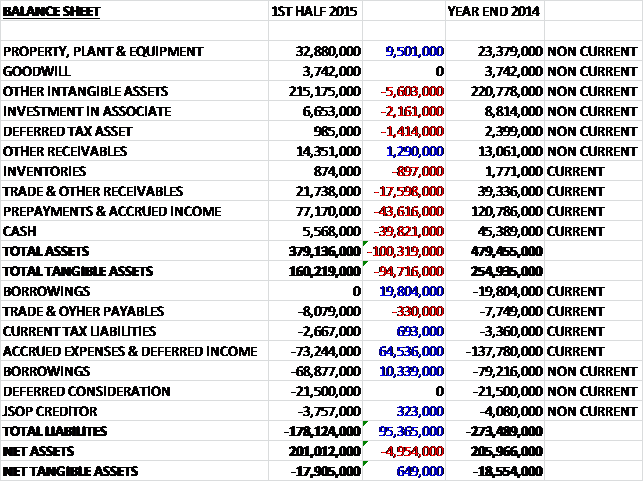
When compared to the end point of last year, total assets increased by £4.1M driven by a £2.5M growth in inventories, a £2.2M increase in receivables and a £1.2M growth in property, plant and equipment partially offset by a £1.4M fall in cash levels.  Liabilities also increased during the year as a £5.2M increase in the bank overdraft and a £1.2M growth in payables was partially offset by a £739K fall in current tax liabilities.  The end result is a £1.2M fall in net tangible assets to £1.2M.

majesticinterimcash

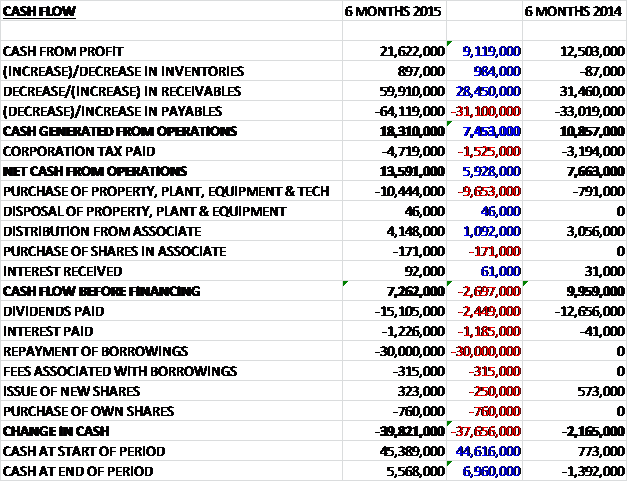
Before movements in working capital, cash profits fell by £2.1M to £12.2M which, after decreases in inventories and receivables were partially offset by an increase in payables, meant that cash from operations increased by £2.4M to £8.5M.  After tax this became £5.8M which was enough to pay for the capital expenditure to give a free cash flow of £1.3M, clearly not enough to cover the £7.7M paid out in dividends to that the group had to eat into its overdraft with a negative cash position of £4.8M.

The retail environment in which the group operates remained highly competitive but the group increased market share by 0.1% to 4.3% and UK like for like sales grew by 2.8%.  During the current year the group has been investing in market and customer insight; better infrastructure; and the latest technologies necessary to secure future growth and the cost of these investments has impacted upon results, along with the weak Bordeaux 2013 vintage.  The lease on the old head office was coming to an end which prompted the group to purchase a long leasehold and locate all the teams into one facility.  In addition, the old distribution centre was operating at full capacity and the new facility is large enough to handle the expected future growth and although these investments should drive future value, they will have an adverse effect on costs in the short term.

The Majestic Wine Warehouse posted a result of £7.7M, a decline of £700K when compared to last year due to the investments made in the period to support future growth, sales were actually up 5.7% with like for like sales up 2.8%. The average spend per transaction increased by £3 to £130 and the average bottle price of still wine is up from £7.71 to £8.02.  The business in currently investing to grow their in-house multi-channel team which to support online growth which increased by 12.3% when compared to the first half of last time.  The group has also appointed a CRM agency to enhance their communications and the first part of the CRM strategy has been executed which involved segmenting the database to deliver better targeted customer communication and since the end of the half year, they have launched a welcome programme to increase the proportion of new customers who return for future visits.

Total sales to business customers grew by nearly 5% to £26.8M and now represent 21.5% of all UK sales.  There is a regional sales team who secure restaurant, pub and hotel business with the logistics being handled by the nearest store.  In London there is a dedicated depot near King’s Cross that sells to larger business customers in the City and West End. In order to capitalise further, more investment has been put into the commercial sales team.  During the half, four new stores were opened with two more being opened after the period end to give the group 210 outlets.  It is expected that three new stores will be opened before Christmas and the group are currently conducting a revalidation of the locations and total footprint required to service the targeted segment of the UK wine market so it sounds like the store opening programme may be slowing.

The Lay & Wheeler business suffered a loss of £23K during the period compared to a profit of £467K last time.  Over the summer, they experienced a disappointing Bordeaux 2013 campaign as the vintage was not great and sales were down across the industry which has further knock on effects on ancillary trading and broking of older vintages.  The business has increased the frequency of diversified offers, such as the recent launch of Penfolds Grange 2010 to try and offset the decline.  Since the end of the half year period they have re-launched their fine wine subscription club and rebranded it as Cellar Circle which offers members benefits.

The French business showed a profit of £738K, an increase from the £660K during the first half of last year and the business has recently simplified its pricing structure and spent time highlighting to customers that they can make substantial savings on the UK market and customers are encouraged to order through the click and collect proposition which accounted for 45% if sales from the division.

An unchanged interim dividend means the shares are currently yielding 5.2%.  At the half year point, net debt stood at £4.8M, an £800K increase when compared to the same point of last year but a big change when compared to the £1.8M net cash position at the end of last year.  Going forward, the rest of this year will be one of investing to “put in place the building blocks to deliver future growth” so it looks like profits aren’t expected to improve in the second half of the year.

Overall then, this was quite a disappointing update.  Profits fell, net assets were down and although operational cash flow did improve, this was due to improvements in working capital when compared to the first half of last year and the free cash flow was no-where near enough to pay for the dividend.  The core performance at the Warehouse offering was fairly decent as sales improved, in particular to businesses but the result was dragged down by increased costs related to investment in the business.  Lay & Wheeler suffered a very disappointing half year due to continued problems with the quality of the latest Bordeaux vintage but the French business did seem to improve slightly.  Management seem to be guiding expectations to non-growth this year and I remain un-invested.

On the 7th January the group released its Christmas trading statement.  Total UK store sales for the 10 weeks over the period increased by 3.7%  but like for like sales were only up 1.1% which means that year to date like for like sales have increased by 2%.  The period was challenging  due to increased levels of competitive promotional activity and whilst the group traded effectively over the period, the company invested gross margin into ensuring that pricing remained competitive in the more promotional environment.  For the rest of the year, it is anticipated that this competitive pricing environment will continue which doesn’t sound very promising.

MJWchart

The chart shows that the shares are on a pretty clear downtrend and reinforces my decision to wait and see with this company.

On the 10th April the group announced a trading update and acquisition.  Since the last update, total store sales grew by 4.1%, up by 1.5% on a like for like basis.  January and February were in line with expectations but March was weaker which, when combined with adverse foreign exchange movements in March means that the group now expects to announce adjusted pre-tax profit of £21M for the full year.

The other announcement was the acquisition of Naked Wines, a privately held international wine business for a total consideration of £70M.  Initially £50M will be paid in cash and a further amount up to £20M in Majestic shares.  Naked Wines is an online crowd funded business model whereby its subscription customers help fund independent winemakers worldwide in exchange for access to exclusive wines at preferential prices.  It is active in the UK, the US and Australia and recorded sales of £74M in 2014 with an EBITDA loss of £3.3M with the business expected to break even by 2016.  Naked Wines will continue to operate as a separate brand with its own management team.

The cash component of the deal is being financed by a new five year revolving credit facility of £85M and will be supplemented by the withholding of the final dividend in 2015 and interim dividend in 2016.  Rowan Gormley, the founder and CEO of Naked Wines will take over as CEO of the enlarged group with the current interim CEO returning to his role as CFO.

Whilst no one can get excited about the trading update, this acquisition looks transformational.  Whilst Naked Wines is not yet profitable and Majestic has certainly paid a lot for it, this transforms the group away from an industry that could be argued to be in decline towards one that seems very fresh and exciting.  I will keep a close eye on the share price and perhaps enter here as a slightly risky investment for the future.

It was also announced that non-executive director Ian Harding acquired 3,000 shares at a cost of nearly £90K to give him a total of 8,000 in all so he certainly seems to think the acquisition augers well.

On the 10th June the group announced the appointment of Anita Balchandani as non-executive director.  She is a partner and sector head of the UK Retail Practice for OC&C Strategy Consultants and non-executive director at Space NK.  Previously she held senior management positions at Shop Direct and Asda.
Majestic Wine Share Blog – Final Results Year Ending 2014

Majestic Wines retails wines, beers and spirits through retail outlets in the UK and France along with trade sales in the UK. Of the three divisions, Majestic Wine Warehouse is a UK based wine retailer, Lay & Wheeler is a specialist in the fine wine market and Majestic Wine Calais operates retail units in Northern France servicing the UK cross-channel market. En primeur refers to the process of purchasing wines early before they are bottled and released onto the market which gives consumers the opportunity to secure wines that may be in limited quantity and difficult to acquire after release. Payments to suppliers are treated as prepayments and receipts from customers are defined as deferred income until the wines are available to customers. The group is listed on the AIM market having been founded in 1980 and it has now released its final results for the year ending 2014.

majesticincome

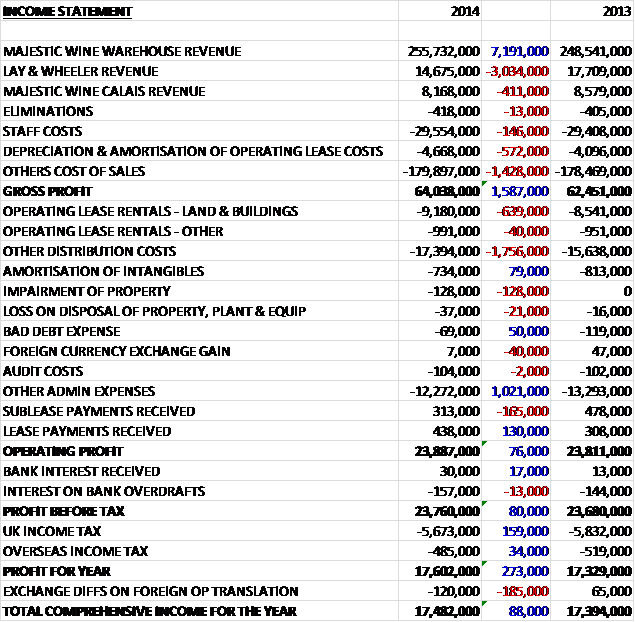
Overall revenues increased when compared to last year as a £7.2M growth in core majestic wine sales was partially offset by a £3M decline in Lay & Wheeler revenue and a £411K fall in Calais revenue.  Depreciation and other cost of sales also increased somewhat to give a gross profit some £1.6M above that of last year.  We then see a £679K increase in operating lease rentals and a £1.8M hike in other distribution costs due to the ongoing rollout of the store estate, partially offset by lower admin costs due to a lower level of accrual for variable remuneration to the management teams to give an operating profit of £23.9M, which remained broadly flat year on year with just a £76K increase.  After finance costs and a fall in the tax paid, the profit for the year grew by £273K at £17.6M.

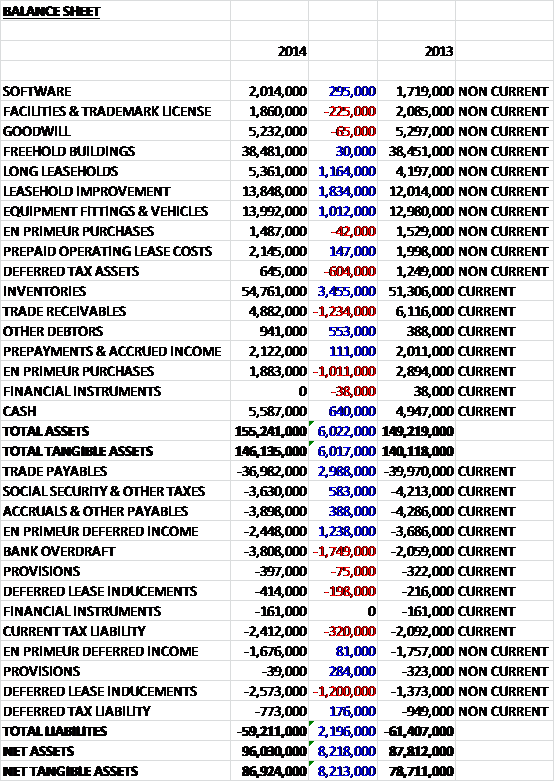
majesticassets

When compared to the end point of last year, total assets increased by £6M driven by a £3.5M increase in inventories, a £1.8M growth in the value of leasehold improvements, a £1.2M increase in the value of long leasehold properties and a £1M increase in equipment and fittings, partially offset by a £1.2M fall in trade receivables and a £1M decline in en primeur purchases.  Liabilities fell during the year as trade payables fell by £3M and en primeur deferred income declined by £1.2M, partially offset by a £1.7M increase in bank overdrafts and a £1.2M growth in deferred lease inducements which are rent free periods and premiums received from lessors in respect of operating leases.  The end result was an impressive £8.2M increase in net tangible assets to £86.9M which seems looks like a strong balance sheet to me.  Having said that, it is worth noting that there are just under £90M worth of operating lease commitments not on the balance sheet with some £5M expected to be received from sub-let properties.

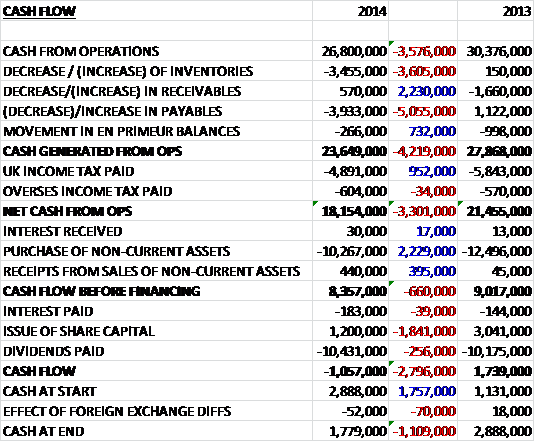
majesticcash

Before movements in working capital, cash profits fell by £3.6M to £26.8M before this was eroded by an increase in inventories and a fall in payables, being blamed on the timing of Easter, to give a cash generated from operations some £4.2M lower at £23.6M which after tax became £18.2M.  This was easily enough to pay for the net £10.3M of capital expenditure (down from last year due to the lack of the £2.1M for the acquisition of the long leasehold of the new head office that occurred in 2013) and the free cash flow for the year was £8.4M, a fall of £660K when compared to last year.  This was not enough to cover the dividends paid out, though, which gave rise to a £1.1M cash outflow during 2014 to lease a cash level of £1.8M at the end of the year which does not leave much headroom, although there was undrawn short term facilities of £2.1M at the year end.

The market in which the group operates has been challenging, as can be seen by the marginal decline in UK sales with a particularly slow January and February being experienced following a positive Christmas trading period.  Despite this, they have managed to increase market share from 4.1% to 4.2% during the year with the value of still wine sold at the group increasing by 4.9% compared to a market that grew 1.3% but contracted in volume terms with the increased value coming from inflation due to increasing alcohol duties.  In addition costs have increased as the world’s grape harvests were weaker due to poor weather combined with rising demand from the Far East.

The Majestic Wine Warehouses posted an operating profit of £21.4M, an increase of £800K when compared to last year.  The average bottle price of still wine purchased increased from £7.56 to £7.94 while average transaction prices increased by £1 to £129.  During the year the group opened 12 new stores with two more after the period end to give a total of 206 stores in the UK with the medium term target being 330 locations.  The commercial offering has done well with sales increasing by 20.6% to £37.3M and management believe that there are good opportunities to improve market share further with the group investing in the commercial sales team.  Online sales grew by 5.8% year on year and now represent over 11% of UK retail sales.  This increase represents a slow down when compared to previous years as further investment was made and the new website was launched.

The Lay & Wheeler business had an operating profit of £1M, a fall of £700K when compared to 2013. This decline was due to the fact that last year included sales from the successful Bordeaux 2010 vintage as the wine was delivered to customers but subsequent vintages saw a slower level of demand reflecting their lower quality.  As a result management expects that profitability from this business will remain at its current level until another strong Bordeaux vintage is seen – not a growth area for the group then.  The Majestic Wine Calais division gave a profit of £1.5M, a small decline of £100K when compared to last year with like for like sales on a constant currency basis declining by 5.7%.

There are a number of initiatives that are being devised by the group.  One new feature is the ability for customers to browse the website based on what’s in stock at the local store that day as all the wines, spirits and beers in stock are listed online.  Another innovation is recommendations from experts for customers who like one particular wine.  The group have improved the click and collect offering with customers being able to pay by Paypal and can collect in store simply by showing their ID.  Finally with the new website platform comes a revamped mobile optimised website with the added ability to view all content on each local store’s webpage and enhanced control of customer account details.

The group is somewhat susceptible to foreign currency changes due to the fact that most of the wines are imported from overseas, with a 5% weakening of Sterling against the Euro reducing profits by £848K.  The main competition comes from grocers who account for 84% of the wine sold in the UK by volume and this has to be the main issue facing the wine merchants at the moment, although the focus on individual customer service certainly differentiates Majestic from the likes of Tesco and Asda.  Another possible risk is the regulatory environment surrounding alcohol and the possibility for further increases in duty which could either squeeze margins or reduce demand as prices increase.
The group has committed to some £2M of capital expenditure for next year which is not an unusual amount.  After the end of the balance sheet date the group successfully moved their head office and also relocated their distribution centre to a more modern and larger facility in Hemel Hempstead which has the capacity to handle a significant volume increase from the potential growth of the multi-channel offering.  Focus in the coming year will be to make the investments necessary to increase the store footprint, grow ecommerce operations, increase sales to business customers and driving the fine wine offer.  In the short term the cost of these investments will lead to flatter profit growth in 2015 with a return to profit growth from 2016 as the benefit from the investments start to take effect.

At the current share price the shares trade on a P/E ratio of 11.6 but this increases to 11.9 on next year’s consensus forecast. The shares currently yield 5.2% in dividends, which is a good return and this is predicted to remain the same next year.  At the end of the year net cash stood at £1.8M, a decline of £1.1M when compared to the end point of last year.

Overall then, this is a fairly solid set of results.  Profits were broadly flat year on year and net assets increased, although in common with many retailers, there is a lot of finance lease obligations off the balance sheet.  Operational cash flow fell year on year and despite being quite cash generative, the free cash flow does not quite cover the dividends which have remained at a historically high rate.  Wine retail is quite a tricky place to be as the market is falling in volume terms with prices increasing due to poor grape harvests but against this backdrop, Majestic is improving market share.  The core warehouse offering is doing well but performance is not so good at the French operation and Lay & Wheeler due to the relatively poor recent Bordeaux vintages.  Going forwards the board have warned that increased investment should lead to flatter profit growth in the coming year and the ever competitive supermarkets are engaging in a major price war, both of which means that I feel Majestic is probably best watched from the sidelines for the moment, despite the decent dividend yield.

Creston Share Blog – Interim Results Year Ending 2015

During the period, Creston has changed its segmental makeup with the divisions now consisting of Communications & Insight which delivers a range of digital technology based marketing solutions with services including advertising, brand strategy, CRM, digital marketing, local marketing, market research, PR and social media marketing.  The Health division provides an integrated communications solution to the healthcare and pharmaceutical sectors and offers services including advertising, advocacy, digital marketing, PR, reputational management and medical education.  The group has now released its interim results for the year ending 2015.

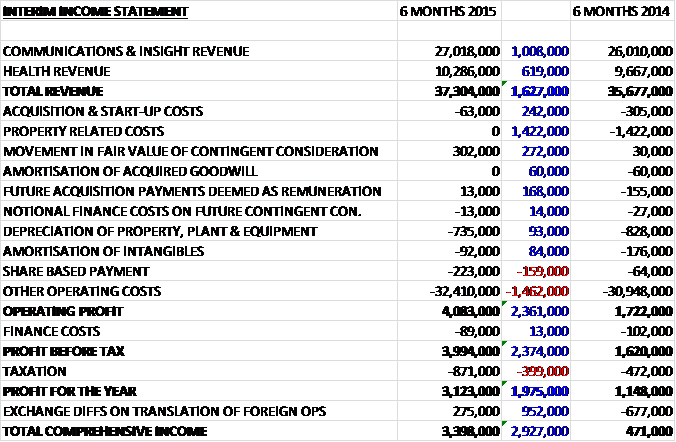
crestoninterimincome

Overall revenue increased year on year with a £1M growth in communications & insight revenue and a £619K increase in health revenue.  We then see a reduction in most one-off costs such a £242K fall in acquisition costs and the lack of £1.4m charge for property related items.  We also see a £168K positive swing in future acquisition payments, partially offset by an increase in share based payments and a £1.5M growth in other operating costs.  Finance costs were broadly flat but taxation did increase on last time (and management expects a slightly higher rate going forward due to higher levels of tax on the growing US income) to give a profit for the half year of £3.1M, some £2M more than in the first half of last year, although it should be noted that if we take the non-underlying costs out from last year the performance would be broadly similar.

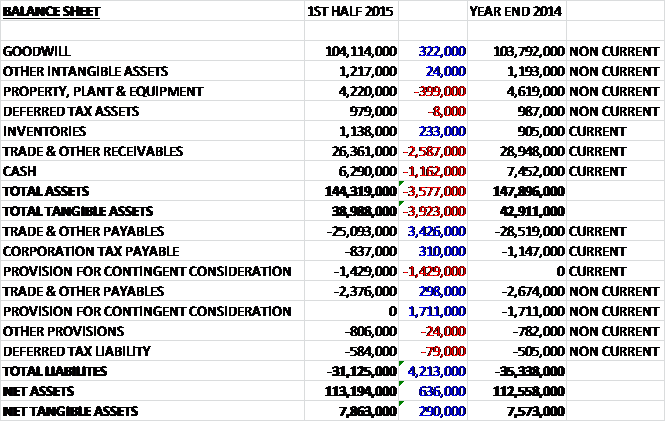
crestoninterimassets

When compared to the end point of last year, total assets fell by £3.6M driven by a £2.6M fall in receivables and a £1.2M decline in cash levels.  Liabilities also fell during the period due to a £3.7M decline in payables and a net £300K decline in the provision for contingent consideration which has now become due within the year.   The end result is a small £290K in net tangible assets to £7.9M.

crestoninterimcash

Before movements in working capital, cash profits increased by £1.8M to £4.8M.  This was eroded somewhat by a fall in payables and after a smaller tax bill, the net cash from operations increased by £8.4M to £2.2M.  This was easily enough to cover the capital expenditure, which fell year on year to give a free cash flow of £1.8M.  The group then spent the majority of this on dividends but also spent £1.2M the purchase of treasury shares which meant that there was a £1.1M cash outflow for the period to give a decent cash pile of £6.3M at the period end.

The Communications and Insight business posted a profit before tax of £3.2M, a growth of £500K when compared to the first half of 2014 but on an underlying basis, after the impact of higher property costs last year, this represents a £400K fall in profit.  Significant new business wins during the period included work for McCarthy & Stone, Sony Mobile, Arthritis Research, Allianz, BskyB, Bentley, McCain, Activision, Vertu, Sainsbury’s Energy and the Department for Work and Pensions.  Revenue from international work grew by 4% to make up 20% of the division’s overall revenues and this is an area that management are looking to grow following the partnership agreement with Serviceplan.

The Health business showed a profit before tax of £2M, an £800K improvement when compared to the same period of last year which included a revaluation credit for the contingent consideration for DJM Unlimited due to project delays and cancellations partly in relation to a failed clinical trial, without which profits would have increased by £200K to £1.7M.  In the US the health business maintained its good new business performance with wins during the period including work for the National Meningitis Association, Parent Project Muscular Dystrophy and CDC.  In the UK new client work during the period included major wins from Sanofi, Baxter, Bayer, Pfizer and Novartis.

The group is somewhat susceptible to currency exchange changes and the strengthening of Sterling against the US Dollar had a material impact on results.  During the period the fact that results included the full effect of higher property costs relating to the co-location of the group’s London based companies affected profits.  There is a slight cautionary warning that the increased reliance on digital revenues, which accounted for over half of sales, can lead to “variability in annual income over the course of a client relationship”.  An example of this is an instruction that begins as a large website design and build will usually progress to a content management, hosting and maintenance instruction.

The earn out obligations of about £1.4M in cash become due in July 2015 and there are other potential charges next year as the launch of Creston Unlimited and the group-wide rebranding of their service offerings has an associated project cost of £500K, the majority of which will be incurred in the second half of the year.

A number of board changes took effect during the period and after the period end.  Barrie Brien was promoted to CEO in April and Kathryn Herrick joined the board and group as CFO in July.  David Grigson stepped down as Chairman in September and was replaced by Richard Huntingford, an existing director for the past three years.  From November, Kate Burns joined the board as non-executive director and brings with her good experience in digital media and technology with senior level experience at Google and AOL and the will be replacing David Marshall who steps down after being with group since 2001.  This is an interesting one as David was Chairman when the group formed and is the Western Selection director, which is one of the large shareholders – does this mean that Western Selection are no longer interested in maintaining their position on their board or even their shareholding?

After the period end the group signed a partnership agreement with the German owned international marketing communications group, Serviceplan.  The business has no UK or US presence and so Creston will serve their clients in these markets with Serviceplan assisting Creston’s clients in Europe with the plan of referring each other’s clients depending on their location and sometimes jointly pitching for clients.  Already the two companies have successfully partnered to win CRM assignments for Danone in Germany and the Middle East.

Going forward, the group are looking to invest and evolve their offer through organic growth and selective acquisitions and they look to deliver more digital based marketing solutions. The growth momentum reported in the second half of last year has continued and it is anticipated that revenues will increase in the second half of this year.  While the board remain cautious in light of the global macro-economic climate it is reported that current trading is in line with expectations for the full year.

The shares are currently yielding 3.5% after a 13% increase in the interim dividend.  At the period there was no debt and the group had a net cash position of £6.3M, a decline of £1.1M when compared to the end point of last year.

Overall then, this seems to be a pretty decent update.  Reported profits increased when compared to the first half of last year but underlying profits seem to be broadly similar.  Similarly, net assets showed a modest improvement but the cash flow seems to be much better with an increased operational cash flow and enough free cash to cover the dividends.  It does not cover the shares purchased for the treasury, however, so there is still work to do to stop that cash pile being depleted.  Again, there have been some changes at the board level with David Marshall leaving and Kate Burns arriving.  Kate seems to have a lot of good relevant experience so she seems to be a good appointment and while the loss of David is probably not much of a problem, the fact that he represents a large shareholder who no longer has representation on the board could suggest that Western Selection will look to offload their shares.

Going forward, the guidance seems mixed.  Whilst revenues are thought to increase in the second half, there are also a few cash costs to watch out for such as the earn out obligations and the expense surrounding the launch of the Creston Unlimited brand.  Also, I am not sure I like the statement about the variability in annual income over the course of a client relationship comment.  Whilst this really is to be expected, pointing this out seems as though it could be paving the way for a profit warning.  In any event, I am keeping a watching brief on the shares.

On the 3rd February the group released an interim management statement covering Q3 trading.  After a decent H1 in which revenues grew by 5%, growth in Q3 was lower, with group revenues up just 1% giving a year to date increase of 3%.  The Communications & Insight business performed well but within the UK Health business, revenue performance was affected by some client budget cuts and project delays which are likely to continue into Q4.  As a consequence of this, the board expects full year group revenue growth to be below current expectations.  Operating costs have been reduced and based on current trading, the board expects group headline profit before to tax to be broadly in line with expectations.

The group continued to win new business with Mclaren and Superfast Broadband, along with contracts with Vue, Barilla and La Roche which were added after the end of the half year.  In addition work with Sony Mobile and Novartis has been expanded.  As mentioned previously, digital work can lead to variability in annual income over the course of a client’s relationship which means the group is pursuing a departure from pure marketing services to include consultancy led marketing advice which should lead to greater pipeline visibility in the future.

Going forward, whilst the marketing services sector remains vulnerable to the impact of macro-economic events, the board is confident that the group is well placed to deliver long-term growth.  I do rather agree with them but I see some short term volatility caused by the “revenue warning” issued here and continue to watch from the sidelines.

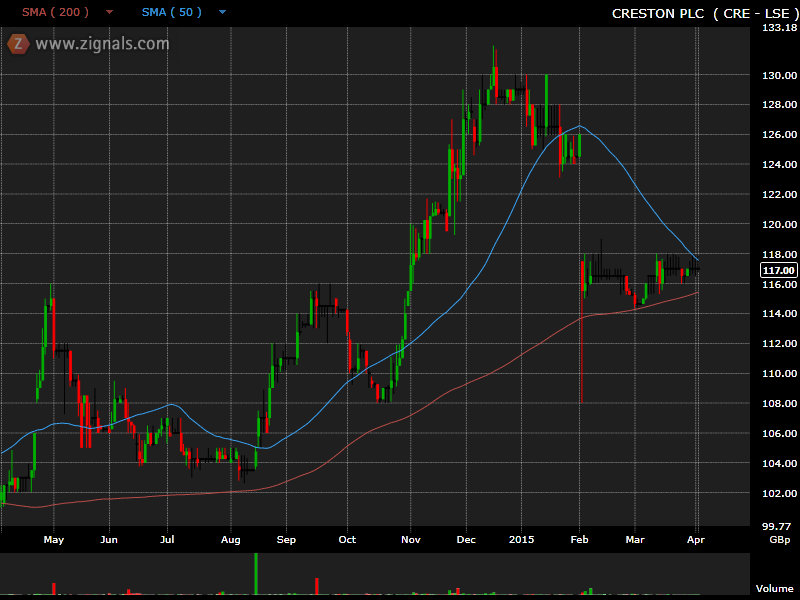
CREChart

As we can see, the last updated halted the appreciation of the shares but they seem to have stabilised since then.

On the 9th April it was announced that DBay Advisors had purchased 161,000 shares in the company at a value of about £188K to give them a 19% interest in the company.  This was a modest purchase but notable because DBay really seem to be building a stake here – I wonder what their plans are?

On the 22nd April the group released a trading update covering the full year results.  They are expected to be in line with (reduced) expectations with revenue growing by £2M to £76.9M, an increase in headline profit and EPS and a cash level of £8.3M at the year end.  The group also announced the acquisition of 51% of How Splendid Ltd, a London based design and development consultancy.  There is an initial cash consideration of £8.7M that will be funded from existing cash resources and the acquired group is expected to retain net assets of £2.1M, including cash of £1M.  There is a deferred payment of up to £7M in June 2017 based on average profit levels.  Creston will have a call option over 24% from April 2017 for a value of up to £8.6M and the remaining 25% from April 2019 for £11.9M.

Last year, Splendid received revenues of £4M and profits of £1.2M but this year it has experienced material growth so actual revenues and profits are higher than this.  The acquisition will be earnings enhancing in the current financial year which is good to hear. The acquired group has a variety of clients including Barclaycard, Boots, EBay, Gamesys, News UK, Skrill, SSE and Star Alliance and focuses on the user experience between a brand and a customer.  There are expected to be significant cross selling opportunities with this acquisition which seems a really good fit.  I have some reservations about the potential total cost of this deal but there is little doubt that it seems like a good, earnings enhancing acquisition and this will encourage me to look at the shares with more interest going forward, despite the rather lacklustre results that are likely to be reported in June.

On the 5th June the group announced that Nigel Lingwood will join the group as non-executive director and become senior independent director.  He currently works as finance director at Diploma, a role he has been in since 2001 where he has seen the growth of the business from a FTSE small cap company to a FTSE-250 constituent.  He will replace Andrew Dougal who will step down as a non-executive director after being with the company since 2006.  This certainly seems like a high-calibre appointment but I am not sure how much time he can dedicate to the role given his senior position at Diploma.

Creston Share Blog – Final Results Year Ending 2014

Creston is an agency group providing clients with strategic marketing and brand consultancy services.  The group as a whole seems to be very technology oriented and is focused on helping their clients with their digital marketing, social media and PR.  The Communications division offers marketing and communications strategy including advertising, brand strategy, channel marketing, CRM, digital marketing, direct marketing, local marketing, social media marketing and PR.  The Health division provides communications solutions to the healthcare and pharmaceutical sector, offering advertising, advocacy, brand consulting, digital and direct marketing, PR, reputational management and medical education.  The Insight division performs market research services using face to face, telephone and online data collection techniques. Creston has now released its final results for the year ending 2014.

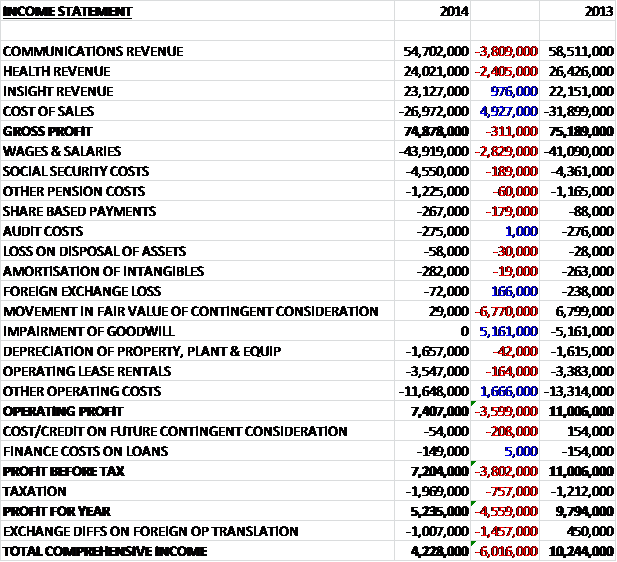
crestonincome

Overall revenues fell as communications sales fell by £3.8M and health sales reduced by £2.4M.  Cost of sales also fell during the year to give a gross profit some £311K lower.  We then see an increase in wages, partially offset by a fall in other operating costs with the big changes in one-off items being a £6.8M reduction in the movement of the fair value of continent consideration and the lack of a £5.2M impairment of goodwill that occurred last year.  The end result is an operating profit of £7.4M, a £3.6M decline when compared to 2013.  There was then a small cost relating to future contingent consideration and in increase in tax, partly due to the £1.7M release of a provision last year following the conclusion of an HMRC enquiry into deductibility of goodwill that was written off when a previous subsidiary ceased trading, and partly due to a higher rate of tax incurred on the group’s US operations so that the profit for the year fell by £4.6M to £5.2M.

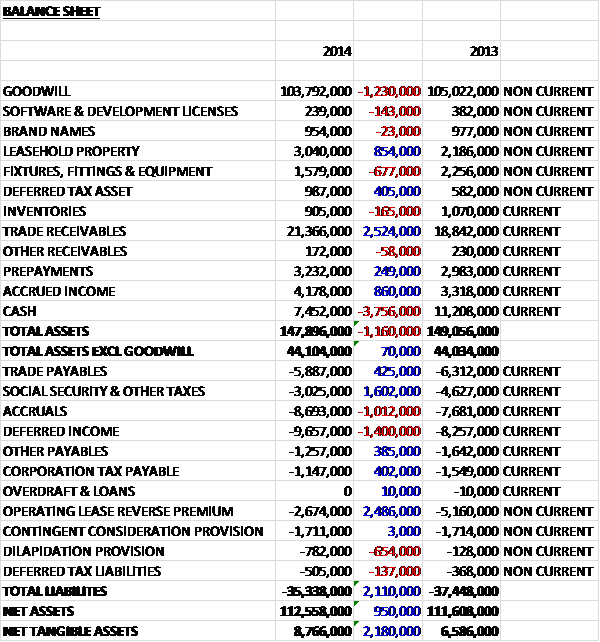
crestonassets

When compared to the end point of last year, total assets declined by £1.2M driven by a £3.8M fall in cash levels and a £1.3M decline in goodwill, somewhat offset by a £2.5M increase in trade receivables, an £860K growth in accrued income and an £854K growth in the value of leasehold properties.  Total liabilities also fell during the year with a £2.5M decline in the operating lease reverse premium and a £1.6M fall in social security and other tax payables, partially offset by a £1.4M increase in deferred income liabilities and a £1M growth in accrued liabilities.  When we take out goodwill, the net asset base is £8.8M, a £2.2M improvement on the figure last year.  It is worth noting that there are £21.6M worth of operating lease payables off the balance sheet, mostly relating to the head office, which seems quite substantial given the net tangible asset level.

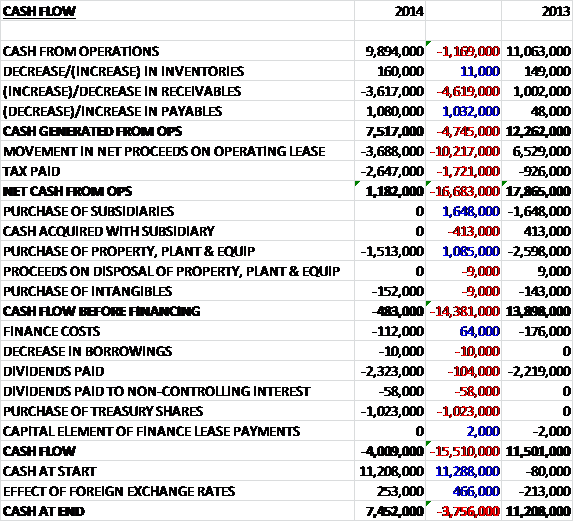
crestoncash

Before movements in working capital, cash profits fell by £1.2M to £9.9M before this was dragged down further by an increase in receivables which reflects a more normal working capital position so that operational cash flow before cash and operating lease changes was some £4.7M lower at £7.5M.  This was eroded further by the £3.7M spent on operating leases (the cash to pay for this was received last year, hence the difference from last year) and the increased tax paid so that net cash from operations was just £1.2M.  This was not quite enough to pay for the £1.7M worth of capital expenditure so there was a negative free cash flow of £483K.  The group then spent $2.3M on dividends and £1M on the purchase of treasury shares so that there was a £4M cash outflow for the year to give a healthy cash level of £7.5M at the year end.

The small decline in revenue was a result of a busy first half spent pitching for new business plus some client volatility but wins filtered through in the second half of the year with £8.6M in net new business wins contributing to a second half growth of 3%.  This increase in pitching activity and increased property costs affected profits which accounts for the small decline seen but the very high level of new business wins almost offset the first half shortfall.

Profit at the communications division was £5.6M, a decline of £600K when compared to last year as a result of the lower revenue and increased property costs and the investment in new business activity during the first half of the year.  There is a generally positive sentiment across the sectors in which the business operates in with the latest Bellwether report being the most positive in seven years in the industry and more specifically social, data, mobile, customer experience, content marketing, multi-channel and personalisation have been noted as the biggest areas of opportunity.  The major shifts in the market with regards to the move towards digital marketing have not gone unnoticed by legacy advertising agencies which may increase competition in the arena, although Creston does seem to be particularly in tune with the ever changing digital market.

During the year work included the development of a new platform for automotive dealer marketing portals and new mobile apps for Danone, while the group is also engaged on a programme in partnership with The Bakery.  This programme enables them to tap into over 400 young technology companies around the world and the business is well into the process of developing technology driven brand solutions for Danone, Unilever and Public Health England in this way with three other major brands at the start of this process.  New business wins during the year included Arthritis Research UK, Bentley, HSBC, Sky and Virgin Trains, along with additional brands from Unilever.  Significant work during the year included the Durex Earth Hour campaign which achieved 85 million video views across more than 50 countries within a few weeks.  There were also notable projects with the Playstation 4 launch, which included the PS4 branded OXO tower stunt.

During the next year, the primary focus will be to establish and embed the new client relationships that were achieved during this year.  Following the spree during the first half of the year, the group will now concentrate on fewer, selected pitches to improve conversion and not allow this activity to impact the current service levels to existing clients.  Internationally, the business is looking to grow through partnerships, joint ventures and acquisitions.  Going forward, with a strong new business performance at the end of last year, the division is expected to make a stronger start to this year.  The new business pipeline remains strong but while the level of market activity continues to increase, management remains cautious as volatility still exists within budgets.

Profit at the health division was £4M, a fall of £2.7M when compared to 2013 driven by the loss of the US Sanofi business in Q4 last year, partially offset by the UK health companies performing well with like for like revenue growth of 5% and continued growth of the digital healthcare agency DJM, acquired in the second half of 2013.  These factors are showed by a 44% decline in headline in profit and a 22% increase in the second half of the year.  During the year the group has seen the shape of agency procurement change with rostered agency numbers being reduced and the emphasis being on cost cutting putting significant pressure on profits.  In the UK cost constraints will continue following the Pharmaceutical Price Regulation Scheme which means the industry may have to reshape itself yet again to generate growth.

In the US enrolment into health insurance exchanges began expanding public and private health care coverage which means that payers are more often the key decision makers rather than doctors or patients and direct to consumer advertising has undergone closer scrutiny and companies have reduced medical education budgets.  This has led to a period of uncertainty for pharmaceutical marketers but the opportunity to reach more insured people in the US means there is a wider audience to communicate with.  During the year the group launched Chemia, a new network covering creative, PR and digital government relations and medical education; and Liberation, a conflict PR agency.  Additionally, Looped was launched which is a brand and creative consultancy.

New business wins during the year included the WHO, MSD, Takeda, Alere, GAVI Alliance, Novartis, UN WSSCC and further Gilead brands.  After the period end, the business also won a contract with Cow and Gate as a result of a referral from the Communications business which is something than management are really trying to push going forward.  Future growth is seen to come from continuing technological innovations such as the new health kit from Apple that means patients don’t need to visit their GP to have their routine monitoring done which creates an opportunity for the industry to move towards more personalised medicine and the communications to support this type of technology, including educating both doctors and patients, will become a new specialist area.  Another area that the business is looking to exploit is getting involved earlier in the pre-licencing process for emerging medicines.

Profit at the insight division was £1.7M, an increase of £300K when compared to last year with growth coming from both revenue growth and the realigning of the cost base.  For the first time since 2008, the general trading environment across market research in the UK and internationally showed signs of improvement but trading levels remained well below those before the recession.  For ICM the period represented a recovery following the structural changes undertaken last year and growth was seen from existing customers such as Aviva and Vodafone, along with the addition of new clients including the British Chambers of Commerce and HM Passport Office.  Marketing Sciences enjoyed a good year of growth driven by increased client relationships with Tesco, Danone, Igloo, Kimberley Clark, Velux and Reckitt Benckiser.  Post year end, the group acquired Walnut, a recent start-up specialising in neuroscience for £100K and the business will continue to innovate in neuroscience and the measurement of emotions.

The annual report contains some examples of the work that the group does which I think gives a better understanding of what some of the contracts involve.  One was to help the Crown Commercial Service reach and engage audiences around serious topics.  In order to achieve this the group collaborated between different agencies and external partners utilising market research, websites, localised media campaigns, social media and direct mail with each campaign being tailored to the specific target audience.  This resulted in increased traffic to websites, increased calls to contact centres and significant amounts of press coverage leading to behavioural change and a growing knowledge of the issues being promoted.

Another project was conducted on behalf of Reckitt brand Durex.  They wanted to create a campaign that would generate over 100 million engagements whilst taking a more emotional positon on sex and love and whilst it could be naughty and cheeky, it also had to show the brand’s mature side and be on a global scale.  The group created a series of Facebook posts and a short film suggesting that the Earth Hour was the ideal time for couples to escape the screen and have some fun in the dark, ironically using Facebook, Youtube and Twitter to spread the message.  The campaign achieved nearly 2 billion impressions worldwide and successfully promoted the Durex brand globally.

The group also worked with the WHO who wanted to highlight the increasing threat of vector-borne diseases with the slogan “Small Bite: Big Threat”.  Two Creston health businesses worked with the organisation to develop two campaign posters, an infographic and a policy document which were shared with over 150 country offices globally to raise awareness and drive action locally.  The team also created a stand at Heathrow.  The campaign was a success and the materials attracted attention from the UN and Centres for Disease Control and Prevention.

The group worked with Canon Europe to develop a B2B campaign to reinforce perceptions of Canon as a business services partner.  The idea was that by getting to know their customers better to provide the insights and vision that will support businesses that strive to be exceptional.   The group developed assets from print and digital display through to insight based content such as articles and white papers and in addition, a central content hub was established online to be stocked with fresh insights and engaging content over the course of the campaign.

During the year the group moved to a new head office in London which incurred £900K of costs incurred during the vacant period of Creston House when the group paid double rent, rates and service charges and £500K relating to move costs, and double charges on existing leases.  Last year the group received £7.2M on signing the lease relating to a reverse premium and agreed dilapidation obligations, of which £3.7M was used this year to fulfil the dilapidation obligation.  Last year we also saw some one-off charges relating to the earlier acquisition of Cooney Waters.  Management decided that the future performance of the group would not be as good as initially expected which had the effect of reducing the contingent consideration likely to be paid by £6.8M which had the knock on effect of impairing goodwill to the tune of £5.2M.  The remaining provision for contingent considerations stands at £1.7M which will be settled in July 2015 and 2016.

One strategic objective that was achieved during the year was the completion of the so called Co-location strategy where all London subsidiaries moved into the Creston House which is designed to improve collaboration between the different divisions which seems to be a clear strategy being adopted by the group, and of course to save on the overheads of having many fragmented offices spread around the city.  The board have also mentioned a share buyback scheme in which up to £2M of shares will be acquired by group subject to being available at an appropriate price which should give the share price some support going forward.

The group seems to have some good headroom.  There are currently no borrowings but there is a revolving credit facility of £20M that is currently undrawn and expires at the end of September 2015 although the group did pay £100K in non-utilisation fees.

The group is somewhat susceptible to exchange rate changes with a 10% strengthening of Sterling against the Euro leading to a £135K fall in profits whereas a 10% weakening against the Dollar would reduce profits by £170K.  Other risks include the fact that this is a fast paced industry with relatively low barriers of entry that may encourage greater competition, the fact that the loss of a big client may materially impact performance, as seen with the Sanofi loss at the end of last year and the possibility of turbulence in the macro-economic environment may affect client budgets and performance.   The challenging market place impacted the small healthcare research consultancy, Vitaris which failed to achieve critical mass and was closed during the year at a cost of £400K.

One of the group’s shareholders is David Marshall of Western Selection.  I have encountered him before at Swallowfield and Western Selection like to get involved in the running of the companies in which they are invested and as such David is a non-executive director at the company.  At the year-end CEO Don Elgie retired after spending 13 years as CEO and founding the group in 2001 who was succeeded by current CFO Barrie Brien, and Chairman David Grigson will step down from the board after more than four year in the job at the next AGM and will be succeeded by Richard Huntingford who has been a member of the board since 2011.  After the year-end, Kathryn Herrick was appointed new CFO so this has been a real period of change for the board.

Going forward, the coming year will be one of investment in realigning the business under a unified group offer and while they remain cautious about the state of the broader macro-economic environment and the potential for it to affect client budgets, the board are confident that over the medium term the new strategy will enable them to deliver higher rates of growth over the medium term.

At the current share price the shares trade on a fair value P/E ratio of 13.7 but this falls to a cheap looking 9.4 on next year’s forecast.  After a 6% increase, the shares are currently yielding a dividend of 3.3% which increases to 3.5% on next year’s prediction.  At the year end the group had a net cash position of £5.7M compared to £9.5M at this point last year.

Overall then, this seemed like a slightly disappointing set of results.  Profits fell during the year and despite improvements to net assets, the balance sheet still does not look that strong.  The cash flow performance was also disappointing with a falling operating cash flow and no free cash flow.  Performance in the second half of the year did improve however, with the poor first half performance, partly due to the loss of the US Sanofi contract, dragging the year down as a whole.  There is apparently positive sentiment in the market but Creston does not really seem to be benefiting from this, possible as competition increases and clients are still looking to cut budgets.

The strategy to increase cross selling seems to be baring some fruit but the move to the new head office seems to be generating quite a few costs with a lot of double payment of rent and rates as some of the legacy offices are obviously still being used.  This year has also seen some upheaval at the board level with the founder and CEO stepping aside to let the Finance Director take over.  Going forward, this year is apparently going to be one of investment, which I guess means higher costs but the performance in the first half is likely to be better than a week comparator in 2014.  In conclusion, I like the digital focus for the group but I still have some reservations about performance at the moment.

James Halstead Share Blog – Interim Results Year Ending 2015

James Halstead has now released their interim results for the year ending 2015.

jhdincomeinterim

When compared to the first half of last year, revenues increased by £6.3M, equivalent to 5.7% although on a constant currency basis, like for like turnover is some 10.3% ahead of last year which meant that after a smaller increase in cost of sales, operating profit was some £1M higher at £21.6M before an improved finance costs was more than offset by a small increase in tax to give a profit for the year of £16.2M, a £1M increase when compared to the first six months of 2014.

jhdassetsinterim

When compared to the end point of last year, total assets increased by £5M driven by an £8M growth in cash levels and a £2.1M increase in the value of derivative financial assets, partially offset by a £7.2M fall in receivables.  Liabilities also increased during the period due to a £4.6M growth in pension obligations, a £1.6M increase in current tax liabilities and a £901k growth in payables to give a £2M decline in net tangible assets, although the balance sheet remains strong with £93.3M worth of tangible equity.

jhdcashinterim

Operational cash flows improved considerably during the first six months of the year, helped by the previously seen reduction in receivables to give a figure some £8.1M higher than last time at £28.3M.  We then see a fall in tax being offset by an increase in capital expenditure before a reduction in the proceeds from the sale of fixed assets and an increase in dividends meant that the cash flow for the year was £8.2M, a £4.4M improvement on last time to give a cash pile of £46.7M at the end of the half.  This company continues to be very cash generative and there seems to be scope for a further increase in dividends going forward if this continues.

UK trading performed solidly despite competitor activity and reported figures were 9% ahead of the first half of last year and the group continues as market leader in this country, and indeed increased market share.  The European business grew by some 6.7% at a constant currency basis and the Oceania business grew by 11% at the same measures.  One project that was completed during the year was at the Sjoskrenten student hostel on the Svalbard archipelago, probably the most northerly contract yet.  Gross margin improved slightly on last time helped by downward pressure on raw materials.  The refurbishment business completed contracts at the Cardiff International Swimming Pool, the Calgary Stampede showground and the extensive Daenisches Bettenlager retail outlets in Germany.

Overheads grew above inflation with the largest being infrastructure expenses associated with sales into global markets but the costs are in line with plans as the group expands into new territories such as the Middle East, India and Canada.  Also during the year Simplay, a loose lay tile was awarded best flooring innovation by the Euro Décor magazine and Expona Flow, the design sheet, was launched at the BAU exhibition in Munich in January. The award winning recycling scheme collected record amounts of waste destined for landfill and returned it to the manufacturing loop.
As well as quoting famous poets and statesmen, the board have confidence with regards the full year result but the continued strength of Sterling presents some headwinds in the coming months.  After the announcement of a 4.7% increase in the interim dividend, the shares now trade on a yield of 3.1% rising to 3.3% for the full year forecast.

This was a good update, profits increased, as did operational cash flow, although this was mainly due to a large reduction in receivables but the group remains very cash generative.  Net assets did fall slightly due to an increase in pension liabilities but the balance sheet remains very strong.  There is some good news in that raw material costs are falling with lower energy prices but overheads in general increased as the group pushed into new markets.  The strong sterling is likely to cause some problems for James Halstead, however, as they export a lot of their products overseas.  As an aside, it is interesting to see the report being littered with quotes from famous people and it can’t be coincidence that the interim dividend is 3.142p, or the first four digits of pi!  I think the directors are having a bit of fun here which suggests some confidence in the group’s performance (hopefully not overconfidence).   The yield is getting to a decent level again now and I see these shares as a very strong hold having topped up earlier in the year.

On the 29th July the group released a trading update for the full year.  Trading has been solid and profit before tax will be ahead of last year and in line with market expectations.  There is confidence that the full year dividend will be increased once again.  Not really much here that we didn’t already know but a decent update nonetheless.

Safestyle Share Blog – Final Results Year Ending 2014

Safestyle has now released its final results for the year ending 2014.

sfeincome

When compared to last year, revenues increased by £11.2M and after cost of sales increased too, gross profits were some £4.5M higher than in 2013 at £49.7M.  We then saw an increase in share based payments and other operating expenses relating to higher salary costs due to the annual pay award and auto enrolment; and marketing costs increased by £1.2M driven by inflation in TV advertising rates and an increased investment in digital marketing,  more than offset by one-off costs relating to last year’s AIM listing and tax settlement so that operating profit increased by £7M which after finance costs and tax produced a profit for the year of £12.8M, pretty much double that of last year.

sfeassets

When compared to the end point of last year, total assets increased by £5.1M driven by a £3.2M increase in cash, a £921K growth in receivables and a £543K increase in property, plant and equipment.  Conversely, liabilities fell during the year due to a £1M fall in payables to give a net tangible asset level of £6M, a decent £6.7M up on the negative value recorded last year.

sfecash

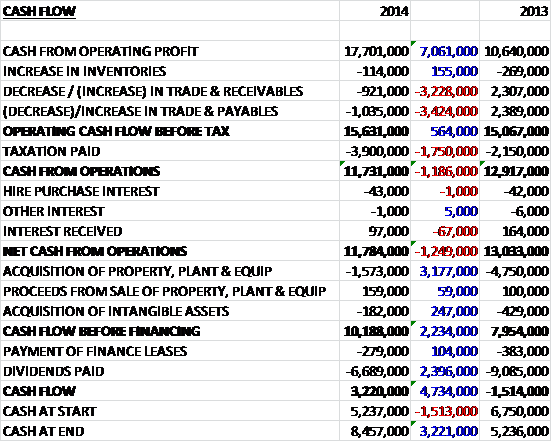
Before movements in working capital, cash profits increased by £7.1M to £17.7M before modestly adverse movements in payables and receivables meant that before tax, the operating cash flow increased by £564K to £15.6M which became £11.8M after tax and interest were taken into account.  This was easily enough to cover capital expenditure so that free cash flow was an impressive £10.2M, an increase of £2.2M when compared to last year.  The bulk of this cash was spent on dividends and there was still a cash inflow of £3.2M to give a cash pile of £8.5M – pretty impressive stuff.

The group has continued to increase market share, up from 7.85% last year to 8.48% in 2014 with the medium term target being 10%, and also maintained their position as the leading player in a fragmented replacement window and door market.  The general economy and repair, maintenance and improvement market continues to recover which should be good for Safestyle as their geographic expansion into the South East and entry into the conservatory refurbishment market should lead to further growth.  The overall market contracted 3.1% during the year with a 4.3% growth in the first half and a concerning 10% decline in the second half of the year.  It is interesting, though, that Safestyle’s volumes increased 4.8% and 4.7% respectively during the year.  It should be noted too that margins suffered in the second half of the year due to the cost of providing compulsory insurance backed guarantees to all customers and by the imposition of a 20% increase on the glass purchase price.

During the period the group carried out 57,682 installations, an increase of 4.7% on last year, consisting of 267,642 window and door frames.  Average frame sales price increased by 1.6% to £504 and total average installed order value increased from £2,704 to £2,806.  The focus on continued expansion into the South and South East resulted in sales growth of 17% in the region and the board believes there is scope for the group to gain further market share there.  Two new sales branches were opened in Sittingbourne and Avon, both of which are performing well and a new branch has been opened in Watford with a further sales branch being planned for later in the year in Surrey.  During the year, the group also opened a new installation depot in Crawley with a further depot planned for the Watford area in the new year.

The group has continued to grow its digital and internet presence and leads generated from direct response channels now account for 31% of all business and the increased focus on direct digital marketing should help the group grow market share and reduce average lead generation costs.  During the year a significant investment was made to the Wombwell manufacturing facilities with an upgraded glass furnace, the installation of a new sash line and a new machining and cutting centre.  Improvements in efficiency and quality have already been seen as a result of the investment.  After a long period of flat prices, the group have made the decision to increase prices from the start of January 2015 to reflect some cost side price inflation, in particular glass prices; more stringent regulation and health & safety standards; and higher TV advertising costs.  Despite the increase, the products apparently remain significantly cheaper than those of Safestyle’s national rivals.

During the year the group has conducted a feasibility study into the launch of a new product offering focused on the conservatory market and management have been encouraged by the initial feedback and as a result will begin the roll out of the new service across an initial eight sales branches in April.  The service will focus on conservatory refurbishment where they will replace the roofs and frames of poorly performing conservatories onto existing bases.  The roofs will be sources as complete units from an external manufacturer and the frames will be produced in the group’s own manufacturing facility.  It is estimated that the refurbishment market totals about 20,000 conservatories a year with further growth expected to be driven by new glass and insulation technology that has vastly improved the energy efficiency of a traditional conservatory.  The market is highly fragmented with little brand awareness so represents quite an opportunity and the board expect to be able to secure a similar percentage of the total conservatory refurbishment market to that which it has in the retail replacement market.

There does seem to be a large number of share options that have been granted with some four million outstanding at the end of the period with the only vesting conditions being that the individual must remain an employee of the group for a minimum period, so that may be something to take into account.

After introducing a price increase in January 2015 the first 11 weeks of the new year has seen a strong order intake, with the order book at the end of 2014 some 3% ahead of the previous year and trading in line with expectations.  The CEO has hinted that an acquisition may be on the cards when he states “our robust cash generation and strong financial position enables the group to retain the flexibility to balance shareholder returns with the ability to take advantage of our leading position within a fragmented market should the opportunity arise”.

At the current share price the shares trade on a P/E ratio of 11.3 which seems pretty good value and this reduced to 10.4 on next year’s forecast.  The shares also seem good value with regards to the dividend yield which is a fully covered 5.2% increasing to 5.3% on next year’s forecast.  The group has a net cash position of £8.5M compared to a net cash position of £5.2M last year.

Overall then this seems like a good update.  Profits improved even when the IPO costs of last year are discounted and net tangible assets are now positive after a good year of cash generation which has given rise to plenty of free cash to pay dividends.  The operational cash flow was slightly lower than last year but this is only because tax increased and there were unfavourable movements in working capital.  Operationally, there were increased installations, particularly in the South East and the average price per installation also improved.   The 10% decline in the overall market in the second half of the year is slightly worrying and no real reason was given for this, although it has to be said that Safestyle’s sales did not suffer.  There is also some pressure on costs with the glass price rising considerably during the year which has given rise to some price increases, so hopefully they will stick.  Going forward, the order book seems decent and the continued expansion into the South East along with the conservatory refurbishment market seems quite exciting.  The shares trade on a low P/E and there is an excellent dividend on offer so I am happy to hold despite the glass price inflation and may look to buy more funds permitting.

As Safestyle has now released its annual report I thought I would see if that gave any more information.  Both the income statement and the balance sheet now have a bit more detail.

safestyleincome

We can see that part of the increase in operating expenses was due to the £638K growth in operating leases and the £340K increase in share based payments, partially offset by a £562K decline in rent payable.

safestyleassets

As far as the balance sheet is concerned, the increase in property, plant and equipment is entirely due to the assets under construction and the increase in receivables is across the board.  The fall in payables is due mainly to the decline in tax and other payables.  I suppose the most relevant piece of extra detail is the fact that there is £11.6M worth of operating leases on non-cancellable contracts which takes some of the shine off the fact the group are now net tangible asset positive.  Overall though, my conclusions based on the prelim results are unchanged.

On the 21st May the group released an AGM statement.  The year has started well with the company trading in line with expectations.  Order intake for the first four months of the year grew by 2.7% year on year and the price increase introduced in January is helping to absorb the impact of glass price increases and regulatory costs.  With the positive momentum in order uptake and continued opportunities to increase their geographic penetration, the board is confident that the group will deliver growth in revenue and profit through the year. This all sounds decent enough.

On the 16th July the group released a half year trading update.  The company has continued to trade well with revenue during the first half of the year expected to be £74M, an increase of 6.8% year on year despite a strong comparator with Q1 2014.  This increase reflects both further growth in market share and the price increases introduced in January.  The board expects a continuing strong sales performance in the second half and remains confident of achieving full year results in line with their expectations.

Order intake grew by 7.1% during the period compared to FENSA statistics which show that the market contracted by over 10%.  The group express surprise at this figure and personally I am very surprised.  Are these stats reliable?  Anyway, if that are it means that Safestyle enjoy a record 9.5% market share.  Cash flow was strong during the half year and the group now has net cash of £14.9M compared to £10.8M at the same point of last year.  Early evidence from the conservatory refurb business launched in April is encouraging but it is still early days.

All of this sounds very positive to me and I am thinking about adding to my position here.

On the 17th July it was announced that CEO Stephen Birmingham purchased 5,000 shares at a value of £11.8K giving him 3,893,889 shares representing 5% of the total issued share capital.  It is always good to see director buying but this is quite a modest amount.

TT Electronics Share Blog – Final Results Year Ending 2014

TT Electronics have now released their preliminary results for the year ending 2014.

TTincome

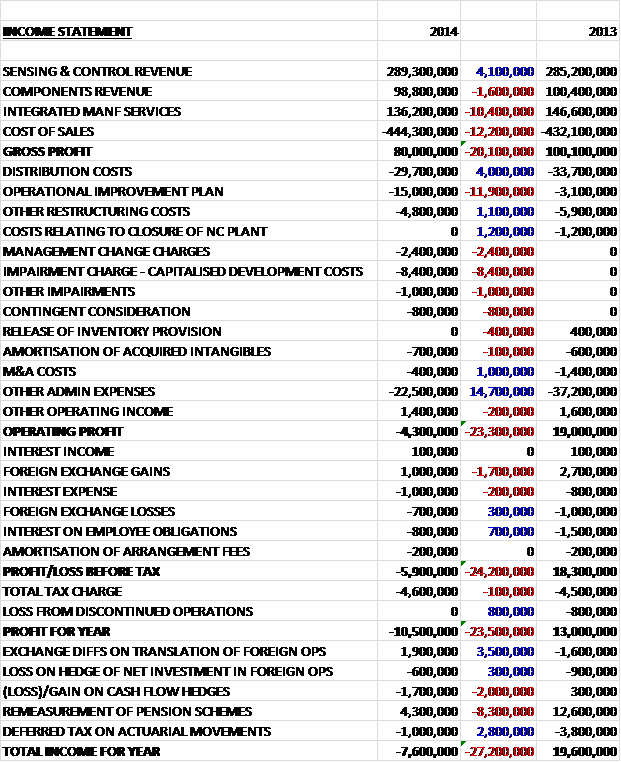
When compared to last year, revenue fell in 2014 as a £4.1M increase in sensing and control sales, largely due to a one-time order, was more than offset by a £1.6M fall in components revenue and a £10.4M collapse in integrated manufacturing services revenue, although there was a massive £22.6M detrimental effect from foreign exchange.  On top of this, cost of sales also increased so that gross profit was £20.1M lower at £80M.  Distribution costs did fall during the year as did underlying admin costs but there were a raft of non-core costs such as the £15M spent on the operational improvement plan, other restructuring costs, impairment charges relating to capitalised development costs and an increase in contingent consideration which helped drive the operating loss some £23.3M lower than last year at £4.3M.  After various finance costs and tax, the loss for the year became £10.5M, a negative swing of £23.5M when compared to 2013.  Although the underlying operating profit at a constant currency basis was broadly unchanged but included £5M of non-repeating profits.

TTassets

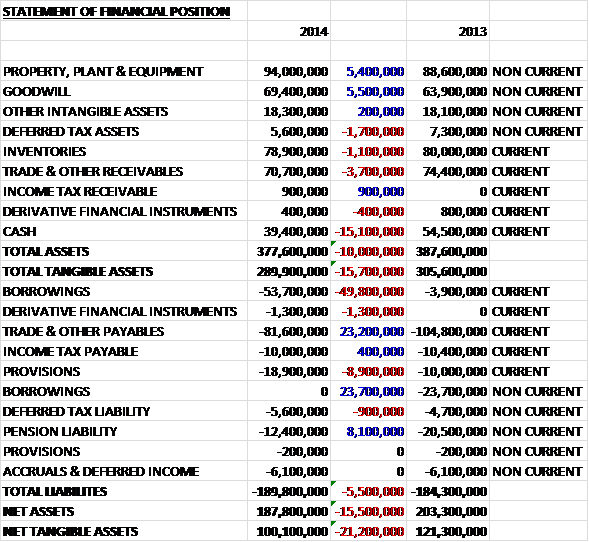
When compared to the end point of last year, total assets fell by £10M driven by a £15.1M decline in cash levels, a £3.7M fall in receivables and a £1.7M fall in deferred tax assets, partially offset by a £5.5M increase in goodwill and a £5.4M growth in property, plant and equipment.  Liabilities increased during the period due to a £30M hike in borrowings and an £8.9M growth in provisions being partially mitigated by a £23.2M decline in payables and an £8.1M fall in pension liabilities partly due to the deficit reduction payments made during the year.

TTcash

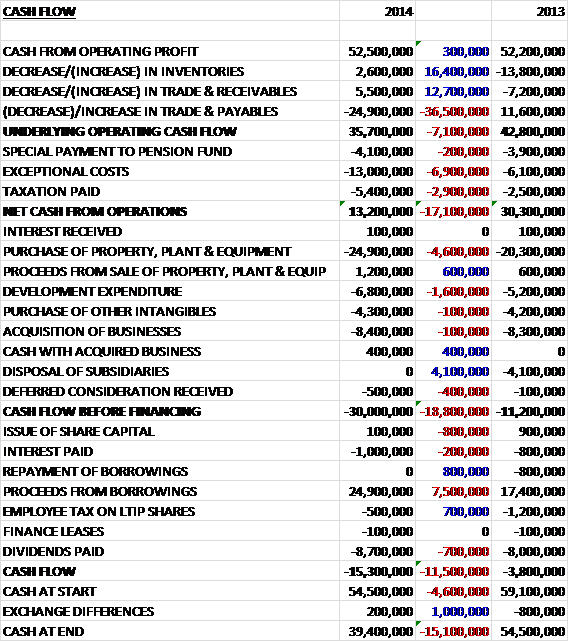
Before movements in working capital, cash profits were fairly flat, up by £300K to £52.5M.  A huge fall in payables due to significant supplier payments made during the first half of the year, however, meant that the underlying operational cash flow was £35.7M, some £7.1M below that of last year.  There was then £13M of exceptional cash costs, another £4.1M paid into the pension scheme and an increased tax payment to give a net cash from operations of just £13.2M.   This cash was no-where near enough to pay for the net £23.7M spent on property, plant and equipment, let alone the £6.8M of development expenditure, £4.3M on other intangible assets and £8.4M on the acquisition.  The cash outflow before financing was £30M so it comes as little surprise that the group had to borrow some £24.9M more to give a cash outflow for the year, after an increase in the dividend payout that the group can’t really afford, of £15.3M which leaves £39.4M of cash at hand at the year end point.  It is worth noting, however, that there was a positive free cash flow in the second half of the year.

Underlying operating profit at the Sensing and Control business was £14.2M, a decline of £3.3M when compared to last year with the operating profit margin falling from 6.1% to 4.9%.  This reduction was driven by poor performance in the Transportation Sensors business related to price-downs and adverse product mix, investment in product development and inefficiencies resulting from the movement to Romania from the German location.  This was partially offset by the £4M profit from the one-off order for steering position sensors and growth in the transportation controls business.  There was also a negative foreign exchange impact of £1M and the acquired Roxspur contributed £400K to operating profit. The first full year was completed at the Indian facility and the group are starting to see benefits of having established a local manufacturing site to serve the growing market.  A key focus for both the transportation and industrial sensing and control businesses will be improving R&D investment efficiency and processes during 2015.

The business launched several new sensor products during the year including a new technology based on SIMSPAD, a new non-contacting sensor platform that is designed to detect non-linear positions through non-ferromagnetic walls.  The new overmoulded speed sensor was launched during the year which simplifies production and provides cost savings on assembly processing.  The business also launched a new Magnetorque sensor for combining position and torque in a smaller package, improving their ability to serve the growing area of Electronic Power Steering applications.

The transportation controls business grew significantly during the year, helped by increased penetration of front LED lighting into a broader range of vehicles and the increased usage of petrol engines where the increase in demand for engines benefited the group’s supply of intelligent electrical water pumps used in engine cooling systems.  The business expanded the supply of intelligent electrical water pumps regionally having won business with their first Korean customer and they continue to develop technology to address customer needs in the area of LED lighting and intelligent power modules.  The patented approach to LED placement helps customers enhance the light’s appearance on the road and will be used for the next generation of intelligent headlights.  In addition, a chip stacking technology was patented which enables higher power density in smaller packages, increasing the number and type of applications that can be served in transportation systems requiring power electronics.

The group experienced a number of delays in the launch of new product platforms during the year in the Industrial sensing business and they are taking steps to re-organise the engineering function and review core processes in order to improve this in the future.  Despite these set-backs, a number of new products were launched during the year including an optical sensor designed to monitor seeds as they are dispensed in agricultural planting equipment and a number of new products are expected to be launched during 2015 which are expected to deliver modest benefits in the second half of the year.  The acquisition of Roxspur strengthened the offering for industrial pressure, temperature and glow sensors and provides a platform for future growth in industrial applications.  A number of activities have been identified to expand the product range and support growth which includes developing an enhanced range of pressure sensors with improved performance and they are also evaluating a number of manufacturing process improvements leveraging skills from other parts of the group.

Underlying operating profit at the Components business was £9.5M, an increase of £5.2M when compared to 2013 with operating profit margins increasing form 4.3% to 9.6%.  This performance was driven by a favourable product mix, improvements in the underlying cost base and a £1M benefit of non-recurring orders associated with the closure of the US facility.  The Power and Hybrid business had a strong year with increased sales and profitability with prior improvements in the strength of the team having an impact.  The business signed a long term supply agreement with Rolls Royce subsidiary CDS to supply a new range of multi-chip modules used in the control of fuel supply for a wide range of engines and they supplied hybrid circuits for the vehicle management computer on the Orion space mission.

The Resistors business saw a significant increase in sales across all product lines and managed a number of major projects.  A new customer service centre was opened in the UK and the US service centre was expanded with the latter installing a major new production facility after a multi-million dollar investment programme.  This new facility produces the new range of WIN moisture resistant precision thin film chip resistors mainly focused on industrial markets and some were successfully shipped during the second half of the year.  The business also managed the closure of the Smithfield site without interruption to customers.  The Magnetics business had a solid performance and progress was made on a number of fronts gaining new programmes and launching new products.  The business, based in Malaysia, continued to expand its automotive sales, launched a new initiative to grow industrial sales and continued to expand their range of moulded inductors.  The connectors business achieved a solid year and continued to support their customer base in military and rail markets.  During the year they launched the new MIL PP and MABAC connectors for military use in land based applications.

Underlying operating profit at the Integrated Manufacturing Services business was £5.5M, a fall of £3.5M when compared to last year with the operating margin falling from 6.1% to 4%.  This reflected the impact of lower revenues due to weaker than expected demand from some key customers in Europe and the cost increases in Romania in anticipation of volumes which have not yet been realised.  Foreign exchange movements also accounted for £500K of the decline in profits.  Key wins have been achieved within the aerospace and defence markets, though.  During the year the division expanded its suite of end-to-end solutions by globalising cable harness and environmental and reliability testing services.  A new engineering office was opened in North Carolina which will provide aerospace and defence customers with specialised technical expertise and product support.

During the year, management conducted a comprehensive review of the business, during which a number of immediate actions were completed to simplify and stabilise operations.  They identified good opportunities in the Industrial Sensing and Control and Advanced Components businesses based on favourable market dynamics.  Transportation sensing and control had good structural growth characteristics but the performance of the transportation sensors business has been disappointing and there is now a clear plan to turn it around by ensuring that R&D spend is targeted on the right opportunities.  The IMS business will continue to deliver at a similar level of performance.

As previously reported, the progress in moving some manufacturing lines from Germany to Romania was delayed but agreement has now been made with the unions and the transfer is making progress.  The cost of the Operational Improvement programme in Europe is expected to be £24M and should generate cost improvements of £3.5M per year and is a necessary step to underpin future competitiveness. The first production line transfer was completed in January and the qualification of that line in Romania is now in progress with the additional ten lines being moved in 2015 and the remainder throughout 2016.  The closure of sales offices in Japan, France and Italy was completed on schedule with the full year benefits of £1.3M per annum being realised in the year.  The transfer of manufacturing from the US to Mexico has been put on hold in order to fulfil a significant customer order agreed in the first half of 2014 and the transfer should now be completed in 2015.

As can be seen, once again there were a lot of non-underlying costs this year.  Under the operational improvement plan, the charge was £15M relating to the closure of the facility in the US and transfer of production to Mexico and the transfer of manufacturing in Germany to Romania.  Other restructuring costs of £4.8M related to site consolidation in the UK and the establishment of a facility in Romania for the IMS division; costs incurred in securing certain supply chain activities; costs incurred in the closure of the loss making connectors facility in the US and costs relating to the creation of the new organisation structure.  There was also £2.4M worth of charges relating to management changes.  There was a non-cash impairment charge of £9.4M after the board re-evaluated the margin expectations of certain products in relation to capitalised development products and finally, acquisition related costs totalling £1.9M relating to the amortisation of intangible assets and costs arising from the Roxspur acquisition.
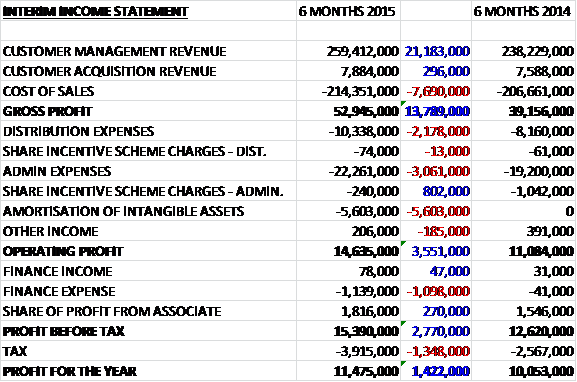
In July the group acquired Roxspur for an initial consideration of £8.3M in cash with a further amount of up to £2.5M payable in 2016 based on the performance of the business during 2015.  The acquisition came with £4.5M of intangible assets and generated goodwill of £2.1M.  During the year, the business contributed £3.7M to revenue and £400K to operating profit and had the acquisition occurred at the start of the year, operating profits would have increased by £900K so this seems like a decent purchase on this basis.

The pension scheme continues to be a drag on profitability.  This year the group paid £3.1M as part of their agreed deficit reduction plan and a further £1M was paid to fund an exercise which offered scheme members with small pensions the opportunity to exchange their annual pensions for a one-off lump sum payment with £3M being set aside to reduce the long-term liabilities of the scheme.  So far in 2015, £1M has been paid towards the deficit reduction programme for 2014 and a further £4.3M is expected to be forked out with another £4.5M due in 2016.  These figures are fairly material for the group, especially during the restructuring that is taking place at the moment.

There were a number of changes at the board level as Richard Tyson joined from Cobham as CEO and Mark Hoad was appointed as CFO at the start of 2015 having previously worked as finance director at BBA Aviation.  Going forward, whilst the order book at the company remains sound, their markets continue to look challenging, especially in Europe.  The board remain cautious in their outlook for 2015 and expect profits to be more second-half weighted than in the prior year with the benefits of the strategic plan not likely to be seen until 2016.

Due to the loss, it is hard to value the shares on a P/E ratio basis but on next year’s consensus forecast, the ratio is 14.8 which seems a little steep given the issues surrounding the group.  The shares yield a decent 4.2% after dividends were increased by 2% year on year, which is not expected to change next year.  At the end of the year the group had a net debt position of £14.3M compared to a net cash position of £26.9M at the end point of last year with undrawn long term borrowing commitments of £70.7M providing ample head room.

Overall then this has been a difficult year for the group.  The loss for the year is disappointing especially when it is considered that results were boosted by £5M worth of one-off contracts.  Net assets fell as a higher amount of borrowing took its toll, although the balance sheet still looks fairly robust.  There was no free cash flow, even on an underlying basis as a huge increase in supplier payments meant that operating cash flow was not enough to fund capital expenditure.  Operationally both the sensing & control and IMF businesses are struggling with the Components segment being the only chink of light as they won an interesting sounding contract with Rolls Royce.  The restructuring is going to continue into 2015 and with the potential for further delays and the benefits only starting to be felt in 2016, I can see this year being another difficult one with the continued pension deficit reduction payments not helping.  Going forward, the market looks challenging and the board set a cautious tone with the fact that profits are heavily weighted to the second half of the year not inspiring confidence.  The shares do have a decent dividend yield but this is certainly not covered by free cash flow and the shares seem fully valued at a P/E level for next year.  In conclusion I feel there is still too much uncertainty for me to invest here despite the recent share price strength.

TTGcgart

The share price has been in recovery mode recently but I still remain cautious.

On the 16th March it was announced that Norges Bank had sold 2,534,989 shares at a value of about £3M to give them a 3.53% holding.  This is a large sale and does not do much for confidence.

On the 9th April the group announced that Chairman, Sean Watson was retiring from the board after spending five years in the role.  He will be succeeded by Neil Carson, the former CEO of Johnson Matthey.

On the 12th May the group released a trading update for the first four months of the year.  Overall trading was in line with expectations with revenues in line with the previous year and an order book that remained sound.  The operational improvement plan continued to progress to schedule with the transfer of nine lines from Germany to Romania now completed with five of the lines also fully qualified.  Management continues to expect the programme to be completed in the first half of 2017.  The outlook for the rest of 2015 remains unchanged with profits apparently still expected to be second half weighted.  A steady update then and one could be forgiven for thinking that the worst might be over for the group.

On the 15th May it was announced that director Neil Carson doubled his share holding to 100,000 shares at a cost of £76.7K which is a decent purchase.

GVC Holdings Share Blog – Final Results Year Ending 2014

GVC has now released its preliminary results for the year ending 2014.

gvcincome

Revenues increased considerably when compared to last year with a €19.4M increase in sports revenues and a €23.3M growth in gaming revenue with increases seen in both Europe and Latin America, and with an increase in variable costs the gross profit was some €20.7M above that of last year.  We then see a €10.5M increase in personnel expenditure, mostly due to a €7.3M increase in incentive schemes, a €2M growth in professional fees and a €1.2M increase in technology costs, somewhat offset by a €2.4M reduction in third party service costs and a €1.6M decline in foreign exchange losses.  We then see the lack of the €19.7M of costs relating to the Sportingbet acquisition that occurred last year and a €1.6M charge relating to the effect of valuing the Betit put option. Finance income fell considerably which was exacerbated by an even larger increase in finance expenses due to the retranslation of the Sterling denominated William Hill loan, offset by a decline in the unwinding of deferred consideration which meant that after a tax charge broadly flat on last year, the profit for the year was €40.6M, a €28.3M increase when compared to last year.

gvcassets

When compared to the end point of last year, total assets increased by €9.4M driven by a €4M increase in receivables, a €3.8M growth in the value of available for sale financial asset relating to the Betit investments and a €2M growth in tax assets, partially offset by a €979K fall in cash levels.  Liabilities also increased during the year as a €6.3M increase in payables a €2.3M growth in income tax payable and a €1.7M relating to the Betit option liability was partially offset by a €3.7M fall in deferred consideration on the Betboo acquisition, a €2.8M decline in other tax liabilities and a €2.4M fall in the William Hill loan which meant that net tangible assets were some €8M ahead of last year at a negative €4.8M which seems like a decent improvement.

gvccash

There was an increase in cash receipts from customers and a fall in cash paid to suppliers and employees so that net cash from operations showed a €56M positive swing when compared to last year at €47.9M.  Of this, €4.3M was spent on the previous acquisition deferred consideration, €3.6M on the investment in Betit and €3.3M on capitalised development costs to give an impressive free cash flow of €35.8M.  The group then paid back some of the William Hill loan and some other borrowings with the rest of the cash going on dividends to give a cash outflow of €979K for the year and a decent cash pile of €17.8M at the end of the year.

The world cup was a success for the group with excellent trading in Brazil and a step-change in the retention and acquisition of customers beyond the tournament.  About €7M was invested in marketing around the tournament and some €3.3M was invested in the group’s products which was capitalised as intangible assets.  Mobile is becoming the natural choice for players in many markets and continued investment in mobile is seen as key to future success.  In addition, the games offering has been broadened through third party integration and the introduction of in-play products is a significant milestone in unlocking additional organic growth opportunities with in-play representing 71% of Sports Gross Gaming Revenue in Q4.  Investment in products during the next year is expected to be some 50% higher than this year in order to maintain the group’s market position and improve revenues.

As usual there are some risks and the new tax regime in the UK has shown what can happen – although the group is not that exposed to the UK market.  They are looking to further diversify by targeting acquisitions in regulated markets as a foil to the mostly unregulated markets that they are currently engaged in, although if the right opportunity does come up, further unregulated acquisitions would be considered.  The group are also rather susceptible to exchange rate fluctuations, not least because the dividends are paid in Euros which could mean the continuing decline of that currency would have an effect on the pay-out.  The charge to operating costs due to the declining Euro this year was €300K with a further loss of €500K on the retranslation of the William Hill loan.

One major investment this year was the acquisition of a 15% stake in Betit holdings, a start-up gaming venture focusing on the Scandinavian market.  The group pad €3.6M for this stake and they also have a call option to acquire the balance of the outstanding shares between July and September 2017 for a minimum price of €70M with the actual price being determined by the mix of revenues between regulated and non-regulated markets.  Should the group not raise the required financing for the deal, the 15% stake can be acquired by the current owners for a nominal consideration.

Going forward, management reckons the group have never been in a stronger position and they look forward to the new year with confidence.  Current trading in Q1 2015 is at record levels with sports wagers averaging €4.6M per day, a sports margin of 8.9% (which is actually somewhat lower than was the case during 2014) and an NGR increasing by 18% to €661K per day, producing another quarter of growth.  Over the next year the group aims to improve the product offering, particularly mobile, continue growing all markets where they are active and devote more time to non-dilutive investment and acquisition opportunities.

There are a number of short term potential cash outflows over the next year with €2.4M due to the founders of Betboo and another €1.7M due the year after which should finally put an end to the payments for this acquisition which seem to have been dragging on for quite a while.  There is also £2.3M (€2.9M) due on the William Hill loan next year with the final £2.3M payment due the year after.  In addition there is €1.4M of finance leases payable next year relating to the purchase of software.   These payments are similar to those of this year, however, so I am confident that GVC can handle them and increased investment in the product not withstanding should continue to pay the dividends we have become accustomed to.

At the current share price the shares trade on a P/E ratio of 9.3 which seems pretty cheap for a company like GVC.  After a year on year increase of 14% the shares now yield an incredible 9.7% and 14c has now been set as the new quarterly dividend benchmark which suggests a similar yield for the year ahead.

Overall then, this is a good set of results.  Underlying profits increases over last year, although personnel costs seem to be increasing quickly; net assets improved relating mainly to the Betit investment although net tangible assets remain negative (not really a problem given the industry and the cash generative nature of the business).  The operational cash flow improved and there was a strong free cash flow which nearly fully covered the dividend and debt repayments with a big cash pile left despite the slight cash outflow.  Next year, investment is increasing in the group’s product with a focus on mobile and in-play offerings which is likely to represent a cost of about €3M extra.

The risks remain, the group is reliant on certain unregulated markets with Turkey being a particular concern, hence the focus on a regulated market acquisition and the collapsing euro is causing a bit of a headache – not just for translation but also with regards to the dividends paid in euros and converted to Sterling and the GBP denominated William Hill loan which gets more expensive as the Euro declines.  Trading in Q1, however, was at record levels, although it would be worth keeping an eye on the declining sports margin as to whether this is a one-off or not but with a very cheap valuation and incredible covered dividend, I am happy to continue holding here.GVCChart

After a long bull run the share price has been consolidating since the end of last year and these latest results have done little to change that.  The chart doesn’t look great actually but I will remain a holder.

The annual report is now out that adds a bit of meat to the bones of the prelim announcement, particularly with regards to the balance sheet, so here it is:

gvcassets14

Total assets increased by £9.4M when compared to last year and we can see that this is driven by a €4M increase in balances with payment processors, a €3.8M increase in the Betit investment, a €2M growth in income tax reclaimable and an €8.8 increase in the group’s own cash, offset by a €9.8M fall in cash balances with customers.  Total liabilities also increased when compared to last year as accruals grew by €3.6M, other trade payables were up €2.6M, income tax payable increased by €2.3M and the Betit option liability grew by €1.7M, partially offset by a €3.6M fall in the Betboo deferred consideration, a €2.8M decline in other tax liabilities and a €2.4M fall the William Hill loan.  I reckon some of those intangible assets are worth something so I have just taken off goodwill from net assets to give a figure of €16.6M, a decent increase of €8.4M when compared to 2013.  There are also just over €3M worth of operating lease liabilities not on the balance sheet but this is not too concerning.

There is further clarification of the effect of the weakening Euro with the retranslation of that William Hill loan costing €467K and the retranslation of finance leases costing €160K.  I have also re-calculated the current rolling dividend yield using a combination of the exchange rates the company actually used and the current exchange rate for the most recently announced one and this reduces the yield down to 9.2% which is still pretty spectacular.

Another thing that comes to light from the annual report is the huge amount of share options given to the directors.  At the end of the year there were 6,806,947 options outstanding.  Of these 3,356,947 are exercisable now at a price between 154p and 234p and as a reminder the current share price is about 460p and the value for the directors of these options comes out at a staggering £9.2M!  I am not sure why they have not been exercised but a clue to this might come from the 3,450,000 options with an exercise price of 1p that are exercisable if the share price were to stay above £6 for 90 continuous days so perhaps the directors felt the extra dilution would put this in jeopardy.  To put it into context, these new options are worth nearly £15.9M which, even when split three ways seems excessive with the total emolument for the CEO being €4.4M during the year and for the non-executive chairman it was €1.5M as each director will receives 100% of their base salary as a bonus if the dividends exceed 54.99c during the year (which was achieved this time).

Just after the year end, non-executive director Nigel Blythe-Tinker stepped down from the board.  There is not really a huge amount more to add – the balance sheet looks a bit better now that I can see some of those intangible assets are probably quite value trademarks and such like but the hugely rewarding pay for the directors is a concern as it seems rather excessive to me.  It doesn’t stop this company being a strong hold for me though.

On the 24th March it was reported that the CEO purchased 21,740 shares at a cost of nearly £100K which brings his interest up to 415,073 and 0.65% of the company.  Although he can clearly afford it, it is good to see him putting some of his own money in.  Similarly it was also announced that the CFO also purchased shares – in his case 10,000 at a value of nearly £46K.

On the 25th March the Chairman made it three directors as he purchased 12,500 shares at a value of £57,375 to give him a total of 135,075 and 0.2% of the company.

On the 27th March it was announced that the directors were surrendering up all those share options apart from the ones with an exercise price of 1p.  Actually, they were not really surrendered as they will receive in cash the difference between the current share price and the exercise price of the shares.  This will net the directors almost £9M in cash quarterly over the next two years which is a huge amount of money and will be material to the cash flow of the company.  Not only this but the directors will continue to receive a cash payment equal to the dividend attached to the surrendered options every time the dividends are paid over the next two years.  This is quite incredible and I am sorry to say seems very greedy to me.  They are no doubt talented individuals but these payments seem far too high for a company the size of GVC.

On the 2nd April the group announced that Marathon Asset Management had purchased 81,577 shares at a value of about £81,577.  They now own more than 5% of the total shares in the company.

On the 2nd April it was announced that Prudential had purchased shares to take its holding up to 2,325,000 or 3.79% of the equity.  Before this announcement, PRU had less than 3% of the company equity so it is good to see such a well regarded institutional share holder join the list.

On the 5th May the group released a trading update covering the first 120 days of the year.  NGR averaged €658K per day, an increase of 17.5% on the same period of 2014 on a sports margin that fell from 9.62% to 8.75%.  Sports wagers continued to grow, increasing by over 21% to €4,590K per day.  Despite the lower sports margin as a result of punter friendly results so far this year, the board continues to be confident for the rest of the year.

On the 19th May the group announced that it had submitted a bid for Bwin.party digital entertainment which would be finance jointly by GVC and Toronto based Amaya.

On the 8th July the group released a statement covering trading in the first half of the year.  Sports wagers increased by 19% to €823M although the aggregate sports margin fell from 9.9% to 8.9% due to some “punter friendly” results in the period. This gives rise to an NGR of €120M, a 14% increase on the same period last year but broadly flat when compared to the second half of last year.  In Q2, sports wagers reached €412.3M with total NGR up nearly 10% year on year to €661K per day.

The group has a presence in the Greek market via its partner, Centric Multimedia.  Following the recent imposition of capital controls by the government restricting the movement of funds both within and outside the country, the group has noticed a softening in plater activity.  It is currently too early to forecast whether this will have a material effect on the second half results. The group have declared a quarterly dividend of 14c per share which is slightly lower than the 15.5c declared last quarter but year to date the dividend remains 5% above that of last year.

A brief statement has also been made regarding the proposed acquisition of bwin.party but all that was said is that bwin are determined to work with GVC so that they can finalise their offer over the coming days so it looks like that might be likely to go ahead.

The trading results are decent enough but somewhat flat on the second half of last year and the Greek situation looks as though it might have an adverse effect.  Additionally the continued weakness of the Euro is whittling away at the value of the dividend payment.  The potential acquisition looks exciting though and I am happy to hold on and collect those dividends until that plays itself out.

On the 27th February the group gave an update on the potential acquisition of Bwin under which Bwin shareholders would receive 122.5p for each share consisting of up to 25p in cash with the balance in GVC shares.  The proposal would be financed via a combination of the issuance of new shares to Bwin shareholders and a €400M secured loan provided by Cerberus Capital.  In addition, the company intends to raise about £150M through an equity placing of new GVC shares in order to fund restructuring costs, the refinancing of existing Bwin debt and for additional working capital purposes.  If a transaction were to be completed, the board believe that cost reductions exceeding €135M per annum would be achieved by the end of 2017.

So the saga rumbles on, the Bwin board seem to prefer 888 as an acquirer but GVC may succeed with this revised bid.  It seems like there will be some heavy dilution and a lot of debt if this bid succeeds, although the mooted cost benefits may justify the expense.

Finsbury Foods Share Blog – Interim Results Year Ending 2015

Finsbury Foods have now released their interim results for the year ending 2015.

finsburyinterimincome

When compared to the first six months of last year, revenues increased by £20.9M due to the growth in UK bakery sales with like for like sales increasing by £4.9M and the acquisition accounting for the rest of the growth.  Cost of sales also increased to give a gross profit some £10.2M ahead of last year.  Core admin expenses increased by £8.3M and we saw £1.3M worth of transaction costs this year, which was clearly a non-recurring item.   Nevertheless, operating profit still managed an £864K increase when compared to last time.  There was an overall adverse movement in the value of interest rate swaps that are used to hedge against increases, and bank interest increased by £111K as a result of the new loan but tax was broadly flat on last year to give a profit for the period some £405K higher at £2.1M.

finsburyinterimassets

When compared to the end point of last year, total assets increased by £81.7M driven by a £25.7M increase in goodwill, a £23.1M growth in receivables, a £21.5M increase in property plant & machinery and a £6M increase in inventories.  Liabilities also increased with a £28.6M growth in payables and a £16.7M increase in borrowings to give a net tangible asset base of £20.3M, an increase of £9.6M which is not too shabby.

finsburyinterimcash

Before movements in working capital, cash profits increased by £1.7M to £5.3M.  Due mainly to an increase in payables, lower interest, and lower tax this became a net cash flow from operations of £6.2M, a £6.9M positive swing when compared to the first half of last year.  This comfortably covered the capital expenditure of £1.7M but the main change during the period was the £53.8M spent on the acquisition.  This was paid for by a £19.3M new loan and £33.7M received from the issue of new capital to give a cash flow of £686K and a cash pile of £1.3M.  If we take out the acquisition, this was actually a rather good performance although the low level of capital expenditure is likely to change in the second half of the year with the full year figure at a similar level to 2014.

UK Bakery underlying operating profits were £3.8M in the first half of this year which represents a £1.8M increase when compared to the first half of last year.  The improvement in performance was due to growth in cake market share on the back of both their licensed products and of brands, an improvement in production efficiency leading to lower cost of production and the benefits of increased automation from capital investment.  The growth in profits seems mainly to be organic with a 72% like for like growth during the period.  Profit margins increased from 2.6% to 3.9% but this remains below expectations with the group looking to find further efficiencies to improve this.

The cake business operates in a mature market with a value decline of 1.4% which makes the revenue growth look like a good achievement.  Growth was driven by a successful Christmas trading period and the success of the Frozen Disney licenced celebration cake along with the own label round cake offering.  Operating profit margin growth arose from increased efficiencies in the factory after significant capital expenditure over the past two years.  The intention is to continue investing in capital expenditure within the cake business to improve margins further and increase product capability.

In the bread and morning good business, the results include two months of trading from the acquired Fletchers business which totalled £16M of revenue and £400K of operating profit.  It is still early in the integration process but early indications are positive with the intention to invest in capital expenditure to improve productivity and increased product capability as in the cake business.  Overseas operating profit was £595K in the first half of 2015 representing a £133K growth when compared to the first six months of 2014 with operating profit margins increasing from 4.1% to 5.3%.  The overseas business primarily trades in France and as such is heavily exposed to the Euro and recent exchange rate performance so the increase in operating profits looks somewhat more impressive.

On the 30th October the group acquired Fletchers Group for £56.4M.  Fletchers produces morning goods and specialist bread products for grocery retailers and foodservice customers.  The acquisition generated £25.7M in goodwill and was satisfied in cash, partly raised by the issue of 59.3M new shares.  Whilst the UK grocery market continues to be challenging, the wider economic environment is slowly improving and the broader channel, customer and product diversification achieved after the acquisition should benefit the group given the higher growth opportunities in areas such as foodservice.  The decent first half performance is expected to continue into the second half of the year as the integration of Fletchers continues and starts to deliver scale and efficiency synergy benefits.

At the half year point, net debt stood at £25M compared to £11.8M at the same point of last year due to the Fletchers acquisition.  After a more than three-fold increase in the interim dividend, the shares are now yielding 2.1% which increases to 3.4% for the full year on consensus forecasts.

Overall then this was a good update from the group.  Profits improved when compared to the first half of last year, both organically and with regards the contribution from Fletchers.  Nat assets improved and the balance sheet looks decent enough, although this is mostly due to the new equity issued during the year.  There is also a decent cash flow with a strong free cash flow (not including the acquisition) that is more than enough to pay the dividend, although the cash pile at the end of the half year does look a bit meagre.

The cake market is a mature one, and also one that is declining but Finsbury seems able to increase market share with successes with the Disney Frozen cake, likely to decline as that franchise ages and the more evergreen own brand round cake.  The acquisition seems like a great fit and the entry into the growing food service market looks a shrewd move.  There is quite a bit of debt here now and the French business is susceptible to further Euro weakness but I see prospects here as being good as the acquisition beds in and a 3.4% predicted dividend yield for the year adds a further incentive.  Having bought in here after the last positive statement, I am happy to continue holding.

FIFChart

We can see from the chart that the market seemed to approve of the results.

On the 7th April it was announced that Martin Lightbody had sold 1,500,000 shares at an approximate value of £1.1M.  This seems to be profit taking as it was done shortly after a series of strong performances in the share price.

On the 6th May the group announced that it had acquired Johnstone’s Just Desserts from administrators FRP.  Johnstone’s is a supplier to national coffee shop chains for whom it produces cake, including its renowned caramel shortcake.  Last year it produced a turnover of some £9M.  Finsbury intends to work with the current Johnstone’s management team at its existing site in East Kilbride and all 150 employees will remain with the company.

On the 16th July the group released a statement covering the full year trading.  The strong trading in the first half of the year continued and the group will outperform its current profit expectations.  Total revenues grew to £256.2M, an increase of 45.8% year on year with organic growth of 6.1%, primarily within cake.  The Fletchers acquisition contributed £69.3M to revenues but the acquisition of Johnstones completed too late to be material.  The overseas division grew by just 1% when compared to last year.

The second half performance benefited from the strong growth in revenues together with an earlier than planned delivery of the Fletchers acquisition synergy benefits.  The strong performance was further complemented by capital expenditure, depreciation, debt and financing costs all being lower than originally forecast.  The group continues to expect capital expenditure in the year ahead to increase as investment within the Finsbury and Fletchers business continued and the directors look to maximise the opportunity within Johnstones.  Before everyone gets too excited, however, the board have reiterated that consumer markets remain challenging but it is anticipated that growth will be driven by the new acquisitions in the coming year.

This is an excellent update and I will look forward to pouring over the full year figures when they are released.


Telecom Plus Share Blog – Interim Results Year Ending 2015

Telecom Plus has now released its interim results for the year ending 2015.

telecominterimincom

When compared to the first half of last year, revenues increased by £21.5M with an increase in the size of the customer base being partially offset by the impact of lower energy consumption due to the warm winter, with the smaller increase in cost of sales meaning that gross profit was £13.8M ahead of last year.  Distribution expenses increased by £2.2M due to the increase in the number of services supplied and admin expenses were up £3.1M as the group continues to invest in headcount to support growth and despite a £5.6M amortisation of intangibles relating to the asset from the N Power deal the operating profit was £3.6M above that of last time.  Finance expenses increased considerably and tax was up a similar amount to that the profit for the half year stood at £11.5M, an increase of £1.4M when compared to the first six months of last year.

telecominterimassets

When compared to the end point of last year, total assets fell by £100.3M driven by a £43.6M decrease in prepayments & accrued income, a £39.8M decline in cash levels, a £17.6M fall in trade and other receivables, a £5.6M decline in intangible assets and a £2.2M fall in the value of the investment in the associate, partially offset by a £9.5M increase in property, plant and equipment relating to the refurbishment at the head office.  Liabilities also fell during the period due to a £64.5M fall in accrued expenses and deferred income and a £30.2M fall in the level of borrowings.  The end result is a small £649K increase in net tangible assets which still stand at a negative £17.9M.

telecominterimcash

Before movements in working capital, cash profits increased by £9.1M to £21.6M but this was eroded somewhat by a fall in payables and after the increased tax payment the net cash from operations stood at £13.6M, an increase of £5.9M when compared to the first half of last year.  The bulk of this was spent on property plant and equipment but due to the £4.1M dividend from the associate, the free cash flow stood at £7.3M, a small decline on last time due to the increased capital expenditure.  Unfortunately this cash was not enough to pay for the £15.1M of dividends let alone the £30M loan repayment so that the net cash outflow for the period was a rather large £39.8M to give a cash level of just £5.6M at the end of the half, which probably won’t go that far.

During the period the number of customers grew by 34,733 and the number of services increased by 126,537 against a backdrop of a competitive market with independent energy suppliers enjoying a short term pricing advantage due to a combination of falling wholesale energy prices and not needing to make a full contribution towards certain social and environmental charges.  In the telecoms market there has been heavy promotion from the big suppliers so it is pleasing to see that there was a net increase of 55,000 communications services and 61,000 energy services.  About half of all the new customers applied for at least four core services and the group have seen a reduction in customer churn to under 1% per month.  There are plans to introduce a number of initiatives, in particular the home mover processes which have the potential to further reduce churn in future.

The group have been recognised by Which as the UK’s best phone and broadband provider, and by Moneywise in their latest survey as the UK’s best energy provider for value and service which shows their continued prioritisation of customer service.

The Independent supplier of energy to business users, Opus, in which the group has a 20% interest made strong progress during the period with the number of electricity and gas sites growing to 179,614 and 25,832 respectively, representing a combined increase of more than 25% year on year.  Turnover remains weighted to the second half of the year but despite the warm weather the business showed rapid organic growth with Telecom Plus’ share of the profits increasing by 17% to £1.8M.  The board are confident that the outcome for the full year will be significantly ahead of the record profits last year.

The group continue to provide further incentives to their distributers with the subsidised branded Mini being taken by 650 partners and 10,000 tablets in circulation.  During the year the group paid a tranche of the loan off early and extended the maturity of the rest so that there is now £70M to be paid with no payments now due until December 2015.  They also extended the working capital facility from £25M to £40M despite not yet drawing down against it.

Although revenues are susceptible to warmer weather reducing the usage of gas, apparently the recently signed deal with N Power means that the group do not suffer a material impact on profitability, which is something I do not really understand.  There is no doubt that the sector is facing a period of uncertainty with the upcoming election and political concern over rising energy prices may lead to further reviews of the energy market that could result in further consumer protection legislation being introduced and in the worst case scenario, the energy market could be renationalised under certain election outcomes.  Disappointingly the board have signalled their intention to stop providing interim management statements and instead intent to update the market on progress on an event driven basis which is a step backwards in my view.

Going forward, management are confident that the group will deliver record revenues, profits and EPS for the current year.  The group are currently not looking to enter the TV space due to the confusing market outlook and scepticism over whether this service will ever offer an attractive commercial opportunity that can sensibly be harnessed.  They are looking at insurance and the provision of boiler cover, however.  Similarly they are interested in providing water services with that market opening up to competition in 2017, although this is currently only going to include the supply to business customers with a further opening up probably dependent on the outcome of the election.

After a 19% increase in the interim dividend, at the current share price they are yielding 3.7%, increasing to 3.8% by the year end with the board spelling out their intention to pay a total dividend of 40p for the year and thereafter returning to the historic level of 75% of adjusted EPS despite the debt and the £21.5M of deferred consideration due to N Power in December 2016.  Net debt stood at £84.8M at the end of the period compared to £75.1M at the end point of last year reflecting the office refurbishment, but it is still disappointing to see little progress made in reducing this.

Overall then, this is a decent update.  Profits are up again with the board expecting record profits for the year as a whole and net tangible assets are creeping up slowly but remain negative.  There is a positive operational cash flow this half year with a free cash flow of £7.3M but this does not go near to paying for the £15.1M of dividends and the £30M loan repayment.  The renegotiation of the loan terms are helpful but there is still going to have to be a £70M payment after the year end and the deferred consideration is still lurking with £21.5M needing to be paid in 2016.  The £40M of working capital facilities will probably have to be utilised to help out with this.  The dividend yield of 3.8% is certainly decent but with the election just round the corner I fell the sensible option would be to wait and see what the outcome is with a Labour/SNP coalition possibly re-nationalising the energy industry which would clearly be a disaster for the group.

TEPChart

The chart shows that the share price has been on a decline for at least a year – I am not going to be investing in a chart that looks like this.

On the 16th April the group released a trading update covering the year ending 2015.  There were very satisfactory levels of growth during the first half of the year in both customer and service numbers but this was followed by a much weaker Q3 and some improvement in Q4.  This was partly due to some headwinds as established suppliers who had hedged against changes in energy price suffered when compared to new independent suppliers benefitting from substantially lower wholesale commodity prices.  The group have now moved to a new head office in North London and have introduced changes to their offering in order to attract a higher quality customer in order to obtain better revenues per member, lower churn and reduce levels of bad debt.

The majority of customer invoices are prepared using estimated meter readings which gives rise to timing differences between the estimated volumes of energy invoiced to customers and the actual volume invoiced to the company by energy industry system operators, which contributes to the unbilled energy debtor carried forward on the balance sheet.  After a recent assessment of the accuracy of the estimates, it has been shown that leakage and theft within the gas industry which will not be billable to customers, has been running at a higher rate than previously expected.  This will have a negative balance sheet impact of £11M and for future periods, provision against leakage and theft is expected to reduce gas revenues between 2% and 3%.  Due to the more sophisticated way that wholesale costs are reconciled to actual customer meter readings by electricity system operators, the impact is not significant in this market.

Although this is not a cash hit, it is concerning that this has been happening since 2007 as it seems strange that it has not been flagged up before now.  It is also a concern that the group are looking to re-state previous year figures as opposed to taking the hit to profits this year which may be a bit misleading.  For the year as a whole, adjusted pre-tax profit is likely to come in at £52M to £53M, affected by the above issue with theft, along with retail energy price reductions and lower energy usage during a warm year.  The board are recommending a final dividend of 21p a share which corresponds to an annual yield of 4.9%, which is certainly not too bad.

Going forward, the board does not believe that the unfavourable conditions that have prevailed this year will go on indefinitely and they expect the gas between the standard variable tariffs currently paid by most customers and the cheaper introductory short-term fixed tariffs available to new customers will start to narrow during the year which should enable to the group to deliver decent organic growth in the number of customers using their service of between 40,000 to 60,000 during the year with an estimated adjusted pre-tax profit next year in the region of £54M and £58M which means that the dividend could be increased to yield some 5.6%.

This update is no doubt disappointing but management do seem to think that further progress will be made next year and that dividend yield is starting to look enticing – I will keep an eye on these shares for now.