Tristel Share Blog – Interim Results Year Ending 2015

Tristel has now released its interim results for the year ending 2015.

tristelincome

Revenues increased across all sectors when compared to the first half of last year and whilst cost of sales also increased, gross profit managed a £621K growth to £5.1M. Admin expenses also increased, along with a £45K growth in share based payments that meant the operating profit grew by £299K to just over one million pounds. There were negligible finance costs/income but tax did increase by £105K to give a profit for the period some £204K higher at £773K.

tristelassets

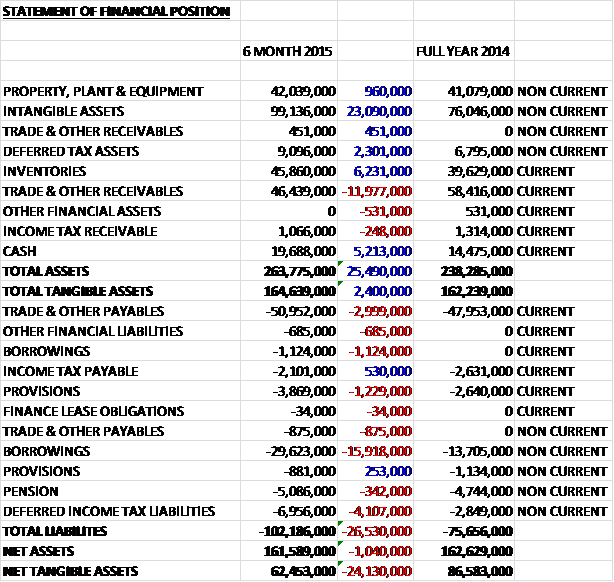
When compared to the end point of last year, total assets increased by £248K driven by a £281 hike in cash levels and a £74K increase in receivables, somewhat offset by a £66K decline in inventories and a £44K decrease in intangible assets. Liabilities fell during the period, almost entirely due to a £429K decline in payables, somewhat offset by a £145K increase in tax liabilities. The end result is a £600K increase in net tangible assets to a comfortable £6.4M.

tristelcash

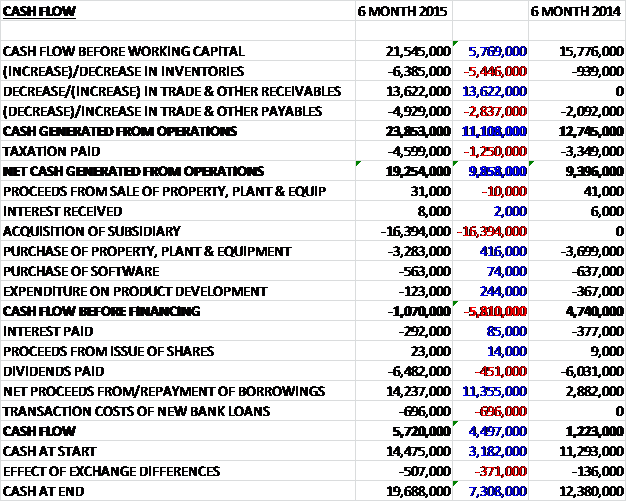
Before movements in working capital, cash profits were £306K higher at £1.5M before a large decrease in payables pushed the net cash from operations down to £1M, a decline of £600K when compared to the first half of last year. Just under half of this cash was spent on capital expenditure to give a free cash flow of £590K. This was enough to cover the dividends of £512K and after a receipt from share issues the cash flow for the half year was £291K, a decline of £675K when compared to the first half of 2014. This is a comfortable cash flow but I am left a little disappointed that the payment of those payables pushed this below that of last time.
Gross profits for the Human Health division increased by £537K to £4.5M; gross profit for the Animal Health business grew by £38K to £244K; and gross profits for the Contamination control division increased by £46K to £343K. The group is investing in a new enterprise resource planning information system which will cost about £160K and investment is also being made in the business development teams in the UK and overseas direct operations in order to establish a foundation for the next phase in the company’s growth. The growth came from both the UK and overseas with the operations in Germany, China and Australia developing particularly well. Going forward the Chairman mentions the potential for expansion into North America which is undoubtedly a huge but difficult market.
The group also mentioned that the regulatory environment within Europe’s biocides industry is going through a period of significant change with the BPR looking to harmonise the European market for biocidal active substances and products containing them. The investment required by the group over the next three to five years to meet the new regulations will be substantial. The chairman seems to think that that this is an opportunity for the group to gain market share from some of their smaller competitors but I do not share his optimism. As part of this change, the group have to decide whether continuing involvement in non-chlorine dioxide products makes economic sense and a rationalisation of their portfolio may be the result. It is expected that the BPR process will take many years to complete and the group will report further regarding this at the preliminary results stage.
After an increase of 63% in the interim dividend, the shares are yielding 2.3% at the current share price. Overall this was a good set of results, as flagged up in the last update. Profits were up, the strong balance sheet improved further and the operational cash flow covered all expenditure, although the decline on the cash from operations compared to the same period of last year due to the increased payables is a bit of a disappointment. Demand for the group’s products increased across all sectors and the international expansion is certainly quite exciting. The issue as far as I see it is the new regulatory changes happening in the EU. This will require substantial investment and is likely to drag on for many years which very well may curtail growth. I am happy to continue holding but I am not regretting my recent sale and I may well reassess my position if the share price fails to hold up.

On the 21st May the group released a trading update covering the first 10 months of the year.  The group has performed ahead of budget in both sales and profit terms during the period with strong trading in the UK, Germany and Australia.  Russia has been difficult over the period and the board is reviewing future prospects in that country.  The pre-tax profit guidance has been increased to £2.5M, compared to £1.8M last year with the CEO commenting that the sales momentum built over the course of the past two years is being maintained and the boast base is being well controlled which will translate to a record profit being reported this year.  This is a very strong update and I have re-entered here after selling post the last update – I should have just kept hold of the shares but that is easy to say with hindsight!

On the 18th June the group announced that it was to pay a special dividend of 3p.  The chairman stated that returning cash to shareholders at this juncture will not be at the expense of investment in the business.  They have a more exciting pipleline of new product developments than he has seen at any time in the past and they are moving forward with regulatory approvals in new, game-changing markets.  Also during the past six months they have spent a lot of time assessing the challenges of the Biocidal products regulation and are now confident that the future costs associated with it will be met comfortably by ongoing cash flow.  In short, the business is making excellent progress in all of its markets.

This is a very bullish sounding update.  It was also stated that the final results won’t be announced until October, though which seems quite late.  After the jump in the share price today, I calculate that the yield for the year will now be about 5% which is very impressive given the growth potential here.  I am sorely tempted to add a few more of these.

On the 1st October the group announced the appointment of David Orr as a non-executive director.  He is currently group MD of Fencor packaging group, a supplier of packaging to Tristel and he has previously serves as Chairman of Pendragon Presentation Packaging.  Interesting….


Zytronic Share Blog – Final Results Year Ending 2014

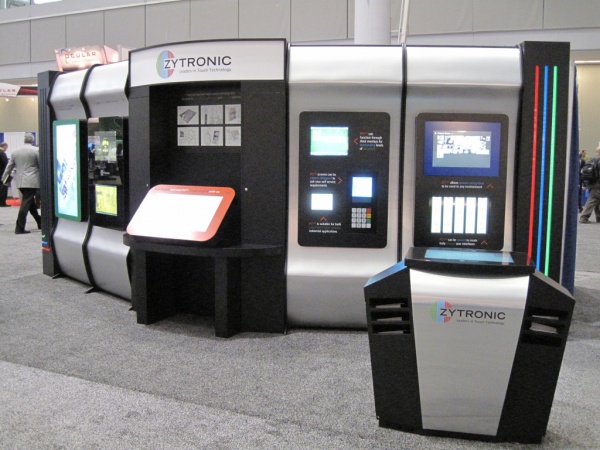
Zytronic is a manufacturer of touch sensor products for public access and industrial applications. The products incorporate an embedded array of metallic micro-sensing electrodes which offer durability, environmental stability and optical enhancement benefits to designers of system integrated interactive displays. It develops and manufactures customised optical filters to enhance electronic display performance and is traded on the London AIM exchange. It has now released its final results for the year ending 2014.

zytronicincome

Overall revenues increased by £1.6M when compared to 2013 as increases in most territories, with particularly good growth seen in Americas, was counteracted by a fall in UK sales. Cost of sales were broadly flat but the group benefited this year from the lack of £413K of royal write-offs that happened in 2013 due to a reduction in forecast sales meaning that a prepayment held on account would not be recoverable. The gross profit, therefore, increased by £2M to £6.9M. Admin expenses increased with an unfavourable movement in foreign currency exchanges, the lack of capital grant amortisation and other costs taking their toll so that operating profit was £1.3M higher than last year. Interest broadly cancelled itself out and taxes increases slightly, with the rise in taxable profits being offset by enhanced tax reliefs so that the profit for the year was £1.3M higher at £3M.

zytronicassets

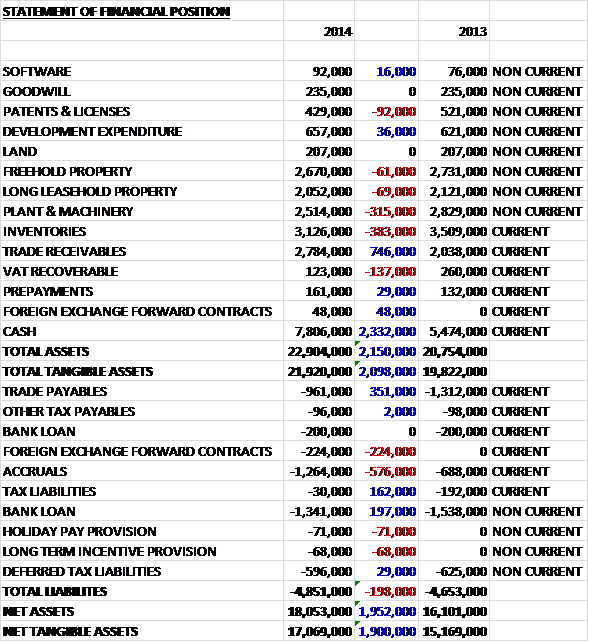
When compared to the end point of last year, total assets increased by £2.2M to £22.9M, driven by a £2.3M increase in cash and a £746K growth in trade receivables, somewhat offset by a £383K decline in inventories and a £315K fall in the value of plant and machinery. Liabilities also increased slightly as a £576K increase in accruals and a new £224K worth of foreign exchange forward contracts were counteracted by a £351K fall in trade receivables and a £197K reduction in the mortgage outstanding. The end result is a £1.9M increase in net tangible assets to £17.1M. I have included patents and licenses in this calculation despite them being intangible as it seems to me that they have some value. In any case, this balance sheet looks strong and is improving year on year whilst the group also has negligible operating leases off the balance sheet.

zytoniccash

Before movements in working capital, the cash profit increased by £1.6M to £4.6M with an increase in receivables being broadly counteracted by other working capital movements giving a £4.7M cash inflow from operations, an £800K increase when compared to last year which then widened to £917K due to a fall in the tax paid. The only capital expenditure of note was a £322K paid for intangible assets (probably development expenditure) and £263K paid for property plant and equipment relating to two additional large format plotters which should treble manufacturing capacity. This gave a free cash flow of £3.7M, an increase of £1M on 2013. The bulk of this cash went on dividends with a further £200K relating to the regular mortgage payments to leave the group with a positive cash flow of £2.3M, an improvement of £1.1M when compared to 2013 and an impressive result.
Overall the significant improvement in trading over the last year continued the trend of second half performance being better than in the first half of the year. Touch product revenues increased by 18% and remain by far the most important part of the business with 79% of total sales. Non-touch product revenues showed an expected decline, falling by £700K driven by a decline in ATM display filter glass. The group is heavily export focused with 94% of total sales being export derived.
Financial applications continued to be the largest market with sales increasing by £200K to £5.7M and included applications such as ATMs, bill payment kiosks and financial point of information kiosks. This market is the strongest touch market area due to the durability and reliability of the group’s products designed for high volume unattended use and locations. The volume increase was driven by a 15,000 unit increase of ATM sensors sold to 46,000 as some new customer projects moved into production and existing customer demand increased after last year’s redesigns. The downside of this was the fact that the redesigns and the different customer mix meant that the average selling price of the units fell by 24%. Non-ATM kiosks have historically been a buoyant market in CIS countries but the ongoing conflict in Ukraine meant sales collapsed by 10,500 units to just 3,300 units.
Vending machines are the second largest application with sales growing 20% to £3M and volume growing 26% to 32,100 units. The volume of sensors sold to Coca Cola for the Freestyle drinks dispenser was in line with expectations and similar to last year at 4,700 units. Unit sales into the fuel vend application area were also similar to last year with a slightly different customer mix whilst growth came mainly from sales into the service vend application area in Eastern Europe.
Other significant growth came through the industrial, gaming and signage markets with sales into the industrial market for human machine interface control devices and general application kiosks growing by 54% to £2M and 61% to 26,000 units. The gaming and signage markets benefited from the manufacture of large sized sensors coupled with the mutual projected capacitive technology multi-touch solution which continues to gain greater market acceptance. Gaming revenues increased by £1.1M to £1.9M with all of the sales attributable to casino upright cabinet slot machine designs. Sensors smaller than 15 inches showed overall unit growth but the Bosch branded cooktop unit and the in-vehicle agricultural telematics system both reduced due to customer forecasted levels.
The group has quite a lot of concentrated risk on three major customers who account for 22%, 11% and 10% of total sales each. The group seems to hedge much of its exchange rate risk but a 5% movement in Sterling against both the Euro and the USD would affect profits by about £13K. Equally there is not much in the way of interest rate risk, with a 100% increase in rates reducing profit by £18K. Operationally the main risks are that someone else releases new, better touch sensor technologies but the group is also susceptible to client’s project timing and the cost of raw materials, particularly energy and oil which have both been declining in recent months.
The group’s borrowings consist of a 10 year mortgage with Barclays. The funds are repayable in quarterly instalments of £50K with interest payable at 2.35% above LIBOR and will be either refinanced or paid off by 2017. Next year it is expected that a project to refurbish the clean room will cost £400K in capital expenditure. The R&D division has released a new ZXY300 series controller which provides customers with multi-touch performance characteristics at similar levels to the 22 to 50 inch range using the ZXY200 series controller. Progress was also made on the commercialisation of the large format curved touch solutions which were showcased in a trade show in Las Vegas.
Geographic expansion is one target for the near term future. The group have established Zytronic Inc in Atlanta in order to focus on OEM and channel partner sales support in the US. They have also signed up for a new initiative in mainland China organised by the former UKTI and referred to as FastTrack China in order to aid engagement in this market. Along these lines, it is also intended to strengthen presence in the APAC region by establishing a sales office in Taiwan.

zytronic
One interesting new application has been developed with Eurocomposant which is a sensor for a series of multi-touch table products for use in home, restaurant and hospitality settings where users can play games, order food, surf the web and connect with friends via social media. The sensors are supplied to HUMElab in 22, 32 and 42 inch formats. Another interesting application is a mirrored point of sale system in opticians Kite GB. The unit uses a PCT touch sensor with a 42inch active area sourced from Zytronic which has been applied to mirror-finished toughened glass and is capable of supporting up to 40 point multi-touch operations. Customers are able to take photos of themselves wearing different frames, post them to social medial sights and enable their friends to comment on the chosen frames.
Two months into the new year, both sales and the order book are ahead of last year which should be a decent platform for further growth. At the end of the year the group has 69 active projects. Digital signage remains the strongest application area in terms of project volume. Strengthening is also observed in the financial, gaming and industrial sectors where the number of active projects at the period end is almost double compared to the period start date.
At the current share price the P/E ratio stands at a rather average 15.5, falling to 14.6 on next year’s consensus forecast. After a 10% increase in dividends this year, the shares yield 3.3% at the current share price, covered nearly 2 times by profits. The yield is forecast to increase to 3.6% on next year’s predicted dividend. The net cash position at the end of the year increased by £2.3M to £7.8M.
Overall this was a strong update. Profits were up, the strong balance sheet improved further and the group continues to throw off cash. There is not much in the way of debt and group is in a net cash position. So far this year, it sounds as though trading is going well and this is certainly a market where there seems to be increasing demand. The ongoing issues in the Ukraine seem to have some effect on the group and the declines in the Bosch project could be potential cause for concern but I believe with the fairly attractive yield these shares may be worth a purchase.

zytronicchart

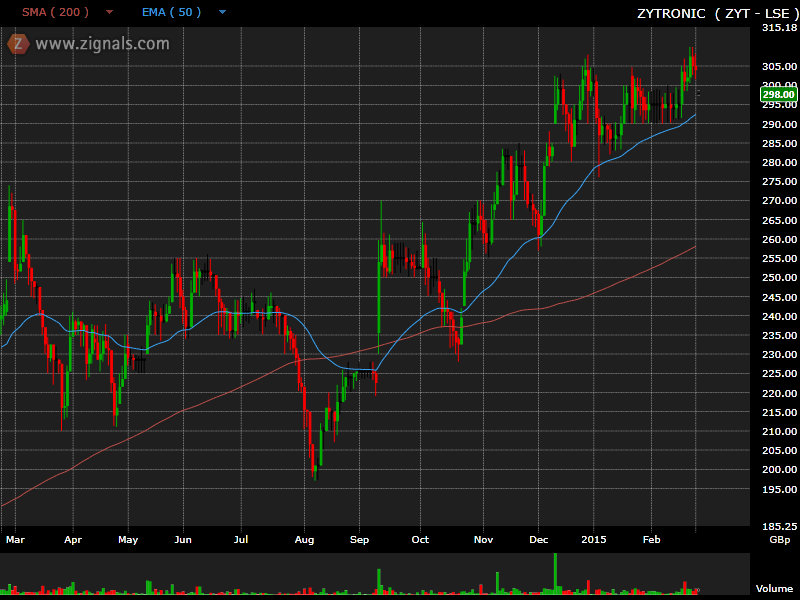
The chart looks pretty good, there seems to have been a decent up trend since the low of August last year so I might look to enter on a retrace.

On the 26th February the group released a trading update covering the first four months of the year which was ahead of the same period last year in line with expectations.  Short but sweet – sounds decent enough to me, I have made a purchase.


Dechra Pharmaceuticals Share Blog – Interim Results Year Ending 2015

Dechra Pharmaceuticals has now released its interim results for the year ending 2015.

dechraincome

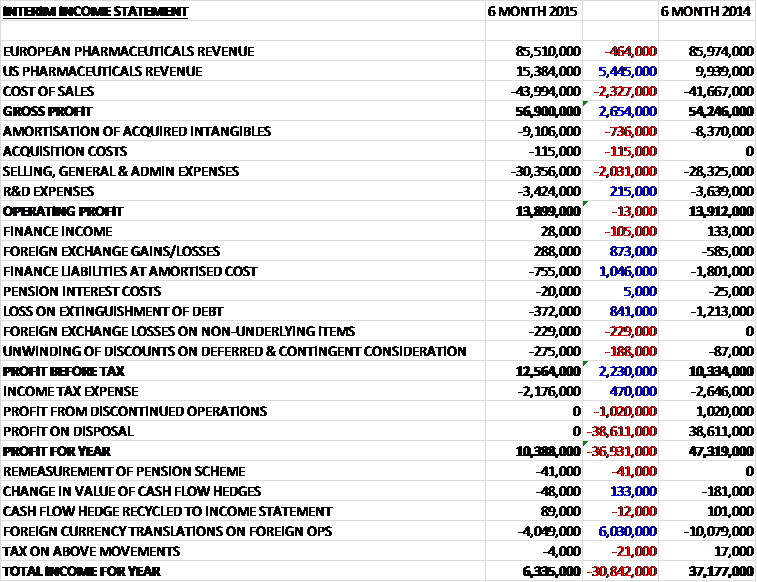
When compared to last year, revenues increased against a soft comparator during the first half of last year due to the £5.4M growth in sales from US pharmaceuticals, somewhat offset by a small decline in European sales due to the weakening Euro. An increase in Sales for Companion Animals, Equine products and third party man was partially offset by falling revenues in Food Producing animals and Diets. Cost of sales also increased so that gross profit was some £2.7M higher than in the first half of 2014. There was a slightly higher amortisation of acquired intangibles and selling & admin costs increased by £2M year on year as the group supported the launch of Osphos and established the infrastructure for the new subsidiaries to give an operating profit that was flat on last time at £13.9M.

As far as finance costs are concerned, there was an advantageous swing in foreign exchange losses/gains and we saw finance liabilities at amortised cost decline by more than £1M (whatever they are) and an £841K improvement in the loss with the extinguishment of debt which pushed profits before tax up to the tune of £2.2M. A lower tax expense, due to lower corporation taxes in Denmark and the UK along with savings from government backed incentive schemes, was dwarfed by the lack of the profits at the discontinued operation so that profit for the year fell by £36.9M to £10.4M. Underlying operating profits, where the biggest reductions are those intangible amortisations (that occur seemingly every year) were £22.7M this half year, an increase of £2.7M.

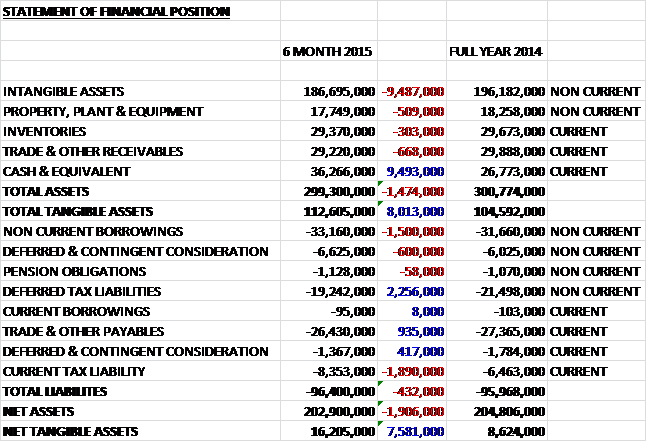
dechraassets

When compared to the end point of last year, total assets at the six month mark this year were down by £1.5M to £299.3M. This was driven by a £9.5M decline in intangible assets, along with smaller falls in most of the other asset classes, somewhat offset by a £9.5M increase in cash. Total liabilities also increased due to a £1.5M increase in borrowings, somewhat offset by a net £366K fall in tax liabilities and a £935K decline in trade & other payables. The overall result is a £1.9M decline in net assets but when the intangibles are stripped out, net tangible assets actually increased by £7.6M to £16.2M which actually makes the balance sheet look rather better than before.

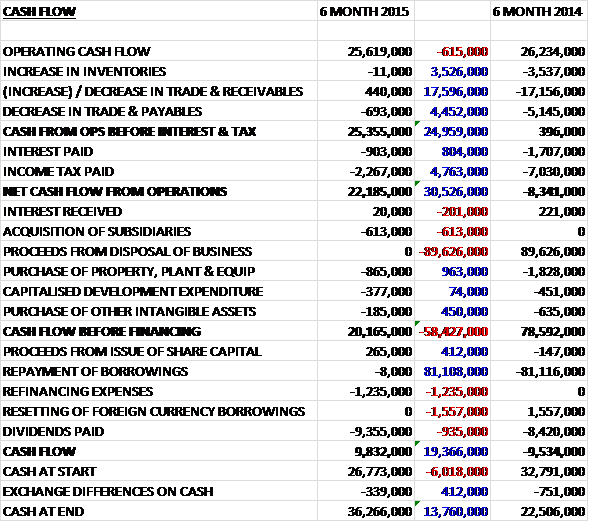
dechracash

Before movements in working capital, cash profits during the first half of the year fell by £615K to £25.6M. Strong working capital control meant that operational cash flow was similar, at £25.4M and far better than last time due to the large increase in receivables that happened previously, presumably related to the disposal. Interest fell considerably compared to the first half of last year as the group paid off debt, and tax was also lower so that the net cash generated from operations was some £30.5M better than in H1 2014 and stood at £22.2M. A small amount of this cash was paid to acquire a business and less than £1.5M was spent on capital expenditure to give a staggering free cash flow of £20.2M. The only other expenses were the £1.2M of refinancing costs and £9.8M spent on dividends. The resulting cash flow for the half year was £9.8M to leave a cash pile at the end of the period of £36.3M.
Operating profit for European Pharmaceuticals fell by £1.1M to £24.1M although this was entirely due to adverse movements in exchange rates as the positive momentum that started during the second half of last year continued into this period with a revenue growth of 5.7% at constant currency rates. The increase was driven by the Companion Animal portfolio with sales ahead of expectations and a strong performance across all home markets. Equine products also performed well, benefiting from the launch of Osphos in the UK. Sales of diets fell slightly during the period as the external supplier was changed which affected supply somewhat. The transfer is now nearly complete with the new supplier providing improved palatability, quality and packaging leading to a re-launch for the brand. The Food Producing animal portfolio had a more difficult six months as the continued pressure on vets to reduce antibiotic prescribing affected sales. The problem was particularly acute in the Netherlands and Germany where the group has a large market share but management don’t see such large issues in their other, smaller, markets.
Operating profits for US Pharmaceuticals increased by £2.1M to £5.4M which represented a 61% increase at constant currency rates. The key therapeutic sectors of dermatology and endocrinology have both delivered organic growth close to 30% as the group gains market share and improves awareness of their products. Osphos was launched in Q1 and two ophthalmic products have been re-launched following the resolution of the long standing supply problems. Sales of the acquired Phycox have performed well during the period and the group also launched a new endocrine product, Levocrine Chewable tablets which were developed at the Phycox facility. Based on the strength of the recent growth and new product launches, the group is accelerating their investment in the sales and marketing infrastructure in the country.
The group is looking to expand geographically with the newly opened Italian facility trading in line with expectations and the Canadian subsidiary being successfully opened in January with further territories, including Poland being planned.
Initial feedback from the UK and US Osphos launch has been positive. In Q2 of this year, the group obtained approval in all European territories for TAF Spray, an antibiotic aerosol for a wide range of species including cattle. This antibiotic is used to treat superficial wound infections and contains an antibiotic that is not used in human health for the most part, which might make it attractive in markets where these antibiotics are tightly controlled. Progress has been made on the next global novel product which will be branded Zycortal with the group already completing the safety and efficacy sections of the final part of the dossier which has been submitted to the FDA for US approval. The dossier has also been submitted in Europe and it is hoped that the product will be available for launch in the next financial year in at least one major territory. There has also been an increase in the number of current projects in pre-clinical development which enhances the pipeline in future with several other opportunities in the exploratory phase also being reviewed.
During the period the group acquired PSPC Inc for a total consideration of £8.4M which consists of just over £5M in cash, £891K of contingent consideration that has already been paid due to the successful registration of Levocrine, and £2.5M still to be paid depending on future sales. The acquisition generated goodwill of just £84K but the vast bulk of assets were intangibles, relating to product rights, at £7.5M. The principle product of the acquired group is Phycox, a neutraceutical which competes in the US veterinary joint health supplement market. The group is still paying for the Dermapet acquisition with a further £600K of deferred consideration which was paid on the fourth anniversary of the deal. The maximum consideration still payable is $5M contingent on revenue exceeding $20M in any rolling 12 month period for a further two years. The PSPC acquisitions seems like it could be good value but despite the useful foothold in the US, it seems to me that the group did overpay somewhat for Dermapet and it is still a bit of a drag having the contingent consideration hanging over potential earnings.
The group has a similar list of potential risks as previously. The competitive environment remains with the launch of generic products in their key markets being a considerable risk. The generics of Felimazole and Comfortan have now been launched and the defence strategy against the Felimazole generic seems to be fairly successful so far with the group maintaining market position in most of its markets. As has been seen during this period, much of the group’s sales occur overseas which leads to exchange rate risk. The Euro continues to weaken against Sterling which could be a continuing problem for Dechra. The antibiotic prescription issue in farm animals continues to be a problem in Germany and the Netherlands but management doesn’t consider any other markets to be at significant risk.
Going forward, despite the continued focus on reducing antibiotic prescribing in Europe and ongoing global financial uncertainty, the group is meeting constant currency earnings expectations. The core portfolio is demonstrating growth, the product pipeline is delivering results and global expansion is progressing which gives management confidence that the group will “continue to deliver value to shareholders”. That sounds a bit noncommittal to me but most of the points made should give the group some basis for growth.
Following the 7.8% in the interim dividend of 5.12p the shares now yield 1.7% at the current share price. At the half year point the net cash position was £3M which is a very favourable position compared to the £5M of net debt at the end of last year. Overall then this has been a solid update. As previously highlighted, the supply issues in the US seem to have been resolved but the control on antibiotics in European farm animals continues to be a problem. Likewise, the weak Euro is a drag on earnings with underlying profits faring slightly better than the comparator period last year. As the intangibles continue to be amortised, the balance sheet is losing some of the huge number of intangibles and actually seems a bit healthier to me despite the decline in overall net assets. The cash generation has been fantastic during the period with a positive net cash balance and a tight control on working capital meaning there is a huge amount of free cash flow available. The group has not used the cash to pay down debt which makes me wonder whether they are going to use it for another acquisition. Overall, a decent if not spectacular performance which gives me some confidence to continue holding.

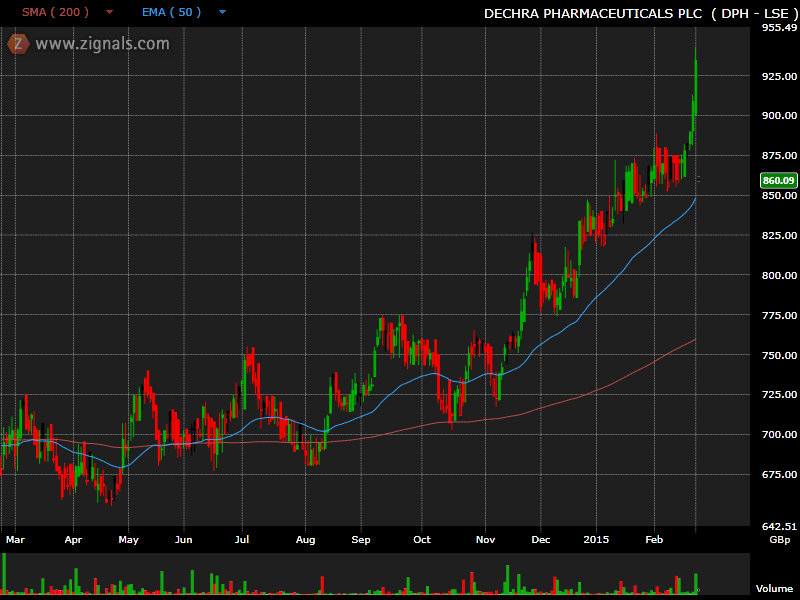
dechrachart

The chart has been rather bullish since the summer of last year and the shares have perhaps become a bit overbought after today’s results – we shall see what happens in the short term but the long term trend is very much up.

On the 28th April, the group released a management statement covering Q3 2015.  Overall, trading continues to be in line with expectations.  Strong third quarter sales have been flattered by the phasing of pre-Easter ordering in Europe and competitor stock shortages in the US.  Revenues in the quarter increased by 6% compared to a year to date increase of 6.6% (although this quarter showed a 14% increase at constant exchange rates).  Revenues in Europe fell by 3.3% in the quarter but this was entirely down to the weakening Euro as constant currency revenues increased by more than 7%.  Companion animal products grew by 13.5% (at constant rates), Equine products were up 30% but food producing animal products fell by 13%.  The diets franchise is showing signs of recovery as the back order issues are resolved following the transfer of manufacture to a new supplier.

The Canadian subsidiary started trading in January and North American revenue as a whole grew by 67% in the quarter with US revenues up 58%.  This impressive growth is partly attributable to the recent acquisition of Phycox, the launch of Osphos and the re-launch of two Ophthalmic products following the resolution of long term supply issues.  This quarter has also seen strong trading in the dermatology product range due to a competitor running out of stock.  The new Polish entity has been established and a sales and marketing team have now been recruited with the office to start trading next year.  FDA approval has been received for the injection facility in Skipton, which is important for the US launch of Zycortal as it will be manufactured there and in March the group made a $1M investment in Jaguar Animal Health to potentially gain access to the EU marketing rights for their companion animal products.

Things seem to be ticking along nicely, currency headwinds not withstanding and I feel comfortable with this investment.

On the 8th July the group released a trading update covering the full year.  Group revenue increased by 5% year on year and at 10% on a constant currency basis and trading results were in line with management expectations.  Revenue in European Pharmaceuticals increased by 4% on a constant currency basis driven by a buoyant UK market but the continued weakening of the Euro has meant that at actual exchange rates revenue in the division fell by 2%.  There was a continued strong performance across the portfolio in companion animal products partly offset by a decline in food producing animal products with the German and Danish businesses continuing to be impacted by the increasing focus on the use of antibiotics.  After the completion of the transfer to a new third-party manufacturer, the pet diet sales recovered from the stock-out issues reported in Q3 and sales ended broadly in line with last year.  The new subsidiary in Poland started trading in May, ahead of schedule.

In North American pharmaceuticals, revenue grew by 60% at a constant currency basis (a bit more on actual exchange rates).  The performance was enhanced by the full year trading of Phycox, the relaunch of Ophthalmics, the launch of Osphos and Levocrine and the start of the Canadian subsidiary.  Adjusting for these items, the sales of core products grew by 16% which is still an impressive performance.  During the year Osphos for equine lameness was launched in the US and UK in Q1 with approval in the EU following in Q4; TAF Spray, a generic antibiotic aerosol, received approval in Q2 across Europe; and FDA approval was achieved for the injection facility in Skipton in Q3 to manufacture Zycortal, a new canine endocrine product.

So, there seems to be steady growth here, although the continued weakening of the Euro and the ongoing reduction in antibiotic use in food producing animals are both having an impact on results.

On the 3rd August the group announced that it had signed a conditional share purchase agreement with the owner to acquire his 63.3% holding in Genera, a Croatian listed pharmaceutical business.  Dechra is offering the equivalent of £19.4M for the shares which relates to €51.4M for the total share capital which will be funded through the existing debt facilities.  Under Croatian takeover rules, the offer required Dechra to make a mandatory offer for the remaining share capital of Genera.

Genera is the largest manufacturer of animal health products in Croatia.  It operates three main divisions:  Animal Health, which represents the majority of revenue; Agrochemicals and Human Pharmaceuticals.  Over the past few years, vaccines have become a key part of the animal health division with particular investment going into its poultry vaccine capabilities including regulatory submissions into the EU.  Last year, Genera made a profit before tax of just €400K on revenues of €28.4M and net assets totalled €19.7M.

The transaction is expected to be earnings neutral for the first two years of ownership and enhancing thereafter.  The rationale I think must be that Dechra want to move into vaccines since animal antibiotics seem to be a declining field in Europe which I think makes strategic sense.  I am not sure what they are going to do with the human pharmaceuticals though. In all, it seems a decent fit but the valuation looks a bit rich to me.

St. Ives Share Blog – Final Results Year Ending 2014

St. Ives is a marketing and print business. The marketing services segments includes data marketing, digital marketing, consultancy services and field marketing whilst the print segment includes marketing print, comprising of exhibitions, events and point of sale specialists and print management business and books. The group does not act as a single entity but as a group of different businesses, each with its own unique proposition and brands. It has now released its final results for the year ending 2014.

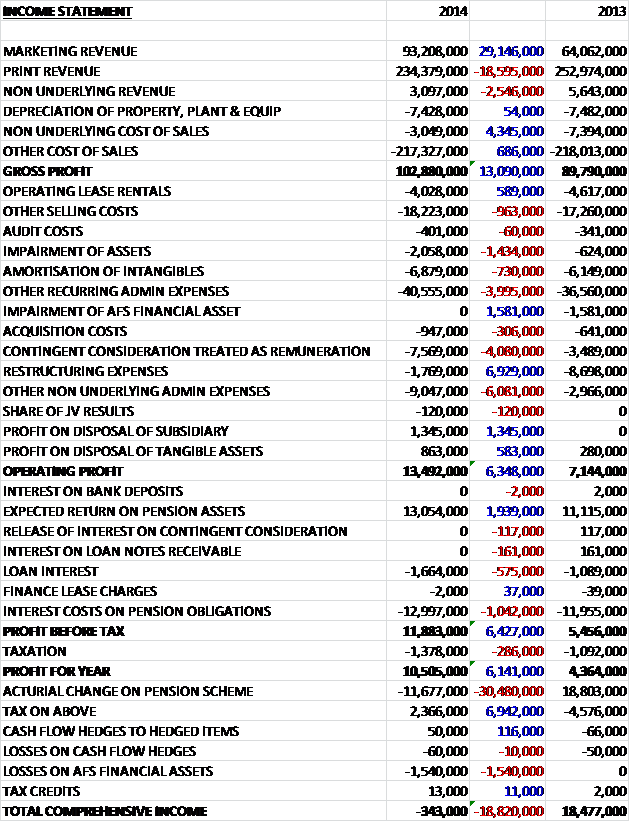
stivesincome

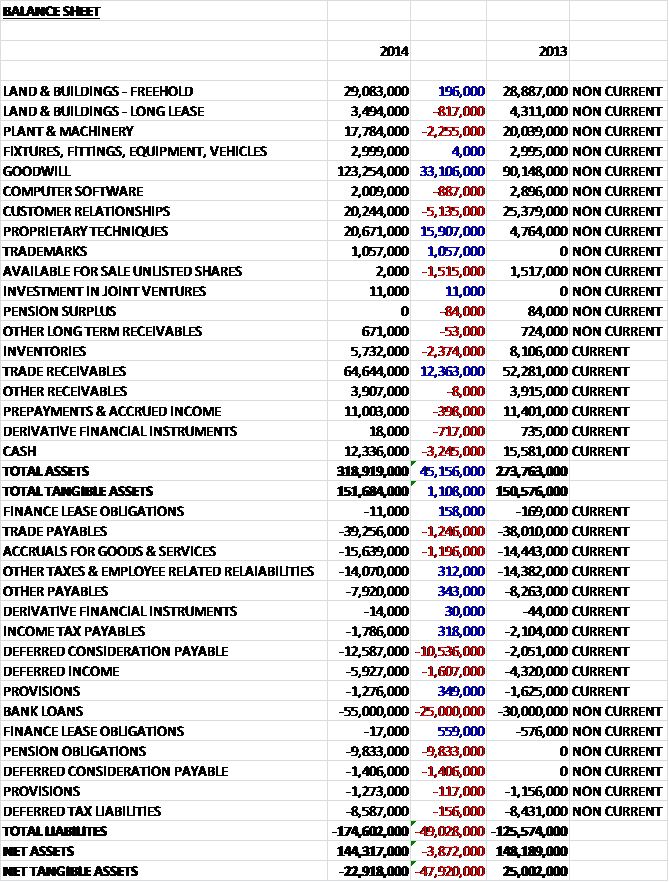
When compared to 2013 revenues were up as a £29.1M increase in marketing revenue, due to acquisitions and organic growth, was partially offset by an £18.6M fall in print revenue due to the disposal. Cost of sales fell during the year so that gross profits increased by £13.1M to £102.9M. There were then several one-off impairments and a big increase in other non-recurring admin expenses, somewhat offset by the lack of the impairment on available for sale financial assets, relating to non-controlling interests in Easypress, Wiforia and Ebeltoft. There was a £4.1M increase in contingent consideration treated as remuneration and a large decrease in restructuring costs, counteracted by a £6.1M increase in other admin expenses due to the continued investment in the marketing businesses. Finally the group also made nearly £2M more than last year on disposals so that operating profit was £6.3M higher than last year at £13.5M. The pension interests broadly cancelled each other out which left loan interest as the main finance cost, which increased by £575K during the year. Tax charges were slightly higher which made the profit for the year £10.5M, a £6.1M growth when compared to the profit in 2013 with underlying profits before tax increasing by £4.2M to £29.4M.

stivesassets

When compared to the end point of last year, total assets increased by £1.1M, driven by a £33.1M hike in the value of goodwill, a £15.9M growth in the value of “proprietary techniques” due to this year’s acquisitions, and a £12.4M increase in trade payables, somewhat offset by a £5.1M fall in customer relationships, a £3.2M decline in cash, a £2.4M fall in inventories and a £2.3M decline in plant and machinery. Liabilities also increased during the year due to a £25M growth in loans, a £10.5M increase in deferred consideration payable and a £9.8M growth in pension obligations. The end result is a massive £47.9M decline in net tangible assets to a negative £22.9M as the group’s “strength” in the balance sheet relates to intangibles – it does not look that strong to me, particularly when it is considered that there are also over £18M of operating lease obligations off the balance sheet. I read somewhere once that when a company makes a point of stating how strong its balance sheet is, it generally is rather weak and they are trying to make it sound stronger than it is. This certainly seems the case here as new CEO Matt Armitage makes a point of mentioning the “strength” of the balance sheet in his note to shareholders.

stivescash

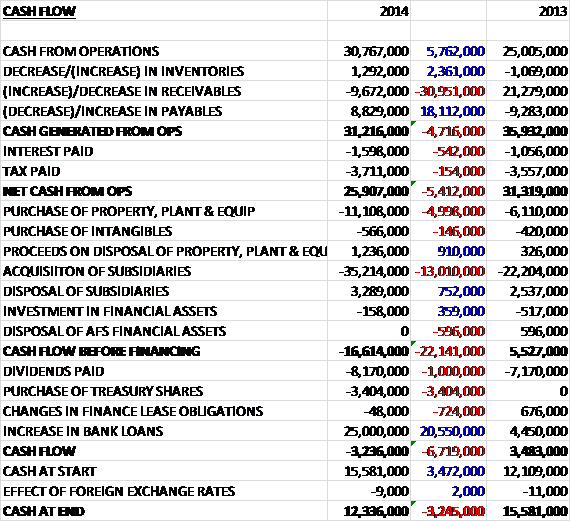
Before movements in working capital, cash profits were £30.8M, a £5.8M increase when compared to last year. Changes in working capital broadly cancelled each other out so that cash generated from operations was £31.2M, and after increases in interest and tax paid, the net cash from operations was some £5.4M higher at £25.9M. The group spent about £11.7M on capital expenditure which included new digital print equipment for Clays, SP Group and Service Graphics, and the purchase of the office occupied by Response One but the resulting free cash flow did not cover the net £32M spent on acquisitions so before financing, the cash outflow was £16.6M. The group then increased bank loans by £25M to cover this expense, plus the £8.2M of dividends paid and £3.4M spent on treasury shares. The resultant cash outflow was £3.2M to give a cash level of £12.3M by the year end. If we take out the acquisition, there is a decent amount of cash generated here but the group needed to increase borrowings to buy the businesses.
Underlying profits in Marketing Services were £4.1M higher than last year at £11.6M. Data Marketing revenues increased by £6.8M to £35.5M and represent the most important marketing division. Occam developed and launched an enterprise level data solution which was subsequently sold to new clients in the leisure, media and automotive sectors and the group sees these product led solutions as a key area of future growth. The growth within Response One was driven by a combination of new customer wins and existing client growth. They provided new data services for clients including Sainsbury, the Conservative Party, Royal Mail and HSBC. In addition, the two businesses collaborated on a successful joint pitch to Guide Dogs.
The Digital Marketing sector had a good year, increasing revenues by £20.4M to £28.1M as the group acquired Realise which slots into this segment. Amaze saw strong growth in demand for its e-commerce services with continued work on a global e-commerce solution for ASICS and new business wins including Waocol Eveden. The group is investing in this part of the business as it sees it as an area for future growth. Branded3 continued to perform well, completing a large project for Virgin Holidays and a European campaign for Norton and Symantec. The business also won a contract with car dealer Inchcape to deliver nine manufacturer websites focusing on the UK with the potential for wider global implementation. The three businesses in this segment, Amaze, Branded3 and Realise combined would rank as a top 10 digital business in the UK. The newly acquired Realise had previously built a digital marketing campaign around Standard Life’s Ryder Cup sponsorship, a full marketing strategy for Spurs football club and the delivery of brand refresh across Lloyds bank’s websites. They also won business from clients such as Universal Films, the BBC, Scot Rail and OVO Energy.
Consultancy Services revenue increased by £6.1M to £22.9M which included the acquisition of Health Hive. Incite recorded strong growth during the year due in part to the expansion into New York and Singapore which means that about 15% of the business’ overall revenue is generated overseas. They are planning on adding an office in Shanghai shortly that is due to start trading by the end of Q1. Pragma also saw strong demand for its services and during the year delivered successful engagements to support a number of retail businesses including Maplin and Bench as well as further developing its airports and commercial spaces offering. Field Marketing sales fell by £1.1M to £11.6M as the business suffered a difficult year with growing competitive pressure within the grocery retail market. It is investing in new data and technology capabilities to enhance the offering and a new management team is expected to add new impetus to the business.
Underlying profits in Print Services were flat when compared to last year at £19.3M. Marketing Print saw an £18.3M fall in revenues to £162.1M as increases in exhibitions, events and point of sale were offset by a £30.2M fall in print management sales due to the sale of a business in this segment. Discounting this effect, revenues at Marketing Print increased by 3% on a like for like basis with strong growth occurring in the second half of the year. SP group continued to provide POS services for retail clients such as Sainsbury, M&S and Holland & Barrett, adding New Look it its client list during the year. Service Graphics won exhibitions and events work from customers including the Rugby Football Union, Network Rail, Strada Restraurants, Wilko, Cotswold outdoor and Bentley, as well as delivering a significant amount of work for the Glasgow Commonwealth Games. The SIMS team continued to provide print management solutions to clients including Royal Mail, HSBC, the Conservative Party and Digital Mobile Spectrum’s consumer brand at800.
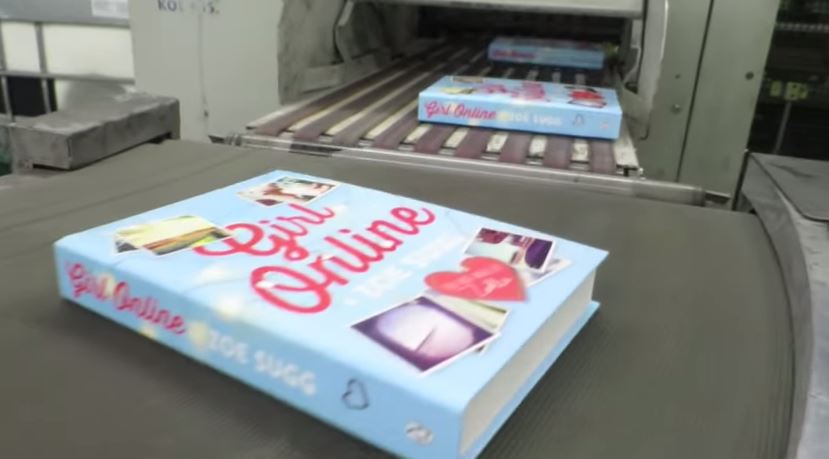
Books revenue fell by £3.4M to £67.4M, although market share was maintained. Clays is the market leader in UK monochrome book production services and continues to extend its range of value added services to the publishing market through digital and supply chain related investment. It has increased market share in the academic market by producing large format books, paperback, cased and short-run cased books as well as the distribution and print model it has built through print partnerships. It now works with a number of academic publishers including Pearson, Oxford University Press and Cambridge University Press. The business has also extended its services into the fast growing self-publishing sector.
On the 2nd March the group acquired Realise Holdings, a digital marketing business, for a total consideration of £29.9M which generated goodwill of £19.7M. Had the company been part of the group from the start of the year, it would have generated operating profits of £2M. On the 1st May the group acquired the Health Hive group for a total consideration of £26M which generated goodwill of £13.4M. It provides consulting and communications services to the healthcare and pharmaceuticals industries and more than half of the top 15 world pharmaceutical companies are clients. If the business had been acquired at the end of the year it would have contributed £2.7M of operating profit. The group also disposed of St Ives Bradford, a print management business. £3M of cash was received with another £775K of deferred consideration. Net assets of £2.2M were lost in the disposal so with £221K of selling costs, the group made a £1.3M profit on it. The strategy going forwards seems to include further acquisitions which operate in growth areas of the marketing proposition.
The Hive business seems quite interesting and has three main segments. Hive is a strategic consultancy and communications business which seeks to understand how patient’s relationships with their conditions affects the way they engage with doctors and the medicines prescribed to them which enables brand messaging to be aligned to their needs, resulting in more effective communication. Ebee creates bespoke strategies for effective communication on behalf of healthcare brands. It analyses user behaviour, accurately profiling how people interact with the entire digital landscape and has a database of user surveys that contains profiles for more than 1,200 doctors. Pollen is the newest division and uses specialised storytelling techniques to create narratives for clients to deliver scientific messages to targeted audience.

book
As can be seen above, there were quite a large number of non-recurring items. Restructuring items included £1.1M costs relating to restructuring activities in the head office, books, point of sale and events businesses. Redundancy and restructuring costs of £446K were recorded in the consultancy services and digital services businesses. An impairment charge of £824K and £738K of empty property costs were recorded in respect of properties held by head office. Profit on disposal of fixed assets included a £297K gain on the disposal of plant and machinery in the point of sale and print management businesses and a gain of £543K in respect of the sale of the building at the Edenbridge site. Finally, revenues of £3.1M and operating losses of £441K arose in respect of the Bradford site. Apparently the restructuring of the print division is now complete so hopefully that will signal a reduction in these exceptional items going forward.
Other non-underlying items included the amortisation of acquired intangibles relating to proprietary techniques and trademarks acquired with Realise and Hive as well as customer relationships, proprietary techniques and in house developed software acquired with data marketing, consultancy and field marketing businesses. An impairment charge of £1.2M relates to customer relationship assets where there has been a higher level of customer churn in the data marketing and field marketing businesses than expected at the date of acquisition. Costs associated with the acquisition of subsidiaries include £947K in respect of Realise and Hive. Contingent consideration payable to former owners of the acquisitions, who continue to be employed by the group, of £7.6M is required to be treated as remuneration.
During the year the group negotiated an increase to the revolving loan facility from £70M to £90M at a rate of LIBOR plus 2% to 2.5% depending on the ratio of the group’s net debt to EBITDA. The outstanding loans within this facility were £55M meaning that there was £35M left undrawn. There will have to be more negotiations shortly, however, as the facility expires at the end of October 2015. At the last pension valuation, there was a funding deficit of £36.7M and the group agreed to pay £167K per month until August 2019 in order to eliminate the shortfall. This means they are expected to pay contributions of £2.4M over the next year which is not an inconsiderable amount. The group is somewhat susceptible to exchange rate changes with a 100% LIBOR hike reducing profits by £308K. There is limited exchange rate risk but the group does supply some customers in Euros, USD, Yen and Singapore dollars.
Other risks include the unsuccessful integration of an acquisition, although the group has certainly has quite a bit of practice in this regard. The market decline in books due to the emergence of ebooks with the resulting reduced print run lengths is going to affect the printing sector and the book printing sector in particular and any deterioration in the UK economy could lead to lower marketing spend by the group’s clients which would clearly have an adverse effect on earnings. One customer accounts for £35M of group revenues, equivalent to about 11% of total sales so whilst the group is not totally dependent on this client, they would certainly feel its loss.
During the year CEO Patrick Martell informed the board of his intention to stand down. He was immediately succeeded by Matt Armitage, who was previously CFO and MD having been with the group since 2007. Matt is being succeeded as CFO by Brad Gray who joined the group in 1988 from Grant Thornton and was previously deputy finance director. Patrick has been with the group for 35 years and served as CEO since 2009 but the disruption should be minimised by the quick appointments of other old hands.
Going forward, with the more favourable economic climate and no immediate prospect of a slowdown, businesses are increasing their marketing spend which should improve revenues and profits for the group in the coming year. The strategy is to increase the underlying profit from the higher margin marketing segment by growing organically, including internationally with offices already in the US and Singapore, soon to be joined by a planned office in Shanghai, and selected acquisitions. So far this year trading has been in line with expectations with the marketing services segment benefiting from the UK economic recovery, from increasing marketing spend by their UK and international clients and from their own organic growth initiatives. Nothing is mentioned about the print segment but overall the board are confident that the group will make further progress this year.
At the current price the shares trade on an undemanding underlying P/E of 10.5, although including all the “one-off” costs the P/E stood at 22.5. On next year’s consensus forecast the P/E ratio look even cheaper at 9.9. After a 10% hike in the dividend pay-out, the shares yield 3.8%, increasing to 4.1% on the 2015 forecast. Net debt at the year-end stood at £42.7M, a large increase on the £15.2M level recorded this time last year.
Overall then, this has been quite a good year for the group. Underlying profits were up and the group is certainly generating decent cash levels at the operating level, although this is not enough to cover the cost of the acquisitions so the group has to rely on increased borrowings that need to be renegotiated this year. Operationally most of the divisions seem to be doing well but the field marketing business is struggling from the competition in the grocery sector and the books business could be in a state of terminal decline. The balance sheet does look rather weak when the large amount of intangibles are discounted, which makes me a little uneasy and that pension deficit is likely to cause a bit of a drag on results for years to come. It is pleasing that the restructuring seems to have been completed but I fully expect to see more “one-off” costs relating to further acquisitions and further impairments. When the economy is doing well and companies are spending a lot on marketing, I suspect St. Ives will thrive but in times of economic strife I would have thought the group will be particularly badly hit.
On the 16th December the group released a trading update covering the first five months or so of the year. The group made good progress and the underlying operating profit and margin were both ahead of the equivalent period of last year. Group revenue is running approximately 9% ahead of last year due to a combination of acquisition and organic growth. The marketing segment continued to grow and performed well, in line with expectations. Revenues were significantly ahead of the same period last year, driven primarily by acquisitions, and the operating margin also increased. The two most recent acquisitions are performing well having been successfully integrated into the group and investment has been made in additional headcount for organic growth.
The print services business continued to perform well despite challenging trading conditions, particularly in the retail sector. Print Services revenues were broadly flat reflecting the exit from the direct mail printing market in the prior year. Going forward, it looks like the group is looking to acquire further companies in the marketing services segment but no definite target has been declared. Overall, the new year has started well and I might look to take a position and perhaps keep a keen eye out for any potential economic slowdown.

stiveschart

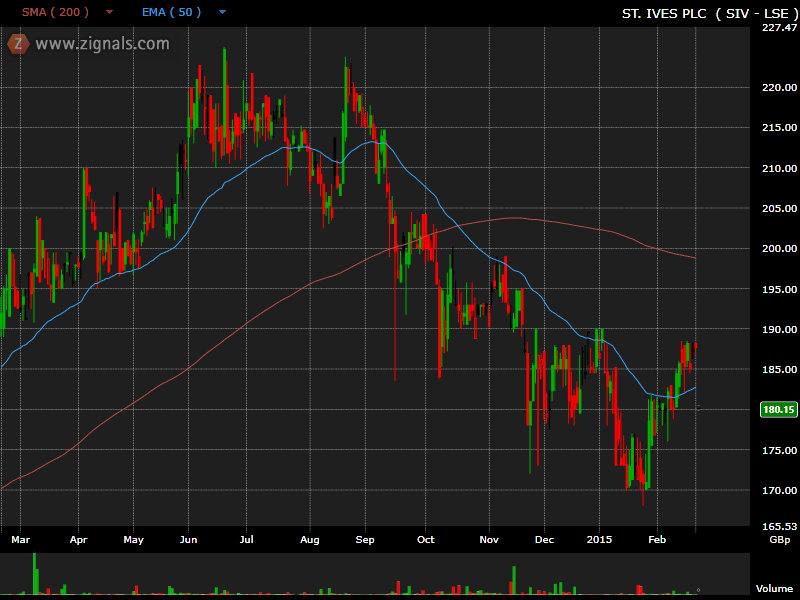
The St. Ives chart seems rather interesting.  Since October the share price seemed to have been retracing but towards the end of January the tables have turned and it seems to have broken out of the four month decline.  If this recovery holds, now might be a good time to buy in – this is one I am keeping an eye on over the coming weeks.

Share Diary 22nd February 2014

This week there were no major updates for the shares I own but it was announced that Shaft Sinkers, one of shares I used to own, would be delisted with shareholders unlikely to realise any value. This company has been hit by the South African mining strikes affecting their clients and the uncertainty surrounding legal action involving a failed project with Eurochem. Although I wasn’t left holding the shares when they went bust, which is progress when compared to my ATH, HMV and RSM Tenon investments, I did only manage to release £192 of value from my shares having lost £1,188. This is just the sort of disaster I hope to avoid with my new found trading discipline!
Another event during the week was that one share I do still own, Naibu, a Chinese shoe producer, has had its shares suspended because the Chinese executive directors seem to have gone AWOL. The UK based non-execs have called in an auditor to see what is going on but all the signs point to the fact that this company is basically a scam to enable the original Chinese investors to get cool, hard cash out of the company by listing on AIM at the expense of mugs like me who bought the shares on fundamentals alone. This has been another learning experience for me not to take audited accounts as gospel truth and just because a company is listed on a UK exchange, does not mean it is a genuine business.
Also during the week, I completed analysis on E2V, Finsbury Food and Circle Oil. All three companies look like decent potential investments but Circle Oil has a pretty poor looking chart and is probably not a sensible investment given the current oil price environment but I have been looking for decent entry points for the other two. Sylvania Platinum released their interim results so I wrote that up during the week – this is another decent looking company, a bit of a rarity in the precious metals space but the fact that they are cash generative and don’t actually mine anything but process tailings from other mines, makes them look interesting. As far as transactions were concerned, I sold out of my last holdings of Matchtech as on reflection I am not convinced by the acquisition and feel there may be some more short term difficulties to come. I realised a £663 profit on this tranche so this has been a good investment overall. Elsewhere I sold part of my Tristel holding. They have raced ahead over the last year, and have an update coming out soon and there has been some share price weakness so I felt it prudent. This sale realised a profit of £607 so another decent investment and I still have more than half of my holding in case the results surprise to the upside.
My only purchase this week has been E2V. I have been looking for an entry point and the share price seems to have recovered following a recent pull back so I have taken the plunge at £1.92. Next week is going to be quite busy for me. I should have completed my analysis of St. Ives, a printing and marketing company but a lot of the companies on my watch list and in my portfolio release final and interim results with Dechra Pharmaceuticals kicking off by releasing Interims on Monday.

Sylvania Platinum Share Blog – Interim Results Year Ending 2015

Sylvania Platinum has now released its interim results for the year ending 2015.

sylvaniaincome

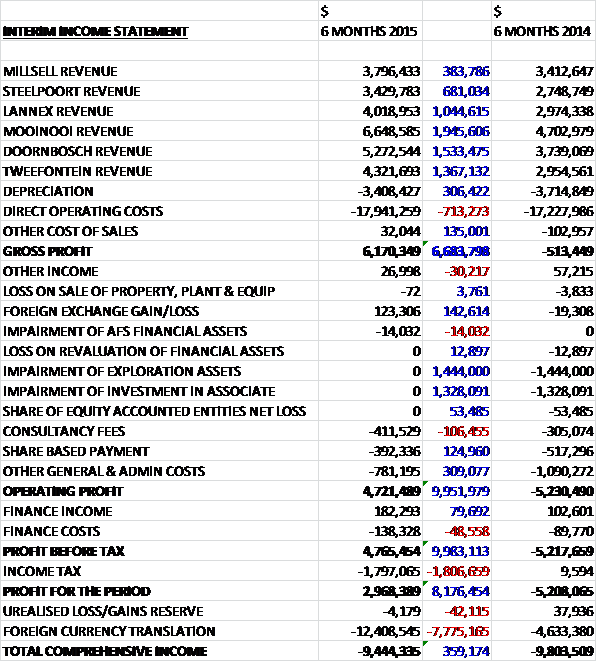
When compared to the first half of last year, revenues increased across all plants with the previously problematic Lannex and Mooinooi, along with the newer Doornbosch and Tweefontein plants increasing by more than $1M each. Direct operating costs increased slightly and gross profit was $6.7M higher at $6.2M. There was a positive foreign exchange gain and a lower share based payment, along with the lack of the two impairments that occurred in the first half of 2014 which helped operating profit swing $10M to the better before a higher income tax meant that the profit for the year enjoyed an $8.2M positive swing at just under three million dollars.

sylvaniaassets

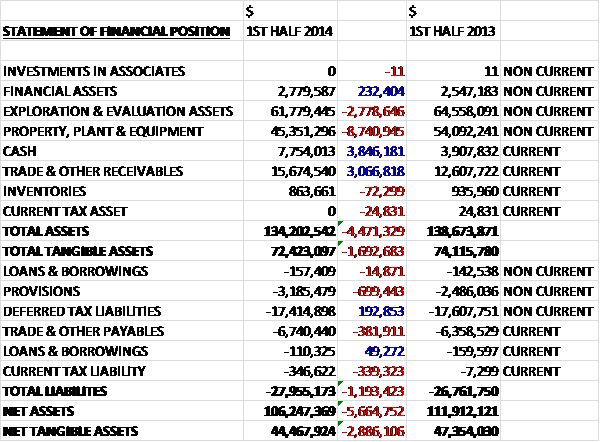
When compared to the first half of last year, total assets fell by $4.5M driven by an $8.7M decline in the value of property, plant & equipment, approximately half due to foreign currency movements and half due to depreciation, and a $2.8M fall in exploration & evaluation assets due to foreign currency movements, partially offset by a $3.8M increase in cash levels and a $3.1M growth in trade and other receivables. Liabilities increased during the period due mainly to a $700K increase in provisions. The overall net tangible asset level fell by $2.9M to $44.5M, although this does seem to be due to the fact that the tangible assets are denominated in South African Rand.

sylvaniacash

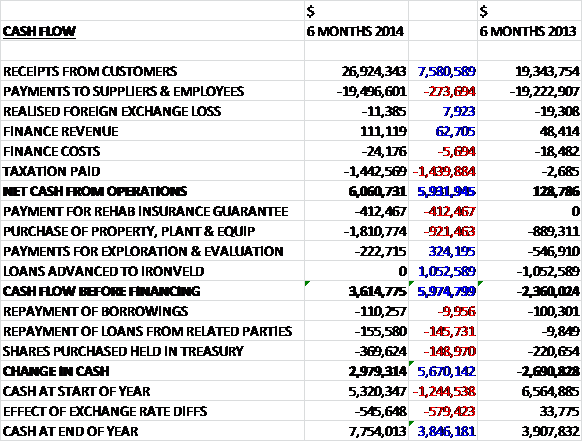
Cash receipts from customers romped ahead by $7.6M, tempered only somewhat by a small increase in payments and a $1.4M growth in tax so that net cash from operations was $5.9M higher at $6.1M. This cash was mainly spent on property, plant and equipment and $412K went on payment for rehabilitation insurance. There was the lack of the $1.1M paid in loans to Ironveld and exploration payments fell so that free cash flow increased $6M to $3.6M. After a bit went on repaying loans and treasury shares, the cash flow for the six month period was an impressive $3M, a $5.7M swing to the positive when compared to the same period of last year.
The best profit performance came at Doornbosch with a result of $2.3M ($1.5M growth). Millsell enjoyed profits of $1.4M ($200K increase), Steelpoort posted profits of $1M ($800K increase), Tweefontein had profits of $900K ($1.3M increase), profits at Mooinooi were $300K ($1.6M improvement) and profits at Lannex were $256K (about a $1M improvement).
Overall the SDOs produced 31,341 ounces during the period compared to 25,189 ounces during the same period of last year. This was boosted by higher plant feed grades at Doornbosch and Tweefontein operations due to the type of material treated during the period and generally stable plant performances. The gross basket priced dropped just 1% to $899/oz whilst group cash costs fell by 18% to $611/oz mainly due to improved cost controls, a reduction in iron ore transport and equipment hire, and lower maintenance costs due to fewer breakdowns. Capital expenditure at the SDOs in general grew by 286% compared to the second half of last year as a result of new tailings facilities at Lannex, Doornbosch and Tweefontein, as well as the changeover from mechanical mining of the dumps to a hydro mining process. This new process is expected to reduce mining costs by up to 20% overall and the new PGM concentrate off-take agreement terms should also lead to reduced costs.
The company is still waiting for the outcome of the Mining Right Application for the Volspruit project with the public participation meeting for the Water Use License Application commencing in February. At the Grasvally Chrome exploration project, the group received permission to remove and dispose of a bulk sample of the minerals recovered during prospecting activities. The plan is to extract a bulk sample from small open pits in three separate areas on the chromite seam outcrop to ascertain metallurgical recovery information in order to complete the MRA. A resource model is being completed over the southern half of the property and the near surface resource will be classified into indicated and inferred categories. Further exploration will consist of a drilling programme in the north of the property for a near surface resource and additional drilling will be performed to categorise the deeper underground resource.
Overall this was a very good update. All of the plants seem to be performing well and are profit making despite a flat platinum price. The group is now cash generating but the balance sheet did weaken slightly, although I’d guess this is due to the South African Rand depreciation and the effect this has on the group’s assets. The exploration licenses are progressing rather slowly but the board seem to be doing this in a sensible, measured way. I do really like this company, although the issues around the South African labour problems are never far away and of course, the group is still susceptible to the platinum price and foreign exchange changes. I am considering buying in here.

On the 9th March it was announced that the DMR had granted mining rights for the mining of Platinum group metals over three of the group’s sites, being the farms of Cracouw 391 LR, Aurora 397 and Harriets Wish 393 LR.  The rights have been granted to Hacra Mining which is a 71% held subsidiary of the group.  Also the DMR has granted rights for the mining of iron ore, vanadium and heavy metals which will be transferred to a subsidiary of Ironveld.

On the 31st March the group released its initial mineral resource estimate following work done on the southern section at the Grasvally chrome project.  It showed an initial mineral resource of 64,900 tons of high grade chromite with a grade of 40.7% Cr2O3 and a Chrome to Iron ratio of 2.19:1, all of which is accessible by small and shallow open pits.  It is likely that this figure will increase as the exploration of the Northern section and deeper portions of the lease area is concluded over the next few months.  The total cost of the project to date is R35.9M, comprising R22M to purchase the prospecting rights, R5M to secure the chrome dumps, £8.9M spent on trenching and rehabilitation with a further R2.7M planned for exploration of the Northern section of the surface outcrop of the ore body over the next six months.

On the 27th April the group released a statement covering performance in Q3.  The combine production for all of the dump operations was 12,778 ounces and the company remains on track to exceed the production target of 53,000 tonnes for the year with the production for the year to date some 15% higher than last year despite the decline this quarter.  The cash cost of production increased by 5% on last quarter to $619 per ounce due to the lower production volumes.  This lower production was caused by a structural failure on the Lannex plant’s thickener that resulted in some downtime and a five day safety stoppage at the host mine that affected production at the Mooinooi and Millsell plants.  Another issue was community unrest related to municipal service delivery at the Eastern operations that affected production at the Steelpoort, Lannex, Doombosch and Tweefontein operations.

The gross basket price of $833/Oz represents a 6.7% decline on that achieved during the previous quarter as a result of the drop in the commodity price which, when combined with the lower production resulted in a 19% revenue drop to $10.5M with the above issues contributing to an EBITDA fall of 57% to $1.4M.  The cash generation remained good, though, with a $1M increase in the group’s cash balance quarter on quarter to $8.8M which represented a $2.9M cash generated from operations with $600K spent on the general business capital for the plants, $200K spent on exploration assets and $1M spent on share buy backs.  Profitability in Q4 is likely to be further impacted by the continuing low metal prices and production for the year should be between 55,000 to 57,000 ounces.

The company continues to await the outcome of the mining rights application for the Volspruit project with a final decision expected before the end of July, dependent on the duration of the independent peer review.  The application for the DMR at the Grasvally Chrome Exploration project will be submitted in May with a total of 1,317 metres of diamond drilling being completed by the end of the period, with planned completion of some 2,425 metres of drilling by early May.  Once this drilling is completed and a JORC compliant resource is declared, this chrome deposit will be sold.  The official signing to execute the mining rights at Harriet’s Wish, Aurora and Cracouw has been delayed pending a request to the DMR to reduce the amount of financial provision for rehabilitation.  Upon finalisation of this, an application to transfer the right to mine iron ore, vanadium and heavy metals to Ironveld will be made.

The group have also announced the appointment of Eileen Carr as non-executive director as a replacement of Grant Button who has stepped down from the board after spending 11 years in his role and 14 years at the company in total.  She has 25 years of experience in the resources sector including as Finance Director at Cluff Resources.  Overall, this is a bit of a disappointing update with the various problems at some of the plants and the continued weakness in Platinum prices.  Despite this, cash generation remains good and the company still looks a strong play in a troubled sector.

On the 11th June the group released a statement clarifying the position over the Volspruit development.  Contrary to newspaper reports, the Environmental Impact Assessment was not rejected by the Limpopo Department of Economic Development (LEDET) requiring the application process to be restarted.  In actual fact, LEDET requested clarification on matters related to water consumption by the project and requested additional work on the assessment be done to include a biodiversity and wetland offset strategy to address any potential loss of flora and fauna species or potential damage to the wetland located near the northern mining pit perimeter.

During the past week, the Environmental Assessment Practitioner released a statement that meetings would be held with LEDET to confirm further actions to be taken by the company to address their concerns and submit an amendment to the application.  Sylvania has until the 19th July to submit an amended application which should be the final stage of the process.  The group remains optimistic that the application will be granted as the detailed environmental impact study did not find any fatal flaws within the proposed project.

On the 29th July the group released an update covering Q4 2015.  In all, some 13,468 ounces were produced during the period, bringing the total for the year as whole to 57,587 ounces.  This represents a 5% improvement quarter on quarter and a 7% increase year on year and outperformance compared to the initial expectation of 53,000 ounces for the year.  This improvement is attributable to higher feed tonnes and a slight improvement on recoveries despite lower feed grades.

The problems arise with the selling prices, however, the gross basket price of $1,032 per ounce is approximately a 2% decrease compared to the price of $1,049 per ounce in the previous quarter.  The platinum and palladium price has dropped significantly since March which has directly impacted the basket price.  After smelting and penalties, this resulted in a revenue drop of 5% compared to last quarter to $10M.

The group cash balance at the period end was $8.4M and cash generated from operations was just $200K with $800K being spent on stay-in-business capital and exploration asset rights applications, $500K being received from the partial repayment of the loan to Ironveld and $800K being spent on share purchases.

The cash cost of production remained stable compared to Q3 at $638 per ounce and increased by 1% when compared to Q4 last year.  While the combined plant feed head grade was slightly lower than the previous quarter, plant feed tonnes, PGM feed tonnes and recovery efficiencies improved for the operations, contributing to the higher PGM ounce production in the period.

At the Volspruit Platinum Exploration license, the additional information requested was released for public review last week and will be submitted to LEDET at the end of August following an opportunity for comment by interested parties.  LEDET will then have 120 days in which to consider the addendum and, assuming that it is accepted, another 30 days to grant the EIA towards the end of January, although it is expected that the department will make every effort to announce its decision sooner.

Exploration has continued over the northern portions of Grasvally in order to declare a JORC compliant resource which will be required by the company in order to exercise a mining right over the resource. Exploration has been in the form of an extensive drilling programme targeting both the upper and the lower chromite layers.  The drilling was completed at the end of April, totalling 2,539m and the logging of samples in underway, to be completed by the end of the month.  Using all acquired data and the previously published southern resource model, a complete resource model will be developed over the entire property.  This will describe both the shallow resource which will be minable by opencast methods as well as the deeper, underground resource.  This resource contains some of the best quality local chromite ore and represents an opportunity for the company to diversify its operations or to consider a brand new venture.

Going forward, the basket price of platinum remains a concern for the foreseeable future but the board is confident that they can continue to produce profitably if the basket price does not further reduce (a big “if” in my view).  Overall, this should have been a good update with an increase in the volume of metal produced and progress on the Grasvally resource but the continued collapse in the platinum price undermines all of this and I feel until it improves, this is a difficult investment so I have sold my shares (although in the long term I think this is a great company).

Circle Oil Share Blog – Interim Results Year Ending 2014

Circle Oil has now released its interim results for the year ending 2014.
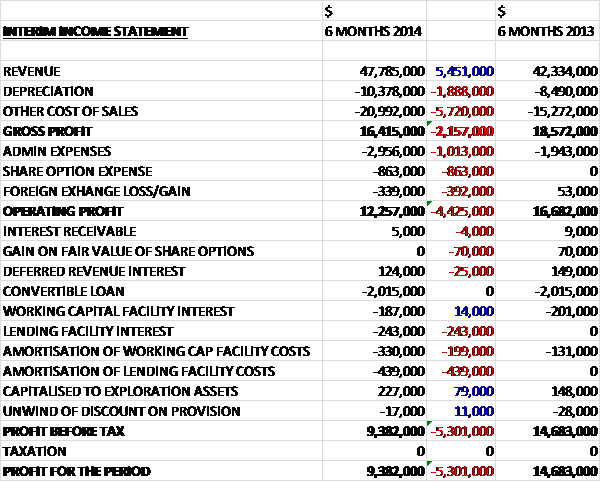
circleinterimincome

When compared to the first half of last year, revenue was some $5.5M higher at $47.8M consisting of $37M in Egyptian oil sales, $1.4M in gas sales in Egypt and $9.4M in Moroccan gas sales with the increase coming from an increase in the volume of oil sold in Egypt, but a $1.9M increase in depreciation and a $5.7M growth in cost of sales meant that gross profits were $2.2M lower than last time.  Admin expenses also increased, primarily due to the drilling activity in Tunisia and there was a one-off share option charge so that operating profit, at $12.3M, was some $4.4M lower than in the same period of last year.  Finance costs also increased, mainly due to amortisation of various borrowing costs and with no tax charges, the profit for the period fell $5.3M to $9.4M.
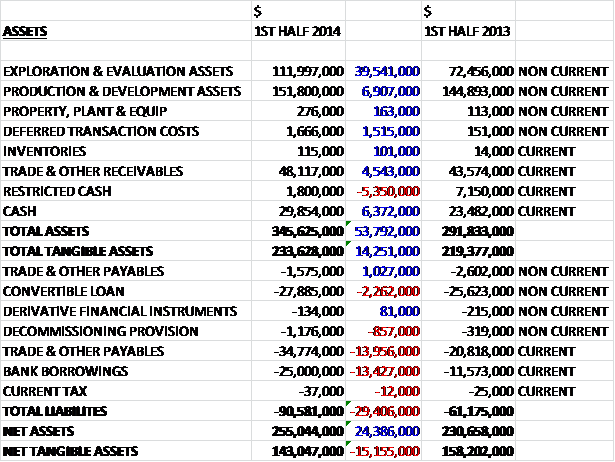
circleinterimassets

When compared to the half year point of 2013, total assets increased by $53.8M, driven by a $39.5M hike in exploration assets, a $6.9M growth in production assets, a $6.4M increase in cash levels and a $4.5M increase in receivables, somewhat offset by a $5.4M decline in restricted cash.  Liabilities also increased over the year due to a $13M growth in payables, a $13.4M increase in borrowings and a $2.3M increase in the convertible loan.  Due to the fact that most of the increase in assets came from the intangible exploration assets, net tangible assets fell by $15.2M but the balance sheet still looks rather strong.
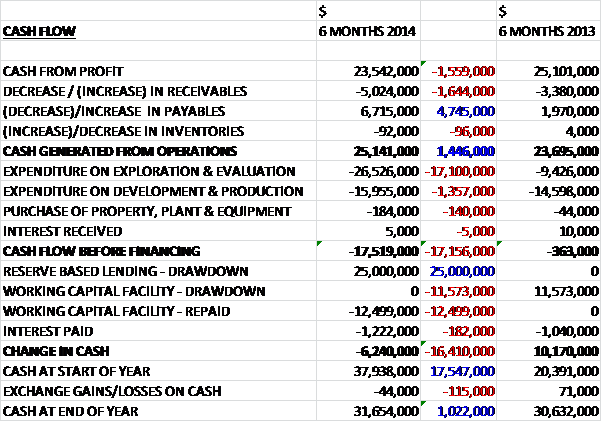
circleinterimcash

Before movements in working capital, cash profits fell by $1.6M to $23.5M but an increase in payables meant that cash generated from operations actually increased by $1.5M at $25.1M.  All of this cash was then spent on exploration and evaluation with an extra $16M spent on development and production.  There was a new $25M drawdown on a reserve based lending facility which meant the group could pay back the $12.5M working capital facility and cover the development expenditure.  The end result was a $6.2M cash outflow which meant that cash levels at the end of the year were $31.7M.

In Morocco several potential drilling locations in both the Sebou and Lalla Mimouna permits have been delineated using the available seismic coverage.  Drilling activity started in the Sebou permit with the SAH-W1 well in May but the rig had to be released to another operator before the well could be fully tested, which is a bit of an oversight but wireline logging confirmed the presence of three gas bearing zones that will be tested for production during the continuation of the drilling programme later in the year.  The second well (CGD-12) was spud in August with a further six wells to follow in Lalla Mimouna over the next year.

The daily production rate in Sebou averaged between 6.8 and 7 MMscf during the first half of the year and negotiations are underway for further off-take by the year end.  The 2014 CPR reserves estimate the 2P value of gross initial gas reserves in Sebou and Oulad N’Zala was 30.2bef with 22.33bef net to Circle.  After the half year production was taken into account, the 2P gross remaining reserves were estimated to be 23.9bef which, current drilling campaign to enlarge the reserve base not-withstanding, seems to suggest only two years of reserves left.

In Egypt at the Al Amir SE field there were ten wells in production with a further two in the Geyaf field with a combined gross production rate of 11,592 boepd and water injection through five of the wells maximised production efficiency and maintained levels.  The appraisal well AASE-19, production well AASE-21 and water injection well AASE-22 were successfully drilled during the period and a work over programme was initiated to follow on from the drilling campaign.  The export gas line to the SUCO facility is currently flowing at 10 MMscf per day with valuable condensate and natural gas liquids being stripped out and sold to EGPC with average rates of 100 bbls of condensate and 20 tonnes of LPG.  The latest reserve estimates in the NW Gemsa showed gross initial oil reserves of 38.3 MMbo and 2P gross initial raw gas reserves of 43.14 bcf which totals 2P gross initial reserves of 45.73 MMboe, 18.29 MMboe net to the group.  Following production during the period the gross remaining reserves are estimated to be 22.72 MMbo which seems to suggest the present reserves will not last that long.

In Tunisia the group drilled the EMD-1 well in the North Central area of the Mahdia permit in a water depth of 240m, 120km east of Sousse.  It was drilled to a TD of 1,200 metres in the upper Ketatna carbonates.  The well discovered very good light oil shows in the lower Birsa carbonate primary target and the upper Ketatna carbonate secondary target over a combined interval of 133 metres.  These oil shows confirm the existence of a working petroleum system in the Mahdia permit.  The gross oil zone interval in the Lower Birsa is 77 metres and the Upper Ketatna has a minimum interval of 48 metres, subject to confirmation.  Using known reservoir and fluid parameters from equivalent formations in the Gulf of Hammamet, the most likely recoverable prospective resources discovered by the EMD-1 well are approximately 100 MMbo.

During drilling of the target carbonates, severe mud losses occurred and hole conditions in the well deteriorated rapidly so multiple attempts at open hole logging by wireline failed until finally the decision was taken to terminate further efforts and suspend the well, which is the second well detailed in this report that seems to have failed on a technicality.  The group has been granted a six month extension to the Mahdia permit to January 2015.  It then has the right to elect for two additional renewals of the permit for 3 years each with a commitment of one well per period.  The award of the Takelsa permit on the Cap Bon peninsular was ratified by the Tunisian authorities in late 2013 and planning for the first exploration phase of three years of work commitments is in progress, starting with the acquisition of seismic, followed by the drilling of four low cost onshore exploration wells.

In Oman the seismic has been interpreted and an exploration well location has been selected in the southern part of onshore block 49.  The principle target depth is about 1,900 metres and the intended spud date is late H2 2014.  The recent seismic survey on offshore block 52 is being processed and interpreted and there has been renewed interest in the group’s acreage following a discovery in the adjacent block to the north which augers well for securing a farm in partner to drill an exploration well next year.  The bid for an onshore block continues to progress with no news as of yet.

During the period the group agreed a reserve based lending facility of up to $100M with IFC, part of the World Bank Group.  The facility matures in 2018 and during the period the group drew down $25M which was used to repay the $12.5M facility agreed with Ahli United Bank of Egypt.  This seems like a better company to borrow from.  The group continues to receive payment from the Egyptian government, albeit at the same belated rate as before.  The oil price achieved in Egypt was $104.3/bo and the gas price achieved in Morocco was $10.3 per MMsef.

The board see an exciting period ahead that includes new drilling in both Morocco and onshore Oman.  Circle finished the half year with increased revenue from its production in Egypt and Morocco and the company is now drilling its 2nd well of twelve in Morocco and recently completed operations offshore Tunisia and forthcoming operations in both Oman and onshore Tunisia have the potential to further enhance the asset base.

Overall this was an OK update.  The exploration work in Tunisia has clearly taken its toll on the financials of the company with a fall in profits, net tangible assets and free cash flow.  The reserves currently shored up seem as though they do not have a huge life ahead of them so hopefully some of these wells can help confirm some new reserves.  Unfortunately both of the new exploration wells have experienced technical difficulties that have prevented testing so in some ways, the program has been a bit of a disappointment during the half year.  There is not enough here to encourage me to buy but I will continue to keep an eye on the company.

On the 7th October the group released an update covering the exploration well CGD-12 in Morocco.  The well was spud on 25th August and drilled to a TD of 1,232 metres.  Gas shows were confirmed by wire logging and encountered at different levels in the Guebbas and Hoot sands.  The total net gas pay encountered in the well from the wireline log analysis is 9.7 metres.  The first test over the secondary target Intra Hoot sands flowed at a sustained rate of 2.21 MMScf per day on a 18/64” choke.  The second test over the main target Hoot sands flowed at a sustained rate of 4.62 MMScf per day on a 24/64” choke.  The well will be completed for further production and the Upper Hoot and Guebbas sands will be available for production at a later date.  The rig will now be moved to drill KSR-12, the third well of the Sebou permit.

On the 11th November the group released an update covering a directorate change and an operating update.  CEO Chris Green has given notice of his intention to step down and resign from the company after eight years, four as CEO and the search for a successor has started.  In Morocco drilling continued on the KSR-12 exploration well in the Sebou Permit.  It has a primary target in the Mid Hoot interval and a secondary target in the Upper Guebbas.  The planned TD of the well is 1,980 metres and upon completion the drilling rig will be demolished and returned to work with another operator.  Drilling will therefore start recommence on the next well in the campaign using another rig which is currently being mobilised.  This rig has now been contracted to provide continuous cover for drilling the remaining nine wells in the exploration programme for the Sebou and Lalla Mimouna permits and be used for any required work overs and testing programmes, which is good to hear.  Due to the onset of winter rains, the next wells will be drilled on higher ground in the Lalla Mimouna permit before returning to Sebou.  Production levels continue to run in line with expectations at 7 MMscf per day.

In Egypt production in the NW Gemsa and Geyad permits continued in line with predictions with oil production varying between 9,300 and 9,700 bopd and gas delivery of 10 to 11 MMscf/d.  Receivables levels continued to be in line with earlier guidance and regular payments continued from EGPC.  The group is expecting an additional one-off payment from the announced special tranche allocated to reduce overall oil company debt in the country.  In Tunisia, the results of the Mahdia well are being interpreted in order to produce data to permit the commencement of a farm out for future block appraisal and the company has apparently already received expressions of interest from a number of companies which will be pursued in the coming months.  Meanwhile they are in discussions with the Tunisian authorities regarding the renewal of the permit for another three years.  As a result of various delays and technical challenges, the well came in at the top end of the board’s cost expectations but not enough to hamper the company’s plan going forward.  They are still waiting further news from the operator regarding the well to be drilled in the Ras Marmour permit.

In Oman the group is engaged in preparations to commence drilling the block 49 commitment well.  Access roads have been constructed to the main road and the drilling rig base and mud pits ahave also been completed.  The rig has been identified and contracts are being finalised so it should begin soon.  This well is a high risk prospect so it seems the Chairman is trying to play down expectations.  The Shisr-1 well will target the main prospect at 1,883 metres and a secondary target at 2,669 metres with a TD of 2,768 metres.  Discussions are continuing regarding the possibility of a farm out in the offshore block 52 and results of the seismic survey have confirmed the presence of the shallow water prospects and added a fourth prospect to the portfolio.  Trading as a whole was in line with expectations.

On the 22nd December the group released an update regarding the KSR-12 exploration well in Morocco’s Sebou permit in which they found a significant gas discovery.  The well was drilled to a TD of 1,980 metres and gas shows were encountered at two different levels within the Hoot sands.  The net gas pay encountered in the well is 19.5 metres in the main target Intra Hoot sands and 1 metre in the Upper Hoot which is a greater thickness than originally expected and pressure testing showed that these sands are not connected to the Hoot sands in the other nearby KSR wells.  The first test over the primary target main Hoot sands flowed at a sustained rate of 8.09 MMscf/d on a 20/64” choke over eight hours with no decrease in well head pressure.  The second test over the upper Hoot sands produced a stabilised rate of 2.32 MMscf/d on a 9/64” choke over ten hours.  The well  will be completed for production for future production in the Main Hoot sands and Upper Hoot will be completed for production once the Main Hoot gas sands have been depleted.

A new rig was transported to Morocco but due to recent heavy rains affecting access roads into the drill site area in Lalla Mimouna, it cannot be delivered there at present.  In order to avoid any further delay the drilling sequence is being modified and the rig will now be transported to the KAB-1 bis location in the Sebou permit, where access is presently possible.  This well is a re-drill of the KAB-1 well which was drilled in 2011 and encountered swelling clays that compromised the integrity of the borehole, leading the well to be abandoned before wireline logging and testing but before this happened, the well encountered good gas shows at the target level.  The new well has the same target with an updated mud system to minimise drilling problems in a slightly more updip location.  The primary target Guebbas sands are expected at a depth of 1,272 metres and the TD of the well is 1,360 metres.

The rig is then scheduled to move to drill the first wells on the Lalla Momouna permit with the first well of the campaign, LAM-1 being located in the central part of Lalla Momouna Nord on the Anasba ridge within the existing 3D seismic area.  The target for the well is for Miocene gas bearing sands, similar to the previously made Sebou discoveries.  The sands are expected at a depth of 1,130 metres and the TD of the well is 1,431 metres.  In summary, the KSR-12 well has found the thickest gas sand interval to date in Sebou and management believe that this well will add significant volumes to the reservoirs for potential gas production.

On the 22nd December the group announced that Mr. Colin Blackbourn no longer holds a notifiable interest in the group.

On the 7th January the group announced the appointments of Anthony Maris (53) and David MacFarlane (57) as non-executive directors of the company.  Anthony Maris is currently COO of SOCO International and David MacFarlane was finance director at Dana Petroleum, overseeing a tenfold growth in market cap before the sale of the company to the Korean National Oil Company.  He was aslo a director at Kentz when it was acquired by SNC-Lavalin group and is currently a director at Energy Assets.  These seem like quality appointments to me.

On the 8th January the group announced that it had appointed Susan Prior (44) as executive finance director.  Since 2012 she has been a transaction services director at PWC for their oil and gas deals team.  It is good to see an executive position at the finance director level as one has so far been lacking.

On the 9th January the group announced that it had received $15M as part of a recent special payment distribution by the Egyptian government to oil companies operating in the company.  This significantly reduces receivables from them and in my view somewhat de-risks operations there so this is very pleasing to see.

On the 12th February the group gave a financial and operating update.  The recent fall in oil prices has had a substantial impact on the sector as a whole but while the group is not immune to this impact, it is somewhat moderated by gas production in Morocco where prices have remained stable.  The existing convertible loan is due for redemption in July 2015 but Heads of Terms have now been agreed with regard to extending maturity to at least July 2017 which if successful would definitely be a help.  The group currently has available cash of $34M and given the refinancing and ongoing oil price weakness, the board is reviewing the cost base and capital commitments.

In Egypt, production in the Al Amir SE and Geyad fields continues in line with previous guidance.  The annual work programme is close to being finalised and is focussed on maintaining current production levels throughout 2015 and includes the drilling of three wells during the second half of the year.  Two are planned as producers and one as an additional injector well aimed at providing further support to the AASE reservoir.  In Morocco, following testing and completion of the KSR-12 well, the KAB-1 bis well has now been spudded and is the fourth well in the twelve well campaign.  The company regards this well as lower risk due to the fact that it has been adapted to cope with the mud conditions and gas shows were encountered during the first run.  Daily production from the Sebu permit continued at 6.5 to 7 MMscf/d, in line with previous guidance.  The current drilling campaign has enable the replacement of depleted reserves and is now looking to add to the overall reserve base.  The company anticipates being able to increase its sales of gas incrementally to both existing and new customers over the next two years as local demand for natural gas remains strong.

In Tunisia, the data from the Mahdia well is being made ready with the intention to start farm out discussions in the near future.  The group continues to await final confirmation of approvals to drill the onshore Ras Marmour well.  The prospect Sedouikech-1 is targeting a productive sand in the early Cretaceous Meloussi sand formation which is the proven reservoir in the adjacent Robbana field.  Tenders are currently being evaluated in respect of the seismic for the Beni Khalled permit but management are considering postponing the award of the tender in order to obtain better pricing.  It is thought that such actions will have a minimal impact on the overall timetable of the project.

In Oman, the start-up for drilling the Shisr-1 well in block 49 has commenced.  The well is located in the SE area of the block onshore in the Dhofar province of Southern Oman.  It lies on the NW dipslope of the NE trending Ghudun high and updip of the Dauka-1 well in the central area of the block 3D survey.  Both targets are potentially oil-bearing Haima Group sands of Ordovician age.  The primary target Hasirah sands are expected to be at a depth of 1,890 metres and the secondary target Ghudun sands are expected to be at a depth of 2,420 metres with a TD of the well of 2,550 metres.  The drill duration is expected to be between six to eight weeks and the completion of the well fulfils the groups obligations in respect of this block.  As previously mentioned, this is considered a high risk commitment well with a loss possibility of success.  The company also continues to seek a farm in partner for the offshore Block 52 but the downturn in the oil price is making this a challenging objective.

Overall, there seems to be progress being made in Morocco but the slide in oil prices makes this a difficult investment at this time.  I suspect they will struggle to find farm in partners and the priority will probably be on keeping those dwindling reserves at a decent level.
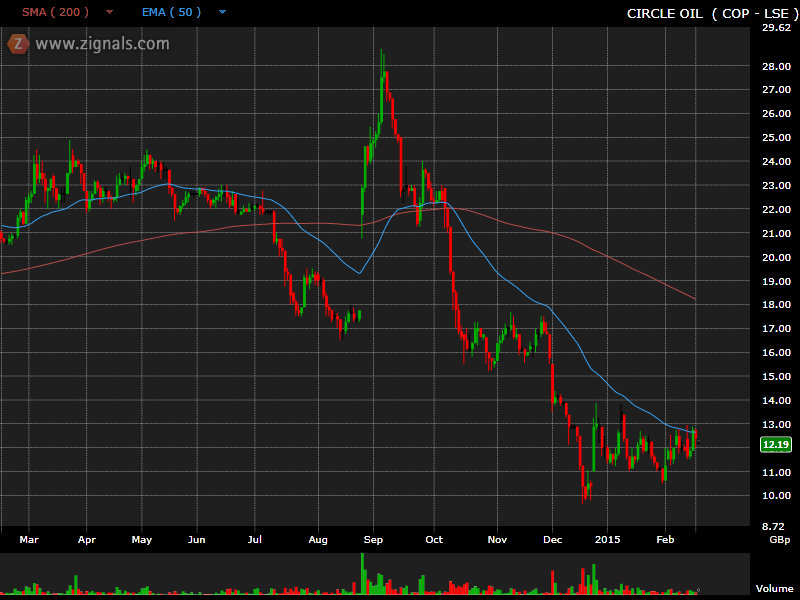
circlechart

When looking at the chart we can see the share has undergone a strong decline as the oil price fell but this year has so far bottomed out.  The share price seems to be testing the 50 day moving average but the trend is probably still sideways.  I may look for an entry point in the future but that point is not now.

On the 4th March the group announced the results of the Shisr-1 well Block 49, onshore Southern Oman.  The decision has been taken to plug and abandon the well after it encountered drilling difficulties on reaching a depth of 1,650 metres. No hydrocarbons were found but it seems as though the drill did not reach the primary target Hasirah sands prognosed at a depth of 1,890 metres.  The Bottom Hole Assembly (BHA) became stuck below the 9 5/8 inch casing shoe which had been set at 819 metres.  Multiple attempts were made to remove it but they proved unsuccessful.  The group have been advised that further attempts to deepen or sidetrack the borehole are not a good idea.   This well was always going to be a risky venture but it is a shame that nothing has really been learned in this venture.

On the 16th March the group announced the results for the drilling of the KAB-1bis well in the Sebou permit, onshore Morocco.  The well spudded on the 4th February and was targetting the same sands that the KAB-1 well targetted in 2010.  That well encountered gas shows but problematic swelling clays created borehole instability and the well could not be logged or tested.  This time the well was drilled with an adapted mud system to minimise drilling problems in a slightly more updip location.  Unfortunately the target Guebbas sands were absent down to a depth of 1,410 metres and it was decided to plug and abandon the well.  The result indicates that the gas shows encountered previously were of a very limited extent.  The rig has been released to complete and test the SAH-W1 well on the western area of the Sebou permit.  The well encountered three gas bearing Guebbas sands but could not be completed as a non-standard 4.5 inch liner was needed.  This is more disappointment from the company on a well that was supposed to be lower risk.

On the 24th March it was confirmed that CEO Chris Green was stepping down with the search for his replacement ongoing.

On the 27th April it was announced the group had signed an agreement to amend and extend the current convertible loan which had previously been due for redemption by July 2015.  The group will now repay $10M before the end of July whilst extending the remaining $20M until July 2017 at a revised conversion price of 13.6p per share which removes one uncertainty hanging over the company.

On the 11th May the group released an operating update for Morocco that includes the preliminary testing of the SAH-W1 well in the Sebou permit.  The well was drilled to a depth of 1,263 metres in June 2014 with gas shows encountered at different levels within the target sands.  The group will start production from the lowest zone, followed by the main zone.  The lowest zone has 3.6 metres of net pay and the test over this interval flowed at a sustained rate of 4.94 MMscf/d on a 24/64” choke during a period of five hours.  The rig has now been released from the well and is being transported to the Lalla Mimouna concession to drill the company’s first well on this permit (LAM-1).  The target of this new well is for Miocene gas-bearing sands, similar to the Sebou discoveries.  The primary target sands are prognosed at a depth of 1,231 metres and the total TD of the well at 1,521 metres.    The chairman believes that after the test of the SAH-W1 well, it has potential to add significant volumes to reserves for gas production.

On the 12th May the group confirmed the spudding of the LAM-1 well on the Lalla Mimouna permit, onshore Morocco.  This is the first well to be drilled by Circle on the permit and is located in the centre of the area, on the Anasba Ridge.  The well is only expected to take between 14 and 20 days to drill, so hopefully there will be some news soon.

On the 29th May the group announced that it had finally appointed a new CEO.  Mitchell Flegg will join from Serica where he has been since 2006 including as COO since 2011.

Finsbury Food Share Blog – Final Results Year Ending 2014

Finsbury Foods operates in the cake and bread markets which is focused on premium, celebration and well-being.  The UK bakery segment manufactures and sells bakery products to the UK’s multiple grocers both for supermarket own brands, the group’s brands and licensed products.  The other segment is a 50% joint venture, although the group does have a controlling interest through prior agreement with Philippe Stretz, and it sells the group’s products into Europe.  Finsbury Food has now released its final results for the year ending 2014.
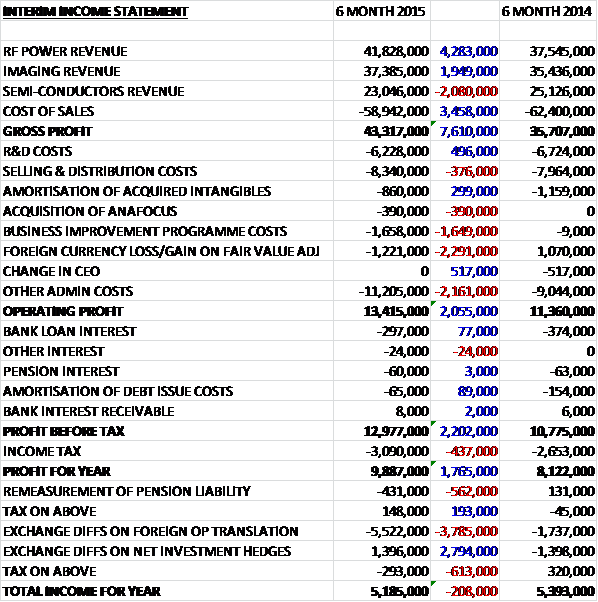
finsburyincome

Revenues fell when compared to last year as UK bakery sales were down £624K and Overseas revenue was down £263K.  Cost of sales also fell, however, so that gross profits were £1.7M higher than in 2013.  Overall admin expenses increased as the group increased marketing support, new product development and range support to make the operating profit £231K lower at £7.1M.  We then see a decline in finance costs as bank interest fell by £472K and interest on interest rate swaps was down £217K.  Tax increased year on year to give a profit from continuous operations of £4.9M, an increase of £150K on last year.  When the profit from the discontinued operation, along with the profit on its sale is taken into account the total profit this year was some £2.9M below that of 2013, although adjusted profit, taking off discontinued operations and one-off income/costs was £6.5M, an increase of £1M when compared to 2013.

finsburyassets

When compared to last year, total assets increased by £1.7M driven predominantly by a £2.9M increase in plant and equipment, partially offset by small falls in cash levels and prepayments.  Conversely, liabilities fell when compared to the end point of 2013 due to a £1.6M fall in accruals and a £789K decline in the liability associated with the hedges.  The fall was partially offset by a £1.1M increase in loans and a £787K increase in pension liabilities.  The end result, once goodwill is discounted, is a net tangible asset level of £10.7M, an increase of £4M when compared to 2013.  It is worth noting, however, that there is £13.2M worth of non-cancellable operating leases off the balance sheet which is higher than the value of net tangible assets.

finsburycash

Before movements in working capital, cash profits fell by £1.9M when compared to last year to just under ten million pounds.  Adverse movements in working capital, particularly a decrease in payables, meant that cash generated from operations was £6.3M lower at £7.7M before reduced interest and tax meant that net cash from operations, at £4.9M, was less than half that of last year.  Unfortunately this cash did not cover the £6.2M spent on the purchase of property, plant and equipment and the group had a negative free cash flow of £1.5M.  Various repayments were counteracted by a £2M drawdown of the revolving credit facility and after dividends were paid, the cash outflow was £754K which left the company with cash levels of just £592K at the end of the year.

Some of the group’s businesses include Lightbody based in Scotland which is the UK’s largest provider of celebration cakes with Disney, Weight Watchers, Nestle and Thorntons among the licensed brands along with own brands and in store bakery bites.  Memory Lane cakes based in Wales is the leading manufacturer of the UK retailer’s premium own brand cakes along with a number of licensed brands.  Nicholas and Harris, based in England, produces a range of specialist breads to UK retailers with a focus on own label breads, rolls and buns.  This year the bakery underwent a 60% expansion to its footprint to allow more efficient distribution and space for future growth.  The main licensed cake products include Weight Watchers, Nestle, Thorntons and Disney.

cake-banner

Overall results were comfortably in line with expectations.  I did find that the letter from the Chairman makes interesting reading.  He has only recently been appointed and seems to be very enthusiastic.  Over the next few years he is looking to improve shareholder value, act justly towards employees and grow the business.  There does not seem to be a focus on customer service, though, which some might say should be the most important consideration.  Although some organic growth is expected, the bulk of any future expansion is likely to come from acquisitions and it seems the desire is to double the size of the group in a fairly short period of time given the right opportunities, but hopefully they will not overdo it.

The group underwent two very different halves during the year with the first half maintaining the good momentum carried over from previous periods with profits enjoying a 50% uplift mostly due to a reduction in interest charges after the cash from the business sale was used to pay off some debt.  The second half was more challenging as commodity price inflation began to show up again and other costs such labour increased.  When this was combined with the squeeze from the customer side as the supermarket price war took hold, the group have had to search for efficiencies and have installed leading edge robotics at the cake factory in Scotland and extended space at Nicholas and Harris by 60%.

It is clear that consumer behaviour has changed as Aldi, Lidl and Pound Shops have seen a niche in the market and are enjoying huge gains which could be difficult for the group as most of their important customers are made up of the large traditional supermarkets.  The business environment is unlikely to get any easier in the near term.

Underlying operating profit at the UK bakery business was £6.1M, £500K higher than last year.  Despite this improvement, one area of disappointment was the speciality bread market which after enjoying strong gains in previous year, encountered flat sales this year whereas the cake business seems to be doing rather better.  Underlying operating profit at the overseas business was £1.1M, £100K more than in 2013.

The underlying ambient cake market in the country saw value sales fall by 2.4% and unit sales declined by nearly 5%.  The market in bread and morning goods remained flat during the year which is more of a niche area for the group.  Conditions in the underlying bread market, however, have been just as difficult with sales declining by 3.4% in term of value.

During the year there were a number of one-off costs.  Expenses of £643K related to redundancy and restructuring and £116K related to due diligence and consultancy expenses associated with an aborted acquisition.  Last year costs of £471K related to costs associated with the cancellation of unapproved share options and the issue of ordinary shares in exchange for this cancellation.

There is quite a concentration in the group’s customers with five clients making up a whole 70% of sales with two accounting for £35M each.  There is also some sensitivity to an increase in interest rates with a 1% increase in the base rate or LIBOR decreasing profits by £160K.  Probably more of a risk, however, is commodity prices with the group being susceptible to appreciations in butter, sugar and chocolate in particular.

In February 2013 the group disposed of the Free Form business consisting of Livwell Ltd and United Bakeries to Genius Foods.  They received £17.1M in cash after any disposal costs and £2.7M of deferred consideration which is payable in February 2015.  They lost £18.9M in net assets with the disposal so the profit for the transaction was £1.2M.  During the year Martin Lightbody relinquished the role of Chairman after years of service in which the group turned itself around.  David Marshall and Crawford Currie also stepped down from the board.  In their place, Peter Baker stepped in as Chairman having gained experience at RHM Consumer Brands, British Bakeries and Rank Hovis Mills.

At the current share price, the underlying P/E ratio stands at an undemanding 10.9 falling to 9 on next year’s forecast.  At the end point of the year there was £8.8M of net debt, an increase of £1.6M when compared to last year but bank facilities are currently comfortable with £19.6M of headroom regarding the HSBC loan.  At the current share price the dividend yield stands at a rather pedestrian 1.4% even after the 33% year on year increase but it increases to a more useful 3.6% on next year’s consensus estimates.

Overall then, this was a decent if rather uninspiring update.  Underlying profits were up, as were net assets but if intangibles are discounted, the balance sheet does not look that strong.  The group didn’t really generate that much cash either, with operational cash flows not covering capital expenditure.  There is no doubt that the shares are cheap on a forecast earnings basis but the increased pressure on the group’s markets means I find it very difficult to see where any growth might come from so I am not going to purchase any shares at this time.


On the 10th October the group announced that it had entered into an agreement to acquire the Fletchers Group who produce morning goods and specialised bread products for UK grocery retailers and food service customers.  The total cash consideration will be £56M which will be funded through a placing of new shares, raising £35M and new debt facilities with HSBC and Lloyds of £52M. Due to the size of the acquisition it will be treated as a reverse takeover and require shareholder approval.  As well as providing new complimentary products, I see one of the main advantages of the acquisition as expanding the customer base into restaurants, coffee shops, bars and fast food outlets.  After completion it is expected that the enlarged group will adopt a progressive dividend policy with an initial dividend cover of about 3.5 times on an EPS basis.

In addition, the group released a trading update that covers the period since the year end.  Sales were up 5% ahead of the same period of last year through a combination of volume, mix and price.  Fletcher’s performance since their year-end was in line with expectations and secured a number of significant contracts that will benefit sales in the second half.  Last year, Fletchers reported revenues of £95M and EBITDA of £6M which nearly doubles the equivalent figures for Finsbury.  Overall then, this looks like a good deal.  The earnings from Fletchers will make a significant impact on the group and gives them exposure to the more healthy restaurant and coffee shop markets.  It is also a good sign that the group managed to raise most of the cash through a share placing rather than raising debt levels too much.  These shares have now become much more interesting in my opinion.

On the 26th November the group released an AGM statement covering the first four months of the year.  Overall trading was in line with expectations.  Total revenues grew by 3.9% to £57.3M as the UK Bakery division grew 5% with a particularly strong contribution from the cake business.  The overseas division saw revenues decline by 3.1% as it reduced the level of promotional sales in order to optimise returns.  The operating environment remains challenging as shoppers continue to focus on value and despite moderating slightly, input costs remained a factory.  The efficiency benefits of the ongoing capital investment programme are also now being delivered successfully which will lead to an improvement in the operating margin later in the year and beyond.

On the 19th January the group released a statement covering the first half of the year.  Since the last update the strong trading performance continued through the Christmas period.  Total sales grew by 24% to £107.6M and was 5.6% up on an organic basis.  After the Fletchers acquisition, the UK Bakery division grew by nearly 28% with an especially strong performance from Cake.  The overseas division finished the first half strongly resulting in flat sales year on year, reversing the previously reported decline.  The strong sales growth was aided by new products such as Disney Frozen cakes, popular Christmas seasonal ranges and increased promotional activity despite the continuing challenging market.  Improvements in operating efficiencies resulting from the ongoing capital investment programme, and overhead reductions completed during the second half of the year complemented the stronger first half organic growth.  These benefits helped offset labour and general cost inflation pressures which have moderated compared to recent years leading to improved operating margins.  The Fletchers acquisition is now being integrated into the group and the board remain confident that the planned scale and efficiency benefits will be delivered as expected and that the group is in a strong position for the year ahead.  This all seems very positive and I will look to enter a position here funds permitting.

finsburychart

Looking at the chart, the share price is above both the 50 day and 200 day moving average with the former also diverging from the latter.  There also seems to be some big volume buys here and this chart is looking pretty good to me.

Circle Oil Share Blog – Final Results Year Ending 2013

Circle Oil is incorporated in Ireland and is involved in oil and gas exploration, development and production in the MENA region.  It sells oil and gas to the government in Egypt and sells gas to a small number of industrial customers in Morocco.  It is listed on the AIM market and they have now released their final results for the year ending 2013.

circleincome

All revenues are currently made in North Africa and during the year they increased by $20.1M as the volume of both oil and gas sales increased along with increased prices achieved for gas sales in Morocco.  Cost of sales and depreciation also increased to make gross profit some $5.2M higher than last year.  Operating and admin costs increased, predominantly due to a $771K loan arrangement fee with smaller increases in professional fees and salaries, so that operating profit was $32.3M, a growth of $4.2M.  The major change in finance costs was a $1.5M fall in interest payable offset by the lack of a $1.7M gain in the fair value of the conversion option and tax during the year was minimal so the overall profit for the year was $3.6M higher than 2012 at $28.8M.

circleassets

When compared to the end point of last year, total assets increased by $47M.  The growth was driven by an increase in cash, with restricted cash up $10.2M and non-restricted cash up $7.3M; a $16.5M growth in exploration and evaluation assets; and a $10.7M increase in production and development assets relating to well appraisal and development costs at the NW Gemsa concession in Egypt and the Sebou Permit in Morocco.  Liabilities also increased due to a $12.5M hike in bank borrowings, a $4.1M increase in trade payables & accruals and a $2.3M growth in the debt portion of the convertible loan.  The overall result was a $12.3M increase in net tangible assets to $163.4M and I have to say that the balance sheet looks fairly strong here.

circlecash

Before movements in working capital, cash profits were $12.1M higher at $51.4M before an increase in payables improved this to $53.4M, a growth of $14.1M.  After the negligible tax, the net cash from operations was $53.3M, an increase of $11.1M on 2012 which seems like a good result.  The bulk of this cash was spent on exploration and development costs with $17.8M and $28.2M respectively on each.  This still left a free cash flow of $7.3M, slightly less than last year due to the higher capital expenditure.  After interest was paid, the cash flow was still positive but a big drawdown on the working capital facility meant that the cash inflow for the year was $17.6M.

In Morocco, gas production averaged 1,069 bopd during the year and the group supplied three companies in the Kenitra industrial zone.  Preparation for a twelve well drilling campaign for the Sebou and Lalla Mimouna permits continued with the wells being planned with the purpose of confirming the viability of additional reserves and increasing the gas production supplies.  The most recent CPR completed by Bayphase in the Sebou concession suggests a 2P Gross Remaining Reserves pf 2.98 MMboe net to Circle and 4.72 MMboe of 3P Remaining Reserves net to the group.  At the Sebou concession, they have a 75% controlling interest with ONHYM, the Moroccan state oil company having the remaining 25% share. At the Oulad N’zala concession, Circle has a 60% share with ONHYM having the rest.  Both concessions include the right of conversion to a product license of 25 years, plus extensions in the event of a commercial discovery.

In Egypt the NW Gemsa concession contains the Al Amir SE and Geyad fields where production averaged 10,443 bopd and 11.4 MMScf/d during the year.  Development drilling continued throughout the period with six producers and one injector in Al Amir and one exploration well, Shebab-2X.  The completion of the new gas export line from the Al Amir facilities to the SUCO terminal Zeit Bay is helping the export of current production and the extraction and sale of condensate and LPG is providing further income.  Five infill production wells were successfully drilled and completed during the year as well as the AASE-16 water injection well to complete the initial development plan for the field.  The Shebab-2 exploration well was drilled in 2013 to test an uppdip exposure from the Shebab-1 well but the target Kareem sands were found to be water bearing.  The well did encounter a potential gas bearing interval in the upper Rudeis limestones but a hydraulic fracturation was unsuccessful with no flow to surface and the well has now been temporarily abandoned.

Gas production through the pipeline from the Al Amir facilities to the SUCO terminal started up in February and gas processing is providing an additional two tonnes per MMscf of LPG and 9 barrels of condensate per MMscf.  The most recent CPR estimates suggest that the NW Gemsa Concession 2P estimated ultimate recovery is 18.29 MMBoe of oil and raw gas net to Circle and following this year’s production, the gross remaining reserves are estimated to be 29.75 MMboe, of which 11.9 MMBoe is net to Circle.  The same report estimated that 3P remaining reserves net to the group was 19.73 MMBoe.

During the year, the group significantly increased its asset base in Tunisia.  As well as participation in the Ras Marmour block, they have obtained a 100% share of the Mahdia block and have farmed into the Beni Khaled block to earn an initial 30% interest.  In addition, the company has also been awarded the Takelsa permit with a 100% interest.  Activity during the year involved seismic survey planning, acquisition and interpretation plus well location and rig planning.  Over the Mahdia permit, interpretation of the seismic data meant that the El Mediouni prospect was fully delineated as the drilling target and a rig was contracted to be able to drill the commitment well in Q2 2014.  The prospect has numerous fields and discoveries in proximity so this should be an interesting drill.  The permit only runs until July 2014, however, after a year extension was granted.  The group have now applied for a further six month extension to complete their understanding of the well results.

The Ras Marmour permit in the SE of Tunisia is located in an area with several on shore oil fields.  The group owns a 23% interest and the operator is Exxoil.  A well is planned to be drilled in 2014 on a nearby prospect but the Ras Marmour partners are still awaiting the final drilling permit with little prospect of much changing despite some site visits from the relevant authorities.    The Grombalia permit was awarded to Circle during the year and the board see this as a key award towards increasing the value of the company.  The license area includes existing oil and gas field concessions and other discoveries within or close to the block and planning for the first exploration phase of three years of work commitments is in progress, including the drilling of four exploration wells.

At Beni Khaled, the group has acquired a 30% farm in interest in exchange for funding a 50 square km 3D seismic programme and one well, which is expected to cost about $5M.  The agreement allows Circle to increase its share to 50% in two equal stages by funding one well in each stage.  The farm in will be funded from existing cash flow and Exxoil will continue as operator.  The license currently produces about 80 to 100 bopd of light oil from one well and contains additional possible fault bounded extensions to the oilfield itself.  The well has so far produced 1.2 MMbo and estimates suggest it now has just 0.25 to 0.5 MMbo remaining to be produced.  The licence itself has a remaining term of 19 years so there is plenty of headroom in that respect.  The license also contains well BDR-1, the undeveloped Bir rassen discovery which in tests in the early 90s flowed at a rate of 23.5 MMscf/d of gas and 28 bocd.  Initial estimates indicate most likely recoverable resources from the Bir Drassen discovery of 47 to 50 bcf of gas and 6 MMbo of oil.  Additionally there are also two further undrilled leads that have been identified within the license to be confirmed by the seismic survey.

In Oman, the group acquired additional 2D seismic which has now been interpreted alongside an earlier 3D survey to define a drillable prospect in the SE part of the Block 49 permit and planning is underway to drill an exploration well in the prospect in the second half of next year.  Additionally, a further seismic survey was conducted offshore block 52 and the results are now being interpreted with the farm out process still continuing with the objective of finding a partner to drill an exploration well.

In summary then, the group has continued the appraisal and development of the NW Gemsa fields in Egypt and the gas export line continues to supply gas to industries in Kenitra.  In addition, the new gas export line in Egypt from the Al Amir facility to the SUCO terminal was completed with gas production starting in February.  The 2014 CPR shows little change from the 2013 values in Morocco and the Egypt estimated ultimate recoverable resources showed a slight increase due to a small deepening of the AASE oil-water contact from additional well data.  In Morocco, more wells are being drilled to grow the reserves base by adding additional gas discoveries through the third drilling campaign in 2014 and beyond.

Oil exploration efforts continued in Tunisia with the interpretation of the Mahdia 3D seismic and the well proposal for the offshore El Mediouni prospect which has recently spudded.  This is a large prospect with game changing potential.  Planning of a new 3D seismic acquisition over the newly farmed in Beni Khaled block is advancing.  In Oman, a commitment well on onshore block 49 is being planned for 2014 and at offshore block 52, three sizeable leads were identified in the shallow water area on the existing seismic with a re-invigorated farm out process being started.  The group achieved an average price for oil of $104.40 per barrel in Egypt, a small decline on the $107.37 achieved last year.  In Morocco, the average gas price achieved was $10.34 per Mscf against $9.40 in 2012.

At the end of last year the group agreed a $12.5M secured revolving working capital facility with Ahli United Bank Egypt which has a two year term.  The facility attracts interest at LIBOR plus 4.25% which doesn’t sound particularly cheap and is used to fund ongoing expenditure in respect of the NW Gemsa Concession in Egypt.  The $11M of restricted cash relates to repayments due under this facility.

As far as risks are concerned, these are similar to most oil explorers and producers.  Working in North Africa comes with considerable political risk, particularly in Egypt where the majority of the group’s oil is sold to the government.  Well over half of receivables are past their due date with over a third over 120 days late, the vast bulk of which is due from EGPC in Egypt.  Payments have been received over the past year and the board believe the money will be received but having so much of the group’s receivables overdue by such a degree from the Egyptian government is a clear potential risk.  The group is also susceptible to exchange rate risk and a 5% fall in the USD against the Euro, Sterling and the Moroccan Dirham would reduce profits by $429K with the reverse also being true.

During the year the group appointed Steve Jenkins as chairman after Thomas Anderson stepped down after 10 years in the role.  It should be noted that the largest shareholder of the company, with 17.75% of the total issued capital, is Libya Oil Holdings.  After the revolution there, this holding has been frozen, what will happen to it is anyone’s guess.

At the current share price the shares trade on a rather ridiculous P/E ratio of 3.8 which increases to a similarly cheap 4.3 on next year’s forecasted earnings.  Overall then, this seems like a good update from a decent small oil producer.  Profits were up, there is a strong and improving balance sheet and the company is free cash flow positive.  There seems some potential for uplift through increased reserves in Morocco and the board certainly seem to see Tunisia as having good potential.  I have been burned by companies like this before though, and the unstable situation in Egypt, including the late payments from the Egyptian government is just enough to keep me out of the shares for now.  I will keep a keen watch, though.

E2V Share Blog – Interim Results Year Ending 2015

E2V has now released their interim results for the year ending 2015.

e2vincome

Revenues increased when compared to the first half of last year as a £4.3M growth in RF Power sales and a £1.9M increase in imaging revenue was counteracted by a £2.1M fall in semiconductor turnover. Conversely, cost of sales fell so that gross profit was some £7.6M higher at £43.3M. A fall in R&D costs was counteracted by an increase in operating costs due to continued expansion into the US and Asia, and admin costs were £2.1M higher than last time reflecting changes in the US and increased IT activity. There was also a £2.3M swing to the negative as far as foreign currency changes on fair value adjustments are concerned relating to the foreign exchange hedging instrument and a £1.7M of restructuring costs relating to the space imaging and Chelmsford teams which meant that operating profits were only £2.1M higher. Slightly lower loan interest charges and amortisation of debt issue costs were counteracted by a higher tax charge so that profit for the year was £1.8M higher at £9.9M and adjusted profit was £4.5M higher at £13M.

e2vassets

When compared to the end point of last year, total assets increased by £25.5M driven by a £23.1M increase in intangible assets obtained with the acquisition. Other drivers were a £6.2M growth in inventories and a £2.3M increase in deferred tax assets, somewhat offset by a £12M fall in trade and other receivables. Liabilities also increased during the year due to a £17M growth in borrowings, a £4.1M increase in deferred tax liabilities, a £3M growth in trade & other payables and a £1.2M increase in provisions. The result was a £24.1M decline in net tangible assets as the borrowings were used to purchase intangibles.

e2vcash

Before movements in working capital, cash profits were £5.8M higher than during the same period of last year before a decrease in receivables was broadly cancelled out by adverse movements in other working capital and after tax was paid, net cash from operations was some £9.9M higher at £19.3M. The vast majority of this cash was spent on the acquisition of a subsidiary with most of the rest going on property, plant and equipment and before financing, the cash outflow was £1.1M. The group then received £14.2M from new borrowings so that it could pay the dividends of £6.5M. The end result was a cash inflow of £5.7M which considering there was only £14.2M of new borrowings and the acquisition cost £16.4M, this is not a bad performance at all.
Results in the first half of the year were in line with expectations in a market that provided challenging trading conditions in some of the group’s markets with operating margins increasing from 12% to 17% reflecting the increased gross profit levels, partially offset by increased costs from the continued expansion in the US and Asia. A wide ranging customer interview programme revealed that customers value the group’s technology but are seeking greater reliability and consistency from them.
RF Power adjusted operating profit was £9.4M for the half year, an impressive £3.3M growth on the first half of last year reflecting strong growth in demand in radiotherapy and good growth in commercial, industrial and defence. Demand from OEMs in radiotherapy was strong in the first half and the 12 month order book reflects a number of multi-year contracts which were renewed during the last couple of years. Revenue in electronic countermeasures was lower than during the same period of last year reflecting the timing of programmes. The group has completed the development programme for a microwave power module for the SAAB Gripen but there are a number of defence programmes to be secured in the second half of the year.
Work is continuing on the next phase of the development contract with Rio Tinto covering the design and supply of large scale microwave generators for use in projects to improve the efficiency of mineral recovery and management anticipates this project continuing throughout the second half of the year. The rest of the portfolio of businesses in the division is focused on applications in commercial and industrial markets and good growth has been seen here, particularly in marine radar. Overall profit margin for the division reflects the change in revenue mix with the growth being delivered in the higher margin product lines and improved product delivery.
Imaging adjusted operating profit was £3.8M for the first half of the year, a decline of about £800K when compared to the first half of last year. Space imaging delivered strong growth on the same period of last year reflecting progress in the projects portfolio. Order intake in space imaging was also strong with new orders for sensors from the US for the Large Synoptic Survey Telescope; from the European Space Agency for Planetary Transits and Oscillations of Stars, and further orders from the Lebedev Physical Institute of the Russian Academy of Sciences at the system level. The group has implemented restructuring in the UK space imaging business to ensure that the cost base is aligned to the level of growth being delivered. This confuses me somewhat, as growth in this division seems to be strong so I suppose more was expected this year and possibly less growth is expected going forward.
Industrial vision demand experienced good growth in Asia reflecting some recovery of the industrial markets, as well as the growth driven by recent product introductions with further growth anticipated from new product introductions in the second half such as the new CMOS based camera, the “Uniiqa+”. Demand in scientific imaging was steady with a similar level expected during the second half of the year. There has been steady demand for industrial sensors for automatic data collection systems, including 2D barcode reading. Thermal imaging has seen revenue significantly lower than during the same period of last year due to lower end user demand, particularly in the core UK market and there has also been a modest decline in dental imaging. Overall profit margins reflected the contribution from the additional revenue, lower provisions on space programmes and product warranties, offset by increased R&D spending and increased resources in the US and Asia.
Adjusted operating profit for Semiconductors was £5.1M for the first half of the year, an increase of £1M compared to the same period of last year. This is despite the 8% fall in revenues that reflected lower demand for microprocessors and assembly, and test services in Europe along with the continued decline in the smart sensor business. This was partially offset by good growth in the US legacy lines and growth in sales of the own design analogue data converters into space applications. Current trading includes the anticipated decline in the smart sensor business with the group’s planned exit from the sector. Order intake was lower than the comparable period last year in part reflecting the timing of last time buy orders which were secured in the first half of last year. Management anticipates securing last time buy orders for the Freescale 68040 family of microprocessors in the second half of the year. Additionally, the group are expecting to introduce new products in the US to expand the range of multi-chip modules during the second half. Overall profit margins for the division reflected the mix of revenue with growth in higher margin segments including legacy products in the US and data converters.
As touched upon before, during the year the group commenced a restructuring of management and the space imaging teams which incurred a £1.4M charge and further restructuring at the Chelmsford facility incurred a charge of £281K. It seems a little strange to me that one of the fastest growing businesses is being restructured but imaging as a whole seemed to struggle during the year. The RF Power restructuring was completed during the year with a small credit to the group. In the second half of the year, further restricting costs of £3M are expected.
During the period the group acquired Innovaciones Microelectronicas (AnaFocus), a Seville based company specialising in the design and development of customised CMOS image sensors. The group paid a total of £21.7M which consisted of £15.1M in cash, £2.8M of accrued consideration that will be paid into escrow and £3.7M contingent consideration which is payable on the achievement of a number of targets over the next 18 months. There was also an additional £2.1M paid to AnaFocus employees as a result of the acquisition. The acquired group came with £15.7M of intangible assets, mainly relating to customer contracts and relationships, and current technology. A total of £10.6M was paid in goodwill on the acquisition. The group contributed £400K in operating profit in the month that it was part of E2V which sounds pretty decent, but the acquisition does seem rather pricey to me.
Going forward, management see industrial vision, space imaging and radiotherapy as the main growth areas where they will be making investments; semiconductors, scientific imaging and industrial processing systems are seen as important markets where investment will be maintained, with other segments being managed for their cash contribution. They have the goal of doubling operating profit by 2020, which seems rather ambitious, and see about two thirds of the growth coming from organic growth and the rest coming from acquisitions. The order book at the end of the half stood at £190M, an increase of just £1M compared to the same point of last year as a strong order intake from space imaging was offset by the cycle of certain radiotherapy contracts but in the last six months, the 12 month order book increased by £10M. In the second half underlying growth is anticipated with specific orders to be secured in space and RF defence. Management continues to be cautious over the broader economic environment, including further adverse movements in exchange rates but assuming no further deterioration in market conditions, expectations for the group’s full year trade performance remains unchanged, which doesn’t sound particularly bullish.
An interim dividend of £1.5p per share makes the total yield 2.4% at the current share price which increases to 2.6% on next year’s forecast. At the end of the period, net debt stood at £11.1M compared to a net cash position of £770K at the end point of last year. The group entered into a new revolving credit facility and still has £62.9M undrawn.
Overall then, this was a decent updates. Profits were up compared to the same period of last year and the operational cash generation was good. The acquisition has weakened the balance sheet somewhat and although it seems profitable, the group did pay quite a lot for it considering they suggested they were only looking for bolt on acquisitions in last update. The restructuring in the space imaging department is disappointing – it seems like it will cost quite a bit of money and considering this is one of the core growth areas, comes as a bit of surprise. Again, this seems like a decent company but there does not seem to be much in the way of earnings momentum with the order book remaining fairly constant. I will continue to monitor things here.
On the 30th January the group released a Q3 update. Trading during the quarter was positive with modest volume growth and benefits being seen from the acquisition of AnaFocus. Pleasingly it was announced that subject to Q4 trading, there is some potential for outperformance which means that the shares may be now worth a look.

e2vchart

Looking at the chart, after the shares had a difficult few months between July and November last year, they have since been on a bit of a good run.  The 50 day moving average is well ahead of the 200 day one with the share price above both.  In recent weeks, however, there has been a bit of a pullback so I might look to enter when this recent pull back has been reversed.

On the 26th March it was announced that GVO Investment management purchased 500,000 shares at a value of about £1M which gives them control over 5.2% of the total share equity.  I have also purchased shares here.

On the 16th April the group released a trading update for the full year 2015.  The group delivered modest volume growth and benefited from the acquisition of Anafocus.  They expect to deliver a strong fourth quarter result and now anticipate that trading performance for the year will be above the previous expectation, which is nice to hear.