E2V Share Blog – Final Results Year Ending 2014

E2V is made up of three businesses.  RF Power Solutions provides high performance electron devices, sub systems and solutions in radiotherapy, electronic countermeasures and industrial processing systems.  High Performance Imaging Solutions provides advanced Charged Coupled Devices (CCD) and Complementary Metal Oxide Semiconductor (CMOS) imaging sensors, cameras and solutions in machine vision, space imaging and scientific imaging.  Hi-rel semiconductor solutions provides high reliability semiconductors and services in aerospace and defence semiconductors which includes high assembly, packaging and test services, extended availability of obsolete and end of life integrated circuits and own design high speed data converters.  They have now released their final results for the year ending 2014.
e2vincome

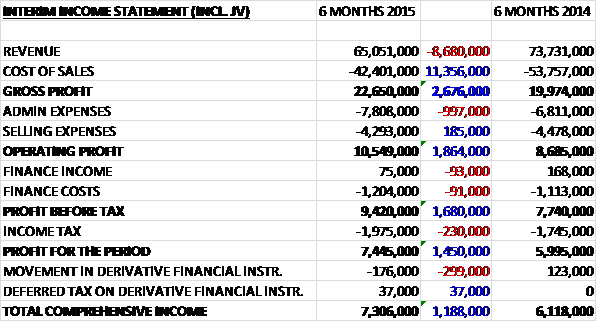
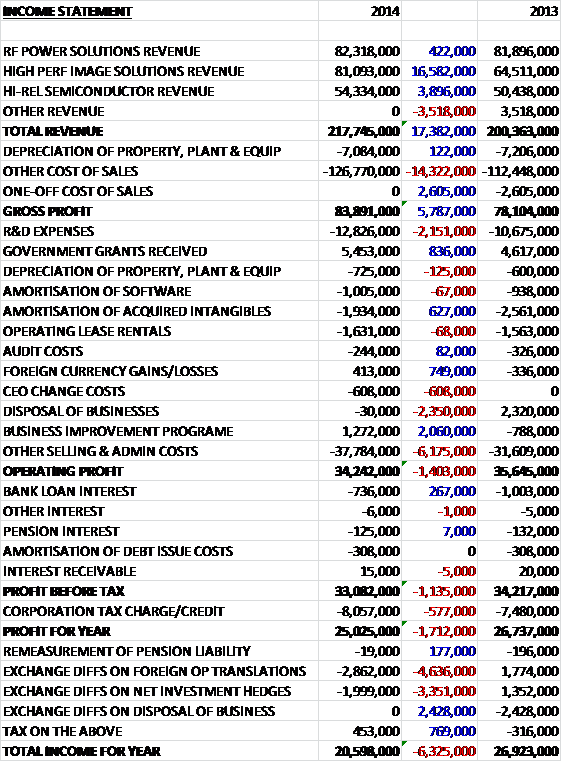
Total revenue increased by £17.4M, predominantly driven by a £16.6M hike in High Performance Image Solutions, somewhat offset by a £3.5M decline in other revenue relating to the lack of any property sales.  The increase in cost of sales , somewhat offset by the lack of the one-off costs (amortisation of acquired intangibles) that occurred last year, meant that gross profits were some £5.8M higher.  As far as operating expenses are concerned, we saw a £2.2M increase in R&D expenses, partially offset by an increase in government grants.  We also see the lack of a windfall from the sale of the business and a swing to a profit from the business improvement programme but a £6.2M increase in other sales and admin expenses meant that operating profit was £1.4M lower at £34.2M but a higher tax rate meant that the profit for the year was £1.7M below that of last year at £25M.
e2vassets

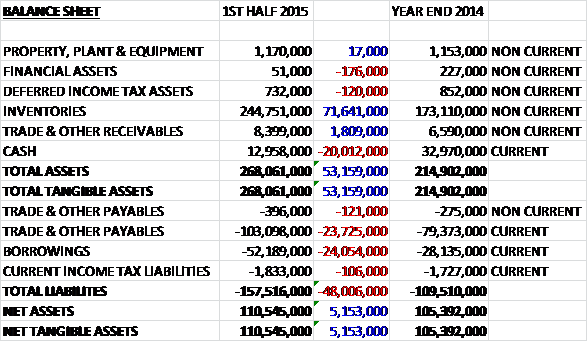
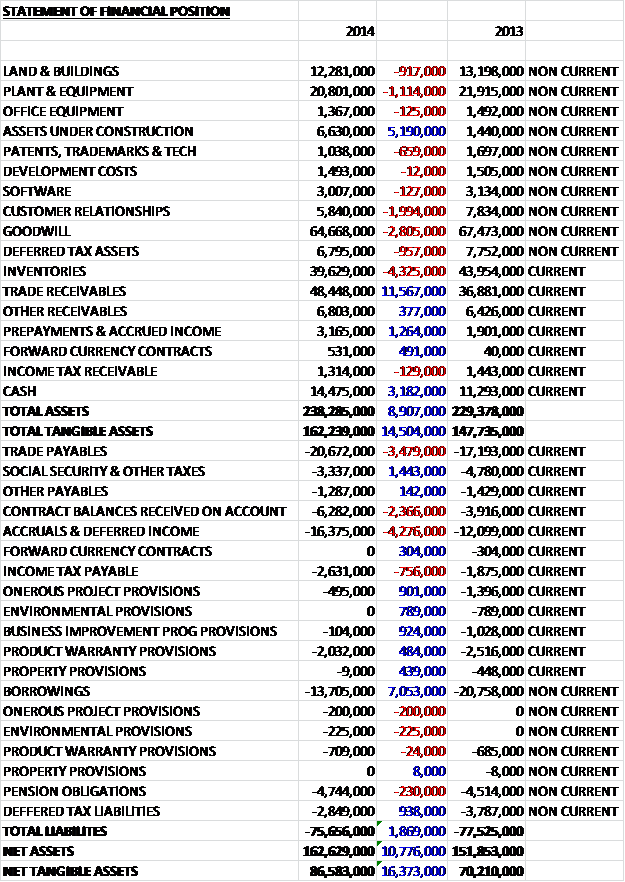
When compared to the end point of last year, total assets increased by £8.9M.  This was driven by a £5.2M increase in assets under construction, a £3.2M growth in cash and an £11.6M hike in trade payables, somewhat offset by a £4.3M fall in inventories driven by a £3.2M reduction in Space inventory due to the increased deliveries in that sector, a £2.8M decline in goodwill and a £2M fall in the value of customer relationships.  Conversely we saw total liabilities fall due to a £7.1M decline in borrowings and a decline in tax liabilities offset by a £4.3M increase in accruals & deferred income, a £2.4M growth in balances received on contract and a £3.5M increase in trade payables.  The outcome of all this is that net tangible assets increased by an impressive £16.4M at £86.6M.
e2vcash

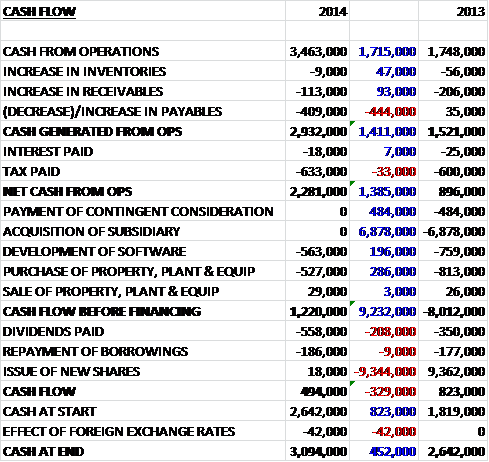
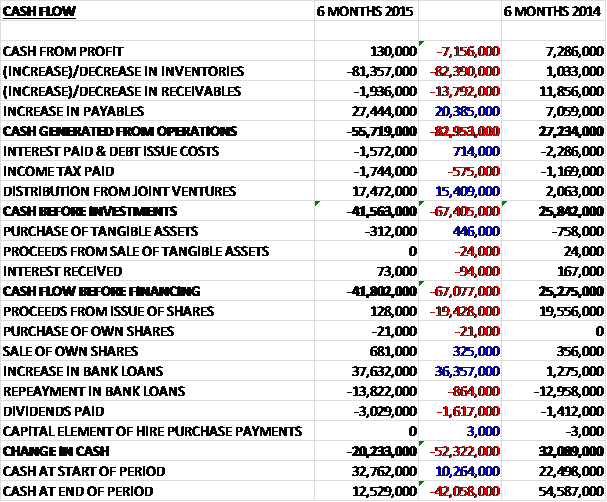
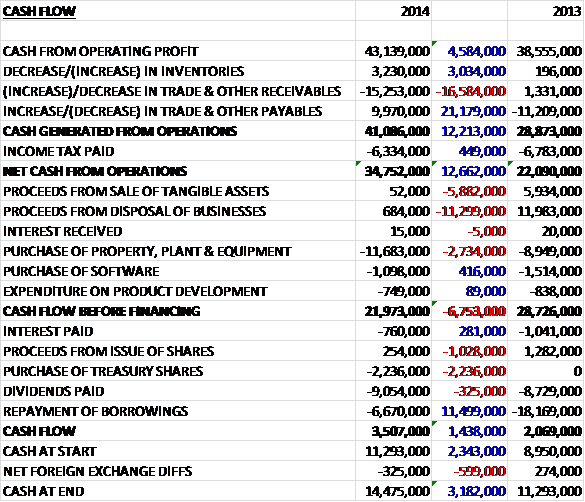
Before movements in working capital, cash profits were some £4.6M higher at £43.1M before working cap broadly cancelled itself out, although the swing in an increase in payables meant that cash generated from operations increased by £12.2M to £41.1M, which became £34.8M after tax.  The bulk of this cash, some £11.7M was spent on property, plant and equipment but the lack of the large one-off receipts from disposals that occurred last year meant that the cash before financing was down £6.8M at £22M.  Of this, £6.7M was spent on repaying loans, £2.2M on treasury shares and £9.1M on dividends and at the end of this there was still a positive cash flow of £3.5M so we can see that this business is very cash generative which is what I like to see.

Adjusted operating profits increased by 8% to £34.7M and represents a 15.9% margin, a slight fall on last year.  There was a stronger performance towards the end of the year, particularly in Q4 in Asian industrial markets; US defence customers, particularly for semiconductors; and UK space products.  There was also a steady growth in semiconductor activities, radiotherapy returning to growth in the second half after a slow start and new product introductions winning market share in professional imaging markets for industrial fire, security and medical.

As far as the group’s markets are concerned, key drivers in the medical and science sector are ongoing demand for spares reflecting growth in the installed user base and OEMs that are expanding their activities in Asia with increasing local competition.  The board estimate sustained growth in medical with government funding for scientific research remaining steady.  In Aerospace and defence there is increased demand for earth observation associated with climate change monitoring, space science and growing commercial aircraft production.  In defence there is a shift to platform life extension and upgrade programmes.  Electronic warfare and communications is receiving funding against an overall decrease in defence spending and there is a growing focus on semiconductor counterfeit and obsolescence management.  In Commercial and Industrial, capital investment remains subdued but there are opportunities in Asia and emerging markets for new product lines.

RF Power Solutions had an adjusted operating profit of £16.1M, a decline of £800K when compared to 2013.  The decline reflects the mix of revenue along with increased R&D activity. The order book at the year-end decreased by £8M to £100M due to the cycle of the multi-year radiotherapy contracts with delivery against the Accuray and Elekta contracts partially offset by the renewal of a three year contract with Varian.  There was also a reduction in the defence order book reflecting delivery on the key programmes.  In Radiotherapy the group provides RF power systems for the generation of high energy x-rays for the treatment of cancer.  They are the market leader in the supply of magnetrons, thyratrons, modulators and services.  The main customers are the radiotherapy OEMs such as Accuray, Elektra and Vairan.  Revenue in this market was steady reflecting some destocking by one of the major customers in the first half of the year before returning to growth in the second half.  In the coming years it is expected that spares revenue will grow in line with the past expansion of the installed user base.  Growth is expected to come from continued new build demand, accounting for about a third and the growing installed user base that accounts for the rest.

In Electronic Countermeasures the group provides technology for platform life extension programmes and upgrades to enhance capability and provide electronic countermeasure protection of high value air, land and naval assets.  These products are generally European made so not restricted under the US International Traffic in Arms Regulation, which is an advantage in international markets.  Key customers are the system level OEMs including BAE, EADS, Raytheon, Salex Galileo and Thales.  Revenue growth was driven by existing programmes including the ALE-55 programme for the F18 Super Hornet and the group has completed qualification for the MPM product for the SAAB Gripen.  Western defence budgets are likely to remain subdued but some decline in short term uncertainty has been observed in the US with a continued shift to platform extensions and upgrade programmes.

In Industrial processing systems the group provides microwave and RF generators for the processing of bulk materials with the current focus on mining.  During the year work was continued on the development programme with Rio Tinto covering the design and supply of large scale microwave and RF generators for improving the efficiency of mineral recovery.  Other applications include radar for commercial shipping and industrial applications such as industrial heating, induction and dielectric welding, lasers and cargo screening.  During the year the group completed the sale of the satellite communication amplifier business for a gain of £400K.  As anticipated, revenue for the remaining business was lower than last year due to a softer demand in industrial and end user markets.  Site restructuring programmes were continued in order to drive further operational efficiencies going forward.
AT32410_048_petite

High Performance Imaging Solutions had an adjusted operating profit of £11.2M, an increase of nearly £4M when compared to last year reflecting the revenue growth in machine vision, space and other applications that are mid-margin activities.  In the future additional resources in the space business will provide the step-up capacity to support new space programmes.  At the year end the order book fell by £2M to £61M reflecting the reduction of overdue deliveries in the space programmes along with the growth coming from businesses that have shorter order cycles.

In Machine Vision the group provides camera platforms for demanding automated optical inspection in semiconductor & electronics manufacturing inspection, food and beverage processing, ophthalmology and document imaging.  The end user markets are specialised inspection equipment suppliers including OCT/Ophthalmology Canon, Carl Zeiss, Meditec and Optopol.  There was strong revenue growth in the sector reflecting good customer demand in the first half of the year and a recovery in Q4.  Growth was driven by the take up of the new CMOS based line scan cameras which provide high speed sensitivity and high resolution for inspection applications.

In Space Imaging the group is a world leader in imaging sensors and sub systems for space and ground based applications including space qualified imaging sensors and arrays for space science and astronomy applications and high speed, high resolution sensors for earth observation satelites.  Increasing investment in monitoring climate change is a main driver for growth in demand for new observation satellite programmes.  The group is continuing to develop a CMOS based technology platform which is part funded by a £3.8M award from the UK regional growth fund.  In recent years E2V have won programmes both in the US and other space markets such as China.  Main customers for these products are worldwide space agencies including ESA, NASA, CNES and CAST as well as the prime satellite manufacturers such as Astrium, Ball Aerospace, Lockheed Martin and Thales.  The space imaging recovery programme has delivered growth throughout the year with a step up of activity in Q4 reflecting the delivery of milestones on a number of contracts.  The business will remain technically challenging but current growth is expected from new programmes currently under discussion with existing customers.

In Scientific Imaging the group provides high sensitivity, low noise sensors enabling scientific instruments.  The imaging sensors are used in spectroscopy, microscopy, crystallography, fluoroscopy and broad scientific imaging applications.  The market for these scientific cameras is highly concentrated with three manufacturers – Andor, Hamamatsu and Roper, all of which are customers of E2V.  The group has a significant market share in this area and revenue was steady with the current macroeconomic environment restricting government science spending.  Other applications include CMOS dental oral sensors, 2D barcode reading and thermal imaging products.  Growth has come from the dental sensors and new product introductions in thermal imaging with dental growth in Asia in particular as the group released a new product in China with Runyes, one of the largest OEMs in the Chinese dental market.  Thermal imaging is now a vital technology in firefighting, law enforcement and security and the group’s new hand held products are targeted at these markets, particularly in the US.  The group has also seen a good growth in demand for their industrial sensors from Honeywell and Datalogic.

Hi-rei Semiconductor solutions had an adjusted operating profit of £11.8M, a growth of £500K when compared to 2013.  This was due to higher revenues at incrementally higher margins and despite increased R&D activities in Grenoble, benefiting from a grant from the French authorities.  The order book at the end of the year fell by £1M to £23M with the order book for aerospace and defence semiconductors strong against a decline in the order book for the legacy smart sensor business.

In Aerospace and defence semiconductors the group acts as a value added channel partner, providing high reliability versions of their customer’s products in civil, space and defence applications.  Some of their clients include Freescale, Everspin, Maxim and Micron.  There has been good revenue growth and order intake as a result of Freescale’s end of life programme for the 603 family of microprocessors, where E2V has contracts supporting seven defence contractors that generated some revenue in Q4 along with a pick-up in demand in the US.   They also benefited from the start of programmes supporting product from their partnership with Micron.  In addition the group also provides customers with continuity of supply of over 4000 SMD components including many that have been made obsolete by their original manufacturers.  These components are generally sold to distributors Arrow and Avnet but there has been lower demand for them in the US, although some recovery was seen in the final quarter of the year.

The own brand high speed data converters are used for analogue to digital and digital to analogue converters for space radio frequency communications.  Some customers for these products include Boeing in the US and Thales in Europe.  There has been some growth in these converters into space programmes with two new programmes scheduled for delivery over the next two years.  Finally in this sector, the group offers outsourced assembly and test services to customers who do not have the in house capability to do it themselves.  Sales of this service have been lower during the year reflecting lower demand in customer’s end user markets.

Semiconductor Lifecycle Management supports platform life extension in aerospace and defence systems when components become obsolete during the lifetime of the system, extending the availability of obsolete semiconductors and providing customers such as Raytheon Space and European OEMs working on the Eurofighter Typhoon programme.  The estimated future revenues decreased by £4M to £20M with new programmes being offset by a reduction in future revenues on the Eurofighter Typhoon export orders.  Other applications are in the smart sensor market for industrial automation, industrial detectors, automotive safety, engine management and climate control.  When the group restructured their Grenoble facility it was decided that they would cease R&D work on these products and the revenue decline reflects the legacy nature of these lines.

The geographic spread of revenues is quite diverse with North America and Europe important markets and Asia Pacific becoming more important.  There is some currency risk, although not too much.  A 10% weakening in USD against the Euro would affect profits by £277K.  Other risks include political and macroeconomic conditions.  A number of the group’s products are for use in industries which are dependent upon and subject to government policies and budget constraints.  A reduction in military spending or a prolonged economic downturn would have an adverse effect on group profits.  Finally, about a quarter of sales relate to long term contracts on fixed prices so if performance costs come in a bit high, the contract could end up being unprofitable.

During the year the group continued its restructuring efforts but made an accounting gain.  This was due in part to the fact that staff who were initially supposed to be made redundant at the Chelmsford site were able to be re-employed in the high performance imaging business.  In Grenoble the group booked a £1M release of receivables provision.  During the year Alison Wood started as the new senior independent director and Steve Blair was appointed as the new CEO after Keth Atwood left having spent 15 years in the role.  Neil Johnson has now been Chairman for one year so this is a period of transition as far as management is concerned.

There is a solid order book but at £128M it was marginally lower than the £130M order book last year.  Apparently this is because the growth has been delivered to businesses that have shorter order cycles and the recovery programme at the space business has lowered the number of overdue orders there.  In all there was a solid order book for the semiconductor customers, full coverage from the radiotherapy customers and an active pipeline of opportunities in space and defence.  Going forward the group are focusing on areas that they see growth potential such as radiotherapy, imaging for industrial, medical, fire and security markets along with space applications and semiconductors but they are continuing to support customers in other areas such as industrial process systems and electronic countermeasures as they adopt to the newly developed products.

The board remain cautious about the broader economic environment and anticipate modest revenue growth over the next year.  They have indicated that they may consider some bolt on acquisitions if they become available.

At the current share price the group trades on a P/E ratio of 15.7 but this falls to a very cheap looking 9.6 on next year’s estimate.  Likewise after a 7% increase this year the shares yield a decent 2.4% at the current share price but this increases to a good looking 4.2% on consensus forecasts for 2015.  At the end of the year the group had a net cash position of £770K, a vast improvement on the £9.8M of net debt at the end point of last year and the group has quite a lot of headway, with revolving debt facilities of about £80M, although this is attracting non-utilisation fees.

Overall this was a pretty good set of results.  Although profits didn’t really romp ahead, underlying profits were fairly strong.  Net assets improved during the year and the balance sheet looks strong.  Similarly, although operational cash flow was up, the free cash flow was slightly lower due to the disposal that took place last year.  The group is very cash generative though and the move to a net cash position is welcome.  Going forward, management do seem a bit subdued, indicating just a modest revenue growth and the order book is somewhat lower than at the end point of last year.  The group does make exciting products, such as imaging for space programmes but it is the medical instruments that are probably has the best growth potential.  In conclusion I do like this company, and its products but I feel the outlook seems a bit subdued at the moment so I will keep watch but not buy any shares for now.

Sylvania Platinum Share Blog – Final Results Year Ending 2014

Sylvania Platinum is engaged in the extraction of platinum group metals, including Platinum, Palladium and Rhodium, from chrome dumps and current arisings, as well as investment in mineral exploration with all of the working operations being located in the Limpopo province of South Africa.  The group is listed on the AIM exchange and has now released its final results for the year ending 2014.

avonincome

When compared to last year, revenues increased driven by a $3.8M growth in sales at Tweefontein and a $3M increase in Mooinooi revenues, somewhat offset by small declines at Lannex and Doornbosch.  Direct operating costs also increased, including a $1M increase in staff costs but gross profit was still some $3.5M higher at $4.3M.  At the operating level, there were a number of one-off costs that affected performance.  There was a detrimental $611K swing in foreign exchange losses, a $1.6M impairment of exploration assets relating to the group’s Everest North porject and a $1.3M impairment of investments in associates relating to the 25% interest in the Chrome Tailings Retreatment Project.  In addition, last year there was a $9.9M gain on the disposal of a subsidiary, relating to the sale of the magnetite iron ore assets to Ironveld.  So despite other general costs falling by $1.5M the operating loss was a negative swing of $8.3M.  This was exacerbated by a more than doubling of tax charges relating to temporary differences in the value of property plant and equipment so that the loss for the year was $5.1M, a $9.5M reduction on the profit made last time, although it is worth noting that if we discount the sale of the subsidiary last time and the impairments, there would have been an improvement on 2013.

sylvaniaassets

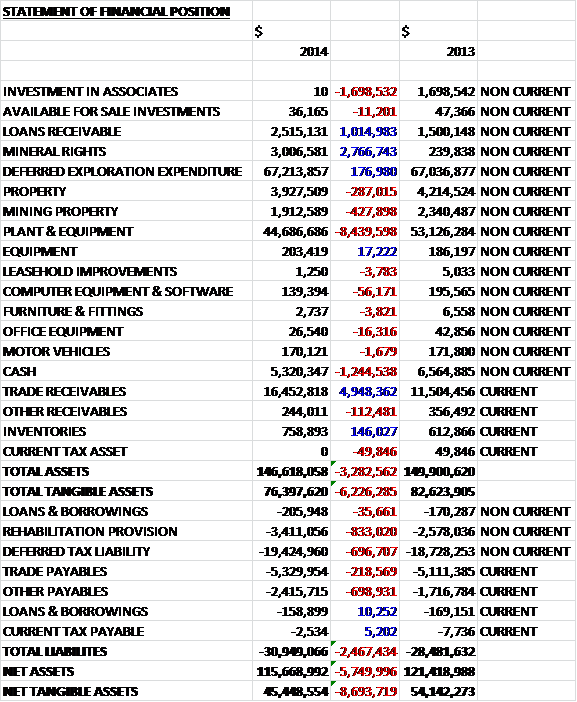
When compared to the end point of last year, total assets fell by $3.3M.  This was driven by an $8.4M decline in the value of property, plant & equipment, a $1.7M fall in investments in associates and a $1.2M decline in cash levels, somewhat offset by a $4.9M increase in trade receivables, a $2.8M increase in mineral rights and a $1M growth in loans receivable relating to a loan given to Ironveld.  Liabilities increased during the year, driven by an $833K increase in rehabilitation provisions, a $697K growth in deferred tax liabilities, which seems to relate to temporary differences in the value of property, plant & equipment, and a $699K increase in other payables.  The result was an $8.7M fall in net tangible assets to $45.5M.  This is a disappointing decline but the balance sheet seems to remain fairly strong.

sylvaniacash

Before movements in working capital, cash profits were some $3.9M higher than last year at $9M.  This was eroded by a large increase in receivables so that the net cash generated from operations was $1M higher at $5.1M.  This cash was soon swallowed up, however, as $1.2M was spent on property, plant & equipment, $3.5M was spent on exploration and evaluation and $1.1M was paid in loans to Ironveld which meant that there was a negative $453K cash flow before financing operations.  A small payment for treasury shares later allocated to senior managers and some loan repayments meant that the cash outflow for the year was $896K, a vast $6.9M improvement on 2013 and meant that the cash at hand by the end of this year was some $5.2M.

Profits at Millsell were $2.2M which was a $400K improvement on profits in 2013.  This is one of the most consistent production plants and increased production by 18% to 7,908 ounces for the year.  Recovery efficiencies were slightly lower, associated with the final scrapings of the Waterkloof dump but it was a combination of the improved plant feed grades and higher plant throughput rates that led to the production increase.  The second pass treatment of the 1MT primary dump is planned to commence in 2015 which should help maintain the consistency seen here at this mature plant.  The total cash cost at the plant fell by 4% to $516/Oz against a sales price of $970/Oz averaged across the group.

Profits at Steelpoort were $1.1M, a decent $600K improvement on last year.  This plant is still processing second pass treatment material from the old Steelpoort tailings dams and produced 7,751 ounces during the year which was a 12% increase on last year’s total and primarily due to an improvement in the recovery efficiency.  Next year the plant will continue to process the same material and aim to further increase recovery efficiency and feed rates. The cash costs were 12% lower than last year at $673/Oz.

Losses at Lannex were $689K, which was a deterioration of $544K when compared to the lower losses last year.  This was a challenging year for the plant with unexpected maintenance costs during the fourth quarter of the year and lower feed grades.  This operation treats a combination of dump material from the old Lannex tailings dam complex and current arisings from the host mine’s Lannex operation.  Despite the lower grades associated with the coarser outer walls of these tailings dams, the operation increased production to 8,028 ounces as the plant saw a significant increase in PGM plant throughput and a small improvement in recovery efficiency.  Plans for the upcoming year are to start second pass treatment of the new Lannex tailings dam and to continue to treat current arisings from the host mine.  Cash costs were 6% higher than last year at $725/Oz.

Losses at Mooinooi were $1.8M which was almost half the $3.5M of losses that occurred in 2013.  The Mooinooi dump experienced a few production issues throughout the year but still managed to increase production by 54% to 6,918 ounces due to a 32% improvement in PGM plant feed tonnage and a smaller increase in recovery efficiency.  In the second quarter there was a Section 54 stoppage notice at the plant which resulted in a 21 day production stoppage and various improvements in safety actions.  The plant treats material from the old Mooinooi dumps and current arisings from the host mine’s Mooinooi plant.  Costs for the year improved by 27% to $764/Oz.  The Mooinooi ROM plant was also affected by the Section 54 stoppage but production for the year increased by 27% to 4,953 ounces.  This plant treats MG2 material from the host mine’s Mooinooi and Buffelsfontein underground mines and the group achieved optimisation of a fine grinding toll milling circuit during Q3.  Despite a 17% fall in cash costs to $1,084/Oz, they remained higher than target levels and the reduction in costs per ounce is the priority for this plant in the coming year and achieving a higher plant throughput is seen as the best way of achieving this.

Doornbosch enjoyed profits of $3.1M, although this was some $300K less than last year.  This operation transferred focus in the second half of the year to treating lower grade second pass material from the old Doombosch dump together with final scrapings from the old Montrose areas and these sources are expected to be depleted during the first half of 2015.  High grade pockets of material have been uncovered with the final scrapings of the Montrose footprint, however, which already assisted in boosting production during Q4.  In all the plant produced marginally less than last year at 9,919 ounces but due to the new material being found, the plant had a record level of production in Q4.  The plant feed grade should reduce and normalise once the operation converts to a combination of full second pass treatment of the current Doornbosch tailings dam and current arisings from the host mine during the next six months.  The focus will be on increasing plant feed tonnes, improving grade and reducing chrome in concentrate in order to reduce smelter penalties.  Due to a significant maintenance repair costs following an abnormal breakdown in the primary mill during the third quarter costs increased by 8% to $516/Oz.

Tweefontein had profits of $610K, a very pleasing reversal of the $905K of losses that occurred last year.  The operation more than doubled production to 8,331 ounces due to a ramping up in production and higher stability after the plant commenced production in 2012.  The plant is treating fines from the host mine’s Klarinet opencast mine, current arisings from the host mine’s Tweefontein operations and old dump material from the Tweefontein paddocks.  The primary focus during the year was to stabilise production and to optimise recovery efficiencies with production levels expected to improve during the next financial year.  The upgrade to the power supply infrastructure eliminated the need to run the diesel generators for extended periods, which helped reduce the cost to $648/Oz.

The outcome for an application for mining rights at Harriet’s Wish, Aurora and Cracouw is still pending but following a decision to scale down exploration, only essential exploration activity has been conducted with no further activities envisioned in the short term.  An environmental impact assessment was submitted to the MRA on Volspruit in January and a flood event at the river was witnessed in Q3 which provided essential data that backed up a report from the environmental assessment practitioner that the proposed activity does not pose any significant risk to the environment that cannot be managed through mitigatory measures and therefore the EAP recommended that the project proceed with a decision from the DMR regarding mining rights imminent.

As part of the Volspruit project, the company purchased the surface rights to the Grasvally and Zoetveld farms adjacent to Volspruit in 2013 and in 2014 entered into an agreement to purchase the prospecting rights over this land for a consideration of $2.5M.  Surface exploration of the Grasvally upper chrome seam outcrop have indicated Cr2O3 values of 46.4% Cr2O3 in situ with a chrome iron ratio of 2.45:1 but further studies suggest that the main seam may be upgraded to 55.5% Cr2O3 with 62% recovery after only one washing pass but tests also suggested that the crown pillar in some of the previously mined areas is shallower than first expected.  The company has commenced with exploring the application for a mining right on the property and has spent $250K on the project so far, not including the acquisition rights mentioned above.  This is a brownfields site that was originally closed in 1988 but the high quality of chromite means that the project is expected to not only pay for itself but in the long term should also provide significant PGM resources.  In a best case scenario, management consider the group to be at least two years away from being able to start construction.

As we have seen there was a $1.3M impairment of the group’s 25% investment in CTRP as the plant is on care and maintenance and no agreement has been reached to restart the operation.  This means the carrying value of the investment is now zero.  There was also a $1.4M impairment of the group’s Everest North project.  This is a joint project with Aquarius Platinum and the viability of the project depends on the operation of their Everest South processing plant which was placed on care and maintenance in 2012 with no apparent plans to restart the operation.  The carrying value of this asset is now zero.  Finally, there was a further $181K impairment on a prospecting right that expired and was not renewed.

During the year the platinum price has been muted due to excess stocks being held due to the ongoing strike actions.  Into 2015, prices have been weak and the situation could continue for some time as improving automotive demand slowly draws down the excess stocks.  The palladium market has powered ahead due to improved automotive demand in North America and Asia.  It is thought that ongoing strike action could cause the mothballing or closure of some mines which may result in a tighter market that would bode well for platinum prices.

ops_map_new_small

The group is heavily reliant on two customers which together make up over 99% of total sales with has clear risks attached to it.  Another thing to be aware of is that repatriation of funds from South Africa is subject to regulatory approval.  Another risk is the susceptibility to currency changes with a 15% appreciation of the Aussie dollar against the South African rand giving the group a $964K loss.  Clearly one of the main risks, however, is the exposure to commodity prices, in particular Platinum group metals which the group does not hedge against.  A 10% fall in PGM prices would result in a $763K loss with a 10% appreciation giving the profit of the same value.

Other risks more specific to the company include the fact that the retreatment of dump material has a finite life and it is essential to for the long term continuation of operations that additional feed material is found and committed to the plants.  Also, South Africa has experienced continuing problems with strikes.  There was a five month strike in the first half of the year and despite no employees of the group being involved, the effects of the strike were far reaching.

During the year the group received notification that Platmin had removed the summons for hearing due in August 2014.  Platmin claims co-ownership of the tailings contained in the Lannex dam.  A similar case has previously been brought that resulted in the claim being withdrawn and Platmin paying all costs.  The withdrawal this time is expected to be temporary and it is thought Platmin still intends to proceed at a later date.

Going forward the board is confident that as a low-cost producer the business will continue to perform despite adverse economic circumstances with focus in the upcoming year on free cash flow generation and maintaining the consistent production of 53,000 PGM ounces during the year, a similar level to this year.  In addition, the board are investigating the possibility of returning capital to shareholders through a dividend policy barring any negative changes in the Platinum or Rhodium price.  The management have also stated that they are not looking to tap up shareholders for capital or take on any unwarranted debt in this climate so will probably spin off or enter into a joint venture over the Grasvily project.

As the group suffered a loss this year, the P/E ratio was -7.7 but on next year’s forecast it is a very cheap looking 5.8.  The dividend yield for next year being forecast by WH Ireland is about 4.2% which doesn’t sound too bad.  This was a mixed set of results for the group.  The fall in profits is due to one-off items and now that some of the low quality assets have been impaired, perhaps this will draw a line under them.  The knock on effect is the declining net asset base, predominantly due to the fall in the value of property, plant and equipment although the balance sheet is steel relatively strong.  Operational cash flow improved but there was no free cash flow after capex was taken into account.  It should be pointed out though, that this would not have been the case if it weren’t for the exploration costs that the board are stating is unlikely to repeat.  Once the problems are sorted out at Lannex and Mooinooi and the exploration costs come down, I can see performance improving here.  Risks remain, however, as the price of platinum seems to be subdued by higher supply and the threat of strikes in South Africa continues to loom.  I will keep watch here but this seems a bit risky for me at present.

On the 7th November the group released an update.  The Sylvania Dump Operations (SDO) exceeded expectations over the last 18 months, with six consecutive quarters of continuous growth.  Increased production levels and technical focus, combined with specific improvement initiatives across all operations, contributed towards this.   A project to move from mechanical mining to hydromining at all plants will improve feed stability to plants and to reduce mining costs going forward.  This project commenced in August 2014 with completion expected by the end of Q2 2015.  The company has signed a new offtake agreement for the concentrate produced by the SDO and improved terms were secured going forward.

The Company also announced that it has received permission to remove and dispose of a bulk samples of Chrome recovered in the course of prospecting operations on the Grasvally and Zoetveld properties.  Based on the high chrome to iron ratios found during the initial exploration phase of the project, the Company believes that the test work to be done on the ore removed by the bulk sample will prove that the chromite is of unusually high quality by South African standards.  In summary, the combination of the stable production profile, improved offtake and Section 20 permissions results in the Company having an improved outlook for the financial year which sounds pretty good to me.

On the 30th January the group released a statement covering Q2 trading.  After a good Q1, the ounce production declined during the second quarter but still exceeded the business plan production for the period.  This reduced production was due to the start-up of hydro mining as well as the planned holiday shut down during the Christmas period.  Overall, 14,701 ounces were produced and group cash costs were $691/Oz, an increase of 21% on last quarter, largely as a result of converting all operations to hydro mining.  The price of the PGMs was pretty much at $893/Oz but revenues only fell by $11% to $13M due to improved concentrate sales terms negotiated during the period.  The cash balance stood at $7.8M, a $1M increase on the previous quarter and about double the level this time last year.  Despite the short term increase in costs, the change-over to hydro-mining is expected to reduce mining costs by 20% going forward.

During the year the Lannex, Doornbosch and Steelpoort plants all suffered lower PGM feed tonnes and recovery efficiencies which was mostly attributable to the change to hydro mining but also the final scrapings at the current Steelpoort dump.  After corrective measures have been put into place, the operating performance at these sites is expected to return to normal levels in Q3.  The company continues to wait for the outcome of the application for mining rights at Volspruit but they are commencing with the public participation of the water use license application.  At the Grasvally Chrome exploration site, testing and samples removed will be used to further prove the high chrome to iron ratios of the orebody and further exploration will consist of a drilling programme in the north of the property for a near surface resource and additional drilling will be performed to categorize the deeper underground resources.  Overall this was a decent update but I still feel there are too many risks at this time.

Sylvaniachart

As we can see, the chart looks a little volatile but the company does seem to be starting to improve from the lows in September, as seen by the gentle incline of the 200 day moving average.  Both the share price and the 50 day MA are above this marker which suggest the group may be over the worst.

sylvaniachart2

A look at the longer term chart shows rather a different story.  This share has been through some tough times but does seem to have leveled off.  I think I would like to see some evidence of a more sustained upturn before buying though.

Amino Technologies Share Blog – Final Results Year Ending 2014

Amino Technology is a company specialising in IPTV software technologies and hardware platforms that enable delivery of digital programming and interactivity over IP networks. They provide set top boxes to the industry and their products are deployed by worldwide network operators and service providers. Revenues are principally derived from the sale of IPTV set top boxes and associated customer support services. They are listed on the AIM exchange and have now released their final results for the year ending 2014.

aminoincome

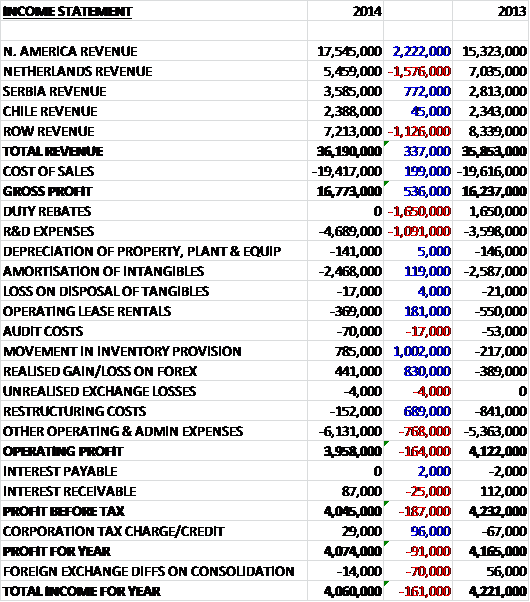
When compared to last year total revenues were £337K higher, driven by North America and Serbia, somewhat offset by reductions in Netherlands and ROW sales due to difficult conditions in Western Europe. Cost of sales were also somewhat lower so that gross profits were £536K higher at £16.8M. R&D expenses increased by £1M as less expenditure was capitalised but there was a reversal with regards to inventory provisions. Other operating costs were also some £768K higher and there was the lack of the duty rebates that occurred last year but restructuring costs were some £689K lower so that operating profit fell by £164K. There was then slightly less interest receivable, offset by a corporation tax rebate so that the overall profit for the year was £4.1M, a decline of £91K when compared to 2013, although those duty rebates last year were the underlying cause of this fall.

aminoassets

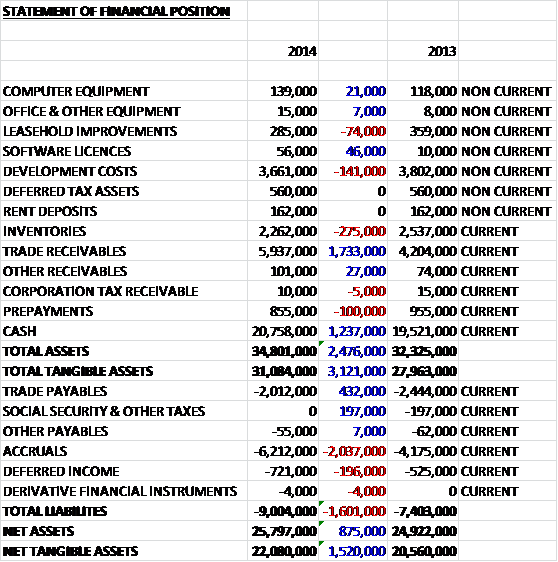
When compared to the end point of last year, total assets were some £2.5M higher. This increase was driven by a £1.7M growth in trade receivables and a £1.2M increase in cash, only partially offset by a £275K fall in inventories. Liabilities also increased during the year as a £2M increase in accruals was partially mitigated by a £432K fall in trade payables. In all, net tangible assets were £1.5M higher at £22.1M. In addition there was £1.5M of operating lease liabilities not on the balance sheet but this doesn’t make much of a dent in the net asset level.

aminocash

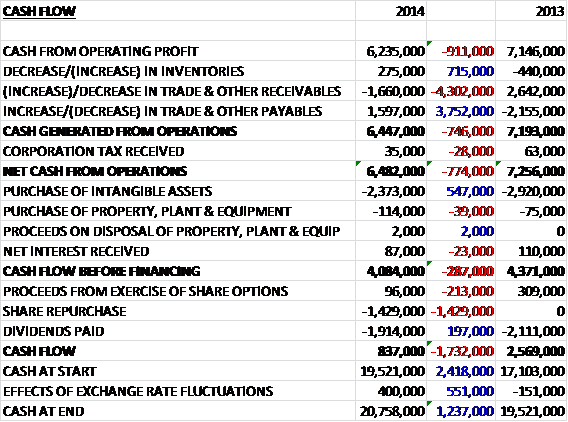
Before movements in working capital, the cash profits fell by £911K to £6.2M before payables and receivables broadly cancelled each other out so that net cash from operations was some £774K lower at £6.5M. The bulk of this cash was spent on intangible assets with a small amount on the purchase of property, plant and equipment so that free cash flow was down £287K to £4.1M. The group spent this fee cash on dividends and a share buy-back programme which still left a cash inflow of £837K, added to the big £19.5M cash pile at the beginning of the year. Despite the decline, the group is still pleasingly cash generative.
The move towards Internet Protocol as the means of delivering multiscreen services to customers is changing the entertainment service delivery industry, particularly in the cable TV market. In addition, the move towards 4K Ultra HD TV delivery is gathering pace and creating opportunities for the group, although mass market take-up will not likely be achieved before 2018. The group’s markets are evolving quickly as the way entertainment is consumed reshapes the operator strategies but operator demand for simple, reliable IPTV devices remains strong, particularly in emerging markets although they are looking for higher performance devices that blend IPTV with OTT content delivered over the open internet along with a greater demand for the “internet of things”.
Some new products include the integration of Youtube, achieved after the year end and the addition of the company’s new app store. A new service layer based around home monitoring and control was also launched towards the end of the year called Home Reach. This service uses cameras, door and movement sensors to enable users to monitor their homes using their smartphones and customer interest has been high with a few early stage trials underway. New opportunities in the pay TV industry are also emerging with the wider industry transition to IP as the means of delivering multiscreen and connected home services presents new opportunities for the group in different markets and analysts see the entire industry moving to IP for service delivery after some satellite and cable operators have already begun to add IP based services to their offerings. Another product opportunity is the delivery of HD services at much slower network speeds than previously experienced.
In North America the company achieved decent revenue growth. The launch of the Live Advanced Media Platform was well received with contracts secured with ITC and C-Spire, which in the case of the latter is a company that has recently transition from a mobile services provider to a fibre based delivery model encompassing broadband, telephony and entertainment services. This trend was echoed the Middle East where Turkcell deployed the platform as part of its multi-service broadband, mobile and entertainment offering.
The company received solid demand for its lower spec product in Latin America and Eastern Europe where new contracts were secured in Argentina where de-regulation is opening up the market for operators to deploy IPTV services and a new contract was secured with the leading Albanian operator. The new A150 device was taken on by a long established operator in the Latin American market as a replacement for their existing Amino product and in the Caribbean the group secured a contract with LIME, part of the Cable and Wireless group, for the provision of devices for a service rollout across a number of territories.
Western Europe was a challenging market during the year with a combination of economic uncertainty and market saturation in certain territories. A key customer in the Netherlands re-entered the market towards the end of the year, placing new orders for the new A150 device and another operator in the Netherlands is now deploying the group’s new Timeshift pause live TV solution which is a USB flash drive that enables users to pause and rewind live TV.

ARM_Powered_Product_-_Amino_Technology_AmiNet125_STB_Large_Version
A new VP of global sales and new specialists on the sales team has given it sharper focus on customer engagement which is feeding through to an upturn in tender activity through the second half of the year and stronger lead generation. It seems like the Chinese venture is at an end with the office closed and functions being moved back to the UK.
The group is somewhat susceptible to changes in exchange rates. A 5% strengthening of Sterling against the US Dollar would have an adverse £200K effect on post tax profit whereas the same change of the currency against the Euro would not have an effect. There are three customers that account for more than 10%of revenues. One US customer accounts for a whopping 29% of sales with another one making up 15%. There is also a Dutch customer who accounted for 11% of turnover and sales to this customer seem to be declining. It seems that the group is very reliant on just a few clients which is a potentially dangerous place to be. One other thing that I have noticed is that there seem to be quite a lot of receivables that are overdue and in fact 18% of all the group’s receivables are past the due date which is something that the company might want to take more control of as none of them were covered by credit insurance.
As already seen there were a number of one-off costs and rebates. This year the restructuring costs related to the closure of the Chinese office whereas the higher costs last year reflect the closure of the Swedish office and some additional reorganisation in the UK as the group concentrated its R&D facilities in Cambridge. Last year the group received two rebates in respect of duties paid on previously recognised international sales. In addition the group has received a further favourable ruling with respect to duties rebate at a tax tribunal, HMRC appeal not withstanding, that could realise a cash receipt of about £700K next year.
Going forward the board expects the new enhanced portfolio will increase the company’s addressable market to build on the trends seen in the second half of 2014 and should contribute to revenue growth in 2015. In addition they continue to evaluate options to broaden the company’s position in the wider IP market pace and that the outlook for 2015 seems positive.
At the current share price the underlying P/E is standing at 16.6, reducing to 16 on next year’s forecast and the shares yield 3.8% in dividends, representing a 45% increase year on year. The pay -out increases to 4.2% on next year’s forecast. The board is committed to using that big cash pile to grow the dividend by 10% or more per year for the next two years.
Overall this seems to be a decent update. Although profits are pretty flat, this does reflect one-off charges and rebates and the underlying profit is actually up on last year. The balance sheet seems very healthy with net assets increasing somewhat as a higher number of orders in the second half increased the amount of trade receivables on the book. Cash generation was also strong, although it did decline at an operational level, with the cash pile pretty massive. The new products seem interesting and it appears the group has a few exciting new opportunities in what is a fast growing market. Given the cash levels, the P/E ratio is not high and there is a decent yield on the shares. The only thing holding me back is the reliance on a small number of major customers but despite this I will probably look to buy some shares in this company.

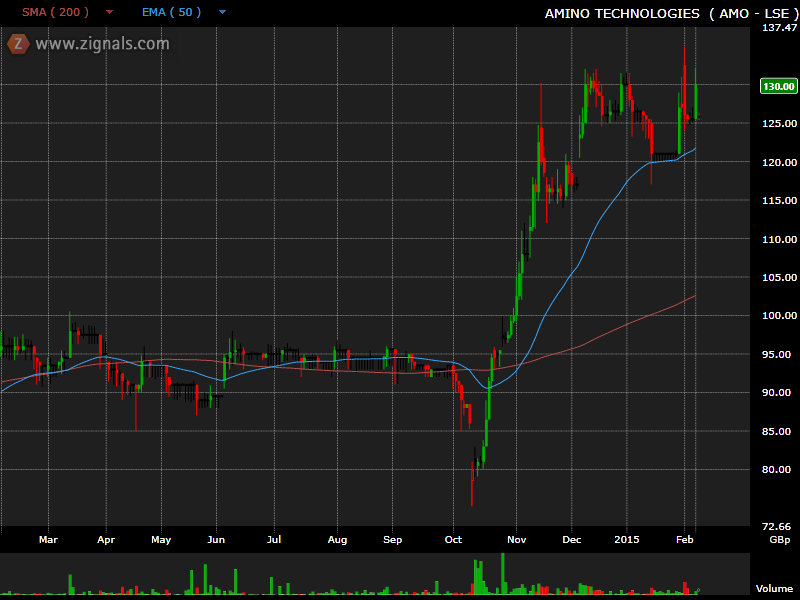
aminochart

Looking at the chart we can see the share price has recently improved so is this trend continues it may be a good time to buy the shares.

On the 24th February the group announced that it had received a rebate of £700K relating to duties paid on historic international product sales.  This was expected but nice to see the confirmation nonetheless.

On the 5th March it was announced that Donald McGarva, CEO, has purchased 10,701 shares at a cost of just under £15,000.  Whilst not a large buy for someone who owns £438,000 of the share capital, it is still good to see director buying when it is not forced upon them by poor share performance.

On the 23rd March it was announced that Schroders had sold 663,419 shares in the company at a value of about £925K. While disappointing, they still own just under 13% of the share capital.

On the 20th May the group announced the acquisition of Booxmedia for an initial consideration of €7.9M.  Booxmedia was founded in Finland in 2009 and is a software as a service cloud TV platform provider.  Its core product suite enables operators and service providers to launch TV Everywhere services using an off the shelf cloud platform, removing the need to build their own bespoke technology infrastructure.  Booxmedia customers can provide their subscriber base with pay-TV features such as DH quality streaming of live TV; access to catch up TV, video on demand and cloud based recording; playback of content that can be started on one device and finished on another; and functionality that turns a mobile device into an intelligent remote controller for internet connected TV screens.  Existing customers of the group include quad play operator DNA that offers a TV everywhere smartphone and tablet service based on the Booxmedia platform.

The acquisition will enable Amino to offer solutions to new customer segments including mobile operators, OTT service providers, media companies and broadcasters alongside its current fixed line telecoms operator customers and should provide a number of cross selling opportunities.  It will also strengthen Amino’s core IP entertainment software capabilities which will now extend to include IPTV devices, mobile devices and the cloud.  The initial consideration will be satisfied with €7.2M cash and €700K in Amino shares and will be funded from existing resources.  Additional consideration of up to €2.6M, shared equally between cash and shares will be payable based on future performances up to the end of 2017.Booxmedia’s revenue and EBIT last year were €1.4M and €200K respectively with about 54% of recurring revenues.

This does seem like a good opportunity for expanding both services offered and the customer base and looks to me like a good use of that massive cash pile, although it could be argued that the acquisition is not cheap based on the EBIT performance of Booxmedia last year.

On the 4th June the group released a trading update covering the first half of the year and it expects both revenue and pre-tax profits to be ahead of last year.  The net cash balance currently stands at £16.8M compared to £19.7M at the end of the first half of last year even after £5.2M of cash was used to acquire Booxmedia.  The company expects the second half weighting of revenues to continue this year and is confident that the results for the year as a whole will be in line with expectations.  Good progress has been made in Western Europe and North America in particular where performance has been consistently strong during the period and momentum in new markets such as the Middle East and Africa has been encouraging with good traction and initial orders achieved.  The board is recommending an interim dividend of 1.265p per share, a 10% year on year increase and representing a rolling annual dividend yield of 3.7%.  So, overall this is a steady rather than spectacular update in my view.

Avon Rubber Share Blog – Final Results 2014

Avon Rubber is a design and engineering group specialising in two core markets; Protection & Defence and Dairy.  They are a recognised market leader in Chemical, Biological, Radiological and Nuclear respiratory protection systems serving the military, homeland security, fire and industrial markets.  In dairy, they manufacture liners and tubing for the milking industry.  A niche market seems to be the supply of hovercraft skirting assemblies, fuel storage tanks and water storage tanks to the US Army and Navy.  The group is part of the FTSE small cap index and they have now released their final results for the year ending 2014.
avonincome

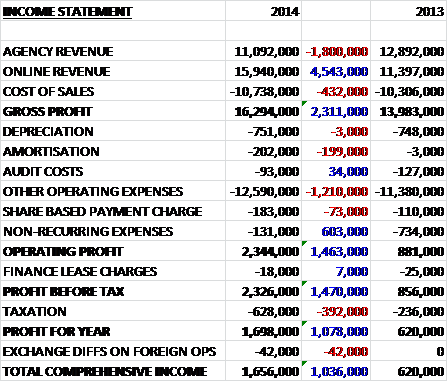
When compared to last year, revenues were broadly flat with a small fall in protection and defence revenue, despite a £2.4M increase of customer funded R&D being included in the figure.  This fall was offset by a small increase in dairy sales although these revenues show the adverse changes in currency exchange rates as at constant exchange rates revenues would have increased by £5.6M.  Costs of sales fell considerably during the year, however, to give a gross profit some £7.8M higher.  There was also a big fall in transportation expenses but a £1.6M increase in exceptional costs relating to the relocation of the Lawrenceville facility and consolidation of US operations, and an increase in other costs in general meant that the operating profit was £1.3M higher at £14.3M despite the £800K effect of currency headwinds.  There were modest declines in all of the finance costs and there was a more favourable geographic mix as far as tax was concerned so the total profit for the year was £10.8M, a £2M increase on the outcome in 2013.

avonassets

When compared to the end point of last year, total assets were just £409K higher.  The increase was driven by a £2.7M hike in cash levels and a £747K increase in development expenditure capitalised, partially offset by a £1.4M decrease in trade receivables, a £516K decline in plant and machinery and a £487K fall in inventories.  Liabilities fell during the period due to an £11.1M fall in the bank loan, a £3.7M decline in trade payables and a £3.1M decrease in other payables, somewhat offset by a £7.6M jump in accurals & deferred income, a £4.8M increase in pension obligations and a £1.2M growth in provisions relating to the cost of consolidating the four US sites into three after the expiry of the lease on the Lawrenceville facility.  The result is a net increase in assets of £4.3M to £25M.  There were £11.8M of non-cancellable operating leases not included in the above balance sheet, a fall of £1.8M on last year.

avoncash

Before movements in working capital, cash profits were some £1.5M higher at £21.3M.  Favourable movements in all parts of working capital meant that cash from operations was £10.2M higher at £25.5M, although part of this was due to a £3.5M accelerated payment from a major customer before their financial year end.  Slightly more tax than last year meant that net cash from operations was £21.8M, an increase of £9.7M.  About £3.8M of this cash was spent on tangible assets and another £3.1M on development costs and IT.  The resulting free cash flow of £14.9M was some £14.3M higher than last year.  This was used predominantly to pay off all of the bank loans with another £1.4M used for dividends.  The resultant cash flow was £2.7M compared to a neutral position last year.  This really was a good performance and now that loans are paid off, there should be great scope for acquisitions or increased dividends going forward.

Protection and Defence profits were £11.3M in 2014, an increase of £1.1M on last year.  The order intake during the year was £93M with increased orders from the DOD, EMEA and North American customers.  The long-running DOD M50 mask contract is now in its seventh year (of ten) and 168,000 systems were supplied during the year (which relates to sales of £34M compared to £45.2M last year) and due to the high order intake of mask systems, they enter 2015 with an order book covering the first half of the year sales at a slightly accelerated rate.  Follow on orders are expected in the first half of next year as 2015 budgets are released.  The filter requirement has less visibility but it is expected that this consumable item will be a good source of repeat revenue in the long term as more masks enter service.  During the year the Joint Service Aircrew Mask programme design, development and testing work progressed well.  This $6.7M development contract is due to finish at the end of 2015 and should lead to a production contract worth up to $74M.

Sales to law enforcement and non-US military increased from £25M to £31M and the group won an industrial order in the final quarter for 27,000 escape hoods of which the majority will be delivered next year.  Sales to the fire market were flat in the first half of the year as buyers held off ordering until the delayed NFPA standard was released.  The Deltair SCBA was designed to meet these new US standards and to enhance operational performance and it has been well received in early customer trials with orders received for 600 units that were carried forward into next year.

The newly developed Emergency Escape Breathing Device received NIOSH approval to the new standard with Avon being the only manufacturer to achieve this.  The product has applications on board navy ships and in the mining sector and the US Navy has an open solicitation to replace its ageing installed base which the group expects to respond to in early 2015.  The non-DOD side of the business includes the North American first responder market and the Rest of the World military and law enforcement market, both of which are being driven by an increased need to provide improved protection against growing global CBRN (Chemical, Biological, Radiological and Nuclear) threats.  Competition in the fire market is intense and at present the new Deltair self-contained breathing apparatus is one of three approved to the new standard and has been well received in the market which the group anticipates will help it improve market share in this area next year.

In non-US markets, the CBRN respiratory protection device is building business in South America and the Middle East and the group have started to make progress into new markets such as the oil and gas sector and the broader industrial sector is seen as an opportunity for growth.  In total sales in the ROW market increased by 26% which is a helpful improvement in diversification.  Eleven new products received regulatory approval during 2014 and a pipeline of further products has been submitted for approval in 2015 which should deliver further product launches.

fm53

Dairy profits were £5.7M in 2014, an increase of £520K when compared to last year.  Sales in the Dairy business have become less dependent on OEMs in recent years as the group continues to grow their higher margin own brand Milkrite products and the proportion of revenue made up of OEM customers has fallen from 47% to 31% in four years.  Market conditions improved during the year with milk prices and feed costs returning to more normal levels and demand for the consumable products was generally at a higher level than last year.  The industry seems receptive to new products and the new Impulse Air product has gained a 21% market share in the US.  A new product that is being launched is the Cluster Exchange Service.  Under this programme farmers outsource their liner change proves to Avon who handle all aspects of this process.  So far it is servicing 887 farms, ahead of initial expectations and the service has the potential to grow significant recurring revenue streams in the years to come as more farms sign up.

The group see a huge potential for their dairy products in emerging markets, particularly in the BRIC nations as the growing demand for animal protein in diets has led to an increased demand for dairy products, driving demand for the group’s consumable product.  A sales and distribution facility was established in China during 2012 and in the first half of 2015 the group expect to open a similar facility in Brazil which is another exciting market.  In the US the Milkrite brand has a 40% market share with Impulse Air having a 21% share.  In the EU the market shares are 16% and 2.5% respectively whilst in China contracts have been secured with the country’s largest milk suppliers and distributors, Mengniu and Yili.  After a soft first half in China following the contaminated milk scandal in the country and an outbreak of foot and mouth, volumes returned to expected levels in the second half

Some of the new products included AvonAir, a new range of powered air purifying respirators; the M62 filter supplied to the DOD and designed to cover a wider variety of threat scenarios; Delatair, the new fire service offering that was launched to the market in the second half of 2014; EEBD, an emergency escape breathing device which has military applications on board ships along with additional mining applications.; HMK150 Helmet Mark Kombination that was launched in 2014 and became the first product to meet a new German police standard for respiratory protection; and further development activity is expanding the respiratory product offering in the aerospace market and underwater diving market.

In the Protection and Defence business the US DOD accounted for £43M of the total revenues which is the equivalent of a staggering 35% of sales.  Clearly the group is very reliance on this one client which does represent a potential risk going forwards.  Also, the bulk of sales are made in the US in general, making the group susceptible to swings in the USD/GBP exchange rate and a 5c change in the exchange rate would have a £415K impact on profit before interest and tax.  The pension scheme is another potential banana skin but the group currently have the deficit under control and will make recovery payments of £300K in addition to £250K towards scheme expenses next year with total payments increasing to £675K in 2016, and £700K in both 2017 and 2018.  Other risks to look out for are problems or delays in obtaining regulatory approval for new products and any potential increase in animal feed prices or a fall in milk demand.

During the year the group acquired VR Technology for total consideration of £833K, £300K of which is deferred with £200K of this contingent on certain performance conditions.  There was a £63K payment of goodwill, although the intangible assets were valued at £923K.  The company designs and manufactures diving rebreather systems and dive computers.  The relatively low tax rate is because the group only currently pay tax in the US as in the UK they are still utilising tax losses and have unrecognised tax assets amounting to £1.4M still to be used.  It was announced that non-executive director Stella Pirie will stand down at the AGM after completing a 10 year stint and a recruitment process to find a replacement in underway.

Going forward, the outlook for next year seems positive.  The DOD contract gives good visibility to earnings and the board expect to see growth in the fire and industrial markets.  In the dairy business, they expect to see growth from the investments made in China and Brazil and from the Cluster Exchange Programme.

The shares are not cheap on a P/E basis as they are 22.7 at the current share price, although this does fall to 17.6 on next year’s estimate which given the quality growth story doesn’t seem too bad.  The shares yield 0.7% after a 30% increase in the final dividend, rising to 0.9% on next year’s estimation so at present I could not consider them an income story.  At the end of the year the group is in a net cash position of £2.9M which is clearly very favourable compared to the net debt of £10.9M the group had this time last year and really gives the group some freedom to invest or return some cash to shareholders.

Overall then, this is a good set of results. Profit are up, as are net assets but it is the cash flow and elimination of debt that makes this quite exciting.  If cash flows are similar next year, there will be a lot spare to invest where management sees fit.  I do think the reliance on the US DOD, although it does give good visibility to earnings in the short term, has the potential to be a problem and I am not sure what happens when the 10 year contract runs out (we are now in year seven).  The new products do sound exciting and the push into emerging markets with the dairy product has the potential for a good growth story, although I suspect things will not completely run according to plan – they never seem to in China.  Altogether though, this seems like a good, strong company and I will look to enter at a suitable point.

On the 23rd January the group released a statement that informed the market that the company’s own pension trustees had sold 194,495 shares, equivalent to about £1.4M.  This now means the trustees have less than a 3% stake in the business which is hardly a ringing endorsement of the value of the shares!

On the 29th January the group released an AGM statement covering the first quarter of the year.  Trading was in line with board expectations and the group was strongly cash generative with a net cash position at the end of Q1 of £6.4M.  In Protection and Defence, the focus, as planned, has been on fulfilling the orders for the DOD and this is likely to continue for the rest of the half year.  There is a high level of quotes out for the higher margin export military masks but the timing of order receipts remains unpredictable.  There was a year on year growth in the fire service products and the level of enquiries for the new Deltair unit has been strong.  The positive momentum in the Dairy business has continued into the first quarter with trading being very strong.  The take up of the Cluster Exchange service has been encouraging in North America and Europe and the Brazilian facility has been set up.  All in all this is an excellent update and I will definitely be looking to enter here.

avonchart

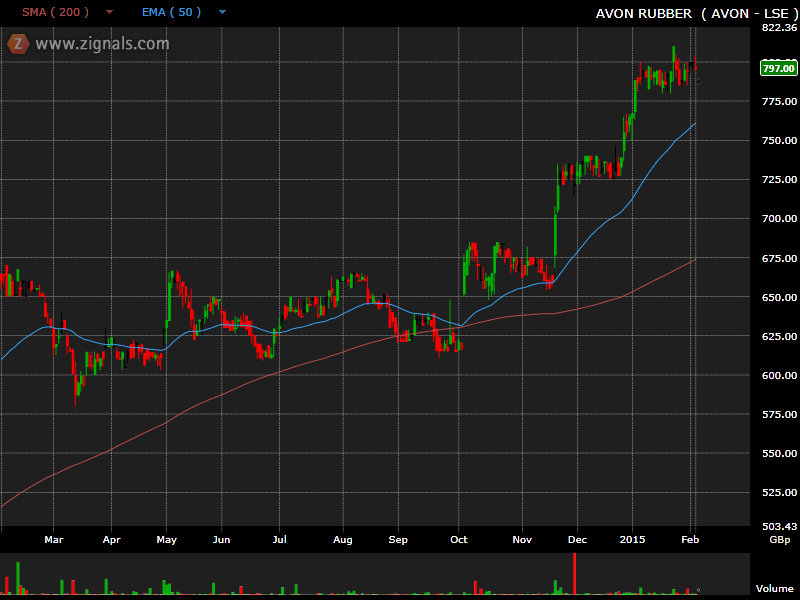
The chart for Avon looks pretty good, after a year or so of consolidation, the shares seem to be on a bullish run again having set a new all-time record high in late January.

On the 17th February the group released an announcement that informed the market that Blackrock sold nearly 9,000 shares for about £70,000 to bring their holding to just under 11% of the total capital.  This is a shame as I don’t really like to see these large institutions selling shares I own despite the sale being quite a modest amount.  Since the chart I posted above, the shares have had a bit of a retrace but the 50 day moving average could act as some support.  I am also slightly concerned that the falling milk price might affect the dairy sales so I’m less confident than I was and wondering if I mis-timed my entry point.  I am still holding on but might sell out for re-entry later if the shares continue to fall.

On the 25th February it was announced that Pim Vervaat had been appointed as a non-executive director.  He is CEO if RPC, a UK based manufacturer of rigid plastic packaging and a FTSE 250 company.  This seems like a pretty good appointment to me.


Alumasc Share Blog – Interim Results Year Ending 2015

Alumasc has now released their interim results for the year ending 2015.

alumascinterimincome

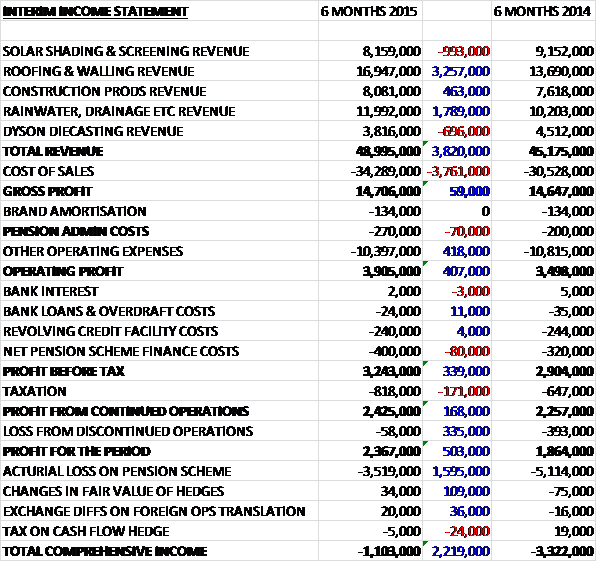
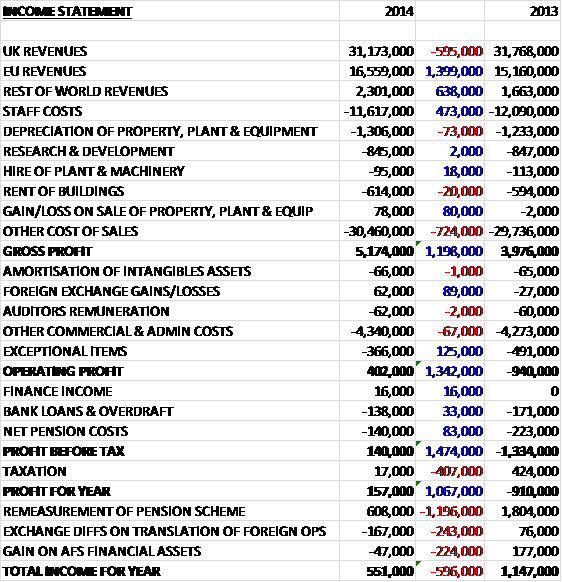
When compared to the first half of last year, total revenues increased by £3.8M driven predominantly by a £3.3M increase in Roofing & Walling revenue and a £1.8M increase in Rainwater, Drainage and House building products revenue.  This was somewhat offset by a near £1M fall in Solar shading sales and a £696K decline in Dyson Diecasting turnover.  Cost of sales also increased during the period to give a gross profit just £59K higher.  Despite a small increase in pension admin costs, operating expenses fell during the period which meant that operating profit was some £407K higher.  The total profit from continued operations was just £168K higher due to more pension costs and higher tax and once the loss from the discontinued operations is taken into account (less than last year as the profit on disposal of the Pendock business is include here) the total profit for the half year was £2.4M, an increase of half a million pounds when compared to the first six months of last year.

alumascinterimassets

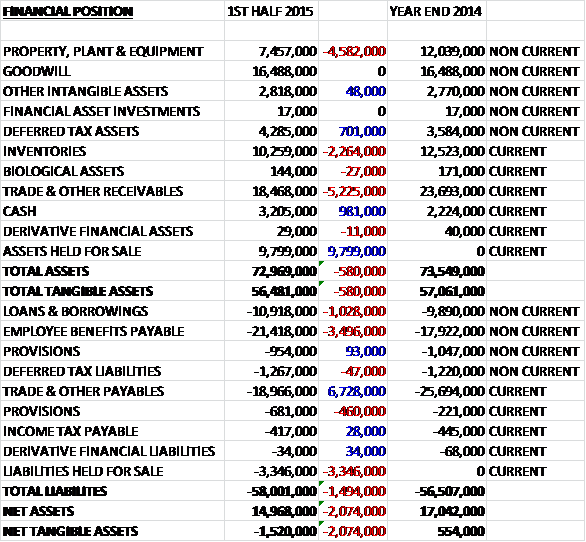
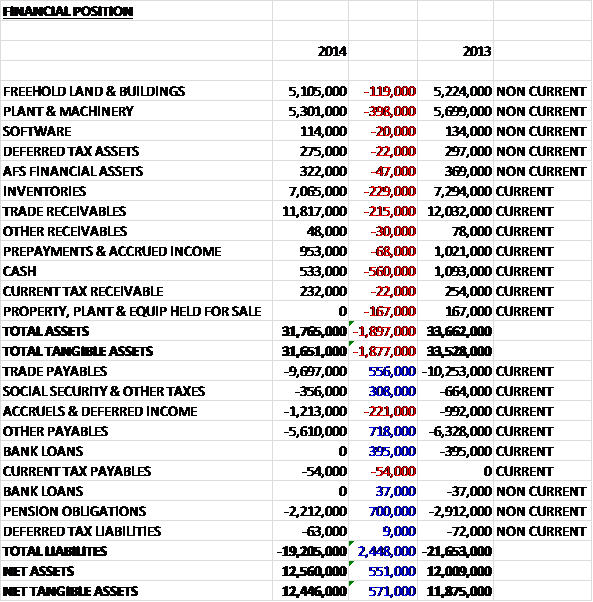
When compared to the end point of last year, assets were down by £580K as falls in property, plant & equipment, trade receivables and inventories were not entirely replaced by the increase in assets held for sale.  Liabilities also increased during the year as a £6.7M fall in trade payables was more than offset by a £3.5M increase in pension payables due to a reduction in corporate bond yields, a £3.3M increase in liabilities held for sale and a £1M increase in borrowings.  The end result was a net tangible asset based declining by £2.1M into negative territory at -£1.5M.

alumascinterimcash

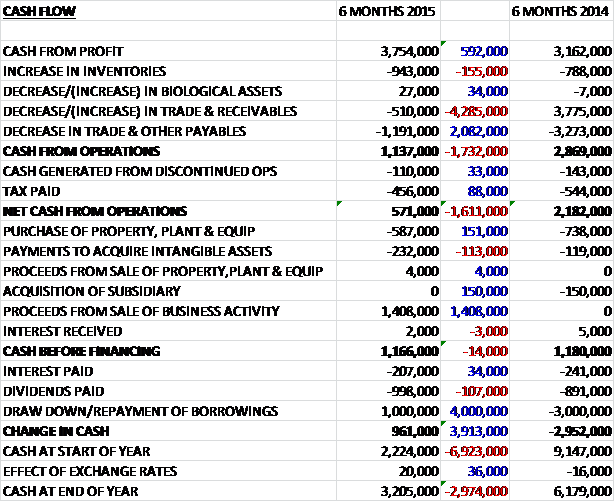
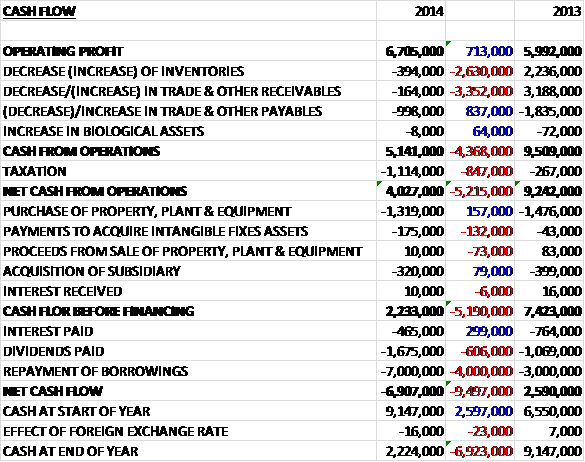
Before movements in working capital, cash profits were some £592K higher at £3.8M before this was somewhat eroded by an increase in receivables, an increase in inventories and a decrease in payables so that cash from operations was £1.1M, a decline of £1.7M on last year.  After the cash outflow from the discontinued operations and tax was taken into account, the net cash from operations was down £1.6M at just £571K. All of this cash was spent on the purchase of property, plant and equipment but the £1.4M received from the sale of Pendock allowed the group to spend £232K on intangible assets, £998K on dividends and pay the £207K in interest payments.  The resultant £961K of positive cash flow was due to the £1M drawdown of the banking facilities.  The cash flow here is flattered by the sale of the subsidiary, without which there would be no cash to spend on dividends but if the group get a better grasp on working capital, this may improve for the second half.

Energy Management profits for the half year stood at £2.6M, an impressive £1.2M increase on the same period of last year.  The increase was driven by Roofing & Walling profits which were £1.1M higher at £2.2M as actions taken over recent years to strengthen management and sales resources, introduce new products and expand the geographical range start to bear fruit against a backdrop of an improving UK market place.  It’s worth noting that these strong results are despite the fact that the Kitimat smelter refurbishment contracts is now largely completed and only made a modest contribution during the year.  In contrast Solar Shading and Screening struggled somewhat with profits declining by £58K to £386K.  Enquiry levels and order intake has shown signs of improvement as the UK new build commercial property market starts to pick up in the South East of the UK but market activity remains some 30% below the pre-recession peak.  Notable projects continued, including the large commercial building in London that is now near completion and the final project in Chiswick Park where the majority of work is now done.  Steady progress was made in developing export markets with some success in North America but it does not sound like this will be enough to replace the completed large London projects.

Water Management and Other profits were down by about £300K at £2M.  The decline was driven by the £326K fall in Construction Product profits to £556K as the business did not have any of the large individual projects in the UK that occurred last year.  The multi-million dollar project at Doha port won last summer is under way and will also benefit the second half whilst the scaffolding business performed well, benefiting from both a broadening product range and routes to market.  Rainwater, Drainage and house building products remained fairly flat, falling by just £38K to £1.4M on revenues that increased by 17%.  The lower margin here was due to investments in new product development and in adding new capacity that gave rise to some additional costs.

Dyson Diecasting profits were £441K lower at £338K which was a solid performance given the fact that levels last year benefited from the initial stocking of some new product lines.  At APC a modest trading loss was seen, an improvement on last year’s performance, due to the recovery actions taken but as announced previously one client decided not to renew a contract as certain engine variants were updated.  As if this was not enough, the business also received some significant retrospective claims for alleged quality and delivery issues on the work that had come to an end and whilst some claims have been settled, the group remain in discussions to resolve the remaining matters.  Provisions against the expected value of the settlement of the claims more than offset the improved trading performance, resulting in a £400K increase in APC operating losses to £1.1M. This loss was partially mitigated by the £800K gain on disposal of the Pendock business.  The net asset level of APC on the balance sheet is £6.5M and management seem confident they can recoup this on any sale which would be a great result if achieved and really help with the cash flow and perhaps do something about the stubborn net debt levels.  It could also be used to acquire other business and the board have stated they are seeking Building Products acquisitions to complement organic growth activities.

Traditionally the group tends to experience some bias towards the second half of the year with regards to profits but this is not expected to occur this year as some large construction projects are expected to make more of a significant impact in the first half.  The order intake for building products increased by 30% to £48.9M, some of which will be scheduled for next year but at the half year point, the value of the order book was £19.2M, a similar level to the end of last year as billings of these larger projects during the year offset the general growth.  The board expect to be able to grow the Building Products business both this year and beyond but I suspect the engineering products business is becoming more and more peripheral.

Net debt remained at the same level as the end of the year at £7.7M.  The increased interim dividend of 2.5p, when added to the final dividend of 2.8p means the shares yield 4.1% at today’s share price which is expected to increase to 4.4% next year.  Overall, I feel this is a bit of a mixed set of results.  It seems that in general the group are seeing some good recovery in some areas but the fact that this year will not be skewed to the second half suggests that management are not expecting a stellar performance during the next six months.  Also the continuing problems at the APC business, which can hopefully be offloaded and the fact that the group seem unable to make much of a cash profit, partly I guess due to the hefty pension deficit payments mean that I am finding it hard to invest here despite the positive market reaction to the update.

alumasc

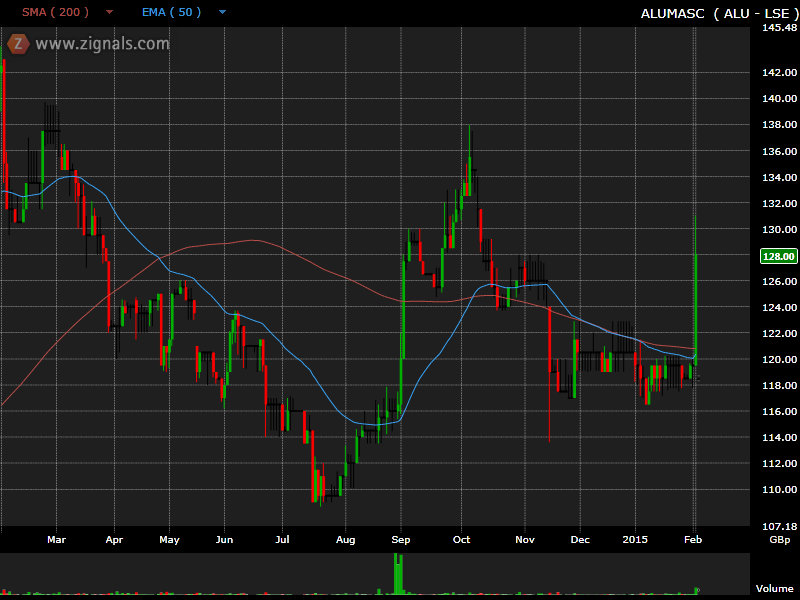
As we can see the price has been drifting somewhat and going nowhere since the end of last year but yesterday’s spike up may be the start of a run.

On the 13th February it was announced that CEO Paul Hooper purchased 17,861 shares for a total value of £24,000.  This now gives him 104,643 shares and seems a good vote of confidence.

On the 25th February it was announced that AXA Investment Managers sold 25,000 shares with a value of about £37.4K.  This is quite a small sale really as they still own just under 14% of the company.

On the 2nd April it was announced that non-executive director Jon Pither sold 16,000 shares which was worth just over £24K.  This was apparently for tax reasons but director selling is never good to see in my opinion.  He now owns 254,131 shares equal to about 0.7% of the company.

On the 26th of June the group announced that it had completed the sale of APC to the Shield Group for a cash consideration of £5.8M which is less than the net asset level of £6.5m that the board suggested they should be able to get for the business.  The defined benefit pension obligations will be retained by Alumasc.  Last year, APC generated an operating loss of £1.4M but the performance of the business did improve in the first half of this year.  The expected one-off costs associated with exiting the business are expected to be about £2M, of which approximately £1.5M will be cash costs.  The proceeds of the sale will be used to support the development of the group’s building products activities, including the relocation, modernisation and expansion of its rainwater and drainage business currently located on the same site as APC.

In addition, the group released a trading update where they stated that performance in the second half of the year was better than expected.  The outlook continues to improve and the building products divisional order books currently stand at £23.7M compared to £19.2M at the half year point.  The order intake in the current year has been over 20% ahead of the same period last year.  This seems like a good update to me.

On reflection I have decided to take an initial position here.  I am still a little concerned about the level of debt and the pension liability but trading seems to be picking up along with the UK commercial construction industry so the shared do look pretty cheap on a forward looking basis, that pension deficit notwithstanding.

On the 15th October it was announced that the group had won a significant project on the east coast of the US to design and supply a custom screening solution to a new gas fired power plant.  The project is expected to generate about £3M of revenue for the group in the 2017 financial year.  Levolux will provide an architectural screen around the plant’s two buildings to improve their visual impact on the surrounding area.  The screen design is based on the patented “Infiniti System” of extruded horizontal aluminium aerofoil louvres fixed to each building through concealed fixings giving the louvres a seamless appearance.  This contract demonstrates the ability to win contracts in the important North American market.

On the 22nd October the group released a trading statement at the AGM.  They made a satisfactory start to the new year and demand from the group’s core UK construction market is apparently encouraging.  The order book continues to rise and year to date revenues from continuing operations are marginally ahead of last year.  They have seen some evidence that capacity constraints within the construction industry generally have caused delay to some projects.  This will have an impact on timing but the board continue to believe that management’s expectations for their full year financial performance will be achieved.  Cash performance remains strong and there is only a modest level of debt as a result.  The market has taken this as a profit warning and I suppose it might be – it is notable that they expect to perform against their own expectations rather than market expectations so I might sell out here.

Swallowfield Share Blog – Full Year Results 2014

I feel it is now time to revisit one of my earlier investments that I had sold out of. Swallowfield develops and supplies personal care and beauty products. Nearly half of all sales are Aerosols, with roll-ons coming in second. They have released their final results for the year ending 2014.

swallowfieldincome

Revenues increased when compared to last year as a £1.4M growth in European sales and a £638K increase in ROW revenues were somewhat offset by a £600K decline in UK revenues. Staff costs fell year on year but other cost of sales increased so that gross profit was £1.2M higher than in 2013. There was a benefit of currency movements and a £125K reduction in “exceptional items” which this year relate to £264K of accelerated depreciation at the Bideford site and a £92K accrual for employee redundancies, somewhat counteracted by a small increase in other admin costs so that operating profit was £1.3M higher. After falling loan and pension costs took their toll and the group received a lower tax rebate (there are still £1M of tax losses that could potentially be utilised), the profit for the year ended up at £157K, a big swing from the £910K loss last year.

swallowfieldassets

When compared to last year, total assets fell by £1.9M as every asset class declined in value with cash down £560K, plant & machinery falling by £398K and the £167K warehouse the group finally managed to flog. Liabilities also fell as a £718K decline in other payables, a £700K fall in pension obligations and a £556K reduction in trade payables were partially offset by a £221K growth in accruals. Net tangible assets ended the year £571K up at £12.4M but there is also £3.3M worth of operating leases payable off the balance sheet, some £538K less than last year.

swallowfieldcash

Before movements in working capital, cash profits increased by £1.3M to £1.7M. Working capital changes broadly cancelled each other so that cash from operations was £1.2M higher at £1.4M. After lower finance expenses and tax, the net cash from operations was £1.2M, an improvement on the £60K cash outflow last year. The bulk of this cash was spent on property, plant and equipment but £250K was received from the sale of tangible assets and free cash flow was £590K, a £1.4M swing compared to 2013. The group spent all of this cash, and then some, was spent on paying back debt to leave a net cash outflow of £560K for the year to leave the group with £533K cash at the end.
Over the year the retail markets in the UK and Europe remained challenging which impacted the toiletries and cosmetics sector, resulting in lower levels of consumer demand which led to a strong and prolonged period of promotional activity from the group’s competitors. Despite this, the decent momentum that occurred towards the end of last year continued into 2014, driving underlying net growth with new customer wins and product launches. Direct exports increased year on year with the growth coming from the US, South Africa, China and Europe.
The group are looking to drive specific categories where they see most growth, these include personal care aerosols, lip balms, deodorant sticks and roll-ons. New products are being developed that will be marketed under Swallowfield’s own brand and will be positioned to avoid any direct conflict with the existing customer base. Mysteriously they are also developing a new high growth, high margin product category that can become additional drive category by 2016. The other side of the strategy is to concentrate on costs and the group has consolidated their Bideford site into two buildings from three and relocated some lines to the Czech Republic which is expected to save £230K per annum.
Although progress has been made in this regard, the group still has two customers who account for more than 10% of total revenues, with one accounting for 15% and the other 11%. To put this into context, though, in 2012 the group had three customers that accounted for more than half of all business. The group is also somewhat susceptible to exchange rate changes as a 5% strengthening of Sterling would result in a £182K reduction in profits. The group already has £650K contracted for but not provided which seems like a fairly substantial investment for a company of this size. Other potential risks include the susceptibility to general economic conditions and any movements in input prices, although it should be pointed out that these are probably in the group’s favour at the moment.
During the year Edward Beale joined the board as a non-executive director. He is a chartered accountant and the CEO of City Group. Going forward the board expect the challenging retail market conditions in Europe and the UK to continue in the short and medium term. They are confident, however, that the new strategy along with new product developments and further efficiencies will gain momentum and improve profitability.
There was no dividend recommended this year but it is expected that next year’s dividend will yield 2.1% at the current share price. The board have indicated that at this time the dividend payment will be reinstated to align with the underlying earnings and cash flow of the business. The P/E ratio is 24.9, which is certainly not cheap but it seems growth is being priced in as the 2015 ratio is expected to be 10.8 which conversely seems good value. At the end of the year net debt stood at £5.1M, a £600K reduction on last year.
Overall then, this was a year of improvement for Swallowfield. Progress is being made, but the group is not there yet. Profits improved, as did the fairly decent balance sheet. Probably most importantly, a tight control on working capital kept the cash generation at a pretty decent level and the group did the sensible thing and used it to pay off debt, although more cash is really needed to make a decent dent and allow them to return to dividend payments. The focus on certain products seems fairly sensible and I do believe that Swallowfield has turned a corner. The fall in the oil price is helpful as this should help costs but the declining Euro is probably going to be a bit of a drag on some of those growing exports. Overall, one to watch but I would want to see a bit more evidence of further progress before jumping in.
On the 13th November the group released an AGM statement. Trading in the first four months of the year was broadly in line with expectations with momentum continuing with new customer wins and new product launches but this was been partially offset by the euro weakness and customer mix. The board expect there to be a significant weighting to the second half of the year, caused by phasing of new contract wins and natural seasonality and that full year profitability will be in line with current expectations.

swallowfieldchart

For a company as small as Swallowfield, the share price tends to jump around a bit but the chart looks interesting in recent weeks as a short bullish run has crossed over both the 50 and 200 day moving averages.  I am still not convinced the group will present a great set of results at the half year point but I am considering taking a small position for the long term.

On the 9th February it was announced that the largest shareholder, Peter Gyllenhammer purchased 22,500 shares at a cost of about £23K.  He now owns over 26% of the company.  This is clearly a modest buy from someone with Gyllenhammer’s means but it strikes me as a good vote of confidence in the company so I have taken this as a trigger to take up the small position I spoke of above.

Tangent Communications Finance Blog – Interim Results Year End 2015

Tangent Communications has now released their interim results for the year end 2015.

tangentinterim

When compared to the first half of last year, revenues were broadly flat with an increase in online sales offsetting a similar decline in agency revenue.  Cost of sales, however, increased so that gross profit was £416K lower.  Operating expenses also increased and there was a one-off £226K charge for staff redundancies, counteracted by a lower taxation.  The profit from continuing operations was £538K, less than half what it was this time last year and the disposal charges meant that the profit for the half year was some £684K lower at £416K.

tangentbalance

When compared to the end point of last year, assets fell by £806K driven almost entirely by a £1.2M fall in cash levels, somewhat offset by an increase in inventories.  Liabilities reduced during the period as all items showed a small reduction apart from provisions which remained flat.  The end result is that net tangible assets fell by £728K to £5.4M.

tangentcashinterim

Before movements in working capital, cash profits were some £816K lower than during the same period last year.  All working capital movements went against the cash flow but the decrease in payables was far less than last time so cash generated from operations was some £367K lower at £791K.  After tax this fell to £544K, a £292K decline.  All of this cash was spent on software development and the purchase of tangible assets and somehow they managed to loose cash on disposing of the Australian business as they gave it away for free.  Therefore there was no free cash flow with which to pay the £663K of dividends and the £379K purchase of shares exacerbated the situation so that at the half year point the group had a cash outflow of £1.2M, I am not sure maintaining the dividend was a prudent move here.

During the period the agency business made an underlying operating profit of £158K but was pushed into the red by the £226K of restructuring costs.  This compares unfavourably to the £671K achieved during the first half of last year.  Sales at Tangent Snowball fell by 22% to £3.2M and were affected by budget cuts at two key clients and the divestment of operations in Australia.  Headcount has now been reduced at the agency and the second half of the year should show an improvement.  Sales at Tangent on Demand grew by 3% to £1.2M and gross margin continued to be above 70% as the business intensified its focus on selling innovative print displays to high end retailers.

The online business made a profit of just over £1M, which was very similar to the result achieved this time last year as strong growth from printed.com and Ravensworth was offset by the underperformance of Goodprint.  Printed.com had a strong first half with sales up 30% to £3.6M as new customers were up 15% and repeat purchases were up 56%.  Sales at Ravensworth were up 17% to £4.1M and innovations during the period included backlit window cards, home information packs and the first digital offering.  It is testament to the business that all customers purchased more than once.  Sales at Goodprint fared less well, falling by 31% to £1.2M as competition in the business card market intensified and the group lost customers to lower cost operations.  The re-building of the customer base will take time and the re-design of the website and new product launches will incur higher costs.

During the year the group disposed of an 81% holding of Tangent Snowball in Australia.  The group actually gave these shares away and with it lost control of £22K of cash, not to mention a net £30K of receivables.  It is a shame that they could not make it work and were so desperate to get rid of the subsidiary as it made a loss of £45K in the first half of last year, although this improved during the second half.   Management expects the second half to improve for Tangent Snowball but current softness in the goodprint division and investment to improve the performance will affect the outcome for the full year as a whole.

At the current share price the dividend yield is a decent 4.1% but I am unsure as to whether it is sustainable.  The group had a net cash position of £1.7M at the half year point, a decline of £1.1M from the end of last year.  There is no doubt that this was a disappointing performance.  The underperformance at Tangent Snowball seems temporary but the problems at Goodprint seem more long term.  Until there is some confirmation of improvement at Tangent Snowball at least, I don’t think these shares represent a buy.  I still like the company though, so will keep watching on the sidelines.

tangentchart

As expected the chart looks pretty poor.  The share price does not look like it is going anywhere positive fast.

On the 11th February the group released a trading statement covering full year results and it does not make pretty reading.  Underlying operating profit is expected to halve to £1.2M and net cash is expected to be £1.4M.  The property print business struggled after slow sales over Christmas and to address this the group is undertaking some restructuring in its Newcastle site.  Non-recurring costs are expected to come to £700K for the year.  The one highlight was Printed.com, where sales are expected to grow by 20% to £7.6M.  In addition the group released wrap.me, a consumer photo product selling personalised wrapping paper.  Trading at Goodprint was slower and a recovery was not forthcoming with sales for the year expected to fall £900K to £2.3M.

Ravensworth trading has slowed since the last update due to a softer housing market and the next year is likely to be governed by uncertainty surrounding the general election.  T/OD sales were in line with expectations and are expected to increase by £100K to £2.6M.  Tangent Snowball is now performing better as a leaner business but it will take another 6 months to see the full impact of the changes implemented at the end of the first half.  The board are not going to pay a final dividend, which is probably prudent in the circumstances.  Overall then this is a poor update, numerous business sectors seem to be struggling and I am not going near this for the forseeable future.

On the 11th March it was announced that Jamie Beaumont would join the board as CFO, taking over from Finance Director Kevin Cameron who will move to the position of Managing Director of the Print Services business.  Jamie is a sprightly 34 and has previously worked at LSL Property Services and as CFO at David Phillips ltd.


Tangent Communications Finance Blog – Final Results Year Ending 2014

Tangent is involved in online printing and digital marketing and is a part of the AIM exchange.  Printed.com is an online printing business who provides business cards, leaflets, wedding stationary and greetings cards whose customers tend to be small businesses.  It is the fastest growing division at Tangent.  Goodprint offers no-frills quality at cheap rates, providing business cards, labels, postcards, calendars and invitations.  Ravensworth offers printing services to the estate agent industry and has a customer base of over 4,500 agents.  Tangent Snowball is a digital marketing agency whose clients include the Labour Party, Carlsberg and Citroen.  Finally, Tangent on Demand is a creative printing business providing business cards, window displays and advert bill boards to fashion brands, creative agencies and corporations including Benetton, Tommy Hilfiger and Chanel.  Tangent Communications has now released their final results for the year ending 2014.

tangentincome

When compared to last year revenues increased, driven by a £4.5M growth in online revenue, somewhat offset by a £1.8M fall in agency revenue.  Cost of sales increased slightly to give a gross profit some £2.3M higher.  Depreciation remained flat but there was a much larger amortisation charge this year which, alongside other higher operating expenses due to a growth in staff costs, and flattered somewhat by a £603K reduction in non-recurring expenses, this year relating to the costs of disposing of the majority share in the Australian operation (£120K is expected to be charged next year), meant that operating profit was £1.5M higher.  After tax, this fell to £1.1M higher at £1.7M, still a pretty decent result.

tangentassets

When compared to the end point of last year total assets increased by £694K driven by a £425K increase in cash, a £361K growth in software assets and a £325K increase in prepayments, somewhat offset by a £206K fall in the value of plant & equipment and a £127K decline in other receivables.  Conversely, total assets fell during the year due to a £427K decline in accruals, a £186K fall in borrowings and a £131K reduction in trade payables, partially mitigated by a £134K increase in other taxes and social security.  The result is a near one million pound increase in net tangible assets to £6.2M.  It is worth noting that the group also has just under £2M of non-cancellable leases off the balance sheet.

tangentcash

Before movements in working capital, cash profits were some £1.7M higher at £3.5M.  A decrease in payables due to the payment of closure costs at Thetford was responsible to a decline to £2.9M after working capital considerations and after tax the net cash from operations was £2.3M, a £1.4M increase when compared to 2013.  Last year the group spent £6.9M on an acquisition but this year, the only capital expenditure was a £563K software development costs and a net £498K spent on the purchase of property, plant and equipment relating to new print and finishing equipment and this level of investment is expected to continue into next year.  This gave a free cash flow of £1.2M which was ample cash with which to pay out £558K in dividends and pay back £186K of loans so that the cash flow for the year was a decent £494K.

Underlying operating profits at the Agency business were £1.2M, flat when compared to last year.  The division benefited from a new chief executive from Omnicom and business focussed on a smaller number of high value contracts with new client wins including Papa Johns and Evoshave.  A number of new opportunities to sell services to existing customers were identified but there may be a deferral in profits in the short term while the new products are marketed.  Sales at Tangent on Demand grew by £140K to £2.4M as the division concentrated on selling displays to retailers such as Laura Ashley, Ugg and Chanel.  The gross margin in this division is currently at an impressive 70% and investment was made for new hires to support product development and sales growth

Underlying operating profits at the Online business were £1.8M, an increase of £1M when compared to 2013.  Printed.com saw sales grow by £2.1M to £6.1M both through attracting a number of new customers and encouraging existing customers to spend with greater regularity.  The repeat order trend was strong and ahead of management expectations with the reward programme proving popular.  Goodprint sales fell by £810K to £3.2M as the conversion from site visitors to buyers slowed and the group have begun to recruit a new e-commerce team to improve their proposition with the latest initiative being the design and delivery of business cards within four hours.  Ravensworth sales increased to £6.6M as the property market experienced an upturn and a new transactional website with an online photo editing service is expected to add new revenue streams.

Although Tangent has no customer that accounts for more than 10% of revenues, the Agency business has one that represents 15% and one that represents 11% of revenues in that sector.  If one of these customers were to be lost, earnings could be adversely effected.  Another risk for the group would be the deterioration of the general economic environment , reducing client’s spending power.  After the year end the group disposed of 81% of its holding in its Australian subsidiary, Tangent Snowball.  There was a loss of £120K on this disposal so I suppose they are pretty keen to get rid of it.

At the current share price the P/E ratio is standing at a value 9.9, rising to a still pretty cheap 10.7 on next year’s forecasts.  The current dividend yield is 4.1% which is expected to remain unchanged next year, although this year it did increase by 20%.  Net cash at the year-end stood at £2.81M, an increase of £640K on last year

Overall this seems like a decent, small company.  Profits made progress, as did net assets whilst there was sufficient free cash flow to cover all the expenses.  Clearly the services the group offers are susceptible to a potential economic decline but this seems an interesting company that I may choose to buy given a decent opportunity.

Telford Homes Finance Blog – Interim Results Year Ending 2015

Telford Homes has now released its interim results for the year ending 2015.

telfordinterimincome

When compared to the first half of last year, revenues fell by some £8.7M in H1 2015 due to the timing of completions. Cost of sales also fell, though, to give a gross profit £2.7M up. Admin expenses increased, as a result of higher staff costs, but selling expenses showed a small decline so that operating profit was £1.9M higher. A small adverse movement in finance income/costs due to non-utilisation fees on the credit facility and a small increase in tax meant that the profit for the period of £7.4M was £1.5M higher than during the same period of last year.

telfordinterimassets

When compared to the end point of last year, total assets increased by £53.2M driven by a £71.6M increase in inventories, somewhat mitigated by a £20M fall in cash levels. Likewise liabilities also increased due to a £24M increase in borrowings and a £23.8M growth in trade and other payables. This meant that net assets were some £5.2M higher at £110.5M.

telfordinterimcash

Before movements in working capital, cash profits were some £7.2M lower at just £130K. A huge increase in inventories, however, meant that there was a cash outflow of £55.7M. After the £17.5M contribution from joint ventures, somewhat offset by interest and tax, there was still a net cash outflow of £41.6M from operations. A small purchase of tangible assets meant that free cash flow was a negative £41.8M. In order to balance the books somewhat there was a net £24M increase in loans, partially offset by a £3M dividend payment to give a cash outflow for the period of £20.2M. Considering the cash position at the end of the period was £12.5M, this looks a little precarious, although it should be noted that this situation was flagged up by management in the last update.
During the period the group agreed contracts for the sale of more than 600 open market homes which is more than were sold during the whole year in 2014. The development pipeline has increased to £1.1BN of future revenue and half of this pipeline has been forward sold. The results for 2015 are expected to be weighted towards the second half of the year with a greater number of open market completions due in that period, including in the Parliament House and Lime Quay developments.
In the first half of the year, open market completions were 140 compared to 222 last year. Some of the progress made on the pipeline includes the £16.3M contract to progress the first three phases of redevelopment of Poplar Business Park. The first phase has planning consent for 170 homes with total revenues expected to be in excess of £75M. This followed the purchase of a development site on Rotherhithe New Road in Southwark for £19M which has planning permission for 158 homes and two new schools. Construction work for both of these projects will start later in the year. Another acquisition involved a 50:50 joint venture with Notting Hill housing group which has purchased a significant site in Stratford for £44M. Outline planning consent has already been granted and an application to create 400 new homes will now be pursued. Despite these successes it seems the board is becoming more frustrated with the planning process in general and particularly how long consent can take.
The gross profit margin during the period was an impressive 36.6%, an increase on the 31.9% recorded last year. The increase is predominantly due to the fact that more than half of the completions were at the Avant Garde joint venture which enjoys a profit margin north of 40% as opposed to the 24% target the group uses when appraising new opportunities. Over the past couple of years house prices in London have increased significantly but this has been partially offset by increasing labour and material costs and management expects a more modest sales price inflation over the next few years. Due to these issues, it is expected that gross margins will fall back down to the 24% level going forward.
The market outlook for London remains positive as demand outstrips supply in the areas the group operates in and the recent launch of Stratosphere, a 36 storey tower in Stratford went well with over 270 of the 307 open market apartments being sold already with future revenues from the site exceeding £110M. Other launches include Stratford Central where 151 of 157 open market homes have been sold and Vibe in Dalston where 79 of 81 homes in the first release were sold. Completions commence with Vibe in late 2016 and conclude at Stratosphere in late 2018, showing how far in advance sales are made. The group is still selling homes faster than it can currently build them.
As the majority of homes that should legally complete before the end of the year have already been sold, the board are very confident of hitting expectations and the cumulative profit before tax for the next four years should still be in excess of £120M. Going forward there is £550M of future revenue forward sold and the board are confident of a bright future for the group.
An interim dividend of 5.1p was declared which represents a yield of 2.9% at the current share price and is a 38% increase on last year’s interim pay out. At the half year point, net debt stood at £39.2M compared to a net cash position at the end of last year. This increase in debt was fully expected as the group ramps up its acquisition of land and construction of homes. So far £52.2M of the £120M of debt has been used so there is sufficient headroom and net debt is expected to increase further as more land is acquired and construction continues.
Overall this is another good update from Telford Homes. Profits were up, as were net assets but there was a hefty cash outflow during the period, resulting in higher debt levels as the group expands further. The future growth potential is certainly exciting but not without risk as the company will become more susceptible to any downturns. The housing market in London is very robust, however, and with a decent dividend yield I still consider these shares a good investment and will look for an entry point.

On the 18th December the group announced that Frank Nelson will be appointed as a non-executive director of the company and will replace Robert Clarke who is retiring.  Frank has over 25 years of experience in the construction, contracting, infrastructure and energy sectors and was Finance Director of Galliford Try for 12 years up to October 2012.  He is also a non-executive director of Thames Valley Housing Association which my prove useful to the group.

On the 23rd January it was announced that Schroders sold 541,860 shares in the company which have a value of about £1.9M.  This is a substantial sale but they still own 9.9% of the group’s shares.

Telfordchart

Looking at the Chart, Telford underwent a strong bull run prior to 2014 but retracted somewhat before recovering towards the end of the year.  Although not bad, there does not seem to be much in the way of movement in price at the moment so I will try and use the chart to show me a decent entry point.

On the 5th March the group announced that it had signed a new £180M loan facility to support its growth plans.  The revolving credit facility extends to March 2019 and is being provided by HSBC, RBS, Santander and Allied Irish.  This facility replaces the group’s existing £120M loan and has a lower cost of debt.  This all sounds good, hopefully the group will be sensible with its expansion plans.  I have decided to dip my toes in here.

On the 22nd April the group released a trading update covering the full year.  Overall, profit before tax is expected to be above current market expectations and profit margins are going to be higher than last year, assisted by some commercial property sales at higher than anticipated prices and cost inflation being lower than estimated.  It is expected that margins will return to normal going forward due to more modest price inflation and some material and labour cost increases.  Demand for the group’s properties remained strong and they exchanged contracts for the sale of 661 open market properties during the year, an increase of 28% at an average price of £459K, an increase of £59K.  The group is already 93% sold in terms of open market homes expected to be complete in the year ending 2016.

Recent launches included Manhattan Plaza in E14, which is close to Canary Wharf and benefiting from a new Cross Rail station in the future.  Earlier in the year the group launched The Junction in  E1 where half of the 26 open market homes have been sold and the Town Apartments in Kentish Town where all 15 open market homes sold in a single weekend.

The development pipeline has exceeded £1BN and since on top of this, the group has recently acquired a site in Upton Park where they will submit a planning application for more than 170 homes.  In addition, they have recently agreed terms with one of its affordable housing partners on a scheme with planning permission for more than 100 homes.  The time taken to achieve planning permission can cause delays to the planned development programmes but in recent months the group has finally received a resolution to grant planning consent for a development on Caledonian Road and expects to complete on the site purchase shortly.  This development will consist of 96 open market apartments and 60 affordable homes with construction expected to start within the next few months.

After taking into account the high volume of completions during the second half of the year, the development pipeline remains at over £1BN, over half of which is forward sold.  The board is apparently not concerned about any individual property proposals announced by the main political parties given the price point of their homes and there does not seem to be much volatility leading into the election.  Given the substantial forward sold position and development pipeline, the board expects significant growth in profits over the next few years.  This all sounds very positive and I am happy to remain holding here.