Telecom Plus Share Blog – Final Results Year Ending 2014

Telecom Plus trades as the Utility Warehouse and provides a range of essential services to households and small to medium sized business.  Customer acquisition revenues represent joining fees from the group’s distributers, the sale of marketing materials and sales of equipment including mobile phone handsets and wireless internet routers.  Customer management revenues are derived from the supply of fixed telephony, mobile telephony, gas, electricity and internet services to residential and small business customers.  The group also provides bill payment protection and accidental death cover to customers for a monthly fee, for which it does not retain the insurance risk for. The company does not spend money on advertising but they have 44,000 independent distributers who sign up customers and then get a small cut of the revenues from each new member that they introduce.  Telecom Plus has now released its final results for the year ending 2014.
telecomincome

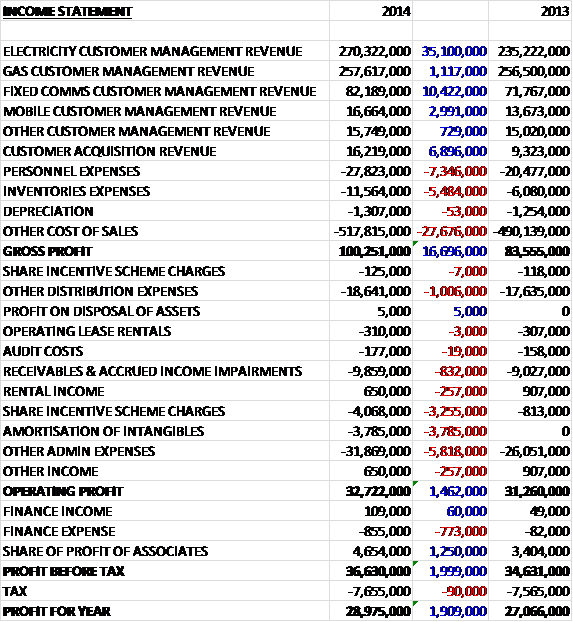
Overall revenues were substantially ahead of last year with particularly large increases seen in Electricity, Fixed Communications and Customer Acquisition revenue.  Gas revenues increased by a more modest £1.1M as a result of the warm winter reducing demand.  Staff costs increased by £7.3M with further recruitment being made in the second half of 2014 likely to mean another increase in costs next year, inventories expensed increased by £5.5M and other cost of sales were up £27.7M to give a gross profit some £16.7M ahead of last year.  We also saw an increase in distribution expenses as a result of higher payments to partners following the continued organic growth and higher revenues; impairments; share incentive scheme charges; amortisation and other admin expenses due to higher staff numbers and telephony costs as the group introduced a free phone line for customer service calls, so that operating profit was just £1.5M above that of last year.  An increase in finance expenses was more than offset by a £1.3M growth in profit from associates, relating to the 20% holding in Opus Energy, before a flat tax bill meant that the profit for the year was £1.9M above that of 2013 at £29M.
telecomassets

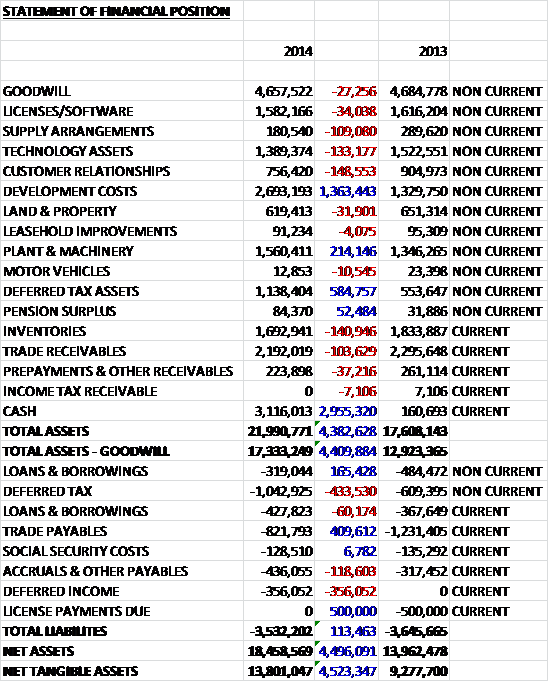
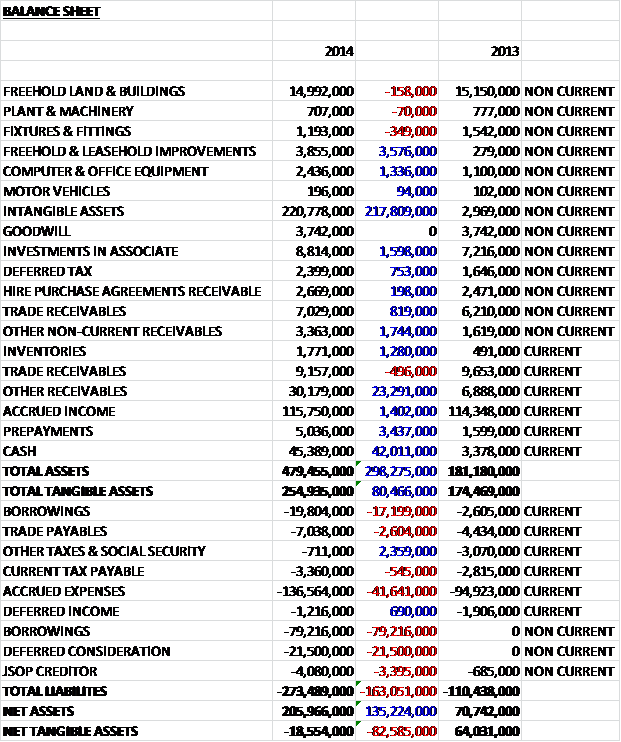
When compared to the end point of last year, total assets increased by £298.3M driven by a £217.8M increase in intangible assets which represents the “goodwill” spent on acquiring the Electricity Plus Supply and Gas Plus Supply from N Power as a result of the new energy supply arrangement, a £42M growth in cash and a £23.3M increase in “other” receivables.  Liabilities also increased during the year due to a £97M increase in borrowings, a £41.6M growth in accrued expenses, a £21.5M increase in accrued income and a £3.4M growth in JSOP creditor so that net tangible assets fell by £82.6M to a negative £18.6M.
telecomcash

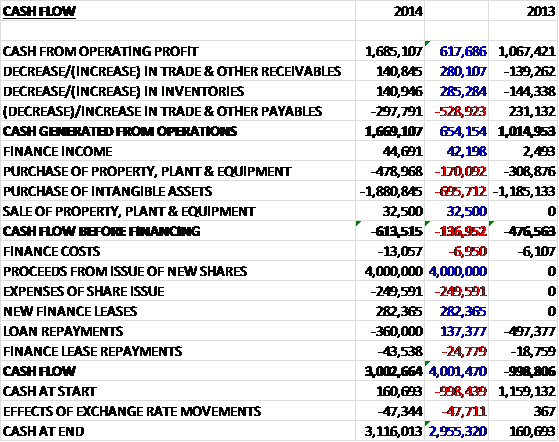
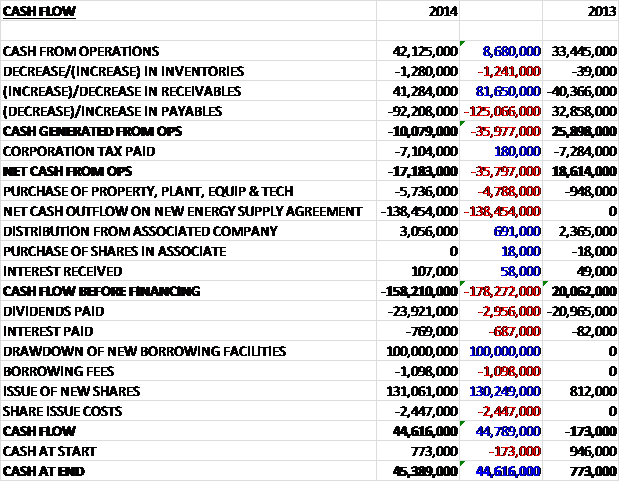
Before movements in working capital cash profits increased by £8.7M to £42.1M before a massive decrease in payables was only partially offset by a fall in receivables to give a £10.1M cash outflow from operations which became a £17.2M outflow after tax was paid.  There was then £5.7M spent on capital expenditure, partially offset by a £3.1M received from the associate which was then dwarfed by the £138.5M cash outflow on the new energy supply agreement with N Power.  This huge cash outflow was paid for with £100M of loans and £131.1M received from the issue of new shares which gave a cash inflow of £44.6M after the payment of £23.9M in dividends to give a cash level at the end of the year of £45.4M which doesn’t seem like a particularly good performance to me.

The group have seen a strong growth in the number of services being provided with a record increase of 305,000 during the year with a 32% increase in the number of mobile services being a particular highlight, although the additions during Q2 and Q3 were unusually high due to favourable market conditions and increase promotional activity that is unlikely to be repeated.  There has also been a doubling in the proportion of new customers taking all five of their core services (gas, electricity, home phone, mobile and broadband) since the introduction of the new bundled structure with the average number of services taken by each residential member increasing from 3.54 last year to 3.64.  Overall churn in the customer base has continued to decline, falling from 11.2% to 10.4% but the average revenue per customer fell from £1,363 to £1,302, the second highest amount ever, as the improvement in the quality of the customer base and slightly higher retail prices were more than offset by lower energy consumption during an exceptionally mild winter, further exacerbated by the comparison with the cold winter the year before.

Part of the differentiation for the group’s product is a high level of customer service which has been reinforced by Which who ranked them first in their fixed telephony and broadband supplier survey, helped by their UK based call centre.  They also have a higher level of trust amongst their customers than any other utility supplier and a net promoter score between +40 and +45 against a backdrop of a score over 0 being considered acceptable, EON getting a score of -21 and the average among internet service providers being +9.  As well as providing good customer service, there are a number of other incentives offered to Telecom Plus customers such as the cash back credit card where £4.6M was paid back to customers during the year, entirely funded by the retailers in the programme, and an online price comparison site.

The group have restructured the way they present and sell their services by introducing a range of “Gold” bundles with enhanced benefits and lower pricing available for members who take all their utilities from Telecom Plus which makes their multi-utility sales proposition simpler for new members to understand.  They have also reduced the number of energy tariffs offered in order to comply with their new license obligations following Ofgem’s retail market review.

A number of new tools were launched during the year in order to help the partners promote the group’s services including a new film featuring Sir Terry Wogan to help explain the Discount Club and the benefits offered to new members, a simplified new online application process, an animated video to explain the part time income opportunity, an app which provides access in one place to all the main resources needed and an interest-free hire purchase scheme to enable them to acquire a tablet to take advantage of these new tools.

The group maintains a 20% share of Opus energy and this associate performed well during the year, increasing Telecom Plus’ share of the profits from £3.4M to £4.7M as a result of a continuing strong trading performance and the further progress that has been made in supplying gas alongside electricity into the small business and corporate sector, for which they are now buying renewable energy from over 500 small UK generators.  The group expects to receive a dividend of £4.1M in July 2014 and the shareholding is recorded on the balance sheet with a value of £8.8M with the market value likely to be much higher than this.  The board are very pleased to have this exposure to this rapidly expanding, profitable and highly cash generative business and I am inclined to agree with them.

One of the main events this year was the new energy supply agreement with N Power.  As part of the deal the group acquired Electricity Plus Supply and Gas Plus Supply from them.  The total consideration comprised of a payment of £196.5M and a deferred amount of £21.5M payable in December 2016, these payments have been recognised as an intangible asset, similar to goodwill.  In order to help pay for this acquisition, the group entered into bank loan facilities of £125M comprising a transaction facility of £100M which was fully drawn down and working capital facilities of £25M, of which none was drawn down.  In addition they had letters of credit in place relating to certain energy distribution charges with a total value covered of £11.8M.  Of the £100M transaction facility, £30M is repayable by the end of 2015 with the remainder being payable by December 2016 – it is quite hard to imagine that the group will be able to pay this back out of their operational cash flow.  As a result of this agreement, the group is enjoying lower energy costs which means that gross margins should be between 15% to 17% going forward instead of the 13% to 15% initially expected.

The group has some £7.7M of capital commitments relating mainly to the refurbishment of their new head office building and once this project is completed towards the end of next year, it will provide sufficient space to support the growth of the company for the foreseeable future and as far as systems are concerned, they have the capacity to manage a substantial increase in current customer and service numbers without the need for any further investment.

The directors of the company own about 23% of the total shares, with the chairman owning a huge amount of shares but there are also a number of institutional investors who own considerable amounts of shares with Standard Life owning 9% of the total equity of the company.

As far as risks are concerned, the group is not exposed to fluctuations in commodity prices due the nature of the agreements with wholesale providers in that they can pass the effect of any such fluctuations on to its customers.  The sector is in the sights of politicians as the election gets closer but their wholesale energy supply agreement with N Power apparently insulates Telecom Plus from any margin pressure due to the proposed 20 month price freeze likely to be included in the labour party manifesto.  Other recent regulatory changes such as the new requirements relating to smart meters, social tariffs and changes to the current decommissioning regime could all have a significant impact on the sector but on the whole new regulations tend to encourage competition which should be a benefit to Telecom Plus given its challenger status.  Having said that, any windfall taxes or price controls would have an adverse effect if introduced.

One risk is the possibility that customers do not pay for their energy and potential fraudulent activity.  During the year the bad debt charge increased slightly from £9M to £9.9M, partly due to an increase in the number of fraudulent applications for high end mobile phones during the first half of the year which triggered an immediate tightening of credit checking procedures.  In order to combat non-payment by customers, the group is installing pre-pay meters where customers cannot or will not pay by any other means.  The number of these meters installed increased by 8,958 to just over 50,000, representing under 6% of the energy services supplied compared to an industry average of about 15%.  Weather can also have an effect on profits as during warm winters, customers do not use as much energy as during cold winters, which would therefore lead to lower revenue per customer.

Going forward, after reaching the 500,000 customer milestone this year, the focus is on doubling this to one million over the medium term which would represent a market share of only 4%,   The improving quality of the customer base gives management good visibility with regards to future revenues and margins and the pre-tax profits next year (adjusted) should show a significant increase over the reported numbers this year reflecting strong organic customer growth achieved over the past year combined with the financial benefits of the transaction with N Power completed in December and as such they remain comfortable with market expectations of profits of £63M which represents a 50% increase.  A number of potential new services are being looked at, including water, TV and insurance products.

Cash outflows in the new year are expected to be higher due to the new debt, the completion of the head office refurbishment and further support for the distribution channel with branded Minis and tablets.  In addition, the group are expecting a modest rise in working capital requirements over the next two years due to the costs associated with funding the growth in the mobile business as customers can obtain a free premium handset at no upfront cost with a 24 month contract along with the above mentioned support for the distributers although N Power remains responsible for funding the working capital requirements associated with the energy budget plan customers.

At the current share price, after a 13% increase in the dividend, the shares yield 3.4% increasing to 3.8% on next year’s forecast.  The board have stated that they remain committed to a progressive dividend policy but the rate of increase will be tempered over the next few years as the group repays the £100M of debt taken out to help fund the transaction with N Power with an increase of 15% expected in the coming year.  The shares trade on a rather expensive P/E ratio of 26.6, although this is 20.9 when the incentive scheme charges and intangible amortisations are removed.  This falls to 16.3 on next year’s consensus forecast, which looks a little better.  The net debt position at the end point of the year stands at £53.6M compared to a modest net cash position of £800K at this point of last year.

This has been an interesting year for the group, profits are up but due to the supply agreement with N Power, net tangible assets are considerably lower than last year and turned negative.  There are also £23.3M worth of “other” receivables on the balance sheet, a lot more than last year, and I can’t work out what these actually are which concerns me a bit.  There was an operational cash outflow for the year, which is never good to see, mainly due to a huge reduction in payables (again, not sure what these relate to) so the operational cash flow before working capital movements is better than in 2013.  Operationally, the group seems to be doing well with new customers, increased services, more services being taken by customers and reduced churn.  The fact that the group is both cheap and does well with regards customer service bodes well for the future in this regard.

Clearly one of the most important events this year has been the new supply agreement with N Power.  Following the theme of not actually getting much information from the annual report, I am not sure what the exact terms are but it seems Telecom Plus are getting cheaper energy in exchange for a big payment up front and a further £21.5M of deferred consideration due in 2016.  Indeed, one theme is that there seems to be a lot of future cash outflows expected as in addition to the deferred consideration due in two years’ time there is also a £30M loan repayment due in 2015, £7.7M in head office refurbishments due within the next six months and the rest of the loan, a full £70M due in 2016 so there seems to be little chance of the group honouring this out of its cash flow so that will have to be renegotiated or new loans will have to be taken out.  There is also uncertainty added into the mix by political uncertainty in a sector that has become quite political in recent times so whilst I do see this company as a good investment at some point, there just seems to be too many short term headwinds and uncertainties for be to invest at this time.

 

Paypoint Share Blog – Interim Results Year Ending 2015

Paypoint has now released its interim results for the year ending 2015.

paypointincome

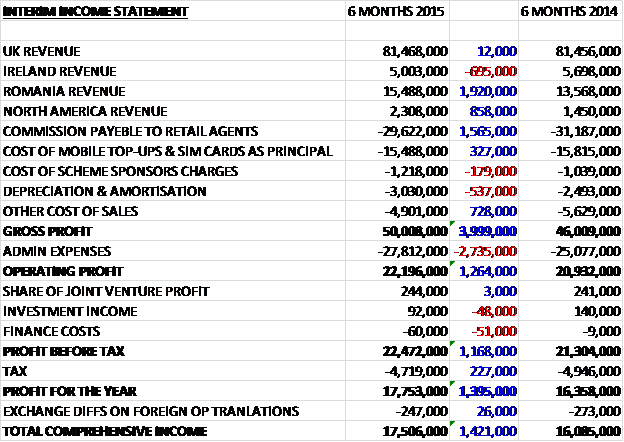
When compared to the first half of last year, revenues increased as a £695K fall in Irish sales was more than offset by a £1.9M increase in Romanian revenue and an £858K growth in North American revenue with UK sales flat year on year.  The commission paid to retail agents fell by $1.6M due to lower mobile top-ups and other falls in cost of sales were counteracted by increased depreciation as a consequence of greater capital expenditure and a small growth in the cost of scheme sponsor charges, all of which gave a gross profit some £4M higher than last time.  Admin expenses increased during the period, which is a situation that management expects to reverse in the second half of the year and finance costs increased slightly before a £227K reduction in tax helped give a profit for the half year of £17.8M, a growth of £1.4M when compared to the first six months of 2014.
paypointassets

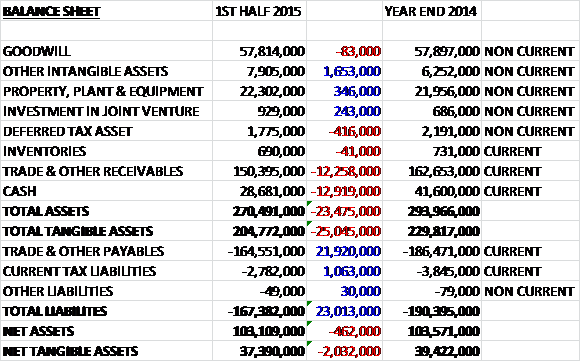
When compared to the end of last year, total assets fell by £23.5M, driven by a £12.3M fall in receivables and a £12.9M decline in cash levels, only partially offset by a £1.7M increase in intangible assets.  Liabilities also fell during the period as payables declined by £21.9M and current tax liabilities declined by £1.1M.  The end result is a net tangible asset level of £37.4M, a decline of £2M when compared to the end point of 2014.

paypointcash

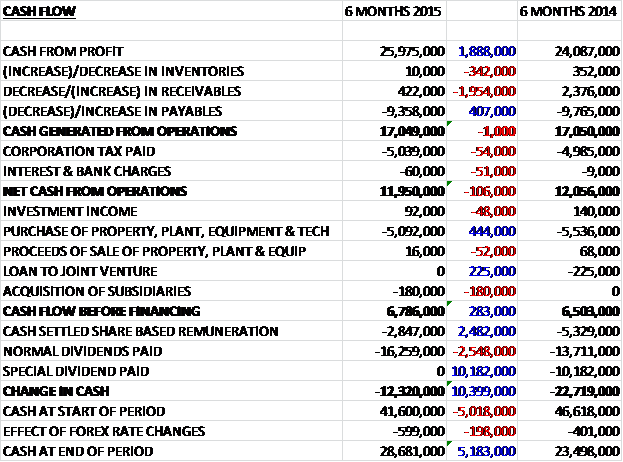
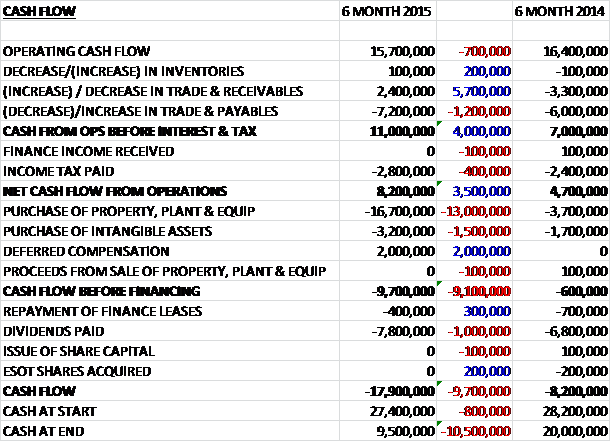
Before movements in working capital, the cash profits were £1.9M higher than in the first half of last year at £26M.  This was taken down by a large decrease in payables to give cash generated from operations of £17M, flat on last time which became £12M after tax was paid.  This cash was enough to pay for the £5.1M of capital expenditure, relating to IT infrastructure developments, terminals, ATMs and prepaid energy card and key readers; the £180K relating to the Adaptis acquisition that took place last year and the £2.8M in share based remuneration settled in cash which gives a free cash flow of about £4M.  This was clearly not enough to pay for the £16.3M spent on dividends so that the cash outflow for the half year was £12.3M to give a cash pile of £26.7M at the half year point which was actually more than this time last year but included £3.8M relating to monies collected on behalf of clients and £7.2M in Romanian client settlement funds.

Bill and general transactions were ahead of the same period of last year as a result of a 53% increase in Romanian bill payment transactions.  UK and Irish bill and general transactions were down nearly 2% year on year due to lower gas consumption because of warmer weather, which has continued into the second half of the year.  The strong growth in Romania was the result of increasing market share to 19% (from 14%) and the addition of new clients, including the launch of road tax payment at the group’s sites.  Net revenue grew by 6% to £25.9M as a richer transaction mix from clients was offset by a reduction in Simple Payment set up fees.

Top up transactions fell from last year as a result of the continued decline in mobile top-up volumes in the UK and Ireland, partially offset by an increase in other top-up transactions and Romanian mobile top-ups where the impact of a larger network has offset market decline.  Despite this decline, net revenue increased by 4% to £11.7M due to the increase in Romania and an increase in requests for early client settlement, for which the group charges fees.

Retail service transaction volumes increased across all products except for SIM card sales.  ATM transactions increased by 28%, credit and debit transactions were up 28%, money transfers increased by 52% and parcels were up 49%.  A higher average ATM transaction value drove an increase in total transaction value in excess of transaction volumes.  Net revenue grew by 17% to £13M driven by the increases in parcels, ATM transactions, credit and debit and income from broadband that enabled faster terminal transactions.  Collect+ transactions grew substantially despite lower consumer send transactions, where there has been significant price competition which, together with an increase in logistics costs as the business moves towards dedicated use of transport, has reduced margins which resulted in profits up by just 1% to £487K.

Mobile and online transactions increased by 11% with payment transactions up 5% and parking transactions up 33%.  Payment transaction growth was driven by adding new merchants and organic growth.  Parking transaction growth was driven by the continued increase in consumer adoption in existing clients.  There was a decline in transaction value due to a change in mix and the weakening of the US and Canadian dollars against Sterling.  Net revenues were broadly flat when compared to the first half of last year at £7.4M reflecting strong growth in parking revenue offset by a decline in payment revenues due to larger merchants enjoying lower pricing.

The group have continued to add parking contracts with councils and parking authorities and the business rolled out the first phase of parking payment services in Paris during the period which will help mitigate the loss of the Westminster contract.  In payments, the first sales have been achieved of two new licenses products.  Cashier enables enterprise merchants to offer a customised payment experience for their online or mobile customers, hosted by Paypoint and also allows customers to store multiple cards.  Cardlock reduces the complication and cost of payment card industry compliance for merchants by removing card data from their websites and apps as soon as it has been entered, and securing it remotely within Paypoint systems.

The group are combining both online and mobile under one new brand.  Continued expenditure in technology, product development, sales and marketing are necessary to take the venture forward and as a consequence of this expenditure, this business is currently loss making and management expects it to remain loss making in the second half of the year.  The group are also expanding into consumer applications beyond parking and the mobile app and online capability for smart meter energy payments is in an advanced stage of development and work has started on a portfolio to cover other sectors too.

As far as the network is concerned, retail sites increased by 1,157 to 36,753 with a growth of 755 in the UK and Ireland with the average retail yield per site also increasing.  The number of sites offering Collect+ parcels grew by just 35 to 5,617, a number that has risen to over 5,800 sites since the end of the period.  In Romania, the network increased by 402 sites during the period and the number of internet merchants fell by 205 due to the churn of smaller merchants.

Going forward the group expects the retail networks in the UK and Romania to continue to deliver profitable growth and they will continue to invest in network expansion, innovative retail technology and new services to improve retail network quality further.  The integration of the mobile and online business under one brand and investment in product development is expected to unlock better growth opportunities for the group.  Trading so far in the second half of the year has been in line with expectations.

Overall then, this is a fairly decent update.  Profits were up but net assets declined somewhat, driven by the outflow of cash as the free cash flow doesn’t cover the value of dividends, although it seems that the business is much more cash generative in the second half of the year.  Romanian bill payments seem to be expanding quickly with new clients and services being added which more than offset a small fall in UK bill payments due to the lower gas consumption during the warm winter.  Top ups fell in the UK as mobile operators continue to promote contract services over prepay but the Romanian top-ups seem more resilient.  Retail services are doing very well, increasing across all sectors but collect+ profits were flat as an increase in the number of transactions was offset by higher costs and more price competition.  The online and mobile sector will remain loss making in the second half of the year as the group continues to invest in the division.

The shares pay a 4.4% dividend yield over the year which seems like a decent amount and the medium term story here looks exciting so I think I might look for a sensible entry point and invest here.

On the 29th January the group released an interim management statement covering Q3.  Overall transactions processed increased by 5% quarter on quarter to 217M.  Revenues of £58M were up 2% and net revenues of £32M increased by 4% with continued strong growth in retail services offset by declines in top-ups and Mobile & Online with Bill and general net revenue being slightly higher than last year as Romanian bill payments continued to grow strongly.  UK energy payments were held back, despite further growth in prepayment meters and increased market share as utilities reported significantly reduced gas consumption.  UK and Irish bill and general transactions were up 1% on last year and Retail services transactions grew substantially, up 29% on last year.  Mobile top-ups continued to decrease but the fall was mitigated by an increase in other top-ups and UK and Irish retail sites increased by 295 to 28,292.

In Romania, profitable growth continued and the group processed 13.8M bill payments in the period, an increase of 27% with terminal numbers increasing by 268 sites in the quarter to 9,024 with new clients added.  Collect+ volumes grew by 37% to over 5.8M transactions in the quarter and a record number during the Christmas week.  The network also continued to expand, with an extra 205 sites added.  Mobile and Online transactions increased by 9% to 36.5M with parking transactions up 17% to 9.6M despite the loss of the Westminster contract, and online transactions up 7% to 26.9M.  Progress in the aggregation of the business continued but net revenues were lower than in the same quarter last year.  At the end of the quarter, net cash was £28M compared to £25M at the end of H1 despite the payment of the interim dividend of £8.4M.

After the end of the quarter, HMRC issued a ruling rendering some services partially exempt for VAT which at current business levels, would cost the group between £1M and £2M in annual irrecoverable VAT.  Going forward, the group expects to deliver results for the full year within the range of market expectations despite the lower than expected energy volumes in Q3.

PAYChart

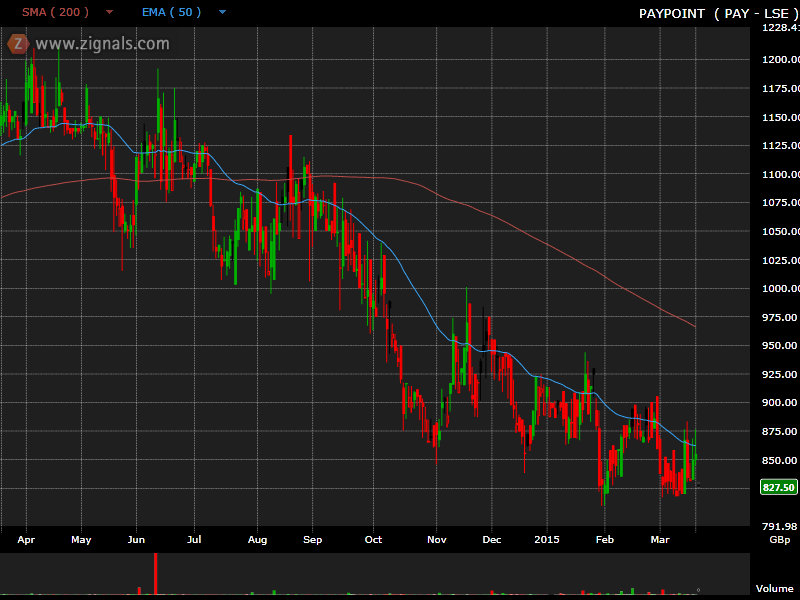
A look at the chart reveals that not is not the time to invest here and I will be looking for prices to stabilise before I take the plunge.

On the 2nd April it was announced that non-executive director Eric Anstee will stand down at the next AGM after spending seven years at the company.

On the 8th April it was announced that Invesco had sold 1,480,615 shares at an approximate value of £12.6M to give them 13.76% of the total equity of the company.  This is a big sale but they are still heavily invested in PAY.

On the 8th April it was announced that Mawer Investment Management had purchased 1,194,103 shares in the company at a value of about £10M to give them a 5.77% stake in the company – it looks like they might have taken some of Invesco’s shares off their hands.

On the 8th May the group announced that Warren Tucker decided to step down as Chairman and he will be replaced by Nick Wiles who has served on the group’s board for over five years.

Gem Diamonds Share Blog – Final Results Year Ending 2014

Gem Diamonds is a diamond miner listed on AIM.  They have two assets – the 100% owned Ghaghoo mine in Botswana that is yet to be fully operational but has a massive total resource of 20.5M carats; and the Letseng Mine in Lesotho, 30% owned by the Lesotho government with a total resource of 5M carats.  The Letseng diamonds are much more valuable, however, with $10.4BN of value in situ compared to just $4.9BN at Ghaghoo.  The group has now released its final results for the year ending 2014.

gemdincome

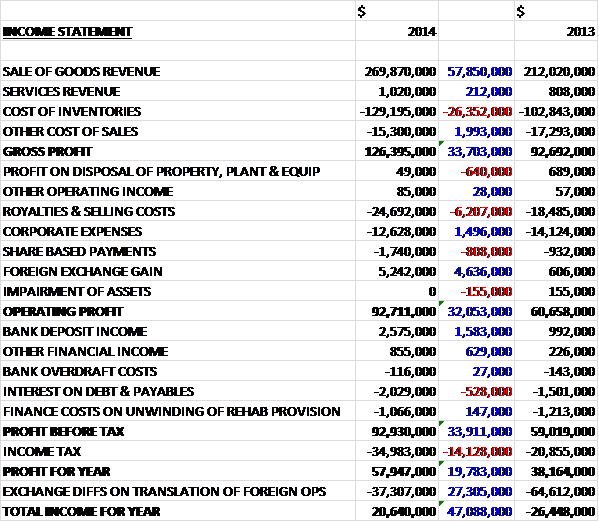
Overall revenues increased by $58M to $270M, driven by 12% higher volumes and 24% higher prices achieved, and with cost of inventories also increasing, partially due to increased waste stripping costs, the gross profit was some $33.7M higher than last year.  Royalties and selling costs increased by $6.2M but this was partially offset by a $1.5M decline in corporate costs and a $4.6M foreign exchange gain to give an operating profit $32.1M higher at $92.7M.  The various finance costs and expenses broadly cancel each other out with an improving bank deposit income meaning that the profit before tax was $33.9M higher at $92.9M before a big increase in the tax bill took this down to a profit for the year of $58M, a $19.8M improvement on the outcome in 2013.

gemdassets

When compared to the end point of last year, total assets increased by $42.3M.  This increase was driven by a $39.6M growth in cash levels and a $29.7M increase in exploration and development assets, partially offset by a $7.4M fall in the value of plant & equipment due predominantly to exchange rate differences, a $9.4M decline in the stripping activity asset, a $7.4M fall in mining assets and a $5.1M fall in decommissioning assets.  Liabilities also increased during the year due to $37.1M hike in the value of loans and borrowings, a $6.8M growth in tax liabilities (despite a decline in deferred tax due to a fall in the value of property, plant and equipment) and a $5.2M increase in accruals, partially offset by a $3.6M fall in rehabilitation provisions to give a net asset base some $3.1M lower than last year at $347.6M.

gemdcash

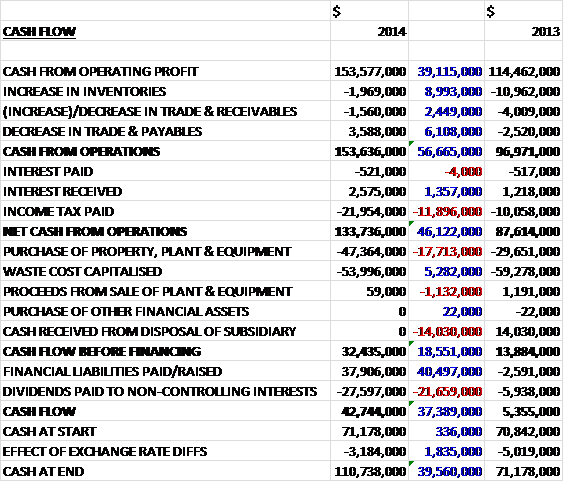
Before movements in working capital, cash profits increased by $39.1M to $153.6M and with working capital changes fairly neutral this year, the cash from operations was still $153.6M, albeit some $56.7M higher than last year.  After the effect of income tax, this was reduced to $133.7M.  The bulk of this cash was then spent on waste processing ($54M) and the purchase of property, plant and equipment ($47.4M) which included $11.3M spent on the Coarse Recovery plant, the plant 2 phase 1 upgrade and additional resource extension drilling at Letseng; and $35.1M spent at Ghaghoo representing the remaining phase 1 capital project costs together with six months operational costs during the commissioning phase that have been capitalised,  so that before financing the cash flow was $32.4M.  Most of this was then given to the non-controlling interest so that free cash flow was just $4.8M.  Strangely the group then took out a net $37.9M in loans to give a cash flow for the year of $42.7M and a cash pile at the end of 2014 standing at $110.7M.

During the year concerns regarding continued liquidity constraints in the market and the tightening of lending criteria by a number of prominent diamond banks, including the announcement of the closure of the Antwerp Diamond bank in October, negatively affected diamond prices and trading activity during the second half of the year as buyers adopted a more cautious approach, further fuelled by a disappointing Hong Kong jewellery show in September.  The high value rough diamonds of Letseng remained fairly resilient, however, with a total of $2,799 achieved per carat in December compared to an average of $2,540 for the year.  It is likely, though, that this issue will filter through to Letseng eventually and it will certainly be affecting any sales of Ghaghoo products.

In the short term there is a relative balance between the demand and supply of diamonds but in the medium term, demand is expected to outstrip supply as ageing mines become depleted and not many new mines are brought online.  The slowdown in GDP growth in China is likely to have a negative impact on prices but this has been partially offset by the recovery seen in the US economy with diamonds used in the production of jewellery remaining the primary driver of demand.  In the market as a whole, Gem Diamonds is a small player, producing 119K carats compared to a world estimate of 131M carats, although the commissioning of the Ghaghoo mine should add another 220K to the group’s total.

At Letseng, a solid year of operations saw an improvement over last year’s production total and improved blasting techniques, plant enhancements and a greater access to ore from the higher grade satellite orebody resulted in an improvement in the grade, size and quality of diamonds produced.  During the year, a revised resource statement was released, reflecting a significant increase in the indicated resource category which had been extended in depth to approximately 350 metres below the current mine pits on both the main and satellite pipe orebodies.  As a result of this increase, the entire 22 year life of the mine has now been classified as reserves.

The improvement in the Letseng mine focused on relatively low capital expenditure projects during the year.  The new Coarse Recovery Plant remains on track to be completed at the end of Q2 2015 which will optimise the treatment of the coarse fraction ore using X-ray transmissive technology that will improve the recovery of the high value Type 2 diamonds.  Implementation of the Plant 2 Phase 1 upgrade project started in Q3 2014 and is on track to be completed in early 2015 at a capital cost of $4.7M.  This project should increase treatment capacity to 250,000 tonnes per annum and further reduce diamond damage.  Subsequent upgrades to the plant will be considered once the current projects are completed and the performance has been fully evaluated.

The mine produced 108,569 carats, a 14% increase on the previous year due to the increased contribution from the higher grade Satellite pipe (31% compared to 16% last year) and the higher than expected performance of the reserve grade.  Total direct cash costs at Letseng were LSL884.6M compared to LSL801.1M last year resulting in unit costs per tonne of LSL137.75 compared to LSL128.68 in 2013.  This increase is primarily as a result of general inflation increases, increased fuel and power costs, additional costs relating to back up power facilities and diamond reduction initiatives, partially offset by savings achieved through the new mining contracts.    Waste stripping activities continued apace in line with the mine plan and the requirement to access the higher grade satellite ore in higher proportions and overall nearly 20M tonnes were moved.  The mining contractor delivered larger mining equipment that included five new 100 tonne dump trucks and two new excavators which improved the waste mining efficiency.

Significant improvements in sidewall control and blasting of the pit slopes allowed to the slope angles of the mine to be increased which will result in lower stripping ratios, significantly reducing the total cost of mining over the life of the mine.  The group renegotiated its contract with the mining contractor a year ahead of the expiry of the last one which resulted in improved unit costs for the next eight years, starting at the beginning of 2014.  They also embarked on a number of initiatives to reduce diamond damage at the mine with changes to mine blasting practices resulting in improved fragmentation of the ore for the treatment plants which contributes to reduced damage and this, plus some of the initiatives embarked on last year have resulted in a reduced breakage trend for the valuable type 2 diamonds.

The Ghaghoo mine is being developed in a phased approach.  The first phase is aimed at confirming diamond grades and prices, as well as testing different mining and processing techniques with subsequent phases increasing production.  The mine is currently in its first phase with the capital project complete and commissioning progressing well.  It has completed the phase 1 capital project which entailed developing an access decline through 80 metres of sand overburden and three production tunnels in the first level of mining.  The tunnels in the old sampling level were intersected in August and they were dewatered and inspected and found to be stable.  Two ventilation holes were drilled with one being equipped as an emergency escape route.

So far, 48,023 tonnes of ore has been treated with 10,167 carats recovered including a 20 carat white diamond, a 17 carat white diamond and a 3 carat orange diamond which confirm the presence of the valuable coloured gemstones.  After the year end a 35 carat diamond was recovered, which is the largest found at the mine to date.   The mine averaged a grade of 21 carats per tonne which was below the expected 27 carats per tonne, partially due to the highly diluted ore from the margins of the pipe and plant inefficiencies during early commissioning.  The grade improved as the year went on after an optimisation process at the treatment plant and it is expected that reserve grades will be achieved as both the plant and mining operations reach steady production levels.

The first tender of 10,167 carats was held in February 2015 and achieved just $210 per carat (compared to more than 10 times that at Letseng) but it will apparently take at least six months of tender sales and the subsequent sale of the polished diamonds by clients in order for a reliable price to emerge.  About 60,000 tonnes per months is expected to be achieved at the mine by mid-2015 as part of the phase one plan.  Progress at Ghagho has not been without its problems as during the year a significant ingress of water was encountered following the intersection of a fissure in the basalt rock, which has now been overcome but led to a delay in the planned ramp up of production

During the year, Letseng recovered seven 100+ carat diamonds with the largest being a massive 299 carat yellow diamond which was sold into a partnership arrangement in early 2015, where the mine will further share in 50% of the uplift from the eventual polished sale value.  During the year the mine sold 108,963 carats at an average price of $2,540 per carat compared to $2,043 the previous year.

The manufacturing operation in Antwerp contributed $3.9M to EBITDA with $5.1M of diamonds sold and $15M remaining in inventory, which relates to a much larger amount unsold than last year.

It is worth noting that the group has a lot of operating leases with the contract of Letseng equipment relating to $323M over eight years.  There was also nearly $16M of capital expenditure approved, mostly relating to the new Coarse Recovery Plant and the Plant 2 Phase 1 upgrade at Letseng.  In addition there are possible tax disputes of $4.9M lurking in the background.

The Lesotho government certainly gets their cut of the diamond revenues with royalties of $22.1M paid this year and a further $27.6M in dividends relating to their 30% ownership of the Lesotho mine also being paid out this year, $6.5M of which related to the withholding tax.   During the year the country did suffer some political unrest but the mine, which is located four hours away from the capital, was not affected.  The country has since stabilised with elections having taken place in February 2015 but this is something that I will have to keep an eye on.

As can be seen, despite the healthy cash pile the group has taken out a number of new loans.  There is a LSL140M three year unsecured project debt facility signed with Standard Lesotho Bank and Nedbank for the total funding of the new Course Recovery Plant.  The loan is for $12.1M repayable in ten quarterly payments starting at the end of March 2015 with a final payment in June 2017.   The loan has a fairly hefty interest rate of 11%.  The other loan is a nine month unsecured $25M facility signed with Nedbank Capital in January 2014 for the remaining spend on the Ghaghoo Phase 1 development.  The loans have been refinanced into a six year secured project debt facility which will expire at the end of 2020 with an interest rate of 2.6%.  Total interest for the year has been $1.1M and there remains $41.6M undrawn on these facilities.

Clearly there are a number of risks facing the group with them being susceptible to the price of diamonds which have showed some weakness towards the end of the year and is, in turn, partly affected by global economic conditions.  There is also a foreign exchange risk particularly with the Lesotho loti, South African Rand and Botswana pula while the group’s sales are denominated in US dollars, which is not the functional currency of the mining operations.  The group is also susceptible to potential political unrest as the disruptions preceding the Lesotho elections this year had shown, although it is probably fair to say that Lesotho and Botswana are two of the more stable African countries.

Despite a weakening of prices in Q4 the long term outlook for the diamond market remains strong and the group expects a firming in the market after banks in Dubai stepped in to offer the liquidity lost after the bank in Antwerp reduced funding.  The Chairman therefore expects diamond prices to begin trending upwards in the second half of 2015.  The focus next year will be on converting the Ghaghoo mine from a development project into sustained operational activities and achieving steady state production by the end of the first half of 2015 with the aim of generating a positive contribution to EBITDA.

At the current share price, the shares trade on a cheap looking P/E ratio of 9.7 which falls slightly to 9.6 on next year’s consensus forecasts.  After the maiden dividend was announced, the shares yield 2.1%, falling slightly to 2% on the 2015 forecast.  The policy going forward will be to determine the appropriate dividend each year based on consideration of the company’s cash resources, the level of free cash flow and earnings generated during the year.  They are expected to be delivered annually with the full year results.  There was a net cash position of $73.6M at the end of the year which seems pretty healthy.

Overall then, this seems to be a generally positive set of results, tinged with a bit of uncertainty. Profits increased substantially but net assets remained fairly with and the group achieving a modest level of free cash flow, which is nearly enough to cover the recently introduced dividend.  One issue has been the softening in diamond prices during the final quarter of the year.  This has been blamed on lower liquidity from the diamond banks but I suspect, as the disappointing Hong Kong jewellery show suggests, that the slow-down in the Chinese economy may be taking its toll.  The board expects diamond prices to improve again in the second half of the year which coincidentally is when they expect the Ghaghoo mine to start contributing to profits.  That mine, however, did provide rather disappointing figures for grade and price per carat but this should improve when production is ramped up next year.

The Letseng mine seems to be in a good shape.  After the investments the breakage should be reduced going forward but the improved costs from the signing of a new contract with the equipment provider loos to be offset by increased input prices at the mine.  Finally, although tensions have reduced following the elections, any further unrest in Lesotho could be a very big issue.  The shares now look very cheap on P/E terms and the new dividend should underpin prices to some extent and I have decided to tentatively buy back in here.

GEMDChart

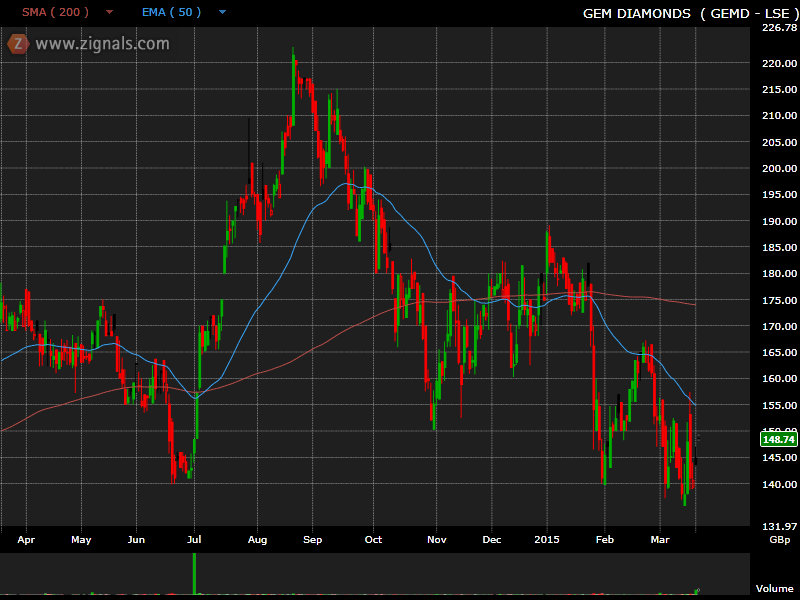
The chart here does not look that great and the falling diamond prices seem to have taken their toll.  Given the downtrend in force here I will have to watch my investment closely and apply a suitable stop loss.

On the 23rd March the group announced that The Capital Group Companies had sold about 2M shares at a value of about £2.9M.  They now have 3.5% of the total share capital but this is quite a hefty sale.

On the 24th March it was revealed that the Capital Group Companies have continued selling down their holding and sold another 1.2M shares at a value of about £1.7M.  They now own below 3% so we are not going to hear whether they sell the rest of their holding.

On the 31st March it was announced that two non-executive directors were retiring from the board.  Dave Elzas leaves after nine years, being with the company since its listing and Richard Williams has taken up a full time executive roll in Canada after being with the company since 2008.

On the 2nd April it was announced that FMR LLC had sold 398,718 shares in the company at a value of about £560,000.  After the sale they still hold 4.79% of the company’s shares so it seems another large shareholder is selling down their holding.

On the 21st May the group released an update for the year to date.  During the period, diamond traders continued the cautious approach they have adopted since Q3 2014 as increased liquidity constraints following the closure of the Antwerp Diamond Bank, together with tighter credit terms imposed by other banks put pressure on the rough diamond market.  Additionally traders in polished diamonds wait for improved demand that was not stoked by the recent Basel Watch and Jewellery show.  The prices achieved for Letseng’s high quality stones did remain robust throughout the period, however.

During the first four months of the year the Letseng mine recovered some 31,369 carats at a grade of 1.58 cpht, this compares unfavourably to the 34,205 carats at a grade of 1.63 cpht that was achieved during the same period last year.  The shortfall is mainly due to the planned 19 day shutdown of Plant 2 as the phase 1 upgrade was completed.  Following this upgrade, plant 2 is operating well and is on track to achieve its target of an extra 250KT of ore processed per annum.  During the period, a 314 carat type 2 white diamond was recovered and sold into a partnership arrangement, which is good to see.  At the first three tenders of the year, some 35,940 carats were sold at a value of $77.1M compared to 31,614 at $67.7M during the last quarter.  This means that the sales achieved $2,146 per carat compared to $2,140 per carat, although the 12 month rolling figure is $2,397 per carat which shows that the last two quarters have underperformed compared to the two before.

The coarse recovery plant remains on track for completion by the end of Q2 and is forecasted to be completed within the budget of $12.5M.  All major equipment has been delivered to the site and construction is well advanced with commissioning having commenced during May.  In Botswana, good progress was made on developing production area 1 on level 1 with the first long hole rings being blasted.  Before these blasts, ore availability had been confined to limited areas on level 0 in the development tunnels.  With more ore available, the plant has been able to treat more material with 67,330 tonnes of ore being treated during the period with 16.174 carats recovered.  Following optimisation initiatives on the plant, and the increased steady state feed, the ore from the newly opened areas has yielded grades above the disappointing reserve grade with an average of 29 cpht in May so far.  The mine is on track to ramp up to full production during the second half of the year as planned.

On the 30th July the group released a trading and production update covering H1 2015.  During the period the overall diamond market experienced high inventory levels and continued liquidity concerns.  This, combined with global macro-economic uncertainties has continued to place pressure on both rough and polished diamond prices.  Letseng’s large high value stones have so far remained resilient to these pressures but the current market conditions have had a negative effect on the pricing achieved for the smaller Ghaghoo diamonds.

At Letseng, 27,547 carats were mined during Q2 which made the H1 output come in at 50,019, a 7% fall year on year.  The decline was due to the plant 2 upgrade which was completed in budget and on schedule.  The shutdown for the changeover occurred for 19 days which reduced the amount mined during February and March.  Following the upgrade, plant 2 is operating well and is on track to achieve its increased head feed target of an additional 250,000 tonnes on an annualised basis.  Although the power supply situation in Lesotho continues to be unreliable with frequent power outages, the impact on the operations at Letseng has been minimal due to the additional on-site back up power generating capacity installed last year.

During the period Letseng held four tenders, selling 46,961 carats at a value of $106.3M.  The average price per carat stood at $2,264, a decline of 3% when compared to the second half of last year.  During the period, 237 carats were extracted for manufacturing at a rough value of $3M with $6.9M remaining in polished inventory at the end of the period.  At the mine, an outstanding quality 357 carat type iia white diamond was recovered that will be sold in Q3 and a further four diamonds over 100 carats each were sold in the period, including a top quality 108 carat type iia rough diamond which sold for over $7M!

The construction of the course recovery plat was completed on schedule and within the budget of $11.7M and commissioning continues with the first diamonds having been recovered from run of mine ore.

At Ghaghoo, 132,135 tonnes of ore was treated, sourced mainly from level 0, whilst work continued in establishing the production section on the first production level and ramping up to steady state production.  After June, all ore has been sourced from level 1.  Five tunnels on level 1 have now been fully developed to the northern orebody-country rock contact, with development having been started on the next two tunnels.  Slot developing and opening has progressed more slowly than anticipated due to localised difficult ground conditions, but has now been completed from tunnel 1 to tunnel 5 which will allow the retreat of the production faces back along these tunnels.  The slower than anticipated progress in the slot opening has constrained the production ramp-up.

Development of the decline down to level 2 progressed to a point, but was then halted just short of the same main water fissure that was intersected on level 1.  Both the decline and the rim tunnel on level 1 need to advance through the fissure in order for development to continue and allow access to the second production section.  Specialists have been deployed to ensure the fissure is fully sealed prior to the tunnels advancing and work is progressing slowly and carefully to avoid any further major ingress of water.

The processing plant will continue to ramp up to the capacity of 60,000 tonnes per month.  In both May and June, over 32,000 tonnes of ore per month were treated, with recovered grades in excess of the modelled reserve grade of 27 cpht being consistently achieved, resulting in a total recovery of 35,283 carats in the period.  During the half-year, eight diamonds larger than 10.8 carats were recovered, including a 41 carat and a 35 carat diamond.  In July a 48 carat diamond was recovered, which was the largest stone found to date.  There have also been a number of coloured diamonds found at the mine, although these were in the smaller sieve sizes.

The second sale of Ghaghoo commissioning production took place in July, achieving a total value of $4.9M at just $165 per carat, substantially lower than the $210 per carat achieved at the first sale, although the quality was not comparable to that sale which, together with the declining market for these goods, had a negative effect on the price achieved.  It is expected that the next Ghaghoo sale will take place before the end of the year and will include a higher proportion of diamonds from the main body of the VKSE phase of the kimberlite ore.

The group has a net cash position of $49.6M at the period end with some $83.8M cash on hand.

Overall then, this is a very mixed update.  Things at Letseng seem to be going quite well.  These larger quality diamonds are holding their value fairly well and the group continued to find some outstanding gems at the mine.  Things are not progressing so well at Ghaghoo, however, where the development of the mine is progressing slower than planned and the falling diamond prices are taking their toll on the smaller, lower quality diamonds produced there.  At these prices, I am not convinced this mine is going to do that well in the short term and until the prices for these gems improve I think I will stay out of the shares for now.

Paypoint Share Blog – Final Results Year Ending 2014

Paypoint is a service provider for consumer transactions through various distribution channels.  There are a number of different activities that the group is involved in with retail networks being one of the most important.  In the UK the network includes terminals in over 26,700 local shops including Co-Op, Spar, McColls, Costcutter, Sainsbury Local, Tesco Express, Asda, Londis and various independents.  Some of the services provided includes energy meter prepayments, bill payments, benefit payments, mobile phone top-ups, transport tickets, TV licenses and cash withdrawals which are made available to customers by most leading utilities and a range of telecoms and other service companies.  There are more than 8,350 terminals in local shops across Romania which enable to people to make bill payments, money transfers, road tax payments and mobile phone top-ups whilst in Ireland there are 500 terminals in shops and credit unions for mobile top-ups and bill payments.  In the UK the network also includes 3,600 Link branded ATMs and 8,800 of the group’s terminals enables retailers to accept debit and credit cards.

The Collect+ service is a joint venture with Yodel that offers parcel drop-off and pick up services in 5,600 convenience stores so that customers can use the service to handle parcels from retailers including Amazon, eBay, ASOS, New Look, Boden, John Lewis, House of Fraser, M&S, Asda Direct and Very.  In major cities across the UK, Canada, USA, France, Switzerland and Australia the group’s parking solutions enables people to pay for parking by mobile, increasingly through Paypoint’s own app. Electronic parking permits, automatic number plate recognition systems for car parks and penalty charge notices are also provided.  The core online payments platform is linked to 16 major acquiring banks in the UK, Europe and North America.  It delivers secure credit and debit card payments for over 5,100 online merchants including Hungry House, Moon Pig, WH Smith, London and Zurich insurance, Moneysupermarket.com and British Gas.  Services include transaction gateway and a bureau service where they take the merchant’s credit risk and manage settlement for them.  There are also a number of value added services such as Fraud Guard, a service that mitigates the risk of fraud in card not present transactions.

paypointincome

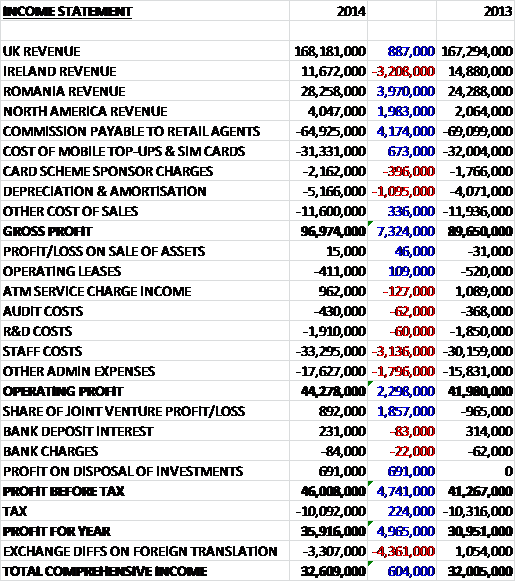
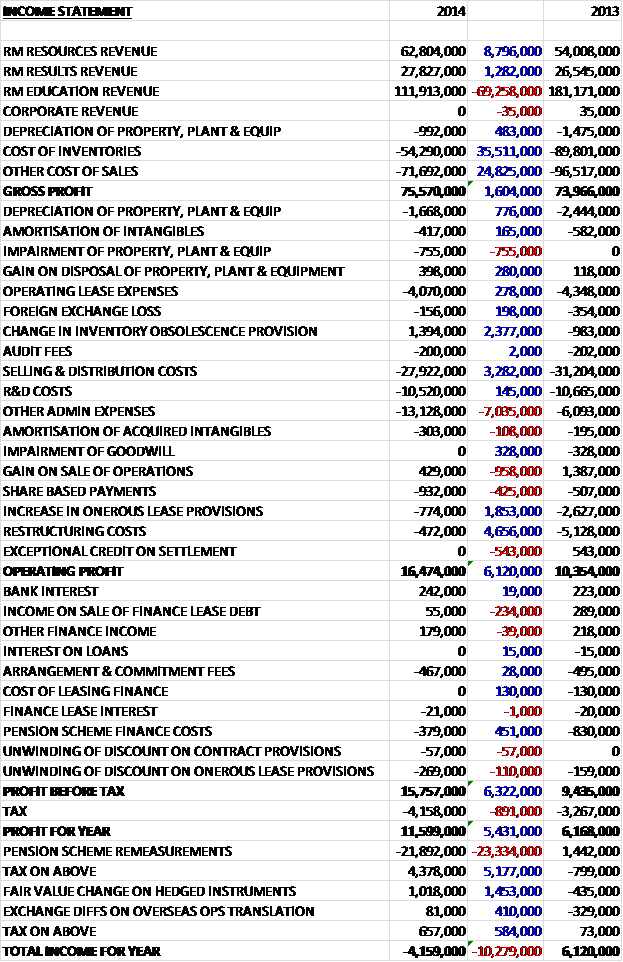
When compared to last year, revenues in general increased with Romanian sales in particular doing well, up by £4M and North American sales increasing by £2M, partially offset by a £3.2M decline in Irish revenues.  Overall retail network revenue was up 1.1% and mobile & online revenue increased by 9.3%.  The commission paid to retail agents fell by £4.2M due to lower mobile top-ups, whereas depreciation and amortisation increased by £1.1M to give a gross profit of £97M, a growth of £7.3M when compared to last year.  Staff costs then increased, as did other admin expenses relating to the increasing cost of IT operations to support new products and the continued investment in mobile and online, a trend that is expected to continue next year, so that operating profit was just £2.3M higher than in 2013.  The joint venture, Collect+, seems to be gaining traction, with a £1.9M swing into profit and the group also made a £691K profit on investment sales, relating to the disposal of the investment in OB10.  The tax bill fell slightly so that profit for the year was £35.9M, an increase of £5M when compared to last year.

paypointassets

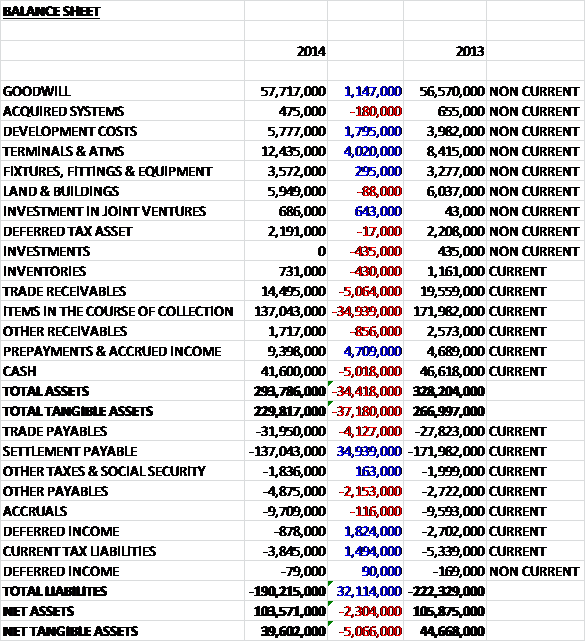
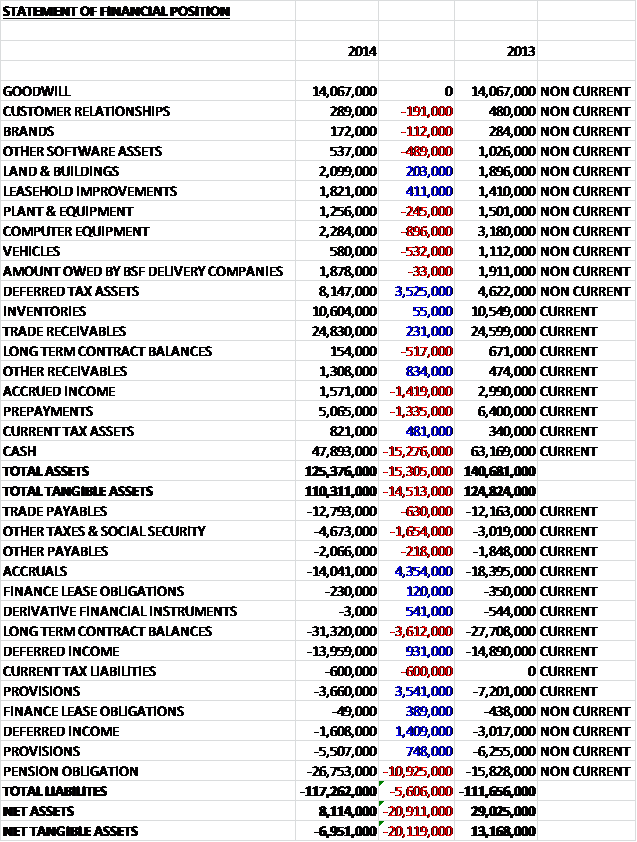
When compared to the end point of last year, total assets fell by £34.4M, driven by a £34.9M decline in items in the course of collection, a £5.1M fall in trade receivables and a £5M reduction in cash levels, partially offset by a £4.7M increase in prepayments and accrued income, a £4M growth in terminals and ATMs, a £1.8M increase in development costs and a £1.1M growth in goodwill.  Liabilities also fell during the year due to a £35M fall in settlements payable (offsetting the items in the course of collection), a £1.8M decline in deferred income and a £1.5M fall in current tax liabilities, partially offset by a £4.1M increase in trade payables and a £2.2M growth in other payables.  The end result is a net tangible asset level of £39.6M, a decline of £5.1M when compared to last year, which is a shame but the balance sheet looks pretty healthy nonetheless.

paypointcash

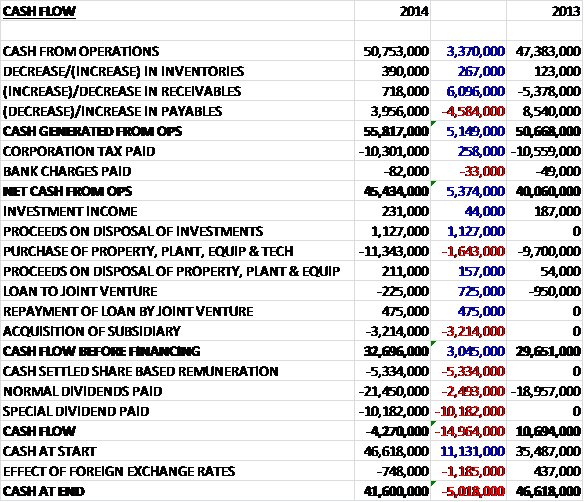
Before movements in working capital, cash profits increased by £3.4M to £50.8M.  All working capital movements improved the cash level, in particular an increase in payables and there was a slightly lower tax bill to give a net cash generated from operations some £5.4M higher than last year at £45.4M.  This cash comfortably covered an £11.3M investment in property, plant & equipment relating to IT expenditure, developments for new products, terminals, ATMs and prepaid energy and card readers, and a  £3.2M acquisition of subsidiary which meant that after a £1.1M cash income from the disposal of an investment, the free cash flow was an impressive £32.7M.  This comfortably covered the £21.5M spent on normal dividends and the £5.3M paid for the cash settlement of share based remuneration.  The group then spent £10.2M on a special dividend which meant that there was a net cash outflow of £4.3M for the year to give a large cash pile of £41.6M at the year end.  Aside from all that cash, there is also an undrawn five year £35M revolving loan facility so there really is plenty of headroom here.

Overall transactions increased from 739M to 767.5M with a 1.7% growth in retail networks and a 15.8% increase in mobile and online.   Transaction values increased to £14.7BN with a 6% growth in retail payments and a 1.8% increase in mobile and online.  In the Bill and General category, revenue was up 4% and net revenues increase by 7.2% to £54M.  Transactions were ahead of last year due to a 54% growth in Romanian bill payment transactions as the group added clients including RCS and RDS, a pay TV and communications supplier that is one of the country’s biggest bill issuers, but the group blamed slow UK transactions on an extra week being in last year’s trading and warmer winter weather impacting energy spending.  Simple Payment service transactions were lower than expected as a substantial proportion of the cheque payments that the system was designed to replace migrated to other payment methods.  The strong growth in Romania was due to increasing market share and adding new clients.

Retail Services volumes increased across all products.  ATM transactions increased by 21%, credit and debit transactions by 18%, SIM card sales by 5%, money transfer transactions by 59% and parcels by a massive 76% over the year.  A higher average ATM transaction value drove an increased total transaction value in excess of the volume increases.  A strong net revenue growth of 20% was driven by increases in credit and debit, parcels and income from broadband (enabling faster terminals) but was held back by a flat ATM performance in the first half of the year.

Top-up transactions decreased over the year as a result of the continued decline in mobile top-up volumes in the UK and Ireland of 17%.  Other top-up transactions were also lower than last year and the fall in UK and Irish mobile transactions was only partially offset by a small increase in Romanian mobile top-ups where the impact of a larger network offset market decline.  The average value of top-ups increased, however, which helped mitigate the volume drop-off.  The joint venture, Collect+, saw transactions grow substantially with a richer mix of consumer parcels driving an increase in revenue and the integration of new merchants, growth in activity from existing clients and improvements in service levels for peak trading all helped the business to post its maiden profit.  The ultimate goal is a lofty one, to provide a larger parcel network than the Post Office but operational gearing in the joint venture is not high so an increase in revenues will not necessarily lead to a huge increase in the bottom line due to greater costs.

In Mobile and Online, transactions increased by 16% with online transactions up 9% and mobile transactions up 44%.  Transaction growth from online services was driven by the continued addition of large merchants and the organic growth of existing merchants.  The group continued to add key mobile parking contracts with councils and parking authorities across the UK, North America and France, including the provision of services for 155,000 parking spaces in central Paris, as they provide a more convenient and cost effective method for collecting charges.  The success in Paris follows other successful bids in Lambeth, Southwark, Chelmsford, Exeter, Seattle, Massachusetts and Dallas.  The winning bid from NSL for Westminster’s parking does not include the Pay Point service, however, so this is a bit of a blow given the potential size of the contract and will delay profitability for mobile and online.  Strong growth in mobile revenue was offset by a fall in online revenue due to the prior year impact of one-off software development income and a higher transaction growth for some larger merchants who benefit from lower pricing.

The company’s bill and general payments service has continued to be resilient as consumers’ discretion in expenditure is limited for essential services.  Utility companies continue to install new prepay gas and electricity meters which will have a beneficial impact on transaction volumes and the online payment market as a whole continues to grow substantially.  One major headwind, though, is the continued decline in mobile top-ups as mobile operators offer more airtime at lower costs and promote contracts ahead of prepay.

During the year the group acquired Adaptis Solutions Ltd, a business that specialises in providing a range of parking services including electronic parking permits, automatic number plate recognition systems for car parks and penalty charge notices.  An initial consideration of £3.4M was paid in cash with the potential for £1.35M in deferred and contingent consideration, although the group does not think that £250K of this contingent consideration is likely to be paid.  There were no net assets acquired and the acquisition generated goodwill of £3.8M.  Adaptis contributed £93K to revenues and a loss of £88K to profit before tax for the period after acquisition and had the acquisition been completed on the first day of the year, it would have contributed £700K to revenues and a loss of £400K.

So far during the current year, trading is in line with expectations.  The retail networks in the UK and Romania should continue to deliver profitable growth from the strong client base and the group will continue to invest in network expansion and new services to improve the quality of these networks.  The group are looking at the possibility of further international expansion after the success of Romania.  It was announced that senior independent director, Andrew Robb will retire at the AGM alongside chairman David Newlands, having been in the position for 16 years with Warren Tucker taking over as his successor.  The shareholder base of the group looks fairly healthy with the majority of shares being held by various institutional investors with Invesco making up the largest one with 23% of the company.  Some of the directors are also well invested with the CEO owning nearly 3% of the shares.

At the current share price the shares trade on a P/E ratio of 15.8 which falls to 14.8 on next year’s forecast.  After an 18% increase in the dividend paid (excluding special dividends), the shares yield a decent 4.2% at the current share price, increasing to 4.5% on next year’s forecast.  There was no debt so net cash stood at £41.6M compared to £46.6M last year.  Some £6.5M of this cash is client cash and £13.5M is located in Romania.

Overall then, this is a solid update.  Whilst profits were up, net tangible assets fell due to declining receivables and cash, no doubt attributable to the special dividend paid.  The balance sheet remains strong and there is a good amount of free cash flow generated, easily enough to pay the normal dividends.  Operationally, Romanian bill payments seem to be doing well but they slowed in the UK as cheque payments migrated to other methods.  There were strong retail services with credit and debit transactions and money transfers doing well.  The performance of the mobile top-up business was not so good and the trend for continued shifts towards contracts over prepay means that this is likely to continue in the future.  Mobile payments seem to be doing well and the car parking angle seems like it has some decent potential, despite the Westminster parking contract blow.   Finally, the joint venture with Yodel seems to be gaining traction and having used the service myself, I found it very convenient.

The shares are not that expensive on a P/E basis and the dividend is decent whilst many of the group’s markets seem to be growing, mobile top-ups notwithstanding.

RM Group Share Blog – Final Results Year Ending 2014

RM supplies products, services and solutions to the UK and international education markets.  There are three divisions: Resources, Results and Education.  The Resources division comprises of two businesses – TTS and SpaceKraft.  TTS is a provider of physical resources to UK schools with a leadership position in primary and early years age groups.  SpaceKraft is a provider of resources and immersive environments to meet the specific requirements of learners with special education needs.  The Results division supplies government ministries, exam boards and professional awarding organisations with technology and expertise to improve the assessment cycle, both in the UK and overseas and this includes the systems required to provide the league tables for English schools.   It also provides exams and tests, onscreen testing, onscreen marking and the management and analysis of education data.  RM Education provides technology based software and services designed for UK schools and other education establishment.  Their products and services include the outsourcing, support and implementation services such as managed services, telephone support and consultancy services; network software, tools and infrastructure services; access to curriculum resources and school management solutions such as e-books; and the provision of broadband and e-safety solutions.  They have now released their final results for the year ending 2014.

rmincome

Revenues declined when compared to last year as an £8.8M growth in Resources sales and a £1.3M increase in Results revenue was more than offset by a £69.3M decline in Education revenue.  Cost of sales also declined to give a gross profit some £1.6M above that of 2013.  Other costs were also generally down as depreciation fell £776K, sales and distribution costs fell by £3.3M and there was a reversal of the inventory obsolescence provision. Other admin expenses did increase by £7M but there were declines in some one-off costs as onerous lease provisions fell by £1.9M and restructuring costs declined by £4.7M to give an operating profit of £16.5M, a £6.1M improvement when compared to last year. Finance costs also improved, driven by a £451K improvement in the pension scheme finance costs but tax increased to give a profit for the year some £5.4M higher than last year at £11.6M.  The adjusted profit for the year, discounting the share based charges (not sure these should be taken out really), amortisation of acquired intangibles, restructuring and a few other items, was £13.7M, an increase of £2.2M when compared to last year.

rnassets

When compared to the end point of last year, total assets fell by £15.3M driven by a £15.3M fall in cash levels, a £1.4M decline in accrued income and a £1.3M fall in prepayments, partially offset by a £3.5M increase in deferred tax assets.  Conversely liabilities increased due to a £10.9M increase in pension obligations, a £3.6M growth in long term contract balance payments and a £1.7M increase in other taxes and social security, somewhat offset by a £4.4M fall in accruals, a £4.3M decline in provisions, mainly relating to lower employee related restructuring provisions – the large amount of onerous lease provisions remain, and a £1.4M fall in deferred income to give a net tangible asset level some £20.1M worse than last time to a negative £7M so this is not a strong balance sheet at all which becomes even worse when the £13.8M worth of operating lease commitments off the balance sheet are taken into account.

rmcash

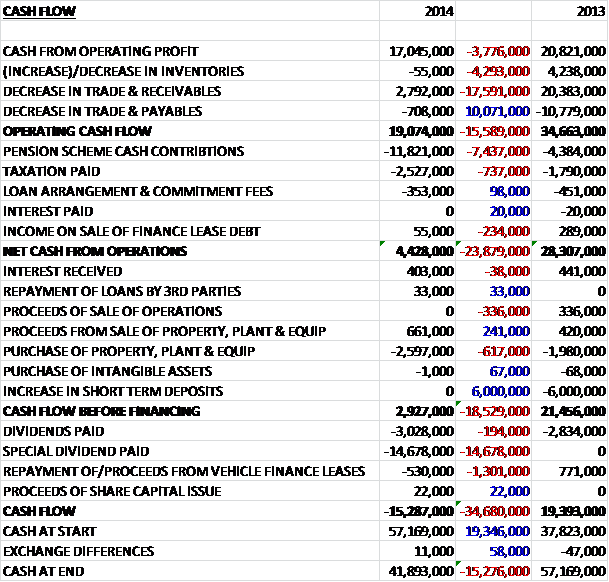
Before movements in working capital, cash profits fell by £3.8M to £17M, although a decrease in receivables meant that operational cash flow was £19.1M, a £15.6M decline when compared to last year due to the huge fall in receivables that happened that year.  As the inventory level declines due to a run-down of long term contracts, it is expected that this situation will reverse going forward.  The bulk of this cash was shunted into the pension scheme (£11.8M, although £8M was a one-off payment in an escrow account to reduce risk) and after tax took its toll, the net cash from operations was just £4.4M.  There was not much in the way of capital expenditure, though, as a net £2M was spent on property, plant and equipment to give a free cash flow of £2.9M which was nearly enough to pay the regular dividends, although the £14.7M spent on the special dividend meant there was a cash outflow of £15.3M which left a still decent cash pile of £41.9M at the end of the year.

For the long term contracts, revenue is recognised proportionately to the stage of completion of the contract based on the fair value of goods and services provided to date, taking into account the sign-off of milestone delivery by customers.  Where the cumulative value of goods and services provided exceeds amounts invoiced, the balance is included in receivables.  Where amounts invoiced exceed the fair value of goods and services provided, the excess is first set off against long term contract balances and then included in amounts due to long term contract customers in payables.

Overall RM Resources had a good year as TTS generated strong organic growth based on market share gains and achieved an increase in margins whilst the SpaceKraft business is no longer loss making.  RM Results secured new customers and delivered growth with improving markets and the reshaping of RM Education continued with the move away from manufacture and sale of hardware devices with more of a focus on services and software.

The Resources business had profits of £10.3M, an increase of £3.1M when compared to last year with an increase in profit margins from 13.3% to 16.4%.  Investment is being made in direct marketing across online and traditional channels and in export business development to support growth.  Revenue from the TTS UK direct marketing business increased by 19% to £46.2M with a particularly strong performance from products targeted at the new English primary school curriculum with the proportion of online sales showing further increases.  TTS revenues from overseas resellers and international schools increased by 20% to £8.5M, driven by growth in Europe, the Middle East and the Americas.  Revenue from sales to UK trade partners fell by 7% to £4.4M, though.  The recent trend of declining sales at SpaceKraft was reversed with a growth of 11% to £3.7M which means that the business is no longer loss making.

The Results business had profits of £4.6M, an increase of £300K when compared to 2013 with margins increasing slightly from 16.1% to 16.7%.  The business secured a new contract with the Caribbean Examinations Council during the year and the summer e-marketing pilot with education charity AQA was completed successfully with the group subsequently being appointed as one of two preferred suppliers for long term e-marketing contracts.  Internationally the business is pursuing opportunities for the onscreen marking of paper based exams while in the UK, the exam and curricular changes introduced have reduced the number of exam retakes and a move away from modular courses to final exam based assessment will also impact the business.  There is a long term trend from paper based to onscreen testing though the take-up for school based exams has been low.  The educational data side of the business is dependent on one customer, the Department for Education.  The National Pupil Database and RAISE online contracts, which included the capture and publishing of data for the school performance tables in England, were extended during the year following the agreement to stop work on the School Performance Data Programme.

The Education business had profits of £7.7M, a decline of £1.7M when compared to last year with profit margins increasing from 5.2% to 6.9% reflecting the continued shift away from hardware devices.  The staff cost reductions were implemented ahead of plan and write downs in the value of remaining inventory were lower than expected.  The services business saw a tough year as revenues declined by 29% to £61.2M with a reduction of new schools being built under the Building Schools for the Future programme.  Digital Platforms and Content revenues increased by 4% to 7.6M with RM Integris sales increasing following good market share gains, including Oxfordshire won last year in a market that is dominated by one competitor with low levels of customer switching.

RM Unify was launched last year as a technology solution to allow customers easy access to the varied digital, cloud based, educational specific content and materials that are now available with revenue derived from annual school subscriptions and from fees from sales of third party applications.  RM Books provides the first e-book solution designed for schools and now has about 16,000 titles available.  The service is free to schools with the group taking a share of revenue from content sold through the system.  E-book adoption in schools has been much slower than in the outside world and as such, revenue is still limited with the current focus on demonstrating the educational value added  of the system.

Network solutions includes sales of network management tools and related hardware such as routers and wireless systems.  Revenues collapsed by 45% to £8.6M as demand for established products reduced with lower school capital budgets.  Sales of the new generation of network and device monitoring tools launched during the year have been disappointing and the focus is on ensuring that existing customers are on the latest version of the group’s software and on developing enhanced propositions which meet users changing requirements.  The broadband and e-safety service provider is dominated by one large regional consortium which accounts for a large percentage of revenue, a relationship that is underpinned by a contract that runs until 2018, although volumes can be variable.  Revenues decreased by 14% to £16.7M reflecting the end of some regional consortium contracts and the movement from private to public networks.  Revenue from hardware fell by 67% to £17.8M reflecting the group’s exit of the PC devices business over the course of the year but revenue was significantly higher than planned with the costs of exit being much lower than expected, benefits that will not be repeated going forward.  Third party partners Misco and Kelway have been appointed to provide hardware to customers where still required under existing contracts.

The group has a £30M revolving credit facility, of which £26.4M remains unallocated.  The interest is payable at 2.5% above LIBOR and there is also a 1.2% fee payable on unutilised balance so given this, it is quite surprising this was entered into with the group having nearly £42M in cash.  The shareholder roster looks pretty healthy with plenty of institutional names and Schroders taking the place of largest shareholder with more than 18% of the company’s equity.  On the flip side, it does not look as though the directors have large investments in the company, however.

Of the £24.8M of trade receivables some £1.7M are overdue by more than 90 days which seems like quite a substantial amount to me, and a huge increase on the equivalent £400K last year.  The group is potentially affected by a number of other risks.  The majority of the group’s business is funded from local government sources so changes in political administration or policy priorities could result in a fall in education spending and global economic conditions may result in a reduction in budgets available for education spending. In addition, education practices and priorities could change which might mean that the group’s products and services no longer meet customer requirements and the company is reliant on some key contracts, the loss of which could materially affect earnings.

One major issue for the group is the pension scheme.  The last valuation in 2012 revealed a deficit of £53.5M and it was agreed that the group would pay £4M per annum towards the deficit until 2013 and £3.6M until 2027.  The next valuation is due in May which may result in further charges.  A further contribution of £8M was made this year into an escrow account, £4.7M of which was paid to help fund a pension buy-in, the income from which will closely match payments to existing pensioners, eliminating inflation, interest rate and longevity risks associated with these pensioners.  The cost of this insurance premium was £30.7M, paid with £26M from the pension assets and £4.7M from the escrow account which leaves £3.3M in the account for future risk reduction exercises.  This only covers 13% of the scheme’s liabilities.

Going forward, it is expected that Results and Resources will continue to perform well and Education will take further steps towards building a platform for development.  It is anticipated that cash generated from operations will be below operating profit in the coming years, reflecting the reversal of a favourable working capital position related to long term contracts and the utilisation of those onerous lease dilapidation provisions.

At the current price the shares trade on an inexpensive P/E ratio of 10.8 which falls to an even cheaper looking 9.5 on Numis’ 2015 forecast.  After a 21% increase in the dividend, the shares have a yield of 2.8%, rising to 3.4% on next year’s forecast.  It has been stated that the board will adopt a progressive dividend policy towards a more appropriate level of cover.

Overall then this is a set of results reflecting the transition of the group.  Profits were up but net assets were down, mainly as a result of increased pension liabilities which seem to be a real drag on results with the group already paying £3.6M a year towards the deficit for the next 12 years and potentially more when it gets revalued in May.  Despite these pension payments and the one-off escrow pension costs, the group had a decent free cash position, enough to mostly cover the normal dividends but a reversal in the working capital position flagged up for next year may put some pressure on this.  Operationally the resources business is doing well but the education business, which is still a large contributor to the bottom line, is struggling with less schools being built under the schools for the future programme and management guiding for a lower profit from the division next year.  The group is clearly susceptible to education spending political change so the upcoming election may be cause for uncertainty.  Valuation wise, though, the shares seem to be very cheap, with a very low forward P/E ratio despite the cash pile and they offer a decent dividend yield too.  I may look to buy the shares at an opportune time.

RMChart

After a decent rise, the shares have been treading water for the last year or so and with the price dropping below both the 50 day and 200 day moving averages, now does not seem to be the time to buy the shares so I will keep a close watch instead.

On the 25th March the group released an AGM statement.  Trading in the first quarter has been in line with expectations and cash deposits at the end of February stood at £40.5M.  Following successful pilots, RM Results signed a three year contract to provide the education charity AQA with e-marketing services.  The group has also sublet one of it’s buildings in Abingdon to the South Oxfordshire District Council.  This building was surplus to requirements and should reduce the onerous lease provision by about £2.4M so this has to be a good move.  Things seem to be ticking along fine here, not sure whether to buy yet – I will have a think!

On the 20th May the group announced that after five year CFO Iain McIntosh will be leaving the company, looking for a “new challenge”.  He will be succeeded by Neil Martin who joins from Adecco where he is currently CFO for UK and Ireland at the Swiss HR company having been CFO at Spring when it was acquired by Adecco.

Omega Diagnostics Share Blog – Interim Results Year Ending 2015

Omega Diagnostics has now released its interim results for the year ending 2015.

omegainterimincome

Revenues were up slightly when compared to the first half of last year as the trend seen last year continues with a £536K increase in food intolerance sales being partially offset by declines in the other segments, despite the adverse £250K affect that strengthening Sterling had on revenues. Cost of sales was just about flat to give a gross profit some £98K higher than last time. We then see a £107K increase in share based payments and a £72K growth in other admin expenses, partially offset by the occurrence of nearly £50K worth of other operating income and a £55K decline in selling and marketing cots to give an operating profit of £196K, a growth of £37K before improving finance costs improved profits further to £44K. Unfortunately all this was wiped out by a tax charge compared to the rebate last time due in part to a movement on deferred tax arising from share based payments and a lower R&D tax credit so that profit for the year was £112K lower than in the first six months of 2014 at £179K.
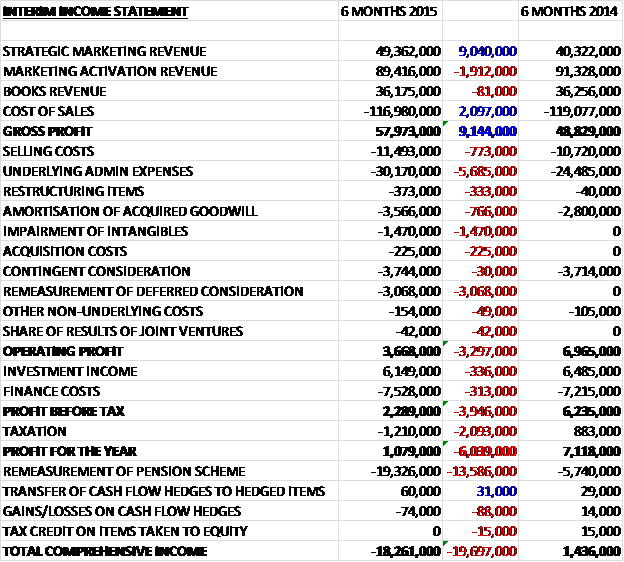
omegainterimassets

When compared to the end point of last year, total assets fell by £36K due to a £370K increase in intangible assets, a £218K increase in inventories, a £157K increase in property, plant & equipment and a £122K increase in deferred tax assets all being more than offset by a £980K fall in cash levels. Liabilities also fell during the period, driven by a £140K fall in borrowings but the end result is a £284K decline in net tangible assets to £6.9M.

omegainterimcash

Before movements in working capital, cash profits increased by £108K to £656K but this was then knocked down, mainly from an increase in inventories, to £306K, a fall of £114K when compared to the first six months of last year. This cash flow was nowhere near enough to pay for the £650K of intangible assets and the £437K spent on property, plant and equipment so that there was a cash outflow of £746K before financing, where the group continued to pay back the loan, which was partially offset by a net cash inflow from finance leases to give a cash outflow for the year of £900K and a cash level at the end of the half of £2.1M.
Adjusted profits at the allergy and autoimmune business fell by £170K to just £28K. The business continues to operate with reimbursement pressures in Germany leading to a reduction in sales across some regions. Adjusted profits at the food intolerance business grew by £383K to £956K. There are a number of key customers in the EU, North America and BRIC countries that are supporting a sustainable increase in product volumes that leads to an overall increase in profitability. Adjusted losses at the infectious disease business were £150K, an adverse movement of £172K when compared to the first half of last year. The division was impacted by some raw material supply delays which led to back orders in the period which will have to be fulfilled in the second half of the year.
Following the sub-optimal results of the Visitect CD4 test in Kenya that was reported last time, subsequent batches have yielded variable results when tested on patient blood samples and the group have found that the combination of an outsourced manufacturing process, an in-house assembly process and the need to test finished devices on patient samples at a UK lab has led to lead times which are fairly prohibitive when needing to test product refinements on an iterative basis.

The group have therefore made a number of changes in order to commercialise the device in the shortest timeframe, including access to expert resources in rapid test development and temporarily bringing control of the outsourced manufacturing process in-house. They are also looking to fully understand how the test was manufactured on the semi-manual bench top basis by the Burnet institute in the first place. Understandably the group are focusing all resources on resolving the issues with CD4 before looking to expand into other diseases like Syphilis that was mentioned last time.
Good progress was made on the allergy development programme with 22 allergens having completed their claim support work and a further 5 having completed optimisation which means there are now 27 allergens now ready to be used on the iSYS instrument with equivalent performance to the market leading product. Those five are now in a queue waiting to undergo claim support work with the remaining 13 needed to complete the launch panel having been identified and in various stages of optimisation. An in-house team of scientists have been recruited to increase momentum in this work. The timeline to optimise the remaining 13 allergens is dependent on sourcing allergen extract preparations of sufficient quality to achieve the performance design goals when incorporated into the assay system.
The group are confident of the performance of the core business in the second half of the year, particularly in the food intolerance business where they have built traction with new customers over recent years. The delay to the Visitect CD4 device is frustrating but the actions were taken so that the market launch of the product went without a hitch, which is of course the correct thing to do, and the board remain convinced that there is a good market opportunity for the product and their outlook for CD4 remains unchanged.
These results are a little mixed. Profits would have been improved if were not for the tax charge but whilst net assets improved, net tangible assets fell when compared to the end point of last year. Due to a build in inventory, the operational cash flow was disappointing and no-where near enough to cover the group’s capital expenditure. The food intolerance division continues to go from strength to strength but the other two divisions continued to experience problems with ongoing reimbursement constraints in Germany affecting the allergy business and the infectious disease business now being affected by raw material delays. The real problems seem to be the delays in development of both the CD4 test and the iSYS instrument with the former still looking a long way from commercialisation after disappointing field tests. The iSYS instrument at least seems to be making progress with just 13 allergens still to develop, however I would be very surprised if this happened before the end of the year and in conclusion although I remain confident that this could be a good investment one day, it is hard to see any near term catalysts for the moment and I will continue a watching brief for now.
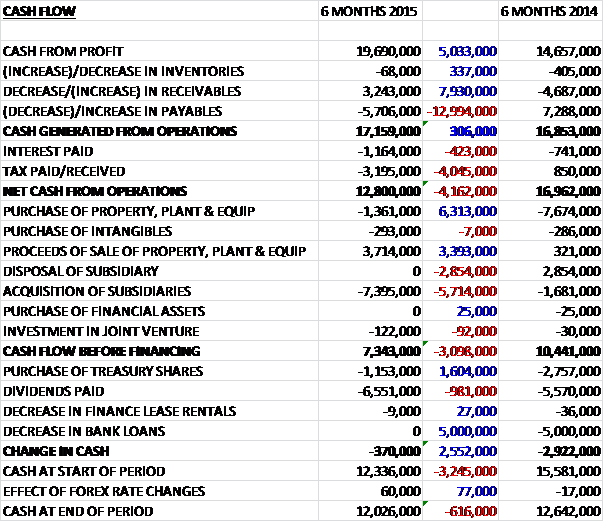
ODXChart

The chart looks pretty uninspiring at the moment with the share price well below both the 50 day and 200 day moving averages.

On the 1st June the group released a development update.  The company has continued to test Visitect CD4 devices on a large number of patient samples with the aim of optimising performance and deciding on a suitable in-house manufacturing process.  It has now made three pilot batches of the devices, all of which yielded comparable results that demonstrate the system is capable of meeting the company’s internal performance goals when tested on HIV positive patients and this investigation phase in now complete.  The outcome has been the selection of in-house manufacturing processes which are scalable and will be subject to verification and validation leading to the release of test devices for re-evaluation in the field.

With regards to the Allersys device, the group now has 32 allergens that have been optimised to show equivalent performance to the market leading product.  Of these, 22 have completed their claim support work.  The manufacturing process and recent amendments to the instrument software have been validated for full scale manufacture and the group now has commercial quantities for 27 allergens and associated reagents which have all passed internal quality control procedures.  These allergens will be used in beta evaluation sites in Spain and Italy, planned in June and July respectively so it seems some useful progress is being made here and I now own some shares.

Omega Diagnostics Share Blog – Final Results Year Ending 2014

Omega Diagnostics sells a wide range of specialised products, primarily in the immunoassay, in-vitro diagnostics market with three divisions. The Allergy & Autoimmune division specialises in the research, development, production and marketing of in-vitro allergy and autoimmune tests used by doctors to diagnose patients with allergies and autoimmune diseases. The Food Intolerance division specialises in the research, development and production of kits to aid the detection of immune reactions to food. It also provides clinical analysis to the general public, clinics and health professionals as well as supplying the consumer food defective test. The Infectious disease division specialises in the research, development and production of kits to aid the diagnosis of infectious diseases. The group was founded in 1987 by current CEO Andrew Shepherd and is listed on the AIM exchange. They group has now released its final results for the year ending 2014.

omegaincome

When compared to last year, revenues were up as a £788K increase in food intolerance sales was partially offset by declines in other areas. Cost of sales increased somewhat, so that gross profits were some £318K higher at £7.4M. There was then a small negative shift in foreign exchange and a £105K increase in R&D costs, plus a £55K increase in share based payments that were counteracted by a £195K decline in selling and marketing costs so that operating profit increased by £221K to £527K. A decent increase in finance income was offset by a £156K fall in tax credits to give a profit for the year of £293K, a £111K increase when compared to 2013.

omegaassets

When compared to the end point of last year, total assets increased by £4.4M driven by a £3M increase in cash levels, a £1.4M growth in development costs relating to the Visitect CD4 project and the Allergy iSYS project, and a £585K increase in deferred tax assets, partially offset by modest falls in most of the other asset types. Liabilities fell slightly year on year with the elimination of the £500K of license payments, a £410K fall in trade payables and a £10K decline in borrowings, offset by a £434K increase in deferred tax liabilities, a £356K growth of deferred income, relating to the UNITAID and Scottish Enterprise grant funding, and a £119K increase in accruals and other payables to give a net tangible asset increase of £4.5M, although it is worth noting that there was a £4M placing of shares during the year but this is a strong looking balance sheet nonetheless. There was £1.3M of operating lease commitments not on the balance sheet, which isn’t particularly relevant given the asset levels.

omegacash

Before movements in working capital, cash profits increased by £618K to £1.7M before working capital movements broadly cancelled each other out to give an operational cash flow of £1.7M, an increase of £654K. All of this cash was used to acquire intangible assets so the purchase of property, plant and equipment relating to the CD4 manufacturing assembly unit and equipment to fill bottles with individual allergy reagents for the iSYS system, sent free cash outflow to £614K. Cash reserves were looking very precarious at the end of last year so the group needed to raise £4M from the issue of new shares before a net increase in finance leases was more than offset by some loan repayments to give a cash flow for the year of some £3M to give a cash pile of £3.1M at the period end. This is an improving performance and the group is not far off from being able to fund itself through its operational cash flows.
The Allergy and Autoimmune business produced an adjusted profit of £152K, a £173K improvement when compared to the small loss last year. Allergy sales fell by £100K to £3.5M and autoimmune product sales fell by £90K to £450K. The allergy sales were derived almost exclusively from the German business which is operating in an environment of reimbursement restrictions. The strategy has been to reinforce customer relationships through training, service and account management to secure the business and to prioritise allergy testing over other testing in a market that has declined by 5% over the past two years. The group continues to sell autoimmune products into markets where automation is ever increasing but despite these headwinds, most of the country markets have maintained their position and the performance drop-off is attributable to a reduction in Iran where reimbursement restrictions have occurred due to the devaluation of the currency.
The Food Intolerance business produced an adjusted profit of £1.7M which was an increase of £500K when compared to 2013. Sales of Food Detective grew by 35% to £1.7M and there was a particularly strong sales performance in Poland and Brazil. Total volumes of the tests were at a record level of 106,312 per annum and excluding component sales to China, the average selling price per kit increased from £22.01 last year to £22.55 this year. Sales of Genarrayt reagents grew by 15% to £2.1M with strong performances in both the Spanish and French markets but there has been a broadening base of other markets with the top five markets now accounting for 63% of sales compared to 70% last year. The group sold a further 13 instruments during the year, taking the cumulative number of installations to 132 instruments and revenue per instrument (for some reason excluding Spain) increased by 7% to £13,746 so I assume if we include Spain, one of the largest markets, revenue per instrument probably fell. The Foodprint lab service achieved sales of £640K compared to £610K last year and the group produced nearly 8,000 patient reports at an average price of £79.55 per report (a small decline from the £80.65 per report in 2013). There are plans to further grow revenues with the introduction of a new dried blood spot test and the broadening of the portfolio in nutritional assessment.
The Infectious Disease business produced an adjusted loss of £95K which was a deterioration of £268K when compared to last year. The decline was due to the loss of business from a UK customer who experienced financial difficulties and the devaluation of the Iranian currency reducing sales through the distributor there. After the period end, the UK customer in difficulties has started to make small orders again as its situation improves. Mitigating these headwinds is good growth in India and Brazil.

724-12-Allergodip
The group really seems to be focusing on infectious disease diagnostics as a strategy, particularly in parts of the world where resources remain constrained and there is a substantial unmet need. The main focus at the moment is HIV and the group has developed the Visitect CD4 device which requires no power or refrigeration facilities and can provide a result in 40 minutes. Beta studies in Kenya and India have provided patient data to determine what, if any, aspects of the test requires further optimisation. As the test nears commercialisation, the group will continue to partner with major NGOs and global health organisation. The group also have access to a POC test for Syphilis which can differentiate between active infections and past infections – something that previous tests have struggled with. They have recently increased in house resources and capability to move this project forward.
Through a partnership with Australia’s Burnet institute the group have secured an exclusive global license to the simple, lateral flow POC device that confirms whether a patient’s CD4 count is above or below 350 cells which has the opportunity to significantly reduce the number of patients lost to care as a result of the length of time between testing and receiving HIV treatment. The group has established a UK manufacturing facility for the product which has been fully validated under ISO approved procedures. Also, they have leased a facility in Pune, India where the interior build of a manufacturing base is under construction which has been part funded by a £400K grant from the Burnet Institute. This Indian facility will enable the group to produce and test locally, avoiding an import duty that applies to for Rapid Test imports into the country. In addition, going forward, this manufacturing base is expected to be used to make other rapid tests for the local market where cost per test is a major barrier to market entry.
In India, 140 patient samples have been tested to date and based on an interim analysis of the data the test has produced results on venous blood samples which match the company’s performance design parameters. Results to date on finger stick blood show a similar overall diagnostic performance but with slightly lower levels of sensitivity which is being investigated as the trial proceeds. The trial in Kenya has been extended beyond the initial 200 patients because test performance was just below optimal performance on both venous and finger stick blood so additional devices have been sent to Kenya for further evaluation. The Kenyan site has also received further training from Omega staff and the board expect that these additional tests will allow them to determine and correct the root cause of the difference.
In addition to the test itself, the development of an Android smartphone app to record and transmit the test results has been completed and is undergoing field trials. It is expected that this app will be available in the new financial year which will offer integration into cloud host databases. This mHealth solution has apparently been met with great enthusiasm by NGOs and global health organisations as the test/app combination offers a complete solution from test site to management HQ. There seem to be numerous potential applications for the CD4 device and as well as HIV and syphilis, the group is also looking at Schistosomiasis which is caused by a worm present in many tropical countries affecting about 200M people. The group is working with an expert in this disease area and good early progress is being made in the development of a new lateral flow test. It is anticipated that field trials could commence in the second half of the year.
The plan for the allergy business is to become a leading provider of allergy tests into clinical labs in a global market estimated to be worth over $500M per annum, dominated by one company. The group have exclusively licensed the use of IDS’ automated iSYS instrument for allergy testing and have invested in a long development programme covering initial feasibility, lock down of assay protocol, optimisation and claim support work. They have also set up an in-house manufacturing facility for reagent filling. During the second half of the year, the first allergens finally emerged from the programme following a successful claim support phase. There are now eight allergens that can be run on the iSYS instrument that show comparable results to the market leading competitor and a further 16 which have now completed optimisation. The strategic aim is to launch with a panel of 40 allergens followed by a programme of menu extensions to achieve a number two market position. The initial commercialisation plans involve working with IDS in markets where it has a direct presence, followed by expansion into other territories through third party distributors. The progress on the iSYS instrument has been slow going and the CEO’s frustration is notable.
No customer accounted for 10% or more of group revenues. A lot of the group’s sales are made in Europe, particularly through the German subsidiary, which means they are susceptible to exchange rate differences, however.
During the year the group has appointed Bill Rhodes as a non-executive director. He joins having spent many years at medical technology company Becton Dickinson. The largest shareholder by far is Legal and General, holding about 18% of the group but the directors also have quite a few shares, with two of them holding more than 2% of the company so this looks like a healthy investor base.
Trading in the new financial year to date has been in line with management expectations with a marginal growth in food intolerance testing being offset by the marginal decline in allergy and infectious disease testing. The future landscape is dominated by the Visitect CD4 test and the chairman has stated that they will make significant progress this year in terms of gaining market acceptance for the device but this will depend on the NGO/aid market and individual country approval processes. It is believed that prospects for the group overall are positive.
At the current share price the company trades on a P/E ratio of 22.2, reducing to a decent value 13.3 on next year’s consensus forecast. No dividends have been proposed for this year. Overall then, this is quite a good update. Profits were up slightly, and net assets were up even when we take out the £4M received from the share placing. The operational cash flow improved but the group still does not have any free cash flow and is not yet in a position to fund itself out of operating cash. The Food Intolerance business is the one performing well with decent, improving, profits but the other two sectors continue to struggle due to customer problems, continued German headwinds and Iranian currency issues. The two new products, Visitect CD4 in infectious diseases and iSYS in allergy tests both seem like exciting prospects but the problem with the Kenyan trial for the former product and the slow progress on getting allergens for the latter may mean that these products are not as quickly forthcoming as management expects. In conclusion, this is potentially a very exciting company but the short term issues make it a bit too risky for me at the moment.

Cambria Automobiles Share Blog – Final Results Year Ending 2014

Cambria was established in 2006 with a strategy to build a balanced motor retail group. About eight years on and the group has 28 dealerships spanning the high luxury, premium and volume segments. It is listed on the AIM exchange and has now released its final results for the year ending 2014. The directors and their immediate families own nearly 47% of the total share equity of the company.

cambriaincome

Overall, when compared to last year, revenues were up substantially with a £35.4M increase in new car sales and a £20.1M growth in used car revenues, partially offset by an £800K decline in after sales revenue. After the increased cost of sales was taken into account the gross profit grew by nearly £4M to £55.2M. We then see an in increase in staff costs and other admin expenses so that operating profit was £1.3M ahead at £5.8M before a more than doubling of the tax bill meant that profit for the year was £661K higher than in 2013 at £4.2M.

cambriaassets

When compared to the end point of last year, total assets increased by some £23.7M, driven by a £10.9M growth in inventories, a £10.6M increase in land and buildings, a £5M growth in goodwill and a £1.3M increase in trade receivables, somewhat offset by a £4.5M reduction in cash levels. Liabilities also increased with a £10.7M increase in vehicle consignment creditors (could this be customer deposits? They could have made it clearer), a £2.6M increase in trade payables, a £3M growth in borrowings, a £1.8M growth in vehicle funding loans and a £1.8M increase in other payables. The end result is a net tangible asset level some £1.4M lower than last year at £22.9M. It is worth noting, however, that the group has a lot tied up in off-balance sheet operating leases with £27.3M payable in total which, when compared to the net tangible asset level, doesn’t look so good. Interestingly in the annual report it is mentioned that the group has a strong balance sheet, which as I’ve mentioned before only seems to come up when the balance sheet seems strong on the surface but is hiding something when one digs a bit further.

cambriacash

Before movements in working capital, cash profits increased by £1.4M to £7.4M before a large reduction in payables was not entirely offset by adverse movements in the rest of the working capital to give a net cash from operations some £2.8M higher than last year at £11.3M. This cash was then spent on property, plant and equipment with a bit left over to cover the acquisition of property that came with the acquisition but not enough for the acquisition of the branch itself so that there was a negative cash flow of £6.7M before financing. This was reduced by some new loans but the cash outflow for the year still stood at £4.5M to give a decent safety net of a £10.3M cash pile. So, the operational cash flow was enough to cover capex but not acquisitions. Also, those payables will have to be paid at some point…
Gross profits in the new car sector increased by £1.6M to £12.3M but margins declined from 6.7% to 6.3%. Organic volumes of vehicles increased by 16.1%, outperforming the market by 5.5% with the strong performance being delivered against general new car registrations increasing by 12.5% year on year. The sale of new vehicles to private individuals was also ahead of the market, being 14.1% higher year on year and commercial and fleet vehicle sales increased by 55% and 9% respectively with these sales being transacted at lower margins, hence the small fall seen.
Gross profits in the used car sector increased by £1.5M with margins falling from 9.3% to 9.1%, and volumes increasing by 2%. This was a reasonable performance and management has concentrated on tight management of its used vehicle inventories. Gross profits in the aftersales business grew by £800K to £23.9M and margins increased from 40.8% to 42.9% with volumes increasing by over 3%. In order to make sure customers are kept on-side the group contact them with service and MOT reminders in a structured manner, using all forms of digital media and traditional communication methods. The continued increase in new car sales gives management confidence of further progress in the important aftersales market.
In July the group completed the acquisition of the Jaguar Land Rover dealership in Barnet from Lookers PLC. The group paid £10.5M in cash for the dealership and the acquisition generated £5M in goodwill. In the year before acquisition the dealership generated a pre-tax profit of £700K. The group have agreed to develop the freehold land fully and build a new JLR dealership at Barnet over the next 18 months at a further cost of £5M. The new building will apparently be a state of the art dealership, enhancing customer experience and make the business much more efficient. Once dealerships are acquired, the group apply an internet social networking strategy for vehicle sales coupled with a support centre and in aftersales, they have a local contact strategy designed to supply customers (I refuse to use the word guest!) with a one stop solution for all their vehicle maintenance needs.
During the year the group invested in a number of their dealerships. During the first half of the year they invested £6.3M in the freehold estate, securing freeholds of the Warrington Fiat and Nissan dealerships and the Croydon Ford dealership, plus additional land for franchise enhancements in Croydon. The investment is in line with the group’s strategy to secure freeholds when the opportunity arises and these investments have reduced the rent payable by £300K, this is a strategy that I agree with, it has to be good for the long term performance of the business to own these premises. In addition to these freehold purchases, the group invested £200K in the re-development of the Oldham dealership to add a Jeep franchise and to bring the site up to current corporate standards for Fiat and there was also £300K invested across the Ford dealerships in line with franchise standards requirements.
The group is somewhat susceptible to interest rate changes with a 0.5 increase in basis points reducing profits by £176K. Other risks include the volatility of the used and new car market and the changes that are potentially made by the car manufacturers to the pricing and margin structure on the new vehicles that the group sells. The group really tries to differentiate itself on customer service and calls all customers “guests”, which might sound a bit pretentious but does seem to underscore the philosophy as the company. There are three four pillars that define the group culture which I suspect is drilled into all new staff members.
There were some strange goings on involving the directors and car purchases. In total the directors purchased 14 vehicles and sold them back to the group. I really don’t know what was going on unless they are close to reaching a target set by a vehicle manufacturer or something?
The economic pressures affecting the mainland European new car markets remain and the UK continues to be well placed to continue the current positive new car market for the foreseeable future. In the first two months of the new year, the group has maintained its growth momentum, delivering results ahead of the business plan and substantially ahead of the comparable period this last year. There are apparently a number of acquisition opportunities under review so it seems likely that another one will be announced during the year – this is the basic strategy of the group after all. In all, the board are confident of making strong progress in the coming year. There has also been an increase in the level of cars sold on PCP which means that customers are more likely to change vehicle for another new one during the terms of the PCP products. Exchange rates also remain favourable and whilst Sterling continues to be strong against the Euro, the UK will be a natural market for the car manufacturers to target registrations. Despite all these positive points, it is unlikely that double digit increases will continue as prior comparatives harden.
At the current share price the shares trade on a P/E of 12.9, falling to a cheap looking 10.1 on next year’s consensus forecast. After an increase of 20% in the dividend, the shares currently yield a not particularly inspiring 1.1% increasing to 1.3% on next year’s forecast from N+1 Singer. The board aims to maintain a dividend policy that grows with earnings but intends to ensure that the payment of the dividend does not detract from the primary strategy to continue to buy and build and grow the group. At the end of the year there was net debt of £4.6M compared to a net cash position of £2.9M at the end of last year but with the loan deals in place, the group has total facilities of £19.3M available to it with a strong hint that some of this will be used for another acquisition.
Overall then this was a decent set for results, profits were up, as was operational cash flow, although this was not enough to pay for the acquisition so the group dipped into its cash reserves and a bit of new lending. The balance sheet could be better and I am a bit nervous by the high levels of operating lease payments going forward. I do like the strategy of buying the freehold to the properties, though, as this should bode well for the future. The dividend is nothing to write home about but the shares to trade on a low P/E valuation. This could be a decent investment but I will not take the plunge quite yet.
On the 15th January the group released a trading update covering the first four months of the year. The group is maintaining the momentum achieved in the last year and trading performance is substantially ahead of the same period of last year which has been achieved in a strong domestic new car market with 2014 recording the highest level of registrations since 2004. All aspects of the business showed strong profit improvement. New vehicle sales during the period increased by nearly 12% on a like for like basis, ahead of the market that grew by 8%. Used vehicle sales were flat compared to the same period of last year on a like for like basis but the gross profit per unit increased.
The all-important aftersales business improved profits by 3% on a like for like basis, but it was up an impressive 11% when the acquisition is included. The Barnet business is performing in line with expectations and the board remains confident about its potential. The board expects the interim results to be significantly ahead of the first half of last year and is confident about the outlook for the rest of the year. The trading performance is also ahead of current market expectations for the year. This update sounds very bullish and apart from the lack of growth in the used car market, it is hard to fault it.
On the 6th March the group released a statement covering the first five months of the year. Once again performance was substantially ahead of the same period of last year and in line with upgraded market expectations. New vehicle sales increased by 10% on a like for like basis, so a slight slow-down from the 12% seen last time, against a market that was up 8% but margins remained robust. Used vehicle sales were once again flat when compared to the same period of last year with gross profit per unit continuing to increase. Profitability in the aftersales operations was up nearly 8% but there was no mention on like for like profits so I presume these fell slightly. Heading into the all-important March trading period, the new car order book is building well and the board expects a strong performance during this month. They continue to explore acquisition opportunities and view the rest of the year with confidence. So, this is another strong update but it can be seen that during the past month, the growth has slowed slightly so sow a small seed of doubt in my mind.

On the 1st May the group announced the acquisition of a Land Rover franchise in Swindon from TH White for £7.56M representing £3M of goodwill payment.  The group will draw down a new loan to pay for the £2.25M freehold property and pay the rest out of existing reserves.  They are intending to relocate the operation to a redeveloped site alongside their existing Jaguar dealership in the town (what will happen to the current Land Rover freehold is unclear).  The acquired dealership had revenues of £32M and a profit before tax of £700K last year and it is anticipated that it will be immediately earnings enhancing.  This represents the second Land Rover dealership for the group and paying £3M in goodwill for a dealership earning £700K a year seems to be a decent move to me.

UK Mail Share Blog – Interim Results Year Ending 2015

UK Mail has now released its interim results for the year ending 2015.

ukmailinterimincome

In the first half of the year revenues fell compared to the same period of 2014.  The decline was driven by a £5.9M fall in mail revenues, partially mitigated by a £3.6M increase in parcels sales and a £500K growth in courier revenue.  The group received an £800K compensation payment from HS2 relating to the delay in automation of the operation due to the impact of HS2 on the groups plans, with further amounts expected to be taken in the second half of the year.  Cost of sales were slightly lower but this was not enough to stop gross profits falling by £500K.  Admin expenses fell but there was then a £7.3M impairment of goodwill in the pallets business which meant that operating profit was £4.9M which became just £2.2M after tax, a £7.1M fall when compared to last time due to the impairment but if that and the compensation were taken out, underlying profits were still lower than in the first half of last year.

ukmailinterimassets

When compared to the end point of last year, total assets at the six month fell by £14.6M driven by a £17.9M decline in cash levels, a £7.3M decrease in goodwill and a £2.4M fall in trade and receivables, partially offset by a £10.8M increase in property, plant & equipment and a £2.2M growth in other intangible assets.  Total liabilities also fell as trade & other payables declined by £9.1M, which was the only significant change in liabilities.  The end result is net tangible assets that were broadly flat over the last six months, increasing by just £100K.

ukmailinterimcash

Before movements in working capital, cash profits fell by £700K to £15.7M before a large decrease in payables and a small increase in tax paid meant that net cash from operations was £8.2M, an increase of £3.5M when compared to the first half of last year.  Unfortunately this did not cover the £16.7M of property, plant and equipment purchase, £4.1M of which was spent on IT, £1.3M on the network, £8.1M in the new hub and £3.2M invested in automation but this was offset by a further £2M received with regards to HS2 compensation before the group spent another £3.2M on intangible assets to give a cash outflow before financing of £9.7M.  The group then spent £7.8M on dividends to give a cash outflow of £17.9M to leave a cash pile of just £9.5M at the end of the period which is clearly not a sustainable situation although that capital expenditure is particularly high at the moment and there is a £25M credit facility that has not yet been drawn.

Underlying operating profit at the Mail business fell by £100K to £6.2M which can be attributable to the extra working day that occurred during the first half of last year.  There was a decline in revenues due to a mix change towards Customer Direct Access mail which carries a substantially lower revenue per item as the group won a significant public sector CDA contract during the year.  Daily mail volumes fell by 2% during the period compared to a wider market fall of 3%, demonstrating further market share gains in a declining market but operating margins did manage a small increase from 5.5% to 5.6%.  Imail, the web to print postal service continued to show good revenue growth.  The group continues to invest in capacity and provide additional services with imailprint being launched during the period.  This provides a printing service which in addition to providing a mail service, also generates printed documents for general use and the board see this as a low risk, medium term growth opportunity.  The new packets service which allows them to offer customers a two/three day low cost delivery service, continued to make progress and the capacity provided by the new hub should enable the group to develop this service further.  The mail business remains well positioned in its market with a healthy pipeline of new business opportunities

Underlying operating profit at the Parcels business increased by £100K to £11.2M as the group achieved volume growth in both the B2B and B2C segments with daily volumes increasing by 6.3% but there was a continued volume mix towards the lower margin B2C segment with operating margins falling from 10.6% to 10.2%.  Unfortunately despite the strong first quarter, the latter weeks of Q2 were more challenging which reflected a wider market trend with weaker trading seen across the retail sector.  The group continued to make progress with product innovations with ipostparcels offering a user friendly, low cost online collection and delivery service with profits growing for this business.  The enhanced next day delivery service which offers advance notice  one hour delivery collection windows is now fully operational and includes a text service which informs customers when their delivery is ten minutes away.  Looking forward, management sees slower parcels growth during the second half of the year as the group continues to face challenging market conditions in the near term.

Underlying operating profit at the Courier segment was flat at £1.4M despite increasing revenues as operating margins fell from 17.8% to 16.1% with the segment working increasingly closely with the parcels business as it represents a key part of the retail logistics operation.  Underlying operating profit at the Pallets business fell by £400K to £200K with a similar fall in revenues.  The group once again experienced gaps in the network which reduced input volumes and caused increased delivery costs and this seems to be difficult to resolve which means that the business is likely to operate at a lower level of profitability than has been the case historically despite actions to secure new, long term network members and taking actions to address the performance of the business.

During the period the group spent £8.1M on the new hub and £3.2M on automation.  The cumulative total expected to be spent on land and buildings over the period to the end of 2016 is some £35M.  It is expected that the group’s contribution to the building of the new hub to be about £15M (the rest likely to come from HS2) which covers the enhancement of the site and building beyond the scale of the current facility.  The investment in automation reflects the initial payments for the design and development of the hub and network automation equipment.  As previously guided, the total expected to be spent on this equipment up to the end of the year is some £20M, so quite a lot to come in the second half of the year then with the benefits likely to be seen from mid-2015 onwards.  The group has committed to capital expenditure of £17.2M which will likely use up all the cash reserves that they have left.

The decline in the performance of the Pallets business in the first half of the year meant that management estimates of the cash generating unit growth rate over the next five years resulted in a goodwill impairment charge of £7.3M which leaves a goodwill asset of just £600K in the business which the directors will reassess at the year end.  Trading in the first few weeks of the second half of the year and overall trends within the individual business have been anticipated and with the peak trading weeks over Christmas still to come, the board’s expectations for the full year remain unchanged.  The board remain excited about the medium term growth prospects for the group.

At the end of the period the group had a net cash position of £9.5M compared to £27M at the end point of last year.  After an increase of 2.8% in the interim dividend, at the current share price the shares are yielding a decent 4% for the year.

Overall then, this seems to have been a bit of a stuttering performance for the group.  Profits in general fell, predominantly due to the decline in the pallets business which sounds as though it could be terminal.  Net tangible assets were flat but there was a hefty cash outflow due to the investment in the new hub and automation.  Operational cash flows did improve during the period, however.  The mail business seems to be holding up against the backdrop of a market in structural decline so it is therefore disappointing to see slow growth in the parcels business as trading towards the end of Q2 became more difficult, which is a trend likely to carry on into Q3.  In the second half of the year, there will be more large capital expenditure spends, particularly in automation equipment and this, along with the slow-down in the parcels business and pallets segments means that I think H2 might be quite tough going for the group.

On the 13th January the group announced its Q3 trading update which includes the ever important Christmas trading.  Overall, performance was in line with expectations with the Parcels business handling record volumes and the network remaining robust during the peak weeks.  The demise of City Link is likely to have a positive impact on the industry as a whole and the group have taken on some volumes from ex-City Link customers.  It will be some time, however, before the longer term outcome of this on UK Mail can be properly assessed.  The board’s expectation for the outcome for the year remain unchanged.  The construction and fit out for the new hub is on track for completion before the end of January. The hub automation has been installed and is now entering a commission and testing phase ahead of implementation in May.

The challenges at the Pallets business have continued and a proposal has now been made to close it.  The board estimate that cash costs of this action will be about £1M with asset write downs of some £2M including the rest of the goodwill associated with the business.  Last year the division earned 2.3% of the total group operating profit so it is a small part of the business but a shame nonetheless.  There is no mention of the slow-down in the Parcels business which I take as a good sign and it is good that the automation investments seem to be mostly complete but there will still be a heavy cash impact this half and now there is the further distraction of the pallet business sale.  I still don’t really see this as a good time to buy the shares.

On the 9th April the group released an update covering trading in Q4 and for the year as a whole.  Group revenues, excluding Pallets, showed an increase of 5% in Q4 giving a total reported revenue growth of 1% during the year.  The parcels business saw volumes increase by 12% in the quarter, partly driven by new account wins as a result of the collapse of City Link.  This increase in volume has taken the parcel volumes above the group’s operational capacity which has resulted in higher costs being incurred during the quarter which is expected to continue into the first half of next year until the volume can be absorbed when the move to the new hub is completed.

The mail business achieved decent volume and revenue growth in the quarter, increasing by 5% with growth driven by good customer retention and new business wins, which have further increased the group’s share of the Down Stream Access market.  The courier business saw a decline in revenue growth in Q4 but achieved growth in the year as a whole.  As a result of some of these issues, the performance for the year is expected to come in at the lower range of current expectations.  The Pallets business has now ceased operating with the wind down being handled without disruption to customers and with closure costs in line with expectations.

The new hub and head office has now been completed on budget and on schedule.  The move of the head office staff to the new office is now largely completed with the move to the new automated hub commencing in May with a plan to be complete by the end of July.  The commission and testing phase of the hub’s automation equipment is progressing and approaching completion with the scale of automation of the parcel sortation operation planned to increase from 20% to 80%.  Despite the short term headwinds, once the move to the hub is complete the group should see an improvement in performance and with the loss of City Link, there is now a better competitive environment that should be good for UK Mail in the medium term.  I am tempted to buy in here but think I would prefer to wait for some evidence that profits are on the up before doing so.

On the 9th April the group released a trading update for the year ended 2015.  Excluding Pallets, reported revenues are expected to increase by 1% driven by a 5% growth in Q4.  The parcels business performed well with volumes in the quarter increasing by 12% driven by new account wins following the collapse of City Link.  This increase in volume, however, took volumes above the effective operational capacity, resulting in above normal costs being incurred which is expected to continue into the first half of the new year until the increase in volume is absorbed by the completion of the new hub.  The mail business saw good volume growth in the quarter, increasing by 5% driven by strong customer retention and new business wins.  The courier business saw a decline in revenues in Q4 but this was not enough to prevent a growth for the year as a whole.  Overall then, it is expected that performance is going to be around the lower end of current estimations.

The pallets business has ceased operating with the wind down being handled without customer disruption and closer costs being in line with expectations.  The new hub has now been completed on schedule and within budget and the move of the head office is now largely complete with the move to the new automated hub expected to be completed by the end of July.  The testing of the automation equipment is progressing well and approaching completion and should increase automation of parcels sorting from 20% of total volume to 80% by September.  The demise of City Link and the new hub are likely to be catalysts for decent growth in the medium term but it is disappointing to see the courier business struggle and in the short term, working over capacity seems to be causing a drag on results so I feel a watching brief is still most appropriate here.

St. Ives Share Blog – Interim Results Year Ending 2015

St. Ives has now released its interim results for the year ending 2015.

stivesinterimincome

When compared to the first six months of last year, revenues increased as a £9M growth in strategic marketing sales was partially offset by a £1.9M decline in marketing activation revenue and flat books sales.  Cost of sales actually fell during the period so that gross profit was some £9.1M higher at £58M.  Selling costs increased by £773K and underlying admin expenses were up £5.7M but it is difficult to analyse this company due to the huge number of “one-off” costs that are incurred with various impairments, re-measurements and amortisation.  During the period there was a £3.1M remeasurement of contingent consideration, and a £1.5M impairment of intangibles, along with a £766K increase in the amortisation of acquired goodwill to give an operating profit almost half that of the same period last year at £3.7M.  Things got worse with a decline in investment income, an increase in finance costs and a tax charge which pretty much halved pre-tax profit so that profit for the year was some £6M lower at £1.1M.  The underlying profit for the period has been calculated at £11.6M though, a £4.5M increase on the same period of last year with the underlying profit margin increasing from 8.3% to 9.3%.

stivesinterimassets

When compared to the end of last year, total assets at the half year point fell by £12.9M driven by a £5.6M decline in property, plant & equipment, a £4.9M fall in intangible assets and a £2.8M reduction in trade & other receivables, partially offset by a £923K increase in goodwill.  Liabilities increased during the period as a £23.2M increase in pension obligations and a £1.1M growth in deferred income was partially offset by a £6.6M fall in deferred tax liabilities, a £5.4M decline in trade & other payables and a £2.4M fall in deferred consideration payable.  The end result was an £18M decline in net tangible assets to a negative £40.9M.  Clearly this looks very disappointing but it can be entirely attributed to the increase in pension obligations.

stivesinterimcash

Before movements in working capital, cash profits increased by £5M to £19.7M.  This was eroded slightly by a decrease in payables but cash generated from operations was £17.2M before the large increase in tax paid and the £1.2M paid in interest meant that net cash from operations fell by £4.2M to £12.8M.  The group actually had a net cash income from its property, plant and equipment transactions so the bulk of the cash was used to purchase a subsidiary, presumably relating to deferred consideration (£7.4M) to give a free cash flow of £7.3M.  The rest of this cash was used on dividends and the purchase of treasury shares to give just a £370K cash outflow to give a decent cash pile of £12M.  So, not much has been spent on capital expenditure but this cash performance was quite healthy.

During the year, the group has revised its corporate structure with three segments including: Strategic Marketing, focusing on high growth marketing segments of data, digital and consulting; marketing activation, delivering communications through print and in store marketing services; and books, representing the book printing business, Clays.  These segments replace the two last year consisting of just marketing and print so should offer some more clarity on the performance of the business, although I am not sure I like the names given to the segments!

Underlying profits at the Strategic Marketing business were £7.1M, a growth of £2.4M when compared to the first half of last year.  The data business saw sales fall by £3.2M to £16.7M as a significant one-off software sale in the previous half year was not repeated and the work mix in Response One changed.  Although these factors affected revenues, their loss did mean that margins improved in the division.  The Occam business recently launched a cloud based data management product which has already attracted clients such as Mitsubishi Motors and Northern Rail with product led solutions being seen as a growth area for the business.  Response One developed its service offering to provide end to end communications strategy and planning and has also launched an entry level version of Reciprocate, the UK’s largest donor data pool to further strengthen their work in the Charity sector.

The digital business performed well, increasing sales by £6.7M to £17.9M.  Amaze continued to grow its e-commerce capabilities with a number of new business wins and the group is investing in this business to grow and develop a dedicated e-commerce practice.  In addition they have launched a digitally led CRM practice, AmazeOne.  Branded3 performed well and had a number of significant business wins including growing the online presence of Travelex and driving customer engagement for a number of Bauer Media brands.  Realise, which was acquired last year, has integrated well into the group and delivered a strong performance since acquisition, including wins for the World Tourism and Travel Council, the design and build of a number of websites for Rothschild and transforming the online and offline experience for Greyhound in the US.

The Consulting business saw sales increase by £6.9M to £16.1M with Incite, the customer research consultancy, delivering significant revenue growth due to the continued expansion of the business into overseas markets.  In addition, an office was opened in Shanghai during the period that is expected to start trading in the second half of the year.  The retail and brand consultancy, Pragma, delivered significant growth for the period driven by its expansion of its airports practice with major projects for clients including Luton Airport in addition to a number of international client engagements including Vivarte, the largest non-food retailer in France.  Hive, the newly acquired healthcare consulting business has integrated well into the group and is trading in line with expectations.

Underlying profits at the Marketing Activation business were £5M, a £200K increase when compared to the same period of 2014.  The Marketing Print businesses saw revenue in line with the prior half with growth in Service Graphics and SIMS due to new business wins including Pernod Ricard, Johnson & Johnson, Toni & Guy and Metro Bank, more than offsetting a decline at SP caused by the ongoing pressures within the grocery retail sector. The Field Marketing business also continued to face pressure within the grocery retail market.  The group did, however, invest in new data and technology capabilities and expects to bring these to market in the second half of the year and by bringing the business into the same management structure and the Marketing Print operations, the aim is to improve the operational effectiveness of the segment.

Underlying profits at the Books business were £4.2M, which was flat year on year.  Sentiment in the physical book market as a whole seems to have improved with e-reader penetration appearing to have levelled off within both the UK and the US with physical book volumes stable for the first time in a number of years.  During the period the group reached an agreement with Penguin Random House to provide 100% of their monochrome book production under a new multi-year contract which represents a significant market share gain for the business and helps to secure about 80% of the segment’s workload for the next three to six year.  I am not sure what the margins are like on this project but it does seem like a very good achievement to me.

As usual for St. Ives there were a raft of non-underlying costs recorded.  Restructuring items included redundancies of £178K, other restructuring costs of £176K and costs relating to empty properties of £338K, whatever that is.  There was a profit on disposal of property, plant and equipment of £49K relating to the sale of a property recorded in the books segment, offset by a £40K loss from the sale of properties in Blackburn, Leeds and Plymouth relating to the Marketing Activation segment.  There was a £3.6M charge relating to the amortisation of acquired customer relationships etc in the two marketing businesses which tests the meaning of non-underlying items in my view, but they are non-cash I suppose.  There was contingent consideration of £3.7M in respect of acquisitions treated as remuneration and an additional £3.1M change in deferred consideration relating to the Hive acquisition.  There was an impairment charge of nearly £300K relating to goodwill and £1.2M relating to customer relationships where there has been a higher level of customer churn in the Field Marketing business than expected.  Finally there was £255K of costs associated with acquisitions.  I suppose it is good that the group gives such guidance on these costs but there always seem to be so many clouding the real performance achieved.

As touched upon above, following the acquisition of Hive last year there is deferred consideration payable in three tranches based on the EBITDA achieved for 2014, 2015 and 2016.  The basis of estimated EBITDA for 2014 was reviewed in the period resulting in an increase in the estimate of deferred consideration payable which has just been added on to Goodwill (as it would have to be) of the acquired company.

Trading in the second half of the year has started well and is in line with expectations.  An improving economic climate, allowing clients to increase their marketing spend, makes the board confident of a positive outcome for the full year.  The group’s strategy for further growth involves organic growth through collaboration between existing brands, such as the work done for Johnson & Johnson which involved a collaboration between the print management business and the search and digital agency and the work for HSBC who are now a customer of five of the businesses within the group; internationalisation into large and high growth markets such as the new office in Shanghai and further acquisitions which the board are on the look-out for.

With an increase of 5% to the interim dividend, at the current share price the shares yield a decent 4.1% with 4.3% predicted for the full year.   At the end of the period, net debt stood at £43M which was relatively unchanged when compared to the position of £42.7M at the end of last year.  Overall then, there are some disappointments here. Reported profits collapsed due to those non-underlying costs but underlying profits were up but although that contingent consideration increase in non-underlying it will certainly be paid in cash, either in the second half of the year or in the first half of next year with the current amount of deferred consideration payable within a year being a pretty hefty £10.2M  Net assets fell due to the increase in pension obligations but cash flow was not bad, even though dividends were barely covered.  The strategic marketing division seems to have done well but I am not sure how much of that increased profit has come from organic growth and the other marketing division has suffered somewhat from the pressures in the grocery market.  The books division seems to be doing fairly well though and the shares do yield a decent dividend.  On the face of it though, I can see more cash cost pressures in the immediate future despite the long term story looking pretty good.

stiveschart

The chart is quite interesting.  The shares had been on a mini-rally since mid January this year but these results have put an end to that.  I will wait on the sidelines to see what happens here.

On the 17th March it was announced that the group had acquired Chicago based consultancy Solstice, specialising in mobile first digital product design and engineering services.  The acquired group comes with 200 spread across offices in Chicago, New York and Buenos Aires with a client base including Fortune 1000 business, with particular strength in the financial services, manufacturing and distribution sectors.  Last year, Solstice generated EBITDA of £2.7M on revenues of £16.5M with gross assets of £5.1M.  The group has acquired the business for an initial consideration of £24.7M made up of £20M in cash with the rest in St. Ives shares.  Further consideration of up to £25.3M may become payable dependent on profit performance in the years ending 2015, 2016, 2017.  The acquisition will be earnings enhancing in the current financial year.

This seems like a decent acquisition but my concern is that St. Ives seems to be stretching itself somewhat with yet another acquisition and my real concern is the build up of deferred consideration.  There are no details of how easy it will be for the acquired group to hit those profit targets but £25.3M over three years will be a substantial drag on top of the consideration already on the balance sheet.

On the 11th August the group released a trading update covering the full year.  Overall results are expected to be in line with expectations.  Trading across the Strategic Marketing segment was positive and significantly ahead of last year.  It continues to extend its range of services, primarily through acquisition.  The integration of Solstice Consulting is progressing well and the group is investing in additional headcount to support their plans for growth in this segment.

Trading conditions in the Marketing Activation segment have been challenging due to the ongoing pressures within the grocery retail market.  As a result, it is expected that revenues will reduce when compared to last year but margin should be maintained as new business wins, cost reductions and efficiency improvements help to mitigate the pressure.  Within the books business, there has been an improvement in sentiment within the physical book market with book volumes stable for the first time in years.  It is expected that revenue in this sector will be broadly in line with last year and for margin to be maintained.