Redrow Share Blog – Interim Results Year Ended 2018

Redrow has now released their interim results for the year ending 2018.

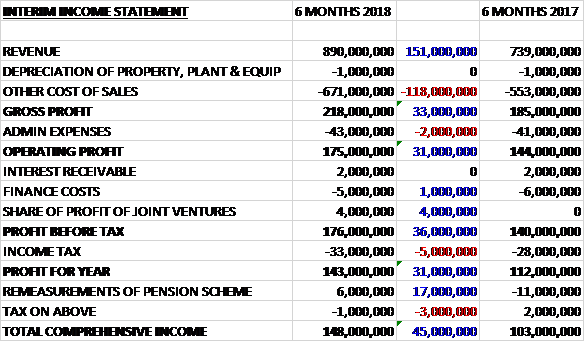
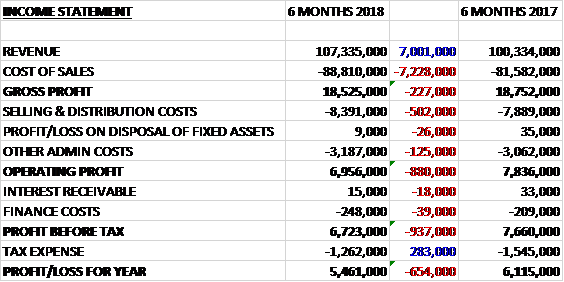
Revenues increased by £151M when compared to the first half of last year and with cost of sales up £118M the gross profit increased by £33M. Admin expenses were up £31M to give an operating profit £31M higher. Finance costs fell by £1M and there was a £4M profit from joint ventures but this was offset by a £5M growth in tax charges to give a profit for the year of £143M, a growth of £31M year on year.

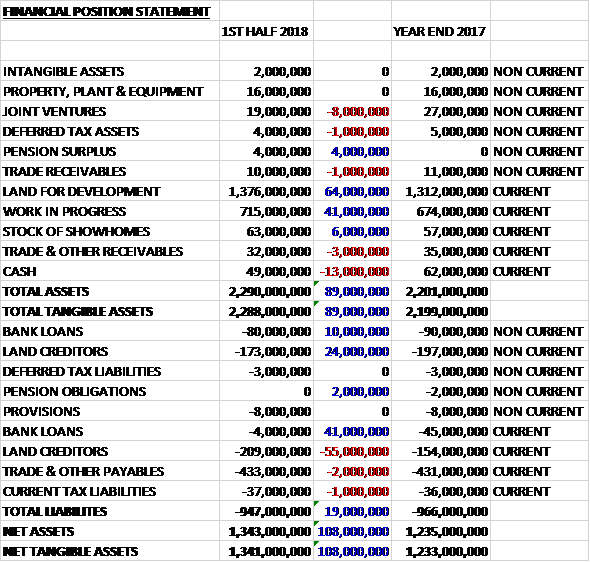
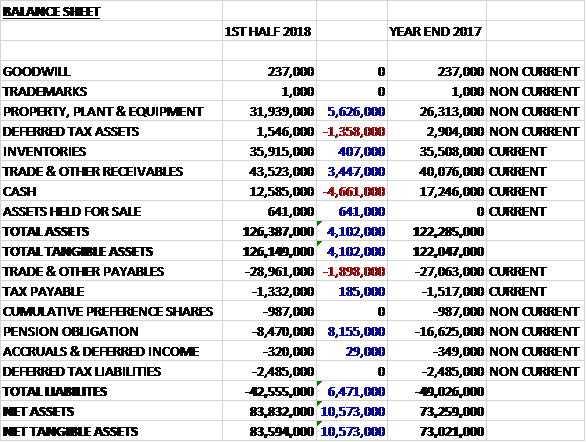
When compared to the end point of last year, total assets increased by £89M, driven by a £64M growth in land for development, a £41M increase in work in progress and a £6M growth in show home stocks, partially offset by a £13M decrease in cash and an £8M fall in joint venture investments. Total liabilities declined during the period as a £31M increase in land creditors was more than offset by a £51M fall in bank loans. The end result was a net tangible asset level of £1.341BN, a growth of £108M over the past six months.

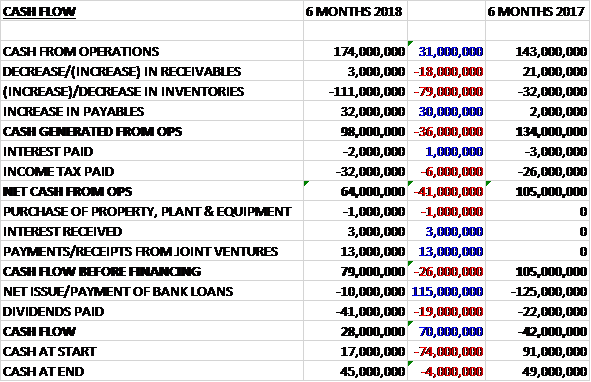
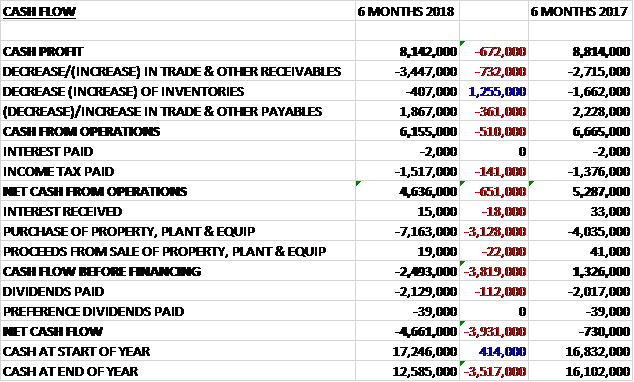
Before movements in working capital, cash profits increased by £31M to £174M. There was a cash outflow from working capital and after tax payments fell by £6M the net cash from operations was £64M, a decline of £41M year on year. The group received £13M from joint ventures and £3M from interest and only spent £1M on capex to give a free cash flow of £79M. Of this, £10M was used to repay loans and £41M on dividends to give a cash flow of £28M and a cash level of £45M at the period-end.

During the period legal completions increased by 14% to 2,811. Group revenue rose by 20% due to the increase in completions, including the first 82 apartments at Colindale Gardens. There was also a 9% rise in the average selling price to £330K, mainly due to the growth in the Southern business. Demand for new homes remained robust with good availability of mortgages at competitive rates. The value of private reservations in the period grew by 10% on a like for like basis and the total order book at the end of December was 5% ahead of the prior year at £1.05BN.

During the period the group added 4,315 plots to their current land holdings, 583 of which were transferred from forward land. There was a net increase of 1,500 plots in the current land holdings and the forward land bank increased by 5,400 plots to 31,800.

Going forward, the group are entering the second half of the year with an order book comfortably in excess of £1BN. Reservations in the first five weeks have been in line with the strong comparable last year and given the strength of the order book and land holdings, together with the robust sales market, the growth strategy remains on track.

At the current share price the shares are trading on a PE ratio of 8.3 which falls to 7.1 on the full year forecast. After a 50% increase in the interim dividend the shares are yielding 3.5% which increases to 4.3% on the full year forecast. At the period-end the group had a net debt position of £35M compared to £73M at the end of last year.

On the 20th February the group announced that director Matthew Pratt sold 9,000 shares at a value of £54K.

Overall then the group has made further progress in the period. Profits were up, net assets increased and although the operating cash flow declined this was due to an increase in inventories and cash profits increased with a good amount of free cash being generated. The improved performance is mainly down to an increase in completions with a small increase in average price of home sold due to differing mix, so it seems that the prices have stagnated somewhat. Still, with a forward PE of 7.1 and yield of 4.3% these shares still look decent value to me.

Newmark Security Share Blog – Interim Results Year Ending 2018

Newmark Security has now released its interim results for the year ending 2018.

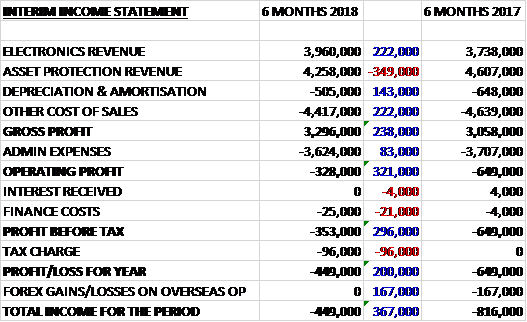
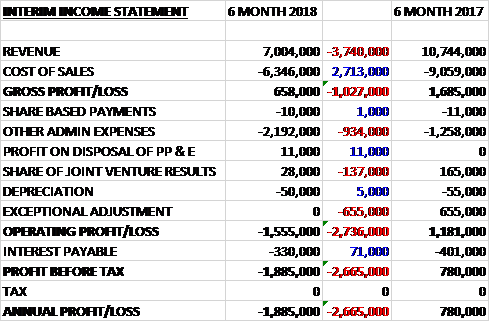
Revenues declined when compared to the first half of last year as a £222K growth in electronics revenue was more than offset by a £349K decrease in asset protection revenue. Depreciation fell by £143K and other cost of sales were down £222K to give a gross profit £238K higher. Admin expenses reduced by £83K which meant that the operating loss improved by £321K. Finance costs increased by £21K and tax charges were up £96K which meant that the loss for the period was £449K, a £200K improvement year on year.

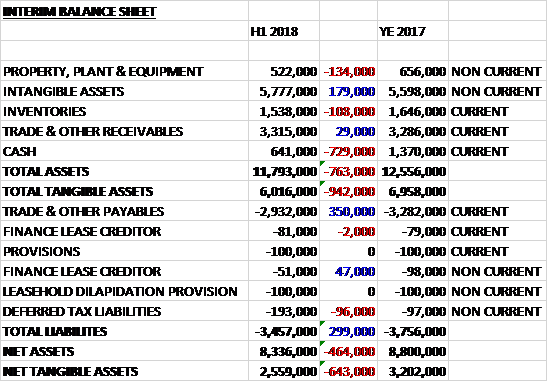
When compared to the end point of last year, total assets declined by £763K driven by a £729K fall in cash, a £134K decline in property, plant and equipment and a £108K decrease in inventories, partially offset by a £179K growth in intangible assets. Total liabilities also declined during the period, mostly due to a £350K decrease in payables. The end result was a net tangible asset level of £2.6M, a growth of £643K over the past six months.

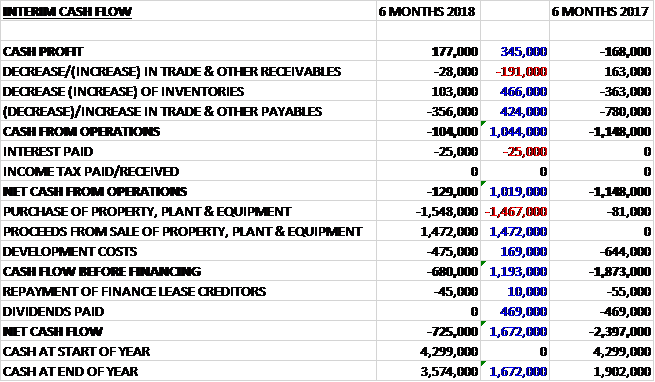
Before movements in working capital, cash profits improved by £345K to £177K. There was a cash outflow from working capital and after interest payments increased by £25K the net cash outflow from working capital was £129K, an improvement of £1M year on year. The group spent £475K on development costs and £1.5M on property, plant and equipment, although they also brought in £1.5M on asset sales which meant that there was a cash outflow of £680K before financing. The group spent £45K on finance lease repayments to give a cash outflow for the period of £725K and a cash level of £3.6M at the period-end.

Revenues in the Asset Protection division declined by £349K. Safetell revenue was 7.6% lower, mainly as a result of reduced contribution from sales of time delay cash handling equipment to the Post Office as it enters the last year of its Network Transformation Programme, which resulted in overall sales of cash handling equipment by 67%. Trading conditions remained challenging whilst the continuing economic uncertainty has resulted in budget cuts and cancellation of planned work by several customers, including government departments. The cost saving initiatives implemented in January 2017 are reflected in the results but further cuts have taken place in H2 2018.

Products revenue was 15% lower but revenue of non-cash handling equipment increased by 57% as a result of renewed marketing and sales efforts. Revenue from Eclipse rising screens was 28% higher as a result of two programmes of work by long standing financial institution customers. Revenue from fixed glazing products continued to decline as they see clients moving away from ballistic protection counters to less secure open counter trading to improve customer relations. After a few years of decline they have seen a 44% increase in revenue for Secure Panel Systems after they obtained additional certification and made significant improvements to the product line. They continue to explore and develop other product offerings which will reduce their reliance on rising screen revenue streams in future.

Service revenue was 14% higher. Margins were maintained due to cost cutting efforts and improved mix of work, but revenue will remain challenging for the division as a result of the continued impact of branch closures that is occurring in the banking sector. As a result, there has been a migration away from traditional work and they are seeing improved opportunities in other markets. They are apparently in the process of renegotiating the renewal of some larger service contracts so hopefully that will go OK.

Revenue in the Electronics division increased by £222K. Within Access Control, the fall in revenue from the legacy Janus range was more than offset by the growth in revenue from the Sateon range. Due to Microsoft’s discontinued support for the 32-bit Windows operating systems on which Janus runs, no new Janus systems were installed and sales declined by 35% to £665K. A significant proportion of the remaining revenue is from recurring software service agreements for existing sites so is expected to decline at a much less pronounced rate in future periods.

The demise of previous generation products has continued to help drive sales of the Sateon line with the Janus-Sateon upgrade programme being extended for another year. Sateon access control revenue saw an increase of 23% to £1.3M. Sateon Advance has continued to be well received by the market since its launch in November 2016. In the period the quantity of new systems installed increased by 86% over the corresponding period last year with the average revenue per system also increasing by 21%.

Development work started to create non-proprietary variants of the Sateon Advance range to allow the hardware to be integrated with third party vendors’ software. By adopting an open protocol approach, incremental revenue is being generated as new channels are developed. Within the period a contracts was won with a major European Workforce Management software provider to supply this hardware as an OEM product to integrate with their proprietary access control systems. Other negotiations are underway with major US and UK based third party access control providers with a view to supplying this line as OEM products.

Across the UK and US, sales of Workforce Management grew by 21% to nearly £2M. In the UK the range of RS series products showed growth of 32% largely driven by requirement for access control products in the HCM sector. The Linux based IT series showed growth of 33%, aided by a contract for one of the world’s largest steel producers, which was completed in the period. They also agreed in November new ongoing supply agreements for the IT51 Linux based workforce management terminal with Workforce Software, an HCM solution provider based in the UK and US. In addition to the hardware a range of remote support tools on a SaaS basis are also being provided, furthering the group’s ambition to generate additional recurring revenues from SaaS.

Also in November it was announced that Grosvenor Technology had won a contract with a leading European Workforce management provider for whom the OEM variant of Sateon is being supplied. The client preferred the industrial design of the GT-10 Android based terminal but wanted to take advantage of the hosted support services that Grosvenor provides within the Linux based terminals. As a consequence, a hybrid solution was developed and this unit will replace a competitor’s product as their flagship hardware offering. The business will also provide a Linux based OEM variant of its GT-10 terminal in addition to a range of cloud based support services on a SaaS basis. The customer is funding development work value of €190K and revenues are expected to come on stream in Q2 2018 with the contract value expected to be €3M over a five year period.

The US operation saw sales increase by 17% to $726K. Negotiations continued with a tier one HCM solutions provider with a view to Grosvenor providing an OEM variant of the GT-10 terminal. These discussions have been underway since the second half of last year but it is felt that they will conclude in H2 of this year. Negotiations are also underway with a second tier one potential customer, again for an OEM variant of the GT-10. Early stage indications are that the proposition is well placed and thus the pipeline to enable future growth continues to be encouraging.

Going forward the group has continued to be affected by challenging market conditions during this period of economic uncertainty together with the anticipated decline in sales to the Post Office. The board anticipates making further contract announcements in the near future and these together with the two contracts mentioned above are expected to improve results in future years.

As the group is loss making, PE ratios make no sense and I can’t find a forecast for this year. There are no dividends being proposed.
Overall then, the group is still struggling but results have improved slightly from last year. Losses improved and the operating cash outflow also got a little better. The net asset level continued to deteriorate, however. The Asset Protection division is struggling due to the continued reduction in the Post Office contract and other customers cutting budgets. The Electronics division looks healthier, however, with growing SATEON revenues and some interesting new contracts where the group is supplying some OEM solutions.

It is hard to say whether these are worth buying yet. I do see some improvements but they seem a little too risky, being loss making. Perhaps one to keep a relatively close eye on.

On the 18th April the group announced that it has received a formal contract extension for the supply of physical security equipment and preventative maintenance to the UK branch network of a leading worldwide supplier of retail banking services.

The contract consists of secured orders for the supply of service and maintenance support for fast rising screens totalling £1.2M, along with the supply of new fast rising screens and auxiliary physical security products which is expected to total around £300K. This is a one year extension to an original contract agreed in 2012 and covers the period ending November 2018.

On the 30th April the group announced that it had secured a new supply agreement for physical security equipment including time-delayed cash handling equipment and secure cash storage units for a major high street financial institution. The agreement will run for five years with options to extend for up to eleven years in total. The first year projections are estimated to generate between £1M and £1.5M of product and installation revenue. This is a current customer for the group and they have supplied them for over 14 years.

Ashley House Share Blog – Interim Results Year Ending 2018

Ashley House has now released its interim results for the year ending 2018.

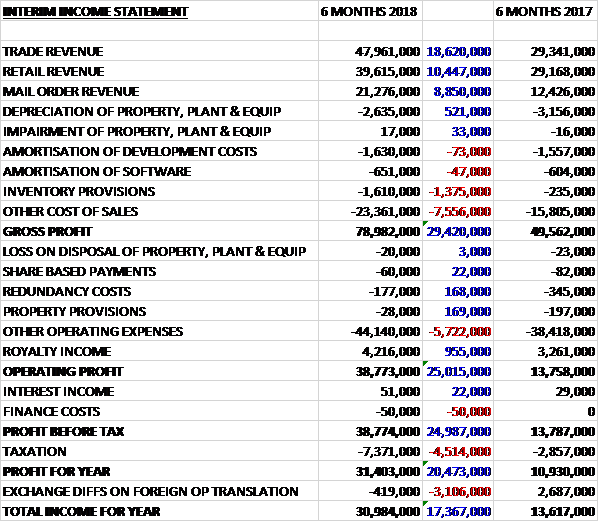
When compared to the first half of last year, revenues declined by £3.7M and with cost of sales only falling by £2.7M the gross profit fell by £1M. There was a £934K growth in admin expenses and joint venture profits fell by £137K. There was also no exceptional adjustment which brought in £655K last time. After interest payments declined by £71k the loss for the period was £1.9M, a deterioration of £2.7M year on year.

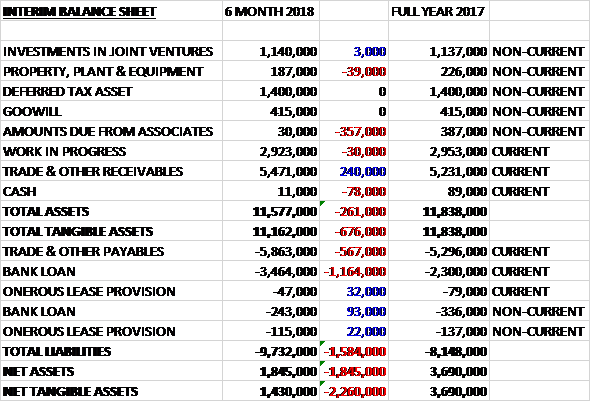
When compared to the end point of last year, total assets declined by £261K driven by a £357K fall in amounts due from associates and a £78K decrease in cash, partially offset by a £240K growth in receivables. Total liabilities increased during the period due to a £1.2M growth in the bank loan and a £567K increase in payables. The end result was a net tangible asset level of £1.4M, a decline of £2.3M over the past six months.

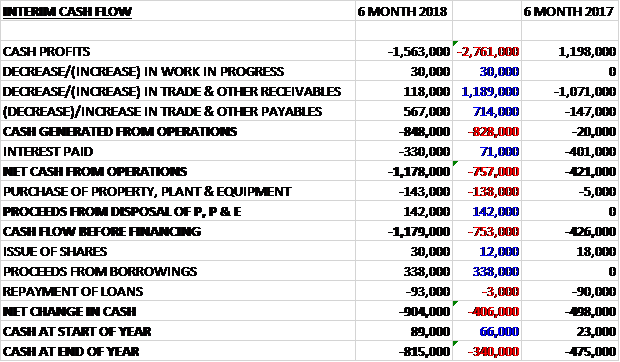
Before movements in working capital, cash profits declined by £2.8M to become a cash loss of £1.6M. There was a cash inflow from working capital and after interest payments reduced by £71K, the net cash outflow from operations was £1.2M, an increase of £757K year on year. The group spent a net £1K on capex to give a cash outflow of £1.2M before financing and after a net £245K was taken out in new loans the cash outflow was £904K and the cash level at the period-end was -£815K.

During the period no schemes reached financial close. This was principally due to the Government’s policy relating to the LHA cap. In October the government announced that it was dropping its plans announced in 2015 to cap housing benefit to LHA rates, enabling the business now to proceed with the delivery of its housing pipeline.

In December the group announced that it had signed a joint venture with Morgan Sindall, established as a 50:50 limited liability partnership which will trade under the name Morgan Ashley. The business will be able to push forward with delivering the housing pipeline that the group has built up over the last few years and is now working to growth the pipeline using relationships developed by both companies. In the last month the group has won a bid for a 54 apartment extra care scheme in Hampshire which will be delivered by the joint venture. The group has received £2.5M of consideration from the transaction and expects to receive the remaining £1.5M deferred consideration in the next few weeks.

In November the group advised that it had two housing schemes that would reach financial close over the coming weeks so these schemes were excluded from the joint venture. The first of these, in Scarborough should reach financial close this week and work continues on a smaller scheme in Peterborough which is being built in the factory via F1 Modular.

F1 Modular continues to build its pipeline. It has recently delivered a six house scheme for Cherwell District Council and an eight bungalow development on former council garage sites for a specialist developer in the North East. The prospective order book for the modular business is growing with two large schemes, one an extra care facility and the other a hotel, both well advanced. While it is still early days, on the assumption that this business is able to deliver these two key schemes, the board believes that it has a strong future.

The pipeline now holds 20 in the joint venture at a value of £203.3M; two housing schemes outside the joint venture with a value of £13.1M; two health schemes with a value of £5.4M with a further two on-site; and three F1 Modular schemes with a value of £13.1M.

In the last couple of months the removal of the threat of the LHA cap along with the establishment of the joint venture with Morgan Sindall were key events for the future of the group enabling it to press forward in the growth and delivery of its significant housing pipeline as well as the other activity in the business. Since the announcement the pipeline has now started to be unlocked but some residual risk remains on rent levels. The board remains confident that they will achieve its profits expectations for the full year but risk remains on the timing of closing of the schemes due to the inherent difficulties of dealing with public bodies.

At the current share price the shares are trading on a PE ratio of 88.2 which falls to 3.3 on the full year consensus forecast. There are no dividends on offer here. At the period-end the group had a net debt position of £3.5M compared with £2.4M last year.

Overall then this has clearly been a difficult period for the group. Losses widened, net assets declined and the operating cash outflow deteriorated. This was because there were no schemes reaching financial closure. The block seems to have been lifted now, though, with the removal of the LHA cap and the setting up of the joint venture. The forward PE of 3.3 looks too cheap and I’m not sure I can rely on it but these shares are finally starting to look interesting.

On the 9th May the group released a trading update covering the year ended 2018. They have achieved financial close on three further schemes. In Ashley House, contracts have been signed with the care provider HSN Care in Peterborough. This will provide specialist residential accommodation for twelve disabled young adults. The modular component of the development will be built by F1 Modular with the work already underway in the factory.

In Morgan Ashley, the scheme in Ryde has reached financial close. This comprises 75 extra care apartments with communal areas providing accommodation for older local residents with care needs, together with 27 affordable bungalows. The scheme will be operated by Southern Housing and owned and financed by Funding Affordable Homes. The scheme is part funded by a grant from Homes England. The business continues to push forward on further schemes and expects a care home in Yorkshire to be the next scheme to reach financial close in the coming weeks.

F1 Modular made a loss in its full year of ownership but it has recently signed contracts for the delivery of a 40 apartment extra care facility in Aberdare for the Housing Association Linc Cymru. This contract will provide activity in the factory for more than six months. The business is also currently delivering classrooms under the Education and Skills Funding Agency framework along with other smaller projects including work for retailers. The pipeline has increased significantly with work being undertaken on a growing number of upcoming schemes including a 148 bedroom hotel. This provides the board with confidence of a positive performance in 2019.

Overall the board expect pre-tax profit in 2018 to be in line with market expectations. The profit will include the write back of an impairment previously recognised against the carrying value of a loan receivable from an associated company. The performance of that business has improved in recent months, enabling it to start repayments more quickly than previously expected. It is thought that this will be fully repaid during the coming year.

The group had net debt of £1.5M at the year-end compared to £3.6M at the end of last year as related party loans have been repaid and the consideration from Morgan Sindall for the joint venture has been received.

This all seems rather positive and I am tempted to take a small nibble here.

Colefax Share Blog – Interim Results Year Ending 2018

Colefax has now released their interim results for the year ending 2018.

Revenue increased by £2.6M but operating costs grew by £1.9M to give an operating profit £656K higher. Finance expenses were broadly similar and tax charges grew by £101K which meant that the profit for the period was £1.8M, a growth of £553K year on year.

When compared to the end point of last year, total assets increased by £3.1M driven by a £2.8M growth in cash, a £265K increase in inventories and a £251K growth in receivables. Total liabilities also increased during the period due to a £1.1M growth in payables. The end result was a net tangible asset level of £28M, a growth of £2.1M over the past six months.

Before movements in working capital, cash profits increased by £759K to £3.9M. There was a cash inflow from working capital and after tax charges declined by £383K the net cash from operations was £4.8M, a growth of £3.4M year on year. The group spent £1.6M on capex to give a free cash flow of £3.2M, of which only £254K was spent on dividends to give a cash flow of £2.9M and a cash level of £9.5M at the period-end.

The main reason for the increase in profits was an improvement in trading conditions in the core US market where the Fabric division saw sales increased by 4.5% at constant currency. In contrast, trading conditions in the UK and Europe remained challenging. Sales in the UK were flat and sales in Europe increased by 1.5% at constant currency. The increase in profit was also due to an improved contribution from the decorating division.

Sales in the fabric division increased by 3.1% on a constant currency basis and excluding hedging losses, the operating profit increased by 7% to £2.9M reflecting improved trading conditions in the core US market. The improvement in the US was broadly based with sales in most territories ahead of last year, reflecting favourable market conditions. The flat sales in the UK are attributed to the very weak high end housing market which continues to be adversely affected by high rates of stamp duty as well as economic uncertainty over the outcome of the Brexit negotiations.

There is more optimism in Europe than they have seen for some years but the performance by country remains mixed. Sales in France were down 9% mainly due to a significant contract order in the prior year. In Germany sales increased by 1% at constant currency and in Italy they were up 3%. Sales in the rest of the world increased by 7% and the focus of the sales efforts in this region remain on the Middle East, China and Russia.

Sales at Kingcome sofas increased by 4% and the business made a small operating profit of £22K compared to £9K last time. At the period-end the order book was up 18% and ahead of expectations based on market conditions. The majority of sales are centred on London and the board expect future trading to be challenging due to the slowdown in the high end housing market.

Decorating sales increased by 26% and the division made a profit of £213K compared to a loss of £84K. In December 2016 the business moved to a new office and showroom in Belgravia. The new location is well suited to the needs of the business and trading has been encouraging since the move. Sales and profits in the division can vary significantly from year to year depending on the timing of contract completions. They have a number of major projects scheduled for completion in the second half and therefore anticipate a stronger than expected overall performance in the year. Although the high end housing market has been challenging, the weakness of sterling if favourable for the business and they have seen an increase in the proportion of overseas contracts.

Hedging losses arising from US dollar cover put in place prior to the Brexit vote were £595K compared to £755K last year.

Going forward, trading conditions in the UK look challenging due to a weak high end housing market caused by high rates of stamp duty and continuing uncertainty over Brexit. Trading conditions in the US are improving and there is also increased optimism in Europe, although this follows two years of sales decline and it is too early to assess the extent of any recovery. With a strong order book for the second half, the board now expect the decorating division to exceed their original expectations for the full year.

At the current share price the shares are trading on a PE ratio of 28.8 which falls to 16.8 on the full year consensus forecast. After a 4% increase in the interim dividend, the shares are yielding 0.9% which remains the same for the full year forecast. At the end of the period they had a net cash position of £9.5M compared to £8M at the same point of last year.

Overall then this has been a fairly good period for the group. Profits were up, net assets increased and the operating cash flow improved with plenty of free cash being generated. The group is benefiting from a strengthening market in the US and an increasing contribution from the decorating division. This could be partly due to timings of large projects but the fall in sterling and new office seems to have helped too. The UK market is a concern, though, due to the subdued high end housing market.

The group has a strong net cash position and as such, the forward PE of 16.8 doesn’t actually look too bad. The dividend of 0.9% is nothing to get excited about but these shares are looking quite interesting in my opinion for the first time in a while.

Games Workshop Share Blog – Interim Results Year Ending 2018

Games Workshop have now released their interim results for the year ending 2018.

Revenues increased when compared to the first half of last year due to an £18.6M growth in trade revenue, a £10.4M increase in retail revenue and an £8.9M increase in mail order revenue. Depreciation was down £521K but inventory provisions were up £1.4M and other cost of sales saw a £7.6M rise to give a gross profit £29.4M higher. There was a £168K decline in redundancy costs and a £169K fall in property provision but other operating expenses grew by £5.7M before a £955K increase in royalty income meant that the operating profit was £25M higher. Finance costs were broadly similar than last time but tax charges increased by £4.5M to give a profit for the period of £31.4M, a growth of £20.5M year on year.

When compared to the end point of last year, total assets increased by £20M driven by a £10.7M growth in cash, a £3.9M increase in inventories, a £2.8M growth in receivables, a £2.2M increase in property, plant and equipment and a £1.4M increase in intangible assets. Total liabilities also increased during the period due mainly to a £6.1M growth in payables. The end result was a net tangible asset level of £60.1M, a growth of £11.6M over the past six months.

Before movements in working capital, cash profits increased by £24.7M to £43.9M. There was a small cash outflow from working capital and after tax payments increased by £3.7M the net cash from operations was £36M, a growth of £17.9M year on year. The group spent £4.9M on property, plant and equipment, £927K on software, and £2.6M on product development to give a free cash flow of £27.7M. They spent £17.7M on dividends and the cash flow for the half year was £10.9M and the cash level at the period-end was £28.6M.

The operating profit in the trade division was £13.5M, a growth of £4.7M year on year and all key territories achieved growth. On the period the net number of trade outlets increased by nearly 200 accounts. In the period they changed their trade terms with their independent accounts in North America, implementing a minimum advertised pricing policy which was implemented on time and as a direct result supported the growth in this territory in this channel.

The operating profit in the retail division was £1.8M, an improvement of £4.2M when compared to the first half of last year. There was growth in all territories and the group opened a net seven new stores. The key priority has been to continue to offer store managers the appropriate product and sales support to help them recruit new customers, retain existing customers and re-recruit lapsed customers.

The operating profit in the mail order division was £13.6M, a growth of £7M when compared to the first half of 2017. Sales in the online shops were up 71%. They continue to improve the online store shopping experience and functionality of the store and the new website homepage, the newsletters and personalisation of page content remain an area of focus.

Sales of digital publications through Apple continue to grow, up 22%. In addition, the last six months saw the group launch their digital titles onto Amazon and release their Black Library audio range onto Audible. This has increased exposure to new customers and will help the group recruit as they move into next year and beyond. The operating profit in the product and supply division was £17.9M, an increase of £11.5M year on year. The royalty income was £3.8M, a growth of £805K when compared to the first half of last year.

Over the past six months the group have doubled the number of customers interacting them on social media. They have supported these customers with daily content for Warhammer: Age of Sigmar and Warhammer 40,000, and increased their video output to more than one video every day. They have also continued to develop the community website and created new brand content sites.

Going forward, sales for the month of December have also shown good growth trends.
After an increase in dividends the shares are yielding 4% which increases to 5.5% on the full year consensus forecast. At the current share price the shares are trading on a PE ratio of 23 which falls to 12.5 on the full year forecast.

On the 5th February the group released a trading update where they stated that the good growth trends have continued to the end of January. Sales and profits in the year to date are therefore slightly above expectations.

Overall then this has been a very strong performance from the group. Profits were up, net assets increased and the operating cash flow grew with plenty of free cash being generated. All divisions performed well and it is quite hard to determine exactly what the group are doing better than before, with perhaps improved online engagement being decisive? The second half of the year has continued strongly and with a forward PE of 12.5 and yield of 5.5% these shares don’t look expensive yet to me and I continue to hold.

On the 22nd January the group announced that head of product and supply Max Bottrill sold 550 shares at a value of £13.7K. He still owns 10,803 shares.

On the 4th May the group released a trading update where they stated that the good growth trends have continued to the end of April/ Sales and profits for the year to date are therefore slightly above expectations.

On the 8th June the group released a trading update covering the year as a whole. The sales and profit growth reported on before has continued to the end of the year across all channels. The board expect pre-tax profit to be at least £74M with licensing royalties at around £10M. They are paying their staff a bonus of £5M.

Telford Homes Share Blog – Interim Results Year Ending 2018

Telford Homes have now released their interim results for the year ending 2018.

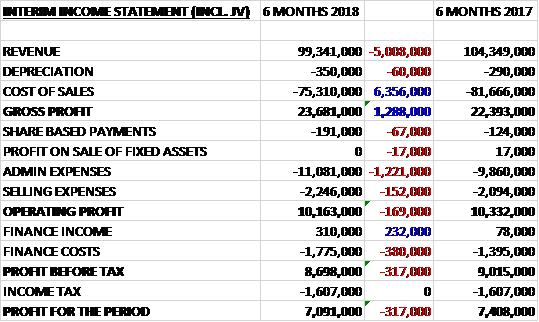
Revenues have declined by £5M when compared to the first half of last year. Depreciation was up £60K but other costs of sales declined by £6.4M to give a gross profit £1.3M higher. Share based payments grew by £67K, admin expenses were up £1.2M and selling expenses grew by £152K which meant that the operating profit was £169K lower. There was a £380K increase in finance costs but income tax remained flat to give a profit for the period of £7.1M, a decline of £317K year on year.

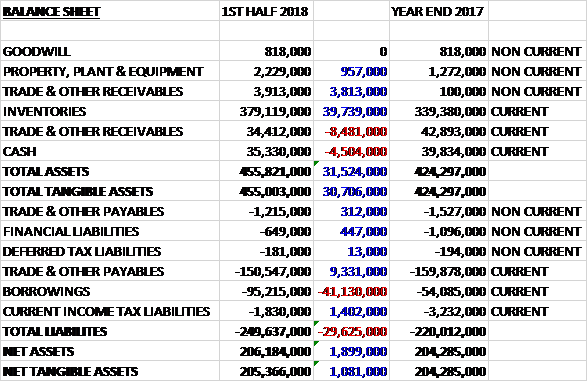
When compared to the end point of last year, total assets increased by £31.5M driven by a £39.7M growth in inventories and a £957K increase in property, plant and equipment, partially offset by a £4.5M decrease in cash and a £4.7M. Total liabilities also increased during the period as a £9.6M decrease in payables and a £1.4M fall in current tax liabilities was more than offset by a £41.1M growth in borrowings. The end result was a net tangible asset level of £205.4M, a growth of £1.1M over the past six months.

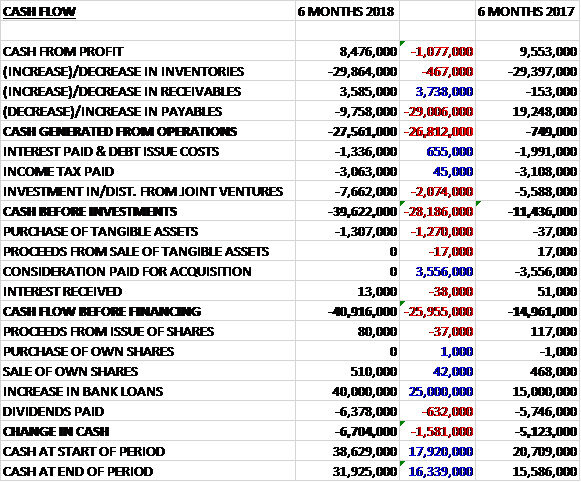
Before movements in working capital, cash profits declined by £1.1M to £8.5M. There was a bug cash outflow from working capital and after interest payments reduced by £655K and investments into joint ventures increased by £2.1M there was a net cash outflow of £39.6M, an increase of £28.2M year on year. The group spent £1.3M on intangible assets to give a cash outflow of £40.9M before financing. They then paid out £6.4M in dividends and took out a new loan of £40M to give a cash outflow for the half year of £6.7M and a cash level of £31.9M at the period-end.

The group’s financial results are influenced by the number of open market completions achieved and there were fewer of these in the period than expected in the second half. As experienced last year this is purely down to development timings which are all on track and in accordance with the original programmes but do not fall evenly across the year. Completions of individual properties are proceeding as planned with no delays.

In joint ventures, whilst there were more open market completions at 116 (85) there has been less revenue from construction contracts, particularly affordable housing, due solely to the timing of developments. In the future construction contracts will be a greater proportion of revenue due to the increased involvement in build to rent where profit is recognised as they build rather than at the end of the development.

The gross margin was 25.1%, up from 22% in the first half of last year. This increase is primarily due to some higher margin developments completing in the period. The margin on build to rent revenue was 17.5%, exceeding the target of 13% mainly due to cost efficiencies.

The group’s recent success in securing build to rent sales means they have not launched any new developments to individual customers in the period. They do have residual availability at a few predominantly forward sold schemes, however, where they have continued to make regular sales at prices in line with expectations.

They have two new development launches scheduled for Q1 2018. The second phase of New Garden Quarter in Stratford will be marketed and at Bow Garden Square they will be opening an on-site sales centre expecting to sell to owner-occupiers utilising Help to Buy. The expected average price at New Garden Quarter is around £550K and at Bow Garden Square it is less than £500K. At the latter 52 of the 83 homes for sale ae expected to be priced below £500K so that first time buyers can benefit from the reduction in stamp duty.

Despite some of the commentary around higher priced homes in London, the group have secured the sale of all four penthouse apartment at their Stratford Central development in the last few weeks for a combined sum of over £5M.

In June they signed a pre-construction agreement with global rental housing operator Greystar to develop just under 900 rental homes in Nine Elms, Battersea. Together they are making progress towards securing a detailed planning consent at which point the group will enter a full design and build contract and the site will then become a significant addition to their existing development pipeline. Their existing build to rent developments are progressing well with the Pavillions due for handover to L&Q by mid-2018. They are now actively looking for new opportunities with L&Q going forward.
Ongoing uncertainty around Brexit and a lack of political stability has deterred some potential buyers from making a purchase, particularly at higher
price levels. Changes to the tax system, especially the phased removal of tax relief on mortgage interest, have also dampened demand from UK based investors despite an active rental market. Despite this, the board expect the structural shortage of homes in London to continue to attract individual investors including those based overseas who typically invest from a larger asset base. The group are working harder to sell individual homes with prospective owner-occupiers needing more visits to a property before agreeing a purchase but this represents a more normal market environment rather than one where the homes sell immediately.

The development pipeline at the period-end represented £1.4BN of future revenues and comprised just under 4,200 homes, over 3,000 of which are in design or under construction with the remainder going through the planning process. The average expected price for open market homes in the pipeline is just under £540K. The group are in promising discussions on a number of attractive opportunities to add to the pipeline both for build to rent and individual sale.

Going forward the board believe the group is well positioned to meet market expectations for the full year with over 95% of gross profit secured. They are on track to deliver over £40M pre-tax profit in 2018 and secured over 65% of the gross profit required to exceed £50M in 2019.

At the current share price the shares are trading on a PE ratio of 11.4 which falls to 8.9 on the full year consensus forecast. After an 11% increase in the interim dividend the shares are yielding 3.9%, increasing to 4.1% on the full year forecast. The net debt at the period-end stood at £59.9M compared to £14.3M at the year-end. This was as expected and is driven by construction on larger sites as they deliver on their pipeline.

On the 20th December the group announced that it had exchanged and completed contracts with U+I and Parkdale Investments for the purchase of a significant residential-led development site in Walthamstow for a total consideration of £33.9M. The site benefits from detailed planning consent for 257 open market homes, 80 affordable homes and 18,830 square feet of flexible commercial space. Whilst this development can be marketed for individual sales the group expects to explore entering into a build to rent transaction for the delivery of the open market homes in the New Year and will undertake the detailed design accordingly. Vacant possession is expected by April 2018 and the group intends to start work in Autumn 2018 with completion expected in late 2021.

Also on the 20th December the group announced that they had exchanged contracts with the London borough of Brent for the redevelopment of Gloucester House and Durham Court, a significant residential development site in South Kilburn. The development will deliver 124 new open market homes, 102 affordable social rent homes and ten shared equity homes in buildings ranging from four to eight stories high. The gross development value of the scheme is expected to be around £95M and work is already underway on site with completion expected in 2021.

Overall then, this appears to be a bit of a mixed period but it was as expected. Profits were down and the operating cash flow deteriorated with a large cash outflow. Net assets did increase modestly, however. All this was flagged up well in advance, though, and the board are very confident of a strong second half. The market seems to be fairly robust in the price-points that the group operates in. With a forward PE of 8.9 and yield of 4.1% these shares look decent value and I continue to hold.

On the 2nd Febuary the group announced that Chairman Andrew Wiseman sold 125,000 shares at a value of £512K. He still owns 2,203,927 shares.

On the 15th February it was announced that non-executive director Jane Earl purchased 6,342 shares at a value of £25K. She now owns 7,432 shares.

On the 18th April the group released a trading update covering the year ended 2018. They expect to report record levels of revenue and profit with pre-tax profit expected to be up by more than 30% and slightly ahead of current market expectations. This increase has been assisted by an improvement in the group’s operating margins by around 3 percentage points.

The housing market in London has remained robust at the group’s typical price point. In January they launched the second phase of New Garden Quarter in Stratford, marketing first in the UK and then internationally. They secured over 100 reservations across three weeks which exceeded initial expectations. Dampened UK based investor demand due to recent tax changes restricted domestic sales to a quarter of these reservations, however, with the remainder sold in China which represents a growing market for the group. The demand is driven by good rental yields with the homes expected to complete in mid-2019.

All of the remaining available homes at Bermondsey Works have been sold in recent weeks, alongside a continuing rate of sale of the remaining higher priced homes at Manhattan Plaza. In late March the group launched Bow Garden Square, focused on owner-occupiers with prices starting from £390K. Initial interest has been encouraging and a number of reservations have been secured.

There is no sign of the weight of investor demand diminishing and the group continues to be approached by new rental operators looking for opportunities. The development pipeline now includes over 4,000 homes compared to 3,972 last year and the average price of the open market homes within that is around £539K compared to £527K.

In December the group exchanged and completed contracts with U+I and Parkdale Investments for the purchase of a significant development site in Walthamstow for a total consideration of £33.8M and the group is about to start a formal marketing process to find a build to rent investor for all of the open market homes having concluded a period of initial design work.

The planning environment in London continues to be challenging and the group has experienced some delays in recent months. They are well place to acquire more sites to add to the pipeline, however.

This all sounds fine, I continue to hold.

Photo-Me Share Blog – Interim Results Year Ending 2018

Photo-Me has now released their interim results for the year ending 2018.
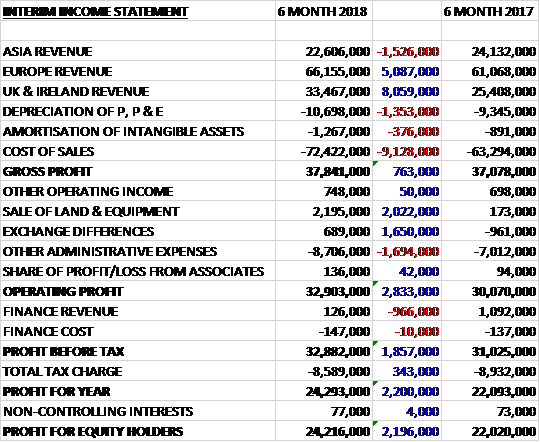
Revenues increased when compared to the first half of last year as a £1.5M decline in Asia revenue was more than offset by an £8.1M increase in UK and Ireland revenue and a £5.1M growth in European revenue. Depreciation was up £1.4M, amortisation increased by £376K and other cost of sales rose by £9.1M to give a gross profit £763K higher. The group made £2M more from the sale of land and equipment, and benefited from a £1.7M positive swing in exchange differences, but other admin expenses grew by £1.7M to give an operating profit £2.8M higher. Finance revenue was down £966K but tax charges fell by £343K to give a profit for the period of £24.2M, a growth of £2.2M year on year, half of which is related to favourable forex movements.
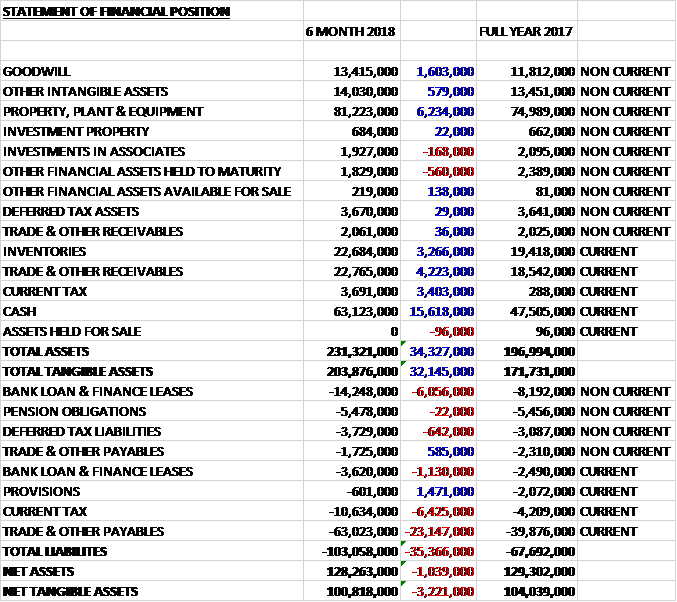
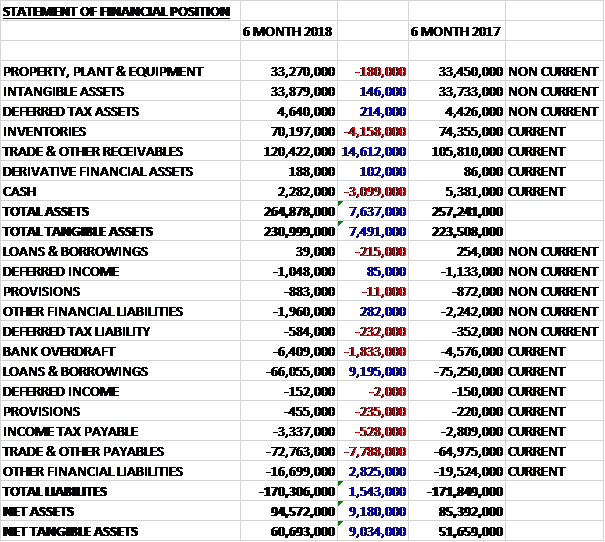
When compared to the end point lf last year, total assets increased by £34.3M, driven by a £15.6M growth in cash, a £6.2M increase in property, plant and equipment, a £4.2M increase in receivables, a £3.4M increase in current tax assets, a £3.3M growth in inventories and a £1.6M increase in goodwill. Total liabilities also increased during the period was a £1.5M decline in provisions was more than offset by a £23.1M increase in payables, a £7.2M growth in borrowings and a £6.4M increase in current tax liabilities. The end result was a net tangible asset level of £100.8M, a decline of £3.2M over the past six months.
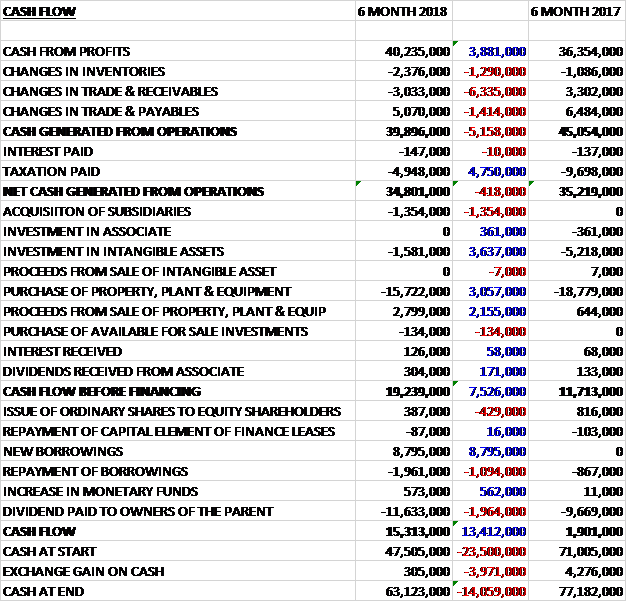
Before movements in working capital, cash profits increased by £3.9M to £40.2M. There was a broadly neutral working capital position compared to a cash inflow last year and after tax payments reduced by £4.8M the net cash from operations was £34.8M, a decline of £418K year on year. The group spent £1.4M on acquisitions, £1.6M on intangible assets, and £15.7M on fixed assets to give a free cash flow of £19.2M. Of this, £11.6M went on dividends and for some reason the group took out a net £6.8M of new borrowings, which makes me a bit nervous, to give a cash flow for the half year of £15.3M and a cash level of £63.1M at the period-end. Why are they taking out new loans to hoard so much cash? It doesn’t really make sense to me.

The operating profit in the Asian business was £2.4M, a decline of £1.3M year on year on revenues that fell by 6.2%, partially reflecting the impact of forex movements. At constant currency, the year on year decrease of 3% reflected more challenging market conditions in Japan and the lower contribution from the My Number ID programme. The board see future growth from the investment in launderette shops, with six now open in Japan.

Photo ID competition has remained high with new entrants looking to capitalise on the long term opportunity presented by the Japanese government’s My Number initiative which is expected to be made compulsory in the medium term (this no longer seems to be being flagged up as an opportunity for the group).

The operating profit in the European business was £22.5M, a growth of £485K when compared to the first half of last year on revenues that increased by 2.3%, primarily driven by a 39% increase in takings from the automated laundry machines and the recent upgrades to the photo booth estate with digital security features and roll out of further kiosks. France, the largest contributor in this sector, performed strongly with revenue up 3.2% and gross takings from the estate of automated Revolution laundries and the laundrette outlets increased by 40%. In Portugal, revenue from laundry operations increased to €700K with profits in the country more than doubling over the past two years.

The operating profit in the UK and Irish business was £7.3M, an increase of £2.6M when compared to the first half of last year reflecting continued expansion in laundry and the roll out of the secure digital upload technology for the Irish Online Passport Service. This includes a £2.3M profit from the sale of the head office building and £700K from acquisitions, offset by £900K in restructuring charges, meaning the underlying profit growth was just £500K. Ireland has been a focus for the laundry roll out programme and the country has seen revenues from laundry operations increase from €100K in 2015 to €2.1M in the same period this year.

The estate increased by 2.8% to 12,951 machines, reflecting the expansion in the laundry business as well as the roll out of the new Speed Lab digital printing kiosks. There has been softening in the UK market due to consumer disposable income constraints. This resulted in lower revenues from the UK photo ID operations in the first half, with slightly reduced demand for photo ID. This backdrop will be mitigated by actions to improve operational efficiencies in the business. Price rises from £5 to £6 have been implemented across the UK photo booth estate.

The group has taken some actions to boost the profitability of the UK digital printing business (the acquisition from Asda). The retail operations are being refocused to provide unattended digital printing kiosk activities, with the phased closure of manned retail outlets. This will result in a total one-off restructuring cost of £2M in the current year, of which £900K has been accounted for in the first half. The restructuring will improve the profitability of the business in the second half but there will be a negative impact on revenue.

The group has continued to invest in the further deployment of digital kiosks, mainly in the UK leveraging their presence across the Asda network. The board are pleased with the performance of the new equipment, achieving average monthly gross takings per unit of £800 across the estate and reaching £1,500 in the UK. They will further expand the roll out of the Speed Lab Cube and Speed Lab Bio released last year, offering the latest digital printing technology and an enhanced consumer experience, creating potential for further growth.

The group have continued to expand their services in Ireland through the deployment of their encrypted photo ID upload technology in their photo booths for online passport applications. Since the Irish government launched the new system in April 2017, around 200 photo booths have been enabled with the technology. They are on track to upgrade a total of 300 units by the end of the year. In the UK, discussions with HM passport office regarding the new online passport service hand testing have concluded positively. The service is now being rolled out to photo booths across the UK from mid-December 2017. The progressive rollout of secure and direct data transfer technologies in photo boots in Germany has continued with around 20 being upgraded.

Within laundry, the group’s manufacturing partner transferred production from Hungary to a new facility in Poland. This resulted in a short term slowdown in production but the new facility has the capacity to support production of 150 Revolution units per month in the second half of the year. This increase in production will enable to the group to accelerate deployment in the longer term.

In July 2017 the group completed the sale of their head office buildings in Bookham, Surrey. The freehold was sold to Shanly Homes for a consideration of £2.5M. The book value of the assets was only £100K so there was a profit on the sale of the building of £2.3M, taking into account sales costs of around £100K. The group has consolidated its head office and UK operations into one location in Epsom so the building was surplus to requirements.

In July 2017 the group acquired Inox Equip ltd and Tersus Equip ltd for a total consideration of £2M. The businesses are both UK based, business to business laundry companies which provide design, procurement and installation of laundry and catering equipment facilities for companies and institutions such as care homes and hospitals. The acquisition includes £450K of contingent consideration and generated goodwill of £1.5M. In the period after acquisition, the businesses generated pre-tax profits of £442K.

Going forward, in the medium term it is anticipated that laundry revenue will grow significantly as a proportion of the total group revenues and satisfactory progress is being made towards the target of 6,000 total laundry units deployed by the end of 2020. In the second half the group will benefit from the enhanced profitability of the retail operations once the refocus of activities is complete. Whilst remaining mindful of the macroeconomic environment, forex movements and consumer sentiment, the board remains confident about the group’s prospects.

After a 20% increase in the interim dividend the shares are yielding 4.2% which increases to 4.6% on the full year consensus forecast. At the current share price the shares are trading on a PE ratio of 19.7 which falls to 18.6 on the full year forecast. At the period-end the group had a net cash position of £47.1M compared to £39.2M at the end of last year.

Overall then this has been a bit of a mixed period for the group. Profits were up, but this was due to the sale of the HQ building and lower tax charges, otherwise profit would have declined somewhat. Net assets declined as did the operating cash flow but this was due to working capital movements and cash profits increased with a decent amount of free cash being generate, albeit with the group also taking out more loans.

The sluggish performance has come from Japan which has struggled with the delays to the My Number ID cards. Both Europe and the UK/Ireland saw a decent performance, buoyed by higher laundry takings and in the case of the latter, the new secure passport service. With a forward PE of 18.6 and yield of 4.6% the shares are not too bad value-wise actually and I continue to hold. Though the cash position seems a bit odd to me.

On the 19th February the group announced that the board of Max Sight, of which the group is an 18% shareholder, has made an application to list on the HK stock exchange. The business intends for the majority of the proceeds from the share offer to be used to fund the long term development of the business in the Guangdong province, expanding the network of photo booths. Following the listing, the group will hold nearly 14% of the share capital. The revaluation of the carrying value of the investment would lead to a revaluation gain of £3.3M.

On the 30th May the group released a trading update covering 2018. The board expects the group will achieve turnover growth of around 6% with the group’s pre-tax profit to be broadly in line with market expectations. As of the end of April, net cash was around £26M reflecting capex slightly ahead of last year, investment in laundry acquisitions and the restructuring of Photo-Me Retail.

The photo ID business continued to perform well except in Japan which has remained a very difficult market due to an oversupply which has put pressure on commissions across the industry. In the UK, rollout of the group’s encrypted passport photo ID upload technology commenced in mid-December. At the year-end, 2,200 photobooths had been upgraded with this technology. This technology is also installed in 200 photo booths in Ireland and 5,700 in France. The group is also in prelim discussions with the Dutch government regarding deployment of this technology in the Netherlands.

The laundry business continued to perform well. Revenue increased by 49% to £32.3M. Production capacity of the Revolution machine increased following the transfer from Hungary to Poland. The increase in volume will support an acceleration in laundry expansion, the early benefits of which started to come through towards the end of the financial year.

In May 2018, after the year-end, the group acquired LeWash, a Spanish business to business laundry services business based in Barcelona, for a consideration of €4.75M. The business, which is a franchise model, consists of two companies with a combined pre-tax profit of €796K.

The operations of Photo-Me Retail have been refocused to provide unattended digital printing kiosk services. This action will boost the profitability of the UK digital printing business but will result in a one-off restructuring cost of £2.6M in 2018.

Going forward, the Japanese photo ID market continues to be highly competitive. The number of photo booths increased significantly during the launch of the ID card but this programme was not compulsory and did not gain the momentum initially anticipated. During the current year, the group will invest in a restructuring of the Japanese business which should boost profitability from 2019.

Taking this into account, the board now believe that pre-tax profit in 2019 will be around £44M, below current market expectations and at a similar level to 2018. The board currently expect to maintain the existing dividend policy.

This does not look good, I am considering selling out here to wait for some signs of improvement.

Avingtrans Share Blog – Final Results Year Ended 2017

Avingtrans has now released their final results for the year ended 2017.

Revenues increased when compared to last year as a £161K fall in medical revenue was more than offset by a £1.7M growth in energy revenue. Cost of inventories grew by £1.6M but other cost of sales were down £1M to give a gross profit £906K higher. There was an 89K fall in the profit on asset disposals but amortisation was down by £109K. Operating lease rentals increased by £80K, there was £101K of acquisition costs, no proceeds from the sale of property (£446K last time), there was £226K of tender share buyback costs and other admin expenses were up £397K to give an operating loss £239K higher. There was a £333K fall in interest receipts but tax payments were up £186K to give a loss for the year of £296K, a detrimental movement of £716K on a continuing basis.

When compared to the end point of last year, total assets declined by £22.9M, driven by a £28.8M fall in cash, partially offset by a £2.6M growth in inventories, a £1.5M increase in other receivables and a £1M growth in prepayments and accrued income. Total liabilities also declined during the year as a £1.2M increase in trade payables was more than offset by a £3.9M fall in borrowings. The end result was a net tangible asset level of £38.3M, a growth of £21M year on year.

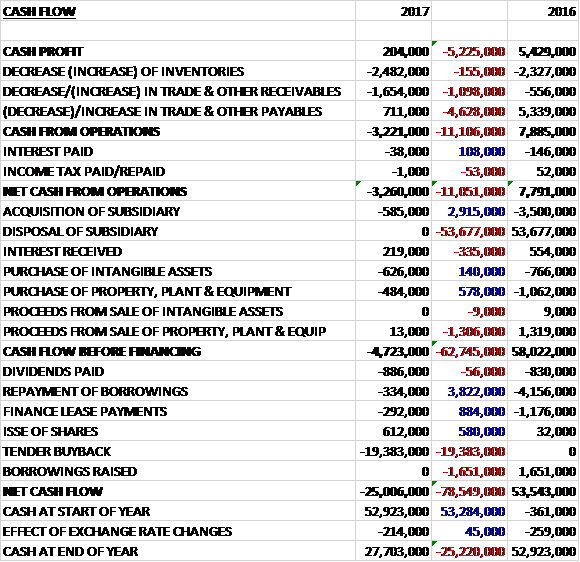
Before movements in working capital, cash profits declined by £5.2M to £204K. There was a cash outflow from working capital and despite interest payments falling by £108K, there was a net cash outflow of £3.3M from operations, a detrimental movement of £11.1M year on year. The group spent £626K on intangible assets, £484K on property, plant and equipment and £585K on acquisitions to give a cash outflow of £4.7M before financing. They also spent £886K on dividends, £292K on finance lease payments, and £334K on loan repayments before a £19.4M return of capital from tender buybacks meant that the cash outflow for the year was £25M and the cash level at the year-end was £27.7M.

The operating profit in the Energy business was £456K, a growth of £209K year on year reflecting the positive effects of restructuring at Maloney and the improving margin mix of new contracts at Metalcraft and Crown. The residual phase of restructuring at Maloney is now complete and the group continued to mitigate the negative effects of the oil price by focusing on the growth areas in the energy market such as energy storage, carbon capture and nuclear power life extension and decommissioning. Haywood Tyler had already been following a risk mitigation path for its oil and gas business plans and the board will continue to follow through with that restructuring.

At Metalcraft business with existing key accounts such as Cummins was steady. The ten year Sellafield contract to produce 3M3 boxes for the storage of nuclear waste progressed to plan and they also won an £11M three year contract extension, extending the scope of the box programme. They made good progress with facilities refurbishment and pre-production tests. The production set up and prototyping phase will continue in the current year, with series production expected to start in 2018.

At Maloney Metalcraft, the oil price continued to affect the business. They completed a limited restructuring process to stabilise their position. The gas project contract with Samsung was completed in the period and the JGC Gulf International project is nearing completion, following a number of customer induced design changes. Work also commenced on the EDF life extension contract and is proceeding to plan.

Crown had a stronger second half to the year, driven by the win of an important new £1.7M contract for flame detection masts, whose end customer is Fluor Corp. Work on this contract continues into the current year. The FET carbon abatement trial in Wales concluded and they are working to turn this application into a product of the future with FET. This technology promises to make small to medium fossil fuel generators “clean”.

The addition of Haywood Taylor brings with it several additional sites to the Energy division. The centre of excellence in Luton, the associated business in Vermont and Peter Brotherhood’s production facility in Peterborough, as well as sales, support and repair facilities in India and China. The facility in Luton includes an advanced facility for specialist motor manufacture.

The operating profit in the Medical business was £428K, an improvement of £616K when compared to last year and included a £115K loss from the acquired Space Cryomagnetics. This is despite a modest revenue decline mainly due to ramp up delays at Composite Products. The board anticipate growth coming through this year from recently won contracts such as Rapiscan and CAS Oxford as well as a full year of revenue from Scientific Magnetics. The division was awarded a £9M ten year contract for NMR cryostats during the year for a customer called CAS Oxford in China.

There have been some notable changes of ownership in some of the key players in the MRI sector recently and the board continue to see new entrants penetrating the Chinese medical imaging market, which, in general, they view positively in terms of business opportunity. These developments indicate that the sector will continue to spend money on developing new products and imaging techniques.

At Metalcraft, business with Siemens was steady in the UK and they continued to develop their relationships with other customers such as for Proton Therapy. In China, results for the unit continued to improve and they made good progress with existing customers such as Siemens and Alltech as well as preparing for the new contracts with Bruker and CAS Oxford for NMR vessels. Composite Products saw its performance in the second half suffer from ramp-up delays with key customer Rapiscan. They believe that the issues causing the delays are now resolved and expect to continue the ramp-up in the current financial year.

In February the group acquired 82% of Space Cryomagnetics to enhance their positon in the energy and medical division. The total consideration was £588K and the acquisition generated goodwill of £648K as it had net liabilities. There are call and put options enabling the group to purchase the remaining 18% of the issued capital of the business with an excise date of 2019 and 2022. The yexpect to acquire the remaining 18% with a contingent consideration of £256K being recognised. The acquisition enables the group to build their capability into superconducting magnets and cryogenics

After the year-end, in August, the group acquired Hayward Taylor for £29.4M through a share placing. At the same time, £11.5M of its facilities were repaid, a further £10M of debt assumed and £5M of transaction costs incurred (this seems a bit steep!) Last year the business had a turnover of £62.7M and a pre-tax loss of £3.7M.

At the current share price the shares are trading on an underlying PE ratio of 208.4 which falls to 66.8 on next year’s consensus forecast. At the year-end the group had net cash of £26.4M compared to £51M at the end of last year. After an increase in the dividend the shares are yielding 1.6% which is forecast to remain flat next year.

On the 2nd October the group announced that CEO Steve McQuillan purchased 18,500 shares at a value of just under £40K. He now holds a total of 243,500 shares.

On the 8th January the group released an update covering the first half of the year with performance in line with market expectations. The group has secured new business in generally improving market conditions. A number of notable contracts were secured in the period, worth almost £7M in total including nuclear life extension contracts worth £2.2M in Sweden and £2.5M in South Korea; a £1M steam turbine refurbishment contract; an initial £500K UK gas distribution network upgrade contract; and a £500K M6 smart motorway contract.

The immediate focus for the group has been the integration of Hayward Tyler and the re-establishment of profitable growth for the business. The initial integration and the necessary restructuring has been completed, in particular at Luton and Peterborough where the group has realised anticipated cost savings. Overall the opportunities for the long term profitable growth of the business as presented by the acquisition are as expected.

Overall then, on the surface this looks like a bit of a disappointing year for the group, with a swing to losses, a fall in net assets and an operating cash outflow. This is very much a business in transition, however, and operationally both divisions saw an improvement with restructuring and improved margin contracts helping the energy division. Going forward, the integration of Hayward Tylor and the Sellafield contract are two important factors and with the oil price improving things should be better this year.

This does seem to be factored into the share price, however, as unless I’m missing something the forward PE of 66.8 and yield of 1.6% looks quite expensive. One to keep an eye on I think.

On the 21st February the group announced that Haywood Taylor has won a $6.7M contract from Korea Hydro and Nuclear. The business has been a supplier of pumps and spare parts to them for over forty years. The latest order, for spare parts to upgrade and refurb existing nuclear power plants, they largest they have received from the group, takes the total value of orders received from this customer since completion of the acquisition to over $10M.

International Greetings Share Blog – Interim Results Year Ending 2018

International Greetings has now released their interim results for the year ending 2018.

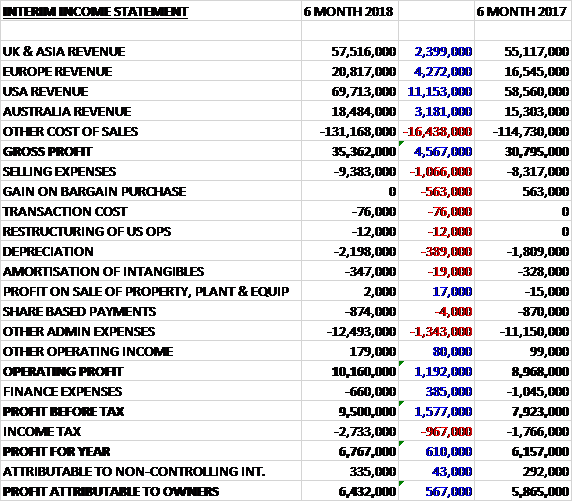
Revenues increased when compared to the first half of last year with an £11.2M increase in US revenue, a £4.3M growth in European revenue, a £3.2M increase in Australian revenue and a £2.4M growth in UK and Asian revenue. Cost of sales also increased to give a gross profit £4.6M higher. Selling expenses were up £1.1M, there was no gain on bargain purchase, which was £563K last time, depreciation was up £389K and other admin expenses grew by £1.3M to give a £1.2M increase in operating profit. Finance expenses reduced by £385K but tax charges grew by £967K which meant that the profit for the period was £6.4M, a growth of £567K year on year.

When compared to the end point of last year, total assets increased by £7.6M, driven by a £14.6M growth in receivables, partially offset by a £4.2M decline in inventories and a £3.1M decrease in cash. Total liabilities declined in the period as a £7.8M increase in payables and a £1.8M growth in the overdraft were more than offset by a £9M decline in borrowings and a £3.1M fall in other financial liabilities, mainly relating to finance leases. The end result was a net tangible asset level of £60.7M, a growth of £9M year on year.

Before movements in working capital, cash profits increased by £2.7M to £13.5M. There was a big cash outflow from working capital so after tax payments increased by £976K there was a net cash outflow of £66.8M from operations, an increase of £10.9M year on year. The group spent £462K on intangible assets and £3.4M on property, plant and equipment so before financing there was a £70.6M outflow of cash. The group spent £2.3M on dividends and took out £66.3M of loans to give a cash outflow of £6.7M for the period and a cash level of £4.1M at the period-end.

The profit in UK and Asia was £4M, flat year on year reflecting the initial impact of the integration of the three UK operating businesses. The new manufacturing equipment producing retailer branded bags to be given to consumers is now fully operational having been installed on time and on budget.

The profit in Europe was £1.7M, a growth of £426K when compared to the first half of last year. A second high speed printing press is on track for delivery and on budget for installation early in 2018. A strong order book is in place for the rest of the year.

The profit in the US was £5.1M, an increase of £1.4M when compared to the first half of 2017 which includes organic growth of 27%, some favourable timing differences and the successful integration of Lang. The planned investment to upgrade the IUT systems in the US is proceeding on time and on budget and is due for installation in 2019.

The profit in Australia was £1.2M, a growth of £207K year on year, driven by the robust independents channel.

In September the group agreed to acquire Biscay Greetings with completion taking place in January 2018. The business is a greetings card and paper products business based in Australia. The acquisition will be satisfied by a cash consideration of £5.5M, generating intangible assets and goodwill of £2.4M. The business will also require a working capital injection of £1.8M.

If growth is heavily fuelled by the US business, as is the expectation, the blended tax rate could continue to rise and cash tax is increasingly becoming payable at the prevailing rate in most geographical regions as historical losses are fully utilised, although this will not be evident in the US or the UK until 2019.

Capital expenditure was £800K higher in the period as the group seeks out opportunities to invest in efficiency. They have taken delivery of new machinery in Wales to manufacture retail branded bags as part of a diversification into new adjacent product categories. The equipment was fully operational at the period-end with a strong order book in place. Orders have also been confirmed for second HD high speed printing pressing press in Europe and to implement a new ERP system in the US, both of which are expected to yield attractive paybacks.

As previously announced, Anthony Lawrinson indicated his intention to retire from his role as CFO for family reasons after six years at the group. The board intends to appoint Giles Willits as new CFO from January. Giles, aged 51, was most recently CFO of Entertainment One.
Going forward, the strong trading position at the end of the first half of the year is firmly underpinning management’s expectations for the full year.

At the period-end the group had a net debt position of £70.2M compared to £76.4M at the same point of last year. At the current share price the shares are trading on a PE ratio of 31.8 which falls to 19.3 on the full year consensus forecast. After an increase in the interim dividend the shares are yielding 1.1% which increases to 1.3% on the full year forecast.

On the 29th November the group announced that non-executive director Mark Tentori purchased 7,404 shares at a value of £30K. This is his first share purchase.

On the 16th January the group released an update covering Q3 which covers the Christmas trading period. Trading has continued to be strong. The group expects to deliver record revenues this year with the continued expansion of their global footprint outside the UK. All regions are on track to deliver year on year profit growth which means that EPS is expected to be ahead of current market expectations and delivering strong year on year growth. The board continue to see strong cash conversion across the group and expect average leverage for 2018 to be significantly below an average of two times.

Additionally as a result of the level of the group’s US earnings the board expects to benefit in 2019 and beyond from the recent US tax legislation changes. The US tax rate change is expected to translate into lower tax payments, thereby enhancing cash generation.
Overall then this has been a good period for the group. Profits increased, net assets grew and cash profits increased, although the operating cash outflow widened which is usually the case due to the timing of Christmas after the first half ends. Going forward, all regions are experiencing growth and the important Christmas period has gone well. This is probably factored into the share price, however, with a forward PE of 19.3 and yield of 1.3%. All in all, however, I remain a holder.