Getech Share Blog – Final Results Year Ended 2017

Getech has now released their final results for the year ending 2017.

It seems a little point comparing most of this as it’s not like for like but gross profit increased by £1.2M but the group incurred an operating loss, which represented a £1.4M detrimental shift on last year, although it should be noted that there was no positive fair value adjustment, which brought in £845K last time, and restructuring costs increased by £461K, so without these there would have only been a £100K detrimental movement. Finance costs remained broadly similar but the tax income increase by £235K to give a loss for the year of £40K, a detrimental movement of £1.1M year on year.

When compared to the end point of last year, total assets declined by £2M, driven by a £947K decrease in trade receivables, a £395K fall in cash, a £395K decline in work in progress and a £246K decrease in the value of data holdings, partially offset by a £660K growth in development costs. Total liabilities also declined during the period due to a £948K decline in accruals and deferred income, a £607K fall in other payables and a £266K decline in borrowings. The end result was a net tangible asset level of £5.6M, a decline of £213K year on year.

Before movements in working capital, cash profits increased by £104K to £593K. There was a cash inflow from working capital and a £793K positive swing to a cash receipt from tax to give a net cash from operations of £1.6M, an improvement of £1.9M year on year. The group spent £1.2M on development costs and £500K on acquisitions along with £54K on other capex to give a cash outflow of £92K before financing. The group also repaid £266K in loans and paid out £34K of interest which meant the cash outflow for the year was £392K and the cash level at the year-end was £2.4M.

Within the tax credit of £653K. They received corporation tax relief of £410K against their R&D work, a prior year and foreign tax credit of £123K and deferred tax adjustments of a £120K credit.

During the period, the products division, on a pro-rata basis saw a gross profit of £3.1M, a growth of £520K year on year. The year saw an upswing in the products division. The group have worked to refresh their data holdings and expand them to include seismic, well and other technical data. They are particularly focused on doing this in regions where they can see clear commercial catalysts that will drive buying interest from customers.

In the year the group were appointed as the Gravity and Magnetic data release agent by Ireland and South Africa, as well as the devolved government of the Faroe Islands. They accessed new gravity and magnetic data in Papua New Guinea, Colombia and Bolivia, and they continued their rolling programme of data reprocessing, through which they have enhanced the value of their data holdings. In parallel they extended the footprint of their Multi Sat data product to cover prospective areas that include East Africa’s lakes, and signed data brokerage agreements with companies including Sander Geophysics (gravity and magnetic data), Canesis (seismic and well data) and US Land Grid (well data). In Sierra Leone they assembled a high value suite of seismic and well data, which under a revenue sharing agreement with the government they are offering for license as part of the country’s fourth offshore licensing round.

In the year the group grew the potential single sale gross value of their data holdings by $20M and net revenue from data sales is beginning to rise a consequence. Coupled with their advanced gravity and magnetic processing techniques and interpretation expertise, their data holdings also continue to underpin the Globe and Regional Reports information products.

In July they completed Globe’s second three year build phase, which was achieved in budget and on schedule and customer feedback has been positive. With this phase now complete, they have moved the commercial model to an annual release cycle. Work on Globe 2018 started in August and remains on track for release in July.

The sector downturn continues to provide a challenging market for the Regional Reports but the group are exploring new ways for customers to access their value. The group first developed their geospatial software as a solution to increasing the efficiency of well planning in coal bed methane products. In collaboration with a major US player, the product has been extended to support onshore shale oil and shale gas operations. They have since broadened the user base and customers are using the software to reduce well development costs and simplify reserves management.

During the year all three software products were enhanced to include a range of new customer-requested functionality and upgraded to include support for Esri’s latest releases. With the re-subscription rate exceeding 95% for the second year in a row, the install base also grew, driven by new customer wins and existing customers deploying the software more widely within their organisations.

On a pro-rata basis the Services division made a gross profit of £155K, a decline of £526K when compared to last year. Within the Services division, on a combined basis, the gross margin was reduced from 24% to just 7%. In geoscience consulting, the reduced oil rice and oil company customer budgets have combined to intensify competition. The group are using their technical expertise to broaden their activities into new sectors. In Mozambique they signed an agreement with the water ministry to use their skills to unlock value in well data that agencies can use to improve their success rate in locating sources of drinking water. During the year a pilot study was commercialised and they are examining ways to expand this work.

The power of this approach is also demonstrated by the group’s history of assisting governments and national oil companies with license rounds, data management, capacity building and advisory services. During the year the group worked for the governments of Lebanon, Mozambique, Namibia, Ras al Khaimah, Sao Tome and Sierra Leone. In Sierra Leone they have worked in partnership with the petroleum directorate since 2016, a project initially funded by the World Bank. During the year this broadened into a multi-year contract to promote the country as a key area for exploration investment. This, along with other government advisory work enables the group to access a rich portfolio of technical data, which they then license on behalf of the government.

During the year the group won a mandate to define and deliver a multi-faceted spatial data strategy for the UK Oil and Gas Authority who then commissioned the group’s Gravity and Magnetics team to complete technical service work over the South Western approaches area of the UK continental shelf. In the period the OGA also purchased their proprietary Multi Sat gravity product which is now being used to encourage investment in under explored areas of the North Sea.

The Geospatial Services business was used on a broad range of engagements to standardise and improve daily workflows such as site inspection and operational surveillance. Their projects include work for NCOC, the partnership operating in Kashagan, one of the world’s largest and most logistically complex oil developments, where they have created a web-based mapping platform to assist in oil spill response, pipeline integrity, vessel tracking and ice monitoring in and around the Caspian Sea. The team were also engaged by oil companies to help build their own geospatial capabilities through the delivery of training courses in Europe, the US and Australia.

During the year they worked in partnership with Esri UK on contracts in the water and transportation industries. They also matured and expanded their geospatial software services footprint in the nuclear space and won their first contract in energy infrastructure – North Connect, a JV laying a cable to connect the power systems of Scotland and Norway, engaging them to design a portal for map and app solutions that facilitate date and information sharing. In each of these new sectors, the group’s investment was rewarded in the year by winning follow on work.

During the year the group has reduced headcount by 27% and both Dr. Paul Carey and Paul Markwick left the board. Andrew Darbyshire joined as CFO and Chris Jepps joined as COO. Huw Edwards is stepping down.

There were a number of one-off costs during the year. The group launched a restructuring programme that resulted in one-off costs of £487K. Following management’s review of inventories, it was considered appropriate to impair the carrying value of a number of reports and studies and the total value of the impairment is £461K.

Going forward, the group’s customers’ attitude to capital spending is currently balanced between spot oil prices, which have rallied strongly since July, and longer dated crude prices which continue to trade between $55 and $60 per barrel. Alongside this, industry costs have fallen dramatically, making the investment environment more attractive than a year ago.

The group have begun the year by backing their growth ambitions with targeted operational, sales and marketing investment. The board don’t anticipate significant upward pressure on costs and they expect tax credits of a similar level to last year. A similar pro-rata sales performance to this year would generate cash inflow of around £500K and each 10% increase in revenue would broadly translate into a £600K increase in free cash flow.

It remains early in the year but the sales pipeline has the potential to exceed this year’s levels. This reflects Q1 upturn in data sales for frontier regions, and continued growth in the user base for their frontier regions, and continued growth in the user base for their software and information products. Further leverage comes from the growth in the breadth, quality and value of the data that they can license. One route to market for this data is the fourth Sierra Leone licencing round where they have worked with the petroleum directorate to assemble a package of seismic, well and value added data to support potential investors in their assessment of the region’s prospectivity. A single licensing of this dataset has the potential to be a disclosable event for the group.

Whilst general geoscience consulting remains tough, the board take encouragement from an increase in demand for their specialisms with the gravity and magnetic team beginning the year with a full programme of work. The geospacial services also continue to diversify their sources of revenue

At the end of the year the group had a net cash position of £1.8M. Going forward, with cash costs and revenue broadly in balance, no historic M&A commitments and a pipeline of potentially material product and service opportunities, the cash flow has leverage for growth. The group is loss making so there is no PE ratio and there are no dividends. In addition, I could find now forecast for this company.

On the 26th March the group announced that director Peter Stephens purchased 250,000 shares at a value of £66K. He now owns 1,888,500 shares.

Overall then, this has been another difficult period for the group with losses and net assets falling. Without the one-off items, however, profits would have been similar to last year and the operating cash flow improved, although there was no free cash generated. The products divisions seems to be performing well with an expanded remit of work. The services division is faring less well, with more competition in the market.

The New Year seems to have started quite well but without any forecasts it is difficult to value the company and I feel I have to sit on the sidelines.

On the 10th April the group released a trading update. Q1 revenues were in line with the same quarter last year but within the mix they have seen an increase in sales of data and information products for frontier areas, increased demand for product training and they have a strong list of new customers trialling their software. The market for geoscience services remains challenging but their geospatial, gravity and magnetics service teams have built a healthy programme of billable work. The group have taken steps to rationalise their footprint with the Henley and London service operations combining in Q3.

The sales pipeline for 2018 is larger and more diverse than last year and they are engaged in a series of potentially material date, information product and software campaigns. These have the potential to deliver revenue above 2017 levels. By combining this with lower cash costs, the cash flow has significant leverage for growth and a similar pro rata sales performance to last year will generate a cash inflow of around £500K with each 10% increase in revenue broadly translating to a £600K increase in free cash flow.

This all sounds potentially interesting but there seems little concrete evidence of progress yet. One to watch but I am staying out for now I think.
Cambria Automobiles Share Blog – Final Results Year Ended 2017

Cambria Automobiles have now released their final results for the year ended 2017.

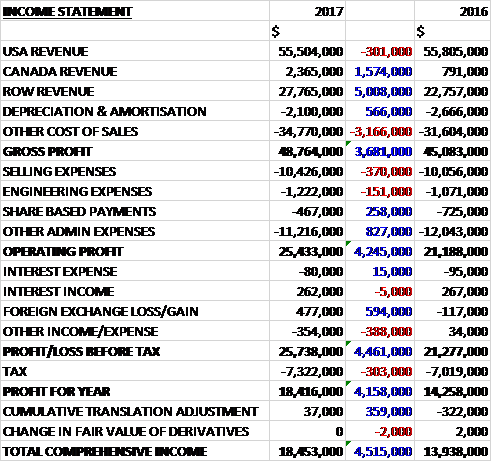
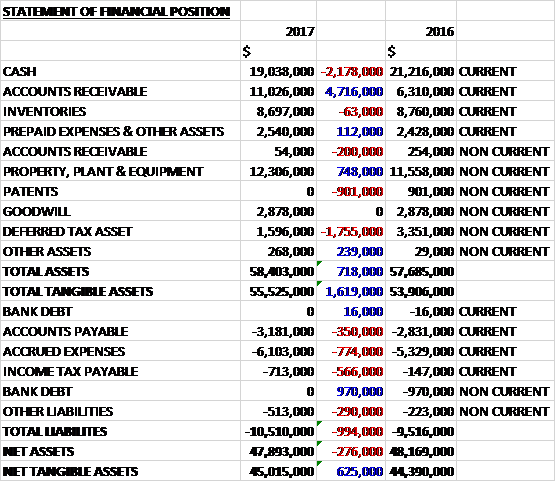
Revenues increased when compared to last year with a £13.1M growth in used car revenue, an £11.3M increase in new car revenue and a £5.9M growth in after sales revenue. Cost of sales also increased to give a gross profit £3.1M higher. There was no income from the sale of businesses, which brought in £2M last year but relocation costs fell by £498K and transaction costs were down £261K. Staff costs increased by £1.2M, operating leases grew by £431K and other admin costs were up £838K to give an operating profit £618K lower. Consignment and vehicle stocking interest fell by £110K and tax charges fell by £437K to give a profit for the year of £9.2M, broadly flat year on year with a decline of just £80K.

When compared to the end point of last year, total assets increased by £29.3M driven by a £13M growth in goodwill, an £8M increase in inventories, a £4.4M growth in cash and a £3.9M increase in freehold land and buildings. Total liabilities also increased during the year due to a £5M growth in other payables and accrued expenses, a £4.9M increase in vehicle funding payable, a £4.4M growth in vehicle consignment creditors payable, a £5M increase in secured bank loans and a £1M onerous lease provision. The end result was a net tangible asset level of £20.7M, a decline of £4.5M year on year.

Before movements in working capital, cash profits declined by £108K to £13.9M. There was a cash inflow from working capital but this was lower than last year and despite no transaction costs, which were £787K last year, the net cash from operations was £14.5M, a decline of £2.3M year on year. The group spent £7.9M on capex and received £411K from an insurance settlement to give a free cash flow of £7M. They then paid back £2.6M of loans and paid out £950K in dividends to give a cash flow for the year of £3.2M and a cash level of £23M at the year-end.

The UK motor retail industry has seen a weakening since the March plate change month where it showed record registration figures. The group’s trading in the first half of the year was very strong but the period from April to August was weaker as consumer demand softened across the industry with a more difficult trading environment with some of the group’s OEM partners being exposed to a weaker forex position as importers.

The gross profit in the New Car division was £21.3M, a growth of £2M year on year. New vehicle revenue increased by more than £11M but volumes reduced by 17% on a like for like basis and gross profit was down £200K on a like for like basis. The reduced volumes were offset by an improvement in the gross profit per unit sold which increased by 26%, a combination of a like for like increase and a strengthening mix from the JLR and Aston Martin dealerships. The like for like volume decline was partly attributed to reductions in unit sales from certain manufacturing partners and a reduction in unit sales from the Barnet JLR site during the disruptive building project.

The group’s sale of new vehicles to private individuals was 10% lower, showing the volume reduction that was anticipated. New commercial vehicle sales reduced by 34% in the period and new fleet vehicle sales increased by 14%. The new vehicle registration data showed total registration were down 1%. The registration of new cars to private individuals was down 5% but in the period of April to August was down 14%. The sale of diesel engine vehicles has been hardest hit as a result of the negative press around emissions.

The gross profit in the Used Car division was £23.5M, a decline of £200K when compared to last year. Revenues increased by £13.1M whilst the number of units sold declined by 6% partly driven by the closure of Swindon Motor Park, which was a high volume used car operation. Despite the decline in gross profit, the gross profit per unit increased by nearly 6%. On a like for like basis volumes were down 2.4% and the gross profit increased by 2.1% with profit per unit up 4.3%. The increase in efficiency of sourcing, preparing and marketing the vehicles has given rise to the increase in profitability.

The gross profit in the Aftersales division was £27.8M, an increase of £2.2M when compared to 2016. Aftersales revenue increased by 9% and like for like revenues were 3% higher with like for like gross profit improving by 1.7% (£400K). The aftersales margin was slightly diluted as the parts component increased in mix terms. The fire that took place in 2016 at the Jaguar and Aston Martin aftersales workshop in Welwyn Garden City had a significant impact on that site. The insurance claim has now been settled and has been included in the trading figures. The site reinstatement took significantly longer than first anticipated as a result of the complexity around stakeholders and insurance liability allocation. Whilst this was frustrating the work is now complete and they were able to re-occupy the workshop in July.

In August the group was partially through the building project relating to its JLR dealership in Swindon. There was a further £6M of contract sum payments to be made under the terms of the agreement with the contractor.

The major property redevelopment at Hatfield which is due to start in January 2018 will relocate the group’s JLR and Aston Martin dealerships in Welwyn Garden City which currently operate in short leasehold facilities into a purpose built freehold property with the addition of the McLaren franchise which will operate on the same site. The expected capital cost is £17M and the cost will be funded through existing cash and new facilities secured on the property.

In 2016 the group opened its Aston Martin dealership in Solihull. In order to secure the franchise for the territory, they acquired a freehold property and invested in a refurb of the facility to accommodate the franchise whilst a permanent location is built. They have secured a new site on the A34 in Solihull on a business park for a permanent facility. They have exchanged contracts and completion is subject to planning permission and the conclusion of extensive highways works to define the site and the new estate road. It is expected that the total freehold investment in the facility will be around £5M with completion expected by the end of Q1 2019.

The group will also be operating two Bentley dealerships in January operating from existing group freehold facilities. The dealership properties are currently undergoing refurbishments to meet the Bentley franchise standard requirements. Overall the group is planning building investment of £29M over the next two years.

Going forward, the UK economy remains in a period of uncertainty while the ramifications of leaving the EU are worked through. There is a lack of clarity on how any free trade agreement will be negotiated and there continue to be major implications for the forex rate. It is unclear how these factors will impact the UK motor trade although the group have seen an industry-wide softening in the new car market from April onwards.

The SMMT is currently forecasting a 5.5% reduction in the new car market in 2018. After the year-end, September and October trading was in line with expectations but down on the previous year due to new car volume and bonus achievements impacting new car margins.
At the year-end the group had a net cash position of £6.1M compared with £400K at the end of last year.

On the 5th January the group announced that Chairman Philip Swatman sold a total of 100,000 shares at a value of £57K to partially finance a house purchase. Following the disposal he has 200,000 shares left.

On the 4th January the group released a Q1 trading update where they stated that trading was in line with market expectations, albeit behind the corresponding period last year. The weaker new car market has seen pressure on both volumes and margins across the period. New vehicle sales were down 14.4% on a like for like basis with gross profit per unit also reducing.

Used vehicle sales continued to perform well on a like for like basis. Total unit sales were down 9.2% due to the lost units from the closed Swindon Motor Park, and like for like units were down 2.8%. This reduction was offset by continued improvement in gross profit per unit and this performance has again enhanced the profit from this segment of the business.

Overall, the group’s aftersales operations delivered a good performance, with revenue increasing by 0.3% (6.1% like for like) with profitability down 0.7% (like for like up 5.9%). This business has been impacted by some of the new franchising decisions that have been taken. These have necessitated the closure of the group’s body shop operations in two locations in order to facilitate the property development for the new franchises.

The group are opening a Lamborghini dealership in Q1, located in Chelmsford, in the same facility as the Bentley dealership and work is underway to complete that showroom for occupation in Q1. The building work to construct the JLR, Aston Martin and McLaren dealership in Hatfield is scheduled to begin in January and will take just under a year to complete.

Going forward, the board remains cautious about the new car market in light of the general uncertainty in the consumer environment and the pressure that vehicle manufacturers are under as a result of the current Sterling rate. Nevertheless the franchising progress that has been made through 2017 and into 2018 has further enhanced the group’s portfolio of dealerships and leaves the business well positioned with strong representation in the luxury segment of motor retail.

At the current share price the shares are trading on a PE ratio of 6.8 which rises to 8.2 on next year’s consensus forecast. After an 11.1% increase in the total dividend the shares are yielding 1.5% which increases to 1.7% on next year’s forecast. At the year-end the group had a net cash position of £6.1M compared to £400K at the end of last year.

On the 8th January the group announced that non-executive director Paul McGill purchased 41,897 shares at a value of £25K.

On the 6th March the group released a trading update covering the first five months of the year, which was in line with board expectations, albeit behind the corresponding period last year both in total and on a like for like basis. The weaker new car market has seen pressure on volumes in the period although bonus earnings have enhanced the group martins. New vehicle unit sales were down 14.6% on a like for like basis but gross profit per unit improved to partially offset the reduction in volume.

Used vehicle sales continued to perform well on a like for like basis with unit sales in line with the same period last year. Total sales were down 6.8% as a result of the lost units from the site closures and refranchising activity carried out. This was offset by continued improvement in gross profit per unit and this performance continues to enhance the profit from the used car segment of the business.
Overall the group’s aftersales operations delivered a good performance with revenue increasing by 0.6% (6.1% like for like) with profitability up 2.1% year on year.

In January the group completed the refurb of existing freehold properties to locate the two new Bentley businesses in Tunbridge Wells and Chelmsford. The refurbs were completed efficiently and both businesses are establishing themselves in the new facilities. The work to create their first Lamborghini dealerships in Chelmsford is nearing completion for an expected site launch in March.

The construction of the JLR, Aston Martin and McLaren dealership on one site in Hatfield started in February. There was a slight delay in starting the works whilst planning conditions were discharges but these are now addressed and the construction work is now progressing. In January the group built a temporary McLaren showroom on the site and began trading at the end of the month. To facilitate these new dealerships in Tunbridge Wells, the group have closed on Honda, one Alfa Romeo and a Jeep dealership along with two body shop operations.

Going forward the board continues to remain cautious about the new car market. The government’s clean air policy narrative and the inconsistent messaging around the forward looking position of diesel engines has created a reduction in consumer demand for diesel vehicles. The new car market in 2017 was down 5.7% with all of the reduction seen in the diesel segment.

The general uncertainty in the consumer environment remains, as does the pressure that vehicle manufacturers are under as a result of the Sterling exchange rate. Whilst the outlook has some challenges, the board believes that the group is well placed to continue to deliver on its strategy of enhancing their portfolio with the arrival of Bentley, Lamborghini and McLaren in the period.

Overall then this is a tricky period for the business. Profits fell but this seems mainly due to no business sales during the year. Net tangible assets declined, as did operating cash flow but there remained a decent amount of free cash being generated. So far this year, the performance has deteriorated due to the weakness in the new car market. Used cars are holding up better due to the increased profit per unit and aftersales seems to be performing fairly well, however. With a forward PE of 8.2 and yield of 1.7% I believe the shares are priced broadly correctly.

Ricardo Share Blog – Interim Results Year Ending 2018

Ricardo has now released its interim results for the year ending 2018.

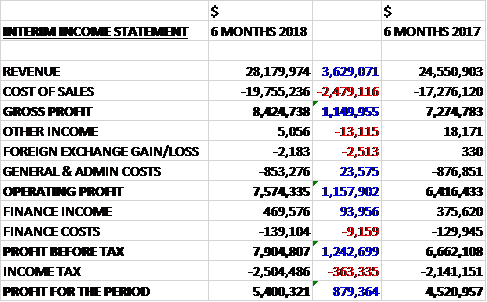
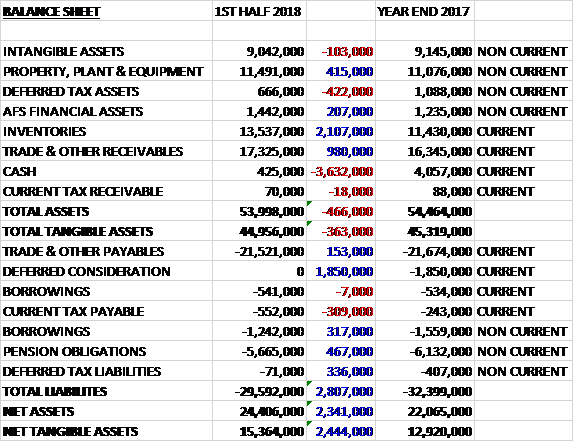
Revenues increased when compared to the first half of last year due to an £8.4M growth in technical consulting revenue and a £7.2M increase in performance products revenue. Cost of sales also increased to give a gross profit £4.2M higher. Admin expenses were up £3.1M, there was a £300K increase in the amortisation of acquired intangibles and a £1.1M charge for reorganisation costs. Offsetting this was a £600K decrease in acquisition costs to give an operating profit £300K higher. Finance coasts were down £100K, underlying tax charges fell £200K but there was a £1.1M charge relating to the impact of the change in US tax rates which meant that the profit for the period was £8.9M, a decline of £500K year on year.

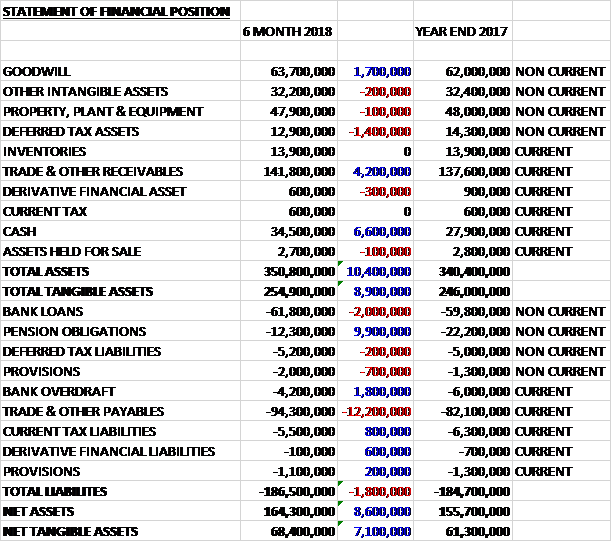
When compared to the end point of last year, total assets increased by £10.4M driven by a £6.6M growth in cash, a £4.2M increase in receivables and a £1.7M growth in goodwill, partially offset by a £1.4M decline in deferred tax assets. Total liabilities also increased during the period as a £9.9M fall in pension obligations and a £1.8M decrease in the bank overdraft was more than offset by a £12.2M increase in payables and a £2M growth in bank loans. The end result was a net tangible asset level of £68.4M, a growth of £7.1M over the past six months.

Before movements in working capital, cash profits increased by £4M to £23.1M. There was a cash inflow from working capital, and this was much larger than last year so despite interest payments increasing by £400K and tax payments growing by £700K the net cash from operations was £24.3M, a growth of £20.4M year on year. The group spent £5.7M on acquisitions, £3.2M on property, plant and equipment, and £1.9M on intangible assets to give a free cash flow of £13.8M. The group then took out £2M of new loans and paid out £7.4M in dividends to give a cash flow for the half year of £8.4M and a cash level of £30.4M at the period-end.

The underlying operating profit in the Technical Consulting division was £13.5M, a growth of £600K year on year which included a £300K contribution from the acquired CPC business. The global business, operating across the automotive and commercial vehicles sectors, delivered a record order intake in the period, securing significant multi-year orders from a number of clients across Europe, Japan and China. This has extended the ageing of the order book which also contains a greater degree of material content than in the prior period. The improvement in the flow of orders in the period has enabled a return to more efficient levels of operation, leading to a more profitable business.

The market in Detroit remains challenging and this is reflected in the order intake during the period. The group are implementing plans to reposition the business and enhance their electrification and autonomous vehicle service offering. Although the US automotive business ended the period with another loss, the level of losses have reduced.

The rail business saw strong order intake across key markets and significant growth in the closing order book, particularly in Asia. Activity in Europe was buoyant with the operations in the UK, Netherlands, Spain and Denmark securing new assignments. The Asian market is very strong, with a notable increase in demand for systems engineering expertise, human factors engineering and ensuring electromagnetic compatibility. The business has recently forged new partnerships with Asia’s major rolling stock OEMs where they are supporting the introduction of railway vehicles into service in cities such as Boston, Chicago, Tel Aviv and Melbourne.

Order intake for the Energy and Environment business was in line with the prior period. The closing order book includes a number of multi-year orders for UK government programmes and reflects a broad private sector and international customer base.

There has been growth and the group have secured a number of large engine, transmission and vehicle integration projects for both medium and heavy duty vehicles. They continue to see demand for their capabilities in the commercial vehicles sector across Asia in particular. The order book and pipeline is based around a broad range of opportunities with a growing proportion of electrification and autonomous vehicle development programmes. In the US, greenhouse gas and nitrogen oxide standards are driving interest in powertrain efficiency as well as the latest requirement for in-use compliance testing in support of their customer’s existing fleets.

In the off-highway business, activity remains at a relatively low level in Europe following the recent implementation of Stage IV emissions standards, while in Asia the industry is showing renewed growth, especially in the transmission and driveline areas. Here, the group is securing an increasing number of projects. They see increasing demand for high speed diesel generator sets and main propulsion systems for marine vessels, and for the conversion of engines for gas or dual fuel operation. The majority of their activities in this industry have been based around failure analysis, investigations, specialist design and development.

The newly acquired Control Point business is performing well. In the UK the group have grown their marine defence business, both surface and sub-surface, and in Europe and Asia they have secured contracts to deliver new engine and transmission designs for land vehicles and they are pursuing other large opportunities.

The underlying operating profit in the Performance Products division was £3.9M, an increase of £500K when compared to the first half of last year. This performance was principally driven by increased volumes of engines for McLaren, particularly for the higher value 720S engine, together with increased volumes of transmissions for both Bugatti and Porsche. These have been partially offset by a reduction in sales to the motorsport and defence sectors. The software business also continues to perform well.

During the period the group expanded their Santa Clara Technical Centre and opened a new electrification and vehicle lab to support innovation in the next generation of clean, electrified and autonomous vehicles. In addition they have extended their collaboration with Roke to develop robust solutions for autonomous and connected transport systems against cyber attacks.

As usual there were a number of non-recurring costs in the period. Acquisition related expenditure of £500K comprised costs incurred for services rendered o the group to effect the Control Point acquisition together with a proportion of the cost incurred to retain specific individuals.
Reorganisation costs of £1.1M relate to the restructure of the automotive business in Europe, China and North America to combine their operations into a single global automotive business. The costs comprise redundancy costs. In addition, further activities were also undertaken to prepare the test cell facilities and related equipment at the technical centre in Chicago for disposal. Further restructuring activities are planned in order to complete the reorganisation of the automotive business. The changes to the US tax rate resulted in a £1.1M deferred tax charge which reduced the value of deferred tax assets held in the US.

In September the group acquired Control Point for an initial cash consideration of £6.3M and a contingent cash consideration of £1.4M, generating goodwill of £1.6M. The acquisition expands on the group’s vehicle engineering capabilities in the defence sector and adds expertise in distributed software-based systems and fleet management technology.

Going forward there was a strong order intake which resulted in an increase of 31% when compared to the first half of last year. There has been a good spread of orders across both the Technical Consulting and Performance Products divisions which provides a good base as the head into the second half of the year.

At the current share price the shares are trading on a PE ratio of 19.5 which falls to 17 on the full year consensus forecast. After a 6% increase in the interim dividend, the shares are yielding 2% which increases to 2% on the full year forecast. At the period-end the group had a net debt position of £31.5M compared to £37.9M at the prior year-end.

Overall then this was a decent period for the group. Profits did decline but this was due to the reduction in the deferred tax asset in the US following the changes to the tax rate there. Net assets increased and the operating cash flow was strong with plenty of free cash being generated, although this was bolstered by an increase in payables which will have to unwind at some point.

Both divisions are performing well with weakness in the Detroit business being offset by strength in rail and commercial vehicles and an increase in deliveries to McLaren, Bugatti and Porsche. This decent performance is now reflected in the share price, however, and a forward PE of 17 and yield of 2% is not that cheap. I am tempted to take profits and buy back lower.

On the 5th March the group announced that is has signed an agreement to sell its Chicago technical facility to Power Solutions International, a US manufacturer of engines and power systems, for a consideration of $5.5M. They will relocate their heavy duty test operations to its existing facilities in Detroit. In addition, they have entered into a strategic technology relationship with PSI whereby their expertise in engine developments, electrification and autonomous vehicle controls will support PSI’s expansion into these areas.

On the 25th July the group released a trading update covering the full year. Order intake was up £44M to £410M, which included £10M from Control Point. The order book at the year-end was £285M, an increase of £37M.

In the second half, in the technical consulting business, they have continued to see strong order intake from Asia from both rail and automotive customers while in the UK, orders from their automotive customers have seen a further decline driven by current uncertainty in the market. The performance products business performed well with further increases in orders in the second half of the year.

Overall they have a good pipeline which includes a number of significant opportunities. They have now received the first orders for the HMMWV brake kit programme in respect of new vehicles in the US and delivery started in July. Total group revenue increased by £28M to £380M, of which £10M related to Control Point.

Despite the good order intake and revenue, the board expect pre-tax profit to be towards the lower end of analyst forecasts. This is mainly due to a reduced performance in the EMEA automotive business following the low level of UK orders in the second half of the year, together with some difficult projects which were delivered in the year. Actions have been taken to improve project delivery in the future and in June they saw orders for the EMEA business overall recover to a good level. In addition, the energy and environment business recruited in anticipation of a higher level of growth in orders than actually achieved.

Further progress has been made in reducing fixed costs and improving the efficiency in the international test operations. Following the disposal of their test assets in Chicago earlier in the year they have now completed the disposal of their test facility in Germany for €5M. The first tranche of the proceeds was received in June with the remainder in July.

Net debt at the year-end was £26M compared to £38M at the end of last year.

Looking forward to 2019, the group enter the year against a backdrop of uncertainty surrounding Brexit and assuming that UK market conditions remain as they are, they are planning for revenue growth of between 3% and 5% in the year ahead.

Overall then, it seems that Brexit is starting to affect the group and the sluggish revenue growth for next year makes me a little cautious over these shares.

Wynnstay Share Blog – Final Results Year Ended 2018

Wynnstay have now released their final results for the year ended 2017.

Revenues increased when compared to last year due to a £31.1M growth in agriculture revenue and a £5.9M increase in retail revenue. Staff costs were up £743K, depreciation increased by £209K and other cost of sales grew by £33.4M to give a gross profit £2.6M higher. Operating leases were up £456K and other manufacturing costs increased by £595K. We also see a growth in admin expenses and a £95K restructuring cost which meant that the operating profit was just £341K higher. There was a £130K increase in the share of profits from the joint venture but a £977K negative swing to losses from the discontinued Pet stores to give a continuing profit for the period of £6.3M, an increase of £476K year on year.

When compared to the end point of last year, total assets increased by £4.5M, driven by a £12.6M growth in receivables, partially offset by a £3.9M decline in goodwill, a £1.8M fall in property, plant and equipment, a £1.3M decrease in inventories and a £1.2M decline in cash. Total liabilities increased during the period as a £1.4M decline borrowings was more than offset by an £8M growth in payables. The end result was a net tangible asset level of £71M, a growth of £2.3M over the past six months.

Before movements in working capital cash profits increased by £579K to £10.3M. There was a cash outflow from working capital and after tax payments increased by £181K the net cash from operations was £4.7M, a decline of £2.7M year on year. The group spent a net £1.8M on capex and spent £678K on the disposal to give a free cash flow of £2.5M. Of this, £1.2M was spent on finance leases, £896K on loan repayments and £2.4M on dividends which meant that after £723K was raised from new share capital, the cash outflow was £1.2M and the cash level at the year-end was £8.9M.

The profit in the Agriculture division was £3.3M, a growth of £331K year on year. Revenues rose by 13% which reflected volume increases across most agricultural inputs, except grain, as well as some inflationary impact in feed and grain prices. The upturn in output prices in 2017 has brought a degree of optimism to the sector.

Demand for fertilizer and feed, increased in the period, mirroring the general UK market. There was some variation in order patterns for fertilizer as farmers timed their orders around fluctuations in market prices during the year. Demand for seed was in line with previous years but the smaller 2016 harvest meant that grain volumes were lower year on year.

In feed products, the increase in farm output prices, particularly milk, increased UK demand. This is reflected in the strong upturn in feed demand, and it also provides the group with confidence for sales over the winter period. The increased volume of milk in the UK market has given rise to some concern over milk prices, which have peaked at around 30p per litre, and there is some possibility of a slight reduction. With a generally stable UK and world market, the board believe that this is likely to be short-term, however, and they don’t expect to see a repeat of the reduction in prices experienced in 2015.

Demand for bagged feed, which is mainly sold through the retail stores, increased during the year, and the investment in new bagging facilities in 2016 helped to satisfy demand efficiently. Further investment in both the compound feed mills is planned for 2018.

At Glasson Grain, while demand for raw materials was lower than the previous year, sales of fertilizer increased significantly, albeit with some reduction in margin. The business has increased its penetration in the north of England and Scotland, and the acquisition of the facility in Montrose will further enhance sales in the area. The financial outcome for the year is in line with the previous year, with an increase in contribution from fertilizer balancing a reduction in the trading division.

The arable business remains strong, although lower grain volumes, along with continued margin pressure, have reduced the contribution from this activity. Combined sales of cereal and herbage seed was in line with the performance last year. Further capital investment is budgeted for 2018 to support additional expansion of the site in Shropshire. Demand for fertilizer was strong in the spring and summer months, although in contrast to the previous year, higher prices in autumn tempered demand for early orders and as a result it is expected that there will be a stronger spot market as farmers buy for the spring usage period.

The smaller 2016 harvest, combined with a reticence of farmers to sell grain from the larger 2017 crop contributed to a reduction in volumes in GrainLink, the gain marketing business. They also experienced some margin pressure as traders competed in a subdued market. Wheat prices weakened slightly during autumn but longer term futures prices indicate a general level of stability at above the cost of production. Overall farm stocks of grain are higher than in 2016, most of which will be traded before the 2018 harvest.

The profit in the Specialist Retail division was £4.7M, a growth of £275K when compared to last year. The pets sector has been very challenging since late 2015 and Just for Pets began to experience a deterioration in trading in 2016. In the first half of the year it became apparent that the business did not have sufficient sale to survive the increasingly difficult trading environment and the decision was taken to put it into administration.

Like for like sales across Wynnstay Stores increased by 5% with the upturn reflecting improved sentiment across the livestock sector. This has been particularly evident in animal health and hardware products as well as milk powders. The success of their Dairy and Sheep and Beef catalogues has also contributed to the improvement in sales, although a change in product mix across the store network has led to a slight reduction in average margin.

The group continues to invest in the network of stores and finished a total refurbishment of the Craven Arms outlet early in the year. They also completed the relocation of the store in Ruthin. The Agricentre business operates a slightly different model with a high percentage of products delivered to farms. During the year they have focused on the efficiency of its delivery network which has resulted in the closure of two outlets and initiatives to create better customer services processes. They have also invested in personnel ahead of an anticipated improvement in sales. Going forward they anticipate further growth in the specialist retailing activities as they expand the trading area.

The contribution from joint ventures was higher, benefiting in particular from an improved performance from Fert Link, which reflected a recovery in volumes in the fertilizer marketplace.

There were some cost incurred on the disposal of Just For Pets. There was a £3.9M Goodwill impairment charge, a £1.7M loss on the measurement of fair value less costs to sell the assets, and a £77K cost incurred in relation to administration.

After the year-end the group acquired a mill and processing facilities in Montrose which will allow Glasson Grain to better service customers in Scotland. The consideration paid was £550K with all of that deferred until 2020 and contingent on the resolution of certain conveyancing issues which the board expect to be resolved within three years. The consideration is the same as the value of the asset and it was required to be divested by Origin after they acquired it for competition remedy purposes.

The recovery in output prices has brought an improvement in demand for all agricultural inputs. The improvement is principally a result of a more balanced world market, particularly for milk products. Prices have also been enhanced by the devaluation of Sterling, which brought added benefits to the UK industry. The improved pricing seems to be sustainable, at least in the short term, and the farming industry is eagerly awaiting the outcome of the Brexit negotiations to understand the full implications for demand and prices in the medium to long term.

Going forward the agricultural trading backdrop is stronger than this time last year and the New Year has started in line with management expectations. While Brexit creates some uncertainties, the board remain confident of the group’s market positioning.

At the current share price the shares are trading on a PE ratio of 14.4 which rises to 14.8 on next year’s consensus forecast. After a 5% increase in the dividend, the shares are yielding 2.7% which increases to 2.8% on next year’s forecast. At the year-end the group had a net cash position of £4.5M compared to £4.3M at the end of last year.

Overall then this has been a bit of a mixed year for the group. Profits from continuing operations were up, net tangible assets increased but the operating cash flow declined. This was due to working capital movements, however, and cash profits increased. There was some free cash, but not enough to cover everything. The increase in output prices has given rise to a good improvement in the agricultural business and now that Just for Pets has closed, the two divisions will probably rise and fall in unison so the group has lost a bit of a hedge against the agricultural market.

The next year has started OK but with a forward PE of 14.8 and yield of 2.8% these shares are not yet good value. I am reluctant to buy in here for the time being.

On the 30th April the group announced that it had reached an agreement with the administrators of Countrywide Farmers to acquire eight stores for a total consideration of £800K, payable in cash. Five of these stores are located in Devon and Cornwall, which extends the group’s reach into the South West with the remaining three stores in Shropshire, Monmothshire and Oxon. The new stores provide a range of products for farmers and operate similarly to the current stores, which will increase to 60 outlets.

Last year the new stores generated sales of £16.4M and the board expect to see a positive contribution from 2019 onwards.