QinetiQ Share Blog – Interim Results Year Ending 2018

QinetiQ has now released their interim results for the year ending 2018.
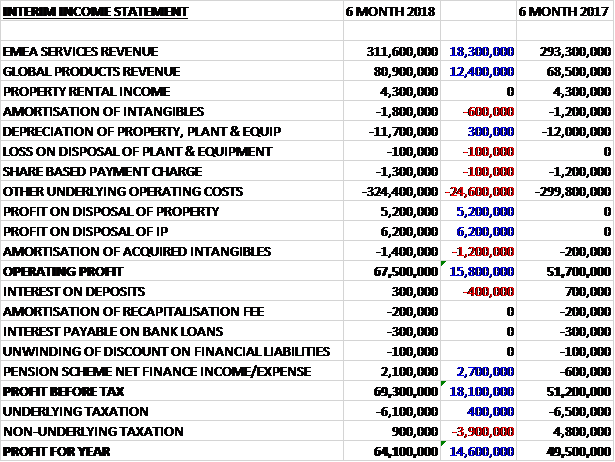
Revenues increased when compared to the first half of last year due to an £18.3M increase in EMEA Services revenue and a £12.4M growth in global products revenue. Amortisation was up £600K and other underlying operating costs grew by £24.6N. The amortisation of acquired intangibles increased by £1.2M but there was a £5.2M profit on the disposal of a property, and a £6.2M profit on the disposal of IP to give an operating profit £15.8M higher. There was a £400K reduction in interest income but there was a £2.7M positive swing to pension scheme income and after tax charges increased by £3.5M the profit for the period was £64.1M, a growth of £14.6M year on year.
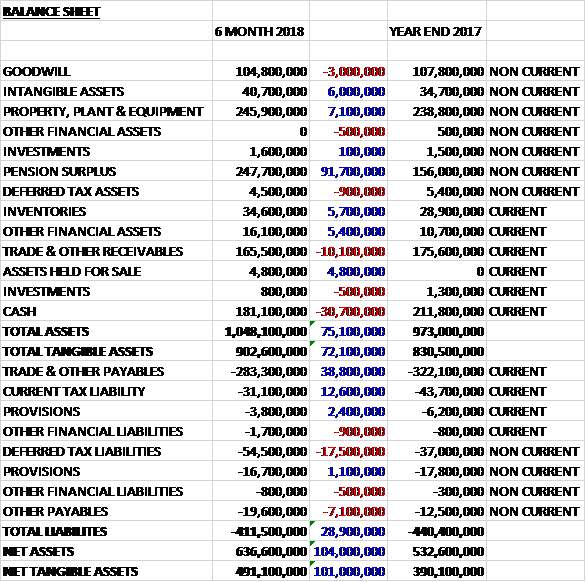
When compared to the end point of last year, total assets increased by £75.1M, driven by a £91.7M increase in the pension surplus, a £7.1M growth in property, plant and equipment, a £6M increase in intangible assets and a £5.7M growth in inventories, partially offset by a £30.7M reduction in cash and a £10.1M fall in receivables. Total liabilities declined during the period as a £17.5M increase in deferred tax liabilities and a £7.1M growth in other payables was more than offset by a £38.8M decline in trade payables and a £12.6M decrease in current tax liabilities related to the timing od the recovery of the R&D expenditure credit. The end result was a net tangible asset level of £491.1M, a growth of £101M over the past six months.
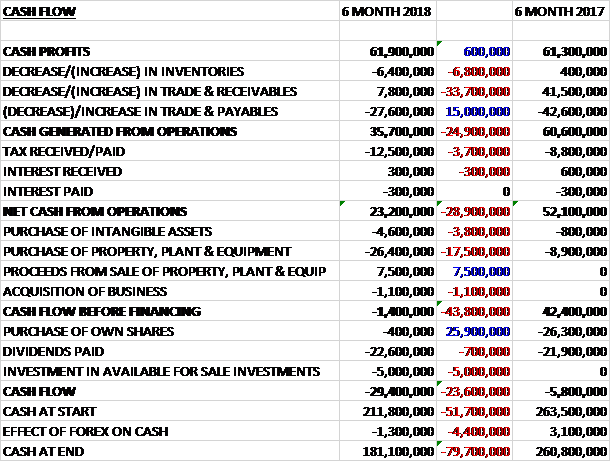
Before movements in working capital, cash profits increased by 600K to £61.9M. There was a cash outflow from working capital, mainly due to a fall in payables and after tax payments increased by £3.7M the net cash from operations was £23.2M, a decline of £28.9M year on year. The group spent £26.4M on property, plant and equipment along with £4.6M on intangible assets and £1.1M on acquisitions, but they did get back £7.5M from the sale of assets to give a cash outflow of £1.4M before financing. They then spent £22.6M on dividends and £5M available for sale investments to give a cash outflow of £29.4M for the period and a cash level of £181.1M at the period-end.

The underlying profit in the EMEA Services division was £47.3M, a growth of £4.3M year on year due to non-recurring trading items such as a £5.3M credit relating to the release of engine servicing obligations as the group invests in new aircraft for test aircrew training and retire their legacy fleet. Excluding these, the Rubikon acquisition and forex movements, the underlying operating profit fell by £3.6M, half of which was driven by the lower baseline profit rate for single source contracts in line with expectations.

The group reported orders of £153.9M, a reduction of £130.4M with the decrease due primarily to last year’s award of the £109M eleven year renewal from the MOD of the Naval Combat system Integration Support Services contract. Excluding this, the Rubikon acquisition and forex movements, orders fells by £30.1M. Around a third of this reduction was the result of the aggregation of smaller aircraft engineering orders into the Strategic Enterprise contract awarded two years ago with the rest relating to a lower level of MOD commitments during the period. On an organic basis, revenue grew by 4% in the period.

In Air and Space the group continue to make good progress under the Strategic Enterprise contract for air engineering services. The contract delivers significant savings to the MOD by aggregating smaller contracts together and the group expects to increase the amount of work brought under the framework. Following the signing of the amendment to the LTPA, they have been transforming test aircrew training and opening up courses to a broader set of international customers, including those in the civil market. During the period they purchased two new Grob G120TP aircraft as part of the upgrade to their fleet to meet growing customer requirements for the evaluation of mission systems.

During the period they reinforced their relationship with Boeing, who use the wind tunnel facility to evaluate their commercial aircraft, with a £25M contract to provide wind tunnel services until 2024. Working with BAE and MBDA, they integrated the Brimstone precision strike missile onto Typhoon, as part of the programme to transfer capabilities from the Tornado GR4; and the business continues to deploy significant resources to develop the gridded ion engine propulsion system to be used on ESA’s Bepi Colombo mission to Mercury. It remains scheduled to launch in October, though various issues with the electric propulsion system still need to be resolved before the launch is formally given the green light to proceed.

In Maritime, land and weapons, in September the group signed an £8M order from the MOD to provide naval combat systems expertise for Type 26 Global Combat Ship which added to the £109M eleven year NCSISS contract agreed with the MOD last year. The German Air Force has placed a £2M contract with the group for an advanced medium range air to air missile trial at the MOD Hebrides range and the group, in collaboration with MILREM, was awarded Defence and Security Accelerator funding for the Last Mile programme which addresses the robotic delivery of supplies to a combat outpost or troops in the field.

In September the Cyber, Information and Training business enabled the connection of the RAF’s Rivet Joint Squadron’s own simulator to the training centre at RAF Waddington for the first time. The milestone is part of an ongoing programme to achieve savings by transforming operational training through the application and integration of synthetic technologies. During the period the business led a multi-industry team from the Secure Information Infrastructure and Services research programme to deliver a low size, weight and power communication information system to 30 users as part of the Exercise Joint Venture 2017.

The Australian business delivered a strong first half with a record level of orders. They signed a contract to manage the explosive ordinance engineering and logistics services at the mine warfare maintenance facilities in Sydney. The business will assume design authority to maintain, update and operate exercise mines and other equipment in support of Australian naval training and readiness requirements.
They signed a contract to design and build a number of engine change cranes to enable safe removal of engines from the Australian Air Force’s C27J aircraft which will also be suitable for use with other aircraft. Their AIR7000 contract acquired through the purchase of Rubikon received an increase in contract ceiling value from $24M to $35M.

In Canada the group completed a project for the coast guard to provide advice that will assist decisions that shape a future fleet for the next fifty years; they were awarded a $5M order from the Canadian Navy for over forty Hammerhead unmanned surface vehicle targets and various payloads. The order was placed under an existing five year $35M framework contract with the Department of National Defence and the order brings total worldwide Hammerhead orders to over 425. They introduced a new service to the Canadian Navy, conducting a live demonstration to emulate the threat of drones to large naval vessels.

In Sweden the group secured contracts with four new customers for training at the flight physiological centre that they operate on behalf of the Swedish defence department. At the period-end, the group announced that they are establishing a new joint venture company in the UAE to manufacture aerial targets for use locally in the acceptance and evaluation of new equipment and the training of armed forces.
Going forward, the board reiterate their guidance for the full year. In EMEA Services revenue under contract is broadly in line with the prior year and the division is expected to deliver modest growth this year, although the lower baseline profit rate for single source contracts represents a headwind for operating margins.

The underlying profit in the Global Products division was £10.2M, an increase of £1.3m when compared to the first half of last year. Orders grew by nearly £30M to £122.4M due to a £13.2M contribution from the QinetiQ Target Systems acquisition, favourable forex movements and the €24.2M spacecraft docking mechanism order with the ESA. Reported revenue was up 18%, driven by the acquisition and favourable forex movements. It was flat on an organic basis at constant currency. At the start of the second half the division has 80% of its full year revenue under contract compared with 98% last time.

The North American business received significant orders in the period, especially in the maritime market where orders totalled $45M. Building on previous work, they were awarded a further significant contract for electromagnetic launch and recovery equipment for the new class of US aircraft carriers. Separately, and in a potential new growth area, the business performed a demonstration of its Dolphin acoustic undersea communication technology.

In land systems, notable achievements included the demonstration of their open architecture Universal Tactical Controller, directing unmanned systems in a shared network operating environment. They supported extensive US government trials with their Titan unmanned ground system to deliver soldiers’ equipment transportation needs. They also received key orders for their air armour and Q-Net RPG protection product lines.
In September they learned they were unsuccessful on the Man Transportable Robotics System INC II programme. The business is currently competing for two further robotics programmes for the DOD and while unmanned systems remains a very competitive field they are confident in their propositions for the remaining programmes.

Optasense performance improved in the period as the business started to see returning confidence in oil field investment combined with the benefits of diversification into adjacent markets. In support of this performance, the business has introduced a more customer-aligned organisation and focused on effective commercial delivery.

They are involved with the delivery of the Trans Anatolian Natural Gas Pipeline Project. During the period they delivered equipment to their partners in Turkey which is the latest milestone of a multi-year effort to secure and deliver a significant international pipeline project. The relative stability of the oil price has resulted in increased capex commitments in specific regions while the interest in the technology by more operations gains pace. They have seen increased adoption and future commitment across the Middle East for both oil and water transport assurance. Security opportunities have become increasingly evident during the period with perimeter and linear asset protection solutions for power facilities and rail lines attracting interest.

The Space Products business signed a €24.2M contract with the ESA to produce a new docking mechanism for the ISS. Under the three year deal, the group will qualify and produce the first model of its International Berthing and Docking Mechanism, designed under a previous ESA contract.

Within EMEA Products, the group’s AS3 communications intelligence system has been added as a payload for Thales’ Watchkeeper unmanned aerial vehicle. It enables the operator to detect signals from military communications devices and then locate, identify and listen to the individuals using them. They developed a counter-unmanned aerial vehicle solution that is being trialled with a number of customers both in the UK and abroad.

Going forward the board reiterate their guidance for the year as a whole. The business’ performance is dependent on the timing of shipments of key orders. As a result of its contracted orders and pipeline of opportunities, as well as the anticipated full year contribution from the Target Systems acquisition, the division is expected to continue to grow in 2018.

In the UK the MOD is under pressure to reduce costs and the impact of Brexit, notably the weakness of Sterling, has put further pressure on defence budgets given the significant amount of dollar denominated programme procurement. The US is expected to show moderate growth. Despite public statements to increase spending, the political environment remains challenging, however. Unpredictability exists in both the budgeting process itself and uncertainty beyond the current Continuing Resolution underwhich the DOD is currently unable to fund new programmes.

In Australia, defence budgets are expected to grow to 2% of GDP by 2021 and in Canada the 2017 review highlighted a significant increase in defence spending through expansion, modernisation and recapitalisation of the Canadian armed forces. In the Middle East, Saudi, the UAE and Qatar are all expected to increase their defence spending by between 0.8% and 2.9% per annum. As governments in these markets grow more sophisticated in their approach to defence, their need for military capability evaluation, assurance and trading are also expected to increase.

The group currently have access to around half of the UK market for defence test and evaluation and they believe that with appropriate investment they can access a greater share of this market, particularly repatriating evaluation work currently undertaken overseas. In addition, there is further opportunity for the group in attracting overseas customers to use their UK-based facilities and expertise, as well as supporting international customers with the development of their own indigenous capabilities.

During the period a deferred tax asset of £1.7M representing UK non-trading losses has been recognised.
The group has a lot of capital commitments. As of the period-end they are contracted for £176.4M with £175M in relation to property, plant and equipment that will be wholly funded by a third party customer under a long-term contract arrangement, mainly relating to investments under the LTPA contract. The additional capex this year will also be recovered in full.

During the period the group announced a joint £17M investment programme in two new tracking radars and upgrades to existing radar facilities at MOD Hebrides. This investment will reduce overall operating costs of the ranges and ensure they provide the capabilities required to support UK defence, defence exports and attract international customers. As part of the LTPA amendment they are investing around £85K over eleven years to test aircrew training at MOD Boscombe Down to purchase eight new aircraft, replacing the oldest aircraft in the fleet, and to introduce a new test pilot syllabus from 2019.

Going forward, overall the board are maintaining their expectations for the group performance in 2018.
At the current share price the shares are trading on a PE ratio of 11.5 which increases to 11.7 on the full year consensus forecast. At the period-end the group had a net cash position of £181.1M compared to £211.8M at the year-end. After a 5% increase in the interim dividend, the shares are yielding 3% which increases to 3.2% on the full year forecast.

On the 8th February the group released a trading update covering Q3 2018. Underlying trading for the group was as expected and the board maintain their expectations for overall performance in 2018.

In EMEA Services trading for the period was in line with expectations. The group is bidding for a number of new opportunities with the UK government that will enable enhanced capability while also driving cost efficiencies. Although the UK environment continues to be challenging, this environment creates opportunities. Internationally the group continued to make good progress, particularly in Australia with positive organic growth and in the Middle East where they have seen strong demand for their advisory services. Trading in Global Products for the period was in line with expectations with good order performance in North America.

During the period the group delivered the first flights of their new aircraft and signed their first multi-year £6M contract with the Royal Netherlands Air Force to train Dutch test pilots and flight engineers until 2022. Under the LTPA contract they received a £9M order to modernise and develop Electro Magnetic Open Sea Ranges.

In the US they won $8M of orders for TALON robots from key defence customers. In Australia an additional $16M has been allocated to their Air 7000 strategic support partner contract which supports the acquisition of airborne maritime surveillance capability. They signed their first £3M contract for the supply of aerial targets and services to a customer in the Middle East, building their presence in the region.
Following the latest triennial valuation and discussions with the pension scheme trustees, the group has confirmed a pension surplus of £140.5M as of the end of June 2017. Consequently, they will cease making cash deficit recovery payments of around £10.5M from March 2018.
On the 9th February the group announced that CFO David Smith purchased 10,188 shares at a value of £20K.

Overall then this has been a fairly steady performance. Profit increased somewhat, net assets were strong, mainly due to the good performance of the pension scheme, but the operating cash flow reduced due to working capital movements – the cash profits were up modestly. There was no free cash generated but this was due to the increased capex requirements of the new framework contract.

Although profits were up, this was mainly due to forex movements and the effect of the acquisition. Organically, profits in Global Products were broadly flat and profits in EMEA Services declined, partly due to the lower profit on single source contracts. Going forward, the lower margins on the single source contract will continue to drag but with a forward PE of 11.7 and yield of 3.2% the shares are not that expensive. Whether it is worth investing here given the lack of organic growth is another question.

On the 24th April the group announced that they had entered into an agreement to acquire EIS Aircraft Operations, currently part of EIS Aircraft group, for €70M. Aircraft Operations is a leading provider of airborne training services based in Germany, delivering threat representation and operational readiness for military customers. It generated €20.1M of revenue and €5.4M EBITDA last year. They deliver airborne training systems using a fleet of 14 leased Pilatus PC-9 and PC-12 aircraft.

They have been the exclusive provider of low speed aerial training services to the German armed forces since 1999 and deliver aerial training services to the US Air Force in Europe. The also modify aircraft for special missions through the integration of sensors and digital systems used in intelligence, surveillance and reconnaissance.

The acquisition is expected to enhance the group’s EPS in the current year and will be funded from available cash resources. It is subject to certain regulatory approvals and is expected to close towards the end of H1 2019.

Bonmarche Share Blog – Interim Results Year Ending 2018

Bonmarche has now released its interim results for the year ending 2018.

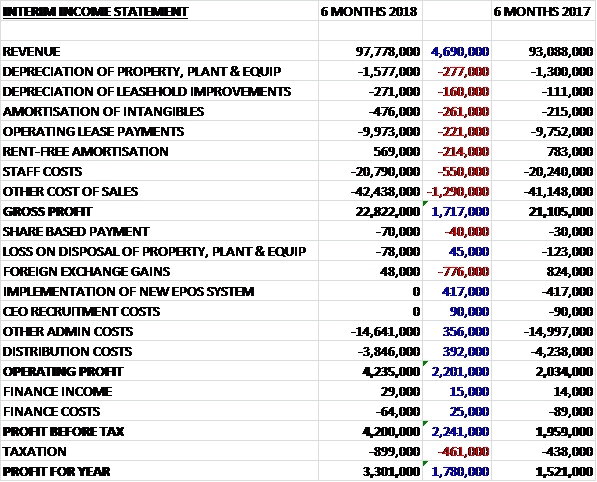
Revenues increased by £4.7M when compared to the first half of last year. Depreciation was up £437K, amortisation increased by £261K, operating lease payments grew by £221K, staff costs were up £550K and other cost of sales grew by £1.3M to give a gross profit £1.7M ahead of last time. There was a £776K reduction in forex gains but this was offset by the lack of any EPOS system costs, a £356K reduction in other admin costs and a £392K fall in distribution costs to give an operating profit £2.2M higher. Finance costs reduced slightly but tax charges grew by £461K which meant that the profit for the period was £3.3M, a growth of £1.8M year on year.

When compared to the end point of last year, total assets increased by £708K, driven by a £9.2M growth in cash, a £774K increase in intangible assets and a £662K growth in property plant equipment; partially offset by a £5.2M fall in the cash flow hedge, a £3.6M decrease in receivables and a £1.6M fall in inventories. Total liabilities also increased during the year as a £991K fall in deferred tax liabilities was more than offset by a £4.2M growth in payables and a £2.8M increase in derivative financial liabilities. The end result was a net tangible asset level of £22.9M, a decline of £6.1M year on year.

Before movements in working capital, cash profits increased by £2.9M to £6.7M. There was a cash inflow from working capital and after tax payments fell by £462K, the net cash from operations was £14.8M, a growth of £7.7M year on year. The group spent £1.9M on property, plant and equipment along with £1.3M on intangible assets to give a free cash flow of £11.6M. Of this, £2.3M was spent on dividends and £211K on finance lease repayments which meant that the cash flow for the half year was £9.2M and the cash level at the period-end was £16.1M.

Within the 5% increase in revenues, store like for like revenue growth was 1.6% and online sales grew by 39%. Q1 was stronger than Q2, however, with total sales up 7.7% and 2.1% respectively and like for like store sales falling 1.2% in Q2. The group have pointed out, however, that the weather was more favourable this year than last so there were some fairly easy comparisons.

As expected, due to the weaker pound, the bought in margin was lower than last year but the reduction has been offset by savings from a lower level of discounting. In H2 last year, the group reduced the level of discounting and they have continued to make progress on this front. During the period, planned promotional discounts and the discounts stemming from the operation of the Bonus Club loyalty scheme have both been lower, as have online promotions.

Operating costs increased overall due to the National Living Wage and the costs of three extra stores. This was mitigated by a reduction in marketing coats, lower logistics costs due to improved efficiency, a reduction in business rate costs and a reduction in head office staff numbers.

Denim was relaunched in all stores following a trial and the new ranges are of a much higher quality and styling credibility and the new range has achieved a 50% increase in sales. Other highlights include an improved leisurewear offer, blouses and swimwear. The discontinuation of peripheral product categories such as Ann Harvey and menswear have helped to make better use of space and drive improved product sales.

The group have begun to use suppliers who can deliver with a shorter lead time. This has increased their ability to trade within the season and respond more quickly to customer demands. An example of this was in the leisurewear category, which they were able to support through an increased level of stock purchasing at the expense of jersey tops, which were performing less strongly. The weakness of Jersey tops was due to an over reliance on this type of garment and is an example of a category in which they have scope to improve their offer.

As has been seen, online sales growth was strong throughout the period. The improvement began in Q4 last year and gathered pace as they began this year. There are a number of factors that have contributed to this improvement. Online marketing is now much more efficiently targeted and they have switched to a new marketing agency which they believe will be more supportive of their objective of growing sales profitably. They have improved their delivery offer so that customers now benefit from free delivery above a certain spend threshold; the level of online discounts have been more tightly controlled; and the look and commerciality of the catalogues has been improved.

Looking ahead, there remains significant scope to improve the customer experience as new systems are introduced in other parts of the business. These will make the interaction between online and store shopping more seamless, improve the delivery options for customers, and improve the engagement with customers from marketing communications.

The most significant development in the stores in the period has been the roll out to all sites of instore online ordering. Also, the installation of cameras to monitor footfall was completed in the period and they will now begin to explore how the data may be used effectively. An early benefit has been to give the retail team a better understanding of the real peaks and troughs in customer flow. The group have cut terminal stock levels to their lowest level in five years as a result of a concerted effort to clear stock during the summer sale.

The group have opened five new stores in the period, which are trading in line with expectations. Three of these were relocations of existing stores and seven marginal garden centre sites were closed at their natural lease breaks, so overall store numbers fell by five. In light of the continued difficult market conditions and the upsurge in online performance, they are being particularly selective in opening new sites which means that the net trading square footage at the end of the year is likely to be similar to the opening position.

The group expect to begin to see benefits from the new ERP system late in the next financial year, although some benefits will come through sooner. For example, since the period-end, a further phase of the project has been implemented and is already making the jobs of some staff easier by removing the need to undertake manual processes.

Going forward, the group continue to face considerable uncertainty as to future market conditions but the profit for the year is expected to be in line with board expectations.

At the period-end the group had a net cash position of £14.9M compared to £5.5M at the end of the year. At the current share price the shares are trading on a PE ratio of 14 which falls to 9.9 on the full year forecast. After the interim dividend was kept the same, the shares are yielding 5.6% which increases to 5.7% on the full year forecast.

On the 19th January the group released a trading update covering the Christmas quarter. Overall the board’s profit expectations for the year remain unchanged. Sales for the quarter decreased by 5.5% with store like for like sales down 9.7% and online sales up 29%. Anticipating the continuation of difficult market conditions during Q3, the board adjusted their stock purchasing plans and the level of discounting was reduced, resulting in a slight improvement in the gross margin.

The clothing market became more challenging during the quarter. The 50+ women’s outer and sportswear market declined but the group grew its market share. There remains uncertainty as to how trading conditions will evolve as the group enters their final quarter. The do not anticipate material changes in the underling market conditions with the weather representing the most significant uncertainty.

Looking further ahead, whilst they expect the market to remain difficult, the group have a number of self help initiatives in progress for 2019 which are expected to deliver profitably like for like sales growth. Overall this was a disappointing update but the poor performance is probably now factored in to the share price.

On the 20th April the group released a trading update covering the year ended 2018 with pre-tax profit in line with board expectations and above last year. Online sales maintained the strong growth seen throughout the year against comparatives that become more difficult in Q4. Store sales performance was disappointing, however, reflecting the issues more widely reported in the clothing market.

Total sales for the year declined slightly but the gross margin was resilient. The lower headline gross margin that was expected due to adverse forex movements was largely mitigated through tight stock control and improvements to the loyalty scheme which led to lower discounting. There were also significant overhead cost savings delivered through improved operational efficiency and reduced marketing expenditure.

In Q4, total like for like sales were down 7.4% with store sales down 11.1% and online sales up 31.2%. This compared to an annual total which was 0.5% down with store sales down 4.5% and online sales increasing by 34.5%.

Overall then, it is good to see that profits are as expected but the acceleration of a decline in store sales is rather disappointing.

Character Share Blog – Final Results Year Ended 2017

Character Group has now released their final results for the year ended 2017.

Revenues declined when compared to last year due to a £5.7M reduction in ROW revenue (UK revenue was flat). Cost of inventories fell by £5.6M but there was a £1.7M negative movement in financial instrument costs which meant that the gross profit was down £1.9M. Selling and distribution costs fell by £181K, staff costs decreased by £341K and other admin expenses declined by £369K to give an operating profit £915K lower. Finance costs were broadly flat and tax charges fell by £157K to give a profit for the year of £10.1M, a decline of £737K year on year.

When compared to the end point of last year, total assets declined by £975K driven by a £1.3M fall in inventories, a £509K decrease in the value of forward forex contracts, a £456K decrease in prepayments and a £419K decline in product development, partially offset by a £1.2M growth in trade receivables. Total liabilities also declined during the period as a £1.3M growth in income tax payables and a £679K increase in forward forex contract liabilities were more than offset by a £3.7M reduction in import loans, a £1.9M fall in trade payables, a £1.1M decrease in accruals and deferred income and a £761K fall in finance advances. The end result was a net tangible asset level of £26.1M, a growth of £4.3M year on year.

Before movements in working capital, cash profits increased by £848K to £16.2M. There was a cash outflow from working capital but this was lower than last year and after tax payments fell by £1.3M the net cash from operations was £12.8M, a growth of £4.6M year on year. The group spent £1.5M on intangible assets and £249K on property, plant and equipment to give a free cash flow of £11M. Of this, £2.6M was spent on their own shares and £3.6M on dividends to leave a cash flow of £4.8M and a cash level of £11.5M at the year-end.

Conditions in the market have been challenging. The group’s international sales have been adversely affected by Toys R Us’s Chapter 11 bankruptcy protection in the US and Canada in September which has had a knock on effect in every market. It has also been announced that the UK arm is also likely to undergo a restructure.

The group has achieved top rankings in the Dream Toys Top 12 list for Stretch Armstrong and Laser X. The Stretch range has performed well and remains one of their top brands in the UK and Internationally. The master toy licenses for Peppa Pig and Teletubbies was renewed for a further three year and the group was appointed master toy distributor in the UK and Ireland for Pokemon ahead of a planned Summer 2018 launch.

Going forward, the group’s performance for the first half of 2018 will reflect a temporary slowdown but the directors believe the business will return to its previous growth pattern in the second half. In addition, the pipeline of new product releases planned for 2018 is predicted to drive a return to a stronger trading performance in 2019.
At the current share price the shares are trading on a PE ratio of 9.7 which increases to 11.6 on next year’s consensus forecast. After a 26% increase in the dividend the shares are yielding 4.3% which increases to 5.2% on next year’s forecast. At the year-end the group had a net cash position of £11.5M compared to £6.9M at the end of last year.

Overall then this has been a bit of a mixed year for the group. Profits declined but net assets increased and the operating cash flow improved with plenty free cash being generated. The market is challenging at the moment, related to Toys R Us going into bankruptcy which is going to lead to a slow-down in H1 and the important Christmas period. Still, the forward PE is forecast to be 11.6 next year with a yield of 5.2% which is not too bad. The group is also sitting on net cash so I tend to view this as a temporary blip. Having said that, if Christmas trading disappoints too much these shares could tumble further so I have sold half my holding.

On the 19th January the group released a trading update covering the first four months of the year, including the Christmas retail sales, which were in line with expectations. Whilst international sales were adversely impacted by many factors, not least of which was the global refinancing of Toys’R’Us, domestic sales continued to perform well, showing growth when compared against the comparable period last year.

The leading brands continued to trade well and the core ranges will be strengthened as the group adds product extensions to them. They continue to add new ranges such as the new line up of Pokemon products, which will be launched at retail this summer. The directors are confident that the performance of their core ranges and these new introductions will positively impact 2018 as a whole. The group have emerged from the Christmas period with virtually no excess stocks to deal with.

While the performance for the first half of the year will reflect the overall lower trading compared to last year, the board remains confident that absent any major external factors, the group will return to its previous growth pattern during the second half of the year. The ship seems to have steadied and I am holding on to my remaining shares for now.

Omega Diagnostics Share Blog – Interim Results Year Ending 2018

Omega Diagnostics has now released their interim results for the year ending 2018.

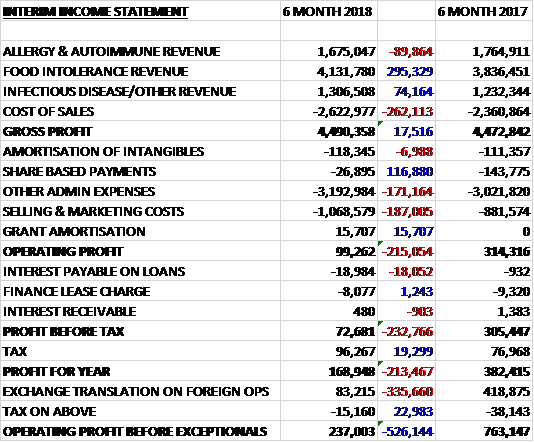
Revenues increased when compared to the first half of last year, helped by favourable forex movements, as a £90K decline in allergy and autoimmune revenue was more than offset by a £295K growth in food intolerance revenue and a £74K increase in infectious disease revenue. Cost of sales increased by £262K to give a gross profit broadly flat. Share based payments declined by £117K but other admin expenses were up £178K and selling and marketing costs grew by £187K to give an operating profit £215K lower. Interest payments increased by £18K but tax receipts were up £19K so the profit for the year was £169K, a decline of £213K year on year.

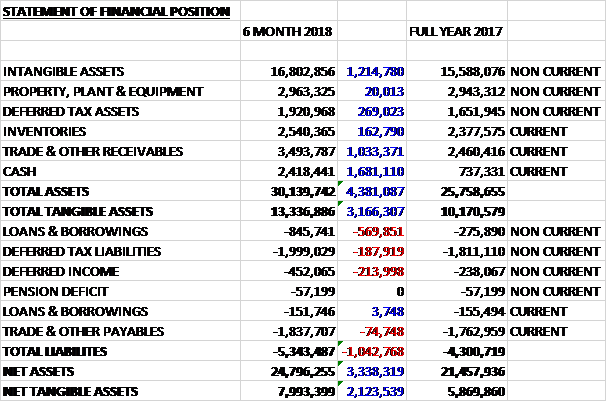
When compared to the end point of last year, total assets increased by £4.4M driven by a £1.7M increase in cash, a £1.2M growth in intangible assets, a £1M increase in receivables and a £269K growth in deferred tax assets. Total liabilities also increased due to a £566K increase in borrowings, a £214K growth in deferred income and a £188K increase in deferred tax liabilities. The end result was a net tangible asset level of £8M, a growth of £2.1M over the past six months.

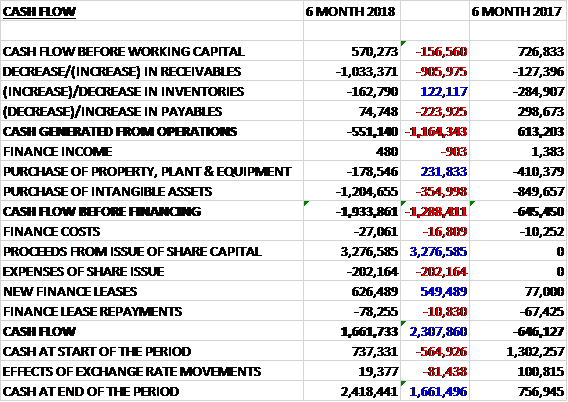
Before movements in working capital, cash profits declined by £157K to £570K. There was a cash outflow from working capital, predominantly due to a growth in receivables, and there was a cash outflow of £551K from operations, a deterioration of £1.2M year on year. The group spent £179K on property, plant and equipment along with £1.2M on intangible assets so there was a cash outflow of £1.9M before financing. This was covered by the net £3.1M of cash from new share capital and £626K from new finance leases to give a cash flow of £1.7M for the half year and a cash level of £2.4M at the period-end.

The pre-tax loss in the Allergy and Autoimmune business was £270K, a deterioration of £174K year on year on revenues that declined by 5%. In Germany revenues fell by 9% in Euro terms but was mitigated to some extent by a favourable currency impact. Autoimmune sales decreased by 60K to just 240K and having stabilised last year, the further decline in German sales was disappointing.

The group have progressed as planned with extending the Allersys menu and expect to CE mark an additional eight allergens before the end of the calendar year. They have also continued their discussions with IDS and while these have taken longer than expected, they feel they are close to agreeing the global distribution terms that will allow them to deliver value from this product range.

The pre-tax profit in the Food Intolerance business was £1.5M, a decline of £121K when compared to the first half of last year despite revenues increasing by 8%. This growth was driven by the Food Print Lab system with more steady growth in Food Detective due to the slow-down of one key market.

The group now have three partner companies in North Americas for the Food Print system and remain convinced that the product can be an important tool for practitioners and nutritionists in the wider arena of food sensitivities, allergies and gut health. In the US, it had become clear that one partner in particular will take longer than first thought to achieve a level of sales that was previously indicated to them. This is based on regulatory approvals taking longer to achieve which has impacted on expectations for revenue growth.

The pre-tax loss in the Infectious disease business was £111K, an improvement of £36K when compared to the first half of 2017 with revenues up 7% reflecting gains in Asia and the Middle East mitigating a reduction in Africa.

As previously announced, the group have CE-marketed their Visitect CD4 test which they anticipate will allow access to opportunistic sales through business to business channels in countries which require a CE-mark. They will now seek to move forward with WHO prequalification and expect that to be achieved in H2 2019. They are also looking to expand its portfolio with a lower cut-off test for the management of advanced HIV disease.

The group have been looking to develop a range of new panels on the Allergodip dipstick test for emerging markets and, in the longer term, for China. They have recently encountered some technical challenges with the product and they are currently reviewing certain options to determine whether it will be feasible to resolve these challenges. As it is not certain at this stage whether these challenges will be overcome, the second half is likely to be impacted by an asset impairment charge of £800K but the revenue expectation for Allergodip in the current year was not material to the group as a whole.

It has also been announced that CEO Andrew Shepherd is now taking on a global ambassador role and will hand over the reins to Colin King who will succeed him as CEO.

Going forward, whilst the board was previously expecting stronger revenues in the second half, it is now likely to be only slightly higher than in the first half. This is due to a number of challenges across the food intolerance business and the weakness in the German allergy market. Accordingly whilst they expect to remain profitable this year, profitability in the second half is now expected to be relatively modest when compared to previous years. Whilst there are a number of short term headwinds in the core business, the board believe that the impact will be more than mitigated by the expected success over the medium term as they complete the commercialisation of key products for Allergy, Malaria and CD4.

At the current share price the shares are trading on a PE ratio of 28.7 which falls to 24.2 on the full year consensus forecast.

Overall then this has been a bit of a disappointing period for the group. Profits are down and although net assets have increased, this was due to the share placing. The operating cash flow deteriorated and doesn’t cover the development costs. The infectious disease business, although still loss making, did see some improvement but there was further deterioration in allergy and autoimmune as the German business continued to struggle, and food intolerance profits declined with slower than expected North American sales of Food Print.

The prolonged negotiation with IDS is a bit of a concern and it would be good to get this sorted and the potentially terminal issues with Allergodip is a real blow. There are always tantalising treats just around the corner, though, with Visitect finally looking like making progress but with a forward PE of 24.2 I am losing patience here.

On the 10th April the group released a trading update covering the year ended 2018. Following his appointment as CEO, Colin King has undertaken a strategic review. They are looking to reduce their cost base significantly with the proposed closure of the German Allergy business and their manufacturing site in India. The estimated impact of the closures will be the elimination of £800K of losses at both sites and non-cash asset write-downs of approximately £5M for the German business and £700K for the Indian site. They are also looking at streamlining some UK operations which is expected to create annualised savings of around £200K.

The headwinds experienced in the last period have continued and the board are now focusing their efforts and resources where they believe they can generate the best returns. They exploring whether the two loss making operations can be sold but discussions to date do not indicate that a material sum can be realised. The cost of closing these business is expected to be around £600K. Following the closure of these businesses it is expected that the group will return to profitability on a lower revenue base.

Turnover is now expected to be £13.6M, a reduction of 6% on last year’s results. This is reflective of pressures on gross margin and continuing headwinds in the core business. Pre-tax losses are expected to be around £700K.

The number of partner companies in North America for Food Print reduced to two in the second half of the year with the withdrawal of one company for their internal financial reasons. Of the remaining two, one is still awaiting regulatory approval for testing samples collected in the US, resulting in lower than expected sales and the group are actively pursuing opportunities to add additional sales channels.

Since the last update, they have added two additional allergens to Allersys with a further two expected by the end of the month which will extend the menu to 53 allergens. Whilst the length of time taken over discussions with IDS has been frustrating, the board expect to provide a further update shortly.
They have recently appointed their first dedicated distributor for CD4 in Nigeria and have started the product registration process with the National Agency for Food and Drug administration in the country which will allow business to business sales to start through the distributor. They have also made progress with a second version of the CD4 test to be used for identifying advanced HIV disease. Two pilot batches of devices have been evaluated at a hospital in South Africa and both met their performance design goals. A third batch is currently under evaluation and if acceptable performance is demonstrated they will start some final robustness and optimisation and then proceed to validation.

The outlook for CD4 is encouraging with the first individual country distributorship being signed. The major sales hurdle they still need to overcome is the individual country by country registration process. They have started this will six countries and plan to start a further six registrations over the coming months.

With a renewed focus and following the closure of two loss making operations, it is expected that the group will return to profitability on a lower revenue base. They have the resources to drive Allersys and the Food Intolerance business as they commercialise CD4.

On the 20th April the group announced that they have finally signed a global distribution agreement with IDS for their Allersys range. The partnership is a long term supply agreement and they are working with IDS to introduce the initial launch panel of 51 allergy tests into the market. Whilst they expect modest sales growth in the short term this is an important step.

On the 23rd April it was announced that Finance Director Kieron Harbinson purchased 125K shares at a value of £16K. Following the purchase he now owns 606,617 shares. It was also announced that CEO Colin King purchased 190,476 shares at a value of £20K and he now owns 468,253 shares.
On the 24th April it was announced that group R&D director Edward Valente purchased 124K shares are a value of £18K.

Overall then there is much to digest here. This year’s results are likely to be quite poor but the progress being made on Allersys and CD4 are encouraging. On balance I think it might be too soon to buy back in here.

On the 2nd May the group announced the closure of the German business. They had not been able to sell it so they have initiated insolvency proceedings through the German court system. The contingent cost associated with this closure is expected to be around £450K, but could be less. Last year the business made an EBITDA loss of €400K.

Solid State Share Blog – Interim Results Year Ending 2018

Solid State has now released their interim results for the year ending 2018.

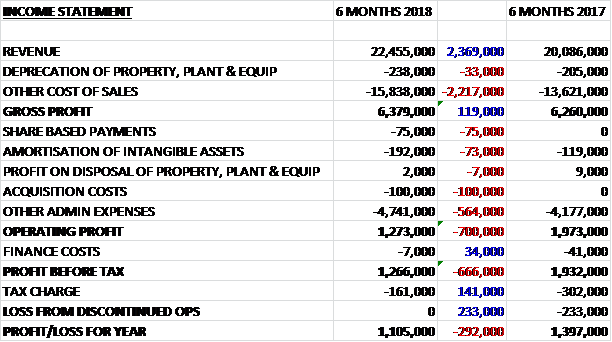
Revenues increased by £2.4M when compared to the first half of last year. Cost of sales grew by £2.4M to give a gross profit £119K higher. Share based payments grew by £75K, amortisation increased by £73K, there was £100K of acquisition costs and other admin expenses grew by £564K reflecting the planned investment in sales staff and the full period cost contribution from Creasefield, which meant that the operating profit was down £700K. Finance costs declined by £34K, however, and tax charges fell by £141K to give a profit for the period of £1.1M, a decline of £525K year on year.

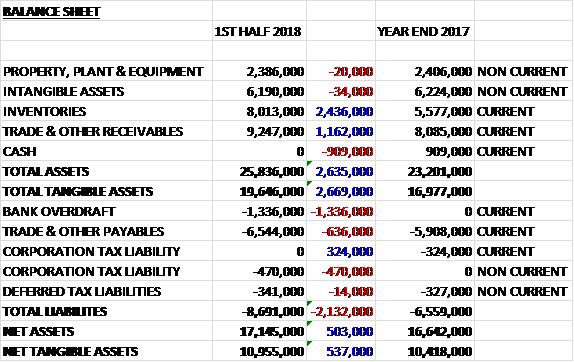
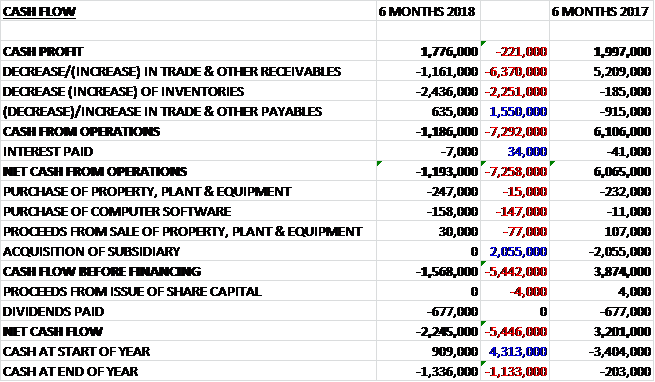
When compared to the end point of last year, total assets increased by £2.6M, driven by a £2.4M growth in inventories and a £1.2M increase in receivables, partially offset by a £909K decline in cash. Total liabilities also increased during the period due to a £1.3M increase in the bank overdraft, a £636K growth in payables and a £146K increase in the corporation tax liability. The end result was a net tangible asset level of £11M, a growth of £537K over the past six months.

Before movements in working capital, cash profits declined by £221K to £1.8M. There was a cash outflow from working capital and after interest payments declined by £34K, the net cash outflow from operations was £1.2M. The group also spent £247K on property, plant and equipment along with £158K on intangible assets to give a cash outflow of £1.6M before financing. They also spent £677K on dividends to give a cash outflow for the period of £2.2M and a cash level of -£1.3M at the period-end.

There was strong organic growth in the distribution division of 20% and a 7% increase in manufacturing revenue but changes in product mix have affected the overall gross margin and the combination of the increased proportion of distribution sales and a change in mix of sales within the manufacturing business resulted in a near 3% reduction in the gross margin.

As can be seen there was a strong cash outflow from working capital due to some strategic investments including: within the distribution division they have taken £400K of new product line into inventory to support a multiyear space customer in an obsolescence management programme. In addition they have spent £500K in inventory for a customer specific product to secure supply and pricing for committed orders. In the manufacturing division they have spent £900K on work in progress in relation to an ongoing project which is currently scheduled to ship in the second half. In addition they have made investments to secure supply and pricing as lead times are increasing in a number of areas such as battery cells, memory and component assemblies and the distribution division.

Manufacturing revenues increased by 7%, driven by the full year impact of the Creasefield acquisition. Within the division, over £2.5M of rail printer revenue that occurred last year did not recur and has been replaced by new power and computing sales. Good progress is being made in implementing a margin enhancement strategy through additional added value services and operational efficiencies aimed at addressing certain low margin battery business inherited from the Creasefield acquisition. The benefits of this activity should start to be seen in Q4 and into next year.

The restructuring of the communications business unit and Leominster operations is now complete and has positioned the business for future growth but the lead time to win and deliver some of the complex antenna programmes has taken longer than expected, resulting in a performance below management expectations. The prospect pipeline remains encouraging, positioning the business for a stronger 2019. After the period-end, an important order for mesh radios was secured from the Government customer.

The power business is responding to strong levels of enquiries in varied applications. They are seeing evidence that the oil and gas sector is showing sustained recovery beyond just a restocking spike evidenced by a new battery pack project for a brand new well development in Africa. The harsh environment robotics project continues to progress well through the engineering phases, with the aim to complete the product development in H1 2018 and then move to review production opportunities.

The computing business unit had a strong performance in the first half with bookings and billing ahead of plan and product margins being maintained. This trend, which reflects a 9% improvement in billings on last year, is the result of investments in sales initiatives. They are actively targeting a number of new opportunities and programmes in the rail sector which they hope will be a good new market for this business.

The distribution business delivered close to a 20% increase in revenues to £9.5M, reflecting strong organic growth across their product rang. Order intake in the first half is up by 39% over the same period last year and the total order book is at record levels. The market remains sensitive, however. The business continues to improve its offering in the growth markets of wireless, cellular and internet of things whilst maintaining a strong offering in the specialist areas of military and aerospace. Investments in engineering support in these areas have led to significantly increased business levels in, for example, the Global Systems for Mobile arena.

Investments that have been made in the sourcing and obsolescence services operation are expected to start to bear fruit in the second half of the year and investment continues in this area to provide secure storage areas within the existing warehouse. Efficiency improvements are now well underway with a wireless warehouse project to speed productivity expected to complete before the year-end. Investment continues in personnel and the working environment with continuous training and infrastructure improvements including the conversion of all lighting to LED. The division expects to hit its second half organic growth targets and exceed order input targets.

At the period-end, the group order book was £20.1M, which is 38% up on the prior year. Order intake in October was at a record level with a good spread of customers and the board are pleased with the new business pipeline and level of new contract awards across the group. This gives them confidence that despite the reduction in the margin as a result of the mix of product sales, the markets that the group serves are resilient and that the group can deliver a strong second half performance and continue to deliver growth.

At the current share price the shares are trading on a PE ratio of 16.7 which falls to 14.8 on the full year forecast. After the interim dividend was maintained the same, the shares are yielding 2.6% which is expected to be maintained for the full year too.

Overall then this has been a bit of a mixed set of results. Profits declined due to the product mix and the resultant lower margins. Net assets did increased but the operating cash flow was down with a cash outflow, although this was not helped by working capital movements. The distribution business is performing well with a good revenue increase and record order books. The manufacturing business is more mixed, however, with the reduced profits due to no rail printer revenues this year, antenna delays and the Creasefield business still having low margins. There is supposedly some improvement in the latter two going forward and the pick-up in the oil and gas market is encouraging, though. This is starting to get interesting again but with a forward PE of 14.8 and yield of 2.6% I would like to see more evidence of profitable growth before buying back in.

On the 13th April the group released a trading update covering the year ended 2018. The adjusted group profit will be in line with market expectations at around £3M with revenue slightly above expectations at £45.5M. The distribution and value added services division maintained strong organic growth of close to 18% and the manufacturing division has delivered a 10% increase in revenues. The overall gross margin will show a reduction, however.

They are continuing to make progress with a significant development contract in their Power business and franchise discussions in the distribution division, both of which are expected to contribute to 2019 results. The lead time to win new business in the Communications business has been longer than expected.

A significant proportion of the sales in the Communication business are exports. Securing overseas opportunities is proving harder than expected, particularly in North America where it appears domestic suppliers are being preferred on contract awards. As a result, the group are reducing their expectations for this business for 2019 which will have a negative impact on margin mix for the group.

This update suggests there is little prospect for profit growth in the foreseeable future so I am steering clear for now.

On the 11th June the group announced that it had received orders to supply power units for autonomous robots operating in cold climate conditions with a combined value of £4.3M. They were commissioned to design and supply the power units for the end customer’s smart warehouses. Deliveries of the power units are expected to start during HS 201, contributing to the current year and continuing into next year. The contract will deliver additional recurring revenues through the supply of replacement cells in subsequent years as part of a support and maintenance agreement.

Trifast Share Blog – Interim Results Year Ending 2018

Trifast has now released their interim results for the year ending 2018.

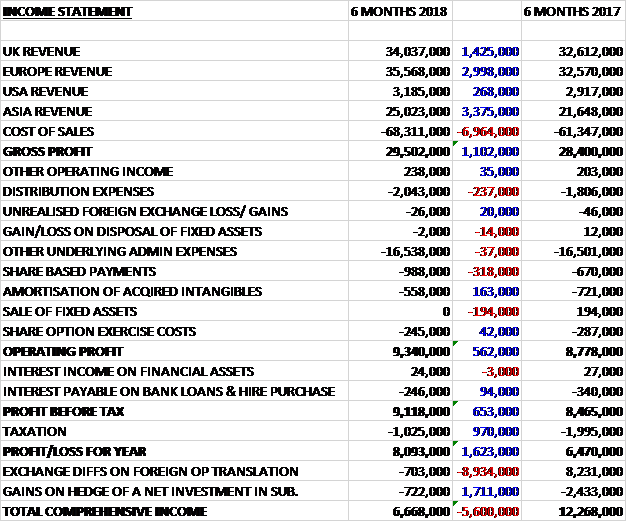
Revenues increased when compared to the first half of last year with a £3M growth in European revenue, a £1.4M increase in UK revenue, a £3.4M growth in Asian revenue and a £268K increase in US revenue. Cost of sales increased by £7M to give a gross profit £1.1M higher. Distribution expenses increased by £237K, share based payments were up £318K and there was no sale of fixed assets, which brought in £194K last time. The amortisation of acquired intangibles declined by £163K, however, and other admin expenses were broadly flat to give an operating profit £562K higher. Interest payments fell by £94K and tax charges were down £970K due to a deferred tax asset not recognised last year for trapped tax losses in the UK as a result of the share option exercised in the year, which meant that the profit for the period was £8.1M, a growth of £1.6M year on year.

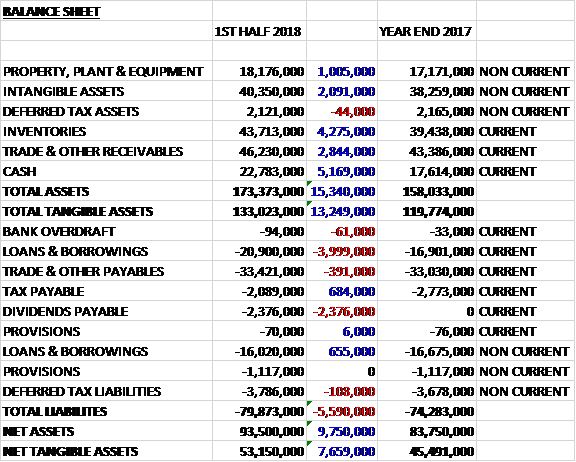
When compared to the end point of last year, total assets increased by £15.3M driven by a £5.2M growth in cash, a £4.3M increase in inventories, a £1.8M growth in receivables, a £2.1M increase in intangible assets and a £1M growth in property, plant and equipment. Total liabilities also increased over the past six months due to a £3.3M increase in borrowings and a £2.4M growth in dividends payable. The end result was a net tangible asset level of £53.2M, a growth of £7.7M over the period.

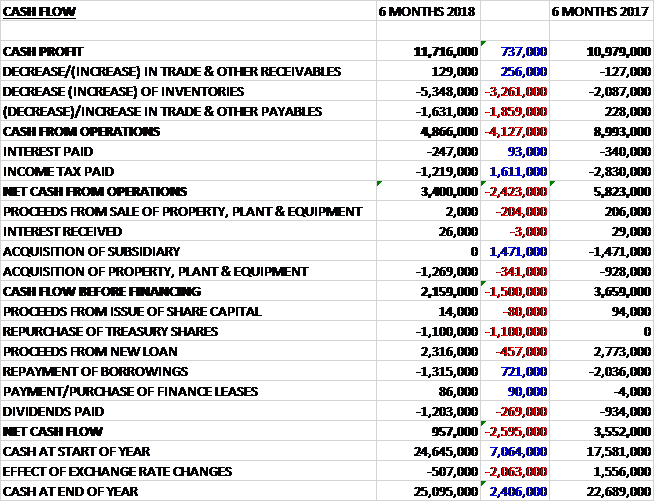
Before movements in working capital, cash profits increased by £737K to £11.7M. There was a large cash outflow from working capital, mainly due to an increase in inventories but tax payments fell by £1.6M to give a net cash from operations of £3.4M, a decline of £2.4M year on year. The group spent £1.3M on property, plant and equipment to give a free cash flow of £2.2M. Of this, £1.2M was paid out in dividends, and £1.1M went on purchasing treasury shares – presumably for director pay. The group took out new loans of £1M which gave a cash flow of £957K and a cash level of £25.1M at the period-end.

The underlying pre-tax profit increased by 9.7% but this has benefited from favourable exchange rates and at constant currency the growth was 4.5%. Gross margins have been maintained close to the target of 30% but they have fallen when compared to the first half of last year reflecting the Euro weakness against the dollar.

The underlying profit in the UK business was £3.9M, a growth of £832K year on year with revenues increasing by 4% due to increased distributor revenues and an increase in contract sales to several key OEMs. The underlying operating margin has improved strongly due to several high margin sales in the period. Forex gains made on the Euro distributor sales have to date been able to offset the negative impact of inflationary pricing pressures following the Brexit vote. The rest of the increase reflects a reduction in the overhead spend.

The underlying profit in the European business was £3.9M, a decline of £1.4M when compared to the first half of last year despite revenues increasing by 2%. The automotive sector experienced growth, most specifically in the Netherlands and Sweden with increases of 11% and 9%. In Italy, the importance of the automotive sector is building, with sales in this sector increasing by 27%, albeit from a small base. Volume reductions at one of the group’s largest domestic appliance OEMs have partly offset other increases, however. Trading volumes with that customer had been abnormally high in the first half of last year as the group supported a significant global product recall programme.

The decline in profits is due to a fall in margins, particularly a reduction in gross margins in the Italian business where the impact of increases in purchase costs at the end of last year has continued into this period. This has been in addition to a planned increase in fixed production costs in Italy as they invest for future growth. Whilst investment costs to get the new Spanish Greenfield site up and running represent most of the overhead led decrease in the region’s operating margin.

The underlying profit in the US business was £116K, a decrease of £50K when compared to the first half of 2017 with revenues increasing by 4%, which was lower than anticipated. This reflects a reduction in their sales to the electronics sector, largely because of the manufacturing issues some of their key customers are experiencing after Hurricane Harvey. The start of production on new automotive wins in the region has helped to offset this negative impact, however. Underlying operating margins have fallen sharply reflecting lower gross margins due to the lower electronics sales following the hurricane.

The underlying profit in the Asian business was £4.4M, an increase of £1.1M year on year with revenues increasing by nearly 11%, largely driven by increases in the domestic appliances business in Singapore and automotive wins for the Chinese, Malaysian and Taiwan operations. In Malaysia, the increase in intercompany co-operations put in place following the downturn in the domestic economy has continued to bear fruit with revenues up 7%.

During the period the group committed to a plan to sell a factory in Malaysia. A buyer has been identified for the asset and management are expecting the transaction to complete before the year-end. The group is expecting to receive around £1.6M for the factory which is higher than the £1M held on the balance sheet for the asset.

In Asia, over the course of the year the group will be investing £1M in the construction of a mezzanine level at their Singapore facility to expand capacity, initially by 25%, and to increase R&D capabilities. In Shanghai they have just expanded their warehousing and inspection facilities to support growth being seen in the Chinese domestic market and the recent expansion into the Japanese market.

In Europe, the Greenfield site in Spain is now up and running. First orders have been processed, stock is on the shelves and the pipeline is looking strong. In Italy, the investments they have made in the heat treatment plant last year are beginning to pay back, bringing an end to the production bottlenecks that were limiting their ability to expand capacity at the plant. Looking ahead they have further investment planned to support the ongoing growth in the European distribution sites, including a warehouse expansion in the Netherlands and a TR innovation and technical centre situated in Gothenburg.

In the UK they are in the process of expanding their warehousing facilities in Northern Ireland to support the strong ongoing growth they are seeing at the site whilst in the US, despite the immediate difficulties following Hurricane Harvey, they plan on investing to build the local team and to support future growth in this important market.
The group continues to search for acquisitions. Since the year-end they two larger international targets were thoroughly investigated over several months but both were rejected due to future revenue growth risk.

Going forward, the second half has started well and with a robust pipeline in place, the board remain confident of delivering their expectations for the full year. There remain some macroeconomic factors at play, however, including the ongoing volatility in forex and raw materials markets, input cost pressures in the UK due to protracted sterling weakness and the wider potential implications of Brexit on the UK economy.

At the current share price the shares are trading on a PE ratio of 25 which falls to 18.8 on the full year consensus forecast. At the period-end the group had net debt of £7.9M compared to £6.4M at the prior year-end, not helped by currency movements. After a 10% increase in the interim dividend, the shares are yielding 1.4% which increases to 1.5% on the full year consensus forecast.

Overall then, this has been another decent period for the group. Profits and net assets both grew, although the former has been favourably impacted by forex movements. The net cash from operations did decline, but this was due to working capital movements and cash profits increased with some decent free cash flow generated.

Operationally it has been a bit of a mixed bag. The UK and Asian businesses have performed well with the former enjoying more higher margin product sales and Asian demand being strong for both appliances and automotive. The European business struggled somewhat due to higher costs in Italy and the set-up costs for the new Spanish division and in the US, the performance was hampered by Hurricane Harvey. The shares aren’t cheap with a forward PE of 18.8 and yield of 1.5% but I remain happy to hold on to this good quality company.

On the 15th February the group released a trading update covering Q3. The global visibility and order pipeline is very encouraging and the business is matching management expectations in revenue and margins with the US business continuing to recover following the hurricane season.

The capital investments made to the manufacturing operations in Italy and Taiwan are already delivering ongoing benefits and the significant expansion of the Singapore facility is on track with phase one expected to complete by the year-end.

Overall the board remain confident that the group will deliver its expectations for the year as a whole.

On the 5th April the group announced the acquisition of Precision Technology Supplies, a supplier and distributor of stainless steel fastenings in the UK to the electronics, medical instruments, petrochemical, defence and robotics sectors. There is an initial cash consideration of £8.5M with a contingent consideration of £2.5M and the acquisition is expected to be earnings enhancing in 2019 and made a profit of £720K last year. The business will run as a stand alone business in the group.

On the 19th April the group released a trading update for the year ended 2018. The European operations have benefited from a stronger second half of underlying organic growth. They have witnessed good growth across a number of key market sectors, particularly in the automotive sector with double digit growth across both the Dutch and Swedish operations. In addition the newest new location in Spain and the new innovation and technical centre in Sweden are both providing good prospects for future growth. On the domestic appliances side, they have seen an expected return to more normal trading levels over the year following the abnormally high sales volumes as they supported a significant global product recall programme for a key customer.

Following a stronger second half, the UK also experienced robust organic growth reflecting a targeted approach aimed at growing both core multinational OEM customers and European distributor sales. Looking ahead, recently announced changes in planned production volumes in the diesel automotive sector could influence activity in the region although to date the expected impact is relatively minor.

Asia has performed well. They have seen a solid year on year growth particularly across the domestic appliances and automotive sectors. As expected the strong double digit growth experienced in the first half of the year was not sustained into the second half, however. This was largely due to the ongoing reduction in demand at one of the region’s key automotive customers as a result of its own restructuring programme, coupled with the impact of deliberately reduced volumes following an e-bidding process at an electronics multinational OEM customer.

Looking ahead, the new warehouse in Shanghai is already providing additional support for the ongoing strong automotive growth in China and Japan. Furthermore, the significant capital investment they have made to their manufacturing facilities in Singapore will also start to feed through into margins over the coming year.

In North America, the TR operation is recovering well following the impact of Hurricane Harvey with strong year on year growth being driven from new automotive wins in the region. They plan to carry on investing to build the local team and to support future growth in this market and they are opening a larger TR warehouse in Houston this month.

Overall, following an encouraging finish to the year, the underlying profit is slightly ahead of management expectations. All of their main geographies, excluding the US, have delivered growth in profits.

During the year the group have initiated a number of significant capital investment projects. Their previous investments, specifically into their Italian manufacturing operations are already delivering capacity benefits and the completion of the mezzanine expansion in Singapore was achieved just ahead of the year-end. Further warehouse expansion plans are underway in the Netherlands and the US.

Overall this looks fine and I continue to hold.

Newmark Security share Blog – Final Results Year Ended 2017

Newmark Security has now released their final results for the year ended 2017

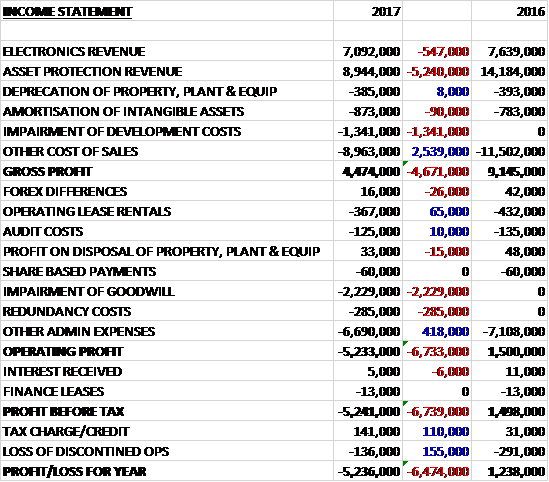
Revenues fell when compared to last year due to a £5.2M decline in asset protection revenue and a £547K decrease in electronics revenue. There was a £1.3M impairment of development costs but other cost of sales decreased by £2.5M which meant that the gross profit was £4.7M lower. We also see a £2.2M impairment of goodwill and redundancy costs of £285K, although other admin expenses decreased by £418K which meant that the operating loss saw a detrimental movement of £6.7M. Finance costs remained broadly the same but the tax credit increased by £110K and the loss from discontinued operations decreased by £136K. All of this meant that the loss for the year came in at £5.2M, a detrimental movement of £6.5M year on year.

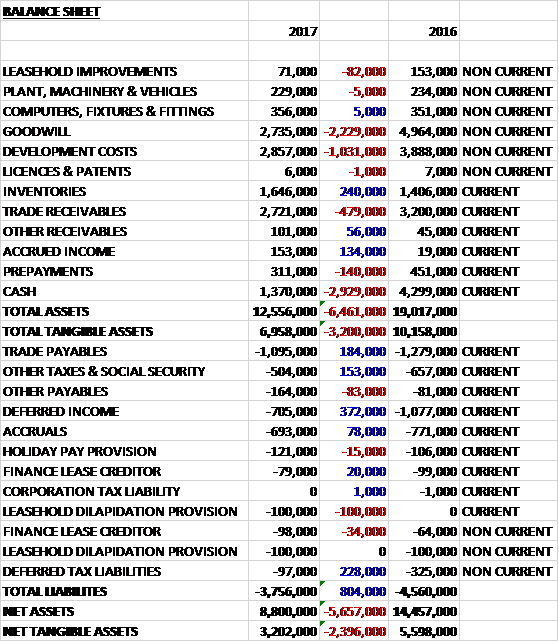
When compared to the end point of last year, total assets declined by £6.5M driven by a £2.9M decrease in cash, a £2.2M impairment of goodwill, a £1M impairment of development costs and a £479K fall in trade receivables. Total liabilities also declined, mainly due to a £228K fall in deferred tax liabilities, a £372K decline in deferred income due to lower levels of advance payments from customers and a £184K decrease in trade payables. The end result was a net tangible asset level of £3.2M, a decline of £2.4M year on year.

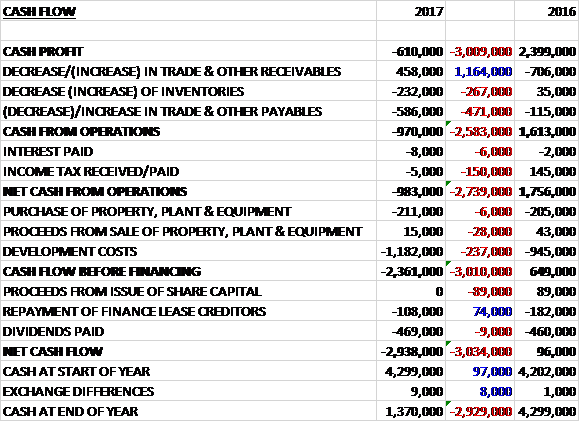
Before movements in working capital, the group saw a £3M swing to tax losses of £610K. There was a small cash outflow from working capital but this was less than last time. There was a £150K fall in tax income, however, which meant that the net cash outflow from operations was £983K, a detrimental movement of £2.7M year on year. The group then spent £1.2M on development costs and £211K on property, plant and equipment to give a cash outflow of £2.4M before financing. They also paid out £469K in dividend and £108K on finance leases to leave a cash outflow for the year of £2.9M and a cash level of £1.4M at the year-end.

Although the opportunity pipeline has grown, the conversion into sales has been slower than expected. The continuing economic uncertainty has affected customer spending plans with proposed programmes being severely delayed or cancelled.

Excluding impairments, the loss for the Electronic division was £708K, a deterioration of £547K year on year. Access Control revenues declined by nearly 13%. This was a very difficult trading period for the business as the group experienced reductions in revenues in its legacy access control platform, Janus, while revenue from its current Sateon offering was affected by the delayed release of the most recent variants. Due to Microsoft and Intel migrating away from platforms and operating systems that support 16-bit applications such as Janus, the revenues from that product line continued to decline in line with expectations.

Significant investment was made during the year and the Sateon offering was bolstered by the launch of new hardware and software, released in the second half of the year under review as Sateon Advance. While revenue for this variant was slower to materialise than original expectations due to the delayed product release, revenues in the Sateon range as a whole increased by 22% compared to the previous year to £2M. Early revenues and margin from the revised portfolio have been softer than earlier products due to their penetration pricing strategy.

The revenues from the Hong Kong operation unfortunately fell well short of expectations and as this position could not be predicted to significantly improve, the decision was taken to withdraw from the country. This operation incurred an operating loss of £225K in the year which has therefore now been eliminated as a cost in future years.
The group has recently entered into a technology agreement with US-based UniKey Technologies whose patented platform provides a “frictionless at door experience” for the end user. It is anticipated that Grosvenor’s first products incorporating the technology will be seen later in the current year.

Revenues for Workforce Management were similar to the previous year. The natural slowdown of the rollout across the estate of one of the world’s largest apparel retailers negated growth in some new and existing channel partners. Development was focused on the GT-10 employee terminal, launched as a developer kit towards the end of H1. It has an Android based operating platform and negotiations have started with several potential major WFM software providers in the US and Europe who have chosen to invest in creating their own software for the GT-10. It is expected to enter mass production during the first half of this year.

Negotiations continued with some large software vendors with a view to supplying them with variants of the group’s time and attendance terminals. In North America, business development activities increased to leverage the potential that exists for growing WFM revenues as it is felt that the US market remains the region of greatest growth opportunity for both the existing IT series terminals and the GT-10.

Excluding impairments, the profit for the Asset Protection division was £130K, a deterioration of £2.7M when compared to last year.

Revenue in Asset Protection (Safetell) decreased by 37%, partly as a result of the reduced contribution from time delay cash handling equipment sales to the Post Office. Although the business received orders from various long-term customers in retail finance, petrol and food retailing sectors, reduced sales were experienced in the lead up to and after the Brexit vote as many customers put plans on hold. This trend continued with budget cuts in all sectors. The fall in the value of Sterling against the Euro resulted in the increased cost of imported products which reduced margins further. The downturn in orders resulted in a reorganisation within the business which generated cost savings, however.

During the year, new products were developed and certified to UK security standards with the focus on providing counter terror security equipment for staff and customer protection. A distribution agreement was entered into with Gunnebo UK to distribute their Security Doors for Partitioning range within the UK. This enables the business to enter new market sectors. A fixed price supply contract with a leading financial institution entered its third and final year and margins on this contract were reduced due to imported component prices related to the fall in value of Sterling.

Service division revenue was 11% lower than last year. Sales have been challenging for the division as a result of the continuing branch closures that have occurred in the banking sector. Pneumatic upgrades of rising screen systems now generate more than 10% of the total service revenue. The new TC105 control panel used on the rising screen was introduced to the market and installed at many sites. This has proved very reliable and will replace the outdated Surefire control panel going forward.

The group conducted a review of the value of product development costs that had been capitalised previously. They have historically amortised IP-rich development costs over a seven-year period and therefore many assets reviewed were several years old. With the launch of Sateon Advance and a reduction in market demand for older products that is has replaced, a write-off of £1.3M on certain access control development costs was made. Development costs continue to be capitalised in accordance with the accounting policy. This is important because it seems to me that either too many development costs are being capitalised or the amortisation period is too long. This means that the group is likely overstating their profit position.

Within the access control business, although many end users have already migrated from Janus to Sateon, there are a number of large customers that are yet to make this transition. The board therefore believe that the opportunity exists for this to positively impact Sateon revenues in the current year. Going forward, the board expect continued growth in revenue from their new Sateon Advance access control system and counter terrorism products but in view of the ongoing economic uncertainty, they expect this will be a difficult trading year.
The group is loss-making so PE ratios are not going to tell us much. Also, there is no dividend being proposed this year and I can find no forecasts for next year. At the year-end the group had a net cash position of £1.4M compared to £4.3M at the end of last year.

On the 13th November the group announced that it had entered into a new ongoing supply agreement with WorkForce Software. The group will supply WorkForce globally, through sales and leasing, with their IT51 Linux based workforce management terminal with will enable their customers to improve business efficiency and facilitate greater employee satisfaction through accurate time tracking. In addition, they will provide WorkForce with a range of remote support tools on an “as a service” basis.

On the 27th November the group announced that it had won a new contract with a European workforce management provider. Under the contract they will provide a Linux-based OEM variant of their GT-10 workforce management terminal in addition to a range of cloud based support services on a SaaS basis. They will also provide an OEM variant of their Sateon Advance Access Hardware to work with their customer’s existing platform.

The customer funded development work in the contract, itself worth £190K, is being conducted this year and revenues are expected to come on stream in Q2 2018 with the contract value being around €3M over a five year period. Apparently the customer preferred the industrial design of their GT-10 Android-based terminal but recognised the advantages of the hosted SaaS services they provide in their Linux based terminal so they are developing a hybrid solution specific to their requirements.

Overall then, this set of results has been a bit of a disaster. The group is now loss making even when the impairments are ignored, net assets declined and the operating cash outflow deteriorated even further. The Electronic division suffered from delays to Sateon, and the Hong Kong underperformance while the deterioration in the asset protection division was even greater with lower Post Office sales and other customers delaying and cancelling decisions due to Brexit. In addition the service division is suffering due to Bank closures. All in all, these don’t look very investable at the moment and I’m steering clear.

N Brown Share Blog – Interim Results Year Ending 2018

N Brown has now released their interim results for the year ending 2018.

Revenues increased by £24M and with cost of sales up only £14.5M the gross profit grew by £9.5M. Warehouse and fulfilment costs increased by £4.3M and marketing and production costs rose by £700K, although this was offset by a £700K reduction in depreciation and amortisation, although this is expected to rise in H2. Other admin and payroll costs increased by £4.6M, partially due to the double running IT costs and further recruitment. There were also two large non-underlying costs, with a £13.8M store closure charge and a £31M growth in financial services customer redress costs. This all meant that the group saw a £44.1M swing to an operating loss. We also see a £4.6M increase in losses related to the forex hedge but these costs have given rise to a tax receipt, which was up £10.6M. This all meant that the loss for the period was £21.2M, a detrimental movement of £38.1M year on year.

When compared to the end point of last year, total assets increased by £22.3M, driven by a £13.9M growth in trade receivables, an £11.5M increase in software and a £5.3M growth in other receivables, partially offset by a £4.8M fall in cash, a £2.5M decrease in derivative financial assets and a £2.1M decline in property, plant and equipment. Total liabilities also increased as a £13.4M fall in current tax liabilities was more than offset by a £21.5M growth in trade receivables, a £33.5M increase in financial service customer redress, a £10M increase in bank loans and a £13.5M increase in store closure provisions. The end result was a net tangible asset level of £424.1M, a decline of £45.2M over the past six months.

Before movements in working capital, cash profits declined by £5.3M to £41.8M. There was a small cash inflow from working capital but this was lower than last time and the net cash from operations was £31.2M, a decline of £15.2M year on year. The group spent £20.6M on intangible assets and £1.2M on property, plant and equipment to give a free cash flow of £9.4M. This didn’t come close to covering the dividends of £24.2M so the group took out £10M of new loans to give a cash outflow for the period of £4.7M and a cash level of £59.4M at the period-end.

JD Williams revenue was £81.1M, an increase of £5.3M year on year. Within this the JD Williams brand was up 12% and Fifty Plus was down 5.2% as expected. The migration of Fifty Plus is now complete. For the new Autumn Winter season they have refreshed the JD Williams brand proposition, launching JD Williams “The Lifestore”.

Simple Be revenue was £64.5M, a growth of £11.2M when compared to the first half of last year where the group made significant ladieswear market share gains against what remains a subdued consumer backdrop, The We Are Curves marketing campaign really seems to be resonating and gaining traction.

Jacamo revenue was £33.5M, an increase of £2.1M when compared to the first half of 2017. Their delivery subscription launched in February and has been successful with a double digit increase in both order frequency and net sales per customer. They will be extending a delivery subscription to other brands in the future. They also teamed up with Tom Morgan from the Undateables to promote their own-brand summer range.

Traditional segment revenues were £68.1M, a growth of £2.9M year on year as actions taken to address performance worked well.

Secondary brand revenue was £76.3M, an increase of £1.1M when compared to the first half of last year. Within this, Fashion world and Marisota both achieved good performances but Figleaves saw a revenue decline as the new management team restructured the business and optimised their marketing approach. High and Mighty revenue declined as they reduced marketing spend ahead of the new site going live.

US revenue was £8.1M, an increase of 6% year on year but down 4.4% at constant currency. The group stepped up their marketing investment towards the end of the period in order to drive new customer recruitment. Ireland delivered revenues of £8.5M, up 17% or 7.4% at constant currency.

Overall, revenue from the store estate was £10.6M, a decline of £900K due to the closure of five dual fascia Simply Be and Jacamo stores as a result of weak footfall and significant future business rate increases. These stores contributed £5M revenue and a loss of £2M in 2017.

Within the 1.1% increase in finance revenues, interest payments grew low single digits and non-interest lines were down double-digits. The improvement in the quality of the loan book was reflected in the gross margin performance, which was up 150bps. They had an encouraging performance recruiting new credit customers who rolled a balance, with an increase of 13% compared to the first half of 2017. This was driven by both the good product revenue performance in the new half and encouraging early results from the trial offering a lower APR for qualifying new customers. This trial continues ahead of the rollout of full variable APR functionality in 2018.

The new IT platform is now live on the High and Mighty and US sites, which includes a new Financial Services system on the High and Mighty site. The programme has now been substantially scaled down, reducing costs, and the in-house IT change team are now delivering enhanced functionality through fortnightly releases. The approach going forward will be to prioritise the developments that deliver the highest returns such as Global Ship Anywhere and Mobile Apps. The timescale for migrating other brands onto the new platform is expected to start in Q2 2018.

There are a number of future growth levers identified by the group. They are looking to increase the number of third-party brands on their websites and similarly are looking to sell capsule ranges of their own products on other retailers’ sites. In addition, they are looking to international expansion with the US being the first priority.

The most recent customer satisfaction score of 83.7% was lower than previously, although ahead of the sector average. The decline was driven by a fire at a delivery partner’s distribution centre which caused significant delivery problems for a small group of customers.

As can be seen there are two large exceptional costs incurred during the period. The group has identified flaws in certain insurance products which were provided by a third party insurance underwriter and sold by the group to its customers between 2006 and 2014. Following an assessment of the cost of potential customer redress, an exceptional charge of £40M was recognised during the period.

Also, during the period five loss making retail stores were closed which has resulted in a non-recurring cost of £13.8M in respect of asset write-offs, onerous lease provisions and other related store closure costs.

In addition there are a number of tax disputes ongoing. They have provided for a total of £5.4M in respect of future payments expected to be made in settlement of some historical tax positions. In addition, they continue to be in discussions with HMRC in relation to the VAT consequences of the allocation of marketing costs between the retail and credit businesses. At this stage it is not possible to determine how the matter will be resolved. An unfavourable settlement of these cases could result in a charge to the income statement of up to £46.8M and a cash payment to HMRC of up to £22.7M but a favourable settlement would result in a repayment of tax of up to £53.1M and an associated credit to the income statement of £29M so this could go either way!

Going forward, at this early stage in the second half, current trading is on track with the plan. A number of changes have been made to the guidance for the full year. The range for product gross margin has been reduced from -120bps – -20bps to 120bps – -70bps whereas financial services gross margin has increased from 0 – 100bps to 100 – 200bps. Group operating costs are now expected to be up 4.5% to 5.5% as opposed to 3.5% to 5.5%. Net debts has been increased from £300M – £320M to £325M – £335M reflecting the increased cash flow impacts of exceptional costs and the growth of the customer loan book. There are also exceptional costs of an additional £2M in H2 as a result of the ongoing tax dispute with HMRC.

At the current share price the shares are trading on a PE ratio of 17.9 which falls to 12.6 on the full year consensus forecast. After the interim dividend was kept the same the shares are yielding 5.1% which is forecasted to remain the same for the year as a whole. Net debt at the period-end stood at £305.7M compared to £286.7M at the end of the first half of last year.

Overall this has been a rather mixed period for the group. They swung to a loss but if we ignore the forex hedging losses, the store closure costs and financial service customer redress, profits would have been broadly flat. Net assets declined, however, as did the operating cash flow and although there was some free cash being generated, this did not come close to covering the dividends.

Core trading at the brands actually looks pretty good, particularly at Simply Be but the group is beset by issues. The financial customer redress is looking more and more expensive, the closure of the loss making stores should benefit the group in the long term, but are a drag in the short term and the dispute with HM customs is rumbling on and could be a real issue going forward. I just think the uncertainties are a bit much here and not adequately covered by the forward PE of 12.6 and yield of 5.1%, which is a shame.

On the 23rd January the group released a trading statement covering Q3. Group revenues increased by 3.2% and the full year profit expectation is unchanged. Simply Be performed well, up nearly 15%, with Jacamo up 4.6%, supported by a strong Christmas campaign and JD Williams increasing by 3%. Secondary brands were down 8.4% and the traditional segment grew by 3.9%.

The relaunch of JD Williams was a success with new customers up 12% and positive reactions from existing customers. This season, Fifty Plus brand customers have received the JD Williams marketing programme which has had mixed success due to the more traditional fashion preferences of some of these customers. This has impacted overall active customer metrics and ladieswear performance which saw an increase of just 0.7%. Actions are being taken to address this and the board are confident in receiving improving response rates from this customer group going forward.

Within Secondary brands, the largest brand, Fashion World, was down high single digits as they diverted marketing investment into their Power Brands. Figleaves revenue was down as expected, with the brand part way through its turnaround led by its new management team. The growth in the traditional segment was driven by the Ambrose Wilson brand, continuing the positive trend reported in the first half.

The US business moved back into positive growth in line with plans, with revenue up 19%. The new marketing strategy, including strong influencer marketing, is working well and they expect performance to continue to accelerate. They are on track to go live with Global Ship Anywhere by the end of the year, which further underpins future international growth.

Financial Services revenue was up 4.5%. Interest revenue was up high single digits whilst non-interest lines were down as planned. They delivered a further improvement in the quality of the customer loan book and this is reflected in their upgraded gross margin guidance. The loan book continues to show healthy growth.

Going forward, the product gross margin guidance for 2018 has fallen considerably, down from -70bps – 120bps to -225bps to -250bps. This is predominantly due to higher promotional activity. Financial services gross margin is expected to improve by +500bps to +550bps compared to +100bps to 200bps previously. This is a result of a further improvement in the quality of the customer loan book, together with several initiatives improving their customer proposition launched during the year. Group operating costs are now +4% to +4.5% compared to +4.5% to +5% previously and net debt is expected to be around £350M compared to £325M to £335M previously, due to the growth in the loan book

Overall I think it is a bit sneaky to paint a picture of growth in revenue and then just mention in passing that this was achieved through higher promotional activity hence the lower margins. Performance is expected to remain as was overall, however, so the fall in the share price might be an opportunity although I do note that the forecasts for 2019 have been slashed so perhaps I should hold off!

On the 19th February the group announced that the new chairman, Matthew Davis, purchased 10K shares at a value of £19.3K.