Avon Rubber Share Blog – Final Results Year Ended 2017

Avon Rubber has now released their final results for the year ended 2017.
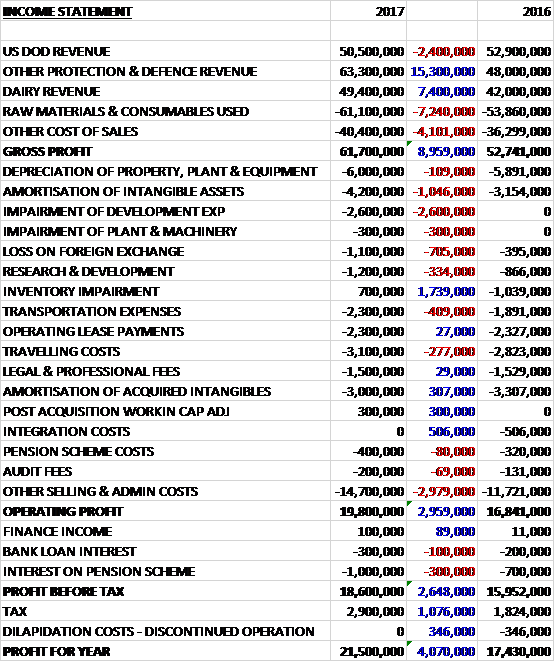
Revenues increased when compared to last year as a £2.4M decline in US DOD revenue was more than offset by a £15.3M growth in other protection and defence revenue and a £7.4M increase in dairy revenue. Raw material costs were up £7.4M and other cost of sales grew by £4.1M to give a gross profit £9M higher. Amortisation increased by £1M, there was a £705K increase in losses through forex, R&D costs were up £334K and transportation expenses increased by £409K. We also see a £2.6M impairment of development expenses and a £300K impairment of tangible assets, offset by a £1.7M reversal of inventory impairments and an £800K reduction in post-acquisition expenses. Other selling and admin costs grew by £3M to give an operating profit £3M higher. Interest payments were up £400K but tax income increased by £1.1M and there were no losses from discontinued operations, which were £346K last year. All of this gave a profit for the year of £21.5M, an increase of £4.1M year on year.
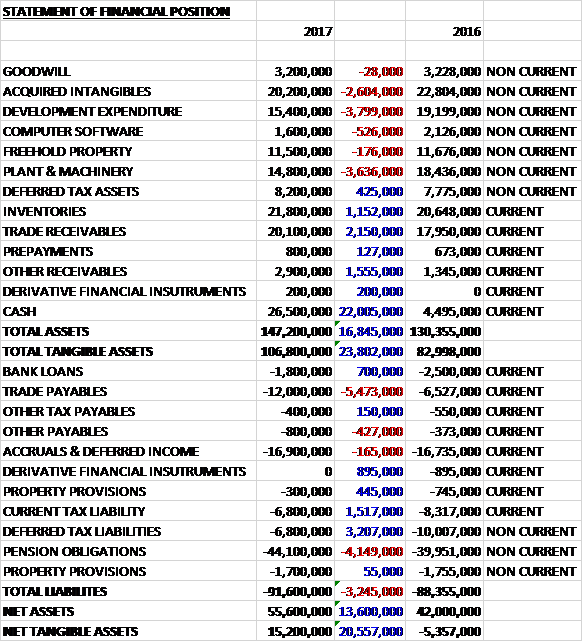
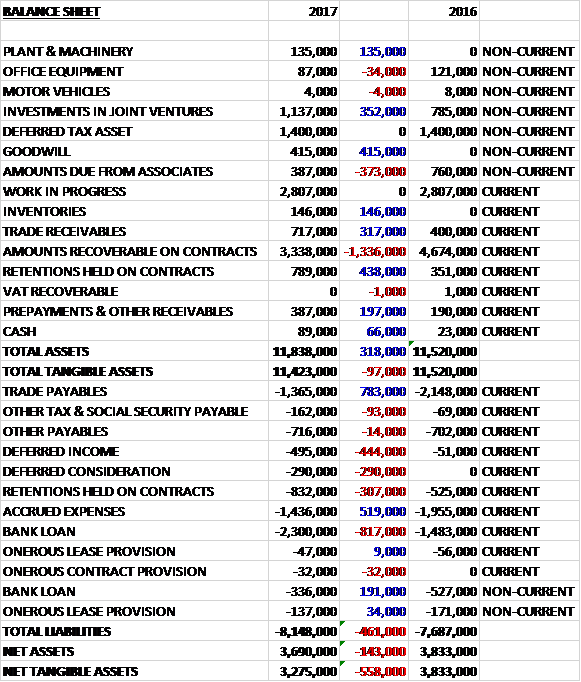
When compared to the end point of last year, total assets increased by £16.8M, driven by a £22M growth in cash, a £2.2M increase in trade receivables, a £1.6M growth in other receivables and a £1.2M increase in inventories, partially offset by a £3.8M decline in development expenditure, a £3.6M fall in plant and machinery and a £2.6M decrease in acquired intangibles. Total liabilities also grew during the year as a £3.2M fall in deferred tax liabilities and a £1.5M decrease in current tax liabilities were more than offset by a £5.5M growth in trade payables and a £4.1M increase in pension obligations. The end result was a net tangible asset level of £15.2M a growth of £20.6M year on year.

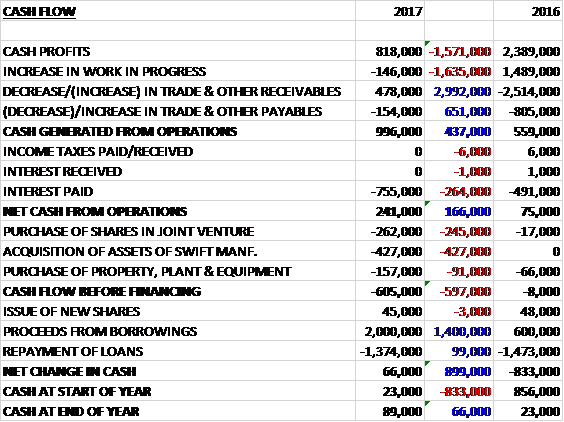
Before movements in working capital, cash profits increased by £6.8M to £37.2M. There was a modest cash outflow from working capital and after tax payments increased by £1M the net cash from operations was £32.5M, a growth of £2.2M year on year. The group spent £2.9M on development costs and £2.6M on property, plant and equipment to give a free cash flow of £27M. Of this, £3.2M went on dividends, £1M on their own shares and £800K on loan repayments to five a cash flow of £22M and a cash level of £26.5M at the year-end.

The underling profit in the Protection division was £18.8M, an increase of £5.2M year on year. A £24.2M increase in orders received together with favourable currency movements drove an increase in revenue of 13%. On a constant currency basis, revenue grew by 3.6% with flat military revenue, 6.1% growth in law enforcement and fire growing by 18%. Margins have improved due to the mix of product shipped and cost efficiencies.

Military revenue was up nearly 10% due to favourable forex movements. On a constant currency basis they were flat with the 37,500 FM50 general purpose respirator order offsetting lower DOD revenues. The group delivered 150,000 M50 mask systems and 144,000 filter pairs, compared with 189,000 mask systems and 122,000 pairs of filter spares in 2016. DOD spares and development costs revenue increased by £2.7M due to higher development costs relating to the M69 air crew mask. At the year-end there was an order book of 49,000 systems, including spares of £4.1M relating to 15,000 M50 face piece assemblies. Since the year-end they have received further orders for 118,000 filters and £4.5M of spares from the DOD.

Revenue from ROW military increased by £8.9M to £13.7M primarily due to the delivery of the 37,500 FM50 general purpose mask order. AEF had another soft year with revenues falling by £800K to £4M, reflecting the variability in timing of certain DOD procurement programmes for fuel and water storage tanks. The business experienced strong order intake in Q4 and enters 2018 with an order book totalling £4M. The group’s acquisition strategy will result, in the medium time, in AEF losing the benefits it currently enjoys under the US small business regime and the board are therefore considering the options for the business.

Within Law Enforcement, North American revenues grew by 22% on a constant currency basis to £20M, driven by strong performance in hoods and mask systems as the group continues to convert police forces to their C50 mask. The increase in fire revenue was driven by solid contributions from both SCBA and thermal imaging cameras.

During the year the group has been nominated as the preferred bidder for the resupply and in-service support of the UK MOD general service respirator. They group are actively pursuing further opportunities to broaden their military customer base.
During the year they experienced strong sales momentum in the law enforcement market and have seen increased demand for their escape products. In the US in particular, the group is expanding their market share. Over the mid-term, the board expect market share gains to continue. To cross-sell a broader range of CBRN systems, they look forward to launching their US powered air range once NIOSH approvals are received.

Their market for self-contained breathing apparatus in the fire sector remains competitive and with a fragmented customer base. The board see an opportunity to leverage their technology capability to enhance the product offering in this segment, however, and are in the process of upgrading their system to comply with the new 2018 NFPA standards. They have developed a revised sales strategy to ensure they deliver sustainable growth over the mid-term. The Argus thermal imaging camera technology they acquired in 2015 has been a significant addition to the fire products portfolio and has enabled them to open cross-selling opportunities across the product range.

Going forward, the previously reported M53A1 powered air respirator and M69 aircrew mask opportunities continue to progress with initial DOD orders expected in 2018. The board anticipate that the initial orders under these programmes will offset the non-recurrence of the 37,000 FM50 general purpose respirator order and anticipated lower M50 mask systems deliveries to the DOD during 2018 resulting in stable military revenues.

They expect similar levels of law enforcement revenue growth in 2018 driven by continued conversion of North American police forces to their C50 mask system and continuing demand for their hoods from a range of global customers. They also expect sales of their new PAPR range to build momentum once NIOSH approvals have been obtained. The board anticipate slower revenue growth in fire in the coming year as the growth rate for Argus thermal imaging cameras reverts to a more normal level.

The underlying profit in the Dairy division was £6M, a growth of £600K when compared to last year. Revenue increased by nearly 18% due to favourable currency movements and 6.6% on a constant currency basis. On a constant currency basis, Interface grew revenue by 4.3%, PCI by 20% and Farm Services by 19%. The growth trends reflect increased farmer confidence following sustained improvements in the milk price as the market recovers. Margins have softened due to increased investment to deliver growth in response to the improved conditions.

Interface revenue grew by 4.3% at constant currency driven by growth in Brazil and Europe. North American revenues declined by 1.1% reflecting a further decline in OEM revenues. In Europe, revenue grew by 15.6% and Latin America grew liner revenues by 29% reflecting market share gains in Brazil. Asia Pacific liner revenues declined by 1% as a result of difficult market conditions in China. Sales of PCI products have benefited from increased farmer confidence resulting in higher investment spend. Revenue grew by 20% driven by growth in Europe of 30% and 83% in Latin America, again reflecting their good performance in Brazil. In North America, PCI growth was 3.3%.

Farm Services has continued to show good growth with constant currency growth of 19%, driven by hikes in North America of 17% and 23% in Europe. At the end of the year, Cluster Exchange had grown by 25% to 35,000 cluster points serving 1,891 farms. To increase their European capacity they plan to open a Farm Services exchange centre in Italy in the coming year. During the year they launched the Pulsator Exchange in North America and from a zero base have introduced 478 Pulsators onto 11 farms. Tag Exchange will follow in 2018 with farm pilots underway and progressing successfully. They plan to launch Tag Exchange in both North America and Europe in 2018.

Going forward, the dairy market environment continues to be positive with improved milk prices and low feed costs reflected in increased farmer confidence. In this environment, the board expect that the growth trends experienced this year will continue into the next year, albeit with a moderation in the PCI revenue growth rate to around 10%.

In Avon Protection the most significant investments have been in further developing the M69 aircrew mask, the Deltair SCBA and MCM100 product range. In Milkrite, investment has been focused on expanding their PCI product range. The group has agreed to increase pension payments by £500K next year.

The £2.6M impairment of development expenditure and the £300K impairment of plant and machinery represents the write-down of costs of developing the Emergency Escape Breathing Device. Further development of this product has been terminated as there are limited commercial opportunities in the current market. This product is outside the core CBRN and respiratory range and was primarily developed for a US Navy contract that was awarded to a competitor in 2015.

Last year’s integration costs relate to the acquisition of the Argus thermal imaging camera business and the relocation of the manufacturing of their Melksham site. Last year’s loss from discontinued operations relates to dilapidations costs of former leased premises of a business that was disposed of in 2006.

As can be seen, the group once again received a tax credit this year. The tax credit this year included £7.2M (£4.4M) in respect of previous periods with a £2.3M credit in connection with company restructuring in previous years and the release of provisions following an updated assessment of uncertain tax positions.

This year an error was identified in the process for valuing the share based payments charge to the income statement. The comparative figures for 2016 have been restated to correct the charge which has increased the payment charge from £100K to £1M and to reduce the operating profit by £900K. This is quite a substantial error!

Going forward, the closing order book of £34M together with £26.6M of orders received after the year-end provides good visibility and the group is well positioned to deliver further growth in 2018. Within Avon Protection, the board expect initial orders for the M53A1 powered air respirator and M69 aircrew respirator programmes in 2018, with these orders offsetting the non-recurrence of the 37,000 FM50 general purpose respirator order and anticipated lower M50 mask systems deliveries to the DOD during 2018. In the medium term these programmes together with the UK General Service Respirator revenues are expected to offset any revenue reduction from anticipated lower M50 deliveries once the ten year sole-source contract ends in 2018.

The dairy market environment continues to be positive with improved milk prices and low feed costs reflected in increased farmer confidence. In this environment, they anticipate that the growth trends experienced by the business will continue to the new financial year.

At the current share price the shares are trading on a PE ratio of 17.9 which increases to 18.6 on next year’s consensus forecast, likely as a result of tax charges returning to normal. After a 30% increase in the dividend the shares are yielding 1% which increases to 1.2% on next year’s forecast. At the year-end the group had a net cash position of £24.7M compared to £2M at the end of last year.

On the 8th November the group announced that it had received confirmation from the US DOD of their participation under the joint enterprise contract vehicle. It is a ten year multiple award framework contract which established a group of qualified contractors to compete for orders in relation to chemical, biological, radiological, nuclear and enhanced conventional weapons defence systems, equipment and material.
This is the procurement structure under which two CBRNe programmes, the M53A1 respirator and the M69 aircrew mask system will be purchased. These programmes are potentially significant to the group in the medium term and initial task orders are expected to be received during the course of 2018.

On the 29th November the group announced that CFO Nicholas Keveth acquired 1,794 shares at a value of £20.8K.

On the 6th December the group announced the receipt of an order for 53,000 M50 mask systems worth $14.3M from the US DOD. This order together with the closing order book of 49,000 mask systems at the year-end secures the anticipated sales of the M50 mask systems to the DOD for 2018.

Overall then this has been a good year for the group with increased profits, net assets and operating cash flow, with loads of free cash being generated. Both divisions saw growth with protection being driven by growth in law enforcement and dairy by an improved confidence in the market. Both divisions were aided considerably by favourable forex movements. Going forward, growth is expected again next year with new programmes offsetting a decline in M50 mask deliveries as the contract with the DOD comes to an end. This I think is the main risk at the moment and if the new programmes don’t deliver as expected there could be problems.

The shares are not cheap, with a forward PE of 18.6 and yield of 1.2% but there is plenty of net cash and I am sticking with them for now.
On the 1st February the group released a trading update covering the first four months of the year where they stated that trading has continued in line with expectations. Order intake across the Protection business has remained strong. The military business enjoyed a positive start to the year and continues to build momentum for 2018 and beyond. Orders have been received from the US DOD which secure anticipated sales of M50 mask systems for the current year and contributes towards building the order book for 2019. The ROW military business has received the first commercial orders for the MCM100 underwater rebreather and is seeing increasing interest and orders for the recently launched Powered Air Products.

Law Enforcement delivered a strong start to the year with significant growth in order intake across the portfolio and growing sales of Powered Air Products in Europe and the ROW. The board anticipate receiving US NIOSH safety standards approval for this range in Q2, enabling them to launch in the country later in the year. The fire business has delivered in line with expectations.

Dairy market conditions have remained positive with milk price softness being offset by lower feed prices. The business has continued to perform well with revenue growth within precision control and intelligence and farm services particularly strong.

The continued strengthening of sterling against the dollar will impact results this year. If forex rates remain unchanged for the rest of the year, the adverse translational impact would be around 8% on revenue and profit compared to the previous guidance of 3%.

The net impact of the recently enacted US tax reform will be positive for the group. For the current year, the effective tax rate is around 14%, which includes a one-off favourable revaluation of the US net deferred tax liability and the release of provisions following the positive outcome of certain tax enquired. For future years, the effective rate of tax is estimated to be around 19%.

In conclusion, with a positive start to the year and the continued strong order intake the board is confident of achieving its current year expectations. Forex issues notwithstanding, this looks OK to me and I continue to hold.

On the 15th February the group announced that further to being the preferred bidder for the UK MOD General Service Respirator contract, they have entered into a five year contract with the MOD for the resupply and in-service support of its General Service Respirator. Production is expected to start during the first half of 2019, after product approvals are complete with the contract expected to generate revenues in the order of £16M over the five year period. The group will incur additional capex of £3M across 2018 and 2019 to obtain product approvals and prepare for production.

On the 23rd February the group announced that Chairman David Evans sold 10,000 shares at a value of £117.5K.

On the 3rd April the group announced that it had completed the disposal of Avon Engineered Fabrics, its US-based hovercraft skirt and bulk liquid storage tank business for a cash consideration of $9.25M. The business had been expected to make a small profit during the year.

Dewhurst Share Blog – Final Results Year Ended 2017

Dewhurst has now released their final results for the year ended 2017.

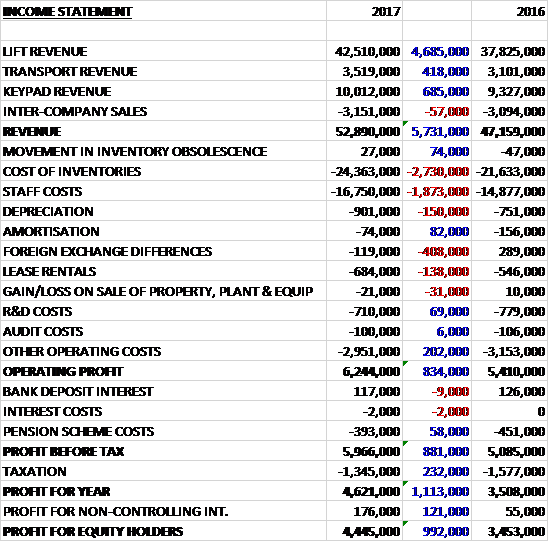
Revenues increased when compared to last year due to a £4.7M growth in lift revenue, a £685K increase in keypad revenue and a £418K growth in transport revenue. Cost of inventories increased by £2.7M, staff costs were up £1.9M and there was a £408K detrimental movement in forex but the operating profit remained £834K higher. There was a small fall in the cost of the pension scheme and tax charges reduced by £232K to give a profit for the year of £4.4M, a growth of £992K year on year.

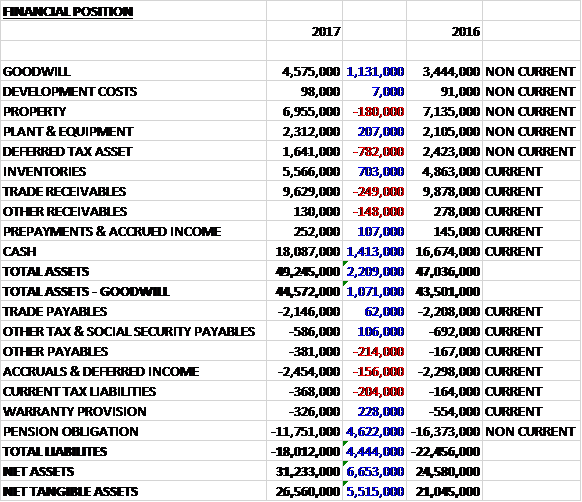
When compared to the end point of last year, total assets increased by £2.2M, driven by a £1.4M growth in cash, a £1.1M increase in goodwill and a £703K growth in inventories, partially offset by a £782K decline in deferred tax assets. Total liabilities declined during the year, mainly due to a £4.6M fall in pension obligations. The end result was a net tangible asset level of £26.6M, a growth of £5.5M year on year.

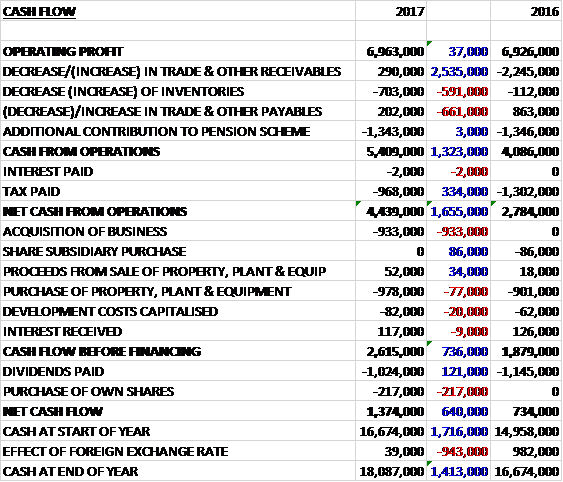
Before movements in working capital, cash profits were broadly flat at £7M. There was a cash outflow from working capital but this was less than last year and after tax payments were up £334K the net cash from operations was £4.4M, a growth of £1.7M year on year. The group spent £933K on an acquisition and £978K on capex to give a free cash flow of £2.6M. This easily covered the dividends of £1M and there was a positive cash flow of £1.4M for the year and a cash level of £18.1M at the year-end.

Overall, the real growth in sales this year came from the acquisition of P&R Liftcars (£2.2M) and the benefit from a weaker pound (£3.3M). The same two factors ensured the growth in profits, both contributing around £400K.

Dewhurst UK had a reasonable year but they were unable to continue the growth that they achieved last year. All regions, with the exception of Europe, showed slightly lower demand and they were also affected by a lull in production for projects in the Middle East. The board are confident that this lull is only temporary, however, and the New Year has started more positively with a number of delayed projects starting to move into production.

Deliveries of products for UK infrastructure projects have continued with the group’s products being used on the new Elizabeth Line in London. They have improved their manufacturing process and one key project has been to improve the flexibility of their push button pressel tooling. They can now mould all their ranges on their two pressel tools rather than just selective ranges. This has reduced the number of tool changes they need to carry out, reducing waste in terms of both time and materials.

It was another challenging year for Thames Valley Controls but the decline in sales has been arrested with the business showing a small increase. During the year they have gradually improved their production processes for the Ethos 2 controller. This will allow them to increase their capacity for this product line. They are investing in a new computer aided panel layout and wiring system that will streamline their engineering processes and will allow for automated transfer of information from engineering into production. Furthermore they recently completed the design and manufacture of four test simulators that will dramatically reduce the test time for an Ethos 2 panel.

The new features that are required to meet the EN81-20 standard have proved quite onerous but these have now been fully incorporated into the design and function of the Ethos 2 product line. During the year they have won and installed some major monitoring projects for both local councils and housing associations. Their new Non Invasive Monitoring systems has been particularly successful. The system interface allows them to provide full lift monitoring in closed-protocol lift control systems. It provides the benefits of full lift monitoring and breakdown identification to their customers irrespective of the make of lift. Through their online dashboard their customers can get instant breakdown advice and better management of repairs.

After significant growth last year, sales at Traffic Management Products grew once again this year but the increase was more measured with the first half of the year starting strong before demand tailed off during the summer months. Over the past year and a half they have launched a significant number of new products and have targeted additional export sales with particular success in the Far East. The business has decided to take control of their key supply chain processes such as moulding and lamination of their bollards and to integrate them into the business over the next two years.

At Dewhurst Hungary there was an 8% increase in sales but that growth was predominantly in the first half of the year and sales in the second half were disappointing. There has been a fairly significant reduction in demand for ATMs and this has impacted the business. There is a growing trend for contactless payments and associated with that there will inevitably be a reduced dependency on cash.
They have redesigned their stainless steel keypad which removes the key skirt that they have historically used which will make for a cleaner design and allow them to reduce the cost of the range.

In the Middle East, although it is early days, the group have already won a number of new projects and the outlook for the coming year is encouraging. They will predominantly source their products through the UK business and focus on fulfilling demand for the region for lift signalisation products. There is also an opportunity longer term to broaden the range of lift products marketed through the Middle East office.

In North America, sales fell back at Dupar Controls following some years of good growth. Despite the 6% fall in sales, however, they were able to improve their margins and closely control overheads which led to a year of record profits in Canada. They are looking to boost capacity in the business and to achieve this they are planning to reorganise the plant and invest in new manufacturing operations software that will help them better control their planning.

This was a very difficult year for Elevator Research and Manufacturing with sales falling sharply and significant losses being incurred. In the second half it became clear that they would need to restructure the business by mothballing the door and cab product lines and focusing solely on the core business of elevator signals. They completed the restructuring in the year and move into the New Year with a much more clearly targeted business and significantly lower overheads. They still believe that there are real opportunities for their products on the West Coast of the US and are working to resolve the challenges in the business.

The Australian market continued to be quite buoyant and all of the group’s Australian businesses showed solid growth. Australian Lift Components achieved the highest level of growth with strong demand for their signalling products. The business opened a new office in Brisbane which allowed them to better serve their customers in that area. Sales at Lift Material remained quite consistent throughout the year and the restructuring of the business into two divisions, elevators and escalators, has worked well, delivering growth for both divisions.

The group completed the acquisition of P&R Liftcars in early 2017. Based in Sydney, the business is similar to that of Dual Engraving. They design, manufacture and install custom lift interiors into lift cars in NSW and provide doors, entrances and other elements of steelwork for their lifts and escalators. Despite the Perth economy continuing to be somewhat soft, Dual Engraving grew their sales over the year. There are fewer major projects at the moment but there is still a steady base load of jobs. They are continuing to invest in new manufacturing plant to improve their processes and allow them to increase capacity and have just taken delivery of a new brake press.
Sales grew in Hong Kong by 16% to a new record level. This growth has been achieved by the sale of TMP products into the Hong Kong market. Sales of their lift products fell as the new property market softened but demand for lift products has shown signs of strengthening in the New Year.

Going forward, the weaker pound is benefitting the reported numbers but UK demand is more fragile at the moment and projects are subject to delay and deferral. Both these effects are at least partly caused by the uncertainty regarding Brexit so any progress in negotiations (or lack of) could materially affect future results.

Overseas demand in the lift market is more buoyant with North America, Australia and the Far East generally reasonably positive. The weaker demand for keypads in the second half has flowed through to the New Year, however and with contrasting significant positive and negative factors it is difficult to predict where the balance will lie.

At the current share price the shares are trading on a PE ratio of 11.4 which falls to 11.3 on next year’s consensus forecast. After an increase in the dividend the shares are yielding 2% which increases to 2.1% on next year’s forecast. At the year-end the group had a net cash position of £18.1M compared to £16.7M at the end of last year.

Overall then this has been a pretty decent year for the group. Profits grew, net assets increased and the operating cash flow improved with plenty of free cash being generated, although cash profits were flat year on year. The underlying performance isn’t quite as strong as this, however, as the growth in profits has come from the weakness of sterling and the acquisition, without which profits would have declined. The group seems to be struggling a bit with UK demand and some of the businesses in the US.

With a forward PE of 11.3 and yield of 2.1%, along with a load of net cash, these shares are not expensive and I really do like this company and the cautious management but I have a feeling the first half of the coming year might be a bit of a struggle and I am tempted to sell up.

Cranswick Share Blog – Interim Results Year Ending 2018

Cranswick has now released their interim results for the year ending 2018.

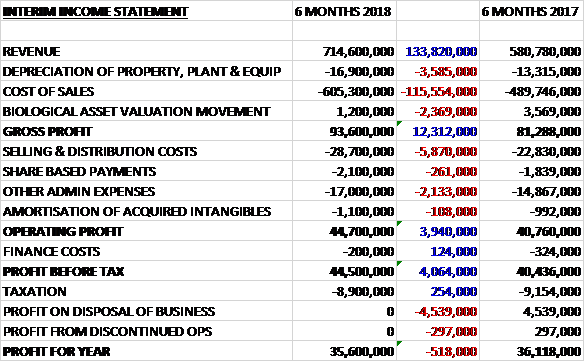
Revenues increased by £133.8M when compared to the first half of last year (£26M from Ballymena, £3.5M from Crown Chicken and the rest organic). Depreciation was up £3.6M, other costs of sales increased by £115.6M and there was a £2.4M fall in the growth in the value of the pig inventory to give a gross profit £12.3M higher. Selling and distribution costs were up £5.9M and admin expenses grew by £2.4M which meant that the operating profit was £3.9M higher. Finance costs were down £124K and tax charges fell by £254K but there was no profit from the discontinued operation which was £297K last time. All of this meant the profit for the period was £35.6M, a growth of £4M year on year.

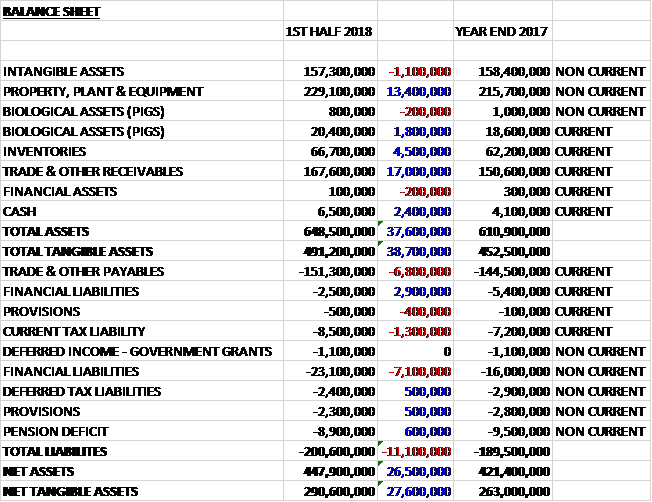
When compared to the end point of last year, total assets increased by £37.6M, driven by a £17M growth in receivables, a £13.4M increase in property, plant and equipment, a £4.5M growth in inventories, a £2.4M increase in cash and a £1.6M increase in the value of the pigs, partially offset by a £1.1M decline in intangible assets. Total liabilities also increased due to a £4.2M growth in financial liabilities, a £6.8M growth in payables and a £1.3M increase in current tax liabilities. The end result was a net tangible asset level of £290.6M, a growth of £27.6M over the past six months.

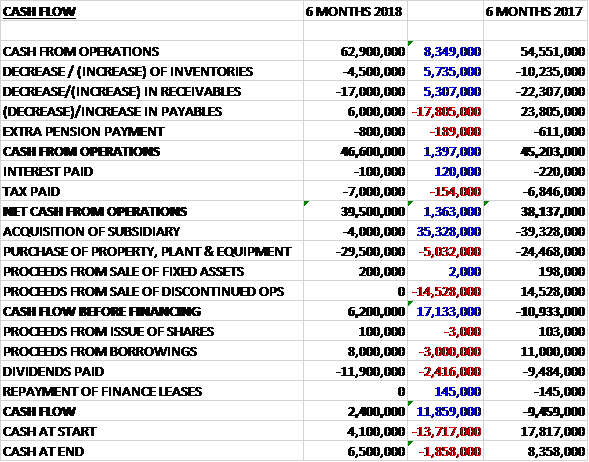
Before movements in working capital, cash profits increased by £8.3M to £62.9M. There was a cash outflow from working capital but an increased tax charge was offset by a reduced interest charge and the net cash from operations was £39.5M, a growth of £1.4M year on year. The group spent £29.5M on capex and £4M on an acquisition, relating to contingent consideration, to give a free cash flow of £6.2M. This didn’t cover the dividends of £11.9M and the group too out £8M of new loans to give a cash flow of £2.4M and a cash level of £6.5M at the period-end.

Fresh pork revenue increased by 26%. Excluding the contribution from Ballymena, like for like revenue growth was nearly 13%. Performance was comfortably ahead of the overall UK fresh pork market which saw volumes decline slightly. More recent market data has, however, been more encouraging with volume growth of 4% last quarter. Innovation has been the key driver of the positive trend with growth of meal kits and mid-week meal solutions supported by a strong AHDB TV advertising campaign. During the period the group also gained new listings including added value supper ranges and developed new processing techniques which have delivered significant eating quality improvements.
The Ballymena butchery hall extension was completed during the period resulting in capacity being increased from 8,000 to 12,000 pigs per week. Further investment is being made at the Hull facility to lift pig chill capacity and to upgrade the rapid chill system to improve yields. The group are also investing £4M in their Wayland operation to increase breeding and finishing capacity of premium pigs in response to customer demand.

Total export revenue grew by 30%, with a modest decline in sales to Far Eastern markets comfortably offset by a more than doubling of sales to other export markets which most notably include the US and Europe. Growth in these two markets reflected stronger volumes and higher prices resulting from Sterling weakness. Like for like export volumes grew by 19%. The UK pig price increased by 6% during the period, rising steadily through to the end of July before falling back slightly.

Convenience revenue increased by 17% reflecting the full contribution during the period of new business wins in the previous financial year. Again, growth was comfortably ahead of the overall market. Cooked meats sales were very strong reflecting the benefit of the new business wins. New product launches in the “Ready to cook” and “slow cook” ranges also helped underpin the strong growth. A further £7M of capex was made across the three cooked meats facilities during the period.

Sales of continental products were in line with the same period last year with higher prices, resulting from the weakness in Sterling, offsetting lower volumes following the loss of pizza toppings business with one retail customer. New business wins with other retail customers, including new platter range launches and pre-pack corned beef, boosted sales. The business continues to explore opportunities in the food service sector which offers good growth potential. Additionally the Woodall’s range of British charcuterie products continues to perform well with new listings secured in the period. The new £28M facility based in Bury is progressing to plan with completion expected in summer 2018. When finished the site will consolidate production from the two existing facilities, lift capacity by around 70%, add new capability and drive efficiency improvements on existing product lines.

In gourmet products, revenue increased by nearly 28% with all sub-categories delivering double digit volume growth. The overall market for these categories grew by 1% in volume terms but premium ranges were up by 9%. Strong sausage sales growth reflected the contribution from the new Butcher’s Choice business launched midway through the previous year together with new business wins launched in summer 2017. Both the Hull and Norfolk sausage facilities are gearing up for the peak Christmas trading period with two additional production lines installed in Hull.

New gammon and wet cure bacon business with one of the principal retail customers, secured in Q4 last year, helped drive strong bacon sales growth. Consumers continued to switch from standard tier lines into the premium ranges. Pastry sales grew strongly, reflecting the contribution from new business with a food to go customer launched at the start of the period. The business has also developed a range of frozen products for one of the group’s retail customers. These new business wins augmented continued growth with the site’s anchor retail customer. A strong new product development pipeline and full Christmas order book leaves the pastry business well placed moving into the second half.

The poultry business included the full contribution from Crown during the period with revenue up 27% and like for like sales growing 21%. The fresh and ready to eat chicken ranges categories continue to be the stand out performers in the wider UK meat protein sector, with market volume growth of 5% and 9% respectively. The Crown business continues to make progress. The management team has been strengthened and investment in the Weybread primary processing facility is driving efficiencies and lifting throughput. More birds are being portioned due to new contracts secured.

Sales of premium cooked poultry grew strongly in the period, reflecting underlying market growth and the launch of contracts with two of the group’s principal retail customers. Further lines have been added since these contracts were launched and looking forward there is a strong new product development pipeline to drive further growth.

The board has approved a £54M primary poultry facility in Suffolk with a further £13M associated investment to upscale existing milling and hatchery facilities. This facility is scheduled for completion in late 2019 and will double the existing capacity with further room for expansion. In July 2016 the group sold its shareholding in the Sandwich Factory.

Going forward, the board believe that the group is well positioned to deliver their expectations for the current year.

At the current share price the shares are trading on a PE ratio of 25.7 which falls to 22.8 on the full year consensus forecast. After a 15%increase in the interim dividend, the shares are yielding 1.5% which increases to 1.6% on the full year forecast. At the period-end the group had a net debt position of £16.7M compared to £11M at the end of last year.

Overall then this has been a good period for the group. Profits are up, net assets increased and the operating cash flow grew. The group is quite capex thirsty but despite this, a decent amount of free cash was generated, albeit not enough to cover the dividend. All aspects of the business seem to be performing well but with a forward PE of 22.8 and yield of 1.6% the shares are priced accordingly. Overall I’m comfortable with this investment.

On the 1st February the group released a trading update covering Q3. Like for like revenue was ahead of last year. Each of the group’s categories delivered growth, underpinned by a strong performance over the Christmas trading period. Total export sales were also well ahead. The UK pig price continued to ease during the period, ending the quarter at a similar level to that of a year ago and the downward trend is being reflected in selling prices. Overall though, trading in Q3 was slightly ahead of board expectations.

Construction on the new continental products facility based in bury is well advanced and progressing to plan with completion expected in H1 of next year. When finished the site will consolidate production from the group’s two existing continental products facilities, lift capacity by around 70%, add new capability and drive efficiency improvements on existing product ranges.

Plans for the new primary poultry facility in Suffolk continue to be developed, with construction expected to begin in Q1 next year. This facility, which is scheduled for completion in late 2019 will double existing capacity with further room for expansion. Net debt increased during the quarter, albeit it was below the level at the same stage of last year, reflecting the seasonal increase in working capital and ongoing capex.

Going forward, the board is confident in the prospects for the remainder of the year. This all looks fine, I continue to hold.
On the 12th February the group announced that director John Bottomley sold 8,000 shares at a value of £244K for “personal financial planning”.

Wentworth Resources Share Blog – Q3 2017

Wentworth Resources has now released their results covering Q3 for the year ending 2017.

Revenues increased by $1.7M when compared to Q3 last year. Production and operating costs were up $139K and depreciation and depletion increased by $411K which meant that the operating profit grew by $1.2M. There was a £585K decline in the accretion on the TPDC receivable but no change in estimate which cost $1.3M last time. After interest expenses grew by $164K and the deferred tax expense fell by $2.2M the profit for the period came in at $704K, an improvement of $4.3M year on year.

When compared to the end point of last year, total assets increased by $201K, driven by a $5.4M growth in receivables, a $2.4M increase in cash, and a $1.5M growth in exploration and evaluation assets, partially offset by a $6.5M decline in receivables from TPDC and a $2.1M fall in the value of natural gas properties. Total liabilities declined during the period as a $1.7M increase in the overdraft was more than offset by a $4.4M reduction in long term loans and a $1.3M decline of payables. The end result was a net tangible asset level of $133.1M, a growth of $2.7M over the past six months.

Before movements in working capital, cash profits increased by $1.5M to $2.1M there was a cash outflow from working capital and the cash from operations came in at $298K, a decline of $135K year on year. This didn’t cover the $511K of exploration costs or the $474K spent on development and production and the $658K that went on interest payments but the $2.1M receipt of long term receivables meant that before financing there was a cash inflow of $769K. Of this the group drew down $1.1M on the overdraft to help repay $2.3M of long term loans to give a cash outflow for the quarter of $471K and a cash level of $3.4M at the period-end.

The average gross daily production increased by 75% to 59.9MMscf per day and the production operating costs declined by 31% to 72c per MMScf. The full year production forecast remains within the previously guided range of 40-50MMscf per day.

During the quarter there was a 78% increase in gas sales to TPDC to 1,256,662MMbtu. During the period the group was supplying two power stations in Dar es Salaam: Kinyerezi-1 and Ubungo-II. Both of these power stations operated at near full capacity during the period with less repairs and problems occurred which resulted in the increase. In addition higher quantities of gas were used for electrical power generation in the period as hydro power generation was significantly reduced following the end of the rainy season and lower quantities of gas were supplied by industry competitors.

During Q2 TPDC started delivery of Mnazi Bay gas to its first industrial customer, a newly constructed ceramic tile factory, Goodwill Ceramics. Gas demand to power the factory is expected to reach 7MMscf per day by the end of 2017 and be sustained at that level thereafter. At the end of Q3, gas deliveries to the company were approximately 5.5MMScf per day.

Additional gas demand from growth in the industrial sector in Tanzania is expected to be realised in the near future. During 2017, TPDC concluded a commercial arrangement to supply gas to a Dangote cement plant and a new gas pipeline is in the process of being installed. The installation of a 35MW power generation unit and associated power supply to the Dangote cement plant is expected to be commissioned during Q1 2018. Dangote also announced a plan to eliminate coal and convert the entire plan to gas, envisaging a permanent combined cycle power plant being built on the premises of the Dangote Cement factory.

Initial gas demand of between 5 and 7MMScf per day for temporary power generation is expected to start towards the end of Q1 2018, The kilns are expected to be fired by natural gas starting in Q2 2018 and will require and additional 8MMscf per day, increasing to between 20 and 25MMScf per day in 2019. The temporary 35MW gas fired plant is planned to be replaced by the combined cycle plant using steam turbines in Q1 2019.

Additional gas fired power generation is expected to materialise in the next three to eighteen months with the completion and commissioning of the Kinyerezi-2 power station and the Kinyerezi-1 extension. The 240MW Kinyerezi-2 station is expected to start the commissioning process in December 2017 with the first six gas power turbines being tested and becoming operational. Completion of this process is expected by Q3 2018. Demand for gas to power this facility is expected to be 5MMScf per day to start up and reach 36MMscf per day by the end of Q3 2018. Commissioning of the 185MW Kinyerezi-1 extension is expected to start during Q4 2018 and once fully operational in 2019 is expected to require an additional 35MMScf per day.

During the quarter there was a 4% growth in gas sales to the TANESCO Mtwara power plant to 51,186MMbtu.

During the period minor works continued the expansion of the processing facilities at Msimbati which, together with the tying-in all five wells completes all the necessary field infrastructure work to enable delivery of gas volumes expected to be in excess of 100MMscf per day to the pipeline to Dar Es Salaam. Commissioning of these facilities is expected in December 2017. With the completion of these capital investments it is expected that there will not be a need for significant additional capex until the average daily demand exceeds 100MMscf per day for an extended period of time.

There seems to be some progress being made on these long term receivables. As of the period-end, the group was owed nine months of invoices for gas sales made to TANESCO, totalling $1.5M. Three months totalling $541K was received after the period-end with the company settling invoices in between seven and twelve months. As of the period-end the group was owed five months of invoices from TPDC totalling $10.4M. After the period-end they paid $1.6M for the February 2017 gas sales invoice and initiated a payment of $2.6M for the October 2017 gas sales invoice.

In July the government of Tanzania enacted three new laws which cover activities within the energy and mining sectors. Two of these are forward looking and contain new regulations stating that all arbitration processes must be heard within Tanzania and place restriction on the ability to move funds out of the country. The third act covers existing agreements and provides the right to the government to renegotiate clauses in existing agreements that are deemed to have unconscionable terms. Based on their current understanding of this new legislation the board do not expect any material impact on their existing operations in the short to medium term but it is unclear whether there will be any material impact in the long term.

In the period, activities in Mozambique mainly involved the reprocessing and analysis of existing seismic data with a view to identifying a well site location, obtaining environmental licenses, planning for the drilling of an appraisal well and completion of tenders for the procurement of a drilling rig and long lead time items such as casing and tubing for the well. The farm-out process is ongoing and the group anticipates securing a partner prior to starting drilling operations in 2018. Funding of the drilling of the Tembo 2 appraisal well will be through internally generated cash flows and sharing the cost with one or more industry partners.

Finalization of the well location and subsequent site visits to further inspect the site for the design of the well pad and site preparation have been delayed due to the deteriorating security situation in and around the Macimboa da Praia region which is next to the group’s concession area. Clashes between police and extremists have increased during October resulting in a heightened risk profile. The group is monitoring the security situation closely.

After the period-end, a further $850K was drawn down on the overdraft which means the facility is fully drawn. Current liabilities include outstanding cash calls issued by the operator of the Mnazi Bay concession for 2016 operating costs of $1.3M of which the company settled the full amount after the period-end. Their share of accrued Mnazi Bay activities for the nine months of 2017 was $4.1M which is expected to be settled through cash receipts from existing gas sales receivables.

Current liabilities also include the principal payment obligations on external credit facilities and the expected settlement of other liabilities also due within the next year. In Q1 the group reached an agreement with its main lender to defer payment of the January payment of $3.3M to Q2/Q3 and deferring later payments for a year. Principal payments of $5.3M are expected to be made in the next year.
The group is working closely with the operator of the Mnazi Bay concession and the external lenders to make settlement of these obligations coinciding with the receipt of cash from gas purchasers for settlement of gas sales invoices. To date the cooperation amongst all parties has allowed the company to effectively manage working capital. Existing gas sales receivables of $12M exceed the immediate obligations to the operator and to the external lenders.

During the rest of 2017 and 2018 the group expects to have no significant capex relating to exploration and development activities in Tanzania and anticipated development capital spending is limited to around $800K for general field development maintenance capital. In Mozambique spending on appraisal activities is expected to be limited to completing the necessary technical work to support drilling of an appraisal well in 2018, costs associated with securing an industry farm-in partner and administrative and support costs for managing the operation under the Rovuma onshore block in Mozambique.

Going forward this quarter was the highest quarterly sales volumes ever and the board expects gas demand to grow in the coming months with the commissioning of the Kinyerezi-2 power station and start of delivery of gas to the Dangote cement plant. The primary challenge continues to be the receipt of regular and timely receipts from TPDC and TANESCO. While the timeliness of cash receipts from TANESCO has improved since the start of the year, settlement of invoices for gas sales made to TPDC remains at between four and five months. While the group expects the situation to improve over the next year, significant effort and patience will be needed to be exercised by all parties.
The group is currently loss making and is expected to make a loss this year but next year the forward PE ratio stands at 90.3 which seems a bit steep.

On the 20th December the group announced that December payments had been received from TPDC totalling $2.5M. They also reported that gas delivery has started to Kinyerezi-2 for commissioning of the first two of six turbines. They continue to maintain 2017 full year production guidance of between 40 and 50MMScf per day.

On the 11th January the group released an operational update. Gas demand continues to grow following the start-up of Kinyerezi-2 with the first two of six turbines now operational which helped push the daily production exit rate for 2017 to 73.4MMscf. The average for Q4 was 62.2MMscf per day with the average production for the full year hitting 49.1MMscf, the upper end of the production guidance range of 40-50MMScf per day.

For 2018 the group expects further growth in gas demand from the Kinyrezi-2 power facility as an additional four gas fired turbines are expected to be commissioned during the year. New gas demand from the industrial sector is also expected from the Dangote Cement factory as well as other new industrial customers. For 2018, based on growing demand and taking into account the seasonal lower demand in Q2, full year production is expected to be in the range of 65 to 75 MMscf per day.
On the 15th January the group announced that Eskil Jersing joined as CEO. He was CEO of Sterling Energy, a UK-based oil and gas exploration company focused on Africa and the Middle East.

Overall then this seems to have been a period of progress for the group. Profits improved, net assets increased and although the operating cash flow declined, this was due to working capital movements and the cash profits increased. The group even managed to produce some free cash flow once the receipts of the long term receivables are taken account of. The question is, is this enough to sustain the growth of the group? The new power station and Dangote cement plant hint that sales should be even higher next year but the problem with actually getting paid for the gas in a timely manner persists. This is a problem as the group is stretched itself with regards to its own payables.

In conclusion, I think the group is moving in the right direction but the shares seem a bit expensive given the issues present.

On the 1st February the group announced that payments had been received during January from TPDC and Tanesco totalling $1.8M for gas sales during 2017. As expected they continue to settle invoices on a regular monthly basis.

On the 1st March the group announced that payments received during February for gas sales generated were $2.5M and gross production volumes during February from the Mnazi Bay field averaged 80MMscf per day, the highest monthly volumes achieved since production started.

Telecom Plus Share Blog – Interim Results Year Ending 2018

Telecom Plus has now released their interim results for the year ending 2018.

Revenues increased when compared to last year as a £767K reduction in customer acquisition revenue was more than offset by an £8.4M growth in customer management revenue. Depreciation was down £251K but other cost of sales increased by £2.2M to give a gross profit £5.7M higher. Admin expenses were up £4.5M due to higher technology, regulatory and staff costs, and there was a £221K increase in share incentive scheme charges which meant that the operating profit grew by £963K. Finance expenses fell by £278K but tax charges were up £607K to give a profit for the period of £14M, a decline by £198K year on year due to the lack of profits from discontinued operations (£832K last time).

When compared to the end point of last year, total assets declined by £28M driven by a £30.8M decline of prepayments and accrued income along with a £5.6M fall in the value of the energy supply contract, partially offset by a £5.1M increase in cash, a £2.3M growth in inventories and a £1.2M increase in receivables. Total liabilities increased during the period as a £43.3M decline in accrued expenses and deferred income was more than offset by a £44.3M increase in bank loans and a £1.1M growth in payables. The end result was a net tangible asset level of £38.4M, a decline of £25M over the past six months.

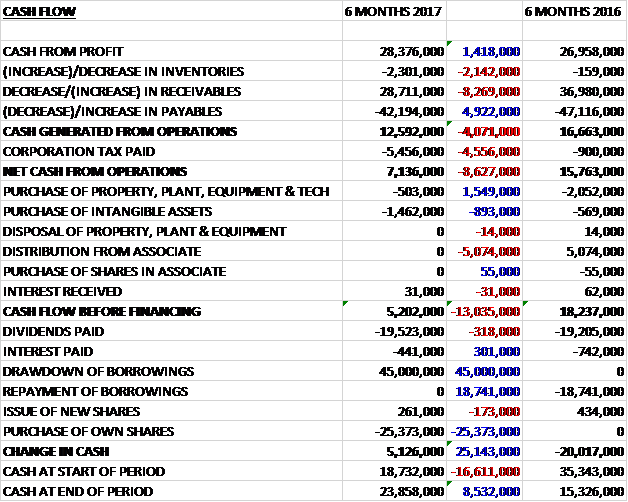
Before movements in working capital, cash profits increased by £1.4M to £28.4M. There was a cash outflow from working capital due to a decrease in payables, relating to timings of payments to suppliers, and after tax payments increased by £4.6M the net cash from operations was £7.1M, a decline of £8.6M year on year. Of this, £1.5M was spent on intangible assets and £503K on fixed assets to give a free cash flow of £5.2M. This didn’t come close to paying the dividends of £19.5M and their own share purchases of £25.4M so the group took out new borrowings of £45M to give a cash flow of £5.1M and a cash level of £23.9M at the period-end.

The growth in revenue was broadly in line with the increase in service numbers, which grew by 36,348 (52,037 last time) with the impact from higher telephony and energy prices being largely offset by a continuing decline in average energy usage due to warmer weather, the progressive impact of energy efficiency initiatives and the prepayment meter price cap that was introduced in April. The growth in service numbers was affected by the one-off loss of services (mostly fixed line telephony) relating to a migration programme from their legacy IPStream product onto faster fibre-based services.

Net customer acquisition costs had been expected to increase but remained broadly flat reflecting a steady level of investment in gathering high quality new members. These include the costs associated with Project Daffodil which continued. The quality of the membership base continued to improve with a steady rise in the proportion of members taking energy, broadband/phone and mobile services.

Churn rates in the electricity industry are running at a record annualised rate of nearly 20% and the Big 6 suppliers are losing customers to smaller outfits. The churn within the group is around 1% per month and they have increased market share.

Following a successful trial of insurance last year, the group continue to make progress in broadening the coverage and competitiveness of the quotes they offer through deeper relationships with more underwriters; gathering annual policy renewal dates from members; and developing a fully automated marketing and quote system to ensure maximum operational efficiency and convenience. By the end of the period they had around 1,800 live policies with encouraging month on month growth of new policy sales. While the focus in 2018 will be the scale roll-out of their home insurance product to their members, they will continue to invest resources into extending the range of insurance services they offer over the medium term.

It remains unclear if bundles linear TV services have a long term future or whether customers will increasingly choose to purchase the content they want and stream it to their devices as and when they want it. The group retain a watching brief in this area but will only enter the market if they find a way to do so that offers a satisfactory return. The group are also considering the supply and installation of gas boilers and providing boiler service and breakdown cover.

SSE and N Power have recently announced their intention to merge their UK domestic supply businesses, creating a new supplier which will become the second largest. The group have been informed that their current supply agreement with N Power is intended to become the responsibility of the new entity, and they will be discussing logistics with them over the coming months.

Service growth during the period was at the lower end of management expectations but the board are optimistic that the proposed SVT price cap will materially improve their competitive position and will act as the catalyst that takes their growth rates back towards the double digit levels they have historically achieved. Overall the board expect their adjusted pre-tax profits for the full year will be slightly ahead of current market expectations.

After a 4.3% increase in the interim dividend the shares are yielding 4.1% which increases to 4.2% on the full year consensus forecast. At the current share price the shares are trading on a PE ratio of 36.2 which falls to 21.4 on the full year forecast. At the period-end the group had a net debt position of £20.4M compared to a net cash position of £18.7M at the year-end.

Overall then this has been a bit of a mixed period for the group. Profits were down due to the sale of the Opus business, but like for like profits grew. Net assets declined and the operating cash flow was down due to working capital movements – cash profits increased and although an OK amount of free cash was generated, this did not cover the dividends. Overall business seems a bit subdued as increases in telephony and energy prices offset lower usage of energy, partly due to the weather.

The current state of affairs is likely to continue until the SVT price cap comes into force and then the group may once again enjoy some real growth. The forward PE of 21.4 is nothing to get excited about but the yield of 4.1% is not too bad. This could become an interesting safe play but I am not sure there is enough here yet to make me want in.

On the 19th April the group released a trading update covering the year ended 2018. Full year adjusted profits from continuing operations are expected to be around £54M, a growth of £700K and in line with previous guidance.

Throughout the year a significant gap remained between the low introductory fixed price energy deals available from some suppliers and the standard variable prices charged by the Big Six. In addition, the energy market saw record levels of switching with around 20% of domestic customers changing to a new supplier over the last year. Together these factors created a challenging environment although customer and service numbers both increased during the year.
Home insurance policy sales have grown steadily during the year to just under 5,000 households, as the group ramped up their internal resources and added new insurers to their panel. During Q4 they began a marketing campaign to existing members to gather their home insurance renewal dates with around 60,000 having been collected by the end of March. The renewal rates amongst the earliest customers who took a policy from them over a year ago are running at over 90%. The board are confident that home insurance will make a small initial contribution to group profits this year and thereafter become increasingly significant.

The group have completed the acquisition of a 75% shareholding in Glow Green, a fast growing supplier of domestic gas boilers and warranty care plans, for a total consideration of £2M. The intention is to support their existing management team in implementing their growth plans for the business by providing relatively modest working capital and promoting their services to their members.

Within the energy market, costs are rising, exerting an upward pressure on retail pricing. Combined with the proposed price cap expected later this year, this is expected to improve the group’s competitive position and lead to faster growth in the latter month of the New Year.

Despite lower average energy revenues and rising investment in their technology and systems, they expect the combination of a higher quality customer base, better commercial terms from wholesale partners, growing benefits from their smart meter rollout and an initial contribution from the extra services they added over the past year to deliver further growth in profits. In the absence of unforeseen circumstances, they expect adjusted pre-tax profits in 2019 to be in the range of £55M to £60M.

Cohort Share blog – Interim Results Year Ending 2018

Cohort has now released their interim results for the year ended 2018.

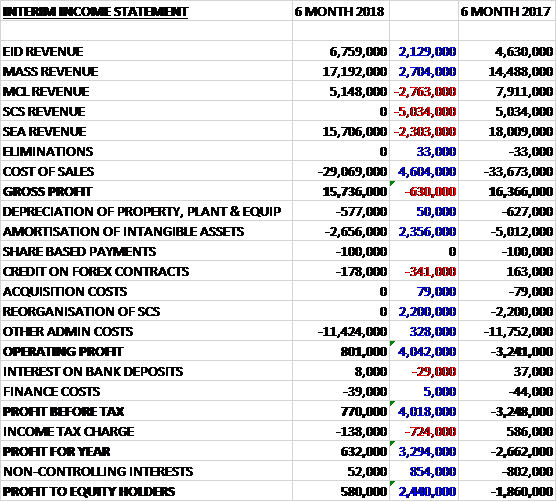
Revenues declined when compared to the first half of last year as a £2.7M growth in MASS revenue and a £2.1M increase in EID revenue was more than offset by the elimination of £5M of SCS revenue, a £2.8M decline in MCL revenue and a £2.3M fall in SEA revenue. Cost of sales also declined which meant that the gross profit was £630K lower. We then see a £2.4M reduction of amortisation charges and no reorganisation costs, which were £2.2M last time and after a £341K detrimental movement in forex contracts was offset by a reduction in other admin costs the operating profit improved by £4M. Interest charges were broadly similar but tax charges were up £724K to five a profit for the period of £580K, an improvement of £2.4M year on year.

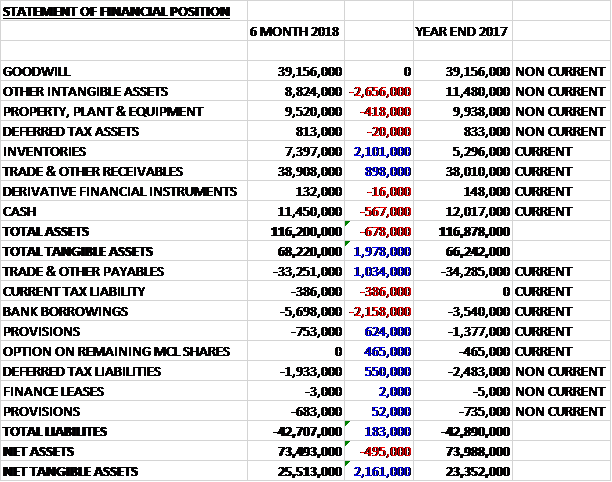
When compared to the end point of last year, total assets declined by £678K, driven by a £2.7M fall in intangible assets, a £567K reduction of cash and a £418K decrease of property, plant and equipment, partially offset by a £2.1M growth in inventories and an £898K increase in receivables. Total liabilities also declined during the period as a £2.2M growth in bank loans and a £386K increase in current tax liabilities were more than offset by a £1M decline in payables, a £676K fall in provisions, a £465K reduction in the option on the MCL shares and a £550K decline in deferred tax liabilities. The end result was a net tangible asset level of £25.5M, a growth of £2.2M over the past six months.

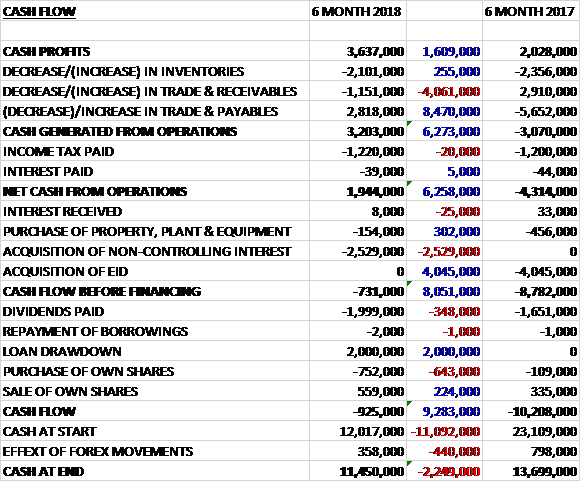
Before movements in working capital, cash profits increased by £1.6M to £3.6M. There was a modest cash outflow from working capital but this was less than last year and after interest and tax remained broadly similar, the net cash from operations was £1.9M, a growth of £6.3M year on year. The group spent £154K on capex and £2.5M on a non-controlling interest of one of their businesses which meant that before financing there was a cash outflow of £731K. The group then took out £2M of new loans to pay the £2M of dividends to give a cash outflow of £925K in the period and a cash level of £11.5M at the period-end.

The profit at EID was £1.2M, a decline of £203K year on year despite an increase in revenue. As expected, margins reduced from the unusually high level seen last year which, together with a smaller sales increase than expected due to the rescheduling of some deliveries into the second half, led to the lower profit. The second half will benefit from the 80% ownership of the business and the order book of £29.7M underpins all of the expected second half revenue.

The profit at MASS was £2.5M, a growth of £149K when compared to the first half of last year and included a £600K contribution from the Training Support business which was previously part of SCS. Elsewhere the business continued to deliver well in its key EWOS business and recent developments in this area give the board confidence that the business will remain a strong contributor to MASS.

There was growth from the cyber business, which includes the Metropolitan Police Service Digital Forensic Programme secured at the end of last year. There are opportunities to provide this service to other UK police forces as well as potentially to overseas customers although the priority at the moment is the delivery of the Met Police programme. The level of orders give the board confidence that MASS will have a stronger second half.

The profit at MCL was £167K, a decrease of £586K when compared to the first half of 2017 on lower revenues, which was below expectations. Some reduction was expected, reflecting the timing of deliveries of hearing protection systems but the result for the business was also impaired by the slippage of some milestones on one if its development projects where the UK customer rescheduled design acceptance.
Although reasonably well positioned for a much stronger second half, the business is seeing a reduction in expenditure in some of its UK market areas and this may affect second half revenue. The delayed project will also see revenue slip into 2019. The board nevertheless expect the performance for the year as a whole to be similar to last year.

The profit at SEA was £1M, broadly flat year on year with a decline of just £6K on lower revenues, despite the inclusion of some of the profitable parts of SCS. The margin saw an improvement due to increased deliveries of maritime systems to export customers offsetting a further reduction in research activity.

In the maritime division, deliveries of torpedo launch systems to export customers began, offsetting a relative lull in its activity on the UK submarine communication programmes due to a gap between substantive completion of design work for the Astute Class and the expected increase in activity on Dreadnought Class. Like SEA, the business is seeing a lower level of spend in the UK, especially in its maritime support framework contracts. Research has continued to be weak with most land activity halted and the remaining SEA work focussed on the maritime area. As a result the business has taken action to mitigate costs and absorbed the reduced research work into its simulation, support and product division.

Elsewhere in the business, SEA’s range of ROADflow products continue to see growth, especially of its new motion system which targets yellow box junctions and banned right turns. This division also contains some former SCS lines of business which contributed £200K of profit. The oil and gas sector remains challenging, although the business remains profitable due to some reduction in overhead costs.
The closing order book contains a significant amount of higher margin maritime systems work for export customers and the pipeline of opportunities gives the board confidence that the business will have a much stronger second half and overall they expect the performance of the business to be similar to last year.

The SCS business was discontinued and accounted for a £455K loss last time.

During the period the group acquired a further 23% of EID from the Portuguese government for £3.5M which takes their shareholding up to 80% with the government owning the other 20%. Also during the period a final amount of £2.5M was paid to the former shareholders of MCL.
Going forward, a stronger second half performance is in prospect which maintains the board’s expectations for the year. Nearly £55M of the £132.1M order book is deliverable in the second half and underpins 83% of the forecast revenue although it should be noted that the order book as a whole has fallen from £136.5M at the year-end. Prospects for further order intake in the second half are encouraging though and there will be the benefit of five months’ contribution from 80% of EID. Overall, allowing for the fact that they have proportionally more to do in the second half, and notwithstanding the pressures in the UK market, the board believe the group can maintain their expectations for the full year.
In their key markets, they continue to see a focus by the UK MOD on areas such as submarines, special forces, cyber defence and secure communications whereas in other areas such as research and product support for some in-service equipment, they have experienced lower demand, with purchases either reduced or delayed. Elsewhere Portugal is seeing a relatively robust level of spend with upgrades to both maritime land and communications systems and the recently announced Portuguese defence budget shows an increase in procurement spend of around 9%.

At the current share price the shares are trading on a PE ratio of 45.2 which falls to 13.9 on the full year consensus forecast. After a 16% increase in the interim dividend the shares are yielding 1.8% which increases to 2% on the full year forecast. At the period-end the group had a net cash position of £5.7M compared to £8.5M at the year-end.

Overall then this has been a bit of a difficult period for the group. Profits were up but this was due to lower amortisation costs (perhaps to do with impairments) and no reorganisation costs, without which profits would have been lower. Net tangible assets did improve and the operating cash flow also improved but no free cash was generated. All of the businesses saw profits down on an underlying basis with slippage of orders, lower UK spend in some areas and continued weakness in research. H2 is expected to be better but much hangs on delivering this expected performance. I don’t think the forward PE of 13.9 and yield of 2% adequately covers this risk so I think I might sit this one out for a while longer.

On the 30th January the group announced that SEA had been contracted by a UK government agency to lead a team in the area of Soldier System Research and Development. The contract has an initial value of £700K for 2018 but is likely to continue until 2021 with a potential value in excess of £3M. Under the contract the business will lead a team of specialist companies to develop a weapon system that combines novel and emerging small arms technologies to produce an integrated system that will deliver greater efficacy for the individual soldier on the battlefield.

Vertu Motors Share Blog – Interim Results Year Ending 2018

Vertu has now released their interim results for the year ending 2018.

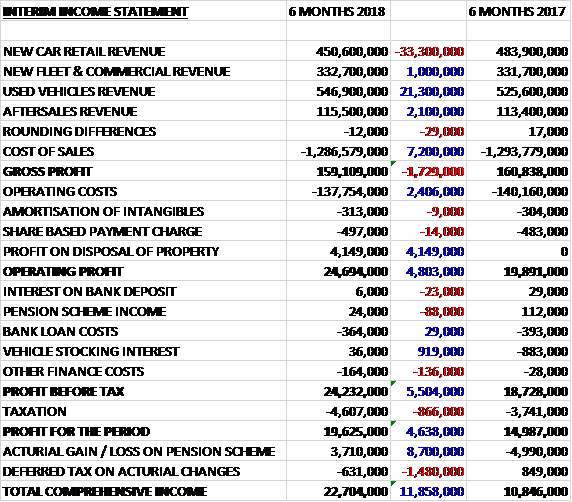
Revenues declined when compared to the first half of last year as a £21.3M growth in used vehicle revenue was more than offset by a £33.3M decline in new car revenue. Cost of sales also reduced but not enough to stop the gross profit falling by £1.7M. The group did manage to reduce operating costs by £2.4M, however, due to lower numbers of sales executives and less marketing, and after the £4.1M profit from the sale and leaseback the group saw operating profit rise by £4.8M. We then see a £919K positive movement in vehicle stocking interest, offset by an £866K increase in tax to give a profit for the period of £19.6M, a growth of £4.6M year on year or a £489K increase excluding the property sale.

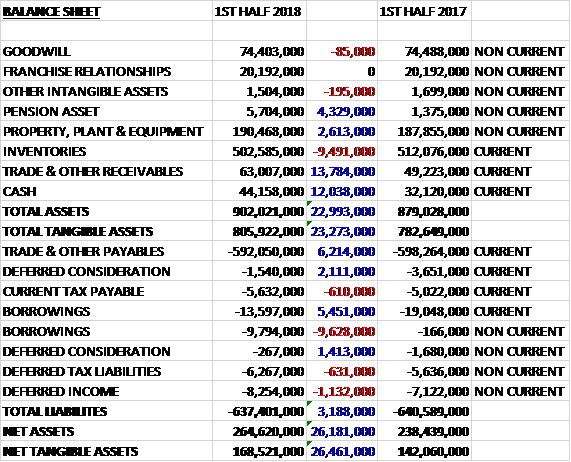
When compared to the end point of last year, total assets increased by £23M driven by a £13.8M growth in receivables, a £12M increase in cash, a £4.3M growth in the pension asset and a £2.6M increase in property, plant and equipment, partially offset by a £9.5M decline in inventories. Total liabilities declined during the period as a £4.2M growth in borrowings and a £1.1M increase in deferred income was more than offset by a £6.2M decrease in payables and a £3.5M fall in deferred income. The end result was a net tangible asset level of £168.5M, growth of £26.5M over the past six months.

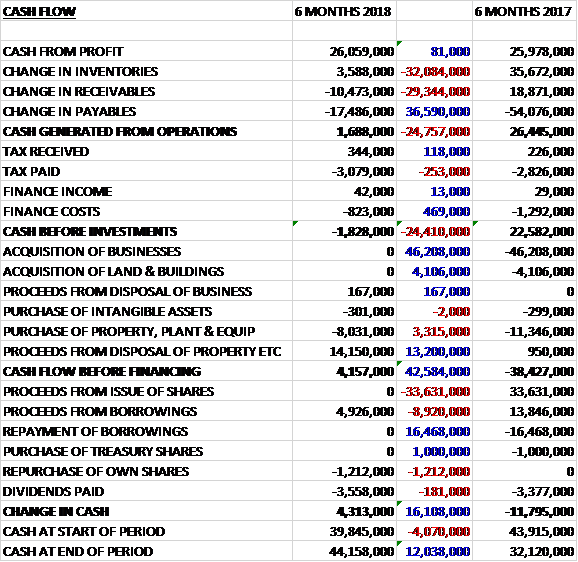
Before movements in working capital, cash profits were broadly flat. There was a large cash outflow from working capital, however, due to a reduction in payables and a growth in receivables. After tax payments increased by £135K and finance costs fell by £469K, there was a cash outflow from operations of £1.8M, a detrimental movement of £24.4M year on year. There were no acquisitions and a net £6.1M was received from the sale of property so there was a free cash flow of £4.2M. Of this, £3.6M was spent on dividends and £1.2M on share repurchases but the group also took out £4.9M of new loans to give a cash flow of £4.3M in the period and a cash level of £44.2M at the period-end.

As can be seen there was a significant cash outflow from working capital in the period. As the pipeline of manufacturer new vehicle consignment inventory expands, the group benefits from the cashflow relating to the VAT reclaimed on this inventory which has yet to be paid for in cash. Equally when the pipeline of new vehicle consignment inventory contracts, the group repays the VAT on the amount of the reduction. During the period the group repaid £16.8M of VAT as pipeline new vehicle consignment inventories fell. This sounds a little dubious to me actually! No mention of this when the group was benefiting from the cash flow!

Current year estimated capex is expected to reduce from £37.5M indicated at the time of the May results to £29.7M currently.
The gross profit in the Aftersales division was £64.2M, a growth of £1.3M year on year. The main driver was the servicing and repair of vehicles, where like for like revenues grew by 4.4%. A key tool to drive customer retention is the sale of service plans, and the group now has 104,142 (97,427) customers who are paying monthly for their service and MOT on the group’s own plans. In addition, a significant number of manufacturer service plans are in place with the group’s customers which further aids retention.

Like for like service margins fell slightly due to the shift in mix towards lower margin warranty work and increasing technician pay levels. Initiatives are being introduced across the group to increase capacity through shift patterns, longer opening hours, mobile van servicing and utilising two technicians per ramp for routine service work to enhance productivity.

The gross profit in the Used Vehicles division was £49.8M, a decline of £2.5M when compared to the first half of last year. Used vehicle sales from internet derived enquiries rose 22% reflecting the importance of the internet. The group is now embarking on an aggressive marketing strategy of its all-encompassing online retailing platform for used cars which is a unique proposition in the UK.

Like for like used vehicle volumes grew by 1.1% in the period while like for like gross profit per unit fell from £1,266 to £1,205. Like for like margins fell from 10.2% to 9.5%, in part due to continued higher average selling prices. The decline in margin was most acute in the premium franchises where weakness was particularly evident around the General Election. Used car margins stabilised later in the period with reduced supply into the market following the reductions in new car volumes.

In March the market was strong, mirroring the new car environment and continued high levels of consumer confidence. Between April and June consumer confidence weakened. High supply levels of part-exchange used cars from the March plate change month coincided with a more challenging consumer environment which resulted in drops in residual values in the wholesale market. This impact was more evident in premium marques and nearly new vehicle segments where margins saw considerable pressure. July and August saw improving wholesale market stability driven by a shortage of supply as new vehicle sales volumes declined, which has created a more robust environment for residual values.

The gross profit in the New car retail and Motability division was £34.3M, a decrease of £700K when compared to the first half of 2017 due to the enhanced performance from the dealerships acquired in the prior financial year (core gross profit declined by £1.3M due to the lower volume of vehicles sold). Like for like car retail volumes in the group fell by nearly 15% with pricing pressures due to currency evident as selling prices rose 5%. The Motability new car market has been under pressure due to the impact of Government welfare reforms, coupled with the pressure on manufacturers in this low margin channel due to currency fluctuations. Motability registrations in the UK fell 4.8% with the group seeing a 5% like for like fall in sales. The gross margin strengthened from 7.2% to 7.6%, however, despite the impact of rising sales prices.

The gross profit in the New fleet and Commercial division was £10.8M, a growth of £200K year on year. The group has increased its market share of the higher margin premium fleet market and engaged less in low margin supply in the volume sector which is reflected in the 6.8% reduction in like for like volumes.

During the period, Sterling traded at lower levels against other major currencies and this currency depreciation has impacted the supply side of the UK new vehicle market as it is less profitable for most manufacturers to import vehicles into the UK. As a consequence, many manufacturers have increased selling prices, reassessed their UK marketing budgets and sought alternative and more profitable markets to which to divert production. These trends have been most acute in volume franchises and have reduced the supply of new vehicles into the UK market.

On the demand side, the uncertainty around the General Election and Brexit vote created a very volatile consumer environment, although confidence has appeared to recover from July onwards. During the period there was considerable media focus on the impact of diesel vehicles on emissions and urban air quality. Consumer demand across vehicle markets reacted to this with a moderate shift of demand into petrol and alternative fuel vehicles. Over the period consumers increasingly realised that diesel vehicles under current production and produces in recent years have a lower environmental impact than older vehicles and demand levels for diesels remained resilient.

Against this background, the March plate change months, which was helped by the pull-forward of registrations due to increase in excise duty in April was a very strong month for UK new vehicle registrations with growth of 4.4% but since March, the remaining five months of the period recorded declines with UK retail registrations for the period down 6.4%.

In August the group completed the sale and lease back of a property operated by a JLR dealership in Leeds. This transaction realised £14.2M in cash and a profit of £4.1M. Further realisations of surplus property is expected over the next year.

During the period the group started a programme of share buy backs under which 3.8m shares have been purchased, deploying £1.6M of cash. A further programme of up to £3M of share buy-backs has just been announced.

Going forward, overall the full year pre-tax profit is expected to be in line with market expectations. The aftersales outlook looks strong with 104,142 active service plans compared to 97,427 last year, used car residual values are strengthening due to reduced supply into the market and the board expect there to be opportunities for acquisitions at more attractive valuations over the next year and a half.
The market conditions described above have not changed significantly during September with weak Sterling causing supply constraints on new vehicles along with pricing pressures. During September, several manufacturers announced scrappage, swappage and switch schemes in an attempt to stimulate the new vehicle market but UK new vehicle private registrations in September were down 8.8%.

The group’s September like for like new vehicle retail volumes fell by 14.8% and this reduced overall profitability from new vehicles year on year. New vehicle margins remained robust as the group achieved manufacturer targets for the quarter at high levels. The group’s used vehicle volumes in September were flat. In recent months, used car residual values have hardened which continued into September and manufacturer scrappage schemes may further tighten supply and underpin used car residual values going forward.

The market for aftersales remains strong as the vehicle parc has continued to grow following several years of strong new vehicle markets. In conjunction with the group’s customer retention strategies, this provides the board with confidence regarding the sustained and growing profit generation from this channel. Aftersales revenues and profits in September were strong.

At the period-end the group had a net cash position of £20.8M compared to £21M at the end of last year. At the current share price the shares are trading on a PE ratio of 8.1 which falls to 7.6 on the full year consensus forecast. After a 10% increase in the dividend the shares are yielding 3% which increases to 3.1% on the full year forecast.

Overall then this has been a robust performance in a difficult market. Profits were up, net assets increased but despite cash profits being flat, there was a big fall in the operating cash flow as the group repaid VAT – it is unclear whether this has unwound or will continue. The new car performance is clearly struggling and volumes were down nearly 15% in September. This weakness has also indirectly affected used cars but margins seem to be firming there. Aftersales continue to be strong and really are the main driver if profitability.

I still don’t get the strategy of selling and leasing back property, only to spend the cash on share buy-backs – this seems very short sighted to me, particularly as the group only recently hit up the market for more cash. Despite this, with a forward PE of 7.6 and yield of 3.1% this is starting to look decent value. The new vehicle market will remain tough but I suspect the other areas will keep the group going so I am tempted to make a purchase here but I note that the consensus forecast is for EPS to fall in 2019 so I might hold fire.

On the 25th January the group released a trading update covering the four months to December. The board expects trading performance for the year as a whole to be moderately below current market expectations, following further declines in the new car market resulting from the depreciation of sterling and a softer general consumer environment.

In the Aftersales market, the group reported continued like for like revenue growth of 3.7%. Whilst service margins declined slightly due to increased labour costs, overall like for like aftersales gross profit grew by 2.2% as parts margins strengthened. There was a 3.2% reduction in like for like used vehicle volumes and a slight reduction in gross margin in the period due to a softening consumer environment and lower levels of pre-registration undertaken as new cash supply into the UK declined.

The group’s like for like new retail vehicle volumes declined by 13.2%, reflecting the franchise mix, and was below the SMMT data of 9.5%. They achieved their manufacturer volume targets, however, and like for like margins were stable with gross profit per unit increasing by 3% to £1,450. The group’s fleet car and light commercial van business has continued to gain market share during the period with new like for like fleet cars growing by 12.4% against an SMMT decline of 11.8%; and new light commercial vans up 0.4% compared to a decline of 4.9% in the market as a whole. This is a very strong performance but the changing mix between car and van sales resulted in a reduction in fleet and commercial margins from 3.7% to 3.3%.

The group has now completed its exit from the Fiat Group business with the closure of Worcester Fiat and Alfa Romeo. In addition, in January the group disposed of a dealership in Boston which was loss making, realising an estimated £1.7M in cash including a freehold property.

Going forward the market for aftersales remains strong as the UK vehicle parc has continued to grow and the board are confident regarding the continuation of a strong performance. The board believes that the used car market will be more buoyant than the new car market in the months ahead and they remain cautious in the new car arena ahead of further forecast updates from the SMMT.

UK new car volumes in the current quarter are likely to reflect the wider trading environment and are likely to be significantly lower than the comparative period, which will include the strong pull-forward impact in the month of March of the changes to Vehicle Excise Duty which took effect in April 2017. While positive on the performance of aftersales and used car channels, the board is cautious on the outlook for the next financial year as new car profitability remains under pressure and cost increases continue. I’m steering clear of this for now.

Ashley House Share Blog – Final Results Year Ended 2017

Ashley House has now released their final results for the year ended 2017.

Revenues declined when compared to last year as a £3.5M growth in housing revenue and a £727K increase in modular revenue was more than offset by a £6.4M decrease in health revenue. Cost of sales also reduced but the gross profit was £1.2M lower. Admin expenses declined by £118K and there was an £88K growth in joint venture income. There was no impairment of the joint venture assets this time, which accounted for £1.5M last year but other operating income was down £581K to give an operating profit £91K higher. Interest payment grew by £264K, however, which meant that the profit for the year was £55K, a decline of £192K year on year.

When compared to the end point of last year, total assets increased by £318K, driven by a £438K growth in retentions held on contracts, a £415K increase in goodwill, a £352K growth in the value of joint venture assets and a £317K increase in trade receivables, partially offset by a £1.3M decline in amounts recoverable on contracts and a £373K fall in amounts due from associates. Total liabilities also increased during the year as a £519K decline in accrued expenses and a £783K decrease in trade payables was more than offset by a £626K increase in the bank loan, a £444K growth in deferred income and a £307K increase in retentions held on contracts. The end result was a net tangible asset level of £3.3M, a decline of £558K year on year.

Before movements in working capital, cash profits declined by £1.6M to £818K. There was a cash inflow from working capital and after interest payments grew by £264K the net cash from operations came in at £241K, a growth of £166K year on year. The group spent £262K on joint venture shares, £157K on tangible fixed assets and £427K on an acquisition to give a cash outflow of £605K before financing. The group took out a net £626K of new loans which gave a cash flow for the year of £66K and a cash level of £89K at the year-end.

The last few months has seen the completion of two further extra care housing facilities in Harwich and Walton, both for Essex County Council. The group has continued to extend its housing pipeline although the delivery of these schemes continues to be delayed by the Government’s intention to restrict housing benefit to the LHA rate. The board believe a resolution to the issue of the cap is close but in the meantime they have been working with funders to create contractual structures that allow them to proceed with developments.

The two developments in Essex were funded by their partner, Funding Affordable Homes, and leased to the registered provider One Housing. The Harwich development consists of two buildings with a total of 70 one and two bedroomed apartments with communal facilities and Walton features 60 apartments with similar communal facilities. In the year the group also completed two developments for the charity HFT, one a block of seven flats for people with learning difficulties and the other a 12 bed unit for residents with dementia.

Despite the continuing difficulties with Government funding in the health segment, the group is currently on site with three health developments, including the diagnostic and treatment centre in Durham and two GP surgeries, in Swansea and Wivenhoe (Essex). All three projects are funded by Assura. In the year they also completed the refurbishment of lab facilities in Basildon Hospital.

The effective Government hold since late 2015 on funding extra care housing developments has restricted the group’s ability to reach financial close on many of their pipeline schemes but they have continued to grow the pipeline during the year including adding schemes such as care homes that are not dependent on the resolution of the LHA cap. The housing pipeline now stands at £197.9M across 23 schemes compared to £162.7M across 18 schemes last year. The health pipeline shows five schemes valued at £14.1M compared to £20.6M across ten schemes last year.

A significant development this year was the increased involvement in F1 Modular, and the acquisition by F1M in March this year of the assets of an experienced offsite manufacturer. The business is now a 76% subsidiary of the group with the remaining shares held by F1M management. It has a growing pipeline with places on local authority frameworks LHC1 and LHC3 and most recently obtained a place on the new ESFA schools framework. The business works in the private sector building retail units and housing although it is increasingly focussing on satisfying demand in the affordable housing and education sectors. F1M is currently in production with a pilot scheme of affordable houses in Banbury and social housing bungalows in Consett.

The current economic conditions create uncertainty over the level of new schemes required by social housing clients; the ability of the company to process its pipeline of extra care schemes due to the LHA rent cap; the level of new schemes required by the NHS; the contribution earned to cover the cost base; and the availability of corporate finance in the sector. The group’s ability to progress its significant pipeline of extra care housing schemes has been stymied since 2015 due to the LHA rent cap. The group has therefore developed relationships with specialist funders who are able to acquire extra care housing schemes on a forward-funding basis, ahead of the Government’s solution to the rent cap. The board expects these relationships to enable a number of their extra care housing schemes to progress to contract in the second half of the year.
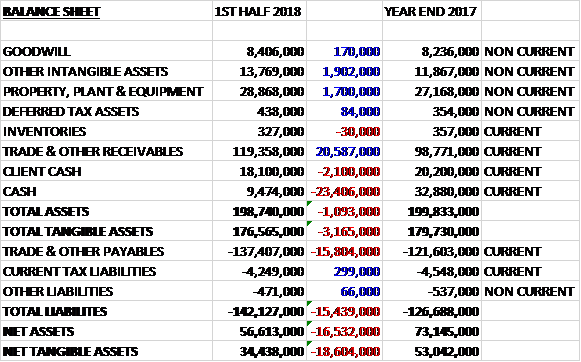
Going forward, the first half of the New Year has to date been challenging with no schemes reaching financial close, but an agreement with new partners will mean a much improved outlook for the second half. The group are working to extend and widen their financing options to ensure they are able to continue to invest in their pipeline as new agreements are developed and the delivery of the pipeline is accelerated.

At the current share price the shares are trading on a PE ratio of 114.9 but this falls to 4.3 on next year’s consensus forecast. No dividend was paid or recommended. At the year-end the group had a net debt position of £2.5M compared to £2M at the end of last year.
On the 26th October the group announced that the Government is set to drop its plans to cap housing benefit in the supported living sector to LHA rates. This change should enable the group to unlock many schemes in its housing pipeline.

On the 24th November the group commented on this week’s budget and the move to increase funding for both health and housing property schemes. Within health, significant funding is being directed to Sustainability and Transformation Partnerships which, amongst other things will facilitate closer integration between health and social care. Within the housing sector, the government is committing increasing funding benefiting the group’s modular offsite offer as well as supported living.

The group has also noted the positive reaction by its funding and registered provider partners to the government dropping its plans to cap housing benefit in the supported living sector. Subject to there being no material changes in the forthcoming consultation process, the group is confident that their housing scheme pipeline can now progress.

They are targeting financial close on two housing schemes in the next few weeks. One is a traditional build and the other is modular with the start of the build phase expected in the early New Year. The group continues to look to extend and widen their financing options to enable them to grow, to further invest in their pipeline.

On the 15th December the group announced that they had signed a joint venture agreement with Morgan Sindall to develop extra care and supported living housing. They will transfer the majority of the pipeline schemes from their housing division to the joint venture, which Morgan Sindall paid £4M for a 50% interest. The group have already received £2M with a further £500K due in early January and the remaining £1.5M contingent on certain completion mechanics, expected in early 2018.

With the recent budget changes signalling a positive change of policy in this area, the board believes that the creation of the joint venture with accelerate delivery of their pipeline, providing a platform to grow the business to the benefit of both partners.
Other than two current housing schemes which are shortly due to reach financial close, all extra care, care and supported living pipeline schemes will become part of the joint venture and will then constitute the entirety of the group’s housing division. Following the transaction the group will continue to operate across three divisions. Its existing modular business and its health property development divisions are unaffected by the transaction. The group intends to apply the consideration received by the company in connection with the transaction to pursue their strategy and provide working capital to all of their activities.

Going forward the board expect the interim results to show a loss but they expect to be profitable for the full year. They consider that this joint venture agreement will enable them to de-risk a significant area of their business and build a stronger project pipeline.
On the 22nd December the group announced that director Maureen Moy sold 550.000 shares at a value of £72.6K. She remains interested in 4,600,000 shares.

Overall then this has been a difficult year for the group. Profits fell, net assets declined and although the operating cash flow improved, this was due to working capital movements and no free cash was generated. The first half results will be poor, with no schemes reaching financial close but the big news has been the lifting of the LHA cap and the joint venture with Morgan Sindall which really shows a way forward to monetise the impressing housing pipeline. The health pipeline is looking rather poor, however, but the group should be profitable for the full year. Indeed, the consensus forecast for the forward PE is just 4.3, suggesting the shares are good value if this comes to pass.

This is an interesting one, the near term half year results will be poor but further out things really seem to be more positive and I am wondering if this could be a good high-risk punt at these levels.

Paypoint Share Blog – Interim Results Year Ending 2018

Paypoint has now released their interim results for the year ending 2018.

Overall revenues declined when compared to the first half of last year as a £2.8M growth in Romanian revenue was more than offset by a £2.5M decline in UK revenue, a £546K decrease in Irish revenue and the elimination of North American and French revenue. Commission payable reduced by £1.9M and there were no scheme sponsor charges, which accounted for £1.7M last time but the cost of mobile top ups increased by £1.4M and depreciation/amortisation was up £1.3M. After other cost of sales reduced by£596K the gross profit was down £2.6M. Share based payments were up £301K but other admin expenses fell by £3.1M due to the lack of mobile payment admin expenses to give an operating profit £158K higher. There was no share of joint venture profit, which was £443K last time and finance costs were slightly higher but a £417K decrease in tax charges meant that the profit for the period was £19.8M, a growth of £58K year on year. It is also worth noting that the discontinued Mobile business brought in £828K last time.

When compared to the end point of last year, total assets declined by £1.1M as a £20.6MK increase in receivables, a £1.9M growth in other intangible assets and a £1.7M increase in property, plant and equipment was more than offset by a £25.5M decrease in cash. Total liabilities increased during the period due to a £15.8M growth in payables. The end result was a net tangible asset level of £34.4M, a decline of £18.6M over the past six months.

Before movements in working capital, cash profits increased by £1.5M to £29.5M. There was a cash outflow from working capital but this was nowhere near as much as last time and after a £1.9M increase in the amount of corporation tax paid, the net cash from operations was £19.5M, a growth of £10.7M year on year. Of this, £4.1M was spent on property, plant and equipment and £3.9M went on intangible assets to give a free cash flow of £11.4M. The group then paid out £37.2M in dividends to give a cash outflow of £25.7M in the half year and a cash level of £27.6M at the period-end.

Within Retail Networks, the total number of terminal sites grew by 2.2% as a 10.4% increase in Romanian sites was partially offset by a 0.8% decline in UK and Ireland sites. In the UK they introduced standardised service fees for legacy terminals across 14,000 sites and as a consequence saw a 1.9% reduction in the customer base.

Transactions across the retail networks declined by 2.9% with the UK declining by 5.3% and Romania up 6.6%. Transaction value was 2% lower than the prior period but net revenue was up 5%, driven by increased service revenue from Paypoint One. The impact of declining transactions was mitigated by improvements to client mix, renegotiation of symbol commissions, increased average top-up values and increased eMoney volumes which have a higher margin per transaction.

Bill and General transactions were down 6.2% with UK energy transactions falling by 9% due to the Big 6 energy providers losing market share, reduced levels of consumer energy debt, higher temperatures and the continued uncertainty around the impact of smart meters and the delays to their roll out. The MultiPay service performed well, however, doubling transactions in the period. Continued strong growth in Romania resulted in the addition of 14 new clients and the country saw volume growth of 6.2%. Net revenue decreased by 1% as the decline in transactions was mitigated by improvements to client mix.

Top-Up transactions reduced by 12.4% as a result of the continued decline in the UK mobile top-up volumes which was partly offset by an increase in UK eMoney top ups and Romanian top ups. Net revenue increased by 7.6% to £10.3M, despite transactions declining as a result of renegotiation of symbol commissions, increased average top-up values and increased eMoney volumes which have a higher margin per transaction.

Overall Retail Services transactions increased by 6.1%. Parcels volumes increased by 13.6%, card payment transactions increased by 5.5% and ATM transactions by 3.4%. Net revenue growth of 13% was greater than transaction growth, mainly as a result of strong growth from PayPoint One service fees, standardised service fees for legacy terminals, improved card payment margins and the change in VAT treatment in the second half of last year for card payments resulting in a benefit of £500K. These benefits were partially offset by the revised commercial terms with Yodel for parcels with an impact of £1.4M on a like for like basis.

Excluding the admin expenses from the mobile payments business last year, admin expenses grew by 8.3%. These higher costs relate to PaypointOne rollout, IT investment costs in relation to CRM, Paypoint One and data centre migration, people costs and irrecoverable VAT which increased by £300K due to the change in VAT treatment of card payments. The increase is weighted to the first half of the year and the board expect minimal growth in the second half as the investment required to deliver Paypoint One to their retailers decreases
After the period-end the group acquired Payzone SA in Romania for an initial consideration of £1.4M plus £400K in deferred consideration. Last year the business produced a pre-tax profit of £200K.

Going forward, the full year outlook remains in line with previous guidance. The group remain on target to achieve 8,000 PaypointOne sites by March. With the launch of EPoS Pro and the focus on increasing their pricing mix, they expect continued growth in the average weekly fee per site. They also plan to implement an option for retailers to have net settlement for card payments. In ATMs they intend to growth their network in the second half while also reviewing the implications from LINK’s recent proposals to reduce the interchange rate for their ATM business. ATMs remain an important business for them but they may adjust their network plans to remove sites that become unprofitable should the proposals to reduce interchange revenues go ahead.

In parcels, underlying trends remain favourable with increasing outlets and continued growth in UK online shopping. Following the restructure of the Collect+ joint venture with Yodel last year, the group now have the opportunity to extend their network to other carriers so they expect continued growth in parcel volumes with the addition of new carriers.

In UK bill payments and top-ups, the group will continue to add more clients to their MultiPay service and extend it to other sectors but there is uncertainty relating to the roll out of smart meters and the general long-term decline of cash and top-ups which will continue to impact the payments business. They hope to continue to renew key contracts with an improvement in revenue per transaction rates, however. In Romania the focus over the next six months will be to start network optimisation, integrating the business and to drive cost efficiencies following the Payzone acquisition.

At the current share price the shares are trading on a PE ratio of 14.6 which increases to 14.7 on the full year consensus forecast. After a 2% increase in the dividend the shares are yielding 5.7% which grows to 6.5% on the full year forecast.
Overall then this has been a solid period for the group. Profits were up due to the lower rate of tax, otherwise they would have been lower due to no contribution from the mobile business. Net assets declined as more capital was returned to shareholders but the operating cash flow improved with a decent amount of free cash flow being generated.

Romania continues to be strong but the UK is more mixed. Generally speaking revenues are holding up as a better product mix is offsetting lower transactions. Whether this can continue given the apparent structural decline in the UK top-up market and the generally lower use of cash is really the crux of the matter here. The forward PE of 14.7 is not very exciting given the lack of growth but the yield of 6.5% looks interesting. The dividend is not sustainable at this level but the shares could be worth a look. A tricky one this…

On the 15th January the group released a trading update covering the quarter to the end of December. Group like for like net revenue grew 3.6% to £31.8M. Actual net revenue declined 4.3%, however, as last year there was a one-off VAT recovery of £2.4M. The decline due to the VAT recovery was partly offset by strong growth in Paypoint One service fees and a strong performance in Romania. Group retail networks transaction volume reduced, as expected, by 1.7% due to lower UK bill and general volumes, partially offset by strong volume growth in Romania.

UK retail services net revenue decreased by 18% reflecting revised commercial terms with Yodel and the card payment VAT recovery. Card payment transactions grew by 3.4% and ATM transactions grew 1.4%. In light of the performance of some of their ATM sites and Link’s proposals to reduce the interchange rate, the group have started an initiative to reallocate a portion of their ATM estate to better performing locations. Collect+ Parcel service volumes declined by 3.1% as a result of reduced volumes in Yodel.

UK bill and general net revenue decreased by 3.3% as transaction volumes declined by 10.5%. This was driven by a 14% reduction in prepay energy volumes, offset somewhat by continued momentum in Multi Pay where transactions increased 80%. The strategy of pursuing an increased mix of smaller but higher yielding clients continues to perform well, partly offsetting the impact of reduced transactions. UK top up transactions declined by 16% as a result of UK prepaid mobile transactions reducing by 19%, partially offset by increased eMoney top-ups.

Romanian net revenue grew by 42%, mainly driven by the acquisition of Payzone in October with its integration progressing well.
Overall performance met the board’s expectations and the full year outlook remains in line with previous guidance.

Goodwin Share Blog – Interim Results Year Ending 2018

Goodwin has now released their interim results for the year ending 2018.

Revenues declined when compared to the first half of last year as a £2.5M growth in refractory engineering revenue was more than offset by a £10.5M decline in mechanical engineering revenue. Cost of sales did also fall but not enough to prevent gross profit decreasing by £1.3M. Distribution expenses increased by £150K and share based payments were up £515K but this was offset by a £1.6M profit on the sale of some assets and a £225K decrease in other admin expenses to give an operating profit £144K lower. Finance expenses reduced by £141K and there was a £64K increase in the share of profit from an associate so that after tax charges fell by £173K the profit for the period was £4.2M, a growth of £276K year on year.

When compared to the end point of last year, total assets increased by £4.2M driven by a £2.6M increase in cash, a £3.4M growth in receivables and a £1.1M increase in property, plant and equipment, partially offset by a £2.2M fall in inventories and a £1.2M decrease in the derivative financial asset. Total liabilities also increased during the period as a £3.1M increase in the overdraft was only partially offset by a £1.4M decline in other borrowings. The end result was a net tangible asset level of £77.8M, a growth of £2.3M over the past six months.

Before movements in working capital, cash profits declined by £1.2M to £8.5M. There was a small cash inflow from working capital compared to a large outflow last time and after tax payments reduced by £206K the net cash from operations was £8M, an improvement of £16.5M year on year. The group spent a net £3M on property, plant and equipment along with £355K on R&D to give a free cash flow of £4.3M. The group repaid loans of £1M and finance leases of £429K and after dividend payments of £3.1M there was a cash outflow of £333K and a cash level of -£1.9M at the period-end.

The profit in the Mechanical Engineering division was £2.7M, a decline of £2.1M year on year. The profit in the Refractory Engineering division was £5.3M, a growth of £3.1M when compared to the first half of last year. There has been a particularly good period for the businesses that supply consumables to the jewellery casting industry which is in a period of revival. The performance of the division was also enhanced by the demise of a major competitor based in the US which has resulted in a substantial surge in order input.

Good progress has been made in India where there is significant growth in the overall economy and the submersible pump business and jewellery investment powder business are expected to achieve record trading results this year. The Indian pump business is also benefiting from sales orders arriving from the newly formed pump business in South Africa which will make respectable profits in its first year of trading.

The profit for the period has benefited from a gain of £1.6M that was realised when Gold Star Powders India sold its one acre of land and factory facility purchased for £110K. The business has now moved to the same site as Goodwin Pumps India. The group don’t see an upturn in the release of new orders for new capacity in the oil and gas or mining markets until 2020 but they have been focusing on trying to win business in nuclear recycling and decommissioning and processing of mining industry waste materials. An example of this is the receipt of a $7.3M order for large machined and fabricated stainless steel castings for the nuclear fuel decommissioning industry in the US.

The current workload stands at £84M, unchanged from a year ago. The order input for the period is the same as last year and due to the persistent low activity in the oil and gas industries, the group further reduced the labour force by 50.

Going forward, due to the further improvement on the refractory engineering side of the business, the board expect to see group profitability in the second half starting to move forward again.

At the current share price the shares are trading on a PE ratio of 23.2. I have no forecast so have to go on this. There is no interim dividend but including the final dividend, the shares are yielding 2.2%. At the period-end the group had a net debt of £27.5M compared to £28.5M at the year-end.

Overall then this has been a bit of a mixed period for the group. Profits increased but this was due to the sale of the Indian property, without which they would have declined. Net assets did improve and although the operating cash flow improved, this was due to working capital movements and cash profits declined. Nevertheless, there was an OK level of free cash being generated. The mechanical engineering business continues to struggle as it relies on the oil and gas industry but the refractory engineering business is performing well, particularly those supplying the jewellery sector. The group is predicted to return to growth in H2 but with a PE ratio of 23.2 and yield of 2.2% I would say this is already priced in and the shares are still looking a bit expensive to me.