Origin Enterprises Share Blog – Final Results Year Ended 2017

Origin Enterprises has now released their final results for the year ended 2017.
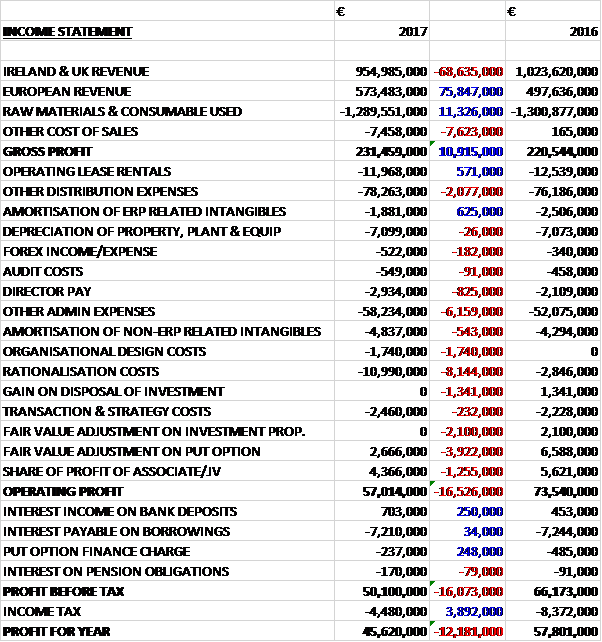
Revenues increased when compared to last year as a €68.6M decline in UK and Irish revenue was more than offset by a €75.8M growth in European revenue. Raw material costs declined by €11.3M but other cost of sales increased by €7.6M to give a gross profit €10.9M higher. Distribution expenses increased by €1.5M, director pay was up €825K and other admin expenses grew by €6.2M. We also see rationalisation costs up €8.1M, organisational design costs of €1.7M, no gain on investment disposals, which was €1.4M last year, a detrimental movement of €6M on fair value adjustments and a €1.3M reduction in the share of profit from associates, all of which meant that the operating profit decreased by €16.5M. The group did make a small improvement in finance costs/income and tax charges fell by €3.9M, however, to give a profit for the year of €45.6M, a decline of €12.2M year on year.
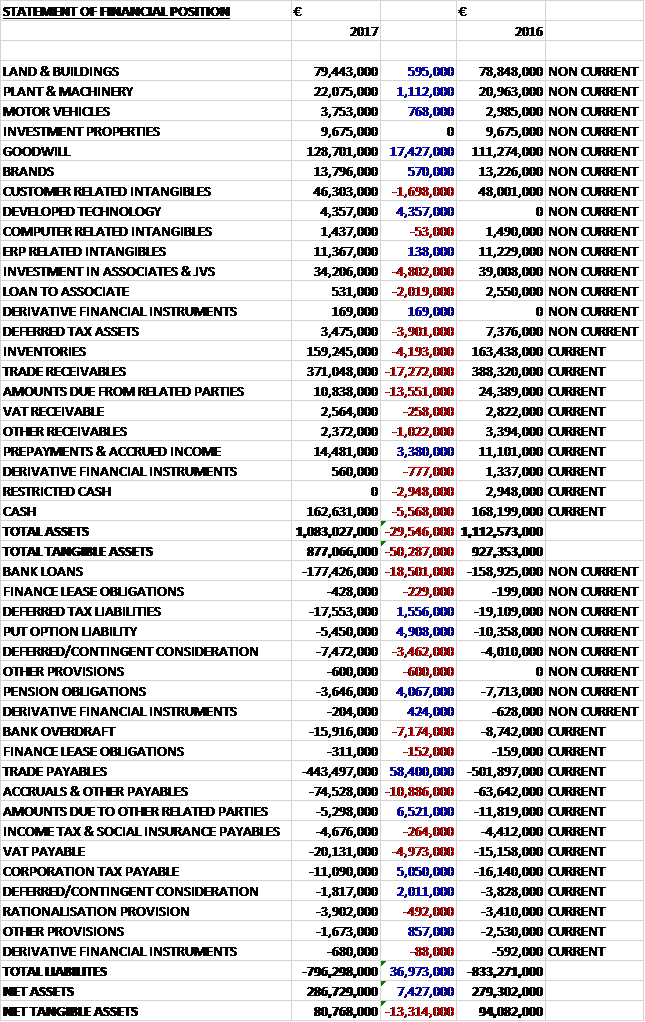
When compared to the end point of last year, total assets declined by €29.5M, driven by a €17.3M reduction in trade receivables, a €13.6M fall in amounts due from related parties, a €4.8M decline in investments in joint ventures, a €5.6M decrease in cash and a €4.2M fall in inventories, partially offset by a €17.4M growth in goodwill and a €4.4M increase in the value of developed technology. Total liabilities also declined during the year as an €18.5M increase in bank loans, a €10.9M growth in accruals and other payables and a €7.2M increase in the overdraft was more than offset by a €58.4M reduction in trade payables and a €6.5M fall in amounts due to related parties. The end results was a net tangible asset level of €80.8M, a decline of €13.3M year on year.
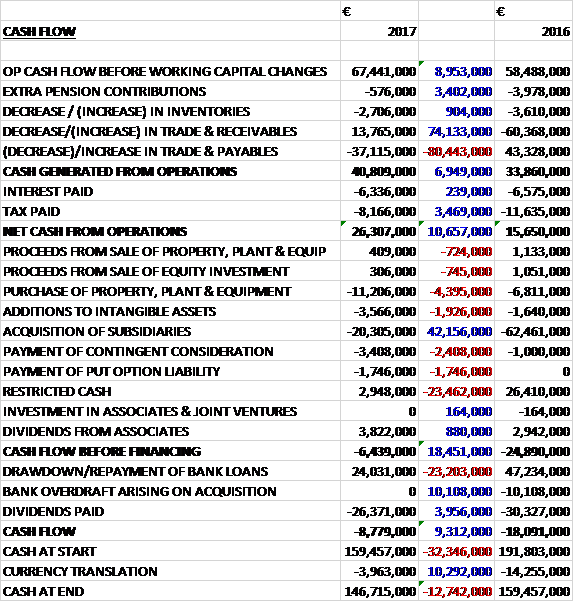
Before movements in working capital, cash profits increased by €9M to €67.4M. There was a cash outflow from working capital but this was similar to last year and after tax payments fell by €3.5M, the net cash from operations was €26.3M, a growth of €10.7M year on year. The group spent €11.2M on property, plant and equipment, €3.6M on intangible assets, €20.3M on acquisitions, €3.4M on deferred consideration and €1.7M on a put option, although they did receive €3.8M in dividends from associates. Despite this there was a cash outflow of €6.4M before financing. The group then drew down €24M of new loans to pay the €26.4M spent on dividends to give a cash outflow of €8.8M for the year and a cash level of €146.7M at the year-end.

Although headline revenue only increased by 0.5%, on a constant currency basis, this increase was 3.4% with this movement principally reflecting increased service revenue and input volumes. Underlying growth in agronomy services and inputs was 5%. With improved margins, the underlying operating profit at constant currency increased by 12% compared to the 4% actual increase.

The operating profit in the UK and Irish business was €54.7M, a decline of €778K year on year with a 1.3% growth in the core business being offset by a 21% decline in associate and joint venture profits. On a constant currency basis, the movement was a growth of 12% and a decline of 14% respectively. The positive impact of sterling depreciation on crop output values along with a favourable backdrop to global diary markets, and lower unit costs for key inputs, were all drivers of an improvement in farm incomes.

The group’s agronomy and on-farm services business delivered a satisfactory performance following particularly difficult trading conditions last year. Higher output prices in local currency together with lower than expected input cost inflation supported increased services and input demand. The business had a renewed focus on high service channels and value added technologies, resulting in higher volumes and improved margins across all portfolios. The business continues to extend the group’s position in the provision of systemised crop technology transfer direct to farm. This is supported by a comprehensive service offer, market leading agronomic research and technical support, and strong software based support capabilities.

There was strong progress on the integration of Resterra, which complemented a very satisfactory performance from Digital Agriculatural Services. Priority focus areas since the acquisition have included the development of new agronomy applications, organisational design and the launch of precision farming services across the European business.

Business to business Agri-inputs delivered good growth in profits in the period with performance principally supported by higher volumes and margins in fertilizer. Strong early season demand for fertilizer drove higher volumes for the year as a whole as primary producers benefitted from greater certainty in raw material pricing and more favourable farm economics. Speciality nutrition applications maintained solid development momentum and underpinned improved margins in the period.

The amenity business achieved a very satisfactory performance, reflecting good underlying volume growth across all business channels. The integration of Headland was completed in the period and in July the group acquired Linemark.

Feed ingredients achieved a satisfactory performance underpinned by good volume growth in competitive trading conditions. Volume improvement largely reflects a more favourable demand backdrop resulting from a combination of higher dairy cow numbers and improved returns for grassland farm enterprises that are seeking to maximise milk production following the abolition of production quotas in 2015. The group’s animal feed manufacturing associate delivered a satisfactory performance in the period.

The operating profit in the European business was €14.8M, a growth of €1.7M when compared to last year. Underlying agronomy services and input volumes increased by 6% reflecting the positive growth momentum in the sales of value added technologies. Market conditions were generally very competitive as farmers responded to volatile output markets and the impact of the challenging growing season in 2016. The operating margin reduced from 4.6% to 4.1%, however, reflecting the timing of acquisitions last year.

Poland delivered a solid performance. Higher margins were underpinned by an improved portfolio mix of value added technologies. On-farm activity showed positive momentum against a weak 2016 comparison, but service and input demand was largely subdued reflecting a delayed start to spring seasonal activity and the impact on primary producers of poor harvest yield and quality last year. Total winter and spring plantings were broadly in line with last year. The new €6M seed processing and input formulation facility is on target to be operational early in the 2018 financial year. This facility will enhance the product capabilities of the business and extend its market leadership in the provision of high performing certified seed varieties to Polish farmers.

Romania delivered a strong performance in the period with good growth achieved across the principal sales channels. Demand was resilient in the case of the main cropping enterprises underpinned by a 2% rise in the total cropping area. Crop development was satisfactory, notwithstanding the impact of intermittent unseasonal weather patterns in Q3. Nutrition portfolios performed strongly in 2017, reflecting the focus on meeting demand from primary producers for improved ranges and speciality applications. Good progress was achieved in business integration with the continued development of trial demonstration farms and knowledge transfer infrastructure supporting the delivery of enhanced technical support on-farm.

Ukraine delivered a good performance in the period, achieving higher revenues and margins underpinned by a favourable portfolio mix of services and input technologies. An improved macro-economic backdrop contributed to a more favourable financing environment for primary producers. Total winter and spring plantings were broadly in line with last year. Soil fertility and seed technology applications maintained good growth momentum with new customer gains supported through an expansion of the sales force together with an extension of the regional distribution footprint of the business. Solid progress has been made during the year leveraging the group’s supply chain partnerships to secure access to high spec technologies.

The group has announced the establishment of a dedicated digital, precision agriculture and crop science collaborative research partnership with University College Dublin, supported by Science Foundation Ireland. This five year development programme underpinning the research partnership is being financed by a €17.6M investment which is co-funded by Origin and SFI.

There were a number of acquisitions during the year. In November they purchased David Dumosch, an agricultural and horticultural merchant. In March they acquired Resterra, a digital agricultural services group that provides an enhancement to their digital technology capabilities with particular emphasis on expanding their data driven group management solutions framework. In July they acquired Linemark UK, a sports and amenity paint manufacturer supplying line marking paint, grass marking machines and accessories. The total consideration for these acquisitions was €25.4M, of which €5.1M was contingent. In all, €15.7M of goodwill was generated.

There were a number of exceptional items during the year. Rationalisation costs of €11M comprise the compensation and termination payments arising from the restructuring of the agronomy services business in the UK. Transaction costs of €2.5M principally comprise costs incurred in relation to the acquisitions. Organisational redesign costs of €1.7M relate to a project to enhance the group’s central capabilities, focusing on how the reporting and management structures need to evolve as the group continues to integrate businesses. The €2.7M gain is relating to the movement in fair value of the put option liability in respect of the Agroscope acquisition.

After the period-end, in August, the group completed the acquisition of Bunn Fertilizer. Based in the UK, the business is a producer of prescription fertilizer blends and nutrition management system servicing the arable grassland and horticulture sector. The consideration for the acquisition was €9M but there is no details on goodwill generation.

Going forward, the board anticipate a stable operating environment for primary producers in 2018, farm sentiment is expected to remain cautious reflecting general volatility in output markets. The group remains focused on capturing growth opportunity in systemised crop technology transfer and is well positioned to capitalise on its scalable business platforms, development opportunities and strong balance sheet.

At the current share price the shares are trading on a PE ratio of 19.8 which falls to 14.3 on next year’s consensus forecast. At the year-end the group had a net debt position of €31.5M compared to net cash of €174K at the start of the year. After the dividend was kept the same, the shares are yielding 3.1% which is forecast to remain steady next year too.

Overall then this was a solid year for the group. Profits declined but this was due to a slew of one-off costs, net tangible assets did decline but the operating cash flow grew, despite the group not producing any free cash. The UK and Ireland saw profits fall but this was due to currency movements and the underlying market seems pretty decent. Likewise things have improved in the group’s Eastern European markets. The forward PE of 14.3 and yield of 3.1% isn’t exactly cheap, however, and I am not sure this offers good value at the moment.

On the 24th November the group released a trading update covering the first quarter. Overall they had a satisfactory start to the year in the seasonally quiet quarter. Demand levels for agronomy services and crop inputs were favourable. This reflects a generally improved on-farm sentiment together with a positive planting profile to date in Autumn across the majority of markets.

Group revenue was €346.7M compared to €333.6M in the corresponding period last year. On an underlying basis, at constant currency, revenue increased by 5% reflecting increased volumes. Ireland and the UK delivered a satisfactory performance recording underlying volume growth in agronomy services and crop inputs of nearly 6%. On a like for like basis, there was an increase of nearly 10%.

Integrated Agronomy and On-Farm Services delivered a satisfactory performance in Q1 with all service and input portfolios maintaining solid momentum in competitive trading conditions. Autumn and Winter crop planting activity has advanced well following a delayed start in September and improved in-field conditions during October enabled significant catch up crop drilling activity.

Business to business Agri-inputs achieved a satisfactory results in the period with performance underpinned by higher fertilizer and feed volumes. Fertilizer recorded higher underlying volumes in highly competitive conditions. The emergence of raw material price inflation has slowed early new season sales order activity as primary producers adopt a cautious approach and defer procurement decisions until closer to the main application period in H2. Speciality nutrition applications maintained good growth momentum and positively supported margins in the period. The Bunn Fertilizer acquisition was fully integrated in the period and is performing to expectations.

The Amenity business maintained a good performance in the period with solid momentum achieved within the professional sports turf and fine turf channels. Linemark performed satisfactorily in the period and integration is progressing to plan.

Higher volumes underpinned a satisfactory performance from Feed Ingredients in the period. Favourable volume development is reflecting a combination of good spot demand in the quarter due to poor animal grazing conditions and improved forward buying interest from customers due to the generally positive backdrop for primary dairy production.

Continental Europe delivered a satisfactory performance recording underlying volume growth in agronomy services and crop inputs of nearly 14%. On a like for like basis there was an underling increase in revenue of 13.5% offset by a 2.5% reduction due to currency movements.

Poland performed well in the period with an increased contribution achieved across the principal service and input portfolios. Despite the favourable performance, many farmers continue to experience challenging operating conditions. A delayed harvest and poor ground conditions due to unsettled weather resulted in curtailed crop cultivation and maintenance activity in many regions of northern Poland. Autumn and winter planting are estimated to be around 3% lower than last year but the shortfall is expected to be recovered through an increase in spring plantings leaving the total cropping area broadly flat. Value added agronomy applications continue to maintain good growth momentum reflecting a favourable business mix and improved commercial effectiveness.

Romania achieved a satisfactory result in the period with all customer channels performing well. The nutrition portfolios continued to maintain good momentum, recording higher volumes in the period as primary producers seek improved ranges and speciality applications. Farm sentiment is positive reflecting a generally good harvest outcome with above average crop yields and quality for the main crop species. The total sown area for autumn and winter cropping is estimated to be in line with last year.

Ukraine delivered a solid performance in the period, in line with expectation and supported by an improved macro-economic backdrop. The business continues to benefit from an expanding distribution footprint and a continued focus on an enhanced crop technology portfolio to address the requirements of the high service segments of the market. Total autumn plantings for cereals and oil seed rape are estimated to be in line with last year.

Overall sector sentiment currently remains cautious against and improved planning backdrop for primary food producers. The autumn and winter cropping profile provides a strong foundation for the seasonally more important second half. Overall, this sounds OK.

On the 23rd January the group announced the acquisition of Pillaert-Mekoson. The business is based in Ghent, Belgium, and is a provider of standard and prescription fertilizer in Belgium and surrounding regions. The turnover for the business last year was €35M and EBITDA was around €1.8M. There is no indication of how much the acquisition costs but is being funded from existing bank facilities and is expected to be earnings enhancing in the first full year of ownership.
Finsbury Food Share Blog – Final Results Year ended 2017

Finsbury Food has now released their final results for the year ended 2017.

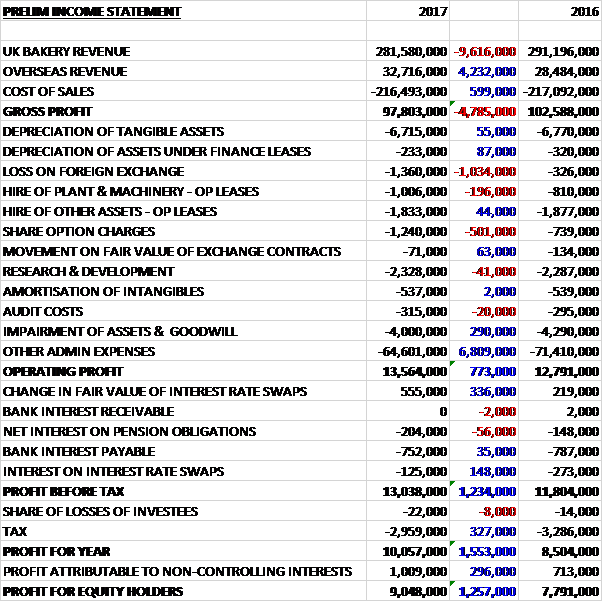
Revenues declined when compared to last year as a £4.2M growth in overseas revenue was more than offset by a £9.6M decrease in UK revenue. Cost of sales reduced marginally to give a gross profit £4.8M lower. There was a £1M increase in the loss on forex movements and share option charges grew by £501K but this was offset by a £6.8M fall in other admin expenses and the operating profit grew by £773K. There was a £336K positive movement in the hedging instruments and a modest reduction in interest with a £327K decline in tax charges, all of which meant that the profit for the year was £9M, a growth of £1.3M year on year.

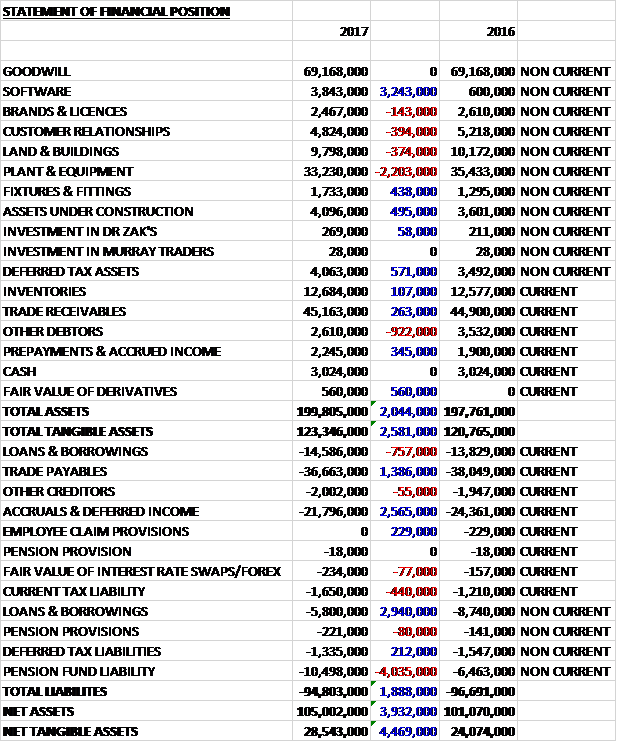
When compared to the end point of last year, total assets increased by £2M, driven by a £3.2M growth in the value of software, a £571K increase in deferred tax assets and a £560K increase in the fair value of derivatives, partially offset by a £2.2M decline in plant and equipment and a £922K decrease in other debtors. Total liabilities declined during the year as a £4M growth in the pension liability was more than offset by a £2.2M decrease in borrowings, a £2.6M fall in accruals and deferred income, and a £1.4M decline in trade payables. The end result was a net tangible asset level of £28.5M, a growth of £4.5M year on year.

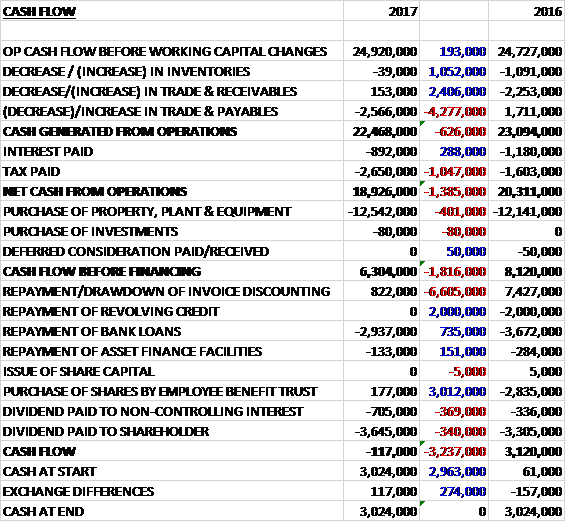
Before movements in working capital, cash profits increased by £193K to £24.9M. There was a cash outflow from working capital due to a fall in payables and after tax payments grew by £1M the net cash from operations was £18.9M, a decline of £1.4M year on year. The group spent £12.5M on capex to give a free cash flow of £6.3M. Of this, a net £2.1M was used to pay back loans and £4.4M went on dividends to give a cash out flow of £117K. Interestingly this is the exactly same amount as the benefit from forex movements so the group ended the year with the same amount of cash as it started it – £3M.

The Grain D’Or business has been historically loss making and despite the implementation of a range of initiatives to improve the business including cost control and new working practices, the site remained loss making. The group now proposes to close the site and a decision has been made to impair the assets by £4M. The business has lost two large contracts since the year-end which has affected its financial performance further. It is believed that the exceptional cash costs associated with the closure could reach up to £10M, spread over seven years, but more likely to be in the region of £6M.

The operating profit at the UK business was £15.4M, a decline of £518K year on year, not helped by reduced promotional spend which was enacted to preserve margins. In Foodservice, the year was one of consolidation with revenues marginally ahead of the prior year. New business was secured on the new cake ranges with the two major UK Foodservice wholesalers, as well as major cafes and pub groups. Kara Brioche buns continue to grow in line with demand, traditional doughnuts continued their renaissance and artisan bread products continued to grow in both sales and outlet penetration. There was strong growth in the top four customers, somewhat offset by reduced trading in export markets, particularly France, and in some smaller customer business closures.

The group has recently completed the renewal of its long standing partnership with Thorntons which will see the group continue to produce and market cakes. They have also announced the launch of a new Mary Berry range in Spring which extends to loaf, sharing and celebration cakes. Successful character licenses in the year have included Batman vs Superman, Minions, Star Wars and Emoji along with Me to You, Peppa Pig and Paw Patrol.
The operating profit at the Overseas business was £2.2M, a growth of £708K when compared to last year, benefiting from improved celebration cake and free from product ranges along with favourable forex movements.

This has not been an easy market. There has been a deflationary UK retail food market which has led to an upswing in discounter’s market share but this has changed in the second half of the year. There have also been some specific cost issued that relate to the current weakness of Sterling and increased costs of the national living wage. These trends looks set to continue for some time with high profile butter price hikes, driven by increased demand and a supply shortfall. These have been somewhat overcome through efficiency gains and price hikes.

During the year the group made capital investments of £12.5M. A new cake line is coming on stream in Cardiff, being commissioned for full production in 2018 and a new artisan bread bakery has been opened in Salisbury. There is a new IT system being rolled out which will give a common platform for the whole business. Going forward, they plan to invest in new plant and equipment to further improve efficiency, product quality and their capability in sustainable and environmentally responsible manufacturing.

At the current share price the underlying PE ratio is 11.4 which falls to 10.8 on next year’s consensus forecast. At the year-end the group had a net debt position of £17.4M compared to £19.7M at the end of last year. After a 7% increase in the total dividend, the shares are yielding 2.8% which increases to 3.1% on next year’s forecast.
Overall then this has been a bit of a mixed year for the group. Profits rose due to a reduction in admin expenses, net assets increased and although the operating cash flow declined, this was due to working capital movements and higher tax payments with the cash profits showing a modest increase. The group still made a decent amount of free cash. The UK business is struggling due to a sluggish market, the living wage increases and raw material price rises. The overseas business is growing, however, no doubt aided by the weak pound.

Going forward, the PE of 10.8 and yield of 3.1% is not too bad but much rests on the raw material issues given the slow growth in the market.

On the 22nd November the group released a trading update covering the first four months of the year which was in line with expectations. Total group sales grew by 4% reflecting the newly inflationary environment. The UK bakery division’s sales increased by 5% while the overseas division declined by 3.8%.

On the 18th January the group released a trading update for the first half of the year where they stated that they had performed in line with management expectations. Total group sales were £157.8M, representing a 0.7% increase. Sales for the continuing business (excluding Grain D’Or) grew by 2.5% to £144.8M with the UK bakery division growing by 3.2% and the overseas division declining by 2.1%. The board believe that its activities during the period position the group well for a solid performance for the rest of the year.

On the 1st March the group announced the purchase of the freehold property at its Lightbody factory in Hamilton which has been occupied by the group for fifteen years. The total purchase price is expected to be £2.6M and financed from existing resources. This is a good development in my view.

James Halstead Share Blog – Final Results Year Ended 2017

James Halstead has now released their final results for the year ended 2017.

Revenues increased when compared to last year as a £4.4M reduction in UK revenue was more than offset by a £12.4M increase in European revenue, a £5.5M growth in Asian and Oceania revenue and a £1.1M increase in ROW revenue. Staff costs increased by £2.2M, R&D costs were up £244K and other cost of sales grew by £3.4M to give a gross profit £8.8M higher than last time. Operating lease rentals grew by £355K and other selling and distribution costs were up £6.2M with admin expenses increasing by £1.1M which meant that the operating profit was £1.2M higher. Finance costs increased somewhat but this was offset by a lower tax charge and the profit for the year came in at £36.5M, a growth of £1.3M year on year.

When compared to the end point of last year, total assets increased by £16.6M, driven by a £10.1M growth in inventories, an £8.4M increase in cash and a £1.6M growth in plant and equipment, partially offset by a £2.2M fall in trade receivables and a £978K decline in deferred tax assets. Total liabilities were broadly flat over the period as an £8.5M growth in trade payables was offset by a £4.2M decrease in pension obligations, a £1.5M decline in accruals and some smaller decreases in other liabilities. The end result was a net tangible asset level of £110.8M, a growth of £16.6M year on year.

Before movements in working capital, cash profits increased by £888K to £50.3M. There was a cash outflow from working capital and tax payments increased by £462K to give a net cash from operations of £36.9M, a decline of £3.3M year on year. The group spent a net £4M on fixed assets to give a free cash flow of £32.9M, of which £25.4M was spent on dividends to give a cash flow of £8M and a cash level of £52.5M at the year-end.

The group saw a boost to their exports due to the effect of the weakness in sterling on competitiveness but this was tempered by a fall in UK sales and turmoil in the supply chain of raw materials. The drop in the UK sales is entirely accounted by de-stocking at two of the larger distributors and the group are satisfied that the actual purchased by end users increased.

Raw material price increased noted in H1 continued into the second half as a result of an explosion at the BASF site in Germany followed by a fire at a Shell refinery in the Netherlands which interrupted supply of PVC. These events resulted in greater demand for raw materials from other manufacturers. In addition there was the withdrawal of a US supplier from the European markets and the currency cost increases as Sterling fell in value. In mitigation the group established relationships with three Asian suppliers and used bulk storage tanks in Teesside to reduce some of the cost effects and most of the shortages.

At the European operations growth in the Expona brand was offset by a reduction in the Karndean ranges. As expected there was a decline in turnover in Germany but growth in Belgium, Austria, Eastern Europe and Switzerland. The group have secured new national chains as customers, including Fitness First, Linzenich Fitness and Pfitzenmeier Group. The group also supplied retail outlets, hotels chains and the central police station in Frankfurt. In France, turnover was on a par with the record of the previous year with increased profit as a result of product sales migrating to higher margin lines.

In Asia, Australia and New Zealand, turnover was up6.8% and profit was greatly increased with margins improving by over 5% due to a favourable product mix and the ending of sales of discontinued stock, along with reduced freight costs by the realignment of stock holdings across the continent.

In Australia the group has supplied nationwide Woolworth stores, the Narrogin Hospital in WA and the Western Sydney University. The Hong Kong office continues to supply projects across China such as Qinhuangdou Welfare Hospital and the Fudan University Hospital of Shanghai. They have also supplied Toys R Us and Louis Vuitton in Hong Kong along with the MGM Casino in Macau.

New Zealand saw a modest 1% growth but with improved margins with good growth in the North Island offset by a decline in the South Island which is still affected by continuing uncertainty following the Christchurch earthquake some years ago. The group retained the NZ social housing contract which came up for renewal in the year and the group are also supplying retail, healthcare buses, B garages and the Rorotonga sports stadium in the Cook Islands. A key development this year was the move to the new warehouse in Auckland which is better suited to the current business needs, which has assisted with the profitability of the business.

At Polyflor and Riverside Flooring in the UK, turnover fell by 2.5% and profit was also down. The last year has been difficult in the UK. One of their major distributors was prepared for sale by its parent company which involved, de-stocking and a lack of investment. Another of the major distributors looked to rationalise stock and focused on margin improvement. The smaller, independent distributors, however, have focused on branded products and improved their market share.

Productivity improvements in line speed and capacity at Radcliffe combined with the flat UK demand led to some redundancies which had a financial cost but over £900K has now been invested into the Riverside plant in Teesside and the group can now offer in line registered embossing on their sheet and they have secured planning permission to extend the plant.

At Polyflor Nordic, Norway posted a small increase in turnover of 2% and the low oil prices in the recent past have had an impact on the market. Projects included the new Svalbard Satellite Station and the new Trondheim Spektrum Arena. Profit in Norway was comfortably ahead of last year. In Sweden, turnover declined by 8% but profit held up better due to swing to higher end products leading to better margins. There was some staff disruption due to the retirement of the MD, along with some other issues, which led to a poor second half to the year. As new sales strategies have been implemented, sales are improving, however. Close control of overheads means that profitability across the Scandinavian business has increased this year.

In Canada, turnover continued to grow with an 8% growth in distributor sales being offset by a decline in direct sales to the mining sector. The group supplied national retailers such as Boston Pizza and Booster Juice as well as Landmark Cinemas and Chevron Gas stations. In addition, they worked on the Royal Victoria Hospital, the National Hockey League NHLA HQ and Omers Towers in Toronto.

The group had a good year in India as this relatively new business reported a small profit. They have exited the start-up phase of their move into this market and several healthcare projects have contributed to this record year, such as the Humancare Trust Hospital in Dwarka, the Royalcare Super Speciality Hospital in Coimbatore and the ESIC Medial College in Mandi.

In the ROW markets, the group worked on the Banco De la Natu in Mexico City, Salalah airport in Oman, the new Schengen terminal at Athens airport and Tamana University in Trinidad. Their distribution network has performed well with several countries at record levels of turnover.

Going forward, trading since the year-end has been strong, particularly in the UK and the supply chain issues have been largely resolved. In addition both Australia and France has reported record sales in the first two months of the year and taking this into account the board are confident of progress in the coming year.
At the current share price the shares are trading on a PE ratio of 26.7 which decreases to 25.7 on next year’s consensus forecast. After an 8.3% increase in the dividend the shares are yielding 2.8% which increases to 3% on next year’s forecast.

Overall then this has been another solid year for the group. Profits increased, net assets grew and although the operating cash flow declined, this was due to working capital movements and cash profits increased with plenty of free cash being generated. The weakness of Sterling certainly helped the group grow its exports but some major headwinds included the turmoil in the raw material market and destocking at the major UK distributors, both of which seem to have improved. The German market also seems to be struggling but despite this, the performance overall was good.

With a forward PE of 25.7 and yield of 3% these shares are not cheap but sometimes you get what you pay for and the shares just could be worth this much assuming there are no big market shocks coming up.

On the 1st December the group released a trading update covering the first five months of the year where they stated that current trading continues in line with budgets.

On the 29th January the group released a trading update covering the first half of the year. Turnover has increased by 5%, boosted by a strong December, and profit is in line with expectations and more than last year. The central European markets have been very competitive with very keen pricing but in early January a German manufacturer entered administration and announced the closure of its sheet vinyl and tile facility. This is expected to take place imminently and should ameliorate the pricing pressures they have been experiencing. Overall confidence for the full year is unchanged and remains positive.

Braemar Shipping Services Share Blog – Interim Results Year Ending 2018

Braemar Shipping has now released their interim results for the year ending 2018.

Revenues declined when compared to the first half of last year due to a £1.9M fall in technical revenue, a £1.2M decrease in logistics revenue and a £470K reduction in ship broking revenue. Cost of sales also declined but gross profit was £2M lower. Operating costs reduced by £1.5M and there were no restructuring costs, which were £1.5M last time. Partially offsetting this was a £709K increase in acquisition costs which meant that the operating profit was £186K higher. Finance costs increased by £61K and tax charges grew by £192K to give a profit for the period of £53K, a decline of £60K year on year.

When compared to the end point of last year, total assets declined by £5.6M to £149.1M, driven by a £4.6M decline in trade receivables, a £1.3M decrease in cash and a £1.1M fall in other receivables, partially offset by a £1.2M growth in prepayments. Liabilities also fell during the period due to a £776K decrease in derivative financial liabilities, a £622K fall in borrowings and a £508K decline in payables. The end result was a net tangible asset level of £17.2M, a decline of £3M over the past six months.

Before movements in working capital, cash profits declined by £327K to £3.5M. There was a broadly neutral working capital position compared to an outflow last time and after tax payments reduced by £780K, the net cash from operations was £2.5M, an improvement of £5.6M year on year. The group spent £380K on fixed tangible assets and £382K on acquisition fees to give a free cash flow of £1.8M. This did not cover the loan repayments of £622K, the purchase of own shares of £850K and dividends of £1.5M so there was a cash outflow of £1.1M and a cash level of £6.4M at the period-end.

The profit in the Ship broking division was £3.5M, a decline of £554K year on year, mainly due to falling tanker rates and low offshore rates. Transaction numbers were similar to the comparable period last year. The forward order book increased by 7% since the start of the year, however.

As expected the tanker markets continued to soften. The Baltic Dirty Tankers index dropped by 19% but while demand remained strong, the delivery of additional tonnage with not notable increase in scrapping reduced vessel earnings. In specialised tankers, there has been a continued expansion in the fleet of LPG and LNG vessels which put pressure on freight rates in the spot market and challenged demand for time charters. Fixture volumes remained steady and the teams maintained their level of earnings compared with the previous year.

As anticipated, the offshore market continued to experience tough conditions as global oil and gas exploration activity remained low although there are signs that the industry is resolving its vessel capacity issues. In dry cargo, the Baltic dry index improved year on year as commodity demand grew in the core markets and fleet growth moderated. Improved earnings for ship owners reduced the level of scrapping activity. The ongoing industrial reforms in China impacted industries like steel, aluminium, coal mining, chemicals and plastics so have been beneficial for dry bulk. Additionally, the growth in China’s demand for agribulks continued to support vessel demand.

The sale and purchase team concluded higher average value deals compared with the comparable prior year period, although the volume of second hand and demolition vessel transactions was lower. The period started well in the dry cargo market with strong activity, but as freight rates softened buyers started to hold back. There has been some improvement in the tanker market as buyers believe that ship values are unlikely to fall further but the lack of quality second hand vessels coming to the market continues to limit activity. Activity in newbuilding has significantly increased compared with the same period last year and the group expect this trend to continue throughout the rest of the year.

The loss in the Technical division was £360K, an improvement of £199K when compared to the first half of last year. The restructuring completed last year is delivering the expected cost savings and the division has won a number of new projects which started in September that are expected to contribute to an improved overall performance. The division continued to be impacted by low levels of oil and gas exploration activity, however. Although trading conditions in some areas continued to be quite difficult, there are encouraging signs in both the event and project led businesses.

The loss adjusting business reported increased profits in the period with an encouraging volume of new claims being awarded. The Far East, Middle East and Canadian operations continued to perform above expectations. In addition to the traditional Upstream Oil and Gas activity, our business saw an increase in the number of instructions associated with downstream, power and expert witness activities.

The surveying and marine consultancy saw high overall activity in the period. They also achieved a number of key wins and positive developments in recent months. The action taken by the business in the previous financial year to address its cost base is bearing fruit. The marine warranty surveying and engineering consultancy continued to be adversely affected by project delays and reduced activity. Their workforce was scaled back to match lower levels of demand and low tender pricing.

Braemar Engineering continued to be project focused and was held back in the period by ongoing project uncertainty. They undertook a programme of substantial reorganisation last year with cost savings being delivered in the current period. Deferred start of a significant project impacted the performance of the business but this project commenced in mid-September. Encouragingly the sales pipeline has significantly improved compared with the prior year; specifically related to smaller vessel conversions, bunkering projects and system upgrades and modifications. Also they have further opportunities secured or under development.

The profit in the Logistics division was £574K, a decline of £290K when compared to the first half of 2017. The port agency business remained strong while the business improvement programme in freight forwarding is ongoing. In the ship agency business, during the first half of the year the group built on the previous years’ business development activity in port agency hub services but this was offset to some extent by a lower market activity. They are continuing to develop their business internationally.

The freight forwarding business performance was lower than the prior year following market changes impacting the import business. Their business improvement programme across all service areas is being implemented and they are winning new business, however, which they expect to accelerate in the second half of the year.

After the period-end, in September, the group acquired NAVES, a German business which advises clients on corporate finance related to the maritime industry including restructuring advisory, corporate finance advisory, M&A, asset brokerage and financial asset management. The acquisition agreement provides for a consideration of between €24M and €35M. The initial consideration, payable on completion, is €14.8M, half of which was paid in cash and half in convertible loan notes; and €1.5M from the issue of 458,166 shares to the sellers. Three annual instalments of €1.4M will be payable to the sellers, half in cash and half in loan notes. Five annual instalments of €700K will be payable to management sellers through more loan notes. Finally an additional payment of up to €11M may be payable over the three years following completion dependent on performance. The business generated underlying operating profit of €3M last year.

Going forward, the group is well placed to deliver a stronger second half performance as the improving momentum continues. The principal drivers of this are the continuing recovery in the Technical division following the cost saving measures taken, new project work for the engineering business and a solid pipeline of marine and adjusting business. In addition, the second half will benefit from the initial five month contribution from Braemar NAVES. They are in line to meet their objectives this year.

Given the negligible profit, there is not much point looking at PE ratios for the current period. On the full year consensus forecast, however, the ratio is 13.9. After the interim dividend was reduced, the shares are yielding 3.3% but this increases to 4.9% on the full year forecast. At the period-end the group had a net cash position of £6.4M compared to £700K at the same point of last year.

Overall then, the group struggled in the period but there are signs that some of the markets are improving. Profits fell, net assets declined and although the operating cash flow improved, this was due to working capital movements and the cash profits decreased. The group still managed to produce some free cash flow, however.

The ship broking market has been affected by growing supply pushing rates down in the tanker market along with the subdued oil and gas market affecting the offshore business. The technical division is also being affected by the weakness in the oil and gas markets but new projects here are starting to improve the performance of the division. The logistics division is also struggling due to a poor freight forwarding market, but again some improvements are being seen. It does look as though the second half of the year will be better and with a forward PE of 13.9 and yield of 4.9% the shares look OK value. The acquisition looks a bit expensive though to me so I will keep a close eye here.

On the 7th September the group announced the acquisition of NAVES Corporate Finance, a corporate finance advisory business focused on the maritime industry to create a new division within the group known as the Finance Division. The consideration payable is €24M, rising to a maximum of €35M should earn-out payment terms and conditions be satisfied. The business is based in Germany and advised predominantly German clients on financing, restructuring and sale and purchase transactions.

A consideration of €19M, to be satisfied 50% in cash and 50% in convertible loan notes is payable, along with €1.5M to be satisfied by the issue of 458,166 shares to sellers on completion, €3.5M to be satisfied by the issue of convertible loan notes to management sellers in five equal annual instalments, and up to a further €11M payable to management sellers over a three year period which will be satisfied wholly in convertible loan notes.

Last year the business generated revenue and profit of €7.5M and €2.1M respectively. The board believe that the acquisition will be earnings enhancing during the current year.

On the 2nd February the group announced the acquisition of Atlantic Brokers, an established broker of physical and financial coal products for a total consideration of £4.8M. The business is an introducing broker for ICE coal and CME Clearport coal futures and options and the acquisition provides the group with the opportunity to expand into new markets using the physical shipping capability and market research of Braemar. As Atlantic is regulated by the FCA it will enable the group to move into the growth area of commodity derivatives broking.

The consideration of £4.8M is made up of £2.7M in cash and £2.1M to be satisfied by the issue of 804,426 shares. This looks interesting but I am staying clear until the debt cab be brought back down.

Harvey Nash Share Blog – Interim Results Year Ending 2018

Harvey Nash have now released their interim results for the year ending 2018.

Revenues increased by £47.6M but cost of sales were up £46.7M to give a gross profit £929K higher. Depreciation was down £74K but other underlying admin costs grew by £947K. There were a slew of non-underlying costs. There was restructuring costs of £2.6M, a £245K cost associated with the AIM listing, a £134K cost relating to excess deferred consideration payable and £106K of acquisition costs. Offsetting these was a £3.5M income from the release of aged accruals, all of which meant that the operating profit was up £517K (for what it’s worth). Interest charges fell by £116K and there was a modest reduction in tax so the profit for the half year came in at £3.2M, a growth of £647K year on year.

When compared to the end point of last year, total assets increased by £22M, driven by a £23.7M growth in receivables and a £2.7M increase in intangible assets, partially offset by a £4.1M decrease in cash. Total liabilities also increased during the period due to an £11.4M increase in borrowings, a £1.2M growth in deferred consideration and a £1.3M increase in provisions. The end result was a net tangible asset level of £5.8M, a decline of £1.1M over the past six months.

Before movements in working capital, cash profits declined by £385K to £4.4M. There was a large cash outflow from working capital due to an increase in receivables, apparently reflecting growth in contract services, and after non-recurring cash outflow of £1.5M and a £162K increase in tax payments had been taken into account, the net cash outflow from operations was £11.8M, a deterioration of £13M year on year. The group also spent £531K on property, plant and equipment along with £1.5M on acquisitions so before financing there was a cash outflow of £13.9M. The group still paid dividends of £1.8M and needed to increase borrowings by £11.3M to give a cash outflow of £4.5M for the period and a cash level of £16.1M at the period-end.

The operating profit in the UK and Ireland business was £1.6M, a decline of £40K year on year, due mainly to the slowdown in the level of higher-margin permanent hiring during the period and the investment in headcount. The group increased market share in the region despite the impact of political uncertainty surrounding the UK general election and changes to the tax treatment of freelancers working in the public sector.

Executive recruitment reported growth but interim placement activity was mixed compared to the prior year. Demand from the financial services sector was strong, with increased compliance and regulation measures in preparation for Brexit driving the recruitment of technology specialists. The introduction of IR35 legislation resulted in significant activity in the public sector to transition existing freelancers and demand for new recruitment fell as a result. Despite this, overall the number of freelancers in the UK and Ireland grew by nearly 8%, improving the outlook for the seasonally more productive second half.

The operating profit in the Benelux business was £2.3M, a growth of £427K when compared to the first half of last year. Skills shortages in the region drove demand for freelancers, project teams and managed services as more companies outsource the management of their temporary staff.

The operating profit in the Nordics business was £175K, a small decrease of £12K when compared to the first half of 2017 despite the first month of post-acquisition results from PAT. Specialist recruitment and interim services offset lower executive search fees. Norway continued its turnaround, however, with gross profit up 29%.

The operating profit in the Central European business was £69K, a decline of £338K year on year. Poland reported a 66% increase in gross profit but the larger businesses in Germany and Switzerland saw gross profit fall by 23% and 18%. Germany saw a decline in freelancers exacerbated by regulatory changes to the freelance labour market and the strong currency in Switzerland led to weaker demand for permanent recruitment. Actions were taken in both countries to align costs with revenues, to refocus investment in growth areas and to reduce fixed overheads.

The operating profit in the US business was £303K, a reduction of £306K when compared to the first half of last year. Demand continues to swing in favour of permanent recruitment but record executive search revenues were offset by a decline in freelancers. Acute skills shortages in the technology sector are creating unexpected challenges. The US business had implemented a range of measures to improve conversion from open vacancies into placements, the benefits of which should be seen in the second half.

The operating loss in the Asia Pacific business was £222K, a fall of £320K when compared to the first half of 2017, aided by productivity gains in Vietnam and reduced losses in Hong Kong as the office winds down.
During the period the directors started a review of the group’s cost base. They have implemented a transformation programme to review underperforming offices, streamline the business and reduce central overheads. Offices in Geneva, Dusseldorf and Denver were closed at a cost of £600K and contracting services ended in Japan at a cost of £300K. The Hong Kong office continues to trade but it is being wound down with anticipated closure costs of £600K recognised. Businesses were streamlined in the UK, Nordics and Central Europe at a cost of £200K, £200K and £300K respectively. Restructuring of central costs totalled £400K.

The recruitment of a new finance director and consequent overlapping costs are considered the first step in this transformation and as such these costs are included in the central cost restructuring charge of £400K (that seems a bit dubious). This transformation programme is expected to complete by the end of the year at a further cost of around £1M. Expected savings from this programme in the current year are £1.1M and £2.2M in 2019.

In July the group’s shares were admitted to AIM and its listing on the main market was cancelled. The cost of this listing was £200K. The accounting estimate for aged accrued liabilities in the Netherlands was re-assessed following a detailed review, resulting in a release of aged accrued liabilities totalling £3.5M. The final deferred consideration payable for the Beaumont acquisition in Japan exceeded initial estimates and the £100K shortfall was booked as a non-recurring item.

In July the group acquired PAT Management, a recruitment business in Sweden, for an initial consideration of £1.7M, and deferred cash consideration of up to £1.8M, generating goodwill of £2.5M. After the period-end, in September, the group acquired Crimson, a UK-based IT recruitment consultancy for an initial consideration of £6M, deferred cash consideration of £4M and an earn-out of up to £5M. The business made a pre-tax profit of £1.7M last year.

Going forward the group enter the second half of the year on track and are confident about the outlook for the rest of the year.

At the current share price the shares are trading on a PE ratio of 11.4 which falls to 9.2 on the full year consensus forecast. At the period-end the group had a net debt position of £10M compared to a net cash position at the start of the year. After a 5% increase in the interim dividend, the shares are yielding 4.2% which increases to 4.3% on the full year forecast.

Overall then this has been a bit of a mixed period. Underlying profits were up modestly but the net tangible asset level deteriorated. There was also a large operating cash outflow and the cash profit declined, which is a bit of a concern. Operationally the UK and Ireland was flat, affected by uncertainty surrounding the election. The Benelux business was strong but this was offset by weakness in Germany, Switzerland and the US. The group is taking on quite a lot of debt and there are some high one-off restructuring charges to come and overall I’m not sure the forward PE of 9.2 and yield of 4.3% fully compensate for the risks.

AG Barr Share Blog – Interim Results Year Ending 2018

AG Barr has now released their interim results for the year ending 2018.

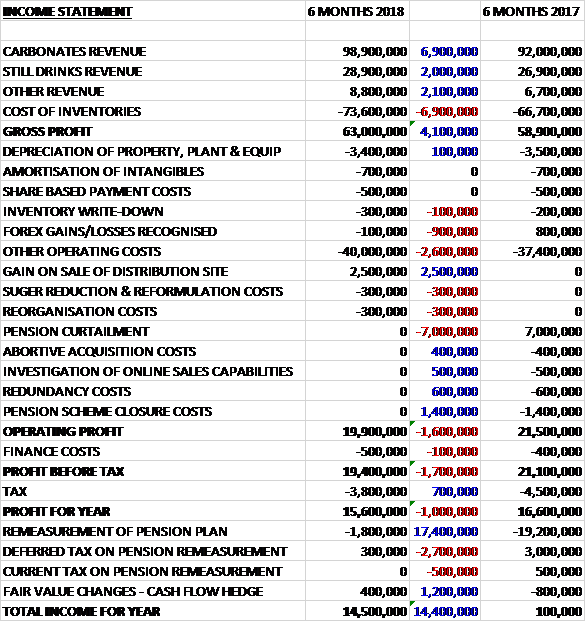
Revenues increased when compared to the first half of last year due to a £6.9M growth in carbonates revenue, a £2M increase in still drinks revenue and a £2.1M growth in other revenue. Cost of inventories also increased to give a gross profit £4.1M higher. There was a £900K negative swing to a forex loss and other operating costs grew by £2.5M. The group did make a £2.5M gain on the disposal of the distribution site, though and there were a number of one-off costs that didn’t recur this time. After the pension curtailment, which brought in £7M last time, the operating profit declined by £1.6M. Finance costs saw a modest rise but tax charges fell by £700K to give a profit for the period of £15.6M, a decline of £1M. If we remove distribution site sale this year, and the pension stuff last year, the profit comes in at £13.1M, a growth of £2.1M year on year.

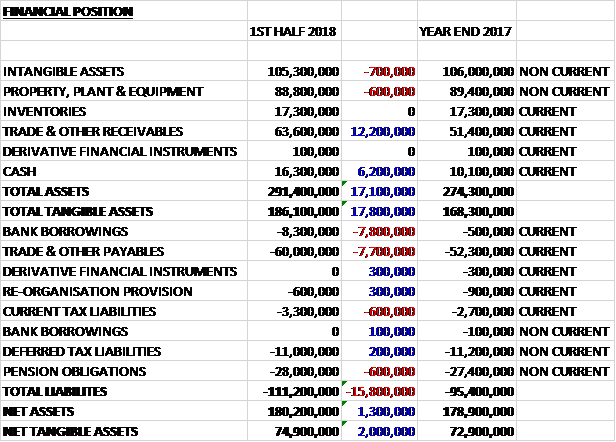
When compared to the end point of last year, total assets increased by £17.1M, driven by a £12.2M growth in receivables and a £6.2M increase in cash. Total liabilities also increased due to a £7.7M growth in bank borrowings and a £7.7M increase in payables. The end result was a net tangible asset level of £74.9M, a growth of £2M over the past six months.

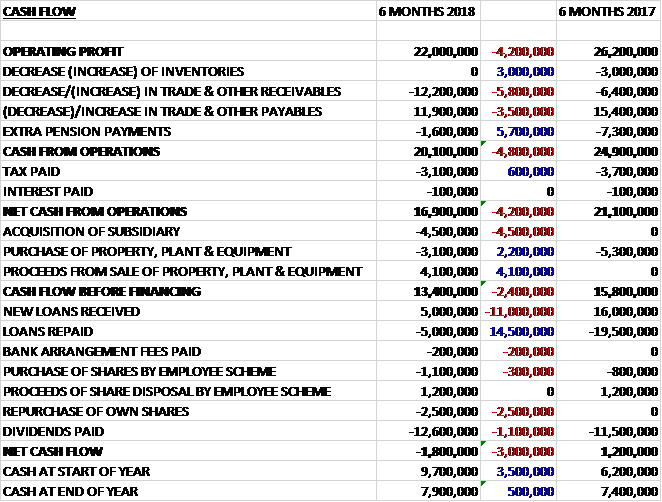
Before movements in working capital, cash profits declined by £4.2M to £22M. There was a modest cash outflow from working capital, and but tax payments reduced by £600K to give a net cash from operations of £16.9M, a decline of £4.2M year on year. The group spent £4.5M on acquisitions and £3.1M on capex but received £4.1M from the sale of the warehouse so the free cash flow was £13.4M. This just about covered the £12.6M of dividends but not quite the £2.5M of share buy backs so there was a cash outflow of £1.8M and a cash level of £7.9M at the period-end.

The underlying gross profit in the Carbonates division was £49.3M, a growth of £1.4M year on year. The underlying gross profit in the Still drinks division was £9.2M, an increase of £1.7M when compare to the first half of last year. The underlying gross profit in the other businesses was £4.5M, a growth of £1M when compared to the first half of 2017.

The group has maintained the strong sales momentum of the second half of last year during the period, growing revenue by 8.8% whilst the total soft drinks market grew by 4.2% in the same period. The increased brand investment along with the cost pressures relating to the continued weakness of Sterling, led to a moderate reduction in margins. The improved market reflected the impact of a seasonally better early summer weather and price inflation.

The group’s performance was particularly strong in England and Wales where they have gained new customers. The Funkin business continues to grow, benefiting from increased cocktail consumption, wider product distribution and further product innovation.

During the period, a £2.5M gain on sale was made on disposal of the Walthamstow distribution site, and the group has entered into a three year operating lease to continue to operate from there in the short term. To date, £300K of costs have been incurred as part of the ongoing sugar reduction and reformulation programme. These costs are forecast to significantly exceed the level of expenditure that would normally be incurred in the course of new product development. By the end of last year, the restructuring was largely complete but £300K of costs were incurred in the period, primarily being an increase in the redundancy provision and further recruitment costs.

During the period the group started a share repurchase programme of up to £30M which is expected to complete within two years. A total of 405,000 shares have been repurchased and cancelled at a cost of £2.5M.

Going forward, the soft drinks market has been negatively impacted in the short term by the poor weather since late July but assuming market conditions across the rest of the year are reasonable the group remains on course to meet the board’s expectations for the full year.

At the current share price the shares are trading on a PE ratio of 24.7 which falls to 20.9 on the full year consensus forecast. After a 5% increase in the interim dividend, the shares are yielding 2.3% which increases to 2.4% on the full year forecast. At the period-end the group had a net debt cash position of £7.9M comparted to £9.7M at the year-end.

Overall then this has been a rather decent period for the group. Profits were up, as was net assets. The operating cash flow did decline, however, but there was still a decent amount of free cash generated. The good performance has been boosted by the good early summer weather. Unfortunately this has not continued into the second half so things might now be a bit more difficult. These shares are not cheap at a forward PE of 20.9 and yield of 2.4% but the company is a good, cash generative business and I am a current holder.

On the 30th November the group announced that Commercial director Jonathan Kemp sold 3,900 shares at a value of £24K.

On the 1st February the group released a trading update covering the year. Total revenue is expected to be £277M, up 7.5% on the prior year. They have continued to outperform the total UK soft drinks market and increased their overall market share with latest data seeing the market value up 2.7%.

The group have not been immune to the external cost pressures faced by many UK businesses over the year, particularly in relation to the weakness of Sterling but the board remain confident of delivering profit growth in line with expectations. It is expected that 2018 will be another challenging year for UK business against a backdrop of continued uncertain economic conditions. In addition the soft drinks industry faces significant changes in regulation, customer dynamics and consumer preference.