Dechra Pharmaceuticals Share Blog – Final Results Year Ended 2017

Dechra Pharmaceuticals has now released their final results for the year ended 2017.
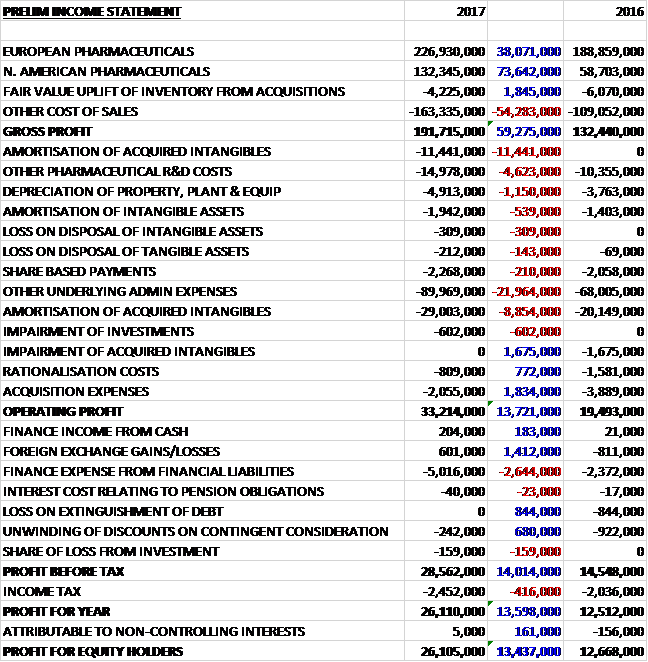
Revenues increased when compared to last year with a £73.6M growth in North American sales and a £38.1M increase in European sales. Cost of sales also grew to give a gross profit £59.3M higher. The amortisation of acquired R&D intangibles increased by £11.4M and other R&D expenses were up £4.6M. Depreciation was up £1.2M and other underlying admin expenses increased by £22M. We also see an £8.9M increase in other amortisation of acquired intangibles which offset last year’s £1.7M impairment. Rationalisation costs were down £772K and acquisition expenses reduced by £1.8M to give an operating profit £13.7M higher than last year. There was a £1.4M positive swing to a forex gain and no loss on the extinguishment of debt but finance expenses from financial liabilities increased by £2.6M and the tax charge grew by £416K to give a profit for the year of £26.1M, a growth of £13.4M year on year.
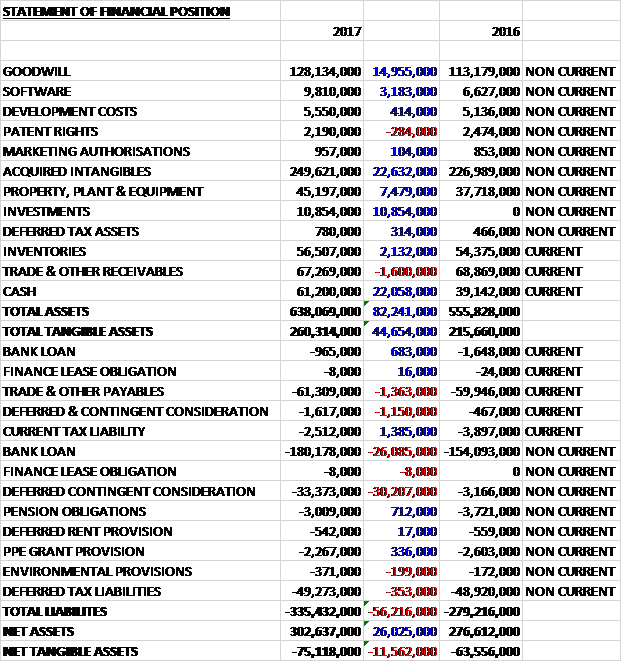
When compared to the end point of last year, total assets increased by £82.2M, driven by a £22.6M growth in acquired intangibles, a £22.1M increase in cash, a £15M growth in goodwill, a £10.9M increase in investments, a £7.5M growth in property, plant and equipment and a £3.2M increase in software. Total liabilities also increased during the year due to a £25.4M increase in bank loans and a £30.2M growth in deferred consideration. The end result was a net tangible asset level of -£75.1M, a detrimental movement of £11.6M year on year.
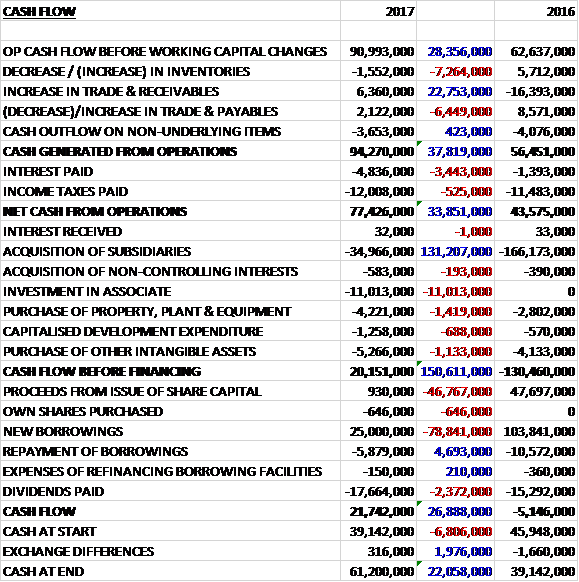
Before movements in working capital, cash profits increased by £28.4M to £91M. There was a cash inflow from working capital but interest payments increased by £3.4M and tax payments were up £525K to give a net cash from operations of £77.4M. This covered the £35M of acquisitions, the £11M of investments in an associate, £1.3M of development expenditure, £5.3M of other intangible asset purchase and £4.2M of other capex to give a free cash flow of £20.2M. This covered the £17.7M of dividends but the group still took out a net £19.1M of new loans to give a cash flow of £21.7M and a cash level of £61.2M at the year-end.

The operating profit in the European Pharmaceuticals division was £60.7M, a growth of £9.1M year on year, of which £4.7M came from acquisitions. Like for like revenues, excluding third party contract manufacturing increased by 5.3%. Third party manufacturing revenues declined by 9.7%, representing a conscious strategic move as the group start to implement an efficiency improvement plan.

Companion animal product sales were the predominant driver of revenue growth in the core EU business with farm animal and equine also delivering growth of 1.3% and 0.7% respectively. The UK, France and Germany performed well and there was also strong revenue growth in Italy and Poland. After a slow start, the recently formed subsidiary in Austria started hitting expectations. Companion animal revenue increased by 9%, driven by a strong performance of Zycortal, the endocrine product launched last year, and from established products such as Cardisure, Vetoryl and the analgesia and anaesthesia range.

The farm animal portfolio has delivered its second successive year of growth, albeit modest. This performance is set against a historical decline in antibiotic sales due to concerns over antimicrobial resistance. Despite this, the group is beginning to see signs of a recovery in sales of their water soluble antibiotics. They believe that their Solustab range is now well positioned to provide vets with a robust portfolio of suitable options for prudent use of antibiotics in the treatment of the majority of infectious diseases in pigs and poultry.

The first of the poultry vaccines developed for the EU, Avishield, was launched in Germany, the Netherlands and Belgium. Although they do not yet have a full range to offer customers, they were still able to gain a market share of about 15%.

The equine portfolio growth has predominantly been driven by Osphos, although they believe that sales are a long way from reaching full potential and will continue to grow as vets gain a better understanding of this treatment. Generic competition to Equipalazone, a long standing product in the portfolio, partly offset the sales growth in this category.

The nutrition and diets market continues to be very competitive. They are maintaining sales of their brand Specific, following historical supply issues and are initiating a number of projects that they hope will re-invigorate the range in the near term. They have, towards the end of the year, launched two new hypo-allergenic wet diets for dogs and cats.

The overall business benefited from a full year’s contribution from Genera and eight months contribution from Apex. Apex is performing well with the recently modernised factory achieving regulatory approval from the Australian authorities in April.

Good progress has been made on the integration of Genera. Significant cost savings have been delivered from the staff layoffs and major improvements have been made in the solid close and liquids manufacturing facilities, into which new products are being transferred to benefit from this low cost location. The primary reason for the acquisition was to access their range of poultry vaccines for broilers and the first of these has now been launched. The next five are in registration and progress is being made with a further four products.

The operating profit in the North American business was £43.2M, an increase of £25.7M when compared to last year, of which £18.7M came from acquisitions. Like for like sales were up 16.5% with the US and Canadian businesses both performing well. The principal drivers of the growth are companion animal and equine products with excellent sales of Zycortal, Vetivex and Osphos.

A number of new products were launched in the year including Amoxi-Clav, the first major product approval from Putney; three new extensions to the Vetivex range; Carprovet flavoured tablets to increase their companion animal pain management range; and two topical dermatology products in a new mousse format.

Overall the division benefited from a good performance by Putney. The integration has been implemented well, significant cost savings have been delivered, new sales channels opened and sales synergies from the enlarged team have been delivered to both Putney and existing product ranges. The Mexican business, Bovel, acquired in January last year continues to focus on the registration of Dechra products with initial approvals having been received. A new management team was appointed during last year and there has been a notable improvement in performance.

During the year, the most significant approval was for a generic antibiotic tables, Amoxi-Clav. Other significant registrations have been Revozyn, a cattle antibiotic for mastitis, in the Netherlands, UK and Germany with applications having been made for a further ten European markets; Cyclospray aerosol and Vetoryl 5mg in Canada; Cardisure, Zycortal, Osphos, Doxy paste and Benazapril oral solution in Australia; Osphos in Mexico; Isathal and Canaural in Korea; Domidine, Atipam and Sedator in Thailand and South Africa; and Altidox, a water soluble antibiotic, in 13 EU countries.

They have also signed three agreements to conduct proof of concept studies on new and potentially material pharmaceuticals for the veterinary market and have licensed a range of companion animal generic tablets form a key partner for Europe, a dental and dermatological product from Kane Biotech for the US and Canada, and a dermatological product from Premune for the EU.

In March the group acquired a 33% interest in Medical Ethics for £11M. They also announced that they had entered into a long term IP licensing agreement with Animal Ethics, who are an Australian-based company focused on developing ethical pain relief products for animal health. This agreement gives Dechra the rights to sell and market Animal Ethics’ product Tri-Solfen for all animal species in all markets except Australia and New Zealand. Tri-Solfen is a topical product that is sprayed onto wounds which relieves pain, controls bleeding and protects against infection for routine treatments in farm animals.

In October 2016 the group acquired Apex Labs, a veterinary pharmaceuticals company based in Australia. The cash consideration was £34.2M and the acquisition generated goodwill £9.9M and other intangible assets of £21.3M. The business contributed £1.1M to group pre-tax profits and had the acquisition been completed at the start of the year, it would have generated £2.1M. The business is reporting in the EU segment. Clearly Dechra are following the same definition of Europe as Eurovision! The principal reason for the acquisition was to provide the group with direct access to the Australian markets.

Towards the end of the year the group established a new business unit, Dechra Veterinary Products International. To focus on increasing their international presence. Currently sales outside their core markets are farm animal based and the group believe that their products in the pig and poultry markets will provide them with an entry opportunity into markets where quality meat consumption is increasing strongly. In the longer term they are targeting companion animal markets which are beginning to gain growth momentum in several developing countries.

As mentioned above the group are reducing third party manufacturing contracts. This was historically important business to utilise capacity in the factories but the increased scale of their own production is now being hindered by a number of these low margin contracts. They will therefore be exiting most of these contracts over the next five years, only retaining a few significant, high volume partnerships. Following the recent acquisitions, in-sourced production accounts for about 50% of all product sales. They have identified opportunities to reduce the complexity of their supplier network by working with preferred partners and bringing more of the outsourced production in-house.

The group continue to focus on the implementation of the Oracle ERP solution which had fallen behind schedule. They now believe that good progress has been made and they are confident that a go live can be implemented prior to the end of 2018.

Going forward, current trading is in line with board expectations and they anticipate delivering their strategic objectives in the new financial year.

At the current share price, the shares are trading on a PE ratio of 69.8 which falls to 26.6 on next year’s consensus forecast, no doubt ignoring the slew of intangible amortisation that the “underlying accounts” don’t include. After a 16% increase in the dividend the shares are yielding 1.1% which remains the same for next year’s forecast so these shares are definitely not cheap. At the year-end the group had a net debt position of £120M, an increase of £3.4M year on year.

On the 4th September director Richard Cotton purchased 8,481 shares at a value of £167K which seems like a decent purchase.

Overall then this seems to have been another year of progress. Profits increased along with the operating cash flow with a decent amount of free cash being generated. The issue I have is the deteriorating tangible asset base which is now considerably negative. The European business performed fairly well, driven by improvements in companion animal sales, and the North American division also performed well due to companion animal and equine products. The shares are not cheap, however, with a forward PE of 26.6 and yield of 1.1% but there has been a director purchase and I am holding on for now.

On the 20th October the group released a trading update covering Q1 where they stated that their performance was in line with management expectations with continued growth across all markets.

On the 9th January the group released a trading update covering the half year which was in line with management expectations. Reported group revenue increased by 10.5% at constant currency. The European pharmaceuticals segment reported revenue increased by 5.5% at constant currency. Excluding third party contract manufacturing and treating Apex on a like for like basis, revenues were up 4%. North American revenues were up 20% at constant currency.

New product registrations were achieved in the period. In Europe, this included Avishield IBH120, the second EU-registered poultry vaccine; and a number of minor registrations were achieved in the international division following its formation in July. In North America, they have now launched all the dosage sizes of Amoxi-Clav tablets in the US and Vetoryl and Osphos in Mexico.

In December the group completed the acquisition of RxVet, a small CAP business in New Zealand. They have been the group’s distributor in the country since 2010 with revenues of $1.4M, half of which were Dechra products.

Following the passing into law of the Tax Cuts and Jobs Act in the US, the group is in the process of reviewing its effect. Overall, an initial provisional assessment indicates that the effect is expected to be modestly favourable on an ongoing underlying basis. A material one-off non-cash credit will arise due to the revaluation of deferred tax balances. Overall this all seems fine.

On the 25th January the group announced the acquisition of AST Farma and LE Vet for a total consideration of €340M to be satisfied approximately 75% in cash and 25% in new Dechra shares. AST Farma is one of the leading companion animal pharmaceutical companies in the Netherlands, focused on generic products. Le Vet has focused on the European markets outside the Netherlands and together the two companies hold around ninety product registrations.
The group has also announced the placing with institutional investors of 5,121,952 new shares at a price of £20.50 per share, representing around 5.5% of the group’s existing share capital. The proceeds will be used to fund the acquisition along with existing resources and the issue of 3,670,625 new shares to the vendors.

The group has worked with both businesses for a number of years since the acquisition of Eurovet in 2012. In more recent years the relationship has expanded through further distribution agreements for certain products and was further enhanced when Dechra acquired Genera. Dechra is already distributor for AST Farma and Le Vet’s products in the UK, Ireland, France, Italy, Norway, Sweden, Denmark, Spain, Portugal, Poland, Slovenia, Croatia, Bosnia, Serbia, Macedonia and Kosovo, representing around 13% of their turnover.

The board believe the acquisition will provide critical mass in the Netherlands and enable to the group to access the direct to vet model, eliminating the need from distributors. The acquisition also provides access to over thirty products in the pipeline, including eight already submitted for EU registration. It is expected to be materially earnings enhancing for 2019 and to deliver returns in excess of the cost of capital in a timely manner.
Strangely the manufacturing and product development activities are not included in the sale and will still be owned by the vendors which means the group will still have to source from them. AST Farma made pre-tax profit of €8.9M last year and LE Vet €2.3M. The businesses don’t own much in the way of assets so the acquisition will be generating goodwill of €331.9M.

Overall this looks like an interesting acquisition, albeit rather costly in my opinion. I am also a little concerned about the increasingly flimsy balance sheet but I will continue to hold for now.

Laura Ashley Share Blog – Year Ended 2017

Laura Ashley has now released their final results for the year ended 2017.

This is pretty silly, comparing a 52 week year to a 74 week one but that is all we have to go on as they have not furnished us with like for like comparisons which shows a certain disregard for investors I feel. Anyway, obviously both revenues and cost of sales were down which gave a gross profit £62.7M lower. Amortisation and depreciation both fell, but there was in increase in losses on disposal of fixed assets and a £700K increase in forex losses before a decline in other operating expenses meant that the operating profit fell by £16.9M. There was a £500K reduction in the losses from an associate and tax charges fell by £4.6M which gave a profit for the year of £4M, a decline of £11.9M year on year.

When compared to the end point of last year, total assets declined by £3.8M driven by a £5M fall in cash, a £4.8M decline in property, plant & equipment and a £1.3M decrease in investments in associates, partially offset by a £6.6M growth in inventories and a £1.9M increase in receivables. Total liabilities increased during the year as a £2M decline in current tax liabilities and a £2.4M decrease in pension liabilities were more than offset by a £9.3M growth in borrowings. The end result was a net tangible asset level of £33.5M, a decline of £8M year on year.

So, again, comparisons with last year are pretty meaningless but the net cash from operations fell by £18.1M to £14M. There was a cash outflow from working capital but this was less than last time and after tax payments fell by £1.6M the net cash from operations was £900K, a decline of £9M year on year. This just about covered the £500K of property, plant and equipment purchased along with the £300K of intangible assets to leave a free cash flow of just £100K. Obviously this came nowhere near the level needed to pay the £14.5M of dividends and after the group also repaid £1.3M of loans, there was a cash outflow of £15.7M and a cash level of -£10.7M at the year-end.

The stores made a profit of £3.8M, a decline of £17.7M year on year. The E-commerce and mail order division made a profit of £13.8M, a fall of £3.2M when compared to last year. The hotel division made a loss of £200K, an improvement of £100K when compared to 2016. The non-retail division made a profit of £10.3M, a decrease of £1.3M year on year.

Total like for like retail sales were down 3.1% but online sales were up 5.6% on a like for like basis. Trading conditions have been challenging for the year and the impact of weak sterling has also contributed to the overall fall in profit which the group has experienced. In the UK, the property portfolio decreased by 25 stores to 167 stores. Of these, 22 were Homebase concession stores following the takeover of Homebase by Wesfarmers. Over the coming year the group expect to open two new stores and close three.

Home accessories sales for the year saw a 3.7% like for like increase with an ever improving seasonal offering. Furniture sales saw a 5.3% like for like decline. This is the group’s most price sensitive category and they are reviewing the end to end supply chain to ensure good value. Decorating sales fell by 4% on a like for like basis, with the performance below expectations. Fashion sales decreased by 10.4% on a like for like basis. This was a disappointing performance and the group have restructured the fashion team and appointed a new Head of Fashion who joined in July.

In June the group opened their first tea room, located in their hotel. It has apparently been met with customer acclaim so further tea rooms may be opened as they develop the model. They have also acquired a new licence partner, the Future Group in India, and will be opening their first stores in the country in September. They have continued to grow their online presence in China having launched a website there in November and they have seen progress in both of these territories and are also in discussions with a number of potential partners in other territories in the Far East.

During the year the group had an exceptional charge of £2.8M due to the impairment on the Singapore property following a recent valuation.

At the current share price the shares are trading on a PE ratio of 15.6 which falls to 12.5 on next year’s consensus forecast. After the final dividend was cancelled, the shares are still yielding 5.8% due to the interim dividend, which is forecasted to remain in place next year. At the year-end the group had a net debt position of £32.3M. Going forward, trading for the seven weeks to 19th August is performing in line with management expectations.

Overall then this has been a difficult year for the group. LFL profits are almost certainly down, net assets declined and the operating cash flow fell with barely any free cash being generated. The group has been hit by the closure of its Homebase concessions but it seems that fashion is the big problem, with double digit declines really not good enough. Until there is some sign of a turnaround, I don’t think the forward yield of 12.5 and dividend (if it is maintained) of 5.8% offers good enough value.

On the 15th August the group released a profit warning. Their results will show an exceptional £2.8M impairment charge due to the revaluation of their new Singapore office block. In addition, trading conditions have continued to be demanding so the board expect pre-tax profits to be materially below market expectations.

Orosur Mining Share Blog – Final Results Year Ended 2017

Orosur Mining has now released their final results for the year ended 2017

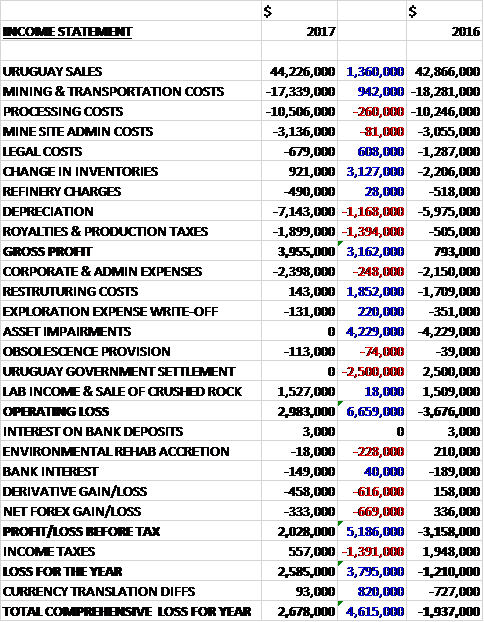
Revenues increased by $1.4M when compared to last year. Mining and transportation costs were down $942K, legal costs fell by $608K and there was a $3.1M positive movement in inventories but processing costs were up $260K, depreciation increased by $1.2M as the SGW UG mine started production in December, and royalties and production taxes grew by $1.4M after last year’s exemption, which meant that the gross profit increased by $3.2M. Admin expenses grew by $248K and there was no Uruguay government settlement which brought in $2.5M last time but restructuring costs declined by $1.9M and there were no asset impairments, which cost $4.2M last time to give an operating profit $6.7M improved on last time. There was a $616K derivative loss relating to a forward contract for up to 6,000 ounces, and a $669K net forex loss with a $1.4M reduction in tax receipts, relating to less deferred tax recognised, all of which meant that the profit came in at $2.6M, an improvement of $3.8M year on year.

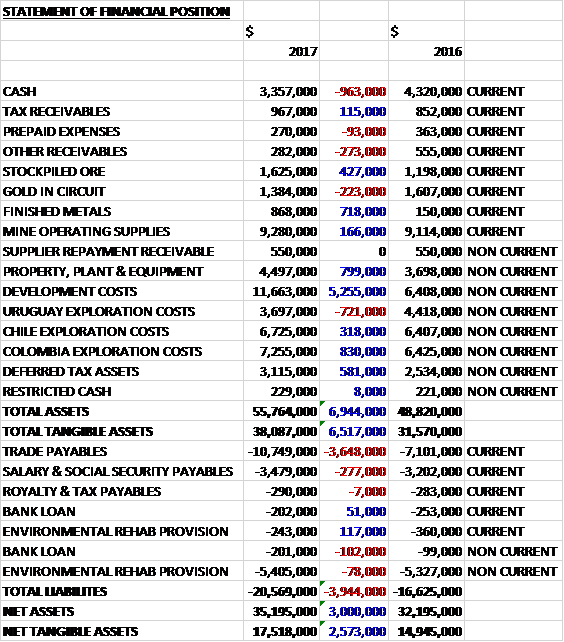
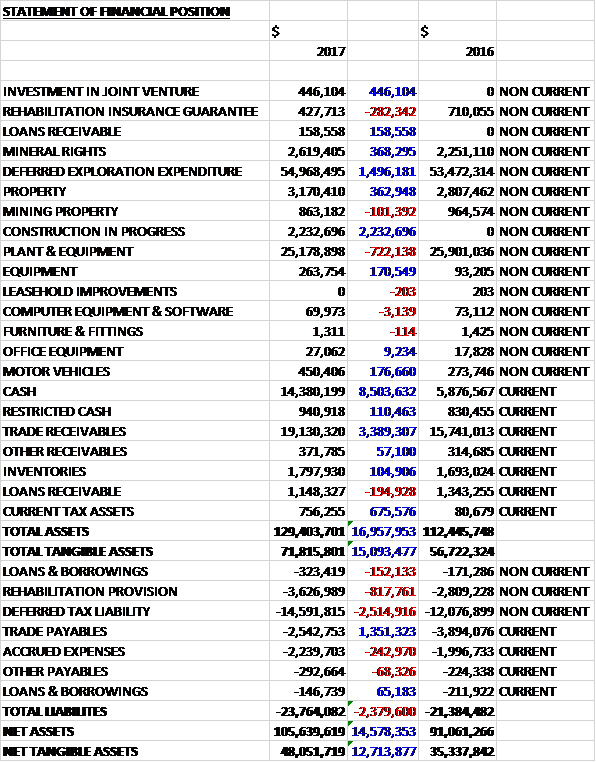
When compared to the end point of last year, total assets increased by $6.9M driven by a $5.3M growth in development costs, mainly relating to underground development, an £830K increase in Colombian exploration costs, a $799K increase in property, plant and equipment and a $718K increase in finished metals inventory, partially offset by a $963K decrease in cash and a $721K decline in Uruguay exploration costs which were transferred to tangible assets. Total liabilities also increased, due to a $3.6M growth in trade payables. The end result was a net tangible asset level of $17.5M, a growth of $2.6M year on year.

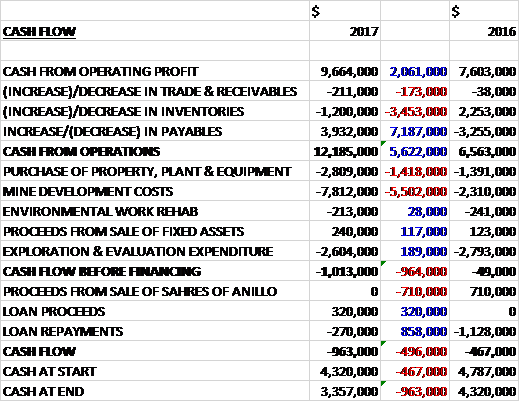
Before movements in working capital, cash profits increased by $2.1M to $9.7M. There was also a cash inflow from working capital due to an increase in payables, partly relating to a legal provision of $700K related to labour claims and a huge increase in activity in Q4, and the cash from operations was $12.2M, a growth of $5.6M year on year. Unfortunately this did not cover the $7.8M of mine development costs representing the construction of the SGW UG ramp, access and ventilation shaft along with the construction of phase 4A of the tailings dam during the year, the $2.8M of property, plant and equipment expenditure and the $2.6K of exploration costs so there was a cash outflow of $1M before financing. The group took out a small net loan so there was a cash outflow of $963K for the year and a cash level of $3.4M at the year-end.

During the year, 978,529 tonnes of ore was processed at a grade of 1.21g/t with recovery averaging 93.41% compared to 1,013,104 tonnes at a grade of 1.19g/t with recovery averaging 92.54% last year. A total of 4,088,407 tonnes was mined, comprising 3,154,434 tonnes of waste and 933,973 tonnes of ore with an average grade of 1.24g/t. This compares to 3,209,063 tonnes comprising 2,283,480 tonnes of waste and 925,583 tonnes of ore with a grade of 1.24g/t.

Production for the year was 35,371 ounces of gold, at the bottom end of the stated guidance of 35,000-40,000 and slightly below the 35,773 ounces produced last year, although there was a significant increase to 10,748 ounces in Q4. The average gold price realised for the year was $1,258 per ounce, an increase of 9% over last year. Cash operating costs for the year were $829 per ounce, a reduction of 6% due primarily to lower operating costs related to lower tonnes transported and processed at higher recoveries during the year. All in sustaining costs were $1,228 per ounce compared to $1,069 per ounce. This increase was due to the additional development capex associated with the SWG underground mine, including ramp, access and ventilation work as well as the royalty exemption from last year expiring.

The SGW UG mine made a gross profit of $4M compared to $793K last year with the improvement mainly due to a higher realised gold price and lower overall costs of sales.

The San Gregorio West Underground mine started full production at the end of November, following a transition period. Construction this year included horizontal development of 2,179m, including 771m of mineralized development and a ventilation shaft, with raise boring having completed in December. This represents about 59% of the total development planned at the mine. The project was approved by the Ministry of Finance in January which allows the group to benefit from certain tax programmes available in Uruguay to promote domestic investments.

In Colombia the group finalised a geological model of its high grade Anza gold project to determine the exploratory potential with the assistance of Mine Development Associates. The project includes a gypsum mine which has environmental and mining permits granted by the Colombian authorities. The gypsum permits can be readily expanded for additional tonnage, providing the ability for the group to fast track permitting for future gold mining operations. The group is preparing to start a 15,000m drilling campaign at Anza.

In June the group granted Asset Chile an extension to decide whether it will proceed with Phase 2 at Anillo. They have until the end of December to make that decision. In exchange, Asset Chile agreed to pay care and maintenance costs of the Anillo property and the related office costs in Chile and have no objection to the group presently entering into discussions with third parties for the purpose of farming out the property should Asset Chile decline to further participate. Asset Chile has to complete its required contribution to Phase 2, up to $1.25M to fund 5,500m of RC drilling, in order to earn into a 32.5% interest in the group’s share in Anillo. In the event that they don’t complete the Phase 2, they will forfeit their earn-in achieved to date.

At Pantanillo, Anglo and the group signed in May the re-purchase of the properties by Anglo in line with the decision made to discontinue with the project. The group has therefore given the mining concessions of the project back to Anglo in June. At Talca in Chile, the group conducted a property review to try to generate value from the asset. Some field work was undertaken to obtain relevant information and the property was presented to potential investors.
At Noiletir in Uruguay, the parties are waiting for the government’s grant of new mining licenses in order to continue with the exploration campaign. At Minerales Cala in Uruguay, the group elected not to contribute to phase 3 expenditures and its interest in the project was reduced to a Net Smelter Return Royalty of 2%.

In August 2016, Gladiator announced their intention to dispose of their current interest under the Option Agreement and in September notified the group of an offer received proposing to purchase all of their interest. The group has concluded that the offer is not compliant with the Option Agreement and therefore can’t be accepted in its current form. Gladiator went ahead anyway and in December executed a binding agreement with a third party to dispose of its interests in the project, and in February, without the group’s consent, they completed the sale to Metamila, a Belize-based company. The group considers this a breach of contract and intends to take all steps necessary to remedy the situation.

Obviously the group is very susceptible to movements in the gold price, even more than most. They stand to gain/loose $4.4M of profit for every 10% movement in the gold price. They are also somewhat susceptible to exchange movements between the Peso and the US dollar, with the Peso appreciating by 9% during the year.
After the year-end, in August, the group raised gross proceeds of $3.2M through a placing and subscription of 16,740,502 new shares at a price of 24.1c per share, together with a grant of unlisted warrants over new shares on the basis of one subscription warrant for every two shares. The net proceeds are intended to be deployed for drilling and associated activities at the Anza gold project in Colombia.

The group expects production from the San Gregorio mine to be between 30,000 and 35,000 ounces of gold with operating costs of $800 to $900 per ounce compared to 35,371 ounces achieved this year at $829 per ounce. At current gold prices this will allow the group to continue to focus on expanding its resource base in Uruguay both from underground and surface operations, with the aim of increasing mine life and increasing production by utilising the spare capacity in the San Gregorio plant.

At the current share price the shares are trading on a PE ratio of 9.8 which falls to 3.1 on next year’s consensus forecast.

Overall then this has been a decent period for the group. They are now profitable, having made a loss last year, net assets increased and the operating cash flow improved, although there is still no free cash due to the investments made in SGW UG, which seems to have started up with little in the way of issues. There was less ore processed which meant less gold produced but the profit was due to an increase in the gold price and a reduction in costs. Going forward the group is expecting to make slightly less gold in 2018 which, to me, suggests the forecast PE of 3.1 is a little low and the current PE of 9.8 is probably a bit more likely.

Tricky one, the group as it stands is just about self-sufficient as far as cash is concerned but needs to tap up the market for investment in order to further its other assets. I’m tempted but I feel there is little immediate prospect of shareholder returns at the moment. This would change with a significant hike in the gold price though.

On the 21st September the group announced an update covering exploration and development in Uruguay. In the half year total production was 12,600 ounces of gold and the current remaining probable reserves are 34,633 ounces, which doesn’t sound like much. They are currently on track to meet their 2018 production guidance.

Three Uruguay exploration activities are planned to be further developed in 2018. The plan is to increase the amount of drilling next to the existing CIL plant and within the 100km long greenstone belt which they control in Uruguay with the aim of increasing mine life and increasing production by utilising the spare capacity in the plant. In addition to these underground projects, they are also planning to drill out projects beyond San Gregorio such as Veta A.

Vita A represents a potential project for a new underground mine. Historically it was a relatively small high grade open pit, located next to the San Gregorio tailings dam which was in operation until March 2008. The open pit produced around 29,000 ounces at average grades of 3.1g.t. As open pit mining progressed, the mineralised body appeared to run underneath the tailings dam. When operations approached this physical barrier, mining was halted and the pit was backfilled. Probable reserves in the zone are 9,440 ounces. A re-evaluation of the body below the dam is currently underway.

An updated geotechnical study of the deposit was performed during the quarter. Results indicate that, providing required preventative measures are undertaken, there are no subsidence, liquefaction or any other negative interactions between the closed tailings dam and potential future underground mining operations.

In parallel, a drilling campaign provided encouraging preliminary results. Of the four holes drilled, each intersected mineralisation, confirming the extension of the mineralised body for a minimum of 140m downhole. This indicates the strong potential for an increase in the volume of mineralised structure which may materially increase current reserves. Further drilling continues in order to confirm and expand its reserve base.

Given the data available and the underexplored nature of the Isla Cristalina Granite Greenstone Belt, the group believes there is scope to make material discoveries in excess of 100,000 ounces of reserves. The San Gregorio trend by itself has produced more than 1.4M ounces of gold.

On the 2nd October the group announced they will be starting their drilling campaign at Anza in Colombia in October.

On the 19th October the group announced the arrival of the second diamond drill rig at Anza in Colombia which commenced drilling on the same day. Preliminary geological reconnaissance of the core indicates geological features similar to previous drilling and is considered a promising host rock. This tends to coincide with historical drilling in the sector which yielded high gold grade intersections. Core sampling will be done as soon as the drill hole is logged.

Ten drilling platforms completed with access roads have been constructed and are ready to be drilled in sequence over the coming months. The group plans to drill around 35m per day per rig and aims to have four holes drilled and ready for analysis by the end of October.

Goodwin Share Blog – Final Results Year Ended 2017

Goodwin has now released their final results for the year ended 2017.

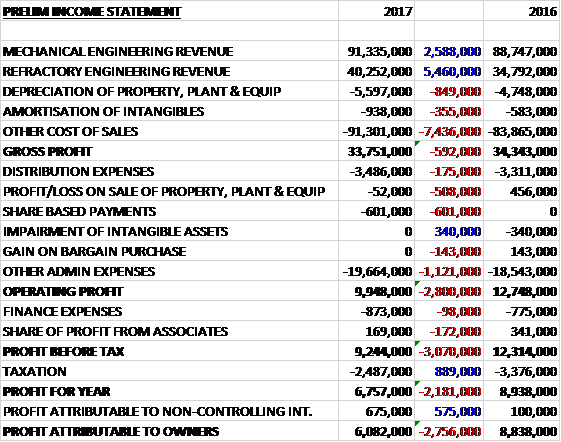
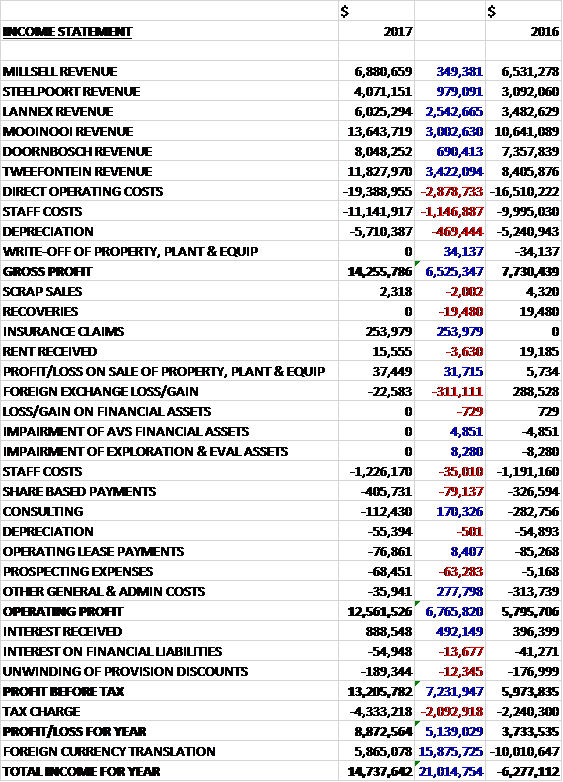
Revenues increased when compared to last year due to a £5.5M growth in refractory engineering revenue and a £2.6M increase in mechanical engineering revenue. Depreciation was up £849K, amortisation increased by £355K and other cost of sales grew by £7.4M to give a gross profit £592K below last year. Distribution expenses grew by £175K, there was a £508K swing to losses from asset sales, share based payments increased by £601K and other admin expenses were up £1.1M which meant that the operating profit declined by £2.8M. The share of profits from associated declined by £172K but tax charges decreased by £889K to give a profit for the year of £6.1M, a decrease of £2.8M year on year.

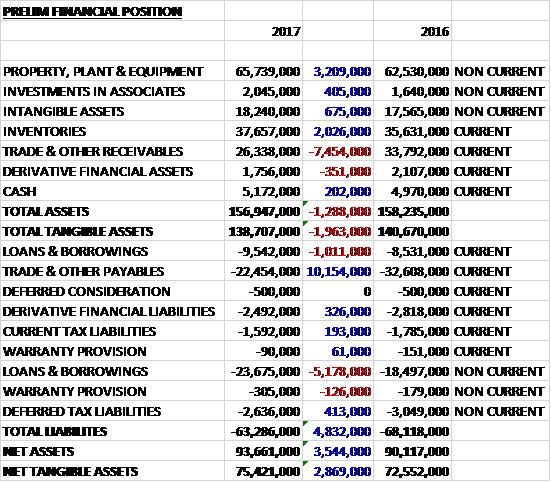
When compared to the end point of last year, total assets declined by £1.3M driven by a £7.5M decrease in receivables, partially offset by a £3.2M growth in property, plant and equipment, a £2M increase in inventories and a £675K growth in intangible assets. Total liabilities also decreased during the year as a £6.2M growth in borrowings was more than offset by a £10.2M decrease in payables. The end result was a net tangible asset level of £75.4M, a growth of £2.9M year on year.

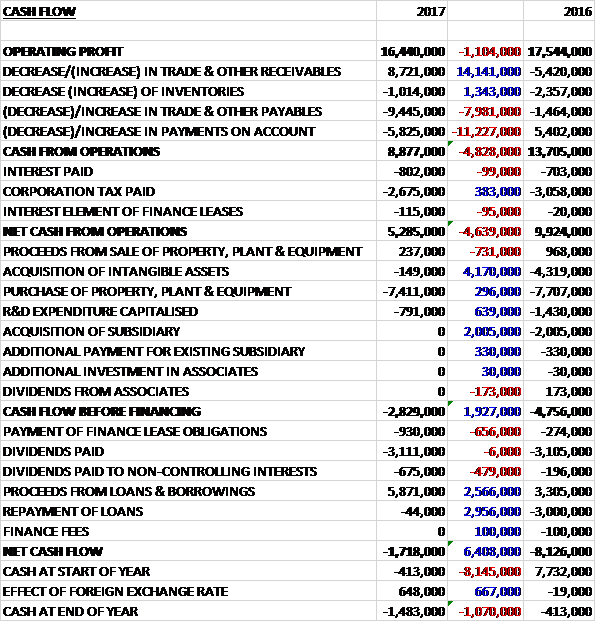
Before movements in working capital, cash profits decreased by £1.1M to £16.4M. There was a cash outflow from working capital an even after tax payments declined by £383K, the net cash from operations came in at £5.3M, a decline of £4.6M year on year. This did not cover the £7.4M spent on property, plant and equipment and the £791K spent on R&D relating to a new valve range at Goodwin International and a new fire extinguisher project at Dupre Minerals, so there was a cash outflow of £2.8M before financing. The group also paid out £3.7M in dividends so had to take out new loans totalling £5.9M top give a cash outflow of £1.7M and a cash level of -£1.5M at the year-end. The operating profit for the Mechanical Engineering division was £7M, a decline of £4M year on year.

Although revenues increased, profits declined as the gross margin reduced due to the continued tightening in market prices for products they sell to the oil, gas and mining industries where capex has been reduced. The valve business in Germany has had an exceptional year, being close to those markets that have re-started investment but the board expect it to be a further 18 months before other areas in the world realise they will be short of supplies.

India has seen coal production and thermal power generation increase which has helped the Indian pump business increase sales by 58%. Goodwin International has received its first order for its new range of axial piston isolation valves and the board expect it to be well positioned when the activity of the petroleum companies starts to recover. The reported profit this year is after recognition of £900K of costs relating to reduced manpower to match market demand.

The operating profit for the Refractory Engineering division was £5.9M, a growth of £1.7M when compared to last year.

At the current share price the shares are trading on a PE ratio of 18 but I can find no forecast for next year. After the dividend payment was kept the same, the shares are yielding 2.8%.

Overall then this has been a difficult year for the group. Although net assets increased, profits declined and the operating cash flow fell with no free cash being generated, although this is partly due to working capital movements. The refractory engineering division actually performed well but this was offset by a mechanical engineering division that is still struggling with a depressed oil and gas market. In these conditions, and given that there is no forecast or even outlook, I feel that a PE of 18 and dividend yield of 2.6% is too expensive at the moment.

On the 13th September the group announced that profitability was broadly in proportion to the full year figures recently published. Sadly they also said that they were no longer issuing quarterly management statements which is certainly a step back in shareholder engagement!

Colefax Share Blog – Final Results Year Ended 2017

Colefax has now released their final results for the year ended 2017.

Revenues increased when compared to last year as a £270K decline in Furniture revenue was more than offset by a £3.7M growth in Fabric revenue and a £200K increase in Decorating revenue. Depreciation was up £533K and other cost of sales increased by £2M to give a gross profit £1.1M higher. Operating expenses grew by £3.1M, which included a hedging loss of £2M, which meant that the operating profit fell by £2.1M. Finance costs were broadly similar so after tax charges declined by £513K the profit for the year was £1.9M, a decline of £1.6M year on year.

When compared to the end point of last year, total assets increased by £3.3M driven by a £2.6M growth in receivables, a £2.1M increase in property, plant and equipment and a £1.4M growth in inventories, partially offset by a £3.4M decrease in cash. Total liabilities also increased during the period due to a £2.7M growth in payables, a £734K increase in deferred tax liabilities and a £533K increase in deferred rent. The end result was a net tangible asset level of £25.9M, a decline of £382K year on year.

Before movements in working capital, cash profits declined by £1.5M to £5.7M. There was a cash outflow from working capital and after tax payments were broadly flat, the net cash from operations came in at £2.8M, a decline of £3M year on year. This didn’t cover the £4.1M spent on property, plant and equipment and there was a cash outflow of £1.3M before financing. The group also spent £478K on dividends and £2.6M on own share purchases to give a cash outflow of £4.3M and a cash level of £6.7M at the year-end.

Sales in the Fabric division were up 5.5% due to favourable forex movements. They were down 6% on a constant currency basis, however. The operating profit reduced by £1.7M to £2.8M due to the hedging loss of £2M. The main reason for the decline in sales was adverse trading conditions in the US market where sales decreased by 7.7%. The rate of decline slowed during the year with the first half down by 10% and the second half down by 6%. In the run up to the US election there was considerable political uncertainty which the board believe impacted spending in the luxury end of the market. They opened a new showroom in Boston in October and a new showroom in Atlanta in February.

Sales in the UK were down 1% reflecting fairly challenging conditions at the top end of the market. Trading conditions are closely linked to the health of the high end housing market and there has been a significant decline in high end housing transactions over the last year, linked to changes in stamp duty.

Sales in continental Europe increased by 7% but reduced by 6% on a constant currency basis. France, Germany and Italy all saw relatively difficult markets. France was down 5%, Germany by 9% and Italy by 4%. Sales in most other European countries were slightly lower compared to last year but there are tentative signs of a pick-up in the overall economy. Sales in the rest of the world decreased by 2% during the year and current market conditions mean that the region remains a relatively small part of overall sales.

Sales of Kingcome furniture decreased by 10% to £2.4M and as a result, the operating profit fell by £240K to £23K. The business has been adversely affected by the slowdown in the high end housing market in the UK. Customer deposits ended the year up by 21% compared to the prior year but management expect conditions to remain challenging. Export sales represent an opportunity for growth, especially given the decline in the value of Sterling since the Brexit vote.

Decorating sales increased by 3% but profits fell by £113K to £108K. It was a transitional year for the division due to the move to the new showroom in Belgravia which opened in February with the initial market reaction exceeding management expectations. The new location is better suited to the needs of the business and whilst they have significantly reduced their investment in antique stock, antique sales have been encouraging. Customer deposits are now well ahead of last year and the decline in Sterling has encouraged an increase in the proportion of overseas customers.

Going forward, the board is cautiously optimistic about prospects for the year ahead. In the US, they have seen a steady improvement in confidence since the presidential election and sales for the first two months of the new financial year are ahead of the prior year and budget. Sales in the UK and Europe are also ahead of last year but the board remain cautious about growth prospects in those markets. The weakness of Sterling against the dollar is very positive for the business but they will not fully benefit this year due to ongoing hedging put in place prior to the Brexit vote, which is likely to give rise to a charge of just over £1.2M.

At the current share price the shares are trading on a PE ratio of 27.1 which falls to 20.2 on next year’s consensus forecast. After a 4% increase in the final dividend, the shares are yielding 1% which remains the same for next year’s forecast. At the year-end the group had a net cash position of £6.7M compared to £10.1M at the end of last year.

Overall then this has been a difficult year for the group. Profits fell, net assets declined and the operating cash flow decreased with no free cash being generated. The main issue seems to have been the lack of confidence in the high-end housing market in the US relating to the election. The rate of decline has slowed, however, and actually reversed so far this year so things might be improving? There are also issues in the high end housing market in the UK due to changes in stamp duty. Although things are improving, most markets still seem to be rather tricky and I think the forward PE of 20.2 and yield of 1% makes the shares look a bit expensive. I am not buying in here quite yet.

On the 14th September the group released a trading update where they stated that current trading is in lie with management expectations. In the core Fabric Division, sales in the US for the first four months of the year are up by 4% on a constant currency basis. In the UK, sales were up 3% and sales in Europe were up 4% at constant currency so this actually doesn’t seem that bad, although the shares still look too expensive to me.

TT Electronics Share Blog – Interim Results Year Ending 2017

TT Electronics has now released their interim results for the year ending 2017.

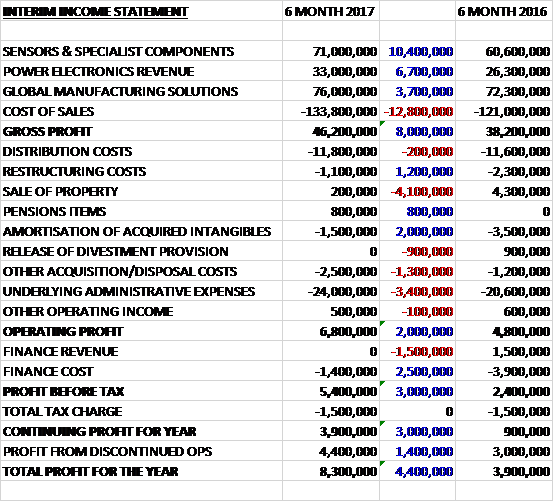
Revenues increased during the period with a £10.4M growth in sensors and specialist components, a £6.7M increase in power electronics revenue and a £3.7M growth in global manufacturing solutions revenue. Cost of sales increased by £12.8M to give a gross profit £8M higher. Restructuring costs fell by £1.2M but there was a £4.1M reduction in the profit from asset sales following last year’s property disposal. There was an £800K income from pension items, representing a past service adjustment under which members agreed to exchange future pension increases for an additional amount of initial pension, and a £2M reduction in the amortisation of acquired intangibles. Offsetting this, there was no release of provisions, which represented an income of £900K last time, other acquisition and disposal costs increased by £1.3M, related to the proposed disposal of the Transportation Sensing and Control division, and underlying admin expenses grew by £3.4M to give an operating profit £2M higher than last time. Finance revenue fell by £1.5M but finance costs declined by £2.5M and tax charges remained flat to give a continuing profit of £3.9M, a growth of £3M year on year.

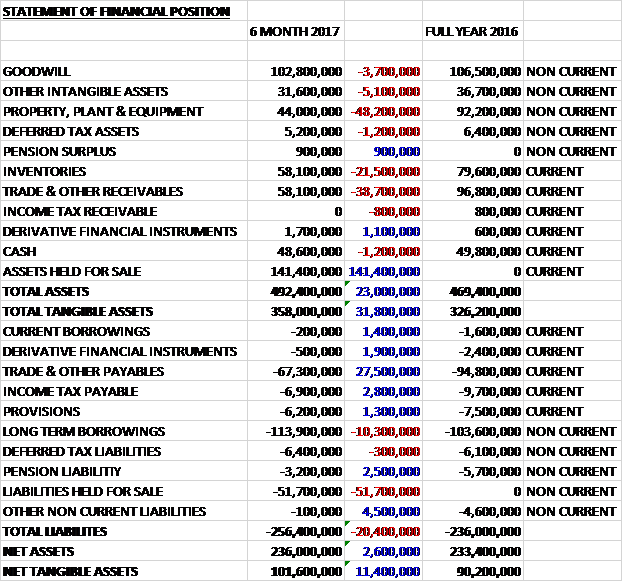
When compared to the end point of last year, total assets increased by £23M driven by a £141.4M asset held for sale, partially offset by a £48.2M fall in property, plant and equipment, a £38.7M decline in receivables and a £21.5M decrease in inventories – this doesn’t tell us much really. Total liabilities also grew during the period as a £27.5M reduction in payables was more than offset by a £51.7M liability held for sale and a £10.3M growth in long-term borrowings. The end result was a net tangible asset level of £101.6M, a growth of £11.4M over the past six months.

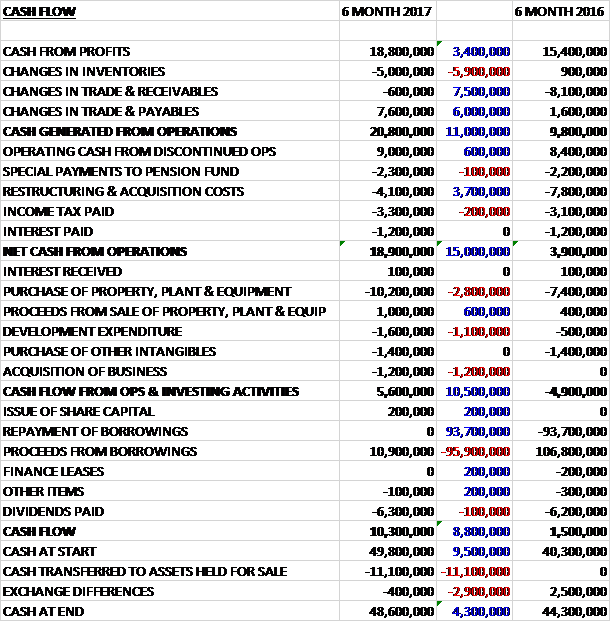
Before movements in working capital, cash profits increased by £3.4M to £18.8M. There was a cash inflow from working capital due to a reduction in payables and after a £3.7M reduction in restructuring costs and an increase of £600K in discontinued operation cash, the net cash from operations came in at £18.9M, a growth of £15M year on year. Although if we remove the cash from the discontinued operations, this is reduced to £9.9M. The group spent £10.2M in property, plant and equipment, £1.6M on development expenditure, £1.4M on other intangibles and £1.2M on acquisitions which left a free cash flow of £5.6M. This did not cover the £6.3M paid out in dividends and the group took out a further £10.9M of loans to give a cash flow of £10.3M and a cash level of £48.6M at the period-end.

The group have reorganised their continuing operations to move their circuit protection, current sensing and signal conditioning capabilities from the Advanced Components division into the Industrial Sensing and Control division, with it being renamed Sensors and Specialist Components. The remainder of the Advanced Components division has been renamed Power Electronics to reflect the change in business mix following the integration of Aero Stanrew into the group. No change has been made to the Integrated Manufacturing Services division apart from it being renamed Global Manufacturing Solutions.

The underlying operating profit of the Sensors and Specialist Components business was £8.6M, a growth of £1.5M year on year. Of this increase, £1.1M was due to a positive forex effect with £400K being the increase at constant currency. This was driven by a 6% revenue increase due to an improving underlying market demand and what the board believe to be a short term increase in OEM distributor demand for their advanced circuit protection, current sensing and signal conditioning components due to extending industry lead times. They have captured market share as a result of reduced lead times and improved capacity.

The benefit of volume increases was partially offset by adverse mix as a result of lower sales of high-margin aftermarket electronic power steering sensors. This impact is expected to normalise in the second half. During the period they saw growth in their optoelectronic assemblies which detect light in a number of applications such as cash machines, medical devices and industrial automation.

The improved market demand for their advanced circuit protection, current sensing and signal conditioning components has been driven by applications requiring reduced size and weight and increased packaging density and power efficiency. Market demand has been strong for these applications in product areas such as white goods and consumer electrical equipment.

New product innovation continues to increase with more new products launched than in the same period of last year. This includes a number of new components with battery monitoring applications with enhanced capabilities including higher rated power and lower temperature sensitivity.

The underlying operating profit of the Power Electronics business was £3.4M, an increase of £1.5M when compared to the first half of last year, all of which was due to favourable forex movements with a further £100K being as a result of the Cletronics acquisition. There was revenue growth of 25% as a result of continued penetration in the aerospace and defence market, together with one off last time buy activities as the group move production from the US to the UK.

Following the new contract won last year with a global engine manufacturer to outsource their product lines for ASIC solutions to the group, they have launched a range of new devices which are used in flight critical aerospace applications. They have now moved production for four customers into the clean room facility in Bedlington, the investment for which was completed last year. The contracts won with these customers will last up to five years.
They have seen increased demand for their connectors being used in rail applications in a significant UK transport infrastructure project. They have also seen good demand from some commercial aerospace engine programmes which have been in ramp up.

During the period they acquired Cletronic, a small US-based manufacturer of electromagnetic components for the aerospace industry, for £1.2M. The acquisition will help to accelerate the strategy for their power electronics capabilities in North America and adds product and technical breadth to the capabilities acquired with Aero Stanrew.

The underlying operating profit of the Global Manufacturing Solutions business was £2.5M, a growth of £100K when compared to the first half of 2016 but all of this, again, was due to favourable forex movements with the constant currency operating profit down 11%. Revenue was down 2% at constant currency. Revenue growth in Asia was strong and the North American industrial market weakness has subsided and the group has won contracts that were previously deferred but this has been offset by weaker European customer demand which has prompted management to make headcount reductions which is expected to yield benefits in H2.

After experiencing challenging North American industrial markets during 2016, they have started to see the market strengthen, winning key multi-year awards in aerospace and defence. In Asia they have continued to see strong growth, particularly in medical markets across a number of customers in life sciences and lab instrumentation. For one customer where they supply printed circuit board assembly integration box builds and cable assemblies, they have seen increased demand as a result of the fast growing Asian medical market as well as ramping up new contracts won with this customer.

In July, after the period-end, the group announced the proposed disposal of the Transportation Sensing and Control division to AVX Corp for £118.8M in cash. The business made an underlying operating profit of £6.5M in the period, an increase of £1.1M year on year with £600K of that as a result of favourable forex movements making this the best performing sector. Completion is expected in Q4.

Going forward, the first half performance and order momentum reinforce the board’s confidence of making further progress in the rest of the year. At the current exchange rate, the group are not expecting to see any further benefit in the second half.

At the current share price the shares are trading on a PE ratio of 21.3 which falls to 16.3 on the full year consensus forecast. After an increase in the interim dividend, the shares are yielding 2.6% which remains the same on the full year forecast. At the period-end, the group had a net debt position of £56M compared to £65.5M at the end of the prior year but it should be noted that this will be wiped out by the £118.8M cash consideration of the disposal.

Overall then, on the surface this has been a strong performance with an increase in profit, a growth of net assets and an increase in the operating cash flow. Some free cash was generated but not enough to cover the dividends. This good performance has been almost entirely due to favourable forex movements, however. Looking at constant currency operating profits, Sensors & Specialist Components saw a decent performance but how much of this was due to a one-off increase in OEM distributor demand is hard to tell.

Power Electronics saw a flat performance and Global Manufacturing saw a declining profit due to a reduction in European demand. Clearly the big event is the disposal of the most profitable part of the group which will eliminate the debt and give the group a decent amount of cash to invest in the business. The current performance doesn’t really warrant the forward PE of 16.3 and yield of 2.6% but I believe that is taking into account the cash that is coming this way. I have decided to take a position here but am a little unsure if that is the right thing to do!

On the 20th November the group released a trading update covering the first four months of H2. Trading overall has been positive with the growth trends experienced in the first half in Sensors and Specialist Components and Power Electronics continuing, and with Global Manufacturing Solutions returning to growth in the period as expected. Group revenue is up 6% on an organic basis compared to the prior year. The order book across all divisions continues to be strongly ahead of the prior year.

The group completed the sale of the Transportation Sensing and Control division. As part of the separation they have announced the closure of their Global Manufacturing Solutions site in Romania which was shares with the TS & C division. They will move their lines to Wales and China rather than incur the cost of establishing a new facility with the site closure expected in H1 2018. Overall this is decent enough, I remain a holder.

On the 15th February it was announced that the group had made a cash offer for Stadium Group whereby Stadium shareholders would be entitled to receive £1.20 for each share, valuing the group at around £45.8M.

Stadium is a supplier of wireless connectivity solutions, power products, human machine interface solutions and electronics assemblies with design, manufacturing and fulfilment operations in the UK, Sweden, the US and Asia. In 2016 the business generated revenues of £53.1M and pre-tax profit of £2.2M.

The benefits are being cited as a greater presence in attractive segments of the industrial, medical, aerospace and defence and transportation sectors; enhanced product capabilities in power electronics and connectivity; and extended R&D facilities. The transaction is being funded by existing cash resources and debt and the group expects it to be immediately earnings enhancing.

The two groups have a complementary customer base, providing opportunities for both businesses to cross-sell their product portfolios. The board believes that their scale and well established routes to market will be beneficial to extending Stadium’s product presence. In particular the development of Stadium’s North American business is expected to be accelerated through TT’s established network in the region.

Gem Diamonds Share Blog – Interim Results Year Ending 2017

Gem Diamonds has now released their interim results for the year ending 2017.

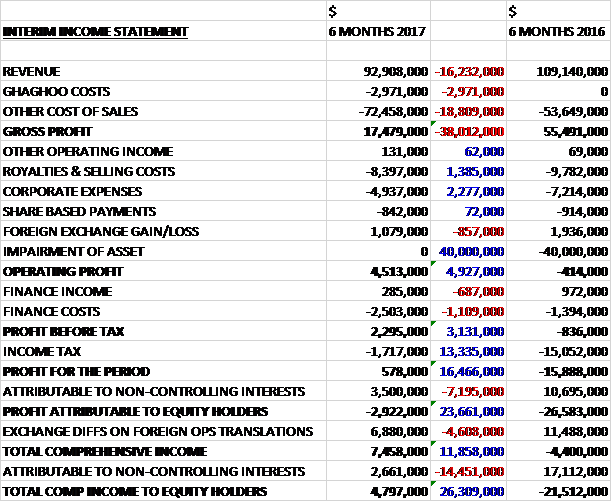
Revenues declined by $16.2M when compared to the first half of last year. We also see one-off Ghagoo costs of $3M and other cost of sales increase by $18.8M, mainly relating to an increase in waste stripping amortisation costs due to the mining mix, to give a gross profit $38M lower. Royalties and selling costs declined by $1.4M and corporate expenses were down $2.3M, however. We also see no asset impairments, which cost $40M last time so the operating profit increased by $4.9M. Finance costs grew by $1.1M and finance income declined but tax charges reduced by $13.M to give a loss for the half year of $2.9M, an improvement of $23.7M year on year. This isn’t the whole story clearly, however, as excluding last year’s $40M impairment, the performance was much lower.

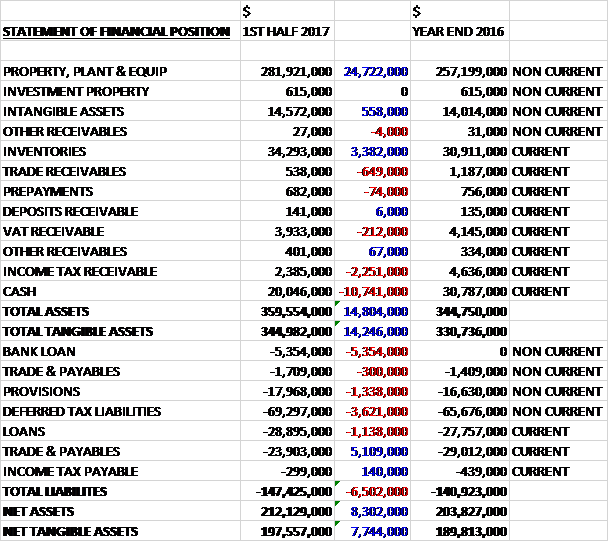
When compared to the end point of last year, total assets increased by $14.8M driven by a $24.7M increase in property, plant and equipment along with a $3.4M growth in inventories, partially offset by a $10.7M decrease in cash and a $2.3M fall in income tax receivables. Total liabilities also increased during the period as a $5.1M decrease in payables was more than offset by a $6.5M growth in loans, a $3.6M increase in deferred tax liabilities and a $1.3M growth in provisions. The end result was a net tangible asset level of $197.6M, a growth of $7.7M over the past six months.

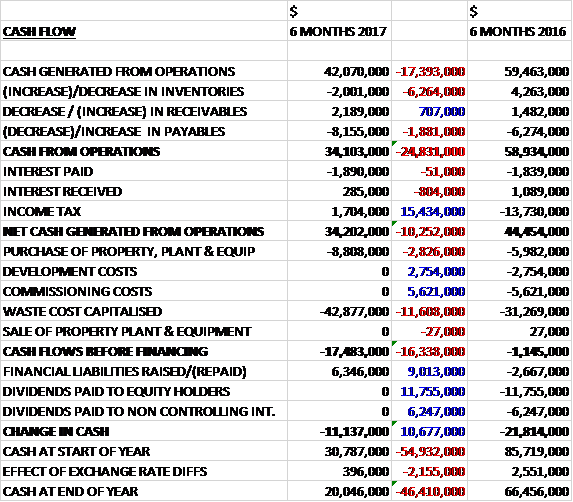
Before movements in working capital, cash profits declined by $17.4M to $42.1M. There was a cash outflow from working capital, mainly due to a decrease in payables, but tax payments reduced by $15.4M to give a net cash from operations of $34.2M, a decline of $10.3M year on year. The group spent $8.8M on property, plant and equipment, mostly relating to the mining support services complex construction, along with $42.9M on waste costs which meant that there was a cash outflow of $17.5M before financing. They raised $6.3M through finance leases to give a cash flow of $11.1M and a cash level of $20M at the period-end.

The global market for diamonds remained cautious. Financing challenges persist and the volatile macro-economic environment continues to create challenges for the middle diamond market.

The operating profit at Letseng was $16.3M, a decline of $30.5M year on year. Overall the group treated 3.2M tonnes of ore at a grade of 1.59cpht compared to 3.3M tonnes at 1.72cpht last time. This meant that the number of carats recovered fell from 57,380 to 50,478. There were lower than planned ore tonnes treated during the period due to reduced plant availability and downtime associated with the installation of the split front ends for plants one and two. The availability issues have largely been addressed now. A significant amount of time and resources were used in addressing these issues and both plants have improved towards the end of the period.
The lower than expected grade was mainly due to the underperformance of the Main pipe contact material and internal changes in the geology of this pipe. The recovery of large diamonds has improved, with four greater than 100 carat diamonds and two D-colour Type IIa diamonds of 98.42 and 80.58 carats being recovered during the period. The average price achieved fell from $1,899 per carat to $1,779 per carat but this has been trending positively having been $1,480 in H2 last year and the latest sale in July achieved $2,385 per carat.

During the period the construction of the relocated mining complex, which is required to make way for the expansion of the open pits, started. Construction progressed well and is expected to be completed in early 2018, on time and budget. Following the disbandment of the Letotho parliament in early 2017, peaceful electrons took place in June and a new government has been elected. Initial engagement with the new government has started positively.
Costs increased during the period due to strengthening of the local currencies against the US dollar, local country inflation and longer hauling distances as a result of mining in deeper sections of both pits.

Going forward the focus will be on building relationships with the new government in Lesotho, continuing to pursue efficiency and cost reduction initiatives, continuing to reduce diamond damage and delivering the mining complex on time and on budget.

The operating loss at Ghaghoo was $5.8M, an improvement of $33.2M when compared to the first half of last year due to the $40M impairment that occurred last time. During the period an earthquake occurred with an epicentre 25km from the mine. There was superficial damage to the surface infrastructure but the earthquake also damaged the seal of the underground water fissure, leading to a large influx of water into the underground workings of the mine. This water was being pumped out of the mine and rehabilitation of the seal will be completed in Q3. Once the water fissure has been sealed, the operation’s annual care and maintenance costs will return to the expected costs of $3M per annum.

The costs incurred in the period included development costs, retrenching costs, one-off costs to renegotiate contracts and one-off costs associated with the additional water pumping and sealing of the fissure as a result of the earthquake.

In February the board decided to place the mine on care and maintenance based on the decrease in the prices achieved for its diamonds. This was achieved in the period and the planned annual care and maintenance cost of $3M is expected to be achieved in the second half of the year.

Apparently the group have received an offer to buy Ghaghoo which the board are considering, but they don’t give any further details. The operating profit in Belgium was $109K, an improvement of $1M when compared to the first half of 2016. The board has approved capital projects of $16M, mainly relating to the Letseng mining support services complex, of which $14.9M have been contracted as of the period-end.

During the period, Roger Davis stepped down as chairman and was replaced by Harry Henyon-Slaney. Also, the Letseng CEO, Mazvi Maharasoa, retired after ten years of service and a new COO, Jeremy Taylor, has been appointed.
No dividends were paid in the period and none are proposed. The group ended the period with a net debt position of $14.2M, cash on hand of $20M and unused debt facilities of $36.2M.

Overall then this has been a rather disappointing period for the group. They have swung to a loss and although net assets were up, the operating cash flow declined and there was a cash outflow before financing. The diamond market remains cautious and the average selling price was lower than last time. The group might have turned a corner here, however, as the more recent sales have been at higher prices due to more large stones being recovered. Both the grade and the tonnes of ore being processed has fallen due to the underperformance of the main pipe material and stoppages at the plant related to the upgrade.

Ghagoo is experiencing further problems following the earthquake but the offer of a sale of the asset is interesting. I would imagine that overall they are not going to get much, however, and this project has been a big waste of money. Whilst the pick-up in the number of large gems is encouraging, there is not much else to get excited about here and I remain on the side lines.

On the 19th September the group announced the recovery of a high quality 115 carat D colour Type IIa diamond from the Letseng mine.

On the 31st October the group released an update covering trading in Q3. At Letseng they recovered 30,774 carats, up 23% compared to Q2. They achieved an average price of $2,397 per carat in July, making it the highest average since September 2015 but the average price in the quarter was $1,858, up 4% over H1. At the period-end they had a net debt position of $11.8M compared to $14.2M at the start of the quarter.

The mine treated a total of 1.3M tonnes, 61% from the main pipe and 39% from the satellite pipe with the higher tonnes treated due to higher plant availability. Despite the improved availability, a crack was identified in the scrubber shell in Plant 2, which is being closely monitored. A decision has been made to reduce the amount of material being fed into this plant to reduce the stress on the scrubber. This reduced feed rate will be maintained until a new scrubber shell is installed, which is planned for February 2018. As a consequence, guidance for tonnes treated for this year has been reduced marginally to between 6.5 and 6.5M tonnes.

Management has implemented various initiatives at Letseng to ensure carats recovered and sold remain within original guidance, and they have increased the contribution from the higher grade satellite pipe material. As a consequence, unit cost guidance is expected to increase due to the higher amortisation charge associated with using the satellite pipe material and the reduced tonnages.

On the 2nd December the group announced that it had not been able to come to an agreement on the sale of Ghaghoo. They are still in discussions with other parties, however.

On the 15th January the group announced the recovery of an exceptional quality 910 carat D colour Type IIa diamond. This is huge, the largest recovered from Letseng and believed to be the fifth largest gem quality diamond ever recovered.

On the 22nd January the group announced the recovery of an exceptional quality 149 carat D colour Type IIa diamond. This is the fourth high quality diamond of over 100 carats recovered so far this year and these shares are looking a bit interesting.

On the 2nd February the group released a trading update covering Q4. The group achieved an average price of $2,217 per carat, up 19% from the amount achieved in Q3 and meant that the average for the year was $1,930. They sold 31,476 carats, up 21% on Q3. At the end of the period the group had a net cash position of $1.4M, a $13.2M improvement on the end of Q3.

The improvement in the recovery of 100 carat gems in continuing into 2018 with five recovered in January alone. This is largely attributable to the ongoing technical improvements made at the Letseng mine.

The reduced feed rate into plant 2 due to the crack in the scrubber shell continues. The installation of a new scrubber shell is planned for April 2018 where the feed rate will revert to normal levels. Full year tonnes treated was 6.4MT, below the 6.5M guidance due to the reduced feed rate. Although waste mining was down quarter on quarter, this was a conscious decision to reduce mining rates to ensure the amount of waste mined was aligned to the amount of ore treated for the year.

During the period 30,560 carats were recovered at a grade of 1.88cpht against an expected reserve grade of 1.75cpht. In the second half of the year a Tomra XRT machine was installed at the mine to re-treat recovery tailings material, recovering 3,298 carats from 25,404 tonnes treated. The recovery of large diamonds has improved markedly over the past four months with 214 larger than 20 carat diamonds recovered in 2017.

Two tenders were held in the period with a total of 31,476 carats sold for $69.8M. A 58.38 carat white diamond achieved $61,905 per carat, making it the highest for rough white diamonds for the year and further contributing to the average increase, a 7.87 carat pink diamond achieved $202,222 per carat, the second highest price per carat ever achieved at the mine.

Serabi Gold Share Blog – Interim Results Year Ending 2017

Serabi Gold has now released their interim results for the year ending 2017.

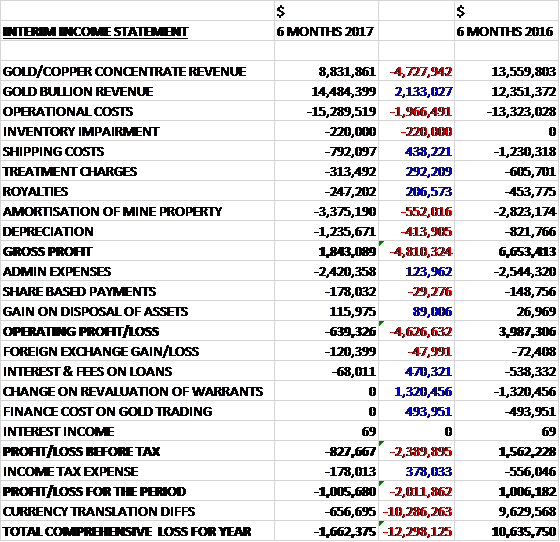
Revenues declined when compared to the first half of last year as a $2.1M growth in bullion sales was more than offset by a $4.7M decline in concentrate sales. Operational costs increased by $2M, mainly due to forex movements and staff pay rises, amortisation was up $552K and depreciation grew by $414K, also reflecting forex movements, although shipping costs were down $438K due to a reduction in concentrate shipments, treatment charges declined by $292K, and royalties fell by $207K which meant that the gross profit was $4.8M lower. Admin expenses saw a modest decline which gave an operating loss that saw a $4.6M negative swing. Loan interest charges declined by $470K, there was no finance cost on gold trading and no revaluation of warrants, which cost $494K and $1.3M last year respectively. After tax expenses fell by $378K the loss for the period was $1M, a detrimental movement of $2M year on year.

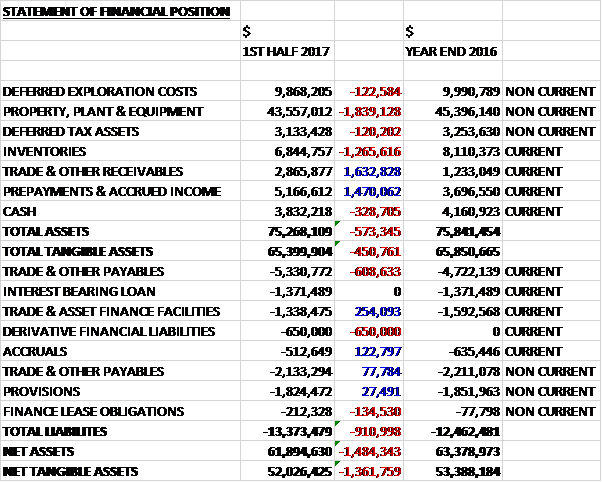
When compared to the end point of last year, total assets declined by $573K driven by a $1.8M fall in property, plant and equipment and a $1.3M decrease in inventories due to lower levels of ore stockpiles, partially offset by a $1.6M growth in receivables reflecting settlement timings and a $1.5M increase in prepayments and accrued income reflecting the funds not yet received from the new Sprott loan and higher prepaid taxes. Total liabilities grew during the period, mainly due to a $650K increase in derivative financial liabilities relating to Sprott’s call option over some gold and a $609K growth in payables reflecting timing differences. The end result was a net tangible asset level of $52M, a decline of $1.4M over the past six months.

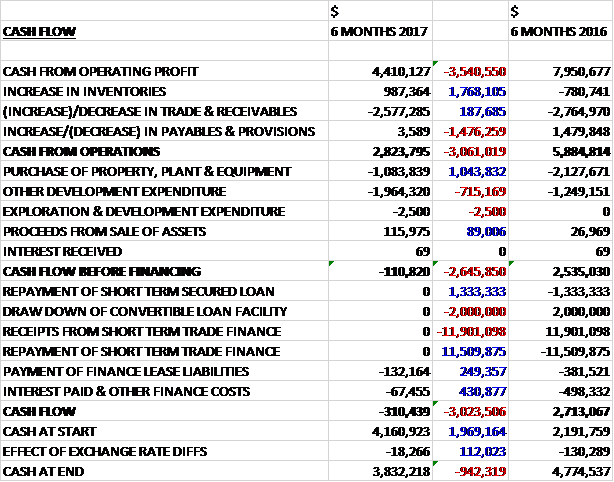
Before movements in working capital, cash profits declined by $3.5M to $4.4M. There was a cash outflow from working capital but this was slightly less than last time so the cash from operations was $2.8M, a decline of $3.1M year on year. The group spent $1.1M on property, plant and equipment and $2M on other development expenditure so there was a cash outflow of $111K before financing. The group repaid $132K of finance leases and $67K in other interest so the cash outflow for the half year was $310K and the cash level at the period-end was $3.8M.

During the half year period the group produced 18,009 ounces of gold compared to 19,667 in the prior year. In Q1 they produced 9,861 ounces with 8,148 ounces being produced in Q2. The sales price was broadly flat at $1,221 per ounce but the AISC cost of production increased from $945 per ounce to $1,072. The cost guidance for the full year is between $950 and $975 per ounce but the cost profile is subject to change as a result of exchange rate variations between the Real and US dollar. They are currently forecasting gold production of around 40,000 ounces for the year.

The group mined a total of 78,993 tonnes of ore compared to 71,152 tonnes last year reflecting he increased number of working faces now available at Sao Chico, but the grade fell from 10.29g/t to 8.89g/t with the figure in Q2 even worse at 7.8g/t. They started to increase the level of stoping activity in Q1 but the stoping method at Sao Chico requires the use of remote controlled loaders and during the period they were still in the process of building up their fleet. In Q1 they had one loader with a second due to arrive in June but the first loader, despite being only four months old, suffered a mechanical problem which significantly reduced stoping production in April and May. It was therefore necessary to use development ore, at a lower grade, as alternative mill feed.

By June, with the original unit returning to full operation and the second unit being commissioned, production improved significantly reflected in 42% of the gold production from Sao Chico being achieved in June. With the additional development completed in the quarter, making available additional stoping blocks, the group is confident that the Q2 shortfall will be recovered over the second half of the year.

The group milled 90,568 tonnes of ore at a grade of 6.69g/t compared to 76,017 tonnes at 8.38g/t, reflecting the increased plant capacity installed in H2, allowing the processing of lower grade stockpiled material. The throughput of the plant increased by around 19% with the introduction of the third ball mill at the end of June 2016 having a significant effect on rates. The increase also reflects the improvements in operational efficiency of the plant with the introduction of the gravity circuit and ILR for treating Sao Chico ore, reducing the levels of gold that would otherwise have been treated in the CIP circuit.

As far as exploration is concerned, a programme is being undertaken at Sao Chico using surface IP and, whilst it is also being undertaken around the Sao Chico orebody, it is also being undertaken in some of the recently acquired tenements around Sao Chico. The programme has to be suspended during Q4 2016 due to poor weather and will restart in the second half of this year. Management considers that these areas, which are located to the south and west of the original license area, offer good potential for hosting strike extensions of the current Sao Chico veins.
In consideration of a loan facility with Sprott for $5M the group has granted them call options over 6,109 ounces of gold at a strike price of $1,320 per ounce (currently the price is around $1,275) exercisable up until the end of 2019. These funds were received after the period-end.

At the current share price the shares are trading on a PE ratio of 8.4 which falls to 4.3 on the full year consensus forecast.

Overall then this has been a difficult period for the group. They made a loss as opposed to a profit last time, net assets were down and the operating cash flow declined with no free cash being generated. Gold production was down due to the group having to use development ore stockpiles as the new loader malfunctioned. This has apparently been sorted out now but the group will have to hope for no more issues in order to hit their production target for the year. If they do hit it, the forward PE of 4.3 looks cheap but this is a big if. I hold on for now, however.

On the 23rd October the group released an update covering Q3. After a disappointing Q2 production of 8,148 ounces, production improved somewhat in Q3 to 9,657 ounces and the total production for the year to date is around 28,000 ounces.

Mine production from both orebodies progressed well, and there were improvements in the average grades mined during the quarter, with average grades over 9g/t. Mine development at Sao Chico has been encouraging with the 40mRL level exhibiting greater than forecast payable strike lengths.

With current plant limitations there has been little success in running down the levels of the flotation tails. To date they have pumped the tailings wet to the CIP plant but this has proven to be slow and labour intensive. Passing the material dry is restricted by belt capacity, and therefore would be displacing higher grade ore. They are now designing and constructing and independent conveyor to feed these tails directly into the ball mills, which means that the material can be added to the current dry mill feed, and therefore increase the levels that can be treated each month. They hope to be operational with this by mid-November.

There is also an intention to introduce an x-ray ore sorter after the main crushing plant that will separate material ahead of milling and remove from the mill feed a significant proportion of the waste that would otherwise have formed part of the feed into the plant. Not only will this reduce process costs, but it will also liberate capacity in a mill constrained operation. They therefore hope they can de-bottleneck the plant using this technology, elevating mill feed grade in the process, and free up plant capacity for the future organic growth. This equipment is built to order and it is expected to take up to a year before it can be commissioned. Payback of the estimated $1.2M costs is expected to be less than a year, however.

With improved metal prices and exchange rates, the group have recently been enjoying better margins and cash generation. They have now been able to commit to an initial 8,000m surface drill programme, which will focus on drilling the many potential vein extensions they have at Palito.

The full programme they would like to undertake is substantially greater than 8,000m and both ore bodies could benefit from higher levels of strike extension drilling. The full programme, targeting 60,000m would be completed in two phases. This initial 8,000m forms part of phase one and is a programme they can start comfortably out of operational cash flow. Drilling will get underway in November.