Berkeley Group Share Blog – Final Results Year Ended 2017

Berkeley group has now released their final results for the year ended 2017.

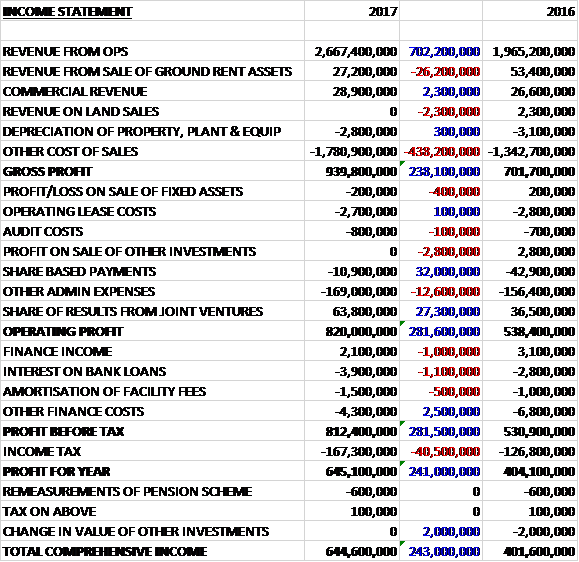
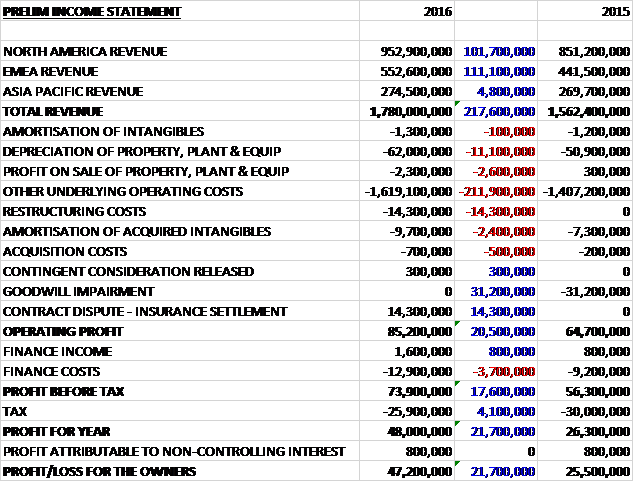
Revenues from the sale of ground rents reduced by £26.2M and revenue from land sales fell by £2.3M but revenue from operations increased by £702.2M and commercial revenue was up £2.3M. cost of sales grew by £437.9M which meant that the gross profit was £238.1M higher. Share based payments declined by £32M and there was a £27.3M increase in the contribution from joint ventures but there was no sale of investments, which made £2.8M last time, and other admin expenses were up £12.6M to give an operating profit £281.6M higher. Finance income was down £1M, there was a £1.1M increase in bank loan interest and a £500K growth in the amortisation of facility fees but other finance costs were down £2.5M and after tax charges increased by £40.5M there was a profit of £645.1M for the year, a growth of £241M year on year.

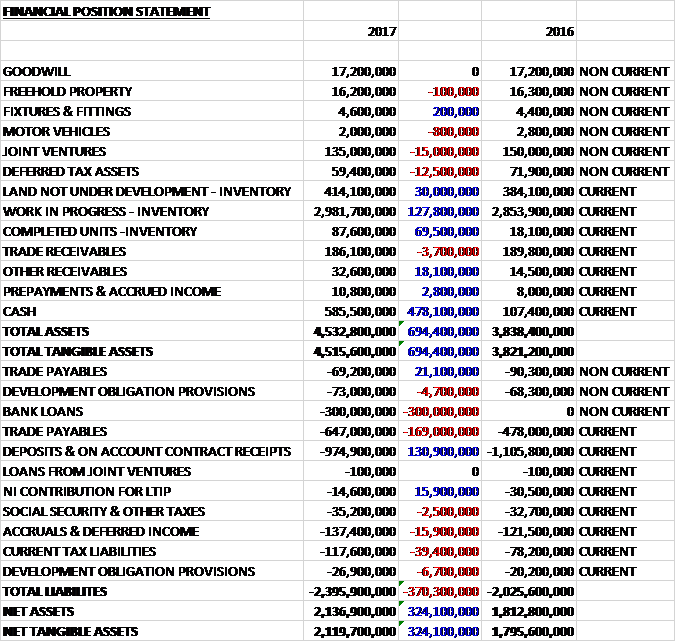
When compared to the end point of last year, total assets increased by £694.4M, driven by a £478.1M growth in cash, a £127.8M increase in work in progress, a £69.5M growth in completed units, a £30M increase in land not under development and an £18.1M growth in other receivables, partially offset by a £15M decline in joint ventures and a £12.5M decrease in deferred tax assets. Total liabilities also increased during the year as a £130.9M decline in deposits on account and a £21.1M fall in trade payables were more than offset by a £300M increase in bank loans, a £169M growth in trade payables, a £39.4M increase in current tax liabilities and a £15.9M increase in accruals and deferred income. The end result was a net tangible asset level of £2.119BN, a growth of £324.1M year on year.

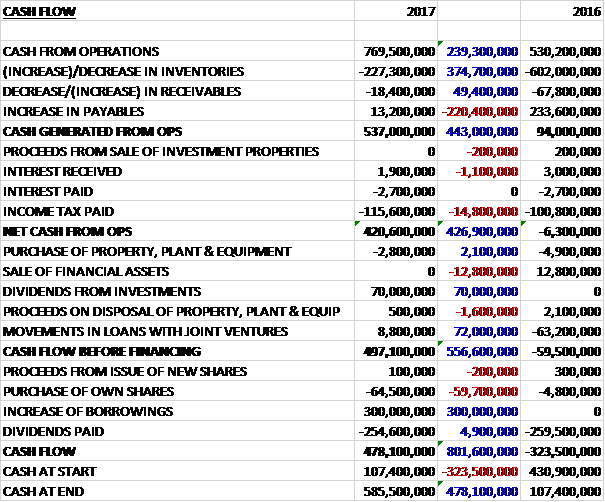
Before movements in working capital, cash profits increased by £239.3M to £769.5M. There was a cash outflow from working capital but this was less than last year and after tax payments increased by £14.8M the net cash from operations was £420.6M, a growth of £426.9M year on year. The group spent just £2.8M on capex and received £70M in dividends from St. Edward, along with the receipt of £8.8M in loans from joint ventures to give a free cash flow of £497.1M. The group then spent £64.5M on their own shares and paid out £254.6M in dividends but covered this with a £300M increase in borrowings to give a cash flow of £478.1M and a cash level of £585.5M at the year-end.

Overall the group sold 3,905 homes at an average selling price of £675K per home compared to 3,776 at £515K last year. They have acquired 16 new sites, of which nine are on a conditional basis, totalling some 7,200 plots. They have also secured ten new planning consents and over 30 revised consents. This activity has seen their holdings rise to 46,351 plots with an estimated gross margin of £6.4M, up from 42,858 plots and £6.1BN a year ago. Since the year-end they have acquired their first site in St. Joseph in Birmingham where they plan to develop around 400 new homes.

Taking the year as a whole. Including the period around the Brexit vote, the value of reservations is 25% lower than last year but this decline has now fully reversed with the return to more stable conditions. Sales continue to be split broadly evenly between owner occupiers and investors and include 157 Help to Buy reservations. Build costs have increased at a similar rate to last year, around 6%, with currency movements impacting materials pricing. There is a recognised skills gap in the UK construction workforce and it is hard to predict how build costs will be affected by Brexit as about half of London’s site labour comes from the EU.

The revenue of £28.9M from commercial activities included the sale of 85,000 sq foot of office, retail and leisure space across a number of the group’s developments including Royal Wells Park in Kent and Kew Bridge, Riverlight, Chelsea Creek, Fulham Reach and Goodman’s Fields in London.

There are a number of factors that resulted in the net £22.3M reduction in share scheme charges, which includes the associated employer’s NI costs. The company cash settled the tax and NI liabilities arising on the vesting of options for participants in the 2011 LTIP in September in lieu of issuing shares. This was more than offset by the effect of the introduction of the caps on the Executive Director remuneration and the prior year included the costs associated with the second tranche of Part B of the 2009 LTIP which vested in April 2016 which was also cash settled for tax and NI.

The increase in the share of joint venture profit reflects the first completions during the current year at 190 Strand and Green Park in Reading, as well as further completions at 375 Kensington High Street and Stanmore Place within St. Edward, and pre-development costs within St. William in the early stages of the joint venture.
St. Edward currently has four schemes in development at Stanmore Place, Kensington High Street, The Strand and Green Park in Reading. 251 homes were sold in the year at an average selling price of £1,332,000. 2,152 plots in the group’s land holdings relate to St. Edward schemes and during the year a resolution to grant consent for a development in Wallingford has been obtained. The site has come through the strategic land holdings and is now included in the land bank. St. Edward also controls a commercial site in Westminster which has a detailed planning consent but will not move into development until the premises are vacated by the current tenant.

6,459 plots (last year: 3,599) in the group’s land holdings relate to St. William schemes, with five new schemes contracted in the year. During the year the production started on St. William’s Prince of Wales Drive development in Battersea. The group continues to work with National Grid to identify sites from across its portfolio to bring into its land holdings. In total there are now eleven St. William developments included in the land holding.

Excluding joint ventures, ten new sites have been added to the land bank in the year. These include six developments in the SE: Farnham, Leatherhead and Cranleigh in Surrey; Royal Tunbridge Wells in Kent; Rudgwick in West Sussex and Sunningdale in Berkshire. In London they have acquired two sites unconditionally: a 21 acre Northfields industrial estate where they are preparing a planning application and a site in Ealing adjacent to their existing Dickens Yard development. In addition, they have conditionally acquired a site on Wood Lane to the west of the existing White City development, and a further conditional site in Paddington.

The group’s land holdings now comprise 90 sites, which is up from 77 a year ago. Of these, 58 have an implementable planning consent and are in construction and a further 14 have at least a resolution to grant planning but the consent is not year implementable; typically due to practical technical constraints and challenges surrounding vacant possession, CP requirements or utilities provision. The remaining 18 sites are in the planning process with 15 of these subject to conditional contracts.

The housing market has stabilised in London and the South East following the disruption either side of the Brexit vote but there are a number of headwinds facing the market. Brexit and wider global macro instability will likely result in constrained investment levels. At the same time, the headwinds from changes in recent years to stamp duty and mortgage interest deductability coupled with the planning environment’s increasing demands from Affordable housing, CIL, Section 106 obligations and review mechanisms are resulting in reduced levels of new housing starts in London. For the group this leads to greater uncertainty around the timing of delivery of homes from the land bank but notwithstanding these issues, the forward sales position and land bank provide sufficient visibility to reiterate the previous guidance of delivering at £3BN of pre-tax profit in the five years beginning 2016 assuming prevailing market conditions persist.

At the current share price the shares are trading on a PE ratio of 8 which remains the same on next year’s consensus forecast. After a reduction in the latest dividend the shares are yielding 5.1% which increases to 5.5% on next year’s forecast. At the year-end the group had a net cash position of £285.5M compared to £107.4M at the end of last year.

Overall then this has been another strong year for the group. Profits increased, net assets grew and the operating cash flow increased, with a decent amount of free cash flow being generated. The group did increase borrowings at the same time as dividends though, which is not something I am a big fan of. The increase in profit seems to be mostly down to an increase in the average value of home sold, which is down to mix and may not be repeated going forward and there are certainly some headwinds such as continued uncertainty over Brexit, increased build costs and the stamp duty changes.

All in all, though I think the forward PE of 8 and yield of 5.5% probably takes this into account. If I wasn’t already invested in some housebuilders, I’d probably be interested in buying some shares here.

On the 6th September the group released a trading update covering the four months to the end of August where they stated that they continued to trade in line with management’s expectations. The London market continues to be adversely impacted by uncertainty around Brexit and the changes in recent years to SDLT which has been partially offset by good mortgage availability at low interest rates, and favourable currency exchange rates. On the supply side, the planning environment remains challenging and new construction starts in London remain 30% lower than 2015.

On the 8th September Chairman Anthony Pidgley sold 750,000 shares at a value of £26.8M! Also, CEO Robert Perrins, sold 500,000 shares at a value of £17.9M. This is not a ringing endorsement of prospects going forward!

On the 10th October the group announced that non-executive director Alison Nimmo sold 2,000 shares at a value of £755K.

Havelock Europa Share Blog – Final Results Year Ended 2015

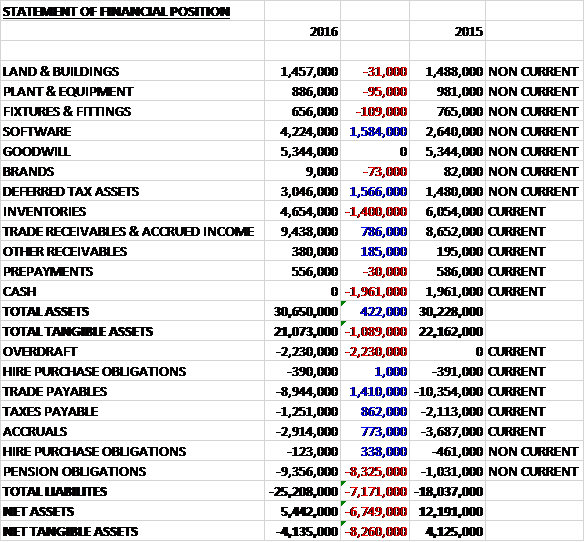
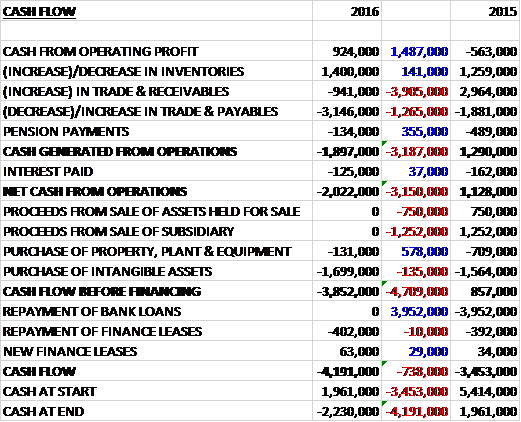
Havelock Europa have now released their final results for the year ended 2016.

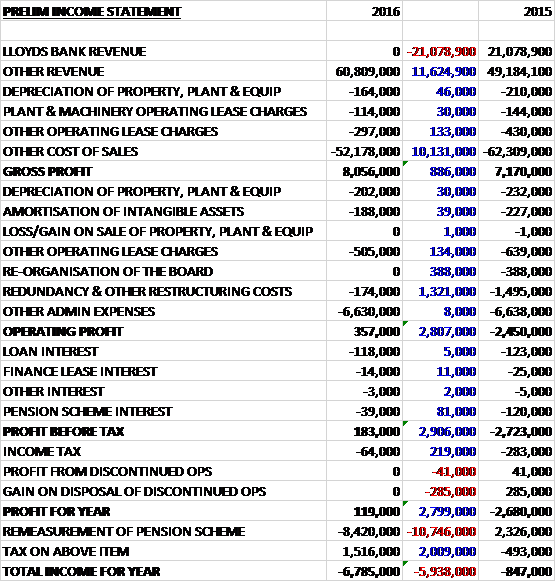
Revenues declined when compared to last year as the loss of the Lloyds Bank revenue, accounting for £21.1M last year, was partially offset by an £11.6M increase in other revenue. Cost of sales declined, however, so the gross profit grew by £8.1M. There was a £134K reduction in operating lease charges, the group didn’t spend £388K on finding a new CEO and restructuring costs reduced by £1.3M which meant that there was a £2.8M positive swing to an operating profit. The pension scheme interest fell by £81K and fax charges were down £219K which gave a continuing profit for the year of £119K, an improvement of £2.4M year on year.

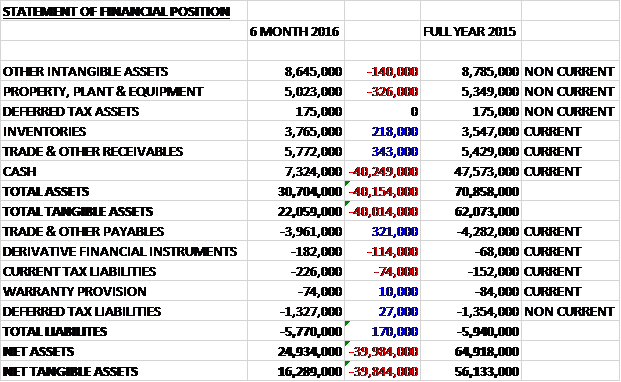
When compared to the end point of last year, total assets increased by £422K to £30.7M, driven by a £1.6M growth in deferred tax assets, a £1.6M increase in software and a £786K growth in trade receivables, partially offset by a £2M decline in cash and a £1.4M fall in inventories. Total liabilities also grew during the year as a £1.4M decline in trade payables, an £862K fall in taxes payable and a £773K decrease in accruals was more than offset by an £8.3M increase in pension obligations and a £2.2M rise in the overdraft. The end result was a net tangible asset level of -£4.1M, a deterioration of £6.7M year on year and a bit of a precarious situation in my view.

Before movements in working capital, cash profits increased by £1.5M to £924K. There was a cash outflow from working capital, however, with a decrease in payables, so there was a net cash outflow of £2M from operations, a deterioration of £3.2M year on year. The group spent £131K on property, plant and equipment along with £1.7M on intangible assets so there was an outflow of £3.9M before financing. The group also had to repay a net £339K of finance leases which meant that there was a cash outflow of £4.2M for the year and a cash level of £2.2M at the year-end.

There was a major increase in public sector sales in the year, especially in the education sector, but financial sector sales were much lower following the decision by Lloyds Bank to reduce their refurbishment and development spend. Due to the improved margins on major public sector contracts and the impact of operational efficiencies following the restructuring in the prior year, the group did manage to turn a profit, however.

Retail and Lifestyle sales fell slightly in the year. Whilst one of the group’s clothing retail customers continued to open new stores in the UK and Europe, some of their major UK customers reduced their activity. They continue to broaden the customer base in this division and initial orders were received from a health food retailer and an electrical goods retailer during the year.

With the reduced level of business from Lloyds, corporate services had a disappointing year with sales excluding Lloyds broadly flat. They continue to target opportunities for both furniture and fit out contracting in this sector and they have recently secured work from a major new financial services customer.
The group is still somewhat dependent on a small number of large clients. Last year, 30% of revenues came from Lloyds Bank so the dangers of this are clear. This year is somewhat better with the largest customer, Primark, accounting for 14% of revenues.

The group continued to develop their new ERP system and costs in the year totalled £1.7M. A phased implementation of the system started in June 2016 and it became fully operational in February 2017. As well as offering cost and efficiency benefits, it should provide a platform for better implementation of the new operational plan and enable the business to become more agile and responsive.

The group are scraping around to save cash. They have made an agreement with the trustees of the pension fund to defer deficit funding payments of £700K scheduled in 2017 into 2018.

There has been a lot of change in the boardroom over the past year. Hew Balfour, who was CEO between 1989 and 2010 was appointed as a non-executive director in April, replacing Alastair Kerr who resigned. David MacLellan resigned as a non-executive director in January 2017 having been chairman for the last four years. He was replaced by Ian Godden. Finance Director Ciaran Kennedy resigned in April to take up a position at Clancy Docwra and he will be replaced by Donald Borland.

After the period-end, in January the group issued 3,000,000 new shares to the Chairman in consideration for cash. In April 2017 he agreed to provide an unsecured loan of £300k to the group which carries interest of 6%, to be converted into shares in the event of a future placing.

Going forward the first half of the year will be challenging. There is a strong pipeline of opportunities in Retail & Lifestyle and Corporate Services but project delays in the Public Sector will result in the 2017 result being heavily weighed to the second half of the year. The current order book for 2017 delivery of £32M is slightly lower than the £35M last year and a major review of longer term vision, mission and strategy is underway.

At the current share price the shares are trading on a PE ratio of 32.8 which apparently falls to 9.9 on next year’s consensus forecast. At the year-end the group had a net debt position of £2.7M compared to net cash of £1.1M at the end of last year, not helped by the investment in the new ERP system. Obviously no dividend is proposed for the year.

On the 13th June the group released a trading statement at their AGM. They continue to make progress despite operating in a very competitive market. As previously indicated they expect 2017 to be significantly weighed to the second half and for the full year whilst activity in the public sector is expected to be below last year, this will be balanced by a better than expected demand from retail and corporate services clients.

Forecasting for the second half remains difficult but given the current order book of £38M and existing and new framework agreements, the board believes that the performance in the full year will remain in line with their expectations. The recent launch of their new Early Years’ Education and Healthcare furniture ranges have been well received by the market and they are now in the process of updating their secondary school range.

The pipeline in the retail and corporate services sectors is encouraging. They have been appointed exclusively by a major UK Building Society to design and deliver new style furniture for their branch refurbishment programme, have secured new retail customers both in the UK and internationally, and have undertaken their first projects in the car showroom sector.

Overall then this has been another difficult year for the group. They did manage to make a profit but the net tangible asset base is now negative, which is a big warning sign for this type of company scraping around for cash like they are. The operating cash outflow worsened due to working capital movements but there was a modest cash profit made here. The public sector has been good this year and that, combined with earlier cost-cutting was what gave rise to the profit. Unfortunately, public sector is not expected to be as strong this year.

The group seem to be trying to conserve cash and they are in a very precarious position. The fact that they are expecting to be so heavily weighted to the second half of the year is another big concern. The forward PE of 9.9 looks decent at first glance but when the negative tangible asset base is taken into account and the fact that I view the forecasts as a bit weighty, I would not be touching this with a barge pole for now. I do expect them to survive but it will be a bumpy ride. Indeed, I will probably not revisit this share until it sorts it balance sheet out.

On the 29th June the group announced that they were to appoint administrators and the shares have now ceased trading. Can’t say this was unexpected.

Spectris Share Blog – Interim Results Year Ending 2017

Spectris has now released their interim results for the year ending 2017.
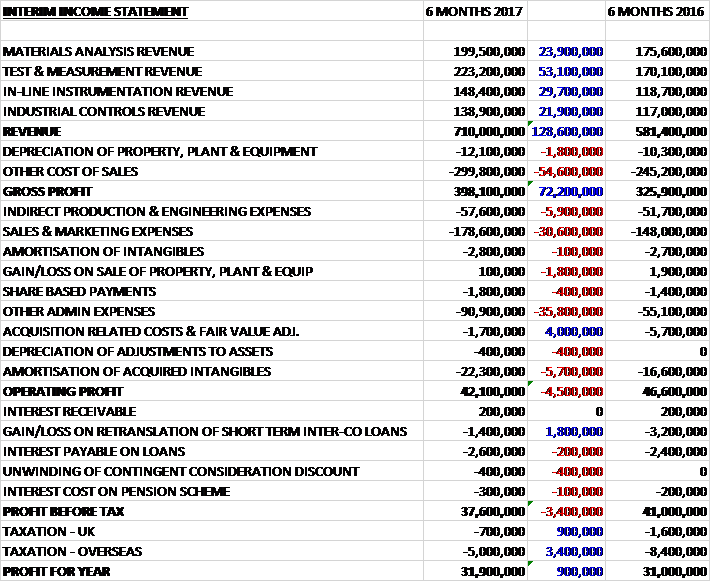
Revenues increased when compared to the first half of last year with a £53.1M growth in test & measurement revenue, a £29.7M increase in in-line instrumentation revenue, a £23.9M growth in materials analysis revenue and a £21.9M increase in industrial controls revenue. Depreciation was up £1.8M and other cost of sales increased by £54.6M to give a gross profit £72.2M higher. Indirect production and engineering expenses grew by £5.9M, sales and marketing expenses increased by £30.6M and other admin expenses rose by £35.8M. Offsetting this, there was a £4M fall in acquisition costs but the amortisation of acquired intangibles increased by £5.7M to give an operating profit down by £4.5M. We then see a £1.8M reduction in the loss on the retranslation of short term inter-company loans and a £4.3M decline in tax charges which meant that the profit for the year came in at £31.9M, a growth of £900K year on year.
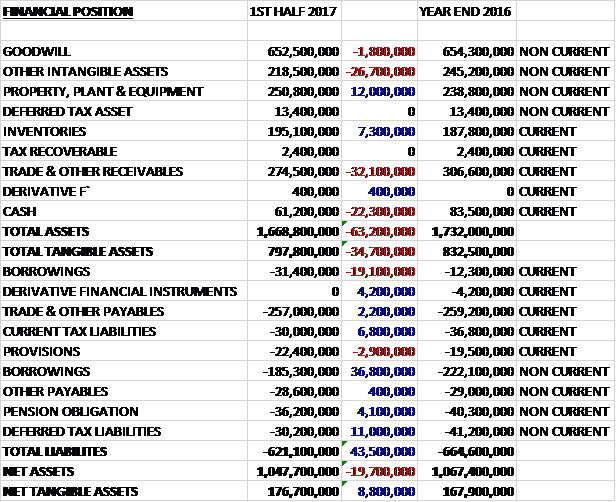
When compared to the end point of last year, total assets declined by £63.2M, driven by a £32.1M fall in receivables, a £22.3M decrease in cash and a £26.7M decline in other intangible assets, partially offset by a £12M growth in property, plant and equipment and a £7.3M increase in inventories. Total liabilities also declined during the period as a £2.9M increase in provisions was more than offset by a £17.7M fall in borrowings, an £11M decrease in deferred tax liabilities, a £6.8M reduction in current tax liabilities, a £4.2M fall in derivative financial liabilities and a £4.1M decrease in the pension deficit. The end result was a net tangible asset level of £176.7M, a growth of £8.8M over the past six months.
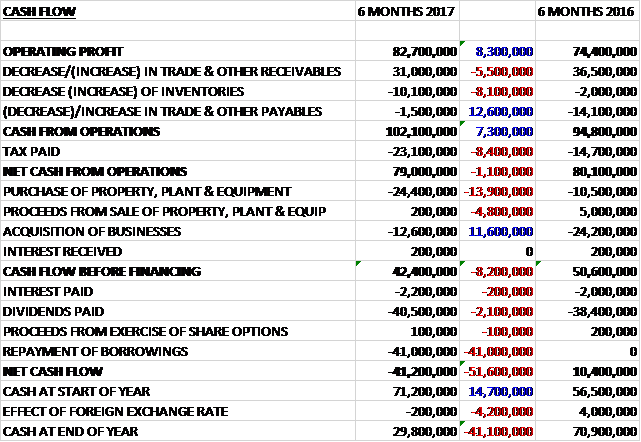
Before movements in working capital, cash profits increased by £8.3M to £82.7M. There was a cash inflow from working capital, but this was slightly lower than last year and after tax payments increased by £7.3M the net cash from operations was £79M, a decline of £1.1M year on year. The group spent £24.4M on capex and £12.6M on acquisitions to give a free cash flow of £42.4M. They spent £2.2M on interest payments (this should be included in operational cash flow in my opinion) and £40.5M on dividends. They also repaid £41M of borrowings to give a cash outflow of £41.2M and a cash level of £29.8M at the period-end.

On a like for like basis, excluding project Uplift costs, adjusted operating profit decreased by 3%. This reflected the impact of the higher sales volumes, offset by overhead cost increases and the performance of in-line instrumentation which posted a decline in profits.

The like for like adjusted operating profit in the Materials Analysis business was £21.4M, a growth of £1.3M year on year. LFL sales were up 3% and LFL sales to the pharmaceutical sector grew strongly in the period with a particularly good performance in Asia. This has been driven by higher investment within the generics sector and the current regulatory focus on data integrity is leading to new equipment purchases as manufacturers upgrade their capabilities.

Since the start of the year the merger of Malvern Instruments and PANalytical has been in effect and work is underway to cross train and merge the sales and marketing teams. The initial focus has been on cross-selling opportunities and a number of these have already been realised with new sales of both products into existing counterpart company customers. During the period the combined business launched two new products: one aimed at helping customers meet regulations in the biopharmaceutical industry and the other for the analysis of the elemental composition of liquids.

At PMS the acquisition of CAS Clean Air Service has allowed the business to be able to offer its Good Manufacturing Practice service knowledge and expertise for regulatory compliance in the pharmaceutical industry. During the period this has now been extended into other markets in Europe and the US. Demand for consulting services in areas such as sterility assurance continues to be robust and the business has been able to provide this additional service to existing customers.

In the metals, minerals and mining sectors, LFL sales returned to growth following the sizeable declines in 2016. Europe delivered a strong performance, although North America continued to see a decline. Commodity prices for base metals have shown a slow recovery. Investments in new production and analytical capabilities are still at a low level, however, but the number of opportunities has started to increase. Sentiment in the mining sector has been improving and the group has seen an uptick in Australia in particular. Aftermarket sales remained robust as customers continued to repair and support their existing equipment.

LFL sales to academic research institutes were down in the period with all regions showing a decline, although there was good growth in orders. In North America, the government has been operating under a continuing resolution that froze 2017 spending at most agencies and generally prevented them from starting new programmes. Similarly political uncertainty in parts of Europe has meant that academic research expenditure has remained subdued in this region. In Asia the key positive market was Japan which did see sales growth.

In the electronics, semiconductor and telecoms sector, LFL sales rose year on year with the main demand centre of Asia showing strong growth. Europe also saw LFL sales increase while LFL sales in North America were lower. There has been strong growth in semiconductor demand, particularly in China and South Korea with a continuation of the favourable market conditions seen in the second half of last year. Electronics sales in the period have been lower, but the order growth was up year on year.

Going forward the board expect sales growth to continue in the second half in the pharmaceuticals sector, given the order growth seen to date and the expansion of the advisory service into new markets such as China. Given the improving backdrop in the metals, minerals and mining sectors, they are encouraged that the increased market activity will start to feed through to a sustained improvement in sales for Malvern and aftermarket sales are expected to remain robust. Sales to the academic research sector remain unpredictable as public sector budgets are likely to remain under pressure in many countries. In the electronics sectors, they expect to see continued strong growth in Asian markets.

The like for like adjusted operating profit in the Test and Measurement business was £19.2M, a growth of £2.1M when compared to the first half of last year. Like for like sales grew by 5%. Sales to automotive customers grew strongly with all key regions delivering growth. At Millbrook the group have been expanding the capacity of their automotive testing services. In May a new large climatic chamber was opened to be used for conducting environmental tests on vehicles. In July they added further capacity as well as complementary customers and services with the acquisition of a commercial vehicle test facility in the UK. The CSA Leyland Technical Centre provides test services to the commercial vehicle, automotive and off-highway sectors and expands Millbrook’s capacity in powertrain, safety and vehicle testing.

There was good LFL sales growth to machine manufacturers in the period. Although the growth in sales in this sector was primarily driven by non-automotive related demand, a significant proportion represents sales into the automotive supply chain. Machine manufacturing sales were strong in Asia, particularly China and in Europe Germany saw good growth with an increase in German exports and an increasing desire for automation and robotics products driving demand for industrial measurement solutions.

In aerospace and defence, LFL sales were flat overall with North America and Europe seeing sales increases, offset by a reduction in Asia. Sales to electronics and telecoms customers were down slightly. Sales to telecoms customers were down as sales to this sector are lumpy, reflecting the scheduling of projects by customers. They have continued to see good traction with Chinese mobile phone operators and have been working closely with Huawei. Sales to electronics customers increased in both Asia and Europe, driven by trends in consumer demand for devices such as audio and communication systems with improved sound quality. They are also seeing continued growth in the supply of high quality components for acoustic testing of smartphones.

In the unconventional oil and mining markets, commodity prices have settled and there has been an increase in US production. As a result the group’s fracking monitoring business has been more buoyant and sales in North America have increases markedly on last year. Mining activity has been more subdued, however, and has been impacted in Asia by the Indonesian government’s restrictions in exports.

Going forward, the board expect the automotive sector to remain robust though the remainder of the year with automotive customers expanding their development programmes and the group’s capex programme coming through to generate revenue. In the aerospace and defence sector, they expect to see a similar trend to the first half, although the pipeline of opportunities has improved in recent months. The consumer electronics market is expected to remain attractive. If commodity prices remain settled, they expect the improvement of their microseismic monitoring to be sustained through the remainder of the year.

The like for like adjusted operating profit in the In-line Instrumentation business was £8.7M, a decline of £1.5M when compared to the first half of 2016 due to adverse mix, restructuring and additional costs following the closure of a business centre in Europe. LFL sales were actually very strong, increasing by 11% year on year. Restructuring activities continued, in particular at NDC Technologies which is consolidating its California production and admin functions into its Ohio facility with the California facility becoming the new Web Process Solutions Technical Centre of Excellence.

Sales to the pulp, paper and tissue markets grew in the first half with all regions in positive territory. Pulp and paper sales were up slightly whilst the tissue business had a good start to the year with particularly strong growth in Asia where they have secured new business with producers of premium grade tissue products. They have also continued to expand their offering by providing solutions for process control and optimisation, particularly in the chemical pulp segment, with the capstone Software tools.

They received new orders for their dataPARC analytics in the pulp and paper, chemicals and other industries. In June they delivered their first digital solution for tissue production management with a vibration monitoring systems installed at a Spanish paper and tissue company, whereby vibration data is captured and displayed using their new analytics software, allowing monitoring of the machine’s Yankee dryer performance.

LFL sales to the energy and utilities sector increased. The backdrop for refinery markets has improved compared to last year as energy prices have stabilised and the group have seen a more solid performance in the hydrocarbon processing sector in the US with activity in Asia also picking up. The wind power business delivered a strong growth in sales from both the turbine OEM companies and their targeted approach to wind farm owners and operators. Bruel & Kjaer Vibro was selected by EDP Renewables to supply and retrofit the installation of condition monitoring systems for more than 15,000 wind turbines globally.

At Servomex, their customer offering has been broadened by the launch of the Laser 3 analyser for combustion applications. This compact product measures ammonia, oxygen and carbon monoxide from combustion processes. They are also aiming to streamline their industrial gases customer offering to a single platform with two variants, a simplified user interface and digital communications which can be more easily deployed by customers according to their needs. This platform will have the ability to integrate their new AquaExact Moisture Sensor which measures moisture in a range of process applications such as air separation, natural gas processing and transportation.

After a surge in growth last year, sales to the web and converting industries increased only slightly this time. Growth in sales in Europe and Asia was offset by an overall decline in North America. The performance in packaging and the cable and tube business has been robust as a result of improving market conditions. During the period NDC Technologies entered into a cooperation with RAM, a web inspection company in similar industries, to sell their web inspection systems in territories RAM don’t cover with a reciprocal arrangement whereby RAM will sell NDC’s gauging systems to their customers.

Going forward, in the pulp, paper and tissue market, the board expect to continue to see good demand in tissue and packaging, particularly in Asia. Sales of Capstone software are also expected to drive growth in both this sector and in other process industries. In energy and utilities, the current environment is encouraging with a more stable oil price underpinning cautious investment in areas such as hydrocarbon processing. Demand from the wind energy sector is expected to remain healthy as they continue to focus on wind farm operators and owners.

The North American market has shown signs of improvement in the first half of 2017, as they see a freeing up of capex and industrial spend in the process industries they serve. They would expect to see the segment’s overall growth in LFL sales to moderate as they go through the second half of the year, however. Based on the current order book and the non-recurrence of adverse costs seen in the first half, they expect to see a strong recovery in margins though.

The like for like adjusted operating profit in the Industrial Controls business was £17.8M, an increase of £1.9M year on year. There was a 5% increase in LFL sales, including in N. America for the first time since 2014.
At Omega, the restructuring continues. Electronics manufacturing, currently performed in California, is to be outsourced and distribution operations for certain markets will be consolidated. The business has developed a number of products to capture the opportunity presented by the increasing “Internet of Things”. Their long range wireless monitoring systems provide web-based monitoring of temperature, humidity and barometric temperature. This system can provide data assurance and security, and they have worked with a major satellite company to provide such a solution.

The industrial networking business also saw a return to sales growth in the core North American market, particularly with the Ethernet and Interface product families. During the period they had notable sales at two major automotive manufacturers, delivering networking solutions for their robotics OEMs and own manufacturing lines. In May Red Lion announced an enhancement to its products which enables more secure communications to cloud platforms and remote access applications. This enhancement utilises Distrix Networks’ software defined networking technology with Red Lion’s RAM range of industrial remote terminal units.

At the automatic ID and machine visions solutions business, sales of their Micro Hawk products have continued to grow rapidly and during the period a new high density version was launched that can read very small barcodes, for example on a silicon chip.

Going forward, progress for this segment in the second half will be largely determined by the industrial demand environment in the US which has experienced an improving backdrop during the first half. They expect to see continued good growth in Asia. As they see customers continue to focus on increasing productivity and efficiency, they expect to see continued growth in demand for their solutions for factory automation and industrial networking, sensing and controls. At Omega, they continue to expect the organisational changes and restructuring measures to deliver an improvement in performance and to exit the year with margins at historic levels.

Project Uplift is well underway with initiatives progressing as planned. The net spend of £8.8M includes Phase 1 activities for IT, procurement and footprint. They have also completed a shared feasibility study and are moving into the detailed design and implementation planning phase.

In February the group acquired Pixirad Imaging Counters, a supplier based in Italy, for a total consideration of £2.8M. The business develops and distributes x-ray detectors and the acquisition generated goodwill of £1.7M. In May they acquired Setpoint, a US business, for a total consideration of £8M. This extends their capabilities in the condition monitoring market and generated goodwill of £4.6M. These acquisitions contributed £1.6M to group operating profit during the period. After the period-end the group acquired CSA Leyland Technical Centre, a company based in the UK, which extends the group’s automotive testing facilities.
Going forward, overall the board expectations for the full year remain unchanged.

At the current share price the shares are trading on a PE ratio of 24.5 which falls to 18.3 on the full year consensus forecast. At the period-end the group had a net debt position of £155.5M compared to £150.9M at the end of last year. After a 6% increase in the interim dividend the shares are yielding 2.1% which increases to 2.4% on the full year forecast.

Overall then this has been a bit of a mixed period for the group. Profits increased but this was due to lower tax charges and pre-tax profits declined. Net tangible assets grew but the operating cash flow declined but interestingly this was due to higher tax payments, in contrast to the profit figures, and cash profits increased with a decent amount of free cash being generated. The overall decline in profit has been due to increased overheads and higher costs in the in-line instrumentation division. The performance in the other division seems pretty good with LFL sales increases across the board.

A lot of the group’s markets do seem to be picking up a bit and I am more positive here than I have been for some time. The shares remain expensive in my view, however, with a forward PE of 18.3 and yield of 2.4%. I therefore find it hard to justify a purchase at the moment.

On the 30th August the group announced that it had signed an agreement to sell Microscan Systems to Omron Corp for a total cash consideration of £123M. The net proceeds from the sale will be used to reduce net debt. The sale will generate a profit of £101M and the business made a profit of £7M last year which means it is expected to have an impact of 2p on EPS in 2017.

Microscan is a provider of machine vision technology and solutions for critical identification, inspection and verification applications. The group’s strategy is transitioning to provide customer solutions incorporating hardware, software and services in selected markets so they believe the business is better off elsewhere. This seems to be a bit of a backwards step as the business is a profitable one, but on the other hand it is being sold for way over the net asset value and it will help to reduce debt so in two minds over this.

On the 21st November the group released a trading update for the first four months of H2. Reported sales increased by 9% and group like for like sales were up 7% with like for like sale in the first ten months of the year increasing by 6%.

Like for like sales grew in all key regions with particularly good growth in Asia, led by strong demand from China. The performance in North America improved markedly since the first half of the year while Europe continued to perform in line with the first half. Like for like sales declined marginally in the rest of the world.
LFL sales increased across all four business segments. There was a notable sales growth in automotive, electronics, semiconductors and telecoms and metals, minerals and mining while academic research continued to see a sales decline in the period.

During the period the group completed the acquisition of Omicon for an initial consideration of $29M plus a deferred consideration of up to $7M. The business provides a range of services to help its customers analyse and improve product reliability and safety and is being integrated alongside the Prenscia Software business within Test and Measurement.

In October the divestment of Microscan was completed with net cash proceeds received of £93M. The disposal will lower adjusted EPS by around 2p. Following the sale, net debt was £26.6M before the outflow of the dividend payment of £23M in November.

Project Uplift initiatives continued and the group still expects a net cost of £14m in 2017 for Phase 1 but both gross benefits and costs will be lower than previously expected. Overall though, the outlook for the full year remains unchanged.

On the 14th December the group announced that they had reached an agreement with Macquarie Capital for them to acquire 50% of the group’s environmental monitoring business EMS Bruel & Kjaer for a cash consideration of £43.4M. The net proceeds will be used to reduce net debt. The business is a provider of environmental monitoring services to airports, cities, mines and construction companies. It will now benefit from accelerated investment which will help create additional services that enable asset owners to monitor and manage their resources more effectively.

On the 26th January the group announced the acquisition of Concept Life Sciences from Equistone Partners. The purchase consideration of £163M will be met from existing cash and bank facilities. The business is a UK-based group providing integrated drug discovery, development, analytical testing and environmental consultancy services to an international customer base, mainly in the pharmaceutical, biotechnology, agrochemical and environmental sectors. Additionally it carries out development and analytical services for the food, consumer and environmental industries.

The gross assets of the business are £73.4M and last year EBITDA was £9.3M and it has a history of double digit growth which is expected to continue. The acquisition adds test service capabilities to the Materials Analysis segment, where it has strong synergies with Malvern Panalytical. This actually looks like a nice acquisition at a decent price to me.

Pan African Share Blog – Interim Results Year Ending 2017

Pan African Resources has now released their interim results for the year ending 2017.

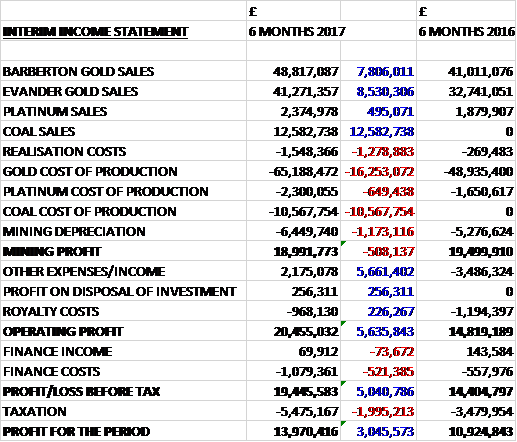
Revenues increased when compared to the first half of last year with a £7.8M growth in Barberton Gold sales, an £8.5M increase in Evander Gold sales, a £495K growth in in platinum sales and the first £12.6M of coal sales. Realisation costs increased by £1.3M, the gold cost of production grew by £16.3M with both labour and electricity costs increasing considerably, the platinum cost of production increased by £649K, there was a £10.6M cost of coal production and mining depreciation rose by £1.2M to give a mining profit £508K lower than last time. There was a £5.7M positive shift to “other income”, possibly due to a gold hedge, a small profit on the disposal of an investment and a £226K decrease in royalty costs which meant that the operating profit grew by £5.6M. Finance costs rose by £521K and tax charges grew by £2M due to increased deferred taxes so the profit for the period was £14M, a growth of £3M year on year.

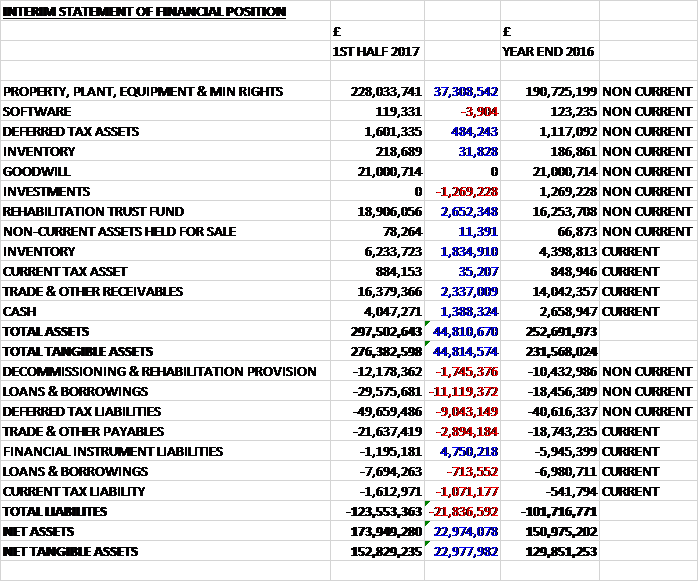
When compared to the end point of last year, total assets increased by £44.8M driven by a £37.3M growth in property, plant and equipment, a £2.7M increase in the rehabilitation trust fund, a £2.4M growth in receivables, a £1.8M increase in inventories and a £1.4M growth in cash , partially offset by a £1.3M decline in the value of investments. Total liabilities also increased during the period as a £4.8M decline in financial instruments was more than offset by an £11.8M increase in borrowings, a £9M growth in deferred tax liabilities, a £2.9M increase in payables and a £1.7M growth in the rehabilitation provision. The end result was a net tangible asset level of £152.8M, a growth of £23M over the past six months.

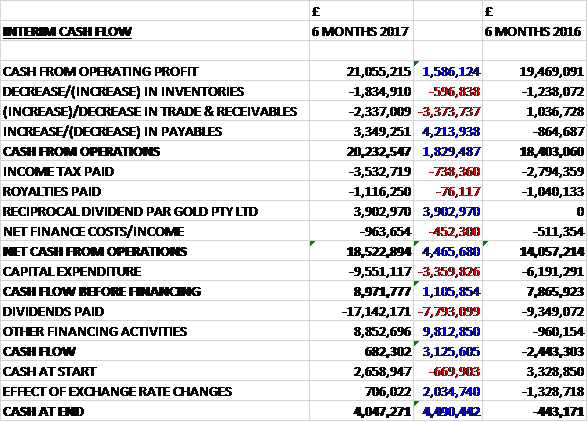
Before movements in working capital, cash profits increased by £1.6M to £21.1M. There was a small cash outflow from working capital, tax payments increased by £738K and finance payments grew by £452K but there was a £3.9M reciprocal dividend from PAR Gold Pty which meant that the net cash from operations was £18.5M, a growth of £4.5M year on year. There was £9.6M of capex which gave a free cash flow of £9M. This did not cover the £17.1M dividend so the group took out £8.9M in new loans to give a cash flow of £682K and a cash level of £4M at the period-end.
The group has benefited from the weakness of sterling. In Sterling terms, profits increased by nearly 25% but in Rand terms the growth was only 10%. Overall group gold production decreased by 10% to 91,613 ounces but the gold price received increased by 13.2% to $1,257 per ounce. Due to the lower gold production, all in sustaining costs increased from $908/oz to $1,014 per ounce.

The net pre-tax income at Barberton was £20.3M, an increase of £7.2M year on year. The average mining head grade reduced from 10.6g/t to 9.4g/t as the Fairview mine experienced issues resulting from lower grade face values, specifically at its high grade 11-block. Work is underway to develop additional production platforms to expose additional high grade panels to increase mining grades.

Gold sold decreased by 13% to 49,212 ounces as a result of the underground gold sold decreasing by 9,146 ounces to 49,212 ounces. The BTRP gold sold increased by 1,911 ounces to 14,741 ounces, supported by grades increasing from 1.3g/t to 2.2g/t. Three separate incidences of community unrest interrupted production as these protests prevented employees from reporting to work, resulting in six days of lost production. In addition, six section 54 regulatory notices resulted in eight lost production days.

Despite the fall in gold production, revenues increased modestly in Rand terms due to a higher gold price. Cash costs increased from $610 per ounce to $773 per ounce as a result of the reduction in the amount of gold produced.
The net pre-tax income at Evander was £372K, a decline of £2.3M when compared to the first half of last year. The average mining head grade reduced from 5.8g/t to 5.4g/t. Due to Section 54 stoppages and a reduction in hoisting speed at 7 shaft during the period, the amount of gold sold fell by 6.5% to 42,401 ounces although revenues increased due to the higher gold price. The 7 shaft, which is used to hoist ore from underground mining to the surface is undergoing critical repairs and maintenance and requires a suspension of the underground mining operations for up to 55 days from 20th February.

The mine experienced a material increase in safety stoppages during the period. They were issued with four Section 54 notices which resulted in 13 lost production days, mainly relating to shaft 7. Cash costs increased from $903/ounce to $1,114 per ounce.

The net pre-tax loss at Phoenix Platinum was £276K, a worsening of £262K when compared to the first half of 2016. The tonnes processed increased by 3.9% to 122,024 tonnes. In July 2016 the business commissioned a scrubber which increased the production capacity by 25% but re-mining was limited by a recent drought. The head grade achieved reduced from 3.2g/t to 2.2g/t due to re-mining from the lower grade tailings facility. Overall PGE production increased by 1.8% to 4,574 ounces with recoveries increasing from 39% to 57% following the installation of thigh energy agitation cells in the plant. Revenues increased due to a modest increase in production and a rise in the selling price, up from $641 per ounce to $664 per ounce.

The cost of production increased from $563/Oz to $643/Oz, however, due to the higher cost associated with transporting the Elandskraal tailings to the plant and higher refinery charges relating to the higher chrome prevalence in the tailings processed from Elandskraal.

The maiden net pre-tax income from Uitkomst Colliery was £1.8M. The operation produced and sold 327,202 tonnes of coal, of which 127,605 tonnes was from the underground mining operations with the rest coming from third parties for processing.

The Elikhulu Tailings treatment project which was approved during the period will provide organic production growth of around 56K ounces of gold per annum and reduce the overall cost profile of the operations. The decision to start construction of the project remains subject to finalising the most appropriate financing package but the group hope to commission it by Q4 2018 calendar year. It is expected to have all in sustaining costs of $523 per ounce over the life of the project and the initial capital cost is forecast to be about £103M which equates to a payback period of four years assuming a gold price of $1,180 per ounce.

The Evander 2010 pay channel is a potentially attractive orebody that runs parallel to the Kinross pay channel and is accessible via the 7 shaft. Surface drilling is underway but initial results have been delayed due to poor rock conditions as well as due to the intersection of water on various instances. The first reef intersection is now expected in April 2017. The 2010 pay channel may offer the group the possibility of establishing a new underground mining area without the cost of sinking a new vertical shaft from the surface.

In conjunction with the 7A shaft refurbishment, Evander’s management initiated a number of independent engineering studies to assess the condition of the underground mining infrastructure. These studies identified critical issues requiring remedial action to ensure safe operation of these shafts. The nature of the refurbishments require a suspension of Evander mines underground operation for a period of up to 55 days with the tailings and surface operations unaffected. The cost of the programme is expected to be around £2.3M.

The immediate focus is to restart the Evander underground mining operations following the suspension of mining to refurbish critical infrastructure, and to finalise the Elikhulu funding package.

At the current share price the shares are trading on a PE ratio of 7.4 which falls to 6.8 on the full year consensus forecast. After an increase in the dividend the shares are yielding 7% but this falls back down to 5% on the full year forecast. At the period-end the group had a net debt position of £28.4M compared to £19.4M at the year-end.

On the 10th March the group released an update. The Evander shaft repairs are progressing on schedule and are still expected to be completed on time. During the suspension of the underground mining operations, the treatment plants have used available capacity to continue processing tailings and additional surface sources. The group have also implemented a number of initiatives to reduce the mine’s underground fixed cost base once mining re-starts.
Evander mines has also reached an agreement with the National Union of Mineworkers. Around 30% of their employees will be retrenched at a cost of around $4.1M. These personnel were designated as redundant for Evander to meet production targets.

With regards the Elikhulu financing the group has built a book of demand in excess of the shares it was given authority to issue at the shareholder meeting but given the current market conditions and volatility they have decided not to complete an equity issuance at this time. They will continue to progress the development from cash and banking facilities until the final funding package is secured.

On the 5th April the group announced the disposal of the Uitkomst colliery for a total consideration of £15.7M. The profit on disposal is £3.8M and the consideration consists of £7.1M in cash, £1.4M of deferred consideration and the rest in COAL shares. This enables management to concentrate on Elikhulu and helps with the cash flow but is a bit of a strange turnaround in strategy in only a short time.

On the 8th April the group announced that the refurbishment at Evander is progressing according to schedule with underground mining operations restarting sometime after the 15th April.

On the 12th April the group announced a proposed funding package for Elikhulu. This includes a proposed placing of 291,480,983 new shares at an issue price of 14p per share and a $72M underwritten seven year debt facility agreed in principle with Rand Merchant Bank. The placing is to raise $51M subject to demand.

On the 20th July the group announced an operating update covering the year. Gold produced was approximately 4.4% below the production guidance at 173Koz due to the slower than anticipated restart of the underground mine at Evander and operational challenges experienced at Barberton, which have now been remedied. The production guidance for 2018 is now 190K ounces.

At Evander in the coming year there will be a continuation of the engineering work plan to improve the reliability of the shaft and related infrastructure, an improvement in the total amount blasted per panel and crew, old gold vamping which is the cleaning of mud accumulations in redundant declines and spillage in and around the belt declines, and pillar mining and vamping at 7 shaft.

Mining in the high-grade areas in Fairview’s 11 block is also now established and expected to continue for the remainder of the year. Productivity improvements are expected at Fairview following the commissioning of a new bulk air cooler which will reduce the ambient temperature at the work face by around 3-4 degrees C. To address the flexibility constraints currently experienced at Fairview, and increase gold production, a feasibility study into a new sub-vertical shaft has been finalised.

The Elikhulu project is progressing according to plan. Following the $50M equity raise in April, the group has started funding the initial capex on the civil engineering works and the procurement of the long lead time items such as the tower crane and carbon in leach tanks. Capex of £10M has been incurred on the project during the current period and capital spend remains on track to be within initial forecasts.

The Fairview mining operation at Barberton is currently restricted by the hoisting capacity of its No.3 Decline, which is used to access workings below 42 Level. This decline is currently used to transport employees, material and for rock hoisting. The 11-block, or MRC, orebody has an average grade of 31.3g/t and current life of mine of 22 years. With no intervention, future mining at depth will result in increased travelling distance. The estimated capex for the sub-vertical shaft from 42 level to 64 level, which will be used to transport employees and material to the working areas so that the No.3 decline can be used exclusively for rock hoisting, is £6M to be incurred over two years. These improvements are estimated to yield an additional 7K ounces of gold per annum.

At Evander, an exploration borehole intersected the Kimberley reef at a depth of around 2km, highlighting a reef intersection with a 6cm width 36.8g/t. Additional drilling deflections will be performed to further delineate the ore body. The group has started a feasibility study related to the 7 Shaft No.3 Decline and 2010 Pay Channel resource which can potentially increase the mine’s underground gold production significantly at a relatively low capital cost. The study is expected to be completed in Q1 2018.

At the period-end the group had net debt of £3.8M compared to £19.4M at the end of last year. The group has also announced that they have sold Phoenix Platinum to Sylvania Platinum for a total cash consideration of £5.1M.
Overall then, this has been a bit of a mixed period for the group. On the surface, the financial performance has been decent. Profit was up, seemingly due to “other income”, net assets increased and the operating cash flow improved with some free cash flow being generated. This seems to have been due to an increase in the gold sales price. Operationally things don’t seem to have been that good. Barberton saw a growth in profits due to increases in the sales price. Production fell due to community unrest and stoppages.

The Evander mine saw profits fall and it is barely making any profit at the moment due to several stoppages and an issue with the shaft 7 which led to a suspension in underground mining, which has now been rectified. Phoenix saw profits fall too but this operation has now been sold. Likewise, Uitkomst, which made a decent contribution during the period has also been sold. The Elikhulu tailings project is the focus going forward and this is a big project which has some risk attached. The forward PE of 6.8 and yield of 5% does account for some of this risk but I am not sure the time is right at the moment.

On the 25th August the group announced that the Integrated Water Use licence of Elikhulu has been granted for a period of 20 years. All environmental permits are therefore now in place to start construction.

XP Power Share Blog – Interim Results Year Ending 2017.

XP Power has now released their interim results for the year ending 2017.

Revenues increased when compared to the first half of the year due to a £12.9M growth in North American revenue, a £4.8M increase in European revenue and a £2.2M growth in Asian revenue. Cost of inventories increased by £17.6M but there was a £4.1M positive movement in changes in inventories and other cost of sales were down £1.7M to give a gross profit £8.1M ahead. R&D expenses grew by £1.7M and other operating costs increased by £4.4M which meant that the operating profit increased by £1.5M. Finance costs were flat but there was a small increase in tax charges so the profit for the period was £10.9M, a growth of £1.1M year on year.

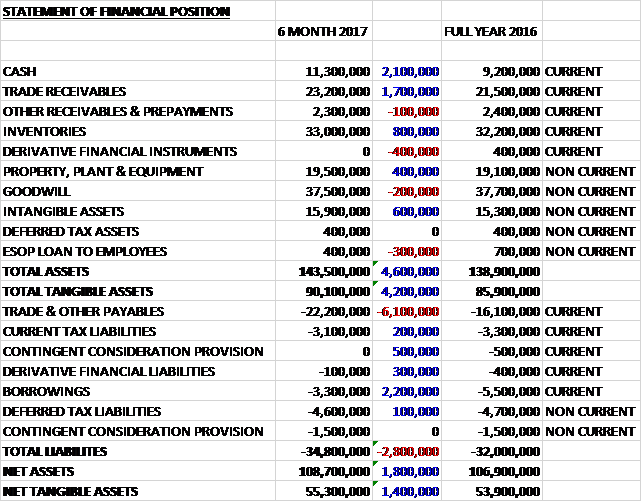
When compared to the end point of last year, total assets increased by £4.6M driven by a £2.1M growth in cash, a £1.7M increase in trade receivables and an £800K growth in inventories. Total liabilities also grew during the period as a £2.2M fall in borrowings was more than offset by a £6.1M increase in payables. The end result was a net tangible asset level of £55.3M, a growth of £1.4M over the past six months.

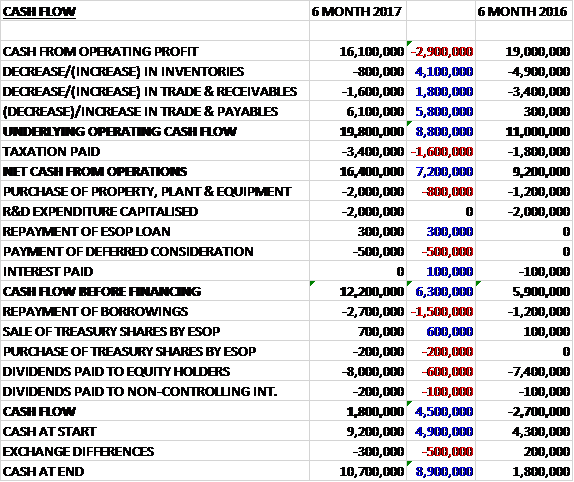
Before movements in working capital, cash profits declined by £2.9M to £16.1M. There was a cash inflow from working capital due to an increase in payables and after tax payments grew by £1.6M the net cash from operations was £16.4M, a growth of £7.2M year on year. The group spent £2M on fixed assets, £2M on R&D capitalised (the rest came out of the cash profit figure) and £500k on deferred consideration which meant that the free cash flow was £12.2M. Of this, £8.2M went on dividends and £2.7M was used to pay back loans which meant the cash flow was £1.8M and the cash level at the period-end was £10.7M.

Overall, pre-tax profit grew by £1.5M and this growth was entirely down to favourable forex movements. The operating profit in Europe was £7.7M, a growth of £1.7M year on year. The operating profit in North America was £14.5M, an increase of £4.1M when compared to the first half of last year. The operating profit in Asia was £1.1M which was flat year on year.

The order intake was up 52% (35% at constant currency). Asia increased by 38% and North America increased by 58%. Overall momentum has continued to build in the business and they enter the second half of the year with an order book of £70.9M (£59.1M). Approximately half of the 35% order intake growth came from existing programmes with half from programmes that have entered production over the past year or so.

The healthcare, industrial and technology sectors all delivered increased revenue in all three regions, suggesting a general market recovery in the capital equipment markets they serve. On a sector basis, revenues from healthcare grew by 36%, industrial revenues increased by 19% and technology revenues were up 58% driven by the semiconductor manufacturing equipment makers who are exhibiting strong and sustained growth.

The gross margin declined from 49% to 46.9%. Proportionally more cost of sales are denominated in US dollars than revenues so the weakness in sterling increased costs which is estimated to have reduced margins by 110 basis points. In addition, some costs which were operating costs last year were considered to be cost of sales this year due to the continuous integration of EMCO. Operating costs increased by £3.9M. Of this, £2.8M was advisory and aborted acquisition costs. In addition, the sterling weakness increased these costs by around £2M and there were extra costs associated with the growth of the business.

The group launched 14 new product families in the first half of the year compared to 27 last time. The relatively high number of new product introductions in 2016 was aided by the introduction of a new labelled product supplier to increase their offering of DC-DC converters. Of the 14 new products introduced, 12 were of high efficiency design. Revenue from own design products was up 39% and now represents 75% of the total, up from 72% last time.

The group now have 259 part numbers approved for production in Vietnam with more in the pipeline. Of the 693,000 power converters manufactured, 60% were made in the country compared to 25% last year. The board expect the proportion of power converters produced in Vietnam to increase further as they transfer more products to that facility. The Chinese factory will focus on the higher power, higher complexity products.

They intend to break ground and start construction of a second factory on their existing site in Vietnam in the second half of the year, with production scheduled to come on stream in 2019. The board estimate that their existing Asian manufacturing facilities have capacity to produce about $170M of end revenue on their own manufactured products with the second facility in Vietnam adding an additional capability or around $130M in revenue. It is estimated that the cost of the second building in Vietnam and the initial equipment set to be approximately $6.5M, of which $1.9M will be incurred in H2 with the remainder in 2018.

Reported order intake and revenues for the first half hit record levels, assisted by the weakness of Sterling, a recovery in the capital equipment markets and new design wins entering their production phase. While the board remain conscious of potential macroeconomic challenges, their strong order book, combined with designs won in 2016 and prior years entering production means that the board now expects the group’s performance for the full year will be comfortably ahead of existing expectations.

At the end of the period the group had net cash of £8M compared to £3.7M at the end of last year. At the current share price the shares are trading on a PE ratio of 24.2 which falls to 20.1 on the full year consensus forecast. After another increase in the quarterly dividend the shares are yielding 2.7% which grows to 2.8% on the full year forecast.

Overall then this has been another strong period for the group. Profits were up, but this was due to forex movements and otherwise they would have been flat. If we exclude the abortive acquisition costs, however, there was strong growth in profits. Net assets improved but although the operating cash flow increased, this was due to working capital movements and cash profits actually declined. There was a good amount of free cash generated.
The order intake has been very strong across all markets, which is good to see, and it seems some of the new projects are starting to make their way through to production. The shares are not cheap with a forward PE of 20.1 and yield of 2.8% but we are paying for quality here. Despite the fact that results have been inflated by favourable forex, I like this company a lot and continue to hold.

On the 2nd October the group announced that it had acquired Comdel, a designer and manufacturer of radio frequency power supplies for a total consideration of £17M paid in cash, funded by a new revolving credit facility of $40M with a $20M additional accordion option which was put in place to assist the acquisition strategy.

Comdel is based in Massachusetts and supplies the industrial and technology sectors with a range of standard, modified and custom high power RF power conversion products. They typically supply them into the semiconductor, thin film, photovoltaics and induction heating industries. Last year it recorded a pre-tax profit of £1.4M and the acquisition is expected to be earnings enhancing in 2018.

The businesses share several customers and the power supply solutions they offer are considered complementary. Comdel’s products and engineering capabilities will enhance the group’s ability to implement its strategy of winning a greater share of business from its largest customers and will also bring a number of new customers to the group. The CEO of Comdel will remain with the business to head up the newly formed RF Power divison.
This acquisition seems rather expensive to me but I guess time will tell…

On the 9th October the group released a trading update for Q3. Trading has been robust. Revenues for the nine months increased by 34% to £123.9M with a constant currency increase of 21%. Order intake was strong at £137.5M, a 44% increase (constant currency increase of 30%). The Q3 order intake was £44.1M compared to £34.2M in the prior year with continued growth in North America with semiconductor manufacturers enjoying an upturn in chip demand, and healthcare companies placing orders for new programmes. Net debt was £10.8M at the period-end following the draw down to finance the Comdel acquisition.

The board now expects the group performance for the full year will be ahead of previous expectations. Furthermore the acquisition of Comdel before the period-end will enable the group to provide their existing customers with a comprehensive product offering in Radio Frequency power supplies, increasing their addressable market and further expanding their revenue base. They are still looking for other acquisition opportunities.

On the 12th January the group released a trading update covering Q4. They had a good end to the year, in line with board expectations as the strong order intake reported in Q3 drove robust revenue growth in Q4. The momentum in order intake continued into the fourth quarter and both order intake and revenue growth has been strong across all regions. Order intake for the quarter was £46.8M, 24% ahead of the same quarter last year and revenue was £43.2M, 16% ahead.

The trading performance of Comdel was in line with expectations with orders in Q4 of £5.8M and revenues of £4.1M. Integration of the business is proceeding as planned and following the acquisition for $23M, net debt was £10.1M compared to a net cash position of £3.6M at the same point of last year.
Going forward the board are encouraged by continued strong order intake experienced across the business during H2 and they enter 2018 with positive momentum and therefore expect to grow orders and revenues in 2018 above that in 2017. This looks fine, I continue to hold.

On the 12th February the group released a tax update. The recently enacted Tax Cuts act in the US is expected to result in a non-cash tax credit in 2017 relating to the revaluation of deferred tax assets, of around £5.2M. The group have also received notice that claims relating to the DEI in Singapore have been accepted resulting in a £1.3M refund of tax paid in 2015 and 2016.

Portmeirion Share Blog – Interim Results Year Ending 2017

Portmeirion has now released their interim results for the year ending 2017.

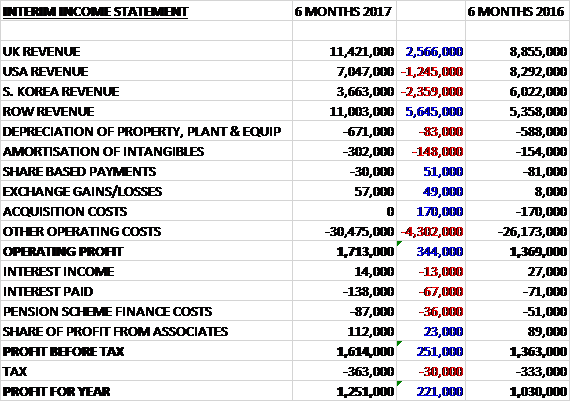
Revenues increased when compared to the first half of last year as a £2.4M decline in Korean revenue and a £1.2M fall in US revenue was more than offset by a £2.6M growth in UK revenue and a £5.6M increase in ROW revenue. There were no acquisition costs, which amounted to £170K last time but amortisation increased by £148K, depreciation was up £83K and other operating costs grew by £4.3M to give an operating profit £344K higher. Interest payments increased by £67K and tax charges were up £30K which meant the profit for the period was £1.3M, a growth of £221K year on year.

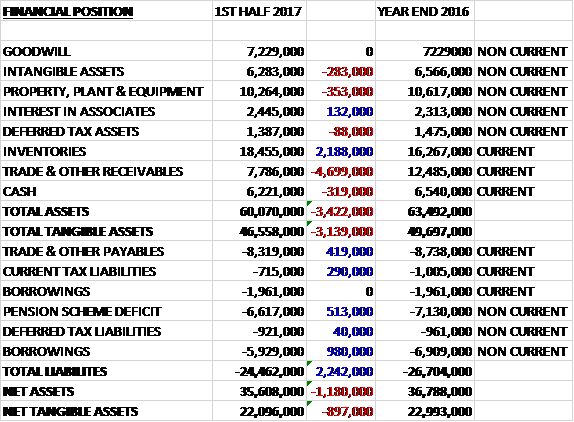
When compared to the end point of last year, total assets declined by £3.4M, driven by a £4.7M decrease in receivables, a £353K decline in property, plant and equipment and a £319K fall in cash partially offset by a £2.2M growth in inventories. Total liabilities also declined during the period due to a £980K fall in borrowings, a £513K decline in the pension deficit and a £419K decline in payables. The end result was a net tangible asset level of £22.1M, a decline of £897K over the past six months.

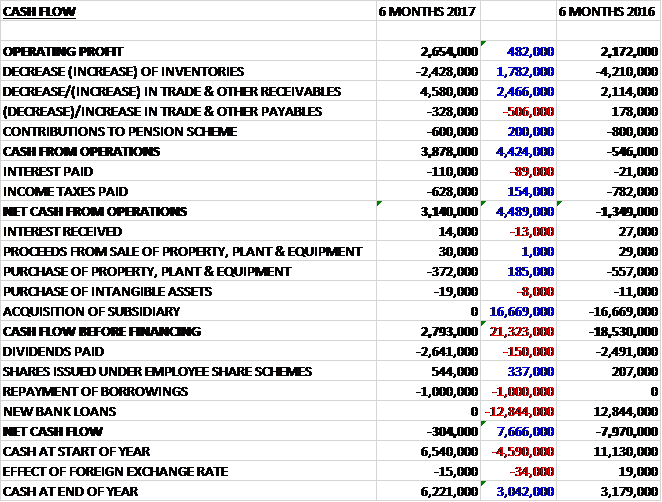
Before movements in working capital, cash profits increased by £482K to £2.7M. There was a cash inflow from working capital due to a decrease in receivables and after an £89K increase in interest payments was offset by a £154K decline in tax payments, the net cash from operations was £3.1M, an improvement of £4.5M year on year. The group spent just £372K on tangible assets which meant that the free cash flow was £2.8M which just about covered the dividends of £2.7M. The group also repaid £1M of borrowings so there was a cash outflow of £304K and a cash level of £6.2M at the period-end.

Excluding Wax Lyrical sales, sales for the core business were 3% ahead of last year but this was due to favourable forex movements and on a like for like, constant currency basis revenues declined by 2%. Sales in the UK grew by 29% due to the additional four months revenue from Lax Lyrical. Excluding this, the market was marginally down on last year due to the phasing of orders, but it is expected to be up for the full year.

The US remained a challenging market. Sales decreased by 25% in dollar terms (15% on actual terms). The impact of some 2016 orders not repeating and some one–off customer specific challenges were the main reasons for the decline. The board are confident of growth in the second half and expect strong orders for Christmas Tree and the new home fragrance ranges.

The South Korean market was down on the same period last year. The board anticipate strong demand in the second half of the year, in line with last year, however. The group have also received their first order for home fragrance from this market that will ship in the second half. ROW sales have more than doubled with strong growth in Europe and the Far East. There was no mention of India, which was a growing market last year.

Wax Lyrical made a net profit of £100K during the period. Good progress has been made on leveraging synergies from this acquisition. These include developing new UK accounts, expanding in export markets and co-developing product. In total 147 home fragrance products have been developed in the first half and they have visibility of a good order book for the second half against these new ranges.

This year the group launched a new collection with Sara Miller which has received a positive reaction, along with key introductions into the Sophie Conran for Portmeirion and Royal Worcester Wrendale Design ranges. New items have also been developed with Wax Lyrical and home fragrance products are now available in their key ranges including Botanic Garden and Sophie Conran.

Mike Raybould joined the board as Finance Director in May and he also has management responsibility for Wax Lyrical. Mike Knapper was promoted to the board as Operations director having been with the group since 1998. Going forward, given the revenue and profit reported in the first half, the board are confident of meeting expectations for the full year.

At the current share price the shares are trading on a PE ratio of 16.5 which falls to 14.7 on the full year consensus forecast. After a 5.7% increase in the interim dividend, the shares are yielding 3.3% which increases to 3.5% on the full year forecast. At the period-end the group had a net debt position of £1.7M compared to £9.7M at the same point of the prior year.

Overall then this has been a bit of a mixed period for the group. Profits were up, as was he operating cash flow with a satisfactory amount of free cash being generated but net assets declined. The group benefited from the Wax Lyrical acquisition, which seems to be performing OK, and favourable forex movements. Without the benefit of these, sales would have declined during the period.

The UK saw like for like declines due to phasing, the US was very difficult and South Korea continued its decline. The board seem to think all these markets will improve in the second half, however, but this puts some pressure on the performance. The one ray of light was European and Far East sales which seem to have exploded. There is not much more info on this, however, so I’m not sure if it is one-off in nature or not. With a forward PE of 14.7 and yield of 3.5% on balance I feel this is a bit pricey given the uncertain nature of the market at the moment.

On the 18th January the group released a trading update covering the year as a whole. They expect record revenues of £84.5M, an increase of at least 10% over the prior year. Excluding the full year impact of the Wax Lyrical acquisition, like for like sales growth exceeded 5%. They also expect pre-tax profit to be slightly ahead of market expectations.

The year on year sales growth strengthened as they moved through the year and the second half results exceeded management expectations. Highlights included the US, export markets and online sales that achieved double digit revenue growth, aided by well receive new product launches. With this momentum they look forward with confidence to 2018 and I have bought back in.

Keller Share Blog – Interim Results Year Ending 2017

Keller has now released their interim results for the year ending 2017.

Revenues increased when compared to the first half of last year with an £84.7M growth in EMEA revenue, a £47M increase in Asia Pacific revenue and a £9.7M growth in North America revenue. There was a £1.7M improvement in profits on the sale of fixed assets but depreciation was up £3.3M and other underlying operating costs grew by £132.1M. There was also a £20.5M increase in earnings surrounding the contract dispute which meant that the operating profit grew by £29.5M. Finance income was up £1.3M with finance costs increasing by £600K and tax charges growing by £4.5M to give a profit for the period of £41M, a growth of £25.3M year on year. Although removing the contract dispute items, profit would have grown by £4.8M.

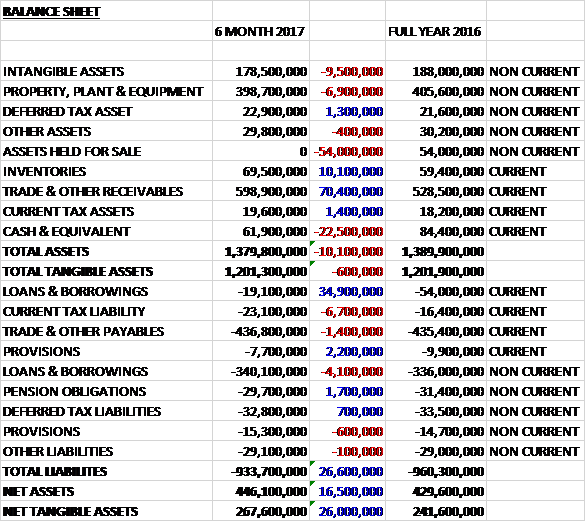
When compared to the end point of last year, total assets declined by £10.1M driven by a £54M elimination of the asset held for sale, a £22.5M fall in cash, a £9.5M decline in the value of intangible assets and a £6.9M fall in property, plant and equipment, partially offset by a £70.4M growth in receivables and a £10.1M increase in inventories. Total liabilities also declined during the period as a £6.7M growth in current tax liabilities was more than offset by a £30.8M decline in borrowings. The end result was a net tangible asset level of £267.6M, a growth of £26M year on year.

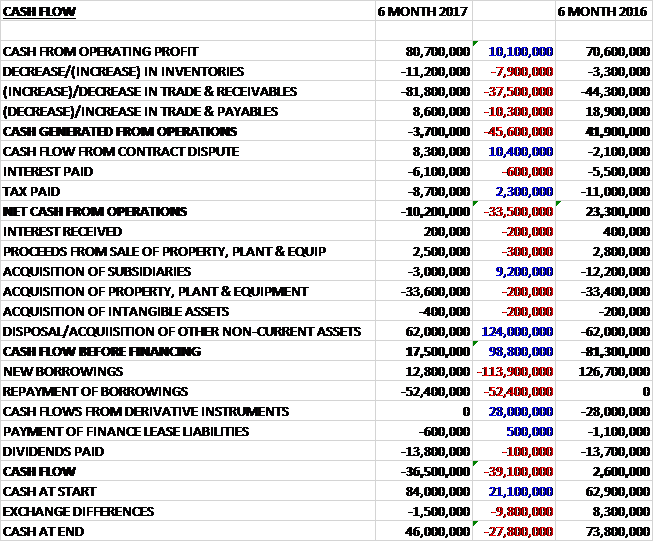
Before movements in working capital, cash profits increased by £10.1M to £80.7M. There was a big cash outflow from working capital, with an £81.8M increase in receivables. This meant that despite tax payments reducing by £2.3M and a £10.4M positive swing to a cash inflow from the contract dispute, there was a net cash outflow of £10.2M from operations, a detrimental movement of £33.5M year on year. The group received £2.5M from the sale of fixed assets and £62M from the warehouse sale at the centre of the contract dispute. They also spent £33.6M on property, plant and equipment along with £3M on acquisitions and £400K on intangibles to give a free cash flow of £17.5M. This covered the dividends of £13.8M but the group also repaid a net £39.6M of borrowings so there was a cash outflow of £36.5M in the half year and a cash level of £46M at the period-end.

The operating profit in the North American division was £28.6M, a decline of £5M year on year, which would have been even worse were it not for the £4.3M gain from favourable forex movements. The US construction market as a whole is solid but with regional and sectoral variations. Residential construction continues to grow strongly, infrastructure spending has slowed and commercial construction market rates vary by region. The profit fall was largely a result of a slowdown in construction activity in two major metropolitan areas where the group has a strong market position.

Hayward Baker had a solid first half with revenue and profit slightly ahead of last year. Case and HJ Foundation both recorded lower profit, however, as their core geographical markets saw a reduction in construction activity, particularly of high end residential apartments. The group’s largest job in the US, Bencor’s $135M diaphragm wall and grouting contract at a Dam in Pennsylvania is performing well. Suncoast had another good period, taking advantage of the ongoing increase in housing starts. Across the US bidding activity remains healthy and the US constant currency order book to be undertaken over the next year is up about 8% so the board expect revenue in H2 to be ahead of H2 last year.

The Canadian business continues to operate in a difficult market and made a small loss in the seasonally weak first half. The major $42M subway contract in Toronto, which finally mobilised in Q2 after more than a year of delays, has started well. In June the group announced further cost-cutting measures, including moving their admin centre from Edmonton to Toronto which better reflects where the bulk of the business opportunities now lie.

The operating profit in the EMEA division was £20M, an increase of £6.4M when compared to last year, helped in particular by the good execution of the $180M contract in the Caspian region which is due to be substantially finished by the end of the year. Whilst a number of markets remain challenging, the most significant European businesses all had a good first half. There has recently been a slowdown in the UK business, but the others in the region all begin the second half with strong order books and good prospects.

Elsewhere market conditions and performance is more mixed. Construction markets in the Middle East are patchy but the business has had a busy period in the region, starting work on major projects in Abu Dhabi and Egypt, and is will set for a strong second half. The political conditions in South Africa and Brazil are holding back construction activity in those markets. Whilst the major project near Durban is progressing well, activity generally in Sub-Saharan Africa is at a low ebb. The Brazilian business made a small loss in the period.

The division has had a number of good project wins in the period. The constant currency order book of work to be undertaken over the next year is over 30% ahead of 2016, giving the board confidence of a good second half. The completion of the major Caspian project at the end of 2017 means that the division’s 2018 profit will be materially down on what is expected this year, however.

The operating loss in the Asia Pacific division was £3.8M, an improvement of £5.8M when compared to the first half of 2016 despite a £1.6M cost relating to unfavourable forex movements and very difficult markets in Australia and Singapore. The loss was mainly related to two significant loss making projects, a joint venture in Australia and a legacy piling job in Singapore. In Australia the revenue run rate increased in the first half, in a large part due to higher market activity. Whilst this pick up is yet to feed through into higher pricing, the Australian business broke even, an improvement of £5M.

In Asia, revenue was broadly flat with a significant increase in India being offset by a reduction in Singapore as a result of the major downsizing of Resource Piling over the last year. As a whole the Asian business recorded a loss as a result of piling contracts in Singapore won in 2016. The Singapore and Malaysian Heavy Foundation businesses have now been merged with tendering being managed out of Malaysia.

Q2 saw some good contract wins in India, including a £14M dam grouting project in Polavarum and an £11M stone column contract to improve the ground for the new Navi Mumbai airport. Looking forward, the division’s order book for the next year is about 30% up which should result in a continuing improvement in performance.

During the period the group made a profit on the contract dispute. The income represents the gain on disposal of the freehold of the processing and warehouse facility acquired last year along with rental income. The gain was £8M on a consideration of £62M, the same amount that it was acquired for. During the period the group reached an agreement to receive £11.7M of insurance proceeds, of which £8.8M has already been received. The group has now recovered £35.3M of the original £54M but not further recoveries are expected. The net cash cost to date of this dispute is £14.3M.

In March the group acquired GEO Instruments, an instrumentation and monitoring business based in North America, for a cash consideration of £2.5M. This generated no goodwill.

Going forward, the US construction market and most of the major European markets are robust whilst elsewhere a number of markets remain difficult. Contract awards have been strong during the period with a 20% increase year on year. As a result, the board expect full year results to be in line with their expectations.

At the period-end the group had a net debt position of £297.3M compared to £339.7M at the same point of last year. At the current share price the shares are trading on a PE ratio of 11.3 which falls to 9.8 on the full year consensus forecast. After a 5% increase in the interim dividend, the shares are yielding 3.4% which increases to 3.5% on the full year forecast.

Overall then this has been a decent period. Profits increased, net assets were up and although there was an operating cash outflow, cash profits increased as this was due to a big increase in receivables. The EMEA region is performing well, but this mainly seems to be due to one large contract in the Caspian region and I am a bit concerned about what happens next year when it has been completed. Asia Pacific is still loss making but this has Improved due to the business breaking even in Australia. North America saw a slow-down in certain markets which has affected profits.

There are a few potential concerns here, as noted above, but the forward order book looks good and the forward PE of 9.8 and yield of 3.5% seems to account for the concerns to some extent. I remain a holder.

On the 16th November the group released a trading update covering the first four months of H2. Both revenue and profit are ahead of the same period of last year. Tendering activity and contract awards remain healthy and the order book for work to be undertaken over the next year is around 10% higher. Overall they remain on course to meet board expectations for the full year and there have been no major changes in their markets since the interim results stage.

In North America, the US construction market as a whole remains solid but with continuing regional and sectoral variation. The two large hurricanes resulted in lost production on some sites in Florida and Texas for up to two weeks in Q3 which has led to a negative one-off profit impact of £3M. Operating profit in North America will decline this year as a result of the previously noted weakness in specific regional markets, as well as the one-off effect of the hurricanes. Looking ahead, bidding activity remains healthy and the order book is around 10% above the level at the same time last year. The group is expected to benefit from the proposed US corporate tax changes, if enacted, as well as in the medium term from any uplift in infrastructure spending in both the US and Canada.

In EMEA the group are still seeing strong revenue and profit growth, helped by continued excellent execution of the $180M contract in the Caspian region which remains on track to be completed by the end of 2017. As a result, profit for the division in 2018 will be materially below this year’s result.

In Asia Pacific, pricing remains challenging in certain market segments but the division continues to make progress in reducing its losses as the results of restructuring and a higher workload materialise. The business in India is growing strongly and in Australia they are seeing an upturn in investment from the resources industry. They continue to expect that the region will return to profitability in 2018.

Overall, pretty decent but I am a bit concerned about the reliance on the Caspian contract so may look to sell up if possible.

On the 5th January the group announced that they expect new US tax reform legislation will benefit their future after tax earnings. This is mainly due to the future reduction in US corporate income tax from 35% to 21%, partly offset by a net adverse impact from other changes. Their current estimate is that the changes will reduce the group’s future overall effective percentage tax rate by around 5% to a number in the high twenties.

In addition, they expect that the group’s 2017 earnings will benefit from a one-off non-cash credit to the income statement as a result of the revaluation of US deferred tax liabilities, which is expected to be around $10M.

They also announced that they are in discussions to acquire Moretrench, a geotechnical contracting company operating predominantly along the east coast of the US. Last year the business had an operating profit of $9.3M and it is envisaged that the acquisition will be funded wholly in cash using existing borrowing facilities.

The enlarged entity will be the largest geotechnical solutions provider on the east coast and will give the group access to new niche geotechnical products as well as new industrial customers and should have good revenue and cost synergies. The two businesses have partnered on a number of successful joint venture projects in the past.

Victoria Oil and Gas Share Blog – Final Results Year Ended 2016

Victoria Oil and Gas has now released their final results for the year ended 2016.

Revenues increased by $11.4M but production royalties grew by $1.4M and depreciation and amortisation was up $11.9M. Other cost of sales fell by $1M but the gross profit was $983K lower. Wages and Salaries were up $1.2M, professional fees increased by $968K and other admin expenses grew by $2.4. There was also a $405K increase in forex losses but a $22.7M impairment of oil and gas assets gave an operating loss $29.4M worse than last time. There was no reversal of provisions, which brought in $1.2M last time and the unwinding of provision discounts increased by $851K before a $320K decline in tax charges meant that the loss from the year was $31.1M, a detrimental movement of $31.3M year on year.

When compared to the end point of last year, total assets declined by $17.1M, driven by a $33.6M fall in the value of oil and gas assets, a $5.3M decrease in RSM receivables and a $1.4M decline in deferred tax assets, partially offset by a $16.7M growth in exploration assets, a $3M increase in cash, a $1.8M growth in the value of plant and equipment and a $1.8M increase in assets under construction. Total liabilities increased during the period due to a $3.2M growth in trade payables due to increased expenditure on the drilling programme, a $7.3M increase in loans and a $1.4M growth in legal provisions. The end result was a net tangible asset level of $77.3M, a decline of $47.4M year on year.

Before movements in working capital, cash profits increased by $3.4M to $12.7M. There was a large cash inflow form working capital due to a decrease in receivables and an increase in payables so that after tax payments increased by $283K the net cash from operations was $22.2M, a growth of $20.6M year on year. The group spent $16.3M on exploration and evaluation along with $10.7M on property, plant and equipment so that after a $1.5M receipt of dividends from an associate there was a cash outflow of $3.2M before financing. The group took out a net $7.3M of new borrowings to give a cash flow of $3.9M and a cash level of $16.3M at the year-end.

There was a 24% increase in gas sales to 3,566mmscf gross driven by gas sales to two Douala power stations and the expanding thermal gas customer base. After the payout, the attributable gas sold for the current period was 2,897mmscf (1,736mmscf last time) which was 81% of the gross gas sold due to the timing of the payout. Going forward, the attributable sales will be 60% and then 57% so there will be a further significant production in 2017.
The global recovery of the oil price has resulted in reduced pricing pressure as competitive energy alternatives have increased in price, and has also resulted in improved pricing on the condensate sales. The average gas sales price for the period was marginally lower than the prior period, however, due to the larger proportion of revenue generated by ENEO.

During the year the Logbaba project reached a production milestone after which GDC will now share 40% of revenues generated with RSM which has had a significant impact on the group’s revenue, performance and cash generated in the year. In addition, the concession agreement governing the block grants the Cameroonian State an option to acquire a 5% participation. When they formalise this option to participate in the project, the group’s interest will be reduced to 57%.

In the prior period the group raised a provision for $5M for the reserve bonus payment and disclosed a contingent liability for an additional $5M pending the outcome of the mediation. The mediated settlement, which included the termination of the 1.2% royalty, resulted in a final liability of $11.2M with $5M having been paid during 2016 and the balance over the next two years which resulted in a loss of $2.6M during the period.

Also, the group disclosed a contingent liability of $1.6M in the prior period relating to a land claim submitted in Cameroon. This matter has not been fully resolved but developments has led management to raise a provision of $900K in the current period with a further $700K remaining contingent on the outcome.

During the year, the group added 15km to the Bonaberi line. Prior to the year-end, three new thermal customers were consuming gas along the extension and branch lines were commissioned up to PRMS units to four additional customers, three of which have since completed their downstream installations and are now consuming gas. Further customers along the line are at varying stages of readiness to consume gas soon.

The Logbaba and Bassa power stations have consumed gas in accordance with the seasonal take or pay levels set out in the initial two year contract which expired in April 2017. Negotiations for the renewal of this contract, in conjunction with the provider of the gas fired generators, have progressed well, but at the reporting date had not been concluded. The parties have agreed to continue trading on the current terms until the negotiations are concluded.

The group continues to seek solutions to the power generation requirements of their industrial customers. Those who were party to the original retail power contracts that included the rental of gensets have now sourced or are in negotiations for their own generators and the group will continue to supply gas. They have held discussions with additional potential large off-takers and other grid power products but they need to increase their reserves to supply these large customers before long term supply contracts can be agreed.

One of the Logbaba wells, La-106, has not produced to its potential due to mechanical and borehole damage to the bottom of the well which has continued to date. Despite remediation efforts, which finished in 2016, the well is now seen as an occasional producer for short periods of time when La-105 is undergoing maintenance. Accordingly the board has decided to write down the $22.7M carrying cost of this well.

The 2016/2017 drilling campaign was designed for two wells – La-107 and La-108 in the onshore Logbaba field to supplement the two existing production wells, La-105 and La-106. The drilling programme, which experienced a delayed start, is progressing despite some challenges. Over 125m of gross gas bearing sands have been encountered in La-108 which is significantly more than the 85m found in La-105 in 2010. The completion of the drilling programme will trigger the processing plant expansion project to double the plant capacity to 40mmscf/day so that the group can take advantage of some of the bigger and longer term supply opportunities in the region.

After the year-end, the well control and drill pipe issues, couple with the planned La-108 sidetrack have resulted in a schedule slippage and an estimated budget increase of about $8M, taking the expected cost to complete both wells to about $56M. Planned completion of the well is now Q3 2017 and the group’s share of well costs will be covered by cash generation, existing cash and credit facilities. Installation of temporary flow lines to connect the two wells to the processing facility on completion of the well testing are almost complete and construction on the permanent flowlines will start once the rig is removed.

In February 2016 the group announced a 75% interest assignment of Logbaba’s neighbouring licence area, the 1,235km2 Matanda block from Glencore. Three wells drilled in the field and seismic data show a strong geological continuation between Logbaba and North Matanda. Work is ongoing to evaluate the gas potential of the block in order to identify drilling prospects.

After the year-end, the group announced that it had entered into a Farm Out agreement with Bowleven in relation to the Bomono production sharing contract. The assignment is still subject to government approvals but once completed will result in the group having an 80% working interest in the 2,237km2 license. In 2016 Bowleven completed extended flow tests on the Moambe well that exceeded 7mmscf/day. The intention is for gas to be produced from the Bomono PSC to be fed into GDC’s pipeline network which is only 8.7km away from the drilled wells.

Bowleven will remain as the operator and an 80% participation holder. The deal includes VOG installing a pipeline connection from the Moambe well to the existing network and completion of civil engineering works at the wellhead necessary for the gas processing plant installation, the cost of which is estimated at $6M; a 3.5% royalty from the group’s Bomono production share of hydrocarbons with a cap limiting the total payment to $20M; and £100K of the company’s shares. The work programme, which includes the drilling of one well in the period of the provisional exploitation license commits the group to an estimated $8M.

During the year Robert Palmer and Grant Manheim retired from the board. Andrew Diamond was appointed as Finance Director and Roger Kennedy as a non-executive director.

At the year-end the group had a $1.8M net cash position with cash plus debt headroom of $30.8M. The anticipated spend on the drilling programme in 2017 is $16.9M.

On the 26th June the group announced that it had extended the current gas supply agreement with ENEO. The take or pay components will remain in place and until the year-end an interim gas price of $7.50/mmbtu has been agreed. They are now working with ENEO to create long term solutions.

On the 28th June the group released a drilling update. In well La-108, about 100m of net gas-bearing sands have been encountered and well logs on La-107 so far indicate net 35m of high porosity gas bearing sands in the Upper Logbaba formation. Drilling on La-107 will continue, targeting the base of the Logbaba sands. On reaching this target the well will be logged before being put into production. A 300m high pressure flowline from the well head to the processing plant has been installed and production is expected in Q3.

The net sands for far encountered of 100m in La-108 and 35m in La-107 have exceeded expectations and compared favourable to the 54m encountered in primary production well La-105. Planned completion of both wells is now Q3 2017.

On the 4th July the group supplied an update on the Logbaba participation agreement and the Bomono project. They have signed an agreement whereby VOG has 57%, RSM has 38% and the government has 5%. The government is entitled to a 5% share of revenues from the sale of all hydrocarbons from the project and are also liable for 5% of exploitation costs.

The group also exercised its option to extend the termination agreement of the Bomono farm out with Bowleven to September 2017. Both parties wish to pursue the farm out and are working with the government to progress the project.

On the 14th July the group announced that CEO Ahmet Dik purchased 19,220 shares at a value of £10.7K. He now owns 948,749 shares.

On the 31st July the group released a Q2 operations update. There was an 11.9% increase in gross average gas production from Logbaba to 14.59mmscf/d and gas sales increased to 1,192mmscf for the quarter but the 708mmscf attributable to Victoria was lower than the 996mmscf in Q2 last year due to the change in attributable revenues. The group received $7.8M of net revenue, down from $8.1M in Q1; there was a $7.6M cash position and a $20.7M net debt position at the end of the quarter, compared to $10.7M at the end of Q1. In June the government executed their right to a 5% participation interest in Logbaba, resulting in the group’s interest decreasing to 57%.

At the end of Q2, a 7” liner was run and cemented in well in La-107 at 2,440m MD. After the period-end, the well has continued drilling to a current depth of 2,914m. As previously announced, it has so far encountered a net pay of 35m of high permeability, high porosity gas bearing sands in the Upper Logbaba Formation, slightly more than was expected. In the hole section that is currently being drilled, preliminary data indicates that about 15m of net gas sand has been encountered.

The drilling programme has taken longer than expected due to the problems encountered in well La-108 but first well completion, at La-107, is targeted for Q3 with flow testing and tie in to the process plan expected at the same time. Following commercial completion of La-107, sidetrack drilling will restart at La-108 where about 100m of net gas bearing sands have been encountered between the top of the Logbaba formation at 1,670m and at 2,702m. This programme will allow the group to bring gas online imminently for sale from La-107 and then develop further capacity from La-108.

During the quarter, the group announced that it had extended the current gas supply agreement with ENEO until the end of December. The parties are currently developing the technical and financial elements of a long term gas supply arrangement aimed at increasing the current contractual power supply of 50MW to beyond 100MW.
The take or pay components will remain in place until the year-end, an interim gas price of $7.50/mmbtu has been agreed. Once the La-107 flow test is complete, the group is confident it will execute a number of long term high volume gas supply agreements with local companies.

On the 17th August the group announced that well La-107 had been successfully drilled to its planned TD of 3,180m where the base of the Logbaba formation was encountered. Production completion is now starting, after which the rig will be released form the well. Primary analysis of the logs indicates that they have encountered 35m of net gas sand in the Upper Logbaba formation, as previously announced, plus 23m of net gas sand in the Lower Logbaba formation.

The production test is expected to start in September and by the end of the month, the board expect that it should be tied in as a production well. Following its release, the rig will skid to well La-108, where sidetrack drilling will restart. The group’s plan is to progressively develop additional gas supplies from wells La-105, La-107 and La-108 over the next six months. Following the flow tests from La-107, this well can then be placed into production to supplement gas from La-105 and the board believe that the additional reserves will enable them to conclude longer term contracts with Douala based high usage gas customers.

The new gas supply from La-107 is expected to come online in Q3. This is a very positive outcome (finally!) but I am not sure it will really change much. Still, this is looking like a better investment than the other gas company I have been looking at, Wentworth and I am tempted to take a small punt.