UK Mail Share Blog – Interim Results Year Ending 2016

Following the integration of the courier operations into Parcels and the end of trading at UK Pallets, the group now only has two segments – mail and parcels. In recent years the courier business has been undergoing a transition away from a traditional same-day courier operation towards an operation which provides specialist service support to the parcels business, hence the integration.

The group has now released its interim results for the year ending 2016.
 

UKMinterimincome

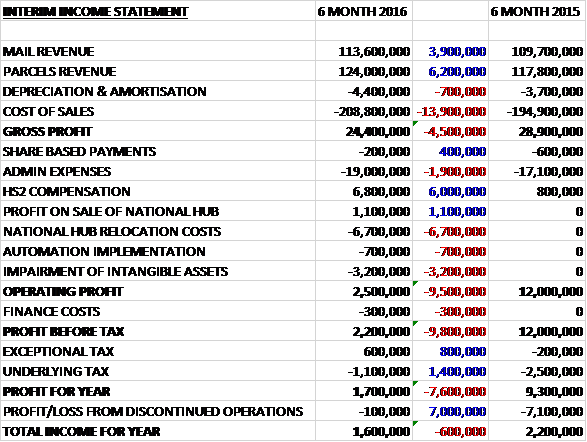
Revenues increased year on year with a £3.9M growth in mail revenue and a £6.2M increase in parcels revenue, but cost of sales grew further so that the gross profit was some £4.5M below that of the first half of last year. Admin expense also increased, up £1.9M, and hub relocation costs were broadly offset by the HS2 compensation. We also see a £1.1M profit from the sale of the old national hub but the automation implementation accounted for £700K in costs and there was a £3.2M intangible asset impairment to give an operating profit £9.5M down on last time. Finance costs increased slightly but tax was much lower so the profit from continuing operations was £1.7M, a decline of £7.6M year on year.
UKMinterimassets

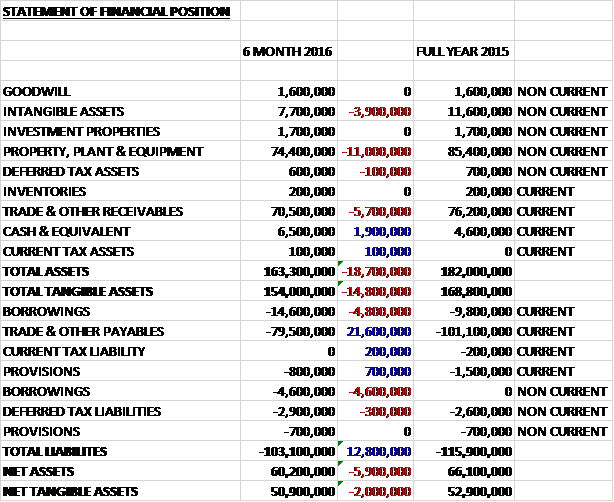
When compared to the end point of last year, total assets fell by £18.7M driven by an £11M decline in property, plant & equipment relating to disposals and HS2 compensation, a £5.7M decrease in receivables and a £3.9M fall in intangible assets, partially offset by a £1.9M increase in cash. Total liabilities also declined as a £21.6M fall in payables was partially offset by a £9.4M increase in borrowings. The end result is a net tangible asset level of £50.9M, a decline of £2M over the past six months.
UKMinterimcash

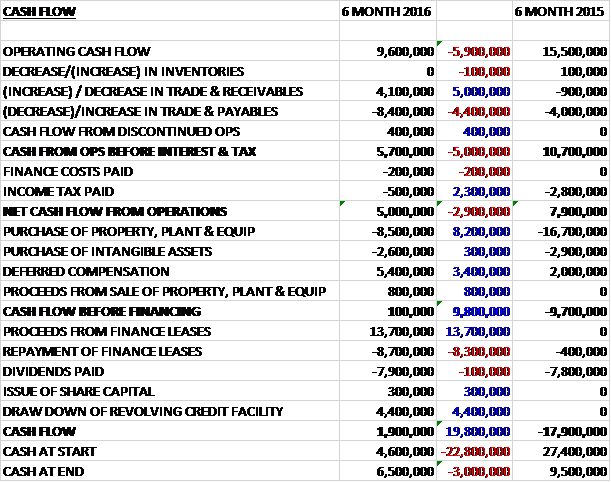
Before movements in working capital, cash profits fell by £5.9M to £9.6M. There was then a further working capital outflow due to a decrease in payables, although overall the cash spent on working capital was less than last time. After this, and a much lower tax payment, the net cash from operations came in at £5M, a decline of £2.9M year on year. The group then received £5.4M from the HS2 compensation but spent a net £7.7M on property, plant & equipment including £1.3M on the new hub and £1.5M in automation along with £2.6M on IT which meant that before financing, the group broadly broke even. They then took out a big finance lease and drew down on the revolving credit facility to pay the dividend and give a cash flow for the period of £1.9M and a cash level of £6.5M at the end of the first half of the year.

The operating profit at the Parcels business was £8.8M, a decline of £4.6M year on year on revenues that grew by 5.3%. This revenue growth as supported by average daily volume growth of 9%, reflecting some important new customer wins and weighted towards B2C customers due to the growth of online shopping. The impact of the sales mix effect combined with the increased operating costs the group have incurred as a result of the relocation of their operations, has meant that the parcels operating margin reduced from 10.7% to 6.3%.

As well as increasing operating costs, the operational issues related to the move to the new hub reduced volume growth slightly and resulted in an increase in customer churn. Following a detailed review, despite the fact the automated sortation equipment is working well and capable of delivering the anticipated benefits over the medium term, the group are facing a number of challenges as a result of a combination of inefficiencies in the new hub and the transport network. This, combined with the volumes of incompatible freight that cannot be handled by the new equipment, has placed added pressures on the new facility which resulted in the additional costs and the temporary reduction in service levels.

A detailed plan is underway to address these issues and therefore to restore the parcels business to its previous levels of profitability and to build from there. There are a number of near-term initiatives that have already eased the pressures on the hub, including securing additional, short term, hub capacity to ease the pressure on the main hub whilst the wider issues are being addressed. The efficiency of the hub will also improve as certain new larger customers come on board whose volumes arrive at the new hub throughout the day rather than just in the peak hours.

More widely, the plan involves re-engineering the line haul template to fully align it with the efficiency of the new hub, and a new operational plan for incompatible freight volumes with a new operations director joining early next year who should be instrumental in the execution of the plan after previously doing the same job at Parcel Force. Some progress has already been made. The sortation equipment is operating at target efficiency with an improving trend of volume performance in the latter weeks of the period; service levels are now back to where they should be; and there are a number of significant potential customers keen to use the services available to the group through the new hub. They will be managing their customer acquisition and overall volumes very carefully, however, as they approach the Christmas period with a focus on profitability and service levels to current customers.

Good progress is apparently being made with product innovations in the division. These include Retail Today, a same day delivery service combining the parcels and courier operations; and ipostparcels, which represents one of the lowest-cost online collection and delivery services available in the UK. Revenues and profits grew well for these operations and the group continues to invest in further enhancing their services in these areas.

Key to the parcels market position is the provision of value added services that customers increasingly demand. The enhanced next day delivery service, which offers advance-notice one hour delivery and collection windows, is now fully operational and is consistently achieving strong service levels of over 95%. In addition, their sales initiative, carrier of contingency, is proving successful with three major retailers already won. They are also progressing parcel drop-off and collection points, with a trial in place with a national multi-site retailer.

The operating profit at the Mail business was £4.9M, a fall of £1.3M when compared to the first half of last year on revenues that increased by 3.6%. Daily mail volumes grew by 8.1% compared to a market that saw an overall volume decline of some 5% demonstrating market share gains. This volume growth was driven by strong customer retention and new customer wins. The competition in the market, however, meant that operating margin fell from 5.6% to 4.5% which is apparently back within the target range after H1 2014 benefited from a particularly favourable product mix. The business has a healthy pipeline of new business opportunities and the group saw continued good progress from imail and related new product innovations.

There are a number of substantial competitor accounts currently out for tender, and the group are seeing a significant success rate in these, albeit with some pricing pressures. Imail, the web-to-print postal service, continued to show good revenue growth. They continued to invest in the product to increase capacity and provide additional services with imailprint being successfully launched. This provides a specialist printing service which, rather than being purely mailed as with the current service, can produce printed documents for general usage. The board see this as a medium term low risk growth opportunity that used the existing infrastructure.

A key growth element of the Access Mail market is the rising popularity of packets, a segment that the group estimates currently represents some £200M of the total Access Mail market of £1.5BN. Whilst they have made some progress in this area in recent years, their share of the packets market remains very low and the business is now being reinvigorated, with investment in specialist automated packets sortation equipment and an increase in the size of the sales team. The board expect to see an impact from early 2016 and it is believed that this area will be key to growing mail revenues and profitability in the future.

As previously mentioned, it has become clear that the near-term challenges associated with the transition have been more significant than originally anticipated. Trading in the initial weeks of the second half has been in line with the revised expectations and expectations for the current year therefore remain in line with previous guidance but due to the timescales required to fully resolve the challenges, the expectations for the next year have softened slightly. The transfer to the new automated facility in Ryton was completed in July and after some initial teething issues, the service levels are now back where they should be in time for the Christmas trading period.

As with most companies it seems, there were a number of non-underlying items during the period. The £1.1M profit on the sale of the national hub represents the compulsory acquisition of the Birmingham hub by the DfT and HS2 as a result of the proposed HS2 railway. There was also a compensation payment of £6.8M reimbursed from the DfT (compared to £800K during the same period last year). The £700K cost relating to automation implementation represents the costs incurred as the group moved towards the roll-out of new automation equipment comprising £500K asset write-offs and £200K of contract termination costs.

The £6.7M of national hub relocation costs comprise of £3.7M of disturbance costs including recruitment and redundancy costs, £2.5M dual running costs which were largely property costs relating to running two sites whilst relocating, £300K compensation paid to customers following a temporary deterioration in service performance, and £200K in relation to the loss of profit resulting from the delay in increasing the hub’s extended capacity. The £3.2M impairment of intangible assets occurred after the group undertook a strategic review of its IT systems during the period which identified a number of software assets that did not fit within the medium and long term strategic goals of the group which offered no future economic value to the group. Last year there was a £7.3M goodwill impairment relating to the discontinued Pallets business and this year there was a further £100K of costs as the group administers the business’ liquidation.

The group has committed bank facilities in place, comprising a five year £25M revolving credit facility available until the end of May 2019 with £14.4M drawn at the period end, and a £20M overdraft facility available until the end of 2015. At the period-end, the group had committed capital expenditure of £1.4M which is a considerable reduction on last year.

In November, after the period end, the group agreed a final compensation payment of £10.3M with the DfT with the funds expected to be received before the end of the calendar year 2015. This final costs mean that the group’s contribution in total to the move will be £12.4M which covers the enhancement of the site and building beyond the scale of the previous facility with some £18.4M in total spent on automation. The costs of the move, including the IT data centre move and related staff costs, have now been largely incurred with some £600K relocation costs expected in the second half of the year with final payments relating to automation of £1.3M also expected to be incurred.

The parcels business is generally busier in the second half of the year due to the Christmas trading period but mail does not have any real seasonality.

At the end of the period the group had net debt of £12.7M compared to £5.2M at the end of last year. The shares are currently yielding 6.1% increasing to 6.7% on Investec’s current forecast but I don’t think that has taken into account the reduced dividend payment likely so I don’t see this as sustainable.

Overall then this has clearly been a difficult period for the group. Profits were down, net assets declined and operating cash flow fell with no free cash generated to speak of. The parcels business struggled due to the higher costs associated with the relocation of the hub but apparently steps are being taken to address these issues. The fact that a decent portion of the parcels are not compatible with the automation machinery is a real problem in my view. Mail profits were also down, with this performance being blamed on strong comparatives with H1 last year and strong competition. It seems to me that the group is grabbing a lot of new market share but at the cost of reduced margins – I hope they have done their sums right and these new contracts are actually profitable.

The expectations for next year have now softened but the £10.3M to be received from the DFT will really help the company and has perhaps been overlooked by the market. In some ways I feel that this is getting close to being an interesting opportunity as the bad news may now all be in the share price and there is a pretty solid balance sheet backing up this business. This sector is cut-throat, however, with City Link going out of business last year and DX recently warning on profits. Also, the temporary reduction in service levels may have a greater knock on effect than is being acknowledged given the competitiveness of the industry. Overall, although these shares look more tempting now I think I will hold off to see how the Christmas trading period goes.

On the 25th November it was announced that CEO Guy Buswell was stepping down with immediate effect after spending ten years in the role. The non-executive chairman and founder Peter Kane will become interim executive chairman. Clearly the board has grown tired of the disruption surrounding the new hub and automation.

On the 12th January the group gave a Q3 trading update. Overall the performance in the quarter was in line with management expectations. The parcels business delivered good volume growth of some 8% compared to the same period last year. This growth was largely driven by an increase in internet shipping related home deliveries. The new automated hub operated very well throughout the peak period, and is starting to achieve good throughput levels so strong customer service was maintained through this busy trading period. The mail business achieved satisfactory volume growth of 2% but due to mix of sales, revenues were down compared to the same period of last year.

Overall not a bad update but it’s not quite strong enough to entice me in yet given the cut throat competition in the industry.

On the 27th January the group announced the appointment of Chris Mangham as IT director. Peter Fuller will also joint as Operations Director. He was most recently Operations Director at Parcelforce.

On the 6th April the group issued an update for the year ending 2016. Revenues for the year are expected to show a 1% decrease and pre-tax profit is anticipated to be in line with management expectations. Overall revenue growth has been impacted by a continued mix effect in the mail business which is expected to result in a revenue decline for the year of some 3% despite mail volumes being up by about 5%.

The parcels business is expected to achieve volume growth of about 4% but growth in Q4 suffered due to the spike in volumes in the comparative period in 2015 as a result of the demise of City Link. The new automated hub continues to operate well and achieved good throughput levels and the group are making further progress with their plans to improve the efficiency of their network in markets that remain highly competitive.

Overall then, not much to get that excited about here in my view.

Easy Jet Share Blog – Final Results Year Ended 2015

Easy Jet has now released its final results for the year ended 2015.

EZJincome

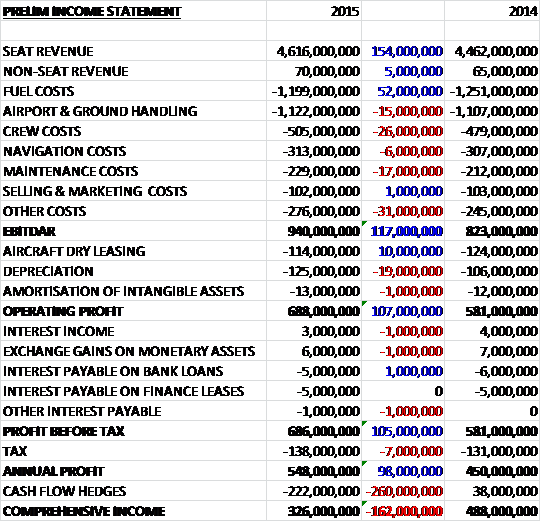
Revenues increased by £159M when compared to last year with passenger volumes increasing by 6% and revenue per seat up 1.5% on a constant currency basis to £64.28, offset by currency headwinds, whilst fuel costs fell by £52M with sales and marketing costs broadly flat. There was a £26M increase in crew costs, though, along with a £17M growth in maintenance costs, a £15M increase in airport and ground handling costs, a £6M increase in navigation costs and a £31M growth in costs to give an EBITDA some £117M above that of last year. We then see a £10M fall in aircraft dry leasing more than offset by a £19M growth in depreciation and after a small fall in finance income and a modest increase in tax, the annual profit was £548M, an increase of £98M year on year. I must say that as an aside, the Easy Jet accounts are a joy to analyse compared to some other companies, with no one-off charges and a good, sensible, split of underlying costs.

EZJassets

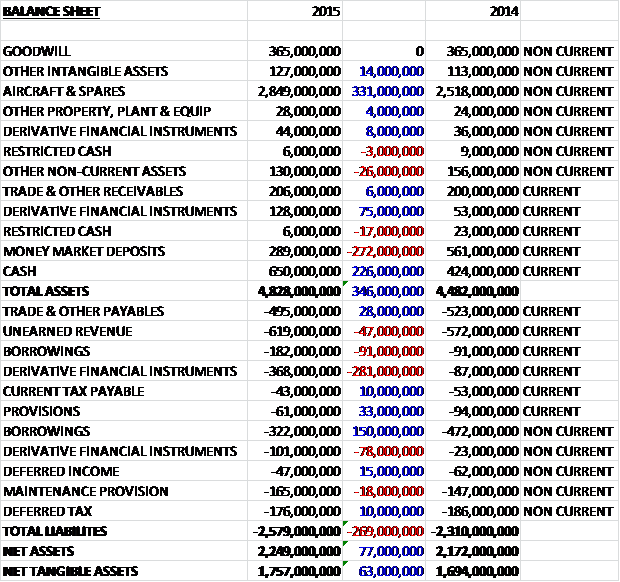
When compared to the end point of last year, total assets increased by £346M driven by a £331M growth in the value of aircraft and spares, a £75M increase in derivative financial instruments, a £226M growth in cash and a £14M increase in other tangible assets, partially offset by a £272M fall in money market deposits, a £26M decline in other non-current assets and a £17M fall in restricted cash. Total liabilities also increased during the year as a £359M increase in derivative financial liabilities, related to the fuel price hedge, a £47M increase in unearned revenue and an £18M growth in the maintenance provision was partially offset by a £59M fall in borrowings, a £28M decline in trade and other payables and a £15M decrease in deferred income. The end result is a net tangible asset level of £1.757BN, an increase of £63M year on year.

EZJcash

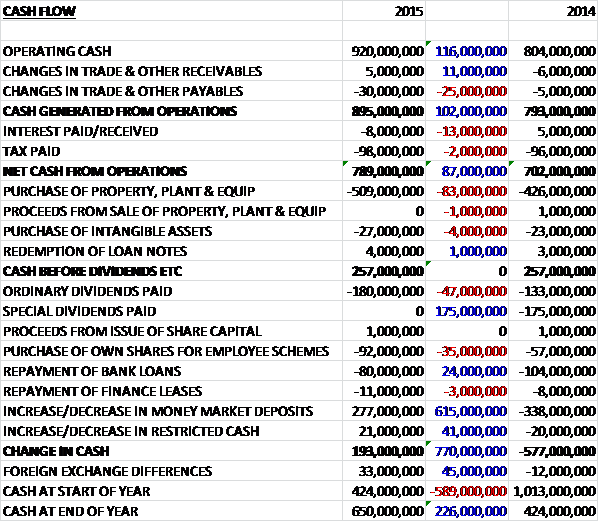
Before movements in working capital, cash profits increased by £116M to £920M but this was eroded somewhat by a decline in payables, a net interest payment and a small tax payment so that the net cash flow from operations was £789M, an increase of £87M year on year. The group spent £509M of this on property, plant & equipment, mostly related to the 20 new planes, and £27M on intangible assets to give a free cash flow of £257M. Of this, £180M was spent on dividends, £92M was spent on shares for employee schemes (that sounds like a lot!), and some £91M was spent on the repayment of loans and finance leases. A £277M fall in money market investments, however, meant that there was a cash inflow of £193M for the year to give a cash level of £650M at the year-end.

The short haul European aviation market has seen strong underlying demand throughout the year particularly in Easy Jet’s primary markets in Western Europe. Economic trends are currently favourable with GDP growth in the group’s main markets with an improving outlook across all of their other major regions which is reflected in strong demand for their services. The total European short haul market grew by 5% year on year, sustained in part by the continued low fuel price. Low cost carrier share of the short haul market increased by about one percentage point to 42%. In the same period, the group’s competitors increased capacity by 7% in its markets, with particularly strong growth in the UK market. In comparison, Easy Jet increased capacity by 5% with growth of 4% in the first half increasing to 6% in the second half. Legacy carriers are also transferring capacity from their flag airlines to lower-cost subsidiaries such as Vueling, Eurowings and Transavia.

During the year the group added a net sixty routes to the network, slightly more than last year. These were allocated to new bases such as Amsterdam, Hamburg, Naples and Porto and to markets where they want to consolidate their position and grow share, such as Switzerland and Italy. The group have also recently announced new base openings in Venice and Barcelona.

In the UK the group are continuing to reinforce their already strong position in the market, both London-based and regional. They remain the number one carrier by market share at almost all of its UK bases, including Gatwick, Luton, Bristol, Belfast and Edinburgh. Their positioning, market share and airport bases are driving both leisure and business passengers. The group increased capacity by 3% during the year, launching new routes such as Gatwick to Stuttgart and Luton to Essaouira, while continuing to increase frequencies on selected routes while their competitors increased capacity in the group’s markets by 9%.

Easy Jet is France’s second largest short-haul airline with a 14% market share with 26 aircraft based in the country. The board see opportunities to grow their market share in France, adding capacity at Charles De Gaulle through up-gauging and strengthening their domestic network. They increased capacity in France by 6% in the year against competitor growth of 5%, launching eight new routes in the year such as Toulouse to Seville and Paris Orly to Split.

Easy Jet has a 12% market share in Italy with 29 aircraft based in the country. The group continues to target increasing market share in Italy, by reinforcing their existing strong positions and investing more in the higher value catchment areas. They are the biggest operator at Milan Malpensa with 22 touching aircraft, have recently opened a new base at Naples and will open a base in Venice early in 2016. They are supporting this by redeploying aircraft from Rome Fumicino. Overall the company increased capacity in Italy by 7% launching 23 new routes in the year including Milan Malpensa to Munich, Milan Linate to Paris CdG and Milan Linate to Amsterdam.

Easy Jet is Switzerland’s second largest airline with a 23% total market share with 23 aircraft based in the country. The group are the number one operator at both Geneva and Basel airports. They increased capacity by 9% during the year, building and reinforcing their leading positions at both airports. Competitor capacity growth in their markets was also 9% and Easy Jet launched eleven new routes in the year such as Geneva to Menorca and Basel to Luton.

Easy Jet has a 4% market share in Germany with 12 aircraft based there. This is a large market, although with a more regional structure than other European countries. The group has focused on its two bases at Berlin Schoenefeld where it is the number one airline, and Hamburg, which they opened last year. They target continued growth in Germany, taking market share from the incumbent operators and have increased capacity by 15% during the year with competitor growth of 6%. They have launched sixteen new routes in the year such as Hamburg to Lanzarote and Hamburg to Paris Orly.

Easy Jet has a 13% market share in Portugal and an 8% market share in Spain with six aircraft based in the former. These two countries are principally an in-bound market for the group with strong demand from the rest of Europe. They increased capacity by 8% in Portugal and 2% in Spain reflecting in particular the investment in a new base in Porto from which they launched six new routes to Luxembourg, Nantes, Stuttgart, Manchester, Bristol and Luton. They also announced that a new base in Barcelona would be opening in February 2016. Competitor market share grew faster, however, with 10% growth in Portugal and 7% in Spain.

The company is the second largest short haul airline in the Netherlands with a 9% market share and 3 based aircraft. The country is a significant opportunity where they currently carry four million passengers a year. In March they opened a new base at Schipol airport in Amsterdam where they are now the second biggest operator, and are continuing to invest in growth of their market share. As a result they have increased capacity by 17% during the year against competitor growth of 9% with nine new routes launches such as Amsterdam to Nice.

Passengers increased by 6% to 68.6M with a record load factor in August of 94.4% and the annual load factor increased by 0.9% to 91.5%. Revenue per seat increased by 1.5% year on year on a constant currency basis whilst capacity grew by 5% to 75M seats. Cost per seat decreased by 3.4% with benefit from fuel and currency but cost per seat on a constant currency excluding fuel increased by 3.6% due to cost pressures that include regulated airport price increases, increased de-icing costs and significant disruption costs which have been mitigated through £46M of sustainable savings with a pipeline of structural cost improvements to deliver future savings.

Excluding fuel, cost per seat decreased by 0.9% to £37.35 but increased by 3.6% on a constant currency basis. This increase includes higher disruption costs following French ATC strikes in April and the impact of two fires at Rome Fiumicino airport. There were also additional costs due to increased airport charges, mostly in Italy, and the early recruitment of crew in the winter to provide a resilient operation ahead of three crew base openings, along with a one-off settlement of £8M with Eurocontrol in the second half of the year. Fuel costs fell by £52M overall to £15.98 per seat and profit per seat increased 12.6% to £9.15 per seat.

Maintenance cost per seat increased by 3.8% at constant currency. 2014 benefited from a reduction in the cost of heavy maintenance following a revised engine contract, and a significant proportion of this reduction was one-off in nature and did not recur this year. This impact was partially offset by the reduced maintenance from the return of five leased aircraft during the year, and some benefits of a reduced maintenance contract in the year. Other costs per seat increased by 9.6% at constant currency. There were increased disruption costs during the year due to the French ATC strikes in April and the two fires at Rome Fiumicino airport. Investment in the development of their digital customer proposition also contributed to the increased cost per seat.

Aircraft dry leasing cost per seat fell by 9.7% at a constant currency due to the return of five leases aircraft during the year and the extension of twelve aircraft leases at lower monthly rentals. Depreciation costs have increased by 11.8% on a per seat basis driven by the acquisition of twenty new A320 aircraft, which increased the average number of the owned fleet to 164. Fuel cost per seat decreased by 9.1% at constant currency. During the period the average market jet fuel price fell by 36% to $619 per tonne from $973 per tonne in the previous year. The operation of the fuel hedging policy meant that the average effective fuel price movement only saw a decrease of 10.7% to $820 per tonne.

The group is launching a loyalty programme but it doesn’t seem to be very similar to other airline offerings and instead of offering free flights, they are offering things such as free name changes and a low price promise, which sounds a bit wishy-washy to me. This scheme will be rolled out in early 2016.

The group is also targeting business customers and are focused on providing a bespoke business offering through distribution platforms, travel management companies and direct to small and medium sizes enterprises. They signed up a hundred corporate customers during the year and despite a strong comparable benefit in 2014 due to the Air France strike, the group nevertheless continued to increase the business yield premium during the year. Sales of business products performed well with a 58% increase in the sale of flexible business fares when compared to last year. Sales through global distribution systems grew by 32% in the year as the group continued to leverage its relationships with the travel management companies. Bookings from corporate customers direct also went up by 30%. They continue to see opportunities to sell its business product across Europe and they have recently strengthened their corporate sales capability through a new market, customer and industry structure.

The group will be investing substantially in their digital capability over the next three years. Their initial focus will be on enhancing the digital customer interface, to be delivered in summer 2016, followed by the development of support systems that will lead to them having the first fully integrated e-commerce platform in the airline industry. In the longer term they are committing to the acceleration of their use of data science to improve efficiency, increase revenue and drive greater customer satisfaction. The digital programme will offer increasing amounts of personalisation, introducing a more relevant booking journey bases on previous behaviour to drive higher footfall and higher conversion rates. It will also enable more self-management capability through the entire journey chain, from booking to check-in and through the airport.

The group are now in their second year of a seven year contract with Gatwick airport, as the largest operator there, and in Luton where they have signed a ten year contract. In ground handing they signed an arrangement with GH Italia covering all of the nine airports that they are present in Italy and they expect to agree a number of new contracts in both areas over the next two years. During the year they also completed a new component support arrangement with AJW Group, consolidating previous arrangements and again leveraging their increasing scale and the group expect to drive significant maintenance savings over the term of the contract.

The group is contractually committed to the acquisition of 150 Airbus A320 aircraft with a total list price of $13BN with 20 for delivery next year, 30 for delivery in 2017 and 2018 and 100 new generation aircraft for delivery between 2017 and 2022. In November 2015 the group secured an agreement with Airbus to take delivery of an additional 36 aircraft, of which 30 are new generation, with a total list price of $3.2M. The up-gauging of the fleet from a majority 156-seat A319 composition to a fleet that is over 70% 186-seat A320s is expected to have a 13% to 14% cost per seat benefit, which translates into over £110M of comparable savings. The total fleet at the end of the year stood at 241 aircraft and increased by a net 15 with five A319s retired over 2015.

The group still have a great deal of their future fuel requirements hedged. Over the next six months, 85% of the requirement is hedged at $852 per tonne, for the whole of next year, 83% is hedged at $830 per tonne and in 2017, 60% is hedged at $664 per tonne and a $10 movement per metric tonne impacts next year’s fuel bill by $3.5M.
The board expect to see passenger growth of 7% over the year with margins sustained through rigorous cost control and the benefit of fleet up-gauging, resulting in positive profit momentum. They will continue to expand in their new bases of Hamburg, Amsterdam and Porto as well as consolidating their strong position in the UK, Switzerland, France and Italy. Demand remains resilient and with forward bookings in line with last year, the board are confident for the future.

Based on current market fuel prices they expect the unit fuel bill to decline by between £140M and £160M during the year but much of the benefit will be passed on to customers so there will be a slight decline in revenue per seat during the first half of the year. The board expect a slight decline in total cost per seat at constant currency including fuel and excluding the fuel effect, cost per seat is expected to increase by 2% which will be weighted to the first half and primarily reflects increases in regulated airports costs and navigation charges, disruption costs and an expected cold winter.

Exchange rate movements are likely to have an adverse impact of approximately £15M in the first half compared to this year and £40M for the year as a whole and the board’s expectations are in line with the market.
At the current share price the shares are trading on a PE ratio of 12.4 which falls to 11.8 on next year’s consensus forecast. After a 22% increase in the annual dividend, the shares are currently yielding 3.2% which increases to 3.6% on next year’s forecast. Including aircraft leases, net debt fell by £83M to £363M.

Overall then, this has been a good year for Easy Jet despite a number of setbacks. Profits increased, net assets were up and operating cash flow grew which gives plenty of free cash, although a lot of it is taken up by a near £100M spent on the employee share scheme! Overall, markets are doing well with the European short haul market improving well. The group increased their presents in all their main markets but Germany and the Netherlands seem to be growing particularly well. The load factor for the year has grown to 91.5% and capacity was up 5%.

Cost wise, fuel costs came down but the group is still suffering somewhat from its hedged position that means it is not feeling the full benefit of the decline. Some other costs did increase, regulated airport prices were up, mainly in Italy, de-icing costs increased, there were more disruption costs due to the French ATC strike and fires at Rome, and there was an investment in aircrew ahead of the new bases opening. The group is also investing heavily in its fleet of aircraft and the larger A320 planes should improve costs per seat over the A319 that still dominate the fleet.

The one cloud hanging over the company is the potential effect of terrorist actions in their North African markets of Egypt and Morocco and the knock on effect on these destinations but with a forward PE of 11.8, a dividend yield of 3.6% and a sensible gearing level, these shares seem rather cheap to me and having sold them just prior to the results I am contemplating coming back in here.

On the 4th December the group released its passenger stats for November. Passenger numbers were up 9.6% year on year to 4,807,922 but the load factor only increased from 89.5% to 90.3% and is below the twelve month rolling total figure of 91.8%. There were 378 cancellations in the month compared to just 16 in November last year. Sharm-el-Sheikh accounted for 176 of these cancellations with the rest due to adverse weather earlier in the month.

On the 7th January the group released their passenger stats for December. Overall passenger numbers were 4.8M, an increase of 4.6% year on year despite the predicted reduction in bookings in the weeks following the terrorist attacks in Paris but load factors fell by 1.8% to 86.6%. The group is France’s second largest airline and about 23% of their capacity during December was on French touching routes, hence the decline in the load factor which is now recovering to normal levels so management do not anticipate any change to full year expectations.

On the 26th January the group released a Q1 trading update. Overall, the board’s expectations for pre-tax profits this year remain in line with market expectations. Passengers carried increased by 8.1% to 16.1M as capacity grew by 7.3% and the load factor increased by 0.6 percentage points to 90.3%. Strong revenue per seat performance in October was offset by the impacts of the terrorist atrocities in Egypt and Paris, resulting in lower demand and yield in November and December. The impact of the cancellation of flights to Sharm El Sheikh was to reduce revenue per seat by about 1.5% whereas the events in Paris impacted revenue per seat by 2%. Business passengers grew by 6.5% in the quarter, which seems pretty good. Forward bookings for Q2 are showing a marked improvement, however, in revenue per seat. For Q1 as a whole, revenue per seat was down by 3.7% at constant currency.

Total revenue was down just 0.1% on the prior year as revenue generated by increased passenger volumes and a higher load factor and a 12.7% increase in non-seat revenue due to a good performance in inflight sales helped offset the lower revenue per seat and negative forex movements of £32M. Cost per seat decreased by 3.7% at a constant currency due to the continuing benefit of a lower fuel price but excluding fuel, cost per seat increased by 1.3%. This was better than originally expected, however, due to airport discounts on additional passenger volumes, engineering and maintenance savings, savings in overhead costs and up-guaging of the fleet from A319s to A320s.

The group’s on-time performance improved from the summer with 82% of flights arriving on time during the quarter, although this was lower than the 86% in Q1 last year. At Gatwick the operating performance improved over the summer but the group have been affected by systems changes at Brest Air Traffic Control as well as increased security and immigration controls across the network.

The group have announced a £3BN Euro Medium Term Note programme which is apparently part of the capital review and will facilitate access to new sources of funding. Cash deposits stood at £743M, however, and net cash was £266M at the end of the quarter, down from £353M at the same point of last year due to pre-delivery payments and the acquisition of aircraft.

As far as hedging is concerned, they have hedged 87% of their fuel requirements for the next six months at $846 per tonne; 86% of their requirements for the full year at $823 per tonne and 69% of their requirements next year at $644 per tonne so they should really see some benefits coming through in 2017.

The group plan to grow capacity by around 8% over the half year period and 7% for the full year. Going forward, they expect revenue per seat at constant currency to decline by mid-single digits in Q2 due to the impact of Egypt and Paris. Cost per seat, excluding fuel at constant currency is expected to increase by 1% in the first half of the year with a between 0% and 1% increase over the whole year. They are continuing to derive a cost benefit from low oil prices with jet fuel remaining between $350 to $450 per tonne which would lower the fuel bill by between £75M and £85M over the half year period. On the same basis, the saving over the full year would be likely to be between £165M and £180M. Exchange rate movements for the half year period are likely to have a £25M adverse impact which doubles to £50M for the full year but due to the strong cost performance and low fuel price, the board expects pre-tax profit for the year to be in line with expectations which is a good performance given the issues they have faced. Clearly there are downsides here but on balance I think I will continue to hold.

On the 4th February the group released their passenger stats for January. Passenger numbers increased by 6.3% to 4,276,821 but the load factor fell slightly, down from 85.1% last year to 85%.

On the 4th March the group announced its passenger stats for February. During the month they carried 4,932,212 passengers, an increase of 9.8% year on year although the load factor of 90.5% is below the 90.9% in February last year and the twelve month rolling average of 91.6%.

On the 22nd March it was announced that director Peter Duffy purchased 1,532 shares at a value of £22,597.

On the 6th April the group released its passenger stats for March. Total passenger numbers increased by 4.3% year on year but the load factor was down by 1.3 percentage points to 91.3% with the rolling annual load factor standing at 91.5%. There were 611 cancellations during the month with the majority due to strike action in France.

The increase in passenger numbers is good but the reduction in load factor, although still not too bad, is not great and the French strike action is definitely having a detrimental effect on trading.

Majestic Wine Share Blog – Interim Results Year Ending 2016

Following the acquisition of Naked Wines, the group has changed its reporting structure. Their operations are now organised into four business units. Majestic Wine Retail is a customer based wine retailer, Majestic Wine Commercial is a B2B wine retailer, Lay & Wheeler is a specialist in the fine wine market and Naked Wines is a customer funded on-line wine retailer. The retail business now includes the retail arms of the UK stores and the Calais stores which were previously reported in a separate business segment. The group has now released its interim results for the year ending 2016.

MJWINCOME

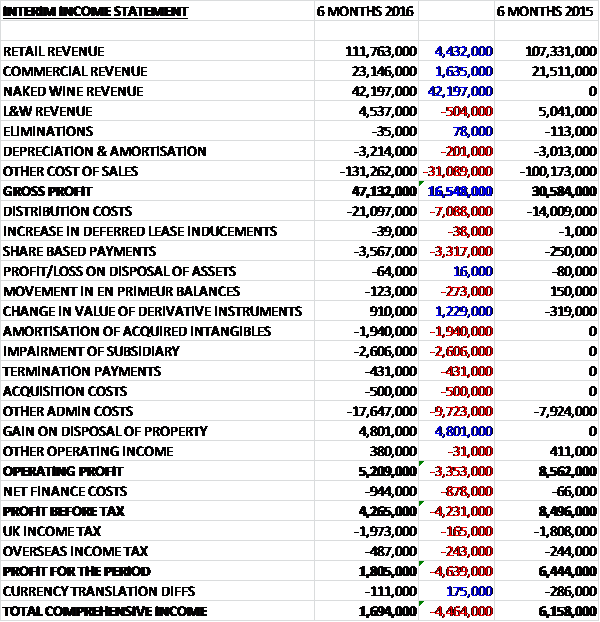
Revenues increased when compared to the first half of last year with a £504K decline in Law & Wheeler revenues being more than offset by a £4.4M growth in retail revenue and a £1.6M increase in commercial revenue. We also see the maiden revenues from the Naked Wines acquisition, with £42.2M being recorded. Cost of sales also increased to give a gross profit some £16.4M above that of last time. There was a £7.1M growth in distribution costs, a £3.3M increase in share based payments relating to the acquisition, a £1.9M amortisation of acquired intangibles, a £2.6M impairment of Law and Wheeler assets, and a £9.7M growth in other admin costs, partially offset by a £1.2M favourable movement in derivative financial instruments and a £4.8M sale of a freehold property which gave an operating profit £3.4M below that of last time. Finance costs then increased, along with a smaller growth in tax so that the profit for the first half of the year came in at £1.8M, a decline of £4.6M year on year.

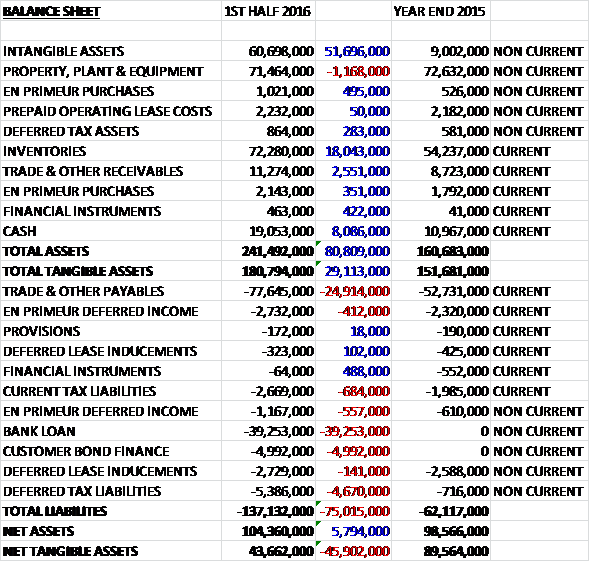
MJWASSETS

When compared to the end point of last year, total assets increased by £80.8M driven by a £51.7M growth in intangible assets, an £18M increase in inventories, an £8.1M growth in cash and a £2.6M increase in receivables , partially offset by a £1.2M decline in the value of property, plant and equipment due to the asset sale. Total liabilities also increased during the period due to a £39.3M new bank loan, a £24.9M increase in payables, a £5M growth in customer bond finance and a £4.7M increase in deferred tax liabilities. The end result is a net tangible asset level of £43.7M, a decline of £45.9M over the past six months.

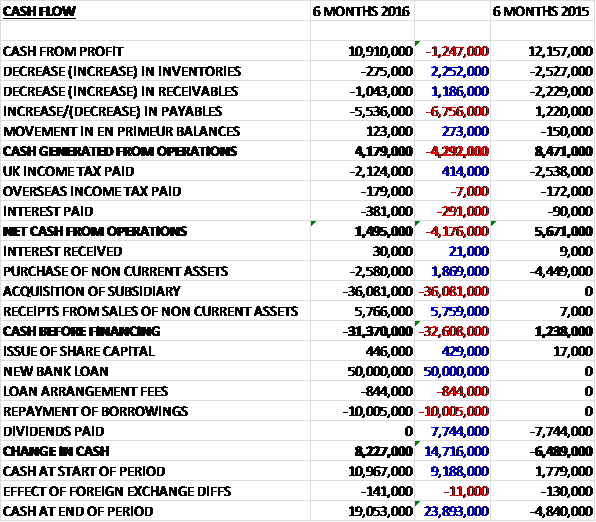
MJWCASH

Before movements in working capital, cash profits fell by £1.2M to £10.9M. We then see an outflow of cash from working capital, with a particularly large decrease in payables and after a smaller amount of tax was paid and a higher level of interest, the net cash from operations was £1.5M, a decline of £4.2M year on year. This did not cover the £2.6M spent on capex and the £5.8M receipt from the freehold sale went towards the acquisition so that before financing there was a cash outflow of £31.4M. A net new £40M of bank loans, however, meant that there was a cash inflow of £8.2M during the period and a cash level of £19.1M at the end of the half.

The pre-tax profit in the retail business was £7.5M, an increase of £223K year on year on a 5% growth on sales as costs increased ahead of inflation, a legacy of the store opening programme. The group has seen positive growth even in mature stores which have previously suffered negative like for like sales for some time.

The adjusted pre-tax profit in the commercial business was £2.3M, a growth of £331K year on year which is a lower rate of growth than previous years reflecting a slightly slower build of new accounts during the half. The board are confident that the division can resume historic growth rates and are investing in supply chain, IT and new business development to achieve this and win additional accounts.

The adjusted pre-tax profit in the Naked Wines business was £608K which reflects a better than planned performance from existing customers and the decision to delay spend on customer acquisitions into the second half. This profit was achieved earlier than expected but further expenditure means that profits are expected to fall before they grow again.

The adjusted pre-tax profit in the Lay & Wheeler business was £27K, a decline of £100K year on year and despite growing sales and a stronger en primeur vintage, the business did not achieve targets set at the end of last year which has led to the goodwill associated with the business being impaired with a charge of £2.6M.

The group is targeting over £500M in sales by 2019 but there is a change of emphasis from opening new stores to new customer recruitment to drive higher returns from the current investment spend and the target for UK stores has been reduced from 330 to 230 (the group currently has 211). In addition they intent to review the existing store network for opportunities to unlock value. I don’t like the sound of this, as it seems to me that they are looking to sell and leaseback some stores which is a real bugbear of mine in retail and totally smacks of short-termism. One thing that I do approve of is the removal of the six bottle minimum purchase requirement whilst retaining discounts for those who do buy more, however, as this should improve passing trade.

The group are reducing capex to around £6M per year but this will be lower still in 2016 as they target a reduction in debt as the interest costs are expected to be £2M during the year with exceptional costs of £500K in the second half along with a further £5M of non-cash acquisition expenses. One issue that the board have been battling is the very high turnover of store managers which is currently running at 23% per year and is a particular target for the new KPIs that have been introduced along with customer retention, product availability and wine quality – it is quite nice to see KPIs targeting customer services as opposed to just financial items.

Obviously one of the main events during the period was the acquisition of Naked Wines in April for a consideration of up to £70M payable in a combination of cash and shares. The acquisition generated goodwill of £30.9M and contributed £37K to group profits. In addition to the initial cash payment, a further amount of up to £20M in Majestic shares has been issued to management in the form of contingently returnable shares and share options.

These will vest subject to the achievement of certain performance criteria over a period of four years which actually seems rather excessive to me. In fact, as I mentioned at the time, this is an exciting acquisition but it really is very expensive and over the next two years share based payments and acquired intangible amortisation together is expected to be £11M each year, falling to £7M in 2018.

During the period there has been a bit change in the make-up of the board. John Colley has joined as MD of Majestic Wine, Luke Jecks as MD of Naked Wines and James Crawford joins from Naked Wines as CFO. The profit for the year is likely to be impacted by the increased investment derived from the successful test period and 2016 is likely to be a low point for profit, after which they expect to see sustainable growth as the anticipated returns from the initiatives are realised.

At the current share price the shares trade on a PE ratio of 15.8 but this increases to 17.6 on the full year consensus forecast. No interim dividends were announced so the shares are not currently yielding anything but the intention is to restore dividends progressively by the end of 2018. At the end of the period the group had a net debt position of £25.2M compared to a net cash position of nearly £11M at the end of last year.

Overall then, this has been a period of change for the group. Profits have fallen but this was mostly due to acquisition-related items and the organic profit decline seems very modest. Net tangible assets were down considerably, as would be expected as tangible cash is used to acquire goodwill and intangible assets. Operating cash flow was disappointing and fell year on year with no free cash generated during the period, mainly due to a large payment of payables it must be said, however. The performance of the retail stores seems to be going well, with even older stores posting profit growth and although the commercial profit increase slowed somewhat, the growth in that sector was good.

Naked Wines posted a small profit but this seems to have been as a result of a delay in investment and may reverse in the second half and Lay and Wheeler seems to be struggling, only just breaking even at the moment – there is no indication of what will be done with this business but I would not be surprised to see it closed. The group are targeting debt reduction, very sensibly in my view, and therefore the store opening programme has been slowed. The acquisition of Naked Wines is clearly the transformational event in the period and it seems like a very expensive acquisition to me. With a PE of 17.6 and no dividends on offer, plus the execution risk of a huge acquisition, these shares do not seem to offer much value at these levels in my view.

On the 7th January the group released a Christmas trading update. Total sales growth was 42.6% compared to the same period last year, boosted by the Naked Wines acquisition – on a pro forma basis, sales were up 12.2% on constant currency rates. The retail like for like sales grew 7.3% in the period, supported by the previous investments to reinvigorate sales growth with new and simplified pricing and improved customer service. These investments have obviously resulted in higher costs, however, and a slightly lower percentage gross margin. The commercial business saw sales grow by 10.2%, Naked Wine sales increased by 28.9% but Lay and Wheeler sales declined by 3.5%.

This is clearly a positive performance and progress really does seem to be being made here but as the CEO himself states (refreshingly honestly), this is too early to call it a trend and the shares are looking a bit expensive to me now, especially given the amount of debt.

On the 8th January the group announced that CFO James Crawford and his wife purchased a total of 9,000 shares at a cost of £32K which represents his maiden share purchase. Whilst not a massive amount, I guess this shows some willing from the director.

Avon Rubber Share Blog – Final Results Year Ended 2015

Avon Rubber has now released its final results for the year ended 2015.

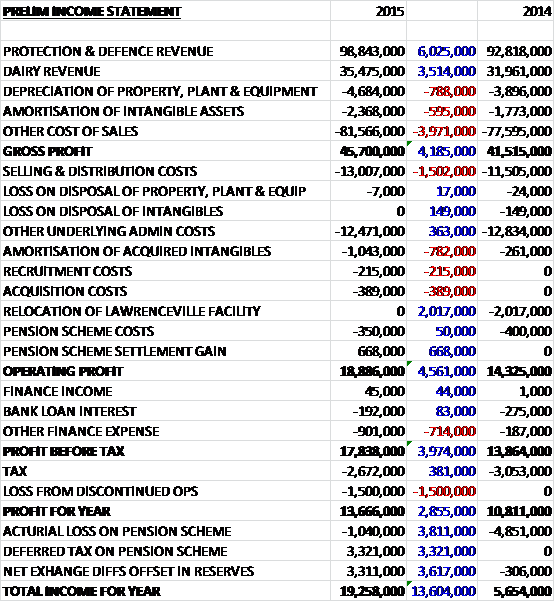
AVONincome

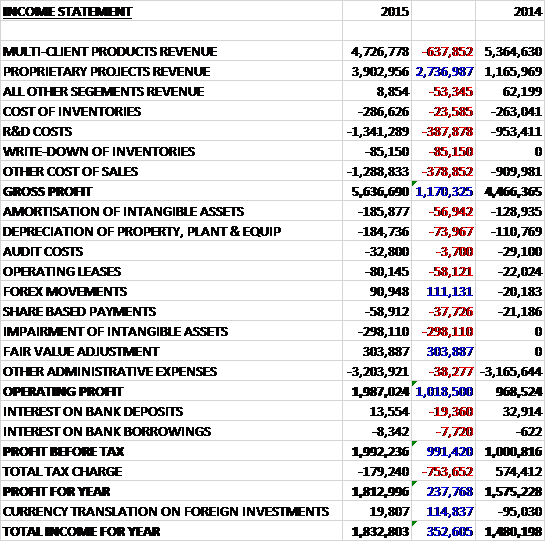
Revenues increased across both business sectors with a £6M growth in protection and defence revenue, along with a £3.5M increase in dairy revenue. Both depreciation and amortisation increased year on year and cost of sales also grew so that gross profit was up £4.2M. Selling and distribution costs increased by £1.5M but underlying admin costs fell. There were also a number “non-underling costs”, not all of which I really agree with. Amortisation of acquired intangibles was up £782K, recruitment costs increased by £215K and acquisition costs were £389K but on the other hand there was no relocation cost, which was £2M last year and there was a £668K pension settlement gain so that operating profits increased by £4.6M. Finance expenses then increased, and there was a £1.5M “loss from discontinued operations” which actually included a rehabilitation provision on a closed business, so that the total profit for the year came in at £13.7M, an increase of £2.9M year on year.

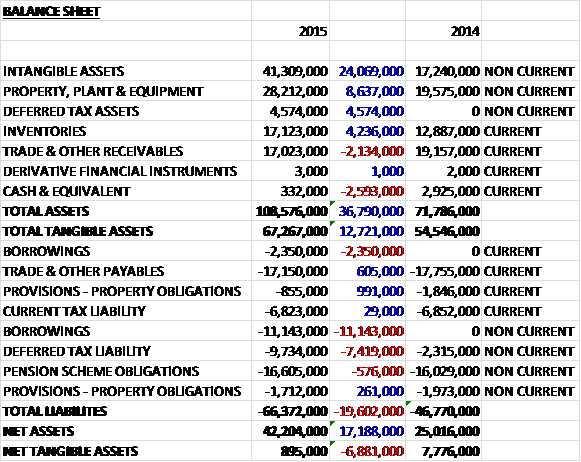
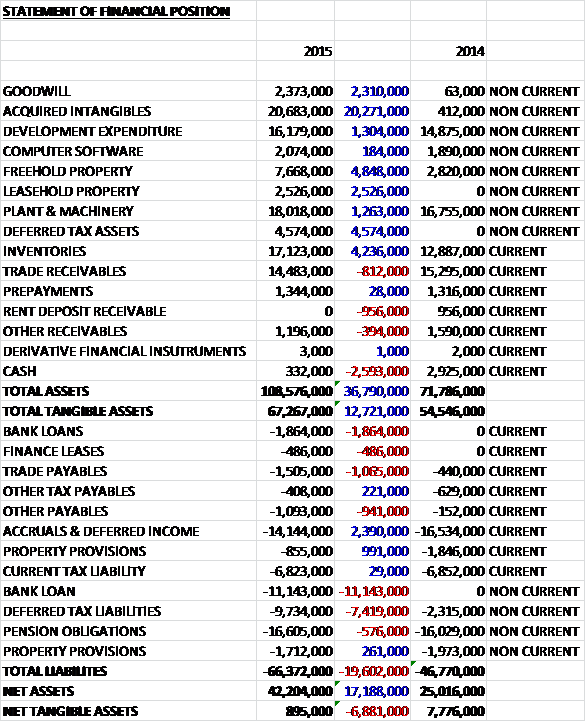
AVONassets

When compared to the end point of last year, total assets increased by £36.8M driven by a £24.1M growth in intangible assets, an £8.6M increase in property, plant and equipment, a £4.6M growth in deferred tax assets and a £4.2M increase in inventories, partially offset by a £2.6M fall in cash and a £2.1M decline in receivables. Total liabilities increased by £19.6M due to a £13.5M growth in borrowings and a £7.4M increase in deferred tax liabilities. The end result is a net tangible asset level of just £895K, a decline of £6.9M year on year.

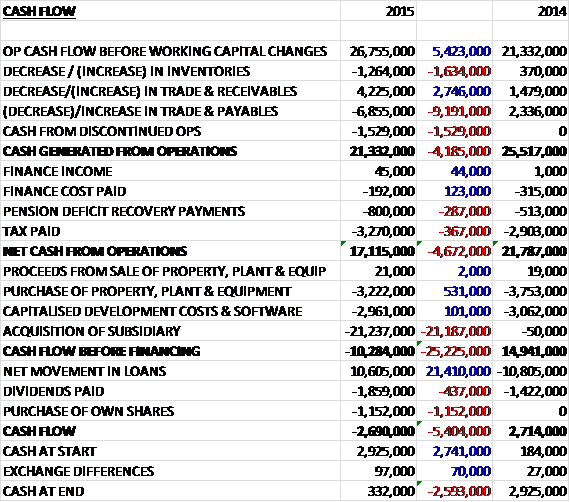
AVONcash

Before movements in working capital, cash profits increased by £5.4M to £26.8M. There was a general outflow of cash from working capital, in particular a big fall in payables which was not helped by a £1.5M cash payment from the discontinued operation so that after a small increase in pension recovery payments and tax paid, the net cash from operations came in at £17.1M, a decline of £4.7M year on year. The group then spent £3.2M on tangible fixed assets and £3M on intangible assets to give a free cash flow of £10.9M before they spent £21.2M on acquisitions. We then see a £1.9M payment on dividends and a £1.2M spent on share purchases but the cash flow was aided by a £10.6M net increase in loans to give a cash outflow of £2.7M for the year and a cash level of just £332K at the year-end.

It is worth noting that the group enjoyed a significant currency tailwind due to the strengthening of the US dollar. The net effect of this is a £1M operating profit gain due to the currency tailwind. The group is also currently enjoying a lower tax rate than normal because it is still using UK tax losses which have now been utilised so this, along with the higher tax rate in Italy where Interpuls is based, means that the tax bill going forward will be higher.

The profit for the protection and defence business was £15.3M an increase of £4M year on year with a £2.3M underlying growth in the year. The DOD, Fire and AEF business have all grown while the non-DOD mask volumes have reduced slightly, as apparently expected given the strong 2014 comparative. Margins have improved due to efficiencies and increased prices under the long-term DOD contract.

Under the DOD long-term M5 mask contract, the group supplied 240,000 mask systems during the year, bringing the total to over 1.4M systems so far under this contract. Having received orders for 172,000 mask systems during the year, the order book stands at only 50,000 systems at the start of 2016 but further DOD M50 orders are expected in the first half of next year as 2016 DOD budgets are released. The filter requirement has less short term visibility, but they expect this consumable item to be a good source of repeat revenue in the long term as more masks enter service. As expected, the DOD qualified a second source to provide filters during the year but in the second half of the year, the group received their first order under this new arrangement for 124,000 filter pairs.

During the year the Joint Service Aircrew Mask programme design, development and testing work progressed well. This will provide respiratory protection to a wide range of operators on the DOD’s fleet of fixed wing aircraft. As previously announced, the DOD has extended its testing phase of this development contract which is now due to conclude at the end of 2016 and should lead to a production contract which could be worth in excess of $70M. Sales to the US law enforcement and non-US military and law enforcement were £27.7M, a decline of £3.3M year on year due to two large orders last year. Despite the decline, there was a good performance from the underlying portfolio and a 10,000 C50 delivery to a customer in the Middle East.

The industrial portfolio launched in 2014 continued to make good progress with particular successes in the oil and gas market and with further product enhancements in the pipeline, there is potential to develop this area of the business. The group saw growth in sales to the North American fire market this year following the release of the new NFPA-approved Deltair SCBA. The product, which is designed to meet the new US regulations and to deliver enhanced operational performance, has been well received by the market and remains one of only four units to receive approval to date. AEF grew strongly in the year, winning hovercraft skirt and fuel and water tank orders as the group have rolled out their non-DOD sales strategy to this area of the business. DOD spares sales have reduced slightly this year, as expected given the volatility of DOD ordering patterns in this area. Long term, as the installed base of masks grows so will the DOD’s requirement to fill its supply chain.

The profit for the dairy business was £5.6M, a decline of £141K during the year but this was only due to the acquisition costs and if the non-underlying costs are discounted, profits increased by £698K. The organic sales growth was achieved despite markets in Europe softening in the second half of the year, reflecting the success of the Cluster Exchange service and growth of the higher margin Milkrite products. Due to the timing of the Interpuls acquisition and the summer holiday season, the acquired business did not contribute to profits this year.

At the start of the year, market conditions improved as global milk prices were at acceptable levels and farmer input costs were favourable meaning there was less pressure on farmer revenues and margins and therefore normal levels of demand for the group’s consumable products. Towards the end of the year, markets softened as these pressures increased due to lower milk prices in some regions. Russian import controls and the removal of quotas have also affected European markets.

The Cluster exchange service was launched in the US and Europe at the end of 2013 and growth rates continue to exceed the initial expectations. By the end of the year it was servicing 430,000 cows on 1,262 farms in the US and Europe. This added-value service enhances the value of each direct liner sale they make and has delivered a more robust business model. Under this programme, farmers outsource their liner change process to Avon, which they deliver through service centres established in their existing facilities. Milkrite sales increased as a proportion of total revenue providing a richer sales mix, rising from 53% to 72% in five years in part due to some OEM outsourcing.

In Europe, Milkrite’s market share has increased as a result of the investment made in the increased sales force, enhanced technical support, and a larger distributor network. The Impulse Air mouthpiece vented liner continues to gain traction with market share increasing from 2.6% to 3.5%. In the US, the air mouthpiece continued to perform well, with market share increasing from 21% to 25%. The group have now commenced work on the next generation of products, the first of which, the Milkrite claw, was launched in Q4 this year.

In China, year on year revenue grew strongly as the industrialisation of the milking process continues apace, creating excellent long-term potential for their consumable products. In South America, where the group opened their sales and distribution facility in the first half of the year, they have started making good progress in establishing a strong dealer network and expect to see growth in this region. In many emerging markets, including India, the number of dairy cows being milked using automated milking processes is growing strongly. This is adding to the market potential for the consumable products the group sells. They plant to harness this potential using the distribution network which InterPuls has already established in these regions.

In June the group completed the acquisition of Hudstar Systems for £3.2M in cash, with deferred contingent consideration of up to £300K and a goodwill generation of £1.1M. In August the group acquired InterPuls for a cash consideration of £18M. This acquisition came with intangible assets of £10.9M and generated goodwill of £1.1M – I have to say that it is quite nice to see properly allocated intangible assets rather than chucking everything in goodwill. After the year-end the group acquired the Argus thermal imaging business from E2V for a consideration of £3.5M. The business is a leading designer and manufacturer of thermal imaging cameras for the first responder and fire markets.

Interpuls provides the farmer with a range of high margin technical solutions including pulsators, milk meters, automatic cluster removers and vacuum pumps, enabling customers throughout the world to configure milking systems. In addition to traditional milking components, the business is expanding into high technology sensors and devices to monitor the life cycle of a cow, analysing milk production, reproduction and health data to provide management information to increase the operational efficiency of the farm. The combination of the largely non-overlapping sales forces of InterPuls with Milkrite should drive higher sales growth than either company could have achieved alone by extending international reach and cross fertilising the product ranges. In combination, the larger business created will increase the group’s profile and the customer awareness in the higher margin areas targeted for expansion.

Hudstar designs and manufactures electronics for breathing apparatus for firefighters and this acquisition both secures the supply chain for some key components of the Deltair products and provides electronics expertise with applications across the rest of the product range.

I must say that after analysing the Easyjet results and how clean they are, it is quite disappointing to see so many “non-underling” items here. We have £215K recruitment costs for board directors which in my view is just a cost of doing business; there is a £389K acquisition cost relating to the purchase of Hudstar and InterPuls which could be considered non-underling; a £350K pension scheme admin cost which occurs every year – this is definitely not “non-underling” and should be included in my view; there was a gain that arose following a trivial commutation exercise which I am happy to discount; and the loss on discontinued operations of £1.5M relating to dilapidation costs of former leased premises of a business which was disposed of in 2006 – I think it is a bit rich calling this a loss from discontinued operations and it is a real cash cost, although not underlying.

Finally, the amortisation of acquired intangibles is removed from the underlying figures. This is not unusual but a real bugbear for me as I think this kind of amortisation is a great way to spread the cost of the acquisitions over a greater period of time and if the company is gaining from the acquisition, it should also be paying the cost in my view. I just wish goodwill was amortised in the same way.

In June the group agreed new bank facilities with Barclays and Comerica Bank. The combined facility comprises a revolving credit facility of $40M and expires at the end of November 2018. This facility is priced on the dollar LIBOR plus a margin of 1.25% which seems pretty good. InterPuls also had a fixed term loan of €2.5M which expired at the end of the 2015 calendar year and is priced at LIBOR plus 0.9%.

At the current share price, the shares are trading on a PE ratio of 24.7 which falls to 20.3 on next year’s consensus forecast so these shares are no longer that cheap. After a 30% increase in the total dividend, the shares are now yielding just 0.7% which increases modestly to 0.9% on next year’s forecast.

Overall then, this has been a good year for the group but probably not quite as good as I was expecting. Profits were up buy net tangible assets were down and the hefty pension deficit and new borrowing means that the balance sheet is actually looking rather weak here in my view. Operating cash flow fell year on year but this was due to a fall in payables and cash profits increased. The protection and defence business performed well with the DOD, Fire and AEF businesses all performing well, although non-DOD masks did decline.
The dairy business performed quite well given the weakness in the market due to the low milk price and the fact that Interpuls is not yet contributing to profits. The forward PE ratio of 20.3 and the dividend yield of 0.9% does not leave much room for error here and I am a little concerned. This year we had a £1M gain from the strengthening dollar and a bit order at the end of the year for DOD masks. When we also add into the mix the fact that all the tax losses have now been used up and the tax bill will be higher next year and there is no longer the backing of the strong net tangible asset level I am very tempted to lock in some profits here.

Avon Rubber has now released its annual report to give a bit more meat to the bones of the final results. We can see that the large increase in finance costs was mainly driven by a £642K increase in the interest paid on the pension scheme and the modest fall in admin costs was as a result of a £1.1M fall in legal and professional fees, partially offset by increases in other underlying admin costs.

AVONassets2

The balance sheet gives a lot more detail on the financial position of the company. The £36.8M increase in total assets was driven by a £20.3M growth in intangible assets, a £4.8M increase in the value of freehold property, a £4.6M increase in deferred tax assets, a £4.2M growth in inventories, a £2.5M growth in the value of leasehold property and a £2.3M increase in goodwill, partially offset by a £2.6M fall in cash. The increase in total liabilities was driven by a £13M increase in bank loans and a £7.4M growth in deferred tax liabilities, partially offset by a £2.4M decline in accruals and deferred income.

We can also see just how susceptible the group is to changes in the US dollar/Sterling exchange rate with a 5c movement affecting profits by £609K. The group also indicate an increased potential impact of the loss of a major contract or business to competitors such as price competition in the dairy market and the impact of milk prices and feed costs.

There is also an interesting graph showing the Milkrite market share where it is running at about 50% in the EU and much more in North America but in China, Brazil and Russia the market share is negligible. It is also non-existent in India but most cows are milked by hand in that country so it might be a bit harder to penetrate the market. In conclusion, there it will probably be difficult to gain much more market share in North America but some opportunities exist in the EU. The largest machine milked market available seems to be in Brazil and the largest market as a whole, including hand milking is India.

Overall then, nothing really that material but a few interesting items nonetheless.

On the 14th December the group announced that non-executive director and Chairman of the remuneration committee, Richard Wood will stand down at the AGM following three years in the role.

On the 26th January the group released a Q1 trading update. In Protection and defence, mask systems production has been focused on fulfilling deliveries to the DOD under the ten year sole source contract for the M50 mask. The group continue to see a number of high margin export opportunities but, as usual, timing of these orders remains unpredictable. The board are currently planning for one of these orders to be received sand fulfilled in H1. The integration of the Argus business has progressed well, with the manufacturing operation being moved from Chelmsford to the Melksham facility.

General market conditions for dairy farmers, particularly in Europe, have been weak as milk prices have been low which has reduced demand for the group’s consumable products as farmers extend the life through over using product. The take up by farms of the Cluster Exchange service remains at encouraging levels in both North America and Europe. The board are pleased with the integration of InterPuls. Net debt at the end of the period stood at £10M compared to £13.2M at the year-end.

This is a bit of a messy update in my opinion – there is nothing much of note in the defence business and sales of consumable products have been hit in the dairy business but how does this affect profits? Who knows because there is no information regarding the impact of these factors on the business. The progress on net debt seems fairly decent but having been stopped out a few weeks ago, I am not yet rushing back in on the back of this update.

It is also interesting to note that at the AGM, some 23% of shareholders voted against the resolution to approve the remuneration policy. This is perhaps something to do with the CEO earning over £1.4M last year with an annual bonus of more than 100% of the base salary and some £604K worth of shares from the long-term plan. This seems very excessive for a company of this size so the shareholder response is not that surprising.

On the 1st February the group announced that new CEO Robert Rennie purchased 10,000 shares at a value of £77.8K which represents his maiden share purchase.

On the 26th February the group announced that Chloe Ponsonby will be appointed as a Non-executive director in March. She is a partner at the Lazarus Partnership, an independent research and advisory firm and has spent the last ten years advising companies as a corporate broker and independent advisor.

On the 3rd March the group announced the receipt of an order for 166,623 M50 mask systems worth $42M under the ten year sole source contract with the US DOD. This secures the expected volume of mask system sales for 2016.

Serabi Gold Share Blog – Q3 Results Year Ending 2015

Serabi Gold has now released its Q3 results for the year ending 2015.

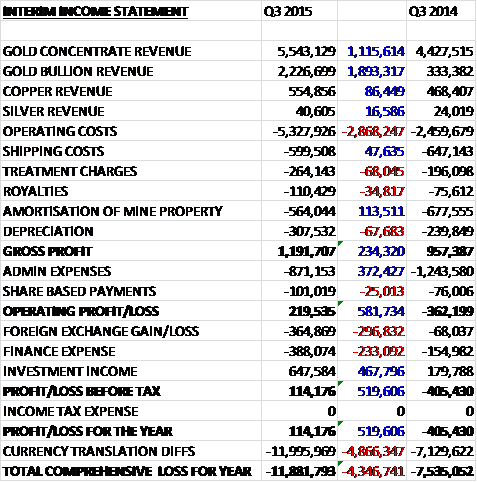
SRBincome Q3

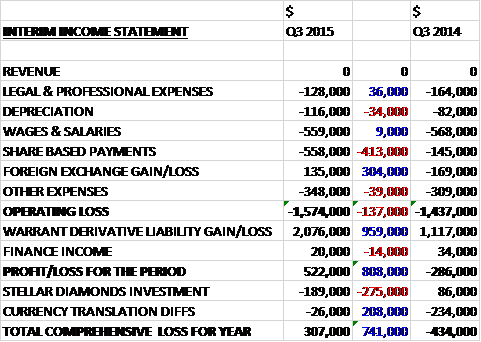
Revenues increased when compared to Q3 last year due to increased sales of all products, particularly a $1.9M growth in gold bullion revenue. Operating expenses also increased, partially due to the group’s decision to revise the basis on which it calculates the value of inventories to give a gross profit some $234K above that of last time. Admin expenses actually fell, mainly as a result of the depreciation of the Brazilian Real, so that the operating profit was $220K, a positive swing of $582K. We then see a greater foreign exchange loss and a higher finance expense relating to interest paid on the Sprott loan partially offset by an increase in investment income due to a reduction in the value of the warranties so that, after no tax was paid, the profit for the quarter came in at $114K, a positive swing of $520K compared to Q3 2014.

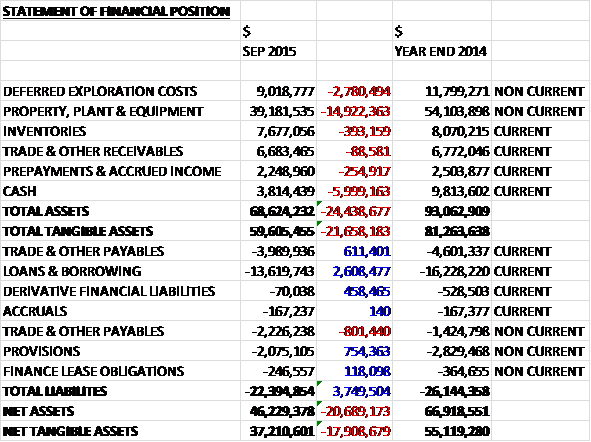
SEBassetsQ3

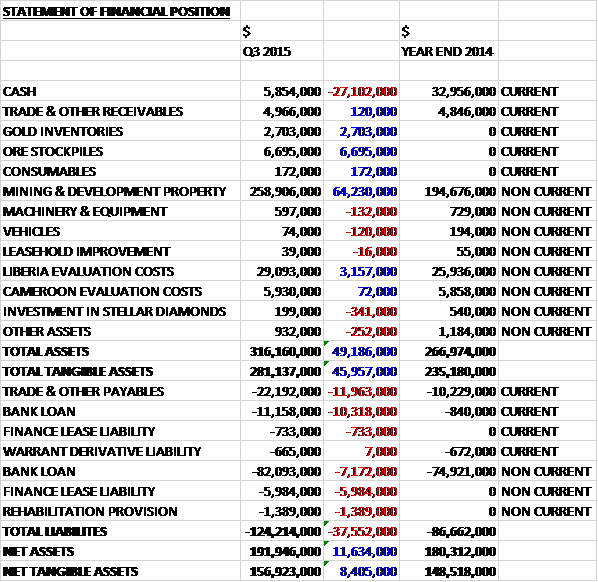
When compared to the end point of last year, total assets declined by $21.7M driven by a $14.9M fall in property, plant and equipment, and a $2.8M decrease in deferred exploration costs, both as a result of the depreciation of the Brazilian Real. Cash also declined during the nine month period, down by $6M. Total liabilities also fell during the period, mainly as a result of a $2.6M decrease in borrowings as the group paid back some of the Sprott loan and a $754K fall in provisions due to the weakness in the Brazilian currency. The end result is a net tangible asset level of $37.2M, a decline of $17.9M over the last nine months.

SRBcashQ3

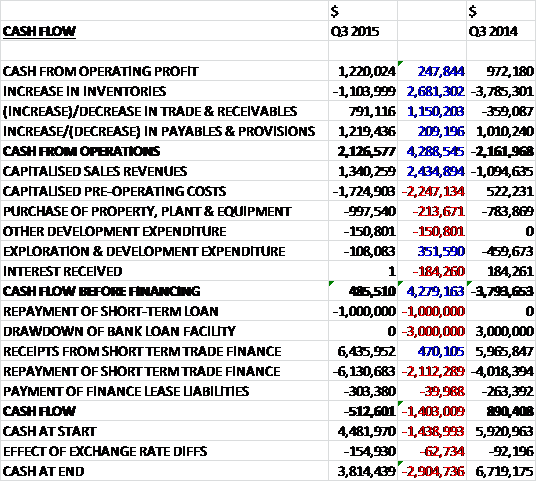
Before movements in working capital, cash profits increased by $248K to $1.2M. An increase in inventories broadly offset an increase in payables but a fall in receivables meant that the cash inflow from operations was $2.1M, a positive movement of $4.3M when compared to Q3 2014, mainly as a result of a lower growth in inventories. There was a net $400K cash outflow from capitalised mining operations so operating cash flow was $1.7M really. The group then spent nearly $1M on property, plant & equipment, $151K on other development expenditure and $108K on exploration and development. After finance lease costs, the free cash inflow was $182K so the company was cash generative. This did not cover the $1M loan repayment, however, so that there was a cash outflow of $513K in the quarter to give a cash level of $3.8M at the period-end.

The operating loss in Brazil was $3.4M compared to a profit of $480K in the same quarter of 2014 and the operating profit in the UK was $3.6M compared to a loss of $842K in Q3 last year.

The Palito mine has now reached a relatively steady operational state with mining activities in a balanced cycle of development and production that is expected to generate approximately 105,000 tonnes of ore at between 8.5g/t to 9g/t of gold during 2015. Production during the first nine months of the year has been 24,704 ounces. Q3 has seen increases in the volume of Sao Chico ore being processed at the Palito plant rising from 4,134 tonnes at the end of Q2 to a total of 10,306 tonnes at the end of September with average feed grades improving from 6.68g/t to 7.12g/t for the nine months and an average of 7.41g/t in the quarter.

Conversely the amount of ore mined from Palito declined by 6% when compared to the Q3 last year which reflected the fact that in this quarter last year, it was the first significant quarter of ore production from stopes. The Palito mine up until the end of Q2 2014 had been in development had with stopes being prepared for production. Q3 therefore saw the benefit of this nine month development period in an exceptionally high level of ore production. By comparison, ore production in Q4 2014 reduced to 25,308 tonnes. Long term planned ore production rates from Palito is expected to average around 90,000 to 100,000 tonnes a year so equates to 22,500 to 25,000 tonnes per quarter so with a figure of 30,454 tonnes this quarter, we can expect this to decline going forward.

During the quarter the group received an average price of $1,122 per ounce of gold compared to $1,199 in the same quarter of last year and $1,162 in Q2 of this year. The all-in sustaining cost of production is $756 per ounce with a cash cost of production of $580 per ounce. During the quarter the group produced 9,078 ounces of gold compared to 8,237 ounces in Q2 and 7,389 ounces in Q1.

The better than forecast mining performance at Palito has resulted in the surface ore stockpiles not being run down as quickly as management forecasted and by the end of September the surface stockpile of Palito ore was measured at approximately 10,600 tonnes with an estimated average grade of 3.63g/t of gold. At the same time in 2014, the stockpile of ore from the Palito mine was estimated at approximately 20,000 tonnes with a grade of 7g/t. During the first half of 2015, the group was able to draw on the higher grade portion of the stockpile to make full use of the processing capability of the Palito gold plant but as the group has, from Q2, achieved increasing rates of ore production from Sao Chico, the level of stockpiled material has started to increase again and also contains 4,000 tonnes of Sao Chico stockpiled ore at an average grade of 3.77g/t.

The gold production generated from this mined ore is to a limited extent being supplemented during the year by surface stockpiles of ROM ore and flotation tailings generated last year. The surface ROM ore stock is carryover or remains of the ore mined in 2013, when the mine started generating ore twelve months before the plant began operating. The 2014 flotation tails are a result of the plant not having the Carbon in Pulp recovery circuit operational until October 2014. Tailings produced from the flotation process were stockpiled during this year, but there has been limited plant capacity to process these stockpiles due to increasing levels of ore beginning to be generated from the Sao Chico mine as well as higher than planned volumes of low grade development ore being processed at Palito.

The group has undertaken further ramp development, and has now reached and is developing on the 19m relative level, but significant focus is now being given to accessing and developing drilled, parallel vein structures on production levels above the 24m RL. These include the Chico da Santa zone which lies to the north of the primary G1, G2 and G3 veins and the Senna zone which is located to the south of the Palito West vein complex and which during 2008 and 2009 produced oxide material in excess of 3g/t. The cross cut to the Chico da Santa zone was completed in October 2015 whilst it is expected that the cross cut to the Senna zone will be completed by the end of November. The opening up of these new sectors will allow the group to establish more ore faces and in time production areas especially on the upper levels in these zones.

In the case of the Senna zone there has never been any previous underground development of the ore zones. Based on the ore grades recovered from the past limited open pit operation, management is hopeful of the potential within the zone. At the Senna zone the group has recorded a drill intersection of 0.55 metres at a grade of 50.99g/t at approximately 300 metres below the surface. Previous exploration activity at Senna highlighted up to four mineralised zones, with structural continuity for three zones of up to 900 metres in strike length and 300 metres vertical depth, of which the most prominent zone was confirmed on surface by trenches for over 600 metres.

Last year the group continued mine development on G3 towards the Palito South area. This development is primarily on the 114m RL, which has been driven some 700 metres further south than any other underground working at Palito. Having intersected numerous high-grade pay shoots, the group is testing the down-dip continuity of these pay shoots for future development of the mine at depth, as well as incorporating into its future mine plans the up-dip extensions of these pay shoots in the upper levels. These are as yet undeveloped and represent an excellent potential source of additional ore.

In light of the higher levels of ore production being achieved at Palito and an expectation of ore volumes at Sao Chico also being higher than initially envisaged, the group has acquired an additional ball mill and is planning further capacity improvements with the Palito gold process plant that will increase the current throughput rates from 400 tonnes per day to at least 500tpd. These improvements, whilst increasing gold production potential, are also intended to create excess plant capacity that will allow the group to catch up lost production caused by unplanned stoppages. These improvements include the installation of an additional flotation cell, an additional leaching tank and new screens within the CIP tanks to improve inter-tank flow rates. These upgrades are expected to be completed by early in Q2 2016 at a cost of about $1.2M which will be funded from operational cash flows.

At Sao Chico, Q4 2014 saw the underground development commence. By the end of Q3 2015, almost 2,000 metres of development had been achieved with three levels now in development and a fourth expected to be reached shortly. During the remainder of 2015 and into 2016, the main vein will continue to be developed and evaluated with the continuation of on-lode development, surface and underground drilling. The development of the main ramp which is being driven at a 12% gradient is continuing, with access to the next level at 156m RL planned to be completed in November 2015.

The immediate priority is to evaluate and define stoping blocks on these first four levels to secure mine production for the next year and a half. Further ramp development will therefore be progressed to pursue the down-dip extension of the current areas that are in development. The rates of lateral development on existing levels will be increased when the company, through a combination of its current surface and underground drilling programmes and on-lode development, has greater confidence in the distribution of the high grade ore mineralisation within the lateral strike extensions.

The high grade mineralisation is dominantly hosted in a consistent alteration zone that can be anything from two to ten metres wide. The alteration zone itself is readily identifiable, however, the high grade gold zones within this alteration zone are much less so, and as a result the mining operations will require on-lode development at regular vertical intervals, with regular channel sampling and in-fill drilling between these levels to best define the high grade mineralisation. This approach will allow the group’s mining personnel to readily identify stoping blocks and optimise mining the high gold grade zones.

The group is continuing to progress the conversion of the exploration license at Sao Chico to a mining license. As the next major step in the conversion procedure, Serabi submitted, in September, the Plano Approvimiento Economico, a form of economic assessment prepared in accordance with Brazilian legislation. All mining operations can continue in parallel under the trial mining license, however and a submission for a further extension of the trial license for one extra year was submitted in September, which will hopefully be completed soon as the current one expires in mid-November. The issuing of the mining license also required the submission of a risk assessment and management plan, safety assessments, environmental and social impact studies, closure and remediation plans which have either been submitted or are in the process of being finalised, in preparation for submission to the relevant government bodies.

The Sao Chico mine, whilst contributing to the group’s gold production during the year, will be primarily in development and is not expected to achieve full production until 2016. A drilling programme is taking place during 2015 which will help the understanding of the ore body and facilitate the mine planning for 2016. Over 6,000 metres of surface drilling has been completed and the programme has been extended beyond its original planned 5,000 metres level to allow the group to undertake closer spaced in-fill drilling. The surface programme is being complemented by drilling being undertaken from within the existing underground developments. The drilling programme which has built on the results and understanding gained from the previous drilling campaigns has continued to report numerous high grade intersections with gold grades in excess of 100g/t and indications that the grade and resource potential continues at depth.

The group is currently forecasting gold production for 2015 of approximately 33,000 ounces with all-in sustaining cost expected to be about $900 per ounce.

As well as the potential that exists to grow resources at Sao Chico, the Palito South, Currutela and Piaui prospects still provide excellent opportunities for identifying additional resources which could both enhance current production levels as well as extend the mine life. With the exception of the current surface drilling programme being undertaken at Sao Chico, no drilling or other exploration activity is currently planned on the group’s properties. Once adequate cash flow is being generated the group will step up its exploration activity and will be looking to add to its resource base and production potential by establishing additional satellite high-grade gold mines in relatively close proximity to Palito which will be the centralised processing facility. Management will continue to evaluate other opportunities within Brazil that it considers could increase the resource base and longer term production potential of the group.

Total volumes processed of both Palito and Sao Chico ore during the first nine months of the year were 96,480 tonnes which was equivalent to 355 tonnes per day. Milling performance at the start of Q1 was affected by power stoppages resulting from an inconsistent electricity supply. The reliability of the power supplied by CELPA has remained subject to fluctuation and interruption which is particularly detrimental to the performance of the gold processing plant. As a consequence, during Q2, the group took the decision to commit to the use of diesel generated power for the operation of the plant. Management expects that the benefits of increased plant availability will significantly outweigh the increased operational costs. The power requirements of mining operations together with the day to day needs of the mine site, camp and other operations continue to be met by power supplied by CELPA except in exceptional circumstances.

During the period the group installed an ILR which will be commissioned in November, this will allow the milled Sao Chico ore to be passed initially through a gravity concentrator with the recovered gravity concentrate containing “free gold” passing through the ILR where in a small closed circuit it is leached with high concentrations of cyanide, dissolving the gold. This gold in solution is then recovered by conventional electro-winning and smelting. This process will enhance gold recovery for the Sao Chico ore and help improve efficiencies in the CIP plant.

The Palito mine achieved commercial production in July 2014. In Q3 2014, the group completed work and commissioned the Carbon in Pulp leaching circuit allowing them to maximise the potential recovery of gold from the ore processed. The first gold pour from the CIP operations took place in October 2014. During the first nine months of this year the group has been undertaking the initial development of its Sao Chico operation and for the remainder of the year plans to steadily increase the production of ore from Sao Chico using the Palito gold processing plant. They began processing ore from Sao Chico during April.

The group started a surface drill programme in March which is ongoing. The drilling campaign is a combination of in-fill and step-out drilling and the results from this, in conjunction with the on-lode development mining that will take place in the remainder of 2015 will help the understanding of the ore body and facilitate mine planning for 2016. The group has not engaged in any exploration activity at the Sucuba or Pizon projects during the past year and has currently not budgeted for any during the next year and a half.

Last year the group entered into an $8M secured loan facility which is required to be paid in full before the end of March 2016 with the Sprott Resource Lending Partnership providing additional working and development capital. The first tranche of $3M of this facility was drawn down in September 2014 with the remaining tranches drawn down in full in December. This loan attracts a hefty interest rate of 10% and to date the group have paid back $3M of this loan. They also have a borrowing facility of $7.5M to provide advance payment on sales of gold and copper concentrate which currently extends only to the end of 2015.

The directors anticipate that the group now has access to sufficient funding for its immediate projected need and they expect to have sufficient cash flow from the current forecasted production to finance the ongoing operational requirements and, at least in part, fund exploration and development activity at the other gold properties. However, the forecasted cash flow projections for the next year include a significant contribution arising from the Sao Chico development where commercial production has yet to be declared. There are obviously risks involved with the start of any new mining operation giving rise to the possibility that additional working capital may be required to fund any delays or additional capital requirements. Should additional working capital be required, the directors consider that further sources of finance could be secured within the required timescale.

Obviously the group’s performance is linked to the price of gold and with the continued strength of the US dollar, it is hard to see the gold price increasing by that much in the near term. Other risks are mainly related to operating within Brazil with the government still looking to introduce a new mining code, and the fact that the group still does not have a proper mining license at Sao Chico.

It is worth noting that there are 100M outstanding warrants which expire in March 2016 but because they are denominated in US dollars and not Sterling, they are not considered an equity item and are included under group liabilities. After the period-end, the Brazilian Real has shown some stability after declining by about 60% against the US dollar over the past year. The majority of the group’s operating costs are made in Reals so any changes affect the cost base along with the value of the assets and liabilities.

Overall then, this has been a fairly steady quarter for the group. Profits increased, and they now seem to be at least breaking even at the current gold price. Net assets did decline, due to the depreciation of the Brazilian Real, but operating cash flow increased and the group even managed to generate some free cash, although this was not enough to cover the loan repayment. Palito has is now producing steadily and the reduction quarter on quarter was due to exceptionally strong production in Q3 last year and will probably settle down a bit lower. At Sao Palito, those very high grade areas of ore seem to be quite difficult to identify but both the amount of ore mined and the grade increased in the quarter, although the mine is not yet in commercial production.

The sale price of $1,122 per ounce seems fairly steady and is above the cost of $756 achieved during the period and the $900 per ounce expected for the year as a whole. Operationally, the ball mill will undergo an upgrade which should increase capacity to mine some of those tailings that seem to be building up. I am a little concerned about the trial mining license, which expires this month and the seeming lack of progress in obtaining a full mining license so would like to see this resolved, and there are obviously operational risks in bringing Sao Chico up to commercial development. Overall though I like the progress being made here and may look to buy some shares when the above issues are clearer.

On the 31st December the group announced that its controlling shareholder, Fratelli Investments, has provided a short term working capital convertible loan facility of $5M for additional working capital facilities. The group is facing strong economic headwinds at a time whilst they have continuing commitments for increasing throughput through the process plant as well as development expenditure to bring the Sao Chico mine into full production. This has restricted the company’s ability to build up cash reserves and to ensure they remain on track, they have had to find external sources of funding.

The loan expires at the end of January 2015 and may be drawn down in three tranches. It has an interest rate of 12% per annum but there is no prepayment penalty or arrangement fee. This is in addition to the secured loan facility arrangement with Sprott which has an outstanding balance of $4M.

The first $2M of the loan is convertible at the election of Fratelli into new Serabi shares at an exercise price of 3.6p (the share price is now 2.8p so this actually seems very fair to me). The remaining amount of the loan if drawn down may be repaid by the company at its option on or before the end of June this year, otherwise Fratelli will have the right to convert it into new shares, also at 3.6p.

Clearly the company is under considerable financial distress which doesn’t really make the shares a good investment at the moment in my book but they are in a fortunate positon in that their controlling shareholder can provide them with short term funding at terms which are not actually that bad. If they had to do a placing to get the cash, things could have been a lot worse.

On the 6th January, the group announced that they had drawn down the initial $2M.

On the 1st February the group released an operational update covering Q4 2015. In the quarter they recorded 7,924 ounces of gold production and although this did not exceed the 9,078 ounces recorded in Q3 or indeed the 8,237 ounces in Q2, December was the best months of the year with 3,200 ounces of gold produced from a milled grade of 9.5g/t of gold. With this trend continuing, there should be a good start to 2016 and production for January is looking to be a further improvement on the December figure. The plant expansion and improvements are planned to be mostly completed by early in Q2 which should mean a further increase in levels of gold production in 2016. As a result, the production guidance for 2016 should be about 37,000 ounces.

The Palito mine has continued to perform consistently with mined grades and tonnages at the forecast level. The operation has now maintained a mined grade of just below 10g/t for much of the past two years. The group have been expanding the mine with some lateral development and two new areas in the mine have now been opened up by cross-cutting to the Senna and Chico da Santa sectors. Veins have been intersected by both sectors with encouraging mineable grades to date. Ore development is ongoing and these two new sectors will provide greater operational flexibility and additional ore sources to the well-established deeper Palito Main Zone and Palito West sectors.

The final quarter also saw the start-up of underground diamond drilling at Palito and the group are now evaluating numerous known but underexplored veins. Currently this evaluation is mostly being undertaken in the upper levels where these veins have been side lined awaiting drilling for the past two years. The board are confident this drilling will provide abundant ore sources in the next two years with the advantage of close proximity to existing infrastructure and not requiring any new ramp development.

At Sao Chico, ore development is now ongoing on a number of levels, most notably at 186mRL and 156mRL, and about to commence on 171mRL and 141mRL. The mine experienced a blip in gold production in October and November which adversely affected Q4 gold production. This was mainly due to power generation problems which delayed all mining activities. The shortfall in the high grade Sao Chico development ore feed was replaced by surface stockpiled ore from Palito which has a lower grade.

By December the problems were resolved and the mine delivered its best month of the year with over 4,000 tonnes mined at grades in excess of 12g/t. This improvement coincided with the commissioning of the Gravity/ILR circuit in the plant in late November where the group are now seeing gold recoveries from gravity concentration exceed 30%, bringing substantial benefits to the efficiency of the rest of the plant.

In the Sao Chico mine itself, the group are continuing to concentrate on the Main Vein. This is a 1.5m to 4m wide alteration zone which is structurally continuous but the gold grades within the zone are not as continuous and are hosted in four steeply plunging “pay shoots”. In these pay shoots the grades are often spectacular, often being in excess of 100g/t. Outside the pay shorts the vein is continuous but with low grade. As a result, as the mine development passes between pay shoots, lower grade ore has to be mined. The central pay shoot is the most established of the four and is some 100m long. The group are focusing the mine development plan for 2016 on this part of the main vein and are now enjoying some consistent higher grade development as a result.

The production improvements in the mine and the plant have met the targets established by the board and have allowed the company to take the decision to declare commercial production effective from the start of 2016.

As reported previously, the plant is being further expanded to allow the processing of significant surface ore stockpiles. The operation has been mill limited since the start of operations and the installation of the third ball mill, along with some improvements in the flotation and cyanidation plant will see their daily throughput increase from the current levels of between 350 and 400 tonnes per day. It is anticipated that they could average over 500 tonnes per day once the improvements are complete but the improvements will also create surplus capacity to catch up any lost production caused by unplanned stoppages.

The surface diamond drilling programme at Sao Chico was stopped shortly before the end of 2015. Whilst the programme was designed initially to explore the Sao Chico main vein to the east and west with step out holes, it soon became clear that more infill drilling was required. The programme and the deployment of the drill rigs was re-prioritised as a result but before completing the programme, three holes targeting the 50mRL level were drilled, some 100 metres below the deepest development level today, returning some very encouraging results.

The total gold production for the year was 32,629 ounces from the treatment of 130,300 tonnes of milled ore at an average grade of 8.43g/t and from cyanidation of 18,355 tonnes of stockpiled flotation tails grading at 2.66g/t. At the year-end the company still had a stockpile of about 36,000 tonnes of flotation tails at an average grade of 2.5g/t, which were recovered from 2014 plant production. They will continue processing this material when possible but until the completion of the plant expansion, currently scheduled for April, available plant capacity for processing these tailings is limited.

During the quarter Palito achieved about 2,000 metres of horizontal development, of which about half was ore development. For the whole of 2016, the mine has completed 6,800 metres of horizontal development and a further 792 metres of raises. At the Sao Chico mine, a total of 728 metres of horizontal development was achieved, 230 metres being ore development and 340 metres completed in the deepening of the ramp and cross cuts to development levels. About 2,800 of horizontal development has now been achieved for the year.

Of the 37,000 ounces of gold forecasted to be produced in 2016, 28,000 should come from the processing of Palito ROM and the Palito stockpiles and with the Sao Chico mine now under development, 9,000 ounces of gold should be produced from there. Overall in Q4, 34,848 tonnes or ore was milled at a grade of 7.55g/t to produce 7,925 ounces of gold. This represents the lowest grade from the year with the largest tonnage of ore to create the third highest quarterly total of gold.

The company announced that it had agreed an extended repayment period for the remainder of the loan with Sprott, the outstanding balance of which amounted to $4M and was due to be repaid by the end of March this year. The company has now agreed that the balance of the loan will be repaid in nine equal monthly instalments starting at the end of April. The interest rate remains at 10% per annum but the company has granted a call option over 2,500 ounces of gold at a strike price of $1,125 per ounce with Sprott having the right to exercise the option at any time up to the end of June 2017. The call option will be settled in cash.

Overall then, this is a pretty decent update. The figures for Q4 were actually rather disappointing with low grades and an associated low amount of gold produced. These issues were due to power generation problems at Sao Chico but they were resolved by December and Q1 2016 looks to be a pretty good period. The Sprott loan has been extended which suggests cash levels are a little tight but it is a positive move to have the repayments spread over a longer period of time.

A tricky one this – if gold prices hold up OK then this could be a pretty good investment at these levels in my opinion and in total contrast to the shambles at Aureus.

Aureus Mining Share Blog – Q3 2015

Aureus Mining has now released its Q3 results for the year ending 2015.

AUEincomeQ3

As the mine has not yet entered commercial production, there was no revenue generated but operating costs did increase during the period, mainly as a result of a $413K growth in share based payments due to bonuses following the first production of gold which meant that the operating loss was $137K higher at $1.6M. We then see a big increase in the gain from the reduction in the warranty derivative liability as the company’s share price fell which meant that, bizarrely there was a $522K gain during the quarter, an improvement of $808K year on year.

AUEassetsQ3

When compared to the end point of last year, total assets increased by $49.2M driven by a $64.2M growth in the value of mining and development property, a $6.7M increase in ore stockpiles, a $2.7M growth in gold inventories and a $3.2M increase in the Liberian evaluation costs capitalised, which was partially offset by a $27.1M fall in cash. Liabilities also increased during the period due to a $12M growth in payables relating to the development and commissioning of the New Liberty mine, a $17.5M increase in the bank loan, a $6.7M increase in finance lease liabilities and a $1.4M growth in the rehabilitation provision. The end result is a net tangible asset level of $156.9M, an increase of $8.4M over the past nine months.

AUEcashQ3

Before movements in working capital, cash losses fell by $462K to $3M. There was then a large outflow of cash related to working capital, in particular a $9.6M increase in inventories so that the cash outflow from operations was $15.2M, an increase of $12M year on year. The group then spent $38.9M on property, plant and equipment along with $3.4M on intangible assets so that before financing there was a cash outflow of $57.3M. The company covered some of this with $15M from the issue of new shares and $20M from new borrowings so that after a hefty $4.7M interest payment the cash outflow for the period was $27M to give a cash level of $5.9M at the period-end. This is getting a little precarious and the company seems quite some way from being cash neutral.

The quarterly profit at New Liberty was $158K compared to no profit in the same quarter of last year. A key focus in the quarter was to continue to ramp up the process plant to name plate capacity of 95KT of run of mine ore per month. In July the process plant underwent a period of 24 hours performance testing, during which the plant was operated at a feed rate of 152 tonnes of ROM ore per hour at a plant availability of 96%, with all other equipment operating within or exceeding their design parameters over a continuous 12 hour period.

Construction activities during the period focused on the completion of the operational water management system, which aimed to ensure that efficient mining could be continued during the rainy season. All mitigations including a flood bund around the pit, pump stations and creek diversion function as planned and mining operations continued to progress through the wet season. Mining operations were hampered due to a lack of a regular and consistent supply of explosives caused by shipping restrictions to Ebola affected countries. In order to alleviate this situation, a supply chain was set up through Ghana and Ivory Coast to transport explosives by road, although this continued to be problematic due to border control measures and was also disrupted by the heavy rains experienced during September.

Mining, road construction and the development of the ROM pad were hampered by the lack of hard rock resulting from the delay in the delivery of explosives but the mining tem stripped over 6MT of waste rock and mined 300KT of ore in the year to date. Mining during the period predominantly focused below the weathered oxide zone in the Larjor starter pit and moved into fresh rock within the Kinjor pit. The primary focus was to push back waste to access more ore and increase face length. Grade control drilling and mining reconciliation undertaken during the period have continued to show that the ore body is robust and representative of the resource model.

During commissioning activities in July, it was noted that the discharge grates on the bar mill were not optimum for the ROM ore and therefore required replacing. The company worked with the OEM and DRA to install more robust, heavy duty grates. As a consequence of the discharge problem, the mill could not be operated at full design capacity at all times causing undue deterioration on some of the mill liners and lifters, which also required replacing which was completed by the OEM at no cost to the group and a full mill re-line took place in September.

Plant processing operations are now focused on optimising reagent consumption, grind size and gold recoveries. The remaining staff members from DRA and other third party contractors that were involved in construction and commissioning began to demobilise from New Liberty with the Aureus owner team now taking full control of the process plant operations. During the quarter the on-site mine lab operated by ALS Global became fully operational and began processing samples. It has the capability of preparing 200 samples per day and is equipped with two furnaces for fire assay analysis. As well as servicing the New Liberty mine, this lab also has the capability to service other third party customers across the region.

After the period-end, in October, a mechanical failure occurred within the secondary crusher resulting in the temporary suspension of processing activities at the New Liberty process plant. After a stoppage of nineteen days, ore crushing activities recommenced following the installation of a temporary 200 tonne per hour mobile crushing unit. The mobile crusher will be retained on site for a period of six months to provide additional operational flexibility during the final testing and commissioning phase of the plant, an also to provide additional crushed rock material for use on haul roads and other infrastructure. Specialists from DRA and technicians from the crusher’s OEM completed the repairs on October 29th allowing resumption of milling and processing operations the next day. During the stoppage of crushing and processing operations, mining operations continued.

In better news, the company made its first gold sale from the New Liberty mine in July and during the quarter, they sold a total of 8,519 ounces at an average price of $1,124 per ounce.

The quarterly loss at the Liberian exploration projects was $104K, an increase of £63K compared to Q3 last year. Regolith mapping over the western portion of the Bea Mining Licence continued during the quarter with the aim of defining concealed mineralisation. Re-interpretation of the regional structural setting shows that most soil anomalies are located along the east-west structures that might represent splays off the Todi shear zone. The shear zone is striking northwest and known to host mineralisation in several locations outside the company’s licence area. A pit dug on an isolated soil anomaly close to the zone near West Mafa target returned bedrock mineralisation, confirming the prospectivity of the structure which has the propensity to be covered west of the New Liberty area with depositional regimes.

Soil anomalies at the West Mafa and Goja targets, located six and nine km NW of New Liberty respectively, occur in erosional and residual terrains and so are representative of in situ mineralisation. At West Mafa, gold is associated with thin discontinuous quartz veins related to third order structures. Trench and pit results from the Goja target show broad mineralisation developed in close proximity to intrusives with better grades found at depth. On anomaly C, regolith mapping shows that depositional regimes potentially mask a large portion of the target strike extent. Regolith mapping will be completed during Q4 over the western portion of the Bea Mining license and follow up work will be carried out on prioritised targets.

At the Ndablama gold project, further mapping is currently being undertaken to gain better understanding of the nearby targets within the pressure shadow one which hosts Ndablama. At the Weaju gold prospect, the group made a second payment of WHMC of $445K and 1,148,611 new shares per the settlement agreement. This total amount equates to the equivalent of $5 per ounce of measured, indicated and inferred resources, within the claims area and the surrounding 200 metre perimeter. If commercial production is achieved within the payable area, WHMC will receive a one-time payment equivalent to 2.5% of the net present value of a project within the payable area, and also receive a 7.5% net profit interest on life of mine production within the payable area.

At Leopard Rock, to date 4,294 metres of drilling has been completed and further mapping is being undertaken to gain better understanding of the area ready for a phase two drilling programme planned for the future. Work has been ongoing with regolith mapping around the Gondoja area to better interpret soil anomalies. The target will be mapped into details during Q4 along with the other targets of the Yambesei shear zone.

Detailed mapping started along the Yambesei shear zone with Koinja and Gbalidee targets covered to date. Mineralisation is located within sheared mafics and ultramafics located between granites and can be followed over a strike length of more than 3.8km which remains open at both ends. This geological mapping which follows the regolith mapping completed during Q1 will continue eastwards so that it covers by year end all the targets up to Welinkua. The mapping will bring the geological knowledge of the 8km corridor to the same level as for the Ndablama pressure shadow zone. Along with the detailed geological mapping, pitting and trenching will be completed to bring all the Yambesei shear zone targets to an advanced stage by the end of the year.

At Silver Hills, during the quarter work focused on the Belgium target located in the central zone. Pitting confirmed the presence of mineralisation over a strike length of 800 metres. This mineralisation which is controlled by the NE shear has the potential to extend over 3km up to Bruge target located in the NE. Pitting and mapping are ongoing at this target to trace the mineralisation along strike and to bring Belgium target and other potential targets to an advanced stage.

During the quarter work on the Yambesei license consisted of in-filling the soil grid to cover the area between Welinkua and Jenemana where several BLEG anomalies were found. Further reconnaissance trips were undertaken to the Archean West license and for the Mabong licence, field data collected during the previous quarter was complied. This showed a complex lithological suite of gneisses, amphibolites, mafics, ultramafics and BIF cut by dolerite dykes as well as two parallel NE trending shear zones.

The quarterly loss in Cameroon was $3K compared to $2K in Q3 last year. Exploration work continued on the interpretation of the mineralised systems of Kambele and Dimako targets following on from the core reclogging. The work was recommended in order to produce a new interpretation of the mineralisation models and determine their potential to host economic deposits. A GIS study was undertaken over the licence area and resulted in the identification of structural lineaments along which field verification has shown the presence of artisanal sites. A ground induced polarisation or ground magnetic survey is planned to be conducted at the Amndoni prospect followed by a first pass RC drill programme.

Liberia was declared Ebola free for a second time at the start of September and has entered into a further 90 day period of heightened surveillance but this is a good sign.

The group has an $88M project finance loan referred to as the “senior facility” and a subordinated loan facility for $12M with RMB Resources. The senior facility’s first repayment is at the end of January 2016 and is repayable in nine semi-annual payments. It bears interest at the US LIBOR rate plus 1.8% along with a 2.5% ECIC premium for a six year term. The subordinated facility bears interest at US LIBOR plus 7.5% for a six and a half year term and is repayable in full six months after the final senior facility repayment. During the nine month period, $8M was drawn down from the senior facility and $12M from the subordinated facility. There appears to be very little left in the way of headroom here.

Cash flows from operations began during the quarter and it is expected that commercial production will be declared at New Liberty in January 2016. As of the end of September, the company had cash of $5.9M and a net current liability position of $14.4M. New Liberty is currently in the ramp up stage to steady state production and working capital is at an expected low point. Management expects the working capital position to improve as gold production increases and operating cash flows are generated. They are considering potential options to strengthen the working capital position.

As previously reported, in November the company acquired three exploration licences contiguous with the Bea Mountain Mining licence through the purchase of Sarama Investments in exchange for the issue of 2,600,000 new shares in the company. It does seem to me that the group probably has enough exploration licenses now and should probably start to concentrate on bringing the current ones through to production.

Overall then this has been a bit of a difficult quarter for the group. They did manage to post a profit but this was entirely due to a reduction in the value of the warranties due to the fall in the share price as there is not yet any commercial production. Taking this effect off, losses widened due to increased share based payments after the first gold pour. Net assets did improve but the operating cash outflow increased due to a growth in inventories and we see that the large interest payments are now very material for the group. Indeed, borrowing headroom is very limited and I think it will be tight as to whether the $5.9M of cash that is left will cover the group until reliable cash flows come in from gold sales.

The period was hit by a number of operational problems including the supply problems for explosives as shipments to Ebola-hit Liberia were ceased and the group had to transport the explosives overland. Now that the country has been declared Ebola-free, this should improve. Also there was a mechanical failure at the secondary crusher which has now been resolved and the discharge grates on the bar mill had to be replaced. All of these issues have meant that commercial production has been pushed back to January 2016. All in all, I do think this is an exciting prospect but the recent weakness in the gold price, seeming mainly related to the strength of the US dollar and the issues surrounding the start-up of commercial production means that I do not feel now is the right time to invest here.

On the 30th November the group released a statement covering the refinancing including a very heavily discounted placing. The additional funding includes an additional $10M liquidity facility to be provided by Rand Merchant Bank and Nedbank and an $11.5M (£7.65M) equity financing which involves a private placing of 153M new shares of the company at a price of just 5p per share. These funds will be used to strengthen the balance sheet, allowing the company to reduce its accounts payable, and procure new mining equipment.

Mining operations to date have been hampered by the lack of available explosives during the Ebola outbreak and inconsistent supply afterwards. As a consequence of this shortage, the mining programme is currently about 9.5M tonnes behind schedule and mining activities have predominantly been focused on keeping the plant supplied with sufficient feed levels of ore which has caused slippages in the waste mining schedule.

A 100 tonne delivery of explosives arrived on site on the 18th November and a further 330 tonnes, equivalent to one month’s supply) is currently being shipped from Ghana. Arrangements are currently being finalised for a further 600 tonne supply to be shipped in December. Following the receipt of the funds from the placing and the reduction in the creditor balance, the group will procure additional mining equipment for delivery during H1 2016 to enable the mining rate to be accelerated which should result in the planned life of mine production profiles being achieved and a reduction in the current shortfall in waste mining operations.

It is expected that the addition of the extra fleet equipment from H1 2016 will allow the rescheduling of the mine plan. Although the pit design remains the same, mining operations are planned to be completed four months earlier than the previous schedule and are now scheduled to finish in February 2022. Processing operations at the mine are expected to continue unchanged until October 2022 and still result in the life of mine production of 859,000 ounces of gold. To date the process plant has processed 223,659 tonnes or ROM ore at an average grade of 3.2g/t. There have been twelve shipments of gold dore from New Liberty for smelting and refining at the MKS PAMP refinery in Switzerland, resulting in sales of 13,500 ounces of gold at an average price of $1,120 per ounce.

Over the past 27 days since the secondary crusher was re-commissioned, the process plant has been operating at an average of 92% of its designed capacity, including planned downtime for ongoing optimisation activities. Commercial production can be declared following the mill having operated at an average for 60% or more of the designed capacity over a period of 60 days – so that at least is looking OK. Whilst operating costs, plant feed grades and plant performance are largely in line with the company’s expectations, gold production is behind target with a shortfall of 27,000 ounces which has impacted the working capital position.

Of the net proceeds of $20M, some $15M is earmarked for the payment of accounts payable and $5M is to be used for working capital during the production ramp. Of the accounts payable, $9M is due to the mining fleet supplier and once this has been cleared, the additional mining equipment can be delivered.

The company believes it can deliver on the production and cost estimates which at the current gold price, should see it generate enough cash flow to meet its continuing obligations, including its debt repayments until the end of 2016. There is a $6.6M debt repayment due in January 2017 which, should the gold price remain at current levels, the company may be unable to meet so may require another placing. This is pretty desperate stuff.

With the benefit of the accelerated mining rate due to the addition of the new mining fleet, all in sustaining cash cost is now estimated at $820 per ounce over the life of the mine with cash costs higher in earlier years due to higher stripping ratios. The company expects to meet production guidance for 2016 of approximately 125,000 ounces at a cost of about $959 per ounce.

In consideration for the granting of the new debt facility, the company will issue options to purchase up to 20.4M shares with a term of five years from closing and exercisable at a 20% premium using a share price of the lesser of the five day weighted average price at the date of the acceptance of the new facilities (14.05p) the date that is two days before the signing of the facility agreement. In addition the existing 11.1M warrants issued to RMB in 2014 will be re-issued on the same terms.

Overall then, this is terrible news for existing shareholders, the placing is less than half the share price before the announcement and the mine seems to be barely profitable at these gold prices with the first debt repayment unlikely to be met. What happens if the price of gold continues to fall? These shares are pretty much not investible at the current time in my opinion although I will keep watching in interest.

On the 8th December the group announced that it had received a request for arbitration from International Construction and Engineering with respect to their contract to carry out civil and earth works at the New Liberty mine. Their contract was terminated in August 2014, having taken legal advice, when works were approximately 70% completed. The earthworks were completed by directly engaged labour and contractors supervised by the project’s construction management contractor, DRA Projects. The management believe that no material amount will be found payable to ICE but nonetheless this is yet another distraction that they could do without.

On the 21st December the group announced an amendment to the Samara acquisition. The previous agreement was for the payment to be 2,600,000 Aureus shares. Now that the shares have nosedived, they have increased the payment to 6,645,070. Nice.

On the 22nd January, at a quarter past four on a Friday afternoon no less, the group released an operational update.

Since the resumption of processing operations at New Liberty at the end of October, the ball mill has been operating at an average of 82% of its designed capacity, including planned downtime for ongoing optimisation. They have experienced issues during the final phase of commissioning in the gravity and CIL circuits of the plant, affecting plant recoveries and resulting in an impact on cash flow and therefore they do not feel it is prudent to officially declare commercial production at this point. The company continues to focus on improving the operational performance of the gravity circuit and further optimising CIL leach kinetics in order to improve overall plant performance. It is anticipated that performance will improve to design levels by the end of Q1 which should be when commercial production at the plant is declared.

Fresh ROM stockpiles are currently standing at 83,509 tonnes at a grade of 2.78g/t and transitional stockpiles currently total 75,248 tonnes at a grade of 1.35g/t. To date, the process plant has processed 386,262 tonnes of ore resulting in 19 shipments of gold dore for smelting and refining in Switzerland, totalling 20,835 ounces of gold with an average price achieved of $1,113 per ounce. Gold production achieved in 2015 was 17,172 ounces against a target of 27,000 ounces and 3,663 ounces have been produced so far in 2016.

The group are looking at new LOM options given the current gold price environment with the review process expected to be complete by the end of February – this sounds ominous.

The company is also attempting to get a deferral of the debt repayment scheduled for the end of January and thereafter a new plan for the repayments as it has insufficient cash resources available to pay both this first repayments and to pay all of its suppliers. It is expected that revenue generated from future gold production should ensure that suppliers continue to be paid and operations can continue. The group is appointing a financial advisor to conduct a strategic review to assess potential options that may be available.

Oh dear, this is desperate stuff. They still have not managed to achieve commercial production, the low gold price looks like it is going to lead to impairments at the mine and it sounds like cash is tight to pay the suppliers let alone the debt repayments. What is worse in my view, however, is that this was slipped out last thing on a Friday. What are they playing at?

Following the sour taste left when after watching a presentation from the company that was swiftly followed by a placing, this reinforces my view that the board here care very little for private investors. I think anyone investing here is asking for trouble and I would not touch it with a barge pole. OMI and SRB look much better placed to me if one wants to invest in a small gold producer.

On the 27th January the group announced that it has received final credit approval from its lender group to defer its first debt repayment which was due on the 31st January. The lenders will not commence discussions with the company to agree upon an appropriate debt repayment schedule following the review of various mine plan scenarios with a final mine plan selected by the end of February.

On the 18th February the group released an operations update. Since the start of the year, total gold production was 11,001 ounces compared to 17,172 ounces produced in the second half of last year. This consisted of 5,478 ounces of gold produced in January and 5,523 ounces produced in the first three shipments of February. Run of mill stockpiles are currently standing at 79,525 tonnes of fresh ore at a grade of 2.4g/t and oxide and transitional stockpiles standing at 74,014 tonnes at a grade of 1.31g/t.

As a result of the ongoing process plant optimisation activities started in mid-January, overall plant recoveries have increased towards design specifications. Continued optimisation of the gravity circuit has shown incremental improvements and there have been further operational improvements in CIL leach kinetics. Additionally, ongoing preventative maintenance activities have allowed plant availability to improve and have resulted in more stable operating conditions.

Throughout the year to date, the ball mill has been operating at an average of 82% of its designed capacity, including planned downtime for ongoing optimisation. It is expected that overall plant performance will continue to improve towards design levels throughout the coming weeks, with commercial production expected to be declared by the end of March. As a direct result of the operational improvements achieved within the process plant, gold recovery levels have steadily increased from about 73% in mid-January to reach an average recovery of 85% throughout February, and has continue to increase to more than 87% during the last week. Further improvements of gold recovery are expected following the introduction of new carbon into the CIL circuit of the processing plant.

So, it looks like progress is being made here but until the financing issues have been properly sorted, these shares are pretty much not investable in my view.
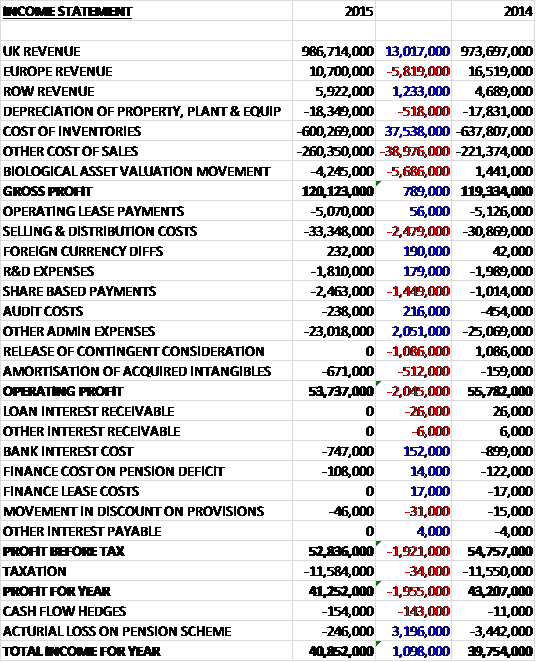
On the 1st March the group announced that it had received credit approval from its lenders to further defer its first debt repayment to 4th April 2016. They are currently finalising an updated mine plan which will form the basis of discussion with the lenders to agree an appropriate debt repayment schedule – a stay of execution then.

On the 2nd March the group announced that they have declared commercial production at the mine as the process plant is now operating in line with design specifications. Over the past sixty days of operation the process plant has achieved an average of 88% of design throughput capacity. During February, throughput totalled 90,099 tonnes of ore milled, resulting in the recovery of over 9,000 ounces of gold with operating recovery levels of 90% achieved by the end of the month. Gold production for the calendar year is currently over 14,000 ounces and to date there have been 25 shipments resulting in sales of about 31,500 ounces of gold.

Run of mine stockpiles are currently standing at 70,844 tonnes of fresh ore at a grade of 2.59 g/t and oxide and transitional stockpiles are standing at 81,881 tonnes at a grade of 1.32 g/t. MonuRent, the fleet provider have purchased and shipped five new 100 tonne capacity Komatsu HD785 rigid haul trucks and one PC1250 excavator. This new fleet equipment is scheduled to be delivered to New Liberty and mobilised ready for operations during April.

So, this is a good milestone to have reached buy given the first debt repayment has just been kicked a little bit down the road, this could be too little too late. Who knows, but this is just a punt at the moment for me so I’m staying out for now.

On the 17th March the group released a gold production update. They announced that in the first two weeks of March operations, the mine produced 4,500 ounces of gold with gold production for the year now totalling 19,200 ounces so far. The process plant continued to operate at a stable run-rate in line with original design specifications, and recovery levels in excess of 90% continue to be achieved. Mining operations at New Liberty will continue to focus on both the Kinjor and Larjor pits and excavation work continues to focus on the completion of the protective flood bund along the southern boundary of the pit limits in preparation for operations throughout the wet season.

So, this is all fairly positive but is just window dressing until the financing is sorted out as far as I’m concerned.

Getech Share Blog – Final Results Year Ended 2015

Getech has now released its final results for the year ending 2015.

GTCincome

Revenues increased by £2M when compared to last year as a £638K fall in multi-client products sales was more than offset by a £2.7M increase in proprietary projects revenue, and with cost of sales only up £875K, gross profit was some £1.2M ahead. There was an increase in depreciation and amortisation along with a £298K impairment of intangible assets but there was also a £304K fair value adjustment and positive forex movements which meant that, after a £38K increase in other admin expenses, the operating profit was £1M higher year on year. Finance income was a little lower than last time but there was a big swing to a tax charge to give a profit for the year of £1.8M, an increase of £238K year on year.

GTCassets

When compared to the end point of last year, total assets increased by £6.7M driven by a £3.1M growth in goodwill, a £1.5M increase in other intangible assets, a £1.7M growth in trade receivables and a £1.3M increase in cash levels, partially offset by a £695K fall in current tax assets. Total liabilities also increased during the year due to a £2M growth in other receivables, presumably relating to deferred consideration on the acquisitions, a 951K increase in accruals & deferred income, and a £1M increase in borrowings. The end result is a net tangible asset level of £5M, a decline of £2.3M year on year.

GTCcash

Before movements in working capital, cash profits increased by £1.1M to £2.4M. A good inflow from working capital, especially the increase in payables, plus a £457K tax rebate, meant that the net cash from operations was £3.9M higher at £3.4M. The group then spent £977K on development costs, £259K on fixed tangible assets, £128K on other intangibles and £1.1M on the acquisition to give a free cash flow of £897K. This covered the £684K paid out in dividends but the group took out £1.1M in new loans to give a cash flow for the year of £1.3M and a cash level of £4.7M at the year-end.

For the exploration and production sector, last year proved to be even more challenging than the previous one. The reduction in exploration expenditure the group observed in 2014 has been followed by a very significant drop in the oil price in oil which has led to significant reductions in capital expenditure across the whole sector, and major redundancy rounds in many companies. The reduction in capital expenditure affected exploration spend most dramatically and a wide range of service companies have been severely impacted.

The profit in the multi-client products division was £3.2M, an increase of £402K year on year, the profit in the proprietary projects division was £2.2M, a growth of £1.6M when compared to last year and the profit in other segments was £1K a decline of £60K when compared to 2014.

In September the group announced their largest ever contract, which was $5M of consultancy work for Sonangol, the Angolan national oil company. This involved generating structural and related interpretation for all the Angolan basins. The project has been completed to schedule and the majority of the income was recognised within the past year. In November, a further umbrella contract with a major oil company was announced and in December the first order under this contract was received which amounted to £400K, although nothing much seems to have happened since then. In April it was announced that they had passed through the tender process with another major national oil company, under which they are one of three qualified bidders for a three year programme comprising several basin work packages per year, each of which would be significant – nothing else seems to have happened on this either.

The group have continued the globe investment programme during the year. While they continue to enhance the data content, the globe clients have apparently been particularly pleased by the software that they have developed to improve the user experience. The group continue to build the interpreted data but have also added two significant third party data-sets. One well data-set comprising more than a million North American wells, and a seismic data-set which covers a number of areas of interest across the world. These help to provide the important assurance to Globe clients that their work is controlled by independent data.

Getech has historically been known for gravity and magnetic data, and for geological work at global and regional sales. The acquired ERCL has a particularly strong seismic interpretation team, which has previously been a gap at Getech. ERCL typically operates at a smaller geographical scale and at stages in client workflows which are later than the Getech focus and with some clients they also directly plan the drilling programmes so the group are now able to offer a significantly broader coverage of client workflows. In its first year of trading, ERCL made a pre-tax profit of £1.2M which sounds impressive but is unlikely to be repeated in this environment. The acquisition generated goodwill of £3.1M and was satisfied by £1.75M in cash, £1.2M in shares issued and £1.4M in contingent consideration.

It is expected that the work in the current three year development period of Globe will continue to add to its value as well as increasingly enabling the group to realise value directly through its use at a variety of scales and in a range of product types. In line with the existing strategy, the board aim to increase the level of business with national oil companies. They recently recruited an experienced international business development manager whose role is renewing and establishing relationships with a range of national oil companies and governments, as well as seeking new government data-sets that may become available for use in Globe.

In the short term, there remains considerable uncertainty about the state of the market and its impact on the group’s trading and the board believe the year ahead will be trading substantially below current market expectations. In this context they will seek to mitigate the immediate effects of the lower oil price while at the same time pursuing attractive opportunities as and when they are available, to grow the business in the medium term.

The board believe that they do have a strong foundation for maintaining profitability in the longer term including the globe framework, which entered its second phase in August 2014, which has seen continued support from the larger E&P companies; there has also been continued demand for proprietary projects, where they can leverage the ERCL acquisition to provide a broader range of advice. The acquisition provides capability in seismic interpretation, well planning, field development and asset management, which mitigates to some extent the effect of low oil price on large-scale exploration; the relationships with a number of national oil companies and governments, which are generally less susceptible to oil price fluctuations, provide a degree of robustness and the ongoing relationship with Sonangol demonstrates strength in this area.

There are apparently a number of significant sales proposals awaiting approval. Client budgets are clearly under significant pressure but even where there is little current money, there has still been a willingness to consider proposals for inclusion in 2016 budgets. While there remains significant uncertainty about the short term and the group cannot predict how the market will develop during 2016, they remain convinced that their products and staff are well regarded to satisfy a clear industry need and as such, whilst they expect a slow start to 2016, they remain confident about the long-term prospects for the group.

The group is very reliant on just one client, with 38% of all revenues coming from just one customer which is clearly a major risk for them. At the current share price the shares are trading on a PE ratio of 6.3, increasing to 20.3 on WH Ireland’s next year forecast. The dividend yield currently stands at 6.4%, however, which is forecasted to remain the same in 2016.

Overall then, the last year has actually been a pretty good one for the group. Profits were up, operating cash increased and there was plenty of free cash but net tangible assets did decline. The globe data set seems to be coming on nicely and the ERCL acquisition looks a good fit. There are two major problems here though. The first is that a big portion of their revenues have come from Sonangol and this work has now finished and the second is that the decline in the price of oil has led to many oil companies slashing budgets which leaves Getech in a rather difficult place. The house broker has reduced their forecast so the PE is now at an expensive looking 20.3 for next year. The dividend yield of 6.4% does look tempting but an investment here really depends on when you think the price of oil will increase. The shares are probably worth a punt if you think this will be soon but I am not so sure so have sold out here – an expensive mistake.

Over the past few days it has been announced that director Peter Stephens has purchased 30,000 shares at a value of £10.9K and now owns 1,068,000 shares. This seems nothing more than a token gesture to me.

On the 9th February the group announced that CEO Ray Wolfson was stepping down from his role. Until a replacement is found, he will continue in the role and the Chairman will increase his level of day to day involvement. Ray has been in the role since 2007 and following his resignation he will take on the role of commercial director, which will not be a board position. I suppose at this time of unprecedented turmoil in the market, he felt this was his time to go. Not positive news for the company in my view.
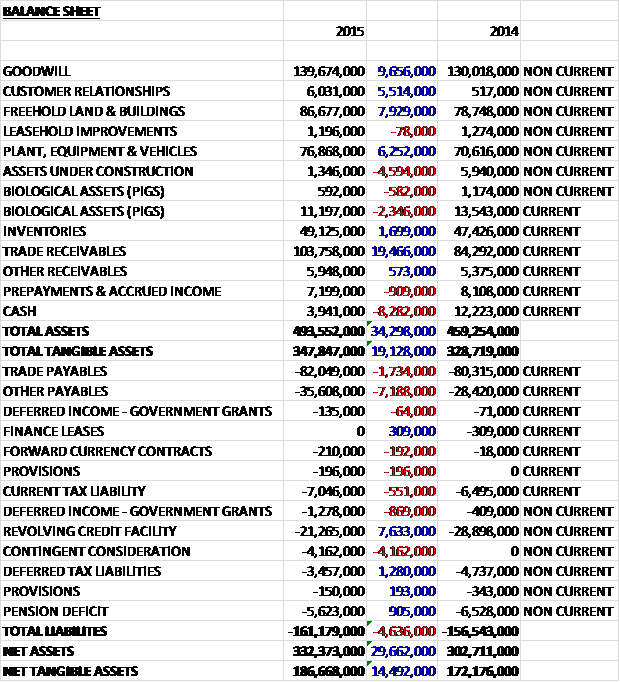
Cranswick Share Blog – Final Results Year Ended 2015

Cranswick manufactures and supplies food products to UK grocery retailers, the food service sector and other food producers. The core market is the UK where they provide a range of fresh pork, gourmet sausages, premium cooked meats, cooked poultry, charcuterie, bacon, pastry products and sandwiches. About 75% of revenues come from the retail customers primarily through retailer own label products. They sell into the top four UK grocers along with the premium grocery and discounter channels. Export sales generate about 5% of revenues, primarily to Europe, Oceania, West Africa and the US.

The group’s biological assets consist of pigs (breeding sows, boars and pigs) and it has now released its final results for the year ended 2015.

CWKincome

Revenues increased year on year as a £5.8M decline in European revenue was more than offset by a £13M growth in UK revenue and a £1.2M increase in ROW sales. Cost of inventories fell by £37.5M but this was offset by a similar increase in other cost of sales but there was a £5.7M detrimental movement in the value of biological assets so the gross profit was £789K above that of last year. Selling and distribution costs increased by £2.5M and share based payments were £1.4M higher but other admin expenses fell by £2.1M before the lack of a £1.1M contingent consideration release last year was not repeated and a £512K increase in the amortisation of acquired intangibles meant that operating profit fell by £2M. Finance costs were slightly lower, mainly due to a reduction in interest payments and tax was broadly flat to that the profit for the year was £41.3M, a decline of £2M year on year.

CWKassets

When compared to the end point of last year, total assets increased by £34.3M driven by a £19.5M growth in trade receivables, a £9.7M increase in goodwill, a £7.9M increase in the value of freeholds, a £6.3M growth in plant and equipment, a £5.5M increase in the value of customer relationships and a £1.7M increase in inventories was partially offset by an £8.3M fall in cash, a £4.6M decline in assets under construction and a £2.9M fall in biological assets. Total liabilities also increased as a £7.2M increase in other payables, a £4.2M growth in the contingent consideration, and a £1.7M increase in trade receivables was partially offset by a £7.6M fall in the revolving credit facility and a £1.3M decrease in deferred tax liabilities. The end result is a net tangible asset level of £186.7M, an increase of £14.5M year on year.

CWKcash

Before movements in working capital, cash profits increased by £6.3M to £78.2M. There was a large cash outflow from working capital, mainly as a result of a big increase in receivables which meant that after slightly lower payments of interest and tax, the net cash from operations was £53.5M, a decline of £5.5M year on year. The group spent £21.1M of this on capex and £17.7M on the acquisition of a subsidiary so that, even after the acquisition, there was a £15.5M cash inflow before financing. The group spent all of this on dividends but also spent £8M on loan repayments so that the cash outflow for the year was £8.3M to give a cash level of just £3.9M at the year end.

Volumes were 3% ahead of last year with growth strongest in the second half but this was offset by the impact of lower input prices being passed on to customers. Continental, bacon and sausages were the product areas that saw particularly good increases. Underlying sales for the year were comparable to the previous year as these increases were offset by lower fresh pork sales and the decision to use all of their own pigs internally as pig prices decreased year on year.
Following a substantial investment in the group’s pig breeding and rearing activities during the previous year, the business this year has focused on improving the quality of the herd and the performance of the breeding, rearing and finishing units. There is now capacity to provide more than 20% if the group’s overall British pig requirements and there will be ongoing investment to improve productivity and efficiencies.
Exports to non-European markets were 23% ahead of the prior year, as the business continues to make progress in developing their export trade. They are now exporting to a number of countries in the Far East and have recently sent shipments to Australia and West Africa. They now have a dedicated business development manager based in Shanghai and are working with the China British Business Council to expand their knowledge of the Chinese market. Exports to Europe were lower than last year as product was sold into the UK market where prices were more attractive.
Fresh pork sales were 10% lower than last year. This was partly due to the loss of business with one customer at the start of the year, which has now been recovered in full. The fall in sales was also attributable to a 9% fall in the average pig price with this reduction being reflected in lower selling prices. Fresh pork sales were supported by a strong BBQ season in the first half of the year along with a buoyant Christmas trading period. During the year work on the new rapid chill system at the Norfolk abattoir was completed. This investment has made the plant more energy efficient as well as improving yields and throughput speeds.
Pastry sales increased by 72% year on year. The rapid growth of the business initially added complexity and cost resulting in the return from the investment being below initial expectations but the performance from the Malton facility improved markedly during the second half. During the year several new products were listed with the lead customer and further products will shortly be launched for the Spring/Summer season. Good progress was made in broadening the customer base for these products through food service, forecourt and food to go channels, including some existing customers of the group’s sandwich business.
Cooked meat sales grew by 2% supported by new product launches and a strong promotional calendar as well as increased business with a key retail customer after securing a long term supply agreement last year. The project to extend the Milton Keynes facility was completed during the year on time and to budget. This investment increased capacity at the site and will deliver efficiency gains as well as improving product quality. During Q4 this year, all production at the Kingston Foods site in Milton Keynes was transferred to the facility in Hull. The consolidation of production at one site will allow the business to better serve its customers and to deliver cost savings. The board has agreed further investment at the Kingston facility which will see it used as a satellite gammon production site.
Sales of continental products increased by 8% reflecting the UK consumer’s growing taste for speciality continental products including charcuterie, cheeses, pasta and olives. Growth was supported by new product launches and new retail contracts in the second half of last year together with a focus on sourcing artisan products from across Europe. During Q4, a range of fresh olives was launched with a new premium grocery customer. The business increased sales of its British charcuterie range and is investing £600K in a new salami production facility at its site in Manchester to provide additional capacity in the fast growing category.
Bacon sales were 4% ahead of last year as continued growth of the hand cured, air dried bacon was supported by substantial increases in sales of premium gammon which is a product area that the group has a strong market position and where barriers to entry are high. During the year the business moved to sole supply status for premium bacon and gammon with one of their leading retail customers. Sales over the key Christmas trading period were particularly strong, with volumes well ahead of the same period last year.
Sausage sales increased by 6% with growth in premium sausage and beef burgers partly countered by lower sales of frozen and mid-tier ranges. The market for the premium product offerings is growing much faster than at the lower end. Sandwich sales grew by 15% driven partly by new contract wins at the start of the period and by additional sales to existing customers. The new contracts brought additional complexity to the business through an increased product range which adversely impacted operational efficiencies but a clear improvement was seen in the second half of the year. This improvement was achieved by a focus on labour efficiencies and yields and by streamlining the customer base and product range.
The retail market is reporting deflation for the first time against a backdrop of continuous growth, driven partly by falling commodity prices across the food chain, but also a trading environment which remains extremely competitive with price wars and the major multiples losing market share to discount retailers. Although there is top line deflation, in core categories such as bacon and sausage, premium tiers are growing strongly.
The food on the move category has grown significantly over the last four years. The group have made good progress in this area and have developed a strong portfolio of sandwiches and gourmet pastry ranges to service these channels. They have also accessed new channels including retailer cafes and front of store chillers. The group are working with a number of specific customers in the pub and restaurant sectors to improve quality, including projects such as better breakfast and the emerging trends around pulled pork and other premium products.
The retail sector remains challenging with deflation evident across the industry but the food to go category continues to perform strongly in both retail and travel sectors. The group have historically concentrated on the travel sector but new business wins in channels such as in store restaurants and hot food counters provide new revenue streams. The group are actively targeting new convenience sales which requires a different approach to product development and a new way of servicing the supply chain. They have won new contracts within the convenience sector over the past year and the business is aligning their core product offers to ensure they are tailored to the growing trend of online shopping.

In October 2014 the group acquired Benson Park for a total consideration of £23.8M consisting of £20M in cash and £3.8M in contingent consideration. The business produces premium cooked poultry which adds a new protein sector to the group and broadens the product range and customer base. The acquisition generated goodwill of £9.3M and in the five months it has been a part of the group it has contributed profits of £1.1M which seems pretty good to me. The contingent consideration is payable based on the performance of the business over a two and a half year period up to a maximum of £4M. The business has traded in line with expectations since acquisition and the major capital expenditure programme envisaged at the time of the acquisition has started with commissioning expected towards the end of 2015 which will increase capacity, improve efficiencies and allow them to offer a broader range of products.

The group has an available bank overdraft facility of £20M, none of which was utilised at the year-end. They also have a revolving credit facility of £100M of which only £22M was utilised at the year-end.

Many of the executive directors have been with the group for a long time and are certainly very competent but they also seem very well paid, perhaps excessively so. This year the CEO was paid £2.3M including bonus and LTIP and the Chairman, who used to be CEO was paid £1.8M which seems very excessive to me. None of them really has a great interest in the shares of the company either and over 27% of shareholders voted against the remuneration policy which indicates a great deal of shareholder unease over the remuneration too.

The group does have a pension scheme but it was closed to new members back in 2004. The liability is currently £5.6M on assets of £24.4 so this is a pretty poorly performing pension scheme but with obligations of just £30.2M the potential downside is not huge. They have contracted future capital expenditure of £2.9M at the end of the year and £4.2M in operating lease payments during 2016.

The group has three customers who account for more than 10% of revenue, being 25%, 23% and 11%. Clearly this is a bit of a weakness but as they supply each of the big four supermarkets, I assume they are the large clients. The group hedges a both a proportion of its near term purchases and sales denominated in Euros but a 100 basis point increase in Sterling against the currency would reduce pre-tax profits by £442K with a similar gain on the weakening of Sterling. Another specific risk to the group is the potential for a significant infection or disease outbreak that may result in the loss of supply of both pig or poultry meat or the inability to move animals freely, impacting on the supply of key raw materials to the group’s sites.

The board are apparently confident that the group is well positioned to continue its successful long term development, which doesn’t tell us anything really. The shares currently trade on a PE ratio of 19.9 reducing to 17 on next year’s forecast which does not look that cheap. After a 6.3% increase in the total dividend, the shares are currently yielding 2% increasing to 2.2% on next year’s consensus forecast. Net debt stood at £17.3M at the end of the year compared to £17M at the end of last year.

On the 1st October the group released a trading update for the first half of the year. Total revenues were 10% ahead of the same period last year and slightly ahead of board expectations driven by strong volume growth across most product categories and a strong contribution from Benson Park. Underlying sales were 7% higher with volumes up 10% as customers continue to see the benefits of lower input prices. The next phase of the development and the Norfolk primary processing facility will start in Q3. This £6M investment will increase capacity and operating efficiencies as well as underpinning the plant’s drive to gain USDA accreditation. The major capital investment programme at Benson Park remains on track and will be commissioned ahead of the 2015 Christmas trading period. Net borrowings were below the previous quarter end and comfortably lower than a year ago.

Overall then this seems to have been a fairly solid year for the group. Profits were down but this was due to the reduction in the valuation of the pigs and if it were not for this, underlying profits would have increased. Net assets were also up and although operating cash flow declined, again this was due to a large increase in receivables and cash profits were up with a lot of free cash generated. Operationally, volumes have increased while prices have fallen due to lower input prices and food deflation. Strong performances in continental, bacon, sausages and ROW exports were partially offset by a reduction in sales in fresh pork, a fall in exports to Europe, presumably as a result of the strong pound, and a fall in margins at pastries and sandwiches as new customers and products “increased complexity”.

The Benson Park acquisition looks a canny one and it is already contributing to profits but the reliance on the big four supermarkets as customers does leave the group rather exposed to this very competitive market at the moment. With a forward PE of 17 and dividend yield of 2.2% these shares are not cheap but that is to be expected for a quality, cash generative business. The update for H1 this year shows revenues increasing but no mention is made of profits so I guess they are faring less well. Tricky one this, I think they are probably priced about right.

Sainsbury Share Blog – Interim Results Year Ending 2016

Sainsbury has now released their interim results for the year ending 2016.

SBRYincome

Revenues declined when compared to the first half of last year with a £249M fall in retail sales and a fairly flat financial services revenue. Cost of sales also fell and the lack of a £310M store impairment that occurred last year meant that gross profit increased by £258M. Underlying admin expenses were broadly flat but there was a host of non-underlying items that occurred last time that did not happen this time such as further impairments and onerous contract provisions. We also see a £92M increase in profit on property disposals that meant that operating profit saw a positive swing of £657M. Finance costs fell slightly (they are expected to increase in the second half due to lower capitalised interest and the perpetual securities coupons) but there was an £11M loss from joint ventures as opposed to a £24M gain last time and after tax increased by £21M the profit for the half year came in at £264M, a positive swing of £608M year on year.

SBRYassets

When compared to the end point of last year, total assets increased by £431M driven by a £260M growth in the amounts due from bank customers, a £129M increase in receivables, and a £106M growth in property, plant and equipment. Total liabilities declined by £241M as a £193M fall in pension obligations, a £275M decrease in borrowings and a £63M fall in current tax payable was partially offset by a £320M growth in trade and other payables. The end result is a net tangible asset level of £5.867BN, an increase of £653M over the past six months.

SBRYcash


Before movements in working capital, cash profits fell by £68M to £648M. There was a general inflow from working capital but the group spent £122M more on the pension scheme (another £125M will be spent on pensions in the second half of the year) so that the net cash from operations was £247M, a decline of £151M year on year. This did not even cover the £360M spent on fixed tangible assets and there was a further £30M spent on intangibles so the cash outflow before financing was £66M. The group then received a £494M cash injection from the issue of perpetual securities which was used to pay off debt (a dubious trick to get debt off the balance sheet in my view) which left the cash outflow for the six months of £15M to give a £1.261BN cash level at the period-end.

Excellent harvests and high yields, particularly in Europe, have led to a drop in commodity prices. Fresh foods such as meat, fish, poultry and produce have seen the highest reductions year on year as food retailers pass the lower prices on to customers. The discounters have grown their market share to over 9%, charging lower prices on a limited selection of products and their growth continues to be a challenge to the established players. Customers are buying more items, driving an increase in volume growth but this is being offset by price deflation, ensuring overall grocery expenditure remains relatively neutral.

The underlying operating profit in the retail business was £332M, a decline of £56M year on year. Sales in the supermarkets were down just over 2%, reflecting the impact of food deflation and changing customer shopping habits. The group are trialling new formats in six of their supermarkets in response to changing customer shopping missions with changes including a different store layout and more checkout options to make it quicker and easier to shop in store and to offer customers more choice. They are making use of the supermarket space by putting the clothing and general merchandise ranges into more stores and offering products and services through concession partners such as Timpsons, Jessops, Argos and Explore Learning.

The group opened 37 convenience stores in the half and sales grew by nearly 11%, despite these stores selling a higher proportion of categories that are experiencing food deflation. They will continue to open one or two stores per week and will look at both smaller and larger sites than their standard convenience stores. The new trial format micro store in Holborn, central London, is just under 1,000 square foot and is designed to meet the needs of people working in the area who buy “food for now”.

The online business continued to grow, in both food and other categories like clothing. Groceries online grew by 7% and orders grew by nearly 14%. This included a record week for online, where they delivered 256,000 orders. At the end of the half they had 52 grocery click and collect sites and are on track to have a hundred by the end of 2015. As click and collect grows more popular, it makes commercial and operational sense to pick orders as close as possible to the collection point, minimising transport and handling costs.

The group have extended and improved their own brand bread range, introducing a selection of premium own brand loaves that are freshly baked in store, and adding new lines made from grains such as spelt, rye and quinoa. This investment has grown volumes by 10% since March and increased their bakery volume market share by 1.5% to 19.2%. The group have also removed nearly 35 tonnes of sugar from their juice ranges and have developed bespoke juice blends with improved flavours. During the period, they launched nearly 70 improved lines across the fish category and have introduced new party food lines such as mini dressed crabs in time for Christmas. The one brand ranges account for 49% of food sales. The premium range delivered over 2% volume growth and the core “By Sainsbury’s” range achieved volume growth of over 3% in response to the lower pricing strategy.

The group have reduced prices by £150M and have simplified their offers and reduced promotional activity in favour of regular lower prices. As well as being more popular with customers, this approach also helps improve forecasting, drives better availability and reduces waste.

The non-food business is an area that is ripe for expansion with only 126 stores offering the full range. The group continues to increase their market share in clothing and sales have grown by nearly 10% during the period as the partnership with Gok Wan and the collaboration with Admiral men’s sportswear proved popular. A successful back to school campaign solidified Sainsbury as the fourth biggest schoolwear retailer by volume. After a successful regional trial, Tu online was rolled out nationwide in the summer and initial sales exceeded estimates. General merchandise sales grew by 1.4% with the bedroom range up 23% due to the strength of the designer bedding offer and dinnerware, mugs and glassware also performing well.

The estimated market value of properties, including the 50% share of properties held in joint ventures, was £10.8BN, a decline of £300M due to a reduction in market rental values and a yield movement. Earlier in the year they opened a 72,000 square foot replacement supermarket in Fulham, increasing the size of the store by 50% and creating space to build 463 new homes. They expect to open a replacement supermarket at Nine Elms in London in summer 2016 and this development will include 737 new homes, local shops, restaurants and office space. These mixed-use developments will generate property profits of around £200M split over this year and next.

The underlying operating profit in the financial services business was £34M, although there was a £25M non-underlying cost relating to the bank migration. This compared to £35M underlying and £23M for the bank migration in the first half of last year. In all, the transition costs are now expected to be at the top end of the £340M to £380M range driven by a six to nine month delay in programme delivery. Loan volumes increased by 18% year on year, with a 23% increase in car loans and a 14% increase in home improvement loans. Despite an increasingly competitive market, the insurance portfolio produces sales growth of 11%. They opened their 200th Travel Money bureau and had their best month for travel money sales in July. Optimising the travel money website for mobile resulted in a 300% increase in sales conversion across these devices which aided the 49% growth in customer transactions.

The group continue to offer reward credit cards with no annual fee at a time when other providers have cut their reward schemes. They installed 49 ATMs in the half, taking the total estate to 1,622 with transactions increasing by 3.9%. The build of the bank platform is materially complete and testing continues. The plan now is to migrate savings customers in Spring/Summer 2016 and cards and loans customs in Spring/Summer 2017, which is between six and nine months later than planned, hence the previously mentioned increase in costs. The bank is expected to deliver a mid-single digit year on year growth in underlying profit in 2016 and capital injections are expected to be about £160M.

The Netto joint venture is on track to open 15 stores by the end of the year. At the end of the half they had six stores open and are learning about the growing discount market. The in store bakery products and British meat offer are particularly popular but the business is still loss making, with Sainsbury’s share of the loss £5M during the period due to start-up costs. The group’s underlying share of profit from its joint venture with British Land was £8M compared to £6M last time and the underlying share of profit from the joint venture with Land Securities was £1M, down from £2M last time. Overall it is expected that the share of profit from the property joint ventures will be slightly lower in 2016 as a whole with the share of losses from the start-up joint ventures being similar to last year.

The group announced a 4% pay increase for 137,000 staff members who work in the stores to a new hourly rate of £7.36 – no doubt pre-empting and reducing the effect of the new minimum wage legislation.

In July it was announced that Lloyds Pharmacy would acquire the Sainsbury pharmacy business for around £125M realising profit on disposal of about £100M. In addition, the group will receive commercial annual rate payments from Lloyds for each of the 277 in-store pharmacies and the transaction is expected to complete by the end of February 2016. It was also announced that the mobile phone joint venture with Vodafone will close towards the beginning of 2016. Customers will still be able to buy phones from the 38 phone shops, however.
At the period end the group had capital commitments of £195M and during the half year the group opened a new one million square foot general merchandise depot at Daventry International Rail Freight Terminal and also upgraded the Basingstoke distribution centre.

The cost savings programme is ahead of plan and the board expect savings of around £225M by the end of the year and are on track to deliver £500M in cost savings over the next three years. So far this year £115M of operational cost savings were achieved with an increase due to growth in the savings delivered from the core operational efficiency programme and one-off benefits relating to a review of their commercial expenditure and the organisational structure within stores and store support centres. The savings in the first half more than offset the inflationary pressures on costs, however, they expect this inflationary impact to step up by £13M in the second half as a result of the 4% wage increase.

During the period the group issued £250M of perpetual subordinated capital securities and £250M of perpetual subordinated convertible bonds which may be converted into shares of the company at the option of the holders at any time up to 23rd July 2021 at a conversion price of 348.6p. I do think that this is a bit of a sneaky way to keep a certain amount of debt off the balance sheet. The group used the proceeds of this to pay back some bank debt and also to make a payment to the pension scheme to reduce the obligations from £651M at the end of last year to £473M at the end of the period.

The bank has entered into a £400M asset backed commercial paper securitisation of consumer loans. Of this facility, £300M had been drawn as at the period-end. Interest on the notes is repayable at a floating rate linked to three-month LIBOR and their contractual repayment is determined by cash flows on the relevant personal loans included in the collateral pool. Core capital expenditure, excluding the bank, is expected to be around £550M for the whole year.

After a 20% fall in the interim dividend, the shares yield 5% which falls to 4.5% on the full year forecast. If we include the perpetual securities which I certainly think we should, the net debt stands at £2.377BN compared to £2.382BN at the point of last year but the board expect the net debt at the end of the year to reduce year on year. This does not include the bank’s own net debt balance.

Overall then, times continue to be tough for Sainsbury’s. Profits did increase but this was due to the various non-underlying costs that occurred last year and underlying profits declined year on year. Similarly, net assets improved but this was mainly as a result of the perpetual securities taken out moving debt off the balance sheet. Operating cash flow declined, which shows what is really going on and there was no free cash flow after capex.
Profits in the retail side fell, driven by a decline in sales at the supermarkets due to food price deflation and changing shopper habits. This decline in the core supermarkets was partially offset by increased sales in convenience stores, online and clothing. The financial services business delivered broadly flat results which were hampered by the bank transition costs being greater than expected, and the Netto stores are still loss making.

Costs going forward are going to grow due to the pay rise given to staff but this seems a canny move to make sure that the new living wage legislation effects are tapered over a few years. Another canny move seems to be the sale of the pharmacy business which will realise a decent profit and still allow the group to recoup some rental income from Lloyds.

Overall though, the core business is still in decline and the forward yield of 4.5% seems rather susceptible to more costs given that it is not covered by cash flow so I will continue to watch from the side lines here.

On the 22nd December the group released a statement that Lord Sainsbury had sold shares to take his holding below the 3% threshold. Apparently though this was only crossed as a result of a gift of shares to his charity.

On the 5th January, the group released a surprise announcement that it had made an approach of an offer for Home Retail group for shares and cash, which was rejected. The two companies have been working closely trialling a number of Argos concessions in Sainsbury stores. They now have until the 2nd February to announce a firm offer. This is a strange one, I can’t see how it makes strategic sense but I will watch the proceedings with interest.

On the 13th January the group released their Q3 trading statement. Excluding fuel, like for like retail sales were down 0.4% compared to 1.6% in the first half of the year, with total sales up 0.8% which has seen their market share increase during the quarter. They launched their new Taste the Difference wines in time for Christmas which contributed to sales growth of over 18% across the range and the programme to invest in the quality of over 3,000 products remains on track. Like for like volumes and transactions both increased year on year.

The group reduced their levels of vouchering and promotional items along with the number of multi-buys in favour of lower regular prices, continuing their commitment to simplify prices and promotions. During the period 16 convenience stores were opened and online groceries saw sales up nearly 10% with some 101 Click and Collect sites now available nationwide. General merchandise saw sales growth of 5% in the quarter and clothing was up nearly 6% despite the unseasonably warm weather. The bank saw an 11% volume growth in loans and a 29% increase in travel money transactions.

The board now expect like for like sales in the second half to be better than the first but food price deflation and pressures on pricing will ensure that the market remains challenging for the foreseeable future. Things certainly seem to be improving here but it has to be said Christmas trading is usually fairly good for the group. Growth remains negative on a like for like basis and I would like to wait and see what happens in normal trading and the proposed Home acquisition.

On the 2nd February the group announced that they had reached agreement on the key financial terms of a possible offer for Home Group. Under the terms of the offer, Home Group shareholders will receive 0.321 new Sainsbury shares and 55p in cash per Home Group share they hold. In addition they will receive about 25p from the Homebase return of capital and 2.8p in lieu of a final dividend for 2016. The Homebase capital return reflects the £200M return in respect of the sale of Homebase announced previously by the Home group.

The possible offer implies a value of about £1.1BN for the company based on the closing Sainsbury share price at this date or £1.3BN including the Homebase return of capital. Under the terms of the offer, Home Retail shareholders will own about 12% of the combined group. The board of Home Retail has indicated that it is willing to recommend the key financial terms of the offer to their shareholders.

Sainsbury expects the offer will be accretive to its EPS in the first full year of ownership and by the third year they expect double digit earnings accretion and a low to mid-teens return on invested capital with some £120M of EBITDA synergies expected to be generated by that point.

About a half of the identified synergies are expected to be generated from Argos Concessions arising from cost savings generated from the relocation of certain existing stores into concessions in Sainsbury stores, including but not limited to cross-selling opportunities and the expansion of click and collect desks. About a third of the synergies are expected to be cost synergies generated by removing duplication and overlap from both central and support functions at the two companies together with procurement benefits resulting from the increased scale. The remainder of synergies are expected to be further revenue synergies, principally from the sale of Sainsbury’s clothing, homewares and seasonal ranges through the existing Argos network.

It is expected that the realisation of the identified synergies will require one-off exceptional costs of about £140M split equally across the first three years following completion. It is also expected that incremental capex of about £140M will be incurred in the three years following completion, relating to store fit-out expenditure. About 20% of this capex will be incurred in the first year with the remainder split equally in the second and third years following completion.

The group intends to finance the cash consideration for the offer through its existing debt facilities and resources to be entirely refinanced at a later date through the proposed transfer of the financial services business to Sainsbury’s bank.

The group must either announce a firm intention to make an offer for Home or announce that it does not intend to make an offer by the close of play on the 23rd February.

Overall then, this is certainly interesting. There are huge synergies on offer here and the Sainsbury management do a good job of selling this. I am remaining on the sidelines but will watch with interest.

On the 15th March the group released its Q4 trading update. The supermarkets recorded both like for like transaction and volume growth and the group maintained their market share in the quarter. They also announced that they will be phasing out most of the multi-buy promotions by August and will continue to simplify their trading strategy in favour of lower regular prices. During the period they opened 16 convenience stores and online grocery sales grew at nearly 14%.

Clothing delivered over 10% growth and the newest Gok Wan collection had its best ever February launch. Entertainment also performed well, with nearly 11% growth driven by some big releases during the quarter. The bank saw a 15% volume growth in insurance new business and a 12% growth in travel money transaction volumes.

Overall then, this was actually a pretty decent update. The like for like sales decline seems to have been halted for now, although my other underlying concerns I covered at the time of the last update are still present and I am only going to update on Sainsbury again when those debt concerns have been addressed.

Red24 Share Blog – Interim Results Year Ending 2016

Red24 has now released their interim results for the year ending 2016.


REDTincome

Revenues declined when compared to the first half of last year (irritatingly there is no longer a split by market sector, just geography) as a £175K increase in USA revenue and a £43K growth in European revenue was more than offset by a £324K decline in UK revenue and a £204K fall in ROW sales. Cost of sales did fall but the gross profit was £138K below that of the first half of 2015. Admin expenses were broadly flat and there was a small decline in finance costs and tax so that the profit for the half year was £265K, a decrease of £129K year on year.

REDTassets

When compared to the end point of last year, total assets increased by £521K driven by a £997K growth in intangible assets and a £288K increase in receivables, partially offset by a £541K decrease in cash, a £125K halving of the value of the asset held for sale and a £96K fall in the value of property, plant and equipment. Total liabilities also increased during the period due to a £393K increase in other payables relating to deferred consideration, an £86K growth in deferred tax liabilities and a £76K increase in current tax liabilities. The end result if a net tangible asset level of £2.9M, a decline of £962K over the past six months.

REDTcash

Before movements in working capital, cash profits fell by £56K to £366M. A large fall in payables meant that there was a £199K cash outflow at the operating level, a detrimental movement of £525K year on year. The group then spent £79K on intangibles, £19K on fixed tangible assets and £195K on the purchase of a subsidiary, but they did get £125K from the sale of the interest in Linx so that the cash outflow before financing was £360K. The group then paid £11K in interest and some £129K that is clearly not covered by cash flow on dividends. The end result is a £509K cash outflow for the period to give a cash level of £2.9M at the period-end.

The travel assistance service has been enhanced by the investment in the tracker product, which has placed it onto a new technical platform that will make it easier to interface with new clients and with new travel data-bases. The product was launched at the business travel show in London in February and met with an encouraging response. The board think that this will materially assist in ensuring that this revenue stream is maintained in 2016 notwithstanding the loss of business from HSBC, of which the addition of a number of new clients has replaced 75% of the lost revenue.

During the period, gaining contracts with Allianz has been a significant development and has opened a large potential market for the travel services and 2016 should see a significant increase in the travel assistance business across the globe. In October the group launched their online training platform, the red24 academy. Initial modules are aimed at the business traveller, but the platform is capable of supporting requirements across all revenue streams and suitable courses will be added as they receive external accreditation.

The special risks business had a quiet half year and dealt with few significant incidents. They continue to publish their “Treat Forecast” and have added new books of business over the year. The office they set up in Munich, primarily to service this unit, has created a number of promising opportunities and has brought on books of business with German insurers and opened sales channels to their clients.

Throughout the year, the consulting and response unit has been busy with requests for close protection work and for evacuation planning services. Last year a Far Eastern client requested a large evacuation from Libya involving several hundred of their staff which generated revenues of about £500K and was the largest project to date. This year the largest response to date has been in Nepal, following the earthquake, which produced revenue of £210K.

The product safety brand has had a busy half year and this is expected to accelerate in the second half of the year following the recruitment of a US product safety team to provide additional resource to US insurers and to provide capacity to service the business to business market there. In the summer they responded on a serious food contamination case for a manufacturer, not through an insured incident, and they believe there is significant opportunity in helping food businesses manage their product safety risks.

It seems as though the group has been unable to fully replace the lost £600K of HSBC revenues, they faced a tough comparison with a large project in Libya and last year (I wish these kinds of things were pointed out at the time) and they invested in the development of the US based product safety team along with launching Red24 Academy. This investment may hold back the results in the short term but apparently places the group on a firm growth path in the future. Apparently the good results in H2 last year were as a result of the last few months of revenue from HSBC but without the costs – why was this not made clear at the time? To add to the issues, the group also made a £100K loss on Rand/Sterling currency hedging activities during the period.

On the 1st July the company acquired RISQ Worldwide for an initial cash consideration of £259K and a deferred consideration of £371K depending on the future pre-tax profit of the business which is something to keep an eye on. The purchase generated goodwill of £584K and generated £26K in pre-tax profits in the three months since acquisition which doesn’t look too bad. RISQ specialises in employee vetting and business investigations as well as supporting the consulting and response businesses.

The board anticipate significant medium term growth in revenue from the acquisition of RISQ, from the new product safety team in the US and from the partnership with Allianz. In the short term, however, the recent investment made in the business is likely to continue to impact on the current year profitability.
After a 9% increase in the interim dividend, the shares are now yielding 2.4%.

Overall then this has been a difficult period for the group. Profits fell, net tangible assets were down and operating cash flow deteriorated – in fact there was a cash outflow at the operating level. This is mostly because of the large contract with HSBC that was not renewed as this half was the first half that it didn’t feature, which means that the second half is likely to have tough comparatives too. Additionally, the special risks division was quiet and the response division did not have a contract on the same scale as Libya evacuation last time. The product safety division and newly acquired RISQ business do seem to be performing well.

I have to say I am rather disappointed by this. I felt that the business had worked hard to replace the lost HSBC contract and must say I am rather surprised by these poor results – there was no warning about this. With a forward PE of 15.2 and a dividend yield of 3% for the full year, I don’t think the risks are fully priced in here yet. I am out.

On the 30th November the group announced a strategic contract with Hiscox whereby they provide strategic support for its product contamination insurance clients with immediate effect. They will help Hiscox’s clients prepare for risks relating to their products as well as respond to immediate crisis situations arising from product recalls and/or contamination. Support includes access to specialist technical, regulatory and PR advisors, product testing facilities and crisis communications facilities.

This seems like a decent contract to me but not sure how material it will be. I am tempted to jump back in here.

On the 3rd May the group appointed Nick Powis as Head of Operations and John Brigg as a non-executive director. Nick joins from Marsh ltd where he was Crisis Consultancy Director and Michael has been a long standing shareholder with current directorships at EMIS International and Royal & Sun Alliance Middle East.