Omega Diagnostics Share Blog – Interim Results Year Ending 2016

Omega Diagnostics has now released its interim results for the year ending 2015.
ODXincome

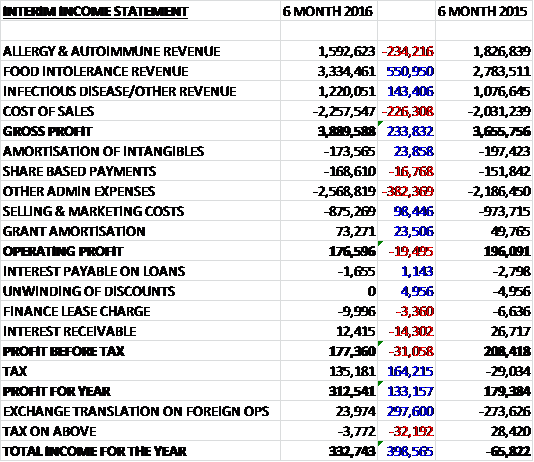
Revenues increased when compared to the first half of last year despite the adverse £180K effect from strengthening Sterling as a £237K decline in allergy & autoimmune revenue was more than offset by a £556K growth in food intolerance revenue and a £143K increase in infectious disease revenue. After a growth in cost of sales, the gross profit was £234K ahead of that of last time. Admin expenses increased by £382K and a £98K fall in selling and marketing costs were not quite enough to prevent the operating profit falling £19.5K. We then see a reduction in the interest received more than offset by a £164K positive swing in tax due to an increase in the deferred tax asset as a result of R&D tax credits to give a profit for the first half of the year of £313K, a growth of £133K year on year.
ODXassets

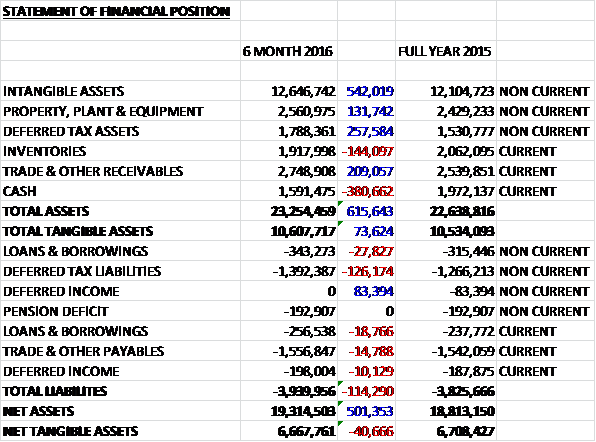
When compared to the end point of last year, total assets increased by £616K driven by a £542K growth in intangible assets, a £258K increase in deferred tax assets and a £209K growth in receivables, partially offset by a £381K fall in cash levels. Total liabilities also increased during the six month period as a £126K growth in deferred tax liabilities was partially offset by a £73K fall in deferred income. The end result is a net tangible asset level of £6.7M, a decline of £41K over the period.
ODXcash

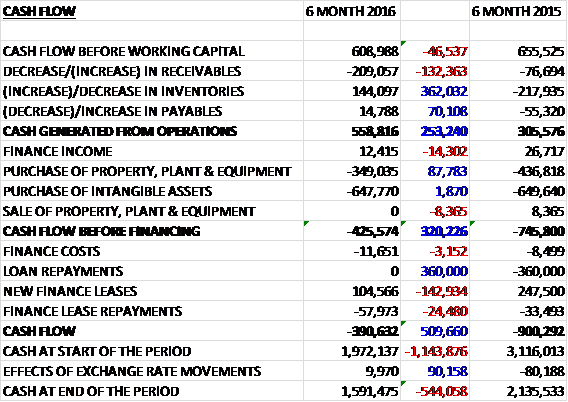
Before movements in working capital, cash profits declined by £47K to £609K. Despite showing a small cash outflow, the cash performance from working capital improved when compared to last year, mainly as a result of a fall in inventories to give an operating cash flow of £559K, an increase of £253K year on year. This did not cover the investment into intangible assets (presumably R&D) and after the £349K spent on tangible assets, there was a cash outflow of £426K. There was a net increase in finance leases which gave a cash outflow of £391K in the six month period and a cash level of £1.6M at the period-end.

Overall the first half performance was in line with management expectations. The group are in the process of putting together a three to five year business plan which should be interesting. The automated allergy product is approaching the point at which the group can begin to earn a commercial return but things are not progressing as well with Visitect CD4. They are systematically progressing with all the potential variables which takes time and there is apparently no guarantee of a positive end-result so this product is looking more and more precarious to me. There are, however, growth prospects in the food intolerance area given the greater understanding of the gut microbiome and the interaction between the food people eat and their overall wellbeing.

The pre-tax loss in the allergy and autoimmune division was £154K, a £49K increase year on year. The business has suffered the duel headwinds of a weaker exchange rate and a declining business in the domestic German allergy market. Whilst autoimmune sales grew by 17% to £300K, allergy sales declined by 18% to £1.29M with half the reduction due to the currency impact. Unfortunately the allergy business is higher margin so this decline has a bigger effect on profits.

The pre-tax profit in the food intolerance business was £1.1M, an increase of £188K when compared to the first half of last year. Food Detective continues to be popular, exhibiting growth in eight out of the top ten markets in the EU, Latin America and the Far East. The Foodprint System has also grown across those markets and included a significant customer win that will lead to sizeable repeat business.

The pre-tax loss in the infectious disease division was £204K, an increase of £39K year on year. The market is the most congested in which the group operates which results in the most price pressure. Revenues did increase, however, with stronger performances in Africa, the Middle East and the UK.

It was previously reported that there was a stability issue with Visitect CD4 that manifests after five weeks storage at room temperature. The group built additional devices to monitor ongoing stability, both up to and well beyond the five week period to attempt to establish a cause for the instability and to gain a better understanding of the time over which the problem might occur.

The group then reported an ambient temperature effect which manifests as a change in test line signal, with no corresponding change in reference line signal identified as being linked to a single step. The group have not been able to replicate the stability issue and they now have data which provides evidence for little or no decline in test performance at ambient temperature six months after being manufactured. In addition, the pilot batches showed no further deterioration in performance when tested four months later.

They have identified the cause of the ambient temperature effect and have found a potential solution to it which they are trying to incorporate into the test. In terms of the ongoing investigations, they are where they expected to be at this point in time and remain committed to the development plan and once they have a satisfactory design they will recommence the verification and validation work plan. So that is all as clear as mud then.

In Pune, India, the group has completed the fit-out of their new rapid test manufacturing facility and are currently installing equipment, IT systems and quality management systems. They are planning to manufacture a range of Malaria tests at a much lower cost of goods to expand the market reach significantly beyond the limited coverage of the current product range.

Since the last update, the group have optimised another allergen so that 37 allergens now match the performance of the market leading product. In addition to the successful Spanish evaluation, with the help of the partner Immunodiagnostic Systems, they have now commenced an evaluation in Italy with further ones planed for France and Germany in the near term. They are building up an extensive set of data which supports the speed and ease of use of their Allersys Reagents on the instrument and they expect to obtain CE marking early in the new financial year.

Overall then, this was a bit of a subdued half year from the group. Profit was up, but this was due to R&D tax credits and pre-tax profits fell. Net tangible assets were also down, and although operating cash flow increased, this was only because of the increase in inventories last time and cash profits fell year on year and no cash was produced if we count the development expenses as operating costs. The only segment performing well is the food intolerance business with profits being boosted by a big customer win. Unfortunately these gains were offset by an increase in the infectious disease loss due to tough competition and a similar increase in losses in the allergy business due to Euro weakness and continued declines in the German market.

The comments about the Visitect CD4 device are a little concerning. They have found a potential solution to the issue but there is no guarantee of a positive end result. On the other hand the allergy product is reaching commercial viability. So, these results suggest that the food intolerance isn’t quite profitable enough to carry the other divisions and the shares are certainly pricing some success in at the moment. I suppose the question is, would a successful allergy product be enough to offset the disappointment from a non-viable Visitect product? Obviously I don’t have the answer to that but I am keeping these shares for now as a speculative punt.

On the 21st April the group released a trading update covering the year ended 2016. Overall results will be in line with market expectations. Revenues are expected to be £12.7M, 5% ahead of last year, and adjusted pre-tax profit will be between £1.2M and £1.3M. Food Intolerance revenues are expected to be £7.1M, a growth of 19%; allergy revenues are expected to be £3.2M, a decline of 13% and infectious disease revenues are expected to be £2.5M, a decline of 1%.

In allergy, the group have now reached their target and have optimised 41 allergens which will be included in the initial launch panel. All of the Allersys reagents have been evaluated on the IDS iSYS analyser to demonstrate performance that matches the market leading product. They are currently in the process of building up inventory levels to support a market launch in the near future and the scientific team is already working on delivering menu expansion beyond the initial launch panel.

External evaluations have now been completed in Spain, Italy and France with a fourth ongoing in Germany. Of the three completed beta studies to date, they have now tested over 1,000 patient samples with 18 different allergens from the range and results are in line with the initial claim support work. These external evaluations in conjunction with the claim support work will enable the group to CE mark all 41 allergens during the early part of the coming year in readiness for launch.

In infectious diseases, the group have now determined the root cause of the ambient temperate effect in the CD4 devices and have demonstrated that they are able to manufacture prototype tests for a lab setting which are capable of operating between 15 and 32 degrees. They are mow working with design engineering companies to incorporate a solution that eliminates the issue to enable the test to be used in the field. The board remain confident that they will be able to find a solution.

They have also established that finger price and venous blood give equivalent results and the board believe the difference seen in the Indian study was due to the then unidentified ambient temperature effect. Beyond this, they are also working on extending the test performance to demonstrate that it will operate up to 35 degrees. On being able to achieve this level of performance on a consistent basis, they will continue with their planned programme of validation work.

The Food intolerance business is currently the driver of growth for the group. The allergy business in Germany continued to decline as the group saw a reduction in buying levels due to increased competition for reimbursement with tests for other conditions. The market in the country is also being squeezed from the automated lab test sector but this should reverse once the Allersys range of tests are launched. The group have maintained their established customer base and are also expanding the panels of tests available on their Allergodip dipstick test. This, alongside introducing a mobile phone app that allows quantification of the test result with provide them with a broader product offering.

Overall, this is a decent update. The food intolerance business is performing well and although the reduction in the allergy business is disappointing, the launch of the allersys system should provide a boost. The CD4 product still seems a long way off but at least some progress is being made on identifying the issues with the test. Overall I will continue to hold here.

Cranswick Share Blog – Interim Results Year Ending 2016

Cranswick has now released its interim results for the year ending 2015.

CWKincome

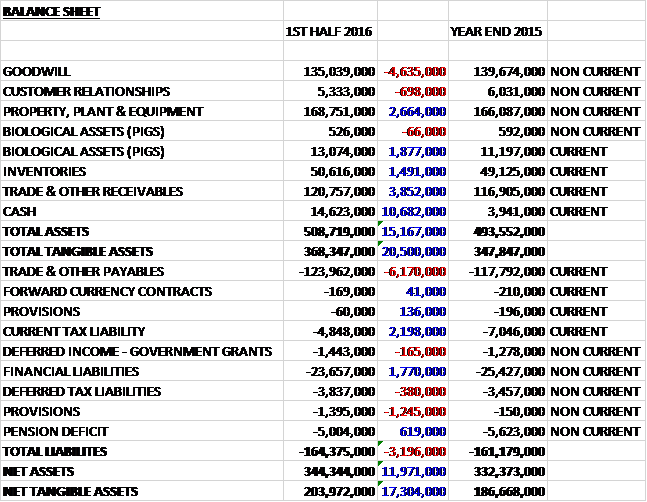
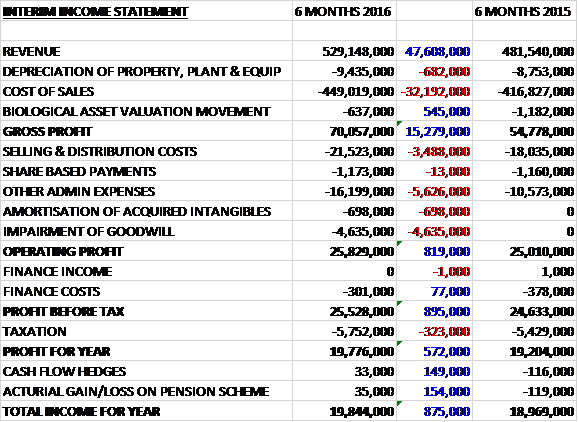
Revenue increased by £47.6M when compared to the first half of last year. Cost of sales also grew which meant the gross profit was some £15.3M above that of last time. Selling and distribution costs increased by £3.5M and admin expenses grew by £5.6M but there was a £700K amortisation of acquired intangibles and a £4.6M impairment of goodwill but despite this the operating profit grew by £819K. Finance costs were slightly lower but tax was higher so that the profit for the half year came in at £19.8M, an increase of £572K year on year.

CWKinterimassets

When compared to the end point of last year, total assets increased by £15.2M driven by a £10.7M growth in cash, a £3.9M increase in receivables, a £2.7M increase in property, plant and equipment, a £1.8M growth in the value of biological assets and a £1.5M increase in inventories, partially offset by a £4.6M decline in goodwill. Total liabilities also increased over the past six months as a £6.2M growth in payables and a £1.1M increase in provisions was partially offset by a £2.2M fall in current tax liabilities and a £1.8M decrease in financial liabilities.

CWKinterimcash

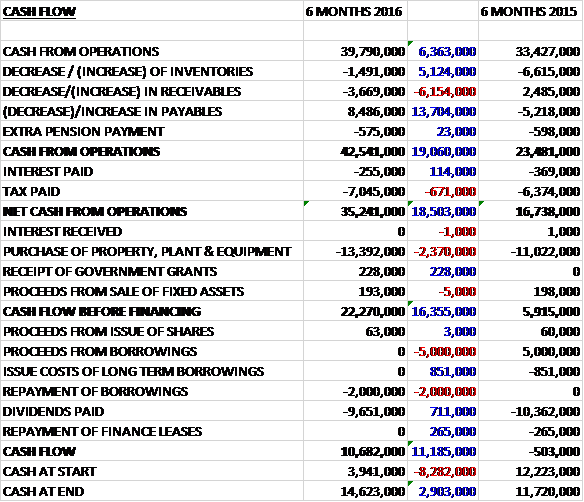
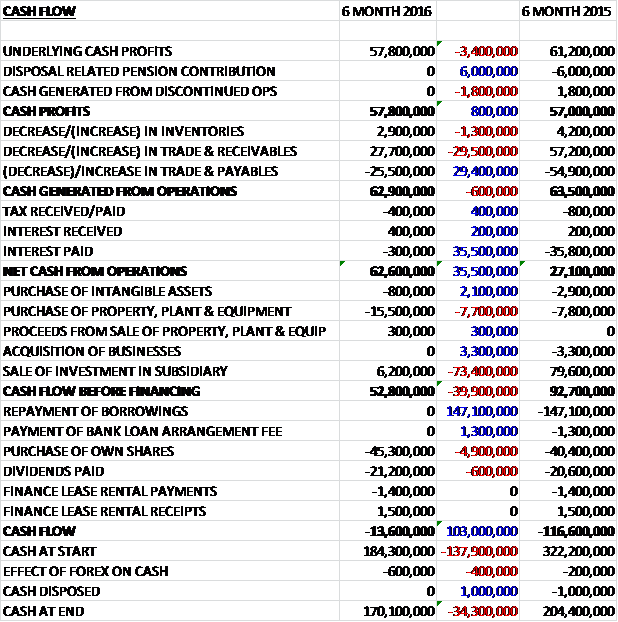
Before movements in working capital, cash profits increased by £6.4M to £39.8M. This was further boosted by a growth in payables and after a slightly lower interest payment and a higher tax spend the net cash from operations was £35.2M, a growth of £18.5M year on year. The group spent £13.4M on capital expenditure relating to the redevelopment of Kinston Foods cooked meats facility, the Benson Park projects and various other initiatives across the group to increase capacity and drive further efficiencies, and after that, the free cash flow was an impressive looking £22.3M. Of this, £2M was used to pay back loans and £9.7M was spent on dividend so that the cash flow for the six month period was £10.7M to give a cash level of £14.6M at the end of the half.

Overall the business performed strongly during the period and recorded revenue slightly ahead of the board’s original expectations. The improvement in group operating margin reflected the positive contribution from Benson Park, an improved performance from the Pastry business and a tight focus on cost control and operational efficiencies. The UK pig price fell 2% during the period and was on average 18% lower than in the same period last year. Despite this reduction, the UK price remains about 30% higher than in Europe. Improvements in productivity together with lower feed costs helped offset the impact of lower pig prices. Total export volumes grew by 18% during the period. Volume growth in Far Eastern markets of 31% offset lower volumes into the US and flat volumes into European markets. Further opportunities are being explored and the range of products being exported is continually being developed and broadened.

Fresh pork sales grew by 15% in the period driven by the recovery of business with one of the group’s principal retail customers as the market as a whole fell 10% due to the fall in UK pig prices. The recent AHDB pulled pork advertising campaign highlights the way in which focused marketing can deliver positive results with a 19% year on year increase in shoulder joint sales during the campaign. The next phase of the redevelopment of the Norfolk facility is now underway. This £6M investment to replace the existing abattoir will increase capacity, improve efficiencies and will facilitate the site’s push for USDA accreditation.

Sausage sales were 5% higher supported by strong volume growth. The premium sector of the market is the main driver of growth as consumers are prepared to pay a modest premium for better quality and taste. Sales of premium beef burgers were 24% higher year on year. Further substantial capital investment to upgrade mixing and filling equipment is planned at the Lazenby’s facility in Hull to support anticipated growth in the sausage category.

Bacon sales were 21% ahead as continued development of the business’ hand-cured, air-dried bacon was supported by strong premium gammon sales. This growth was aided by gaining sole supply status for premium bacon and gammon with one of the group’s lead retail customers shortly before the previous half year-end. With further new product launches planned for both existing and new customers in the run up to the peak Christmas trading period, the business is well placed moving into the second half of the year. The redevelopment and conversion of the former Kingston Foods site in Milton Keynes into a gammon facility was recently completed. This facility will apparently enable the business to target a new sector of the bacon and gammon market.

Cooked meat sales fell 6% reflecting overall market deflation and lower volumes to one retail customer. Further substantial capital investment at the Sutton Fields facility will upgrade staff amenities and refurbish both high and low risk production areas to enable expansion into new categories with existing customers and develop further capability to supply food to go ranges to manufacturing and food service customers. A significant three year capital investment programme at the Valley Park facility will refurbish the site and upgrade chilling and storage facilities to support future growth.

Sales of poultry from Benson Park made a positive contribution to overall group performance in the first half. New business wins during the period, both with existing and new customers, leave the business well placed moving into the second half of the year. The capital investment programme which was underway when the business was acquired in October last year, is now complete. The enlarged factory footprint and new in-line spiral cooking and cooling equipment was commissioned ahead of the peak Christmas trading period. This £9M investment programme has substantially increased capacity and will improve operational efficiencies as well as enabling the business to offer a broader product range.

Pastry sales were 45% ahead of the first half of last year, continuing the positive development since this category was introduced. Operational performance at the site continued the marked improvement seen in the second half of the last financial year and the category made a positive contribution to the overall group result. New product lines have recently been launched which, coupled with a strong Christmas and seasonal promotional programme, leaves the pastry business well placed to deliver growth during the remainder of the financial year.

Sales of continental products increased by 12% reflecting the UK consumer’s growing appetite for these products including charcuterie, cheeses, pasta and olives. Growth was supported by new product launches and new retail contracts together with a continued focus on sourcing new products from across Europe. The extension of the Guinness Circle facility to produce British cured meat products was completed during the period, and will produce a range of premium cured meats under both the Woodall’s brand and retail own labels.

Sandwich sales grew by 5%, supported by new contract wins brought on stream part way through the first half of last year. Top line growth was supported by an improved operational performance as the business continued to strip out underperforming accounts and rationalise the product range. The business has recently received confirmation that a key account will not be extended beyond its current term, however, and consequently the outlook for this business beyond the current financial year-end will be more challenging.

Following a change in the customer base of the sandwiches business, an impairment review was performed which resulted in a goodwill impairment of £4.6M. After this impairment the carrying value of goodwill in the business was £8.9M so any further adverse changes in key assumptions would lead to an additional impairment charge. Market conditions are expected to remain competitive through the second half of the year but the board believe they are well placed to deliver further growth.

After a 9.4% increase in the interim dividend, at the current share price the shares yield 1.9% which increases to 2.1% for the full year consensus forecast. At the period-end, the net debt position stands at £4.8M compared to £17.3M at the end of last year.

Overall then this has been a good period for the group. Profits increased, aided by the Benson Park acquisition; net assets improved and operating cash grew to give a very decent amount of free cash. Exports to the Far East seem to be increasing considerably but they did fall to the US. Most products performed well with fresh pork sales up due to a recovery of a large customer, sales of sausages were up due to increased sales of premium products and ales of bacon, gammon, pastries and continental fare all increased. Cooked meats performed less well with sales down generally as a result of market deflection but the real problem is that a key client has been lost in the sandwiches business which will affect the group next year.

It is difficult to quantify how much this loss will cost them but it was serious enough to take an impairment on the goodwill of the division. I suppose I will have to wait for some new broker forecasts to get a better idea. With an improving net debt position and a 2.1% dividend yield, the shares are not cheap but this is a quality outfit and once I manage to get some clarification on the lost sandwich contract, I might consider buying in here.

On the 28th January the group released a Q3 trading update where they stated that trading was in line with the board’s expectations. Total revenue was 5% ahead of the same period last year driven by strong volume growth of 11% and underpinned by a strong Christmas trading period. Underlying revenue was 4% higher with volumes up 10% as the benefit of falling input prices was passed on to the group’s customers. Export sales grew strongly with volumes shipped to the Far East 28% ahead of the same quarter last year.

Following the seasonal increase in working capital and ongoing capex, net debt increased from £5M to £18M in the quarter but remained well below the £57M reported at the same stage last year. Overall then, a steady update and I will continue to hold.

On the 5th April the group released a trading update for the year ended 2016. There was continued positive trading in Q4 which resulted in total full year sales volumes being 12% higher than the prior year. Full year underlying sales volumes increased by 10% with corresponding revenues ahead by 5% as the group’s customers continued to benefit from lower pork prices. Export sales grew strongly in the final quarter, reflecting the ongoing robust demand for pork products in Far Eastern markets.

The group invested well in excess of £30M across its asset base during the year to support future growth and drive operating efficiencies and this level of investment is expected to continue through the current financial year. Strong cash generation resulted in the group moving into a net cash position at the year-end compared to a net debt position of £18M at the end of Q3 and £17M at the end of last year.

Overall the board expect the trading performance for the year to be in line with their expectations.

On the 11th April the group announced the acquisition of Crown chicken from the Thacker family and management for a cash consideration of £40M paid from existing bank facilities. Crown is an integrated poultry producer based in East Anglia. They breed, rear and process fresh chicken for supply into a broad customer base across grocery retail, food service, wholesale and manufacturing channels. They also have an efficient milling operation which satisfies all of their own feed requirements as well as supplying feed to other pig and poultry producers in the region.

Last year, adjusted EBITDA for the business was £6.6M and the transaction is expected to be modestly earnings enhancing in the current year.

Cambria Autos Share Blog – Final Results Year Ended 2015

Cambria Autos has now released its final results for the year ended 2015.

CAMBincome

Revenues increased when compared to last year with a £43.2M growth in new car revenue, a £27M increase in used car revenue and a £4.8M growth in after sales revenue. With an increase in cost of sales, the gross profit was some £6.8M higher than last time. Staff costs grew by £3.6M but other operating costs only increased by £313K so that the operating profit was £2.6M higher than in 2014. Consignment and vehicle stocking interest was up and taxation was higher which gave a profit for the year of £6M, a growth of £1.9M year on year.

CAMBassets

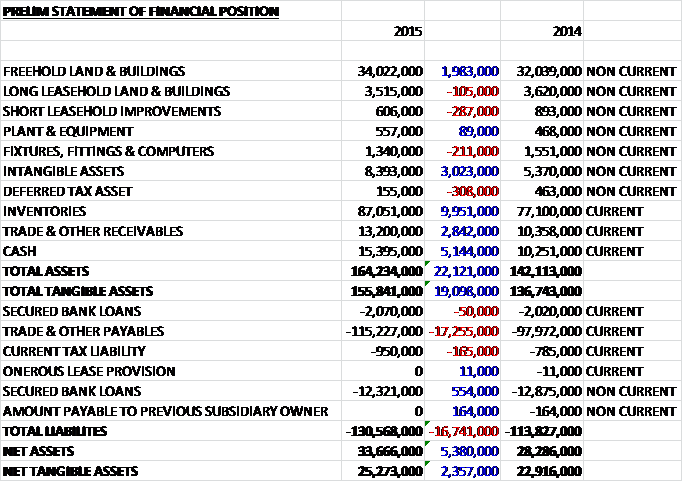
When compared to the end point of last year, total assets increased by £22.1M driven by a £10M growth in inventories, a £5.1M increase in cash, a £3M growth in intangible assets, a £2M increase in freehold land and buildings, and a £2.8M growth in receivables. Total liabilities also increased due to a £17.3M growth in payables. The end result was a net tangible asset level of £25.3M, an increase of £2.4M year on year.

CAMBcash

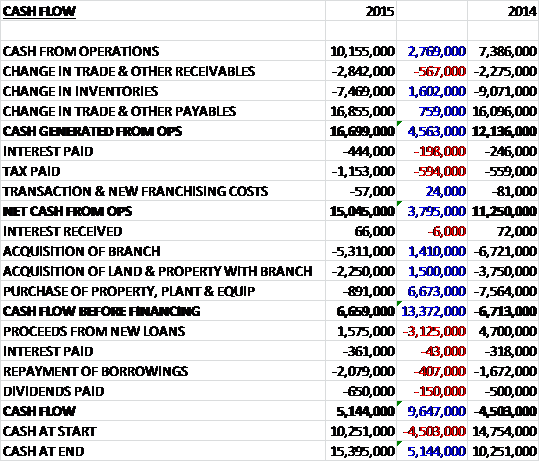
Before movements in working capital, cash profits increased by £2.8M to £10.2M. Due to a large fall in payables, however, which was more than offset by tax and interest, the net cash from operations came in at £15M, a growth of £3.8M year on year. The group then spent £5.3M on new branch acquisitions, £2.3M on land and buildings that came with the acquisitions relating to the Swindon Land Rover acquisition, and £891K on property, plant and equipment to give a cash flow before financing of £6.7M. The group paid back a net £500K of loans and spent £650K on dividends so that the cash flow for the year was £5.1M to give a cash level of £15.4M at the year-end (although obviously this is a bit of a false favourable position given the working capital flows throughout the year).

The gross profit in the new car division was £15.5M, a growth of £3.2M year on year with a 9% increase in new units sold. Excluding the impact of the Barnet and Swindon acquisitions, new sales volumes rose by 1.1% and gross profit was up just £300K. This was delivered in a market that grew 7% but the private registrations element of the market increased by just 4.4%. The industry data indicates that dealer sales are lower than the SMMT registration data which also includes the impact of self-registrations. The group’s sales to private individuals was 9.2% higher and average profit per unit sold was up 12.6% to £1,476. Commercial and fleet vehicles sales by the group increased by 11.6% to 1,090 units and by 0.8% to 605 units respectively and these sales are transacted at lower margins hence the dilutive effect on overall margin.

The gross profit in the used car business was £20.8M, an increase of £1.8M when compared to last year with the sale of 14,945 units representing a 4.4% growth. Like for like volumes were up 1.3% and gross profit increased by £900K on an organic basis. The group is applying consistent controls to the level of used car stock being held, the pricing and presentation of the inventory and the penetration of finance and insurance products to the sale of used cars. The adoption of this trading style has resulted in the average gross profit on each unit retailed increasing by 5.3% to £1,395 per unit. It has also resulted in the concentration on tight management of inventories and an above industry average return on investment.

The gross profit in the aftersales segment was £25.8M, a growth of £1.9M year on year with service and bodyshop hours increasing by 7.8%. The zero to three year car parc continues to be replenished as new car sales increase year on year and this gives the group confidence of further progress in customer retention and the aftersales business remaining strong.

During the year the group purchased a Land Rover dealership in Wootton Bassett from T.H. White for a total cash consideration of £7.6M which included goodwill of £3M. In the year before the acquisition, it is estimated that the branch made a pre-tax profit of £700K with £207K generated for the group during the period since the start of May when it was acquired. The acquisition represents the group’s second Land Rover dealership and is integrating well, performing in line with expectations so far. During the year this business together with the Barnet Land Rover dealership acquired last year, contributed £1.2M to pre-tax profits.

It is the intention to fully re-develop the Swindon Motor Pak location to provide a new JLR facility in line with the new Arch design concept for JLR facilities. It is anticipated that the development will be completed by summer 2017 and the planning process will start imminently. Once the new development is complete, they will relocate the Land Rover business from the existing property in Wootton Bassett and they will then dispose of the Wootton Basset facility. When the Barnet JLR dealership was acquired in 2014 the group committed to develop the freehold site to provide the Arch concept at that location too. Full planning consent has now been obtained and they are in the process of finalising negotiations with contractors for delivery of the site. It is expected that development will start next year with completion in Q1 2017 calendar year.

The group has refinanced its banking facilities with Lloyds. The existing £14.4M of term loans were refinanced into one £15M that has a five year term and a 15 year capital repayment profile. The cost of the facilities is LIBOR plus a margin which is set each quarter and is dependent on the net debt:EBITDA ratio for the group. It can range from 1.2% where the net debt is less than one times EBITDA, and 2% where the net debt is greater than 2.5 times EBITDA. The group has also arranged two further revolving credit facilities. The first is a five year £15M facility available for the acquisition of businesses and property, the second is a five year property development facility to be used against the Barnet and Swindon properties. The maximum drawdown against this facility is £7M, and it is intended that once the developments are complete, the facility will be converted to a standard amortising term facility.

Since the industry lows experienced in Q4 2011, the UK market has enjoyed 43 consecutive months of year on year growth in new car registrations to September 2015. The situation plateaued in October but the market is expected to reach a record high in 2015 at over 2.6M new car registrations. The group believe that the new car market will remain robust but they do not expect year on year growth in new car registrations to continue when the market reaches its natural mid-cycle level, which is thought to be around now. The UK remains an attractive place for the vehicle manufactures to register and sell cars given the overall recovery of the economy and the exchange rate benefit that the manufacturers receive as sterling remains strong.

As a result of these exchange rate benefits and the ongoing low interest rate environment, vehicle manufacturers continue to deliver strong consumer offers, which represent attractive propositions for the group’s customers to acquire new cars. The level of cars sold on Personal Contract Purchase related products has increased significantly over the past four years. As a result of the increased presentation of the PCP offers, there is a natural change cycle where a customer is more likely to change a car for another new one during the term of the PCP product. A larger portion of cars sold on PCP gives greater control of the customer’s change cycle and creates an opportunity for the company to engage with them.

After the year-end, the growth momentum has continued in the first two months of the year with results substantially ahead of the comparable period this year and tracking ahead of current market expectations, and the board believe they are well placed to continue their growth in the year as a whole. The group are continuing to look for new acquisition targets.

At the current share price the shares trade on a PE ratio of 11.9 which fall to 10.1 on next year’s consensus forecast. After a 25% increase in the total dividend, the shares are now yielding 1% which increases to 1.3% on next year’s forecast. The net cash level currently stands at £1M compared to a net debt position of £4.6M at the end point of last year, although there is a considerable amount of leaseholds outstanding.

Overall then this has been a good year for the group. Profits increased, net assets grew and operating cash flow was up with a decent amount of free cash being generated. The organic new car sales growth seems to be rather lacklustre, though, but this is apparently explained by the official figures including self-registrations. Both used car sales and after sales profits showed good growth too as the strong new car sales of recent years filter through to these markets. As long as Sterling remains strong (one of the few businesses where Sterling strength is a bonus) the UK is likely to be continued to be targeted by car manufacturers but the board now see the market as being mid-cycle so the continued year on year increases are likely to plateau.

It is worth noting that the group will be sinking quite a lot of cash into the JLR refurbishments so I would like to see a prudent acquisition strategy given this and the fact that when the market does turn then car dealerships tend to get hit hard and if CAMB were carrying a lot of debt at that point, they would be in trouble. The dividend yield of 1.3% is nothing to write home about but the forward PE ratio of 10.1 seems to factor in the cyclical nature of the company and the shares still look fairly good value to me – I will continue to hold.

On the 11th January the group announced an acquisition and a disposal. They acquired the Land Rover Franchise in Welwyn Garden City from Jardine Motors for a cash consideration of £10.8M which brings the number of Land Rover franchise under the Grange trading name to three. This acquisition generated £10M of goodwill and is being funded from the newly refinanced banking facilities. It is estimated that the dealership generated a pre-tax profit of £2.5M last year and it is anticipated that it will be earnings enhancing from H2 of this year.

The group disposed of its Grange Jaguar franchise in Exeter to Helston Garages for £1.3M which generated £1.2M in goodwill. The group is also closing its Aston Martin boutique located in the same premises which is apparently in line with the Aston Martin franchise network restructuring strategy and Cambria expect to add another Aston Martin franchise to the portfolio in the short to medium term. The disposed businesses made a profit contribution of £500K to the group last year.

The disposal is in line with the compliance guidelines from JLR which states that both Jaguar and Land Rover brands should be represented by the same dealer in a given franchise territory. The acquisition here certainly looks decent but in my view the disposal seems to have been sold off a bit cheaply. Nonetheless, these transactions seem to have been a net gain for the group.

On the 14th January the group released a trading update. They maintained the momentum achieved over the last year and the trading performance in the first four months of this year has been substantially ahead of 2015 in a backdrop of a record new car market where the market has seen year on year growth in registrations in all but one of the last 46 months, although the rate of growth is slowing. Trading during the period has also been substantially ahead on a like for like basis.

New vehicle unit sales were up 4% but down 1.2% on a like for like basis with gross profit per unit improving. Used vehicle sales performed better with total unit sales up 4.7% and like for like up 2.9% with gross profit per unit improving here too which has significantly enhanced the profit derived from the used car segment of the business. Growth in aftersales has also continued with profitability up 3.1% but flat on a like for like basis.

The Swindon Land Rover business acquired in April has continued to perform in line with expectations. Overall, the board expect the results for the first half of the year to be significantly ahead of last year and in line with recently upgraded (following the acquisition) market expectations. This is all pretty good stuff.

On the 7th March the group released a trading update covering the first five months of the year. They stated that trading was substantially ahead of the same period last year on both a total and like for like basis.

New vehicle unit sales were up 3.8% but down 1.2% on a like for like basis with gross profit per unit improving. Used vehicle sales performed better with unit sales up 4.3% with a 2.3% increase on a like for like basis with gross profit per unit also increasing which enhances the profit derived from the used car segment of the business. Growth in aftersales operations also continued, with profitability up 4.1% with like for like profits flat.

The Swindon Land Rover business that was acquired in April has continued to perform in line with expectations and the new Welwyn Garden City Land Rover dealership, acquired in January, is integrating to plan and will be earnings enhancing in the second half of the year. After the first week of the important March trading period, the new car order book is building well and the board expects the group to deliver another strong trading performance in the month as a whole.

Overall, this seems like an OK update and the group is still growing with increases in gross profit per unit but the increase in sales seems to be coming entirely from acquisitions with like for like sales broadly flat.

Telecom Plus Share Blog – Interim Results Year Ending 2016

Telecom Plus has now released its interim results for the year ending 2016.

TEPinterimincome

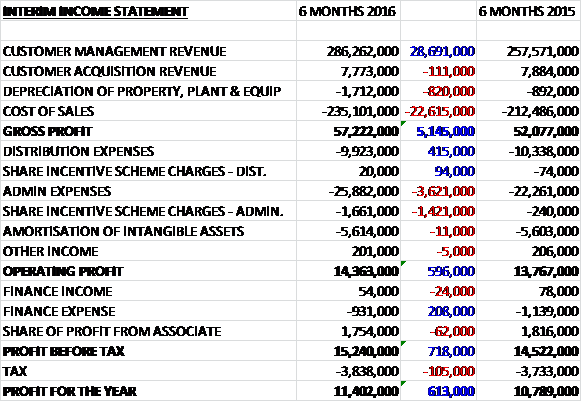
Revenues increased by £28.8M when compared to the first half of last year and after an increase in depreciation and cost of sales, the gross profit grew by £5.1M. Distribution expenses actually fell as a result of a reduction in promotional spend but share based payments grew by £1.5M and other admin expenses were up £3.6M, due to growth in the number of services being provided and higher occupancy costs following the move to the larger HQ, so that operating profit was up £596K. After a decrease in finance expenses, a fall in the profit from the associate and a modestly higher tax cost, the profit for the six month period came in at £11.4M, an increase of £613K year on year.

TEFassets

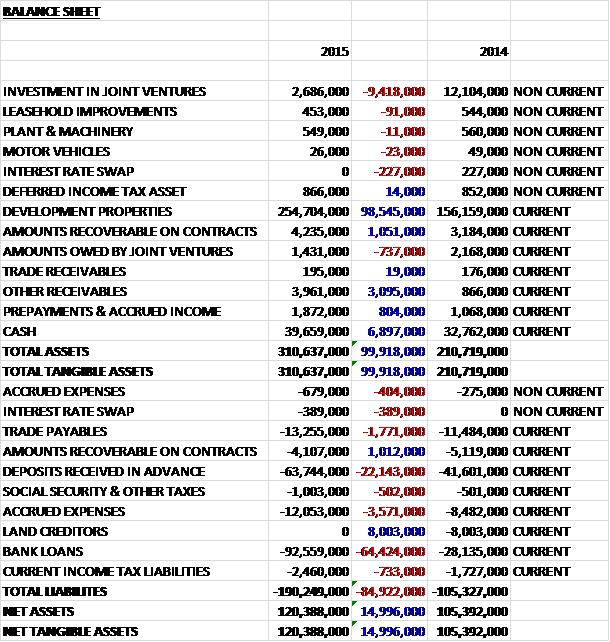
When compared to the end point of last year, total assets fell by £45.4M driven by a £40.1M decline in prepayments and deferred income, an £8.9M decrease in property, plant & equipment, a £5.6M fall in other intangible assets, a £3.9M decline in receivables, and a £3.7M decrease in the value of the investment in the associate, partially offset by a £9.4M growth in the investment property (transferred from PP&E) and a £7M increase in cash. Total liabilities also declined during the period due to a £39.4M fall in accrued expenses and deferred income and a £2.9M decrease in payables. The end result is a net tangible asset level of -£15.7M, a positive movement of £1.3M during the period.

TEPinterimcash

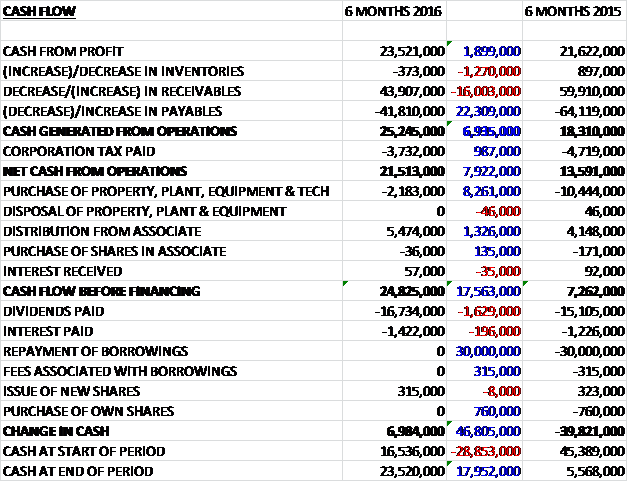
Before movements in working capital, cash profits increased by £1.9M. A large fall in receivables was not quite entirely offset by a large growth in payables and after a lower tax payment, the net cash from operations was £21.5M, an increase of £7.9M year on year. The group did not spend much on capital expenditure, just £2.2M and after the £5.5M distribution from the associate and the interest was paid, the free cash flow was £23.4M, of which £16.7M was spent on dividends to give a cash level of £23.5M at the period-end.

Customer Management profit fell by £85K year on year whilst the losses in Customer Acquisition fell by £681K. Opus continued to make progress in building market share with the number of electricity and gas sites they supply growing to 206,679 and 39,372 respectively which represents a combined increase of 19.7% on the previous year but in spite of this growth, profits are expected to be slightly below last year due to the announcement in the July budget of the removal of the exemption from Climate Change Levy of business customers supplied with European renewable power.

The increase in revenue reflects the growth the group have seen in the size of the customer base over the past year, and seasonally normal weather during the first half of the year compared with an unusually warm spring and summer last year, partially offset by the modest industry-wide reductions to domestic gas prices which took place earlier in the year. The number of customers and services increased by 13,585 and 53,488 respectively which represents quite a slow down when compared to the first half of last year but over half of them applied for at least four services.

There is continuing highly competitive market conditions with both smaller independent energy suppliers and various members of the “big six” continuing to offer heavily discounted short-term fixed price tariffs to attract new customers through price comparison sites and via collective switching initiatives. In the broadband markets, all the major telecoms companies continue to offer free and discounted broadband services for extended periods in order to attract new customers, together with other incentives such as shopping vouchers. These are largely funded by charging more to their existing customers. Telecom Plus no longer offers promotional incentives to new members which, although causes a slow-down in customer acquisition, means that there is lower churn and longer average customer lifetimes and both delinquency levels and bad debt continued to fall.

Around 600-800 new sales partners join a month but these were outweighed by the number of inactive partners who allowed their positions to lapse which resulted in a small reduction in the overall number of registered partners.
The group are looking into expanding into insurance. The current intention is that any such insurance products would form part of the single monthly bill that is already being sent to each customer, and that the group would be acting a broker rather than Principal in relation to these services. Other major areas into which they have considered extending into include TV and water. In relation to the TV market, they have so far been unable to identify a way of entering this space that will earn a satisfactory return for shareholders. In relation to the water supply market, in 2017 there are moves underway to require regional monopoly providers to hive-off their supply business into separate companies. The group will be investigating the feasibility of including the supply of water as an additional core service.

Although wholesale energy prices have fallen considerably over the last two years, little of this reduction has yet been reflected in the standard variable tariffs paid by the vast majority of consumers (and which the group’s purchase price is based on). This is because other suppliers are choosing to re-invest the benefit of these lower commodity costs in creating increasingly attractive short term deals in order to attract new customers.

The CMA enquiry into the energy market published their provisional findings in July, which generated a higher level of responses from interested parties than anticipated. This has delayed the expected publication of their provisional decision on remedies until early 2016, with their final report not now expected until April of that year. They have announced they are considering a number of solutions, including relaxing the current rules that restrict each supplier to just four tariffs, the introduction of a new safeguard tariff, and possible changes to how customers are treated when they reach the end of a fixed term tariff.

In October the group launched “Project Daffodil” where they supply and fit LED light bulbs throughout customer homes free of charge which is expected to reduce their consumption by over 10%. This service will be available to customers who switch all their services to the group. The initial feedback has been encouraging with a significant improvement in the quality of new members joining the business over the past six weeks and has resulted in the proportion of new customers taking all five services increasing from 30% to 45%. It is anticipated that as the sales team become more adept at identifying potential new customers able to take advantage of this benefit, and the number of households who have their free LED light bulbs installed increases, the annualised growth will start to return towards the rates they have historically achieved.

Obviously this initiative will lead to higher customer acquisition costs, these will be partially offset by the higher quality and quantity of new customers signing up. The board remain confident that profit for the current year will be ahead of last year in line with previous guidance.

Clearly one major potential risk to the company is legislative and regulatory risk. Proposed changes such as the new requirements in relation to smart energy meters, social tariffs and changes to the current decommissioning regime could all have a potentially significant impact on the sector, although any additional costs associated with smart metering are not expected to affect the net margins earned by energy companies in the longer term as they are likely to be reflected in higher retail charges. Another topical issue is that of data security risk. A significant breach of cyber security could result in the group facing regulatory fines, loss of commercially sensitive information and damage to its brand. The group continually reviews its approach to cyber security and adopts a multi-layered approach to defence including, high specification firewalls, anti-viral management systems, vulnerability scanning, and third party penetration testing on the group’s IT infrastructure.

During the period the company moved into newly refurbished head offices at Merit House and the former head office building, Southon House, was vacated. Southon House is therefore now held as an investment property and after an independent valuation of the building the value was determined to be £10.2M.

After a 15.8% increase in the interim dividend, at the current share price the shares are yielding 4% which increases to 4.3% on the full year forecast. The net debt fell by £6.8M to £67.2M.

Overall then this was a fairly solid set of results. Profits were up and the net tangible asset position improved despite remaining negative. Operating cash flow also grew and plenty of free cash was generated, although it should be remembered that there is a £21.5M deferred consideration to pay next year. The profits at Opus declined somewhat, however, due to the removal of climate change exemption for businesses supplied with renewable energy. Profits in the core business grew slightly as more favourable weather was experienced but the number of new customers slowed due to the fact that TEP don’t offer discounted introductory deals unlike most of the other energy companies.

The addition of insurance and water could be growth drivers but it doesn’t look as though they will be added in the near future. The CMA enquiry could also be another source of growth for the group depending on its findings, although this now not due until April 2016 and project daffodil sounds really interesting – costs will rise in the short term but this could be a real boost to the number of customers taking all the services offered by the group. Overall profits are still expected to be in line with forecasts and with a 4.3% dividend yield these shares are looking rather interesting to me.

On the 19th April the group released a trading update covering 2016. Notwithstanding the challenges posed by continued falling energy prices, the board are confident of reporting adjusted pre-tax profits of at least £54M, in line with previous guidance. Cash flow remains strong, in line with management expectations and they have taken the opportunity to refinance on more favourable terms.

There has been organic growth of 4.2% in service numbers over the past year taking the number of services supplied to 2,181,704. Whilst this growth was below the level originally anticipated, it has been achieved against a background of a rising gap between standard variable energy tariffs and the cheapest fixed term introductory deals available over the year. This was caused by a number of factors including further deflation in wholesale commodity prices, rising policy costs (including smart meters) and increasingly aggressive collective switching initiatives. Over the last few weeks this gap has narrowed slightly, following recent industry-wide price reductions to standard variable tariffs.

Profit Daffodil, the new benefit announced of supplying and fitting low-energy LED light bulbs free of charge for Double Gold members, is gathering momentum with over 300,000 bulbs already installed. The proportion of new members who have switched all their services to the group is now running at over 50% and if this trend continues, the board expect it to deliver a modest increase in their service growth rate over the course of the coming year.

In line with previous guidance the company intends to pay a total dividend of 46p, an increase of 15% year on year and representing a yield of 5.3%.

Following the CMA’s investigation into the energy industry, they have drawn up draft proposals to remove the current restrictions on discounts, bundling and the number of tariffs each supplier can offer. This will significantly increase the group’s flexibility to offer an attractive choice of packages as they expand their existing range of services in the future. The board were disappointed that they did not propose more radical initiatives to address the widespread practice of offering new customers attractive introductory deals at the expense of the rest of the customer base, however.

The group have a clear strategy to deliver continued high quality growth, albeit at modest levels for as long as the current headwinds continue. Over the course of the new year, the board anticipate that all the key operational and financial metrics for the business will continue to show further progress.

Paypoint Share Blog – Interim Results Year Ending 2016

Paypoint has now released its interim results for the year ending 2016.

PAYinterimincome

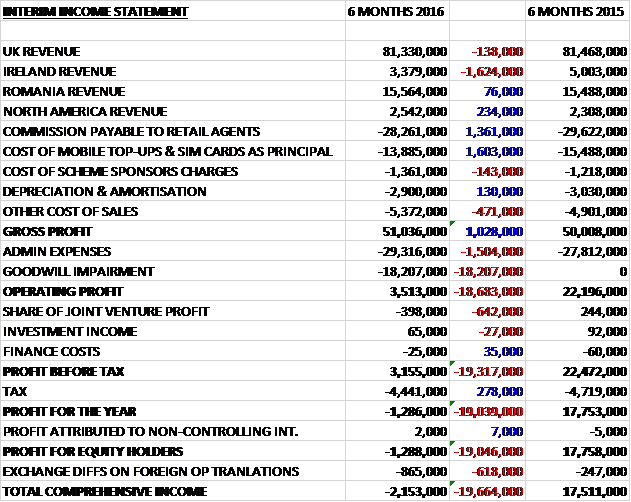
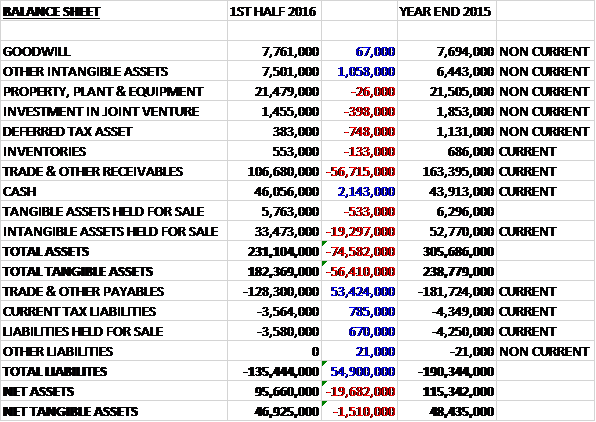
Revenues fell when compared to the first half of last year as a £76K growth in Romania revenue and a £234K increase in North America revenue was more than offset by a £1.6M decline in Ireland revenue and a £138K decrease in UK revenue. The commission payable to retail agents fell by £1.4M as the group has adjusted the share of commission with its retailers in response to competitor rates, and the cost of mobile top-ups and sim cards declined by £1.6M which meant that gross profit was £1M above that of last time.

Admin expenses grew by £1.5M though, due to £700K of restructuring and legal costs related to the sale of the Mobile and Online Payments businesses and the HMRC ruling which increased irrecoverable VAT which accounted for £1M (the rate of increase in admin expenses is expected to slow in the second half of the year), and after the £18.2M goodwill impairment, the operating profit was £18.7M lower. There was a loss from the joint venture, a negative swing of £642K but tax fell which meant that the loss for the first half of the year came in at £1.3M, an adverse movement of £19M year on year (including the £18.2M goodwill impairment).

PAYinterimassets


When compared to the end point of last year, total assets fell by £74.6M driven by a £56.7M decline in receivables and a £19.3M decrease in intangible assets held for sale, partially offset by a £2.1M growth in cash and a £1.1M increase in other tangible assets. Total labilities also declined during the period due to a £53.4M fall in payables. The end result is a net tangible asset level of £46.9M, a decrease of £1.5M over the past six months.

PAYinterimcash

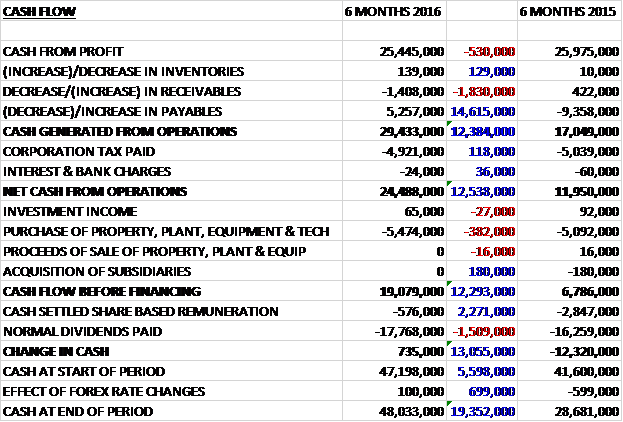
Before movements in working capital, cash profits fell by £530K to £25.4M. An increase in payables compared to a large decrease in the first half of last year meant that net cash from operations came in at £24.5M, a growth of £12.5M year on year after a tax payment of £4.9M. The group spent £5.5M on property, plant and equipment relating to IT infrastructure, development for new products, terminals, ATMs and prepaid energy card and key readers for the software version of the terminal that can be loaded onto retail till systems, to record a free cash flow of £18.5M (after we include the share based remuneration). This was mostly spent on dividends which meant that the cash flow for the six month period was £735K and the cash level of the period-end was a hefty £48M.

Overall results for the first half were in line with management expectations with operating profits decreasing by 5% due to investment in the Mobile business and lower revenues in Online Payments. The retail networks produced net revenue growth of 3.5%. In the UK there were 1.2% fewer prepaid energy transactions than last year and in particular the number of prepay electricity transactions was lower as consumer demand appears to have reduced. In Romania, bill payment transactions have grown 15.6%, as the group continued to add new clients and increased their market share. Retail services transaction growth was 21.2% and net revenues were up 16.2% to £15.1M. In the UK, mobile top-up transaction volumes have continued to decline, whereas in Romania the volume of transactions has increased.

Bill and general transactions were ahead of the same period of last year as a result of a 15.6% increase in Romanian bill payment transactions. UK and Irish bill and general transactions were down 1% on last year due to lower transactions in prepaid electricity. An apparent decrease in consumption together with the effect of higher average transaction values exceeded the impact from meter growth. Although not material to these results, the multi-channel payment solution continues to grow strongly and sales to a further five clients have been agreed, including the first big six client, and it is attracting interest from other sectors. The strong growth in Romania, where the group processed 29.1M transactions, was the result of increasing market share to 21.3% from 18.8% and the addition of new clients. Growth in net revenue of 1.2% to £26.2M slightly exceed that of revenue, helped by changes to the retail terms made in response to competitor rates.

Top up transactions decreased from last year as a result of the continued decline in mobile top-up volumes in the UK and Ireland of 13.8%. This fall was only partly offset by an increase in other top-up transactions and Romanian mobile top-ups. The reduction in top-up transaction value was lower than that of transaction numbers as the average value of mobile top-ups increased which helped mitigate the reduction in net revenue to a 5.2% fall to £11.1M, as did the increase in other top-ups.

Retail services transaction volume has increased across all products. ATM transactions increased by 27%, credit and debit transactions by 19.2%, money transfer transactions by 7.2%, SIM cards by 45% and parcels by 18.1% over the same period last year. A higher average credit and debit transaction value and money transfer transaction value has driven an increase in total transaction value in excess of transaction volume. Strong net revenue growth of 16.2% to £15.1M was driven by increases in parcels, ATM transactions, credit and debit, and income from broadband enabling faster terminal transactions.

Collect+ is the market leading third party click and collect service and its parcel returns activity also continues to grow strongly with transactions up 18.1% to 9.9M. Within the consumer send market, there continues to be substantial price competition and consequently the management team has focused on developing click and collect along with returns. The group continue to discuss with Yodel the future of the joint venture and the proposed increases in charges put forward by them. A portion of these charges have been allowed pending the outcome of these discussions which has caused an adverse impact on profitability with losses of £797K recorded compared to a profit of £487K last time. They expect to be able to report on the conclusion of these discussions by the time of the full year results announcement.

In Mobile and Online, transactions increased by 22.2% with payment transactions of 62.3M up 22.7% and parking transactions of 23.6M up 20.9%. Parking transaction growth was driven predominantly by the continued increase in consumer adoption in existing clients and the full roll out of parking payment services in Paris. The increase in online payment transactions stemmed from existing merchants. Net revenues decreased by 5.7% to £7M reflecting a decline in payment revenues due to larger merchants benefiting from lower pricing on core payment processing transactions, offset by strong growth in the mobile business in North America.

The business has continued to add parking contracts with councils and parking authorities as they provide them with a more cost effective method for collecting parking charges. It has fully rolled out the parking payment services in Paris during the period, a contract has been signed to service a number of London Underground car parks as part of a TFL initiative and during the period, Brighton local authority ended its use of parking meters.

In online payments an increasing number of clients are processing on the new Advanced Payments platform and the sales of the two new licensed products, Cashier and Cardlock have started to accelerate. Cashier enables merchants to offer a customised payment experience for their online or mobile customers and also has a built in capability to allow customers to store multiple cards whilst Cardlock removes card data from client websites as soon as it has been entered, securing it remotely in Paypoint systems. A further two products have been launched during the period. Mobile SDK makes it easier for a merchant to provide an improved payment experience in an app and Fraudguard5 is an enhanced version of the successful Fraud Management product which introduces new analytical capabilities.

Terminal sites overall have increased by 848 to 38,389 since the end of last year. The group continue to roll out their PPoS integrated solution to retailers which combines a virtual terminal with a plug in reader, to provide their service at lower cost. As well as enhancing service to retailers, this allows the group to redeploy the old terminals for use in Romania. In addition to the 7,717 PPoS solutions, there were 11,627 broadband enabled terminals at the period-end. In Romania, they increased their sites by 224 to 9,458 over the same period but the number of internet merchants fell by 645 largely through churn of low volume merchants. The number of sites offering the Collect+ parcels service increased by just 64 to 5,895, constrained during the discussion of Yodel’s proposed increase in charges to the joint venture.

The group have developed a multi-channel product in UK retail, aimed at addressing the payment challenges faced by utilities as a result of the government mandated change to smart meters by 2020, which builds on the existing online payment solutions for prepaid meters. This product has already been sold to six clients in the energy sector including the first big six energy client and has attracted interest from other sectors, including housing.
The group have made progress with the sale of Mobile, which is expected to complete before the end of the year but offers made for Online Payments are disappointing, reflecting the potential buyer’s uncertainty of the business’ success with new products which are at an early stage of their lifecycle. In view of the uncertainty of the eventual outcome, management have recorded an impairment of all the goodwill in the Online Payments business of £18.2M – it looks like they overpaid for that one then!

So far in the second half of the year, trading has been in line with management expectations and after a 14.5% increase in the interim dividend, at the current share price the shares are yielding 4.3%.
Overall then, this was a bit of a disappointing set of results in my view. Profits declined slightly if we ignore the goodwill impairment which seems to have been due to higher irrecoverable VAT and some restructuring costs, net assets declined and although operating cash flow was up, this was only due to an increase in payables and cash profits decreased year on year. The group is still very cash generative though and produced a lot of free cash – enough to cover the dividend.

There was a good performance in retail services with particularly strong growth in parcels, ATM transactions and credit and debit card services; while there was also a modest improvement in bill and general transactions due to growth in Romania partially offset by a decline in UK electricity prepayments. Top-ups continued to struggle due to the structural decline in UK prepay mobile phone top ups, mobile and online saw net revenues decline due to larger merchants getting lower prices, and Collect+ is starting to struggle due to the higher charges levied by Yodel – it appears they are trying to push through even greater charges in future too.

The sale of the mobile business should take place in the second half of the year that should bring in even more cash but it looks like they are struggling to find a buyer for the online payments business which is disappointing. The dividend yield here is pretty good, at 4.3% and covered well enough but the growth here does seem rather lacklustre.

On the 8th January the group announced the sale of its Online Payment businesses comprising Paypoint.net and Metacharge to Capita for a consideration of £14M satisfied in cash. They will update on the sale of the Mobile Payments business in due course.

On the 28th January the group released an interim statement covering Q3. Retail services have grown strongly, the new terminal is in pilot in the UK and they have made good progress in developing their core epos software. Since the end of the quarter, they have also completed the sale of their online payments business. This progress has been partially offset by the unseasonably warm weather, however, which has impacted on energy consumption, and an extension of the additional costs in Collect+ along with a delay in the sale of the mobile payments business. The board aim to resolve the Collect+ JV agreements and complete the sale of their mobile payments business by the year-end.

Net revenues in Q3 were up 1.8% to £35M year on year. There was strong growth in retail services of 22.7% and mobile & online of 9.6%, offset by a 13.7% decline in top-ups and a 2.4% fall in bill & general, the latter mainly due to lower energy consumption. The previously reported adverse VAT ruling from HMRC and the warm weather has slowed improvement in the results.

In UK and Ireland retail, retail service transactions were up 14.3% but bill and general transactions were down 8.1%. Mobile top-ups continued to decrease as the prepaid mobile sector declined, partially offset by an increase in other top-ups. Retail sites in the region increased by 113 in the quarter to 29,044. In Romania, profitable growth continued. The group processed 15.3M bill payments in the period, up 11%. Top-ups increased by 6.2% and retail services by over 50%. They increased their terminal estate by 307 sites in the quarter to 9,765 and continued to add new clients.

At Collect+, volumes increased by 5% to over 6M transactions in the period with a record Christmas week of 638K transactions. The network continued to expand with an increase of 75 sites to 5,970 in the quarter. Discussions are ongoing with Yodel regarding the future of the joint venture and the proposed increase in charges put forward by Yodel. Some of these charges have been allowed pending the outcome of negotiations which has resulted in the joint venture generating a small loss.

In Mobile and Online, transactions increased by 37.6% to 50.2M with mobile payment transactions up 38% to 13.3M and online payment transactions up 37% to 36.9M. The online payments business was sold to Capita after the end of the period for £14.4M and they have continued to progress the sale of the mobile business.

Overall then, this is a bit of a disappointing. Whilst the group can’t be blamed for the warm weather, the continued decline of mobile top-ups is disappointing and it would be useful to know how much further this has to fall and how much profit that part of the business contributes. The Collect+ joint venture also seems to be an ongoing problem and has become a drag on the business. Aside from Romania and other geographical expansion it is difficult to understand where any further growth will come from but at the current share price this seems like an interesting value play and I am keeping it on alert.

On the 29 January it was announced that director Nicholas Wiles purchased 10,000 shares at a value of just under £80K to give him a holding of 35,000 so it seems he sees some value here too.

On the 4th February the group announced that non-executive director Steve Rowley stepped down from the board with immediate effect having spent the last seven and a half years in the role.

On the 5th February the group announced that director Giles Kerr purchased 7,500 shares at a value of just over £58K. This represents his maiden share purchase.

Tangent Communications Share Blog – Interim Results Year Ending 2016

Tangent Communications has now released its interim results for the year ending 2016.

TNGinterimincome

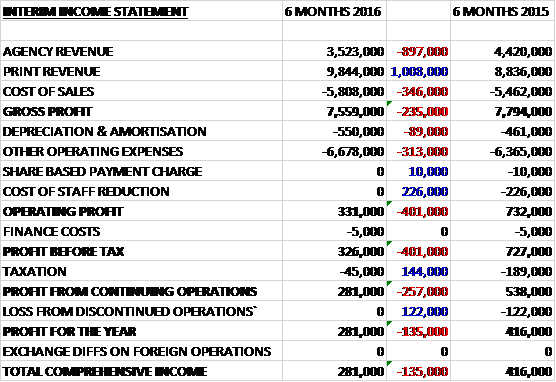
Revenues increased when compared to the first half of last year as an £897K decline in agency revenue was more than offset by a £1M growth in print revenue. Cost of sales also increased, however, to give a gross profit some £235K down. Depreciation and amortisation increased by £89K and other operating expenses increased by £313K but the lack of the £226K charge for staff redundancies that occurred last time offset this somewhat so that after a £144K reduction in tax and the elimination of the £122K loss from discontinued operations, the profit for the six months came in at £281K, a fall of £135K year on year.

TNGinterimassets

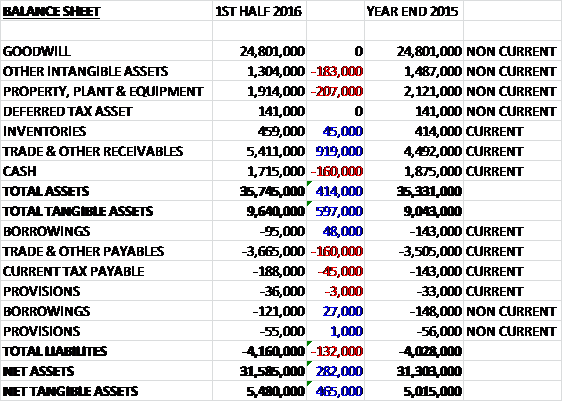
When compared to the end point of last year, total assets increased by £414K driven by a £919K growth in receivables partially offset by a £207K fall in property, plant and equipment along with a £183K decline in intangible assets. Total liabilities also increased during the period as a £160K growth in payables was only partially offset by a £75K fall in borrowings. The end result is a net tangible asset level of £5.5M, an increase of £465K over the past six months.

TNGinterimcash

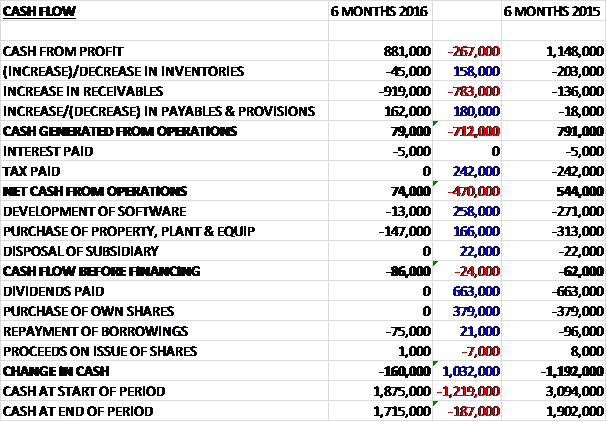
Before movements in working capital, cash profits fell by £267K to £881K. A large increase in receivables due to a spike in revenues in July and a subsequent poor cash collection period (which has now returned to normal), partially offset by no tax being paid, gave a net cash from operations of just £74K, a decline of £470K year on year. The group then spent £147K on property, plant and equipment relating to £68K spent on additions to plant, equipment and computers and a further £27K on improvements to leasehold property, and £52K spent on fixtures and fittings along with £13K on software development so that before financing there was an £86K cash outflow. There was then a £75K repayment of borrowings to give a cash outflow of £160K for the first half of the year and a cash level of £1.7M at the period-end. The group expect to be cash generative in the second half of the year.

The operating profit at the Agency business was £457K, a growth of £263K year on year on sales that were flat. The group downsized Tangent Snowball in Q2 in response to the poor new business pipeline mentioned in the last update. This pipeline has not yet improved but sales to existing clients have been better than expected so the business remained on budget during the first half of the year. The success of some of their contracts represents an opportunity to build upon, although the second half of the year remains more challenging.

The operating profit at the Print business was £47K, a collapse of £951K when compared to the first half of last year on sales that were up 1%. Sales through the printed.com website increased by 17% due to the integration of Goodprint customers and products which was completed and business cards are now the biggest selling product in this division. There has also been an increase in sales of products that are manufactured externally which enables the group to compete with new entrants to the market.

Previously printed.com had manufactured all its products in-house but they have begun to build partnerships with third party printers allowing them to expand into areas of the market in which they had not previously competed. As a consequence, they have felt some pressure on operating margin which they expect to impact performance in the second half of the year. There is growth in online print purchasing but there is similarly a growing numbers of online suppliers of print and pricing is becoming ever more visible which leads to competition increases.

Ravensworth services had a difficult period. After a strong period for residential property transactions in 2013 and early 2014, the market slowed markedly. These muted market conditions have persisted through the first half of this year and continue into the second half. There has also been a slower than expected take up of data, digital marketing and photo products which the business aims to upsell to their customer base alongside their print and design offer. T/OD performance has been comparable to the prior year. Advertising agencies continue to outsource their print production projects, providing a niche market that the business is well located to serve.

Ominously the group mentions a full review of their intangible assets at the year-end so I think it likely that we might see some impairments after that. I have noticed that the group sells goods and services to Nails Inc, a company that Michael Green has an interest in. During the period they sold £109K to them and there was £165K owed to Tangent from Nails Inc. These figures aren’t huge but it seems to me that Nail Inc. are a bit late on their payments which is perhaps something to keep an eye on?

At the end of the half the group had a net cash position of £1.5M compared to £1.6M at the end point of last year. Overall the board expect to end the year in line with its current expectations.

Overall then, this has been a fairly difficult period for the group. Profits were down, as was operating cash flow with no free cash generated. The net assets did improve, however, and they seem to have a pretty strong balance sheet. The performance in the Agency business was a bit better than I was expecting, it seems due to sales of existing customers, but they really need to start generating some new business. The print division really suffered during the period, however, it seems mainly due to increasing competition in the online print space and the poor performance of the estate agency business due to low property transactions.

So, this is an interesting one. The print business seems to be pretty doomed as it is in the commodity side of things with huge amounts of cheap competition but there is obviously something worthwhile at the agency side of things with current clients using the company more often – if (and this is a big “if”), they can win some new substantial business, improve the estate agency offering and perhaps get rid of the print business, the strong asset backing and net cash should be enough to see them through to profitable growth. I am not rushing to own the shares, but perhaps one to watch in my view?

On the 23rd December the group announced that non-executive director David Steyn resigned from his role. He has recently been appointed CEO and Chairman of Robeco Group so this is fair enough.

On the 10th February the group announced that an entity owned by Chairman Michael Green was making a bid for the company. Under the terms of the offer, shareholders are being offered 2.25p per share which represents a 63.6% premium on yesterday’s closing price and value the company at £6.7M. He has received irrevocable commitments from shareholders representing 55.5% of the total share capital.

I suppose this makes sense given the size of the company but I am sure some long-term shareholders will be very unhappy at this opportunistic bid by the management team here given their destruction of value of the past couple of years.

Creston Share Blog – Interim Results Year Ending 2016

Creston has now released its interim results for the year ending 2016.

CREinterim16

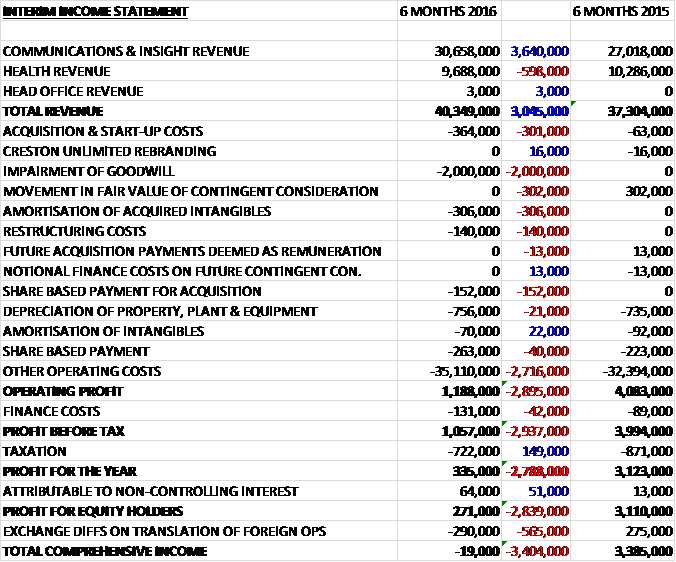
Revenues increased when compared to the first half of last year as a £598K decline in health revenue was more than offset by a £3.6M growth in communications and insight revenue. “Underlying” operating costs increased by some £2.7M and we also see various other costs including acquisition costs, amortisation of acquired intangibles and the lack of a reduction in contingent consideration that occurred in the first half of last year. The largest cost though is a £2M impairment of goodwill so that the operating profit came in £2.9M lower. A small increase in finance costs was offset by a fall in taxation and the profit for the period attributed to shareholders was £271K, a decline of £2.8M year on year.

CREinterimassets

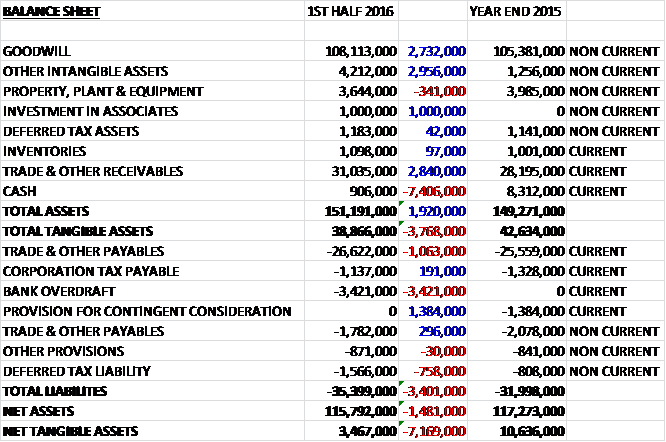
When compared to the end point of last year, total assets increased by £1.9M driven by a £3M growth in intangible assets, a £2.8M increase in receivables, a £2.7M growth in goodwill and a £1M investment in an associate, partially offset by a £7.4M fall in cash. Total liabilities also increased during the period as a £3.4M growth in the bank overdraft, a £1.1M increase in payables and a £758K growth in the deferred tax liability was partially offset by a £1.4M fall in deferred consideration. The end result is a net tangible asset level of £3.5M, a decline of £7.2M over the past six months.

CREinterimcash

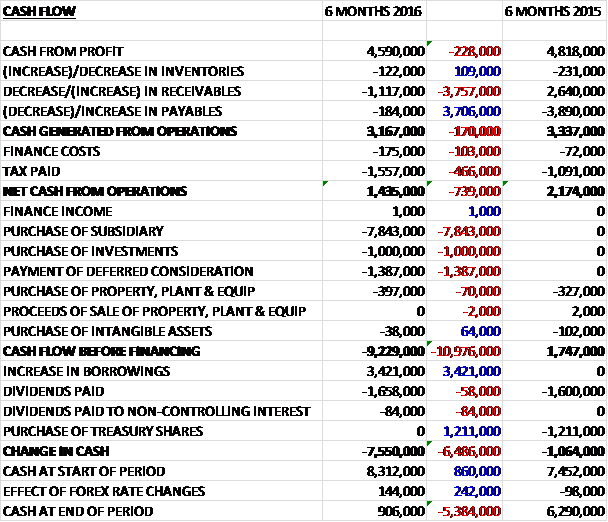
Before movements in working capital, cash profits fell by £228K to £4.6M. A cash outflow from working capital, in particular an increase in receivables, along with higher tax and interest paid meant that the net cash from operations was just £1.4M, a decline of £739K year on year. The group then spent £397K on property, plant and equipment along with £38K on intangible assets but they also spent £7.8M on an acquisition, £1M on an investment and £1.4M in deferred consideration so the cash outflow before financing came in at £9.2M. A £3.4M increase in borrowings helped a bit but there was still a £7.6M cash outflow during the period to give a cash level of just £906K at the end of the first half.

The Unlimited strategy continues to increase inter-agency and partner cross-referrals and results in a growing number of invitations to pitch for multi-discipline and international accounts. In terms of new business the group has added a mix of new clients and brands such as Logitech and Costa, and assignments from existing clients such as Canon, Danone and Diageo with many of the wins involving two or more of the businesses under the new Unlimited proposition. The new business wins are continuing into the second half of the year including their win of the Vodafone Customer Value marketing account, their appointments as both Sony Mobile and McLaren’s global lead digital strategy agency and most recently the appointment as British Airways’ CRM and data strategy adviser.

Following the lacklustre first half, the board are budgeting for improved growth in the second half. The factors behind the slow growth in the first half were weaker trading by a small number of their larger retail and consumer tech clients causing budget cuts; an adverse financial impact of about £400K attributed to the weakening Euro on the Euro-based revenue contracts which have grown during the period; and a slower performance in the UK health advertising offer, predominantly due to the healthcare industry’s growing need for integrated channel neutral and more patient centric campaigns. As a consequence of this third factor, the group took the decision to combine the offers of DJM and PAN to create a multi-channel agency.

The “underlying” profit in the Communications and Insight division was £4M, an increase of £800K year on year although it seems that £700K of this growth has come from the How Splendid acquisition with a 4% growth in like for like sales. There have been two major product launches during the period. Reflected Life allows the group to measure, track and understand a consumer’s digital behaviour and experience across multiple devices, providing insight that helps their clients to influence future behaviours. The Real Adventure Unlimited has launched Real Data, a new data offering strengthening their data capabilities by using their insight data and analytical innovations.

Significant new business wins during the period included work for Emmi Caffe Latte, referred by Serviceplan; and Mitsubishi, referred from Asian marketing network, Hakuhodo. There were also further assignments from existing client SSE and post period end wins include projects for Barclaycard and Sky’s on-demand box sets. The partnership with Serviceplan and the close working relationship with Hakuhodo contributed to the 19% increase in revenue derived from international work for clients.

The “underlying” profit in the Health division was £1.6M, a decline of £100K when compared to the first half of last year on a 6% decline in revenues. Following a slower performance in the health advertising offer, and the healthcare industry’s growing need for integrated channel neutral and more patient centric campaigns, the group have combined DJM and PAN to create DJM PAN Unlimited (see what they have done there?!). With almost all clients shared, uniting the two businesses more formally made sense.

The Health business had some significant new client wins and projects for existing clients during the period including Abbvie, AstraZeneca, Bristol Myers Squibb, CDC, Columbia Neurosurgery, Gilead, International AIDS Society, National Meningitis Association, Norgine, Novartis, Pfizer, Seqirus and Takeda. The period also saw the launch of Search Unlimited, a specialise SEO agency for the healthcare sector, offering natural search, paid search and paid social solutions to a number of global pharma companies and consumer healthcare brands.

In April the group acquired 51% of How Splendid, a London-based digital design and development consultancy. The group spent £8.7M in cash and the transaction generated goodwill of £5.1M. There is potential for a further additional consideration payment of up to £7M in June 2017 based on average profit up to March 2017. This payment would be considered deemed remuneration and will be expensed to the income statement as the provision is recognised. Currently there is zero deferred consideration due to first half project variability which will be reassessed going forward. I’m afraid I don’t know what first half project variability means so am a bit confused why no contingent consideration has been recognised.

The fair value of non-controlling interest in Splendid is deemed to be nil on acquisition due to restrictions on the 49% non-controlling interest which links the ownership of those shares to continuing employment for two years from the date of the acquisition. As such a share based payment charge will be recognised to value this liquidity foregone to build up a balance in equity from the date of acquisition to the two year anniversary of the seal. At the anniversary of the deal this will convert to non-controlling interest which is forecast to be £700K. For the remaining share capital there are no put options, but the group will have the option to acquire a further 24% from April 2017 for a maximum value of £8.6M and the remaining 25% from April 2019 for a maximum value of £11.9M. Since the acquisition, Splendid contributed profit of £700K so it seems to be quite profitable but this is a really complex arrangement I think.

In June the group made a strategic investment in 18 Feet and Rising ltd, a London-based advertising agency, for a consideration of £1M representing 27% of the business. During the period the decision was taken to close Fieldwork UK due to declining demand of face to face market research data collection which led to a goodwill impairment of £2M. There have also been a number of new partnerships entered into. In April they signed with their second international partner, Propeller Communications, a digital healthcare communications agency based in the US. Also in April, they signed with Future Foundation, a global consumer trends and insight consultancy and the Design Consultancy to add to the consultancy offer alongside Splendid.

As with most companies there is a plethora of “non-underlying” costs here, some of which are more underlying than others. Acquisition costs of £100K were incurred in relation to the acquisition of Splendid and £40K for the investment in 18 Feet and Rising. As the group clearly relies on acquisitions, I feel these are probably underlying. Start-up business trading losses totalling £200K were incurred associated with Reflected Life, Real Data and Search Unlimited, in their first year of trading. Along with Creston Unlimited rebranding costs of £30K representing costs as a result of the launch of the new agency brand, Creston Unlimited and the rebranding of all group businesses with the “Unlimited” suffix. Sorry, but taking out losses from new brands is wrong in my view and whilst rebranding is more likely to be non-underlying, I see this as general costs of doing business really.

There was also a £200K share based payment charge relating to the valuation of the liquidity foregone of the non-controlling interest shareholders – more acquisition costs then? Restructuring costs of £100K were incurred comprising £50K spent on the closure of Fieldwork UK and £90K spent on combining DJM PAN. Those costs are borderline I think, they are not huge so I will probably include them. Finally there was a £2M goodwill impairment recognised as a result of the closure of Fieldwork UK. OK, Goodwill is a nonsense anyway so this is one cost I am happy to discount.

There have been a couple of board changes in the period. Nigel Lingwood joined as a non-executive director and after nine years, Andrew Dougal will step down from the board as non-executive director in November.
Whilst the slower growth in Q1 has been followed by a stronger performance in Q2 and start to the second half of the year, the board are expecting their full year performance to be slightly behind expectations.

After a 5% increase in the interim dividend, at the current share price the shares yield 3.6% increasing to 3.9% on the full year consensus forecast. At the end of the first half the group was in a net debt position of £2.5M compared to a net cash position of £6.9M at the end of last year.

Overall then this is a bit of a disappointing set of results. Profits were down but when all of the non-underlying items were taken out, they were broadly flat; net assets declined; and operating cash flow fell generating no free cash after the payment of deferred consideration and nowhere near enough to pay for the acquisition. There were some good sounding contract wins but performance was effected by weaker trading from clients, the weakness of the Euro and the fact that the health business does not seem to be aligned with what their clients are actually looking for. Clearly nothing can be done about the first two issues but the last one is apparently being addressed. In all, the Communications and Insight division showed lacklustre organic growth and the health division reported a small decline in profits.

I am a little concerned about the acquisition as I don’t understand the terms – why is there no contingent consideration recognised? It seems to me that there are some potential liabilities off the balance sheet going forward. Trading in Q2 was better than Q1 and it sounds as though trading so far in the second half if going fine but the board still expect full year results to be slightly below expectations. This is a real shame as there was a point where Creston was one of my conviction buys but it seems as though the turnaround strategy has lost momentum somewhat and the 3.9% dividend yield is not quite enough to compensate for this in my view so I am out for now.

On the 26th November the group announced that CFO Kathryn Herrick purchased 5,700 shares at a cost of £6.8K. This is her first share purchase and while welcome, is not a massive vote of confidence.

On the 27th January the group released a trading update for the first nine months of the year. Following revenue growth of 8% in H1, growth in Q3 saw revenues increased by 11% giving rise to a 9% growth year to date. Like for like revenue growth stood at just 2% in the quarter with like for like revenue growth year to date standing at just 1%.

In the first few weeks of 2016, the group has been advised by a number of clients across multiple industries of project delays and cuts. Some of these relate to client specific circumstances and others are due to increasing concerns they have about the trading outlook for their businesses given the current uncertainty of the global economy. This will lead to significantly reduced revenue growth in Q4 compared to board expectations and there is limited opportunity to mitigate the impact on operating profit from the reduced revenues.

As a consequence, the board expects full year revenue to be about 8% ahead at £83M and flat on a like for like basis with headline pre-tax profits slightly below last year at £9.9M. In addition they expect to report exceptional charges likely to include a charge for impairment of the carrying value of goodwill (no real loss there then). They expect to see a broadly neutral cash position at the year-end.

Despite this the group continued to see considerable new business during the period with wins including the Vodafone Customer Value Marketing account, appointments as both Sony Mobile and McLaren’s global lead design strategy agency, an appointment as British Airways’ CRM and data strategy adviser, the local marketing of Bosch Power Tools and Garden UK and the CRM and digital strategy for Weetabix.

This is very disappointing. Despite some impressive contract wins, Creston seems unable to improve like for like sales and profits. I am not rushing to buy in here.

On the 18th February the group announced that Iain Ferguson joins as non-executive director, representing the company’s largest shareholder, DBAY Advisors. It was also announced that Chairman Richard Huntingford has decided to step down next month having been in the role since 2014. So, it seems as though the shareholders are getting restless here.

On the 18th April the group released a trading update covering 2016. The board expects the group’s financial performance to be in line with the previous statement and consensus expectations with net cash ahead of expectations at over £1M. As previously announced, exceptional charges will include a charge for impairment in the carrying value of goodwill. The actions taken since the last update and a more stable outlook for the group’s clients mean they are well placed for future growth. This is not a bad update considering the issues faced the group and I am considering taking a small position here again.

Bonmarche Share Blog – Interim Results Year Ending 2016

Bonmarche has now released its interim results for the year ending 2016.

BONinterimincome

Revenues increased by £5.9M when compared to the first half of last year but we also see an increase in depreciation, operating leases, staff costs and other cost of sales so that the gross profit increased by £2.2M. Underlying admin costs were up £1.9M and distribution costs increase by £431K but the £1M fee relating to the main market listing takes the operating profit £1M below that of last time. Finance costs were fairly negligible and tax was slightly lower so the profit for the first half of the year was £4M, a decline of £931K year on year.

BONinterimassets

When compared to the end point of last year, total assets increased by £3.4M driven by an £8.2M growth in cash and a £461K increase in inventories, partially offset by a £3.7M fall in receivables and a £1.6M decline in the value of the hedging instrument. Total liabilities also increased during the period as a £3.6M growth in payables was partially offset by a £376K decline in rent-free deferred income and a £343K fall in deferred tax liabilities. The end result is a net tangible asset level of £24.9M, an increase of £544K over the past six months.

BONinterimcash

Before movements in working capital, cash profits fell by £719K to £7.3M. There was a large cash inflow from working capital, however, with a fall in receivables and a growth in payables due to the timing of stock and capex payments of £1.7M which had previously been expected to be paid during the period and slipped into the second half. There was also £1M in main market listing fees that were unpaid at the period-end. The tax payment was also lower than last time so that the net cash from operations was £12M, an increase of £2.1M year on year. They then spent £1.3M on property, plant & equipment and £234K on intangible assets to give an impressive free cash flow of £10.5M. After the dividends were paid along with a small amount of finance lease rentals, the cash flow for the first half of the year came in at £8.2M with a cash level of £19.3M at the period-end.

The adjusted profit, not including the main market listing cost was in line with the first half of last year which had benefited from particularly good sales during the summer, driven by good weather. The summer of 2015 was more typical of the norm, although there were few prolonged spells of fine weather after April.

During the first half of the year, store like for like sales increased by 2%. During Q1 there was store like for like contraction of 1.7% compared to a growth of 13.5% in the first quarter of 2015. The comparatives softened for Q2 and as a result they achieved a 6.1% store like for like growth in Q2. During the period the group opened a net eight new solus stores and concessions.

During the first half, online sales grew by just 4.2% compared to last year. They grew by 11.4% during Q1 but during Q2 there was a decline due to disruption connected with the launch of the new responsive website. It was launched in July and its development required making significant changes to the underlying structure of the site which interrupted the operation of SEO, an important generator of traffic. As a result, online sales during Q2 were 3.6% lower than last year. Following the launch of the site, work has been carried out on rebuilding the SEO links, using a new digital agency, and it is expected that online sales will show year on year growth by the end of the year. The website itself seems to be performing well and has been voted the “best online shop” alongside John Lewis in a Which report.

The group are in ongoing discussions with Oracle, the supplier of the new EPOS system, about the continuation of the rollout of its “Retail J” system. It is hoped that they will be in a position to move this project forward soon. Although the delays to the rollout of the new EPOS system have been disappointing, most of the behind the scenes work is complete and there is relatively little to do in terms of further development.

The product gross margin was lower than last year as the average summer conditions necessitated a more normal level of discounting in order to clear summer stock at the end of the season. Underlying operating costs increased as a result of the addition of new space, inflation, the launch of an improved delivery service to stores in June, a trial of TV advertising which began in September, new hires to strengthen marketing, and higher costs of online marketing due to the problems with SEO.

Greater emphasis is now being placed on bringing the company to the attention of people who don’t know the brand. A new media agency is working on offline marketing, as well as online in order to achieve a greater consistency in the group’s marketing. In the autumn, a test TV advertising campaign comprised two phases has been conducted in northern TV regions. Prelim results from the first phase broadcast in September are promising, and the analysis of the second phase is in progress. The rationale for investing in further advertising is sound in principle, but there is more work to do to establish where the right balance lies between short term costs and the longer term benefits from increasing brand awareness.

Following last year’s very mild autumn, this year the group had planned to make the transitional autumn ranges less heavily dependent on cool weather by “de-seasonalising” their coat and knitwear ranges. By offering customers a range of products more geared to autumn in lighter weight fabrics the idea is to reduce their reliance at this time of year on heavier items – whether this is working in the current warm weather is open to debate. They have also introduced “wardrobe favourites” to bridge a gap between the running line ranges and seasonal ranges.

Ann Harvey is distinguished from the group’s main ranges by offering plus-sized designs in more contemporary styles. It was relaunched in August in fifty stores with lower price points than in the previous trial and aimed at existing Bonmarche customers rather than former customers of the Ann Harvey brand. Early feedback supports the view that there is demand for a more contemporary plus-sized offer and they will continue to evaluate this to decide how best to capture this market and utilise the Ann Harvey brand.

The view of how best to position menswear products has continued to evolve since the group trialled their first items in this range last year. The strongest demand has been for gifts rather than replacement purchases, and they will therefore focus the menswear offer on the months immediately before Christmas with an emphasis on popular gift items such as tops and accessories. They will therefore consider the opportunity in future to offer complementary gift items alongside the core offer.

The programme to replace older store fascias with new ones incorporating the new branding is progressing according to schedule and they are on track to complete 140 by the end of the year. This will leave about 60 stores to refresh during 2017. At the same time as replacing the fascias, certain elements of internal branding have also been updated with the cost of upgrades running at £9K per store and the 2016 capex impact at about £1.3M.

Following the trial last year of the personal shopping service, this has now been rolled out across all stores. Since its launch in April, they have seen good uptake from customers and a higher than average value per transaction where customers have used the service. It is estimated that this has contributed about 0.3% to like for like sales growth and the board see the opportunity for further growth from this service and are providing further training to staff to encourage this.

Trading conditions during November have been challenging due to very mild, wet weather. The expectation for the full years remain unchanged provided that trading conditions normalise for the rest of the year, which is quite a bit “if” in my opinion. Despite the fact that last year, the first half was stronger, this year the board expect the second half to be stronger this year as new stores begin to contribute and online growth returns, weather dependent of course.

At the current share price the shares are yielding 2.5%. The group has a net cash position of £18.6M at the end of the first half of the year compared to £10.2M at the end point of last year and £12.6M at the half year point of last year.

Overall then this has been a bit of a tricky half year for the group. Profits were down, although if we discount the main market listing costs, they were broadly flat. Net assets did increase and although operating cash flow increased, this was due to payment timings and cash profits fell. The group is still very cash generative though. Trading in stores had a poor Q1 followed by an improved Q2 as last year comparatives eased. Online trading was hit in Q2, however, due to a hit from google following the website upgrades that meant they were not appearing for relevant searches.

The Ann Harvey brand and menswear doesn’t appear to have gained much traction and they will only hit full year targets if weather conditions normalise. There is no guarantee of that and so I am not going to buy in here just yet.

On the 16th December the group announced that CEO Beth Butterwick will step down after four years in the role to join Karen Millen as CEO. She will remain at the group until her successor is appointed. In her time at Bonmarche, she led the business through a transformative period, through the acquisition by Sun Capital Partners, the IPO in 2013 and the transition to the main market. She will be quite a loss in my view.

To make matters worse, the group also released a profit warning. Trading conditions in December have been very challenging and have not normalised and the board believe that they are likely to continue for the remainder of the winter season. They have therefore revised their profit expectations for the current year with pre-tax profits expected to be within the range of £10.5M to £12M.

Given the warm weather and the fact that at the last update the group said they were relying on the weather to normalise in order to achieve expectations, this should come as no shock. The shares may actually be decent value but until the uncertainty over the CEO and whether the group can actually hit their revised targets, I am remaining out for now.

On the 15th January the group released a trading update covering the Christmas period and Q3. Sales for the quarter increased by 3.4% but like for like sales declined by 1.3% and the board’s expectations for the full year are in line with their revised guidance in the last update of pre-tax profits in the region of £10.5M and £12M. In the short period since Christmas, demand has trended towards normal levels so perhaps the worst is over for them?

On the 30th March the group announced the appointment of Helen Connolly as the new CEO and she will take up her position later in the year. She is currently Senior Buying Director for George at Asda having previously worked for Next and Dorothy Perkins in buying roles. This seems like a decent appointment.

On the 8th April the group released a trading update covering the year ended 2016. Total sales increased by 5.3% but like for like sales increased by just 1%. For the final quarter, total like for like sales grew by just 0.5%. The board expects that the pre-tax profit for the year will be at the lower end of guidance outlined in the last trading update but their financial position remains sound.

After Christmas, trading conditions continued to be quite challenging with the exception of January when the group saw a higher than average demand for autumn/winter sale stock. Although helpful in clearing these ranges, the continued colder weather has been unhelpful in kick-starting real demand for spring products. Overall consumer confidence does not appear buoyant and the board expect trading conditions to remain challenging and therefore their outlook for 2017 is cautious.

In addition, the group have appointed Mark McClennon as an independent non-executive director. He is currently Global VP for IT at Unilever so seems like a high calibre appointment. They have also announced the appointment of Sergei Spiridonov as a non-executive director and the nominee from the majority shareholder, BM Holdings. He replaces Michael Kalb.

Wentworth Resources Share Blog – Q3 Results Year Ending 2015

Wentworth Resources has now released its Q3 results for the year ending 2015.

WRLQ3income

The sales of natural gas in Tanzania increased by $702K when compared to Q3 last year. Production and operating costs also grew, up $278K (including $190K relating to the tax settlement in Tanzania) and depreciation and depletion increased by $279K due to the start of gas deliveries to the pipeline. Offsetting this was a $288K fall in admin costs due to lower professional & legal fees along with office costs that nearly halved, and a $172K decline in share based payments. Although an improvement on last time, there was still an operating loss, however, as the $1.8M loss represented a $600M improvement over last time. We also see a $272K increase in interest expense, which at $475K was pretty much half the total gas sales, but there was a $1.1M accretion on the TPDC receivable as the receipt of these receivables should come closer due to the delivery to the pipeline, so that the loss for the quarter came in at $1.2M, broadly flat when compared to Q3 2014.

WRLQ3assets

When compared to the end point of last year, total assets increased by $19.3M driven by a $10.3M growth in the value of natural gas properties, a $9.7M increase in exploration and evaluation assets and a $3.5M growth in TPDC receivables, partially offset by a $3.2M fall in cash and a $1.2M decline in prepayments from partners. Total liabilities also increased during the nine month period as a $15.7M growth in long term loans, and a $4.3M increase in current bank loans was partially offset by a $3.1M decrease in payables. The end result is a net tangible asset level of $104M, a decline of $7.6M when compared to the end point of 2014.

WRLQ3cash

Before movements in working capital, cash losses decreased by $712K to $1.3M but a working capital cash outflow meant that the cash outflow from operations was $3.1M, a detrimental movement of $4.9M when compared to Q3 last year. The group then spent $382K on exploration relating to drilling and operator overheads in Mozambique, $1.2M on production, mainly relating to field infrastructure connection works and $421K on bank interest before another large cash outflow from working capital, this time at the investing stage, meant that before financing there was cash outflow of $12.4M. The group then issued $7.3M-worth of new share capital and increased loans by $5.2M to give a cash flow for the quarter of $58K and $2.3M of cash at the period-end.

The net loss in Q3 of the Tanzania operations was $170K compared to a net loss of $20K in the same quarter of 2014. The group produced 276MMScf, a five-fold increase compare to Q3 last year at an operating cost of $2.72 per MScf. They sold 229,287MMbtu to gas pipeline at a price of $3 per MMbtu compared to none this time last year and 53,188MMbtu to the Power Plant at a price of $5.36 per MMbtu which represented an increase in quantity of 6% due to new electricity customers and lower downtime at the Mtwara power plant. Tanesco has also become more current on settlements for gas sales, paying all outstanding invoices up to the end of July.

The first gas delivery to the Dar es Salaam pipeline started on August 20th. Currently the Mnazi Bay gas field is supplying approximately 45MMscf per day to Dar es Salaam for power generation at the Kinyerezi-1, Symbion and Ubungo power generation facilities with two of the four turbines having been commissioned at Kinyerezi-1. At full operating capacity the Kinyerezi-1 station, excluding a future planned expansion, will utilise about 30MMScf per day of natural gas, while idle capacity at the other plants will consume about 50MMScf per day once they are operating at full capacity. Future gas demand is expected to come from the expansion of the Kinyerezi-1 plant, construction of Kinyerezi-2, 3 and 4, the Kiwa Power station and growth in industrial demand with total demand in Tanzania far exceeding gas supply by the end of 2018.

Under the gas sales agreement, the joint venture partners are contracted to supply up to a maximum 80MMscf per day of natural gas during the first eight months after the commercial operations date, which is expected to be reached during Q1 2016, with an option to increase over time to a maximum 130MMscf per day of gas during the supply contract period which ends in 2031. The first payment for gas was received in early November for gas sales delivered during October. Initial volumes of 640MMscf and 320MMscf delivered during August and September respectively were purchased by TPDC to fill and pack the pipeline, commission the Kinyerezi receiving station and generate power.

The company’s five existing development wells in the concession are expected to produce a combined minimum 80MMscf per day and will therefore be able to meet the initial contracted delivery volume specified in the agreement. Four wells have been tied in to the connection point of the new pipeline and are currently producing a combined 45MMscf per day which is limited to the current nomination from TPDC with gas production expected to reach 80MMScf per day by the end of 2015. The fifth well is currently supplying just 2MMscf per day to the local 18MW power plant in Mtwara which provides the local population with electrical power. The company expects gas sales to the pipeline to increase to 130MMscf per day as market demand grows.

The MB-3 and MS1X wells were both tied in to the connection point of the new pipeline during the quarter while the surface infrastructure activity comprising the installation of separation facilities, piping, flow lines and civil works was ongoing. It is necessary to separate liquids and clean gas ahead of delivery into the pipeline as the joint venture partners are responsible for the properties of the gas such as temperature, water content, pressure and sulphur content.

Given the immediate access to market for the gas and the spare capacity available in the pipeline, the company will seek to advance and exploration drilling programme in 2016. The company expects the cost of these exploration activities to be fully funded from internally generated cash flow.

The net quarterly loss of the Mozambique operations was $140K compared to a loss of $482K in Q3 last year. In July the company provided formal notification of its intention to proceed with an appraisal of the gas discovery in the Tembo-1 well. All the work programme and comments of the Rovuma Onshore Block concession agreement have been fulfilled and the third and last exploration phase of the block expired at the end of August. Anadarko, the current operator and most of the other partners have notified INP of the relinquishment of their participating interests in the block but the group plans to continue with the other remaining party, state owned ENH, and reach an agreement on assigning the participation interest of the relinquished parties, appoint an operator of the block, determine an appropriate appraisal area of the Tembo-1 gas discovery and agree an appraisal plan. A definitive plan is subject to a resolution of these issues and approval granted by the INP to proceed with an appraisal programme.

The processing of the seismic data could take up to 18 months depending on the acquisition parameters and the weather conditions and contingent on identifying a suitable appraisal target, an appraisal well may be proposed. Prior to the allocation of the 73.41% participation interest in production operations relinquished on the block, Wentworth held an 11.59% interest and ENH held a 15% interest.

During the quarter the Tanzanian president assented the Petroleum Act 2015 which became effective in September. Some of the key changes included the formal designation of TPDC as the national oil company and that it shall hold at least 25% of interests in oil and gas blocks except where TPDC decides otherwise but the company does not expect operations in Tanzania to be materially impacted by the introduction of the act, although they continue to engage with industry and government to determine the full extent of the changes in the energy industry in the country. In Mozambique, the government also passed a new petroleum law in 2015 which, among other things, allows the national oil company to compete with other private oil companies and introduces new terms for exploration licenses and new regulations regarding local content. The group does not expect the changes to have an impact on their activities in this country either.

At the end of the quarter there was still a long-term receivable of $33.7M due from Tanzania Petroleum Development Company, a partner in the Mnazi Bay concession. The company currently receives a significant proportion of TPDC’s share of gas sales direct from the operator to reduce the receivables due and during the period they received $1.4M relating to this but this did not even offset the $2.9M share of TPDC’s Mnazi Bay costs that the company paid during the quarter. The group believe that it will be fully recovered within two years which will obviously provide a significant source of cash flow if it comes to pass. There is also $6.5M related from the company’s disposal of transmission and distribution assets receivable from TANESCO but there seems to be little progress being made on actually recovering this amount.

In 2014 the group accrued an estimated tax liability for the period from 2008 to 2012 of $280K and the final tax assessment for the period was received this year and totalled $130K which was settled by way of an offset against a deposit on account with the Tanzania Revenue Authority. Also in 2015, the company received a tax assessment relating to a discontinued subsidiary totalling a hefty $1.2M and covering the period from 2009 to 2012. During the period the company made a cash payment of $250K and in October the TRA approved their request to offset $480K against the remaining deposit on account with the TRA leaving an accrued payable balance of $150K.
At the period-end the group had drawn down the entire $26M credit facilities from its Tanzanian lenders and had just $2.3M of cash left and the first repayment is due in Q2 2016. Following the commencement of gas sales under the long term agreement the company expects to generate sufficient cash flow to meet ongoing obligations extending beyond a year, however.

Gas sales into the new pipeline are expected to reach 80MMscf per day by the end of 2015 as the power plants at Kinyerezi and Ubungo reach full operational status. Production volumes are expected to be maintained at 80MMscf per day for at least eight months to allow for the gas fields within Mnazi Bay to be properly evaluated from a reservoir management perspective.

Overall then this has been a period of progress for the group. The loss has declined somewhat but they are still loss making at the operating level and similarly although the operating cash outflow increased, this was due to the working capital build and underlying cash losses fell. Net tangible assets were also down during the period and the group still seems to be some way off being cash flow positive. The delivery to the pipeline took place in August and this is clearly a very important event for the group. Just as important, TPDC seem to have paid for their gas on time but I have concerns over whether that will continue.

The current delivery rate is 45MMscf per day but the board reckon this will nearly double to 80MMscf by Q1 2016. The new petroleum acts in both countries the group operates in is cause for concern, although the board don’t seem overly cautious about them and in Mozambique, all of the exploration partners don’t seem that impressed by the concession and have relinquished their interest – hopefully Wentworth sees something they don’t. A further drilling programme has been mentioned in Tanzania which it is thought will be self-funding which will be great if true.

The cash levels have become a bit precarious here. They have $2.3M left in the bank and are fully drawn down on their debt with the first repayment due in Q2 2016. It is vital, therefore, that TPDC continues to make regular payment and that huge long-term receivable is clawed back from them. If this doesn’t take place it would appear further funding will be necessary. Having said that, the prospects here are rather exciting and whilst nothing ever seems to run smoothly for oil and gas operators in Africa, I retain the faith and hold these shares in the small speculative part of my portfolio.

On the 13th January the group released an operational update. In Q4, gross gas production into the pipeline and directly to a power plant in Mtwara averaged 46MMscf per day with production averaging 55MMscf in December. To date, growing gas demand from the power sector has been impacted to delays experienced in commissioning the new Kinyerezei power plant and the conversion of the Ubungo power plant from diesel to gas. These delays are considered to be short term in nature and all of the power generation facilities that will utilise Mnazi Bay gas in the generation of electricity are expected to become fully operational during Q1.

As a result, production volumes into the pipeline are now expected to reach between 70 and 80MMscf per day during Q1 and remain at that level for the rest of the year. The existing wells performed in line with expectations and are expected to be more than capable of meeting expected demand so no development wells are planned for the year.

Payments by TPDC have been paid in accordance with the agreed terms and the company ended the year with $2.7M in cash and debt of $26M, of which $7.4M is due to be repaid from cash flows in the second half of the year.

While the delay is a bit disappointing and adds a bit of uncertainty, the story remains good here in my view, although if any further delays are incurred the company could have trouble paying the debt that comes due this year.

On the 17th February the group announced the resignation of non-executive director Richard Schmitt with immediate effect after five years at the company to allow him to pursue his other business opportunities.

QinetiQ Share Blog – Interim Results Year Ending 2016

QinetiQ has now released its interim results for the year ending 2016.

QQinterimincome

Revenues increased when compared to the first half of last year with a £4.3M increase in EMEA Services revenue, a £1M growth in global products revenue and a £500K increase in property rental income. A growth in amortisation was offset by a fall in depreciation but share based payments increased and other underlying operating costs grew by £5M so that the operating profit was £900K above that of the first half of 2015. Finance costs fell, mainly as a result of the £2.6M fall in the interest payable on the US private placement as the group paid the debt off following the sale of the US services business last year and the pre-tax profit grew by £3.9M. We then see a broadly flat tax charge but there was no loss from the discontinued operation that took place last time and the profit for the half year period came in at £42M, a growth of £9.1M year on year.

QQinterimassets

When compared to the end point of last year, total assets fell by £46M driven by an £18.4M decline in receivables despite the receivable acknowledged from the insurance company (see below), a £9.2M fall in deferred tax assets, a £14.2M decrease in tax and a £3.2M fall in the value of inventories, partially offset by a £4.3M growth in property, plant and equipment. Total liabilities also declined during the period as a £26.9M fall in payables, and a £19M decrease in the pension obligation was partially offset by a £15.6M growth in the current tax liability. The end result is a net tangible asset level of £166.1M, a decline of £9.5M over the past six months.

QQinterimcash

Underlying cash profits fell by £3.4M to £57.8M but last year’s one-off contribution to the pension scheme related to the disposal meant that actual cash profits increased by £800K. There was a small cash inflow from working capital during the period as both inventories and receivables fell but this effect was less than last time so the cash generated from operations fell by £600K. A massive interest payment last time as the group paid off its debt early, however, meant that net cash from operations came in at £62.6M, an increase of £35.5M year on year. The group spent £15.5M on property, plant & equipment and £800K on intangible assets to give a hefty free cash flow of £46.6M. The group also benefited from a £6.2M cash inflow from the sale of a subsidiary and all of this cash was spent with £21.2M going on dividends and £45.3M used to buy the company’s own shares which gave a cash outflow for the year of £13.6M and an impressive cash level of £170.1M at the period-end.

The group has been operating in a tough and uncertain market. Orders fell to £228.4M against a strong prior period when they were £320.5M. The market environment was challenging with budgets under pressure and some de-scoping and delay to orders. Additionally, about two thirds of the orders reduction from the prior period was due to the timing of multi-year contract awards and the impact of this on near-term revenue is expected to be limited. Some significant multi-year orders were awarded after the period-end including a £153M five year renewal for engineering support to the UK MOD for the A400M Atlas, Typhoon and Tornado aircraft under a new output-based model. In all, at the start of October the group had 90% of 2016 revenue under contract, consistent with the prior period end.

The trading environment in the UK is tough in the short term. The Government’s Strategic Defence and Security review will be published shortly, and its publication will help bring clarity on its priorities and the associated allocation of the UK defence budgets with efficiency and innovation likely to be the key themes. Also underway is a public consultation by the recently established Single Source Regulations Office on the proposed approach to calculating the baseline profit rate for single source contracts which is expected to conclude in early 2016. The regulations apply to new single source contracts, plus existing contracts when they come up for renewal with about 70% of the group’s total EMEA services revenue being derived from these types of contracts.

In the US, the defence downturn is reaching the bottom but the defence spending cycle is long. New Programs of Record for capabilities such as ground robots are still at least a year away and in the near term most opportunities are likely to be for the reset and recapitalisation of products previously used on operations. The Department of Defence is increasingly concerned that its technological superiority has been steadily eroding so it has launched the defence initiative, an effort to identify and invest in innovative ways to sustain and advance America’s military dominance for the 21st Century. This will put new resources behind innovation and R&D in technical areas where QinetiQ happens to have particular strengths. In Australia, the government needs to modernise its defence equipment and plans to replace the majority of its platforms over the next fifteen years, supported by an increase in defence expenditure to 2% of GDP.

The operating profit at the EMEA Services business was £42.7M, broadly flat year on year. In the Air business the group is working with the MOD and the supply chain to develop a new model to transform the provision of aircraft test and evaluation. Shortly after the period end, it was awarded two contract renewals under this new model, worth a combined £153M over five years, to deliver technical services to fast jets and heavy life aircraft. This new way of working improves long-term planning providing better visibility, and delivers considerable savings to the MOD. This award complements a £13M contract won in the period to assist the MOD in bringing the Delta Test variant of the A400M Atlas into UK service, and a £5M contract to evaluate flight control system upgrades to Boeing’s Chinook helicopter.

In international markets, the business was awarded a five year extension to the contract under which it manages and assists in the delivery of training at the Swedish Flight Physiological Centre. The Air business also delivers turnkey services for customers using Remotely Piloted Air Systems to meet growing demand particularly from international organisations such as the UN. Following last year’s opening of the Snowdonia Aerospace Centre at Llanbedr in Wales, the business is to demonstrate the use of Remotely Piloted Aircraft in tackling environmental issues in a project for the Welsh Government.

The weapons business was awarded a new contract with the MOD for a new research framework contract for trials, testing and analysis in cyber and electronic warfare. It also won a £5M contract from Raytheon to develop and qualify a new generation of the Paveway precision-guided bomb for the Typhoon aircraft due to enter service with the RAF in 2019. The targets offering was augmented in the period by the introduction of the new Firejet target which will underpin future expansion in international markets. During October, the weapons business led a team from across the group to deliver an international at sea demonstration at the Hebrides range, the largest in Europe. The exercise attracted nine ships from eight nations, culminating in the first ever launch of a ballistic rocket into space from the UK and its subsequent engagement by an SM3 missile launched by a US guided missile destroyer.

During the period the maritime business was awarded a new contract to deliver acceptance trials for the four new MARS class tankers. The business is targeting international markets, principally through the supply of mission systems for offshore patrol vessels, corvettes and frigates. It is also pursuing selected growth campaigns with a focus on emerging technologies such as autonomous systems. During the period it was selected to develop and deliver a containerised command system to control multiple unmanned systems for demonstration by the Royal Navy in 2016.

In the Cyber, Information and Training markets, although competition is fierce, budgets for C4ISR and cyber security are expected to grow as recent funding rounds have either protected or enhanced spending. The CIT business is the MOD’s leading supplier of C4ISR research, growing its research revenues in the period and winning new work to improve information systems for deployed headquarters. During the period the business was awarded a position with Northrop Grumman on a seven year framework contract to deliver cyber security support to the UK Government. CIT is also going to market in partnership with established prime contractors outside the UK, most notably in the US training and simulation market. Finally the business is providing secure receiver processing for the encrypted Public Regulated Service on the Galileo constellation of satellites, the EU version of GPS which goes live in 2017. During the period it launched a new receiver that will utilise the PRS service for use by governments, the military and emergency services across Europe.

In the Global Products division, orders fell from £71M to £57.6M due to reduced demand for military products driven by lower levels of operational spending the US and the timing of recapitalisation orders for the robot fleet, partially offset by a small increase in orders for OptaSense, the Distributed Acoustic Sensing business. The operating profit at the Global Products business was £7.1M, an increase of £400K when compared to the first half of last year, benefiting from a reduction in overhead costs in the US products business.

The US products business, which accounts for about 75% of revenues in the division, saw revenues generated by the sale of unmanned systems increase, principally for the maintenance, repair and overhaul, or reset of robots previously used on operations. Demand for survivability products continued to be impacted by reduced operational budgets, but the business shipped armour for the C-130 aircraft as well as ground vehicles during the period. Shortly after the period-end, the business was awarded an initial $16M contract by General Atomics to deliver control hardware and software for the Electromagnetic Aircraft Launch Control System and Advanced Arresting Gear for the US Navy’s next generation aircraft carrier.

At the end of September, the OptaSense business completed an 18 month development project with Deutsche Bahn which concluded that DAS technology has the potential to significantly reduce the cost of sensing in the rail industry. The business also won a contract with a Class 1 Railroad operator to deliver a software platform in preparation for a wider rollout of DAS technology. Although growth in the upstream oil and gas market has been constrained by the low price of oil, the business has signed a strategic marketing agreement with Weatherford. In infrastructure security, OptaSense signed a two-year framework agreement to deliver two hundred units to protect critical national infrastructure for a customer in the Middle East.

The Space Business is currently developing the computer and avionics for ESA’s Proba 3 satellites to be launched in 2018 to study the sun. Other EMEA product orders placed during the first half of the year included a contract to develop an electronic hub-drive for military ground vehicles for the US Defence Advanced Research Projects Agency worth $2M, with an option for a further $3M. Commerce Decisions won its first contract through its Australian arm and was selected to deliver bid evaluation criteria that will be used to assess prospective warship designers for the Canadian Surface Combatant.

During the period the group received deferred consideration of £6.2M relating to last year’s sale of the US Services division and this seems to represent the final payment relating to this as no further consideration remains outstanding.

It can be seen above that there was a big increase in the current tax liability. This was primarily related to a liability encountered in the US following a court decision in respect of taxes payable on the group’s acquisition of Dominion Technology Resources in 2008. An insurance policy was taken out at the time and if the court’s decision is final, the funds required to settle the dispute will be provided by the insurers so an offsetting receivable is reported on the balance sheet and this will not have an effect on the overall cash position of the company.

The £150M share buyback was completed by the end of September and a further £50M share repurchase was initiated today which will be executed over the next year provided there are no other significant and better opportunities for investment within the business. The group have indicated that capital expenditure is likely to increase further as they continue to invest in the LTPA contract. Given the timing of the SDSR, the immediate priorities are to engage with customers to understand its impact and the emerging opportunities and to ensure that the group delivers their expected performance this year.

During the period Steve Wadey joined the group as CEO in April having previously been Managing Director of MBDA UK and Technical Director for the MBDA Group.

There seems to be some progress being made on the pension deficit. During the period it fell by £19M due to a £12.2M actuarial gain and a £7.9M contribution from the company. There has been no change to the cash contributions required under the recovery plan, however, which continues to require £13M of company contributions per annum until the end of March 2018.

In the UK, the Government’s Strategic Defence and Security Review, together with ongoing defence transformation, are expected to continue to have an impact on the UK defence market and in the rest of 2016 there will continue to be uncertainty and the potential for interruptions to order flow but the EMEA Services division’s performance as a whole is expected to remain steady this year. Although the performance of Global Products remains dependent on the timing and shipment of key orders, revenue under contract for this year is as anticipated at this stage and overall the board’s expectations for group performance this year remains unchanged.

After a 6% increase in the interim dividend the shares are now yielding 2.1% increasing to 2.2% on the full year forecast.

Overall then this has been a solid period of trading for the group. Profits were up but net assets were down, although it should be noted there was a share buyback exercise taking place during the period which would have reduced the equity. Operating cash flows did increase but this was due to a large one-off payment related to the early repayment of debt that occurred in the first half of last year. The fall in orders looks rather alarming but the receipt of a £153M order after the end of the half meant that there is a similar amount of forward earnings already contracted for as last year.

The trading environment is tough with budget constraints at both the MOD and DOD. In the UK, much hinges on the SDSR and the single source contract review, both of which are ongoing and offer some uncertainty. In the US it seems that a recovery is still fairly some way off but the board believe a trough may have been reached there. EMEA Services were flat and performing decently with the cyber division looking interesting despite the strong competition in that area. Global Products is faring less well, suffering from a lack of demand but profits were improved by cost cutting in the US.

Going forward the shares yield 2.2% and there is a new £50M share buyback. This is clearly a quality, cash generative business that is going through a tough time in its end markets at the moment and I am tempted to dip in here on weakness.

On the 11th December it was announced that the group had reached an agreement to sell Cyveillance, previously a business unit in the US Services division. It has been bought by LookingGlass Cyber Solutions for a cash consideration of $35M.

On the 27th January the group announced the appointment of Lynn Brubaker as a non-executive director. She has most recently been VP and General Manager of Commercial Aerospace at Honeywell International so sounds like a decent appointment.

On the 10th February the group released their Q3 trading update where they confirmed previous guidance for the group performance for 2016 was still relevant. The UK defence market remains uncertain, however. While the government’s strategic defence and security review was published in December, it is likely to take some time before its impact is clear. Additionally, the single source regulations office is not expecting to publish the single source profit rate for the next year until March.

The performance of EMEA Services was in line with expectations in the period and revenue under contract for this year is as expected, although the division has continued to experience some de-scoping and delay to orders. During the period the business won a contract with Motorola Solutions to provide monitoring, assessment and assurance services in support of the delivery of the UK Emergency Services Network. As announced previously it also secured a £153M five year renewal from the MOD for aircraft engineering support.

In December the group sold Cyveillance Inc to Looking Glass Cyber Solutions for net proceeds of £22M. The business is a former unit of the US Services division which was sold in 2014 and had revenues of $18M last year.

Trading in Global Products was as expected during the period, and revenue under contract for this year is also as anticipated, although its performance remains dependent on the timing and shipment of key orders in what is a shorter order cycle business. Among their new orders in the period, the OptaSense business was awarded a contract to protect about 2,000KM of pipeline which, once installed, will be the world’s largest distribution fibre sensing project. The total value of the project is more than $30M of which about half has been contracted with Optasense.

Overall, the board’s expectations for group performance in the current year remain unchanged.
It is also worth noting that the company purchased for cancellation from Merrill Lynch, 1,024 shares worth about £22.5K.

Overall then, not much has changed here. I am a little concerned about the fact that there seems to be potential for order slippages to affect Q4 so, having been stopped out earlier this month I have decided not to re-enter here yet.

On the 24th March the group confirmed that they were on course to meet their expectations for the year. EMEA Services continued to perform as expected. Earlier this month, the Australian business announced that it had been awarded a five-year follow on contract with rolling extensions for up to 15 years to provide aircraft structural integrity services for the Australian Defence Force. Trading in global products has been as expected in the period with the US products business winning small robot and survivability orders for both US and overseas customers.

In March the UK Secretary of State for Defence announced that next year’s baseline profit rate for single source defence contracts will be just under 9% compared with 10.6% this year. This new rate will apply to new or renewed qualifying contracts signed from April 2016 and acts as the starting point for individual contracts.

So, trading this year seems to be going OK but the reduction in profits on government contracts is unwelcome news.