QinetiQ Share Blog – Final Results Year Ended 2015

QinetiQ provides testing facilities for high-tech defence applications, among other things. Revenue is recognised once the group has obtained the right to consideration in exchange for its performance. When the outcome of a contract can be estimated, revenue and costs are recognised by reference to the stage of completion of the contract activity at the balance sheet date. Amounts recoverable on contracts are included in trade and other receivables and represent revenue recognised in excess of amounts invoiced. Payments received on account are included in trade and other payables and represent amounts invoiced in excess of revenue recognised.

EMEA Services provides technical assurance, test and evaluation and training services, underpinned by long-term contracts, the most significant of which is the long term partnering agreement for test, evaluation and training services which has been delivered to the MOD over the last twelve years. The division is also a market leader in research and advice in specialist areas such as C4ISR, procurement advisory services and cyber security. The C4ISR business provides research, advice and bespoke solutions for secure communications, command and control, surveillance sensors and information management. In the “Explore” category the training business uses commercial off the shelf technology to connect people and assets for mission rehearsal and tactic development.

The air business de-risks complex aviation programmes; the weapons business supplies independent research, evaluation and training services for integrated weapons systems; the maritime business provides independent technical advice and support, particularly in the areas of platform performance, stealth, command information systems and systems integration; and the Australian division provides advice and services predominantly to government customers. The business is underpinned by two long term contract with the Australian Department of Defence – one contact is focused on the provision of engineering services workshops with the other one that supports the airworthiness of military aircraft. The Procurement Advisory Services provides tender assessment, cost and analytical services principally to support complex procurement programmes in highly regulated markets.

The US Products business involves contract-funded R&D and products that protect people and assets such as military objects; the Optasense business is a bespoke fibre sensing business that delivers decision ready data to multiple markets; the Space Products division provides satellites, payload instruments, sub-systems and ground station services; the EMEA products division provides research services and bespoke solutions developed from IP spun out from other divisions.

The group rarely competes directly with aerospace and defence companies but instead provides research, technical advice and test and evaluation across all military domains and the majority of equipment programmes through the LTPA and other key contracts. The core markets are defence, security and aerospace. Much of the revenue is derived from longer-term contracts with known dates for renewal and re-tender. These contracts exhibit relatively low risk characteristics with low capital requirements and strong, predictable cash flows.

The group has a special shareholder in the shape of the UK MOD and they are required to obtain their consent if at any time the chairman is not a British citizen and they propose to appoint a CEO who is also not British and vice versa. There are other rights too, including the option to purchase defined strategic assets of the group in certain circumstances such as testing and research facilities.

In 2003 the group entered into a long term partnering agreement to provide test and evaluation facilities and training support services to the MOD. This is a 25 year contract with a total revenue value of up to £5.6BN depending on the level of usage by the MOD.

Qinetiq has now released its final results for the year ended 2015.
QQincome

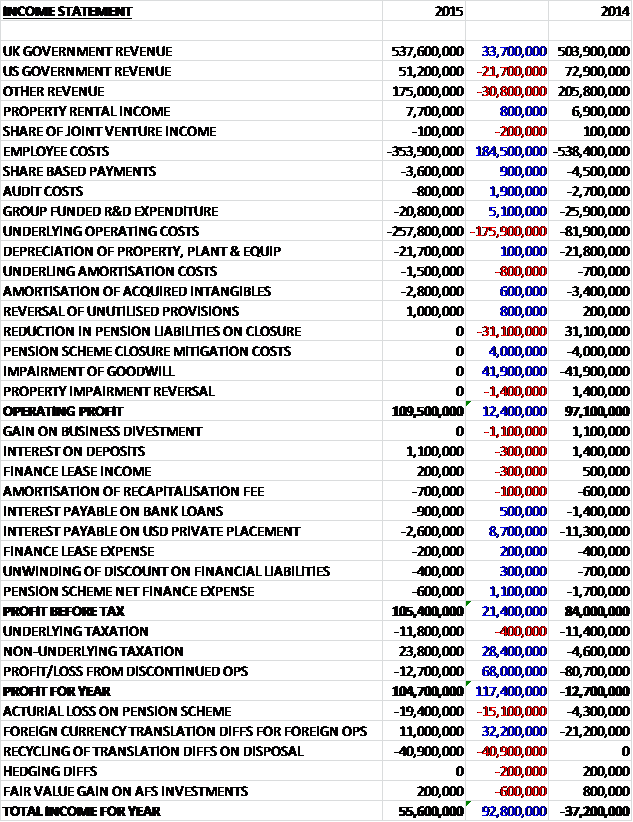
Revenues fell when compared to last year as a £33.7M increase in UK government revenue was more than offset by a £21.7M decline in US government revenue and a £30.8M fall in other revenue. Employee costs were some £184.5M lower and R&D expenditure also decreased but other underlying operating costs increased by £175.9M. Non-underlying costs fell somewhat as last year’s £41.9M goodwill impairment and £4M pension scheme closure mitigation costs was partially offset by a £31.1M reduction in pension liabilities and a £1.4M property impairment reversal to give an operating profit £12.4M higher than last year. Finance costs fell when compared to 2014, mainly as a result of an £8.7M reduction in the interest payable on the USD private placement so that pre-tax profits were £21.4M above that of last year. We then see a £23.8M tax income related to the realisation of tax losses and a £12.7M loss from the discontinued operation, some £68M better than last time. The end result of all this is a profit for the year of £104.7M, a favourable movement of £117.4M year on year.
QQassets

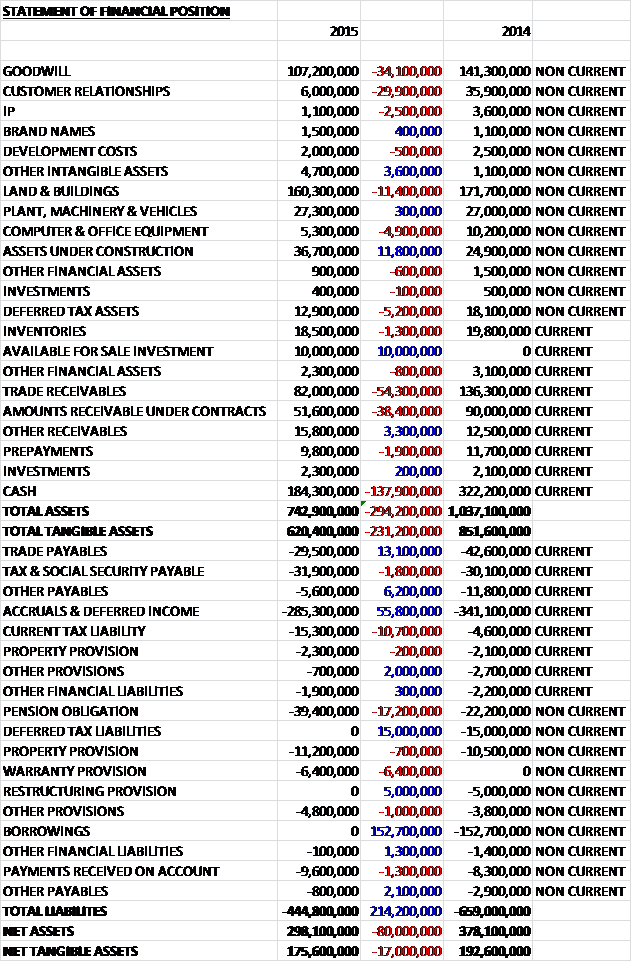
When compared to the end point of last year, total assets declined by £294.2M driven by a £54.3M fall in trade receivables, a £38.4M decrease in amounts receivable under contracts, a £34.1M decline in goodwill, a £29.9M decrease in customer relationships and an £11.4M fall in the value of land and buildings, partially offset by an £11.8M increase in assets under construction and a £10M available for sale investment. Total liabilities also fell during the year as a £152.7M elimination of borrowings, a £55.8M decrease in accruals and deferred income, a £15M fall in deferred tax liabilities and a £13.1M decline in trade payables was partially offset by a £17.2M increase in the pension obligation and a £10.7M growth in the current tax liability. The end result is a net tangible asset level of £175.6M, a decline of £17M year on year.
QQcash

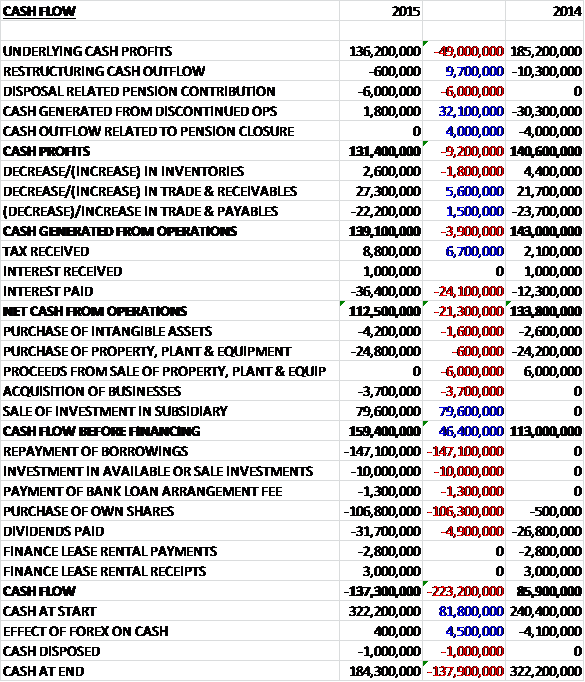
Before movements in working capital, underlying cash profits fell by £49M to £136.2M. After taking into account the non-underlying items, the actual cash profits fell by £9.2M to £131.4M. A large fall in receivables and in increase in tax received was offset by a big hike in the interest paid(presumably due to the early redemption of the debt) meant that net cash from operations stood at £112.5M, a decline of £21.3M year on year. The group spent £24.8M on fixed tangible assets and £4.2M on intangibles to give a free cash flow of £83.5M before a net £75.9M was received from the sale of a subsidiary to give a cash flow before financing of £159.4M. The bulk of this was used to pay back borrowings with the rest going on the investment in the available for sale asset. The group also paid £31.7M on dividends and used £106.8M to buy-back shares to give a cash outflow for the year of £137.3M and a cash level of £184.3M at the year-end.

The EMEA services operating profit was £93M, an increase of £3.3M year on year assisted by an insurance recovery and the completion of a final milestone on an international project. Each of the core air, weapons and maritime businesses performed well despite the uncertainty in the UK defence market resulting from the MOD transformation programme and strategic defence and security review. Orders, excluding the £998M third term of the LTPA contract, grew 3% to £461.6M and revenue was also up 3% on an organic basis at constant currency. At the beginning of the new year, 80% of the division’s annual revenue was already under contract.

During the year the air business secured a £16M extension to its largest MOD test and evaluation contract, and a four year £5M contract for research into aircrew performance. The business also continued to grow its engineering services offering and now provides maintenance, repair and overhaul services for fixed and rotary wing aircraft across three main contracts with opportunities to take this capability into new international markets.

The weapons business delivers the MOD’s conventional weapons research programme through the Weapons Science and Tech centre which secured £17M of orders during the year. In response to the growing complexity of weapons systems trials work, major infrastructure improvements took place at a number of the ranges that the business runs under the LTPA contract including new communications infrastructure in the Hebrides and a new range control centre in Wales. The group has also undertaken work for the South Korean government as well as some European customers.

The maritime business won a £5M contract from a competitor to deliver the MOD’s mobile underwater targets service at the BUTEC range it operates off NW Scotland, which also benefited from over £20M of investment to modernise its acoustic measurement system, enhancing the group’s ability to deliver stealth related services. During the year the business supported the integration of a new radar on the Type 23 frigate and a new command system for the helicopter carrier HMS Ocean. This expertise underpins a new mission systems integration service to meet demand from international customers, particularly from the Asia Pacific region. The business was also awarded a contract to deliver technical support for ship procurement for the Canadian government. The Portsdow site was selected to host the defence growth partnership’s centre for maritime intelligent systems which will help UK industry meet customer interest in emerging technologies such as autonomous systems.

The Australian division delivered a steady performance against a background of fiscal pressures and defence reform, securing a two year extension to the services it delivers to DSTO Fishermens bend in Melbourne. The training business secured its largest ever contract for the continued provision in the UK of Distributed Synthetic Air Land Training valued at £33M over five years. It also beat a number of competitors to win the next stage of a core research programme worth £3M over four years. As a result the business is well positioned for future opportunities as the MOD moves towards its vision of a network of simulators across the UK to augment live training. Having established an office in Florida, the business has secured a positon on three IDIQ contracts working in partnership with established prime contractors such as Alion and developing a promising pipeline of opportunities in the US.

The Cyber Security business won a new £3M contract to deliver secure monitoring and hosting services for a major financial institution. The business is integrating the group’s human science expertise into its consulting offering and is investing in its cyber intelligence capabilities. It launched a cloud based cyber threat centre that monitors the internet, provides alerts and delivers data on domain names, IP addresses, phishing and malware attacks. During the year the procurement advisory services business provided horizon scanning for the UK Cabinet Office, cost forecasting services to the MOD, and won a £2M MOD contract for business case support to help address frontline challenges such as the supply of water, fuel and power. The division is spear-heading the group’s presence in Canada, where an office was opened during the year.

The Global Products operating profit was £18.3M, a decline of £8.7M when compared to last year due to a reduction in revenue due to reduced sales of conflict related products along with about $5M of one-off costs. Orders grew by 2% to £152M as demand for EMEA products offset the slow order intake in the US products business with about half of 2016 revenues already under contract at the beginning of the year.

The US Global Products business won $24M of orders to reset TALON robots, modernising them for future operations. These awards position the business well for future US DoD Programs of Record although to date these have been slow to emerge. The fifth generation of TALON was launched during the year, incorporating the ability to use third party commercial components to capitalise on the continued divergence of military and civil robotic technologies. In addition, $14M of orders for unmanned systems were won from international customers. In response to the growing use of robotics in the construction and demolition industries, the business launched DriveRobotics, a kit that transforms Bobcat vehicles into an unmanned vehicle. Demand for survivability products continues to be impacted by the drawdown for US military operations, although new orders were received for armour for the C-130 aircraft.

The sale of the US Services division removed organisational conflict of interest barriers that prohibited the US Global Products business from pursuing DoD R&D contracts and the division saw a modest increase in these activities during the year. It was one of two suppliers to receive a contract from the DARPA for the first phase development of the Hydra programme to develop a distributed undersea network of modular unmanned platforms and payloads. This positions the business well for follow-on phases of the programme and other projects with the US Office of Naval Research.

Optasense made progress implementing its strategy of developing partnerships with leading industry players to exploit its key markets. In rail, the business continues to work with Deutsche Bahn and also won a $5M initial award from the Saudi Rail Organisation to provide security monitoring for over 1,000km of rail line. In oil and gas, the product development agreement with Shell continues to deliver significant technological progress but the fall in the oil price has slowed the adoption of DAS for well completion but improved the economics of its use for flow monitoring and seismic profiling.

After the year-end the business entered into a non-exclusive strategic alliance with Weatherford to deliver solutions to optimise well planning, construction and production. In infrastructure security, the delivery of some key projects was, ironically, interrupted by a worsening security situation in the Middle East but this also increased demand. At the end of the year the business signed a framework supply agreement to protect critical national infrastructure including pipelines, airports and other facilities for a customer in the Middle East. When complete, the two year project could involve 200 units and encompass up to 8,000km of assets.

At the end of the year the space products business was awarded a contract worth €16M over three years to develop the computer ad avionics for the European Space Agency’s Proba-3 satellites that will fly in formation and use an eclipsing mechanism to study the sun. The business is also playing a vital role in the ESAs IXV mission launched in February 2015 as its technology will be responsible for guiding the “space taxi”, a smaller version of the US space shuttle, safely back to Earth. Commerce Divisions delivered record profit in 2015, securing an enterprise-wide contract for the third year from the MOD for its “Award” procurement software, as well as delivering growth in the UK health and transport markets. The business also secured its first order in Canada shortly after the year-end.

Field evaluations are underway for the Linewatch power line sensor system, which precisely measures voltage and currents on power grids. The product is designed to meet emerging Smart Grid requirements for the detection of faults and power theft, condition-based maintenance, and distributed power generation. In addition the US products business is developing a high power density generator which can provide modular roll-on/roll-off power required for emerging defence and civil applications.

During the year the UK business launched ASX, a small sensor that delivers airborne surveillance capability. The MOD selected the Modular Electronic Warfare System ahead of more established products to form the basis of its medium weight electronic surveillance capability for expeditionary operations. Further milestone orders won during the year included a $3M contract with the US Transportation Security Administration to develop the next generation of Qinetiq SPO stand-off Millimetre Wave threat detection system.

The UK government continues to face a significant budget deficit, and a further period of fiscal austerity looks likely. Defence expenditure is not protected by government ring-fencing but the MOD has made progress over the last five years in balancing its budget. In the US, Obama recently requested an 8% increase to the US defence budget for 2016, forcing the Republican majority to weigh up competing concerns about defence and tackling the ongoing fiscal deficit. The US government, is, however, continuing to drawdown the number of troops deployed on overseas operations and reduce the accompanying procurement budget which continues to depress demand for conflict related products.

One project undertaken during the year was for the UK Royal Navy where the maritime stealth information and range services team provided stealth management capabilities helping to make vessels combat ready. Rather than sailing mine-hunters out and back for six month tours of the Middle East, the technology allows four vessels to be based in the region for years. They place magnetic and acoustic sensors in the water, sail a vessel over them, and then calibrate on board systems to avoid detection by aggressors and make an 8,500 tonne destroyer look like a much smaller vessel.

Elsewhere, the US Transportation Security Administration has awarded the group a $3M two year contract for an innovative threat detection system that uses their passive millimetre wave technology. With the TSA concerned about terrorist threats to targets like railway stations, ferry and bus terminals, it wanted leading-edge technology to help secure these venues. Working at a range of up to 15 metres, the SPO technology scans a crowd and detects if a person is hiding something under clothing without needing to stop. Travellers are not inconvenienced, the system does not emit harmful radiation and no privacy laws are contravened. With earlier versions deployed at locations including New Jersey, Washington and LA, the group also provides maintenance, support and end-user training.

Under a twenty year contract, the group provides aerial targets worldwide for the UK Army, Royal Navy, RAF and project teams working on new weapons. The group now handles all such requirements after several suppliers were consolidated into one. They also completed aerial target projects for the US Air Force, Swiss MOD, Danish Navy and BAE Systems. Demand for this service is rising, a recent contract for Sweden involved working with a US target manufacturer to deliver launchers and operators, and they are now exploring opportunities to bring other suppliers’ targets into CATS to offer even better performance and value for money to customers.

The European space agency awarded the group a €16M three year contract to develop the computer and avionics for its Proba-3 mission which involves two satellites making a virtually fixed structure in space by precise formation flying only 150 metres apart. Proba-3 will study the sun’s corona using an eclipsing mechanism, with a camera fixed on one satellite and an occulting disk on the other, and flying at the optimal distance apart to shield the camera from the sun and create conditions usually only observable during a solar eclipse. The Belgium based team is creating highly compact avionics able to process millions of instructions per second while also operating effectively in the punishing high-radiation environment of space.

Under a five year contract that runs from 2014, the group is delivering the Distributed Synthetic Air Land Training 2 capability for the UK MOD, building on the delivery of a previous five year contract. Operating from the Air Battlespace Training Centre in Lincoln, the £33M DSALT2 training programme provides the UK Army and RAF with realistic and flexible representations of operating environments. Their bid was supported by a pan-Qinetiq team and includes sub-contractors Boeing and Plexsys.

In May the group completed its sale of the US Services division, comprising Qinetiq North America with the proceeds applied in settling the remaining private placement debt which was put in place to finance the acquisition of the division in the first place. This will involve a penalty of £28.8M incurred on the early redemption of the debt. The initial cash consideration was $165M prior to the standard working capital adjustments at completion and there is also contingent consideration of between zero and $50M based on gross profit generated by the disposed business in 2015 which in the event amounted to $9M in cash.

In August the group acquired Redfern Integrated Optics, a US based business that designs and manufactures highly coherent semiconductor lasers which are used in the distributed acoustic sensing market. The business was acquired with initial cash of £3.3M and deferred consideration of £500K and generated goodwill of £2.9M. In November the group acquired SR2020, a US-based provider of borehole seismic services who develop and use purpose written, proprietary software for borehole seismic imaging, micro-seismic monitoring and passive seismic monitoring. The business has extensive oil and gas industry experience. The business was acquired with cash of £400K, all of which was goodwill.

It is interesting to note that the group is actually making money from operating leases, with a total as a lessee outstanding of just £13M compared to £37.3M outstanding with the group as a lessor as it sub-lets properties that are vacant. The group currently has contracted capital commitments of £30.8M in relation to property, plant and equipment that will be wholly funded by a third-party customer under long term contract arrangements. During the year the group recognised a tax asset of £25.2M in respect of unused tax losses relating to UK trading losses which are expected to be utilised in the foreseeable future.

The group operates a pension scheme which was closed to future accrual at the end of October 2013. There is currently a liability of £37.8M attached to the pension but it is a big scheme with assets of some £1.454BN so there is potential here for this to get out of hand.

In October 2014, Leo Quinn tendered his resignation as CEO to take up a role as CEO of Balfour Beatty. Leo arrived at the group in 2009 at a difficult point in the company’s history and has since transformed their fortunes. Following his departure, CFO David Mellors took over as interim CEO but by April 2015 the group had appointed Steve Wadey as new CEO who was previously MD at MDBA UK. It has to be said that the executive directors are very well paid and the last CEO was paid £2.1M last year with the CFO pocketing £1.8M this year. It is also notable that over 15% of votes were voted against the remuneration policy at the AGM so this seems to be a common concern. It’s also notable that the directors do not own many shares in the company.

Defence transformation and the forthcoming comprehensive spending review and SDSR are expected to have an impact on the UK defence market this year and give the potential for interruptions to order flow. The portion of revenue under contract at the start of 2016 was similar to a year ago and the balance is supported by a pipeline of opportunities. Overall given the opening backlog position, expectations for the performance of EMEA Services in the current financial year are unchanged.

In Global Products, newer products are recording notable milestones and the amount of revenue under contract at the start of 2016 is up slightly on a year ago, but the drawdown of American overseas military forces is continuing to depress demand for conflict-related products. As the division has a lumpy revenue profile which is dependent on the timing and shipment of key orders, there is a range of possible outcomes for the year. The board is, however, maintaining its expectations for group performance in the current financial year.

In May 2014 the group initiated a £150M capital return to shareholders by way of a share buyback. By the year-end, the group had bought back £63M shares at a cost of £128M and the board apparently remain committed to maintaining an efficient balance sheet so expect more shareholder returns or acquisitions.

At the current share price the shares are trading on a PE ratio of 15.2 which reduces to 14.9 on next year’s forecast. After a 17% increase in the full year dividend, the shares are currently yielding 2.4% which increases to 2.5% on next year’s consensus forecast. At the end of the year the group had a net cash position of £195.5M compared to £170.5M at the end point of last year. There is currently also £233.3M in undrawn committed facilities with an interest rate of just 0.65%+LIBOR.

Overall then this was a solid set of results. There are various definitions of profit but overall profits increased due to non-repeated non-underlying items last year. Underlying pre-tax profits did improve but this was due to a much lower interest payment as a big chunk of debt was paid off and underlying operating profit fell. The operating cash flow declined year on year on every metric, however, and net assets declined during the period. Despite the decline, the group is still very cash generative and plenty of free cash was generated during the year.

The EMEA Services division performed well with the core air, weapons and maritime business performing well. Profits were boosted by the final milestone payment on an international project, though, so this will not be repeated going forward. It is a shame the value of the project is not mentioned but it is good to see that it is being brought up now and not as an excuse for a profit warning somewhere down the line (other companies should take note). Profit fell in the global products division, however, due to lower sales of combat-related products following the withdrawal of troops from Afghanistan – an issue that is likely to continue into the new-year.

There are clearly a number of risks involved here. The MOD is clearly the most important customer but it is currently undergoing a budget review which could clearly affect the company. The withdrawal from Afghanistan is also going to reduce demand for their products. In addition, the global products division has lumpy orders so earnings visibility is low, there is a new CEO and the huge pension plan is lurking in the wings. The sale of the US Services division looks sensible though and the group has a strong net cash position. At a forward PE of 14.9 and a dividend yield of 2.5% the share price seems to be sensibly factoring everything in, though.

On the 30th September the group released an update covering trading in the first half of the year. The board are maintaining their expectations for group performance this financial year. In the UK, the government’s strategic defence and security review, and public consultation on the proposed approach to calculating the baseline profit for single source contracts are both underway. The EMEA services division continues to see some customer contract award decisions deferred due to uncertainties in the UK market or delayed by requirements for additional approvals. The revenue under contract this year is as expected at this stage, however. As expected the group’s global products division continues to trade at similar levels to last year.

Overall then, this seems steady but not that exciting – the spending reviews in the UK seem to be the main issue at the moment.
GSK Share Blog – Q3 Results Year Ending 2015

GSK has now released its results for Q3 2015.

GSKQ3income

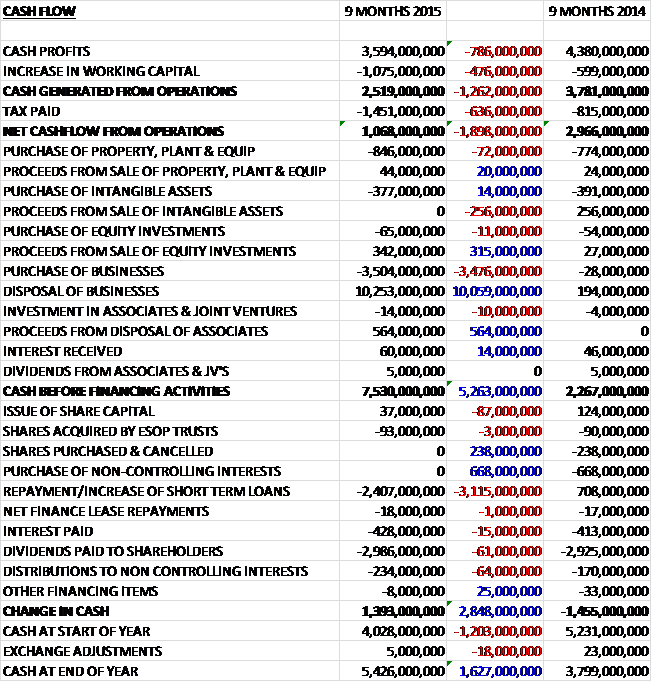
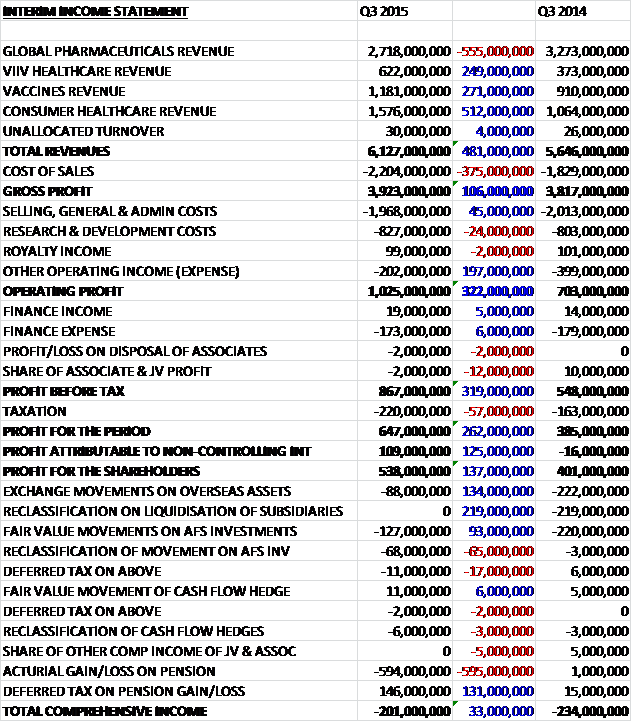
Revenues increased when compared to Q3 last year as a £555M fall in global pharmaceuticals revenue was more than offset by a £512K increase in consumer healthcare revenue, a £271M growth in vaccines revenue and a £249M increase in ViiV healthcare. Cost of sales also increased to give a gross profit £106M higher than last time. Selling costs actually fell during the period and other expenses declined by £197M so that the operating profit increased by £322M. Finance costs were broadly similar but tax was higher and there was a much larger increase in the profit attributable to non-controlling interests due to the greater contribution from ViiV healthcare. The end result was a profit attributable to the equity owners of £538M, a growth of £137M year on year.

GSKQ3assets

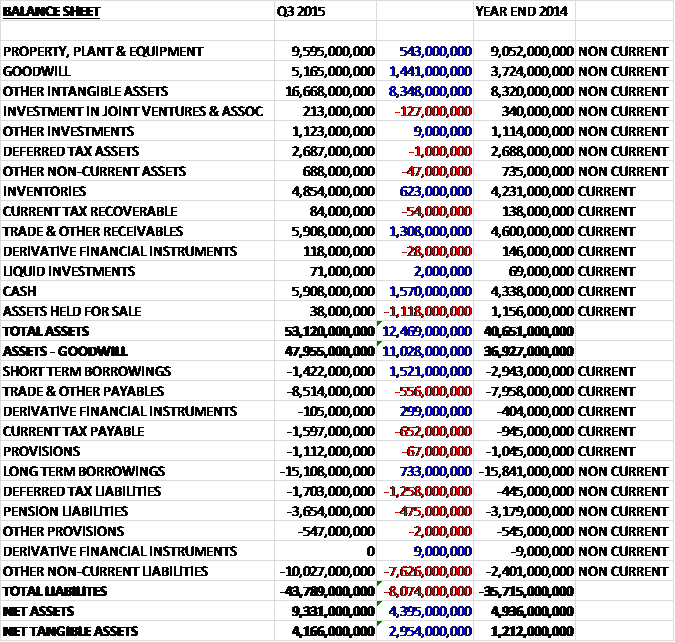
When compared to the end point of last year, total assets increased by £12.469BN driven by an £8.348BN growth in other intangible assets, a £1.441BN increase in goodwill, a £1.57BN growth in cash, a £1.308BN in receivables and a £623M growth in inventories. Total liabilities also increased as a £7.626BN growth in “other” non-current liabilities which relates to the agreement with Novartis and Pfizer for GSK to be required to purchased their holdings of a couple of joint ventures, a £1.258M increase in deferred tax liabilities, a £652M growth in current tax payable and a £556M growth in payables was partially offset by a £1.521BN decline in short-term borrowings and a £733M fall in long-term borrowings.

GSKQ3cash


Before movements in working capital, cash profits fell by £786M to £3.594BN and there was also a cash outflow associated with working capital movements, primarily reflecting an increase in receivables from seasonal flu vaccine sales, and tax was some £636M higher than in the first nine months of last year which included a tax payment of £268M on the sale of the oncology business, so that the net cash from operations was £1.068BN, a decline of £1.898BN year on year. The group spent £846M of this cash on property, plant and equipment and £377M on intangible assets so that there was no fee cash but there was a net £6.749BN cash inflow from business disposals and £564M from the sale of part of the shareholding in Aspen so that before financing there was a cash inflow of £7.53BN. The group used £2.407BN to pay back loans, £428M went on bank interest and £3.22BN was spent on dividends to give a cash flow of £1.393BN for the first nine months of the year and a cash level of £5.426BN at the period-end.

Actual profits increased year on year but this was only due to a reduction in non-underlying profits, primarily as a result of a £246M fall in legal charges where last year’s quarter included the fine payable to the Chinese government; and a £350M fall in acquisition costs which included the re-measurement of the liability and the unwinding of the discounting effects on both the contingent consideration for the acquisition of the former Shionogi-ViiV healthcare joint venture and on the consumer healthcare joint venture put option (the ViiV contingent consideration increased in Q3 2014). There was a cash payment of £53M this quarter relating to the ViiV healthcare contingent consideration.

Core operating profit was £1.718BN, 5% lower on constant currency terms than Q3 2014 despite an increase in turnover. The decrease included an impact from the Novartis transaction, reflecting the disposal of GSK’s higher margin oncology business and the acquisition of lower margin products, and also then benefit last year of a £219M credit from a release of reserves following simplification of the group’s entity structure and its trading arrangements. On a pro-forma basis, core operating profit was flat on a turnover increase of 5%. Excluding the impact of the reserves release, the core operating margin increased by 2.1%, benefiting from an improved product mix in the quarter as well as initial contributions from the pharmaceuticals restructuring and Novartis integration programmes.

The cost of sales were broadly flat on a pro-forma basis as the benefits of favourable product mix, driven by strong growth in new products, particularly Tivicay and Triumeq, together with improved supply and pricing in consumer healthcare and accelerated flu vaccines sales in the US, were offset by continued adverse pricing pressure in pharmaceuticals, primarily respiratory, and increased investments in vaccines to improve the reliability and capability of the supply chain. Sales and admin costs increased in the quarter reflecting the comparison with last year’s costs that included the reserve release. Excluding this, costs reduced reflecting savings in global pharmaceuticals, including the benefits of the restructuring programme, and integration benefits in vaccines and consumer healthcare, offset by promotional support for new launches and seasonal activity, particularly in consumer healthcare.

The operating profit in the global pharmaceuticals division was £1.116BN, a decline of £382M year on year. Respiratory sales during the quarter declined by 9% to £1.272BN. Seretide/Advair sales were down 19% to £794M, Flixotide/Flovent sales decreased 4% to £144M and Ventolin sales fell by 3% to £152M. Relvar/Breo Ellipta recorded sales of £64M and Anoro Ellipta, now launched in the US, Europe and Japan, recorded sales of £22M. In the US, respiratory sales declined by 10% with a small decline in volume and a big negative impact of price and mix. This decline included the price and mix impact of new contracts agreed last year in response to competitive pressures where Advair and Breo Ellipta compete. Sales of Advair fell 18%, Flovent sales were down 8% and Ventolin sales fell by 7%.

European respiratory sales were down 13% to £313M with Seretide down 23% reflecting increased competition from generics and the transition of the respiratory portfolio to newer products. Relvar Ellipta, approved in Europe for both COPD and asthma, recorded sales of £20M while Anoro Ellipta, with launches now underway in many countries throughout the region, recorded sales of £5M. Respiratory sales in the ROW region declined by just 2% with emerging markets down 6% partially offset by Japan, up 9% where sales of Relvar Ellipta more than offset the decline in Advair sales. In emerging markets sales of Seretide were down 15% due to additional generic competition and price reductions in a number of reimbursed markets, together with some tender phasing, while Ventolin grew 6%.

Sales in the cardiovascular, metabolic and urology category rose 1% to £225M. The Avodart franchise fell 5% to £176M with 9% growth in the sales of Duodart/Jalyn more than offset by an 11% decline in sales of Avodart. In the US, generic competition in Avodart started in October and generic competition to Jalyn is expected later in Q4 2015. Sales of Prolia increased 50% to £11M. Immuno-inflammation sales grew 3% to £72M. Benlysta turnover in the quarter was £59M, up 22% with Benlysta US sales up 23%.

Sales in other therapy areas grew 1% to £523M. Dermatology sales declined 7% to £94M, adversely affected by supply constraints, which also affected Augmentin sales, down 8% to £116M. Relenza sales more than doubled in the quarter to £15M, partly driven by the timing of US CDC orders. Sales of products for rare diseases declined 7% to £91M, despite including sales of Volibris which were up 3%. Established products turnover fell 13% to £614M with sales in the US down 21% and Lovaza sales down 66%. Europe was down 10% to £115M, with Serevent sales down 18%. ROW was down 11% with lower sales of Zeffix, down 28% driven by China, and Seroxat down 14%. Valtrex sales increased 42% to £33M following the regaining of exclusivity in Canada until October 2015.

The operating profit in the ViiV healthcare division was £466K, an increase of £220M when compared to Q3 last year. HIV sales increased 65% to £622M with the US up 94%, Europe up 54% and ROW up 19% with the growth in all three regions being driven by Triumeq and Tivicay. The ongoing roll-out of both products resulted in sales of £211M for Triumeq and £157M for Tivicay. Epzicom/Kivexa sales declined 9% to £175M but Selzentry sales grew 10% to £33M. There were continued declines in the mature portfolio, mainly driven by generic competition to both Combivir, down 42% to just £7M, and Lexiva, down 19% to £18M.

The operating profit in the vaccines business was £464M, a growth of £136M when compared to Q3 2014. Vaccine sales grew 32% to £1.181BN with the US up 42%, Europe up 31% and ROW up 22%. The business benefited from sales of the newly acquired products, primarily Bexsero and Menveo in Europe and the US. The 13% pro-forma growth was primarily driven by strong Fluarix sales in the US due to improved supply and the accelerated switch to the Quadrivalent formulation, and higher CDC orders primarily for Rotarix, and Synflorix in ROW regions. The growth was partly offset by supply constraints in Hepatitis vaccines and a decline in Infanrix in the US reflecting a return of a competitor to the market.

In the US sales grew 42% and 22% on a pro-forma basis. This was largely attributable to the improved supply and accelerated delivery schedule of Fluarix Quadrivalent, up 59% compared with Q3 last year. A government contract delivered incremental Ixiaro sales while the timing of CDC orders drove Rotarix up 57%, and the Hepatitis vaccines portfolio, up 9%. These factors were partially offset by the comparison to Q3 last year which benefited from an Infanrix CDC replenishment. The newly acquired portfolio added a combined £60M to US sales, driven by the Bexsero launch and the timing of CDC orders for Menveo.

In Europe sales grew 31% and 14% on a pro-forma basis to £308M. This growth primarily reflected increased sales in the Meningitis portfolio. Bexsero growth came from gains in private market channels in several countries including Italy and Portugal, and the UK following its inclusion in the NHS immunisation programme. A strong Menveo performance reflected a tender win in the UK. Growth in Germany was strong with Boostrix, the MMRV portfolio and Infanrix all benefiting from better supply and a competitor supply shortage. Growth in Europe was partly offset by a 9% decline in sales of Hepatitis A vaccines reflecting supply constraints.

In the ROW market, sales grew 22% and 3% on a pro-forma basis to £347M. The pro-forma performance reflected Synflorix growth, up 19%, driven by orders from Africa and Brazil. International pro-forma growth was partly offset by Boostrix, down 48%, due to greater competitive pressures, particularly in Latin America, and lower sales of Hepatitis A vaccines, reflecting supply constraints.

The operating profit in the consumer healthcare division was £210M, an increase of £75M year on year. The business represents the joint venture with Novartis together with the GSK business in India and Nigeria, which are excluded from the joint venture. Turnover grew 55% to £1.576BN, benefiting significantly from sales of the newly-acquired products. On a pro-forma basis, growth was 7% reflecting 5% in volume and 2% in price, reflecting strong growth in the US following the launch of Flonase as well as globally strong growth in Sensodyne and Panadol. Momentum from first half launches continued to drive innovation contribution with sales from product introductions in the last three years representing about 13% of sales in the period.

US sales grew 61% on a reported basis to £360M and 18% on a pro-forma basis, with Flonase contributing just over half of the growth for the quarter. Theraflu recorded strong growth following the launch of a warming syrups range. The quarter also benefited from the improved supply of denture care products and the re-launch of Nicorette lozenge together with the ongoing re-launches of Nicorette Minis and alli, which continued their recovery from supply shortages last year.

Sales in Europe grew 87% to £481M, but just 1% on a pro-forma basis. Sensodyne continued to report strong growth due to new advertising in key markets and the roll-out of Sensodyne True White in the UK, Sensodyne Repair and Protect in Germany and Sensodyne Mouthwash across a number of markets. In Wellness, Voltaren continued to perform strongly, recording the highest ever market shares in Germany, Sweden, Poland and Italy, driven by a new advertising campaign. This was substantially offset by unusually warm weather in Europe which delayed the start of seasonal cold and flu activities.

ROW sales of £735M grew 37% on a reported basis and 6% on a pro-forma basis. India continued to perform well with Horlicks reporting growth of 8% and Sensodyne delivering growth of 41% due to strong marketing campaigns. Oral health sales in Japan grew 15% compared with a comparative period impacted by an increase in sales tax last year, with Sensodyne sustaining its position as the country’s number one toothpaste brand. Wellness sales began to recover as some markets stated to return to growth following the negative impact of reducing channel inventories in the acquired consumer businesses.

Core EPS for the year is expected to decline at a percentage rate in the high teens, primarily due to continued pricing pressure on Seretide in the US and Europe, the dilutive effect of the Novartis transaction and the inherited cost base of the Novartis business. The guidance excludes potential income from the proposed divestment of ofatumumab. In 2016, the group expects to see a significant recovery in core EPS with percentage growth expected to reach double digits on a constant currency basis as the adverse impacts seen this year diminish and the sales and synergy benefits from the Novartis transaction contribute more meaningfully. The board are apparently confident in their outlook for the rest of the year and a return to growth in 2016.

Some of the new pharmaceutical and vaccine products seem to be gaining some traction. Of course the HIV products of Triumeq and Tivicay are leading the way with sales in the quarter of £211M and £157M representing increases of more than 100% and 96% respectively. The next most important is vaccine Menveo was sales of £81M, but this only represented an increase of 26%. The £41M of Bexsero sales, however, represented an increase of more than 100%. The respiratory products of Relvar/Breo Ellipta and Anoro Ellipta both increased sales by more than 100% to £64M and £22M respectively. For some context seretide sales fell 19% to £794M and Avodart sales were down 5% to £176M so Triumeq is already as important as Avodart and is increasing importance at a considerable rate.

During the quarter there were a few advances made in the pipeline, most notable of which was the Japanese approval of Zagallo for alopecia and the data from the phase III study of Shingrix demonstrating 90% efficacy against shingles in people 70 years of age and over.

The group are expecting to complete the divestment of ofatumumab in Q4 2015 or Q1 2016. During the period they completed the disposal of various consumer healthcare products in a number of markets for £145M. They also completed the disposal of two meningitis vaccines in a number of markets for £55M. Both of these disposals were required to meet anti-trust approvals for the Novartis transaction.

The net debt at the end of the period stood at £10.551BN compared to £14.788BN at the same point of last year. There was no change in dividend expectations for the year and the shares are currently still yielding 5.8% and is planned to remain the same up to the end of 2017 which is probably providing a bit of a floor on the share price at present. There is also a special dividend of 20p that is going to be paid early next year which will give a dividend yield of 7.2% for this year only.

On the 4th November it was announced that the group had received approval from the US FDA for its biologics licence application for Nucala (mepolizumab) as an add-on maintenance treatment of patients with severe asthma aged twelve years and older and with an eosinophilic phenotype. It is administered as a 100mg fixed dose injection every four weeks and patients will receive Nucala in addition to their normal medications for severe asthma. This is the first marketing authorisation for the drug anywhere in the world and took about a year to achieve from submission. Applications have been submitted in a number of other countries including the EU and Japan with further submissions expected during 2016.

Overall then this was a bit of a mixed quarter for the group. Profits did increase but this was due to lower legal costs and less acquisition expenses and underlying profits fell due to the lower margin on the acquired Novartis products. Net assets did improve over the past nine months but operating cash flow was down with no free cash being generated. The problem remains the respiratory portfolio and Seretide in particular. Seretide remains by far the most important drug but sales are down due to pricing pressures in the US and generic competition in Europe and the new respiratory drugs are still some way off making a contribution close to Seretide.

Elsewhere, generic competition for Avodart is expected to start in the US in Q4 which will put this stalwart under pressure but the real saviour at the moment is ViiV healthcare and the new drugs of Triumeq and Tivicay which are growing fast and starting to make a real meaningful contribution. It is just a shame that the group doesn’t own 100% of these products! The vaccines business is also doing well with the contribution from the former Novartis products along with some organic growth. Additionally, consumer healthcare is also making an improved contribution to profits due to the launch of Flonase in the US and a strong performance from Sensodyne. With a dividend yield of 5.8% and the strengthening contribution from the ViiV healthcare drugs, I think GSK is starting to look rather interesting again.

On the 2nd December it was announced that the European Commission had granted authorisation for Nucala as an add-on treatment for severe refractory eosinophilic asthma in adult patients. As a result it is now approved for use in the 31 countries covered by the EMA. This follows the US approval in November and regulatory applications are ongoing in a number of other countries including Japan.

On the 16th December the group announced that it had received positive top line results from the phase III programme investigating sirukumab, a human anti-interleukin monoclonal antibody for the treatment of patients with moderately to severely active rheumatoid arthritis in development as part of a collaboration with Janssen Biologics. There were no unexpected safety findings and long term safety and efficacy data are currently being collected in ongoing extensions of the trials. Regulatory applications for the drug are anticipated in 2016.

On the 18th December the group announced that ViiV Healthcare had reached two separate agreements with Bristol Myers Squibb to acquire its late stage HIV R&D assets and to acquire their portfolio of preclinical and discovery stage HIV research assets. Under the terms, ViiV will acquire fostemsavir, an attachment inhibitor currently in phase III development for heavily treatment experienced patients which is expected to be filed for regulatory approval with the FDA in 2018. The second late stage asset is a maturation inhibitor currently in phase II development for both treatment naïve and experienced patients and a back-up inhibitor candidate is also included in the purchase.

Assets in preclinical and discovery phases of development include a novel biologic with a triple mechanism of action, a further maturation inhibitor, an allosteric integrase inhibitor and a capsid inhibitor. A number of Bristol Myers Squibb drug discovery employees will also be offered the opportunity to transfer to ViiV Healthcare. These potential therapies have novel modes of action and would offer significant new treatment options to patients with HIV.

The late stage asset purchase comprises an upfront payment of $317M followed by development and first commercial sales milestones of up to $518M and tiered royalties on sales. The purchase of the preclinical and discovery stage research assets comprises an upfront payment of $33M followed by development and first commercial sales milestones of up to $587M with further consideration contingent on future sales performance. These transactions are expected to be completed in H1 2016.

On the 21st December the group announced the completion of its transaction to divest rights to ofatumumab for auto-immune indications to Novartis following regulatory approval. The consideration payable by Novartis may reach up to $1.034BN and comprises $300M paid at closing; $200M payable subject to the start of a phase III study in relapsing remitting MS; and further contingent payments of up to $534M payable on the achievement of certain other development milestones. Novartis will also pay royalties of up to 12% on any future sales of the drug in auto-immune indications.

It looks as though this sale is paying for most of the purchase of the HIV assets but only time will tell as to whether this is a good deal I guess.

On the 23rd December the group announced the appointment of Dr. Jesse Goodman as a non-executive director. Dr. Goodman is currently professor of medicine at Georgetown University and previously served in senior leadership positions in the US FDA, including most recently as the FDA’s chief scientist. This to me looks like a very useful addition to the board.

N Brown Share Blog – Interim Results Year Ending 2016

N Brown has now released its interim results for the year ending 2016.

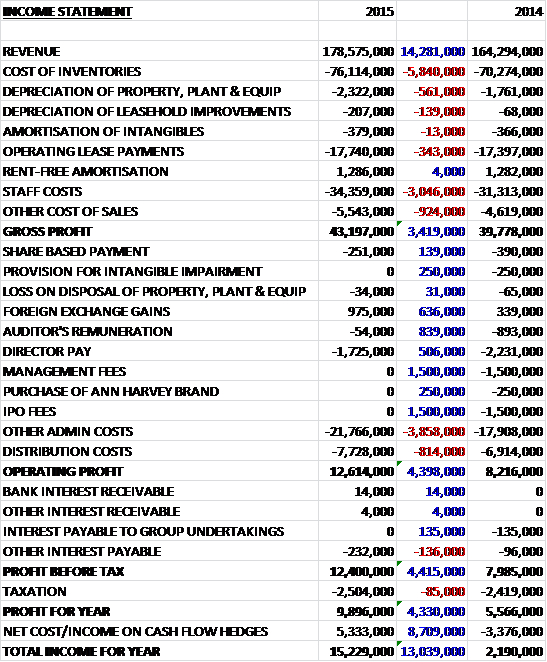
BWNGincome


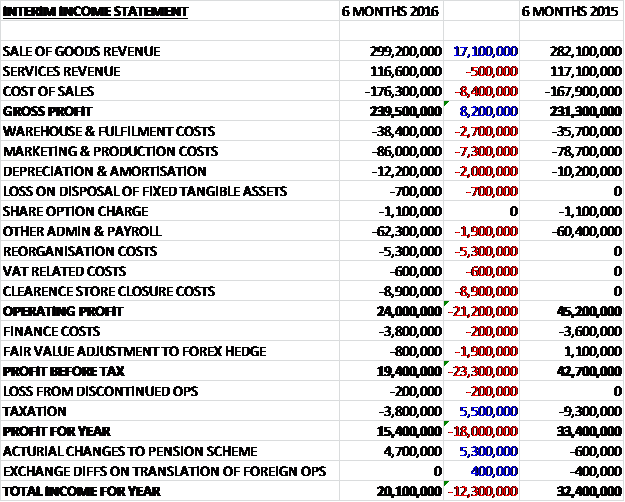
The revenue attributable to the sale of goods increased by £17.1M and the services revenue remained broadly flat year on year. Cost of sales also increased to give a gross profit £8.2M above that of the first half of last year. Warehouse and fulfilment costs increased by £2.7M, admin costs grew by £1.9M and depreciation & amortisation increased by £2M but the big increase was the £7.3M hike in marketing and production costs due to a step up in recruitment for Simply Be and Jacamo together with the timing of some TV campaign spend, which meant that underlying operating profit fell year on year. In addition to this there were some one-off costs including a £5.3M reorganisation charge and an £8.9M cost relating to the closure of the clearance store which meant that operating profits nearly halved to £24M. There was also an adverse movement in the forex hedging instrument but tax was a lower which meant that the profit for the half year was £15.4M, a decline of £18M year on year.

BWNGassets

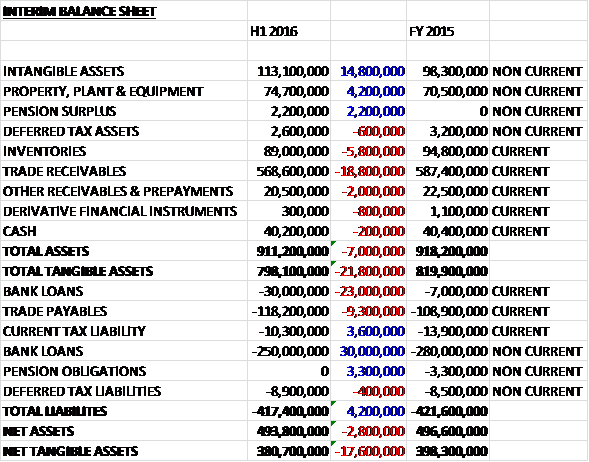
When compared to the end point of last year, total assets fell by £7M to £911.2M driven by an £18.8M decline in trade receivables, a £5.8M decrease in inventories and a £2M fall in other receivables and prepayments, partially offset by a £14.8M increase in intangible assets, a £4.2M growth in property, plant and equipment and a £2.2M pension surplus. Total liabilities also declined during the period as a £7M fall in the bank loan, a £3.6M decline in the current tax liability and a the eradication of the £3.3M pension deficit was partially offset by a £9.3M increase in trade payables. The end result is a net tangible asset level of £380.7M, a decline of £17.6M over the past six months.

BWNGcash

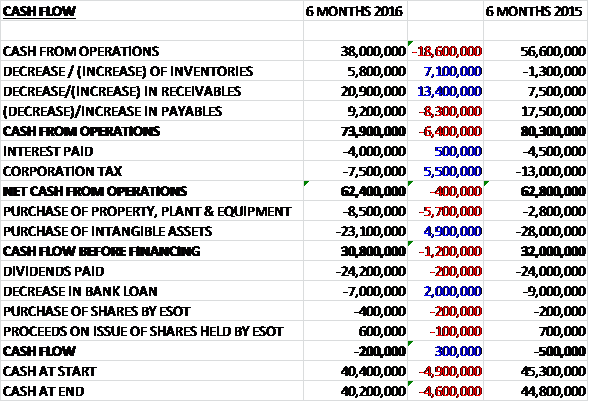
Before movements in working capital, cash profits fell by £18.6M to £38M. As with the first half of last year, there was a big cash inflow from working capital with a particularly large fall in receivables and after a £5.5M reduction in the corporation tax payment, the net cash from operations was £62.4M, a decline of just £400K year on year. The group spent £8.5M of this on fixed tangible assets mainly relating to warehousing and £23.1M on intangible assets, mostly relating to software developments to give a free cash flow of £30.8M. Some £24.2M was spent on dividends and the rest was used to make a dent in that huge bank loan so that there was a £200K cash outflow for the period and a £40.2M cash level at the end of the half.

The group is adjusting their retail business model and the way they operate, transforming from direct mail-led to digital first.

The gross profit in the product division was £172.9M, an increase of £5.8M year on year. JD Williams continued to improve but the turnaround of the largest brand will take time and during the period JW Williams product revenue was £103.1M, flat year on year. The brand represents a group of seven historic titles that have been migrated into JD Williams over the past year but Fifty Plus and Ambrose Wilson still need to be migrated which should take place in 2016. The core brand actually increased sales with the overall flat performance due to a decline in Ambrose Wilson sales. In addition, new customers were up 21%, the online order penetration of first orders increased by 21% to 74%, overall online penetration of JD Williams was over 50% for the first time, and the market share of retail online traffic, although still low at 0.4%, was up 22%.

Simply Be product revenue was up 21% to £50.2M with an improving trend in Q2 compared to Q1. The online penetration of the brand is now 89%. During the period, the group further strengthened their digital marketing capabilities and stepped up their social engagement, with campaigns such as #catwalkcontender, a search, working with Cosmo magazine and Milk money agency, for a real customer to front their Christmas campaign. They have also launched new ranges for Autumn Winter 2015, including Simply Be Unique, targeted at the most fashion conscious consumers, a capsule Coast range exclusively in sizes 20-26, a range with their new brand ambassador Jameela Jamil, and a range with plus-size blogger Sprinkle of Glitter.

Jacamo product revenue was also up 21% to £30.4M, again with an improving trend in Q2. Online penetration stands at 98%. The strong performance was driven by improved product ranges. Going forward, they continue to focus on the brand positioning and style credentials. Again, they significantly increased their social media engagement, the highlight being the #Hakarena campaign, which has been viewed by over 2.4M people online and trended number one on twitter. The specialist brands performed strongly, with revenues up nearly 16% to £38.4M driven by a continued good performance from House of Bath but support brands saw revenue fall by 2.8% to £77.1M.

Overall ladieswear saw growth of 2.4% to £134.6M against a challenging market backdrop. Within this, the Q2 growth rate was several percentage points higher than in Q1. Menswear revenue declined by 2.9% to £40.6M although younger menswear outperformed, driven by Jacamo. There was a good performance in Footwear, with revenues up 11.9% to £33.2M driven by continued product improvements. Home and Gift revenue was up 14.8% to £90.8M. This was driven by improvements made to the product offering, helped by a favourable market backdrop and by encouraging customers to increase their spend with the group by also purchasing homewares in addition to the core fashion offering.

The gross profit in the financial services division was £66.6M, a growth of £2.4M when compared to the first half of last year with revenues that fell 0.4% with a 1.9% decline in Q1 and a 1% improvement in Q2. The modernisation of the business is enabled by the credit release of their new systems transformation project which gives the group the tools to continue to refine their credit decision making, charge variable APRs, offer promotional interest free periods and new credit products in 2016. Credit arrears over 28 days stood at 10% compared to 11.7% in the first half of lf last year which was due to policy changes in prior periods and improved fraud detection. As they go into H2, the board expect the rate to increase slightly due to seasonal timing factors (rates are high in the busier Christmas period) and the continued step-up in new customers.

For the first time in three years there was an increase in new credit customer recruits, up 15%. It is believed that this was driven by the improved product proposition. Going forward it is expected that the recently introduced 0% interest offer over the Christmas trading period and, longer term, the ability to offer customers a far more personal credit proposition, to both generate further new credit customers. It is still relatively early days since the introduction of cash customers and they seem to be either incremental or at an expense of credit customers who immediately paid off their balance, not incurring interest charges. Currently about half of new customers open a credit account.

Sales from the Simply Be and Jacamo stores were up 91% to £9.4M and 6% on a like for like basis. The operating loss was £900K against £600K last year due to the headwind of seven new stores opening during the period with the profitability of like for like stores increasing by 12%. They now have 15 stores with the long term strategy to ultimately have 25.

Before exceptional items, there was a 14% decline in operating profit due to the timing of some marketing spent for the Autumn Winter campaigns which occurred in H1 instead of H2, the increased operating costs from seven new Simply Be and Jacamo stores year on year, and increased depreciation and amortisation spend due to the investments in their systems.

Revenue derived from international markers amounted to £15M, an increase of £1M with an operating loss of £400K compared to £1.2M in the first half of last year. The performance in the US is improving with revenues up 35% to £6.2M and an operating loss that fell from £1.7M to £900K. During the period the group carried out their first PR activity in the country and as part of this focus, they sponsored a special plus-size episode of America’s Next Top Model which was watched by over 1.4M people and drove a 100% increase in traffic to the US website.

The group are pleased with the performance of their third-party credit provider. This is marketed to customers as a credit facility together with a points-based loyalty programme. Over two thirds of new customers now elect to join this scheme which is important for customer loyalty, with credit customers having a second order rate three times that of a cash customer. The systems transformation programme includes the launch of a new international web platform. Until this goes live in mid-2016, they will remain in cautious expansion mode in the US with a focus on further improving customer loyalty, building brand awareness and minimising operating losses which all sounds sensible to me.

The board are also pleased with the performance of the Irish business which saw positive revenue growth in constant currency terms for the first time in several years, driven by the product improvements they have made. Irish revenues were £6.4M, down 3.9% in sterling terms but up 5.9% on a constant currency basis.

During the year the board carried out an efficiency review of their store estate which resulted in two sets of outcomes. The group are improving staff structures and store rotas to better match demand patterns and increase efficiency, changing store delivery frequencies, tailoring this to individual store requirements; and moving to “just in time” logistics processing of inventory for stores. The other outcome was the closure of the 18 clearance stores which took place in August after the review concluded that disposing of unwanted stock through outlet stores was inefficient and outdated. The excess inventory is now sold through online channels at a cost saving of £3M per annum against the clearance store route.

There were a number of non-underlying items during the period. VAT costs relate to a potential settlement with HMRC in respect of VAT recovery on bad debts written off over a number of years. It is anticipated that this matter will be settled in the second half of the year. The £600K charge is legal costs associated with disputes with HMRC on this and other issues. During the period they closed their retail clearance stores, in line with the strategy to become digital first with the exceptional costs of £8.9M relating to stock write-downs, onerous lease provisions and other related closure costs. The exceptional costs in the second half are expected to be considerably lower in H2, with guidance of between £2M and £3M.

The overhaul of the merchandising function is now largely complete, they have made strong progress with the relative pricing position of their products and they have significantly invested in and improved their digital marketing capabilities, the brand awareness continued to increase and they are half way through their systems infrastructure project.

The global multi-channel transformation involves a new core website transaction engine, fixing legacy issues which significantly slowed the speed to market. This new system will allow them to trade with far more agility going forwards. They will also move to a full cloud-hosted technology, have more global marketplace functionality and much improved personalisation capabilities. Credit transformation modernises the credit proposition and allows the group to operate in a far more flexible, customer relevant way. They will be able to charge variable APRs and will have the ability to make lending decisions tailored to individual customers and based on individual products.

Planning transformation significantly improves the systems used by the product teams, providing more enhanced data for merchandising decisions which will, in time, improve the supply chain efficiency.

In the first half the group implemented a new finance system which was delivered on time and to budget. The second half of the year will see the first go-live releases of Fit 4 the Future. The credit transformation went live as the report went to press and the Simply Be euro website goes live later in the second half of the year.

The group currently have a market share of 4.3% in the plus-size ladieswear market and 1.3% in the larger size menswear market. They have ranked third in the UK retail sector for customer service in the recent Institute of Customer Services survey, behind only Amazon and John Lewis. The group have invested in an in-house design function for the first time which is significantly improving their fashion credential, ensuring they present their customers with on-trend collections in a brand appropriate way. To date, this design function has only had input into the womenswear ranges with Autumn Winter 2015 being the first season to benefit. This will be expanded into menswear and home in the coming year and a half. In addition, this season the group will also launch a range with Coast in larger sizes.

The group returns rate significantly improved to 27.8% which was driven by product mix, with homeware outperforming; an increase in cash customers who have significantly lower returns rate; and the benefits from the improvements that have been made in the products such as size consistency.

The group continue to see strong online metrics, with demand up 17% and active customer numbers up 15%. Online penetration stood at 63% during the period, a significant increase to the 58% in the first half of last year. Mobile services now account for 64% of online traffic, an increase of 12% driven by improvements in the mobile offering. The company has a loyal group of customers who are unlikely to transition online to the same extent as the overall population, so it is important that they continue to be considered in the transition to a digital led offering. The conversion rate of 5.7% was slightly lower due to the continued shift to mobile devices which people tend to use for browsing primarily. In fact, the conversion rate increased for each device individually.

During the period the group completed their refinancing process at improved rates. The borrowing facilities, expiring in March 2016, were previously financed through a £250M securitisation facility and two £50M bilateral revolving credit facilities. As a result of the refinancing process, they increased the securitisation facility to £280M and extended it for a further five years. They also replaced the two revolving credit facilities with a £125M facility plus a £50M accordion feature.

The year is expected to be significantly H2 weighted and the second half has started well, with a decent performance in September in line with expectations which underpins board confidence for the year as a whole with the new Autumn Winter campaigns being well received. For the full year the group is guiding for a full year product gross margin from 25bps down to 50 bps up; full year financial services gross margin between 300bps to 200bps down; full year operating costs up 3% to 5%; net interest between £8M to £10M; capex of between £58M to £60M and H2 exceptional costs of £2M to £3M.

After the interim dividend remains the same, the shares yield 3.8% which expected to remain the same for the year as a whole. The net debt position at the period-end was £239.8M compared to £205.2M at the same point of last year.
Overall then this seems to have been another difficult period for the group. Profits declined year on year due to increased recruitment for the stores and the timing of some marketing spend, net assets fell and operating cash flow decreased, although there was still a decent amount of free cash. In the product division, the growth in sales seems to be driven by Simply Be and Jacamo with some of the other brands doing less well. Financial services profits were up in the period as fewer customers were in arrears and the group developed a more flexible product offering.

The physical stores are still loss making due to the new openings but stores that have been open for the year seem to be profitable. The international business was also loss making but these losses are declining, mainly as a result of lower losses in the US. One-off costs are expected to be much lower in the second half and trading is expected to be second-half weighted with a decent September, although I am not sure what effect the mild October will have had on trading. With a dividend yield of 3.8% and a forward PE ratio of 15.1 these shares are not bad value but there is also a hefty net debt position here to consider so I will probably leave this for a while.

On the 22nd December the group announced that director Angela Spindler purchased 23,782 shares at a cost of £69K. This was her first share purchase.

On the 14th January the group announced that non-executive director Simon Patterson is resigning in order to take up another role outside the company.

On the 21st January the group released a Q3 trading update where they state they are on track to meet full year expectations. Group turnover increased by 4.1% in the quarter with product turnover up 4.3% and financial services turnover increasing by 3.7%, compared to 5.8%, 7.9% and 1% respectively in Q2.

After the well-documented difficult start to the season for the sector, the group delivered good results over the cyber weekend and the weeks that followed, driven by an improved product offering which continues to gain traction with customers, together with new digital marketing initiatives. Simply Be and Jacamo showed strong growth and there was also double digit growth in the JD Williams brand.

The JD Williams group of titles saw marginally positive product revenue growth but there remains a divergence in performance between the core JD Williams brand, which has undergone modernisation, and the traditional brands Ambrose Wilson and Fifty Plus. The double digit growth seen in the core JD Williams brand, driven by improved product offerings, strong PR activity and the Autumn Winter digital marketing campaigns, was offset by single digit declines in the other two brands. The group are focusing on stabilising the performance of these brands, including a refinement of their marketing programme and clearer articulation of the product offering for these customers.

Simply Be achieved low double digit revenue growth and the new Autumn ranges were well received by customers. Jacamo also saw double digit growth, driven by the continued success of own-label, together with digital content that is resonating well with target customers. At the category level, ladieswear saw modest growth, a solid result against the challenging market backdrop; menswear recorded mid-single digit revenue growth, driven by Jacamo; but homeware was the best performing category, up high single digit figures driven by furniture, home textiles and beauty.

Online sales were up 13% and both order frequency and units per basket both recorded positive growth whilst the average selling price was flat. Conversion and abandonment rates improved further, both overall and across each device type. Simply Be USA performed well with a 28% growth in turnover, aided by the strong dollar with constant currency revenue up 20%. The group are in cautious expansion mode in the US, ahead of the new international web platform going live in mid-2016.

Whilst stores remain a small part of the group overall, their performance was disappointing with sales flat on a like for like basis. In line with the wider retail sector, footfall was weaker, and this was the primary cause of the muted sales performance, with conversion in store up year on year.

There was revenue growth of 3.7% in financial services and gross margin benefited from the continued improvement in the quality of the credit book. The trend of an increase in new credit recruits who are rolling a balance has continued.

The Fit for the Future project saw to important milestones during the period: the launches of the Simply Be Euro website and Powercurve, the foundation of the credit release and early results on both launches are encouraging. Having reviewed the launch of the first stage of the new web platform, management have identified additional opportunities to improve the customer experience through implementation, and have therefore refined the phasing of the credit and global multi-channel releases. Additionally, to avoid any disruption to 2016 peak trading, they plan to defer the roll-out of the main brands until early 2017 so there will be a modest delay to the projected flow of benefits announced previously, although the overall costs and benefits of the project remain unchanged.

The group has made a couple of changes to their guidance for 2016. Product gross margin has fallen from -25bps to +50bps to -75bps to flat; but financial services gross margin range has improved from -300bps to -200bps to -100bps to flat. All other guidance remains unchanged and the current consensus trading pre-tax profit is around £84.3M.

Overall then, this is actually quite a decent update. Sales were up overall and the core brands of JD Williams, Jacamo and Simply Be all performed well and the US stores seem to be making progress. The group seem to have shrugged off difficulties relating to the warm autumn period and, although margins seem to be falling this year, the shares are looking like a decent investment at the moment in my opinion.

Overall then, much like most of the other housebuilders, this has been a good year for the group. Profits were up, net assets increased and the operating cash flow improved to give the group some free cash to play with. Completions were up, sales prices increased, the margin improved and the land bank grew. The cost of land did increase slightly compared to the sales price and skilled labour shortages did increase build costs too but materials prices have stabilised.

Going forward, there are some sizeable developments that the group is embarking on and the order book is up from last year. It is worth noting that further growth is likely to come from an increase in sales outlets rather than increased prices and this is a very cyclical business which will be very dependent on prevailing interest rates. There is more debt here (including the deferred terms on land purchases) than some other builders such as BKG which makes this a bit of a riskier investment, and the forward dividend yield of 2.2% is not much to write home about. The forward PE of 8.2 does look cheap but overall I think I am happier being invested in Berkeley than here and I am reluctant to increase my weighting towards such a cyclical sector.

On the 29th February the group announced that following a review of their accounting policies in relation to provisioning for bad and doubtful receivables, they have restated their debtor impairment provisions. This seems to have been prompted by a change of auditor as the previous once, Deloitte confirmed the group’s financial statements were appropriately prepared under IAS 39 but the new one, KPMG seem to disagree.

An adjustment to reduce net assets for 2014 by between £45M and £55M is being made reflecting the impact on net assets from an increase in the provision and a similar, albeit lower adjustment will be required for 2015. These adjustment reflect an increase in the debtor impairment provision level from 8% of gross debtor value to a range of between 17.5% and 19% in 2014; and from 6.5% to a range of between 15.5% and 16.5% in 2015. An estimated increase in the debtor impairment provision to a range of between 14.5% and 15.5% is estimated for 2016.

There are also small changes as a result of these restatements to revenue, cost of sales and gross margin of financial services. The net result of these adjustments is to increase expected pre-tax profit in 2016 by £4M to £7M and between £3M and £4M in the previous year. The quality of the group’s credit book has been improving over recent years which is the primary reason for the upward adjustment to profit for 2015 and 2016 following the higher provision to be made in 2014. I’m afraid I still don’t understand why profit has been increased for 2016, my best hypothesis is that the group was accounting for defaults that were higher than the provision and now the provision has increased, the extra defaults in the next year have fallen?

Separately the board have stated that they remain comfortable with market expectations for the current year before accounting for the increase in profit expected as a consequence of the adjustments. This is all very confusing but it seems like that the underlying trading hasn’t changed.

N Brown Share Blog – Final Results Year Ended 2015

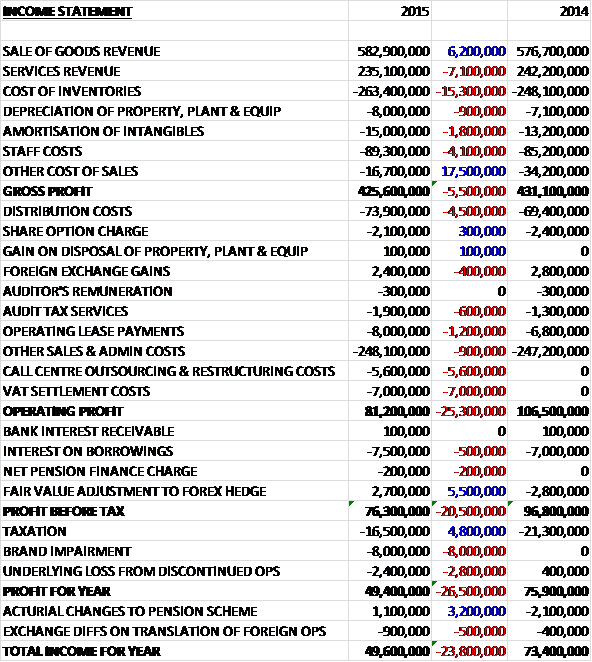
N. Brown is a clothing chain that focuses on plus sizes. As well as the sale of products, the group also makes money from the rendering of services which includes interest, admin charges and arrangement fees. Interest income is accrued on a time basis, by reference to the principle outstanding and the applicable effective interest rate which is the rate that exactly discounts estimated future cash receipts through the expected life of the financial assets to that asset’s net carrying amount. The average credit period given to customers for the sale of goods is 258 days. Interest is charged at 44.9% on the outstanding balance and generally receivables over 150 days past due are written off in full. JD Williams is an online department store for the 50+ female with other brands including Simply Be and Jacamo. N Brown has now released its final results for the year ended 2015.

NBOincome

Overall revenues were down when compared to last year as a £6.2M increase in the sale of goods was more than offset by a £7.1M fall in services revenue. Cost of inventories increased by £15.3M which was offset by a decline in other cost of sales so that the gross profit was some £5.5M down. Distribution costs grew by £4.5M as did operating leases and sales and admin costs but we also see some one-off costs creeping here too with a £5.6M charge related to restructuring, including the outsourcing of the call centre to Serco, along with a £7M charge relating to the VAT settlement with HM Customs which drove the operating profit down by £25.3M at £81.2M. The group then benefited from a £5.5M positive swing in the fair value adjustment of the forex hedge and a lower tax payment but the brand impairment and the underlying loss from the discontinued operation meant that the profit for the year came in at £49.4M, a decline of £26.5M year on year.

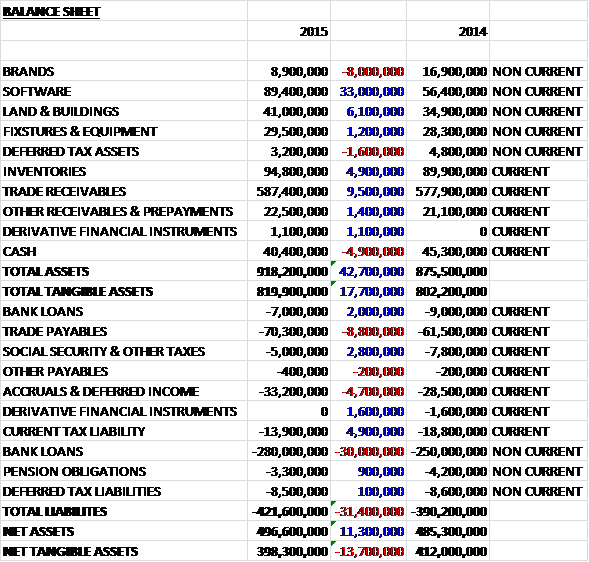
NBOassets

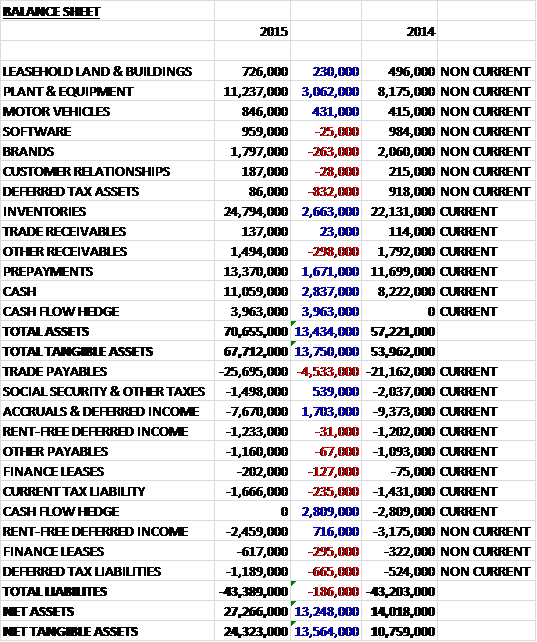
When compared to the end point of last year, total assets increased by £42.7M driven by a £33M growth in the value of software, a £9.5M increase in trade receivables, a £6.1M growth in land and buildings and a £4.9M increase in inventories, partially offset by an £8M fall in the value of brands and a £4.9M decline in cash. Total liabilities also increased during the year as a £28M increase in bank loans, an £8.8M growth in trade payables and a £4.7M increase in accruals and deferred income was partially offset by a £4.9M fall in current tax liabilities and a £2.8M decline in social security and other taxes. The end result is a net tangible asset level of £398.3M, a decline of £13.7M year on year.

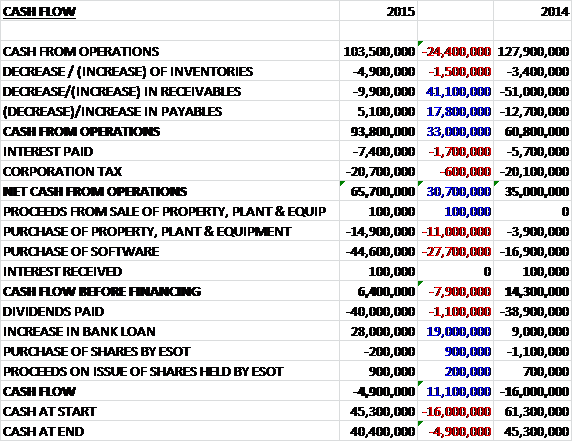
NBOcash

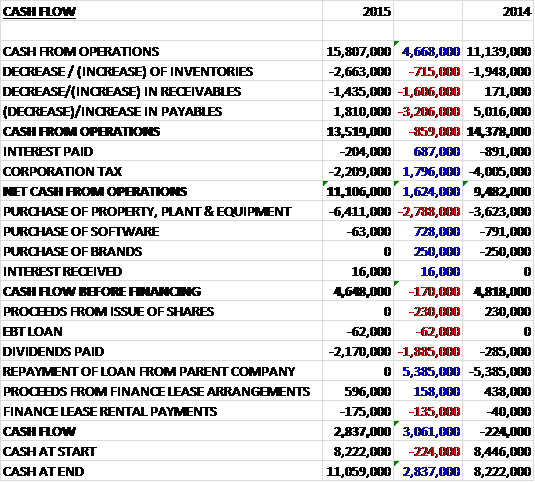
Before movements in working capital, cash profits fell by £24.4M to £103.5M. There was an outflow from working capital, but this was much less than the huge increase in receivables that occurred last year and after higher interest payments, the net cash from operations was £65.7M, an increase of £30.7M year on year. The group spent £44.6M on software and £14.9M on fixed tangible assets relating to stores and the warehouse in equal measure to give a free cash flow of £6.4M. This was nowhere near enough to pay the £40M in dividends so the group increased the bank loan by £28M to give a cash outflow of £4.9M for the year and a cash level of £40.4M at the year-end.

Step-changing the way the business operates and presents itself to market proved more disruptive than anticipated in some key areas and this, combined with a very challenging Autumn trading period across the sector, led to their performance falling below initial expectations. The largest brand, JD Williams, was entirely relaunched during the year which was well received by customers and the spring saw a step-up in the product offering and brand awareness.
Jacamo, having enjoyed revenue growth of 20% last year, saw sales rise by 11% during this year. The introduction of two new labels in the portfolio has helped attract more customers to the brand. Both Label J and Black Label have built on the success of the Flintoff range. The group are also driving brand awareness with TV advertising, used for the first time. The homewares category saw sales increase by 7% year on year; there has also been a decent international performance, albeit with deliberately constrained growth as they bedded in a third party credit offering. US demand was up 13% for the year.

Interestingly the CEO has identified a number of weaknesses at the group including merchandising, the value for money of some of their products, the digital marketing capability, low brand awareness and an underinvested systems infrastructure. Apparently they have made progress in all of these areas but will continue to focus on them going forward.

Over the past year the group have made improvements to their product quality. Also, from a price perspective they decided to make a number of investments to improve their competitive positioning. They have rebalanced their pricing architecture with clearer definition between the three price points of the products. They introduced a small number of key value lines and at the top end of the pricing structure they have improved the ranging of their premium product with occasionwear being a good example. For spring they moved JD Williams to “All sizes one price” in line with the other brands. This followed positive results from a number of trials but the changes led to a percentage margin reduction, although cash margin increased after three to six months.

In financial services, whilst revenue declined by 2.9% year on year, this was driven by a number of policy changes made and the gross profit contribution increased year on year with credit arrears at their lowest level on record. The focus in the division is on maintaining the credit customer base, growing the number of cash customers and modernising the offer. The latter target is enabled by the systems transformation project which will enable the group to charge variable APRs, offer promotional interest free periods and allow them to make credit decisions at a product level.

The group have recently started taking cash customers and their introduction has not resulted in a decline in the credit customers who roll over a balance but are incremental or at the expense of credit customers who immediately paid off their balance, not incurring interest charges. It has also been noted that cash customers have a 6% lower returns rate than either group of credit customers.

A comprehensive review of the systems transformation projects has been undertaken and as a result the number of systems releases has been streamlined and the project length reduced. The project is primarily focused on customer facing improvements and in association with the significant systems change, they are also running an organisational change programme. The benefits include cost reductions, increased demand and improved margin and some of these benefits will be reinvested back into the business. The global multi-channel transformation is expected to save £24M at a cost of £41M; the credit transformation project is expected to save £12M at a cost of £9M; and the planning transformation project is expected to save £9M at a cost of £15M so in total the savings are expected to be £45M at a total cost of £65M. These benefits are expected to start to ramp up from the second half of 2017 with the full impact from 2020.

In the US, sales grew by 13% and the operating loss reduced considerably from £4.7M to £2.5M. Revenue growth was somewhat constrained by the decision to dial-down the recruitment activity as they bedded in their third-party credit provider. This credit offer has performed strongly and has significantly improved customer loyalty, with credit customers seeing a 250% uplift in second order rates versus cash customers. The systems transformation programme includes the launch of a new international web platform and until this is live they will remain in cautious expansion mode in the US, with a focus on improving customer loyalty, building brand awareness and minimising operating losses, which sounds sensible to me.

Sales from the Simply Be and Jacamo stores were up 64% to £13M but the operating loss increased slightly, from £1.6M to £1.8M over a period of significant store openings. There are now fifteen stores, including five stores opened during the year with the new Exeter store being the best performing to date. The long term strategy is to open 25, covering 85% of the population. They have continued to see a positive “halo” effect from the store portfolio and they are also important in terms of building brand awareness. This coming year will see an efficiency review focusing on logistics as the board believe these operations can be improved.

The group are in discussions with HMRC in relation to the VAT consequences of the allocation of marketing costs between the retail and the credit businesses. At this stage it is not possible to determine when or how the matter will be resolved but in the VAT creditor there is an asset of £16.7M that has arisen as a result of cash payments made under protective assessments raised by HMRC which the board expect to recover in full.

Following a review of the business and its future profit potential, the board decided to close the Gray and Osbourn catalogue business. The process is ongoing and will continue into the next year but the business made an underlying loss of £2.4M during the period with an £8M amortisation of the brand, whose value was reduced to zero. Other exceptional costs included £5.6M spent on strategy costs, which include the outsourcing of the call centre to Serco, along with group re-organisation costs. The group also incurred £7M of exceptional costs for VAT. This relates to a potential settlement with HMRC in respect of VAT recovery on bad debts written off over a number of years. The board expect to settle this matter in the coming year.

There were a number of board changes during the year. Lesley Jones joined the board as non-executive director. She has over 35 years of marketing and risk management experience. In January they it was announced that Dean Moore would be stepping down to pursue other opportunities. He had been CFO for eleven years and was placed by Craig Lovelance who was previously CFO of BMI Healthcare. It is notable that the directors are very well paid here, perhaps excessively so, and it is also interesting to see that 18% of votes were voted against the remuneration report at the last AGM which is quite a lot.

The group has a bank loan of £250M secured over some receivables whilst there is also an unsecured bank loan of £37M drawn down under various medium term bank revolving credit facilities of which £120M is committed until March 2016. At the year-end they have available £83M undrawn committed borrowing facilities. If interest rated had increased by 0.5% the profit before tax would have decreased by £1.4M so this is a potential risk for the group. The group does operate a defined benefit pension scheme which was closed to new members back in 2002. Although the deficit is currently only £3.3Mm the present value of defined obligations is £120.8M.

The scale and pace of change required to modernise the business put a great deal of strain on the performance in a difficult year for the clothing sector. Some important foundations for profit recovery and long term growth were laid and the board is confident in the outlook for the business.

At the current share price the shares trade on a PE ratio of 17.6 falling to 15.1 on next year’s consensus forecast. The shares yield 3.8% which is expected to remain the same next year. At the year-end the group has a net debt position of £246.6M compared to £213.7M at the end of last year. In addition there are outstanding operating leases of £32.1M which are increasing, presumably as the number of stores increase.

Overall then this has been a rather difficult year for the group. Profits were down year on year not helped by the ongoing costs relating to the dispute with HMRC and the restructuring expenses. Net tangible assets also fell and although operating cash flow improved, this was only because there was a much smaller increase in receivables than last year and cash profits were down. There was some free cash but this was nowhere near enough to cover the dividends.

Operationally the group was affected by the restructuring and the poor autumn for the clothes market due to the warm weather. Despite this, sales at Jacamo and homewares improved and the US business reduced losses. The stores still made a loss, but this was apparently due to the new openings so this should bode well for the future. Despite the poor performance this year, I do think this is a decent business and the comparatives for next year seem good but I will hold of for now.

Bonmarche Share Blog – Final Results Year Ended 2015

Bonmarche is a multi-channel retailer of affordable womenswear and accessories and are one of the UK’s largest retailers of affordable clothing for women over fifty. They have 292 stores and also offer online, catalogue, TV and telephone shopping. The immediate parent company is BM Holdings, itself advised by a private equity investment fund of Sun Capital Partners Inc. with a holding of 52.4% of the company.

The group sells gift vouchers. On those transactions, no immediate revenue is recorded and the value is recorded as a deferred income liability. When a gift voucher is redeemed, revenue is recognised and the deferred income balance is reduced. The deferred income liability includes liabilities in respect of some vouchers which are unlikely to be redeemed and the carrying amount of gift voucher liabilities at the year-end is £1.1M.

It has now released its final results for the year ended 2015.

BONincome

Revenues grew by £14.3M when compared to last year. Cost of inventories increased, as did depreciation, staff costs and other cost of sales so that gross profit was £3.4M ahead of last year. We then see a much lower charge for the audit costs, more foreign exchange gains and the lack of several non-underlying costs that occurred last year, in particular £3M in management fees and IPO costs. Underlying admin costs increased, however, as did distribution costs, mainly related to an increase in volume, to give an operating profit some £4.4M higher. Finance costs and tax were broadly flat so that the profit for the year was £9.9M, an increase of £4.3M year on year.

BONassets

When compared to the end point of last year, total assets increased by £13.4M driven by a £4M growth in the hedging asset, a £3.1M increase in plant and equipment, a £2.8M growth in cash, a £2.7M increase in inventories and a £1.7M growth in prepayments mostly relating to business rate charges. Total liabilities also increased as a £4.5M growth in trade payables was partially offset by a £2.8M fall in the hedging liabilities and a £1.7M decline in accruals and deferred income. The end result is a net tangible asset level of £24.3M, an increase of £13.6M year on year.

BONcash

Before movements in working capital, cash profits increased by £4.7M to £15.8M. A working capital cash outflow, however, was offset by a tax and interest rate that combined broadly halved so that net cash from operations was £11.1M, an increase of £1.6M year on year. The group then spent £6.4M on property, plant and equipment, mainly relating the opening of new stores and concessions, the replacement of some lorries and expenditure on store systems, to give a free cash flow of £4.7M, of which £2.2M was spent on dividends to give a cash flow for the year of £2.8M and a cash level at the year-end of £11.1M.

Overall the year was one of two halves, to coin a well-used footballing phrase. A strong performance in the first half was supported by good summer weather, however, the mild autumn created more difficult trading conditions in the second half of the year.

Store like for like sales increased by 4% which increased the market share by 12.8% to 4.4% of the UK women’s value clothing market. During the first half of the year, total sales increased by 11.8% and store like for like sales were up 7.8%. Multi-channel made good progress, growing 50.6% year on year. The warmer than average weather created particularly strong demand for big seasonal categories such as jersey tops, cropped trousers, shorts and swimwear.

In the second half of the year, sales increased by 5.7% with store like for like sales up just 0.2% and multi-channel growing by 25.6%. The group was not immune to the effects of the mild conditions in autumn as customers had less reason than normal to invest in heavier clothing such as knitwear and coats when the product mix in-store had shifted towards these items. In addition, the group have identified that for the coming autumn season, improvements can be made to elements of the outerwear and knitwear ranges. They have also reduced the reliance on coats and knitwear during the early autumn months.

The mild autumn also resulted in increasing levels of discounting activity on the high street, progressively intensifying and culminating in widespread price reductions on Black Friday which continued in the approach to Christmas. This took the edge off December’s full price sales with many sales (including Bonmarche’s) beginning before Christmas which also had the knock on effect of reducing the impact of January sales, leading to a difficult final quarter.

Through the mystery shopper programme, the group have learned that customers want more fashionable products, so they have ensured that they have continued to increase the percentage mix of their contemporary fashion offer but without alienating customers who are slower to make the move away from more traditional items. Many of the more fashionable designs have been introduced via the David Emanuel label which tends to feature clothing focused towards special occasions. This sub-brand accounted for about 12% of sales during the year.

Last summer the group launched their Ann Harvey collection in 23 stores and online, initially as a trial. The trial results have helped them refine the collection for autumn/winter which will be primarily aimed at offering existing and new plus-size customers a more contemporary range than the Bonmarche main range, which does not have a plus-size range, at slightly higher price points. They will offer this range in sizes 18 to 32. As a result of feedback from customers, during late autumn the group also began to test a limited range of menswear in fifty stores. The trial is still at an early stage but they are optimistic that this is an opportunity which merits further exploration. The trials have begun to indicate which products work best in the autumn season and will continue in order to ascertain the same about the summer season.

A key priority during the year was to improve the usability of the website. They have made a number of improvements to the site, including the introduction of a simplified landing page, clearer main banner messaging, a more logical hierarchy of tab messages down the page, fewer category descriptions, and similar search and checkout tabs. Email campaigns have been improved, to be more relevant and to include a broader range of content, for example in relations to promotions, occasion dressing or style tips. Traffic reaching the website via tablets now account for 38% of all traffic and 32% of online sales with sales made via computers declining and the relatively small number of mobile sales increasing. The group therefore began working with their website provider to develop a responsive website but its development has taken longer than originally planned and it is now expected to be launched in July 2015.
The catalogues are now well established as a popular complement to the stores. Although their primary use is to showcase new collections prior to a purchase made in store or online, some customers welcome the facility to order directly from the catalogue via the call centre. Sales made through the call centre increased by 32% compared to the previous year.

During the year the group opened 29 new stores, most of which were concessions, particularly in garden centres. They are pleased with the performance of the six new Solus stores and will be more selective going forward with the garden centre sites but they plan on opening a further 15 to 20 concession locations in 2016, along with testing other concession store formats.

During the year a number of investments were made in the stores. Some of these were part of the continuing moves of making the stores more attractive places to shop and some were less visible infrastructure investments to underpin future growth. New fascias were installed in 18 stores and this programme will grow next year as they plan to replace older store fronts and bring them up to date with the latest branding. The cash desk units were replaced in 209 stores to prepare them for the installation of new tills and they made significant upgrades to the store communications infrastructure, including installation of broadband, Wi-Fi and local networks in each tore, also part of the preparatory work for the EPOS till replacement project.

During the year the group began the project to replace the store systems, including EPOS, with an up to date solution that provides customers with a more coherent experience regardless of the shopping channel used. Good progress has been made installing the infrastructure necessary to enable the system to operate but progress on implementation of the system itself has been slower than they would have liked. They are therefore reviewing their options, including the choice of supplier, to ensure that they progress with the most appropriate solution.

They have identified the opportunity to improve stock availability across the entire product range and during the year they introduced a trial to rest whether shortening the lead time between picking an item in the warehouse and delivering it to stores would help achieve this. The results were apparently encouraging and in the coming year they will make investments in their delivery operation to shorten the time take to deliver to stores.

The group have not traditionally used conventional paid advertising to promote the brand but instead rely on their magazine and TV shopping. For the magazine they distribute 40,000 copies four times per year and this year it was updated to reflect the other brand developments. The partnership with the Ideal World TV shopping channel has continued to work well, and the focus during the year was to increase the number of weekly shows, increased to two-hour slots during peak selling times. This has proved successful and this activity continues to generate a small profit, as well as fulfilling its main purpose which is to create awareness of the brand amongst a wider group of potential customers.

During the first half of the year the cost of the hedged US dollars was greater than for the corresponding period last year but the level of discounting during the period was slightly lower due to strong sales. The exchange rate effect was the stronger of the two and as a result gross margin was 56.5%, 0.8% lower. During the second half of the year, the effect of these two variables reversed. The average rate at which the group bought dollars to meet their requirement was better than in the previous year but as trading conditions became more difficult and more discounts were applied to maintain rates of sale. Again, the exchange rate effect was the stronger and the margin in the second half increased by 1.2% to 58.2%.

I don’t really take much notice of awards usually because they all seem to just be purchased by the company that wins but I did notice that Bonmarche were voted second to John Lewis in the Clothing and Shoes category for Which, and that award does have some kudos in my view.

There have been a number of board changes. Tim Mason was Chairman and a partner of Sun European Partners, whose affiliate is the company’s largest shareholder. He stepped down as a partner of Sun and therefore also as Chairman in April. John Coleman replaced Tim as Chairman and Michael Kalb who is a senior MD at Sun and has been working with the company since its acquisition by Sun, joined the board as its appointee as a non-executive director
The group is rather susceptible to exchange rate changes as they pay most of their overseas suppliers in US dollars. They do enter into forward foreign currency hedges to cover up to 100% of forecast inventory purchases for a year so a 10% weakening of the dollar would decrease profits by just £92K. In addition they are also clearly susceptible to changes in the economy in general as a slow-down in consumer spending could materially affect the group’s financial condition. The other big risk involves weather conditions. Prolonged unseasonal or extreme conditions may have a material adverse effect. Finally, and very topical at the moment, is the risk of an increase in the minimum wage as they pay most of their non-management employees minimum wage so an increase has an adverse impact on costs.

The group doesn’t currently have any debt but there is a committed revolving credit facility of £10M available should seasonal working capital fluctuations create the need to use it (although this was not necessary at any point during the past year). There are capital commitments of £1.4M outstanding at the year-end and in line with most other retailers, there are some hefty operating leases outstanding here with £65.3M at the end of the year.

Going forward it is believed that the outlook for the business over the next year is positive. They have multiple growth opportunities to build upon as the market gradually recovers but the board remain neutral in their assessment of the likely effect of external factors on their business.

At the current share price the shares trade on a PE ratio of 15.8 which falls to 14.6 on next year’s consensus forecast. The shares are currently yielding 2.2% increasing to 2.5% on next year’s forecast. At the year-end there is a net cash position of £10.2M compared to £7.8M.

Overall then this seems to have been a good year for the group. Profits were up, net assets increased and operating cash flow grew, with plenty of free cash generated. In the first half of the year, things progressed well with good summer weather leading to a strong performance but in the second half of the year a mild autumn reduced sales and also increased promotions. This effect was offset by favourable USD exchange movements, however. Both like for like store sales and online sales increased in the year and a number of changes being made suggest growth should continue, with more contemporary fashion ranges, more choice for plus size customers, the trial of a menswear offering and improvements to the website all taking place.

The group currently trades on a forward PE of 14.6 and a dividend yield of 2.5% so with no debt, this looks fairly good value. I like this company, they are trading well and the shares are not too expensive. Of course, the issue of inclement weather is never far away and could ruin trading through no fault of the company but overall I might look to take a position here.

On the 30th July the group announced a trading update for Q1. Sales in the quarter increased by 3.8% but like for like sales fell by 1.7% after they increased by 13.5% in Q1 last year, mainly as a result of inconsistent spring and early summer weather. At this early stage of the year the board are confident of achieving its expectations for the year.

On the 18th September the group announced its intention to join the main market and to cancel its shares on AIM, which seems to be a good idea to me. Also, they noted that having reviewed current trading, trading expectations for the full year remain unchanged. It is expected that the full year performance for 2016 will be weighted towards the second half of the year as the benefits of stronger like for like sales growth due to weaker comparatives, new stores and an improved online offering are realised. The board expect the results for H1 2016 to be broadly in line with H1 2015.

E2V Share Blog – Interim Results Year Ending 2016

E2V has now released its interim results for the year ending 2016.


E2vinterimincome

Revenues increased when compared to last year as a £1.8M fall in RF Power revenues and a £974K decline in semiconductors revenue was more than offset by a £10.1M growth in Imaging revenue reflecting a £4.4M contribution from Anafocus and a forex benefit of £2M. Cost of sales also increased to give a gross profit some £1.8M higher than in the first half of 2015. R&D costs increased somewhat as did the amortisation of acquired intangibles but underlying admin costs fell due to lower management incentives and there were a number of lower non-underling costs such as a £635K decline in business improvement programme costs and a £2.5M swing to a foreign currency gain on the hedging instruments. Finance costs then increased and tax was slightly higher so that the profit for the half year was £10.5M, an increase of £572K year on year.

E2vinterimassets

When compared to the end point of last year, total assets increased by £1.3M driven by a £9.2M growth in inventories, a £2.1M increase in income tax receivables, a £1.8M growth in property, plant and equipment, and a £1.8M asset held for sale, partially offset by a £7.7M fall in receivables and a £5.5M decrease in cash. Liabilities also increased as a £9.6M growth in borrowings was partially offset by a £6.6M decline in payables, and a £1.7M fall in derivative financial liabilities. The end result is a net tangible asset level of £71.5M, an increase of £383K over the past six months.

E2Vinterimcash

Before movements in working capital, cash profits fell by £1.8M to £19.7M. There was then a large cash outflow from working capital with a particularly big increase in inventories. A higher tax payment then meant that the net cash from operations was £8.1M, a decrease of £11.2M year on year. The group spent £6.6M on fixed tangible assets and £1.8M on the acquisition of the subsidiary to give an outflow of £571K before financing. The group then spent £3.7M on treasury shares and £7.9M on dividends before an income of £7.1M from new borrowings meant that there was a cash outflow of £5.4M during the period to give a cash level of £15.6M at the end of the first half of the year.

The operating profit in the imaging business was £4.6M, an increase of £1.9M year on year. In professional imaging the industrial vision market is driven by the increased use of sensors in industrial automation where the group sees high single figure market growth rates. The new product launches are making new markets and winning market share in industrial vision. The acquisition of Anafocus has brought new customers and strengthened their existing relationships and provides growth through innovation leading to new product lines and winning custom programmes. In the first half, the combination of new product introduction has doubled growth. In space, governments increasingly seek to maintain independent observation capabilities and the expansion of climate change monitoring is driving growing demand for new observation satellite programmes.

Excluding AnaFocus, organic growth was 15%. Professional imaging represents two thirds of the division’s revenue with the balance coming from space. Underlying growth came from strong demand in automatic data collection, machine vision sensors and optical inspection CMOS cameras. Life science was steady reflecting end user demand remaining at similar levels to the prior year. In space, revenue growth came through delivery on programmes, although these programmes remain technically challenging and they are continuing to commit the resources needed to improve delivery to customers.

The overall profit growth reflects the contribution from the revenue growth with Professional Imaging delivering mid-teen margins and space margins being affected by the additional resources required to support customer programmes. R&D activities have been increased to drive future growth, focusing on areas of strong customer demand, in particular industrial automation and space. In space, work in progress on programmes has increased supporting the anticipated step up in revenue in the second half of the year. The order book at the end of the period was £100M compared to £82M at the same point of last year. The orders due for delivery within the next year were £65M.

The operating profit in the RF Power segment was £8.2M, a decline of £777K when compared to the first half of last year. In radiotherapy the group continue to anticipate that spares revenue will grow in line with the past expansion of the installed base over the last five to ten years. Revenue growth is expected from continued new build demand, which accounts for about a third of growth, and which currently has low single figure growth rates, with two thirds from growing installed base which has had higher growth rates in prior years. Defence budgets across the NATO countries are constrained and the group do not expect to see this change in the short term. The majority of growth in the division is anticipated to come from radiotherapy where they continue to prioritise their investment. The other applications continue to be driven by the general industrial cycle.

There was a decline in revenues from the division with a strong growth in radiotherapy reflecting increased demand from the key OEM customers, whilst absorbing some destocking, along with growth in the commercial and industrial markets. This was offset by weakness in defence with slower than anticipated programme wins and a pause in industrial processing systems. Margins were maintained at 22% despite the lower revenues. This reflects cost control and the alignment of the cost base in defence to the expected activity level. R&D activities continue to be focused primarily on radiotherapy applications. Inventory levels have increased to support customer delivery and as part of a specific programme to reduce over concentration in the supply base and provide continuity of supply as new suppliers are qualified.

The order book at the period-end was £60M compared to £85M at the same point of last year. The decrease reflects the cycle of the multi-year radiotherapy contracts with delivery against their contracts for their key OEM customers. They have also had a reduction in the defence order book reflecting slower than expected programme wins. The orders due for delivery over the next year were £44M, reflecting a lower than a full year cover for radiotherapy. The board expect to renew one radiotherapy multi-year order in the final quarter of the current year along with securing further specific defence orders for delivery in the second half of the year.

The operating profit in the semiconductors business was £4.2M, a fall of £141K when compared to the first half of 2015. The group sees continued ongoing market growth for high reliability products in civil aviation applications such as flight control computers and engine management systems, driven by civil aviation applications which have seen high single figure growth rates. In the last two years they have seen increasing interest in the high reliability microprocessors for space applications that require increased levels of on-board processing. The group have introduced new own design high speed data converters and new multi-chip modules which enable their customers innovation. They have also secured design-ins for their products on future programmes for civil aerospace and space applications.

Revenues declined year on year. Flow down on programmes has increased activity for US legacy product lines, along with good growth coming from their own design high speed data converters for space applications which was offset by lower demand for microprocessors. In other applications there was the anticipated decline in the legacy ASIC business as these products approached the end of their life cycle. The relatively small fall in profits compared to the revenue was due to an improved mix, with growth in the higher margin lines, good cost control and improved operating performance. Inventory levels have been increased both to take advantage of opportunities for strategic inventory purchases and to support the revenue step up anticipated in the second half of the year. The order book at the end of the period was £27M compared to £23M at the same point of last year. This order intake reflects the anticipated flow down on programmes and the order delivery within the next year remained flat at £20M.

The group acquired Anafocus last year but during the period the group paid £1.8M which represents full payment of the first two payments of contingent consideration. Two further payments remain outstanding, one of which is due for payment in the second half of the year and the second payment is due for payment in the first half of next year. Management expects that the remaining target will be met and a liability of £1.8M is recorded in respect of this. During the period the group has repositioned its regional teams in the US and Asia so that they are aligned with the divisions and has reorganised RF’s defence business into three distinct units. Costs, principally staff related, of £917K have been recognised in the period. Project Sunrise, the reorganisation of the footprint at the Chelmsford facility continued and costs of £106K were incurred in the period and second half restructuring is expected to cost about £1M.

At the end of the period the group had capital commitments of £2.3M, principally relating to the acquisition of new plant and machinery. After the end of the balance sheet date the group sold the thermal imaging business. The business had assets of £1.8M and the estimated net proceeds on the transaction are £3M. The total order book at the period-end was £187M compared to £190M at the same point of last year which reflects a strong order intake in imaging offset by the cycle on contracts for radiotherapy. The order book for delivery over the next year is £130M compared to £138M last time.

The focus for the second half is building, in professional imaging, semiconductors and RF defence, on the satisfactory order book and delivering the technically challenging customer programmes in space. The board remain cautious about the broader economic environment and assuming no deterioration in market conditions, the guidance for 2016 as a whole remains unchanged.

After a 6.7% increase in the interim dividend the shares now yield 2.2% which increases to 2.3% on next year’s consensus forecast. The PE ratio for the full year 2016 is expected to be 16.9. At the period-end the group has a net debt position of £19.8M compared to a net debt position of £4.7M at the end of last year and there is still £62.6M of the revolving credit facility that remains undrawn.

Overall then this has been a bit of a slow period for the group. Profits have increased year on year but this just seems to be due to the positive fair value movement of the exchange rate hedge and underlying profits are presumably lower although I am a bit unsure as to whether this fair value movement mitigates unfavourable exchange rate movements elsewhere on the income statement such as in revenue? Net assets did increase modestly during the period but operating cash flow was down and there was no free cash, mostly as a result of a large investment in inventory.

The imaging division seems to be doing well with increased demand from professional imaging and a bulging order book. Semiconductors seem to be rather flat as a reduced microprocessor demand and a falling legacy business is being mostly offset by improvements in other parts of the division. The RF Power division seems to be struggling a bit, however, mainly as a result of lower NATO defence budgets. The order book in the RF Power business looks rather poor too, but this seems to be a reflection of the radiotherapy order cycles. With a PE ratio of 16.9 and a dividend yield of 2.3% along with an increased net debt, these shares do not really seem that good value to me. Nonetheless I am willing to hold on to them for now.

On the 25th January the group announced the acquisition of Signal Processing Devices Sweden, a leader in the design and development of high performance analogue to digital processing technology for up to £12M. Their products are used by customers including leading OEMs across a number of sectors such as industrial test & measurement, healthcare, communications, and science. It also brings proven patented technology in software and board level sub-systems and services which complement the group’s broadband date converter business. Last year the business made sales of $4M but no profit figure is mentioned so I assume it is loss making with the acquisition expected to be earnings enhancing in 2017. The initial cash purchase price is £9.5M with a further earn out of up to £2.7M in cash which is being funded from existing resources. I have to say that this looks a little pricey to me.

On the same date the company released a Q3 trading update. The business performed in line with expectations apart from Space Imaging where they have not seen the anticipated acceleration in programmes delivery, which remain technically challenging. Nevertheless, assuming stable forex and market conditions, management expects a satisfactory outcome for the full year trading performance and the financial position of the company remains strong.

Overall then, I am not sure about these updates. The acquisition seems a bit expensive and trading in Q3 seems to have been a little disappointing. I remain out of these shares for now.

On the 3rd March the group announced the appointment of Carla Cico as a non-executive director. She is also a member of the board of Allegion, a global provider of security products and Alcatel-Lucent, a telecoms provider. In her previous roles she has been CEO of both Rivoli SPA and Ambrosetti Group – China.

Pure Wafer Share Blog – Final Results Year Ended 2015

Pure Wafer has now released its final results for the year ended 2015.

PURincome

Revenues from the remaining North American facility increased by just $175K year on year but with a smaller increase in cost of sales, gross profit came in £75K ahead. We then see a $322K increase in admin expenses and growth in depreciation and share based payments to give an underlying operating profit $324K lower than last year. There were also some exceptional costs – $80K worth of redundancy costs and $221K relating to the Swansea fire as costs were incurred transferring some customer activities to Prescott, and after an increase in “other similar losses” the pre-tax profit was $1.4M, a decline of $716K year on year. This was dwarfed by the gain from the insurance pay-out following the fire, however, so the actual profit for the year was $60.8M, an increase of $57.1M!

PURassets

When compared to the end point of last year, total assets increased by $55.8M driven by an $80.1M increase in cash partially offset by a $15.7M fall in property, plant and equipment; a $4.5M decline in receivables; a $2.4M decrease in deferred tax assets and a $1.4M fall in inventories. Total liabilities fell during the year as a $2M decline in the deferred grant income and a $3.6M fall in loans and borrowings was partially offset by a $3.7M increase in payables and a $1.7M growth in income tax liabilities. The end result is a net tangible asset level of $88.1M, an increase of $57.8M year on year but much of this cash will be returned to shareholders.

ricardocash

Before movements in working capital, cash profits increased by $73.1M to $79.1M, although this is clearly misleading as it is including the insurance pay-out in this and the underlying cash performance is a little harder to ascertain. We also had large cash inflows from working capital so despite a small tax payment as opposed to the rebate last time, the net cash from operations, at $88.3M was $82.9M up year on year. The group only spent $1.3M on capex with the rest of the cash going on bank loan repayments with a hefty $3.4M also spent on the cancellation of the RBS warrants. The end result is a cash inflow of $80.1M to give a cash level of $85.2M at the year-end.
The group are now rather dependent on a small number of large customers with the largest accounting for 27% of revenues and the second largest accounting for 16%.

Following a fire at the Swansea facility the group decided not to reinstate the UK manufacturing facility hence the UK results have been recorded as discontinued operations. In addition the decision to cease to trade the solar business was also made at this time. Overall the group made a £60.3M profit on the discontinued operations. This is as a result of a $1.9M grant releases arising from the impairment of property, plant and equipment along with the £90.6M proceeds from the insurance settlement being partially offset by a $3.4M operating loss from the business, a $15.5M impairment of property, plant and equipment, a $2.2M redundancy cost, a $2.5M site exit and closure costs, a $2.5M insurance settlement incentive, a $1.3M fire related exceptional item, a $129K solar intangible impairment, $3.2M of other losses and some $1.7M in tax charges.

Investigations have indicated that the fire was caused by an electrical fault with a heating element contained within a chemical storage tank. It was contained to the external service and plant areas of the facility and was prevented from entering the production areas by the installed fire prevention systems but subsequent metallurgic testing determined that elements of the building had been compromised by the fire and acid smoke from the fire had contaminated manufacturing areas including highly sensitive clean rooms and equipment. As a result of the fire it was determined that the building would require extensive and costly repairs. The board decided not to reinstate the facility. In addition to the costs involved, some of the reasons included the fact that the majority of Swansea’s customers had declined the company’s offer to qualify and switch production to Prescott and had already migrated to competitors and the fact that the reinstatement of the facility would likely result in overcapacity within the market. The excess funds from the insurance pay-out will therefore mostly be returned to shareholders and it is expected that this will be in the region of 140p to 145p per share.

The Prescott facility continued to fortify its position as the leading wafer reclaim company in the US. Following the Swansea fire, a few customers have started with the qualification of Prescott so that production can be switched. Due to the time consuming nature of the qualification process, no incremental volume will materialise until the end of the year, however. The Prescott facility enjoyed record levels of productivity which together with close management of costs, resulted in its cost per wafer continuing to run at a historic low despite suppliers seeking to increase prices for the majority of consumable items.

Demand for the group’s wafer reclaim services has remained strong since the end of the year. The board are confident that these levels of demand will continue throughout the current year. Industry analysts are forecasting continued growth in the semiconductor market. Confidence in the industry means that the group’s customers continue to invest heavily in additional capacity and technology advancements, giving rise to further wafer reclaim opportunities for them in the US.

There is not really any point looking at PE ratios at the moment as the share price in pretty much entirely anticipating the shareholder returns available following the insurance pay-out. Also, after the pay-out the group doesn’t hold any debt so net funds at the end of the year were $85.2M.

Overall then it is very difficult to value this company. Pre-tax profits did fall but it is pointless having a look at the net assets and cash flow as they both include the total received from the insurers – it is a shame that underlying items were not included too but I suspect they were not that good. All that we really need to know if that the company is paying between 140 to 145p to shareholders with the shares now trading at about 177p, leaving 37p for the rest of the business. I think these are probably now priced about right.

On the 24th November the group announced that it had agreed terms for the sale of the US operation to Wafer Holding Company. It will result in the disposal of all of the trading business and assets of the company so they will be treated as an investing company. The total price payable is $16M which will be satisfied by the payment in cash of $14.4M on closing with $1.6M held by an escrow agent to account for any claims arising under the terms of the disposal and providing no such claims are outstanding, the balance will be released to the company at the end of August next year.

Upon completion of the disposal the company intends to wind up and de-list from AIM. I guess this is not really surprising, but nonetheless I think I would be a little disappointed by this if I was a shareholder.

Utilitywise Share Blog – Final Results Year Ended 2015

Utilitywise has now released its final results for the year ending 2015.

UTWincome

Revenues increased when compared to last year with a £15.5M growth in enterprise revenue and a £6.1M increase in corporate revenue. Cost of sales also increased to give a gross profit some £7.9M above that of 2014. We also see an increase in admin costs, the lack of a £2M contingent consideration release that occurred last year where earn out criteria were not met, and a £1.5M positive swing in provisions, with a provision release occurring this time. Acquisition costs were also slightly higher but operating profit still came in £2.3M ahead. After a slightly smaller finance expense and a much higher tax level, the profit for the year came in at £11.2M, an increase of £1.7M year on year.

UTWassets

When compared to the end point of last year, total assets increased by £21.7M driven by a £12.8M growth in accrued revenue, a £10.3M increase in goodwill, a £5M growth in other intangible assets and a £2M increase in receivables, partially offset by a £9.3M fall in cash. Total liabilities also increased due to a £7.2M growth in borrowings and a £1.4M increase in payables. The end result is a net tangible asset level of £9M, a decline of £2.7M year on year.

UTWcash

Before movements in working capital, cash profits increased by £1.5M to £16.8M. A huge increase in receivables due to the increased proportion of renewal business compared to last year, plus a fall in payables, however, meant that after tax was a little bit higher, there was a £4.7M cash outflow from operations, a deterioration of £14.5M year on year. The group then spent £1.8M on fixed tangible assets and £6.4M on acquisitions to give a cash outflow of £12.9M before financing. There was then £3.4M paid out in dividends and a net £7.2M in new loans to give a cash outflow of £9.3M for the year and a cash level of £6.5M at the year-end.

There was a note with the results this year that noted the financial statements have been adjusted to reflect the correction of an error made in the financial statements for 2013 and 2014. This arose followings management’s review of the revenue provision (when the revenues are generated, the amount is estimated for the length of the contract and the revenue provision is the predicted variance for customers that do not take as much energy as expected). The conclusion of the report was that the rate used to calculate the estimated variability in value was too low (it is currently 15%) and also the provision was held for two years and then released which did not reflect the lengthening of contract terms the group was experiencing. Last year this means that revenues were increased by £305K in the re-stated finances but interestingly the variance will be assumed to be 15% for 2016.

The profit in the enterprise division was £9.7M, an increase of £4.9M year on year. The profit in the corporate division was £1.2M, a decline of £144K when compared to last year. The group now have 27,000 customers in the UK and 4,000 in Europe. In the enterprise division they have increased their ability to engage with potential customers and have developed their Trusted Advisor framework to ensure consistency and complete delivery of all applicable products and services as part of the Utility Management Plan. These will also enable them to establish a relationship with potential customers outside the normal procurement contract cycle.

During the period they have completed the move to the new HQ which has allowed them to recruit more sales people and support staff. Having increased the salesforce from 363 to 610, they have slowed and refocused their recruitment in recent months to ensure they have quality staff capable of delivering their strategy effectively and to increase customer conversion rates. This means that overall headcount growth in the coming year will be slightly slower than previously expected. There have also been a number of additions to the management team. Steve Atwell was appointed as Managing Director of the Enterprise Division and Brin Sheridan has just been announced as the new COO. Brin has extensive experience in the field of energy management within the built environment space having previously been employed as MD at the Energy Solutions Group. He will oversee the implementation of the group’s energy saving propositions.

At the period end the secured pipeline was slightly below last year but had improved from the position at the half year point when the move to the new HQ had just been completed. By the end of September, the pipeline had grown further to £28.3M. The group have developed an online site intended to assist customers comparing tariffs. It is specifically for certain smaller meter sizes, enabling them to switch supplier with minimal human intervention, therefore making the service viable for the smaller customers.

In April the group acquired T-mac Technologies for £16.2M. The consideration consisted of £6.3M in cash, £3.8M-worth of shares issued and £5.7M of contingent consideration. The total value of the contingent consideration is based on a multiple of expected EBITDA capped at £12M, split between cash and shares. The acquisition generated goodwill of £10.3M and in the three months since the acquisition the business contributed a pre-tax profit of £252K. It is expected that T-mac will provide the group with additional capabilities in the energy monitoring and controls space to help customers of energy not just monitor but to control and optimise their energy usage. The T-mac customer base is more akin to the larger multisite corporate customer but they intend to develop products and services which will appeal and provide this capability to the wider SME customer base. The integration has gone well to date and some additional opportunities have been seen as a result of the joint offering.

Exceptional items in the year related to the costs incurred in the acquisition of T-mac Technologies, costs of £39K in relation to unforeseen late invoices connected to the prior year acquisition of Icon Communications and other aborted acquisition costs. Also included are restructuring and reorganisation costs such as settlement payments of £83K and costs of £52K incurred in the set-up of the head office. During the year there was also a credit of £268K offsetting these costs which arose from the release of restructure and dilapidation provisions not utilised.

Obviously there continue to be specific risks to the company – many of which are the same as last year including any potential regulation of the industry. Going forward the investment in the UK procurement and services business model will continue and the number of sales people is now planned to increase to over 800 by the end of 2016. The group also continues to evaluate acquisitions which will add to the overall proposition and in addition a clear market opportunity exists to continue and evolve the business model across Europe and they are currently procuring energy on behalf of customers in France, Germany, Holland and Belgium.

At the current share price the shares trade on a PE ratio of 13.8 which falls to 10.4 on next year’s consensus forecast. After a 25% increase in the total dividend for the year, the shares yield 2.5% increasing to 3.5% on next year’s forecast. Net debt at the year-end was £6.7M compared to a net cash position of £9.8M at the end of last year.

Also today, in a second announcement the group announced the immediate change to its existing payment terms with a key energy supplier. They have agreed to amend terms such that any extension secured on a contract that has not expired receives the same payment terms as a new customer would, in this case 80% on the extension signing and 20% subject to the normal reconciliation process at the end of the contract. They have also agreed that this change of terms will apply to historic accrued revenue balances and hence they have received £3.6M in cash from the supplier.
As a result of the strengthening supplier relationships and the prevailing energy price environment the length of the contracts being secured for customers has increased. The group have prioritised securing existing customers on longer contracts with their incumbent energy suppliers, either as renewals or extensions to the initial contract. Historically the supplier payment term for this contract revenue was delayed until the extended period had commenced and was booked to accrued revenue on the balance sheet.

Discussions are ongoing with all of the key energy suppliers to amend payment terms to reflect this changing way that the company is doing business, with the aim of agreeing revised terms resulting in the receipt of payment for renewals and contract extensions in a similar way to the revised terms detailed above. This is a very positive step in my view. It does some way to improving cash flow and addressing the very genuine concerns that potential investors like myself have about the cash flow here and the very aggressive revenue recognition policy. More really needs to be done in my view but this is a very positive first step.

Overall then this seems to have been a bit of a mixed year for the group. Profits increased year on year but net tangible assets were down and operating cash flow deteriorated considerably into a cash outflow despite an increase in cash profits as the large number of contract renewals meant there was a huge increase in accrued receivables. The previous year adjustment doesn’t really change much but it does show that revenue recognition is confusing even the company itself. There was a bit increase in customers although these seem to be mainly attributable to the enterprise division where profits increased considerably with profits in the corporate division falling away despite the recent acquisitions.

The levels of sales staff has also increased considerably but it seems that this rate of increase has been a bit too much with a focus more on quantity rather than quantity as new staff don’t seem to have been as productive as expected. The acquisition, although expensive, looks like a decent, profitable, one and the European expansion looks like an interesting prospect. With a forward PE of 10.4 and a dividend yield of 3.5% the shares look cheap but despite the changes in terms with one of the suppliers there is still a nagging doubt over the revenue recognition policy and the outflow of cash during the year. I am tempted at these levels but these doubts are holding me back for now.

On the 15th December the group released an AGM statement. They have made a solid start to the year with trading in line with expectations. The pace of recruitment is picking up and they anticipate their position continuing to improve as the year progresses. The secured future pipeline as of the end of November was £27.7M. The board expect the oil price reduction to feed through to improved tariff opportunities for end consumers, providing further opportunities to serve their customers. They are also making progress in further developing their multi-channel routes to market and overall they view the future with confidence.

Additionally the group have announced the immediate change to their existing payment terms with a second key energy supplier. They have agreed to amend their terms such that any future extension secured on a contract that has not expired receives the same payment terms as a new customer would, in this case either 75% or 80% of the expected revenue from the contract falling due on the extension signing and the remainder at maturity. Discussions are ongoing with more of the key energy suppliers to amend payment terms to reflect the changing way that the group are doing business.

So, we have a positive update, but more important in my view is the fact that another supplier has agreed to a change in terms. I am tempted to take a position here but I think I would prefer to wait until I can see an updated cash flow statement that shows what effect these contract changes are having on the all-important cash position.

On the 17th February the group released a trading update for the half year period. The group has performed in line with management expectations with continued revenue growth in both UK divisions as well as the European operation. In the Enterprise division, gross order book additions totalled £40M in the period and the contract go live rate improved meaning the group revenue pipeline was £24.7M at the period-end, some £1.5M below that of the at the end of last year although it was £1.2M up on the same point of last year.

Energy consultant headcount at the period-end was 625 compared to 610 at the year-end with headcount growth being slightly slower than expected, although it is expected to increase in H2. Consumer numbers stand at 29,288 compared to 25,976 six months ago. The all-important figure though is net debt which stands at £10.4M compared to £6.7M at the year-end. This is in line with management expectations but seems disappointing to me in a period that included the £3.6M received following the change in payment terms with an energy supplier.

The rate of customer acquisition has increased compared to extensions and renewals in line with management expectations and the board expect to report both revenue and profits full the full year in line with management expectations. Overall, the cash position looks poor to me so I am staying clear for now.

On the 11th April the group announced that it had been named a partner by Dell which means they are now one of Dell’s OEM partners as part of a joint strategy to introduce internet of things building automation to customers. It is unclear to me what this actually means!

Victoria Oil and Gas Share Blog – Final Results Year Ended 2015

Victoria Oil and Gas has now released its final results for the year ended 2015.

VOGincome

Revenues increased by $13.2M when compared to last year whereas production royalties remained flat and other cost of sales grew to give a gross profit some $4.6M above that of 2014.  Sales and marketing expenses declined during the year but depreciation and amortisation increased by $4.7M.  Admin expenses fell somewhat and there was a $5.4M positive swing in “other” gains and losses.  There was also a $1.1M share of profit from associates before the $49.8M impairment of the assets in Russia meant that there was an operating loss of $50.7M.  Finance costs then fell somewhat but there was a much lower tax credit so that the loss for the year came out at $50.8M.  If we take off the impairment, the actual loss comes in at just over $1M an improvement of $665K year on year.

VOGassets

When compared to the end point of last year, total assets fell by $62.8M driven by a $57.8M decrease in exploration and evaluation assets in Russia, a $6.6M decline in the investment in Cameroon Holdings, a $2.7M fall in receivables and a £1.1M decline in cash, partially offset by a $5.4M investment in associate – possibly this is the prior investment in Cameroon Holdings?  Total liabilities also fell during the year as a $4.6M decline in payables and a $1.7M decrease in deferred tax liabilities were partially offset by a $1.1M increase in provisions.  The end result is a net tangible asset level of $123.5M, almost exactly the same as it was last year.

VOGcash

Before movements in working capital, cash profits increased by $751K to $6.5M.  A large fall in receivables meant that the cash generated from operations came in at $8.8M but due to the big swing to a fall in payables, this was some $4.8M below that of last year.  The group spent all of their cash on property, plant and equipment but due to a $1.8M loan repayment paid to the group, the cash inflow before financing was $1.3M which the group used to pay back borrowings to give a cash outflow at the year-end of $538K and a cash level of $16M.  This is actually not that bad in my view.

During the year there have been a number of notable achievements.  There has been an increase in monthly average gas production from 2.72mmscf per day to 12.39mmscf by the year-end.  In addition they have reached an agreement with Cameroon’s national electricity generating company, EMEO, to provide gas to installations at the Bassa and Logbaba power stations in Douala via take-or-pay contracts that secured revenue for at least the next two years and they delivered the first gas to the grid through the company.  They also completed the main Douala pipeline network, crossing the Wouri River to the far shore, opening up new markets in that growing area; and they purchased the Logbaba gas processing plant and started planning for expansion to double capacity to about 40mmscf per day.

During the year the group made its first connection of the first gas-fired electricity generation sets to customer sites in Douala.  The four sites connected were all existing thermal customers who needed a consistent supply of electric power to overcome regular grid blackouts.  Through an agreement with a third party, the group leased 1.5MW gensets and installed them at dairy Camait, plastic mouldings company Icrafon, flour mill SCTB, and the Guinness brewery.  Despite import related delays in delivering this new product line during the past year, once released by port authorities, the gensets were installed and running at the customer sites within a month.

The installation of the gensets provided the group with the first new derivative product from Logbaba gas in addition to thermal combustion.  Now that the concept has been proven, the four retail power customers are expected to take over genset rental contracts directly from the supplier and the group will be gas supplier only to these customers.

Work on the spur pipeline to the Dangote Cement works was also completed in early 2015.  The clinker grinding and bagging facility, located at Douala port, was commissioned in early June 2015 and has been a consistent and slowly increasing customer of gas since this time.  The group also completed connections on the Douala main shore to customers such as Socapursel, a food manufacturing business and SOTEX, a textile manufacturer.

A key task this year has been to establish a presence on the Western Bonaberi shore across the Wouri estuary which hosts a number of potential customers and also has the space for industrial developments requiring port access.  As well as the main pipeline under the river, the group also laid some 1,129 metres of branch lines in the Bonaberi-Magzi estate area with the first customers connected within five weeks of crossing following flow testing.  New Bonaberi thermal customers were Sopriacam, a cooking oil and soap refinery; New Foods, a biscuit manufacturer; and Sasel, a salt manufacturer.  These three customers are now consuming gas and the group are confident of adding at least eight more in 2016.

Other than the newly commissioned Dangote plant, all new thermal customers were previously using HFO for boilers driving mechanical plant and processes.  The group worked with these businesses to demonstrate the cost savings expected to occur following conversion to gas and then implemented individual engineering solutions that ensured an efficient conversion for these customers.

In December the group signed terms with ENEO, Cameroon’s electricity company, to supply gas to two power stations located in Douala.  The Bassa power station was located 300m from the existing Northern pipeline and the Logbaba power station was located 1.3km along the proposed eastern leg of the main line.  ENEO needed to produce a total of 50MW of power from the two stations.

The agreement with ENEO was a significant gas supply contract for the group in terms of scale and revenue generation, with guaranteed minimum take or pay gas consumption at a fixed $9/mmbut over the two year contract term which can be extended by mutual agreement.  The minimum take of pay levels are $9mmscf/d in the dry season and $3mmscf/d in the wet season but the group expects actual demand from ENEO will be higher than the minimum levels during both seasons based on ENEO advising them that they need to supply 50-80MW of additional power to the city grid for each of the next five years.  Altaaqa was engaged to provide power generation equipment to the project and took responsibility for importing and installing the gensets at the power stations.

In March the group announced the first supply of 4.5mmscf/d of gas to the 16 Altaaqa gensets installed at Bassa.  Following the pipeline connection to Bassa and the installation of the gensets, 20MW of gas generated power was being fed into the grid for the first time.  In April, it was announced that the Logbaba power station project was online and delivering 30MW to the grid.  This meant that the 50MW target under the ENEO agreement and the group’s responsibilities to deliver gas to both stations ad been met.  This principle delivery factor triggered the take or pay conditions in the contract with the total project being delivered within four months of the contract being signed.

In May the group announced that it had made payment in full for the purchase of the Logbaba gas processing plant from Expro for $2.6M using cash generated from operations and contributions from RSM.  Ownership of the plant has significantly reduced monthly operating costs there.

Going forward the demand for gas in Cameroon for thermal and power generation is estimated to be in excess of 150mmscf/d and the group need to grow production to meet this demand.  The task now is to ensure that the group have the reserves and capacity to be able to deliver new allocations of gas to new customers and markets so they are now planning to drill two new wells at the Logbaba concession site.  These wells are primarily twins of the wells completed in the 1950s which produced good gas flows.  Spudding of the first will be in the first half of the 2016 calendar year and the group are planning on funding these wells from internal cash flow, bank finance and partner contributions and at this stage they do not expect to need to seek shareholder funding (this doesn’t sound that certain).

The group is currently the only supplier of natural gas to Douala.  It owns and manages the whole value chain from the wellhead to customer connection and has supply contracts with customers at prices from $9/mmbtu to $16/mmbtu and the country’s gas price is not subject to regulation.  The group obviously intends to maintain its position as a dominant gas supplier to industry in Douala and will seek to act as a gas consolidator in the region.  Compressed Natural gas and dedicated small power users can all be allocated gas in addition to maintaining the supply to the regional electricity generator.  The group have also begun to look at other opportunities within the country and have been in discussions with several participants in the sector about possible joint ventures and farm-in projects.

The core business has been somewhat insulated from the effects of the major shift in oil pricing but during the year they have had to withstand the competitive price pressure of heavy fuel oils.  The group’s gas products are currently more attractive than HFO due to no storage costs, transparency, cleanliness and reliability but in the end, price is possibly the most important consideration.  One of the focuses during the year was to bring online new product applications for GDC gas.  The most obvious usage was that of power with existing thermal customers in the private sectors requesting the group to apply their gas for an electricity generation solution.

During the year the group decided to completely impair their West Medvezhye Russian asset which generated a loss of $49.8M.  The directors continue to pursue ways to derive value from the asset through farm out, joint venture, or sale but this has been challenging due to the state of relations between Russia and the West, combined with the low oil price.

During the year, two new non-executive directors were appointed, with both James McBurney and John Bryant joining during the year.  It has also been announced that Ahmet Dik will join the board of the group as CEO of GDC.  He has worked with the business for two years, being instrumental in concluding the terms with ENEO, and in time it is the intention that he will step up to the CEO position of the group as a whole, which will enable the executive chairman to relinquish his role as interim CEO which would be a positive move.

The group have a net cash position of $5.1M compared to $6.4M at the end of last year but I could not find any EPS broker forecasts which is a bit of a pain.

Overall then, this seems to have been a solid year for the group.  If we discount the Russian impairment, the loss was better than last year and they must be pretty close to breaking even.  The net tangible asset level was flat and the operating cash flow fell year on year, but this was due to a large working capital inflow last year and cash profits were up year on year.  The group is also very close to generating some free cash flow too.

Operationally a lot of progress has been made.  The average gas production has increased from 2.72msf/d to 12.39 and the contract with ENEO to provide gas to two power stations has gone live.  Additionally, they have laid enough pipeline to reach the far side of the river which should open up some new customers.  Of course there are some risks.  The need to expands means that there are plans to drill two wells – these will obviously cost money but this is probably the time to be doing it when hopefully drilling costs are lower.  The possibility of the issue of new shares for these drills can’t be ruled out.  Also, although the group is sheltered from the declining oil price, a continued fall with start to make HFO look better value.

In conclusion, I thought these results read better than I expected.  The company is very close to generating proper profits and some free cash so I am keeping close watch here.

VICTORIA OIL

This chart looks rather interesting.

Victoria Oil and Gas has now released its annual report for 2015 which contains a bit more detail.

VOGincome15

We can see a bit more detail on those admin costs and it seems that the increase came from a $973K growth in wages, a $1M increase in professional fees and a $465K growth in office costs. Those other gains and losses relate to a foreign exchange gain compared to a hefty loss last time and a $722K discount on the settlement of debts. The improvement in finance costs was mainly due to the lack of any loan finance fees.

VOGassets15

When compared to the end point of last year, total assets declined by $62.8M driven by a $57.7M impairment of the Russian exploration asset, a $6M fall in other receivables, a $4.7M decrease in the oil and gas interest, a $2.2M decline in assets under construction, a $1.2M fall in the investment in Cameroon Holdings and a $1.1M decline in cash, partially offset by a $6.5M increase in plant and equipment and a $3.3M growth in trade receivables. Liabilities also declined during the year due to a $5.8M fall in trade payables, and a $1.7M decline in deferred tax liabilities. The end result is a net tangible asset level of $123.5M, flat year on year.

In January 2014, the group signed a loan agreement with BGFI of Cameroon. The principal facility of $8.3M was taken out to fund pipeline extensions, customer connection work and installation of gensets at customer premises. The facility is payable at a rate of 7.25% per annum repayable in 36 monthly instalments and the outstanding balance at the end of May was $6M. The balance owing on the Noor Petroleum loan is currently $4.7M and this attracts an interest of 6.5% per annum.

At the end of May the group had $16M of cash which had fallen to $13.5M by the end of October. The directors expect that the group will be able to generate enough revenue to fund its operations for the next year at least. Given the debt levels of $10.9M, the net cash position should be about $2.6M at the moment. It should be noted that at some point RSM will become entitled to its participating interest share of revenue but it is not clear when this might be.
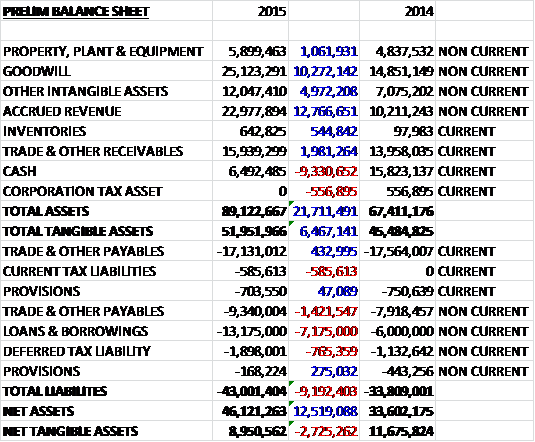
On the 5th November the group released an update for Q3 (this confused me a bit until I saw the later RNS regarding a change in reporting year-end to the end of the calendar year. This quarter was the first full period specifically covering the wet season in Cameroon since they started supplying gas to ENEO and it is the lowest demand period due to the seasonal increase in power output from the country’s hydroelectric dams. The take or pay terms in place with ENEO split minimum payment levels between the wet and dry seasons. Bearing this in mind, average daily gas production was 8.2mmscf/d with 718mmscf of gas sold compared to 12.6mmscf/d and 1,120mmscf in Q2 and 4mmscf/d and 368mmscf in Q3 last year. The group sold 10,878bbls of condensate compared to 13,445bbls and 5,667bbls respectively. This was actually higher than expected as ENEO exceeded its take or pay minimum quota for the period by 32%.

The cash level at the end of the quarter was $12.8M compared to $14.2M at the end of last quarter primarily as a result of a $2.4M debt repayment. The cash received from gas and condensate sales was $8.1M, a 17% reduction on the $9.8M received last quarter.

Having purchased the Logbaba gas production plant in the previous quarter, the group has agreed terms for the operation and maintenance of the plant with Expro (the company they bought the plant from in the first place). They also commissioned a design study with Expro for the expansion of the gas production plant from its existing 20mmscf/d level to up to 40mmscf/d. During the quarter they continued to assess the investment case for potential pipeline expansion into the Bonaberi area and customer connections.

The group have appointed Petrofac to undertake well planning and project management of the upcoming Logbaba drilling campaign planned for 2016, which will target two new wells. The planning, design, and procurement of services and materials for the next two wells, La-107 and La-108, is progressing on schedule. La-107 is to be a twin for the La-14 well drilled in 1957. This well’s objectives include the development of the Upper Logbaba reserves identified in La-104 and to prove lower Logbaba resources that were found there. The La-107 well design also encompasses an option to drill an exploration tail below the base of the Logbaba formation at about 3,200m.

The second well being planned, La-108, is a step-out well into the 2P area of the Logbaba field. The bottom hole location will be about 1,100m to the South East if the drilling pad surface location and is intended to prove up the 2P reserves in the vicinity of the well and to move the 2P reserves into the 1PD, proven developed category. It is intended that the wells will be funded from internal cash flow, bank finance and partner contributions but at this stage it is not expected to require shareholder funding, although clearly this is an option being considered.

The group continue to look for opportunities to expand its hydrocarbon sales. Compressed Natural Gas presents them with the opportunity to distribute gas from the Logbaba gas production plant to a wider network that the gas pipeline currently offers. They are in discussions with a partner who will fulfil all of the capital and operational requirements for the gas compression and distribution of CNG which will enable customers up to 250km from Douala to be provided with gas.

So, overall this seems to have been a fairly robust quarter considering that it is usually the lowers production period during the year. The next quarter will see the tailing off of the wet season in terms of production and expected increased production. The future drilling of new wells offers both risks and potential rewards and until the costs of these wells are more clear I feel the prudent option would be to stay out of the shares for now – I may reconsider this position though.

On the 17th December the group announced the appointment of Iain Patrick as a non-executive director. Iain co-founded PWX Ltd, a consultancy providing business development support to a number of oil and gas companies. In 2006, he was appointed as director of commercial & legal affairs of Gulf Keystone before joining Edgo Energy as commercial director in 2008. He is currently CEO of the oil and gas consultancy Trinity Energy, and serves as a non-executive director for Madagascar Oil and Gas. The company is also considering an additional director to be appointed in 2016 which is an interesting decision given the fact that most of their peers are looking to restrain costs and conserve cash.

On the 20th January the group released an operations update covering Q4. The period marked the third quarter of supply to ENEO and overall production was in line with expectations. The continued erosion of the global oil price has had minimal effect on the business in terms of either gas price changes or customers changing back to oil. The quarter covered the second half of the wet season and average daily production was 7.1mmscf per day compared to 8.2mmscf per day in the previous quarter, of which 3.4mmscf was attributable to grid power. January marks the return to the dry season and associated higher gas utilisation with the grid power sector now recording consistent consumption in excess of 9mmscf per day. This increase is due to the take or pay terms with ENEO.

At $7.6M revenues in Q4 were below the Q3 total of $9M and the net cash position was $5.9M compared to $4.9M at the end of Q3.

Thermal gas sales remained reasonably consistent with the previous quarter, although there was a decline from 350mscf in Q3 to 315.3mmscf in Q4 and management expects this to continue until the capital expansion projects are completed. Grid power sales declined from 367.6mmscf in Q3 to 310.3mmscf in Q4 but consumption is expected to increase significantly during H1 2016 with the first two weeks of the year producing an average of 15.3mmscf per day. Condensate sales are a by-product of the gas production process and volumes sold of 8,608bbls in Q4 compared to 10,878bbls in Q3 reflect these volumes.

The drive in 2016 is to ensure there is sufficient capacity to bring on major new customers by increasing reserves, plant capacity and pipeline reach. At present the production plant capacity is constrained at 20mmscf per day. In addition, finding new applications such as CNG that can add capacity for the existing markets remains a priority.

The group is a 60% holder in the Logbaba concession but is currently entitled to 100% of revenue generated from the project. The concession agreement provides for this allocation of revenue to continue until gross revenues equal the initial exploration costs incurred in the drilling of the two operational wells. Management expects that this point will be reached during H1 2016 and thereafter revenues will be split in accordance with the participating interests which will obviously impact on profitability.

Overall then, sales have fallen quarter on quarter but should increase considerably from Q1 following the start of the dry season. I think the fact that the partner in the Logbaba concession will start earning 40% of the revenues, however, could have a big impact on profitability so now is probably not the time to jump in here.

On the 28th January the group released an operations outlook. The business is beginning 2016 with average daily gas production rates of over 15mmscf per day and aim to increase annual production by 30% during the year. Despite the massive fall in the price of oil, the group has managed to maintain its gas prices at $9 to $16 per mmbtu.

The group will be drilling two new wells in the Logbaba concession in 2016 with spudding of the first well anticipated by the middle of the year. Both wells will be drilled on the current site with well LA107 a twin of well LA104 previously drilled in the 1950s and well LA108 a step out well adjacent to known formations. Petrofac has been engaged as project consultants to help complete the well programme and planning is advanced with a suitable rig secured. Whilst drilling onshore Cameroon is more expensive than in established gas producing regions, the company is taking advantage of the current slump in the hydrocarbon services market to ensure the most cost effective and efficient programme is implemented. The aim is to complete drilling by the end of 2016 and they expect to add new reserves as well as transfer 2P reserves into the 1P category.

In the first half of 2016, the group plans to finalise designs to expand the Logbaba gas processing plant to provide increased capacity. Expansion of the plant is necessary to allow them to process the increased production expected from the drilling programme and pipeline expansion into the Bonaberi area. Expro International has been engaged to complete a study on the design and costs to increase the capacity of the processing plant over three stages to 40mmscf per day. Stage 1, which will expand capacity to 25mmscf per day, is expected to be completed in 2016. The group has received the initial reports on the options available and the next phase is to provide a cost and schedule that ties into the expansion phase of the project from the gas supply side.

The expansion of the pipeline network into Bonaberi will allow the group to access industries that need room to expand or build away from the crowded Douala environment. Before the drilling programme is completed, they expect to have phase 2 commissioned and phase 3 of the pipeline underway. This will provide access to a number of new customers and twelve new gas supply agreements have been signed for businesses on the proposed pipeline. Maya Oil are located at the end of the phase of this expansion and are expected to be a significant consumer of gas, estimated at 0.3mmscf per day.

The group have suggested that they are in discussions to supply additional gas to power projects with ENEO and others and have also mentioned that they are implementing a strategic plan to target other countries in Africa which is an interesting development, although it would be good to get Cameroon cash flow positive first.

During 2016 the revenues from the Logbaba project will be split between the participating interests which will reduce cash coming into the group. The board have indicated that they will fund their capital projects via a combination of strong and established operational cash flows, partner contributions and debt – no placings then? Interestingly the board have also commented that they will endeavour to distinguish the group’s business and from other companies in the oil and gas sector so that they attract an appropriate equity market valuation – I am not sure how they intend to do this, and they will also enhance reporting, transparency and corporate governance which is good to hear.

Overall then, it sounds like quite an exciting year ahead for the group with the new wells planned and other expansion projects. The fact that no placing is planned is good news but I can’t help being concerned about the effect of the revenue split between the partners in the Logbaba concession.

On the 18th February the group announced that it had reached an agreement with Glencore Cameroon and Afex Global on the Matanda Block, a large hydrocarbon license in Cameroon. The terms include the assignment of Glencore’s 75% interest to the VOG with the company becoming the block’s operator. As consideration for the assignment, the group will assume responsibility for carrying out a work programme to be agreed by the Cameroon government. The block covers an area of about 1,235 square kilometres and is prospective for significant natural gas and condensate resources.

The other player in the block is Afex, a Bermuda-based exploration and production company and with this partner the group will initially focus on prospects in the onshore license area located close to the Logbaba area and the existing pipeline network currently operated by Victoria. They will submit a new work programme to the government for approval and expect to start the first phase of seismic data acquisition in Q4 2016.

The board believe that the North Matanda Field has considerable potential and that it is an extension of the Logbaba structure. The block is certainly sizeable, some 60 times larger than their existing concession. It is believed that the concession has a strong geological continuation with Logbaba and tests from three wells already drilled prove a rich condensate yield varying from 30bbl/mmscf to more than 70bbl/mmscf.

It is estimated that the concession has a P50 gas in place volume of 1,864Bcf with condensate in place of 136Mmbbls and ta recent well drilled in 2013 shows a deeper gas reservoir that has not been included in these estimates.

Overall then, this seems like a good, opportunistic acquisition but I wonder how the group will pay for the work programme as well as the up-coming wells to be drilled at Logbaba.

Matchtech Share Blog – Final Results Year Ended 2015

Matchtech has now released its final results for the year ended 2015.

MTECincome

Revenues increased when compared to last year due to the £57M maiden revenue generation from the acquired Networkers business.  Organic revenues declined as an £892K increase in the engineering business was more than offset by a £7.2M fall in professional services revenue.  Wages and salaries increased by £4.8M, leasing costs increased and other cost of sales grew by £35.5M to give a gross profit £9.8M above that of last year.  We then see an increase in the amortisation of acquired intangibles along with underlying admin costs and after a £1.7M exceptional acquisition cost and a £1M restructuring cost relating to the acquisition the operating profit was down £598K.  After a bigger interest cost and tax bill, the profit for the year came in at £8.3, a decline of £811K year on year, although this was only due to the exceptional acquisition costs.

MTECassets

When compared to the end point of last year, total assets increased by £79.7M driven by a £24.8M growth in goodwill, a £23.5M increase in trade receivables, a £17.6M growth in customer relationships and a £4.2M increase in trade names.  Total liabilities also increased during the year as a £34M increase in borrowings, a £10.8M growth in accruals and deferred income and a £5M increase in the deferred tax liability was partially offset by a £4.4M decline in the contractor wages creditor.  The end result is a net tangible asset level of £24.3M, a decline of £14.7M year on year.

MTECash

Before movements in working capital, cash profits increased by £970K to £16.7M.  Working capital movements nearly cancelled each other out although the fall in receivables was slightly higher than the decline in payables and after a higher tax payment, the net cash from operations came in at £13.2M, an increase of £965K year on year.  The group then spent £524K on tangible fixed assets and £387K on intangibles before the £37.6M spent on the acquisition meant that before financing there was a £25.2M cash outflow.  After dividends were paid out, the group drew down £28.6M from the term loan to give a cash outflow of £2.1M for the year  – this would actually be pretty good were it not for the acquisition.

The pre-tax profit in the Engineering business was £9.8M, broadly flat year on year.  NFI increased by 6% with contract NFI up 2% and permanent fees increasing by 24%.  The infrastructure division, which focuses on primarily UK-based projects in environmental and water engineering, highways, transportation and planning, property and rail sectors, had a successful year with significant NFI growth in both contract and permanent recruitment.  The group provided staff in many key infrastructure projects including the Thames Tideway Tunnel and the HS2 rail link.  Other major projects included the new M8 scheme in Scotland and the M1 smart motorway scheme.  While the completion of the water industry’s AMP5 capital investment framework period meant demand for engineers lessened somewhat during the year, the decline was not as marked as the previous AMP completions.  The group are now active in meeting the new recruitment demand stimulated by the start of AMO6 which runs from 2015 to 2020.

Very strong permanent placement in the marine sector contributed to a successful year, during which the business expanded their international focus with a particular emphasis on Canada.  This focus culminated with a contract to work on the Canadian National Shipbuilding Procurement Strategy, where the government selected two shipyards to rebuild Canada’s naval and coast guard fleets with packages of work worth a combined $33BN.  In the UK the maritime division worked through the year with BAE on the major ongoing projects to build and supply the Royal Navy’s new Type 26 Frigate and the successor programme.

Issues around the falling price of oil have had an impact on recruitment numbers in the energy sector although the acquisition of Networkers gives the group a foothold in the renewable energy sector, particularly in areas like offshore wind power in Europe.  The group downsized their German operation during the year but there was a substantial increase in the UK automotive business which was driven in particular by the relationship with Jaguar Land Rover.  The aerospace division underwent a major shift in emphasis during the year as they responded to changing patterns in client demand.  Across the industry, focus in the production cycle has moved from a primarily design-led phase to manufacture, significantly altering the type of engineering personnel that aerospace companies are looking for.  The group therefore moved their attention away from the declining contract opportunities to concentrate on the more in-demand high margin and permanent positions.  In doing so, they have protected their position in a flat market.

It was a good year for the general engineering division, particularly for skilled and semi-skilled placements throughout the South with growth particularly strong on the permanent side of the business.

The pre-tax profit in the Professional services division was £3.9M, an increase of £1.2M when compared to last year.  NFI for the year was down 7% with contract NFI down 2% and permanent fees down 14% although if the closed Barclay Meade office is discounted, contract was broadly flat and permanent fell by 7%.  Despite the profitable Barclay Meade office in Hampshire, the board believed that the London office had not gained enough traction to be viable over the medium term so it was closed in the second half of the year.

The Connectus IT recruitment business had a varied year, with strong performance in both the corporate account client base and within the core ERP business area, offset by challenges faced in other specialist markets.  The corporate accounts team was able to deliver a profitable service with 800 placements across the year, retaining a place on the NHS framework, which allows them to enhance their position as a top ten supplier of IT contractors to the body.  The development of the specialist markets including software, project management and IT infrastructure was challenging, but they saw significant contract wins with a number of technology, professional services and engineering clients which should fuel growth next year.

At Alderwood, the group diversified their product offering, putting a larger emphasis on engineering and technical training professionals.  This has allowed them to utilise their client and candidate base whilst also working to support the number of candidates gaining the skills and qualifications to enter industries with significant skills shortages.  They also expanded their offering overseas, working with education providers in regions such as the Middle East to help them with the delivery of teaching in areas such as English, maths and IT as well as general engineering, construction and the service sector.  This will be a major focus moving forward as the Saudi government continues to invest in up-skilling the population as part of its five year education plan.  They also shifted the emphasis of the UK recruitment business to focus on a technical and vocational product offering.

The maiden pre-tax profit in the acquired Networkers business was £1.9M.  Trading for the four months was in line with last year generating NFI of £9.5M with contract NFI up 3% and permanent fees down 7%.  The business has been providing recruitment services to the telecoms sector for over 15 years and during this time has become a market leader in providing skilled technical resource to the leading vendors and service providers with an emphasis on emerging markets.  There remains a high demand for candidates in specialist technologies where skills shortages are greatest and therefore demand from clients is strongest.  The Energy and Engineering division continued to show impressive growth rates despite the slowdown in the oil and gas sector due to the focus on renewable energy.

The main event during the year was the acquisition of Networkers International in April.  The total consideration was £58.5M and as part of the consideration the group issued new shares to Networkers shareholders as well as a cash consideration of £29.2M.  Networkers is an international recruitment business which supplies staff on a permanent or temporary basis in the telecoms, IT and Energy & Engineering sectors.  The acquisition generated goodwill of £24.8M and generated profits of £471K in the four months it has been part of the group.

During the year there were a number of “non-underlying” costs.  There was £1.7M incurred in respect of the Networkers acquisition.  The restructuring costs are items relating to the integration of Networkers and redundancy costs following the restructuring of Barclay Meade.

The operational aspects of the integration programme are continuing.  In areas like finance, HR, IT and management they are already achieving cost synergies and best practice.  Areas for rationalisation remain, for example they still have two CRMs, two back offices and two sets of associated systems.  They have also identified synergies in the stock exchange listing costs, the board, management overhead and the rationalisation of property.  These synergies should realise in the region of £1.3M next year on a fully annualised basis with more cost synergies to follow.  The group have chosen to re-invest some of these cost synergies to improve the business and accelerate future growth as well as strengthening functional management in some areas.

The group has working capital facilities with HSBC which allows the group to borrow up to 90% of its invoiced debtors up to a maximum of £65M.  Interest charges on borrowings are at a rate of 1.1% over the HSBC base rate.  The group has also agreed a three year, £30M term loan facility with interest charged at a rather more costly 3% over HSBC LIBOR rate.  There is currently £57.2M undrawn bit given the fact that a 1% movement in interest rates would reduce profits by £420K I think it would be prudent to leave it undrawn.  The group is now also rather susceptible to exchange rates with a 25c weakening of the Euro and the Dollar against Sterling would reduce profits by £1.4M.

The group have appointed Patrick Shanley as Chairman who will start from the AGM.  He will replace the interim chairman, Ric Piper.

So far, 2016 has started in line with management’s expectations with many buoyant markets across the group’s core sectors.  In engineering, particularly encouraging is the continued progress in the infrastructure division where relationships with key multi-national clients will be expanded internationally, as well as in the automotive, aerospace and maritime markets.  In energy the group now enjoys a strong position in the European renewables sector and the telecoms sector is also performing well, fuelled by clients investing in 4G and converged service offerings.  The newly combined IT team is well placed to take advantage of strong demand.

The group has a good new business pipeline and signs of sales synergies are coming through with early joint bids progressing well.  They are now in a position to pursue more larger-scale relationships.  The board are planning for substantial growth over the next few years.

After a 12% increase in the final dividend, the shares are yielding 4.3% which is expected to remain the same next year.  At the current share price, the shares trade on a PE ratio of 15.7, falling to 12.4 on next year’s estimate, although these have not yet been updated following the release of the results.  The net debt position at the year-end was £33.6M compared to £3.1M at the end of last year.

Overall then, this is likely to have been a transformational year for the group.  Profits did decline buy if the acquisition costs are excluded there was an increase (although I doubt much of this was organic), net tangible assets also fell as the group acquired a lot of goodwill but operating cash flow increased and the group produced plenty of free cash before the acquisition.  The engineering market was fairly flat with presumably lower margin permanent vacancies increasing at the expense of contract hires.  The energy sector is obviously feeling the pain from the decline in the oil price but the UK automotive sector is buoyant.

In professional services, the opposite was true and permanent hires falling compared to flat contracts but profits still improved.  Clearly the most important aspect this year was the transformational Networkers acquisition which although it did not come cheap, does open up some interesting geographic diversity.  Due to the acquisition the group are now much more susceptible to exchange and interest rate changes with the potential increase in interest rate a real risk going forward which means that paying back the debt is hopefully a priority.

There are clearly also some risks surrounding the acquisition and it is possible that the core business might suffer if attention is diverted to merging the two businesses but the outlook statement reads very positively and with a yield of 4.3% and a PE ratio of 12.4 the shares look good value to me and I have dipped back in.

On the 29th October the group announced the appointment of Patrick Shanley as Chairmen. Patrick is currently chairman of Accsys Technologies and has previously been CFO of Courtaulds.

On the 2nd December the group released an AGM statement where they stated that the group continues to trade in line with their expectations.

On the 7th December it was announced that non-executive director George Materna purchased 100,000 shares at a value of £515K. This means that he now owns 7,877,405 shares representing 25.55% of the total issued share capital. This is a nice vote of confidence I think.

On the 28th January the group released a trading update for H1 2016. Overall the operational performance was in line with their expectations and the board anticipate that profit for the full year will also be in line with their expectations (it would be quite strange if they didn’t!)

NFI performance for the group was up 59% to £35.7M but this was entirely due to the acquisition and on a like for like basis it was down 1%. Engineering LFL NFI was up 7% to £21.7M with a particularly strong 17% growth in permanent fees and contract NFI growing 4%. Within Engineering there was a strong performance from Infrastructure, with NFI up 19%. Technology LFL NFI was down 12% to £14M and down 2% on H2 2015. Within the division, Telecoms was in line with last year but IT was down 20% and the board are committed to enhancing their overall offering in this sector.

The integration of Networkers continues to go well, and they have now identified nearly £2M of annualised synergies which will be fully realised in 2017. They expect to identify additional cost synergies as they continue the integration process and combine the remaining back office functions by the end of this year. The group are re-investing some of these synergies in improving systems connectivity in Asia and North America. They have also appointed regional senior management in both regions in order to accelerate growth in these important markets. Finally they have taken the opportunity to strengthen the group management structure and invest further in their business development capability. Sales synergies are coming through and the new business pipeline across the group is apparently encouraging.

With the integration expected to be mostly completed by the end of the year, the CEO and CFO of Networkers will be leaving the group at that time. Demand in the UK for skilled engineers remains robust and looking ahead, the board see a number of opportunities to roll out their Engineering recruitment services across overseas locations. Investment in headcount is taking place in these areas and they remain confident that they will convert these opportunities into significant growth over the next few years.

Overall then, it seems a poor performance in the IT business has dragged down what is an encouraging performance in the other areas. The opportunities from the acquisition do seem exciting, though, and I will continue to hold.