Braemer Shipping Services Share Blog – Interim Results Year Ending 2016

Braemar Shipping has now released its interim results for the year ending 2016.
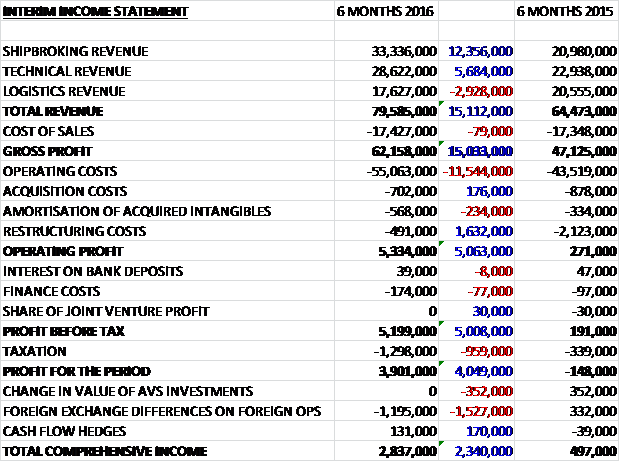
BMSintincome

Revenues increased when compared to last year as a £2.9M decline in logistics revenue was more than offset by a £12.4M growth in shipbroking revenue and a £5.7M increase in technical revenue.  Cost of sales were broadly flat so gross profit was £15M ahead of last time.  Operating costs increased by £11.5M, however, which was partially offset by a £1.6M decline in restructuring costs so that operating profit was £5.1M over the first half of last year.  Finance costs increased slightly and tax increased more considerably so that profit for the half-year came in at £3.9M, a £4M improvement year on year.
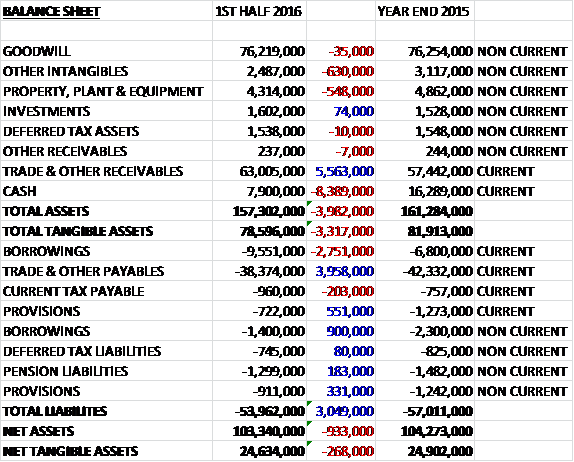
BMSintassets

When compared to the end point of last year, total assets fell by £4M driven by an £8.4M decline in cash, a £630K fall in intangible assets due to the amortisation of the acquired future order book and a £548K decrease in property, plant and equipment arising from the disposal of the former HQ, partially offset by a £5.6M increase in receivables.  Total assets also decreased during the period as a £4M fall in payables, and a £882K decline in provisions partially offset by a £1.7M increase in borrowings.  The end result is a net tangible asset level of £24.6M, a decline of £268K over the past six months.
BMSintcash

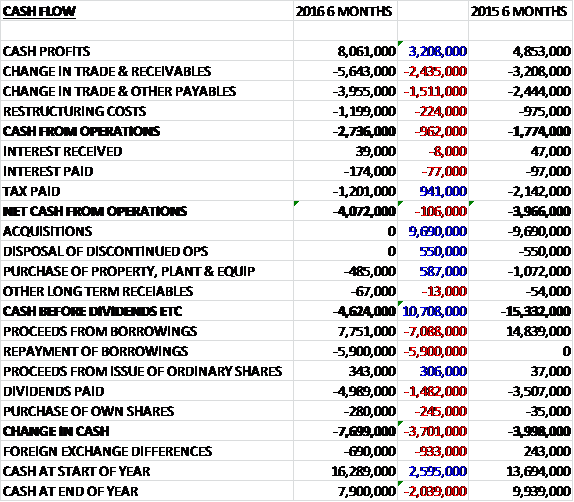
Before movements in working capital, cash profits increased by £3.2M to £8.1M.  A big outflow of working capital cash, with a particularly large increase in receivables meant that there was a cash outflow of £2.7M before a lower tax payment meant that the net operating cash outflow was £4.1M, a detrimental movement of £106K year on year.  The group did not spend much on capex, however, with £485K spent on fixed tangible assets so that before financing the cash outflow was £4.6M.  The group still spent nearly £5M on dividends, however, and after a net increase in borrowings, the cash outflow for the half year came in at £7.7M to give a cash level of £7.9M.

The divisional operating profit in the shipbroking division was £4.6M, an increase of £3.2M year on year with much of the increase attributed to the full period impact of the merger with ACM.  The total forward order book remains consistent at about $56M, of which approximately $14M relates to the second half of this year.  The increase both in oil production and crude oil tonne miles reported over the last year has had a beneficial effect on the tanker market and freight rates have been strong throughout the first half and are expected to remain so during the coming quarter.  The fall in the oil price has had the opposite effect on the offshore market, however, where exploration budgets have been cut back significantly and the demand for offshore supply vessels have fallen.

With lower oil prices, the tanker and offshore markets can behave counter-cyclically and with the group’s greater weighting in tankers they would expect a net benefit to shipbroking income while oil supply and tanker demand are strong.  The dry bulk market is suffering from an over-supply of tonnage and a softening in Chinese demand for raw materials.  Although the market will take time to re-balance, the group are apparently appropriately structured to operate in these conditions.

Sales and purchase activity, both in second hand and demolition, has been steady.  The rise in the tanker market stimulated investment interest in the sector, especially earlier in the period, and they have been involved in a number of significant market transactions, some of which will benefit income in the second half of the year.  In addition, the time charter market for tankers has seen a rise in both rates and activity and they have been able to conclude some good multi-year business for their clients in the half.

The divisional operating profit in the technical division was £3.1M, a growth of £807K when compared to the first half of last year.  While the reduction in the oil price has had a detrimental impact in some parts of the division, this has been offset by growth elsewhere.  Braemar Engineering has had a very successful first half and is currently working on a number of major LNG projects for clients based in Europe, USA and Africa and is well positioned to capitalise on future growth in LNG.  Braemar Offshore, the marine warranty surveying and engineering consultancy, was affected by the slowdown in offshore-related activity following the drop in the oil price.  The business has continued to diversify its activity, however in order to try and achieve a solid performance.

Braemar Adjusting, the energy loss adjusting business, performed well against the backdrop of the downturn in the oil and gas sectors of its market with the Middle East office a major contributor during the first half.  Despite the market pressure, they were able to maintain good staff utilisation and have managed expenditure whilst continuing to focus on business development.  As a result, the group are beginning to see an increase in the volume of instructions in both onshore and offshore business.  The hull and machinery damage surveying and marine consultancy business performed steadily throughout the period.  The number of new instructions fell compared with last year reflecting global market conditions but the average incident value increased.   Braemar Howells, the incident response and environmental consultancy services business, has reported good results for the first half without attending any major incidents in the period.

The divisional operating profit in the logistics sector was £981K, a decline of £65K when compared to the first half of 2015.  Whilst the general port agency market has been quiet, business performance in the UK was secured by several ongoing and ad hoc support projects.  The new Houston office is beginning to secure port agency business and during the period they augmented their Singapore port agency with added commercial sales skills in order to develop local markets.  Sea freight volatility continued, although imports were strong within the logistics sector.  They are developing new client relationships following their decision to develop specialist areas such as reefer and European overland.  Contract logistics remains a key sector with their use of digital technologies such as “shiptrak” allowing them to add value by optimising their customers’ processes.

There were a few non-underlying items during the period.  The group incurred £702K in respect of the acquisition of ACM and £491K in relation to restructuring activities as a result of the acquisition.

The majority of the cash flows have followed the normal business cycle whereby the second half is more cash generative due to the timing of staff bonus payments, although there has been an increase in working capital requirements arising from revenue growth.  The group are actively seeking to reduce the level of working capital without inhibiting the normal business operations and the objective of growing the business.  The outlook for the full year continues to be in line with the board’s expectations which is supported by the early indications of trading in the second half.

After the interim dividend was kept the same, the shares are yielding 5.9% on an annual basis which is great but hardly covered by cash flow.  Net debt at the period-end stood at £3.1M compared to £4.9M at the same point of last year and a net cash position of £7.2M at the end of last year.

Overall then this has been a fairly solid period for the group.  Profits have increased year on year but net assets fell back slightly.  The operating cash flow also worsened but this was due to working capital movements and cash profits increased.  The very large working capital outflow meant that there was a negative cash flow at the operating level, however.  The shipbroking division increased profits, mainly as a result of the contribution from ACM, with the increased demand for tankers offsetting a declining demand in offshore supply vessels and bulk carriers.

The technical division seems to be performing well, mainly as a result of some large LNG projects but the logistics business fared less well due to port agency work being quiet.  With a dividend yield of 5.9% and PE ratio of 13.1, the shares are not exactly expensive but there does not seem to be a great deal of organic growth, the global economic outlook looks precarious and the large working capital outflow is a little concerning so I think I might stay out of this share for the time being.
BRAEMAR SHIP

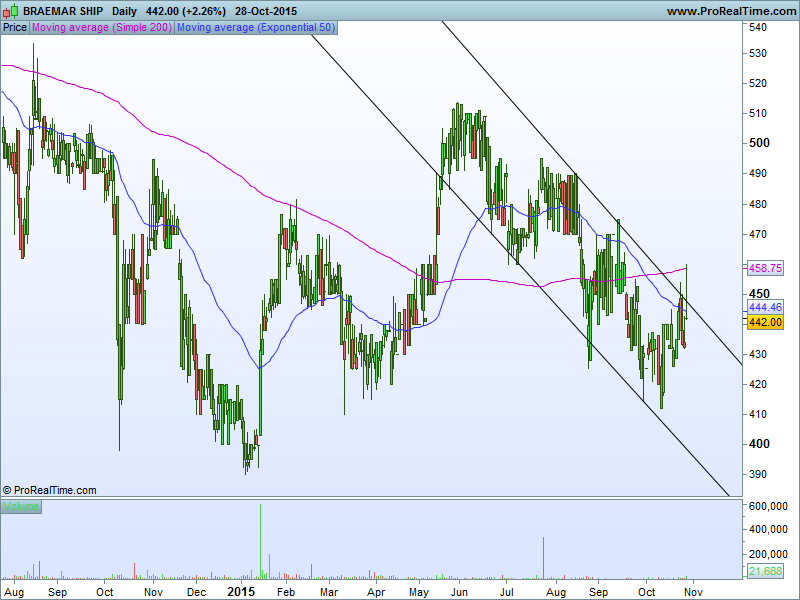
It’s possible that the recent fall in share price has been halted but we will have to wait for some confirmation.

On the 14th January the group issued an update covering the trading period since the end of October. Positive momentum continued through the company and they are on track to meet their objectives this year – not sure that really tells us much. The shipbroking division continued to perform well in a volatile environment. They have seen strong activity in the tanker markets driven by the increase in oil production. The sale and purchase business has been pleasing but as expected, the dry cargo and offshore markets remain challenging.

The technical division is performing in line with expectations with the LNG engineering business in particular continuing to grow which has offset the effect of lower exploration activity on the offshore energy business. Overall the board remain confident that the group is on track to meet market expectations for the full year.

On the 2nd March the group announced that CEO of Braemar ACM James Gundy sold 27,500 shares at a value of £117.6K. This leaves him with 468,852 shares in the company.

On the 19th February (only being reported now!), director Denis Petropoulos purchased 19,500 shares at a value of nearly £84K to bring his holding up to 620,934 shares. This is a pretty decent buy actually, not prompted by any need to support the share price.
Harvey Nash Share Blog – Interim Results Year Ending 2016

Harvey Nash has now released its interim results for the year ending 2016.

HVNintincome

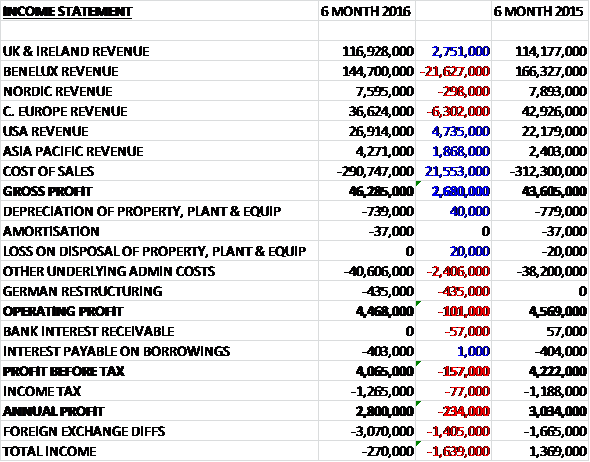
Revenues declined considerably when compared to last year as a £4.7M increase in USA revenue, a £2.8M growth in UK and Ireland revenue and a £1.9M increase in Asia Pacific revenue was more than offset by a £21.6M fall in Benelux revenue and a £6.3M decline in Central Europe revenue with Nordic revenue down by £298K.  Cost of sales also fell considerably, however to give a gross profit £2.7M above that of the first half last year.  Admin costs increased, though and the German restructuring costs of £435K pushed the operating profits down by £101K.  After a small increase in tax and the elimination of bank interest receivable, the profit for the year came in at £2.8M, a decrease of £234K year on year.

HVNintassets

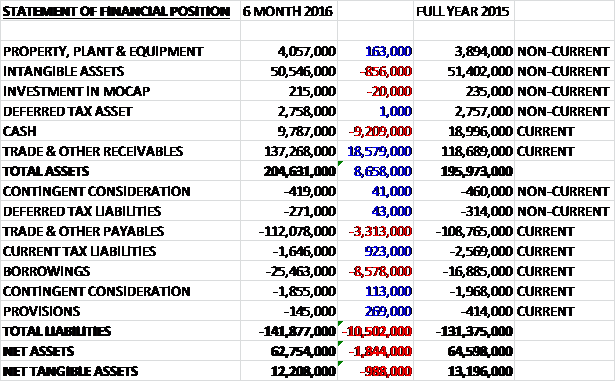
When compared to the end point of last year, total assets increased by £8.7M driven by an £18.6M growth in receivables partially offset by a £9.2M decline in cash and an £856K decrease in intangible assets.  Liabilities also increased as an £8.6M increase in borrowings and a £3.3M growth in payables was partially offset by a £923K fall in current tax liabilities.  The end result is a net tangible asset level of £12.2M, a decline of £988K over the past six months.

HVNintcash

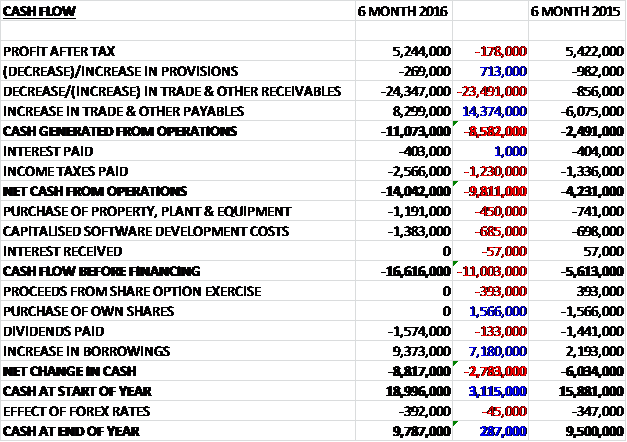
Before movements in working capital, cash profits fall by £178K to £5.2M.  A huge increase in receivables, however, along with a smaller increase in tax relating to the payment of prior year taxes in Belgium and Germany, meant that there was a £14M cash outflow from operations, an increase of £9.8M year on year.  The group also spent £1.2M on fixed tangible assets relating to the modernisation and updating of the technology platforms and database, technology and office infrastructure spent, and £1.4M on development costs relating to software development for a vehicular small cell solution in Germany, so that before financing there was a cash outflow of £16.6M.  After an increase in borrowings, the cash outflow for the period was £8.8M to give a cash level of £9.8M at the period-end.

The growth in contracting in the US, the UK and Benelux has absorbed more cash than normal at the seasonal peak which was exacerbated by a five week billing month ending on the half-year date which meant that receivables increased despite lower turnover and shorter debtor days.  In addition, payables decreased due to the unfavourable timing of certain contractor payrolls and as a result, net borrowings increased considerably.  The cash performance is expected to improve in the second half of the year as working capital swings substantially reverse and catch-up tax payments and capex flows normalise.

The operating profit in the UK and Irish business was £2.1M, an increase of £181K year on year.  Strong results were reported from Scotland and the new UK regional locations of Newcastle and Bristol made their first positive contributions.  In London, significant growth was generated from Finance and Banking, which was mitigated by weaker results from oil and gas.  Contract demand for technology specialists was robust as the acute skills shortage continued.

While results from the senior interim business were improved on the prior year, the UK election impacted demand for permanent activities in Q1 in local government, education and the NHS.  The healthcare market is returning to normal, however, with net fees for the half year up 8.6% and increased demand for international mandates.  In Ireland, gross profit increased by 9.3%, led by demand for finance professionals and technology specialists for Dublin-based US multinationals and an improved performance from the recently opened office in Cork.

The operating profit in the Benelux division was £1.8M, a decline of £456K when compared to the first half of last year.  Challenging market conditions in the Netherlands and reduced margins for managed services across the Benelux held back profits.  Additional investment for growth in Belgium also reduced the short term contribution in Antwerp and Brussels.  Demand for permanent placements increased during the period, however.  The process of closing the French executive search office was finally completed during May.

The operating profit in Central Europe was £187K, an increase of £186K when compared to the first half of 2015 with increases in Switzerland, Poland and Germany.  Gross profit in Germany was 29.4% higher due to the increasing demand for flexible technology and engineering labour and a significant rise in permanent recruitment, with placements more than doubling on the prior period as business confidence improved.  In the German outsourcing business, revenue was down 6.4% with a loss of £200K.  As a result, further restructuring is being undertaken in the legacy telecoms outsourcing services business in the second half of the year to reduce costs in line with sales.

In the innovations business, software development totalling £1.1M was capitalised in relation to the ongoing development of a vehicular small cell solution for the German automotive industry.  Key milestones in support of the policy of capitalisation were achieved and the process of reviewing all options for the future of the German outsourcing business is progressing.

The operating profit in the Nordic business was £107K, a growth of £50K year on year with the figure affected by the devaluation of both the Swedish and Norwegian currencies.  The business in Sweden continued to grow, further consolidating its market leading position in senior and professional recruitment and leadership services, with a 15.2% growth in gross profit.  Good permanent recruitment activity facilitated a 22.2% increase in fee earners, particularly in the smaller locations such as Finland and Norway.  Following the restructuring in Norway last year, the loss in the period was significantly reduced.

The operating profit in the US was £756K, a growth of £286K when compared to the first half of last year, aided by favourable market conditions and strong demand for technology professionals.  Permanent placement revenues increased by nearly 20% on the prior year while gross profit contracting and outsourcing grew by 51.3% and 36.4% respectively.

The operating loss in Asia Pacific was £58K, an improvement of £87K year on year on revenues that increased by 77.7% to £4.3M.  This was driven by senior executive recruitment in Hong Kong and Japan, an encouraging start to the new Singapore office and continued strong trading in Vietnam where the recruitment business reported an increase in permanent revenues of 15.9%.  In Australia a focus on productivity and costs partly mitigated the 16.8% decline in gross profit against the prior period.  This was due in part to the weakening Australian dollar but mainly challenging operating conditions in Q1.

After the period-end the group paid the deferred consideration of £2M in respect of the Belgian acquisition of Talent IT.  Since the period-end the group has performed in line with management expectations but since the end of the first half, global macro-economic uncertainty has increased, notably with respect to China, and currency issues continue.  Overall the board remain positive about the outlook for the rest of the year, however.

The net debt position at the end of the half was £15.7M compared to a net cash position of £2.1M at the end of last year.  After a 10% increase in the interim dividend, the shares are currently yielding 3.8%, increasing to 4% on next year’s consensus forecast.

Overall then this has been a mixed period for the group.  Profits were down but this was only due to the German restructuring and underlying profits increased slightly.  Net assets fell, however, and both cash profits and operating cash flow decreased during the period, with the latter driven by a huge increase in receivables which is being put down to growth in some regions along with a five week billing week – I’m not convinced by that but if these cash flows reverse in the second half, the cash flow for the year should be pretty good.

The UK performed well due to Scotland and some new offices with other good performances from Ireland, Germany, Sweden and the US with Australia and Norway continuing to struggle along with the Netherlands which does not seem to be performing well.  With a forward PE of 10.4 and a dividend yield of 4% the shares still look cheap but now there is a net debt position driven by the working capital outflow and growth seems to be stubbornly slow, I am not sure what do about this one.

HARVEY NASH GRP

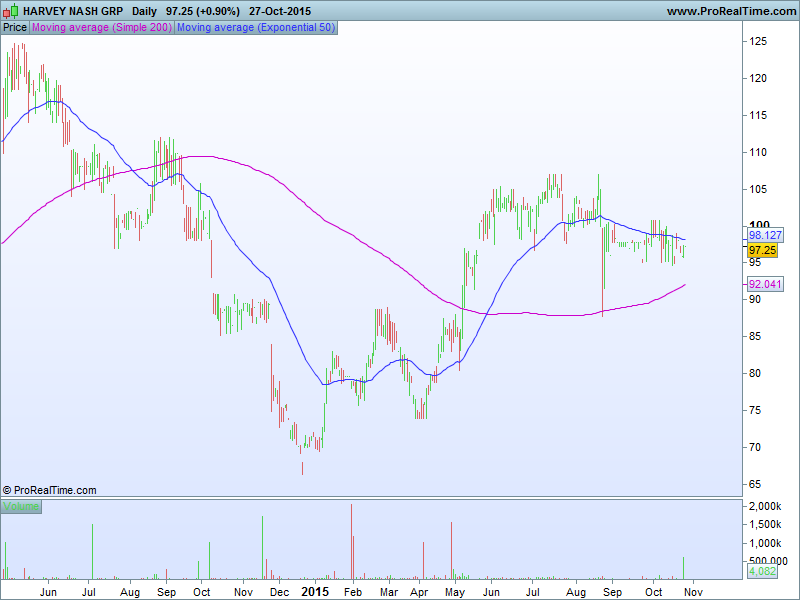
The share price does seem to have come off slightly in recent months but the recovery is arguably still in place.

On the 7th December the group released a trading update for the first nine months of the year. Overall they traded in line with board expectations with adjusted pre-tax profit increasing by 7% year on year, driven by strong trading in the US and Germany, solid results in the UK and progress in Asia. Net borrowings were at a similar level to the balance at the end of the first half.

The group has also announced the sale of its German telecoms outsourcing business, Nash Technologies, which was completed in early December. The revenues of the business had declined due to the merger involving its largest client, Alcatel-Lucent, and the business was loss making. The group have agreed its sale to the CEO of Nash Technologies by way of a management buyout. The disposal will have no effect on the core recruitment business in Germany, which is trading strongly and contributed €1.3M to group profits in the first nine months of the year.

The aggregate consideration from the disposal payable at completion is just under £20K with the buyer assuming working capital liabilities capped at £1.7M. In addition, the buyer will pay additional cash consideration to the group by way of an earn-out based on the performance of Nash Technologies subject to a maximum amount of £6.5M. It has also been agreed that should the buyer dispose of the business before the end of 2022, they will pay the group the first £1.7M of any net proceeds arising from any such disposal and 50% of any proceeds in excess of this amount, capped at £6.5M.

Excluding the effect of the earn-out, the charge on disposal will include a non-cash loss of £6.2M representing the difference between the net book carrying value of the business and the net cash initial proceeds; and the future cash commitments, capped at £4.1.

I suppose it is good news that they have managed to offload a loss-making part of the business (last year it lost £300K) but the fact that they have not been able to recover any of the book value is very disappointing.

On the 26th February the group released a pre-close trading update. The adjusted pre-tax profit is expected to be in line with market forecasts and gross profit grew across all geographies and service lines on a constant currency basis. The gross profit for permanent recruitment was up 10%, the gross profit for contracting recruitment was up 8% and the gross profit for offshore services increased by 10%. The net cash position at the year-end was £200K, ahead of expectations due to tight control of working capital. There was strong growth in the US with constant currency gross profit up 16% and also Asia Pacific with a 38% growth off a lower base.

Harvey Nash Share Blog – Final Results Year Ended 2015

Harvey Nash is a provider of specialist recruitment and outsourcing solutions.  It has offices in the UK, Europe, the US, Hong Kong, Japan, Australia and Vietnam and it is listed on the LSE.  Their services include executive search and leadership services where they work with organisations to recruit board members and senior executives on a permanent and interim basis, along with consultancy such as assessment and leadership services.  A second service is professional recruitment where the technology recruitment business helps organisations recruit experts on a permanent and contract basis, and they also provide bespoke assistance to clients in order for them to manage their workforce risk, payroll services and hiring processes.  The final service is offshore and solutions where they provide managed IT services and projects, software development, and BPO services in Vietnam along with mission critical elements of telecoms R&D.

Managed solutions have become the gateway to new client relationships, whether it’s the management of existing client business operations or providing recruitment outsourcing and payroll services.  Increasingly more routine elements of the recruitment or solutions process are undertaken offshore, reducing cost and increasing efficiency.  Revenue anticipated, but not invoiced at the balance sheet date is accrued on the balance sheet as accrued income (perhaps this is common practice but this seems a bit aggressive to me) whilst revenue invoiced but not earned at the balance sheet date is recorded as a liability as deferred income.

The group has now released its final results for the year ended 2015.

HVYincome

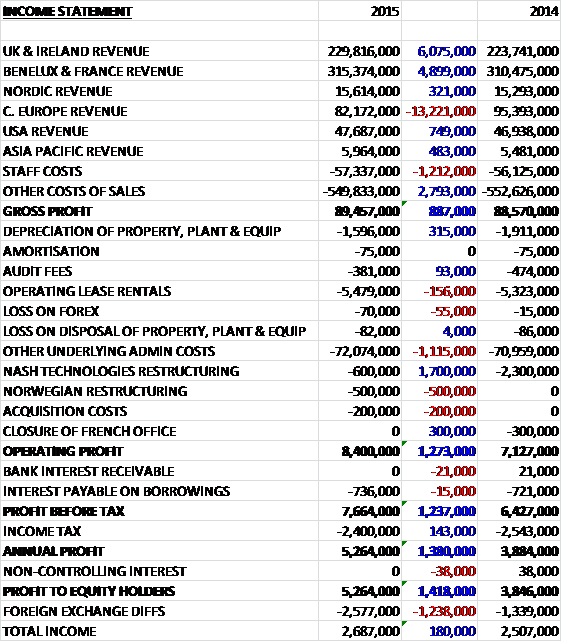
Overall revenues fell when compared to last year as increases in the majority of markets was more than offset by a £13.2M fall in Central European revenue.  Staff costs increased slightly but other cost of sales declined to give a gross profit some £887K ahead.  We then see a slightly lower depreciation but an increase in admin costs before various non-underling costs took their toll, with a £1.7M fall in Nash Technologies restructuring,  partially offset by increases in other costs to give an operating profit £1.2M higher than in 2014.  After slightly higher finance costs were offset by a lower tax charge, the profit for the year came in at £5.3M, an increase of £1.4M year on year.

HVYassets

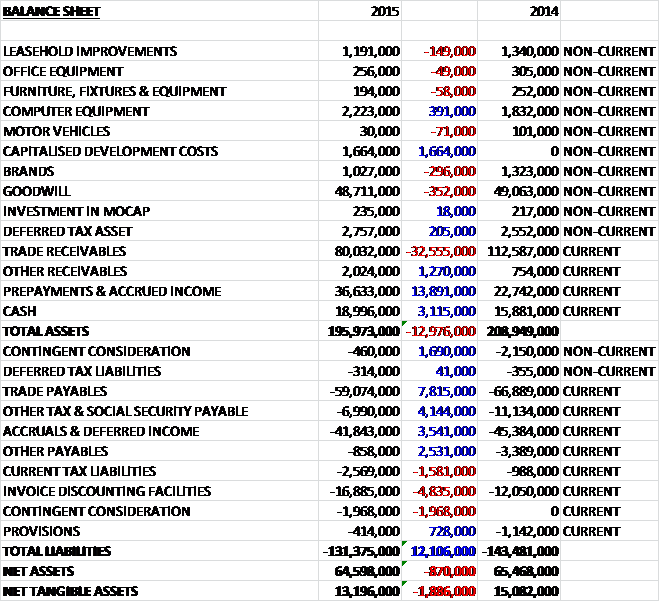
When compared to the end point of last year, total assets fell by £13M driven by a £32.6M decline in trade receivables as a result of efficient working capital management and the timing of invoicing, partially offset by a £13.9M increase in prepayments and accrued income as a result of an increase in accrued income in the Netherlands due to the timing of invoicing, a £3.1M growth in cash, a £1.7M increase in capitalised development costs and a £1.3M growth in other receivables.  Total liabilities also fell during the year as a £4.8M increase in the invoice discounting facilities and a £1.6M growth in current tax liabilities was more than offset by a £7.8M fall in trade payables, a £4.1M decline in other tax and social security payables, a £3.5M decrease in accruals and deferred income and a £2.5M fall in other payables.  The end result is a net tangible asset level of £13.2M, a decline of £1.9M year on year.

HVYcash

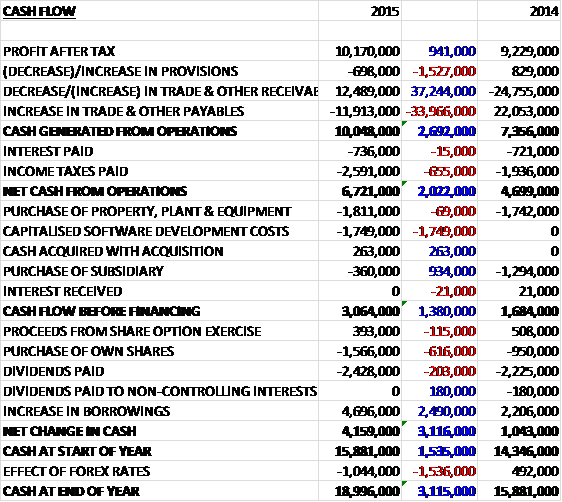
Before movements in working capital, cash profits increased by £941K to £10.2M.  There was a broadly neutral working capital position compared to a small outflow last time and after higher taxes were paid, net cash from operations came in at £6.7M, an increase of £2M year on year.  The group spent £1.8M on tangible fixed assets and the same amount on software development so that the free cash flow was £3.1M.  The group spent all this on buying its own shares and dividends, and after a £4.7M increase in borrowings, the cash flow was £4.2M to give a cash level of £19M at the year end.

The operating profit at the UK and Ireland division was £3.7M, a growth of £524K year on year as the business capitalised on market share gains and continued with investment to expand capacity during the recession.  Demand for contingent technology professionals continued to be the strongest area of the market with London and the finance and banking sectors in particular being buoyant.  The broader demand for executive and higher salary did not demonstrate similar growth but education, health, consumer and board recruitment has been active.  Interim management reported a steady performance with an increasing pipeline of opportunities as the economy continued to improve.

Growth came from the recently established locations in the UK – Newcastle, Bristol and Warrington, with the larger hubs such as Birmingham and Manchester broadly flat against record results in the prior year.  In Scotland, the referendum reduced demand for permanent hires but the number of contractors out at the year-end was up 87% comparted to the previous year.  In Ireland, continued strong demand from mainly US and European multinationals for IT contractors drove overall growth up 22% in gross profit.  The recently established office on Cork also delivered good growth, albeit from a low base.  Gross profit from offshore IT services was one again the fastest growing service, up 17% following a strong year of new business sales, underpinning the UK profitability and cementing key recruitment client relationships.

The operating profit in Benelux and France was £4.3M, an increase of £291K when compared to last year.  Currency headwinds were the key feature of the Eurozone results.  In the Benelux regions, clients continued to favour temporary recruitment over permanent and the business acquired in 2012, Talent IT in Antwerp, delivered a strong result in its final earn-out year with gross profit up 25% which resulted in the trigger of a £2M contingent consideration payment in 2016.  The Netherlands reported a small decline of 2% in gross profit terms, mainly related to lower permanent recruitment.

The operating profit at the Nordics business was £351K, a growth of £37K year on year but gross profit declined as a result of a weak performance in Norway.  The business in Sweden performed well with gross profit up 16% despite challenging trading conditions with the interim management business reported the strongest growth, up 43%.  Finland and Denmark, although both small, both reported strong increases in gross profit.  Norway’s economy has been impacted by weakening domestic demand in the first half of the year and a significant decline in the price of oil in the second half such that gross profit was down 37%.  The downsizing of the operation and property was not sufficient to return the Norwegian business to breakeven by the end of the year with a smaller loss expected for 2016.

The operating profit in Central Europe was £799K, a decline of £444K when compared to 2014. Results across the region were mixed.  In Switzerland and Germany, recruitment gross profit declined by 4% and 6% respectively but in Germany a weak first half was offset by a much stronger second half mainly due to increasing demand for engineering and employed IT consultants.  Executive recruitment in Poland was lower than the previous year but technology recruitment was strong with a 94% increase in gross profit.

The operating profit in the US was £865K, an increase of £13K year on year.  The business invested in headcount as confidence in the recovery grew stronger.  Permanent recruitment was robust as the pipeline of orders for permanent hires continued to improve with net fees up 11% on the last year, with the Seattle office generating the highest proportion.  Executive search was up 15% boosted by demand for senior executives to drive technology based digital business strategies in larger companies.

A natural swing in demand occurred during the year from contract to permanent as clients switched their resourcing strategies to filling long term permanent positions.  This impacted contribution and led to a small decline in core contracting gross profit over the year.  The decline was offset by strong growth in the new Enterprise Technical Delivery Service, which grew by 31%.  This service provides contract resources to large enterprises mainly through a vendor management programme using the group’s unique offshore sourcing strategy.  The acute skills shortage combined with investment in digital resulted in many clients, mainly in the media sector, resourcing projects with offshore skills based in Vietnam, resulting in an increase of 26% in gross profit from this service.

The operating loss in the Asia Pacific division was £304K, a detrimental movement of £388K when compared to last year due to investment in headcount and new offices.  Progress was slower than initially expected and Australia remained challenging.  Hong Kong and Vietnam continued to grow their pipeline and headcount, however. The Tokyo team experienced a mixed six months with the integration process a distraction as they settle into the group.  The board are confident that the business will be back on track in the year ahead, however.

The demand for permanent recruitment grows as the market expands while temporary, contract and offshore services enable clients to balance risk and achieve cost reductions so are probably more in-demand during difficult periods.

There were some non-recurring items this year.  £600K related to the strategic review of Nash Technologies and the relocation of lab assets.  £500K related to the restructuring of Norwegian operations and £200K was incurred in the UK in respect of the acquisition cost of Beaumont KK.  In total, these came to £1.3M compared to £2.6M last year.

In August 2014 the group acquired Beaumont KK, a recruitment business in Tokyo for an initial consideration of £400K with contingent consideration payments up to a maximum of £500K depending on the performance of the business over the next couple of years to 2017.  The acquired business contributed an operating loss of £24K to the group in the five months or so since it was purchased and the transaction generated goodwill of £702K.

If sterling had strengthened by 10% against the US dollar last year, the operating profit would have been £11K lower so no real susceptibility there.  If it had strengthened by 10% against the Euro, however, operating profit would have been £619K lower which is a considerable risk for the group.  Other potential risks include the disruption to the recruitment sector through the growing use of social media to source candidates and a potential global economic downturn.  The group increased its invoice discounting facility to £50M and currently has some £35.1M undrawn, including a £2M overdraft facility.

The softening of permanent recruitment demand experienced in Q4 in mainland Europe appears to have stabilised and the macro outlook is currently supportive in the USA, UK, Ireland, Vietnam and parts of mainland Europe such as Germany and Sweden.  The board are expecting similar trends in trading conditions across the major markets and despite the impact of the strong Sterling, they are encouraged by the start of the current year and believe the outturn for the whole year will be in line with expectations.

At the current share price the shares trade on a PE ratio of 13.3 which reduces to 10.4 on next year’s consensus forecast which seems decent value.  At the year-end the group had a net cash position of £2.1M compared to £3.8M at the end point of last year. After a 1% increase in the final dividend, the shares are currently yielding 3.7%, increasing to 4% on next year’s forecast.

Overall then, progress seems to have been rather slow over the past year.  Profit was up, although if the restructuring and acquisition costs are excluded, the underlying profit was flat.  Net assets declined year on year but operating cash flow improved somewhat to give an increased free cash flow, although the group still needed to take out further loans.  Operationally, the UK, Ireland, Belgium and Sweden seem to be performing well but Germany, Norway and Australia are not doing so well, albeit Germany does seem to be improving as the year progresses.  The weakness of the Euro continues to be a real concern but with a forward PE of 10.4 and dividend yield of 4% along with a net cash position, the shares certainly seem to be factoring this risk in and look a little cheap to me.


IQE Share Blog – Interim Results Year Ending 2015

IQE has now released its interim results for the year ending 2015.

IQEinterimincome

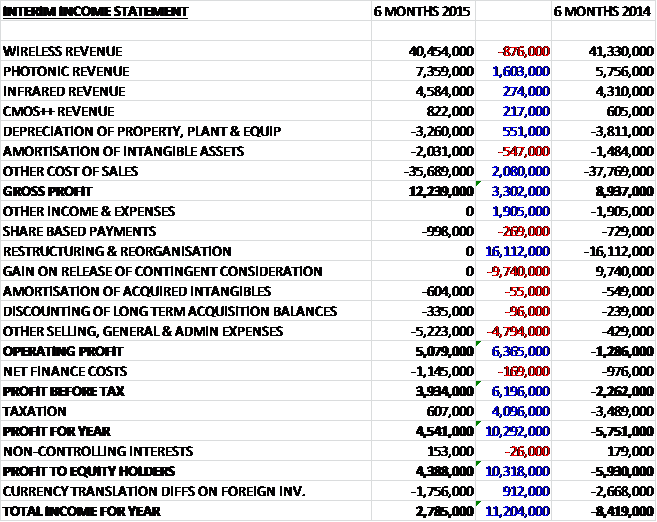
Revenues increased when compared to the first half of last year as an £876K reduction in wireless revenue was more than offset by a £1.6M growth in photonic revenue, a £274K increase in infrared revenue and a £217K growth in CMOS++ revenue.   The fall in depreciation was offset by an increase in amortisation but cost of sales declined so that gross profit was some £3.3M ahead of last time.  Underlying sales, general and admin costs increased by £4.8M but one-off costs were much lower due to the lack of any restructuring expenses or “other” expenses.  After a small increase in finance costs, pre-tax profits increased by £6.2M before a big swing to a tax income due to the tax impact last year of the exceptional release of deferred consideration, meant that the profit for the half year came in at £4.4M, an improvement of £10.3M year on year.

IQEinterimassets

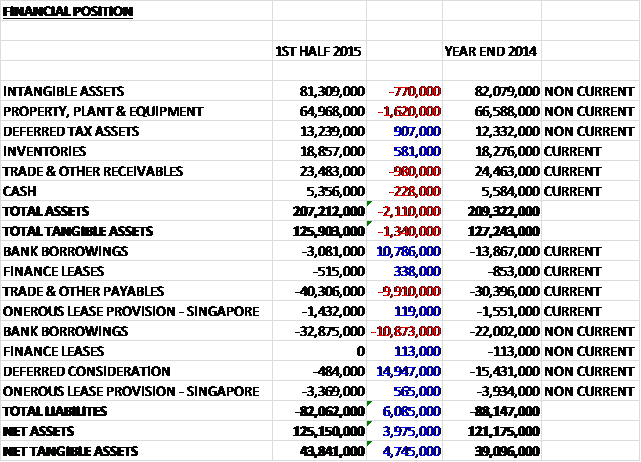
When compared to the end point of last year, total assets fell by £2.1M driven by a £1.6M decline in property, plant and equipment; a £980K fall in receivables and a £770K decline in intangible assets, partially offset by a £907K increase in deferred tax assets and a £581K growth in inventories.  Total liabilities also declined during the period as a £14.9M fall in deferred consideration and a £684K decrease in onerous lease provisions was partially offset by a £9.9M increase in payables.  The end result was a net tangible asset level of £43.8M, an increase of £4.7M over the past six months.

IQEinterimcash

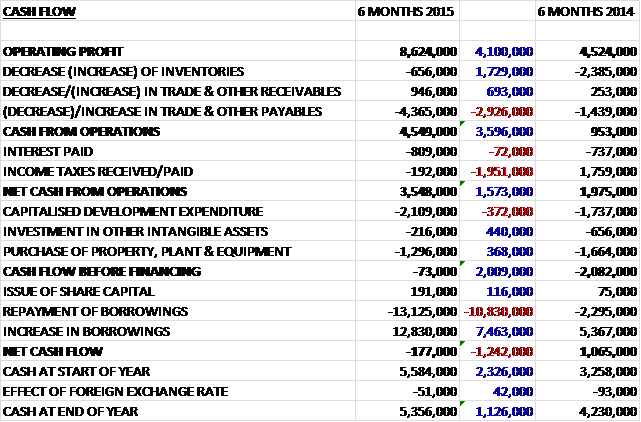
Before movements in working capital, cash profits increased by £4.1M to £8.6M.  A large fall in payables, however, along with a swing to a tax expense, meant that net cash from operations was £3.5M, an increase of £1.6M year on year.  The group then spent £2.1M on development expenditure, £1.3M on tangible fixed assets and £216K on other intangible assets so that there was no free cash flow, with an outflow of £73K before financing.  After a slight net repayment of borrowings, the cash outflow for the period came in at £177K to give a cash level of £5.4M at the period-end.

The adjusted operating profit in the wireless division was £5M, a decline of £541K year on year as some of the sales expected in Q2 fell into Q3 due to temporary production disruption at one customer site – the wireless business as a whole was otherwise stable. The customer forecasts apparently continue to reflect a normal second half weighting of demand and the board remains confident in achieving its full year expectations.

The adjusted operating profit in the photonics division was £1.6M, an increase of £1M when compared to the first half of last year following strong engagement by the group in its customers’ product development programmes over the past few years.  The increasing number and quality of customer product development programmes is a positive lead indicator which is providing a high level of confidence over the group outlook for the segment.   The business unit is being propelled by the group’s leadership in advance lasers (VCSELs) and has already begun the transition from development and pilot revenues into high volume manufacturing following a number of key contract wins over the past year.  The groundwork has been set for significant progress in the business unit for the remainder of this year and into 2016.

Advanced Solar achieved a major milestone with initial sales into field deployments.  This is a highly disruptive renewable energy technology.  Advances in cell and system efficiency are accelerating the adoption of CPV for utility scale energy generation which is expected to become a $200M market for compound semiconductor materials in the next two to five years.  The group are fully prepared for high volume manufacturing and are poised for the ramp as their products complete full end customer qualification and a robust supply chain becomes established.  The technical progress made with GaN technologies, is advancing the group towards initial sales into the RF and power markets in the next 12 to 18 months and the group are also at an advanced stage of development with their LED lighting technology with initial product launches expected shortly.

The adjusted operating profit in the infrared division was £655K, a growth of £27K when compared to the first half of 2014 and the group has an estimated 80% market share of indium antimonide and gallium antimonide materials used in high resolution infrared systems.  Production is currently concentrated on defence related applications but it is expected to rapidly transition into industrial and commercial use for thermal imaging, safety, security and energy monitoring applications.  The adjusted operating loss in the CMOS++ division was £655K, an increase of £215K year on year.

It is worth noting that the group has about £145M of accumulated tax losses which represents a potential reduction in future tax payable of up to £39M.

After the period end, in July, the group entered into a joint venture with Cardiff University to create the Compound Semiconductor Centre, whose aim is to lead the development and commercialisation of compound semiconductor technologies in Europe.  The CSC is jointly owned and controlled by IQE and the university with the group contributing equipment with a market value of £12M which was matched by a £12M cash contribution from the university.  The group will also license certain IP to the CSC.  The creation of the joint venture will create a non-cash exceptional gain of £4.7M due to the difference between the book value and market value of the equipment contributed by IQE and they will also receive revenue of £2M relating to the IP license.

In September the group entered into an exclusive license and option agreement to acquire Translucent’s unique cREO technology.  Under the agreement IQE will pay Silex Systems $1.5M within six months in consideration of the license and agreement, which will include the transfer of a range of manufacturing and characterisation equipment from Translucent to IQE and also required the exclusive services of two engineers for a year.  The agreement also includes an exclusive option for IQE to acquire cREO technology and IP portfolio for $5M within six months of the exercise of the option, plus a long term royalty agreement of 3% of epi products sold using the cREO technology transferred, or 6% of cREO templates sold using the cREO technology transferred.

At the end of the first half of the year, net debt stood at £31.1M compared to £35.5M at the same point of last year and £31.3M at the end of 2014.  There is no dividend at this company but the forward PE stands at a tantalising 9.7.

Overall then, this has been a pretty good six months for the group.  The profit is up, net assets increased and the operating cash flow grew year on year.  The group did not make any free cash during the half but this does seem to be somewhat seasonal.  The profits in the wireless division did decline, however, which is being put down to an issue at a customer site that meant orders for Q2 were pushed into Q3 so hopefully this will be temporary.  The increase in the photonics division has made up for the shortfall with some strong growth and the solar products seem to be making progress.  The PE of 9.7 looks too cheap to me despite the high debt levels and I am sorely tempted by this share.

IQE

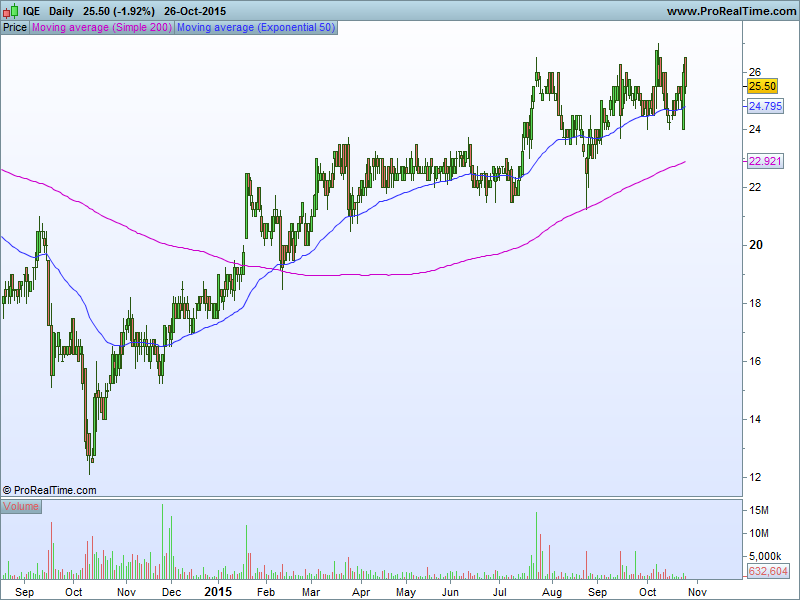
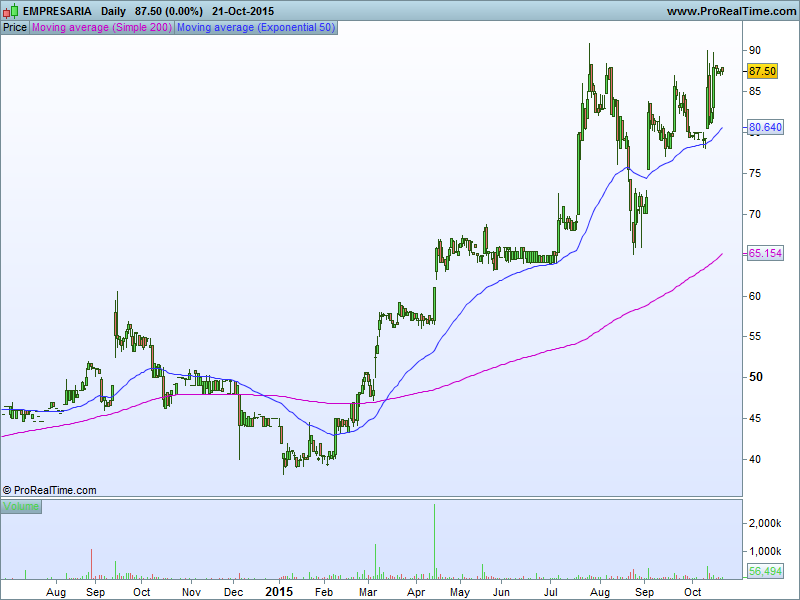
The chart looks pretty good to me too.

On the 16th December the group released a trading update. They are on track to achieve year on year growth with H2 revenues expected to be up sequentially over H1. The weakness in the mobile and smartphone markets has impacted wireless wafer sales in Q4 but this has been offset by higher non-wireless revenues, including from photonics and technology licensing. This has given the board confidence that the financial performance for the full year will remains in line with their expectations, which should result in net debt of about £25M by the year-end.

Key wireless customers’ market updates have reflected a mixed performance in H2 2015 and a number of recent company announcements have highlighted broad weakness in the mobile and smartphone segments. Nevertheless, the outlook for 2016 remains positive due to increasing global connectivity and the continuing growth in data traffic. The photonics business has continued to perform strongly, delivering significant double digit revenue growth which is being driven by a wide range of end market drivers, including data centres, optical communications and sensing applications.

InfraRed and CMOS++ have also performed well, in line with expectations and first pilot production revenues were generated from Solar. During the year the group entered into two joint venture arrangements, in Singapore and the UK. These ventures have started positively and the group has licensed additional IP during H2 to enable the acceleration of the joint venture business plans.

This seems to be a pretty decent update, although there is no talk of profits and the wireless end market weakness is cause for concern.

On the 11th January the group announced that it had renegotiated its long-term supply contract with its premier tier 1 customer for the supply of wafer products used in wireless applications. The board estimates that the contract will contribute more than $55M of revenue during 2016. The new supply contract guarantees the group at least 75% of the customer’s demand for epiwafers that are produced using its metal organic chemical vapour deposition platform. It will also see an expansion in terms of additional products from its molecular beam epitaxy platforms.

The contract covers epiwafer products for RF applications including power amplifiers, low noise amplifiers and switches used in smartphones, tablets, PCs, routers, satcoms and some other devices connected to the internet of things.

This is clearly a relief to get this contract extended as it is very important to the group but it is unclear if the margins will be similar to last time and whether the $55M contribution to revenue is better than last time or not. I still find this company interesting but feel the debt levels are still to high for me at the moment.

On the 26th January the group announced that it received a new purchase order agreement for indium phosphide materials to the value of $3.7M from a leading global substrate manufacturer who is an existing long term customer. High Purity InP is the source material for the manufacture of InP wafers used in the production of high-performance photonic components for a range of application in infrared sensing and telecoms with a particular trend towards high definition imaging applications enabled by InP materials.

On the 15th March the group announced that it had issued 5,141,467 shares to Translucent. They have been issued as consideration to satisfy the $1.4M license fee payable for the exclusive license of their Rare Earth Oxide semiconductor technology. The technology apparently offers a unique approach to the manufacture of a wide range of Compound Semiconductor on Silicon products, including gallium nitride on silicon for the power switching and RF technologies markets. All well and good but I am not sure why they are paying them in shares – was this the initial agreement or are they getting short of cash?

IQE Share Blog – Final Results Year Ended 2014

IQE is the world’s leading manufacturer and supplier of advanced semiconductor wafer products and their finished products are compound semiconductor wafers, also called epiwafers.  Their technology is found in smartphones, tablets and various other tech devices and their customers incorporate these wafers into their chips that form the components for a wide range of wireless communications and photonic devices.  The group has a 55% market share of the global demand for compound semiconductor wafers in the wireless components sector. The group has also developed advanced materials technology which spans wireless, infrared, photonics, solar, power electronics and CMOS++.  The biggest competitor across the compound semiconductor space is a company called VPEC with Landmark, Hitachi and Sumitomo also competing in the space.  The products are sold to the chip manufacturers such as Intel and ARM who then supply customers such as Apple and Samsung.

The group has a strategy to mitigate the risk of changing chip manufacturers by establishing strong supply relationships with all major chip companies so that any changes in mobile models do not have a drastic effect in sales.

The group’s core IP is Epitaxy which is a nano-technology that enables the manufacture of epiwafers.  Epitaxy is a form of atomic engineering that required high spec cleanrooms and sophisticated production tools.  They grow atomically thin films of crystals on a substrate which is a physical and electric template required in order to handle the finished products.  It is the combination of layers produced by the group that gives the epiwafer its properties.

The wireless division accounts for just under 80% of total sales and covers electronic devices that communicate wirelessly including mobile phones, mobile networks, WIFI, smart metering, satnav and various other connected devices. The photonics division accounts for about 20% of sales with the market covering applications that either emit or detect light such as emitters and detectors including optical interconnectors, laser projectors, optical storage, cosmetic applications, gesture recognition, and finger navigation;  infrared; solar and lighting.  The electronics market combines the advanced properties of compound semiconductors with the low cost of silicon with the market separated into power control and advanced materials.

The group is also the clear market leader in advanced gallium antimonide and indium antimonide substrates for use in a range of infrared and heat sensing applications.  The sensitivity of current heat sensors enables a monochrome image so that applications such as night vision devices can only see in tones of green and black whereas the new antimonide materials allow greater sensitivity so that different shades and colours can be distinguished, effectively producing full colour night vision images.  The group is actively engaged in a number of collaborative programmes with leading industry platers and government agencies in the development and supply of infrared materials based on antimonide materials. The group has now released its final result for the year ended 2014.

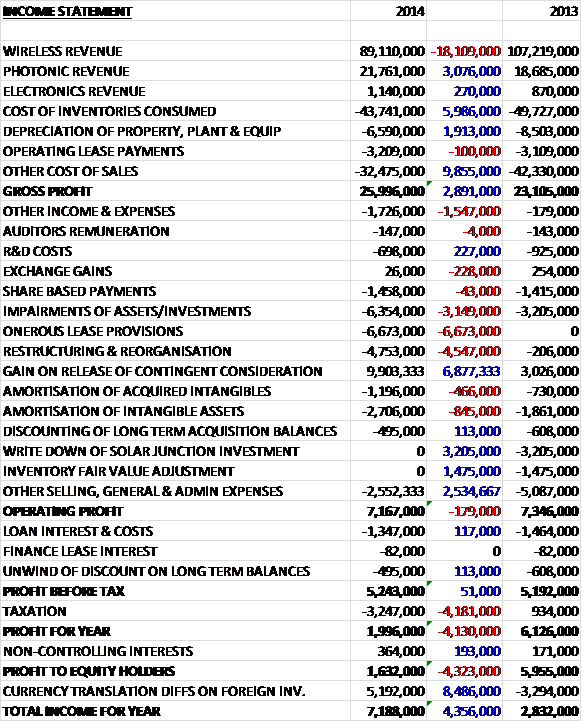
IQEincome

Revenues declined when compared to last year as a £3.1M increase in photonic revenue and a £270K growth in electronics revenue was more than offset by an £18.1M decline in wireless revenue due to the impact of an industry wise inventory correction, foreign exchange and lower underlying growth in demand for wireless wafers.  Cost of inventories fell, as did depreciation, but amortisation increased along with operating lease payments.  The big fall in other cost of sales, however, meant that gross profit was £2.9M above that of 2013.  We then see a £1.5M growth in other expenses and a detrimental movement in exchange gains partially offset by a small fall in R&D costs but there were a number of one-off costs as a £3.1M increase in impairments, a £6.7M onerous lease provision and a £4.5M growth in restructuring  expense was offset by a £6.9M increase in the gain on release of the contingent consideration and the lack of the £3.2M write-down of the Solar Junction investment and the £1.5M inventory fair value adjustment.  After all that the operating profit fell by just £179K but a smaller loan cost and lower unwinding of the discount on long term balance meant that pre-tax profits increased by £51K.  This was entirely dwarfed by the effect of a swing to a tax charge due to a £4.4M deferred tax charge on exceptional items this year, however, and the profit for the year came in at £1.6M, a decline of £4.3M year on year.

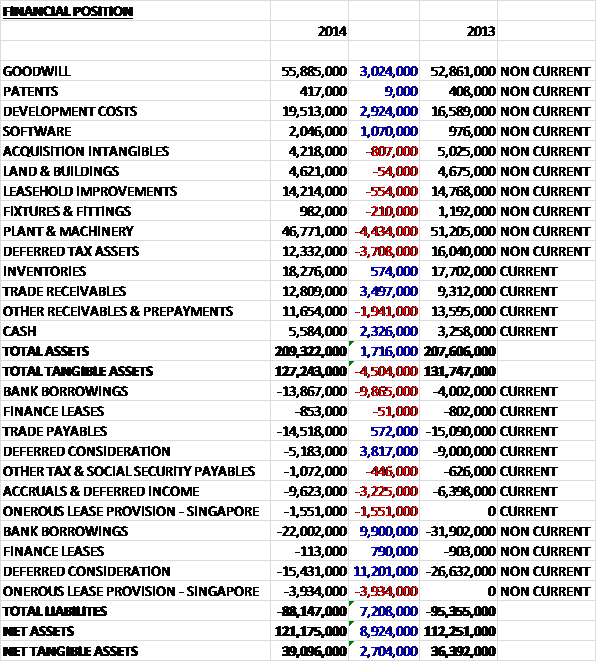
IQEassets

When compared to the end point of last year, total assets increased by £1.7M driven by a £3.5M growth in trade receivables, a £3M increase in goodwill, a £2.9M growth in capitalised development costs, a £2.3M growth in cash and a £1.1M increase in the value of the software partially offset by a £4.4M fall in plant & machinery, a £3.7M decline in deferred tax assets and a £1.9M decrease in other receivables and prepayments.  Total liabilities fell during the year as a £15M fall in deferred consideration was partially offset by a £5.5M increase in the onerous lease provision relating to the Singapore facility and a £3.2M fall in accruals and deferred income.  The end result is a net tangible asset level of £39.1M, an increase of £2.7M year on year.

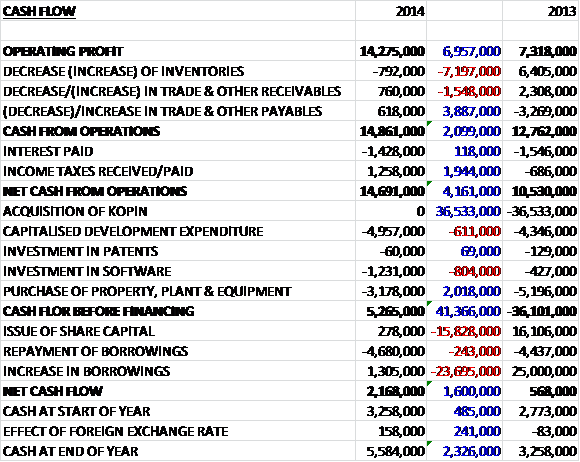
IQEcash

Before movements in working capital, cash profits increased by £7M to £14.3M.  There was a slight cash inflow from working capital, but not as much as last year but there was a £1.3M income tax receipt which nearly covered the interest payment to give a net cash from operations of £14.7M, an increase of £4.2M year on year.  The group then spent £5M on development expenses, £1.2M on software and £3.2M on fixed tangible assets to give a free cash flow of £5.3M.  Most of this was spent on paying back borrowings so that the cash flow for the year was £2.2M to give a cash level of £5.6M at the year-end.

Discounting the impairment, the operating profit at the wireless division was £10.1M, an increase of £200K year on year.  The wireless communications market has grown rapidly in recent years reflecting the increasing adoption of wireless technology coupled with the need for an increased compound semiconductor content to support greater sophistication of mobile devices.  Whilst handset replacement cycles have slowed, innovations such as wearable devices are expected to reignite the desire to upgrade connected devices such as smartphones.  Coupled with the potential growth in “internet of things” the overall wireless market is expected to continue to grow.  Smartphone shipments are expected to grow from over 1BN units this year to more than 1.5BN in 2017.  Growth in the compound semiconductor content in smartphones will be driven by the need for more radio frequency functionality and greater complexity in wireless circuitry but will be partly mitigated by improved efficiencies and a drive towards reduced component footprints.

The operating profit in the photonics division was £3.3M, a vast improvement on the underlying profit of £800K in 2013 with the increase driven by the increasing adoption of VCSEL technology into a wide range of applications from data centres through to industrial processes.  It is thought that this ramp is at an early stage and has a long and sustainable future with demand currently outstripping supply in a number of market segments.  Feedback from customers apparently indicates further growth in the sector as the need for sensors, energy generation, heating, lighting and other energy efficient products grows.  The group have also announced its participation in a €23M programme to establish a Pan European pilot line for the production of VCSEL components.

The Solar business moved into production in early 2015 with the group’s material now being deployed into the field.  Although this was later than initially anticipated, the future of this business apparently remains bright as an end market pull should see it ramp up over the next couple of years.  The group have also become a key partner in an EU funded programme to develop 4-junction advanced solar cells for space applications.

Conversely the power business has progressed more rapidly than originally expected.  A number of major technical milestones and commercial partnerships are positioning the group in a strong position to commercialise this technology with an agreement with M/A-COM Technology Solutions to deliver 200mm GaN on Silicon.  The operating loss at the electronics division was £1.2M compared to a loss of just £59K last year.

Currently wired data transmission in the home, the office and data centres is largely undertaken using copper cables.  Data traffic is growing at a fast rate, however, due to technologies such as HD imaging, video streaming, big data and cloud computing.  This is necessitating a switch from copper wires to optical communication which is a natural evolution that mirrors the transformation that has already taken place in telecoms infrastructure.  Optical interconnectors offer significantly higher speed data transfers over much longer distance compared to their copper counterparts, and are much more efficient.  Data centres have become major consumers of electrical energy, rivalling traditional heavy industries.  A number of contract wins for both production and development contracts were gained during the year.

Compound semiconductor technology that enables optical interconnects include Vertical Cavity Surface Emitting Lasers (VCSEL).  They are an advanced laser technology geared to mass production and low costs and the group is the market leader for these products with world record data speeds in excess of 64GB/s already demonstrated.

The group has developed a powerful range of advanced, engineered wafers such as germanium on insulator, germanium on silicon and silicon on sapphire which offer a high performance and low cost solution for next gen microprocessors, ultra-high speed flash memory and MEMS devices such as motion sensors.  They have established a good position in these advanced technologies working with some of the biggest names in the industry, which is reflected in a number of joint patents awarded in conjunction with intel for the production of compound semiconductor materials on silicon substrates.

The group made sound technical progress during the year with the launch of the infrared’s industry’s first 150mm indium antimonide wafers, a major milestone in reducing the overall cost of chips to drive increasing adoption.  This was followed up with a number of significant contract wins for the division and there has been significant work in developing these materials for consumer sensing applications which will drive much higher volumes of wagers in the future.

The group is somewhat on a number of large customers with one client accounting for 29% of revenues and anther accounting for 24%.

During the period the group was engaged in restructuring its global operations which has resulted in certain cash costs and provisions for asset impairments and future lease costs.  No further restructuring costs are expected in 2015.  The cash costs incurred were £4.8M which related to redundancy costs, requalification costs and the duplication of overheads to support the transition of customers between production facilities.

The asset and lease provisions primarily related to the group setting aside the Singapore facility and certain equipment for use by a new joint venture with WIN Semiconductors and Nangyang Technological University called the Compound Semiconductor Development Centre of which the group has a 50% stake.  It has been established to accelerate the development of compound semiconductor technology to provide an effective incubator for bringing new innovations to market.  The group will be providing facilities, equipment and IP on favourable terms to the joint venture which have caused the asset impairments.  In return the group will be the production partner for the high volume manufacturing that emerges.  The asset impairments related to equipment (£4.9M), inventories (£1.4M) and the provision of onerous leases (£6.7M).

An acquisition was made in 2012 where the consideration is being settled through agreed contractual price discounts.  Subsequent to the measurement period, any adjustments to the recorded fair value of the contingent consideration are taken through the income statement within other income.  The revenues of products sold which are subject to this discount are recognised at full market value.  On settlement of the transaction, the discount is applied to reduce the deferred consideration balance.

The group also generated a non-cash profit of £9.9M arising from a reduction in the estimated remaining deferred consideration, settled via trade discount, in respect of a previous acquisition.  Of the total deferred consideration of £15.4M outstanding, some £10.7M is expected to be settled through the agreed price discounts over the next two years.  The investment in Solar Junction was fully provided for last year and in 2013 prior to the disposal of the minority interest to Solar Junction Corporation.

As with anything in this fast moving space there is always the risk that this new technology will be superseded by something else or may not be able to make the impact in new applications that is expected.  There has apparently been some commentary about the threat that silicon will replace compound semiconductor technology in mobile communication.  The board believes that this sis contrary to both the underlying technology trends and the fundamental properties of these respective materials.  Indeed, it is widely expected that the next disruptive technology in the semiconductor industry will be the combination of compound semiconductor and silicon technologies which will enable “System on Chip” integration.

The group is somewhat susceptible to interest rate rises with a 50 basis point increase pushing up the interest costs by about £170K per annum.  Most of the group’s sales take place in the US so there is also a susceptibility to exchange rate changes with a 1c movement in the US dollar to Sterling exchange rate impacting earnings by about £200K.

As can be seen, a large onerous lease provision has been recognised during the year.  The provision assumes that the lease will be onerous for the next four and a half years.  Subsequent to this period, the group expect to be able to sublet the premises or negotiate to exit the lease, the full term of which is seven years with the lease running to 2021.

The current year has started in line with expectations, and the outlook for the full year remains positive.  At the current share price the shares trade on a PE ratio of 11.5 which seems rather decent value but there are no dividends paid by this company.  At the end of the year the group had a net debt position of £31.3M compared to£34.4M at the end of last year.

Overall then, this is an interesting company with a 55% market share for their products that go into the wireless market.  Profits fell during the year but this was due to a large deferred tax charge and pre-tax profits were flat with underlying profits increasing during the year.  Net assets increased as the deferred consideration was settled via a trade discount and the balance sheet looks fairly good actually.  Operating cash flows also improved with the group actually making some free cash.

Profits at the wireless division, which makes up about 80% of the business, increased modestly as handset replacement cycles slowed.  The photonic division was the growth driver as an increasing adoption of VCSEL technology drove profits higher.  The electronics division is still fairly loss making, however, with losses widening during the year.  The solar product looks like it has the potential to be disruptive, although progress is slower than expected here and the power division is progressing quickly.

There are clearly some risks here.  The fact that the group delivers into a small number of chip makers means that there is key client risk despite the diversification and there is always the chance that another technology will come along to disrupt the market.  In addition, the group is susceptible to interest rate rises and any weakness in the dollar with the latter admittedly looking unlikely for the time being.  There is no dividend yield here but cash does seem to be being generated and at a PE ratio of 11.5, this company does look rather interesting to me despite the large debt pile.


Communisis Share Blog – Interim Results Year Ending 2015

Communisis has now released its interim results for the year ending 2015.

CMSincome

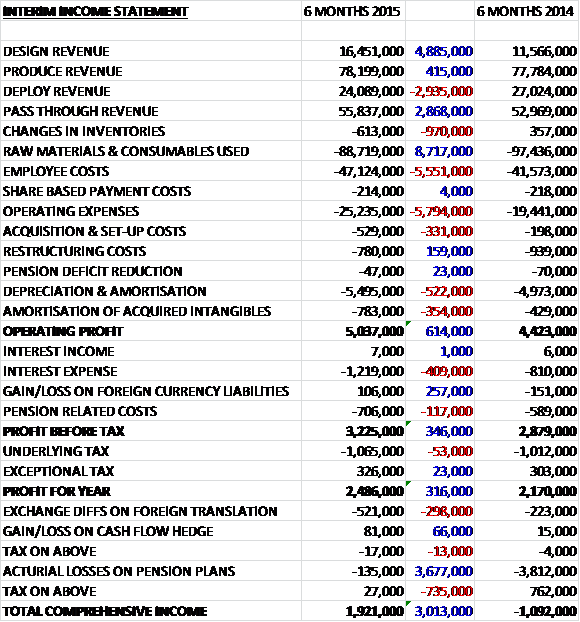
Revenues increased when compared to last year as a £2.9M decline in deploy revenue was more than offset by a £4.9M growth in design revenue reflecting a full six months’ contribution from the agencies acquired last year; a £2.9M growth in pass through revenue and a £415K increase in produce revenue.  We then see an £8.7M fall in raw material costs but employee costs were up £5.6M and operating expenses increased by £5.8M, along with an increase in depreciation and amortisation to give an operating profit some £614K ahead of last year.  There was a higher interest cost and a slightly higher pension cost which meant that the profit for the half year was £2.5M, an increase of £316K year on year.

CMSassets

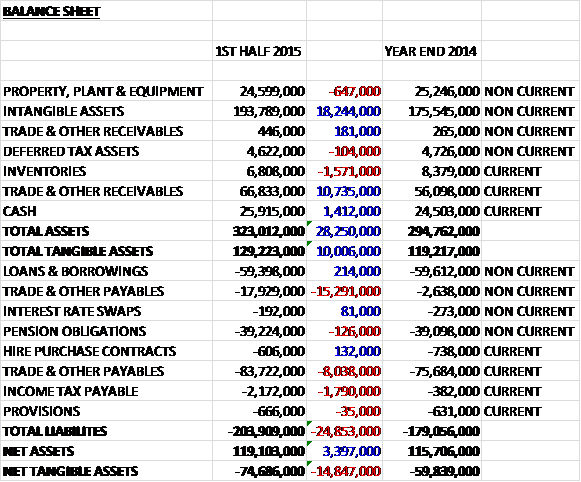
When compare to the end point of last year, total assets increased by £28.3M driven by an £18.2M growth in intangible assets, a £10.7M increase in receivables and a £1.4M growth in cash partially offset by a £1.6M fall in inventories.  Total liabilities also increased during the period due to a £23.3M growth in payables and a £1.8M increase in income tax payables.  The end result is a net tangible liability level of £74.7M, a detrimental movement of £14.8M over the past six months so the already poor balance sheet is getting worse.

CMScash

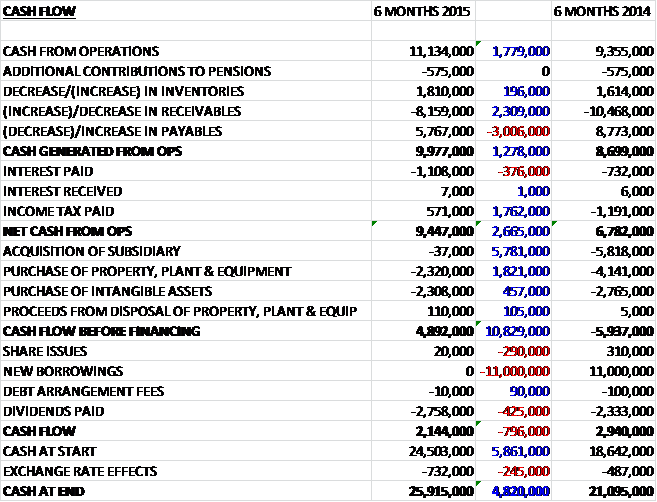
Before movements in working capital, cash profits increased by £1.8M to £11.1M.  We then see a bit of a cash outflow from working capital due to an increase in receivables but after a tax receipt as opposed to a cost last time, the net cash from operations was £9.4M, an increase of £2.7M year on year.  The group then spent £2.3M on intangible assets and a very similar amount on property, plant and equipment which is apparently a more normal capex level, to give a free cash flow of £4.9M.  After the dividends were paid out, the cash flow for the first half of the year was £2.1M to give a cash level of £25.9M at the period-end.

The underlying profit in the design segment was £1.3M, a decline of £52K year on year on revenues that grew due to the contribution from the agencies acquired last year together with a recovery in the data services business following its repositioning in analytics and to appeal to broader market sectors than its historic focus on insurance.  The small decline in profit is attributable to some price pressure from larger clients and the effect of a seasonal trading pattern in shopper marketing where profits are weighted to the second half of the year.

The underlying profit in the produce business was £9.6M, a growth of £1.1M when compared to the first half of last year with revenues that also increased due to a number of offsetting factors.  Volumes fell faster than expected in chequebooks but more slowly in transactional activities as customers appeared to show some reluctance to migrate from paper to digital formats.  These reductions were offset by the benefit of a full six month’s contribution from incoming customer communications services acquired under a contract with Lloyds, and growth in digital distribution, both of which are higher margin services, together with better than expected demand for direct mail which, along with process improvements and cost reductions, drove profits higher.  The underling profit in the deploy sector was £5.8M, an increase of just £157K year on year on revenues that were broadly flat due to adverse foreign exchange movements.

During the period the group was awarded a six-year contract with AXA for the provision of incoming and outgoing marketing and operational customer communication services including creative, print, digital and postal distribution and document management services.  Under the agreement the group has assumed responsibility for a number of AXA’s existing UK inbound and print centres.  The initial transition phase was completed and the contract went live at the end of April.  After a competitive tendering process, EE extended its marketing communications contract for two years until March 2017 and a long standing client in the utility sector selected the group for the provision of outgoing transactional communication services for a further five years until October 2020.

Overseas expansion has continued during the period.  Three new locations were added in Bucharest, Milan and Warsaw, and activities have been scaled up through the main European hubs with new clients in the drinks, food, pharmaceutical and technology sectors.  These market share gains will help to offset a fall in demand from lower margin UK print sourcing clients.  The pipeline of opportunities with blue-chip consumer goods groups across Europe is strong, offering good potential for profitable growth.

The group has developed a new digital services platform that provides multi-channel customer messaging services.  This allows clients to improve their customers’ experience by delivering communications when, where and how they want to receive them.  It was used by Nationwide Building Society to send messages associated with the new ApplePay system.

As usual there were a number of “exceptional” items during the period.  Some £780K was incurred in respect of restructuring which included ongoing integration costs relating to the new design agency Psona, and Lloyds activities. There were also £47K of pension deficit reduction costs relating to legal and consultancy expenses.  I don’t think any of these are really exceptional – the pension deficit reduction is definitely ongoing and the others just relate to a re-brand and an extension to a contract.  A further £500K of exceptional integration charges are expected in the second half of the year.

During the period there was a further acquisition.  In January they acquired Life Marketing Consultancy, a research and insight-led shopper marketing agency whose clients are leading consumer goods groups especially in the food, drinks, technology and pharmaceutical sectors.  The group acquired the business for an initial consideration of £9.3M satisfied by the issue of a two year, bank guaranteed promissory note of £9.3M, £700K in cash and through the issue of new shares to the value of £4M.  As part of the purchase agreement, two contingent consideration mechanisms have been agreed.  An amount up to a maximum of £6M will be payable at the end of 2016 subject to the business generating EBITDA of £3M of less due should the business earn between £1.9M and £3M with two thirds payable in cash.  An amount up to a maximum of £3.3M will be payable on the achievement of defined synergies over the three years ending 2017, payable in cash with the fair value estimated at £2.5M.  The acquisition generated goodwill of £17.2M and contributed a loss of £106K.  I have to say that it seems to me the group have overstretched themselves with this one.

With the prospect of ongoing revenue growth, improving profitability and cash generation the board is confident about the group’s prospects for the remainder of the year.  At the current share price the shares trade on a forward PE of 9.7 which looks rather cheap on the face of it.  After a 9% increase in the interim dividend, the shares currently yield 3.8% increasing to 4% on the full year consensus forecast which is nice to have.  At the period-end the net debt stood at £43.4M which seems a bit much to me.

Overall then, this seems to have been a fairly decent update but my previous issues with this company remain.  The profit for the period improved, as did the operating cash flow which produced some free cash, although no-where near enough to start paying the debt down to any great degree.  The net tangible asset level remained very poor, however, with a large net liability situation which is getting worse.  The design business seems to be struggling somewhat due to price pressure from a larger client, the deploy sector is trundling along, not helped by adverse exchange rates and it is left to the produce business to drive growth as the new Lloyds contract and increased demand for direct mail offset the structural decline in chequebooks.

The new AXA contract should start contributing to results soon and I am heartened by the Nationwide contract to send messages related to Apple Pay as this would seem to be the future – I wonder how profitable it was.  The Life Marketing acquisition I think is probably a step to far and I would like to see the group take a break from acquisitions and pay back the debt.  At a PE ratio of 9.7 and a dividend yield of 4% the shares look good value but the terrible balance sheet and high debt levels mean that this is still too much of a risk for me at present.

COMMUNISIS

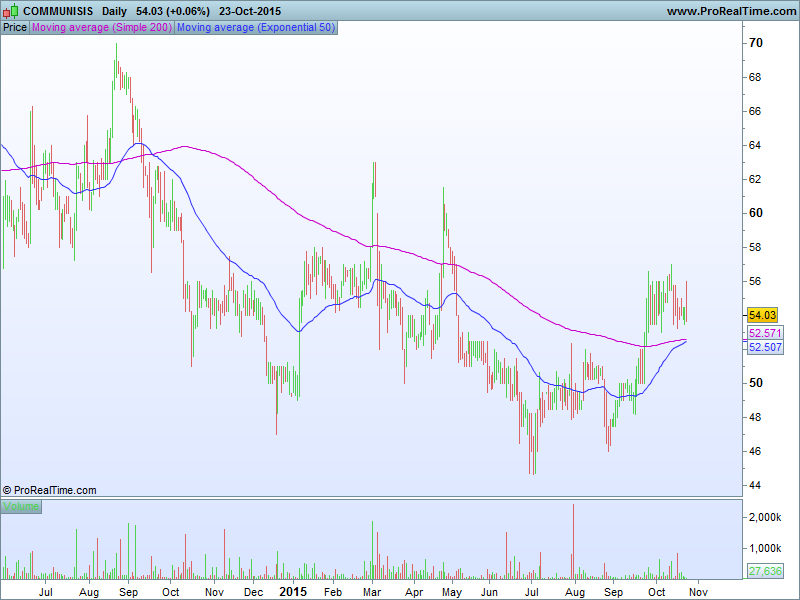
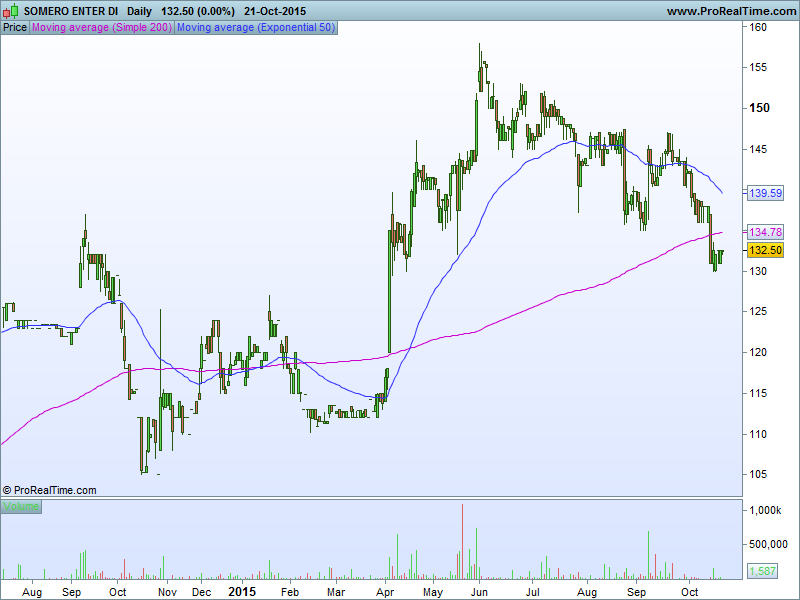
This does look like an interesting time for the chart.  The recent recovery does seem to put the long term downtrend under threat.

On the 12th November the group released a trading update covering Q3. The group expects to deliver results for 2015 that reflect double digit growth in adjusted operating profit, improved free cash flow and increased adjusted earnings per share when compared to last year, but slightly below expectations due to the performance of the Life business. Life, the new shopper marketing agency acquired in January, is taking longer than expected to contribute its projected earnings, due to some reduction or deferral in spend by existing clients and due to the phasing of some new business opportunities. The pipeline for the business for 2016 is building, however, and some synergies are being realised.

The produce division has continued to take advantage of its market leading position, particularly in the provision of outbound transactional services where the group has signed three important contract renewals during the period and strong new business momentum has been seen in the deploy division where, in recent months, three brand deployment contract wins have been secured with large clients across Europe in the fast moving consumer goods and electronics sectors. Additionally the group’s relationship with Boots has been renewed.

Overall then, this is a bit of a disappointing update and I have decided to reduce the number of companies I am looking at so I’m afraid due to the slow progress and the negative net tangible asset level, this one if for the chop. I will continue to keep it on watch but I will not post any further updates unless something changes.

Communisis Share Blog – Final Results Year Ended 2014

Communisis is a provider of personalised customer communication services.  These communications are typically of a marketing, operational or regulatory nature and can be distributed either on paper or in digital formats, through e-mail, text message, mobile content, social media or as in-store marketing collateral.  Many of these services are business critical and of operational necessity for clients which provides a degree of stability of revenue streams irrespective of macro-economic and other market conditions.

The group has three operational segments.  The design segment services brand strategies by utilising creative, data analytic, and digital marketing skills to devise and implement marketing campaigns that engage customers, so it is a marketing business then.  The produce segment services are mostly provided under multi-year contracts and comprise the specialist, high volume and predominantly personalised printing of outgoing customer communications of an operational nature such as direct mail, invoices, statements and chequebook, the processing of incoming customer correspondence and the production of shareholder mailings such as AGM notices and dividend cheques.  The deploy segment services provide brand deployment support through the management of third party supply chains for the sourcing and distributing of in-store marketing collateral, mainly in overseas market.

Pass through revenue represents the pre-agreed or contracted revenues representing charges for print, postal and other marketing materials which are passed onto clients at cost as part of a wider service.  Postal charges are recognised on despatch to the postal carrier, and print and other marketing material charges are recognised on despatch by the supplier.

The group has a traditional strength in the financial services sector but has been diversifying the client base in recent years.  Clients include all the major UK banks, the top ten building societies, major telecoms and media groups, utilities, global consumer goods distributers, high street retailers and supermarkets, government departments and charities.  The financial services market accounts for nearly half of all revenues but the consumer goods market is the one that is growing the most, up to just under a quarter.  Communisis has now released its final results for the year ended 2014.

COMincome

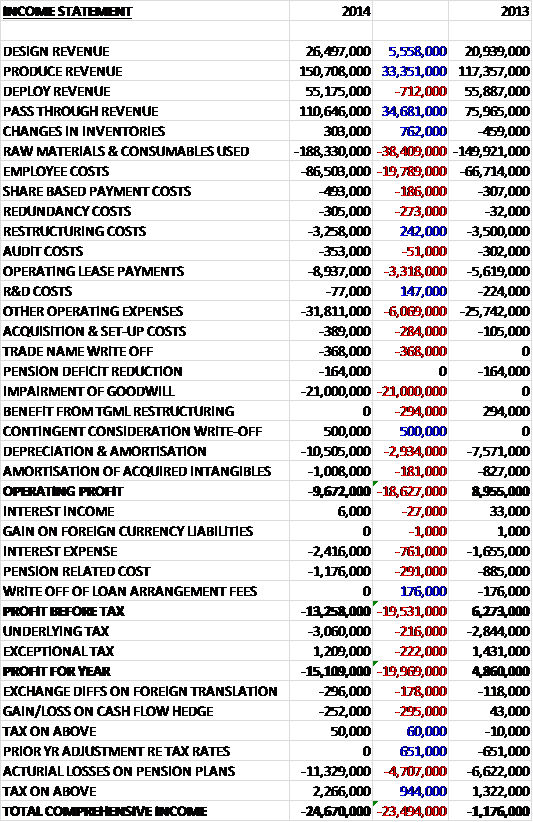
Overall revenues increased when compared to last year as a £712K decline in Deploy revenues was more than offset by a £34.7M increase in pass through revenue, a £33.4M growth in Produce revenue and a £5.6M increase in Design revenue.  Raw materials cost £38.4M more than last year and employee costs were £19.8M above last year.  We also see a £3.3M increase in operating lease costs, a £2.9M growth in depreciation and amortisation, and a £6.1M growth in other operating costs.  The operating profit was adversely affected by a £21M impairment of goodwill this year, however, which meant that it was £18.6M below that of 2013.  We then see an increase in interest costs and a small growth in taxes so that the loss for the year came in at £15.1M, an adverse movement of £20M year on year.  Clearly if it were not for the goodwill impairment, however, then the profit would be ahead of last year.

COMbalance

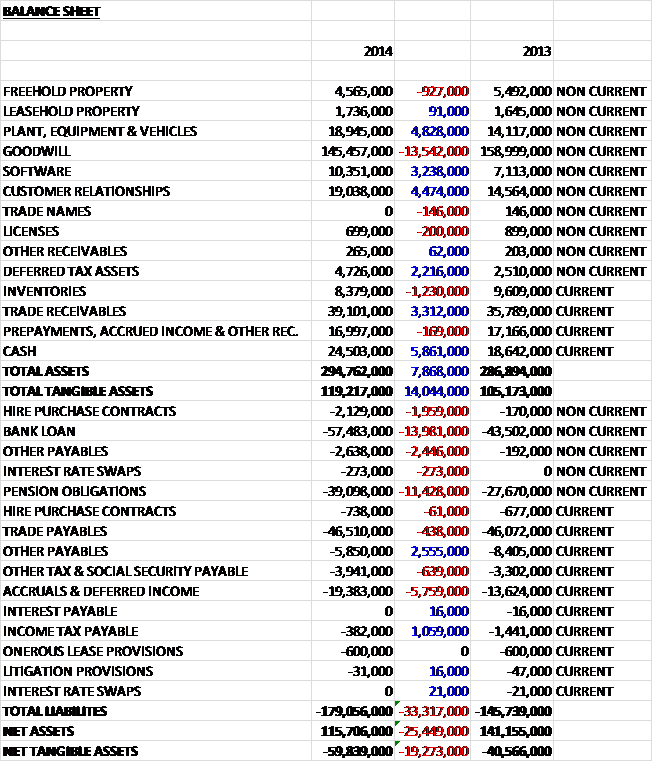
When compared to the end point of last year, total assets increased by £7.9M driven by a £5.9M growth in cash levels, a £4.8M increase in plant and equipment, a £4.5M growth in customer relationships, a £3.3M increase in trade receivables and a £3.2M increase in the value of software.  Total liabilities also increased due to a £14M growth in bank loans, an £11.4M increase in pension obligations and a £5.8M growth in accruals and deferred income.  The end result is a net tangible asset level of -£59.8M, a deterioration of £19.3M which doesn’t look all that good to me.

COMcash

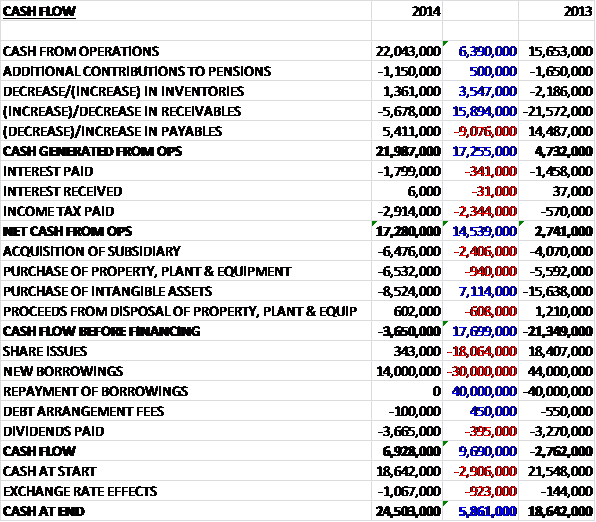
Before movements in working capital, cash profits increased by £6.4M to £22M.  There was a broadly neutral working capital situation this year compared to the large outflow last year driven by a huge increase in receivables so, despite an increase in interest and tax, the net cash from operations, at £17.3M, was £14.5M greater than last year.  This was enough to cover the purchase of fixed assets and intangibles but not the acquisitions so that before financing there was a cash outflow of £3.7M.  After dividends were paid out and the group took out new borrowings of £14M to give a cash flow of £6.9M for the year and a cash level of £24.5M at the year-end.

Most of the contracts for the “Produce” segment are for outgoing communications from the group’s clients to their customers but the range of services was extended early in the year with the acquisition of imaging and mail processing capabilities for incoming customer communications under an outsourcing contract with Lloyds.  The most recent new contract award, in February, was a six year commitment from AXA for both incoming and outgoing marketing and operational customer communication services for all its UK brands including Sun Life, Wealth, Insurance and PPP Healthcare.

The UK economy continued to recover during the year, providing a boost to business confidence and marketing budgets.  Ongoing cost and profitability pressures, especially in the financial services sector, stimulated further outsourcing of customer communications activities leading to new business opportunities.  These beneficial effects are offset to some extent by economic weakness in the Eurozone and social unrest in other parts of the world.  There is an underlying erosion in some of the group’s more mature markets, such as those for chequebooks, but margins are maintained through tiered pricing mechanisms and adjustment to the cost base.  The progressive shift from paper to digital communications is an important trend and the group is adapting its business model accordingly.

The deploy segment had a decent year with a contract extension from P&G until the end of 2019 whilst revenues from its brand deployment services grew significantly, both through an extended network of European offices and from the addition of new consumer goods clients in the drinks, healthcare and technology sectors.

The underlying operating profit in the design segment was £2.8M (actual profit £2.2M), a reduction of £400K year on year.  Turnover increased considerably mainly due to revenues from acquisitions offset by a substantial reduction in data sales which resulted from a continuing decline in demand for prospect lists from the insurance sector that has been the group’s historical focus for their data activities.  The loss of contribution from the data sales together with the costs associated with a reorganisation of the business and refocusing its activities on data analytics has led to the reduction seen in operating profit.

The underlying operating profit in the produce segment was £18.5M (actual loss £5.3M including the £21M goodwill impairment), an increase of £1.9M when compared to last year.  The two new Lloyds contracts accounted for most of the growth seen in turnover offset by an 8% reduction in demand for transactional documents and higher margin chequebooks due to the ongoing migration from print to digital formats and the changing pattern of payment methods.  While the additional turnover contributed to higher adjusted operating profit, non-recurring costs incurred during the transition phases of new contracts together with a loss of contribution from changes in product mix resulted in lower overall margin.

The underlying operating profit in the deploy segment was £13.8M (actual profit was the same), a growth of £4.2M when compared to 2013.  The small decline in turnover was the net effect of a 13% increase in managed fee income, linked to the international expansion of brand deployment services for P&G and a 14% decrease in other revenue following a strategic decision to withdraw from or outsource low margin commodity print management services.  These same factors generated the increase in adjusted operating profits.

The group is rather dependent on a small number of large clients with one accounting for 22% of total revenues and one accounting for 15% and the top five clients accounting for about 62%.

One major contract extension during the year was with Lloyds Banking.  In February the group was awarded a further new outsourcing arrangement with the bank for the imaging and processing of incoming mail from customers.  The arrangement is for an initial ten year term with a five year renewal option.  It involves an investment of about £7.5M in working capital and mobilisation costs, about £3.2M of which was paid during the year with the rest falling due over the next two years.  Under the arrangement the group is handling more than 30 million incoming customer documents for all of Lloyd’s brands.  Documents are scanned and digitised with the content being indexed for archiving and onward distribution by the bank.  The group are also responsible for the design and creation of operational customer facing documents.

The arrangement brought a new service line to the group and resulted in the acquisition of fourteen existing Lloyds sites with the main operational centres being in Edinburgh, Leeds and Andover.  This outsourcing contract followed a similar award in the previous year for Lloyd’s ongoing customer communications.  Combining the outsourcing of both incoming and outgoing communications provides the group with a significantly expanded client relationship and substantial new capabilities and growth opportunities.

In February 2015 the group was awarded a new six year contract with AXA for the provision of incoming and outgoing marketing and operational customer communication services including creative, print, digital and postal distribution and document management services.  Under the outsourcing arrangements, the group will assume responsibility for a number of AXA’s existing UK inbound and print centres.

During the year the group made a substantial commitment to the development of a second transactional centre within Lloyd’s facility at Copley to allow the transfer of production from, and the closure of, the other Lloyd’s transactional site at Crawley.  Net capital expenditure during the year has consequently been higher than normal at £14.2M of which £9.2M relates to Copley including £3M of capital equipment purchased from Lloyds.  Additional expenditure of £1.4M to complete the facility will be incurred next year and two HP T400 and one T300 high speed colour digital platforms were also commissioned as part of this investment, all under operating leases.

There have been a number of technological developments that have taken place during the year which have included production automation to enable value to be driven from the HP technology investments; the replacement of legacy systems to improve productivity and support overseas growth; multi-channel document management, supporting client needs to provide a seamless customer experience; and analytics and decision making tools that increase clients’ return on investment and help them target their customers more effectively.

The latest triennial valuation of the pension scheme in March resulted in a reduced deficit at £19.5M and annual deficit reduction payments that have been halved to £1.5M from the previous level of £3M.  Despite this, the pension scheme deficit increased to £39.1M this year primarily due to a significant reduction in corporate bond rates.

One major risk to the group relates to the speed of migration from paper to digital communication formats.  Each year, the number of paper based communications on existing business tends to fall but overall growth is achieved from new services and market share gains.  The group’s services include the composition of the underlying document, the processing of the personalised data that is added to each communication and the distribution of that communication by the most appropriate channel.  All of these services continue to be relevant and add value in the digital environment.  During the year about 10% of the group’s transactional communications were delivered digitally.

As can be seen there were a large number of non-underlying costs during the year (as there seems to be most years).  There were costs of £3.3M incurred in respect of organisational restructuring which included ongoing rationalisation across the group, along with further costs in relation to the closure of the cheque production facility at Trafford Wharf, the integration costs relating to the new design agency, Psona, and recently acquired contracts.  The £368K trade name write-off relates to the creation of Psona which has resulted in a name change for Kieon and the Communications Agency to Communisis Digital and Psona (this kind of gives an indication as to what a nonsense some intangible assets are.  How can a company give value to a brand name it is acquiring if it is just going to impair it and re-brand it?!).  The pension deficit reduction costs relate to legal and consultancy expenses of £164K which were fully paid by the end of the year.

The largest cost related to a £21M goodwill impairment in the produce segment which arose from acquisitions made at the beginning of the last decade.  The impairment has arisen to the reductions in demand for some mature product lines.  Again, this just supports why I never include goodwill in my calculations.  The situation would be better if the asset was amortised as given how old it was, it would probably been fully amortised by now but instead it all gets amortised at once and conveniently discounted.

There were a number of acquisitions during the year.  In April the group acquired Jacaranda Productions, a video film specialist creating, managing and measuring the effectiveness of video content for global brands.  The consideration paid was £1.7M satisfied by cash of £876K and new shares to the value of £600K.  As part of the purchase agreement a contingent consideration has agreed equal to 10% of the annual gross profits of the business which will be payable at the end of the next three years.  The contingent consideration is capped at £500K with the fair value estimated at £200K.  The acquisition generated goodwill of £994K and contributed profit of £28K since April.

Also in April, the group acquired Public Creative which creates and drives brand awareness with digital media using web and mobile apps.  The acquisition cost £379K and generated goodwill of £295K.  Since the date of acquisition, the business generated a loss of £12K.  In June the group acquired the Communications Agency, an agency that specialises in brand response and CRM across all media channels.  The acquisition offers considerable scope for growth and revenue synergies with the group’s existing client portfolio.  The consideration payable amounted to £7.8M satisfied by £5.3M in cash and through the issue of 2,404,643 new shares along with deferred consideration of £571K subject to the business generating EBITDA of £888K.  The acquisition generated goodwill of £5.6M and contributed profit of £531K during the year.

In August the group acquired the Meaningful Marketing group, a CRM agency with specialist knowledge of the financial services sector.  The consideration paid amounted to £647K satisfied with cash of £390K and an amount of up to £625K being payable to the sellers spread over the next five years and equal to 10% of gross profit up to £1.5M and 12.5% of gross profit over this amount.  The acquisition generated goodwill of £540K and generated profit of £187K during the year.

After the end of the year, in January the group acquired Life Marketing Consultancy, a research and insight-led shopper marketing agency whose clients are leading consumer goods groups especially in the food, drinks, tech and pharmaceuticals sectors.  The acquisition was a big one, on an enterprise value of £22.6M and net assets of just £1.4M.  The total consideration was £23.3M with an initial consideration of £14M satisfied by the issue of a two-year bank guaranteed promissory note, £700K in cash and through the issue of £4M in new shares.  As part of the acquisition, an amount up to a maximum of £6M will be payable at the end of 2016 if the business generates EBITDA of £3M.  The fair value of this consideration has been estimated at £4.6M.  There is also another contingent consideration up to £3.3M payable based on the achievement of defined synergies over the next three years and this has been valued at £2.5M.  I have to say that I think the group might have over stretched itself with this one – they didn’t have enough headroom in their debt facility and the bank was obviously unwilling to let them borrow more.

The group’s debt currently attracts an interest rate of LIBOR+2.5% to LIBOR+4.25% depending on the ratio of net debt to EBITDA.  There is currently only £7M of undrawn facilities so hopefully the group will concentrate on reducing debt and building up their balance sheet in the short term.  The group does somewhat hedge against increases in interest rates with a fixed rate of 3.63% paid on one tranche of £10M and 4.15% on another £10M tranche.  If interest rates had been 100 basis points higher for the year, pre-tax profits would have been £380K lower.

After an 11% increase in the full year dividend, the shares currently yield 3.7% which seems pretty decent to me.  The net debt position at the year-end is £35.9M compared to £25.7M at the end of last year, although this is flattered by seasonal differences and it is refreshing to see the group state the average bank debt as being £41.4M.  At the current share price, the shares trade in a PE ratio of 18.8 if we discount the goodwill impairment but this falls to 9.7 on next year’s consensus forecast, no doubt discounting any “non-underlying” costs.

Overall then this has been a bit of a mixed year for the group.  There was a loss recorded but this was only due to the goodwill impairment and discounting this, profits did increase year on ear.  Operating cash flow also improved and not including the acquisition, there is some free cash flow here but it doesn’t seem to be enough for the group to be able to pay back any of its borrowings.  The real problems seem to lie with the balance sheet, however.  There is a hefty net tangible liability situation here and it seems to be getting worse.

Operationally the group seems to be operating fairly well.  The design division was adversely affected by a fall in demand from insurance companies for lead lists and the produce division is likely to be in a slow structural decline due to less documents being sent by post as many people migrate to digital communications and the phasing out of chequebooks, which is a high margin part of this business.   This year, these falls were offset by the large contract started with Lloyds for handling all their ingoing and outgoing mail.  The deploy segment seems to be performing well as their contract with P&G gives them a lot more work.

So, with a PE of 9.7 and a dividend yield of 3.7% these shares look rather cheap but when we consider the long term structural decline of the sector, the terrible balance sheet, the large debts and the acquisitions that the group can’t really afford (they seem to be buying market companies, presumably to try and mitigate against the move away from written communications) then I don’t think I can invest in these shares.  They may offer some upside to more risk-tolerant investors but its not really for me at the moment.


Empresaria Share Blog – Interim Results Year Ending 2015

Empresaria has now released its interim results for the year ending 2015.

EMPinterimincome

Overall revenues declined year on year as a £1.5M growth in ROW revenue was more than offset by a £1.7M fall in UK revenue and a £1.4M decrease in European revenue.  Cost of sales also fell, however, to give a gross profit £2.5M above that of the first half of last year.  Admin costs did increase though so that operating profit increased by £600K.  Loan costs decreased slightly but this was offset by an increase in tax so that the profit attributable to equity holders came in at £1.5M, an increase of £400K year on year.

EMPinterimassets

Total assets fell by £1.2M when compared to the end of last year driven by a £1.5M fall in cash and a £1.2M decline in goodwill partially offset by a £1.3M increase in prepayments and accrued income.  Liabilities also fell during the period as a £2.6M fall in bank loans and a £1.3M decline in invoice banking loans were partially offset by a £2.5M increase in the overdraft and a £1.2M growth in accruals.  The end result is a net tangible asset level of £2.5M, an increase of £1.4M over the past six months.

EMPinterimcash

Before movements in working capital, cash profits increased by £200K to £3M.  We then see this cash flow collapse, mainly as a result of a large increase in receivables so that after higher taxes are paid, there is a net cash outflow of £700K from operations, compared to a £200K inflow last time.  The group then spent £300K on fixed assets and £300K on extra shares in subsidiaries so that the cash outflow before financing was £1.2M.  We then see a net £400K increase in borrowings and a token £300K in dividends so that the cash outflow for the period was £1.1M to give a cash level of £6.3M at the end of the half, although the first half is traditionally weaker for cash flows.

The UK operating profit was £1M, flat when compared to the first half of last year which reflects in the investment made in staff.  UK revenues were down 5% due to a £3.7M decline after the end of the Heathrow T2 project and a £2M impact from the planned reduction in low value work.  There was a 37% increase in permanent revenues, half of which arose from the acquisition of Ball and Hoolahan last year with growth across Financial, Technical & Industrial and Domestic services.  The temporary margin grew from 13.1% to 14.5% which helped offset the lower revenues from Technical and Industrial so the temporary NFI was only slightly down on the prior year before the contribution from the permanent NFI meant that total NFI increased by 19%.

Market conditions remain positive, in particular in the financial sector.  Within technical and industrial, the largest brand is refocussing sales efforts further away from the low value end of the market which is having the effect of reducing productivity in the short term which is expected to continue for the rest of the year.

The operating profit in continental Europe was £1M, an increase of £400K year on year, aided by cost savings and the exit from the loss making GiT business.  Revenue decreased by 4% to £36M due to the disposal of the business in the Czech Rep and closure in Slovakia along with adverse currency movements.  NFI was also affected by currency movements and fell slightly but the temporary margin increased from 17.8% to 18.4%.

In Germany the logistics services division performed strongly with revenue growth of 24%.  Within the temporary division revenue was stable with cost savings helping to improve profit contribution.  Market conditions in the country were positive during the period despite the uncertainty around the Greek debt crisis.  In the healthcare business, the economic situation in Finland remains difficult.  NFI income was down but this was offset by lower costs and the business continues to increase its sales with local candidates as it transitions away from an import model.

The operating profit in the ROW was £900K, an increase of £200K when compared to the first half of 2014.  Revenues increased by 7%, primarily from permanent sales which grew by 24% which was helped by the investments made last year in new office openings and the acquisition in Dubai.  Together these represented 15% of the growth, with stand-out performances also in Australia (IT, digit & design), Thailand (executive search) and India (offshore recruitment). Against this there was a disappointing result from China and the training business in Indonesia, both of which are reducing costs in line with lower sales.

Temporary sales were up 1%, not helped by adverse currency movements, particularly in Australia and Japan.  There was good growth in Chile in temporary sales but this was partially offset by a reduction in the traditional outsourced services.  In Japan the retail sector faced candidate shortage issues which negatively impacted revenue and profit.  The temporary margin across the region was stable at 13.5%.  Costs increased due to the investment in new staff, albeit largely in India where pay rates are lower and where a second centre was opened to accommodate sales growth.  This centre was filled quicker than anticipated so they are now looking to open a third centre in the second half of the year, earlier than originally planned.  Market conditions in the region are generally favourable, although the economic situation in SE Asia could lead to a slowdown in that region.  In the largest markets outside SE Asia (Japan, UAE and India), the board see continued growth prospects.

In June the group increased their interest in the executive search business in Indonesia by 10%, taking it up to 90%, for a cash consideration of £300K.  During the period they also closed the GiT operation in Slovakia and sold the operation in the Czech Rep, generating costs of £100K. They do not anticipate any material purchases of minority shares during the rest of the year.  The number of management shareholders did not increase during the period but matters are apparently progressing with a number of brand managers that are expected to be finalised before the end of the year.  In the second half of the year, it is expected that the deferred consideration of £500K will paid regarding the Ball and Hoolahan acquisition.

During the period the UK revolving credit facility of up to €10M was repaid, replaced by new facilities in Germany provided directly to the subsidiary there.  The new facilities comprise a term loan of €5M and an increase in overdraft facilities of €5M to €8M.  It is expected that the UK term loan of £500K will be repaid in the second half of the year to be replaced by a temporary increase in the UK overdraft.  In total the group still has undrawn facilities of £8.2M.

The group are experiencing currency headwinds in some of their key markets, in particular Continental Europe, Japan and Chile, which is expected to negatively impact the second half performance.  Based on trading in the first half and the opportunity seen in the various markets, the board are confident that results for the full year will be ahead of current market expectations, delivering further growth.  Despite the increase in permanent recruitment compared to temporary this year, the focus going forward is still focused on temporary recruitment.

The net debt position at the end of the period was £9.9M compared to £9.8M at the end of last year and £14.2M at the half year point of 2014.  The group does not traditionally pay an interim dividend and this was the case this time as well with no dividend announced.

Overall then this was a solid performance from the group.  Both profits and net assets increased and despite the fall in operating cash flow, this was only caused by a large increase in receivables and cash profits improved too.   Having said that, there was a cash outflow at the operating level which despite the fact it is somewhat seasonal, is not idea.  Profits in the UK were flat as the move away from lower margin work seems to be affecting productivity but performance was good in Europe, driven by the previous reduction in costs in Germany; and profits increased in ROW markets despite softness in China as the group performed well in Australia, Thailand and India.

The board now expect performance to be ahead of expectations and the forward PE ratio is a paltry 9.7.  There is still a lot of debt here, though,  and the dividend yield of 0.8% is not exactly enticing (sensible given the debt levels) so I’m not too sure what to do about this one.

EMPRESARIA

It has to be said that his is a pretty good looking chart.

On the 13th October the group announced the acquisition of various business owned by PS, a specialist recruitment group in the US focussing primarily on pharmacy benefit managers with all of its revenues generated from temporary sales.  The aggregate consideration is expected to be about $12.1M.  The business generated NFI of $1.9M and EBITDA of $600K last year  but the forecast for EBITDA this year is $1.3M and the board expect the acquisition to be earnings enhancing in the first full year of ownership.

There is an initial consideration of about $7.3M, deferred consideration payable in 2016 based on 100% of the financial performance of the business less 60% of the budgeted performance which will be paid on acquisition, first earn-out consideration payable in 2017 based on any increase in the financial performance of the business, and the second earn out consideration payable in 2018 also based on an increase in performance.  The consideration is based on a minimum of $9.6M and a maximum of $16M.

The group is expecting to raise £3.3M through a placing and to fund the rest of the acquisition costs with a new debt facility of £4.5M.  The placing consists of up to 4,456,285 new shares representing just over 9% of the total share capital at a price of 75p per share.  Participation will be limited to certain institutional shareholders and the Chairman.

This seems like a decent acquisition with a first foray into the US market, although it does seem quite expensive.  The increase in debt levels is also cause for concern given the high levels of borrowings already present at the group.  To be honest this acquisition has put me off a bit and I might wait on the side lines for now.

On the 21st January the group released a trading update covering the year. Full year profitability will be ahead of market expectations despite the impact of adverse currency headwinds. The board expect adjusted pre-tax profit growth of about 23% year on year with NFI about 10% ahead of the prior year. Total net debt is expected to reduce by 26% to £7.3M which includes the term loan to help fund the acquisition of Pharmaceutical Strategies in the US.

During the year they have invested in new staff, launched a second brand in the Middle East and developed the new office openings made in 2014. They have also continued to devolve low margin industrial contracts. There were some notable performances in Australia, Thailand and some UK sectors. They are particularly pleased with the performance in Germany and India during the year with the offshore recruitment business in India significantly increasing profits and opening a third centre ahead of original plans with good possibilities for further growth in the year ahead.

In October they acquired Pharmaceutical Strategies, a healthcare agency operating in the US which has been quickly integrated into the group and should be contributing to profits in 2016. Overall the board see exciting growth opportunities and are confident in their ability to deliver profitable growth.

I like this update, things seem to be going quite well here. The shares have been hit quite badly in recent weeks due to the state of the market but I am tempted to buy in here.

Somero Enterprises Share Blog – Interim Results Year Ending 2015

Somero has now released its interim results for the year ending 2015.

SOMintincome

Revenues grew when compared to the first half of 2014 as a $100K fall in ROW revenue was more than offset by a $5.1M increase in North American revenue and an $800K growth in EMEA revenue.  Cost of sales also increased to give a gross profit some $3.3M higher.  Selling costs were slightly lower than last time but admin costs grew year on year due to increased headcount, higher sales commissions and health insurance expenses, which meant that operating profit was $2.1M ahead year on year.   We then see a swing to a foreign exchange loss but the real difference from last year is a $4.7M swing to a tax charge due to last year’s reversal of a non-cash valuation allowance which meant that the profit for the half year was $5.4M, a decline of $2.8M year on year.

SOMintassets

When compared to the end point of last year, total assets increased by $4.9M driven by a $2.1M increase in cash, a $1.8M growth in property, plant and equipment, and a $1.2M increase in accounts receivable, partially offset by a $772K fall in the value of patents.  Total liabilities also increased during the year due to a $1.6M increase in income tax payable and a $502K growth in accrued expenses.  The end result is a net tangible asset level of $27.3M, an increase of $3.5M over the past six months.

SOMintincome

Before movements in working capital, cash profits increased by $789K to $6.5M. We then see an increase in the income tax rebate to give cash from operations of $7.3M, an increase of $1.5M year on year.  The group then spent $2.2M on property and equipment, primarily related to investment in the Houghton facility expansion and new Fort Myers HQ, which gave a free cash flow of $5.2M.  The bulk of this cash was spent on the dividend plus a few other smaller costs relating to purchases of stock and stock options etc and along with $242K paid back on loans the cash flow for the period was $2.2M to give a cash level of $10.1M at the period-end.

Large line sales increased to $15.4M as a result of an increase in volume from 30 units to 44 units; mid line sales decreased to $2.3M due to a decrease in volume from 18 units to 12 units; small line sales increased to $6.3M due to a slight increase in volume to 76 units; remanufacturing sales increased to $3.7M despite a decrease in units from 26 to 23 units due to higher average prices; and 3D profiler sales increased to $2M due to an increase in units sold from 17 to 21.

US sales momentum carried forward into the current year as a result of the new product introductions such as the S-485, replacement demands on outdated technology, ongoing construction growth and project backlogs the group’s customers are experiencing.  This growth trajectory is expected to result in strong sales for the year.  A particularly strong performance in the Middle East, with revenues above expectations and increasing by $1.7M to $1.9M, has positioned EMEA for growth compared to the first half of last year which offset a sluggish performance in Russia and India.  In addition the board are encouraged by improved activity in Europe with revenues up 36% to $1.9M.

The markets in SE Asia experienced solid growth during the period, increasing revenues by $600K to $1M but China started the year slowly, resulting in trading falling compared to the same period of last year.  The group continues to progress in developing brand awareness, providing education and training on the value of high performance flat concrete floors, and finalising third party equipment financing options through the Bank of China.  The low penetration rate in the country, combined with greater acceptance of flatness standards and customer willingness to use the group’s products suggests that the group has opportunity for growth going forward.  In addition, the board is expecting the planned launch of the Concrete College in Shanghai in Q4 will play a key role in supporting growth in the region.

Growth is also anticipated in Latin America outside Brazil (so not the region as a whole then), driven by increased activity in Mexico attributed to the manufacturing sector.  Positive signs of improvement have also been seen in other countries in the region.

In the second half of the year the group expect to launch the S-10A.  This machine is designed to benefit contractors with smaller to mid-sized slabs and ranging from the beginner to those ready to move to a higher level boom-out Laser Screed Machine.

Ground has been broken for the 20,000 square foot expansion in Houghton, Michigan with an expected capital cost of $1.3M and targeted completion in Q4 2015.  Land has also been purchased and the design completed for the new 14,000 square foot facility in Fort Myers, Florida with an expected capital cost of $4.8M and targeted completion in Q2 2016 – it is notable that the costs for both of these projects have increased having initially been expected to be $1M and $4M respectively.

The board are encouraged by trading early in the second half of the year and are confident that the group will deliver a strong performance in line with market expectations.

After a 27% increase in the interim dividend, the shares are currently yielding 2.9% but for some reason this is expected to fall to 2.8% once the full year dividend is announced.  The future PE ratio is 10.9 which seems fairly reasonable.  The net cash position at the period-end was $9M compared to $6.6M at the end point of last year.

Overall then this seems to have been another good update from the group.  Profits did fall but this was entirely due to last year’s reversal of non-cash valuation tax allowance and operating profits were up.  Net assets increased and operating cash flow was also up, with a good amount of free cash generated once again.  Operationally, the group is still dependent on the US market and luckily this is going well.  Other areas that experienced growth were the Middle East, Europe and Mexico with the BRIC nations the ones where the group is struggling with China being the most important market that is showing cause for concern.  It is notable that the capital investment projects seem to be more expensive than initially thought so it will be worth looking for some cost over-runs on these.  Despite this though, the shares look cheap with a PE ratio of 10.9, a dividend yield of 2.8% and plenty of net cash.

SOMERO ENTER DI

There does seem to be some recent weakness on the chart but perhaps there is a long-term support nearby.

On the 10th November the group announced that Chairman Lawrence Horsch sold 5,000 shares at a value of £6.6K. He still owns 147,000 shares so this looks to be just a small sale and not really much to worry about.

On the 7th January the group released a trading update covering the full year of 2015. In the second half of the year the group has performed strongly, particularly in Q4, with monthly sales at an all-time high in December. As a result they now expect to report revenue ahead of current market expectations. Furthermore, as a result of an improved gross margin performance, they now expect to report EBITDA materially ahead of current market expectations.

Demand in the second half of the year remained robust across the core product range with North America and Europe contributing significantly to sales growth while performance in China was healthy and remained stable. The particularly strong finish to the year in Europe and full year performance in the Middle East notably exceeded board expectations.

The year-end demand for the company’s products in North America was predominantly driven by technology upgrades and fleet additions, highlighting lengthy project backlogs for customers that extend will into 2016. On a product basis, while large line machine sales continue to represent the majority of volume, small line revenues, including the S-485 introduced at the end of 2014, were key contributors to growth.

The board is confident that it will deliver another year of growth in 2016 and that the high level of activity in December will continue into the year, providing a solid start to trading.
This is a nice looking update with both revenues and margins increasing. This remains a highly cyclical business but trading seems to be going well at the moment and I have taken an initial position here. Note that these shares are counted as being US equities so I had to fill out a form to allow me to trade them.


Empresaria Share Blog – Final Results Year Ended 2014

Empresaria is an international specialist staffing group, with a strategy to be diversified and balanced across geographies and sectors.  They follow a multi-branded business model operating in 18 countries.  The group has a philosophy of management equity to align the interests of shareholders and key management through the sharing of risk and reward with operating business management teams investing directly in their own businesses with the group taking a controlling interest.  There is a decentralised structure with local management retaining operational autonomy.

Nearly half of all revenues are derived from the Technical and Industrial sector with the group also active in IT, Finance, Retail, Executive Search and Healthcare.  They operate in the UK, Germany, Austria, Finland, Estonia, Japan, Indonesia, India, Australia, Chile, UAE, Thailand, Singapore, China, Hong Kong, Philippines, Malaysia and Mexico.

The group earns revenues from permanent recruitment when a candidate is placed in a role with a client, with the fee typically being a percentage of the candidate’s total salary.  Revenues are earned on temporary recruitment for the time worked by the candidate as a percentage of the salary earned in the period.  The group also provides training services in SE Asia and offshore recruitment services in India.

The group has now released its final results for the year ended 2014.

EMPincome

Revenues declined across all regions year on year with a £4.9M fall in UK revenue due to the end of a large airport contract, a £1.5M decrease in ROW revenue and a £100K fall in European revenue due to adverse currency movements. Operating lease charges declined too, however, as did other cost of sales to give a gross profit £2M above that of 2013. We then see an increase in admin costs and the lack of a forex gain that occurred last time, partially offset by no German restructuring costs so that operating profit was some £900K above that of last year. There were slightly lower loan costs and slightly less profit was attributable to non-controlling interests so the profit for equity holders was £3.5M, an increase of £1.1M year on year.

EMPassets

When compared to the end point of last year, total assets increased by £500K driven by a £2.1M growth in cash, partially offset by a £1.4M fall in trade receivables, and a £900K decline in “other” receivables.  Total liabilities fell during the year as a £2.7M decline in invoice financing loans and a £900K decrease in bank loans were partially offset by a £1M increase in current tax liabilities.  The end result is a net tangible asset level of £1.1M, which is not great although it has improved by £2.4M year on year.

EMPcash

Before movements in working capital, cash profits increased by £1.2M to £7.2M.  We then see a fall in invoice discounting compared to an increase last time that meant that despite the lower tax paid, the net cash from operations fell by £200K to £5.5M.  The group then spent £1M on fixed assets, £500K on shares in the subsidiaries and £1.2M on acquisitions to give a cash inflow of £2.6M before financing.  Some of this cash was used to pay back debt and pay out dividends but the cash flow for the year came in at £2.2M to give a cash level of £7.8M at the year-end.

Market conditions have generally been good during the year, particularly in the UK but certain markets do remain uncertain and the group is obviously susceptible to adverse economic conditions and any knock on effect on the job market.

The operating profit in the UK was £2.2M, an increase of £100K year on year with revenues falling by 7% due to a reduction in the technical and industrial sector driven by the completion of a large airport project coupled with the deliberate move away from low value work.  This was partially offset by growth from Financial Services and Domestic Services, with the banking and insurance markets seeing a marked rise in confidence in the year.  NFI grew by 1% to £15.9M but adjusting for the prior year branch closures and disposal of the payroll services business, the underlying growth was 6%.  The group opened new offices in Manchester during the year in Technical and Industrial, and Domestic Services so they now have three sectors operating in that market.

The operating profit in Continental Europe was £3M, a growth of £1.7M when compared to 2013.  Revenues were marginally down during the year and NFI was up 8% to £15M.  Currency movements impacted on these results with revenue and NFI up 5% and 14% respectively on a constant currency basis.  Germany was the main driver for profit growth following the branch restructuring and cost reductions that took place in previous years.  All claims for retrospective pay and social security have been agreed and no further claims are able to be made so £100K of provisions have been released.  In Finland, the business returned to profit in the year although market conditions remain difficult due to the severe economic situation.  At the start of 2015 the group disposed of the underperforming small businesses in the Czech Rep and Slovakia.

The operating profit in the rest of the world was £1.2M, a decline of £900K when compared to last year with revenues down 3% but NFI up 6%.  The business suffered from negative currency impacts with NFI up 9% on a constant currency basis.  There were good performances in Japan, India, Thailand and Australia.  The operating profit fell year on year due to the investments in new offices in Mexico City, Santiago, Kuala Lumpur and Hong Kong.  The group have started to restructure their training business in Indonesia and their executive search business in China where less favourable economic conditions have had a negative impact on profits.  The standalone search business in Malaysia was sold to management in January 2015 following a small loss in the year but the group opened up another office in Kuala Lumpur under another brand.

The group have entered two new emerging staffing markets – UAE and Mexico with the opening of a Monroe office in Kuala Lumpur after the disposal of the Metis brand in the country, maintaining a presence in that market.  The executive search recruitment business in China is also rebranding to Monroe Consulting, the successful brand already covering South East Asia and parts of Latin America.  In July the group increased their shareholding in the executive search business in Shanghai for an initial cash consideration of £300K with a further £100K payment deferred until 2015.

In March the group purchased 51% of the shares in BW&P, a Dubai based company specialising in permanent sales in the Technical and Industrial sector for an initial consideration of £300K with two further payments continent on the performance of the business over the next year.  The acquisition generated goodwill of £66K.  The business services clients throughout the GCC region and specialises in construction and engineering but also covers a wide range of professional sectors.  The business is not directly reliant on the oil price and the management team have a proven track record in the region – this seems like a decent price to pay for this business.

In December the group purchased 75% of the shares in Ball and Hoolahan, a UK based company specialising in permanent sales in the Marketing sector for an initial consideration of £984K with one further payment contingent on the performance of the business in 2015.  This acquisition generated goodwill of £503K.  The business has a long track record and specialises in the creative media and digital sectors.  The acquisitions did not generate any profit this year but had the investments been made at the start of the year, profits would have been £200K higher.

The group is somewhat susceptible to exchange rate changes, particularly against the Euro and a 10% strengthening of Sterling against the currency would adversely affect profits by £400K.  They are also susceptible to increases in the interest rate with a 100 basis point increase reducing profits by £200K.  Another potential risk for the group is that of regulation.  In Germany for example, there are plans to increase the minimum wage and proposals to limit the length of time a worker can be a temporary worker.

At the current share price the shares trade on a PE ratio of 11.6 which falls to 9.7 on next year’s consensus forecast which seems rather cheap to me.  At the year end the group had a net debt position of £9.8M and although this has improved by £5.4M during the period, this is still quite high for a company of this size.  There is not much in the way of a dividend yield here with the shares yielding 0.8% this year which is expected to remain the same next year.

Overall then this seems to have been a decent year for the group.  Profits increased, as did net tangible assets, but they still look precariously low to me.  Operating cash flow deteriorated year on year but this was due to changes in invoice discounting and cash profits increased and there was a decent amount of free cash.  The result in the UK was fairly flat but real progress was made in Europe after last year’s restructuring in Germany.  The profit in the ROW declined, however, due to investments made in new offices.  At a forward PE of 9.7, this share does look cheap but on the other hand the dividend yield is rather pathetic and there is a lot of debt (I suppose the two go hand in hand).  Overall though, I do quite like the look of this share.