Vertu Motors Share Blog – Interim Results Year Ending 2016

Vertu has now released its interim results for the year ending 2016.

VTUintincome

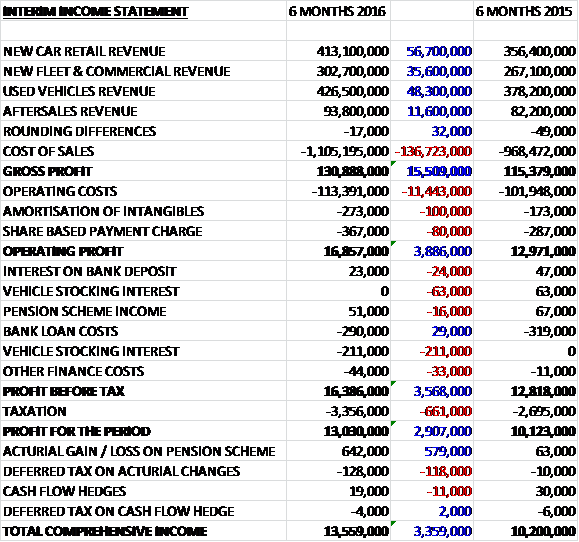
Revenues increased when compared to last year with a £56.7M growth in new car retail sales, a £48.3M increased in used vehicle revenues, a £35.6M growth in new fleet and commercial revenue and an £11.6M increase in aftersales revenue.  Cost of sales also increased to give a £15.5M growth in gross profit.  Operating costs also grew during the period so that operating profit was some £3.9M above that of last time (with new acquisitions contributing a loss of £384K).  We then see a negative swing in vehicle stocking interest and an increase in tax which meant that the profit for the period was £13M, an increase of £2.9M year on year.

VTUintassets

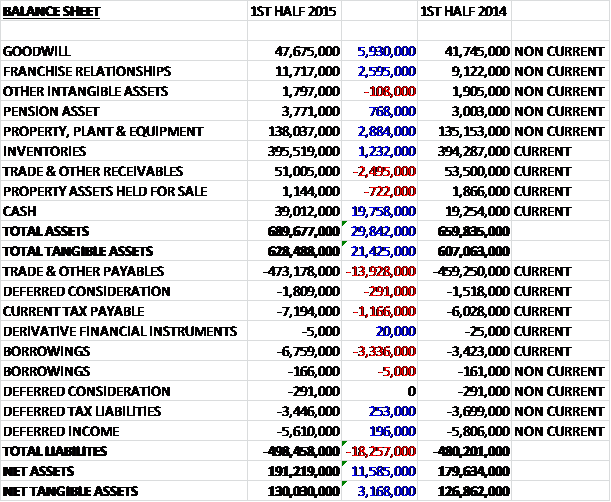
When compared to the end of last year, total assets increased by £29.8M driven by a £19.8M growth in cash, a £5.9M increase in goodwill, a £2.9M growth in property, plant and equipment, a £2.6M increase in franchise relationships and a £1.2M increase in inventories, partially offset by a £2.5M decline in receivables.  Liabilities also increased during the period due to a £13.9M growth in payables, a £3.3M increase in borrowings and a £1.2M growth in current taxes payable.  The end result was a net tangible asset level of £120M, an increase of £3.2M during the period.

VTUintcash

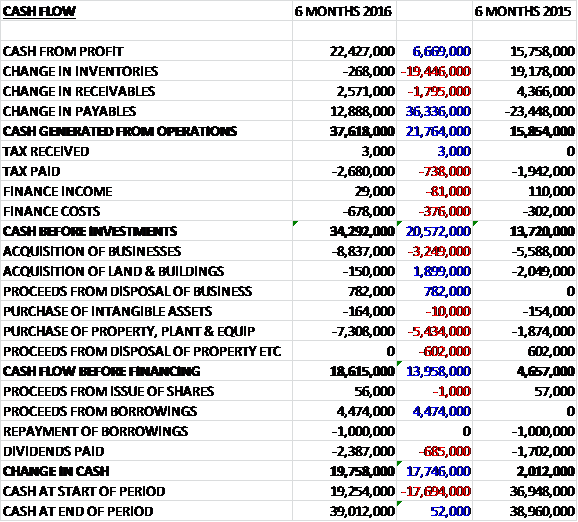
Before movements in working capital, cash profits increased by £6.7M to £22.4M.  We then see a large decrease in payables (which seem to be related to lower VAT payments due to fluctuations in new car consignment inventory levels) push the cash generated from operations to £34.3M, an increase of £20.6M year on year.  The group then spent £8.8M on acquisitions and £7.3M on property plant and equipment to give a cash flow before financing of £18.6M.  We then see a curious increase in borrowings which dwarfed the increase in dividends (presumably the cash level at the period end give a very favourable impression compared to the average cash levels) which meant that there was a cash flow of £19.8M and a cash level of £39M at the end of the half-year.

The UK automotive sector has continued to respond positively to the supply push of new vehicles into the market by manufacturers reacting to weaker demand from other global markets and helped by the strong Sterling.  This resulted in further growth in UK new vehicle registrations in September, albeit with slowing growth in private new retail registrations with the balance picked up by stronger fleet activity.  After three years of growth in new vehicle registrations, the supply of used vehicles has now normalised from the previous period of supply constraint.

The UK economy continues to display positive growth and consumer demand remains buoyant and responsive to finance led offers for new cars which are being made available.  The latest SMMT forecast for the total UK new car market for 2015 is £2.6M and the forecast for 2016 is expected to remain flat.  The board expect to see a period of stability in the UK car market in the short to medium term.

Like for like new retail sales were up 1.2% against a growth of 1.8% in private registrations for the franchises represented by the group as a whole as the market data includes pre-registered vehicles with levels of dealer self-registration growing.  Like for like Motability vehicles sales were up 6%, gaining market share in a market that declined 0.5% during the period.  Motability is an important area for the group and represents over 22% of total new car retail sales for them.  Motability customers display very high levels of aftersales retention during their three year contract and the group is currently Motability Operations Dealer of the Year.  The like for like vehicle gross profit grew by 4.8% in the period as manufacturer targets were achieved at high levels, maximising earnings, which resulted in stable vehicle gross margins of 7.3% as the average selling price per car strengthened from £13,342 to £14,213.

Like for like new car fleet sales fell by 8.5% following a shift in sales mix with reduced supply to lower margin daily rental channels.  Gross profit per unit improved, however, resulting in like for like gross profit generation.  The fleet business is subject to periodic fluctuations in channel mix as manufacturer strategies and customer requirements change.  Like for like commercial new vehicles sales grew by 24.2% against a market that rose 16.4%, reflecting the willingness of both large and small enterprises in the UK to invest in their business.  Lower fuel prices have supported this trend, encouraging transport businesses to invest in their vehicle fleets.

Like for like used retail vehicle sales grew by 4.2% against a very strong performance last year as the used car market returned to more normal levels.  Like for like margins and gross profit per unit both declined, however, in line with the board’s expectations.  The group remains focused on maximising used car return on investment.  Rising stock levels from self-registrations and increased used car depreciation have put pressure on returns with the above market average returns for the group falling from 126.3% to 115.2%.

Like for like aftersales revenues increased by 3.7% and gross margins were up from 43.7% to 45.5%.  In the high margin service area, like for like revenues grew by 6.2%.  Increased sales of service plans have improved customer retention into the service channel, particularly of older used cars.  Lower margin fuel sales declined significantly with depressed fuel prices creating a pull on revenues but improving margins.

In non-dealership businesses, Bristol Street Versa, which is a converter of wheelchair accessible vehicles, is now profitable after having undertaken a turnaround plan since its acquisition in 2011.  The group currently has 5% of the UK Motability wheelchair accessible vehicle market and supplied 222 vehicles in the period, the bulk of which were procured from the group for conversion.  They also supplied 419 vehicles to the Taxi Centre which was acquired in November.  Its performance has been in line with expectations and is making an increasing contribution to the group.

In March 2014 the group entered into a business arrangement with Haymarket to jointly operate the What Car Leasing platform.  This online portal provides UK automotive retailers with a route to market to customers who wish to purchase new cars via a leasing model.  The business generates advertising revenues from the retailers on the website.  It continues to be developed and its contribution to the group is increasing, generating over 72,000 enquiries for its subscribers in the period.  An expansion of the group’s joint operations with Haymarket is currently being planned.

During the period the group added nine outlets, disposed of one and closed three so that it now operates 119 sales outlets in total.  Of the £152.2M increase in revenues, acquisitions in the period accounted for £20.6M of growth and the businesses acquired last year contributed £94.4M which meant that core group revenues increased by 5.2% reflecting increases in vehicle sales and aftersales whilst closed or sold businesses accounted for a decline of £17.3M.

In April the group became the sole franchise partner in Glasgow for Nissan and began to operate from temporary facilities in the North of the city to complement the existing South Glasgow business.  In September a significant freehold property was acquired for £3.9M close to the city centre which will be turned into a landmark Nissan dealership in the coming year.  The new dealership development will occupy about half of the site acquired with the remainder earmarked for re-sale.    In April the group closed its sub-scale Peugeot dealership in Ilkeston and in July they disposed of the Dunfermline Peugeot dealership – there were no significant costs incurred due to these closures.  In July they refranchised the former Suzuki outlet in Mansfield to become a Dacia and Renault facility which saw them exit from representing Suzuki.  Also, a peripheral aftersales outlet acquired in the Bolton Ford acquisition was sold, realising cash of £700K.

There were a number of acquisitions during the period.  In April the group acquired Bury Land Rover in Lancashire from Pendragon for a total consideration of £7M which was settled in cash from existing resources.  The group came with no net tangible assets so this consideration was goodwill plus £2.6M allocated to franchise relationships.  In May the group acquired Bradford Jaguar from Lancaster PLC for a total consideration of £826K which was settled in cash from existing resources representing goodwill of £750K.  In June the group acquired Blacks Autos which operates a Skoda dealership in Darlington.  The total consideration amounted to £1.5M settled in cash from existing resources with goodwill of £765K.

The group are engaged in a substantial programme to refurbish and redevelop a number of dealership to latest manufacturer standards.  A number of these projects have been completed in the period including the development of a Ford Store in Orpington, completion of Nottingham VW South and a number of Vauxhall refurbishments.  The substantial redevelopment and enlargement of the Vauxhall dealership in Waltham Cross has also now been completed.  A number of projects are currently ongoing including the development of a Ford Store at Bristol Street, Birmingham and the refurbishment of Mansfield VW.

There were a number of further acquisitions after the period-end.  In September the group disposed of a satellite dealership acquired with the Gordons of Bolton acquisition in November 2014.  The site in Lancashire realised £1.4M in cash.  Also in September the group purchased long leasehold dealership premises in Exeter for a consideration of £2.4M which will be refurbished to allow the future relocation of the existing Hyundai and Renault van operations.  They also purchased a freehold property in Glasgow for £3.9M for future development for the Nissan franchise.  In October the group acquired SHG Holdings which operated Audi, VW passenger and VW commercial outlets in Hereford.  The consideration of £12.8M was satisfied in cash from existing resources and £1.5M is to be deferred for two years to be paid under certain conditions.  The group will be investing about £1.5M into the redevelopment of Hereford Audi next year.

In October he group ceased sales operations at two multi-franchised dealerships – Cheltenham Alfa Romeo and Bristol Jeep.  Aftersales operations are retained at these locations.  In addition, a petrol forecourt operated alongside the Stroud Ford dealership was closed to allow the expansion of used car operations.

While the SMMT data has reported September’s private new vehicle registrations for the franchises represented by the group as being flat, Vertu’s private new vehicle sales were 3.3% below that of September last year.  Despite this, new car profitability was a record for the month and along with a solid performance in used vehicles with like for like volume growth of 5.4%, and aftersales, this has established a sound base for the balance for the rest of the year.  September profits were ahead of last year with strong turnarounds delivered in a number of businesses acquired in recent years.

After the most recent acquisition, VW franchises now represent about 9%.  The manufacturers and retailers are currently working together to ensure that any impacted vehicles are identified and issues resolved.  In the near term this is likely to boost aftersales revenues.  The group has to date witnessed no significant decline in total vehicle sales volumes or used car valuations above normal seasonal variations in the four VW group brands.  After continued strong trading in September with results ahead of last year, the board now anticipate full year results will be ahead of expectations.

At the period end the group had a net cash position of £32.1M compared to £34.4M at the same point of last year.  After a 29% increase in the interim dividend, the shares are now yielding 1.6% increasing to 1.8% on the full year forecast.

Overall then, this was a very good six month period for the group.  Profits were up, net assets increased and operational cash flow improved to give a decent amount of free cash, although these levels were distorted by large increases in payables.  The UK car market is still improving although the rate of growth does seem to be slowing, something that may continue if the supply push comes under threat from improving conditions in the EU.  New sales growth seems to be sluggish but Motability is doing well, as is commercial with increased profits per unit.  Used car sales were up but profits per unit fell as used car depreciation increased.  The all-important aftersales unit did well with increased profits driven by the services business.

The collaboration with Haymarket does sound interesting and the other peripheral businesses seem to be contributing more to the group.  After the period end, a net £17.7M has been spent on acquisitions and capex so the cash levels could be coming under threat but despite falling volumes, profits in the important month of September are head of last year which means trading for the full year is expected to be ahead of analyst predictions which is always good to see.  The VW scandal doesn’t seem to have hit sales yet but one would expect it will at some point, but this may be mitigated by increased work in the aftersales division.  At 1.8% the dividend yield is not much to write home about but I am sorely tempted to buy in here.

VERTU MOTORS

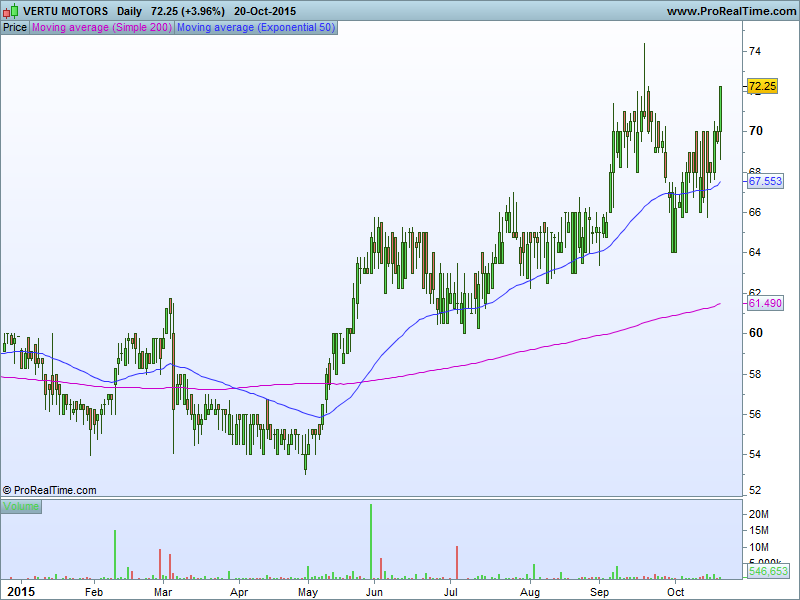
This chart is looking rather good too.

On the 1st December the group announced that it had acquired Who’s Ace Holdings, an operator of a well-established online vehicle parts business based in Kent. The business has built a presence in the non-franchised, online automotive parts market and there should be a significant opportunity to apply Who’s Ace’s ability to efficiently manage fitment data and establish the sale of genuine, franchised parts online. Bringing together this data capability with multi-franchise parts supply will provide the opportunity to accelerate growth in the parts sales channel to both retail end users and independent garages.

Total consideration is estimated at £2.2M which includes an earn-out over a five year period which would include goodwill of £1M. The initial payment of £1.8M has been settled in cash from the group’s existing resources. Last year the business generated EBITDA of £600K and the board expect the acquisition to be earnings enhancing in its first full year of ownership. This looks like a very nice little acquisition in an interesting new niche to me.

On the 25th January the group announced the acquisition of three Honda dealerships in Nottingham, Derby and Stockton on Tees from Lookers for a total consideration of £2M. This consolidates the group as Honda’s largest retail partner in Europe with 12 car dealerships. The acquisition generated goodwill of just £200K and has been settled in cash from existing resources. Last year the three outlets achieved a break even trading result and the board expects them to be earnings enhancing in their first full year of ownership. This looks to be an excellent deal to me.

On the 1st March the group announced the acquisition of Sigma Holdings and its subsidiary Greenoaks for a total cash consideration of £21.9M, of which £18.4M has been settled immediately with a further £3.5M being deferred for a year. In addition to the purchase, vendor shareholder loans of £9M have been settled in cash on completion by the group. The business operates the Mercedes outlets in Reading, Ascot and Slough with Ascot being an AMG performance centre. This represents the first foray into Mercedes retail. Each of the dealership freeholds is owned by Greenoaks, which is good to hear and the transaction generates goodwill of £13M. Last year the business made a pre-tax profit of £1.2M and the board expects the acquisition to be earnings enhancing in its first full year of ownership.

I have to say that this seems a bit expensive to me and I hope the group are not over-extending themselves.

On the 8th March the group released a pre-close trading update where they state that the trading performance for the year is expected to be ahead of current market expectations.

Vehicle servicing like for like revenues were up 5.6% which helped improve the group’s like for like aftersales gross profits, which increased by 6.7%. This performance was driven by strategies in customer retention into service and vehicle health checks performed on all vehicles vising the group’s service departments. Margins rose in each area of aftersales including service, parts, accident repair and petrol forecourts.

New car retail sales volumes grew by 6.5%, ahead of the UK market growth of 3.6% which meant that market share also grew. Like for like new vehicle gross profit per unit also grew as manufacturer targets were achieved. The group continued to grow their market share of the light commercial van market with like for like sales volumes up by 15.4% on improved margins whilst their fleet car business continued to shift away from supply to lower margin daily rental channels which meant that like for like profit performance improved.

Used car marketing activity has increased which resulted in like for like volume growth of 10.8% in this category. This is significantly ahead of the estimated overall used car market growth and resulted in the group increasing its market share here too. They have increased gross margin on a like for like basis by 5.4%.

At the start of March, Tim Tozer, former chairman of Vauxhall motors, jointed the board and the group also appointed Liz Cope as Chief Marketing Officer with effect from April 2016, representing a new position for the group. She was previously VP Global Marketing for Vax.

The board sees the UK new car market stabilising at current levels and the key drivers of supply push from European manufacturers are likely to stay in place for the medium term. The order book for retail new cars on a like for like basis so far in March was 11.6% ahead of last year and current trading is robust.

The board have identified a number of near term acquisitions comprising both premium and volume dealerships which would add a new manufacturing partner. In order to finance these opportunities, they are considering options to raise further capital for the group including a potential equity issue and a review of its borrowing facilities with a view to introducing property backed, fixed interest long term debt.

Then, just one day later, the group announced a proposed placing to raise £35M at 62.5p per share which represents a discount of 8.8% on the closing price yesterday. The placing shares will represent about 14% of the enlarged share capital and certain directors have indicated an intention to invest £300K as part of the placing.

The placing will enable the group to further expand its portfolio through the acquisition of additional dealerships which the board expects to comprise both existing and new manufacturer partners. Three near term acquisitions have already been identified with a combined consideration of about £26M and will add a new manufacturing partner. The remainder of the proceeds will be used to pursue other acquisition opportunities. The group is also reviewing its borrowing facilities with a view to utilising the security of its substantial freehold property portfolio with a view to mortgaging the properties up to £50M.

So, we have an excellent update followed one day later by a placing. This is very poor form in my view – why not just announce the placing alongside the update? Anyway, I do not really like the way this company is going. It is going to forego its prudent approach and instead embark on a spending spree using placings and more debt. Is this really the right time in the cycle to be going down this route? Sadly these shares are not for me at the moment – what a shame after the excellent progress they made this year.


Somero Enterprises Share Blog – Final Results Year Ended 2014

Somero Enterprises designs, assembles and sells patented laser-guided equipment that automates the process of spreading and levelling volumes of concrete for commercial flooring and other horizontal surfaces such as paved car parks.  The machines employ laser-guided technology to provide a high level of precision in concrete surface flatness at a higher rate of efficiency than conventional methods.  The group has sold to contractors for non-residential construction projects in over 92 countries and the equipment has been specified for use in the construction of warehouses, assembly plants, retail centres and other commercial construction projects that require very flat concrete floors.  The products have been used in projects for Costco, Home Depot, B&Q, Daimler Chrysler, various Coca-Cola bottling companies, the US Postal Service, Toys R Us and ProLogis.

Somero Laser Screed equipment holds an incredible 99% market share in the non-residential, horizontal concrete flooring industry.  The target customer is the commercial concrete floor contractor of any size.  They have assembly operations in Michigan and their HQ is in Florida.  Revenues are generated from sales of large line products, sales from new small line products and sales from spare parts, refurbished machines, topping spreaders, mini screeds, 3D profilers, S-15R and accessories.  They have now released their final results for the year ended 2014.

SOMincome

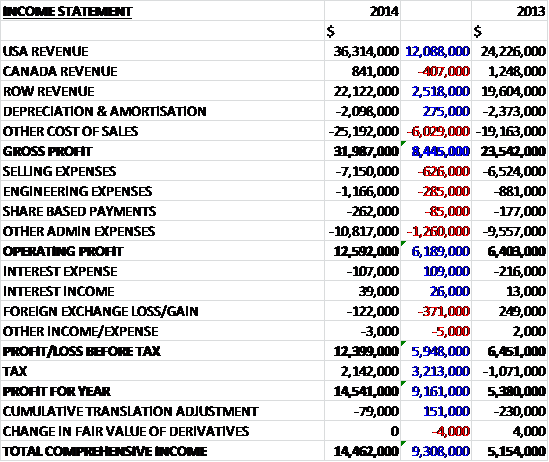
Revenues increased when compared to last year as a $407K fall in Canadian sales was more than offset by a $12.1M increase in US revenues and a $2.5M growth in ROW revenue.  Cost of sales also increased despite a lower amortisation charge to give a gross profit some $8.4M ahead.   Selling expenses increased by $626K, engineering expenses grew by $285K and admin costs were up $1.3M but operating profit was still $6.2M above that of last year.  We then see a bit of a loss from foreign exchange changes which meant that pre-tax profit was $12.4M, an increase of $6M year on year before a $2.1M tax rebate due to a non-cash valuation allowance of $4.1M and $5.9M settlement of restricted stock units and settlement of stock options which are deductible for tax purposes, meant that the profit for the year came in at $14.M, an increase of $9.2M.

SOMassets

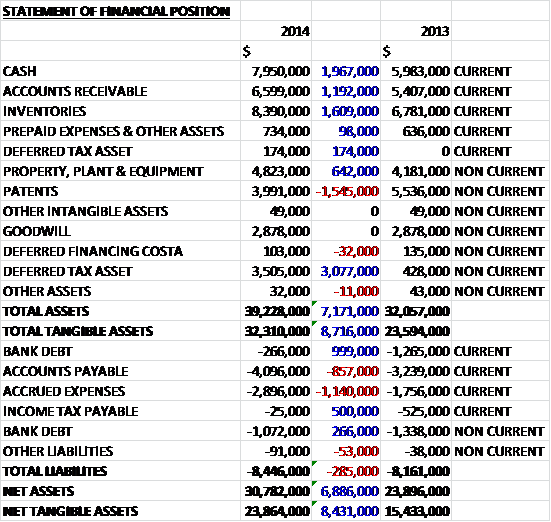
When compared to the end point of last year, total assets increased by $7.2M driven by a $2M increase in cash, a $3.1M growth in deferred tax assets, a $1.6M increase in inventories and a $1.2M growth in accounts receivable, partially offset by a $1.5M fall in the value of patents.  Total liabilities also increased as a $1.3M fall in bank debt was more than offset by a $1.1M increase in accrued expenses and an $857K growth in accounts payable.  The end result is a net tangible asset level of $23.9M, an increase of $8.4M year on year.

SOMcash

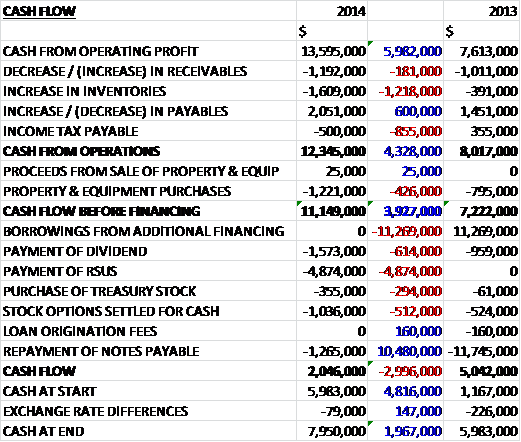
Before movements in working capital, cash profits increased by $6M to $13.6M.  We then see an increase in payables more than offset by a growth in inventories and an increase in receivables to give cash from operations of $12.3M, an increase of $4.3M year on year.  The group spent just $1.2M on capital expenditure relating to computer hardware and software upgrades, vehicle purchases, ERP upgrades and improvements to the Michigan facility, to give a free cash flow of $11.1M.  The bulk of this money was used to pay restricted stock units, of which $554K were still outstanding at the year-end, and we also see $1.6M spent on dividends, $1.3M spent on the repayment of debt and $1M on stock options settled for cash.  The end result is a cash flow of $2M and a cash level of $8M at the year-end.

The North American market performed well, increasing from $25.5M to $37.2M; the revenues from China grew by 44% to $9.5M; the European market saw a 20% increase to $3.6M and Australia along with SE Asia also saw strong growth.  Russia and the Middle East experienced sales declines, however, due to political unrest in those regions.  The substantial increase in revenue was driven by two new products, the S-15R and the S-485, the new sales people and increased construction activity.  In all, large line sales increased to $22.4M as a result of a 52% increase in volume to 64 units; small line sales decreased to $9.7M due to a slight fall in units to 126 and other revenues increased by $7.1M to $27.2M.  There were two customers that accounted for more than 10% of receivables – one of 10% and one of 36%.

All of the Asian markets grew substantially in the year, in particular in China.  This growth is driven by increasing their penetration rate in all regions of China and the broader awareness of US floor flatness standards now issued by the China Flooring Association.  The Chinese economy is evolving towards more logistics, big box retailing and e-commerce which increase owners’ demands for the speed and flatness provided by the group’s equipment and they invested in an additional $800K to expand the team by five people to 19 employees.  The new office is larger than the HQ in Florida and will include the Somero Concrete College and warehousing for over $1M in spare parts and equipment inventory to service the country.

In SE Asia, sales increased from $400K to $700K.  The group expect to see strong growth from this region and they will increase their market awareness and penetration as evidenced by the sale of two large line screeds and two 3D profilers for the start-up of a multi-year project in Jakarta which will create a dedicated bus line with concrete pavement in early 2015. Sales in India were very good for the initial phases of penetration into this significant market.  Marketing efforts have been stepped up and the group continue to invest in sales and develop revenue opportunities.  Europe continues to recover and demonstrated growth year on year.  Latin America remained flat due to the Brazilian economy and sales in Russia and the Middle East were slow due to the geo-political changes that occurred during the year.

During the year the group introduced the S-485 Laser Screed.  It is designed for easier set-up and operation and requires one less person to operate and only one person is needed to establish a grade or fine tune the programmable height receivers.  They have had a good response to the new machine as it was introduced in October and contributed $900K in sales during those three months.

Due to the anticipated growth of the business, the board has concluded that the current global HQ in Fort Myers will not be large enough to accommodate future growth.  As a result the company has entered into an agreement to purchase land to build a new global HQ at an expected cost of up to $4M spread over two years.  They also plan to expand their Michigan facility at an approximate cost of $1M.

The group have started to devise an education programme specifically for the Chinese market that they are calling the Somero Concrete College.  This programme will educate and train the group’s customers to become industry leaders in placing a concrete floor successfully.  The group’s current facility in the country will be utilised for the training grounds, regional sales office, customer service call centre and parts warehousing.  In addition to the college, they are also launching their Screed Training programme at the facility.  This programme is specifically designed for new customers and will educate them in proper operation and maintenance of a newly purchase Somero Laser Screed.  This training programme will be similar to the one currently provided in the US.  The completion of the college will occur in Q4 2015.

The group’s financial performance is affected by a number of factors, especially the cyclical nature of the non-residential concrete construction industry, as well as the varying economic conditions of the geographic markets they operate in, particularly North America, Western Europe and China. They are particularly affected by construction projects from large North American retailers such as Wal-Mart and Costco where their large laser screed products have been utilised.  Their performance is also dependant on the replacement and refurbishment of older products as they reach the end of their expected life cycles.  Somero equipment is in a period of demand for replacement and refurbishment as older machines reach the end of their lifecycles.

Strong US sales momentum has carried forward into 2015 as a result of the new product introductions, replacement demands on outdated technology and the ongoing construction growth that the group’s customers are experiencing – this growth trajectory is expected to result in strong sales for 2015.  The penetration rate in China is currently only about 1% and the board see the country as a key growth driver.  Customers there now have access to financing options made available specifically for Somero equipment which is expected to have a positive impact on sales in the region.  Growth is anticipated in Latin America outside of Brazil’s economic slowdown.  This was driven by strong Q4 sales in Mexico, attributed to the manufacturing sector, and is continuing into 2015.  After a sound start to the new year, the group are confident that this will be a year of solid growth for them

The group has a net cash position of $6.6M compared to $3.4M at the end of last year.  After a 150% increase in the total dividend this year, the shares currently yield 2.7% increasing to 2.8% on next year’s consensus forecast.

Overall then this seems like an interesting company and the past year has been a good one.  Profits are up, net assets increased and operating cash flow improved to give both a decent free cash flow and a comfortable net cash position.  The markets in the US and Europe seem to be improving and China appears to be a big potential growth driver whilst the Middle East, Russia and Brazil are proving to be a drag on results.  There are some things to watch out for – this market is very cyclical and although the geographic diversity does mitigate this risk somewhat, the US still makes up the bulk of profits and a slow down here would have drastic consequences.  Also, one customer makes up about a third of all receivables which is never a good place to be and there seems to be quite a lot of capex being mooted with the new HQ, Michigan factory and the dubious sounding Concrete College.  There is also the lingering doubt about a foreign company listed on AIM.  Overall though, the net cash is a nice cushion and the 2.7% dividend yield is pretty good for a fast growing company like this.


Bioquell Share Blog – Interim Results Year Ending 2015

Bioquell has now released its interim results for the year ending 2015.

BIOQinterimincome

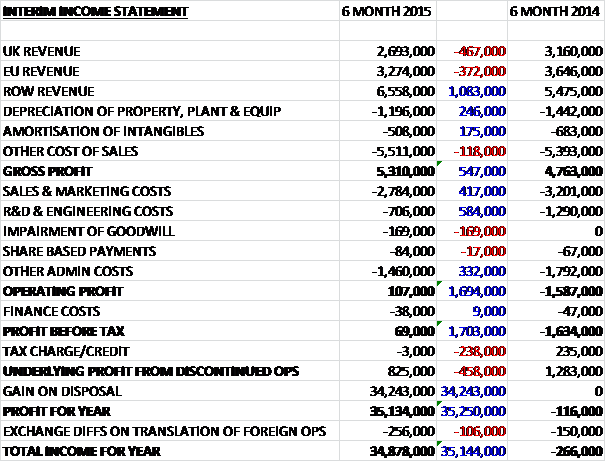
Overall revenues increased modestly when compared to the first half of last year as declines in UK and other European revenue was more than offset by a £1.1M growth in revenue from the rest of the world.  Depreciation and amortisation were both down slightly and after a small increase in the other cost of sales the gross profit was £547K above that of last time.  Sales and marketing costs reduced, as did R&D costs and despite a £169K goodwill impairment, admin costs also fell along with finance costs before the lack of a tax rebate this time meant that before discontinued operations, the profit for the half year stood at £66K, an improvement of £1.7M year on year.  We then see an £825K contribution from the discontinued operation and a £34.2M gain on disposal to give an actual profit for the period of £35.1M.

BIOQinterimassets

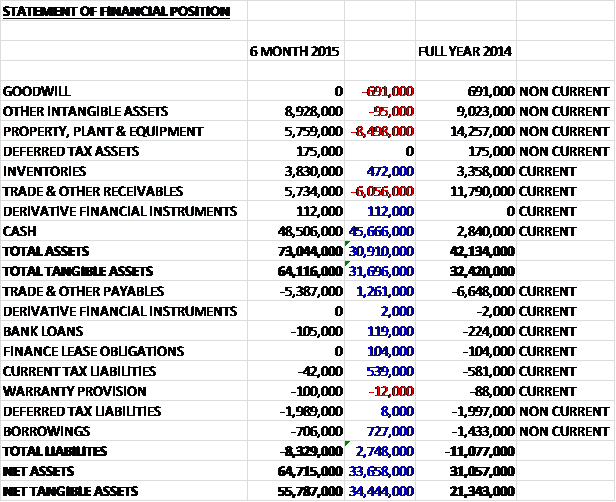
When compared to the end point of last year, total assets increased by £30.9M to £73M driven by a £45.7M increase in cash and a £472K growth in inventories, partially offset by an £8.5M fall in property, plant and equipment, a £6.1M decline in receivables and a £691K fall in goodwill.  Total liabilities declined during the year due to a £1.3M fall in payables, a £846K decrease bank loans and a £539K decline in current tax liabilities.  The end result is a net tangible asset level of £55.8M, an increase of £34.4M over the past six months.

BIOQinterimcash

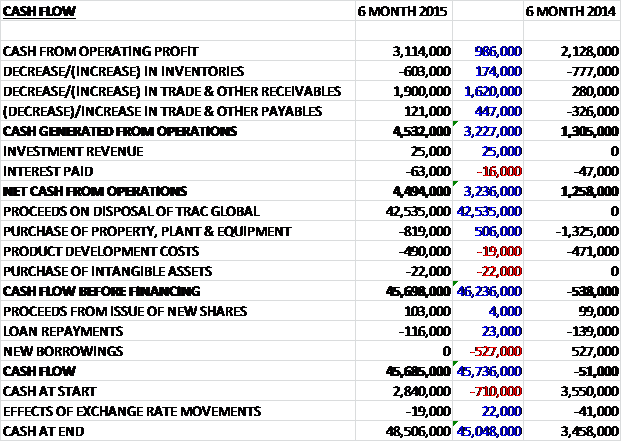
Before movements in working capital, cash profits increased by £986K to £3.1M.  A large fall in receivables then drove the net cash from operations up to £4.5M, an increase of £3.2M year on year.  The group spent £819K on tangible fixed assets and £490K on product developments to give a decent amount of free cash flow before the £42.5M proceeds from the disposal of Trac Global meant that the cash flow for the year was £45.7M to give a cash level of £48.5M at the period end.

The changes made in the Bio division’s cost base last year means that it is just about profitable now at the operating level.  The group are beginning to see the benefits of the new products, services and consumables that have been developed and launched over the past couple of years and the underlying demand in the core life sciences and healthcare markets is increasing.

Life Sciences orders increased by 3% year on year as the new products are gaining traction in the market, in particular the QUBE order book was up 50% to £1M at the end of the period.  As expected, life sciences revenues declined by 16%, however, to £8.2M reflecting the phasing of deliveries from the order book as well as the decline in revenues associated with the hydrogen peroxide vapour equipment.  Demand for the QUBE product continued to grow from a broad range of customers around the world.  Although the product is primarily sold into sterility test and hospital pharmacy applications, it is now beginning to sell into biotech research and low volume biotech manufacturing applications.

The life sciences revenues in the US market increased during the period.  The changes made in the US business a year ago are starting to be reflected in the financial results of the business.  In contrast the group continues to find the market in China much slower than a few years ago and they are looking at new ways of generating profits in the country.  Revenues from the higher margin consumable products continued to grow.  The consumables range currently comprises hydrogen peroxide cartridges as well as biological and chemical indicators used to help customers obtain and maintain regulatory approvals.

Revenues from the healthcare business increased 22% to £2.1M.  The US showed strong growth and now accounts for about half of worldwide revenues.  Factors that are driving this increase include increased awareness following micro-biological contamination linked to the treatment of Ebola patients in US hospitals as well as increasing concerns about hospital acquired infections.  The HPV technology was also used to help bring the MERS outbreak in South Korea under control.

The new healthcare product, BQ-50, was launched in May and the order book is beginning to grow.  This product incorporates a number of new technologies which make the product easier to use which results in faster eradication of pathogens in hospitals.  The product also enables the group to provide lower-cost, more flexible bio-decontamination service offering to hospitals in the US and Europe.  Sales of the pod product were slower than expected and a number of changes have been made to the way in which the product is promoted which it is anticipated will help drive growth in healthcare revenues in the second half of the year.

Defence revenues increased from £800K to £2.2M during the period.  The group continued to see demand for the specialist filtration equipment from a number of customers around the world, particularly in the Middle East.  They have developed a flexible range of modular CBRN products which enable them to produce cost effective solutions to international vehicle and fixed installation manufacturers.

Service related revenues fell by 5% to £5.7M, reflecting a decline in Room Bio-Decontamination Service revenues partly due to a greater number of large emergency RBDS contracts in the first half of last year.  The group believe there are a number of new applications for this service arising from biotech applications and they are in the process of increasing their marketing of the service to capture these applications.

In May the group sold TRaC Global, which carried out the group’s testing, regulatory and compliance work.  During the period the business contributed £600K to net operating cash flows and had a pre-tax profit of £1M.  The disposal brought in £44.5M in cash and there was a gain of £34.2M on disposal so they certainly seem to have got a decent price for the sale but it is disappointing and perhaps a little short sighted in my view to sell your most profitable and growing business.  The majority of this cash is intended to be returned to shareholders but this has been deferred pending the outcome of the strategic review.

The increasing demand for the QUBE product is offsetting the decline in older hydrogen peroxide vapour equipment and the group launched their new product, BQ-50, for the healthcare market.  Overall the group is on track to meet the board’s expectations for the full year.

There are no interim dividends so the 2.4% dividend yield still applies for the full year. After the receipt of cash from the TRaC sale, the group has a net debt position of £47.7M compared to £1.1M at the end of last year.

Overall then this seems to have been a year of improvement for the underlying bio business.  Profits did increase but were still negligible, net assets improved as a result of the gain on the TRaC sale and perhaps most importantly, operating cash flow improved with a decent amount of free cash generated – although this was boosted somewhat by the reduction in receivables.  Operationally, the largest division, life sciences, seems to still be struggling somewhat due to a decline in older HPV equipment and subdued Chinese demand but hopefully the growth in QUBE can take up some of the slack.  Progress in the other two divisions was good with the BQ50 product likely to improve healthcare revenues going forward.  I do think that the TRaC sale is a bit disappointing and the return of cash is dominating proceedings here but I do quite like the company overall.

BIOQUELL

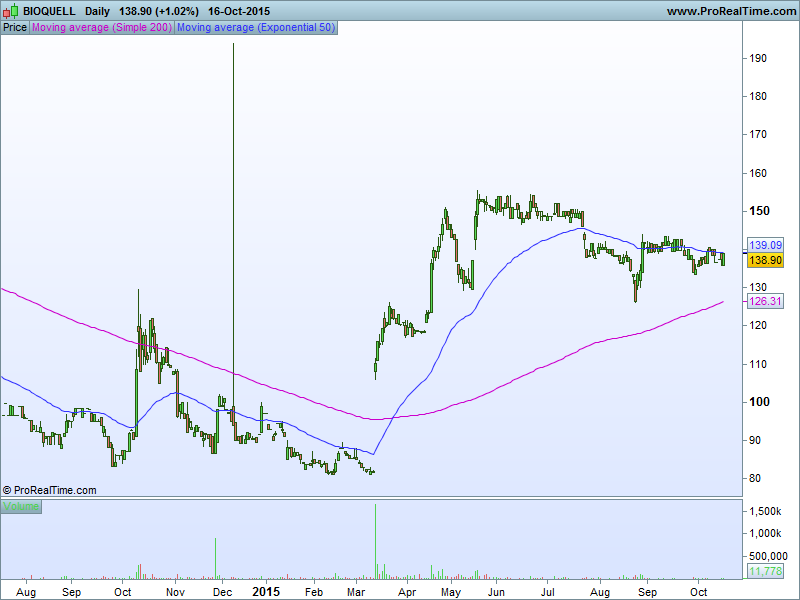
The share price seems to be going no-where fast at the moment.

On the 14th January the group released a pre-close trading update for 2015. Trading since the half year point has remained broadly consistent with board expectations. Revenues for the year are expected to be flat. Life Sciences revenues grew by 1.8%, reflecting a strong second half but healthcare revenues declined by 2.2% and defence revenues were 13.7% lower at £3.5M. Pre-exceptional profit is expected to be in line with board expectations but an exceptional charge of £200K will be booked this year to reflect headcount reductions in Q4. There will also be an exceptional profit of about £34M associated with the sale of TRaC in March.

In all the company had net cash of £47.5M at the year-end and the strategic review is expected to draw to a conclusion around the end of Q1 2016.


Bioquell Share Blog – Final Results Year Ended 2014

Bioquell sells biological contamination control services and equipment into the international life sciences, healthcare and defence markets.  One important offering is hydrogen peroxide vapour bio-decontamination technology which has been used by the US military programme to eradicate biological warfare agents and reduces hospital acquired infections.  In addition the group utilises HEPA and activated carbon air filtration which it uses to breakdown hydrogen peroxide vapour as well as to protect military vehicles and facilities from biological, chemical, radiological and nuclear contamination.

The group has now released its final results for the year ending 2014.

BIOQincome

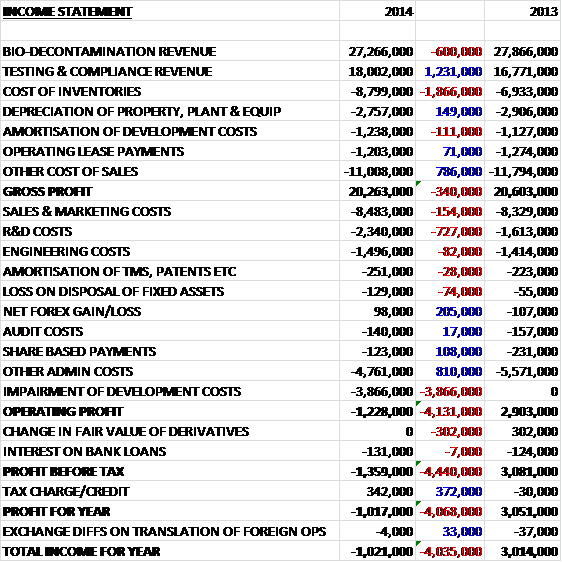
Overall revenues increased when compared to last year as a £600K decline in bio-decontamination revenue, held back by operational difficulties in the US and Asia, was more than offset by a £1.2M increase in testing and compliance revenue.  Cost of inventories also increased, however, which meant that gross profit for the year was some £340K lower.  Sales and marketing costs grew modestly but R&D costs were up £727K which was mostly offset by a reduction in admin costs and a favourable forex movement before a £3.9M impairment of intangibles, mostly development costs, meant that there was a loss at the operating level, an adverse movement of £4.1M when compared to 2013.  After movements in derivative financial instruments were offset by a tax credit, the profit for the loss for the year was £1M, an adverse movement of £4.1M year on year.  Even without the impairment charge, the profit would have been lower.

BIOQassets

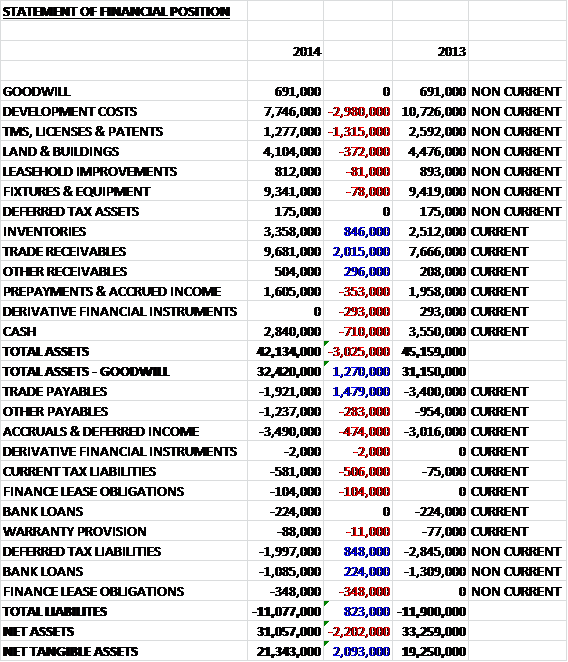
When compared to the end point of last year, total assets fell by £3M driven by a £3M fall in capitalised development costs, a £1.3M fall in other intangible assets and a £710K decline in cash levels, partially offset by a £2M increase in trade receivables and an £846K growth in inventories.  Liabilities also fell during the period due to a £1.5M decline in trade payables and an £848K decrease in deferred tax liabilities.  The end result is a net tangible asset level of £21.3M, an increase of £2.1M year on year.

BIOQcash

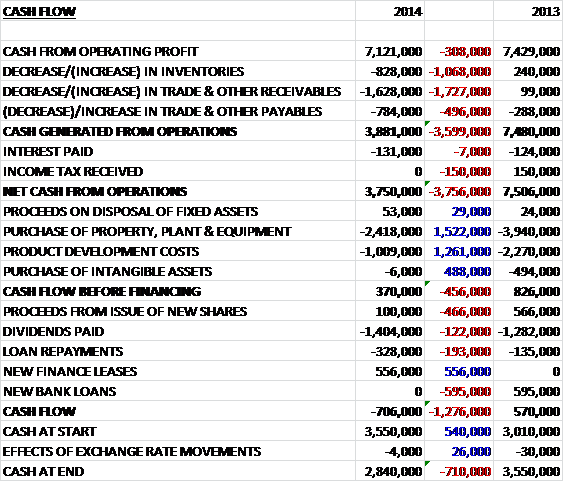
Before movements in working capital, cash profits fell by £308K to £7.1M.  When compared to last year there was also a detrimental movement in all constituents of working capital with a particularly large increase in receivables and after the income tax rebate of last time was not repeated, the net cash from operations was £3.8M lower at £3.8M.  The group then spent £2.4M on fixed assets and £1M on project development to leave a few cash flow of just £370K.  This was not enough to cover the £1.4M of dividends paid out and after some cash received from the new finance leases, the cash outflow for the year was £706K to give a cash level of £2.8M at the year-end.

The Bio division encountered significant headwinds in the Life Sciences market, particularly in Asia and the US, and a number of management changes were made during the year.  In the division, healthcare revenues increased by 26% to £4.3M, assisted by the new single patient pod product which is used to isolate beds in open plan multi-bed hospital rooms which are common outside the US and France, as well as increased interest in the hydrogen peroxide vapour technology as a result in part of the decontamination service activities during the Ebola outbreak.  Defence revenues more than doubled to £4.1M but life sciences revenues, mainly from equipment sales, reduced by 17% to £18.9M.

The Trac revenues were strong across all services with particularly good results from the environmental and electromagnetic compatibility services helped by high levels of aerospace activity.

The group have taken a number of steps to try and reduce the lumpiness of their defence orders, in large by extending the range of applications for their products.  Interest in the CBRN filter products have been aided over the past year by increased sectarian conflicts in the Middle East as well as instability close to the Russian border in Eastern Europe.

Many of the group’s customers are highly conservative and adopt new technologies slowly so it can take some time and substantial marketing investment to see increased revenues linked to the launch of a new product.  In order to supply the breadth of products as well as the short response times for services, they require a large facility in the UK which has high fixed costs and associated operational gearing.  This facility currently has significant under-utilised capacity which could be used to generate high margin incremental revenues.

The group have made good progress during the year in increasing the number of regulatory approvals for their hydrogen peroxide consumables around the world.  They also extended their supply chain to enable them to supply consumables cost effectively to a greater proportion of international customers.  They have also taken a number of steps to repackage certain technologies to enable them to migrate from an equipment based offering to increase the provision of specialist decontamination services which should improve recurring revenues and quality of earnings.

In the last couple of years the group have reduced their dependency on HPV by delivering complementary products such as the QUBE for life sciences and the Pod for healthcare.  They are also in the process of launching a new HPV product, the BQ-50.  This product is designed both for use in hospitals and for the provision of decontamination services by the network of international distributors.  This product draws on the technologies and components which were developed for a US military development programme a few years ago, including fast cycles, smaller size, reduced weight and automated cycle calculations.  It is anticipated that this product will help the group increase their equipment and service revenues in the healthcare sector in 2015.

During the year the group deployed twenty Pods in conjunction with four suites of HPV equipment in a Saudi Arabian intensive care unit in advance of the annual Hajj pilgrimage at Mecca.  This was the first substantial Pod deployment outside the UK and it is anticipated that this reference site will generate further Pod and HPV bio-decontamination revenues from the Middle East.  The recent Ebola outbreak has created significant interest in the group’s equipment and services.  The HPV technology has been used to decontaminate Ebola patient rooms in three hospitals in the US as well as in hospitals in the UK, France and Holland.  The group have been talking to hospitals in Europe and the US about helping them with Ebola emergency preparedness and, via the Pod technology, isolation surge capacity.

The group has been developing BioxyQuell, a peroxy-chemical based wound treatment technology for a number of years.  The technology has regulatory approval in the EU and they have been working on the commercialisation of the product in the UK.  They have found it difficult to commercialise the technology in the current hospital funding environment, however, and they have taken the decision to suspend the project as it is believed there are better opportunities with other products in the portfolio so the board has taken the decision to impair the value of development costs of this technology.

During the year the group ceased working on the contract to develop COLPRO solutions for a new vehicle for the British Army.  Subsequently to the cessation of this contract they essentially halved the size of the engineering team as the end of the contract has cost them £300K a year.  Due to the risks associated with such programmes, the board have taken the decision not to carry out large defence-related development contracts in the future.  They did manage to secure other COLPRO contracts related to the standard CBRN equipment from customers in the Middle East and Eastern Europe, though.   A proportion of these contracts was delivered in 2014 and based on the orders already received, they will continue to generate revenues into 2015.

There does seem to be a decent amount of headroom on borrowings with an unused revolving credit facility of £6M and undrawn overdraft facilities of £1.5M.  It is interesting to note that last year, about a quarter of shareholders voted against the remuneration report which is quite strange as the directors don’t seem to be that aggressively paid.  The group is somewhat susceptible to foreign currency changes with a 10% strengthening of Sterling against the US dollar reducing profits by £109K and a 10% strengthening against the Euro reducing profits by £73K.

After the year-end the group sold the TraC division for a cash consideration of £44.5M and is expected to give rise to a profit of £35.4M with the majority of cash proceeds being returned to shareholders.  The sale of the most profitable part of the business does seem to lack ambition somewhat but the board believe that the remaining Bio division represents an attractive standalone business with interesting prospects.

In the life sciences sector growth is expected due to increased sales of biologics and biosimilars, which require the use of aseptic principles during research as well as the manufacturing process.  The imposition of more demanding regulations and compliance requirements in the life sciences and healthcare sectors is also expect to increase demand for the group’s products.  Within the healthcare sector hospitals face increasing difficulties treating patients who contract antibiotic resistant bacterial infections.  The imminent launch into the healthcare sector of the BQ-50, a new small, fully automated product to rapidly eradicate pathogens from surfaces in hospitals should also help drive revenues in this sector.

During the past year the group reduced the cost base in the Bio business substantially, particularly in relation to their engineering resources, and also made significant changes to the management structure of the American and Asian subsidiaries, the results of which will be seen in the coming financial year.  The new year has started well for both divisions and it is believed that the business can deliver significant value to shareholders in 2015.

The substantial phase of significant capital investment in new products and services such as QUBE, Pod, BQ-50 and consumables, is essentially over.  Going forward the group expects to see product line extensions and technology updates but with a markedly lower requirement for capital expenditure so it is expected that the Bio division will start to generate cash.  Sales in the Life Sciences sector currently remain key to the profitability of the division and steps have been made to address the issues encountered in that market.  The lack of single patient rooms in many critical care rooms in hospitals and the increasing prevalence of antibiotic resistant infections creates opportunities in the healthcare market and the defence business is well positioned with a significant order book already covering most of the planned 2015 defence related shipments.

At the current share price the shares trade on a PE ratio of 20.7 which reduces to 20 on next year’s consensus forecast so that doesn’t look great value.  The shares currently yield 2.4% which is identical to the figure expected next year.  The net cash at the year-end was £1.1M compared to £2M at the end of last year.

Overall then this is an interesting company.  Over the past year, though, profits have fallen as have operating cash flows.  There is still some free cash, however, but this does not cover the dividends and the net tangible assets improved during the year.  The Testing and Compliance division seems to be doing very well but sadly this has been sold, albeit for quite a decent amount.  The remaining bio division is doing less well due to headwinds in the life sciences division in the US and Asia – progress in the much smaller healthcare and defence markets seems to be better.

There are some interesting products which may add to future profits with the pod gaining traction and BQ-50 looking promising.  The emergence of Ebola and MERS must be a good thing for the group and there is likely to be less cash used in capex going forward.  The shares are not that cheap, however, trading on a PE of about 20 and delivering a yield of just 2.4% so I am going to watch proceedings here from the side lines for a while.

St. Ives Share Blog – Final Results Year Ended 2015

As a result of the reallocation of resources and a change in the group’s internal reporting, the segments have been redefined as Strategic Marketing, Marketing Activation and Books.  The Strategic Marketing segment comprises all the businesses that were previously reported under the Marketing Services segment other than the Field Marketing business which is now reported under the Marketing Activation segment.  The segment comprises the Data, Digital and Consulting businesses.

The Marketing Activation segment includes the Field Marketing business, and all the group’s Marketing Print businesses that were previously reported under the Print Services segment other than Clays which is now reported under the Books division.  The Marketing Activation segment comprises the group’s Exhibitions and Events, Point of Sale, Print Management and Field Marketing businesses.  The Books segment comprises Clays that was previously reported under the Print Services division.

St. Ives has now released its final results for the year ended 2015.

SIVincome

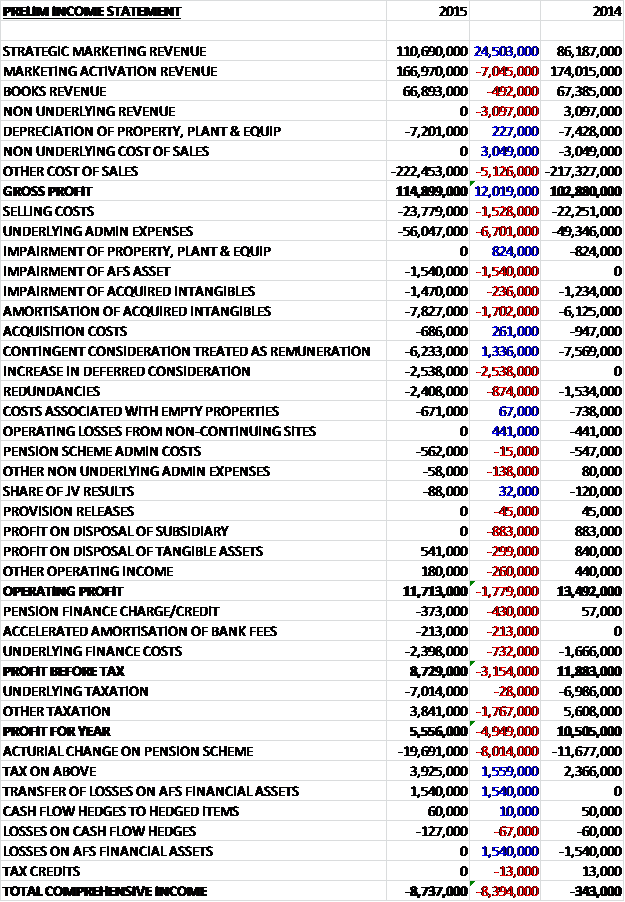
Revenues increased considerably when compared to last year, although organic revenue fell as a £7M decline in Marketing Activation revenue, a £3.1M elimination of non-underlying revenue (broadly offset by a fall in non-underlying cost of sales) and a £492K fall in books revenue was more than offset by a £24.5M increase in strategic marketing revenue. Cost of sales also increased to give a gross profit some £12M above that of last year. We then see selling costs up £1.5M and an “underling” admin cost increase of £6.7M before we get to a huge list of “non-underling” admin costs. We have a £1.5M impairment of an available for sale asset, a £236K increase in impairments of acquired intangibles and a £1.7M increase in the amortisation of acquired intangibles, a £2.5M increase in deferred consideration, an £874K increase in redundancy costs, an £883K decline in profit on disposals of subsidiaries and various other items – most of these happen every year so don’t seem to be very “non-underlying” to me.
The upshot of all this is a £1.8M decline in operating profit compared to 2014. We then see an increase in the pension charge, an accelerated amortisation of bank fees, and an increase in “underlying” finance costs and after an increase in tax, the profit for the year came in at £5.6M, a decline of just under £5M year on year.

SIVassets

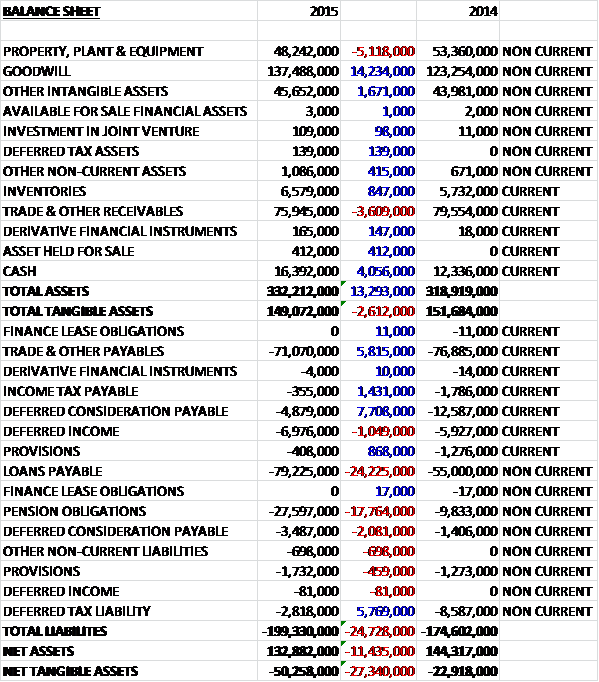
When compared to the end point of last year, total assets increased by £13.3M driven by a £14.2M growth in goodwill, a £4.1M increase in cash and a £1.7M growth in other intangible assets, partially offset by a £5.1M fall in the value of property, plant and equipment along with a £3.6M decline in receivables.  Liabilities also increased during the year as a £17.8M growth in pension obligations, and a £24.2M increase in loans was partially offset by a £5.8M fall in deferred tax liabilities, a £5.6M decline in deferred consideration, a £5.8M fall in payables, and a £1.4M fall in income tax payables.  The end result is a net tangible asset level of -£50.3M, a detrimental movement of £27.3M year on year – this is not a good balance sheet at the moment!

SIVcash

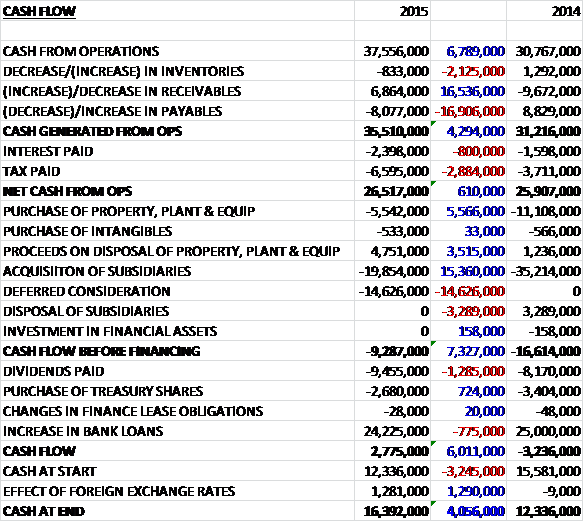
Before movements in working capital, cash profits increased by £6.8M to £37.6M.  A fall in receivables was more than offset by an increase in inventories and a decline in payables; and interest was up £800K with a £2.9M growth in tax paid so that net cash from operations came in at £26.5M, an increase of £610K year on year.  The group then spent £5.5M on fixed tangible assets relating in part to £3.5M invested in the book segment to meet the additional volume generated by the Penguin contract, £533K of intangibles and £14.6M on deferred consideration.  They also made £4.8M on the sale of fixed assets and spent £19.9M on acquisitions to give a cash outflow of £9.3M before financing.  We then see a £9.5M dividend payment and £2.7M spent on treasury shares.  This was all paid for by a £24.2M increase in bank loans to give a cash flow for the year of £2.8M and a cash level of £16.4M at the year end.  I am not sure if this company will ever be self-sustainable as it seems to have to buy growth through acquisitions that it can’t afford out of its own cash flow.

The “underlying” result in the Strategic Marketing segment was £16.3M, an increase of £4.5M year on year which included full year contributions from Realise and The Health Hive acquired last year, along with Solstice acquired in March.  Revenues at the data business fell by £2.3M to £33.2M with the fall due to a significant one-off software sale within Occam in the previous year (worth £2.4M)and a change in work mix in Response One but both of these factors helped to improve the margin in the year.  Response One introduced a new analytics proposition and improved its digital capabilities.  In addition, Occam has significantly expanded its remit within JLR and they are now delivering services intro them through both Occam and Amaze One.  Occam has also secured a number of new wins, including Car Giant, Healthspan, Sainsbury’s Retail Technology Services and the RAC.

The digital division saw revenues increase from £27.8M to £45.5M.  Amaze saw a number of significant new client wins throughout the year.  It has established a core strength in advising manufacturers who are transacting directly with their customers for the first time and in the delivery of B2B commerce solutions with both areas currently experiencing significant market growth.  Following the launch of Amaze One, the CRM collaboration between Amaze and Occam, the business has progressed well, winning projects for the Arcadia Group and Royal Mail while also extending its CRM remit with Northern Rail.

Branded3 has achieved a number of new business wins throughout the year, securing the search engine optimisation account for First Direct, which further extends their remit with the company, as well as winning contracts for Halfords, Chelsea FC and Durham University.  Realise has continued to build its business both within the UK and internationally.  Highlights included a digital transformation project for Greyhound in the US and international digital marketing campaigns for Disneyland Parks and Expedia.  In addition, the business has had a number of new significant new business wins including Nikon in Europe and Hewlett Packard & Sutter Health in the US.  Moving forward it is the intention to bring the digital businesses closer together in order to collaborate on large scale multi-discipline, multi-territory digital client mandates.

The consulting business saw revenues of £32M, an increase of £9.1M when compared to last year.  Incite continues to grow internationally in response to client demand.  It has seen strong growth in New York and Singapore having opened offices in both markets during 2013, and has secured a number of significant new business wins.  Following this expansion, the business opened an operation in Shanghai this year, winning its first new client mandates in the region at the end of the financial year.

Pragma has also seen an increase in demand for overseas projects with airports and commercial spaces in particular being high growth areas with the business advising on the commercial strategy of Mexico City International Airport.  Hive, the healthcare communications consultancy the group acquired in May 2014, has integrated well into the group and continues to add new clients to its roster with substantial wins from three pharmaceutical companies.  Its patient journey mapping product is a strong growth driver for the business with recent new project wins from Bayer, Novartis and AbbVie with this area expected to see continued momentum into next year.

The “underlying” profit in the Marketing Activation division was £10.9M, a decline of £409K when compared to last year.  Trading conditions within the division were mixed with growth in Service Graphics and SIMS offset by a reduction in POS revenue caused by ongoing pressures within the UK grocery retail sector.  Within Service Graphics the group won new clients during the year such as the MOD, Moorfields Eye Hospital and Rolls Royce.  Within SIMS they have delivered significant growth due to new client wins including Adidas and Pernod Ricard, as well as securing organic growth from the existing client base.

Despite a difficult year due to increased competitive pressures within the grocery retail market, Tactical Solutions has also had a number of new business wins over the year, including Revlon and Quorn.  They continue to invest in new data and technology capabilities and have recently launched a bespoke data tool, TSeye, to continue to differentiate the business in a crowded market place.  They have also developed the creative marketing and design offering.  The Shop, which sits in the SP operation, has extended their European remit with international client engagements such as Adidas.  In addition, since the end of the year they have re-signed and extended contracts with many of their leading clients.  These contract extensions provide an increased level of visibility and a stable foundation for market share growth over the next two to three years.

The “underlying” result in the Books segment was £8.1M, a fall of £303K when compared to 2014.  Revenue in Clays was broadly in line with the prior year with a slight decrease in margins.  The business is the market leader in UK trade monochrome book production services and continues to extend its range of value added services to the publishing market through digital and supply chain related investment which has included the introduction of a new self-publishing service that is seeing rapid volume growth.

Sentiment in the physical book market has improved with e-reader penetration appearing to have levelled off within the UK and the US and with physical book volumes stable for the first time in a number of years.  During the year the group reached an agreement with Penguin Random House to provide all of their UK monochrome book production under a new multi-year contract.  This represents a significant market share gain for the business and, along with a number of other recent contract wins and extensions, secures about 80% of Clays’ workload for the next three to six years.

During the year the group acquired Solstice, a mobile first marketing and technology business for a total consideration of £28.1M comprising £19M in cash, £4.7M in shares and £5.1M in future consideration.  The acquisition generated goodwill of £12.8M with further intangible assets of about £11.7M.  During the period Solstice contributed £1.6M to operating profit which seems decent enough.  The acquisition of Solstice in March broadened the group’s digital capabilities and enhanced their international credentials.  The businesses’ offering of mobile product design and engineering services compliments existing digital businesses and creates opportunities for increased collaboration at an international level.

As mentioned, there are a huge number of “non-underling” items that affect the group so let’s have a look at some of them.  The restructuring items during the year relate to the closure of the Burnley site of £1.3M, redundancy costs of £764K relating to the restructuring of the former Print Services division to the Marketing Activation segment and costs relating to empty properties of £671K.  Profit on disposal of property, plant and equipment includes £411K relating to the sale of a property recorded in the Books segment, and a net gain of £159K from the sales of properties in Blackburn, Leeds and Plymouth.  A loss of £29K on disposal of assets related to the closure of the Burnley site was recorded in the Marketing Activation segment.  Whether these are really non-underlying or whether they are normal costs in a constantly evolving business is open to debate.

Charges related to the amortisation of acquired customer relationships, proprietary techniques, trademarks and software intangibles of £7.8M were incurred.  Contingent consideration of £6.2M in respect of acquisitions required to be treated as remuneration rather than consideration and deferred consideration of £2.5M are both recorded in the Strategic Marketing segment.  For a company such as St. Ives where the business strategy is very much to acquire growth, these acquisition costs definitely need to be included in my view.

An impairment charge of £1.5M relates to an impairment of goodwill of £296K and to customer relationships of £1.2M where there has been a higher level of customer churn in the Field Marketing business.  An impairment charge of £1.5M was recorded on the disposal of the group’s investment in Easypress for a nominal amount in July.  The same argument really applies to this as to the acquisition costs but these impairments are certainly more “one-off” in nature.  The group conducted a project to offer those members of the defined benefits pension scheme over the age of 55 independent advice on their pension options.  These costs of £268K have been treated as a non-underlying item.  This last cost is definitely non-underlying in my view so I have finally found one!

One real potential problem has become the pension scheme.  The group will continue to make deficit funding contributions of £2M per annum and a contribution of £400K towards the cost of the admin.  The deficit has increased from £9.8M to £27.6M during the year caused by an increase in scheme liabilities due to a fall in the discount rate used to value the liabilities and an increase in the inflation rate.

After the period end the acquisition spree continued with an acquisition of FSP ltd, a UK based retail consultancy which will work closely with the Pragma Consulting business particularly in the airport, travel and commercial space sectors.  The group have suggested they are going to continue with the acquisitions which of course they need to do as there seems to be no organic growth here.

The outlook for the Marketing Activation business remains challenging, impacted by the competitive trading conditions in the UK grocery retail sector, which are expected to continue this year.  The new year has started in line with the board’s expectations and they continue to invest in their higher margin strategic marketing activities.  Assuming current market conditions continue, they are confident that they will make further progress in the year ahead.

At the current share price the shares trade on a PE of 44.9 but the “underlying” PE is 9.6 which falls to 9.4 on next year’s consensus forecast so I can’t work out how to value this share – my gut feeling is that it is being over-valued when relying on underlying figures.  After a 9% increase in the full year dividend, the shares currently yield 4.1% which increases to 4.2% on next year’s forecast which looks good but when so much is spent on acquisitions, can they really afford it? The net debt seems quite high here and at £62.8M it was considerably higher than the £42.7M at the end of last year but there are unutilised commitments of £35.8.

Overall then, this is a very difficult company to value.  Profits are down year on year mainly as a result of an increase in deferred consideration and the impairment of the for sale assets but it’s hard to say what the underlying profit actually is.  The balance sheet looks pretty terrible, net tangible assets are very negative and getting worse due to large increases in the pension deficit and bank loans.  The cash flow sheet is interesting, operating cash flow did improve and if we discount the acquisitions, there is some free cash flow here although there is an outflow before financing due to the constant acquisitions.

Strategic Marketing seems to be going well but profits in the other divisions are falling, partly as a result of the competitive UK grocery market.  Sentiment does seem to be improving in the books division and there is good earnings visibility there at least.  The headline PE is predicted to be 9.4 next year but this is pretty meaningless as it is no doubt based on whatever form of underlying profit the analyst sees fit.  The yield of 4.2% is not bad though.  In conclusion then I am staying clear of this company for the moment – there doesn’t seem to be any organic growth and the constant barrage of acquisitions is taking its toll on the debt levels and balance sheet.  I would much rather they took a rest, and had a couple of years where they used their strong operating cash flow to repair the balance sheet but I don’t think that is going to happen.

ST.IVES

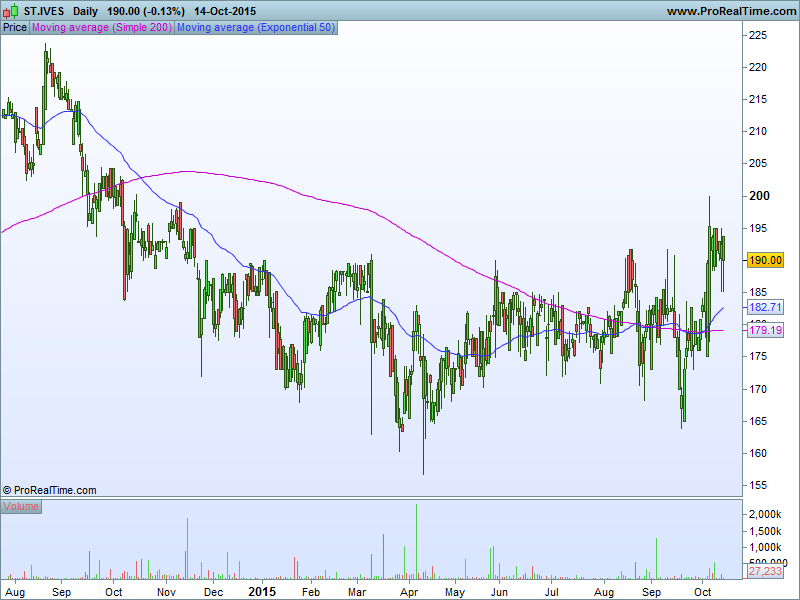
There does not seem to be much of a strong trend here.

On the 17th December the group released a trading update covering the first four months of the year. Trading overall was in line with management expectations with revenue running approximately 4% ahead of the same period last year and the full year expectations remaining unchanged.

Trading across the Strategic Marketing segment was strong and significantly ahead of the equivalent period last year, with organic growth of 15% driven by a combination of international expansion and greater collaboration across the group businesses, combined with acquisition driven growth of 20%. The segment continues to extend its range of services, primarily through acquisition. The integration of the recently acquired Solstice Consulting and FSP is progressing well and as planned, the group is continuing their investment in additional headcount to support growth.

Trading conditions in the Marketing Activation segment continue to be challenging due to the ongoing pressures within the grocery retail market. As a result, revenue in the sector was 10% lower than last year with flat margins as new business wins, cost reductions and efficiency improvements helped mitigate this pressure. Diversification of the client base to reduce the dependency on the grocery sector remains a priority.

Within the books business, revenue was 3% behind last year as trading in November dropped below expected levels, although they have yet to see the full impact of the Christmas trading period. The board expect to experience significant incremental volume in the business from January as part of the additional market share secured through the Penguin Random House contract win.
Despite quite liking this company operationally, I have decided that due to the weak balance sheet and heavily negative tangible book value, that I will no longer be covering these shares unless something changes on this front.

Tristel Share Blog – Final Results Year Ended 2015

Tristel has now released its final results for the year ending 2015.

TSTLincome

Overall revenues increased when compared to last year with a £1.6M growth in human healthcare revenue, a £184K increase in contamination control revenue and a £109K growth in animal healthcare revenue.  Cost of inventories also increased to give a gross profit £1.3M above that of 2014.  We then see a £125K loss on disposal of intangible assets and a £164K growth in wages along with a £102K increase in research costs expensed and a growth in other admin expenses which meant that operating profit came in £722K ahead of last year.  There was a small increase in finance income and a £214K decline in the amount of tax paid relating to deferred tax.  The end result is a profit for the year of £2.2M, an increase of £943K year on year.

TSTLassets

When compared to the end point of last year, total assets increased by £1.9M driven by a £1.4M growth in cash, a £381K increase in trade receivables, a £153K growth in plant and machinery, a £145K increase in computer software as the group invested in a new operating system (SAP Business One) and a £110K increase in other receivables, partially offset by a net £162K decline in the value of capitalised development costs.  Liabilities fell during the year as a £465K decline in trade payables was partially offset by a £323K increase in social security and other tax payables.  The end result is a net tangible asset level of £7.9M, an increase of £2.1M year on year.

TSTLcash

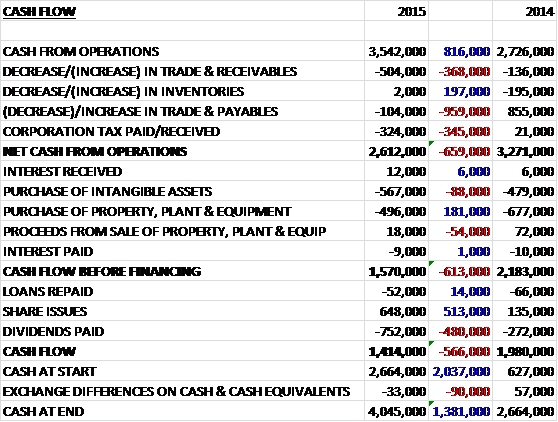
Before movements in working capital, cash profits increased by £816K to £3.5M.  An increase in receivables combined with a large swing to a fall in payables and the payment of corporation tax (as opposed to a tax cash receipt last year), however, meant that the net cash from operations was £2.6M, a decline of £659K year on year.  The group then spent £567K on intangible assets, and a net £478K on tangible fixed assets to give a few cash flow of £1.6M.  Out of this, the remaining £52K loan was repaid and £752K was spent on dividends which meant that after a £648K receipt from share issues, the cash flow for the year was £1.4M to give a cash level of £4M at the year-end.

The gross profit in the human healthcare business was £9.4M, an increase of £1.1M year on year; the gross profit in the animal healthcare division was £557K, an increase of £50K when compared to last year; and the gross profit in the contamination control business was £678K, an increase of £83K when compared to 2014.

The group plans to achieve revenues of £20M by 2017 which seems as though it should be achievable at this rate of growth.  They also intend to maintain a pre-tax margin of at least 15% whilst investing in new markets and products to sustain growth beyond 2017.  So far the pace of up-take of the group’s products has been frustrating for the chairman but the geographical expansion means that the rate of growth could accelerate.  They have embarked on their US regulatory approvals project and apparently now have a more exciting pipeline of new product innovations than the Chairman has ever witnessed, which sounds positive.  Other markets that they do not yet operate are Canada, much of South America, India, Central Europe, Africa and much of South East Asia.  They are committed to establishing a presence in most countries in Latin America by 2017.

In the hospital market the group is focused on two areas of infection prevention which are Instrument decontamination in the out-patient area, and the disinfection of critical services.  Sales in both of these areas are growing faster than the group-wide CAGR of 18%.  In the out-patient market the group provides disinfectant products that are used with small medical instruments in ENT, cardiology, ultrasound, urology, GI physiology and ophthalmology.  In these areas there is a constant stream of patients requiring procedures for which clinicians use small instruments that are relatively simple to decontaminate.  They have targeted these areas because they are not addressed by the competition.  Global revenues from out-patient care have reached £9.3M over the year.

The group’s disinfectants provide an effective strategy to control C. difficile, one of the most problematic pathogens in hospitals.  Globally, revenues of the surface disinfectants have grown at a CAGR of 63% from 2006 and now provide revenues of £1.4M in human health and £101K in contamination control and animal health.

This year, one customer made up 27% of total revenues.  In the human healthcare division, I guess this client must be the NHS so the group is very susceptible to funding of the health service.  Another potential issue is the time it is taking to collect receivables.  At the end of the year some £220K of receivables were overdue by more than 120 days which represents nearly 8% of the total and compares unfavourably to last year where there were no receivables past 120 days due.

During the year the group appointed David Orr as non-executive director.  His career spans the British Army, the City and managing businesses in the packaging industry where he has been group MD of Fencor Packaging.  It is notable that many of the directors have options that vest in the event of a change of control of the company so they seem to be very motivated to find a buyer for the company before 2019.

At the current share price the shares trade on a PE ratio of 22.9 which reduces to 21.4 on next year’s consensus forecast which seems rather expensive.  After a 69% increase in the final dividend, the shares yield 4.8% which reduces to 2.3% on next year’s forecast as the special dividend is not expected to be repeated and the group will maintain a dividend cover of two times going forward.

Overall then this was a very good year for the group.  Profits are up, there is plenty of free cash flow and net assets have increased but operating cash flow has fallen year on year.  This is only as a result of detrimental movements in working capital, however, in particular a fall in payables relative to the increase in 2014, and underlying cash profits have increased.  Profits are up across all business sectors with the human healthcare sector being by far the most important as both outpatient instrument decontamination and surface disinfectants have performed well.

As usual, there are some things to be aware of though.  One customer, probably the NHS, accounts for over a quarter of sales and perhaps more concerning is the increase in overdue receivables, some by quite a lot, which have not yet been impaired.  In addition, the forward PE of 21.4 doesn’t leave much room for error.  Overall though, this is a good set of results for an interesting and growing company so I am happy to hold and may add more if the share price comes down a notch.

TRISTEL

The market has reacted well to these results and has posted a multi-year high.

On the 15th December the group released an AGM statement. So far this year, they have achieved year on year profit growth. The board expect pre-tax profit for the first half of the year to be no less than £1.4M compared to £1.1M in the first half of last year and £1.5M in the second half of last year, which is in line with market expectations. They expect cash generation before the payment of dividends to be move than £1M during the period. Growth is coming from all areas of the business but they are particularly pleased with the progress in China and are satisfied with the progress that is being made on the US regulatory approval programme.

Overall, this seems to be a decent update and I will continue to hold.

On the 15th December the group announced that Elizabeth Dixon, Finance Director, has purchased 4,933 shares at a cost of £7.2K which brings her holdings up to 50,000. It was also announced that CEO Paul Swinney had purchased 5,000 shares at a cost of £7.6M which brings his holdings up to 920,000. Whilst nice to see the execs buying shares, these are fairly modest amounts.

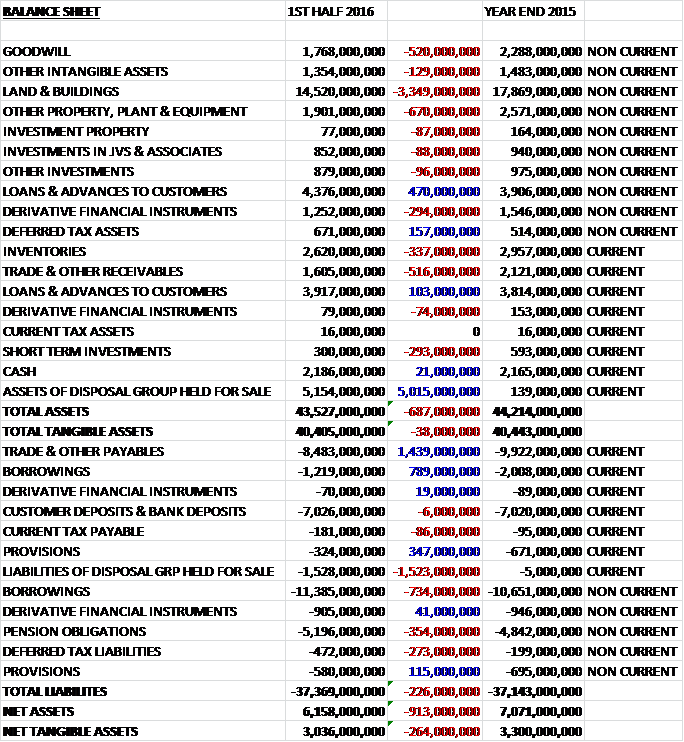
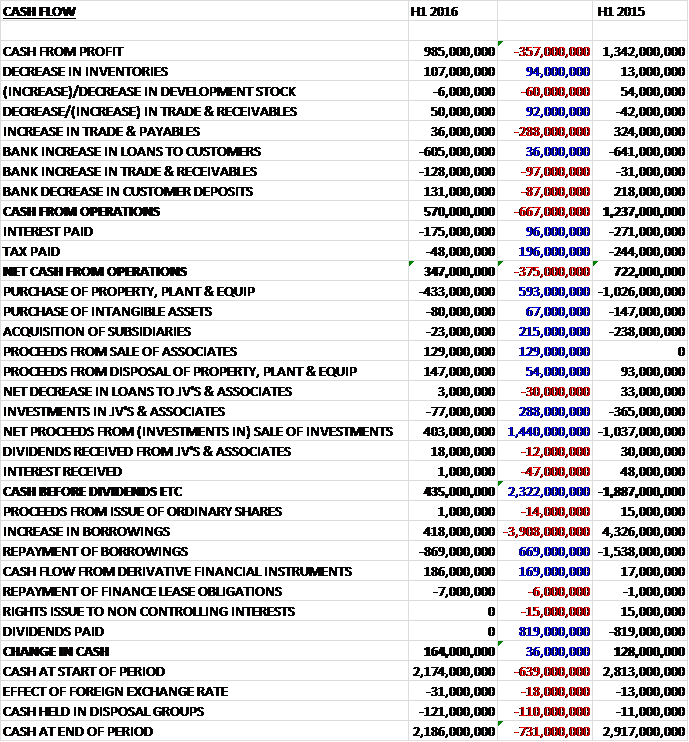
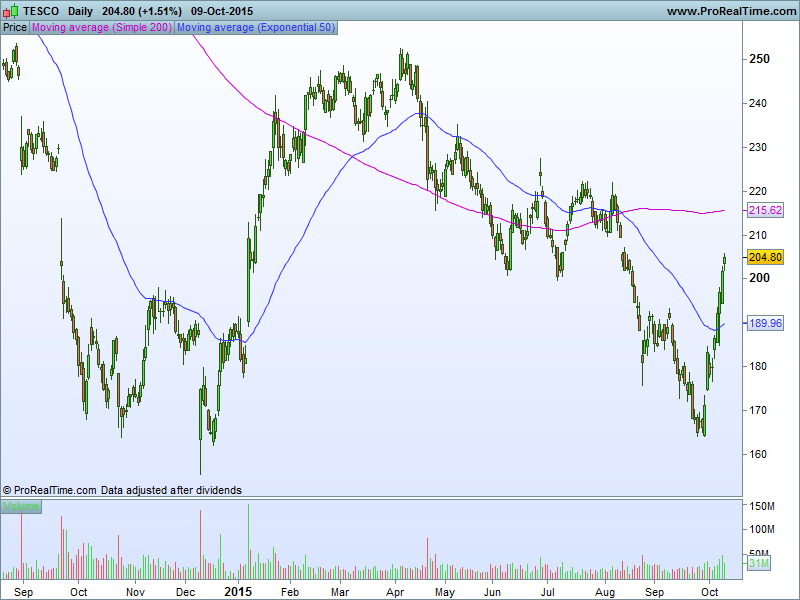
Tesco Share Blog – Interim Results Year Ending 2016

Over the period Tesco has changed the way in which it reports its different segments.  They have moved the retailing activities in Ireland, previously disclosed in the Europe segment, into a new UK and Ireland segment.  The activities in other countries, previously split between Europe and Asia have been combined into an International segment.  The activities in South Korea have been classified as discontinued operations.

Tesco has now released its interim results for the year ending 2016.

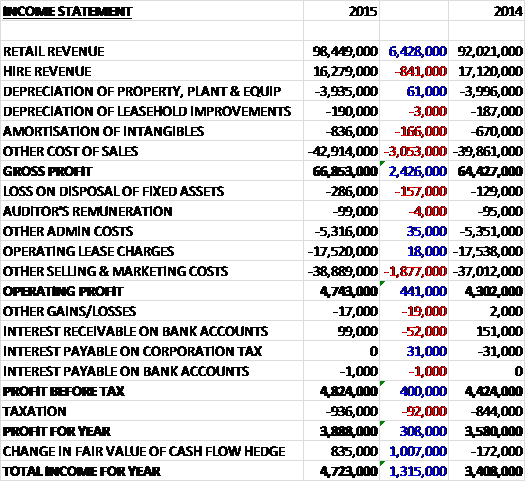
TSCOincome

Overall revenues declined when compared to the first half of 2015 due to a £512M fall in UK and Irish revenues, a £123M decrease in international revenue not helped by the strength of Sterling against the Euro and a £4M decline in bank revenue.  Underlying cost of sales fell by £292M due to a decline in the cost of inventories, but there were also a number of non-recurring costs last year that were not repeated including a £187M charge for the reversal of previous year’s commercial income and a £136M impairment of fixed assets.  This resulted in a gross profit some £197M above that of last time.  Admin expenses did increase, though, to give an operating profit just £138M ahead.  We then see a net £71M increase in interest costs and a £14M growth in pension finance costs which meant the profit before tax was just £74M, albeit £93M better than last time.  An increase in tax and a £390M loss contribution from the South Korean discontinued business, however, meant that the loss for the period came in at £368M, a detrimental movement of £374M year on year due to the £31M profit from discontinued items.

TSCOassets

When compared to the end point of last year, total assets fell by £687M driven by a £3.349BN decline in land & buildings, a £670M fall in other property, plant & equipment, a £520M decrease in goodwill, a £516M decline in receivables, a £294M decrease in derivative financial instruments, a £293M fall in short term investments and a £337M decline in inventories.  This was partially offset by a £5.015BN increase in the assets held for sale and a £573M growth in loans to customers.  Total liabilities increased during the period as a £1.523BN increase in liabilities held for sale, a £354M increase in pension obligations and a £273M growth in deferred tax liabilities were partially offset by a £1.439BN fall in payables and a £462M decline in provisions.  The end result is a net tangible asset level of £3.036BN, a decline of £264M over the past six months.

TSCOcash

Before movements in working capital, cash profits fell by £357M to £985M. A much lower increase in payables year on year increased this decline and a £605M increase in bank loans to customers meant that cash from operations was £570M, a decline of £667M when compared to the first half of last year.  A smaller interest payment and much lower tax paid, however, gave a net cash from operations of £347M, a fall of £375M year on year.  We then see £433M spent on fixed assets (£593M less) which mainly related to new stores opened in Thailand, and £80M spent on intangibles which was offset from sales of joint ventures, associates and investments so that before financing there was a £435M cash inflow.  This was used to pay back loans with a net £451M being repaid to give a cash flow of £164M for the half year and a cash level of £2.186BN at the period-end.

The operating profit in the UK and Ireland business was £166M, a decline of £377M year on year.  First half UK profits also include charges in respect of the restructuring of Dunnhumby’s US relationship with the Kroger Co, in addition to income received following the settlement of proceedings against Mastercard.  Like for like sales declined by 1.3% with an improved performance in Q2 (1% fall) than in the first quarter.  In the UK, customers are responding well to improvements in the core offer and the group are seeing sustained year on year growth in transactions and volume which is more than offset by deflation driven by the price investment and lower commodity prices.  The closure of 53 unprofitable stores in the UK during the period and the reduced levels of store openings led to a contribution from net new space of just 0.5%.  In Ireland the group have made a significant investment to improve price competitiveness.  This has led to an improving trend in volumes throughout the half and an increase in market share for the first time since 2013.

The group have made permanent reductions to their cost base, fundamentally changed the way they do business with suppliers and have started to generate positive operating leverage through increasing volumes.  The progress made so far, combined with the improved productivity as they continue to simplify the range, will enable them to fund further improvements for customers in the second half.

The operating profit in the International business was £102M, a decrease of £35M when compared to the first of last year, driven by the impact of investments in the customer offer and legislative changes in Hungary, including mandated store closures on Sundays and the introduction of a “food supervision fee” from January which the European Commission is currently investigating.  Total like for like sales increased in the period for the first time in nearly three years.  Like for like sales grew in all European markets as customers responded to investments in the fresh food offer, with improving sales trends particularly evident in Poland and Slovakia.  They also delivered like for like sales growth in Thailand in Q2 driven by both increased customer numbers and higher volumes, despite high levels of deflation and a difficult consumer environment.

The restructure of the teams in Czech Rep, Hungary, Poland and Slovakia is now complete, moving from operating as individual country trams to one regional team.  The board see significant opportunities for synergies in buying, marketing and operations across the markets.

The operating profit at the bank was £86M, a fall of £13M year on year mainly due to an initial reduction in interchange income following Mastercard’s agreement with the Competition and Markets Authority for a phased introduction of new, lower fee levels.  This agreement is ahead of the introduction of European Commission caps which will lead to a further reduction from December.  In July the bank became the first in the UK to show foregone interest on customer’s monthly statements which allows them to see if they could have earned more interest by transferring deposits from their current account to an instant access savings account.

In addition, the business introduced a 95% loan to value mortgage and smaller loan sizes during the period which contributed to an increase of 10.2% in customer lending.  In a very competitive market, the insurance business was able to broadly maintain the number of in-force policies.  The profitability of both home and motor products has benefited from further enhancements to their underwriting approach.

The share of the post-tax profits from joint ventures and associates declined by £6M to £13M as a result of increased losses in the partnership with China Resources company.  Commitments for capital expenditure were £294M at the period end principally relating to store development.  The group are making progress in their cost saving initiatives and are on track to deliver annual savings of around £400M across the company.

During the period the group reached a decision to close the pension scheme to new entrants and future accrual from November, and to replace it with a new defined contribution scheme.  During the period the pension deficit increased by £300M to £4.2M driven by asset returns which have been impacted by volatile equity markets in recent months.  A cash contribution of £92M was made to the scheme during the period.

In March the group obtained sole control of the Tesco Aqua Ltd Partnership, previously a joint venture with British Land.  The group received British Land’s share of the partnership and cash of £96M in exchange for British Land taking sole ownership if three shopping centres, three retail parks and three standalone stores which were held in joint ventures between the two companies.  The consolidation of the Tesco Aqua partnership has increased property, plant and equipment by £465M, being the fair value of 21 standalone stores included in the assets acquired, together with increasing group liabilities by £474M third party debt and £57M derivative liabilities.  No goodwill was recognised on the transaction.

The serious fraud office commenced an investigation into accounting practices at the group in October. The SFO could decide to prosecute individuals and the group and there is a possibility of fines and other consequences.  Also, class actions have been filed in the US against the group and various directors for alleged violations of US federal securities laws.  The lead plaintiff filed a claim on behalf of all investors in May 2015 and the group filed a motion to dismiss the claim in August.  In addition, law firms in the UK have announced the intention of forming claimant groups to commence litigation against the group for matters arising out of its overstatement and have secured third party funding for the litigation.  No such litigation has yet been formally threatened so the group does not make any assessment of the outcome.

After the period end, the group entered into a conditional agreement to sell the Korean business to a group of investors led by MBK Partners, and including Canada Pension Plan, Public Sector Pension Plan and Temasek Holdings with completion expected in October.  The £3.839BN fair value less costs to sell exceeds the carrying value of the Korean net assets so no impairment loss has been recognised.  As can be seen there was a substantial loss from the discontinued South Korean business.  This was due to a £419M one-off charge which relates to a deferred tax charge of £408M and costs to sell of £11M, the business itself made an operating profit of £29M.  Last year the loss from discontinued operations included a £53M tax charge from the disposal of Chinese operations.

Going forward, the market remains challenging.  In the second half the group will continue to benefit from initiatives already undertaken to improve the competitive position and reduce the cost base which means that full year expectations remain unchanged.

Tesco does not currently pay dividends, and most analysts expect this to continue for the whole year.  At the period end the group had a net debt of £8.588BN compared to £8.481BN at the end of last year with the increase mainly as a result of the £561M debt acquired on the acquisition of Tesco Aqua partnership.  The total indebtedness which includes lease commitments and pension deficit was £21.880BN compared to £21.719BN at the start of the year.   Not including the pension deficit and adding on the pro-forma effect of the Homeplus disposal, the total indebtedness stands at £13.454BN.

Overall then this has been a difficult period for the group but one of some progress.  Profits fell in the period due to the deferred tax on the sale of the Korean business but last year, we also saw a plethora of one-off costs and without these, underlying profit was also down during the period.  Net assets also declined as did operating cash flow.  There was no free cash as such but some was obtained from the sale of investments which was used to pay down debt.  In the UK and Ireland, profits fell but like for like sales declines were slowing and volumes increased.  Internationally, profits were also down mainly due to the Sunday closure in Hungary and the dubious sounding “Food Supervision Fee” in the same country.  Like for like sales in Europe were up though, and Q2 saw an improved performance in the most important Asian market, Thailand.

Profit at the bank also declined due to a reduction in the interchange income on transactions with more declines to come.  Additionally, profits in the associates fell due to increased losses in China, which sounds a little ominous to me.  The group is also under pressure from the SFO investigation and various litigation threats.  The sale of the Korean business did bring in some much needed cash to reduce further but the disposal of a profitable overseas business is a little disappointing in my view.

In conclusion then, things do seem to be improving in the core market but there are still potential headwinds and the discounters are not going anywhere – the risk/reward on this one doesn’t quite look good enough in my view.

TESCO

The share price has certainly recovered over the past week, reacting well to the Sainsbury update but it is debatable as to whether the downtrend has been broken.

On the 15th October the group announced that it had agreed the sale of 14 Spenhill development sites across London, the South East and Bath to a fund and clients advised by Meyer Bergman.  The transaction, worth £250M, is for sites suitable for mixed use and residential development.  This seems like a good deal to offload more land that is not going to be developed and to strengthen the balance sheet.

On the 26th November the group announced it had reached an agreement to settle a class action commenced in New York on behalf of the holders of the ADRs. The class action against the company alleged breaches of certain US federal securities laws in connection with the overstatement of commercial income. The settlement agreement amounts to $12M and there remains one more claim Brought in Ohio representing the remaining ADRs which it looks like will be paid off too.

On the 14th January the group released an update covering Q3 and Christmas trading. In Q3, group like for like sales declined by 0.5% with a 1.5% fall in the UK and a 1.2% decline in Ireland being partially offset by a 3.3% growth in Europe and a 2.4% increase in Asia. The figures for the Christmas period were much better with a total 2.1% growth with the UK up 1.3%, Ireland increasing by 2.9%, Asia up 4% and Europe growing by 4.2%. Within the UK like for like growth of 1.3% over Christmas, volumes were up 3.5% and customer satisfaction increased considerably.

In Q3, total sales were in line with last year at constant rates as the sales reduction from store closures slightly exceeded the contribution from new store openings but at actual rates, sales declined by 2.2% reflecting the impact of Sterling strength. In the UK, the like for like sales decline of 1.5% reflected the impact from not repeating the national coupon campaigns from the prior year.

The strong Christmas performance was helped by a 5% reduction in price for some lines and the growth in sales was evident across all categories including positive like for like sales growth in the Extra format, where customers responded well to the seasonal general merchandise ranges. In clothing, sales grew significantly ahead of the market with strong ladies fashion and knitwear ranges supported by an attractive Christmas gifting offer.

The positive sales performance over Christmas in Ireland followed an improving trend in sales and volume through the course of the year. There has been a strong customer response to the investments made through the year, in particular the move to lower, more stable prices on key lines.

The sustained positive like for like growth in both Europe and Asia is being driven by improvements across the offer, particularly in food. Combining the Central European businesses is already making a difference, giving them further ability to invest for customers and supporting better availability and improved service. In Asia, the performance in Thailand was particularly good with strong growth in customer transactions leading to Tesco’s highest ever market share.

Tesco bank continued to see strong growth in lending and an increase in number of customers for the home insurance products. Despite this there was a reduction in sales of 5.2% over the Christmas period due to the introduction of European Commission caps on interchange income in December which followed an initial reduction driven by Master Card’s agreement with the CMA in April.

The increase in like for like sales on a constant exchange rate is pleasing but in Q3 total sales at actual exchange rate saw a group reduction of 2.9% in sales with a 1.5% fall in the UK, a 9.3% decline in Ireland, an 8.2% fall in the rest of Europe and a 4.5% decline in Asia. There does seem to be some progress here, though, but I think it is far too early to decide that the downtrend has been broken so I remain out and unless things drastically change, this is likely to be my last report on Tesco I think.

Also on the same day it was announced that Alison Platt and Simon Patterson will join the board as non-executive directors. Alison is the CEO of Countrywide, the UK’s largest property services group and has a wealth of experience in the property sector. Simon is MD of Silver Lake Partners, a global technology investment firm and is also a non-executive of N Brown.

Gemfields Share Blog – Final Results Year Ended 2015

Gemfields has now released its final results for the year ended 2015.

GEMincome

Overall revenues increased year on year as a $55M growth in Montepuez revenue was partially offset by declines in the other businesses.  Labour costs increased by $6.1M, royalties grew by $3.7M, fuel costs were up $2.8M and depreciation and amortisation increased by $11.8M. The change in inventory and purchases had a beneficial movement of $19.5M, however, which meant that gross profit was broadly flat when compared to last year.  In admin costs we then see another $2.9M increase in labour costs, a $2.6M growth in selling and marketing costs and a $2.4M increase in professional costs so that operating profit was some $6.5M lower than last year.  The loan interest grew by $1.7M and there was a $1.9M adverse exchange rate movement which was offset by a lower tax charge so that the profit for the year was $12.3M, the bulk of which was attributable to non-controlling interests (mainly relating to the Montepuez mine) so the profit for the owners was just $3.7M, a decline of $5.1M year on year.

GEMassets

When compared to the end point of last year, total assets increased by $40.6M driven by a $16.4M growth in inventories, a $9.7M growth in property, plant & equipment, a $7M growth in VAT receivable, a $5.6M increase in deferred stripping costs, a $4.7M growth in the loan receivable and a $4.3M increase in unevaluated mining properties, partially offset by an $8.9M decline in cash and a $6.8M fall in the value of evaluated mining properties.  Liabilities also increased during the year due to $28M hike in borrowings and a $4.7M increase in trade receivables.  The end result is a $6.7M increase in net tangible assets at $254.3M.

GEMcash

Before movements in working capital cash profits increased by $3.5M but a large increase in receivables and inventories along with a $7.2M increase in tax paid meant that the net cash from operations came in at $16.9M, a decline of $28.8M year on year.  The group then spent $4.4M on unevaluated mining projects, $24.5M on property, plant and equipment with $9.8M being spent on mining equipment, upgrades to the wash plant and infrastructure at Montepuez; and $17.4M on stripping costs.  They also granted a $4.7M loan to Kariba Minerals so that before financing, there was a cash outflow of $33.4M.  After a $2M interest payment, the group took out a net $28.2M in new loans so that the cash outflow for the year was just $8.7M to give a cash level of $28M at the year-end.

The world’s top jewellery markets experienced double digit growth in the import of coloured gemstones.  The US grew by 29%, Europe by 22% and the high jewellery manufacturing centres of France, Italy, Switzerland and the UK reported growth of 22%, 21%, 42% and 44% respectively.  Hong Kong imports rose by 23% while India remains one of the most significant markets with imports rising by 6%.  The highest quality rubies are commanding higher prices than diamonds of similar weights.  Despite some market uncertainty, demand for coloured gemstones is expected to remain strong through the current year.

The profit at the Kagem Emerald mine was $9.3M, a decline of $19M year on year.  During the year the mine progressed its fourth high wall pushback programme at the Chama pit.  The programme commenced in 2014 and was designed to expose the emerald mineralisation at the SE edge by 75 metres for open pit ore production for at least two to three years at the current rate of operations.  The programme progressed well and was completed in September 2015.  The mine has updated its plan and is now planning for a continued waste stripping of the Chama pit over the life of the mine.  The accelerated waste stripping will provide for about two to three years of ore available for mining at any given point in time.

Gemstone production for the year increased by 49% to 30.1M carats of emeralds.  This production came from the Chama pit (27.8M) and the bulk sampling projects (2.3M).  The increased production is mainly as a result of improved volumes of ore mined throughout the year and production was second half weighted with 18M carats produced in H2.  The increase in annual carat production is in part due to the fluctuation nature of gemstone deposits as well as a result of the better rain management employed during the rainy season.  The mine has the potential to increase production to around 40 to 45M carats in the forthcoming years.

Total operating costs were $44.5M with unit operating costs of $1.48 per carat compared to $1.58 per carat last year.  On a cash basis, operating costs were $1.45 per carat compared to $1.36 per carat last time.  The updated JORC compliant resource and reserve statement showed indicated and inferred mineral resource of 1.8BN carats at a grade of 281 carats per tonne with a net present value of $520M based on a 10% discount rate.

During the year a total of $34.8M was invested in new mining and ancillary equipment, deferred stripping costs as well as in improving the facilities and infrastructure (compared to capex of $11.9M last year).  Of this total, $20.8M was spent on deferred stripping costs, $7.6M in additional mining equipment to increase production capacity, with the remaining $6.4M spent on replacing existing mining and ancillary equipment.

The Kagem washing plant achieved a total of 5,247 hours of operation.  As part of the efficiency drive the wash plant processing capacity and its security arrangements are being upgraded with a view to increasing the plant output from 33 tonnes per hour to a potential 66 tonnes per hour.  This will lead to an increase in optimisation of the process flows, increased operating flexibility and enhanced overall production capacity and productivity with the upgrade expected to be complete by December.  The modified and new picking belts are located within an improved washing facility, leading to a better working environment with enhanced levels of ventilation, lighting and noise reduction resulting in better overall control.  These improvements will also result in reduced maintenance costs, more efficient gemstone selection from the belts and enhanced overall security.

The Libwente pit, located 3km from the Chama pit is one of two new bulk sampling projects at the mine and has the potential to extend the Fwaya Pirala belt in the NE direction.  Bulk sampling of the pit commenced in 2014 and has progressed well, resulting in an increase in overall scale of operations during the year.  The pit was developed by the removal of the overburden which has recently reached the productive level of top TMS.  A total of 2M tonnes was excavated during the year and 161K carats were produced at a grade of 37 carats per tonne, indicating the presence of potential production system.

The Fibolele pit, located 2.7km from the Chama pit also saw increased gemstone production and bulk sampling during the year.  Based on the encouraging results achieved during the first of two phases of bulk sampling, a third phase has now been planned.  This will increase the pit size to 590 metres in length and 50 metres in depth.  A total of 2.1M carats were excavated at a grade of 167 carats per tonne.

Security initiatives implemented during the year include extensive upgrades to the CCTV infrastructure in the mining pit, security gates and sort house and the implementation of professional CCTV monitoring personnel.  These measures have yielded considerable improvements but with the associated consequence of an increase in the number of apprehensions.

The profit at the Montepuez Ruby mine was $39M, an increase of $25.6M when compared to last year.  During the year the group expanded the scale of the operation including additions to the fleet which saw an increase in total rock handling to an average of 250,000 tonnes per month compared to 130,000 tonnes during the last year.  The total tonnes excavated in 2015 was 3M tonnes compared to 1.6M tonnes the previous year.  There was an increased focus on the Mugloto block as a result of the discovery of higher value deposits spread over a large area in the alluvial gravel beds.  This resulted in an overall decrease in grade, supported by a considerable increase in the value of goods mined.  Around 325,000 tonnes of ore were processed by the wash plant with an average grade of 26 carats per tonne compared to 158,000 tonnes at 41 carats per tonne.

A total of 8.4M carats of rubies were produced during the year compared to 6.5M carats last year with 8.2M carats coming from the Maninge Nice primary and secondary ore and 200K carats from the Mugloto secondary ore.  Total operating costs were $21.6M and unit operating costs were $2.57 per carat, an increase from the $1.12 per carat last year.  Cash costs were also up, increasing from $1.68 per carat to $2.18 per carat but rock handling costs decreased by 10% to $6.16 per tonne.

During the year an additional rinsing screen was installed to replace the dry screen and improve the performance and capacity of the wash plant during the rainy season.  This helped support the processing performance achieved over the year to 100 tonnes per hour.  Further upgrades are proposed to increase capacity to 150 tonnes per hour with an expected run rate of 120 tonnes per hour.  A water reservoir and large dam have been constructed adjacent to the wash plant for the collection of rain water.  Seven large-diameter water bore holes combined with the use of water collected within the exposed bulk sampling pits further supplemented water supplies.

There are potential plans to increase the mine’s current processing capacity through the installation of a second wash plant with a 250 tonnes per hour capacity, operating at 200 tonnes per hour to give a total capacity of 320 tonnes per hour.  The new process plant will incorporate washing, screening, and dense media separation optical sorters to recover rubies together with fine tailings dewatering.

The new resource statement suggested an indicated and inferred mineral resource of 467M carats of ruby at a grade of 62.3 carats.  The report also confirmed probable ore reserves of 432M carats at a diluted ore grade of 15.7 carats per tonne.  The mine has a projected life of 21 years producing 432 carats over its life.  The projected real cash flow is about $2.76BN over the 21 years and a post-tax net asset value is $996M on a 10% discount rate with a capital expenditure totalling $305M.

During the year a total of $9.8M was invested in new mining equipment, as well as improving the infrastructure of the mine.  Of this total, $7.7M was invested in additional mining equipment to increase the production capacity of the mine with the remaining $2.1M spent on replacing existing equipment.  The mine’s campsite is due to undergo a significant upgrade in the coming year and a contract has been awarded for the construction of a large expansion to the residential camp.  This includes new permanent housing units as well as improved roads, water purification capabilities, office and leisure facilities.

Given the size of the mine, unlicensed mining activity remains a threat.  New infrastructure, a significant security presence and ongoing efforts have resulted in an improvement, however.  An extensive security plan is being implemented at site level which will aim to separate the security department into an independently functioning unit.  Internal security personnel with experience in the Mozambique military have been hired with the aim of increasing the skills and discipline available.

The acquisition of a controlling interest in two additional ruby deposits in Mozambique was completed during the year.  The licenses of 25 years were granted to Megaruma, of which Gemfields has a 75% interest.  The two licenses share a boarder with Montepuez and are expected to provide a platform for the expansion and development of the Mozambique ruby operations.

At the Kariba amethyst mine, total rock handling stood at 276,000 tonnes compared to 110,000 tonnes last year.  Work commenced on the installation of a new solar power system to support a more consistent and reliable electricity supply to both the mine site and the surrounding community.  The majority of the mining activity continued to take place around the Top Curlew pit which produced around 90% of the ore but in March a new pit was opened, the Curlew Main, which recently started production.

In September 2014 the group entered into an agreement with East West Gem Investments to progress opportunities in Sri Lanka for sapphires.  As part of the agreement the group created a company called Ratnapura Lanka Gemstones, of which they have a 75% interest.  The business has been granted a trading license which allows them to procure several small shipments of Sri Lankan sapphires for analysis.  The venture has also acquired a 75% interest in certain exploration licenses covering diverse minerals and plans to commence a preliminary geological assessment covering these licenses.

In February the group completed the acquisition of 75% of shares in Web Gemstone Mining, an Ethiopian company.  It holds an emerald exploration license covering a total concession area of 200 square kilometres.  A base camp has been established on the concession and a team was stationed there in June 2015.  Exploration work has recently been started for the coming year with a preliminary ground survey, mapping and preparation of base plans.  A manual pitting and trenching exercise has been initiated on a promising area in the north of the license and the results of these activities will help guide the future course of exploration in the area.  Oriental Mining in Madagascar has not been subject to any large scale ground activity this year due to several political changes in the country.

The loss at Faberge came in at $15.1M which was the same as in 2015.  The business continued to expand its global presence during the year via an increasing number of agreements with retail partners.  Faberge products are now available in Australia, Czech Rep, Malta, Qatar, Saudi Arabia, Switzerland, Thailand, UAE, Ukraine and the US.  Since the year-end further agreements have been completed resulting in their products also being available in Azerbaijan, Bahrain and Canada.

During the year Faberge underwent further optimisation of the business, including management appointments, as part of a strategy to become a profitable standalone business within the group.  Progress was made across all the product categories of jewellery, time pieces and the relaunch of Imperial Class Objects.  Political turbulence in important markets such as Russia and Ukraine, and investment in branding and marketing campaigns which are yet to be released, impacted overall sales growth at the business.  Record orders were received at Basel World 2015, however, with these revenues being recognised over the coming year when the deliveries are made.  The business also recorded improving revenues from sales of larger coloured gemstones through its Devotion collection.

Cost saving initiatives resulted in a 5% saving on admin costs with total operating costs of $18.1M but this didn’t prevent the hefty loss.  The total number of Faberge boutiques increased from 16 to 20 during the year.  Faberge continued its association with Harrods in the run up to Easter with events including the Faberge Egg Burst, which allowed clients to design their own Faberge Egg that was then displayed in the Harrods front window using 3D mapping.  In addition, the in-store Faberge Egg Hunt engaged visitors in hunting for six collectors’ eggs hidden throughout Harrods using a specially designed app.   Faberge also exhibited at the design fair Masterpiece London for the first time in June.

During the year the group relaunched the Imperial Egg class objects and the first one, the Faberge Pearl Egg, was introduced at the Doha International Jewellery show and was purchased in Doha by Hussain Al Fardan, one of the largest pearl collectors in the world.  The second Imperial Class Objet set is close to completion and comprises a series of four eggs that reflect the four seasons.  Each egg is designed to carry a surprise inside (a bit like an expensive Kinder Egg then).  The summer egg was presented at the Faberge salon at Masterpiece London in June.

During the year the group launched the timepiece collection including the Faberge Lady Compliqee Peacock and Winter timepieces, and the Men’s Visionnaire I.  The ladies watches offer a movement that has been created for Faberge and comprises of a four-cog mechanism that enables a peacock’s tail, or a snowflake, to fan out with the passage of time.  The men’s Visionnare I offers a flying tourbillon.  The dial is made up of seven separate segments that cover the movement only partially.  The timepieces will be available to buy at Faberge boutiques and partner’s points of sale from November.

Basel World saw the release of the jewellery collection “Summer in Provence” and the new Rococo and Heritage core collections.  The Secret Garden collection was presented at the Internaltional Jewellery Show in Doha in February.   Faberge’s new advertising campaigns will launch in November and combined with the expanded presence globally, this should set the stage for further improvements in overall sales.  The business is particularly pleased with the reception for its timepiece and Objets collections.

During the year the group held three rough emerald auctions as well as three rough ruby auctions.  The first emerald auction was an auction of lower quality stones and out of 12.1M carats offered, 11.6M were sold generating revenue of $15.5M at a price of $1.34 per carat.  The second emerald auction was of higher quality stones and out of 600K carats offered, 530K were sold generating revenue of $34.9M at an average price of $65.89m per carat, a significant increase over the previous high of $59.31 per carat.  At the third emerald auction, revenues of $14.5M were realised on the sale of 3.9M carats of lower quality stones at a price of $3.72 per carat.  It is notable that of the 10.1M carats offered, only 3.9M were sold.  After the year-end the group conducted a high quality emerald and amethyst auction which yielded revenues of $34.7M for the emeralds and $440K for the amethysts.

The first ruby auction was of higher quality stones which generated $43.3M for 62,936 carats sold from the total of 85,491 carats offered with an average realised price of $688.64 per carat.  The second auction was one of lower quality rubies which generated $15.9M for 3.96M carats sold out of the total of 4.03M carats offered at a price of $4.02 per carat. The third auction generated revenues of $29.3M for 47,451 carats sold out of the total of 72,208 offered.  The average realised price was $617.42 per carat.  There was also an amethyst auction with a total of 27.7M carats of higher quality amethyst being offered.  The sale of 13 of the total 14 lots generated revenues of $450K at an average value of 1.77c per carat.

At the year-end the group has capital commitments of $3.2M for the overburden removal at Kagem and $4.4M for the purchase of mining equipment and mine camp expansion at Montepuez.

In September the group acquired controlling interests in two emerald projects in Colombia.  The Coscuez Licence includes exclusive rights for the exploration, construction and mining of emerald deposits granted by the Colombian government within the area of Coscuez in San Pablo de Borbur, Boyaca.  In the past the area has hosted the Coscuez mine, one of history’s more significant emerald mines, having been in operation for over 25 years.  In 1990, open pit mining was replaced by small scale underground mining in the upper reaches of the deposit with extraction taking place from adits mines into the hillside.  Under the terms of the agreement, Esmeracol will transfer the license to a newly incorporated company imaginatively called Coscuez NewCo and Gemfields will acquire an indirect 70% interest in this company.   Further exploration activity needs to be carried out to support the development of a geological model and a prelim mine plan, all of which is likely to take up to two years.

The total consideration payable is $15M with the first tranche of $7.5M due on completion, $5M in cash and $2.5M in Gemfields shares.  A second tranche of $2.5M is due on the first anniversary of completion and a third and fourth tranche of $2.5M each upon attainment of agreed profit targets.  Completion is expected to occur by March 2016.

The second project comprises a number of new license applications and assignments to existing concession contracts administered by the Colombian Mining Agency.  The applicants for the mining licenses are a number of Colombian companies indirectly controlled by ISAM Europa.  Gemfields has acquired indirect 75% and 70% effective interests in underlying licence applications and assignments through two holding companies which own the assorted Colombian companies.  The total package of mining license applications and assigned concession contracts cover about 20,000 hectares in the Boyaca and other Colombian departments and comprise mostly greenfield sites, although small scale mining has occurred in some of the license area.  Eight of the assignments have been approved and issued so far with the remaining applications under review.

The total consideration payable is $7.5M with the first tranche of $450K being paid on acquisition.  A second tranche is payable upon granting of certain license applications, a third tranche is payable when bulk sampling commences on certain license areas, a fourth tranche is payable on the commencement of commercial mining and a fifth and sixth tranche (comprising more than half of the total consideration) is payable upon attainment of agreed revenue targets.

There are now a number of new projects and assets.  The group has a 100% interest in Oriental Mining with nine exploration licenses covering emeralds, rubies and sapphires in Madagascar.  There are eleven additional licenses in the process of being transferred with initial stages of geological evaluation being completed.  The group also has a 75% interest in the Megaruma licenses, two additional ruby deposits in the Motepuez district and share a boundary with the current mine.  They have a 75% interest in Ratnapura Lanka Gemstones, a trading company which will source rough diamonds from local parties.  They have a 75% interest in Web Gemstone with an interest in an emerald exploration license in Ethiopia. Exploration work has commenced for the coming year with a prelim ground survey, mapping and preparation of base plans.

There also have a 70% interest in the Cosuez Emerald mine in Colombia, one of the largest emerald mines in the world with completion expected to occur in March,; and 75% and 70% interests in selected Colombian exploration prospects.

During the year the group took out a $25M medium term loan with Macquarie which bares interest of US LIBOR + 4.5%.  This loan was used to repay the $15M related party loan with Pallinghurst and to fund working capital requirements.  The group also has a $20M revolving credit facility with Barclays with the same interest rate which was mainly used to pay the contractor undertaking the removal of waste in the Chama pit in Kagem and to fund working capital requirements.  The $15M related party loan was repaid in full during the year.  After the year-end, two debt facilities of $10M were entered into with Barclays Mauritius and Pallinghurst.  The interest rate for both loans was the same as above and the Barclays loan was to support the overburden removal and financing of capital expenditure whilst the Pallinghurst loan, which is repayable in December this year is for inventory investment and working capital.

With further emerald and ruby auctions scheduled to take place in the latter part of 2015, continued organic growth at both Kagem and Montepuez, and a focus on acquisitions and expansion, the board “look forward to another strong and successful year”.  The group are targeting at least three emerald and ruby auctions next year.  Following the acquisition of exploration licenses in Sri Lanka, Colombia, Mozambique and Ethiopia the group are forecasting an increase in exploration costs though.  They are targeting 25M to 30M carats of emerald and beryl production in Kagem and 8M carats of ruby and corundum at Montepuez.

Going forward, the group are installing a second washplant at Montepuez and an upgrade to the washplant to increase processing capacity to 320 tonnes per hour by 2017 is being considered and this should allow increased production to 20M carats of rubies by 2018.  Additional capital expenditure is planned for exploration in existing mines and new projects and accelerated waste stripping in the Chama pit operation should increase production to around 40 to 45M carats in the forthcoming years.

At the current share price the PE is a huge 117.2 falling to 23.6 on next year’s consensus forecast which seems more reasonable but still rather costly.

Overall then this was a very disappointing set of results.  Profits fell considerably, although net tangible assets did increase year on year.  The operating cash flow was also down but this was due to a large increase in inventory, possibly as more gems remained unsold at the auctions, and underlying cash profits actually increased when compared to 2014. The operating cash flow is not covering capex at the moment, though, so it doesn’t look like we are at a cash break-even point here.  The decline in fortunes seems to have been due to a crash in the profits made at Kagem, despite the increase in carats produced. The reason for this is a little puzzling as unit costs did not increase, perhaps more lower quality gems were produced during the year.

Progress at Montepuez was much better and the rubies are looking like a better prospect now than the emeralds in my view.  The losses at Faberge continued but did not get any worse.  If the group could get the division even to a breakeven point, then that would considerably improve earnings at Gemfields.  Despite the lack of progress this year, partly as a result of the conflict in Ukraine and increased marketing costs, next year does seem as though it could offer some improvements with increasing demand for some of the products.  In conclusion, at a forward PE of 23.6, this still looks a little expensive so I will wait on the side lines for now.

GEMFIELDS

The market did not react well to the results, as would be expected.  The shares now trade below the 200 day moving average.

On the 4th November, the group released an update covering Q1 2016. At Kagem, production of emeralds increased from 6.3M carats to 7.5M carats with an average grade of 237 carats per tonne compared to 214 carats per tonne in Q1 2015 although in Q4 2015, 8.1M carats were produced at a grade of 222 carats per tonne. Total operating costs of $11.1M grew slightly on account of the increased scale of mining and exploration activities being carried out across the mining licence. Unit operating costs of $1.48 per carat was lower than the $1.63 recorded in the same quarter of last year.

The fourth high wall pushback at the Chama pit progressed during the period and completed in September. A total of 4MT of waste was moved during the quarter. The group have revisited their mine plan for the pit, following the updated resource statement, and they are now looking at the option of continued waste stripping over the life of the mine. This will ensure that two to three years of ore is available for mining at any given point in time. In addition the exploration and bulk sampling activities at the Fibolele and Libwente pits are progressing well and have yielded some promising results.

The September auction of higher quality emeralds held in Singapore saw 590K carats being sold, representing 88% of the value offered and generating revenues of $34.7M at an average of $58.42 per carat, the third highest average price achieved to date but below that of the last auction.

At Montepuez, the focus on delineating additional areas of higher quality alluvial resource resulted in production of 500K carats of ruby versus 2.9M carats in Q1 2015 at an average grade of 7 carats per tonne against 41 carats last time attributed to a greater proportion of higher quality but lower grade alluvial ore deposit processed during the quarter. Total operating costs of $6.1M were above those of $4.3M in Q1 2015 due to the increase in scale of exploration, processing and mining activities. Unit operating costs of $12.2 per carats against $1.48 last time was driven by the shift in focus to mining and processing ore from areas of higher quality but lower grade.

The ongoing mining and bulk sampling operations continued to provide positive results and insight into the geology of the deposit. The ongoing test work has led to an enhanced understanding of the ore characteristics, supported the identification of additional higher value but lower grade alluvial ore resources and improved throughput in the existing semi-mobile processing plant. These improvements saw a 4% increase in tonnes processed when compared to Q1 2015.

With the key focus being on mining the Mugloto block, where the higher value deposit is spread over a large area, as well as the delineation of an additional and recently identified area that has the potential to produce material of exceptional quality resulted in a reduced overall grade of seven carats per tonne and the production of just 500K carats of ruby but with a 96% increase in the volume of higher quality rubies being recovered. The construction of the new Montepuez camp started in March. A total of 102 housing units, a recreation unit, canteen and new kitchen will be built. The first set of new housing will be ready for inhabitants by the end of November with completion of the camp and grounds scheduled for early 2016.

At Faberge, gross profits from sales orders agreed during the quarter increased by 61% when compared to Q1 2015. The gross profit margin on sales orders agreed increased from 30% to 51% over the same period. The number of items included in sales orders increased by 241% while revenues from sales orders agreed fell by 4% with results for Q1 2015 being skewed by the sale of a single exceptionally high value item. Total operating costs increased by 6%, largely due to an increase in advertising spend. In July, the retail partner in Bangkok held a grand opening and press call. The event attracted significant interest from local media and a number of sales were made. By the end of September, Faberge opened four of its own retail outlets and a further 22 points of sale with retail partners.

In September an auction of higher quality rough amethyst held in Singapore generated revenues of $440K at an average price of 4.32c per carat, the highest ever achieved at any of Gemfields’ amethyst auctions. In Sri Lanka the group continued to set up procedures and equipment required for trading operations. Placement of the key management team has been completed and sapphire trading is expected to start in Q2 with associated supply chain mechanisms being developed.

In Ethiopia, following the completion of the acquisition of 75% of an exploration licence, an exploration team was recruited and established on site to help develop a better understanding of the license area. A base camp has been established on the concession and a team was stationed there in June. Exploration work has recently commenced, consisting of a ground survey, mapping and preparation of base plans. A manual pitting and trenching exercise has been initiated on a promising area in the northern part of the license, selected on geological indicators and past artisanal activity.

At the end of the quarter, the group had a cash position of $41.1M with a net debt position of $18.9M with general expenses of $11.5M. The production target for rubies remains at 8M carats for the year and for emeralds it is 25M to 30M carats.

Overall then, this seems to have been a bit of a difficult quarter for the group with Kagem production down compared to the previous quarter and Montepuez production much lower as the group mined higher quality but lower grade ore. Faberge at least seems to be making progress but I don’t think the time is right to jump back in here.

On the 23rd November the group released the results from its auction of lower quality rough emeralds which was held in India, the first time a lower quality emerald auction was held outside Zambia since 2012. The auction saw 5.07M carats of the gem on offer with 18 of the 23 lots being sold generating $19.2M at a value of $4.32 per carat which compares favourably to the $14.5M generated at $3.72 per carat last time.

The event was also used to sell higher quality emeralds purchased on the open market which yielded $1.1M.

Overall then, these are pretty robust results although really it is the higher quality emerald and ruby auctions which are more important though.

On the 3rd December it was announced that Finn Behnken, a director of the company, purchased 75,000 shares at a value of £29.3K. This represents his first purchase.

On the 21st December the group released the results of their recent auction of higher and medium quality rough ruby held in Singapore. The auction generated revenues of $28.8M at an average price of $317.92 per carat with 45 of the 49 lots being sold. Given that the quality mix offered at this auction comprised a new blend of both higher and medium quality rubies, the result apparently cannot be directly compared with prior auctions but the per carat price achieved apparently remained broadly consistent with previous auctions. This is just as well given that the last auction of higher quality ruby generated an average price of $617.42 per carat and generated revenue of $29.3M, although less lots were sold in that auction.

Although some degree of softening in the demand for certain darker tone and lower quality grades remains, this is expected to be overcome as the group’s consumer education initiatives continue to reach a broader cross section of markets as key economies continued to strengthen. So far this year, two emerald and one ruby auction have raised $82.7M in revenue. Overall, this is not too bad but there is not a great deal to get excited about if I am honest.

On the 16th February the group released an update covering trading in Q2. The total production at Kagem was 8.2M carats compared to 7.5M carats in Q1 and 5.8M carats in Q2 last year. The average grade was also higher with the 272 carat per tonne figure comparing favourably to the 237 recorded in Q1 and the 190 recorded in Q2 2015. The capital expenditure on the mine was also well down and the total gemstone unit costs was $1.38 per carat compared to $1.48 in Q1 and $2 in Q2 last year.

The fourth high wall pushback was completed in September 2015, leaving about 15 months of exposed ore available for mining and continued waste stripping of the Chama pit will be done in-house for the foreseeable future. Total rock handling during the quarter was 2.8MT, with all of this being moved by the in-house mining team. Increasing the overall strike length at the Chama pit operation and optimising the blasting and scheduling techniques assisted in further improved mining efficiencies and productivity. In addition, the exploration and bulk sampling activities at the Fibolele and Libwente pits are progressing well and have so far yielded some promising results. The mining operations at the Fibolele pit have advanced during the period, taking it to an extended strike length of 600 metres and yielding 1.6M carats of emerald during the period.

Kagem has also increased its processing efficiency and capacity following an upgrade and extension to the existing washing plant facility, as well as the installation of an updated digital security and surveillance infrastructure. An improved climate-controlled environment has also been established within the extended picking facility, resulting in an improved working environment and better operating controls.

The November auction of lower quality emerald held in India saw 2.45M carats being sold, representing 95% of the value offered and generated revenue of $19.2M. The auction yielded an overall average value of $4.32 per carat, which is apparently the highest price achieved to date for lower quality emeralds. There was also a November traded auction of higher quality rough emeralds, originating from Zambia and Brazil and obtained in the open market which yielded revenues of $1.1M with 20,400 carats being sold.

At Montepuez, the total production was 1.6M carats compared to 500K carats in Q1 and 3.4M carats in Q4 last year and in the half year, the production was 2.1M carats compared to 6.3M carats in H1 last year. The grade was 22 carats per tonne compared to 7 carats in Q1 and 34 carats in Q4 last year. Capital expenditure was similar to last year, at $5.1M in the half year period. The gemstone unit cost was $4.31 per carat compared to $12.20 in Q1 and $1.68 per carat in Q4 last year.

The sampling operations led to an enhanced understanding of the ore characteristics and has supported the identification of additional higher value, lower grade alluvial ore resources. Throughput at the existing semi-mobile processing plant saw a 29% decrease in tonnes processed when compared to the same quarter last year, largely on account of the rainy season making the clay-rich head feed difficult to process. Upgrades to the existing wash plant are planned to be carried out in a phased manner throughout 2016 with a view to further improving its processing efficiency.

The total ore mined in the quarter amounted to 132.9KT against 158.2KT in Q2 last year, of which 71.7KT were processed compared to 101.4KT last time. The key focus has been on mining the Mugloto block, where a known higher value deposit is spread over a large area, as well as the delineation of an additional and recently identified area that has the potential to produce material of an exceptional quality, resulting in an increase in the volume of waste mining and a total of 922Kt being moved. Increased processing of the Mugloto ore led to the reduced overall grade but a 1,825% increase in the volume of higher quality rubies recovered.

The construction of the new camp started in March 2015 with a total of 102 housing units, a recreation unit, canteen and new kitchen being built. The first set of housing units have been commissioned and allotted with completion of the project targeted for the end of April. Unlicensed mining activity and asset loss remain key challenges. The implementation of new infrastructure facilities and improved technological interventions such as the enhancement of radio communication ranges, mobile camera lighting towers, increased numbers of CCTV cameras and mobile guard posts resulted in a visible improvement in overall security. An extensive plan has been formulated and is being implemented at site level and a training programme for security staff incorporating human rights and soft skill development has been provided.

The December auction of higher and medium quality ruby held in Singapore saw 90,642 carats being sold, representing 95% of the value offered and generated revenues of $28.8M. It yielded an average value of $317.92 per carat.

Faberge saw a strong quarter with sales orders agreed increased by 13% when compared to Q2 last year and the gross profit margin increased from 31% to 49% with unit sales increasing by 48%. Total operating costs increased by 16% though, largely due to an increase in advertising spend.

In Colombia, exploration and mine planning activities such as drone surface topographic survey, underground survey and prelim assessment of engineering solutions for Coscuez Emerald Mine access were initiated as part of the ground preparations for future operations. Further exploration activity will be carried out over the next two years to support the development of a geological model and a prelim mine plan.

In Sri Lanka the group has completed the establishment of the required infrastructure and equipment for trading in Colombo and Ratnapura. The group have also completed its prelim assessment on some of the exploration licenses covering diverse minerals and expects to continue its assessment of the other licences during the year.

In Ethiopia, the manual trenching exercise has been completed on a promising area in the northern part of the license named Dogogo Hill. The block measures 1.92Km2, covering a strike length of 2.4Km with eight trenches being planned at 100 metre intervals. Excavation of the trenches was completed in November with a cumulative length of 2.2Km. These trenches exposed contacts between pegmatites and talcose schists, and the occurrence of beryl has been recorded. A pitting exercise has been initiated at the contact zones exposed during the trenching. A geological mapping exercise has also been completed at various scales in another block to the south of the license called Karolo Kora Hill. This block measures 13.75Km2 and covers a 5.5Km strike length of the ultramafic belt.

Overall then, Kagem delivered a 41% increase in production volumes year on year while costs continue to be well maintained. Montepuez continues to produce encouraging results including a high level of confidence that the production volumes will soon be supported by the planned shift in mining focus to areas where the grade is higher but with a reduction in value in the coming months. The board maintain their production target of 25 to 30 million carats of rough emeralds and 8 million carats for rough rubies.

At the period-end, the group had cash of $24.9M and total debt of $55M and incurred expenses of $14.5M during the half year.

Overall then, there is a lot of detail here to get through. Kagem seems to be doing well, with increased production and lower costs but Montepuez seems to be a bit more variable and it is difficult to understand how the changes in grade and values will affect the accounts. The cash level seems to be somewhat lower than at the end of last year with an increase in debt so despite the low capex at Kagem, there doesn’t seem to be any cash generated. So, whilst things look promising I think I will wait for the interim results before I buy in here (they are due next week).

Moss Bros Share Blog – Interim Results Year Ending 2016

Moss Bros have now released their interim results for the year ending 2016.
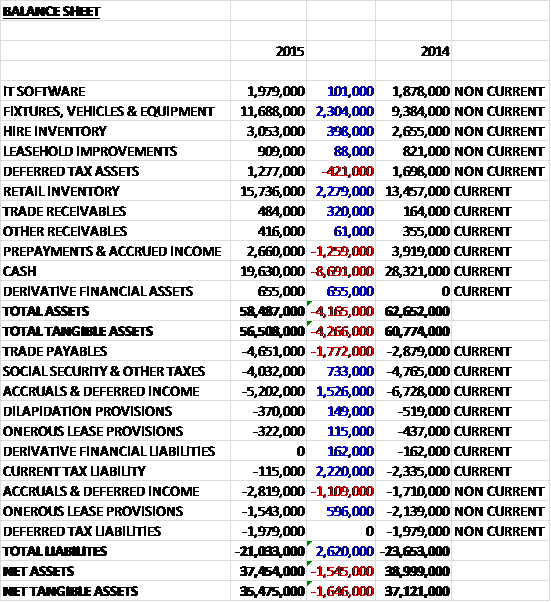
Mossinterimincome

Revenue increased when compared to the first half of last year with a £4.8M growth in retail revenue and a £777K increase in hire revenue.  Cost of sales also increased to give a gross profit £3.9M higher.  We then see admin costs increase along with a £686K growth in depreciation and a £375K increase in amortisation.  This, combined with a £1.5M increase in other selling and marketing costs meant that operating profit grew by £843K when compared to the first half of 2015.  After a modest increase in tax, the profit for the period was £2.2M, an increase of £700K year on year.

Mossinterimassets

When compared to the end point of last year, total assets fell by £178K driven by a £1.7M decline in retail inventory due to a re-phasing of Autumn/Winter stock intake to better align product availability with customer demand, a £610K fall in the value of the derivative financial asset, a £604K decrease in cash and a £507K fall in payables, partially offset by a £3.7M growth in property, plant and equipment.  Total liabilities increased during the period due to a £1.1M growth in payables and a £461K increase in the current tax liability.  The end result is a net tangible asset level of £34.1M, a decline of £1.4M over the past six months.

Mossinterimcash

Before movements in working capital, cash profits fell by £700K to £8.8M but a much smaller fall in payables than last year meant that the cash generated from operations was some £8.7M better at £7.7M.  The group then spent £1M on intangible assets, £5M on property, plant and equipment, and £2.1M on tax to give a cash outflow of £400K before financing.  The dividend payment of £7.2M then meant that the cash outflow for the period was £7.6M to give a cash level of £20.2M.

Gross profit at the retail business was £29M, an increase of £3.3M when compared to the first half of last year.  The launch of the new Moss Bros sub brands at the start of the Autumn 2014 season, in conjunction with the ongoing store refit programme has ensured that the customer offer is more closely aligned to the target customer groups.  Additionally, the implementation of a more targeted promotional programme in conjunction with improved clearance of residual stocks through the e-commerce “Outlet” channel has enabled the group to improve their gross margin.  E-commerce has grown strongly in the period and this trend is expected to continue.

The refit programme to modernise the portfolio continued and the refitted stores continued to achieve payback targets.  Eleven were refitted during the period and a further fourteen are planned to be refitted in the second half of the year.  In total, 74 stores now trade in the new format and there are apparently signs that this is helping to change customer perception of the business.  During the year, four stores have been relocated to larger premises and five have been closed with the estate currently running at 125 stores.

The gross profit at the hire business was £7.8M, an increase of £600K year on year.  Hire bookings for the 2015 wedding season are ahead of last year and the average price achieved on hire continued to improve as a result of the introduction of new premium product lines.  The introduction of lounge suits in particular has been very successful and has enabled them to broaden the wedding hire offer.   Royal Ascot and eveningwear also showed growth.  The impact of the improvement in wedding hire bookings will reduce in the second half, however, as they move out of the wedding season and into the evening wear season.

The online capability continued to grow with e-commerce retail sales up by 55% on the previous year.  Traffic flow, conversion and customer retention all continued to improve.  The group have launched a country specific US site during the period to add to the sites serving Ireland, Sweden, Denmark, Netherlands and Australia with international sales now making up 3.1% of the online total.  Mobile traffic continued to grow strongly and is now 23% of online sales.  A number of upgrades were made to the hire website during the period and online hire continues to gather momentum.  Overall, online sales now comprise some 10% of the total group revenue.

The group are at the early stages of testing the retail proposition in international markets and will ensure they understand the resonance of the brand before jumping in.  A two store pilot in the Middle East is being undertaken with a franchise partner and the first one is expected to open in the second half of the year.

One thing to bear in mind is that the introduction of the living wage in 2016 could lead to higher employment costs.    The group are undertaking a review and redesign of remuneration to align potential reward with the achievement of their objectives and incorporate the living wage.  Given the intended improvement in the design of the remuneration packages to reward improved performance, together with operational efficiencies, it is not expected that the introduction of the living wage will have a material impact in the short to medium term.

It was announced that Finance Director Robin Piggott is intending to retire at the AGM next year.

The early response to the Autumn/Winter retail range is positive with trading in the first eight weeks of the second half has been good with like for like sales up 10.4% (compared to 9.7% in the first half of the year) and the financial performance continues to be in line with the board’s expectations for the full year.

At the current share price the shares have an impressive dividend yield of 5.4% which is expected to remain the same for the full year.  The shares currently trade on a PE of 26.3 which looks rather expensive but this is forecasted to come down to 18.4 for the full year this year which looks a bit more palatable.

Overall then this was a good update from the group.  Profits increased year on year as did operating cash flow but in the case of the latter, this was only due to a huge increase in payables last time and underlying cash profits actually fell during the period.  Net tangible assets also fell modestly which is perhaps a symptom of the large dividends.  The retail business continued to grow with the refits and new brands driving this growth, along with the speedy clearance of old stock online.  More pleasingly perhaps, is the growth seen in the hire business as the wedding season improved and new products added to the offering.  Of course, there will be less weddings in the winter months but hopefully the evening wear can pick up the slack.

The online business really seems to be making progress and the tentative international expansion is intriguing.  So far in the second half trading has been good and with a dividend yield of 5.4% these shares look rather tempting to me.  The rather high valuation with regards PE ratio is something to look out for though.

MOSS BROS.

Is this is a bit of a recovery I see here?

On the 14th January the group issued a trading update covering August to mid-January where they stated that they continued to make good progress and were trading in line with market expectations. Like for like sales were up 4.2% and total sales were 4.8% ahead of last year. Retail sales, comprising 86% of total revenues, continued to benefit from the increasing number of refitted stores now trading and the more authoritative brand and price proposition with total retail sales up 3.5% on a like for like basis. Hire sales increased by 9.5% like for like with a successful eveningwear season maintaining the momentum achieved in the first half of the year.

Overall gross margins for the half year to date improved by 2.8 percentage points, am improvement of the 1 percentage point increase in the first half of the year largely due to an improvement in retail gross margins which have benefited from the continued focus on more coordinated and targeted promotions despite the unseasonably warm autumn weather. E-commerce sales were up nearly 33% in the year to date with mobile and tablet sites continuing to grow strongly. A total of 21 stores were refitted during the year to date and a further 20 are planned next year with the refitted stores continuing to achieve the expected turnover increases.

The group expects to end the year with a net cash balance of £17M compared to £19.6M at the end of last year.

On the 19th February the group announced the appointment of Tony Bennett as finance director. He is currently finance director at Charles Tyrwhitt, a multi-channel menswear retailer. The group has also appointed Paula Minowa as COO, which is a newly created role. She was previously CEO of Strauss Innovation, a German multi-channel lifestyle retailer.

Moss Bros Share Blog – Final Results Year Ended 2015

Moss Bros retails and hires formalwear for men, predominantly in the UK.  They operate through Moss Bros branded mainstream stores, promoting a number of own branded sub-brands and third party brands. The group also trades through the premium Savoy Taylors Guild fascia.  The other brands comprise Moss London, slim fit styles aimed at a younger audience; Moss 1851, tailored fit suits for business and leisure; Moss Savoy Taylors Guild, the heritage brand with luxury fabrics with a regular fit; and Moss Esq, great value suits for everyday wear with a regular fit.

It has now released its final result for the year ended 2015.

Mossincome

Revenues increased when compared to last year as an £841K decline in hire revenue was more than offset by a £6.4M increase in retail revenues.  Cost of sales also increased to give a gross profit £2.4M higher than in 2014.  Admin costs were broadly flat but a £1.9M growth in selling and marketing costs meant that operating profit came in £441K ahead of last tome.  After less interest received on the bank accounts and a slightly higher tax bill, the profit for the year was £3.9M, a growth of £308K year on year.

Mossassets

When compared to the end point of last year, total assets fell by £4.3M driven by an £8.7M decline in cash and a £1.3M fall in prepayments and accrued income, partially offset by a £2.3M increase in retail inventory and a £2.3M growth in fixtures, vehicles and equipment.  Liabilities also fell during the year as a £2.2M decline in the current tax liability and a £733K decrease in other payables was partially offset by a £1.8M increase in trade payables.  The end result is a net tangible asset level of £35.5M, a decline of £1.6M year on year.

Mosscash

Before movements in working capital, cash profits increased by £336K to £10.3M but a large increase in inventories partly to support the earlier intake of new season’s lines, along with a £2.4M increase in corporation tax meant that the net cash from operations was £5.2M, a decline of £4.2M year on year.  The group then spent £7.2M on fixed tangibles relating to the opening of six stores and the refurbishment of 14, and £937K on intangibles (IT) which meant that there was a cash outflow of £2.8M before financing.  The group also paid £6.2M in dividends that were clearly not covered by cash flow so that the cash outflow for the year was £8.7M to give a cash level of £19.6M at the year-end.

The retail environment was more competitive during the year with heavy discounting around new events like black Friday.  The group continued to develop their brands such as Moss London, Moss 1851 and Moss Esq.  There was also investment made in the product offer with a more modern range through the Moss London brand, the development of a strong casualwear range and the launch of hire lounge suits.  In addition, the group are taking part in the “Undercover Boss” TV programme which should help promote the brand to a wider audience.

The gross profit at the retail business was £53.3M, an increase of £3.4M year on year.  The group have continued to implement operational improvements across the business and the programme of refitting stores, together with the successful launch of the new sub-brand line up, positively impacted like for like sales, which were up 7.1%.  The promotional activity around Black Friday generated significant customer interest across stores and online and affected the pattern of sales and margin across key trading weeks, although there was some downward pressure on gross margins which ended the year 0.1% below the previous year.

During the year, six new stores were opened and nine were closed.  The board are considering further new store opportunities over the next year and they now have 130 stores.  The average lease length across the portfolio is now 53 months and they are targeting improved lease terms on renewal, of a ten year term, with a tenant only break clause after five years. The underpinning of hire and demand for e-commerce click and collect points, together with advantageous lease deals means there is an opportunity to expand the number of stores with good returns.

The gross profit at the hire business was £13.5M, a decline of £1M when compared to last year.  Overall like for like sales fell by 3.6% in the year due to a decline in wedding hire items.  Evening Wear, Royal Ascot and school proms showed good levels of growth.  The group carried out a review of their product offer and customer experience.  As a result they have invested in new hire stock, introducing their lounge suite offer with two new styles, introducing new styling in the morning suite offer, and adding to the branded ranges.  A number of initiatives around stock management and customer comms have been launched and management is confident that the product availability will be improved for the new season.

E-commerce sales performed very strongly with the rate of sales growth at just under 59% and online sales now represent 7.8% of the total.  Site traffic, conversion and retention rates are all on improving trends with returns rates currently at 23%, which sounds rather high.  The mobile and tablet enabled website grew strongly and now comprises 35% of total e-commerce sales.  Expansion into international markets is underway is underway with dedicated sites for Ireland, Sweden, Denmark, Netherlands and Australia and further territories are planned for next year.  E-commerce has also proved to be an efficient way of clearing end of lines stock with faster sell through rates.

The early clearance of residual stock has enabled new season’s stock to be introduced in stores earlier, improving the customer offer and enabling greater scope for tactical promotions.  The increase in direct sourcing from the Far East has increased exposure to foreign currency risk, though, which is being mitigated through hedges.

The hire website continued to gain traction and the group believe the recently added group hire functionality should support future growth.  Results are apparently encouraging and there is evidence of wedding hire customers starting off online before going into stores to complete the transaction.  A number of improvements are planned this year to improve conversion rates.

The store refit programme is now entering its fourth year and 58 stores are now trading with the new look format.  Refitted stores achieve a three year payback criteria and the board are accelerating the refit programme with 27 stores planned for refit next year.  This will impact on cash reserves but this is expected to be recouped quickly due to short payback period.  Capital expenditure for the next year is expected to be about £14M (compared to £7.2M last year) which includes £7.5M for the refits and £2.5M hire stock.

During the year the group upgraded their stock control and distribution centre systems and plans are in place to upgrade their point of sale systems.  The upgrade is largely cost neutral with lower annual maintenance costs offsetting higher depreciation charges.  This upgrade will involve capex of £400K next year with additional costs of £200K being incurred during the implementation period.  As well as introducing latest technology, the upgrade will also improve business efficiency and the customer experience.

Initiatives to provide a fully multi-channel offer to all customers offering a number of ways to shop have been implemented.  The project to create a single customer database, including full customer transaction history, is nearing completion and offers significant CRM opportunities for the business.  Once completed it will enable customers to shop for retail and hire seamlessly across a range of channels.  Social media is also being used to gain traction for the brand across a number of platforms.

The group has contracted capital commitments of £3M and net operating leases of £85.5M, although of course they are spread over many years.

Group like for like sales in the first seven weeks of the new year are up 7.5% and early season wedding bookings for 2015 are showing an improvement on the prior year, although it is too early to say if this upturn will be sustainable.

At the current share price the shares trade on a PE ratio of 25.5 which falls to 23.3 on net year’s consensus forecast which looks rather expensive.  On the other hand the shares do yield 5.4% after a 5% increase in the total dividend which seems pretty good.

Overall then this was a decent period for the group.  Profits increased but net tangible assets did fall slightly.  Operating cash flow also fell but this was due to a build in inventory and underlying cash profits increased year on year.  It is notable that there was no free cash flow, however.  The retail business is progressing well despite the effect events such as Black Friday have on margins as the new sub-brands and store refits increased profits.  The hire business fared less well with declining profits due to a poor wedding season.  The geographic expansion that comes with e-commerce looks interesting.

The increase in capex surrounding the store refits will likely reduce cash even further in the new year but the three year payback seems like a good investment.  The new year has started well with sales up 7.5% on a like for like basis and the hire business improving due to a good start to the wedding season.   The shares are certainly not cheap but the yield is pretty juicy if sustainable.  In my opinion this looks like a quality outfit but the shares may be priced to reflect this.