Goals Soccer Centres Share Blog – Interim Results Year Ending 2015

Goals Soccer Centres has now released their interim results for the year ending 2015.

goalinterimincome

When compared to the first half of last year, revenues were broadly flat, down by just £35K.  There was also a small increase in the underlying cost of sales due to rent reviews and increases in business rates but the lack of the £571K bad debt provision that occurred in the first half of last year meant that gross profit was £439K higher.  A lower depreciation of tangible assets was more than offset by a growth in other admin expenses as the group increased resources in the head office and hired a US development director so that the operating profit was flat year on year.  Underlying finance expenses were some £647K lower, however, due to the reduction in borrowings and the period also benefited from the lack of the cancellation of the interest rate swap and the bank arrangement fees written off last time so that after a higher tax bill, the profit for the period stood at £3.5M, an increase of £3.3M when compared to the first half of 2014.

goalinterimassets

When compared to the end point of last year, total assets increased by £4.5M driven by a £4.5M growth in the value of leasehold property and a £1.8M increase in other receivables relating to VAT on capital expenditure incurred in the company, partially offset by a £1.9M decline in assets under construction, presumably as they were transferred to leasehold property.  Total liabilities also increased during the year mainly due to a £1.2M growth in the bank loan and a £509K increase in current tax liabilities.  The end result is a net tangible asset level of £73.9M, an increase of £2.2M year on year.  I have mentioned before, however, that I am not very comfortable with the bulk of the assets being leasehold properties when the operating lease liabilities are not on the balance sheet.

goalinterimcash

Before movements in working capital, cash profits fell by £221K to £6.2M.  This was further eroded by an increase in receivables, partially offset by a decline in tax so that net cash from operations stood at £4.3M, a decline of £1.4M year on year.  The group spent £3.6M on tangible assets with £2.5M being incurred on the new centres and £1.1M on upgrading existing centres, £349K on interest and £612K on software development so that there was no free cash flow for the period.  The group then drew down £1.2M in loans in order to pay the dividends and give a cash flow for the year of £208K and a cash level of just £77K at the period end.

In the UK business, sales for the first half of the year fell by 1% to £16.4M with like for like sales down 2%. Football, bar, vending and other revenues all fell 2% on a like for like basis.  During the period the group experienced some softness in the casual football product, which represents about 45% of sales with like for like sales declining by 5%.  This product performed particularly strongly last year when the majority of grass 11-a-side pitches across much of England were closed due to flooding during Q1 resulting in an influx of teams seeking artificial pitches for training and play.

A few centres have lost some casual footfall customers as a result of local authorities actively marketing their all-weather pitches at lower prices, but the board are confident that their focus on delivering a quality experience in facilities with dedicated 5-a-side arenas will allow them to maintain their market leading position in the sector.  A new loyalty initiative has been implemented along with a focus on customer service to ensure they continue the best experience in the sector.  Like for like bar and vending sales were down 2% despite the mid-week sales increasing by 2% due to declines at the weekends, although margins were held during the period.

The centre in Los Angeles delivered very good growth with sales up 22% to £600K, although they were “only” up 12% on a constant currency basis.  EBITDA at the centre increased by 23% to £343K which is a strong performance from a centre that has 11 pitches and does not benefit from bar or function sales.  The group are currently making progress in developing good relationships with local government as well as local school districts and property developers and they now have a solid pipeline of quality sites.  Legals have been concluded, planning consent achieved and building permits are at an advanced stage on one site with construction planned to commence in the second half of the year.  In addition, they have agreed heads of terms and commenced the legal process on a further three sites.  In the UK, the group opened a new centre in Manchester in February and Doncaster in April

The new mobile app and responsive website were launched in December, providing an improved experience for customers.  Downloads of the app are running ahead of expectation with over 34,000 to date and continuing at a rate of 500 each week.  Whilst downloads have been ahead of expectations, use of the various features is variable with those relying on full team interaction taking longer to be adopted than those used by single players.  Functions such as league fixture and results are heavily accessed by players whist team organisation and player payments are taking longer.

One encouraging area is the use of the Player Blast functionality where team organisers and potential players are brought together to save a game that might otherwise have been cancelled due to a lack of participants.  Customers have sent over 5,000 player blasts in the current year resulting in 4,500 games going ahead which may otherwise have been cancelled.  Some functions such as league information, online booking and team management are aimed at improving the customer experience while others such as Player Blast and individual player payments have a direct financial benefit for the company.

The group are continuing to promote the app and are developing a new app based loyalty scheme which will provide benefits to organisers and players when they use specific functionality.  The board believe that, once fully adopted, the functionality within the app will help reduce cancellations and make the game far more accessible to a wider audience.  It will also allow the group to develop a relationship with each player for the first time, tracking their playing habits and allowing them to market directly to the customer via email, SMS and in-app with tailored offers.  A new mobile friendly website was launched in Q1 2015 in the UK and Q2 in the US.  Since launch, online booking have increased by 23% and online kids party bookings by 24%.

The group started the year with a major marketing push with the Get Fit campaign which promoted the health and fitness benefits of playing 5 a side football.  Marketed heavily on social media, they supplemented the benefits of playing football with activities in-branch such as providing fitness tips and the chance to win Jawbone wearable technology.  Unfortunately this campaign coincided with a period of adverse weather and did not generate the strong start to the year that is usually experienced at this time.

The group continues to hold national tournaments for clients such as McDonalds, JD Wetherspoon and Odeon.  They also, along with two other major providers, hosted teams across England for the FA People’s cup, a major tournament promoted by the FA and BBC.  Goals achieved the highest number of entries per centre and the Manchester centre was selected as the venue for the final which was broadcast on the BBC.  A major kids party promotion through digital channels has delivered a 16% increase in bookings on top of a strong year last year.

All new centres and resurfaced pitches will now feature the group’s “Stadium Turf”, artificial turf with two shades of green reflecting the pitch perfect conditions of the newly rolled pitch before a big stadium game and feedback from players has so far apparently been excellent.  The Goals Cam technology trialled last year has proven successful and this has been extended to five centres this year.  In addition, after successful tests in two centres, the group rolled out their new Soccer Blast product, a kids party experience aimed at older children and youths, in Q2

Sales in the first nine weeks of the new period have been challenging in the UK with like for like sales over the summer holiday period falling by 10% due to tough comparable trading in the weeks following the world cup and a significant increase in both league and casual teams cancelling over the holiday period.  The board think that this is due to organisers struggling to find sufficient players for their game to go ahead as they took advantage of the strong pound during a period of poor UK weather to holiday abroad ( not sure why that would have a different effect to people holidaying at home).  The strong trading momentum at the LA centre has continued into the second half of the year, however.

In response to the weak summer period, the group have enhanced their annual September Uplift marketing campaign aimed at driving summer lapsed and new teams into the centres following the traditional summer period of lower activity.  It is expected that this uprated campaign, together with new retention tactics will drive an increase in sales over the next few months.  With the lack of visibility, however, having just commenced the campaign, the board is adopting a more cautious view of the full year outcome and is revising its profit before tax guidance for the full year to between £9.3M to £9.8M

The interim dividend was kept the same (not a great vote of confidence) so the rolling annual yield is currently 1.3%.  The net debt at the period end stood at £38M compared to £36.9M at the end point of last year.

Overall then this has been a difficult year for the group.  Underlying profits were actually modestly ahead of last year due to the reduction in debt meaning less was spent on finance costs and net assets increased due to more leaseholds (my opinion on these leaseholds is unchanged) but operating cash flow fell and the group is making no free cash despite spending money on dividends.  The LA centre has actually performed well but it seems frustratingly slow to open any more centres in the area.  The UK performed less well due to a lower number of casual players, apparently mostly because last year much of the competition was flooded in Q1 and this year, local authorities have been stepping up their offering.

Sales in the new year so far are down by 10% due to a strong post-world cup comparison this year and apparently more people going on holiday instead of playing football.  I am not sure about that, but the revised profit figures of £9.3M to £9.8M actually don’t look that bad.  The shares currently yield an unexciting 1.3% and they have a net debt of £38M which still seems a little high to me.  So, in conclusion, the US opportunity does look very good but progress at this company really seems to be at a snail’s pace and there does not seem to be much progress.  The debt still seems a little high to me and the assets are just leasehold buildings with the lease payments off the balance sheet.  I am not that tempted to buy any shares despite the collapse in the price following this announcement.

On the 9th November the group announced a trading update. Conditions in the UK business over the summer period have been challenging. Whilst progress has been made since the September update, delivering week on week sales improvements, the speed of the recovery was not at the level anticipated. In view of this, the board now anticipates that pre-tax profit for the year will be between £8.2M and £8.6M in the absence of adverse weather conditions.

I don’t normally update on changes in ownership but on the 12th November Sports Direct acquired just under 5% of the company through a CFD. It is unclear whether they intend to make a bid by Mike Ashley, Sports Direct owner, seems to be quite a shrewd operator so he obviously sees some value here. I will not be following him in quiet yet but this is an interesting development.

On the 27th November the group announced the appointment of Nick Basing as deputy chairman with a view to him stepping up to the role of Chairman at the company’s AGM next year.

On the 14th January the group released a trading update covering 2015. Trading for the year was in line with revised market expectations with sales of £32.9M representing a UK like for like decline of 7%. The US business delivered strong growth, however, with sales for the year up 9%. It was also announced that CEO Keith Rogers will step down and relocate to the US business to become president which is an interesting development. To be honest I can’t seem much potential here so this will be my last update for the company.

On the 3rd June the group released an interesting update covering their strategic review, the conclusion of which was that they will raise about £16.75M through a placing of 16,750,000 new shares at a price of £1 per share.

The board have admitted that the group has suffered from long periods of site under-investment which has restricted the modernisation of existing centres, largely due to legal commitments to invest in new centres along with a need to deleverage the balance sheet. This has resulted in 14 centres having an average age of over nine years compared to an expected life of ten years.

The net proceeds of the placing will be used on an arena modernisation and catch-up programme, a clubhouse refurbishment programme, a committed US pilot site and to deleverage the balance sheet. The placing shares will represent about 28.6% of the existing share capital and the placing price represents a discount of just 3.4% on the latest closing price.

The arena modernisation programme will cost £3.5M and is being immediately implemented with 25 centres scheduled to be modernised before October. This will include the playing surfaces to be replaced by high quality twin stripe 5G artificial turf and all new pitches will have shockpads installed under the playing surface to help extend pitch life and improve game quality, along with new LED floodlights which will also reduce lighting costs. Furthermore, 14 seven a side pitches will be created through the conversion of 28 five a side pitches to meet increased demand. The pitch age profile will significantly improve upon the above investment with 30% of pitches being less than a year old. In addition to this £3.5M catch-up investment, £1.6M has also been committed to be spent on Arena modernisation in 2016.

The clubhouse refurbishment programme will cost £7.9M. A new brand vision has been developed and a 2020 Club concept will be retrofitted to upgrade the estate. Selected centres will be significantly redesigned and facilities relaunched to drive enhanced returns. All centres will benefit from the refurbishment of reception and changing areas, new signage, upgraded café facilities and the utilisation of unused space. The new club concept will be introduced at two pilot centres in Q3 and then rolled out across the remainder of the estate over the next two years.

The US pilot will cost £2.6M. The group is contractually committed to a new pilot site in Pomona, LA, which is due to open in December. A new centre concept has been developed for the US, refining the design of the Southgate centre with ten arenas and a new clubhouse format. There is an advanced pipeline of four additional potential centres, all situated in the LA area, but no further centres will be committed until target returns at Pomona are meeting expectations.

There are four strategic priorities that have been set, which are to grow and innovate the UK core estate through refurbishment of the existing buildings to a new upgraded brand format, and accelerating the Arena modernisation programme and introduce new technology to enhance the customer experience; to develop new capabilities aimed at underdeveloped growth segments, relaunching quality offering for advanced booked customers, upgrade IT systems and refresh the operating environment.

Other initiatives include the international expansion of centres with another centre to be opened in LA in the second half of the year and investigating the market potential to leverage the brand in Asia; and to inlock underlying asset potential through the development of additional revenue generating lines of business.

The new aim is to improve ROCE and increase value for shareholders which means a targeted EBITDA return of 30% on the arena modernisation, a 15% return on clubhouse refurbishments and a 20% return on a committed US pilot. The board are also looking to maintain net debt/EBITDA below 2.5x and return to paying dividends in 2017 when the balance sheet recovers.

Trading so far this year has been similar to that announced last time with like for like sales marginally negative. Overall, it really sounds like the new leadership team are giving the group the best chance for success. I like the idea of the investments and the placing seems to have been well received. Given further improvements in the balance sheet and the investment in the company’s assets, this might just be investible again and is looking rather interesting in my view.

On the 4th July the group announced that founder and MD Keith Rogers sold 70,000 shares at a value of £79K. He still owns 3,960,446 shares in the company.

Laura Ashley Share Blog – Interim Results Year Ending 2016

Laura Ashley has now released its interim results for the year ending 2015.

ALYinterimincome

Overall, revenues fell when compared to the first half of last year as a £1M growth in e-commerce sales and a £400K increase in hotel revenue was more than offset by a £400K decline in store revenue and a £5.3M fall in non-retail revenue.  Cost of sales also fell but gross profit came in some £300K less than last time.  Operating costs also fell, however, which meant that operating profits were £200K above the first half of 2015 at £8M before the share of the associate operating profit more than halved and tax fell by £500K which meant the profit for the half year stood at £6.7M, an increase of £400K year on year.

ALYinterimassets

When compared to the end point of last year, total assets fell by £8.8M driven by a £7.6M fall in cash, a £2.9M decline in inventories and a £2.7M decrease in receivables, partially offset by a £3.7M increase in the value of property, plant and equipment.  Total liabilities also fell during the year due to a £6.7M decrease in payables to give a net tangible asset level of £40.3M, a decline of £1.6M during the period.

ALYinterimcash

Before movements in working capital, cash profits fell by £700K to £8.8M which was eroded somewhat by a large fall in payables, albeit much smaller than last year, to give an operational cash inflow of £7.7M compared to an operating cash outflow of £1M in the first half of last year.  The group then spent £1M on intangible assets and £5M on property plant and equipment along with £2.1M spent on tax (I refuse to include that in the financing section like the Laura Ashley accounts have!).  The end result is no free cash flow with which to pay the £7.2M of dividend payments so that the cash outflow for the period stood at £7.6M to give a cash level of £20.2M at the end of the half year.

The contribution from the stores was £7.7M, an increase of £700K year on year.  At the period end the property portfolio in the UK comprised 198 stores after three new ones were opened and ten were closed, reducing the total selling space by 2%.  The contribution from the e-commerce division was £5.4M, a growth of £800K when compared to the first half of last year.  These sales now represent 19% of the total in the UK and the group now offers online delivery to the Benelux countries and early indications are that this will grow quickly.

Furniture sales for the half year increased by 8.8% with like for like sales up 10.4%.  With seventeen wooden furniture ranges available in many colours and finishes, upholstery which is available in over 100 fabrics and an extended range of beds, mattresses and mirrors, the depth of choice now on offer has enabled the category’s growth and broadened its appeal.  Further product development has added to the range in the new season.  Home Accessories sales for the period increased by 8.2%, with like for like sales up 10.5%.  As the stand-out category, significant growth was achieved by the lighting, bed linen and gift ranges, all of which significantly outperformed the market.  Early indications are that this growth will continue into the second half of the year.

Decorating sales increased by 2.1% with a 4% increase in like for like sales.  The best performing products in this category were the made to measure curtains, readymade curtains and the paint ranges.  Fashion sales for the period decreased by 5% with like for like sales up 0.6%.  There were some successes within the fashion ranges and the group will continue to focus on the core values of the brand which include design, quality and print.  This is the most competitive category in which they trade but the board expects like for like sales to continue to grow in the second half of the year.

The loss from the hotel was £100K, half the loss from the first half of 2015.  Sales performance at the hotels saw an increase of 44% which is expected to continue into the second half.  These hotels are threatening to break into profit at some point.

The contribution from the non-retail division was £5.1M, a decline of £1.5M year on year.  The contribution from the associate was £300K, a fall of £400K when compared to the first half of last year.  The primary reason for the shortfall against last year was the performance of the Japanese market where, following the rise in local sales tax, the domestic economy has been sluggish.  This, aligned to a weak Japanese Yen over the period, resulted in a sharp fall in demand.  The political and economic difficulties of Russia and Ukraine have also contributed to a relatively weak performance but good growth was recorded in a number of territories including South Korea and the Middle East.  The board expects the performance to improve during the second half of the year.

The board are apparently encouraged as they enter the second half of the year.  They will continue to work with their overseas franchisees to ensure that they maximise the international opportunities and the development of the digital platform will remain a key focus during the rest of the year.  Trading for the first five weeks of the second half of the year was up 5.7% on a like for like basis.

After the period end a loan of £20.2M was drawn down by the group upon the acquisition of the head office of the Asian operation in Singapore.  This represents 65% of the purchase price of the building with the remainder of the purchase price being funded from cash reserves.

Net cash at the period-end was £20.2M compared to £27.8M at the end of last year and £13.8M at the same point of last year (although the £20.2M loan taken out after the end of the period negates this net cash position).  After the interim dividend was kept the same, the shares now yield 7.3%.

Overall then, this was another period of slow progress.  Profits did increase year on year, but this was only because tax was lower, and pre-tax profits fell.  Net assets were also down and although operating cash flow improved there is another caveat here as this was due to a much smaller fall in payables than last time and underlying cash profits fell.  Due to the increase in capex, there was no free cash flow but the group still paid out the dividends anyway.  Operationally, the UK performance was good driven by furniture and home accessories sales but overseas things were not so bright as a sluggish Japanese economy and weak yen along with disruption in Ukraine and Russia reduced profits.  The dividend remains attractive at a yield of 7.3% but the post-balance sheet acquisition of the office building in Singapore means that the group is no longer in a net cash position and this pay-out could be in jeopardy.  I will keep a watching brief for now.

ASHLEY(LAURA)

On the 11th January the group informed the market that its license partner in Australia was placed into administration. The exposure to the group is £1.2M but there is no effect on the rest of the company.

Central Asia Metals Blog – Final Results Year Ended 2015

Central Asia Metals is a mining and exploration company with operations primarily in Kazakhstan.  The group’s principle activity is the production of copper cathode at its Kounrad operations in the country.  They also have an investment in a copper tailings project in Chile and are listed on the AIM exchange.

The costs of the delivery to the end customers are effectively borne by the group through means of an annually agreed buyer’s fee which is offset from the selling price.  The group sells and distributes its copper cathode product primarily through an offtake arrangement with Traxys which is for a minimum of 90% of the plant’s output.  The copper is transported from the Kounrad site by rail and delivered to the end customers in Turkey.  As part of the offtake arrangements, the group sells the copper cathodes at a price linked to the LME copper price.

The plant at Kounrad was constructed as a 10,000 tonnes per annum plant and the resource at Kounrad estimates that the dumps contain over 600,000 tonnes of copper, of which some 250,000 tonnes is recoverable giving the mine an estimated life of over 15 years.  The plan now is to increase capacity to 15,000 tonnes per annum.

CAMincome

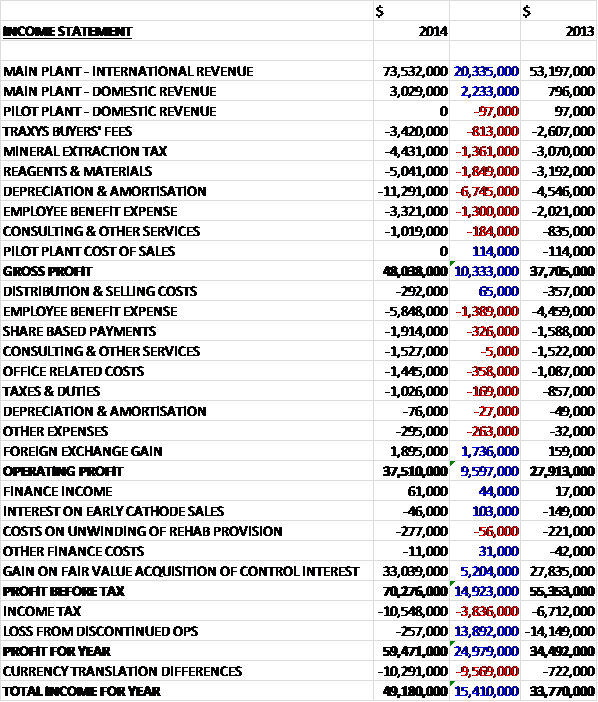
Revenues increased considerably year on year as the group took complete control of the Kazakh mine.  There was also an increase in cost of sales, including a $6.7M growth in depreciation and amortisation following the uplift in asset values to give a gross profit some $10.3M ahead of last year.  Admin expenses also increased with a $1.4M growth in staff costs, a $358K increase in office costs and a $326K growth in share based payments, partially offset by a $1.7M increase in the foreign exchange gain so that operating profit increased by $9.6M to $37.5M.  This then nearly doubled by a $33M gain on the fair value gain on the acquisition of the joint partner venture and after an increase in tax and a $13.9M fall in the loss from discontinued operations in Mongolia after they were fully impaired last year meant that the profit for the year came in at $59.5M, an increase of $25M year on year, although this comparison is fairly meaningless given the fact that last year the group did not have full control of the subsidiary.  It should also be noted that there was also a $10.3M charge relating to the translation of foreign operations.

CAMassets

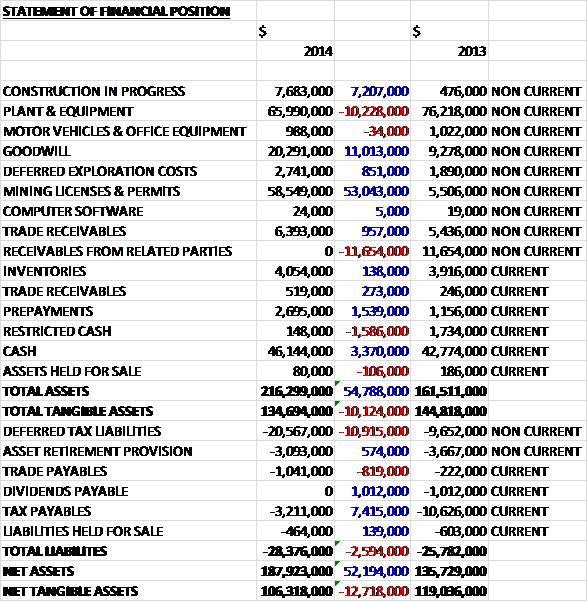
When compared to the end point of last year, total assets increased by $54.8M driven by a $53M growth in the value of mining licenses and permits as a result of the Kounrad acquisition, an $11M increase in goodwill, a $7.2M growth in construction in progress and a $3.4M increase in non-restricted cash partially offset by an $11.7M fall in receivables from related parties (the ex-joint venture) and a $10.2M decline in the value of plant and equipment.  Total liabilities also increased during the year as a $7.4M fall in current tax payables as the group paid an instalment against the corporate tax payable, and a $1M eradication in the dividends payable was more than offset by a $10.9M increase in deferred tax liabilities due to the acquisition.  The end result is a net tangible asset level of $106.3M, a decline of $12.7M year on year.

CAMcash

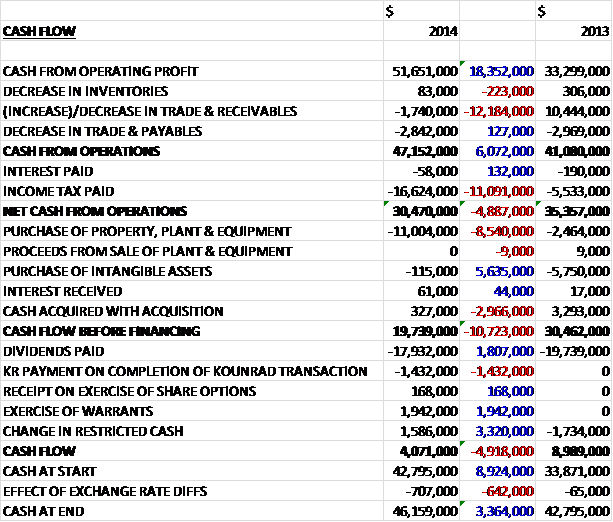
Before movements in working capital, cash profits increased by $18.4M to $51.7M.  The large fall in receivables that occurred last year did not repeat this time and the group paid $11.1M more in income tax so that net cash from operations actually fell by $4.9M to $30.5M.  The group then spent $11M on property, plant and equipment mostly relating to the SX-EW plant expansion with the rest going on the new boiler and sustaining capex, and $115K of tangible assets so that the free cash flow was an impressive $19.4M.  The group paid the bulk of this out in dividends and also paid out 1.4M relating to the completion of the Kounrad transaction before a $1.9M receipt relating to the exercise of warrants and a $1.6M fall in restricted cash meant that the cash flow for the year stood at $4.1M to give a cash level of $46.2M at the year-end.

In October 2013 the ownership of Kounrad Copper Company increased from 60% to 100% following the acquisition of 40% of the business.  Consequently the comparative results for 2013 comprise of 60% of the revenues and costs associated with the project for the first nine months of the year but 100% for the final three months whereas the results for 2014 comprise 100% of the revenues and costs for the full year.

In Kounrad, a total of 11,136 tonnes of copper cathode was produced during the year which represents a marginal increase on the production target of 11,000 tonnes.  Since the start of leaching operations in 2012, the focus of the activity has been on the Eastern dump area which is estimated to contain about 168,000 tonne of copper at the outset of operations with some 80,000 tonnes expected to be recovered in total so there should be some 52K tonnes still to be recovered from the area.  From 2017 there will be an increasing proportion of recovered copper supplied by the transfer of leach solutions from the Western dump areas and by 2019 the Western dump area will be the predominant feed source following the gradual depletion of the Eastern dumps.

The C1 cash cost of production was $1,566 per tonne compared to $1,600last year, aided by the depreciation of the Kazakh currency, and fully absorbed costs within Kazakhstan were $3,642 per tonne, an increase from the $3,152 recorded last year due to increased depreciation and amortisation charges as a result of the accounting treatment of the acquisition of the 40% share of the Kounrad project.  A total of 11,163 tonnes of copper was sold at an average copper price of $6,794 per tonne compared to $7,114 last year.  During the year the utilisation rate of the plant was 98.7% which met expectations.

Leaching operations in winter when temperatures regularly get to -20 are facilitated by a combination of heating the dump irrigation solution and also covering certain areas of the dripper piping system with a layer of protective high-density polyethylene sheeting.  As leaching operations progress on the Eastern dumps, the distances from the plant to the leaching cells become greater and during 2015 the operations plan involves leaching various blocks located in the Northern part of dump 7 which will result in pumping the irrigation solution a distance of 3km.  In order to achieve the delivery of the required volume of solution and to ensure that dumps 5 and 2 can be irrigated from 2016 onwards, a modification to the pump delivery system  is being undertaken which involves the addition of a second parallel pipeline.

These two pipelines will be equipped with booster pumps at a point close to the junction of dumps 7 and 5 in order to overcome the calculated extra head pressure that is required to maintain the flow volumes.  At the year-end the pipeline had already been installed and all necessary pumping equipment ordered and ready for delivery to site.  It is expected that it will be commissioned in late Q2 2015.

The board have agreed on a phased expansion of annual copper cathode production to 15,000 tonnes at the existing plant with a capital expenditure programme over the next three years through to 2017.  It is thought that through the expansion of the existing SX-EW facility to a nominal capacity of 15,000 tonnes, the Eastern dumps can provide the required quantity of copper to reach this by 2016.  Thereafter, through the phased introduction of leach solutions from the Western dump area, this capacity can be maintained until the cessation of leaching activities in the Eastern dumps.  The required quantity of solutions transferred between the East and West sites can be achieved by the installation of two 12.6km pipelines.

During the year detailed engineering plans were finalised for the expansion.  They comprised the installation of extra heating capacity through the addition of two 2.8 MW boilers thus allowing increased winter production.  In addition the plant is to be expanded by the inclusion of a sixth mixer settler and construction of a separate EW building containing 24 new EW cells and associated equipment, thus increasing the copper plating capacity by about 50%.  The construction work on the new boilers started in June and was completed by October which increased the total installed heating capacity to 14 MW and provides for a planned design increase in heating winter raffinate flows from 450m3/hr to 750m3/hr.  This raises the temperature of cold incoming solution at 1 degree C to 10 degrees prior to passing through the SX mixer settler units.  By December the boiler house was performing somewhat better than design forecasts.

The second stage of the plant expansion requires the addition of a sixth mixer settler unit in the SX section and a new EW section, containing 24 EW cells. Following the receipt of the necessary state permits, work commenced on site in July and commissioning is scheduled for Q2 2015.  The new EW overhead crane, which is used for harvesting cathode plates, had been fully installed by the end of the year and will be used to install and equip the 24 EW cells during Q1 2015.  All the purchase orders and equipment supply contracts have been placed, with many items already delivered.  The capital costs for the expansion will be in line with, if not less than, the announced capital budget of $15.5M.

Engineering design of the facilities required to start leaching at the Western dumps by Q2 2017 has progressed well during the year.  The technical project documentation was completed in July and has been submitted for approval and it is anticipated that state approval will be granted in Q2 2015.  Once all approvals have been received, equipment procurement and certain construction work will start on site from late Q3 2015.  This stage of the Kounrad expansion plan requires the construction and installation of two pipelines, each of 12.6km.

One pipeline will enable PLS from the Western dumps to be transferred to the expanded SX-EW plant for processing into cathodes.  The other pipeline will enable the raffinate solution from the SX section to be transported back to the dumps for irrigation purposes.  In order to provide the ability to operate through the winter at the Western dumps, a boiler house of the same design as the original facility at the Eastern plant will be installed.  During December, final engineering discussions were undertaken to finalise the specifications and revalidate the capital cost, estimated to be about $19.5M for this phase of the expansion.

The supply of sufficient technical quality water from 2017 onwards to allow simultaneous leaching at both the Eastern and Western dumps has always been an important consideration.  At present all such water is provided from an underground reservoir sourced from an abandoned mine about 8km to the NE of the plant.  Studies have indicated that this reservoir has the capability to provide adequate water at least until the end of 2017 but beyond this time, the source may not be capable of providing the extra volume of water needed to simultaneously operate two leaching sites. The decision was taken, therefore, to install a water pipeline to transport water drawn from Lake Balkhash to the Kounrad site.  This will provide sufficient water for the project through to the end of its life as well as assisting the local community with plentiful water for their own purposes.

This project required the upgrading of an intermediate pumping station close to Balkhash and the installation of 16.5km of pipeline.  The estimated capital cost of the programme is $2.7M and it is anticipated that installation works will be completed by the end of 2015.  As the abstraction system from the lake does not operate in winter, commissioning will be conducted during Q2 2016.  During the winter months, the make-up water requirement is very low, which can be provided by the underground reservoir as required.

Last year the group acquired a 50% interest in Copper Bay ltd for a cash investment of $3.2M.  Copper Bay Ltd was incorporated with the sole purpose of developing the Copper Bay project in the Atacama region of Chile.  For nearly forty years until 1975, several copper mines disposed of the tailings residues from their mineral processing operations into the Rio Salado which outflows into Chanaral Bay.  Over that period it is believed that some 250M tonnes of tailings were discharged into the bay.  They now sit in the bay and on the beach at Chanaral and cover a 13km2 area.  The business is examining the viability of reclaiming and processing the copper tailings to produce copper cathode and copper concentrate.  The $3.2M invested into the business was used to deliver a pre-feasibility study and significant progress has been made with $1.8M spent on advancing the project with work expected to be completed by Q2 2015.

During the year a drilling campaign was conducted on the beach with a total of 136 holes being drilled to an average depth of 9.2m and a total of 1,022 samples were collected for assaying.  The resource is currently being assessed with the potential for additional copper resources to be investigated at a later date.  During the year the technical focus has been on assessing the most efficient means of extracting the copper from the resource.  The outline process is for the tailings to be reclaimed by dredging from the beach zone, after which the reclaimed solids will be pumped to the nearby processing plant.

The first stage of the process consists of leaching whereby sulphuric acid is added to the tailings in order to solubilise the copper oxides.  This will be conducted in a series of leach tanks to produce a PLS for conventional processing into copper cathodes by means of a SX-EW plant.  The second stage of the processing is for the leached residue solids to undergo a froth flotation process in order to extract residual sulphide materials into a saleable concentrate product.  The final tailings reside from this combined process will then be returned either to the beach zone as coarse backfill or to a tailings management facility as fine tailings.

This latter process is expected to result in about 90% of the processed tailings from the plant being returned to the beach zone and this part of the process is very important to both the economic viability and the environmental success of the project.  A significant amount of bench scale metallurgical testing has been carried out throughout the year and this has indicated that a copper recovery in the range of 70% to 73% can be achieved from the above processes.  Additional testing performed on a seven tonne bulk sample taken from the drilling programme is under consideration as part of the next stage of the project.

There is a high degree of local and national support for any proposed improvements to the environmental conditions in the area due to historical pollution and any initiative to reduce the impact of the tailings on the environment will be welcomed by the regional state authorities.  During the year an environmental fatal flaw analysis of the project was undertaken together with an environmental baseline study.  The study did not identify any fatal flaws in the project and provided management with a better understanding of the environmental obligations.  The most important environmental aspect for the viability of the project involves the assessment of the re-deposition of the processed tailings to the beach zone and this issue continues to be studied.

The feasibility study is expected to be complete during Q2 at which time a decision will be taken by the board regarding additional investment of $3M to increase their holding to 75% of the project which would then be used to finance more detailed work on the project.

The total capital cost for the Kounrad expansion is estimated at $35M over the next three years including the $9.4M already spent this year but in addition to the estimated $6.5M that will be spent on sustaining capital expenditure for the plant and Kounrad site during the three year period.  At the year-end the group has $46.3M in cash with $12.7M held in Kazakhstan to cover the expansion costs and working capital requirements in the country along with instalment payments of corporate income tax.  There were no debts outstanding.

The group continues to hold for sale the assets it owns in Mongolia and is actively seeking to sell the Ereen and Handgait projects.  The sales are taking longer than the board anticipated due to the current political and regulatory uncertainties in the country and the implications of a court case brought by the minority partner on the Ereen project.  In June, Bayanresources was sold for nil consideration.

During the year the group completed the acquisition of the remaining 40% of the Kounrad project which consisted of two key parts.  The first transaction involving the transfer of an additional 40% ownership of Kounrad Copper Company was completed in October 2013.  The second transaction involving the transfer of the remaining 40% economic interest in the subsoil use contract was completed in May 2014.  On completion of the Kounrad transaction, a total of 21,211,751 shares were issued to Kenges Rakishev in May.  An additional cash payment of $1.4M was paid to Kenges on that date to reflect the entitlement to dividends payable.  In all the total consideration came to $67.2M, mostly in shares and the transaction generated goodwill of $20.3M with a recognised gain on fair value of the assets of $32.4M.  As well as becoming a major shareholder in the group after the Kounrad transaction with 16% of the total share capital, Kenges Rakishev was also appointed to the board

Apparently there are currently insufficient reserves available in the company for distribution as dividends so the directors are proposing to rectify this by completing a court approved capital reduction scheme by cancelling the company’s share premium account and transferring the reserves to retained earnings which is expected to become effective around May 2015.  I have to say this is going over my head somewhat but the company apparently undertook a previous capital reduction scheme in 2013.

The group is somewhat susceptible to foreign exchange movements and had the Kazakh Tenge and British Pound strengthened by 10% against the US dollar, profits for the year would have been $1.9M lower.  The group is also clearly affected by the price of copper. Given the debt-free status of the group, the board have up to now not bothered with a hedging policy but given the recent volatility in the price of copper, the board have now allowed a hedging policy of up to 30% of the group’s twelve month production, although this has not yet been utilised and there is currently no hedging in place.  A 10% fall in the price of copper would have reduced profits for the year by $7.7M.

Another risk for the group is Kazakhstan tax risk. The tax system in the country is at an early stage of development.  The application of tax laws and regulations are still evolving which considerably increases the risks with respect to mining and subsoil use operations.  Tax regulation and compliance is subject to review and investigation by the authorities who may impose extremely severe fines, penalties and interest charges.  The group’s main receivable is the VAT incurred on purchases within Kazakhstan and a total of $6.4M was still owed to the group.  They are working closely with advisors and local partners to try and recover the amount due and the planned means of recovery will be through a combination of the local sales of cathode copper to effectively offset VAT liabilities and by a successful appeal to the authorities.

The Chinese economy is crucial to the copper market, accounting for just under half of world demand.  Concerns about growth in the construction sector in China have been compounded by the huge overcapacity that has been constructed in the major cities of the country and the correction in China’s real estate sector could prove damaging to the demand for copper.  Despite this scenario, China’s copper consumption is still expected to grow by 4% in 2015.  On the supply side of the equation, the situation is not clear.  Analysts have been predicting a surplus of copper supply in 2015 and 2016 due to production capacity increases coming on stream from the major miners but the recent reductions in the copper price have led many to reassess this expected surplus.  In recent months Rio Tinto has lowered forecasts for its Kennecott mine by 100,000 tonnes, BHP has cut 150,000 tonnes from Econdida’s 2015 outlook and Glencore shaved guidance for Minera Alumbrera by 50,000 tonnes.  These kind of figures really put CAM’s production guidance in context and current consensus is that the market will return to a deficit after 2016.

During the year the copper price came under pressure due to increasing supply and continued concerns over the outlook for the growth of the Chinese economy.  These price pressures became particularly acute at the start of 2015 when the price fell to a five and a half year low of $5,505 per tonne.  Whilst the current commodity price environment provides a challenge to all copper producers from which the group is not immune, their low operating cash costs mean they are in a good position to remain competitive with the price needing to go below $3,500 per tonne before the group stops being profitable, something that has happened only twice over the past ten years.

At the current share price the shares trade on a PE ratio of 10.5 but this increases to 13 on next year’s consensus forecast.  The dividend yield currently stands at 8% falling to a still-decent 5.6% on next year’s forecast.

Overall then, this has been an interesting year for the group characterised by the acquisition of the remaining part of the Kounrad joint venture that they did not previously own.  Profits did increase but net tangible assets fell during the year.  The operating cash flow also fell but this was due to a bit payment of tax and were it not for this, the underlying cash flow was positive.  During the year 11,136 tonnes of copper was produced at a cash cost of $1,566 per tonne and a fully absorbed cost of $3,642.  The average sales price of $6,794 does suggest plenty of headroom here but the price of copper has been falling and stood at $5,505 at the start of the year – still profitable for the group but this is clearly something that needs to be watched closely.

The other main risk really is the reliance on just one project in Kazahstan so the group is very susceptible to political risk in the country.  This could end up being mitigated by the very interesting tailings project in Chile with more details on this in the future.  The Kounrad mine itself seems like a small but quality asset which has a low cost base despite the freezing winter temperatures requiring boilers to heat the raffinate.  There is clearly potential risk in the expansion but if that goes to plan, the mine will be producing 15,000 tonnes a year before long.  The assets in Mongolia look like total write-offs and seem to be impossible to get rid of.

At a forward PE ratio of 13 and a dividend yield of 5.6% the shares certainly look fairly decent value but really this is a play on the price of copper and with the Chinese economy struggling at the moment, this is clearly a risky buy.

On the 21st May the group released an update covering Kounrad expansion.  The SX-EW extension has been successfully commissioned with the internally funded $13.4M programme including construction works and equipment installation for the extended SX-EW facilities.  The extra mixer-settler tank has increased the plant’s solution treatment capacity by 33% to 1,200 cubic metres per hour, and the additional 24 electro-winning cells have increased the daily plating capability by 42% to 50 tonnes of copper.  The infrastructure upgrade also included the installation of an additional 10MW transformer substation.

This stage 1 expansion and additional 5.6MW boiler capacity installed towards the end of last year have increased the plant’s nameplate annual capacity to 15,000 tonnes of cathode copper and the company remains on track to achieve its 2015 production target of 13,000 tonnes of copper and 15,000 tonnes in 2016.  The main focus now is on implementing the stage 2 expansion programme, the approvals process for which is proceeding as schedule.

On the 24th June the group announced that it is exercising its right to invest a further $3M to increase its shareholding in Copper Bay ltd to 75%.  This investment is being made following the completion of an internal pre-feasibility study on the Chanaral Bay Copper Tailings Project.  The funds will be used to conduct a definitive feasibility study on the project.  The study revealed an indicated resource estimate of 104,345 tonnes of copper at a grade of 0.244% and an inferred resource estimate of 19,838 tonnes at a grade of 0.234%.

Much of the inferred resource will be used as a berm to protect the resource area from sea ingress during dredging operations and it will then be reclaimed on completion of dredging.  This resource only covers the Chanaral beach area and there is potential upside at Chanaral to significantly increase this resource through the future inclusion of a similar amount of additional mineralised material in the surf and bay zones covered by the license.

Test work indicates that the most effective means of extracting the copper from the tailings is by initial acid leach to produce a clean copper concentrate and indicative metallurgical recovery from the PFS test work is 72.8%.  Dredged material will be fed to the plant and will result in annual copper production of 8,600 tonnes comprising 6,200 tonnes of cathode and 2,400 tonnes of copper concentrate.  The reported resource in the beach area would be sufficient for a mine life of nine years and the study envisages fine tailings being stored in a tailings management facility located 3km from the proposed site of the processing plant and coarse tailings re-deposited on the beach.

Environmental and social studies commenced over a year ago will continue throughout the next year and a half.  The Chanaral area is well known for the adverse environmental impact caused by the historic deposition of tailings into the bay and beach zone and, due to the reclamation of these tailings the project is strongly supported by the local community.

Project economics are based on the mineral resources estimated on the beach and do not consider the material that may be identified in the surf and bay zone.  The prelim capital expenditure estimate is $88M.  Estimated C1 cash costs of operation are $1.34/lb with a project NPV at 8% discount rate of about $50M after tax with an IRR of 21% based on a long term copper price of $3/lb – I don’t know why they have to keep switching between lbs and tonnes as it is rather annoying!  Future exploitation of the surf and bay zones may provide significant economic upside to the project.  I must say this all sounds rather promising unless that copper price keeps coming down.

On the 25th June it was announced that CFO Nigel Robinson exercised options over 144,736 shares at an exercise price of 1c per share – very nice for him!  On the same day he sold the lot and earned himself £262K which is certainly a nice pay day.  It is a shame he didn’t hold on to any of the shares but he still owns 646,715.

On the 29th June the group announced that an incident occurred on the Kounrad site that will impact on the production guidance of 13,000 tonnes for this year.  During normal production activity a problem occurred in the solvent extraction section which resulted in a significant quantity of the organic inventory being lost to the dumps within a very short time frame.  After inspection, it was identified that one of nine weir plates in the recently commissioned SX mixer settler had fallen out of position, resulting in the ability of the organic inventory to escape from the circuit via the raffinate and onto the dumps.  The reasons for the failure of the plate are currently being investigated.

The problem has since been rectified and the plant has started again but at a much lower flow rate.  This will continue for several more days until the site team can stabilise the plant and determine the full extent of the loss of organic inventory, any impact on the pipeline infrastructure and the duration of time that the plant will need to operate at reduced production capacity before the organic inventories can be replenished.  The impact on full scale production at Kounrad is temporary and will not affect the ability of the plant to produce high quality copper cathodes at competitive costs of production.

On the 3rd July the group provided a production update for the first half of the year.  Kounrad Q2 production of 3,093 tonnes of cathode copper brings production for the half year to 5,444 tonnes, a 6.9% increase over the first half of 2014.  The increase is largely due to the expanded boiler house capacity at the plant resulting in higher solution volume treatment rates during the winter months.

Following the earlier incident, the SX-EW plant is now operating at 45% capacity.  Orders for the replacement organic inventory have been placed and are expected to be delivered on site by mid-August.  Following their arrival, the will be added to the SX circuit, after which the dump leaching process will need to reach pre-incident flow rates which are more than double the current level.  Management anticipate that the overall circuit will be back at design capacity by the start of September.  The incident will impact the previously stated 2015 production target of 13,000 tonnes of copper and at the moment it looks as though it will be closer to 12,000 tonnes which is still an increase on the 11,136 tonnes produced last year but disappointing nonetheless.

CENTRAL ASIA

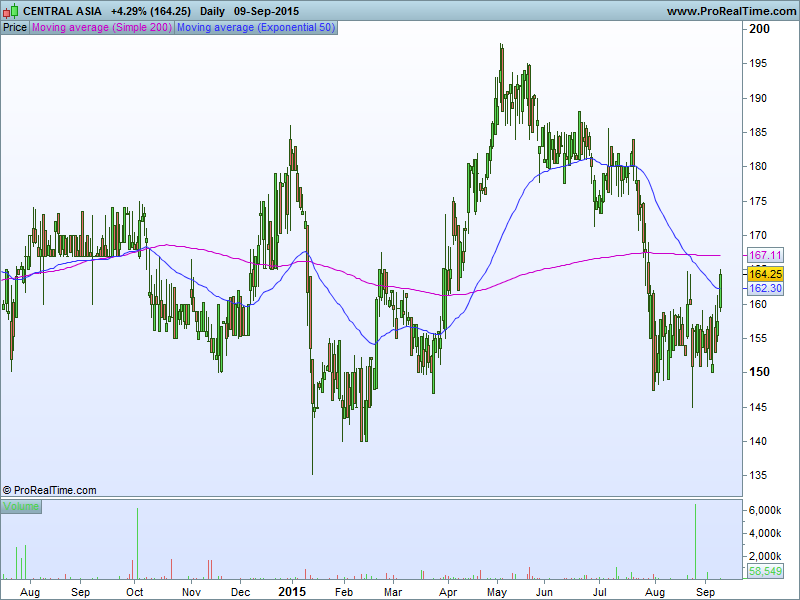
The share price has not done much over the past year, it could be looking for a leg-up now though?

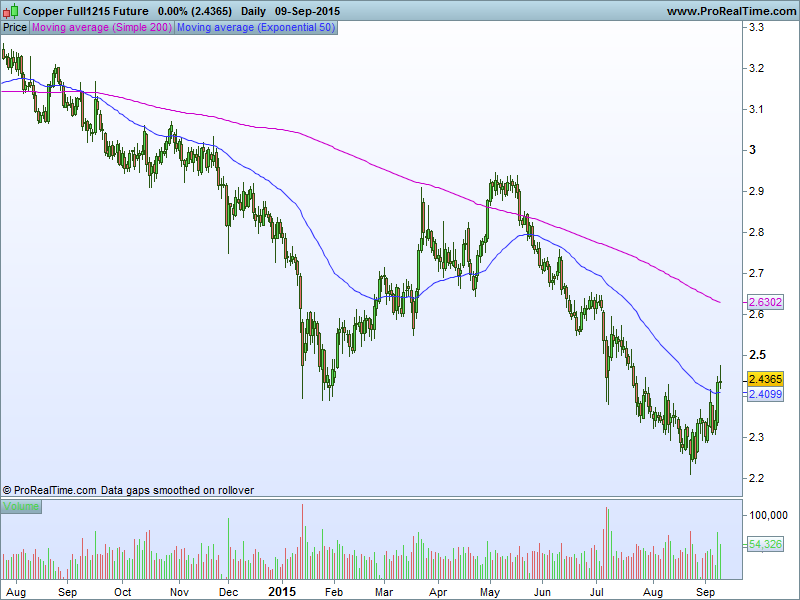
Copper Full1215 Future

This is the real problem.  The copper price hit a recent low towards the end of August and is now attempting a bit of a recovery but whether this will be maintained remains to be seen.

Murgitroyd Share Blog – Final Results Year Ended 2015

Murgitroyd has now released its final results for the year ended 2015.

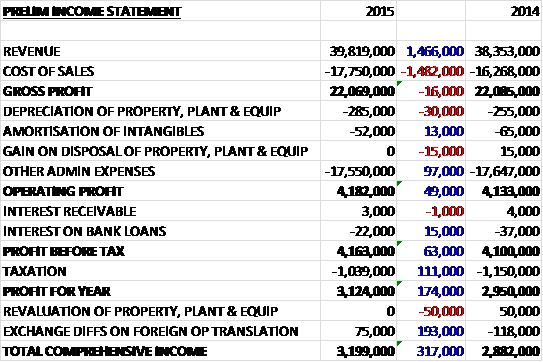
MURincome

Revenues increased by £1.5M when compared to last year but a similar increase in cost of sales meant that gross profit was broadly flat, down by just £16K.  Depreciation was slightly higher but other admin expenses fell to give an operating profit some £49K ahead of last year.  This was further improved by a small reduction in interest and a £111K fall in tax which gave a profit for the year of £3.1M, an increase of £174K when compared to last year.

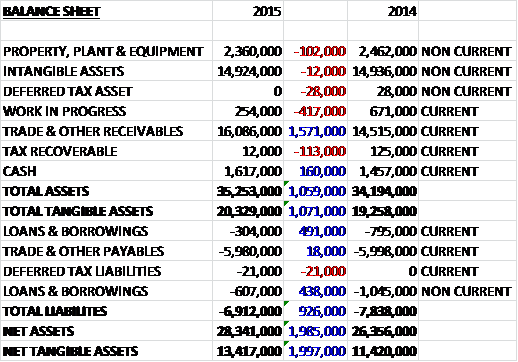
MURassets

When compared to the end point of last year total assets increased by £1.1M driven by a £1.6M growth in receivables, partially offset by a £417K fall in work in progress.   Liabilities fell during the year due to a £929K decline in loans and borrowings.  The end result is a £2M increase in net tangible assets at £13.4M.

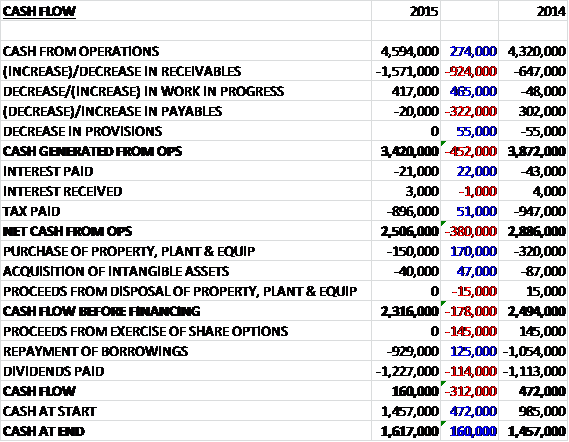
MURcash

Before movements in working capital, cash profits increased by £274K to £4.6M before a larger increase in receivables, partially offset by a fall in work in progress and less interest and tax paid meant that the net cash inflow from operations was £2.5M, a decline of £380K when compared to 2014.  The group then only spent £150K on fixed tangible assets and £40K on intangible assets to give a free cash flow of £2.3M, of which £1.2M was paid out in dividends and £929K was used to pay back loans.  The group had a cash inflow for the year of £160K and a cash level at the year-end of £1.6M which is all very comfortable.

The markets in which the group operate showed steady growth in the year with an increase in Community Trade Mark applications, up 4.4% and a stable demand for Registered Community Design applications.  The most recent stats report an annual increase of 3% in European Patent applications to 273,000, which is an all-time high.  The composition of these filings shows applications from the US up 6.7%, Japanese applications falling by 3.8% and EU applications remaining unchanged.  The group continues to monitor developments concerning the introduction of the new European Unitary Patent, which is still expected to be ratified by sufficient member states of the EU and enter force during 2017.  Despite the buoyant markets, however, price pressures remain and cost control remains a priority for the group.

Revenue growth has been driven organically by the ongoing investment in business development, principally in the US where revenues increased by 20% to £15.7M and the country now accounts for about 40% of total sales.  This growth was partially offset by a further contraction of £900K in revenues from the longstanding UK client base.  The gross margin declined slightly from 57.6% last year to 55.4% in 2015 due to the ongoing changes in the client and sales mix as well as the continuing price pressure in the market for professional IP advisory services.  Despite this, operating profits increased by 1.2% due to a strong focus on cost controls.

As well as a reduction in overall headcount, the number of qualified attorneys required and employed by the group continues to fall reflecting the transfer of a number of revenue generating areas from attorneys to paralegals, specialist formalities staff and patent and TM admins.  The group will continue to recruit and train these non-attorney staff members whilst at the same time restructuring how it delivers services to clients to generate greater efficiencies.  This restructuring is on course and remains a key component of the group’s strategy of growing earnings.

During the year, Edward Murgitroyd took over day to day leadership of the management teams and was appointed CEO of the operating subsidiaries in October.  Dr. Chris Masters and John Reid have been appointed as non-executive directors and in August, the group appointed Gordon Stark as COO.   Due to these new appointments, the executive chairman, Ian Murgitroyd intends to move from an executive position to a non-executive role going forward.

Over the next year the group are looking to drive growth in the US while also increasing their focus on Europe with the aim of reversing the recent contraction of revenues in this market as economic activity increases.  Trading since the year-end has been in line with management expectations and the board apparently look forward to the future with confidence.

At the current share price the shares trade on a PE ratio of 15.4 reducing to 14.7 on N+1 Singer’s forecast for next year.  After an 11% increase in the total dividend for the year, the shares yield 2.8% increasing to 3% on next year’s forecast.  There is a net cash position of £710K at the end of the year compared to a net debt position of £380K at this point of last year.

Overall then, this was a solid set of results.  Profits increases modestly year on year and net assets were also up.  Operating cash flow did fall but this was entirely due to an increase in receivables and underlying cash profits grew to give a comfortable free cash flow.  Although the market seems to be growing, the problem is the pressure on price and it looks like the group is looking to cut costs to drive growth rather than rely on an upturn any time soon.  The US business seems to be performing well at the expense of the UK division so hopefully this is something that they can focus on for next year.  The forward P/E of 14.7 and dividend yield of 3% seem about right for this safe stock with net cash.  Safe but rather unexciting in my view and I am not rushing to own any shares for the time being.

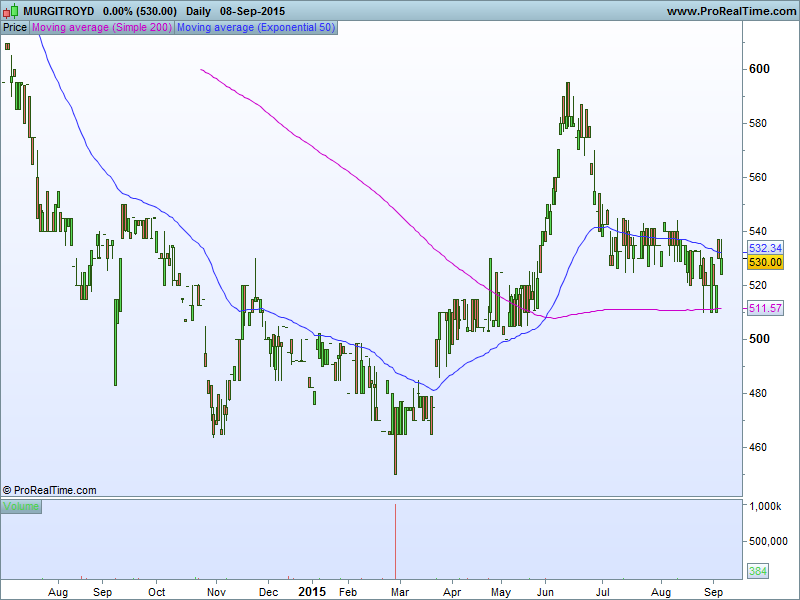
MURGITROYD

The chart doesn’t look all that exciting at the moment either…

Dechra Pharmaceuticals Share Blog – Final Results Year Ended 2015

Dechra has now released its final results for the year ended 2015.

DPHincome

Overall revenues increased when compared to last year as a £3.8M decline in European revenue was more than offset by a £13.7M growth in North American revenue.  Cost of sales also increased somewhat, to give a gross profit some £8.4M ahead of last year.  R&D costs grew by £423K and there was a small increase in depreciation with a £6M growth in other admin expenses along with a £1.3M increase in the amortisation of acquired intangibles to give a pre-tax profit of £25.8M, an increase of £4.4M when compared to 2014.  This was almost exactly wiped out by an increased tax bill (partially relating to prior year adjustments), however, and last year’s gain on the disposal of a subsidiary meant that profit for the year came in at £19.5M, a decline of £39.6M year on year.  It is also worth noting that once again, foreign currency translations wiped off £18.5M of this when determining the total comprehensive income for the year.

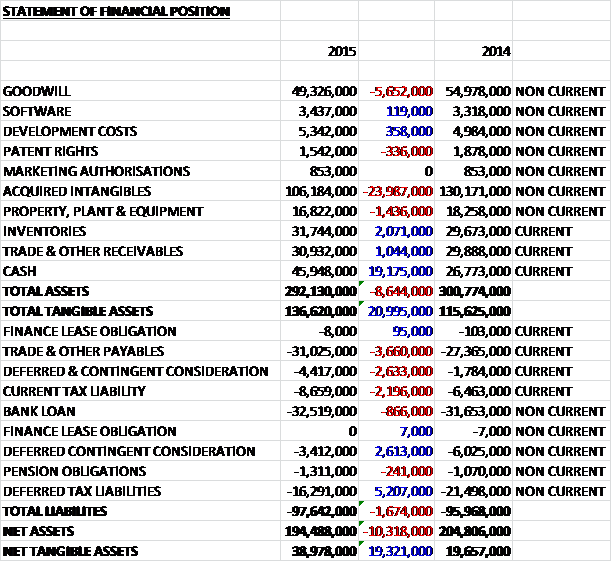
DPHassets

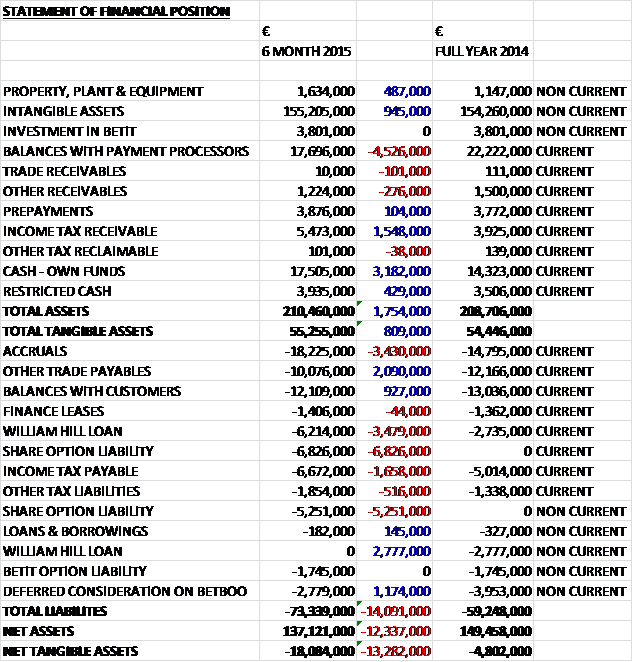
When compared to the end point of last year, total assets fell by £8.6M driven by a £24M decline in acquired intangibles (partly due to amortisation and partly due to foreign exchange movements), a £5.7M fall in goodwill due to currency translation and a £1.4M decline in property, plant and equipment, partially offset by a £19.2M increase in cash, a £2.1M growth in inventories and a £1M increase in receivables.  Liabilities increased during the year as a £5.2M fall in deferred tax liabilities was more than offset by a £3.7M increase in payables and a £2.2M growth in the current tax liability.  Also note that the deferred contingent consideration in transferred from non-current liabilities to current liabilities.  The end result is a net tangible asset level (removing just goodwill and acquired intangible actually) of £39M, an increase of £19.3M year on year.

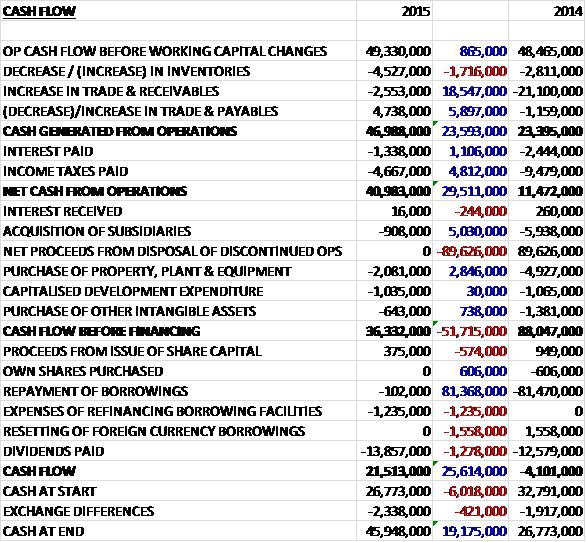
DPHcash

Before movements in working capital, cash profits increased by £865K to £49.3M before a much smaller increase in receivables than last year along with lower interest paid and taxes meant that net cash from operations increased by £29.5M when compared to last year at £41M.  The group then only spent £2.1M in fixed assets, £643K on intangible assets and £1M on development expenditure and even after some deferred consideration of £908K was paid, free cash flow stood at an impressive £36.3M.  The group then spent £1.2M relating to the refinancing of the borrowing facilities and even after £13.9M was paid out in dividends, the cash flow for the year stood at £21.5M with a cash level of £45.9M at the year-end.

The operating profit at the European pharmaceuticals division was £48M, a decline of £1M year on year due to adverse currency movements (profits were up just over 4% on a constant currency basis).  There was solid growth at constant currencies as a strong performance across the companion animal products portfolio offset a decline in food processing animal products.  Most markets grew in the year but the most significant double digit sales increases were seen in the UK, France, Spain and Belgium.  Endocrinology, dermatology and anaesthetics all performed strongly.  The dermatology portfolio was expanded with the launch of an in-licensed product, Sporimune in seven European markets and the launch of Osphos in the UK improves their position in the equine markets with preparations now being made for the launch of the product across the rest of Europe in the new year.

Food animal products continued to decline as the antibiotics market in Western Europe has a continued focus on prudent prescribing due to antibiotic resistance.  This remains an ongoing headwind against the group’s overall performance, especially in Germany and Denmark, where there has also been competitive pressure.  In the Netherlands, however, the rate of decline has slowed having reduced sharply over the last four years.

The therapeutic and life stage pet diets, branded “Specific”, have now fully recovered from the stock-outs created by the transfer of the products to a new manufacturer but sales declined slightly compared to the previous year.  The range has now been repositioned and a new marketing campaign is being rolled out across Europe focusing on the high inclusion of fish protein, the ethos of deriving the nutrients of the products from sustainable sources, and the Specific brand being dedicated to the veterinary market.

The operating profit of the North American pharmaceuticals division was £10.6M, an increase of £4.6M when compared to last year.  All major therapeutic areas grew, in particular endocrinology and dermatology sales increased by 24%.  The sales increase in in endocrinology was driven by Vetoryl which continued to deliver double digit growth, and by the product launch of Levocrine chewable tablets which has outperformed management expectations.

The performance in North America benefited from the full year trading of Phycox, the re-launch of ophthalmics, the launch of Osphos and the opening of the Canadian subsidiary.  Phycox, which was acquired in May 2014, has performed well throughout the year and the number of customers purchasing the product increased by over 50%.  The ophthalmics products, which were re-launched following long term supply issues, achieved expected sales targets despite strong competition from human generic equivalents.  The group also launched Osphos, the equine lameness product, and whilst the uptake has been a little slower than expected, they have penetrated approximately one third of the equine and mixed animal practices.  Adjusting for these new products, the existing core products grew by nearly 22% on a constant currency basis.

Following a serious shortage of critical care intravenous fluids in the US market, the group obtained FDA approval for the emergency importation of their European critical care intravenous fluid Vetivex to supply the equine market.  They are currently working with the FDA to achieve long term approval for a US labelled version of this product to add to the equine portfolio.  To support growth in the US, there have been 16 new appointments, predominantly across sales and technical support.

Revenues of companion animal products were £113.9M, an increase of £15.7M fuelled by Vetoryl’s momentum in the EU and US, the launch of Phycox and the success of Dermapet in the US; revenues of equine products increased by £1.7M following the launch of Osphos; revenues of farm animal products were £27.3M, a decline of £4.5M due to the impact of the reduction in prescription antibiotics and increased competition in Germany and Denmark; revenues of diet products fell by £2.8M to £25.6M due to some supply disruption following the transfer of the manufacturing of dry diets to a third party manufacturer; and revenues of third party manufacturing were £19.7M, an increase of £1.7M as the business realised value from the new contracts signed last year.

The key objective of the manufacturing division is to produce own brand pharmaceuticals for the group but additionally they also utilise spare capacity to provide a third party manufacturing service.  Within the year, these external sales, reported under the EU segment, have increased by nearly 12%.  A number of projects were implemented across the sites including the premix department in Bladel to increase batch sizes for FAP products; a new faster encapsulating machine in Skipton which increased yield and doubles capacity; a blister packing line to increase capacity and flexibility through automation; and a larger creams and ointments vessel to facilitate a major third party contract and production of in-house creams, liquids and ointments in Skipton.

There have been a number of other developments within the division, the most significant of which is the successful pre-approval inspection of the Skipton facility by the FDA in preparation for the approval of Zycoral, to be manufactured at the site.  The US site in Florida was acquired in May 2014 and has been fully integrated into the division.  This year they have focused on increasing quality systems and production capacity following the launch of Levocrine which is manufactured there.

Following the launch of Osphos in the UK and US in the first half of the year, it has subsequently received approval in 17 additional EU countries and has also received marketing approval in Canada.  TAF Spray was also approved in 14 European countries in the year.  This is a generic antibiotic aerosol which is used to treat superficial wound infections in several species.  A new low dose 5mg Vetoryl has been approved for the US which enhances the range of dosing options available to vets and helps continue growth from the group’s leading product.  To support the geographic expansion goals, minor approvals were received for Octacillin and Soludox in the Philippines, and Sedaxylan in South Africa.

Complete dossiers have been filed in both the EU and US for a canine endocrine product, to be branded Zycortal and it is hoped that the first approval will be received during the new financial year.  The group has three Food Animal products for poultry and swine under review in Europe and are preparing a further dossier for a decentralised application which will be submitted before the end of the 2015 calendar year.  Owing to the nature of the development process, some projects in the feasibility phase have taken longer than projected before reaching the development phase but this is being partially mitigated by the overall number of projects in development.  The group have reached a preliminary agreement with Jaguar Animal Health to secure marketing and joint development rights for their leading companion animal product.  They have acquired a partially completed dossier for an additional canine endocrinology product and further development work will be required to gain full approval which will be conducted at the manufacturing facility in Skipton.

In the first half of the year the group opened their Canadian subsidiary which commenced trading in January and has already begun to establish a strong presence in the territory.  The new subsidiary achieved sales targets for Vetoryl, Felimazole and the dermatology range but other products sales were impacted by surplus stock in the market from the previous distributor which had washed through the system by the end of the financial year.  They have also established a trading subsidiary in Poland which came about as the distributor was acquired during the year and trading there commenced in May.  The group are also at an advanced stage of planning the start-up in Austria, which should start trading before the end of the new year.  They are also continuing to invest in the regulatory function to gain new licenses in other countries and whilst there are few locations where they have the relevant critical mass for a new start-up, the regulation process is important in order to expand beyond the core markets.

The roll out of the Oracle IT system remains one of the primary objectives for the group.  Detailed plans are in place for the implementation to be completed by the end of 2017.  Also, as far as IT is concerned, a group high speed network has been implemented across all major locations, a web-based portal for staff training has been designed, a new website has been launched in multiple languages and new hybrid PC tablets are being introduced for all sales staff.

During the year the group revised its borrowing facilities which now comprise of a £90M revolving credit facility and a £30M accordion facility committed until September 2019.  Resetting of foreign currency borrowings within the prior year cash flow statement relates to the cash adjustment required to ensure the movements in foreign exchange rates do not result in the committed revolving credit facility being exceeded.  Interest is charged at 1.3% over LIBOR.

During the year, the group launched Levocrine, a product acquired with the Phycox acquisition.  There was a contingent consideration of $1.5M which was due upon the successful registration of the new product and a further $4.2M contingent on future sales, of which $500K was paid during the year.  During the year the group paid a further £600K in respect of the acquisition of Dermapet relating to deferred consideration to be paid on the fourth anniversary of the completion date.  The maximum further consideration payable was $5M, contingent on revenue exceeding $20M in any rolling 12 month period ending on the sixth anniversary of completion.  After the year-end, this $5M has been paid leaving no further consideration to pay.  I think it is fair to say that the Dermapet acquisition has been a costly one.

After the year-end, the group signed a conditional share purchase agreement to acquire 63.3% of the authorised shares in Genera, a Croatian listed pharmaceutical business.  Under Croatian take-over rules, the group is required to make a mandatory offer for the remaining issued share capital of the business.  They have offered €51.4M for the entire share capital which will be wholly payable in cash and is to be funded out of existing facilities.  Genera has a strong market share in Croatia and the neighbouring countries with three divisions: Animal Health, which represents the majority of revenue; agrochemicals; and human pharmaceuticals.  It is unclear what Dechra intends to do with the agrochemical and human pharmaceutical businesses.  The principle reason for the acquisition is to enter the poultry vaccines market and three new geographic markets in Croatia, Slovenia and Bosnia as well as allowing access to a low cost manufacturing base.

Going forward, the board believes that the focus on key therapy areas, the continued rate of adoption of Osphos and sales in the new territories will drive progress in the short term.  Current trading is in line with management expectations but the business continues to be exposed to exchange rate headwinds.  In the long term, the delivery of new products and the integration of potential acquisitions give the board confidence in future prospects.

At the year end the group had net cash of £13.4M compared to a net debt position of £5M at the end of last year.  At the current share price, the underlying PE ratio is a hefty 23.4 which falls to 21.5 on next year’s consensus forecast which still looks rather expensive.  After a 10% increase in the total dividend, the shares are currently yielding 1.8% which increases to 2% on next year’s forecast which is decent but not that exciting.

Overall then this has been a solid year for Dechra.  Profits fell year on year but this was only due to higher taxes and the gain from discontinued operations last year and profit before tax from continuing operations did increase.  Net assets grew strongly driven by a higher cash level and it is here that we really see the strength of the group.  Operational cash flows increased and there was a very healthy amount of free cash generated which enabled them to end the year in a net cash position.  Operationally, Europe was a little difficult mainly as a result of the weakening euro.  The reduction in antibiotic usage in food animals was another drag on results but this was offset by increased sales in other areas.  In North America, things were much better.  There was a very strong performance in both acquired products and like for like sales in all areas.

I am a little concerned about the comment regarding the fact that some projects in the feasibility phase are taking longer than expected to reach the development phase and perhaps in the medium term this will reduce profits a bit?  The Genera acquisition looks a little expensive to me but the new area of poultry vaccination is probably a sensible strategic route to take given the continued pressures on antibiotic usage.  Going forward, the business continues to struggle with the weak Euro but otherwise things seem to be going OK.  On a forward PE of 21.5 and a forward yield of 2%, this is certainly not a value share but given the sheer quantities of cash being generated here I am happy to hold for the time being.

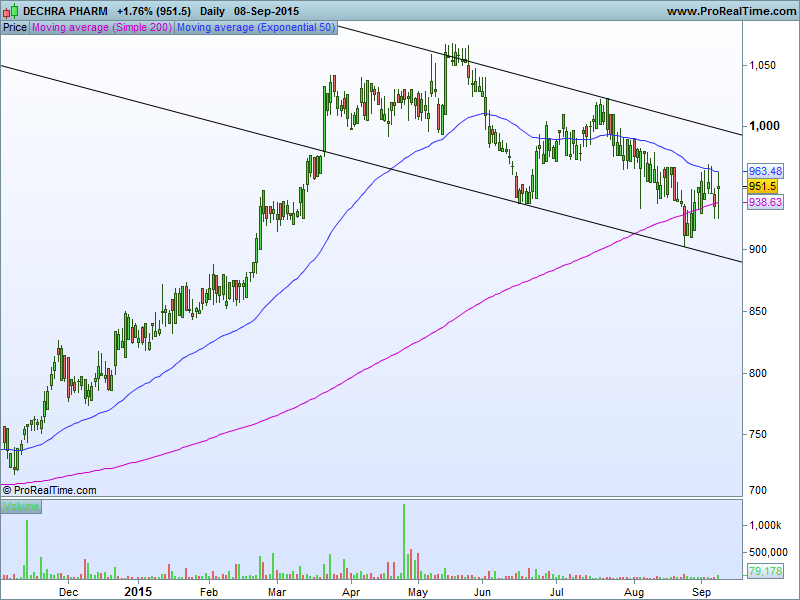
DECHRA PHARM

After enjoying a very strong run, it does seem as though the shares have entered a downtrend which is a little concerning.

On the 23rd October the group released a trading update covering Q1.  Group revenue increased by about 21% at constant currency exchange rates (13% at actual rates).  This performance was driven by a strong momentum in all business units, the phasing of sales in advance of regional price increases and the contribution from the new subsidiaries.

The European pharmaceuticals segment increased revenues by 11% at CER, but were flat at constant exchange rates.  The growth was driven by companion animal products which were ahead of board expectations.  Whilst it is only three months into the new year, the group saw some solid trading in food producing animal products too but diet sales declined.  The new Polish subsidiary, which started trading in May, performed strongly in the period.

Total reported North American revenue increased by about 86% at a constant currency, but even more at actual exchange rates as the dermatology, endocrinology and ophthalmic ranges started the year strongly.  Canada also contributed to the growth as it only started trading in Q2 last year.  Sales of the Dermapet range reached the $20M threshold in August which triggered the final milestone payment of $5M from the acquisition in 2010 so it will be good to get that out of the way.

Zycortal, a novel canine endocrine product for the treatment of Addison’s disease, received EU approval in September.  The group are now preparing for a phased launch in all European markets throughout the remainder of the year.  The complete dossier is also under review by the FDA for approval in the US.  Osphos, indicated for the treatment of navicular syndrome, is gaining market share in the US and it is expected to be launched in EU territories by the end of the 2015 calendar year.

The acquisition of Genera has been successful with the cost of acquiring the 92.26% controlling interest being €36.6M.  During the period the group also entered into an agreement with Central Sales Ltd in Canada the IP of HY-50, an equine lameness product for C$750K.  They already owned the trademarks and rights for the product in other countries and now have control of the brand worldwide.  This all seems very strong to me and probably justifies its premium price.

On the 14th January the group released a trading update covering the first half of the year. European Pharmaceuticals increased revenues by 4% on a constant currency basis but saw a decline of 3% at actual exchange rates. Including the Genera acquisition, the growth was about 9% at constant currency. The growth was driven by companion animal products which increased by 4% (constant currency). Whilst the German market continues to experience challenges, the performance I the food producing animal business has improved due to growth in markets targeted for expansion and good trading in Poland. Overall Diets sales declined by 3%, however, although a recovery in some markets has been seen.

Total reported North American revenue increased by about 51% on a constant currency basis, and performance was even better at actual exchange rates, up 57% as the dermatology, endocrinology and ophthalmic ranges started the year strongly. The momentum in the US is being maintained as the group invests in sales, market and technical support. Canada, which only started trading in H2 2015, also contributed to this growth.

The group received FDA approval in the US in December for Zycortal, a novel canine endocrine product for the treatment of Addison’s disease which follows the EU approval in September with the launch expected in Q4 this year. Two FAP antibiotics, Solupen and Solamocta (for ducks and turkeys) were approved in the EU in Q4 2015 but the company terminated an early stage project for canine ophthalmology following inconclusive results during the feasibility studies.

In January, the group opened a subsidiary in Austria and they have alos acquired Laboratorios Brovel, a veterinary pharmaceuticals company based in Mexico. They paid $5M in cash with a further $1M contingent upon Brove reaching registration milestones for Dechra’s products in Mexico. The business has a diverse product portfolio with a turnover of £2.6M but I suspect the real reason for the acquisition is an entry into the Mexican animal health market with the initial focus on the registration of several existing Dechra products in this market.

Overall then, a pretty good update in my view.

On the 16th February it was announced that CFO Anne-Francoise Nesmes will be stepping down in July to take up the same role at Merlin Entertainments having been at the company since 2013. This is a bit of a shame but I guess she felt Merlin had more to offer.


Johnson Service Group Share Blog – Interim Results Year Ending 2015

Johnson Services Group has now released their interim results for the year ending 2015.

JSGinterimincome

Overall revenues increased when compared to the first half of last year as a £3.7M fall in dry cleaning revenue due to a reduced number of branches was more than offset by an £11.3M growth in textile rental revenue which included a two month contribution from London Linen.  Depreciation of textile rental items increased by £1.7M and amortisation was £600K higher with other underlying operating costs some £3.9M higher.  We also see a £6.2M charge relating to dry cleaning restructuring costs which meant that the operating profit was £4.9M below that of the first half of 2014.  Finance costs, including notional interest on the pension liabilities, were slightly higher but tax was down by £1.1M so that the profit for the half-year came in a £700K, a decline of £4.1M year on year.

JSGinterimassets

When compared to the end point of last year, total assets increased by £78.2M driven by a £34.9M increase in goodwill, a £24.8M growth in other intangible assets, a £9.4M increase in receivables, a £5.7M growth in property, plant and equipment, and a £5.3M increase in textile rental items, partially offset by a £2.2M fall in non-current receivables and a £1.3M decline in deferred tax assets.  Liabilities also increased during the period as a £44.8M growth in borrowings, a £9.5M increase in payables, a £5.2M increase in deferred tax liabilities and a £1.4M growth in provisions were partially offset by a £3.1M fall in pension obligations.  The end result is a net tangible asset level of -27.1M, an adverse movement of £39.2M when compared to the end point of last year, which is looking a little stretched to me.

JSGinterimcash

Before movements in working capital, cash profits increased by £200K to £20.7M and after a fairly large increase in payables, partially offset by a bit of a higher tax payment, the net cash from operations came in at £19.8M, an increase of £800K when compared to the first half of last year.  The group then spent £3.7M on property, plant and equipment along with £12.8M on the purchase of textile rental items which, along with a £1M receipt from special charges gave a free cash flow of £4.3M, which just about covers the finance lease payments and dividends.  Clearly it does not leave any cash for acquisitions so the net £65.5M spent on acquisitions had to be paid for by new borrowings, which increased by £46M, and the issue of new shares which brought in £21.2M.  The end result is a cash inflow of £2.4M and an end of period cash level of -£2.5M.

Underlying operating profit at the textile rental division was £12.4M, an increase of £1.6M year on year, helped by the addition of the London Linen Business and a full six months of trading from Bourne.

Apparelmaster had a solid first half performance with sales to both new and existing customers being positive, despite the challenges of competitive market conditions.  This, along with the renewal of a number of national accounts, has resulted in increased investment in rental stock.  The business strategy to improve customer service and streamline customer invoicing is being well received.  As part of the ongoing investment in the workwear facilities, the new £8.5M facility in Leeds is now fully operational, delivering good levels of efficiency and quality combined with lower energy consumption.  The new facility has significantly increased the garment processing capacity for the business in the North of England and will enable delivery efficiencies to be realised in the area.  Further capital investment has been completed at the Perth facility where a substantial extension to the building, along with additional washing and finishing equipment, has been added to accommodate further growth.

Stalbridge returned a strong performance in the first half with improved customer retention and new sales driving revenue growth.  Lower central overheads and improved productivity have led to an enhanced margin and tighter controls on linen stock spend and management are improving linen utilisation.  A new marketing campaign was launched during the period and new sales materials have been developed to strengthen the sales and marketing process.  There have also been investments in new machinery during the period which have provided improvements in throughput and product quality.  New energy saving equipment has been installed in the Glasgow factory which has also been extended in size due to strong demand for the premium service in Scotland and the North East.

Stalbridge and London Linen are being integrated to streamline customer relationships and transport links with some previous London Linen customers being serviced from the Stalbridge facility in Glasgow.  The customer extranet facility, which allows customers to access their account details on the internet, is proving very popular and further development work is underway to make it more interactive.  At London Linen, trading in the first two months was in line with expectations and revenue increased compared to the same period last year.  There are a number of capital investment programmes for the business that are currently under review and will commence towards the end of the year and into 2016.

Bourne has traded well in the face of recent volatile market conditions and some lost national contracts in the high volume UK hotel sector.  While the sector has experienced a lower occupancy rate increase than in the previous year, the group has added a net 17 hotels to the business so far this year.  The business has introduced photographic technology to automate the consistency of the finished linen.  In conjunction with this investment is the introduction of a web ordering portal for customers combined with a paperless billing facility which has been very well received.

The underlying operating profit at the dry cleaning division was £500K, an increase of £100K when compared to the first half of last year.  There were 210 branches and 128 Waitrose locations trading at the end of the period.  The branch reorganisation is nearly complete, with the closure of 99 branches in a three month period, the total cost of which remains at £6.5M.  The partnership with Waitrose seems to be going well, adding a further 50 locations in the period and it is anticipated that additional locations will be added throughout the rest of the year.  They have continued to develop new routes to reach their customers at their place of work and through the online model which includes the launch of Johnson’s Bridal and localised online service for the cleaning of household goods.

There were a number of “exceptional items” listed in the results.  These include restructuring costs in the textile rental division relating to a new processing facility that has been constructed to replace an existing site in Leeds.  The total cost of the relocation, excluding the capital investment, is expected to be £2.3M, of which £1.3M was incurred last year (£800K during the first half).  In the first half of this year, £600K has been charged with the remaining £400K being charged in the second half relating to the decommissioning of the old site.  Another item is the restructuring of the dry cleaning business relating to the closure of various uneconomic branches, 99 of which were closed during the first half of the year.  The estimated charge to the income statement is about £6.5M, of which £6.2M was recognised during the period and the remaining £300K will be recognised during the second half of the year.  Finally, during the period, professional fees of £500K and stamp duty of £300K was paid relating to the acquisition of London Linen Supply Ltd.  Whether to include these costs in the underlying figures is a matter of debate.  The dry cleaning restructuring certainly looks like one-off charges but the costs for the closure of the old textile rental facility could be considered ongoing costs relating to the business and the costs relating to the acquisition could certainly be considered ongoing given the buy and build strategy in my view.

As the end of the half, the group had committed orders for capital expenditure of £800K, much less than the £5.5M at the same point of last year, presumably as the new textile rental facility in Leeds is now broadly completed.

In April, the group acquired London Linen Supply for a net consideration of £64.9M plus fees.  The group came with intangible assets of £26.1M, including a huge £25.5M for customer lists; along with £34.9M of goodwill.  Since acquisition, the business generated a profit of £700K for the two month period and had it been acquired at the start of the year, it would have provided profits of £2M.  Although this is clearly an earnings enhancing acquisition, the price paid looks rather high to me despite the fact that it strengthens the group’s presence in the restaurant and catering linen market. The directors are apparently seeking further acquisitions in the wider textile rental market which strikes me as rather dangerous given the amount of debt here.

The group has a committed facility comprising a £100M rolling credit facility which runs to April 2020 and a £20M short term facility expiring in April 2016.  They have partially hedged its exposure to rises in interest rates.  Until the start of 2016, LIBOR is replaced with a fixed rate of 1.79% over £20M of borrowings and thereafter LIBOR is replaced with a fixed rate of 1.4725% over £15M of borrowings until the start of 2019 and LIBOR is replaced with a fixed rate of 1.665% over a further £15M until the start of 2020.

The pension plan continues to be a burden on the group.  During the period they paid £1M as part of the deficit recovery programme with another £900K due in the second half of the year.  Following discussions with the actuary, a re-measurement gain of £2.3M was recorded as a loss on the return of assets of £3M was offset by a £5.3M financial assumptions gain on the liabilities relating to an increase in corporate bond yields.  The scheme was closed to future accrual at the end of last year which will help but the deficit still stands at £15.4M.

It is worth noting that as a condition of the sale of the facilities management division in 2013, the company put in place indemnities to the purchaser in relation to any future amounts payable in respect of contingent consideration relating to the Nickelby acquisition completed in 2012.  The maximum amount payable under the terms of the indemnity could be up to £5M but the directors believe that the risk of settlement at or near the maximum level is remote.

Going forward, the board expect further progress in the second half of the year and expect the full year result to be slightly ahead of current market expectations.

After a 30% increase in the interim dividend, at the current share price, the shares trade on a dividend yield of 2% but I can’t find a prediction for the full year.  The net debt currently stands at £72.4M compared to £28.5M at the end of the year which seems a bit stretching for a company of this size.

So, this was a fairly solid set of results for the group.  Profits were below those of last year but if we take out the dry cleaning restructuring costs, underlying profits did improve.  Operating cash flow also improved year on year with an OK level of free cash before the acquisition.  The problem, though, in my view is the balance sheet.  Net tangible assets fell considerably and were heavily negative as the group strains under the burden of a lot of debt and pension obligations.  Operationally, it is quite difficult to analyse performance as no like for like figures are given so I assume LFL profits at the textile rental are probably down year on year, perhaps influenced by the competitive environment for Apparelmaster and the difficult end market for Bourne.  The dry cleaning performance was fairly solid and I do really like the initiative with Waitrose which seems to be going quire well.

The dividend yield of 2% is OK but the real problem for me here is the amount of debt.  Of course as long as things continue to go well, this is not a problem but if the recent wobbles in the economy expand then it could become a real issue.  It also concerns me that management are looking to potentially make even more acquisitions when I feel they would be much better placed allowing the recent ones to bed in and build up their reserves a bit.  All in all, this is not for me at the moment despite the good share price performance:

JOHNSON SERV.

On the 30th November the group announced the acquisition of Ashbon Services, a specialist linen hire and laundry business based in Lincolnshire, for a cash consideration of £6.25M. The business serves the catering, hotel and leisure industries from its processing plant in Grantham and is expected to be immediately earnings enhancing with revenues of £4.5M last year.

On the 1st December it was announced that CFO Yvonne Monaghan and her husband sold 200K shares at a value of £176K. After this transaction, she still holds 564,086 shares in the company. This is quite a heft sale and I kind of agree with her. The debt at this company is currently too much considering its negative tangible book value in my opinion and I will not be covering it going forward unless that situation changes.
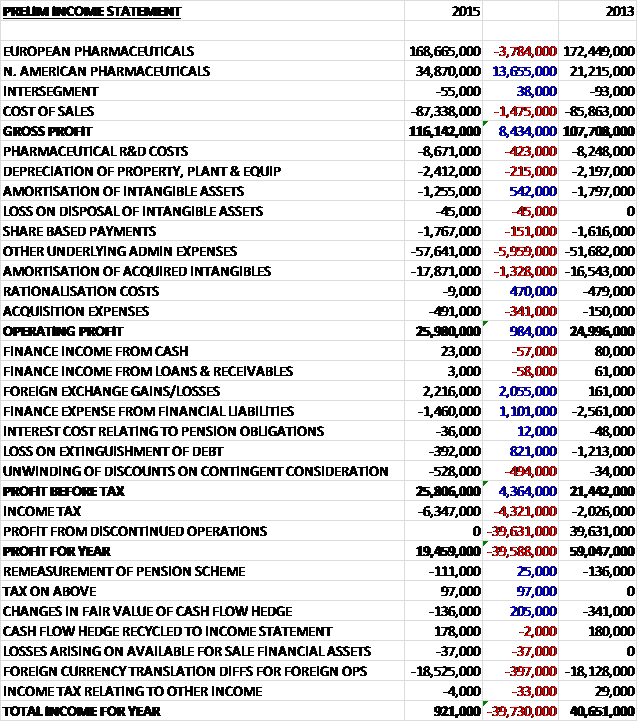
Fairpoint Share Blog – Interim Results Year Ending 2015

Fairpoint has now released its interim results for the year ending 2015.

FRPinterimincome

Revenues increased when compared to the first half of last year as a £1.1M fall in IVA revenue, a £54K decline in claims management and a £16K fall in debt management revenue were more than offset by a £10.2M increase in legal services revenue.  An increase in cost of sales meant that gross profit increased by £4.6M.  There was a £1.2M increase in the amortisation of acquired intangibles and other increases in underlying admin expenses were partially offset by the lack of £749k of acquisition costs relating to Simpson Millar and £480K in refinancing costs that occurred last year to give an operating profit of £974K, a positive movement of £1.1M year on year.  We then see a decline in the unwinding of the discount on IVA revenues and an increase in the unwinding of the discount on contingent consideration along with a slightly higher tax level to give a profit for the half year of £1M, an increase of £228K when compared to the first half of 2014.

FRPinterimassets

When compared to the end point of last year, total assets fell by £1.3M driven by a £2.5M fall in other intangible assets, a £2.8M decline in trade receivables and a £931K fall in amounts recoverable on IVA services partially offset by a £2.7M increase in other current assets.  Liabilities also fell during the year as a £2.4M fall in long term financial liabilities was partially offset by a £905K increase in payables.  The end result is a net tangible asset level of £13.2M, an increase of £1.3M over the past half year.

FRPinterimcash

Before movements in working capital, cash profits grew by £2.1M to £4.9M.  After a favourable swing to an increase in payables and less tax paid, the net cash from operations came in at £4.9M, an increase of £3.9M. The group then spent £480K on property, plant and equipment along with £118K on software development and £219K on the purchase of debt management and legal service back books to give an impressive looking free cash flow of £4.2M.  Some £1.8M was spent on dividends and a net £2.2M was spent on repaying borrowings to give a cash inflow of £193K and a cash level of £2.6M at the period-end.

Market conditions in debt solutions remain challenging and the group continues to take a disciplined approach to marketing expenditure.  The volume of new IVA solutions in England and Wales decreased by over 30% to 19,426 in the first half of the year, a reflection of the economic stability in the wider economy.  The board believe that these market conditions are likely to continue until bank base rates increase, adversely impacting the financial circumstances of home owners who typically have higher incomes.

The adjusted pre-tax profit at the Legal Services division was £1.4M, an increase of £1.3M year on year with a small improvement in profit margin to 13%.  Compared to the full six month period of the prior year when the business was not part of the group, legal services performed well with a single digit organic growth in profits.  The group is taking a series of actions with the business including placing prime responsibility for the generation of new customer enquiries into the group marketing function; defining a pricing tariff for over 70 legal products, which will enable the group to communicate a price point for a fixed schedule of services; developing the infrastructure to operate more efficiently, and more recently adding a class leading volume personal injury, conveyancing and travel law business to enhance the product set.  Since the acquisition of Colemans, legal services now represent at least 62% of revenues.

At the IVA Services division, revenues fell by £1.1M as a result of fewer new cases due to the general market reduction, and pre-tax profit fell by £300K to £1M.  In light of the difficult market conditions, the group has focused on profit margin management through cost control, hence the relatively small fall in profit margin from 19% to 17% despite the reduction in cases.  The total number of fee paying IVAs under management at the period end was 16,889 compared to 18,717 last year with the number of new IVAs written in the first half being 795 at an average fee of £3,036 compared to £3,458 last time.

In the DMP Services division, revenues were flat but pre-tax profit fell by £100K to £1.5M.  The focus during the period has been on existing clients and engaging with the requirements of the new regulatory regime and the group expect their application for full regulatory permission to be processed during the second half of the year.  Due to the regulatory environment, no acquisitions of DMP back books were considered during the period.  The total number of DMPs under management at the period-end was 20,730 compared to 21,422 at the same point of last year and adjusted profit margins were down by just 1% to 39%.

Revenue in the Claims Management division was flat and profit fell by £200K to £400K as the business invested in developing new products and services.  Claims levels, largely relating to PPI reclaim activity from existing IVA clients, have reached maturity whilst those from the debt management clients are building well.

In August the group agreed a £5M extension to its previous £20M banking facility with AIM, taking the total facility to £25M.  The new committed facility comprises a £17M revolving credit facility and an £8M term loan which extends to May 2019.

After the period-end the group acquired Colemans CTTS solicitors and Holiday Travel Watch, a provider of consumer focused legal services with particular class leading expertise in personal injury, volume conveyancing and travel law.  The initial consideration was £8M in cash and a further £1M through the issue of 755,516 shares.  Further contingent consideration of up to £7M may be payable based on the financial performance of Colemans for the 11 month period ending June 2016 and the year ending June 2017.  There will also be £1M in legal, professional and integration costs in the second half of the year.  As well as organic growth, the board has indicated that they will continue to look for acquisition opportunities.

The board anticipates that the market conditions in the IVA segment will remain challenging and they will therefore continue to focus on margin management and cash generation.  They expect the development of other claims products to mitigate in part the effects of the maturing IVA claims activity.  In DMP, the group are focused on existing business whilst their application for full regulatory permission is processed.  The debt solutions activities are expected to benefit from their usual seasonally stronger second half, in part due to lower anticipated marketing costs given the subdued markets.  As a result of the above factors, along with the initial contribution from Colemans, the board is confident of delivering progress in line with market expectations for the year as a whole.

After a 7% increase in the interim dividend, at the current share price the shares yield 3.7% which rises to 3.8% for the full year forecast.  At the end of the half year, before the £8M spent on the acquisition of Colemans, the group has a net debt position of £5.2M compared to £7.1M at the same point of last year.

Overall then, this was a period of change for the group with a solid performance.  Profits were up but this was only due to the refinancing and acquisition costs that occurred last year and underlying profits showed a small decline. Net tangible assets were up, however, as was operating cash flow with plenty of free cash being generated. The market for debt solutions is challenging and is likely to remain so until interest rates increased and therefore the decline in IVA profits have had a knock on effect on the claims management profit.  The DMP division is also in a bit of limbo until it gains regulatory approval.  The fact that the group has managed to anticipate these issues and shift focus onto legal services with some well-timed acquisitions really is a credit to them and were it not for this, profits would have been far more severely affected.  The outlook therefore depends somewhat on the performance and integration of these law firms and with a yield of 3.8% I am happy to continue holding.

FAIRPOINT GROUP

The chart looks fairly reassuring too, although perhaps it is a little overcooked now.

With regards the acquisition of Simson Millar, there was a provision for the payment of an earn-out of up to £6M based on the financial performance of the business for two 12 month periods ending June 2015 and June 2016 with a maximum of £3M to be payable each year and satisfied by a consideration of 50% cash and 50% shares.  The financial performance has exceeded the financial hurdles set for the first earn-out period ending June 2015 so on the 25th September the group paid £1.5M in cash and issued just over 1M new shares at the previously agreed price of 141p per share to the vendors.

On the 27th November the group put out a statement in response to the Autumn Statement by the chancellor. The government’s proposals seek to restrict the ability for sufferers of minor whiplash injuries to claim compensation which is expected to be implemented in April 2017 following a period of consultation. As such the proposed changes have no impact on the board’s expectations for performance in 2015 and 2016. Following the acquisition of Colemans in August, the group has an operational capability designed specifically in anticipation of such changes and therefore they believe they are well positioned to take advantage of these market changes.

Unfortunately this statement does not tell us anything really. To state that the proposed changes will have no effect in 2015 and 2016 when they are expected to be implemented in 2017 is obvious and the fact that they have not mentioned 2017 suggest to me that they are likely to have a serious impact. I am also not sure what to make of the last sentence – there is no detail here at all. I have made good money here and the shares do look a bit cheap but I am considering selling out on the strength of this.

On the 19th January the group released a trading update for year. Overall the group’s adjusted results are expected to show double digit growth against the previous year and are in line with market expectations. This is principally as a result of the continued development of the group’s consumer legal services business.

In legal services, the business has delivered significant double digit increases in segmental revenues and profits whilst making good progress on margin improvement. The division now represents about two thirds of revenues and benefited from the Acquisition of Colemans in August which brings a legal processing centre to the group for the delivery of volume personal injury, conveyancing and travel law.

Following the proposed changes announced by the chancellor in his Autumn statement, relating to small claims limits and whiplash claims and subsequent clarification in the government’s response, the group believes that the changes are intended to focus on whiplash claims relating to road traffic accidents; are subject to consultation; and are expected to follow previous precedent and apply to cases introduced post implementation and not retrospectively. This category business represents about 8% of group’s revenues (although this might increase as the other divisions decline).

In the IVA division, conditions in the debt solutions market remain challenging with the volume of new IVAs in the UK falling by nearly 26% in the first three quarters of 2015. IVA revenues have as a consequence reduced by about 15% and the group has continued to focus on delivering good margins, strong cash generation and avoiding uneconomic new business.

In the DMP division, revenues have declined by about 15% which reflects the absence of acquisition activity in 2015. Following the clarification form the FCA regarding debt management back book acquisitions, the group do not intend to resume activity in this field and will maintain focus on cost control within the division. Within the claims business, as expected revenues have declined significantly compared to last year as the business transitions from maturing IVA PPI claims to newer lines of activity and margins have reduced to reflect this mix change.

Group net debt at the end of the year stood at £13.6M compared to £7.6M at the end of the prior year. During the year the group incurred exceptional acquisition transaction and restructuring costs totalling £1.4M with the former associated with the acquisition of Colemans and the latter with the application for full regulatory permission with the new regulator of DMP activities, the FCA.

Overall then, this is a decent enough update. We can clearly see the legal services business is going to be the driver for growth going forward as the other divisions seem to be declining fast. The fact that about 8% of revenues are affected by the chancellor’s announcement is a bit more helpful but there is no indication of what the effect on profit might be. I suppose I will have to wait for a broker note to include it which is not rally a very fair state of affairs. I am a bit torn here, the business looks cheap but there are clear risks.

Northern Petroleum Share Blog – Final Results Year Ended 2014

Northern Petroleum is an oil and gas exploration and production company quoted on the AIM market.  Their key assets are in Canada, an onshore oil production play with significant growth potential, and in Italy, with both onshore and offshore permits and applications containing exploration prospects and discovered oil fields.

The group has various licenses.  In Canada they have 94 leases in the North West Alberta onshore asset.  In Italy they have a 20% interest in the Cascina Alberto onshore permit with Shell Italia being the 80% interest holder and operator.  Offshore they have two permits in the Southern Adriatic and five applications, all 100% owned.  Offshore in the Sicily Channel they have two 100% owned permits, a 100% owned application and two 50% owned applications, one operated by Petroceltic.  They also have a 100% owned application offshore in the Ionian Sea.  In French Guyana they own a 1.4% interest in the offshore Guyane EEL license with Shell being the operator.  Finally, in Australia they own a 100% interest in the onshore PEL629 license.

In Canada the Keg River carbonate reef redevelopment project in NW Alberta is targeting production from more than 80M barrels of light oil remaining in place in the 30,000 acres owned by the group.  The reefs on the group’s acreage produced from the 1960s through to the early 2000s, with significantly lower recovery factors than surrounding areas.  The opportunity exists to put the fields back on production.  In Australia the large acreage in the Otway basin is primarily targeting an unconventional oil and gas play, currently available for a farm out.  In French Guyana the acreage contains the Zaedyus oil discovery and additional prospects within a large deepwater exploration license.  Monetisation of the interest is currently being considered.

In Italy, the group owns five permits onshore and offshore and a large area of applications in the Adriatic, an area of recent interest by the industry following the licencing rounds in Croatia and Montenegro.  The Adriatic permits contain the Giove undeveloped oil discovery with 26M barrels of 2C contingent resource, and the potentially significant Cygnus exploration prospect.  Onshore the group has recently farmed out its Cascina Alberto permit to Shell Italia who will operate the permit through the exploration work programme.  Building and maturing a broad collection of exploration and appraisal assets in Italy will provide opportunities to create value for the group.

Northern Petroleum has now released its final results for the year ended 2014.

NOPincome

Although revenues from the UK fell, the group made their maiden revenues from Canada, and after production costs also increased, gross profit improved by $258K year on year.  Pre-license costs also fell, along with operating lease rentals, share scheme costs and other admin expenses. We also see a $2.3M profit on disposal of assets relating to the sale of the UK assets and nearly $1M less in new business expenses when compared to last year.  Unfortunately all this was dwarfed by the impairments with a $9.4M increase in oil and gas impairments, an $18M increase in exploration asset impairments and a $744K impairment of the IT system to give an operating loss some $21.9M bigger than in 2013 at $57.3M. After a smaller foreign exchange loss, a much lower tax credit and the lack of a $2.8M loss from discontinued operations, the loss for the year stood at $59M.  Some $16M of these losses was attributable to non-controlling interests (namely HALO, who own the 44.1% of the French Guyana assets through their investment in Northpet), however, so that the loss attributed to the owners came in at $43M, an increase of $3.6M year on year.

NOPassets

When compared to the end point of last year, total assets fell by $62.1M driven by a $36.5M reduction in the value of the French Guyana exploration assets, a $23.7M fall in cash, a £3.5M fall in the value of Italian exploration assets and a $1.6M decline in the value of IT systems partially offset by a $3.5M growth in the value of the Italian oil and gas assets.  Total liabilities increased during the year as a $749K increase in accruals and deferred income, and a $1.1M growth in trade payables were partially offset by a $406K decline in deferred tax liabilities and a $328K fall in the Italian Government loan.  The end result is a net tangible asset level of $7.3M, a collapse of $22.5M year on year.

NOPcash

Before movements in working capital, cash losses widened by $5.3M to $5.1M.  A fall in receivables and an increase in payables meant that after interest and tax, the group lost $2.7M from operations, a $491K improvement year on year due to the much smaller tax payment.  The group spent $11M on producing assets and property, plant and equipment, and some $11M on exploration before an inflow of $2.5M from the sale of a subsidiary meant that the cash outflow before financing stood at $22.2M.  After government loans broadly cancelled each other out, the cash outflow for the year stood at $22M to give a cash level of $12.1M at the year-end which is clearly not a sustainable situation.

At the year-end the group has cash of $12.1M and they expect to make future revenue from existing oil and gas fields but further development or drilling in Canada and appraisal activities on the group’s assets in Italy will require external capital, which may come from the farm out of existing assets, the sale of non-core assets, debt or equity.  The board believe that they have sufficient resources to continue in operation at least until the end of 2016.

In Canada the group started proof of concept work in the Virgo area of NW Alberta, aiming to redevelop Keg River carbonate reefs with low recovery factors, using workovers of existing wells and the drilling of new wells.  The positive results from the first three wells resulted in a redevelopment programme being initiated with the expectation that the year-end exit production rate would be over 500 bopd.  The initial three wells were placed on production using rental equipment with the fluids trucked to the local processing facility, pending tie-in to the existing infrastructure which gave a stabilised production of more than 200 bopd at the half year point.

The results of the three wells drilled in the second half of the year were mixed with one well testing at more than 1,000 bopd, one at 20 bopd and the third proving swept with water.  The high rate well was tied in to the existing local infrastructure and, combined with the initial three wells, allowed production to peak at more than 500 bopd just before the end of the year.  The declining oil price postponed further capital investment to tie in the three original wells due to a much longer investment payback horizon, however.

The key uncertainty with the three wells drilled in the second half of the year proved to be the ability to correctly identify the top of the reservoir from interpretation of the seismic prior to the wells being drilled.  This, along with the impact of water injection into other reefs on reservoir sweep, led to the poor results of two of the wells.  The top reservoir came in where expected proving the revised seismic model.  One of the wells produced oil at a rate of 90 bopd from a top reservoir section but with significant amounts of water making the well uneconomic in the current oil price environment.  Analysis is underway to determine whether the water was being produced from a separate zone not completely isolated by the cemented liner, or the dynamic nature of the reef system is more complex than previously understood.

At the end of the year, a reserves report for the Virgo assets was commissioned, reviewing the first three wells and the high rate well from the second round of drilling.  Using current oil prices, they assigned proved reserves of 144,000 barrels of oil and additional probable reserves of 149,000 barrels of oil.  These wells generate a net present value at 10% discount rate of approximately C$4M.

In Canada two drilling campaigns, each of three wells, were undertaken during the year.  The first three wells comprised a re-entry into an existing well (100/14-22); a new well into a previously undrilled reef (100/16-19); and a new well into a previously produced reef (102/13-13).  The results of the 100/14-22 well prove the concept of oil re-equilibration since when the well was brought back into production, the well had a peak daily rate of 100 bopd with an initial water cut of 40%, an improvement on both measures from when the well was shut in previously in 1991.

The results from the 102/13-33 well support the concept that larger reefs developed with only a single well contain remaining un-swept oil zones that can be targeted by drilling new wells.  The well had a peak daily rate of 260 bopd with an initial water cut of 36%.  The result of the 100/16-19 well, an exploration well, highlighted that structures may exist which have not been identified in the past and provided additional information to assist with the subsurface identification of future well locations.  The well had a peak rate of 140 bopd of dry oil.

The second campaign of three wells drilled during the summer and autumn all targeted unswept zones at the edges of previously produced reefs.  The result from the 102/15-23 was exceptional with the well encountering 14 metres of net oil pay and flowing on test at a facilities constrained rate of 1,300 bopd of dry oil.  The 100/14-23 well encountered four metres of net oil pay and produced at a rate of 20 bopd during swabbing, while the 100/1-27 well encountered an unexpected overpressured and water swept reservoir.  Both wells were subsequently suspended without being tested and have been impaired on the accounts while awaiting further evaluation.  The wells prompted a focused subsurface review aimed at delivering similar higher performance results as seen by the 102/15-23 well.  The review refined the subsurface understanding, primarily through revised seismic interpretation, well location optimisation with respect to nearby production wells and the understanding of reservoir sweep behaviour.

Other activities in Q4 2014 concentrated on the installation of the surface facilities and the tie in of the 102/15-23 well, along with well planning for the next drilling phase.  The facilities work was completed before Christmas and following the tie-in for the 102/15-23 well, production was progressively increased up to the new year enabling the group to achieve a total field production rate from all four producing wells of more than 500 bopd.

In early 2015, the planned two well drilling programme was reduced to a single well in a response to the rapidly falling oil price.  The 102/11-30 well was located down flank of the reef structure in order to investigate the possibility of unswept oil on the reef edge.  The well reached the top of the Keg River formation in line with prognosis and encountered the expected reservoir section.  When tested the well flowed at 90 bopd with a water cut of 85%.  As a result the well was suspended pending a subsurface and facilities review to determine the source of the water and establish a cost effective method of handling the water.  The results from these wells will be incorporated into a revised sub-surface model which is expected to be completed during Q3 2015 and no further wells will be drilled until it has been completed.

In the current reduced oil price environment, a reduction in development and production costs will be crucial in delivering an economic project in Alberta, hence the impairment of the Canadian project.  Should the low prices continue, it is expected that there will be a reduction of operating costs due to downward price pressure on the supply chain coupled with a reduction in rig and associated service industry rates by H2 2015.  In the meantime the group is investigating alternative operating strategies for the existing wells in order to reduce variable operating costs.  In all, the group produced 30,685 bbls from the country and generated revenue of $2.2M.  Stable production at the year-end was 275 bopd with a peak of over 500 towards the end of December.

In Italy the focus was to continue to liaise with industry and government authorities for approval of the environmental impact assessment to allow the acquisition of 3D seismic data to be made in the southern Adriatic permits, F.R39.NP and F.R40.NP that contain the Giove oil discovery and the Cygnus exploration project.  Elsewhere the award of the onshore Cascina Alberto permit and offshore C.R149.NP permit in the Sicily Channel demonstrated that the regulatory authorities are providing the support needed to move forward within Italy.  The Giove undeveloped oil discovery has been assessed to contain 2C contingent resources of 26M barrels of oil.  The planned 3D seismic survey should help in locating an appraisal well on the field required to establish a viable development plan.  The results from the most recent sub-surface analysis indicate that there is potential for improved reservoir properties and a higher recovery factor.

The Cygnus prospect remains a high priority and is the primary focus of the 3D seismic survey.  It is interpreted as having a proximal reservoir sequence to the equivalent distal reservoir sequence that forms the reservoir in the adjacent Aquila oil field.  The assessment of the prospective resources for the Cygnus prospect assigned 978M barrels in the high case estimate, using a common oil water contact with the Aquila field, of which 790M barrels of prospective resources are net to the group on the F.R39NP permit.  In the mean case, using a shallower contact and assuming there is separation of the mapped prospect from the Aquila oilfield, a prospective resource estimate of 446M barrels have been assigned, of which 401M barrels lie within the permit.  There is an estimated chance of success of 12% for the Cygnus prospect.

The group is seeking a farm in partner to progress the work programme, which will include the acquisition of 3D seismic data across both the Giove oil field and Cygnus prospect that will further enhance the potential to progress with a Giove oil field development and the drilling of an exploration well on Cygnus.

Onshore in Italy, the Cascina Alberta was awarded in July 2014.  The area was held in the late 90s by Eni which focussed on a prospect called Gattinara that previously interpreted as holding a prospective resource of 300M barrels of oil.  The trap is similar to structures such as the Villafortuna-Trecate field, which is located 25Km to the South East.  In early 2015 the group announced a farm out deal with Shell Italia whereby in return for an 80% interest and transferred operatorship to Shell Italia, Shell will pay $850K in cash on completion and will carry the group for the costs of the exploration campaign which will include a carry on the authorisation of any new seismic until the seismic costs reach $4M and a carry on any exploration well until the well costs reach $50M.  Shell have a pre-emptive right over the company’s remaining interest in the Cascina Alberto permit in the event of any change in control at the asset or corporate level.

In the Sicily channel, permit C.R149.NP was awarded in July and is adjacent and to the East of C.R146.NP and contains an extension of the Vesta oil prospect.  The prospect is interpreted as having the same age reservoir sequence as the on trend Vega oil field.  Permit C.R146.NP is currently held in suspension while an environmental impact assessment to drill an exploration well is processed through the Ministry of Environment. Applications closer to the Sicilian coast contain leads similar to the on trend Palma oil discovery and are also pending environmental impact assessment approval before permit award.  Following the year the group announced a joint technical study with Schlumberger and GEPlan.  The study will cover a large area of the Streppanosa Basin which includes C.R146.NP and C.R149.NP, with the objective of promoting and high grading the area for exploration.

In the Ionian Sea, within application d59F.R-.NP there are three deep water gas discoveries Fiorenza, Fedra and Florida drilled in 1982, 1987 and 1999 respectively by Agip.  The gas discoveries are adjacent to the producing Luna, Hera Lacinia and Linda gas fields operated by Eni.  Additional exploration prospects are contained within the application and these together with the existing gas discoveries will be evaluated on the pre-existing Eni 3D seismic survey once the permit has been awarded.

In Australia two deep wells were drilled by Beach Energy on adjacent acreage to provide further support for the play concept.  The license is suspended for a year to allow further technical work and evaluation prior to progressing with a seismic programme. The group is seeking a farm in partner for the license.  The UK license portfolio was sold to UK Oil and Gas Investments in October 2014 for a consideration of £1.5M.

The French Guyana drilling campaign was completed in 2013 and Shell, the operator, is currently incorporating the results into its geological model to better understand the considerable remaining prospectivity and determine the future license work programme.  While subsurface analysis is still ongoing any future exploration or appraisal wells are contingent on the satisfactory outcome of this analysis and would most likely require an extension of the license which expires in mid-2016.  With this level of uncertainly concerning future exploration, it has been deemed appropriate to impair the full value of this asset.  The assets in French Guyana are held through Northpet investments, some 55.9% of which is owned by the group.  The group are looking into ways to monetise the investment in the license.

During the year the group had impairment losses relating to accounting and procurement IT systems implemented in early 2012.  Following the disposals of three UK operating subsidiaries during the year and of the Netherlands subsidiary last year, the carrying value of the IT systems have been impaired by 40% to reflect the redundancy of system modules and functionality previously used to meet joint venture agreement requirements.  Other impairments include the impairment of the carrying value of leasehold improvements following the disposal of one of the office floor leases and the planned relocation of the head office in April 2015.

Following the drilling of the development wells in Canada and the halving of the oil price in late 2014, and after a review of the performance of all the producing wells, impairment losses of $15.3M were recorded against the Canadian developed assets.  In order to reach these judgements, the directors have used average oil prices of $50 in 2015, rising to $85 by 2017.

Last year the group impaired some $1.4M owing to the group from Avobone from the drilling of the Savio 1x well.  In March they agreed a settlement involving cash payment and transfer of a VAT debtor of $1.1M which left $600K outstanding.  The group is pursuing the recovery of the VAT debtor but the timing of any cash receipts is uncertain and could take a number of years.  During the year the associate company, Oil and Gas Investments, was dissolved.  $49K trade debtors due from the associate were written off in the year.

In February the group announced that Well 102/11-30, targeting a reef previously undrilled by the group was drilled and tested as planned.  A significant reef section was encountered, as forecast from seismic interpretation.  Two separate zones were isolated and tested.  A lower zone, which was water wet and an upper zone which produced oil but with too high a water content to be economic in the current oil price environment.  The well was suspended for further evaluation.

During the year Graham Heard departed from the board after spending many years with the company and there is no plan to replace him.  In addition Stewart Gibson retired from the board in early 2015 as a result of the need for the group to manage costs throughout all areas of the organisation.

At current commodity prices, the existing financial resources provide limited scope to materially advance the core assets of the business and may be exhausted by the end of 2016 without the realisation of cash resources through farm out or other monetisation projects.  Production led growth is still the key strategy for the group but the fall in the oil price meant that only one Canadian production well was tied into the existing local third party infrastructure and with the high cost involved in trucking significant amounts of water, the decision was taken to shut in the other wells at the start of 2015.

At the year end, the group had cash of $12.1M and there was $1.3M of debt outstanding relating to the Italian Government loan which is repayable over five years.  The group does not make a profit so we can’t value it on a PE ration basis.

Overall then, this has clearly been a difficult year for the group, as it has been for many small oil companied following the hefty decline in the price of oil.  There were increasing losses due to more impairments but underlying losses were a bit lower than last year.  Net assets collapsed, however, as there was a large outflow of cash.  Operating cash losses fell year on year but this was entirely due to hardly any tax being paid and underling cash losses actually increased during the period.  At the year-end the group had cash levels of $12.1M but since then another well has been drilled and the cash is only likely to last until the end of 2016 without any farm in cash being received.

As far as the assets themselves are concerned, the only producing asset, located in Canada seems as though it is unlikely to be able to contribute much to cash flow in this low cost environment and my understanding is that there is only one well currently producing there.  The Australian and French Guyanan assets don’t look as though they will come to much but the Italian acreage does look rather interesting.  Clearly they will not be able to go alone with any of the assets but the farm out to Shell looks like a good way forward for progressing these in this environment.  Overall, I think this company might have potential in Italy but investing in the current environment is pretty much impossible in my view.

On the 8th May the group announced that the farm out of the Italian onshore permit, Cascina Alberto, to Shell Italia, had been completed following the Italian authority approval of the transfer of 80% of the permit interest in return for $850K a carry of the exploration costs as previously announced.  The work programme has started with the re-processing of existing seismic data to determine whether there is a requirement for further seismic acquisition to help delineate a proposed target for an exploration well.

On the 11 May the group released details of their new incentive schemed for the directors as obviously their generous salaries are not enough to motivate them to work hard.   The key principle of the new policy is apparently to link any reward only to the performance of the company’s share price over the medium term. Under the VCP, participants have been awarded performance 1,000,000 “performance units”.  The units will convert into nil-cost options at three dates during a five year period if a number of criteria are achieved.  I do hate nil-cost options!  The threshold price is the higher of a 20% per annum compound growth rate from the grant price (15p per share) and the measurement price used at a previous measurement date.

The measurement dates are in May 2018, 2019 and 2020.  Any nil-cost options earned at each measurement date will not be exercisable until the end of the five year measurement period and all participants are required to build up a shareholding equal to their base salary by the final measurement date.  This actually seems fairly sensible – the shares have to increase by 20% and the directors have to remain in place to obtain the options so the scheme looks OK to me.

The NPIP is another scheme that has been established to create a rolling, three year share incentive  for all staff and to govern share based awards made as part of any annual bonus to directors and senior management.  In May the directors were granted awards in the form of nil-cost options which are the deferred annual bonus shares in respect of 2013.  These awards have not been granted until now due to the company being in successive closed periods since the 2013 bonus award was determined (this seems a little odd to me).  The awards vest in January 2017 and include 209,644 for CEO Keith Bush and 167,715 for CFO Nick Moran.  I have to say this sits a little less well to me, what exactly are these directors being awarded for?

On the 19th May the group released a production update for the Canadian assets.  A production package for the 100/16-19 well was purchased and following implementation of some design changes is now ready to be installed at the well pad.  The package includes an 800 barrel storage tank, separator and flare stack.  The pump and heater have also been configures to be powered by associated gas produced from the well which brings cost savings.  The larger storage tank will provide better onsite oil and water separating capability and a reduction in regular trucking movements, which will benefit production uptime during the wet periods.  Starting in June, the well is expected to produce at 75 to 100 bopd subject to well reservoir performance and associated water production.

The pump on the 102/15-23 has now been installed and the local operator, who owns and manages the pipeline and processing infrastructure that the well is tied into, has undertaken a programme of maintenance which has affected the well.  Work required to ensure the integrity of the pipeline that the well tied into will be conducted early in Q3, after which production will restart.  An initial production rate of about 150 bopd is planned and reservoir performance and water cut will determine future production rates and decline.

The remaining wells have a total production capacity of 250 bopd at water cuts greater than 50%.  Establishing disposal of the produced water as economically as possible is key to the restart of production from these wells.  Other operators in the area have demonstrated that wells can produce economically at water cuts greater than 95% and the company is now reviewing operations for each well to ensure the recovery and value from the wells is maximised.  At $55 WIT, operating net back after royalty is forecast to be approximately $30 per barrel and at current oil prices, net cashflow from both wells is expected to cover most of the total general and admin costs of the company.
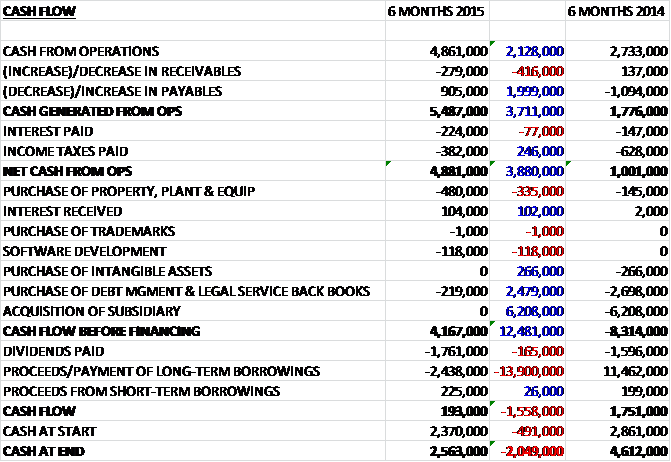
I have to say, it is good to see 100/16-19 being re-opened and the fact that just these two wells should be able to support the company is very positive.  Having said that, it appears that the company currently has no wells in production so the first half results are likely to look a little poor.

In June, the group announced that its environmental impact assessment (EIA) for the acquisition of 3D seismic data across the Giove undeveloped oil discovery has been approved by the Italian regulatory authorities.  In addition, EIAs for two of the company’s exploration permit applications have been approved.  This will allow the company to continue its exploration and appraisal campaign in the Southern Adriatic.  There are three further EIA applications in the area which are expected to be approved shortly.
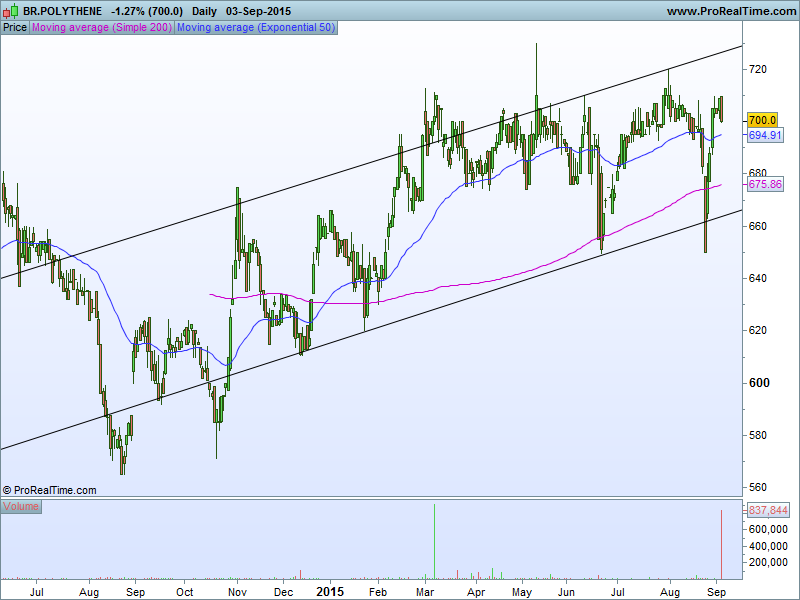
On the 11th June the group announced an update of the production activities in Canada.  At well 100/16-19, the new package was installed and following a period of commissioning the well started production on the 7th June.  It has flowed without incident on pump at a rate in excess of 100 bopd.  The well is expected to produce at between 75 and 100 bopd, dependent on future reservoir performance and associated water production.  At the 102/15-23 well, the maintenance work being undertaken by the local operator is expected to take four to six weeks, after which production will restart with a planned initial production rate of 150 bopd.

On the 16th June the group announced that the Italian authorities had approved the remaining three EIA in the Southern Adriatic.  Now all EIAs have been approved, the company can now work with the Italian authorities to finalise the award of the permits.  Once received, a full 2D seismic programme will be designed to evaluate the potential of the 4,500 sq km of contiguous permits and develop further opportunities similar to the Giove discovery and Cygnus exploration prospect.

NTHN.PETRO.

This is not a chart that inspires me to invest at the moment.

BPI Share Blog – Interim Results Year Ending 2015

BPI has now released its interim results for the year ending 2015.

BPIinterimincome

Overall revenues fell when compared to the first half of last year as a £1.9M increase in North American revenue was more than offset by an £11.7M fall in UK revenue and a £5.5M decline in European revenue.  There was also a fall in costs, however, to give an operating profit some £1M above that of the first half of last year.  After an increase in pension finance costs was nearly offset by a decline in the interest on the loan and tax was slightly higher, the profit for the year came in at £11.4M, an increase of £1.3M year on year.

BPIinterimassets

When compared to the end point of last year, total assets increased by £3.8M driven by a £30.8M growth in trade and other receivables and a £1.5M increase in cash, partially offset by a £17M fall in inventories, an £8.8M decline in deferred tax assets as the value of the pension deficit fell and a £2.6M decline in property, plant and equipment.  Liabilities fell during the year as a £39.6M decline in pension liabilities and a £2.6M fall in the bank overdraft was partially offset by an £11.8M increase in payables and a £9.2M growth in bank loans. The end result is a net tangible asset level of £61.7M, an increase of £25.9M when compared to the end of 2014.

BPIinterimcash

Before movements in working capital, cash profits were £26.1M, an increase of £1.6M year on year.  An increase in payables and a fall in inventories were broadly offset by an increase in receivables but the £14M paid towards the pension plus a slightly higher tax payment meant that net cash from operations came in at £8.8M, a fall of £7M.  The group then spent £9.1M on capital expenditure so there was no free cash during the period in which to pay the £2.9M of dividends or the £3.2M spent on acquiring shares for the incentive scheme so the group took out £10.3M of new loans to leave a cash inflow of £4M and a cash level of £2M at the end of the first half.

Operating profit at the UK and Irish division was £7.6M, an increase of £100K year on year.  Volumes sold reduced as the group shipped less product to the site in Canada and exited some very low margin retail refuse sack business which was offset by some growth in plain films and silage stretchwrap.  Volumes in the plain films sector increased but margins suffered from the polymer price increases.  The policy of upgrading the extrusion lines at the Bromborough site has continued with three new lines fully operational.  An additional five layer coextrusion line has been ordered for delivery in early 2016.

Silage stretch volumes increased despite a slow start to the season due to the cold weather in Northern Europe.  As with other products, though, margins were lower due to the polymer price increases and the impact of exchange rates on export volumes. Operational improvements continued at Leominster and a seven layer line has been ordered for delivery in 2016.  Sales volumes of industrial stretchwrap increased due to continued growth in the prestretch wrapsmart product and good demand for blown hand reels due to customer wins.  Sales volumes from the Wide Lines at Ardeer increased despite reduced supplies of silage sheet to the North American business as they experienced greater demand for silage sheets in the UK and secured new volume in Continental Europe.

Sales volumes in refuse sacks reduced by over 10% following the loss of some retail business at very low margins but operational efficiencies have improved and the group is starting to see benefits from the co-extrusion investment.  Construction films experienced a slow start to the year with continued patchy demand in Q2 resulting in lower volumes but sales of the specialist gas and water proofing business continued to grow, up 9% as new products were introduced.  In recycling, scrap availability continued to be the major concern, particularly in farm plastics where new start-ups in Ireland and Central Europe contributed to higher demand for farm waste.  The new recycling line at Heanor is performing well and allowing access to more contaminated waste.

Volumes in the Visqueen packaging business were lower due to reduced demand from the construction sector and a poor season in the animal feed sector due to the mild winter.  Sales to the peat/compost and furniture/bedding sectors saw some improvement.  At Ardeer, a replacement printing press was installed towards the end of the first half and two replacement extrusion lines will be installed in the second half of the year.  The UK consumer operation which supplies printed packaging for food to the supermarkets and major brands, continued to experience challenging conditions with lower volumes and intense margin pressure.  The plant in China increased volumes in aprons and stretchwrap but has yet to secure any additional printed film food business.

The operating profit at the Mainland Europe division was £9.6M, a fall of £500K when compared to the first half of last year.  This decline was entirely due to the weakness of the Euro and profits in the local currency actually increased by 6.5% with sales volumes up 7% to 49,500 tonnes as all three sites reported increases.  Margins were squeezed by the exceptional raw material prices in Q2, however.  Sales volumes of the silage products increased by over 10% with sales of advanced products SilotitePro and Baletite increasing by 31%.  This increase arose against a background of cold weather in Northern Europe and consistent hot and dry weather in Central Europe.  The significant polymer price increases in Q2 resulted in very difficult pricing and margins suffered, being below those of last year.

At Zele, volumes of Bontite, the premium industrial stretchwrap product, continued to grow aided by new legislation for load stability.  Sales of printed film for the food industry increased by over 13% with growth mainly from the frozen fries sector but margins suffered from the polymer price increases.  A replacement printing press with additional capacity will be installed in the second half of the year.  In Roeselare, volumes improved as sales of stretch hoods, feedstock for printing and Formiflor, the thinner product for the insulation market.  Sales volumes from the plant in Holland increased by over 4% with increased sales of FFS and printed film.  Margins were squeezed here too by the increasing polymer prices.  A replacement printing press for FFS was installed and the replacement of a number of extrusion lines was authorised.

The operating profit at the North America division was £800K, an improvement of £1.2M year on year.  The division returned to normal production levels following the installation problems on a replacement large extrusion line that occurred last year.  Agricultural sales were up by 15%, particularly in the agricultural bag market with customers reporting strong approval of products from the new extrusion line which is performing well with the products showing improved physical characteristics.  Production output was much improved over 2014 but some power outages reduced levels to below expectations.  Scrap levels have reduced and new and improved products are being developed for the market.  Performance in the second half of the year will depend on market demand and weather and while there are dry conditions in California, the group is experiencing good grain bag bookings in Western Canada.  The business will recover from the disappointing 2014, however, and further benefits should be seen from the new extrusion line.

As can be seen, the main issue during the period was raw material costs.  During the first few months of the year there were clear signs of raw material costs falling but these costs accelerated to an all-time high during Q2 in Western Europe.  Several factors accounted for this rapid rebound in costs.  Firstly, import tariffs for polyethylene polymers from certain Middle Eastern countries increased from January.  Secondly the euro depreciated in value against the US dollar, the currency used world-wide except in Europe to trade in the raw material.  Both of these factors meant that it was less attractive to import polymer from the Middle East.  Thirdly, the Western European producers suffered from an unprecedented number of force majeure incidents with more plant outages than ever seen before.

The raw material market has become less frenetic in the last few weeks and attention is again focusing on medium term reductions in feedstock costs on the back of imported shale gas from North America.  Some minor reductions in price have been seen for certain grades of raw material and further reductions are anticipated over the coming months. Passing through the price increases was apparently very difficult so margins have been squeezed.  Wholesale electricity costs are reflecting the lower oil and gas prices but there has been no relief in the UK due to increasing energy taxes and environmental levies.

Sales to the agricultural sector generally peak in the first half of the year due to seasonal weather conditions.  At the period end the group had contracts in place for future capital expenditure of £10.3M.  The most significant expenditure during the period was on the delivery and installation of replacement printing presses at Ardeer and Hardenberg.  At Bromborough the group continued to replace and upgrade extrusion lines and at Leominster they ordered a seven layer extrusion line for silage stretch.

During the period, the pension scheme changed the index used to determine minimum pension increases from RPI to CPI which has resulted in the reduction of the present value of scheme liabilities of £27.6M.  To increase the security for scheme members, the company also made a one off payment of £11.2M.  These actions have resulted in a substantial fall in the deficit of the scheme from £99.1M at the end of last year to £59.6M at the end of the first half.  This is still a considerable deficit but it is in a much better position than it was.

Demand remains at reasonable levels and with raw material prices having eased in August, the board are confident that they will meet expectations for the year as a whole.  At the current share price the shares have a dividend yield of 2.4% which is expected to remain the same on the full year consensus forecast.  At the period end the group had net debt of £29.2M compared to £24.1M at the year end and £29.8M at the same point of last year.

Overall then this has been quite a strong performance from the group.  Profits were up, net assets were up due to the reduction in pension obligations and although operating cash flow fell, this was due to the one-off payment to the pension scheme and underlying cash profits increased.  The lack of any free cash flow is a bit disappointing but this could be seasonal.  Operationally the UK and Irish business was broadly flat, the European business saw profits fall but this was only due to the weak Euro as underlying profits increased, and North American profits improved following the issues surrounding the installation of the extrusion line last year.  The one big issue during the period was the appreciation of polymer input costs at a time when oil prices have been showing unprecedented weakness.   These prices were high into July at least with some respite in August so they will still affect the second half but the effect should be reduced as prices should ease following the re-start of Shell’s large Moerdijk plant.

The pension position is now much improved, although still a cause from concern and the continued weakness of the Euro is unhelpful.  The shares yield 2.4% in dividends and the forward PE is about 10 which seems too cheap to me.  With the easing of the polymer price and the continued benefit of a North American division that is working again I would have thought the second half looks potentially quite bright, full global economic meltdown notwithstanding.  I am very tempted to buy some more here but it was recently reported that the MD of Europe, Michael Huyghe sold 25,000 shares at a value of £175K which leaves him with 83,292 shares left.  This is a fairly decent chunk of shares that have been sold which leaves me a bit concerned and perhaps I should hold off buying shares at this time.

BR.POLYTHENEThere looks to be a definite uptrend in play here.

On the 11th November the group released a trading update. The group has seen some lower demand from certain sectors which has resulted in volumes to the end of October being below those of the same period last year, notwithstanding a 5% increase in sales of silage stretch-wrap. The shortfall in demand was offset by margin recovery during September and October and the group are now seeing order books firming again but polymer producers are seeking price increases for November. Overall the board remains confident that the business is on course to meet their expectations for the year.

Recent and imminent capital expenditure at Zele in Belgium and Leominster in the UK, the two largest facilities for production of blown stretch-films, has led to the decision to close a smaller facility at Widnes which will reduce costs. The group also plan to consult with employees to reduce numbers at the consumer facility in Worcester and in the films business at Sevenoaks on order to align staffing levels to current demand at these locations which is expected to result in about forty redundancies. In addition, in October they disposed of the loss making Promopack Digital Studio business for a consideration of £200K. In aggregate, the closure, restructuring, and disposal are designed to enhance future performance and will result in a one-off cost of £1M during 2015.

Overall then a rather mixed update but performance is still in line.

On the 21st December the group released a pre-close trading update. Trading remained consistent with the last update but raw materials have since increased with a forecast of further increases in early 2016. Overall, however, the board remains confident that the business is on course to meet their expectations for 2015, although the polymer price increases are cause for concern.

On the 27th January the group signed an agreement to sell its Chinese subsidiary to Amcor, an Australian-based packaging group. The consideration payable is estimated to be about £9.4M with an estimated £6.4M upon completion with the balance to be paid in cash in instalments following the agreement of working capital and satisfaction of certain post completion arrangements, all of which are expected to take place over the next year. The proceeds will be used to reduce borrowings.

The subsidiary was established to produce low cost carrier bags for the UK retail market but after the retail carrier bag business was sold in 2002, it diversified into other products for the UK market and latterly the group invested in high quality printing and conversion equipment to supply the Australian market. Progress was slower than expected, however and over the past year the business was in a break even position on sales of £9.6M. About 80% of the sales to BPI in the UK are expected to continue after completion. The disposal is expected to complete in 2016 and will result in a £4M gain on disposal.

GVC Share Blog – Interim Results Year Ending 2015

GVC has now released its interim results for the year ending 2015.

GVCinterimincome

When compared to the first half of last year, sports NGR increased by €2.8M and gaming NGR grew by €13M and after variable costs, the gross profit came in some €8.7M higher than last time.  We then see various other costs increasing year on year with a €1.4M growth in technology costs, a €443K increase in professional fees and a €792K increase in other personnel costs.  The incentive scheme costs increased by €2M to a frankly incredible €8.1M and we also see an €846K increase in foreign exchange losses.  We also see some non-underlying expenses as the €1.6M cost relating to the Betit put option last year was more than offset by a €3.8M charge relating to costs that have arisen so far on the proposed takeover of Bwin and a £915K charge for Romanian back tax and license fees.  All this gives an operating profit of €18.4M, a decline of €493K.  As far as finance costs are concerned, a €373K unwinding of the discount on the deferred consideration was more than counteracted by an €804K detrimental movement in foreign exchange revaluation relating to the conversion of the William Hill loan from GBP into Euros along with the retranslations of finance lease payments and share option cash-out liabilities, so that after tax, the profit for the half year stood at €16.7M, a fall of €827K year on year.

GVCinteriumassets

When compared to the end point of last year, total assets increased by €1.8M driven by a €3.2M growth in cash, a €1.5M increase in income tax receivable and a €945K increase in intangible assets, partially offset by a €4.5M fall in balances with payment processors.  Total liabilities also increased as an incredible €12.1M share option liability, a €3.4M increase in accruals and a €1.7M growth in income tax payable was partially offset by a €2.1M fall in trade payables, a €1.2M decline in Betboo deferred consideration and a €927K decrease in balances with customers.  The end result is a €13.3M fall in net tangible assets to a negative €18.1M.

GVCcash

The group made €26M of cash from operations, which is an increase of €4.5M when compared to the first half of last year.  They then spent €1.2M on earn-out payments from the Betboo acquisition, €2.6M on internally generated software and €407K on property, plant and equipment to give a free cash flow of €21.7M, an increase of €7.3M year on year.  The bulk of this was spent on dividends and there was also €948K spent on finance lease payments to give a cash flow of €3.6M for the half year period and a cash level of €21.4M at the end of the period.

In the first half of the year, the value of sports wagers came in at €823.7M compared to €769.2M in the first half of last year.  The sport margin has declined from 9.7% to 8.8%, however with Q2 even lower at 8.7% so that the sports NGR was just €2.8M ahead at €54.8M.  This increase was driven by Q1 NGR and the NGR in Q2 was actually below that of Q2 last year and was the lowest quarterly total for over a year, which is a bit of a concerning development.  The Gaming NGR seemed to be much more healthy, however, and in contrast to sports NGR, the figure for Q2 was the highest in over a year and some €7.1M above that of Q2 last year and €3.6M higher than Q1 this year.  Of the sports gross gaming revenue, in-play now amounts to 73% compared to 63% at this point of last year, and mobile represents about 38% compared to 22% during the first half of last year.

As can be seen, there were two exceptional items during the period.  There were professional fees of €3.8M that have been incurred since May after the group announced the proposed acquisition of Bwin party.  As this is still ongoing, there will presumably be more of these professional fees in the second half of the year.  These costs relate to due diligence, synergy reviews, tax planning and extensive legal workstreams.  It is anticipated that an acquisition of Bwin would be accompanied by a move from AIM to the main market at the time of completion.


The other item was a €915K charge for Romanian back tax and license fees.  The group is making an application to be licensed in the country and under the licencing regime enacted, companies that have in the past operated there are obligated to make a “tax amnesty” settlement should they wish to be considered for a new license.  The group has therefore made a provision for these back tax costs.  The underlying tax impact of being licensed in Romania is likely to be about €500K.  There was also the imposition of the UK point of consumption tax of 15% in the UK on sports GGR and 15% of Gaming NGR along with German VAT of 19% on certain aspects of gaming revenues.

As can be seen, there is now a huge new liability relating to share based payments.  These relate to cash payments paid to each director over a period of two years and the director’s dividend bonuses derived from the share options that will decrease in a straight-line over the two year period of the retention plan.  The total liability is a very considerable €12.1M.  The group is still paying off the William Hill loan and the second instalment of £2.3M is repayable in December with the final instalment of £2.3M being repayable in June next year.

The group has made a restatement of €1.6M to the income statement last year and added it as a cost of valuing the Betit put option.  This represents the recognition of the fair value of the put and call options to acquire the balance of the outstanding shares associated with Betit.  At the time of the 2014 interim statement, the fair value exercise had not been completed which makes me wonder if perhaps it would have been more suitable to just recognised the cost when it was calculated rather than restate previous statements.

After the end of the period, the group received notice that 37 Entertainment Inc, a company incorporated in Canada, had files legal proceedings against GVC which the group intends to “robustly contest”.

After experiencing softening in the Greek market following the economic problems in the country, the group is now experiencing signs of greater customer activity.  They remain confident on the future prospects of the Greek market which will continue to be important.  Current trading for the group as a whole remains strong, even with the absence of the World Cup this year.  Management are highly confident for the rest of the year.  At the current share price the shares a yielding 9.6% on a rolling annual basis.

So, this seems to have been another period of decent performance.  Profit did fall year on year but this was entirely due to the costs relating to the proposed Bwin takeover and operational cash flow improved during the period to give rise to plenty of free cash.  The balance sheet is not looking so good, however, with net tangible assets down by €13.3M due to the share option liabilities.  Indeed, these figures really lay bare exactly how much management is rewarding themselves with these options which are very excessive in my view.  Operationally, the falling sports book margin is a little concerning but this is being made up for by increasing profits from the gaming side of the business.  The dividend yield remains a major incentive but the real issue at the moment is the potential Bwin acquisition  – there seems to be a bit of a bidding war going on so the concern has to be whether GVC end up overpaying for Bwin or miss out on the acquisition entirely.

GVC HLDGS

GVC has now announced that they have reached an agreement on the terms of a recommended offer where GVC acquires Bwin.party.  As part of the deal, GVC shares will transfer from AIM to the main market and if the offer becomes effective it will result in the issue of about 195,288,073 new GVC shares to Bwin shareholders which would result in former Bwin shareholders holding about 66.6% of the enlarged group.

The group intends to integrate its own and Bwin’s operations with restructuring steps including the migration of the GVC sportsbook onto the bwin.party platform and in the 18 months after completion, GVC will take the following actions to improve the profitability in the sportsbook, casino and poker businesses:

After the integration onto the bwin platform, GVC’s existing sportsbook platform will cease operations, generating substantial cost savings in the form of lower technology costs, reduced staff costs and other associated efficiencies.  The directors also believe that there opportunities to substantially improve the financial performance of the bwin.party sportsbook by a greater use of CRM systems to realise value from the large historical investment in the bwin and Sportingbet brands by cross-selling; building a best in class trading and risk team from the combined teams; investment in technology, systems and product development, the addition of more third party casino content, focused investment in those projects and marketing programmes which have measurable return on investment and termination of all sponsorship programmes, and more efficient operation of the customer services, IT and marketing functions.

The directors will consider expanding into certain markets in parts of Asia and Africa where the bwin brand is well known due to its association with a number of internationally recognised football brands.

The group believes that there are also opportunities to improve the financial performance of the casino and poker operations.  They believe that there are opportunities to significantly reduce costs at bwin’s casino operation by applying the same principles as with the acquired sportsbook.  The majority of bwin’s bingo activities operate on a third-party platform and so require little or no investment in terms of product development, although the group intends to ensure that its bingo product continues to evolve and remain competitive.  Poker is bwin’s leas profitable gaming business and has declined in terms of NGR in recent years.  The group intends to continue the steps already taken by bwin to stabilise and improve its poker performance and integrate the GVC poker operations into bwin’s poker platform.

The group has identified gross cost savings from integrating and restructuring the sportsbooks and integration of other operations of at least €125M per annum before any negative synergies such as an increase in customer attrition from the restructuring.  Some cost synergies include staff, outsourcing and other people-related costs with efficiencies to be derived from removing duplication and by operating a more streamlined sportsbook; sponsorship and marketing cost efficiencies by eliminating marketing which as a low return on investment; IT and development efficiencies by migrating the sportsbook, reducing the number of development programmes, focusing on platform stability and reducing the amount of time that the technology systems were not available to customers; and back office and facility related savings by integrating systems and teams, re-organising finance functions and implementing changes to board incentives.

The delivery of these cost savings is likely to give rise to approximately €60M in one-off costs which would be incurred in the first 18 months after the acquisition.  By applying its cash management capabilities to the integrated sportsbook activities, the group believes that by the start of 2017, the restructuring would drive substantial improvement in cash flows from operations and free cash flow enabling the prompt repayment of the Cerberus loan and the resumption of payment of dividends at a level which is comparable to the group’s quoted peer group of online gaming companies.

Bwin is licensed and regulated in Gibraltar and also has licenses in Alderney, Austria, Belgium, France, Italy, Denmark, Germany, Malta, Spain, the UK and the necessary approvals to operate in New Jersey in the US.  It generated EBITDA of €101.2M last year and has a leading position in each of its four key products: online sports betting, casino and games, poker and bingo with brands including bwin, party poker, party casino and Foxy Bingo.

In all, GVC have offered 25p in cash plus 0.231 new GVC shares for each bwin.party share, implying a headline value of about 129.64p per bwin share.  It is proposed that current bwin CEO Norbert Teufelberger will join the board as a non-executive director.

The group is also proposing to raise about €206M by way of a placing of 27,978,812 shares to certain new and existing institutional investors are a placing price of 422p per share and the subscription of 7,566,212 new shares by certain investors at a price of 422p per share.  Certain GVC directors will also participate in the fundraising.  The net proceeds of the placings will be used to fun reorganisation costs within the enlarged group and for general working capital purposes, they will not be used for the cash consideration relating to the offer.

In addition, the existing contractual bonus arrangements for the GVC board are cancelled from 2016 onwards and the existing awards held under the 2010 LTIP will be cash cancelled on completion.  The existing bonus retention plan, announced in March, will be accelerated and paid on completion and transaction bonuses will be paid to the board on completion.  The directors will reinvest these proceeds (estimated to be about £10.9M) in subscribing for new shares as part of the fundraising with will have a year-long lock-up arrangement.  I have to say that despite the fact the proceeds will be invested back into the company, the acceleration of that disgraceful bonus plan leaves a rather sour taste in my mouth and seems rather greedy to me.   At least the new employee share scheme will be market value options.

The cash consideration of the offer will be funded by €400M of senior secured debt provided by Cerberus which is a two year secured facility that bears interest at EURIBOR + margin 11.5%, which seems pretty expensive to me.

In all, this is clearly a transformational deal for the group and if GVC can pull it off quickly there should be great rewards.  This is not without risk, however, and with the added uncertainty plus the lack of dividends for the foreseeable (despite earlier assurances that any acquisitions would not affect shareholder returns), I have decided to sell out here.  These shares have made me a lot of money so I may look to re-enter at a later point.

On the 8th October the group released an update covering Q3 trading.  After the latest quarterly dividend of 14c was announced, the yield for the first nine months of the year is 9.8% but as this is going to be the last dividend payment this year, we can take this as the yield for the year.  NGR for the nine month period was 11% higher than last year averaging €670K per day with gaming NGR up 18% to €356K on customer deposits that grew by 14% to €1.7M per day.

Sports wagers in the period grew to an average of €4.5M per day compared to €3.9M per day last year  but sports NGR only increased by 3% to €314K due to the sports margin falling from 10.1% to 9.2%.  The board is apparently very confident of the outlook for the rest of the year.

On the 30th November the group announced the appointment of Shay Segev to the newly created role of COO. He is the former COO of Playtech and is an expert of technology and products for the online gaming industry. He is currently Chief Strategy Officer for Gala Coral, developing the company’s Onmi-channel growth strategy and it is expected that he will join GVC, initially on a non-board basis, in March 2016. This certainly seems like a quality appointment to me but not sure why he is not joining the board in March.


On the 4th December the group released a trading update for the first two months of Q4. Net gaming revenue was 11.7% higher than the same period in 2014, sports wagers grew by 12.7% to an average of €4.9M per day, a gross win margin of 9.3% was achieved in sports during the period compared to 8.7% last year, and customer deposits rose by 8.3%. The board remain highly confident of the outlook for the rest of the year. This is no doubt a great performance and the reason for the update becomes clear as the EGM is taking place on the 15th December to approve the proposed acquisition of Bwin so I am sure that will have more of an effect on the share price than these great numbers.

On the 11th January the group released a trading update covering Q4 and the full year. During the quarter, sports wagers were up by 13.6% to €4,959 per day and sports margin edged up to 9.1% which gave a sports NGR of €320K per day, a growth of 5.6%. Gaming NGR was up 13.9% to €392K per day to give a total NGR of €712K, up by 10%. The constant currency figures were even better as the group was affected by the depreciation of the Brazilian and Turkish currencies so that on a constant currency basis, total NGR was up 21.3%. This is clearly an excellent set of results for the group but proceedings are now dominated by the acquisition of Bwin Party.

On the 2nd February the group, following its admission to the official list, the group announced the appointment of two non-executive directors. Stephen Morana spent ten years as part of the management team at Betfair, having served as both CFO and interim CEO. He is currently the CFO of Zoopla which he joined before its IPO. Peter Isola is an expert in gaming law and regulation. He currently holds non-executive directorships at numerous Gibraltar companies and since 2007 he has been a Senior Partner at Isolas in Gibraltar.

On the 3rd February the group announced the grant of options under the LTIP. CEO Kenneth Alexander was granted an option over 8,798,075 shares with an exercise price of £4.22 per share; CFO Richard Cooper was granted an option over 4,399,037 with an exercise price of £4.22 per share; and Chairman Lee Feldman was granted an option over 4,399,037 shares with an exercise price of £4.67 per share. The higher exercise price for Lee’s shares are due to US law and just so he doesn’t miss out the company has agreed to pay him a cash bonus of nearly £2M (being the difference between £4.22 and £4.67 for that many shares), although he does have to invest half of these proceeds in new shares.

The options will vest subject to the satisfaction of a performance condition whereby total shareholder return is more than the median of the FTSE 250. Also, non-executive director Norbert Teufelberger was granted an option over 200,000 shares with an exercise price of £4.22 per share. These will not be subject to a performance condition so this is free money at the current share price.

I suppose this could have been worse – the performance conditions are helpful if not exactly taxing but this is a huge amount of shares that are being given away. In particular the chairman seems to be getting a lot, especially considering his cash bonus…

On the 9th February the group announced that non-executive director Norbert Teufelberger has sold 460,000 shares at a value of £2.3M. This is not exactly a vote of confidence but he retains 2,755,264 shares – I wonder if he will look to offload some more.

On the 22nd March the group announced the appointment of Liron Snir to the newly created role of Chief Product Officer who will be overseeing product management and the overall user experience. Liron is the former President of Product Strategy at Playtech and seems to be a good appointment to me.

On the 22nd March the group announced the appointment of Liron Snir to the newly created role of Chief Product Officer who will be overseeing product management and the overall user experience. Liron is the former President of Product Strategy at Playtech and seems to be a good appointment to me.