32 Red Share Blog – Interim Results Year Ending 2015

32 Red has now released its interim results for the year ending 2015.

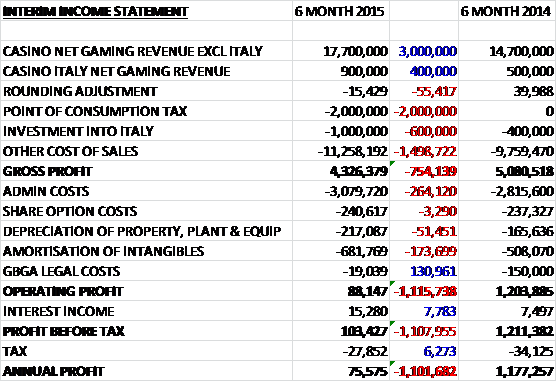
TTRinterimincome

Overall revenues increased when compared to the first half of last year with a £3M hike in UK revenue and a £400K growth in Italian revenue.  Cost of sales increased by more, though, and the £2M point of consumption tax along with the £600K increase in the investment in the Italian business did not help, so that gross profit was some £754K lower.  Admin costs increased by £264K and amortisation grew by £173K but legal costs associated with the UK remote gambling regulatory regime fell by £131K so that operating profit was £1.1M lower.   After a small amount of interest income was more than offset by tax, the profit for the half year came in at just £76K, a decline of £1.1M year on year.

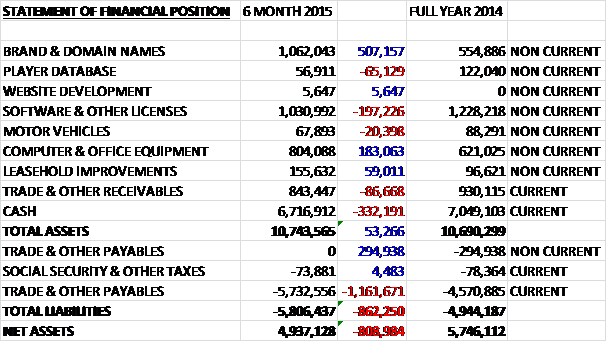
TTRinterimassets

When compared to the end point of last year, total assets increased by just £53K as a £507K increase in the value of brands and a £183K growth in computer and office equipment was partially offset by a £332K fall in cash levels and a £197K decline in software and other licences.  Liabilities also increased during the period driven by a £900K growth in payables.  The end result is a net tangible asset level of £4.9M, a decline of £809K over the past six months.

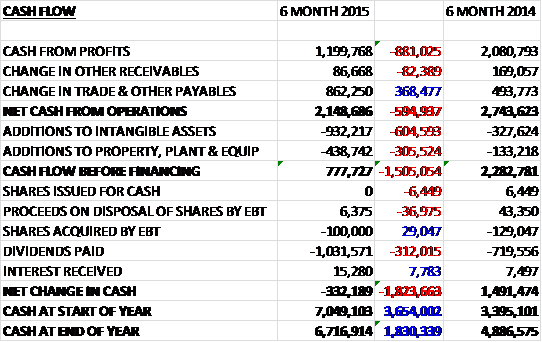
TTRinterimcash

Before movements in working capital, cash profits fell by £881K to £1.2M.  This was improved by a fall in payables so that net cash from operations was £2.1M, a decline of £595K year on year.  The group then spent £932K on intangible assets and £439K on tangible assets to give a free cash flow of £778K which was not enough to cover the £1M spent on dividends so there was a cash outflow of £332K over the period to give a cash level of £6.7M at the period end.

During the period there was a 22% increase in active casino players to 62,214 which reflects the combination of accelerated new player recruitment, up 12%, and improved results from player retention and reactivation activities.  Casino player yields did fall by 5% to £380, though, and casino cost per player acquisition grew by 9% to £197.  The mobile casino did do well with revenues now representing 42% of total casino revenues.

The UK point of consumption tax was introduced in December and cost the group £2M during the first half of the year which probably explains why the group was not very profitable during the period.

The group suffered a £1M loss in Italy during the first half of the year compared to a £400K loss in the first half of last year as a result of the increased marketing activities in the country to capitalise on the strong growth opportunities in that market.  In the country, NGR increased by 67% to £900K with a total of 4,285 new players recruited to give a total of 8,443 active players.  The breadth and quality of games of the casino product in Italy is still behind that of the UK offering with further games to be introduced later in the year which should boost the appeal of the offer.

After the end of the half, the group acquired the remote online gaming business Roxy Palace for £8.4M comprising £2M in cash and the issue of 10M shares.  Of the cash consideration, £1M is payable on completion, £500K in six months and another £500K at the end of December 2016.  The business was founded in 2002 and built up a player database containing 230,000 registered players.  It reported NGR of £10.1M and gross profit of £3.4M last year but this doesn’t include the effect of the point of consumption tax so profits going forward will be much lower.  EBITDA was £1.6M last year so the acquisition does look fairly good value.  The group will continue to operate the acquired brands in the UK going forward.

The second half of the year has started strongly with NGR for the first 12 weeks of the year up 52% excluding trading from the acquired Roxy business.  Roxy also performed well and generated NGR of £2.5M since acquisition with the integration process progressing well.  With the strong start to the period and the good progress integrating Roxy, the board is confident in delivering expectations for the full year.  After a 10% increase in the interim dividend, the shares are currently yielding 3.4% increasing to 3.6% on Numis’ full year forecast.

Overall then, this was quite a difficult period for the group caused by the introduction of the point of consumption tax.  Profits were down because of this and net assets also declined.  In addition operating cash flow fell but the group was still free cash flow positive.  In the UK, the number of casino players grew steadily with mobile doing well but the yield per player fell.  In Italy, the number of players increased but the country is still not at a break-even level yet.  The second half has started well and the acquisition looks decent so, with the view that full year targets are still going to be hit and with a decent dividend yield of 3.6% I will continue to hold.

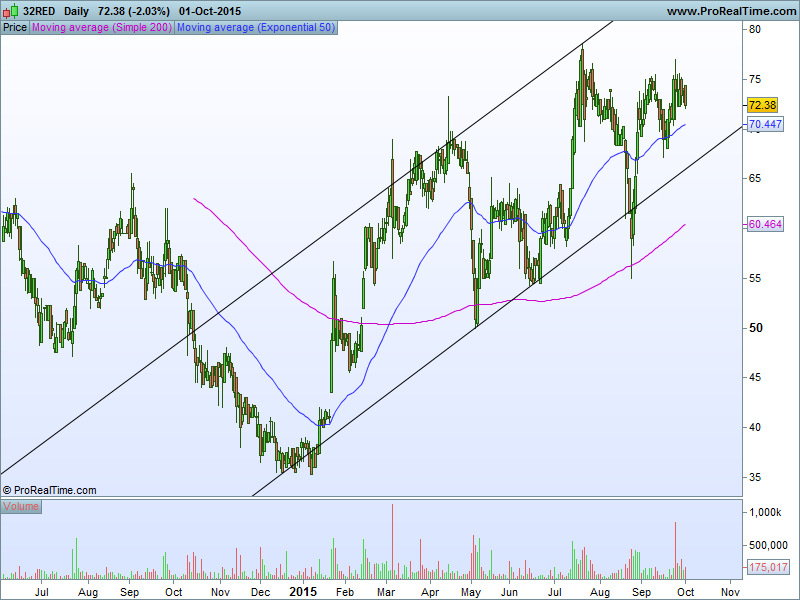
32RED

To my untrained eye the uptrend still looks to be in place.

On the 30th November the group announced that the wife of non-executive director David Bowen acquired 20,200 shares at a cost of about £21K which is his first share purchase.

On the 21st January the group released their pre-close trading update for 2015. Overall, total NGR was up 51% to £48.6M and whilst part of this was due to the £5.2M contribution from Roxy Palace, core 32Red NGR was up 35% to £43.4M with Italian NGR increasing by 54% to £1.7M, casino NGR up 34% to £39.3M and other products growing by 42% to £2.4M.

The increased investment in market that is focused on the group’s strict returns criteria has accelerated organic revenue growth in the UK market. The focus has remained on the development of mobile device gaming and as a result mobile revenues were up 71%, representing 44% of the total.

The relocation of the acquired Roxy Palace business to Gibraltar and the integration of operations was completed in December, slightly ahead of schedule. NGR was in line with expectations during the integration phase and the business will now benefit from increased and more efficient marketing in the year ahead. The board have suggested they will continue to look for further acquisitions in the coming year.

The group have continued to make progress in Italy in what remains a competitive market and they hope to move towards break even in 2016.

Early trading in 2016 has been strong across the company’s products with revenues in the first few weeks up 27% on the same period of 2015 and up 54% including the contribution from Roxy Palace. The company expects to report EBITDA slightly ahead of expectations for 2015 and marketing expenditure will be increased again in 2016 with the board expecting further strong progress in the year ahead.

This is a difficult one. These results are clearly excellent but the focus on NGR and EBITDA does cause me some concern. What is the actual profitability here when we take into account tax and amortisation etc? I have now doubled my money on these shares over the past year so it seems to me now might be a time to book those profits. Probably too soon knowing me but let’s see.

On the 10th February the group announced a special dividend of 3p per share which gives an annual yield of 4.1% at the current share price so this is a nice surprise. Perhaps a potential acquisition fell through?

Air Partner Share Blog – Interim Results Year Ending 2016

Air Partner has now released its interim results for the year ending 2016.

AIRinterimincome

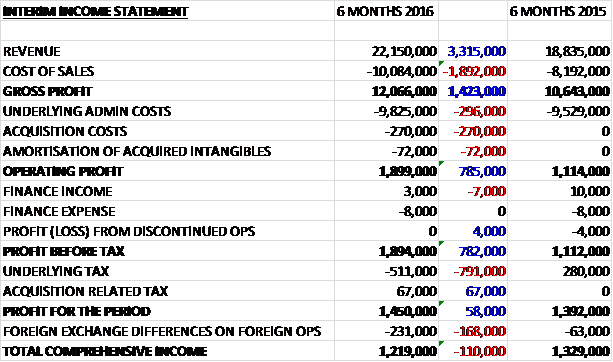
The group no longer seems to split the revenue by sector which is rather annoying but revenue for the period increased by £3.3M and after an increase in cost of sales, gross profit grew by £1.4M.  Underlying admin costs increased by nearly £300K and we also see some £270K in acquisition costs and £72K of acquired intangible amortisation to give an operating profit £785K ahead.  Finance costs were negligible but after a big swing to a tax cost as opposed to the rebate from last time relating to a R&D claim and changing the tax basis for Jetcards in the US, gave a profit for the year of £1.5M, an increase of £58K year on year.

AIRinterimassets

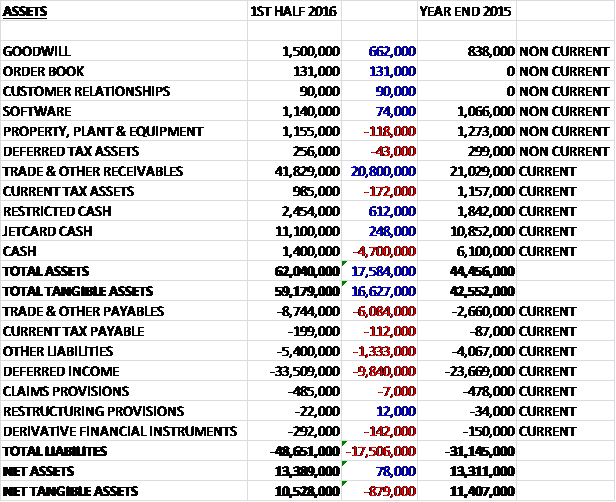
When compared to the end point of last year, total assets increased by £17.6M driven by a £20.8M growth in receivables partially offset by a £4.7M decline in cash levels.  Total liabilities also increased during the period due to a £9.8M increase in deferred income, likely related to the increase in money put on the Air Partner Jetcard; a £6.1M increase in payables and a £1.3M growth in other liabilities.  The end result is a net tangible asset level of £10.5M, a decline of £879K over the past six months.

AIPinterimcash

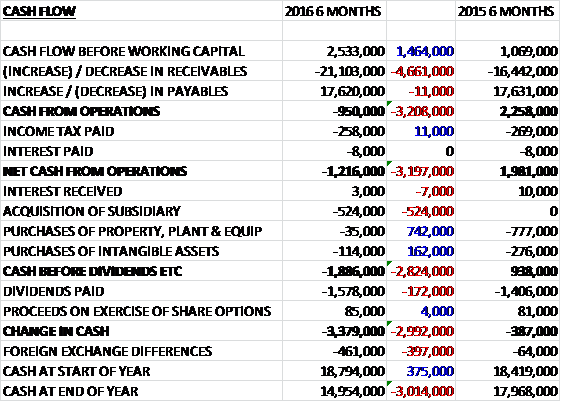
Before movements in working capital, cash profits increased by £1.5M to £2.5M.  A large increase in receivables – apparently due to increased receivables from the larger credit clients – meant that after a slightly smaller tax payment the net cash outflow from operations came in at -£1.2M.  The group then spent £35K on tangible assets, £114K on intangibles and £524K on an acquisition so that the cash outflow before financing was £1.9M.  They also spent £1.6M on dividends so that the outflow for the period was £3.4M to give a cash level of £15M at the end of the half (only £1.4M of this relates to non-jetcard cash).  This is actually a rather disappointing performance in my view.

The underlying operating profit in the Commercial Jet Broking division was £1.7M, an increase of £600K when compared to the first half of 2015.  The growth was largely driven by improved trading in the UK against fairly easy comparatives in the first half of last year, and in Europe which benefited from a larger tour operating programme compared to summer last year.  Within the UK commercial jet business, they increased focus on a clearer sales strategy and improved service levels.  Surprisingly there was a strong contribution from the oil and gas sector and other strength came from demand from football teams and continued government work.

Trading in Commercial Jets in Europe was decent, benefiting from a large tour operating programme as well as a strong performance from the German automotive sector (which might now be under threat due to VW’s woes).  Austria delivered a stable performance but results in Italy were down year on year mostly due to government related work in 2014 which was not repeated this year.  Despite some new customer gains, the performance in the US was behind expectations due to a lower number of one-off charters ad well as less activity that expected from a key customer.

The Cabot operations are now included in the Commercial Jet sector.  The group’s existing aircraft remarketing operations are predominantly in the short-term wet lease market but the acquisition adds significant aircraft sales and dry lease expertise, channels where the group has previously experienced demand from its existing customer base.  Since the acquisition, Cabot has been appointed as the exclusive marketing agent by China Airlines for two Boeing 747-400s as well as by Kenya Airways for four Boeing 777-200ERs.

The underlying operating profit in the Private Jet Broking division was £939K an increase of £349K year on year.  The increase was largely driven by a strong performance in the UK, somewhat offset by a weaker than expected performance in the US.  For Jetcard, the targeted sales focus has seen deposits rise to £13.6M from £11.9M at the same point of last year.  Utilisations have improved by 22% which helped the card deliver its strongest performance since its launch in 2004.  The number of cardholders now stands at 220, up by 45 cards on last year.  The highest increase in JetCard numbers was seen in the US with 23 new cards whilst the UK saw an increase of 15 and Europe added 7.  The ad-hoc performance has been mixed.  While the performance in the UK has been strong, the US and European businesses have experienced a decline in profit when compared to last year.

The underlying operating profit in the Freight division was £394K compared to a break even position in the first half of last year.  The group have continued their work with government aid agencies to assist in a number of geopolitical crises and in addition, good growth has been seen in the UK, German and US businesses, albeit from a small base.  The “Red Track” technology has continued to the success of the aircraft on ground business and it is encouraging to see the focus and investments made in the business deliver an improved performance.

The fall in the non-jetcard cash level is a little concerning.  This is apparently due to working capital movements as a result of increased charter demand from some of the largest credit customers as well as acquisition investments and associated costs.

The group have identified certain components of their customer’s journey that were inconsistent and a programme was put in place to enable them to understand these issues and fix them.  The £485K provision relating to claims was held in relation to the settlement of claims which have been received from third parties following the closure of Air Partner Private Jets with all remaining claims expected to be settled by March 2016.

In May the group acquired Cabot Aviation Services, a global aircraft remarketing broker.  The total consideration was £814K with £514K settled in cash and the rest settled by an equity consideration.  The acquisition came with £264K of intangible assets and generated goodwill of £701K.  In the two and a half months since acquisition the business generated operating losses of £53K on revenues of £43K.

After the end of the period, the group acquired Baines Simmons, an aviation safety consultant, for a net consideration of up to £6M.  The acquisition was funded from a combination of the group’s cash resources and a £3.6M debt facility.

The board remains confident that its expectations for the remainder of the year will be achieved although I have no idea what those expectations actually are.  The success behind the improved trading, notably UK Commercial Jets and the tour operations in Europe, should continue into the latter half of the year.  The board also believe that the momentum with JetCard and the UK’s ad-hoc division in Private Jets can be maintained. Challenges remain in the US, however, along with the sluggishness of private jets in Europe and they are looking at improvements in these areas.

After a 10% increase in the interim dividend the shares currently yield a decent 5.2% but I could find no forecasts or the full year dividend.

Overall then this was a decent period of progress for the group.  Profit improved year on year, but net tangible assets fell.  Although operating cash flow declined, this was due to a large increase in receivables and underlying cash profits improved.  Nonetheless the increase in receivables is unwelcome and the group is not generating any operational cash flow at the moment, let alone free cash.  The performance in all three divisions improved with commercial jets up due to a good UK performance against poor comparatives last year and a good tour operating programme in Europe.  The performance in the US was poor, however, due to less activity from a key customer.

In private jets, the good performance was again driven by the UK with US adhoc orders down.  The non-jetcard cash seems to be on the slide, which is a worry and the cash position is not looking that great any more.  Still, the Baines Simmons acquisition looks to add a different string to Air Partner’s bow and the 5.2% dividend yield is certainly welcome.  I will continue to hold here.

AIR PARTNER

On the 28th January the group released a pre-close trading update. Trading momentum in the second half of the year remained good with a stronger than expected end to the period. As such, the board expect underlying pre-tax profit to be at least £4.2M compared to £2.6M in the prior year. This sounds good to me and I have bought back in here.


AG Barr Share Blog – Interim Results Year Ending 2016

AG Barr has now released its interim results for the year ending 2016.

BAGincome

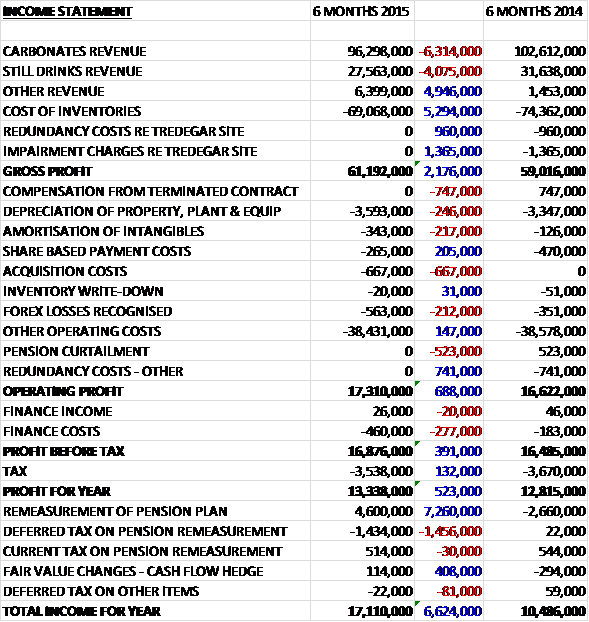
Overall revenues declined when compared to last year as a £5M growth in “other” revenue was more than offset by a £6.3M fall in carbonates revenue and a £4.1M decline in still drinks revenue.  Cost of sales also fell and there were no non-underlying costs such as the £1.4M impairment charge at Tredegar and the £960K redundancy costs at the same site so that the gross profit was £2.2M higher.  We also see the lack of a £747K compensation for the loss of the Orangina contract and a £667K acquisition cost that occurred this year that caused the operating profit to increase by £688K.  Finance costs increased but tax fell somewhat to give a profit for the year of £13.3M, an increase of £523K year on year.

BAGassets

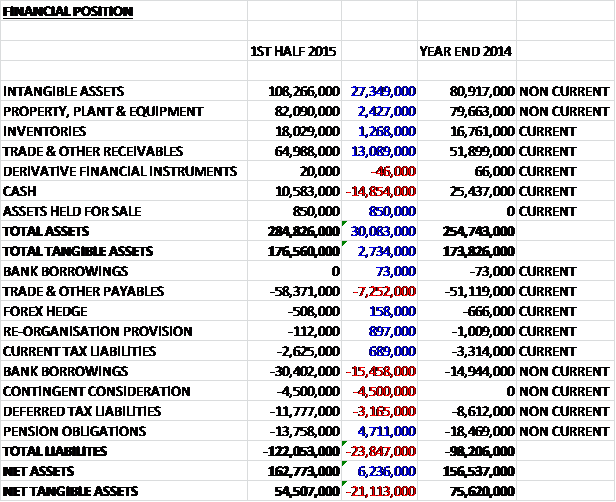
When compared to the end point of last year total assets increased by £30.1M driven by a £27.3M growth in intangible assets relating to the Funkin acquisition and the investment in the BRP project, a £13.1M increase in receivables, a £2.4M increase in property, plant and equipment, and a £1.3M growth in inventories partially offset by a £14.9M decline in cash.  Total liabilities also increased during the period as a £15.5M growth in bank borrowings, a £7.3M increase in payables, a £4.5M increase in the contingent consideration and a £3.2M growth in deferred tax liabilities were partially offset by a £4.7M decline in the pension obligations.  The end result is a net tangible asset level of £54.5M, a decline of £21.1M over the past six months.

BAGcash

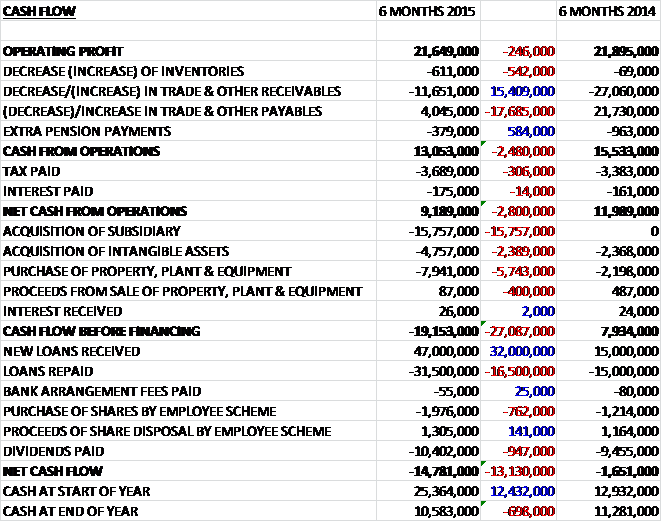
Before movements in working capital, cash profits fell by £246K to £21.6M.  The large increase in receivables was much lower than last year (apparently as a result of activity around the Commonwealth Games) but the increase in payables was also lower so that after a slightly higher tax payment the net cash from operations came in at £13.1M, a decline of £2.8M year on year.  This did not cover the £7.9M spent on property, plant and equipment relating to normal capex and the acquisition of additional land at the Milton Keynes site, along with the £4.8M purchase of intangible assets and when the £15.8M spent on the acquisition is added, the cash outflow before financing was £19.2M.  The group then took out a net £15.5M of new loans which were used to pay the £10.4M of dividends so that the cash outflow for the six month period was £14.8M to give a cash level of £10.6M at the period-end.

There have been a few changes to the numbers reported last time.  There was a miss-statement between the gross profit for carbonates and the other segments.  An element totalling £2.3M of gross profit in relation to carbonates was reported in the “others” segment which seems a bit sloppy to me.  Also, following the implementation of the new ERP system it was concluded that some distribution costs previously recorded in operating expenses would be more appropriately recorded within cost of sales.  This has resulted in a reduction in the gross profit of £3.4M for the year and £1.8M in the half-year.  There was no change to reported operating profit.

The soft drinks market in the period has been impacted by continued price deflation and very poor weather.  As expected the revenue performance has also been affected by the stretching prior year comparatives driven by good weather and the promotional activity around the Commonwealth Games.  The total soft drinks market experienced a 0.6% decline in revenue during the period with a modest growth of 1.4% in volume driven by strong performance in water and the positive performance of the energy drinks category.

In the period, gross margin improved, benefiting from a combination of improved procurement conditions and supply chain savings.  Operating margins were adversely impacted by the combination of lower volumes and investment in the business, however.  The group previously announced a £5M investment at the Cumbernauld factory with the installation of new high speed glass filling capability.  The investment will lead to the discontinuation of the returnable glass bottle system at the end of the year but moving to non-returnable, recyclable glass will support the long term development of this popular product format and should facilitate a number of brand development projects next year.

In the period the group also announced phase 3 of the ongoing investment at the Milton Keynes site.  Their plans include the building of increased warehouse capacity to improve operational efficiency, flexibility and costs as well as the purchase of four acres of development land adjacent to the site.  The total expected cost of the development phase, including the additional land for future expansion, is £11M.

The underlying gross profit in the carbonates division was £50.1M, a decline of £524K year on year; the underlying gross profit in the still drinks and water segment was £8.2M, a fall of £1.9M when compared to the first half of last year; the underlying gross profit in the “other” segment was £2.8M, an increase of £2.3M year on year.  This includes the sale of the acquired Funkin cocktail products, rental income for vending machines and the sale of ice cream.

The past six months have been busy for the group.  The period began with the closure of the Tredegar factory and the subsequent clearance and sale of the site that completed in September.  During the early part of the year they also commissioned carton packaging capability at the Milton Keynes site, increasing capacity and improving flexibility in that product format.  In addition, they have completed the planning and go-live of the Business Process Redesign project which means they are now operating their business on a much more effective, modern and robust system capable of supporting sustained future growth.

The go-live of the BPR proved more challenging than anticipated.  They experienced a period of difficult internal operating conditions after they went live with the system which impacted the revenue performance and customer service.  They have now stabilised their systems and the focus is to realise the business benefits of the new operating platform.

In February the group acquired Funkin ltd, a company which offers a broad range of premium cocktail solutions including fruit purees, cocktail mixers and syrups.  The total consideration paid was £22M comprising £17.5M in initial cash and £4.5M of contingent consideration.  It came with £7.2M of intangible assets and generated goodwill of £15.7M.  Since acquisition the business contributed an operating profit of £700K with a growing international presence in the US and Europe in addition to the leading position in the UK.

During the year the group appointed David Richie, CEO of Bovis Homes on to the board as a non-executive director.

At the period end, the net debt stood at £20M compared to just £3.7M at the same point of last year.  The group still has some £14.5M undrawn on the revolving credit facility and £5M of unused overdraft.  They have committed to the acquisition of £6.4M of property, plant and equipment.

Market conditions across the first half of the year have been difficult and are forecast to remain so.  The business has responded to the market conditions but the poor weather since July has meant that they are not yet at the targeted “run rate”.  Assuming a satisfactory trading performance over the important Christmas period, the board now expects the company to deliver a full year result broadly similar to last year, which doesn’t sound that positive.

After an 8% increase in the interim dividend, the shares are now yielding 2.4% increasing to 2.5% on next year’s consensus forecast.

Overall then, this has been an unusually difficult six months for the group.  Profits did increase, but this was only because of the closure costs of the Tredegar site last year and underlying profit fell.  Net tangible assets declined too, as the acquired Funkin business was mostly made up of intangible assets and operating cash flow fell, with no free cash flow at the end of the period.  Both profits in carbonates and still drinks fell with poor weather, price inflation and difficult comparatives with last year all taking their toll.  The group is also investing a lot into its plant at the moment with some £16M in additional capex outlined in two different projects so there is some risk associated with this, as the teething problems with the BRP system has shown, and net debt has grown.

Market conditions remain difficult with supermarkets continuing to struggle against price deflation and there is no growth expected this year.  All this does mean that the share price has come down a bit, however, and with a forward yield of 2.5% and forward PE ratio of 17.2 the shares no longer look quite as expensive as they did.  With the current uncertainties, though, I do not think that now is the right time to invest in this company.

BARR (A.G.)

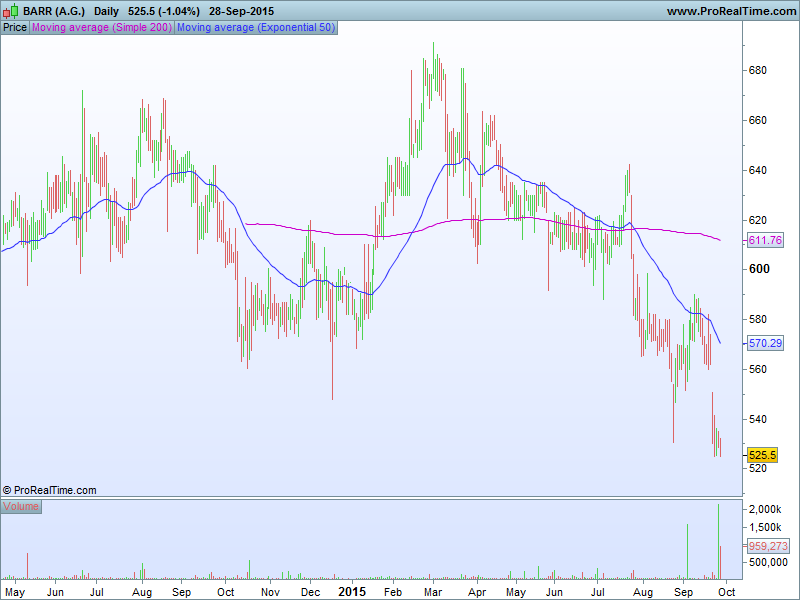
The chart doesn’t look too inspiring…

On the 3rd December the group released a trading statement covering the last 18 weeks. Revenue from the ongoing business increased by 3.9% with year to date revenue from ongoing business falling by 0.2% (actual year to date revenue is down 2.2%). As expected, the revenue performance in Q3 gained momentum as the group put the challenges of the first half of the year behind them. Despite the competitive environment they have maintained market share.

The warehouse expansion project at the Milton Keynes site is nearing completion and good progress is being made on the production capability projects at both Milton Keynes and Cumbernauld, which will provide increased flexibility. The board anticipate that the marketplace will remain highly competitive but assuming a satisfactory Christmas trading period, the company remains on track to meet their expectations for the year.

On the 29th January the group released a pre-close update for Q4 trading. In the quarter they expect to deliver revenue growth of over 2.5%. The soft drinks market in the UK continued to be challenging and highly competitive but business performance continued to improve across the second half of the year and revenue for the year as a whole is expected to be around £257M which is a 1.5% decline on a like for like basis. Across the year the group have tightly controlled their cost base to ensure margins remain steady.

The operational investments in efficiency have continued to make good progress and all of the current projects are expected to be delivered on time and in budget. The implementation issues encountered in the first half associated with the business process re-design go-live have been resolved and free cash flow generations remains strong. Overall they are on course to meet their expectations for the year.

This is a much better update then, trading seems to be improving towards the end of the year which bodes quite well for 2016. Is this enough for me to buy in? I’m not sure, the market remains very competitive and I may be better off sitting this one out. I’ll keep it on watch.

Swallowfield Share Blog – Final Results Year Ended 2015

Swallowfield has now released its final results for the year ended 2015.

SWLincome

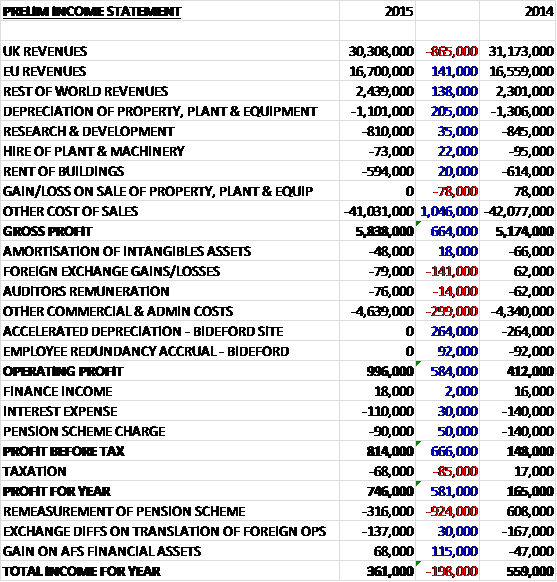
Revenues fell when compared to last year as a £141K growth in EU revenue and a £138K increase in ROW revenue was more than offset by an £865K decline in UK revenue.  Although due to a weakening Euro and strengthening US dollar, revenues on a constant currency basis would have been £900K higher.  Depreciation fell year on year, however, and other cost of sales declined by more than £1M to give a gross profit £664K above that of 2014.  We then see a £141K negative swing in foreign exchange gains/loss and a near£300K fall in admin costs, although there was a lack of £366K in exceptional items that occurred last year so that the operating profit increased by £594K year on year.  Finance costs fell by £78K but tax increased by £85K so that profit for the year came in at £746K, an increase of £589K year on year.

SWLassets

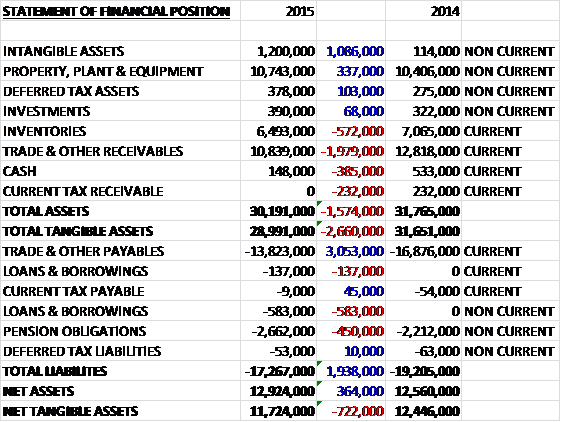
When compared to the end point of last year, total assets fell by £1.6M driven by a £2M decline in receivables, a £572K fall in inventories and a £385K decrease in cash partially offset by a £1.1M increase in intangible assets and a £337K growth in property, plant and equipment.  Liabilities also fell when compared to last year as a £3.1M decline in payables was partially offset by a £720K increase in loans and a £450K growth in pension obligations.  The end result is a net tangible asset level of £11.7M, a decline of £722K year on year.

SWLcash

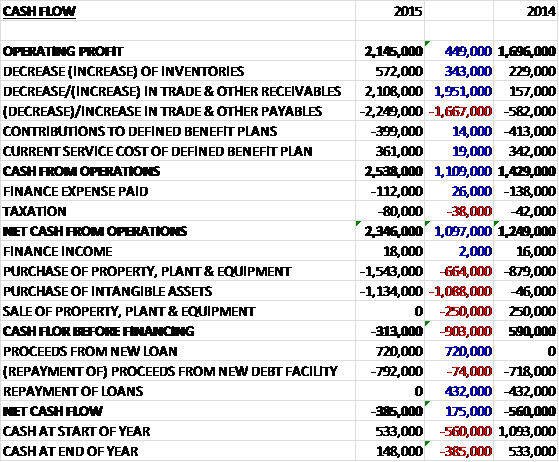
Before movements in working capital, cash profits increased by £449K to £2.1M.  A decline in receivables was broadly offset by a fall in payables but a fall in inventories meant that the cash flow from operations grew by £1.1M which, after tax and interest, became £2.3M, an increase of £1.1M year on year.  The group then spent £1.5M on property, plant and equipment, along with £1.1M on intangible assets – both much higher than last year due to the timing of a major aerosol capital project plus the investment in the cost base optimisation project at Bideford so that before financing there was a £313K cash outflow.  After a small net repayment of loans, the cash outflow for the year stood at £385K to give a cash level of £148K.

During the year the group have secured important new contracts in their drive and build categories that will support further growth.  They have also made their first shipments of their premium beauty brand Bagsy and the value brand Tru continued to build its retail presence.  An increase in margins offset a slight softness in revenues against expectations due to the delayed availability of some materials and the continuing weakness of the Euro.  The overall negative effect of the Euro weakness on profits was £400K during the year.

The group are focusing on the drive categories of personal care aerosols, lip balms, deodorant sticks and roll-ons.  They grew direct contribution margin of 9% and have secured two significant contracts with major global brand owners that will contribute to further growth next year and beyond.

In the year they introduced their new plastic aerosol product in a post-foaming shower gel format.  This project has taken three years to develop and included many innovations to overcome the challenges of pressurisation precision, crimping technology, gassing techniques, formulation compatibility and shrink-sleeving onto heat sensitive PET.  It has enabled them to secure a long term contract with one of their largest customers and provides them with the opportunity to extend this technology to other product categories and customers.

The group have also utilised their product development expertise to create new ranges of products under their own brands as well as those of their customers.  They are positioned to avoid any direct conflict with the existing customer base.  Through targeted campaigns and the use of low cost customer engagement channels such as social media, it is believed that they can build strong brand awareness to support product sales with moderate and sustainable investment levels.

Following the acquisition of the Real Shaving Company brand, it has been integrated successfully and it is performing well.  In addition to its financial contribution, the brand has also added further sales channels which the group will leverage for the other owned brands.  Customer response to the plans for the brand has been positive and first listings for the new aerosol products have been agreed.  The brand was acquired for £1.15M.

The development of the Swallowfield brands progressed during the year.  The premium brand, Bagsy, was introduced in June exclusively online and will be launched with a major national department store chain in October.  Distribution of the value brand Tru has been extended – it is now present in there UK retailers and one in Europe.  The new male haircare brand, MR, will be launched in October into 350 stores of a leading high street health and beauty retailer.  The group continues to work on a number of projects which may lead to the establishment of new capabilities but the success so far of the own brand products means that resources are being deployed in areas that accelerate progress there.

During the year the group completed the consolidation at the Bideford site into two buildings from three, relocating selected manufactured lines to Tabor in the Czech Rep.  This project delivers full year savings of £230K.  They have also identified a project to implement a coordinated upgrade of the energy and waste infrastructure at the main Wellington site, which aims to generate savings of about £150K per annum and is expected to be completed in 2016.

Although it still causes some issues, the pension scheme seems to be improving.  The group entered into a revised deficit recovery plan with the payment falling from £111.5K per annum to £108K per annum over ten years.  Subsequent to finalising the valuation the group entered into a formal consultation with members to close the scheme to future accrual from Jan 2016.

Going forward the board believes that they will deliver further profitability growth in the following year.

During the year the group have reduced their dependency on certain clients but they  do still rely on a relatively small number of important clients with one customer accounting for 14% of revenues and another one accounting for 11%.  At the current share price the shares trade on a rather expensive looking 18.9 but this falls to a much more reasonable 10.3 on next year’s consensus forecast.  At the year-end the group had a net debt position of £5.4M compared to £5.1M at the end of last year which I would like to see come down a bit actually.  After the restatement of the final dividend, the shares now yield 1.6% which increases to 2.4% on next year’s consensus forecast.

Overall then, this seems to be a tentatively positive year for the group.  Although net tangible assets fell during the period, profits increased along with operating cash flows.   The group is still not producing any free cash, however, which means that the dividend payments are not really that prudent in my view.  There seems to be a lot of activity with new brands as the first shipment of the Bagsy brand took place along with the first listings of the acquired Real Shaving Company brand.  The Bideford consolidation should enable savings of £230K per annum which is quite material for a company of this size but the Euro weakness remains a headwind.  With a forward PE ratio of 10.3 and a dividend yield of 2.4% the shares do not look that expensive and although risks remain, I am happy to hold on to my shares here.

On the 12th November the group released an AGM statement covering the first four months of the year and overall trading is line with expectations. Production has started on two significant new contracts with major global brands as previously announced which will positively impact on the second half of the year. Similarly, production and sales of the new plastic aerosol product are performing as planned. The premium beauty brand, Bagsy, is now being rolled out across Debenhams stores nationwide in time for the Christmas trading period and the men’s haircare range, MR, is now present in larger Boots stores across the country. Whilst the board anticipate the challenging retail conditions in the UK and the rest of Europe to continue, they expect to maintain their positive momentum and are confident in the prospects for the year as a whole. This all seems fairly good to me.

AG Barr Share Blog – Final Results Year Ended 2015

AG Barr manufactures, distributes and sells soft drinks. It has manufacturing sites in the UK and sells mainly to customers in the UK with some international sales.  As well as carbonates and still drinks, the group also derives income from water coolers, rental income for vending machines and sales of irn-bru and Rubicon ice cream along with other soft drink related items such as water cups.  Some of the brands include Irn-Bru, Rubicon, Barr, KA, Strathmore, Simply, Tizer, D’N’B, St. Clement’s, Abbott’s and partnership brands include Rockstar and Snapple.

They have now released their final results for the year ending 2015.

BARRincome

When compared to last year, total revenue increased with a £381K growth in carbonates revenue, a £3.3M growth in other revenue, and a £3.1M increase in still drinks revenue.  Cost of inventories fell during the year but last year’s £1M one-off costs at the Milton Keynes development was more than offset by a £1.4M redundancy cost at the Tredegar site and a £1.5M impairment cost of the same site this year.  This meant that gross profits increased by £5.3M.  The group also gained £747K in compensation from a terminated contract relating to the contract for the production and sale of Orangina that was terminated by Schweppes, but distribution costs grew by £1.6M.  Operating leases also increased along with a detrimental movement in trade receivable impairments and a smaller growth in other admin expenses, although there was a lack of £2.1M of merger costs that occurred last year which gave a £4.2M increase in operating profit.  A slight reduction in interest costs was more than offset by a growth in tax so that the profit for the year stood at just under £30M, a growth of £1.8M year on year.

BARRassets

When compared to the end point of last year, total assets increased by £27.9M driven by a £12.5M growth in cash levels, a £7.1M growth in software development costs relating to the implementation of the new ERP system, a £5.8M increase in assets under construction relating to the Milton Keynes phase 2 programme, and a £4.1M growth in trade receivables, partially offset by a £1.6M fall in freehold land and buildings.  Total liabilities also increased during the year as an £18.4M growth in pension obligations, an £8.3M increase in trade payables and a £1.4M growth in accruals was partially offset by a £2.8M fall in deferred tax liabilities.  The end result is a net tangible asset level of £125.6M, a decline of £5.5M year on year.

BARRcash

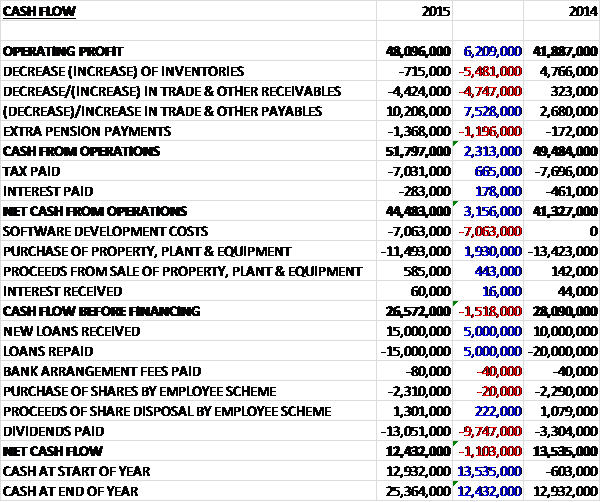
Before movements in working capital, cash profits increased by £6.2M to £48.1M.  A large increase in payables, which were distorted by large capital creditors related to the installation of the Tetrapak line at Milton Keynes was partially offset by detrimental movements in inventories (partly related to the Tredegar site closure,) and receivables.  A £1.4M extra pension payment, along with a lower tax and interest payment meant that the net cash from operations came in at £44.5M, an increase of £3.2M year on year.  The group spent £7.1M of this on software development and £11.5M on the purchase of property plant and equipment to give a free cash flow of £26.6M.  After a £13.1M payment of dividends and a net £1M purchase of shares by the employee scheme the cash flow for the year was an impressive £12.4M to give a cash level at the year-end of £25.4M.

The UK soft drinks market entered a deflationary phase towards the end of the year but over the year as a whole the market experienced a 0.2% volume decline and a 0.4% value growth.  The year on year figures were impacted by exceptionally warm weather the year before and in volume terms carbonates declined by 1.3% following strong growth last year.  The still category saw volumes increase by 0.8% with a 0.2% decline in values.  The water category overtook cola to become the largest single category by volume.  The energy category continued to experience growth with a 4.1% increase in values and fruit drinks also grew but significant declines continued in fruit juice, dilutes and sports drinks.

Geographically, sales in England and Wales, which account for about 60% of the total, grew by 3.5% and international sales increased by 7.9%.  The situation in Scotland remained strong, growing by 1.2% but future growth potential lies outside Scotland.

The gross profit in the Carbonates division was £102.2M, a growth of £3M year on year. Total Irn-Bru sales grew by 1.6% with sugar free contributing strongly to this growth.  The brand benefited from the sponsorship of the Glasgow commonwealth games.  Sales of Irn-Bru ice cream was just under £1M.  Sales of the brand in England and Wales increased by 5.6%, driven by increased sales in Northern England with sugar free growing by over 20%.  Rubicon delivered a solid performance with growth of 3.4%.  Across the Rubicon portfolio, carbonates have delivered growth of 8.1% with a 1.5% growth in stills reflecting the challenges of the juice market.  Rubicon benefited from increased brand investment with the launch of Coconut Water which developed as a sub-category, and in January 2015 they launched the Rubicon brand into the chilled category, available in Mango, Guava and Lychee.

The Barr range of flavoured carbonates continued to grow steadily year on year with sales growth over 6%.  The launch of Xtra Cola and the further development of new flavours and formats all helped to underpin the strong performance.

The gross profit in the still drinks and water division was £17.3M, an increase of £900K when compared to last year.  Strathmore had a very good year with growth of over 20%.  The development of the brand was supported by the huge level of awareness driven by the Commonwealth games sponsorship with athletes from around the commonwealth using the brand.  Since then the group have partnered with Scottish Rugby to further promote the brand.  The group have also launched Strathmore Twist into the growing flavoured water category and they expect this to show strong future growth.

The gross profit in the “others” segment, including ice cream was £3.7M, an increase of £3.1M when compared to 2014.  The group exited the non-core water cooler business in the second half of the year which was sold to Eden Springs, realising a small gain on the sale of the business.  They have also exited the Findlays bottling site in East Lothian.

As far as the partnership brands are concerned, Rockstar continued to grow in line with the market following the prior year’s outstanding growth performance.  The brand has recently launched Rockstar Energy Waters and has also expanded into Scandinavia.  The Orangina brand exited the portfolio in July but in September the group launched a new partnership with Dr. Pepper Snapple group to develop the Snapple brand in the UK and on a wider European basis with the brand management moving to Barr in January 2015.  This venture does have the potential to have quite an effect on future growth in my view.

During the year the group announced the closure of its manufacturing site in Tredegar.  This resulted in an impairment charge of £1.5M in respect of buildings and plant at the site which have been written down to recoverable amounts.  Some £485K of related redundancy costs were incurred during the year with a further provision of £942K being recognised.  Also, as a result of the finance, telesales, distribution, demand and supply planning reorganisation, a curtailment of the pension plan has arisen.  This resulted in an exceptional credit arising from the reduction in the pension obligation following a fall in the number of employees remaining in the scheme.  The value of this credit was £523K.  A tax credit of £687K has been recognised as a result of the total exceptional costs.

The investment in new carton facilities in Milton Keynes has progressed with the commissioning phase under way at the moment.  The project has been delivered on time and within budget which has resulted in the Tredegar site being closed in February 2015.  The new Milton Keynes facility in combination with the strong operating performance of the other sites will allow the group to improve their overall operating cost base and efficiency.  In the coming year the expansion related capital expenditure is likely to continue with the focus being on the further investment at Milton Keynes and the implementation of the new ERP system in June.

Last year, certain freehold properties were transferred to a partnership in order to lease the properties to a group company and provide the pension scheme with a distribution of the profits.  The group has the ability to control the partnership by making additional payments to the scheme and it is therefore treated as a consolidated entity and the value of the properties sold to the partnership and leased back to the company remain on the balance sheet.  As part of the funding arrangement the group made a one off payment to the pension scheme of a hefty £20.4M to allow it to invest in the partnership and this was treated as a prepayment of pension contributions.

The group currently has a net cash position of £10.4M compared to a net debt position of £2.1M last year.  Of the total £40M of loan facilities, some £15.1M was drawn down and £24.9M was left undrawn relating to £5M in the three year revolving credit facility, £15M in the revolving credit facility for Milton Keynes and a £5M overdraft. There are also £16.6M of outstanding operating lease commitments off the balance sheet.

After the year-end the group acquired Furkin Ltd, a company that offers a broad range of premium cocktail items such as fruit purees, cocktail mixers and syrups.  The total cash consideration was £16.5M plus up to a further £4.5M in contingent consideration, funded by an extension to the existing credit facilities.  The acquisition gives the group an opportunity to enhance their position in the on-trade and hotel, restaurant and café hospitality market segments.

Overall market conditions are expected to remain challenging.  The UK soft drinks market is experiencing a period of price deflation which will make it more difficult for many businesses to deliver the top line growth of recent years.  Whilst the year has started slowly, reflecting tough comparative trading and promotional phasing, the board are confident they will be able to “unlock the significant potential that Barr offers its shareholders in the year”.  Whatever that means…

At the current share price the shares trade on a PE ratio of 22.8 which falls to 19.2 on next year’s consensus forecast which is certainly not cheap but you pay for quality I guess.  After a 10% increase in the total dividend for the year, the yield is currently standing at 2.1% increasing to 2.3% on next year’s forecast.

Overall then this has been a steady year for the group.  Profits increased year on year, as did operating cash flow and they produce plenty of free cash in what seems to be a very cash generative business.  Net tangible assets did fall, however, when compared to last year.  The soft drinks market as a whole is rather stagnant in this country although the energy and water categories are both increasing.  For AG Barr’s brands, Strathmore water was the outstanding performer but the others seem to be growing faster than the market too for the most part.  The partnership with Snapple looks interesting but the loss of Orangina is a little disappointing.

The new Milton Keynes site is likely to improve efficiency going forward but the high level of capital expenditure will continue into next year.  There is a decent amount of net cash as a safety net but this has been spent on the Furkin acquisition which, although opening up a potentially interesting new market, seems to be rather expensive and no profit figures are given for the business.  Going forward, the pressure from supermarkets to reduce prices is having a detrimental effect on the market and the group has made a slow start to the new-year.  This is without doubt a quality business but given the market problems at a dividend yield of 2.3% and a PE ratio of 19.2 the shares look a little expensive to me.

Safestyle Share Blog – Interim Results Year Ending 2015

Safestyle has now released its interim results for the year ending 2015.

SFEinterimincome

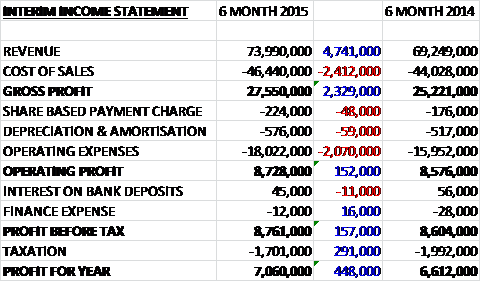
When compared to last year, revenues increased by £4.7M and after an increase in cost of sales, gross profit was some £2.3M ahead.  Operating expenses also increased, mainly as a result of an increased spend on TV and digital marketing, and a small fall in bank interest received was broadly counteracted by a fall in finance expenses so profit before tax was £157K higher which, after a decline in tax, meant that the profit for the half year came in at £7.1M, a growth of £448K year on year.

SFEinterimassets

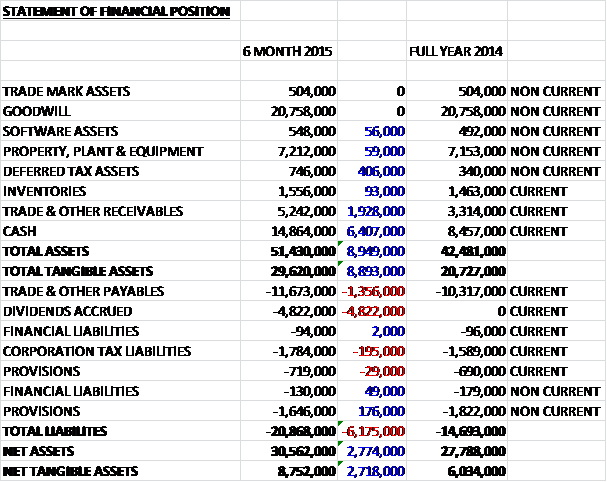
When compared to the end of last year, total assets increased by £8.9M driven by a £6.4M growth in cash levels, a £1.9M increase in receivables and a £406K increase in deferred tax assets.  Liabilities also grew over the past six months due to a £4.8M dividend accrual and a £1.4M growth in payables.  The end result is a net tangible asset level of £8.8M, an increase of £2.7M over the past half year.

SFEinterimcash

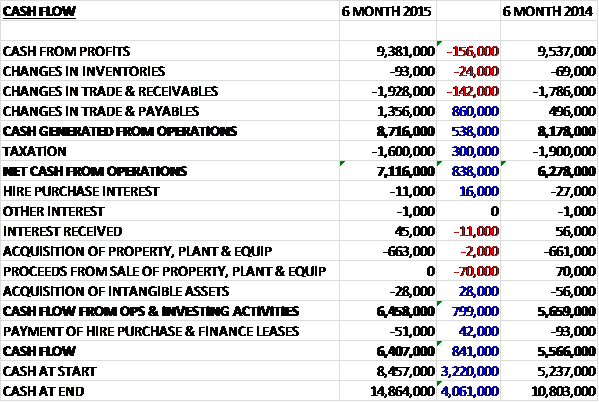
Before movements in working capital, cash profits fell by £156K to £9.4M when compared to the first half of last year.  An increase in receivables was not entirely offset by a growth in payables, which was higher than last year and after a slightly lower tax payment, the net cash from operations came in at £7.1M, a growth of £838K when compared to the first half of 2014.  There was not much in the way of capital expenditure, with the £663K spent being very similar to last time and relating to the investment in manufacturing equipment as part of the five year programme, along with £28K spent on intangible assets, half that of the first half of 2014.  The cash flow for the period as a whole was an impressive £6.4M to give a cash level of £14.9M.

The market in which the group operates contracted by another 10.1% by volume during the first half, with further deterioration evident in July and August.  These figures are rather surprising given the generally favourable consumer economic conditions and the order trends seen with Safestyle and I have to say I am a bit sceptical.

The group’s enhanced range of consumer finance offerings are proving to be attractive to their customers and provides a competitive advantage that helps the group increase market share, up from 8.5% to 9.5% in the period.  This does have a knock-on effect of increasing costs and therefore reducing gross market for the year as a whole, however.  In addition, they have invested in additional marketing expenditure during the period and it is expected that this increase in advertising commitment to continue in the second half.

The conservatory refurb programme was launched in April and early order intake was apparently encouraging, with installations increasing in volume in the second half.  It is expected that this product will support growth next year, contributing for a full year.

The total volume of frames installed increased by 3.8% to 141,712. Leads generated from media and online marketing grew by 12% and the average unit sales price was up 2.8% to £517. The price list increase implemented at the start of the year was secured, with the frame prices increasing steadily through the first half of the year as the 2014 order book was installed.  As well as an increase in prices and volumes, gross margin also improved during the period due to the price increase and a reduction in PVCu costs as a result of lower resin prices which was partially counteracted by the introduction of mandatory insurance backed guarantees in June 2014, the increase in glass prices from August 2014 and the increased subsidy costs as a result of the continued transition to promotional finance offers.

During the period the group opened a new sales branch in Watford.  Order intake since the period end has been buoyant, aided by the improved customer finance offer which was launched in June, and the recently introduced conservatory upgrade product which is gaining momentum.  The board remain confident of delivering a year outturn in line with market expectations and expect the market contraction to slow.

After a 9.7% increase in the interim dividend, at the current share price, the shares yield 3.6% which increases to 4.2% on the full year forecast.  At the period end, the group had a cash position of £14.9M, an increase of £6.4M during the period.

Overall then this was a decent half year for the group.  Profits were up, net assets increased and operating cash flow grew year on year, but this was only due to the larger increase in payables than large time and cash profits actually fell.  The group did generate copious amounts of free cash, however.  Despite the market contracting by 10%, Safestyle increased both volumes and price per frame and going forward the consumer finance offering along with the new conservatory refurb business is expected to drive further growth.  With not debt and a full year forecasted yield of 4.2% this looks like a decent investment to me.

On the 22nd October the group announced that it has issued 2,367,143 shares following the exercise by Zeus Capital of its warrant over new shares in the company granted at the time of the IPO.  The warrants have an exercise price of £1 per share and as a result of the exercise, the company will receive cash proceeds of nearly £2.4M.  The total number of shares in issue will now be 80,242,143.

On the 9th November it was announced that CEO Steve Birmingham purchased 40,000 shares at a value of £87.3K and now owns 4.9% of the company. The share price had been slipping a bit recently so this looks to be timed to try and halt that – still, a nice vote of confidence from the top man.

On the 25th January the group released a year-end trading update. The company has continued to trade well, with revenue for the year increasing 9.5% to £148.9M. In addition, pre-tax profit has shown good progress and is expected to be in line with consensus market expectations of £17.6M as the expected strong performance in the second half of the year saw double digit growth in both sales and profit.

Against the backdrop of a weaker market in 2015, the rollout of the group’s enhanced consumer finance offer helped to drive growth in the year, particularly in the second half. As expected, operating margins will show some decline in H2 as a result of the additional subsidy costs related to this offer, however. They have continued to increase market share, up from 8.48% at the end of 2014 to 9.46% at the end of last year within an overall market that contracted by 6.6%.

The number of installations increase 4.3% to 60,134 and the order book at the year-end was up 1.2% on the prior year. The board have seen a strong start to 2016 and they are confident of building on the progress made in the last year.

Overall then, this seems like a strong update although the order book growth does seem quite modest. I will continue to hold.


Central Asia Metals Share Blog – Interim Results Year Ending 2015

Central Asia Metals has now released its interim results for the year ending 2015.

CAMLinterimincome

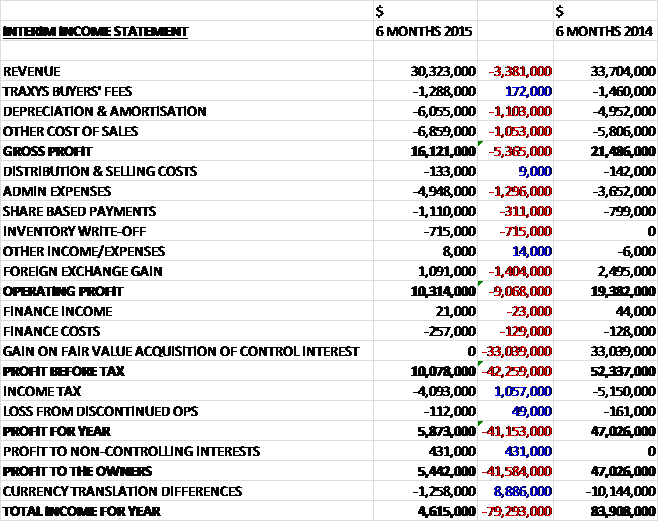
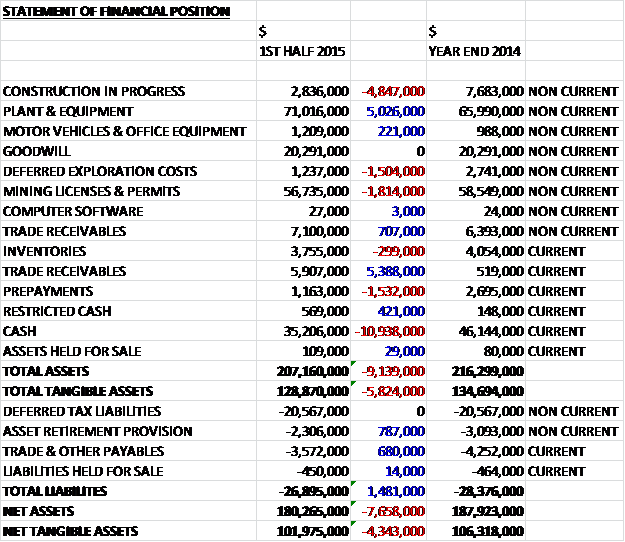
Revenues fell by $3.4M when compared to the first half of last year and both depreciation and other cost of sales increased year on year to give a gross profit some $5.4M lower.  Admin expenses increased by $1.3M, the foreign exchange gain was $1.4M lower than last time and there was a $715K inventory write-off so that operating profit fell by $9.1M.  There was no gain on the fair value acquisition of the acquired assets but tax was somewhat lower to give a profit attributable to the owners of $5.4M, a decline of $41.6M year on year.

CAMLinterimassets

When compared to the end point of last year, total assets fell by $9.1M driven by a $10.9M decline in cash, a $4.8M fall in construction in progress, a $1.8M decrease in mining licenses and permits, a $1.5M fall in deferred exploration costs due to the re-measurement of the Copper Bay valuation and a $1.5M decline in prepayments, partially offset by a $5M increase in plant and equipment and a $5.4M growth in trade receivables as a result of $4.5M owed for the sale of copper for June deliveries which was received in early August.  Total liabilities also fell during the half year due to a $787K fall in asset retirement provisions and a $680K decline in payables.  The end result is a net tangible asset level of $102M, a decline of $4.3M over the last six months.

CAMLinterimcash

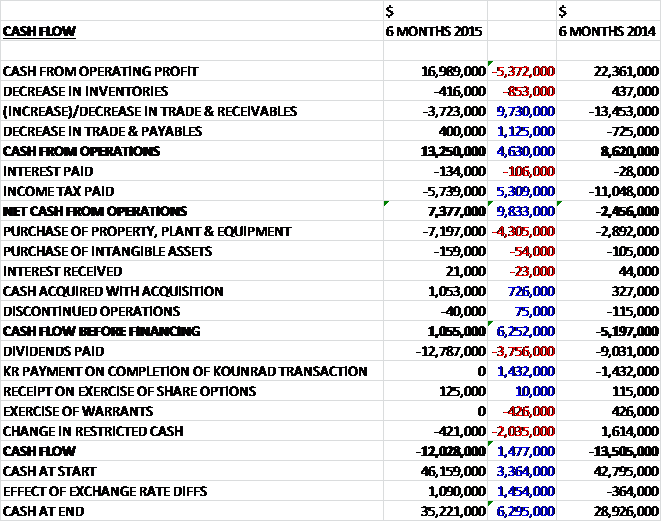
Before movements in working capital, cash profits fell by $5.4M to $17M.  Although receivables did increase, they did so much less than during the first half of last year and we also see the amount of tax paid almost halve so that the net cash from operations came in at $7.4M compared to a net outflow of $2.5M at this point of last year.  The group then spent all this cash on property, plant and equipment ($7.2M) and intangible assets ($159K) so there was not really any free cash.  The group then paid out a lot in dividends so that the cash outflow for the period was $12M to give a cash level of $35.2M at the end of the first half of the year.

The total copper production in the first half of the year was 5,444 tonnes, an increase of 7% year on year.  Total copper sales increased by 9% to 5,120 tonnes with an average price achieved being $5,936 per tonne compared to $7,049 per tonne in the same period of last year.  Towards the end of August the copper prices had declined close to $5,000 per tonne.  C1 cash cost of production was $0.75 per lb compared to $0.72 per lb in the first half of last year with the fully absorbed unit cost being $1.87 per lb.  The guidance for the full year is now 12,000 tonnes of copper despite the incident reported previously.

The increase in copper production was largely due to the expanded boiler house capacity at the plant resulting in higher solution volume treatment rates during the winter months.  As previously announced, an incident occurred on site towards the end of June which resulted in about a third of the organic inventory being lost to the dumps within a very short time frame.  On inspection it was identified that the weir plate system had failed in the recently commissioned SX mixer settler, allowing some of the organic inventory to escape from the circuit via the raffinate system and on to the dumps.

The failure was rectified but the loss of inventory and the subsequent lead times to replace it resulted in the revision of the 2015 full year production target from 13,000 tonnes to 12,000 tonnes of copper.  At the end of August all of the organic inventory had been replenished and the plant was gradually being ramped up to capacity levels.  The incident cost a total of $700K arising from the write-off of the lost organic inventory.  Shortly after the period-end the group experienced their first major accident on site.  The accident resulted in injuries to two employees who are being given support to make a full recovery.

The extended SX-EW facility was commissioned ahead of schedule in May.  The programme included construction works and equipment installation, all undertaken by company personnel.  The extra mixer-settler tank has increased the plant’s solution treatment capacity by 33% to 1,200 cubic metres per hour, and the additional 24 electro-winning cells have increased the plant’s daily plating capability by 42% to 50 tonnes of copper.  The infrastructure upgrade also included the installation of an additional 10MW transformer substation.  The stage 1 expansion and additional 5.6MW boiler capacity installed towards the end of 2014 have increased the plant’s name plate capacity from 10,000 to 15,000 tonnes at a cost of approximately $13M against a budget of $15.5M.  The application to the relevant authorities for the required permits to allow copper extraction from the Western dumps are in progress and approvals are expected to be received by the end of 2015.  The stage 2 expansion therefore remains on track for production in 2017.

At the period-end, the group subscribed for 135,621,610 newly allotted shares in Copper Bay ltd for $3M which increased their shareholding from 50% to 75%.  Following this investment, management has reconsidered the accounting treatment of the initial $3.2M investment in 2013 and have fully consolidated the Copper Bay group at historical cost.  An intangible asset of $3.2M recognised in 2013 equal to the cash consideration paid for the initial 50% shareholding has been reduced by $1.6M.  The feasibility study has now commenced and a project manager has been appointed.  It will work towards providing more accuracy and confidence regarding all aspects of the project.  In Mongolia, the group continues to hold for sale the assets it owns.

In May the company completed a court approved capital reduction scheme which resulted in $67.1M being transferred from the share premium account to distributable reserves.  A condition of the capital reduction scheme was to set aside an amount into a restricted bank account which would cover certain creditors as of the effective date of the capital reduction.  The balance of this restricted bank account is currently $400K.

At the year-end, non-current receivables included $7.1M relating to the amount owed to the group by the Kazakhstan government for VAT.  The group is in the process of appealing to the authorities and the outcome may not be known until early 2016.  A portion of the outstanding balance is being recovered through the offset of VAT liabilities on local sales of copper cathode.

After the period-end the Kazakhstan government transitioned to a free floating exchange rate of the KZT allowing the market to set the price.  As a result during the month, the rate of the KZT depreciated approximately 37% compared to the end of the first half of the year.  This will impact the results and net asset position in future reporting periods.  For example, a 30% devaluation impact on the net assets of $73.5M denominated in KZT is a reduction of $22M.  The immediate impact of the change is positive, however, as about 60% of the cost base is denominated in KZT and copper is mostly sold in USD.

At the current share price the shares yield an impressive 7.2% but this reduced to 5.2% on the full year prediction.  There is no debt so the net cash currently stands at $35.8M compared to $46.3M at the end of last year.

Overall then this was a difficult period for the group.  Profits declined, along with net assets and although operating cash flow improved year on year, this was only due to a smaller increase in receivables than last time and less tax paid with the underlying cash profits declining.  Although both copper production and sales increased the reason for this sluggish performance is due to the average price obtained per tonne of copper falling from $7,049 to $5,936.  What’s more, this has since fallen even further to about $5,000 per tonne.  Also, the loss of some $700K-worth of organic inventory hasn’t helped.

Going forward, the increase in production enabled by the upgrade does bode well and with the feasibility study at Copper Bay starting, there could be some uplift from this too.  The strong decline in the Kazakhstan currency should reduce costs but it will also reduce the value of the local assets so I am unsure as to the effect of this development.  With a dividend yield of 5.2% there is some value offer at this high-quality producer but with the Copper price continuing to struggle with an uplift difficult to envisage at this time, I do not think I will be jumping in here just yet.

CENTRAL ASIA

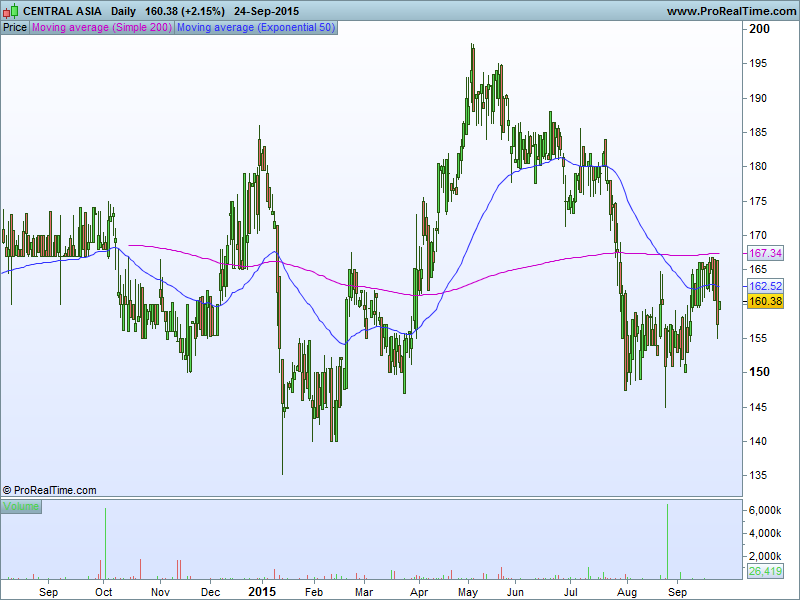
The chart still doesn’t look that inspiring.

Copper Full1215 Future

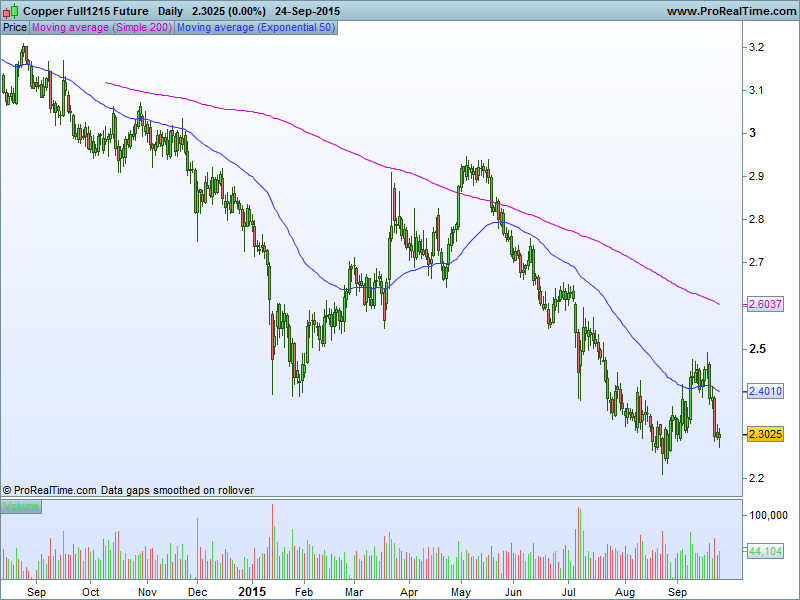
The copper price chart certainly doesn’t – the recent recovery seems to have been short-lived.

On the 5th October the group released a production update covering Q3.  Production in the year to date has reached 8,410 tonnes compared to 8,432 tonnes during the same period of last year; year to date sales were 7,699 tonnes compared to 7,055 tonnes and there was a record monthly copper output of 1,216 tonnes in September itself.  Production in Q3 pf 2,966 tonnes was lower than the 3,337 tonnes produced in Q3 last year due to the operational incident which resulted in a quantity of the organic inventory being lost.  The impact at Kounrad was temporary, however, and the plant returned to capacity in early September.  The guidance for the year remains at 12,000 tonnes.

On the 23rd November the group announced that it has received the regulatory approvals required for the Stage 2 expansion programme of its Kounrad solvent extraction and electro-winning copper recovery project in Kazakhstan with the Ministry for Investment approving an amendment to the project’s existing subsoil use contract. This approval gives the group the right, under the law, to exploit the copper contained in the Western dumps. The procurement of materials and equipment for the programme is now underway with the capital cost remaining within the $19.5M estimate. The construction works are scheduled to start in March 2016 and will be executed primarily by company personnel.

The second part of the year has seen an overall increase in production volumes and a record monthly production of 1,285 tonnes of copper has been achieved in October. This increase, together with an approximate 65% devaluation of the Kazakh Tenge against the dollar results in downward pressure on the unit cost of production which is lucky given the fall in the price of copper over recent weeks.

On the 8th December the group announced that Roger Davey had been appointed as a non-executive director. He has over 35 years’ experience in the international mining industry and is also non-executive director of a number of other companies in the sector such as Atalaya Mining, Orosur Mining and Condor Gold. Until 2010, he was Senior Mining Engineer at N M Rothschild.

On the 6th January the group released a 2015 production update. During Q4 the group produced 3,661 tonnes of copper compared to 2,701 tonnes in Q4 last year, which brings the total production for the year to 12,071 tonnes, an increase of 8.4% year on year. They sold 12,040 tonnes of copper cathode during the year, an increase of 880 tonnes. These sales were predominantly through off-take arrangements with Traxys, which has been retained as the group’s offtake partner through to the end of 2018 with terms that provide some cost savings. As of the end of the year, the group’s cash position was $42M.

In H1, the C1 cash cost was $0.74 per pound and for the full year this is expected to be between $0.65 and $0.70 with the reduction due to efficiency improvements, increased copper production and the devaluation of the local currency. The company is confident that 2016 C1 cash costs will be maintained within the 2015 guidance range of $0.65 and $0.70 per pound.

The company is now targeting increased copper production for 2016 to between 13,000 and 14,000 tonnes. Consistent monitoring and analysis of the copper leaching rate since production started in 2012 indicates that the recovery of copper from the dumps is taking slightly longer than originally projected but the company remains confident of producing the same total tonnage of copper from the Kounrad resource as previously estimated, thereby extending the life of the operation beyond 2030.

The SX-EW plant’s increased nominal capacity of 15,000 tonnes per annum is predicted on two inputs: the throughput of volume of pregnant leach solution to the plant from the dumps, and the grade of copper within the solution. The plant is now capable of handling up to 1,200m cubed of PLS per hour and this throughput was achieved in Q3 but due to the seasonal temperature variations at the site, the average annualised throughput is estimated at about 80% of design.

The combination of a longer leaching cycle, seasonal variations to the volume of PLS and a stabilisation of the long run PLS grade means that he company believes a production guidance range of between 13,000 and 14,000 tonnes of copper cathode is more appropriate to ensure sustained production over an extended period.

The cost discipline combined with the weakening of the Kazakh Tenge means that the board are condfident that they can continue to generate positive cashflows from the operations at Kounrad despite the current market headwinds which have seen copper prices drop to a six year low. The dividend policy of returning a minimum of the 20% of the annual gross revenues to shareholders therefore remains in place.

As previously noted, this is no doubt a quality outfit and one that I would normally wish to own shares in, but the recent collapse in the price of copper makes me reluctant to jump in here.

Martin & Co Share Blog – Interim Results Year Ending 2015

Martin & Co have now released their interim results for the year ending 2015.

MCOinterimincome

Revenues increased then compared to the first half of last year as a £30K fall in franchise sales was more than offset by a £1.1M increase in management service fees with Xperience contributing £900K of the growth and Martin & Co contributing £200K, a growth of 10%, along with a £19K growth in other revenues.  Cost of sales also fell somewhat to give a gross profit some £1.1M ahead of last time.  Depreciation and amortisation increased by £119K year on year due to the amortisation of acquired intangibles and other admin expenses grew by £471K due to a £300K increase in personnel costs relating to the Xperience brand and the rest on other admin expenses before a £115K charge relating to redundancy costs due to reorganisation following the acquisition of Xperience, meant that the operating profit was £395K higher.  We then see a £43K bank interest charge and a £68K increase in tax to give a profit for the year of £919K, an increase of £288K year on year.

MCOinterimassets

When compared to the end point of last year, total assets increased by just £28K driven by a £394K increase in cash, and an £84K growth in prepayments and accrued income, partially offset by a £255K fall in assets held for sale and a £82K decline in the master franchise agreement.  Total liabilities fell during the period, mainly due to a £250K decline in the bank loan and a £115K fall in deferred tax liabilities.  The end result is a net tangible asset level of £549K, an increase of £542K over the past six months.

MCOinterimcash

Before movements in working capital, cash profits increased by £508K to £1.3M. After a £49K interest charge and a £196K tax payment, the net cash from operations came in at £927K, an increase of £285K year on year.  The group then only invested £5K in capital expenditure and received £287K from the sale of intangible assets relating to the sale of the managed portfolio to G Fisheries along with deferred consideration on owned offices disposed of in 2013, along with £29K in interest to give a cash flow of £1.2M before financing.  The group then paid back £250K of the loan and paid out £594K in dividends to give a cash flow for the period of £394K and a cash level of £3.8M at the period-end.

During the year the group added new office openings in Bristol and Gloucester under the CJ Hole brand and in Kingston, Chester and Plymouth under the Martin & Co brand.  It is anticipated that that a further two offices will be opened for CJ Hole in Worcester and Cirencester in the second half.  At the period-end, the group had 284 offices which were franchised and operated by 239 franchisees.

In lettings, high tenant demand continued with 65,917 viewings in the period compared to 63,698 in the first half of last year and the total tenanted managed portfolio across the group remained stable at about 44,000.  Apparently, following the announcement in the budget of changes to landlord tax allowances, a survey suggested that 90% of landlord clients intended to maintain or expand their portfolio.

At the end of the half year, there were 164 Martin & Co offices offering an estate agency service with 3,079 properties listed for sale compared to 145 offices and 2,161 properties listed for sale at the same point of last year.  Since September the group has also offered a “no frills” online agency service but there has been very limited take-up with less than 5% of lettings and 1% of estate agency revenue generated from this source.  There was a slight dip in listings at the Xperience offices with 4,730 listings compared to 5,465 in the first half of last year which suggests that estate agency activity has been slower this year.

A new factor this year has been the length of time it takes for a sale to progress to completion, increasing from 3 months traditionally to between four and five months this year.  It is thought that this may be as a result of reduced capacity in conveyancing firms.  At the end of the period, the pipeline of sales agreed stood at £4.9M for Xperience and £1.7M for Martin & Co compared to £4.65M and £820K respectively.

The group have now substantially completed the integration of the Xperience divisional functions into the head office.  They will be increasing their focus in the second half of the year on franchise sales activity as they believe that each of the five brands is capable of further development through a mix of franchisee recruitment, encouragement for existing franchisees to expand and the conversion of competitors to a franchise model.

The lettings business has traditionally performed more strongly in the second half of the year and the board expect this to be the same for the estate agency business.  The slower start to estate agency transactions this year is apparently reversing and the value of transactions exchanged at £6.6M was 21% higher in June than in the same month last year.

During the period the group sold its 374 lettings properties in Saltaire, its main franchise operator in the region, G Fisheries ltd.

The group currently has unutilised debt facilities of £2.75M available should it need them, along with cash balances of £3.8M and the CEO has stated they might go for another acquisition if the right target presented itself.

The UK housing market is recovering and the buy to let sector remains healthy with all the drivers for further growth remaining in place.  During the period, management spent considerable time during the half year consolidating the acquisition of Xperience and the value of the business materialised despite some restructuring costs.  Trading in the second half of the year is historically stronger and management is confident that the group is well placed to deliver a strong performance.

After a 38% increase in the interim dividend, at the current share price, the shares are yielding 2.8% which increases to 3.2% on the full year consensus forecast.

Overall then this was a good set of results for the group.  Profits increased year on year, net assets were up as the bank debt was paid back and operational cash flow increased which, due in part to negligible capex, gave rise to a decent amount of free cash.  The estate agency seems to be gaining traction and the lettings market seems to be strong.  The dividend yield for the full year is currently 3.2% which seems to be a decent incentive to me so I have bought in here.

MARTINCO

On the 22nd October the group released a trading update covering the first nine months of the year.  Total revenues have increased by 47% to £5.3M and total management service fees increased by 64% to £4.6M.  Management fees from the lettings business grew by 33% to £3.5M and management fees from the sales business grew five-fold to £1M with this growth primarily attributed to the Xperience acquisition last October.  The Martin & Co branded network achieved 6% growth in fees from lettings and 78% growth from sales.  All in all, trading up to the end of September has been in line with expectations.

On the 20th January the group released a trading update covering the year ending 2015. Overall revenue was up 38% to £7.1M with a strong 53% year on year growth in management service fees revenue which gives a net cash position of £2.3M at the year-end. Trading in general was in line with expectations.

The past year has been focused on the integration of Xperience and realising operational efficiencies at a head office level. The four established Xperience brands have seen year on year growth in lettings revenue of 10.5% and Martin & Co has seen 76% year on year growth in estate agency. Additionally operational economies of £400K per annum have been realised and the one-off restructuring costs were fully absorbed in 2015 trading. There were eleven acquisitions of tenanted managed portfolios that added 900 properties.

Government intervention in the buy to let sector will result in an increased tax burden for smaller investors with mortgage debt or for those who plan to purchase additional properties to add to their portfolio. The fundamental drivers for expansion of the UK private rented sector over the past decade remain in place, however, such as high net migration, a restricted supply of new housing stock and deposit hurdles for first time buyers.

The board do not expect these recent changes to the buy to let sector to significantly impact their business. They are well positioned to sell investment properties if investors do decide to exit and their research suggests that larger investors will purchase this stock. Also, buy to let investors have generally reduced gearing in their portfolios over the years since 2008 and are well positioned to absorb rising interest rates. The board remain positive about the outlook for their core lettings business.

Overall this looks like a pretty decent update and I am tempted to buy back in here.


Kalibrate Share Blog – Final Results Year Ended 2015

Kalibrate has now released its final results for the year ended 2015.

KLBTincome

Revenue increased when compared to last year as pricing revenue was up $3.5M and planning revenue grew by $261K.  There was a greater amount of amortisation and other underlying operating expenses were up $2.9M but this year benefited from the lack of $276K worth of IPO advisory services and other exceptional items totalling $2M that occurred last year so, although there as $363K relating to costs from the company’s floatation, including severance pay of $181K to Brad Ormsby.  The operating profit was therefore, some $2.1M higher.  Finance costs fell by $40K but the tax was much higher so that the profit for the year came in at just under $2M, an increase of $1.8M year on year.

KLBTassets

When compared to the endpoint of last year, total assets increased by $435K driven by a $4.7M growth in receivables and a $1.3M increase in other intangible assets, partially offset by a $5.1M decline in cash levels and a $315K fall in the deferred tax assets.   Liabilities fell during the year mainly due to a $1.6M decrease in payables which meant that the net tangible assets were $11M, an increase of $977K year on year.

KLBTcash

Before movements in working capital, cash profits increased by $2.6M to just under $4M.  Large increases in receivables, apparently as a result of some significant deals closed at the end of the year, and declines in payables meant that there was a net operating cash outflow of $2.5M for the year, a detrimental movement of $5.3M year on year.  The group then spent $2.6M developing intangible assets and $228K on property plant and equipment which meant that the cash outflow before financing items stood at $5.3M.  The group gained a small amount from the exercise of share options, partially offset by some finance lease repayments so that the cash outflow for the year stood at $5.2M to give a cash level of $4.6M at the year-end which is clearly not a sustainable state of affairs.

The underlying operating profit in the pricing division was $1.7M, an increase of $109K year on year.  The group achieved revenue growth in all geographies.  The Americas increased 18% due to a positive mix of SaaS and perpetual license wins; Europe increased 24% due to the full implementation of its large managed services contract with a major oil company and several SaaS and perpetual license deals.  ROW improved mostly from SaaS pricing wins in SE Asia and Australia.  This growth has been achieved whilst they had the overall trend of a growing number of their clients electing to enter into SaaS model contracts instead of large upfront perpetual license contracts.

The underlying operating profit in the planning business was $1.5M, an increase of $72K when compared to the first half of last year with revenue increasing modestly to $11M.  This increase in revenue in North America, Europe and Africa was offset by declining revenues in Japan.  The Japanese planning market is very mature and the group experienced a very strong year in 2013 with a considerable amount of market activity.  Since then, the market has retrenched into established site plans.  The country’s pricing market, however, is as yet undeveloped and the group is adding resources to the market in order to introduce their pricing product.  The group has seen significant increased planning projects in its core markets and has secured new clients for planning services in Bosnia, Bulgaria, Chile, the Czech Rep, Ireland, Kenya, Mexico, Romania, Morocco and Serbia.

The group has experienced demand for both planning and pricing products in deregulated markets including Latin America, Africa, India and SE Asia.  Mexico deregulated during the year and Kalibrate completed a consulting project for a retail chain and, at the end of the year, signed a planning contract with one of the fastest growing fuel retailers in the country.  A significant pricing deal in Brazil opens further opportunity in South America.  They also won several SaaS pricing contracts in the Philippines and Australia, while in India they have been working with a national oil company on planning and pricing models as they prepare for competition to increase in their newly deregulated market.

Geographically, in North America pricing revenue was up 18% due to perpetual and Saas license wins with several strategic tier one accounts.  Similarly, planning revenue increased by 13% mostly as a result of successfully cross-selling planning products to existing pricing customers during the period and from generating new revenue from additional data reselling.  The revenue for Europe increased by 32% due in part to the implementation of the significant managed hosting relationship with a major oil group, several strategic pricing deals and some significant planning deals.  The pricing revenue increased by 24% from the large managed services client and from multiple oil company pricing deals.  The planning revenue increased this year does not fully reflect a large planning deal that started towards the end of the year with most of its revenue being earned in future years.

The revenue in the rest of the world was down 13% due to a 26% decline in the Japanese market due to a reduction in sites to survey, an effect of overall market retrenchment, partially offset by an improvement in African market studies and wins in SE Asia and Latin America.  With the continuing deregulation trend in various countries throughout the world, the group continue to see growing demand for both their pricing and planning lines in the ROW regions.

The group have had success this year in generating revenue from their existing clients, which has been achieved through cross-selling their pricing and planning products as well as expanded services and data reselling.  At the time of the IPO, 18 of their clients purchased both planning and pricing products and at the year-end this stood at 31 with further room to grow.  They have been able to expand some key relationships within mature markets of North America and Europe to grow their market share further.  The complexities of managing fuel and convenience retail performance are increasing.  A larger number of legacy and in-house systems are therefore being used by some clients that are no longer able to cope with the volume of data and sophisticated analytics required to keep pace with market dynamics.  The group should be able to capitalise on these opportunities and help clients manage this complexity.

Deregulating markets present significant opportunities for the group’s strategy consulting services and pricing and planning solutions.  They continue the groundwork and processes with a priority on India, where deregulation was announced in October 2014.  They have expanded their relationship with a major client in India since deregulation and are pursuing new opportunities in the region.  Management continue to see expansion opportunities in Africa, SE Asia, India and Latin America and in each of these growth markets, the drivers for progress remain the deregulation of fuel pricing in various countries, increased competitiveness in the fuel retail industry and add-on business from existing clients.

Kalibrate Cloud 1.0, the SaaS solution was launched in September 2014 and will be followed with the launch of significant upgraded capabilities in Kalbrate Cloud 2.0 as of October 2015.  This upcoming update represents a significant step forward in expanded pricing capabilities, enabling pricing management from the fuel forecourt to in-store.  This means that Kalibrate is the only company to offer this end-to-end capability.

The growth of the group’s managed services offering has evolved more quickly than expected.  They invested significantly during the year and with their partner, Rackspace, they serve 28 managed services clients, including the largest contract in the group’s history which generates about $2M per annum.  At the point of the IPO the group had a hundred existing pricing clients who they felt they could convert to managed service contracts.  At the start of the year the number that had been converted stood at 14 and by the year-end this had doubled to 28.  The focus remains on continuing to convert existing clients as well as adding new clients to the managed service offering in order to grow further the recurring revenue base and the Kalibrate Cloud single platform should be the driver for clients to move to managed services.

Due to market trends and client demand, the transition from software installations to SaaS contracts accelerated during the year.  At the same time the group converted a number of existing perpetual license clients to SaaS based agreements.  The SaaS solution enables the group to reach new market segments optimised for mobile delivery such as India, and more efficiently deliver solutions in a way that fits with clients’ operational imperatives.  Next year will continue to see the group make this transition, allowing them to create a business that can deliver higher recurring revenues, even stronger client relationships and enhanced margins for the long term.  In the short term, however, this does mean that cash collection is reduced.  Indeed, three large clients switched to the SaaS model which would have generated about $2M in additional cash had they closed as perpetual license deals.

The group is becoming somewhat susceptible to the loss of one client, with one global customer contributing 12% of the group’s revenue.  This was an increase from the 9% last year.  The order book improved by 15% to $41.4M and was strengthened by annualised recurring revenue of $21M compared to $19.6M in the prior year.  The group enjoyed a remarkable 100% global client retention rate for the past year which is good going in my view.

During the year Gregg Budoi replaced Brad Ormsby as CFO.  He brings over twenty years of experience in the petroleum retail, convenience store and finance sectors, and intriguingly has extensive merger and acquisition experience.

The board remains committed to the strategy of securing new and converting existing clients to the SaaS model to provide further revenue visibility, improving gross margins and ensuring longer-term client relationships.  Based on this continued momentum, the board expects to see continued progress in the year ahead and remains confident that the group is on track to achieve its current targets for 2016.

At the current share price the shares trade on a PE ratio of 26.6 which seems rather expensive to me, I don’t have a very up to date broker forecast but the forward PE is about 24.3 which still looks rather expensive to me.  At the end of the year, the group was in a net cash position of $4.6M compared to a net cash position of $9.7M at the end of last year.

After the period-end the group announced a new reseller partnership with Clear Demand Inc.  They have full global exclusivity to provide fuel retailers with Clear Demand’s in-store merchandise and promotions pricing capabilities, white-labelled under the Kalibrate Brand.  By adding this service, Kalibrate will be the only business decision platform that enables the control of the entire fuel and convenience retail industry, from forecourt to in-store.  This differentiation expands the group’s market size globally and strengthens its position as the industry leader.  They have already entered into initial pilot programs with four clients.

Overall then, this was an interesting year for the group as they cemented their status as a listed company.  Profits increased year on year, aided by less exception costs but the underlying profit still improved.  Net assets also increased and although the underlying cash profits did improve, the real problem is the operating cash flow.  A large increase in receivables, apparently due to some large contract wins at the year-end and the continued increase in SaaS contracts meant that operating cashflow actually deteriorated this year to a net outflow.

Operationally, the pricing business is gaining tractions and while the planning business also improved, the decline in Japan due to strong comparatives last year meant this increase was modest.  Going forward, there remains considerable opportunities in recently deregulated markets and India must have huge potential.  The reseller partnership with Clear Demand also looks interesting and should increase the group’s offering considerably.  Despite this, I do feel that a forward PE of 24.3 is a bit much to ask for a company that is losing cash at the operating level so I will remain on the side lines here for now.

KALIBRATE TECH.


Ricardo Share Blog – Final Results Year Ended 2015

Ricardo has now released its final results for the year ended 2015.
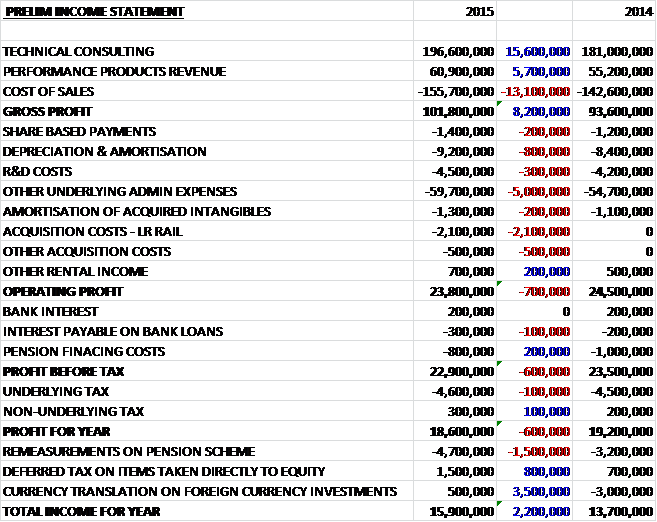
RCDOincome

Revenues increased when compared to last year as Technical Consulting was up £15.6M and Performance Products grew by £5.7M.  Cost of sales also increased to give a gross profit £8.2M ahead of last year.  We then see an £800K increase in depreciation and amortisation along with a £5.3M growth in other underlying admin expenses.  There were a number of one-off expenses, including £2.1M relating to the acquisition of LR Rail and £500K relating to other acquisition costs which meant that operating profit was some £700K lower than last year at £2.8M.  A slightly lower finance cost due to lower pension financing costs then meant that the profit for the year came in at £18.6M, a decline of £600K year on year.

RCDOassets

When compared to the end point of last year, total assets increased by £67.4M driven by a £47.1M growth in cash, a £12M increase in receivables, a £2.8M increase in deferred tax assets and a £2.2M growth in other intangible assets.  Liabilities also increased during the year due to a £45.4M growth in bank loans, a £7.5M increase in payables, a £2.6M increase in current tax liabilities and a £2.6M growth in deferred tax liabilities.  The main change we can see here is a £45.4M new bank loan that was used to increase the cash so that the group could make a payment for the acquisition of LR Rail.  The end result of all this is a net tangible asset level of £71.1M, an increase of £5.3M year on year.
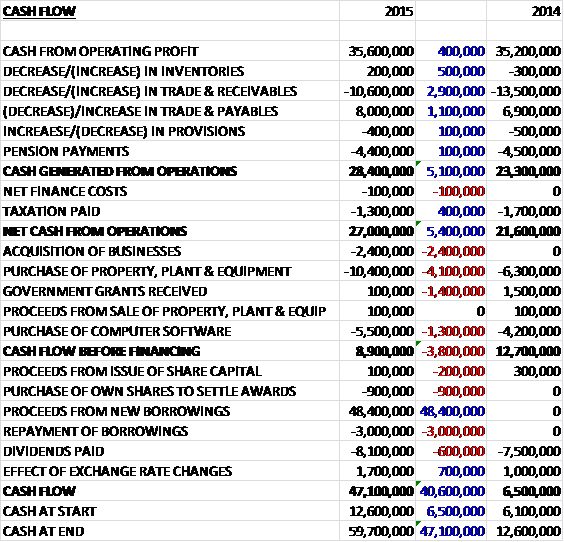
RCDOcash

Before movements in working capital, cash profits increased by £400K to £35.6M which became a net operating cash flow of £27M, an increase of £5.4M year on year as receivables increased by less than last year and payables fell by less.  The group then spent £10.4M in fixed assets relating to planned cash expenditure at the Shoreham Technical centre on both the expansion of the vehicle assembly facility as part of the supply agreement with McLaren, and the Vehicle Emissions Research Centre (£5.3M net of government grant); and £5.5M on computer software to give a free cash flow of £11.3M.  Some £2.4M was spent on acquisitions, £900K on shares for pay awards and £8.1M in dividends.  The group then took out a net £45.4M of new borrowings to give a cash flow of £47.1M and a cash level of £59.7M, ready to spend on the LR Rail acquisition.

The underlying operating profit at the Technical Consulting division was £20M, an increase of £2.2M year on year.  Underlying operating margins have increased from 9.8% to 10.2% with the order intake increasing from £192M to £209M.  During the year the UK and German Technical Consulting businesses have been integrated to form a European Technical Consulting division, along with a separate global motorcycle division which includes the newly acquired Vepro business.  The European division secured a range of large multi-year programmes in the passenger car, commercial vehicle and power generation sectors in particular.  Activity levels have been particularly high in the engine and vehicle groups and this division remains the main generator of profit.

In Ricardo Motorcycle the focus has been on the delivery of existing large multi-year powertrain programmes and the global roll-out of an expanded product and service offering to existing and new clients.  As a result they have secured a new multi-year vehicle programme with an international client in the motorcycle and scooter section of the market.

In the US, the business has maintained its commercial performance in the passenger car and commercial vehicle sectors whilst positioning the business for growth in other areas.  The business mix has seen increasing engine testing activity across both light and heavy duty applications and increased interest in rail and energy sectors.  The defence activity continues to diversify and during the year the group launched Ricardo Defence Systems to enable them to access higher level security programmes from the US Defence Administration.  The California business is growing and they will continue to see expansion in activities in that area.

Asia, including China and Japan, remains a key region and the Shanghai based business has secured and started to deliver a number of large locally won contracts.  This has included a mixture of hybrid vehicle, engine, transmission and attribute development activities.  In Japan they have seen good levels of performance in the passenger car and commercial vehicle sectors.  The Energy and Environment business has had a good year and has seen growth in both international and private sector clients.  The five historic practice areas of Energy and Climate Change, Air Quality, Resource Efficiency and Waste Management, Sustainable Transport and Rick Management have performed within expectations alongside PPA which was acquired during the year and integrated as a sixth practice area.  The strategic consulting activities continue to operate well across all geographies and performance has been good in all operating regions.

The passenger car sector remains the most significant market for the group.  Projects continue to be driven by emissions legislation, CO2 reduction and global competition.  During the year demand remained high, with large multi-year contract orders from automakers and suppliers in the UK, EU and Asia. New orders were secured across the vehicle systems and core powertrain areas of the business, focused on both new products and upgrades to existing products.

One of the key drivers of the strong demand is the requirement to deliver lower carbon dioxide solutions at lower cost whilst still maintaining high levels of functional performance.  This is driving increased interest in the vehicle lightweighting, advanced combustion and intelligent vehicle and driveline technologies.  Autonomous vehicle technology in particular is attracting significant interest in North America.  Interest in hybrid and electric vehicle architectures, battery pack and battery management system design and vehicle attribute development also feature strongly.  The Vehicle Emissions Research Centre was commissioned at the Shoreham Technical centre during the year and the group continues to invest in advanced combustion and other key technologies in areas related to improvements in overall vehicle efficiency, such as intelligent driveline, lightweight materials and electrification.

The group’s activities in the government and environmental sector have been driven largely by the long-standing relationships that the business has with government bodies in the UK, the EU and elsewhere.  Activity in the government sector continues to focus around issues such as urban air quality, flood prediction and prevention, sustainable transport solutions to overcome congestion, emissions compliance, waste and resource efficiency and future energy mix.

Despite UK government pressure on budgets, the business has secured a number of major contract wins with departments such as Defra and BIS.  In the US they continued to build relationships with the Department of Energy, the Environmental Protection Agency, the National Highway Traffic Safety Administration and the California Air Resources Board.  In the EU they are working with the EU Commission and international donor organisations on a range of new products and initiatives.  Future growth is focused on the private sector and international expansion outside of the UK.  The acquisition of PPA in November has enabled the business to strengthen its activities in the energy sector, especially in Africa and Asia.

During the past year the group launched Ricardo Motorcycle as a global business unit and added UK based consultancy Vepro during the year.  They have continued a partnership relationship with Exnovo, a motorcycle vehicle engineering business in Italy.  Growth in the sector is being driven by the need for a reduction in carbon dioxide emissions, the increasing focus on urban mobility solutions and a growing interest in e-bikes together with the increased demand for high quality motorcycles in developing markets.  During the year the business remained focused on the delivery of existing large multi-year powertrain programmes for clients in Japan, China and Germany.  The business mix covers a number of major subsystems including engines and driveline and transmission systems.  They have also secured a new multi-year vehicle programme from an international client in the motorcycle and scooter sector of the market.  The high performance vehicles and motorsport team is pursuing a range of new opportunities.

The group has seen strong growth in the commercial vehicle sector, especially from the Asian markets.  They have secured a number of large engine and transmission projects across the medium and heavy duty sectors.  Activity levels are being driven by legislation and new product development for global applications.  Strong engagement in this sector has driven increasing engine test activity, especially in North America.  They have also seen growing interest in the aftertreatment and fuel cell capabilities at their technical facility in California.  Facilities include a catalyst hydrothermal ageing test lab, a synthetic gas reactor test lab for rapid evaluation and modelling  of aftertreatment components and systems, and fuel cell testing capabilities for solid oxide and proton exchange membrane fuel cells.  They have also focused on developing their product offering in the areas of fuel economy improvement, system optimisation and hybridisation which are areas seen as significant growth markets.

Activity in the off-highway sector continued to remain at a relatively low level following the recent implementation of stage IV emissions standards in Europe.  The focus in the coming years will be assisting clients with EU, US and Chinese legislation for 2020.  The product offering in this sector is focused on new powertrain and engine development, complete machine optimisation, cost-effective after treatment solutions and hybridisation options, all of which are attracting increasing levels of interest.  They also continue to invest in energy recovery technology.

The group’s defence related activity has seen an important number of new customer wins.  They have seen increasing activity in mainland European, Middle Eastern and Asian markets as a result of focused business growth activities outside the UK markets.  In the UK they have seen increasing demand for their Total Systems Optimisation approach, a programme which is focused on optimising vehicle architecture selection to minimise lifecycle costs and maximise fuel economy.  In the US they have launched Ricardo Defence Systems as a platform for expansion by enabling the business to access higher level security programmes from the US Defence Administration.  The focus remains on the land domain and they are actively engaged in a range of future opportunities in international markets.

The Rail business has continued to grow with a focus on Technical Consulting activities in the rolling stock area in both the EU and North America.  They are also at an advanced stage with the DDFlyTrain research and development project conducted with Artemis Intelligent Power and Bombardier Transportation.  This project has used the company’s high speed flywheel-based brake energy recovery system concept to deliver a projected fuel saving of around 10% on Diesel Multiple Unit rolling stock.  The business has developed a broad geographic spread with a variety of programmes taking in Tier 1 equipment manufacturers, rail operators, rail equipment manufacturers and governments with a focus on increasing fuel efficiency and reliability.  In the US, the group is developing a Maglev rail system for a low-cost urban connection between Orlando airport and the nearby convention centre.

The clean energy and power generation sector has seen the majority of its activity in the large engine area for power generation.  The group is engaged in a number of large projects covering genset development, gas engine conversions, heavy fuel oil engines and Combined Heat and Power solutions.  They have seen less activity this year in the renewable energy sector, although they continue to deliver offshore and onshore wind energy projects.  Good levels of activity have also been seen in fracking applications for the oil and gas market and there has been significant growth in the management consulting activities across the energy sector.  The marine sector is driven by increasing demands for high speed diesel generator sets and main propulsion systems, and also for the conversion of engines for gas or dual fuel operation.  The majority of their activities in this sector have been based around failure analysis, investigations, specialist design and development activities.

The underlying operating profit at the Performance Products business was £7.7M, a decline of £200K when compared to last year and order intake declined from £67M last year to £43M. About half of the revenues earned in this sector come from just one customer. in the defence sector, activities have focused on the supply of ongoing post-design services for the UK MOD which included the supply of infra-red lighting and axle upgrade kits.

Demand for engines from McLaren for its supercars continued and the group now supply power units for the new 650S and the P1 hybrid models.  The McLaren engine assembly facility is currently being expanded to enable the business to satisfy McLaren’s product expansion plans.  Production of the Porsche Cup and advanced dual clutch transmissions to Bugatti continued in line with the long-term supply agreements.  In motorsport, the group has remained busy during the year with manufacturing orders from F1 customers, and products such as the transmissions for the Japanese Super Formula, Indy Lights and World Series by Renault.  Work has also been ongoing to design and manufacture a GT3 racing transmission for two new premium clients.

Rail activity continues to perform to plan through the continuing manufacture and supply of monorail transmissions for applications in Malaysia and Brazil.  They continue to seek out similar future opportunities with exploit the market presence developed through the technical consulting activities and the newly created Ricardo Rail business.

During the year the group completed five major R&D programmes and was awarded five new ones.  They have actively engaged with the new European R&D framework programme “Horizon 2020” through the European Green Vehicle initiative.  The five new programmes awarded are Horizon 2020 projects.

The DDFlyTrain programme delivered a proof of concept flywheel demonstrator for the rail industry using the Ricardo Torqstor flywheel and test rig.  The collaborative partners were Bombardier and Artemis and the research project was co-funded by Innovate UK and the Rail Safety and Standards Board.  Bombardier’s Turbostar Diesel Motor Unit was used to project fuel saving, based on high speed flywheel brake recovery technology retrofitted to DMU rolling stock.  Simulation and rig testing were used to demonstrate the practical feasibility, operational fuel and energy savings, and the economic investment case for high-speed flywheel energy storage technology on DMU trains.  The project received the Rail Exec award in the safety and sustainability category and the TorqStor technology received the 2014 SAE Tech Award as one of the top five technologies on display at the SAE World Congress.

The group has now delivered and commissioned the MultiLife wind turbine bearing system on a 600kw turbine.  The Barnesmore wind farm operated by Scottish Power in Donegal, Ireland is known to experience aggressive wind conditions and was used for the location of the project.  The system reduces the need to remove and repair the wind turbine gearbox, which increases the time that the turbine is generating revenue.  This is achieved by rotating the face of standard bearings over time which ensures that the fatigue damage or wear never reaches a critical localised condition during the turbine’s life.  The system has the potential to extend bearing life in excess of 500% based on rig tests.  The project was partly funded by the DECC and Ricardo is collaborating with Scottish Power and the Universities of Sheffield and Strathclyde.

A new engine research programme called Magma looks at optimised approaches for gasoline engines, including adoption of the Miller cycle.  In the transmission area, the ULTRAN project is yielding impressive results with innovative lightweight transmission designs that reduce the weight of a rear-wheel drive unit by 25%.  In the hybrid area, a project to investigate Switched Reluctance Machines for future e-Machine applications is yielding industry-leading FEA tools for e-Machine design.  The project delivered a prototype high-speed synchronous reluctance machine.  ECOCHAMPS, a new Horizon 2020 project, is targeting the next generation light and heavy duty hybrid electric vehicles.

The US DoD continues to emphasise rapid acquisition of proven innovations that can save soldiers’ lives.   The group is investing in a collaborative programme with a Tier 1 supplier to provide a world-class stability system for a tactical vehicle.  The solution mitigates the problem of rollover for on and off road vehicle situations and provides improved vehicle performance and reliability whilst offering significant operational cost savings.  Development and testing are complete and the product is well-aligned to DoD acquisition objectives.

At the University of Brighton, the Sir Harry Ricardo Combustion Research Centre is expanding to provide a dedicated joint research facility where university staff will work alongside Ricardo engineers.  The objective is to undertake fundamental research to assist with the design of the next generation of internal combustion engines while developing the group’s staff to learn new skills and capabilities.

In October the group acquired Vepro and in November they acquired Power Planning Associates for a combined consideration of £3.6M.  Vepro brings motorcycle chassis, powertrain integration and prototype build expertise to the motorcycle business.  It also brings complementary customer relationships with key accounts in India and the US.  PPA provides an extension to the group’s energy sector capability, ranging from conventional small scale and distributed power systems, to renewable power and smart grid technologies.  It also specialises in techno-economic and management consultancy services for the energy sector.  The consideration was £3M in initial cash which was all paid before the end of the year, along with £600K in contingent consideration.  The acquisitions generated a total of £2.3M in goodwill.  Since acquisition, the two businesses generated an underlying operating profit of £200K.

On the 1st July, annoyingly just one day after the year-end, the group completed the acquisition of Lloyd’s Register Rail.  LR Rail is a rail consultancy and assurance business and is a partner for a wide range of international clients.  It provides services ranging from rolling stock design, signalling and train control, intelligent rail systems, operational efficiency improvements, training and independent assurance services.  The initial cash consideration is £40.6M and the provisional assessment of goodwill is £28M. It has major clients such as Network Rail, Dutch Railways, MTR, Crossrail, Etihad Rail and Qatar Rail.  In August the group acquired Cascade Consulting for a total consideration of £3.2M.  The business provides additional capability and reach in the areas of water resource and water quality management, ecosystem services and environmental impact assessment.  This acquisition generated £2.6M in goodwill.

At the year-end the group held total banking facilities of £89.4M which included committed facilities of £75M and an overdraft of £14.4M.  Committed facilities of £45.4M were drawn down which attracts interest of between 1.6% and 2.35% above LIBOR and are repayable in 2020.  The pension scheme is a source of potential problems, the £1.2M increase in the deficit this year was primarily due to a reduction in the discount rate assumption.  The additional cash contributions of £4.3M per annum were agreed with the trustees following the last full actuarial valuation in April 2014 – this is not an insignificant sum.

At the year-end the closing order book stood at £140M which is a decline of £2M when compared to the same point of last year.  Market conditions remain positive in the UK and Asia, with a good pipeline of defence vehicle activity in the US and recent secured wins in the motorcycle sector in Germany.

At the current share price the shares trade on a PE ratio of 22.5 falling to a more reasonable looking 18.9 on next year’s consensus forecast.  After a 9% in the full year dividend, the shares yield 1.8%, increasing to 1.9% on next year’s forecast.   The group is currently in a net cash position of £14.3M, an increase of £1.7M year on year with some £40.6M spent on the LR acquisition the day after the year-end which acquired some £12.6M of net assets so after this acquisition I guess the net debt must be about £26.3M.

Overall then this was a solid year for the group.  Profits did fall but this was due to acquisition related costs and discounting these, underlying profit was up.  Net assets increased year on year and operating cash flow also improved to give a decent amount of free cash.  Capital expenditure may well be lower next year as the Vehicle Emissions Research Centre was completed but there will be acquisition related pay outs of course.  Operationally, technical consulting seems to be performing well but profits at the performance products division fell as a large project came to an end, presumably for the MOD.  Whether the new projects, including the work for McLaren can offset this remains to be seen.

The group has embarked on a bit of an acquisition spree with four over the past year or so.  The LR Rail is by far the largest one, and hopefully they will concentrate on assimilating this business rather than go mad on acquisitions.  The forward PE of 18.9 is not cheap but probably about right for a company of this quality and the dividend yield of 1.9%, although nice to have, is not really much to get excited about.  Ricardo remains my second largest holding so I will not be adding any more at this point but I am happy to hold for the time being.

RICARDO

It seems as though the shares are consolidating…

On the 4th November the group announced the appointment of Ms Malin Persson as non-executive director. She was employed by Volvo between 1995 to 2012 where she was VP Corporate Strategy and Business Development, President and CEO of the research and innovation company Volvo Technology and head of environmental affairs at Volvo Logistics. She is also owner of Accuracy AB, a consultancy and engineering company. This seems like a very strong appointment to me.
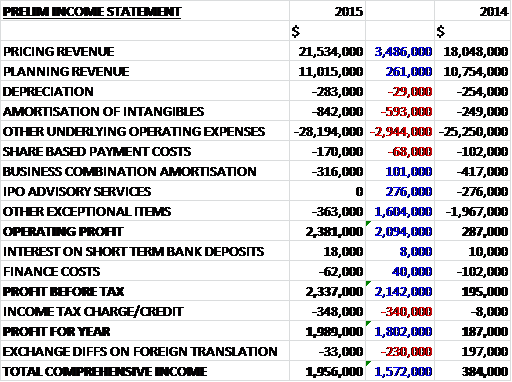
 

On the 19th November the group released a trading update from July to date. They have seen a good start to the year with strong order intake in the last four months of £113M, some £43M higher than at the same point of last year. On a like for like basis, order intake is up £22M with the total order book at the end of October of £206M compared to £132M. Significant orders within technical consulting include a project for an electric bike and two passenger car transmission orders in the US, a multi-year rail project for the independent validation and verification of a transit railway in Asia, and further passenger car orders in Europe. In performance products, there was an increased level of orders for McLaren.

The rail business has performed in line with expectations since the acquisition of LR Rail and the integration is progressing well. The final stage of the acquisition of the rail business is the completion of the joint venture in China which is expected to be finalised in the next few months for an agreed consideration of £1.9M. In performance products preparations are on track for the increase in volumes expected in the second half of the year in respect of the engine supply contract for McLaren and overall trading is in line with board expectations and they remain confident of continued progress during the year.

This all reads quite well and I am fairly happy to keep hold of my shares here, which represents my second largest holding.