Asian Citrus Share Blog – Final Results Year Ended 2015

Asian Citrus has now released its final results for the year ended 2015.

ACHLincome2015

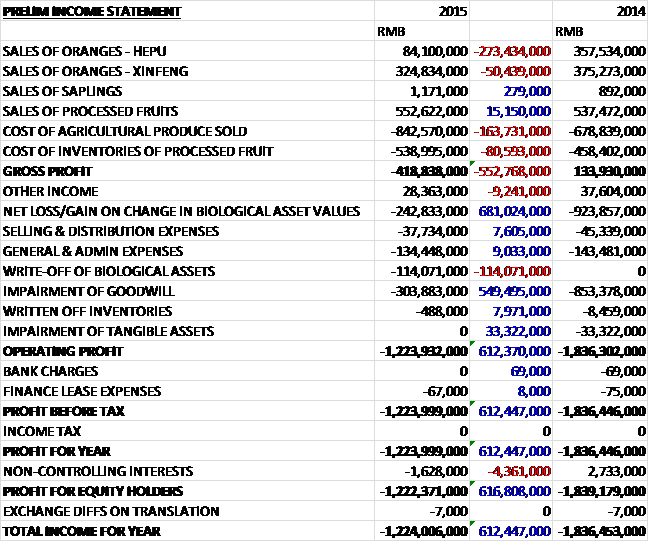
Overall revenues fell during the year as a £1.5M increase in the sales of processed fruit due to increased sales of red dates and medlar juice concentrate, frozen mango and tomato, and a small growth in the sales of saplings was more than offset by a £32.4M decline in the sales of oranges.  The cost of agricultural produce sold increased by £16.4M reflecting the increase in consumption of both fertiliser and pesticides and the cost of inventories of processed fruit grew by £8.1M due to an increase in the cost of raw materials because of limited supplies, as well as increased labour costs, to give a gross loss of £41.9M, a negative swing of £55.3M.  The decline in biological asset values was not as pronounced as last year but there was an £11.4M write-off of biological assets.  The impairment of goodwill was less than last time though (the goodwill associated with the fruit processing business has now been fully impaired) and there was no impairment of intangible assets so that the loss for the year came in at £122.2M, an improvement of £61.7M year on year.

ACHLassets2015

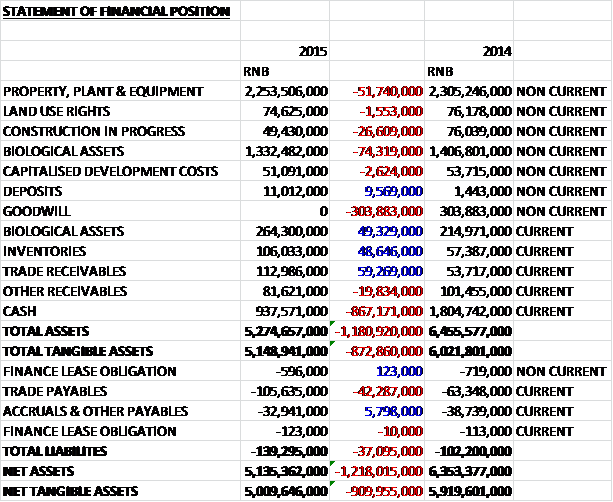
When compared to the end point of last year, total assets crashed by £118.1M driven by an £86.7M fall in cash levels, a £30.4M decline in the value of goodwill, a £2.5M fall in the value of biological assets, a £5.2M decrease in property, plant and equipment, a £2.7M fall in construction in progress and a £2M decline in other receivables, partially offset by a £5.9M increase in trade receivables and a £4.9M growth in inventories.  Total liabilities increased during the period due to a £4.2M growth in trade payables.  The end result is a net tangible asset level of £500M, a decline of £91M year on year.

ACHLcash2015

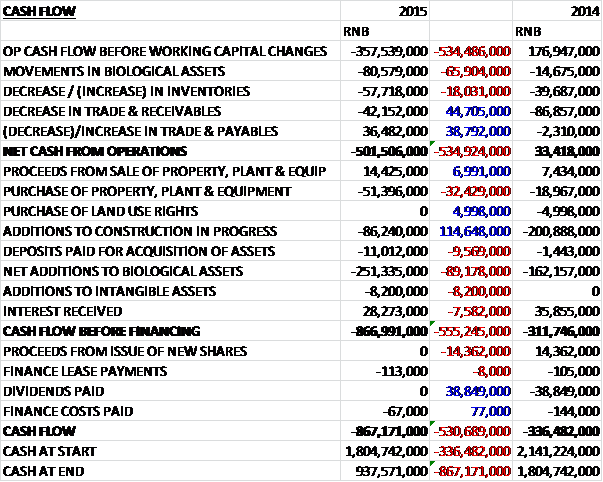
Before movements in working capital, cash losses came in at £35.8M, an adverse movement of £53.4M.  We then see an increase in inventories and receivables so that the net cash outflow from operations was £50.2M, an adverse movement of £53.5M year on year.  The group purchased a net £3.7M of property, plant equipment, spent £8.6M on construction in progress and £25.1M on biological assets so that the cash outflow before financing came in a £86.7M.  There was little in the way of financing items so that the cash outflow for the year was £86.7M to give a cash level at the year-end of £93.8M – this is disappearing fast!

The loss at the agricultural produce business was £84.5M, an improvement of £11.1M year on year.  The total orange production yield decreased by 34% to 130,125 tonnes due to extensive damage at Hepu from Typhoons Rammasun and Seagull; the effect of cryogenic freezing rain and frosts in Xinfeng and the effect of high temperatures and drought in Xinfeng area resulting in water scarcity for irrigation which affected the fruit size as well as production volume of the orange crop.

The loss at the processed fruits business was £4.8M compared to a £1.3M profit last year.  Sales tonnage decreased marginally but the loss is mainly due to the increased costs of raw materials due to limited supplies, increased material scrap and maintenance costs caused by the low productivity of the production equipment, and increased labour costs.  The group has decided to delay further investment in the third plant in Baise City due to deteriorating market conditions.  Although it normally takes three to five years for a new plant to achieve full capacity, the group has decided to invest and improve the utilisation at the two current plants which are in full operation.

During the year 317,839 orange trees with a value of about £11.4M were removed due to the infection of Huanglongbing disease which indicated an infection rate of approximately 20% of trees in the Xinfeng plantation and some 2,563 trees were re-planted in June.

The production yield at Hepu fell by 64.6% to 26,278 tonnes due to the extensive damage suffered from the impact of the typhoons and in addition, the average selling price declined by 33.6% and costs increased as a result of the adverse weather.  The average price achieved for the summer oranges was £362 per tonne and the average price for the winter oranges was £231 per tonne compared to £545 and £386 per tonne respectively which reflects both the extensive typhoon damage and the poor appearance of oranges infected by citrus canker.  The plantation is now fully planted with 1.2 million orange trees.  Also a total of 221,769 banana trees were naturally re-seeded from the original trees following the clearance of the damage caused by Typhoon Rammasun.  The first crop of banana trees was harvested from July to September with 5,930 tonnes being sold at £314.6 per tonne – about £1.9M that will be recognised in next year’s sales.

The production yield at Xinfeng decreased by 15.7% to 103,847 tonnes owing to the effect of cryogenic freezing rain and frosts in Xinfeng in early 2014 and the effect of high temperature and drought during Q4 2014 which resulted in water scarcity for irrigation which adversely affected the fruit size as well as production volume of the winter orange crop.  In addition, the spread of the Huanglongbing disease increased costs.  The average price achieved for the winter oranges was £322 per tonne compared to £314 per tonne last year.  The plantation now contains 1.3 million winter orange trees.

The construction of the Hunan plantation was completed after 26,960 grapefruit trees were planted during the year.  Production at the plantation is scheduled to begin in 2016.  The plantation consists of 1.05 million summer orange trees and about 750,000 grapefruit trees.

The group are apparently working on supply chain optimisation which includes methods to reduce costs of pesticides and fertilisers, exploring new export opportunities and changing the product mix in order to improve margins.  Also, the group is conducting research on improving quality standards by means of larger citruses, and taste, which they hope should lead to premium pricing of their products in the market.

There is an interesting comment here from the auditor.  They have noted that the group purchased fertilisers from a supplier who did not possess a valid business license (the value of this covered about 7.7% of total purchases for the year).  The total value of the purchases was £10.4M and there is £2.5M in trade payables.  The suppliers’ business registration is not currently included in the records of the state administration for industry and commerce of China.  The auditors were unable to obtain sufficient evidence of the commercial substance of the transactions relating to the recorded purchases from the supplier because they were unable to obtain satisfactory documentary audit evidence to explain how the supplier was able to conduct the recorded transactions while not possessing a valid license, they were unable to satisfy themselves of the identity of the supplier and they were not able to determine whether the recorded purchases were free from misstatement.

This is potentially very important as I am sure I recall that a director, or perhaps previous director, had owned a fertiliser supplier and it seems to me that it is quite likely that cash has been syphoned off to this “supplier” under the cover that more fertiliser was required following the storms and various diseases that have befallen the group.  It is also notable that by far the largest expense is the £42.4M spent on fertilizers which made up more than half of all cost of sales.

At the period end the group had capital commitments of about £4.4M mainly in relation to the construction of the farmland infrastructure in Hepu plantation and the acquisition of plant and machinery in the fruit processing business.

During the year Mr. Ng Cheuk Lun was appointed as an executive director, Mr. Ng Hoi Yue became an executive director, deputy CEO, after resigning as non-executive director, Mr. Ng Ong Nee was appointed chairman.  There is going to be a bit of a cull in directors with CFO Ng Cheuk Lun (he didn’t last long) and executive directors Cheung Wai Sun and Pang Yi will step down after the AGM.

The group is loss making so there is no PE ratio and I cannot find a broker prediction for next year.  There is also no dividend being paid – prudent given the cash burn no evident here.

Overall this past year has been a bit of a disaster for the group.  The loss did improve but this was only due to lower impairments and the underlying loss increased.  Net tangible assets declined year on year and the operating cash loss increased with the cash pile disappearing fast.  The loss attributable to the processed fruits venture is disappointing with an increased cost of raw materials due to lower supplies along with a growth in labour costs taking their toll.  The losses at the Hepu plantation were pretty catastrophic with the typhoons reducing yield to just 26,000 tonnes and the canker reducing the average selling price at the same time as costs increased.  At Xinfeng things were little better with yields falling to 104,000 tonnes as the poor citrus trees here had to battle cryogenic freezing rain, drought, a heatwave and Huanglongbing disease.

Going forward, the Huanglongbing disease is likely to adversely affect the Xinfeng plantation but I would have thought things should improve at Hepu with the banana crop underway and Hunan where production of oranges should start in 2016 – although we haven’t yet had a plague of locusts so I guess that is always a worry.  The dealings with the fertilizer company seem very dubious too – the auditor actually seems to have done its job and uncovered some potentially dodgy dealings with the fertilizer company that is not actually a fertilizer company – I wonder where that £10.4M has actually gone…

In all then, things should be getting better but with all the odd and stuff going on here, these shares seem pretty dangerous to me so I am steering clear.

ASIAN CITRUS

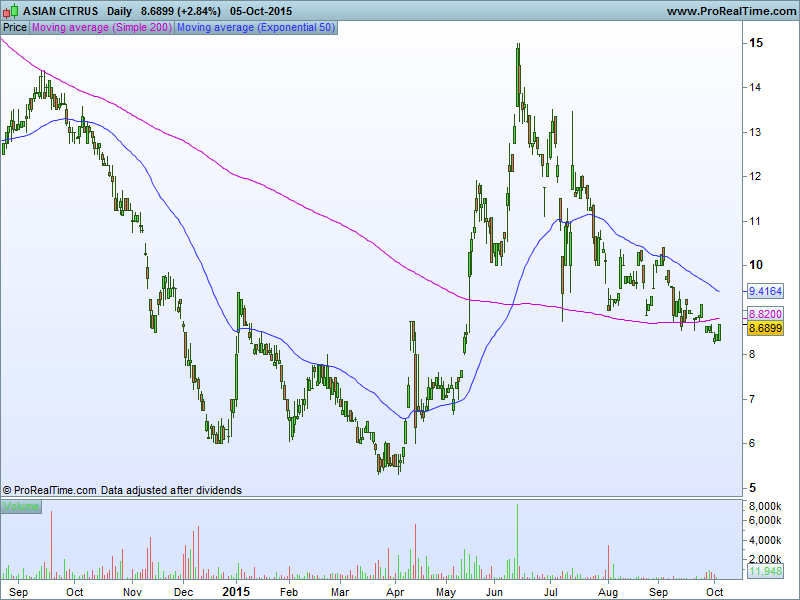
Following the inexplicable jump up, the shares seem to be on a decline again now.

On the 18th December the group released an update covering the winter orange crop. The crop from the Hepu plantation, which was impacted by poor weather, will supply about 4,700 tonnes of oranges in H2 2015 compared to 7,146 tonnes last year. It is expected that the selling price will increase by 3%, however. The crop in the Xinfeng plantation was damaged by the outbreak of Huanglongbing. It is estimated that the production output for H2 will be about 11,000 tonnes compared to 103,847 tonnes last year and the outbreak is likely to have an adverse effect on the results for 2016 too. Reflecting these issues, it is expected that the selling price for the crop from Xinfeng will be about 24% lower this year.

As a result of the reduction in the production volumes at both plantations and the anticipated lower selling price at Xinfeng, the board estimates there will be a reduction in revenue and profit generated in 2016. Things are pretty desperate here and there seems no end in sight, I will be ending my coverage of this company until things start to turn around (I doubt they will, but you never know!)

I know I said I had written my last piece on this company but the latest bit of news is a peach. I might actually just keep an eye on Asian Citrus for entertainment value. On the 29th December (always a good time for stock market releases) the group informed the market that instead of the initial estimate of 18% of the Xinfeng trees being infected by Huanglongbing disease, the actual total is likely to end up being closer to 80%! Despite chucking a load of pesticide and fertilizer at the problem, the prevalence of the disease on surrounding plantations has meant they have been able to fight it and the whole Xingeng plantation is being permanently shut down. The board estimate that this will lead to an approximate £85M of asset write-downs.

They also helpfully reiterate that they are not covered by insurance and there will be no reimbursement of the losses. They also state that investors are advised to exercise caution when dealing in the shares of the company! I’d say, “investors” would have to be mad to buy any shares here. I actually can’t believe anyone would still own any stock as this company has become a laughing stock and is clearly on its last legs. I wonder if I can open up a short here?

President Energy Share Blog – Interim Results Year Ending 2015

President Energy has now released its interim results for the year ending 2015.

PPCintincome

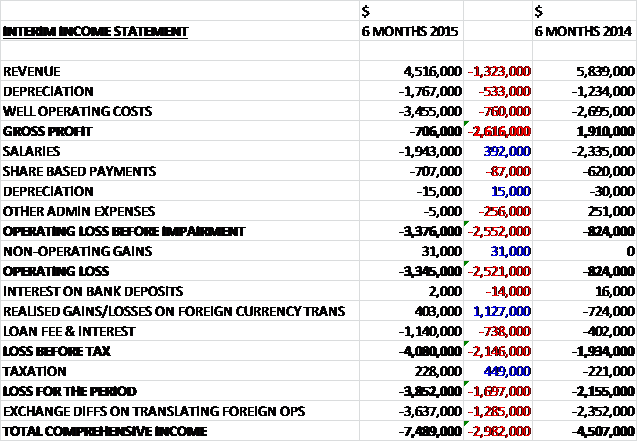
Revenues have fallen by $1.3M when compared to the first half of last year.  Both depreciation and well operating costs then increased as the figures reflect a 100% ownership of Puesto Guardian concession so that the gross loss was $706K, a negative swing of $2.6M.  Salaries did fall by $392K but share based payments and other admin expenses increased to give an operating loss some $2.6M higher.  After a $1.1M positive swing in realised gains and losses on foreign currency transactions was partially offset by a $738K increase in loan fees and interest the loss before tax was some $2.1M higher which became a loss for the period of $3.9M after tax, an increase of $1.7M year on year.

PPCintassets

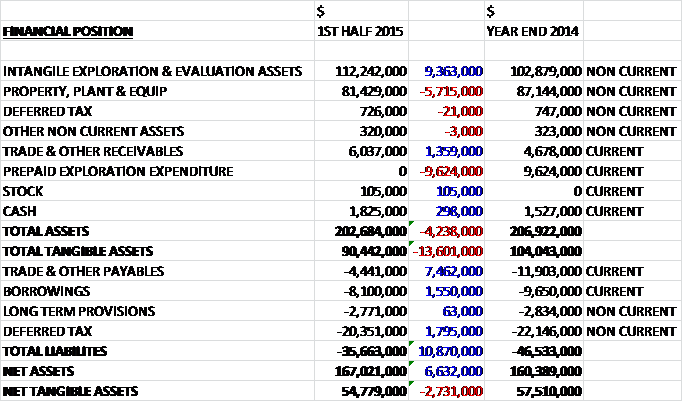
When compared to the end point of last year, total assets fell by $4.2M driven by a $9.6M decline in prepaid exploration expenditure and a $5.7M fall in property, plant and equipment mainly relating to exchange differences, partially offset by a $9.4M increase in exploration and evaluation assets and a $1.4M growth in receivables.  Liabilities also fell during the period due to a $7.5K decrease in payables, a $1.8M fall in deferred tax liabilities and a $1.6M decline in borrowings.  The end result is a net tangible asset level of $54.8M, a decline of $2.7M year on year.

PPCintcash

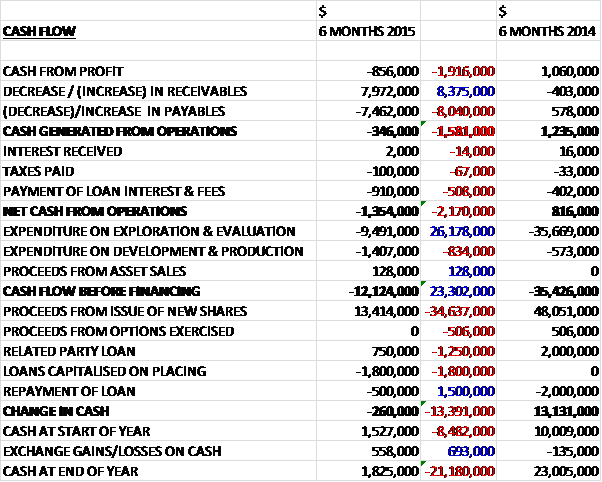
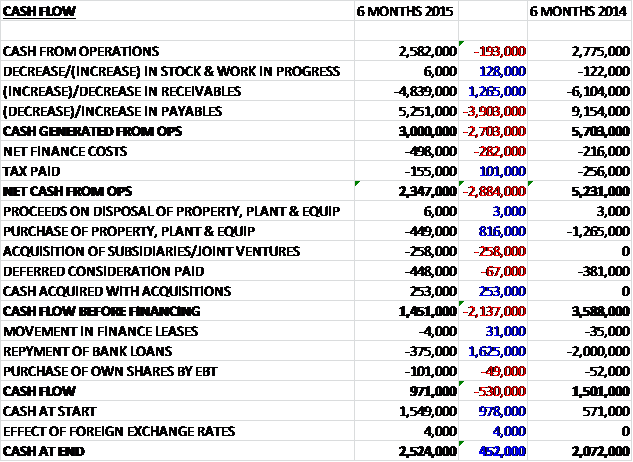
Before movements in working capital, cash losses came in at $856K, a negative swing of $1.9M year on year.  After a fall in receivables and payables, along with a $508K increase in loan interest and fees gave net cash from operations was $1.4M, a negative swing of $2.2M.  The group then spent $9.5M on exploration and evaluation, along with $1.4M on development and production to give a cash outflow of $12.1M before financing.  The group then made $11.6M from the issue of new shares which gave an overall cash outflow of $260K and a cash level of $1.8M at the end of the period – it seems to me that the group are going to have to get another cash injection to carry on like this.

In Argentina the average net production before workovers was 231bopd compared to 342bopd during the same period of last year.  The first phase of workovers of shut-in wells was completed in budget and on time at the end of the period and the current average production is now running at 315bopd with one of the producing wells temporarily in maintenance.  The group average a realisation price of $70 per barrel with an additional $3 per barrel increase for new 2015 production which shows that Argentina is a very good prospect in this low oil price environment.

After the period end new concession terms were granted over all producing fields expiring in 2050 and post-period 2P reserves increased by 28% to 18.1MMbls with a net present value 10 before tax and royalties of $329.4M.  Analysis of prospective resources shows significant potential in the deep gas prospect within the Puesto Guardian concession and the Matorras license areas.  The next phase of workovers is being targeted towards the end of the year with long lead time items now being ordered.  Essential maintenance and upgrading of facilities have now been completed.

In Paraguay the group have acquired 603km of 2D seismic which is awaiting final analysis.  It is clear from the seismic data that several drillable Paleozoic prospects exist, in line with the company’s expectations and at 2,500 to 3,000 metres depth they are some 1,000 metres shallower than the Lapacho and Jacaranda wells drilled last year.  In Australia the PEL82 block is still being retained by the company and remains under review with actions suspended due to the current market conditions.

In Louisiana, production increased by purchasing minority interests in operated assets and carried wells interest coming on stream.  The current production of 270bopd represents a 29% increase from the average of 209boepd during the period and 218boepd during the first half of last year.  The group also achieved operational cost savings and an extra $140K contribution to facility overheads has been achieved.  The realised price for the oil was at WTI price which has fallen considerably over the period, averaging at $52 per barrel compared to $102 in the first half of last year and is now comfortably under the price achieved in Argentina.  New well AS5 was drilled and movable hydrocarbons were identified.  The well was suspended due to unexpected high pressure, however, with re-entry currently being discussed with a view to be actioned in the medium term.

The group had cash levels of $1.8M at the period end with undrawn loan facilities of $6.9M available.

Overall then, this has clearly been a difficult period for the group.  The loss increased, net tangible assets were down and the operating cash outflow grew.  Operationally things seem to have been improving through towards the end of the year.  In the US, current production has increased but the decline in the realised oil price to $52 has offset this improvement.  In Argentina, the fixed $70 per barrel price for oil has sheltered the group somewhat from the oil price declines and production increased here too towards the end of the period due to the workover programme.

In Argentina, the resources have increased and in Paraguay some interesting targets for drilling have emerged.  Unfortunately there is currently just $1.8M cash left with some $6.9M in undrawn loans.  With the cash burn of $12.1M during the period, further workovers in Argentina planned and a potential drill in Paraguay, it seems likely to me that the group will have to get some more cash from somewhere and whilst I still think this company has some interesting looking assets I don’t think now is the time to buy in.

PRESIDENT ENRGY

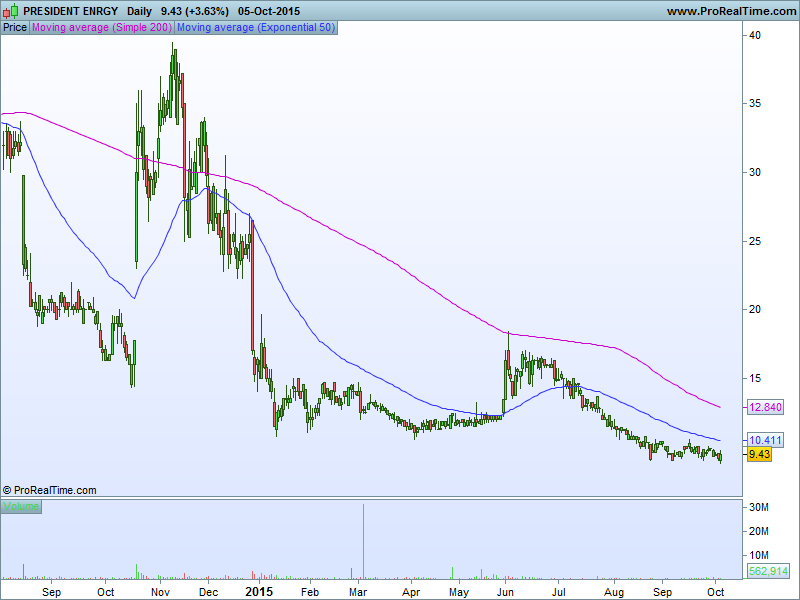
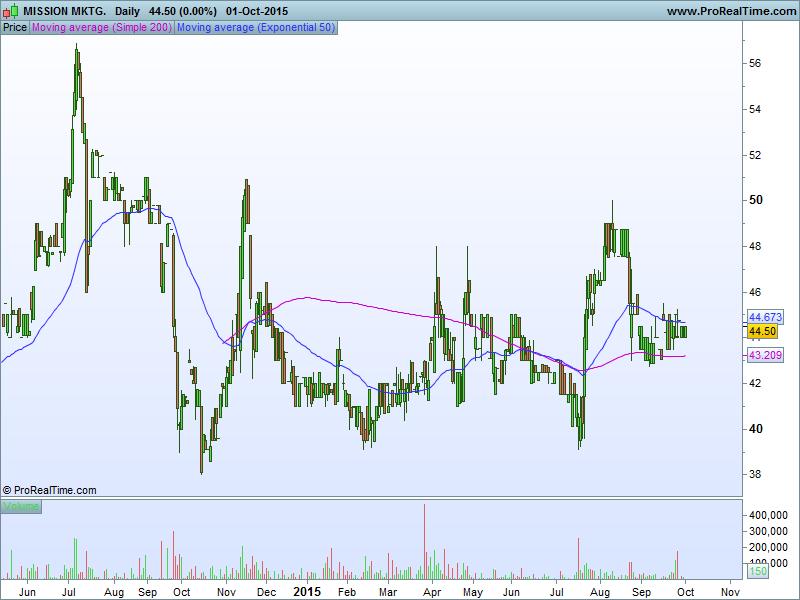
this is not a joyous chart.

On the 6th October the group announced that it had acquired the 36% interest of the Pirity concession held by Petro Victory which will take President’s holding up to 100%.  The acquisition will cost $500K payable by instalments ($200K in completion and three consecutive monthly payments of $100K).  In the event of a farm-out taking place and back costs being paid, a sum limited to $2.7M will be payable to PV.  Also a net profits interest of 3% of net revenues after deducting royalties and operational expenditure generated  from commercial production will be paid to PV.

This looks like a good opportunistic acquisition due to PV’s lack of funds but the fact it is being paid in instalments is a bit odd.

On the 9th October the group announced the results of the Seismic campaign in Paraguay.  There is an oil case with gross unrisked recoverable prospective resources of 302MMboe; a gas/condensate with gross unrisked recoverable prospective resources of 559Bcf of gas and 17MMBls of condensate.  The overall chance of exploration success is considered by the company to be 22%.  The success case is economic even in the current depressed market environment.

Whilst the interpretation of a number of other leads and prospects in Hernandarias continues, the company completed its own estimates of prospective resources in the Boqueron prospect.  It is a three way dip structure of up to 60 square km and judged to be juxtaposed against Devonian source rocks.  The new seismic supports the correlation of the same Paleozoic section proved in Lapacho in a NW direction through a series of structures culminating in the largest structure at Boqueron.  At the Boqueron prospect the Icla, Santa Rosa and Sara reservoirs discovered at Lapacho are judged to correlate to depths of 1600 to 2700 metres.  The source rocks are expected to be in the light oil generation window at these depths.

The group is moving forward with planning, strategic considerations and discussions over its Paraguay portfolio now that the recent Pirity acquisition has been completed. Taking into account the current macro environment, the current focus is on investment in production.  It is therefore too soon to provide a definitive timetable for drilling of an exploration well at Boqueron.   They currently have a 40% interest in the Hernandarias block and are entitled to earn-in to a further 40% on investing into the block within the next four years with an outstanding sum of about $10.4M to be applied towards drilling activity.

On the 4th November the group released a statement covering loan restructuring and a placing to raise $5M. The loan restructuring will result in the amount outstanding under the company’s loan facility being reduced from $11.1M to $7.1M by re-designating up to $4M into an unsecured convertible loan at a lower interest rate of 10% with the ability to convert the loan into shares at a 30% premium to 7.075p with both the revised loan facility and the convertible loan having a maturity date of the end of April 2017. Following the transfer, there will be $2.9M undrawn on the loan.

The proposed subscription is intended to raise up to $5M to be used to support the working capital position of the company and provide more flexibility to achieve the “best value possible for shareholders” with regards to the company’s farm-out process for Argentina and Paraguay while implementing its workover programme in Argentina to increase production. The executive chairman and CEO, Peter Levine, intends to participate in the subscription through the capitalisation of certain amounts due under the loan facility (the company who loaned the money is controlled by him) and in subscribing for new shares for cash. The subscription involves the issue of 45,801,280 new shares at a price of 7.075p per share.

Clearly this is necessary for the group to carry on but there is not that much being raised here and I have to say the fact that Peter Levine’s company is the one loaning the money makes me a bit uncomfortable (although this has been the case for some time of course).

On the 29th October the group announced the appointment of Robert Shepherd as non-executive director. He is former VP for emerging markets oil and gas at ABN Amro, a former non-executive director of Imperial Energy and a former CEO of Azonto Petroleum. He currently already owns a paltry 9,144 shares – no doubt purchased at a much higher price.

On the 14th December the group released an operational update.

Although operations on the two workovers planned for the period are still in progress, the results so far are encouraging. Production during well testing at intermediate steps in the workover and stimulation programs achieved an initial two day rate of 175bopd, substantially in excess of expectations, giving a new daily company production of more than 700boe in Argentina and Louisiana together.

With one of the workover wells, DP10, only currently allocated contingent resources, with continue production the board expect to be able to reclassify some contingent resources to reserves. The workover and stimulation exercises are continuing and both wells will be put back on stream again upon completion of the works in the coming week.

It was also announced that at the end of the year both David Jenkins and David Wake-Walker are retiring as non-executive directors. In the current environment the company will not be taking any immediate steps to replace them, which seems sensible to me.

Overall then, this was actually a very good update. The increase in production at these wells bodes well for the other workovers and the reduction in costs of two board members leaving is a positive too. Unfortunately in the current environment, it is difficult to see how any small oil company is a good investment, particularly as it must be expected that the new government in Argentina may reduce the price they pay for oil in the country given the big disparity between the current price in the country and the current price of oil on the market.

On the 7th January the group released an update covering the Argentine assets. The two workovers at the Dos Puntios Field at Puesto Guardian have now been completed on budget and the results have exceeded management expectations with production of the two previously shut in wells now at an aggregate rate of approximately 120 bopd compared to the initial mid-case projection of 88 bopd. The group is now planning a follow up stimulation programme of five wells to start as soon as possible with further follow on well candidates possible thereafter.

The Government’s policy relating to the price of the local benchmark crude for 2016 has been set at $67.50 per barrel which followed a 30% devaluation of the Peso. The price for crude produced in Salta is still unknown but last year there was a 10% discount on the stand rate which is not great but still above the price of crude in the general market. The new government intends to increase the amount of US dollars that can be paid out of Argentina to repay foreign originated loans with an increase from $50K per month to $2M.

The group is also announcing that Carlos Felices has stepped down from his role as country manager of Argentina having been appointed to the main board of the Argentine National Oil Company but whilst he is no longer an executive of the company, he will continue to provide advice as a part time consultant.

This is mostly positive stuff but unfortunately I think profitability here is some way off and I am not jumping in.

On the 22nd January the group released a Paraguay update. Following on from the results of the recent drilling campaign, it is now estimated that the Pirity and Hernandarias concessions together hold about 2.55Tcf and 425MMbbls of prospective resources net to the group in six identified main structures. In addition, the data shows more than 23 leads in Cretaceous and Palaeozoic plays in those concessions.

In the 100% owned Pirity concession, the ministry of public works has granted a year suspension for the time to complete the relevant work programme with an option to extend the suspension for a further six months subject to prevailing circumstances. The outstanding commitment under the contractual work programme is to drill one more exploration well before September 2017.

In the 40% owned Hernandarias concession, the group has relinquished a part of the concession in the northern part of the area but they have re-applied for a prospection permit for this area which is now known as the Don Quixote block and is pending approval subject only to obtaining an environmental license. The cost to earn in the further 40% of the concession has now reduced to $10M from the original figure of $17M and the work remaining commitment in the concession is one well to be drilled before October 2019.

The group has been granted a prospection permit over an area called Pilcomayo which is located between the Pirity and Hernandarias blocks and the prospectivity of this relatively small area is consifered promising. At Dermattei, after consideration of the work programme terms, the group has decided to terminate their farm-in agreement with Crescent and has therefore transferred operatorship to them, although they retain a 10% interest in the concession.

On the 2nd March the group announced that Chairman Peter Levine purchased 4M shares at a value of £200K to give him a total of 121,834,586 shares. This is a decent purchase but whether it is an attempt to halt the decline in the share price or he genuinely sees value in the shares is impossible to ascertain.

On the 7th March the group released an update. Current trading in Argentina and Louisiana continues in mine with management expectations with both trading profitably at current oil and gas prices. Louisiana remains a profitable contributor to the group whilst Argentina benefits from realisation prices of about $58 per barrel which, combined with a strongly depreciated peso, assists in keeping margins robust and acts as a cushion against domestic inflation levels. As it is now possible to transfer dollars out of the country, the operation is expected to become a net cash contributor to the group in H2.

The next set of workovers are due to commence by the end of March with purchase orders signed for an initial four well programme. The programme will be funded out of cash generated by the Argentine operation without the need to draw on the group’s facilities.

The company continues to plan a multi-well drilling programme in Argentina to materially increase production with a view to start drilling in H2 2016. Planning has now progressed to negotiations with contractors. With the improving investment environment in Argentina, it is anticipated that the funding of the drilling programme will be sourced out of existing and new bank facilities so on that basis, the board do not believe it will be necessary to raise additional equity.

The company continues to trade within its facilities with adequate headroom. Emphasis remains on rationalising core central admin costs and concentrating spend in countries where the group operates. Therefore, the company’s London-based full time finance director, Ben Wilkinson, has agreed to step down with immediate effect with his current responsibilities being shared between the existing group financial controller and an interim part-time CFO to be appointed as soon as possible. The company also intends to appoint a second non-executive director within the next three months.

It is good to hear that both regions will be profitable, even at this oil price, and given the low share price I think the group should do all they can to prevent the need for a placing to pay for the drilling campaign. I have mixed feelings about the finance director leaving. It will be good to save on his salary but it does feel a bit like a step backwards. The current environment in Argentina is now a lot less hostile and I feel this might be worth a punt so I have made a small purchase which I will probably live to regret!

On the 29th March the group released an update. The four well workover programme has started. They are on currently producing wells with three at Puesto Guardian and one at Dos Puntitas. Present trading in Argentina is operationally profitable, with planning and negotiations continuing in respect of the proposed H2 drilling programme which is expected to comprise an initial six wells.

They also announced the appointment of Jorge Dario Bongiovanni as a non-executive director. He is an Argentinian citizen and has worked for Repsol and Petrobras in South America. He now works for the IFC as a consultant.

On the 12th April the group gave an update on the Argentina operations. The four well workover programme has been completed at a cost of less than $400K, funded from the operating cash flow. This amount is less than a third of the cost of December’s workover programme due to rig-less working with a pumping unit. The programme increased production by about 150bopd and total production from the Puesto Guardian concession is now 500bopd. As part of field operations, a rolling programme of producing well workovers will now be started to mitigate the normal field declines with the cost of these to be paid out of cash flow.

The cost of these workovers looks very good and the increase looks useful too. I was for some reason expecting a bit more but these workovers look to have been successful in my view.

InternetQ Share Blog – Interim Results Year Ending 2015

Internet Q has now released its interim results for the year ending 2015.

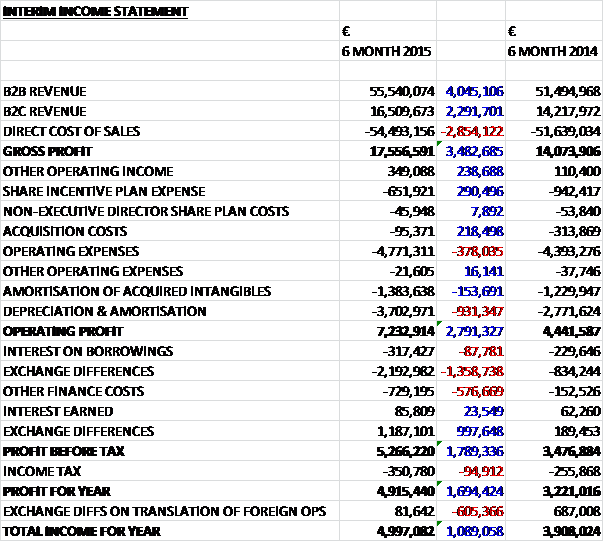
INTQincome

Revenue increased when compared to the first half of last year with a €4M growth in B2B revenues and a €2.3M increase in B2C revenue.  Cost of sales also increased somewhat to give a gross profit €3.5M ahead of last time.  Other operating income increased somewhat, and the expense related to the incentive plan fell, along with acquisition costs.  Other operating expenses did increase, however, and depreciation and amortisation was €931K higher to give an operating profit some €2.8M more than last time.  We then see a net €361K exchange rate loss and a €577K growth in other finance costs to give a profit for the period of €4.9M, an increase of €1.7M year on year.

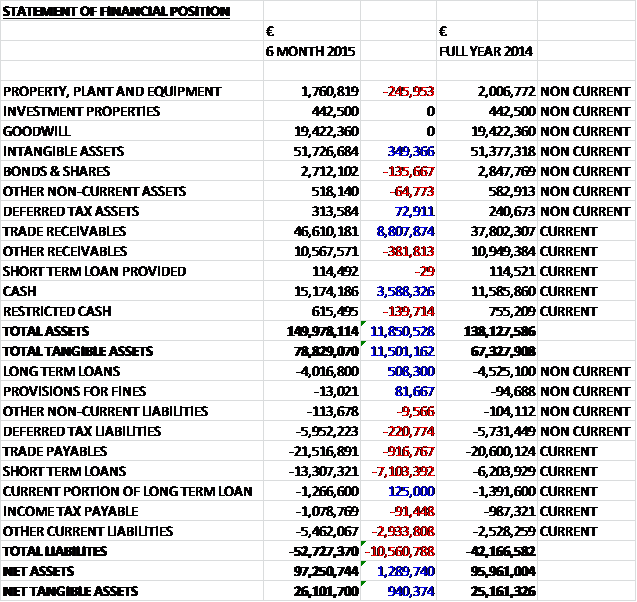
INTQassets

When compared to the end point of last year, total assets increased by €11.9M driven by an €8.8M growth in trade receivables and a €3.6M increase in cash levels.  Total liabilities also increased during the period due to a €6.6M increase in loans, a €2.9M growth in “other” current liabilities and a €917K growth in trade payables.  The end result is a net tangible asset level of €26.1M, an increase of €940K over the past six months.

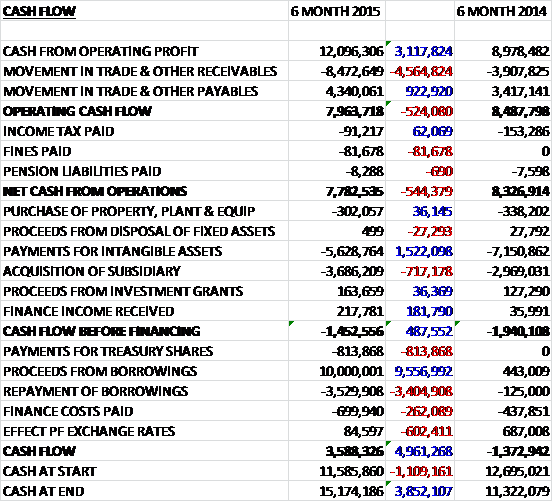
INTQcash

Before movements in working capital, cash profits increased by €3.1M to €12.1M but due to a large increase in receivables, the net cash from operations came in at €7.8M, a decline of €544K when compared to the first half of last year.  The group then spent €5.6M on software development and €3.7M on deferred consideration so that once again, there was a cash outflow before financing at €1.5M (the capex is expected to be slightly higher in the second half of the year).  The group then took out a net €6.5M of new borrowings to give a cash flow for the period of €3.6M and a cash level of €3.6M at the end of the half.

The adjusted operating profit at the B2B business was €9.6M, an increase of €1.5M year on year.  The managed transition away from the lower margin aggregation business is now well progressed and the group is benefiting from its focus on the high-growth high margin Minimob platform.  Growth has been fuelled by an increase in Minimob’s direct advertising revenue and the continued expansion of the performance based advertising client base.  During the period the group deployed Minimob with China-based global advertisers, including UC Browser and Baidu; direct advertisers, including BBM, NetDragon and HotelQuickly; and agency led brand advertisers, including WeChat, Gumtree and Samsung.

Minimob’s smartphone ad-serving revenues have also grown strongly, increasing from €7M to €35M year on year.  Continued progress has also been achieved in developing mobile marketing partnerships with mobile network operators in several geographies with Latin America delivering a 46% increase in revenue from €12M to €17.5M.  The release of self-service features on the Minimob platform along with ongoing platform upgrades should drive further growth, free from the challenges display advertising is facing.

The adjusted operating loss at the B2C business was €222K, a €900K improvement year on year.  During the period Akazoo produced positive EBITDA and with its pay-only business model, is differentiated in the marketplace.  Obviously the main event in this division was the deal with R&R Music, however.

After the period end R&R Music invested €17M and contributed their business to acquire nearly 32% of the Akazoo business.  The enlarged entity provides significant new cash resources, IP, human capital, synergies and other related assets.  Based on the subscription terms of the new investment, the implied valuation of the enlarged business was about €104M with InternetQ holding about 69% of the business.  Akazoo is now cash self-sufficient and the integration of R&R Music is proceeding to plan with the restructuring of the enlarged business across Europe well progressed and expected to be completed in H2.  The group expects an impact of up to €3M to the full year EBITDA as a result of the integration and investment to deliver the growth plans of the combined entity.

Going forward the board believe they are on track to achieve full year market expectations prior to the impact of the R&R Music acquisition with revenue expected to show a second half weighting.  They see further growth opportunities in the mobile marketing and music streaming sectors.  Minimob’s growth potential will be further enhanced by the introduction of new programmatic campaigns, self-service campaign planning and an increase in proprietary data which will drive optimisation going forward.  For Akazoo, growth will be supported by the market shift away from freemium models towards pay-only music streaming services, opening up new markets for growth.

The group finished the period with a net debt position of €2.8M consisting of €15.7M cash and €18.5M of bank debt.  As usual there is no dividend announced as no free cash is being generated.

Overall then, this was another period of growth for the group.  Profits were up, as were net assets but the operating cash flow fell due to a large increase in receivables (underlying cash profits improved) and as usual there is no free cash as the operating cash flow is ploughed back into the business through the purchase of intangible assets.   Profits at the Minimob business improved and the losses at Akazoo also got better.  The really interesting development here though is the injection of some €17M in cash from a third party that means the business is now self-sufficient.  The deal will consume some cash in integration costs but in the medium term it will be interesting to see if the business can generate any real cash without this burden.

That remains the crux really, I find it difficult to invest while the group is not really making any operating cash flow (if we count capitalised intangibles as operating costs, which really they should be).  This deal is threatening to make the group investible and I will keep a keen eye on developments here.

INTERNETQ

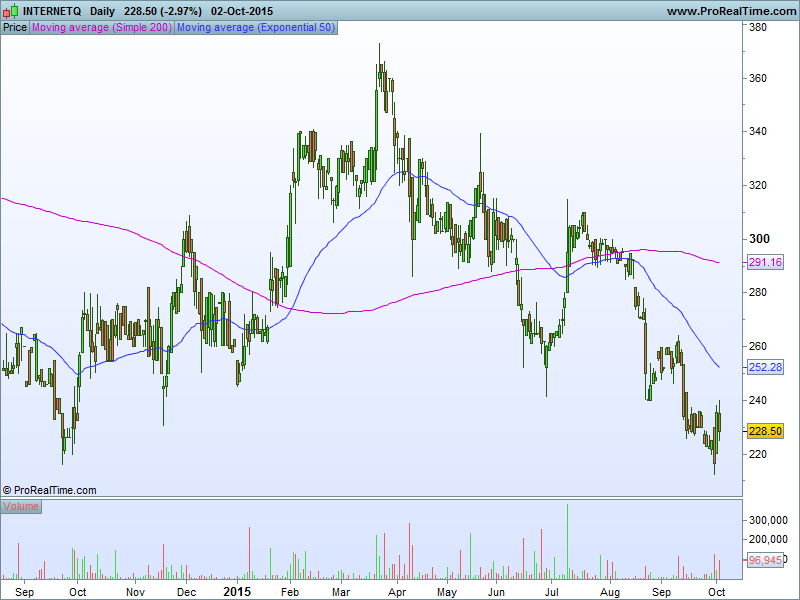
Despite the recent up-turn the trend still seems to be negative – one to watch.

On the 17th November the group released an update covering the first nine months of the year. Revenue was up 20% to €105.6M with B2B revenue up 17% to €79.7M and B2C revenue up 30% to €23.3M. Adjusted EBITDA was up 30% to €17.5M and adjusted pre-tax profit increased by 4% to €7.9M.

In Mobile marketing (B2B), new direct advertising campaigns, with no intermediary costs, created new revenue streams, increased momentum and helped drive improved B2B margins. There was a continued improvement in the quality of Minimob’s client base with new campaigns run for global brands including Alibaba, Deutsche Welle, Samsung, Ebay, Deezer, Pandora, Poker Starts, Amazon and HBO. There is also ongoing product development with the creation of a data front end that allows greater insight into daily transactions, the launch of a self-serve advertisers platform, and full development of the programmatic offering that will differentiate the Minimob platform from competition and will apparently help attract new business.

In the Digital Entertainment sector (B2C) there has been the successful integration of Akazoo and R&R Music with the launch of operations across the UK, Greece and Ukraine underway, the app has doubled its subscriptions growth rate in Poland, benefiting from a significant increase in brand awareness. Following the launch of the service in Indonesia in Q1, subscriptions in the region grew at a 50% month on month rate, and there was the successful launch and distribution of Akazoo radio in Poland, Indonesia and South Africa.

The group has recently launched the self-service advertiser platform, as a separate feature of Minimob, and noted a positive adoption of the proposition by clients and partners. They are seeing accelerated revenue growth in the second half of the year with Minimob’s strengthened position fuelling growth of the B2B segment and improved margins. The board expect that the shift towards adtech campaigns will have a positive effect on their top line and cash conversion going forward.

All this sounds very good of course, but what I am really interested in is the cash flow. Until the group starts making some real cash, I will continue to wait on the side lines.

On the 3rd December the group released a statement covering the recent price decline following a blog post. They state that given the factual inaccuracies in the post, they have taken the decision to strongly refute the assertions made and the conclusions drawn. They say that there has been no material change in the operational and financial performance or outlook for the business since the Q3 trading update. I believe the blog post was made by Tom Winnifrith of Share Prophets. There may well be some factual inaccuracies in the blog but he usually does his homework and has been very good at spotting dodgy companies in the past so I would certainly not be buying these shares following this collapse in the share price.

On the 7th December the group released a rebuttal of the blog post last week. They made a few comments, most of which seems to be waffle but some of the more important points in my view were: The B2B concentration ratio referred to by the author refers to 2014 and largely relates to the group’s legacy mobile marketing campaigns business in which the billing/collections were often made using a small number of multi-country aggregators in line with common industry practice (in response to the point about the group having a high client concentration); management strongly denies suggestions that the group is involved in any manipulation of Akazoo’s ratings on social media and the fact that they often agree to use its respective local partner’s brand instead of the Akazoo brand in promoting the B2C service may explain why the Akazoo-related “liking” activity of international pop stars may appear low.

In response to the suggestion that the Akazoo Polska has a terrible brand in the country, the company seems to agree and mentions that in Poland the service now mainly operates using Orange’s own brand (powered by Akazoo). The blog suggests that the group has a relationship with three companies called Twinsbox, Adviator and Bette Tech. Apparently these companies are not related parties and the appearance of the group’s office addresses on the websites of these companies appears to be the case of content scraping and now the company has been made aware of this, they have threatened those parties with legal action and at least one has removed their address from their website.

It appears the group has had dealings with them, however. About five years ago, Twinsbox acted as a trial local agent for the group but as it was unsuccessful this arrangement ended shortly afterwards. They also confirm that they occasionally interacted with Adviator with them acting as a low value systems technical integration contractor on behalf of Russian mobile networks or mobile aggregators active in the Russian market.

Obviously this response is much better than the last one, but this doesn’t quite ring true with me. I have no real opinion either way, however, but it is a fascinating turn of events here and I will watch on with interest.

On the 2nd February the group announced that it has been approached by Toscfund, Penta Capital and the current CEO, acting jointly, about a possible offer for all of the outstanding shares in the company which are not already owned by them. They have until the 1st of March to make an offer. Well, this is an interesting development and obviously had the effect of boosting the shares. I suppose the end game is getting close here and we will find out in a month’s time what is really going on here.

On the 9th February the group released a trading update covering 2015. Revenues increased by 145 to €150M. The Mobile Marketing business contributed about 72% of these revenues and the Digital Entertainment business contributed 28%. Cash levels at the year-end were about €19M compared to €12M at the end of the prior year. Apparently the group has a solid pipeline and is exhibiting positive momentum across both businesses. This is all well and good but their performance is a sideshow really with the most important thing at the moment the potential buy out of the company.

On the 1st March it was announced that the consortium and directors have reached an agreement for the cash offer of the company. Under the terms, each shareholder will receive £1.80 per share which represents a premium of 120% over the closing price before the first announcement and values the company at about £72.2M. It looks as though they have about 54% of the total shareholding already accepting the terms so I suspect this will go through. Interestingly there is a comment that the allegations in Tom Winnifrith’s blog post, or their impact on the share price are not reasons for making the offer and that discussions were already taking place prior to the allegations.

So, it looks like this saga may have come to an end with a pretty decent outcome for shareholders (although perhaps not those that have been holding for the long-term). It seems we will never know whether the company is a scam or not but it has been an interesting saga. Unless anything changes, this will be my last post on this company.

Tower Resources Share Blog – Interim Results Year Ending 2015

Tower Resources has now released its interim results for the year ending 2015.

TRPinterimincome

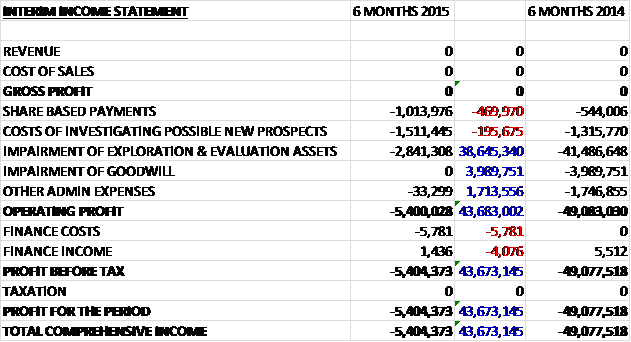
Obviously there is no revenue so no gross profit but there was over $1M of share based payments, an increase of $470K when compared to the first half of last year.  The cost of investigating new prospects also increased, up $196K with $800K spent on the Thali license in Cameroon, but these increases were more than offset by a $1.7M decline in other admin expenses.  We also see a $2.8M impairment of exploration assets relating to activities in Kenya and Namibia, compared to more than $41M last time and no impairment of goodwill.  Finance costs were negligible and there was no tax so the loss for the half year came in at $5.4M, a decline of $43.7M year on year.

TRPinterimassets

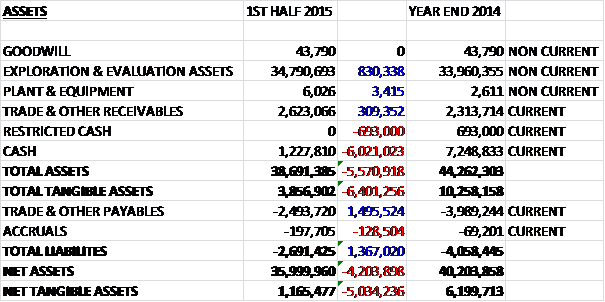
When compared to the end point of last year, total assets fell by $5.6M driven by a $6.7M decline in cash levels, partially offset by an $830K increase in the value of exploration and evaluation assets and a $309K growth in receivables.  Liabilities also fell during the period due to a $1.5M decline in trade & other payables.  The end result is a net tangible asset level of just $1.2M, a decline of $5M during the period.

TRPinterimcash

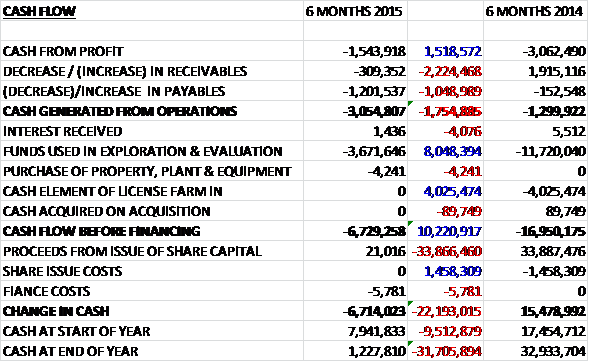
Before movements in working capital cash losses halved to $1.5M but a fall in payables meant that the cash outflow from operations was $3.1M, an increase of $1.8M year on year.  There was no farm in costs during the period so the only expense was the $3.7M used in exploration and evaluation which included $2.2M spent in Kenya and $600K spent in Namibia, both subsequently impaired, so that before financing, the cash outflow was $6.7M.  There were no material items of financing so this was also the cash outflow for the period and the cash level at the end of the half year stood at just $1.2M.

The strategy of the group has changed somewhat.  The entry into the Cameroon shallow waters marks a shift in the risk profit from frontier to proven producing basins.  They have refocused the portfolio and resources to areas on the Atlantic Margin where they are confident they can add value in this difficult market.  They have therefore withdrawn from areas where it is felt there is no medium term likelihood of commercially worthwhile success.  They intent to take advantage of the current difficulties in the sector to assemble further acreage and they are moving increasingly towards being an early stage operator.

In Cameroon, negotiations for a 100% interest in the shallow water Thali block PSC continued throughout the period and the PSC was signed with the government in September 2015.  The block is located in the Rio Del Rey basin, a proven producing sub-basin of the Niger Delta, offshore Cameroon.  The PSC covers depths ranging from 8 to 48 metres and the basin has, to date, produced over one billion barrels of oil and has estimated remaining recoverable reserves of 1.2 billion boe, primarily within water depths of less than 2,000 metres.  The Thali block itself includes existing oil and gas discoveries totalling 7M barrels and contains a number of already identified exploration opportunities across four distinct play systems.

On signing the PSC, a three year initial exploration period commenced with a work programme designed to unlock both appraisal and exploration potential.  The initial priority is the acquisition of 3D seismic in the first half of 2016.  This will be used to update the existing 24 year old data to allow better resolution of shallow plays as well as imaging of deeper sections.  The group expect to be drilling by 2017/2018.  The market downturn in the services sector presents the opportunity for the company to leverage lower seismic and drilling costs and a partner will be sought to share the financial commitment and provide additional technical input.

The terms of the contract include three exploration phases, including the minimum work commitment of the initial exploration period which covers three years and consists of geological and geophysical studies, 100km2 of 3D seismic acquisition and a commitment well with a minimum financial commitment of $13M.  The first renewal period, covering the subsequent two years consists of one exploration or appraisal well with a minimum financial commitment of $15M.  The second renewal period of two years also consists of one exploration or appraisal well with a minimum financial commitment of $15M. The company has the option of relinquishing the license on completion of each period.

The current oil discovery on the block is viewed as being sub-commercial but once better seismic imaging has been achieved the company sees potential to add incremental oil reserves to achieve commerciality.  There is also significant potential to develop prospects at deeper levels, in both structural and stratigraphic traps once better imaging has been achieved.  The existence of infrastructure in adjacent blocks means that the development of a 20M barrel oil field has the potential to be economically viable at current oil prices.

In Namibia the group received formal notification from Repsol, the operator of PEL0010 of their decision not to proceed into a second year of the final renewal period on the license which would have included a commitment to drill a well.  After the first renewal period expired in August, the joint venture’s interest in PEL0010 has therefore been relinquished.  Tower has itself submitted a proposal to the Namibian Ministry of Mines and Energy for a new license covering the former PEL0010 acreage.  The company is also negotiating other new operated acreage positions offshore Namibia.

In Zambia, analysis of the samples taken from the fieldwork programme continued throughout the period.  Results indicate that elements for a working petroleum system are present with the potential for both oil and gas generation.  No modern seismic or drill data exists in this basin.  In August, the company completed its second programme of fieldwork and obtained more encouragement that the area has significant exploration potential with the presence of potential source rock, reservoir and seal now being proven.

Given the existing surrounding infrastructure and constrained domestic energy market, the group believes that there is significant gas to power opportunity in the area with the blocks well positioned relative to markets and distribution infrastructure.  The three year secondary period has been split into three one year periods with respective commitments to further field work, airborne gravity and magnetic data acquisition, and a 2D seismic programme.  The company is actively looking for a partner to accelerate the programme so that prospects can be drilled in 2017.

In South Africa, in September, approval was received to enter the two year first renewal period on the offshore Algoa-Gamtoos license (50% owned).  Evaluation continues by the operator New Age of the previously acquired 3D and 2D seismic with several prospective plays being worked up.  Whilst commitments are limited to additional geophysical work, further seismic acquisition is planned, but this will not be possible before 2017 due to environmental restrictions.  A funding partner will be sought in due course.  Approval to convert the Orange Basin TCP into an exploration right is being awaited.

In Kenya, in February, the group announced that the Block 2B Badada1 well had been drilled but was plugged and abandoned as a dry hole.  In May the Kenyan Ministry of Energy granted an extension of six months to the first additional exploration period to enable the joint venture partners to assess the results of the well.  Following the group’s assessment a decision was made to exit the licence from the end of August, however, with all license commitments of the first additional exploration period having been met.  As a result of renewed political uncertainty in Madagascar and a lack of progress with negotiations for Block 2102, the company has withdrawn its interest for the time being.  With the group’s focus now being on the western parts of Africa, the East African Regional office in Uganda has been closed and the head office has moved to a more cost effective premises in London.

In July the company announced a placing and subscription to institutional and some other investors of nearly 3BN shares at a price of 0.19p per share to raise $8M.  Of note, M&G investments (part of the Prudential group) invested $3.6M in the placing and they currently hold 18% of the company’s share capital.  In addition, Standard life now has a 5% interest and employees and consultants subscribed to $1.4M of the placing funds so there are some heavy hitters invested here.  The chairman believes the group is well positioned, he is comfortable with the current funding position and is optimistic about the future.

At the period end the group has cash balances of $1.2M and took in a further $8M in July from an equity funding.  The board believe this will be enough to meet its committed capital expenditure programme for at least the next year.

In September, Dr. Philip Frank joined as non-executive director along with Nigel Quinton as exploration director.  Dr. Frank has over thirty years of experience in the industry.  He joined FTSE250 company Emerald Energy in 2003 as exploration manager until the group was acquired by Sinochem for £532M in 2009.  Until March 2015 he was exploration director at Sterling Energy with responsibility for all new venture and exploration activities in Africa and Kurdistan.  Nigel Quinton is a geoscientist with over thirty years exploration experience.  He is a co-founder of Sterling Energy and became Operations and Technical director after it listed on AIM.  He has worked at Tower since 2012 as head of exploration and has overseen the drilling operations and led the negotiation of the entry into the Thali PSC in Cameroon.

Overall then, much like other similar companies, this has been a difficult six months for the group.  The loss did improve year on year, but net assets fell and the operating loss increased, although this was due to adverse working capital movements.  There was a $6.7M cash burn and after the recent placing, cash is probably at about $9M so there is likely to be enough cash to last the next year but after that more funding is going to need to be sought.  The change is strategy from more risky frontier exploration is an interesting one and the Thali block in Cameroon does look rather promising to me.  Namibia seems to be on the back burner at the moment, although there are some applications going through.  The next drilling is likely to be in either Zambia or Cameroon but will not take place until 2017.

This company is starting to look interesting with the Thali block and there are some heavy hitters investing in the placing.  There are a huge number of shares in issue though and I would not rule out yet more dilution further down the line so I am holding tight for the moment.  I lost a lot of money on the Namibia debacle so I am a little hesitant to back them again.

On the 16 February the group released a South Africa update. The group with its 50% partner New African Global Energy, have agreed not to proceed with an application to convert the TCP in the SW Orange Basin into an exploration right. Accordingly, New African will reimburse the group the sum of $500K which was paid as part of an original farm-in agreement in 2013, which has now been terminated. The exit from this high-cost deep water frontier basin is consistent with a move towards a more balanced portfolio of proven and emerging basins and will allow Tower to concentrate its efforts in South Africa on the Algoa-Gamtoos ER which offers more near-term potential.

At Algoa-Gamtoos, the 2016 work programme and budget has been approved between the joint venture partners (New Age and Tower). The programme will include further geophysical work and the interpretation of previously acquired 3D seismic data with a view to seeking a partner for the next stage of operational activity.

I suppose every little helps, and this receipt of funds now means that the South African programme for 2016 is self-funding, which is nice.


Northern Petroleum Share Blog – Interim Results Year Ending 2015

Northern Petroleum has now released its interim result for the year ending 2015.

NOPinterimincome

When compared to the first half of last year, revenues fell by $908K to just $223K.  Cost of sales also fell, representing the fixed level of costs incurred during the shut-in period in addition to the cost of shutting the wells in and an element of the work undertaken to restart the 100/16-19 well, to give a gross loss some $651K worse than last time.  We also see a $1.6M decline in admin expenses and an $814K “other” operating income relating to the cash received for the farm out of the Cascina Alberto permit, which meant the operating loss was $2.1M, an improvement of $1.9M year on year.  We do see a foreign exchange loss of $429K due to the strengthening US dollar though, which drove the loss for the first six months of the year to $2.6M, an improvement of $1.2M when compared to the first half of 2014.

NOPinterim assets

When compared to the end point of last year, total assets fell by $8.9M driven by a $9.2M collapse in cash, a $1.9M decline in exploration and evaluation assets and a $1.1M fall in receivables partially offset by a $3.6M increase in oil and gas assets.  Total liabilities also fell during the year, mainly due to a $4M decline in payables.  The end result is a net tangible asset level of $4.6M, a decrease of $2.7M over the past six months.

NOPinterimcash

Before movements in working capital, cash losses improved by $1.5M to $1.6M but after a large fall in payables as the group paid down a significant amount of Canadian creditors, the net cash outflow from operations was $4.5M, a $1.9M deterioration year on year.  The group then spent $3.9M on property, plant and equipment relating to the capex on the 102/11-30 well drilled in February and the tie-in of the 102/15-23 well, along with $560K on exploration and evaluation so that before financing the cash outflow stood at $9M.  There were no financing items so this was the cash outflow for the period which meant that the cash level at the period-end was just $3M.

In Canada, production from the group’s existing wells was shut in towards the end of January.  They were being produced using expensive rental equipment and production was being trucked, making it only marginally economic before being tied into local infrastructure.  With the drop in the oil price, only one of the wells was tied in as the capital payback period on the investment required to tie in the other wells had significantly increased.  Following the temporary halting of production, the rental equipment was removed from the remaining wells and the ongoing running cost of the operations in the field was reduced to as low as possible.

Subsequent to shutting these wells in, the operator of the infrastructure detected a problem with part of their pipeline network, requiring 102/15-23 to be shut in as well.  This meant that for the majority of the period the group had no production.  Economic production was restarted in June from the 100/16-19 well, enabled by the purchase of a low cost production vessel that removed the need for high cost rental equipment.  Production from the 102/15-23 well was expected to restart during Q3 but the operator of the local infrastructure is undertaking a wider review of the pipeline network following initial repairs and the restart of production will occur after the infrastructure operator makes the necessary repairs or the group implements an alternative offtake solution.

During Q1, the 102/11-30 well was drilled into a previously developed reef.  It encountered the reservoir on prognosis but problems experienced when cementing the liner over the reservoir section lead to difficulties in interpreting the well test.  The well delivered nearly 100 barrels of oil per day during the test with 85% water production, but it was not possible to determine where the water was coming from due to the cementing issue.  As a result, the well was suspending pending a subsurface review to understand the water production mechanism and determine the optimum way to produce the well with minimal water production.

Significant progress has been made in Italy.  The group farmed out an 80% interest in the Cascina Alberto permit to Shell for a cash contribution of $850K and a carry effectively through to the end of the drilling of any exploration well on the permit.  The group has also received the approval of six environmental impact assessments in the Southern Adriatic, one for the proposed 3D seismic programme across the Giove oil discovery and Cygnus exploration prospect, and five others for application areas.  Approval for these EIAs allows the group to plan the seismic programme and work with the Ministry of Economic Development to turn the applications into permits.

Further reductions in cost have been made during the first half of the year including an additional reduction in the number of staff and an office move to a much more cost effective location.  With just $3M in cash at the period end, a number of initiatives are actively being pursued to bring necessary further capital resources into the group to find the business.  With the outlook for crude oil prices remaining uncertain into next year, the focus of the business is on minimising the cost of development and production.

Overall then, much like many similar small oil and gas companies, this has been a difficult six months.  The total loss did improve but net assets declined and the operating cash outflow increased due to the payment of some large Canadian creditors – the underlying operating cash loss actually improved year on year.  Still, with a cash burn of £9M and just £3M left in the bank, the group will likely need to raise more funds from somewhere.  The Canadian operation has had a very difficult half year with problems in the pipeline network and expensive rental equipment meaning that there was practically no production at all during the period.  There is no one well back into production but that is not going to carry the company.  Things in Italy progressed rather better with the farm-out agreement and the EIA approvals.

Overall though, until the funding issues have been clarified and the oil price improves this seems like a very difficult company to invest in so I will wait on the side lines.

NTHN.PETRO.

This is not a good looking chart!


On the 12th November the group announced a proposed direct subscription of 40,000,000 new shares to raise $1.2M, an acquisition of assets in NW Alberta and a proposed open offer for up to a further 40,000,000 new shares at 3p per share.

The acquisition comprises of existing production facilities and wells on mineral leases across approximately 28,000 acres, the majority of which are in the Rainbow area of NW Alberta, about twenty miles South of the company’s existing Virgo assets. The consideration to be paid is about $200K in cash and the company will also assume the abandonment liability for all the wells and facilities acquired, with the net liability estimated at $1.5M. The operating cash flow attributable to the assets being required was C$400K over the past eight months.

These Rainbow assets were previously acquired by the vendor as part of a larger corporate acquisition and were regarded as non-core. They are estimated to contain proved and probable reserves of approximately 1.185M barrels of oil equivalent with a calculated net present value of about $14.7M. The existing wells on the leases were drilled to target multiple reservoir horizons including a Devonian Keg River light oil play, the same play as targeted within the company’s Virgo assets. The Rainbow assets had average reported production in September of 211boe/d, of which about 80% was oil.

The assets include a total of 117 operated and 41 non-operated wells, of which about a third are either currently in production or are believed to have the potential of being brought back into production. The remaining wells are either suspended or abandoned. In addition to the wells and mineral rights, a material amount of facilities and equipment are included with the acquisition. There are two main facilities which consist of storage tanks and water separation facilities as well as water disposal wells. There is also a direct sales point into the Plains Midstream Pipeline system for produced oil. These facilities will provide operational synergies for the existing Virgo assets, since production can be trucked, processed and sold through the Rainbow Assets facilities without incurring third party processing and water disposal fees currently being paid by the company for its existing production.

The directors have identified an initial work programme on the assets which is proposed to be initiated shortly after the completion of the acquisition. This involves the reinstatement of wells and facilities and is intended to double the existing oil production over the next year. It is forecast that this production, combined with the forecasted production from the company’s existing assets, will provide sufficient net cash flow to broadly cover their total general and admin costs in 2016, using an oil price of $47 per barrel, and should allow the company to access the debt capital markets for future development capital. Over the long term, it is believed that the combined asset base could support production growth to in excess of 2,500 bopd.

The company has raised £1.2M before expenses via a subscription of 40,000,000 shares at an issue price of 3p per share. It is being taken up by Cavendish Asset Management and City Financial Investment, both existing shareholders. Also, a further 40,000,000 shares will be made available at 3p per share under the terms of the open offer to raise a further £1.2M which the directors at least intend to take up.

As far as operations are concerned, in Canada since the end of Q2, the 100/16-19 well has continued to produce with a water cut of about 25%. Average daily production for Q3 has been about 25bopd. Well 102/15-23 is still not producing as the owner of the pipeline has decided not to proceed with the repair that is needed so the company is looking at undertaking the repair itself.

In Italy, the exploration work programme has begun on the Cascina Albert licence, which involves the reprocessing of existing seismic to determine whether further seismic is required before a decision can be made on an exploration well. The company is now planning a work programme to acquire 3D seismic in the southern Adriatic across the Cygnus exploration prospect and Giove oil discovery, which is forecast to occur in Q3 2016. This seismic acquisition is subject to financing, most likely through a farm out of the permit, and the positive conclusion to local appeals and operational approvals. The company is also drafting an appraisal well environmental impact assessment submission with the plan to drill a well in the next year and a half.

They aim to drill five wells in five years across its Italian permits and exploration applications, each with the potential to add material value to the company upon success. The completion of such a forecast programme will be subject to securing suitable financing and all the necessary regulatory approvals. The company has ongoing discussions with various third parties in the industry regarding possible farm outs of its Italian assets and is currently in discussions with one particular party concerning the farming out of its offshore permits and exploration applications.

The directors and other key management have agreed to further reduce their salaries. In exchange for this reduction, nil-cost options over new shares will be issued every three months so that they don’t miss out – so we are swapping dilution with costs then, and given the current value of the company, this could be substantial. Things have got so dire here that they are having to reorganise the capital of the company as the new shares are being issued at a price lower than their nominal value.

This really is a desperate situation here. The group only has one well currently producing, the owner of the pipeline is refusing to repair the damaged section and now up to 80,000,000 new shares are being issued compared to a current total of 95,365,660, meaning huge dilution, for a paltry £2.4M which, hopefully, will bring the company up to a break-even position. I am glad I don’t own shares here, it is a shame really as some of these Italian assets do look potentially interesting but I don’t see this company as investable at the moment.

On the 22nd January the group released an update. At the year-end the cash position stood at $2.4M after the payment of the consideration for the Rainbow assets and other year-end payables. The forecast for 2016 general admin costs is less than $3M and positive cashflow is forecast from Canadian production, even in the current oil price environment.

The focus in Italy over the next six months will be on the submission of an environmental impact assessment for the approval of an appraisal well to be drilled on the Giove oil discovery in 2014; planning for a 3D seismic acquisition in the southern Adriatic in the second half of 2016, primarily over the Cygnus exploration prospect; and the ongoing exploration campaign on the Cascina Alberto permit for which the company is being carried by the operator Shell.

Both the proposed 3D seismic over Cygnus and the appraisal well on Giove will require external funding and the company is in discussions with several companies to understand if appropriate funding can be structured for the programmes. In addition to these activities, the company awaits the final decree from the MOED for the award of five exploration permits which adjoin the existing permits in the Southern Adriatic.

In Canada, following the payment of the cash consideration for the acquisition of the Rainbow Assets the Alberta Energy Regulator has assigned the leases to the company following the deposit of $1.2M. This deposit represents the cost of the asset abandonment liability as due to the shutting in of production during last year, the assigned asset value has steadily decreased which has resulted in a larger cash deposit being made than initially forecast. The deposit will return to the company once production and asset values increase which is expected to occur as a result of the winter work programme.

Canadian production from the enlarged company currently totals about 200boe per day, of which about 80% is oil. In total the proved plus probable reserves come to 1.48M boe of which proved reserves are 0.92M boe. The winter work programme focuses on the replacement and repair of pump and rods and engines on the Rainbow Assets as well as returning the previously shut-in 09-25 battery into production.

In the Virgo area, the 102/15-23 well has been shut in for nearly a year due to a pipeline integrity issue on a third party operated gathering system. After discussions, the company has agreed to take ownership of the affected section of pipeline and carry out the necessary repair work during February to bring the well back in to production.

There is no drilling or well workover activity planned for this winter. Due to the oil services industry adapting to the changing industry environment and a further refinement of the programme, it is anticipated that this work programme will now cost about $600K, almost half as much as originally forecast and will take about three to four months. The company now expects this programme should lead to a doubling of their production.

On the 15th March the group released an update covering the Canadian business. The recently acquired Rainbow assets are performing better than expected. There are initial high rates of production as wells are restarted and the asset base appears to have plenty of scope to reach the target of 400 barrels per day this year.

The winter work programme targeting the doubling of group production to 400bopd began in late January following the acquisition of the Rainbow assets. The programme is focused on restarting wells through the replacement and repair of equipment, storage tanks and pipelines at both those assets and the nearby Virgo assets. To date, the group has acquired and tested the pipeline tie-in from the 15-23 well to the local operator in the Virgo assets area; reconfigured the facilities and pipe work at 15-1 in the Rainbow Assets area; and pressure tested and prepared for the reinstatement of the 9-25 battery in the Rainbow Assets area.

It is anticipated that the 9-25 battery and the majority of the wells tied into that battery will start production later this month and the battery also has the benefit of third party tariff income derived from the processing of other operators’ oil.

The remaining activity of the programme involves the use of a rod rig and workover rig to change out broken rods and pumps on up to six wells, which will then be restarted. The amount of wells included in the programme will depend on the timing of the arrival or warmer weather. A further well, 2-12, is also being considered as a start-up candidate subject to reconfiguring the facilities at the well head.

The capital cost of the programme is expected to be within the reduced forecast cost of $600K. The company has already deposited about $1.3M with the Alberta Energy Regulator as an abandonment deposit when the new assets were acquired. This money will be returned to the company once the deemed asset value increases above the abandonment liability. The company expects the full deposit to be returned during Q3 this year and the capital cost of the programme and a possible further summer programme will be managed around the timing of this deposit return.

The 15-23 well, which produced for less than a month at the beginning of 2015 before being shut in due to problems with the pipeline tie-in, was bought back online at the end of February at a rate of 540bopd with very little water cut. It has now been choked back to produce between 100 and 150 bopd to help minimise water production over time.

The 15-1 well, which has been shut in since 2012, when it was producing about 20bopd, came back into production towards the end of February at almost 400bopd. It was then shut in following problems with the well head equipment, which was repaired, and is now back in production at a restrained rate of between 100 and 150bopd, again to minimise water cut in the longer term.
The 13-36 battery continues to produce at approximately 140bopd from eight tied-in wells. Production from 15-1 and 9-25 will be trucked to the battery for processing, water disposal and sale into the Plains Pipeline System.

A priority for the company is restricting the initial high rate flus production, which in turn should reduce the rate at which the water cut climbs. This is not as important for those wells directly tied in via a pipeline to the 13-36 or 9-25 facilities as both have water disposal wells, but increasing water cut from standalone single well batteries means increased trucking costs to transport produced oil and water to the batteries for processing and sale. This is also the case for the 15-23 well where the company has to pay the third party operator processing fees for water separation. The longer term plan for all the wells is to ensure produced water can be disposed of at minimal cost, allowing these wells to produce oil profitably even when the water cut is in excess of 90%.

Overall then a nice little update that shows some progress is being made in Canada but it would have been nice to have received some information about the cash position.

James Halstead Share Blog – Final Results Year Ended 2015

James Halstead has now released its final results for the year ended 2015.

JHDincome15

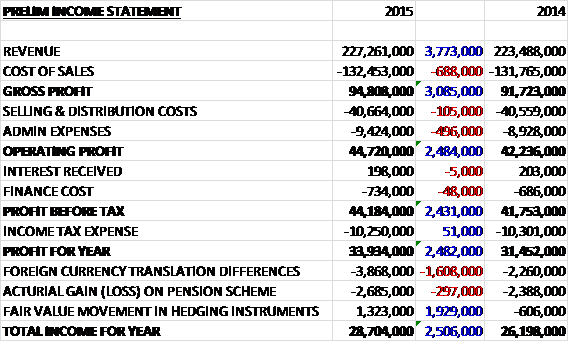
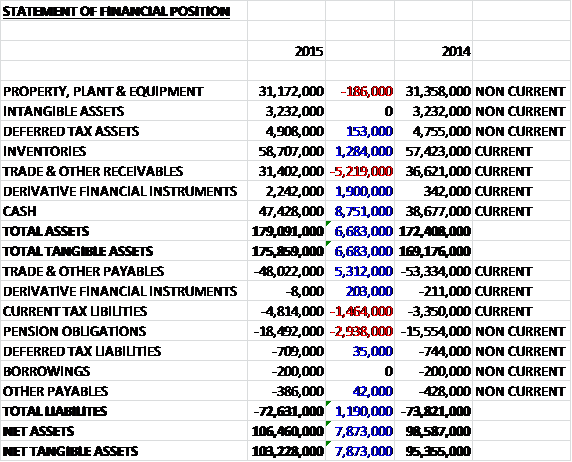
When compared to last year, revenues increased by £3.8M to £227.3M.  The cost of sales also increased to give a gross profit some £3.1M ahead.  Selling and distribution costs increased slightly but admin expenses grew by £496K so that operating profit came in £2.5M ahead of last year.  Finance costs grew modestly but this was offset by a reduction in tax which meant that profit for the year came in at £33.9M, an increase of £2.5M year on year.

JHDassets15

When compared to the end point of last year, total assets grew by £6.7M driven by an £8.8M increase in cash levels, a £1.9M growth in derivative financial assets and a £1.3M increase in inventories, partially offset by a £5.2M fall in receivables.  Total liabilities fell during the year as a £2.9M increase in pension obligations and a £1.5M growth in current tax liabilities were more than offset by a £5.3M decline in payables.  The end result is a net tangible asset level of £103.2M, an increase of £7.9M year on year.

JHDcash

Annoyingly there is no split for changes in working capital so the cash generated from operations was £42M, an increase of £7M when compared to last year. This was further improved by a £3.1M decline in the amount of tax paid so that the net cash from operations was £33.7M, an increase of £10.1M year on year.  The group only spent £3.9M on capital expenditure so there was an impressive free cash flow of £30.1M, of which £21M was spent on dividends with the rest becoming the cash inflow for the year of £9.2M to give a bulging cash pile of £47.4M at the year-end.

The group have consolidated their position as the UK market leader and UK growth of 10% has driven this year’s results as the factory in Teesside continues to be crucial to the growth.  Europe continued to represent a sizeable portion of the business (about 40%) and this has grown by 5% in local currency.  The Australian business has improved on the disappointing results of the last couple years, increasing turnover by 15% in local currencies.  Manufacturing efficiencies, stable raw material prices and economies of scale as Teesside output grows have helped protect margins.

At Polyflor Nordic, turnover was broadly on a par with previous years.  There has been good progress in the sale of manufactured product and in particular, with the introduction of product manufactured at the Teesside facility.  During the year the group have installed the most northerly Polyflor in the world in Longyearbyen, a city well inside the Arctic Circle, on student’s apartments.

Objectflor has shown growth with sales 3.9% ahead of the priod year.  During the year they launched Expona Flow at the BAU exhibition in Munich.  It is a brand of luxury vinyl sheet and the market response was apparently excellent.  Gross margin was under pressure due to extensive competition in the luxury vinyl tile sector and due to the weakness of the euro but this pressure was offset by favourable product mix and profit increased by 3.9%.  The French business has continued to grow with a 5% sales increase.  It still has a relatively low market share and with a broader range the group expect the business to expand again next year.

The Australian turnover was 15% ahead of last year and there has been an increase in gross margin, which was expected after the group undertook a large stock cleansing exercise in the prior year.  This was partially offset by increased import costs due to the weakness of the Australian dollar.  New Zealand turnover increased by 1.1% and the company continues to win projects to augment the refurbishment sector.  The Housing New Zealand contract to supply social housing is adding to the solid position in the country.  In Asia, the group faced a difficult year with sales dipping slightly below last year.  The sales mix was towards the higher-end ranges, however, with profitability increasing.  China continues to be the lead market in the region but it was lower this year as a result of the widely reported slow down, nevertheless the LVT and Expona Flow ranges fared well in retail and healthcare.  In the rest of the region, Singapore, Thailand, the Philippines and South Korea all shared good growth.

It was a solid year for the UK manufacturing operations with turnover up 4.1%.  The launch of Secura in June 2014, Expona Flow in February 2015 and Designatex in June 2015 are adding volume to the plants.  In the UK, turnover was up 10% reflecting market growth and increased market share but there is competition from Euro-based rivals.  Gross margins were maintained against the pressures of exchange rates due to the increased volume through the UK plants.  Some projects completed included the refurbishment of Astra Zeneca’s Alderley Park R&D facility, the Rolls Royce Apprentice Academy in Derby, and the National Space Centre in Leicester.

It is third year as a distributor in Canada, the business continued to grow with turnover up 14%.  A warehouse has been based in Ontario which has been a good asset and the introduction of the Expona ranges of LVT are building on the established Polyflor ranges.  The board are positive on future growth in the country.  Polyflor India was formed in the early part of the year and the initial focus has been on recruiting local sales reps.  Sales have been encouraging but in its first year the business made a small loss.  The group are working alongside their long standing distributor who is focused on the region around Delhi but the team is now winning sales in Gurgaon, Bangalore, Goa, Guwahati and Mumbai.  The pace of growth in the country is significant and the strategy is aimed at new build in the healthcare and educational sectors rather than the refurbishment market.

Sales to South America showed growth with a 42% increase over the prior year.  The Middle East, despite turmoil in several countries, has progressed some 9% with Kuwait, Oman, Qatar and the UAE showing year on year growth.  In Africa, sales to Kenya, Nigeria and South Africa all significantly increased.  The Russian market is depressed and given the state of the economy this is likely to remain the case but Poland, Latvia, Lithuania and Romania all continued to grow.

A number of new contracts won during the year include the Stade des Lumieres, built in Lyon for Euro 2016; Matru retail stores in Chennai; and Queenstown International Airport in New Zealand.

In many of the group’s markets confidence in growth has taken root but there is still some way to go in the global recovery which bodes well for new build projects.  The board are encouraged that their launches of Designatex and Expona Flow towards the end of the year have been well received and there is an increasing amount of safety flooring that is manufactured in Teesside which is a trend that will continue to give economies of scale.  In recent months, the group has been fighting against the strength of Sterling against the Euro which they expect to continue into the new year but there have been some offsetting factors such as cheaper input prices of raw materials and the board remains positive.

After a 12.3% increase in the final dividend the shares yield 2.7% which increases to 2.9% on next year’s consensus forecast.  At the current share price the shares trade on a fairly hefty PE ratio of 25.3 falling to 24.9 on next year’s consensus forecast.  There is no debt so the net cash position stands at £47.4M – I wonder what they will do with it all…

Overall then this has been another strong year for the group.  Profits and net assets were both up and the operating cash flow also increased with the group producing loads of free cash which boosted the already sizeable cash levels.  Trading was good in the UK, as it was in the EU and Australia but adverse currency issues affected these two markets.  Things were harder in China and Russia due to the well-documented problems in these countries and considering China is the group’s largest Asian market, there is some exposure to risk here.  On the cost side, the strong sterling has been offset by greater economies of scale in Teesside as more product in manufactured there and a relatively benign raw material price environment.

New ranges have been introduced towards the end of the period and with a dividend yield of 2.9% I am more than happy to keep holding what is one of my largest positions.  The forward PE of 24.9 looks expensive but this is undoubtedly a quality outfit with a lot of net cash so it is perhaps warranted.

JAMES HALSTEAD

The chart also looks rather good here.

On the 27th November the group released a statement covering the first five months of the year. Trading in the year so far has been in line with budgets. Turnover on a constant currency basis is ahead of the same period last year but on a par on a reported basis due to the effects of exchange rate translation. Profits are ahead of last year and the board believe first half results will be in line with management expectations. They have also announced a special dividend equal to 7.858p (the same as the final dividend) so that is a nice bonus for shareholders!

On the 3rd December it was announced that Mr Wild, a non-executive director of the company, sold 33,000 shares with a value of £165K. He still owns 150,300 shares but this represents quite a hefty sale.

On the 1st February the group released a pre-close trading update covering the first half of the year. Turnover has increased in each of their major markets on a constant currency basis but currency translation to sterling had an adverse impact of 10-15%. Despite this, the profit for the first six months trading is ahead of last year and in line with the board’s expectations and confidence in the full year is unchanged and remains positive.

Circle Oil Share Blog – Interim Results Year Ending 2015

Circle Oil has now released its interim results for the year ending 2015.
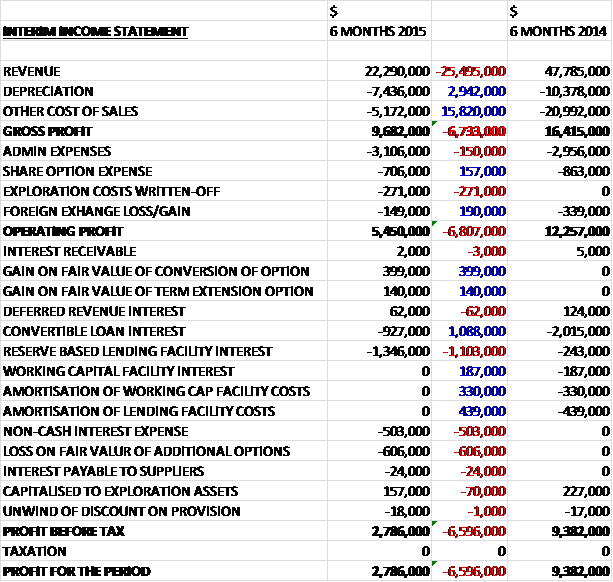
COPintincome

When compared to the first half of last year, total revenues more than halved to $22.3M which related to $15M of mostly oil sales in Egypt and $8.3M of gas sales in Morocco. This reflected the fall in oil prices and lower production volumes in Egypt.  There was also a small reduction in Moroccan gas sales due to the end of one customer contract.    Both depreciation and other cost of sales also fell so that gross profit fell by $6.7M to $9.7M.  Admin expenses increased slightly, and there was $271K of exploration costs written off relating to the failed well in Oman, offset by a $157K decline in the share option expense and a $190K decline in foreign exchange losses so that operating  profit declined by $6.8M to $5.5M.  There were numerous finance income items and cost items with the largest being a $1.1M decline in convertible loan interest, offset by a $1.1M increase in reserve based lending facility interest.  We also see a $503K non-cash interest expense (not sure what that could be) and a $606K loss on the fair value of additional options.  The end result is a profit or the year of $2.8M, a decline of $6.6M year on year.
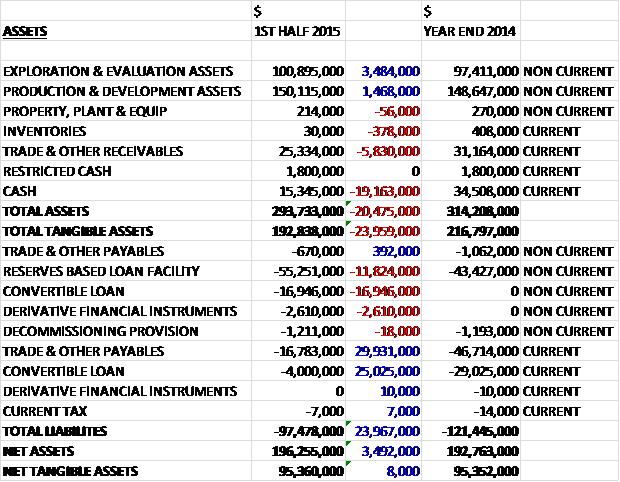
COPintassets

When compared to the end point of last year, total assets fell by $20.5M driven by a $19.2M decline in cash levels and a $5.8M decrease in receivables due to the lower oil price environment and the receipt of cash from EGPC with the receivable days now at levels not seen since before the Arab spring, partially offset by a $3.5M growth in exploration and evaluation assets and a $1.5M increase in production and development assets.  Total liabilities also declined as a $30.3M fall in payables due to the payment of substantial obligations relating to the EMD-1 well in the Mahdia permit and the final well drilled in Oman, and an $8M decrease in the convertible loan were partially offset by an $11.8M growth in the reserves based loan facility and a $2.6M increase in derivative financial liabilities.  The end result is a net tangible asset level of $95.4M which was unchanged over the period.
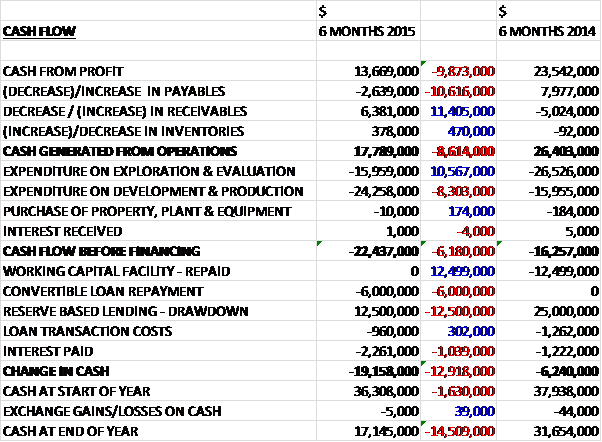
COPintcash

Before movements in working capital, cash profits fell by $9.9M to $13.7M.  This was improved by a large fall in receivables so that the cash generated from operations was $17.8M, a decline of $8.6M.  This cash did not cover the $24.3M spent on development and production, however and certainly not the $16M spent on exploration which meant that the cash outflow before financing was $22.4M.  The group then repaid $6M of the convertible loan but drew down $12.5M of new reserve based lending and after the $2.3M interest payment the cash outflow for the period was $19.2M to give a cash level of $17.1M so at this rate of cash burn, it is not going last much longer.

In Morocco the group has made a number of efficiency improvements.  Led by a newly appointed country manager, the focus has been on decreasing costs and improving overall operational and drilling efficiency.  A number of local supply contracts have been re-negotiated and the supply chain restructured.  As a result the group has reduced operating costs and reduced rig time which has resulted in a fall in well costs by over $1M per well.  The group also continues to benefit from the use of its own pipeline which has additional capacity for a new gas supply.  As a result of the existing infrastructure the threshold for commerciality for any new discoveries is relatively low and the group continues to look to add reserves both through its drilling programme and any other opportunities that might arise.

Sebou average daily gas production was 6.2MMcf per day during the first half of the year and negotiations are under way for further off-take to increase the supplies to and revenues from both existing customers and new industrial partners moving into the Kenitra region.  Demand in the country remains buoyant and whilst the group has been somewhat shielded from falling commodity prices due to fixed gas price contract where the average realised price was $8.66 per Mcf during the period, there is potential for a further improvement on current pricing levels as new contracts are negotiated.

Drilling operations in the onshore Sebou and Lalla Mimouna blocks have continued through the period.  In Sebou the notable success was the SAH-W1 well which encountered gas shows at different levels within the target Guebbas sands.  The group will produce from the lowermost Guebbas zone where 3.6 metres of net pay was discovered and flowed at a sustained rate of 4.94MMcf/d on a 24/64” choke during a test period of five hours.  This well was tied into existing production facilities in July.  The KAB-1 bis exploration well, also in the Sebou permit, was drilled in February and encountered very limited gas shows, so it was plugged and abandoned.  The KSR-12 discovery well, drilled on the Sebou permit towards the end of last year, has also been connected for production and was successfully brought on line in May with the well producing at rates of up to 2MMcf/d.

Results in Lalla Mimouna have been mixed, with the first well LAM-1 targeting Miocene gas bearing sands similar to the Sebou permit.  LAM-1 was tested and the primary target flowed gas at a stabilised rate of 1.9MMcf/d on a 16/64” choke and the secondary target was perforated and flowed at a stabilised rate of 1.1MMcf/d.  Post period, ANS-2 and NFA-1 well were drilled and although both encountered gas shows at the targeted depth, the interpretation of wire line logs indicated that the reservoir quality encountered in the wells did not meet the pre-drill estimates.  The group is continuing to review the data gathered and in partnership with ONHYM will prioritise the next prospect to drill.  Following the Lalla Mimouna wells the rig has now returned to the Sebou permit in the Rharb basin, the location of the existing production wells.

In Egypt the partners continue to carefully manage output with costs of $4.34 per bbl, amongst the lowest in the world.  As a result, even in the current oil price environment, the field remains profitable and cash generative.  At the end of June, 14 wells in the Al Amir SE field and five wells in the Geyad field were on production, with a combined average gross production rate of 9,648 boepd for the period.  Water injection through four wells in AASE and one well in the Geyad field is providing continuing pressure support to maximise recovery efficiency and optimise production levels.

The export gas line to the SUCO facility at Zeit Bay is currently flowing at approximately 7MMcf/d with a total delivered to the terminal of 8.8Bcf at the end of June.  Condensate and natural gas liquids are tripped out of the gas and sold to EGPC with gross average daily rates of about 65bbls of condensate and 15 tonnes of LPG.  The group is in the final stages of documenting the commercial agreements, but has historically accrued for its share of the gas and condensate revenues from the field.

The AASE-21 well was shut in during April due to a high water cut.  The AASE-18 well was recompleted and brought online during May at an initial rate of 650 bopd which will help during the remainder of the year to partially compensate for the loss of AASE-21.  Given the group’s material ownership stake in the block, they have taken a much more active role with the operator.  The process of good field management will be continued into 2016 through implementation of the dynamic reservoir model of the AASE field.

The group continued to benefit from the historic capex spend on the fields and is working closely with the operator to prudently manage the field and arrest the decline in production through workover and drilling activity.  During the second half of the year a programme to perform workovers on up to eight wells commenced.  The results of this workover programme will be used to influence the design of the next planned drilling programme of two or three production wells.

In Tunisia, during the first half of the year the group continued to work with the Consultative Committee on Hydrocarbons and after the end of the period, they announced the renewal of the Mahdia permit.  It has been extended for three years until January 2018.  The extension carried with it a commitment of one exploration well, one appraisal well, and a requirement to acquire 300 square km of 3D seismic.  The group currently has a 100% interest in the permit and is now looking for a farm in partner with the process now being commenced.

The offshore Mahdia permit covers an area of 3,024 km2 and contains the El Mediouni structure which was retested by the EMD-1 well in August 2014 and is a potentially large discovery.  The well encountered a 133 metre column of light oil in the Ketatna carbonates.  While mud losses prevented log data acquisition, the group estimates an un-risked prospective recoverable resource in excess of 70MMbo from the structure.  It is located in a water depth of about 230 metres in benign Mediterranean conditions and the permit also contains a number of similar prospects which have been de-risked by the EMD-1 well.

At Ras Marmour and Beni Khalled, the group continues to evaluate its commitments in the current commodity price environment.  They await final confirmation of all approvals to drill the onshore Ras Marmour well which is targeting a productive sand in the early Cretaceous Meloussi formation, which is the proven reservoir in the adjacent Robbana field.  At Beni Khalled, tenders are currently being reviewed in respect of the 3D seismic with a view to future appraisal of the existing discovery.

In Oman the onshore exploration well, Shisr-1, drilled in Q1 2015 in the SW area of Block 49, was plugged and abandoned due to drilling difficulties.  In light of this and coupled with the insufficient interest in the farm-in on Block 52, the group relinquished both blocks and is no longer bidding for new acreage in the country as they are exiting Oman.

During the period the group extended the convertible loan agreement with KGL Petroleum.  Of the $30M loan value, $10M has been repaid – $6M during the period and $4M in July.  The repayment of the remaining $20M was extended to July 2017.  Also, the group drew down $12.5M of the IFC reserve based lending facility amounting to total draw-downs of $57.5M, which is a lot of debt for a company of this size in this oil price environment.  Net debt stood at $64.4M compared to $23.3M at the same point last year.  By August the net debt had increased further to $65.7M.

In Morocco there are a number of ongoing claims against the group.  These include claims by ex-employees and claims by ex-suppliers associated with the previous country managers.  The group does not believe that these claims are material or likely to succeed.

The group had estimated capital commitments amounting to $21M which are payable over the next two years.  Expenditure on production and development assets is estimated to be $8.7M while expenditure on exploration and evaluation assets is estimated to be $12.3M in North Africa.  This is going to be tight and the group has said they are exploring potential funding options, presumably including a potential placing.

Overall then, much like many small oil and gas producers, this has been a very difficult period for the group but it has to be said that the results are probably not as bad as I was expecting.  As would be expected, profits fell but the fact the group is still profitable is certainly a bonus.  Net tangible assets were flat which again, is fairly good going but the real problem becomes apparent when we look at the cash flow report.  Operating cash flow fell and it was not close to covering the capex of the group.

In Morocco, costs have come down and demands remain buoyant.  At $8.66 per McF, the price achieved has been somewhat sheltered from the declining oil price but exploration activity has been mixed with two wells being added to production.  The Egyptian acreage has very low costs, at $4.34/bbl and remain profitable even in this environment.  The problem is the that this field is old and production is declining with one new well not covering the shut in AASE-21 well.  There will need to be some spending in Tunisia to cover commitments there but any farm in achieved may be a catalyst for short term share price gains but with a huge amount of debt, cash levels of just $21M and some $17.1M of capital expenditure inked in over the next two years, the group really could do with an improvement in the oil price!

CIRCLE OIL

This chart does not look good and seems to roughly follow the oil price.
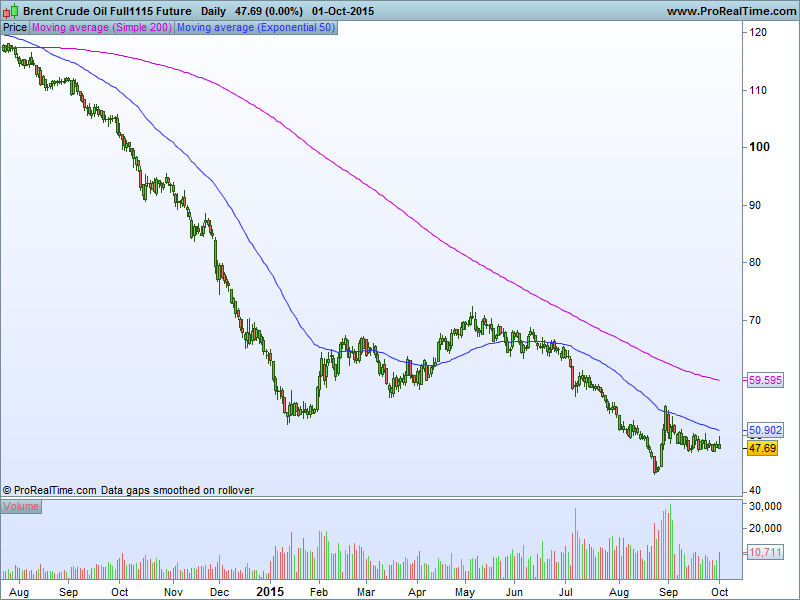
Brent Crude Oil Full1115 Future

On the 13th October the group released an update covering the Ksiri West-A exploration well on the Sebou permit in Morocco.  The well reached a TD of 1,890 metres and prospective gas shows were logged, and a completion string installed in preparation for well testing and then connection to existing production facilities.  The primary main Hoot target interval was perforated from 1,818 metres to 1,826.7 metres and flowed gas at a maximum rate of 8MMScf per day on a 24/64” choke.  The well will be tied back to the pipeline from Sebou to Kenitra ready for production.  IT is about 680m west of KSR-11 and 1,120 metres west of the Ksiri sub-station.

The rig has now relocated to drill the Caid El Gaddari-13 (CGD-13) well, the final well in the current drilling campaign.  The location lies within the Gaddari Sud exploitation concession near the SW margin of the Sebou permit.  This well has a primary target of just 780 metres which consists of gas-bearing Miocene sandstones in a structurally elevated position east of the CGD-1 well and west of the CGD-9 well.

The flow rate achieved on this well is in the upper end of the range of expectations – it is nice to see some good news coming out of the company for once!

On the 28th October the group announced a discovery at the Caid El Gaddari-13 (CGD-13) exploration well on the Sebou permit.  The well spudded on 8th October and reached a TD of 871m on the 17th, significantly ahead of schedule.  The target consisted of gas-bearing Miocene sandstones in a structurally elevated position east of the CGD-1 well and west of the CGD-9 well.  The well has encountered about 5.9m of net pay and an interval of 4.7m was perforated between 791 and 812m.  Testing has been completed and the well has flowed at a rate of 4.45MMscf/d through a 28/64” choke.  The well is located 320m northwest of the closest tie-in point on the 75% owned pipeline to Kenitra.  The well will be brought into production and produced through the pipeline to customers in the city.

This discovery concludes the drilling campaign in Morocco.  Ten wells have been drilled in total, seven in Sebou and three in Lalla Mimouna with six recorded discoveries (five at Sebou and one at Lalla Mimouna).  Improving operational efficiency has been a key goal for the group and drilling costs have fallen 30% per well during the course of the campaign, as the oil price has fallen.  The geological team will review and integrate the well data from the campaign when planning the next one in Morocco, initially scheduled for late 2016.

It is good to end on a high, and this well does seem to be fairly promising.  For me, there is just too much debt to take the plunge, however.

On the 14th December the group released an update. There has been slower progress than expected on the negotiations with the IFC to extend the reserve based lending agreement by one year to June 2019. Trading remains very challenging due to a further weakening of global oil prices, varying production levels in NW Gemsa and the impact of macro events on payments from EGPC. Following a reduction in the value of the company’s assets, they expect the borrowing base to be reduced and as a result there will be a moderate shortfall. The group is therefore considering a number of options including an equity raise to improve the balance sheet.

For what it’s worth, in Morocco they are reviewing the well data from the recent drilling campaign and the final two successful wells have been tied back to the existing production infrastructure and started production earlier in the month. It is the intention to re-start drilling in Morocco in Q4 2016.

In Egypt, the company, its partners and the government signed a processing and treatment agreements which sets out the framework under which the participants in the NW Gemsa field will be paid for gas sales since February 2013. As at June this year, the group’s receivables stood at $25.3M, of which about $2M was attributed to gas sales. Operationally the workover campaign aimed at managing the field as it matures is nearing completion and has informed the design of the next drilling programme which started this month with the spudding of the AASE-23 well which will be first of two new producing wells with the objective of increasing production levels.

In Tunisia, the farm-out process for the Mahdia permit is ongoing with the company engaged in discussions with a number of companies despite the market for farm downs being impacted by the overall decline in the sector.

In conclusion then, the pertinent point of this update is that the debt is too high and it is very likely the company will have to undergo an equity placing to repair the balance sheet – this has been on the cards for a long time but I suppose the most recent plunge in the price of oil as brought the situation to a head.

On the 8th February the group released an operational and financial update. They have signed a memorandum of understanding with SBS Porcher, a potential new gas customer in Morocco. As part of the arrangement, a new pipeline extension would be constructed linking the existing pipeline in the northern Kenitra region to the Porcher factory in the central Kenitra area. The key terms are that Porcher will pay for and own the pipeline extension with construction estimated to start in May with first gas expected to flow in Q4 of this year; the estimated gross offtake volume would be 0.35mmcf per day with a price equivalent to $12/mcf which represents a 6% increase in production volumes compared to 2015; and the gas price would be fixed for the duration of the five year contract. All parties are expected to sign binding documentation in the coming months and when signed this will represent a gas price some 40% higher than the average price currently and will enable the group to access a potential new customer base in central Kenitra.

In Egypt the infill drilling campaign on the NW Gemsa field is continuing. The first of two production wells, AASE-23 has been drilled, completed and tied in to the production infrastructure and a couple of days ago, a well test showed the well flowed at a gross average rate of 4,081bbls per day and 2.715mmscf through a 48/64” choke. The well will be produced at a lower rate, however, in order to manage the long term field production. The second production well, AASE-24, was spudded on the 8th Feb. In Tunisia the farm out process for the Mahdia permit is continuing and apparently the company remains engaged in discussions with a number of interested parties.

The company remains in discussions with the IFC regarding its debt but given the further fall and continued volatility in oil price, discussions are unresolved and both parties are “working together to find a solution to right-size the balance sheet”. In Egypt, the dollar receipts from EGPC remain limited and unpredictable which means that the company’s cash flow and financial position remain under significant pressure.

This new contract in Morocco does sound promising but this is completely over shadowed by the fact that the company doesn’t seem to be able to get any payment in Egypt and it sounds like the IFC is going to end up owning much of the equity here and I really don’t understand why the share price has leapt in recent days. I am definitely staying out until the financial situation is sorted out.

On the 15th March the group released an operating and financial update. Discussions with the IFC have resulted in an agreement to suspend the December redetermination until 15th April with any repayments being postponed until that date. The lenders have indicated their willingness to consider further waivers as may be required in order to complete the strategic review.

The company’s cash flows and financial position remain under significant pressure, primarily due to the uncertainty and irregularity of receipts from EGPC. At the year-end, they had cash of $10M and receivables of $21.6M. Inclusive of the $20M convertible loan held by KGL, the total debt position is $77.5M and there is a further $14.1M of trade payables. Further, the company is reliant on extracting US dollars from its Moroccan operations to both satisfy its obligations to its creditors and to fund operations.

In addition, the most recently disclosed 2P reserves of 16.23mmboe are expected to have reduced due to the production of hydrocarbons and the lower oil price environment. The scope of the options being considered under the strategic review include the sale of one or more of the company’s assets, a corporate transaction such as a merger with a third party, the sale of the entire share capital of the company, and the raising of capital in the form of new share placings.

In Egypt, at the year-end, 11 wells in the Al Amir SE field (ASSE) and three wells in the Geyad field were on production, with a combined average gross production rate of 8,871 boe per day for the year. Water injection through three wells in field is providing continuing pressure support to maximise recovery efficiency and optimise production levels. The AASE-23 well was first brought on stream in February 2016 and is now being produced at around 800boe per day. Drilling continues at the ASSE-24 well which was spudded in early February.

In Morocco, the focus has been on decreasing costs and improving overall operational efficiency. Sales from Sebou for 2015 averaged 4.39mmcf per day, net to the company, utilising less than half of the pipeline capacity. Prices held up well with the average price realised during 2015 being over $8.50 per Mcf.

Overall then, there is a stay of execution but the problem remains the huge amount of debt the company has accrued. I can’t imagine this depressed environment is the best time to try and sell any of the assets so, unless the whole company can be sold at a decent price, this is not looking good for current shareholders in my view.

On the 15th April the group announced that the IFC has agreed to extend the suspension of the December redetermination and any repayments due under its reserve based lending facility until 13th May. They have also indicated their willingness to consider further waivers as may be required to continue the strategic review process. This is good news but the shares are far too risky until the review process is over.

On the 29th April the group released a reserves and resources update and to reflect the downward revisions due to the current low oil price environment, they expect to recognise an impairment charge in the 2015 results.

In Egypt, the net 2P reserves for the NW Gemsa field are 6.671MMboe compared to 12.49MMboe at the end of 2014, although 1.626MMboe has been re-categorised as P50 unrisked contingent resources and there was net field production of 1.295MMboe. In Morocco, there net reserves for the Sebou permit are 0.98MMboe compared to 3.74MMbie at the end of 2014. In addition, unrisked contingent resources are a further 1.183MMboe and the net field production was 0.276MMboe during the year.

This is certainly not good for the company – there is only about six years of production left at these levels.

On the 13th May the group announced that the IFC had agreed to extend the suspension of the debt repayment until 27th May. The group expects to receive an improved payment from EGPC for May compared to the previous months but their cash flows and financial position remain under significant pressure and a sustained improvement in payments from EGPC is required – this does not sound good.

On the 17th May the group announced that the infill drilling campaign on the NW Gemsa field has been completed. The second of the two production wells, AASE-24, has been drilled to TD, completed and tied in to the production infrastructure. A well test commenced and the well flowed at a gross average rate of 1,714bbls per day and 3.062mmscf per day of gas through a 40/64” choke. The well will be produced at a lower rate in order to best manage the long term field production.

These results will help maintain production rates and mange field production. There is no further drilling planned in 2016 although there is an ongoing workover campaign which is also expected to help maintain production levels. This all sounds fine but the operational side of this company is now a side show and the important issues are the debt repayments and receivables from EGPC.

On the 20th May the announcement came that shouldn’t have come as much of a surprise. After taking into account the company’s $77.5M outstanding debt position and based on the indicative proposals received to date, it is likely that there will be little or no value attributed to equity holders. This sounds like a total wipeout to me.

On the 27th May the group announced that the IFC had agreed to extend the suspension of the repayments due under its reserve based lending facility until 24th June. They have also considered further waivers as may be required. This is obviously good news but doesn’t change anything – there is still likely to be no value left for shareholders here.

On the 24th June he group announced that the IFC had agreed to extend the suspension of their repayments until 22nd July. The payments from EGPC have continued to be unpredictable and to date there has not been a sustained improvement.

Havelock Europa Share Blog – Interim Results Year Ending 2015

Havelock Europa has now released its interim results for the year ending 2015.

HVEintincome

Revenues declined when compared to the first half of last year with a £470K fall in interiors revenue and a £1.2M decline in educational supplies revenue as the Stage Systems division is consolidated into the interiors segment.  Cost of sales also fell to give a gross profit some £404K below that of last time.  The board reorganisation relating to loss of office compensation and fees for the recruitment of a new CEO and finance director, cost some £402K and the slight increase was more than offset by the £464K decline in admin expenses so that the operating loss increased by just £36K.  Finance costs fell, but tax was up slightly and the loss from the discontinued operation (Teacherboards) grew by £58K so that the loss for the half year came in at £1.9M, a growth of £84K year on year.
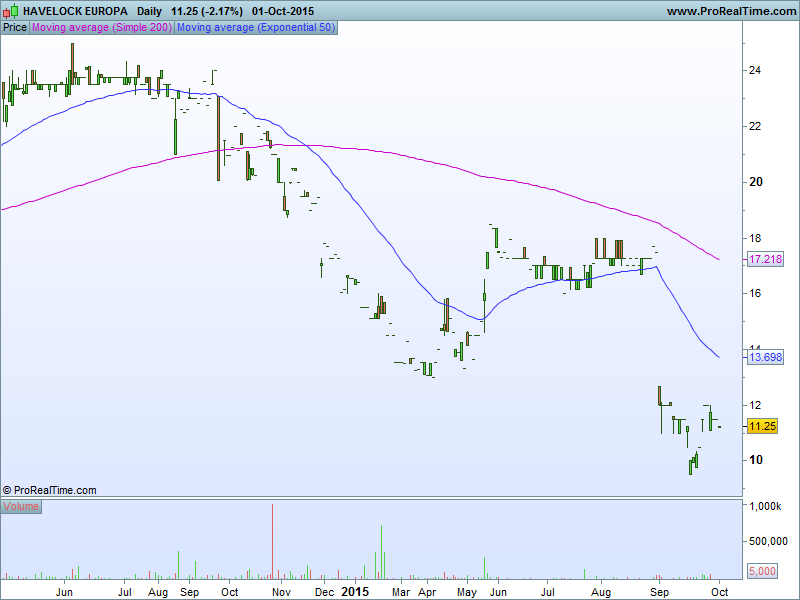
HVEintassets

When compared to the end point of last year, total assets fell by £5.9M driven by a £5.4M decline in cash and a £2.1M decrease in receivables, partially offset by a £706K growth in intangible assets and a £592K increase in assets held for sale.  Liabilities also fell during the period as a £4M fall in bank loans, a £2.2M decline in payables and a £1.3M decrease in pension obligations was partially offset by a £2M new overdraft and a £533K growth in liabilities held for sale.  The end result is a net tangible asset level of £4.7M, a fall of £1.5M when compared to the end of 2014.

HVEintcash

Before movements in working capital, cash losses widened by £133K to £1.8M.  A large fall in payables then meant that the net cash outflow from operations was £2.6M, an increase of £526K year on year.  The group then made £750K on the sale of property, plant and equipment, most of which was spent on more fixed assets and an £838K acquisition of intangible assets drove the cash outflow before financing even higher, at £3.3M.  After the repayment of nearly £4M of borrowings, the cash outflow for the half year stood at £7.4M to an overdraft position of £2M.

Subdued demand in the UK retail and financial services sectors was the main reason for interiors sales reducing by 5% but a £460K reduction in overheads resulted in a slightly lower loss before tax of £1.8M.  Within the retail sector, demand from the existing UK client base was soft with many clients now re-evaluating their business cases before committing to invest in their projects.  To counter this, the group are focusing on developing the number of customers that they trade with within each sector.  Within Retail, they have had some success with this strategy, and began supplying three new major retailers.  Within international retail they are beginning to see the benefits of the work done previously and are on track to deliver the 15% of group revenue targeted from this business stream.

Demand in Financial Services has continued to decrease as customers continue to downsize their estates.  In addition, a significant framework contract won in late 2014 has not yet delivered the expected turnover as the end client’s programme has been delayed.  On a positive note, they are continuing to support the Network Transformation Programme being undertaken by the Post Office and the office fit out market has been targeted as an area for potential growth.  They have been successful on a number of projects and are directing resources to maximise this opportunity.

As part of the business reorganisation plan, the board have amalgamated the education, accommodation and healthcare sectors into one public sector services business stream.  Activity within these sectors has benefited from a strong 2015 order book and the challenge from the second half of the year is to maximise revenue from these projects as some of them have suffered from on-site client delays which doesn’t sound good.  Operationally the business relocated to its new head office and the expected benefits from the relocation are being realised and the group are trying to standardise and simplify the business to make it easier to do business with.

A customer survey undertaken during the period identified the need for immediate changes within the business.  Some changes include a proposed reorganisation of the business to reflect changes in the market place with a 10% reduction in staffing levels; a simplification of the business model designed to focus on the customer experience; and the sale of Teacherboards.

Contracts have been placed for future capital expenditure amounting to £306K.  After the period-end the group sold Teacherboards for a consideration of £1.4M to Sundeala ltd.  The borrowing covenants have been met during the period and the board expect to be able to comply with the conditions in the future based on the most recent forecasts and taking account of mitigating actions that could be taken in periods when headroom is tight – this doesn’t sound that confident.

During the period, David Ritchie succeeded Eric Prescott as CEO and due to overseas commitments the largest shareholder, Andrew Burgess resigned from the board.

Demand within the UK Retail and Financial Services sectors remains subdued and the board expect this situation to continue until the end of the year.  Progress on the business reorganisation is being made and they expect to have the major changes implemented by the end of the year which should ensure they enter 2016 with a stable, more efficient business that is better placed to take advantage of any opportunities with annualised cost savings of £3M.

Net debt increased  by £500K to £3.1M due to an increase in finance lease obligations relating to the investment in ERP.  Obviously there was no interim dividend declared.

Overall then this was a difficult six months for the group.  The loss widened but this was due to the board reorganisation and without this, the loss would have fallen slightly.  Net assets fell during the period and the operating cash outflow increased year on year.  The UK retail and financial services demand was weak and is expected to remain so for the rest of the year.  It is difficult to see much positivity here at all actually, I suppose the replacement of Eric Prescott with David Ritchie as CEO is one glimmer of hope and the cost savings achieved by 2016 may set the groundwork for a better performance next year but I will not be buying in just yet.

HAVELOCK EUROPA

This chart doesn’t really offer much optimism either…

On the 6th October the group announced the appointment of Peter Dillon as non-executive director.  He is a chartered accountant and was finance director of Hargreaves Services from 2003 to 2007, including during the period of their IPO.  Ominously, he has was also a director of Parkview Construction which was placed into administration; Underbank Park Farm which was struck off in 2001 and fined for the late filing of accounts; and a consultant to Idess Retail which was places into administration.  Mr. Dillon’s family trust, Gold ltd, owns 1.76% of the shares in Havelock.

I am not sure what to make of this, Mr. Dillon’s past directorships do not seem to be that auspicious to me…


On the 17th November the group released a profit warning. The company has been informed by its largest financial services client that it will be substantially reducing its anticipated spend on refurbishment and development next year. As a result, it is forecast that the contracting revenue the group will receive from this client for undertaking branch refurbishment and development programmes will be negligible for 2016 although they will be retained as the preferred furniture provider to the client. The contracting revenues from these programmes this year will be about £14M and will be unaffected but the impact next year will be material before mitigating actions are undertaken. This is a big blow for the company and I don’t think these are investable at the moment. Unless things radically change I will not be doing any more updates on this company.

On the 24th November the group announced that non-exec Peter Dillon purchased 85,000 shares at a cost of £7,650. He now owns some 763,070 shares which is nearly 2% of the entire company. Although nice to see a director buying shares, the amount here looks nothing more than a token gesture to me.

On the 25th January the group released a trading update covering the year of 2015. The business simplification programme is gaining momentum and the cost reductions identified as a result of the programme were achieved by the end of the year. Trading in Q4 was as expected so the board expect the results to be in line with its expectations at the last update. As of the year-end, the group was debt free with net cash of £1M compared to a net cash position of £200K at the end of last year. Although trading remains challenging, particularly in the retail sector, they group is entering 2016 with an order book of £23M for delivery within the year which is 15% up on 2015.

Overall, not a bad update but things remain brutally tough for the group and I am not rushing in to chase the shares higher.

Finsbury Foods Share Blog – Final Results Year Ended 2015

Finsbury Food has now released its final results for the year ended 2015.

FIFincome

Revenues increased considerably when compared to last year with an £80.2M growth in UK bakery revenue and a £218K increase in overseas revenue which meant that, after an increase in cost of sales, gross profits grew by £30.7M.  Depreciation increased by some £2.6M year on year and operating leases increased by about £850K but R&D costs fell by £3.5M.  We also see a £3.1M increase in acquisition costs and a £24.7M hike in other admin coats relating to the acquisition, increased retailer marketing support, new product development, range support, remuneration for bonuses and improvements to the workplace, and the operating profit is still some £2.4M up year on year.  We then see a much smaller increase in the value of the interest rate swap and bank interest increased, although the interest on interest rate swaps did fall. After a modest increase in tax, the profit attributable to the equity holders is £6.2M, an increase of £1.8M when compared to 2014.

FIFassets

When compared to the end point of last year, total assets increased by £81.9M driven by a £24.5M growth in property, plant and equipment; a £23.5M increase in receivables; an £18.7M increase in goodwill; a £6.7M increase in inventories; a £5.6M growth in customer relationships (relating to the Fletchers acquisition); and a £3.1M growth in deferred tax assets, partially offset by a £2.9M fall in deferred consideration receivable.  Liabilities also increased during the year due to a £31.5M growth payables and an £11.7M increase in borrowings.  The end result is a net tangible asset level of £22.5M, an increase of £11.8M year on year.

FIFcash

Before movements in working capital, cash profits increased by £5.1M to £15.1M.  This was then increased due to a growth in payables and after lower interest and tax was paid, the net cash from operations came in at £15.2M, an increase of £10.3M year on year.  The group then paid £7.4M on property, plant and equipment which is likely to increase to £11M over the next year, received £3M in deferred consideration and spent a net £55M on acquisitions so that the cash outflow before financing was £44.7M.  The group also paid some £1.6M in dividends and in order to pay all this, there was a net £16M drawn down in borrowings and £34.1M received from the issue of share capital.  The end result is a net cash outflow of £653K to give a cash figure at the year-end of just £61K.

The total underlying profit at the UK Bakery segment was £10.9M, an increase of £4.8M year on year with some £3.1M attributable to the acquired Fletchers business.  The cake business registered an increase in market share, volume and turnover and organic growth of 6% was stimulated by increased investment in promotional campaigns, outstanding performance from licensed products and innovative methods of optimising the mix for customers.

The Village Bakery, one of the group’s brands, is the country’s leading Rye bread supplier which is targeted at consumers looking to avoid wheat which seems to be a good market to be in at the moment.  Similarly, Crank’s is the UK’s leading organic bread band which is another area of growth.  The group also make cakes for Thorntons, which is the 4th largest brand in the ambient cake market and sales continued to grow, outperforming the market.  In August Ferrero brought Thorntons but intend to retain the brand so hopefully Ferrero will wish to continue to work with the group.  Thorntons is the dominant player in the cake bites market, holding a market share in excess of 40% and the last year has seen the introduction of a raft of new product innovations which broaden and enhance the offering in the market place.

The group also hold the licence to manufacture and distribute low fat cake to the UK and Ireland’s grocers under the Weight Watchers brand.  The low fat cake category continues to struggle in the face of evolving consumer health and dietary requirements.  Recently, however, there has been a focus on product packaging innovation to deliver better portion control to the consumer and on a stronger more impactful pack design.  The group seeks to evolve and innovate the brand and offering ensuring its continued relevance.

The Character licenced celebration cake has been a key growth area for the business, driving an overall value increase of 31% over the past year.  Once such license is Disney with Frozen being a resounding success story and the Marvel superhero’s of Avengers and Spiderman are ever evolving.  Later in the year, the next addition of Star Wars will be released which should sell fairly well, although I am not sure Star Wars cakes will be as popular as the likes of Frozen, which is targeted at a younger age group.  Other important character brands include Peppa Pig, the Turtles, Spongebob and Me to You with the new sensation that is the Minions also driving the success in this category.  The total underlying profit at the Overseas division was £1.2M, an increase of £15K year on year.

The group believe that diversifying into foodservice cake as well as consolidating the existing markets of celebration cake and organic bread will deliver organic growth.  Further acquisitions will introduce new product, customer or channels diversification or accelerate market consolidation in the core product areas.  The recent acquisition of Fletchers introduced a significant new customer, M&S, channel (foodservice) and product diversification into muffins and croissants.  The Johnstone’s acquisition similarly took the group into the coffee shop cake market for the first time.

The UK ambient cake market is valued at just over £1BN and grew by 1.2% in value over the past year so it is quite a slow growing area.  Finsbury Food is the second largest supplier of pre-packed ambient cake to the UK’s multiple grocers and they have strengthened their leading position in the niche areas of focus.  Annual bread and morning goods sales are over £4.8BN but the market remains flat.  The group is a niche player in this market, manufacturing a range of bread and morning goods.  The foodservice out of home eating sector continues to grow whole the retail environment remains challenging.

The government’s national living wage initiative presents a challenge to the group.  As with other businesses in the market, expenditure on employment is a high proportion of the costs and this change is potentially inflationary.  Mitigating the impact will take time and will require a greater focus on efficiency improvements and cost reduction programmes.

Overall the economic outlook remains uncertain and customers are having to adjust their offering and formats.  Discounters are continuing to take market share in a grocery sector that is relatively static, although eating out does seem to be on the rise.

The group is rather dependent on a small number of important customers with three accounting for more than 10% of revenues at 21%, 14% and 11%.  Indeed, the top five customers account for some 62% of total revenues, which although an improvement on the 73% last year, still indicates some key client risk.

A big change in the British Retail Consortium Food Standard will go live later in the year.  This requires a focus on vulnerability assessments throughout the supply chain.  All of the group’s sites have maintained a BRC A or A* grades in the year but BRC are anticipating fewer suppliers achieving the higher A and new AA scores.  Additionally, the Food Standards Agency has published new salt targets for 2017, requiring work to be carried out on recipes to meet these targets.  Further reductions will become significantly more technically challenging on certain types of product and the group currently sits at around 70%m compliance against the new targets.

During the year the group acquired Fletchers for a total consideration of £56.4M.  This was funded in part by an oversubscribed equity raise of £35M with the rest funded through debt.  Fletchers produces morning goods and specialist bread products for leading UK grocery retailers and foodservice customers.  Benefits of the acquisition include complementary product ranges and new foodservice channels, and retail customer diversification.  In the eight months since the acquisition, Fletchers has contributed a pre-tax profit of £3.1M.  The cash consideration was paid at the acquisition date and it came with intangible assets of £8.8M and generated goodwill of £18.4M.  This obviously didn’t come cheap and is a major acquisition for a company of this size but given the profitability, I think it is probably worth the price paid.

In June the group acquired Johnstone’s Just Desserts from administrators for a cash consideration of £1.6M which generated goodwill of £372K.  In the half month since the acquisition, the business generated a pre-tax profit of £23K which seems pretty good and if this can be sustained, the price paid looks a steal and the acquisition offers an entry into the high-growth national coffee shop segment.  Also, in May the group acquired 25% of the share capital of Dr Zak’s ltd for a consideration of £225K, of which £50K has been deferred and is payable within one year of the acquisition date.  Dr. Zak’s develops and supplies high protein food including bread, pasta and bagels.  All of these acquisitions together generated costs of £3.2M during the year with share placing costs of £1.5M written off against the share premium account (is that normal procedure?).

Of the total level of borrowings, the group still has some £29.6M undrawn, mainly relating to the invoice discounting facility, the revolving credit facility and the overdraft. The net debt currently stands at £21.3M compared to £8.8M at the end point of last year.  The group have hedged against interest rate risks with three interest rate swaps in place with a total coverage of £14M, equivalent to 66% of year end net debt, at a weighted average rate of 2.5%.  The effective interest rate for the group at the year-end, taking into account the interest rate swaps and deferred consideration with a base rate at 0.5% and LIBOR at 0.58% was 4.04%, so I’m not sure they are that effective really.

At the current share price, the shares trade on an underlying PE ratio of 13.5 which falls to 12.5 on next year’s consensus forecast which seems decent value, if not entirely spectacular. After the total dividend more than doubles, the shares are now yielding 2.4% which increases to 2.7% on next year’s consensus forecast.

Overall then this was a real year of progress for the group. Profits were up, both organically and through the contribution from Fletchers.  Net assets also increased, although payables are looking rather high and operating cash flow grew with a decent amount of free cash flow which was nowhere near enough to cover the acquisition.  The cake sector seems to be the growth driver at the moment with a decline in Weight Watchers cakes more than offset by character cake sales, driven by Disney, Marvel and the Minions.  The national living wage is something that is likely to impact the group negatively going forward so this is a development that should be watched.

Supermarkets continue to be under pressure which may have an effect on margins into this market but the newly acquired Fletchers, which seems a little expensive, offers an entry into the growing food service market.  Net debt has obviously increased due to the acquisition but seems manageable and with a 2.7% prospective dividend and forward PE ratio of 12.5 the shares look fairly decently valued and I will keep holding as I would hope the recovery story here has further to go once Fletchers has been properly integrated.

FINS.FOOD

The bullish trend is clear from this graph and is still intact.

On the 25th November the group released an update covering trading in the first four months of the year. Total group revenues grew to £102M during the period with a 10.1% organic growth. The UK Bakery division grew by 8.7% and the overseas division grew by 19.4%. The Fletchers business is ow fully integrated and performing strongly and Johnstone’s is apparently integrating well. Whilst consumer confidence has improved the economic and trading outlook remains uncertain and the board anticipate that the Fletchers and Johnstone’s acquisitions will drive the majority of growth this year.

These figures look very strong so far but given the outlook statement, it seems as though the board are expecting organic growth to slow as the year progresses. Still, I am happy to continue to hold these shares.

On the 15th January the group released a pre-close trading update for the first half of the year. They stated that since the AGM update, the strong trading performance has continued through the Christmas period. Total company revenues grew by £156.6M, an increase of 46% year on year which includes like for like growth of 7.4%. The UK bakery division grew by 6.1% on a like for like basis with the overseas division up 18.8%. The prior year acquisitions are now fully integrated and performing strongly.

It is now all good news, however, as consumer markets remain challenging and organic growth has been hard on with significant promotional investment, new product development and fresh layers of infrastructure so it sounds as though margins will have taken quite a hit. Still, I will hold on for now.

On the 1st February the group announced the appointment of Marnie Millard as a non-executive director. Marnie is currently CEO of Nichols, the soft drinks group. Following over 13 years in the role, non-executive director Paul Monk announced his intention to step down from the board at the next AGM, although he will remain as a consultant to the group.

Mission Marketing Share Blog – Interim Results Year Ending 2015

Mission Marketing has now released its interim results for the year ending 2015.

TMMGintincome

Overall revenues increased when compared to last year as a £959K decline in events and learning revenue was more than offset by a £2.2M growth in branding, advertising and digital revenue; a £1.9M increase in PR revenue and a £677K growth in media revenue.  Cost of sales also increased modestly to give a gross profit some £3.2M higher.  We then see a £2.8M increase in underlying admin costs but restructuring costs of £634K along with a £108K increase in the amortisation of acquired intangibles and a £113K reduction in the favourable movement in deferred consideration meant that operating profit fell by £537K.  The amortisation of bank arrangement fees fell slightly and tax was down to give a profit attributable to the equity holders of £1.3M, a decline of £370K year on year.

TMMSintassets

When compared to the end point of last year, total assets increased by £6.4M driven by a £5M growth in receivables, a £975K increase in cash and a £520K growth in goodwill.  Liabilities also increased during the period as a £3.3M increase in payables, a £2.2M growth in accruals and a £329K increase in finance lease obligations was partially offset by a £600K fall in contingent consideration payable.  The end result is a negative net tangible asset level of -£5.6M, a favourable movement of £1.2M over the period.

TMMGintcash

Before movements in working capital, cash profits fell by £193K to £2.6M.  The increase in payables more than offset the fall in receivables but the payable growth was less than that of the first half of last year and after increased finance costs and slightly lower tax was paid, the net cash from operations came in at £2.3M, a decline of £2.9M year on year.  The group then spent £449K on property, plant and equipment and £448K on deferred consideration  so that free cash stood at £1.5M, of which £375K was spent to pay back loans and £101K was used to buy shares for the bonus scheme.  The end result is a cash inflow of £971K to give a cash level of £2.5M at the end of the half.

The operating profit in the branding, advertising and digital division was £2.5M, just £7K less than last year.  The operating profit in the media division was £442K, an increase of £100K year on year.  The operating profit in the PR division was £460K, a growth of £360K when compared to the first half of 2014.  The operating profit in the Events and Learning division was £35K, an increase of £10K year on year.  The profit margin remained at 8% as improved margins in the PR, Media and Events and learning activities, partly driven by the restructuring undertaken at the start of the year, offset the higher initial running costs of the overseas businesses and the start-up of the new Sports Marketing agency.  The spending cycles of the customers tend to result in a second half bias which is expected to be repeated this year.

The group have improved both their reach and their expertise, particularly within digital and data development areas whilst at the same time creating new initiatives such as Ethology which sees a harnessing of data with insights and direction that delivers responses from consumers.  New business wins include Ask, Autoline, BMW, Brewin Dolphin, British Airways, Diageo, Muller Wiseman, RAC, Sage, SAS, and Siemens.

At the end of last year, Speed PR was launched which has apparently gone well and this year Splash has been bedded in in Asia.  The April Six opening in San Francisco continued to thrive as does the recent merger to create the Bigdog agency with offices now in Leicester, Birmingham, Norwich and London. Alongside this activity they recently launched Mongoose Sports Marketing by hiring a new team.  Some recent wins at this agency suggest that their approach is resonating with Corporates, Brands and Events.

Proof Comms, Splash Interactive, Speed Comms and Brandon Hill Comms were all acquired in the second half of 2014.  In addition, the Weather Print and Digital Communications was acquired in February this year and the group commenced pre-launch activities in connection with its new sports marketing venture.  These new entities contributed operating profit of £300K so organic growth seems to be rather negligible.

Following the announcement that Stephen Boyd will step down from the board as non-executive director, the group have announced the appointment of Julian Hanson-Smith from October.  Julian set up the financial PR firm Financial Dynamics before pursuing a career in private equity.   The Chairman has stated that the group are looking for further acquisitions and should make a couple of announcements later in the year.  The board expects the full year expectations to be met.

Net debt at the end of the first half of the year stood at £7.9M compared to £9.5M at the end of last year.  At the end of the year the group had £14.6M of committed facilities, of which £4M was undrawn with an additional overdraft facility of £3M.  Due to the phasing of working capital requirements, an increase in net debt is expected in the second half of the year so there is not a great deal of firepower for further investment in these facilities really.

The interim dividend increased from 0.25p to 0.3p which gives a dividend yield of 2.6% which increases to 2.7% on FinnCap’s full year estimate.

Overall then, this was a bit of a mixed set of results.  Profits fell year on year, due to restructuring costs but net tangible assets did increase, remaining negative.  Operating cash flow was down, with comparisons not helped by a large increase in payables during the first half of last year.  The group did generate a decent amount of free cash, however.  The media and PR businesses with the drivers of growth with the other sectors remaining rather flat and the newer agencies contributed well which meant that organic growth does not seem that great.  Net debt was down during the period but this is expected to reverse in the second half of the year but the board expect to meet full year expectations and a dividend yield of 2.7% is decent enough so I am content to wait to see what kind of growth can be achieved during the rest of the year.

MISSION MKTG.

The share price has moved around considerably but the trend since the start of the year is just about upwards.

On the 5th October the group announced that its April Six Agency opened its new office Singapore.  It aims to be the first agency in the Asia-Pacific region to offer a specialist service for technology organisations with a global footprint.  The group have appointed Brad Harris to run this office, someone who has 15 years’ experience leading technology marketing programmes in the region.  He will be supported by the delivery team at Splash Interactive, the Singapore based digital marketing services agency acquired by the group last October.

On the 27th November the group announced the acquisition of Chapter Agency which includes the recently acquired Bell and Watson. The initial consideration is £1.3M payable in cash on completion and further consideration of up to £3.7M is payable subject to financial performance in 2015, 2016, 2017 and 2018, of which the first £200K will be payable in shares. Chapter was established in 2009 and is a Midlands-based advertising agency employing 29 people with a client base that includes Nissan, Yardley, Topps Tiles, Crodcube, Calor and Virgin Trains. Last year the business had profits of £400K. This seems like a decent addition, although that contingent consideration will have to be kept in check.

On the 18th December the group announced the appointment of Mike Rose to the board as an executive director. In 2009 Mike founded Chapter Agency Ltd where he has remained as MD since its recent acquisition by the group.

On the 22nd January the group released a trading update for the year. The group has experienced a strong second half and results for the year are expected to be in line with market expectations. The recent acquisitions are trading well but their addition to the group will result in an increase in the net debt position. They try and state that their balance sheet is strong but we know that from the last set of results that this is not true so I don’t know why they bring it up at all. This all seems OK, but nothing really to get excited about and I am out.