Molins Share Blog – Interim Results Year Ending 2015

Following the sale of the analytical services labs business, the group has restructured into two divisions: packaging machinery which supplies automated product processing, handling, cartoning and robotic end-of-line packing machinery and systems from its operations in the UK, Netherlands, Canada and Singapore; and instrumentation & tobacco machinery which includes the group’s tobacco machinery activities along with the quality control, testing and analytics instrumentation business which has customers in both the tobacco and other consumer goods industries. Molins has now released its interim results for the year ending 2015.

MLINincome

Overall revenues increased year on year as a £2.9M fall in instrumentation and tobacco machinery sales was more than offset by a £3.5M increase in packaging machinery revenue.  Unfortunately cost of sales also increased to give a gross profit some £1M lower than in the first half of last year.  Admin expenses did fall, however, but the pension scheme expense increased to give a pre-tax profit before discontinued operations of £400K, a decline of £600K.  We then see a £3.5M loss on a disposal and a related £1.3M impairment of goodwill associated with the disposal (the goodwill should probably have been impaired prior to this in my view) to give a loss for the half year of £5.3M, a deterioration of £5.1M year on year.  Those “non-underlying” expenses relate mainly to the admin costs of the pension scheme but some £100K of re-organisation costs were also recorded.

MLINassets

When compared to the end point of last year, total assets fell by £14.1M driven by a £5.5M fall in cash, a £4.3M decline in receivables, a £3.2M decrease in property, plant and equipment and a £1.5M fall in deferred tax assets, partially offset by a £1.2M increase in inventories.  Total liabilities also fell during the year due to a £7M fall in the pension liability, a £3.7M decline in borrowings and a £1.4M decrease in payables.  The end result is a net tangible asset level of £8.6M, a fall of £1.6M over the past six months.

MLINcash

Before movements in working capital, cash profits fell by £500K to £2.3M but a much smaller increase in inventories than last time meant that cash from operations improved year on year as a broadly flat working capital position along with a £900K payment to the pension scheme and £900K used in the discontinued operations meant that net cash from operations stood at just £400K, an improvement of £4M year on year.  In fact, when development costs (which are operating costs really) of £1.2M are taken into account, there was a negative operational cash flow here so after capital expenditure and the acquisition of some IP, the cash outflow before financing stood at £1.2M. Imprudently the group spent £600K on dividends and also paid back some £3.6M in loans to give a cash outflow for the period of £5.4M and a cash level at the six month stage of £4.3M.

The operating profit in the packaging machinery division was £1.1M, an increase of £1M year on year.  All parts of the division performed ahead of the same period of last year with continued improvements in margins expected in the second half of the year.  These results were supported by moves to create a standardised range of products, as well as an ongoing focus on innovative engineering and applications skills.  The group saw increased orders from its multinational and regional customers in most parts of the world with expansion in Asia and increasing activity in South America, supported by the existing infrastructure in Brazil.  With a strong order book in place for delivery in the second half of the year, the division is well placed to continue to progress and the group are looking for further operational efficiencies, aided by the development of the standardised product range.

The operating profit at the instrumentation and tobacco machinery division was £300K, a fall of £1.3M when compared to the first half of last year.  As anticipated, market conditions in the tobacco sector continued to be challenging.  Activity levels declined in most geographic regions, particularly in Europe and South East Asia along with the larger multinational customers.  The strength of sterling also adversely impacted the division and the performance of the tobacco machinery part of the division remained under pressure.  The impact of these conditions on the instrumentation activities only started to be felt in Q1 2015, with order intake and sales falling in the period, although immediate order prospects were are a little more encouraging.  Measures have been taken across the division to reduce operating costs and defer expenditure where appropriate which will continue into the second half.

Product developments were continued across the division.  Alto, the 10,000 per minute cigarette making machine, successfully completed field trials in the first half of the year and field trials for Optima, the new cigarette packing machine, will start later in the year.  These two major initiatives, with others to develop ancillary equipment, mean that the division will have completed a significant programme of development, enabling it to supply a complete make-pack cigarette production line of equipment in a range of speeds.  This also means that that the business is positioned to compete in a larger proportion of the market.  The group also continued to enhance the product range of the instrumentation business to support both the market leading position in the tobacco sector and an expansion into new sectors.  The purchase of the intellectual property for non-invasive thermometry measurement equipment will assist the initiatives to increase their presence in the nutrition sector.

At the end of May the group sold the trade and assets of Arista Labs Inc for proceeds of just £300K, which were less than the costs of £400K.  This represented a loss on disposal of net assets (including goodwill) of £4.7M which shows the need for the group to get rid of the division which made a trading loss of £900K during the period.  This is clearly a poor price but hopefully now the drag of this business is not being felt, the performance of the company stands a better chance of improvement.

Going forward, management do not expect any significant change in the trading environment in the second half of the year and they remain on course to meet market expectations.  As in previous years, the full year trading performance will be significantly weighted to the second half, however.

Although still problematic, the pension deficit did fall during the period with the UK scheme improving by £6.7M and the US scheme improving by £500K.  The UK scheme is subject to a formal triennial actuarial valuation at the end of June with the deficit recovery plan being formally reassessed following its completion.  The current level of deficit funding is £1.8M per annum which is pretty onerous for a company of this size.

As the interim dividend was kept the same, the shares now yield 7.2% and this is expected to remain the same for the full year.  This is a stonking yield but whether it is sustainable, of course, is an important consideration.  At the period end, net debt stood at £3.9M compared to £2.1M at the end of last year.

Overall these results were probably in line with expectations as the outperformance of the packaging machinery business was offset by a poor performance at the tobacco machinery division.  Profits fell year on year, not aided by the loss from the Arista labs sale, although there was also an underlying fall in profit.  Net assets also fell and although operating cash flow increased, this was due to a better control on working capital this year and the underlying cash profits were actually down and there was no free cash during the period.  Going forward, there is expected to be further margin improvement at the packaging machinery division  in the second half of the year and the Arista sale should remove that drag on the business so I can see a scenario where profits improve going forward, although that will depend on the tobacco machinery division.  The dividend yield of 7.2% is also a real incentive but I am not sure whether the turnaround is completely underway yet.

MOLINS

The share price chart does not look good…

Portmeirion Share Blog – Interim Results Year Ending 2015

Portmeirion has now released its interim results for the year ending 2015.

PMPincome

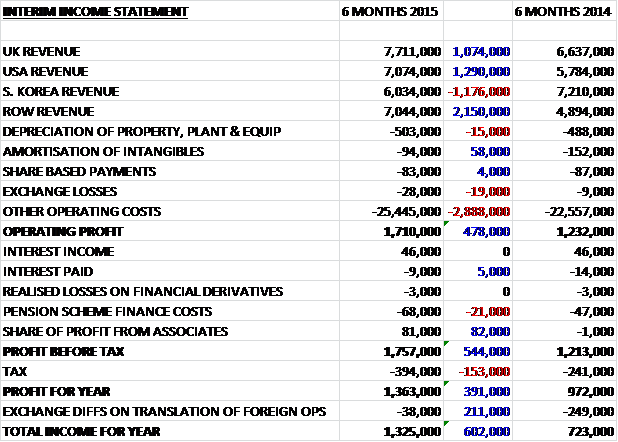
Overall revenues increased when compared to last year as a £1.2M fall in Korean sales was more than offset by a £1.1M increase in UK revenue, a £1.3M growth in US revenue and a stonking £2.2M increase in ROW revenue.  Operating costs also increased during the period to give an operating profit some £478K ahead of the first half of last year.  The group also made a small profit via the associate, presumably from Canada, but a larger tax bill offset this and meant the profit for the half year was £1.4M, an increase of nearly £400K year on year.

PMPassets

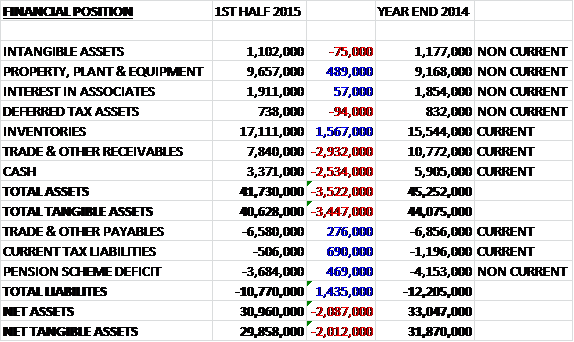
When compared to the end point of last year, total assets fell by £3.4M driven by a £2.9M decline in receivables, and a £2.5M fall in cash partially offset by a £1.6M increase in inventories and a £489K growth in the value of property, plant and equipment.  Total liabilities also fell during the period due to a £690K decline in current tax liabilities, a £469K decrease in the pension deficit and a £276K fall in payables.  The end result is a net tangible asset level of £30M, a fall of £2M over the past six months.

PMPcash

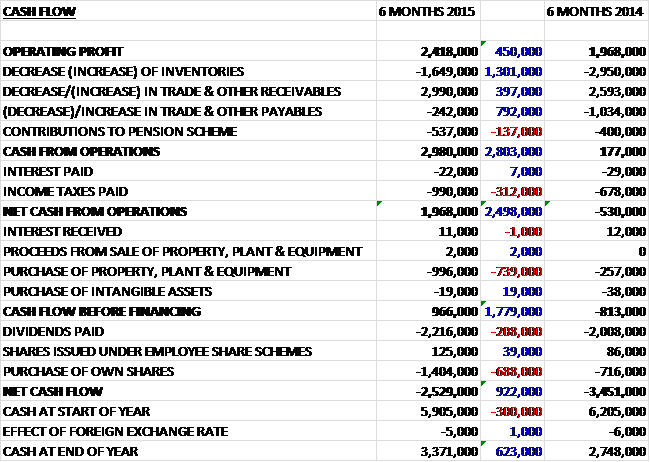
Before movements in working capital, cash profits increased by £450K to £2.4M and this was boosted further by a fall in receivables, partially offset by higher tax and higher contributions to the pension scheme so that net cash from operations came in at just under £2M, an improvement of £2.5M year on year.  The group then spent nearly £1M on capex to give a free cash flow of £966K, which didn’t cover the £1.4M spent on share purchases or the £2.2M spent on dividends so that the cash outflow for the period stood at £2.5M with a cash level at the end of the half year of £3.4M.  It must be pointed out, however, that the cash income is very much skewed to the second half of the year.

US sales increased by 12% in local currency and by 22% when translated into sterling as the recovery seen at the full year stage continued.  In the UK, sales increased by 16% and direct online sales into the two countries increased by 43% year on year.  After fifteen years of growth, the South Korean market contracted during the period, falling by 16%.  This was caused by economic conditions in the country toughening but management are confident of long the long term prospects there.  Elsewhere, India has once again performed strongly, with revenues increasing by 58%.

The major capital expenditure on production capacity expansion announced earlier in the year has already absorbed £1M and the total capital expenditure for the year will be about double this.  The total cost of the expenditure at the Stoke plant will be £1.5M and includes a new continuous tunnel kiln.  Work is well underway and running to schedule with an anticipated kiln commissioning date in Q4 2015.  In the mean-time the group has continued to grow production incrementally, averaging weekly production of over 150,000 pieces, some 5% ahead of the same period of last year.

The group has continued to extend their existing patterns and to develop new patterns for all of their markets.  Within Portmeirion they have Alfresco Pomona, in Spode they have variations on the Delamere patterns, including Bouquet, Lakeside and Rural.  The new Ted Baker ranges have been well received around the world.

There is still no final resolution of the anti-dumping duty imposed on the group by the EU in 2012.  They continue to pursue the matter through the legal processes but is so far cost the group a cumulative £1.7M

The results of the group are always significantly weighted to the second half due to Christmas sales but the board remain confident for the full year but the board remain confident for the future and the strategy remains unchanged.  After an 11% increase in the interim dividend, at the current share price the shares yield 3%, increasing to 3.1% on the full year consensus which is fairly decent.  The net cash position at the period end was £3.4M, compared to £2.7M at the same point of last year.

Overall then, this seems like another period of strong performance from the group.  Profits increased, as did operating cash flow and the group produced a decent amount of free cash, although this did not cover the dividends.  The results are always heavily weighted to the second half due to Christmas so this kind of cash flow is probably to be expected in the first half.  Operationally, the US, the UK and India all did well but the performance in South Korea suffered somewhat, which is a potential cause for concern given the importance of that market.  The anti-dumping issues continue,  I suppose Portmeirion must be importing its china from overseas, probably China but this is guess work as there is no further detail provided in what is an update that is a bit thin to be honest.

Another potential banana skin is the commissioning of the new kiln and any potential delays, although that seems to be progressing on target at the moment.  The yield of 3% is decent enough and I am sorely tempted to buy shares here.

Risks: New kiln teething issues, slowdown in Korea.

Opportunities:  Greater capacity from 2016, Indian sales, resolution of the anti-dumping issues.

PORTMEIRION

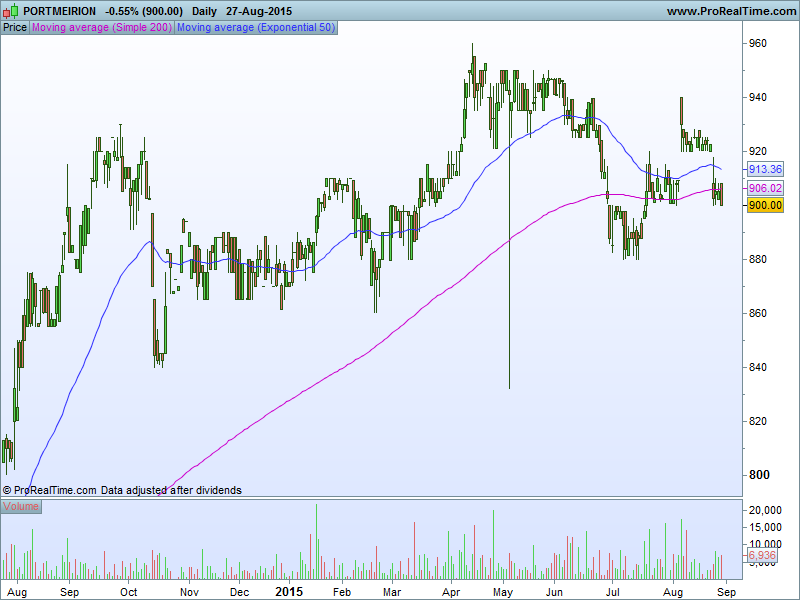
It does seem as though there has been some weakness recently – could be a good buying opportunity?

On the 18th January the group released a trading update for the year where they stated that they expect pre-tax profit to be slightly ahead of market expectations. Revenues are expected to be over £68M, an increase of at least 11% year on year although they have benefited from the strong US dollar and at a constant exchange rate the increase would have been 8%. The new kiln was installed and commissioned during the year within budget and in time without any disruption to existing production. It will be brought into live production from the start of February to meet expected demand for UK manufactured product in 2016. Sales in the UK were particularly robust through the year with strong growth in online sales with the US performing well in the run up to Christmas.

Overall, this is a good positive update.


Portmeirion Share Blog – Final Results Year Ended 2014

Portmeirion is listed on AIM and is a market leader in high quality tableware, cookware, giftware and table top accessories based in Stoke.  There is also a showroom and office in New York along with warehouses in Connecticut and Guangdong in China.  Products are sold directly to customers in the group’s own shops in the UK, via the internet, through a network of distributors throughout the world and directly to retailers.  They also gain some royalty income from the IP imbedded in their brands, patterns and designs.  The factory in Stoke does not produce bone china or porcelain which are different clay mixes and require different firing temperatures so they manufacture just under half of their products themselves, sourcing the rest externally.

There are four main brands within the group.  Portmeirion has designs that apparently sit comfortably with everyday life with its best-selling brand being the Botanic Garden Range.  Spode is renowned for its rich heritage and includes British designs such as Blue Italian, Blue Room and Christmas Tree.  Royal Worcester has a rich and diverse design heritage, offering a wide spectrum of products from fine bone china mugs and sophisticated tableware sets to the opulent Painted Fruit Collection.  Pimpernel is a brand covering placements, coasters, trays and accessories.

The associates are Furlong Mills, a supplier of clay and glaze, of whom the group owns 28% and Portmeirion Canada who markets and distributes the group’s products in Canada, with a 50% ownership.

portincome

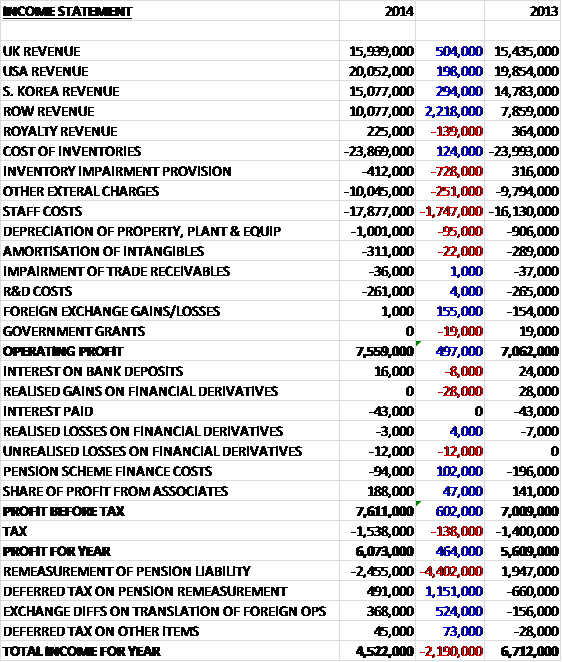
Overall revenues increased year on year as slightly lower royalty revenues were offset by increases in all the other segments, with a particularly large increase in ROW sales driven by growth in sales to India.  We then see staff costs increase by £1.7M and a £700K negative swing relating to the inventory impairment provision which was partially offset by a £155K positive swing in foreign exchange to give an operating profit nearly £500K more than last year. There was also the lack of £28K in realised gains on financial derivatives that occurred last year but the pension scheme finance costs fell by £102K year on year and there was a £47K increase in the profit from associates to give a profit for the year of £6.1M, an increase of £464K year on year.

Portassets

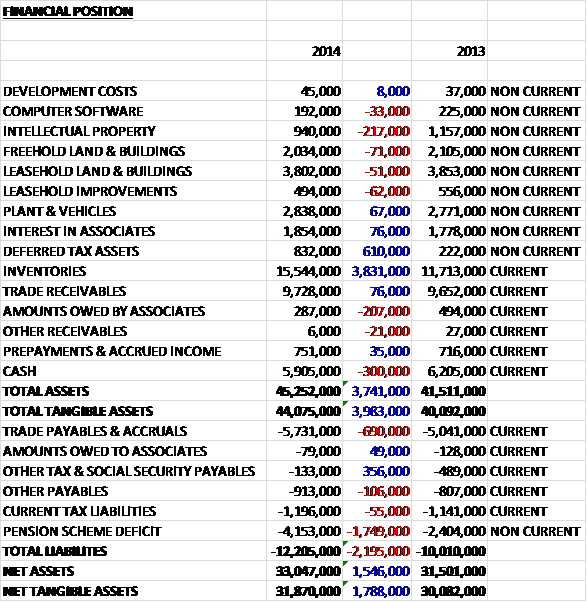
When compared to the end point of last year, total assets increased by £3.7M, driven by a £3.8M increase in inventories and a £610K growth in deferred tax assets, partially offset by a £300K fall in cash.  Liabilities also increased during the year as a £1.7M increase in the pension deficit and a £690K growth in trade payables was partially offset by a £356K fall in other tax and social security payables.  There is also £4M-worth of operating leases outstanding off the balance sheet, but that isn’t particularly material.

Portcash

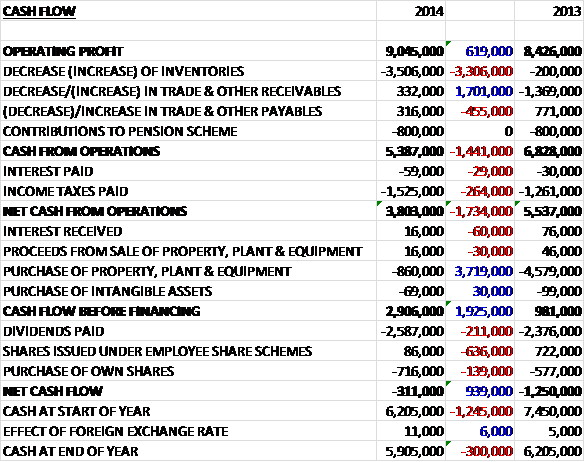
Before movements in working capital, cash profits increased by £619K to £9M.  After a large increase in inventories (which is now a focus for management to reduce), however, and a smaller increase in tax paid, the net cash from operations stood at £3.8M, a decline of £1.7M year on year.  The group then paid £860K for property, plant and equipment along with £69K on intangible assets to give a decent cash flow before financing, the bulk of which was spent on dividends with a further £716K going on share purchases for the employee share schemes.  The end result is a net cash outflow of £311K for the year to give a cash level of £5.9M at the year-end.

Operating profit in the UK division was £6.6M, a reduction of £100K when compared to last year with sales to South Korea increasing by 2% and sales to the rest of the world up 25% with India growing by 84% to become the group’s fourth largest market.  The operating profit in the US division was £994K, an increase of £678K year on year as better rates of employment and lower fuel costs continued to improve prospects in the company’s biggest market.

Sales of the best-selling Botanic Garden collection were over £28M and it remains at the heart of the group’s future prosperity.  Spode Christmas Tree is the second best seller, its main market is the US where is sells in excess of $10M per annum.  The initial responses to the Ted Baker tableware patterns are encouraging and management has high hopes for it during the coming year.

Online sales, principally to UK and US customers, hit £2M which represents a 73% increase year on year.  US online sales increased by 178% after commencing in the second half of 2013 while UK online sales increased by 36% with no sign of slow-down in this route to market.  During the year the online capabilities were expanded into Austria, Belgium, France, Germany, Ireland, Luxembourg, the Netherlands, Spain and Portugal.

As well as nudging against manufacturing inefficiencies due to being close to capacity (the group makes just under half of its own products), they also suffered from the imposition of anti-dumping duty in Europe which has cost the business about £800K.  Another area of potential concern is carbon tax measures and energy costs.  Energy costs are a major item of expenditure for the group but recent energy pricing has moved favourably which meant that despite a 16% increase in sales of own manufactured products, energy costs only increased by 2.6% year on year.  Finally, another risk to the group is clearly economic conditions, particularly in the UK, the US and South Korea, although increasingly other markets are also becoming important such as India.

In the Portmeirion brand, next year is to host two new collections in collaboration with Ted Baker.  The Rosie Lee collection is a comprehensive tableware range featuring pretty florals and is hand gilded with 22 carat gold.  Ted Baker’s signature prints are also threaded into the Casual Collection.  The Sophie Conran range has been refreshed with a new collection, Sophie Blue which is inspired by traditional English spongeware techniques and features surface patterns in a deep blue colourway set on the rippled silhouette.  A new colour, “pebble”, also joins the range alongside white and glass line extensions.

In the Spode brand, Winter Scene joined the portfolio during the year.  It is an interpretation of classic Spode artwork prints with a red border of holly leaves and acorns adorning each item in the tableware collection with key pieces featuring a winter’s day scene.  Christmas Tree continues to be a best-selling festive pattern with new product introductions ensuring its popularity.  Delamere Rural is showing strength and a number of new items being made at the Stoke factory are being added to the range.

In the Royal Worcester brand, the Wrendale Design’s licensed collection has proved very successful since its launch in 2013 and building on this popularity, new characters designed by Hannah Dale joined the fine bone china mug collection in 2015 including a dog, cat, pig and rabbit.  A new giftware collection featuring a variety of the animal illustrations has also been introduced including a tea-for-one set and egg cups.  The winning design from the group’s competition will make its debut in 2015.  Inspired by the Stoke on Trent skyline (!), the design includes pinks, blues and oranges and features hot air balloons floating over an industrial landscape.

In the Pimpernel brand, the placemat and coaster portfolio has been extended to include three new designs in 2015.  The seaside inspired Coastal Signs placements and coasters feature rugged seashores and maritime resorts whilst the Puppy Club and Kitty Club coaster sets feature sepia images of cats and dogs.  New additions to the Wrendale Designs collection include round placemats, coasters and worktop savers that complement this licensed range.

Following a strategic review of the UK manufacturing site in Stoke, in response to the increased demand for UK made product, the board has approved a £1.5M investment in a new glost kiln and other equipment that will increase the capacity of the UK factory by over 50%.  To meet demand from a number of export markets, including the US, South Korea, India and the Far East, production output was increased by 17% in 2014 to 150,000 pieces per week.  Forecasts show sufficient growth in demand over the coming years warrant expansion with some 250,000 pieces per week being targeted.

The group does have one large customer in South Korea which accounts for about 23% of sales – presumably a distributor.  If something were to happen to them, there could be an issue finding a replacement.  The UK defined benefit pension scheme was closed to new entrants and future accruals back in 1999 but it is still causing a few problems.  The scheme currently has a deficit of £4.2M on assets of £28.3M which is a shame given how long it has been closed but not particularly alarming.  The group is expected to pay £937K into the scheme in the coming year which is a bit of a drag on cash flows.  The group uses forward contracts to mitigate foreign currency movements, with the US dollar being the most important but a 10% change in any currency against sterling does not look as though it would have a material effect.

At the year-end the group had entered into contractual commitments of £699K.  The group seems to have plenty of debt headroom.  There is a £2M overdraft facility available at an interest rate of 2.25% and a £2M revolving credit facility with an interest rate of 2.3%.   At the year end, neither of these were being used but it is worth noting the working capital movements throughout the year, with a build as the group enters the Christmas period.

Trading in the first two months of the new year is ahead of the same period of 2014 but sales have become increasingly second half weighted so the more important trading comes later in the year.  In any event, management are confident for the short and long term.

At the current share price the shares trade on a PE ratio of 15.8, falling to 14.7 on next year’s forecast which seems sensible.  After a 10% increase in the total dividend being paid, the shares are yielding 2.9%, growing to 3.1% on next year’s forecast which again seems fine.  The group considers that a two times cover is appropriate for the dividend.

Overall then this was a good update for the group.  Profits increased, as did net assets and although the operating cash flow fell, this was due to a build in inventories which management are looking to address and the underlying cash profits increased year on year.  This was driven by a great performance in the US as the economy there improved.  Profits in the UK actually fell and frustratingly the reason for this is not actually explained anywhere.  Perhaps they encountered some inefficiencies as the Stoke plant performed close to capacity.  The £1.5M being spent on a new kiln looks necessary given the capacity constraints and being able to make 250,000 pieces a week would be very good – the investment looks modest given the benefits.

Online sales continue to romp ahead and new websites have been opened in some European countries, although the EU anti-dumping fines of £800K look perplexing – some more background to this would have been helpful.  There are plenty new designs coming in, with Ted Baker looking very interesting – a quick look on the website shows the Rosie Lee collection in particular to look interesting and modern.  The group also seem to have the license for Peppa Pig which one would have thought enjoys some decent sales.  In all, the PE ration probably looks about right but I may look to enter on weakness.


BPI Share Blog – Final Results Year Ending 2014

BPI is a global producer of polythene films and supplies over 270,000 tonnes each year for a range of applications.  They are also Europe’s largest recycler of polythene waste.  Their products are used across a range of market sectors with a focus on agriculture/horticulture (31%), retail food chain (32%), industrial (12%), construction (14%), healthcare and waste services (7%) and non-food retail (4%).

In Agriculture and horticulture, the group provides silage products, greenhouse films, polytunnel covers, packaging for retail horticulture (compost bags), animal feed packaging and fertiliser packaging.  In non-food retail, they provide mailing bags and garment film for on-line retailers, mailing film, transit packaging, and protective films for furniture and carpets.  In the food retail chain, they provide bakery packaging, frozen food packaging, shrink film for cans and bottles, fresh produce packaging, refuse sacks and transit packaging.  In Healthcare and Waste Services they produce refuse sacks, recycling bags, caddy liners and aprons.  In construction they provide gas protection systems, structural waterproofing, protection films, ventilated cement sacks, overwrap films for insulation and packaging for aggregate and bricks.  In Industrial, they provide container liners, heavy duty sacks and pallet protection for polymer producers, additives manufacturers, specialist chemical companies, salt producers and fuel producers.

Some major clients include Tarmac, Britvic, Bunzl, Coca-cola in UK and Europe, Saint Gobain, United Farmers, Greif, Unilever, Sainsbury, NHS, Next, Princes Foods, Tesco, Travis Perkins, Veolia, Warburtons, Morrison, Dow, Total, Ineos, McCain, and United Farmers of Alberta.

The European business comprises two manufacturing sites in Belgium, one in the Netherlands and a sales operation in France.  The business specialises in the manufacture and sale of high quality printed film for the food industry, form fill and seal films and heavy duty sacks including valve bags for the chemical, construction, horticulture and fertiliser industries.  The UK and Ireland business consists of 15 UK manufacturing sites and three sales offices.  It also includes the manufacturing plant in China as most of its production is currently sold in the UK.  The North American business is based in Edmonton, Canada and manufactures polythene film for the agricultural and horticultural markets and also includes a conversion facility in nearby Westlock which folds and packs bags used for the storage of silage and grain.

Films are plain film on reel products and recycled products are manufactured from recycled polythene scrap.  Silotite is used by farmers to securely ensile their forage crops.  BPI has now released its final results for the year ended 2014.
BPIincome

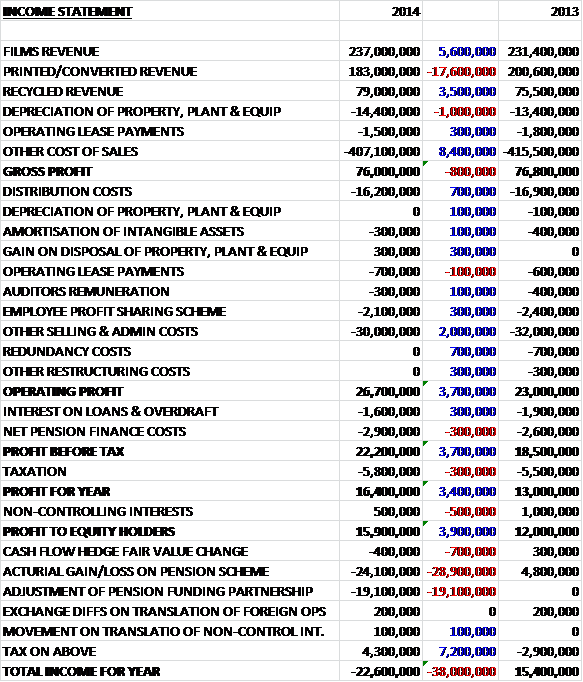
Overall revenues declined year on year as increases in films and recycled revenues were more than offset by a £17.6M fall in printed revenue.  Cost of sales also fell, despite an increase in depreciation, to give a gross profit £800K below that of last year.   Distribution costs fell by £700K and admin costs were £2.8M below that of 2013 and when £1M of restructuring costs that occurred last year did not repeat in 2014, the operating profit was some £3.7M ahead.  After interest costs, pension costs and cash are taken into account, the profit for the year stood at £15.9M, an increase of £3.9M year on year.
BPIassets

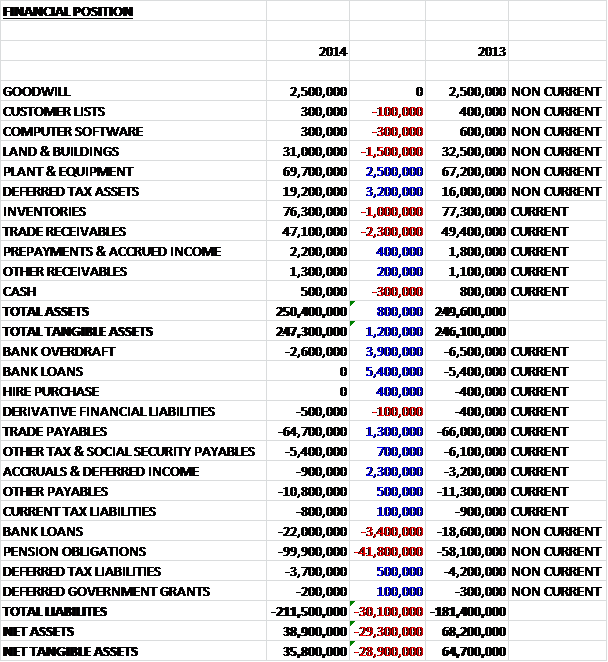
When compared to the end point of last year, total assets increased by just £800K as a £3.2M growth in deferred tax assets and a £2.5M increase in the value of plant and equipment was offset by a £2.3M fall in trade receivables, a £1.5M decline in land and buildings and a £1M fall in the value of inventories.  Liabilities increased considerably driven by a £41.8M growth in the pension obligations, partially offset by a £5.9M fall in borrowings, a £2.3M decline in accruals and deferred income, and a £1.3M decrease in trade payables.  The end result is a net tangible asset level of £35.8M, a fall of £28.9M year on year.

BPIcash

Before movements in working capital, cash profits increased by £4.2M to £42.7M.  This was eroded somewhat by a fall in payables and payments to the pension scheme and after lower interest and tax was paid, the net cash from operations increased by £5.8M to £29M.  The group then spent a net £15.8M on property, plant and equipment along with £300K on acquisitions so that the free cash flow stood at £12.9M, which looks rather good.  After dividends were paid and shares were repurchased along with a modest repayment of borrowings the group had a cash inflow of £3.2M for the year.

The European polythene film extrusion market was estimated at around 7.5M tonnes in 2014 and no individual business has more than 5% of the market.  Total market volumes have shown growth during the year with the recovery focused on packaging for food although market volume has been impacted by the continuing trend towards stronger and thinner films.  Carrier bag production in Europe has declined due to increasing volumes of imported bags and environmental pressures to reduce their usage.  There are still a large number of paper sacks in use and market sectors such as animal feed, pet food and cement are under pressure to move to polythene sacks.  The refuse sack market continued to be resilient despite movements to wheelie bins and communal containers.

The growth in flexible films for food packaging has been driven by changing consumer demands with the requirement for extended shelf life for fresh food and less spoilage.  Away from the packaging markets, greenhouse film has been growing due to increasing demand to extend the growing season of many varieties of fruit and veg.  Construction film volumes declined due to previous falls in construction markets, although some recovery has been seen more recently.  Polythene film has been substituting other materials within the packaging industry such as paper and aluminium.  The industry has now reached a degree of maturity and recent years have been challenging with growth rates now averaging less than 2% per annum, caused by slower economic growth, continuing thinning of films and increased import penetration of converted bags from Asia.

The underlying operating profit at the UK and Irish division was £11.2M, an increase of £2.5M year on year with contributions from the STC and Flexfilm acquisitions, operational improvements at Ardeer and a strong recovery in construction.  Sales volumes increased to 193KT despite the loss of the bread contract.  Sales of collation shrinkwrap, which are mainly to the food and drink industries, were in line with last year despite difficult trading conditions in the UK soft drinks industry as the business secured some new customers.  The converter market remained flat with demand patchy but they did see some growth at some customers and were successful in winning some new clients.

The sites continued to operate efficiently with a focus on reducing scrap and operating costs.  At Bromborough they commenced a programme to replace older equipment over a period of several years.  Three new coextrustion lines are now installed to increase capacity, produce thinner films and offer customers improved performance.  All three lines are now performing well with good outputs.  External volume sales of silage stretchwrap were flat year on year despite a high level of carry-over stocks in the UK and Scandinavian markets.  In the UK, the business continues to position itself as a supplier to the leading co-operatives and agricultural merchants who wish to sell their products.  The Irish market remains the lowest priced in Europe and the focus there is on a restricted range of customers.  The new complementary products helped to increase sales in overseas markets, however, particularly in Scandinavia and New Zealand.

Sales of Securap, a new product for bailing waste, increased by 8% but this new market suffered from credit related issues.  Sales of the prestretched WrapsmartUltra continued to grow and were 20% ahead of last year including some volume from the STC acquisition.  The Bridgewater site is fully focused as a low cost manufacturer of industrial cast stretchwrap.  Sales of the product were lower than last year as it is increasingly imported from Asia.  Sales of cast hand reels and cast Wrapsmart both increased and improved margins, however.

Widnes continued to produce a range of blown machine and hand reels for the packaging industry and despite strong competition in the conversion sector and a continuing move to prestretch products, volumes were broadly the same as last year.  At Leominster the programme of investment to upgrade older extrusion equipment and improve output and quality continued as output improved with a good reduction in scrap.  All conversion for Wrapsmart, including the STC machines, was moved to a new hall at the end of the year and should result in further increased efficiency and lower scrap next year.

The group is the leading recycler of waste polythene films in the UK.  They recycle scrap from their own operations, used products taken back from customers and scrap purchased in the open market.  Availability of scrap continued to be a key issue and they are now bringing in packaging scrap from Europe as scrap prices increased, putting pressure on margins.  The intake of farm plastics increased and they now have availability from some national schemes in Europe.  The recycled material is used in the manufacture of construction films, including damp proof course, refuse sacks, rigid products and a range of other products.

Construction activities continued under the Visqueen brand with the supply of construction films including protective sheeting, damp proof membrane, damp proof course and a number of other products to major builders’ merchants in the UK.  Construction films continued to recover and volumes were 6% ahead of last year against an overall market recovery of 5%.  The specialist gas and water proofing business achieved a significant increase in market share as it increased sales by 25%.  They achieved this growth by establishing stocking centres at their customers last year which enabled them to service clients more efficiently.  Some 29 centres were established by the end of the year and there are commitments for a further eleven centres.  Following this success they have launched damp protection centres which will stock general purpose DPM and DPC.

Total tonnage of refuse sack sales increased by 3% with the main growth coming from the retail sector.  Pressure on margin in all sectors remained intense, particularly as scrap prices increased and continuous development is needed to remain competitive.  In the healthcare sector the business has supplied a range of waste sacks to the NHS and secured additional apron business in the second half of the year.  At the start of 2015, they secured a contract to provide refuse and clinical waste sacks to the Scottish Health Service, replacing an overseas supplier.  Sales of healthcare products to other customers also increased during the year.

Volumes to the local authority sector continued to reduce as councils move to wheelie bins or stop providing sacks.  The loss has been replaced by continued growth in the retail sector along with the food services and facility management markets where new customers have been secured.  The public sector remains an area of risk as they look for savings to meet their reduced expenditure targets. The group supplies both the NHS and local authority markets and continue to offer lower cost products.

While the group achieved growth in the retail sector, margin pressure remained intense and they lost a major contract at the end of Q3 but continue to supply a number of the larger national food retailers.  Sales of the green sack range continue to grow and are used by both retailers and distributers.

Volumes at Heanor increased during the year and management changes have been made to improve production and efficiencies.  A first coextrusion line was installed in December and results apparently look promising and should enable to the business to offer an improved range of products.

The industrial activities, which manufacture heavy gauge polythene packaging products, saw volumes increase by 5% with continued recovery in the construction sector and improved demand in peat, furniture and general industrial packaging.  The group continues to see growth in volumes of the more complex printed cement sacks and expects to see further growth in 2015 due to additional customer wins including some export business.  Sales volumes of peat and compost sacks for retail horticulture showed a small increase while volumes to the animal feed sector were down due to the extended mild weather.  Packaging for furniture and carpets continued to recover and industrial packaging volumes improved as additional business from current customers was secured.  Sales of garment film for online retailers were ahead of last year due to strong demand.  Pallet stretch hooding volumes increased significantly as new customers were secured following the upgrade of lines in 2013.

The major site at Ardeer continued to improve its operational performance with a significant reduction in scrap, particularly in the new films hall which was opened following the transfer of business from Stockton.  The new extrusion investment for heavy duty sacks continued to deliver higher outputs, improved film quality, lower scrap and energy costs and a further line was installed during Q4.  Two further extrusion lines for other products have been ordered for installation in the summer of 2015 and a replacement eight colour printing press will be delivered in Q2.  Greenock continued to perform well with higher volumes, lower scrap rates and reduced costs.  Good growth was achieved in tissue overwrap film, liners, carrot covers and garment films.

Total volumes of agricultural film products sales increased by 40% with considerable growth in silage sheet as product was supplied to the North American business as its new line was being installed.  Horticulture sales improved with growth in the UK and France as a new winder was installed at Adeer which improved the quality and appearance of the finished product.

At Worcester, sales volumes were significantly reduced following the loss of a large bread bag contract at the end of last year.  The site was restructured at the end of 2013/start of 2014 with significant job losses and equipment moves.  Surplus equipment including two printing presses and conversion equipment was transferred to Jordan Plastics.  Volumes at Worcester remained under pressure throughout the year as a number of supermarkets reported lower sales and more produce was sold without packaging.  Margin pressure remained intense as supermarkets and their suppliers attempted to continue to reduce costs.  The strategy to broaden its customer and product base saw some initial results as they increased volumes in printed shrink and frozen food and secured business with additional supermarkets including the discounters, however.

The plant in China manufactures aprons on the roll, flat aprons and a range of bangs including refuse, swing and pedal, food and freezer.  The group installed further extrusion equipment and an additional eight colour printing press to increase capacity for the production of packaging for bread and fresh produce.  Total volumes were just behind 2013 as some refuse sack business was lost.  At Jordan Plastics, capacity was increased by transferring two eight colour printing presses and four conversion machines buy unfortunately additional sales volume was not delivered and margins were impacted by the strength of sterling against the euro for the sales in Ireland.

The total capital expenditure in the UK business was nearly £12M as older equipment was replaced and new extrusion lines were installed at Bromborough, Adeer, Heanor and China along with a new recycling line at Heanor and a printing press in China.  Planned expenditure for next year includes extrusion equipment for Ardeer and Bromborough and a replacement printing press for Ardeer.

The underlying operating profit at the Mainland Europe division was £16.3M, an increase of £1.9M when compared to last year despite an adverse currency movement of £900K as the business benefited from investment in new equipment and an improved product mix.  Sales volumes were 5% ahead with growth in both silage and industrial products.  Total sales of silage products increased by 11% due to good growing conditions, despite high levels of carry-over stock in some markets.  Sales of the newer products SilotitePro and Baletite increased by 33% with market feedback continuing to be positive.  Baletite is a replacement for traditional round bale netting and SilotitePro is a new generation of silage film with improved economic and environmental properties.

Aggressive competition due to the presence of carry-over stocks resulted in some margin reduction.  In the first quarter the business completed the installation of a nine layer coextrusion line at Zele to meet the growing demand for these products, the full benefit of which will only be seen in 2015.  The reduction in polymer prices may delay the start to the new season and result in a more difficult year with pressure on margins, but the good growing season this year has resulted in limited stocks in the supply chain.

Volume sales of printed film for the food industry were behind those of last year as some orders were delayed due to impending changes in food legislation.  A new replacement printing press has been authorised to replace two older units and this will enable greater production efficiencies and a small increase in capacity.  Demand in pallet protection film and general purpose film remained reasonable despite some competitive pricing but sales of the strategic product, stretch hoods, were up 28%.  Sales of Bontite the high quality industrial stretch product showed an increase and new legislation on load stability should offer additional opportunities.

Following the transfer of a line from Zele, extrusion on Roeselare increased significantly as it now produces all the feedstock for printing at Zele.  Total production at Roeselare was nearly 19,000 tonnes with growth in all strategic products.  Sales volumes of the new thinner products for the insulation industry increased by nearly 22% year on year.  Sales from the industrial film plant in Hardenberg in Holland increased by 3% with demand from the polymer industry steady despite difficult conditions.  Sales of other FFS products grew by 8% but volumes of bags continued to reduce as customers moved to form fill and seal products.  The plant also benefited from last year’s installation of a replacement eight colour printing press and a further eight colour printing press for FFS that was installed at the end of 2014.  Production fixed costs and labour costs per tonne remained broadly flat year on year.

The group continued its investment in the business with the installation of a nine layer extrusion line at Zele for silage and a replacement eight colour printing press at Hardenberg for non-petrochemical form fill and seal products.  Going forward, Zele in Belgium will continue to focus on stretch products, particularly silage and printed film for the food industry.  Roeselare in Belgium will focus on a reduced number of products, including stretch hoods, feed stock for printing and a range of pre-stretched thinner products for the insulation industry.  Hardenberg in Holland is focused on industrial products and is a leading supplier of FFS to the petrochemical and other industries.  With further investments in capacity and the development of new and improved products, the business should deliver similar or better returns in future years.

The North America division recorded a loss of £800K, a deterioration of £1.7M year on year as the installation of the replacement of the largest extrusion line was delayed by nearly three months due to a major item being delivered behind schedule by a normally reliable supplier.  Initial teething problems, particularly with the new winder, further restricted production and led to inefficient production runs as the focus was on satisfying customer orders in the second half of the year.  Sales volumes were in line with last year as the product was sourced from the plants in the UK.  Sales of agricultural products were up 10% with strong growth in silage and grain bags as new customers were added.  Sales of sheet were also ahead of last year due to higher exports and better crop conditions but volumes in bale wrap were lower due to competitive conditions.

Horticultural sales fell by 20% as the business lost its major supply position at one customer and had difficulty in supplying the market in the second half.  They are withdrawing from the low margin overwintering film and will now focus on greenhouse films.  Higher polymer prices in the region despite low feedstock costs have encourage imports and placed pressure on sales pricing and margins.  Some reductions were seen in the price of polymer towards the end of the year and the reductions have continued into 2015.

Scrap levels increased due to commissioning issues on the new line and inefficient production in the second half as the business struggled to meet customer demand.  The new extrusion line is currently running well and it is achieving the expected outputs with good film properties.  They are now producing an improved product and the group are looking forward to a more normal 2015 and return to profit.

Total capital expenditure of £17M was above depreciation.  During the year the group completed two major strategic projects comprising a multi-layer coextrusion line for stretchwrap at Zele and a replacement seven layer agricultural line in Canada.  Other major investments included the installation of two coextrusion lines at Bromborough to produce thinner films for food packaging, the installation of a replacement eight colour printing press for FFS film at Hardenberg to improve quality and increase capacity, the installation of additional extrusion and printing equipment in China, the replacement of recycling equipment at Heanor to increase efficiency and reduce costs, and  the installation of a coextrusion line at Heanor to reduce costs and develop improved products.

At the year-end the group had outstanding contracts for capital expenditure of £5.8M and planned expenditure already authorised includes the replacement of an eight colour printing press at Ardeer to reduce costs, improve quality and increase capacity; the addition of two coextrusion lines at Ardeer to improve film quality and reduce scrap and energy costs; the replacement of an eight colour printing press at Zele to replace two older presses and increase capacity; and increasing the rewinding capacity in Canada to support a new extrusion line.

The cost of raw materials is currently reducing due to a decline in the price of naphtha, the main feedstock for the petrochemical industry in Europe, which should reduce the working capital requirement of the business going forward.  The lower polymer prices are reflected in selling prices, however, so reported sales turnover will reduce.  Energy costs reduced marginally in both the UK and Europe reflecting lower wholesale prices.  Going forward, it is anticipated that wholesale energy price in the UK will reduce further but the overall costs is likely to increase due to higher energy taxes.  Costs per tonne in the UK remains higher than in the European and Canadian operations and energy policies in the country continue to place intensive energy users at a competitive disadvantage in global terms.

In July the group acquired the pre-stretch business of STC including three converting machines.  This is a small purchase, with sales of just 1,000 tonnes but will bring new customers, additional capacity and new products in the form of coreless pre-stretched reels to the group.

It was announced that after serving for nine years, non-executive Lord Jamie Lindsay is retiring from the board.  It has to be said that the pay is very generous here with the directors being rewarded handsomely for average performances with the CEO earning £1.6M this year with an astonishing £843K through long term incentives.  At least this was lower than the incredible £2.1M he earned last year!

The pension scheme seems to be a cause for serious concern for the company.  The defined benefit scheme was closed to new entrants in 2000 and ceased future accruals in 2010.  Despite this the scheme currently has a deficit of £99.1M on assets of just £232.2M (taking off the related deferred tax asset, the total liability is £83.1M). Contributions next year will consist of an annual payment of £3.6M, which will continue for the foreseeable, and an additional payment of £500K reflecting the company having reached an agreed profit target, this is in addition to the £1.9M paid out of the pension funding partnership.  After the year-end, the company agreed with the trustees to change the index used to revalue pensions in payment from RPI to CPI, which reflects the current government guidance.  The effect of this change would be to reduce liabilities as they currently stand by £27M.  As part of the agreement the company has agreed to make a one-off payment of £11M to the scheme in June 2015.

In 2011 some freehold properties were transferred to a limited partnership established with the main purpose of leasing the properties back to group businesses and to provide the pension scheme with a distribution of the profits which is about £1.8M per annum.  Apparently as the group has changed to the pension partnership agreement, restricting the ability of the scheme to sell or transfer its income interest without the consent of the group, the income interest no longer meets the criteria for recognition as a plan asset so it has been removed from the balance sheet.  The result of this change has been to increase the pension obligation by £19.1M this year, being the fair value of the income interest.  The scheme funding and cash flow benefits of the pension funding partnership are unaffected by this accounting change.  As well as this £19.1M effect, the scheme was also affected by £25.2M due to changes in assumptions underlying the present value of scheme liabilities.

There is not a great deal of susceptibility to changes in interest rates with a change of 100 basis points resulting in a £100K change to profit before tax.  There is more susceptibility to exchange rate changes with a 10 euro cent change against the value of sterling changing profit/loss by £1.2M.  As well as the pension issues, the main potential risks include general economic conditions, raw material prices (linked to the price of oil), energy costs, weather conditions (for the agricultural end users) and perceived environmental issues.

Going forward, the group has made a good start to 2015.  The order book is similar to the same time last year and good demand is expected from the agricultural sector in the coming months.  The board anticipate a much better year in North America, continued progress in the UK and another good performance in Europe so they look forward to the remainder of the year with confidence.

The shares are currently trading on a PE ratio of 11.7 which reduces to 9.6 on next year’s consensus forecast, which looks very cheap.  After a 10% increase in the final dividend, the shares are currently yielding 2.4%, increasing to 2.5% on next year’s forecast.  At the year-end the group had net debt of £24.1M compared to £30.1M at the end of last year, partly as a result of the delay to some of the capital expenditure spend this year.  The group currently has overdraft headroom of £18.4M an undrawn bank loan of £48M.  There was also £4.2M in operating lease payables off the balance sheet.

Overall then this was a fairly solid set of results.  Profits improved as costs fell and operating cash flows were also up with a decent amount of free cash being generated which was partly due to the slippage of some capital expenditure into next year.  Net assets did fall year on year due to a huge increase in pension liabilities, partly affected by an accounting change but the pension is still a considerable drag on results as next year the group will to pay an £11M one-off payment to the scheme.  This is a huge amount and really shows the issues here as despite measures in the past to tackle the deficit it still remains considerable.

The market as a whole is very fragmented and has pretty much reached maturity for the time being.  The reduction in carrier bag usage along with refuse sacks is a bit of a drag on performance but this is offset by more plastic packaging required to improve the shelf life of fruit and veg and also greenhouse plastic to increase the growing season.  Another driver is the construction market which is improving as the economic outlook in Europe starts to look a bit better.

The UK put in a decent performance due to an improving construction market and the improvements made at the Ardeer plant, partially offset by the loss of a large bread packaging contract.  The move to establish waterproofing stocking centres at customers seems to be a good one and the opening of more of these should drive further growth.  The European performance was good despite a weak Euro due to increased sales to the silage and industrial markets.  The North American division was the source of problems, however, as the inexcusable 3 month delay in the installation of an extrusion line caused the division to slip into a loss position.

Going forward, the fact that the extrusion line is up and running in Canada should mean the North American division returns to profit which should drive overall profits up.  Also as the lower oil price reduces prices of the Naphtha feedstock, the input prices should reduce, although in the UK higher taxes are expected to mean that energy costs increase.  The forward PE of 9.6 does seem to undervalue this company but that £11M payment to the pension scheme should be taken into account and the forward dividend yield of 2.5% is fairly modest but nice to have.

On the 12th May the group released a trading update covering the first four months of the year.  Volumes were ahead in the period due to increased silage stretchwrap reflecting new capacity.  This resulted in the performance for the first four months being ahead of the same period last year.  Less positive is the fact that in March a reduction of polyethylene imports from the Middle East coincided with a number of declarations of force majeure (the exact natures of which were not disclosed) by Western polymer producers which has caused the price to rebound to high levels with shortages in many grades.  This volatility will likely continue until the holiday season when the subsequent reduced demand should allow supplies to get back in balance.

The group will pass these price increases through to the end users but margins are likely to be impacted in the short term while these increases are in the process of being passed through.  Despite this, the successes with new products in the UK and Europe along with the recovery in the performance of the North American business means that the board are confident in the outcome for the year as a whole.

On the 3rd July the group reported that improved volumes continued into May and they currently anticipate that the performance for the first half will be slightly ahead of that achieved in 2014 despite the continued pressure on margins as they continue to pass through increases in raw material costs.  It now looks as though the raw material price increases are running out of steam having reached record levels well above those in the Far East but in addition returns from the European business are being affected by the continued weakness in the Euro.

It seems as though the underlying progress of the group is good but they are being hit by things which are outside of their control.  I feel it is probably sensible to wait for the interim results to get some further clarification on these current issues.
BR.POLYTHENE

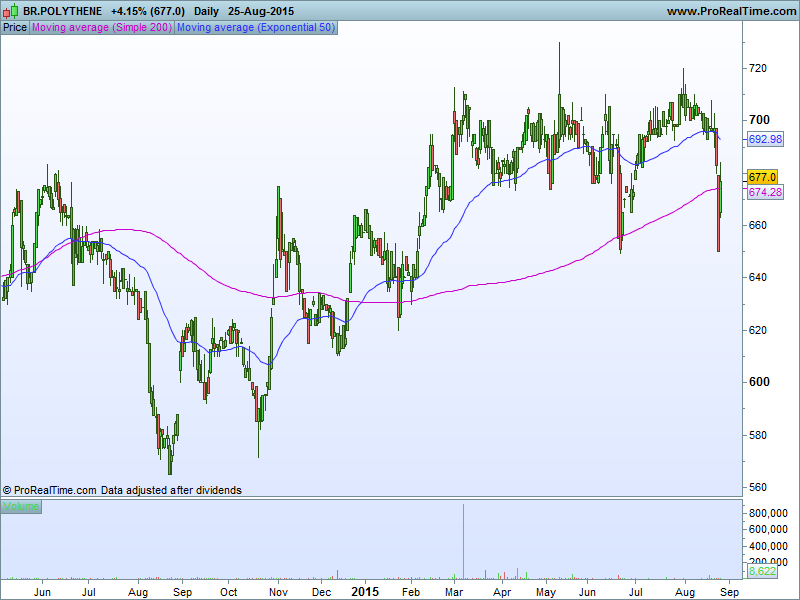
There bull run seems to have run out of steam a bit.

Sylvania Platinum Share Blog – Final Results Year Ended 2015

Sylvania Platinum has now released its final results for the year ended 2015.

SLPincome

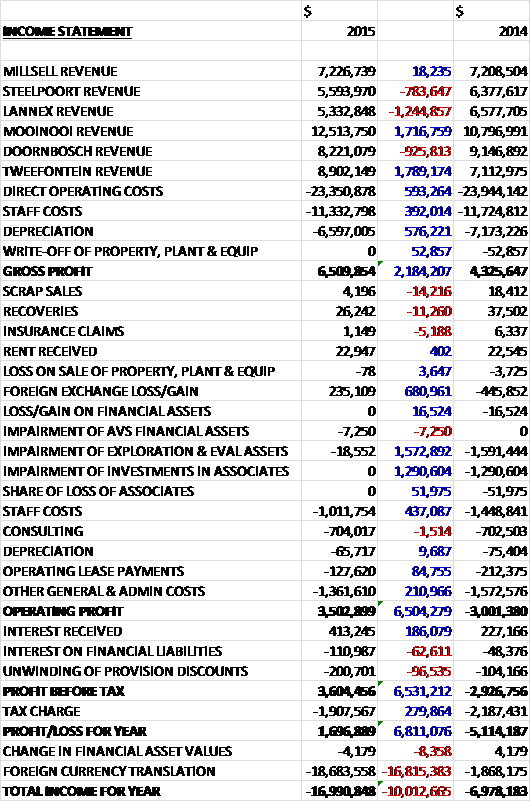
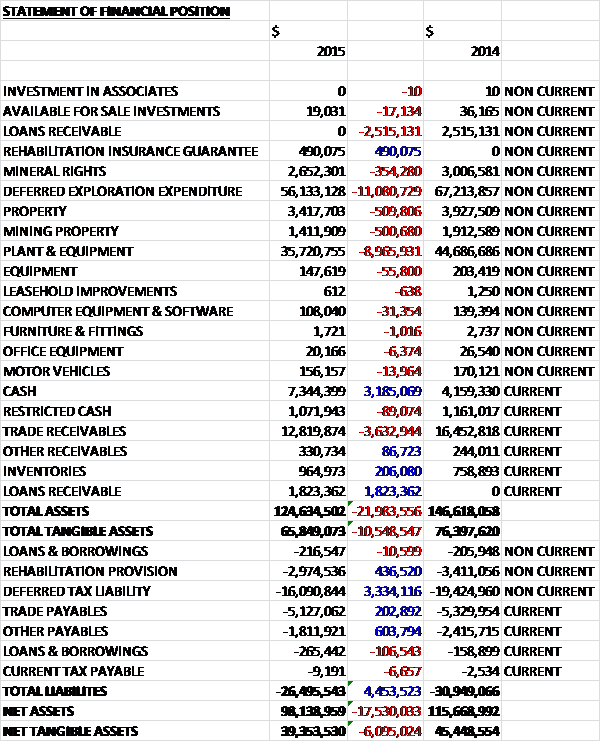
When compared to 2014, total revenues increased as declines in sales at Lannex, Doornbosch and Steelpoort were more than offset by growth at Mooinooi and Tweefontein.  Staff costs and depreciation both fell to give a gross profit $2.2M higher than last year.  We then see a positive swing in foreign exchange as far as costs are concerned, further lower staff costs and a decline in other admin costs, along with the lack of $2.9M-worth of impairments that occurred last year.  After tax and finance costs, the profit for the year came in at $1.7M, compared to a loss of $5.1M in 2014.  It is also worth noting that there was a huge $18.7M loss on foreign exchange translation.

SLPassets

When compared to the end point of last year, total assets collapsed by $22M driven by an $11.1M fall in deferred exploration expenditure due to foreign exchange losses, a $9M decline in plant & equipment (due in part to exchange differences and partly due to the depreciation being higher than capex), and a $3.6M fall in trade receivables partially offset by a $3.2M increase in cash.  Liabilities also fell during the year, mainly due to a $3.3M decline in deferred tax liabilities to give a net tangible asset level of $39.4M, a fall of $6.1M year on year.

SLPcash

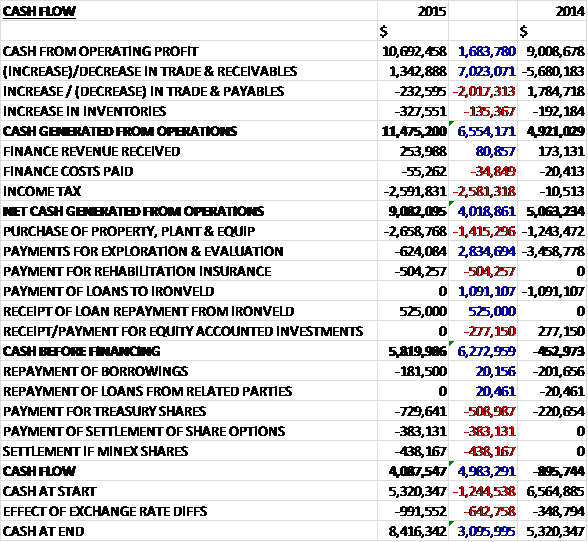
Before movements in working capital, cash profits increased by $1.7M to $10.7M.  This was further improved by a fall in receivables, but there was a much bigger tax payment this year so that the net cash from operations stood at $9.1M, an increase of £4M year on year.  The group spent $2.7M on property, plant & equipment relating to new tailings facilities at Lannex, Doornbosch and Tweefontein along with the changeover to a hydro-mining process; $624K on exploration and they used the receipt of loan repayments from Ironveld to pay for rehabilitation insurance to give a free cash flow of $5.8M.  The group then spent $730K on treasury shares, $438K on the settlement of Minex shares, $383K on the settlement of share options and $182K on loan repayments.  In all, there was a $4.1M cash inflow for the year to give a cash level of $8.4M at the year-end which looks like a very good performance to me.

Profits at the Millsell plant were $2.7M, an increase of $500K year on year; profits at the Steelport plant were $687K, a decline of $400K when compared to last year; losses at the Lannex plant were $1.7M, a deterioration of $1M when compared to 2014; losses at the Mooinooi plant were $176K, an improvement of $1.6M year on year; profits at the Doornbosch plant were $2.8M, a fall of $300K when compared to last year; and profits at the Tweefontein plant were $2.2M, an increase of $1.6M year on year.  The average basket price during the year fell to just $1,072 per ounce and the cash costs per ounce fell by 9% to $603 per ounce.

The main issue for the group has been the continued decline in the platinum price.  The metal started the year at $1,497 per ounce and finished the year at just $1,078 per ounce.  The decline was partly mitigated by the South African Rand’s decline against the US dollar but in a market that has been oversupplied and in which production additions are still being made to increase mine capacity and where high-cost production is being cross-subsidised there appears little prospect of much of a recovery in the price.  Labour conditions in the country have improved after a five month strike last year but the mining labour environment in the country remains a concern for the sector in general.

During the year the group set a company annual record for SDO production at 57,587 ounces, a 7% increase from the 53,808 ounces achieved last year. The SDO began the year with a sixth consecutive quarter of continuous growth in Q1.  This tapered off in Q2 and Q3 largely as a result of the start-up and commissioning of hydro mining, the planned holiday shut down period and a structural failure on the Lannex plant’s thickener which resulted in some downtime at the plant. Community unrest as a result of poor municipal service delivery exacerbated operating conditions at the Eastern operations as employees were prevented from entering the plants.  The change over from mechanical mining of the dumps to a hydro-mining process is expected to reduce mining costs by up to 20% going forward.

Feed material to the operations declined slightly from Q2 onwards due to the start of second-pass treatment at Millsell, Lannex and Doornbosch, as well as the final scrapings at the Steelpoort dump, but these stabilised at lower production rates to align with the annual guidance.  As a result, plant feed tons for the year are down 15% to 2,129,352 tons but a 13% increase in the feed grades to 2.31g/ton combined with the subsequent upgrading of the PGM’s before flotation contributed to the annual production achieved.

The company received word that the mining rights for PGMs and iron ore, vanadium and heavy minerals was awarded to a subsidiary at Harriet’s Wish, Aurora and Cracouw.  The official signing to execute the mining right has been delayed, however, pending a request to the DMR to reduce the amount of financial provision for rehabilitation.  After the year-end, the DMR agreed to reduce the financial provision to R6M.  A financial guarantee will be issued and arrangements made for execution of the right which will be followed by an application to transfer the right to mine iron ore, vanadium and heavy minerals to Ironveld in terms of the transaction concluded in 2013.

The group continues to await the outcome of the mining rights application from the DMR for the Volspruit project which appears to rest on the decision taken by the LEDET whether to grant an Environmental Authorisation to mine.  The company remains confident that the decision will be favourable but LEDET requested clarification from the group on certain aspects of the Environmental Impact Assessment as well as an instruction to provide biodiversity and wetland offset strategies.  The decision by LEDET is expected within the following six months.  In addition, a submission of the application for the Water Use License will require preliminary civil designs of all dam facilities and as this will result in further costs, these activities have been postponed pending the decision on the MRA and environmental authorisation.

At the Grasvally Chrome operation, it has been discovered that the resource contains some of the best quality chromite in the country, comparable with Turkish-grade chromite.  Exploration continued over the northern portions of the property in order to declare a SAMEC compliant resource which will be required in order to apply for a mining right over the resource.  Exploration is expected to be completed by October and as the company has no intention of becoming a Chrome miner, the Grasvally project will most likely be available for sale during 2016.  The intention is to become a platinum miner at Volspruit but in order to do so, the group would have to raise substantial capital or find a joint venture partner, both of which are uncertain given the availability of mining capital in the current market.

The group has used forecast commodity prices for between 2016 to 2018 of between $1,400 to $1,600 per ounce for platinum and $850 to $875 for palladium in their models.  As the current platinum price stands at $1,023 per ounce, there is the potential for some impairments going forward.   A further 10% fall in platinum group metal prices would reduce profits by $704K with the opposite movement having the opposite effect (although I doubt that is very likely).The vast bulk of revenues were made to two customers and in the notes it states that the contract for one of them was terminated in May.  There is no other mention of this in the report so I am not sure what kind of impact this is going to have.

Going forward, the first half of next year will be difficult and platinum prices are not expected to move in the group’s favour.  Operationally, the board remain positive despite the difficult conditions and they will continue to pursue the benefits of optimising their operations.  They are working to resolve the technical problems at Mooinooi and all other operations are approaching or are at steady state so it is expected that they will produce 55,000 ounces at a cash cost of under $700 per ounce and a capital expenditure of $3M.

I have to mention an extract from the chairman’s letter at this point – it certainly raised a chuckle from me and I quote:  “Let me dwell further on a recent near miss…. The five or so tons of platinum South Africa produces each year is overwhelming the market and platinum miners, being the go-getters that they are, cannot be persuaded to moderate their output to balance the market.  We were however, recently spared a possible glut when an asteroid with a 90M ton core of pure platinum passed within a whisker of our planet.  If our mining companies had been quicker off the mark, they might have extracted enough metal from the flying rock to cover the entire Bushveld complex with platinum to a depth of a foot.  Mind you, had the asteroid landed on top of the Bushveld complex, our present problems might have seemed as trifling as this interlude”.  I love that!

During the year Grant Button has left after spending 11 years on board and he was replaced by Eileen Carr who has previously been finance director at Cluff Resources and is currently non-executive director of Nobel Holdings, a Russian Oil and Gas company.

At the current share price the shares trade hands on a PE ratio of 27.3 which apparently falls to 8.9 on WH Ireland’s forecast for 2016, which I personally find very hard to believe.  The group still has some $2.9M of undrawn borrowing facilities available and plenty of cash so it doesn’t look as though they are in any immediate danger from the declining platinum price.

Overall then, this has actually been a good year for Sylvania.  The profit is up, as is operating cash flow and the group has a decent amount of cash as a safety net.  The net asset level did fall, however, mainly as a result of the depreciation in the South African Rand but the balance sheet remains strong.  Operationally, most plants are doing well but technical problems beset the Mooinooi and Lennex plants and the Steelpoort plant seemed to struggle a little bit.  The group produced some 57,587 ounces this year and plan to produce about 55,000 this year.  The Grasvally chrome project sounds interesting and I do find myself wondering what kind of ball park figure will be realised from the potential sale of the project next year.
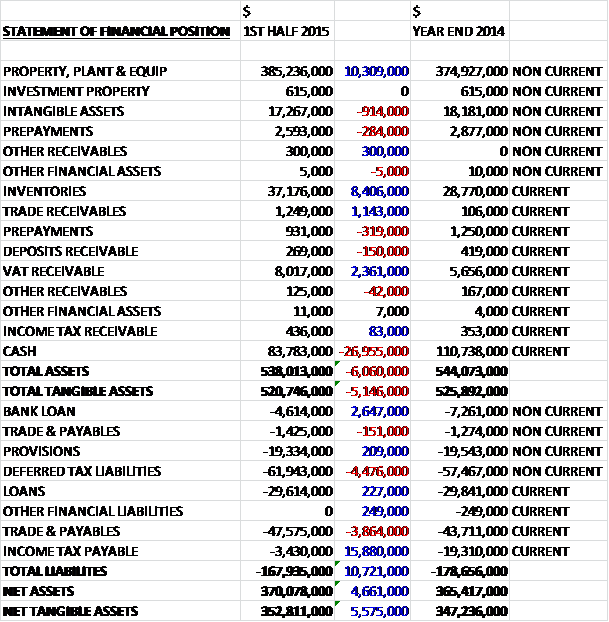
The main issue clouding the company, however, is the price of platinum.  It has fallen from $1,497 at the end of last year to $1,078 at the end of this one and the group does not quite realise this full price from their sales.  Their costs are only $603 per ounce, aided by the deterioration in the South African Rand but as long as the oversupply in the market continues and the price remains subdued, things will remain difficult for all producers of the metal.

SYLVANIA PL

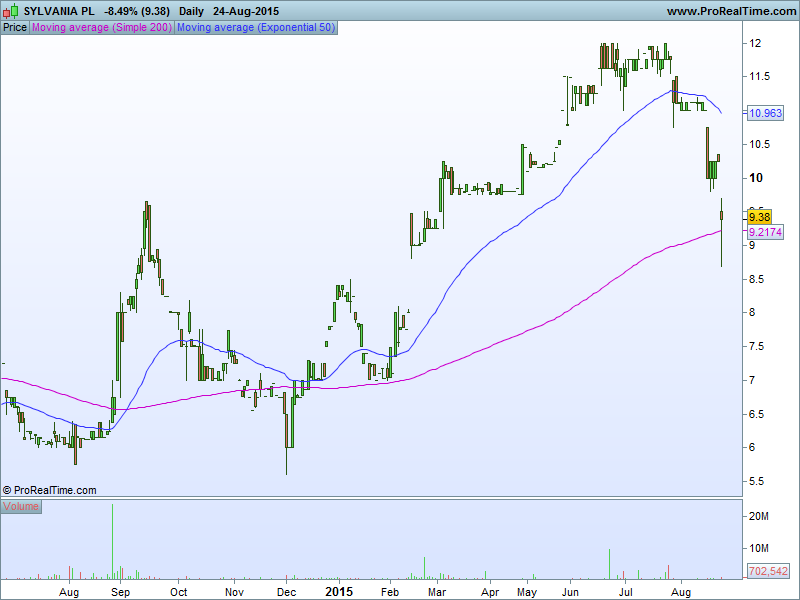
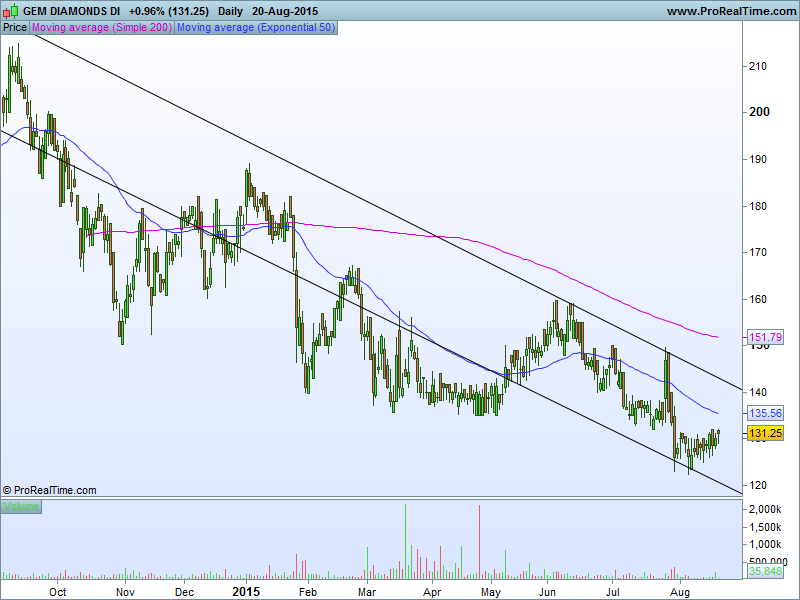
This chart seems to have broken down somewhat, whether the 200day moving average will act as some support remains to be seen.

On the 24th August the group announced that a fire at an electrical substation had affected the Mooinooi dump and ROM plants.  The cause of the fire is yet to be confirmed but it is believed to be related to a current in-rush as a result of a power failure.   Production losses are currently being incurred but it is expected that a temporary substation and electrical equipment will be installed before the end of the week.

In addition, Lannex and Steelpoort have been affected by recent violent community protest regarding demands for improved infrastructure and jobs.  The communities have now withdrawn the protests, however, and operations in the area have returned to normal.  It is anticipated that these events could result in production during Q1 being up to 1,000 PGM ounces lower than expected but the group should still be able to achieve the 55,000 ounces forecast for 2016.

On the 28th October the group released an update covering Q1 2016. The dump operations produced 13,729 ounces during the period, a 2% improvement quarter on quarter. This increase is attributable to a slight improvement in recoveries, despite lower PGM plant feed grades and lower tonnes treated. The cash costs fell by 17% to $532/Oz whilst in Rand terms, costs were down 11%. This reduction is as a result of improved maintenance planning and cost controls at the operations combined with the improved recoveries.

The gross basket price dropped 15% to $879/Oz mirroring the platinum price which fell to a six year low at the end of September. Despite the higher ounces for the quarter, therefore, the low metal prices resulted in a 12% drop in revenue to $8.8M. The group cash balance at the end of the period was $6.8M, down from $8.4M at the end of the previous quarter with the reduction attributable to a cash outflow of operations of $90K due to the low basket price and reduction in pipeline finance; cash spent on sustaining capex and exploration assets rights applications of $400K; $400K spent on share purchases and $100K on rehabilitation guarantees. As much of the cash is held in Rand, the Rand/Dollar exchange rate movement resulted in a further reduction of $500K in dollar terms.

Despite the lower metal prices, electronic substation fire and subsequent one week downtime at Mooinoii, as well as two weeks of violent community protests at the Eastern operations, all of which impacted negatively on plant availability and tonnes treated during the quarter, the higher ounce production and lower unit costs resulted in group EBITDA improving significantly quarter on quarter to $1.25M. The basked price of platinum remains a concern for the foreseeable future but the group are confident that the SDO can continue to produce profitably provided prices do not drop significantly further and management continue to keep tight control on costs.

At Volspruit, following a review of all comments received and completion of the comments and responses report, the Addendum and report was delivered to LEDET and the DMR in mid-September. LEDET has 120 days in which to consider the addendum and if it accepted, another 30 days to grant the EIA.

The Grasvally mining right application for chrome was submitted in September and has been accepted by the DMR. The exploration programme has been completed over the northern portions of the site in order to declare a SAMREC compliant resource which will be required by the company in order to exercise a mining right over the resource. With all logging and data collection completed following the drilling programme, the work to compile the resource statement is in its final stages and expected to be completed by the end of October. It is expected that the resources will comprise a SAMREC compliant shallow indicated resource and a deeper inferred resource.

At Harriet’s Wish, the company received the decision from the DMR to reduce the amount of financial provision for rehabilitation in August. Arrangements have been made to issue the financial guarantees in order to provide for this reduced financial security for rehabilitation. It is anticipated that this will be received shortly, thereafter arrangements will be made with the DMR for the notarial execution of the mining rights. Application for ministerial consent to transfer the right to mine iron ore, vanadium and heavy minerals to a subsidiary of Ironveld has also been submitted. Hacra must now proceed with the water use license application but this will be delayed as the original land owners are all deceased and the company will have to facilitate the transfer of the title deeds to the lawful land occupants and descendants of the original land owners. This process will then allow the application to be submitted on agreement to the project by the current land occupants.

Overall then this update is not that bad considering the very poor platinum price but until sentiment picks up in the metal, this seems like quite a difficult investment.

On the 28th January the group released a Q2 update. The dump operations produced 15,791 ounces in the quarter, a 15% improvement on Q1. This increase was attributable to a combination of higher tonnes treated (15% improvement) and an improvement in both plant feed grades (3.5% improvement) and recovery efficiencies (8%) for the quarter. The cash costs decreased by 21% in dollar terms to $420 per ounce, aided by the weak rand but in rand terms, cash costs also fell by 13%.

The gross bucket price of $785 per ounce represents an 11% decrease compared to the $879 achieved in Q1, having fallen from $1,082 since the beginning of July. Despite this decline, however, revenue increased 10% to $9.7M due to the increase in volumes produced.

The group’s cash balance at the end of the period was $5.1M, a $1.7M fall on the previous quarter. Cash generated before working cap movements was $2.5M with net operating cash of just $500K after working capital is taken account for. They also spent $800K on tax, $400K on stay-in business capital for the plants and $400K spent on share purchases. The impact of exchange rate fluctuations on cash held was a decrease of $500K.

The communities in the East of the region have continued their violent protests demanding jobs and better infrastructure, which resulted in some production down-time, although this was less than in Q1 and accounted for about one week, and the precious metals market has also been strongly affected by the decline in platinum and palladium prices in recent times. In the early part of 2016, the price of platinum has shown little sign of recovery and the palladium price has dropped even further. Despite all of this, the group EBITDA increased by 83% to $2.3M.

At Volspruit, the company continues to await the decisions on the addendum and comments and responses report delivered last quarter. At Grasvally Chrome, the fulfilment of the most recent exploration phase, an upgraded mineral resource estimate has completed. The mining right application for chrome was submitted in September and has been accepted and the environmental impact assessment document was released to the interested and affected parties in January with public participation meetings to be held in February. As previously stated, the company intends to sell this chrome deposit for cash and an international agent has been appointed to handle the marketing to potential ferrochrome smelters. There were no further developments at the other platinum exploration licenses.

Overall then, this update is not all that bad. Sure, the low price of platinum and palladium are taking their toll but by increasing production, the group seems to have remained fairly profitable. The ramp up of volume has taken its predicable toll on cash generation but this is to be expected. Also I have to wonder how much the group expects to get for the Chrome deposit. The market for steel is not great, which is where I suppose most Chrome ends up but this could still be a welcome cash injection. I am sorely tempted to get back in here to be honest.
XP Power Share Blog – Interim Results Year Ending 2015

XP Power has now released its interim results for the year ending 2015.
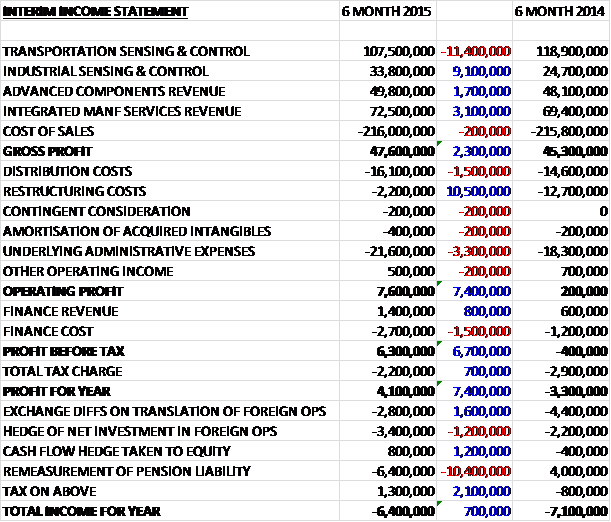
XPPinterimincome

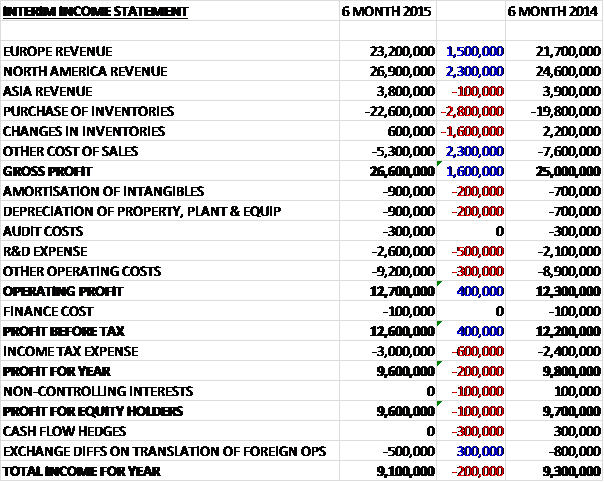
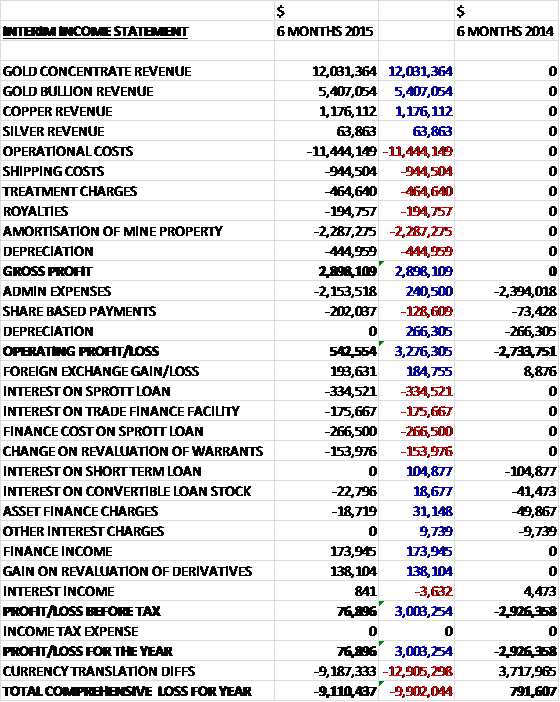
Overall revenues were up year on year, mainly as a result of currency exchange movements, as a small fall in Asian revenue was more than offset by a £2.3M increase in N. American revenue and a £1.5M growth in European revenue.  Cost of sales also increased due to an increase in the purchase of inventories.  R&D expenses increased too along with other operating costs, partly as a result of the strong US dollar and the increase in sales and engineering resources announced last time.  The pre-tax profit came in at £12.6M, an increase of £400K when compared to the first half of last year.  After an increased tax bill, the profit for the year was £9.6M, a decline of £100K year on year.

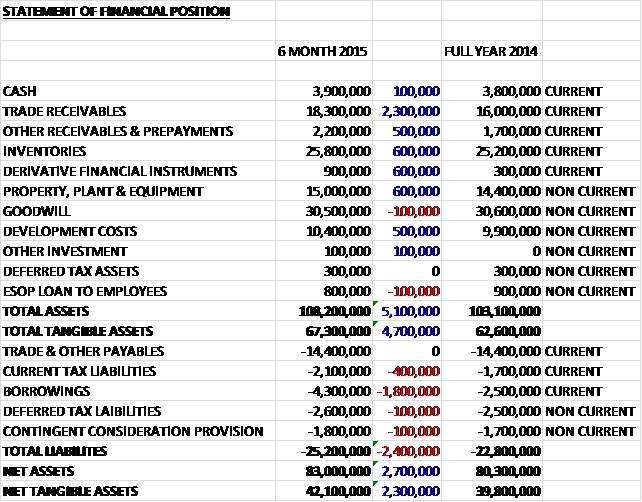
XPPinterimassets

When compared to the end point of last year, total assets increased by £5.1M driven by a £2.3M growth in trade receivables and a £600K increase in inventories, derivative financial instruments and property, plant and equipment.  Liabilities also increased during the period, mainly due to a £1.8M increase in the overdraft.  The end result is a net tangible asset level of £42.1M, an increase of £2.3M during the six month period.

XPPinterimcash

Before movements in working capital, cash profits increased by £1M to £14.3M.  This was reversed by an increase in receivables and after tax, there was an £8.5M cash inflow from operations.  The group spent £1.3M of this on fixed assets, £1.4M on R&D and £600K on the acquisition of a subsidiary to give a free cash flow of £5.1M.  This did not cover the dividends, however, to give a cash outflow of £1.8M for the period and a cash level of -£400K.  A decent enough performance, but I still feel they shouldn’t be paying quite so much of this cash out as dividends.

Order intake in the first half of the year surpassed revenues as it did last year, increasing by 11% to £56.5M, so overall momentum continues to build in the business and the group enters the second half of the year with a strong order backlog.  The European business achieved very strong order intake and revenue growth after experiencing some weakness in the second half of last year.  In contrast the North America business, which showed strong momentum in the second half of 2014, has slowed as customers placed orders at lower levels and revenues grew at a slower rate than in the second half of last year.

There was no profit or loss at the Asian business compared to a £1.1M profit in the first half of last year.  The profit at the European business was £3.8M, a decline of £500K year on year.  The profit at the North American business was £7.4M, an increase of £900K when compared to the first half of 2014.

Revenues from healthcare grew 13% to £17.3M driven by new programmes with key accounts, particularly in Europe, as well as existing programmes coming back to life.  Healthcare is benefiting from design wins entering production from larger accounts where XP has gained approved or preferred supplier status in recent years.  Industrial declined by 3% to £24M, primarily driven by North American accounts while the industrial business in Europe showed good growth.  After a prolonged period in the doldrums, the technology sector grew by 25% compared to the first half of 2014 to £12.6M.

Gross margin fell slightly from 49.8% to 49.4% primarily due to start-up costs relating to the production of the first complete power converters in the Vietnam facility.  It is expected that the factory will make a net contribution to margins in the second half of the year as production volumes running through the facility increase.  The operating margin also reduced, falling from 24.5% to 23.6%.

The significant number of new products introduced over the last three years is yet to have a material impact on group revenues, given the time lag from launch to them entering production due to the lengthy design cycles required by customers to qualify the power converter in their equipment and then gain the necessary safety agency approvals.  The group launched 13 new products during the period. Of these products, 10 are high efficiency products and more are being launched with digital control, an example of this is the GSP00.  They have also released a version of their industrial 1.5KW product with digital control.

With larger customers continuing to reduce the number of vendors they deal with, the group’s broad product offering and in-house manufacturing capability apparently leave them well placed to secure further preferred supplier agreements.  The production of the magnetic components in Vietnam is mitigating the continued rise of Chinese labour costs.  They now have 27 part numbers approved for production in Vietnam with many more in the pipeline.  Of the 590,000 power converters produced during the period, some 24,000 of these were produced in the Vietnamese facility and the start-up costs reduced profits by about £400K during the first half of the year.

In May the group acquired a 51% stake in a value added distributer of power products based in South Korea for a cash consideration of $2.1M.  The company has been distributing XP’s products since 2008 and, although a niche player, South Korea is an interesting market for industrial electronics.

Going forward the management have suggested that they may look to make further acquisitions and they have also stated that whole the global economic outlook remains uncertain, the second half of the year has started well and they are encouraged by the order intake and strong backlog.  They therefore expect to be able to continue to growth revenues in the second half of the year as designs won last year enter their production phase.

The bulk of the group’s revenues are earned in USD so the change in the USD to GBP exchange rate has a significant effect on revenues.  The majority of expenses are also in US dollars, however, so the impact at the profit level is much less.  The impact of the dollar changes during the period was to increase profits by £700K with the Euro exchange impact on profits being -£300K.

After an 8% increase in the dividends in the first half of the year, at the current share price, the shares yield 3.9% which increases to 4% on the full year consensus forecast.  The predicted PE ratio for the full year stands at 15.3.  At the period end, the net is £400K compared to a net cash position of £3.8M at the end of last year, although the net debt position as this point of last year was £1.5M.

Overall then, this half year was steady rather than impressive.  Profits fell but this was only due to an increased tax bill and net tangible assets grew during the period.  Operational cash flow also fell year on year, but again this was due to an increase in receivables and the underlying cash inflow improved.  There is still a decent amount of free cash but this no longer seems to be covering the dividend and the group was left with hardly any cash left after the half year finished.  Operationally, the medical market continued to improve and the technical market made a bit of a recovery but sales to industrial applications showed some softening.  The management have also stated that orders from North America have softened somewhat compared to previously.  Overall though, orders are up and the second half of the year has apparently started well and with the Vietnam factory expected to contribute to margins during the period as opposed to being a drag, the outlook looks fairly decent.

There is a good looking dividend yield here but it doesn’t look that well covered.  This is a tricky one, I will probably hold fire here but perhaps look to enter on weakness.

XP POWER

The share price is a bit choppy but the trend seems to be generally upwards.

XP Power has now released an update covering trading in Q3. The group traded in line with board expectations during the quarter with revenues in the year to date up by 9% to £81.7M which was aided by favourable currency movements.  There has been a continued strong performance across the European market but this was offset by weaker order intake in North America.  Orders at the end of September were 2% higher than in the previous year but on a constant currency basis they were down 3%.  Factory loading continued to be strong and this high utilisation in conjunction with the ramp up of power converter production at the Vietnam facility produced a favourable margin impact.  At the end of the quarter net cash was £1.2M compared to £1.3M at the start of the year.

An 8% increase in the dividend to date means that the shares trade on an annual dividend yield of 4.3% which seems pretty decent.  In all then, it does sound as though the slow-down in US orders is adversely affecting the group so I am not sure this is the right time to purchase the stock.

On the 25th November the group announced the acquisition of EMCO High Voltage, a manufacturer of high voltage power modules. A total consideration of £7.8M was paid in cash on completion which was funded through a new debt facility. The business, based in Northern California with manufacturing operations in Nevada, supplies the industrial and medical sectors with a broad range of standard, modified and custom high voltage products. As well as a product offering suitable for an array of applications used by some of the existing customer base, EMCO will bring a number of new customers to the group. Last year it recorded sales of £5.1M and it is expected to be earnings enhancing in 2016.

On the 17th December the group announced that Polly Williams will join the board as a non-executive director. Polly is a former partner at KPMG and is currently a non-executive director at Jupiter Fund Management, TSB Group and Daiwa Capital Markets Europe.

On the 8th January the group released a trading update for Q4 2015 where the performance was in line with board expectations. Revenues for the year as a whole were £109.5M and 8% ahead of those of last year, although just 4% ahead on a constant currency basis. Order intake for the period was £110.4M, an increase of 1% on a constant currency basis. The integration of EMCO is proceeding well and the sales team are already identifying new customer opportunities for their high voltage modules and orders for EMCO products from existing customers were strong in December.

Order intake in Q4 from North America of $22.2M (excluding EMCO) was more encouraging than the $17.3M experienced in Q3 and the total group order intake in Q4 of £30M is also encouraging. Following the EMCO acquisition, the group’s net debt stood at £3.5M compared to a net cash position of £1.3M at the end of last year. The Q4 dividend will be announced at the time of the final results but isn’t expected to be less than 23p per share which represents a 7% increase in the total dividend and a current yield of 4.3%.

Going forward, the board are encouraged by the stronger order intake in Q4 and by the progress of the integration of EMCO. Despite the mixed global economic picture, therefore, they enter 2016 with positive momentum and expect that they should be able to show further modest revenue growth during the year.

Overall then, this is not a bad update actually and the yield looks useful so I might be tempted to make a purchase.

XP Power Share Blog – Final Results Year Ended 2014

XP Power is listed on the London stock exchange and is incorporated in Singapore.  They make power converters that takes electrical mains supply from the grid and converts it into the correct form of electricity to power their customers’ equipment in applications in the industrial, healthcare and technology industries.  In addition, the power converter will prevent electrical noise from the mains interfering with the end equipment and will also prevent the end equipment transmitting noise into the mains supply along with reducing the production and running costs of their customers’ equipment.

The group apparently deals with 95% of the S&P 500’s healthcare equipment manufacturers along with 73% of the industrial equipment manufacturers and 69% of the technology equipment manufacturers.  The board estimates that they currently have an 8.3% share of the North American market, an 11.1% of the European market and just 1.2% of the Asian market.

The time from identification of a customer programme can be very long (between 18 to 30 months) but once the product is designed into their customers’ equipment they have an ongoing revenue annuity, typically for around seven years but this can be longer or shorter depending on the industry and application.

It has now released its final results for the year ended 2014.

XPincome

Revenues were flat year on year reflecting a weakness in the US dollar (constant currency revenues were up 5%) as a decline in sales to Europe was counteracted by increases to North America and Asia.  Cost of sales declined, however, it seems due to changes in inventories which gave a gross profit £500K ahead of last year.  Distributing and marketing costs also fell somewhat, also partly due to weakness in the US dollar against Sterling, but a small decline in interest expense was offset by a modest increase in tax so the profit for the year stood at £19.4M, an increase of £1.2M year on year.

XPassets

When compared to the end point of last year, total assets increased by £7.6M driven by a £4.8M increase in inventories, a £1.4M growth in development costs and a £1.3M increase in plant and equipment, partially offset by a £1.2M decline in cash.  Liabilities fell during the year as a £6.3M fall in loans and borrowings was partially offset by a £1.7M increase in payables.  The end result is a net tangible asset level of £39.8M, a decent looking £9.5M increase year on year.  There is also £5.2M worth of operating leases off the balance sheet, but this doesn’t seem excessive.

XPcash

Before movements in working capital, cash profits increased by £3.8M to £29.4M.  After a large increase in inventories was partially offset by a lower amount of tax paid, however, the net cash inflow from operations was £21.8M, an increase of £1.6M when compared to last year.  The group then spent £2.9M on R&D (the bits that weren’t included in operational cash flow) and £2.9M on fixed assets so that the free cash flow stood at an impressive £16M.  The group used £7.3M to pay off the loans and £11M was given to shareholders in dividends which meant at the end of the year, the cash level stood at £1.3M.

Overall the operating margin improved from 23% last year to 24.2% in 2014. The group started production of the first complete power converters in the Vietnam factory, providing additional manufacturing capacity at lower cost than the existing Chinese facility.  They have also implemented a new CRM system to enhance collaborative working and provide better customer service and knowledge to the business.

The profit at the European business was £7.6M, an increase of £200K year on year.  Some European markets have been challenging, particularly in those where the group already have a high market share such as the UK.  Despite the challenging economic conditions in Germany and Southern Europe, they saw revenue growth in these areas due to an increase in market share.  A direct sales presence has been established in Israel where good medium term opportunities have been seen.

The profit at the North American business was £13.6M, a growth of £300K when compared to last year.  It has shown some clear momentum driven by strong design wins in larger blue chip customers.  The outlook is encouraging and the group will be expanding their sales engineering resources over the next year.  The profit at the Asian business was £1.7M, an increase of £800K year on year as the division performed well, being able to replace a large programme that went end of life last year.  A direct sales presence has been added in Japan where the group has already had some wins against strong local competition.

As far as sectors are concerned, industrial revenues increased by 3.4% to £49.1M, healthcare increased by 2.6% to £31M but technology declined by 10.3% to £21M.  The improvement in industrial and healthcare sales is principally due to market share growth as new programmes have entered into production.  In industrial, good progress has been seen in 3D printing, test and measurement and industrial printing applications.  The healthcare segment continues to strengthen and the group expect to see higher growth rates in the medium term as they are now approved vendors at all the key players in this market, yet still have a relatively small share of their available business.  Technology continues to be the most cyclical and challenging segment.  The semiconductor equipment manufacturers, where XP has a strong customer base, are highly cyclical.  They have also seen a decline in some other technology programmes which the group are working to replace with new business.

During the year the group worked with a customer who supplies communication equipment, serving areas such as police, fire, rescue and other emergency services markets.  They came to them with a requirement for a DC/DC power converter.  They had previously been working with another company which was designing them a custom power converter for their application but after a while they discovered the specification was too onerous for them to achieve.  The solution had to meet the stringent requirements for conducted and radiated emissions and immunity, and a very tough environmental requirement.  In addition, even though the maximum power output was only 15 Watts, it had to fit inside a relatively small space that the customer had allowed for the power converter in their system.

The group’s design and applications engineers came up with a solution based on one of their standard filters and DC/DC modules.  The parts are designed in such a way that they use the enclosure in which they are placed as a heat sink.  This means that they can be used within small enclosures and radiate a large proportion of the unwanted heat to the outside environment.  The tougher part of the design was the required EMC performance.  As the end application was a communications system, the limits that needed to be met were very low, allowing the system to be used in harsh, noisy environments.  This combined with the space constraints did not allow for ideal component placement but using their own facilities, the group was able to perfect the circuit before performing the final tests and gaining approval in a third party test house.

A manufacturer of building control systems based in Europe uses the group’s standard ECE05 encapsulated AC/DC power module in a wall mounted control panel.  The ECE05 was selected for its high efficiency and very small size, utilising the benefits of low heat dissipation, low profile and small footprint to minimise the internal ambient temperature and maximise the available space for the end application within the enclosure.  Due to the customer’s high quantity expectations of the next development, which offers a reduced feature set at a lower price, cost was a key driver for all system elements including the power converter.  The group was able to compromise certain spec elements of the standard product while maintaining the key efficiency size benefits, adopting a simplified feedback and control systems for a modified version of the ECE05 and removing the case and encapsulation.  The simplified control system significantly reduced the component count and combined with the removal of the case and encapsulation, realised a modified standard version at a significantly lower cost.

The ultra-high efficiency products are also inherently more reliable.  Once the power converter gets to a level of efficiency that it is producing very little waste energy as heat, it no longer needs a mechanical fan to cool it, which is the most unreliable part of the unit.  In addition, as the power converter runs cooler the electronic components which are sensitive to heat, such as electrolytic capacitors, have longer lifetimes.  This is of particular benefit for products that are designed into critical applications in the healthcare and high end industrial sectors where product failure and downtime are not acceptable.  The additional benefit of dispensing with fan cooling is that the system does not require vents to expel the waste heat so can be sealed to prevent ingress of liquids and other material that could affect its reliability.

The group have consistently raised the power level at which their products can operate without the need for fan cooling.  While it is comparatively straightforward to design products in the 100 Watt power range that do not require fan cooling the challenges become much greater as the power levels increase.  In the first half of the year the group released the CCB200 which is a cost efficient power converter which can deliver 200 Watts of power without the need for fan cooling.  This unit can deliver this level of power at high ambient temperatures right across the input range (up to 70 degrees C).  Since then, the CCL400 has been released that can deliver 400 Watts of power without the need for a fan.  These two products have been well received by customers and the design win pipeline for both is strong.

As with any business there are a number of risks.  One of the main one seems to be competition.  The directors believe that the development of new technologies could give rise to significant new competition to the group which may have a material effect on its business.  At the lower end of the target market, the barriers to entry are low and there is a risk that competition could quickly increase particularly from emerging low cost manufacturers in Asia.

There were a number of board room changes during the year.  Peter Bucher joined as non-executive director and he has experience in the power converter industry.  Terry Twigger joined the board at the start of 2015.  He has previous experience as CEO of Meggitt.  The founder of the group is still part of the board and is currently chairman and I have to say it is very refreshing to see such sensible remuneration for the directors.  They are well paid but there does not seem to be the excesses with regards to share options and the like seen at some other companies.

The provision for the deferred consideration on the balance sheet relates to the acquisition of the final 16% of Powersolve Electronics in 2017.  The final amount payable depends on the future performance of the business but it is estimated at £1.7M.  If Powersolve’s future earnings change by 10% year on year, the deferred consideration will be affected by £100K.

The group has an annual working capital facility of up to $15M with the Bank of Scotland.  The facility reduces to $12.5M from 2015 and $7.5M from July 2015 and has an interest rate of LIBOR+1.75%. The group is slightly susceptible to exchange rates.  A 6% weakening of the US dollar against Sterling would reduce profit by £200K and a 5% strengthening of the Euro against sterling would reduce profits by £400K – this is definitely the right way round for the group at the moment.

While the global economic outlook looks mixed in the year ahead, the board believe that they can grow revenues as the new designs won in 2014 and prior years enter production.  The North American and Asian businesses are showing encouraging momentum.  They also plan to invest in additional sales and engineering resources in North America during next year to help drive further growth, and have hinted they may invest in bolt on acquisitions to further broaden their product offering and engineering capabilities.

At the current share price the shares trade on a PE ratio of 16.1 which reduces to 15.3 on next year’s consensus forecast.  After an 11% increase in the total dividend, the shares currently yield 3.7%, increasing to a decent 4% on next year’s forecast.   The dividend is paid quarterly which is a nice change in a company of this size.  The net cash position at the year-end was £1.3M compared to a net debt position of £3.5M this time last year.

Overall then, this seems like an interesting company that has produced a good set of results.  The group has good earnings visibility given the length of time its components are used in customer products but already have fairly high market shares in Western markets but Asia seems to be an area for potential growth with a lower market share in that region.  It is worth noting too that there could be some heavy competition in the areas that XP operate.  At the lower end, there is a low barrier to entry and I would have thought heavy competition on price so it is with the innovations around efficiency of their products such as the removal of the fan that differentiates the company.

This year, profits improved year on year, as did net assets and operational cash flow.  Indeed there was plenty of free cash and the group only had an outflow of £2.4M despite paying back loans of £7.3M.  Trading has been decent across all regions and industrial and healthcare improved which mitigated the continued falls in the technology market.  Going forward, the Vietnam factory should add to the low-cost credentials here and there is also a decent quarterly paid dividend to enjoy.  All in all, this looks like an interesting company to invest in.


TT Electronics Share Blog – Interim Results Year Ending 2015

TT Electronics has now released its interim results for the year ending 2015.

TTinterimincome

Revenues increased when compared to the first half of last year as an £11.4M decline in transportation revenues was more than offset by a £9.1M increase in industrial revenues, a £3.1M growth in IMS revenues and a £1.7M increase in components revenue.  Cost of sales was broadly flat year on year so that gross profit saw a £2.3M increase.  Distribution costs increased by £1.5M and underlying admin costs increased by £3.3M but a £10.5M fall in restructuring costs meant that operating profit was £7.4M ahead of last time.  An increased finance cost more than made up for a growth in finance revenue and after a reduced tax charge, the profit for the half year was £4.1M, a positive swing of £7.4M year on year.

TTinterimassets

When compared to the end point of last year, total assets fell by £13.7M driven by a £7M fall in property, plant and equipment, a £5.6M decline in inventories and a £4.5M decrease in cash, partially offset by a £2.5M increase in receivables, a £1M growth in deferred tax assets and a £1M increase in other intangible assets.  Liabilities also fell during the period as a £5.6M decline in payables, a £4M fall in income tax payable and a £3M decline in provisions was partially offset by a £6.6M increase in borrowings and a £4.4M growth in pension liabilities.  The end result is a net tangible asset level of £88.1M, a decline of £12M year on year.

TTinterimcash

Before movements in working capital, cash profits fell by £4.2M to £20.8M which became £16.3M after a working capital outflow compared to -£8.5M last time after a huge fall in payables in the first half of 2014.  After the £2.1M special payment to the pension fund, a £4.7M cash charge relating to restructuring and a similar level of tax, the tax from operations was just £4.7M.  This did not cover the £7.4M spent on tangible fixed assets, the £800K spent on development exposure and the £1.1M paid for intangible assets so that before financing there was a £4.2M cash outflow for the half year period.  After a net £7.9M increase in borrowings, which covered the £6M paid on dividends, the cash outflow for the period stood at £3.1M to give a cash level of £34.9M at the period-end.

As the group has changed its operating segments slightly, I thought this might be a good opportunity to revisit what they actually do.  The Transportation Sensing and Control division develops both sensors and control solutions for automotive OEMs and tier one suppliers including powertrain providers for passenger cars and trucks.  The group develops a wide range of products for multiple applications on a vehicle, from power controls, gear position and pedal sensors to fluid and emission sensors, with almost all of them focused on the safety and driver assistance features required by their customers.

The Industrial Sensing and Control division provides products to aid precision, speed of response, reliability and the physical environment.  Its position, pressure, temperature, flow and fluid quality sensors are used for critical applications in a range of end markets including industrial automation and process control, medical and aerospace sectors.  The Advanced Components division creates specialist, highly engineered electronic components for circuit protection, power management, signal conditioning and connectivity applications in harsh environments.  It serves customers in the industrial, aerospace, automotive, defence and medical markets and focuses on creating value by developing innovative electronic solutions to challenging problems on their customers’ electronic circuits or systems.

The IMS division draws on its manufacturing design engineering capabilities, global facilities and world class quality standards to provide complex electronic manufacturing solutions to customers in the aerospace and defence, medical and high technology industrial sectors.  The business has broad capabilities ranging from printed circuit board assembly to environmental test and full systems integration.  The solutions are focused on low volume, high mix business.

Overall the underlying profit declined by 21% to £10.4M with the reduction relating to a £1.4M increase in R&D expense and £1.9M of contractual price-downs in Transportation Sensing and Control, the £500K non-recurrence of end of life sales in Advanced Components, together with a £2.1M adverse mix impact in IMS.  These adverse effects were partially offset by volume growth and cost reductions across the business along with customer requested pull-forward of revenues in advance of a re-sourcing of materials.  There was also a £1.2M positive foreign exchange benefit.

The operational improvement plan remains a key area of focus.  Of the ten lines planned to be moved from Germany to Romania during 2015, nine have now been transferred, with eight through customer qualification.  The focus of the second half of the year is on the transfer of one more line.  Six lines are planned for transfer during 2016 and they will continue to evaluate the business case for each line ahead of a final decision to proceed.  The transfer of production from Fullerton to Mexicali is expected to be completed in the second half of the year.  Overall the operational improvement plan is on track to be completed during the first half of 2017 with full benefits of £5.5M per annum by 2018 – has it all been worth it?

The underlying operating loss at the Transportation Sensing and Control division was £900K, an adverse movement of £3.2M year on year.  The reduction was driven by increased R&D expense together with the impact of lower sales prices, partially offset by productivity improvement and cost reduction.  During the period the group displaced an existing tier 1 manufacturer for the supply of an advanced next-generation haptic pedal solution for a global premium automotive OEM.  This will see the division shift from being a tier 2 component supplier to being the tier 1 supplier of a complex single box solution that should commence in 2018.  The group also launched their AdBlue optical fluid sensor for diesel exhaust systems, a product that overcomes the inherent issues with ultrasonic alternatives.

The underlying operating profit at the Industrial Sensing and Control division was £6.4M, a 49% increase year on year with the operating margin increasing from 17.4% to 18.9%.  Excluding the favourable foreign exchange impact of £700K, profits increased by 33%.  The acquired Roxpur added £300K to operating profit during the period but the bulk of the increase came from a revenue pull-forward due to a customer request ahead of a change in material supply linked to a key programme, and as a result, profits are expected to be weighted to the first half this year.

Following a lengthy design programme with Delta Electronics, the group received the first production order for their latest optical phase diode array, a critical component used in position sensors, particularly in robotic applications.  Deliveries are due to commence in the second half of the year and this order seems to validate the strategy of working with customers who require engineering support to develop sensing solutions for their critical applications.  The Roxspur business which was required in the second half of last year is being more fully integrated into the division and they are making steady progress to improve elements of their product range.  In the first half of the year, Roxspur secured a new 18 months contract with Tata, their largest customer, for high temperature sensors used in a metal processing application.

The underlying operating profit at the Advanced Components division was £3.4M, an 11% decline year on year with a decline in operating margin from 7.9% to 6.8%.  This decline was principally as a result of the absence of the high margin non-recurring orders associated with the US Smithfield facility.  During the period, a number of new products were released including a custom inverter module for a major aerospace manufacturer, a custom microcircuit for space use and an AECQ200 approved high temperature moulded inductor for automotive use.

In the market of power modules for aircraft electrification the division was approved for participation in two development projects for “Green Taxi” and helicopter safety programmes, both with major European aerospace manufacturers.  The enhanced customer focus and more targeted R&D are also realising benefits.  After three years of collaboration, the division won its first major automotive programme from a Chinese manufacturer for the magnetic power components for a fuel saving start/stop function.

The underlying operating profit at the IMS division was £1.5M, a decline of 44% year on year as margins contracted from 3.9% to just 2.1%.  Without the benefit of a £400K currency movement, the performance would have been even worse due to an adverse product mix which is expected to reverse substantially in the second half of the year.  During the period, the division was chosen by L3 as a partner to support the design and prototyping for a new product to help aircraft operators take advantage of the next generation air transportation system traffic management standards.  As well as the mature NADCAP-accredited engineering capabilities at the Ohio facility, IMS was also able to offer NADCAP accreditation in the Suzhou and Rogerstone facilities.   The division also benefited dorm a number of customer awards for customer service and the Romanian facility received its TS13485 and ISO9001 certification along with numerous successful customer audits.

The pension scheme remains a bit of a problem, the liability widened to £16.8M compared to £12.4M at the end of last year on assets of £451.1M, so it is quite a sizeable scheme.  The group will pay £4.3M this year and £4.5M last year and it is disappointing to see that the deficit widened despite the group paying £2.1M towards the scheme during the period – there is a real problem that this could run away from the company if there is a downturn in the value of the scheme assets in the future.

As mentioned by the chairman in his statement, this is a year of transition but current market conditions remain challenging, especially in Europe, although the order book is apparently solid (probably down slightly as no actual figures are given) and the outlook for the full year is unchanged.

At the period end the group was in a net debt position of £25.4M compared to £14.3M at the end of last year.  They also had £48.5M of undrawn committed borrowing facilities and £54.4M of undrawn uncommitted borrowing facilities.  After the interim dividend was kept the same (they should probably take a break from dividends in the short term in my view) the shares currently yield 3.6% and this is expected to remain the same next year too.

Overall then, this was a transition period for the group and progress seems to be taking some time.  Profits did improve year on year but if last year’s higher restructuring costs are taken into account, the underlying profit fell in the first half of this year.  Net assets also fell and although operating cash flows did increase, this was entirely due to a huge outflow of working capital last time and underlying cash profits were also lower.  The group is not yet generating any free cash so I am not sure I approve of the dividend remaining the same despite the decent cash cushion.

The restructuring seems to be past the hump, although the transition to Mexico should take place in the second half of this year and there are still some lines to move over to Romania.  Operationally the Industrial division prevented the situation being even worse but the good performance was due to last year’s acquisition and the pull-forward of an order following a request from a customer, so his is unlikely to do so well in the second half.  Elsewhere, the transport division did very poorly, mainly it seems due to higher R&D costs and lower sales prices.  The Components division saw profits fall but they were not as drastic as in other divisions and seem to be due to tough comparatives.   The IMS division saw a poor product mix, a situation which should reverse in H2.

In conclusion then, I have not really seen enough evidence that things are improving here very quickly and I am a bit disappointed by the falls in underlying profit.  We should also be mindful of the pension deficit.  So, despite the fact that I actually quite like the company, their products and management I don’t think I will be investing at this time.

TT ELECTRONICS

The shares have undergone an impressive steady recovery and this does look like a good chart, I am still not convinced though.

On the 17 November the group released a trading update covering the period to the end of October 2015. Overall the group’s performance remains in line with management expectations. For the year to date, revenues have declined by 3% on an organic basis, of which 2% is accounted for by the large non-recurring orders in Industrial Sensing and Control, and Advanced Components delivered last year. General industrial markets have, however, been somewhat weaker during Q3. Whilst the majority of the group’s businesses continues to perform as expected, there has been some impact on the shorter cycle businesses, notably the Advanced Components division, and as a result their order book is marginally lower than in the prior year.

The group have now completed the transfer of ten lines, with nine of them customer qualified. Transfer and qualification of a further two lines is scheduled for H1 2016. The final four lines will remain in Germany, with the transfer of production to Romania now expected to be concluded by the end of the first half of 2016. As a result, they now expect the cost of the programme to be around £25M, about £5M less than originally anticipated and there will be a modest reduction in project benefits. They intend to re-deploy this cash in further cost reduction measures in their shorter cycle industrial market facing businesses. The above actions, together with the group’s enhanced focus on cash flow, mean that they now expect full year net debt to be in the region of £35M.

The transfer of production from Germany to Romania is now expected to be completed a year earlier than anticipated and the group are developing plans to deploy the cash saved in further cost reduction measures. General industrial markets have become weaker in recent months, and the group therefore remain cautious about market conditions. Whilst there has been some softening in the shorter cycle businesses, notably in Advanced Components, this is being offset by earlier realisation of benefits from the operational improvement plan and the outlook for the year is unchanged.

Overall then, there is nothing here that makes me want to buy in just yet. It is clearly possible that the weak industrial markets have further to go and it seems like they are only going to hit targets due to less expenditure on the restructuring which is fortuitous. I will continue to watch here though.

On the 21st December the group announced the acquisition of Aero Stanrew for a consideration of £42.2M. Aero Stanrew is based in Devon and designs and produces electromagnetic components and electronic systems for harsh environments and safety critical applications. The business is focused on the commercial aerospace and defence markets with sole-source positions on key growing platforms. Last year the business reported adjusted EBITDA of £3.2M and gross assets were about £13.6M (although this is pretty meaningless as there could be large liabilities). The acquisition is expected to be immediately earnings enhancing.

The consideration has been settled through a combination of £39.8M in cash from the existing facilities and the issues of 2,576,000 shares to key members of the management team who will remain with the business. I have to say this this doesn’t seem to be that cheap, but without a net asset figure it is hard to confirm this. Also, I am not sure this is the right stage in the group’s recovery for it to be making large acquisitions and given the large debt level now seen here I think the shares are now looking too expensive.

Gem Diamonds Share Blog – Interim Results Year Ending 2015

Gem Diamonds has now released its interim results for the year ending 2015. GEMDintincome When compared to the first half of last year, revenues fell by $30.9M(although as it has not yet reached commercial production, all Ghaghoo revenues were capitalised) due to both reduced volumes recovered and lower prices realised, and with cost of sales decreasing by $12M the gross profit saw a decline of $18.9M year on year.  Royalty and selling costs fell by $3.6M, mirroring the decline in revenue (most of these costs are royalties paid to the Lesotho government) but finance income fell by $580K to give a profit before tax some $15.5M below that of the first half of last year.  After a much smaller tax bill and a positive $2.1M swing to profit for the discontinued operation in Mauritius the profit attributable to the equity holders stood at $15.4M for the half year, a decline of $4.3M year on year. GEMDintassets When compared to the end point of last year, total assets fell by $6.1M driven by a $27M crash in cash levels partially offset by a $10.3M increase in property, plant and equipment, an $8.4M increase in inventories, a $2.4M growth in VAT receivable and a $1.1M increase in trade receivables.  Liabilities also declined during the period as a $4.5M increase in deferred tax liabilities, and a $3.9M growth in payables was more than offset by a $15.9M fall in income tax payable and a $2.7M decline in bank loans.  The end result is a net tangible asset level of $352.8M, an increase of $5.6M year on year. GEMDintcash Before movements in working capital, cash profits fell by $15.4M to $70.7M.  Due to a large increase in inventories and receivables, however, the cash from operations fell by $30.8M to $61.3M.  The income tax payment fell by $12M which meant that net cash from operations fell by $42.7M to $38.7M. The group then spent $28.5M on deferred stripping costs; $11.4M on fixed tangible assets relating to the coarse recovery plant, the plant 2 phase 1 upgrade and capex at Ghaghoo; $10.5M on commissioning costs at Ghaghoo and $4.5M on development costs.  All this meant that there was a $15.9M cash outflow before financing.  The group then paid dividends and repaid a small amount of loans to give a cash outflow of $25.2M in the half year and a cash level of $83.8M. During the first half of the year, the rough diamond market experienced continued high inventory levels and liquidity concerns.  This, combined with global macroeconomic uncertainties, has continued to place downward pressure on both rough and polished diamond prices.  Although demand and prices for Letseng’s high quality diamond production have remained reasonably resilient through the period, the challenging market conditions have had a negative effect on prices achieved for Ghaghoo’s more commercial quality production.  In the second half of the year it is expected that prices for Letseng’s diamonds will remain firm while the prices for Ghaghoo’s production should stabilise. During the period the Letseng mine delivered both of its growth projects, the plant 2 phase 1 upgrade and the new coarse recovery plant.  The implementation of these two projects will see an increase in tonnes of ore treated and carats recovered in the remainder of the year and beyond.  There are now no other major capital projects planned at the mine for the foreseeable future.  Operating profits have decreased compared to the corresponding period last year as a result of lower diamond prices achieved due to difficult market conditions and the decreased number of carats recovered and sold due to the shutdown to commission the plant 2 phase 1 upgrade.  Royalties and selling costs declined as a direct result of the fall in revenue and other costs declined as a result of the strong US dollar against the Lesotho loti which positively impacted US dollar reported costs during the period. At Letseng, five diamonds recovered in the first half of the year were greater than 100 carats in size, including a 314 carat Type IIa white diamond which was sold into a partnership arrangement in May.  In July, a 357 carat Type IIa white diamond was recovered and options for its sale are being considered. The plant 2 phase 1 upgrade was completed on schedule and within the budget of $4.2M with the shutdown for the changeover completed within 19 days.  The first phase will deliver an increase in treatment capacity of 250,000 tonnes per annum as well as further reducing diamond damage.  Phase 1 will lay the foundation for further improvements in both treatment capacity and diamond damage reduction in subsequent plant development phases at the appropriate time.  The shutdown at plant 2 to allow for the upgrade to be completed resulted in 3% lower tonnes treated compared to the first half of last year of 3.1MT, but remained in line with the mine plan guidance for 2015. The construction of the coarse recovery plant was completed on schedule at the end of the period and within the budget of $11.7M.  Commissioning has been successful and on the first day of operation, a 52 carat diamond was recovered.  The X-Ray sorters installed at the plant will ensure improved recovery of the high value diamonds and personnel x-ray scanners and improved surveillance will result in significant security improvements expected from this project.  Electricity at the mine is supplied from South Africa by Eskom.  With increased load-shedding events by Eskom, the on-site back up power generators have proved to be a worthwhile investment as they have greatly minimised the impact of power outages on production during the period, without significantly impacting total operating costs. During the period the group released an optimised life of mine plan.  The key features are steeper pit slopes made possible by improved blasting practices, increased plant treatment capacity from the plant 2 phase 1 upgrade, smoother waste profile peaking at 36 mtpa, and satellite ore tonnage increasing to 1.65mpta in 2015 to 2019 and 2mpta from 2020 onwards.  The focus at the mine going forward will be on optimising the newly commissioned plant 2 to ensure diamond damage is decreased, optimising the new coarse recovery plant to achieve the expected security and recovery benefits, managing the increase in mining fleet to meet the increased annual waste stripping target, optimising the Alluvial Ventures plant to improve throughput and recovery of fine diamonds, and evaluating optimal timing for underground mining. Of the total ore treated at Letseng’s plants, 33% of the material was sourced from the satellite pipe and 67% from the main pipe.  The ramp up of satellite pipe ore treated to 1.65MT in 2015 is on track to be achieved.  The balance of the ore (500KT) was treated through the Alluvial Ventures contractor plant, 80% of which was sourced from the main pipe and 20% from stockpiles.  Certain process improvement modifications were also undertaken during the period at the Alluvial Ventures contractor plant which should see minor improvements in both tonnages treated and grade recovered going forward.  Waste mining for the period was 14% higher than in the first half of last year and is on target to achieve 22 to 24MT per annum this year.  Additional larger mining equipment is being mobilised to achieve these targets. In all, some 46,961 carats from the mine were sold at an average price of $2,264 per carat compared to last year when 53,799 carats were sold at an average price of $2,747 per carat.  During the period, a revision to the number and timing of the mine’s tenders was made.  The number of tenders has been reduced from ten to eight during the year. At Ghaghoo, 132,125 tonnes of ore was treated in the first half of the year with 35,283 carats being recovered.  This ore was sourced mainly from a trial section on level 0 which is now fully mined out.  Mining has now moved to the first production level (level 1) with the May and June average grade recovered increasing to 29.1cpht, above the reserve grade of 27.8cpht.  The ramp-up of production continues to progress, albeit slower than anticipated due to difficult localised ground conditions within the orebody.  A slot tunnel along the northern contact together with five stoping tunnels have been completed which now allow the production faces to retreat back across the orebody. Development of a further two tunnels west of tunnel 5 has also commenced. As the tonnage of ore from underground increased, the processing plant will continue to ramp up to the name place capacity of 60,000 tonnes per month.  Processing optimisation and recovery efficiencies within the plant are ongoing.  With the increased tonnage being treated and the plant running more consistently, the mine has started to recover some larger sized diamonds.  During the period, 13 diamonds larger than 10 carats each were recovered, including a 35 carat diamond recovered in March and a 48 carat diamond recovered in May (the largest diamond recovered at the mine to date).  Also a number of fancy colour diamonds, ranging from blues, pinks, oranges, lilacs and yellows, although predominantly in the smaller sizes, were recovered during the period. Mining production will continue on level 1 for the rest of the year whilst the main decline and the level 1 rim tunnel are progressed in order to access the next production sections.  Progress in developing the decline and the rim tunnel has been impeded by the presence of water-bearing fissures.  Specialists have been deployed to ensure that the fissures are fully sealed prior to the tunnels advancing and work is progressing slowly in order to avoid any further major ingress of water.  The company is planning a feasibility study to determine the appropriate time to expand the mine in order to benefit from economies of scale. The first sale of 10,096 carats of Ghaghoo diamonds was held in February, achieving an average price of $210 per carat for a total value of $2.1M.  After the period-end, a second sale of 29,891 carats took place, achieving just $165 per carat for a total value of $4.9M.  Although this was below the average price achieved in the first sale, and the mine plan, the production was of lower quality which, together with a declining market for these goods, had a negative effect on the price achieved.  The next sale should take place before the end of the year and will include a higher proportion of diamonds from the main body – this will be an important event for the group. Going forward, the focus for the mine will be the ramp up of production to a steady rate of 60,000 tonnes per month, continuing underground development to ensure sustainable production at the planned rates, design and development of long term underground infrastructure to support production, implementation of a water management strategy to deal with the excess water from the mine, management of costs to ensure profitability at full production rates, and to commence with a feasibility study with regards to expanding the mine to a higher level of production. Polished sales through the manufacturing division and partnership arrangements contributed $3.3M in additional revenue to the group and $2.6M to underlying EBITDA.  In 2012 the group established a small manufacturing facility in Mauritius.  At the end of June, this subsidiary was sold.  The sale was agreed at a purchase price of $400K to be paid in quarterly instalments of $50K staring at the start of 2016.  The subsidiary made an operating loss of $1M during the period and the group made a gain of $1.7M on the sale, mainly due to the recycling of the foreign currency translation reserve and the disposal of $732K-worth of payables. In April, 667,500 nil-cost options were granted to certain key employees under the LTIP.  These options vest after a three year period and are exercisable between 2018 and 2025.  In addition, 740,000 nil-cost options were granted to the executive directors under the same scheme with the vesting of the options subject to the satisfaction of certain market and non-market performance conditions over a three year period with the same timeframe as above.  This is all very nice, nil-cost options!  There is no indication of what the performance criteria might be. The group has two main bank loans.  The LSL140M bank loan at Letseng Diamonds is a three year unsecured project debt facility signed jointly with Standard Lesotho bank and Nedbank in June 2014 for the funding of the new coarse recovery plant.  The loan is repayable in ten quarterly payments which started in March of this year with the final payment due in June 2017.  The interest rate on this facility is a mighty 11%!  The other one is a $25M bank loan facility at the company.  This loan is an unsecured facility which was signed with Nedbank at the start of 2014 for the remaining spend on the Ghaghoo phase 1 development.  The loan was extended to October 2015 before it should be refinanced into a six year secured project debt facility expiring in December 2020.  The interest rate at this facility is 4.3%.  Finally there is a $20M three-year unsecured revolving credit facility with Nedbank which has not been used during the period and an undrawn $20.6M revolving credit facility at Letseng.  In all, the group now has cash balances of $83.8M and undrawn facilities of $40.6M. Going forward, the board have approved capital projects of $7.6M and there is a possible dispute approximating $400K and tax claims within the various countries that the group operates approximating $1.4M.  In the current depressed diamond market and due to the slower than expected ramp up at Ghaghoo, capital and cash management will be of high priority in the short term.  Focus will be on converting the Ghaghoo mine from its commissioning phase into sustaining operational activities and achieving steady state production.  At Letseng, the potential added value benefits following the completion of its current projects are expected to materialise and generate positive return on capital invested.  Operationally, Letseng is geared to continue to mine a higher percentage of the higher grade, higher value satellite pipe ore.  With cost control and operational efficiency the focus for the second half of the year, the company is on track to pay its next dividend in 2016. At the current share price the shares have a dividend yield of 2.3% which is forecasted to increase to 2.5% this year. Overall then, this has been a difficult half year period for the group.  Profits are down due to less ore being mined after the planned shut down due to the plant 2 phase 1 upgrade along with a lower price being achieved for the diamonds.  Net assets did improve, however, mainly it seems from a reduction in the current tax payable.  As far as cash flow is concerned, things were less positive with a $15.9M cash burn before financing – there remains a decent safety net with regards cash though. The prices of the Letseng diamonds did hold up better than the market but still fell from $2,747 last year to $2,264 this year and with less capex at Letseng going forward this mine at least seems like it should generate some cash flow.  The problem really lies with the Ghaghoo mine.  The more commodity level diamonds mined here have been more affected by the weakness in the market and the price of $165 achieved at the last auction doesn’t look good enough in my view.  Management say this is because the quality of diamonds was unusually low but we shouldn’t have to wait long until the next Ghaghoo auction which will be very important.  In addition, the operating problems at the mine don’t help either.  Progress has been hampered by difficult localised ground conditions and water bearing fissures. In conclusion, I will hold off buying here until there is some more clarity over how much the company can expect to get for its Ghaghoo diamonds in the current market. GEM DIAMONDS DI This is not a good looking chart…

On the 14th September the group announced that it had sold an exceptional 357 carat white diamond recovered in July for a total of $19.3M.  This really is an impressive achievement and shows that these really large stones are still in high demand.  A few more of these and it won’t matter so much about the poor sales of the lower quality Ghaghoo diamonds.


On the 11th November the group released a trading update covering Q3. Prices for the large, high value production from Letseng remained robust during the period, achieving an average of $2,578 per carat compared to $2,374 in the year to date as a whole. The general sentiment in the diamond market remained cautions, and with continuing global macro-economic uncertainty, has placed further downward pressure on both rough and polished diamond prices. Following the HK diamond and jewellery show in September, focus has now turned to the US market.

At Letseng, during the quarter there were 29,460 carats recovered at a grade of 1.68cpht compared to 20,559 carats last quarter. Following the plant 2 phase 1 upgrade, ore processed through the plant is currently achieving the planned head feed tonnage which will increase throughput by 250,000 tonnes on an annualised basis. The two plants treated a total of 1.47M tonnes of ore during the period, of which 55% was sourced from the main pipe and 45% from the satellite pipe. The balance of the ore (290KT) was treated through the Alluvial Ventures contractor plant, of which 70% was sources from the main pipe and 30% from stockpiles.

Following on from the good progress made in the satellite pipe waste stripping, the year to date contribution of ore from the satellite pipe has already reached 1.58M tonnes against the full year target of 1.65M tonnes and is now expected to reach 1.8M tonnes by the end of the year.

Two Letseng tenders were held in the period, achieving an average price of $2,578 per carat compared to an average of $2,374 in the year to date, which seems pretty good. In all, 25,460 carats were sold in the quarter realising a value of $65.6M. There were also 33 carats of diamonds that were extracted for the group’s own manufacturing during the period at a rough value of $1M. Overall, the increased guidance for the year is for 105K to 108K carats to be recovered compared to 102K to 107K previously due to higher amounts of ore being treated. Some thirteen rough diamonds achieved a value of more than $1M including an exceptional quality 357 carat Type IIa white diamond which achieved $19.3M on tender with a total of three diamonds of over 100 carats being sold during the period.

Things at Ghaghoo were not so positive despite an increase in the carats recovered to 31,922 at an increased grade of 29.1cpht. All mined ore is being sourced from tunnels one to five on level 1. Production build up is continuing and development of the next four tunnels is well advanced in order to generate reserves for sustainable production. The water at the rim tunnel has been sealed and development has now progressed through the fissure area.

Plant optimisation continued during the period with the highest year to date monthly treated tonnage of 42,263 achieved in September. As part of this optimisation process, a new 100 tonne surge bin is scheduled for installation in January, and will be positioned ahead of the Autogenous Mill to further enhance the mill’s performance. A second parcel of 29,891 carats of commissioning phase production sold for $4.9M in July representing a price of just $165 per carat which brings the average to date down to $176 per carat.

The group had $86M cash on hand at the period-end with $32.1M drawn down against its available bank facilities resulting in a net cash position of $54M.

Overall then, the performance at Letseng seems to be very robust, with a good operational performance and excellent prices obtained for their output. At Ghaghoo it is a different story. Progress does seem to be being made operationally, with the water fissure issue seemingly dealt with but the prices achieved for the diamonds are poor reflecting the market for the stones in general. The question is, at this share price, is the company worth buying just for Letseng alone?

On the 17th December the group announced the appointment of Michael Lynch-Bell as a non-executive director. Michael spent a 38 year career at Ernst & Young having led its global oil & gas, UK IPO and global oil & gas and mining transaction advisory practices. He is currently a non-executive director Kaz Minerals. This is an interesting appointment, given his experience I wonder if some sort of deal is being lined up?

On the 3rd February the group released a trading update covering Q4. The diamond market remained weak during the period as it had done for much of 2015. The slowdown in Chinese retail demand, liquidity constraints and high polished inventory levels, particularly in the manufacturing sector, together with a strong US dollar contributed to a cautious approach being adopted by both the manufacturing and retail sectors. The prices achieved for the large, high value rough production from Letseng remained comparatively firm during the period, achieving an average of $2,117 per carat but the same cannot be said for the more commodity sized diamonds from Ghaghoo.

Initial data from the 2015 holiday season retail sales in the US has been positive and the general sentiment in the diamond market going into 2016 has improved. The reduction in the supply of rough diamonds from the major producers, together with the reduction of prices seen in 2015 and concerted consumer marketing efforts have helped to improve sentiment. The group’s first Letseng tender of 2016 currently underway in Antwerp has been well attended and sentiment is upbeat.

At Letseng there was 1,810,935 tonnes of ore treated that recovered 29,100 carats at a grade of 1.61cpht which is a 3% increase on the tonnes of ore treated by a 1% fall in the carats recovered due to a 4% fall in the average grade when compared to Q3. The plants 1 and 2 treated 1.53M tonnes of ore, of which 79% was sourced from the man pipe and 21% from the satellite pipe. The balance of the ore was treated through the Alluvial Ventures Plant. The higher production levels achieved are as a result of the plant 2 phase 1 upgrade which was implemented at the beginning of the year.

During the quarter a total of 30,357 carats were sold, an increase of 19% quarter on quarter but the price achieved declined by 18% to $2,117 per carat which meant that the total value sold fell by 2% at $64.3M. A total of two tenders were held during the period. The mine has managed to maintain its costs within expected targets and are in line with the full year guidance. Going forward, next year the mine is expected to treat 6.8M to 7M tonnes of ore, with the satellite pipe contributing 1.65MT. A total of 107K to 110K carats are expected to be sold and stay in business capital is expected to be between $8M and $10M.

At Ghaghoo, 85,046 tonnes of ore was treated in Q4 which recovered 24,294 carats at a grade of 28.6cpht. This compared unfavourably with Q3 when 109,751 tonnes were treated and 31,923 carats were recovered at a grade of 29.1. The majority of ore treated during the period was sourced from tunnels one to five on level one. During the period 503 metres of tunnelling was completed with development well advanced in the next series of tunnels on level one. Following the sealing off of the water fissure on level one, the planned intersection on the decline to level two has also been sealed.

As part of the treatment plant optimisation, a 100 tonne per hour surge bin, positioned ahead of the Autogenous Mill to enhance the Mill’s performance was commissioned in January. Post commissioning, the plant achieved its targeted treatment rate of 2,000 tonnes per day, confirming the plant’s ability to run its nameplate capacity of 60,000 tonnes per month.
A parcel of 49,120 carats was sold for $7.4M in December at just $150 per carat which brings the average to date down to $162 per carat. Based on the prices achieved in this sale and the currently depressed state of the rough diamond market for Ghaghoo’s production, various options have been reviewed with the aim of minimising operating losses during the year. It is considered prudent to downsize current production to achieve a modified target of about 300,000 tonnes for 2016.

Underground mining conditions experienced during the development phase of Ghaghoo have continued to be difficult. At the end of November, caving at the end of tunnels two and three propagated through to the surface. Although this was anticipated as the volume of ore extracted underground increased, it occurred some six months earlier than expected. Actions required to create a buffer zone to limit sand dilution were put in place and underground mining was then resumed. It has now become apparent that the area subject to dilution risk is greater than originally advised and the buffer zone has been increased following reassessment which will result in the deferment of extraction of about 300,000 tonnes of ore.

Reverting back to the original phase 1 production levels of 60,000 tonnes per month, or expanding beyond that production level will be largely dependent upon an improvement in the diamond pricing environment and options are being assessed to expand the operation in order to achieve acceptable financial returns as and when the diamond price improves.
The group ended the year with $85.7M cash on hand and a net cash position of $55.3M with the dividend payment for 2015 remaining on track.

Overall then this is a bit of a mixed update. The prices at Letseng, although down a bit are fairly robust and the operational performance at the mine seems good. Things are not the same at Ghaghoo, however, with the mine beset by operational difficulties and the smaller diamonds being sold there are not getting good prices. There does seem to be an improvement in sentiment in the diamond market, however, so it is possible prices may pick up. Until then, I will not be rushing to buy the shares.

Serabi Gold Share Blog – Interim Results Year Ending 2015

Serabi Gold has now released its interim results for the year ending 2015.

SRBincome

There was no commercial production in the first half of last year so there are no comparatives.  We can see that gold concentrate makes up the bulk of the revenue and operational costs are the largest cost of sales item.  The gross profit for the half year stood at $2.9M.  Admin expenses fell by $240.5K, principally due to the devaluation of the Brazilian real and the lack of legal fees associated with last year’s placing, but share based payments did increase somewhat to give an operating profit of $543K compared to an operating loss this time last year.  Finance costs increased during the year as a the interest on the Sprott loan increased by $335K, the finance cost on the same loan increased by $266.5K and related to the call option granted over 4,812 ounces of gold, the interest on the finance facility increased by $176K.  The change on the revaluation of warrants came in at $154K compared to a maiden finance income relating to income due arising from short term movements in the gold price between contractual pricing arrangements with the designated refinery and the price ruling when the group draws down on the trade finance arrangement, and a $138K gain on the revaluation of derivatives.  The overall profit for the half year stood at $77K compared to a loss of $2.9M in the first half of last year.  There were currency translation losses of $9.2M, however, due to the collapse in the Brazilian Real.

SRBassets

When compared to the end point of last year, total assets fell by $10M driven by a $5.3M decline in cash, a $5.3M fall in property, plant and equipment due to currency differences and a $941K decrease in deferred exploration costs, also due to the depreciation of the Brazilian Real.  Total liabilities declined during the period as a $1.9M fall in loans and a $407K decline in provisions, again due to the depreciation of the Real, was partially offset by a $1M increase in current payables and a $349K increase in long term payables.  The end result is a net tangible asset level of $47.2M, a decline of $8M over the half year period.

SRBcash

Before movements in working capital cash profits came in at $2.9M, a positive swing of $5.4M year on year.  We then see an outflow of working capital due to a modest increase in inventories and receivables as a higher amount of concentrate was awaiting settlement from the smelter as per the contractual arrangements.  This gave a cash from operations figure of $1.5M.  As the Sao Chico mine is not yet in full production, the revenue and costs from this mine were capitalised as can be seen here but the operating cash flow is not year enough to cover capital expenditure with a $3.3M purchase of property, plant and equipment giving rise to a $2.8M cash outflow before financing.  The group then repaid $2M of the short term loan and a small amount of finance leases to give a cash outflow of $5.2M for the half year and a cash level of $4.5M at the six month period.

Overall some 14,843 ounces of gold was produced from Palito and 783 ounces from Sao Chico with the all-in sustaining cost of production coming in at $967 per ounce and an average realised price of $1,186.  The group is currently forecasting gold production for 2015 of approximately 35,000 ounces with an all-in sustaining cost of between $900 and $950 per ounce.

The Palito mine has now reached a relatively steady operational state with mining activities expected to generate some 90,000 tonnes of ore at around 8.5g/t during 2015.  The gold generated from this mined ore will be supplemented during 2015 by running down surface stockpiles of ore that have been established over the first year of operations, and by the reprocessing, through Carbon in Pulp recovery circuit, of the stockpiled tailings accumulated from the initial floatation recovery process during the first three quarters of 2014.  The group plans to undertake further ramp development during the year to access the next level at -19 metre relative level, significant focus will be given to accessing and developing drilled parallel vein structures on production levels above the 24mrl.  These include the Chico de Santa zone which lies to the north of the primary G1, G2 and G3 veins and the Senna zone which is located to the south of the Palito West vein complex and which during 2008 and 2009 produced oxide material in excess of 3g/t.

The two mines together resulted in over 57,300 tonnes of ore being extracted during the first half of the year and the gold grade of the ore being mined has averaged 9.95g/t.  The group has adopted selective mining in some of the development drives which has reduced dilution and resulted in higher grades of development ore being extracted from development mining activities.  A total of 3,569 metres of horizontal development was completed during the period and management remains focused on ensuring that development mining rates are maintained to ensure that adequate stopes are generated to maintain ore production rates.  The better than forecast performance at Palito has resulted in the surface ore stockpiles not being run down as quickly as forecast and by the end of June the surface stockpile was 7,744 tonnes with an estimated average grade of 3.41g/t.

Total volumes processed during the period were 64,691 tonnes.  Milling performance at the start of the first quarter was affected by power stoppages resulting from an inconsistent electricity supply by CELPA, the regional power supply company.  During Q2, the group has, in the short term during the rainy season when grid power is particularly subject to interruption, taken the decision to commit to the use of diesel generated power for the operation of the plant.  Management expects that the benefits of increased plant availability will significantly outweigh the increased operational costs.

During the period the group also commenced processing of the flotation tailings that were produced during the first three quarters of 2014 through the CIP plant.  The material is being used as top-up feed for the CIP plant as and when the opportunity arises.  The process plant is however often close to capacity and this restricts the rate at which this material can be added into the CIP plant and thus the rate at which this material can be run down.  At the start of the period a stockpile of more than 50,000 tonnes of material which management anticipates has an average grade of 2.5g/t had been established.  Priority will always be given to higher grade material and in particular the treatment through the CIP plant of Sao Chico ore, so processing of these flotation tailings remains very much a secondary priority.

At Sao Chico, by the end of June about 9,100 tonnes of ore had been extracted and over 4,100 tonnes processed through the gold recovery plant at Palito.  During 2015, the main vein will continue to be developed and evaluated with the continuation of on-lode development, surface and underground drilling.  The vein is sampled with each advance in the gallery.  The mine, whilst contributing to the group’s gold production during the year, will be primarily in development and is not expected to achieve its full production potential until 2016.  A 5,000 metre diamond drilling campaign commenced in March the results of which, in conjunction with the on-lode development mining that will take place in 2015, will help the understanding of the ore body and facilitate the mine planning for 2016.

In January the ramp development intersected the main vein, the principal currently identified structure at Sao Chico, approximately 30 vertical metres below the portal entrance, in a four metre high and four metre wide gallery, crossing the ore perpendicular to its strike. The initial sampling confirmed a payable intersection with a true width of 3.6 metres and a gold grade of 42g/t.  The group has now deepened the ramp down to the next level at 182m, where the main vein has been intersected.  Development of the main vein itself on the initial level at 216m has been ongoing since the initial intersection in January.  A total of over 600 metres of development following the main vein to the east and west of the initial intersection had been completed by the end of the period.

Four distinct ore zones, totalling around 250 metres have been identified within this 600 metres of development.  The largest of these has been developed and prepared for stoping with the first production stope at the 216m now underway.  With the development having identified that scope exists at Sao Chico for mined widths of over 3 metres, it is becoming clear that the main vein exhibits mineralised widths that will require the use of both selective manual mining and mechanised mining methods.  The group has adopted a mechanised mining method for this first production stope.  These findings along with the mine development and ongoing drill programme which commenced in late March are enabling the group to better understand the geometry and continuity of the Sao Chico deposit.

The decline ramp is being driven initially to two development levels, at the 216m and the 182m levels, approximately 30 vertical metres and 60 vertical metres respectively below the surface.  The development levels will follow the main vein to its strike extents to the east and west.  This work will allow the group to better evaluate the continuity and payability of the mineralisation.  The group plans to undertake over 900 metres of ramp development and 1,000 metres of ore development at Sao Chico during the course of the year.  Ore transportation to Palito began in February and processing of Sao Chico ore through the Palito gold plant commenced in April.

To enable processing of the Sao Chico ore through the Palito gold recovery plant, a separate process line has been established with a dedicated feed hopper which can feed one of two mills with a dedicated feed of Sao Chico ore.  The construction of the hopper was completed at the end of Q1 and after an initial commissioning period using ore from Palito, the processing of the Sao Chico ore started at the end of April.  Over 8,300 tonnes mostly of development ore had been extracted by the end of June and included 702 tonnes extracted during June at a grade of 7.72g/t that was extracted primarily from the first production stope.

The group started a 5,000 metre drill programme in March and to date a total of 4,700 metres have been completed in 25 holes.  The drilling campaign is a combination of in-fill and step-out drilling and the results from this, in conjunction with the on-lode development mining that will take place during the remainder of 2015 will help the understanding of the ore body and facilitate the mine planning for 2016. The group is still mining on a trial licence and continues to prepare the Plano de Approveimento Economico which is the next major requirement in the conversion process.

A resolution was approved that the issued share capital of the company should be reduced by cancelling and extinguishing all of the issued deferred shares of 4.5p and 9.5p. This is a good move, I don’t really know why they existed in the first place.   There remains 100,000,000 warrants in the company at an exercise price of £0.06 that expire at the start of March 2016.  There are also 51,146,285 options outstanding after the lucky management were awarded 15,000,000 more during the period at an exercise price of £0.055.

The group now expects to have sufficient cash flow from its forecast production to finance its ongoing operational requirements and to, at least in part, fund exploration and development activity on its other gold properties.  It is worth noting though, that the forecasted cash flow projections for the next year include a significant contribution from Sao Chico where commercial production has yet to be declared.  The group has payments of $6.3M in long term debt to pay over the next twelve months along with $556K of finance lease payments and $103K in operating leases.

After the period-end, the Brazilian Real has reduced further in value against the US dollar by approximately 8%.  The value of the group’s net assets and liabilities were significantly impacted by the devaluation of the currency during Q1 and this will further exacerbate things – assets will reduce but so will locally derived costs.  Last year the group made a loss but on the consensus forecast for profits this year, the shares trade on a very cheap PE of 4.5 so I suppose the market does not believe these figures.

Overall then, this has been another period of good progress for the group.  They made their maiden first half profit which is a good achievement given there weren’t even aby revenues this time last year.  Net assets did fall but this was broadly attributable to the collapse of the Brazilian Real, which has fallen further since the period-end.  The group is still not making any free cash, however, as there was an outflow of $2.8M before financing, although once the Sao Chico mine is making a property contribution, this may change.  In all the group expect to produce 35,000 ounces of gold at an all-in cost of $900 to $950 per ounce.  During the first half of the year, they had an all-in cost of $967 per ounce and an averaged realised selling price of $1,186 per ounce.

So, things are looking rather good for the company going forward but the continued weakness of the gold price does put a spanner in the works.  If it continued to fall, these mines may start to become less economically viable so I think this could be the most important thing to watch.

SERABI

The share price seems to jump around all over the place but the general trend seems to be negative.

Ounce Gold USD

The price of gold does seem to be attempting a bit of a recovery but it is certainly too soon to call the end of the bearish sentiment.  Tricky one this, I think the risk of the falling gold price just about outweighs the potential at this company but I will watch closely.

On the 21st October the group released the first results from its surface drilling exploration campaign at the Sao Chico gold mine.  A drilling programme of 5,000 metres, totalling some 35 holes, has been ongoing since April targeting the strike and depth extension of the known Sao Chico Main Vein as well as some infill drill holes.  There were some excellent high grade intersections with hole 15-SC-093 intersecting three times at a grades of 155.37g/t, 242.68g/t and 105.18g/t.

The high grade gold mineralisation is dominantly hosted in a consistent two to eight metre wide alteration zone which itself is visually easily identifiable. The high grade gold zones within this alteration zone are much less so, however, and as a result the mining operations will require on-lode development at regular vertical intervals, with regular channel sampling and in-fill drilling between these levels to best define the high grade gold mineralisation.

Considering the need to drill a tighter drill pattern at Sao Chico, at least in the short-term, the drilling campaign has had to change focus from step out exploration drilling to more in-fill drilling.  The company has therefore taken the view that with this change in priority, the planned resource update will be deferred until 2016.  This will allow them time to complete the surface drilling campaign with underground lode-development.  They also feel with gold prices being volatile and many miners facing considerable economic headwinds, that the company should be minimising discretionary costs and an independent technical report falls into that category.

I have to say, I didn’t realise conditions were so bad for Serabi that they are needing to conserve cash.  Nonetheless, the drill results seem to be pretty decent.

The group have now released an update covering trading in Q3. They continued to average 3,000 ounces a month during the period, they have produced 25,000 ounces so far to date and remain on track to produce 35,000 ounces in the year as a whole, which will be double that of last year. The Palito mine continued to perform well with both mined tonnage and grade exceeding the planned targets. Mined grades for the year remain over 10g/t. During the last quarter, the company began driving long cross-cuts to the Chico da Santa and Senna sectors to the North and South of the Palito Main Zone, two areas which have previously been drilled and have potential. These two new sectors will open up more ore faces.

At Sao Chico, ore development is now on three levels with over 2,000 metres of development mining now completed. This initial development, along with surface and underground drilling is providing the board with a good understanding of the mineralisation. The grades at Sao Chico are, at times, over 100g/t though the high grade ore zones at the mine are not easily visible. As a result, in the mining of Sao Chico they are more reliant on assay control, requiring close spaced sampling. Nevertheless, each month sees an improved level of contribution from Sao Chico to the company’s gold production.

It has become clear that the operation will require increased milling capacity. Since the start of production, the company have never been able to run down their ROM stockpiles, albeit that they are of relatively low grade. The generation of low grade ore in narrow vein mining is part and parcel of the business, as lode development is an unavoidable part of the exploration and evaluation process. As a result there is approximately 14,800 tonnes of ROM stock which they cannot process without increased throughput capacity. A third ball mill identical to the two already operating has been purchased and will be operational in early Q2 2016. This, along with some improvements in the flotation and cyanidation plant, will see the daily throughput increase from the current levels of about 400 tonnes per day to about 500 tonnes per day once the improvements are complete and will also create excess capacity to catch up any lost production caused by unplanned stoppages.

The surface diamond drilling programme has now exceeded 6,000 metres and whilst they have had to tighten up the drill spacing due to the complexity of Sao Chico, some of the results have been good with the two deepest holes both showing grades in excess of 40g/t over mineable widths. They have been complementing this programme with additional underground drilling from within the development galleries. It is anticipated that Sao Chico will enter commercial production late in the year with the forecast of 35,000 ounces at an all-in sustaining cost of $900 to $950 per ounce is still in place.

In all, total production in Q3 was 9,078 ounces of gold. During the period, gold production was derived from the processing of ROM ore from the Palito mine combines with the Palito surface coarse ore stockpiles, the stockpiled tailings established during Palito mine production last year and processing of Sao Chico ROM ore. With a total stockpile of over 42,000 tonnes of flotation tails recovered from last year’s production, the company will continue processing this material when possible but with excellent levels of ROM feed available from both mines, combined with the surface coarse ore stockpiles, available plant capacity of processing the flotation tailings is limited.

At the Sao Chico mine over 840 metres if horizontal development was achieved during the quarter, of which 250 metres involved deepening of the ramp. Over 950 metres of lode development has now been completed on the levels 216mR, 199mRL and 186mRL. Production is now underway, albeit limited as the focus remains on lode development and evaluation. During the quarter, about 6,200 tonnes of development and stope ore were processed through the plant. Whilst the majority of the ore is being derived from the development drives, the Sao Chico ore processed this quarter showed an improved average grade of 7.4g/t of gold.

The company expects to produce 28,000 to 29,000 ounces of gold during 2015 form the processing of Palito ROM and Palito stockpiles. With the Sao Chico mine now under development, the company also expects production of 6,000 to 7,000 ounces of gold from ore mines there.