Serabi Gold Share Blog – Final Results Year Ended 2014

Serabi Gold is engaged in the evaluation and development of gold projects in Brazil.  This year saw the start-up of the Palito gold mine and the start of development of its neighbouring high grade Sao Chico gold project.  The projects are located in the Tapajos region in Northern Brazil which has seen alluvial and small scale surface mining operations in the past.  The Palito mine has a measured and indicated resource of 206,466 ounces of gold at a grade of over 7.5g/t with inferred mineral resources of 392,817 ounces of gold.  Palito is a small-scale operation using selective mining techniques with an initial production target of around 24,000 ounces per annum.  The Sao Chico deposit was acquired in 2013 and is being developed as a satellite deposit to supply supplemental high grade gold ore to the Palito processing plant.  Average resource grades at Sao Chico are in excess of 25g/t and whist the current resource is small (inferred resources of just 71,385 ounces of gold), management is confident it will be expanded.  In addition to these two mines, the company holds exploration licenses over the surrounding 41,000 hectares and is seeking additional exploration holdings in the Tapajos region.

All revenue is derived from the sale of copper and gold concentrates along with gold bullion produced by the Palito mine.    It is expected that all future production derived from the Sao Chico mine will be in the form of gold bullion.   The concentrate is mined in Brazil and then routed through the UK and shipped to Hamburg.  There are only two customers, one publicly quoted major copper smelter in Europe that takes the concentrate and the other that takes the bullion.

The plan for the Palito mine is to operate at levels of about 90,000 tonnes per annum and during 2015 running down stockpiles of coarse ore and floatation tailings.  The plan for Sao Chico is to be in development for 2015 with limited production being generated from stoping and only in 2016 to reach full mine production rates.  The annual LOM gold production is expected to be 42,000 ounces over a period of eight years.  Every $100 change in the price of gold would affect value in use by $20.7M.

The shares are listed on AIM and the Toronto stock exchange and the company is 52% owned by Fratelli Investments.  Serabi Gold has now released its final results for the year ended 2014.
serabiincome

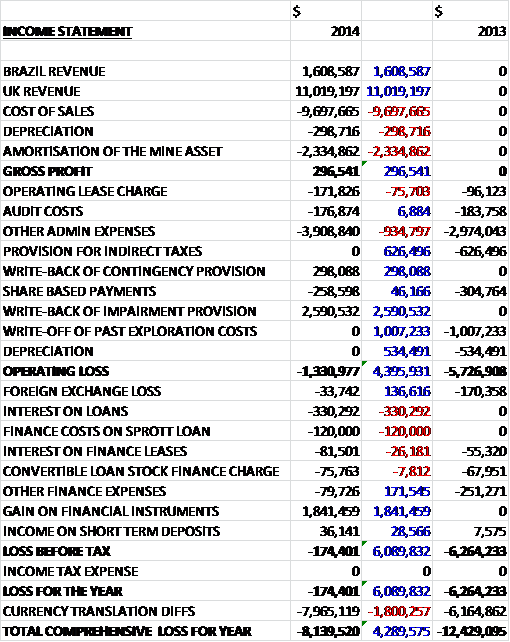
This is the first year that the group has achieved revenues and it recorded £1.6M of revenue from Brazil (relating to the gold bullion) and $11M from the UK relating to the concentrate.  Cost of sales were $9.7M and after a $2.3M amortisation of the mine asset as it is now a producing mine, the maiden gross profit stood at $297K.  Operating lease charges increased slightly and other admin costs were up $935K but there were various non-underlying benefits when compared to last year. There was no $626K provision for indirect taxes or a $1M write-off of past exploration costs that occurred last year relating to the Pizon project that is no longer considered a priority for the group.  There was also  $298K write-back of a contingency provision relating to potential labour settlements that were not required, and a $2.6M write-back of an impairment provision.  All this meant that the operating loss stood at $1.3M, a decline of $4.4M year on year.  With regards to finance items, there was a $330K interest on loans and a $120K finance cost related to the Sprott loan but this was more than offset by a $1.9M gain on financial instruments (partly relating to the reduction in the value of the warrants issued and the decline in value of the Sprott call option over some gold).  The end result is a $174K loss for the year, an improvement of $6.1M when compared to last year but it should be noted that there was an $8M loss relating to foreign currency translation.
serabiassets

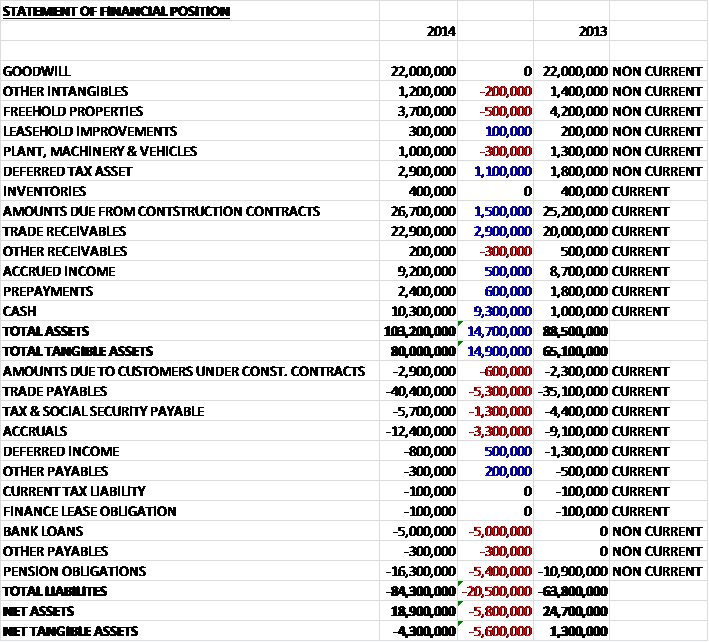
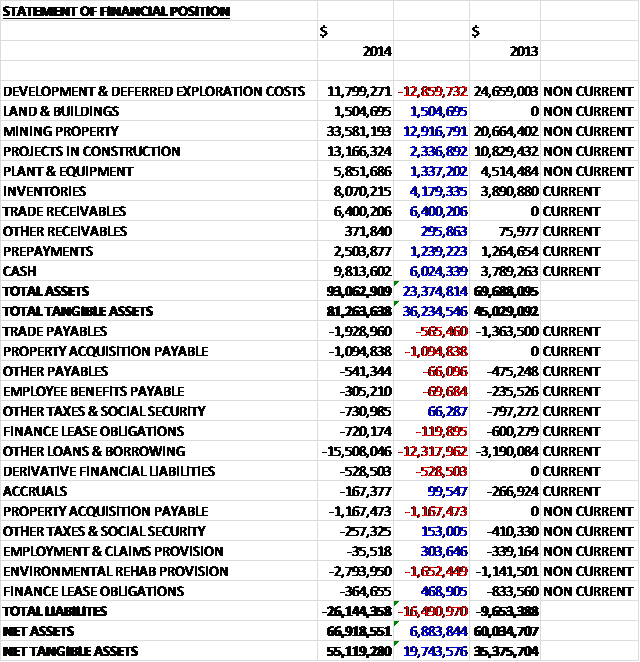
When compared to the end point of last year, total assets increased by $23.4M driven by a $12.9M increase in the value of mining properties, a $6.4M growth in trade receivables, a $6M increase in cash and a $4.2M growth in the value of inventories partially offset by a $12.9M fall in development and deferred exploration costs as a proportion of these costs were transferred to fixed assets as the mines move towards commercial production.  Total liabilities also increased due to a $12.3M increase in loans and borrowings, a $1.7M growth in the environmental rehabilitation provision, and a $2.3M increase in the property acquisition payable.  The end result is a $19.7M increase in net tangible assets at $55.1M.
serabicash

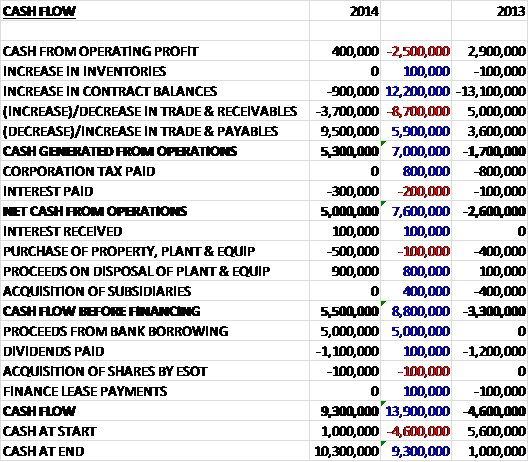
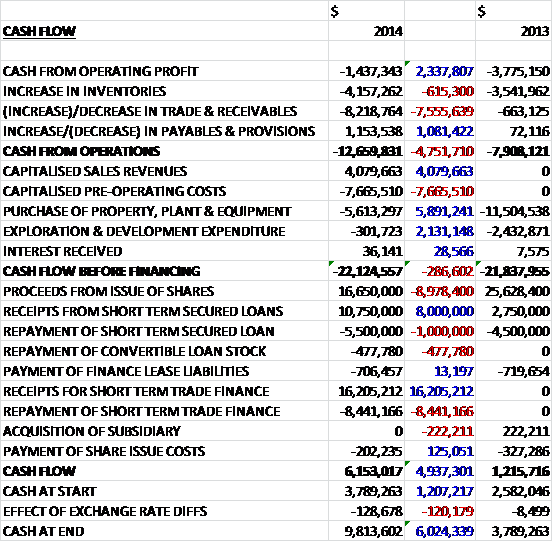
Before movements in working capital, cash losses fell by $2.3M to $1.4M.  A huge movement in receivables and a fairly large increase in inventories, however, meant that the operation cash outflow stood at $12.7M, an increase of £4.8M year on year.  After operating costs and the purchase of property, plant and equipment, the cash outflow before financing was $22.1M.  The group then made $16.7M from new share issues, a net $5.3M from new short term secured loans and a net £7.8M from short term trade finance to give a cash inflow of $6.2M and a cash level of $9.8M at the end of the year.

The company expects to start processing ore from the Sao Chico gold project in Q2 2015 and expects to produce 35,000 ounces of gold in 2015 at an all-in sustaining cost of between $900 and $950 per ounce from both mines together, a 90% increase on the 2014 output with a further increase in 2016 once Sao Chico is in full production.  The Palito mine has now reached a relatively steady state of operations and is expected to generate some 90,000 tonnes of ore at around 8.5g/t next year.  The gold production from this mined ore will be supplemented by the reprocessing of stockpiled tailings accumulated during the first three quarters of 2014 and by running down surface stockpiles of ore that have been established over the last year of operations.

With much of the capital requirements for Sao Chico being incurred in the first half of 2015, the group are expecting to be producing positive cash flow which will allow them to retire their current (very expensive) debt arrangements and start to look for new growth opportunities both organically and potentially through acquisition.

At Palito, by the end of 2013 the company had established a run of mine stockpile of ore of approximately 25,000 tonnes with an average gold grade of over 8 grams per tonne.  Initial commissioning of the gold process plant commenced In December 2013.  For the first quarter of 2014, the operation was in a planned ramp-up phase and during the second quarter the company continued to build upon the start-up targeting a long term plant throughput rate of 7,500 tonnes per month with commercial production starting in July.  Underground development mining has continued with more than 6,200 metres of horizontal development completed at the end of the year.  Production activity is now in eight mining areas, three sectors in the Palito West area and five sectors in the Palito Main Zone.

Mining operations during Q4 were slightly below plan as a result of reduced equipment availability during December with 25,308 tonnes being mined at an average grade of 9.28g/t.  For the year as a whole, total mined tonnage was ahead of planned levels, however, with an aggregate of 76,500 tonnes at an average grade of 9.95g/t.  As a result of the higher rates of mine production the surface stockpiles of ore have not been depleted as much as was expected and the surface stockpile of coarse ore totalled about 11,000 tonnes at the year-end.  The average gold price achieved during the year was $1,230 per ounce against an all-in sustaining cost of $1,034 per ounce (expected to fall to between $900 and $950 next year).

In the plant, processing rates throughout the year have continued to improve having averaged about 9,600 tonnes per month during Q4 after recording 4,700 in Q1, 6,200 in Q2 and 8,000 in Q3.  Gold production in the fourth quarter was 7,819 ounces, an increase of 42% over the previous quarter as the company began to use higher grade ore.  The majority of gold production from the mine is in the form of copper/gold concentrate which is then shipped to smelters in Europe for further processing.  During Q4, 493 tonnes of concentrate was produced and a total of 1,467 tonnes was produced in the year as a whole.

The commissioning of the CIP plant was completed shortly before the end of Q3, a delay of about a month compared with previous expectations.  The first batch of gold loaded carbon was withdrawn from the circuit during October and the first elution and gold pour was completed at the end of the month.  The introduction of the CIP plant will allow the operation to increase gold recoveries and the company expects that over the life of the mine, gold recoveries in excess of 90% will be achieved.  A second ball-mill acquired in March became operational during the second half of July following a period of remediation.  It was purchased in anticipation of establishing a second process line for ore from the Sao Chico operation but in the near term it is providing additional milling capacity to process some of the stockpiled material and maximise short term production.

The mining fleet at Palito is relatively new and comprises three 20 tonne trucks, three underground drill rigs and four underground loaders.  A fourth 20 tonne truck is deployed at Sao Chico on the preparatory works involved in the development of this deposit.  The company owns various other items of mobile equipment, including three front end loaders, a bulldozer and other smaller vehicles.  Whilst additional equipment purchases are planned during 2015 these will primarily be dedicated to Sao Chico and the company will transfer equipment between the two locations to supplement capacity as required.

At Sao Chico, work commenced during February on the preparatory earthworks required to expose the bedrock and establish the mine portal.  It was initially thought that these works would take three months to complete but the rainy season continued longer than expected and as the ground became saturated, excavation conditions became difficult that meant it was not until Q3 that it was completed.  Additional drainage and water run off areas have been constructed to ensure the stability of the cut-back and protect the roadway that is the access point to the mine.  These features should ensure that a similar period and level of prolonged rainfall will not affect movement around and access to the mine.

By the end of September the first excavations to establish the mine portal were completed and Q4 saw the underground development commence with 95 metres completed before the year-end and a further 160 metres completed by the end of February 2015.  Five veins were intersected in the cutback and a further three in the ramp and at the intersections all appear to be of mineable widths and grades.  All eight of these previously unknown structures lie outside the current geological resource.   In January 2015 the ramp development intersected the principle Main Vein which exhibited visible sulphides.  The main vein ore body, which is the principle structure within the resource, has now been fully exposed by a four metre high and wide gallery that has crossed the main vein perpendicular to its strike.  Sampling confirmed that the intersection had an average width of 3.6 metres with a gold grade of 42g/t.  Elsewhere the zone continues to exhibit similar widths to the original intersection and grades in excess of 15g/t.

The company plans to undertake over 750 metres of ramp development and 2,700 metres of ore development at Sao Chico during the course of 2015, following the main vein as its strike extends to the East and West.  With all the mining and fixed fleet required for the 2015 mine plan in place along with the initial workforce, the company expects to see continued progress at the mine.  Ore transportation to Palito began in February and processing of Sao Chico ore is forecast to start in Q2 2015.

In March 2015 the company started a 5,000 metre drilling campaign which will be a combination of in-fill and step-out drilling, and the results from this will help the understanding of the ore body and facilitate the mine planning for 2016 as well as the preparation of a new resource estimation for the project.  In November, the DNPM approved the final exploration report for Sao Chico which is the first process in transforming the exploration license into a mining licence.  Work is now underway on the preparation of the Plano de Approveimento Economico which is the next major requirement in the conversion process.  With the trial mining license already in place, however, all mining operations can continue in parallel.

As far as the other prospects are concerned, the underground development of Palito is being driven towards the Palito South area but the company has no plans during 2015 to undertake further exploration on either this or the Currutela and Piaui prospects or undertake further investigation of other anomalies.  Once adequate cash flow is being generated from production operations, they intend to use some of this cash to advance these opportunities which are all relatively close to Palito.

The current gold market seems to be rather difficult.  Overall supply levels have remained the same year on year as a 5% increase from mines was offset by a lower rate of recycling as a result of lower gold prices.  Mine supply is expected to plateau in 2015 as mining companies cut back on capital expenditure.  Consumer demand continued to be led by China and India and consumption for the jewellery market was steady throughout the year, albeit at a small reduction to 2013 levels.  The strengthening of the US economy, the potential for US interest rate growth and the strengthening of the US dollar have reduced the appetite for safe haven investments but continued geopolitical events surrounding Ukraine and the Middle East can be expected to continue to have a positive effect on some demand in the near future.

There are clearly a number or risks going forward, the main one being a continued fall in gold prices which would not only reduce cash flow but also the life of the mines as some of the gold becomes uneconomic to extract – this would mean some potential impairments against some of the assets.  Other risks include the fact that the exploration license for Sao Chico expired in march and whilst there is an interim license in place, there is no guarantee that a mining license will be granted.  Also, the government of Brazil has been seeking to introduce a new mining code for some time and the matter continues to be an area of debate.  Any new legislation could result in all current applications being cancelled and require applicants to make new ones under the terms of any new codes.  The government in Brazil is losing support in general and the country is struggling economically which means the government may seek to increase taxes and royalties on the mining sector to increase state income.

The company seems to have rather a complicated share structure.  There are ordinary shares of 0.5p each, deferred shares of 4.5p and deferred shares of 9.5p.  The deferred shares carry no voting or dividend rights or any rights to participate in the profits or assets of the company and all the deferred shares may be purchased by the company at any time for no consideration.  In the event of a return of capital, after the holders of the ordinary shares have received the aggregate amount paid up thereon plus £100 per ordinary share, they are then eligible to receive payment.  I have to say I don’t really understand what this is all about and why anyone would want a deferred share.

On the 3rd March the group completed a share placing raising £10M which provided additional working capital during the start-up phase of production at Palito and also to fund the initial development and further evaluation of the Sao Chico project.  The placing involved the issue of 200,000,000 units at a subscription price of 5p whereby each unit comprises one new ordinary share and one half of one new warrant.   Each warrant entitles the holder to subscribe to one new ordinary share at a price of 6p before March 2016.

In September they entered into an $8M secured loan facility for the period to the end of 2015 with the Sprott Resource Lending Partnership providing additional working and development capital which carries a massive 10% interest rate per annum.  The first tranche of $3M was drawn down in September with the facility being completely drawn down by the end of the year.  The group also makes use of a borrowing facility of $7.5M with Auramet Trading to provide advance payment on sales of gold and copper concentrate for the period between shipments leaving Brazil and settlement from the refinery, which extends to the end of 2015.  It is also worth noting that there are property acquisition payments due to a past owner of the Sao Chico property valued at $2.3M which will be paid in instalments with the first due in 2015.  Of this amount, $1.1M is due within one year.  In addition to the loan, the group have granted Sprott a call option over 4,812 ounces of gold at a strike price of $1,285 which can be exercised any time before the end of 2015.

The group expects to have sufficient cash flow from its forecast production to finance its ongoing operational requirements and, in part, to fund exploration and development activity on its other gold properties.  The forecasted cash flow projections for the next year, however, include a significant contribution from the Sao Chico development where commercial production has not yet been declared.

After the year-end, the Brazilian Real has reduced in value in comparison to the US Dollar by approximately 20%. The value of the company’s net assets and liabilities will have been significantly impacted by this devaluation.  The company sources the majority of its operational consumables in Reals and salaries of its Brazilian employees are paid in Reals so the operating costs are also affected by the change which mitigates against this issue somewhat.  It seems likely that the Real will remain weak in the medium term.

The group made a loss this year so there is no PE ratio but on next year’s consensus forecast, the shares are trading hands at a PE of just 4.5 which seems cheap.

Overall then, this seems like another interesting gold miner just about to ramp up production.  The deposits are small buy high grade with some 42K ounces expected to be produced over eight years.  The company is loss making still but earned its maiden revenues this year.  Net assets did increase, but this would be expected due the placing undertaken this year.  The company burnt through some $22.1M in cash before financing considerations which seems like a lot but within this there was a $9.8M working capital outflow, and the ramp-up to commercial production at Palito so next year should see an improvement.

There are clearly some potential risks going forward, not least the gold price which is showing continued weakness, I suppose mostly due to the strength of the US economy.  In addition, the new mining code and the lack of a mining production license at Sao Chico is of some concern, as is the possibility of the beleaguered Brazilian government adding on short sighted royalty penalties for miners.  Next year, the company is expected to produce 35K ounces of gold at all-in costs of between $900 and $950, which does remain below the current gold price.  From 2016, there should be additional contribution from the Sao Chico mine.  Year-end cash levels of $9.8M should be enough to see the company through the foreseeable despite the $1.1M due next year to the previous owner of land at Sao Chico.

All in all, this seems like an interesting prospect but I am worried about continued gold price weakness so I might keep a watching brief here for now.

Wentworth Resources Share Blog – Interim Results Year Ending 2015

Wentworth Resources has now released its interim results for the year ending 2015.

WRLinterimincome

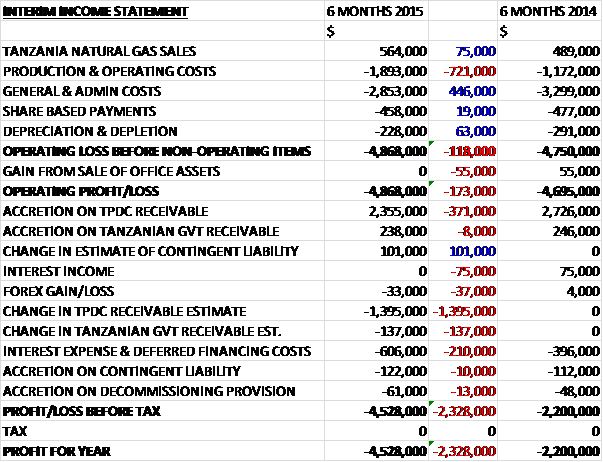
When compared to the first half of last year, natural gas sales increased by just $75K due to slightly higher demand from new electricity customers and lower downtime at the power plant.  This was dwarfed by a $721K increase in operating costs due to the $600K recognised relating to the estimate cost of settlement of the ongoing tax audits, partially offset by a $446K fall in admin costs due to downsizing of office space, streamlining IT infrastructure and optimisation of the corporate structure to give an operating loss of $4.9M, an increase of $173K year on year.  There were then various adverse movements in finance costs and gains with the largest differences being a $1.4M change in TPDC receivable estimate, a $371K fall in the TPDC receivable accretion and a $210K increase in interest expense.  The end result is a half year loss of $4.5M, an increase of $2.3M when compared to the first half of last year.

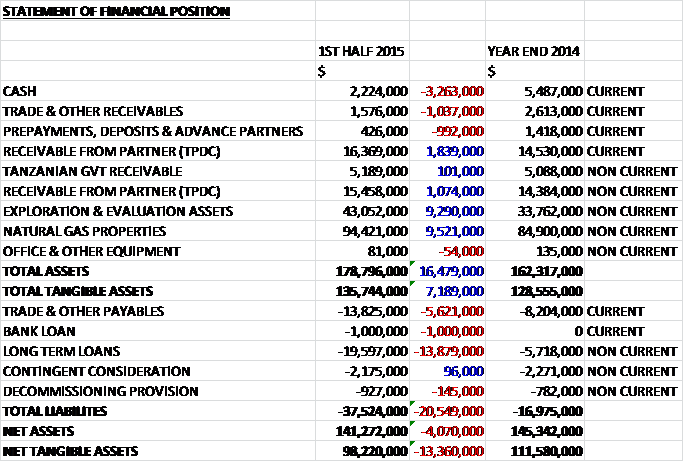
WRLinterimassets

When compared to the end point of last year, total assets increased by $16.5M at the half year point, driven by a $9.5M increase in natural gas properties, a $9.3M growth in evaluation and exploration assets, and a $2.9M increase in the TPDC receivable, partially offset by a $3.3M fall in cash, a $1M decline in trade receivables and a $992K fall in prepayments.  Liabilities also increased during the year due to a $13.9M increase in long term loans, a $5.6M growth in payables and a $1M increase in the current aspect of the long term loan to give a net tangible asset level of $98.2M, a decline of $13.4M over the past six months.

WRLinterimcash

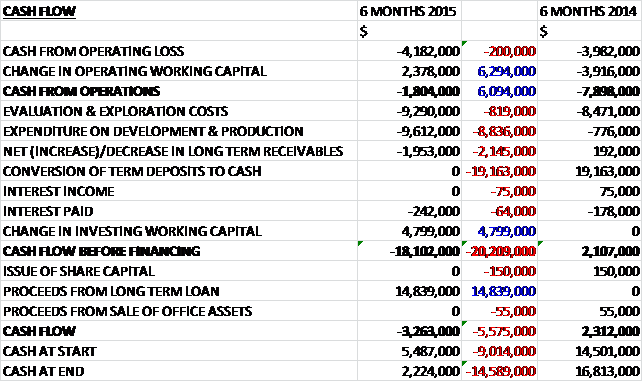
Before movements in working capital, the cash loss increased by $200K to $4.2M for the first half of 2015.  After working capital movements, the operational cash outflow was $1.8M, an improvement of $6.1M year on year.  The group then spent $9.3M on exploration costs relating to $8.6M spent on the drilling of the Tembo-1 and Kifaru-1 wells in Mozambique, $507K in indirect overheads in Mozambique and $151K relating to 2D seismic processing in Tanzania; $9.6M in production development relating to $7.9M spent on the MB-4 development well, $1.4M spent on Tanzania field infrastructure connection works and $277K spent on other field development;  and $242K on interest.  There was also a net increase in long term receivables and a $4.8M favourable movement in “investing working capital” to give a cash outflow before financing of $18.1M.  The group drew down on the long term loan to give a cash outflow for the half year of $3.3M and a cash level of $2.2M at the period end.

The pipeline is now expected to be completed and commissioned in Q3 2015 and the final handover from the construction contractor, China National Petroleum, to TPDC is expected to occur in November.  All connection infrastructure is planned for completion in Q3.  Mechanical, electrical and instrumentation installation for the de-hydration unit and other equipment; civil works for all the equipment and control room for the gas plant; and condensate storage tank site erection and painting activities are ongoing.  Construction of the Madimba GPF is complete with start-up and commissioning of the facility expected to take place during Q3.  The start-up and commissioning of the pipeline commenced in July.  The completed gas receiving station is scheduled to be ready to deliver gas to the end users during September.

As a reminder the Mnazi Bay partners are contracted to supply a maximum of 80mmscf/day during the first eight months after commercial operations date with an option to increase over time to a maximum 130mmscf/day during the supply contract period which lasts until 2031.  Negotiations on the payment security arrangements are at an advanced stage and are expected to be concluded during Q3 in line with expectations.

The company’s existing five wells within the concession are expected to produce a combined 80mmscf per day which should cover the initial delivery volumes.  The recently completed MB-4 well which intersected the Miocene gas reservoirs with a net pay of 24 metres in the Upper Mnazi Bay and 43 metres in the Lower Mnazi Bay zones, has been selectively tested at different two hour stabilised flows with the upper bay achieving a flow rate of up to 18.8mmscf/day and the lower bay of up to 22.2mmscf per day.  The MB-3 well is still producing at 2mmscf/day, limited by the demand of an 18MW gas fired power station.

In terms of readying the existing five wells to deliver gas to the new pipeline, MS1-X and MB-3 will be tied-in to the connection point by mid-August, MB-2 and MB-4 are scheduled to be tied in and commissioned by the end of August and MB-1 will be tied in during Q2 2015.  The company anticipates gas sales to the pipeline to increase to 130mmscf/day as market demand grows and deliveries could escalate to 270mmscf per day within five years subject to the drilling of additional development wells.

As well as the drilling of the MB-4 well, the surface infrastructure activity comprising the installation of separation facilities, piping, flow lines and civil works was ongoing.  Progress during the period included the completion of the by-pass infrastructure at the Msimbati Plant gate, allowing delivery of gas to TPDC in advance of the separation units becoming operational; long lead time items were procured; existing wells were tied-in and flow lines installed for MB-3 and MS1X; and work on the tie-in of MB-2 and MB-4 was ongoing with a target of completion in Q3.  The surface infrastructure allowing the flow of gas from all production wells to the Madimba GPF is expected to be fully operational during Q4 2015.

Given the immediate access to a market for Mnazi Bay gas and the spare capacity available in the pipeline, the company expects to initiate and exploration drilling programme in 2016, a significant proportion (but not necessarily all) of these activities are expected to be funded from internally generated cash flow.

In Mozambique, the company continued discussions with the partners on the Rovuma block on a possible appraisal of the Tembo-1 gas discovery.  All work commitments on the block have been fulfilled and the third and last exploration phase expires at the end of August, subject to any appraisal of the Tembo-1 discovery.  Anadarko, the operator and PTTEP have indicated their intention to exit the block on this date.  The fourth well, Kifaru-1 failed to find an economic reservoir.

In July, the company provided formal notification to the Mozambique government of its intention to proceed with an appraisal of the Tembo-1 discovery.  During Q3, priorities are determining the participation interests of the joint venture partners remaining in the block and appointing an operator in addition to agreeing an appraisal work programme and budget and establishing the appraisal area.  A definitive plan going forward is subject to a resolution of these issues and approval being granted by the Mozambique government to continue with an appraisal programme.  The rest of the block acreage with the exception of the agreed appraisal area will be relinquished at the end of August.

At the period-end an undiscounted long term receivable of $36.2M from Tanzania Petroleum Development Company (TPDC) as outstanding and the company is basically waiting for the cash to flow from the pipeline before this can be paid back which should start to occur from 2016 and it is hoped that the recovery of the receivables will be fully collectable within two years from delivery of first gas and this should provide an important source of cash flow for Wentworth.  There is always a risk that future production from the Mnazi Bay concession may not be sufficient to settle the receivable which would then require a provision.

There is also still a $6.5M long-term receivable from TANESCO that remains uncollected and the company continues discussions on this matter.  The group is also owed some $1.4M from eight months-worth of gas sales to the 18MW gas fired power station.  It is hoped that the new pipeline will provide an opportunity for TANESCO to operate more efficiency but I am not as positive about that as Wentworth management.  They expect to eventually receive full recovery of current and future gas sales to TANESCO but they have been slow in settling invoices so far.

At the end of last year the company had estimated $280K was likely to become payable for alleged unpaid payroll taxes and withholding taxes on imported services, certain accounting transactions and late penalty interest.  In June, the TRA issued an amended tax assessment certificate that indicated a total liability of just $140K so the company recorded a credit adjustment of $140K.  During Q2 2015, the TRA conducted a tax audit for the period 2009-2012 on a discontinued subsidiary of the company.  They issued a notification that tax assessment certificates of $740K will be issued for alleged unpaid withholding taxes and payroll taxes along with $610K for alleged unpaid VAT.  The company has recognised a liability for the first set of charges but believes it has a strong case against the VAT tax issues so has not provided for that liability.

No options were granted during the period and some 10M remain outstanding at an average price of $0.58 per share.

At the period end the company had cash of $2.2M and a further $5.2M available to draw down on the existing credit facility.  In July they completed a private placing which raised $7.6M through the private placing of 15,412,269 shares at 32p per share, which gives a total of about $15M to play with, which is not really that much given that current liabilities stand at $14.8M relating to amounts due to the operators of the company’s assets in both Tanzania and Mozambique.  Should additional exploration and development activity take place prior to generating sufficient cash flows from gas sales to the new pipeline or should there be delays beyond Q4 2015, additional funding may be necessary.  It is also worth noting that repayments on the loan will commence in Q2 2016 and the group went down the road of doing a placement because they found debt difficult to source given the challenging macro oil and gas environment which is a little concerning.

After the initial delivery of gas in Q3, management expect to ramp up sales so that they will exit 2015 generating significant free cash flow to fund future growth and finance exploration activities.  The company is still loss making so there is no PE ratio this year which is expected to remain the case for the rest of 2015, although the consensus forecast for 2016 suggests a forward PE of 4.4 which is very cheap if it can be relied upon.

Overall then, this is still a company that interests me but the good times continue to be just out of reach at the moment.  The loss increased year on year, mainly as a result of a decline in the TODC receivable estimate and the provisions for the tax audits.  The group got through about $18.1M of cash in the first half of the year before financing and as we can see, this is not sustainable.  The new producing well in Mnazi Bay looks pretty decent but given Anadarko’s decision to leave the concession in Mozambique, I am not holding out much confidence that the Tembo-1 well has found much of interest.

The opening of the pipeline has been put back to November, which should not come as much of a surprise and the first cash flow from the gas sales will not now arrive until the end of the year.  The delay meant the company had to do another placing as they found debt hard to come by due to the poor oil and gas environment at the moment.  As far as I can tell, the company has $2.2M in cash, $5.2M in further debt and $7.6M from the placing but this $15M is not going to last long given the $14.8M of current liabilities due on the two concessions.  This is looking very tight to me and any further delays are going to make things rather uncomfortable.  This is so frustrating as I really do think there is great potential here.  I will remain a very interested onlooker.

WENTWORTH RES.

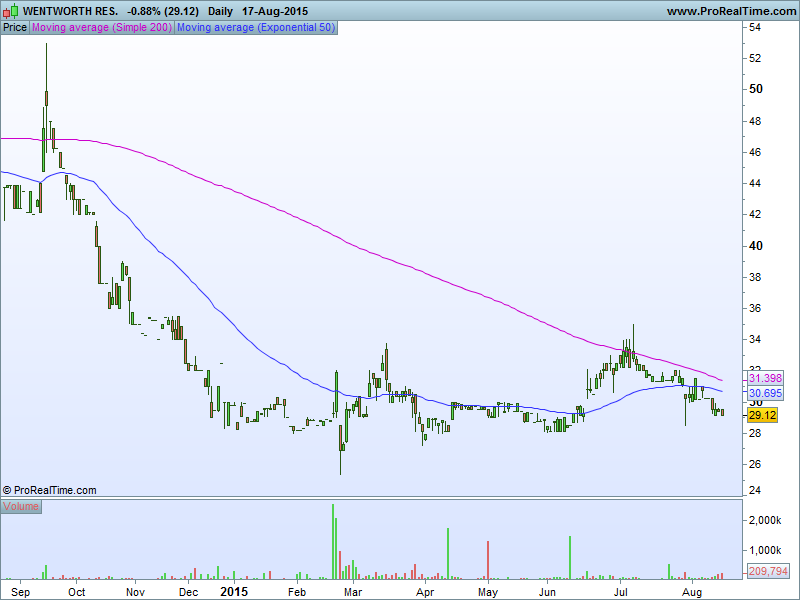
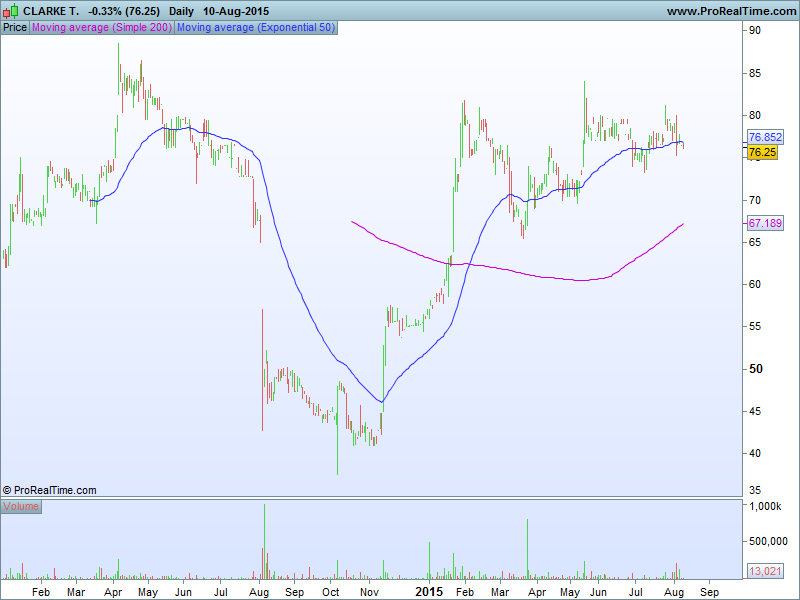
After a brief improvement in July, the shares seem to have resumed their downward trajectory.

On the 20th August the group released an update covering operations at the Mnazi Bay Concession.  Gas deliveries have now commenced to the new pipeline in Tanzania.  Two wells are now producing and the remaining three wells will be put on production in the coming months.  Initial production volumes will be used for commissioning purposes and to fill the pipeline.  Production rates are expected to increase to 70 mmscf/day by October and reach 80 by the end of the year.  Gas deliveries by TPDC for use by power and industrial companies are expected to commence in October.  The partners will receive payment at the end of each calendar month for sales volumes delivered during that month.  As a reminder, the gas sales price has been set at $3.07 per thousand cubic feet, rising in line with US CPI.

The partners have agreed payment security terms with TPDC , the buyer of the gas and various other parties which provides sufficient assurance that sales of gas will be settled in accordance of the agreed payment terms.  The MD expects to exit the year in a strong financial position.

This is the update I was waiting for.  I was concerned that there could be further delays to the commissioning of the pipeline so that now gas is actually being delivered, these are mostly allayed.  There are still concerns over the tight financial position and whether TPDC will actually pay on time but on balance I have decided to take a position here.  I expect a bit of a choppy ride!

On the 4th November the group released an operational update for Mnazi Bay. The gas production facilities at Madimba, the Mtwara to Dar es Salaam pipeline and the Kinyerezi gas receiving facility have now been fully commissioned and are operational. Mnazi Bay gas is currently being used to generate power in Dar es Salaam at the existing Ubungo-II and Symbian power plants, as well as the new Kinyerezi-I power plant. Production volumes into the pipeline are currently at 33mmscf per day from three wells on a restricted flow basis, and are expected to reach 80mmscf per day once all the generators of these three power plants are fully operational, which is expected in Q4 2015.

Three of the five existing wells at Mnazi Bay have been successfully brought on stream with well performance in line with expectations. The fourth well is expected to be tied in during November and the fifth well is expected to be tied in and ready to produce into the new pipeline in Q1 2016.

Sales gas volumes of 1,032mmscf were delivered to the new pipeline during October at an average of 33mscf per day and a gross payment of $3.8M to the joint venture partners has been received from the Tanzania Petroleum Development Corp. Under the gas sales agreement, the sale price has been set at $3 per million NTU, about $3.07 per thousand cubic feet, rising in line with the US CPI industrial index starting in 2016.

All this seems fairly good as things seem to be progressing as expected.

Wentworth Resources Share Blog – Final Results Year Ended 2014

Wentworth Resources is an East Africa focused oil and natural gas explorer and producer.  They are incorporated in Canada and listed on the Oslo Stock exchange and AIM – quite an eclectic mix!  There are two operating segments – Tanzania, the Mnazi Bay Concession, and Mozambique, the Rovuma Onshore Block.

The Mnazi Bay concession covers approximately 756km2 and has five wells that have been drilled to date.  Four wells are capable of producing natural gas from two discovered gas fields and one has been plugged and abandoned.  Field operations also encompass natural gas field infrastructure including two processing plants and a 27km pipeline.  The interests in production operations at the concession are M&P, the operator with 48%; Wentworth with 32% and TPDC with 20%.

The Rovuma onshore block in Northern Mozambique covers nearly 12,000km2, the majority of which is onshore.  Three wells have been drilled on the block to date, two of which encountered hydrocarbons but were considered non-commercial.  The third well encountered 11m of natural gas net pay and evaluation of this discovery is ongoing.  The partners in the concession are Anadarko, the operator with a 35.7% interest; M&P with a 27.7% interest; Wentworth with an 11.6% interest; PPT Exploration & Production Public Company with an interest of 10%; and Empresa Nacional de Hidrocarbonetos de Mocambique with a 15% interest.

The group currently just supplies one 18MW gas fired power plant in Mtwara in Tanzania at an average price of $5.36/mmbtu but the real step change will be the commissioning of the new pipeline to connect the capital.  The group currently has developed reserves of 3.46MMBoe (1P) and 4.84MMBoe (2P) with total 1P net reserves of 11.36MMBoe and 2P net reserves of 15.91MMBoe.

Wentworth has now released their final results for the year ended 2014.

WRLincome

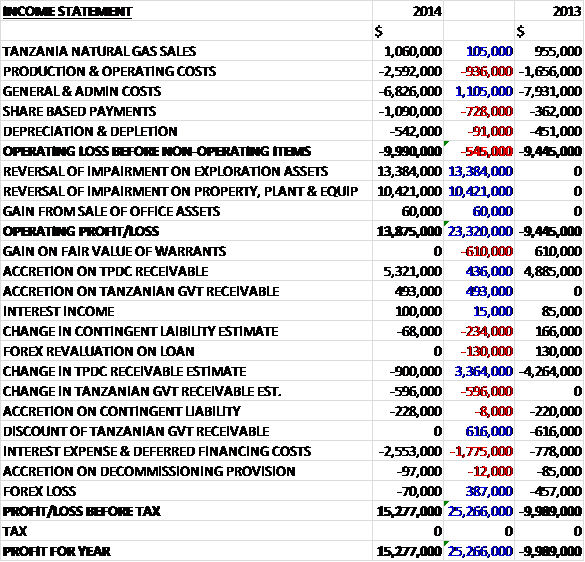
The group made $105K more in natural gas sales than last year due to higher demand from new electricity customers and lower downtime experienced at the power plant, but the total for the year was still only $1.1M.  This was dwarfed by the $2.6M of production and operating costs, which increased  by $936K year on year as the company prepares for the ramp-up in operations next year, offset by the $1.1M fall in general and admin costs.  After a $728K increase in share based payments which, at $1.1M were higher than all the revenue from gas sales, the underlying operating loss stood at $10M, an increase of $545K year on year.  The group benefited from a reversal of impairments on both tangible assets and exploration assets, however, to give an actual operating profit some $23.3M higher than last year at $13.9M.  We then see a large amount of finance costs and income, in particular a positive accretion on the TPDV receivable of $5.3M and a large increase in interest expense and deferred financing costs at $2.6M relating to the repayment of the Vitol Loan, to give a profit for the year of $15.3M, a positive swing of $25.3M when compared to last year.

WRLassets

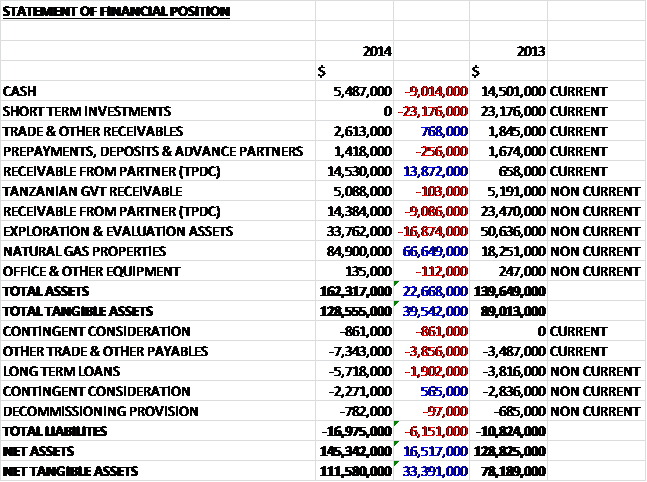
When compared to the end of last year, total assets increased by $22.7M driven by a $66.6M growth in the value of natural gas properties and a $4.8M increase in the receivables due from TPDC, partially offset by a $23.2M fall in short term investments, a $16.9M decline in the value of exploration assets as $53.1M was transferred to property, plant and equipment including the costs associated with three existing wells and field infrastructure within the Mnazi Bay concession that will be utilised in the production of discovered natural gas, and a $9.1M fall in cash.  Liabilities also increased during the year due to a $3.9M increase in payables and a $1.9M growth in long term loans.  The end result is a $33.4M increase in net tangible assets at $111.6M.

WRLcash

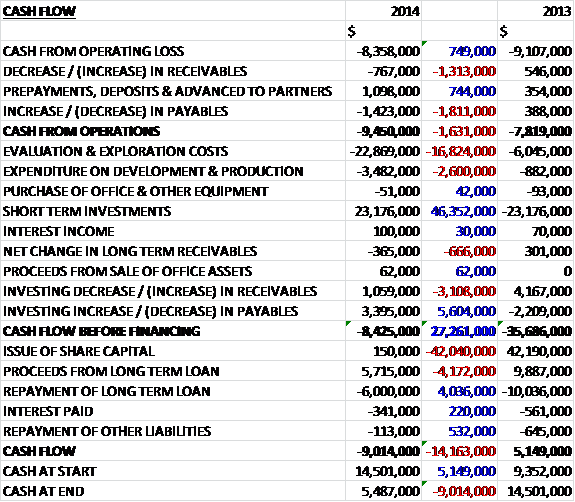
Before movements in working capital, cash losses fell by $749K to $8.4M.  A small outflow in working capital, in particular a fall in payables, meant that the cash outflow from operations stood at $9.5M, an increase of $1.6M year on year.  The group then spent $22.9M on evaluation and exploration relating to $7.9M on 2D seismic acquisition in Tanzania and $14.1M on exploration drilling in Mozambique, along with $3.5M on development and production relating to $443K on the development well, $1.1M on the field infrastructure connection to the pipeline and $1.9M on other field development, but there was an inward flow from “investing” working capital so that before financing, the cash outflow stood at $31.6M.  Surely the $23.2M gained from short term investments is financing, not investment and after taking that into account the cash outflow for the year stood at $9M and the cash level at the end of the year was just $5.5M.

During 2015, the Tanzanian government sponsored gas pipeline project is planned to be commissioned and fully operational.  The Mnazi Bay concession is currently the only gas concession in the country with significant discovered gas readily available to feed into the pipeline.  TANESCO plans to add another 1,200MW of electricity to the national grid over the next three years by constructing four power stations at Kinyerezi on the outskirts of Dar es Salaam, with additional plants at Kilwa and Mtwara.  The current status of the pipeline project indicates that start-up and commissioning are planned to occur in April with a ramp-up to full operations and completion of the project estimated to be in June.  The government entity, TPDC will be the operator of the pipeline upon its completion.

There are a number of elements that need to be completed before Wentworth is able to deliver gas to the pipeline.  Gas from Mnazi Bay will be sold to TPDC at the fiscal metering station and inlet flange immediately adjacent to the existing company owned gas infrastructure on the Msimbati peninsular at Mnazi Bay.  TPDC is responsible for the cost of delivery to the end user and the cost of processing the gas at the Madimba gas processing facility.  The connection infrastructure, comprising of the tie-in of the four production wells, a gas gathering system including 7km of pipeline, primary liquid separation and the fiscal metering station will link the Mnazi Bay gas infrastructure to the Madimba GPF and is on schedule for completion in April.

The government’s Madimba GPF is being constructed within the Mnazi Bay concession and is located 11km from Wentworth’s existing gas infrastructure.  At peak capacity the facility is planned to have a total capacity of 210mmscf/day consisting three 70mmscf/day trains.  Engineering and construction oversight is being provided by Worley Parsons with construction of the facility undertaken by Chinese Petroleum Engineering.  So far the Madimba GPF is about 94% complete and commissioning of the facility is expected to commence in April.  Foundation work for all the equipment of the gas plant, mechanical installation of the de-hydration units, condensate storage and construction of a treated waste water discharge pipeline are nearing completion.

The main gas pipeline from Mtwara to Dar es Salaam will have a maximum capacity of 784mmscf per day and is now approaching 99% completion.  Government representatives indicate that the pipeline welding, trenching, lowering of the pipe and fibre optic cable into the trench, backfilling and hydrostatic pressure testing is complete with the main ongoing activity being pipeline drying.  The gas receiving facility at Kinyerezi is located on the outskirts of the capital and is the end point of the pipeline.  At this location, gas will be distributed to end users including delivery to the Kinyerezi power generation complex located about 1km away from the gas receiving facility.  This station is about 99% complete with only minor civil works, including cement laying, outstanding.  The receiving station is scheduled to be commissioned in April.

The majority of gas supplied by Wentworth to the pipeline will be used for power generation, whilst a small percentage may be for industrial use.  There is currently spare capacity in excess of 200MW at the TANESCO owned power plants which equates to demand of about 50mmscf per day.  This current spare capacity presents an immediate demand for Mnazi Bay gas from the Ubongo I and II power plants, the Symbion plant and the Tegeta plant.  The new 150MW Kinyerezi-1 power station is under construction and is expected to be commissioned in June.  This power station will add about 30mmscf per day of new demand when it becomes operational.  Additional future gas demand is expected to come from the planned expansion of Kinyerezi-1 (33mmscf/day) which is expected to be commissioned by July 2016 and the construction of Kinyerezi-2, 3 and 4 which are expected to be completed by the end of 2017 along with the Kilwa power station and the Mtware power plant in 2018 at which point the total demand for natural gas from the pipeline will be about 450mmscf/day.

In September the company agreed a long term sales agreement with the government of Tanzania.  The Mnazi Bay concession partners are contracted to supply up to a maximum of 80mmscf per day of natural gas during the first eight months after the commercial operations date with an option to increase over time to a maxim 130mmscf/day of natural gas during the 17 year supply contract period. The agreement is subject to certain conditions, including the government providing environmental permits and approvals and providing an executed version of payment security agreements prior to delivery of first gas which are currently being finalised.

The initial delivery of gas within the agreement is expected to occur prior to the end of April and is at a fixed price of $3.07/mmscf.  Following the delivery of initial gas, the company expects to deliver gas in May which will ultimately be sold to end users by TPDC.  Contractual payment terms will apply to initial gas and sales gas resulting in cash flow for the company which is expected to start in July.  The company’s existing four wells in the concession are expected to produce a combined 80mmscf/day and are therefore able to meet the volumes specified by the agreement (just about) but currently one of the wells is producing at 2mmscf per day which is limited by the gas demand of an 18MW gas fired power station located at Mtwara.

A fifth development well, MB-4, is expected to start drilling operations in Q1 2015 and is expected to be completed by June with an initial production of 20mmscf/day.  This additional well allows for the flexibility to test reservoir performance while still being able to supply 80mmscf/day within the first eight month period of the agreement.  The company expects two wells to be tied in to the connection point to the new pipeline by march with a third tied in by the end of April, the new development well by June and the existing producing well by the end of September.  Subject to the deliverability from the existing wells and additional development wells, the company expects gas sales to the pipeline to increase to 130mmscf/day by Q1 2016 and they could escalate up to 270mmscf/day within five years should additional exploration success occur in the concession.

Two key development activities were initiated following the signing of the agreement.  Engineering, design and construction of field infrastructure necessary to tie-in the company’s existing wells to the pipeline was started along with planning the drilling of the new development well.  The surface infrastructure includes the installation of separation facilities and flow lines and the EPC contract has been awarded to TPF Basse from Belgium who are fully mobilised to site.  A detailed engineering design is complete and a 10 metre by-pass pipeline, allowing delivery of gas to TPDC in advance of the separation units becoming operational is expected to be completed by April.  Long lead time items have been procured and the separation facilities are expected to be on location and operational in Q3 and construction has commenced on tying-in of existing wells and installing flow lines.

During Q1 2014, the acquisition of 58km of high resolution 2D seismic was completed over the existing discovered Mnazi and Msaimbati gas fields and processing of the data is ongoing and will be used to help determine the location of future development wells.  The new infill development well is expected to start drilling operations in Q1 2015 with well site preparation and civil works having been commenced during Q4 2014.  The rig is currently being mobilised to the well site location and drilling operations are expected to be complete by June.

In Mozambique, drilling operations of the frontier Tembo-1 exploration well were completed and a natural gas discovery was made in Cretaceous aged sands.  The well took over six months to drill and complete and was drilled to a total depth of 4,553 metres.  Petrophysical analysis of the Cretaceous section indicates 11 metres of natural gas net pay.  Natural gas and some condensate was recovered by modular formation dynamics testing but the partners do not plan any further evaluation of the well and will assess all the data recovered to determine the potential commerciality of the discovery with an evaluation by Anadarko anticipated within the next few months.

In January drilling operations of the Kifaru-1 exploration well in the concession commenced.  This well targeted Miocene, Oligocene and Eocene sands.  It was drilled to a total depth of 3,100 metres but failed to find an economic reservoir and was plugged and abandoned in February.  The government of Mozambique has accepted the drilling of this well as fulfilment of the third phase exploration drilling obligations which expires in August.  During 2015 the partners plan to analyse data from both wells in order to determine the next steps and an appropriate work programme for the rest of the year.

Trade and other receivables predominantly comprises amounts due from government departments in Tanzania, tax input credits for goods and services tax in Canada and VAT in Tanzania and Mozambique.  The company’s ongoing exposure to receivables from Tanzania Electricity Supply Company Ltd (TANESCO), the state power company, is connected with the gas sales from the Mnazi Bay Concession to the gas-fired power plant located in Mtwana.  At the year-end the Mnazi Bay concession partners were owed fifteen months of gas sales with $2.4M owing to the group.  After the year-end TANESCO settled three months of arears totalling $483K.  The construction of the gas pipeline project may provide an opportunity for TANESCO to operate more efficiently and generate positive cash flow and it is expected that this will mean that the group eventually receive full recovery of the receivables.

In 2009 the company and TPDC entered into a joint operating agreement relating to the Mnazi Bay Concession.  Under the agreement, TPDC has a 20% participating interest in the production from the concession and will pay the company for 20% of the past costs incurred on the concession from TPDC’s share of future production.  In addition, the TPDC’s share of costs incurred after that date, which are paid by the company, will be recovered by the company from TPDC’s future production and this receivable is subject to an interest charge of one month term LIBOR plus 2% per annum.  The accretion over the expected term of the asset is based on future expected cash flows from the concession.   A long term receivable of $33.5M is due from TPDC.  The company receives a significant portion of TPDC’s share of gas production from the Mnazi Bay concession directly from the operator before TPDC receives cash from its share of the revenue.  There is a risk that future production from the concession may not be sufficient to settle the receivable.  The receivable has been discounted to $28.9M due to its long term nature but with the passage of time and the move closer to recovery, the carrying amount of the receivable is accreted up to the case value with a corresponding credit to the income statement.  It is estimated that the full value of the receivable will be recovered by two years after the delivery of first gas to the pipeline which should provide a significant source of cash flow for Wentworth.

The company has an agreement with the government of Tanzania to be reimbursed for all the project development costs associated with transmission and distribution expenditures at cost.  An audit completed in 2012 verified costs of $8.1M reimbursable of which a total of $1.6M has been recognised as a credit against this cost due to tariff equalisation funds and VAT input credits.  At the year-end a receivable of $6.5M related to the company’s disposal of transmission and distribution assets and various costs associated with the Mtwara Energy project was due from the Tanzanian government and the group is currently in discussions with the various parties on agreeing a method of reimbursement, which may not be in cash.

During the year there was a reversal of impairments where previous contingent resources were classified as reserves.  The market for the company’s discovered gas has evolved to an advanced stage of certainty in Tanzania.  The company signed a long-term gas sales agreement in September to deliver natural gas to a government owned transnational pipeline at a fixed price of $3/MMBtu escalating annually at US CPI which has led to the reversal.

As a result of an asset purchase and sale transaction in 2012, the company may be obliged to make payments of $3.4M should certain future gas production thresholds from Mnazi Bay be reached.

There remains 5M warrants outstanding on the company’s shares with an exercise price of $0.648 per share.  There are also nearly 10 million options outstanding on the company’s shares with some 5.6 million currently exercisable. This figure includes 3,750,000 granted during the year with an exercise price of $0.69 which seems like a lot to me given the company is not yet really making any money.

A the year-end the group has cash of $5.5M to fund its planned activities prior to the commissioning of the Mtwara to Dar es Salaam gas pipeline which is expected during Q2 2015.  During Q4 2014 they secured two credit facilities totalling $26M with a Tanzanian bank.  An amount of $6M was used to pay an existing loan with the remaining facility used to fund development capital within the Mnazi concession in Tanzania.  The loan is 48 months in duration and bears interest of 6 months LIBOR rate plus 750 basis points subject to a floor of 8% per annum and a ceiling of 9.5%, which seems like a hefty rate to me.  After a grace period of one year, repayments are payable in six semi-annual equal instalments.

At the year-end there was $6M drawn down on the facility. So with the undrawn loan amount and the current cash, there is $25.5M available to the company.  There is expected to be significant free cash flow from Q3 2015 from the pipeline but the drilling of the MB-4 development well and field infrastructure costs are expected to be $9.2M and $9.8M respectively  which gives a total of $6.5M after these payments.  The costs attributable to Wentworth on the Kifaru-1 exploration well in Mozambique that have not already been paid are $4.2M which brings the headroom down to just $2.3M.  The current expectation is that the financial position is sufficient for operations as far as the current timetable is concerned but if there are any delays (quite likely in my view) the company will have to raise more capital – for which it is exploring operations.

As well as all the receivable outstanding, the group is also having discussions with the Tanzanian government over alleged unpaid taxes.  In July they issued tax assessment certificates totalling $2.1M of alleged unpaid payroll taxes and withholding taxes on imported services and certain accounting transactions plus late penalty interest totalling $2.1M for the period 2008 to 2012.  In November the Tanzanian Revenue Agency accepted the company’s objection to a withholding on certain accounting transactions and a tax liability of $666K was waived.  The company has recorded a liability of just $281K against these taxes.  They continue to communicate and provide clarification on the remaining $3.2M and the company believes it has a strong case against the remaining assessed amount and have not recorded a provision against it.  A date has not yet been set by the TRA board to hear the tax appeals.  Such are the risks of operating an oil explorer in Africa.


The company has some oil and gas concession commitments going forward.  On the Romuva onshore block in Mozambique there is a new minimum expenditure net to Wentworth of $2.1M relating to the drilling of the exploration well, Kifaru-1 that was commenced in January 2015.

One risk is clearly the fluctuation of crude oil and natural gas prices.  There is some insulation from this effect because the group has an agreement with the government of Tanzania to supply natural gas from the Mnazi Bay concession at a price of $3/MMBtu, escalating at US CPI annually over a 17 year term.  There is some exposure to exchange rate risk primarily in respect of the Tanzanian shilling and Canadian Dollar against the US dollar.  A 10% increase in the Tanzanian shilling against the US dollar would result in a charge of about $18K.

The company is still loss making and is expected to remain so in 2015 but if we look forward to 2016, the consensus forward PE ratio is a very undemanding 4.4.  Of course a lot can happen between now and then but this looks quite cheap to me.  Obviously there are no dividends planned for this year and there are none planned for 2015 with any cash going into further development and paying back the loans.

Overall then, this looks like an interesting little company.  Although there was a profit recorded this year, it was only because of impairment reversals and there is obviously an underlying loss because the one power station customer is not enough to keep the lights on.  The big hope is the new pipeline connecting the capital which will open up a large market for the company’s gas.  The group went through considerable cash reserves this year, burning through $31.6M before financing due to the preparations for connection to the pipeline.

There seem to be a number of operational issues.  There is a huge amount of receivables due from TPDC as it seems Wentworth has been covering their costs up to now, although once the pipeline is connected the cash should start flowing in from them.  Probably harder to obtain will be the receivables from the state owned TANESCO who seem to pay for their gas whenever they want and not when requested by Wentworth!  Additionally the receivable from the Tanzanian government is likely to be difficult to obtain in my view and on top of this, the government is now trying to extract unpaid taxes from the company.

The pipeline is due to come on stream by April with the first cash flow coming in by July.  These timings are very important as it seems to be the company could run out of cash before then.  There is $5.5M cash left, plus the $20M left undrawn from the loan facility but after the development well and other infrastructure is paid in Tanzania there will only be $6.5M and a further $4.2M to pay for the exploration activities in Mozambique which leaves just $2.3M left. Any delays in cash flow from the pipeline could mean the company has to raise further cash somehow.  Delays are probably quite likely in my view given the difficult operating environment in the country.

In all, I feel that this could be a good investment soon but the falling oil price is unhelpful and the timings for cash flow look a little too tight for me at present so I will keep a watching brief here.


Aureus Mining Share Blog – Interim Results Year Ending 2015

Aureus Mining has now released its interim results for the year ending 2015.

AUEincome

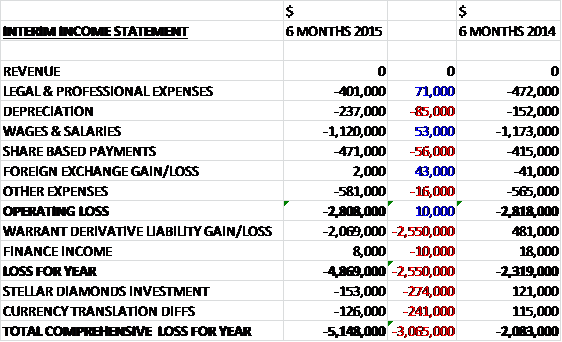
Once again there were no revenues and a small fall in legal and professional expenses was offset by a rise in depreciation and likewise, a fall in wages was offset by an increase in share based payments.  We then see slightly higher “other expenses” but a beneficial swing in foreign exchange losses to give an operating loss of $2.8M, broadly flat year on year.  The group also had a $2.1M increase in the warrant liability as their share price increased so that the loss for the year stood at $4.9M, an increase of $2.6M when compared to the first half of 2014.

AUEassets

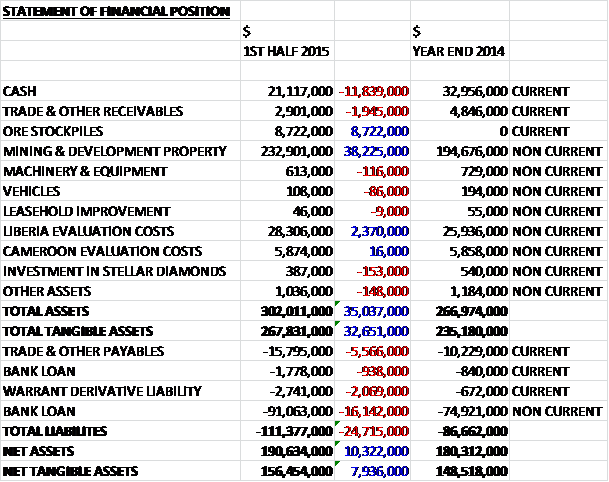
When compared to the end point of last year, total assets increased by $35M driven by a $38.2M increase in mining and development property, an $8.7M growth in ore stockpiles and a $2.4M increase in capitalised evaluation costs at the other Liberian assets, partially offset by an $11.8M fall in cash and a $1.9M decline in receivables (which still includes a $2.5M advance payment to the earthworks contractor that remains unrecovered).  Liabilities also increased during the period due to a $17M hike in bank loans, a $15.8M growth in payables and a $2.1M increase in the warrant derivative liability.  The end result is a $7.9M increase in net tangible assets to $156.4M.

AUEcash

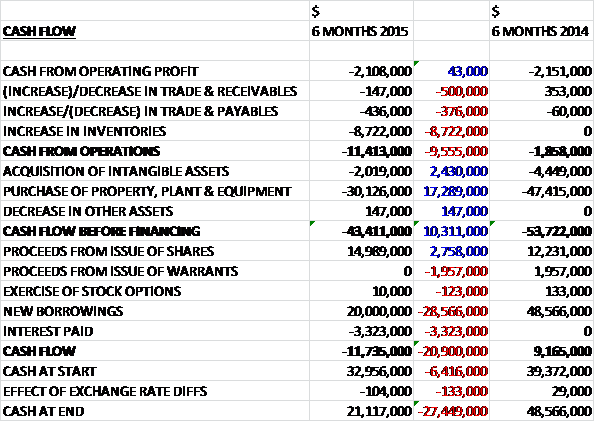
Before movements in working capital, cash losses were broadly flat year on year at $2.1M before a large increase in inventories meant that the cash outflow from operations stood at $11.4M, an increase of $9.6M when compared to the first half of last year.  The group then spent $30.1M on further developing the tangible assets (producing mine), $2M on evaluating the prospective mines (mainly relating to the works programme at New Liberty and Ndablama) and $3.3M on loan interest payments so that before financing the cash outflow was $46.7M, an improvement of $7M when compared to the first half of last year.  The group the made $15M from new share issues and took out borrowings of $20M to give a cash outflow of $11.7M for the period and a cash level of $21.1M at the end of the half year.

A key focus during the period was to achieve first gold from the New Liberty processing plant which occurred in May, and then complete the plant commissioning and undergo a phased ramp-up to a capacity of 95,000 tonnes of ore per month by July.

During the period the group completed the return water pond and the outflow trench civils at the tailings storage facility and work continued on the plant stockpile silt traps. Phase one of the TSF penstock line was also completed, providing sufficient storage for the first year and a half of operations.  Work is planned to resume on phase two after the end of the wet season.  The structural, mechanical, platework and piping contractor mobilised an additional two structural teams and an additional two mechanical teams to site to ensure that first gold was delivered to schedule, and civil works and steel erection at the plant site was completed during the period.  All finishing and electrical fit out works and installations were also completed at the plant site.

During April an eight hour performance test was undertaken on the crushing circuit of the process plant where no serious issues were identified and the pre-leach thickener was also filled with water and the rakes commissioned with the plant water supply.  The gold room and electrowinning circuit were also commissioned and certified ready to receive first gold.  Following the successful first gold pour which occurred on schedule in May, the plant was temporarily shut down and work re-started on the final commissioning of the Carbon in Leach tanks and circuit with work also commencing on the installation of the vertimill.  Civil and mechanical snagging checks were undertaken at the process plant.  This process involved checking the design and construction procedure compliance and the electrical and instrumentation compliance checks were also completed alongside independent structural QA work to ensure that the project construction meets the contracted specification.  Following the planned plant shut down, a phased ramp-up commenced with the plant meeting name-plate capacity in July.

During the period, work also progressed on the construction of the floor bund and drainage works around the Larjor pit and extending this to cover the northern boundary of the Kinjor pit ensuring that mining could progress during the impending wet season.  This included the installation of the necessary sumps and pumps to keep the pit clear of the surface water, all of which are now operating as designed and allowing mining activities to continue throughout the wet season.

Mining activities during the period have continued to progress with advances in fresh rock mining rates in both the Kinjor and Larjor starter pits with ore being stockpiled ready for processing.  Waste rock was utilised during the period to increase the size of the ROM Pad to accommodate these stockpiles, to develop the flood protection bund and to provide a hard surface for all haul roads in preparation for the wet season.  Work will now focus on the Larjor pit, with RC grade control drilling and in-pit mapping ongoing.

As far as exploration at New Liberty was concerned, regional geological mapping was undertaken to allow the generation of further targets.  Detailed regolith mapping started in the vicinity of the mine to define areas hosting potentially concealed mineralisation.  On Anomalies B and C, both targets located near to the mine, deepened trenches returned better results with depth.  Auger drilling was performed on Anomaly B to pass the ferricrete and reach the saprolite.

At West Mafa and Goja targets, located 6km and 9km NW of New Liberty respectively, soil anomalies occur in erosional and residual terrains and so are representative of the in situ mineralisation.  Channel sampling has identified mineralisation and gives clues to the controls on mineralisation aiding future exploration.  Previous trench results from the West Mafa target showed gold spikes associated with narrow quartz veins in amphibolites, gneisses and iron rich formations.  A geology fact map was produced for the area and interpretive geology maps developed.  Trench and pit results from the Goja target showed broad mineralisation developed in close proximity to intrusives with better grades found at depth.  Further work will be conducted around New Liberty with follow up work to be carried out on prioritised targets.

At Ndablama, further mapping is currently being undertaken to gain better understanding of the nearby targets within the pressure shadow which hosts the prospects.  At Leopard Rock, the Bea Mountain License has been enlarged to include the Leopard Rock target immediately South of the license and hosts the SE extension to the gold bearing rocks associated with the Ndamlama project.  Further mapping is being undertaken to gain better understanding of the license ready for a phase two drilling programme planned for the future.  At Gondoja, work has been ongoing to map the regolith around the area to better delineate soil anomalies.  The results of 40 pits excavated along the Yambesei Shear corridor SW of Gondoja were received and show strike extensions to mineralisation and possible parallel zones.

Trenching was undertaken at the Musa target, located between Gondoja and Gbalidee.  Bedrock mineralisation could be defined at a sheared contact between amphibolites and granites.  Along with the detailed geological mapping, pitting and trenching will be completed to bring all the Yambesei shear zone targets to an advanced stage by the year-end 2015.  At Silver Hills, work focused on regolith mapping in the central zone.  Selective channel samples from artisanal sites were collected at the Belgium target in order to better define the mineralisation potential.  Pits dug along strike confirmed the presence of mineralisation suggesting continuity over a strike length of 400m.  Further work including detailed mapping with pitting and trenching will be conducted to bring the Belgium target to an advanced stage.  Meanwhile the central zone will continue to be prioritised through mapping and pitting to define the presence of additional mineralised zones.

During the period, work on the Yambesei licence consisted of extending and infilling the Yembesei soil grid to cover the area between Welinkua and Janemana where serval BLEG anomalies were found.  A total of 12 lines were completed.  Further reconnaissance trips were undertaken to the Archean West license.  A series of traverses were completed within the Mabong licence to locate areas for further follow up work.  These showed a complex lithological suite of gneisses, amphibolites, mafics, ultramafics and BIF cut by dolerite dykes as well as two parallel NE trending shear zones.

Exploration work continued on the interpretation of the mineralised systems of the Kambele and Dimako targets following on from core reclogging.  The work was recommended in order to produce a new interpretation of the mineralisation models and determine their potential to host economic deposits.  Regolith mapping was carried out over the Kambele-Dem area where extensive ferricrete occurs and is expected to conceal mineralisation.  Several pits dug across the regolith profile show gold enrichment with depth.  A GIS study was undertaken over the license area and resulted in the identification of structural lineaments along which field verification has shown the presents of artisanal sites.  A ground induced polarisation of ground magnetic survey is planned to be conducted at the Amndobi prospect followed by a first pass RC drill programme.

During the period Liberia was declared Ebola free in May but in June the first new case was confirmed since March.  Five contacts associated with this first case have since been confirmed.  All contacts have now completed their 21 day follow up period and the last case was discharged after testing negative in July and no new cases have been reported in the week to the start of August.

During the period, $8M was drawn down from the senior facility and $12M was drawn down from the expensive Subordinated facility.  There were no new warrants issued during the period so there are still 40,072,175 outstanding.  In February the company raised a further $15.5M through the issue of 56,000,000 new shares at a price of 18p per share.  The financing comprised the issue of 29,239,766 shares at a value of $8.1M to the IFC and the issue of 26,760,234 shares worth $7.4M for brokered financing.  Operational cash flows are expected to be generated from Q3 2015 once production commences at New Liberty – at the end of the period the group had cash of $21.1M.

During the period, the group achieved the significant milestone of first gold at its New Liberty mine.  Plant commissioning was substantially completed and process plant nameplate capacity was achieved in July and the primary focus for the rest of the year is to bring production levels up to steady state and to generate operating cash flows.

Overall then, this was a period of real progress for Aureus.  Financially, there was an increased loss as the higher share price increased the warrant derivative liability.  Net assets improved, however, as both inventories and property, plant and equipment increased and the group issued more shares for cash.  Cash losses were broadly flat before an increase in inventories meant that the cash outflow from operations increased considerably.  There was less cash spent on the New Liberty mine, however so before financing the cash outflow reduced.  At the period-end there was $21M in cash left and both loans were fully drawn so whether the anticipated cash inflow in Q3 will come soon enough and in sufficient quantity to prevent further share dilution is a key consideration.

The group did pour its first gold in May but really had to struggle to hit the self-imposed deadline and the plant was shut down again after the pour.  It seems to be meeting capacity in July, however, so hopefully the targets for the year will be hit.  This is clearly an exciting time for the group and probably the opportune moment to buy into a company such as this (apart from the euphoria after the first discovery) but the one big elephant in the room here is the performance of the price of gold and until the latest decline is halted, it is difficult to invest in any gold mining company.

AUREUS MINING

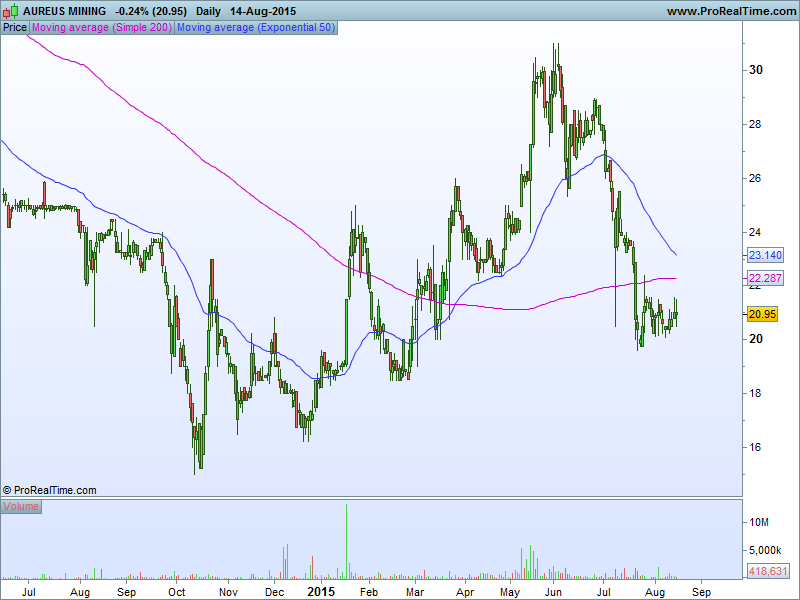
The decline in the share price may have been halted but I will continue to wait it out.

Ounce Gold USD

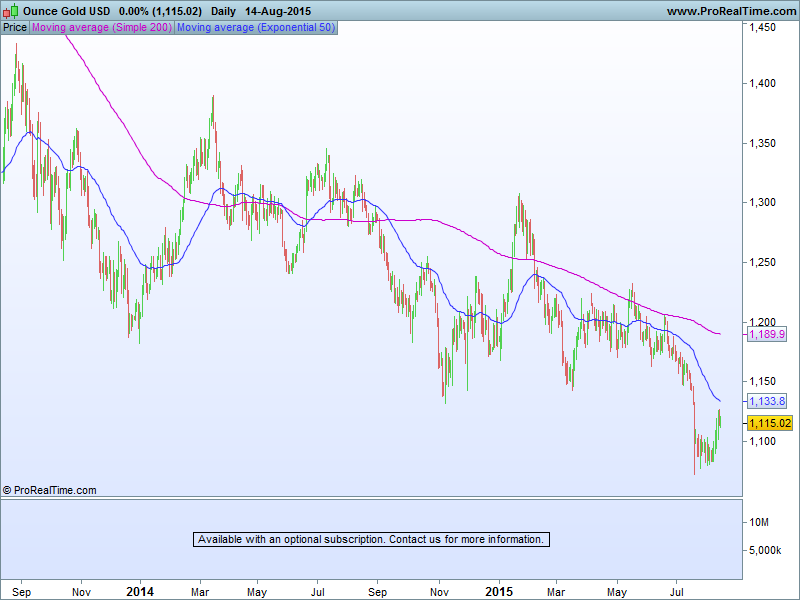
Despite the recent small recovery, the trend in gold price looks fairly bad.

On the 20th August the group announced that the opening ceremony for the New Liberty mine had taken place.  The final plant commissioning has now been completed and the company is now working towards reaching steady state production in Q4.  I think this announcement is largely ceremonial but it is pleasing to see that things are moving in the right direction.  The gold price is moving back up to the trend line too but as things stand I think the gold price is probably too week for an investment here.  If the downtrend is broken, I will probably reassess.

On the 7th September the group released an operations update and announced the commencement of gold sales and initial mining and processing operations from the New Liberty Gold Mine.  The company achieved nameplate capacity on the gold plant in mid-July and continues to progress through the commissioning and ramp-up process in order to optimise recoveries and work towards a declaration of commercial production.

Mining operations were hampered from April to July due to a lack of a consistent supply of explosives caused by a delay in the delivery of the emulsion plant from China.  The delivery was impacted due to shipping restrictions to Ebola affected countries.  In order to alleviate this situation, a supply chain was set up through Ghana and the Ivory Coast to transport explosives by road.  The emulsion plant will now be commissioned in early November and the company now has three months of supply of explosives at New Liberty and has a regular supply to the site.

Initially mining, road construction and the development of the run of mine pad were hampered by the lack of hard rock which was caused by the delay in the delivery of explosives.  Nevertheless, the mining team has stripped over six million tonnes of waste rock and mined 263,673 tonnes of ore.  As at the end of August, the ore stockpiles total 211,363 tonnes and with an adequate supply of explosive material there have recently been considerable improvements in mining sequencing and ore fragmentation is improving as mining progresses below the weathered rock.

The construction of the operational water management system ensures that effective mining can be undertaken during the rainy season.  Mitigations include a flood bund around the pit, pump stations and creek diversion.  All are working as designed and mining operations have continued to progress throughout the wet season and are now focussing below the weathered oxide zone in the Larjor starter pit and moving into fresh rock within the Kinjor pit.  The primary focus of the mining team during September is to push back waste to access more ore and increase face length.

Grade control drilling and mining reconciliation to date have continued to show that the ore body is extremely robust and representative of the resource model.  The on-site mine lab operated by ALS Global is now fully operational and has been processing samples over the last two weeks.  The lab can prepare 200 samples per day and is equipped with two furnaces for Fire Assay analysis.  A revised mining schedule is being enacted to enable the company to achieve its production targets for the first year of operations.  This updated plan will include a three month acceleration of the delivery of an HD785 haul truck and a PC1250 excavator to January 2016, which will facilitate an increase in the mining rates enabling the mining team to catch up on the near term shortfall.

To date the New Liberty process plant has processed 52,310 tonnes of ROM ore at an average feed grade of 3.6g/t at an average gold recovery of 89%.  During the plant commissioning phase, there have been four gold dore shipments for smelting and refining at the MKS PAMP refinery in Switzerland.  This has resulted in sales of 4,881 ounces of gold at an average price of $1,119 per ounce.  In late July it was noted that the mill discharge grates were not optimum for the ROM ore and therefore needed replacing.  The supplier has worked with the company and more robust, heavy duty grates have been installed.  As a consequence of the discharge problem, however, the mill could not be operated at full design capacity.  This caused undue deterioration on some of the mill liners and lifters which must also be replaced.  The replacement of these components has been undertaken at no cost to the group and the mill will continue to operate throughout September with a full mill re-line being scheduled to take place in early October.  Plant processing operations are no focused on optimising reagent consumption, grind size and gold recoveries.

The company is on track to declare commercial production during Q4 2015 which will be declared on the first day of the calendar month following the mill having operated at an average of 60% or more of the designed production capacity calculated over a 60 day period.  The value of the gold produced prior to commercial production will be deducted from the capitalised construction costs of the mine rather than recorded as revenue.

Following the resurgence of a small number of Ebola cases in June, all associated contacts have now completed their follow up monitoring period and Liberia was declared Ebola free for a second time by the WHO following a continuous period of 42 concurrent days without a case ending in the end of August.

The second and final payment has been made in relation to the settlement agreement for the acquisition of certain mining rights from Weajue Hill Mining Corp.  The legacy mining rights are situated in the Weaju area covering only 1.7km2 of the total 457km2 mining license granted to the company.  As part of the settlement agreement, a second payment was required to be made on the completion of a feasibility study for the Weaju project.  The payment comprises £445K and 1,148,611 new Aureus shares which equates to the equivalent of $5 per ounce of measured, indicated and inferred resources.

It is good to hear about the updated production at the mine and the lack of explosives situation now seems to have been resolved.  I am highly tempted to take an initial position here with the price of gold and the potential emergence of Ebola being the main two impediments to this.

On the 20th October the group informed the market that gold production at the New Liberty Mine has temporarily stopped due to a mechanical failure within the secondary crusher.  The company’s operational team are working with DRA, the EPCM contractor, and specialist technicians from the crusher’s OEM who are on site to conduct the repairs.  Following an initial assessment, all required tools, spares and equipment have been sourced and are being expedited to the mine.  The OEM expects to complete their repair work and have the crushed fully operational by the end of October.

To recommence production as quickly as possible, a mobile crusher with a capacity of 200 tonnes per hour has been sourced in country and is being transported by road to the mine to cover the intervening downtime period and allow for crushing and stockpiling operations to continue whilst the crusher is undergoing repair.  It is anticipated that the temporary crusher will arrive at the mine by the 23rd October and be operational shortly afterwards.   Following the repair of the secondary crusher, the mobile crusher the mobile crusher will be retained for a period of time to provide additional flexibility during the ramp up of operation.

The company believes that this temporary shutdown in processing activities will not severely impact production levels but may halt gold production for up to two weeks.  During this time, the company will continue with mining operations to increase its ore stockpiles.  It is also taking this opportunity to undertake other additional preventative maintenance activities across the process plant that were scheduled to be undertaken later in the year.

During the process of commissioning and ramping up the process plant, the company has made eight shipments of gold ore, resulting in sales of approximately 10,000 ounces of gold.  Following the repair of the secondary crusher, they will continue to work towards the achievement of commercial production and although now delayed, management expects this will be achieved by the end of the year.  The first repayment under the debt facilities is due in January 2016, and providing the plant now moves smoothly through the remaining commissioning phase to steady state design capacity, the cash flow from operations in Q4 will be sufficient to meet this obligation.

That is a big “if” and I must say I am a bit nervous about this so I will wait on the side lines for now.
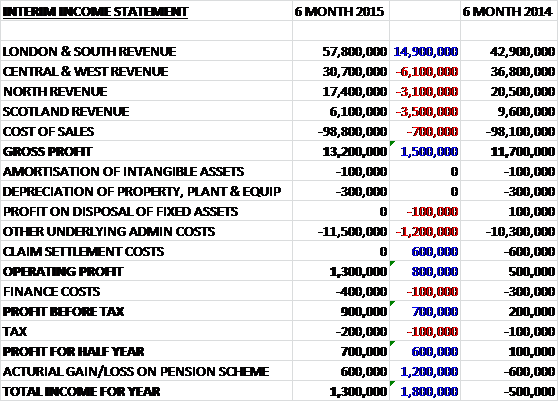
On the 2nd November the group reported that fold producing operations at the New Liberty goldmine have restarted following the repair of the secondary crusher. They recommenced on the 28th October in order to build up a stockpile of crushed ore before processing operations restarted on the 30th. The mobile crusher, which was sourced in-country, has a capacity of 200 tonnes per hour and is sufficient to supply the New Liberty bar mill which runs at a designed feed rate of 146 tonnes per hour. This mobile crusher will be retained on site for six months to provide additional operational flexibility during the final testing and commissioning phase of the plant, and also to provide additional crushed rock material for use on haul roads and other infrastructure.

Technicians from the OEM of the secondary crusher successfully completed repairs to remediate the mechanical failure. These repairs were completed on the 29th October following which time the crusher has been tested extensively to ensure all parameters are operating correctly before being recommissioned and ramped back up to its full capacity. Following the resumption of crushing activities, a stockpile of 6,000 tonnes of crushed fine ore allowed for the restart of milling and CIL processing operations with milling operations starting on 30th October.

During the 19 day temporary shutdown, mining operations continued to progress, leaving ROM stockpiles totalling 55,283 tonnes at 3.16g per tonne and oxide stockpiles of 105,203 tonnes at 2.04g per tonne. Additionally during this period, the company took the opportunity to undertake further preventative maintenance works around the plant site. Following the successful restart of processing operations, the focus of the company returns to working towards declaring commercial production at the mine which management now expects to achieve in early 2016.

On the 3rd November the group announced that it had agreed to acquire three exploration licences from Sarama Resources. They are contiguous to the company’s Bea Mountain mining licence and are located close to the New Liberty Mine. Exploration work undertaken by Sarama defined a 15 km long gold corridor highlighted by gold in soil anomalies and extensive artisanal mining, which on average are within a 15km radius of the New Liberty mine. Gold mineralisation intersected by drilling includes intercepts of 3.9g per tonne over 7.5m from 9.3m and 2.3g per tonne over 5m from 28m. Altogether the holes have effectively tested only 1km of the identified 15km anomalous soil corridor.

The licenses have been acquired for a total of 2,600,000 shares in Aureus and Samara will retain an uncapped 1% net smelter return royalty on gold produced from the Cape Mount permit. Once the company develops a cash flow positive position, they will undertake exploration on the rest of the 15km soil corridor. They have already identified targets for follow up work, which includes zones showing continuous mineralisation. They will undertake further field work over the next year including geology and regolith mapping with some pitting and trenching before conducting a full interpretation of the geological and structural settings of the whole corridor.

So, the re-start of the mining operations is a good sign, but it is a shame that commercial production will not start until next year. This new exploration license looks interesting though, and I look forward to a time when the group is cash flow positive!

Aureus Mining Share Blog – Final Results Year Ended 2014

Aureus Mining was incorporated in Canada in early 2011.  They are involved in the exploration and development of gold assets in West Africa, particularly the construction of the New Liberty Gold Mine in Liberia which is nearing completion.  The company is listed on the Toronto stock exchange and the AIM exchange.

The company holds a mineral development agreement in Liberia for gold development which is valid for 25 years with an option for a further 25 years and when it was ratified in 2013 it had 13 years remaining.  In 2009 the company was granted a mining license which allows them to explore and mine in an area that encompasses the New Liberty Gold Project, Weaju, Gondoja, Silver Hills and Ndablama.  In 2011 they acquired the Archean Gold exploration license which is an area immediately south of the company’s Bea Mountain mining licence and currently contains the Leopard Rock property.  In 2013 they increased their holdings around the New Liberty project through the acquisition of exploration licenses which included Yambesei, Archean West, Mabong and Mafa West.  In Cameroon the Batouri licence covers an area of 1,000 km2 and targets gold in the east of the country.  Additionally the company holds over 30M shares in Stellar Diamonds, a diamond mining and exploration company listed on AIM.

I always think it is useful to look into some accounting policies and in this case, mining and development costs are capitalised as intangible assets but are not amortised during the development phase, instead being checked for impairment.  On commencement of commercial production a development property is transferred to a mining property and is depreciated on a unit of production method.  I suspect that is all fairly standard for a mining company of this type.

The New Liberty Gold Project is a greenfield development which has good access to the capital and main port, Monrovia, and there is already a 100km mostly tarmac road from Monrovia to the project site that provides year round access. The total reserve at the project stands at 924,000 ounces at a grade of 3.4g/t with 8.5MT of ore with 99K ounces so far proven.  The reserves support an open pit operation with an annual production rate of 1.1MT of ore over an eight year production life.  The site has measured resources of 100,000 ounces at a grade of 4.77 g/t and indicated resources of 1,043,000 ounces at a grade of 3.55 g/t.

The Ndablama prospect is located approximately 40km NE of the New Liberty deposit and is defined by the presence of extensive artisanal mining activity and a 2km gold in soil anomaly.  There is an indicated resource of 386k ounces at a grade of 1.58 g/t and an inferred resource of 515K ounces at 1.7 g per tonne.  The Weaju deposit is situated 30km NE of the New Liberty project at the eastern end of the Bea Mountain range and has been the subject of intense artisanal mining activity.  This one comes with some strings attached, though. Upon completion of a feasibility study, Weajue Gill Mining Corp will receive payments equivalent to $5 per ounce measured, indicated and inferred resources.  If commercial production is achieved within the area, they will receive a one-time payment equivalent to 2.5% of the net present value of the project and 7.5% net profit interest on life of mine production within the area – this seems like a lot to me.  The inferred mineral resource is 178,000 ounces at a grade of 2.1 g/t.

At Leopard Rock in the Archaean license, gold mineralisation occurs within folded, deformed and metamorphosed rocks along a NW trending shear zone but so far no resource studies have been completed.  The Gondoja target is located 8km NE of Ndablama and has been previously explored by Mano River in 2000 and showed grades of between 1 and 2 g/t over wide widths of 20 to 64 metres.  Koinja and Gbalidee are located on the Yambesei shear corridor.  Silver Hills is another area that has experienced artisanal mining in the past and pitting is currently being undertaken at some of these areas.

Aureus Mining have now released their final results for the year ended 2014.

AURincome

There are no revenues yet at this company so we can have a look at the expenditure.  Legal and professional expenses nearly halved during the year due to a reduction in fees incurred in relation to the project financing as legal documentation was completed in Q4 2013, but this was mostly offset by an increase in depreciation and wages.  We also see a foreign exchange loss but a fall in other expenses.  The big difference year on year was the $3.3M impairment of the investment in Stellar Diamonds which took place last year, representing the cumulative losses incurred on the investment since 2011.  We also see a $2.3M warrant derivative liability gain to give a loss for the year less than half that of last year at $3.4M (nearly the amount of that Stellar impairment).

AURassets

When compared to the end point of last year, total assets increased by $100.9M driven by a $99.3M growth in mining and development property relating to costs incurred at New Liberty, particularly earthworks ($22.3M), mechanical supply ($15.6M) and structural supply ($16.7M), and a $7.3M increase in the Liberian evaluation costs (relating to the drilling programme at Ndablama), partially offset by a $6.4M fall in cash.  Liabilities also increased during the year due to a $74.9M growth in the bank loan and a $3.8M increase in trade payables to give a net tangible asset level of $148.5M, an increase of $13.7M year on year.  The 2013 liabilities above do not quite match what is printed in the accounts because on the statement the trade payables and accruals do not equal the total payables.  This is a bit annoying but the figures are not material and it was last year…

AURcash

Before movements in working capital the cash loss fell by $382K to $4.4M.  A fall in receivables meant that the net cash outflow from operations stood at $3.8M, a fall of $1.5M year on year.  The group then spent $7.4M on exploration assets and $92.8M on producing (nearly) assets to give a cash outflow of $105.2M before financing operations.  In order to pay for all this, the group issued $22.4M of new shares, $3M of new warrants and took out $74.6M of new borrowings.

At New Liberty, construction of the Run-of Mine wall and tipping bin was completed at the primary crusher.  The steelwork for the secondary crusher was also completed and both crushers were lifted into position ready for further commissioning.  Good progress was made on the mill building installation, following the placing of the completed mill shell and trunnion ends on its bearings in November.  The CIL and detox tanks reached their final levels with further work focusing on the completion of the tank stiffener rings and the bund walls.  During this period, all significant areas of civil works were handed over to the contractor.  Work on the tailings storage facility has commenced and the main water line from the dam was also installed during the period.

Six of the eight power generators have been placed and commissioned and the final two are now on site ready to be commissioned.  The mine store and workshop buildings have been completed and only await connection to the mains power while construction of the reagent store is 80% complete.  The plant admin offices have been completed and all the process personnel and contractor staff have moved into them.  Some 90% of all planned concrete pours have now been executed.

The staff and visitor accommodation at the mine camp was completed and occupied during the period and drinking water was also commissioned with work starting on the sewage plant.  All bush clearance totalling 95 hectares was completed in the open pit arena and the pre-strip mining has been completed for the Larjor pit and the mining of the first ore in the pit was started.  Mining activities focused on the upper levels of the pit and waste rock from the pre-strip and early mining phases has been used in the construction of a surface water diversion berm around the pit area and in the construction of the haul road.

The mining equipment supplier has commissioned the drill rigs and the excavator and the first four of the 100 tonne dump trucks have arrived on site and are undergoing commissioning in time for taking over from the existing fleet during Q1 2015.  Operator training for the trucks has commenced during the period.  Grade control drilling was completed in both the Larjor and Kinjor pits with a grid of closed spaced inclined RC holes designed to provide detailed grade information of the mineralisation contained within the first year pit.  The results have shown excellent reconciliation with the resource model in terms of mineralisation strike, dip and width of intersections.

In addition to the above, the New Mine Plan was announced in February 2015 which included an additional 28,000 ounces of gold expected to be produced in the first year of production through the mining of an additional started pit to bring the total year one target production up to 122,000 ounces of gold.  Post tax project NPV of expected cash flows from the start of commercial production have increased to $328M (using a gold price of $1,300 per ounce, a 5% discount rate and a corporation tax of 25%).  Significant free cash is now expected to be generated throughout the life of the mine with earlier free cash to fund the other exploration programmes.  The life of mine average operating cash costs are expected to be reduced by 8% to $692 per ounce with all-in sustaining cash costs reduced by 7% to $789 per ounce.

As far as exploration on the license is concerned, trenching work was carried out on the West Mafa and Goja targets in the western portion of the area.  Results from East Mafa showed gold spikes associated with narrow quartz veins in amphibolites, gneisses and iron rich formations.  A geology fact map was produced for the area and interpretive geology maps developed.  Results from Goja showed broad mineralisation developed in close proximity to intrusives.  Further reconnaissance work will be conducted around New Liberty with follow up work to be carried out on prioritised targets.

At the Ndablama prospect, phase four of the exploration drilling programme was completed which led to an updated resource of 386,000 Oz at 1.6 g/t indicated and 515,000 Oz at 1.7 g/t inferred.  At the Weaju project, six additional diamond holes totalling 1,142 metres were drilled that explored down dip and along strike as well as testing the mineralisation model.  At Koinja and Gbalidee, regolith mapping was undertaken during the period and detailed geological mapping and trenching are required to further define the full potential of the corridor.  At Silver Hills, lithosamples and channel samples returned good grades in artisanal mining areas such as Belgium, Kpokolo and Wesse and pitting was undertaken at the Belgium and New Belgium targets during the period.

During the year, regional mapping on the Yambesei license confirmed additional potential mineralisation along greenstone belts including the Mafa and Yambesei shears as well as the NE extension from Gondoja.  New regional targets were defined based on the presence of artisanal workings and anomalous lithosample results and a soil grid completed in Q2.  Bulk leach extractable gold sampling was also completed with 279 samples collected in the license identifying targets for future follow up.  Mapping and lithosampling was undertaken in the Archean West license at Lofa Congo and South Than which host alluvial mining for gold and diamonds and at Mabong, mapping and sampling continued showing the geology dominated by amphibolite-granite intercalations with late dolerite dykes (yes, really!)

In Cameroon, exploration work focused on the interpretation of the mineralised system of Kambele and Dimnako following on from the reclogging.  The work was undertaken in order to produce a new interpretation of the mineralisation model to determine the potential of the two targets to host economic deposits. A ground induced polarisation or ground magnetic survey is planned to be conducted at the Amndobi prospect followed by a first pass RC drill programme.

At the year end, the group had commitments of $14.3M of capital expenditure and $1.5M of operating expenditure.  At the end of last year, the company entered into an agreement for an $88M project finance loan facility with Nedbank and Rand Merchant Bank and also entered into a subordinated loan facility agreement for $12M with the Rand Merchant Bank which will be used to finance the development of the New Liberty Gold Project.  The project finance loan’s first repayment in January 2016 and it is repayable in nine payments.  It bears interest at US LIBOR +1.8% + 2.5%.  The subordinated facility bears interest at US LIBOR + 7.5% for a six and a half year term and is repayable in full six months after the final senior loan repayment – that is quite a hefty interest rate.  At the end of the year, $8M of the senior facility and the full $12M subordinated facility remain undrawn.

If US LIBOR rates increase by 100%, the group would have to pay $300K more in interest per annum.  A 10% strengthening of the USD against the GBP or Canadian dollar would reduce net assets by $50K and $35K respectively.  A 10% strengthening against the South African Rand would increase net assets by $192K.  Included in prepayments is $2.5M in advanced payments made to the earthworks and civils contractor which remained unrecovered at the termination of the contract.

In April, the company completed a private placement to sell 33,375,000 units at a price of £0.27 per unit.  Each unit comprised of one common share in the company and a half of one common share purchase warrant.  Each warrant entitles the holder to purchase one share at a price of £0.378 up to October 2017.  The direct costs associated with the placing amount to $2.9M.  In July the company closed a subscription by the IFC, the private sector arm of the World Bank, for 24,520,296 units at an issue price of £0.27 per unit to raise $11.2M.  The terms are the same as above except the warrants expire at the end of January 2017.  Direct costs to issue the units were $1.1M.  The total number of warrants outstanding is 40,072,175 at an average exercise price of £0.392 per share.

After the year-end, the company granted stock options over 5,631,875 common shares at an exercise price of C$0.35 per share.  575,000 of the options were exercisable immediately and the remainder vest over the next two years upon completion of certain service and performance vesting conditions.  The group also completed an equity financing, raising $15.3M through the issue of 56,000,000 new shares at a price of 18p per share which included the issue of 29,239,766 shares worth $8M to the IFC and the issue of 26,760,234 shares worth $7.3M to brokered financing.

During the year the majority of earthworks and civils, the installation of most key items of mechanical infrastructure, and the diversion of the Marvoe creek have been completed, along with the relocation of the Kinjor and Larjor villages.  The primary focus for 2015 will be to complete the construction of New Liberty with first gold targeted for the end of May and final commissioning is expected to occur by July, leading to steady state production from August.  General exploration work will also continue across the other licenses with the medium term goal of Aureus becoming a multiple mine producer.

Although there were no profits this year, the consensus forecast is for a PE ratio of 13.7 on next year’s profits which sounds good for what will not be a full year of production.  At the year end the group was in a net debt position of $42.8M.

So, I have looked at a few gemstone miners and oilers but so far no gold miners – given the price of the precious metal I thought now might be the time to take a look at one.  The loss this year is neither here nor there really but the improvement was due to the impairment of the Stellar Diamond investment last year.  Net tangible assets increased during the year,  as the group issued more equity to fund its activities and there was a $106.2M cash burn before financing which seems to have been enough to complete most of the work for New Liberty.  There is still at least $14.3M of capital expenditure to go but this was covered by the post year-end placement and there is still nearly $33M of cash at hand and a little bit of headroom with the loans, although not a great deal.

Clearly this is a very important time for the group, the start of mining is pretty much here and the project should be nicely profitable at a gold price of $1,300 an ounce.  Where the price of gold is heading, though, is anybody’s guess.  All of my investments in these natural resources companies end up going sour so I am keeping a watching brief here for the moment.

Interserve Share Blog – Interim Results Year Ending 2015

Interserve has now released its interim results for the year ending 2015.

IRVinterimincome

When compared to the first half of last year, revenues increased across all business segments although the proportion attributable to joint ventures and associates also increased.  After cost of sales grew by £169.1M, the gross profit increased by £48.8M.  We then see a £47.9M increase in underlying admin expenses and a £5.2M growth in the amortisation of acquired intangibles more than offset by a £7.4M fall in transaction costs and a £1.5M decline in integration costs but the contribution from joint ventures increased by £3.9M to give an operating profit for the first half of the year of £42M, an increase of £10.2M year on year.  Finance costs nearly doubled when compared to the first half of 2014 but tax costs reduced to give a profit for the year of £29.3M, an increase of £6.3M when compared to last time.

IRVinterimassets

When compared to the end point of last year, total assets increased by £169.3M driven by a £95.9M increase in receivables, a £34.3M growth in the pension surplus, a £26.1M increase in cash, a £23.8M growth in goodwill due to the discovery of loss making contracts at the acquisitions and an £11.2M increase in property, plant and equipment, partially offset by a £22.4M decline in other intangible assets.  Total liabilities also increased during the year due to a £76.5M increase in payables, a £52.5M growth in bank loans and a £21.2M increase in long term provisions, presumably related to the loss-making contracts discovered in the acquisitions. The end result is a £13.8M positive movement in net tangible assets but they remained negative at £31.1M.

IRVinterimcash

Before movements in working capital, cash profits increased by £10.8M to £61.1M.  After an £8.1M increase in pension deficit payments, a £99M increase in receivables and a net £12M spent on hire fleet capital expenditure, the net cash from operations stood at £17.9M, a positive swing of £38.4M.  The group then paid a net £8.3M in interest and £17.4M on capital expenditure (with £7M spent on the first stage of investment in a new UK Midlands office) with a broadly neutral contribution from/to joint ventures to give a negative free cash flow of £6.9M.  Clearly there was not cash left to pay the dividends so some £52.5M more was taken out against the bank loans to pay the £22.4M in dividends and to give a cash level at the period end of £100.1M.  This is not that impressive really.

The profit at the UK Support Services division was £40M, an increase of £6.1M year on year; the operating margin increased from 4.2% to 4.3% and the future workload increased by 7% to £6.2BN – this is now by far the most important contributor to group profit.  During the year the group further developed their portfolio of private sector clients, for instance in the transport sector where they won a number of long-term contracts in the rail sector with MTR Crossrail and KeolisAmey Docklands in addition to their existing contract with London Underground.  In total these contracts added some £100M to the future workload.

They made good progress in the retail sector too.  They secured a three year, £35M extension with B&Q, doubling the scale of the cleaning service and adding catering at around a quarter of the estate.  The relationship with Debenhams was extended, in which the group have delivered facilities services across its UK stores and offices for over 25 years.  In addition, they have mobilised their contract with Sony Europe to manage the company’s estate in 27 countries.

The public sector business has evolved significantly over the past year and a half with the main changes relating to reductions in revenue from the loss last year of the South East Regional Prime contract and the decrease in size of the new MoD National Training Estate contract compared to previous arrangements.  In recent years the group have, though, built capability in the provision of frontline public services across healthcare, welfare-to-work, skills and justice.  This growing part of the business includes the expansion of Learning and Employments following last year’s acquisition of the Employment and Skills group.  The recently announced pooling of budgets in the Greater Manchester area, covering transport, housing, planning, policing and public health is an early example of how the group’s breadth of capability could be highly relevant to more “place-focused” commissioning.

The profit at the International Support Services division was £4M, an increase of £800K when compared to the first half of last year.  The operating margin fell slightly, from 4.3% to 4.2% and the future workload increased by £200M to £300M.  During the period the group won an oil and gas services contract with Petrofac in Oman, having initially worked for them solely in the UAE.  The focus on servicing essential production facilities as opposed to exploration and helped provide the increase in profits seen in the division.

Other highlights during the period included winning fuel pipeline construction and installation contracts with BP Khazzan, Gulf Petrochemicals Services Company and RasGas, as well as a sea water treatment works contract with Veolia Water.  The facilities management businesses won contracts with new clients including the Abu Dhabi Equestrian Club, the Environment Agency of Abu Dhabi and secured further work with IKEA in Qatar.  The newly established facilities management business in Saudi Arabia mobilised its first contracts in the period to manage services at the IT and Communications complex and King Abdullah Financial District in Riyadh for the Al Ra’idah Investment Company.  The board are encouraged by the prospects for their recently launched joint venture with the Rezayat Group which adds to their delivery capability in the Kingdom.

The profit at the UK Construction division was £5.3M, a decline of £2.7M when compared to the first half of 2014 with the wafer thin margins falling from 1.9% to 1.1%, although the future workload has increased by 22% to £1.7BN.  Market demand continued to strengthen during the period which drove revenue growth up but the challenges of the current trading environment, combined with marked supplier cost inflation resulted in margins falling below the medium term expected range.  Although tender pricing is improving and the risks associated with supply chain insolvency and pricing inflation are beginning to recede, it is expected that margins will remain tight in the short term.

Work winning in the period was strong and significant items within the additional workload included the group’s appointment as preferred bidder to build a new £200M complex at the Defence and National Rehabilitation Centre at Stanford Hall, further wins in the EfW market at East Lothian and Rotherham, and a contract to build seven secondary schools across Hertfordshire, Luton and Reading.

The profit at the International Construction division was £4.9M, a growth of £600K year on year with operating margins increasing from 2.4% to 3.3% and the future workload edging up 2% at £200K.  Demand continued to strengthen across the region and strategic development plans such as Qatar’s Vision2030 and the UAE’s plans for Expo 2020, along with the ongoing need for infrastructure development to keep pace with rapid population growth are all gaining traction and stimulating activity in the market.

Work winning during the period included projects to expand the Doha West sewage treatment plant for the Marubeni Corp, to build a seawater pumping station for a desalination plant in Doha for the Toya Thai Corp and an executive jet terminal at Al Maktoum International Airport for Dubai Aviation City Corp.  The group also secured further works with clients such as Dubai’s Road and Transport Authority, Siemens, Petron Gulf and the British School Muscat.

The profit at the Equipment Services division was £18.6M, an increase of £4.6M when compared to the first half of 2014 with the decent operating margin increasing from 15.4% to 17.9% as the division benefited from the fleet investment in improving global infrastructure markets.  The group continued to invest in risking markets, albeit at a more modest pace than last year with net capital expenditure of £10.4M which means that over the last year and a half, the group has invested £51M in stock, working capital and net capex, however, it is expected that the rate of expansion in the asset base will continue to ease in the second half of the year.

In Asia Pacific, the group delivered strong performances in Hong Kong and the Philippines driven by increased investment in infrastructure projects including the Kowloon Rail Terminus, the Hong Kong Macau Bridge and the Manila Bay Development.  Demand in Oceania, however, remains muted following the conclusion last year of a series of major mining related projects with no current prospect of future capacity expansion.

The group continued to see strong growth in the Middle East, benefiting from increased demand in Qatar where a number of large scale infrastructure projects are now underway, including the East West Highway project where Interserve are supplying equipment on several bridge structures.  Demand also continued to grow in the UAE where work has been delivered on the Dubai Opera House, the Saadyatt Resort in Abu Dhabi and on the new Dubai-Abu Dhabi highway.  In Saudi Arabia, the group started work on a new 14 storey transport hub being built in Mecca.  The UK continued to benefit from increasingly confident construction markets with a significant pipeline of road projects offering potential to replace work on more mature schemes such as Crossrail.  Work continued on sizeable rail improvement projects in Reading and on the Stockley Viaduct project near Heathrow airport.

The losses at the group segment widened by £2.8M to £12.5M year on year.  This segment now includes the investments which were formerly reported separately but following the disposal of the majority of the PFI portfolio are longer judged individually material.  The increased costs were driven by the initial investment in the construction of a new Midlands office where the group will consolidate their back office activities.

For the acquisitions of Initial Facilities and Esg last year, the fair value of the assets acquired was provisionally assessed at the time and included in the 2014 accounts.  Since the year-end these assessments have been updated by £19.7M to reflect the impact of loss making contracts on which constructive and legal obligations existed at the time of the acquisitions.  There is no profit/loss associated with this as it has just been added to the goodwill paid for the acquisitions (as it should be given the accounting treatment of goodwill).  I have to say this just underlines what a ridiculous asset goodwill is and why I always discount it when determining net assets – due to loss making contracts being discovered which will lead to a reduction in the performance of the acquired businesses than expected, the goodwill asset goes up!  I really think there should be a change to the treatment of goodwill but I am not an accountant so perhaps I am missing something.

During the period the company concluded negotiations on the triennial valuation of the pension scheme. Since the last time the exercise was carried out they have undertaken considerable efforts to de-risk the liability position and increase the asset strength through the pension buy-in and contribution of £55M of PFI assets respectively.  The effect these actions had was to recognise a pension asset of £34M on the balance sheet compared to a deficit of £93M three years ago and an actuarial deficit of £64M compared to £150M at the end of 2011.  In addition it has been agreed that the existing recovery payments of £12M per annum would continue until the next valuation.  This is a huge amount of deficit reduction payments, I didn’t actually realise they were so high but the progress made on the deficit reduction so far is rather impressive in my view and it is much less of a risk than it has been in the past.

The future workload rose by 11% over the past year to £8.3BN and demand in the group’s main markets continued to strengthen which gives the board confidence in their positive outlook.  This is the good news.  The not so good news is the fact that the board expect the national minimum wage announced in the recent budget to have an adverse impact on margins in the UK support services segment of between £10M and £15M next year, receding over the next few years thereafter as the change is prices in to relevant contracts.  This will not affect the second half of 2015, however, and the board’s expectations for growth in 2015 overall remains the same.

At the period end net debt stood at £297.9M compared to £268.9M at the end of last year and £243.1M at the half year point of 2014. After a 5% increase in the interim dividend, at the current share price the shares are yielding 4.2% which increases to 4.5% on the full year consensus forecast.

Overall then this is a bit of a mixed update.  Profit for the half year increased but when last year’s transaction and integration costs are taken out of the equation, profit fell year on year. Net assets did improve though, mainly due to the revaluation of the pension which validates a lot of the hard work done on the scheme in recent years, but net tangible assets remained negative which is never great for this kind of company.  The operating cash flow also improved but there was no free cash available and the payment of the dividends pushed the net debt level ever higher.

Operationally, the UK support services business and the equipment services business are pretty much driving the group now, both improved year on year, no doubt helped by the Initial acquisition in the case of the former.  Internationally, the group seems to be doing well in Qatar and the UAE with Saudi Arabia now offering some decent work.  The problems are in the UK construction division, however, with wafer thin margins made even worse by supplier cost inflation.  The discovery of the loss making contracts in both of the acquisitions is disappointing and the fact that the minimum wage announcement will cost the group between £10M and 15M next year is a real blow, especially considering that division is where most of the growth is coming from.

The shares unsurprisingly took the above news badly and now yield 4.5% on the full year consensus which is a nice amount to have but I have to say the concern over profitability next year is keeping me out at present.

INTERSERVE

This is quite an interesting chart.  The recent uptrend seemed to break down in mid-June and the share price has gapped down following yesterday’s update.

On the 13th November the group released a Q3 trading update. The group’s markets have experienced mixed conditions over the past three months but the group’s outlook for the full year remains unchanged with expectations for continued growth.

Construction has continued to strengthen in the Middle East, reflecting their focus on key clients in retail, leisure and infrastructure so the board expect results in the international construction division to show positive progress year on year. In the UK, while the performance of the building and fit-out business is encouraging, this year’s result will be impacted by three loss making energy process contracts within the infrastructure business. This is due to sub-contractor insolvencies and the consequential impacts in project timing and costs. The group’s involvement in the delivery of these contracts is substantially complete, however. Due to these issues, the board expect a break-even performance for the full year in the UK construction segment.

Equipment Services has continued to deliver good growth, fuelled by strong demand and benefiting from the increased scale of the hire fleet in which they have invested in recent years. Trading is particularly strong in parts of the Middle East, the Far East and the UK, more than offsetting volume reductions from the downturn in Australia.
Anticipated year-end net debt remains unaltered in the range of £270M to £300M and the visibility of future workload remains encouraging with 60% of 2016 consensus revenues secured by the end of Q3. Since the half year results, the group have won new contracts and extensions with Siemens, Hilton Hotels, Petrofac, Qatar Cool, the Department for Transport, Durham Uni, York Uni, Warwick Uni, Scottish Power and Northern Powergrid.

The group have also announced that Glyn Barker will join the board as Chairman after Lord Blackwell announced his intention to stand down. Glyn is a non-executive director of Aviva and Berkeley Group and until December 2011 was vice Chairman of PWC UK. He also held a number of other senior positions at PWC including UK Managing Partner and UK Head of Assurance.

There is nothing in this update that encourages me to buy back in here.

Spectris Share Blog – Interim Results Year Ending 2015

Spectris has now released its interim results for the year ending 2015.

Specinterimincome

When compared to the first half of last year, revenues increased by £23.4M to £563.2M as a £2M fall in in-line instrument  revenue was more than offset by increases in the other divisions, particularly the £15M growth in materials analysis revenue.  Cost of sales also increased to give a gross profit some £10.3M ahead of last time.  Indirect production and engineering costs also increased, up £2.8M and sales and marketing expenses were up £8.1M.  We also see an increase in underlying admin costs along with a £600K growth in acquisition related costs and a £5.5M hike in the amortisation of acquired intangibles to give an operating profit £8.8M lower than in the first half of 2014.  Finance costs increased slightly, mainly as a result of a fall in the gain on retranslation of short term inter-company loans but tax fell year on year to give a profit for the year of £40.4M, a decline of £6.4M when compared to last time.  Incidentally this profit was almost entirely wiped out by the adverse effects of foreign exchange on the translation of foreign operations.  Apparently profits are expected to be weighted towards the second half of the year.

Specinterimassets

When compared to the end point of last year, total assets fell by £29.2M driven by a £17.3M decline in receivables, a £5.6M fall in goodwill, a £5M decrease in other intangible assets and a £4.9M fall in property, plant and equipment partially offset by a £7.3M increase in inventories.  Conversely liabilities increased during the period as a £14.8M fall in payables and a £3.1M decline in the deferred tax liability was more than offset by the £20.7M increase in borrowings to give a net tangible asset level some £21.2M lower at £116.9M.  Included in the above is £11.9M of deferred and contingent consideration.

Specinterimcash

Before movements in working capital, cash profits fell by £2.5M to £78.5M.  There was then a net outflow of working capital, driven by a £14.6M increase in inventories and a £9.1M fall in payables but the tax payment was some £5.8M lower than last year to five a net cash from operations of £52.9M, an increase of £1.3M year on year.  The group then spent a net £11.7M on capital expenditure and £30.4M on acquisitions which, after an interest payment of £2.4M meant that the free cash flow stood at £8.6M, a fall of £17.8M year on year.  This did not cover the £36.3M in dividends so the group took out £19.3M of new borrowings to give a net cash outflow of £8.2M in the first half of the year and a cash level of £21.7M at the period-end.

Regionally sales to North America declined by 2% representing a marked change to the strong performance in this region last year.  Sales to China fell by 4% in the first half and, together with a 5% decline in Japan, these countries partially offset a good performance in India and South East Asia to give a 1% increase in sales to the Asia Pacific region.  After a strong start to the year, sales growth in Europe moderated as the period progressed resulting in a 4% growth in the first half.  Growth in the continent was broad based by industry but was held back by Germany where sales growth was just 1%.

The operating profit at the Materials Analysis division was £14.6M, an increase of £1.4M year on year due to the impact of prior acquisitions.  Like for like operating profit fell by 10% as a result of the absence of a one-off R&D related government grant last year.  Like for like sales grew by 4%, benefiting from continued good growth from pharmaceutical and fine chemicals and semiconductor customers, particularly in North America.  There was a return to growth in the metals, minerals and mining sector, driven principally by the metals and minerals segments with mining demand remaining subdued.  Sales to academic research customers declined year on year as fiscal budgets remained constrained in many markets.

Sales to the pharmaceutical sector grew with strong performances in North America, Germany and India helped by growing demand from biopharmaceutical and generic drug manufacturers.  The investment in the development of products focused on the life science industry continued to yield results.  The group secured a major contract with Novartis for their Viscosizer product which will deliver substantial cost savings to Novartis by enabling more cost effective pre-screening of its therapeutic antibody candidates before they enter clinical trials.  Following the acquisition of MicroCal last year, the business has expanded its product range with the launch of the next generation of calorimeters targeted specifically at the life science market.

Within Asia Pacific, sales to Chinese pharmaceutical customers declined as the passing of Good Manufacturing Practice regulations in the country saw the end of a multi-year investment phase by Chinese pharmaceutical companies as they strive to achieve compliance.  It is believed, though, that growth prospects remain good in this market over the medium term.  Regulatory compliance is now a strong growth driver in India where the generic drug manufacturers are focussed on achieving the standards necessary to export to the US.  The particle measuring business won a significant order from Merck for a facility monitoring system together with a multi-year service contract.

After a difficult year last year there was a return to growth in the metals, minerals and mining sectors in all major markets except China, where demand remains subdued in the face of over-capacity in mining and continued postponements and delays to large capital expenditure projects.  Generally the growth in this sector is of an after sales nature with customers preferring to repair and support existing equipment rather than replace it.  In contrast there is good growth in the cement and building materials markets, particularly in the US, Europe and Mexico.

There has been a major new product launch in the period, the Zetium X-ray spectrometer.  This is the first machine in the market that combines several x-ray techniques together in one machine with easy-to-use software.  The group have also launched CNA Pentos, a real-time cross-belt elemental analyser targeted at the cement industry and similar applications.  Sales to academic research institutes declined, as governments remained fiscally constrained and public funding programmes were either exhausted or awaiting renewal.  Notably the strong growth in the UK in recent years has stopped due to uncertainty surrounding the general election in the period.

Demand in the semiconductor sector continued the progress that began during the second half of last year reflecting more favourable market conditions and new product introductions.  Growth was also benefited from the acquisitions made of the distributors for the particle measuring business in South Korea and Taiwan.  An important new product released to market in the period was the Ultra DI-20 Liquid Particle Counter which counts and sizes contaminants as small as 20 nanometres.

The board expects this segment to continue to deliver robust sales growth in the second half of the year, notably in the pharmaceutical and semiconductor sectors, boosted by new product launches and the impact of acquisitions.  Demand from the mining sector is likely to remain weak but the metals and minerals sector is expected to remain robust.  There is expected to be some release of EU funding of research and development budgets in the second half which should lead to improved demand in the academic research sector and cost reduction measures have been taken in order to improve future profitability.

The operating profit at the Test and Measurement division was £18.7M, a decline of £700K when compared to the first half of last year.  Sales to the automotive sector declined slightly, mainly due to the lack of large orders from North American customers that were seen last year, which offset continued good growth in Japan and modest growth in Europe.  The quality of the in-car infotainment and communications systems continued to be increasingly important to car manufacturers whilst legislation is also driving interest in the group’s full-vehicle simulators that allow more efficient development of noise, vibration and harshness targets with Bentley placing a major order for the simulator during the period.

Sales to the aerospace industry increased despite the economic sanctions on Russia adversely impacting exports of satellite vibration test systems to that end market.  There was a strong performance in North America where the group secured a significant order from Lockheed Martin for PULSE software analysers to test sound and vibration in its satellite systems.  Whilst there were continued project delays in China there was good growth elsewhere in the Asia Pacific region and following a sizeable order last year, a major South Korean aerospace company placed a further large order during the period for satellite vibration test systems.

Sales to the consumer electronics market were down significantly in the first half of the year, reflecting a strong prior year period when major customers in the segment had particularly large projects in North America and China.  There was strong growth in demand for the engineering software solutions in the period with customers increasingly seeking to use software to improve the quality, reliability and durability of their equipment and processes.  Since the acquisition of ReliaSoft, the business has secured a number of significant contracts, notably an order worth around €600K from a major oil and gas producer in the Asia Pacific area for software to analyse system and field operational performance and identify opportunities to reduce downtime.

Sales of the environmental noise monitoring services grew in the first half of the year, driven by good growth in Europe.  The group has made progress in diversifying away from airports and won a major contract with the Italian government for exhaust monitoring in their vehicle inspection centres.  The relationship with AENA, the Spanish airports operator was extended to centralise systems across the six airports already served and to add new systems to further ones.  In Australia, the noise monitoring service with the Australian Department of Defence has been expanded to a third military base.

At the end of last year, the group acquired ESG Solutions which was integrated into this division. The weakness in the oil and gas market is causing many producers to delay their investment plans which led to demand for ESG’s products reducing as the period progressed.  Nevertheless, the business secured several contract wins against some competitors including a multi-million dollar project in the Marcellus field in the US.  Good progress has been made extending ESG’s presence outside North America into China and Australia with the initial establishment of offices in the Middle East and Mexico also taking place.

The board expect the second half of the year to benefit from robust market conditions in the automotive and aerospace sectors, further strong growth in engineering software and the contribution from acquisitions.  The microseismic monitoring market is likely to remain challenging through the rest of the year, however, and due to the uncertain nature of the outlook in certain markets, cost reduction measures have been taken in order to improve future profitability.

The operating profit at the In-line Instrumentation division was £13.8M, a fall of £3.5M when compared to the first half of 2014 which reflected adverse currency movements and the ongoing weakness in the graphic paper and coated paperboard markets, particularly in China.  This was partially offset by strong growth in both the downstream petrochemicals and wind energy markets.

In the energy and utilities markets, sales were up strongly during the period.  This reflected good growth in the downstream petrochemicals market and the wind energy market.  In downstream petrochemicals, there was good demand from China where there remains a focus on the control and reduction of emissions, and from SE Asia, although the continued uncertainty in the oil and gas market is leading to fewer large projects being progressed.  The group launched a major new product platform for the industrial gases market during the period, a laser gas analyser called MiniLaser.  This is more powerful, smaller and lighter than other products on the market.  In January, an oxygen variant was released to market aimed at the petrochemicals industry and in the second half they expect to launch an ammonia variant, targeted at the combustion and power markets.

Sales of wind turbine monitoring solutions to the renewables sector grew strongly, and the group have now sold over 10,000 condition monitoring units since shipments began 12 years ago.  Following on from the contract win last year with EDP Renewables, similar contracts for the supply and retrofit installation of condition monitoring systems on wind turbines has been secured with Capstone Infrastructure in Canada and a major energy company in the US.  During the period they also began offering a new “Condition Monitoring Systems as a Service” solution to customers.  This is a complete retrofit of CMS for wind turbines without the customers needing to make an upfront capital investment.  Instead, they lease CMS equipment from Spectris who then provide services such as fault detection and monitoring, diagnosis and maintenance during the duration of the contract.  They also launched the Vibration Interface Module, a system that enables data and signals from any machine protection system to be processed, stored and analysed on a single CMS.

In the pulp and paper markets there were broadly similar trends as experienced during 2014.  There was good growth from the tissue segment as more producers move to high performance creping blades and related services, and there was also growth within the pulp segment, reflecting a good reception to the new single point control sensor, as shown by a significant order received in Indonesia.  These positive trends continued to be more than offset by weak demand for coating blades in the graphic paper and coated paperboard, markets, however, particularly in China where excess capacity remains.  The new Phoenix coating blade technology, which provides better print quality and wear resistance than other products on the market, is gaining traction amongst the group’s customer base.

Sales to the web and converting industries declined overall, primarily reflecting a lack of the large projects and orders in North America and Asia Pacific that benefitted the first half of last year, together with weaker demand across Europe.  Demand improved as the period progressed, however, in part reflecting the increase in new product development this year.  For example, the group launched the InControl extrusion line controller to strengthen their position in the medical tubing and automotive cable markets, and the InfraLab e-Series meat analyser which provides measurement of fat, moisture, protein and collagen content in meat samples.

Going forward, the board are seeing good opportunities in the tissue industry for their consumable products such as creping blades, as well as for their process control instruments as manufacturers seek to improve their productivity and despite the challenges in the graphic paper and coated paperboard markets, they expect their new products to enable them to deliver some modest growth in sales to the pulp and paper market in H2.  Demand from the energy and utilities sector is expected to remain strong, although growth rates are expected to moderate from the strong H1 level given a reduction in large projects in the downstream petrochemical industry.  Cost reduction measures have been taken in certain businesses to improve future profitability.

The operating profit at the Industrial Controls division was £20.3M, an increase of just £100K year on year with the positive benefit from foreign exchange movements masking a sales decline, primarily due to a broad based slowdown in North American industrial demand together with the absence of major product development activity by consumer electronics customers.

Investment in the internationalisation of Omega is delivering good results with strong sales growth in Asia, led by Japan, where they have been operating for over a year.  Growth was also strong in Mexico and Brazil and the expansion of the European business is progressing to plan.  The North American business, in contrast, faced more challenging market conditions with a weak industrial manufacturing environment in the US.

During the year the group launched a new mobile compatible website for North America and established a technical learning section on all websites to enhance Omega’s reputation as a technology leader.  There has also been an increase in the rate of new product introductions during the period, both through private label and internal development. In March they launched a major new series of temperature and process controllers which are targeted at customers in the laboratory, in factory automation and chemical industries.  The ERP system is now in place throughout the Omega business with the exception of Europe and Mexico where they expect to launch in the second half.

The downturn in the oil and gas market, particularly in North America, led to a decline in sales of the Graphite series of display panels to that market after a strong performance last year.  In addition, the industrial Ethernet business experienced fewer large orders from several other industries in the US such as the automotive market.  In contrast the industrial cellular products continue to see good demand from the telecoms and utilities industries in North America and Europe.  Following a significant order in 2014 from a major US telecoms service provider for cellular modems to enable its smart grid deployment, the group won a large industrial networking order during the period from a major US utility company, also to assist in smart grid deployment.

During the period the group enhanced their series of industrial cellular routers through the addition of SMS text messaging functionality to enable them to provide automatic alerts to operatives.  In the UK a major food manufacturer has chosen Graphite display panels to improve data collection and operator productivity with the potential for the order to extend to their other plants outside the UK.  The display panels have now also received certification to allow them to be used in hazardous environments in Europe, the Middle East, Africa and Asia, opening up opportunities in the oil and gas and mining industries outside North America for the first time.

After a strong finish to 2014, sales of track, trace and control products declined in the first half of this year, impacted by the industrial slowdown in the US and by reduced demand from a major electronics customer and its supply chain, mostly based in Asia.  Demand for products in China remains strong, however, as more Chinese factories seek to increase the amount of automation in order to improve productivity.  Progress for this segment as a whole in the second half of the year will be largely determined by the industrial demand environment in the US, albeit a beneficial impact is expected from recent and upcoming new product launches and improved demand from the electronics sector.

In January the group acquired ReliaSoft, a company based in the USA, for a total consideration of £30.4M, generating goodwill of £18M.  The company is a leading provider of reliability engineering software, education, consulting and related services to product manufacturers and maintenance organisations globally.  It will be integrated into the Test and Measurement segment.  In March, the group acquired Sunway Scientific, a Taiwanese distributor, for a total consideration of £2.2M including £400K contingent consideration which is based on 10% of annual sales over a threshold over the following three years, subject to a total cap of £1.9M.  The acquisition generated goodwill of £600K and the business will be integrated into the Materials Analysis segment.  The acquisitions contributed £1.2M to operating profits during the period.

Given the weak trading conditions, the group has initiated a number of cost reduction measures, including selective restructuring in certain businesses in order to improve future profitability.  These measures resulted in a net cost of £400K in the first half with an additional net cost of £3M expected to be incurred in the second half.  The annualised benefits arising from these measures are expected to be around £6M.

During the year Bill Seeger and Ulf Quellmann joined the board as non-executive directors and after nine years of service, John Warren retired as non-executive director.

New product launches and recent acquisitions are expected to benefit performance in the second half of the year and in addition, the group have taken cost reduction measures to improve profitability.  Given the challenging near term trading environment and the net effect of the cost reduction measures, full year adjusted operating profit is expected to be around the lower end of market expectations (£200M to £223.4M, so nearer the £200M figure then).  This is rather disappointing but I have to say I really like the way this company has stuck their neck out and given a figure – I wish more companies did this.

Net debt at the period end came to £148.7M compared to £107.4M at the same point of last year.  After an 8% in the interim dividend, the shares are yielding 2.5%, increasing to 2.6% for the full year consensus estimate.

Overall then this was another mixed half year for the group.  Profits fell year on year due in part to the increased amortisation of acquired intangibles but also due to underlying admin costs increasing.  Net tangible assets also fell, partly due to increased pension liabilities and increased borrowings and whilst operational cash flow increased, this was entirely due to lower taxes being paid and the underling cash profits fall – although the group is still decently cash generative.  Operationally, the materials analysis division improved due to the acquisition but it is still struggling with lower demand from the mining sector.  The test and measurement division saw lower profits due to less large orders from the consumer electronics division, the weak coated paperboard and graphic paper market affected the in-line instrumentation division and the industrial controls segment was hit by a slowdown in US industrial demand.

This all adds up to a rather gloomy picture overall.  As I said before the company is cash generative and a quality outfit but I don’t think the current share price takes into account the difficult markets the group is facing at the moment.

SPECTRIS

The downturn might be weakening but this doesn’t look like a good chart to invest in at the moment.

On the 20th November the group released a trading update covering the first four months of the second half. Like for like sales declined by 1% with trading conditions worsening as the period progressed. Acquisitions contributed 2% points of sales growth whilst foreign currency exchange movements adversely impacted growth by 2% which resulted in the 1% fall overall.

Like for like sales grew by 2% in both Europe and Asia Pacific whilst sales to North America declined by 3% and there was a significant decline in sales to the ROW, principally driven by weakness in Russia and Latin America. Materials Analysis and Test and Measurement both continued to deliver sales growth whilst sales declined in both In-line Instrumentation and, more markedly, in Industrial Controls.

The group have completed three bolt-on acquisitions since the half year, for a combined upfront consideration of £11M. In August they purchased Label Vision Systems, a US based leader in surface-based microseismic sensing technology which is provided to the oil and gas along with mining markets. It will integrated into ESG Solutions within the Test and Measurement segment. In November, they acquired Sound Answers Inc, a US based engineering services business that specialises in noise, vibration and harshness design and simulation, primarily for automotive customers. The business will be integrated into Bruel & Kjaer within the Test and Measurement segment. The acquisition pipeline apparently remains encouraging.

Overall, the board currently anticipates that full year adjusted operating profit will be towards the lower end of the range of market expectations which is probably therefore about £180M.

Overall, this is a disappointing update and I am particularly concerned about the comment regarding trading conditions worsening as the period progress so I am not buying these shares at the moment.

On the 25th November it was announced that Chairman John Hughes purchased 2,000 shares at a cost of £34.4K which gives him a total holding of 10,000 shares. A little later it was also announced that director Eoghan O’Lionaird purchased 5,743 shares at a cost of £100K which represents his first share purchase. These buys look like a pretty decent gesture to me.

Spectris Share Blog – Final Results Year Ended 2014

Spectris is a supplier of productivity-enhancing instrumentation and controls and is made up of four divisions.  The Materials Analysis division provides products and services that enable customers to determine structure, composition, quantity and quality of particles and materials when assessing materials before production or during the manufacturing process.  The businesses in this division are Malvern Instruments, PANalytical and Particle Measuring Systems and customers tend to be in the metals, minerals and mining, pharmaceutical and fine chemicals, and academic research industries.  The Test and Measurement division supplies test, measurement and analysis equipment, software and services for product design optimisation, manufacturing control, microseismic monitoring, and environmental noise monitoring systems. The businesses in this sector are Bruel & Kjaer Sound and Vibration, ESG Solutions and HBM.  Customers in this division tend to come from the automotive, aerospace, consumer electronics, energy and environmental noise monitoring industries.

The In-line Instrumentation division provides process analytical measurement, asset monitoring and on-line controls as well as associated consumables and services for both primary processing and the converting industries.  The businesses in this division are Bruel & Kjaer Vibro, BTG Group, NDC Technologies and Servomex.  Customers in this division tend to be from the process industries, energy and utilities, pulp, paper and tissue, and the converting, web and packaging industries.  The Industrial Controls division provides products and solutions that measure, monitor, control, inform, track and trace during the production process.  The businesses in this division are Microscan, Omega Engineering and Red Lion Controls.  Customers in this division tend to be from the general manufacturing industry.

Spectris has now released its final results for the year ended 2014.

spectrisincome

When compared to last year, total revenues fell by £28.3M to £1.173BN with declines in all business areas, particularly materials analysis and in-line instrumentation.  Cost of sales also fell, however, to give a gross profit some £21.2M below that of last year.  We also fee modest falls in R&D costs and indirect production and engineering expenses but sales and marketing costs increased year on year.  There was a £1.1M positive swing in foreign exchange and a £1.3M impairment of fixed assets along with a £3.2M increase in acquisition related costs, which was counteracted somewhat by a £3M fall in the amortisation of acquired intangibles, although these remained substantial at £25.9M.  After a decline in other operating costs, group operating profit stood at £168.3M, a decline of £17.6M year on year.

We then see a £10.1M positive swing in the translation of short term inter-company loans and a £3.4M decline in the interest payable on the bank loans but there was the lack of a £98.3M profit on the disposal of the Fusion UV business that occurred last year (although there was a £2.4M income this year related to the release of warranty provisions of the disposed business) which was offset partially by a fall in tax to give a profit for the year of £135.1M, a fall of £64.9M when compared to last year.

spectrisassets

When compared to the end point of last year, total assets increased by £97.7M driven by a £48.4M increase in goodwill, a £17.5M growth in trade receivables, a £17.2M increase in customer-related assets, an £11.6M increase in patents and technology, and a £13.7M growth in inventories, partially offset by a £9M fall in cash.  Total liabilities also increased during the year as a £12M increase in bank loans, a £6.8M growth in other payables, a £4.1M increase in deferred tax liabilities, mainly relating to the acquisition, and a £3.2M increase in trade payables was partially offset by a £3.8M fall in current tax liabilities.  This gave a net tangible asset level (plus patents and technology) of £224.4M, an increase of £4.1M year on year.

spectriscash

Before movements in working capital, cash profits fell by £14.6M to £218.7M.  The group then saw a  fairly large outflow of working capital, mainly due to a £16.3M increase in receivables and after a much lower tax bill, the net cash from operations stood at £155.2M, an increase of £2.9M when compared to last year.  The group spent a net £25M on fixed assets relating to investments in infrastructure projects in the Netherlands and a new ERP system for Omega Engineering, and some £6.6M on interest (why that is included in financing I do not know…) along with a £91.6M spend on acquisitions and even after all of this, there was a £32.3M increase in cash before financing items.  This was not enough to cover the dividend though and after a net £12.6M of new loans the cash outflow for the year was £7.1M and the cash level at the year-end was £32.3M.

The adjusted operating profit in the Materials Analysis division was £53.3M, a decline of £10M year on year.  This primarily reflected weakness in the metals, minerals and mining industries and first half weakness in the academic research sector, partially offset by sales growth in the pharmaceutical and semiconductor sectors, not helped by costs incurred in relation to new product launches in the life sciences sector.  Sales to the pharmaceutical sector increased, driven by growing demand from biopharmaceutical and generic drug manufacturers, particularly in North America, though Asia and Europe both grew too.  The group see significant further opportunities in this sector and continue to invest in the area, launching a number of new platforms including the Zetasizer Helix, which can be used to characterise protein size and structure.  Additionally, the acquisitions of MicroCal and Affinity Biosensors were completed during the year.

MicroCal is a provider of microcalorimetry instruments for material research with particular applications in biomolecular applications, whilst with Affinity Biosensors the group obtained the Archimedes instrument which accurately measures the density of individual particles, molecules and cells, enhancing the portfolio of solutions across the life science market.

The metals, minerals and mining sector was challenging during the year, notably in China, Australia and Indonesia where there was a significant decline in new commodity related infrastructure investment as customers focussed on improving their returns on existing investments in the face of slowing global commodity demand.  In addition, many large projects in China were postponed or subject to delays.  The group continued to develop new products and applications for this market, however, launching the upgraded X-Ray Fluorescence benchtop system, the Epsilon 3* and they have been pleased with the initial customer response to the system which is suitable for applications in a wide range of industries such as cement production, mineral analysis and polymer production.

Sales to academic research institutes were broadly flat as the decline experienced in the first half was offset by good growth in the second half with sales to Chinese universities growing strongly in H2, benefiting from environmental projects to improve river water quality and energy storage across the country.  There was also good growth from the UK academic sector in the second half of the year.  Demand in the semiconductor sector improved as the year progressed, reflecting more favourable market conditions and an increased rate of new product introductions.  The acquisition of their distributor in South Korea in the second half of the year also contributed to growth in that sector.

After three successive quarters of sales decline, the segment returned to growth in Q4 and the board expect to see good progress in 2015, boosted by new product launches and the acquisitions made during the year.  Continued investment in new products should deliver progress in the pharmaceutical, life science and semiconductor sectors, albeit slower growth is expected in the Chinese pharmaceutical market as compliance with new regulations has now been achieved.  The board expect the academic research market to remain subdued given public sector budget constraints and demand from the metals, minerals and mining sector is expected to remain low next year as although there are early signs that demand is stabilising, the timing of any recovery remains uncertain.

The adjusted operating profit in the Test and Measurement division was £52.2M, a fall of £2.6M when compared to last year reflecting investments in the engineering software business and IT infrastructure together with higher personnel costs and adverse foreign exchange movements.  There was good growth in the automotive sector, particularly in North America and Japan.  Growth is being driven by the investment cycles of the large automotive manufacturers and rising demand from the industry to understand the noise and vibration characteristics of vehicles and engines in order to gain competitive advantages and meet legislative requirements.  The industry also continues to invest in hybrid and full electric vehicles, including in China.  During the year the group launched important new products targeted at this market such as the MX403B amplifier which measures the high voltages associated with electric car batteries, and the SomatXR data acquisition system which have both been received well so far.

Sales in the aerospace market declined this year following some particularly large projects in 2013 and a second half decline in sales to Russia.  The group launched new modules for their data analysis software which enables fatigue testing of new carbon fibre composite materials.  They also purchased an optical sensors business during Q4 that will allow HBM to accelerate its growth in optical measurement and monitoring solutions for a wide range of applications including new material development and power systems within the aerospace, automotive and power industries.

There was a significant decline in the defence and space markets during the year, particularly in the second half of the year when the imposition of economic sanctions on Russia meant the group were unable to export their vibration test systems for communications satellites to that market.  In addition, defence budgets have been constrained in most developed markets.  There was a continued strong growth in demand for the group’s engineering software solutions, though, as customers increasingly use software to enhance their productivity by converting engineering and process data into information that enables them to improve their products and processes.

Sales to the consumer electronics market were strong throughout the year, benefiting from large projects in North America and China as customers seek to enhance the audio quality on their electronic devices.  The group sees opportunities to grow in this market by providing calibration services which should improve the quality of revenues in a sector where sales patterns are lumpy, driven by large customer projects.  The group continues to develop their environmental noise monitoring business, launching a service called Noise Sentinel on Demand aimed at construction and industrial markets.  This service required no capital outlay and is low-cost to use.

The board expects further progress in the division in 2015, benefiting from the acquisitions and robust market conditions in the automotive, aerospace and consumer electronics sectors.  They see increased opportunities for software applications to support innovation in vehicle design and engine technologies with their new solutions such as PULSE reflex targeted at these opportunities.  They also expect growing demand for measurement equipment to test new composite materials used in automotive and aircraft frames.  The board have highlighted that a repeat of the large projects in the consumer electronics market may not occur this year – this is refreshingly honest I have to say.  Near term market conditions in the oil, gas and mining industries are uncertain and the space market is likely to remain subdued whilst economic sanctions against Russia remain.  Defence spending will also be constrained by continued pressure on government finances.

Examples of projects in the division during the year include HBMs lean manufacturing programme, ProHBM, which is driving productivity at the Suzhou facility in China.  The programme was implemented to improve efficiency as costs increase throughout China.  Another initiative involved redesigning the production cell system so that all assembly, quality inspection and final packaging is integrated into a single work station that has resulted in a 50% reduction in the cycle time for each load cell manufactured.  Bruel & Kjaer’s new lightweight portable Impedance Meter System measures the acoustic properties of the materials used to help reduce noise from aircraft engines.  This helps manufacturers develop quieter aircraft in order to meet increasing environmental noise regulations.

The adjusted operating profit in the In-line Instrumentation division was £48M, a decline of £3.2M when compared to 2013 with sales declining due to foreign currency exchange movements and margins declining due to adverse product mix, primarily in the pulp and paper business.  In the energy and utilities market, sales were up significantly during the year with strong demand in China, driven by legislation to reduce emissions, and good growth from the downstream petrochemical markets in North America and the Middle East.  The group have launched a new laser gas analyser into this sector which is smaller and lighter than other products in the market.  In India, they benefited from the continued expansion of a large petrochemical producer, Reliance Industries, with substantial orders received for the gas analysis products.  They also received a major contract from EDP Renewables North America for the supply and retrofit installation of condition monitoring systems on several hundred wind turbines of different brands in the US, together with the adoption of VibroSuite, their monitoring and surveillance software into EDPR’s systems.

During the first half of the year, the decision was taken to merge NDC and Beta LaserMike and the new business, named NDC Technologies, will provide customers with a broader product offering and state of the art technologies.  It is expected that the new business will be able to increase sales penetration to a number of markets.  Sales to the converting, web and packaging industries showed strong growth, particularly in Asia and Europe, benefiting from new products such as the AccuScan 6012 gauge, the industry’s first four axis diameter and ovality gauge for measuring products up to 12mm.

Sales to the pulp and paper markets declined during the year as market conditions triggered mill closures, curtailments and de-stocking activity while sales of products for tissue applications grew strongly, particularly in North America, which was sufficient to offset lower demand for graphic coated paper in China and Europe.  Trading conditions in China were also negatively impacted by project delays and increased price competition.  Despite these difficult market conditions, the group are launching new products such as the PROTO UF tungsten carbide coating blade to enhance their market position.

Overall, the board expect progress in this division in 2015.  Whilst near-term trading conditions in the coated paper market are likely to remain challenging, they see good opportunities in the tissue industry for consumable products such as creeping blades, as well as for their process control instruments as manufacturers continue to seek to improve their productivity.  They see good medium-term growth potential across the energy and utilities sector, albeit the near-term outlook for the energy market is uncertain.  There is a strong pipeline of new products to target this sector going forward.  In the converting, web and packaging industries, new food safety regulations in the US provide good growth opportunities whilst they also expect to see incremental benefits from the creation of NDC Technologies.

As mentioned above, NDC Technologies launched the AccuScan 6012 gauge, the industry’s first four axis gauge for measuring products up to 12mm.  This features a 25% improvement in flaw detection accuracy compared to a conventional three axis gauge and up to 100% ovality accuracy.  Manufacturers of extruded products such as medical tubing and high-performance cable can control product quality more reliably and reduce wastage.  Also, Bruel & Kjaer Vibro released a new compact portable monitoring instrument line, the VIBROTEST/VIBROPORT 80 which is more powerful, intelligent and lighter than its predecessor.  These handheld vibration measurement tools play an important part in predicting where faults may occur, avoiding damage to machinery and unscheduled downtime.

The adjusted operating profit in the Industrial Controls division was £44.6M, a fall of £800K year on year as a result of the investment in the expansion of Omega Engineering and IP related legal costs (reported sales were flat and LFL sales increased by 5%).  Investment in the geographic expansion of Omega is starting to show results with good sales performance during the year, particularly in Asia.  The opening of the Japan office in January 2014 completed the initial phase of the Asian expansion programme.  Since then, their presence has been strengthened in Europe and Asia through additional investment in digital marketing, development of sales staff and local operational capabilities.  In the latter part of the year, the new ERP system was launched across Omega’s global network which will enhance the back office processes and give faster insight into daily orders and sales.  During the year the group also increased the number of new product introductions, for example, in late 2014 a new wireless transmitter and Omega app was released that allows customers to use their smartphones and tablets as a data logger for temperature, PH and humidity.

The segment saw particularly strong growth from sales into the supply chain supporting the North American oil and gas sector where the Graphite series of display panels has developed a good position in the fuel distribution market.  These displays are robust and provide an interface for operators to communicate and control fuel tank pumping activity to a central server.  They are seeing many customers use the product on their tanks as part of their digital oilfield initiative and are expanding the production facilities for this business to increase capacity.  A number of new products to strengthen the industrial networking and factory automation offerings were also launched which included the N-Tron Gigabit Power over Ethernet Plus injector, which allows factories and other industrial sites to add new technology without disrupting existing networks.

Sales growth for their track, trace and control products improved as the year progressed.  This reflected easier comparator figures in the second half of the year, together with increased activity from their major electronics customers and the launch in mid-2014 of Auto VISION 3.0, the latest machine vision solution that automates tasks such as inspection, gauging and counting, and reads barcodes and optical characters.  The board expect to see further growth in this segment in the coming year.  The need for customers to improve productivity and efficiency is expected to result in increased demand for factory automation and industrial networking products, particularly in China where there is a drive to improve the return on previous capital investments.

Red Lion Controls added the N-Tron Series Gigabit Power over Ethernet Plus injectors to its portfolio of industrial networking products.  These compact injectors are used in space-constrained applications and deliver both power and data over a single Ethernet cable.  Gigabit Ethernet is becoming the standard in industrial networking and these products are particularly suitable for video security and other applications requiring high-speed communications.  Microscan’s new CloudLink interface enables users to monitor product barcode inspections remotely.  It improved productivity by allowing the user to see results immediately on any web-enabled device.

There were a large number of acquisitions during the year.  In June, the group acquired La Corporation Scientifique Claisse, a company based in Canada for a total consideration of £10.4M.  The purchase extends the group’s capabilities in sample preparation for atomic spectroscopy, including X-Ray analysis and generated goodwill of £3.4M.  In July the group acquired MicroCal, a US business, for a total consideration of £28.7M which extends their capabilities in life science analytical solutions and generated goodwill of £14.9M.  Also in July the group acquired Affinity Biosensors, a US business, for a total consideration of £9.6M including £700K contingent consideration based on 3% of sales over a threshold amount over the next six years.  The Affinity acquisition extends the group’s capabilities in particle measurement within the life science sector and generated goodwill of £4.7M.

In September the group acquired Sudo Premium Engineering, a South Korean distributor, for a total consideration of £5.9M including a £1.5M contingent consideration which is based on 2.5% of annual sales up to a threshold and 7.5% over this threshold over the next five years.  The acquisition came with intangible assets of £5.9M but did not generate any goodwill.  In October the group acquired Fibersensing, a company based in Portugal, for a total consideration of £5.1M (plus £1M of acquired debt) including £2.5M of contingent consideration which is based on 50% of sales over a threshold amount over the next three years.  This acquisition extends the group’s capabilities in Fiber Bragg Grating measurement and monitoring systems for critical physical assets and generated goodwill of £3.1M.

In December the group acquired Engineering Seismology Group, a company based in Canada, for a total consideration of £44.1M including a £6.9M contingent consideration which is based on 50% of the year on year sales growth over the next three years above certain thresholds.  The acquisition generated goodwill of £22.4M and enhances the group’s capabilities in microseismic monitoring equipment and analysis solutions primarily in the oil, gas and mining industries.  All of these acquisitions contributed £3.5M to the operating profit throughout the year.  This all means that there is some £11.6M of contingent consideration that could potentially be paid going forward but it is unclear whether this has been included under the group’s liabilities.

After the year-end the group acquired ReliaSoft Corp, a company based in the US, for a total consideration of £28M.  The business is a provider of reliability engineering software and will be integrated into the Test and Measurement segment.  The group is fairly large but seeks to expand further through developing new products, pursuing new growth in new markets and new geographies and pursuing acquisitions.

The group is somewhat susceptible to foreign exchange movements against Sterling with a 10% weakening of the US Dollar reducing pre-tax profits by £5.8M, a 10% weakening of the Euro reducing pre-tax profits by £5.4M and a 10% weakening of the Swiss Franc reducing pre-tax profits by £1.7M.  There is less susceptibility to interest rate rises with a 1% increase giving rise to a £200K fall in pre-tax profits.  As can be seen, there are also some risks associated with the geographical range the group operates in with the weak Eurozone economies, a slightly softer Chinese economy and economic sanctions imposed on Russia all affecting sales this year.

Assuming a similar macroeconomic environment in 2015, the group expects to deliver progress as they benefit from their new investment in new products and from the recent acquisitions.


At the year-end, net debt stood at £125.6M compared to £104.1M at the end of last year with available undrawn committed borrowing facilities of £316.8M. There is also £40.5M of operating lease payments off the balance sheet but this isn’t particularly high for a company of this size and fell year on year.   At the current share price the shares trade on a PE ratio of 17.1, falling to 15.8 on next year’s consensus forecast.  After a 9% increase in the total dividend this year, the shares currently yield 2.8% but this falls to 2.6% on next year’s forecast.

Overall then this seems to have been a fairly slow year for the group.  Pre-tax profits fell year on year, even when the effect of the loan re-translations (I still don’t really know what that is) and last year’s disposal are removed.  Net assets did increase modestly, but that was due to the growth in intangible assets and although net operational cash flow grew year on year (due to much lower tax payments) the underlying cash profit fell.  Despite this, the group is still very cash generative and even had free cash left over after the £91M spent on acquisitions – sadly this was not enough to cover the dividends though.

Operationally, all segments experienced declining profit but the overall fall was driven by the Materials Analysis division which struggled in the face of lower demand for commodities and lower academic research.  These factors are likely to remain going forward, along with a likely decline in sales to Chinese pharmaceutical companies following the completion of compliance there.  In the other divisions, Test and Measurement was impacted by the sanctions on Russia and has warned that the large consumer electronics projects may not be repeated next year and in the In-line Instrumentation division sales were impacted by the falling market for coated paper.  The Industrial Controls division was impacted by legal costs and investments in Omega but growth is expected here going forward.

In conclusion, this seems to be a high quality outfit – there are some great in-demand products being sold here and it is generating oodles of cash but there seems to be a bit of a softening in many of the markets and with a forward PE of 15.8 and a dividend yield of 2.8% I am not sure these issues are being fully factored in here.

T. Clarke Share Blog – Interim Results Year Ending 2015

T. Clarke has now released its interim results for the year ending 2015.

CTOincome

Overall revenues increased when compared to the first half of last year as a £14.9M growth in Southern Revenues was mostly offset by a £6.1M fall in Central and West revenue, a £3.5M decline in Scottish revenue and a £3.1M fall in Northern revenue.  Cost of sales also increased slightly to give a gross profit some £1.5M ahead of last time.  We then see an increase in underlying admin costs, partially offset by the lack of a £600K claim settlement cost that occurred last year so that the operating profit was £800K higher than in the first half of 2014.  A small increase in both finance costs and tax expenses meant that the profit for the half year stood at £700K, an increase of £600K year on year.

CTOassets

When compared to the end point of last year, total assets at the half year point of 2015 fell by £5.8M driven by a £9.8M decline in cash and a £2.2M fall in receivables, partially offset by a £6.6M increase in amounts due under construction contracts. Total liabilities also fell during the period as a £7.4M decline in payables and a £2.3M fall in amounts due to customers under construction contracts were partially offset by a £4.2M increase in borrowings to give a net tangible asset level some £400K better than at the end of last year but still negative at -£3.9M.

CTOcash

Before movements in working capital, cash profits increased by £1.1M to £1.7M.  There was then a huge outflow of working capital, driven by a £7.5M fall in payables and a £5.3M increase in receivables and after minimal tax and interest, there was a £12.8M cash outflow at the operating level, an increase of £8.2M year on year.  Once again there was minimal capital expenditure but the group did spend £1.1M on dividends, which seems a little frivolous to me and left the group with a £14M cash outflow at the half year point and a cash level at the period end of -£3.7M.

The underlying operating profit in the London and South division was £1.2M, a positive swing of £1.6M when compared to the first half of last year and the operating margin increased to 2.3% with an order book of £210M.  Good progress has been made on promoting the group’s M&E offering in London with new projects including Chiswick Park building 7, additional work for Selfridges and Summit House, a commercial office environment.  A number of the larger schemes that have been secured are now at the stage where onsite activities can commence and generate meaningful revenues, including Angel Court, Mizuho Bank, Principal Place, Rathbone Square and London Wall Place.

These new projects are in addition to the other key schemes were they already on site including BBC Television Centre, Bloomberg London, Project Nova, Ruskin Square in Croydon, South Bank Tower, Tate Modern and Victoria Underground Station.  The group are currently bidding in limited competition for a number of other London schemes where decisions are expected to be made before the end of the year.

The underlying operating loss in the Central and West division was £600K, a negative swing of £1.1M when compared to the first half of 2014 and the order book fell £7M to £43M at the period-end.  This Cardiff business suffered a disappointing performance due to a challenging student accommodation project which is finally due to close out in October and revenues for 2015 have been affected by the same principal contractor withdrawing from a secured project on which the business was partnering with them.  Elsewhere across the division, good progress is being made securing projects across a number of sectors with existing clients and new client opportunities.  The group are particularly encouraged at the larger projects they have been securing in the South West.

The underlying operating profit in the Northern division was £700K, a decline of £200K year on year with operating margins falling from 4.3% to 4.1% and the forward order book increasing by £8M to £43M. This team is based at Accrington and will shortly relocate to larger offices in Chorley which are well located to serve the current client base in the region.  Two significant facilities management contract wins were awarded that means they now provide these services for 500 care homes and 60 office buildings nationwide operated from Leeds.  The business also continues to work exclusively for BAE at Warton and Samlesbury and continues to pursue additional opportunities at Barrow-in-Furness.

The underlying operating profit in Scotland halved to just £100K in the first half of the year with the operating margin collapsing from 2.4% to 0.7% although the order book did increase by £4M to £24M.  The business saw a slightly quieter first half to the year than expected but it is believed that there will be an active second half to the year, particularly in the residential sector where they remain the contractor of choice to the leading house builders in the Scottish market.  The division continues to seek opportunities in the wider M&E sector having recently secured a project at Hunterston Power Station on the west coast of Scotland.  Intelligent Buildings is also gathering significant momentum with a number of key contracts secured.

The group’s £5M three year revolving credit facility was fully drawn at the period end.  The latest review of the overdraft facility was completed in July and a further £3M working capital facility was arranged.  Curiously the group also mentions that it has available bonding facilities of £17.5M and I must admit that I don’t know what is meant by this.  During the period the Chairman David Henderson has indicated that he wishes to spend more time on his other business activities and will be stepping down in September. He will be replaced by the senior independent director, Iain McCusker.

The order book now stands at a strengthened £320M compared to £275M at the same point of last year, of which £155M is due for delivery in 2016 and some £108M for the second half of this year as the remainder of the low margin contracts secured during the recession work their way through to completion.  The signs of improvement in the London markets continue to be seen and the group expects to see further opportunities for margin growth (which still stands at a wafer thin 1.3% for H1 2015) next year and beyond in the wider markets across all UK locations.

After an unchanged interim dividend of 0.5p per share, the shares currently yield 4.1% which is the same as the estimate for the full year.  Net debt at the period end stood at £8.7M compared to £4.3M as the same point of last year as the group invested in its engineering resources in order to ensure the delivery of the larger order book and is likely to improve during the second half of the year.

Overall then, this was a bit of a mixed update.  Profits did increase year on year but were broadly flat if last year’s claim settlement cost is removed.  Net assets also increased as the pension deficit fell slightly but net tangible assets remained negative but it is the cash flow statement that really tells the story.  Despite a small increase in underlying cash profits, there was a huge outflow of working capital as the group gears up to start on projects during the current market improvement.  This is actually quite a dangerous time for some companies as the cash levels become very constrained and net debt increases.  Quite why the group feels it is prudent to pay a dividend during this time is slightly beyond me but there it is.

Operationally, the London and SE division seems to be seeing the benefit of the improved construction market and the inference is that the new projects are being won on a proper margin.  Elsewhere in the country things are rather less positive with Scotland slowing down, the North remaining subdued and problems with a principal contractor affecting performance in Wales.  The order book is certainly up, however, and should the group get through the second half of the year with no major issues, next year should be far more profitable but I am unsure whether I want to take the risk with more attractive investments out there in my view.

CLARKE T.

The share price does seem to be in a general up trend but I’m still not sure about this one…

On the 19th November the group released a trading update where they stated that the underlying performance for the year continues to be in line with board expectations. Net debt has reduced during the second half of the year and as at the end of October stood at £6M in line with internal forecasts. The group’s order book at the end of September was 15% higher year on year and maintained at the level of £320M reported with the interim results. More pleasingly, the board can see a significant improvement in the quality of their order book as they work through the majority of contracts awarded during the down cycle. They are increasingly confident that this will be reflected in a material increase in operating margin during 2016 and 2017. The improving quality if the order book is due to concentrating on London and bidding only on contracts that offer appropriate returns.

Having reviewed the opportunities of the Bristol and Cardiff offices, they board have concluded that they are not capable of delivering the quality of opportunity or level of sustainable margins that they require and therefore both will be closed by the end of this year. The offices are expected to incur a pre-tax loss of £2.6M, of which £300K relates to cash closure costs.

It has also been announced that Mike Robson has been appointed as a non-executive director. He qualified as a chartered accountant with PWC and is currently a director at Azure Partners which offers strategic consultancy services to directors and business owners.

Overall then this seems to have been a decent update with the promise of increasing profit margins in the coming years as their contracts improve following the end to the downturn.

On the 15th January the group announced a trading update for the year where the board stated that overall they expect results to be in line with expectations. The cash position has improved significantly during the second half of the year as major new contracts come on stream with a net cash position of £6.6M at the year-end. The replenished forward order book remained at a similar level to the end of last year and markets remain active with the group tendering for work particularly stretching into 2017 but they remain focused on opportunities that will drive margin improvement.

They are currently the preferred bidder on a number of London projects with a combined value in the region of £65M, none of which is in the current forward order book so if won, this should increase that considerably.

T. Clarke Share Blog – Final Results Year Ended 2014

T Clark is a UK-based building services contractor.  Their principle activities are the installation of electrical, mechanical and ICT services nationwide.  They also provide a range of associated products and in-house manufacture, design and engineering services.  Clients include global media, financial services and manufacturing organisations along with main contractors in the construction industry, house builders and a range of public and private sector businesses.  The group’s business areas are M&E contracting; transport, a rail and airport division; mission critical, a specialist resource for critical data and power; intelligent buildings; facilities management; residential and hotels; design and build; manufacturing and green technologies.

The Design and Build division, based in Colchester, was started this year but the M&E Contracting division is still the core, representing about two thirds of future work.  The Facilities Management business involves maintenance and the care of offices, commercial buildings, and institutional buildings such as hospitals, schools and arenas.  In particular, the group have facilities management operations serving some of the biggest names in UK engineering and the nuclear industry

Revenue from the rendering of services that do not fall to be accounted for as construction contracts is accounted for by reference to the stage of completion of the relevant contract, determined by reference to the proportion of costs incurred.  For construction contracts, when the outcome of the contract can be estimated reliably, revenue and costs are recognised by reference to the stage of completion of the contract activity at the reported date, measured based on the proportion of contract costs incurred for the work performed to date relative to the estimated total contract costs.  The recognition of this revenue is a source of uncertainty due to the difficulty of forecasting the final costs to be incurred on a contract in progress and the process where applications are made during the course of the contract with variations, which can be significant, often being agreed as part of the final account negotiation.

T Clark has now released its final results for the year ended 2014

Tclarkincome

Revenues increased year on year as a £13.6M increase in construction contract revenue was partially offset by a £3.2M fall in other contract revenue.  Raw Material costs increased by £4.1M and staff costs increased by £4.4M so that gross profits were some £300K ahead of last year at £23.7M.   We then see an increase in underlying admin costs and a £1.2M charge for claim settlement costs (double that of 2013) to give an operating profit of zero.  After interest paid on loans and the pension scheme plus a small tax rebate the loss for the year stood at £600K, a negative swing of £1.7M when compared to last year.

Tclarkassets


When compared to the end point of last year, total assets increased by £14.7M driven by a £9.3M growth in cash levels, a £2.9M increase in trade receivables, a £1.5M increase in amounts due from construction contracts and a £1.1M growth in deferred tax assets (relating to the re-measurement of the pension scheme).  Total liabilities also increased during the year due to a £5.4M increase in pension obligations, a £5.3M growth in trade payables, a £5M increase in bank loans and a £3.3M growth in accruals.  The end result is a £5.6M fall in net tangible assets to a negative £4.3M which looks rather weak.  There was also £3M of operating leases outstanding at the year-end, half of which are due within the next year.

Tclarkcash


Before movements in working capital, cash profits fell by £2.5M to just £400K.  A large increase in payables, however, meant that the net cash from operations stood at £5M, an increase of £7.6M year on year.  The group then actually made more money selling its tangible assets than buying them to give a free cash flow of £5.5M.  The group used £1.1M to pay the dividends but curiously took out a loan of £5M to give a cash level of £10.3M at the year-end.  The draw-down of the loan seems rather strange given the amount of cash supposedly on the balance sheet – I can think of two likely explanations – either the company is eyeing up an acquisition, or more likely in my view, that cash level at the year-end is a bit misleading and the group is going to have to pay those increasing payables which means the cash at the year-end is probably significantly higher than at other times of the year.

The underlying loss from operations at the Southern division was £1.1M, a negative swing of £2.1M year on year.  This loss was due to a substantial loss on the Mission Critical contract highlighted last time on which the group reached a negotiated settlement that has now been fully settled.  If this one contract is removed, the region would have delivered a significantly higher profit than in 2013.  Elsewhere in the region, competition has remained fierce, particularly in the first half of the year with clients delaying procurement to secure ever lower prices.  This trend began to reverse towards the end of the year with many of the region’s offices benefiting from repeat work.  The last few months have also seen significant wins for the combined M&E business in London, securing significant revenue into 2015 and beyond.

The underlying profit from operations at the Northern division was £1.6M, a decline of £200K when compared to last year and this represented a decline in profit margin from 4.8% to 3.2%.  The fall is apparently due to positive final account settlements that occurred in 2013 on a number of contracts undertaken in previous years. Despite this excuse, growth seems to be quite slow in the region even though it benefited from strong client relationships and repeat business.  The underlying profit from operations at the Scottish division was £600K, an increase of £400K when compared to 2013 as improving commercial and IT revenues were added to the continuing strong performance in the residential sector.  There were additional costs of £100K during the year as the business defended a multitude of adjudication claims brought by a sub-contractor.  The underlying profit from operations at the property division was £300K, an increase of £100K year on year.

The UK economy as a whole saw many signs of substantial recovery in 2014 but in the construction sector such signs remained sparse until late in the year and there was no significant surge in demand.  Margins, therefore, remained under pressure and despite the record order book, there was no margin improvement until Q4.  There are significant signs that the London commercial market is picking up with contractors looking to build their major schemes now.  In the normal cycle, it is expected that regional markets will pick up a little later than the market in the capital.
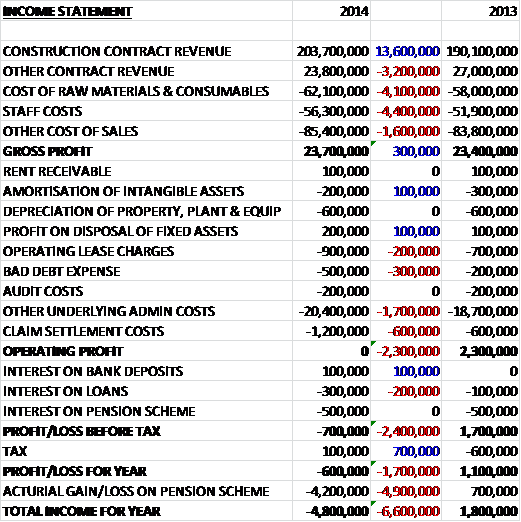
During the year the group has worked on a number of contracts but some stand-out ones include mechanical and electrical engineering contracts at the Walkie Talkie building, BBC White City, Bloomberg London, building E at BP Sunbury, Deutsche Bank, Imperial Tobacco HQ in Bristol, Selfridges, South Bank Tower and Transforming Tate Modern.  There were also contracts at Aberystwyth Student Accommodation, Bank Station Capacity Upgrade, De Vere Gardens, Silwood Sidings, US Air Force Bases Mildenhall and Wyton and the Victoria Station upgrade.

One of the main strategic developments this year was the complete integration of the TClark DRG large scale mechanical operation with the main business which was matched by a series of major M&E contract wins and the appointment of DGR MD and founder Danny Robson to the main board.  These actions open up the large scale M&E contracts in London and other UK markets.

During the year the group launched their Design and Build operation which opens up another new revenue stream for the group in a strategically attractive area.  The business now has a maiden £11M order book and is slightly ahead of its planned growth target.  In the coming year the group is planning on bringing all of its local businesses together within one UK operating company in four new regional operations which includes London and the South East, Central and West, the North and Scotland.  This structure aims to keep the valuable local presences and connections to the local market but also to maximise efficiency, the capability to cross-sell and share resources and knowledge both regionally and nationally.  It is expected that this project will be complete by the end of 2015.

The Design and build division made revenues of £1M during the year and has a forward order book of £11M. The core M&E division made revenues of £148M and has a forward order book of £204M; the Intelligent Buildings division made revenues of £5M and has a forward order book of £4M; the Facilities Management business made revenues of £19M and has a forward order book of £18M and is a particular growth area for the group; the Transport division made revenues of £18M and has a forward order book of £31M and hopes to break into the airport market from their successful rail operation; the Mission Critical business made revenues of £8M and had a forward order book of £6M; and the residential and hotels business earned revenues of £30M and has a forward order book of £26M.

The group is market leader in the large scale electrical engineering sector.  During 2014 margins remained tight but going forward it is expected that better margins will be available as clients seek to lock in the group’s resources as skills shortages loom.  In the large scale mechanical engineering sector, the group made a series of major contract wins and the board thing that this is an area that represents a good growth opportunity.  There has been a strong performance from the transport and residential businesses.  The board see HS2 and other major rail projects as an opportunity for further growth in the transport sector.

During the year the Scotland Green Technologies and Renewable energy department handed over, in partnership with Springfield Properties, the first nine Air Source Heat Pump installations to Muirhouse Housing Association in Edinburgh.  These pumps work by using the latent heat in the outside air to deliver heating and hot water to homes using electricity only to run the fans and compressors. At the school Ask Putney, their package included site-wide mains and sub-mains distribution, complete internal and external lighting systems, site-wide data, fire detection voice alarm, CCTV, access control, metering and maintenance of systems.  Mechanically they provide natural gas site wide distribution, air-con, BMS and smoke extraction systems, full public health services, above ground drainage, rainwater installation, portable drinking water and domestic water services.

The group also completed a major animal management and vet services building working with Midas Construction on a full mechanical and electrical design and build.  They provided everything from PV installation to fire and intruder alarm design and installation.  They also completed a turnkey design and build project for Springfield Fuels, a prefabricated Mask Air Compressor Plant.  It is a world class nuclear fuels facility and T Clark was engaged to design and install a mask air compressor unit to provide breathing air across the site.  The plant was to be prefabricated to that it could be moved in future to a different location if necessary and the air supply was to be delivered to various points across the site.

T Clark has recently, working with global scanner manufacturers Siemens and GE, developed a very high quality in-house design and manufacturing operation for scanner controls. These scanners are installed in every hospital across the UK.  In November the group announced over £7M if major new project wins in London, all starting in 2015.  These included Beaufort House in Hendon, London Wall Place, One Angel Court, Principal Place, Bishopsgate and Rathbone Square.  In the transport division, wins over the past year and a half meant that their order book stretched ahead to 2022.  The work with Costain at Waterloo Station is the first project with this major contractor and around 40% of the contract wins in the division are for full design and build contracts.

In December the team in Huntingdon concluded a six month programme to deliver a full building services package at Peterborough stadium including mechanical, electrical and ICT works.  On the electrical side they installed general power and lighting plus emergency lighting throughout with CCTV, fire alarm, TV, data installation to all floors, local electric and water heaters, and a photovoltaic system on the roof.  They also delivered a lighting protection system to the complete building and external lighting.  On the mechanical side, they installed a new water main, a rainwater harvesting system, net controls and pipework to the existing pitch irrigation system, new water tanks, drainage, a complete refrigerant and heating cooling system and a full ventilation system.

This year there was a £1.2M exceptional claim settlement cost.  A subsidiary business was one of a number of parties that were subject to a substantial damages claim for work carried out in 2007 before it was acquired by the group.  Damages were awarded against the company, the bulk of which were covered by the insurers but following an unsuccessful appeal, the apportionment of costs exceeded the insurance cover in place which resulted in a negotiated settlement that cost the group £700K.

Last year the company settled a sub-contractor claim against the group for work carried out in previous years which resulted in costs of £500K.  A further £400K in costs were incurred this year in seeking to reach a settlement of costs and interest in respect of this claim and a potential counter claim by the company against the sub-contractor.  Proceedings are ongoing in this matter but the directors do not believe there will be any significant additional costs to the group.  In addition, a sub-contractor has brought a number of adjudication claims against a subsidiary in respect of a single contract.  The company has so far been successful in defending these claims but has incurred costs of £200K in doing so (£100K of which were incurred last year).

The group has an £8M overdraft facility with Natwest which attracts interest of 2.75% above base rate and at the year-end none of this facility was being used.  In February the group arranged a £5M committed three year revolving credit facility with Natwest which incurs interest of 3% above LIBOR on drawn facilities and 1.5% on undrawn balances.  This facility includes some financial covenants and while the group was compliant with its obligations at the year-end, this was not the case during the whole year.  The group breached its obligations by failing to notify the bank in a timely manner of an award of damages against them but they managed to obtain a waiver of this breach – it sounds like it might have just been an oversight.

Also, following the settlement of a contractual dispute in the group’s mission critical division which resulted in the group recognising a significant loss on the contract concerned, the group informed the bank that it would be unable to meet the interest cover covenant and requested in advance a waiver of this covenant.  The terms of the facility were subsequently varied before the year-end to remove the interest cover test for the last quarter – this is potentially more serious in my view and reinforces the fact that the group is actually in a bit of bother over its finances despite the apparent large cash pile they are sitting on.

Last year one customer accounted for 18% of total revenues but this year no customers accounted for more than 10% of sales.  As can be seen, the group seems to be having a bit of trouble with its pension scheme.  The deficit of £11.5M represents a funding level of just 68% and has been significantly impacted by the fall in bond yields.  A deficit reduction plan has been agreed with the regulator which involves making additional contributions and providing the security in the form of a contingent asset over the group’s property portfolio worth £3.1M with the aim of eliminating the deficit by 2029.  Employer contributions amount to about £1.1M per annum at the moment which is fairly substantial given the lack of profits being made here.  .

With a record order book of £300M and early signs of margins beginning to improve, the board are looking to 2015 with confidence.

The underlying PE ratio currently stands at a massive 66.2 but this falls to a more reasonable 12.8 on next year’s consensus forecast.  After an unchanged total dividend for the year, at the current share price the shares are yielding 4.1% which remains the same for next year’s forecasted pay out.  The group has a net cash position of £5.2M at the year-end compared to £900K at the end of last year.

Overall then, this has been a rather difficult year for the group.  There was a loss recorded, which seems to have been as a result of various contract disputes and one substantially loss making contract in the mission critical business.  Net assets also fell and the increased pension deficit and increase in payables took their toll.  At first glance the cash flow looks pretty decent with increased net operational cash flow and plenty of free cash but we can see that this was entirely due to the large increase in payables which are going to have to be paid at some point, and the underlying cash profits actually fell year on year.  It is also a bit concerning that a covenant on the debt had to be waived during the period and that pension deficit is starting to look a little menacing.

Operationally, the Southern division is suffering from that loss making contract and things also seem to be rather slow in the Northern division, although in Scotland the group is making increasing profits.  The group is obviously very cyclical and dependent on the UK construction sector and this, in London at least, finally seems to be picking up which should bode well for the coming year if the group manages to stay clear of further contract disputes.  The forward PE ratio looks about right and the yield of 4.1% is certainly worth considering but although I do feel this should be a much better year for the company I have a few niggling doubts about how well they can take advantage of the increased opportunities.