James Halstead Finance Blog – FY 2013

James Halstead has now released their final results for the year ending 2013.

jameshalstead2013income


Revenues for the year were down across all reporting groups with Oceania/Asia particularly badly hit. It is worth noting that the motorcycle accessories business is no longer trading though so if this, along with the effects of foreign currency translation is discounted, revenues are only down 1.1% on last year.  Thankfully costs of sales were also down but not enough to prevent a £3M reduction in gross profit.  We see depreciation down by £1.2M on the total last year and a fall in admin costs is slightly mitigated by an increase in distribution costs as a result of increased warehouse space, meaning the operating profit fell by less than gross profit, down £1.5M.  A reduced expected return from the pension scheme is counteracted by less interest on pension liabilities and increased interest on the cash reserves before a £1.6M reduction in tax, relating to lower rates in the UK relative to Germany and Australia,  gives a profit for the year just about flat (up £68K) at £30.6M.  This is the first fall in revenues for some time but not a catastrophic loss due to the beneficial make up of taxation this year.

jameshalstead2013assets


Overall assets were up £4.3M on last year.  There was a large increase in inventories due to a broader product range and product launches near the year end, a £1.9M increase in trade receivables and a £1.8M increase in plant and equipment.  These were somewhat counteracted by a £3.8M fall in cash levels.   Assets were also up during the year with the big increases seen in trade payables, up a hefty £8M and the pension obligations, which increased by £3.5M.  Most other liabilities decreased but net tangible assets still fell by £3.5M to £87.6M.

jameshalstead2013cash


The cash profits were £2.1M lower at £43.6M before adverse movements in inventories and receivables were counteracted by an increase in payables before pension payments of £1.1M left the net cash from operations up by £4.9M to £42.1M.  There was then a small amount of interest received from the cash balances and a hefty tax bill of £11.4M which meant that net cash from operations was £31.1M.  This cash flow was entirely spent on dividends as a special dividend meant that £31.5M was given back to shareholders (this was £16.1M more than last year).  This was instead of the purchase of their own shares (£5.2M was spent on this last year).  Added to this, there was £3.7M that was spent on capital expenditure.  Overall there was a cash outflow of £3.8M which, when it is considered that dividend payments doubled to £31.5M is very good really.  It is worth noting the higher value of trade payables, however.

Raw material prices were broadly level with the last two years but were at historically high levels.  The more pressing issue in this industry is apparently the excess capacity and the battle to gain volume.

The Scandinavian business performed well with Norway advancing sales 5% and Sweden rocketing by 23%.  The market in Norway picked up towards the end of the period with increased activity in healthcare and education.  Some projects included the new HQ for the Department of Environment  in Norway and the NKS Hospital and Tele2 Arena in Stockholm.  The business in the rest of mainland Europe had a flat sales performance.  Germany is a very large market for vinyl flooring and as such attracts a lot of competition despite the government belt tightening going on there which has led to an erosion of margins. This, along with the full effects of the new higher capacity warehouse had an effect of profitability.  A revamped commercial range of Luxury Vinyl Tiles was launched in Germany and although it is facing some price pressure, performance has been good so far.  The group supplied flooring to Jena Social housing renovation project in Germany, one of the largest of its kind in Europe and was the major flooring partner in the Weissenhauser Strand development, a major holiday park at Kiel.

Oriental Asia sales were 8% ahead of last year and enjoyed some margin improvement too, with China in particular trading well as the group’s reputation and a competitive advantage due to the weakness of sterling took effect.  This is particularly pleasing giving the potential there but at some point sterling may strengthen which would apply some pressure.  The group supplied a good portion of the flooring for the 12th National Games of the People’s Republic.  In contrast, Australia suffered somewhat and sales were down 11% as some large projects came to an end.  However, there has been some good take up of from the retail sector there and all trains and trams in Southern Australia have James Halstead flooring.  New Zealand is showing some tentative signs of recovery as turnover was up 2%.  The group secured a tender for all social housing through “Social Housing New Zealand” as well as supplying flooring for the last 7 hospital refurbishments and supplying safety flooring to the number one bus manufacturer.  Rebuilding work following the earthquake in Christchurch is also proving favourable for the group.

UK turnover increased by 4% and remains the most important market for the group.  During the year a new safety floor design was released and sales of this have been encouraging.  During the year the group also released a new luxury vinyl sheet for supply to the social housing market which is also proving to be a success.  In the factory, the line speed has been upgraded along with capability but the slow-down in some overseas markets has been hampering productivity.  Other examples of new contracts won include the Specsavers chain of stores in Sweden and the Wulanchabu hospital in Inner Mongolia.

Going forward, government spending is restricted in many markets and the outlook appears tough.  There is not an extensive visibility in the refurbishment market and major contracts are contested keenly by all manufacturers so it appears than in the immediate short term the period of rapid expansion may be at an end.

Overall then, we have seen that revenues are down across all reporting groups but delving a bit deeper shows that these figures are hiding some good performers as the termination of the motorcycle accessory business clouded good UK figures; poor sales in much of continental Europe overshadowed strong Scandinavian turnover and the end of some large Australian contracts dragged results in that segment down in contrast to strong Chinese growth.  The profit for the year was flat.  In fact it was almost exactly flat but this was only due to the fact that a higher proportion of sales in the UK meant a lower tax bill due to the relatively favourable tax system here.  Net assets were down mainly due to a higher level of payables but the fact that a special dividend was paid that almost doubled tax payments to shareholders had an effect on net assets.  In fact, the small outflow of cash was excellent considering this massive pay-out.

Even after the big dividend pay-out this year, the group still has a net cash position of £34.7M.  The dividend yield at the current share price is 3.1% not including the special dividend.  If this was counted, the yield would be 5.5% which is a very good return.  The current P/E ratio of 19.3 suggests that the stock is not cheap but when the net cash position is taken into account, and the fact that James Halstead is so cash generative then this no longer looks that expensive to me and I am tempted to top up here.

On 6th December, at the AGM the group announced that modest growth had occurred in turnover for both the UK and overseas markets with France in particular doing well.  Raw material supply and input prices were steady, cash balances were solid and the first half results are likely to be within expectations.  Overall a fairly decent update.

On 3rd February, the group released a trading statement covering the first half of the year.  Central Europe, and France in particular did well and Oceania was on a par with last year.  Unfortunately, after a poor December, profit overall will be 3-4% below the same period of last year on revenues 2% up on the same period.  Apparently this was within expectations but still slightly disappointing.

GlaxoSmithKline Finance Blog – Half Year 2013 results

Glaxo has now released their half year results for the year ending 2013.

glaxointerim2013

In the first half of the year, revenues in US and European pharmaceuticals ticked up slightly, along with Consumer Healthcare revenues.  Emerging market pharmaceutical revenues were up substantially but this was counteracted by a big fall in Japanese Pharmaceutical revenues with ViiV healthcare continuing its decline.  Overall revenues were almost flat, down by just £13M. An increase in cost of sales drove Gross profit down £143M.  Selling and admin costs reduced, but this was more than mitigated by an increase in R&D expenditure.  Royalty Income increased by £57M but an “other” operating income of £545M in the first half of last year turned into and expense of £69M which had an adverse effect on operating profit, down £709M to £3B.  There was a £29M profit on disposal of associate and income from associates and joint ventures increased to £18M, added to this, taxation was lower than last year which gave a profit for the period of £2.1B, down by £563M on the first half of last year.  Due to a huge actuarial gain on the pension scheme, total comprehensive income was £2.9B.

glaxointerimbalance2013

Overall assets were up by more than half a billion pounds to £42.1B.  The largest increases were the £488M extra in assets held for sale which relates to the anticoagulant and Lucozade/Ribena operations which are being held for divestment, the £451M increase in other investments and the £341M increase in trade and other receivables.  This was partially counteracted by the £1.3B reduction in cash levels.  Liabilities were also up, driven by a £300M increase in loans and a £269M hike in provisions.  Overall net assets were up £534M to £7.3B but when goodwill is taken off, they are up a bit less (£394M to £2.8B).

glaxointerimcash2013

Cash profits showed an improvement of £247M over the first six months of last year and after adverse movements in working capital caused mainly by increased inventories to support growth businesses, the cash generated from operations was £109M more than last year at£3.6B, which after tax became £2.96B.  Capital expenditure was higher than last year and there was a net outflow of cash on the purchase of intangibles of £135M as opposed to a net income of £672M during the first half of last year.  There was also £205M spent on the purchase of new business which meant that the cash flow before financing activities was £2.18B, £596M down on 2012.  There was £366M of shares purchased and cancelled but £426M of new share capital issued – not sure how that makes sense!  There was also £588M spent on the purchase of non-controlling interests, a net £458M repayment of loans and £1.94B of dividends paid to shareholders.  This all meant that there was a cash outflow of £1.37B during the half year.  This sounds disappointing and seems to basically be as a result of keeping the high payments of dividends to shareholders.

The group reached settlements in principle with the Attorneys General of eight states to resolve lawsuits relating to the marketing of Avandia as well as the separate action brought by the Attorney General of Louisianna relating to other products.  The total settlement was $229M and was within existing provisions.  As soon as one legal issue seems to be becoming resolved, another one rears its head, though.  The Ministry of Public Security in China has confirmed an ongoing investigation into alleged serious economic crimes by GSK China which is a real blow as China is one of the areas that GSK is performing well.   The outcome at this time is not known.

During the year, the group completed the acquisition of Okairos AG, a European based biopharmaceutical company focused on the development of a specific vaccine technology in the prophylactic and therapeutic fields.  The total consideration was £205M which represented a goodwill payment of £37M.  An offer of £700M was received for the two anticoagulant products and the related manufacturing site from Aspen Group during the period.

Excluding the impact of disposals, turnover was up by 2% during the half year.  There was a differing performance for each sector.  Worldwide vaccines fell by 5% due to the reduction in Cervarix sales in Japan.  Discounting this, vaccines increased sales by 1% reflecting strong growth Infanrix in the US due to a competitor supply issue.  Consumer healthcare sales grew by 6% discounting the divested OCT brands.   In the US, Pharmaceutical sales fell by 2% mainly due to the conclusion of the co-promotion Vesicare agreement.  Sales of respiratory products fared well and grew by 8% and Oncology sales were even stronger, up by 17% but was partially offset by a 21% decrease in Lamictal sales due to increased generic competition and a 35% fall in dermatology sales.   US vaccine sales were up 7% primarily due to a 19% hike in Infanrix sales.

European pharmaceutical sales were down by 3% as good sales of Oncology products were counteracted by lower sales of older products and price reductions of Avodart.  Vaccines grew sales by 5% due to improved tender performance and beneficial tender phasing.  EMAP pharmaceutical sales grew by 7% with the Middle East, African and China showing particularly good contributions.  Augmentin sales were up 18% and Setetide was up 11% but augmentin sales had a favourable comparison with a poor half last year that was affected by supply problems.  EMAP vaccine sales were down 5% due to phasing issues.  In Japan there was a 4% increase in pharmaceutical sales as strong growth in respiratory products Avodart, Lamictal and Relenza were partially offset by an erosion in Paxil sales.  Japanese vaccine sales collapsed by half and ViiV healthcare sales fell by 5% as increased sales of Epzicom and Selzentry were more than counteracted by falls in sales of older products.  Not including the divestments, consumer healthcare turnover was up by 6%.  Growth in the US and Europe was driven by Sensodyne and the restocking of Alli.  In the rest of the world, strong growth in India, the Middle East and Latin America was mitigated by falls in Chinese sales.  US and European pharmaceuticals still make up the majority of profits.   

Respiratory sales in the first half of the year were up 5% with strong growth in all regions with the exception of Europe.  Seretide sales were up 5%, Flixotide sales were up 6%, Xyzal sales were up 28% (albeit from a small base) and Ventolin was up 5%.  In the US, sales were up an impressive 8%, European sales were down 2% reflecting ongoing austerity measures, EMAP sales increased by 8% with strong growth in China, Turkey and Brazil and Japanese sales were up 10%.  Anti-viral sales were down by 8% due to declines in Valtrex and Relenza;  Central Nervous System sales were down by 12% with Seroxat, Requip and Lamictal sales all suffering from generic competition; Cardiovascular sales were down 12% due to the conclusion of the Vesicare co-promotion agreement in the first quarter of 2012. Not including Vesicare, sales were up 1% due to strong increases in Avodart and Duodart revenues.  Metabolic sales were up 19% but still represent a small sector for the group. 

Anti-bacterial sales were up 4% driven by an 8% hike in Augmentin sales as strong growth in EMAP was helped in part by the phasing of shipments in H1 2012 as a result of some earlier supply interruptions.  Oncology sales did well, increasing by 20% as Votrient sales more than doubled, Promacta sales grew 51% and Arzerra sales grew 41% which were mitigated slightly by a 13% fall in Tykerb and generic competition for Hycamtin in Europe and Argatroban in the US.  Dermatology sales were down 4% with US sales crashing by 35%.  Rare Disease sales were up 17% which were mostly driven by Volibris, up 24% and Mepron up 62%.  Flolan sales were down 16% as a result of the biennial price reduction in Japan and continued generic competition in Europe.  Immuno-inflammation sales were £67M, up from nothing this time last year – all these sales were for Benlysta.  ViiV healthcare sales were down 5% as a 10% hike in Epzicom and an 18% increase in Selzentry sales were not enough to halt the decline in the more mature portfolio.

Vaccine sales fell by 5% due to the comparison with the final stages of the HPV vaccination catch up programme in the same period of last year.  Excluding Japanese Cervarix sales, vaccines were actually up by 1% reflecting strong performance in Europe and the US offset by the impact of the phasing of tender orders in EMAP.  Synflorix sales fell by 8%, largely reflecting phasing order timing; Infanrix sales increased by 14% due to stronger orders in Europe and EMAP along with competitor supply issues in the US.  Sales of Hepatitis vaccines fell by 5% due to the return to the market of a competitor in the US.

Consumer healthcare sales were up 1% but when the sold OTC brands are discounted, turnover was up 6%.  The strong performance in oral healthcare was driven by a 14% hike for Sensodyne and a 9% increase for denture care brands.  Total Wellness brand sales were up 4% on a like for like basis which was partially driven by the favourable comparison for Alli, which was out of stock for a period in the first half of last year for both the US and Europe.  A severe cold and flu season in early 2013 helped Coldrex, Panadol and Beechams increase sales but there was a 45% reduction in sales of Contac, due to new shelving requirements in China.  Nutrition sales were up 6% as strong growth in emerging markets, led by Horlicks in India more than offset a 2% decline in Europe.  Skin health sales were up 9% led by Abreva in the US. 

At the end of the half year, the group had a net debt position of £15.72B, which was a whole £1.683B more than at the start of the year (£800M of this is being blamed on adverse dollar to sterling exchange rates and another £800M due to the acquisition of further shares in Glaxo India and the acquisition of Okairos).  Glaxo need to be careful not to let this get carried away.  The group are targeting share repurchases of between £1-2B during the year.

During the half year there was a £48M amortisation of the Benlysta intangible asset acquired as part of the HSG acquisition.  Other one-off costs were the £151M under the Operational Excellence Programme, £90M under the Major Change Programme and £18M related to the HSG acquisition.  There was also £90M of legal charges principally related to provisions for existing product liability matters.

There have been a number of changes to the pipeline of new drugs.  Quadrivalent flu vaccine was approved in Q1 but there was less good news for IPX066 as the collaboration with Impax was terminated.  In Q2 there was FDA approval for COPD treatment Breo Ellipta and Mekinist and Tafinlar for Metastatic Melanoma.  All three of these treatments have subsequently also been filed for use in the EU.

Overall then, revenues were flat on the same period of last year with decent performances in the US, Europe and EMAP were counteracted by lower revenues in Japan due to the comparison last year with the end of the Cervarix vaccination programme and falls in ViiV sales due to the mature portfolio.  R&D and other cost of sales were also up which meant that profit for the half year was down £563M to £2.1B. Net assets ticked up a decent amount due to new investments and cash from operations also did well despite a large investment in inventories.  Cash flow was impacted by higher capital expenditure, the purchase of acquisitions and a lack of any intangible asset sales which meant there was a cash outflow of £1.37B.  When it is considered that £1.94B was spent on dividends, this outflow isn’t a total disaster.  Progress has been made on the Avandia lawsuits which seems to be mostly behind the group now but the new investigation in China is a real blow considering how important the country was becoming to Glaxo.  Disappointingly net debt was up considerably which was blamed on adverse exchange rates and acquisitions.  I would like to see net debt come down somewhat in future as it seems a bit high to me.  The board announced a dividend of 18p (the same as for the last quarter) for the quarter which makes the rolling annual yield 4.7% which is pretty decent.   I still rate these shares as a hold given the dividend income.


Tristel Finance Blog – FY 2013

Tristel has now released their full year results for 2013.

tristel2013income

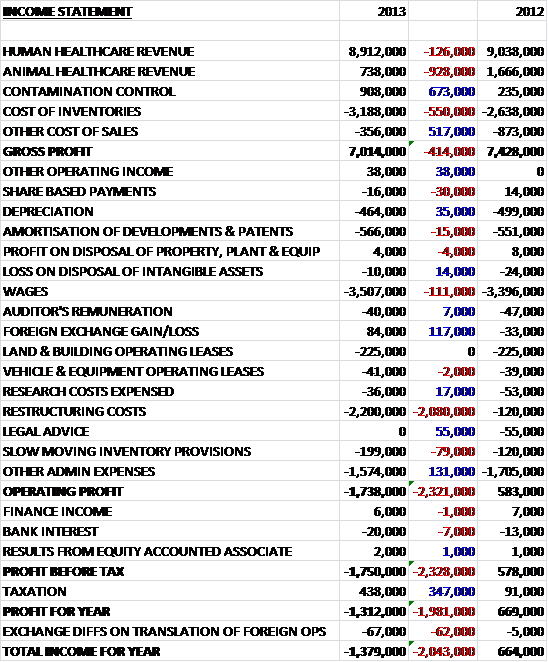
Falling revenues in Human Healthcare and Animal Healthcare were partially mitigated by a hike in Contamination Control revenue.  During the year the agreement with the distributor in the Animal Healthcare segment was terminated and the group sold direct to the customer.  One consequence of this was that some of the sales that used to go through the distributor were actually found to be going into the other two segments and the Animal Healthcare revenue reductions show this.  Costs of sales were also marginally higher to give a gross profit of £7M, which was £400K lower than last year.  Wages were £111K higher during the year and remain the largest single cost but this year also saw a £2.2M restructuring charge which drove last year’s operating profit to a £1.7M operating loss.  The restructuring costs included costs involved in reducing headcount and impairments to assets after a review of the balance sheet, so they are mostly non-cash items.  At least there was a tax rebate on the (mainly) non-cash losses so the loss for the year was just under £2M worse off at £1.3M.

Tristel2013assets

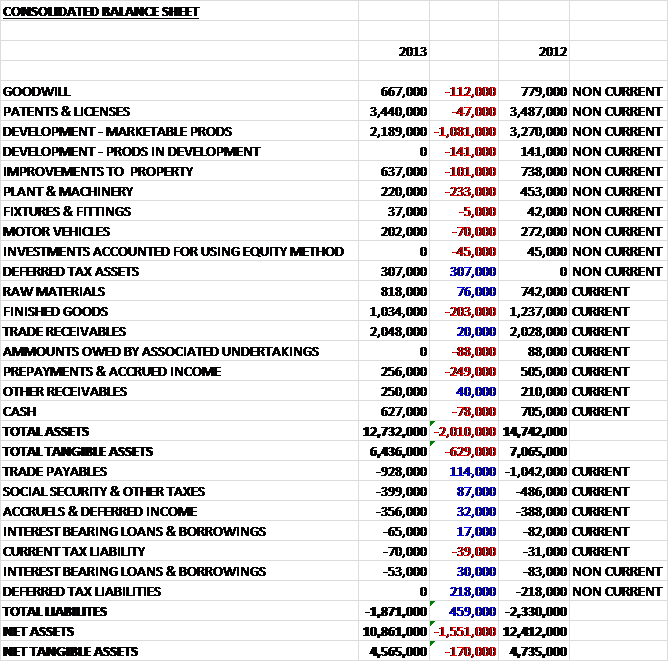
Assets at the year-end were down just over £2M to £12.7M with almost all individual assets suffering a decrease.  The largest fall was the reduction in the intangible development assets which declined by more than £1M and relates to Stella disinfectant wipes as the recoverable value of sales was deemed to be less than the asset value on the balance sheet resulting in impairments.  Due to the loss making year, the only asset to substantially increase is £307K of deferred tax asset.  Liabilities, however, also declined during the year with the wipe-out of the £218K deferred tax liability and the £114K reduction in payables being the biggest fallers.  This meant that liabilities were down £459K and net tangible assets had a small reduction of £170K to £4.6M.

Tristel2013Cash

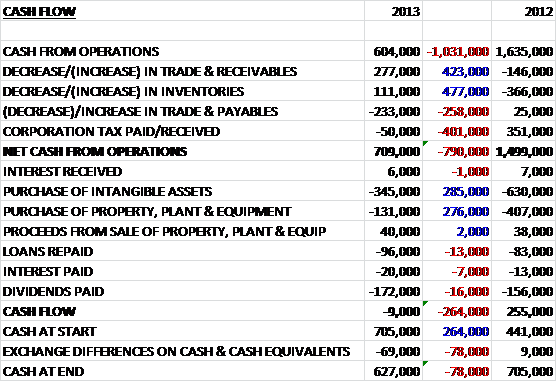
The cash profits for the year collapsed by over £1M to be just £604K.  There was a favourable movement in working capital, however, with a decrease in receivables and inventories not being fully mitigated by a decrease in payables.  Corporation tax was £50K to leave the net cash from operations at £709K, less than half the figure last year.  A lot less was spent on capital expenditure this time and after a loan repayment of £96K and £172K of dividend spend, the cash outflow was only £9K, £264K worse off than last time but considering the poor profit levels, the increased loan payments and the small hike in dividend, this is actually quite a good cash flow, mainly due to the reduced capital expenditure. 

During the year a provision was made against certain inventories against slow moving and obsolete stock with £204K being taken off the value of Tristel Stella equipment and £206K taken off Shine equipment.  It was also mentioned that the amount owed to the group by Tristel Italia was considered doubtful and provided against (this is another component of the non-recurring items).  It is not clear why the receivables are considered doubtful and whether the associate will continue trading with Tristel – a little more information about this would have been useful.  Tristel continues to pay royalties to the company belonging to one of their directors, Bruce Green which I still find a little uneasy about.

The main issue that has faced Tristel during the past year is the collapse of the legacy Endoscopy sales that have had to be replaced by new products.  During the year, the group has worked hard to make sure these products were available and to get the overseas offices to become cash generative.  This has generally happened and the results this year have been characterised by a poor first half of the year followed by a decent performance in the second half as management seem to have been caught out by the severity of the fall-off in endoscopy sales which more than halved during the period.

Another major issue has been the termination of manufacturing for the distributor (Medichem) of the animal healthcare products.  The group now sell their own brand to the market, which is named Anistel.  This has led to higher margins but they have found it difficult to market these products directly as they are outside the traditional products that Tristel sell.  There seems to be some traction being made as 16 overseas distributors have now switched over to Tristel and 2014 should be a little better for this product.  The Crystel range has been selling more slowly than was anticipated but client wins in industry and NHS aseptic units have given rise to a 286% increase on last year’s sales.  Sales for next year are expected to substantially increase.

By far the most profit is still currently made in the Human Healthcare segment but profits in the Contamination Control business is also on the up.  Geographically about 2/3 of sales are made in the UK.  There were a number of customers that made up a large proportion of revenues, with the largest accounting for 19.4% although this has reduced from 33.2% last year so some progress seems to have been made in diversifying revenue sources.

The Wipes system is used to decontaminate nasendoscopes, cardiology and ultrasound probes.  They have been approved for use by the Australian regulatory body and the Chinese Ministry of Health and are recognised by many professional bodies.  Sales from overseas offices (New Zealand, China, Hong Kong and Germany) increased by £600K year on year.  Tristel NZ sells the Stella decontamination system and supplies the New Zealand and Australian hospital infection control market, sales more than doubled to £735K.  The Chinese subsidiary sells the wipes system, Stella and Fuse, the surfaces range.  Sales here fell by 42% to £305K but the restructuring work undertaken at this office meant the business was cash break-even.  The German office serves the hospital infection prevention market and sales here nearly trebled to £623K.  The Russian branch is still in formation and no activity has yet started there.

In the instruments sector, Multi channelled endoscopy fell by more than half but this was counteracted by a small increase in UK Single Lumened endoscopy and a £500K increase in sales of overseas singles lumened endoscopy.  The board feel that they are some way off reaching market saturation point and that women’s health and ophthalmology offer particularly good growth prospects and it is expected sales will continue to grow strongly.  Sales of surface products increased by less than 1% with an increase in UK sales being mitigated by a 5% fall in overseas sales.  It is anticipated that the upward momentum in sales will be restored next year.  In the Water sector, Tristel is the exclusive European distributor of Bio-Cide products used to control the Legionella bacterium.  This agreement was renewed for 20 years in 2008.  Sales of these products were down £64K and fell both in the UK and in export markets – this sector is not considered a growth opportunity but a consistent stream of cash. 

Revenues overall were down on last year due to the fall-off of the legacy endoscopy product and the termination of the distributer agreement for animal healthcare.  There was a £1.75M loss before tax but considering there was a one-off charge of £2.2M, this indicates that the group would have made a similar amount of profit to last year without these charges.  Nat tangibles nudged down due to impairments of some plant and machinery and certain inventory.  There was a small cash outflow which was kept low due to reduced capital expenditure.  Apart from the endoscopy products, the other products seem to be gaining traction and the board have a rather bullish view of next year’s prospects (although this is not the first time I have heard this).  Although the group made a loss this year, things do seem to be looking up for next year but the future P/E ratio is predicted to be 17.2 according to analysts, which seems a bit pricey for the moment.  The current dividend yield is 1.2%, which is not that stellar either so I am reluctant to rely on forward looking management statement so I do not see these as a buy at the moment.

 On the 10th December the group released an AGM statement.  It was noted that the strong trading had continued and in the first half of the year revenues were up by 36% to more than £6M and profit will come in at £600K, which is £100K above the profit for the whole of last year.  They have seen growth from all areas of the business and there was a significant increase in sales of Tristel wipes.  It was also noted that the pattern of growth should continue into the second half and full year results are likely to be ahead of market expectations.  It does seem that Tristel has turned a corner and I have topped up with some more shares.

On 22nd January the group released a trading update covering the first half of the year.  They reported that they had enjoyed a strong first half and that a better than expected December has led to a performance ahead of expectations.  Revenue will be in excess of £6.4M, pre tax profit will be more than £700K and the group is now in a net cash position.  Particular growth was seen in sales of products used to disinfect non & single lumened instruments, hospital surfaces and within aseptic units.  Overall, a very reassuring statement.

Ricardo Finance Blog – FY 2013

Ricardo has now released their results covering the full year end 2013.  Technical Consulting provides services in relation to the development and implementation of engineering projects and in relation to management and operational consultancy, this segment contains the newly acquired Ricardo-AEA.  Performance Products generates income from manufacturing, assembly, software sales and related services.

ricardoincome2013


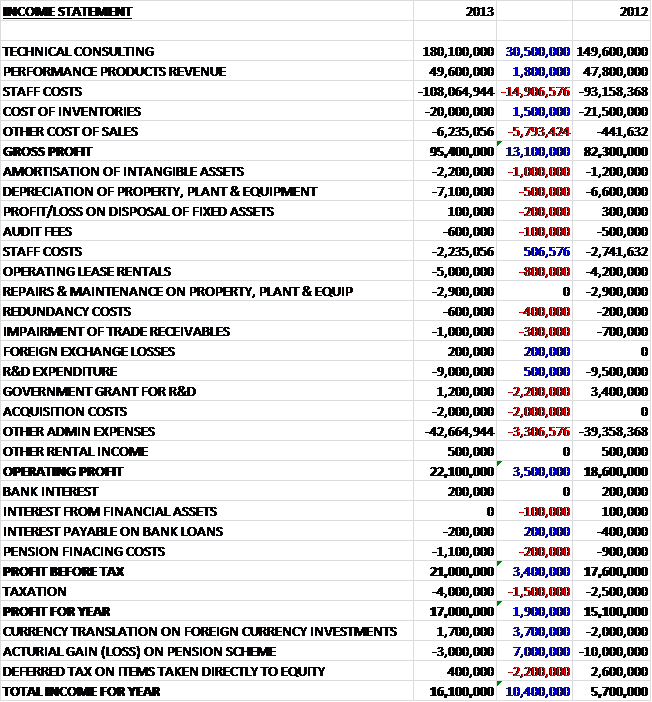
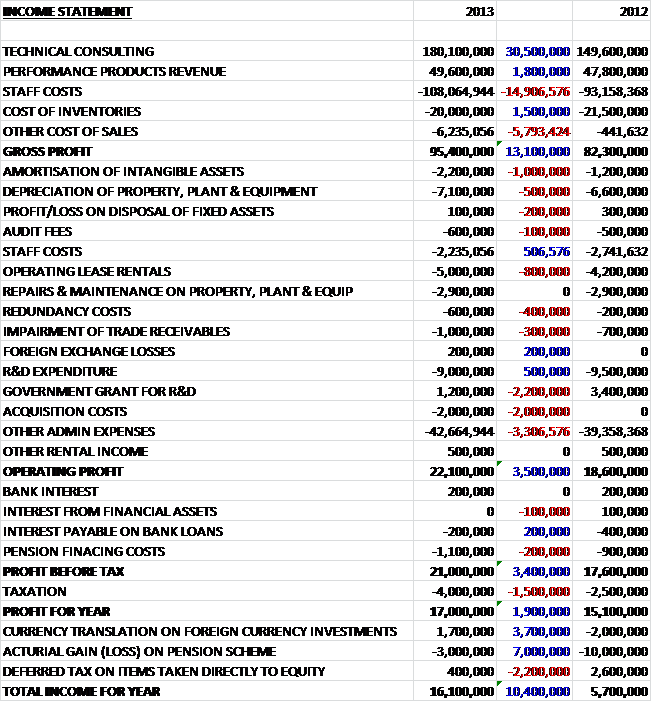
Revenues in the Technical Consulting division were up by £30.5M, mostly due to the extra income from the AEA acquisition.  Performance Products revenue also ticked up slightly to just under £50M.  Staff costs, as would be expected for the larger group, were up by nearly £15M.  This meant that the Gross Profit was £13.1M higher at £95.4M.  Admin Costs also increased, as did Amortisation and acquisition costs.  There was also a smaller government grant for R&D by the tune of £2.2M.  The outcome of this is that Operating profit increased by £3.5M to £22.1M.  Taxation was £1.5M higher, primarily due to a legislative restriction in Germany on the utilisation of tax losses so the Profit for the year was £1.9M up at £17M, which was a respectable result.

ricardobalance13


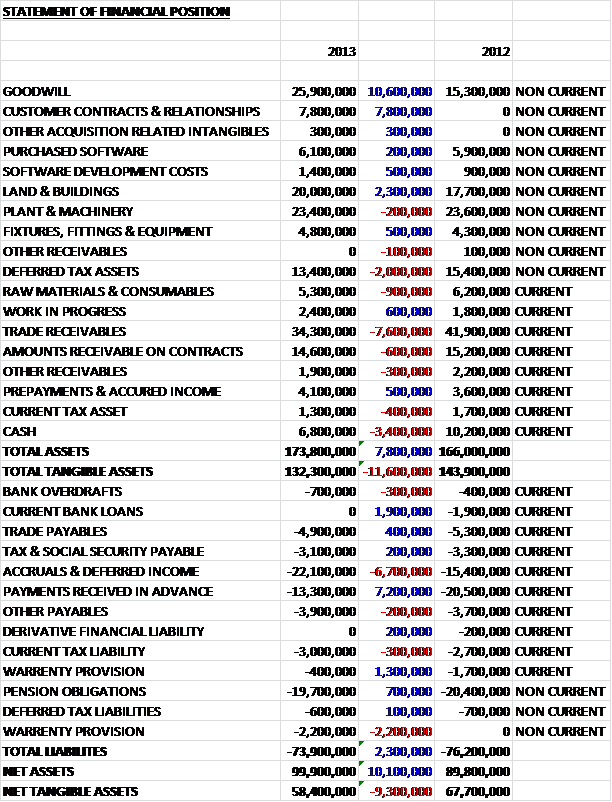
Total assets for the year were up £7.8M but a closer inspection shows that the increase was predominantly in intangible assets with goodwill up by £10.6M and customer relationships up £7.8M.  This increase is clearly from the AEA acquisition.  The only other major increase was land and buildings, up by £2.3M.  A number of assets fell, with the largest fall being the £7.6M reduction in the value of trade receivables.  There was also a £2.4M reduction in tax assets and a £3.4M fall in cash.

Liabilities actually fell during the year with the largest fall being a £7.2M reduction in advance payments.  The other major fall was in bank loans, down by £1.9M to give a loan position of zero.  There were a number of increases too, with accruals up £6.7M being the only major one.  This all means that net assets were £10.1M higher than last year but due to the bulk of the asset increases being intangible, net tangible assets actually fell by £9.3M to £58.4M.  Given the lack of debt, this is still a very comfortable figure, however.

ricardoincome2013


Cash profits were fairly good, up £4.9M on last year and the movements in working capital were overall somewhat favourable with a decrease in receivables not being entirely mitigated by an increase in payables.  There was a fairly hefty pension payment, however, which was £700K higher at £3.7M.   In fact, the pension costs took their toll on the net cash from operations again, with the finance costs increasing by £200K to £1.1M.  The net cash from operations finished £6.9M better than last year at £29.3M.

Capital expenditure was fairly high and the purchase of property, plant & equipment was up £1.8M to £10.3M and included the construction of the Vehicle Emissions Research Centre in the UK.  The largest cost was the acquisition of AEA, however, which was £18M.  This was slightly mitigated by £4M of sales of assets which included £3.7M received for the sale and leaseback of the offices in Germany and a £1.6M government grant relating to the Vehicle Emissions Research Centre.  Although, a new £10M loan was taken out, this was actually paid back in full, along with £2M of historic borrowing.  On top of all this, there was a £6.6M dividend payment.  Overall, there was a cash outflow of £3.7M compared to a £5.4M in flow last year but when we consider that there was a net £14M paid on acquisitions, a net £2M reduction in borrowing and £6.6M of dividends paid, this small outflow seems like a very good performance indeed.

The operating profit for Technical Consulting is £16.8M and the profit from Performance Products is £6.1M.  This is up from £14.7M and £5.8M respectively last year.  Ricardo does seem to be quite exposed to two very large clients.  One customer accounted for £36.3M of revenue in Technical Consulting and another customer accounted for £24.3M of revenue split between the two business segments.  The failure of one of these clients would be very damaging to the group.  The majority of revenues were earned in the UK and this increased further during the year, up £20.4M.  Revenues earned in the rest of Europe also increased considerably, up £11.8M.  Also doing well was Japan, up £3.8M with the US (up £2.4M) and Malaysia (up £1.5M) performing well too.  The only major region to reduce revenues was Germany, where they fell by a very disappointing £5.8M.

On 8th November, the group acquired AEA Technology PLC, which was in administration, for a total cash consideration of £18M which included a goodwill payment of just under £10M.  Time will tell, but this looks like a fairly good value acquisition to me.  The group is engaged in consultation and advice on environmental matters.   Apparently the integration is performing above expectations and is making considerable synergy savings.

Although revenues overall were up 16% in the year, if the contribution from AEA is discounted, this falls to a 3% increase.  The order intake in the year was £218M, discounting AEA it was £192M which was a £5M fall on last year.  The order book at the end of this year was £121M which is £14M up on the end of last year but £13M down discounting Ricardo-AEA.  Within technical consulting, it was noted that more passenger car companies were willing to commit to externally resourced development programs.  The group is generally involved in around 400-500 projects at any one time ranging from a few thousand pounds to multi million pound projects.

There has been some change at the board level as Group Finance Director, Paula Bell resigned in May and is now CFO of John Menzies.  It sometimes worries me when finance directors unexpectedly resign but at just 46 I guess she must have felt Menzies was the next step up.  She is replaced by Ian Gibson who is a chartered accountant with thirty years of commercial experience and was previously CFO at Cable and Wireless Worldwide PLC (albeit he only held that post for just over a year before it was taken over by Vodafone).

Some of the varied projects that the group has been working on over the past year include assistance to Cox Powertrain to develop their engine concept of a new engine that has approximately half the fuel consumption of a state of the art diesel engine.  Ricardo worked very closely with Cox, so much so that Cox relocated to the Ricardo Technical Centre site in Shoreham.  Typical applications for the new engine would be ferries, coastal patrol boats, motor cruisers and supply vessels for the offshore wind sector.  There is also significant military interest, with the Royal Navy ordering a prototype.  Cox has now matured as a business and relocated again to its own premises but Ricardo continues to provide engineering consultancy to the group.  Ricardo was named a strategic partner for Jaguar Land Rover to help bring its new model line up to launch which included work on the integration of engines, advanced drivelines and chassis systems.  The impetus for this project was targeted at the Chinese market which expects luxury sedans powered by downsized engines to avoid the higher rates of tax on large engined imported vehicles.  Ricardo’s responsibilities included component design and development, vehicle package management, simulation, testing and the management of the prototype fleet.  The resulting cars won significant numbers of new customers in China and were deemed a success.

The newly acquired Ricardo-AEA worked with the Gibraltar government on an on-going project to help the outpost meet EU legislative limits for ambient air quality and to fulfil public information obligations.  The group also entered into a three year contract in 2013 with the city of Riyadh (Saudi) to support their air quality policy by providing analysis, measurement, modelling and advice to the city.  In the UK, the group has worked on low emission schemes in London and Oxford.  Another project was with Aggreko (a provider of industrial generators) providing engineering support to develop a more fuel efficient, cost effective generator.  The group has a similar collaboration with Cooper Corp from India to provide a lighter, more fuel efficient, cost effective and quieter generator.  The focus for Ricardo’s rail business is on fuel efficiency and exploring alternative fuels and Ricardo has worked with GE Transportation on more fuel efficient locomotives, including a study to determine the efficiency of using natural gas a locomotive fuel source.  Ricardo already had a long collaboration with BWM motorcycles and was chosen to assist on the new BWM scooter.  By basing the resulting engine on globally produced components and BMW standard parts, there was a lower materials bill with no compromise on quality.

Activity in the Government sector was down on last year due to the cyclical nature of major programmes.  During the year, some contracts won included an award by the California Energy Commission to perform a survey of the plug-in electric vehicle marketplace and a project for the US Advanced Research Projects Agency for support of advanced electric motor design.  For Ricardo-AEA, the UK Government sector remained its largest market and despite increasing pressure on budgets the group won contracts for the Combined Heat and Power Quality Assurance Programme, the Climate Change Agreements Programme, Resource Efficient Scotland and the Scottish Air Quality Database.  The group also expanded internationally with the Riyadh air quality programme.

The Passenger Car business remained a very important sector for Ricardo and project demand was strong with orders from the US, Japan and China as well as the UK from customers such as Jaguar Land Rover.  Order intake was well balanced and the need for continued fuel efficiency and lower carbon emissions continued to be an important driver.  The High Performance Vehicle sector tends to straddle both technical consulting and performance products  and demand remained positive in both motorsport and luxury road cars.  In the Motorcycle business new projects were won in both China and Japan in addition to wins from the long standing European customers.  Projects include base engine & transmission development, emissions reduction programmes and hybrid & control systems.  Activity in the Commercial Vehicles sector was lower than in prior years due to Europe being towards the end of the product development cycle for Euro Vi emissions legislation and North America being yet to define future emissions legislation changes.  The focus in Europe this year was on fuel economy improvements and in the US the focus has been on cost reduction and quality improvement programmes.  Projects were completed a Japanese OEM and a Chinese manufacturer in Asia.  Significant new business wins included engine testing, manufacturing site assessment and power drive unit analysis for US customers and the completion of the European ERTOC project

A slowdown in the Chinese construction industry and the delay of any new legislation in emerging markets has led to lower activity in the Industrial Vehicle sector.  There was a continuation of the TaxiBot programme in Israel, which is a vehicle that allows planes to taxi without using their own engines and there were a number of base engine programmes awarded in Europe, Asia and North America.  Ricardo’s performance in the Defence sector was very good despite government austerity measures affecting their defence budgets and the group experienced increased penetration into European, Asian and Middle Eastern markets. New contracts included a programme with a European defence vehicle engineering company to develop hybrid technology for an eight wheel drive platform.  In the US a contract was secured with DARPA and a test of the new Ricardo engineered vehicle for TARDEC showed that it had a 70% improvement in fuel consumption.

The Rail sector business remained buoyant during the year with order intake doubling on the figure of last year and there is now a very good geographical spread of orders with new clients being won including Bombardier, CNR Dalian and GE Transportation. The new projects have focused on increasing fuel efficiency and looking at alternative fuels.  The Power Generation sector experienced increased demand during the year where major areas of activity were large engines for power generation, combined heat, power and energy storage systems and offshore wind generation.  Contracts included the previously mentioned work with Aggreko and the support of Atlantis Resources on their tidal energy system.  Ricardo-AEA recorded contracts with a large property developer looking at greenhouse gas emissions, air quality monitoring for an airport group, benchmarking the carbon footprint for a food manufacturer’s products, assisting a major global bank to support green investment and waste flow analysis for a services outsourcing provider.

Demand in the Marine sector is being fuelled by the international marine emissions regulations and the introduction of low sulphur fuels.  Contracts were completed on several gas engine development programmes and new contract wins included gas engine design, new high speed diesel engines for European and Chinese customers and a European R&D programme aiming to develop new heat recovery and turbo charging systems for marine applications.  The Technical Consulting sector started 2014 with a solid order book and a growing order pipeline which includes significant opportunities within the passenger car market.

The Performance Products sector accounted for about a quarter of group profits and the segment continued to deliver growth in terms of order intake, revenue and profits, which were up £300K to £6.1M.  Order intake for the year increased £3M to £46M.  Activity for the performance products segment is currently based in the UK.  In Defence, assembly of the Foxhound used by British forces continued with the successful delivery of the first two tranches of 300 vehicles.  During the year, new orders from General Dynamics Land Systems took the total manufacturing commitment to date to 376 vehicles.  In High Performance Vehicles, demand from McLaren for new engines for their supercars continued and a further order was received from Bugatti for an extension to the long standing contract to supply the dual clutch transmission for the Veryon supercar.  In Motorsport, there were orders from Formula 1 customers, Super GT, GT3 and the Renault World Series.  The positive growth in Technical Consulting in the Rail sector fed through to orders for Performance Products and a contract was completed to manufacture prototype units of Scomi’s monorail transmission

Excluding Ricardo-AEA, underlying operating profit in Technical Consulting increased by 7% and the contribution of Ricardo-AEA was £2.8M during the year.  The existing UK technical consulting business had a strong year and despite a strategic partner taking certain work in-house, a good stream of new business was secured.  The German business had a difficult year as demand softened and a key client here took some work in-house too.  The business improved in the second half of the year, however, with some multi-year contract wins and tight cost controls improving performance.  In the US, the business performed solidly in a difficult market.  A number of small contracts wins were made with the “Detroit 3” and profits were underpinned by Defence and Passenger Car work.

Overall, this is a very positive update.  Income was up across both operating segments and the net cash outflow of £3.7M was very impressive considering the net £14M spent on acquisitions and the £2M net reduction in debt.  Indeed, there are now no loans at all at Ricardo and whilst net tangible assets fell by £9.3M, they are still a healthy £58.4M in total.  Operationally things seem to be going well, particularly in the passenger car and rail sectors but commercial vehicles and the German office don’t seem to be doing so well.  It would be nice to see some major new contracts in the Performance Product business to cover the end of the Foxhound production cycle though and the dependence on two very large customers is a slight concern.

The group currently has a net cash position of £6.1M, which was £1.8M worse than at the same period of last year but considering the net £14M on new acquisitions, there is actually a very strong underlying position here indeed.  Current P/E ratio is a hefty 18.2 (16.7 on an underlying basis) but it is predicted to fall to 15.6 next year, which is not so expensive considering the strong underlying performance of the company and lack of debt.  The yield at the current share price is 2.3%, which is decent but not stellar.  It is fairly well covered, though (2.3 times).  Having bought a few more of these shares after the last update I am continuing to hold.

On 14th November, Ricardo released an interim management statement covering the first four months of the year.  Order intake was up 17% and 6% excluding the acquired Ricardo AEA.  The order book closed 6% up on the level at the end of the June and contained a good mix of business.  Significant orders included a further order for monorail transmissions for a second installation in Brazil; a motorcycle project for a customer in Asia; a further DARPA order for the US defence sector; and passenger car content in the UK, US and Asia.  Another exciting new announcement was that the group was selected to partner with Thailand’s Defence Technology Institute on the development of its Black Widow Spider 8×8 armored vehicle programme.

The UK business performed well during the period but the German and US businesses continued to face a challenging market backdrop with a performance similar to last year but below historic levels.  Strategic Consulting and Ricardo AEA contined to perform in line with expectations.  Looking forward, the group has a strong order pipeline with opportunities including a European motorcycle programme; further power generating activity in Europe and Asia; two multi-year assembly projects for supercar manufacturers; passenger car, defence and commercial vehicle opportunities in the US and a decent number of passenger car programmes in China and Japan.  Overall, this is a good update.  The business seems to be doing well and there are a number of interesting projects in the pipeline.

On the same day, the group announced that Chairman Michael Harper would be retiring at the AGM next year.  It has been decided that Terry Morgan will join the board as deputy chairman at the start of next year with a view to him succeeding Michael when he steps down.  Terry is currently Chairman of Crossrail Ltd and the Manufacturing Technology Centre for Railway Engineering.  It is good to see such an orderly succession plan in place here, which is rather unlike many other companies.  This is a great company currently and I will look to top up on any macroeconomic falls.

On 20th December the group announced that they had signed a contract with McLaren to supply engines from their Shoreham facility to 2020, worth £40M a year.  This is the largest order that Ricardo have ever received and although they already have a strong relationship with McLaren, this will had a substantial amount of earnings for the group and I have added a few more here.

On 16th January, the group announced a trading update covering the first half of the year.  It was stated that since the last update, business performance continued in line with expectations and they gained contract wins in both Technical Consulting and Performance Products.  These wins include a European motorcycle programme, further power generation activity in Europe, further government consultancy, and passenger car programmes in the US, China, Japan and the UK.  It is particularly pleasing to see new orders for the previously struggling German and US offices.  Overall a good update.


GVC Holdings Finance Blog – Interim 2013

GVC has now released their half year results for 2013.

gvcinterimincome


Revenues are up across all areas but the largest increases are in Sportingbet and BSB revenue, reflecting the new acquisition.  Variable costs are also up, but much less than revenues so Gross Profit is €27.9M higher at €45.6M.  Personnel expenditure and Technology costs are up €9.8M and €6.5M respectively reflecting the larger group and the only other major expenses are the costs arising on the Sportingbet acquisition, which was €15.1M.  These costs included €4.6M for lawyers and other advisors and a €1.6M incentive paid to the directors.  The total also included €5.4M of restructuring costs.  All of this means that Operating Profit was €5.9M lower at €700K.   There was a one-off profit from asset sales of €1.3M and the lack of the loss making discontinued operation, which was €900K last year.  Therefore the profit for the year was only €3.4M lower at €829K, not bad considering the substantial costs arising on the acquisition.

gvcinterimassets


There were a number of large increases in assets.  By far the largest increase was the €81.5M hike in intangible assets relating to the acquisition.  There was also a €13.8M increase in cash balances with customers (clearly not an accessible asset) and a pleasing €9.6M increase in cash that the group has at hand.  Otherwise there was a €3.6M increase in balances with payment processors, which are funds held by third party collection agencies subject to collection after one month or used to make refunds to customer and €2.9M more other receivables.  This all means that the total assets have doubled and tangible assets have also doubled to €54.1M.  Likewise, most of the liabilities have also increased, with the balances with customers cancelled out, a €16M increase in accruals and a new €8M interest free loan from William Hill as part of the agreement to acquire Sportingbet.  This was partially mitigated by a €4.3M reduction in trade payables and a €1.7M fall in deferred consideration on the Betboo acquisition.  There is still €10.6M remaining on the deferred consideration, however.  Net assets in total were €78.1M higher at €136.6 but net tangible assets actually fell, down €3.4M to a negative €10.4M.

gvcinterimcash


The cash paid to suppliers and employees dwarfed the cash receipts from customers to leave the net cash from operations a hefty outflow of €17.2M, €17.4M worse than last year.  The cash flow is bolstered by the €8M new loan but the main factor is the net €35.5M income from the acquisition, including cash acquired.  Against these large numbers, the €2.2M spent on dividends looks rather paltry.  The overall effect was a €21.7M gain of cash – this was entirely due to the acquisition, however, and it is disappointing to see there was a net cash outflow from operations (although this will hopefully change once all the efficiencies have been ironed out).

The bulk of the profit was earned in the B2B business with Casino Club also contributing a decent amount.  Sporting Bet just about broke even after a small loss this time last year.  The majority of revenues were earned in Europe with emerging markets making up just 14% of the total.

On the 19th March of this year, the group completed the acquisition of Sportingbet PLC, excluding the Australian business which was acquired by William Hill.  The business was acquired for €79M, paid for by the issue of new shares.  The group came with a lot of payables but a €42.6M cash injection from William Hill meant that the net tangible asset base of Sportingbet was close to neutral.  There was a €76.5M payment of Goodwill, which seems a very hefty valuation.  As part of the Sportingbet acquisition, William Hill was granted an option over their Spanish business which William Hill has exercised.  The hand over will occur on the 16th September this year.  To date the business contributed €1.3M of profit for GVC so it is a shame to lose it but it was not unexpected.

The business the group acquired was in a poor condition and was heavily loss making with net current liabilities of €47M, declining revenues and a high cost base.  It is good to hear, then, that the restructuring and integration of the business is nearly complete and is going better than was expected with a reduced cost base (down by 50%) and increased revenues so that the group is now profitable (albeit currently due to the contribution of the Spanish business that is being transferred to William Hill).  The balance sheet has been completely repaired and the business is now producing a modest amount of cash.  The management cancelled unnecessary IT functions, outsourced IT support, closed the high cost Guernsey operation, halved the London footprint, integrated the various sportsbooks and terminated inefficient marketing such as sponsorships.   The management are now looking for other acquisition opportunities.  Another benefit of the acquisition was the mitigation of about €23M in deferred consideration that would have become payable to Sportingbet relating to the previous acquisition of the B2B business.

During the year the group disposed of the Betaland business for a nominal sum stating that due to declining profitability it was no longer in their interest to keep the business.  During the half year before it was sold, the business made a €783K loss.

In the first half of the year Sportingbet revenues were 5.2% ahead of the same period of last year, which was achieved despite the lack of any major football tournaments.  In Q3, revenues fared even better, up by 12.1%.  B2B revenues in the first half were 15% ahead but fell in Q3 due to the weakness of the Turkish Lira and a slight reduction in player activity due to changes in the regulatory regime in Turkey where the Islamic leaning government seems to be putting the squeeze on gambling in that country.  Casinoclub revenues were 9% up in the first half and 8.3% higher in Q3 so overall revenues for the first half were up by 8.5% but “only” up by 3.4% in Q3 due to the lower B2B revenues.

In Europe, the regulatory environment remains unclear but as already mentioned, the regulatory controls in Turkey have become stricter which is a bit of a concern as much of the B2B sales are made in the country.  In the UK HMRC has announced that the government expects the finance bill in 2014 reflecting the change in regulation taxing remote gambling on a place on consumption basis at a rate of 15%.  Based on current trading, this is likely to cost the group about €2M a year

Due to the progress being made with the acquisition, the group have announced a quarterly dividend of 10.5 Euro cents which, when added to the other two quarterly payments this year gives an incredible yield of 7.4%.  If it can be assumed there will be another similar dividend payment next quarter, this gives an annualised yield of about 10%!  It has been stated that market expectations for the current year are likely to be exceeded, which is another encouraging point.  Profits were down on the first half of last year but this was entirely due to the acquisition.  Net tangible assets also fell due to the loan from William Hill and increased accruals.  There was a huge gain in cash levels but this was again, due to the acquisition and the cash that William Hill put forward to clear the balance sheet of Sportingbet, while there was a hefty €17.2M outflow on operations which I hope is driven by the acquisition again.   The performance of each division seems to be going well but the recent regulatory pressures in Turkey are a potential cause of concern.  Overall, though, the successful integration of Sportingbet and that incredible dividend yield alongside minimal debt encourage me to buy a few more of these.

On 4th December the group was prompted by a number of poor announcements from other sporting bet companies to issue one of its own.  They announced that trading in the first two months of Q4 held up very well.  The group experienced an increase in the average daily wagers but sports margin did slip somewhat.  Net Gaming Revenue rose by 4% on the average level in Q3.  The board therefore expect the full year results to be at the upper end of expectations.  Overall a decent update.

On 9th January the group issued an update covering trade for Q4.  Revenues in the 4th quarter averaged €531K per day which was 3% above that of last quarter prompting management to state that EBITDA will come in above current management expectations.  Also, the next quarterly dividend of 11.5€ cents was announced which brings the total so far for the year to 32.5c, about 26.9p at current exchange rates.  By my reckoning this gives a yield of 7% not including the final dividend which could well take the yield above 10%.  Given the successful integration of Sportingbet seems to be complete I think this is a return I can’t ignore so I have bought a few more.

Havelock Europa Finance Blog – Interim Result 2013

Havelock have now released their interim results for the half year end 2013

havelockinterimincome13

Revenues for the group reduced across all business areas.  The loss of discontinued revenue with the sale of the businesses was counteracted by a very similar reduction in cost of sales.  Educational supplies revenue was broadly flat but the £3.3M fall in interiors revenue was very disappointing and was blamed on orders being more weighted to the second half of the year than usual – we will see if that is true at the end of the year.  Admin expenses were well down, falling by nearly £2M which left operating profit £1.4M lower than in the first half of last year at £1.8M.  A small finance cost was mitigated by a similar tax rebate and the loss for the year was £1.7M, which was £1.1M worse than in last year, not including £8M gained on the disposal of the subsidiary last year.

havelockinterimassets13

Total assets at the half year point were £8.3M lower than at the end of last year.  The largest falls were the £9.2M reduction in trade receivables and the £1.7M fall in cash levels, this was only partially mitigated by a £2.3M increase in inventories as the group gears up for a more active second half of the year, which is where earnings are traditionally weighted.  The £970K of assets held for sale relates to a property in Letchworth that is clearly deemed surplus to requirements.  Liabilities were also lower, however, also down by £8.3M driven by a £6.6M reduction in trade payables and a £2.3M reduction in pension obligations as the value of assets in the pension scheme increased.  These liability falls were slightly counteracted by a £746K increase in loans.  The result of all this was that net tangible assets remained broadly flat from the end of last year at £10.1M.

havelockinterimcash13

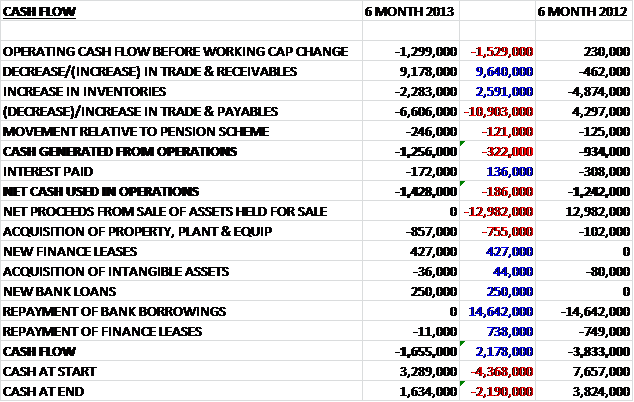
Things start off badly with the cash flow as the cash loss from the income statement was £1.3M, £1.5M worse than the first half of last year.  The changes in working capital broadly cancel each other out with a decrease in receivables counteracted by decreases in payables and increased inventories.  The increase in inventories was less than last year, however, and cash from operations was £322K worse than last year at a negative £1.3M.  The interest paid on the loans was lower than last year and the net cash used in operations was only £186K worse at £1.4M.  During the half year Havelock spent £857K on capital expenditure, which was mainly for the new laser cutting machine for the factory which it is hoped will improve efficiency going forward.  This expenditure was partly paid for by a £427K new finance lease and a £250K increase in bank loans.  At the end of the half year there was a £1.7M outflow of cash compared to a £3.8M outflow at this point last year.  This is because last year the group paid off most of their debt.  The cash levels now stand at £1.6M so the group can ill afford another half like this one.

Last year the group sold two businesses – the Showcard Print business, which was the point of sale division and Clean Air Ltd. The group received a cash inflow of £13M for the Showcard Print business and after taking into account the assets also disposed of in the sale, there was a gain of £8M.  The Clean Air sale was much smaller and the group received a cash consideration of £563K with a gain of £50K. The discontinued operations actually turned a profit of £697K (mainly related to the Showcard Print business, profit from Clean Air was negligible) in the first half of last year and it seems the group has not yet been able to plug this gap.

The operating loss in the Interiors business increased to £1.1M, which is explained by their customers’ orders being more weighted than normal to the second half of the year.  During the period there were some decent contract wins including a new framework with the Post Office to support its network refurbishment programme and the rebranding of Lloyds and TSB bank branches that starts in the second half of the year.  The group have also undertaken a number of projects in Europe and the Far East and have recently been appointed lead partner for Marks and Spencer’s Far East activities.  In addition, the group have also entered the supermarket sector with their first orders from a leading UK supermarket.  The Education sector saw fewer programmes finalised in the period but recent announcements of further school building programmes suggest that activity may pick up again in the future.  Havelock has increased their resources directed to student accommodation in order to secure larger projects in that area and they have also developed a new range of specialist healthcare furniture to win more business in that arena.

In educational supplies, margins remained steady and the segment reported a small loss (£100K) from a break-even point last year due to a change in the mix towards larger sound and light projects at Stage Systems.

Net debt at the end of the first half of 2013 was £4.8M, this was double the net debt position at the end of last year and is blamed on the build-up of inventories for the busier second half of the year and the capital investment of new equipment (shame the group is not in a position to use cash from operations for capital investment).  Once again the board have not announced a dividend and the overall climate remains competitive.  Going forward, the group is trying to improve margins through greater efficiency and value engineered products that cost less to produce.  This half year was clearly difficult and the group have not been able to replace the lost contribution from the disposed businesses.  Having said that, there are a number of interesting contract wins and the Lloyds/TSB and Supermarket contracts look particularly interesting, although it is not clear what the margins are like on these projects.  It is difficult to make a good case for investment here but I am going to wait for the second half of the year to see if the board are correct and that it will make up for the slow first half.  If not, I suspect I will be looking for an exit point.

 On 8th November, the group announced that it had sold the leasehold property that was previously occupied by Showcard Ltd, which was sold by the group last year.  They will receive £1.1M in cash that will be used to reduce debt but they will lose £150K of income a year that was the rent they charged Showcard.  A shame to lose the income but I guess this is a sensible option to take.

I wouldn’t normally comment on the appointment of a new non-executive director but I feel that the announcement on 18th November that Andrew Burgess was appointed is noteworthy.  Burgess has worked at Paragon Labels, MacFarlane Packaging and was Finance Director at Paragon Print & Packaging.  Over the past few years Burgess has been buying up shares in Havelock and is now their largest shareholder.  What his plans are long term are unknown.

On 29th January, the group issued a trading update covering the year to  December 2013.  It was stated that trading during the period was in line with expectations.  The group had managed to widen its customer base and completed a project with a supermarket for the first time.  It was also encouraging to see that there had been an increase in tender activity in both the UK and overseas.  Despite this fairly good news, activity in the education sector was subdued and revenues here are expected to be lower next year but the group had made some progress in securing orders in student accommodation, which should filter through by 2015.  After the sale of the property mentioned previously, there is now a situation where net debt is below £500K and within that there was £1M of capital expenditure.  Overall, this is a fairly decent update.

Laura Ashley Finance Blog – Interim Results 2014

Laura Ashley has now issued their interim results for the half year to 2014.

lauraashleyinterimincome14

There is no doubt that the last 6 months have been difficult for Laura Ashley.  Revenues were down across the board with store revenues down £6.2M, E-commerce down £1.3M and non-retail revenue down £500K.  Cost of sales and operating costs were also down but this did not stop the operating profit from falling £1.1M to £6.9M. At least the share of associate (the Japanese business I believe) operating profit marginally increased by £300K but this and a small amount of finance income was mitigated by the £400K cost of closing unprofitable stores.  A slightly lower tax charge on the smaller profits meant that profit for the half year was £700K lower at £5.5M.  Not a total disaster but very disappointing and this actually came as a bit of a surprise given management’s fairly bullish statements previously.

laurashleybalanceinterim14

After the disappointing income statement, the balance sheet gives some cause for concern too.  Total assets were down by £9.5M driven by the worrying £16.8M reduction in cash reserves on the end of last year.  This was only partially mitigated by the £6.1M increase in inventories and the £2.2M increase in trade receivables.  As far as liabilities were concerned, trade and payables fell by £2.8 which was counteracted by the £1M increase in pension liabilities.  In total, liabilities were also down but not as much as assets so net tangible assets fell £7.4M in six months to £53.1M.

lauraashleyinterimcash14

As we could have predicted from the peek at the cash levels from the balance sheet, the cash flow is a bit of a disaster.  Cash taken from the income statement was down by £2.2M but the group got a bit hammered by adverse movements in working capital.  £6.1M was tied up in higher inventory levels, £2.2M was tied up in increasing receivables and a decrease in payables accounted for £2.8M.  This all meant that the cash generated from operations was a negative £2.9M, a whole £6.5M lower than the same period of last year.  Added to this was £2.3M paid in tax and a massive £10.9M paid out in dividends.  This, along with a small amount of capital expenditure meant that there was a cash outflow of £16.8M.  Clearly, these huge dividends are not sustainable for long if this happens again as those cash reserves will not last forever if the group loses nearly £17M every half year!  The second half of the year is usually better with regards to cash generation but I can’t see this huge deficit being turned around before the end of the year.

As far as contribution is concerned, profit from stores actually increased to £6M but there was a very concerning £1.3M reduction in profit from e-commerce (and mail order).  Previously this has been the great hope for the group so I would like to understand what went wrong here.  The hotel is currently making a small loss but I am not sure if this was ever expected to turn much of a profit.  The contribution from the associate was decent, up £300K with contribution from licences and franchises down by £200K but still holding up fairly well at £5.9M.

It is also disappointing to see the excuse that the chairman gives for the poor performance.  Yup, the weather.  Apparently the cold weather affected clothing and the hot weather affected home furnishing sales.  I am not sure what kind of weather Laura Ashley needs to perform well!  Some of the reduced store sales were due to the closure of unprofitable stores as two new stores were opened and five closed but like for like sales also fell by 2.2%. 

One possible explanation for some of the loss of business in e-commerce was that systems “enhancements” in customer ordering were undertaken which had some impact on operations but should enhance performance going forward.  Work is also continuing on website development and enhancement so we will see if this has an effect on e-commerce performance in the second half.

Within retail, furniture was the one product category that actually improved performance on the same period of last year as like-for-like sales were up 0.7%.  There were a number of product launches during the year, including snugglers and new colours in the popular cabinet ranges.  Along with the rest of the products, Home Furnishings reduced sales – down by 2.7% on a like for like performance.  Like for like sales across all UK retailers in this category fell by 2.4% so Laura Ashley underperformed the rest of the market.  Moving into the second half, the product offer is apparently stronger, however.   Like for like decorating sales fell by 1.6% with Laura Ashley once again underperforming against all UK retailers whose sales fell by 0.5%.  Early Autumn response has been good to the ready-made curtains and paint ranges, however.  It is the Fashion business, though, that was the really poor performer as sales reduced by 6.6%. 

The hotel was officially launched in August and turned in a small loss.  The international franchising operations expanded further and at the half year point there were 280 franchised stores, 17 more than at the end of last year and new stores were opened in Japan, Australia, South Korea, Taiwan, Hong Kong, Spain and Bulgaria and new agreements have been signed for new stores in the second half of the year in the Baltics, Poland and Armenia.  Against this backdrop, then, it was disappointing to see a 3.6% reduction in revenues on the first half of last year.  Trading for the group in the first 8 weeks of the second half of the year continues to be disappointing with like for like revenues down 1.3%.

Overall then, this update is a bit of a disaster.  There was no warning as such and the fact that the performance is being blamed on the weather does make me wonder about the competence of the board.  Profits were down, net assets fell and the cash flow was terrible, partly due to adverse working capital movements.  Having said that, the company doesn’t turn into a lemon in 6 months, there is still no debt and a decent cash pile.  At the current share price the yield is 7.9% which is an incredible return.  It is nowhere near covered by current earnings, however and the cash pile will not last forever.   This update was a shock but not enough to encourage me to sell up.  I won’t be adding more until I can see if this is a blip or the start of a more steady decline, however.

On 13th December Laura Ashley released a management statement covering the 19 weeks to December 7.  During this period total retail sales decreased by 2% year on year with like for like sales falling by 0.7% which compared to year to date figures of retail sales down 2.1% and like for like sales down 1.6%.  There were some significant new licensing agreements signed that will benefit the group next year but this year licencing revenue collapsed by 16%.  23 new franchise stores were opened abroad and the one slight good point was that online sales increased by 1%.  This is clearly a disappointing update but some comfort may be gained from the fact that the rate of decline in like for like sales seems to have slowed down.

 On the 15th January, the group announced that they had sold their position in Moss Bross for 84p per share.  Moss Bros have just reported some good results and the share price responded accordingly so I guess the board decided to realise their profit and get a bit of cash in (the deal should bring in clost to £8M gross).

On the 20th January, the group announced a bonus dividend of 1p per share to “show their appreciation to the shareholders for their continued support”.  Not sure about that, but it is always nice to get a bit of a cash bonus.  I guess most of the cash from the Moss Bros disposal is coming the way of shareholders then.  The ex-dividend data is the 29th of this month but it is quite strange that this has been announced before the update on Christmas trading.

Dechra Pharmaceuticals Finance Blog – Full Year 2013

Dechra has now released their full year results for 2013.

dechraincome13


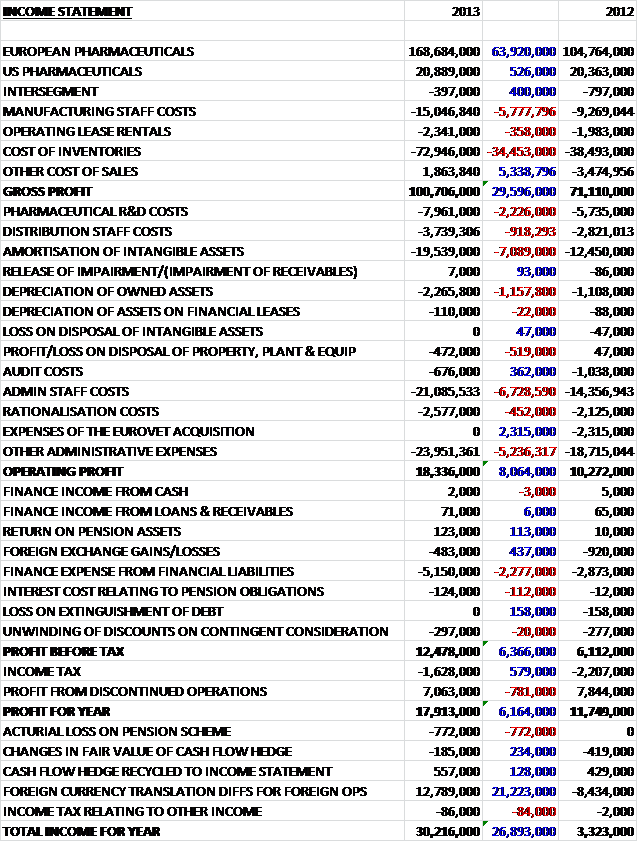
Following the decision to sell the services division, there are only two reporting segments with the vast of majority of revenues earned by the European sector, up by £64M as a result of the Eurovet acquisition.  US revenues were fairly flat during the year.  Cost of inventories were up by £34.5M, again at least partly due to the Eurovet acquisition.  Admin costs seem to have increased by a fairly substantial amount and we can also see that there was £19.5M of intangible amortisations, up by £7.1M on last year.  The £2.6M of rationalisation costs relates to the costs incurred to rationalise the four duplicated sales offices the group had after the Eurovet acquisition.  This leaves the operating profit £8.1M higher at £18.3M.  The only significant finance cost is the expense from financial liabilities, presumably interest from the huge loans, up by £2.3M to £5.2M.  The profit from the discontinued services sector was £7.1M which left the profit for the year at £17.9M, £6.2M higher than in 2012 with the difference coincidently not that far off the £7.1M that will be lost with the sale of the services business.

dechraassets13


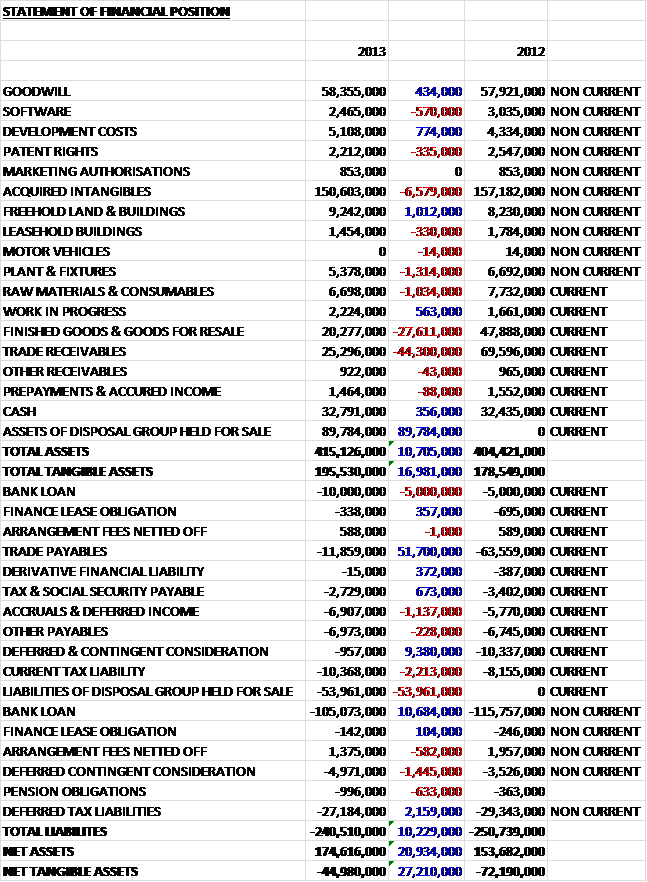
Overall Total Assets were up £10.7M on last year and we can see the effects of taking the services business out and placing it in assets held for sale.  Acquired intangibles fell by £6.6M but remained very high.  They are the development costs and product rights acquired with Dermapet, Gentrix and Eurovet. The big fallers, however, were finished goods inventory, down £27.6M and trade receivables, down £44.3M.  The value of assets held for sale was £89.8M so without this effect, I suspect both inventories and trade receivables would be up.  Taking off the intangibles gives tangible assets of £195.5M, up a healthy £17M on last year.

Liabilities fell by £10.2M during the year with £51.7M of trade payables being shunted into liabilities held for sale.  The big changes were the £7.9M less of the deferred consideration left to pay and the £5.7M overall reduction in bank loans.  I have to say that reducing loans and deferred consideration to such an extent whilst leaving the cash levels pretty much untouched is very impressive. Overall these movements give rise to a £27.2M increase to net tangible assets.  A lot depends on what is received for the disposal but if these valuations are correct, much progress on the balance sheet seems to be made this year.  Net Tangible assets are still negative to the tune of £45M but for pharmaceutical companies much of the value is in brands and patents so this is not of any great concern.

dechracash13


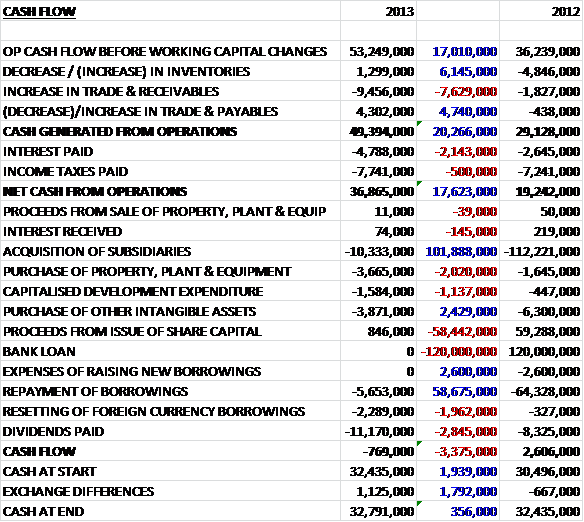
Operating cash flow before working capital changes was £53.2M, a £17M hike on last year.  The main change in working capital was a £9.5M increase in receivables which meant that cash generated from operations was £49.4M, £20.3M better than last year.  Interest nearly doubled to £4.8M due to the big loan taken out to acquire Eurovet and net cash from operations was £17.6M higher at £36.9M.  Out of this cash, £10.3M was spent on acquisitions relating to the deferred consideration on Eurovet .  There was £5.2M spent on capital expenditure and a further £3.9M spent on intangible assets.  Also during the year, the group paid back £5.7M of borrowings and spent £11.2M on dividend payments.  There were no new loans and the resultant cash out flow was £769K and with a healthy cushion of £32.8M of cash at the end of the year, this is really rather impressive.  It will be interesting to see if it can be sustained without the cash receipts from the Services business.

As far as profit is concerned, European pharmaceuticals contributed £45.8M whereas US pharmaceutical profit fell slightly to £5.6M.  Geographically, the UK still accounts for the largest amount of revenue followed by Germany and then the US.

During the year, the group completed a licencing, supply and distribution agreement for a branded veterinary generic product from a US pharmaceutical company.  Dechra will pay $3M up front and then a potential further $2M based on achieved sales of $20M, these are new companion animal products and will not make a material impact.  The idea is that they will complement the existing products and add to the growth of the business in the States.  The major event last year, as mentioned in the last update was the Eurovet acquisition for a cash total of £116M which included £36.3M of goodwill and £78.7M of other intangibles.  Also during the period, a further £10M was paid with respect to contingent consideration relating to the Dermapet acquisition.  There is now only $6M contingent consideration left.  It was agreed that the Services division would be sold for £87.5M to Patterson Companies Inc, which relates to a profit of £400K.  The completion accounts are yet to be finalised, however.

Good work has been made on overdue receivables, presumably at least partly due to the services business being sold.  There is now £4.5M overdue as opposed to £10.1M last year, none of which are overdue by more than three months.  At the moment, due to the high level of debt the group is quite susceptible to interest rate increases and a 2% rise would reduce group profit by £621K.  Even more concerning is the exposure to the Euro exchange rate.  A 10% appreciation of Sterling against the Euro would cost the group £3.2M.

Overall, pharmaceutical sales grew by 4.7% with companion animal products up 7.8% driven by increases in sales of Vetoryl, Felimazole and Caridsure whereas food producing animal sales dropped by 3.2% due to pressure on antibiotic prescriptions and competition on Cyclospray. Diets showed growth of 2.6% and third party manufacturing increased by 12.5%.

Dechra Europe is performing well in the three major European markets and EU revenues were up 5% on a like for like basis.  The UK was the fastest growing market with Germany and France also showing solid growth as Eurovet’s swine and poultry products were launched in France for the first time and all Eurovet products are now ready to be launched into Scandinavia.  The export business is also expanding in markets around the world and the Dechra brand will be expanded through newly established subsidiaries in the EU.  Performance in Netherlands and Scandinavia was relatively disappointing, however.  Sales of pet diets increased by 2.6% at constant currency levels, which was boosted by the launch of a new intensive support diet for animals in post-surgery rehabilitation.  Third party manufacturing continued to perform strongly with an increase in external sales of 12.5% at a constant currency basis and the group continued to receive a high level of new external contract enquiries.

The US business currently only markets companion animal and equine products and spending in the US pet market has been recovering from the levels seen during the financial crisis.  Revenue from the segment grew by 4.7% in the year, hampered by third party supply issues with the ophthalmic and dermatological ranges to such an extent that the dermatological product, Animax, had a complete out of stock situation.  Dechra has now changed suppliers but the validation from the relevant authorities for the new supplier is taking some time.  It is considered that the group should be able to make up most of the lost sales when it is up and running though.  The underlying performance of the key products in the US has actually been strong with Felimazole growing by 16% and Vetoryl growing by 12%.  There are currently several products in the US development pipeline which should encourage further organic growth.

Following the Eurovet acquisition, Dechra had manufacturing sites in Skipton, UK; Bladel in the Netherlands and Uldum in Denmark. The small site in Denmark will be closed by the end of next year with its two key products being transferred to Skipton.  The Bladel site predominantly manufactures products for food producing animals in large scale batches. The acquisition has had the effect of allowing Dechra to expand into Germany and into food animals, two markets where they were not really that well developed and expanding into food animal drugs is particularly interesting because this is a much bigger market than companion animals in emerging markets outside the EU and North America

The process to get drugs to market in the veterinary world takes between three to five years so products are in development for a much shorter time that in the human pharmaceutical arena.  There are currently 11 drugs in development for dogs, cats, horses, cattle and poultry and revenues from these projects are expected to peak at around £35M.  New products for the global markets includes Methoxasol, an antimicrobial for swine and poultry that has been approved for use in the EU; Buprenodale, a multi dose small animal analgesic that has received authorisation for use in the EU and Anesketing, a generic companion animal sedative that has been approved for use in seven EU countries.  There were also a number of line extensions, including Soludox, a water soluble antibiotic for swine and poultry that has a new indication for use in Turkeys in the EU; Felimazole 1.25mg, a new dose strength that has been approved for use in the EU and Comfortan, a companion animal analgesic has received approval for an extension for its use in cats.  In addition, a number of drugs were registered in new territories, including Libromide used to treat canine epilepsy has been extended for use in France, Austria, Portugal and Switzerland; Felimazole, for feline hyperthyroidism has been approved for use in Australia and Vetoryl, used in the treatment of canine Cushing’s syndrome has been approved for use in South Korea, Brazil and New Zealand.  The new dosing for Felimazole is intended to further differentiate the product from a number of generic drugs that have been recently launched in a number of EU countries.

The new product launch of Osphos to treat lameness in horses was delayed due to problems with a third party manufacturer.  This product is due to be submitted in UK, Canada and Australia imminently but as the horse is classed as a food producing species in the EU, further work is needed on it before submission into that territory.  It is already approved for use in the US.  A second major new product, for use in a canine endocrine disorder was originally intended to be manufactured by a third party but following the problems it is now likely to be produced in house.  The clinical trials for this product are progressing well.

During the year the long standing Chief Financial Officer, Simon Evans, resigned.  It always worries me when this happens as it sometimes points to hidden problems in the business, particularly as he was still relatively young at 49 and had been with the company for 15 years.  His replacement is Anne-Francoise Nesmes who joins the group this year and has herself been at Glaxosmithkline for 15 years where in the latter years she worked as Senior VP of Finance in the global vaccines business.    During the year, there was also another executive director appointed and Tony Griffin joined from the acquired Eurovet and became managing director of the EU pharmaceutical business.

This was a fairly good year for Dechra, profits were up £6.2M but discontinued operations contributed £7.1M.  Revenues in the EU were particularly strong, partly due to the Eurovet acquisition.  Net tangible assets were up considerably with borrowings and contingent consideration both down.  Cash flow was flat but it should be taken into consideration that this included spending of £5.7M to pay back loans, £10.3M on deferred consideration, £3.9M on the acquisition of intangibles (the licencing agreement) and £11.2M spent on dividends.  That flat cash flow now looks rather impressive.  Current trading is being described as ahead of last year and in line with management expectations. Net borrowings currently stand at £80.8M, still substantial but some good progress has been made in bringing it down as mentioned previously.  At current share price levels the dividend is a solid but unexciting 1.9% and the P/E stands at 18.6 but with the loss of the services profit next year, this is predicted to increase to 20.8 which is probably about right.

On 17th October, Dechra released a trading update covering Q1 2014.  It was stated that trading with inline with expectations, approximately 5% ahead of last year but 1% behind on a constant currency basis.  The sale of the services segment was completed for £87.5M with £81.1M of that being used to play down debt.  European pharmaceuticals increased revenues by 6% but this was entirely due to exchange rate differences and at a constant currency revenues were down 1% as robust trade in Dechra’s own sales and marketing organisations was more than offset by reduced exports, apparently due to the phasing of orders.  US revenue was down by 5% (down 7% at constant currency) doe to the Animax supply issues.  Were it not for that, US revenues would have been ahead.  I must admit I was a little disappointed by this update and I do hope these supply issues in the US get sorted shortly.  As long as the reduction in exports really is due to the phasing of orders, though, there is not really that much to worry about here.

GlaxoSmithkline Finance Blog – Full Year 2012

980 Great West Road, Brentford, TW8 9GS

Glaxosmithkline is a global healthcare group which is engaged in the creation, discovery, development, manufacture and marketing of pharmaceutical products including vaccines, over the counter medicines and health related consumer products.  The pharmaceuticals business develops and makes available medicines to treat a broad range of serious and chronic diseases, with respiratory illnesses making up the largest segment.  The vaccines business is one of the largest in the world, producing both paediatric and adult vaccines against a range of infectious diseases.  They also develop a range of consumer healthcare products in various sectors.

Much of Glaxo’s competition comes from generic producers who are able to offer the same products for much cheaper as they do not have to incur costs for R&D and other costs in bringing new medicines to market, particularly in Western markets.  This effect is less pronounced for vaccines or products where patents exist on both active ingredients and the delivery device.

glaxoincome


We can see that total revenues are down by nearly £1B to £26.4B.  Most pharmaceutical segments suffered a decline with the exceptions being Oncology, Rare Diseases and Immuno-Inflamatory and Oral care and Nutrition in the Consumer Healthcare business.  Cost of sales increased during the period, driven by higher inventory costs and write-downs to give a gross profit £1.2B lower than in 2011.  Despite a £583M increase in intangible impairments, other operating costs generally fell during the period.  The big differences we see during the period were a £339M increase in profit from business disposals, a £233M gain on settlement of collaborations and a £349M increase in the gain on the acquisition of a joint venture.  This flattered the operating profit somewhat and that was only £415M lower than last year at £7.4B.  Counteracting this, however, was the lack of £585M relating to the profit on disposal of interest in an associate before a lower tax amount gave the profit for the year £714M lower at £4.7B.  This was eroded somewhat by unfavourable exchange differences and a further actuarial loss on the pension scheme and the total income for the year was £4B.

Glaxobalance


The largest increases in the value of assets were in Licences and Patents which increased by £2.3B to £7.4B due to the acquisition of Human Genome Sciences.  The only other major increase in assets was Goodwill up £605M to £4.4B and land & buildings, up 226M.  These increases were counteracted by decreases in cash, down £1.5B; assets held for sale, down £605M due mainly to the disposal of the OTC brands; deferred tax assets, down £464M, which relates to the centralisation of their intellectual property and product ownership into the UK, and trade receivables, down £326M, which include £257M due from state hospital authorities in Greece, Ireland, Italy, Portugal and Spain.  These movements, along with some other minor changes have increased the level of assets by £395M.  As the largest increases were intangible, however, the tangible asset base tumbled by £2.6B.

As far as liabilities are concerned, we can see £2.4B reduction in the value of current provisions.   This was predominantly due to the settling of the US legal disputes.  In contrast, an increase was seen in “other payables” which were up by £1.4B during the period.  Other payables included £585M related to the potential maximum amount payable to shareholders of GSK Consumer Healthcare Ltd, the Indian subsidiary after Glaxo offered to buy all the shares and a contingent consideration relating to the acquisition of the Shionogi-ViiV healthcare joint venture.  Apart from the increased payables, the bulk of the increased liabilities are in the form of extra borrowings and loans which were up a very substantial £3.4B.  This has helped increase liabilities by £2.5B.  The upshot of this is that net assets were down by £2.1B to £6.7B but net tangible assets fared even worse, down £5B to a negative £7.8B.  I do feel that for Glaxo, those brands and patents are rather valuable so I have also calculated the net asset value without the Goodwill (which I still consider to be somewhat of a distraction when trying to calculate the value of a company) which was £2.7B lower at £2.4B.  Either way, it is clear that borrowings are well up and that as far as the balance sheet was concerned, the group took a bit of a battering this year.

Glaxocashflow


Operating cash flows for the year of £5.5B were a disappointing £1.8B down from last year.   The group has been actively targeting working capital and has already reduced the capital cash conversion cycle from 202 days to 194 days and having already targeting receivables and payables, are now looking at the inventory levels (inventory levels increased somewhat due to the HGS acquisition and increased vaccine inventories).  These favourable movements in working capital meant that cash from operations was £6B before tax took its toll and brought it back down to £4.4B, £1.9B lower than last year.  A £1.1B receipt from the sale of intangible assets paid for the purchase of property, plant and equipment.  There was a £3.6B increase in borrowings, which paid for the business purchases (£2.3B) and part of the share buy-back scheme (£2.5B).  The group also had to pay £779M out in interest on the loans and £3.8B was given back to shareholders in the form of dividends.  Overall this all lead to a net cash outflow of £1.6B.  By taking into account the new loans, the share buy-back scheme and the new business sales, the cash flow would have been a negative £493M.  Considering this included the £3.8B dividend to shareholders, this is not too bad (although it does depend on the £1B sale of intangible assets) but I would be looking for a better performance next year to sustain that dividend and prevent spiralling debts.

The US and EMAP regions were the only areas that increased profits.  The result in Europe was particularly badly hit, being down by £525M. During the year a new joint venture, Japan Vaccine Co was started with Daiichi Sankyo which commenced trading in July.  Most of the profit from associates is received from Aspen Pharmacare (£235M during 2012).  Aspen, 19% owned by Glaxo is listed on the Johannesburg stock exchange and is Africa’s largest pharmaceutical manufacturer

The new licenses and patents that have been acquired are also considered the most valuable, with Dolutegravir valued at £1.8B and Benlysta valued at £1.2B.  These are pretty hefty valuations!  As far as brands are concerned, Panadol is considered the most valuable at £413M with Sensodyne next at £256M.  Glaxo is currently involved in numerous legal disputes and incurred a charge of £449M related to product liability cases involving Paxil, Poligrip and a few others.

During the year the group made a number of acquisitions, the largest being Human Genome Sciences, a US based biopharmaceutical company which is focused on the development of protein and anti-body drugs for the treatment of immuno-inflammation diseases for $2.3B of cash.  The goodwill difference was £791M.  Another considerable purchase was the acquisition of Shionogi’s share of the Shionogi-ViiV healthcare joint venture.  There were no tangible assets gained but the main drugs under development are Dolutegravir and early stage integrase inhibitor compounds.  There was no cash involved in this acquisition but there is a contingent consideration based on the future sales performance of the compounds, which has a theoretically unlimited value and a 10% stake in the subsidiary has also been offered.  Glaxo obviously see potential in Shionogi-ViiV’s pipeline but the contingent consideration concerns me slightly.  The group also made two other acquisitions for a consideration of £302M.  During the year the group disposed of their holding in Quest Diagnostics, listed on the NY stock exchange, generating a profit of £584M.  After the end date of the balance sheet, Glaxo increased their stake in their Indian subsidiary to 72.5% for £570M.

The pharmaceuticals industry seems to be keeping several lawyers in work and there are a substantial number of legal claims that Glaxo is involved in.  Many of them seem to be generic drug makers challenging patents for various drugs so that they can enter the market.   Perhaps more worrying are the product liability suits where people have had adverse side effects from the drugs.  The most infamous current example is Avandia, where the group have settled many of the US claims but claims in Canada and Israel are still pending.  Another significant product liability case is with Paxil where there have been alleged problems with birth defects when pregnant mothers take the drug, along with possible dependency issues.  The group has settled the majority of the US claims relating to birth defects but a number of other claims remain unsettled, including many in Canada and in the UK.  Finally, there are still some outstanding claims relating to the use of Poligrip between 2005 and 2010.  It is alleged that the use of Zinc in the adhesive caused copper depletion and neurological problems.  Many of these cases have been dismissed but some are still ongoing.   Sales and marketing cases are also costly for Glaxo.  The Avandia related marketing matters have mostly been settled, as have the “Colorado Investigation” lawsuits, but a number still remain outstanding.  Litigation involving the average wholesale price of drugs sold to US state Medicare organisations has also mostly been settled with only Illinois and Wisconsin outstanding.  A matter relating to the Puero Rican manufacturing site has also been settled for the substantial amount of £500M.  I am not sure what the issue was but this is a substantial pay out by the group.

There are also a few competition investigations, with the EU and the UK looking into agreements relating to patents and generic drug makers, to determine whether competition has been stifled by some of these payments. A couple of US anti competition and monopoly law suits where buyers alleged Glaxo conspired with other companies to delay generic competition and charge higher prices are due to be settled for $216.5M. Other litigation includes actions relating to the purchase of Steifel labs where their former employees were encouraged to sell their shares back to the company at an undervalued rate before it was sold to Glaxo – not really Glaxo’s fault but they have to pay up if the claims are successful.  Additionally the group may be liable for the disposal and clean-up of hazardous waste at various US sites. The figures could be significant but the group accrues values for this as it goes along.  Overall, all these actions look daunting but after the US Avandia issue seems to be mainly solved, there are not that many outstanding issues that could be hugely detrimental to the group depending on the outcome of the anti-competition investigations.

As far as individual drugs are concerned, by far the most important with £5B of sales (flat on last year) is Asthma/COPD treatment Seretide/Advain.  Other drugs that earn more than £700M are Avodart for Prostatic Hyperplasia (£790M); infanrix, a vaccine for Diptheria, Tetanus, Polio and Hep B (£775M); and Flixotide, another Asthma remedy (£779M).  From these figures it is clear just how important Seretide is to Glaxo and the patent expires in the EU for this drug in 2017.

As would probably be expected, emerging markets are becoming more important for Glaxo and they now account for 26% of sales and grew 10% during the year.  Sales in Japan fell 6% because last year was boosted by catch-up sales of Cervarix.  Sales in the US were down 2% but the group are apparently preparing to launch a few new products in the new year.  The real drag on results, however, was the performance in Europe with business there weaker by the tune of 7% where government austerity measures are impacting growth.  R&D progress was good during the year and there are now 6 key new products under regulatory review and phase 3 data is expected on 14 products over the next couple of years.  The group have recently announced a program that aims to cut costs by about £1B by 2016 and will help simplify supply chains.

Investments in emerging markets are being made and during the year a new innovation centre was opened in China and the shareholding in the Indian subsidiary was increased.  A strategic review is underway regarding the Ribena and Lucozade brands, which are popular in Western markets.  Investment is also being made in the UK with a new biopharmaceutical manufacturing centre in Ulverston part of a £500M investment program.

In many countries the prices of pharmaceuticals are controlled by law.  Governments can also influence prices through their control of national healthcare organisations.  In Europe, governments are responding to increasing austerity pressures.  Healthcare reforms in France, Spain and Germany have restricted pricing and mandated generic solutions.  In Japan the government implemented its mandatory bi-annual price review in 2012.  In the US there are no government price controls over private sector purchases but federal law requires pharmaceutical manufacturers to pay rebates on certain medicines to be eligible for reimbursement under several state and federal healthcare programs.  Those rebates were expanded in 2011 and this year the government is finalising additional details for implementing the Affordable Care Act which includes an expansion of the government’s health insurance for low income citizens.

In the US, the healthcare market is undergoing changes due to the ongoing healthcare reforms and pharmaceutical companies are having to adapt to the changes.  Overall sales during the year were down by 2% but when Avandia was taken out of the equation, sales were flat.  Operating profit increased by 1% as a result of continuing efficiencies being made.  In the respiratory market, sales grew by 1% after a fall last year.  Advair, the largest product was up 1%, whilst Flovent sales reduced by 1%.  Ventolin sales did well, increasing by 14% this year.  Strong performances from Lovaza, Lamictal, Promacta, Votrient and Arxerra helped offset the loss of patent exclusivity for Ariztra and Argatroban and the loss of Avandia sales.  The new treatment for lupus, Benlysta contributed sales of £65M during the year.  Turnover was flat in the vaccines business as a decline in Flu vaccines were offset by increases in Pediarix and Boostrix.  During the year the pipeline made progress with several products receiving FDA approval including Votrient for Sarcoma, Promacta for Hep C, MenHibrix, a vaccine for Meningitis, Raxibacumab for Anthrax inhalation and Fabior foam for dermatology.  In addition, five other medicines were submitted.  The year also included a settlement with the US government on long standing legal cases as mentioned earlier.

In Europe, economic conditions remain hard with many governments undergoing austerity measures.  In addition to the 7% drop in sales, there was also an 11% fall in operating profits.  Pharmaceuticals were down 8% and Seretide revenues fell by 4% despite increased volume as prices were cut.  Sales of Oncology products did well, however, as did sales of Duodart and Avodart which increased by 9% despite Duodart not having market access approval in France or Italy.  Gaining approval to market products continued to be challenging but improvements were seen this year with Prolia, a treatment for osteoporosis and lupus treatment Benlysta  being launched in most markets.  Vaccine turnover fell by 4% reflecting austerity driven price cuts and the group have decided to further restructure the European operation to reduce costs.

In Emerging Markets, growth, although still strong, slowed somewhat as global economic factors, increasing price controls, funding constraints and aggressive local competition took their toll.  Within the 10% overall increase, sales in Latin America were up 11%, China up 17% and India up 10%.  Price constraints in Turkey and Korea counteracted these large increases though.  Seretide, Avodart/Duodart and Avamys all gained market share with strong launches for Duodart in Philippines and Prolia in Brazil, Russia and Argentina.  Benlysta is now approved in 10 countries across the region, including Russia and Taiwan and was launched in four.  Regulatory approval was completed for Relvar in Philippines, Taiwan and Brazil.  Classic brands increased sales by 5%, boosted by strong showings from Augmentin (8%), Ventolin (10%) and Zeffix (3%) including successful tenders in Saudi Arabia, Russia, Korea and Kazakhstan.  Vaccines grew by 14% driven by Synflorix, Rotarix and Cervarix with Synflorix having a particularly successful launch.  Operating profit grew broadly in line with sales.

Although turnover in Japan fell by 6%, this reflected the end of the Japanese HPV catch-up vaccination program.  Discounting Cervarix, turnover was up by 5%.  The Japanese system of reimbursement helped Glaxo as it takes into account strong innovation portfolio.  Pharmaceuticals turnover grew by 3% with strong growth from the recently launched products Lamictal, Avodart and Volibris, partly offset by the impact of price cuts and increased generic competition for Paxil.  The respiratory portfolio grew 6% with strong contributions from Adoair and Xyzal counteracting declines in Flixonase and Zyrtec.  There were six new approvals this year including Samtirel for Pneumonia, Paxil CR for depression, ReQuip CR for Parkinson’s disease, Votrient for soft tissue sarcoma, Botox for hyperhidrosis and Malaron for malaria.  New product filings were made for Relvar (Asthma/COPD) and Arzerra (Leukemia).  Operating profit in the region fell by 7%, comparable to the decrease in sales.

Consumer Healthcare turnover was up by 5% (discounting the effect of the OCT brand sale) with strong growth in Oral Care, Nutrition and Total Wellness partially offset by a small decline in Skin Health.  US sales grew by 2% and European sales were flat year on year reflecting the continued tough economic conditions.  The rest of the world markets grew by an impressive 12% with India, the Middle East and China making strong contributions and the group increased their holdings in their Indian subsidiary.  Within Total Wellness, gastro-intestinal products did well, up 11% through the launch of Tums Freshers in the US and strong performance of ENO in emerging markets.  The weight loss product, Alli suffered a major interruption from the supplier which impacted sales, however.  Smoking reduction products performed well in Europe and North America.  The Oral Care category showed good growth, up by 8% and led by Sensodyne rollouts of Repair & Protect.  The denture care business also did well, up by 12%.  In Nutrition (up 8%), Horlicks continued to grow in India and the Maxinutrition brand acquired in 2011 achieved strong growth of 21% year on year.  The Skin Health business registered a 1% decline during the year where strong performances of Bactrobran in China and Zovirax were offset by declines for Hinds in Latin America and Oilatum in the UK.  Operating profit in the division fell 9% reflecting the disposal of the OTC brands.

Turnover in the HIV division was down 10% on the previous year.  This decline was anticipated as the mature product portfolio faced greater generic competition in the US.  Two drugs fared well, however, with Epzicom/Kivexa (now by far the most important drug in this segment) growing sales by 10% and Selzentry/Celsentri increasing sales by 20% and the latter experienced expansion into Japan, Argentina and Australia.  Due to robust cost control and a change in the mix of products sold profits in the division were flat year on year.  The submission of Dolutegravir in Europe, US and Canada was completed during the year to try and mitigate the ageing drug portfolio in this sector.  Glaxo offers HIV drugs to many low income countries on a not for profit basis.

The upcoming pipeline does look rather strong across the board at the moment with new vaccines for flu, meningitis and meningitis-Hib gaining approval along with two significant new indications for existing medicines treating cancer and hepatitis.  Six new products were also submitted to regulators during the period covering treatments for respiratory disease, cancer, HIV and diabetes.  Additionally, phase 3 data (the final tests before a decision is made on submission) is expected to be received for a further 14 assets in the next two years.

The two new indications for new medicines were for Promacta for thrombocytopenia associated with hep c and Votrient for the treatment of soft tissue sarcoma.  The six new submissions were respiratory medicines Relvar/Brevo and Anoro; oncology medicines Dabrafenib and Trametinib; Dolutegravir for HIV and Albiglutide for diabetes.  Two new chemical entities moved into phase three development whilst none in phase three were terminated so all in all a fairly positive outlook for the pharmaceutical segment.  The three new vaccines that gained approval were Nimenrix for meningitis, MenHibrix for meningitis hib and a flu vaccine with four other vaccines in late stage development.  The development of new vaccines is a complex process that takes about 10 to 12 years and traditionally vaccines have been used to prevent illness but one interesting area for study is for vaccines to help the body’s immune system fight current illnesses such as a variety of tumours.

Some new consumer healthcare products launches during the year were Tums Freshers, a combination of heartburn relief and breath freshener; Abreva Conceal, a patch that conceals cold sores whilst still letting air in; and Horlicks Growth +, a nutritional product for children.

There were £165M of restructuring charges related to the acquisition of HGS during the year due to restructuring and reducing costs.  Over the past five years the manufacturing organisation has also undergone rationalisation and savings of £930M per annum have been achieved.  There is also a program to standardise packaging and to phase out small volume packs to further improve efficiencies.

This was a mixed year for Glaxo, revenues were down and profits overall were down by £415M on last year as impairments were counteracted by gains on disposals of assets.  Net assets (not including Goodwill) more than halved during the year as an increase in the value of patents was more than counteracted by a reduction in cash and increases in borrowings and payables.  The cash flow on the surface was rather disappointing with a £1.6B outflow of cash.  During the year, however, the group spent £2.3B on acquisitions, £3.8B on dividends and £2.5B on share buy-backs and the group are targeting £1B to £2B of share buy backs next year.  It is also notable that loans increased by £3.6B and there was £1B received from the sale of the OCT brands.  Net Debt at the end of the year was £14B, £5B more than last year.  This is quite a hike in debt levels but was affected by the £1.9B to settle the most significant ongoing US government investigation and £2B of cash paid out to purchase Human Genome Sciences and the aforementioned share buy back scheme.

As with most companies around the world, Glaxo is finding Europe very tough going with increases of sales coming from emerging markets.  The settlement of most of the US claims is welcome but the anti-competitive issues could still be a problem.  The pipeline of new drugs is encouraging but it should be noted that Glaxo is very dependent on one drug at the moment (Seretide) and if this fails there could be trouble.  At the current share price, the P/E ratio is a rather pricey 17 but this falls to 14 for 2013 estimates.  The P/E for this year does drop to 12.4 when the non-core items such as amortisation and legal fees are taken into account (whether legal fees are a non-core cost is another argument altogether, though). The current yield is a healthy 4.6% and that encourages me to rate these as a hold.

BP Blog – Interim 2013

BP has now released their half year figures for 2013.

bpinterimincome


Overall operational revenues were down.  Upstream revenues fell by $1.2B while lower margin downstream revenues increased by $416M.  The effects of the sale of the stake in TNK-BP affects other income and we can see that earnings from associates were down by £1B, slightly mitigated by a small increase in earnings from joint ventures.  The big difference from the first half of last year, however, is the $12.8B gain on business sales, up from $1.7B in the first half of last year as BP sold its stake in TBK-BP to Rosneft.

Purchases, production expenses and manufacturing expenses all fell reflecting the leaner organisation that BP is becoming but the main difference in expenses is the fact that impairment and losses on business sales were$4.2B less than in the first half of last year. Due to this increased (one-off) profit, tax was considerably higher and the profit for the half year ended up $14.7B higher at $19.1B.  The difference can be entirely accounted for with the increase in business sales and the reduction on impairments on said sales.  Otherwise, profits would be slightly down.  Currency translation differences and cash flow hedges to market took their toll on total income, mitigated somewhat by a favourable remeasurement on the pension.

bpinterimbalance


Overall total assets were up by $6.8B.  The largest difference in assets can be explained by the sale of the TNK-BP business.  At the end of the half year there were no assets held for sale compared to $19.3B at the end of 2012. This is split into $8.7B more cash and $11.9B more investments in associates, representing the Rosneft shares BP received as part of the deal.  Other large changes were $3B increases in property, plant and equipment; a $4.8B increase in trade and receivables and a $482M increase in prepayments counteracted by large decreases in derivative financial assets which I think was related to an old share price being used to value the Rosneft shares.

Liabilities fell during the half year driven by a $1.8B fall in debt, a $3.7B reduction in provisions as $3.9B relating to the agreement with the US government to resolve all criminal claims relating to the Gulf Region Health Outreach Program were reclassified as payables, and a $2.6B reduction in pension obligations.  These were somewhat mitigated by $1.2B increase in trade and payables, a $2.2B increase in tax liabilities and a $2.5B increase in other payables (partially due to the reclassification of the provision mentioned above).  All of this gives a net tangible asset base of $92.8B, a pleasing $9.9B up on the end of last year, albeit mostly driven by the disposal of TNK-BP.

bpinterimcash


At $19.7B operating cash flows for the half year were $3.4B higher than at the same period of last year.  This was eroded by movements in Gulf of Mexico spill cash flows, movements in working capital and tax so that the net cash from operations, at $9.4B was $1.5B up on the first half of 2012.  Once again, this was not enough to cover capital expenditure during the period, which was $1.5B higher at $11.8B, most of which went on upstream operations.  The sale of businesses and assets added $21.1B to the cash flow, $4.9B of which was spent on investments in associates, mainly Rosneft.  The change in debt was fairly neutral, with repayments being pretty much the same as new loans.  As mentioned previously, BP has begun a share buy-back scheme, which accounted for $1.8B of cash and $3.1B was paid out in dividends.

The upshot of all this was a $8.7B positive cash flow, up by $7.8B from the first half of last year.  It is fairly hard to get at underlying figures here as it is not clear what investments BP would have made had they not sold the massive stake in TNK-BP, but it is clear that operating cash flows were not enough to cover capital expenditure, let alone dividends so this needs to improve in future.

Although most revenues were made in the downstream sector, profits were highest in Upstream.  Replacement cost profit of upstream operations was $10B, $66M higher than in the first half of last year.  Downstream operations were $3.5B up on the loss that occurred last year due to a $2.7B impairment charge, and were $2.7B during the period.  TNK-BP made a one off $12.5B profit and the first lot of Rosneft profits occurred ($303B).  Other business made a loss of $1B, improved slightly from the $1.2B loss in the first half of 2012.

Underlying profit in the Upstream segment was $10B, £700M less than in the first half of last year.  These figures were adversely affected by lower liquid realisations, higher costs, exploration write-offs and lower production due to divestments somewhat mitigated by higher gas realisations.  Underlying production actually increased reflecting new project volumes in Angola, The North Sea, the Gulf of Mexico and an improved performance in Trinidad.  Actual production was lower, however, due to divestments.  Looking ahead, the group expects Q3 production to be lower as a result of planned turnaround activity and repairs in the North Sea, planned maintenance in Alaska and further divestments.  Costs are also expected to be seasonally higher in Q3.

The sale of BP’s 60% interest in the Polvo oil field in Brazil for $135M is expected to be completed next quarter and some good news from Brazil was that BP, along with some partners, was named as winning bidders for eight offshore blocks, two of which will be operated by BP.  Other positive news was that a significant gas concentrate discovery was made off the Eastern Coast of India.  Also, BP was awarded interests in two licences in the Barents Sea off Norway.  The group also announced $1B of new investment and two drilling rigs at the Alaska North slope field over the next five years.  Additionally, the group announced the start-up of oil production from new facilities at Valhall near Norway and the completion of a successful flow test at a well on offshore Brazil but the decision was made not to proceed with the current plan for the Mad Dog Phase 2 project in the Gulf of Mexico, which was disappointing.

Underlying profit in the downstream sector was $2.8B, an increase of $782M on the first half of last year.  The fuels business provided an underlying profit of $2.1B and accounted for most of the profits in this segment.  This was a $815M increase on the same period last year which was mainly due to a strong supply from operations despite a planned outage for maintenance at the Whiting refinery and further divestments.  The second quarter marked the start-up of the new crude unit at the Whiting refinery which is on target to be completed in the second half of the year.  Additionally, BP-Husky Refining successfully started up a new Naphtha reformer at the Toledo refinery and the Cherry Point refinery commissioned its new diesel dydrotreater and Hydrogen plant.  An investment of $500M was announced for Southern African refining projects.  During the half year both the Carson refinery and the Texas City refinery were sold in the US.

Going forward, the group expects refining margins to decline due to global capacity additions and the absence of profits from the two sold refineries, which contributed well to the results in the same quarter of last year (shame they were sold then…).  The lubricants business had an underlying profit of $717M in the first half of the year, an increase of $72M on the same period of last year driven by increases of sales from the premium Castrol brands and strong profitability from growth markets.  The Petrochemical business only managed underlying pre-tax profits of $35M in the first half of the year, which was a decline of $105M on the first half of 2012.  This was blamed on a difficult trading environment and margins are expected to remain under pressure for the rest of the year.  In June, however, BP and its partner received final approvals from the Chinese government for a third purified terephthalic acid plant at Zhuhai.

Underlying profits from the new Rosneft investment were $303M during the period, although there were only 11 days of contribution from the first quarter so this will improve going forward.  Other Business made an underlying loss of $899M during the period, a $76M improvement on the same period of last year.  During the year BP decided to retain and continue its wind business despite taking an impairment hit of $141M.  The main news seems to be the start-up of the Vivergo joint venture bioethanol plant in the UK.

The aftermath of the Gulf of Mexico oil spill still looms large over the results for BP.  Overall another $241M was paid on the Gulf spill response compared to $823M in the same period of last year.  This charge was due to an increase in the litigation and claims provision and the ongoing costs of the Gulf Coast Restoration Organisation.  To date, the total cost now stands at $42.4B.  The ultimate cost that will be paid is still open to a great deal of uncertainty.  Another issue is that money in the $20B trust fund is running out and the board predict that in the next quarter it will completely run out and that any payments made will have to come straight from the income statement which will obviously have an effect on cash flows.  Of the provisions, there is still $11.2B on the book, mostly relating to litigation and claims, with smaller amounts in Clean Water Act penalties and Environmental penalties, not including the substantial penalties that BP cannot currently estimate.  The PSC settlement for business claims has increased to $9.6B but even if BP is successful in their challenge to the PSC’s interpretation of the claims the figure will end up being higher.

The Clean Water penalties are based on the assumption that BP will not be found guilty of gross negligence or wilful misconduct and the amount eventually paid is also open to considerable uncertainty.  The trial is scheduled to start at the end of September.  Since the last update, BP has now been named as a defendant in more than 2,200 additional civil lawsuits brought by individuals, corporations and government entities and further actions are likely to emerge.  The vast majority of these claims have been filed under the Oil Pollution Act.   No provision has been added for these as the outcome cannot be predicted but BP has applied to have these claims consolidated with the MDL 2179 cases mentioned above where it is being decided whether BP is grossly negligent or not.  As mentioned in the last update, possibly the potentially most damaging claims are being made by the states of Alabama, Mississippi, Louisiana and Florida and those civil claims have been consolidated with the MDL 2179.

Not much progress has been made to try and overturn the decision to suspend BP’s participation in new US government contracts.  On 19th July the EPA upheld this decision.  Apparently this can be challenged in a federal court but there is no indication as to whether this is a course BP is going to take.  With regards to the Plaintiffs Steering Committee settlements, as mentioned in past updates, BP has been challenging the fact that the DHCSSP seems to be accepting claims without merit as they are interpreting the agreement in a different way to BP.  In March, the court upheld the claims administrator’s interpretation of the ruling.  BP is continuing to appeal the decision but it looks as though this might end up costing more than BP initially thought…   As far as I can tell, the cases that shareholders have filed against BP for loss of earnings and dividends have been dismissed.

The Gulf spill, as well as causing BP a huge amount of financial woe is probably also having an effect on their ability to obtain more contracts, particularly in the US where they have suffered a huge amount of damage to their reputation which my take many years to clear.  As if this wasn’t enough, European Commission officials made a series of inspections at the BP offices (and other companies in the industry) acting on concerns that anti-competitive behaviour might have taken place regarding oil price reporting.  The investigation is still at an early stage but it has prompted similar requests from US authorities worryingly.

The other defining occurrence this half was the sale of BP’s stake in TNK-BP to Rosneft and the subsequent allocation of some Rosneft shares to BP.  $16.6B was received in cash and $10.8B was received in Rosneft shares which was offset against the carrying value of the investment in TNK-BP of $12.4B.  Nearly $3B of these receipts were deferred.  Other investments held for sale that were completed during the period was the sale of the Maclure, Harding and Devenick fields in Braemar in the North Sea; the sale of the Carson refinery in California and the sale of the Texas City refinery.

The huge $19.1B profit that was recorded was mainly due to the sale of the TNK-BP stake.  The group also benefited from a lack of impairments on sales of businesses.  Net tangible assets also benefited from the sale as these were up nearly $10B.  The reduction in the pension deficit and an increase in receivables also helped here.  Cash from operations was up on the first half of last year but remained insufficient to cover the capital expenditure.  The cash flow was positive by the tune of $8.7B, however, due again to the proceeds from the TNK-BP sale.  Underlying profits were actually up as a whole but profits in the upstream business fared worse than last year.  The best performer was the fuels business, up by $815M.

Going forward, it is of some concern that the board expect profits to be lower next quarter than in the same period of last year.  Results are also still being overshadowed by the aftermath of the Gulf of Mexico spill.  There is still a huge amount of uncertainty regarding how much more that BP will pay but there are still some substantial charges waiting in the wings and the fact that the trust fund has run out of money does not bode well for the second half of the year.  Net debt at the end of the period was $9.2B better off at $18.2B as the group used the proceeds from the disposals to reduce debt and at current prices the shares have a dividend yield of 5.3%, which is pretty decent and brokers are still predicting a forward P/E of 8.9 which is very cheap even given the uncertainty surrounding the Gulf Spill.  Until more is known about the final charges that will be incurred, however, I feel these are still a bit risky to buy more of so I remain a holder.

On 3rd October it was announced that the US Court of Appeals, Fifth Circuit ruled in favour of BP in that the claims administrator should not be automatically paying out claims to people who did not suffer actual injury traceable to loss from the Deepwater Horizon accident until the matter is fully heard and decided through the judicial process.  The matter is now remanded for further proceedings to the District Court.  It is gratifying to see that at least someone in the US legal systems seems to be seeing sense and this ruling is pleasing.  It should be kept in mind, however, that this is far from over and in the past he US courts have had a history of coming down against BP so I will not be celebrating quite yet.