President Energy Finance Blog – Half Year Results 2013

President Energy has now released its interim results for the half year to end 2013.

presidentinterimincome

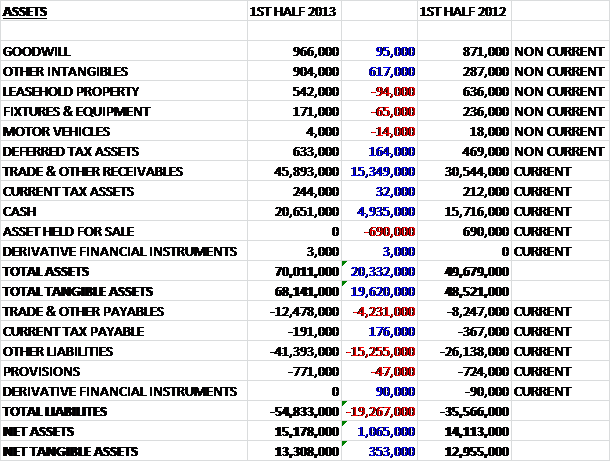
Over the first half of the year revenues were up by $692K when compared to the same period of 2012.  Depreciation was slightly higher but well operating costs fell considerably by $1.1M, driven by an improved cost position in Argentina.  Gross profit was therefore up by $1.6M to $1.9M.  This was almost exactly the cost of the wages for the group, which at $1.9M, increased by $381K.  We also saw an increase in share based payments, mitigated by a fall in other admin expenses to give an operating loss of $2.3M, $1.7M better than last year.  This year, there was an impairment charge of $460K relating to the relinquishment of the PEL 132 license in Australia, compared to no impairments in the first half of 2012.  As far as non-operating costs were concerned, there was a positive gain on foreign currency translation, entirely counteracted by $356K increase in loan fees and interest.  Loss before tax was $2.9M, which was $1.1M better than last year.  A far lower tax rebate, though, meant that the total loss for the year was actually $880K worse than in 2012 at $2.7M.

presidentinterimassets

Total assets for the year were down by $8M. We can see that a reduction of $10.7M was counteracted by a $14M increase in property, plant and equipment.  The driver behind the reduction, however, was the $11.2M fall in intangible exploration and evaluation assets.  Apparently, following seismic reprocessing, $14.1M of exploration costs in Argentina were reclassified as property, plant and equipment.  Liabilities decreased by $1.7M when compared to the end point of last year.  This was driven by a $1.4M fall in payables and a $293K decrease in deferred tax liabilities.  The result of this is a $6.3M fall in net assets, which now stand at $80.6M.

presidentinterimcash

Before working capital changes, it is good to see that the group had a positive inflow of cash of $888K compared to the outflow during the same period of last year.  A decrease in payables, however, meant that the cash outflow from operations was $601K, still $3.1M better than last year.  The group then spent $5.5M on exploration and evaluation, $1.5M more than in 2012; and $2.5M on development and production, which was pretty much the same as the amount spent last year.  This year was a lot quieter as far as cash flow was concerned as there were no acquisitions, new loans or new shares issued.  So, after the payment of the loan fee, the outflow of cash was nearly $9M which leaves the group with a cash position of $6.8M at the end of the half.

In Paraguay the original seismic acquisition programme was successfully completed ahead of schedule and initial results were apparently encouraging.  In addition to this original programme, the group also acquired a further 700km of 2D seismic detail on the additional follow on potential throughout the basin, which has now been 90% completed and more than 20 potential drilling targets have been identified.  The high grade targets identified to date lie within the Cretaceous  interval but the new seismic details suggest that there is also a large Paleozoic play system, and technical work has now begun to establish the potential.  Preparations for drilling remain on course for the first well of three to be spudded in Q2 2014.  In August, Paraguay had a general election where President Cortes won a clear victory and set out his determination to attract foreign investment, which bodes well.

In Argentina the group successfully completed the three-well stimulation campaign on wells PE7 and PE8 at Pozo Escondido, and well DP1001 at the Dos Puntitas Field.  Wells PE7 and PE8 had both been closed for 20 years and the preliminary results for these two wells provide strong encouragement for the establishment of new reserves in the carbonate reservoir, and for considering the stimulation across the large portfolio of old wells in the concession.  Initial production from these two wells has increased by 100% with the net production attributable to the group running at about 300 bopd and expected to further increase with the contribution from the third well.

The reprocessing and interpretation of the data on the Pozo Escondido and Dos Puntitas fields has now been completed, showing significant undrilled highs within the field areas.  At Pozo Escondido, it is estimated that there is an increase in the “sock tank oil initially in place” (STOIIP) of 215% to 63 MMB.  At the Dos Puntitas field, the reprocessing has validated the existing STOIIP of 15 MMB and six undrilled highs have been identified.  These results point to a further development potential in these fields through fracks, sidetracks and further drilling.  Average net production for the period was 153 bopd, down by 2 bopd compared to the same period of last year due to delays to the stimulation programme but current net production, including the two recently stimulated wells, is substantially higher, at 300 bopd.  Average realised prices for the period were $71 per barrel and the Argentine assets are currently breaking even. 

Louisiana continued to provide the group with solid production and cash flow.  Average production was up 36% at 212 boepd and average realised oil prices were $108 per barrel.  Realised prices for gas sales were $97 per barrel of oil equivalent.  Current production in Louisiana is 275 boepd.  In Australia, the PEL 82 asset is currently the subject of farm out discussions and PEL 132 was relinquished with an impairment of $460K taken. 

The current cash balance is $6.8M and the group has a $15M revolving loan facility in place.  The Argentine assets really seem to be stepping up production but the real prospect is Paraguay.  There will probably be no re-rating, either up or down, until the first wells are drilled there but I am happy to hold until then.

On the 27th September the group announced that it had entered into an agreement with the International Finance Corporation, and arm of the World Bank, to acquire over 12% of the company’s shares.  New shares would be placed in order to allow this and the proposed investment is £12.5M.  This is a good vote of confidence, but does mean more dilution of the share capital.

On 4th November the group announced that it had entered into an eighteen month contract with Schlumberger for the provision of project management and integrated drilling and completion services for its Paraguay drilling programme.  Early seismic results show the possibility for an expanded resource potential compared to the basin estimate of 159 mmb of risked oil published last year.  At least two major structural plays have been identified and management have suggested that the total risked resource potential of greater than 500 mmb of oil is a possibility. 

On 5th December the group confirmed it had signed the subscription agreement with the IFC.  It was also announced that as part of the deal they have given certain covenants to the IFC, including an undertaking to adhere to IFC’s environmental, social and other performance standards in relation to its conduct in all Paraguay operations.  IFC are also able to nominate a director to the board to act as their representative, which I guess is fairly standard with this size of holding.  From IFC’s perspective, they are looking to help Paraguay harness its domestic resources and decrease the country’s dependence on fuel imports.  There are no further details given about the covenants, but there seem to be quite a few conditions attached to this deal.

On 8th January, the group released an operational update.  In Paraguay, the group procured a rig and a letter of intent has now been entered into to drill the 2014 exploration programme.  The contractor is Queiroz Galvao Oleo a Gas, one of the largest service providers in Brazil.  The rig is capable of drilling down to depths of 5000m, which is adequate to explore the deep Paleozoic play identified in the survey.  Mobilisation from Brazil is due to commence during February and is estimated to take two months with the first well scheduled to spud during May.  At the end of January, the group should have finished analysing the seismic results and an independent audit by RPS should have been completed, that will hopefully confirm the presence of about 500 mmboe of risked prospective resource. 

In Argentina the frack programme on the PE-7 and DP-1001 wells has stabilised field production at 415 bopd, an increase of 40%.  PE-7 is averaging 185 gross barrels of fluid a day whilst DP-1001 is averaging 110 gross barrels a day.  The PE-8 well encountered some technical problems.  A workover was carried out and a beam pump installed which produced 200 gross barrels of fluid a day.  Subsequent to this, however, the pump performance started dropping off before failing entirely.  It is thought that this is due to seal damage from some low level of sand production.  The well is therefore currently shut-in awaiting a pulling operation to change the pump seals.  Current realised oil prices increased to $76/bbl, an increase of 13% on a year ago.  In Louisiana, production remained strong with monthly production of about 250 boepd.  Oil prices remained firm at $109 per barrel and the group now intend to drill two new exploration wells in the area.

On 10th January, the group announced a proposed farm-in for the Chaco region of Paraguay.  It as been offered an option of up to 80% participation interest in the Hernandarias block in the Chaco region.  The group will fund the first $17M of a work programme including one well drilled to test the Devonian at any time within the three year exploration phase of the concession contract.  The block covers an area of 18,500km2 and is located immediately North of the existing Pirity and Demattei concessions.  President will retain the entire block of 18,500km2 for one year, reducing to 8000km thereafter.  The block is of interest because it contains the same Paleozoic play that has delivered significant reserves in numerous giant field in the Andean mountain front of adjacent Argentina and Bolivia.  The Andean front structures die out before the basin reaches Paraguay but the Paleozoic play system becomes highly structured into numerous large rotated fault blocks in the Hernandarias system, which is unique to the Paraguay concession (in this area).  The group hope to commence acquisition of seismic data with a view to drilling the first Paleozoic structural test within the three year work programme period.

On the 24th January the group released a statement covering the new independent audit of the Paraguay resources.  The audit covers the three drilling prospects that are being targeted in 2014.  In total, there are 647 mmboe of unrisked prospective resources attributable to President and 130 mmboe  risked resources.  The success rate outcomes attributed to President are $11.7BN unrisked and $2.4NB risked.  There are also over 20 prospects yet to be evaluated.  The three drilling targets are the Jacaranda prospect, the Tapir prospect and the Yacare prospect with the Jacaranda containing the largest total quantities, followed by Tapir and with Yacare having quite modest potential.

Within Jacaranda the large structural prospect is developed within the tilted fault block domain along with the North West flank of the Pirity rift basin and contains two petroleum systems with several play types.  Prospective resources have been attributed to four independent sandstone reservoirs that can be tested with one vertical well (both Cretaceous and Paleozoic sections are found there).  In the Cretaceous zone the targets are likely to be oil in the Lecho sand and a wet gas in the underlying Pirgua sand.  In the Paleozoic, prospective sandstone reservoir targets are developed within the Carboniferous and Devonian and are most likely to contain wet gas.

The Jurumi complex comprises five four way dip prospects in the Cretaceous Lecho reservoir.  The audit covered the Cretaceous reservoir in only three prospects and for the Paleozoic section only in the Tapir drilling location within the complex.  As in the Jacaranda prospect, the Paleozoic targets are considered to be most likely wet gas.  The group believes that upon completion of seismic studies, further significant prospective resources within the Jurumi complex will be identified.  The Yacare prospect is a four way dip closure with prospective resources contained in the Cretaceous Lecho sand and is expected to be oil.  Seismic depth migration is still ongoing and the prospect size here cannot be reliably estimated until the work is complete.

On the 6th February, the group announced a placing of shares to institutional and other shareholders.  In total, $50M was raised in the placing to institutional shareholders and the new shares represent just under 29% of the share capital before the placing.  There was also an open offer to the group’s existing shareholders to raise a further $6.7M. 

On the 24th February the results of the placing and open offer were revealed. Only 11.9% of the open offer shares were taken up but, along with the placing, the exercise raised $50.8M.  Some of the shares were taken up by the IFC and they now control 13.5% of the capital.

On the 26th February, Chairman Peter Levine purchased over 390,000 shares to take his holding in the company to 19.32%.  A few other board members also made some smaller purchases.  I do like to see long standing board members dipping into their own pockets for shares in their company.

On the 24th March the group announced that it the mobilisation of the rig contracted from Brazil had taken place.  The first well will be drilled on the Jacaranda prospect, and will target multiple horizons – it is scheduled to spud by the end of May.

On the 30th April the group released a statement covering their acreage in Australia.  They have recently comissioned comprehensive seismic data and and re-interpreted some existing 3D data on the PEL82 license.  It has been ascertained that in addition to the conventional play, a previously unidentified new unconventional play exists in PEL82 with gross prospective resources on a best case basis of 904 Bcf.  This report has re-energised ongoing discussions to find industry participation for further activity.  In order to do this, the license has been extended to September 2015.  This is an interesting development.  Paraguay is clearly the focus but if the group can get some real value from these new resources in Australia then it would be a bonus.
President Energy Finance Blog – Full Year Results 2012

President Energy is an oil and gas exploration and production company.  It currently has producing assets in the US and Argentina and has exploration assets in Paraguay.

presidentincome

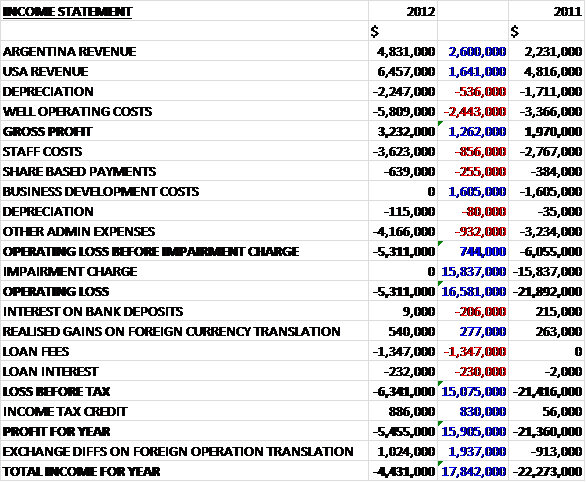
President receives revenue from its Argentinian and US assets.  Argentinian revenue more than doubled to $4.8M year on year due to development drilling undertaken and the contribution of a full year or production, and US revenue was up $1.6M to $6.5M.  Well operating costs also increased, up $2.4M to $5.8M reflecting a full year of Argentinian production costs, and the group also experienced a $536K increase in depreciation to give a gross profit of $3.2M, up by $1.3M on last year.  As far as admin costs were concerned, there was a $856K increase in staff costs, along with a $255K increase in share based payments. There was the lack of a $1.6M business development cost but other admin expenses were $932K higher, which meant that operating loss before last year’s impairment charge was $5.3M, compared to a loss of $6.1M in 2011.  That impairment charge in 2011 was $15.8M, relating mainly to the East Lake Verret assets in Louisianna which had been written off due to the fact that no commercial reserves were found, which obviously skews the results for that year.  Finance costs in 2012 were up, driven by $1.4M in loan fees so, after a tax credit the loss for the year was $5.5M, $15.9M better than last year but it would have been broadly fat were it not for that impairment charge.

presidentassets

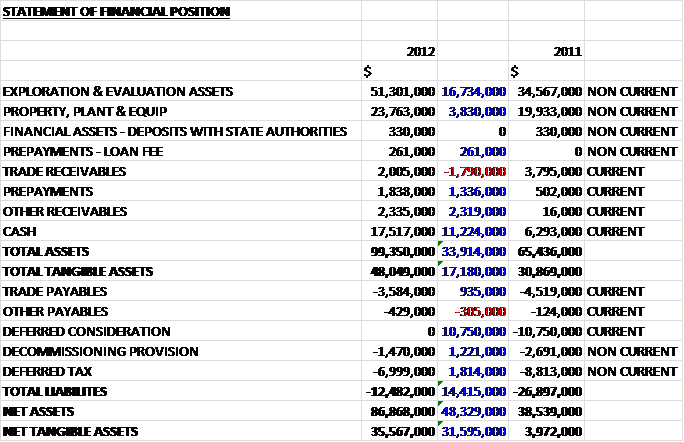
Overall, total assets were up an impressive $33.9M.  The main drivers were a $16.7M increase in capitalised exploration assets relating mainly to the entry into Paraguay via two farm-in agreements, along with some new exploration licenses in Argentina.  There is also an amount of $14.6M carried relating to the Australian assets that the group is looking to farm out.  Other drivers include a $11.2M increase in cash due to the issue of new shares, a $3.8M hike in fixed assets and $2.3M more of other receivables, only slightly mitigated by a $1.8M reduction in trade receivables.  Almost all liabilities fell, driven in particular by the lack of $10.8M worth of deferred consideration and a $1.2M fall in decommissioning provisions leading to net assets that were some $48.3M higher at $86.9M.

presidentcash

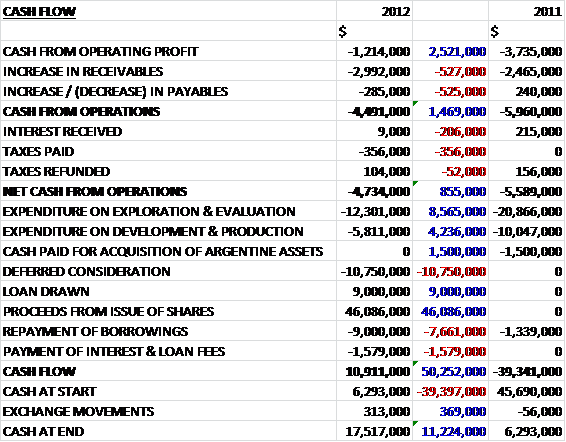
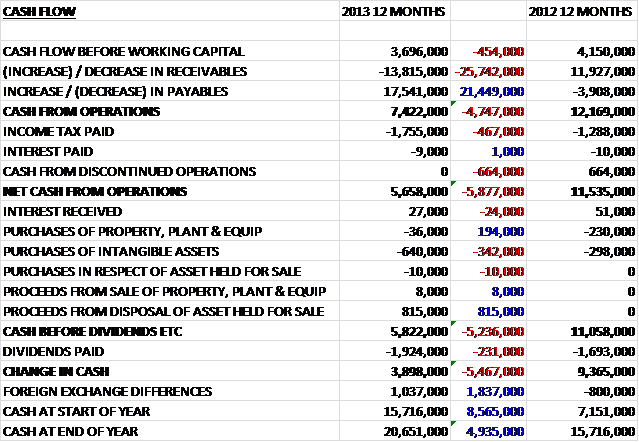
The cash outflow before movements in working capital was $1.2M, $2.5M better than last year.  An increase in receivables led to cash from operations being $1.5M better than in 2011 at -$4.5M.  After tax, the net cash outflow from operations was $4.7M.  The group then spent $12.3M on exploration & evaluation, and $5.8M on development & production, both less than in 2011.  They also spent $1.6M on loan fees and $10.75M of deferred consideration relating to the acquisition in Argentina, and in order to pay for all this, issued new shares to the value of $46.1M.  For the year,  the cash flow was $10.9M, a whole $50.3M better than last year for what it’s worth.

The group have a number of capital commitments going forward.  They are committed to funding a three year exploration programme on each of the Matorras and Ocultar license areas in Argentina.  They will have a modest seismic re-processing and new seismic acquisition commitment of $2M each.  The group also intend to incrementally acquire up to 59% in the Pirity concession (from 12%) and 60% in the Demattei concession (from 3%), both in Paraguay.  This will be done by funding agreed seismic work and three wells in each block.  The anticipated cost of seismic acquisition, processing and interpretation is $9.5M.

The group is fairly exposed to movements in exchange rates with the USD/Argentinian Peso the most important – a 10% move would affect the profit or loss account by $576K. 

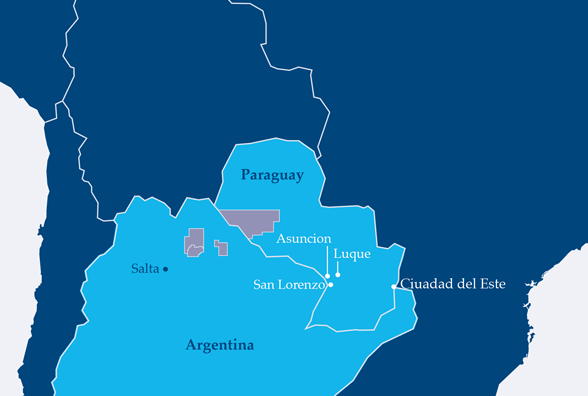
After the end date of the balance sheet, the successful drilling of the A-54 well on the East White Lake Field in Louisiana provided additional production of about 50 bopd taking production is Louisiana as a whole to 250 boepd.  The company has also completed a comprehensive seismic reprocessing exercise on the five fields in the Puesto Guardian Concession in Argentina.  The work identified significant undrilled highs within the field, confirming the further development potential.  In the Pozo Escondido field, STOIIP increased from 20mmb to 63mmb.  Also in Argentina, a work over and frack campaign at the Pozo Escondido and Dos Puntitas fields are expected to give a lift to production there.  In Paraguay, seismic acquisition operations have begun and were acquired over the high-graded areas of the Pirity and Demattei Concessions.  The group are targeting an initial three well drilling campaign for 2014.

In September the group announced a farm in agreement for two blocks in the Pirity sub basin in Paraguay.  An independent assessment gives a net mean risked recoverable prospective resources of 94 mmbbls of oil which could give a $2BN success case value to President, a huge premium on the current market cap.  The results of the seismic operations should be available in Q4 2013 and the seismic exploration company, Global, has agreed a success based fee with the group in the form of a discovery bonus.  Some progress has been made on infrastructure and planning has been commenced for the Q2 2014 drilling programme.
president map_full_zoom

In Argentina, the group drilled three new wells.  The DP-1001 well was brought on stream while the PEE-1001 and P-1002 wells are part of a future frack sidetrack and work-over programme.  The group also commenced a three well fracking campaign targeting carbonate reservoirs in the Dos Puntitas and Pozo Escondido fields.  If they are successful, it provides encouragement for a further sequence of fracks to target the large oil reserve in place at this reservoir.  An exploration prospect in the Martinez del Tineo field was independently reviewed.  The gas and condensate target at the site near the Bolivian border was assessed to have an unrisked prospective resource estimate of 570 bcf and 14.5M barrels of condensate.  Based on this prospect, the group applied for three open exploration concessions and were awarded two blocks as operator, with three years to study the concessions on which only sparse data is currently available.

In Louisiana, operations in East White Lake and East Lake Verret continued to provide solid cash flow.  Production was up 15% on last year at 183boepd and continued to rise after the end of the year after a successful new well.  New exploration leads have also been identified in the area.  The Australian assets are not core to the central strategy of the group with work continuing only at a low level.

As of the end of the year, the group is in a position of no debt and has a $15M, 24 month facility that it can draw on if needs be.  The group currently has 2,306.3 mboe of proved reserves, a fall of 129.1 mboe due to production at Louisiana and Argentina.  There are also another 4,566 mboe of provable reserves, a fall of 207.8 mboe on last year due to the decision not to proceed with the development of wells for which probably reserves were previously recognised in East Lake Verret.

The US assets provide some dependent cash flow and the Argentinian fields seem to be increasing production to a decent level.  It is the assets in Paraguay, however, that make President such an interesting proposition.  Should they be successful there, there is real upside potential and should they not hit black gold there, there are still the Argentinian and US assets to fall back on.  It would be nice to see some more exploration areas in the pipeline but I am happy with the risks involved given the potential in Paraguay.  I have taken a small position here.

Tristel Finance Blog – Half Year 2014

Tristel have now released their half year results.

tristelinterimincome14


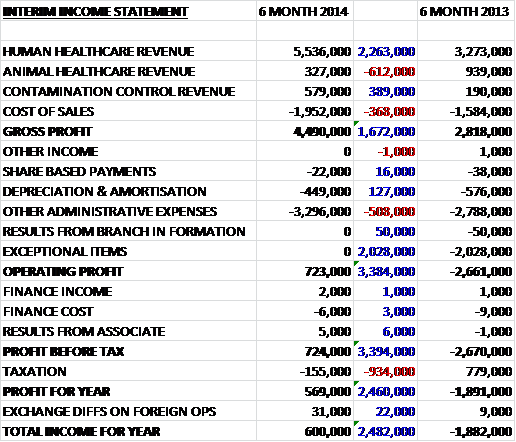
Overall revenues increased fairly substantially.  Human healthcare was up £2.3M to £5.5M and Contamination Control more than doubled to £579K but this was mitigated somewhat by a £612K crash in Animal Healthcare revenue.  Cost of sales also increased to give a gross profit up some £1.7M to £4.5M.  Admin expenses increased year on year, up £508K to £3.3M but the group benefited from the lack of over £2M of exceptional items that occurred last year so operating profit improved £3.4M to £723K. There was a big swing in the amount of tax paid by the group and overall profit for the year stood at £569K, a £2.5M increase on the first half of 2013.  Not a bad performance.

tristelinterimassets14


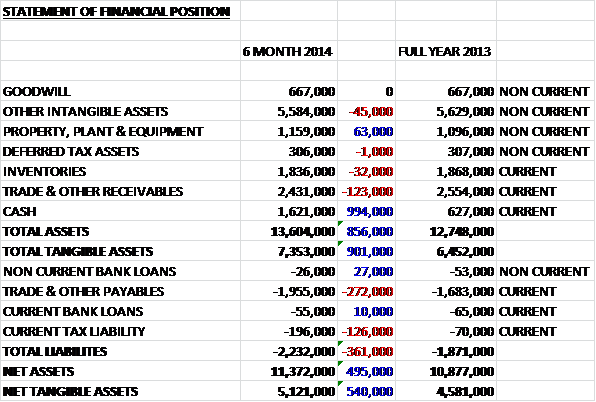
Total assets increased by £856K from the end point of last year.  The only two increases were a near £1M hike in cash levels and a £63K increase in property, plant and equipment.  This was somewhat mitigated by a £123K fall in receivables and a £45K reduction in intangible assets.  Liabilities also increased during the period, driven by rises in payables and tax liabilities.  The resulting net asset level was £11.4M, up by nearly £500K.

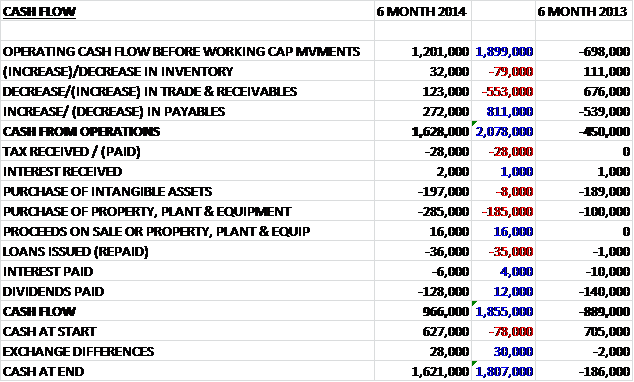
tristelinterimcash14


Before working capital movements, the cash flow was a decent £1.2M, which compares well to the £700K outflow in the first half of last year.  There was a decent control on working capital, with the group able to increase payables in particular, to give a net cash from operations of £1.6M, £2.1M better than in the first six months of 2013.  There was an increase in capital expenditure, and in particular a £185K hike in the purchase of property and equipment, and there was a reduction in the amount paid out in dividends.  This meant that the cash flow for the half year was a fairly decent £966K, a whole £1.9M improvement on the situation during the same period of last year.

Sales into the Human Healthcare market grew 88% to the UK and 40% to overseas markets.  The growth was led by the Wipes System which is used in ENT, cardiology and ultrasound departments.  The main markets outside the UK were Germany, Italy and Australia.  Sales of the surface disinfectant products grew by 91% to £800K, so they still make up a small segment of the earnings in this sector.  Overall gross profit in this sector increased from £2.2M to £4M.

Sales of the contamination control products increased by 54% to £600K. These products are used in pharmaceutical manufacturing environments, hospital aseptic units and labs.  The board believe that this is an area that should experience further growth going forward.  Gross profit in the contamination control sector increased from £55K to £297K.  Animal Healthcare profits collapsed from £608K to £206K following the loss of the distribution agreement last year.

Going forward, the board believes there is potential for further growth in the current product range and they are constantly looking for new innovations.  Examples during the period in question include a new version of the Wipes System that provides barcoding and electronic traceability which extends the product’s intellectual property protection; and a new delivery system for Chlorine Dioxide that the group are calling Tristel Revolver for use in antiseptic units.

At the end of the half the group was in a net cash position of £1.5M compared to net debt of £400K last year.  An increase in the interim dividend gives a yield of 1.4% at the current share price.  Fairly modest, but nice to have.  This is definitely an improvement on last year’s trading as Tristel moves away from its declining legacy products and the overseas growth is good to see.  It does seem like this has further to go but any investment here is a bit of a risk.  I already have a decent holding so will not be buying any more at the moment.  Sill a hold for me.

On the 28th April the group released a trading update for the year.  They announced that the momentum seen in the first half has continued resulting in a pretax profit of about £1.5M.  This was ahead of market expectations and the group also mention that cash balances have strengthened, exceeding £2.2M at the year end.  This is all very encouraging and I am tempted to top up again.

On the 10th June the group released a statement covering the full year.  They experienced a rise in sales in all three sectors and across most geographical markets.  The pace of growth was higher than previously anticipated and costs remained stable.  Therefore their expectations for pre tax profit this year has increased to £1.75M, up from £480K last year.  Great stuff!

On the 28th July the group released a trading statement suggesting that results for the year would be better than expected last June.  Full year revenues increased by 28% and pre tax profit should come in at £1.8M before share based payments with a net cash position of £2.6M.  All good stuff, might be tempted to top up on weakness.


Tower Resources Finance Blog – Half Year 2013

Tower Resources has now released their interim results for the year end 2013.

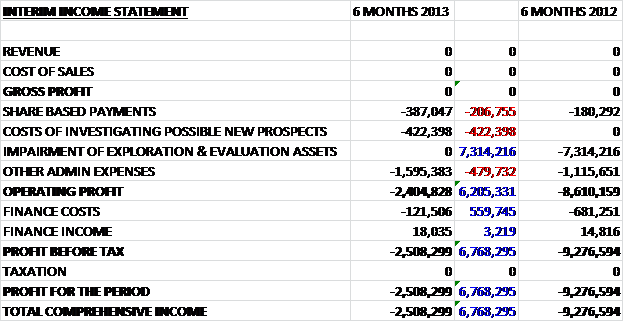
towerinteimincome

Again, the group received no income and only incurred admin expenses because all the exploration expense is capitalised.  Share based payments more than doubled in the half year to just under $400K and the group also incurred a $422K cost for investigating new prospects, presumably relating to the Madagascar acquisition.  Other admin expenses also increased, up $480K to $1.6M but the largest difference on the first half of last year was the lack of a total impairment for the Ugandan exploration assets.  Therefore operating loss was much lower, down by $6.2M to $2.4M.  Finance costs were also much reduced, down $560K so the loss for the year was $2.5M, down by $6.8M on the same period of last year.

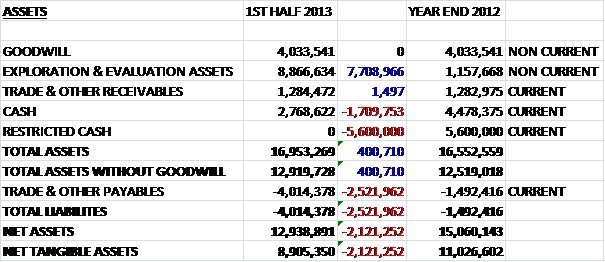
towerinterimassets

At the half year point, total assets were fairly static when compared to the end of last year as the restricted cash and non-restricted cash were used to increase the exploration and evaluation assets.  Liabilities, however, increased by $2.5M due to an increase in payables because of money owed to Respsol, the Namibian site operator (this cash was subsequently paid after the end date of the balance sheet),  which meant that net assets fell by $2.1M when compared to the end of last year to finish the half year at just under $13M.

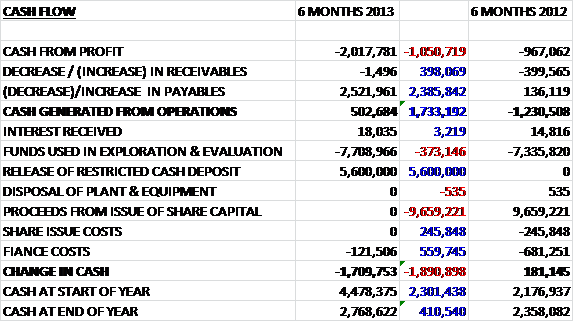
towerinterimcash

The cash lost before movements in working capital was $2M, $1.1M worse than during the same period of last year.  A large increase in payables, however, meant that the net cash from operations was actually in positive territory, a $500K inflow compared to a $1.2M outflow last time.  The group also benefited from the release of the cash held in the escrow account which was promptly used in exploration and evaluation, which was $373K higher than last year.  The group did not receive any financing for the issue of shares, which brought in $9.7M last year but the finance costs were down slightly, due to lower costs relating to the SEDA.  Overall for the half year there was a $1.7K outflow of cash which was fairly modest, mainly due to the release of the withheld cash. 

Things are ticking along OK.  These accounts don’t really give much to go on, just more of a back-up and confirmation of where the cash is going.  Despite the recent disappointments with other companies’ drills in Namibia, I am still happy with my modest holding here to keep the dream alive!

On 12th August, the group released a statement that the open offer had raised £1.04M.  Every little helps, but it some way below the maximum that could have been received and shows that only a quarter of the open offer shares were taken up.

On 2nd September the group issued a statement regarding the acquisition of Wilton Petroleum.  The operator of the Madagascan block, Ophir no longer intend to drill the commitment well.  Tower have not yet indicated what course of action they now wish to take but this is a bit of a set-back in their desire to diversify away from Namibia.

On 25th September the group released a statement covering the settlement agreement between Tower, Wilton and Ophir regarding the Madagascan block.  It was agreed that due to the cancellation of the drilling of the block, Ophir would compensate Wilton to the tune of $6M.  Tower will then complete the acquisition of Wilton which would basically have the effect of increasing the net cash by $4.25M, after the cash consideration is taken into account – as the shareholders of Wilton will receive some equity in Tower, it is basically a back door way of making a share placing.  Tower will then continue discussions relating to the future licencing of the block.  It was also mentioned that the group intend to bid on a licence on a block in Cameroon. 

On 1st October the group confirmed the completion of the Wilton acquisition for a total value of $4.3M.  As mentioned previously, this was basically a different way of raising finance and was the same as a share placing of 4.6% of Tower’s capital at a 35% premium to the share price.  So, it is a shame to see yet more dilution of the shares in issue, it seems a good, opportunistic, deal.

On 5th November, the group issued a statement covering the issue of equity to PDF.  In payment for their services, the group has issued PDF with 1.8M shares in the company, they now own 0.46% of Tower’s equity.

On 29th November, the group announced that the drillship being used for the Namibian licence had been delayed by a month as it had not yet left the shipyard in South Korea.  It is now scheduled to arrive at the drill site on 23rd March. 

On the 24th January, the group released an operational update.  It was confirmed that they are actively looking for a farm-out partner for 10% of their interest in the Namibian site.  Another mile stone is that the drill ship has finally left South Korea and is on its way.  It was also announced that more shares had been issued.  They raised £820K via a modest draw down on its EEF with Darwin and more shares were issued as an increase in demand for the shares pushed the price over 5p – an interesting concept.  Finally, it was stated that they had a cash balance of $18M having already paid $3M towards the drilling costs.

On 5th March the group released a statement announcing that the drill ship had arrived in Namibia.  It will undergo final testing before drilling is scheduled to start on the 11th April.  Still no news on any farm out deal.  I am a bit concerned that no one else seems interested in the site and that Tower may have problems with cash flow during the drilling process.

On the 9th April the group made a number of announcements. They included a placing of shares to raise £19.3M to fund the rest of the Namibian drilling; an acquisition of Rift Petroleum, a company with interests offshore South Africa and onshore Zambia and the farm in to block 2B in Kenya alongside Taipan Resources and Premier Oil. The placing was made to institutional investors and the directors were unable to participate as the company is in a close period but it was nonetheless over-subscribed. As the share price improved, the board made the decision that a placing would be less dilutive to shareholder value than the 10% farm out that they have been chasing previously. It does seem to be the correct decision on the face of it but it could indicate that there was a lack of interest in the potential farm out and it would have been nice if the board disclosed that a placing was one of the options they were looking at.
The drill ship is schedule to commence drilling in Namibia around the 17th April. Based on the CPR update the well is targeting risked resources of about 496mmboe. The group has used the balance sheet cash of $14M along with a part of the proceeds from the placing to finance the remaining firm well costs and other PEL0010 license activity, assuming the project continues into the second renewal phase.
The placing also provided the funds to acquire Rift Petroleum and has given the group a 50% interest in the Algoa-Gamtoos license offshore South Africa, which is at an early stage in the exploration process. Before completion of the deal, the vendor will provide $7.4M to fund the completion and processing of the 3D seismic programme and about $2M of funds from the placing will be used to finance other license activity in South Africa and Zambia.
The group has also agreed to farm in to Block 2B onshore Kenya with Taipan resources for a 15% working interest. The costs of the farm in include $5M in respect of back costs and 2014 seismic costs as well as $3M in well costs relating to the Badada-1 well which is anticipated to spud in Q4 2014. This farm in is expected to be complete in May/June 2014 and is conditional on the consent of the other major partner, Premier Oil.
The placing involves 550M new shares at a price of 3.5p and as mentioned, it will raise £19.3M in new funds. The shares will be placed with institutional and some other shareholders but is not open to the public which is disappointing as it means my interest will be diluted. After the placing the group’s share capital will consist of 3,764BN shares. In all the $32M of new funds will be spent as follows: $5.9M on the remaining approval well costs at the Namibian Welwitschia-1 well, $3M on the PEL0010 license activity in Namibia, the 2014/H1 2015 license activity with regards to the Rift Petroleum acquisition, $5 of back costs and 2014 seismic costs in Kenya, $3M of 2014 well costs in Kenya, $5M relating to the signature bonus and 3D seismic in Q1 2015 in Cameroon. The rest is being spent on G&A, G&G, tax and placing costs. It seems therefore that the group is now well financed for the immediate future.
As mentioned above, the group has acquired the share capital of Rift Petroleum, a private exploration company focused on offshore South Africa and onshore Zambia, in exchange for the consideration shares. As well as Tower, a number of oil majors have also acquired acreage in the country including Exxon, total, Anadarko and Shell. Rift Petroleum’s primary asset is its 50% interest in the Algoa-Gamtoos license alongside New Age Energy Algoa and it covers seven blocks and 11,809 Km2 between two license areas that have been farmed in to by Exxon and Total. The license consists of three prospective basins, algoa to the east, Gamtoos to the west and the Outeniqua deep-water basin.
New 3D seismic in the Algoa Canyon play should be available during Q3 2014 whilst mapping of the existing 2D seismic is ongoing. A farm-out process in respect of the license is still ongoing and there are apparently a number of discussions ongoing regarding interests in the block which Tower intends to continue. Rift Petroleum also has rights to acquire a 50% interest in any exploration right granted to New African Global Energy over the SW Orange Basin area covering three blocks and 21,500km2. The group has also successfully bid and been awarded an 80% interest in two blocks (40 and 41) onshore Zambia. Due to the consideration shares agreement, the founder of Rift, Julian McIntyre, will become a significant new shareholder in Tower.
The other main development was the acquisition of the 15% interest in Block 2B in Kenya, currently owned by Taipan Resources. Premier Oil owns a 55% interest with the remainder still owned by Taipan. The group will pay Taipan $4.5M in cash with a contingent payment of $1M on the spud of a second well. The total estimated mean gross unrisked prospective resources was reported as being 1,593 mmboe. Processing of the seismic data is underway and due to be completed shortly and this data will be used to identify a drilling location for the Badada-1 prospect that is planned to be drilled during Q4 2014. There are also drilling campaigns by Africa Oil, Afren and Tullow due to be drilled in the region during 2014.
The final development is that the group has been named as preferred bidder on the Dissoni block in Cameroon and is considered to be a fairly low risk, low volume target. Subject to finalisation of terms with the Cameroon government, the group expect to undertake 3D seismic during Q1 2015.
Despite not being informed that the group was looking to undertake a placing of new shares, the funds raised here should provide Tower with enough funds for the immediate future. The Namibian drill seems to be well funded and the new acquisitions seem give the group a future should the Namibian acreage not provide and commercial quantities of oil. The Kenyan prospect in particular, looks quite interesting. I am still invested here for the moment, at least until the results of the Namibian well are known.

On the 22nd April the group announced that the Drillship will commence drilling operations in Walvis Bay by 25th April.  This is a little later than expected due to prolonged acceptance testing by Repsol in advance of it taking the vessel on a three year contract.  The drilling itself is likely to take up to 46 days and during the drilling process there will be no updated to the market with an announcement being made only once operations on the Welwitschia-1 well have been fully completed and analysed.

On the 24th April the group announced that the drillship spudded the well on the 23rd April – we’re off!

Tower Resources – Full Year 2012

Tower Resources is an oil and gas exploration company focused on Africa in general, and more specifically Uganda, Namibia and Western Sahara.  The most exciting asset is a 30% stake in a substantial field in Namibia.  I am not sure how useful a financial analysis will be on a company like this but I will give it a try.

towerincome

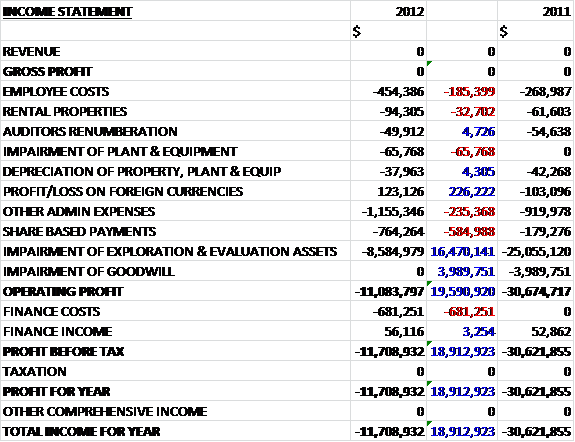
The group have not struck black gold yet so there is currently no revenue.  The largest increases in operating costs are employee based with cash costs and share based payments both increasing.  The group did manage to make a small profit on its foreign currencies but the largest cost is the impairment of exploration assets ($8.6M, down by $16.5M last year).  The impairment, along with the impairment of equipment relates to the end of the Ugandan licence where the group failed to strike oil.  It is notable that the group incurred financial costs this year, up $681K from nothing last year relating to the costs for new finance arrangements.  No profits means no tax so the loss for the year was $11.7M, an improvement of $18.9M from 2011.

towerassets

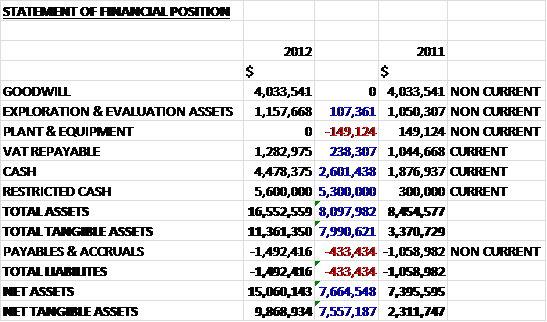
Total assets for the group were $16.6M, up by $8.1M when compared to last time.  The increases were a $5.3M hike in restricted cash held in an escrew account  ready to be transferred to Arcadia to double their interest in the Namibian license, and an extra $2.6M held in normal cash.  The current capitalised E & E costs relate to the Namibian license ($1.2M) and the Western Sahara license ($225K).  The receivables relate to VAT repayable by the Ugandan government which the group are negotiating over.  The only liability comes under payables and mostly involves VAT withheld related to the Uganda operation, and again, the group are negotiating with the Ugandan government over this.  Overall net assets nearly doubled to $15.1M and net tangible assets of $9.9M were $7.6M higher than in 2011.

towercash

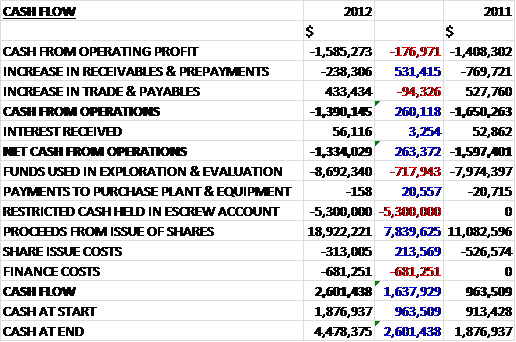
A cash flow analysis is probably more useful than some other measures.  After favourable movements in working capital, the net cash outflow used in operations was $1.3M.  The largest expense, as would be expected, was funds used in exploration, and at $8.7M they increased by $718K over last year.  The group also spent $5.3M on the escrew account before it was used to acquire a higher stake in the Namibian asset.  During the year, the group successfully raised $18.9M in a rights issue ($7.8M more than in 2011) to keep going and there was also $681K spent in finance costs, relating to the two new agreements mentioned below to secure extra financing,  which was not present last year.

As can be seen from the above statements, there is quite a lot of impairment of assets.  This relates to the full impairment of capitalised exploration and evaluation costs at its site in Uganda as the group failed to find any hydrocarbons there.  The well was drilled at a cost of $8.6M and was relinquished in March 2012.  The group has completed site restoration to the satisfaction of the Ugandan authorities and their bond was released in March 2013.  They have retained a commercial presence in the country and will bid in the next licensing round.

During the year, the structure for companies working on the Namibian license changed.  Tower doubled its holding to 30%, Repsol became the operator with a 44% interest and Arcadia makes up the rest with an interest of 26%.  In order to complete the transaction, $5.3M was transferred from the escrow account, after the end of the balance sheet date, and will be capitalised under E&E.  The asset covers three blocks, 1910A, 1911 and 2011A.  The first well to be drilled on the Welwitschia, on the Delta structure, is due to be drilled early to mid-2014 and will go through the five identified reserves to a depth of 3,000m.  458M boe of risked recoverable reserves have been attributed to Tower’s 30% holding so we could be looking a potentially substantial amount. 

Tower are not the only company drilling in Namibia, HRT have begun drilling offshore in the country so it will be worth keeping track of what they find, if anything.  Recent geo-seismic studies within the block that Tower is part owner of have identified a number of direct hydrocarbon indicators. Although no commercial quantities of oil have been found in Namibia to date, the geology is similar to that in Congo, Angola and Brazil, all prolific sources in recent years.  There have been two recent drills in Namibia.  The Kabelijou exploration well drilled by BP, Petronas and Charity intercepted source rock but failed to discover commercial quantities of hydrocarbons. The other exploration well, the Tapir well drilled by Chariot announced It encountered sections of excellent quality reservoir but again, no commercial quantities of hydrocarbons were found.

As well as the geo-seismic data, there have also been sightings of surface seeps, pock marks and gas chimneys.  The seismic data, as well as suggesting hydrocarbons are present, also provides evidence of the presence of sands in the Tertiary and Upper Cretaceous, and carbonate reservoir in the Lower Cretaceous.   Within the license, there are four large leads.  The southernmost, Delta, was covered by the 3D seismic survey and the first target, the Deep Maastrichtian, has an economic chance of success of 31%.  Although this well has the highest chance of economic success, there is also Palaeocene with 19%, Upper Campanian with 9%, Campanian Wedge with 9%, Albian with 8%, Alpha Palaeocene with 12% and Gamma Palaocene with 9%.  The Deep Maastrichtian is currently the most exciting, but given the sheer quantity of estimated reserves, Palaeocene is also a pretty decent prospect.

The total costs for the Namibian well is likely to come to about $30M, so obviously more funding will have to be obtained from somewhere.  The group did enter into an $8M Standby Equity Distribution Agreement (SEDA) and a managed $3.125M SEDA backed loan agreement with YA Global Master, an investment fund managed by Yorkville.  The loan can be increased in tranches of $1 up to a total of $6.125M.  Also, an agreement was made with Darwin Strategic to enter into a £20M Equity Finance Facility (EFF).

Apart from Namibia, the other licence that Tower is currently involved in is in the Western Sahara.  The group own a 50% interest in the offshore Guelta block and the onshore Bojador block, both of which are operated by Wessex exploration, the other 50% owner.  In addition, the two companies have also entered into an assurance agreement for an interest in the Imlili block, also offshore.  There has not been much exploration work in the country but high quality reservoir in wells drilled to date show some potential.  Due to the political situation there, it is not currently possible to progress any exploration work on this asset but as part its acquisition in 2008, there is a potential contingent consideration payable should any future exploration activities be successful. 

In June 2012, Graeme Thomson was appointed as the new CEO so it will be interesting to see if any new ideas are progressed.  As things stand at the moment, there is no real chance of the Western Sahara license being progressed so this is pretty much a bet on whether they will find commercial quantities of hydrocarbons in Namibia.  The lack of a find so far seems disappointing but given the size of the potential reserves, I think these shares are worth a (very) speculative buy.  I am fairly comfortable with the 30% success rate for the first well.

On the 22nd May, the group released a statement regarding the HRT exploration well offshore Namibia.  Whilst they did find some oil from thin sands, the principle target of the well, a carbonate reserve, was not as well developed as anticipated.  Therefore no commercial quantities of oil were found.  This well was 200km south of tower’s own Welwitschia prospect and while this well shows that oil has been generated and migrated, the lack of any large remaining reserves is disappointing.

On 2nd July, the group released a statement covering an update to the Competent Persons Report covering the Namibian well.  Due to the discovery of light oil at the HRT well, there is considered to be a slight increase in the chance of an oil discovery.  The estimate of net risked prospective resources at the Welwitschia well was increased from 458m mboe to 496m mboe.

On the 3rd July the group announced that acquired a 20% interest in the Marovoay block onshore Madagascar through the purchase of Wilton Petroleum ltd.  The block is operated by Ophir energy and they have an 80% interest.  The first exploration well is due to be drilled by mid-2014 and is targeting prospective resources of about 90m mbbls.  The price for this acquisition is $1.75M in cash and shares equal to 7% of Tower’s equity, which values Wilton at $4.7M. There is also deferred consideration of $4M should the operator drill a second well.  There does not seem to be huge potential here, but it is good to see the group branching out into other countries.

On the 5th July the group announced they had entered into a strategic partnership with Geoscience group PDF.  They will provide exploration data tailored to the expanding needs of the company.  PDF will earn a portion of its fee in Tower shares, which as management state, will align the fortunes of the two companies.  It does seem, however, that Tower are creating quite a dilution of the share capital with these deals.

On the 5th July the group also announced a Namibian operational update.  The drilling of the Welwitschia well is now planned to commence in mid-February and a firm rig is in place, the drilling location is agreed, the site survey is largely completed and the long lead time items are being manufactured.  The new build Rowan Renaissance, on a three year contract with Repsol, is being used for the drilling.  The rig will be delivered in December and move directly to Namibia for its first assignment.  The budget is currently at $27M, with Tower’s share currently $8.1M to be called in the second half of the year.  The board expect Tower’s share of the total cost to be $24M.  The group are looking at various sources of financing for the well, including farm-out, asset swap and an equity raise.

On 22nd July, the group released a statement covering the recent exploration well drilled by HRT in Namibia. Although reconfirming the presence of an Aptian marine source, they failed to find the presence of quality reservoir in the primary Murombe objective.  This was the second in three wells being drilled by the company and is located 200km south of Tower’s main project.  A secondary target, the Baobab reservoir was found to be water-wet so the well is being prepared for plugging and will be abandoned.  This is another failure in a similar area but it the question must be asked – where have the oil reserves migrated to?

On 25th July, the group announced a placing of £9M and an open offer of up to £4.1M.  The proceeds will be used to fund the company’s share of the 2013 costs associated with the Welwitschia well in Namibia, the cash portion of the Wilton acquisition, for general working capital purposes and to enhance the ability to pursue new ventures.  The placing will be offered to certain existing and new customers at a price of 1.125p per share.  The directors are participating in the placing, investing £1.2M.  There was also an announcement that they intend to farm out a 10% interest in the Namibian license to fund the 2014 drilling costs.  If it is unable to farm out this interest, it is expecting that the company will have to seek additional funding in order to meet its remaining ongoing work obligations under the Namibian license. 


Ricardo Finance Blog – Half Year ending 2014

Ricardo has now released its results for the half year ending 2014.

ricardointerimincome


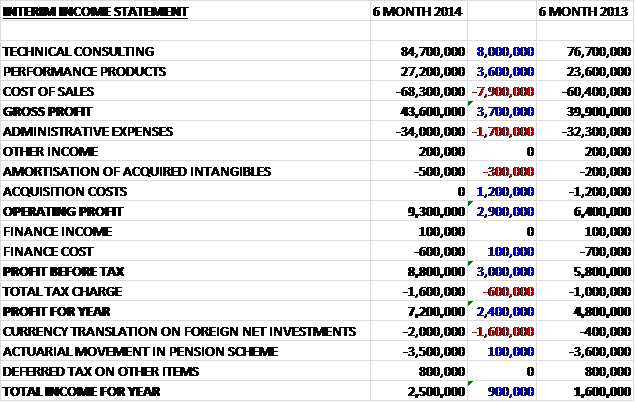
Revenues were up across both reporting segments, with Technical Consulting up £8M and Performance Products up £3.6M.  Cost of sales also increased but not enough to prevent an increase in gross profit, up £3.7M.  Admin expenses were up by £1.7M and there were no acquisition costs, which accounted for £1.2M last year so the Operating profit was up £2.9M to £9.3M.  There was a slightly larger tax charge, as would be expected, so the profit for the half year was £7.2M, which was £2.4M higher than the same period of last year, but the increase was halved to a still decent £1.2M if the one-off acquisition costs from last year were removed.

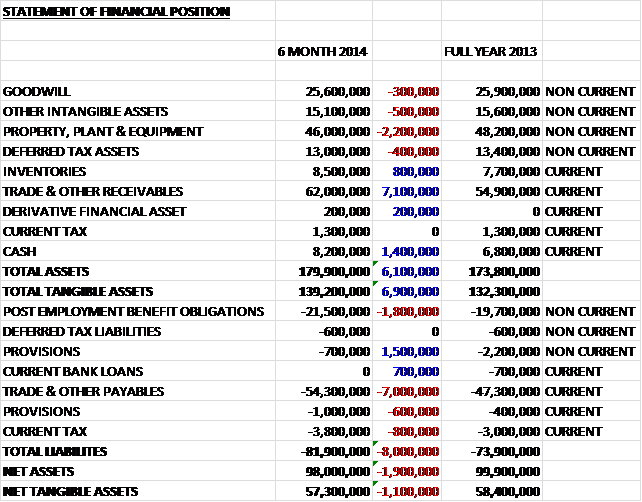
ricardointerimassets


When compared to the end of last year, total assets at the half year point were up by £6.1M.  This was driven by a £7.1M increase in the level of receivables, a £1.4M increase in cash and a £800K hike in inventories; somewhat counteracted by a £2.2M fall in the value of property, plant & equipment and a £500K reduction in other intangible assets.  During the same period, we also saw an increase in liabilities, driven by a £7M hike in payables and a £1.8M increase in pension liabilities, somewhat mitigated by a net £900K fall in provisions and the elimination of the last remaining £700K of bank debt.  Overall then, net assets fell by £1.9M, which is pretty much the amount of the pension liability increase.

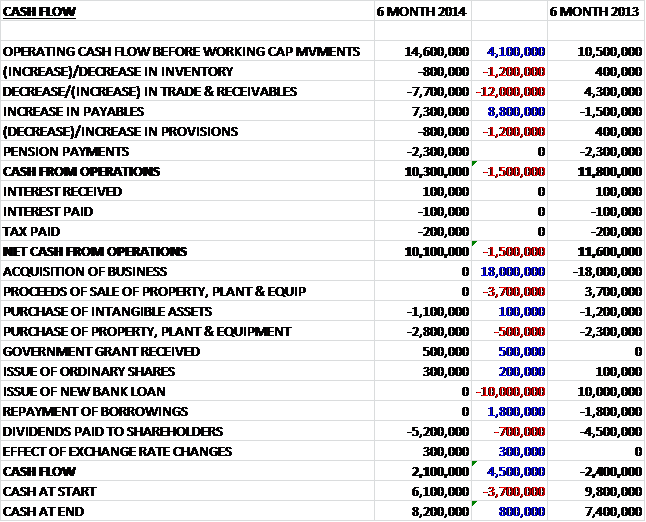
ricardointerimcash


Before working capital movements, the cash flow for the half year was up by a fairly decent £4.1M.  During the half year, both payables and receivables increased but at a broadly similar amount.  Compared to last year, however, the increase in receivables was significant.  The group also made £2.3M of pension payments and paid out negligible tax and a net of zero interest so the net cash from operations was £10.1M, £1.5M less than in the first six months of 2013 due to the increased receivables.  As far as non-operational items are concerned, the only payments were a £5.2M dividend payment (up £700K), a £2.8M spend on property and equipment (up £500K), and a £1.1M spend on intangible assets.  This time last year, the group also spent £18M on the acquisition of a new business and benefited from £3.7M of proceeds from the sale of fixed assets.  It is impressive that the group has already been able to absorb those costs from cash flow as it has paid back all of the loans at the end of last year.  Overall then, the cash flow was £2.1M at the end of the half, a decent amount given the small increase in capital expenditure and dividends.

Technical Consulting operating profit was £5.6M, up by £900K.  The UK business continued to be the main driver of profits whilst the German and US businesses continued to face a challenging market backdrop and had a difficult start to the year.  These businesses did gain traction in the second quarter, however, and the closing order book was very encouraging.  In the motorcycle market the group are enjoying some success with new contract wins in China, Japan and Europe.  The motorsport and high performance vehicle business also enjoyed a good start to the year with a number of large contract wins.  In the passenger car sector, the group has experienced a good level of activity in Japan, China, the UK and US, along with emerging economies with the drivers coming from increased fuel efficiency and reduced emissions.  The commercial vehicle market remained difficult but there were opportunities in China and Japan

The defence market seems to be continuing to perform well, with work in the UK and US continuing.  The widely publicised reduction in US defence spending may have an effect going forward, however.  The rail business continued to develop within a variety of territories with recent projects including engines, driveline, alternative fuels and strategic consultancy – natural gas as a fuel has been a particular engine for growth.  The energy sector performed as expected with electrical energy storage a particular area for growth.  The key area for growth within the marine market is the efficiency of propulsion systems to improve fuel consumption and the group has won a number of contracts to upgrade engines to run on alternative fuels such as natural gas.  The group’s marine business is growing strongly in Europe, with increasing interest in Asia and North America.  There was also a strong performance in environmental consulting and the group are looking to expand internationally there.

Performance Products operating profit was £4.2M, up by £600K.  This performance was underpinned by increased motorsport activity and monorail transmissions, which offset a reduction in the delivery of defence vehicles.  Production of the Porsche Cup transmission commenced in July, which marked the start of a long term supply agreement.  The supply of engines to McLaren and clutch transmissions to Bugatti continued and as mentioned in the last update, a new contract with McLaren worth £40M per annum for the supply of engines will commence in 2016.  In addition, products for formula 1 customers, Japanese Super GT and the Renault World Series continued.  In Rail, the group continued to supply monorail transmission in Malaysia and received a new order for transmissions in Brazil.  In Defence, the assembly of the Foxhound vehicles for the MOD continued but the final tranche has now been delivered.

Going forward, management has seen a steady increase in prospects in a number of key markets across Europe and North America and the Asian Pacific markets have remained hungry for technology transfer and new product development.  The business will continue to benefit from the global trends in reducing carbon dioxide emissions, improving the efficiency of energy usage, the reduction of the release of pollutants and particulates and the addressing a changing global energy mix.  The core areas of growth are in transport, security and energy.

Overall then, this is a good update – profits have increased across both areas and there seem to be a good number of new contract wins.  Cash flow was good but net assets suffered a reduction, partly due to increased pension deficits.  Going forward, there is a little bit of uncertainty in the defence market with reduced spending and the end of the supply of Foxhound vehicles to the MOD, so it will be interesting to see whether the group can absorb that.  Management has declared an interim dividend of 4.3p per share, up from 4p last year, which gives an annual yield of 1.9% at the current share price.  Net cash at the end of the half was £8.2M, up from £6.1M at the end of the last year.  At these levels, I see the shares as a hold and am not going to add any more until the results of the lack of Foxhound deliveries can be seen.

On the 19th May the group released a management statement covering the first 10 months of the year.  The order book at the end of April stood at £141M compared to £130M at the same point last year benefiting from a good level of orders from the US during April.  Significant orders in the last four months included a large engine project for a major passenger car OEM in the US, a further DARPA order in the US and a commercial vehicle engine programme.  Orders in the UK included further passenger car orders for large OEMs and in Performance Products, orders included the pre-production phase of he new McLaren project together with further motorport transmissions.

In the pipeline there are a number of projects for Chinese customers in the latter stages of negotiation and passenger car opportunities in the UK, US and Germany.  In Performance Products, the group also signed a multi-year production supply agreement worth over £35M in revenues that will start in 2015.  Revenues in the first ten months were up 3% on the same period of last year and profit was in line with expectations.  Performance Products performed well but UK revenues in Technical Consulting was slightly lower than expected in Q3 due to delays to a project.  Ricardo-AEA and Strategic Consulting continued to perform in line with expectations.  The group are building momentum in the US and Germany with the order book in both locations ahead of that of the same period of last year.  The group continued to have a net cash position despite working capital increases due to the changing mix of the customer base and the growth of performance products.  Overall this was not a bad update but I am left a little disappointed at the slight slow down in revenue growth due to the delay to projects in the UK.  Hopefully this will just have a temporary effect.

On the 17th July the group released a statement covering the final two months of the year.  Customer activity in those two months was positive with a record year end order book and a good pipeline across multiple markets.  Asia continued to perform well with orders being signed in China and Japan with further opportunities in the latter stages of negotiation.  Profit performance for the year is in line with market expectations and revenue will be slightly above that of last year.  Further cash generation in the period lead to a cash balance slightly ahead of expectations.  Market conditions are strong in the UK and Asia and the US is showing improving conditions but Germany remains challenging.  Overall a decent update with no real surprises, I remain a holder.

TT Electronics Finance Blog – Interim Results 2013

After a strategic review, the group is now split into Sensing and Control, the provision of sensors that convert physical variables into electronic signals, controls that process input from the sensor and instrument systems; Components, specialist resistive and magnetic components and microcircuits, connectors and interconnection systems; and Integrated Manufacturing Services, the provision of global electronics manufacturing capability with logistics and integrated systems.

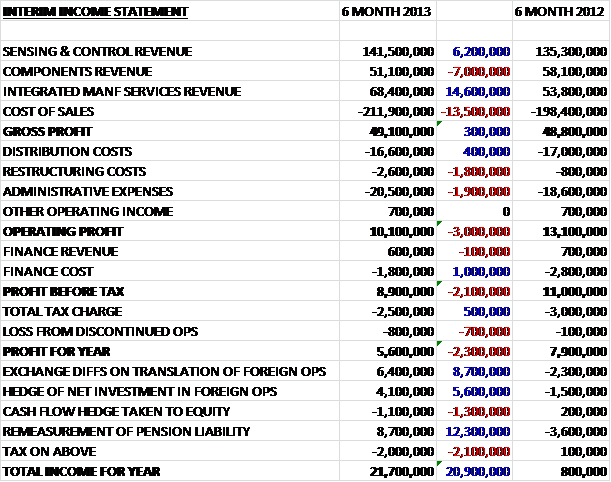
ttinterimincome


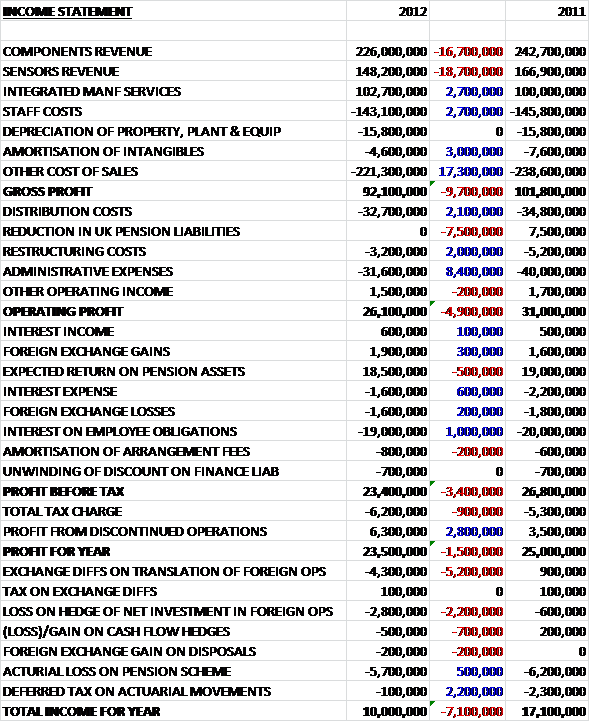
Overall revenues increased during the first six months of the year, after a slow first quarter was followed by a better second quarter.  Discounting the favourable exchange rates and the contribution from the acquired ACW business, however, underlying organic revenue was down by just under 1%.  There were differing fortunes for each sector, however.  Integrated Manufacturing Services did best, up by £14.6M; Sensing and Control also head a steady half year, increasing revenues by £6.2M but the Components sector saw revenues fall by £7M, due to lower demand for industrial resistors and connectors for military markets.  Cost of sales increased during the period to leave Gross Profit just £300K higher at £49.1M.  Distribution costs improved slightly but admin costs increased by £1.9M and restructuring costs were up £1.8M to £2.6M.  This meant that Operating profit was £3M lower at £10.1M before a lower finance costs and tax charge were somewhat mitigated by a £800K loss from the discontinued operation, due to a settlement from TT relating to the disposal of Ottomotores last year, to give a profit for the half year of £5.6M, down by £2.3M.

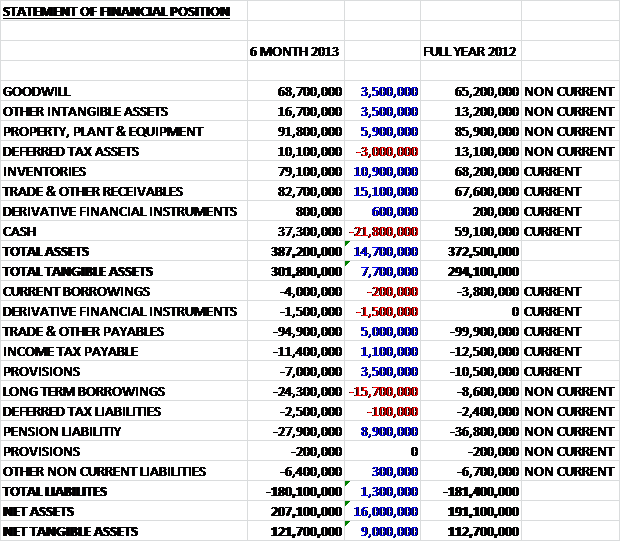
ttinterimassets


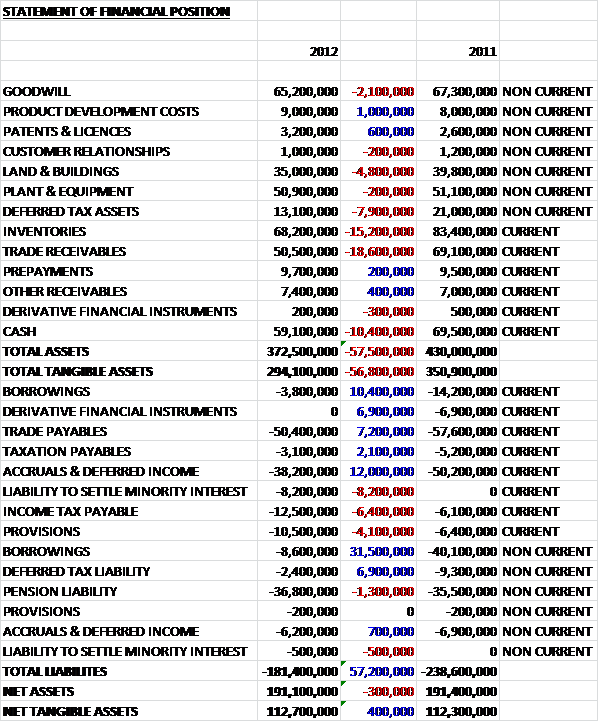
Overall total assets were up £14.7M.  The largest increases were seen in trade receivables, up £15.1M; inventories, up £10.9M and property, plant & equipment, up £5.9M.  These increases were counteracted by a £21.8M fall in cash levels.  Liabilities were fairly stable when compared to the end point of 2012.  A £8.9M fall in pension liabilities, a £5M reduction in trade payables and a £3.5M fall in provisions were almost entirely counteracted by a £15.9M increase in borrowings.  Overall then, net assets increased by £16M to £207.1M and net tangible assets were up £9M to £121.7M.

ttinterimcash


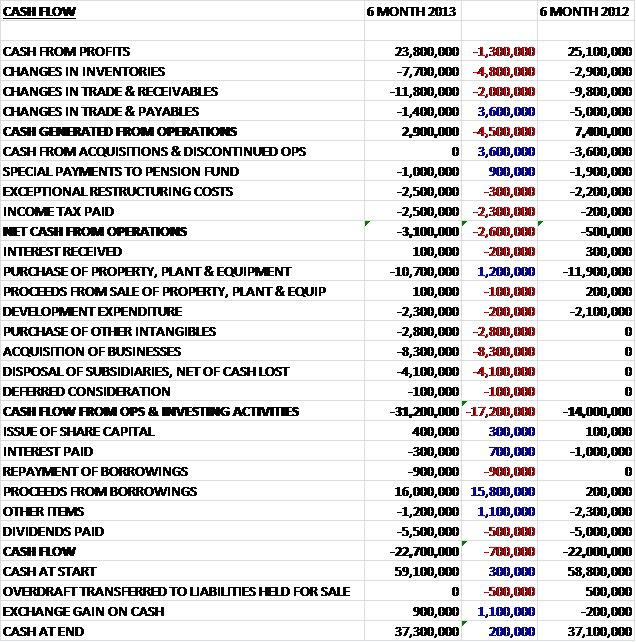
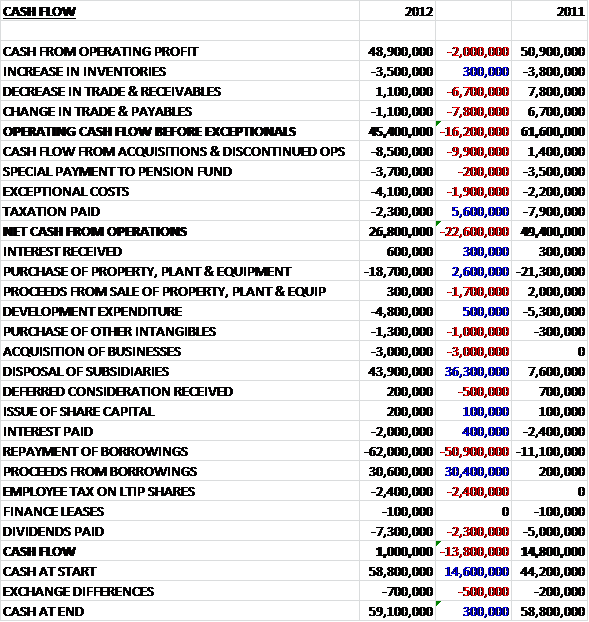
Cash from profits for the first half of the year suffered a £1.3M fall when compared to the same period of last year.  There was a huge adverse shift in working capitals with particularly large increases in receivables and inventories due to seasonal factors, the ramp up of manufacturing in Romania, the effect of the ACW acquisition, the closure of the IMS Malaysia plant and lower trading in components and IMS.  This left the cash generated from operations at only £2.9M, down by £4.5M.  The group then paid a £1M cash charge to the pension fund, although this was less than last year, and had £2.5M of restructuring costs which meant there was a net cash outflow from operations of £3.1M, £500K worse than in the first half of 2012.

The group then spent £10.7M on tangible assets, mainly as a result of investment in the Mexican and Romanian facilities, and £2.8M on intangible assets, along with £8.3M to fund the acquisition.  They also managed to lose a net cash amount of £4.1M on disposals!  Therefore we see a £31.2M cash outflow before investing activities.  The cash flow was give some help with a £16M receipt from new loans but even after this, the cash flow was a negative £22.7M.  The group really need to work on their working capital controls to improve the cash generating performance.

As can be seen from the statements, there were a number of exceptional items during the period including the closure and relocation of the ACW Technology facilities from Southampton to Tonypandy in Wales at the cost of £1.1M; the relocation and start-up costs of production facilities in Romania, at a cost of £400K; the relocation of production facilities in Malaysia, at the cost of £500K; restructuring costs relating to the new organisation structure (£400K); final costs relating to the closure of the Boone, NC plant (£200K); the release of a surplus fair value inventory provision created at the date of acquisition of ACW Tech; and the amortisation of the fair value adjustment made to inventory at the date of acquisition relating to ACW  Tech (both £400K).  This is a lot of restructuring, hopefully it will all bear fruit.  The group also announced the “Operational Improvement Plan” which is expected to cost £30M over the next two years and give annual savings of £8M by the end of 2015.

During the half year the group completed the acquisition of the 49% minority interest in Padmini, the Indian Sensing and Control business for £8.3M in cash with a further £500K deferred subject to performance conditions.  The earlier acquisition of ACW Technology is apparently now successfully integrated.  It can be seen that there is a clear problem with the pension deficit and an agreement has been made with the trustee of the scheme for additional payments of £3.9M in 2013, £4.1M in 2014, £4.3M in 2015 and £4.5M in 2016.  This is a substantial amount of money and may act as a bit of a drag on results for years to come but will hopefully go some way to reducing the deficit.

Operating profit for the Sensing and Control business was £8.9M, up by £800K.  This performance was driven by progress in industrial and transportation markets, including a better performance for the Austrian operation.  Demand in their markets is being driven by tighter emission targets and the need for better performance and the group apparently has a good pipeline of products to take advantage of this.  Two new contracts have been won in China for delivery next year, which reflects growth in this market.  Going forward, the group is expecting margins to improve due to the move of several operating lines from Austria to Romania.

Operating profit for the Components business was £1M, down by £2M.  The connectors business was affected by lower levels of defence spending, which is expected to continue going forward.  The resistors business was affected by customers re-balancing inventory levels, which is expected to improve in the second half of the year.  The group has invested capital in a new facility at Corpus Christi in the US for the development of thin film resistor products in an effort to refresh the product portfolio.

Operating profit for Integrated Manufacturing Services was flat at £2.8M as the segment suffered lower margins due to the ACW acquisition and the exit of operations in Malaysia.  The business entered the second half of the year with a strong order book, however, and is expected to improve margins during the period.  The ACW acquisition has come with a number of new clients and the group is increasing its manufacturing footprint by establishing a new facility in Romania alongside the existing Sensing and Control operations.

Overall then, this was a slightly disappointing performance.  Underlying organic revenue fell, mainly due to the reduction in military spending in the components division, but net assets were up, due mostly to increased working capital.  This increase in working capital, partly due to the ramp up of production in Romania and the ACW acquisition gave rise to a dire cash flow performance as there was an operating outflow of £3.1M (hopefully this can be reversed somewhat in the second half).  There are also a lot of exceptional items, and this is only going to increase in the near term as the group has outlined a cost reduction plan this will cost £30M over the next couple of years, which will have an effect on free cash flow going forward, I would have thought. An interim dividend of 1.6p was declared (an increase of nearly 7%) which gives an annual yield of 2.3% at the current share price.  The group has a net cash position of £9M, a vast improvement on the net debt position of £7.3M this time last year, due to the disposal of the Secure Power business.  Orders apparently indicate that the second half of the year should give a better performance than the first half.  So, some signs that this may be a decent investment in the long term but I see a few too many headwinds in the near term to dip in just yet.

On 12 November the group issued a statement covering the first ten months of the year.  It was announced that underlying sales were up 2.6%, reflecting the improving trading conditions.  It was also stated that the order book had been growing steadily.  During the period, the group secured a contract with a major Korean OEM, supplying pedal and power management electronic controls.  New contracts were also won supplying control modules, system critical sensors and electonic pedals to three major customers.  As part of the “operational improvement plan” the group has announced the transfer of production of sensors and resistors from California to Mexico and the closure of the sales office in Japan, instead relying on distributors in that country.  The connectors and harnessing factory based in Smithfield, USA is being closed with some lines being transferred to Perry, USA and some to Abercynon in the UK.  So far the savings in transfering lines from Germany to Romania have been lower than expected due to delays in obtaining approvals and supply chain issues, which have now been largely resolved.  Due to these problems, the group’s performance for the year is likely to be at the lower end of expectations.  It is good to see the increase in business but it is a shame about the supply chain issues.  I remain uninvested here.

On the 10th January the group released a pre-close trading statement covering the last two months of the year.  Trading was in line with expectaions and underlying organic sales for the whole year were ahead by approximately 5% on 2012.  The order book continued to improve and the group is heading into 2014 with a healthy order book.  Improved working capital controls helped give a decent cash generation and the group had a decent £26M net cash position at the year end.  This cash will be used for internal investment and the odd acquisition.  At the same time it was announced that the group was planning to relocate manufacturing operations from Werne to lower cost areas.  Due to the ongoing operational plan, there will be a doubling up of inventories and some operational efficiencies which will obviously affect cash flow and hold back margins in the coming year.  This is a better update but I still feel the desire to wait on the sidelines until the operational review plan is properly underway.

On the 14th January, the group announced that Geraint Anderson was stepping down as CEO after six years.  He will be replaced by Richard Tyson in July.  Richard joins from Cobham as president of their Aerospace and Security division.  The outgoing CEO is leaving to focus on other projects and came as a bit of a surprise.

Dechra Pharmaceuticals Finance Blog – Half Year Results 2014

Dechra have now released their half year results for the year ending 2014.

dechraincome2014h


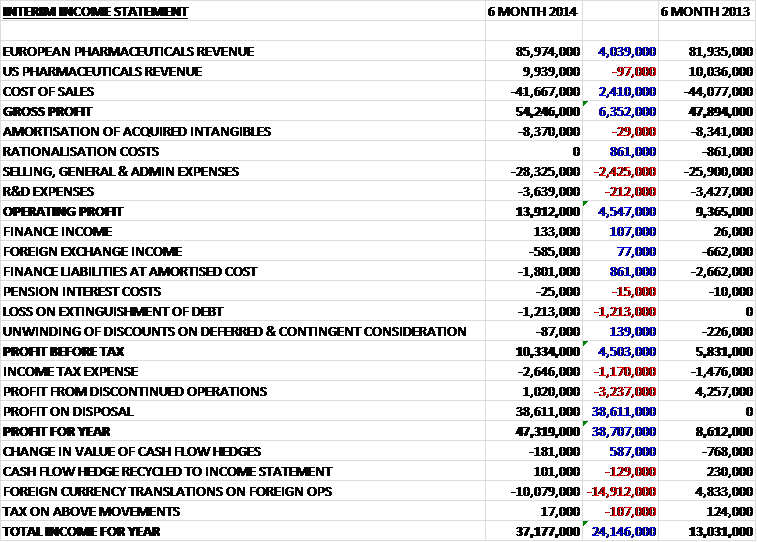
European revenues increased by a rather meagre £4M with US revenues remaining roughly flat.  The cost of sales, however, also reduced, by £2.4M to give a Gross Profit up by the tune of £6.4M.  There was an increase in admin costs, due in part to the reallocation of corporate costs following the divestment of the services segment,  and a slight clime in R&D expenses, somewhat counteracted by the lack of a £900K expense relating to rationalisation costs that occurred last year.  This meant that operating profit was £4.5M higher at £13.9M.  The rather high finance liabilities came down somewhat, presumably due to the reduction in the debt level but there was a one-off £1.2M loss on the extinguishment of the debt.  Therefore the profit from continued operations before tax was £10.3M, £4.5M up from the same period of last year.  The tax expense was nearly £1.2M higher and the profit from the operations of the disposed segment took in £1M, down from £4.3M the year before.  All this was dwarfed, however, by the £38.6M profit on the disposal which meant that profit for the year was up £38.7M to £38.6M.  I believe the profit before tax gives a more accurate picture this time, however.

dechraassets2014h


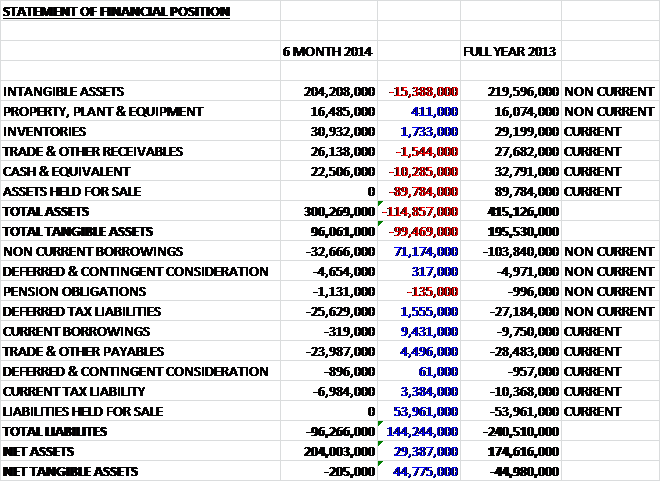
Overall, assets were down an incredible £115M, mainly due to the £89.8M reduction in assets held for sale relating to the disposal.  We also saw a £15.4M fall in intangible assets and a £10.3M reduction in cash levels.  Thankfully this was counteracted by an even larger £144M fall in liabilities.  £54M of this were the liabilities held for sale but the largest fall was a £80.6M reduction in borrowings as the group used the cash from the disposal to reduce debt.  There was also a £4.5M fall in Trade payables and nearly £5M less in tax liabilities.  This all led to a £29.4M improvement in the net asset situation and a net tangible asset base that was pretty much at zero; so the balance sheet now looks much more healthy that last year.

dechracashflow2014h


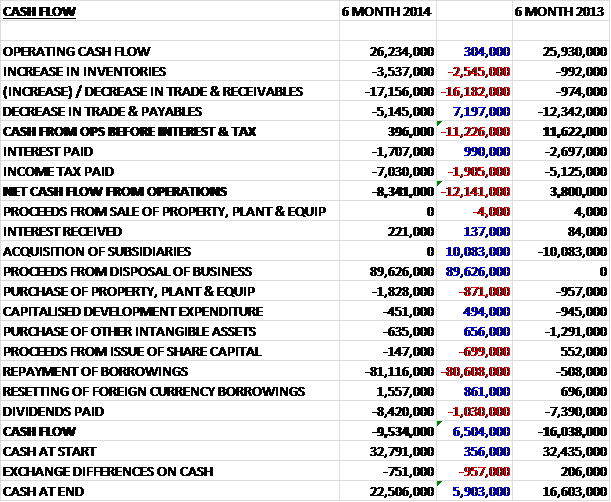
Cash profits were fairly flat at £26.2M but large adverse movements in working capital, particularly a big increase in receivables, meant that cash before tax was down a substantial £11.2M to just £400K.  (this was being blamed on the phasing of working capital at the services segment).  Due to the play down of debt, the interest paid was down by nearly £1M but there was a large tax bill of £7M, which was a big increase from last year so net cash from operations for the first half of the year was a disappointing outflow of £8.3M, £12.1M lower than in the same period of last year.  Capital expenditure was a bit higher than in 2013 but the big differences were one-offs.  The £89.6M received from the disposal of the services segment was used to pay back £81.1M of borrowings and increase dividend payments by £1M to £8.4M.  The group also benefited from not paying out any more contingent consideration on the US acquisition, which meant the lack of a £10.1M payment that occurred last year.  Overall, there was a cash outflow of £9.5M which, given the scale of the one-off receipts, is actually a little disappointing, although management expect this to improve in the second half of the year.

The operating profit for European pharmaceuticals was up by £4M to £25.2M.  Without the effect of favourable currency exchange rates, however, revenues actually declined by just under 1%.  This was partly due to the phasing of export orders, the ongoing pressure on antimicrobial usage in animal medicine due to concerns of over-resistance and the introduction of new dosing guidelines in the Netherlands, where the group did particularly badly over the period.  This meant that the mix of sales was slightly more skewed to higher margin companion animal drugs.  During the period, a number of advances were made in the drug portfolio, including the launch of a 1.25mg version of Felimazole to try and counteract generic completion for the larger doses; the launch of Sedator, Atipam and Domidine, three sedatives from the Eurovet portfolio, into Norway and Sweden; the preparation of Forthyron, a canine endocrinology product for launch in France and Sweden following the termination of distribution agreements with previous marketing partners; and the rights have been secured to market two new in-licensed products: Alfaxan, a cat sedative from Jurox and Sporimune, an oral dermatological product from Le Vet.

The other focus for growth has been geographical and the group have established a subsidiary in Italy that will commence trading in March.  Third party contract manufacturing continued to perform well with a strong order book and new contracts being secured during the period.  Work has been commenced on the expansion of the liquid, creams and ointments suite at the manufacturing site in Skipton which should increase capacity, improve quality systems and help the group achieve FDA (US) approval for these dosage forms.

Profit for US pharmaceuticals increased by just £316K to £3.3M.  Although nothing was paid during the period, the group still has a potential $6M to spend on the US acquisition, $5M is dependent on reaching a certain revenue and this does not expire until the 6th anniversary of the completion date.  Revenues decreased during the period, however, due to ongoing supply problems with Animax and it looks as though it will not return to normal until the end of the year at the earliest.  Having said that, key products Vetoryl, Felimazole and the dermatology range all performed well with double digit revenue growth.  A new dermatological product, Miconahex + Triz was launched during the period which is competition to an established brand whose patent has recently expired.

During the period, a couple of milestones were achieved on the product pipeline with a positive response from the FDA regarding a novel equine product and the successful completion of a clinical trial for a new canine endocrine project.  The most notable new registration was for Felimazole 2.5mg and 5mg in South Korea.

It does seem as though the group is experiencing a number of headwinds at the moment.  As well as the previously mentioned guidelines for antimicrobial products in the EU and supply issues from third parties in the US, a generic competitor has launched a product targeting Felimazole, one of the group’s key brands, in a number of EU territories; since the end of this update, Sterling has strengthened considerably against the Euro which will have an adverse effect on earnings; and a drug that is needed to diagnose Cushing’s disease in dogs that is manufactured by a third party is currently in short supply which impacts the use of Vetoryl.  Despite all this, management still expect to hit earnings targets but are cautious about the overall economic environment as well as these issues going forward.

Net debt at the end of the period was a modest £10.5M, down from the £81M recorded at the end of the last year due to the previously mentioned pay-back of debt using cash from the disposal.  The interim dividend was increased by just over 9% to give a full year dividend yield of 2.1% at the current share price, which is OK but nothing spectacular.  The profit this half was pretty decent, but this may have been due to favourable exchange rates which are no longer present.  The balance sheet has been substantially improved with the cash received from the disposal being used to pay back debt.  The operating cash flow was disappointing.  This is being blamed on the phasing of working capital at the disposal group but I remain slightly sceptical.   These issues, along with the headwinds described above make me a little hesitant about Dechra for the first time.  I am going to stick with it for the time being but I do not feel confident enough to add at these levels.

On the 30th April the group released a statement covering Q3 of this year.  Overall revenues in the quarter were 4.7% ahead of the same period of last year and for the first nine months of the year they were up by 2.8%.  In Q3 European pharmaceutical sales were up 3.3% against a comparitor period affected by poor weather.  On the constant currancy level, sales were up 2.9%, driven by a 9% increase in sales of companion animal products, counteracted by flat revenues for food producing animal products  as improved equine product sales were mitigated by a decrease in large animal antibiotic sales.  US revenues were up a promising 16.3% in the quarter, and this would have been even more were it not for currency headwinds in the region.  Momentum in the endocrinology and dermatology areas in the US was strong with Veroryl and Felimazole performing ahead of expectations.  During the quarter the group opened an Italian subsidiary and they are on track to open a Canadia subsidiary in the Autumn of this year.  Overall, group trading was in line with management expectations which is a bit of a relief given the problems highlighted at the half year stage.

On the 2nd May, Dechra released an update covering a number of their different drugs.  They have received approvals from both the US Food and Drug Administration and the UK Veterinary Medicines Directorate for Osphos, a clodronate injection for to control navicular syndrome in horses, a leading cause of equine lameness.  The drug is not yet approved for use in the rest of the EU as horses are classed as a food producing species which means additional studies needed to be undertaken.  These extra studies are now complete and the group are filing for approval in the EU immediately.  The product will be manufactured from June and should be launched in the US and the UK at the start of the next financial year.

It was also announced that Vetropolycin and Vetropolyin HC, two major sterile ophthalmic products received market approval for re-launch in the US following their transfer to a new manufacturing site.  At their peak these products had sales of about $2.2M.  In October 2012 Dechra took ownership of the marketing authorisations and they spent the subsequent period identifying a suitable manufacturer and seeking approval for the new site.  The group had already manufactured a quantity of this product and it will be sold through distributers immediately although the group don’t expect them to have a material effect on profitability this financial year.  Additionally, the group has recently submitted the dossier for approval in the EU and to the FDA for a canine endochrine product.  It is targetted for approval in 2016.

It is good to hear that some of the manufacturing problems in the US seem to have been solved and the new equine drug also seems promising.  This is a good update for the group.

On the 20th May the group announced the acquisition of the trade and assets of PSPC Inc for $10M.  Of this $10M, $8.5M is due on completion and the remainder is contingent on the successful registration of a new product in development.  Dechra will also pay a royalty of 10% on total net sales on the products, increasing by 2.5% if annualised sales are more than $7.5M and a further 2.5% if annual sales exceed $12.5M for the life of the Phycox patent.  The principle asset is Phycox,  vet joint supplement for dogs and horses that contains an algae extract that alleviates pain and inflamation without many of the side effects that can occur with other similar drugs.  Phycox currently has annual US sales of $4.5M.  The acquired group have also launched a Vitamin K soft chew that is used to treat dogs and cats poisoned by rat poison.  This seems very niche indeed but has potential sales of up to $1M.  Finally, the group also has a product in the final phase of development that is due to be released next year and should bolster the endochrinology category.

Overall, this is quite a small acquisition with a number of conditions attached but should enhance Dechra’s US products.

On the 8th July, Dechra released a statement covering trading for the full year.  Overall revenues were up 1.6% at the constant currency rate as a second half growth rate of 3.7% compensated for a 0.7% decline in the first half.  European revenues increased by 0.7% compared to last year and all countries showed growth except for the Netherlands where increased competition and antimicrobial reduction continued to create a drag on sales.  Sales of Companion animal products increased 3.4% and equine sales were up 13% but food sales for food producing animals fell by 7.5% due to the above issues.  In the US, revenue grew by 7.1% at constant currency rates and included a 22.9% increase in Vetoryl sales and a 17.4% growth in sales of Felimazole but these results were still affected by the supply issues reported previously.

During the year the group received market authorisation to launch Osphos, a major new equine product into the UK and US which should start to contribute by Q1 2015.  They also submitted a novel canine endocrine product for approval in the EU and US and extended their US portfolio through the acquisition of PSPC in June.  In Europe a new Italian subsidiary was established and there is a planned entry into Canada in the second half of next year.  Overall, no real surprises here but it is a shame to see no end to the supply issues plaguing the US sector.  I will continue to hold.

TT Electronics Finance Blog – Full Year 2012

TT Electronics is an electronics company with three different reporting groups.  Components are specialist resistive components and microcircuits, connectors and interconnection systems; Sensors are electronic accelerator pedals, engine and wheel speed, temperature and pressure sensors and chassis height sensors; and Integrated Manufacturing Services is the provision of global electronics manufacturing capability with logistics and integrated solutions.  The group is active in six different markets: transportation is the most important market, followed by industrial, defence & aerospace, medical, telecoms and power generation.

TT Electronics have now released their final results for the year ending 2012.

ttincome

Overall revenue fell for the year with sensors revenue down the most (£18.7M) and components revenue falling £16.7M, somewhat mitigated by a £2.7M increase in Integrated Manufacturing Services revenue.  Cost of sales also fell, however, and the gross profit was £92.1M, down by £9.7M.  The comparative figure was further improved by a £2.1M fall in distribution costs and an £8.4M reduction in admin expenses, somewhat mitigated by the lack of a £7.5M reduction in pension liabilities that occurred last year.  These, along with some smaller differences, such as a reduction in restructuring costs, which this year mostly related to the closure of the components operation in North Carolina, meant that profit from continued operations before tax was £3.4M lower.  The group also received £6.3M of profit from discontinued operations (relating to the Secure Power division), which won’t occur next time to leave the profit for the year at £23.5M, down by £1.5M.

ttassets

Total assets for the year were down by £57.5M at £372.5M.  The largest falls were an 18.6M decline in Trade Receivables, a £15.2M reduction in inventories and a £10.4M fall in cash.  There were also some smaller falls in deferred tax assets, land & buildings and goodwill.  Thankfully, liabilities also fell considerably with a huge £41.9M decline in borrowings, a £12.7M reduction in accruals & deferred income and declines in deferred tax liabilities somewhat mitigated by an £8.2M liability to settle a minority interest, a net increase of £4.3M taxation payable and a £4.1M hike in provisions, due to an increase in legal provisions.   Overall, then, net tangible assets were just about flat at £112.7M.

ttcash

At £48.9M cash profits were £2M down from last year before slightly adverse working capital movements, particularly an increase in inventories, gave an operating cash flow of £45.4, which was £16.2M worse than last year because of particularly favourable movements in payables and receivables.  Acquisitions and discontinued operations gave rise to an £8.5M outflow of cash compared to a £1.4M income in 2011.  A further £3.7M payment to the pension fund, £4.1M in exceptional costs and a tax payment meant that net cash from operations was £26.8M, £22.6M below that of last year.  This cash was spent on capital expenditure and dividends and the £43.9M of cash received from the disposal of subsidiaries was mainly used to pay down borrowings.  The overall cash flow at the end of the year was a modest income of £1M, down from £14.8M in 2011.  A little disappointing really, considering the disposal.

During the year, the group disposed of the whole Secure Power division.  Dale Power Solutions was sold for £10.6M and Ottomores was sold for £29M.  Due to the assets that were disposed of along with the businesses, the group made a net profit of £6.8M on the disposals. The group also made an acquisition, buying ACW Technology for £3M in cash and £100K of deferred consideration.  On the surface, this seems like a good deal because the value of inventories and net receivables came to £3.1M on their own and there was also £300K of fixed assets acquired.  The acquired company provides manufacturing services to clients in the defence, aerospace and industrial markets.

The group seem to be moving a lot of their manufacturing plants to lower cost regions.  During the year, they expanded the Mexicali facility in Mexico, a new facility was established in Romania and a new engineering facility was opened in India. 

An example of the work the components division has been doing this year is the design and manufacture of blood sensing oximetry technology that delivers accurate non-invasive data, this work has been conducted with CAS Medical Systems.  The Sensors division has designed and developed a second generation combined pressure and temperature sensor, which has already won a major order from BMW.  In China the IMS division has won new business with Aviage systems to provide avionics solutions for the next generation C919 Chinese built commercial airliner.

After the balance sheet date, the group purchased the 49% of Padmini TT Electronics that they did not already own for £8.2M plus £500K of deferred consideration.

Net cash was fairly flat year on year, increasing by £300K to £59.1M, which is certainly a big pile of cash. The final dividend was increased by 0.3p per share and at the current share price the dividend yield is 2.5% which is decent rather than spectacular, the yield is fairly well covered, however.  At the time of writing the P/E is currently 13.6, which is not that taxing but due to a predicted fall in EPS next year, the P/R next year is 15.9, which is starting to look a bit worse value-wise.  It is disappointing to see that revenues across the two largest businesses were down, but due to a fall in costs, profits were no lower when one-off items were discounted.   It has been a busy year, there was a large disposal, with the cash being used to reduce debts that has resulted in a large cash pile (some of which was then spent on Padmini); the group is clearly taking measures to reduce costs and as a result the lower revenues do not seem to be affecting profits, but I would like to see more evidence of growth I think before I invest here.


Air Partner Finance Blog – Interim 2013

Air Partner have changed their end of year date so this is an interim update but it includes the last 12 months of finances.

airpartprofit

When compared to last year, revenues fell by just under £7M but there were differing fortunes for the four divisions.  Private Jet brokerage performed the best, up £9.5M; commercial jet brokerage fared reasonably well too, being up by £5.9M.  This was counteracted by a crash in both freight revenue and other services, both of which nearly halved during the year.  Cost of sales decreased, however, which meant that gross profit improved by £1.2M year on year.  Admin expenses remained unchanged but the group did not benefit from the one off income received last time due to the release of various accruals and provisions.  Therefore operating profit was marginally lower, down £113K at £3.9M.  Again, the group did not benefit from a one-off finance income and they had a larger tax bill which meant that overall, annual profit was down by nearly half a million at £2.5M.

airpartassets

Total assets at the half year point of 2013 were just over £70M, up by more than £20M.  This increase was driven by a £15.4M hike in receivables and nearly £5M more cash on the books.  There was also an increase of £617K in other intangibles.  Liabilities, however, also increased, driven by a £15.3M increase in “other liabilities” and a £4.2M jump in trade and other payables, with provisions up slightly to £771K, £473K of which are held in relation to the potential costs of third party claims following the closure of Air Partner Private Jets that are due to be settled by March 2016.  The rest of the provisions relate to restructuring costs.  This means that net tangible assets increased by just £350K to £13.3M.

airpartcash

Before movements in working capital, cash flow was £454K down on last year at just under £3.7M.  Both payables and receivables increased considerably, put payables were up at a faster rate so cash from operations was actually £7.4M after working capital movements were taken into account.  This was £4.8M worse than last year, though, because of a decrease in receivables in 2012.  The group paid out £467K more in tax and did not receive the £664K they received from the administrators last year so net cash from operations more than halved to £5.7M.  This year, cash spent on intangibles more than doubled to £640K but this was counteracted by an £815K gain from the sale of their plane.  Dividend payment increased by £231K so the overall cash flow was £3.9M, which was £5.5M less than last year but still a decent return.  Favourable exchange differences boosted this further by £1M. 

From a 4% improvement in revenues, Commercial Jet Broking profits increased by 46% to £2.3M.  The division has reacted to the reduction in government and conference business by concentrating on tour operating, automotive, sport and oil & gas (opening an office in Houston to service this market).  Progress in the oil and gas sector has been good with client numbers up 50% on last year. Performance in the US was ahead of expectations, driven by investment in brokers, large corporate events, the White House and the repatriation of stranded passengers.  Performance in the UK was also significantly ahead of that of last year.

Private Jets had a very good year with revenues up 22% and profits increasing by 47% to £1.5M.  This was led by a strong performance the US, UK and France.  Sales of the Jet Card continued to improve during the year and they were up 35%.  Freight Broking fared less well as revenues fell by 52% and profits fell by £100K to just £200K, predominantly due to the conclusion of a large government contract and the continued weakness in the global air freight market.  Support Service revenues nearly halved during the year reflecting the fact that the division is considered more of an internal support division than one that is expected to show a lot of profit.  The profits were still £200K, however, driven by an increase in emergency planning.

Although revenues were down, a tighter control over costs meant that profitability improved, driven by both private and commercial jet brokering, with the freight business performing badly.  The cash flow was decent enough, but due mainly to adverse working capital movements, was worse than last year.  At the current share price the dividend yield is a decent 3.3%, after the interim dividend was increased by 10%.  The current P/E is a reasonably expensive 23.4, although the underlying P/E is 21.3.  The big cash pile is a good safety net but I am not sure that there is enough potential here to warrant the current share price.

On 6th November, it was announced that Tony Mack, a director, was retiring from his position.  This is relevant because he is the son of the founder, and has been offered a life presidency position and that he has sold a substantial amount of shares for retirement purposes.

On 6th December the group released a statement covering the six month period to December.  Commercial Jet and Private Jet divisions both continued to trade in line with expectations with growth in Commercial Jets driven by the UK and Europe and growth in Private Jets driven by the UK and the US.  The Freight division performed significantly ahead of the comparative period last year with assistance to aid agencies driving the performance here.  Despite this, the groups profit expectations for the period remain unchanged.

On the 20th December, the group announced that Gavin harles, the CFO will leave the company after four years to continue his career elsewhere.  There may be nothing in it, but this does leave me slightly nervous.

On the 31st January the group released a brief statement stating that profit expectations for the full year remained unchanged.