BP Blog – FY 2012

BP probably does not need much introduction, but in case anyone doesn’t know, they are an Oil and Gas company whose business model involves exploring for hydrocarbons, bringing them to the surface, moving them using pipelines, ships, trucks and trains, capturing value across the supply chain; refine, process and blend the hydrocarbons to make fuels, lubricants and petrochemicals and supply customers with fuel for transportation, energy for heat and light, lubricants to keep engines moving and petrochemicals to make a variety of everyday items such as paints, plastics and textiles.

BP’s activities are separated into Upstream, Downstream and Other business.  Upstream activities include oil and gas exploration, field development and production; midstream transportation, storage and processing; and the marketing and trading of Natural Gas.  Downstream activities include the refining, manufacturing, marketing and supply of crude oil, petroleum products, and related services.  The other business includes investments in renewable energies, shipping and corporate activities.

Fuels sold include gasoline, diesel, aviation fuel and LPG.

They are active across the globe, but some of the main regions are Alaska, where 13 oilfields and 4 pipelines are operated, along with significant interests in 6 other producing fields; the Gulf of Mexico, where oil and gas are produced from four operated hubs, and three non-operated hubs; Trinidad and Tobago, where 13 offshore platforms are operated, along with one onshore processing facility; the North Sea region, where 30 oil and gas fields are operated, along with two major terminals and an extensive network of pipelines; Azerbaijan where projects include the Azeri-Chirag-Gunashli oil field, the Shah Deniz gas field, three major terminals and a number of long distance pipelines; and Angola where the group holds a position in 9 deepwater licences and the Angola LNG project.

BP have now released their results for the year ending 2012.
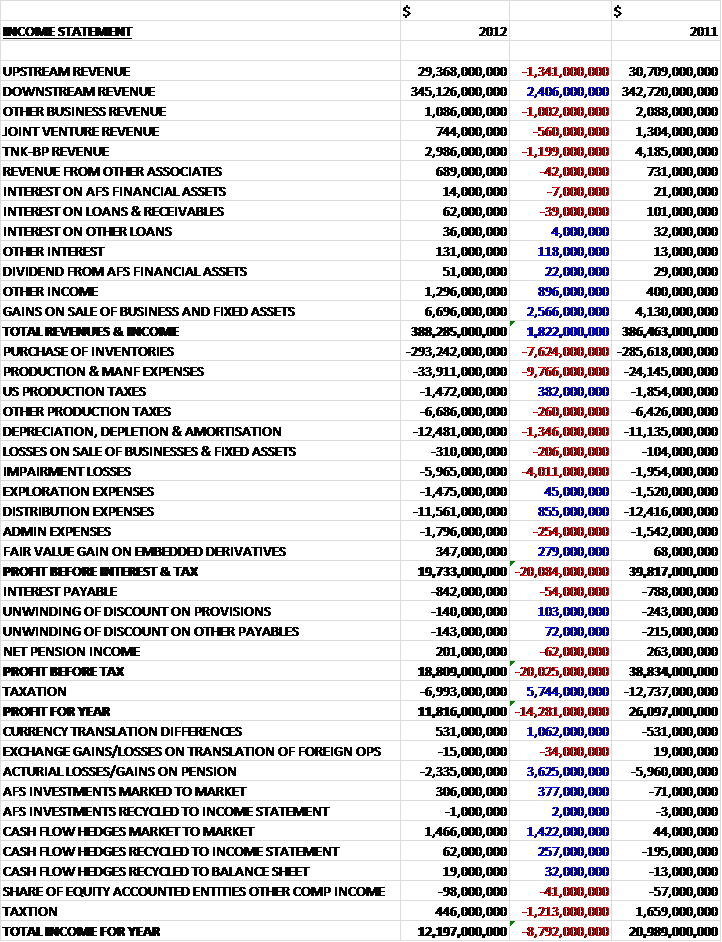
bpincome


As BP spent the last year divesting assets, it comes as no surprise that revenues are down across nearly all business sectors.  Interestingly, however, revenues in the downstream business have increased by $2.4B over the year.  The fall in the TNK-BP revenue is because that business was classed as an asset for sale towards the end of the year so the revenue received has been recorded elsewhere ( I think under “other income”).  Apart from other income, the only other major gain was in the sale of business and other assets – BP made $6.7B in profit from this over the year.

Taking out the asset sales, the group suffered a revenue fall during the year.  Compounding this was an increase in costs.  Inventory costs were up by $7.6B but more alarmingly production and manufacturing expenses increased by nearly $9.8B.  Also included here are nearly $6B of impairment losses and a $254M increase in admin expenses.  Not all expenses rose, however, as both exploration and distribution costs were down.   The profit before tax halved as a result of the above and after (a much reduced) tax bill is taken into account, the profit for the year was $11.8B, compared to $26.1B last year.

Non-operational costs for the year included a charge of $370M relating to onerous gas marketing and trading contracts; $308M relating to exploration expenses associated with the US natural gas assets and $244M relating to their exit from the solar business.
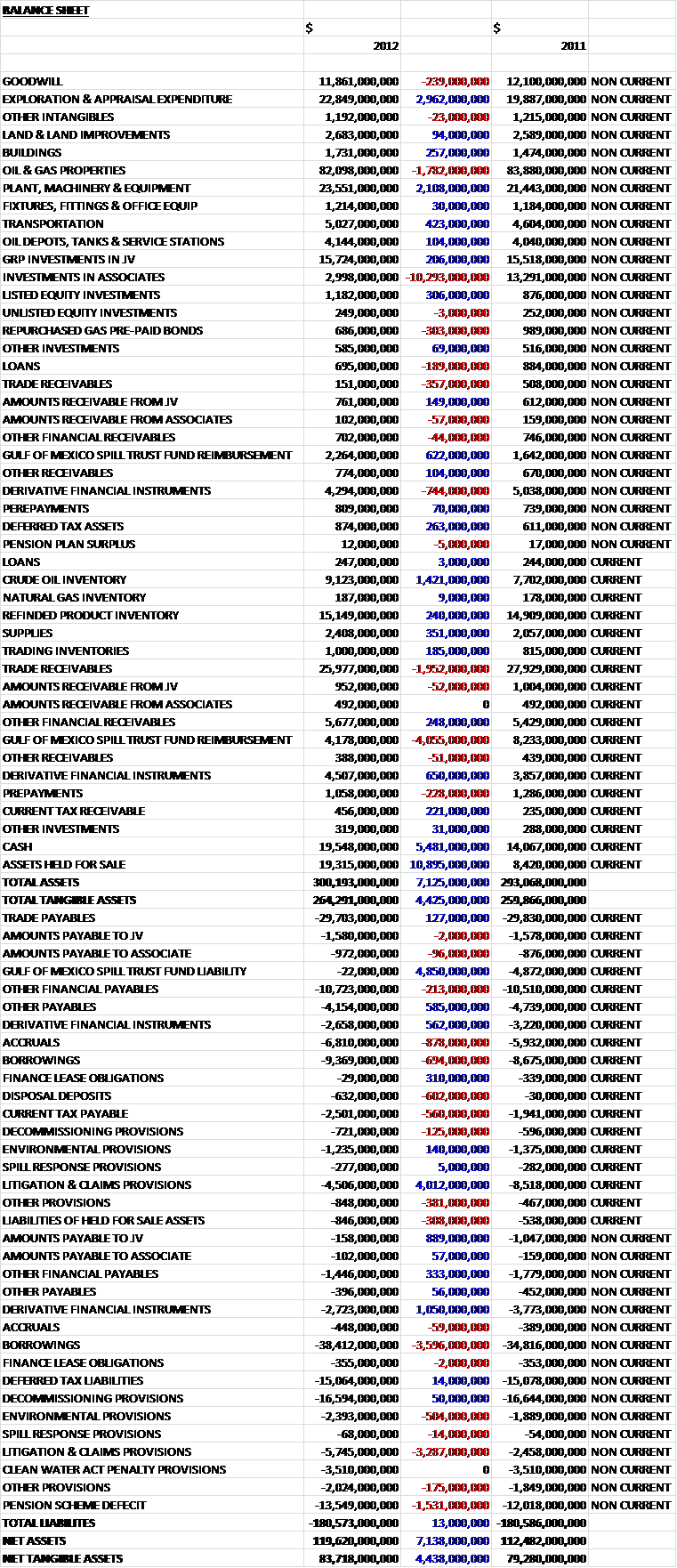
bp balance


Overall assets actually increased by over $7B during the year.  The largest movers were nearly $3B more of capitalised exploration expenses; a $2.1B increase in plant and equipment; a $1.4B increase in the value of crude inventories and a pleasing $5.5B increase in cash.  These were mitigated somewhat by a $1.8B reduction in oil and gas properties, nearly $2B less in trade payables and a net $3.4B reduction in the Gulf of Mexico Trust Fund reimbursement, which relates to future expenditure already provided for that will be paid from the fund, so is a non-cash related asset.

Looking at liabilities, we can see that these remained flat year on year.  The big fallers were a $4.9B reduction in the Gulf of Mexico Trust fund liabilities as most of this money now seems to be paid in.  Whether it will be enough to cover the amount needed is another matter.  The other major decreases were a net $700M decrease in litigation and claims provisions which I find somewhat surprising and a $900M decrease in payables to Joint Ventures.  The main increases in liabilities were a $878M hike in Accruals, a hefty $4.3B increase in borrowing and a concerning $1.5B increase in the pension deficit, which now stands at $13.6B, as if BP didn’t have enough problems!  In fact, as the group from next year will be adopting a revised version of IAS 19 Employee Benefits, they will (quite fairly it seems to me) have to adopt the same expected rate of return on plan assets as they use to discount liabilities which will affect (non-cash) earnings by about $1B. The deferred tax payable was increased because the restriction of tax relief for decommissioning expenditure in the North Sea fell from 62% to 50%.  This was mitigated somewhat by the reduction in UK corporation tax.  The provisions relate to settlements of criminal charges, penalties for liabilities under the clean water act and legal fees.  All the above has given rise to a $4.4B increase in net tangible assets to $83.7B.

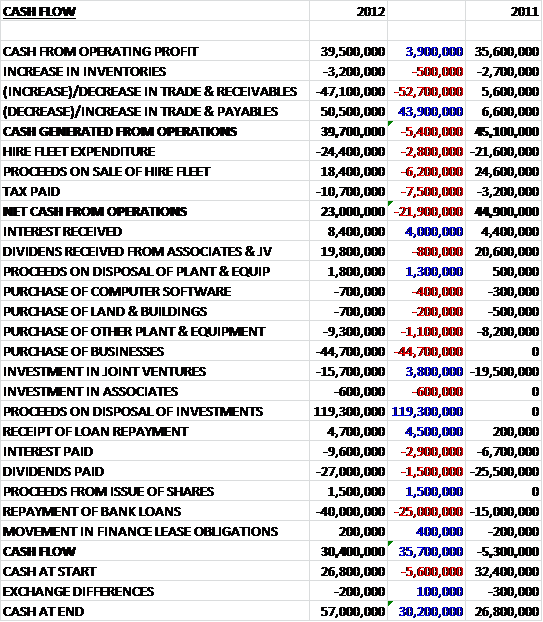
bp cashflow


We can see that operating cash flows were way down when compared to last year but the decrease in receivables when compared to the increase last year means that the net cash from operations was only $1.8B lower at $20.4B.  This was more than wiped out by capital expenditure, however, which was $5.2B higher at $23.1B.  A further $1.5B was invested into associates but the group did benefit from a massive $11.4B injection of cash from the disposals.  There was also a net £3.9B of new loans which meant the group could pay $5.4B in dividends and have $5.4B left over.  It is clear, however, that were it not for the business disposals that there would be a heavy cash outflow here.

The operational cash flow is expected to improve in 2013 due to reduced trust fund payments and higher margin projects coming online.

During the year, BP did not make any major business acquisitions, the most significant being the acquisition of Shell and Cosan Industria’s interests in aviation fuel assets at seven Brazilian airports.  There were a number of assets held for sale, however, as the group seeks to streamline its operations and free up some more cash.  Among those are a number of central North Sea oil and gas fields, namely BP’s interests in the Maclure, Harding, Devenick, Brae and Braemar fields.  The sale has been agreed for $1.1B.  BP has also reached an agreement to sell its Carson refinery in California to Tesoro Corp for $2.5B.  The sale of the Texas City refinery was completed in early 2013 to Marathon Petroleum Corporation.  The most significant disposal agreed, however, was the sale of BP’s share in the TNK-BP group to Rosneft for $11.6B in cash and an 18.5% stake in Rosneft which, although is an interesting development, I find a bit disappointing because BP is giving up considerable operational sway in a very major market.

TNK-BP was one of the ten largest non-state owned oil companies in the world with upstream interests in Russia, Brazil, Venezuela and Vietnam, producing about 2M barrels of oil per day and five refineries located in Russia and Ukraine and had recently announced the first gas from the Lan Do field in Vietnam.

Since 2010, the group have now sold about 50% of their upstream installations, 32% of their wells and 50% of pipelines.  At the same time, the proven reserve base has only fallen by 10% and it does seem as though they are doing a good job of offloading mature assets whilst keeping hold of those with more potential.

During 2012, the group completed the sale of Marlin, Horn Mountain, Holstein, Ram Powell and Diana Hoover fields in the Gulf of Mexico to Plains Exploration and Production company; the sale of Hugoton and Jayhawk gas production and processing sites in Kansas and the Jonah & Pindale upstream operations in Wyoming to LINN Energy; the sale of their interests in the Canadian Natural Gas Liquids business to Plains Canada and a number of interests in the North Sea.  Downstream, the group disposed of their interests in Purified Terephthalic acid production in Malaysia to Reliance Global Holding.

The group suffered an impairment loss of$1.1B in their interests in the Fayetteville and Woodford shale gas assets due to revisions in reserves; a $1B impairment loss relating to the decision to suspend the Liberty project in Alaska; a $706M write down of assets in the Gulf of Mexico and North Sea caused by the decommissioning provision resulting from continued review of the expected decommissioning costs; a $144M write-down of certain gas storage assets in Europe due to changes in the European gas market and other smaller impairment losses relating to other items.  Downstream there was a $1.6B impairment on the sale of the Texas City refinery and a $1B loss on the assets during the sale of the Carson refinery.  Finally, a $258M impairment loss was recognised due to the decision not to proceed with an investment in a biofuels facility in the US.

The fortunes of BP over the past few years have been dominated by the Gulf of Mexico rig explosion and the subsequent oil spill and the total amount that BP will need to pay on the disaster is still open to considerable uncertainty.  Over the past year, the cost to the cash flow has been $6.3B, materially less than in the past two years.  In 2010, a trust fund to deal with the subsequent claims was set up and financed to the tune of $20B. The fund does not cover any fines, penalties and administration costs relating to claims.  Unfortunately it seems likely that the $20B in the trust fund will not be enough to fully cover all claims that are likely to arise and after the money runs out, BP will pay legitimate claims directly.  The current cash balance of the trust fund was $10.471B.

So far the group has made a total of $32.8B of payments resulting from the Gulf of Mexico oil spill.  In November, an agreement was reached with the US government to resolve all federal claims.  BP pleaded guilty to 11 counts of misconduct relating to the initial loss of 11 lives; one misdemeanour count under the Clean Water act; one misdemeanour count under the Migratory Bird Treaty Act and one felony count of obstruction of congress.  As a result, BP will pay $4B in instalments over a period of five years.  The court also ordered that BP serve five years of probation.  Also in November, BP agreed a settlement with SEC to resolve the SEC Deepwater Horizon related civil claims and has agreed to pay a civil penalty of $525M.

At the same time, the US Environmental Protection agency announced that it had temporarily suspended BP from participating in new federal contracts, which is rather unfortunate.  In February 2013, the EPA issued a notice of mandatory debarment for BP at its Houston headquarters that prevents the company entering into new contracts or leases with the US government at those premises, which is another setback, particularly as these debarments typically last 3 to 5 years and the US government seems to want to make an example of BP, particularly as they have not had a great recent history in the US after the 2005 Texas City refinery explosion and the 2006 Alaskan pipeline leaks.

For the charges set out under the clean water act, the amount to be paid depends on a number of factors, one being the volume of oil that was discharged into the Gulf which has to be estimated.  BP believes that the US government has over estimated this figure by about 20%.  Another factor is how much per barrel of oil that will be charged.  BP is currently working on a figure of $1,100 per barrel, which is the maximum charged unless gross negligence or wilful misconduct can be proven.  Therefore the provision of $3.510B that covers this charge could be less in the unlikely event of the maximum not being charged, or much more (there is a theoretical maximum of $4,300 per barrel) if gross negligence or wilful misconduct is proven.

There is the likelihood of further legal claims against BP with regard to the Gulf of Mexico spill going forward, particularly a worrying looking claim by several US Gulf states for damages and loss of earnings that could end up being $34B.  BP is obviously contesting this robustly but it could have a damaging effect in the future.

As well as the litigation from the Gulf of Mexico spill, BP is also defending a claim from Exxon against Alyeska, in which BP has a stake with regards to the response to the Exxon Valdez oil spill.  It is not clear what they are claiming for and BP are defending the case.  Another subsidiary, Atlantic Richfield is being sued over injuries due to lead pigment in some paints.  So far, no claims have been upheld but there are some ongoing and the amount being claimed is apparently fairly substantial.

BP also has exposure to the sanctions placed on Iran.  Two oil fields in the North Sea and related pipelines markets and supplies gas in which Naftiran Intertrade has interests have been shut down, also a Canadian university has been using graduate students, some of whom were nationals of Iran on a research program part funded by BP which has now been terminated by the company (amazing to think that was against regulations).  Finally, BP involved an Iranian consultancy firm in 2010 for some auditing services that may have been against EU regulations.

BP is currently involved in a number of long term research projects.  One is the International Centre for Advanced Materials (ICAM), a $100M 10 year research partnership aimed at advancing the understanding of advanced materials from self-healing coatings to membranes across a variety of energy and industrial applications. The University of Manchester will be the centre for this research.  Another project is the Energy Sustainability Challenge (ESC) which studies the relationships between natural resource usage and energy production and consumption.  Another is the Energy Biosciences Institute (EBI) which is a $500M 10 year study with some American universities to perform ground breaking research aimed at the development of next generation biofuels, as well as other bioscience applications to the energy sector.  Halfway through the project, the EBI is generating a number of innovations, particularly in the field of cellulosic conversion.  There is also the Massachusetts Institute of Technology Energy Initiative (MITEI), to which BP is providing another $25M for continuous energy research over the next five years.  MITEI conducts research aimed at tackling energy challenges such as increasing energy supply, improving efficiency and addressing environment impacts of energy consumption.  Finally, BP is in involved with the Energy Technologies Institute (ETI) which was set up to accelerate lower carbon technology development .  By the end of the year, the ETI had commissioned $281M of work covering 41 projects.

The vast majority of the profit is made in the Upstream Business ($22.4B) with Downstream only making $2.4B and the Other Businesses making a $2.8B loss.

As far as the exploration side of business is concerned, during the year the group started activities in Brazil, Offshore Nova Scotia, Egypt, Gulf of Mexico, Namibia, Uruguay and the US.  The principle areas of production were Angola, Azerbaijan, Argentina, Egypt, Trinidad, UAE, UK and the US.  During the year, underlying production was broadly flat as major project start-ups and improved operating performance in Angola was offset by natural field decline.

In Europe, BP is active in the North and Norwegian Sea.  In the North Sea, the Rhum gas field remained shut due to continuing sanctions on Iran, as the field is part owned by an Iranian company.  In Norway, gas production from the Skarv field commenced and is expected to produce for 25 years. Daily crude production is 85,000 barrels with gas production of 670 M Cubic Feet.  Production started at the Valhall field in January 2013 with daily production of around 65,000 barrels expected by the second half of 213.  In the Gulf of Mexico, despite the problems there, 2 new rigs were started up with an eighth rig expected to start up in 2013.  BP was assigned 51 exploration blocks and the Galapagos development was started during the year.  In Alaska, BP operates 13 Oilfields and four pipelines, it also owns significant interests in six other producing fields.  BP is working with ExxonMobil and ConocoPhillips to commercialise extensive natural gas resources on the North Slope of Alaska.  Work on the Liberty Field was suspended during the year because the cost required to bring the rig up to scratch would be too significant, which resulted in an impairment of $1B.  In the rest of the US, the group is involved in production of Natural Gas and condensate across nine states.  Impairment losses of nearly $1.5B were recognised in the Woodford and Fayetteville shale reserves reflecting new market values in the prevailing low cost environment.  The group has signed an agreement to lease 300 square km in Northeast Ohio for future oil and gas production.

In Canada, BP is focussed on oil sands development and holds interest in three oil sands leases; significant exploration interests in the Beaufort Sea and the new leases covering 14,000km2 off Nova Scotia.  In South America, BP is active in Brazil, Argentina, Bolivia, Chile, Uruguay and Trinidad.  In Brazil, the group has interests in 14 exploration and production blocks and in March approval was gained for its farm in to four deepwater concessions in which it has a 40% interest.  The Bolivian government announced that it intends to nationalise interests in the Caipipendi Operations contract, in which BP has a 60% interest and production was impacted by a strike in the Cerro Dragon field – such are the risks of operating in South America at the moment.  In Uruguay, contracts have been signed for 3 offshore exploration blocks covering 26,000 km2.  Exploration and Production licences almost doubled during the year in Trinidad and the group now owns licences covering 1.8M acres offshore on the east coast.

In Africa, BP’s upsteam activities are in Angola, Algeria, Libya, Egypt and Namibia.  They are present in nine deepwater licenses in Angola and own a small interest in the LNG project.  The Clochas and Mavacola fields, which are run by Esso but in which BP has a 27% stake, started production and reached 65,000 barrels a day by the end of the year.  The PSVM project also started up with a production of 60,000 barrels a day (but is expected to rise to 150,000 barrels a day eventually).  In Algeria, BP owns interests in the Salah and In Amenas gas projects and has a joint venture in the Bourarhet licence which has been extended to September 2014.  In January 2013, a terrorist attack occurred at the Amenas site and non-essential staff were pulled out.  Limited production started again in February and BP is still committed to production in the country.  In Libya, BP has a partnership to explore acreage in the onshore Ghadames and offshore Sirt basin and preparation work restarted in May after the civil unrest there.  In Egypt, BP has interest in oil and gas assets and in June, the first gas from the Seth development was announced.  In August, the group announced gas discoveries at Taurt North and Seth South, which were the fourth and fifth discoveries announced in the area (BP has 50% ownership).  In Namibia, BP is a non-operating partner in five deep water exploration blocks.

In Asia, BP is active in Indonesia, China, Azerbaijan, Oman, Jordan, USE, India and Iraq.  In Indonesia, BP has joint interests in a company supplying gas to the country’s largest LNG export facility, the Bontang LNG plant.  BP also participates in the Sanga-Sanga CBM PSA, along with the Tanjung 4 and Kapuas 1, 2 and 3.  The Kapuas sites will be exited shortly, however.  In China, BP has interests in two deepwater exploration blocks in the South China Sea.  In Azerbaijan, the group operates two PSAs and holds other exploration licenses and now has an interest in the export pipeline.   BP is currently conducting exploration and appraisal programmes in Jordan and Oman.  In Abu Dhabi, UAE, they have small interests in both onshore and offshore concessions, with the onshore one expiring in 2014.  In India, the group has a 30% interest in nine oil and gas PSAs and a 50% interest in another.  In Iraq, the group holds a 38% interest in the Rumaila service contract.

In Australia, BP is one of several partners in the North West Shelf venture, which has been producing LNG, pipeline gas, condensate, LPG and oil since the 80s.  BP also has a 17% stake in some of the related oil reserves and infrastructure and stakes in some other smaller fields.  In May, the seismic survey in the Ceduna Sub basin uncovered 12,500km2 and BP are now drilling four deepwater wells in this frontier exploration basin.  In Eastern Indonesia, BP owns the North Arafura PSA on the coast of the Arafura sea and has interests in the Tangguh LNG plant, the West Papua 1 and 3 PSAs , and the West Aur 1 and 2 deepwater PSAs

In the North Sea, BP operates the Forties Pipeline System that handles capacity from more than 80 fields and has a 36% interest in the Central Area Transmission System that transports Natural Gas.  In addition, the group operates the Sullom Voe oil and gas terminal in Shetland.  In North America, the group has a 47% interest in the Trans Alaska Pipeline System, transporting crude oil from Prudhoe Bay to the port of Valdez.  In Asia, BP has a 30% stake in the Baku-Tblisis-Ceyhan oil pipeline that transports oil to the port of Ceyhan in Turkey.  The group has a 26% interest in the South Caucasus Pipeline which transports gas from Azerbaijan to the Turkish border and operates the Western Export Route Pipeline between Azerbaijan and Georgia.

As far as LNG is concerned, BP has a 10% stake in the Abu Dhabi Gas Liquefication company which supplied 5.6MT in 2012; a 14% share in the Angola LNG Project which is expected to produce 5.2MT when it starts up in 2013; is one of several partners in the NWS venture in Australia that has a capacity of 2.7MT and also in Australia, has a 17% interest in the Browse LNG venture.  In China BP has a 30% stake in the Guangdong LNG regasification and pipeline project that has a 7MT annual capacity.  In Indonesia, the group has a 38% holding in the Sanga-Sanga export terminal and a 37% stake in the Tagguh LNG plant and has a capacity of 7.6MT per annum.  In December, government approval was gained to increase capacity at this plant by 3.8MT, with the extra capacity due to be online by 2018.  In Trinidad, BP’s net share of the capacity at the Atlantic LNG trains is 6MT per year.

There have only been some minor new crude discoveries in the US and Russia.  There have, however, been some large discoveries of Natural Gas in the US, South America and Russia. There were five major start-ups during the year – Galapagos in the Gulf of Mexico; Clochas Mavacola and Block 31 in Angola; Devenick in the North Sea and Skarv in Norway.  The Angola LNG plant was also commissioned to start production in 2013.

As at the end of the year, BP has interests in 16 refineries, this will be reduced to 14 during 2013, following the sales of the Texas City and Carson refineries in the US.  At the Toledo refinery, a higher efficiency naphtha reformer was completed.

The group also operate nearly 21,000 retail outlets for fuels.  These are located in the US, Europe, Australia and Southern Africa but the numbers are reducing, predominantly in the US.  Air BP, is the aviation fuel arm and they sell in excess of 460,000 barrels a day.  The group are in the process of exiting their LPG marketing business.  The lubricant business is active in the automotive sector, under the brand of Castrol, the marine sector, where it is the largest supplier of marine lubricants in the world, the industrial sector, the aviation sector and the energy sector.  The petrochemicals business has four main products – Purified Terephthalic Acid (PTA), Paraxylene (PX), Acetic Acid and Olefins.  PTA is a raw material used in the manufacture of polyesters used in fibres, textiles and film and it uses PX as a feedstock.  Acetic Acid is used in paints, adhesives and solvents, as well as in the production of PTA.  The Olefin business if based in China.  The PTA project in Zhuhai, China was progressed during the year with the below ground preparation work complete,  Also, BP signed a memorandum of understanding with some local groups to explore the development of an integrated 1,4-butanediol (BDO)and Acetic Acid plant in Chongqing.  The resultant plant would produce 200,000 tonnes of BDO and 600,000 tonnes of Acetic Acid a year.  Progress is also being made with the joint venture with Indian Oil Corp to invest in a 1MT per annum Acetic Acid plant in Gujarat, India.  The refinery integration study has been completed.  Another revenue stream was realised in 2012 by licensing BP’s PX and PTA technology to third parties, with two being sold for use in India.

The replacement cost loss for Other Business was nearly $2B, compared to a loss of $1.7B last year.  The result was impacted by the loss of the Aluminium business, adverse foreign exchange  effects and higher costs.  The Wind business brought three new wind farms into operation and now has 16 operating farms across the US.  Biofuels production continued to increase with a joint venture based in Hull being commissioned that has a capacity of 420ML a year of Ethanol.  The group is expanding ethanol production at its existing three sugar cane ethanol mills in Brazil and is looking to produce fuel that is competitive in an $80 Crude oil environment without subsidies.  The group can also use waste products at these plants – sugar in Brazil and animal feed in Hull.

At the end of the year, BP had 52 vessels (37 medium size crude and product tankers, 3 VLCC, one North Sea shuttle tanker, eight LNG carriers, 3 LPG carriers).  The group have ordered 13 new tankers to be built in South Korea, with the first one to be delivered in 2014.  There are also over 100 time chartered vessels and various spot charters.

The main areas of progressed resources were Angola, Azerbaijan, Iraq, Norway, Russia, Trinidad and the US.

New exploration opportunities have been opened up in Brazil, Canada, Egypt, Namibia, Uruguay and in the US, which is a promising Shale basin in Ohio.  As mentioned, production has started in two Angolan projects and a programme of exploration is continuing in the country.  In Azerbaijan, two pipelines have been selected for the export of oil from the country and the West Chirag drilling platform and are on course to start in late 2013.  In the North Sea there were high levels of activity where some projects were started and others sold as the group focus on high margin projects.  The Gulf of Mexico continues to be considered an important part of BP’s strategy as 80% of reserves remain in the ground.  It has been decided that the challenges involved in developing the Alaska Liberty Field are too high and development plans there have been suspended, as mentioned previously.

Downstream, refining and lubricants seem to be performing well, despite weak demand for the latter but margins were reduced in Petrochemicals as the group maintained their production quantities at the expense of profits .  The underlying replacement cost of Fuels was just under $5B, up from $3.6B in 2011.  Lubricants were up by a lesser degree, $1.3B, compared to $1.25B.  Petrochemicals fared badly, however, as they were just $166M, compared to $1.1B the year before.

Crude prices in 2012 on average remained pretty much unchanged when compared to the year before with global consumption being fairly weak as demand in developing nations took the slack from lower demand in industrialised countries.  The weakness in the global economy continued to create a challenging environment for downstream operations but margins did improve due to refinery closures in the US and Europe.  Lower demand was caused by low economic growth, blending of biofuel products and increased car fleet efficiencies.  The lubricant market was weak due to low growth and the reduction of incomes.  Margins were held up by lower raw material costs, though.  Demand for petroleum products reduced and new capacity came online in Asia, which caused margins in PTA and Paraxylene to be very low.  Conditions in 2013 are expected to continue to be difficult, with more Chinese capacity due online.

Going forward, the group are looking to make between $24-$27B of capital investment a year until the end of the decade with around $2B-$3B of divestments to keep the cash coming and to optimise their portfolio.  Production in 2013 is likely to be lower than that of last year, mainly due to the impact of business sales but four major projects are expected to come onstream towards the end of 2013.  Refining margins are predicted to decline in 2013 as further capacity comes onstream and demand continues to be weak in many markets.  Demand for lubricants is expected to be similar next year and capital expenditure in the downstream sector is likely to be somewhat lower than this year.  The break-even point next year is likely to occur in the $80 to $100 per barrel price range.

As BP is still feeling the effects of the Gulf of Mexico spill, there is still a lot of uncertainty.  This year profits halved due to less upstream revenue; increased manufacturing and inventory costs, and higher impairments.  Net tangible assets were up by $4.4B due to a higher amount of capitalised exploration expenses, more plant and equipment and higher inventories.  Although the cash flow was positive, this was entirely due to increased borrowing and business/asset sales.  As it stood this year, capital expenditure was not covered by operational cash flow which seems rather unsustainable going forward.  It is worth keeping in mind that $6.3B was used to cover the spill so one would hope that this will come down in future.  It is also keeping in mind that one of the claims (by a number of US states) has the potential to hit BP for $34B, which will clearly affect the group for many years to come if it is upheld.  During the year, net debt reduced by the tune of $1.4B, which is clearly a good sign, the current yield is 4.9%, which is decent but not without risk and the current P/E is a very low 7, with the P/E for next year projected to be slightly higher, at 8.5.  Overall, this could be a good investment but the risk is definitely here with the potential for some huge future pay outs.  On balance, I will continue to hold.

On 22nd March, BP announced that it intends to carry out a share repurchase program with a total value of up to $8B.  This is an amount that is equivalent to their initial investment in TNK-BP (BP received $12.5B in cash from Rosneft for its stake, with the rest of this cash being used to reduce debt).  It is intended that this program will finish within 18 months. I am not usually a fan of share buy back schemes and often think there must be better ways to invest the money but with this action, BP are intending to counteract the loss of EPS that will occur with the sale of their TNK-BP business so I guess on this occasion it does have some merit.

On the 3rd June 2013, BP announced that it had completed the sale of the Carson Refinery and SW US retail assets to the Tesoro Corp for $2.4B.  Cash proceeds included $1.1B for assets and $1.35B for inventory and other working capital.  This sale apparently signals the completion of the US fuels portfolio divestment.  The refinery is located near LA and has a capacity of 266,000 barrels per day, so is a large outfit.  The sale also included the pipelines, logistics terminals and Arco branded retail marketing network in Southern California, Arizona and Nevada. This sale was already in the pipeline so it is good to get it completed.
 

Interserve Blog – Interim 2013

Interserve has now released their interim results for the half year 2013.

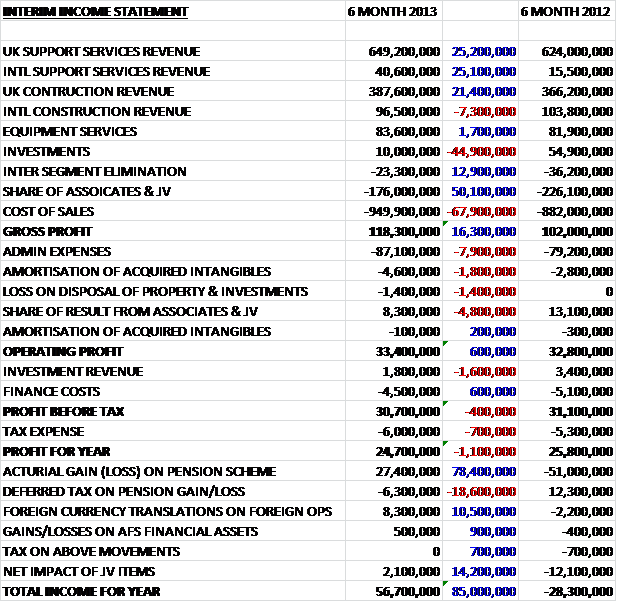
interserveinterimprofit


We can see that revenues in most of the business segments have increased, with international support services up by £25.1M to £40.6M.  International Construction revenue fell, however, down by £7.3M to £96.5M.  Revenue from investments was down substantially as the group sold off most of their PFI interests but there is also a corresponding fall in the share of revenues from joint ventures.  The cost of sales were also up substantially to leave the gross profit up £16.3M to £118.3M.  We can see there was a fall in the share from associates and joint ventures, presumably due to the lack of PFI income and admin expenses were up £7.9M to £87.1M.  There were also one-off costs of £4.6M of amortisation of acquired intangibles and a loss on investment disposals.  The resulting operating profit was similar to that of last year, up by just £600K.

A reduction in investment revenue, however, and an increase in the amount of tax paid pushed the profit for the half year £1.1M down to £24.7M.  A massive actuarial gain on the pension scheme (that is where most of those sold PFI investments went) means that the total income from the year was considerably higher than last year.

interserveinterimbalance


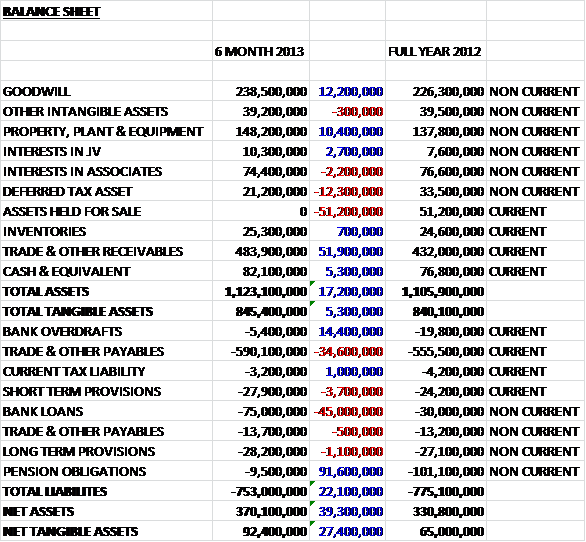
Overall assets grew by £17.2M over the position at the end point of last year.  The largest movements were in Assets Held for sale, as the group sold the PFI investments (£51.2M) and a £51.9M increase in trade and other receivables.  I am not sure what caused such a hike, presumably partially to do with the acquisitions.  We also see a £21.3M reduction in the deferred tax assets counteracted by a £12.2M increase in goodwill, a £10.4M increase in property, plant and equipment, and a £5.3M increase in cash.  Stripping out the increase in intangibles gives a small rise of £5.3M in tangible assets.

In contrast, liabilities fell by £22.1M.  The major movement here was the £91.6M reduction in pension obligations which are now just £9.5M.  This was because most of the PFI investments were sold to the pension scheme.  There was also a £14.4M reduction in the bank overdraft but this was swamped by a £45M increase in bank loans.  Trade and other payables were the other big increase, up £34.6M on the end of last year.  Overall this means that net tangible assets climbed £27.4M to £92.4M so a pretty decent 6 months for the balance sheet, mainly due to the pension deficit fall.

interserveinterimcash


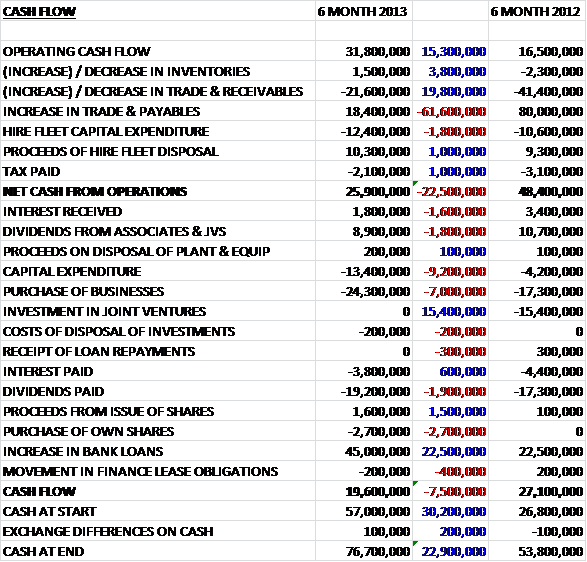
There was a fairly healthy £31.8M of operating cash flow which is reduced to £25.9M by changes in working capital, a net expenditure on the hire fleet and tax paid.  This was £22.5M less than in the same period of last year due to the fact that there was an £80M increase in payables during the first half of 2012.  Compared to last year there was a lower interest received and a lower dividend from associates and joint ventures.   Capital expenditure was much higher than last year, up by £9.2M to £13.4M.  The increase of £45M in bank loans paid for the £24.3M of business purchases and the £19.6M of positive cash flow whilst the group also managed to pay out £19.2M in dividends.

The £19.6M cash inflow in the first half of the year was very much flattered by the £45M of new debt, which also paid for the acquisitions.  Were it not for these two factors, there would have been a £1.1M of cash outflow, which is not that great actually but it is important to remember that £19.2M was paid out in dividends, £1.9M more than last year..  It is also worth noting that after this was recorded, another acquisition was made in the region of $46M, which would mean that cash flow for the full year is likely to be rather negative.

Geographically, by far the largest amount of revenue received was in the UK.  The region was also very important for profit, contributing £34.1M in the 6 month period (compared to £30.5M in the first half of last year).  The next largest region, MENA accounted for £12.4M, an increase of £1M.  Oceania contributed £4.1M, a reduction on last year and the Far East only contributed £700K, £1M down from H1 2012.  The rest of Europe and the Americas actually made a loss.

During the period there were two acquisitions.  In January, the group acquired Willbros Middle East Ltd which owned 85% of two oil and gas services businesses, the main one being The Oman Construction Company (TOCO) for a total consideration of £25.7M.  The second acquisition was much more minor.  In May the group acquired Paragon Management UK Ltd, a specialist interiors and property refurbishment business for a consideration of £3M.  TOCO came with £11.8M of net assets (£4.9M intangible) and Paragon £2.6M (£400K intangibles).  After the end the period, another acquisition was made.  In July the group acquired Topaz Oil and Gas which provided oilfield maintenance, fabrication and construction services to the Middle East.  The total consideration is expected to be $46M.

Support Services in the UK grew revenues by 4.4% and profits by 29.1% and showed an improved margin of 4.2%.  Organic profit growth was bolstered by new contracts in the nuclear, defence, healthcare and public sectors with some extra coming from the recent acquisitions.  Future workload for the division increased to £5.4B.  About 2/3 of revenue comes from the public sector with major clients the MOD, Magnox, DEFRA, NHS, Scottish Power, East Thames Group, Sainsbury, Carphone Warehouse and Alliance Boots.  A highlight was the £700M seven year contract with NHS Leicestershire to provide estate management, rationalisation and modernisation for three NHS trusts.  Another seven year contract was with East Thames to provide a repairs and maintenance service to the group’s 13,500 households.

Internationally, Support Services more than doubled revenues and increased profit by 50%.  Future work load more than doubled to £159M at the half year point.  The major contributor to this increase was the TOCO acquisition.  The principle focus is on the oil and gas industry and there is considered to be growth potential there.  TOCO has added strong work-winning contracts valued at about £34M.  A highlight was a three year oilfield services contract worth £30M to construct and maintain pipelines in Northern Oman.  Madina won a long term mechanical services contract with Shell Pearl in Qatar and Khansaheb secured contracts for the provision of facilities management to Habib bank in Dubai and Estate management at Monte Carlo Beach Club in Abu Dhabi.

UK Construction increased revenues by 5.8% and profits rose 1.4% to £7.4M with a stable future workload of £950M.  A significant new revenue stream was achieved with the construction of energy from waste plants with construction taking place in Glasgow and Peterborough.  The value to the group of this contract is about £15M.  The acquired Paragon group won a £6M contract from HM Courts and Tribunal Service.  In Education, new projects were awarded by Middlesbrough College and Portsmouth Charter Economy.  In Health, new projects were won with Mid Cheshire Hospitals and Hywel Dda Health Board.  A contract was secured with Jaguar Land Rover to build their Engine plant in Wolverhampton.  There were also new awards from Viridor, United Utilities, SW Water, SE Water, Affinity Water, Cornwall County Council and the Highways agency.

The Middle East construction business continued to find the market difficult but there were early signs of an upturn in the UAE.  Greater demand was also showing in the Americas and Far East.  Oceania, however, saw demand weaken from historic highs.  Revenue was down 7% and profit fell by 18.6% to £5.7M.  Future Workload remained stable at £200M.  There appears to be some sign of an upturn in the UAE with previously mothballed developments starting up again and new developments in the commercial and leisure sectors.  Slow progress on contract wins in Qatar hampered market activity but there has been recent progress in significant civil engineering contracts for rail and roads.  Oman offers a good prospect for growth from the recent acquisitions.  Progress in the Indian construction market has been slow and the group has taken the decision to exit that market resulting in a write-off of £5M.  Highlights over the half year have included a contract for the construction of Lusail tower in Qatar and the installation of a desalination plant in the same country.  In Dubai, contracts were won with the Office of the Crown Prince of Dubai, EMAAR restaurants, Majid Al-Futtaim (retail), Chalhoub Group (retail), the Government of Fujairah (roads) and the Dubai Festival Club (retail).   In addition, a contract to construct a GE Emirates Engine maintenance centre in Dubai; fit out work for the Four Seasons Hotel and road and infrastructure work for Meraas was gained.

In Equipment Services, revenues were up 2.1% and profits increased by 25% to £8.5M due to pricing improvements and operational efficiency.  There were new expanded capabilities in Philippines, Singapore, Colombia, South Africa, Iraq, US and Mozambique.  There was strong demand in Saudi Arabia and Qatar showed signs of an upturn.  Demand weakened in Australia, however, as a number of significant natural resources projects were delayed.  Market conditions in the UK and the rest of Europe remained difficult.  Highlights included framework on the largest coal bunker in South Africa at the Grootegeluk mine; heavy duty shoring equipment was used on the Isa Gate Flyover in Bahrain, framework used on the air traffic control tower in Muscat Airport, Oman, the use of a safety screen on the construction of a new residential tower in Canada Water, London and equipment used in the construction of bridges linking Jubail with Ras Al Kahair in Saudi Arabia.

So, revenues increased across most of the businesses with the exception of International Construction.  The support services seem to be entering into some good, long term contracts and the equipment services business seems to be doing well to improve margins.  The subdued construction market in the Middle East and Australia are of some concern and it is disappointing to see the group exit India, which I would have thought could have provided some good long term returns even if short term profits were hard to come by.  Profit for the year fell by £1.1M due to reduced investment revenues, presumably due to the PFI investments being sold to the pension scheme.  That transaction, however, made a serious improvement with the look of the balance sheet, however, as the pension deficit was reduced dramatically.  In fact, net tangible assets increased by £27.4M which seems very impressive.

Cash flow was OK.  Dividends were nearly covered by the cash generated by the group, with a bit more coming from new borrowings.  In fact, borrowings were up substantially to pay for the acquisition spree that Interserve seems to be on.  Having said that, at the half year point net debt was a negligible £700K (although that will change once the Topaz acquisition is taken into account).  The dividend yield stands at 3.8%, and although the mega returns available a year or so ago are no longer present, this still represents a decent yield.  In the medium term, it will be interesting to see how the group adjusts from the move away from PFI contracts to Middle East oil and gas services but at the moment I think the shares are at a fair price.

On 14th August the group announced that it had been awarded a contract extension with the MOD worth £110M.  The contract runs until July 2014 with an option to extend for a further 6 months and involves managing military training facilities across the MOD’s training estate.  It is an extension of a contract that has been in place since 2003 so has been long term so far and covers more than 120 sites and 8,000 buildings.

On 17th October, Interserve announced that they won a new five year contract to supply service management to the BBC.  The contract is worth £150M and involves supplying over 150 UK facilities with critical broadcast engineering and business continuity services.  This contract follows the current construction contract the group had with the BBC that was worth £40M.  This is clearly a substantial win, obviously the margin is unknown but this is a good boost to Interserve.

On 13th November, the group released an interim trading update.  It is noted that they completed the acquisition of Topaz Oil and Gas Services in September but that market conditions remained mixed.  Overall, performance was in line with expectations with strong growth in UK Support Services and Equipment Services and a resilient performance in the construction business.  This offset lower than expected activity levels in the Middle East oil and gas services business.  In the year to date the group won over £1.8B of work from clients including the Ministry of Justice, BBC, Foreign and Commonwealth Office, Defence Infrastructure Organisation, Nottingham University Hospitals NHS trust, Arabtec Corp (Qatar), Majid Al Futtain (UAE), Qatar National Bank and Doha Festival City.  This is a decent update but the down turn in the Middle East oil and gas business is a bit of a disappointment.

On 25th November the group announced that it formed a partnership with the University of Sussex to provide a 10 year facilities management contract to the university.  The contract is worth £150M so is quite substantial and will commence at the start of 2014.  The group will provide various services to the university including cleaning, grounds maintenance, buildings management, portering, mailroom, security, car parking, waste management, health and safety support, project management and energy saving improvements.  Some improvements that are being introduced are a reduction in carbon emissions, a new helpdesk staffed 24/7 and investments in skills development.  One other nice touch is that six undergraduates will be given the opportunity to work on the contract each year as trainee managers.

On 8th January the group released a trading update.  It stated that they have continued to perform well and in line with expectations.  Short and sweet!

On 28th February the group announced that they had entered a conditional agreement with a subsidiary of Rentokil Initial to acquire its facilities services business for a cash consideration of £250M.  The transaction will be funded partly by a new placing of shares which should raise about £70M and represents nearly 10% of the current share capital, along with new debt.  The acquired business has operations in the UK, Spain and Ireland and employs about 25,000 people.  The services offered include cleaning, catering, security, mechanical & electrical building maintenance, energy management and statutory compliance. Their client base is also more skewed towards the private sector than the current situation at Interserve and the enlarged group should have a close to 50/50 split between the private and the public sector.

The resultant group will become one of the top three (by revenue) providers of support services in the UK (I assume I also own shares on one of the other top three, Compass).  The main reason for the acquisition is the increased market that it opens up for the group, but the board also expect to achieve synergy costs of about £5M by the end of 2015.  The underlying operating profit before amortisation for the acquired group was £25.6M and the board expect the acquisition to be earnings enhancing within a year despite the £10M in one-off exception costs associated with the purchase.  This bid is large enough to require shareholder approval but given the group currently has negligible net debt, I see this as a decent opportunity for expansion.

Photo-Me International Blog – FY 2013

Photo Me International provides various different automated vending machines, most of which are photographic related.  The machines include Photobooths, Digital Printing Kiosks and coin operated amusement rides.  They are most active in the UK, France and Japan but are also present in Ireland, Austria, Belgium, Germany, Hungary, Luxembourg, Netherlands, Poland, Portugal, Switzerland, China, Singapore and South Korea.

photoincome


We can see that revenues are down across both business components, with Sales & Servicing suffering the biggest fall whilst the fall in Operations revenue can be explained by adverse changes in exchange rates.  It is also apparent that many costs have fallen too, however, with staff costs falling £5.2M; property leases down £1.1M and R&D down by £1.1M.  Non cash depreciation has also fallen and the group made a £2.7M one-off gain on the sale of property, plant and equipment.  All of this means that the gross profit was up by £3.7M to £42.2M.  Admin expenses were also down somewhat so operating Profit was £4.2M better than last year.  The group has sold the rights to the future rental stream on the investment property up to 2019.  They will still collect the cash for the rental money but that rental income will not stay within the company.

Lower interest from financial assets and the lack of any investment sales was counteracted by a lower bank loan cost before a £1.2M increase in tax caused the profit for the year to be £3M up, at £17.6M.  Unfavourable exchange differences gave a 15.1M total income compared to £12.3M last year.  Overall a good performance, although slightly flattered by the gain on the sale of the tangible assets.

photoassets


Overall we see total assets falling by £3.9M.  The biggest fallers were in inventories, trade receivables and the intangible R&D Costs.  These were mitigated somewhat by a £1M increase in other intangibles and a pleasing £5M increase in cash.  Liabilities were also down, driven predominantly by decreases to outstanding loans, accruals and trade payables.  Not all liabilities were down, however, and we saw fairly significant increases in provisions, including a £800K increase in employee claim provisions (most of those costs are expected to be incurred during the next financial year) and a £2.4M increase in other provisions which represent potential legal claims against certain group companies – there is no clue as to what these claims relate to.  Overall, net tangible assets were £3.7M higher at a very impressive £81.6M.

photocash


The cash taken forward from the operating profit was actually fairly similar to last time but preferential changes in working capital meant that the cash generated from operations was £46.6M, £4.2M up on last year.  After tax, this was still an impressive £38.9M.  Out of this cash flow, £17.3M was spent on capital expenditure and £4.5M was paid back in loans.  The group has nearly cleared all of its debt now, so the amount spent on this was £6.7M less than last year.  There were a couple of things that flattered the cash flow somewhat, such as the sale of some tangible assets (£3.7M) and the sale of treasury shares (£5.7M) but this was more than spent on a massive £12.7M hike in dividends to £20M.  After that, the group still managed to end the year on a positive cash flow of £5.4M to add to the £54.6M it already had!

Although revenues fell, the operating profit for the Operations segment grew on last year.  Likewise, in Sales and Servicing, losses reduced when compared to last year despite the falls in revenue.  During the year there was an overall reduction of vending units, mainly due to the reduction in numbers of Amusement Rides in the UK.  In Europe, there was a particularly strong performance in Germany, where the group has been increasing the number of Photobooths considerably, and Belgium.  Due to lower costs, there were also decent increases in profit from the UK, Switzerland and Japan.

Photo-Me are taking this opportunity, using their cash generated by the photo booths, to diversify their offering.  Revolution is a high capacity coin operated washing machine and is able to wash large loads in 30 minutes, it also includes a tumble dryer, but there is no information about how long the drying takes.  Photolight is an eco-friendly solar street lights that do not require connection to the grid.  These products are an effort to hedge against any changes in photo id requirements and to generate more cash.

Although most of the revenue and profit comes from the Photo booth estate, the group are now rolling out the Revolution laundry machines into France and Belgium initially.  The units are to use the same locations and same engineers as the Photobooths so there is a good synergy on costs.  As with the photobooths, a commission will be paid to the site owners.  There are now 275 units in the field, 62 owned and operated by Photo-Me, and the plan is to increase this to over 2000 units by the end of 2015.  So far the machines have been very cash generative, with an average EBITDA margin of over 50%.  The Digital Printing Kiosks operate in a mature market, mainly in France and Switzerland but the group continue to innovate with new products for this market,  the UK amusement machines are a very small part of group revenues but now that some loss making units have been removed, the sector is profit making.

In recent years, the group have rolled out their more advanced Starck photobooths and have entered a number of new exciting markets such as China, Korea and Poland.  This increased geographic footprint is slightly masking the fact that sales of other products have been on the low side due to continued reluctance by individual businesses to invest capital.  Costs savings have been achieved by the restructuring of the French sales and servicing subsidiary and the transferral of management control to the CEO of European activities.  This has resulted in a centralised logistics platform and led to savings from reduced stocks and staff numbers.

The Sales and Servicing group is still loss making, but it is much less so than it was last year The results were flattered by a £2.4M profit on the sale of an industrial building, however.  The market has remained difficult and sales have been slow and the smaller business is now focussed on supporting the group as a whole.

There are a number of potential issues going forward.  One being the fact that most of group revenues are made outside of the UK so fluctuations in the Sterling/Euro exchange rate in particular is a potential cause for concern and the group does not seem to hedge against these changes.  Perhaps the more serious concern, however, is the possibility of a government (the French would be of particular concern) to implement centralised image capture for biometric passports.  This eventuality is combatted by providing a high quality, affordable service and to conduct lobbying actions with the various governments.

There is now a much more even spread of cash between Sterling and Euro when previously the large Euro reserves meant that the group may have been more susceptible to exchange rate fluctuations.  The majority of the profit is made in continental Europe, but profits in Asia are increasing quickly (from £3.9M to £5.7M) and it is worth noting that so far the financial crisis in the Eurozone does not seem to be adversely affecting profits in this region.

Going forward, the first seven weeks of trading are in line with expectations and with the Sales & Servicing issues apparently sorted and the roll out of the modernised Photobooths, plus the roll out of the new laundry machines, the future is looking rather promising currently.  The group are also continuing to eye new markets and have plans to expand into Thailand and Ukraine.

Overall then, this is a very positive set of results.  Profits were up by £3M to £17.6M but £2.7M of this increase was due to the sale of a building and a lot more was due to less depreciation.  The net assets are very healthy indeed and it is pleasing to see that almost all of the debt has been paid back.  Indeed, net cash is now a remarkable £58.9M, an improvement of £9.5M from last year.  The balance sheet does show that there are likely to be some costs associated with legal actions and ex-employee actions which may affect results slightly next year.  The £5.4M cash inflow is very pleasing to see, particularly as there was an incredible £12.7M hike in dividend payments.  Again, there is some flattering of the numbers, however, as £3.7M came from the sale of that property and £5.7M was from the sale of treasury shares.

Operationally, the Photo booths are doing very well and the washing machines seem to have some real potential. The P/E currently 19.5, which is certainly not cheap but going forward it is 16.8, which is a little better.  At current prices, the dividend is 3.2% but there is a special dividend of 3p that increases the actual yield to 6.4%.  Next year the board have already signalled their intention to increase the dividend by another 20% and to consider another special dividend so there is a lot of cash being sent back to the shareholders.  I do have slight concerns over the potential for a government somewhere to decide to take ID photos in-house but overall I still see these shares as a weak buy, even at this price.

On 12th September, the group released a management statement.  It was reported that they started the year well.  Group turnover was slightly lower than the same period of last year, mainly due to lower revenues in the Sales and Servicing division and adverse currency translations in Japan due to the weakening Yen.  Despite this, profits were 10% ahead of the situation at the same period of last year.  The star performer was the European business, with profits in France significantly ahead of last year as the laundry units begin to make a contribution.  The European business also benefited from a 7.5% increase in photobooth numbers.  UK profits were flat and Asia declined 15% due to the previously mentioned currency issues.  The underlying performance was strong and was 10% up on a constant currency basis.  The Chinese group increased turnover by 30% but was still marginally loss making due to the heavy investment in R&D and new photobooths.  There were 52 new laundry machines added during the three month period resulting in a profit of £500K.  The net cash position remained pretty much the same from the year end despite increased investment and payment of the interim dividend  Overall this is a good update and it bodes well for the year ahead.

GVC Holdings Blog – FY 2012

Malbourne House, St. George’s street, Douglas, Isle of Man, IM1 1AJ

GVC Holdings provides services to the online gaming and sports betting markets.  They are headquartered in the Isle of Man and the group’s activities are licenced in Malta and the Dutch Antillies.  Casino Club provides an online casino and poker targeting German speaking customers; Betboo provides sports betting, poker, casino and bingo to customers in Latin America; and the B2B business provides back office services to third party providers.

GVC Holdings have released their results for the full year ending 2012.

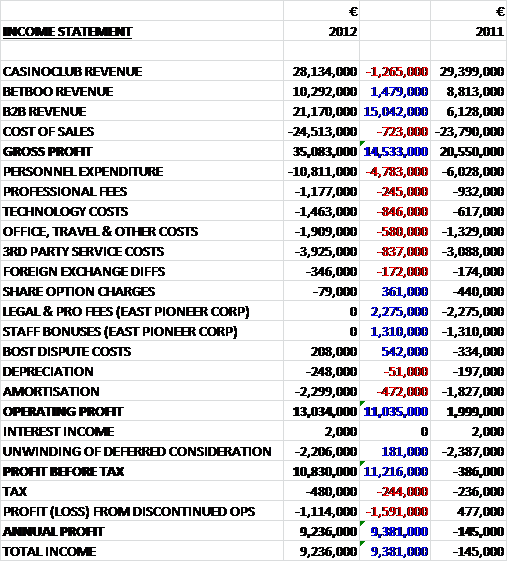
gvcincome


B2B income is the amount receivable for services to other gaming operators and includes the amounts due for the provision of services to East Pioneer Corp.  The big change in revenues is the €15M jump in B2B revenue as the first full year of trading took effect but there was also a €1.5M increase in Betboo revenue, mitigated by a €1.3M fall in Casinoclub revenue.  The cost of sales only increased marginally to leave Gross profit €14.5M up at €35.1M.  The next largest expenditure, personnel, increased by nearly €5M on last year and we see various other smaller fees also growing.

This was partially mitigated by the lack of legal fees and staff bonuses relating to last year’s deal with East Pioneer.  After the €2.2M unwinding of deferred consideration (related to the Betboo purchase), the profit before tax for continuing operations was €10.8M.  On the subject of that deferred consideration, this seems quite a strange way to account for it as for other companies it is usually just added as part of the acquisition costs at the time of purchase but this seems to be added annually until it reaches the actual amount. A slightly higher tax rate, relating to tax paid in Israel and a €1.1M loss on discontinued operations meant that the annual profit was €9.2M compared to a €145K loss last year.

gvc assets


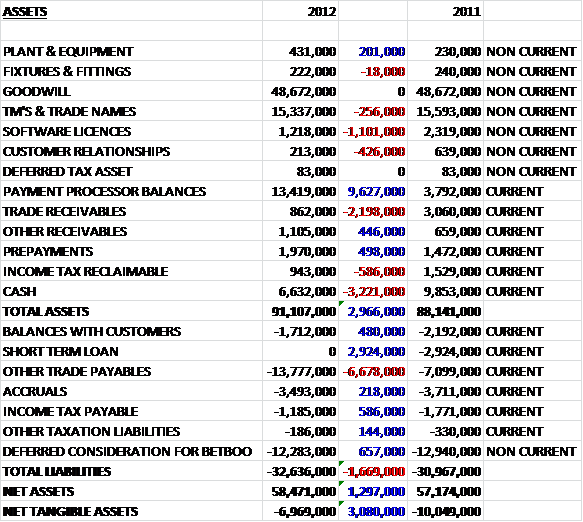
Overall, assets were up by €3M on last year.  The bulk of this increase came from a €9.6M hike in payment processor balances, mitigated by lower cash reserves and lower trade receivables.  The majority of assets are intangible and there is a huge £49M worth of goodwill.  Software licences lost €1.1 in value during the year.  Liabilities were also up, entirely due to a €6.7M increase in trade payables which was partially counteracted by falls in all other liabilities.  Overall, net tangible assets were £3.1M higher than last year at a negative €7M (not that a company like GVC would be expected to have much in the way of tangible assets).

gvc cash


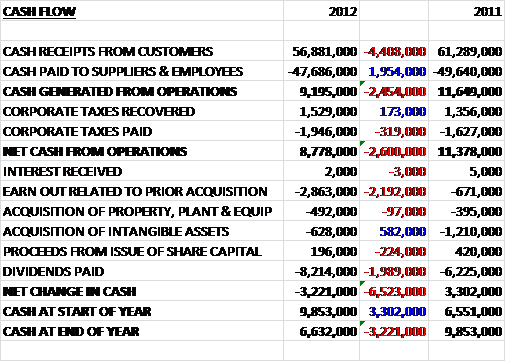
Overall we can see that the cash from operations actually fell when compared to last year as there was €4.4M less cash from customers, mainly due to the fact that more working capital was tied up in the BSB payment processing.  A higher amount of tax paid meant that net cash from operations was €2.6M down at €8.8M.  Most of this (€8.2M) was paid out in dividends which does not leave much for capital expenditure.  The real driving force behind the negative cash flow was the €2.9M earn out related to the continued payments following the Betboo acquisition.  The cash outflow was €3.2M compared to a €3.3M inflow last year.  The earn out is related to the purchase of Betboo where the sellers get 36 monthly payments from mid-2011 and one extra payment each year equal to 25% of Betboo NGR earned.

Of the sectors, the most profit was earned by Casino Club, with the BSB business also doing well.  The Betboo business was loss making during the period.  As we have seen, the only sector to reduce revenues was Casino Club which was partially attributable to a reduction in poker revenue which is a trend that has been seen industry wide.  Revenues at Betboo grew by 17% despite a lower sports hold. There were additional investments to support this growth which is the explanation given for the loss.  Going forward, the group has embarked on internal restructuring to reduce costs in this area.

During the year, the group arranged to dispose of Betaland for a nominal sum.  It was thought that the declining profitability meant it no longer made sense to hold on to it and during 2012 it made a loss of €1.1M compared to a profit of €477K the year before.  Another issue resolved was that the group reached an amicable settlement with Boss Media regarding some legal claims which resulted in some provisions being released back into the income statement.

Jackpots won in Club Casino are taken straight from the income statement as there is no central fund to cover them.  As of the end of the year, a total of €6.6M was available across 37 games.

At the end of the year, it was announced that with William Hill, the group had reached an agreement to buy Sporting Bet.  William Hill will receive the Australia business and an option over the Spanish business whilst GVC obtain the other assets, minus a few freehold properties.  After the acquisition, the Sportingbet group will need to be substantially restructured which will be costly and it sounds like there are substantial liabilities that were inherited as well as assets, which is possible cause for concern.

This period is one of change for GVC.  Revenues were up substantially, driven by the full year contribution of the B2B business.  Casino Club revenues were down slightly as online poker became less popular.  Although revenues at Betboo were up, increased investment meant that it was loss making.  Overall, profits were €9.3M higher at €9.2M.  Net tangible assets are up slightly but are still negative and there was a cash outflow of €3.2M, but this seems to be due to more trade receivables being tied up in the new B2B business and there is easily enough cash to cover dividends and there is no debt.  On the subject of dividends, at the current price the yield is a good 5.7% but I am not sure of the dividend situation next year.  From November 2013, however, the group aim to pay a dividend quarterly.  The P/E ratio at the time of writing is 10.9, so still good value in that regard/

Going forward, the group has made a strong start to 2013 and average PRF was 27% higher than the same period of 2012 on a like for like basis but the coming year is going to be completely overshadowed by the Sporting Bet acquisition.  It sounds like the purchase comes with quite a few liabilities so I expect there to be a situation of net debt at the next update.  Overall, there are some good prospects here but I would like to see how the acquisition beds in before committing myself further.

On 1st July 2013, the group released a trading update.  It was mentioned that management have been able to make material reductions in the cost base of Sporting Bet, and by the end of the year costs should have reduced by 40%.  Last year, Sporting Bet’s European operations lost €52M, €26.9M of which were exceptional charges.  The group have now started outsourcing the IT infrastructure to lower cost jurisdictions, terminated all marketing and corporate sponsorships where return on investment was poor, improved organisational structure and paid off a lot of loans and overdue supplier payments.  The cost of these improvements were less than anticipated and it is anticipated that Sporting Bet will be cash generative by the end of the calender year.  Sporting Bet NGR was 8% higher than last year and 2012 was also flattered by the Euro 2012 football Championships.  Revenues at Casino club increased by 10% per day, and revenues in Betboo were up 25% per day.  Another positive of the take-over was the fact that the deferred consideration has been entirely eliminated.

Overall, all this means that the group are going to pay a dividend much earlier than originally thought, and quarterly dividends will take place from November.  This really is an excellent update and I think I will try and buy some more of these shares.  The dividend has been announced as being 9.06p per share.

Havelock Europa Blog – FY 2012

Havelock Europa, Westway, Hillend Industrial Park, Dalgety Bay, Fife, KY11 9HE

Havelock Europa is a provider of Interior solutions, including the design manufacture and installation.  The group’s main customers are retailers, banks, construction companies, education authorities and commercial organisations.  This is where most of the revenue is earned but they also have an Educational Supplies segment that is involved in the design, manufacture and supply of teaching aids, display boards and stages for the education sector.  They have undergone a difficult time of late and in 2010 left the main exchange and entered the AIM exchange.

They have now released their results for 2012.

havelockincome


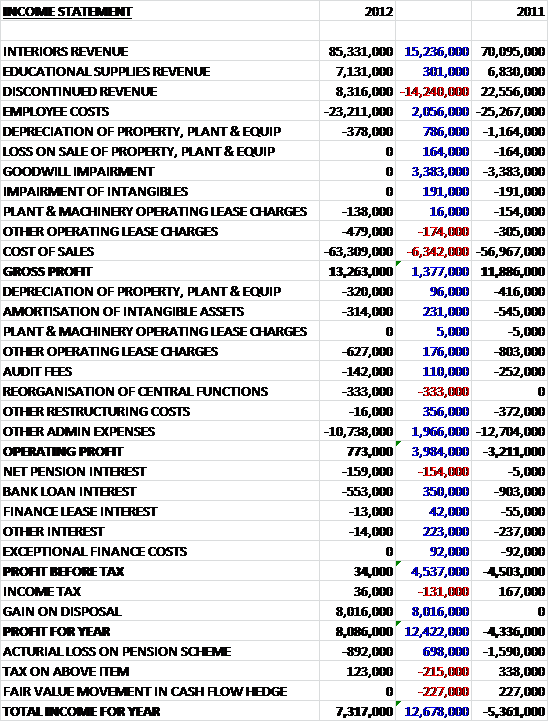
Although revenue is only marginally up on last year, if the revenue of discontinued operations is taken out, interiors revenue is up an impressive £15.2M and educational supply revenue is up by £301K.  We can also see employee costs reduce and a few one-off costs that occurred last time did not repeat this year, counteracted by an increase in the rest of the cost of sales.  Overall, gross profit was £1.4M up at £13.3M.  A reduction in almost all admin charges (except a one-off £333K reorganisation of central functions) meant that operating profit was £4M higher at £773K.  Likewise, most financing costs were lower and the profit before tax was £4.5M higher at just £34K (wiped out by the £36K of tax payable).  The big news this year though is the £8M gain on disposal of a subsidiary, which caused the profit for the year to increase by £12.4M to £8.1M.  Actuarial losses on the pension scheme nudge the total income for the year down a bit to £7.3M.

havelockassets


As far as assets are concerned, we have seen a reduction in almost all long term assets, both tangible and not, mitigated by increases in inventories and trade receivables (hopefully a sign of increased orders).  The big two reductions, however, were the sale of the asset held for sale (£8.3M) and the £4.4M reduction in cash.  Overall, this meant that total tangible assets were £6.1M lower at £43.9M.

Looking at the liabilities it becomes apparent where the cash received from the sale of the subsidiary has gone.  Bank loans were down by a pleasing £14.8M to a manageable £5.7M.  The other main reduction in liabilities was the £3.9M of liabilities held by the asset sold.  Trade payables was the big increase, though, up £4.9M as the group extended average payment days with its suppliers from 36 days to 52, presumably to help the cash flow figures.  Overall, net tangible assets were £7.5M higher at £10M.  Much more healthy than last year.

havelockcash


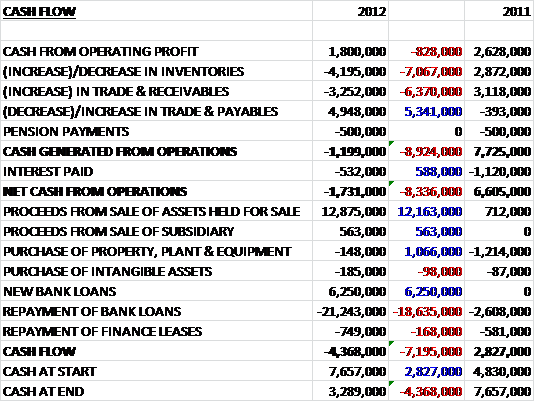
The cash taken from the operating profit is rather disappointing, down £828K from last year to just £1.8M.  As we have already seen, an increase in trade and payables was more than counteracted by an increase in both inventories and receivables.  The lower debt levels did see a reduced amount of interest paid but at £532K, it was still fairly substantial.  Overall, there was a net cash loss from operations of £1.7M compared to a £6.6M gain last year.  During the year we can see that the group made £12.9M of cash from the sale of assets relating to the subsidiary (the bulk being trade receivables and property, plant & equipment) and £563K for the subsidiary itself.  Taking into account the net assets lost, the cash inflow was about £8M.  This was used to pay off debt and a net £15M was returned to the bank, plus £749K in repayment of finance leases.

The overall cash flow was an outflow of £4.4M, which was pretty much meaningless given that most of the cash received was from a disposal and the group paid off a lot of debt.  It will be interesting to see what happens next year as I think the cash income from operations needs to grow somewhat.

Although revenues in the interior sector are much higher than in education, the operating profit contribution from the two businesses is very similar (between £472K and £497K).  Margins in the interior business were under pressure as lower prices were offered in exchange for more volume.  During the period of difficult trading in the past few years, the group has not been able to make any capital investments but a new laser cutting machine has now been ordered which should increase potential volumes by up to 50%. The education business saw a recovery in direct to schools sales and has incorporated the stage systems into being a supplier for the education business.

The group is quite badly exposed to a number of large clients.  Lloyds TSB made up 25% of all revenues during the year and Marks & Spencer represented 15% of revenues so if something were to happen to one of these customers, there could be problems.  These customers also seem to be leveraging their position to push prices down, which is leaving Havelock little option but to try and find ever more cost savings.

The subsidiaries sold were Showcard Print business, which is what had the bulk of the effect and bought in £12.9M of cash and Clean Air Ltd, which got £563K of cash.  Going back five years, the last time the group actually made a profit was in 2008 but the net debt situation in 2012 was the best it has been for some time due to the sales and now stands at a much more manageable £2.4M, down from £13.7M last year.

Going forward, the group is looking to focus on its core business of Retail and Education whilst looking to expand into areas such as Accommodation and Healthcare and has already secured the first projects in these two areas.  There has been an increase in activity in the Education sector whilst retail remains uncertain and competitive.  Overseas activity grew during the year and the aim is to grow this to be 10% of revenues in the medium term.

Overall then, the group still seems to be in a period of transition.  The results are dominated by the sale of the two subsidiaries and the subsequent pay off of some of the bank loans.  The margins in the interior business look razor thin and the group his heavily reliant on two large clients, which is cause for concern.  Were it not for the sales, the cash flow would also look rather sickly as Havelock struggles to turn that revenue into cash.  I am pleased that they are expanding into other areas again and hope that now they are not hamstrung with the large amount of debt they had before, the group can kick on to better things.  I will hold and await developments.

At the AGM, the board released a statement that said that it has seen activity levels in the first half at lower levels than in the same period of last year but after discussions with their clients, they are confident of a busy second half of the year.  The group completed the first jobs in healthcare and student accommodation, which is a little more encouraging.  I don’t like the sound of this update and I wonder if I should take a small loss here and sell up?

Sainsbury Blog – FY 2013

sainsburys logo


Sainsbury have now released their final results.

sainsburyincome


Revenues for the year were up by just over £1B at £23.3B, £1B of which were online sales, up by 20%.  An increase in cost of sales, employee costs and operating lease payments, however, mean that the Gross profit is just £66M up on last year.  There was a £20M Transaction cost related to the on-going purchase of Sainsbury Bank that did not occur last year, £5M of internal restructuring costs and a £26M increase in other admin expenses, which, when combined with the £15M less in profit from the sale of subsidiaries meant that operating profit was only £13M up on last year.

The profit for the year was £16M up on last year at £614M as a pension financing charge was counteracted by a lower tax charge.  Total income for the year was £90M lower than last year at £361M as the group was severely affected by a £366M actuarial loss on the pension scheme. Overall this is not a bad result, but the profit does not seem to have moved on that much from last year and the pension valuation is becoming a bit of a worry.

sainsburyassets


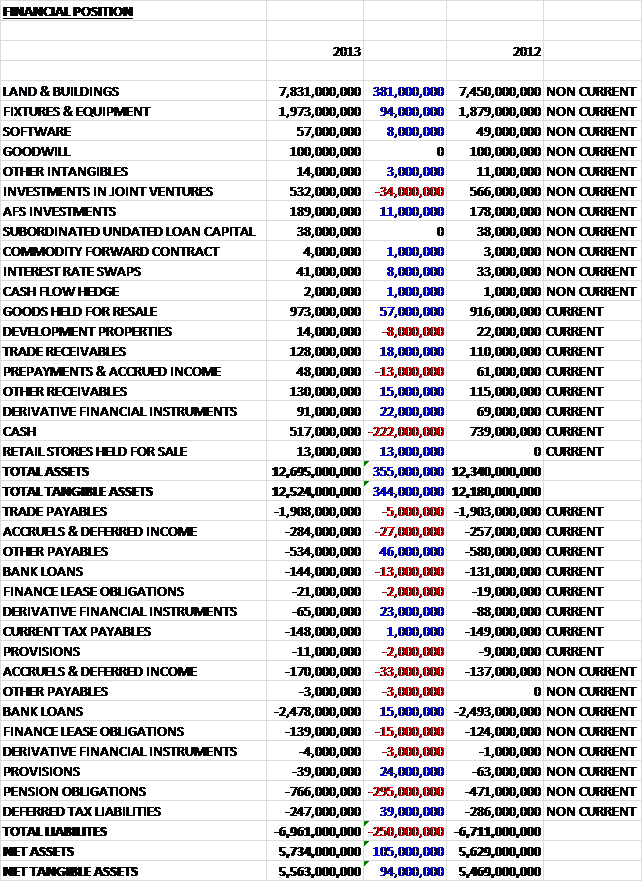
Total Assets for the year increased by £355M.  The largest increase was the value of land and buildings, up £381M on last year, followed by fixtures and equipment (up £94M), showing that Sainsbury is continuing to invest in its store portfolio.  Another major increase was the value of inventories, again showing the larger store portfolio.  This was somewhat mitigated by a £34M reduction in joint venture values, reflecting a revaluation of some of the property held in joint ventures, and a £222M reduction in cash levels.

As far as liabilities were concerned, the largest increase by far was the £295M hike in pension obligations, followed by a £60M increase in accruals and deferred income, which partly relates to the accounting for leases with fixed rental increases.  The increase was lower than that of assets, however, so net tangible assets increased by £94M to £5.563B.

sainsburycashflow


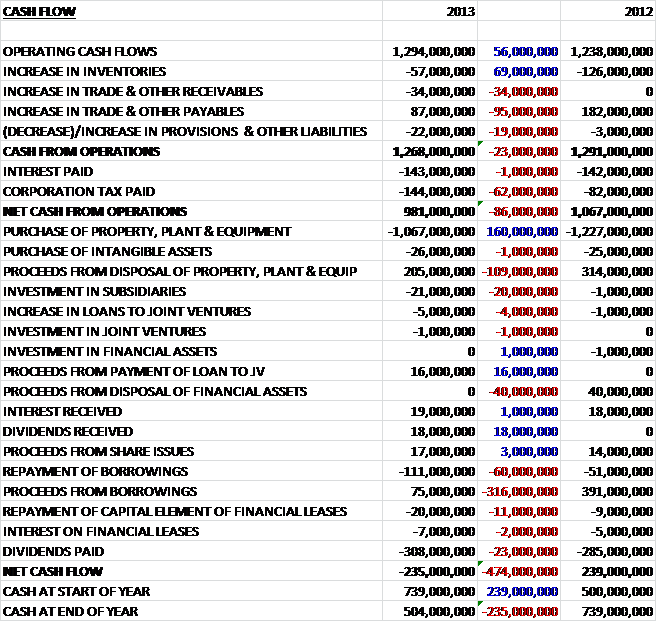
Compared to last year, cash from operations fell by £23M due to an increase in trade and receivables and less of an increase in payables.  The net cash from operations of £981M was further affected by a £144M corporation tax charge (£62M higher).  All of this cash was then swallowed up by £1.067B of capital expenditure, leaving a negative cash flow after this.  This was made worse by a £21M investment in subsidiaries and a net £36M repayment of borrowings (compared to a net £376M receipt from borrowings last year).  Dividends of £308M were also paid out during the year. The group did benefit from an £18M dividend received, however.  Overall then, the group had a net cash outflow of £235M, compared to an inflow of £239M in 2012.  When it is considered that there was a £412M swing in loans going out, the resulting difference from last year is -£62M, which seems to have been accounted for by a £109M reduction in proceeds from the sale and leaseback of stores.

Profits from the bank were just £2M, affected by the £20M of costs relating to the purchase of the 50% held by Lloyds.  The property investments also only contributed £2M due to a reduction in the value of the properties.  This compares to £16M and £12M respectively last year.  To put these numbers into context, the retail stores earned £784M in profit.  Without the one-off costs, the bank at least would have increased profits.

The group intends to take full ownership of the bank and therefore have signed an agreement to buy the 50% owned by Lloyds at the cost of £248M, £193M of which will be a cash payment.  They see the full control of the bank as an important part of their diversification strategy.  The group have also opened up pharmacies in 270 stores and the energy business has seen an 83% increase in customers – I cannot see where the energy business’ results are listed though so I do not know how much was made on energy. Clothing also showed strong growth, showing a strong double digit increase.  In addition, the group has a GP office in 35 stores and a dental surgery in 12.

Convenience stores is another area that Sainsbury have been aggressively expanding into during the last few years and sales this year were up by 17% driven by new openings and some like for like increases.  Online is another growth area, up by 20%.  Growth in credit cards was 17% as the bank’s card is strengthened by the offer of Nectar points.  Other areas of growth within the bank were insurance, with business up 67% and travel money, up 35%.  During the year, Sainsbury purchased a majority stake in Anobii, which now operates as Sainsbury e-books and signed a deal with Rovi to supply an on demand video streaming service.

One area that Sainsbury has traditionally done well is on special occasions such as Christmas and Easter.  This year, the UK had many such occasions with the Olympics and Jubilee celebrations.  Homeware in particular was boosted by this effect.  The group continue to open new space, with 14 new supermarkets and 87 new convenience stores being opened during the year.  Sainsbury continues to trade on its values as a commercial advantage and Sainsbury is once again the largest fair trade retailer in the world.  Sainsbury continues to have a successful own brand and it grew 5% on last year and now accounts for half of all food sales.  The premium brand fared particularly well, with sales up 10%.  It is here that Sainsbury’s reputation as a reliable and honest provider really pays dividends as it emerged completely unscathed from the horsemeat scandal that hit other supermarkets.

In order to plug the gap in the pension scheme, the group transferred £501M of property in 2011 to a partnership via a sale and leaseback program.  The pension scheme’s interest in the partnership nets it about £35M a year over 20 years and in 2030, the property will revert back to Sainsbury ownership for a cash payment equal to the remaining funding deficit, up to a value of £600M.  This is either quite an elegant solution to the funding issue or a ticking time bomb, I can’t quite work out which.  Currently the net pension obligations stand at £688M, up by £233M on last year and the pension deficit is a bit of a concern going forwards.

Net debt at the end of the year was £2.2M, up by £182M over that of last year.  At the end of next year, the group expect net debt to hit £2.6B as capital expenditure continues to outstrip the cash received by the group.  The cash outflow is a little disappointing but underlying cash flow was actually better than last year.  Profit for the year was up marginally, as were net tangible assets as a reduction in cash and higher pension obligations were counteracted by a greater investment in property.  Going forward, there is a commitment of £248M to purchase the half of the bank that the group do not currently own.  Clearly there is an element of risk here but it is an interesting diversification for Sainsbury to attempt. There is going to be £100M of capital injection over three years to maintain the appropriate ratios, mitigated by a £60M repayment of dated loan stock.  In addition, the bank will also incur non-underlying transition revenue costs of £170M and transition capital expenditure of £90M, in order to build and move onto the new banking system so this is starting to look a bit expensive.  Having said that, the group have indicated that the transaction is expected to deliver cash payback within eight years. Operations wise, the big growth areas were the convenience stores and online sales.

Overall then, not that much progress has been made, and it does concern me a bit that the capital expenditure is higher than the cash received, which in the long term it would be good to get under control.  Having said that, it has been a difficult market over the last year and Sainsbury seems to be faring better than other UK supermarket groups.  The dividend is currently 4.7% and covered 1.8 times by earnings, which the board aim to increase to two times earnings.  The P/E ratio is a rather good value 11.4 which looks pretty good to me and I think that the shares may be slightly undervalued at the moment.  I may look to buy more on weakness.

Sainsbury have now released their first quarter trading update.  It seems to contain more of the same really.  Like for like sales are up 0.7%, with total sales up 3.6% driven by homeware, with kitchen electrical sales up 34% and cookware up 23%; convenience stores with sales up 20% (19 news stores have been opened) and online sales, up 16%.  I do not consider anything to have materially changed since the last update.

On 2nd October, Sainsbury released an update covering the second quarter.  Overall, total sales were up 5% and like for like sales up 2.1%.  For the first half of the year, sales were up 4.4%.  During the quarter the big drivers were online sales, up 15% and convenience sales, up 20%.  General merchandise also continued to grow and the rate was over twice that of food.  During the period, the group launched a new mobile service in a joint venture with Vodafone so it will be interesting to see how that gets on.  As far as traditional stores were concerned, there were 31 new convenience stores opened and 5 new supermarkets. Overall this is yet another strong result, and it is business as usual for Sainsbury.

Braemar Shipping Blog – FY 2013

Braemar have now released their results for the year ending 2013.

braemarincome2013

Although total revenue is up by £10.3M, the high margin Shipbroking Revenue is down by £3.5M to £46.4M.  Environmental Revenue, of which the vast majority is work on the stricken containership Rena, was up nearly £9M but this revenue stream is forecast to come to an end shortly.  Perhaps more pleasing is the £4.9M increase in Technical Revenue.   The largest increase in costs comes from materials and other costs, which were up £8.4M to £16.9M.  We have also seen a £2.4M rise in staff costs, which have helped to cause the operating profit to fall by £374K when compared to last year, at just under £9M.  As a cash rich company, this was boosted somewhat by a £300K interest on bank deposits but the share of joint venture profit collapsed to £62K.  This, along with a lower amount paid in tax left the annual profit just £95K lower at £6.9M.  A positive foreign exchange difference pushed the comprehensive income £642K up to £7.8M.

braemarassets2013

Within the £1.5M increase in total assets, the major changes are a £5.8M increase in cash, counteracted by a £3.8M reduction in trade receivables and a £1.2M reduction in other intangible assets due to them being somewhat impaired from the lower than expected performance of the acquired Casbarian Inc.  Within those reduced trade receivables were £3.1M that were impaired.  This was lower than last year but still seems like a lot to me. As far as liabilities were concerned, there was a £550K reduction in trade payables and a £400K reduction in deferred consideration relating to the acquisition of Casbarian where the performance targets are not going to be met within a total £1.5M reduction in liabilities.  This caused the net tangible assets to increase by £4.1M to £38.3M.

braemarcash2013

The group achieved a flat operating cash flow compared to last year at £12.2M, but a much better control of capital – especially the reduction in receivables that meant the cash generated from operations was nearly £10M better than last year at almost £15M.  A reduction in tax and an increase in interest meant that net cash from operations was £10.3M better off at £11.6M.  A much lower amount spent on acquisitions and a slight increase in the amount paid out in cash meant that the group achieved a £4.9M cash inflow as opposed to a £8.2M cash outflow last year.  A much better performance which was driven by a better control of receivables and payables.

Although on the decline, the group still gains most of its profit from shipbroking.  In 2013, that accounted for £4.6M of profit, Technical for £2.8M, Environmental £2.7M and Logistics £1.9M. Given the fact that Ship Broking still does not seem to have bottomed out and environmental will all but disappear once the Rena clean-up is completed, this is a little concerning.  No customer accounted for more than 10% of group revenues, however, so the client base seems quite diverse.

During the year there was quite a bit of board upheaval and Quentin Soanes & Alan Marsh, both founding members of the company retired during the year.  The finance director, James Kidwell replaced Alan as CEO and Martin Beer has arrived as the new Finance Director from Unigate.

During the year the Shipbroking division achieved more transactions than last year but the value of each transaction was significantly lower due to lower ship values, freight rates and less orders coming from the forward order book.  The technical division increased revenues across most areas but in particular Offshore in Asia did well.  In Logistics, ship agency revenues grew but these were counteracted by a lower project forwarding activity.  Of the £23.4M of revenue recorded by the Environmental division, £18.9M was relating to the Rena project so it can be seen what an affect the end of that project will have on revenues.

The Shipbroking division has continued to struggle due to the on-going over capacity of marine tonnage which is showing no real signs of reversing and this year the deliveries of new ships continued to be higher than the scrapping of old tonnage, further increasing the over supply problems.  After a fall this year, the future order book going into next year has fallen by a further £8M to just £11M but the group is seeing vastly increased business in the spot market.   In the bulk shipping market, seaborne trade increased by 4.4% year on year but available tonnage increased by 10%, which shows the problem.  Next year the fleet is expected to increase by 8% so the situation is likely to get worse. 

The freight market for Crude tankers is at its lowest point and the product tanker market is roughly at break-even levels.  The situation is such that many owners are not able to cover expenses for the year.  The pattern of trade is changing as the US increasingly moves towards energy self-sufficiency and more oil and petroleum products are being consumed in Asia.  The majority of business is happening on the spot market.  The Chemical and gas markets look a little better, although they are affected by the same issues as other markets.  The group has recently arranged a 15 year coverage for a number of gas carriers to carry Ethane from the Shale gas developments in the US to Europe.

In contrast to other markets, the demand for offshore supply vessels has been strong and the group have extended their coverage to Latin America, Asia and East Africa.  The performance of the offshore desks has been good and this performance is expected to continue in the future.  As with other markets, the Container market is currently oversupplied to a tune of 36% and charter rates have fallen year on year. This is not likely to improve over the next year.

The ordering of new vessels during the year was thin and due to the already over supplied market, the number of transactions has been limited.  The second hand market for bulkers and tankers was even worse with prices continuing to fall and the availability of finance low but the group managed to increase transactions during the year, at a cost of lower values.  Unsurprisingly the demolition of old tonnage is growing and during the year the group sent 80% more ships to demolition compared to last year.     

In contrast to the Ship Broking segment, the lower margin Technical Division did rather well during the year, growing sales by 15%.  A portion of this was from the acquisition of Braemar Casbarian but the majority of the growth was from Braemar Offshore where the group won a number of contracts to provide marine warranty surveys for long term offshore energy contracts in the Asia Pacific region and the group opened a new offshore office in Thailand.  The market is expected to be buoyant going forward.

The adjusting business had a year of transition and further expansion occurred when an office was opened in Dubai whilst non-core operations in Latin America were sold.  Despite this, performance was stable during the year.  Braemar SA, who provide damage surveys, loss prevention and marine consultancy, increased revenues by 8% due to the acquisitions last year taking full effect but like for like sales were actually down on 2012.  In the Engineering sector, the group won a new contract in LNG that will add a lot of revenue and the increasing demand for LNG means the group expect this sector to do well in future. 

Braemar Casbarian, acquired in 2011 provides services to the offshore industry in the Gulf of Mexico.  The work in this area was below expectations, partly as a result of the slow pace of recovery following the Deepwater Horizon accident.  The cost base of the business has been reduced to take this into account.

Within the flat revenues in Logistics, the Ship Agency business performed well and a large contact was won for agency work at Grangemouth and Finnart.  The group has grown staff numbers to support this new business.  Logistics did not perform so well when compared to last year due to a number of one-off contracts that occurred last year and the negative affect the Olympics had on the business.  Things have started off fairly well in the first few months of the next reporting period.  During the year the group broadened their geographical reach into Houston and Oslo.

Going forward, there is no real prospect of an up-turn in the shipping markets in the short term and the recent subdued performance in Ship Broking is likely to continue, growth is expected in the Technical market, however but as already stated the end of the Rena contract will result in much lower activity levels in the Environmental sector.

The dividend remained unchanged for the year and the yield at the current share price is a stonking 6.2%.  It has to be said that this yield is only covered 1.2 times by earnings but the large cash reserves mean that is it not particularly under threat.  The recent rally in the share price means that the P/E ratio is no longer ridiculously cheap, at 13.1 but if the brokers are to be believed an increase in EPS next year would give a predicted P/E of 11 at the current share price, which is starting to look good value.  I am not sure where the analysts expect the extra profit to come from though.

So, this year was a fairly good performance in my view, given the underlying market situation but the excellent cash flow was only really achieved by reigning in the outstanding receivables.  Going forward, we know that profit from Environmental will definitely be lower as the Rena work comes to an end and the Ship Broking profit is also likely to be lower given the continued over supply of capacity.  The outlook is somewhat better for the Technical and Logistics sector but I don’t really see that they will make up the short fall.  Having said that, I think the dividend is fairly safe and the group continues to be debt free.  I see these as a hold.

 On 19th June, Braemar released an interim statement.  They informed the market that performance of the chartering desks have been strong and while there was some recovery in freight rates, this is not expected to be sustained.  The offshore desk and demolotion desk also performed strongly.  The Technical division made a good start to the year, mainly driven by Braemar Offshore which experienced a good level of activity in the Asian energy market.  The adjustment segment performed well and Braemar Engineering started work on the three month contract to design and supervise the build of 6 new LNG carriers.  The Logistics segment had a solid start in a difficult market and the Environment division performed steadily, not withstanding the end of the Rena contract.  In summary, the group seems to have made a good start to the year but there is no change in the outlook for the year ahead.

Laura Ashley Blog – FY 2013

Laura Ashley have now released their results for the year ending 2013

lauraashleyincome

Although store revenue was fairly flat, this year saw another increase in e-commerce and non-retail, plus the first real revenue contribution from the hotel.   The actual profit contribution from stores was down, however, with an increase in contribution from E-commerce and non-retail.  The hotel was marginally loss making in the period.  Costs of sales were also up, however, to leave the Gross profit completely flat at £126M.  As far as other expenses were concerned, there was not much change on last year with the biggest being a £800K fall in depreciation.  These slight changes in admin costs meant that the operating profit was £1M better than last year, at £19.3M.  The group also received a better return from the associate (Laura Ashley Japan) and an unchanged tax charge left the profit for the year £1.7M higher at £14.7M.  Total income for the year showed a similar increase as adverse exchange differences were counteracted by an increase in unrealised investment gains.

lauraashleyassets

Overall Total Assets were down by £3.5M year on year, with a £3.4M in the value of investments in quoted shares being counteracted by a £1.6M reduction in the value of leasehold property and a £5.7M reduction in inventories.  Liabilities fell by £6M, driven by a £3.7M fall in trade payables, a £2.3M reduction in deferred income and a £1.3M reduction in social security payables.  This meant that net tangible assets were £1.9M better off at a very healthy £60.6M.

lauraashleycashflow

Before changes in capital, the group achieved a cash flow £400K better than last year.  A decrease in inventories was more than counteracted than an increase in receivables and a decrease in payables which left the cash from operations £2M lower than last year at £22.4M.  The largest cash expense by far was the £14.5M spent on dividends (no change from last year).  Otherwise, nearly £5M was paid out in tax but the main difference from last year was the £5.6M less that was spent on the purchase of property and equipment as the previous year included the purchase of the hotel.  Overall, the small cash outflow of £400K was £3.1M better than last year and a fairly decent performance.

During the year the group opened 6 new UK stores and closed 5 stores for the on-going re-alignment.  Like for like sales in UK stores were actually down by 0.1% and gross margin rates fell by 1.9%.  In the UK, online revenues are becoming more and more important, now making up 16% of UK sales and e-commerce sales were up nearly 20% year on year to more than counteract falling mail order sales.  The group now sell to France, Germany, Austria, Italy and Switzerland in addition to the UK – so I would have thought more opportunities to expand there.  A mobile site has recently been introduced to keep up with the times. 

In the UK, furniture is the biggest proportion of sales and it was fairly flat – increasing just 0.5% on last year.  Home Accessories did very well, increasing by 7.6% and apparently is becoming more relevant for gifting, giving a boost in sales.  Decorating sales ticked up ever so slightly, up 0.7% and this sector is still an import driver for other areas.  Unfortunately fashion sales fell by 5.6% year on year after a poor second half of the year.  During the year, the group re-launched their fragrance, “Number 1” and sales of that are apparently going well.

Franchise revenues continue to be a more important source of income and they increased by 13% on last year with stores in 28 countries, including new ones in Russia, Poland and the Baltic States.  Licensing income is also becoming an important source of profit as this increased by 17% year on year.  Licences were awarded for conservatory furniture and shower enclosures during the year.  The hotel has now been refurbished and will be launched as a Laura Ashley boutique hotel shortly.  It will be interesting to see how the hotel, purchased from Corus hotels (also mostly owned by the same Malaysian outfit as Laura Ashley) adds to profits in future and whether this is a new venture for the group or just a one-off.

This year has got off to a decent start, with the group announcing like for like sales up by 2.7% for the first two months.  Overall this is a fairly good update, it is clear that a falling contribution from the UK stores is being counteracted by increased online sales, franchises and licences and Laura Ashley seems to be adapting to the changing retail environment fairly well.  One area of slight worry is the slightly negative cash flow but given the large cash pile and lack of debt, this is not a pressing concern.  The current yield is a very good 6.9%, and is just about covered by earnings.  The P/E ratio of 14.3 shows that this share is not as undervalued as it once was but it is difficult to safer source of a 6.9% return anywhere else.  Still worth topping up in my view.

 On 21st May, Laura Ashley announced that they will be paying a special dividend of 0.5p per share.  Apparently this is to commemorate the 60th anniversary of Laura Ashley.  The dividend is not covered by earnings and is taken from the cash reserves.  It seems like a rather arbitary reason for a special dividend and is perhaps a way to reduce the cash pile. In any event, it was a nice surprise as a shareholder.

On 13th June the group released an interim statement.  In the release, the say that total retail sales fell by 0.6% due to a weak performance in the fashion sector.  They attempted to blame this on the weather – I am having none of that!  E-commerce sales growth was 4.4% and 10 new franchise shops were opened.   This profit warning was a bit of a disappointment but it is still possible to turn this around and I am not overly worried yet.

Interserve Blog – FY 2012

Interserve splits its business into four different segments.  Support services are the provision of outsourced services to public and private sector clients in the UK and Middle East.  Construction is the design, construction and maintenance of buildings and infrastructure in the UK and Middle East.   Equipment Services is the design, hire and sale of formwork, falsework and associated equipment.  Finally, investments are mainly involved in the maintenance of the group’s PFI framework investments.  The most important end user sectors are Commerce, Defence, Infrastructure, Health and Education.

Within support services, the group provides facilities management, where they maintain buildings and estates, providing services to people working/living there.  Other services include healthcare, employment services, waste management and training.   In the UK a continuing trend towards outsourcing is opening up the market for companies like Interserve.  The outsourcing market is substantially less developed outside the UK and the second largest market Interserve is active in is the Middle East.  Here they provide building repair, plant maintenance, health & safety training and assurance services to the oil and gas sector.  This region is a good opportunity for growth and the group is making some investments in this area.

Within construction, the group provide all technical and commercial aspects of building and engineering services including constructing the buildings, providing services to companies constructing the buildings and interior design and fit-out.  Some of the projects abroad include infrastructure, roads, rail, port schemes, power, water and drainage and services internationally also include joinery, steelwork and specialist temporary buildings.  In the UK, most of the business is in the public and utilities sectors.

Their Equipment services brand is RMD Kwikform and designs and provides specialised framework, falsework and shoring equipment.  The business is most active in the UK, Middle East and Australia but has also opened branches in India, Chile, Panama and Kazakhstan.

Interserve have released their full year results for the year ending 2012, starting with the income statement.

interserveincome


Revenues for the year were a bit of a mixed bag.  The largest revenue source, UK support services, fared well as the group took on more outsourcing work from the government and international support services also did quite well, increasing revenues by over £5M on a small base.  Equipment services continued its recovery, increasing revenues by over £13M.  Things were not so good for International Construction, however, as revenues from this sector reduced by £22M to £202M as there has been lower demand in some countries.  There are some signs of improvement in UAE and Oman with Qatar are also showing some increased infrastructure development.  The other sector to fare badly was the investments revenue, which nearly halved to £81M as Interserve sold off a large amount of its PFI investments (the investment in the University college hospital London was sold for £33M to Unicorn Holdings; stakes in two subsidiaries that held 19 PFI investments were sold for £85.5M and the remaining assets held for sale, at a valuation of £51.2M were transferred to the pension scheme).  There were also some increases in costs of sales but overall the gross profit was up by £16.2M on last year, at £220M.  The £5.4M of interest relating to joint ventures are to do with the PFI assets sold, so this income will not be repeated next year.  The group indicate that the income from investing the proceeds will cancel this out.  That remains to be seen.

The admin expenses did not change that substantially but the share of profit from associates and joint ventures fell by £2.4M to £25M.  The figure dominating these results, however, is the £115M of profit on the sale of investments (the PFI sales mentioned previously).  This huge one off receipt caused the operating profit to rocket by £117M to £185M.  Without this sale, there would have been a modest increase in operating profit last year.  The other exceptional item of £4M relates to bonuses triggered by the profit made on this sale.

Things were otherwise quite stable but the income tax increased by £4.7M on a low level last year which left the profit for the year £111.1M up at £172M.  The total income from the year was adversely affected by an actuarial loss on the pension scheme.  Overall this profit was totally dominated by the PFI sale, were it not for that, the profit for the year would have been marginally below that of last year.

interserveassets


Starting with intangibles – we can see that the acquisitions have come with a substantial amount of goodwill (up by over £27M) and customer relationships.   We can see that the investments in joint ventures have been moved to available for sale assets, and in some cases sold (this would be the PFI companies).  These sales have given rise to a £31M increase in the cash level.  Other large increases in assets include a £10.1M increase in tax assets, a £12.1M jump in trade receivables, a £14M increase in prepayments and a large £19M increase in payments due from construction contracts.  All this means that tangible assets were up £48M to £840.1M.

As far as liabilities are concerned, there is a pleasing £40M reduction in the bank loan, to leave it at £30M.  Provisions were down by a small amount with the largest proportion taken up by contract provisions, which include the costs of site clearance and other costs.  This is where the good news ends, however, as there were large increases in trade payables (£22.5M), deferred income (£38.1M) and pension obligations have increased by a massive £45M to £101M.  The actuarial pension scheme deficit was agreed at £150M in the year, before the contribution of the PFI investments being moved to the scheme and future deficit contributions have been set at £12M.  That pension obligation increase helped push the group into a lower net tangible asset base than last year and the net tangible assets for this year were down by £14.6M to £65M.  This does not seem like a huge amount for a company of this size.

interservecash


An increase in receivables cancelled out an increase in payables to give a cash flow of operations of £39.7M, which was £5.4M less than last year due to a very big increase in receivables (despite the average credit period on the sale of the goods reducing from 41 days to 37 days).  The hire fleet accounted for net £6M of cash and the tax payment of £10.7M was substantially higher than a low level last year which meant that net cash from operations was nearly £20M less than in 2011.   The cash receipt from joint ventures was slightly down on last year but was a welcome £20M. The largest income of cash was a one off receipt of £119M from the disposal of a holding in the University College London PFI project and some other PFI investments.

This large cash receipt was spent on purchases of businesses (£44.7M) and the repayment of some of the bank loan (£40M) which leaves £34.6M to be spent on the cash flow.  As we can see, the cash flow at the end of the year was £30.4M so this was entirely due to the PFI disposals.  Were it not for this, there would have been a negative cash flow here.

Overall then, this cash flow looks impressive at first glance but when it is realised that the positive cash flow is entirely due to the one-off disposal of the PFI investments, it is a little less impressive and if that healthy dividend is going to be sustained, there needs to be a slight increase in cash.

The UK accounts for at nearly 3/4 of the group profits, with the Middle East and Australasia accounting for most of the rest.  A modest amount of profit is coming from the Far East, but this figure is increasing.  The group incurred a loss on operations in the rest of Europe and the Americas.

During the year, the group made two acquistions.  BEST made £1.6M in profit last year and contributed £1.4M to group profits since acquisition and Advantage Healthcare made £2.6M last year and contributed £100K since acquisition. The group has decided that each one is worth between £13M and £14M of Goodwill. After the balance sheet date, the group purchased Willbros Middle East Ltd which owns oil and gas service businesses for a total consideration of £26M, including £19M of Goodwill and intangible assets.

The revenue growth seen in UK support services was primarily down to new business with existing customers.  This is exemplified by the relationships with Alliance Boots which grew from a contract providing cleaning services for some stores to total facilities management for the office locations and cleaning services to over 1000 stores in both UK and Ireland.  As well as increasing revenue, the group has also worked hard to improve margins.  During the year new business was won with Scottish Power, Carphone Warehouse, West Yorkshire Police, Borough of Southwark, London Universities, the Environment Agency and the Defence Infrastructure Organisation which has caused the future workload to increase to an impressive £5.2B.

The division was strengthened by the acquisition of BEST, a Yorkshire based providers of training for people trying to get back to work; and Advantage Healthcare, which provides case management, social care, clinical and nursing services for primary care trusts, private clients and through GP referrals.   This increase in healthcare capability helped the group win a contract with Leicestershire NHS Trust to provide complete facilities management and consultancy, supporting at least three hospitals and other facilities.   Another area the group is looking to expand into is the justice market, providing facilities management to prisons.

Although UK support services provide the bulk of the revenue, the international support services sector is a growing area for Interserve.  Some new contracts include an extension to onside mechanical maintenance to an Oryx gas to liquid plant; a five year service contract and turnaround services to Shell Pearl; a five year contract for plant modification works and maintenance services for Dolphin Energy (both on shore and off shore) and the fabrication and installation of pipework for a Punj Lloyd polysilicon plant.

The group has been investing in new businesses here too, with the acquisition of TOCO, an Oman based business specialising in fabrication, maintenance and repair services to the oil and gas industry and the group are confident about future prospects in this area.

Although revenue for UK construction increased slightly, a more competitive environment squeezed margins and the contribution to profit fell from last year and these low margins are expected to continue in the medium term.  Interserve is moving more into growth markets, such as energy from waste and have completed the design and build of a plant in Westbury and have also won a £150M contract with Viridor for the construction of Glasgow’s new residential waste treatment facility.  The group also have a contract to renovate an old building in Edinburgh to turn into flats.  Other new contracts include a project for a Land Rover factory, contracts with NHS, National Grid, English Heritage and the Highways agency.  Future workload currently stands at £900M and whilst the board expect the current year to remain challenging, they feel that this visibility of future work sits them in good stead.

Revenue from International Construction is somewhat less than in the UK but the contribution to profits are similar due to the higher margins.  Unfortunately revenues and profits fell during the year due to client caution.  Although in the UAE there are signs of optimism, with new contracts including a £11M Fujairah road system project; a £6M region HQ for Habib Bank; a £38M Fujairah city centre shopping centre project; a £49M Jumeirah Beach shopping centre project and a £28M contract for General Electric for an Emirates Airlines engine overhaul facility.  The fit out business won contracts for hotels in Abu Dhabi and Ajman.

Conditions in Qatar have been somewhat more subdued but a contract to fit out the main halls and lounges in Doha Airport has been won as have fit outs in two office towers in Doha.  Other projects have included a £30M project to build two substations for Hyosung and chilled water piping diversions for Ashghal who are building an expressway in Lusail after the group had previously built a sewage plant for them.

Market conditions in Oman were stable over the period with good levels of activity in defence and industrial development.  Notable contracts included a substation for Arabian Industries and work for the new Military Training College in Seeb.  The fit out and joinery businesses did well with the completion of the Sohar Court complex a highlight.  In the short term, growth in the region is likely to remain subdued but with the World Cup coming to Qatar in 2022 and economic growth forecast in the region as a whole, long term prospects look better.

With higher margins, equipment services is another important area for the group and this business has seen a gradual recovery in their markets.  In the Middle East, Saudi Arabia remained the largest market and projects included the provision of equipment to the Roots group at the Mecca Grand Mosque; in Jeddah, their equipment is being used to build the new approach roads to the airport and there are several infrastructure projects in Riyadh.

The business performed well in Oman and projects included the redevelopment of Muscat and Salahlah airports.  In the UAE there are signs of more substantial infrastructure projects coming to market and a contract was won to supply equipment for the presidential palace in Abu Dhabi.  Conditions in Qatar remained subdued during the period.  Things picked up nicely in South Africa with new contract wins for Flicksburg reservoir with Rawacon and the supply of shoring equipment to the Mhlatshane waste water treatment works for Cyclone Construction in Kwazulu Natal.  Interserve continued to supply equipment to the Gruluk Bunker in connection with a new power station in Lephalale.

In Australia, projects included Gorgon in W. Australia and three other LNG plants on Curtis Island and although the pace of investment in Australia has slowed recently, it still represents and import and relatively stable market for the group.  Following the earthquake in Christchurch, the group has been supplying a lot of shoring equipment and framework which has driven very good results in New Zealand.  Work in Hong Kong revolves around a new cruise ship terminal and an integrated public transport project.  The group had a strong year in the Philippines with demand being driven by projects such as the new arena and stadium complex.

Demand in Europe was generally subdued, reflecting the continued construction pressures in this region and Interserve underwent some efficiency savings to make sure they were well positioned in the smaller market place.  Some important projects included the support of a stadium roof in Marseille and Spain where they are working with Horta Costada on plans to increase capacities ahead of the UEFA 2016 tournament in Spain.

For much of the year, conditions in the US were difficult and the group responded with a number of organisational changes but towards the end of the year the construction industry showed some signs of recovery.  Elsewhere in the Americas, market conditions were more favourable and there has been increased investment in Chile and Panama with Chile in particular performing well, driven by demand in mining.  Interserve are planning a market entry into Colombia too.  Going forward, revenues in Equipment Services are predicted to continue to improve.

I feel results for this year were fairly mixed but overall seem quite positive.  Revenues were up for most sectors but they were reduced in international construction where Qatar remained subdued and in investments where many of the PFI companies are being offloaded.  One big story in these results was the £115.5M made on those PFI sales, which was invested in reducing debt and in three new acquisitions.  Net tangible assets are actually quite low for a company of this size and reduced further during the year predominantly due to the larger pension obligations. The positive £30.4M of cash flow was entirely down to the PFI sales and if these sales were taken out (a very crude measurement I know!) then there would have been a negative cash flow of £4.2M, which is no disaster but could be better.

Going forward, the low margin work in the UK looks set to continue as the Government outsources more work to cut down on costs.  Internationally, the UAE seems to have picked up and Oman is strong, with Qatar still experiencing some difficulties.  Australia is still doing quite well but there is evidence of reduced infrastructure spending recently, which is a bit worrying.  Europe, as would be expected, remains difficult but it seems Interserve don’t have a huge exposure there.

I do like Interserve as a company.  They seem to be quite well diversified in both products (they don’t rely entirely on construction) and geographically and I particularly like their focus on the Middle East.  The dividend has a yield of 4.2% which is not that bad but has been better and the P/E ratio of 10.6 still seems rather cheap despite the increase in share price.  I have slight concerns as to how the sale of the PFI assets will affect the bottom line once the revenue from them is taken out and whether the group can maintain a positive cash flow without the one-off sale of PFI investments this year.  I think overall I still consider Interserve to be good value.

On 2nd April, Interserve announced a new contract with Magnox who operate 10 nuclear power stations in the UK and seem to be responsible for decomissioning them.  The contract is initially for three years and is worth £80M.  Interserve will provide a full range of facilities management, including mechanical and engineering maintenance, catering, cleaning, office services, grounds maintenance and civil works.  The group is also the sole contractor on a four year framework agreement with Magnox to design and construct facilities to store intermediate level waste.  This seems like a good contract win in an interesting sector.

On 3rd April, Interserve announced a new joint venture to develop the Haymarket area of Edinburgh into offices, retail units, hotel accomodation and underground parking.  They have invested £10.5M in the project and construction works should be at a value of £150M.

On 13th May an interim management statement was released that stated trading was pretty much as expected.  Over £700M of new work was secured in the period.

On 9th July the group released a statement that said they continued to perform in line with expectations with a strong future workload.  Short and sweet.

On 15th July the group announced that they had entered into an agreement to acquire Topaz Oil and Gas based in UAE for US$46M.  The company provides oil field maintenance, fabrication and construction services to the Middle East, particularly in Abu Dhabi and Fujairah.  Current clients include Shell, ADOC, ADNOC, Qatar Gas, RAK Petroleum and Aker Solutions. This seems like a pretty decent opportunity, although not much detail on the financials has been provided.

Matchtech Blog – Interim 2013

Matchtech have now released their interim results for the half year ending 2013.

matchtechinterimincome


After the restructuring in reporting, which now includes Engineering (Aerospace, Automotive, Energy, Infrastructure, Marine and Science sectors) and Professional Services (Barclay Meade, Alderwood and Connectus, the new brand for the technology sector) we can see that revenues are up in both sectors.  Cost of sales are also up, however, as are admin expenses to leave the operating profit a decent £923K up, at £4.4M.  Higher finance costs and income tax erode this somewhat and the profit for the year is £740K higher at just under £3M.  I see this as a pretty decent performance.

matchtechinterimstatement


Compared to the end of last year, the assets at the 6 month point of this year were down by £2.4M.  This was almost entirely due to the £2.6M reduction in Trade Receivables during the period.  Although trade receivables were down, the amount of trade receivables overdue has grown from £7.4M at the end of last year to £12.2M at the current time.  This is a slight concern and something that I hope the board have an eye on.  Thankfully, liabilities were also down and an increase in trade and payables of £3.4M was more than counteracted by the £6.6M reduction in the bank loan.  This has resulted in the net assets of the group increasing by £830K to £28.5M.

matchtechinterimcashflow


Operating cash flow for the six months was nearly £5M, just under £1M up on last year.  This was enhanced by good control over working capital and the resultant net cash from operations was £9.3M, up by £877K on last year.  There was a very small amount of capital expenditure, only £185K (2011: £402K) was spent on purchases of property plant & equipment and only £17K (2011: £597K) was spent on intangibles.  The higher figures last year included the £400K acquisition of XRS.  The only substantial outflow of cash came in the form of dividends, at a similar level to last year.  Overall, cash flow was an impressive £6.6M.  However, this would have been rather lower had there not been such an increase in payables.

The majority of profit is made in the Engineering business but Professional services also increased profits in the period.  Equally, most profits are made in the UK, but the non UK business was actually profitable in the first half of the year (£32K), which is a change.     One client accounted for £26.9M of revenue, but this is the only customer that accounted for more than 10% of revenues.

Underlying permanent fees remained flat for the first half of the year, held back by candidate confidence and incumbent employer counter-offers, despite the increased client demand.

The engineering division fared well over the half year with contract fees up 9% and permanent fees remaining level.  In Infrastructure, major UK rail and highways projects increased demand for contract staff but fees remained broadly flat.  Fees for the Energy sector are up 5%, driven by strong demand for talent in Oil and Gas.  Strong demand in Asia has driven aircraft deliveries to record levels which had the effect of increasing Aerospace fees by an impressive 13%.  Likewise, automotive has had a very good year, with fees up 21% due to demand for Western luxury cars in Asia. Marine activity is good, with fees up 7%.  New frigate and destroyer programmes have taken off to replace the slow-down in the aircraft carrier and Oman programmes.  The leisure market is also showing signs of increase.  Activity in the Science and General Engineering sectors has been flat year on year.

Professional Services also fared comparatively well with a 28% increase in contract fees, partly driven by the acquisition of Xchanging.  Permanent fees were down 6% due to the discontinuation of Executive Search and Financial Services operations.  Barclay Meade fees were fairly flat over the period but market share grew as the group placed a greater emphasis on the professional marketplace in the South East.  At Alderwood, fees increased slightly as the Welfare to Work providers focus on the provision of skills creating larger companies with a higher volume of permanent vacancies.  Fees at Connectus had risen nicely as various projects create a demand for both permanent and contract staff and there continued to be a skills shortage for software developers, analysts and hardware designers.

During the period, the group announced contract extensions for BAE, taking the contract to the end of 2015 on an unchanged margin.  A one year extension for the Babcock Marine contract takes that up to March 2014 and likewise, a contract extension with TFL takes that to March 2014 also.  A new contract was announced with UK Power Networks that covers recruitment for two years.

Going forward, the group have stated that the engineering contract market remains strong with clients continuing to see good global demand for their services and products and long term infrastructure projects give good visibility.  It is predicted that full year results will be in line with expectations.  Overall this is a good update, the group is more profitable and there is an impressive cash flow.  The cash flow has gone into paying down the debt, which is a good move in my view.  The small hike in dividends and large hike in share price means that the yield is still an impressive 4.7% for the year.  I have purchased some more and I still see these shares as good value.

On 8th August, the group released a trading update for the full year.  Trading in the last few months was strong and underlying profit for the year is now expected to be slightly ahead of previous expectations.   Underlying NFI for the year was up 9% on last year and demand for contract staff within Engineering and Connectus remained strong due to global demand for products and services that their clients offer and continued investment in UK infrastructure.  Permanent fees increased by 4% and Engineering delivered a 6% increase.  The time to hire period was elongated, however, due to low candidate confidence.  Net debt was reduced by £4.2M but remained fairly high.  Overall a fairly positive update but the share price in recent weeks has more than kept up with the good news.

On 6th September, Matchtech announced that it has acquired Provanis (Application Services Ltd), a niche technology recruitment business for a total of £4M, paid by the lending facility.  Provanis achieved an operating profit of £1M last year and is expected to be cash generative.  The acquisition will complement Matchtech’s technology business and will broaden their capability in the global ERP recruitment market as 55% of net fee income is generated outside the UK.

On 20th September the group announced the arrival of Brian Wilkinson as chairman.  He joins from Ransted, the second largest recruitment firm in the world and seems to be quite a decent appointment.  On the same day, Matchtech announced that it was announcing the placing of just over 1M new shares, representing 4.3% of the share capital.  The placing price was 405p, compared to the price at writing which was 430p.  The placing will raise £4.1M which is being used to pay back debt incurred with the recent acquisition mentioned above.  I must say that this has come as somewhat of a surprise as I thought the group had sufficient existing facilities to handle the acquisition and I am slightly concerned.  Perhaps management thought the share price was a little toppy and wanted to capitalise on that?