Martin & Co Share Blog – Final Results Year Ended 2014

Martin & Co is a UK residential property franchise business whose franchisees operate from 282 offices and it is currently the 4th largest residential estate agency and lettings business in the country. Revenue represents the sale of franchise agreements, management service fees levied to franchisees monthly based on their turnover, and also the provision of training and ongoing support.  The group listed on AIM in 2013 and it has now released its final results for the year ended 2014.

There are a number of brands in the MartinCo stable.  Martin & Co itself earns 94% of its revenues from lettings and 6% through the estate agency business, although this grew by 138% year on year so is increasing in importance.  Xperience was acquired during the year and was the property franchise arm of Legal and General and itself has four regional brands – Ellis & Co, Parkers, CJ Hole and Whitegates.  Ellis & Co has 20 offices inside the M25 and one in Kent, CJ Hole is an estate agent with 19 offices throughout Bristol, Somerset and Gloucestershire; Parkers has 15 offices along the M4 corridor; and Whitegates is an estate agency with 36 offices across the North of England and derives about half of its income from lettings.

The group charges a management service fee of 9% on all franchisee fee income for Martin & Co franchisees and 7.5% for the acquired Xperience franchisees.  A franchisee can only exit via a controlled sale to another franchisee approved by the group and a resale typically improves fee income of the business by 30% within a year of the change of franchisee.

Although the group is listed on AIM, the founder and current chairman has an interest of just under 50% of the company shares with the other large holders being various institutions.  The CEO Ian Wilson also has a decent holding and the directors seem to be fairly sensibly remunerated.
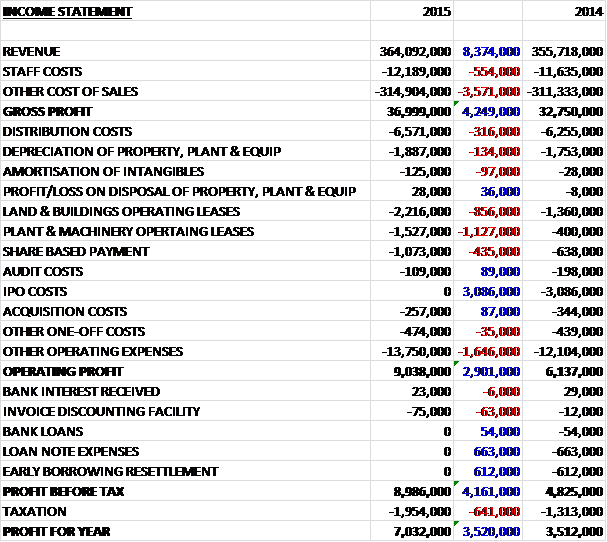
MARTINCOME

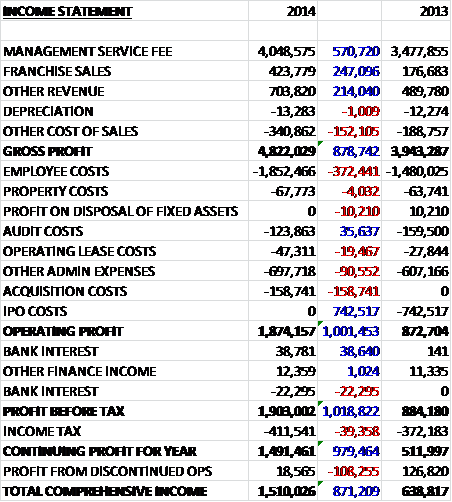
Overall revenues increased year on year with a £571K growth in management service fees (half organic, half from acquisitions), a £247K increase in franchise sales, through the introduction of 14 new franchisees, and a £214K growth in other revenues.  Cost of sales also increased to give a gross profit some £879K ahead of last year.  We then see a £372K increase in employee costs and a £91K growth in other admin costs reflecting the first full year of being listed, and with regards to non-underlying expenses, the group benefited from the lack of a £743K IPO cost that occurred last year but they did incur £159K of acquisition costs this year.  After bank interest, a higher income tax and a profit from discontinued operations that fell by £108K, the profit for the year was 1.5M, an increase of £871K year on year
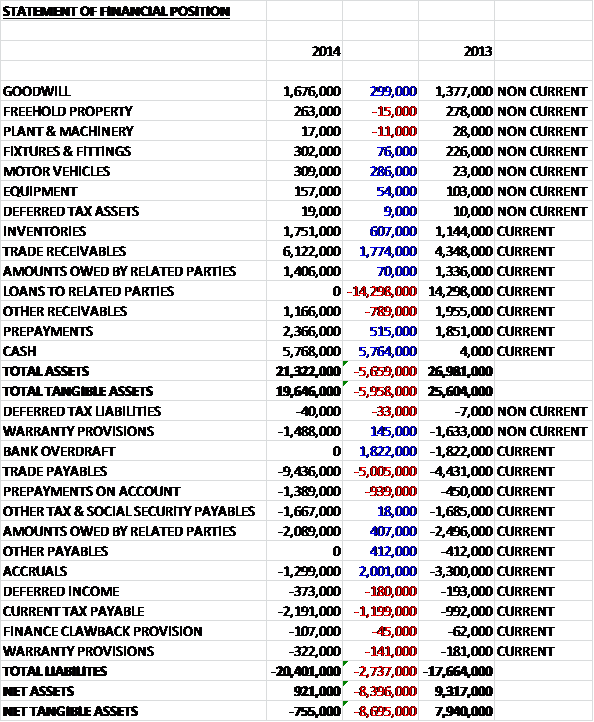
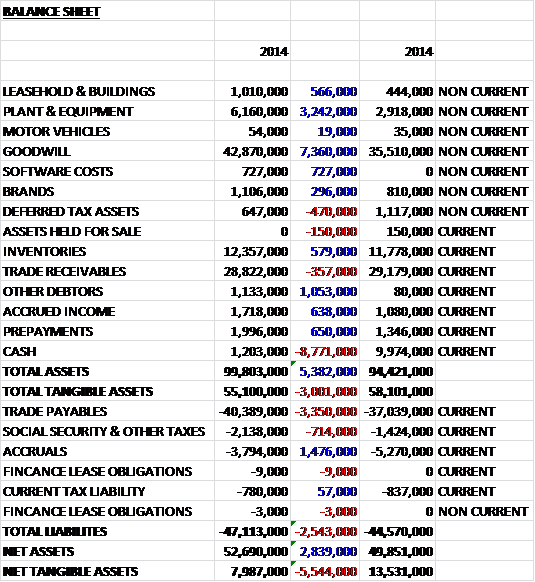
MARTASSETS

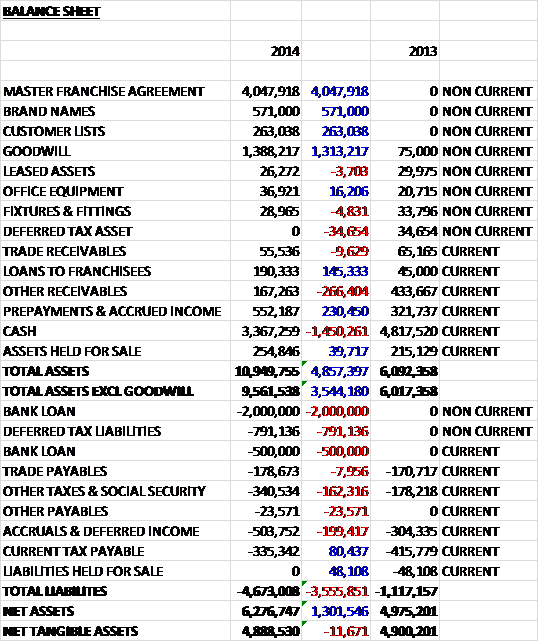
When compared to the end point of last year, total assets increased by £4.9M driven by the £4M master franchise agreement from the acquisition, which is being counted as an intangible asset along with an extra £1.3M increase in goodwill, partially offset by a £1.5M fall in cash levels.  Liabilities also increased during the year due to a £2.5M increase in bank loans and a £791K deferred tax liability.  The end result is a broadly flat net “tangible” asset level at £4.9M.  On this occasion I have counted net tangible assets as being net assets without the goodwill, although it is debatable as to whether the customer list and the master franchise agreement is worth anything.  The outstanding operating leases are fairly insignificant at just £61.8K at the end of the year.
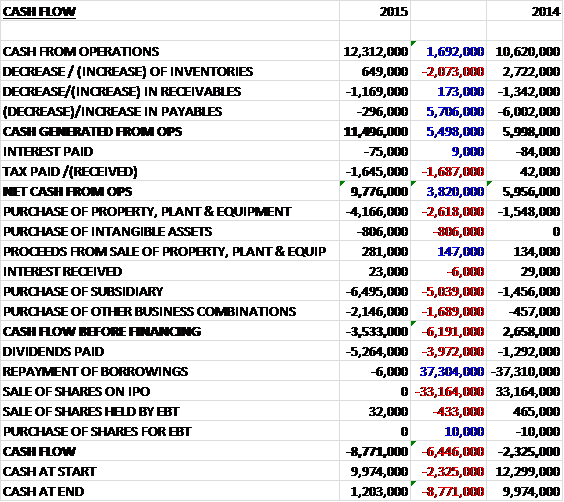
MARTCASH

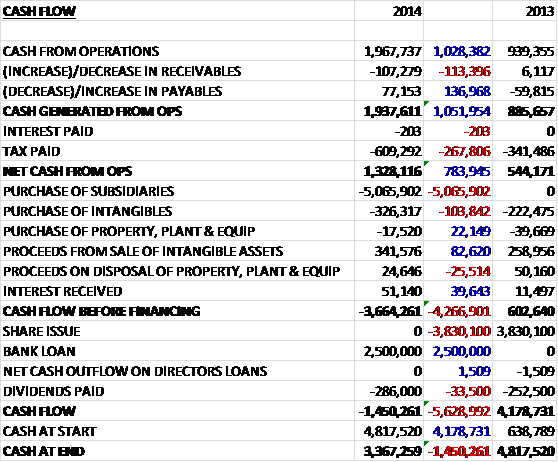
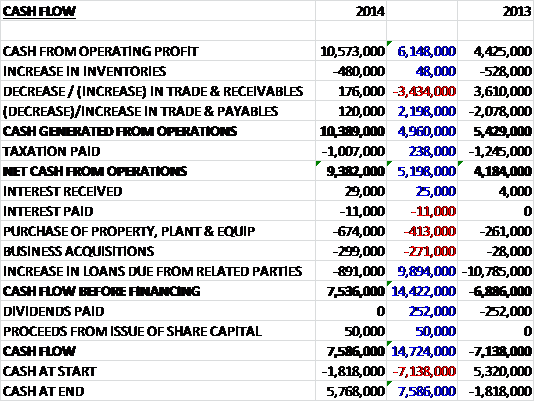
Before movements in working capital, cash profits increased by £1M to £2M.  After an increase in both receivables and payables, the cash generated from operations stood at £1.9M and after tax this became £1.3M, an increase of £784K year on year.  There was actually a net cash inflow from the purchase/disposal of intangible assets and no real capital expenditure to speak of but the acquisition cost £5.1M which meant that before financing, the cash outflow stood at £3.7M.  The group then took out a loan of £2.5M and paid dividends worth £286K to give a cash outflow of £1.5M for the year and a cash level of £3.4M at the year end.

At the end of the year the group had 155 Martin & Co offices offering an estate agency service alogn with 88 Xperience estate agency offices.  The estate agency business achieved a 138% year on year increase in management service fees with the number of sales increasing from 597 last year to 1,355 this year, and the directors believe that there is a significant potential for further development of this income stream, although the roll-out is now almost complete.  The franchisees acquired 845 properties to the total being let in a number of small scale acquisitions and the acquisition added about 10,000 properties to the portfolio which grew to 42,177 at the year-end.

The board reckon that the burden of increasing government regulation in the sector means private landlords are more often turning to agents for professional advice but a more important factor is the rise of the internet property portals such as Rightmove which do not allow private landlord advertisers.  The rental market itself is also forecast to increase considerably with estimates of a 7.4% annual growth in rents up to 2017. The management also believe that the pension reforms recently enacted will release pension funds that will be invested into buy-to-let properties and with net migration running consistently at 300,000 per annum and restrictions on mortgage lending affecting the young, it is the cash-rich older generation who can afford the 25% deposits on buy-to-let properties and there will be no shortage of tenants to occupy them.

During the year the group acquired Xperience Franchising and Whitegates Estate Agency for a net cash consideration of £5.1M, The group paid £4.1M for Xperience which included goodwill of £913K and a master franchise agreement worth £3.4M.  The acquisition of Whitegates cost the group £991K in cash and came with £401K of goodwill and a master franchise agreement worth £653K.  Since the date of the acquisition, Xperience contributed £100K in profit and Whitegates contributed £50K and had the acquisitions taken place at the start of the year, group profits would be some £900K higher so despite this being a lot of money for a company of Martin & Co’s size, this seems good value to me.  It does seem as though, the deal took longer than it should have done to complete which apparently distracted the group from other opportunities.

The group has decided to discontinue the activity of owning and managing its own offices and this year an office in Worthing was sold, representing the last owned office with several offices sold the previous year.  The group has deferred the income for some of these sales and the cash inflows this year were £365K and £252K of deferred consideration existed at the year-end.

During the year the group acquired its first portfolio of 374 managed lettings properties in Saltaire for £300K but portfolios that meet the group’s criteria have been difficult to find due to the sales price or issues with the quality of the portfolio.  After the year-end these properties in Saltaire have been subsequently purchased by the franchisee that was managing them for £256K which resulted in a profit over its net book value of £1K (these are the assets held for sale on the balance sheet above).  It is apparently still the group’s intention to acquire portfolios of managed properties going forward despite this sale but this element of the acquisition strategy will play a minor role for the foreseeable future.

At the current share price the shares trade on a PE ratio of 22.1 which seems rather expensive but falls to a more reasonable 15.5 on next year’s consensus forecast.  The shares are currently trading on a dividend yield of 2.7% which is useful to have and is forecasted to increase to 3.2% next year.  It is worth noting that there is still £300K of deferred consideration receivable at the year-end following the sale of the Worthing office and there is still £2.5M of unutilised loans available to the group for development and expansion of operations.

On the 7th May the group released an AGM statement and told the market that current trading is in line with expectations.  The acquisition of the Xperience offices is producing the expected uplift in revenue and all of the franchisor functions for the five brands have now been successfully consolidated into one HQ with the associated restructuring costs being absorbed.

On the 13th May the group announced that it had appointed Phil Crooks as non-executive director who is currently a partner in forensic and investigations services at Grant Thornton.

Overall then, the results in the company’s first full year of listing seem pretty good.  Profit increased, along with operational cash flow.  There was next to no capital expenditure, instead the group seems to be expanding through acquisition and the cash from operations did not come close to covering the cost of that over the year.  The balance sheet looks a little thin, depending on how the franchise master agreement is valued and the net assets remained fairly flat year on year.  Current trading is in line with expectations and the new acquisition along with the estate agency work should drive an increase in profits.  The forward PE of 15.5 is decent enough, as is the forward dividend yield of 3.2%.  It should be noted that this company is a franchise seller really as opposed to a lettings agent or estate agent but it potentially looks quite interesting to me.
MARTINCO

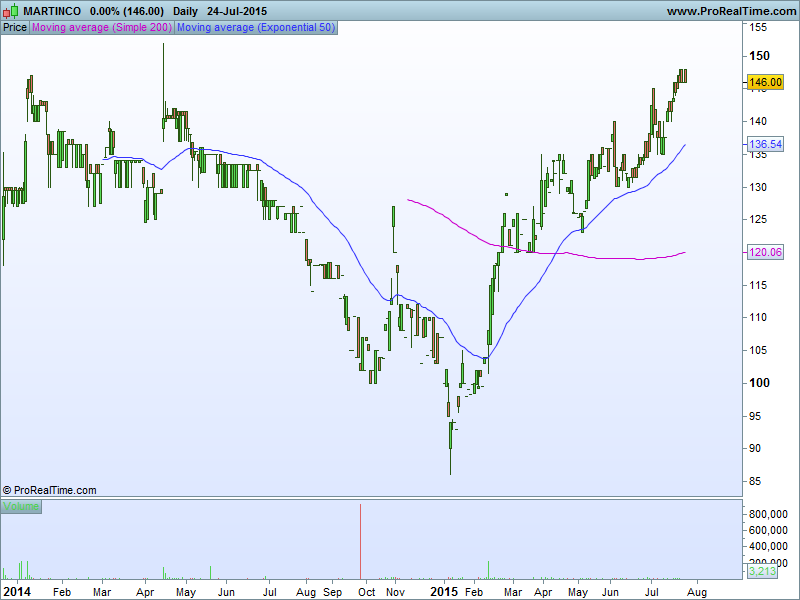
The shares have recovered from their low point at the start of the year and are now above the IPO price – this chart looks fairly decent to me.

Goodwin Share Blog – Final Results Year Ended 2015

Goodwin has now released its prelim results for the year ended 2015.

GDWNincome

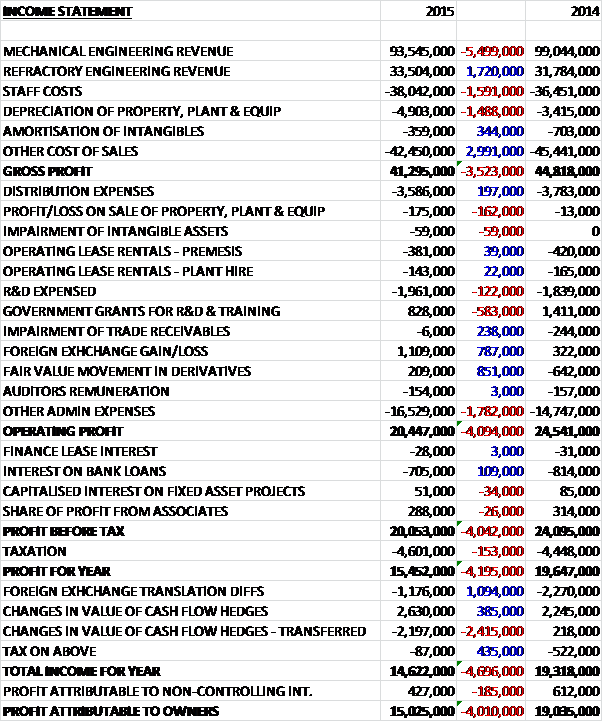
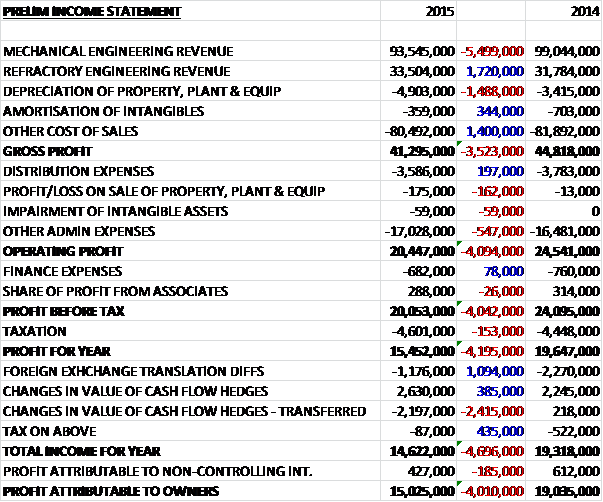
Overall revenues fell year on year as a £1.7M growth in refractory engineering revenue was more than offset by a £5.5M decline in mechanical engineering revenue, driven by falls in the US and the UK.  We then see a big increase in depreciation, counteracted by falls in other cost of sales to give a gross profit £3.5M below that of last year.  Distribution costs fell modestly but admin expenses increased which was not helped by a £175K loss on the disposal of fixed assets to give an operating profit £4.1M down from 2014.  After an increase in tax and a fall in finance expenses, the total profit attributable to the owners fell by £4M to £15M.

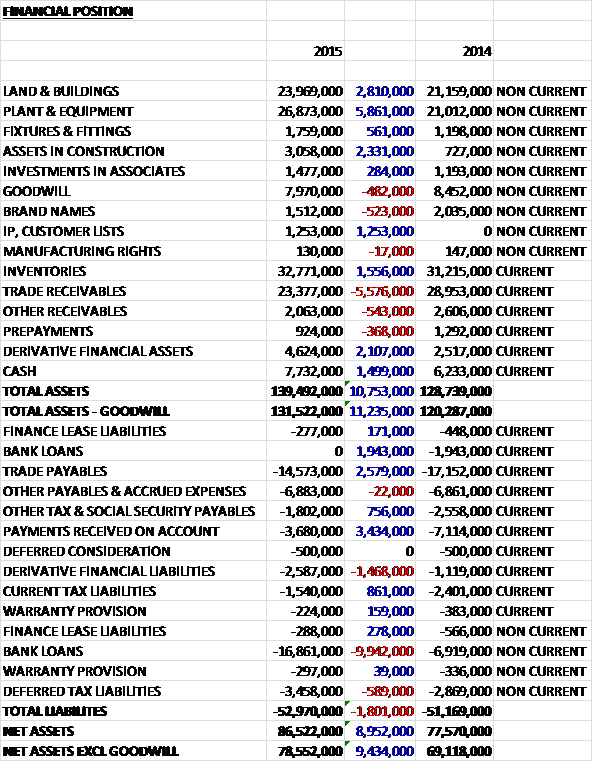
GDWNassets

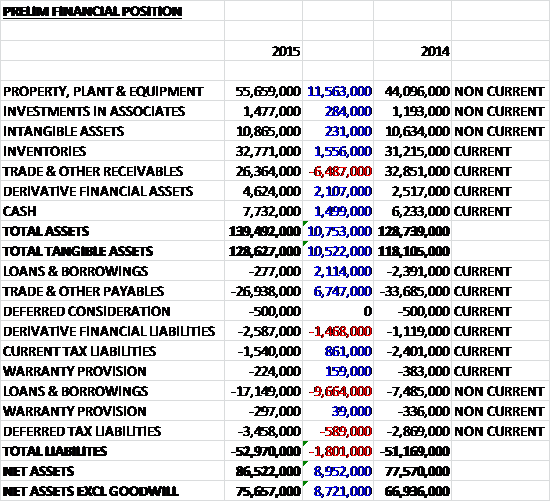
When compared to the end point of last year, total assets increased by £10.8M driven by an £11.6M increase in property, plant and equipment, a £2.1M growth in derivative financial assets, a £1.6M increase in inventories and a £1.5M growth in cash levels, partially offset by a £6.5M fall in receivables. Liabilities also increased during the year as a £7.6M increase in borrowings and a £1.5M growth in derivative financial liabilities was partially offset by a £6.7M fall in payables.  The end result is an £8.7M growth in net tangible assets to £75.7M.

GDWNcash

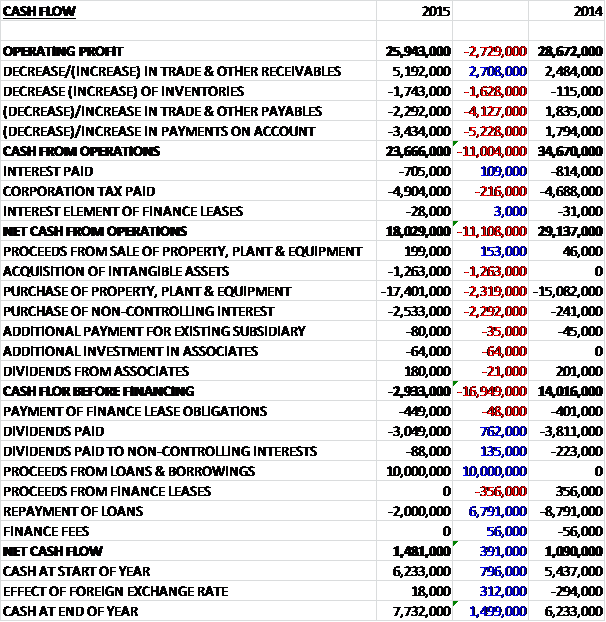
Before movements in working capital, cash profits fell by £2.7M to £25.9M but detrimental movements in all working capital items except receivables, plus an increased tax bill partly offset by a fall in interest paid meant that net cash from operations was £18M, a decline of £11M year on year.  This cash just about covered capital expenditure in fixed assets of £17.4M but doesn’t quite cover the £1.3M of intangible assets acquired or the £2.5M spent on the purchase of non-controlling interests relating to the 20% minority interest in Gold Star Powders India and Goodwin Pumps India, along with the 49% minority interest in Gold Star Brazil, to give a cash outflow before financing of £2.9M.  The group then paid finance leases of £449K and dividends of £3M which it couldn’t really afford so took out a net £8M of new loans to give a cash flow for the year of £1.5M and a cash level of £7.7M at the year-end.

The profit at the mechanical engineering business was £16.4M, a decline of £2.9M year on year and the profit at the refractory engineering business was £5.1M, an increase of £1.3M when compared to last year.  The deterioration in profits stems from the oil and gas engineering market sector with order placing activity having substantially contracted in Q1 with order input in that quarter being 32% down on the same period of last year (the group derives some 45% of sales from the oil and gas sector).  This situation did improve throughout the year to the extent that order input for the full twelve months was only 19% down on 2014.  The lower level of available orders also resulted in higher competition which has and will impact on margins and profits.  At the end of the year, group workload stood at £79M, a reduction of 22% year on year.

The group have been investing quite a bit in R&D in recent times and in the last two years have applied for five patents in 16 countries.  It is hoped that within the next three years orders for these products will start to be received and that they will command decent gross margins.  The patents relating to the refractory division are AVD (Aqueous Vermiculite Dispersions) used in fire extinguishers and Micashield, a fire resistant paint for wood structures and other substrates.  The patents in the engineering division are for a new type of axial piston valve and a new type of nozzle check valve.  In addition, the castings business has been granted a patent for its new super nickel alloy, G130, developed for use in high temperature turbine applications.

Just before the end of the year, the refractory services business signed an agreement to purchase the technology, customer list and other assets from a French casting powder company but the cost has not been disclosed.  This purchase has enhanced the moulding material technology for the casting of tyre moulds and glass within the group and the tyre mould technology has brought with it associated patent rights with exclusive worldwide rights for use in reclaimable patterns and the lost wax casting industry.

Going forward, the level of workload has improved in the first two months of the new year which, according to the chairman, leads to the possibility that the performance in Y/E 2016 will not be as bad as feared.  Some markets will remain difficult over the next couple of years but the group also expect to see continued growth in the refractory engineering sector and the board believes that the recent investments will enable the group to continue with its track record of growth.

At the current share price the shares trade on a PE ratio of 12.1 and after the dividend was held at the same level, the yield stands at 1.7%.  These figures are not too bad but don’t really point to an undervalued share in my opinion.  Frustratingly there are no broker estimates that I could find.

Overall then this has clearly been a difficult year for the group.  Profits are down, driven by a fall in income from the much larger mechanical engineering division which relies on the oil and gas industry.  We also see operating cash flow falling and there was no free cash flow generated at all during the year.  The group still paid out some £3M in dividends which, while I understand why they did it, I don’t really agree with – when the dividends are held steady it tends to suggest the company is probably paying out more than it is comfortable with in my experience.  There are some fairly good signs, though, the net tangible asset level improved considerably during the year and the board still see growth as a probability this year.  In conclusion, this is clearly a quality outfit but in my view the share price doesn’t completely factor in the difficulties facing the group’s largest market in the coming year so I will continue to watch with interest from the side lines.

GOODWIN

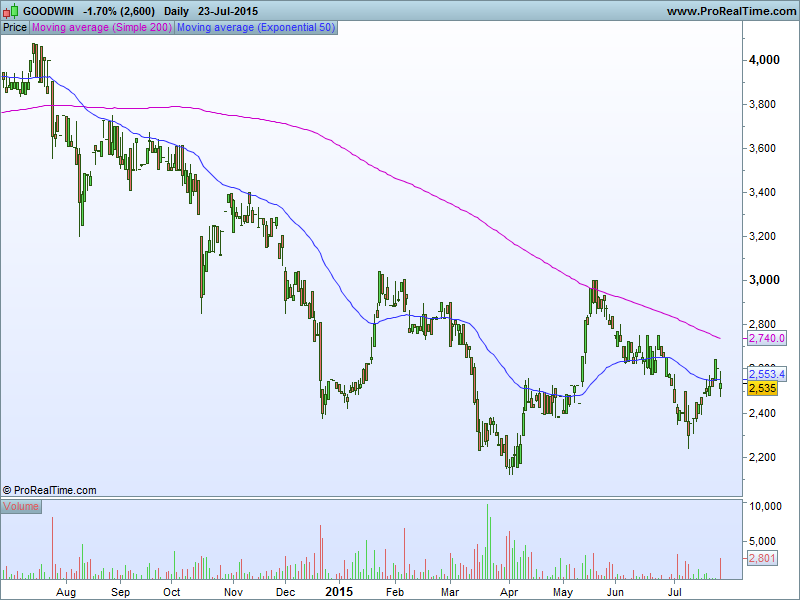
There has been some slight consolidation following the downtrend that has been in evidence through the year but an uptrend has yet to have been established.

Goodwin has now released their annual report for the year ended 2015.

gdwnINCOME

Within admin expenses we can see that the group benefited from a positive movement in foreign exchange and derivative financial assets, along with a lower impairment of trade receivables, although underlying admin expenses did increase.  There was not really much else new to note when compared to the prelim results though.

GDWNassets

We can see that within fixed assets, most items increased, in particular plant and equipment and within intangible assets, an increase in IP and customer lists was offset by a decline in goodwill and brand names.  We can also see that all kinds of receivables fell when compared to last year.  As far as liabilities are concerned, the fall in payables was driven by declines in trade payables and payments received on account.

The only other thing of interest really is the £672K increase in operating leases outstanding to £1.5M, although these remain modest relative to the size of the company.

On the 10th September the group announced its Q1 trading update.  Revenues in the quarter were down by £6.3M to £33.5M and profit nearly halved to £3M.  The Q1 sales order input was up 36% compared to the same quarter of last year when the downturn in the oil and gas industry activity started to hit but, whilst the order input is similar to 2013 and 2014, the profit margins on many of these new orders will be lower due to the increased level of fight needed to win the business in the quieter market. This is not a good update and whilst Goodwin often release RNSs at strange times, releasing this one just before the market closed does not strike me as best practice.  Disappointing.

Amino Technologies Share Blog – Interim Results Year Ending 2015

Amino Technologies has now released their interim results for the year ending 2015.

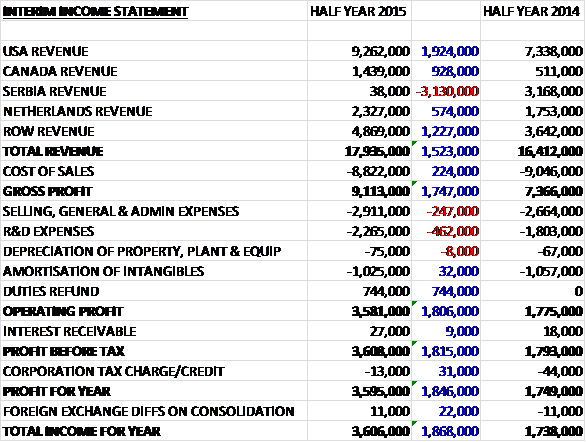
AMOinterimincome

Overall revenue increased by £1.5M year on year as a £1.9M increase in US revenue, a £928K growth in Canadian revenue and a £574K increase in Dutch revenues was partially offset by an almost complete collapse in Serbian revenue.  Cost of sales fell during the period which meant that gross profit increased by £1.7M to £9.1M.  We then see a £247K increase in selling & admin costs, partly relating to legal costs associated with the acquisition, and £462K growth in R&D expenses relating to development of x5x and live products but there was a £744K refund of past duties paid which represents the final rebate, and after tax the profit for the half year was £3.6M, more than double the £1.8M profit recorded in the first half of last year.

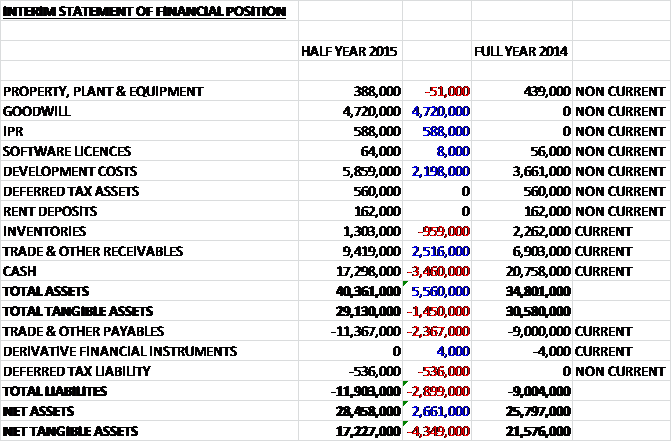
AMOinterimassets

When compared to the end of last year, total assets increased by £5.6M driven by a £4.7M increase in goodwill, a £2.5M growth in receivables and a £2.2M increase in development costs (relating to both internally generated costs and those that came with the acquisition) partially offset by a £3.5M fall in cash and a £959K decline in inventories.  Liabilities also increased during the period due to a £2.4M growth in payables and a £536K increase in deferred tax liabilities.  The end result is a £4.3M fall in net tangible assets to £17.2M.

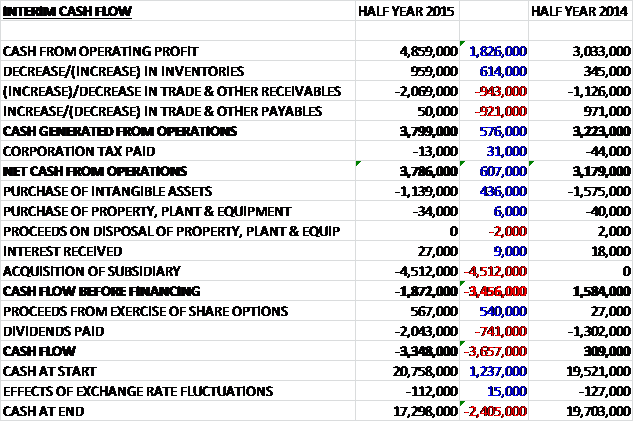
AMOinterimcash

Before movements in working capital, cash profits increased by £1.8M to £4.9M. A large increase in receivables, however, eroded this somewhat and net cash from operations for the first six months of the year was £3.8M, an increase of £607K year on year.  The group then spent £1.1M on intangible assets – probably development costs, to give a free cash flow of £2.7M which was not enough to cover the £4.5M spent on acquisitions let alone the £2M of dividends to give a cash outflow of £3.3M for the half year and a cash level of £17.3M at the period end – a great cushion but it seems the group has now found something to spend it on, more on that later.

Over the period the board has seen a considerable evolution within the Pay TV industry where the shift towards “TV everywhere” viewing across multiple TV, smartphone and tablet screens is accelerating.  At the same time, the timeframe within which new 4K Ultra-HD services are expected to be deployed by service providers has also shortened which has brought forward the group’s plans to introduce services to support this new medium.

The strong demand seen in the key North American market at the end of last year continued into 2015 and demand from existing customers grew strongly along with a number of new contract wins.  New products launched into the market were well received and the group received further orders for the Live Advanced Media Platform from an existing customer and good initial take-up of the A150 IP device which was introduced into the market during the period.  The group has added certified YouTube capability alongside Vudu video on demand and the Amino TV appstore which has been well received by operators but progress on the availability of Home Reach has been slower than expected with commercial trials now underway with a regional operator in North America.

In Latin America, the demand for lower spec products remains strong with substantial orders received from an existing customer in Chile.  There was also progress in the Argentinian market where Catel, the association representing some locally-focussed IPTV operators, launched a second phase of their IPTV deployment using the higher spec A150 device.  Europe remains challenging, however, despite the good progress made with key customers in the Netherlands where the A150 continues to be the product of choice for new deployments.  Some progress has been made in the Middle East where focused sales and marketing activities are beginning to generate orders.  This will continue into the second half of the year with a focus on developing partnerships with key regional systems integrators to address new hospitality, residential compound and digital signage opportunities.  A new H150 IP device was launched during the period to address these markets.

As mentioned above, TV viewing has continued to grow outside the home on smartphones and tablets.  This means that operators are looking to deliver these services with a consistent look and feel that retains their brand.  In line with the increase in consumer demand for 4K TV sets the company showcased their new 4K platform which is based on the widely deployed Aminet software to customers at the major TV connect industry event in April and availability is likely in early 2016 in line with operator deployment plans.

During the period the group acquired Booxmedia, a Software as Service cloud TV platform provider based in Finland.  The company was acquired in order to enhance the group’s offering by adding a cloud based platform which can enable the delivery of “TV everywhere” entertainment to a full range of IP connected devices.  The total consideration was £7.5M, generating goodwill of £4.7M and consisted of cash of £5M, shares worth £483K and contingent and deferred consideration of £2.1M.  If the acquisition had been made at the start of the year, the business would have contributed £114K to group profits.  I think the total cost of this acquisition had a view on the future rather than the profits generated at the current time.
At the end of the period the group had a net cash position of £17.3M compared to £19.7M at the end of the first half of last year with the decline attributable to the £4.5M of cash spent on the acquisition of Booxmedia.  After a 10% increase in the interim dividend, the shares now yield 3.2% on an annualised basis which increased to 3.5% on the consensus forecast for the whole year.  Going forward, the board remains confident of meeting market expectations for the full year.

On the date of their interim results, the group also announced the acquisition of Entone for a total consideration of £46.7M comprising of initial cash consideration of £41.6M, £3.2M on the first anniversary of completion and a further £1.9M on the second anniversary.  The acquisition will be funded by the placing of shares to raise £21M, existing cash reserves equal to £17.3M and a revolving credit facility with some £5.1M expected to be drawn down.

Entone is a provider of hybrid TV and connected home solutions and the acquisition is expected to enhance Amnio’s global footprint and is expected to be significantly earnings enhancing in the first financial year of ownership (2016).  In the 11 months to May, Entone had EBITDA of $4.1M from revenues of $46.7M and had net assets of $15.9M including net cash of $12M.  The acquisition provides an opportunity to consolidate one of the group’s direct competitors and will assist with evolution of HEVC and 4K UHD along with offering a direct sales route into the US.  Key synergies of about £1M in the first full year of ownership have been identified.

The group was particularly interested in two Entone products, FusionHome, a home monitoring solution, and Engage, a hosted field service software suite including a secure environment for remote management of device firmware and provision data along with remote support and service information diagnostics. Other core product offerings include Hybrid TV devices and software that provides flexible home networking options with models ranging from media players to home servers; and FusionTV, applications that enable the delivery of TV services from the cloud.  Entone has over 150 global customers and is a market leader in the US IPTV market.  Core customers include Consolidated Communications, Canby Telecom, Cable & Wireless, Fair Point Communications, Vodafone, Three Rivers and Twin Lakes.

The group is raising £12M from the placing of 16,153,846 shares at a price of 130p per share which represents a 6.5% discount to the closing price the date before the announcement.  Unfortunately the placing will be restricted to institutional investors and the directors of the company.  Following the issue of the new shares, the enlarged share capital will be 74,407,743.

Overall then this seems like a good update from the group and profit in the first half of the year doubled, albeit aided by the duties refund.  Net tangible assets did fall, as the group spent cash to acquire goodwill but operating cash flow increased year on year.  Outside Europe, sales have been good and the group’s products seem to be in good demand.  The results were overshadowed by the acquisition, though.  It is clearly transformational and seems like a good use for that pile of cash the group has been sitting on over the past few years.  I do hope they take some time to allow the acquisitions to bed in though and hope they don’t get hooked on acquisitions.  One thing to watch out for is the deferred consideration – there is £2.1M outstanding from the Booxmedia acquisition and £5.1M from the Entone acquisition so together the £7.2M is a very material amount for a company of this size.
Overall though, I am more than happy to hold at the present time while we see how the acquisition beds in.

AMINO TECH

On the 27th October the group released a trading update.  They expect to report a second half shortfall in revenue against expectations within the core Amino business.  As a result, they expect pre-tax profit to be below expectations, in line with that achieved last year.  The company also confirms that revenue and cost synergies arising from its recent acquisition are tracking ahead of plan and are integrating well. Net cash balances are still expected to be in line with expectations and the dividends are unaffected.

They have identified that their sales execution efforts in the second half of the year were not satisfactory.  Whilst a small proportion of the trading shortfall is due to the consolidation of certain customers and delays to some orders where the customer is considering the transition to 4K UHD services, sales execution is the primary factor in the shortfall.  As a result, the company has implemented a series of targeted actions across the business.

I have to say that this profit warning is very disappointing and I did not see it coming.  It seems to me that the group have taken their eye off the ball with the core business and instead have been focusing on the acquisitions – they are not experienced acquirers after all.  I would like to think, therefore, that this is temporary but the lack of any further detail on what exactly went on and how long it will take to fix means that I have sold out here.  What a shame.

On the 3rd December the group released a trading update for the year ending 2015 where they state that they are trading in line with revised market expectations for both revenue and pre-tax profit. The net cash position at the end of the year was £2.1M and ahead of market expectations. Further to the earlier profit warning, the group has restructured its sales team to address the problems in execution experienced in the second half of the year. The new integrated sales organisation across the Amino and Entone businesses will be led by Steve McKay, the former CEO of the acquired Entone group. They now have a better sales focus in all key regions, with dedicated teams for Latin America and Europe and a new combined sales team for North America.

The group continues to make solid progress with regard to the Booxmedia and Entone acquisitions that were completed during the year. The Entone acquisition is expected to drive significant cost synergies and the integration of teams and product lines of each acquired company is on schedule. The acquisition of Entone has strengthened the combined group position in North America with the addition of direct Tier 2 operator customers – Cincinnati Bell and Consolidated Communications, complementing existing distribution partners serving Tier 3 operators. The enlarged group has also brought stability in Western Europe to a wider base of Tier 2 operator customers. Eastern Europe has been more challenging, with the potential consolidation of a major SE Eastern European customer, impacting further roll out of their IPTV solution.

Booxmedia sales and marketing plans have progressed well with two major customer wins secured in H2 2015. Dutch utilities and digital services company DELTA selected Booxmedia’s white label platform and products to provide, install and maintain a new end to end multiscreen cloud TV solution. Belgian broadcaster RTL selected Booxmedia to provide, install and maintain a full end to end cloud video on demand platform.

It was also announced that CFO Julia Hubbard has taken a short leave of absence from the business with Julian Sanders stepping in on an interim basis having previously taken on the role during Julia’s maternity leave in 2014. Her leave of absence has now been extended beyond the short period originally envisaged by the board.

Overall then it seems as though progress is being made but I would like see some evidence that their new sales team is improving the situation and the situation with the CFO sounds rather concerning.

Entu Share Blog – Interim Results Year Ending 2015

Entu has now released its interim results for the year ending 2015.

entuinterimincome

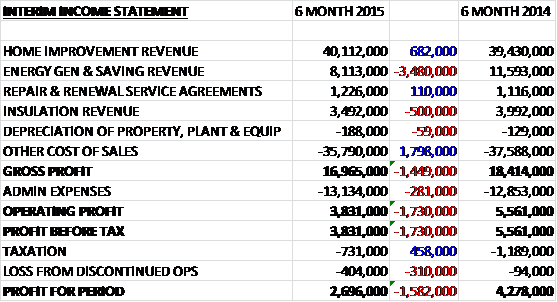
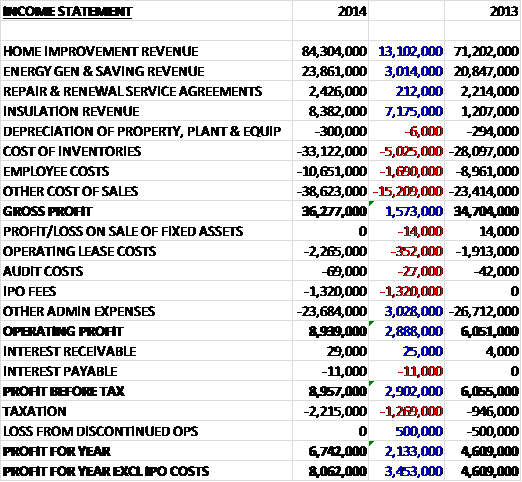
Overall revenues fell year on year as a £682K increase in home improvement revenue and a £110K growth in repair and renewal service agreement revenue was more than offset by a £3.5M fall in energy generation and saving revenue and a £500K decline in insulation revenue. Depreciation increased slightly but other cost of sales fell by £1.8M.  We then see a £281K increase in admin expenses as a result of the company’s admission to AIM, offset by a fall in tax and after the £404K loss from the discontinued operation is taken into account, the profit for the half year comes in at £2.7M, a fall of £1.6M when compared to the first half of last year.

Entuinterimassets

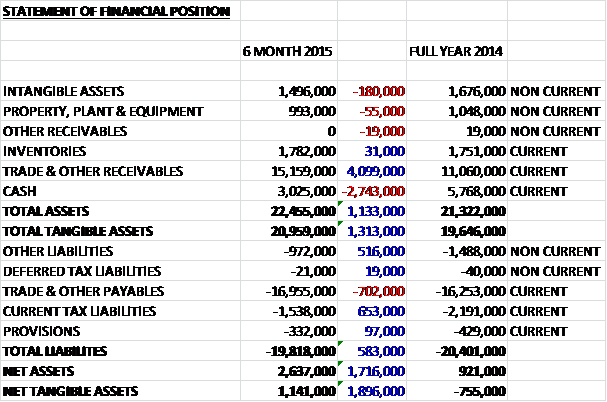
When compared to the end point of last year, total assets increased by £1.1M as a £2.7M fall in cash and a £180K impairment of intangible assets due to the discontinued operation, was more than offset by a £4.1M increase in receivables.  Conversely liabilities fell during the period driven by a £653K fall in current tax liabilities and a £516K decline in “other liabilities” partially offset by a £702K increase in payables.  The end result is a £1.9M increase in net tangible assets which are now positive at £1.1M.

Entuinterimcash

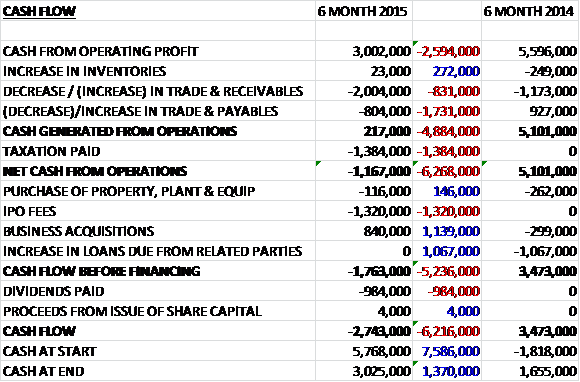
Before movements in working capital, cash profits collapsed by £2.6M to £3M.  This was then eroded further by the £2M increase in receivables and a fall in payables and after a hefty tax payment of £1.4M there was a £1.2M cash outflow at the operating level compared to a £5.1M cash inflow at this point of last year.  There was minimal capital expenditure and the group managed to gain a net £840K cash inflow from the acquisition but the IPO fees were paid during the period to give a cash outflow of £1.8M before financing and after the £984K dividend payment, the cash outflow for the period as a whole was £2.7M to leave a cash level of £3M at the year-end so clearly this situation cannot continued for much longer.

Overall performance was in line with management expectations against an unusually high prior year comparator.  I find this quite a curious statement.  If this is correct, then why wasn’t the fact that last year’s result was a one-off good performance mentioned at the time?  It was also stated that operating profit was below that of last year reflecting normal seasonality of the business.  Again, I find this quite strange as the comparison is the same time of year!  While I am on a bit of a whinge, the current asset figure in the audited annual result for 2014 doesn’t add up – I suspect a typo under the trade and other receivables column, probably as a result of having to rush the results out following the collapse in the share price prior to them being published.

Underlying operating profit at the home improvements business was £2.4M, an increase of £700K when compared to the first half of last year which also represented an improvement in operating margins reflecting the benefit of the group’s efficient integrated Job Worth Doing platform which undertakes the product installations.  A corporate contract with a national DIY retailer has now been agreed and anticipated revenues from this venture are expected to build to about £10M with the opportunity to cross sell other services.

The underlying operating loss at the energy generation and saving business was £252K, a negative swing of £1.3M when compared to the first half of 2014.  The division clearly had a challenging six months due to lower solar panel product sales as the potential customer base becomes accustomed to lower tariff levels from the sale of surplus energy generation back into the grid, along with significant departures and disruption in the sales and marketing teams over the period.  The group have now strengthened these teams and they expect activity to improve in the second half of the year.  They also have a healthy pipeline of commercial solar business following the agreement of a solar PV contract with a European procurement organisation for an initial 1000 homes with revenues of approximately £4.5M and the opportunity to cross sell other services.

The underlying operating profit at the repair and renewal service business was £914K, a decline of £27K year on year despite a 10% increase in revenues as a result of increased sales commissions driving growth – it is expected that operating profits will rise in subsequent periods.  The underlying operating profit at the insulation business was £794K, a decline of £1.1M when compared to the first half of last year which reflects a reduction in Energy Company Obligation funding (the revenue the group receives from utility companies in respect of carbon offset tonnage arising from the supply and installation of insulation products) across the sector which has fallen from £80 to £22.50 per carbon tonne.  The group are installing a greater volume of products this year and the forward order book has risen from £2M to an astonishing £14M.

During the period the group started negotiations for the disposal of its kitchen retail operation as it represents a line of business that doesn’t fit into the overall strategy of the group.  The business suffered an operating loss of £248K during the half year period and also had its net assets written down by £156K to zero.

During the period the group acquired Astley Facades that gave the group complementary commercial cladding operations across the UK.  Despite initially paying £200K for the acquisition, the group has managed to have this consideration repaid after the event due to the need to add provisions for potential bad debts.  The acquisition comes with no net assets and nothing was paid for the group which is a bit of a strange state of affairs.  Also despite contributing £420K to revenues there was a zero contribution to operating profits/losses.  This seems like a good fit for the company and they appear to have got it for free so I guess it is a good piece of business but given the figures supplied it is quite difficult to make a judgement.  The group have suggested that they are looking for further acquisitions to enhance their geographic reach and product offering.

There have been a number of recent board changes.  Phil Anderson joined as marketing director with responsibility for brand management and marketing initiatives across the group.  After the year-end Geoff Stevens was appointed as CFO with Darren Cornwall remaining on the board as group corporate development director, focussing on furthering the group’s acquisition strategy and integration of acquired businesses.

Going forward the group is targeting the North West region in particular and are set to launch a new TV advertising campaign in the second half of the year and increase their online presence and the value of web sales.  Additionally having already negotiated a supply and installation agreement with a well known corporate brand the group are looking for more such deals.  Finally they are continuing to develop their proposition in home automation which sounds rather exciting in a market that is expected to triple in size over the next three years.

The total future order book has now grown to £30M from around £10M at the same point of last year which looks promising.  The board has seen increased activity in the second half and they remain on track to meet market expectations (whatever they are!) with the second half of the year apparently being seasonably stronger.   The European Court of Justice recently ruled that the UK’s 5% rate of VAT on energy efficient products is in breach of EU law, raising the prospect of an increase of the VAT rate to 20%.  The group already applies a full 20% rate of VAT to the large majority of its home improvement products and the impact of the rate change is not expected to be material.

After the “special” final dividend of 1.5p was declared at the end of last year, an interim dividend of 2.67p has been declared at the interim stage which gives a rolling annual yield of 3.7% which doesn’t seem too bad.  They also still intend to declare a final dividend of 5.33p per share which would give an astonishing annual yield of 7.1%.  The group had a net cash position of £3M at the period end, an 83% increase year on year.

So, this is a really interesting update. Actually it has been a poor first half for Entu, profits were down, mainly due to people being less likely to buy solar panels after the cost of energy fell, the loss of a proportion of the sales and marketing team and the reduction in the eco funding for the insulation products.  A knock on effect is that the operational cash flow collapsed and was negative during the period, not helped by a big increase in receivables.  Astonishingly the group then claim that this performance was in line with management expectations!  So management were expecting to lose much of their sales force?  In addition, there was a blatant leak of these poor results as the share price crashed days before their released which obliged to the group to rush these results out early.

On the surface there were actually some decent points, the underlying double glazing business is actually performing well, the contract with the DIY retailer is certainly material on a revenue level (although no mention is made of profitability), the order book trebled to £30M and there is a stonking potential dividend on offer.  Unfortunately I have completely lost confidence in the board to be truthful about any of this though so I see the seeming value on offer here to be a bit of a value trap.  It could be that management are just naïve rather than being wilfully untruthful but I can’t really see this as a serious investment (although there could be a short term trading opportunity as people come in for the divi.)

ENTU (UK)

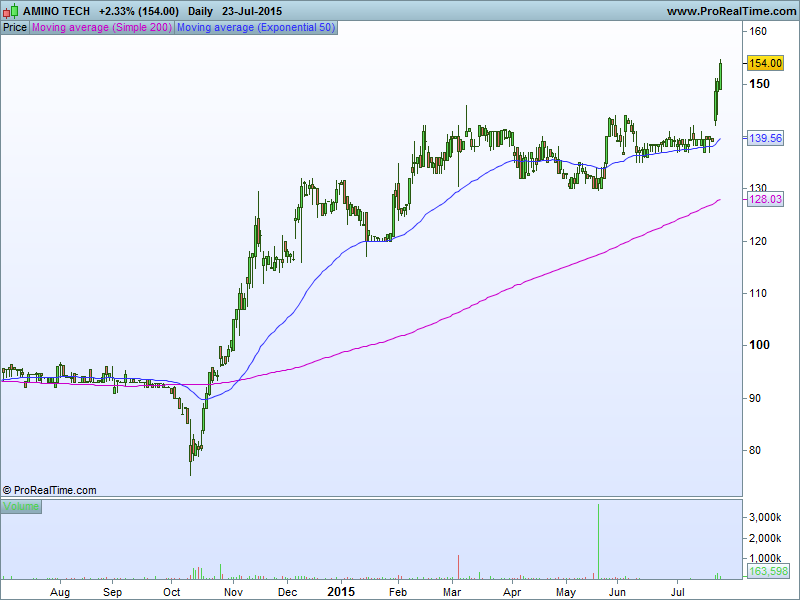
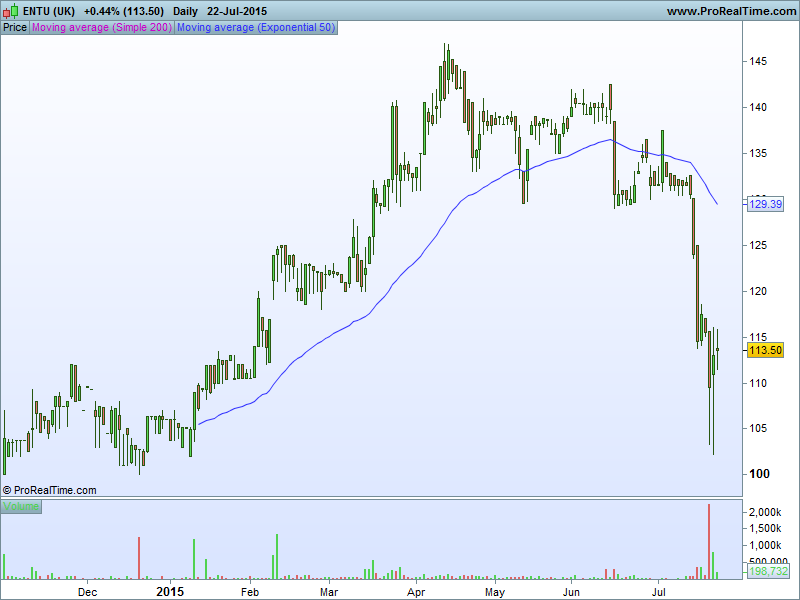
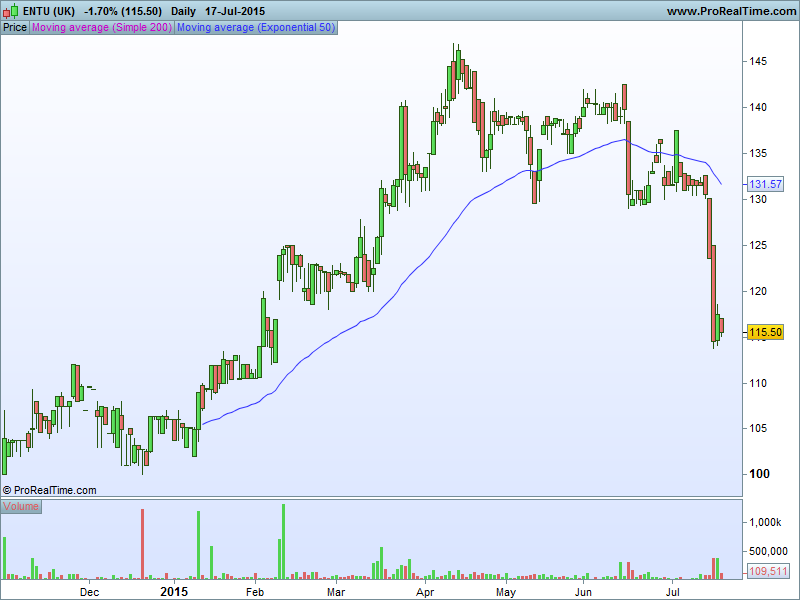
We can clearly see the dubious price action before the release of the results – although the volume wasn’t that massive, the price came down considerably.

On the 1st September the group released a trading update.  The anticipated improvements in the solar division during the summer months had not materialised and the board expects the market environment for solar to become increasingly difficult as a result of speculation about a possible increase in VAT from 5% to 20% and uncertainties concerning the future levels of feed-in tariffs , in particular a recent government proposal for a substantial reduction in these tariffs from the start of 2016.  The company now expects that it will lose more than £2M during the current year from its solar activities against a budgeted contribution of £1.6M.  It is not expected that the solar business is likely to make an acceptable return on investment in the medium term and therefore it will be discontinued.

Following the developments in the solar business, the group now anticipates that full year results will be below market expectations and it expects to make an operating profit from continuing activities of about £8M.  The board apparently remain confident of the future prospects of the other activities which trade in line with expectations.  In light of this update, the company is reconsidering the final dividend and instead of the mooted 5.33p pay out, it is now expecting to pay out 2.67p which shows the folly of suggesting such an ambitious unsustainable pay out in the first place in my view.

This is clearly very disappointing for shareholders and the board here are really not covering themselves with glory and seem very naïve as this profit warning cannot come as a total shock.  Perhaps all of the bad news is now out, who knows, but the dividend pay-out is clearly not set in stone.

It was also announced previously that non-executive director David Grundy stepped down from the board with immediate effect.

On the 27th November it was announced that Chairman David Forbes purchased 50,000 shares at a cost of £30.4K. This is his first share purchase and while welcome is not really a huge amount.

On the 14th January the group announced that Geoff Stevens stepped down as CFO and assumed the role of non-executive director and he will be replaced by Neill Skinner. The board had previously intended the CFO role to be part time but has changed its mind! Neill has previously been CFO at Clean Air Power. Current MD of Entu Energy Services, Andrew Corless, has also joined the board as COO having been with the company since September 2014. The group have also indicated that they expect their results for the year-ending 2015 should be in line with expectations.


Arbuthnot Share Blog – Interim Results Year Ending 2015

Arbuthnot has now released its interim results for the year ending 2015.

ARBBinterimincome

Net interest income increased by £23.4M year on year as a £22.5M increase in retail banking interest income and a £4M growth in private banking interest income was partially offset by a £3.1M increase in interest expense.  Conversely net fee and commission income declined during the year due to a £1.7M fall at the retail bank and a £122K decline at the private bank to give an operating income some £21.8M ahead of the first half of last year. There was then a £4.4M increase in financial asset impairment losses and a £12.9M increase in underlying admin costs but the fair value amortisation charge fell by £1.8M to £950K and after a tax bill just a small amount higher than last year, the profit for the half year period stood at £12.7M, almost doubling year on year, up by £6M.

ARBBinterimassets

When compared to the half year point of last year, total assets increased by £637.7M driven by a £594.8M increase in loans to customers, a £52.3M growth in balances at central banks and a £48.2M increase in debt held to maturity, partially offset by a £63.2M fall in loans to other banks.  Liabilities also increased during the year due to a £539.3M increase in deposits from customers to give a net tangible asset level of £168.3M, an increase of £91M year on year.

ARBBinterimcash

As we have already seen, the group increased the amount of interest received but saw the amount of fees and commission fall.  Cash payments to employees and suppliers also fell by £5.8M and tax was nearly two million pounds lower to give a cash flow from profits of £22.3M, an impressive increase of £21.6M year on year.  We then see a £283M increase in loans to customers and a £16.8M increase in deposits from banks more than offset by a £410.6M increase in amounts due to customers to give an operational cash flow of £129M, an increase of £120M when compared to the first half of last year.  There was then a net £6.4M purchase debt securities and a £6.9M payment of dividends to give a cash inflow of £147.8M for the half year period and a cash level of £260.5M at the end of the half year.

The segment profit at the retail bank was £13M, an increase of £4.5M when compared to the first half of last year with continued positive trends in the customer lending balances which have grown by 90% year on year.  Of the more established consumer finance businesses, motor finance and retail finance have performed well with the motor finance book increasing by 19% to £152M and the retail finance lending growing from £91M to £163M driven by good lending volumes generated from the sport and leisure, and cycle businesses.  The SME lending growth has exceeded expectations, mainly due to the real estate and asset finance products.  The real estate finance loan balances have increased from just £13M at the half year point of last year to £266M at present.  The asset finance portfolio has risen to £30M and invoice finance now stands at £16M, both of which commenced business within the last year.

The segment profit at the private banking division was £3.7M, an increase of £2M when compared to the first half of 2014 with the Dubai office contributing a loss of £66K compared to a loss of £520K last year.  The increase in profit is a result of investment in hiring additional private bankers over the past two years which has led to a substantial increase in new clients opening accounts.  In addition to recruitment in London, the bank has also developed in other markets.  The South West office in Exeter has agreed a lease and will move into its new premises in the second half of the year, the Manchester office has completed further recruitment of both private bankers and a wealth planner and the Dubai office should break even in the second half of the year, just two years after opening.

Included in the customer loans is the residential mortgage portfolio that was purchased in December and the ownership of these mortgages is now in the bank’s own name as of June and they have entered into a servicing agreement with Exact Mortgages.  The bank is now embarking on three significant investment initiatives to support its future growth.  Firstly they have begun an upgrade of their operations which includes paperless workflow, standardised customer interaction and the implementation of a new banking platform which is expected to be completed by the end of 2016.  Secondly the bank has agreed terms to secure 10,000 square feet of additional office space in the City on a short-term lease to be occupied in the second half of this year – the exact reason for this remains a mystery though.  Finally, and most interestingly, the bank is embarking on its expansion into commercial banking.  Initially the focus will be on providing business banking services to its entrepreneurial private banking clients but the scope should increase in future.  They have started recruiting for this new venture but the proposition is not expected to launch until 2016.

Overall the economic environment remains favourable which should allow both banks to continue to grow.  With a business friendly government in office over the next five years, the board expects the banks to maintain their momentum and continue their long term investment plans, although they will remain vigilant over the political and economic events in Europe.  The board have increased the interim dividend by 1p to 12p which means the shares are yielding 1.7% on a rolling annual basis.

Overall this seems like it has been a good six months for Arbuthnot.  Profit nearly doubled and is being driven by both the part owned retail bank and the fully owned private bank.  Net assets also increased and the group had a healthy level of cash inflow during the period.  The retail bank is benefiting from growth in retail finance, motor finance and real estate finance while the private bank is benefiting from a lot more people opening accounts.  Going forward, the commercial banking services look rather exciting although we are unlikely to see a contribution from that until next year.  We should also be able to see the Dubai office starting to contribute to profits too. The exuberance should be tempered by the new tax levies the government has implemented that adversely affect the smaller challenger banks and would hit One Savings Bank, but despite this I have decided to take a position here.

ARBUTHNOT

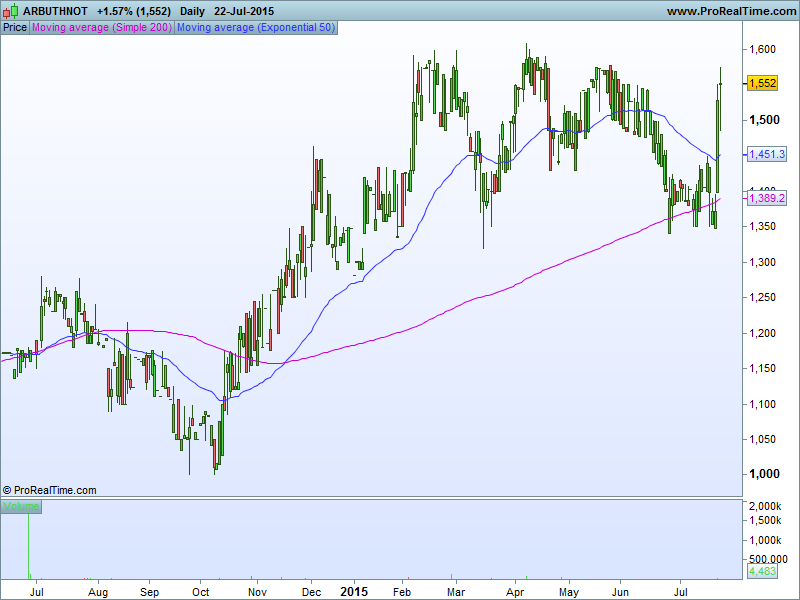
The shares have struggled to get above 1,600 over the past year and are still pretty much trending along although the most recent decline has definitely been reversed following the last results.

On the 15th October the group released a statement covering trading in Q3.

Secure Trust Bank traded strongly during the period.  Demand for its consumer lending products remained healthy, especially in Retail and Motor Finance where lending volumes are materially higher than the previous year.  The SME lending divisions continue to make progress and as a result the overall lending volumes of the bank have now exceeded £900M.  The business continues to see favourable conditions in the retail deposit market and remains able to match its lending growth by attracting deposits to various fixed rate products.

The bank is in the process of developing a deposit platform that will enable it to offer cash ISA products and Ian Henderson has been appointed who will be responsible for strategy, personal lending and mortgages.  He was recently the CEO of Kensington Mortgages.

Arbuthnot Latham has continued to see an increase in the number of new client introductions and is now taking on more than fifty new clients per month.  They have seen an increase in market activity following the general election and as a result, a healthy pipeline of approved lending applications has been generated.  The improvement in the property market has resulted in the repayment of a number of loans, however, as projects have been completed.  This has resulted in an apparently temporary slowing of the growth in customer lending balances but given the pipeline, the board anticipate that this will recover and the year-end balance will be in line with market expectations.

Following the bank’s intention to develop its commercial banking capabilities, it has announced the arrival of Stephen Fletcher to lead the business.  He was previously an MD at Coutts with over 25 years of experience.

Overall the group is confident that it can continue to make positive progress and take advantage of the opportunities that exist for both its banks.  They therefore expect results to be in line with market expectations for the year as a whole.  This is a fairly decent update and I am happy to remain a holder here but it does sound as though AL might miss its customer lending targets if the pipeline does not come good.

On the 26th November it was announced that Robert Wickham was retiring as deputy chairman of the group having been a part of the story here since way back in 1993. He will leave at the end of the year.

On the 14th January the group released a pre-close trading update for the full year where they stated that they continued to trade well in Q4 and expect to report a pre-tax profit in line with market expectations.

Secure Trust Bank saw strong overall growth in its lending portfolios, which resulted in the total loan book closing in excess of £1BN, a growth rate of over 70%. Its consumer lending was led by Retail Finance and Motor, with new volumes materially higher than in the prior year. The business has continued to make progress in the development of its SME lending activities during the year and the bank has seen strong demand for Asset Finance, Invoice Finance and Real Estate Finance with new lending volumes 65% higher than in 2014. Conditions in the savings market remain favourable as the bank continues to see good inflows of deposits across its product offerings and the bank remains strongly capitalised and well-funded.

At Arbuthnot Latham, customer lending balances have ended the year in line with market expectations. The other lines of business in the private bank have continued to make good progress while the commercial banking division remains on track with its developments. During Q4, the business was in negotiations to purchase a second portfolio of residential mortgages but when the Bank of International Settlements published its second consultative document on its proposed revision to the standardised approach for credit risk in December, management decided that the direction of travel indicated would result in the anticipated return on capital from the mortgage portfolio would fall below the desired target levels so they withdrew their offer which resulted in transaction costs of £450K.

Shoe Zone Share Blog – Interim Results Year Ending 2015

Shoe Zone has now released its interim results for the year ending 2015.

shoeinterimincome

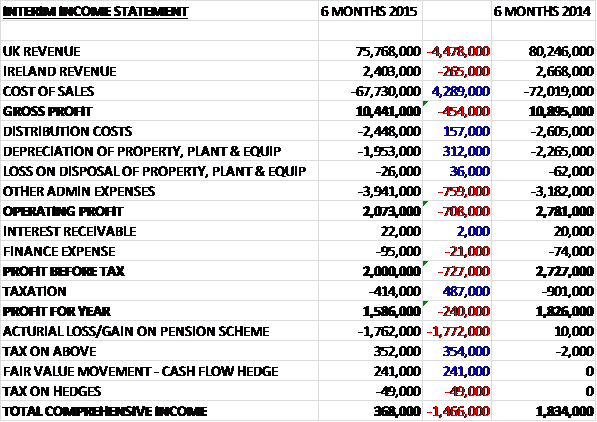
Overall revenues declined in the first half of the year as UK revenues fell by £4.5M and Irish revenues declined by £265K.  Cost of sales also declined but the gross profit for the period was some £454K below that of the first half of last year.  Distribution costs fell by £157K due to investments made in the Leicester distribution centre and lower fuel costs, and depreciation declined by £312K no doubt due to the reduced store estate but other admin expenses increased considerably to give an operating profit £708K lower.  Finance expenses increased slightly but tax more than halved year on year to give a profit for the year of £1.6M, a fall of £240K year on year.

shoeinterimassets

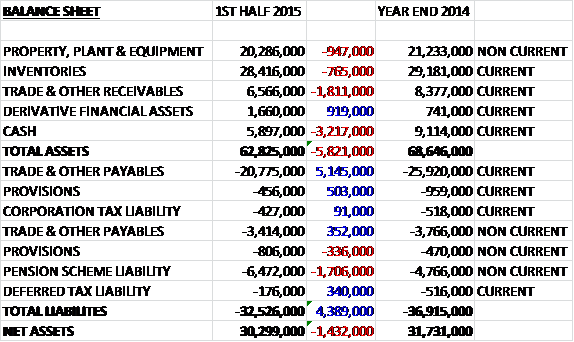
When compared to the end point of last year, total assets fell by £5.8M driven by a £3.2M decline in cash, a £1.8M fall in receivables, a £947K decrease in fixed assets and a £765K fall in inventories, partially offset by a £919K increase in derivative financial assets relating to the foreign exchange hedge.  Liabilities also fell during the year as a £5.1M fall in current payables and a £503K decline in provisions was partially offset by an ominous £1.7M increase in the pension liability.  Overall, net assets fell by £1.4M to £30.3M.

shoeinterimcash

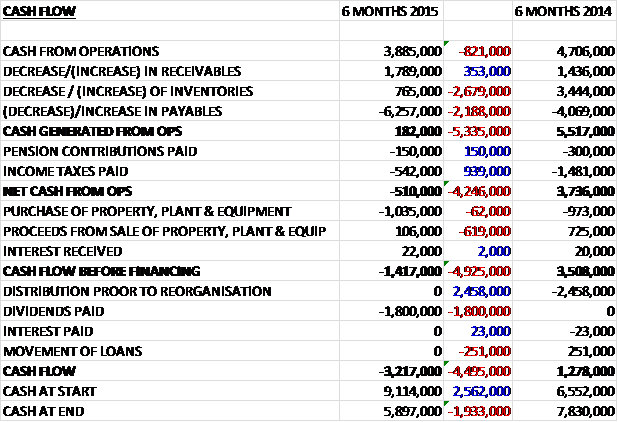
Before movements in working capital, cash profits fell by £821K year on year to £3.9M.  We then see a massive fall in payables which meant that after lower pension contributions and tax payment, there was still a net operational cash outflow of £510K, a negative swing of £4.3M when compared to the first half of last year.  The group then spent £1M on property, plant and equipment to give a £1.4M cash outflow before financing.  After the payment of £1.8M worth of dividends, there was a cash outflow of £3.2M and a cash level of £5.9M at the period end.

The warm weather conditions had a material impact on autumn/winter trading which slowed revenues towards the end of the first half.  While footwear volumes increased, the average price was down due to the different product mix sold with lower priced ladies ankle boots being favoured over long leg boots.  In addition, the wider market continues to experience deflation in clothing and footwear.

The product range has continued to evolve with significant improvements to bags and sundries.  The bag ranges for the winter and summer season have been relaunched with a strong focus on value with the range now being offered in store at the price points of £8, £10 and £13.  The sundries and shoe care range has been expanded and are held in a defined space near the till.  The group plans to build upon these growth areas in the second half.

Since the start of the year the group has opened five new stores, relocated four stores and refitted 18 more.  They have closed nine loss making stores and will open, relocate and refit a further group of stores in the coming year.  In all, there are now 541 stores compared to 545 at the end of last year with more large stores and less smaller stores.  The profitability of stores is being improved by rent reductions with rents on renewal for the six months falling on average by 28%.

Online revenues were up 30% in the period and contributed at a higher rate than the average high street store.  Following a successful trial on eBay, the group completed their full launch in October which is achieving good results, already accounting for 7% of online revenue.  Amazon continues to grow and now represents 17% of online revenue and the email club has grown 14% over the first half of the year.  The website now has a fully responsive checkout and the business continues to invest in online development.

Going forward, current trading has remained in line with expectations following the April trading update with the online performance remaining strong and ahead of market growth projections.  The group has a net cash position of £5.9M at the period end compared to £7.8M at the end point of last year.  The shares currently yield 3.9% which increases to 5.4% on next year’s consensus forecast which seems like a good rate of return.

Overall then this was a poor first half of trading for the group.  Profits fell as a result of warm weather and deflationary pressures, net assets declined as the pension scheme deficit increased and there was a cash outflow at the operating level.  Online revenue is improving, however, and the shares seem to yield a decent dividend.  It seems rather poor that there was so little visibility over the effect the weather would have on sales but the shares seem to be fairly well valued at the moment.  A tricky one this – perhaps I might be tempted if trading improves.

SHOE ZONE

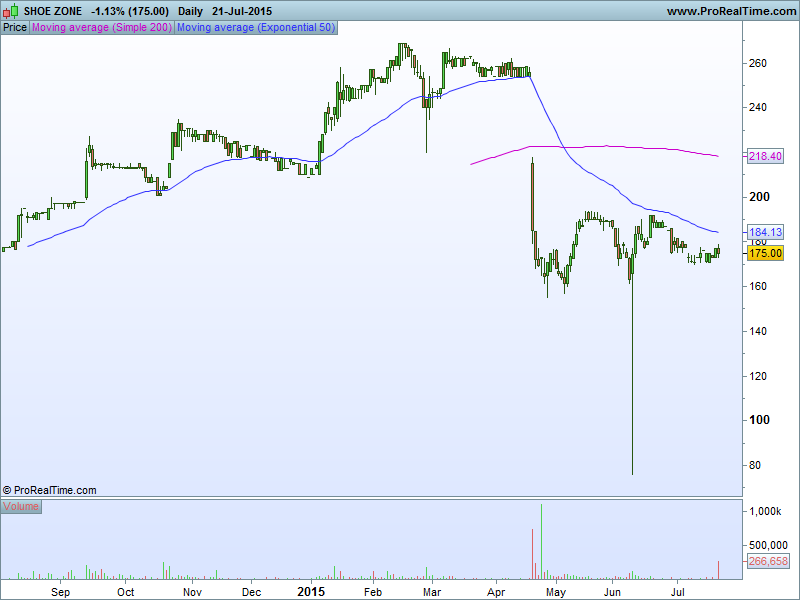
After the initial shock from the profit warning, the shares seem to have traded within a certain range but the underlying trend might be gently up.

On the 27th October the group released a trading statement covering the full year.  They traded well in the second half of the year and expect to report revenues for 2015 in the region of £166.8M compared to £172.9M in the previous year with pre-tax profits expected to be in line with expectations.  They ended the year with 535 stores having opened 18 and closed 28 during the period and ended the year with a net cash position of £14.2M compared to £9.1M at the end of last year.

On the 30th October the group announced that CEO Anthony Smith and COO Charles Smith sold 1,386,472 shares at a value of £2.6M and 1,108,528 shares at a value of £2.1M respectively. They still hold 28% and 22% of the company’s capital respectively so while it is always disappointing to see directors selling shares, they still have big interests. It was also announced that the wife of CFO Nick Davis purchased 15,700 shares at a value of £30K. This is Mr. Davis’ first interest in the shares and is small fry really compared to the huge sales.

32Red Share Blog – Final Results Year Ending 2014

32Red is involved in the provision of interactive betting and gaming operations over the internet.  It is domiciled in Gibraltar and is listed on the AIM exchange.  The board own a considerable amount of the company with the chairman, CEO and non-exec John Hodgson owning 45.2% between them. It has now released its final results for the year ending 2014.

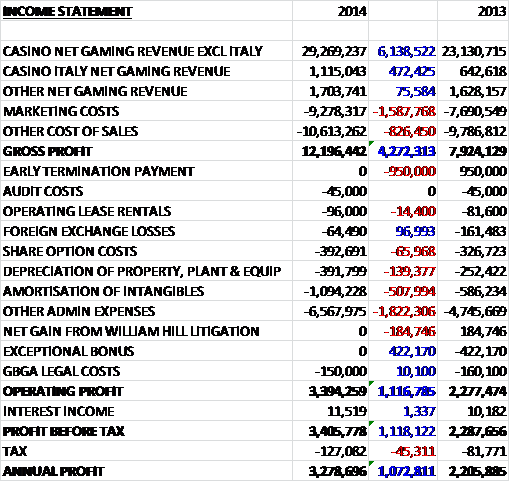
32Redincome

Overall revenues increased when compared to last year with Italian casino revenues up £472K, other casino revenues up £6.1m and other net gaming revenue increasing by £76K.  Cost of sales also increased, driven by a growth in marketing costs, to give a gross profit some £4.3M ahead of last year.  We then see a lack of the early termination payment from Swansea City (£950K) and the gain from the William Hill litigation (£185K) that occurred last year, offset by the non-recurring exceptional bonus of £422K in 2013.  We also see amortisation increasing by £508K and other underlying admin expenses up £1.8M to give an operating profit some £1.1M higher than in 2013.  The GBGA legal costs seem to be ongoing and are incurred in respect of industry lobbying and legal advice connected to the UK government’s proposed point of consumption tax regulation.  After a slightly higher tax bill, the profit for the year stood at £3.3M, an increase of £1.1M year on year.

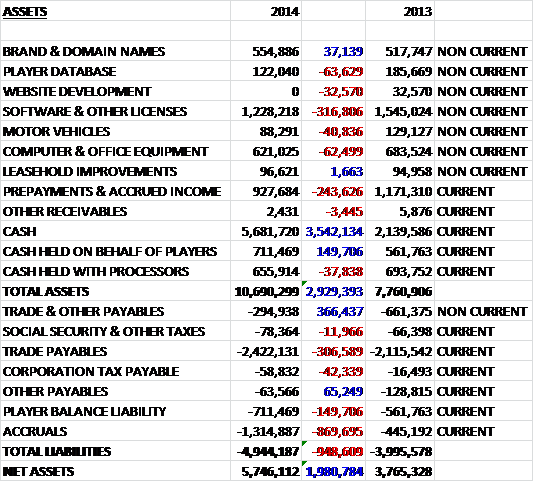
32Redassets

When compared to the end point of last year, total assets increased by £2.9M driven by a £3.5M increase in cash, partially offset by a £317K fall in the value of software licenses and a £244K decline in prepayments and accrued income.  Total liabilities also increased during the year as an £870K growth in accruals and a £307K increase in current trade payables was partially offset by a £366K fall in non-current payables.  The end result is a £2M increase in net assets to £5.7M.  There is also some £480K worth of operating leases off the balance sheet but this is not really a material amount.

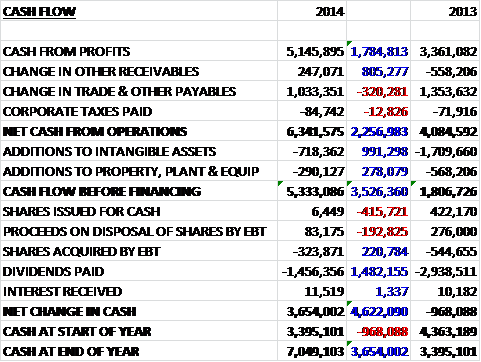
32REDcash

Before movements in working capital, cash profits increased by £1.8M to £5.1M which was further improved by an increase in payables to give a net cash from operations of £6.3M, an increase of £2.3M year on year.  The group spent £718K on intangible assets and £290K on property, plant and equipment and the free cash flow was £5.3M.  This was more than enough to pay for the £1.5M in dividends to give a cash inflow for the year of £3.4M and a cash level at the year-end of £7M.

Gross profit before marketing costs in the Italian casino business was £795K, an increase of £348K year on year and a total of 5,011 new players were recruited to bring the number of active players up to 8,628.  This performance is despite the company’s decision to limit its marketing investment in Italy during the year, ahead of expected positive changes in the regulated market from the end of 2014.  The group is embarking on a new series of TV ads in the country from January 2015

Gross profit before marketing costs in the other casino businesses was £19.7M, an increase of £5.6M when compared to last year.  During the year new players increased from 38,033 to 44,385 which is a direct reflection of the increased marketing investment with a total of 31,241 TV adverts being viewed by 5.4M UK males.  While TV advertising continues to be largest marketing expense, awareness of the brand is also increased by the continued sponsorship of UK horseracing as one of the four main financial supporters of the All Weather Horseracing Championships.  In addition, the group has also signed a three year sponsorship deal with Rangers football club and is half way through its three year license to operate “I’m a Celebrity Get me out of here” slot machine games.  Over half of all new customers are recruited via mobile devices with mobile casino revenues up 89% now accounting for 32% of total casino revenues.

Gross profit before marketing costs in the other products business was £963K, a decline of £150K when compared to 2013 although during the year the group signed an agreement with B2B sportsbook supplier Kambi Sports Solutions to deliver a fully managed sportsbook solution to 32Red.  The new sportsbook is fully integrated with the existing microgaming platform enabling customers to transfer fund between casino and sports.  This was launched in June 2014 and initial trading results have been encouraging.  Poker and Bingo continues to make a steady contribution in highly competitive markets and it is expected that these products will benefit from increased activity levels following an increased investment in marketing.

There only seems to be two KPIs, the NGR increased from £25.4M to £32.1M during the year whilst the number of active casino players increased from 71,266 to 82,155.  The board are incentivised to reach certain EPS growth targets and I notice that they are re-calculating 2013 EPS as if UK POCT had been in place throughout the year and to use this as the base EPS against which growth targets are set.  Considering the board have stated elsewhere that they see the tax as an opportunity for the group as opposed to a headwind, this doesn’t seem to correlate with this action as far as I can see.

In my view, the group looks to be susceptible to the point of consumption tax which came into play in December, as it currently pays the 10% tax rate of Gibraltar and much of its revenue comes from the UK.    The group is also somewhat exposed to foreign exchange risk, although the majority of their transactions are denominated in Sterling, a 15% strengthening of Sterling against the Euro would reduce profits by £115K and a 15% strengthening against the Aussie Dollar would reduce profits by £365K.

During the year the group acquired the UK customer database of Go Wild Casino.  They were migrated to the group’s platform by mid-September with initial trading following migration being in line with expectations and the board expects the acquisition to be earnings enhancing in 2015.

Trading in the new year to date has been strong with net gaming revenue in the first two months of the year increasing by 35% year on year.  The board believes that the new licensing regime in the UK will have the effect of reducing competition and provide opportunities for acquisitions.  The group intends to increase its marketing investment in the new year and with relatively modest levels of market share in the UK, the board believes there are a number of opportunities for the group to expand its reach.

At the current share price the shares trade on a fully valued PE ratio of 18.1 but this falls to a more reasonable 13.3 on next year’s consensus forecast.  At the year end the group has a net cash position of £7M compared to £3.4M at this point of last year.  At the current share price the shares have a dividend yield of 3.2%, increasing to 3.3% on next year’s estimate which is decent if not exactly spectacular.

Overall then this seems like an excellent set of results, profits are up, net assets increased and operating cash flow was ahead of last year with copious amounts of free cash.  The casino business seems to be doing well with the poker and bingo businesses doing less well.  The new sportsbook agreement looks interesting and could generate some returns.  The forward PE of 13.3 looks about right and the 3.2% dividend yield is nice to have but the big black cloud hanging over the group is the introduction of the UK POCT and being based in Gibraltar and having the UK as its main market makes 32Red susceptible.  The group doesn’t appear overly concerned given their comments but the realigning of the board’s bonus targets to take the new tax into account paints a different story to me and I would rather they were just honest about the potential impact of the tax.  For this reason, I am staying out until more clarity can be obtained.

On the 14th July the group announced the acquisition of Roxy Palace Casino for a total consideration of £8.4M consisting of £2M in cash, with £1M due on completion, £500K in six months and the remaining £500K by the end of 2016; and the issuance of 10,000,000 new shares.  The business has been acquired from Hyperlink Media and Applied Logistics and is expected to be immediately earnings enhancing.  Roxy Palace offers more than 500 online casino games including slots, blackjack, video poker and roulette and has a database containing 230,000 registered players.  The business reported gross profit of £3.4M and EBITDA of £1.6M last year, although the POC tax will have to be factored in to that.  It also uses the same Microgaming platform that 32Red uses so integration should be fairly smooth and the group have stated they will keep the Roxy Palace brand.

Overall this looks like a good acquisition.  The price seems fair for a business earning more than £1.5M a year but clearly this will be lower once the UK POC tax is taken into account.

On the 22nd July the group gave an update covering trading in the first half of the year.  Overall NGR was up 22% to £18.6M with UK casino up 21% to £17M, Italian casino up 67% to £900K and other NGR up 4% to £700K.  At the UK casino, the number of new platers increased by 12% to 26,407 with the casino player yield falling from £400 to £380.  In Italy, a total of 4,285 new players were recruited during the period and the company continues to grow market share in this recently regulated market and will look to add additional gaming products later in the year.

Trading momentum has continued since the period end with gross gaming revenue increasing by 35% so far in the second half and trading remains comfortably in line with the board’s full year expectations.  All this sounds very good and operationally things are going well with Italy offering an exciting growth market but there is no mention of what profits are actually like and no mention at all of the POC tax so it is very hard to make an informed decision as to whether this is a good investment.  In all, I feel it safer to wait until there is a clear view on to how profitability will be affected in the first half of the year and for that we will have to wait until September.

On the 23rd July it was announced that CFO Jonathan Hale sold 100,000 shares at a value of £71.3K.  He is still interested in 1,329,458 shares representing 1.59% of the total so he still has a substantial interest.

Shoe Zone Share Blog – Final Results Year Ended 2014

Shoe Zone is a footwear retailer in the UK and Ireland, it was listed on the AIM exchange in May 2014 but is still majority controlled by the Smith family as brothers Anthony and Charles Smith between them own over 50% of the total share capital, they are also CEO and COO respectively. It has now released its final results for the year ending 2014.

shoeincome

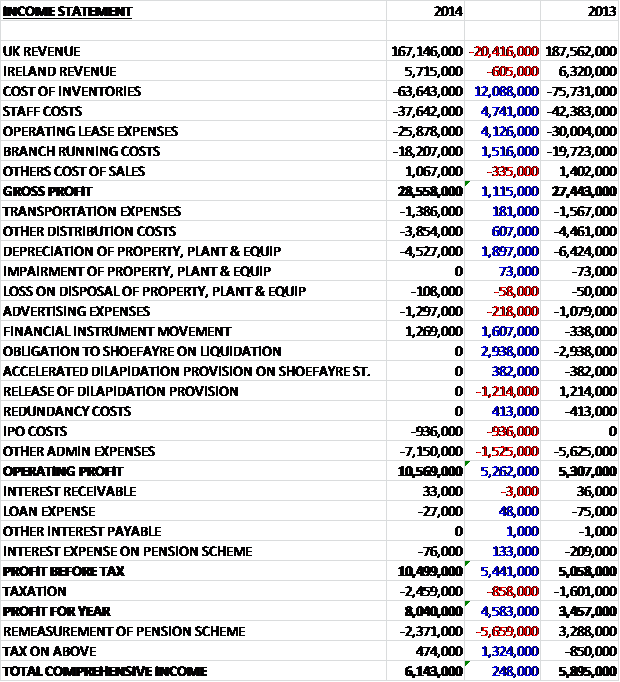
When compared to last year, UK revenues fell by £20.4M and Irish revenues declined by £605K as the group closed several more unprofitable stores, but we also see a decline in cost of sales with cost of inventories down £12.1M, operating lease expenses falling by £4.2M and branch running costs down by £1.5M.  I realise that not all staff costs are cost of sales but frankly I didn’t think it was worth trying to estimate where to put them, in any case they are down £4.7M to give a gross profit some £1.1M ahead of that of 2013.  We also see distribution costs fall and depreciation costs declining, partially offset by an increase in advertising expenses.

We also see the effect of some non-underlying items as the lack of last year’s £1.2M provision release was more than offset by a positive £1.6M swing in the financial instrument value, a lack of £2.9M obligation to shoefayre on liquidation that occurred last year and the lack of £413K-worth of redundancy costs that happened last year to give an operating profit some £5.3M above that of last year.  We then see a small improvement in finance expenses, driven by a £133K decline in pension scheme interest, partially offset by a fall in tax to give a profit for the year of £8M, an increase of £4.6M year on year.

shoeassets

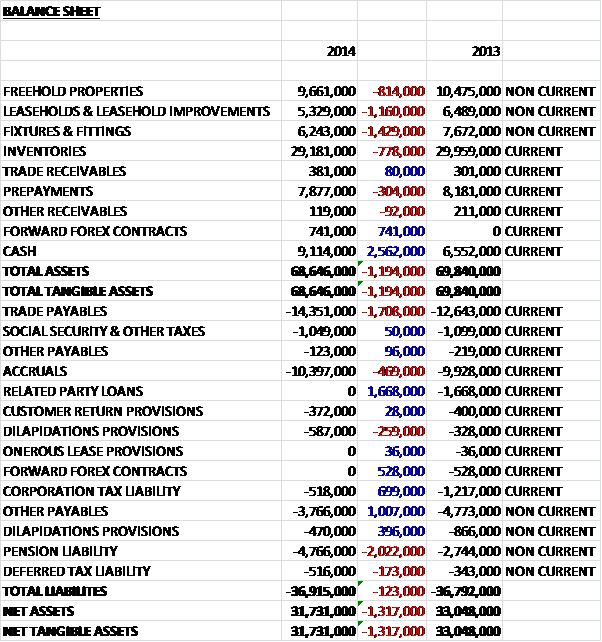
When compared to the end point of last year, total assets fell by £1.2M, driven by a £1.4M decline in fixtures and fittings and a £1.2M fall in leasehold improvements, partially offset by a £2.6M increase in cash.  Liabilities increased during the year as a £1.7M decline in related party loans and a £1M fall in other payables was more than offset by a £2M increase in pension liabilities and a £1.7M growth in trade payables.  The end result is a £1.3M decline in net assets to £31.7M but it is worth bearing in mind that there are some £103.6M of operating leases off the balance sheet which is substantial but not exceptional in a retail business.

shoecash

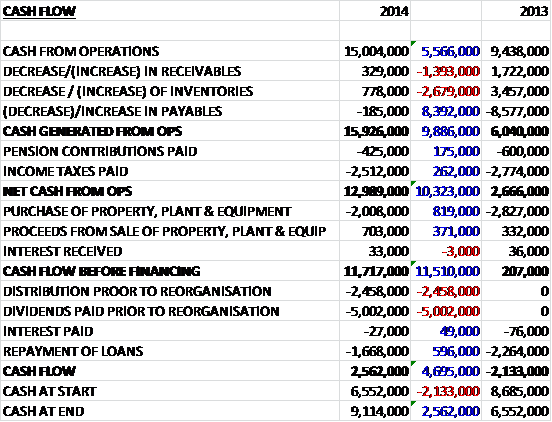
Before movements in working capital cash profits increased by £5.6M to £15M.  A fall in inventories and receivables was partially offset by a small fall in payables and after lower pension obligations and tax paid the net cash from operations stood at £13M, an increase of £10.3M year on year.  This easily covered the £2M capital expenditure with some £11.7M of free cash before dividends prior to reorganisation and the repayment of loans meant that the cash flow for the year  stood at £2.6M to give a cash level of £9.1M at the year-end.

Over the past year the group placed a greater emphasis on their back to school and comfort shoe ranges with the 5-9 age group forecasted to grow by 12% between 2012 and 2017 and the continued growth in the ageing population suggesting improving markets in these areas.  As a consequence of this emphasis, they enjoyed their best August in history as the back to school range sold well.  In addition, they have increased their focus on men’s footwear and the men’s multi buy offer performed well so has been extended in recent months.

The handbag and shoe care ranges have progressed well after having been introduced in 2013.  Handbag sales were up 73% to £2.5M and sales of shoe care products increased by 94% to £1.4M. The ranges have been enhanced for the new-year which is driving further growth in these areas.  The group are also looking to introduce their handbag range into the smaller stores after a recent trial was carried out.  Shoezone introduced 200 web exclusive products in spring/summer 2014 which far exceeded expectations, accounting for 5% of online sales.  As a result of this success, greater volumes have now been purchased for the autumn/winter season.  They are now in discussions with their supply partners about further extending their online offer further in 2015.

At the end of the year, the group had 545 stores compared to 570 at the same point of last year with 17 being opened during the year and 45 being refitted at a cost of £1.9M. The group are placing more orders direct with overseas factories with the proportion increasing from 38% last year to 53% this year and this approach apparently gives better margins.  The traffic on the website increased by 25% year on year and a fully responsive site will be launched in 2015 following a recent trial that resulted in a 24% increase in mobile conversion rates.

As well as their own website, the group launched on Amazon in November 2013 which made up 8% of all online sales in 2014.  Following this, they then launched on eBay in July 2014 which is expected to be at least as profitable as Amazon.  In all, online sales grew by 47% but still only represent just over 3% of total sales. The email club grew by 52% during the year which allows the group to continue to develop their email marketing.  They have also had some success with business to business transactions which will continue to be developed during the coming year.

The investigations into new stores in Spain and Poland are ongoing but are likely to remain a longer term goal rather than an immediate sales growth opportunity but online international sales have now been commenced with improved international delivery options from the website and the launch into other countries via Amazon.

A look at the KPIs show some that are fairly standard – cash balances increased, along with EPS growth and gross margin.  We also see that online participation increased from 2.2% to 3.1% and finally rental percentage of turnover fell from 14.2% to 13.9% reflecting an increase in larger stores and rent negotiations.

There is some exchange rate risk on purchases from major suppliers based in the Far East which is mitigated through using forward foreign currency exchange contracts and it could be worth keeping an eye on the pension schemes – the group operates a number of them and the pension liability increased by £2M to £4.8M, mostly relating to the Shoefayre defined benefit scheme.  Contributions of £300K are expected to be made in the coming year.

Going forward, despite the warm start to the winter season, the board believes 2015 will be a year of continued growth for the group.  So far this year, six new stores have been opened and terms have been agreed on 10 new stores representing seven relocations and three new locations.  The multi-channel offering continues to grow ahead of forecasts and the falling oil price is having a positive impact on the cost of logistics and raw materials.  The board are therefore confident that the business will perform in line with market expectations.

At the current share price the shares have a dividend yield of 2.1%, increasing to an impressive looking 5.4% on next year’s consensus forecast. If we discount the IPO costs, the shares are trading on a very cheap looking PE ratio of 9.7 but next year, profits are not expected to be so good so on the consensus forecast, the shares trade on a forward PE of 11.1.  At the year-end the group is in a net cash position of £9.1M compared to £6.6M at the end of last year.

Overall then, this seems like a decent set of maiden results for the group profit is up on last year, as is operational cash flow with plentiful free cash generated.  Net assets did fall, however, but the balance sheet looks in decent shape, operating leases not withstanding.  The sales of handbags, show care and online sales look set for further growth but they still represent fairly insignificant numbers compared to the sale of shoes from the stores.  In conclusion, the shares do look cheap on most metrics but I feel it is prudent to wait for further updates given how little time the shares have been publically traded.


Entu Share Blog – Final Results Year Ending 2014

Entu sells replacement windows, double glazing, entrance doors, patio doors and exterior improvement products in the UK.  They are listed in the AIM exchange after being brought to the market by Mr. B Kennedy, the previous controlling owner in October 2014.  They have now released their full year results for the year ending 2014.

In the Home Improvement Products sector the group supplies a range uPVC double glazed residential doors, French doors and patio doors; a range of bespoke uPVC conservatories, garden rooms and orangeries in various styles and finishes, offering heat control systems and insulated roofs which prevent heat loss during cold weather; and roofline products that include uPVC bargeboards, cladding and soffits and fascias which form the frontage below the roofs and eaves of many homes.

In the Energy Generation and Saving Products sector the group supplies a range of energy efficient double glazed windows in various designs; solar photovoltaic panels which reduce energy bills and generate income for the customer via feed-in tariffs that pays the customer for each kilowatt of energy the panels produce; and a range of energy efficient boilers including combination, conventional and system boilers.

In the Eco Products sector the group provides cavity wall insulation that is a filling blown into the gap between the exterior walls of a house to reduce heat loss.  They also provide external wall insulation which is an insulation system fixed to external walls of a property with mechanical fixings and adhesive.  It is then covered with a mesh reinforcement, base coat and finally a decorative finish.  The process significantly enhances the thermal insulation of a building whilst providing the added benefits of sound proofing, enhancing the exterior appearance of the home and damp proofing.  Finally in the segment, the group provides loft insulation which works in a similar way to cavity wall insulation.

The Installation Partners division includes Job Worth Doing, which is the group’s national installation service that uses a network of self-employed tradesmen operating out of 14 service centres across the country.  The services range from hanging a picture to installing a conservatory.  The group acquires new customers through door-to-door canvassing, with 1,216 self-employed canvassers; internet marketing, which is becoming more important and is driven by the website; and media and internet advertising.

ENTUincome

When compared to last year, revenues increased considerably with a £13.1M increase in home improvement revenue, a £3M growth in energy saving revenue and a huge £7.2M increase in insulation revenue from nearly a standing start.  We then see cost of inventories up £5M, employee costs up £1.7M and other cost of sales up £15.2M which gives a gross profit some £1.6M higher than in 2013.  There was a £352K growth in operating costs but a decline in other underlying admin expenses, partially offset by a £1.3M IPO charge to give an operating profit ahead by £2.9M higher and after a £1.3M growth in tax, the profit for the year stood at £6.7M, an increase of £2.1M year on year.

ENTUassets

When compared to the end point of last year, total assets declined by £5.7M driven by a £14.3M fall in loans to related parties, which were waived when the company listed (the related parties were also controlled by the owners of Entu and included Sale Rugby club!– I am not sure I like that), partially offset by a £5.8M increase in cash and a £1.8M growth in trade receivables.  Conversely liabilities increased during the year as a £5M growth in trade payables, a £1.2M growth in current tax payable and a £939K increase in prepayments on account was partially offset by a £2M fall in accruals and a £1.8M decline in bank overdrafts.  The end result is an £8.7M negative swing in net tangible assets to a negative £755K which doesn’t look that great to me, despite the group stating they have a strong balance sheet (always a red flag).  It is also worth noting that there are £8.9M worth of operating lease commitments off the balance sheet.

ENTUcash

Before movements in working capital, cash profits increased by £6.1M to £10.6M.  The increase in inventories was broadly offset by beneficial movements in payables and receivables and after the tax was paid, the net cash from operations was £9.4M, an increase of £5.2M year on year.  There was not that much in the way of capital expenditure with £674K spent on fixed assets and £299K spent on acquisitions.  After a £900K increase in loans due from related parties, the cash flow for the year stood at an impressive £7.6M to give a cash level at the year-end of £5.8M

Underlying operating profit at the home improvements segment was £3.8M, an increase of £200K year on year with a met margin of 4.5% (down from 5%), which represents an increase in market share, along with an improvement in consumer confidence that meant homeowners are more likely to make improvements to their home.  The division was expanded during the year with the acquisition of the Europlas brand.  Underlying operating profit at the energy generation and saving business was £1.8M, a huge jump of £1.6M when compared to last year.  These products include solar photovoltaic installations, air to heat pumps, voltage regulators, remote heating controls and boilers.

Underlying operating profit at the repair and renewal service agreements business was £1.9M, an increase of £84K when compared to 2013.  This segment is an annual warranty plan offered to customers on the vast majority of the group’s products and has a gross margin of 78.7%, down from 82.5% and about 60% of customers are members of the programme.  Underlying profit at the insulation business was £2.7M, an impressive growth of £2.3M year on year.  Products in this segment include cavity wall insulation, external wall insulation and loft insulation.

The board sees opportunities for growth in energy generation and efficiency products which are growing in popularity due to increasing consumer awareness, high costs of traditional home energy products and government incentives towards the adoption of green technology in the home.  The general strategy is to grow by offering cross-selling a wide range of complementary products, including energy efficient windows, doors, conservatories, external and cavity wall insulations, solar power generation products and energy efficient boilers.  It is thought that in the UK there are 24 million homes which could be suitable for loft insulation, 19 million suitable for cavity wall insulation and 27 million suitable for high efficiency boilers.

The group are currently developing a technology that will enable customers to monitor their energy usage online on a daily, weekly and monthly basis to understand where they are consuming most energy and how energy efficient products can save them money which Entu can then use to offer their energy assessments and bespoke energy efficient solutions. They are also actively seeking to grow their existing product line, especially in energy efficient boilers and in solar panel installations, and to capitalise on emerging trends by entering into partnership agreements with other players in the sector.

The previous owners, the Kennedys still own some 30% of the total share equity and CEO Ian Blackhurst and his family also owns about 15% with Darren Cornwall also owning more than 3% so it could be said that the executive directors’ interests are still aligned well with shareholders.

During the period the group acquired Europlas, a provider of home improvement products for a cash consideration of £299K, all of which was goodwill.  The business contributed an astonishing £485K to profits since its acquisition in December so this looks like a great deal.

There does seem to be a high level of trade receivable impairments.  This year, some £725K was impaired which is an incredible 11% of the total – is the company not making proper checks when it sells its products?  This amount is based on the past default experience and the current economic conditions.  The group does operate a defined contribution pension scheme and the total contributions during the year were £232K.

The current year has started well and trading is in line with management expectations.  They are expecting continued organic growth through greater customer engagement and cross-selling as well as taking advantage of opportunities in the energy efficiency market.  In addition, they will supplement this growth through the use of strategic acquisitions.

At the current share price, the shares trade on a cheap looking PE ratio of 9.4. I cannot find any forecasts for earnings going forward, I suppose it is still early days for this business.  Net cash at the year-end stood at £5.8M compared to a net debt position of £1.8M at the end of 2013.  The directors have declared a special interim dividend which yields 1.3% but they intend to pay a total dividend corresponding to a yield of 6.9% for 2015 as a whole, which is a spectacular return.

Overall then, this looks like an interesting potential investment.  Profits increased year on year and the operational cash flow looks great, with plenty of free cash and a decent cash pile at the year end.  On the other hand, net tangible assets fell considerably as related part loans were written off which leaves a negative net tangible asset base in this asset-light business.  The energy saving and insulation divisions have done very well over the past year, growing very quickly.  The shares look very cheap on a number of metrics, the PE is just 9.4 and the dividend yield is an incredible 6.9%.  So, what’s the catch?  Well, the market where the group operates in is very cyclical but it is in a sweet spot at the moment and the business is still very new – cobbled together and sold off just last year so this could be the peak of the performance.

This is perhaps a little cynical but the interim results are out shortly and I will wait to see what is said then before making a final decision.

ENTU (UK)

It has to be said that the share price graph looks a little alarming too.

Conviviality Retail Share Blog – Final Results Year Ending 2015

Conviviality Retail has now released its final results for the year ending 2015.

CVRincome

When compared to last year, total revenue increased by £8.4M and with a smaller increase in cost of sales, aided by nearly £1M worth of lower receivables impairments, gross profit was up £4.2M year on year.  We then see distribution costs increase by £316K and operating leases up a considerable £2M when compared to last year.  There was also a £435K increase in share based payments due to the awarding of options to franchisees, and a £1.6M growth in other operating expenses due to the increase in owned stores.  This was offset by the lack of £3.1M worth of IPO costs that occurred last year which meant that operating profit was ahead to the tune of £2.9M.  There were also a host of one-off finance costs that did not recur such as the £663K loan note expense and the £612K relating to the early resettlement of borrowings.  After a £641K increase in tax the profit for the year stood at £7M, an increase of £3.5M, but if we discount a lot of the one-off costs incurred last year, the underlying profit is actually below that of last year.

CVRassets

When compared to the end point of last year, total assets increased by £5.4M driven by a £7.4M increase in goodwill, a £3.2M growth in plant and equipment and a £1.1M increase in “other debtors” partially offset by an £8.8M fall in the cash level.  Liabilities also increased during the year as a £3.4M increase in trade payables and a £714K growth in social security and other tax payables was partially offset by a £1.5M fall in accruals.  The end result is a £5.5M decline in net tangible assets to £8M.

CVRcash

Before movements in working capital, cash profits were £12.3M, an increase of £1.7M year on year.  This was eroded somewhat by working capital movements but when compared to last year, the fall in payables was much less pronounced and the cash generated from operations increased by £5.5M to £11.5 which then became £9.8M after tax (no tax was paid last year for some reason).  Of this cash, the group used £4.2M to purchase fixed assets and £806K went on intangible assets which gave a free cash flow of just over £5M.  This was not enough to cover the £5.3M of dividends and certainly not enough to pay for the £8.6M of acquisition so the cash outflow for the year was £8.8M to leave just £1.2M in cash at the year end.

The group saw more than 20 existing franchisees open new stores during the year and the number of stores owned by multiple franchisees increased by 22%.  For the last two years, the group has embarked on a major restructuring of their franchisee base but this programme has now come to an end, arresting the number of store closures with total store numbers increasing by nearly 5% to 624. The franchisees are obviously very important for the structure of the group and some 94% of all goods purchased by them are sourced from Conviviality.  The group offer a franchisee share scheme to help encourage loyalty with up to 3,500 shares offered per store for achieving annual standards targets and this year some 1.4 million share options have been allocated with almost £900K offered through the overrider scheme to the franchisees.  Over the past year, 35 new franchisees have joined the network.

The group are continuing to expand their geographical coverage and have identified the North East, Yorkshire, the SW and Scotland as priority target areas.  In the North East, the group expects to expand through a combination of current and new franchisees, the Rhythm & Booze acquisition took care of Yorkshire and the GT News acquisition builds their presence in the East Midlands.  Their ambition to grow in Scotland is being pursued via a trial with Scotmid to franchise stores.  This trial is apparently showing some positive early signs and the first stores has opened in Stevenston, followed by Annan with further stores to be opened during this month.

Conviviality seems to be doing well with engaging with its customers.  They have the highest number of active Facebook fans in their sector with some 68,000 and they actively use social media to communicate offers and promotions.  In April they piloted their Click and Collect service and rolled this out to their franchisees.  The group have also updated the image of their brands with the roll out of the new fascias that is nearing completion with the completed stores showing a 1.3% sales differential after the change.  They have also launched an app that has been downloaded over 30,000 times that can be used to redeem offers.

As far as products are concerned, the group now have over 70 premium bottled ales and over 20 craft ales in their range.  The spirits range also continues to improve and there is a focus on the growing trend for premium and flavoured spirits.  The wine buyers have also been strengthening their category and sales of wine have increased 10% year on year.  On average the off-license range has been 12% cheaper than the competition despite the heavy discounting experienced in the market.

The group has made significant investments during the year to become more efficient and have modernised the Crewe warehouse without any disruption in trade to ensure the flow of the warehouse is as efficient as possible and poised for further growth.  They have also undertaken maintenance works and refurbishments to their corporate stores, ensuring that they are an attractive for transfer to franchisees.  At the end of March the full transport operation of 160 drivers and staff from the third party provider CVL have been taken under the control of the group.  It is expected that this operation will improve service levels to the franchisees.  Going forward, the group is initiating a programme of space optimisation in the stores which should be completed by the 2016 financial year.

Within the flat retail sales, the 0.4% increase in the average number of stores was offset by a 0.5% reduction in sales per store due to the lower sales from the two acquisitions.  Retails from the Bargain Booze stores that had traded throughout the year were 0.5% higher than from the stores that traded throughout the previous year as the quality of the estate improved, although apparently overall like for like sales fell by 1.7%

During the year the group made a couple of acquisitions.  RNB Stores was purchased for £1.8M in cash and came with 31 shops.   The acquisition generated £1.4M of goodwill and contributed £700K to the group’s profits this year with some £700K being spent on refitting the stores.  In February the group also acquired GT News Group for a cash consideration (including costs) of £6.7M which generated goodwill of £5.7M.  The acquired group is a convenience retailer that operates 37 stores in the East Midlands and Yorkshire.  From the date of acquisition, the stores did not contribute to profits but if they had been acquired at the start of the year, they would have contributed about £800K.  This did not come that cheap but it should add value to the group going forwards.

Following the acquisition of GT News, Jonathan James, the former chairman of the Association of Convenience Stores entered into a ten year franchise agreement, taking control of 36 stores from the acquisition.  There were some board changes during the year.  Andrew Humphreys joined as CFO and Amanda Jones joined as COO.  After the year-end the group also appointed Ian Jones as a non-executive director.

Going forward, the group plan to leverage their wholesale capability into new markets.  By acting as a wholesaler to their franchisees, they have built relationships with their suppliers and understand the market dynamics and plan to embark on some corporate accounts.  Now that the realignment and closure of poorer quality stores has been completed, the group should be well placed for growth in the coming year.

At the current share price, the shares are on a PE ratio of 15.4, reducing to 13.2 on next year’s forecast which seems about right.  After a 5% increase in the final dividend, the yield stands at 5.4%, increasing to 5.5% in 2016, which is a very good pay-out.  At the year-end the group had net cash of £1.2M although it is worth nothing that there are some £16.2M of operating leases outstanding off the balance sheet so whether the group really is in a net cash position is debatable.

Overall this year seems to be one of fairly slow progress for the group.  Profits were up but when we strip out the one-off costs relating to the IPO last year, underlying profits actually fell year on year.  Net tangible assets also fell with cash being used to pay for goodwill and the balance sheet is not looking that great really.  At least operating cash flow increased, both actual and underlying but this was not enough to cover the costs of the acquisitions and not quite enough to even cover the dividend, which is yielding an impressive 5.4%, although how sustainable it is has to be open to debate so up to now, pretty uninspiring stuff.  All this is irrelevant, however, as the shares are suspended due to the earlier announcement that the group is looking to reverse takeover Matthew Clark, an alcohol distributer.  If the deal goes ahead it will be genuinely transformational so the investment case will totally depend on the details of that – more of that to come at some point in the future.

The group has now confirmed that it has entered into an agreement to acquire Matthew Clark from the Accolade Wines Group and Punch Taverns for a total cash consideration of £198.4M.  Matthew Clark is a UK based alcohol and soft drinks wholesaler which primarily serves the non-tied on-trade market via a national distribution network.  Over the past year, they have delivered to about 17,000 premises that have included pubs, bars, hotels and restaurants and generated an EBITDA of £25.3M and a post-tax profit of £13.4M after £4.4M of exceptional items.  The acquisition is being funded by a £130M placing and £80M to be drawn under new banking facilities.  Appropriate working capital facilities of up to £92.5M will be in place for the enlarged group to cover seasonal and intra-month fluctuations in working capital.

The directors believe that the increased scale of the enlarged business will increase its buying power, enabling buying synergies to be achieved.  In addition, combining the two businesses has the potential to realise distribution, operational and revenue synergies.  The acquisition is expected to be earnings enhancing from the first full year of ownership.  It is estimated that the net debt of the enlarged group will be about £80M, excluding any amounts drawn under the revolving credit facility.  The group will incur advisers’ fees, commissions and expenses of about £7.5M in connection with the acquisition, placing, admission and new banking facilities.

Andrew Humphreys, the group’s CFO has been granted an option over 149,519 shares.  It has an exercise price of 155p and a three year vesting period.  Some £130M is being raised by way of a placing of 86,666,667 shares at a price of 150p.  These new shares will represent nearly 56% of the enlarged share capital which will stand at 154,943,024 shares in total.

The group has also included a trading update where it stated that since the end of the year, both Conviviality and Matthew Clark have traded in line with management expectations.

On the 12th November the group announced a trading update covering the first half of the year. The revenues for the period were 38% ahead of last year at £252M and 4.4% higher excluding the impact of the acquisition. The retail business generated revenues of £191M, an increase of 0.4% but a decline of 1.3% on a like for like basis, although the Wine Rack stores performed well with like for like sales up 5.3%. Matthew Clark generated revenues of £61M over the month or so since acquisition, an increase of 4% year on year and good progress is being made integrating the business with the synergy sales on track. In all, the group continues to perform in line with market expectations.

On the 26th January the group announced that David Robinson has been appointed as MD of Conviviality Retail. He joins from the Home Retail Group where he was COO of Argos. They board have also appointed Mark Simmonds as Commercial Finance Director for Conviviality Retail. He joins from Mitchells and Butlers where he was Director of Financial Planning and Analysis.