Wynnstay Share Blog – Interim Results Year Ending 2015

Wynnstay has now released its interim results for the year ending 2015.

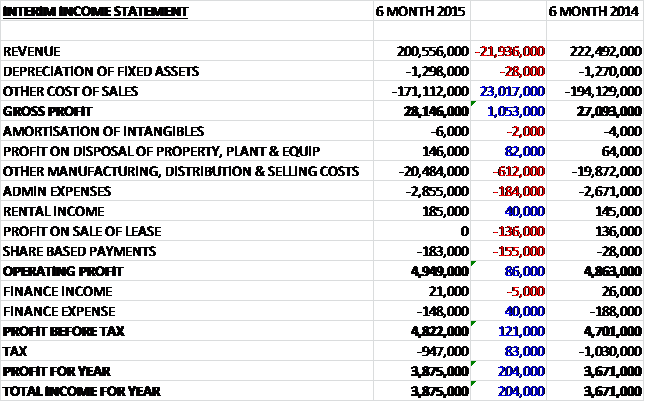
WYNinterimincome

Revenues fell by £21.9M when compared to the first half of 2014, reflecting continued commodity price deflation in grain and traded raw materials, but cost of sales also fell to give a gross profit some £1.1M ahead.  The manufacturing, distribution and selling costs increased, as did admin expenses, and we also see the group did not receive a £136K profit on the sale of leases that occurred last time.  Due to lower debt levels, though, finance expenses did fall by £40K and tax was also some £83K lower to give a profit for the first six months of 2015 of £3.9M, an increase of £204K when compared to the first half of last year.

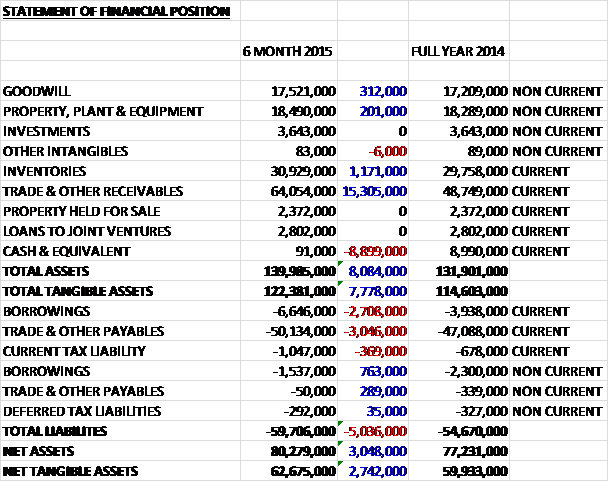
WYNinterimassets

When compared to the end point of last year, total assets increased by £8.1M driven by a £15.3M increase in receivables and a £1.1M growth in inventories, partially offset by an £8.9M fall in cash levels.  Liabilities also increased during the year due to a £2M growth in borrowings and a £3M increase in payables.  The end result is a £2.7M increase in net tangible assets to £62.7M.

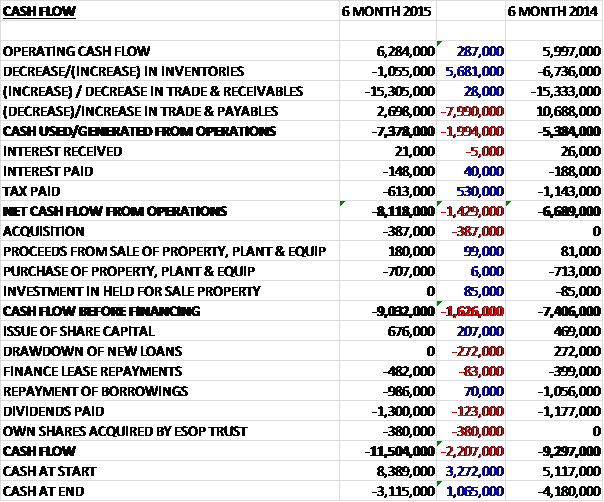
WYNinterimcash

Before movements in working capital, cash profits increased by £287K to £6.3M. We then see a huge increase in receivables, which appears to be seasonal, and after tax and interest, there was a net cash outflow from operations of £8.1M, some £1.4M more than last year.  The group spent £387K on an acquisition and a net £523K on property, plant and equipment to give a cash outflow of £9M before financing, which involved repaying finance leases, and loans along with £1.3M worth of dividends.  In all, there was an £11.5M outflow of cash to leave an overdraft of £3.1M at the period end. This looks alarming but there should be a cash inflow from the second half of the year.

The output prices remained low for many farmers but the balance of trade is expected to reverse in the foreseeable future.  The group have recently completed their planning exercise to map out the potential organic and acquisitive growth opportunities over the next five year and they are investing in production and marketing initiatives to support their development.  There is no detail about the plan, which is a shame but perhaps it will be detailed in the annual report later in the year.

Profit in the Agriculture division was £2.2M, a decline of £127K year on year as the low grain price affected arable product margins, particularly in fertiliser and grain trading, partially offset by a good feed performance.  The output prices for many products remain below the realistic cost of production for many farmers, mainly as a result of the current surplus in the global supply of grain and dairy products which has resulted in a reduction in demand for fertiliser.  Volumes of compound and blended feeds increased by 9% year on year, though, gaining market share.  The investment in the production and distribution facilities has improved efficiency within the feed products division enabling the group to maintain competitive prices for their customers.

Glasson delivered a solid performance despite a reduction in sales of fertiliser and raw materials for feed as compounders reverted to the use of home produced cereals following the good UK crop in 2014.  The business benefited from increased sales of specialist products which have supported a good contribution to the group.  In the arable products division, sales of cereal and herbage seeds have been buoyant and the business continues to increase its presence in the market but demand for fertiliser has been lower than the equivalent last year, as farmers geld back from buying in anticipation of a fall in prices.  The fertiliser spot market has been encouraging, however, helped by the recent realignment of prices which will benefit sales over the summer period.

The large grain harvest in 2014 has contributed to an increase in traded volume but the continuing low grain price has resulted in pressure on margins.  Grain stocks at farms remain higher than normal and with a good harvest predicted for 2015, volumes are expected to be high for the foreseeable future.

Profit in the Specialist Retail division was £2.9M, an increase of £266K when compared to the first half of last year and was aided by the further integration of the stores acquired in the CPF acquisition.  The Wynnstay stores business now has 42 outlets which includes the seven stores acquired in 2013, as well as two new stores added in the last six months.  Total sales over the period increased by 6%, with like for like sales rising by 2%.  New initiatives to work alongside the group’s customers to bring improved efficiency to the industry are apparently progressing well with the introduction of specialist ventilation and lighting systems for dairy enterprises being an example of this.  The group plans to continue to grow their network of stores to expand their geographical presence and extend their farmer customer base.

The pet product business performed well during the period with like for like sales up 2.8% but its profit contribution is below that of the same period of last year due to costs associated with business expansion.   A new store was opened in June in Cambourne, Cambs and further new stores are planned to open over the next year.  During the first half there was £126K of other losses compared to £73K during the same period of last year.  All joint venture and associates have been performing in line with management expectation but their result is not included in the interim results, instead being added to the final results at the end of the year.  The FertLink fertiliser joint venture is now directly handling fertiliser trade previously managed by the Glasson operation so this business will now be reported at the full year stage.

Going forward, trading conditions for farmers have been difficult over the past two years as a result of the downward pressure on farm gate prices and adverse weather conditions.  The industry is cyclical, however, and the macro economic factors around the world food demand remain compelling.  The board believes that the changing marketing environment will bring opportunities to the industry as customers strive for efficiency within production systems.  The board are confident about the group’s continued future growth and overall trading is in line with management expectations.

After an 8.8% increase in the interim dividend, at the current share price the shares yield 1.9% which is what is expected for the full year consensus.  The net debt at the period end stood at £8.1M compared to £10.9M at the same point of last year and reflects the peak of the group’s working capital cycle.

Overall then, this was a pretty decent if unexciting update.  Profits increased modestly as did net assets to further strengthen that rock solid balance sheet.  Underlying operating cash flows also improved year on year but due to movements in working capital, this was reversed at the actual operational cash flow stage.  The business is very seasonal and the half year point seems to mark a bit of a low as per working capital cycles so the negative cash flow at the period end is probably no cause for concern.  The agriculture business continued to struggle, mainly due to the world surplus in grain causing prices to fall which has a knock on effect on fertiliser sales but the retail business is picking up the slack with a steady like for like growth in both the country store network and pet stores.

All in all, I quite like this share for its dependability and will look to add on any weakness.

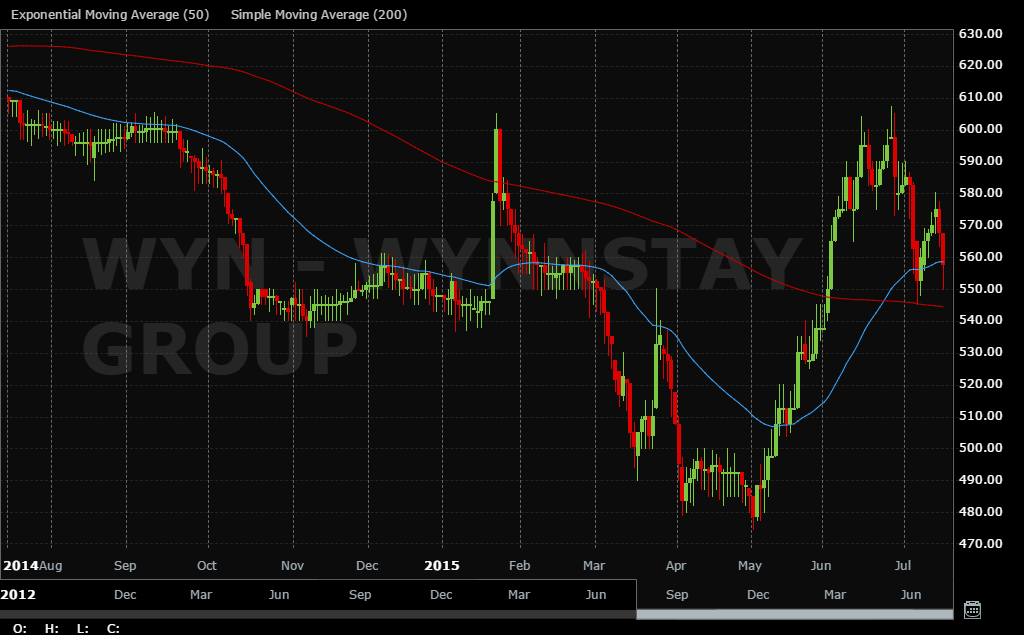
WYNNSTAYGROUP-20150716-102308

After rallying since May the shares have come off the boil somewhat so now might now be the right time to take my position.  I will keep a close eye on this.

On the 19th October the group announced an acquisition and a trading update.  They have agreed terms for the acquisition with TG Jeary for its West Country farm supplies operation, Agricentre.  They will utilise their existing bank facilities to fund the acquisition, the terms of which are not yet being disclosed.

Agricentre operates a network of eight units supplying a wide range of agricultural inputs including animal healthcare, dairy hygiene and animal nutrition products as well as feed related equipment and other hardware.  Its units are located in Bristol, Calne, Langport, Honiton, Salisbury, Shepton Mallet, Sturminster Newton and the Isle of Wight.  It has historically generated sales of about £15M and the current financial year is expected to show a small operating loss.  The acquisition extends the group’s trading presence into a major new geographic region and the stores will be integrated into the current network with a significantly enhanced product range and operational efficiencies.  The full benefits of the acquisition are not expected to come through for about a year, however.

The group is also reporting satisfactory trading in the second half of the year to date with results expected to be in line with expectations.  Looking ahead, the trading backdrop for farmers remains difficult and the group is taking a cautious view on the expected recovery in output prices over the next twelve months.

Wynnstay Share Blog – Final Results Year Ending 2014

Wynnstay manufactures and supplies agricultural products to farmers and the wider rural community in Wales, the Midlands, Lancashire and Yorkshire.  The group has two main segments.  Agriculture involves the manufacturing and supply of animal feeds, fertilizer, seeds and associated agricultural products whilst Specialist Retail involves the supply of a wide range of specialist products to farmers, smallholders and pet owners.

Within the agriculture division, there are a number of businesses.  The Feed division operates two compound feed mills and one blending plant.  Both mills can produce multi-species products. Glasson operates Glasson Dock near Lancaster and has traditionally been a raw materials trader and fertiliser blender.  Their activities now include the packaging of added value products supplied to specialist animal feed retailers.  The business is also involved in a joint venture, FertLink, which has production facilities at Birkenhead and Goole.

The Arable division supplies a wide range of products to arable and grassland farmers.  It is a significant supplier of fertiliser, acting as a principle supplier of GrowHow and Yara products together with its own Top Crop brand. Seed is processed in Shropshire at the arable base as well as Woodhead seeds in Yorkshire.  Agrochemicals are also supplied by the business.  Grainlink is the group’s in-house grain marketing company and provides farmers with an independent professional marketing service.  Woodheads seeds operates a seed processing plant near Selby in Yorkshire supplying a full range of cereal and herbage seeds to farmers and wholesale customers.  It also trades grain and supplies fertiliser to farmers.

The retail division covers Wales, the Midlands and Lancashire.  There are three main businesses within the division.  Wynnstay Stores provide a comprehensive range of products for farmers and rural dwellers and now numbers 42 stores.  Just for Pets is based in Worcestershire and consists of 20 specialist pet product stores from Cambridge to Bristol.  Two stores also have an easipetcare concession offering vet clinic advice and services to customers and six stores include vaccination clinics.  Youngs Animal Feeds manufactures equine and small animal feeds from its facility in Staffordshire.  It also acts as a distributor of products to the equine market through wholesalers and retailers in the West of the UK.

The company is listed on the AIM exchange and it has now released its final results for the year ended 2014.

WYNNincome

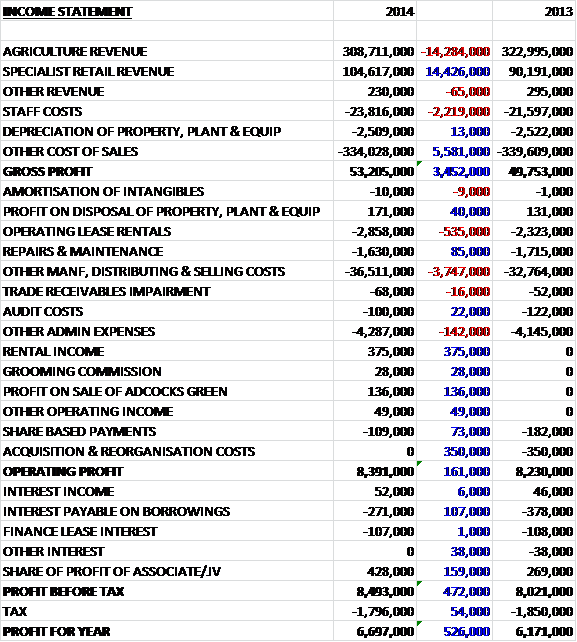
Revenues were broadly flat year on year as a £14.3M reduction in agriculture revenue was offset by a £14.4M increase in specialist retail revenue, which was boosted by the contribution from Carmarthen & Pumsaint which was acquired in 2013.  Despite an increase in staff costs, cost of sales fell when compared to 2013 to give a gross profit £3.5M higher at £53.2M. We then see a £535K increase in operating lease rentals and a £3.7M growth in other manufacturing, distribution and selling costs partially offset by £375K or rental income and various other small income sources that did not occur last year.  The lack of £350K worth of acquisition costs that occurred in 2013 pushed operating profit £161K ahead of last year, however.  We then see a reduction in interest payments as borrowings came down and an increase in the share of profit from the associate and joint ventures before a slightly lower tax bill meant that the profit for the year was £6.7M, an increase of £526K year on year.

WYNNassets

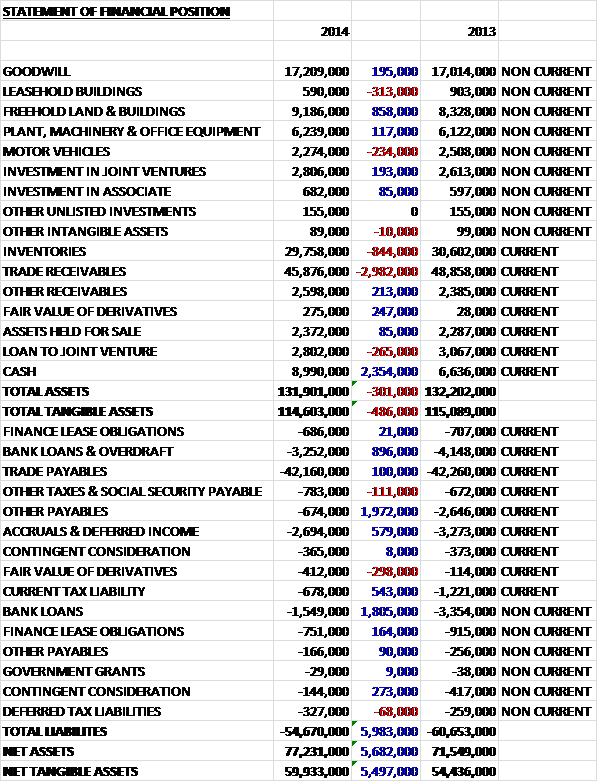
When compared to the end point of last year, total assets fell by £301K as a £3M decline in trade receivables and an £844K fall in inventories were partially offset by an £858K increase in freehold land and buildings and a £2.4M growth in cash.  Total liabilities also fell during the year due to a £2.7M decline in bank loans and overdrafts, a £2M fall in other payables and a £579K decrease in accruals and deferred income.  The net result is a £5.5M increase in net tangible assets to £59.9M which looks good to me.

WYNNcash

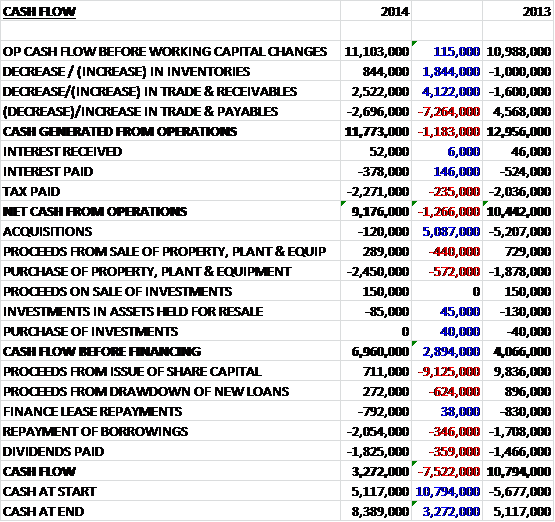
Before movements in working capital, cash profits increased by just £115K to £11.1M.  A decrease in payables was more than offset by falls in inventories and receivables, driven by commodity deflation, to give a cash generated from operations of £11.8N, a £1.2M fall year on year due to the negative swing in payables.  After tax and interest, the net cash from operations stood at £9.2M, a £1.3M fall when compared to last year.  This was more than enough to pay for the capital expenditure and before financing, there was a free cash flow of nearly seven million pounds.  The group used this to pay off finance leased and borrowings and to pay a dividend of £1.8M which meant that for the year as a whole, there was a cash inflow of £3.3M and a cash pile at the year-end of £8.4M – this looks pretty good to me, although the finance director helpfully points out that this represents an artificially high number and the group moves into short term debt at certain points of the year.  This is true for most businesses and it is refreshing to see this being specifically pointed out in this case.

During the year there was a significant variation in yields of agricultural outputs which led to a reduction in commodity pricing over the last year.  Deflation was particularly evident within the agricultural division where, despite an overall increase in volumes of trade, revenues reduced by 4%.  Average manufactured freed prices were some £14 per tonne lower across the year while fertiliser and grain prices averaged falls of £22 and £46 per tonne respectively.

Profit in the agriculture division was £3.8M, a decline of £1.1M year on year as margin pressure on agricultural inputs and lower than expected market activity in fertiliser and grain in H2 put pressure on margins.  Results for the year also reflected the mild weather conditions of the winter which contrasted significantly to those experienced in the previous winter.  A return to more normal weather patterns from Spring benefited crop production, resulting in good grazing and forage production for livestock farmers as well as high yields for many arable units.

Demand for ruminant feed has been lower this year against the prior year, mainly due to the mild weather and lower milk prices.  It was a story of two halves for the feed products business, though, as a 2% fall in sales in the first half of the year was followed by strong sales in the second half.  There was a notable rise in blended products which offset reduced sheep feed volumes in early spring.  The group’s investment in production facilities improved efficiency which contributed an improved performance in manufactured feeds.

After two years of outperformance, the contribution from Glasson was below the level of the last two years.  This reflected reduced margins across both the raw materials trading and fertiliser activities.  Volumes in raw materials were buoyant, however, as feed manufacturers sourced alternative raw materials to replace UK grain which was in short supply following the poor 2013 harvest.  Fertiliser sales increased during the year but sales at Fertlink in the latter part of the year were lower as farmers held back from buying for the 2015 cropping year.

In arable products, sales of cereal and herbage seeds over the year reached record levels but margins came under pressure as a result of the reduction in grain prices across the industry.  Fertiliser sales in the division increased by 19% year on year, benefiting from CPF’s first year of full contribution.  Demand was buoyant in the spring as farmers embraced ideal growing conditions but tempered in the autumn with reduced margins.  The UK grain harvest was good in 2014 and while this brings opportunity for the GrainLink and Woodheads grain trading teams, the fall in grain prices in the autumn to levels last seen in 2008 has meant that farmers have been reluctant to sell.  It is therefore expected that a high proportion of the volume will be marketed during the 2015 financial year.

Profit in the specialist retail division was £4.9M, an increase of £500K when compared to last year.  These results benefited from the first full year’s contribution from CPF with the business moving into profitability in the second half as expected.  The acquired network of stores in SW Wales have now been fully integrated.  Just for Pets has seen pleasing like for like sales growth.  Since the year end the group has added two new stores to the Wynnstay stores network, one in Aberystwyth and one in Ross On Wye.  These additions take the number of stores up to 42 and further extends their geographic reach.

On a like for like basis, Wynnstay stores saw a 2% increase in sales compared to the 25% seen including the new stores.   They have introduced some new products such as large-scale ventilation and lighting systems for dairy units and a growing range of hardware products.  These have apparently been well received and have contributed to the stores’ performance this year.  The Just for Pets stores have benefited from the marketing initiatives implemented over the past two years and has seen consumer sentiment improve with average spend increasing over the year and contributing to a 4.5% increase in like for like sales.  The number of outlets currently stands at 20 stores with an additional store expected to be opened in the spring of 2015.  The Youngs Animal Feeds business has performed well, maintaining its position in the market.

Other profits were £250K compared to losses of £386K in 2013 which might include £108K worth of profit from the petroleum products associate, Wynnstay Fuels ltd (£69K last year).  All joint venture and associate businesses have performed in line with management expectations.

There were a number of board changes over the year.  Howell Richards has joined as non-executive director.  He has some 30 years’ experience in the agricultural sector and has established one of the largest dairy farms in the UK.  He replaces Jeff Kendrick who retired after an incredible 25 years of service.  It was also announced that Lord Carlile will be retiring having been a non-executive director of the company for over 16 years – the non-execs here certainly spend a decent amount of time with the company.  It is good to see that the board are not on a gravy train here with their salaries at a sensible level.  For the most part they seem to be farmers with the exception of the Chairman who has a background in retail and currently CEO of Poundland – he should be quite an asset.

During the year the group completed the purchase of Mansell Powell Suppliers, a supplier of agricultural goods based in Herefordshire, for an initial consideration of £154K with a further £75K of contingent consideration.  The acquisition generated goodwill of £195K and extends the group’s geographic trading area and farmer customer base as well as adding an additional outlet to the country store chain.  The group have stated that their strategy involves geographic expansion and organic growth.

The group is already contracted to spend some £598K in capital expenditure next year and will be investing in their IT sand management systems over the coming year.  Also, after the year end the group completed the acquisition of Ross Feed Ltd, a supplier of agricultural and hardware goods based in Herefordshire for a total potential consideration of £501K which includes £60K of contingent consideration.  The acquisition generated £312K of goodwill and profit before tax last year was £123K.  The business extends the group’s geographic trading area and adds an additional outlet to the country store chain.  This looks like a good value acquisition to me if that profit figure was not a one-off.

Whilst Wynnstay is not really affected by interest rate changes and exchange rates, although relevant to raw material prices, are not a huge risk, they are susceptible to changes in commodity prices, particularly with regards to the animal feed manufacturing activities and some wheat futures contracts are used to manage exposure.

Going forward, long-term prospects for the UK agricultural industry remain buoyant but shore term issues have arisen as a result of the decline in output prices.  The changes to the Common Agricultural Policy will also bring further changes to the industry, including some short term challenges.  The industry remains driven by climatic conditions with the resultant price volatility but while output prices for farmers are currently weak, especially for the dairy sector, increasing global food demand should drive a return to more “realistic” prices.

At the current share price, the shares trade on a PE ratio of 16 which falls to 15.5 next year which is not exactly bargain territory but not too bad.  After a 10% increase in the total dividend, the dividend yield currently stands at 1.8%, increasing to 1.9% on next year’s consensus forecast – again not bad, but not that great either.  At the year end, the group has a net cash position of £2.75M compared to net debt of £2.5M at the end of 2013 and there is some £14.8M of operating leases off the balance sheet.

Overall then, this seems like a decent update.  Profits increased but they did seem to be flattered by a few one-off items and there was a decent level of free cash generated, despite the underlying operational cash flow only showing modest improvements year on year.  There was a good growth in the net tangible asset level and the balance sheet does look very strong here.  Operationally, the two divisions experienced different trading fortunes.  The agriculture business is suffering somewhat with low output prices as the price of raw materials, particularly grain, and fertiliser fell.  The retail side is doing rather better with the pet store in particular looking promising with a decent level of like for like growth.

The shares do not look a bargain on a PE level or a dividend level and this company is susceptible to commodity prices and weather which are both out of their control.  Having said that, the performance seems solid enough and the balance sheet looks very good.  This could be one to tuck away on weakness perhaps?


Sanderson Share Blog – Interim Results Year Ending 2015

Sanderson has now released its interim results for the year ending 2015.

SNDincome

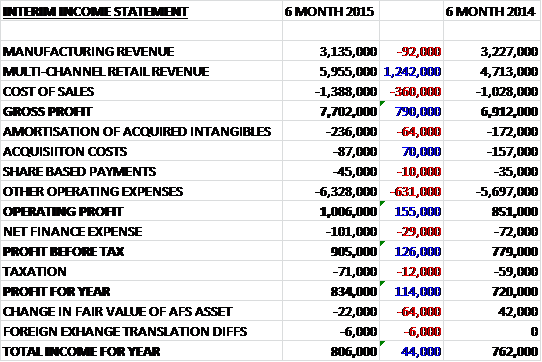
Multi-channel retail revenue is becoming a more important part of the business with a £1.2M increase year on year compared to a £92K decline in manufacturing revenue.  Cost of sales also increased to give a gross profit some £790K higher than in the first half of 2014.  We then see an increase in amortisation of acquired intangibles offset by a fall in acquisition costs but other operating expenses increased by £631K year on year.  When combined with a £29K increase in finance expense and a £12K increase in taxation, the profit for the half year stood at £834K, an increase of £114K when compared to the first half of last year.

SNDassets

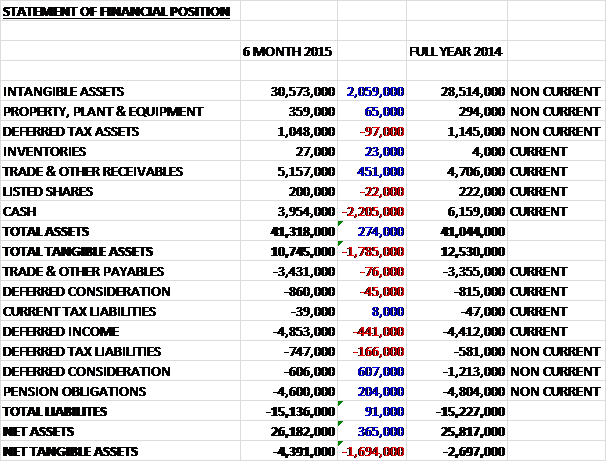
When compared to the end point of last year, total assets increase by £274K to £41.3M driven by a £2.1M increase in intangible assets and a £451K growth in receivables, partially offset by a £2.2M fall in cash.  Total liabilities fell during the year as a £441K increase in deferred income and a £166K growth in deferred tax liabilities were more than offset by a £562K decline in deferred consideration and a £204K fall in pension obligations.  The end result is a further £1.7M deterioration in net tangible assets to a negative £4.4M.

SNDcash

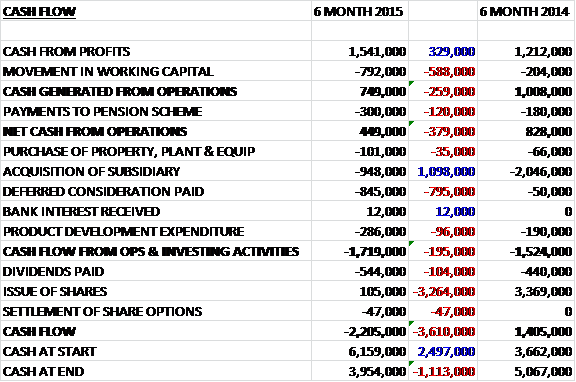
Before movements in working capital, cash profits increased by £329K to £1.5M but this was reversed by a £792K working capital outflow as a number of sales ledger balances slipped beyond the period end with a total of £435K being receivable in the first week of April, and a £300K payment to the pension scheme so that net cash from operations was just £449K, a decline of £379K year on year.  Although this just about covered the development costs and purchase of fixed assets, the group also spent £948K on another acquisition and a further £845K on deferred consideration to give a cash outflow of £1.7M before financing.  The small issue of shares did little to stem the cash outflows as the group spent £544K on dividends to give a cash outflow for the half year of £2.2M and a cash level of just under four million pounds at the period end.

The order book at the period end was £2.8M compared to £2.5m at this point of last year and 13 new customers were gained, up from 12 last year.

Operating profit at the Manufacturing business was £334K, which was broadly flat year on year with a decline of just £5K.  The general manufacturing business improved its trading performance compared with the first half of last year which is expected to continue into the second half of the year.  This performance was offset by the food and drink business which experienced some delays in the receipt of expected sales orders.  Eight new customers were gained during the period including Simtom Food Products, Summit Chairs, Wine Bottling Solutions and NutriFresh which compared well with the five new customers gained during the first half of last year.  There were also some large projects with existing customers including Magnadata, Cook Trading, Food Partners and Freddy Hirsch.

The group has had some success with its entry level Unity ERP product which is aimed at smaller and emerging businesses and over the coming months they are expecting to further develop the software and to launch new products, including further cloud based solutions.  Recurring revenue represents over 61% of total divisional sales and the order book stands at £1M, a decline of £240K year on year but a strong sales prospect list should ensure that the division achieves an improved trading result for the full year.

Operating profit at the Multi-Channel Retail business was £672K, an increase of £160K when compared to the first half of last year.  Mobile enablement and deployment continues to be a key driver in this sector with increasing levels of business activity.  The wholesale distribution and cash and carry market has been slower during the period, however, but prospects for the second half of the year are good, driven by the release of the latest enhanced version of software.  The acquired Proteus has made a steady start to the year and helped further expand the group’s presence in the areas of warehousing, logistics and supply chain.

Five new customers were gained during the period including Anzac Wines and Spirits, Lavitta, Quba & Co and Matthew Algie which compared unfavourably with the seven customers acquired in the first half of last year.  The division also managed to gain a number of large orders from existing customers including JD Sports, Kingstown Associates and Superdry.  The period end order book was strong at £1.8M (£1.2M) and with good sales prospects, the division is well placed to achieve its increased trading targets for the full year.

In December the group acquired Proteus Software Ltd for a maximum consideration of £1.9M, generating goodwill of £1.1M.  The group has paid £1.4M in cash with up to £500K payable depending on the profitability of the business over the next year.  The acquired company provides warehouse management solutions to businesses operating in third party logistics, warehouse management and supply chain distribution markets.  Since acquisition, the business contributed £47K to operating profits before amortisation of acquired intangibles and acquisition related costs.  I think it is getting to the point where I would like to see Sanderson concentrate on organic growth but this looks to be another decent value acquisition.

I am pleased to see that the group finally has a CEO, Ian Newcombe has been appointed having already made a contribution to the group’s strategy and driven the development of the multi-channel business.  The group have also appointed David Gutteridge as a non-executive director who was Chairman of Tinglobal until he led a successful trade sale to Singapore listed Declout.  It seems he has been employed previously at Sanderson.

I notice that the Chairman has stated in the interim results that the company has a strong balance sheet.  I have found that this type of statement is a bit of a red flag and so it seems to be the case here too.  It doesn’t look that strong to me, stuffed with goodwill and a negative net tangible asset level.  The pension deficit is an unhelpful liability too and there are some £3.8M worth of operating leases off the balance sheet.

Going forward, particular emphasis will be placed on further developing the range of solutions for mobile and ecommerce businesses, for the food and drinks processing sector and for entry level systems in the manufacturing division.  The general economic environment continued to show signs of improvement but sales cycles remain protracted.  The board is apparently cautious but the decent order book along with a long list of sales prospects provides them with a good level of confidence that the group will continue to make further progress and deliver results in line with market expectations for the full year.

Net cash at the period end stood at just under £4M (£3.95M) compared to £5.1M at the same point of last year.  The interim dividend has increased by 12.5% to give a rolling dividend yield of 2.8%.

Overall then, this seems to have been a fairly good start to the year with profits increasing and the order book in a better state than at the same period last year.  The group is still consuming more cash than it generates though, due to its continued expansion through acquisitions.  Also, the balance sheet deteriorated somewhat during the period and net tangible assets remain negative.  The retail business looks good with increased profits and order book despite the slowdown in wholesale orders but the manufacturing business is a bit more mixed with flat profits and a fall in the order book due to a slowdown in the food manufacturing market.  This is a tricky one, on the one hand I do like the company and its products but I have nagging doubts about the cash burn and the negative tangible asset base.  I may look to buy on any improved trading announcements.

SANDERSON GRP

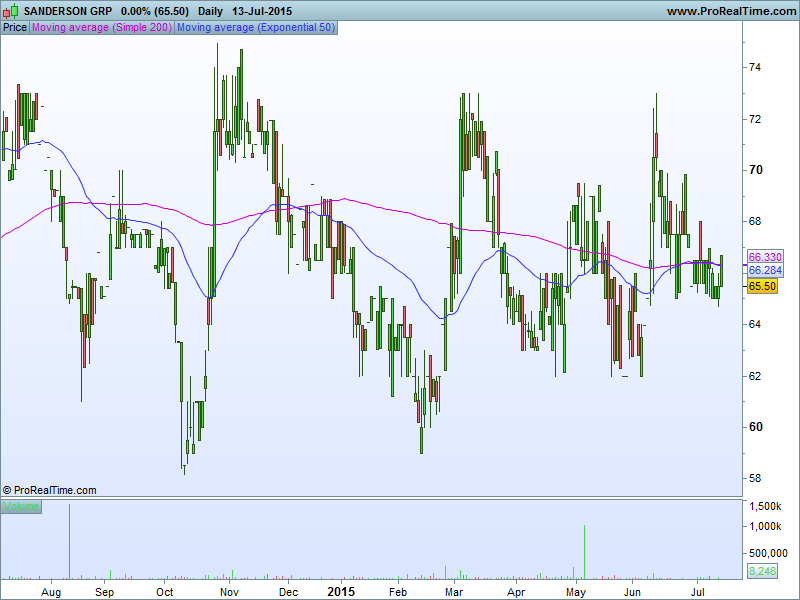
Well this is a bit of a mess!  The share price seems to jump around all over the place but it has definitely been range bound over the past year.

It has been announced that on the 15th July, non-executive director David Gutteridge acquired 45,000 shares at a value of £29.7K.  Following the transaction he owns 545,000 shares in the company representing about 1% of the total.  This is a nice sign of confidence.

On the 27th October the group released a trading update covering the year as a whole with trading in line with market expectations.  Group revenue grew from £16.4M to over £19M and adjusted operating profit increased from £2.8M to £3.3M.

The group continued to invest in its product and service offerings which are designed to provide customers with tangible business benefits often visible within a short time.  A particular focus is in the multi-channel retail business to further enable the adoption and application of digital and mobile technologies into the retail market.  The group’s mobile commerce business focused on delivering cloud based solutions accessed via mobile, tablet and in-store devices achieved revenue growth of over 75%.  It is expected that it will continue to achieve significant growth as retailers seek to adapt technology in order to transform the shopping experience for their connected customers.

Within the manufacturing division, the part of the business focused on supplying customers operating in the food and drink processing market experienced slower trading conditions with some project and order delays but a large new customer order has been received since the year-end and trading prospects in the new year are much improved.

The group acquired Proteus Software, a provider of specialist warehouse management solutions in December and the business has made a positive contribution in its first year as part of Sanderson.  Notwithstanding the ongoing investment in product development and acquisitions which have been funded through the cash generated, there is a cash balance in excess of £4.4M at the year-end compared to £4.2M at the half year point.

The overall economic environment appears mixed and sales cycles continue to be protracted.  The deployment and use of mobile technologies is continuing to develop with market demand accelerating.  In the coming year, management expects to focus further efforts on delivering growth across the group’s businesses but especially from the newly emerging digital retail market and further acquisitions will be considered.

At this early stage of the new year, the board are condiment they will make further progress and deliver trading results at least in line with market expectations for 2016.

This all sounds rather good to me – “at least” could be considered a guidance slightly upwards from current expectations.

Sanderson Share Blog – Final Results Year Ending 2014

Sanderson develops and supplies IT software and services which includes market-focused solutions to the multi-channel retail and manufacturing sectors, they currently have 460 customers and they are listed on the AIM exchange and have now released their final results for the year ended 2014.

Revenues for initial license fees are recognised on the provision of software to the customer.  Revenue from the provision of professional services including support, maintenance, training and consultancy services is recognised as the services are performed.  Hardware sales are recognised on delivery and annual licence, maintenance and support revenues are recognised evenly over the period to which they relate.  When amounts are invoiced in advance the unearned element remains in deferred income until recognition is appropriate.  Having recently looked at Utilitywise which recognises revenues on multi-year contracts at the start of each project, this revenue recognition is clearly the more sensible way of doing it.  It is also good to see that the bulk of the development costs are expensed rather than capitalised, although some £600K was still capitalised during the year.

In manufacturing the group’s ERP software and cloud based solutions support many sectors such as discrete manufacturing, food and drink processing, print and distribution.  The range of green IT, factory and warehouse automation solutions to improve efficiency and manufacturing and provide cost saving benefits to customers which include Associated British Foods and Michelmersh Bricks.  In multi-channel retail, the group supplies software and services to retail, mail order catalogue, fulfilment, wholesale and online businesses.  The group provides integrated e-commerce systems which underpin online operations, in-store technology, and is a major provider of IT solutions to the wholesale and cash and carry industries.  The driver for customers to adopt these solutions is to increase efficiency, making cost savings and delivering business growth.

Sandincome

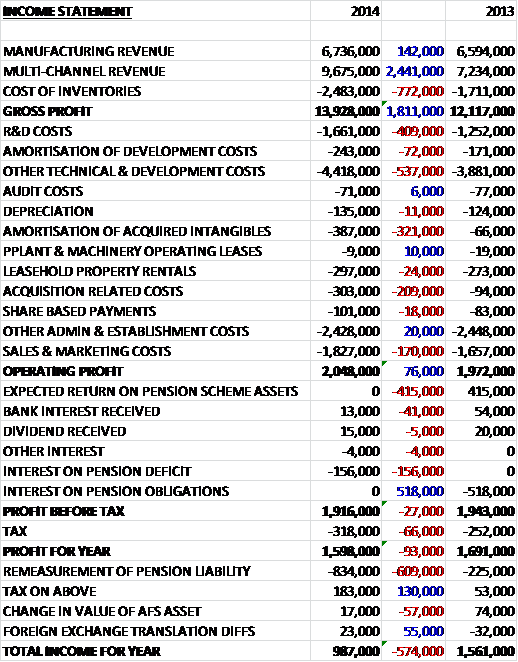
Overall revenue increased year on year, driven by a £2.4M growth in multi-channel retail revenue.  Cost of sales also increased to give a gross profit some £1.8M higher than in 2013.  We then see that R&D costs increases by £409K and other technical and development costs were up £537K.  The group also saw a £321K increase in amortisation of acquired intangibles, a £209K growth in acquisition related costs which were fully expensed during the year and a £170K growth in sales and marketing costs to give an operating profit just £76K above that of 2013.  We then see the lack of a £415K return on pension scheme assets that occurred last year being offset by the lack of the interest on pension obligations.  After an increase in tax, total profit for the year came in some £93K below that of last year at £1.6M.

SANDassets

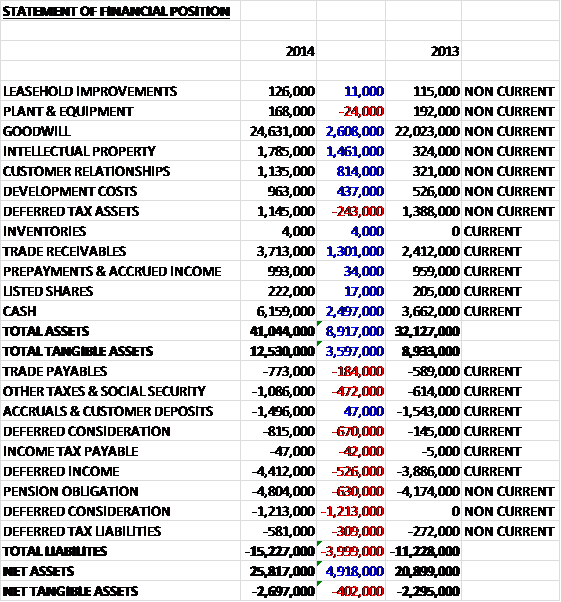
When compared to the end point of last year, total assets increased by £8.9M driven by a £2.6M increase in goodwill, a £2.5M growth in cash, a £1.5M increase in intellectual property and a £1.3M growth in trade receivables.  Liabilities also increased during the year due to a £1.9M increase in deferred consideration and a £630K increase in the pension obligation. The end result is a £402K reduction in net tangible assets which stand at a negative £2.7M.  There was also £3.8M worth of operating leases outstanding, £253K of which is due within the year.

SANdcash

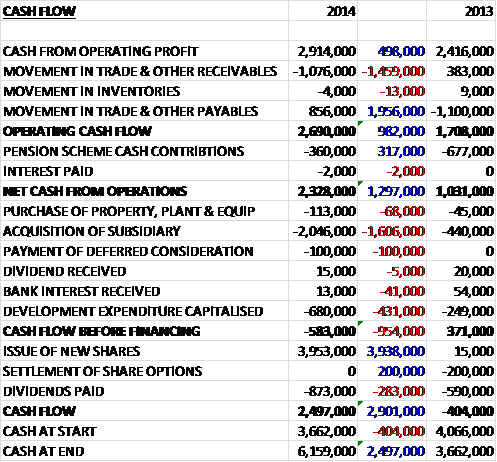
Before movements in working capital, cash profit increased by £498K to £2.9M.  We then see an increase in payables more than offset by a growth in receivables before the contributions to the pension scheme nearly halved to give a net cash from operations of £2.3M, an increase of £1.3M year on year.  This cash easily paid for the capital expenditure with £680K going on development costs and £113K on fixed assets but did not cover the £2.1M of acquisitions.  In order to pay for these and cover the dividends, the group then issued new shares at a value of just under £4M to leave a cash flow for the year of £2.5M and a cash level of £6.2M at the year end.

Operating profit at the Manufacturing business was £877K, just £29K above that of last year.  The market continued to experience slow trading but a recently launched product, Unity Express, aimed at smaller manufacturing businesses has a number of good and promising prospects in the sales pipeline.  The growth in the division was driven by the food and drink processing sector which now accounts for half of all the division’s revenues and continues to provide opportunities due to the need for traceability through the supply chain combined with the drive to reduce operating costs.  Seven new customers were gained during the year compared to nine last year and the order book at the year-end fell from £1.2M to £926K.

The operating profit at the Multi-channel retail business was £1.2M, a £46K increase year on year.  A continued high level of activity has been experienced from the provision of ecommerce and mobile commerce solutions with an average growth rate over 10%.  The growth in the ecommerce and wholesale distribution business was partially offset by a fall in the traditional mail order business, however.  Priam, which was acquired last year, was restructured and fully integrated into the group and whilst its profit contribution was minimal in the year, it is expected to make an improved contribution next year.  Ten new customers were gained in the year compared to five last year.  It seems that the order book in the ecommerce business took the group by surprise and this apparently held back profitability during the year but now offers a good opportunity to boost profitability in the coming year.

The value of the order book at the year end stood at £2.4M, an increase from the £1.9M recorded at the end of last year.  During the year 17 new customers were gained (14 last year) at an average initial contract value of £116K (£119K) with the total value of new orders growing to just under two million pounds.

I always like a good case study and Sanderson has provided a few of those.  Freddy Hirsch is an ingredients manufacturing organisation that has grown to become the largest food ingredients manufacturer in Africa.  The company has been a Sanderson customer for 14 years and is a major user of all available modules in their food ERP system including factory automation for scheduling and control of recipe weighing and multiple dispensing systems.  The group’s manufacturing system allows Freddy Hirsch to operate a common IT platform across its business with products and prices managed by head office and downloaded to the relevant country.

Preston Beer is a £5M, ten employee business.  It supplies an extensive range of beers, sprits, soft drinks and wines to restaurants, hotels and pubs in the North of England.  It has transformed its operations with the Sanderson delivered wholesale solution with their investment paid back over three times in under a year.  Robust pricing control, real-time stock visibility and management data are all provided with accurate stock control achieving a saving of £5K per month.  The group also supplies Aspinal who sell fine quality leather goods.  The company has benefited from rapid sales order processing, accurate stock information across all channels and greater warehouse efficiency.

There is an interesting array of KPIs and the group’s performance against them was mixed.  Operating margin and order intake both improved but revenue per employee, debtors over 60 days (12.2%) and dividend cover (2.4) all deteriorated year on year.  The increase in the debtor days was quite considerable and above the 10% target.  This was being put down to delays encountered in projects involving the integration of third party products and activity levels in the approach to the year-end.  The economic environment also increased the number of customers extending payment beyond agreed credit terms which has got to be a bit of a concerning development.

It can be seen that the group operates a pension scheme and although relatively modest, the liability is affecting the net asset level.  It is closed to future accrual and had its last actuarial valuation in 2011 so another one is due soon so this is a potential risk going forward.  The bulk of the group’s revenues are earned in the UK so there is no foreign exchange risk.  The main risk though, is probably a downturn in the economic environment and the subsequent reduction in company’s IT spend that would result from that.

It should be noted that the largest shareholder is Christopher Winn who owns some 22% of the total share capital.  Mr Winn led a management buy-out of the company before it floated on the AIM exchange.  He is also Chairman of the company and by far the best paid director.  In fact, his pay could be considered rather generous so on one hand, we have to be careful that he doesn’t get too greedy and keep awarding himself increasingly excessive pay awards but on the other hand it can be good to have someone with such a vested interest running the company.  There appears to be no CEO at Sanderson.

During the year the group acquired One Iota ltd which is a business that provides cloud-based multi-channel solutions via new mobile, tablet and in-store devices.  The maximum consideration could be up to £5.4M which generates goodwill of £2.6M.  The acquisition was satisfied with a cash consideration of £2.4M paid on acquisition and a further £750K satisfied by the issue of new shares.  Deferred consideration of £300K will be paid over the three years following the acquisition and an additional £2M in deferred consideration could become payable subject to various performance targets to the year ending 2016.  Last year One Iota produced revenues of £665K with a profit before tax of £195K and during the period it contributed £160K to the group’s profits.  In my view, on the surface, this looks like a good acquisition for the group being good value and offering an opportunity to expand into the mobile retail solutions market.

In order to pay for the acquisition the group raised some cash by placing over six million new shares at 55p each which is a decent way of raising more cash but could be a sign that lenders were not willing to lend money due to the weakness of the balance sheet.  Going forward, business sentiment at small and medium sized businesses has continued to show some improvement but customers remain cautious in their outlook.  The improved order book provides the board with a reasonable level of confidence that the group will make further progress in the next year.

At the current share price the shares trade on a PE ratio of 22.2 which doesn’t look to cheap but this does fall to a better looking 14.1 on next year’s consensus forecast.  After a 20% increase in the total dividend year on year, the shares currently yield a useful 2.7%, increasing to 2.9% on next year’s forecast.  The group has a net cash position of £6.2M at the year-end compared to £3.7M at the end of last year.

Overall then, this was a mixed performance this year.  Profits fell year on year and although it could be argued that the cause of this was acquisition related costs, given the frequency of acquisitions, it looks to me that these are underlying costs.  Net tangible assets fell and the balance sheet looks weak with a negative net tangible asset level, although IT companies don’t seem to have very good balance sheets as a rule.  The cash flow does look decent though, and the increasing operating cash flow threw off some free cash, although not enough to cover the acquisition.  Speaking of which, the One Iota business looks to be a good purchase to me and it is already contributing to profits which should improve after the acquisition related costs work their way through.

The manufacturing business seems to be struggling with a reduction in the number of new customers and a lower order book at the year-end but this is offset by an improvement at the multi-channel retail business, boosted by the acquisition.  Indeed, were it not for the acquisitions then organic growth across both businesses would have been fairly modest. The products do seem to offer some tangible benefits to customers, though, and there seem to be a number of long term clients on the books so there is clearly a good business here but whether that can trickle down to the bottom line is a little less clear.  I will keep watch at this company for the moment.

Dewhurst Share Blog – Interim Results Year Ending 2015

Dewhurst has now released its interim results for the year ending 2015.

DEWincome


When compared to the first half of last year, revenue fell by £249K to £22.8M.  Operating costs also fell during the year, though to give an operating profit some £85K ahead of last time.  We then see a tax bill that is slightly higher to give a profit for the half year of £1.6M, an increase of just £62K year on year.

DEWassets

When compared to the end point of last year, total assets increased by £485K driven by an £888K increase in receivables and a £117K growth in cash partially offset by a £207K fall in property, plant & equipment, a £156K decline in other intangible assets and a £113K decrease in goodwill.  Liabilities fell during the period as a £172K growth in current tax liabilities was more than offset by the £324K reduction in the pension obligation.  The end result is a net tangible asset level some £851K higher at £19.7M.

DEWcash

Before movements in working capital, cash profits fell by £102K compared to the first half of last year to £2.6M.  This was then eroded by a further increase in receivables and a £663K payment to the pension scheme to give an operational cash flow some £62K below that of last time at just under a million pounds.  After tax more than halved, however, the net cash from operations stood at £863K, an increase of £127K year on year.  This was more than enough to pay for the £161K of capital expenditure and free cash flow for the half year stood at £750K which paid for the dividends and left a cash flow for the period of £147K.

Overall weakness in the UK market resulted in lower revenue domestically but the overseas businesses performed strongly.  After a positive start to the year, UK sales fell back in Q2, possibly affected by the general election.  They were weaker across both lift and transport divisions but the impact was greatest in the lift business after a very strong first half for those products last year.  The fall in UK sales was almost entirely offset by stronger North American, Asian and Australian performances but the weaker Australian and Canadian dollars reduced reported revenue by £200K during the period.

Going forward, the UK government has indicated that constraints on public spending will increase further and this is likely to impact the group’s public sector sales.  In their overseas markets, the short term outlook is reasonably positive suggesting the current trends are likely to continue.  Therefore the board expects their markets in the UK to remain weak whilst the overseas markets should remain buoyant, at least for the second half of the year.  A further fall in the Australian and Canadian currencies, however, will have some negative impact on the profitability of operations in those countries.  The interim dividend has increased from 2.8p to 3p to give a yield for the year of 2.3% and there are still no broker forecast that I can find.

This is all the detail that was included in the interim report and I have to say that the performance in the UK is rather disappointing and given the issues facing Australia over the commodity price falls, I am not sure that sales in that country will hold up in the medium term.  Still, the shares still look cheap on current metrics so I am tempted to dip my toe in here.

On the 22nd June it was announced that a court in Arizona had dismissed the lawsuit against the Hungarian subsidiary without the finding of liability.  The group have subsequently agreed a confidential full and final settlement of all claims from AIG arising from the dispute and there is no material impact on current market expectations for the results of the group either this year or future years.  This is indeed good news.

Dewhurst Share Blog – Final Results Year Ending 2014

Dewhurst is a supplier of components to the lift, transport and keypad industries.  For lifts they produce push buttons, indicators, auxiliary equipment, control and monitoring systems.  In the transport industry the group produces highway products, parking equipment, push buttons and indicators.  In the keypad industry the group produces banking terminals, security products, ticketing machines and petrol pumps.  The group is listed on the AIM exchange and has now released its final results for the year ended 2014.

dewhurstincome

Overall revenue increased by £2.9M year on year with a £2.5M growth in lift revenue, a £337K increase in keypad revenue and a £296K increase in transport revenue.  We then see a £1.4M increase in the cost of inventories and staff costs increasing by just under half a million pounds.  To offset this, there was an improvement in foreign exchange losses and the lack of a £1.3M in goodwill write downs that occurred last year to give an operating profit some £2.6M ahead.  Taxation was substantially lower than last year, mainly due to deferred tax and unrelieved tax losses in the period, to give a profit for the year of £3.9M, an increase of £3M when compared to 2013.

dewhurstassets

When compared to the end point of last year, total assets increased by £2.4M driven by a £2.4M growth in cash levels, a £633K increase in trade receivables and a £377K growth in the deferred tax asset, partially offset by a £373K decline in capitalised development costs, a £315K fall in plant & equipment and a £260K decrease in property values.  Liabilities also increased during the year due to a £1.7M increase in pension obligations and a £207K growth in warranty provisions.  The end result is a £995K growth in net tangible assets to £18.9M.

dewhurstcash

Before movements in working capital, cash profits increased by £1.3M to £6.5M before this was eroded by an increase in receivables and a £1.4M contribution to the pension scheme.  The tax paid was somewhat lower than last year, however, to give a net cash from operations of £3.9M, an increase of £959K year on year.  The group then spent £408K on capital expenditure, £70K on development costs and £112K on contingent consideration as Dual Engraving reported sales over A$4.5M to give a free cash flow of £3.4M, a very respectable £2.8M higher than last year.  After dividends were paid and the group purchased a small number of shares for cancellation, they were left with a comfortable cash inflow of £2.6M and a cash pile of £12.9M at the year-end – this all looks pretty good to me.

UK operating profit was £1.9M compared to a break-even position last year.  After a difficult 2013, sales at Dewhurst UK Manufacturing recovered strongly this year, particularly for the lift products with the improvement being spread across domestic and overseas sales.  In the UK the business has been focused on building sales of complete fixtures and rather than just selling loose components.  The market interest in the UniBlade product range has led them to significantly extend the number of variants to suit different markers and installations.  The product has already been installed in the Cheesegrater building and T2 at Heathrow.

The business has continued to work on improving processes throughout the year with a particular focus on waste. At Feltham, an unacceptable proportion of the moulding material was ending up as waste so they have implemented a project to significantly reduce this through improved planning, changes to tooling and product rationalisation.

It was a very busy year at Thames Valley Controls.  After many years of reduced local authority spending, it seems that investment has increased as far as lifts are concerned and the business has increased sales of both controller products and lift monitoring systems.  The online monitoring system, CMS Anytime, has proven to be popular and lift operations can be simply checked either on the move or in the office which can enable engineers to deliver weekly and monthly reports to residents.  During the last year they also released a new Remote Indicator Display which enables facilities managers to display a message on a remote screen by sending a text message which means that residents can be easily informed about building repairs or maintenance works.  The business has started the year with a strong order book that is expected to continue through the coming year.

Regulatory requirements in the UK with regards to road signage have gone through some significant changes over the past year and TMP were required to make some design changes to its core product to ensure the new codes were met.  This resulted in the launch of a new solar powered bollard, Evo-s, with new front and wider side profiles as well as increased light output.  Since its launch mid-way through the year it has been very well received and enjoyed good sales.  In the past the group has outsourced the supply of the base of the bollards that enable them to flex and return to their original positon but they have now taken this in-house and from 2015, the bollard products will all use the new base which offers improved impact performance at a lower cost.  The group believes that spending on road infrastructure will gradually increase over the coming years and they believe that there are significant opportunities to grow the business so have added additional design resources to come up with some new products.

European operating profit was £965K, an increase of £412K year on year.  Sales grew marginally at Dewhurst Hungary and the implementation of some overhead reductions enabled the business to improve on last year’s performance.  During the year, they have developed a new design of keypad for one of their major customers which has been delivered in line with customer requirements in good time.  The test lab in Hungary is now fully commissioned and the group is carrying out ongoing tests of all keypad products that are manufactured in the country.

Americas operating profit was £1.3M, a decline of £200K when compared to last year.  The regional economy in North America continued to be reasonably buoyant and Dupar Controls took advantage of this to grow sales during the year.  The business operates mainly in Canada but there is also a Chicago sales office to cover the mid-western US states which has become a particular target with an increase in sales force based there.  The increase in sales has intensified pressure on the production facilities in Ontario so the group have invested in a further CNC engraving machine and added a second evening shift.

At Elevator Research and Manufacturing, the group changed the management structure to harmonise standards between that business and Dupar with the promotion of George Folenau, the GM of Dupar Controls to be VP of North American operations.  The aim is to enable customers to experience the same terms of service, drawings, product design and quality no matter which business they order from.  Like Dupar, ERM benefited from the improved economic situation in the US and sales rose.  In the second half of the year, after an investment into the production side, the percentage of deliveries shipped on time improved significantly and the backlog was eliminated.

Asian and Australian profit was £1M, an increase of £400K when compared to 2013.  It was a challenging year for Australian Lift Components after the merger of JAS into the business and this distraction coupled with a fall in sales in the first half of the year led to a poor performance.  The performance did pick up dramatically in the second half of the year, however, which sets the business up positively for the new year.  Lift Material grew sales throughout the year with the EHC product line performing very strongly.  The business benefitted from good sales of handrails and encouraging sales of a wide range of escalator spare parts.  Customers also have the opportunity to buy products direct from the manufacturer but they chose to purchase from the business due to the local technical and installation support that they can offer.

Dual Engraving’s business in Western Australia continued to be busy throughout the year and they had a number of major projects in Perth where they supplied custom lift interiors.  The plan for Perth includes further development of the city centre so there is opportunity to grow the business over the medium term.  As a response, the business has invested more resources into admin and manufacturing to ensure that they are able to boost their capacity and meet the available demand.  Dewhurst Hong Kong has now been operational for about four years.  The market in Hong Kong remains quite buoyant and the business predominantly sells into the local housing and infrastructure sectors.  There is currently a great deal of infrastructure investment in the state, particularly for the railways, with a number of extensions to the mass transit rail system and the new high speed rail link to China.  The business has this year taken on the distribution of Avire safety edges for lifts as well as their own products and initial sales have been “very encouraging”.

The group has capital commitments of £134K at the end of the year.  It should be noted that AIG Speciality Insurance filed a complaint against the Hungarian subsidiary claiming $7M in respect of a purported failure of a component supplied to a third party.  The group is obviously defending the claim but this could be a material amount for the company if they lose the case.

One other potential issue with this company is the pension scheme.  They operate schemes in the UK, Canada, USA, Australia and Hong Kong and closed the schemes to future accrual in 2010.  This year the deficit increased by £1.7M to £12.2M and the group pays £1.4M each year to reduce this deficit which will continue going forward and is a fairly material amount to a company of this size.  The group have also suffered somewhat from the strength of Sterling which is something else that should be watched.  The company is clearly still heavily owned by the Dewhurst family with Mrs V Dewhurst being the largest shareholder.  All of the directors seem to have sensible pay levels which is nice to see

The group has launched a new version of its solar powered traffic bollard and an enhanced security ATM keypad during the year along with a mirror blade for lifts that provides clear and stylish indication of the lift to board for users of destination despatch control systems.  The group has been putting considerable investment into products that will be launched in the near future.

Overall demand remains stable but news on the economy can be volatile.  Australia seems more buoyant than last year and there are some reasonable projects scheduled for the coming year.  The signs in the UK and North America are reasonably positive but elsewhere things are less certain and the strength of the pound is likely to reduce the benefit of overseas sales.

At the current share price the shares trade on a cheap looking PE ratio of 8.5 and the dividend yield stands at 2.3%.  Management are looking to move towards a dividend covered four times by earnings and this year the dividend increased by 12.5% year on year.  I don’t have any forecasts but these figures look rather good value to me.  There is no debt and operating leases are fairly negligible so the net cash positon was about £12.9M.

Overall this seems like it has been a good year for the company.  Profits are up, albeit being flattered somewhat by the lack of a goodwill write-down this year, net tangible assets increase and there were negligible operating leases and a very strong balance sheet.  There was also a good free cash flow generation that more than paid for the dividends and added to the already decent cash pile.  Operationally, things seem to be improving as far as lifts are concerned in the UK and Australia but a strong Sterling and subdued European demand is likely to be a headwind going forward.  As usual, there are some things to watch out for.  The pension deficit looks big for a company this size, there is the potential for a material claim against the Hungarian subsidiary and the continued strength of Sterling is also an issue but with a current P/E of just 8.5, a strong net cash position and a 2.3% dividend yield, these shares look good value to me.

RM Share Blog – Interim Results Year Ending 2015

RM has now released its interim results for the year ending 2015.

RMincome

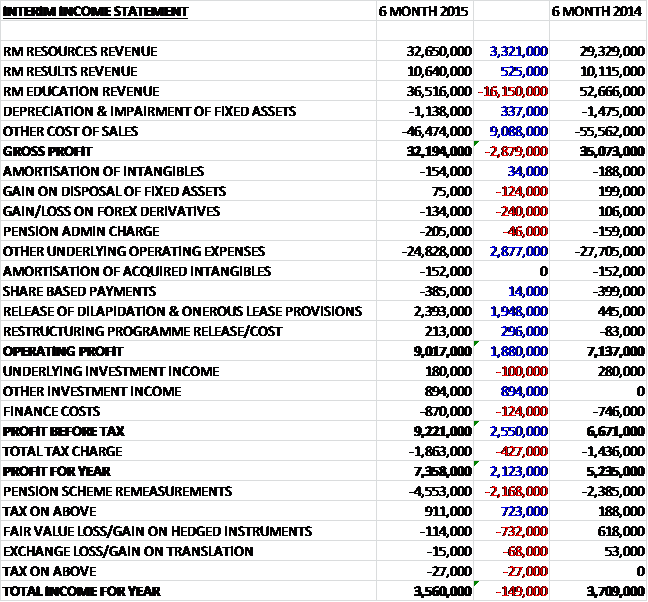
Overall revenues fell year on year as a £3.3M increase in Resources revenue and a £525K growth in Results revenue was more than offset by a £16.2M decline in Education revenue.  Cost of sales also fell to give a gross profit some £2.9M lower than in the first half of last year.  Underlying admin costs fell year on year but there was a smaller gain on the disposal of property, plant and equipment, there was a loss on foreign exchange derivatives and the pension charge was slightly higher.  The group then benefited from a £1.9M increase in the release of onerous lease provisions as the group managed to sublease its old premises to South Oxon District council for three years, there was also a £213K restructuring release to give an operating profit £1.9M higher than last time.  After an £894K “other” investment income relating to the sale of the group’s interests in Newham Learning Partnership and a £427K increase in tax the profit for the half year stood at £7.4M, an increase of £2.1M although this does seem to have been driven by the release of the provision and restructuring gain.

RMassets

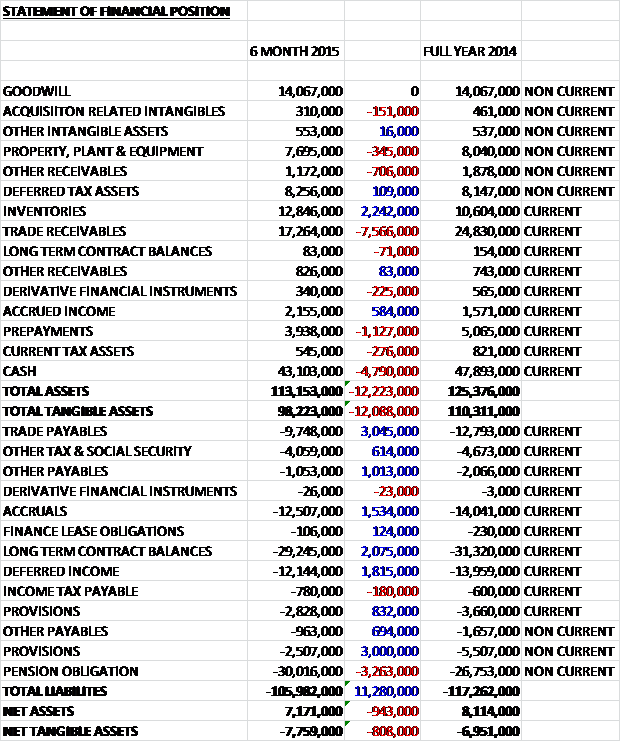
When compared to the end point of last year, total assets fell by £12.2M driven by a £7.6M fall in trade receivables, a £4.8M decline in cash and a £1.1M decrease in prepayments, partially offset by a £2.2M increase in the value of inventories.  Liabilities also decreased during the period as a £3M fall in trade payables, a £3.8M decline in provisions, a £1.8M fall in deferred income, a £1.7M fall in other payables and a £1.5M decrease in accruals was only partially offset by a further £3.3M growth in pension obligations.  The end result is an £808K fall in net tangible assets to a negative £7.8M.

RMcash

Before movements in working capital cash profits were fairly flat, increasing by just £38K to £8.9M.  This was eroded by a large decline in payables, however, to give an operating cash flow of £1.7M, a fall of £4.3M year on year.  This was not enough to cover the £2M pension deficit payments, however, and after tax is taken off, there was a net cash outflow of £1.1M at the operating level.  There was fairly modest capital expenditure – just £370K on tangibles and £170K on intangibles and the group benefited from £1.6M worth of proceeds from the sale of other receivables relating to the sale of the group’s interests in Newham Learning Partnership.  The group then spent £2.5M on dividends and £2.3M on its own share purchases which meant that there was a £5M cash outflow for the half year to give a cash level of £37.1M at the period end.

The operating profit at the RM Resources division was £4.5M, an increase of £700K year on year.  TTS represents over 90% of the segment’s revenue and is a value added distribution business offering a wide range of curriculum products and materials to schools.  The direct catalogue and online revenue rose by 13% benefiting from strong curriculum focused propositions.  International revenue grew 17% and represented 13% of the businesses’ sales in the period.  Adjusted operating margins increased from 13.1% to 13.9%.

The operating profit at the RM Results division was £1.6M, a decline of £400K when compared the first half of last year despite a 5% increase in revenues.  This decline occurred because the comparison last year was flattered by the cumulative impact of an improvement in the forecast lifetime profitability on an estimated long-term contract.  In February the division signed a new three year contract to provide the education charity AQA with e-marketing services alongside DRS, their existing supplier.  The division has also been selected as preferred supplier to provide e-assessment services to a world leading professional membership organisation, ICAEW, an existing customer for e-marking.

The operating profit at the RM Education division was £2.6M, a decline of £700K year on year although due to the decision to discontinue the sale of personal computing devices and operating margins improved from 6.4% to 7%.  This division includes services subject to long-term project accounting and like last year, profits were positively affected by good operational performance and cost control in completing BSF contracts.  Good progress was made in the period with respect to pursuing the priority areas in software and services.  Positive engagement with major Multi Academy Trusts has resulted in a wide ranging framework agreement being signed with one trust and with the division being awarded preferred bidder status on another.  The vast majority of maintained primary schools in Derbyshire have contracted to transfer to RM Integris, the division’s cloud-based School Management Systems platform and a new internet connectivity contract was signed with West Berkshire.

The pension scheme is continuing to be an issue for the group.  The deficit increased somewhat year on year and there is an agreement to pay £3.6M per annum in deficit catch up payments which is a material amount for a company of this size.  So far in trading in the year is running in line with board expectations and they are confident that the group will return to revenue growth in 2016 with all three divisions growing by 2017.  The cash position at the year-end is likely to be ahead of current market expectations.

After a 25% increase in the interim dividend, at the current share price the shares have a dividend yield of 2.6% which is expected to increase to 2.9% for the full year.  Net cash at the period end stood at £43.1M compared to £47.9M at the end of last year.

Overall then this was a steady update from the group.  Profits did increase year on year but this was due to one-off gains – mainly the provision release after the old property was sublet.  Net tangible assets are currently negative and fell during the period as that pension deficit continued to take its toll.  Underlying operating cash flows were broadly flat but an increase in payables meant that actual cash from operations was not enough to cover the pension deficit payments, although there remains a good cash level.  Operationally, resources seems to be doing well but the other two divisions saw profits fall year on year, although the new contracts look promising.  The forward dividend yield of 2.9% is decent enough but I don’t really see enough here to really see that much progress is being made.

RM

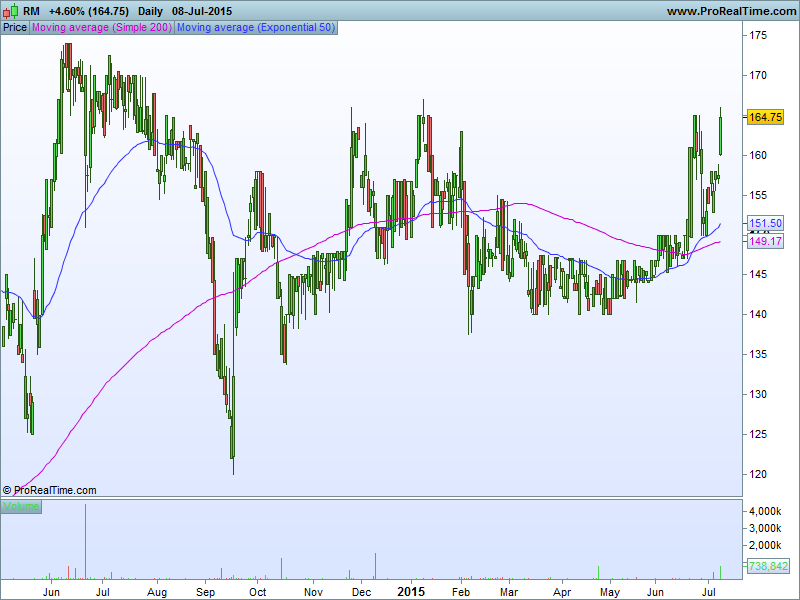
It does seem as though the shares might be on a bit of an upward trajectory at the moment as the fifty day moving average moves above the 200 day MA but I am still not sure about this one.

On the 21st July it was announced that Andy Wilson sold 57,000 shares at a value of £96K.  He now owns 35,184 shares in the company.

In the 6th August it was announced that some 640,000 share options had been awarded for the board at an exercise price of zero.  Vesting of the shares will be based on the relative total shareholder return performance up to 2018.  There are no indications of what the thresholds for vesting are.  So, yet another zero price share option awards for a lot of shares in this case – I find it a shame that directors in the company need motivating in this way.

On the 5th October it was announced that a further 160,000 share options had been awarded to CFO Neil Martin, again for an exercise price of zero.  The options are exercisable in the period from October 2018 to September 2025 based on the relative Total Shareholder Return from 2015 to 2018.  The TSR must be at least at the medium ranking of each of the members of the FTSE small cap index in order for the options to be exercisable.

On the 16th December the group released a trading update for the full year. They expect the results to be in line with expectations with cash levels at £48.3M. Earlier in the month, an agreement was reached with the trustee of the pension scheme with regards the triennial valuation with the deficit agreed at £41.8M compared to £53.4M in 2012, at the last valuation. The recovery plan comprises an initial cash contribution of £4M to the scheme and £4M into the escrow account established previously, together with deficit recovery payments remaining at £3.6M per annum until 2024. The revaluation of the scheme is welcome but I don’t really seem anything here that is encouraging me to buy the shares.

Omega Diagnostics Final Results – Year Ending 2015

Omega Diagnostics has now released its final results for the year ending 2015.

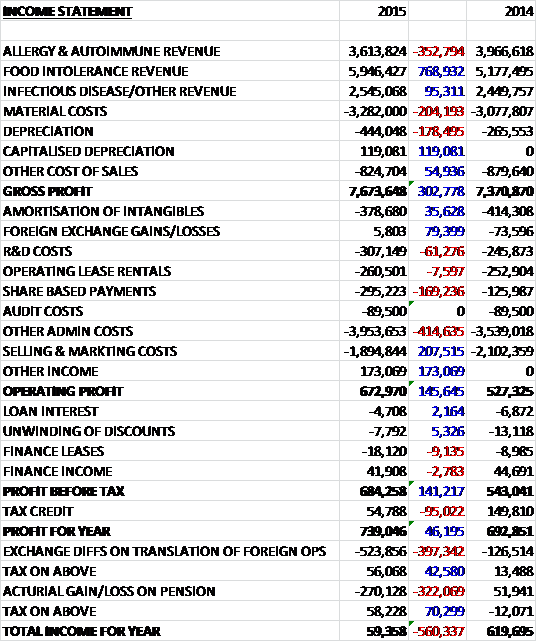
ODXincome

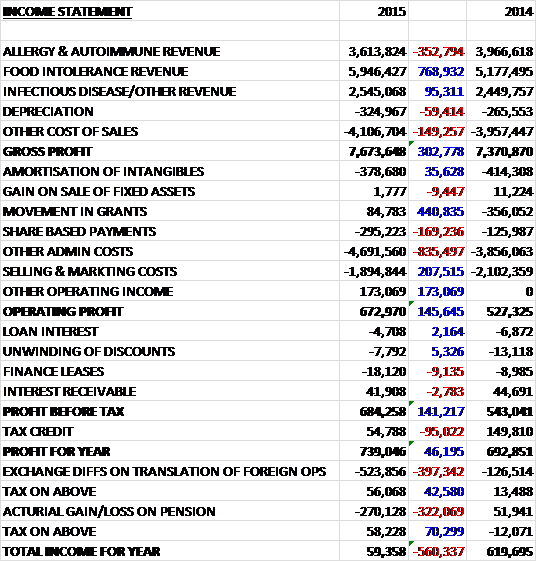
Overall revenues increased year on year as a £353K fall in allergy and autoimmune revenue was more than offset by a £769K increase in food intolerance revenue and a £95K growth in infectious disease revenue.  Revenues were adversely affected by currency movements and would have been some £400K higher on a constant currency basis.  Cost of sales also increased somewhat to give a gross profit some £303K ahead of last year.  The amortisation charge fell year on year and the group also benefited from a £441K movement in grants, although this was offset by a £169K increase in share based payments and an £835K growth in other admin costs due to an increase in costs related to the Visitect CD4 device, a near full year charge for the manufacturing space in India and investment in regulatory staff.

Selling and marketing costs actually fell during the year and £173K worth of “other” operating income comprising of a £74K credit from the UNITAID grant, £54K from a Scottish enterprise grant awarded in 2012 as certain employment targets were met and £45K relating to compensation received from Lloyds bank for previous hedging products the group was required to take out to gain access to funding, meant that operating profit was £146K ahead.  There was a £95K reduction in the tax credit, mainly as a result of movements on deferred tax from share based payments, to give a profit for the year of £739K, an increase of £46K when compared to 2014.

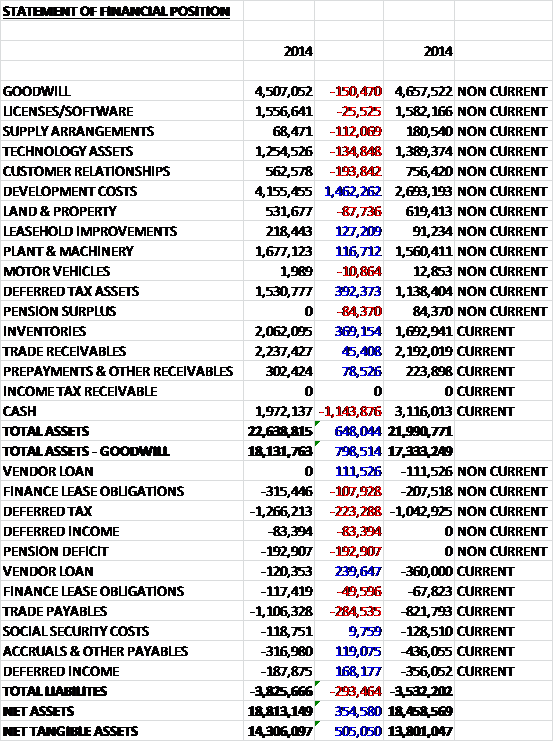
ODXassets

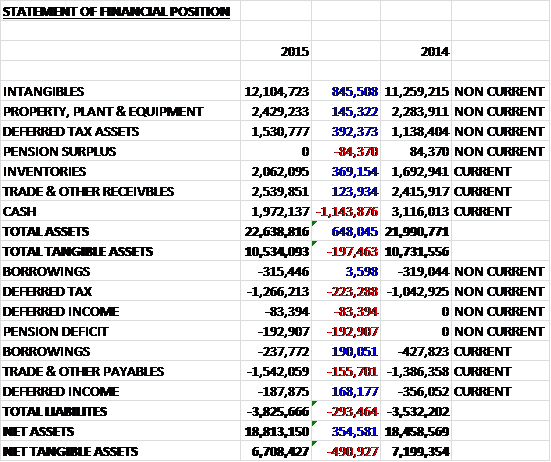
When compared to the end point of last year, total assets increased by £648K driven by an £846K growth in intangibles, a £392K increase in deferred tax assets, a £369K growth in inventories and a £145K increase in property, plant and equipment, partially offset by a £1.1M decline in cash.  Liabilities also increased during the year as a £223K increase in deferred tax liabilities, a £193K increase in the pension deficit and a £156K growth in payables was partially offset by a £194K fall in borrowings and a £168K decline in deferred income.  The end result is a £491K fall in net tangible assets to £6.7M.

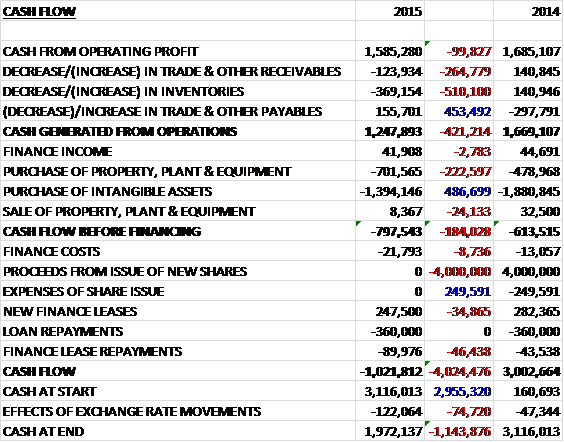
ODXcash

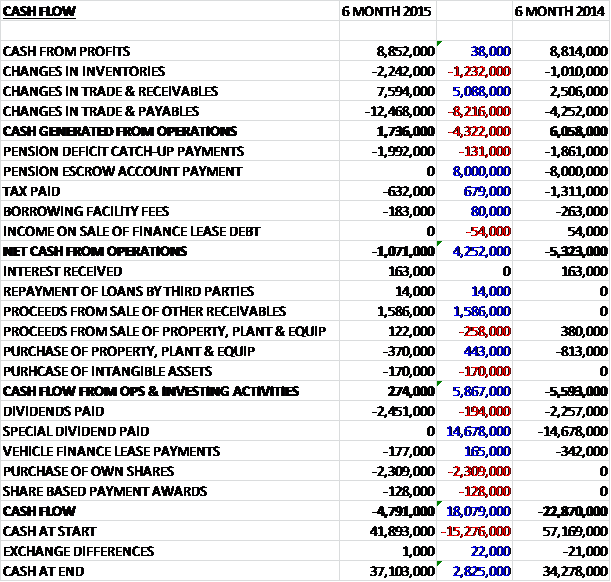
Before movements in working capital, cash profits fell by £100K to £1.6M.  This was eroded by an increase in receivables and inventories, due to the intentional decision to lock in and hold key raw materials for the CD4 test (worth £300K) partially offset by a growth in payables to give a cash from operations of £1.2M, a £421K decline year on year.  Unfortunately this did not cover £1.4M worth of intangible asset acquisition, probably related to development costs and certainly not cover the £702K in property, plant and equipment purchases so that before financing, the cash outflow stood at £798K, a £184K deterioration. We then see £360K of loan repayments and £90K in finance lease repayments, partially offset by £248K worth of new finance leases to give a cash outflow of £1M for the year and a cash pile at the year end of £2M (there is also a £1M overdraft facility).  This is not too inspiring to be honest.

.Of the £700K worth of capital expenditure on fixed assets, the group spent £300K in Scotland on expanding the Visitect CD4 manufacturing assembly facility, in India £100K was paid on account to the contractor responsible for the fit out of the new manufacturing facility and £200K was invested in Genesis/CNS to ensure it keeps pace with the growth experienced in the food intolerance business.

Following a three batch validation in February the Visitect CD4 test underwent pilot studies in India and Kenya, the results from the Indian study showed acceptable performance whereas the results from Kenya were suboptimal.  In order to determine the cause behind the Kenyan results, further batches were made which demonstrated unacceptable levels of batch to batch variability.  At this point, the group brought the previously outsourced manufacturing process in-house and engaged with experts in lateral flow device development who were able to investigate the issues with the co-inventors.

During the second half of the year, the group manufactured the test using the same methods as developed by the Burnet institute.  They have been able to make thousands of devices and have moved to a period of verification and validation, concentrating their efforts on overcoming the stability issue that became evident as described below.  Once resolved, the group will restart the earlier field trials.

Before we get on to the operational performance, it should be noted that in the last few days it has been determined that that there is a stability issue with the Visitect CD4 final product that manifests after five weeks of storage at room temperature.  The group are currently undertaking further investigation to determine a route cause.  They will not put the product back into field evaluation until they have addressed the issue and the product meets the needs of the target market.

This year Food Intolerance sales increased by 15% to £5.95M.  Sales of Food Detective grew by 23% during the year to £2.08M with impressive growth in Poland, Brazil and China.  Total volumes achieved were just over 163,000 units compared to 106,000 units last year and excluding component sales to China, the average selling price per kit was £20.66, a reduction from the £22.55 last year reflecting promotional activities in Poland.  Sales of the Genarrayt Foodprint reagents grew by 19% to £2.52M with strong performances in Spain, France, Canada and Brazil.  Spain and France were the largest markets, exceeding half a million pounds of sales each.

The group also sold a further 18 instruments in the year, taking the cumulative number of installations up to 150 and excluding Spain (why?) revenue per instrument increased by 4% to £14,354 with the relatively low growth reflecting investments being made into newer Far Eastern markets.  The CNS lab service achieved a modest increase of 3% in sales to £650K with 8,241 patient reports produced at an average price of £79.33 per report (down from £79.55).  The profit before tax at the food intolerance division was £2.1M, an increase of £500K year on year.

Sales in the Allergy and Autoimmune division comprised of Allergy sales of £3.08M and sales of autoimmune products of £530K compared to £3.52M and £450K last year.  The Allergy sales are derived from the Omega business in Germany which has experienced a reduction in sales due to continued reimbursement restriction which was exacerbated by the weakening Euro against Sterling. The loss before tax at the allergy and autoimmune division was £299K, an increase of £162K when compared to 2014. The strategy remains to focus on retaining customer relationships through training, service and education.  The modest growth in the Autoimmune sales reverses a recent downward trend due to growth in the Middle East.

Steady progress has been made towards the commercial launch of the Allersys Allergy programme with 32 allergens having been optimised and showing equivalent performance to the market leader.  With external site evaluations still to be concluded there is still some work ahead but there is confidence that when the platform is launched, it will be well accepted.  The strategic aim remains to launch a panel of 40 allergens on the automated IDS/Allersys system followed by a programme of menu extensions to achieve a number two market position.  During the year optimisation work was transferred from the external contractor to a newly recruited in-house team.  In total there are six IDS instruments across two sites supporting the work programmes.

Following a successful pilot study in June comparing the performance of eight Allersys allergens with the predicate device, ThermoFisher’s ImmunoCAP system, and when the results were presented at the annual EAACI meeting they generated a lot of follow-on interest.  They now have a fully validated in-house manufacturing system with finished kits for 27 allergens available on the shelf.  All of these kits have recently begun external evaluations at sites in Spain and Italy and will provide performance data for the technical file needed to support CE marking.  Commercialisation discussions continue, both with IDS in markets where it has a direct presence, and with their partners in other areas.

Infectious disease sales increased by 4% to £2.55M due in part to the recovery in business fortunes of a UK customer that experienced financial difficulties in the prior year and in part due to improved product mix in Africa and Asia mitigating some reductions in the Middle East.  The loss before tax at the infectious disease division was £289K, an increase of £178K when compared to last year.

The production facility in India is taking shape and is expected to be complete within the next six months which will provide the group with a capacity of two million tests per annum in addition to the 2.5 million tests able to be produced in a single shift in the UK facility.

If it can be commercially produced to a satisfactory standard, the Visitect CD4 device is planned to be initially introduced and implemented in 13 countries in Sub Saharan Africa through working with major NGO networks.  As part of the commercialisation process there are certain regulatory hurdles to overcome in addition to gaining the CE mark approval for the test itself.  The group are already engaged with the WHO to gain prequalification for the test but the timescale for achieving this is likely to be in excess of one year. In the absence of WHO approval there is also the Expert Review for Diagnostics which aims to provide guidance to procurement agencies for diagnostic products that have not yet undergone assessment by WHO.  The short term goal is to obtain ERPD approval for the product well in advance of WHO PQ which will allow the earliest procurement of the device.

The field trials of the Android smartphone app to record and transmit Visitect CD4 test results have also been delayed during the CD4 investigation phase but will be capable of being recommenced once the results from India and Kenya show that the test device itself works in the field.  NGOs and global health organisations are apparently enthusiastic as the app/device combination offers a complete information solution from test site to management HQ.  The group’s activities with the Groupe Speciale Mobile Association (GSMA) continues to attract attention from major players in Africa such as mining companies which operate across the continent and in areas which are remote and have poor healthcare facilities along with a high HIV burden.

Total investment in R&D was £1.81M, an increase of £200K year on year.  Expenditure continues to be focused on the group’s two major strategic opportunities.  Expenditure on the Allersys project increased to £980K from £930K with the marginal increase reflecting additional staff costs.  Expenditure on the Visitect CD4 project increased from £430K to £480K as the group progressed and completed the internal investigation phase.  A total of £1.5M of this expenditure was capitalised into intangible assets with a total of £3.1M now capitalised to date on the iSYS project and £1.1M on the CD4 project.

During the year it was announced that Colin King was to join the board as COO from the Elere group.  In addition CEO Andrew Shepherd has been given responsibility for identifying new product opportunities in global health with a focus on achieving new product launches.  It has become clear that the group needs to make some internal changes to the way they work after the disappointment with the CD4 product.  All technical activity will ow fall under the control of the R&D director Dr. Edward Valente.  They have also developed a new division, Global Health, reporting directly to the CEO which encompasses all aspects of the CD4 product roll-out and promotion along with assessment and development of new product opportunities.  It also includes market development and promotional activities for the schistosomiasis and syphilis POC products.  In January 205, Dr. Nigel Abraham was appointed as group Science Director for Food Intolerance.  He joins from Genova Diagnostics where he was Scientific director and a board member.

Going forward the board foresee growth opportunities in Food Intolerance which will mitigate the ongoing pressures of reimbursement for the allergy business in Germany.  At the current share price, the shares trade on a PE ratio of 27.1 which seems rather expensive and so far I have not seen any updated forecast for EPS going forward so I do not have a forward P/E ratio at this time.

Overall then, these annual results are all about the further setback with the Visitect CD4 device which is apparently unstable after five weeks in a room temperature environment which doesn’t inspire confidence for the African field where it will be deployed.  From the restructuring being undertaken and the WHO hurdles that need to me met, it doesn’t sound as though this will be quick fix and for this reason I have decided to sell up and wait for another entry point further down the line. Operationally the food intolerance business is doing very well, increasing profitability year on year but the allergy and infectious disease business both became increasingly loss making in part due to adverse exchange movements and the continued reimbursement restrictions in Germany.

OMEGA DIA

Understandably the market has reacted poorly to the further delay, what a shame.

Omega Diagnostics has now released their annual report with a bit more supporting detail.

ODXincomefinal

The only extra information of any interest here is the £204K increase in material costs and a £61K increase in R&D expenses, partially offset by a £79K favourable exchange rate movement.

ODXassetsfinal

As far as non-current assets are concerned in intangible assets we can see that a £1.5M increase in development costs was partially offset by smaller declines in the other intangibles.  Most of the tangible fixed assets increased modestly and there was also a small growth in trade receivables and prepayments.  In payables, the increase was driven by a £285K growth in trade payables.

There is an interesting part in the annual report where the group outlines prospects in various regions.  In the Americas the group has achieved a growth of 79% in food intolerance products in Brazil and Canada and going forward there is expected to be continued growth in Latin America, an expansion of the strong food intolerance market position in Canada and they are exploring longer-term options for US entry, although the regulatory requirements are rather onerous.  In Europe the business is slowly declining in Germany but food intolerance continues to grow from its strong base in Southern Europe.  The group plan to introduce large allergen panel on Allergodip and grow export business out of Germany to mitigate the internal decline and continue to grow the food intolerance business.

In the Middle East and Africa region the group have launched Foodprint Arabia in Gulf countries with Food Detective also being launched in Saudi Arabia.  There was also strong growth in Iran and Nigeria.  Going forward the group are looking to continue the growth of food intolerance in the Gulf countries and reverse the declining trend in infectious diseases through Visitect.  In Asia the group have continue their growth in India despite currency devaluation, experienced strong growth in China and found new food intolerance partners in Hong Kong and the Philippines.  Going forward the group are looking to diversify the portfolio in India, focusing on tier two and three cities, implement the manufacturing facility in India to reduce production costs and continue growth in food intolerance in India, China and SE Asia.

We can also see that the group increased the value of outstanding operating leases by £439K to £1.7M and while this is not a particularly large amount, the increase is noticeable for a company of this size.

On the 30th September the group announced the grant of options to new COO Colin King.  They have granted 1,200,000 options at an exercise price of 13p.  Half of them can only be exercised when the share price has hit 50p or more on at least one occasion over the three year vesting period.  The other half will be exercisable if the company’s adjusted EPS show a 10% cumulative growth rate over the three year period beginning April 2016.

I have been critical of director options in the past but this is an example of exactly how it should be done in my opinion.  The targets look tough, which is great, and they are definitely in line with shareholder interests.

On the 26th October the group released a trading update covering the first half of the year.  Turnover is expected to be £6.15M, 8% ahead of the first half of last year.  An increase in gross profit has covered a rise in management costs so that pre-tax profit is expected to be similar to that achieved last time (£560K) and overall trading is in line with management expectations.

Within food intolerance, the group continue to see significant gains in business throughout the Americas and the Middle East plus a number of markets in Asia and the Far East.  This is driven by increased use of both the Food Detective and the microarray-based Foodprint.  The allergy division continues to be affected by the results for the German business where revenue was impacted by a further weakening of the Euro and the influence of reimbursement budget caps resulting in a slow decline in testing activity within the doctor’s office segment.  The infections disease segment has produced encouraging results, helped in part by the recovery of the stained bacterial suspension product line in the UK and growth across the product range in some African countries.

They have continued to make good progress in the period with the allergy development programme.  Since the last update, a further four allergens have been optimised, taking the total number whose performance matches the market leading product to 36.  Of these, 26 have now completed claim support work and a further six are just about to enter the claim support phase.  The in-house team will focus on delivering a menu expansion beyond the initial launch panel of 40 allergens.

An external evaluation in Spain completed in July.  The principle investigator selected ten allergens to test over 400 patient samples.  A strong positive linear relationship between the Allersys assay and the market leading product was reported and it was concluded that the reagents on the IDS iSYS analyser provided a technology which was quick and easy to use for allergy testing in the lab.  Over 500 samples have been collected for the planned Italian evaluation which is due to start at the end of the month.  Further evaluations will also be conducted in Germany and France, each with over 300 samples, with an expected start date towards the end of the year.

With regards CD4, since the last update the group have concentrated efforts to resolve a stability issue which manifested after five weeks storage at ambient temperature.  They have recently discovered an ambient temperature effect which manifests as a change in test line signal, with no corresponding change in reference line signal.  They have identified the step responsible for this temperature effect and their immediate focus now is to complete the testing needed to determine which component from this step causes it.  Once it is identified and replaced or adjusted, the verification and validation process will re-commence.  They remain confident of resolving this, although the ultimate timing remains uncertain at this stage.

The company has recently completed the fit-out of 20,000 sq ft of lab and manufacturing space in Pune, India.  As well as providing a second manufacturing site for CD4, the facility, which is being installed with manufacturing equipment which is generic for most lateral flow rapid tests, will provide a low cost manufacturing base for a broader range of infectious disease test.  They have selected a range of Malaria tests on which to work as soon as the equipment has completed validation.

Overall then, the slow progress on CD4 is disappointing and the German business is continuing to struggle but elsewhere, progress seems rather good with the new allergy tests coming along nicely.  In all, I have decided to re-enter here but I am aware that until the problem with CD4 is sorted (if it is), this is quite a speculative investment.

EasyJet Share Blog – Interim Results Year Ending 2015

Easyjet has now released its interim results for the year ending 2015.
EZJincome

When compared to last year, seat revenue increased by £65M.  Operating costs remained fairly flat year on year as an £11M increase in other costs relating to disruption costs, a £7M growth in crew costs due to pay increases and the early recruitment of crew ahead of the three new base openings, and a £6M increase in airport costs due to expected regulatory changes in Germany and Italy were offset by a £21M decline in fuel costs (although the market fuel price reductions have not been fully reflected in the cost to the group due to the hedging policy).  Depreciation was then £7M higher than last year to give an operating profit of £7M, a positive swing of £60M when compared to the first half of last year.  After tax this became a £46M positive swing to £5M for the half year, although we see that the hedges took a hammering due to the decline in the fuel price.  It should be noted that revenues and profitability are lower in the first half and recover in the second half which covers the much busier Summer season.  The performance in the first half has benefited from an exchange rate gain of £18M which is expected to more than reverse in the second half.
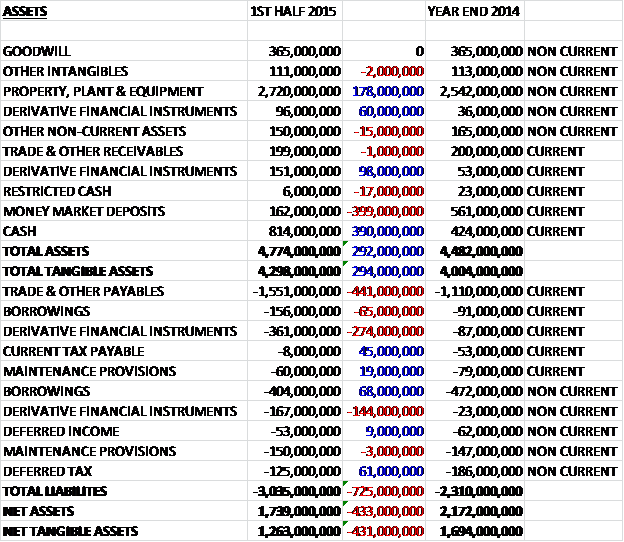
EZJassets

When compared to the end point of last year, total assets increased by £292M driven by a £178M increase in property, plant and equipment and a £158M growth in derivative financial instruments.  We also see the £399M fall in money market deposits being offset by a £390M increase in non-restricted cash.  Liabilities also increased during the six month period as a £441M increase in payables and a £418M growth in derivative financial instrument liabilities were partially offset by a £68M fall in borrowings, a £61M decline in deferred tax payable and a £45M fall in current tax payable.  The end result is a £431M decline in net tangible assets to £1.263BN.
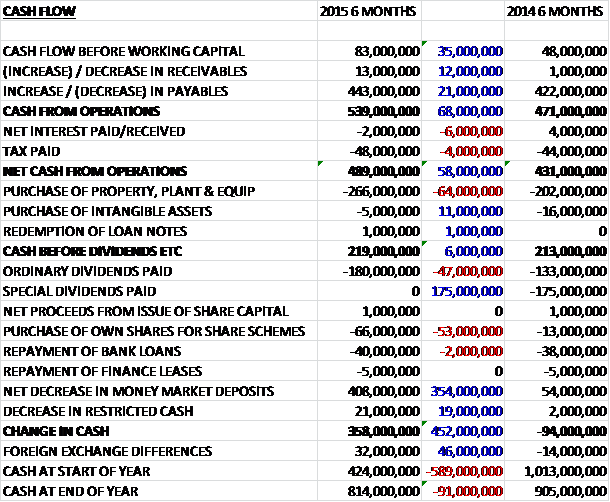
EZJcash

Before movements in working capital, cash profits increased by £35M to £83M.  We then see a huge increase in payables partially offset by a £48M tax bill to give a net cash from operations of £489M, an increase of £58M year on year.  This was easily enough to pay for the increased capital expenditure with the spend on tangibles up £64M to £266M relating to the acquisition of eight A320s, the purchase of life limited parts for use in engine restoration and deposits on aircraft acquisition made in advance of delivery, and the spend on intangibles down £11M to £5M to give a free cash flow some £6M higher at £219M.  This was enough to cover the £180M dividend spend and the £40M repayment of the bank loan but it did not cover the £66M spent on the purchase of shares for employee share schemes (no doubt to cover the ridiculous exec director remuneration.  We then see some £408M transferred out of money market deposits into cash to give a £358M cash flow for the half year and a cash pile of £814M at the period end.

Easyjet’s markets grew by 6.8% year on year in terms of numbers of seats but the group only increased capacity by 3.6% as their competitors took the bulk of the increase, growing by 7.7%.  The growth in the European short haul market is set to continue in the second half as a result of improved economic conditions and a lower oil price.

In the UK EasyJet increased capacity by 3% and increased capacity at Gatwick by 10% due to the new slots purchased from FlyBe and by deploying larger aircraft at the airport.  The group launched 12 new routes such as Edinburgh to Funchal and Gatwick to Stuttgart whilst also increasing frequencies on selected routes.  In the first half of the year the group increased capacity in Switzerland by 6.3% with growth focusing on increasing capacity on existing routes and introducing new routes such as Basel to Lanzarote and Geneva to Vienna.

The group continued to increase capacity and market share in France with capacity increasing by 4.3% to give a market share of 14%.  The growth was focused on increasing frequencies on existing routes and introducing new routes.  The board continues to see attractive growth opportunities in the country.  In Italy the group increased capacity by 5.3% and it now has a market share of 12% with growth focused on both existing routes and new routes.  They now have 26 aircraft based across Milan Malpensa, Rome Fiumicino and Naples and operates from 17 different airports in the country.  In Germany, the group’s capacity increased by 15% and it now has a 4.1% market share.  Capacity growth was driven by increasing frequencies to business destinations including London, Amsterdam and Basel.  There are now 12 aircraft based across Berlin and Hamburg and 13 new routes were launched during the period.

In Portugal the group has a 12% market share and opened their second Portuguese base at Porto with two based aircraft.  In the second half, six new routes will be launched from Porto to Luxembourg, Nantes, Stuttgart, Manchester, Bristol and Luton.  The group has an 8% market share in Spain and continues to see opportunities to allocate capacity to routes able to generate high returns.  In the Netherlands, the group increased capacity by over 13% after launching a new base in Amsterdam in March with three based aircraft and another to be sited there from October.

During the period the cost per seat, excluding fuel fell by 1.4% on a reported basis but increased by 2.9% on a constant currency basis.  The increase was driven by an increase in charges at regulated airports, increased crew costs associated with new base openings along with higher levels of de-icing and disruption in Q2.

The revenue per seat grew by 0.2% on a reported basis and by 2.6% on a constant currency basis.  This increase was driven by strong October trading, particularly UK beach and domestic French routes; an increase in load factor by 0.7 percentage points to 89.7%; increased allocated seating conversion rates and the yield management of bags; the timing of Easter and a good finish to the ski season; business passenger initiatives including the first business TV advert; and continued investment in digital and revenue management initiatives such as the bespoke app for the Apple watch.

The business passenger initiative made good progress during the period with growth in passengers in line with expectations.  Sales of business products performed well, including a more than doubling in the sale of inclusive fares when compared to the first half of last year.  Sales through Global Distribution Systems grew by 59% as the group continued to leverage its relationships with the Travel Management Companies.  The board continues to see opportunities across Europe and recently strengthened its corporate focused sales team in France, Germany and the Netherlands.

The group’s on-time performance declined from 89% to 86% due to adverse weather across Europe and industrial action.  The weather in Q2 was worse than the unusually benign period last year which resulted in an increase in the use of de-icing fluids.  In addition there were increased diversions due to snow across Europe and strong winds.  Q2 also saw an increase in industrial action in Europe including two Italian Air Traffic Control strikes, firemen strikes in Paris and two strikes by airport security staff in Germany which resulted in a total of 683 cancelled flights in the first half compared to 520 last year.

Overall the Euro rate weakened since the last half year which resulted in a loss of £35M in revenue generated in Euros and a gain of £50M on costs excluding fuel incurred in Euros.  The dollar rate also weakened slightly which resulted in an exchange rate gain of £6M on the purchase of fuel. Overall the impact of exchange rate movements was a gain of £18M.  Although the group has a surplus of Euro costs over revenue, revenue cash inflows generally occur several months before cost cash outflow which, with the weakening Euro against Sterling, results in a short term benefit to the income statement.  It is expected that this will more than reverse during the second half giving an adverse impact for the full year.

The “lean” programme delivered £21M in sustainable savings in the period which included the benefit from longer term airport deals such as the new contract with Gatwick that gives the group certainty on passenger charges over the next seven years.  It is hoped that the programme will deliver between £30M and £40M in savings over the next five years.  The company is also in the process of evaluating the provision of its maintenance contracts and has selected AJW to be the primary provider of its requirement for component maintenance and the provision, storage and distribution of spare parts.

The decision has been made to increase the number of seats from 180 to 186.  All new aircraft delivered from May 2016 will be fitted with 186 seats and the existing fleet will be retrofitted from winter 2016 to be completed by the summer of 2018.  This action should deliver a cost per seat saving of 2% but obviously will reduce the space in the aircraft.

The group is contracted to acquire 167 A320 aircraft with a total list price of $14.3BN.  Of these, 11 are due for delivery this year, 50 from 2016 to 2018 and the remaining 100 by 2023.  During the first half of the year the group took delivery of eight A320 aircraft and disposed of four A319 aircraft.  In the second half of the year, one aircraft will exit the fleet and a further 12 A320 deliveries are planned.

Going forward the group is planning on increasing capacity by 6.2% this summer against a forecasted competitor increase of 6.7% with lower fares being offered due to the declining price of fuel.  The second half has started off with a difficult month.  Due to extended French Air Traffic Control strikes in April the group has had to cancel some 600 flights which is expected to impact pre-tax profit by around £25M.  Taking this into account, along with the increasingly competitive environment, it is expected that revenue per seat on a constant currency basis in the second half will fall by low single digit percentage points.  In addition Q3 revenue per seat will be impacted by the movement of Easter which is likely to reduce revenue per seat by 3 percentage points which means the group is expecting Q3 revenue per seat to fall by about four percentage points.

Not including fuel, the group expects costs per seat on a constant currency basis to increase by 2% in H2.  This does not include a possible additional navigation charge from Eurocontrol of up to £12M which the group is currently disputing.  The increase is likely to be driven by charges at regulated airports, particularly in Germany and Italy; increased crew costs and higher navigation charges.  Including fuel, however, cost per seat is expected to fall by about 1%.  With jet fuel remaining between $550 per tonne to $750 per tonne, the fuel bill for the second half of the year is likely to decrease by between £60M to £85M year on year.  For the full year the decrease is likely to be between £95M to £120M.  Additionally, exchange rate movements are likely to have a £40M adverse impact in the second half and a £20 adverse impact for the year as a whole.

As the group enters the important summer season, forward bookings are in line with last year with passengers benefiting from a fall in fares in a more competitive environment due in part to the lower fuel costs.  The group is apparently still well positioned to grow revenue and profit this year.

Easyjet only pays dividends once a year and at the current share price the shares yield 2.9%, increasing to 3.2% on 2015’s consensus forecast.  Including operating leases at seven times, the adjusted net debt stood at £438M compared to £446M at the end of last year and the group signed  a new five year $500M revolving credit facility.

Overall then, this seems to have been a more mixed set of results for EasyJet.  Profits were up, although they were flattered by £18M of net currency gains and the inclusion of Easter in March.  Operational cash flow also increased and the group remains very cash generative but net assets declined in the half year due to an increase in payables (this seems to be seasonal) and a growth in the net derivative financial instrument liabilities as the declining price of fuel affected the hedging instruments.  So far in the second half the group has been hit by a £25M charge relating to the French air traffic strike and will also lose out due to the timing of Easter.  In addition adverse currency movements are expected to impact the group by £40M which is offset by a £60M saving from the lower fuel price.

The shares do look decent value but the ongoing industrial action in the industry is a concern as is the fact that the group may become relatively less competitive than some of its rivals due to its fuel hedging activities.  I will keep an eye on proceedings here.

On the 4th June the group released the passenger stats for May.  EasyJet flew 6,490,974 passengers during the month, an increase of 7.2% compared to the same month last year.  The load factor also increased, up from 89.4% to 91.6%.

On the 18th June the group announced a change in its operations in Italy with a new base opening in Venice and the closure of the Rome base.  In Venice, the company will open a base starting from April 2016 with four aircraft based at the airport.  The airline already flies to the city from 15 airports across Europe and is the largest airline at the airport.  The opening of the base will enable the group to fly more early morning departures from Venice.  Milan Malpensa is already the group’s second largest base with 18 aircraft.  It is announced that three more will join from April 2016 which will strengthen their existing status as the largest airline at the airport which is located in Italy’s richest metropolitan area.

In 2014, EasyJet opened a base in Naples and is already the largest airline at the airport and there are plans to add one more aircraft to the base from April boosting the total to four.  The Rome Fiumicino base is delivering lower returns than the group’s other bases.  The worsening performance has been driven by high airport passenger charges, which have more than doubled since 2012 with further above inflation increases in the coming years.  In addition, the airport offers a poor passenger experience which has led to low levels of punctuality and customer’s satisfaction, thereby dragging damaging the brand so it seems to make sense to redeploy these aircraft to other, more promising Italian cities.  In addition, it was also announced that the group will open a new base in Barcelona from February 2016, basing three aircraft there.

On the 26th June it was announced that non-executive director John Browett will be appointed CEO at Dunelm from the start of 2016.

On the 6th July the group released their passenger stats for June.  Passenger numbers increased by 7.6% to 6,559,802 and load factors increased from 92% to 92.7%, which seems rather impressive.  Overall it does seem as though things are improving for the group although the threat of industrial action continues.
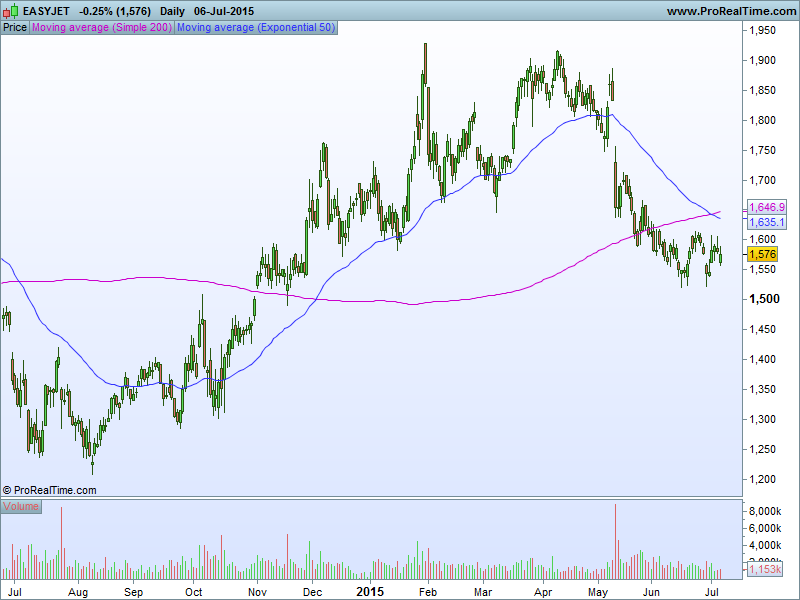
EASYJET

The share price seems to have halted its decline but I can’t say it is recovering yet.

On the 22nd July the group released a trading update covering Q3 where it was stated that after 77% of seats have now been booked for the second half of the year as a whole the group expects to grow profit before tax from £581M in 2014 to between £620M and £660M this year.

This quarter, passenger numbers increased by 6.2% to 19.1M year on year, and the load factor increased from 90.4% to 91.7% but the revenue per passenger fell by 6.8% to £64.42 to give a total revenue down 1% to £1.24BN.  The capacity growth seen was focused on Amsterdam, Hamburg, Porto, Basel and Geneva.

April was a difficult month due to the movement of Easter and the French ATC strike which together reduced revenue per seat by three percentage points and adversely affected profits by £25M.  In the other two months, the performance was better than expected through driven by trading in the UK and beach routes across Europe along with a number of revenue management initiatives.  Business passengers grew in line with expectations and sales of inclusive fares grew by 76%.

The group launched a mobile host and new iphone app during the period.  The host is now available in Gatwick and Edinburgh and provides customers with notifications at relevant points of their journey through the airport such as bag drop and gate information.  In the quarter the group took delivery of nine A320 aircraft to give a total of 90 A320s and 149 A319s at the period-end.  The net cash position has fallen by £182M year on year to £421M as a result of pre-delivery payments and the acquisition of aircraft.

During the period the group cancelled 1,463 flights compared to 648 in the prior year.  The majority of these cancellations (773) were due to the reduced capacity caused by a fire at Fiumicino airport with the French strikes accounting for a further 591.  The on-time performance was lower in the quarter, driven by issues with the ground handling supplier at Gatwick which have now been addressed.

There was a 1.1 percentage point impact on costs from the French strike and the fire at Fiumicino and airport charges increased by 0.8 percentage points in regulated airports in Italy and Germany.  Cost per seat, excluding fuel therefore increased by 2.8% on a constant currency basis but because the price of fuel has fallen so heavily, the cost per seat including fuel fell by 3.3% and the fuel bill in the second half of the year is expected to fall by between £65M and £80M, offset by a £35M adverse effect from exchange rate movements.  The efficiency programme delivered a further £7M of saving in the quarter driven by initiatives in airports and ground handling and the group are confident of delivering savings for the full year between £35M to £40M.

Going forward the group has hedged 83% of its fuel requirement for Q4 at $878 per tonne and 80% at $844 per tonne for next year with jet fuel currently trading between $550 and $750 per tonne.  The current macro environment is uncertain with the issues in Greece and Tunisia combined with the reduction in capacity at Fiumicino and continued threats of industrial action but the group still expected to grow profit from £581M last year to between £620M to £660M this year which includes the impact from the resolution of the Eurocontrol dispute which will result in an £8M additional navigation charge in Q4.

Overall then, things seem to have improved since the last update and profits are going to increase this year, mainly as a result of the fall in the price of fuel despite the previous hedging policies adversely affecting the group.

On the 6th August the group released their passenger stats for July.  In total, passenger numbers increased by 9.4% to 7,036,470 when compared to July 2014 and the load factor increased from 92.9% to 94.3%.

On the 3rd September the group released a trading update.  The load factor for August was an astonishing 94.4% and passenger numbers were a record breaking 7.06M.  They have also seen a stronger than expected unit revenue performance for the month and the outlook for September, supported by successful ongoing digital and revenue initiatives, looks good with capacity growth across the short haul network of around 6% and particular strength on UK beach routes.

The strong revenue performance has more than offset the significant cost headwinds that the business has faced so far this year, with greater than expected disruption across the network, the impact of the two fires at Rome Fiumicino airport and the one-off £8M settlement with Eurocontrol and costs associated with higher load factors.  Fuel and currency exchange rate movements remain broadly within expected ranges.  Consequently full year profit before tax is now likely to be between £675M and £700M, an increase from the previous guidance of £620M to £660M.  This all looks rather good actually, especially when it is considered that the fuel costs should come down once the more expensive hedges work their way through the system.

On the 4th September it was announced that that the Haji-Ioannou family share holding had been reduced from above 34% of the total to 33.73%.

On the 9th September it was announced that CEO Carolyn McCall exercised an option to purchase 106,978 shares  which were all subsequently sold, netting an astonishing £1.9M.  This is quite a bonus!  It is also a shame that she decided not to hold on to any of the shares.

On the 29th September the group announced that Warwick Brady, a director in the company, sold 17,500 shares at a value of £309K.

On the 5th November the group announced passenger stats for October 2015. Passengers increased by nearly 10% to 6,398,796 year on year and load factors increased from 90.9% a year ago to 93.3%. The profit guidance previously announced continued to be between £675M and £700M so all good here. Having purchased a few shares here I have almost immediately sold again as I got nervous about the fallout from the air crash at Sharm El Sheik.

EasyJet Share Blog – Final Results Year Ended 2014

Easy Jet is a short haul European low cost airline.  As well as the main brand, they also own 49% of EasyJet Switzerland. The company pays some £12.6M in order to use the Easy Jet brand. It has now released its final results for the year ending 2014.

Easyincome

Revenues increased across all markets with a £106M increase in the UK, a £79M growth in Southern Europe and a £71M increase in Northern Europe.  Various costs also increased, with fuel costs up £69M due to higher load factors on the planes, airport and ground handling increasing by £29M due to annualised costs in Italy, crew costs up £25M due to a 2% increase in payroll costs and an increase in average sector length, and marketing costs up £13M.  Maintenance costs managed to remain flat during the year as the group benefited from a renegotiated engine maintenance contract (most of the gains are non-recurring though) but there was a £19M increase in other costs, driven by the cost of wet leasing two aircraft over the summer, employee bonuses and digital development costs to give an EBITDAR of £823M, an increase of £112M year on year.  Due to an increase in aircraft dry leasing due to 17 new aircraft leases that were taken out in 2013, and tax, partially offset by a £15M favourable swing in exchange gains, the profit for the year ended at £450M, an increase of £52M.

Easyassets

When compared to the end point of last year, total assets increased by £4.482BN driven by a £259M increase in aircraft and spares, a £337M growth in money market deposits and a £59M increase in derivative financial instruments, partially offset by a £589M fall in cash levels, and a £34M decline in trade receivables.  Liabilities fell during the year as a £42M increase in deferred tax and a £25M growth in unearned revenue, which represents the seats sold but not yet flown, was more than offset by a £107M fall in bank loans, a £27M decline in accruals and a £26M fall in the maintenance provisions.  The end result was a decent £142M increase in net tangible assets to £1.713BN which seems like a strong balance sheet to me.  There were some £466M of operating leases outstanding, mostly relating to aircraft.

Easycash

Before movements in working capital, cash profits increased by £131M to £781M. The favourable movements last year in payables and receivables were then partially offset and a reduction in interest paid was counteracted by an increase in tax so that net cash from operations increased by just £1M to £702M.  This covered the capital expenditure of nine new aircraft, parts used in engine restoration and pre-delivery costs on 35 aircraft ordered during the year along with £20M for the acquisition of Gatwick landing rights from FlyBe, fairly comfortably to give a free cash flow of £257M.  The group used this to pay off some loans and bank leases with the rest going on ordinary dividends before they dipped into their reserves to pay a £175M special dividend and put some £338M into money market deposits to leave a cash outflow of £577M and a cash level at the year-end of £424M.

The improvement in profit is due to a number of factors such as the continued revenue per seat growth and higher capacity; a 1.3 percentage point improvement in the load factor; and the better than expected cost performance driven by the “Easy Jet lean programme”, one-off benefits of the CFM engine selection and the continued scale advantages of increasing the proportion of A320 aircraft in the fleet which have been introduced over the last few years with minimal reduction in yields and cost savings per seat of around 7% to 8% when compared to the smaller A319 aircraft through economies of scale.

The revenue per seat grew by 1.2% to £63.31 (1.9% on a constant currency basis) which was driven by a number of factors including the continued improvement in the mix of routes due to the ability to respond quickly to changes in demand, improved conversion and yield from more sophisticated pricing for customers through further developments in the bespoke revenue management systems, performance of allocated seating and the yield management of bag charges, the increase in load factor, and initiatives to target the business passenger.  Revenue per seat fell at Gatwick due to the purchase of FlyBe slots and the management see a good opportunity to improve revenue performance at the airport as these slots are integrated.

As touched upon above, the group has made a concerted effort to target business customers during the year and the managed business, where the group has a contractual relationship with certain corporates, grew by 10% year on year.  The group’s sales through dedicated business channels such as Global Distribution Systems, API and on-line booking tools grew by 34%.  In September 2014, a TV ad campaign was launched focusing on the business passenger offering which enabled the group to carry its highest number of business passengers in a month ever.  Furthermore, the group partnered with Sabre to enhance its booking process and renewed its distribution agreement with Travelport.  It also renewed its travel deal with the UK Houses of Parliament and won best short haul airline at the 2014 Business Travel awards.

Easy Jet is the largest short-haul carrier in the UK with a market share of around 20%.  They saw growth across a number of airports in the country with the majority of the increase coming at Gatwick due to the acquisition of FlyBe slots last year, where capacity increased by 15%.  The slots were transferred at the end of March 2014 and have been used to further build the number of routes out of the airport and increase frequencies on existing routes such as Inverness and Amsterdam.  Overall, the group increased capacity in the UK by 5.8% and launched 24 new routes during the year.

In Switzerland the group grew capacity by 6.8%, carried over 10 million passengers and now has 23 aircraft bases in the country.  11 new destinations were launched from Geneva and Basel during the year which means that they now fly 110 routes from the country.  Also during the year, Easy Jet consolidated its number one position at the two airports, increasing market share by 0.4% and 1.2% to 40.5% and 52.4% respectively.

Easy Jet is now the largest low-cost airline in France with a market share of around 14% with 26 aircraft based in the country.  During the year some 14.7 million passengers were carried over 180 routes with 24 launched in 2014.  The group was able to take advantage of the Air France pilot’s strike during the year by adding additional capacity, attracting more customers and increasing revenue by £5M.  The group launched four new routes at Bordeaux, increased frequencies on key business routes, became the largest short-haul carrier in Nice and launched two new French destinations at Strasbourg and Figari.

Easy Jet has 27 aircraft based in Italy, grew capacity by 6.2% during the year and has number one or two positions at Milan Malpensa, Rome Fiumicino and Naples, where the base was only opened in March 2014 with two aircraft.  They also have a strong position in Venice, Olbia and Pisa.  It is believed that further opportunities exist in the country given the current market dynamics and the position the group have already established in the market.

In Germany, Easy Jet’s capacity grew by 6.7% and 11 aircraft are now based at the country in Berlin and Hamburg, where the base was launched in March with two aircraft.  The focus so far has been on Berlin where the company has nine aircraft and a 62% market share at Schonefeld airport and it has taken market share from Lufthansa in the city.

Easy Jet carried about four million passengers in Spain and Portugal during the year and with a market share of around 13% is the second largest carrier in Lisbon with four aircraft based at the airport.  In Spring 2015 the group is planning on opening its second Portuguese base at Porto with two aircraft.  Spain is also an important destination in the network and the group have an 8% market share in the Spanish short haul market.  In Netherlands, the group is the second largest carrier in Amsterdam with a market share of around 9%.  In Spring 2015 the group will open a base at Schiphol airport with three aircraft.

Clearly one major driver of customers to the Easy Jet proposition is the value offering. The strong operational and cost performance is built around ensuring aircraft depart and arrive on time.  The first half of the year saw some challenges for the group’s operations including the Italian Air Traffic Controllers strike in October, a power outage at Gatwick on Christmas Eve, Air Traffic Control computer systems failure in the UK, the adverse weather conditions in December across Northern Europe and the French Air Traffic Controllers strike in March.  The second half of the year also saw some operational issues including recurring industrial action in Italy and France, unusually prolonged continental summer thunderstorm periods and the transitional impact of the group’s large increase in capacity at Gatwick following the acquisition of FlyBe slots.  All of these issues resulted in a two percentage point reduction in on-time performance levels for the year as a whole to 85%.

During the year, the lean programme delivered £32M of sustainable savings, of which £18M was delivered in the second half.  Savings were focused on ground handling contracts and agreements with non-regulated airports.  Further savings were delivered by engineering initiatives and fuel burn projects including the benefit of more aircraft fitted with Sharklets (which improve fuel efficiency) in the fleet.  The process also highlighted that there are many more cost saving opportunities for the group to deliver which will form the basis of a plan to deliver £30M to £40M in sustainable savings per annum over the next five years.

After several years of low market capacity growth, the European short-haul market has returned to more normal levels of capacity growth.  In the year to September the total number of short-haul seats increased by 3% on the group’s markets with EasyJet experiencing seat growth above the market at 5.1% during 2014 as a whole.  It is expected that capacity and demand will be broadly aligned over the next five years.

During the year the group has exercised its remaining 35 options and purchase rights over current generation Airbus A320 aircraft for delivery between 2015 and 2018. The group is contractually committed to the acquisition of 170 Airbus A320 family aircraft with a total list price of $14.6BN with 20 being delivered in 2015, 50 between 2016 and 2018 and the remaining 100 between 2017 and 2022.  They now have number one or two market positions at primary airports including Gatwick, Geneva, Paris Orly, Paris CdG, Amsterdam and Milan Malpensa.

During the year the group has seen regulatory progress at Gatwick where they have reached a long-term agreement that provides a good base for savings and growth over the next seven years.  In addition, governments have apparently started to reconsider how airports are regulated in France and Switzerland. There have been significant increases in charges at Rome Fiumicino airport, however, where the airport has structured charges in a way that discriminates against point-to-point airlines (I suppose to try and protect Alitalia’s position) and this has been accompanied by continued pressure on regulated charges at a range of other airports across Europe.

The group is susceptible to changes in the price of fuel and currency movements so they hedge between 65% and 85% of the next year’s fuel requirements and between 45% and 65% of the following year’s anticipated foreign currency requirements.  A £10 per tonne movement in the cost of fuel impacts the fuel bill by $3.5M, a one cent movement in £/$ impacts profits before tax by £1.3M and a one cent movement in £/€ impacts profit before tax by £1.1M.

There were a number of board changes with Dr. Andreas Bierwirth and Francois Rubichon joining the board.  Andreas is currently CEO T Mobile Austria and has previously served on the board of Austrian Airlines whereas Francois used to be deputy CEO and COO at Aeroports de Paris so their experience should prove useful going forward.  Just after the year end David Bennett and Professor Rigas Doganis will retire from the board having both served for nine years.  It has to be said that in my view the executive directors are very well paid, perhaps excessively so.  Including the LTIP scheme, the CEO earned £7.7M last year which is an incredibly generous, perhaps greedy, amount.

It is interesting to note that some 45% of the total shareholding voted against the remuneration policy.  Clearly one factor for this is the huge salaries being earned by the executive team but there is a little more to the story than this.  That 45% corresponds to just two major shareholders, none of them institutional, and a look at the shareholder register suggests that the shareholders voting against the policy are Sir Stelios Haji-Ioannou and his family, who are the founders of the group.

Clearly there are a number of potentially significant risks that affect Easy Jet, being in the airline business.  There is always the low risk of a major accident or terrorist threat which may damage the reputation of the airline.  More likely and less serous is the impact of mass disruption including prolonged adverse weather, volcanic dust clouds, strike action and pandemics which would affect the ability for people to fly.  Additionally, although the fact the group operates one type of plane has its advantages with regards to costs, it does potentially leave the group susceptible to the failure of their one supplier, Airbus, or the A320 aircraft, although this does seem unlikely at the moment.  Additionally, although the position is fairly well hedged, sudden significant increases in the fuel price or a weakening in the exchange rate against the US dollar would have a significant effect on fuel costs and a change in the general macroeconomic environment could reduce the number of people travelling, although as a low-cost provider this would probably affect Easy Jet less than the legacy carriers.

Going forward, the group expects to grow capacity by around 3.5% in the first half of 2015 and by around 5% for the full year.  Forward bookings for the first half are slightly ahead of the prior year with the investment in the new slots at Gatwick growing capacity at that airport by 10%.  As a result of the continued investments, revenue per seat is expected to be broadly flat in the first half of the year and costs per seat are likely to increase by 2.5% in the first half and 2% for the year as a whole, driven by increased crew costs ahead of new base openings, charges at regulated airports in Italy and Germany, increased navigation charges and increased maintenance costs due to the ageing of the fleet.  It is estimated that the fuel bill for the half year is likely to fall by between £12M and £22M and on a full year basis, the fall is expected to be between £22M and £70M.  In addition, exchange rate movements are likely to have a £5M favourable impact in the first half and £20M for the full year.

The board will continue to keep the balance sheet under review and intends to make further returns of capital to shareholders as further funds accumulate – I like the sound of that.  As for the regular dividend, the board has decided to increase the pay-out ratio from one third of profit after tax to 40% of profit after tax.  This year this represents a dividend of 45.4p, an increase of 36% over last year’s ordinary dividend with next year forecasted to yield 3.2%.  Including operating leases at seven times, net debt stood at £446M at the year-end compared to £156M this time last year (actual net cash was £422M).  This represents a gearing of 17% compared to the target of between 15% and 30%.  It seems as though the group is looking to reduce these leases going forward, which is a good strategy in my view as they are targeting 20% leased aircraft compared to the current level of 32% leased aircraft.  At the current share price, the shares trade on a P/E ratio of 14 which reduces to a good value 11.4 on next year’s consensus forecast.

Overall then, this seems to have been a good year for Easy jet.  Profits are up, as are net assets and underlying operational cash flow, although the actual net cash from operations was broadly flat due to favourable working capital movements last year.  In any event, the group throws enough plenty of free cash and the balance sheet looks good.  During the year, capacity increased as did revenue per seat with allocated seating and the targeting of business travellers aiding progress.  The newly acquired slots in Gatwick have not been fully integrated and next year should benefit from the full year of their contribution.  New bases are to be opened up in Porto and Amsterdam which should further increase capacity next year aided by a general improvement in the European aviation market.

The on-time performance suffered from a plethora of one-off items, with strike action being a particular issue throughout the year but this is just one of the many risks that affect companies in this industry.  Next year, the profit per seat is not likely to be that far ahead of this year as flat revenues coincide with increases in crew costs, regulation charges at certain airports and maintenance costs, offset by a reduction in fuel costs.  The forward P/E of 11.4 looks decent value though and the 3.2% dividend yield is nice to have so I think in conclusion these shares offer decent value at the moment.