Arbuthnot Banking Share Blog – Final Results Year Ended 2014

Arbuthnot Group wholly owns private bank Arbuthnot Latham and owns just over 50% of retail bank Secure Trust Bank.  Arbuthnot Latham provides a private banking and wealth management service consisting of private banking that comprises of current accounts, deposit accounts, loans, overdrafts and foreign exchange.  Each client deals with a dedicated private banker who provides an individual tailored service.  It also includes Wealth Planning, which is built on long-term relationships and bespoke financial strategies.  The service is independent and fee, not commission based with clients receiving a service covering estate and tax planning, pensions and wealth preservation and generation.  The discretionary investment management service comprises asset management, developing tailored investment strategies to ensure that each client’s specific investment objectives are met.

Secure Trust Bank is a UK retail bank and its core business is to provide banking services including a range of lending solutions and deposits.  It also provides fee-based current accounts to UK customers who may not be well served by other banks.  Consumer Finance offers its customers lending in the areas of motor finance, retail finance and unsecured personal lending.  Business Finance provides SME’s funding for asset finance, invoice finance and real estate finance.  The current account includes a prepaid card and charges a monthly fee of £12.50 with customers being able to earn rewards at participating retailers.   Finally, the savings offering is a combination of instant access accounts, notice deposits and deposit bonds.  The company has now released its final results for the year ending 2014.

ARBBincome

Interest income increased by some £25.2M when compared to last year, driven by a £23.8M increase in interest from loans to customers, and a £908K reduction in interest expense.  Net fee income also increased, up by just £1.1M as a £2.9M fall in fee expenses and an £890K increase in trust fee income was partially offset by a £2.7M decline in PPI insurance income.  Underlying admin expenses increased year on year with a an £8.7M increase in staff costs (not including share based payments) and a £3.1M growth in other admin costs but there was the lack of a number of one-off gains that occurred last year when the group got £1.2M in rental income and £6.5M from the sale of a building.  .  All this meant that, after a £1.3M increase in tax, the profit for the year came in at £17M, an increase of £5.5M when compared to 2013.

ARBBassets

When compared to the end point of last year, total assets increased by £355.8M driven by a £197.8M increase in mortgages, a £132.5M growth in commercial loans, a £72.2M increase in debt securities held to maturity and a £51.1M growth in other loans to customers, partially offset by a £77.1M fall in cash held at central banks and a £73.2M decline in loans to banks.  Liabilities also increased during the year due to a £159.5M growth in term deposits from customers, a £47.1M increase in current account deposits, a £29.9M growth in notice account customers and a £25.7M increase in deposits from banks.  The end result of this is an £88.4M growth in net tangible assets to £162.3M.  There are operating lease commitments of £21.4M.

ARBBcash

Most of the cash was gained through interest receipts with a £25.6M increase in interest received and just a £1.4M increase in fee income.  We also see that there was no other income compared to the £7.7M that occurred last year (relating to the sale and leaseback of the HQ).  Cash payments to employees and suppliers increased by £10.7M and tax was slightly higher to give a cash flow from profits of £31.2M, an increase of £9.9M year on year.  The net cash from operations was heavily negative, however, widening by £129.5M to give an outflow of £163.8M.  This was because the increase in loans to customers was not covered by the increase in amounts due to customers.  We then see a further £7.8M spent on property plant and equipment and a net £72.2M being spent on debt securities to give a cash outflow of £244.8M before financing.  The group then increased borrowings by £25.7M and gained £48.8M from a placing at the subsidiary, One Trust Bank along with £24.3M in proceeds from selling shares in One Trust.  The end result is a cash outflow of £150.3M to give a cash level of £147.8M at the end of the year which is clearly not a sustainable situation.

Arbuthnot Latham reported pre-tax profit of £3.6M compared to £7.7M last year, although last year’s result was dominated by the £6.5M gain generated by the sale and leaseback on the new HQ and underlying profits more than doubled.  The underlying business delivered a year of growth across all key areas.  The core business of private banking and wealth management benefited from the evolving market conditions and the move into the new HQ in London towards the end of the year was a sign of the development of the business and the continued expected growth going forward.

The business has been focusing on key sectors of the wealth market in the UK through the recruitment of new senior bankers and the growing disenchantment of wealthy clients with the ever increasing volume of changes has resulted in some of them moving their business to Arbuthnot.  Excluding the acquired portfolio, the client loan book grew by 26% to £430M and client deposits grew by 12% to £586M.  As a result of the higher number of quality private banking clients, the overall costs of deposits fell during the year.  In Wealth Management, there was a 26% increase in assets under management to £666M.

The bank is developing its proposition outside London.  The office in Exeter has grown, a new office in Manchester has been opened and the Dubai office completed its first year of operation.  In Dubai, there has been strong business strength in a short space of time reflecting the dynamic nature of the local market and its long term potential.  Towards the end of the year, the bank completed the purchase of a portfolio of residential mortgage loans.  The mortgages were being sold by the administrator of the Dunfermline Building Society and they are geographically diversified.  They also offer the group a stable asset to offer as collateral to participate in the Bank of England’s sterling monetary framework, gaining access to a further source of liquidity.  The portfolio was purchased at a discount to face value and came onto the balance sheet at £106M.  It had little impact on the results this year but will be immediately accretive in 2016.

Secure Trust Bank recorded pre-tax profits of £26.3M, an increase of 53% when compared to the previous year.  The Bank’s lending portfolios achieved double digit growth with advances to customers increasing by 59% to £622.5M at the end of the year and total new volumes growing by 79% to £545.9M.  Motor Finance increased by 20% to £137.9M as the business continued to service the top 100 UK car dealer groups and strengthened its relationship with specialised motor intermediaries.  Retail Finance grew by 37% to £156.3M with an encouraging performance of V12, acquired in 2013.  The launch of its season ticket offering was well received and the funding strength provided by the group enabled V12 to pitch to larger retailers with a new strategic relation with AO.com being a good example of this. Personal unsecured lending balances including Everyday Loans increased from £159.2M to £181.4M and these portfolios are currently being managed to maximise return rather than outright growth, although the newly launched guarantor loan offering should supplement growth rates in 2015.

The bank launched its SME division during the year and Real Estate Finance has quickly developed a portfolio of loans totalling £133.7M largely secured on residential properties and towards the end of the year the bank also began its invoice finance business via STB Commercial Services.  The flow of new business on this product exceeded the initial expectations and the portfolio ended the year totalling £5M.  In addition, asset finance was commenced via a partnership with Haydock Finance who provides a full business outsourcing service.

The bank has been on a good trajectory of growth and the management teams have been careful to ensure that it is well controlled.  Improvements have been made to the risk and compliance teams and a new treasurer, chief internal auditor and chief technology officer have been appointed.  The bank is funded by the retail deposit market and during the year customer deposits increased by 39% to £608.4M and in addition, a £50M share placement was completed which increased the capital base of the bank by 44%.  During the year the bank has received several external accolades including being the only UK bank to hold the Customer Service Excellent award which replaced the kite mark and it has also received the 4 star mark by the Fair Banking Foundation.  The Current Account ended the year with 20,792 accounts compared to 22,860 in 2013.

Although impairment losses increased by 3%, compared to the increase in the loan book this represents a good outcome.  There were a number of reasons for this.  Firstly, a significant proportion of the increase in lending was as a result of the start-up of the Real Estate Finance Division.  This lending is fully secured at LTVs of around 60% so losses on this portfolio should be minimal and due the short time that it has been running, it is too early for any of its lending to have become impaired.  Secondly, as a result of the market benchmarking exercise for non-performing loans, the business concluded that the provisions held against its debts in long term recovery were excessive so the provisions were released.

During the year the company sold over one million shares in its subsidiary, Secure Trust Bank that resulted in a net gain of £24.3M.  In addition, Secure Trust issued over two million new shares, gaining it £48.8M.  This had the effect of reducing the company’s holding from 67% to 52% which is a bit of a shame in my view.

The company is controlled by founder, CEO and Chairman Henry Angest who owns nearly 54% of the total share capital.  The other large holders are made up of various institutions such as Unicorn and Prudential.  I have to say that the board remuneration looks very generous with the highest paid directors getting £3.7M and £3.6M during the year.  This was mostly due to LTIP awards but seems overly excessive to me even though the company seems to be performing well (bankers, huh?).  At least none of these were Mr. Angest which really would have sent alarm bells ringing.

The group seems to have a decent capital ratio with the core tier 1 capital ratio improving from 14.4% to 18.2%.  In addition the group does not seem to have much exposure to exchange rate movements or interest rate changes  Going forward, the economic outlook remains uncertain with a continued weak Eurozone economy and the central banks committed to expansionary monetary policies.  Despite this, the group is making good progress and the board remains optimistic that this can continue.

At the current share price the shares are yielding 1.9% which increases to 2% on 2015’s consensus forecast which is decent rather than spectacular.  At the current share price, the shares trade on a rather expensive 25.2 times earnings but this falls considerably on next year’s forecast of 13.8 which starts to look rather good value.

Overall then this looks like a great year for Arbuthnot.  Profits were up considerably despite a one-off gain last year from the sale and leaseback of the HQ – something I am not actually a fan of but I suppose the group must have been desperate for the cash to expand.  Net assets were also up as the group purchased a large mortgage portfolio and underlying cash profits increased, although operating cash flow was heavily negative due to the rapid expansion in lending to customers.  Operationally, Arbuthnot Latham is by far the smaller contribution to profits but underling income from that bank did double during the year while Secure Trust is the main driver of earnings which had a great year, opening its SME banking operations.

The bank is funded by retail deposits and seems to take quite a conservative view on funding which is something I really like, but having said that they do seem to be displaying some short-termism in their actions with the sale and leaseback of the HQ and the sale of a portion of their Secure Trust holding.  That bank is going from strength to strength and is a major source of profit so why are they selling down their holding?  I don’t really understand that to be honest.  Overall though, the bank is performing very well, the dividend yield is decent enough and the forward P/E doesn’t look too taxing so I am thinking of taking a position here.

On the 15th May the group and Secure Trust released trading updates for Q1.  As far as the group is concerned, it has started the year well.  Both banks have traded robustly and have delivered strong growth in lending volumes.  Overall, customer loan balances finished Q1 over 60% higher than at the same point of last year.  The board believes they are well positioned to make further progress during the year.

There is a bit more detail on the Secure Trust update.  The Consumer Finance business continued to make significant progress compared to Q1 last year.  New lending volumes in Retail Finance and Motor Finance have grown 121% and 22% respectively.  In the SME lending market they continue to see strong demand for their products.  Momentum is building in line with management expectations and lending balances now exceed £200M.  The Real Estate Finance business has a significant pipeline of new opportunities and the commercial finance and asset finance businesses continue to develop as planned.

This all sounds very positive.

ARBUTHNOT

he share price hasn’t really made much progress this year but the recent weakness could be a bit of a buying opportunity?

On the 4th December the group announces that Secure Trust Bank has agreed on the sale of its branch based non-standard consumer lending business, Everyday Loans, to Non Standard Finance. The total consideration is for £127M and comprises £107M in cash and £20M in NSF shares and on completion, NSF will repay the £108M intercompany debt to STB with the expected profit on disposal being at least £115M. In the view of the CEO of Secure Trust, the unsolicited approach for the business presented an attractive option to accelerate the strategy of proportionately reducing their exposure to personal unsecured loans products whilst investing in the strongly growing motor retail and SME lending activities.

ELG represents about £102M of the £189M receivables of the bank’s consumer lending division and generated revenues of £40M last year with profits of £12.9M. It has net assets of just £7M. The acquisition is being funded by way of a placing and debt facilities, of which £30M has been provided by Secure Trust in the form of a three year loan.

While in the short term the disposal is expected to be earnings diluting, the board is confident that the proceeds can be invested to accelerate the bank’s growth prospects and secure new income streams. They are continuing to see strong growth in the Motor, Retail and SME lending activities and the capital generated by the disposal will support the ongoing increase in customer lending balances which now exceed £1BN. The bank has reiterated that it expects 2015 results to be in line with market expectations, after taking into account the deal costs already incurred.

Overall then, this seems like a good price for the business and hopefully the proceeds can be invested sensibly.

Utilitywise Share Blog – Interim Results Year Ending 2015

Utilitywise has now released its interim results for the year ending 2015.

UTWinterimincome

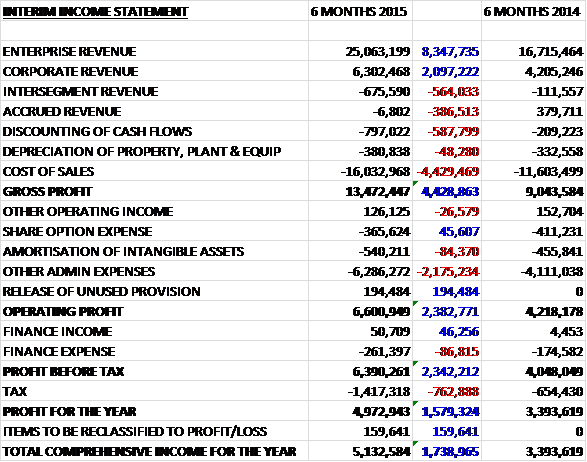
Revenues increased across both sectors year on year with enterprise revenue up £8.3M and corporate revenue increasing by £2.1M.  Cost of sales also increased to give a gross profit some £4.4M ahead of the same period of 2014.  We then see admin expenses increase, partially offset by the £194K release of an unused provision to give an operating profit some £2.4M higher.  Finance expenses increased somewhat and the tax bill almost doubled to give a profit for the year of just under £5M, an increase of £1.6M year on year.

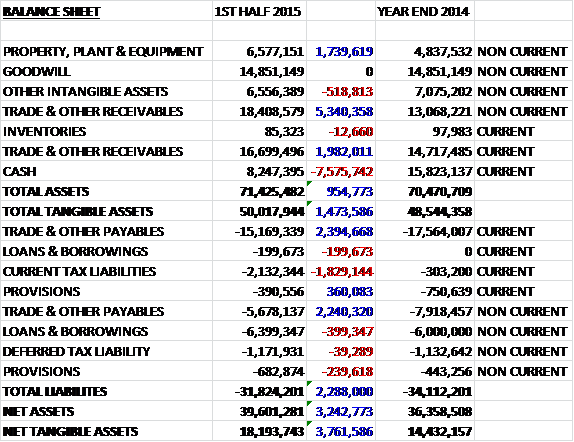
UTWassetsinterim

When compared to the end of last year, total assets at the half year point were some £955K higher driven by a £7.3M growth in receivables as the group concentrated on renewing existing customer contracts, and a £1.7M increase in the value of property, plant and equipment partially offset by a £7.6M fall in cash.  Liabilities fell during the period as a £1.8M increase in current tax liabilities was more than offset by a £4.6M decline in payables to give a net tangible asset level of £18.2M, an increase of £3.8M over the past six months.

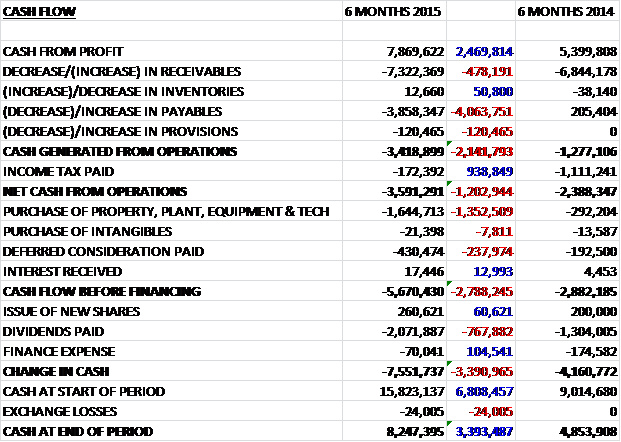
UTWcashinterim

Before movements in working capital, cash profits increased by £2.5M to £7.9M.  This was wiped out, however, by the £7.3M increase in receivables and the £3.9M decrease in payables to give a net cash outflow from operations of £3.6M, a decline of £1.2M year on year.  The group then spent £1.6M on the purchase of property, plant and equipment relating to the new head office, and £430K on deferred consideration, along with £2.1M on dividends to give a cash outflow of £7.6M for the year and a cash pile at the period end of £8.2M.  Hopefully, the group will begin to recoup some of those receivables soon as they will run out of cash at this rate!  It is worth pointing out, however, that the group does seem to have a cash outflow in the first half to be reversed in the second half.

The Enterprise division recorded a profit before tax of £5.1M, an increase of £1.8M year on year.  This growth was achieved despite operating from a similar revenue generating average headcount before the office move.  During the period, there was a consistent renewal rate above 80% in the division.  A feature of the first half was an increase in revenue from contract extensions (85% of revenues are recognised at the renewal date) as following the introduction of new, longer term energy supply contracts by several energy suppliers, the group focused on extending and renewing energy contracts for its existing customers.  The extension of these contracts for existing customers helped secure revenue, profit and cash flow over the longer term and secured price certainty for customers along with generating revenue for Utilitywise.  In all, renewal and extension revenue represented about 42% of the division’s sales in the period compared to 32% in the first half of last year.

For the contract renewals, 85% of revenue is recognised when the contract is extended and they are not included in the company’s secured pipeline.  After the period end, the group has increased efforts towards the acquisition of new customers.  During the half year, the total customer base increased by 23% to 22,048 and since the period end, the group have secured 1,061 new customers with March representing the highest monthly acquisition performance ever.  The Corporate division recorded a profit before tax of £1.4M, an increase of £935K when compared to the first half of last year.  This growth was supported by significant customer wins in the medium sizes business space and the renewal rate increased to 98% which sounds impressive.

The two divisions have differing growth prospects with the Enterprise growth being fuelled by the addition of headcount as the group acquires new customers in a market that remains large compared to the current customer count.  The Corporate division operates in a much more mature market and some of the growth initially is driven by the transfer of some of the larger customers in the Enterprise division in to the Corporate account managed customer function as their contracts come up for renewal

As far as the KPIs are concerned, the group increased the number of energy consultants by 29% to 449 and the total number of customers increased by 23% to 22,048.  The secured pipeline fell by 1%, however, to £23.5M although this did then increase after the period end to some £26M.

The move to the head office was completed on schedule on in budget which now enables the group to accelerate the recruitment of additional staff in order to drive future growth.

The group is still susceptible to a small number of energy suppliers who make up a large amount of revenues with the two largest accounting for 28% and 15% compared to 24% and 18% respectively during the same period of last year.  The relationship with these companies remains strong, apparently, and the group has secured new commercial terms with a number of suppliers during the half year.

Going forward, the board believes a significant market opportunity exists for continued profitable growth and they look forward to a second half of continued positive momentum.  They consider that they are still at an early stage in terms of their growth potential and there are some exciting opportunities ahead, for example in the water market when it de-regulates in 2017.  In the meantime the group is continuing to build their energy services capability and recent government initiatives such as the Energy Savings Opportunity Scheme have presented opportunities to engage with large corporate clients to assist them in their regulatory compliance and reduce energy consumption.  The second half of the year has started well and performance over the period is predicted to continue this positive momentum.

After a 55% increase in the interim dividend, at the current share price the shares are on a rolling dividend yield of 1.7% which increases to 2.1% on the full year consensus.  At the end of the half year, the group was in a net cash position of £1.6M compared to a net debt position of £100K at the same point of last year, although immediately after the period end the group made a £4M PAYE payment that was related to share awards and then made the acquisition so they will now be back in a net debt position.

After the period end the group acquired T-mac Technologies Ltd for an initial consideration of £10M, £6.25M in cash with the rest in shares.  A further £12M could become payable once earn out accounts have been finalised with 70% of this in cash and the rest in new shares based upon six times EBITDA above a hurdle for the years ending the first and second anniversary of completion.  In 2015, the acquired group reported EBITDA of £300K on revenues of £3.6M.  The initial cash consideration is being funded by a new £25M revolving credit facility, of which £13M will be immediately drawn to fund the acquisition and to refinance the group’s existing facilities.

T-mac has cloud based technology that provides business energy management systems that enable clients to monitor and reduce their utility consumption, make savings and help them comply with government legislation.  It services both SME and industrial and commercial customers in the retail, education manufacturing, transport and leisure sectors.  Whilst this does seem like a good fit for the group, it does seem as though it has paid a lot of money for a company that only earned £300K in EBITDA last year.

On the 8th May it was announced that Adam Thompson sold 450,000 shares in the company which seem to have been purchased by non-executive Jeremy Middleton.  The transaction was worth a whopping £990K and following the announcement, Jeremy owns 2.99% of the total share capital and Adam Thompson owned 2.57%.

On the 3rd June it was announced that the group had been granted a European patent for Edd:e which offers business a measurement and verification tool that helps them make informed decisions about the actions they need to take to save energy.  On average it shows customers ways to reduce energy consumption by 27%.

On the 5th June it was announced that non-executive director Jeremy Middleton acquired 300,000 shares at a value of £787K.  He really seems to be accumulating at the moment and now has 3.4% of the total share capital which seems like a decent vote of confidence.

On the 10th June the group entered into a three year partnership with the RBS Mentor team to offer energy efficiency advice to customers.  RBS Mentor already offers business customers support with employment law, HR protocols, health and safety and environmental management so this adds energy management to the list.  Utilitywise will provide on-site energy audits to help business involved in the scheme better understand potential energy savings.  The financial implications of this deal are unclear but I would have thought this scheme would enable to the group to reach significantly more customers.

On the 22nd June it was announced that Jeremy Middleton had purchased yet more shares.  This time it was 703,603 at a value of nearly £1.9M.  This is a very significant purchase and means that he now owns 4.3% of the total equity of the company.

Overall then, this seems like another period of progress, profits and net assets are both up in the six months but operational cash flow as negative due to the increase in receivables from the focus on renewing contracts where the cash receipts are split over a few years.  Hopefully this situation will reverse once these contracts start paying out in cash.  The group still relies very heavily on one customer, accounting for more than a quarter of all revenues so an investment here clearly has risks which have been amplified by a rather expensive looking acquisition.  The shares do yield about 2.1% now though which is decent if unexciting and the good start to the year plus the accumulation by Jeremy Middleton is bullish.  In conclusion I think I might look to buy some shares here.

UTILITYWISE

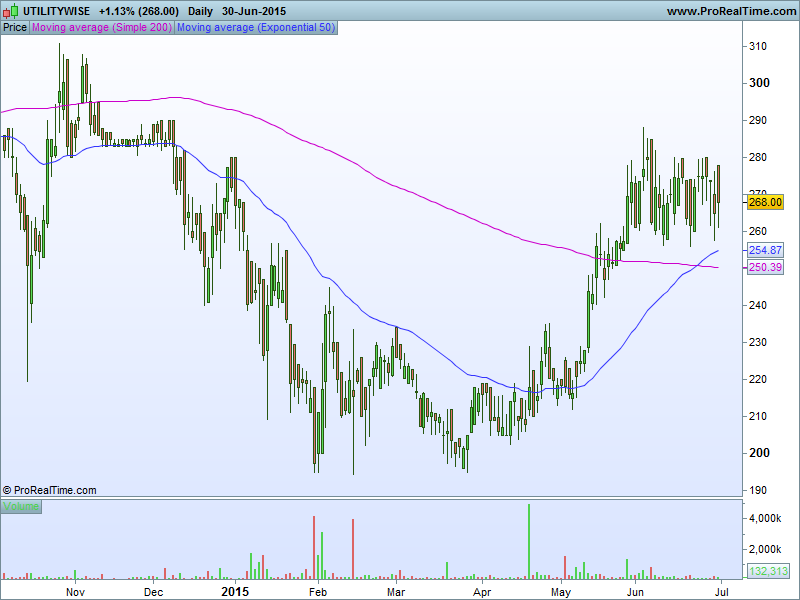
The share price seems to have consolidated recently having climbed from its lows earlier in the year.

On the 12th August the group released a trading update covering the full year to 2015.  Revenue for the period is expected to be slightly ahead of market expectations at about £69M, representing growth of about 42% year on year but the important bits are that EBITDA is expected to be slightly below market expectations due to the increased headcount, the initiation of an ecommerce capability, selected European trials and “strengthening” the management team.  Also, of note given the fact that the company books revenues years in advance of actually receiving the cash in some cases, the net debt at the year-end increased to £7.5M.

In the Enterprise Division, the levels of new business in H2 have been strong with contract extensions and new customer acquisitions with the latter increasing in Q4.  The group also benefited from a continuation of revenue from existing customer contract extensions while the additional headcount started to contribute to revenue and the new customer acquisition focus gained momentum which should be a primary driver of growth in the division going forward.  The revenue pipeline that has been secured but not yet recognised stood at £26.2M at the year-end compared to £23.5M at the half-year point.

The Corporate division performed well in the second half and alongside the procurement activity the group is apparently capitalising on revenue opportunities from the EU’s mandatory ESOS initiative together with other adjacent revenue streams including the recently announced RBS Mentor scheme.

At the same time as the above announcement, the group announced that Andrew Richardson, deputy CEO tendered his resignation after spending the last six years at the company to allow him to “take a break from work and to pursue other interests”.   Additionally, Steve Atwell has joined the board as MD of the Enterprise division having joined the group from Sage where he was MD of their SMB business across the UK and Ireland.

In all, the EBITDA miss is disappointing but not that detrimental to the investment case in the long term.  What is more of an issue is that is seems the group is still unable to make any cash.  I will have a closer look when the results are released in October but there is nothing above that makes me want to dip a toe in here.

On the 26th August the group announced that non-executive Paul Hailes had acquired 11,667 shares at a value of nearly £18.5K.  He now owns 45,001 shares in the company.  This is not a massive purchase but good to see a bit of director buyers at these low prices.


Utilitywise Share Blog – Final Results Year Ending 2014

Utilitywise is a utility cost management consultancy offering energy procurement, energy and water management products and services to its business customers throughout Europe.  They provide services to its customers designed to assist them in achieving better value from their utility contracts, reducing their energy and water consumption and lowering their carbon footprint.  Services include energy procurement, energy and water management, energy and water efficiency, carbon management, energy and water saving product installation and project management.  They have now released their final results for the year ending 2014.

Before I start, I want to have a bit of a rant.  The annual report and general shareholder facing financial reporting is one of the most awkward to use/read that I have seen.  First of all, I found it very difficult to find the interim results on the website, although the annual report was easy enough to see.  The report itself, though, has two pages to each A4 sized sheet which makes the writing very small and hard to read.  In addition, why do companies insist on using coloured backgrounds and non-black text?  Who decided that a red background with white text was going to be the best idea? The group also made a mistake in last year’s accounts and failed to include rental payments of £510K in their lease payment disclosure. Anyway, rant over, hopefully the financial performance is a bit better.

The group provides services through negotiating rates with energy suppliers on behalf of business customers and generates revenues by way of commissions from those suppliers.  This revenue is recognised when the contract between the customer and supplier becomes live and are calculated based on expected energy use by the business customer at agreed commission rates.  The cash receipts from these sales can be received before the date that the contract goes live or spread over the term of the contract between the energy supplier and the customer, which can be up to three years.  Accrued revenues relate to these commissions earned and not yet invoiced or paid.

The group also earns revenue from the sale of energy management products to business customers and contracts for on-going services.  Energy management product revenue is recognised as soon as the work has been completed and for on-going service contracts, the revenue represents the value of work done in the year with revenue for contracts for on-going consultancy services being recognised as it becomes due to the group as services are delivered.

There are two business segments that are reported on in the group.  The Enterprise division derives its revenues from the commissions earned from energy suppliers for contracts with small and medium sized business customers throughout the UK, Ireland and some European markets.  The Corporate division derives its revenues from energy procurement of larger industrial and commercial customers, providing an account care service and offering a variety of utility management products and services designed to assist customers manage their energy consumption.

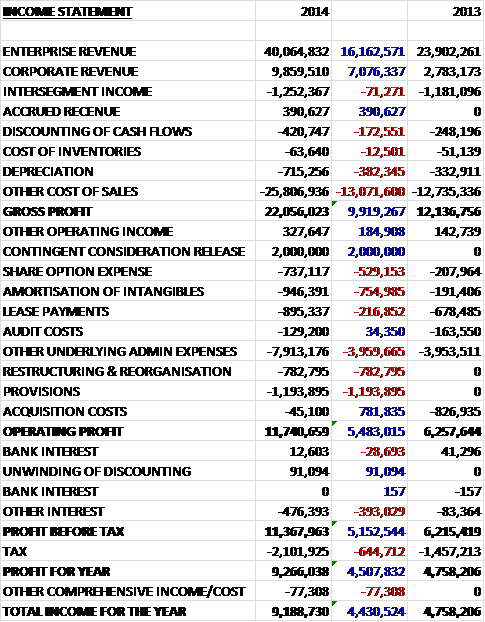
UTWincome


When compared to last year, revenues increased across both business sectors with Enterprise revenue up £16.2M and corporate revenue up £7.1M giving rise to a 93% overall, although like for like revenues were “only” up 62%.  We also see an increase in cost of sales to give a gross profit £9.9M ahead of 2013.  There was a one-off gain of £2M relating to a contingent consideration release which was offset by a £783K charge for restructuring and a £1.2M provision.  Underlying admin costs were also up, with increases seen in share option expenses, amortisation and lease payments to give an operating profit of £11.7M, an increase of £5.5M.  After an increase in “other” interest and a higher tax charge, the profit for the year was £9.3M, a £4.5M increase year on year.


UTWbalance


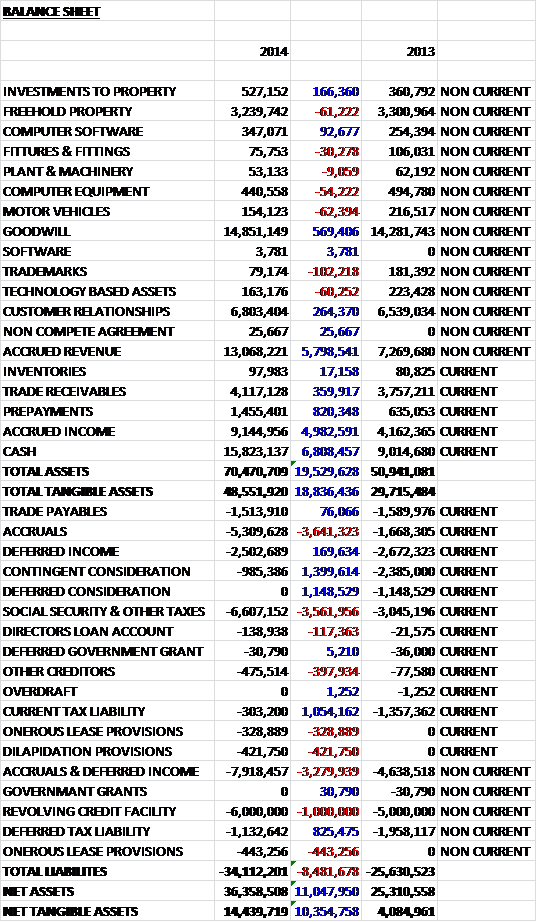
When compared to the end point of last year, total assets increased by £19.5M, driven by a £6.8M growth in the cash level, a £10.8M increase in accrued income, and an £820K increase in prepayments.  Liabilities also increased during the year as a £6.8M increase in accruals & deferred income, a £1M growth in the revolving credit facility and a £3.6M increase in social security and other tax payables was partially offset by a £1.4M fall in contingent consideration, a £1.1M decline in deferred consideration, a £1.1M fall in the current tax liability and an £825K decrease in the deferred tax liability.  The end result of all this is a £10.3M growth in the net tangible asset position at £14.4M.  It is worth noting, though, that  this corresponds to a significant increase in outstanding operating leased which now stand at £15.8M due to the new head office but these are mostly long term lease commitments with current commitment standing at just £772K.

UTWcash

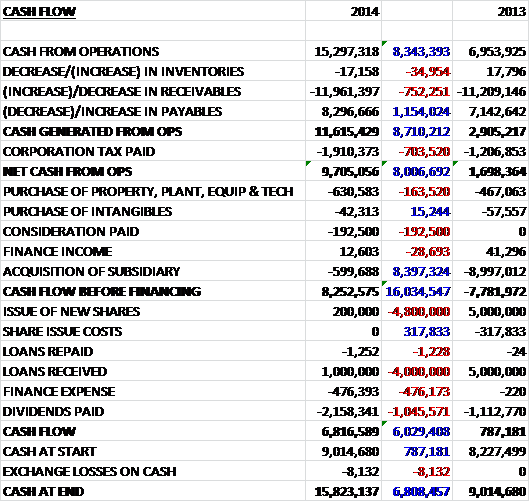
Before movements in working capital, cash profits increased by £8.3M to £15.3M.  This was eroded somewhat by a large increase in receivables, and a small growth in tax to give a net cash from operations of £9.7M, a growth of £8M year on year.  This cash easily covered capital expenditure and the small spend on an acquisition to give a free cash flow of £8.3M.  The group then took out £1M more in loans and paid dividends of £2.2M give a cash flow of £6.8M and a cash pile at the year end of £15.8M.  This looks to be very impressive but I’m not sure why more loans (albeit fairly modest amounts) are being taken out if cash flow is this strong – there are currently undrawn facilities of £3M.

Profit before tax at the Enterprise business was £6.3M, an increase of £500K year on year and profit before tax at the Corporate business was £1.7M, an increase of £200K when compared to last year.  The KPI’s are quite interesting and don’t seem to include the usual EPS/revenue/margin metrics.   The number of energy consultants increased from 281 to 363, the number of contracts secured increased by 36% 37,824 and the future secured revenue grew by 70% to £28.2M which all seems good, although I would have thought that hitting the target of one of the KPIs would probably filter through to the others too.

Given the nature of the services the group offers, it is clear that actual revenue earned from commission is dependent on the amount of energy actually used by the customer.  The group has determined that there is a likely variability of 15% but if the usage varies by more than that, there may be an impact on revenue – with each extra 1% potentially affecting revenue by the tune of £421K.  Due to the way the group earns commission in the Enterprise segment, they are very reliant on a small number of energy suppliers.  One energy supplier accounts for some 36% of revenue with another one accounting for 15%.  Clearly this leaves the group very susceptible to any changes in their agreement with that one large customer.

The group has continued to invest in its IT systems and processes to support further growth, and this has included the development of Quantum, the core CRM solution.  Additionally they have developed the system to support their presence in the French and German markets and the recent acquisitions have enabled them to invest further in Energy Services with improvements to their Edd:e sub-metering solution that is now fully integrated in to the multi-utility reporting platform “Utility Insight”.

There were a number of exceptional items during the year, many relating to the costs incurred in the acquisition of Icon Communication Centres and other aborted acquisition costs.  There were also settlement payments of £469K, costs of £167K incurred in the set-up of a new head office which will be occupied in the next financial year as well as a dilapidations provision and an onerous lease provision for the current premises of £422K and £772K respectively.  The £2M credit arose from the release of deferred consideration where earn out criteria were not met, so I suppose that cloud did have a silver lining.

There are a number of ways in which the group gains new customers.  They employ “energy consultants” who cold-call potential customers who might benefit from reduced energy tariffs, some organisations, such as the British Chamber of Commerce, refer customers to Utilitywise, where commissions are split between both companies.  Field based energy consultants target organisations that can’t be reached through the telemarketing channel and the business development team target larger prospective customers.  The board believes that due to the UK market fragmentation, the low penetration of third party intermediaries in the UK commercial market and the company’s share of the total potential market means that there is an opportunity to increase market share through both organic growth and acquisitions.  In addition, following the Icon acquisition, a market opportunity exists to expand the model into other European markets.

There are a number of potential risks that face the group.  As mentioned above, the group derives a significant portion of its revenue from the commissions paid by a small number of energy suppliers.  Should these suppliers decide in future not to engage with the group or with intermediaries generally, and instead to engage directly with customers, the group would suffer pretty drastic declines in earnings.   There is also a risk that the government implements legislation requiring changes to the current fee structures for TPI’s which could have a material impact on the operating results of the group.  Finally, the energy procurement market is currently unregulated and any future regulations, whilst not as catastrophic as the above two risks, could add to the costs incurred by the group.

In April the group acquired Icon Communication in the Czech republic for a total consideration of nearly £2M consisting £897K in cash, £99K in shares and £985K in contingent consideration.  The transaction generated goodwill of £569K and came with intangible assets of £1.2M.  Since the data of the acquisition the business has generated revenue of £867K and a loss before tax of £65K.  If it were acquired at the beginning of the year, group revenue would be £52.2M and profit before tax £10.9M.  The group was acquired predominantly to facilitate expansion into certain European markets.

Some board changes during the year include Andrew Richardson taking on an enhanced role as deputy CEO (whatever that means) and Jon Kempster has become CFO, a role he previously held at Wincanton.  Given that group’s dire financial struggles, I am not sure that is a good thing.  The group is run by CEO Geoff Thompson who also founded the group.  For the most part the board looks quite impressive and young, although the COO is a guy called Adam Thompson aged just 27, I assume he is the founder’s son.  The board also has substantial shareholdings which is good to see, although not that unusual when the founders are still running the show.

In addition to the lease commitments of £772K for next year, the group also has some £774K to pay for the fit out of the new head office.  The new office will enable the group to grow headcount to 1,400 over the next two years from around 745 in 2014.

At the current share price, the shares trade on a hefty historic P/E of 22.3 which falls to a more reasonable 16.1 on next year’s forecasted earnings.  The shares have a yield of 1.5%, rising to 2.1% which is nice to have in a growing company, if not altogether that exciting.

Overall then, this seems as though it has been a good year of progress for the group.  Profits and net tangible assets are up considerably, along with operational cash flow to give a good level of free cash.  The new head office should offer a good platform for further growth and the group should be able to absorb the fit out costs without too many problems.  There seems to be plenty of opportunity for future growth and the forward looking P/E ratio doesn’t look too stretched.   There is one major potential risk here though, and that is the fact that the group makes money from commissions from energy companies.  One of these suppliers accounts for 36% of revenues which is a huge amount and should this supplier decide to targets these customers direct, the implications for Utilitywise are fairly catastrophic.  In conclusion, though, I think this is an interesting looking company, albeit one that does come with considerable risk.  I may look to take a position if I feel bold.


Photo-Me International Share Blog – Final Results Year Ended 2015

Photo-Me has now released its final results for the year ending 2015.

PHTMincome

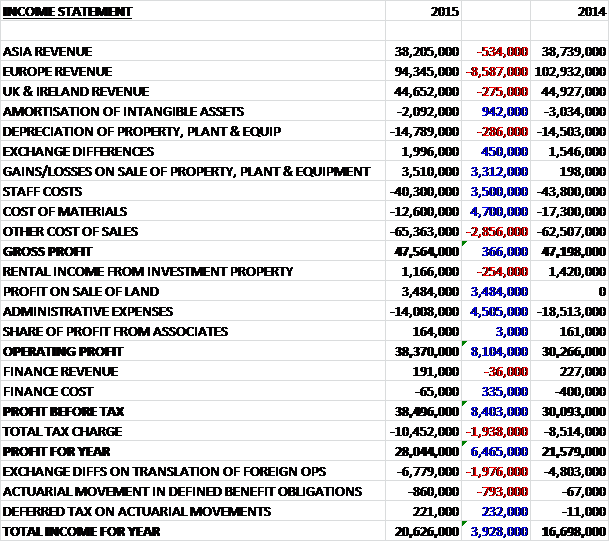
When compared to last year, revenue fell across all regions with a particularly large £8.6M decline in Europe.  Underlying revenue did increase, however, as changes in exchange rates had the effect of reducing revenue by £11M and some £2.7M of falling revenues was due to the decline in the minilab business.  We then see a lower amortisation and depreciation charge, the group gained on exchange differences and there was a one-off £3.5M gain from selling the vacant land at the Bookham site.  In addition, staff costs fell by £3.5M as a result of the restructuring of the former sales and servicing division and cost of materials were down £4.7M due to the winding down of minilab division as well as the reductions achieved through enhanced efficiencies in the supply chain, which left other costs of sales up some £2.9M to give a gross profit just £366K above 2014.  We then see a large decline in admin expenses and a £335K fall in finance costs before a £1.9M growth in the tax bill meant that the profit for the year stood at £28M, an increase of £6.5M when compared to 2014.

PHTMassets

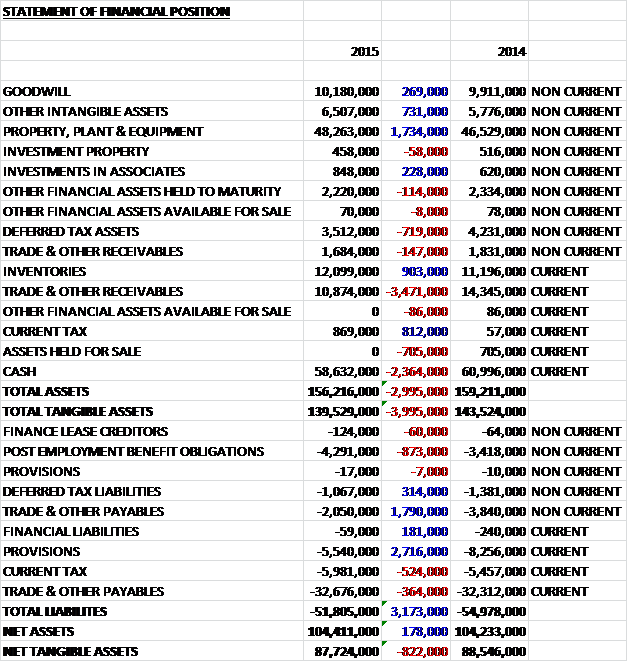
When compared to last year, total assets fell by £3M, driven by a £3.5M decline in receivables and a £2.4M fall in cash, partially offset by a £1.7M increase in property, plant and equipment.  Total liabilities also declined during the year due to a £2.7M fall in provisions and a £1.8M decrease in payables.  The end result is an £822K decline in net tangible assets at £87.7M.

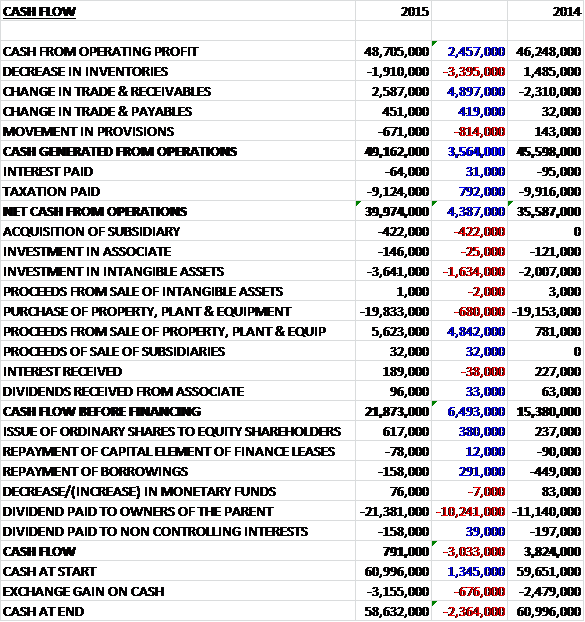
PHTMcash

Before movements in working capital, cash profits increased by £2.5M to £48.7M. A relatively modest fall in receivables drove the cash from operations to £49.2M, a £3.6M increase year on year. The tax bill was then somewhat lower so that the net cash from operations stood at just under £40M.  The group then spent nearly half, some £19.8M, on property, plant and equipment with another £3.6M spent on intangible assets, offset by a receipt of £5.6M from the sale of property plant and equipment to give a cash flow before financing of £21.9M.  The bulk of this was spent on dividends to give a cash flow for the year of £791K, although due to exchange rate losses, the actual cash level at the year-end fell by £2.4M to £58.6M.

The operating profit at the Asia division was £6.9M, an increase of £1.2M year on year.  By far the largest territory in the region is Japan which showed a strong performance with revenues up 6.4% and profits up 18.6% on a constant currency basis.  The group is deploying an additional 1,000 booths in Japan to take advantage of the new ID card regulation which is scheduled to come into force in January 2016.  Under this regulation, all Japanese citizens will need a new photo ID card and with a population of some 87 million, this is expected to lead to a substantial increase in demand over the next two to three years.  Gradual progress continues to be made in China, where turnover rose by 25% on a constant currency basis and operational efficiencies along with better siting of machines resulted in a profit in the country compared with the loss last year.  Positive progress is also being made in South Korea, where some 100 photo booths have been sited.

The operating profit at the Europe division was £22M, an increase of £800K when compared to last year despite reported revenues falling by 8.4% which was mainly due to adverse currency movements and the declining minilab business.  In addition the profit would have been considerably higher on a constant currency basis.  The European photobooth estate increased by 4.5% year on year with the main areas of growth being France and Switzerland.  The group continued to roll out its higher margin Starck booths and there are now 3,213 deployed across the continent, an increase of 883 over last year.   The roll out of the laundry product continued to progress well with an increase in the owned estate of 442 to 644 machines.  The average revenue per owned unit in France was €14.396 which represents a 4% increase year on year and the turnover of the laundry business as a whole was £6.3M, up from £3.3M in 2014.

The group now has laundry units in nine countries, with the most significant coverage being in France and Belgium.  Besides the traditional laundrette locations, they are also seeing potential demand in sites like equestrian centres, campsites, universities and military barracks.   Prospects are particularly good in Portugal and Ireland with 37 machines now in Portugal which represents 28% of the total revenue from that country from a standing start.  Following the relocation of the outsourced manufacturing capability to Hungary last year, the plan is to have deployed 6,000 laundry units in Europe by 2020.

The group continues to operate over 5,000 digital printing kiosks, primarily in France and Switzerland and is currently upgrading the estate to the latest technology to accept all models of memory cards and smart phones.  A new Starck designed kiosk was unveiled in November last year which is a new generation with no real comparator which the board considers to be very promising and the product should be launched over the next few months.  The group is also looking to introduce 3D technology into its photobooth and as an example of this, they have started to introduce 3D figurine booths.  Another new concept is Photolight, a solar-powered streetlight that has been under development over the past couple of years which is now beginning to be marketed more widely.  Additionally, the carwash concept is still under trial with the initial results being encouraging – during 2016 the group expects to scale up the trials.

The operating profit at the UK and Ireland division was £8.5M, a decline of £1M when compared to 2014.  Growth in photobook numbers was just 1% year on year while there was a 30% reduction of the amusement machines which are not material to the group’s business.  With the market background remaining difficult, turnover in the region was flat.  The group rolled out 32 laundry units in Ireland, where results to date have been promising as they are currently the highest earning machines in the portfolio.

The group is looking to increase its contactless systems deployment programme to improve the customer offering and is also considering expanding into new Asian markets and the US.  South Korea is one new market and small operations have now been launched in Poland.  Many of the KPIs are various different iterations of revenue and profits but underlying EBITDA margin is up 3.6% to 29.2% with the other indicators being a slight slowdown in the number of photo booths being opened to 916 and an increase in the rate of laundry machines being added at 525 this year.

Going forward, although the continued strengthening of Sterling against both the euro and the yen will likely have an adverse effect in the coming year, the board expects another year of strong underlying progress next year.  As well as foreign exchange risks, I guess the other big one is the potential for a government to implement centralised image capture for biometric passports and other applications which would seriously affect profits if it occurred in a big market such as France or Japan.

At the current share price, the shares trade on a P/E ratio of 21.7, falling to 20.7 on FinnCap’s estimate for next year which looks expensive but doesn’t taking into account the huge cash pile.  After a 30% increase in the total dividend this year,  the shares have a dividend yield of 3.4% which is nice to have but on FinnCap’s estimate for next year it is down as an incredible 7.9%.  This seems almost like it could be a mistake but perhaps they are guessing what the special dividend might be and if this figure is correct, these shares look very good value indeed.  I suppose this has stemmed from the comment from the Chairman that having raised dividends substantially in recent years, the board intend to increase the ordinary dividend by 10% per annum and any net cash on the balance sheet at the year-end in excess of £50M will be spent on a special dividend.   At the year end the group had a net cash position of £60.7M, a decline of £2.4M year on year.

Overall then, this has been another good year of progress for the group.  Profits were up, as was operational cash flow with a good level of free cash covering the generous dividend.  We did see net tangible assets fall slightly, however, but the balance sheet remains strong.  Asia did well this year and the new photo ID legislation in Japan should provide some good earnings growth in the next few years.  Europe is also doing well and would be doing even better were it not for the weakness of the Euro.  The UK is probably one of the weaker areas at the moment but that region is still profitable,   Going forward, although penetration in the more mature markets means that photo booth growth will probably be limited, the roll out of the laundry machines looks exciting and the new style photo booths should also add something to the group.

The strength of Sterling against the Euro and Yen is likely to continue to drag on results going forward but with the potential of some good payments to shareholders going forward, I am very comfortable to have Photo-Me as my largest shareholding.

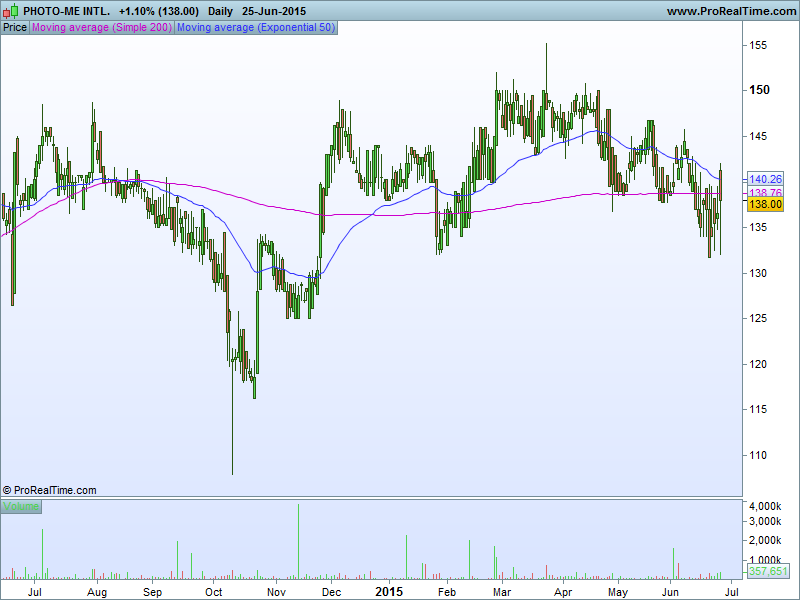
PHOTO-ME INTL.

It’s fair to say the share price has not got anywhere in a year and in recent months I think it has been suffering from exchange rate worries but these results might help stop the rot.

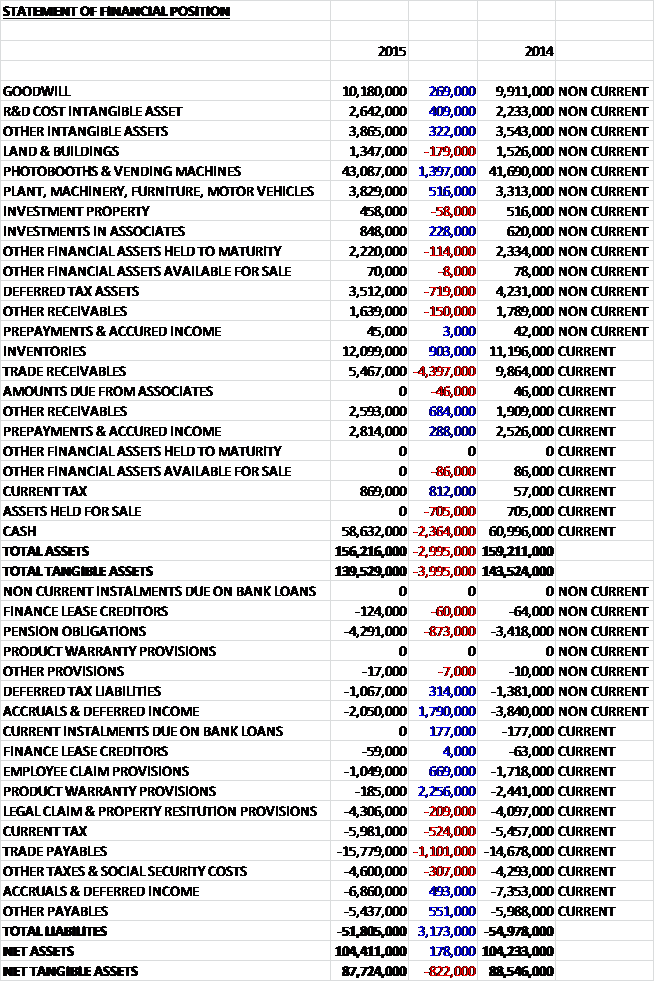
Photo-Me has now released its annual report.  There is not really that much detail in the income statement but we do see that the fall in financial costs was driven by a £304K reduction in investment provisions.  The statement of financial position, as usual, gives us some more useful information though.

PHTMassets

We can see that the in property, plant and equipment was mostly due to a £1.4M increase in photo booths and vending machines and the fall in receivables was driven by the £4.4M decline in trade payables.  As far as liabilities are concerned, the decline in provisions was due to the £2.3M decline in product warranty provisions and a £669K fall in employee claim provisions.  As far as payables are concerned, the increase was driven by a £1.1M growth in trade payables.

Something else of interest that tends to be included in the annual report but not the preliminary results is operating leases, or in the case of PHTM, site owner agreements.  Operating leases outstanding are fairly modest, being just £3.9M at the year-end but site owner agreements, which enables the company to site its machines, was £20.2M which is rather more material but given the cash levels at the company no cause for concern at all.

During the year the group acquired Copyphot based in Switzerland for £422K, representing goodwill of £513K (there was a negative net asset value).  The group also disposed of its 51% interest in the Hungarian subsidiary for £80K.

On the 27th August it was announced that Francoise Coutaz-Replan had retired from her position as finance director from today.  Mr. Gabriel Pirona has been appointed as interim finance director but he will not join the board at this time.  Francoise will continue as a non-executive director of the company.  I have to say this is an unwelcome announcement.  Why has she resigned, are they looking for a permanent replacement, will the finance director continue to be an executive position?  Normally, a sudden retirement by the finance director would really set alarm bells going but the fact that she is remaining as a non-exec does temper this somewhat so I am not sure it is that sinister, but it is a bit of a clumsy announcement in my view.

On the 21st October the group released an AGM statement covering the first four months of the year.  Turnover improved by 4.4% on a constant rate of exchange (probably fell on actual exchange rates then) and pre-tax profits at a constant exchange rate were over 10% ahead and the board remains confident of the outlook for the full year.

The expansion of the laundry business in Europe is increasingly contributing to the financial performance of the business.  In France, over 1,000 units have been deployed, delivering a very encouraging performance with the more established units continuing to deliver year on year revenue increases.  In other countries such as Ireland and Portugal, the laundry business represents some 50% of recent months’ revenues in these countries.  The laundry roll-out overall continues in accordance with the stated plan.

The group have agreed a three year period of exclusivity for carwash systems in the retail in market in France with Karcher with the initial focus being on large supermarkets.  Since the agreement in August, four Karcher units have been deployed.  Those units are preforming well and after investing in some 40 further units in the coming year, the group will re-assess the opportunity for further expansion at the end of 2016.

The group’s cash generation remains strong, trending ahead of last year’s performance.

Telecom Plus Share Blog – Final Results Year Ending 2015

Telecom Plus has now released its final results for the year ending 2015.

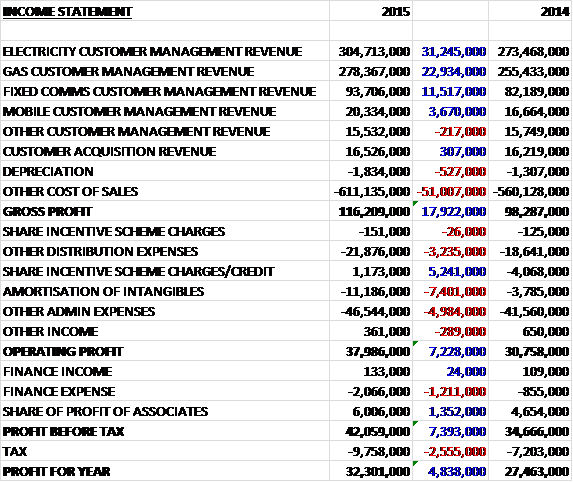
TEPincome

Revenue increased considerably when compared to last year with a £31.2M growth in electricity, a £22.9M increase in gas, an £11.5M growth in fixed communications and a £3.7M increase in mobile.  Cost of sales also increased, of course, to give a gross profit some £17.9M ahead of last year.  We then see distribution costs increase by £3.2M reflecting higher commissions paid to partners, a £7.4M increase in amortisation of intangibles due to the agreement with N Power kicking in and a £5M increase in other admin expenses (mainly relating to increased staff costs), partially offset by a credit relating to the share incentive scheme which arose as a result of the falling share price.  Finance expenses increased by some £1.2M during the year due to the higher loans but there was a £1.4M increase in the share of profit from the associate before a higher tax bill meant that the profit for the year came in at £32.3M, an increase of £4.8M year on year.

TEPBalance

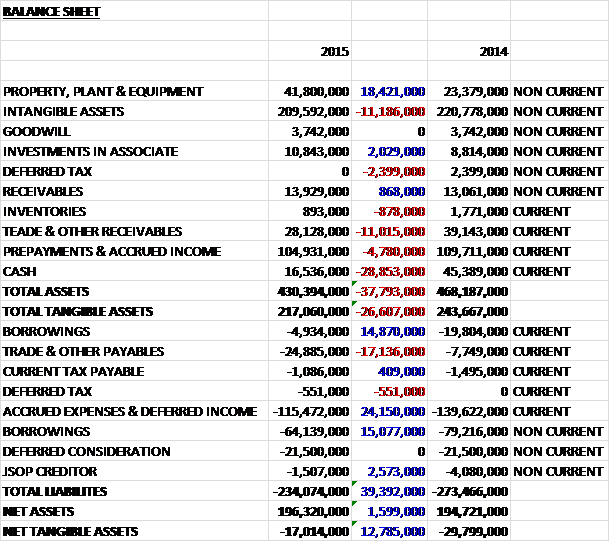
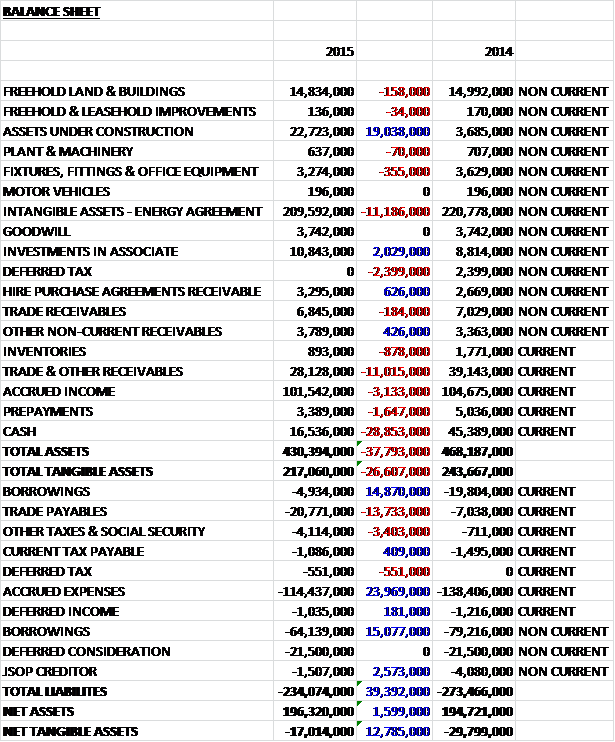
When compared to the end point of last year, total assets fell by £37.8M, driven by a £28.9M fall in cash, an £11.2M decline in intangible assets, an £11M fall in receivables, a £4.8M decrease in prepayments and accrued income, and a £2.4M fall in deferred tax, partially offset by an £18.4M increase in property, plant & equipment and a £2M growth in the investment in an associate.  Liabilities also fell during the year as a £24.2M fall in accrued expenses & deferred income, a £30M decline in borrowings and a £2.6M decrease in the JSOP creditor was partially offset by a £17.1M increase in payables.  Overall, net tangible assets increased by £12.8M but they remained negative, at -£17M.

TEPcash

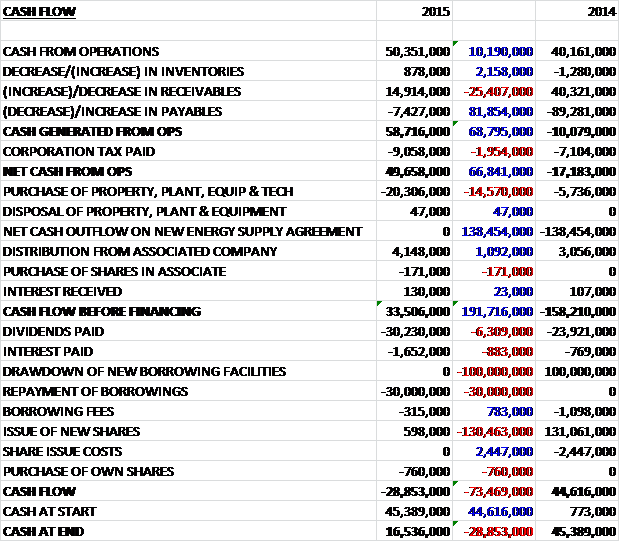
Before movements in working capital, cash profits increased by £10.2M to £50.4M.  This increased further due to a decline in receivables from payment timing differences on the energy purchasing agreement with N Power, a situation that is likely to reverse next year, but a much lower fall in payables meant that the cash generated from operations increased by £66.8M to just under £50M after tax.  After the group spent £20.3M on capital expenditure, mostly relating to the refurb of the head office, and received £4.1M from the associate, there was a free cash flow of £33.5M available.  This covered the £30M loan repayment but not the £30.2M in dividends so for the year there was a cash outflow of £28.9M to give a cash pile at the year-end of just £16.5M.

Next year the group is expecting a modest rise in working capital requirements due to the costs associated with funding the growth in the mobile business (the provision of premium handsets on 24 month contracts), an increase in the number of Minis provided to partners on hire purchase agreements and the cost of providing partners with tablets on 30 months interest free credit.  On the other hand, capital expenditure should reduce as the group finishes refurbishing their new office HQ.

This year has provided the most competitive trading conditions that the board have yet seen where a sustained fall in wholesale energy prices over the last 18 months and aggressive promotional activity by a number of new entrants into the energy market, who have not hedged their energy costs at historically higher prices, has combined to create a record gap between the introductory fixed price deals available to those who switch and the standard variable tariffs paid by the majority of domestic customers.  This has been exacerbated by the group’s competitors using the higher margins earned on legacy customers to help fund new introductory deals which is something the group does not do and expects that will be addressed in due course through regulatory intervention and reductions in standard variable tariffs as larger suppliers reflect the prevailing lower level of commodity costs.

Although the group remains on track to achieve their medium term target of one million households, it is now apparent that the path towards this will not be a straight line with growth being higher during periods when market conditions are favourable and slower at times like this when the competitive environment is more challenging.

The profit at the Customer Management segment was £53.5M, an increase of £10.6M when compared to last year.  The increased profitability seen reflects organic growth over the past couple of years along with the additional margin contribution from the supply arrangement with N Power, partially offset by the higher costs associated with leakage within the national gas distribution network than had previously been anticipated.  Revenue growth was constrained by a fall in average energy consumption from the domestic membership base due to a mild winter and the impact of energy efficiency measures that have been delivered by the industry over the last few years with the average revenue per member falling from £1,304 to £1,279.

The group has delivered some 200,000 more services during the year with growth spread across all services with 58,753 residential members now taking all five services from the group with some 66,898 now taking the “Double Gold” bundle, a 44% increase over the past year.  Indeed, the percentage of new members taking the bundle has been steadily increasing from 21% in Q1 to nearly 28% in Q4.  During the first two months of Y/E 2016, following the recent changes to the proposition, the percentage has increased to over 29%.

The group continues to do well with regards their customer service having been shortlisted as best telecom service provider at the Moneywise annual awards.  As such, the group also does not offer heavily discounted one-year introductory deals to new members, unlike many of their competitors with both new and existing customers paying identical amounts for the same packages.  The good customer service has filtered through to a consistently positive net promoter score of +45 in an industry where some suppliers achieve negative scores and British Gas has a score of +23.  Indeed, this represents the second highest of more than 60 brands.

The Opus associate continues to go from strength to strength and it is anticipated that the contribution will be about £6M next year too with an increase expected in 2017.  The increase reflects the progress that has been made in supplying gas alongside electricity into the small business and corporate sector, for which they are now buying renewable energy from over 500 small UK generators.  The investment in the associate is valued at £10.8M on the balance sheet but the board believes the market value is substantially higher and they are very pleased to have exposure to this rapidly growing, profitable and highly cash generative business.

The loss at the Customer Acquisition segment was £15.5M, an increase of £3.3M year on year.  This widening loss reflects the increased promotional activity during the year targeted on recruiting high quality multi-utility new members in a highly competitive market, and a higher proportion of members taking the double gold bundle.  Although the cost of acquiring an owner-occupier taking the bundle is generally considerably higher than for a tenant taking fewer services, the board believes the return on investment will more than compensate for these increased costs due to the much longer expected lifetime of the customer.

During the year, a significant number of new partners joined the business, increasing the total registered from 44,056 to 49,539.  It seems that through an improved online training course and revised incentive structure, a higher proportion of new partners are making a successful start to their career and improving the effectiveness of new partners is a core focus for the business.  They have recently been trialling a new approach to classroom training that has shown some encouraging results which will be rolled out across the UK this year.

As far as customer incentives are concerned, the group have discontinued their previous introductory offer of six months free broadband for all members taking gold bundles and replaced it with a two year fixed price energy tariff and choice from a range of new benefits which are only available to owner-occupiers and available to both new and existing members.  This decision was driven by the significant difference in churn rates between different segments of the membership base as the group declines to complete for those customers who change providers every year looking for the best rates.  This removal of up-front incentives has not made is easier for the partners to sign up new members, however, and the absolute growth in the numbers is currently running below the target run-rate for the year as a whole.  It is therefore likely that organic growth will remain in the mid-single digit percentage until the gap between the introductory fixed price energy deals available to new customers and the variable tariffs charged to most households narrows significantly which should apparently start to happen later this summer.

During the year the group paid over £5.4M in cashback to its customers, an increase of £500K.  This is a great incentive to provide as it is funded entirely by the retailers in the programme with some members achieving more than 20% off their utility bill just by using their cashback card to make purchases.

One area that there is a tangible sense of frustration from management is that of regulation.  They will shortly be starting to roll out the installation of smart meters for their members in order to ensure that all domestic energy meters are replaced by 2020.  There have been continued delays in finalising the specification for the meters, however, which suggests that the original target end date for the programme is no longer achievable and trying to maintain this deadline will likely lead to higher fulfilment costs.  Another example is the establishment of “Smart Energy GB” which has a mandate to spend over £85M of customers’ money on advertising the benefits of smart meters through an expensive multi-media campaign featuring two cartoon characters called “Gaz” and “Leccy”.  I have pretty much quoted that from the annual results and the disdain from the Chairman is almost palpable!

The group is looking at expanding their offering and later this year they hope to introduce a range of insurance products such as home and motor policies.  In the longer term, other potential new services include water, TV and home emergency cover, including boiler cover.  One service already being supplied that is a potential growth area is mobile.  During the year there was a 23% rise in the number of mobile services provided and penetration within members has now reached 25% with scope for further improvement going forward.

One major issue over the past year has been the fact that some £11M on the balance sheet as accrued income was unlikely to be recovered due to higher levels of industry-wide leakage in the gas distribution network than had previously been thought.  It has therefore been necessary to write down the unbilled gas debtor to bring its value in line with the amount expected to be receivable.  Due to the more sophisticated way that electricity wholesale costs are reconciled to actual customer meter readings, the effect on this market has been limited to £300K.  The board has seen fit to restate these numbers in previous balance sheets rather than take the hit as an impairment.

One potential problem facing the group is the agreement set with N Power for the provision of power. The price paid for energy is set by reference to the average of the standard variable tariffs charged by the “big 6” to their domestic customers, less an agreed amount.  This is a good strategy at most times but in the current environment, this price may not be competitive against the wholesale prices available to new and other independent suppliers.

Looking forward, the board are confident that they will deliver record revenues, profits and earnings per share next year and expect to increase the dividend by another 15% to 46p (which is the figure used for FinnCap’s estimate below).  Management are expecting pre-tax profits to come in at between £54M and £58M – it is nice to see the board sticking their necks out and suggesting a figure actually.

At the current share price the shares trade on an expensive looking 21.9 times earnings, which falls to 14.9 on FinnCap’s forecast for next year which seems about right.  After increasing by 14% year on year, the dividend yield currently stands at 4.6%, increasing to 5.2% next year which seems like a very decent return to me.  The group is currently in a net debt position of £74M compared to £75.1M which includes a deferred consideration of £21.5M payable to N Power during Y/E 2017.

Overall then, this has been a difficult year for the group but I have to say these results look a little more reassuring than I thought.  Profit is up, along with net tangible assets – although the group still have a negative net tangible asset base which is not something I like to see usually.  Operational cash flow seems strong, although this was enhanced by favourable working capital movements which will reverse next year. Although the group does have a strong free cash flow generation, this year it was not enough to cover the dividend and the debt repayments – I wonder if something may have to give here, although the lower capital expenditure now the HQ is finished should help.

The main issue this year has been that lower wholesale prices have meant that the group’s earlier agreement with N Power is now a hindrance as smaller, independent providers can buy cheaper wholesale gas on the market.  This is exacerbated by the cheap introductory offers by some competitor s and Telecom Plus just can’t compete with this.  Hence, why they are targeting owner-occupiers and those taking more services which seems to be a sensible approach in the current climate.  The group still has good results for customer service so it seems they are becoming more of a quality outfit than a cheap one.

The energy leakage issues is disappointing but it seems this has now been sorted with better estimates now in place – how it went on for so long, I really have no idea though and points to a lack of rigour somewhere along the line.  At the current share price, the P/E ratio looks about right but that dividend yield is starting to look interesting.  In the short term, growth is going to be constrained but given the relatively depressed share price, I have decided to take my first small position here.

TELECOM PLUS

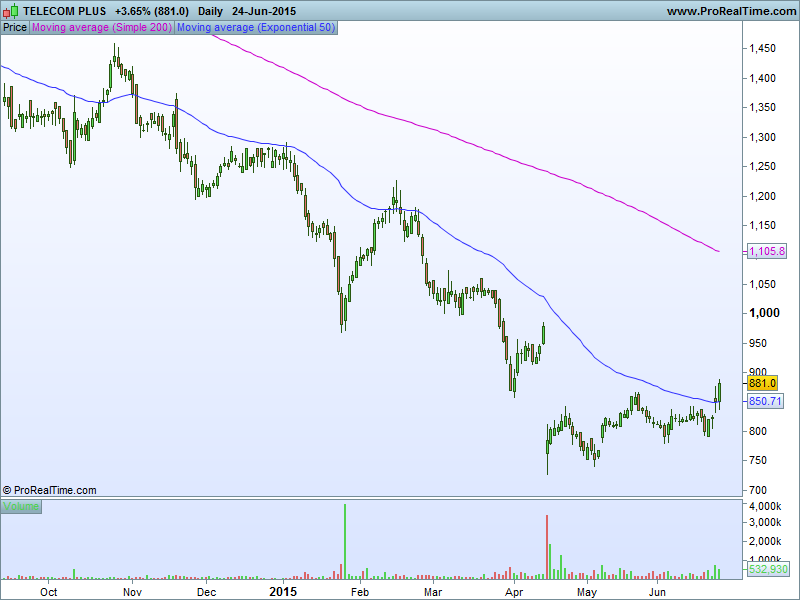
The chart suggests it may be a bit soon to buy but the price has risen above the 50 day moving average and I am feeling bold!

Telecom Plus has now released its annual report for the year ending 2015.

TEPincome

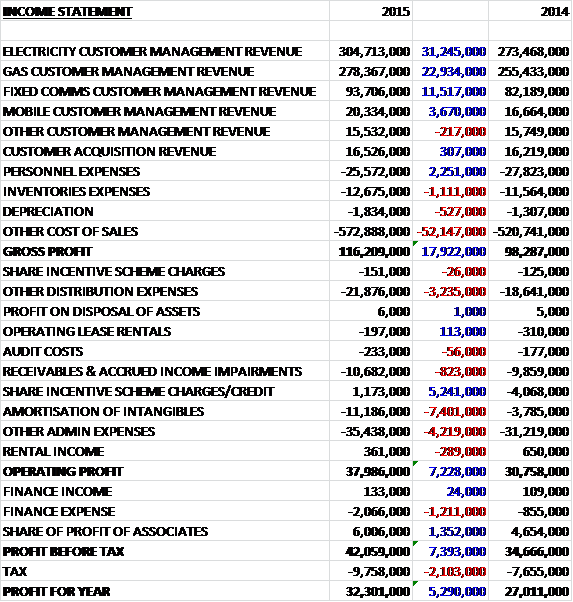
There is not too much here that has now been covered previously but we see that personnel expenses fell by £2.3M, partially offset by a £1.1M increase in inventories expenses.  As far as admin costs are concerned, operating lease rentals fell by £113K but receivables and accrued income impairments increased by £823K.

TEPassets

The balance sheet gives a bit more extra information though, as we see that the increase in property plant and equipment is entirely due to the £19M growth in assets under construction which related to refurbishment work on the company’s new HQ which was brought into use after the year end, and that fall in intangible assets is from the amortisation of the energy agreement with N Power as would be expected.  On the liabilities side we can see a £13.7M increase in trade receivables which looks a little concerning and also a £3.4M increase in other taxes and social security payable.  Accrued expenses did fall by £24M, however.

Including the deferred consideration of £21.5M payable to N Power in December 2016, the net debt position was £74M compared to £75.1M last year.  There is negligible operating leases outstanding but there are capital commitments of £2.5M relating to items in respect of the refurbishment of the new HQ, the acquisition of a small office building and the acquisition of the source code of the software underlying the group’s billing system.

We can see from the report that the executive directors are incentivised with regards to adjusted EPS growth, Total Shareholder Return growth and service number growth.  It should be noted that CEO Andrew Lindsay had a huge payday with a total remuneration of nearly £2.2M due to LTIP awards.  It is difficult to see what he has done to warrant this huge amount.

On the 11th August the group released an AGM statement covering trading so far this year.  They confirm that they have continued to trade in line with management expectations since the year-end with further steady mid-single digit growth in the size of their customer base.

Only one of the big 6 suppliers have announced a reduction to their standard variable pricing so far so the board expect that trading conditions will remain challenging until the other major suppliers follow suit, which is expected to happen shortly.  The board also welcome the draft findings announced by the CMA with regards to their proposal that standard variable tariffs should be subject to a price–cap in order to protect non-engaged customers who are being over charged by their supplier so that they can use the excel profits to offer attractive short term deals to those who switch.

The important part of the announcement is that they remain on track to meet market expectations for adjusted pre-tax profits of between £54M and £58M in the current year and to deliver a 15% increase in the dividend to 46p per share.  So, nothing has changed since the last update but it is always helpful to get some reassurance that there are no additional problems.

International Greetings Share Blog – Final Results Year Ended 2015

International Greetings has now released its final results for the year ending 2015.  These took me by surprise somewhat, as I wasn’t expecting them so soon!

IGRincome

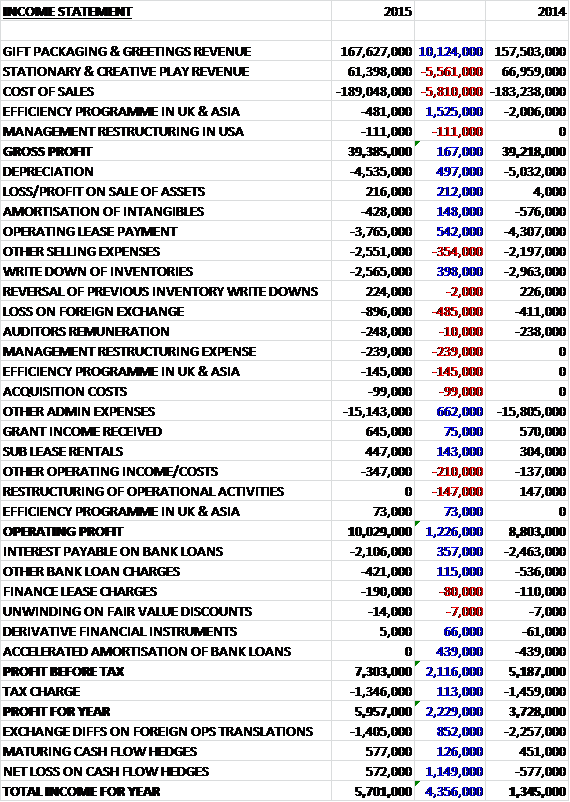
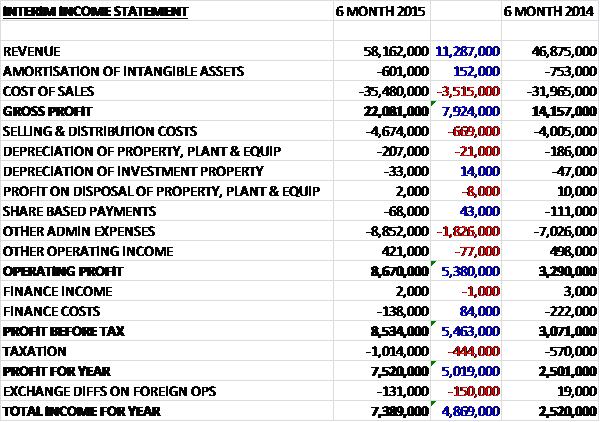
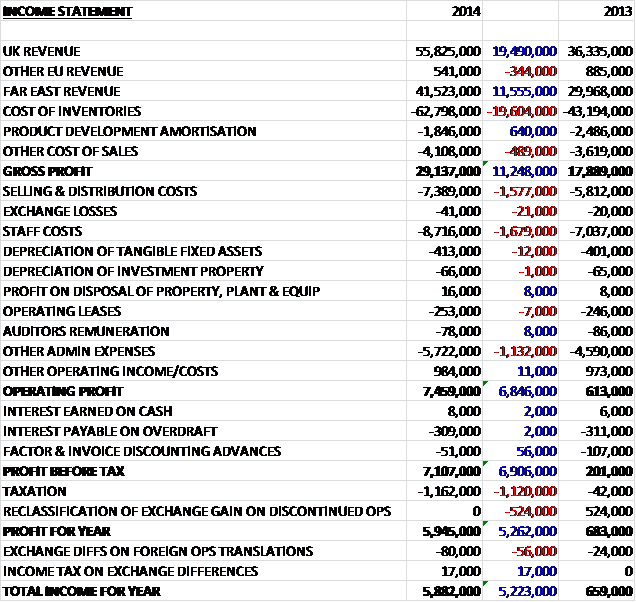
Revenues increased this year when compared to 2014 as a £10.1M growth in gift packaging and greetings was only partially offset by the £5.6M decline in stationary and creative play sales.  Cost of sales also increased but far less was spent on the UK efficiency programme, which this year related to the investment in high definition printing in Wales, to give a gross profit just £167K ahead.  As far as selling expenses are concerned, we see a near £500K fall in depreciation and a similar decline in operating lease payments and in other expenses we also see a £398K decline in the write down of inventories.  In addition, the forex loss doubled to £900K and there were some other one off costs such as the management restructuring expense after the US CEO sadly passed away along with the admin costs for the efficiency programme.  In all, this gave rise to an operating profit £1.2M above that of last year.

Operating costs fell during the year as better bank terms and lower debt reduced the interest payable and there was no one-off accelerated amortisation of bank loans that occurred last year.  The tax charge was also £113K lower so that the profit for the year stood at £6M, an increase of £2.2M year on year.

IGRassets

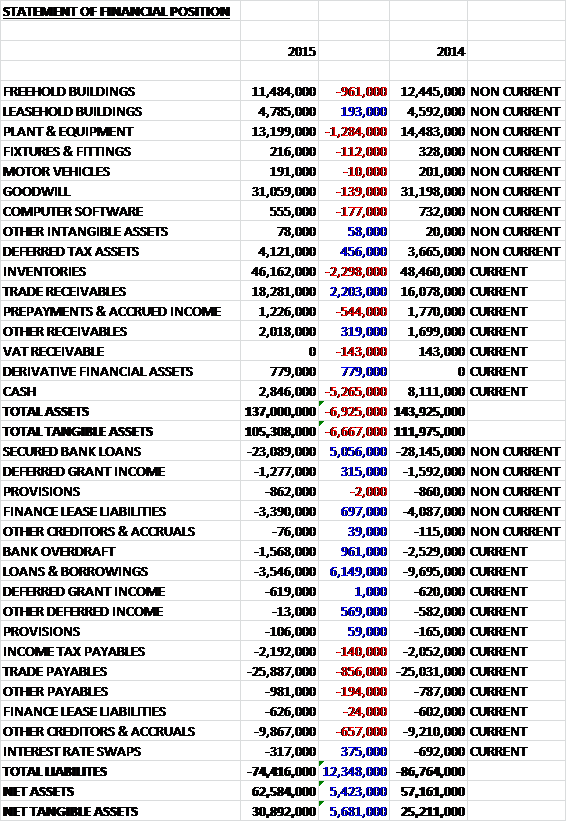
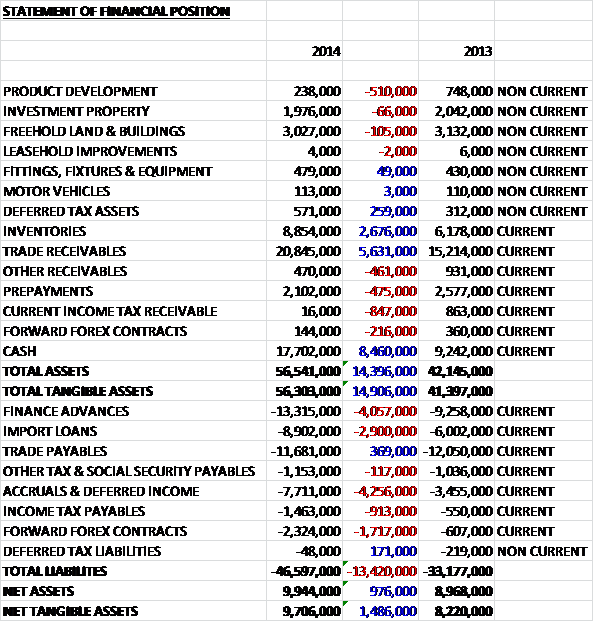
When compared to the end point of last year, total assets fell by £6.9M driven by a £5.3M fall in cash, a £2.3M decline in inventories and a £1.3M decrease in the value of plant and equipment, partially offset by a £2.2M increase in trade receivables.  Liabilities also fell during the year due to a £6.1M decline in current loans and borrowings, a £5.1M fall in secured long term bank loans and a £961K decline in the bank overdraft.  The end result is a £5.7M increase in net tangible assets to £30.9M which seems quite a good result.  There are currently £22.7M worth of operating leases outstanding which seems to be fairly well covered.

IGRcash

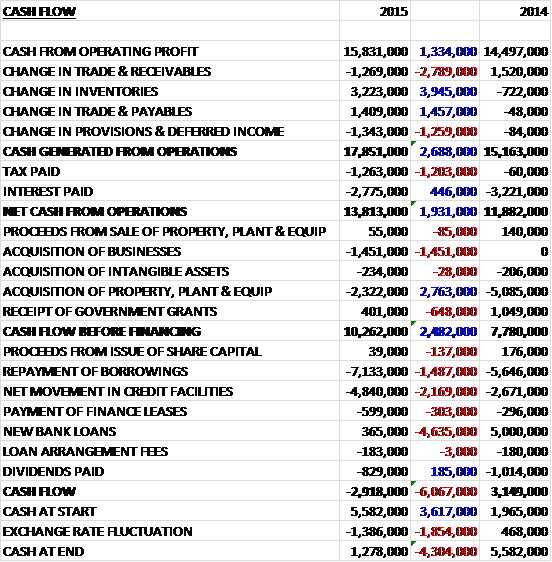
Before movements in working capital, cash profits increased by £1.3M to £15.8M.  After changes in receivables and payables broadly cancelled each other out, a fall in inventories, particularly in the US, meant that the cash actually generated from operations increased by £2.7M to £17.9M.  We then see less interest paid but much more tax when compared to the negligible amount last year so that net cash from operations stood at £13.8M, an increase of £1.9M year on year.  Capital expenditure was lower than last year at £2.3M for property, plant and equipment so even after the £1.5M spent on acquisitions and £648K less in government grants, free cash flow increased by an impressive £2.5M to £10.3M.  This, along with some of the cash from last year, enabled the group to pay back £11.6M of borrowings to give a cash outflow for the year of just under £3M and a cash pile at the year end of £1.3M.  Despite the low amount of cash to end the year, this is exactly what I like to see – a company using its free cash to pay back loans.

Profits at the UK and Asia business were £4.5M, an increase of £2.8M year on year.  During the year the group upgraded compliance standards in their facilities in China which led to the record sales of 74 million Christmas crackers.  They are now geared for even greater performance levels having invested in semi-automated processes for cracker manufacturing which became operational during spring 2014 along with enhanced production capability in gift bags and greeting cards.  These upgraded facilities have enabled them to secure a three year contract for the sole supply of single greeting cards to the UK’s largest pound shop and record levels of gift bag orders that have been achieved for shipment during 2015.

The group will continue to grow sales of licensed products with stationary and creative play categories being consolidated under the Copywrite brand in the UK.  Sales of the Disney Frozen and Despicable Me ranges were noteworthy and continued to thrive into the new year alongside an updated selection of other licensed products.

The European business had a profit of £3.2M, a growth of £600K when compared to 2013.  This growth occurred despite challenging overall market conditions due to excellent levels of manufacturing efficiency and record sales volumes.  The second full year of using the new printing facilities in Holland, along with highly competitive product offerings resulted in a continued growth of market share.  The acquisition of Enper in June has been fully integrated and strengthened market share in the Benelux region and management seem to be on the lookout for similar acquisition opportunities in the future.

The profit at the USA business was £2.1M, a fall of £900K year on year despite strong sales growth which benefited this year from a weak end to 2014 due to the adverse weather conditions that occurred at that time.  During the year the gift wrap manufacturing facilities near Savannah were enhanced by the installation of new automated case packing equipment which was fully operational from Spring 2014.  During the new year, new, high speed paper conversion facilities will be installed.  The sales growth included expansion in the neighbouring markets of Canada, Mexico and South America and in the US growth was achieved within the major supermarket and discount channels.  The working capital situation in the US was vastly improved during the year through a 36% reduction in inventory levels.

The Australia business had a profit of £1.1M, a decline of £1M when compared to last year.  Performance was impacted by an overall slowdown in the country’s economy and a recent investment in logistics facilities that enables the group to improve order fulfilment levels to an increasing base of retail customers across the country.  The focus for the coming year will be on executing plans to improve profitability rather than trying to increase sales.

In recent years the market the group operates in within the UK has undergone some changes and experienced value and innovation by the traditionally dominant supermarkets, the expanding market presence of discounters, the prolific growth of pound shops and the ever expanding online presence of new and existing customers.  In mainland Europe the group plans to continue to leverage its position as the number one European player in gift packaging, working mainly with the major retail chains but also seeking opportunities in new channels and territories across the continent.  In the US there has been success through nationally based grocery chains, discounters and $1 retail specialists.  At the same time, the well-established gift wrap company range of premium products has consolidated its market position.  Further growth opportunities have been established and traction gained in South America and Canada, both through partnerships with US-based customers and through indigenous customers.

In Australia, the closure of one of the country’s largest discount chains impacted the business and the market overall.  The strategy has been to seek new channels of distribution offering both FOB and domestic order fulfilment whilst providing customers the full availability of the portfolio of products available from the group as a whole.  This has enabled the group to expand their presence to neighbouring countries such as New Zealand.  The business has also expanded its upscale activities including premium brands such as Card Couture as well as the full range of Tom Smith crackers, cards and gift packaging.  Although from a small base, the group has also experienced growth in other regions such as Asia, Africa and the Middle East.

After the successful investment in Europe and the UK, the group are looking at investing in the US and Australia to improve margins to levels closer to the European business.  In general the group also looks to improve on their rather thin 3.7% pre-tax margins by increasing the balance of own brand products and non-Christmas business along with efficiencies in sourcing and manufacturing which should already help improve margins for the next year after the investment in the Swansea manufacturing facilities last year.  Another factor that affects margins is the increase of the lower margin FOB business delivered to major customers at ports in China.  The group will still target this FOB business as it enables high volume orders and avoids other costs and risks associated with domestic delivery.

The group is somewhat susceptible to exchange rate changes and a 10% strengthening of Sterling against the Euro and US dollar would reduce profit by £25K and £617K respectively so the GBP/USD is definitely the one to keep an eye on.  It has been stated, though, that the significantly weaker Euro rates at the end of the year are likely to impact more materially in next year’s results through translation of overseas earnings.  Additionally, the relative strength of the US Dollar can materially impact prices out of China, most notably due to the weakness in the Euro and Australian dollar which will reduce margins on products out of Asia to those regions.

On the 5th June 2015 the group acquired Enper Giftwrap for a cash consideration of £1.5M which generated goodwill of £509K.  Had the purchase taken place at the start of the year, turnover would have been £229.5M.  Now that the investment in Wales is complete, the site at Aberbargoed may become available for sale which offers the opportunity to release cash in the near future and in addition the group is in the third year of a five year period by which a company has the option to purchase part of another under utilised site for a price of £2.4M (the book value is just £800K)

Going forward, management expects that now they have improved their financial position and management team, opportunities exist to grow in all regions, both organically and through acquisitions.

At the year end, net debt stood at £29.4M compared to £36.9M at the end of last year.  At the current share price, the shares trade on a P/E ratio 12.9 and yield 0.8%, improving to 11.1 and 1.6% respectively on next year’s forecast after they returned to the dividend list a year ahead of schedule.  Going forward, the board has determined that the dividend will be covered at least three times by underlying earnings and the board will target this level going forward, although this will be balanced against attractive opportunities to invest in growth that present themselves and the continued reduction in debt.

Overall then, this was a year of real progress for the group.  Profits and net assets both increased and the operational cash flow also improved, aided by tighter US stock control.  The group is giving off good levels of free cash even after the acquisition which is being used to pay down debt at a decent rate. The UK, Asia and Europe is performing well after their manufacturing facilities were upgraded last year but times were harder in the US and Australia with the latter being impacted by the closure of a large discount store.  The group is looking to invest in the US production facilities going forward to improve efficiency there.  Although lower margin, the licensed products of Disney Frozen and Universal’s Despicable Me should provide decent sales and there should be continued improvements filtering down after the investment in Wales, not just operationally but also through cash realised by the potential sale of one of their sites.

The forward P/E looks pretty undemanding, the net debt is coming down nicely and the dividend is nice to have, although at the moment it is not particularly material.  The board have flagged up continued Sterling strength as a very real headwind, however, so I shouldn’t get too euphoric over the potential here.  Nonetheless, I am comfortable with my current investment here.

INTL.GREETINGS

the share price had already moved up in anticipation of these improved results so there could be a period of consolidation on the cards.

On the same date, the group announced that CFO Anthony Lawrinson exercised share options over 607,652 shares with an exercise price of nil.  Following this, he then sold his entire 667.652 holding realising some £817K!.  I have to say this is disappointing on a number of counts.  I do think that this number of options with an exercise price of zero is excessive and a bit greedy.  In addition, the fact that the CFO now own no shares in the company is also a bit of a disappointment in my view.

On the 1st August it was announced that Chairman John Charlton (through his wife) had sold 10,000 shares at a value of £14.6K.  Given that he now owns 667,500 shares, this is not a massive sale by any stretch of the imagination but following the CFO sale previously, this is not a great indication of strength going forward.

On the 26th August the group released a trading update covering Q1.  Sales and overall customer order levels already received have been in line with management expectations and the board believe they are on track to deliver against market expectations despite the weak Euro and AUS dollar.  In the US, the group has begun a phased programme of investment in the manufacturing facility starting with new high speed gift wrap converting equipment to be installed in early 2016.  Also in the region they have extended their relationship with Aldi to the US where they have over 1,000 established stores; they have received a Christmas commitment from one of the largest drugstore chains to feature in over 7,500 stores and they have commenced trading with a chain of over 8,000 discount stores where a range of creative plat products will be launched in Autumn.

There was also some good looking licensing highlights as the group entered into a contract with Disney for the Star Wars franchise on a multi-territory basis; they entered into a licensing contract with Coca Cola, featuring Santa Claus across a range of gift packaging and greetings products in the UK; they have received commitments for over 2 million of creative play products in the UK for Universal Studio’s Minions; and the latest National Geographic product offering across gift packaging, gifting and stationary will be promoted in over 3,000 additional stores.

This all sounds fairly promising.  I took some profits in these shares after they quickly increased in value and the directors started selling but I am tempted to jump back in actually.

On the 7th September the group announced that Chairman John Charlton had sold 10,000 more shares at a value of £15K.  This is not much and he still owns 657,000 shares but I am not too happy about the continued investor selling here.

On the 20th October the group released a trading update covering the first half of the year.  Overall trading was in line with expectations with decent sales revenue and a solid order book supporting the expectations for the full year.  In the UK, the group are on track to deliver the expected annual efficiencies resulting from recent investment in the manufacturing operations; in Europe and Australia the businesses have fought weak Euro and Aussie Dollar exchange rates to deliver to expectations and in US, shipping is ahead of seasonal trends (whatever that means).  Additionally, net debt should be significantly lower than at the same period of last year.  This all seems decent enough, I am happy to hold.

Character Group Share Blog – Interim Results Year Ending 2015

Character has now released its interim results for the year ending 2015.

characterincome

When compared to the first half of last year, revenues increased by £11.3M and with a much smaller increase in cost of sales, gross profit increased by £7.9M.  Selling and distribution costs then increased by £670K and admin costs were also up to give an operating profit some £5.4M higher than last time.  A decline in finance costs was more than offset by an increase in the tax bill to give a profit for the half year of £7.5M, an increase of £5M.  It should be noted, however, that these results are flattered because they include a £1.5M mark to market adjustment to the derivative financial instruments compared to a £2.9M charge last year so adjusting for this, pre-tax profits increased by just £1M to £6M.

characterassets

Due to the seasonality of the business I have compared the balance sheet to the end of the first half of 2014.  Over the year, total assets increased by £3.7M driven by an £8M growth in cash levels, partially offset by a £3M fall in receivables and a £552K decline in deferred tax assets.  Total liabilities were broadly flat year on year as a £2.4M fall in derivative financial instrument liabilities and a £907K decline in short term borrowings was offset by a £2.9M increase in payables to give a net asset level of £11.4M, a decent £3.7M increase, although it should be noted that receivables plus inventories, although still higher than payables, saw a reduction year on year.

charactercash

Before movements in working capital, cash profits increased by £768K to £8.1M.  A large decline in receivables and fall in inventories more than offset the change in payables to give net cash from operations of £15.9M, a £9.8M increase year on year.  This was more than enough to pay for the £822K of development costs and £144K of capital expenditure to give an impressive free cash flow of £15M.  Some £6.1M was spent on share buy-backs and only £838K was spent on dividends to give a cash flow for the half year of £8.9M.

During the half year period, the group’s market share has continued to rise with the strong sales at consumer level continuing through the crucial Christmas period which gave rise to a result that was above management expectations.  The long standing licensed collections such as Peppa Pig, Dr Who, Scooby Doo, Fireman Sam and Weebles have been in the group’s portfolio for a number of years and have seen extensive development for 2015, including additional and innovative toys within the brands.  The more recent brands to be added to the product portfolio such as Teksta, the Zelfs, Shimmer ‘n’ Sparkle, Little Live Pets and Minecraft have now established themselves in the market.

New products are being added to the portfolio soon with Clangers being introduced in April 2015 and Ugglys Pet Shop being introduced in June 2015.  The Group are also launching Yummy Mummies which is a new children’s cookery craft collection based on a molecular gastronomy concept which is already a web and YouTube hit in the Far East which sounds interesting.  Also, the group has been awarded the global master toy partner for Teletubbies which is currently under development and expected to be launched and marketed in early 2016 following the broadcast of the new TV series on the BBC in late 2015.

One of the group’s subsidiaries has been recognised as “Toy Supplier for the Year” at the Toy Industry Awards and has also received product awards in the categories of Gaming Toy (Minecraft), Interactive Toy (Little Live Pets), and joint winner in the “Craze of the Year” for the Cra-Z-loom bracelet maker from the Shimmer ‘n’ Sparkle collection.  Additionally the group was once again named supplier of the year by both Argos and Tesco.

As can be seen, the share buy-back programme has continued through the first half of the year with a total of 2.3 million shares at a value of £6.1M being purchased.  This is a material amount given the number of shares in circulation and the group has the authority to buy back some 4.6 million more shares, although since the end of the half, no more have been purchased.

Richard King, the executive Chairman and joint founder has recently turned 70 and is looking to retire in the near future.  Therefore he has decided that an orderly sale of the majority of his remaining shareholding should be undertaken over the next two years.  As Mr. King owns over two million shares, this will be a substantial amount but understandable in my view.

Current trading apparently remains very encouraging.  The group has had a good reception to their product portfolio from retailers following customer reaction at various trade expos and therefore they expect this season’s ranges to deliver in term of demand and sales across both the UK and international markets.  The board are confident that the company can deliver another year of solid progress this year (I should think so after these half year results) and achieve current market expectations for 2015.

After a 51% increase in the interim dividend, at the current share price, the shares yield 2% which is expected to remain the same for the full year on Charles Stanley’s estimates.  At the end of the half year, the group had a net cash position of £4.3M compared to a net debt position of £4.6M at the same point of last year.

On the 4th June it was announced that executive Chairman Richard King, following the announcement at the interim results stage, has conducted a placing of a total of 1,531,924 shares.  Of that total, 1,009,308 were placed at 414.75p per share with the remaining 522,616 being placed at 415p per share.  As previously mentioned, he was a substantial shareholder and this sale represents some 7.36% of the total equity in the company.  Following the transaction, Mr. King retains an interest of 536,286 shares equivalent to 2.58% of the total share capital.

Overall then, this is an excellent set of half year results, although I do think the figures are slightly flattered by certain items.  Profits are up but much of this is due to the adjustment for the fair value of the forex hedge (I really think this should be listed separately on the income statement) with underlying profit showing a more modest growth.  Net assets are up as the group did a good job of converting working capital to cash which brings me to the cash flow statement.  The group is very cash generative with oodles of free cash but again this has been flattered by very tight controls on working capital with a large increase in payables and a large fall in receivables, which is great but I wonder if this is really giving a real reflection of average cash levels through the year.

Operationally, the group has a lot of interesting brands and is winning some good awards which is good to see and over the period they have really purchased a lot of their own shares to give a lift to the share price, though perhaps reducing liquidity.  Trading is currently in line with expectations, the company is currently in a net cash position and the forward P/E is just 11.1 on Charles Stanley’s 2015 estimates which seems good value to me, although growth for 2016 is likely to be lower.  The 2% dividend is nice to have too.  In all, this looks a great investment but as usual I am tempering my enthusiasm with the knowledge that the stellar growth that occurred this year is unlikely to continue and the group will have to maintain its momentum after Richard King retires as executive Chairman.

CHARACTER GRP.

Well, that chart looks excellent – I think I might take a nibble.

On the 6th August the group announced that Chairman Richard King sold 200,000 shares at a value of just over £1M to leave him 336,286 shares.  Also, executive director Josehp Kissane exercised 47,000 share options at price of 63p per share and promptly sold them.  He retains 500,000 shares in the company.

On the 8th September the group released a rather short update where they said trading for the full year had been satisfactory and they expect to deliver a year-end result in line with market expectations.  They also announced the appointment of Allenby Capital as joint broker and stated that they would look to continue their share buyback programme.  I have to say I am not sure how to take this update, the fact that trading is only “satisfactory” is not great to hear and the appointment of a joint broker could be acquisition related but I am not sure.  I am just a little more nervous about being invested here than I was before the announcement.

On the 17th September it was announced that finance director Kiran Shah sold 1,830,000 shares netting an incredible £9.3M.  In addition, Marketing Director Jon Diver exercised options over 750,000 shares at an exercise price of 187p per share and sold 600,000 of these shares netting £1.7M.  Kiran still owns over 10% of the total share capital and Jon owns over 6% so they still have a big interest.  These sales were apparently in response to institutional demand and we do see GLG Partners buying 1.2M shares but I still don’t like to see such large share sales from directors of a company.

Character Group Share Blog – Final Results Year Ending 2014

Character is engaged in the design, development and international distribution of toys, games and gifts. They are listed on the AIM exchange and have now released their final results for the year ending 2014.

characterincome

Overall revenues increased considerably as growth in UK and Far East sales was only partially offset by a decline in other European revenue. Cost of inventories also increased to give a gross profit some £11.2M ahead of last year. We then see a £1.6M increase in selling and distribution costs, a £1.7M growth in staff costs and a £1.1M increase in other admin expenses to give an operating profit £6.8M above that of 2013. We then see a halving of factor and invoice discounting advances (whatever they are) but also a £1.2M increase in tax and the lack of a £524K positive reclassification of exchange gain on discontinued operations that occurred last year. In all, the group made a profit for the year of £5.9M, an increase of £5.3M year on year.

characterassets

When compared to the end point of last year, total assets increased by £14.4M driven by an £8.4M increase in cash, a £5.6M growth in trade receivables and a £2.7M increase in inventories. Liabilities also increased during the year due to a £4.3M growth in accruals and deferred income, a £4.1M increase in finance advances which are advances against trade receivables, a £2.9M increase in import loans which are short term trade finance instruments, and a £1.7M growth in forward foreign exchange contract liabilities. The end result is a £1.5M growth in net tangible assets to £9.7M. The operating lease liabilities are negligible, indeed the receipts due to the group from its leasing activities outweigh any payments it is due to make. Of more note, perhaps, is the £2.1M worth of minimum royalties to be paid.

Charactercash

Before movements in working capital, cash profits increased by £7.3M to £11.8M. Due to an increase in receivables and inventories, this was eroded somewhat to become a £1.3M increase to £8.5M which after interest paid and a tax rebate gave rise to an operating cash inflow of £8.3M, a £2.7M growth year on year. This was more than enough to pay for capital expenditure and the group made a free cash flow of £6.6M, nearly £4M of which was spent on share buy-backs which represents an incredible 10% of the total share capital, and £1.4M was spent on dividends to give a cash flow for the year of £1.4M and a net debt of £4.5M at the year end – I think I would prefer to see this cash used to pay off debt rather than buy back shares but this is a good cash generation nonetheless.
Operating profit at the UK division was £2.2M, a positive swing of £2.6M when compared to the loss last year. Growth of UK sales across several categories has increased substantially with strong domestic sales coming from key ranges such as Peppa Pig, Teksta, Chill Factor, Minecraft, Dr Who, Fireman Sam, The Zelfs and Disney Princess Palace Pets. There was also strong growth from Peppa Pig in Australia and Europe along with Dr Who in the US. The operating profit at the Far East division was £8.8M, an increase of £3.8M when compared to 2013. The operating profit at the EU division was £103K, a decline of £56K year on year.
As their brands continue to mature, the group expects to see further growth from these as they continue to apply their development and marketing skills to them. In addition, revenues are expected to further increase due to the new products to be officially unveiled at the Toy Fair in London in a month’s time.
The group has secured a number of new licenses during the year with examples including The Clangers which should be ready for retail by June 2015, and the Teletubbies through an agreement with DHX Media. A new sixty episode series of Teletubbies is in production and the group expects to launch the range in the UK during 2016 with international launches following. As well as winning “Toy of the Year” for Teksta, the electronic puppy, the group has also won “supplier of the year” from Argos and Tesco, and the Teksta T-Rex also received the Creative Play Award in the electronics an multimedia section from Creative Steps.
The group seems to have a good number of its toys included in the official DreamToys listing which is an accurate prediction of the toys that will be in most demand at Christmas. There are two products in the top 12 and seven more in the full list of 72 toys. Leading the list for the group are Little Live Pets Bird Cage and the Minecraft figures. The other toys from the portfolio that are on the list are Minecraft Animal Mobs, Peppa Pig Weebles Wind and Wobble Playhouse, Peppa Pig Muddly Puddle Jumbo Jets, ChillFactor Ice Cream Maker, Teksta T-Rex, Cra-Z-loom Bracelet Maker and Cra-Z-Knitz Ultimate Designer Knitting Station.
The group are somewhat dependent on one customer with some 16% of revenues coming from this customer compared to 15% last year. There is also one brand that accounts for 18% of UK sales. They also seem very susceptible to changes in the US dollar/Sterling exchange rate with a 10% strengthening of Sterling against the Dollar giving rise to an incredible £8.3M reduction in profit and this year, the adverse currency movements gave rise to a £1.9M charge. The group does hedge some of this exposure, however. Finally, the group have outsourced production to China which also carries its own potential risks.
The debt structure seems a little complicated. The group has a bank overdraft of £1M, a trade finance facility of £13.5M and a £5M revolving loan facility which will expire within one year. The UK subsidiary also has an ongoing recourse invoice discounting facility of £20M.
All of the executive directors have been with the company for a long time with all of them except Michael Hyde being with the group since 1991, three of them being joint founders. The directors seem to have been very generously rewarded this year with a huge £555K bonus taking the highest paid director, JJ Diver to £812K for the year! After the year end, the group issued some 1.8M shares to employees exercising share options which is more than the 1.6M shares purchased for cancellation which cost the group £3.4M. The group has the authority to buy-back another £3.4M worth of shares and it remains part of the strategy to purchase its own shares when appropriate.
The new year has started off well with very pleasing sales at the consumer level which in the lead up to the Christmas season, is building ahead of expectations and the board remains confident that the company can deliver another year of solid progress resulting in enhanced profitability. At the current share price the shares trade on a rather expensive looking 18.1 but this improves considerably to 11.7 on next year’s consensus forecast. After a 10% increase, the shares are currently yielding 1.6% in dividends, increasing to 1.9% next year.
Overall this has been a good year for Character. Profits were up, net assets increased and both operational and free cash flow grew year on year too. The group seems to have some great brands with Tekstra, Peppa Pig and Minecraft looking good. Going forward, the Teletubbies license looks good and the Clangers might add some earnings too. Additionally as the other brands start to mature, earnings are likely to increase too. Not everything is positive, though. The group seems susceptible to Sterling weakness against the US Dollar, there is one customer that accounts for more than 10% of revenues and the board seem to be overpaid to me. In all though, a decent future P/E and the continued share buy backs look as though the shares may be decent value.

Getech Share Blog – Interim Results Year Ending 2015

Getech has now released its interim results for the year ending 2015.  It has to be said that detail in this update is rather thin on the ground.

Getechinterimincome

Revenues increased by £509K year on year and cost of sales fell slightly to give a gross profit some £535K higher. We then see an increase in share based charges, depreciation and a negative exchange rate adjustment partially offset by a fall in other admin costs to give an operating profit of £703K, an increase of £485K. A reduction in finance income was more than offset by a fall in tax so that the profit for the half year stood at £691K, an increase of £498K when compared to the same period of 2014.

Getechinterimbalance

When compared to the end point of last year, total assets at the half way point of 2015 increased by £2.8M, driven by a £1.5M increase in receivables, a £1.3M growth in cash levels and a £596K increase in the value of intangible assets, partially offset by a £713K fall in current tax assets. Liabilities also increased during the period, mainly due to a £2.5M growth in payables to give a net tangible asset level of £7M, a decline of £310K. It is also disappointing to see that payables are higher than receivables and inventories.

Getechinterimcash

Before movements in working capital, cash profits increased by £546K to £831K before a large increase in payables more than offset an increase in receivables to give an operational cash flow some £1.7M higher at £1.7M. This was further flattered by a tax refund to give a net cash flow from operations of £2.4M. After we account for £482K of development costs and nearly £200K of capital expenditure, the free cash flow is a very healthy £1.8M. The only other major expense was dividends worth £534K to give a cash inflow for the half year of £1.2M.
During the half year the business continued to be affected by the difficult market conditions. The significant drop in oil price has led to cuts in capital expenditure across the full range of exploration and production companies which has led to a negative impact on the service companies, particularly those focuses on exploration. The board believes the market may be difficult for some time so the group is focusing on the key needs of clients and companies that are less affected by spending cuts. They also state that the downturn can lead to opportunities such as better value acquisitions.
The group starts the second half of the year with a substantial pipeline of sales opportunities with discussions underway on major contracts that could have a material impact on earnings. They remain confident of their medium and longer-term prospects. At the current share price the shares are yielding 4% which increases to 4.2% for the full year on WH Ireland’s forecast.
This was a bit of a mixed update for the group. On the one hand, profits were up along with the cash flow and the group is making a decent amount of free cash. On the other hand, net tangible assets are down and in particular the large increase in payables which dwarfed the receivables is a cause for concern in my view. The group won some very encouraging contracts in Q4 last year which has set them up well for this year but the lack of new contracts in the first half is presumably a result of the difficult market conditions. The shares look cheap on a P/E basis and the dividend yield is good but I feel there is just a bit too much risk at the moment and will continue to monitor events.
On the 24th March the group announced the acquisition of ERCL, an upstream oil and gas consultancy. Their skills are primarily in the use and application of seismic and well data in all stages of the workflow and the board believe that the combined group will be able to offer a significantly more comprehensive range of services and products, addressing exploration and development issues across a broader spectrum of client workflows and in particular ERCL brings a proven track record of dealing with Governments and national oil companies. The acquisition comes with more than $1M of specialist oil industry geoscience software under license that is used to analyse technical data on behalf of its clients.
Specifically ERCL provides strategic and advisory services with license round management, capacity building and training, data management and multi-client products. It also provides geo-technical expertise to oil companies for exploration and development projects and to service companies on a proprietary basis. During the last year ERCL delivered revenues of £3.8M and profit before tax of £1.2M but this was flattered by exceptional contributions from work in Africa. The value of net assets is just £40K. It is expected that one of the directors, Huw Edwards, will take up a role on the Getech board after acquisition.
The group will pay a potential total consideration of £4.3M which consists of an initial cash payment of £1.75M, an issue of nearly 2.2M shares which will be given to the current shareholders of ERCL and deferred contingent consideration of £1.55M spread over a three year period. The bulk of this consideration will be paid using Getech’s cash reserves but the group has also arranged a loan with RBS for £1.1M, repayable over four years or less with an interest rate of 2.04% above base rate. Overall then, this seems like a decent acquisition but it is hard to make a real judgement given the fact that ERCL profit seems to have been pumped up by a one-off Africa contract.
On the 13th April the group announced a new national oil company contract. The contract is for three years with the client having the option to extend for a further two years. Getech is one of three companies contracted to provide basin evaluation services and it is anticipated that the client will offer by way of tender to these three companies several basin evaluation packages per year and that the value of these packages will, if won by Getech, significantly affect the company’s results. This is good news but it is slightly tempered by the fact that the group will have to bid for work still and nothing concrete has been won yet. Still, there is exciting potential here.
On the 17th June the group announced that the wife of director Peter Stephens purchased 50,000 shares worth just over £25K. This is a decent vote of confidence that brings his shareholding to over one million, representing over 3% of the total issued share capital.

GETECHGROUP-20150621-104706

As we can see, the share price has come of the boil a bit in recent months.

On the 7th August the group released a statement covering trading for the full year of 2015.  The board are expecting profits before tax to double to £2M which would be a result slightly below current market expectations.

Three major NOC contracts were announced during the year and longer term contracts include the commitments to Globe as well as the multi-satellite project which have substantially reduced the impact of the movements in the price of oil.  Despite the three NOC contract wins, only one, the Sonangol contract, contributed income during the year and the group expect all three clients to generate significant income in the coming year.  The ERCL acquisition is integrating well and has made a positive contribution to profits but is experiencing an impact from the market downturn.

Overall, the directors believe that the market conditions in the year ahead will remain challenging but, based on the existing contracts and continued client interest, they remain optimistic for the future and confident about prospects for 2016 as a number of significant discussions have already taken place with clients regarding including the group’s products in their 2016 budgets.  This will supplement the income already committed to the Globe and Multi-Satellite projects as well as the anticipated returns from the NOC clients.

Overall, despite the slight undercut of expected profits, the outlook statements looks very positive and the contribution from the NOC contracts should help weather the storm of the lower oil prices.  I am tempted to add here despite the terrible market conditions.

On the 12th August the group announced that CEO Raymond Wolfson sold 17,500 shares at a value of just under £10K.  He still owns 452,979 shares in the company representing nearly 1.4% of the total.  Apparently the sale is in order to settle the remainder of his income tax bill following the exercise of options earlier in the month.  It is always a shame to see the directors selling shares but given the quantity involved, I buy the explanation given and don’t see this is an issue.  I decided to take an initial position here.

Getech Share Blog – Final Results Year Ending 2014

Getech provides gravity and magnetic data, services and geological studies to the petroleum and mining industries to assist in their exploration activities. They are based in Leeds and are listed on the AIM exchange. They have now released their final results for the year ending 2014.

Getechincome

Overall revenues fell year on year as a £2.4M decline in multi-client products was partially offset by increases in proprietary projects and other segments which relate to the provision of training and other miscellaneous income. Cost of inventories fell considerably though, with R&D costs also lower to give a gross profit some £1M lower than in 2013. The group then experienced £153K of adverse currency movements and other admin expenses were also slightly higher to give a profit before tax down by £1.2M. Due to a net £574K tax receipt from R&D enhanced expenditure (including some £494K from prior years), however, the profit for the year was just £59K lower at £1.6M.

Getechassets

When compared to the end point of last year, total assets increased by just £55K as a £724K increase in prepayments & accrued income; a £674K growth in current tax assets and a £183K increase in deferred tax assets following the part-payment of the deferred consideration for the acquisition of Lisle Gravity, was mostly offset by a £935K fall in cash, a £500K decline in fixed term bank deposits and a £186K fall in the value of data holdings. Liabilities fell during the period, driven by a £961K decline in accruals and deferred income, a £119K fall in borrowings and a £109K decrease in current tax liabilities, partially offset by a £211K increase in deferred tax liabilities and a £161K growth in trade payables. The end result is a £1M growth in net tangible assets to £7.3M which looks fine along with a comfortable current ratio. Looking at the outstanding operating leases makes for less comfortable reading, however. At the end of the year there were some £51M non-cancellable leases with £22.3M falling due within one year. This is compared to £6M last year which looks like a huge difference – how will the group pay these?

Getechcash

Before movements in working capital, cash profits fell by £1.1M to £1.3M. An increase in receivables and a decrease in payables, however, meant that after a much lower tax bill, there was a cash outflow from operations of £480K, a negative £3M swing when compared to last year. After development costs and the purchase of property, plant and equipment was more than offset by funds transferred from fixed term deposits, the free cash flow was still negative at £137K. The group then repaid £119K of borrowings and spent £617K on dividends to give a cash outflow for the year of £853K, although there was still a comfortable cash pile of £3.4M at the year end. As an aside, I know this is not specific to Getech but why is interest received considered an investment item but interest paid a financing item – I don’t really get that…
The profit at the multi-client products division was £2.8M, a decline of £1.6M year on year. The profit at the Proprietary projects division was £614K, an increase of £423K when compared to last year. The profit at the other segments division was £61K, an increase of £51K year on year.
This year was a much more challenging operating environment for the business than the previous two years. There was significantly lower capital expenditure in the upstream sector due to the uncertainly about the global economy and downward pressure in the oil price along with the cyclical reassessment of expenditure following a number of years of cost growth. In addition the year has been disappointing generally for international exploration with a number of key wells in new plays being unsuccessful which has led to companies reconsidering their exploration expenditure. These trends affected the group for the first nine months of the year but Q4 showed a much stronger environment with companies committing to expenditure with the group and consequent impact on the sales pipeline and signed contracts. Although at the current oil price levels, the fluctuations are not regarded as posing a material risk, should the oil price fall to significantly lower levels, there may be an adverse impact on demand.
The bulk of the revenues are still made in the US but these are falling year on year with Asian and African revenue increasing. Rather worryingly there are two customers that account for more than 10% of turnover with one accounting for 12% and one for 11%. I suppose this is not that unusual for this type of company that is this size but it is still a potential problem nonetheless. Although there are no impairments of receivables at the moment, there are some £43K worth that are more than six months overdue compared to none last year which is another potential issue. Additionally the group is rather susceptible to exchange rate changes and a 10% appreciation of Sterling against the US dollar will have a £283K detrimental effect to profit before tax whilst a 10% appreciation against the Euro would reduce profits by £30K. These figures are not insignificant given the size of the company.
The group has four areas where they believe they have a strong foundation for growing the business. The Globe framework, which entered its second phase in August, has seen continued support from the larger exploration and production companies. It provides an environment that encourages increased interaction with clients with a larger number at the annual Globe workshops in Leeds and Houston. The group have also seen increased demand for Proprietary projects, partly as a result of the Globe framework, but also increased interest from national oil companies such as Sonangol. The framework also allows the group to deal with a wider range of companies at geographical scales that are considerably smaller than previously which will be a major area of focus in the coming year. The group have also seen continuing sales of the gravity and magnetic data sets, particularly in the US where exploration spend continues to be strong and finally, they are in the process of developing new business streams and looking for acquisition opportunities.
During the next period the group will extend Globe so that it is capable of meeting the needs of a much broader community of clients. The second three year period of build for the framework started in July and five sponsors have already committed to the core data layers with discussions ongoing regarding other potentials. During this phase the framework will be upgraded to increase resolution within a structure that can be easily delivered to clients in several forms such as a global set of core deliverables, as regional deliverables, or in bespoke parts which can be at any scale and contain data layers extracted from the overall framework. The full Globe framework comprises many data layers, some of which are delivered as part of the core Globe sponsorship and some of which are only available as additional products. It provides a springboard for the efficient development of new, more focused regional reports and provides an added value starting point for new proprietary contracts.
The strategy for the Commissions division started to show success in the year by doubling its income year on year. This strategy included an objective to target key clients capable of having a material impact on the group’s performance which was shown by the Sonangol contract which involves interpretation work on the geological basins of Angola.
The multi-satellite project, which is a global roll-out of the Cryosat R&D pilot project achieved funding in excess of £1M to cover a three year programme to June 2017. This project combines the gravity data from several satellites in a way that generates higher resolution results than is otherwise available, thereby increasing the value of the data for exploration purposes. The performance of the US gravity data business during the year was “exceptional” with two sales out of the upgraded data set with an aggregate value of $1.1M. The group believes that this resulted from a combination of the major upgrade to the data set that they completed the previous year and an increased interest in North America as an exploration target.
There were several important new contract wins during the year. The group won its largest ever contract worth $5M which will be undertaken by the Proprietary services division. The contract is with Sonangol, the Angolan National oil company and involves overseeing and managing the oil and gas exploration and production in the country. The group also won a major contract with a leading US oil and gas independent valued at $2M which includes the renewal of the Globe subscription which will cover the second period to July 2017, a long term license for regional high resolution gravity and magnetic data; and a subscription to the global depth to basement project which is planned to complete in Q4 2015. Other contracts included the delivery from the recently upgraded US gravity data set for $600K with all the income recognised during 2015 and another $500K contract for the delivery of the US gravity data set.
Given the pullback in exploration spending in 2014, the board believes that expenditure will not reach the previous high points seen in 2012 in the near future but they have experienced a strong start to the current financial year with a number of large contracts already secured. The CEO states that the oil price weakness has not had an obvious impact on sales and interest levels and many clients are apparently intending to include the group’s products in their 2015 budgets. This, combined with the committed income already received for the year gives the board confidence that this year will be a “very much better year”.
At the current share price the shares trade on a P/E ratio of 10.5 which falls to a rather good value 9.3 on WH Ireland’s forecast for next year. The shares enjoy a dividend yield of 4% which increases to 4.2% on next year’s forecast which seems like a pretty decent pay out to me.
Overall then, this was a mixed year for the group. The falling oil price has curtailed exploration budgets but the group has won some great contracts in Q4 of the year. The contract with Sonangol looks particularly good, showing the international nature of the work. Overall though, I feel that there is quite a lot of risk with regards the oil price which, along with the reliance on a few large customers and the huge operating leases means I will wait on the side lines for now.