Majestic Wine Share Blog – Final Results Year Ending 2015

Majestic Wines has now released its final results for the year ending 2015.
MJWincome

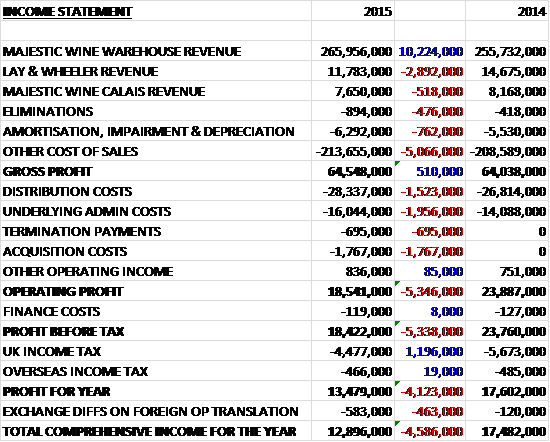
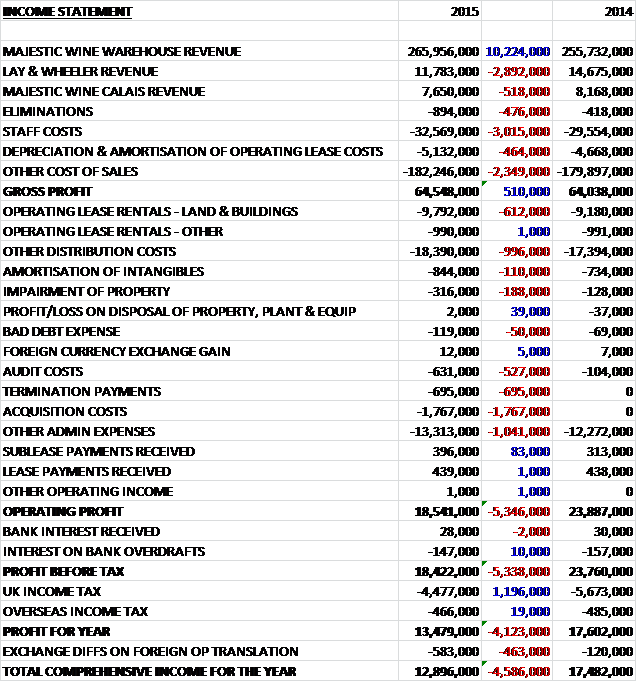
Overall revenues increased year on year as a £10.2M growth in Majestic Wine Warehouse revenue was only partially offset by falling revenues at Lay and Wheeler and Calais.  We also see cost of sales increase year on year to give a gross profit some £510K higher than last year.  We then see distribution costs increase by £1.5M and underlying admin costs increase by nearly £2M which was not helped by a £695K termination payment and £1.8M worth of acquisition costs.  Finance costs were broadly flat but tax was £1.2M lower than last year to give a profit for the year of £13.5M, a decline of £4.1M when compared to 2014.
MJWbalance

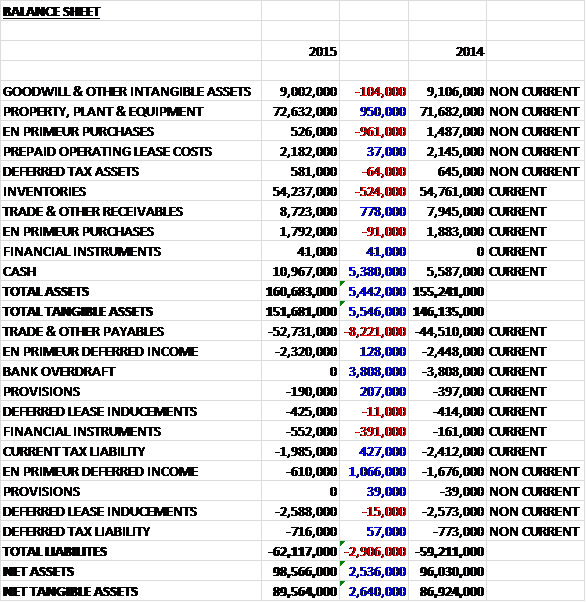
When compared to the end point of last year, total assets increased by £5.4M driven by a £5.4M growth in cash, a £950K increase in the value of property, plant & equipment, and a £778K increase in receivables partially offset by a £1.1M fall in en primeur purchasers and a £524K decline in inventories.  Liabilities also increased during the year as an £8.2M grown in payables was partially offset by a £3.8M reduction in the bank overdraft and a £1.2M fall in en primeur deferred income.  The end result is a £2.6M increase in net tangible assets to £89.6M which looks good until it is remembered that last year, operating lease liabilities were about £90M.
MJWcash

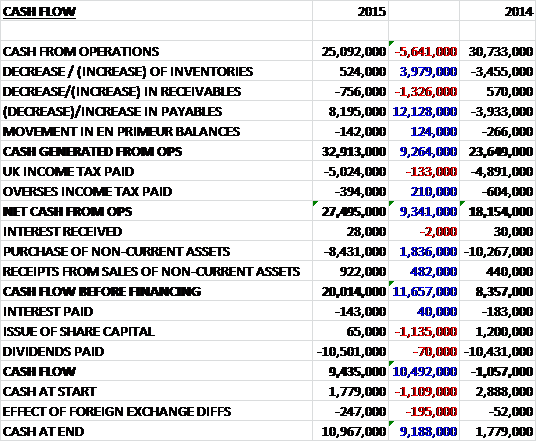
Before movements in working capital, cash profits fell by £5.6M to £25.1M.  A large increase in payables, however, due to certain calendar year end payments worth around £4.4M falling into the 2016 financial year, meant that after tax, net cash from operations stood at £27.5M, a £9.3M increase year on year.  The group then spent £8.4m on intangible assets to give a free cash flow of £20M, more than enough to pay the £10.5M worth of dividends to give a cash flow for the year of £9.4M. Even when the £8.2M worth of increased payables is taken into account, this is not a bad result.

The operating profit at the Majestic Wine warehouses was £19M, a decline of £2.4M year on year.  Despite this decline, the commercial business which sells to restaurants, hotels and pubs, saw a strong growth in sales, up nearly 13% to £42.1M.  Sales in e-commerce also showed a return to strong growth, increasing by 12% year on year and now representing 12% of total UK retail sales.  One area of focus has been on customer communications and in order to increase leverage of an upcoming programme, the number of customer email addresses being held increased by 46% to 394,000.  Towards the end of the year the group launched their first app, “myMajestic”.  This allows customers to store their purchase history both online and in store.  It has so far been downloaded by 19,000 customers and initial feedback has been good.  They intend to continue to invest in enhancing the functionality of the app with development based on feedback from customers.

The operating loss at Lay & Wheeler was £67K, a negative swing of £1M when compared to last year.  This loss was recorded after recognising a reduction of £500K in the balance sheet carrying value of stocks of fine wine for which market values have fallen below acquisition costs, primarily in the Bordeaux 2010 vintage.  During the year the Bordeaux 2013 campaign was very disappointing and despite the quality of the vintage being good, sales were down across the industry.  The group has increased the frequency of offers and had some successes such as the launch of Penfolds Grande 2010, though.  They have now rebranded the business as Cellar Circle with enhanced membership benefits and customer sign up rates have improved.

The operating profit at Majestic Wine Calais was £1.4M, broadly flat year on year.  During the Autumn of 2014 the group simplified their pricing structure highlighting to customers where they can make substantial savings on the UK market price.  Customers have been encouraged to order through the click and collect proposition which now accounts for over 44% of sales, up from 41% last year.

Despite the rather disappointing result with growth in online and commercial sales not enough to offset the underlying sales decline in the more mature Majestic stores, the group continued to grow market share, increasing by 0.1% to 4.3% with UK like for like sales growing by just under 2%.  They have also seen an increase in the number of active customers of 35,000 with an average spend per transaction remaining at £129.  The group have opened in ten locations during the year and closed three bringing the total number of stores to 212.  They now believe that the optimum number of stores is between 225 and 250 as opposed to 330 previously indicated.  The group has implemented a new CRM strategy following the appointment of a new marketing agency and they aim to build a more engaging, personal and relevant relationship with their customers.  The first stage of this strategy was implemented by enhancing and segmenting the database to enable better targeted multichannel communications with a new customer welcome programme being launched in November.

The transformative news that occurred after the end of the balance sheet date was the acquisition of Naked Wines for a total consideration of £70M which includes £50M payable in cash on completion and up to £20M in contingent consideration.  Naked Wines is a customer funded international online wine business with over 300,000 customers.  In an unusual move, former CEO of Naked Wines Rowan Gormley has been appointed CEO of Majestic.  The acquisition will significantly accelerate the planned development of the group’s online capabilities whilst providing Naked Wines with the infrastructure to enable a click and collect delivery option.  Additionally, it opens up attractive markets in the US and Australia.  There is no doubt that Naked Wines is a great and exciting acquisition for the group but it does seem very expensive to me.   Following the acquisition the group entered into a facility with Barclays and HSBC for £85M with some £50M drawn down so far.

As well as a new CEO, Anita Balchandani has joined the board as non-executive director.  She is a partner and sector head of the UK Retail Practice at OC&C Strategy Consultants, an international consulting firm.  She has experience of working with clients to make the transition towards successful multichannel operating models and unlocking insight and value from customer data so I can see where the board are coming from with this appointment.

Following Rowan’s arrival he is conducting a thorough strategic review of the business and a number of new initiatives have been designed to restore the group to profitable growth, such as one off trial and learn initiatives and the creation of in-house expertise in key areas.  In all, the initial priorities are to make the shopping experience simpler, easier and more fun; invest in staff training and retention; build sustainable sales growth through more personalised service and recognising loyalty; rebuilding the supply chain to optimise on shelf availability; deliver robust IT to support ongoing innovation; and to limit new store openings to the 20 to 30 locations that can deliver a good return on investment.  Initial costs of this are expected to be £3M in 2016 with most of the costs falling in the first half of the year, which will clearly constrain profit in the short term.

Trading in the first two months of the new year has been in line with management expectations and despite the near-term headwinds, the CEO is confident of delivering significant shareholder value in the medium term (although he would say that of course)

At the current share price the shares trade on a P/E of 20.7 which reduces to 17.6 when we take out the non-recurring costs – either way this looks a little pricey and even on next year’s consensus 15.5 the market seems to be valuing some considerable growth.  After the final dividend was cancelled, the yield for the year as a whole stood at a measly 1% which is expected to grow to 3.9% next year.  That seems a little optimistic to me given the board have already signalled their intent to not have an interim pay out next year with future dividends “progressively” re-instated by 2018.  At the end of the year, the group enjoyed net cash of £11M compared to £1.8M this time last year, although the acquisition of course changes that.

Overall then, the results were fairly lacklustre with a fall in profits but an increase in net assets.  Operational cash flow did increase but this was only because some payments were shunted into next year and underlying operational cash flow fell year on year.  The group still generates a decent level of free cash flow, however.  Operationally the online and commercial businesses are both doing well but the store portfolio is faring less well and the Lay and Wheeler business really seems to be struggling due to a lack of demand for the recent Bordeaux vintages.  The acquisition of course was the most important part of this update and Naked Wines looks to be an exciting company, although as I have said the price paid certainly seems to be on the high side.  There is headroom of £35M which will certainly cover day-to-day trading but the likely £20M of contingent consideration will have to come from somewhere.  In conclusion, there are enough short term headwinds to make me think that the valuation here has got a bit ahead of itself so I will not be rushing in to buy just yet.
MAJESTIC WINE

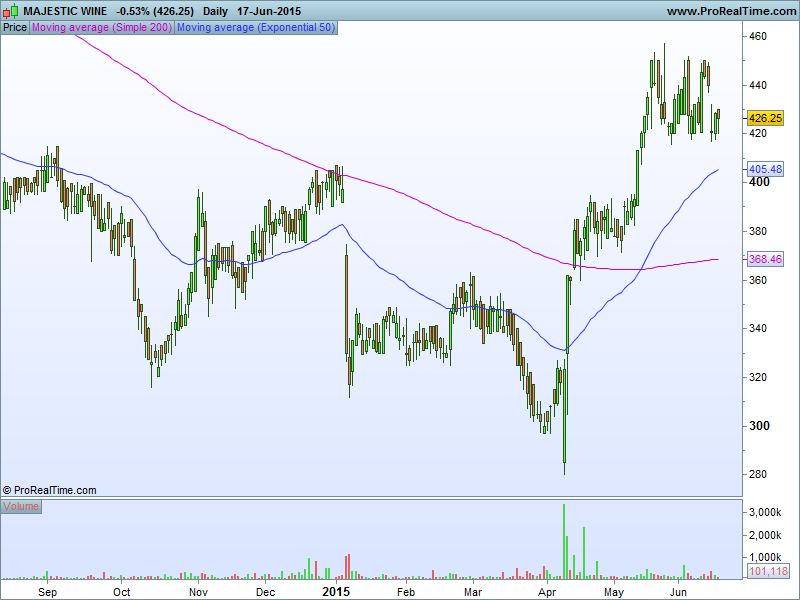
The shares have been boosted by the acquisition announcement and seem to be undergoing some consolidation now.

Majestic Wine has now released its annual report.
MJWfinalincome

We can see some more information about those costs with depreciation and amortisation of operating lease costs up £464K, staff costs increasing by £3M and operating lease rentals themselves increasing by £612K.  There was also a £188K, representing more than double last year, increase in the impairment of property and the group paid much more to their auditors than in last year for corporate finance services.
MJWfinalassets

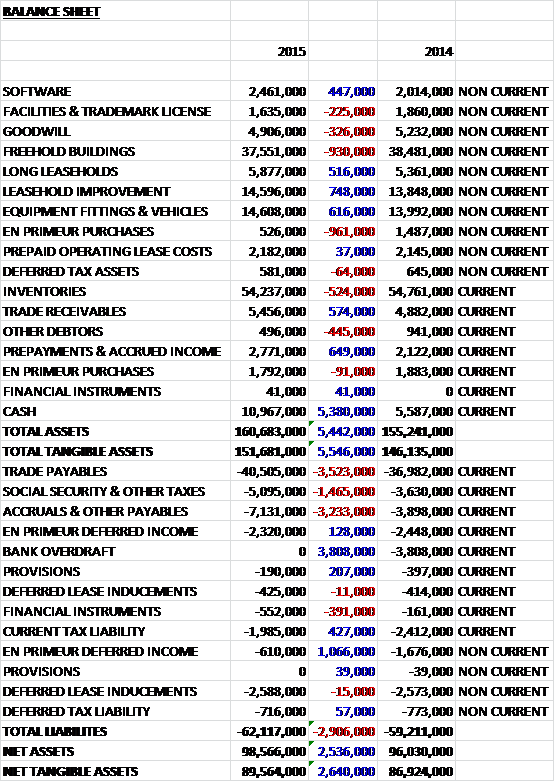
Within intangible assets there was an increase in software valuation, more than offset by falls in the value of licenses and goodwill.  Within tangible fixed assets, we see increases in long leaseholds, leasehold improvements and equipment, partially offset by a £930K fall in the value of freehold buildings.  Within receivables, a £445K fall in “other debtors” was more than offset by a £574K increase in trade receivables and a £649K growth in prepayments and accrued income.  Within payables, we see a £3.5M increase in trade payables, a £3.2M growth in accruals and other payables and a £1.5M increase in tax payable so all types of payable are on the up.

There was a bit of a mixed bag with regards the KPIs.  Total revenue increased along with like for like UK store sales, which increased by 1.9%.  The number of trading stores in the UK increased by seven and the number of active customers increased by 35,000.  The average transaction value remained flat, however, and the profit before tax fell year on year.

We also see a net £84.3M of operating leases not on the balance sheet so these would have the effect of bumping net debt up to £73.3M, which is still an improvement on last year.

On the 21st September it was announced that Chairman Phil Wrigley purchased 10,000 shares at a value of £38K.  This doubles his shareholding top 20,000 shares.  Also, non-executive Ian Harding acquired 2,000 shares at a value of £7.6K to give him an interest in 10,000 shares.

On the 1st October it was announced that Greg Hodder had been appointed as a non-executive director.  He is currently CEO of Charles Tyrwhitt Shirts Ltd but probably of more relevance he was previously CEO of Direct Wines for 14 years.

Murgitroyd Share Blog – Final Results Year Ending 2015

Murgitroyd has now released its interim results for the year ending 2015.

MURincomeint

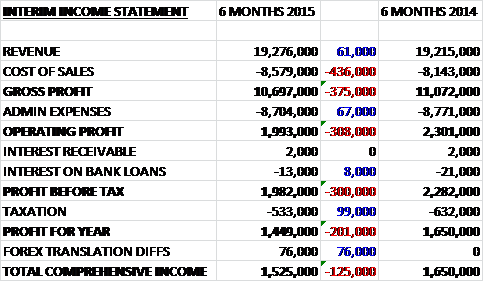
Revenues were flat when compared to the first half of last year, increasing by just £61K and a growth in the cost of sales meant that gross profit was some £375K lower.  Admin expenses did fall somewhat due to tight cost control, and the interest on the loan was slightly lower so that profit before tax was down by £300K year on year reflecting the ongoing investment in new business and the fact that current US margins are lower than elsewhere.  After tax, the profit for the year was £1.4M, a fall of £201K.

MURassetsint

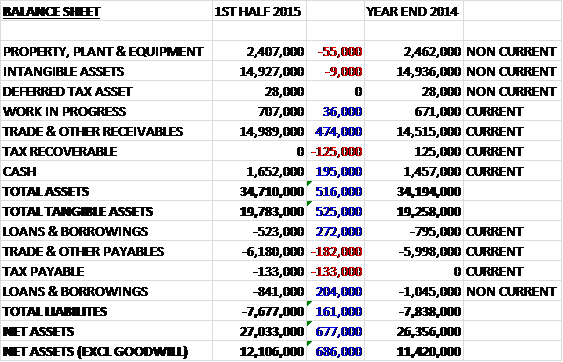
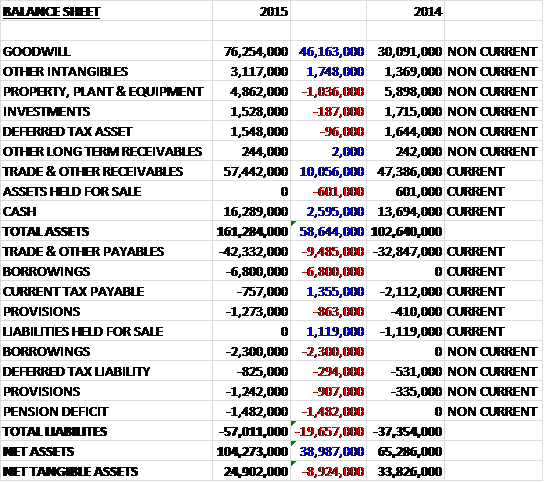
When compared to the end point of last year, total assets at the half year point increased by £516K, driven by a £474K growth in receivables and a £195K increase in cash partially offset by a £125K fall in tax recoverable.  Total liabilities fell during the period as a £476K fall in borrowings was partially offset by a £182K increase in payables and a £133K growth in tax payable.  The end result is a £686K increase in net tangible assets to £12.1M.

MURcashint

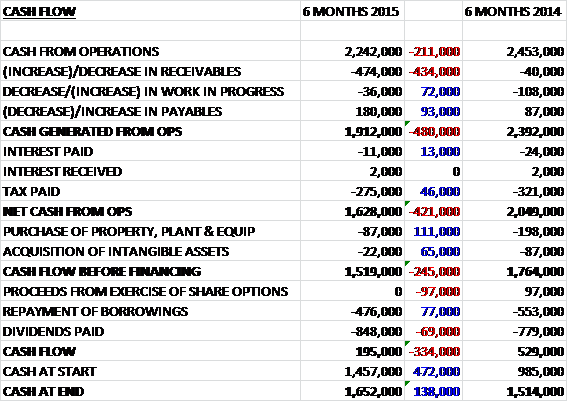
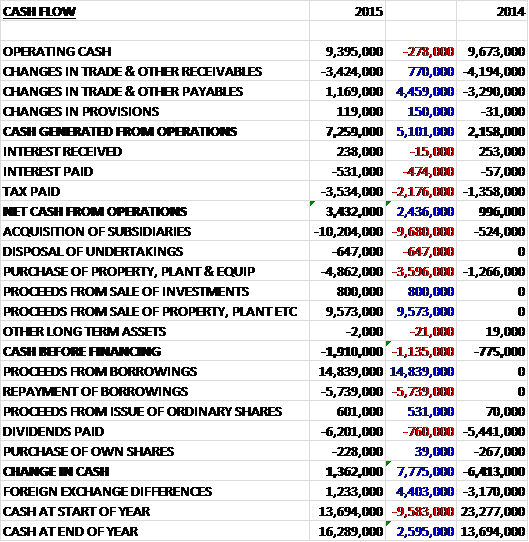
Before movements in working capital, cash profits fell by £211K to £2.2M.  This was eroded further by an increase in receivables, partially offset by a smaller tax bill to give a net cash from operations some £421K lower than in the first half of last year at £1.6M.  There was then negligible capital expenditure so that the free cash flow stood at £1.5M, a £245K decline.  Much of this was spent on dividends but the group also managed to pay off £476K of borrowings to give a cash flow for the first half of the year of £195K.  Despite the fall in operating cash, I do like the fact that the group is using its free cash flow to pay down debt.

The IP Portal filing service is proving increasingly popular amongst clients and there are adequate resources in place to provide for the growing number of larger corporate users.  The investments made in internal and client facing systems continue to deliver cost reductions in a market that is facing pricing pressure.  Business from the US saw significant growth of 22% in Sterling terms and the country remains a key focus for investment and an increasingly important growth market.  It is the largest source of European Patent applications and its growing presence in the market is helping to offset the effects of a stagnating market in Europe with the group addressing the operating businesses on a country by country basis.

In 2014 the number of Community Trade Mark applications filed increased to 117,000 which set a new record despite the rate of growth slowing compared to previous years.  The European Patent Office also reported a 3% year on year increase in Patent filings for the year with the number of applications rising to an all-time high of 273,000.  Within these filings, applications from the US increased by 6.7%, Japanese applications fell by 3.8% and European applications were flat.
Apparently the group remains on track to meet its revenue and earnings targets for the full year with trading in line with expectations and an expectation of a better performance in the second half.  Although markets remain challenging, the group are confident that the investments made will enable them to deliver long-term and sustainable growth.  They have also pointed out that they continue to seek earnings enhancing acquisitions but so far nothing has been announced.

Following a 13% increase in the interim dividend, the shares currently yield 2.3% increasing to 2.5% on the full year ending 2015 estimate after the board have suggested they will be targeting an increase for the final dividend too.  At the end of the period the group was in a net cash position of £288K compared to a net debt of £827K at this point of last year.

Again, this half year was a bit of a mixed bag for the group.  Profits fell year on year as did operational and free cash flow, although the group still generates enough cash to continue paying down its debt.  Net assets did rise, however.  It is difficult to know what to do here.  On the one hand we have a company that generates copious free cash flow and is steadily paying down its debt but on the other there is a market that is growing but experiencing increasing pricing pressure – with the growth market of the US having lower margins.  I would like to buy in here but I think I would like to see some evidence of growth before I do.

On the 11th February, the group announced that non-executive director, David Gray, has resigned from the Board, effective today.  A process to replace Mr Gray is underway.

MURGITROYD

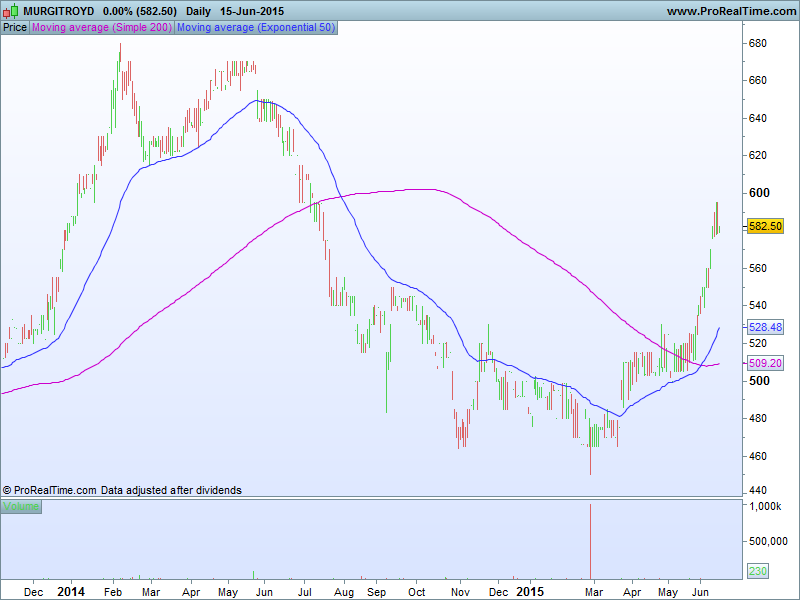
The shares certainly seem to be on their way back up again but it is hard to see exactly why – a tricky one this!

On the 12th August the group announced the appointment of Gordon Stark, aged just 38, to the executive board and Dr Christopher Masters and John Reid as non-executive directors.

Gordon is the current COO of the subsidiary, Murgitroyd so it looks as though he has been promoted.  Christopher was executive chairman of Aggreko and is currently non-executive chairman of Energy Assets.  John founded his own consultancy, ReidStewart Associates and prior to that he was group commercialisation manager of the Intermediate Technology Institute.

Murgitroyd Share Blog – Final Results Year Ending 2014

Murgitroyd provides a range of intellectual property advisory services. In addition to the UK branches, the group also operates offices in Ireland, France, Germany, Italy and Finland with a sales office in the US.  It is listed on the AIM exchange and has now released its final results for the year ending 2014

MURincome

Overall, revenues increased year on year as a £709K decline in UK revenue was more than offset by increases elsewhere, in particular the £2.7M growth in US revenue.  Cost of sales also increased, though, to give a gross profit broadly flat year on year, down by just £2K.  Admin costs also increased, made worse by the lack of a property revaluation uplift which now apparently goes straight to equity.  The interest on the bank loan came down as the group paid off some debt and tax was lower but the profit for the year fell by £376K year on year to just under £3M.

MURassets

When compared to last year, total assets increased by £1.2M, driven by a £604K increase in “other” receivables and a £468K growth in cash.  Conversely liabilities fell during the year as a £1.1M fall in loans and borrowings was partially offset by a £190K increase in “other” payables and a £171K growth in trade payables.  The end result when we exclude goodwill is a £2M increase in net assets to £11.5M.  The operating leases outstanding are not all that substantial and fell by £795K over the year to £3M.

MURcash

Before movements in working capital, cash profits fell by £510K to £4.3M.  An increase in payables when compared to last year, though, meant that operational cash flow increased by £234K to £3.9M.  This became a £739K increase to £2.9M after the lower tax bill and interest payment was taken into account.  This was easily enough to pay for the £320K worth of tangibles and £87K worth of intangibles the group spent on capital expenditure to give a decent free cash flow of £2.5M.  The group used about equal amounts of this to pay for the dividends and to reduce debt to give a cash flow for the year of £472K and a cash pile at the year-end of £1.5M.

The increase in sales was due to organic growth accruing from investment in business development, especially in the US where revenues saw strong growth and have offset falls in the core UK market.  The flat gross profit reflected both the changes in client mix as well as the price pressure that continues in the market for professional IP advisory services.  The strong pound also had an adverse effect on earnings and caused gross profits to fall by £340K.  Much of the US new business comes from larger corporate clients, many using the group’s IP Portal national phase filing service, a market the sales teams are continuing to target.

The group has now rebranded all of its operating businesses under the simplified “Murgitroyd” brand and deputy Chairman Edward Murgitroyd has assumed day to day leadership of the operational business’ management teams from Chairman Ian Murgitroyd.  They are also recruiting paralegals, specialist formalities staff and patent and trademark admins as opposed to attorneys to try and reduce costs and change the way the group delivers services to clients.  Despite this, attorney numbers have increased in the newer offices such as Munich, London and Dublin.  Other cost cutting initiatives involve investing in IT to streamline the way that clients are interacted with.

The markets where Murgitroyd is active continue to display growth with stats showing an increase in European trademark applications of about 4.6% but while the market remains robust, price pressures remain.  The larger corporate clients in particular continue to demand more for less from their professional advisors and investing in improvements in the group’s working practices and service delivery cost control remains a priority.

Next year the group will focus on the European market with the aim of reversing the recent contraction of revenues there despite the current stagnation of the market, alongside continued growth in the US.  The price pressures seen in the market will continue to impact the group and the board expects this to constrain profits progression both this year and next.  Management will look for potential acquisitions where they are immediately earnings enhancing.

The KPIs this year were a bit of mixed bag.  As profitability fell, the various margins declined although net margin remained fairly robust at nearly 11%.  Debt levels improved, however, with gearing down and the current ratio up.  Also of note is the increased turnover per pound of salary costs and the increased bad debt exposure which grew from 0.5% last year to 0.8% this year and represented some £721K of receivables which is quite a material amount and something I hope if being given a priority.

As with many family controlled businesses, the board make up is a little unusual.  Executive chairman is founder and largest shareholder Ian Murgitroyd with the deputy executive chairman position taken up by Edward Murgitroyd, presumably his son.  The CEO and Finance Director position is just one post, occupied by Keith Young who is an accountant from KPMG which seems a little odd.  In any case, the remuneration does not seem excessive for a company of this size.

As far as risks are concerned, the increasingly international nature of the business will mean that they are susceptible to Sterling strength, as seen during the year with a further 10% appreciation against the US dollar potentially giving rise to a loss of £99K and the same appreciation against the Euro giving rise to a loss of £33K which are noticeable amounts for a company of this size.  In addition, the IP market is dependent on global macroeconomic conditions as during lean times companies may start to cut down in their expenditure on R&D and therefore reduce the need for patent services.

Going forward, the group are committed to an aggressive dividend policy following the reduction in debt and this year dividends increased by 6% to give a yield of 2.3%, increasing to 2.5% on next year’s consensus forecast.  At the end of the year the group had net debt of £383K compared to £1.9M at the end of 2013.  At the current share price, the shares trade on a P/E of 17.7 which falls to 17.1 next year which looks a little pricey to me.

Overall then this was a mixed set of results.  Revenues were up due to strong growth in the US, offset by weakness in the UK market but profits fell as costs increased.  Net assets improved year on year and the balance sheet looks very healthy.  Operating cash flow increased year on year but this was due to the poor movements in working capital last year – underlying operating cash flows deteriorated slightly but the group is in a comfortable position where a low level of capital expenditure means there is plenty of free cash to continue paying down debt and spending on dividends.

Operationally though, things seem a little difficult.  Despite a strong market, price pressures really seem to be taking their toll and the board has indicated that pricing pressure will constrain profit in the new year and given this, the forward P/E of 17.1 looks a little strong to me.

Circle Oil Share Blog – Final Results Year Ending 2014

Circle Oil has now released its final results for the year ending 2014.

COPincome

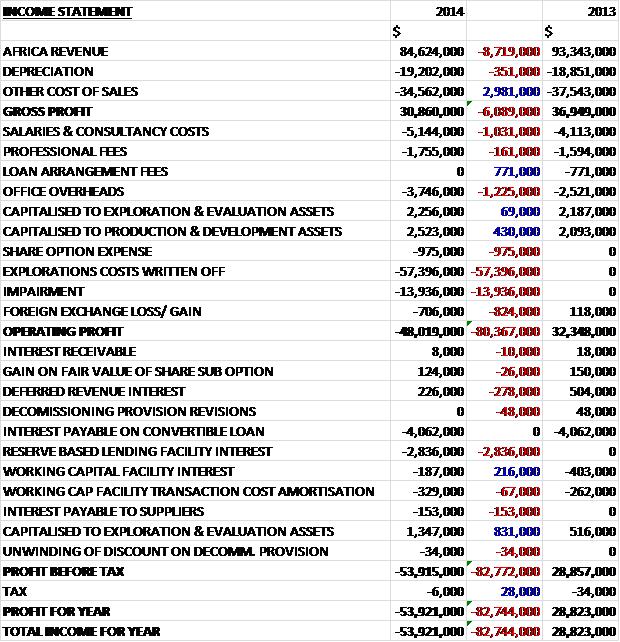
When compared to 2013, revenues fell by some $8.7M, mainly due to the lower price of oil but there was also a small decline in volumes in Egypt, and with cost of sales also declining gross profit was $6.1M lower at $30.9M.  We then see staff and consultancy costs increase by $1M and office overheads up by $1.2M.  The real damage was done by the one-off charges, however, with $57.4M of exploration costs written off due to the withdrawal from Oman and the expiration of the license at the Grombalia block in Tunisia; and impairments of $13.9M relating to the assets in Egypt due to the lower oil price environment, which meant that operating profit was $80.4M worse than last year.  As far as finance costs are concerned, we see a $2.8M interest charge from the reserve based lending facility somewhat offset by an $831K increase in the amount of interest capitalised to exploration and evaluation assets.  A negligible tax bill then meant that the loss for the year was $53.9M, a reversal of $82.7M year on year.

COPassets

When compared to the end point of last year, total assets increased by $6.3M driven by a $51.7M increase in African exploration assets, an $8.4M growth in cash and a $2.5M increase in production and development assets, partially offset by a $35.7M decline in Middle East exploration assets, an $11.9M fall in trade receivables as the balance receivable from EGPC reduced considerably, and a $10M decline in restricted cash.  Liabilities also increased during the year as a $30.9M increase in bank borrowings, a net $2.3M growth in the convertible loan and a $26.3M increase in trade payables was partially offset by a $1M fall in deferred revenue to give a net tangible asset level of $95.4M, a collapse of $68.1M year on year.

COPassets COPcash

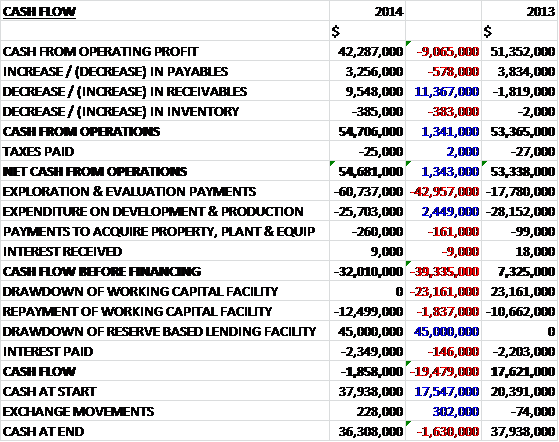
Before movements in working capital, cash profits fell by $9.1m to $42.3M.  Favourable movements in both payables and receivables, however, mostly relating to the cash receipts from EGPC which were overdue (the receivable from this client is now expected to remain at a similar level going forward), meant that the net cash from operations came in some $1.3M higher at $54.7M.  This partially covered the expenditure on the producing assets but was no-where near enough to cover the expenditure on the exploration assets so that before financing there was a cash outflow of $32M with the drawdown of a new reserve based lending facility meaning that for the year as a whole the cash outflow was $1.9M to give a cash pile of $36.3M at the year end.

Overall, the stable gas price in Morocco means that the country is a priority going forward and the group is keen to boost reserves through the ongoing drilling campaign with some potential new customers in the Atlantic Freeport near Kenitra a possibility.  Two discoveries in the Sebou concession added over 6.5 bcf to the reserves during the year and these wells will be put into production shortly.  The 2015 drilling campaign in both the Sebou and Lalla Momouna blocks is well under way and the rig has moved to Lalla Mimouna after the third well was completed.  In Egypt, two further producers and one water injectors were added to arrest the inevitable decline in production from the mature Al Amir SE and Geyad fields.

The low oil prices have impacted the group quite hard especially considering the cost overruns on both the Mahdia block and block 49 in Oman and in order to remain competitive a strategic review of the cost base and funding options is underway.  The average price achieved in Egypt was $94.8/bbl against $104.4/bbl last year and in Morocco the group achieced $10.12/Mscf against $10.34/Mscf in 2013 with the fall in that country attributable to the weakening of the Dirham against the US dollar.

At the end of the period, proved and probable (2P) oil and gas reserves showed NW Gemsa in Egypt as having 26.19 gross MMbo of oil, an increase of 1.83 MMbo with 29.17 bcf gross of gas, a fall of 2.09 bcf, both due to revisions.  In Sebou in Morocco, gross gas reserves came out at 27.88 bcf, an increase of 4.42 bcf, mainly due to new discoveries, and in Oulad N’Zala in Morocco, the gross gas reserves were 1.33 bcf, an increase of 0.2 bcf due to revisions.

In Morocco, gross gas production averaged 6.46 MMscf per day (1,183 boepd), supplying three companies in the Kenitra industrial zone with the largest two customers regularly taking more gas than the minimum contracted.  Preparations for the third drilling campaign were completed with the start of well SAH-W1 in May 2014 with the wells planned to add additional reserves with a view to extending the gas supply contracts.  The KSR-12 well was drilled into a seismic anomaly next to the KSR-8 Main Hoot production and tested separate accumulation in a downthrown fault panel at a different pressure.  This independent gas reservoir has now added additional reserves to the estimate.  Also the CGD-12 well was drilled through another separate accumulation in the SW area of the Sebou concession.

In well SAH-W1, three gas bearing zones were encountered at the expected depths but for technical reasons, the rig was released from this site prior to testing and completion so these accumulations have not been included in the latest reserves calculation.  During April 2015, however, testing was completed which enabled the well to be added to the production system and following this, the rig was moved to the Lalla Mimouna block to start drilling an initial three well programme.  For the Oulad N’Zala concessions, the 2P value of gross estimated recoverable gas reserves is 37.14 bcf (6.4 MMboe) with 27.5 bcf net to Circle, a 23% increase over the prior year report.  The 2P gross remaining reserves are estimated to be 29.21 bcf (5.04 MMboe) with 21.71 bcf net to the group, a 19% increase on last year’s report.

In Egypt, the NW Gemsa concession contains the AASE and Geyad fields where gross production averaged 10,026 bopd and 10.6 MMscf per day.  Development drilling continued to May 2014 with two producers and one injector in AASE.  The gas export line to the SUCO facilities in Zeit Bay has allowed for produced wet gas to be processed as dry gas with the additional benefit of extracting condensate and LPG at the terminal which has been ongoing since early 2013.  Appraisal production well AASE-19, infill production well AASE-21 and the water injector AASE-22 were completed during the year which concluded the initial field development programme with the rig being farmed out to another operator for a year or so.

During the year, field operatorship at NW Gemsa changed from Vegas to North Petroleum and development drilling is planned to resume during H2 2015.  Average daily production in the new-year to May was is 8,236 bopd with 3,294 net to Circle and 9.32 MMscf per day of gas with 3.73 net to the group.

At the start of the year the group had interests in two exploration licenses in Tunisia: the offshore Mahdia permit and the onshore Ras Marmour permit with an application for an exploration permit for Takelsa under negotiation.  In addition, an agreement with Exxoil, the operator of the Beni Khalled production concession made Circle a partner in this lease subject to fulfilment of an agreed work programme of seismic and a well.  The field is currently producing less than 100 bopd compared to some 550 bopd ten years ago.  Activity during the year included the drilling of an exploration well in the Mahdia block and seismic survey planning in Beni Khalled.

The El Mediouni well in the Mahdia permit commenced in June and was suspended in September having encountered light oil shows through a 133 metre section of Ketatna carbonates.  Massive mud losses occurred and despite multiple attempts to restore circulation, the hole conditions deteriorated and no open-hole logging was possible.  Although this was a disappointing result, the well proved both a petroleum system and a reservoir on the block and with an application to enter the next exploration phase awaiting formal government approval, efforts to farm-out an interest in the block with re-commence in later in the year.

At the start of the year, the group operated onshore exploration block 49 and offshore exploration block 52 in Southern Oman.  The infill 2D marine seismic survey acquired during the year was processed and interpreted for the inshore area of Sawqirah Bay in block 52.  The group also drilled onshore exploration well Shisr-1 in Q1 2015 in the SW area of block 49 but the decision was taken to plug and abandon the well due to drilling difficulties and no hydrocarbons were detected.  As part of the review of the cost base, given the insufficient interest in a farm-in of block 52, Circle decided to relinquish both blocks and exit Oman completely.  Once the restoration of the drill site on block 49 is complete and all relevant data has been submitted to the Ministry, the offices in Oman will be closed and the group will no longer bid for new acreage in the country.  As a result, the group’s investment in Oman has been written off.

Trying to keep track of Circle’s various funding facilities is quite a challenge.  After the year-end the convertible loan was amended with the group paying $10M by July (so far $6M has been paid off) with the remaining $20M being extended until July 2017 and an increase in the interest rate from 6% to 8%.  During the year the group also signed a reserved based lending facility of up to $100M with IFC with a maturity date of June 2018.  As of the end of December, the total loan amount committed was $75M with the maximum available amount being $66M and the total draw-down was $45M with a further $12.5M being drawn down after the year-end.

Going forward the group is planning further infill drilling in Egypt during the year with three new production wells in 2015 aimed at minimising the decline in production rates, and to continue the drilling programme on the Sebou and Lalla Mimouna permits in Morocco with at least three wells being drilled in the Lalla Mimouna concession during the year with the aim to increase gas sales this summer.  In Tunisia, they are waiting for government approval to proceed to the next exploration phase of the Mahdia permit and will re-start farm out efforts.  The drilling of Sedouikech well in the Ras Marmour permit is likely to be undertaken but the final decision will be taken in light of the overall review of the group’s capital expenditure commitments.  Overall the board hopes to further increase the gas reserves in Morocco and sustain oil production in Egypt during the year.

During the year Chris Green resigned as CEO and Mitch Flegg was appointed as his replacement from June 2015.  He was formerly the COO of Serica Energy and is an operationally focussed executive.  Also, Susan Prior was appointed finance director from January.  She is a chartered accountant who was formerly at PwC.  Additionally there were two new non-executive appointments with Antony Maris, a petroleum engineer currently COO of SOCO International and David MacFarlane, the former Finance Director at Dana Petroleum both bringing significant experience to the group.

As the group made a loss, it is pointless looking at the P/E ratio this year but it is expected to be 18.3 on next year’s (varied) consensus broker forecasts which looks rather rich to me.  At the year end the group has available cash of $34.5M and net debt stood at $38.7M but it increased to $59.2M by the end of May 2015.

Overall then this was clearly a disappointing year for the group.  Underlying profits fell, there were impairments in Egypt and Oman, net assets declined considerably due to large increases in borrowings and trade payables.  Operating cash flow did increase but this was only due to the continued recoverable of overdue receivables from EGPC which will not be repeated going forward and the cash income is not enough to sustain this level of exploration which is why it is a good idea to leave Oman – arguably this was a step to far at the same time as the Tunisian programme anyway.  The technical problems on the Tunisian drill is disappointing but the country does hold some promise with Morocco also likely to add to income going forward.  Sadly the same cannot be said for Egypt which is an ageing field susceptible to oil price fluctuations.  Overall, given the above and the vastly increasing levels of debt I don’t think Circle Oil is a sensible investment at this time.

On the 26th June the group released an update for the LAM-1 well testing.  Following the completion of the well on the 26th May, the well was tested using a slick-line unit.  The primary target was hit at 1,261 to 1,272 metres and gas flowed at a stabilised rate of 1.9 MMscf/d on a 16/64” choke and the secondary target was hit at 1,181 to 1,183 metres and flowed at a stabilised rate of 1.1 MMscf/d.  The rig has now been mobilised to drill the ANS-2 well, the second one of the campaign located on the norther flank of the Anasba ridge with a TD of 1,062 metres.

It is good to finally get some good news from the company, I think that Morocco always was the most likely to provide good results.

On the 14th July the group announced that it had completed the ANS-2 exploration well in Morocco.  Although the well encountered gas shows whilst drilling at the targeted depth, the interpretation of the wireline logs indicates that the reservoir quality encountered at the well has not met the pre-drill estimates.  It has therefore been suspended pending further analysis of all the data before a decision is made regarding whether or not to complete the well.  The rig is now being mobilised to drill the NFA-1 exploration well, the third in the drilling campaign on Lalla Mimouna.  This well is targeting two potentially gas-bearing zones in the Miocene sands which exhibit strong seismic amplitude anomalies, attributed to gas filled porous sands.

On the 3rd August the group released an update covering the NFA-1 exploration well on the Lalla Mimouna permit, onshore Morocco.  The TD of the well, at 1,077 metres, was reached on the 26th July.  The well encountered gas shows whilst drilling at the targeted depth but the reservoir quality did not meet the company’s pre-drill estimates so the well have been plugged and abandoned.  The rig will not be mobilised to drill the Ksiri South exploration well in the Sebou permit which is targeting two objectives in the Miocene Gaddari sands.  One of the objectives is to prove up the potential of targets with a significant trapping component which, if successful, will open up a new play type for the Sebou permit.  Unfortunately this is another disappointing result for the group.

On the 19th August the group announces that the Tunisian authorities have approved the application to renew the exploration permit on the Mahdia block with an extension running until January 2018.  The extension carries with it a commitment for one exploration well, one appraisal well and a requirement to acquire 300km2 of 3D seismic.  Given the group’s 100% working interest in the block, they intend to select suitable partners to help evaluate and develop the prospects on the permit.  There have apparently already been initial expressions of interest from a number of oil and gas companies with the financial strength and experience to make suitable joint venture partners.  The confirmation of this extension of the permit will give interested parties greater certainty in making a formal approach and should assist in concluding an agreement.

On the 26th August the group released an update for the KSS-A well which was targeting two objectives in the Miocene Gaddari sands.  The well encountered unexpected lithology above the primary objectives and as a result the well has been plugged and abandoned.  The technical data from the well in being assessed in line with available seismic with a view to assessing further drilling in the area at a later date.

The rig is now being mobilised to drill the Ksiri West (KSR-A) exploration well in the Rharb basin.  The principal target is in the hanging wall of the Ksiri West fault sequence.  There are channelised sand bodies within the Main Hoot sequence which display a significant seismic amplitude anomaly found to be caused by gas-filled porous sands in several nearby wells.  The event should be a depth of about 1,789 metres and a shallower, smaller, secondary target is recognised in the Miocene Guebbas sands at 1,303 metres.  The well has a TD of 1,860 metres.

Oh dear, things are getting a bit desperate here in my view…

Creston Share Blog – Final Results Year Ending 2015

Creston has now released its final results for the year ending 2015.

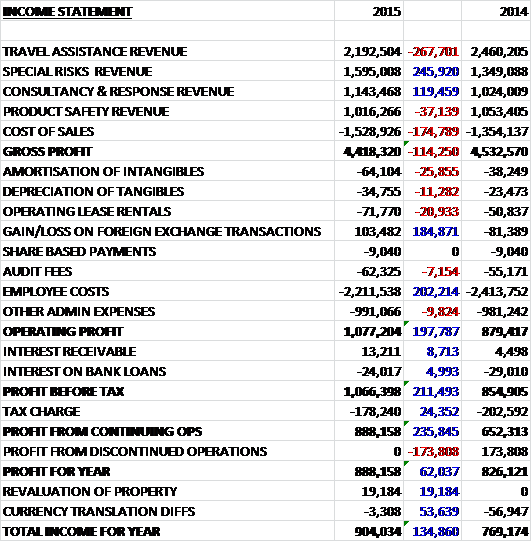
CREincome

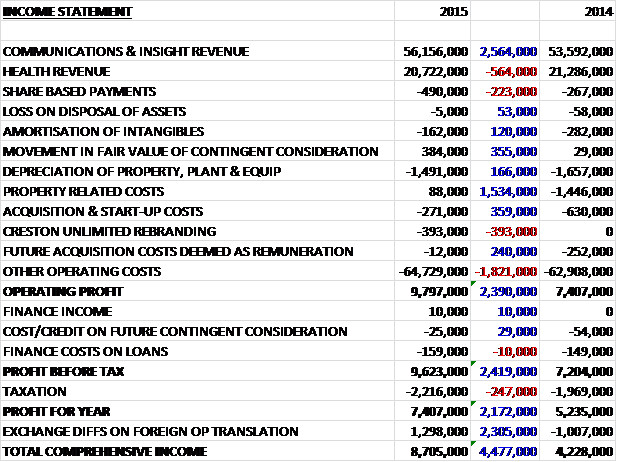
Overall revenues increased year on year as a £564K decline in health revenue was more than offset by a £2.6M increase in communications and insight revenue.  Although underlying operating costs did increase, there were a number of costs that fell with both depreciation and amortisation costs declining, a £240K reduction in future acquisition costs deemed as remuneration, a £359K decrease in acquisition and start-up costs, a £355K positive movement in the fair value of the contingent consideration and a £1.5M positive movement in property related costs that disappeared year on year as some £100K was credited back due to a rebate of costs incurred during the vacant period at the HQ.  The end result is a £2.4M growth in operating profit which, after an increase in tax, became a £2.2M increase in profits for the year at £7.4M.

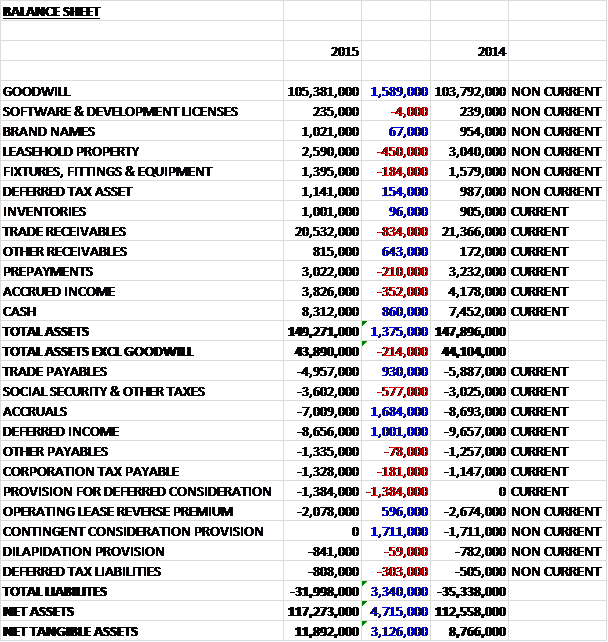
CREbalance

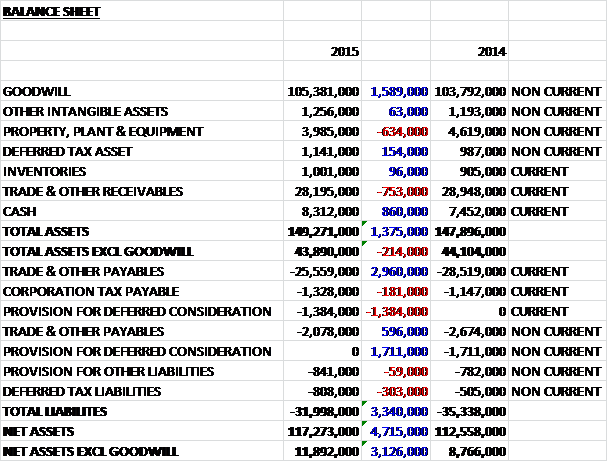
When compared to the end point of last year, total assets increased by £1.4M, driven by a £1.6M growth in goodwill, an £860K increase in cash and a £154K increase in deferred tax assets, partially offset by a £753K fall in receivables and a £634K decline in property, plant and equipment.  Conversely, total liabilities declined year on year as a £3.6M fall in payables and a £327K decline in deferred consideration was partially offset by a £303K growth in deferred tax liabilities and a £181K increase in corporation tax payable.  The end result is a net asset base, excluding goodwill, of £11.9M which represents a £3.1M increase year on year.

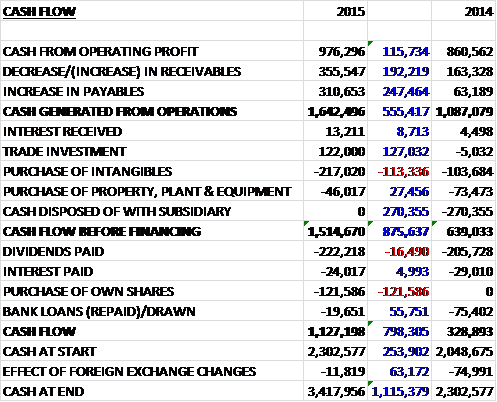
CREcash

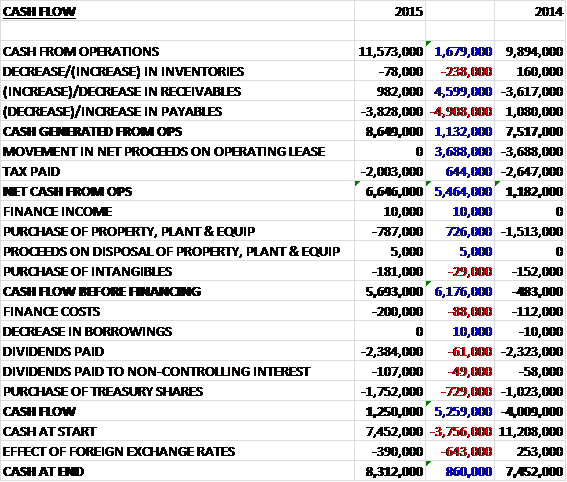
Before movements in working capital, cash profits increased by £1.7M when compared to last year to £11.6M.  This was eroded somewhat by a fall in payables relating to a reduction in deferred revenue where scope for pre-billing has reduced across the client base, so that cash generated from operations increased by £1.1M.  After tax, the net operational cash flow stood at £6.6M.  There was little in the way of capital expenditure with £787K spent on tangible assets and £181K spent on intangibles to give a strong free cash flow of £5.7M.  This was more than enough to pay for the £2.4M of dividends and £1.8M in share purchases to give a cash flow for the year of £1.3M compared to an outflow last year that was affected by cash payments to fulfil the dilapidation obligations with the signing of a new operating lease at the head office, and higher capital expenditure.

Underlying profit at the Communications and Insight division fell by £156K to £8.1M with the profit margin declining from 15% to 14%.  The decline was due to the weakening Euro in the second half of the year and temporary additional freelancer costs incurred following a strong new business performance.  The division managed to mitigate some £500K of property related costs incurred in the first half of the year following a successful rates review across a number of properties in the second half.  Significant new business wins during the year included work for new and existing clients such as Activision, Allianz, Arthritis Research UK, Asda, Varilla, Bentley, Deezer, McCarthy & Stone, McLaren, Mind Candy, Sainsbury’s Energy, Sky, Sony Mobile, Superfast Broadband and Vue Cinemas.  Post period end wins included Costa and further assignments from Canon.

Underlying profit at the Health division fell by £178K to £4.3M with a profit margin remaining steady at 21%.    The decline was exacerbated by the weakening Euro during the year but constant currency profits fell too.  As previously reported, after a strong first half, Q3 revenue performance was impacted by some client budget cuts and project delays within the UK Health business, which also affected Q4 revenue at which point actions were taken to re-align the cost base.  The effect was mitigated somewhat, however, due to a revaluation credit relating to the contingent consideration for DJM Unlimited due to project delays and cancellations, partly as a result of a failed clinical trial.  Significant new business wins during the year included Abbot, Baxter, Bayer, Danone, International AIDS Society, Parent Project Muscular Dystrophy and Unilever.  The group has also expanded its remit with CDC, Novartis, National Meningitis Association, Pfizer and Sanofi.

This has been a year of change for the group with a new board and a new strategy that was set out at the start of the year which sought to build an agency group band, develop a group full service client offer, develop the consultancy offer, invest in the existing company’s offer and services, and to grow international services.  This has been implemented with the launch of the new agency group brand and offer, Creston Unlimited, with the rebranding of all Creston companies.

The board have also sought to target investments and partnerships on skills that are currently missing within the group’s offering.  During the year the group has entered into four new partnerships – each in a complementary area.  Two new partnership agreements will enhance the international services offering.  In November, they signed an agreement with Serviceplan, the leading independent marketing communications agency group in Europe which has already resulted in a number of new client referrals and joint pitches such as a joint CRM assignment for Danone in Germany and the Middle East.  In April 2015, the group signed an agreement with Propeller Communications, a digital healthcare communications agency based in the US and in the same month they also signed with Future Foundation, a global consumer trends and insight consultancy to complement their insight offer, and with the digital strategist, the Digital Consultancy to further add to the group’s consultancy offer.

The KPIs for the group are all financial and includes international revenue, digital revenue, EBITDA, cash conversion and net cash along with a few others.  All indicators either improved or remained flat except revenue and profit per head, both of which reduced year on year.  During the year the group embarked on a share buy-back scheme and as of the year-end some £1.8M has been spent with a remaining balance of £200K still to be purchase depending on the share price performance.

As previously touched upon, this year was a year of change for the board.  Barrie Brien joined as CEO and Kathryn Herrick joined as CFO.  David Grigson stepped down as Chairman and was replaced by Richard Huntingford who was an existing member of the board so at least provides some continuity.  Additionally, Kate Burns joined the board as non-executive director and David Marshall stepped down.  Finally, after the year-end, Nigel Lingwood will join as non-executive director with Andrew Dougal stepping down.

The group has been adversely affected by the strengthening Sterling against the Euro and given that further volatility is expected, management are working to renegotiate Euro denominated contracts where possible and are considering available hedging arrangements.

As can be seen from the above accounts, there is now £1.4M of contingent consideration to pay after a £400K credit was received due to its revaluation.  This will become payable in cash by July of this year.  Also, after the end of the balance sheet date the group paid out £8.7M for the acquisition of How Splendid so it is quite likely that they will finish 2016 in a small net debt position.

After the year end the group announced the acquisition of 51% of How Splendid, a digital design and development consultancy.  The acquisition added some significant new clients such as Barclaycard, Boots, Gamesys, News UK, Skrill, SSE and Star Alliance, two of which will become one of the top 20 clients in terms of revenue.   On completion there was an initial cash payment of £8.7M funded from existing resources with a further cash payment of up to £7M due by June 2017.  In addition, Creston will have the option to acquire a further 24% from April 2017 for up to £8.6M and the remaining 25% from April 2019 for up to £11.9M.

Going forward, the group is now one year into its five year strategy and there is a real feeling of momentum across the company.  The board are encouraged by the early success of this strategy which gives a strong platform to deliver value to shareholders over the medium term.  That is a quote from the outlook statement and it gives next to nothing away about trading in the current year!

At the current share price, the company trades on a P/E ratio of 11, falling to a rather good value 9.8 on next year’s consensus forecast.  After an 8% increase in the full year dividend, the shares currently yield 3.1% in dividends, which increases to a decent looking 3.4% on next year’s forecast.  At the end of the year, the group was in a net cash position of £8.3M compared to £7.5M at this point of last year.  After the year end, the banking facility was renegotiated to include a £25M revolving credit facility which suggest that perhaps further acquisitions are on the cards after the recently announced acquisition and previously announced deferred consideration use up the net cash reserves.

On the same date as the results the group announced that it had made a strategic investment in 18 Feet and Rising, a London based advertising agency.  The group currently works with Allianz, Cuprinol, Kopparberg, Nandos, House of Fraser and Skoda, for which they created the world’s first ad campaign to use eye tracking technology.  The investment is for £1M in cash for a 27% stake in the business. Last year it grew revenues by 245 to £2.7M but is presumably still loss making as no figures were given for profits.

Overall then, I think this update was better than I was expecting.  Reported profits increased considerably, although underlying profits showed a more modest growth.  Net assets improved and the balance sheet looks good for a company of this nature.  Also, operational cash flows improved and the group had a very good level of free cash flow which more than paid for the dividends and share buy-backs.  Operationally, the weak Euro seems to be a bit of a drag on performance, and this along with some of their health clients cutting budgets meant that the performance in the second half was a bit of a struggle.  The cash pile has already been used up in acquisitions and I do hope that the new board, which has brought with it a new energy and strategy doesn’t go overboard with the acquisitions.  In conclusion then, the good performance this year combines with the cheap looking forward P/E and decent dividend make up for the operational difficulties and I have made a small purchase.

CRESTON

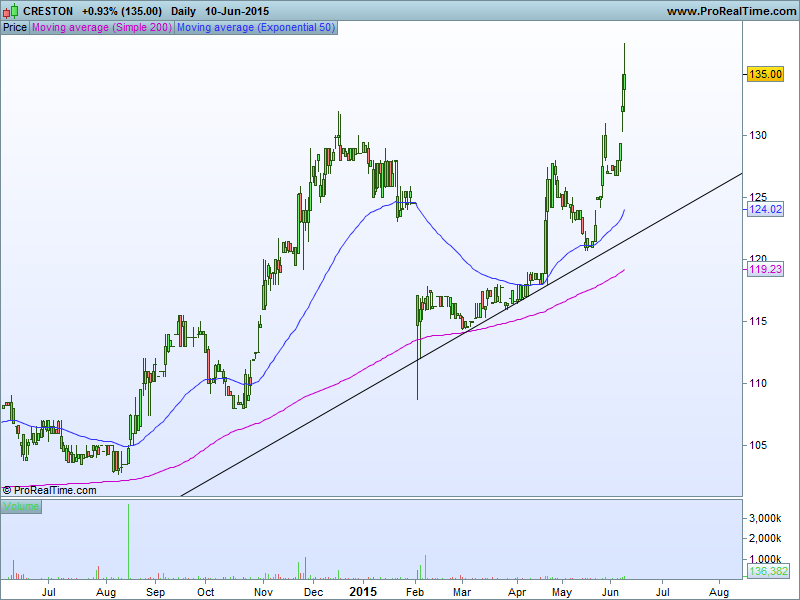
As we can see, the share price has responded well to the results.

Creston has now released its annual report for the year ending 2015.

CREincome

The only extra information gleaned from the income statement is that audit costs grew by £17K, operating lease costs fell by £166K and there was a £127K positive swing in foreign exchange items.  This had the effect of giving an “other” operating cost of £11.2M, an increase of £834K year on year.  It is good to see the operating leases come down but there is not really much else of interest here – I do with operating lease costs were listed separately at the prelim results stage but I guess I can’t have everything.  I also wish the receivables, payables and intangible assets were split on the prelim balance sheet too so we will have a look at that now.

CREassets

So, we can now see that the small increase in intangible assets is down to the increase in the value of brand names and within property, plant and equipment the fall was driven by a £450K decline in leasehold property.  Within receivables we can see an £834K fall in trade receivables, a £352K decline in accrued income and a £210K fall in prepayments was partially offset by a £643K increase in “other” receivables.  As far as liabilities are concerned, we can see that a £577K increase in social security and other tax payables was more than offset by a £930K fall in trade payables, a £1.7M decline in accruals and a £1M decrease in deferred income.  The operating lease liability off the balance sheet was broadly flat at £21.5M.

The reminder that the group is somewhat susceptible to exchange rate changes should be notes.  A 10% strengthening of Sterling against the Euro would reduce profits by £175K and a 10% appreciation against the US Dollar would reduce profit by £20K.  Net cash at the year-end stood at £6.9M not including the operating leases but including the deferred consideration due to be paid this year.

There are a few case studies included in the report.  The objective with Vue Cinemas was to increase cinema admissions and market share so the group used local audience insight and mapping to define the target audience and create new film related creative content across multiple channels.  For Magnum they created an integrated brand engagement campaign spanning digital, social, experiential, print and outdoor to drive excitement around the release of two limited edition Magnum ice cream flavours.  For BMW they were tasked with revolutionising the user experience of the retailer network websites so they balanced centrally managed and localised content to empower dealers to market in their local area.  The group also worked with Virgin Trains across social, digital advertising and CRM to get more people on their trains.

I have to say that to me the new CEO seems to be very well paid, perhaps excessively and this year earned £696K with a substantial annual bonus and LTIP award.  The annual bonuses are based on profit before tax (75%) and client satisfaction (25%) which seems sensible enough but a 2% increase in the former was enough to trigger the minimum bonus.

In all though, I feel that this is a decent company only part way through a tangible improvement drive so I am happy to hold.

Red24 Share Blog – Final Results Year Ending 2015

Red24 has now released its final results for the year ending 2015.

REDTincome

Overall, revenues increases somewhat year on year as declines in travel assistance and product safety were offset by increases in special risks and consultancy & response.  Falls in revenues from the UK and Europe were offset by an increase in ROW sales.  Cost of sales also increased, however, to give a gross profit some £114K lower than last year.  We then see a fall in employee costs, partially offset by small increases in depreciation, amortising and operating lease rentals before a £185K positive swing in foreign exchange transactions sent the operating profit £198K higher than in 2014.  There were then small improvements in interest costs and a smaller tax bill (due to the fact that R&D investment in the travel tracker product attracted a tax credit in the UK) offset by the lack of a £174K profit from the discontinued operation to give a profit for the year of £888K, an increase of £62K year on year.

REDTassets

When compared to the end point last year, total assets increased by £808K driven by a £1.1M increase in cash and a £152K growth in the value of intellectual property, partially offset by a £204K fall in trade receivables and a £118K decline in prepayments and accrued income.  Total liabilities also increased during the year, mainly as a result of the £219K growth in accruals and deferred income relating to obligations for future services that have already been invoiced.  The end result is a £569K growth in net assets to £4.1M (excluding goodwill).  Operating leases were negligible and declining so this balance sheet looks rather solid.

REDTcash

Before movements in working capital, cash profits increased by £116K to £976K which became an improvement of £555K to £1.6M after the group increased the number of days it takes to pay its creditors from 19 days to 26.  Capital expenditure was minimal, with a £217K purchase of intangible assets and £46K going on property, plant and equipment and the free cash flow was further flattered by the £122K received from the sale of a portion of the Linx investment.  Indeed, before financing, the cash flow stood at an impressive £1.5M.  Of this, some £222K was spent on dividends and £122K on the purchase of shares to use for employee schemes so that for the year as a whole there was an impressive £1.1M of cash coming into the business, some £798K better than last year.

Gross profit at the Travel Assistance division fell by £111K to £2.2M.  The service was significantly enhanced the investment in the travel tracker product which has placed it onto a new technical platform that will make it easier to interface with new clients.  The product was launched in February 2015 and the initial response has been encouraging.  The previously announced loss of the HSBC Premier and Advance books in the UK impacted revenues in the current year and although significant progress was made in diversifying revenue streams, regulatory changes in the UK make it unlikely that the lost revenues will be replaced by like for like income so the cost base was reduced.

Gross profit at the Special Risks division grew by £153K to £1.2M.  The business had a busy year and dealt with a record number of kidnappings and other attempts at extortion with Mexico and Indonesia proving particular trouble spots.  The prolonged incident that occurred last year in the Middle East was not repeated but the group has added new books of business over the year.  The new Munich office is meeting expectations and has created a number of promising opportunities.

Gross profit at the Consultancy & Response division fell by £94K to £363K.  The business has been busy with requests for close protection work and for evacuation planning services.  In August a Far Eastern client requested a large evacuation from Libya involving several hundred members of staff which was successfully completed and represented the largest operation to date.  Gross profit at the Product Safety division fell by £62K to £682K.  The division did show an increase in revenue during the second half of the year following the launch of a new analytical tool and new training modules which kept the group’s offering ahead of the competition and helped ensure that contracts are renewed and new business won.

Given the loss of the largest customer these results are actually very good.  The group seems to have responded swiftly to the news by reducing their fixed cost base and winning new contracts.  Two clients still account for more than 10% of revenues, however with both account for about 14% compared to 23% and 10% last year.  This is to be expected for a company of this size but it is still a considerable risk and one that the group is trying hard to resolve.  The group does also seem to be suffering from a high level of receivable impairments.  Of the total amount of £717K some £44K was impaired during the year, which is more than 6%.  After this impairment, the amount of receivables overdue has fallen significantly however, so hopefully this is a one-off occurrence.

Another potentially serious risk is that of currency differences.  A 10% appreciation of the South African Rand against Sterling would increase the cost of its operations in the country by £148K, although this would be mitigated somewhat by a corresponding £116K rise in the value of their Rand assets.  Were the US dollar to appreciate by 10% against Sterling, profits would be reduced by £84K.  These may not sound like huge amounts but they are fairly material to a company of this size.  In order to try and counteract some of this risk, the group has forward purchased 80% of their forecasted Rand requirements.

During the year the group received £122K from the sale of a portion of their Linx investment.  They have agreed to sell their entire holding which will bring in £125K in 2015 and the same amount in 2016.  The KPIs of the group are all financial in nature and include revenue, gross profit, profit before tax, EPS and available cash.  All of them except gross profit improved year on year.  This year the group appointed Lorraine Adlam as non-executive director.  She was previously CEO of a Lloyd’s Underwriting business and Chairman of Howden Insurance Brokers so she sounds like she might be a useful person to have on the board given that insurance companies must make up a decent portion of the client base.

Going forward, although there are risks to the business mainly relating to their continued (but improving) over-reliance on some large customers, foreign exchange risks and the general global economic outlook, the board are encouraged by the progress over the last year and are confident of further progress to come.  The acquisition made after the balance sheet date added a number of blue chip clients to the group’s books and strengthened their presence in Asia along with broadening the product offering in the UK.  There is apparently a good pipeline of new business and significant opportunities are seen in Europe and Asia.

At the current share price the shares trade on a P/E ratio of 11.4 which falls to 9.4 on next year’s consensus forecast which looks pretty decent value to me.  After a 17% increase in the final dividend, the dividend yield currently stands at 2.4% increasing to 2.9% next year which again seems pretty good.  At the end point of the year, the group enjoyed a net cash position of £3.2M compared to £2M at the end of last year so they clearly had enough to pay for the acquisition announced recently.

Overall then, this is a very encouraging updates.  Profits improved slightly, net assets increased in what was already a solid balance sheet and operational cash flow improved, albeit slightly flattered by good working capital movements, to give a very strong free cash flow.  Operationally, the travel assist business did remarkably well considering the loss of the HSBC contract and the special risks division had a strong year due to record numbers of kidnappings!  The consultancy & response, along with the product safety divisions both saw profits fall although revenues picked up for the latter business in the second half of the year.

As with any business there are risks, though, and especially so in one as small as this.  The group still relies on a number of large customers, although this is an area that is much improved year on year.  The large amount of impaired receivables will hopefully be an area of focus and the currency issues, at least as far as the more volatile Rand is concerned, seem to be being addressed but strong shifts in the USD and GBP exchange rates could still cause problems.  The forward P/E is under 10 though, there is a near 3% dividend yield expected for next year and the group has a strong net cash position.  This is the kind of business I like – they make enough free cash to be able to fund their own expansion both organically and through acquisitions.  I am currently comfortable with my investment here.

RED24

As you can see the shares have pretty much entirely recovered from their shock after the loss of the HSBC contract.

On the 6th July the group announced that a company indirectly owned by Chairman Simon Richards sold 240,000 shares at a total value of £63.6K.  Mr. Richards still owns some 14,219,250 shares representing over 29% of the total equity but this is likely to put a bit of a halt on the share price appreciation in the short term.

On the 20th July the group announced that the same company as above, indirectly owned by the Chairman sold its remaining 200,000 shares at a value of £58.5K.  Mr. Richards still owns 14,019,250 shares representing 28.62% of the total issued share capital so he is still heavily invested.

On the 28th August the group released a statement that non-executive director Lorraine Adlam had purchased 25,000 shares at a value of £6,575 which gives her a total of 75,000 shares.  This is not exactly a huge vote of confidence but nicer than nothing!

UK Mail Share Blog – Final Results Year Ending 2015

UK Mail has now released its final results for the year ending 2015.

UKMincome

When compared to last year, overall revenues increased as a growth in parcels and courier revenue was partially offset by a fall in mail revenue.  Cost of sales increased considerably, however, to give a gross profit some £8.8M lower than in 2014.  Underlying admin expenses fell by £8M but non-underlying costs increased slightly as the £400K cost of automation implementation and the £2.5M in national hub costs were not entirely offset by a £2M compensation relating to HS2.  We then see £9M in impairment costs, £1.4M in pallet business closure costs and a loss from the pallet business to give a profit for the year of £5.1M, £12.4M lower than last year.

UKMassets

When compared to the end point of last year, total assets increased by £11.9M, driven by a £35.3M increase in property, plant and equipment, a £3.8M growth in receivables and a £3.6M increase in intangible assets, partially counteracted by a £7.9M fall in the value of goodwill.  Liabilities also increased during the year as an £18.2M increase in payables, a £9.4M increase in borrowings, a £1.1M growth in deferred tax liabilities and a £1.1M increase in provisions was partially offset by the elimination of £8.9M worth of deferred compensation and a £2.5M fall in current tax liabilities.  Overall, net tangible assets fell by £1.9M to £52.9M which is still a decent balance sheet, although that large increase in current payables is a bit concerning and is not covered by receivables and cash.

UKMcash

Before movements in working capital, cash profits fell by £1M to £29.8M but due to a large increase in receivables, the net cash from operations stood at £23.6M, a decline of £4.6M year on year.  This cash was no-where near enough to pay for the huge £39.1M of expenditure on property plant and equipment and after a further £6.4M spent on intangible assets with £7.7M relating to IT and some £3.9M on the network with the rest relating to automation and the new hub investments), partially offset by a £2M receipt of deferred compensation, the cash outflow before financing stood at a hefty £20.3M.  The group then drew down £10M from the credit facility to pay the dividends (why not bite the bullet and conserve cash by having a dividend hiatus?) to give a cash outflow of £22.8M for the year as a whole to leave a cash level of £4.6M at the year-end – this is looking rather precarious with some £15M currently undrawn on the revolving credit facility with Lloyds.

The operating profit at the mail business fell by £200K to £12.5M.  Revenues also fell despite an increase in volumes due to a change in mix towards Customer Direct Access mail, which carries substantially lower revenue per item.  This change in mix came about due to the win of a very significant public sector contract during the year.  The 4.7% increase in average daily mail volumes comes at a time when the UK market as a whole contracted by 3% so the group is gaining market share, albeit very low margin market share.  The operating margin remained at a rather thin 5.2% during the year.

The web-to-print postal service continued to show good revenue growth and the group successfully launched ‘imailprint’ during the year which provides a specialist printing service which can produce printed documents for general use as well as being mailed. In addition to these new products, a key growth element of the Access Mail market is the rising popularity of packets where the group has a rather low market share.  This has led to management reinvigorating the business, investing in specialist automated packets sorting equipment and increasing the size of their sales team.

The operating profit at the parcels business fell by £1.9M to £20.5M.  The group achieved volume growth in both the B2B and B2C markets with daily volumes up 7% when compared to last year and an ongoing volume mix change towards the lower margin B2C segment.  Volume growth in the final quarter was particularly strong, mainly due to the collapse of City Link which caused some challenges at they digested the new client volumes.  This took the parcel volumes temporarily above the current operating capacity which resulted in above normal operating costs being incurred.  While this will be resolved when the new hub becomes fully operational, it did impact profitability and operating margins this year which fell from 10.2% to 9.4%.

The ipostparcels business performed well during the year, improving both revenues and profits, and the group are investing further in the product.  The enhanced next day delivery service, which offers advance notice one hour delivery windows, is now fully operational and includes a new texting service and tracking facility.  The immediate priority for the parcels business is to complete the transfer to the new hub and then roll out automation to the target levels which will increase capacity and reduce operating costs.

The operating profit at the courier business fell by £500K to £2.7M despite an increase in revenue as the operating margin fell from 17% to 13.4%.  The business has been undergoing a transition away from the traditional same-day courier operation towards one that provides specialist service support to the parcels business (whatever that means…) which resulted in the loss of some business during the year.  Going forward, this business will be integrated into the parcels business and will no longer report separately.  The pallets business endured a challenging few years in an increasingly competitive market which led to the decision to close it.

During the year there were some considerable exceptional costs.  The cost of automation implementation represents the costs incurred during the final weeks of the year, mostly relating to contract termination costs, as the group moved towards the roll-out of new automation equipment.  Further amounts are expected to be incurred in the next financial year.  National hub relocation costs represent disturbance costs associated with the relocation of the national hub and offices.  They comprise £200K in property costs associated with running two sites for about two months, £1.1M of recruitment and redundancy costs and £1.2M of costs relating to short term site operating costs due to the delay in the expansion of the old national hub as a result of the compulsory purchase.  Full reimbursement of these costs is being sought from the DfT and further compensation amounts are expected to be received during 2016.

The other set of exceptional costs relates to the closure of the pallets business.  The goodwill associated with the purchase of this business in 2003 was fully impaired which gave rise to an impairment cost of £7.9M which rather shows the danger of relying on goodwill assets on a balance sheet.  In addition, some £1.1M worth of capitalised software development costs were also impaired.  As well as the non-cash impairment costs, the group also incurred closure costs which related to £700K in redundancy costs and £700K in contract termination and additional dilapidation expenses.

This year has been one of preparing for the physical transition of the national hub which is proceeding on time and on budget.  A lot of work remains for H1 2016 in order to complete this process and in addition, the overcapacity issues at the parcels business will likely to continue until the automation roll-out is fully completed in September.  Currently some 20% of parcel volumes go through automated facilities which will increase to about 80% after the automation is complete with large sized parcels not being compatible with the equipment.  In total, some £35M is expected to be spent on land and buildings over the next year with the group’s net contribution to the new hub being about £15M.  In addition there is some £20M being spent on automation in the first half of the year.

Some of these innovations are mentioned above, but the key areas of new products that are being targeted are ipostparcels, which is a parcels collection and delivery service targeting the internet end-customer and small businesses; retail logistics, a parcel delivery service targeting the needs of retail businesses; imail, a hybrid web-to-print postal service; imailprint, an internet based printing service; and packets, a collection and delivery service in conjunction with Royal Mail’s delivery service.  The group are also looking at including deliveries throughout the evening, making best use of their delivery sites and vehicles as well as providing flexibility for customers and alternative delivery and collection options such as retail stores and locker boxes.

Going forward, the board expects the first half of the new year to be challenging as they reposition their parcels business and manage the full integration to the new hub.  In addition, the group is also rolling out the new automation equipment which will mean that the performance for the year will be more weighted to the second half than usual – a difficult six months is expected then.

At the current share price, due to the considerable non-underlying costs, the shares trade on a P/E ratio of 55.8 which falls to 17.1 on next year’s consensus forecast which looks a little costly to me.   The underlying P/E is apparently 15.9 which suggests that next year is going to be a struggle.  At the end of the year, the group had a net debt of £5.2M compared to a net cash position of £27M at the end of last year.  At the current share price, the shares enjoy a yield of 4.2% but as we have seen, the group does not have the cash to pay the dividends, instead needing to pay them out of draw-downs of its credit facility.  Next year, the yield is predicted to increase to 4.4%.

Overall then this has been a difficult year for the group.  Reported profits fell considerably due to numerous one-off charges but underlying profits also fell.  Net assets were down slightly and I am a little concerned about the huge increase in payables – no detail is given for the increase so I guess I will have to wait for the annual report to see what they are.  Also, operational cash flow fell year on year, although this was entirely due to adverse working capital movements.  There was nowhere near enough cash to pay for the capital expenditure though, and the group needed to borrow to pay the dividend.  Profits at both the letters and parcels business fell as the group had to take on lower quality work in the letters sector due to the structural decline in the market and profitability in parcels was hit due to overcapacity following City Link’s demise, which is expected to continue until September at least.

The reported profit this year was hit by a complete impairment of goodwill.  This seems rather strange to me – did the company not test the pallets business on an annual basis?  Did the pallets business suddenly become unprofitable in just one year?  I inherently don’t like goodwill as an asset class – all it represents is the amount the company paid over the fair value of the acquired company’s assets.  Perhaps it should be amortised as the acquired company becomes integrated into the parent company?  In any case, I tend to ignore it to calculate net asset values but I do believe in this case, it should have been partially impaired in previous years.  In conclusion then, it seems that H1 next year is going to be difficult with more costs associated with the automation in particular, and with a P/E ratio suggesting the company is not currently good value, the share price is probably being propped up by the hefty dividend, which UKM is borrowing to pay for.  I think the sensible option will be to wait on the side lines until the half year stage at least.
UK Mail has now released its annual report which gives a bit more detail to a number of areas.

UKMincomeF

We can see a little more detail in the cost of sales with a fall in royal mail access costs and employee costs being offset by a £10.6M increase in subcontractor costs and other cost of sales.  Likewise, there is more detail in admin expenses with increases seen in operating lease rentals, repairs and maintenance and R&D in particular when compared to last year.  It is also a small point, but I think it is a bit cheeky to capitalise those finance costs to make it look as though they reduced (some £300K was capitalised during the year).

UKMCashf

Likewise we see some more detail on the balance sheet with the increase in intangible assets due to a growth in internal software developments and tangible assets increasing considerably with both buildings and equipment increasing considerable.  The increase in receivables is due to “other debtors” so not so much useful information there.  Payables, though, makes interesting reading as the fall in accruals more than made up for by the increase in deferred compensation (actually just moving from non-current to current assets) and a spectacular £15.8M increase in trade payables which looks a little concerning to me.  Also, we get some detail about the operating leases outstanding and these increased by £4.2M to £40.6M which is not great considering net assets fell during the year.

I am not sure if this was included with the preliminary results but I notice that in the Chairman’s statement he suggests that the investments made in the last few years are about to bear fruit – specifically in the second half of this year supposedly.

The group hasn’t done very well with its KPIs this year with all the financial measurements (revenue growth, operating margin, ROCE, and free cash flow and all deteriorating year on year.  The group did manage to improve on debtor days and waste recycling slightly but CO2 emissions and health and safety compliance reduced during the year.  There were no KPIs that attempted to monitor customer satisfaction.  As far as risks are concerned, clearly the main one this year is the implementation of the new hub and automation equipment.

There was one change in the board during the year.  Carl Moore was appointed as operations director having previously served as Network Director.  One thing that I did notice is that due to LTIP awards, the three executive directors all earned substantially more than last year with the cEO earning a total of £913K.  This seems rather excessive to me given the performance of the company during the year.

Overall then, there is nothing here which really changes my mind.  I still feel it will be best to wait for the interim report to see how the various upgrades are progressing.  If anything, the huge increase in payables and the operating lease growth makes me more nervous.

On the 7th August the group released a trading statement covering the first four months of the year (basically it is a profit warning).  To management’s credit they launch straight into it.  It is not clear that the near-term challenges and their impact on the current year’s performance are more significant than anticipated.  They have now completed the move of the Birmingham hub and head office to a new fully automated facility in Coventry with the relocation contract with HS2 expected to complete on the 10th August.

While parcel volumes for the first four months of the year were 4% ahead of the same period last year, the move has caused a greater level of customer churn and loss of volume than anticipated, with an associated adverse impact on parcels revenue mix.  In addition, a greater than expected proportion of current parcels volumes in incompatible with the new sortation equipment, resulting in additional operating costs and a delay to the full benefits expected from automation, which management think will be achieved in the medium term.

The mail business continued to perform well, with volumes up by 6% during the first four months of the year, representing a further increase in market share of the access mail market.  The group has recently won a number of major contracts and has a good pipeline of opportunities as a significant number of competitor contracts are now coming out to tender.  The packets initiative also continued to make good progress with a strong pipeline of opportunities.

Overall, it is expected that performance for the current year will be materially below market expectations with profit before tax now expected to be in the range of £10M to £12M with some further impact in the first half of 2016.  This is clearly disappointing and while a degree of customer churn is probably to be expected, the fact that a lot of the parcels are not even compatible with the new equipment is less forgivable in my view.  This company does not look like a good investment to me at the current time.

On the 6th October the group released a half year update.  Overall group performance is in line with expectations.  Reported revenues from continuing operations increased by 4% compared to the same period last year.  In the parcels business, daily volumes increased by 8% and they are now achieving improved rates of parcels volumes growth.  This increase continues to be weighted towards B2C customers due to the growth in online shopping.  In the mail business, average daily volumes were some 8% ahead of the same period last year and the group have won a number of major contracts and has a good pipeline of new opportunities.

Progress in the plan put in place to address the recent challenges associated with the parcels business has apparently been encouraging and a number of significant new customers are keen to use their services following the investment in the new hub.

Overall then, this could be the point at which fortunes for UKM turn a corner.  Although there are clear risks and performance is only “in-line” this share has just got a bit more interesting.

On the 8th October the group announced that Carl Moore, Operations Director, is stepping down with immediate effect in order to pursue other interests.  Peter fuller will replace him and join the board in early 2016 as Operations Director.  He has experience in parcels distribution, most recently in Parcel Force, where he has been Operations Director since the end of 2011 so this looks like a sensible appointment.

Braemar Shipping Share Blog – Final Results Year Ending 2015

Braemar Shipping has now released its final results for the year ending 2015.

BMSincome

Revenues were up across all sectors with ship broking up £12.7M, Technical increasing by £4.1M and Logistics some £3.4M higher.  Cost of sales increased considerably less, however, to give a gross profit £14.4M higher than last year.  Underlying operating costs then increased by £12.5M, partly as a result of the larger board following the ACM acquisition, and amortisation of intangibles increased by £1.3M but there are some sizeable one-off items to take account of.  The £5.4M profit from the sale of the old head office was more than offset by £6.9M of restructuring costs following the acquisition, £1.2M in actual acquisition costs, £808K of other acquisition costs and further charges of £776K relating to a share plan to retain key ACM staff that will bear a cost for the next few years, which all meant that operating profit fell by £3.6M year on year.  It could be argued that the intangible amortisation was not a one-off but if we take off all the other non-underlying costs, operating profit came in some £649K ahead of last year.  We then see higher finance costs but the lack of a £2.2M loss from discontinued operations last year meant that the profit for the year stood at £2.6M, a fall of £1.9M year on year.

BMSassets

When compared the end point of last year, total assets increased by £58.6M driven by a £46.2M growth in goodwill, a £10.1M increase in receivables, a £2.6M increase in cash and a £1.7M growth in other intangible assets, partially offset by a £1M decline in the value of property, plant and equipment.  We also see liabilities increase as a £9.5M increase in payables, a £9.1M hike in borrowings and a £1.5M increase in the pension deficit (inherited from ACM) was offset partially by a £1.4M fall in current tax payable and the loss of £1.1M worth of assets held for sale.  The end result is an £8.9M decline in net tangible assets to £24.9M.

BMScash

Before movements in working capital, cash profits were £278K lower at £9.4M before an increase in receivables was partially offset by favourable movements elsewhere to give a cash flow from operations some £5.1M higher at £7.3M.  There was a greater amount of interest paid and the tax was much higher, more than double that of last year, which meant that the net cash from operations was just £2.4M ahead of last year at £3.4M.  Unfortunately this was not enough to cover the £4.9M spent on capital expenditure but the £9.6M head office sale did nearly cover the £10.2M spent on the acquisition.  Before financing then, the cash outflow stood at £1.9M.  The group then took out a net £9.1M which paid for the dividends (I don’t usually like a company borrowing to pay dividends) and left the group with a cash inflow of £1.4M for the year and a cash pile of £16.3M at the year-end.

The shipping markets generally worked in the group’s favour during the year with the sharp fall in oil prices giving rise to increased activity and freight rates in the tanker markets.  On the other side of the coin, the falling oil price led to a significant fall-off in rates in the offshore market which offset some of these gains.  The effects were also felt in a the Technical division where some slow-down of activity in SE Asia was seen, but again this was offset by increased demand for LNG services.

Underlying operating profits at the ship broking business increased by nearly £3M to £5.6M following the merger of ACM.  The operating margin increased from 6.4% to 10.4%.  The acquired tanker desks have now been fully integrated as planned which has enhanced world-wide market coverage. During the year, the well-publicised fall in the price of oil meant that oil supply improved and the demand for large crude tankers in particular was strong in the second half of the year with the highest freight rates for more than five years.  The clean trades have also enjoyed a significant improvement in product carrier demand as refinery margins improved.  The renewed strength in the tanker markets along with an expectation of future volatility has also acted as a stimulus to the long term period market with the group concluding some business for the forward order book.
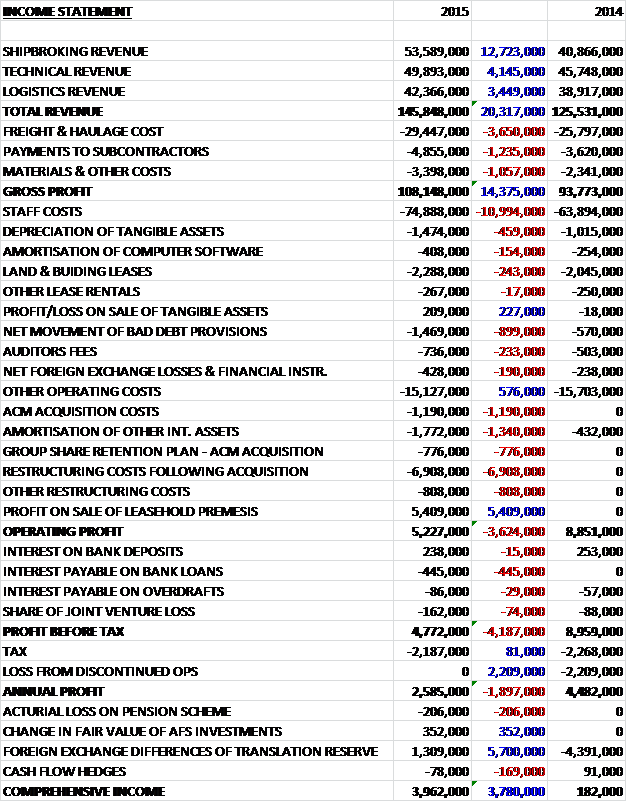
The LNG team performed well, increasing transaction numbers and concluding significant newbuilding business and the gas and small tanker teams now have a wider market coverage following the acquisition.  During the year the LPG team was involved in special long term projects to assist petrochemical companies securing their future feedstock needs but European spot activity was quite soft for much of the year, although refinery activity was stronger in the final part of 2015.  In the offshore department, both chartering activity for anchor handlers and platform supply vessels, and project business was good but the decline in the oil price caused the exploration and production industry to cut back, leading to a fall in freight rates.  The outlook for the offshore market remains challenging for the new year with an expectation of lower activity, partly cushioned by a good forward order book.

In dry bulk, freight rates were more reasonable in most sectors.  Chinese iron ore demand is a key driver of the Cape market which is fairly strong despite faltering steel production in the country but the over-supply of dry bulk tonnage, particularly in Q4 when freight rates fell by 20%, took its toll on the market.  Management have apparently begun to see an increase in scrapping of old vessels in 2015 but the full unwinding of oversupply is likely to take some time leading to subdued freight rates going forward.  Sale and Purchase income was higher than last year, mainly due to an increase in second hand business across the tanker, bulk carrier and container vessel categories.  Second hand tanker values have appreciated quite significantly over the last year in line with the growth in earnings but the reverse trend was evident in bulk carriers, especially in the last six months as their earnings dipped.  Newbuild prices fell somewhat over the course of the year and demolition was steady for much of 2014 before picking up strongly in 2015 as older bulk carriers were scrapped.

Underlying profits at the technical division were £6M, a decline of £900K year on year reflecting margin pressure, falling from 15.1% last year to 12.1% this year, and lower activity in offshore.  This division now includes the Environmental business which is no longer a separate business segment.  The lower amount of oil and gas exploration activity caused revenues at Braemar Offshore to reduce despite the fact that they have continued to win important new business through the downturn but several long term energy projects helped underpin performance to some extent.

Braemar Engineering reported higher revenues and profits which are attributable to an increase in both the marine and shore based LNG consulting as the three year project for the design, site supervision and crew training for six new LNG carriers progressed well with the project moving to the construction supervision phase as planned.  The office in Houston also saw solid growth and was appointed to the role of Owner’s Engineers to a significant LNG bunkering and fuelling project which is aimed at supplying LNG vessels for use as bunker fuel.  Towards the end of the year, the group announced their involvement in the marketing and development of a new technology for the design of an LNG containment system and they will derive revenue from the initial development phase of this project from next year.

The adjusting business performed well during the year despite the fall in the oil price affecting activity in that sector in the latter part of the year as revenue from adjusting increased when compared to previous years.  This improvement is achieved from retaining and expanding market share in existing markets as well as increasing its presence in new areas of operation.  There has been some restructuring and a significant recruitment drive over the period which resulted in a higher level of professional staff.  In the US, the adjusting business has expanded in the Northeastern states to capitalise on the existing refining, petrochemical and power sectors.  The underperforming Brazilian operation was restructured with improvements already showing through and the office in Dubai had a particularly good second half of the year.
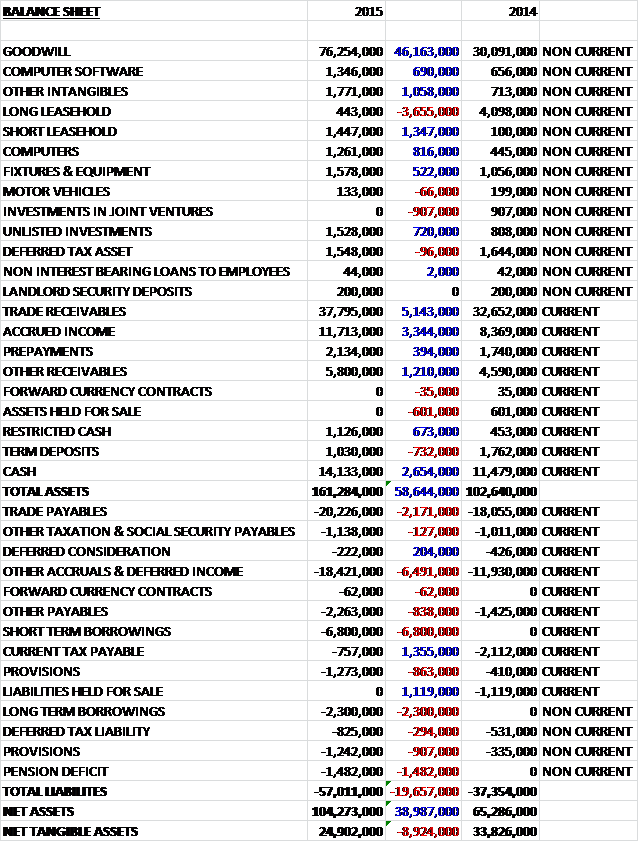
Braemar SA reported a 15% improvement in profitability with an increase in revenues as a lower number of surveys being undertaken due to fewer casualty claims in the hull and machinery market was offset by an increase in the number of consultancy assignments and project cargo surveys.  Geographically there was a lower level of business in South East Asia where trading conditions were challenging offset by an improved performance in Europe.  Braemar Howells carried out a routine level of business during the year with no major incidents undertaken and has opened in a new office in Western Australia to provide consultancy services such as the design and implementation of MARPOL waste reception facilities which are aimed at preventing and minimising the pollution from ships.
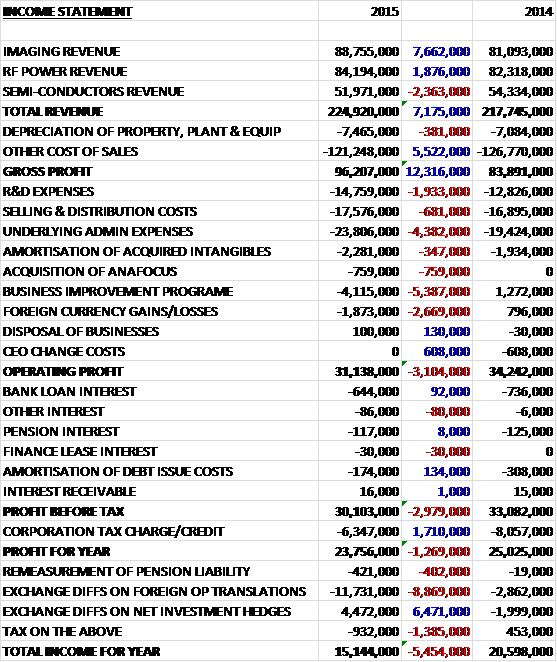
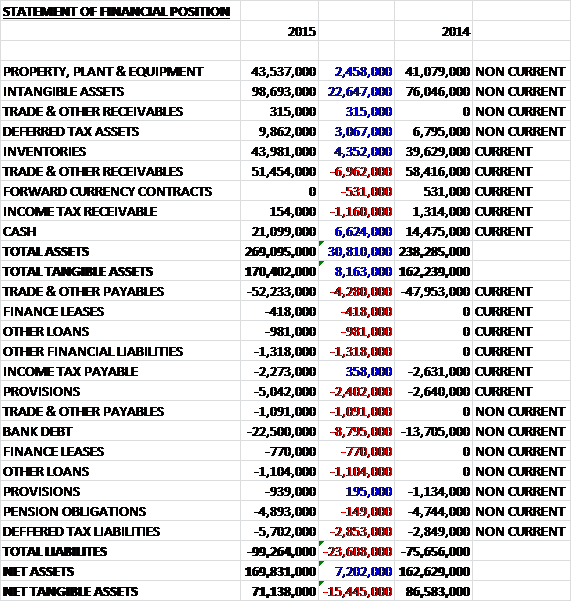
Underlying profits at the logistics business were £2.3M, an increase of £294K when compared to last year with operating margins up from 5.1% to 5.4%.  Cory Brothers increased revenue and profit due to stronger than expected volumes from the freight forwarding business despite the competitive market place.  During the year a cost reduction programme was carried out with some management restructuring and in the first half of the year, the non-core tours business was disposed of.  In Port Agency, the Global Hub business continued to grow but the underlying UK port agency market has been challenging.  Despite this, market share has increased and profitability was maintained.  In the second half markets showed signs of improvement and the business is looking to build market share over the next year as well as growing a presence in North America and the continued growth of the Global Hub business.

Cory Logistics was able to sustain its position in key business areas, with growth in new services as well as the existing contract business which was achieved despite volatile sea freights.  The number of forwarding jobs increased by 20% and the Liner business supported 533 calls during the year.  The strategy going forward is to expand into European markets, continuing growth of existing core areas and building on newer services such as refrigeration containers.

It was announced that after 12 years at the group, Graham Hearne was stepping down as chairman and he will be replaced by David Moorhouse who has experience serving on the boards of companies in the shipping and energy fields, most recently as Chairman of Lloyds Register.  Also, Dennis Petropoulos, Johnny Plumbe and Tim Jacques will all be stepping down at the AGM with Denis becoming president of Braemar Asia and Johnny retiring in order to pursue his independent consultancy interests.  Finally, Martin Beer is stepping down after just two and a half years to be replaced by Louise Evans as Finance Director having joined from the Williams Grand Prix team where she held the same position.

Clearly one of the major events of the past year has been the acquisition of ACM.  The group spent £10.1M in cash and £40.3M in shares issued and ACM came with just £4.6M of net assets so thwr acquisition generated a rather hefty looking £45.9M of goodwill, apparently attributable to staff.  The results are now included in the ship broking division but in the five month period before the acquisition, ACM reported an operating profit of £1M on revenues of £9.8M.

The group currently has bank facilities of £15M relating to a revolving facility of £10M and an amortising term loan of £5M that is repayable at £450K each quarter.  As part of the acquisition of ACM, the group did inherit a small pension scheme with a deficit of £1.5M.  It is now closed to new members and has only four active members.  The current level of contributions from the group is £300K per annum and they are currently in the process of agreeing funding with the trustees that will result in a further annual cash contribution.

Going forward, the ship broking division will benefit from a full year of contribution from ACM, along with the synergy savings that will take place and the board believe that the benefit of the improved tanker markets and the strength of the US$ will balance the effect of the lower oil price on the division.  The technical business will see a continued strong contribution from LNG related projects, likely offset by the impact of slower offshore markets, and the logistics division is expected to benefit from a lower cost base and some improvement in activity.  Overall the group is expected to make further progress in the coming year and the performance since the start of the new year is in line with expectations.

At the current share price, the underlying P/E ratio stands at a rather expensive looking 17.8 although this is expected to reduce to 14.7 on next year’s consensus forecast.  The dividend was kept the same this year despite the higher number of shares in issue and at current prices the yield stand at an impressive 5.1%, although this is not expected to change over the next two years.  At the year end the group has a net cash position of £7.2M compared to £13.7M at the end of last year.

Overall then this has been a decent year for Braemar.  Underlying profit is marginally ahead of last year despite actual profits falling due to the acquisition related restructuring.  Net tangible assets were also down as the group paid hard cash for goodwill, but operational cash flow improved due to less unfavourable movements in working capital.  There was, however, no free cash flow and the group had to borrow to pay the dividend, which is not a great sign.  Operationally, ship broking had a good year, no doubt due to the contribution from ACM, along with higher tanker rates stimulated by the decline in the price of oil. Bulk shipping is doing less well, suffering from considerable over capacity that is unlikely to be resolved any time soon.

The engineering division had a harder year as good LNG income was more than offset by lower activity in the off-shore oil and gas market.  The logistics business had a solid year.  The acquisition seems rather expensive to me but there is no doubt that it has rejuvenated the group and should lead to some growth next year as the results benefit from a full year of contribution.  The shares do not look great value on a P/E level but the yield is mightily impressive.  As we have seen, however, this is no where near covered by free cash flow and it could be in danger if cash generating performance does not improve.  Overall I see these shares as fairly valued and will continue to hold.

Braemar Shipping has now released its annual report.

BMSincome

We can see some more detail of the costs.  All aspects of cost of sales grew with freight costs up £3.7M, subcontractor payments increasing by £1.2M and material costs up £1.1M.  By far the largest increase in admin costs was staff costs, increasing by £11M year on year but we also see a hefty £899K growth in bad debt provisions.  Finally, we can see that the increase in finance costs was mainly due to the £445K interest payable on bank loans.

BMSbalance

As far as assets are concerned, we can see that the decline in property plant and equipment was due to the £3.7M fall relating to the sale of the long leasehold property and within receivables, increases included a £5.1M hike in trade receivables, a £3.3M increase in accrued income and a £1.2M growth in other receivables.  Within payables, the increase was driven by a £6.5M growth in accruals and deferred income along with a £2.2M increase in trade payables.  It is also worth considering that as a result of the move to the new office, the forward operating lease payments increased by some £10.6M to £16.6M.  Of this, £2.8M was due in the next year.

One thing that I did notice is that the executive directors all enjoyed hefty bonuses this year.  They are still not paid ridiculous amounts but the £549K paid to CEO James Kidwell is on the heavy side – I don’t really like to see directors being awarded bonuses for mediocre performances.

As alluded to above, the provision for trade receivable impairment has increased considerably. This year some 11% of the total were impaired compared to 8% last year which seems like a lot to me.

On the 24th June, the group released a statement covering trading in Q1.  Overall, trading was in line with the board’s expectations.  In the tanker market, they have continued to experience high rates and activity supported by increased worldwide oil production and refining activity.  They have also been involved in some good tanker and LNG second hand sale and purchaser business.  The dry cargo market remains more challenging, suffering from a surplus of tonnage and a slow-down in demand and the board expects the market to take some time to return to a more reasonable balance.  Although beneficial for the tanker business, the falling oil price has led to a reduced offshore activity but the breadth of market coverage means that the group is fairly resilient in changeable markets.

The performance of the technical division has been in line with expectations and head of Q1 last year.  Braemar Engineering, which specialises in LNG consultancy and design performed particularly strongly, as expected, tempered by some reduction in offshore related business.  The ship agency business started the year well as a result of buoyant tanker market activity but this was offset by a slower freight forwarding performance.  Overall then, nothing much has really changed and the outlook for the full year remains as it was at the last update.

E2V Share Blog – Final Results Year Ending 2015

E2V has now released its final results for the year ending 2015.

E2Vincome

Overall, when compared to 2014, revenues increased as a £7.7M growth in imaging revenue and a £1.9M increase in RF Power revenue was partially offset by a £2.4M decline in semi-conductor sales.  Cost of sales fell during the year to give a gross profit some £12.3M ahead of last year.  We then see a £1.9M increase in R&D expenses and a £4.4M hike in underlying admin expenses relating to increased staff costs, IT investment and the costs of expansion in Asia and the US, before a £5.4M negative swing associated with the business improvement programme (after the last year saw credits relating to the release of provisions), and a £2.7M detrimental movement in foreign currency losses meant that operating profit was £3.1M lower than in 2014.  Finance costs improved somewhat, mainly due to a fall in bank loan interest and lower amortisation of debt issue costs and tax was also some £1.7M lower, mainly due to a decline in deferred tax liabilities relating to origination and reversal of temporary differences, to give a profit for the year of £23.8M, a decline of £1.3M year on year.

E2Vassets

When compared to the end point of last year, total assets increased by £30.8M, driven by a £22.6M growth in intangible assets, a £6.6M increase in cash, a £4.4M increase in inventories and a £3.1M growth in deferred tax assets, partially offset by a £7M fall in receivables.  We also see liabilities increase during the year due to an £8.8M increase in bank debt, a £4.3M growth in payables, a £2.9M increase in deferred tax liabilities and a £2.2M increase in provisions.   The end result is a £15.4M fall in net tangible assets to £71.1M.

E2Vcash

Before movements in working capital, cash profits increased by nearly £5M to £48.1M.  A decline in receivables, reflecting good cash collection, was nearly completely offset by a fall in payables and an increase in inventories as the group increased levels to improve their responsiveness to customer requirements, and after an increased tax payment, the net cash from operations was some £6M higher at £40.7M.  Impressively the group managed to pay for its capital expenditure needs, plus nearly £20M on an acquisition and still have £10.6M of free cash flow left.  This just about covered the interest paid and dividends but the group still took out £7.8M of new borrowings which incurred £721K in costs to give a cash flow of £7.4M for the year and a cash pile of £21.1M.

The results represent a particularly strong Q4 with the benefit of the Anafocus acquisition and steady growth in the industrial vision, radiotherapy, commercial and industrial businesses.  The space, scientific imaging and semiconductors businesses remained flat whilst revenues in RF Defence and thermal imaging fell.  The order book at the end of the year looked good with orders for delivery within the year increasing by 14% to £146M with particularly good coverage in the Space and Industrial Vision businesses and full coverage from the Radiotherapy customers with an active pipeline of opportunities.  The group really seem to have a focus on customers now, actively delivering what they value rather than what the group wants to achieve technically.  The total order book increased by a more modest £7M to £191M.

Imaging is now arranged into two business streams – professional imaging and space.  Professional imaging demand is driven by the increased use of sensors in industrial automation with growth driven by the improvement in industrial markets and recent product innovations such as the new CMOS based camera.  Further growth is planned from new product introductions in 2016.  Scientific imaging is expected to remain steady with the market highly concentrated with three major customers.  In Space, governments increasingly seek to maintain independent observation capabilities and the expansion of climate change monitoring is driving growing demand for new observation satellite programmes.

The group is continuing to develop their CMOS based technology platform for Space, which is in part funded by a £3.8M award from the UK Regional Growth fund.  During the year more than £40M of new orders were secured and key wins included the first phases of the Large Synoptic Survey Telescope contract in the US, a number of ESA contracts and new opportunities in Korea, China and Russia.  Two major science projects have started including LSST and Plato for ESA with a potential combined total value of £50M.  Within the Earth observation sector, £11M of orders were booked in the year.  The group has invested in their Chelmsford facility to increase their wafer processing capability and expand the assembly area and characterisation lab and they will continue to invest in production facilities in the coming year with the reorganisation programme being delayed and inexplicably renamed project Sunrise.

The operating profit at the Imaging business fell by £4.9M to £7.3M with adjusted operating profit down by 17% to £9.3M despite revenue increasing by 9% to £88.7M.  The revenue growth came from strong demand in automatic data collection, machine vision sensors and optical inspection CMOS cameras in Asia.  Scientific imaging was steady reflecting end user demand remaining at similar levels to the year before.  In Space, activity was sustained although the programmes are challenging and the group has had to commit more resources to improve delivery to customers.  The thermal imaging business saw lower demand in core markets with sales significantly below that of last year.

The lower profits reflect a decline in margins due to delayed milestones in the Space programmes which lead to cost increases.  The lower thermal imaging sales also led to declining margins and the cost base has been reduced accordingly.  AnaFocus performed strongly, contributing ahead of expectations and R&D activities have been increased significantly to drive future growth, focusing on machine vision and space.  The order book looks good, increasing by £29M to £90M reflecting key programmes in Space, including a £1M increase in the level of overdue orders along with growth coming from Industrial Vision and AnaFocus.  The orders due in the next year were up £20M to £70M which underpins the expected revenue growth.

The group produces systems that deliver higher performance radio frequency power generation for healthcare, defence and industrial applications.  The key growth drivers are the increasing incidence of Cancer worldwide, industrial growth and defence spending.  In radiotherapy the group produces systems that deliver power at radio frequencies used for the generation of x-rays in the treatment of cancer where they are established as market leader with an incredible market share of 90% for the supply of magnetrons.

In Radiotherapy the group anticipates spares revenue will grow in line with the past expansion of the installed base over the last five to ten years with revenue growth anticipated to be driven by continued new build demand, which accounts for about a third of growth.  There has been increasing demand in Asia, especially China with new equipment demand being dependent on healthcare spending.  In defence, the key driver is the level of NATO spending and budgets across the NATO countries are currently constrained and the board does not see this changing any time soon so investment is being targeted at the growth business of radiotherapy.  During the year the group finished a further phase of their development programme with Rio Tinto in their industrial processing systems business, covering the design and supply of large scale microwave and RF generators for use in products to demonstrate the improvement in the efficiency of metals recovery.  Rio is now in the process of deciding whether to take the project onto the next stage of development.

The operating profit at the RF Power business grew by £1.4M to £18.4M with adjusted operating profit increasing by 21% to £19.4M and revenues increasing by £1.9M, driven by a strong growth in radiotherapy reflecting increased demand from the key OEM customers, along with good growth in the Commercial and Industrial markets, particularly marine.  This was partially offset by weakness in Defence with slower than anticipated programme wins and lower activity levels in Industrial Processing Systems.  The increase in profit also reflects improved operating effectiveness with good cost control and lower inventory write-offs.  R&D activities were below that of last year, focusing primarily on radiotherapy applications.  The order book at the end of the year was £20M lower than last year at £80M, reflecting the cycle of the multi-year radiotherapy contracts and a reduction in the defence order book.  The order book for delivery in the next year was broadly flat at £58M reflecting a full year coverage for Radiotherapy and good coverage in Commercial and Industrial, partially offset by a decline in Defence.

In the semi-conductors sector, the board sees continued growth for high reliability products in civil aviation applications such as flight control computers, engine management systems and cockpit display systems.  In addition, there is a growing demand for high reliability, radiation tolerant products tested for low earth orbit space applications including weather monitoring, earth observation and telecoms satellites.  The growth in these sectors has offset delayed demand for defence programs associated with Typhoon, F-16, F-18 and the Joint Strike Fighter.

The division has made significant progress in the growing space market.  They have been part of a NASA-led consortium to develop QML standards for non-hermetic space qualified products and following the publication of this standard, the group has now introduced a range of microprocessors based on a Freescale power PC platform which complement their own design space qualified ADC and DACs that form an integral part of their portfolio.  They plan to introduce other QML qualified semiconductor products over the coming months.  Recognising the opportunity for growth in North America, in December the group opened a new facility in Texas in order to be closer to customers.

During the year, the company saw a reduction in revenues related to the outsourced assembly and test services that they provide customers who lack the in-house capability, reflecting demand fluctuations in their customer’s end user markets.  There has been an increased interest in high reliability microprocessors for space applications that require greater levels of on-board processing in the last two years.  In addition, E2V continues to support their legacy products for sensor signal conditioning ASICs and ASSPs.  They had previously decided to cease the R&D activities associated with these product lines and the revenue from them now reflects the anticipated decline.

The operating profit at the Semi-conductors business grew by £400K to £10.3M with adjusted operating profit increasing by under 1% to £11.9M while revenues fell by 4% to £52M.  This decline in revenue reflects the fact that good growth from US based product lines, along with the business’ own design high speed data converters for space applications has been offset by lower demand for microprocessors and the anticipated decline in the legacy smart sensor business as those products approach the end of their lifecycle.  The better performance with regard operating profit is due to improved product mix with growth in higher margin lines, along with good cost control.  The order book fell by £3M to £20M reflecting the anticipated decline in the legacy smart sensor business along with lower demand for microprocessors, partially offset by improved order cover from the US.  The order book for the next year declined by £1M to £18M.

The main R&D programmes currently include the next generation RF generating sub-systems for radiotherapy, sensors for industrial vision, the CMOS platform, process capability, coatings and CMOS for space along with the next generation semiconductor products.

During the year the group undertook restructuring of their central operations, RF Power and Imaging teams with an announcement to cease manufacturing in Beijing during H1 2016 and a consultation regarding the planned closure of the sales office in Bievres, France.  A charge of £3.4M was recognised during the year, mainly relating to staff and onerous lease costs.  The group is also undertaking a reorganisation of it Chelmsford facility which has incurred costs of £686K during the period.

During the year the group entered into a new revolving credit facility which expires in July 2018, predominantly denominated in Sterling and US Dollars which relates to about £93.2M at the current exchange rate compared to £79.3M under the old facility.  By the end of the year some £22.5M was drawn down under the facility.  There are currently commitments of £3.8M relating to the acquisition of new plant and equipment.

During the period the group acquired Spanish based AnaFocus, which specialises in the design and development of customised CMOS image sensors.  The acquired group had net assets of £11M, some £15.6M of which related to identified intangible assets, mostly relating to current technology and customer relationships.  The group paid £17.9M in up-front cash with a further £4.1M in contingent consideration possible, which the board estimates will be paid in full, so the purchase generated goodwill of £11M.  During the year AnaFocus contributed adjusted operating profit of £1.8M on revenues of £5.8M.  The first payment of the deferred consideration is likely to be £1.8M in the first half of the current year with the potential for two further payments, the first of which is due in the second half of the year with the final payment in the first half of the following year.

Going forward, whilst the board remains cautious about the broader economic environment, assuming no deterioration in market conditions, the outlook for the current year remains unchanged – which doesn’t give much away really.  They have stated that they want to double operating profit by 2020, however, with a focus on industrial vision, space, radiotherapy and semiconductors with both organic growth and acquisitions which are expected to contribute to up to a third of the growth.

At the current share price the shares trade on a P/E ratio of 19.6 which falls slightly to 18.7 on next year’s forecast which seems fairly fully valued.  The dividend yield stands at 1.9% after a 16% increase year on year, growing further to 2% which again, seems fairly average.  Net debt stood at £5.2M at the year end compared to a net cash position of £770K at the end of last year.

Overall then this was a fairly good year for the group.  Profits fell but this was due to restructuring costs under the business improvement programme and underlying profits improved year on year.  Net tangible assets fell as the group spent cash acquiring a large amount of intangible assets with AnaFocus but the cash flow looked good, operational cash flow improved and the group had a good level of free cash flow even after the acquisition was taken into account.  Operationally, imaging profits fell due to cost increases in some of the space programmes and declining thermal imaging orders be growth in the order book, partially driven by the AnaFocus acquisition gives some confidence for next year.  Profits were strong at the RF Power business driven by good levels of Radiotherapy projects, partially offset by declines in defence spending at NATO countries but the declining order book is rather disappointing, despite the board blaming timings of orders for the fall.

Profits were flat at the semi-conductors business and he order book was fairly static.  Interestingly the group increased headroom in their borrowing facilities which suggests to me that another acquisition is on the cards for the year ahead.  The board has stated that they aim to double operating profit by 2020.  I am not sure that I like these kinds of targets though, and I hope that growth will not be chased to the detriment of prudency.  In conclusion, this seems to be a company with decent prospects that is performing fairly well.  The valuation does seem to be up to date with this, though so I will continue to hold rather than try and add some more.

E2VTECHNOLOGIES-20150604-094812

This has been a good year for the share price so far, it could perhaps have become a bit overextended though?

The group has now released its annual report so let’s see what further information is contained there, starting with the income statement.

e2vincome2

So there is a slightly larger breakdown in admin costs where we can see that amortisation increased along with audit costs but nothing really that important here.  Probably more interesting is the more detail that comes with the balance sheet.

e2vassets2

As we can see there is quite a lot of detail here.  The increase in property, plant and equipment was due to the £3.8M increase in plant and equipment but of more interest is the breakdown of intangible assets where there were some large increases due to the AnaFocus acquisition.  Goodwill was up £8.6M, customer relationships increased by £6.9M and patents & trademarks were up £5.1M.  As far as receivables are concerned, both trade and “other” receivables declined during the year.

In liabilities, trade payables fell but contract balances received on account increased by £2.7M and accruals and deferred income grew by £3.6M.  Within provisions, the big increase came from the £2.5M hike in the employee related provisions.  Operating leases were broadly flat year on year and not a material amount.

There are also some interesting KPIs, most of which improved year on year with operating margin up to 17.8%, ROCE increasing and a 14% growth in the 12 month order book.  We also see a 1 percentage point increase in the proportion of sales from outside Western Europe but the percentage of sales from customers of products which were new over the last three years declined slightly.  We also see a fall in sales growth from 11% this year to just 3% this year.

We can also see that some £1M of trade receivables were impaired compared to £778K last year which seems disappointing and is not an insignificant amount.  At the end of the year, the group had committed to £3.8M worth of capital spending, mainly relating to the acquisition of new plant and equipment.  The group is also somewhat exposed to currency movements, particularly the US dollar with a 15% weakening of the currency against Sterling havening the effect of reducing profit by £294K.  The exposure to the Euro seems fairly negligible thankfully.

On the 15th July the group released a trading update covering Q1 2016.  During the quarter the group delivered modest revenue growth, reflecting the previously reported opening order cover in the Semiconductor division.  Whilst the board remains cautious about the broader economic environment, the outlook for the current year remains unchanged.  A fairly steady if not exactly inspiring update then, I will continue to hold.

Telford Homes Share Blog – Final Results Year Ending 2015

Telford Homes has now released its final results for the year ending 2015.

tefincome

Revenues increased by £46.4M when compared to last year and a smaller increase in cost of sales meant that gross profit was some £14M ahead.  We then see an increase in depreciation, a growth in admin costs, mainly due to higher employee costs, and a £2.8M increase in selling expenses due to an increase in agent commission following three significant sales launches, along with a £1.7M fall in the profit from the joint venture as 77 open market sales were completed at Bishopgate Apartments compared to 180 last year, which leaves operating profit some £6.9M higher at £28M.  There was then a fall in finance income and a £741K increase in finance costs due to a growth in loan arrangement fees due to the new borrowing taken out which, along with a hike in the tax paid, meant that the profit for the year stood at £19.7M, an increase of £4.8M year on year.

tefassets

When compared to the end point of last year, total assets increased by nearly £100M driven by a £98.5M growth in inventories, a £6.9M increase in cash and a £4.2M increase in receivables, partially offset by the £9.4M crash in the investment in the joint venture, relating to the reduction in inventory at Bishopgate Apartments as some 77 open market apartments were sold.  Liabilities also increased during the year due to a £64.4M increase in borrowings and a £19M growth in payables to give a net tangible asset level some £15M higher at £120.4M which looks rather healthy.

tefcash

Before movements in working capital, cash profits increased by £8.7M to £13.8M.  This was entirely counteracted by a huge increase in inventories, however, to give a cash outflow from operations of £67M compared to a broadly neutral position last year.  We then see an increase in both interest paid and tax, more than offset by an £11.3M increase in the distribution from joint ventures to give a net cash outflow from operations of £53.8M, an adverse swing of £58.7M.  There was a small amount of intangible asset buys but the cash outflow before financing stood at £53.8M.  In order to cover this cash outflow, new bank loans were taken out so that after the payment of £6.1M worth of dividends, the cash flow for the year stood at £6.9M to give a cash pile at the year-end of £39.7M, most of which has been committed to future land and development costs.

The group exchanged contracts for the sale of 661 open market properties during the year and has sold a further 105 so far in since the end of March.  The most recent sales launch was Manhattan Plaza in E14 close to Canary Wharf.  The launch took place over three weekends and 71 out of the 120 open market properties were sold to investors at prices around £800 per square foot.  A quarter of these properties went to UK investors with the bulk sold overseas, particularly into China.  During the year there were several smaller launches including The Junction in E1 where half of the 26 open market homes were sold and the Town Apartments in Kentish Town where all 15 open market homes sold in a single weekend.  In October, the group launches Stratosphere in Stratford that resulted in over £110M of sales in less than a month with nearly 90% of the 307 open market homes being sold.  There are currently no unsold completed homes and they are being sold quicker than they can be built.   The next significant sales launch will be Bermondsey Works in SE16 in June with 148 open market homes being available for about £600 per square foot.

Overall there are 2,200 homes under construction across 16 developments compared to 1,700 two years ago but the total number of completions during the year fell from 492 to 374.  Despite this, revenues improved due to the increase in the average selling price per property from £329K to £439K, partly due to the mix of developments and partly due to an underlying price growth.  Commercial revenue increased from £7.7M to £16M due to a significant sale in Bishopsgate Apartments of £9.65M net to the group.

There is very good earnings visibility here as shown by the fact that they are 95% forward sold for next year already with the total value of forward sales now over £550M compared to £341M this time last year.  The group takes a minimum 10% deposit on exchange of contracts and where sales are more than two years ahead of completion, usually another 10% a year after exchange.  This means there is a good cash flow coming in and during the year some £63.7M was taken in deposits.  This success in forward selling homes meant that there was a greater proportion of properties sold to investors this year as they typically buy further in advance of completion than owner-occupiers and it is good to see that many customers make repeat purchases.

During the year margins were head of last year and expectations with operating margins up from 17.1% to 17.5% due to some commercial property sales at higher than expected prices and build cost inflation being slightly less than anticipated.  The board expects margins to reduce in the future, mainly due to the more subdued level of house price inflation and some cost inflation.  The gross margin has been targeted at 24% compared to the 32.4% achieved this year (31.9% last year).  The board are still targeting a profit before tax of £40M by 2019 but have warned that profit growth may not be smooth and might not occur each year due the timing of project completions.  This is reflected in brokers predictions for 2017, where it seems profits may drop back slightly so hopefully this will not come as too much of a shock to investors when/if it occurs.

Recent projects that have been acquired include a site in Upton Park where planning permission for more than 170 homes will be submitted later this year and terms have been agreed with an affordable housing partner on a regeneration scheme with planning permission for more than 100 homes.  There are apparently no shortages of development sites but unlocking them is more of a challenge.  As at the end of the year, the development pipeline stood at £1.07BN of future revenue compared to £878M at the same point of 2014.

There have been a couple of changes at the management and board level with Robert Clark stepping down as non-executive director in July after many years in the position.  Also, joint group managing director Mark Parker was made redundant having been in the job since 2007 with the other joint group managing director, John Fitzgerald, now responsible for production across the entire group.

The planning process continues to be a challenge and the time taken to achieve it restricts the supply of new homes and can delay the planned development programmes.  In December the group finally secured a resolution to grant planning consent for a development of 156 homes in Caledonian Road but some five months later, formal consent has still not been issued which exemplifies the problems faced by developers in London.  Some small adjustments that can make a big difference include additional planning resources in local councils and setting defined time limits for various stages of the process.  I doubt progress will be made on the former issue but the latter one sounds sensible and should be something that is introduced in my view.

There is one main future commitment which involves a joint venture with Notting Hill housing which has exchange contracts to purchase a significant site with outline planning permission in Stratford  for £44M which is payable by January 2016 and funding for this will be sought later in 2015.  The company has signed a new £180M corporate loan facility which extends to March 2019 which replaces the previous £120M loan facility.  The interest payable varies depending on the gearing level from between 2.8% to 4% which is an improvement on the minimum level of 4% previously.  As of the end of March, there was an unutilised balance of £85M (remembering the £39.7M cash level too) and gearing has increased to 44% with the covenant set at 150%.  It is expected that this gearing will increase further as the group continues to invest in site acquisitions and development costs.

At the current share price the shares trade on a P/E of 15 which reduces to a cheap looking 12.2 on next year’s forecast, although it is expected to increase again to 14.6 in 2017.  The shares are currently yielding 2.3% in dividends which is expected to increase to 2.8% next year which reflects the policy of paying one third of earnings in dividends.  Net debt at the yea- end stood at £55.3M compared to a net cash position of £3.4M last year and this is a trend likely to continue next year.

The outcome of the General Election has provided some stability to the political environment and the housing market and the relatively affordable homes in London that the group focuses on are experiencing high demand from tenants, investors and owner-occupiers due to a shortage in the number of new homes, so the fundamental attractions of these markets are likely to be present for the foreseeable future.  The board therefore expects significant growth in output and profits over the next few years and remains very confident in the long term prospects for the group.

Overall then this was a good update but one in which the group used considerable resources in expansion.  Profits were up, mainly as a result in the increasing property prices and net assets improved.  Operational cash flow was heavily negative, however, due to the investment in housing inventory and most of the cash is already earmarked for investment in the coming year, although there is still £85M of headroom in the debt facility.  There are more homes under construction than this time last year and the group has a strong development pipeline with a 95% forward sold position.  It is difficult to see the fundamental demand in affordable London homes declining any time soon and medium term, there is likely to be a strong increase in profits.

As with any company, there are a few issues to be aware of though.  The slow-down in house price inflation and increase in costs will reduce margins going forward and it seems that profits will fall back in 2017 before increasing again in 2018 due to the timings of completion.  Also, the group is taking on a lot of debt to fund expansion.  Indeed, as further amounts of cash is utilised and the gearing increases further I think Telford may find it hard to keep the current pace of expansion going, at which point it is possible the shares could suffer a bit.  Overall though, this seems to be a good investment and I will continue to hold on to my shares.

TELFORDHOMES-20150603-100345

This chart looks good with an uptrend in place since mid-August.

Telford Homes has now released its annual report that gives a bit more detail to some areas.

TEFincome

So, we can see a break-down of the revenues received and the increase is accounted for by growth in both open market and contract revenue with freehold sales disappearing. We can also see that operating leases increased slightly to £951K and the other main area that has more detail is the finance costs and here we see that a small reduction in the interest on the loan was more than offset by the £950K increase in the amortisation of facility fees relating to the early payment of the previous facility.

TEFassets

As usual it is the balance sheet that shows the most new detail. Here we see that all property, plant and equipment items fell slightly during the year. As far as receivables are concerned, the £737K fall in amounts owed by joint ventures was more than offset by a £1.1M increase in amounts recoverable on contracts, a £3.1M growth in “other” receivables – not sure what this relates to, and an £804K growth in prepayments and accrued income. The large increase in payables was predominantly driven by the £22.1M increase in deposits received in advance (stretching the definition of “payables” in my view), although there was also a £3.6M growth in accrued expenses and a £1.8M increase in trade payables. These were partially offset by the elimination of £8M in payables to land creditors. Overall then, I think that this helps allay some potential fears over the nature of the increased payables. Although increasing somewhat, operating leases were fairly negligible.

Overall then, not much has changed here, the group still looks a good investment but I do wonder whether there may be some near-term volatility as investors start to look at the drop off in profits in 2017.

On the 6th July it was announced that managing director John Fitzgerald sold 100,000 shares at a value of £427K.  The sale was apparently in order to fulfil some personal financial commitments.  He still owns 282,718 shares in the company.

This was followed by an announcement that on the 8th July he sold a further 50,000 shares for £212K.  This is quite some personal commitment and I don’t like this.  Combined with the announcements in the budget I have decided to realise a profit here.  I do still like this company but see a few short term issues and feel this is the prudent response.

On the 16th July the group released a statement from the AGM.  They continue to experience very strong demand from investors, tenants and owner-occupiers across all of their developments.  Most recently, they launched 148 open market homes at Bermondsey Works where 94 sales were achieved in June at a total value of £44M.  since the start of April the group have secured 218 open market sales and the total value of forward sales due for completion this year is now over £620M, more than three times the revenue reported last year.

They also comment that they welcome the recent measures outlined by the government to improve the planning process and remove unnecessary delays, devolving more power to the Mayor of London and speeding up the process for brownfield land.  The group continues to appraise opportunities to increase its development pipeline and is in negotiations on a number of prospective sites.  The current pipeline extends into 2019 but the board is still keep to increase this when the right opportunities arise.  They remain confident of achieving expectations for 2016 and laying the foundations for sustained long term growth.

All in all, this all reads very positively, the amount forward sold for this year is astonishing.  There is no mention of the extra taxes on property investors though, and what effect this would have and I presume they are still expecting a fall in profits in 2017 so there are still some potential downward pressures.

On the 21st September the group announced the acquisition of the regeneration business of United House Developments for £23M which has been entirely funded from existing cash resources.  The business consists of a group of companies that have various interests in development opportunities in North and East London.  These are City North adjacent to Finsbury Park station, the refurbishment of the Balfron Tower in Poplar, two phases of development at Gallions Quarter near Royal Albert Dock and the regeneration of Chrisp Street market in Poplar.  The developments are all at various stages in the planning process but they have the combined potential to add some £500M to the group’s existing £1BN development pipeline.

City North is a mixed use development comprising 355 apartments and 109,000 square feet of retail, leisure and office space in a joint venture with Business Design Centre.  The scheme includes two 23 storey towers linked by a 12 storey terrace building.  The site has full planning permission and incorporates plans to improve the facilities at the adjacent Finsbury Park station.  The group will immediately work with the joint venture partner to ensure that construction can commence in 2016 with completion expected in 2020.  The gross development value of City North is in excess of £200M so it should add over £100M to the group’s pipeline.

Balfron Tower is a 26 storey grade II listed building in Poplar.  The project involves the refurbishment of 146 existing homes in a joint venture with Londonewcastle and the owners, Poplar HARCA.  The development is subject to planning permission and allowing for this process, the refurbishment should commence in early 2016 to be completed by 2018.  The group owns a 25% interest in the scheme which is expected to add over £15M of revenue to the development pipeline.

Gallions Quarter is a multi-phase development adjacent to Gallions Reach DLR station.  The development is controlled by Notting Hill Housing Group, who have partnered with the group before.  They are acquiring a 50% interest in the project.  The first phase has planning consent for 292 new homes subject to signing a section 106 agreement and the other phase has outline consent for a further 254 homes.  The process through which United House Developments is acquiring a legal interest in the development is not yet complete but the final steps are expected to be concluded shortly.  A portion of the total consideration has been deferred therefore and becomes payable on securing the legal interest in the development, although the amount of the deferred consideration has not been disclosed.  Assuming the condition is satisfied, the two phases will add over £75M to the group’s development pipeline.  The first phase is expected to commence in 2016 and be completed by 2020 with the remaining phase starting at that point.

The regeneration of Chrisp Street market is a major development opportunity in partnership with Poplar HARCA, whom the group have a long standing relationship with.  The development is expected to include several hundred new homes but the proposals require substantial consultation with local residents, commercial occupiers, Tower Hamlets borough (oh dear) and other interested parties.  The ultimate acquisition of the development from Poplar HARCA is subject to achieving all the necessary consents.  The aim is to start development in 2017 with phased completions expected over a seven year construction time.  The development has the potential to add £300M to the group’s long term development pipeline.

These are all interesting acquisitions that add considerably to the forward pipeline of work.  They will not add much in the short term and some of them seem to be subject to a number of conditions but this looks fairly positive overall.

On the 14th October the group released a trading update covering the first six months of the year.

They have recently opened a new sales and marketing centre in Stratford to give them a permanent presence in the area.  The remaining 32 homes at Stratosphere were launched from this centre in October with 18 reservations secured by the end of the first day.  Following several successful sales launches in the last six months, the forward sold position of over £685M to be recognised across five years compared to £550M at the start of the year.  Legal completions on forward sold homes are also being achieved in line with expectations.  These are weighted to the first half of the current year and as a result, the board expect the pre-tax profit to more than double compared to the £9.4M recorded last year.  The group remains on track to meet profit expectations for 2016 and beyond.

The group has progressed planning for several of its key developments.  After an initial delay, full planning permission is in place for 156 homes at Caledonian Road and work is underway on the site.  In addition, planning permission has been granted in the last few weeks for 471 homes at Chobham Farm, Stratford, in partnership with Notting Hill Housing Group and for 192 homes at Redclyffe Road, E6.  Both of these were approved at recent planning meetings and are subject to signing the usual legal agreements.

Demand remains high from all of Telford’s typical customers so the board are very confident in investing further in the development pipeline.   This update sounds pretty positive to me, but I think it was always expected to be.  The gap is likely to occur in next year’s figures but nonetheless I am tempted to dip back in here.


On the 27th October the group announced a placing to raise £50M. It is thought that the placing will enable them to take advantage of the current opportunities and achieve enhanced longer term growth in its output of new homes. The company will place 13,888,889 new shares at a price of 360p per share with the net proceeds expected to be £48.3M.

The proceeds are expected to be committed within one year and be fully utilised within two years and will initially be focused on driving sustained profit growth without reducing short term debt requirements such that gearing will increase in the short term as previously anticipated. Given its strong forward sold position, the group will invest the placing funds to target annual profit before tax of £45M from 2019. Beyond that the board expects to use recycled equity to manage future debt requirements and therefore reduce longer term gearing whilst still maintaining controlled growth towards a pre-tax profit of £60M.

As a result of the long term nature of the developments, the placing is expected to cause an initial dilution of earnings but this will enhance net asset value per share. As a result the board intends to increase its dividend payments above one third of earnings in the short term to offset this initial dilution. The placing shares will represent about 18.6% of the enlarged share capital and represents a discount of 12.2% on the closing price on the 26tth October.

The shares are expected to begin trading on the 16th November so I don’t expect to see much share price strength before then. The group are certainly going for growth at the moment which could be a mistake if there is a downturn any time soon.

On the 26th November the group announced that it had purchased a significant development site on Camden Street in Poplar for over £20M. The site has full detailed planning consent for a 22 storey development consisting of 206 new homes and a nursery. The group expect to commence work on the site in 2016 with completions anticipated in 2019 and 2020. The development is expected to add in excess of £80M of revenue to its development pipeline.