Tangent Communications Share Blog – Final Results Year Ending 2015

Tangent Communications has now released its final results for the year ending 2015.

tangentincome

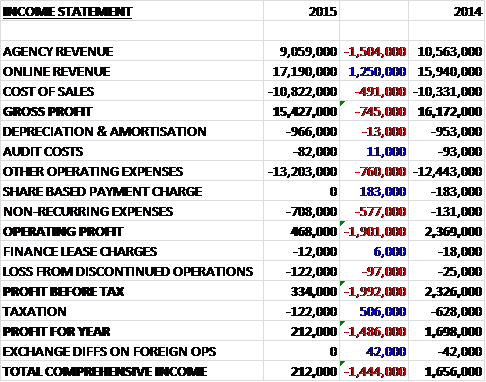
Overall revenues fell as a £1.25M increase in online revenue was more than offset by a £1.5M decline in agency revenue.  Cost of sales then increased to give a gross profit some £745K lower than last year.  There was also an increase in underlying operating expenses as well as a £577K growth in non-recurring costs relating to the downsizing of Tangent Snowball, rationalising Ravensworth and relocation expenses, which left the operating profit at just £468K, a decline of £1.9M.  This fall widened to £2M when the loss from the discontinued operations is taken into account and after a much smaller tax bill, the profit for the year stood at just £212K, a decline of £1.5M when compared to 2014.

tangentassets

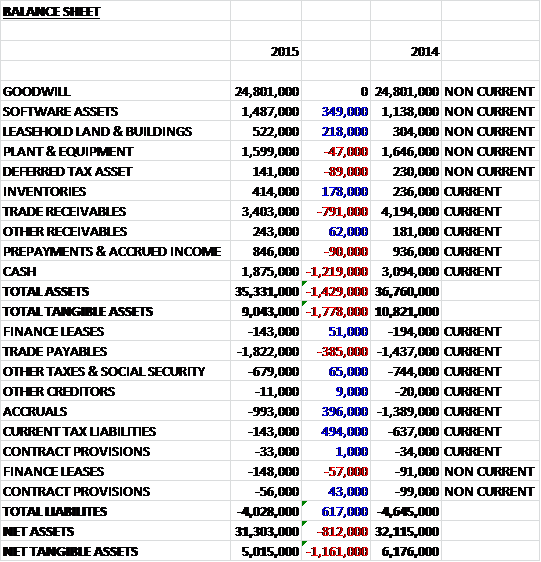
When compared to the end point of last year, total assets fell by £1.4M driven by a £1.2M decline in cash levels and a £791K decrease in trade receivables, partially offset by a £349K growth in the value of software assets, a £218K increase in land & buildings, and a £178K increase in inventories.  We also see liabilities fall year on year as a £494K decline in current tax liabilities and a £396K fall in accruals were partially offset by a £385K increase in trade payables.  The end result is a £1.2M decline in net tangible assets at £5M.  It is worth noting, however, that the group took out a large operating lease (probably relating to the relocation) and leases now represent £4.1M that is not included on the balance sheet which looks rather less robust when this is taken into account.

tangentcash

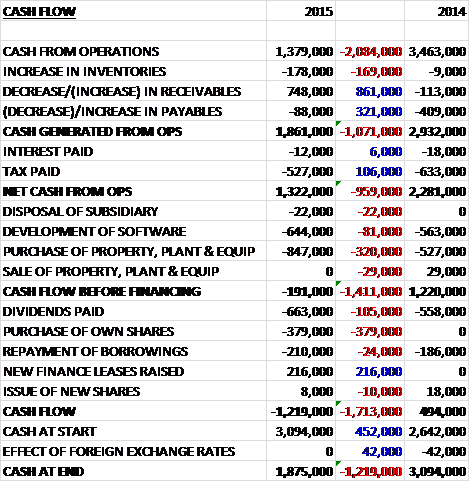
Before movements in working capital, cash profits were some £2.1M lower than in 2014, but this was improved somewhat by a decrease in receivables due to a higher proportion of customers paying upfront and online with credit and debit cards, before a lower tax bill meant that net cash from operations was nearly £1M lower at £1.3M.  This was not quite enough to cover capital expenditure of £847K of intangible assets and £644K of intangibles so there was no free cash flow this year.  The group then paid £663K on dividends and £379K of cash it barely had on the purchase of its own shares with the end result being a £1.2M cash outflow to leave a cash level of £1.9M at the year-end with overdraft headroom of £1M.

Overall online print sales grew by nearly 8% to £17.2M which was a slower increase than anticipated and profits fell by £1.3M to £454K.  Measures have been taken to rationalise the online print business with a focus on driving sales through the growing printed.com platform which will involve the transfer of the goodprint business under the printed.com umbrella.  In line with this approach, going forward the group will report the performance of printed.com, goodprint and Ravensworth in a combined business segment.  Sales at printed.com increased by 25% to £7.6M with new customers and an increase in customers who returned year on year providing the basis for the growth.

Sales at goodprint declined with business card sales down 34% to £2.1M as the market became increasingly competitive.  The customer facings brands under goodprint are now being merged into printed.com which should reduce costs and increase efficiency.  Ravensworth benefited from a strengthening of the residential property market in the early part of the year but saw it cool significantly in the latter part of the year with sales from October dropping 20% below the trend set in the first eight months.  This impacted profitability as the business was taken by surprise before it could fully adjust to the changing market conditions.  Sales in the year as a whole were up 12% to £7.5M but clearly this was due to the strong performance in the first half of the year offset by the weakness in the second half.

Profit from Agency operations fell by £700K to £424K. Sales at Tangent Snowball fell by 19% to £6.7M due to budget cuts from two key clients at the start of the year and the divestment of the Australian operations.  The business has reduced headcount during the year and has now started to see the benefits of operating with a leaner team.  Apparently digital marketing remains in demand but competition and an increase in in-house skills are having an impact on the business.  New business was slower than targeted to relieve the reliance on a few large clients and senior management changes have now taken place within the division.  Sales at Tangent on Demand were flat year on year at £2.4M.

After a review of the operational structure, the group has reduced headcount which led to restructuring and redundancy costs of £590K.  In addition, all of the London based businesses have been relocated during the year which resulted in a one-off expense of £120K. The reduction in operating profits meant that the headroom with regards goodwill impairment was reduced so I would not be surprised to see a write-down at some point in the future.  I don’t generally include Goodwill in my analysis of a balance sheet, though, so this has limited effect as far as I am concerned (although the reduction in predicted operating profit going forward is clearly a concern).  Of the group’s capital expenditure this year, £570K was spent on printing equipment and IT, £280K was spent on leasehold improvements and £640K was spent on software.  Investments in equipment and IT is likely to remain flat going forward but should reduce in software and cease entirely with regards to leasehold improvements, so capital expenditure should reduce in 2016.

The group has various financial and non-financial KPIs with most of the financial ones worsening year on year with employment costs as a percentage of sales up, operating margins down and EPS down.  One highlight though was the increase in cash conversion to 158% reflecting the higher proportion of customers paying in advance via credit and debit cards on the website.  The highlight of the non-financial KPIs is staff retention with staff turnover improving to 2%, which seems remarkably low and suggest the company is a good place to work despite the disappointing financial results.

There does seem to be a large amount of options granted to the directors with nearly 10% of the total shareholder equity in the form of options, some of which have an exercise price of zero, which I think is not really on.  During the year the group completed the disposal of its 81% holding of Tangent Snowball in Australia which resulted in a loss of £120K, approximately half of which related to the fees of the disposal and half relating to the operating loss of the subsidiary while it was part of the group.

The new year has started in line with expectations but profits are expected to be lower year on year in the first half of 2016.  Despite the challenges, however, the board believes there is a sizeable market to exploit and demand for the group’s products remains but whether the group can capitalise on these opportunities remains to be seen.

At the end of the year, net cash stood at £1.6M, a reduction of £1.2M year on year.  There is prudently no final dividend this year and one is not expected next year either.  At the current share price the shares trade on a very expensive P/E ratio of 43.7 but this reduces to a much more reasonable 10.8 on next year’s consensus forecast.

Overall then, this was clearly a poor update from Tangent.  Profits fell drastically, net assets declined and the balance sheet is looking rather weak, being loaded with Goodwill that has had its impairment headroom lowered.  Operating cash flow fell despite an increase in advance payments and there was no free cash flow at all, although the cash pile should be sufficient for the year ahead and capital expenditure should be a bit lower this year.  Operationally, the only business that is doing well is Printed.com with the second half performance at Ravensworth particularly disappointing.  It seems that for the bulk of the business that there is just too much competition and Tangent may not be able to compete.  The forward P/E ratio does look good but with management flagging up lower H1 profits this year and no dividend on the cards for 2016, I think I will be avoiding these shares for now.

DOCUMEDIASOLUTIONSPLC-20150602-094725

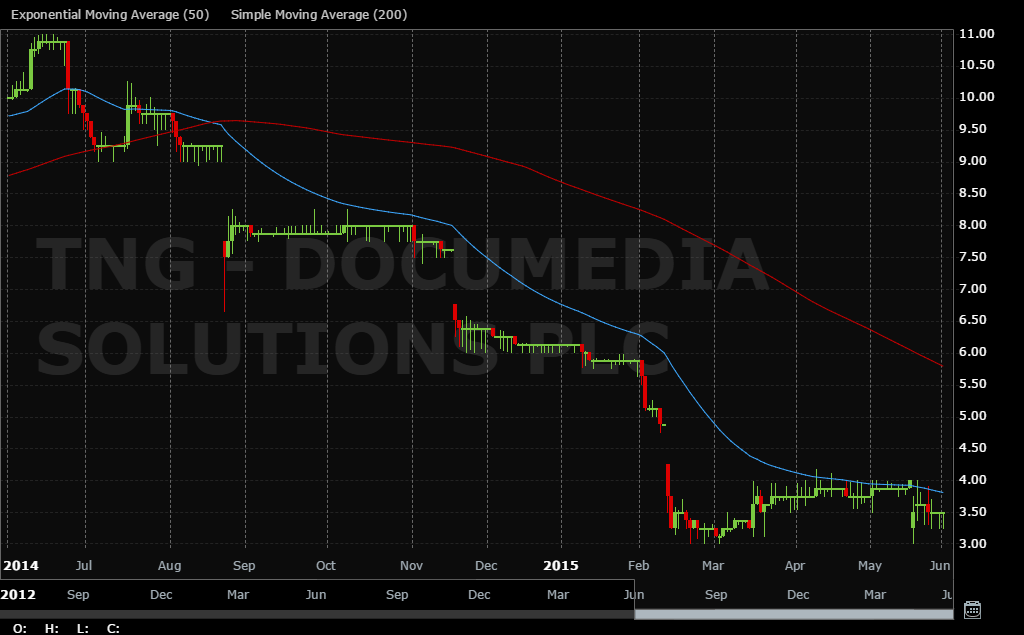
As things stand, this is not a chart that I can invest in.

On the 23rd June the group released a statement covering trading in Q1.  Apparently trading was in line with expectations but forecasts for the rest of the year have been lowered due to Tangent Snowball not winning enough new business.  As a result, it is anticipated that the outcome for the group for the full year will be below expectations, although net cash at the year-end is expected to be £2M.  More specifically, management expects profits at Tangent Snowball to be £500K below expectations and as a result Tangent Snowball CEO Steve Grout has been dismissed and replaced by Tim Green who has taken over day to day responsibility for the agency business.  In addition, the business will be seeking to hire new senior sales staff.

The print business performed in line with budget in Q1 and performance is forecast to continue in line with expectations.  The rationalisation of the print business continues and the full goodprint proposition is now available on printed.com.  This is yet another profit warning and it seems pretty difficult to justify an investment in this company.

On the 30th June it was announced that CFO Jamie Beaumont and non-executive director Nigel Kissack had purchased 250,000 and 340,172 respectively which represents £7,500 and £9,185.  These are their first share buys so I am not getting too excited about this.

Paypoint Share Blog – Final Results Year Ending 2015

Paypoint has now released its preliminary results for the year ending 2015.

PAYincome

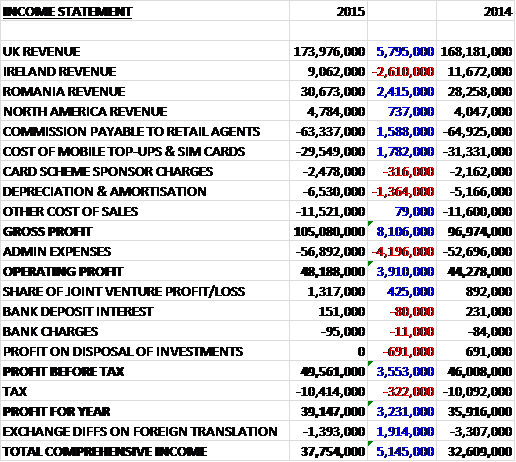
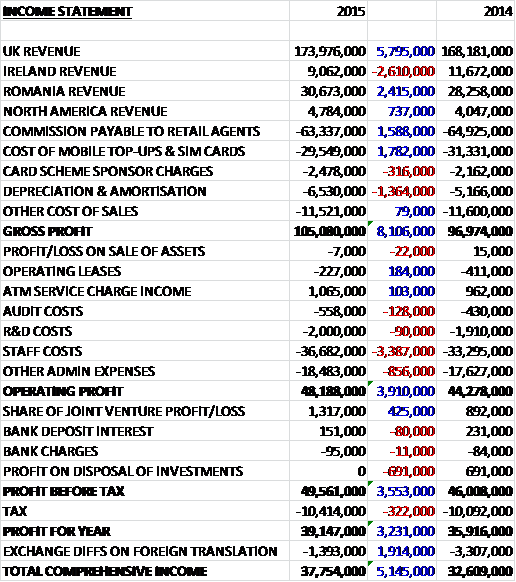
Overall, revenues increased year on year as a £2.6M decline in Irish sales was more than offset by a £5.8M increase in UK revenue, a £2.4M growth in Romania revenue and a £737K increase in North America sales.  Cost of sales fell as the commission payable to retail agents declined by £1.6M due to the lower mobile top-up transactions and the cost of mobile top ups and sim cards fell by £1.8M, partially counteracted by a £1.4M increase in depreciation and amortisation to give a gross profit some £8.1M higher than in 2014.  Admin expenses increased, however, reflecting a growth in IT costs in the second half of the year which continued into the next year, increasing costs of development and marketing required to support new products and continued investment in mobile and online to support the potential for growth in these markets which left operating profit some £3.9M higher.  There was a good increase in contribution from the Collect+ joint venture but a lack of a profit from the disposal of investments that occurred last time so that after a slightly higher tax bill, the profit for the year came in at £39.1M, an increase of £3.2M.

PAYassets

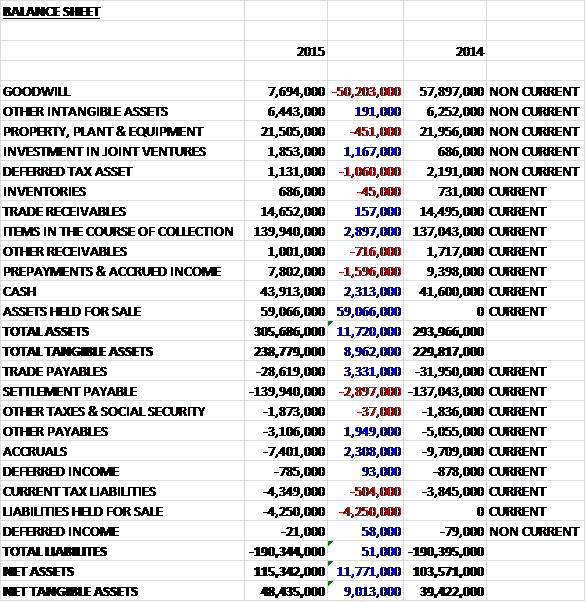
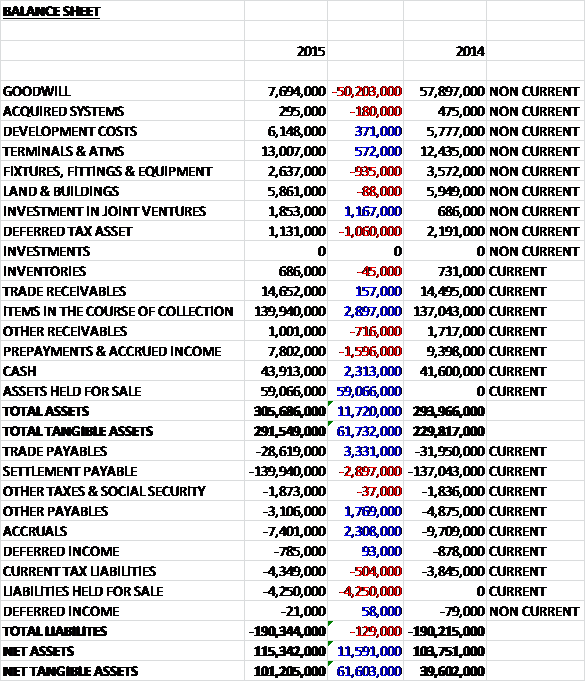
When compared to the end point of last year, total assets increased by £11.7M driven by a £2.9M increase in items in the course of collection, a £1.2M increase in the investment in the joint venture and a £2.3M growth in cash levels.  The other effect we see is the transferal of various items into assets held for sale, most notably £50.2M worth of goodwill pleasingly.   Liabilities remained flat during the year as an increase in settlements payable was offset by falls in trade payables, accruals and other payables.  Likewise we see the transferral of some £4.3M worth of liabilities into the business held for sale.  The end result is a pleasing £9M growth in net tangible assets to £48.4M and if the group gets the carrying value of goodwill when it sells the mobile and online payments business, the balance sheet could look very strong indeed.

PAYcash

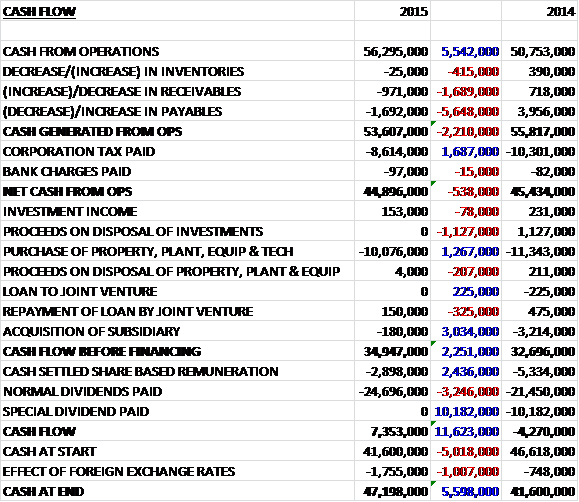
Before movements in working capital, cash profits increased by £5.5M to £56.3M before adverse working capital flows, partially offset by a smaller amount of tax paid, meant that the net cash from operations fell by £538K to £44.9M.  The largest expense by far was the £10.1M spent on property, plant and equipment relating to IT expenditure, developments of new products, ATMs and energy card and key readers for PPoS, with some £2.9M being spent on cash settled share based remuneration to give a very impressive free cash flow of £32M.  Of this, some £24.7M was distributed to shareholders as dividends with the rest going straight to the bottom line to give a cash flow of £7.4M, partially eroded by £1.8M with regards to exchange rates to leave a large cash pile of £47.2M at the end of the year, although it should be noted that £3.8M relates to monies collected on behalf of clients and £10.1M relates to client settlement funds held in bank accounts owned by Paypoint in Romania.  Even taking this into account, there seems to be a healthy level of cash here especially as there is a £45M undrawn revolving credit facility in place until mid-2019.

Given the changes taking place in the group, it seems as though it might be a good idea to go over what exactly is included in the two main divisions.  The group is now focusing on retail payments and services which includes prepaid energy, bill and cash out services; mobile top-us, e-money vouchers, prepaid debit card top up and lottery; retail services including ATM, debit/credit, parcels, money transfer, SIM cards, broadband, receipt advertising, charges for failed direct debits and paper invoicing; along with the collect+ parcel service joint venture.  The Mobile and Online business, which is being disposed of, includes parking, permits, tolling, ticketing, bicycle rental transactions, consumer transactions with merchants, pre-authorisations, optimisation of authorisations, Fraud Guard and real time management reporting.

Net revenues at the Bill and General sector increased by more than 9% to £59M with transactions increasing due to a 37% hike in Romanian bill payment transactions resulting from a market share increase, including the addition of new clients due in part to the launch of road tax payments at many Pay Point sites.  UK and Irish transactions showed a modest fall due to lower domestic gas consumption , mitigated by the continued increase in energy prepayment meters.  During the year the group launched their multi-channel payment solution for their first energy client (Utilita) for its smart meter customers that addresses the payment challenges faced by utilities as a result of the UK Government mandated change to smart meters by 2020 with other energy companies ready to take the service and a launch abroad on the cards in due course, alongside interest from the social housing sector.

Net revenues at the Top-ups division increased by nearly 3% to £23.2M despite an 8% decline in transactions due to a reduction in UK and Irish mobile top-up transactions, partly offset by an increase in other top-ups and Romanian mobile top-ups.  The increase reflects the higher value of other top-ups and the growth in requests for early client settlement, for which the group charges a fee.  Net revenue at the Retail Services business increased by nearly 20% to £26.5M with transaction volumes increasing across all products except for SIM card sales.  ATM transactions increased by 29%, money transfers by 44% and parcels by 39%.  These increases were offset by the fact that parcel transactions earned a reduced fee from Collect+ above a volume tier which was reached for the first time this year (which are not repeated) and lower revenues from receipt advertising.

The profit at the Collect+ business increased by 48% to £2.6M when compared to last year.  Transactions grew substantially despite lower consumer send transactions, where the group experienced significant price competition and this, along with the expected increase in logistics costs as the business moved to dedicated use of transport meant that gross margins reduced.  Discussions are underway with the joint venture partner, Yodel, about its proposed increases in its charges to Collect+ over the next year for providing logistics services which makes future profitability hard to predict.

Net revenues at the mobile and online businesses fell by nearly 4% to £14.5M despite the fact that transactions increased overall by 10% with payment processing up 6% and parking transactions increasing by 22%.  The payment transaction growth was driven by adding new merchants and organic growth, and the parking transaction growth was driven by the increase in consumer adoption in existing clients.  The fall in net revenues due to the decline in transaction value was due to a change in mix and the impact on parking from the weakening of the US and Canadian dollars against Sterling along with larger merchants benefitting from lower pricing on core payment transactions, offset by the growth in parking revenue.

The group has continued to add parking contracts with cities, operators and local authorities and they rolled out the first phase of parking payment services in Paris during the period which made up for the loss of the Westminster contract last year.  In Payments, the first sales have been achieved for two licensed products.  Cashier enables enterprise merchants to offer a customised payment experience for their online or mobile customers and also allows customers to store multiple cards.  Cardlock reduced the complication and cost of payment card industry compliance for merchants by removing card data from their websites and apps at the point of data entry and securing it remotely within Pay Point systems.

Significant work has been undertaken on the core parking system to enable new functionality and work is also advanced on the next generation of the Pay By Phone app due later this year.  Continued expenditure in technology, product development, sales and marketing are needed to take this venture forward and grow net revenue which means that the business is currently loss making and should remain so for the next year.

In UK and Ireland, site numbers increased by 4% and during the year the group continued to roll out their PPoS (PayPoint Point of Sale) integrated solution to retailers, which combines a virtual terminal with a plug in reader to provide the service at a lower cost and also has the knock on effect of freeing up some of the terminals to redeploy in Romania where the number of terminal sites increased by 880 during the period.  As well as the multi-channel payment services to clients, the group are also developing a new tablet based terminal with integrated EPoS capability that enables independent retailers to better manage their stock and promotions, along with other value added applications.  The EPoS solution will also collect purchasing and behavioural data which the group would then seek to monitise.  In addition, they are looking to move into new territories abroad both organically and through acquisitions both in developing and more mature economies.

The main announcement with the result is the fact that the group is looking to offload the Mobile and Online businesses, which includes the parking and online payment processing companies as the board felt that the investment needed to make them competitive in the long term was too much for them to handle.  This is a bit of a shame, especially as the car parking payments business seemed to be gaining traction but I suppose they can concentrate on the other core businesses if this goes through.

The main structural divers continue to be the increased prevalence of convenience shopping in the UK and the growth in Romania, counteracted by a decline in mobile top-ups in the UK and Ireland as more customers move over to mobile contracts.  The group states that their satisfaction rates and promoter scores are exceptional but there has been stories recently in the press that reductions to retailer commission shortly after they have signed contracts make PayPoints solutions less popular.

The group has a good spread of KPIs covering EPS, dividends, profits, ROCE, number of transactions, transaction values, net revenue, operating margin and labour turnover.  All of the financial KPIs improved year on year but labour turnover increased in both the UK and overseas and seems rather high at 21.7% and 16.5% respectively.

During the year there were a number of board changes with Nick Wiles taking on the role of Chairman having been a non-executive director since 2009.  Neil Carson has joined as senior independent director and Gill Barr will also join the board from June.  They are replacing David Newlands, who steps down as Chairman and Eric Anstee who has served on the board for the last seven years.

Going forward, trading at the start of the new year is line with expectations, although the investment in Mobile and Online will lower earnings in the first half of the year.  The retail networks in the UK and Romania should continue to deliver profitable growth despite the impact of the recent VAT ruling.  At the current share price the P/E stands at a rather average 16.8, although this reduces somewhat to 16.1 on next year’s consensus forecast.  After a 9.2% increase in the final dividend, the dividend yield currently stands at a decent 4%, increasing to 4.2% on next year’s forecast.

Overall then, this seems to be a fairly good update.  Profits are up, net assets improved to give a very strong looking balance sheet, particularly if the full value of Goodwill can be realised from the sale of the online and mobile business; and although operational cash flow reduced slightly due to adverse movements in working capital, there is a very strong free cash flow generation here and a comfortable looking cash pile.  Operationally, the bill and general payments division has a decent year as increased revenues in Romania (due in part to a road tax payment solution being introduced) was offset by a decline in gas consumption in the UK.  The retail services division had a very good year with ATM services and money transfers doing very well, but growth in the top-up division was more subdued as a strong performance in Romania was counteracted by continued falling mobile top-ups in the UK and Ireland.  The Collect+ business performed well but the fact that Yodel are looking to increase their charge to the joint venture is rather concerning.

I suppose the main announcement was the fact that the group are looking to sell the mobile and online business.  This is a bit of a shame as it is certainly one that has exciting growth prospects but it is currently loss making and the realisation of its value will allow the group to concentrate on its new products in its core divisions and potential international expansion, which given the success in Romania, would be an exciting prospect.  I am a little concerned about the recent press stories potentially leading to reputational damage and the P/E ratio seems roughly in line with performance here but there is a good dividend yield and this is the kind of company I like – very cash generative with little debt.  I don’t have the fund for a purchase here but I might revisit if the euphoria regarding the disposal dies down.

PAYPOINT-20150601-101832

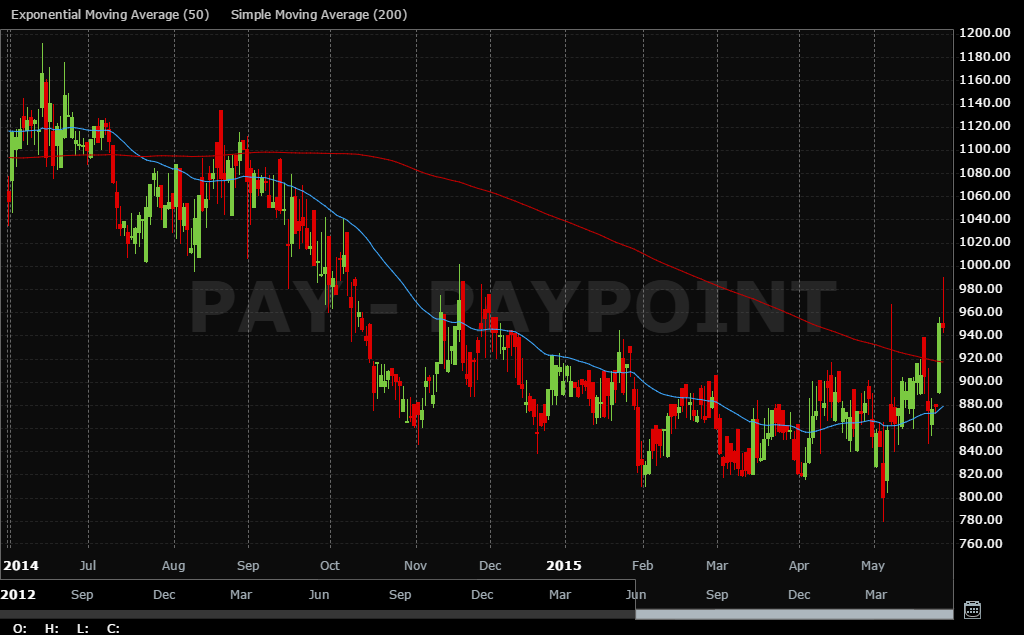
The market has reacted well to the results and this may signal a change in the downward trend that has been in place since this time last year.

On the 28th May it was announced that Gill Barr has been appointed as non-executive director.  She has held senior position as the Co-Op, John Lewis, Mastercard and Kingfisher and has previously serves as non-executive director at Morgan Sindall and the UK Breast Cancer Coalition.

Paypoint has now released its annual report with a bit of extra detail.

payIncomefin

The extra detail here is all in admin costs.  We can see that the main component of the increase was a £3.4M increase in staff costs.  The fees paid to the audit company also increased but operating leases fell year on year.

PAYbalancefin

The prelim results actually contained quite a lot of details the only extra information we have on the balance sheet is in intangible assets and property, plant and equipment.  The increase in intangible assets was driven by a growth in development costs whilst the fall in tangible assets was due to a £935K decline in fixtures and fittings, partially offset by a small increase in terminals and ATMs.  Operating leases, although somewhat higher this year, are pretty immaterial.

There is also further information about some of the group’s activities over the year.  Independent energy supplier Utilita has become the first user of the group’s new integrated multi channel payment solution for smart meter customers.  Utilita’s customers now have flexibility to pay using whichever payment method is most convenient to them at the time – either by cash at any of the stores in Paypoint’s network, or by credit and debit card using their mobile phone, tablet or computer.

The new smart ticketing system has been rolled out with Cardiff Bus in Cardiff and the Vale of Glamorgan, along with Mersey Travel on Merseyside.  The system enables transport companies to allow customers to buy tickets and load smart cards for use on multiple transport modes.  It makes it much easier for customer to top up their smart cards with a range of ticket and value options each time they top up at one of the group’s retailers who benefit from extra footfall.  PayByPhone, which allows drivers to use a mobile payment app for parking was chosen by Apple to be one of the first apps to launch on their Apple Watch.  The app has a feature that discretely displays on the watch face how much time is left in the driver’s parking sessions and enables users to instantly extend the parking time without returning to their cars.

Most of the UK’s electricity suppliers issued the Government electricity rebate, designed to help reduce domestic energy bills, to around three million customers using the group’s CashOut scheme.  Each recipient received a voucher which they were able to redeem at Pay Point as a top-up on their electricity meters.  Several energy companies also used Pay Point to deliver other discounts and rebates to customers.  British Gas issued dual fuel discount vouchers to almost one million customers and Warm Home Discount vouchers to a further 197,000 customers for electricity top-ups.  EDF Energy also issued vouchers under the Warm Home scheme to 75,000 customers for gas and electricity top-ups at Pay Point.

Derby City Council has become the first local authority to contract exclusively with the group for cash payments by residents.  Previously they had also used the Post Office as well but after reviewing the costs involved in collecting payments through two networks, they went with Pay Point alone to enable residents to pay their bills to the council and their rent to Derby Homes.  As councils around the country look to cut costs, this kind of things could become more prevalent going forward.  This is both an opportunity and a potential risk to the group I would say.

In Romania, an increasing number of multiple groups are recognising Paypoint as an important generator of footfall and major group such as Cora, Carrefour and Profi who operate supermarkets and hypermarkets across the country are now offering their customers the facility to pay their bills through Paypoint in their stores.  As the group’s retail network has expanded into remoter counties and regions, the majority of regional utility suppliers, particularly in water and sewage, have signed up to offer their customers the facility of paying their bills at Paypoint.

During the year, Collect+ completed the rollout of its click and collect service for John Lewis.  The store’s customers can now collect their online purchases from any one of the stores in Paypoint’s network with the service now having 260 retail brands that have signed up including Amazon, Asda, House of Fraser and River Island. It is also being used as an option for those who sell products via ebay to send to UK addresses.

So, a bit more information but nothing major.  I am increasingly of the opinion that Paypoint would probably make quite a good investment.

On the 22nd July the group released an update covering Q1 2016.  Overall trading was in line with the company’s expectations.  Transactions processed for the quarter were up 6% to £201.6M.  Net revenues were £29M, an increase of just 1% on last year with growth in retail services partially offset by a decline in mobile and online, mobile top-ups and bill and general. UK and Irish bill and general transactions were in line with last year with a continuation of low levels of energy consumption.  Retail services transactions (ATMs, debit/credit cards, parcels, money transfer and mobile sim cards) were up 24% year on year.  Mobile top-ups continue to decrease as a result of the decline in the prepaid mobile sector but other top-ups are growing.  UK and Irish retail sites numbered 28,702, increase of 395 since the financial year end.

In Romania, profitable growth continues.  The group have processed 14.5 million bill payments in the period, an increase of 18% year on year.  After 38 new outlets were added to the network, there were 9,272 outlets in the country and the group continues to add new clients and services.  Collect+ volumes increased by 22% to over 4.9 million transactions in the period , up from 4 million last year but the group continues its discussions with Yodel over the proposed cost increases.  Mobile and online transactions increased by 16% to 41.8M and parking transactions increased by 11% to 11.5M with online payment transactions up 18% to 30.3M.  The group has a net cash position of £47M (including client cash), up from £44M at the year-end but the final dividend is due for payment later this month.  The proposed sale of the parking and online payment company is apparently progressing satisfactorily.

Overall, growth doesn’t seem to be exciting but there are no nasty surprises in the update.  I have been thinking about taking a position here for some time and have decided to take the plunge.

On the 29th October the group announced the appointment of Giles Kerr as non-executive director. He is director of finance at Oxford University and a non-executive director of BTG and Senior having previously been finance director at Amersham PLC.


Tower Resources Share Blog – Final Results Year Ending 2014

Tower Resources has now released its final results for the year ending 2014.

TRPincome

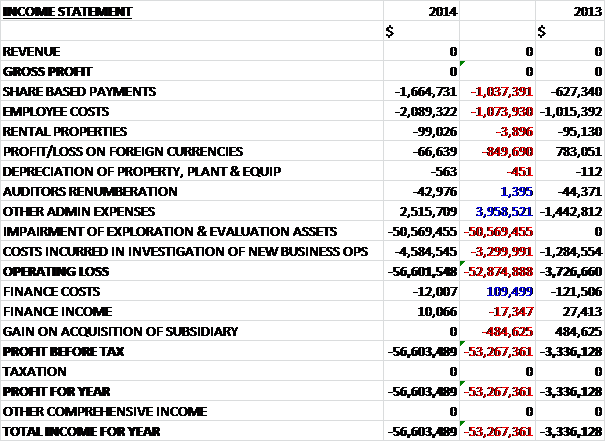
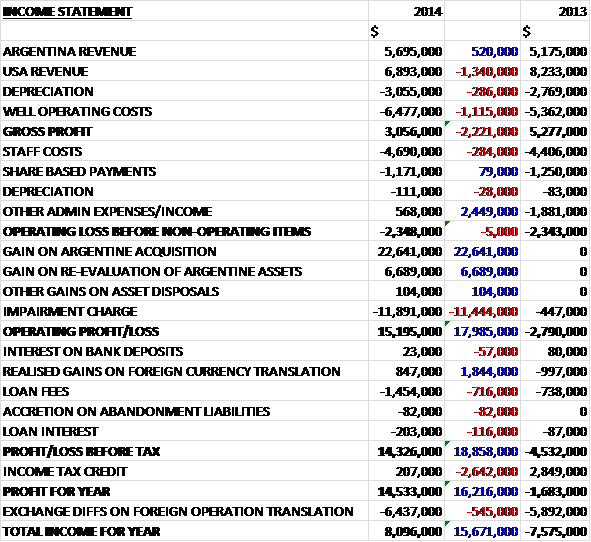
As usual, there are no revenues but we do see a big increase in both share based payments and employee costs.  There was also a negative swing to a loss on foreign currencies but these increased costs was counteracted by the “other” admin expenses which relates to the fact that more of these costs were capitalised. There was a $3.3M increase in the costs incurred in the investigation of new business opportunities and a huge $50.6M impairment after the two failed wells in Namibia and Kenya.  Finance costs improved considerably but there was a lack of a gain on the acquisition of a subsidiary which occurred last year to give a total loss for the year some $53.3M higher than in 2013 at $56.6M.

TRPassets

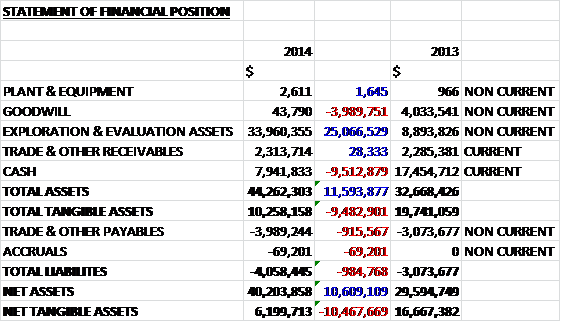
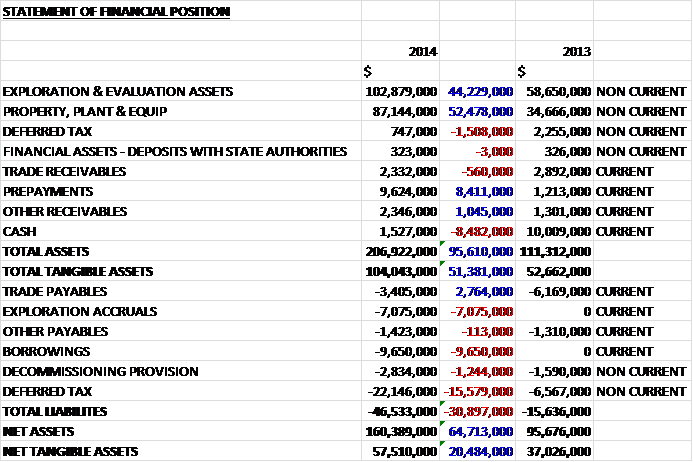
When compared to the end of last year, total assets increased by $11.6M, driven by a $25.1M increase in exploration and evaluation assets due to increases in South Africa counteracted by impairments in Namibia and Kenya, partially offset by a $9.5M fall in cash and a $4M decline in goodwill.  Liabilities also increased during the period due to a $916K increase in payables to give a net tangible asset level some $10.5M lower at $6.2M for what it’s worth.

TRPcash

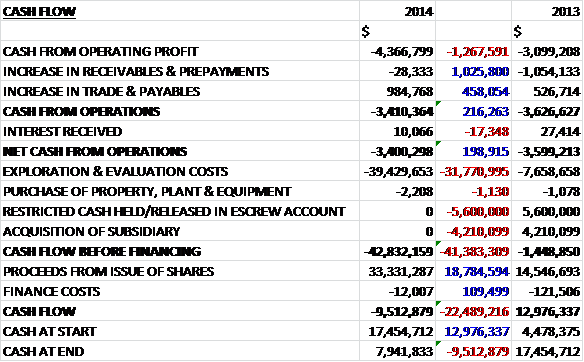
Before movements in working capital, the cash loss increased by $1.3M to $4.4M before a growth in payables gave a net cash outflow from operations of $3.4M, a $216K improvement on last year.  The group then spent $39.4M on exploration and evaluation which was partially paid for by proceeds of $33.3M from the issue of shares to give a cash outflow for the year of $9.5M and a cash level of $7.9M at the year-end (which includes some $693K of restricted cash).

The group’s first venture in Cameroon will be the Dissoni offshore block.  They were selected as preferred bidder in 2013 and negotiations regarding the production sharing contract have been ongoing since then!  They are apparently in the final stages, however, with a conclusion expected in mid-2015.  Dissoni lies in the Rio del Rey basin in the Eastern part of the Niger delta where to date over 1 billion bbls have been produced and remaining reserves are estimated at 405 million boe which have come primarily from shallow producing sands at depths of less than 2,000 metres, but there has been very little exploration at deeper depths.

The block has the potential for up to four distinct play systems, including the established producing play in which three discovery wells have already been drilled, which were viewed as non-commercial.  The group believes that with better quality seismic, oil reserves can be added to achieve commerciality.  The development of a 20 million bbl field should be economically viable and to date some 7 million bbls have been discovered on the block.  On signing the agreement, the priority will be the acquisition of 3D seismic in late 2015 or early 2016.  The initial exploration period is for three years and the group hopes to be drilling by 2018.  Drilling costs in this shallow area would be less than $20M for the shallower targets and a partner will be sought to share the group’s financial commitment and provide additional technical input.

The group became an operator in Zambia upon the acquisition of Rift Petroleum with an 80% interest in blocks 40 and 41.  They have now completed all of their initial period commitments in the basin including an extensive programme of geological fieldwork which comprised the evaluation of geophysical data, geochemical analysis and rock sampling to assess the potential for source rock generation and reservoir presence, the results of which indicate that elements for a working petroleum system are present and have been submitted to the Zambian authorities.  The three year secondary period has been split into three one year periods with commitments to undertake further field work, airborne gravity and magnetic data acquisition, and a 2D seismic programme.  The acreage can be relinquished at the end of each year if results are not good and partners are being sought to fund the work with potential drilling to take place by 2018.

The group’s non-operated interests in the Algoa-Gamtoos and SW Orange basins offshore South Africa also came as part of the Rift acquisition and the operators are New Age Energy and New African Global Energy respectively.  On the Algoa-Gamtoos blocks, the processing of 3D seismic data has continued and the first renewal application to the exploration right has been submitted to the South African authorities which is expected to be approved in the second half of 2015 and the group hopes to be in a position to drill by 2017 with a farm out expected before any decision to drill a well.  The South West Orange basin is currently held under a Technical Co-operation permit with an application to convert this into a three year exploration right having been submitted.  Concerns about the regulatory environment in the country have lessened somewhat by the government’s decision to consult further with the industry.

The group retains a 30% interest in the Repsol operated license 0010 in Walvis Bay, Namibia.  During the year, the Welwitschia-1 well targeted five reservoir targets ranging from the Palaeocene-Maastrichtian to the Albian Carbonate sequence at a depth of 3,000m.  Only three of these targets were reached and all of these reservoirs were found to be poorly developed.  The well was beset by operational difficulties including a delay following the late arrival of the rig, the slumping of a wellhead housing beneath the sea bed which meant the well had to be respudded, and a series of faults with the blow out preventer control system which resulted in suspension for two weeks.  The upshot of all this is that the well only reached 2,454 metres with no hydrocarbon finds and with the arrival of the winter season in the South Atlantic, the gross cost of continuing deeper would have been around $40M so the decision was taken to plug and abandon the well.  Due to all the delays the well cost much more than anticipated which led to a dispute with Repsol over how much Tower had to pay, which was eventually settled with the group paying $28.3M in total, within the original budget.

The current work programme involves obtaining a fuller understanding of the well results and the implications for the prospectivity of the rest of the license, especially the untested deeper targets including the Albian carbonates with the data from the failed well being tied to the 3D seismic data already obtained.  The board still believe that a commercial discovery of oil will happen in Namibia with other international companies planning to drill by 2017.  The current strategy is to wait for other operators to begin a fresh drilling campaign in the area before committing to a further well and the Namibian assets have been impaired in the meantime.

In Kenya, after the year end the Bada-1 well was plugged and abandoned as a dry hole.  The operator, Lion petroleum, is in discussions with the Kenyan authorities as to how best to complete the evaluation of the remaining prospectivity of Block 2B.  One of the other partners, Premier Oil, has given notice to exit the joint venture with Lion and Tower remaining as the sole interested parties.  They now wish to fully integrate the well data into geological models to assess the potential in both the Tertiary and Cretaceous areas and a six month license extension to November 2015 has been granted to allow for analysis prior to a decision being made on entering the next exploration phase, although there is not anticipated to be any additional expenditure this year.  There is still an injunction preventing physical operations over the bulk of the block, though, with further court hearings expected in Q2 2015 which is a further uncertainty.  As a result of the failure, the well costs have been impaired.

The group still holds a 50% interest in the offshore Guelta and Imlili blocks and the onshore Bojador block in Western Sahara.  The sovereignty of the territory remains in dispute with Morocco and there is little that can be done to advance exploration of these blocks at the moment.  A well was drilled by another company in an area to the north awarded by Morocco but despite finding gas and condensate the discovery was non-commercial, although the find does establish that a working petroleum system exists in the area.  In Madagascar, the group continues with discussions with the new government to obtain a license over the previously held area of Block 2102 which are ongoing.  In Ethiopia, following a review of an application made by Rift for blocks AB3 and AB6, it was withdrawn.  New applications have been made on three other licences and work continues to identify new opportunities but discussions are not being rushed in this low oil price environment.

It is quite interesting to see what the group has actually spent on exploration and evaluation during the year.  The most was actually spent in South Africa ($32.3M) with some $29.8M being spent in Namibia, $8.2M in Kenya, $1.3M in Zambia and $35K in Western Sahara.  Following impairments in Kenya and Namibia, the capitalised exploration and evaluation assets are $32.3M in South Africa, $1.3M in Zambia and $381K in Western Sahara.  As the group does not have any revenue, they need to raise funds by issuing new shares and during the year 550 million were issued that raised $32M.  At the end of the year they held about $7.2M in non-restricted cash and it is expected that more funds will have to be raised during the next year to cover working capital needs and committed capital expenditure programmes.

The group does have some exploration expenditure commitments this year with $1.8M still to be paid to fund the remaining Badada-1 well costs in Kenya and a further $741K for extending the PEL0010 license in Namibia which is expiring in August.  During the year the group acquired Rift Petroleum, an Isle of Man company with exploration assets in South Africa and Zambia.  There were no tangible assets and they paid some $32.2M to acquire the exploration and evaluation assets with 550 million shares.  The acquisition gave Tower exposure to a 50% interest in two South African offshore areas.

During the year CEO Graeme Thomson managed to pocket a bonus of more than $1M which is interesting as there seems little that was achieved to warrant this and his total pay package increased from $606K to $1.6M which seems really very excessive to me given the fact that Tower have still not managed to find any hydrocarbons.

After the year-end the group announced that the Badada-1 well had not encountered commercial hydrocarbons and was plugged and abandoned.  They also announced that the £20M EFF funding facility with Darwin was not being renewed and 15 million shares were issued under contractual arrangement as part payment for services provided in Q4 2014.  There are no drills planned for the coming year.

Going forward, the board point out that successful wells are usually achieved with the help of data obtained from unsuccessful ones and they believe that the group is building valuable data sets and relationships in several basins and countries (albeit expensive ones) that will bear fruit in time.

Overall then, this was clearly a disappointing year for Tower as both potentially high impact wells came up dry.  The Cameroon license seems to offer something a bit different with a potentially lower risk, lower impact prospect.  In Zambia, the group still seems a long way off drilling but South Africa may offer a prospect of something happening in 2017, although the comment about the regulatory environment is a little concerning.  Nothing will happen in Namibia for a few years as the group waits it out to see if any other company’s make interesting finds and I am not too sure if Kenya still offers much in the way of prospects after a dry well that let Premier to jump ship and the continued injunction.  The coming year should be quiet with no drilling in this low oil price environment but the group will have to raise further funds nonetheless.  The shares I still own are as good as worthless so there is not much point selling them at these levels abut there is not much in the short term that makes me want to buy any more.

On the 28th May the group released a statement confirming Premier’s exit from the Kenya prospect which means that Tower now has a 33% interest and the first exploration period has been extended by 6 months by the Kenyan authorities to the end of November which will give the partners enough time to assess the remaining prospectivity of the block.

TOWERRESOURCES-20150528-035435

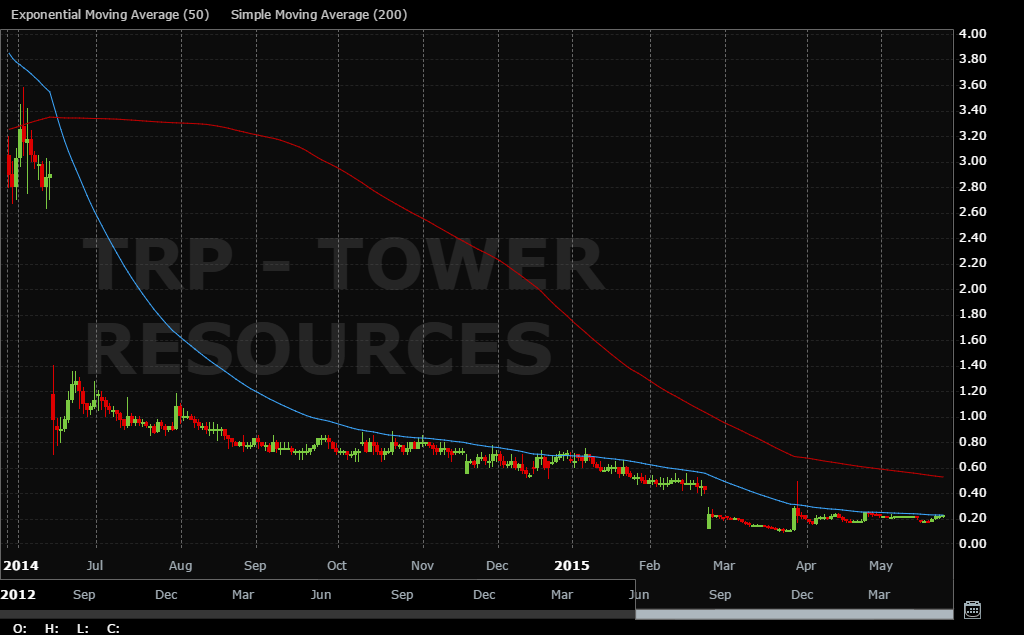
This chart is a painful one to holders of the share but there does appear to be a vague upwards trend since the decline after the Kenyan well results.

The group have released an update covering current trading and a new placing.  The company has placed 2,904,989,747 shares in the capital of the company at a price of 0.19p to raise proceeds of £5.2M.  Following admission of the new shares, the company’s share capital will comprise of 6,735,155,777 shares.  When added to the current cash balance of $1.8M, the $8M placing will be used as follows:  $5.4M in Cameroon, $2.7M in Namibia, $600K in Zambia, $500K on other licenses and $600K on corporate costs.

In Cameroon the group was selected as the preferred bidder for the Thali block, offshore, in September 2013.  The Thali PSC has been negotiated and the board expect to be formally awarded a 100% interest in the block imminently.  This block is located in the Rio del Rey basin which to date has produced over one million barrels and has remaining reserves estimated at 1,200M boe, primarily from shallower producing sands at depths of less than 2,000 metres.  The block has the potential for up to four distinct play systems including the established play in which three discovery wells have already been drilled.  These are currently views as being sub-commercial but with better quality seismic the group sees potential to add incremental oil reserves to achieve commerciality.  There is also significant potential to develop prospects at deeper levels one better imaging has been achieved.

The existence of infrastructure in adjacent blocks means that the development of a 20 million barrel field has the potential to be economically viable at current oil prices with 7 million barrels already discovered on the block.  On signing of the PSC, the company priority will be the acquisition of 3D seismic in early 2016 which will be used alongside older data to allow better resolution of shallow plays alongside imaging of deeper sections.  The initial exploration period is for three years and the group expects to be drilling in 2017/2018.  The market downturn in the services sector presents the opportunity for the company to leverage lower seismic and drilling costs and a partner will be sought to share their financial commitment and provide additional technical input.

In Namibia the group is currently negotiating substantial new operated acreage positions offshore.  The current exploration period of PEL10, however, only extends to August 22nd and all current license obligations have been met.  The next period would require a well to be drilled and the group does not consider that to be currently justified.  The area remains of interest, though, and there are plans announced by other companies to drill in the country next year and the year after.  In South Africa, the group hopes to see a restart of drilling activity by the industry when the proposed legislative framework is clear but in the meantime their work commitments in this area are minimal.

In Zambia, the company has successfully completed all of its initial period commitments and is well positioned for the next exploration phase.  The results from the fieldwork are apparently encouraging and indicate that elements for a working petroleum system are present with the potential for both oil and gas generation,  Given the excellent surrounding infrastructure and constrained domestic energy market, it is believed that there is a significant gas to power opportunity in the area.  The three year secondary period has been split into one year periods with commitments to further fieldwork (being funded by the placing), airborne gravity and magnetic data acquisition and interpretation along with a 2D seismic programme.  The acreage can be relinquished at the end of each annual decision point if results are discouraging.  The group is looking for partners to accelerate the programme so that prospects could be drilled in 2017/2018.

The directors of the company have agreed to subscribe for 371,500,000 shares at a cost of $1.1M and M&G, an international asset manager, is investing about $3.55M in the placing which will give them an 18% shareholding in the company.

President Energy Share Blog – Final Results Year Ending 2014

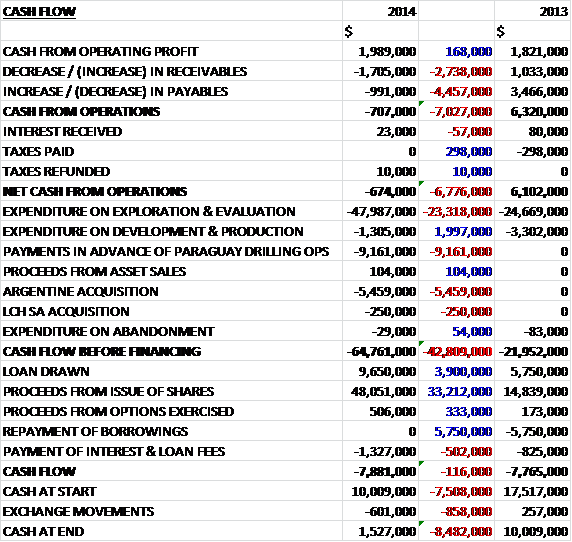
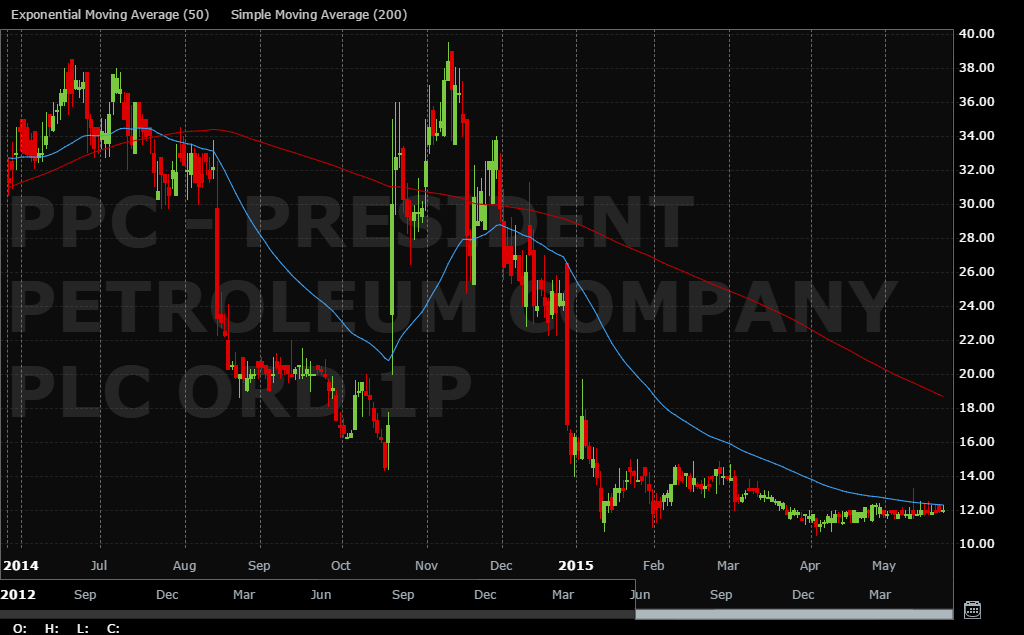
President Energy has now released its final results for the year ending 2014. ppcincome Overall revenues fell year on year as a $520K growth in Argentinean sales was more than offset by a $1.3M decline in USA revenue as the average oil price fell from $86 to $81.  Well operating costs increased by $1.1M due to the 50% share of Puesto Guardian gained, work over costs on East Lake Verret and the ending of severance tax holidays on certain wells to give a gross profit some $2.2M lower than last year at $3.1M.  Staff costs increased slightly but other admin costs were substantially lower because it included some $3.1M ($2.11M) of costs that were capitalised, to give an underlying operating loss flat on last year at $2.3M.  There were some large non-underlying gains and losses, however, as a $22.6M gain on the Argentine acquisition relating to the remaining 50% interest acquired at the Puesto Guardian concession and a $6.7M gain on the re-evaluation of the Argentina assets following the revaluation after the Puesto Guardian acquisition, was partially offset by an $11.9M impairment charge, mainly relating to the Australia PEL82 license which was fully impaired during the year.  The group also benefited from an $847K gain on foreign currency translation but loan fees were some $716K higher and the tax credit fell by $2.6M to give a profit for the year of $14.5M compared to a $1.7M loss in 2013. ppcassets When compared to the end point of last year, total assets increased by $95.6M, driven by a $52.5M increase in property, plant & equipment; a $44.2M growth in exploration assets relating to expenditure on drilling activities at the Jacaranda and Lapacho wells in Paraguay and the acquisition of a further 5% of the Pirity concession; an $8.4M growth in prepayments and a $1M increase in other receivables, partially offset by an $8.5M decline in cash levels and a $1.5M fall in deferred tax assets.  Liabilities also increased with a $15.6M increase in deferred tax liabilities due to the profit made on the Argentinian acquisition and the revaluation of the assets there (there are still plenty of unrecognised losses that are available for offset against future profits), a $9.7M growth in borrowings, a $7.1M increase in exploration accruals and a $1.2M growth in the decommissioning provision, partially counteracted by a $2.8M fall in trade payables to give a net tangible asset level of $57.5M, an increase of $20.5M when compared to 2013. ppccash Before movements in working capital, cash profits increased by $68K before an increase in receivables and a decrease in payables, offset partially by a $298K fall in tax paid, meant that there was a $674K net cash outflow from operations as opposed to the $6.1M cash inflow last year.  The group then spent $48M on exploration and evaluation; $1.3M on development and production and $5.5M on the Argentine acquisition with a payment of $9.2M in advance of the Paraguay drilling operations to give a cash outflow before financing of $64.8M.  There was a share placing of $48.1M and new loans of $9.7M to give a cash outflow for the year as a whole of $7.9M that left a cash pile of just $1.5M at the year-end – clearly not enough to fund further operations. In Paraguay, the group currently owns a 64% working interest in the Pirity concession, a 10% working interest in the Demattei concession, with the right to earn up to 60% and a 40% working interest in the Hernandarias concession with the right to earn up to 80%.   This combined acreage of 34,000 square km includes an extension of both the deeper Paleozoic and Silurian petroleum systems from which the gas condensate fields in Bolivia are formed along with the shallower Cretaceous petroleum system across the border in Argentina. During the year the group drilled the Jacaranda and Lapacho wells on the Pirity block which proved the existence of the Devonian and Silurian Paleozoic petroleum systems in the basin and made hydrocarbon discoveries in the Sara, Santa Rosa and Icla reservoices with a light oil discovery in the Icla interval (covering 24m) and a gas condensate discovery below 4,060m in the Santa Rosa and Sara sands.  Unfortunately there were problems with the well testing operations on both occasions so the group could not demonstrate commercial flow rates, which was a real blow. The majority of the Paleozoic prospectivity is in the Hernandarias concession where the Santa Rosa and Sara target intervals can be reached at much lower depths.  The exploration programme in the Pirity basin is continuing with a 607km 2D seismic survey currently underway, the results of which are expected in mid-2015.  The survey is focused on the Boqueron, Labon and Tuna leads which are thought to contain the Devonian and Silurian packages identified in the Jacaranda and Lapacho wells at a depth of between 2,000 and 3,000 metres. The operating loss in Argentina was $948K, an increase of $486K when compared to last year.  Since acquiring full ownership of the Puesto Guardian concession, the group has carried out reprocessing of seismic and reservoir engineering analysis and as a result of this is now commencing with well work overs and with drilling of new production wells in a second phase.  The increase in production will also benefit from a government announcement of a $3 per barrel increase to the barrel realisation price for each increased barrel produced over existing production.  The group has also commenced the farm out of a deep Paleozoic gas prospect at the Martinez del Tineo field in the Puesto Guardian concession which is assessed to contain unrisked recoverable prospective resources of 570 Bcf of gas and 14.5 mmbbls. The phase 2 programme is targeted to commence during the latter part of 2015 subject to finance being in place, which consists of up to 17 new wells targeting proved oil reserves.  It is expected that some $30M of development finance will be required for the programme, at which point it should become self-funding.  Additionally, an application is being made under new government legislation relating to unconventional hydrocarbons to obtain extended license terms over their concessions with tight reservoirs now qualifying for these extended license terms.  If granted, the end date of the Puesto Guardian concession would become 2050 with the 3P oil reserves of 17.5 mmbls most likely increasing by  a further 16.5 mmbls due to the transfer from contingent resources into reserves.  It is hoped that that the application will be finalised before the end of 2015. The operating profit in the US was $2.5M, a fall of $1.5M when compared to 2013 as a falling oil price combined with increased operating costs due to some work overs increase production.  The producing East White Lake and East Lake Verret fields continue to provide a cash flow base that covers the majority of the group’s overheads.  Production fell from 236 bopd to 222 boepd but the Eagle Crest well at East Lake Verret was brought on stream at no cost to the company because it was farmed out in return for a full carry of costs, a 3% gross overriding royalty and a further 12% working interest.  The well came on stream in 2014 with payout expected to occur by mid-2015. The company continues to believe there is some value in the PEL 82 license in Australia where 250 Bcf of conventional prospective resources and unconventional prospective resources of between 460 Bcf to 1.98 Tcf have been identified.  Discussions with potential farm in partners have been placed on hold, however, while the South Australia state conducts a review into unconventional drilling activity.  An application has been made to extend the license from September 2015 for a potential further year.  Due to the hiatus, the group has impaired $11.5M of intangible assets at the license. A the year end the cash position stood at $1.5M and a further $14M was raised after the year end to fund the acquisition of new seismic lines on the Hernandarias concession in Paraguay and an initial workover programme in Argentina. During the year, discussions with potential farm-in partners for the PEL82 license in Australia were placed on hold while the South Australian state conducts a review into unconventional drilling activity.  An application has been made to extend the license up to September 2016 but in view of the current hiatus, the group has impaired the $11.5M of intangible asset value related to the concession.  Apparently management do see value in there but I suppose the favourable Argentinian acquisition which enabled the group to revalue the current asset there with an increase of $12.9M, allows the group to conceal the impairment somewhat and it is probably the sensible thing to do to protect against a possible impairment in the future. There are quite a lot of share options outstanding and over the past year they have been issued at the rather generous exercise price of 1p which is a trend that I find rather dubious.  The good side is that these options will only be exercised if the share price hits 80p, so this is quite an upside from the 13p-ish that the shares are languishing at, so perhaps the directors would deserve their pay day if this is the case. During the year, the group acquired the remaining 50% interest in the Puesto Guardian concession in Argentina which gives them complete ownership and operational control.  The group spent $5.5M in cash, $247K in deferred consideration and waived a loan of $1.6M in order to acquire assets worth $22.6M.  Taken at face value, this really is an excellent acquisition with a huge amount of assets acquired for really very little (an incredible $1.04 per 2P barrel).  During the year, the extra 50% acquired contributed a cash operating profit of $200K on revenues of $1.6M and had it been acquired at the start of the year, it would have contributed some $1.2M in cash operating profits – excellent stuff!  In addition, a further 5% was acquired in the Pirity concessions due to the acquisition of the Paraguayan company LCH for $7.1M At the end of the year, the group was committed to funding a three year exploration programme on each of the Matorras and Ocultar license areas surrounding Puesto Guardian in Argentina.  There is a seismic re-processing and new seismic acquisition commitments of $2M each with a drill or drop decision after three years.  In Paraguay, the group has entered into farm in agreements to spend a further $32M on the Demattei concession to earn the remaining 50% working interest and a further $15.4M on the Hernandarias concession to earn the remaining 40% working interest. The KPIs all involve production and costs at the two producing countries with production in Argentina increasing (only due to the 50% Puesto Guardian acquisition, gross production fell) but falling in USA.  Operating costs have increased across both territories and now stand at $22.9 per boe in the US and $61.8 per boe in Argentina.  Finally, there is one financial KPI which is cash balances which fell during the year. After the end of the balance sheet date, there have been a number of significant events.  Due to the lower oil price environment, the group is looking to reduce its overhead cost base, hence the depart in January of CEO John Hamilton, COO Richard Hubbard and non-exec director Michael Cochran with Peter Levine becoming chairman and CEO with Miles Biggins assuming the role of COO.  Alistair Burt MP joined in February as a non-executive director. In March, the company placed nearly 30M shares at 12.5p per share with a further 43M then added at 12.5p per share with attached warrant that are exercisable at 18.75p per share during a three year period.  A total of $14M was raised in the placing to fund an acquisition of new seismic lines on the Hernandarias concession in Paraguay and an initial workover programme in Argentina.  The existing $15M loan facility was extended to the end of 2016 with a company owned by largest shareholder, CEO and Chairman Peter Levine.  This involved loan fees of $1.5M being paid to the company, which seems as though it could be a potential conflict of interest. Going forward, not-withstanding the current oil price environment, the board are confident that the group will progress this year in Paraguay and Argentina.  The first priority is the focus on exploration and production whilst maintaining cost control. On the 14th May it was announced that Alistair Burt MP has resigned from the board.  He didn’t last long but after the election, he has become a minister of state so I guess that is fair enough. On the 16th May it was announced that CEO, Chairman and largest shareholder Peter Levine had upped his holding even further with the purchase of 2,350,000 shares at a value of £276,125 which is a good vote of confidence. Overall then, this has been an eventful year for Presidents.  Revenues have fallen due to the lower oil price environment but operating losses were flat as increased operating costs were more than offset by the capitalisation of more admin costs.  The group did achieve a profit, however, due to the excellent Puesto Guardian acquisition which is also the reason for the increase in net tangible assets.  Cash profits actually increased by detrimental movements in working capital meant that there was a cash outflow from operations and the year end cash position was down to $1.5M with a further $14M raised in a share placing post year-end. The main news this year was the failure of the two Paraguay wells to find commercial hydrocarbons.  The future of the company is based upon finding something in the country so hopefully at some point they do manage to make a valid test on an exploration well.  The focus for the next year is in Argentina, however, and a further $30M will have to be found from somewhere to fund an extensive production well campaign in the country so there will be a further fund raising at some point. I do feel that at some point, these shares will be worth investing in.  Now that the dispute with the partner in Paraguay has been resolved and some real upside potential in Argentina, that time may well be this year at some point, possibly after the next placing. PRESIDENTPETROLEUMCOMPANYPLCORD1P-20150527-022229 The shares remain considerably lower than at their height but there does seem to be a gradual recovery from the lows in mid April. On the 15th June the group released an update coverings its operations, mainly in Argentina.  They have completed the four well work-over programme on the Puesto Guardian concession within budget and the four previously shut-in wells are in the clean up phase and currently flowing ahead of expectations at an aggregate of 190 bopd, a 92% increase in current field production which provides a significant return on the $1.6M investment made. Realisation prices remain at about $70 per barrel with the additional oil from the work overs generating a further $3 per barrel from government incentives which gives a net $50 per barrel return to the company after costs.  Planning now continues for a new multi-well and work over programme on the concession and work is currently being carried out to upgrade the facilities there which comprise two separate main central processing units, one on each of the Dos Puntitas and Puesto Guardian fields capable of processing an aggregate 6500 bfpd. The farm out process for the deep gas prospect at the MDT field commenced last month and prelim discussions have taken place with several potentially interested parties.  In Paraguay, infield seismic data acquisition is proceeding in line with plans and, subject to weather, should be completed by the end of July with prelim results available in Q3 2015. On the 13th July the group released an operations update.  In Paraguay data acquisition of the 603km of 2D seismic on the Hernandarias block has been completed on time and on budget and the preliminary review of the first raw data processed in the field is apparently “cautiously encouraging”.  Final analysis is expected to be available in about two months.  In Argentina, the recent four workovers produced approximately 200 bopd of steady production and the next series of workovers are now being considered together with new wells in due course.  Realised price for production in June was $71 per barrel with a similar amount expected in July.  Current daily aggregate production from the county is running between 380 and 400 bopd. In Louisiana, the group has acquired net incremental production of about 100 boepd of which 45% is oil.  In addition a further $12K per month of facilities fee income has been acquired.  The total consideration paid for this extra production and fee income was $120K.  The increased production includes higher effective working interests in one well in each of the two fields and more than offsets the decline rate incurred in the East White Lake field.  A new production well is due to spud during the course of this months and targeted to come on stream by the end of August.  Current production in Louisiana net to President before the new well is about 285 boepd.

On the 14th September the group released an update relating to the Hernandarias block. Whilst final processing by the independent contractor is ongoing, the seismic is of excellent quality and it is already clear from the data that several drillable Paleozoic prospects, in line with the company’s pre-acquisition expectations, exist at 2,500 to 3,000 metres depth, being some 1,000 metres shallower than the Lapacho and Jacaranda wells drilled last year. In light of the importance of the results, management is carrying out careful analysis and review before announcing the full results together with prospective resource estimates.

On the 25th September the group released an update for the reserves and prospective resources in Argentina. In the Puesto Guardian area 1P Proved Oil Reserves increased by 21% to 11MMBls; the 2P Proved and Probable Reserves increased by 28% to 18.1MMBls; the 3P Proved, Probable and Possible oil Reserves increased by 32% to 23.1MMBls; and the NPV10 net present value of the 2PO oil reserves increased by 10% to $329M.  This statement takes into account the new concession terms including the extension to 2050.

Previously the Martinez Del Tineo prospect was assessed at having unrisked recoverable prospective resources of just 570 Bcf of gas and 14.5MMbbls of condensate.  As a result of recent technical studies, re-processing of all regional seismic and incorporation of recent knowledge from the Paraguay drills, these estimates have been updated.  They now assess the unrisked recoverable prospective resource of 2.3Tcf of gas and 59MMBls of condensate with an overall chance of success of 25%.  With the inclusion of the prospective resources in the neighbouring Matorras license, the aggregated unrisked recoverable prospective resource is 6.6Tcf of gas and 166MMBls of condensate.

Given Argentina has a ready gas market currently offering a gas price of $7.5 per MMBtu and the asset is onshore and easily accessible and the previous NPV value was $1.028BN at a gas price of $4 per MMBtu and a condensate price of $65/bbl, the current value must be rather tasty.  The Martinez Del Tineo prospect can be explored by the deeper leg of a development well at the MDT field drilled to intersect and produce the shallower proven and probable oil reserves, thereby saving costs of a dedicated exploration well.  This would also act as a test of concept for the Paleozoic prospective resources in the Matorras license which are dependent prospects.  The group is continuing discussions with potential partners relating to this prospect and the above all looks rather good to me (although I have thought that before with this company).

Tesco Share Blog – Final Results Year Ending 2015

Tesco has now released its final results for the year ending 2015.

tescoincome

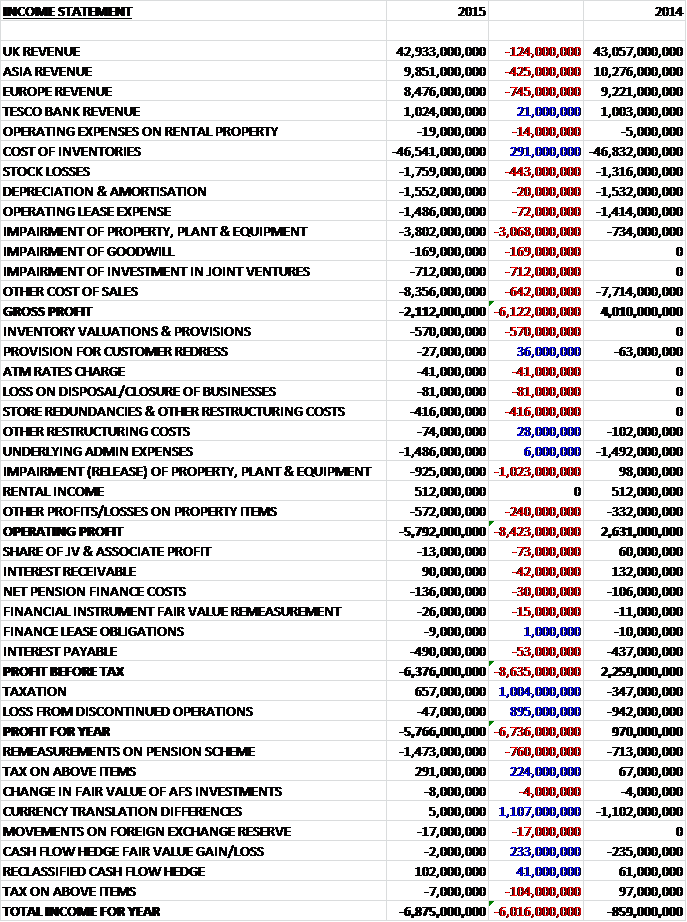
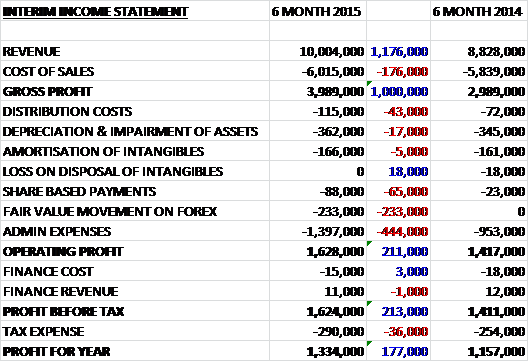
When compared to last year revenues fell considerably as a £21M increase in bank revenue was more than offset by a £745M fall in European sales, a £425M decline in Asia revenue and a £124M decrease in UK revenue.  Cost of inventories did fall during the year but this was more than counteracted by a £443M increase in stock losses, smaller increases in depreciation and operating lease expenses, and a growth in other cost of sales.  There were also a number of considerable one-off costs which included £3.8BN of impairments to property, plant & equipment; a £712M impairment of joint venture investments and a £169M impairment of goodwill.  This all meant that the gross loss came in at £2.112BN, a £6.122BN swing to the negative.

Underlying admin expenses actually fell during the period but this decline was dwarfed once again by some huge one-off costs including a further £925M impairment of tangible assets, a £570M provision against inventory, a £416M charge for store redundancies and restructuring costs and some smaller charges relating to the loss on the closure of a business and an ATM rates charge.  We also see a £240M increase in other property costs to give an operating loss of £5.792BN, an astonishing £8.423BN swing to the negative.  In addition there was a reduction in the share of associate/joint venture profit, a decline in interest receivable, an increase in pension costs and a £53M growth in interest payable to give a loss before tax of £6.376BN, although this was improved somewhat by the lack of a large loss from discontinued operations and a £657M tax rebate to leave the loss for the year some £6.736BN worse than last year at £5.766BN.

tescoassets

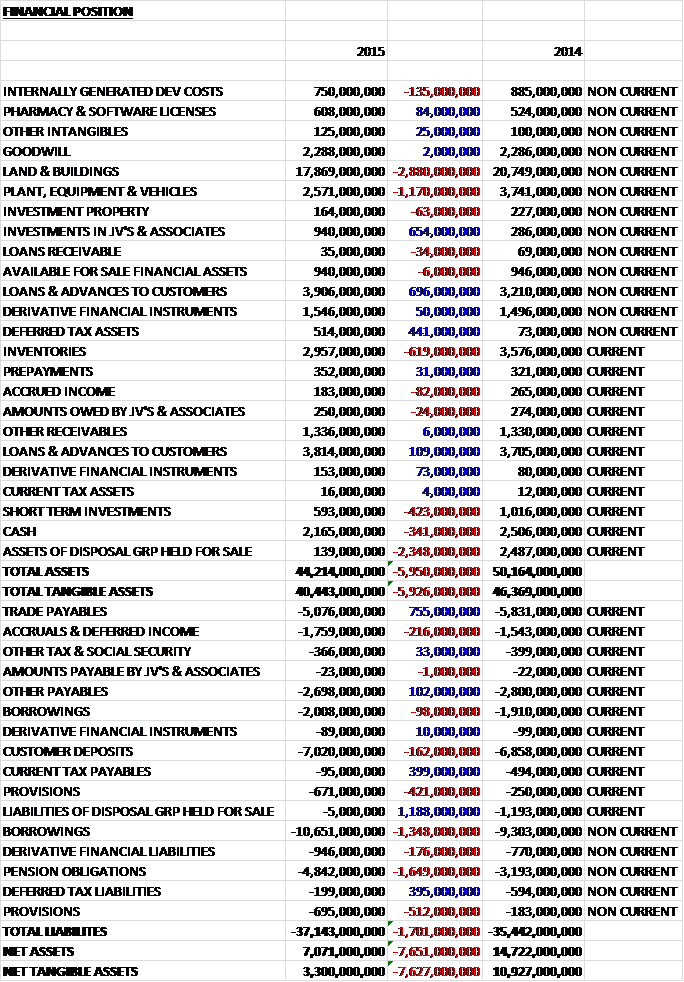
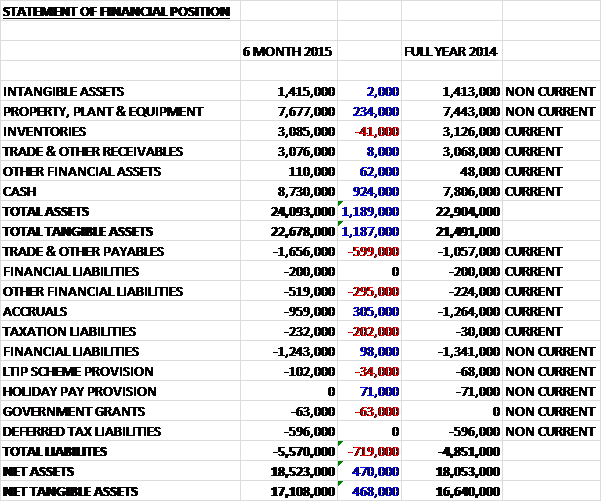
When compared to the end point of last year, total assets crashed by nearly £6BN driven by a £2.88BN fall in the value of land and buildings; a £1.17BN decline in the value of property, plant and equipment; a £2.348BN fall in the assets held for sale, a £619M fall in inventories, a £423M fall in short term investments and a £341M decline in cash levels; only partially offset by a £696M increase in loans to customers, a £654M growth in investments in joint ventures and a £441M increase in deferred tax assets.  Conversely we can see that liabilities increased during the period as a £1.188BN decline in liabilities held for sale, a £755M fall in trade payables, a £399M decline in current tax payables and a £395M decrease in deferred tax liabilities were more than offset by a £1.649BN increase in pension obligations, a £1.446BN growth in borrowings and a £933M increase in provisions to give a net tangible asset level of £3.3BN, an incredible £7.627BN crash when compared to last year.  It is also worth noting that there is a huge operating lease liability off the balance sheet with a net £14.885BN in non-cancellable leases and when this is considered, this balance sheet does not look very strong at all.

tescocash

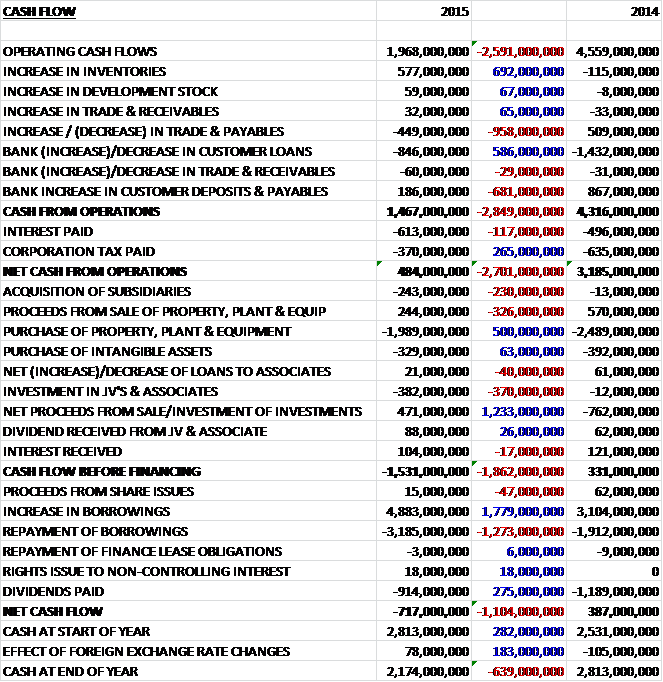
Before movements in working capital, cash profits fell by £2.591BN to £1.968BN before adverse movements in working capital at the bank meant that cash from operations stood at £1.467BN which became just £484M after tax and interest, a decline of £2.7BN when compared to 2014.  This was nowhere near enough to pay for the £1.989BN spent on tangible assets and the £329M spent on intangibles but the group did manage to get some £471M from the sale of an investment and £88M in dividends from joint ventures so there was a cash outflow of £1.531BN before financing.  There was a net £1.698BN of new borrowings to clear this cash outflow but the payment of 914M in dividends sent the cash flow into negative territory for the year at £717M and at this rate the £2.174BN of cash that the group has will not last much longer despite the suspension of the dividend, although it should be noted that there is some £5BN in headroom from undrawn credit facilities.

The group have been focusing on service, with new staff being hired in customer facing rolls and all head office staff being asked to spend some time working in store; range, with a review taking place across all categories in order to reduce the amount of choice and streamline the range somewhat; availability, which is partly linked to a bloated range, with more space now being given over to the top 1,000 items in store which increases product availability at peak times; and price with both cheaper own brand products and more stable pricing across the board.  The board have also identified some £400M worth of cost savings which has led to the closure of 43 unprofitable stores and the cancellation of plans to build a further 49.

The group are also targeting debt and have acknowledged that there is too much. In order to bring this down, a number of decisions have been made, including the cancellation of the final dividend this year, a reduction in capital expenditure to £1BN during the next year, which is about half of that of this year, the replacement of the defined benefit pension scheme and payment of £270M per annum to fund the deficit, and a focus on the leases that contribute to a £1.5BN annual rent bill which has so far resulted in an asset swap with British Land to regain sole ownership of 21 superstores, and finally a review of the peripheral businesses with Blinkbox and Tesco Broadband having been sold or closed and a consultation has begun regarding the future of Dunnhumby.

The changes that the board are making to the group are significant and are likely to result in an increased level of volatility in their performance over the short term.  After some of these changes have been made, the group has seen a steady improvement in footfall, transactions and volumes with like for like sales volumes up for the first time in four years but the market is still challenging both overseas and in the UK and many of the changes made will only be felt over the long term.  One are that has caused Tesco some embarrassment this year was the commercial income scandal which is now being investigated by the Serious Fraud Office.  In order to prevent such a thing happening again, much of the old management have been replaced and there is a focus on cost prices rather than the commercial income received back from suppliers for promoting their products.  A new code of business conduct has been introduced to make sure all staff are aware of the issues and to make it easier for staff members to speak up if they suspect some wrongdoing.

It is interesting to see the change in KPIs that are now being used to monitor performance which have been reduced from over 40 to just six.  They include customer loyalty as defined by the frequency of shops and average spend, which was down 2.5% this year; the percentage of staff members who would recommend Tesco as a place to work and a place to shop (70% and 77% respectively this year); supplier satisfaction with the company which currently stands at a paltry 58%; group sales, which declined by 1.4% this year; group trading profit which was down some 57.5% this year; and operational cash flow, which fell by nearly 60%.  Clearly these have been benchmarked at a low level and customer loyalty seems a bit wishy-washy but I really like the mix of the other five, which suggests the group is really trying to improve some of the core issues surrounding staff, supplier and customer satisfaction as well as the financial performance indicators.

UK trading profit fell by 79% to £467M with sales down 1.7% to £48,231BN and like for like sales down 3.6% which reflects a challenging and deflationary market along with the group’s own underperformance.  There has been some recent improvement with Q4 like for like sales falling by just 1%, being driven by positive volumes in response to some of the customer focused initiatives launched in Q3.  The full year UK trading margin stood at a wafer thin 1.1%, impacted by lower sales and some of the previously implemented initiatives to reduce price and the reduction in commercial income from suppliers

Asian trading profit fell by 18% to £565M with sales declining by 4.1% which included a 3.2% impact from detrimental foreign exchange movements.  In South Korea the impact of the DIDA regulations remained significant whilst in Thailand the recovery in consumer spending was slower than initially expected.  The trading performance in Malaysia was impacted by protests against Western owned businesses and a challenging economic environment.

European trading profit declined by 32% to £164M with sales falling by 8.5% which included a 7.9% adverse foreign exchange effect.  Whilst there was some improvement in Q4, the like for like sales performance was mixed over the course of the year with strong competition from discount retailers, particularly in Ireland which saw a like for like sales decline of 6.3%.  The profitability of the Central European businesses continued to be under pressure and in Turkey there was a £30M charge relating to the write-off of a fuel debtor.  Recent legislative changes in Hungary that mandated store closures on a Sunday and the introduction of a “food supervision fee” will have a material impact to ongoing profitability in that country.  The group are looking at restructuring the European business, changing the leadership structure to bring Czech Rep, Hungary, Poland and Slovakia into a single structure which should save in costs and improve buying power.

Tesco bank trading profits remained flat at £194M with revenues up 2.1% due to a strong growth in lending to customers offset by the investment in personal current accounts.  The business has extended its range of mortgage and loan products with a current account being launched in June 2014.  The motor and home insurance business saw a 3% growth in accounts, having expanded its underwriting providers and implementing digital improvements to enhance the customer experience.  Losses from joint ventures and associates were £13M, a decline from the profit of £60M that was recorded last year, driven by the loss from the partnership with China Resources Enterprise which was formed in May 2014.

As can be seen, there has been a huge number of one-off costs and charges this year with over £7BN in total, some £600M of which will result in direct cash outflow.  The charges included fixed asset impairment and onerous lease charges of £3.8BN against the trading stores due to the challenging industry conditions with a further impairment charge of £925M relating to impairment of work in progress balances and charges relating to the closure of stores; goodwill and other impairments totalling £878M, which included an impairment of £630M relating to the investment in China Resources Enterprises due to increasing competition from Chinese e-commerce companies, £116M relating to Dobbies and other UK businesses and an impairment of £82M in joint venture investments relating to the slow-down of the roll out of Harris + Hoole and Euphorium sites.  There was also a £570M charge to the inventory position due to the adoption of a forward looking provisioning methodology and a £168M impact of a reduction in the level of in-store costs capitalised to inventories was also included; £350M relating to restructuring costs and a £208M cost relating the commercial income adjustment.

During the year the group opened some 1.6M square feet of new space but this was offset by the closure of 1.1M square feet, primarily in Turkey and Hungary.  The franchised store network continued to grow, mostly in South Korea with a further 600K square feet being planned for opening this year.  At the year end, the estimated market value of fully-owned property fell by £7.6BN to £22.9BN due to a weakening of the UK and Central European property markets but this still represents a surplus of some £2.7BN over the book value and another £700M was added to the value of property portfolio following the post-balance sheet deal with British Land.

During the year the group acquired Sociomantic, a Berlin based provider of digital advertising solutions for £124M which included £38M in deferred cash consideration, generating goodwill of £87M.  Going forward, the market is still challenging and the board don’t expect to see this change in the immediate future.  Good progress is being made on the improvement initiatives that will deliver significant cost savings during the coming year.  The immediate priority will be for these savings to be reinvested in the customer offer (which is basically saying not to expect a dividend any time soon).

There will be no final dividend paid this year with future dividends being considered within the context of the performance of the group, free cash flow generation and level of indebtedness, which refreshingly includes operating lease liabilities, a move that I would love to see adopted at some other companies.  This sounds sensible enough to me with no dividend expected next year either.  Net debt stood at £8.481BN, an increase of £1.884BN year on year but when compared to the end point of last year but when the pension deficit and operating lease liabilities are added on, the level of total indebtedness increases to an incredible £21.719BN (£3.144BN higher). The shares trade on a rather expensive looking 23.3 on underlying earnings, increasing further to 29 in 2016.

Overall then this was clearly a terrible year for Tesco, the group made a reported loss with an underlying fall in profits across all regions, a collapse in net asset values and a reduction in operational cash flows with a negative free cash position.  There will be further headwinds in Hungary following new regulations there and the board do not seem to expect any let off in the difficult trading conditions in the near term.  Having said that, Q4 was certainly less bad than the rest of the year and I do have confidence in the newish CEO to turn things round long term – there is a very refreshing approach, with honest acknowledgement of the operating lease issue and some good looking KPIs which make me think that this juggernaut will be turned round eventually.  I see this as long term though, and in the short term I see better opportunities elsewhere so I have sold out here for now.

TESCOPLC-20150526-104756

After recovering at the start of the year, the share price seems to have started a slow descent from the release of these results.

Tesco have now released an update covering trading in Q1 this year.  Overall group revenues fell by 1.3% on a like for like basis excluding VAT and Fuel.  This represents an improvement over the decline of 1.8% last quarter, itself an improvement from the quarter before.  UK like for like sales fell by 1.3% compared to 1.7% last quarter as a result of continued significant deflation driven by the group’s price investments and weakening commodity markets.  Following the significant price cuts on branded products made in January, the group have rolled out  similar reductions on more than 300 additional products and seen improvements in their pricing against key competitors.  The range reviews are progressing well, enabling them to simplify their offer, reducing prices and increasing availability.  They have now completed reviews in fifteen categories, reducing the number of lines by 20% which have helped them get record levels of availability.

Like for like sales fell by 4.4% in Ireland, an improvement on the 6.7% decline last quarter but the weakening Euro had a strong impact and sales at actual exchange rates collapsed by 14.7%.  The group have made a significant investment in lower prices in Ireland which helped the like for like sales improve somewhat, although performance was still held back by a difficult competitive environment including high levels of competitor couponing.  Elsewhere in Europe, like for like sales on a constant currency basis increased by 2.2% but again the weak Euro took its toll and sales fell by 9.4% at actual exchange rates.  Both comparisons represent a decline quarter on quarter.  There was a strong performance in the Czech Rep and a step up in performance in Slovakia but the introduction of new legislation in Hungary, including enforced Sunday closures, impacted the business.  A significant restructure of the individual Central European country leadership teams to one regional team is largely complete, creating substantial synergies.

In Asia, like for like sales fell by 3% on a constant currency basis, an improvement on the 4.7% decline last quarter.  This region benefited from currency exchange rates, however, an at actual rates sales increased by 4.3%.  The improvement suggests that customers are responding well to the focused price investments made in fresh food and core groceries in the region but external conditions remain challenging with like for like sales declining in the two largest markets of Korea and Thailand.  In Malaysia, an improving underlying trend was more than offset by the negative impact of the introduction of a new tax in April.

Sales at the bank increased by just under 1% due to the expansion of their offer in categories such as loans and mortgages and making the product range accessible to more customers but this was offset by reduced interchange income, relating to the introduction of an EU cap which takes full effect within the next year.  Overall then, things are certainly still tough for the group and sales are continuing to decline but the slowdown of this fall has got to be a positive and the super tanker does seem to be slowly turning around.

On the 7th September the group announced the proposed sale of the Homeplus business in South Korea.  They have entered into a conditional agreement with entities established by a group of investors led by MBK Partners, including the Canadas Pension Plan investment board, Public Sector Pension investment board and Temasek Holdings.  The consideration payable represents an enterprise value of £4.24BN and under the terms of the disposal, Tesco will receive just over £4BN in cash with net proceeds of the disposal being £3.351BN.

The business is profitable with an underlying operating profit of £281M last year but the introduction of the distribution industry development act has had a material impact on store opening hours and trading days at Homeplus with an associated impact on profitability.  The net cash proceeds of £3.351BN will be used to strengthen the balance sheet by redeeming certain upcoming bond and commercial paper maturities over the course of the next year and a half.  It is expected, however, that the disposal will have a dilutive effect on the earnings per share in the current year and will result in an estimate accounting loss of about £150M.

Clearly the group does need to find some cash from somewhere in order to pay its debts as they come due and the South Korean business has been hit by the new opening hours regulation but I think it is a bit of a shame that a business that clearly has a decent long term future has been sacrificed and I am not sure that this is a good move in the long term.

Zytronic Share Blog – Interim Results Year Ending 2015

Zytronic has now released its interim results for the year ending 2015.

zytronicinterimincome

Revenues increased by £1.2M when compared to the first half of last year and with a much smaller increase in cost of sales, gross profits increased by £1M.  We then see a small increase in distribution costs, share based payments and other admin expenses and the group also experienced a detrimental £233K cost relating to foreign exchange movements to give an operating profit some £211K higher.  After finance costs and revenues broadly cancelled each other out, a higher tax expense gave a profit for the year of £1.3M, an increase of £177K when compared to the first six months of 2014.

zytronicinterimassets

When compared to the end point of last year, total assets increased by £1.2M driven by a £924K increase in cash levels and a £234K growth in the value of property, plant and equipment.  Liabilities also increased during the year as a £599K increase in payables, a £295K growth in other financial liabilities and a £202K increase in current tax liabilities were partially offset by a £305K fall in accruals to give a net tangible asset level some £468K higher at £17.1M.

zytronicinterimcash

When compared to the first half of last year, cash profits increased by £513K to £2.5M which after broadly favourable working capital movements and a reduction in the tax paid, translated into a £650K increase to £2.6M in net cash from operations.  Capital expenditure increased during the period to nearly half a million in tangible assets and £168K in intangibles but this was partially offset by a £63K government grant to give a free cash flow of £2M, a £261K increase.  This was more than enough to pay for the dividends so the cash flow for the half year stood at £924K to give a good looking cash pile of £8.7M at the period end.

The year so far has seen an increase in demand for the group’s touchscreen products.  The production efficiencies and recent capital expenditure projects, together with increased revenues and focus on products such as the larger format multi-touch sensors helped increase gross margins from 34% to 40%.  This was partially offset by an increase in admin overheads and adverse currency movements between Sterling and the US Dollar.  The group has continued to see increased market penetration and growth in their largest market sectors of ATM machines and vending machines and have been able to exploit the potential from the newer multi-touch and larger format touchscreens in other niche markets, in particular the introduction of the new touchscreens into table and gaming machines for the leisure markets have resulted in considerable interest.

Going forward, the group is continuing to benefit from an improvement in current trading and expect to make further progress for the remainder of the year.  After the interim dividend increased by 10%, at the current share price the shares yield a decent 3.3%.  The net cash position at the period end increased by £1M from the end point of last year to £7.3M.

Overall then, this is a brief but positive set of results.  Profits are up, net assets increased and operational cash flow improved to give a decent looking free cash flow and a growing cash pile. The gaming machine markets seems like it could be an interesting one and with a good dividend and growing net cash, I am very happy with my investment here.

ZYTRONIC-20150521-012039

After a couple of wobbles, the shares now seem to have resumed their upwards trajectory.

On the 15th October the group released a trading update covering the full year.  The second half showed an improvement in revenues over those in the first half which was particularly marked in Q4, resulting in a 13% increase year on year.  The improvement in revenues together with benefits of the production efficiencies and capital investments have resulted in the board expecting pre-tax profit for the full year to be materially ahead of market expectations.  This is excellent stuff and I have added to my holding here.

Compass Share Blog – Interim Results Year Ending 2015

Compass has now released its interim results for the year ending 2015.

CPGinterimincome

Overall revenues increased when compared to the first half of last year as small declines in offshore & remote, business & industry and joint venture sales were more than offset by good increases in education, healthcare and sports & leisure sales.  Operating costs also increased to give an operating profit some £41M ahead.  We then see an increase in loan interest and tax so than profit for the period stood at £466M, an increase of £19M when compared to the first six months of 2014.

CPGinterimassets

When compared to the end point of last year, total assets increased by £280M, driven by a £103M growth in intangible assets, an £82M increase in receivables and a £72M increase in goodwill, partially offset by a £72M decline in cash levels.  We also see liabilities increase due to a £113M growth in borrowing levels to give a net tangible asset level some £31M lower at a negative £1.711BN which doesn’t look too good.

CPGinterimcash

Before movements in working capital, cash profits increased by £69M before detrimental movements in all working capital elements due to the seasonality of the business and investment in emerging markets where working capital is less efficient, meant that cash generated from operations stood at £694M, a £20M improvement.  After tax and interest this then became a net cash from operations of £520M.  This was more than enough to pay for the £130M spent on tangible assets, the £101M spent on intangibles and the £58M spent on acquisitions to leave a cash flow before financing of £251M.  This did not cover the dividend payment of £298M though, let alone the £139M spent on the share buy backs so the group borrowed a further £111M to give a cash outflow for the first six months of the year of £76M to leave a cash pile of £336M.

Overall the retention rate increased to 94.5% due to an unusually strong performance in North America and improving trends in Europe and Japan.  Like for like revenue growth was 2.7% which reflects some pricing and modest like for like volume increases and underlying profit increased by 6.5% on a constant currency basis.  The group has continued to generate efficiencies by embedding its “MAP” framework deeper into the business with a focus on the cost of food and labour costs but the board believes that there are still further efficiencies to come.  Overall there was a 0.6% negative impact on revenues from currency translation as a weakening of Sterling against the US Dollar was more than offset by strengthening against other currencies.

Operating profits in North America increased by £47M to £395M with a margin improving from 8.4% to 8.5%.  This reflects some good new business wins with unusually high retention rates, with some like for like volume improvement.  Further progress was made on reducing costs whilst at the same time investing in the business to support the organic growth.  The Business and Industry sector delivered good levels of new contract wins including Johnson & Johnson, the Culinary Institute of America and the Royal Bank of Canada, along with some improvement in like for like volumes.

In the Healthcare sector, organic revenue growth was good, driven by new contracts with the Vancouver Coastal Health Authority and the Scottsdale Lincoln Health Network.  Organic revenue growth in the Education sector included strong new business and increased levels of participation which included contract wins with Hillsdale College and Louisiana State University.  The sports and leisure business delivered strong organic revenue growth through excellent contract retention and solid attendance levels at sporting events.  The smaller defence, offshore and remote business saw some pressure on organic growth following the recent decline in commodity prices.

Operating profits in Europe and Japan fell by £7M to £206M with an operating margin that improved from 7.2% to 7.3%.  Although organic revenue increased, the economic picture in the region remains difficult and despite stabilising, like for like volumes remained negative.  There were good levels of new business in the UK, Spain and Japan with improving retention rates across the region.  Contracts were won with VW and JLL in the UK, Hospital D. Josep Trueta in Spain and the Rakuten Kobo Stadium Miyagi and GE Healthcare in Japan.  Retained contracts included the Wimbledon championships, and ExCel in the UK as well as Disneyland Paris, the Sony head office in Japan and Bosch in Germany.  Across the UK, Germany, the Netherlands and Southern Europe, there was an improving trend in like for like volumes but the group continued to experience pressure in France and the Nordic regions, which have an exposure to the oil and gas market.

Operating profits in Fast Growing and Emerging markets were £105M, a decline of just £1M when compared to the first half of last year, although the operating margin fell from 7.1% to 7%.  There was a 7.7% increase in organic revenues with strong levels of new business in emerging markets helping to offset the decline in the Australian Offshore and remote sector.  In Australia, negative organic revenue reflected the ongoing slowdown in the offshore and remote sector, although other sectors within the country saw good levels of new business and extended contracts including Wesley College, the University of New England and Network Nine.  In Latin America, new business wins remained strong with an encouraging pipeline across all countries.  New food service contracts included Pepsico and Pirelli in Brazil and a remote site contract with copper miner Codelco in Chile.  The business focused on cost efficiencies in the region to mitigate against falling volumes.

Organic revenue growth in Turkey was driven by new business wins which was offset by some declines in like for like volumes driven by challenging macroeconomic conditions.  New contracts in the country included the provision of food services to Doga Schools, Cimentas and the Turkish Aerospace Industry, as well as the retention of Mercedes and Goodyear.  The Middle East performed well with strong new business wins such as Zadco, Tawam Hospital and the UAE University; and in South Africa the group won contracts with Anglo American and Mondelez as well as retaining business with Microsoft and Mediclinic.

Double digit organic growth in India and China was driven by strong new business wins.  In India, the group won food service contracts with the Asian Heart Institute and Ceat Tyres and strengthened their relationship with Reliance Group with additional support services.  In China, they extended their relationship with Tencent and won a food service contract with Dulwich College in Beijing.  Due to the uncertain macroeconomic environment in some emerging markets and weak commodity prices, the group has experienced some negative like for like volumes and clients looking for costs savings, along with increasing inflation rates.  In order to offset these headwinds, the headcount has been reduced in Australia, Brazil and the Turkish food business by 10%, although the long term potential in these markets remains.

There are slightly more capital commitments at the period end than at the same point last year with £203M, mainly relating to intangible assets , compared to £139M.  The expectations for the full year remain unchanged but the economic environment in some of the emerging markets is rather uncertain and low commodity prices are impacting the remote and offshore business.  The pipeline of new contracts is decent and the board has confidence in delivering another year of progress.

After an 11.4% increase in the interim dividend, at the current share price, the shares yield a decent 2.4%.  Net debt stood at £2.655BN at the period end compared to £2.353BN at the start of the year.  The share buyback scheme continued during the period and the £500M programme is expected to be completed this year.

Overall this was another solid update.  Profits crept up year on year and operational cash flow improved to give a decent amount of free cash, although this was not enough to cover the dividends and share buyback scheme.  Net assets fell, however, as borrowings increased to give a very negative net tangible asset level which is somewhat concerning.  Operationally the North American business is the star performer, propping up the other more underperforming parts that includes a European market that is still suffering (although slowly improving), and a mixed emerging market outlook with strength in China and India offsetting difficult macroeconomic conditions in Turkey and Brazil and declining commodity prices that have impacted the remote sector in Australia.  Going forward, there are apparently further efficiencies to come and a yield of 2.4% is probably just enough to remain interesting.  I will continue to hold but I can’t really see much scope for share price appreciation in the short term.

COMPASSGROUPPLC-20150520-035856

Since April there has been some weakness in the share price although the long term trend still seems to be up.

On the 15th June it was announced that Chairman Paul Walsh purchased 5,000 shares at a value of £55,350 to give him a total holding of 21,411.

On the 29th July the group released an update covering trading in Q3.  Overall organic revenues were up 5.5% for the first nine months of the year with growth in Q3 slightly softer at 5.1% reflecting strong net new business in North America, an acceleration of growth in Europe and Japan, and a more subdued environment in both Fast Growing and Emerging and Offshore and Remote.  Overall margins have improved by around 5 basis points in the quarter and around 10 basis points for the year to date.

The performance in North America was good with revenue growth of 7% for the quarter and 7.8% for the year to date.  Strong growth across most sectors was partly offset by weaker volumes in the oil and gas business.  The margin increased by around 5 basis points during the quarter.  In Europe and Japan, organic growth was 1.8% during the quarter and 1.2% for the year to date, driven by improving performances in several countries, particularly the UK and Spain.  The group continued to deliver efficiencies in the region which improved margins by 10 basis points in Q3.  In Fast Growing and Emerging markets, organic revenue grew by 7.4% in the first nine months of the year and by 6.8% in Q3.  Revenue growth in emerging markets was around 12% in Q3 with strong rates of new business somewhat offset by weaker volumes in Brazil and Turkey.  The operating margin declined by 10 basis points with the ongoing efficiency programme partly offsetting the impact of volume and margin pressures in the oil and gas, and mining client base (particularly in Australia)  and soft volume some emerging markets.

If the current spot rates continue for the remainder of the year, foreign exchange translation is expected to negatively impact underlying operating profit by £6M.  The share buyback programme is now almost complete with just £25M to be spent going forward.

The group are now proactively reducing the cost base in the offshore and remote business globally, and in some emerging markets.  This restructuring plan will cost around £20M to £25M per year in 2015 and 2016.  It is therefore expected that 2015 operating margin will be flat year on year and in 2016 the savings, together with margin improvement in the rest of the group, is expected to offset the impact of lower volumes and pricing pressures in the fast growing and emerging region.

Overall the update sounds positive but the restructuring looks like it is going to cancel out much of the improvement in margins already gained.  The market did not take too kindly to this update but considering the share price weakness leading up to this, it doesn’t seem all that bad to me.  I am quite heavily invested here so I might look to offload some given the headwinds in emerging markets but I am happy to continue to keep my core holding.

On the 13th August it was announced that COO North America Gary Green sold 150,422 shares at a value of more than £1.6M.  I feel given this and the latest update along with the poor chart now is probably the time to sell my shares here.  I have held them since the financial crisis and have realised a good profit but it is a little sad more me nonetheless and it now leaves me with no investments in the FTSE 100 at all.

On the 1st September it was announced that non-executive director Mr. Silva purchased 8,200 shares at a value of £84K.  This is his first share purchase.

On the 24th September the group announced a few board changes.  Andrew Martin, COO for Europe and Japan will step down in December and Dominic Blakemore, currently group finance director, will become COO for Europe including Turkey.  On the same day, Johnny Thomson who is currently regional MD of the Latin American business will become group finance director and will join the board as an executive director.  It is unclear who will be responsible for Japan.  Johnny, who is a chartered accountant, joined the group in 2009 as finance director for the Brazilian business.  He was then appointed CEO of the Brazilian business before becoming the regional MD in 2014.  He joined from Hilton Hotels where he was VP finance for the UK and Ireland division.

Laura Ashley Share Blog – Final Results Year Ending 2015

Laura Ashley has now released its final results for the year ending 2015.

alyincome

Overall revenues increased when compared to last year as store revenue was up £5M, e-commerce revenue increased by £3.8M and hotel revenue was up £500K, partially offset by a £200K decline in non-retail sales.  Cost of inventories also increased, but other cost of sales fell somewhat to give a gross profit some £3.9M ahead of 2014.  There was an increase in staff costs but this was mitigated by a fall in operating lease costs with foreign exchange showing a £2.1M swing to the positive.  This was counteracted by a £2.9M increase in other admin costs, though, to give an operating profit £4.7M higher than last year.  The share of profit from the Japanese associate fell by £1M to give a disappointing £500K loss and the one-off gain on sale of investment fell by £2.7M, although this was partially offset by the lack of £2M in store disposal losses that occurred last time.  The slightly higher tax bill then meant that the profit for the year stood at £18.3M, which was a £2.6M growth when compared to 2014.

alyassets

When compared to the end point of last year, total assets fell by £9.2M, driven by an £8.5M decline in prepayments and accrued income, a £2.5M fall in amounts owed by associate, a £1.7M decline in trade receivables and a £1.7M fall in the value of leasehold property, partially offset by a £3.7M increase in cash, a £2.6M growth in “other debtors” and a £1.7M increase in deferred tax assets.  Total liabilities also fell during the year due to an £8.5M fall in accruals & deferred income, a £3.3M decline in other payables and a £2.2M decrease of trade payables, partially offset by a £9M increase in pension liabilities.  The end result is a £4.3M fall in net tangible assets to £41.9M. It should also be noted that there is a huge amount of operating leases, relating mainly to the stores, with £119.2M in total non-cancellable leases.

alycash

Before movements in working capital, cash profits increased by £5.4M to £27.5M.  A large decrease in payables more than offset advantageous movements in other working capital measures to give a net cash from operations some £7.2M higher than last year at £18.6M.  This was more than enough to cover the £2M of capital expenditure (part of which involved POS technology to achieve payment card industry compliance) to leave some £16.6M of free cash flow available.  This didn’t quite cover the cost of the normal dividends but the £8M received from the sale of investment shares and the £1.2M income from the sale of tangible assets enabled the group to pay a special dividend and to have £3.7M cash left over to add to the pile to give a total of £27.8M at the year end – very comfortable.

Overall the stores made a contribution of £19.6M, a £3.3M increase when compared to last year and e-commerce contributed £9.6M, an £800K increase.  Furniture sales fell by 0.3% during the year, although they were some 0.5% higher on a like for like basis in an increasingly competitive market.  The group has seen some success in bedroom furniture, mattresses, and the newer wooden ranges.  Sales of home accessories increased by 3.5% based on improving and broader product ranges with bed linen, lighting, gift items and soft furnishings enhancing the overall home offering.  The group is aiming to maintain this growth with particular emphasis on the new kitchen ranges and the expanded seasonal offering.  Decorating sales fell by 1.5% during the year; and fashion sales fell by 2.8% (just 0.1% on a like for like basis) which continues to receive positive feedback from customers despite the lacklustre sales performance with encouraging responses reported with regards the collections due out later in the year.

Non-retail profits fell by £1.3M to £13.4M.  Franchise revenues fell by 1.5% to £27.8M due to a weaker Japanese economy and challenges facing some mainland European economies.  There are now 303 franchised stores (increased from 286) in 30 territories with further agreements expected to be signed later in the year.  More precisely the franchise operations have been affected by an increase in consumption tax in Japan, a sharp fall in the value of the Ukrainian and Russian currencies, and the continued struggle of the economies of Greece, Cyprus and Spain.  Licensing income grew by 3% to £3.4M reflecting good levels of organic growth amongst a stable licensee base, although several new license agreements are expected to be approved during the new year.  New launches this year have included a bathroom furniture range  with contracts extended in stationery, bed linen and bathroom categories.  A key performer was the toiletries license with a 61% year on year growth in sales.  A second hotel was opened during the year under license located at Lake Windermere in order to further showcase the company’s wares, although in all the hotels made a £400K loss.

The group continues to slightly reduce its store portfolio with three opened and seven closed.  E-commerce continues to be an important part of the group’s offering with sales increasing by 8.6% year on year and they now operate a fully translated French website with a German one due to follow this year in order to sell their products into Germany, Austria, Italy and Switzerland.  Additional investment has been made in the website to improve the experience for mobile and tablet users.  There is a desire to expand further into Asia and in order to aid in this aim, a subsidiary has been incorporated in Singapore.

In the first two months of the current year, the group has seen like for like sales increase by 3% and whilst the consumer markets that they operate in face a number of challenges, the board believes this growth can be maintained for the foreseeable future.  This year the board have seen fit to have the AGM in Malaysia which seems to me that is not very convenient for shareholders in a UK company listed on a UK stock exchange.  When it is also considered that there was no information regarding when the final results would actually be published, the shareholder engagement really seems to be slipping here.

At the current share price the shares are yielding 5.7%, which is a good return in my view.  The P/E ratio seems a decent value at 13.9.  Net cash at the year end stood at £27.8M, an increase of £3.7M when compared to this point of last year.

Overall then this is a decent if not exactly exciting update.  Profits increased but net assets fell as the pension liabilities grew.  Cash flow is one area that the group remains very strong with increased operational cash flow and low capital expenditure giving rise to a large amount of free cash, although this is not quite enough to cover the dividends.  Operationally the accessories business seems to be doing well, as does the small licensing business but decorating is struggling and the important franchise sector suffered this year with issues in Japan, Russia and Ukraine having a detrimental effect.  The investment in a French and German website is a great idea and something which I think should add significant value going forward, although I am less sure about the expansion in Singapore.  The slide in shareholder engagement is a concern and the lack of communication surrounding the release of the final results and the decision to hold the AGM in Malaysia is a very disappointing development.  Overall though, the decent trading performance and the 5.7% dividend return is enough to keep me invested.

LAURAASHLEYHLD-20150520-101219

The share price seems to have become a bit overextended, perhaps as dividend hunters arrive for the pay-out but the trend overall seems positive.

On the 30th June it was announced that the company has purchased an office block in Singapore for a cash consideration of £31.1M from Ho Bee Realty.  The office block is 98,254 square feet and will be used as the location of the group’s Asian HQ.  The company already has strong franchise partners in Malaysia, Taiwan, Japan, South Korea, Hong Kong and Australia but in order to take advantage of the operations in Asia, in particular China and India, it is thought that the company needs to establish a regional operational presence.  The acquisition will be financed using £10.9M from current cash reserves and £20.2M from a new debt facility which will be repayable over 15 years in monthly instalments of £140K.  The total acquisition cost will be £34.5M and it will impact earnings this year to the tune of £300K and £600K next year.

I must admit I don’t feel that good about this.  I am sure expansion into China and India is something to strive for but is it normal to buy an 8 storey building in Singapore to facilitate this?  Would it not be more prudent to lease a building first with a view to buying once the venture is considered a success?  One of the main attractions for me of Laura Ashley was the cash cushion and the incredible dividend yield, both of which must be at some risk now.  I have decided to sell out here.

Vertu Motors Share Blog – Final Results Year Ending 2015

Vertu has now released its final results for the year ending 2015.
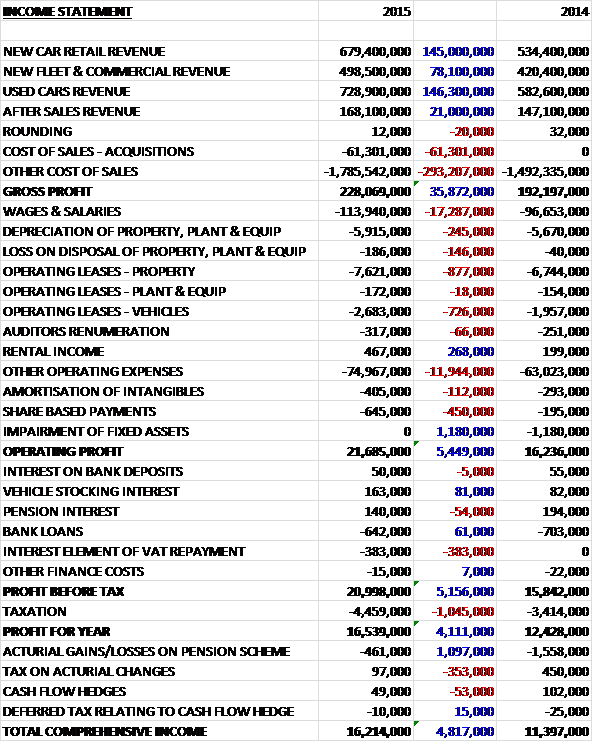
vertuincome

Revenues were up across all business sectors with new car retail up £145M, new fleet and commercial up £78.1M, used cars up £146M, and after sales up £21M.  We also see cost of sales increase to give a gross profit some £35.9M ahead of last year.  Most operating expenses increased, with wages up £17.3M due both to increased commissions on higher sales and a growing headcount, and “other expenses” up £11.9M, with advertising expenditure increasing by £1.4M and operating leases increasing by £1.6M, although there was no impairments this year which accounted for £1.2M in 2014, but there was a £383K charge relating to HMC that did not occur last time and tax costs were over one million pounds higher to give a profit for the year of £16.5M, a £4.1M increase when compared to last year.
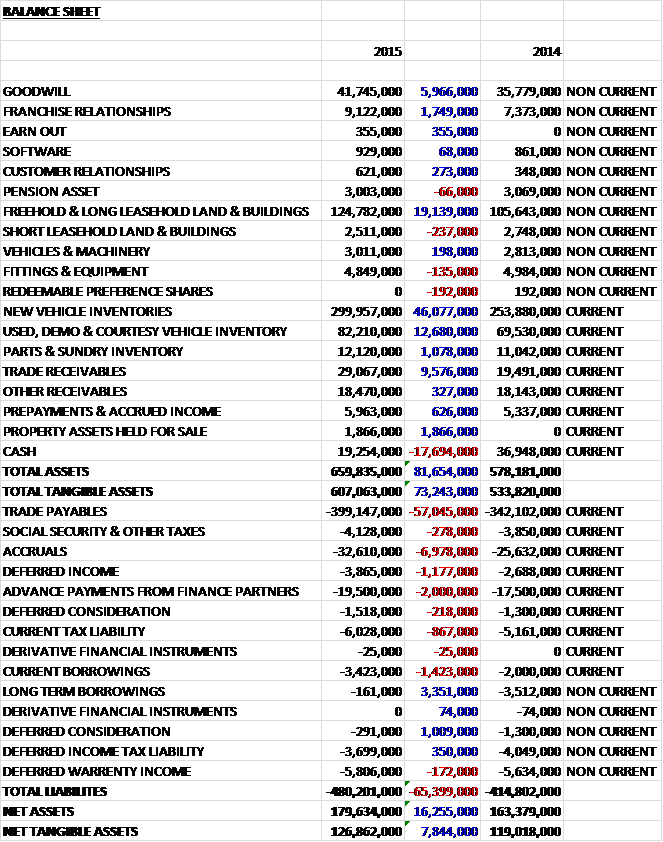
vertuassets

When compared to the end point of last year, total assets increased by £81.7M driven by a £46.1M increase in new vehicle inventory, a £19.1M growth in the value of property, a £12.7M increase in used car inventory and a £9.6M increase in trade receivables, partially offset by a £17.7M crash in the cash level.  Liabilities also increased with a £57M growth in trade payables and a £7M increase in accruals (partly relating to outstanding service plans) being offset by a £1.9M decline in the value of borrowings.  The end result is a £7.8M increase in net tangible assets to £126.9M which looks like a very healthy balance sheet, although it is worth remembering that there are outstanding operating leases totalling £81.5M that are off the balance sheet.
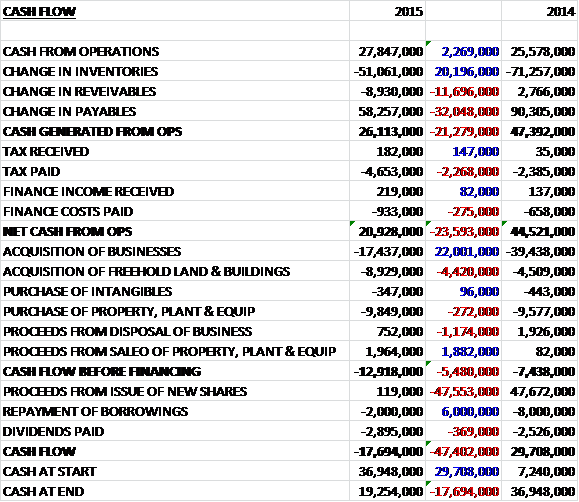
vertucash

Before movements in working capital, cash profits increased by £2.3M to £27.8M.  Changes in working capital broadly cancelled each other out, as increases in receivables and inventory due to the growth of fleet and commercial operations were offset by higher levels of receipts from service plan and warranty customers, although payables increased at a slower rate than last year so that cash generated from operations was £21.3M lower at £26.1M.  After tax and finance costs, the net cash from operations stood at £20.9M.  This was enough to cover the buildings acquired and other capital expenditure but could not cover the £17.4M spent on acquiring new businesses so that before financing, the cash out flow was £12.9M.  After dividend payments and the repayment of loans, the cash outflow for the year stood at £17.7M to leave a cash pile of £19.3M at the year end.  This is still a considerable amount of cash but it seems the group will eat through last year’s £47.7M raised through new shares in a couple of years which is a bit of a concern and it must also be pointed out that due to the timing of year end, the cash reserves are some £20M higher than during the majority of the year, so it starts to look a little less comfortable.

Market conditions in the UK continued to be buoyant due to improving consumer confidence and continued attractive finance offers from manufacturers.  The rate of growth did slow somewhat, however, as was predicted.  During the second half of the year, as sales started to slow, it became apparent that there were higher levels of self-registration by retailers that created a disconnect between the actual sales of vehicles to private customers and vehicle registrations.  The self-registered vehicles are then sold to the market as used cars.  Due to the strength of Sterling against the Euro and the relatively buoyant economic conditions in the UK, the country remains the market of choice in Europe for car manufacturers.  Equally, improving economic conditions and the rise of online shopping has created a robust commercial vehicle market in the UK with registrations rising 12% last year.

New car retail and motability recorded a gross profit of £50.9M, an increase of £10.1M when compared to last year, although gross margin fell from 7.6% to 7.5%.  New retail car volumes rose by 6.4% in the year on a like for like basis compared to an increase of 8.4% in the market as a whole but the board considers that the shortfall is explained by the registration data reported in the market figures including self-registered vehicles by retailers and manufacturers when the group’s sales volumes excludes them.  Volumes of sales on the Motability Scheme rose by nearly 11% on a like for like basis against a 6.3% increase in the market.  This performance is due to an increased focus of the sector and the fact that the group was awarded Motability Dealer of the Year in 2014.  The sales in this category have a near 100% retention into service operations in the three years following the sale so despite the low margins, the growth in sales should auger well for future aftersales profitability.  The profit per unit of new cars increased during the year from £12,170 last year to £13,639 by the second half of this year which was due to the change in unit mix towards higher-end vehicles as the year progressed.

New fleet and commercial recorded a gross profit of £12.3M, an increase of £2.1M when compared to last year on a margin that increased slightly from 2.4% to 2.6%.  Like for like car fleet volumes rose by 16% with a similar increase seen in light commercial vehicles which reflected market share gains against a market that increased by 12%.  These improvements were obtained due to the increased number of dealership based local business specialists and prior year acquisitions which have gained traction.

The used car business recorded a gross profit of £75.5M, an increase of £12.3M when compared to last year on a margin that declined from 10.8% to 10.4%.  Used car volumes increased by 16.6% in total and 9.2% on a like for like basis, which was ahead of the market as a whole.  The UK used car market was stable during the first half of the year with constrained supply leading to stable prices and margins but in the second half of the year the market returned to a more typical seasonal depreciation cycle due to retailer self-registration and an increase in the supply of nearly new vehicles which compete with competitive finance-led new vehicle offers.  Additionally, rising new car sales increased the general supply of used cars in the market so for the first time since 2009, the market is no longer supply constrained which reduced the margins achieved in the second half of the year.

The margins were also affected by the higher value vehicles on offer in the new JLR dealerships which have higher selling prices but consequently lower margins as a percentage of purchase price.  Indeed on a like for like basis, margins improved from 11.5% to 11.6% with an increase in the first half of the year offset by a decline in the second half.  With the supply constraints now lifted, it is likely that margins will come under further pressure but volumes of sales should rise.

The aftersales business recorded a gross profit of £89.4M, an £11.4M increase when compared to 2014 on a margin that increased from 43.1% to 43.5%.  The increase in margin is due to an increased focus on “technician” efficiency and higher volumes in the vehicle health check process, which seeks to ensure that all customer vehicles visiting the dealerships were given a full mechanical health check by a technician who identifies any service work which may be required. The group now has over 71,000 customers who pay monthly for service and MOT via the three year service plan product, which is a good increase from the 55,397 achieved last year.

The accident repair sector experienced another year of stabilisation and there is evidence that industry capacity restrictions have led to a greater balance in supply and demand in the sector with the group’s accident repair revenues growing by 5.5% on a like for like basis on incredible margins that increased from 65.6% to 65.8%.  There are now nine accident repair centres in the portfolio.  Supply of manufacturer parts saw revenues rise 2.9% on a like for like basis on a stable margin – parts represent about 27% of total aftersales profits.  Due to the fall in petrol prices, there was a 5.4% decline in like for like petrol forecourt revenues but stronger margins saw profits rise by £100K.

A strong part of the group’s strategy is to try and turn around failing dealerships by implementing their own processes and customer service offering, of which they seem rather proud.  They were recognised within Honda and Hyundai for having amongst the best UK dealerships in those brands for customer service and the Darlington Nissan outlet has won the best large dealership award in the Nissan franchise.  Many of the acquisitions undertaken in recent years have still to reach maturity in terms of performance enhancements which provides the opportunity for margin improvements and profit growth over the medium term.  Operations deemed not able to meet return on investment hurdles are identified and either closed, disposed of or refranchised.

In line with the group’s strategy to expand through acquisition, there have been a number of business buys this year.  In May they acquired Hillendale, which operated a Land Rover dealership in Lancashire and a Jaguar dealership in Bolton for a total consideration of £8M, £6M through cash and the remainder from the issue of shares.  The acquisition came with £2.9M of net assets, £1.7M of which were intangible so it cost £5.2M in goodwill.  The dealerships are profitable and if the acquisition had taken place at the start of the year, profits would have increased by £393K.  The group also acquired the Taxi Centre & Easy Vehicle Finance for a total consideration of £2.1M, £1.5M of which was satisfied in cash, £400K through an earn out arrangement and £200K in shares.  The business sources vehicles for private operators in the taxi sector.  The acquisition generated just £807K in goodwill and had it taken place at the start of the year, would have contributed £229K in earnings, so this seems to be a good deal.

In November the group acquired four Ford dealerships – Bolton, Wigan, Horwich and Walkden for a total consideration of £11M, £109K of which was deferred.  This acquisition generated no goodwill as the group paid the market price for the assets.  Additionally, they acquired Addison Motors with Alfa Romeo, Chrysler, Jeep and Fiat franchises in Newcastle; 3e Autos, operating a Renault repair centre in Nottingham, and a Nissan dealership in Halifax for a total consideration of £1M satisfied in cash.  The group also disposed of a Nissan dealership in Altrincham for a consideration of £752K which relates roughly to the fair value of net assets disposed of.

It seems that there is likely to be higher capital expenditure next year as the group has capital commitments in respect of property, plant and equipment amounting to £7.6M compared to just £1.5M at this time last year.  The group has also indicated that it will continue to acquire dealerships across the volume and premium spectrum as the board continues its growth strategy.

The group has a decent amount of undrawn bank facilities available to it with an overdraft of £5M, a CMML facility of £30M and a loan facility of £15M.  After the year end, the group refinanced its borrowing facilities by converting the £15M acquisition facility into a £20M facility that can be increased to £40M with the overdraft and other facilities increasing from £35M to £45M.  Other changes that occurred after the balance sheet are that the group sold its only Suzuki dealership, based in Mansfield in order to have greater scale relationships with manufacturers (the outlet is currently being refurbished and will open as an additional Renault/Dacia dealership) along with one of the peripheral sales outlets of the Bolton Ford business acquired this year, in addition to a small Peugeot sales outlet in Ilkeston – there were no significant costs associated with these disposals.  Additionally, the group disposed of the second peripheral freehold sales outlet acquired with the Bolton Ford business for a consideration of £700K which is equal to the net book value of the property.  Finally, the group acquired the Bradford Jaguar outlet from Jardine Motors for a consideration of £900K including goodwill of £750K; and Bury Land Rover from Pendragon for a consideration of £7M, all of which was goodwill.  The consideration was settled from existing cash resources.

Ford is the largest franchise partner to the group in both profit terms and number of outlets, with 22 currently in operation and Vertu is the 3rd largest Ford dealer in the country.  This year, the group acquired four new outlets in Lancashire, two of which have subsequently been closed.  The manufacturer is rolling out 65 Ford stores in the UK which will be large scale dealerships selling the full range of products including the Vignale premium product and the iconic Mustang.  This year the group will open its initial Ford stores in redeveloped existing dealerships in Kent, Birmingham, Gloucester and Bolton.  During the year the group completed the rebuilding of its Durham Ford dealership.  The £2.3M investment significantly increased the sales potential of the dealership and further significantly redevelopments are planned in 2015 at Birmingham, Shirley and West Brom in order to further grow sales at these locations.

The Nissan franchises represent an increasing proportion of the group’s profitability, with 10 sales outlets now in operation.  Vertu is now the sole Nissan partner in Glasgow with two outlets and there are plans to build a landmark Nissan dealership in the coming 18 months.  In the past two years, the group has acquired five VW dealerships in the East Midlands and capital expenditure in these dealerships to expand showroom capacity and implement latest manufacturer standards is ongoing.  Lincoln and Boston were completed during 2014 with the remaining three in Nottingham and Mansfield to be completed during the current year.  The group currently operates a multi-franchised Renault, Dacia and Hyundai dealership in Exeter and due to increased sales volumes, they are relocating the Hyndai outlet to a separate dealership in a new freehold property which will cost £2.3M.

During the year, the group also saw the purchase and lease of additional properties next to the Waltham Cross Vauxhall operation at a cost of £1.1M which is facilitating a wider redevelopment of the dealership providing additional showroom, workshop and used car sales display capacity which will be complete by September.  Early this year, two new outlets were opened in one location in Nottingham and the group now operates a Renault/Dacia outlet along with a Honda Motorcycle dealership.  At the moment there are a number of manufacturers simultaneously requiring investment which did not take place during the financial crisis which means that capital expenditure is currently running at high levels and will fall back to much lower levels in due course.

Other infrastructure investment includes a significant support centre in Gateshead which operates activities such as service booking, sales enquiry management and customer experience activities (whatever they are).  Previously these activities were spread across three different locations but a single office building was acquired for £1.5M which will enable to the group to consolidate into one location, thereby saving on costs and it should be opened by June this year.  Another important area for investment is online functionality, for example the group has installed online chat in order to help customers any time of day and the website is regularly ranked in the top two for visitors which suggests the group has a good handle on digital marketing.

Capital expenditure this year included £7.3M in respect of the purchase of property for dealership development projects, £7M for refurbishment projects, £1.6M for the new support centre property and £3.3M on IT and other ongoing capital expenditure.  In the coming year the group expects to pay £9.8M on current dealership redevelopment projects and £12.8M on new dealership developments so substantially more than this year, although there are five surplus properties with a book value of £4.8M that could bring a bit of cash in if sold.

Trading after the year end has been good, ahead of both the current year financial plan and the same period of the prior year with like for like sales volumes increasing by 4.3% against a figure of 2.7% in the market as a whole for sales to private buyers with stable margins.  Group fleet and commercial new vehicle sales delivered improved profitability due to strengthening margins, and the market continues to show significant growth in volumes year on year.  Like for like used retail volumes were up 6.2% in the post-year end period despite the impact of cheaper, finance-led new car offers but as with the second half of the previous year, increased availability has led to softening margins, declining from 10.8% to 10.4%, although the increased volume has more than made up for this with regards profits.

After the year end, group aftersales profitability increased on a like for like basis due to higher revenues and margins, with the overall margin increasing from 44.9% to 46% with service, accident repair centres and parts all showing both revenue and margin improvements.  Petrol forecourt sales declined due to the falling fuel price but margin again increased.  Service like for like revenues rose 7.2% in the post year end period and continued to benefit from the successful customer retention initiatives being executed by the group with over 71,000 customers now paying monthly for service and MOT service plan packages.  Given this encouraging trading at the start of the year, the board is confident that the group will grow profits and the business again this year.

At the year end, net cash stood at £15.7M compared to £31.4M at the end point of last year. The shares trade on a P/E ratio of 12.5 which falls to 10.8 on next year’s estimates, which indicates the shares are in value territory whilst the dividend yield currently stands at 1.8%, which after increasing by 31% this year, is not spectacular but not bad for a growing business, with 2.1% expected next year.

Overall then this seems like a good update.  Profits are up, as are net assets with inventories increasing considerably on last year, although this should be put in the context of the £47.4M raised in last year’s placing.  There is a decent amount of free cash flow but this is nowhere near enough to pay for all the acquisitions and the cash levels start to look less attractive considering they are some £20M higher due to the timing of the March plate change.  There is some concern that the new car sales seem to be behind the market as a whole but this is explained by the fact that Vertu does not include any self-registrations in its figures.  The fall in margins is not a concern in new cars as this is caused by the higher value vehicles being sold in the newer dealerships, with earnings per car up.  The lower margins in the used car business could be more of a concern, though, with the fall due to the increase in supply.  The aftersales business continues to be strong and should get stronger with the warranties sold with the higher used car sales.

The shares only trade on a forward P/E ratio of 10.8% and there is a decent 2.1% prospective dividend on offer here but my issue with this company is that its continued expansion rate is not sustainable with the current cash pile probably disappearing by this time next year and with the increased capital expenditure already flagged up, I would not be surprised if the group will have to come back to investors for more cash in order to sustain its growth rate.  If the company was expanding using its own funds then I think this share would be a definite buy but it does seem a bit risky as things stand, without even considering what might happen should the UK economy take a dive and people stop buying cars.

On the 13th May the group announced that Kenneth Lever will join as non-executive director.  He has held senior executive roles at Alftred McAlpine and Tomkins and was CFO at Numonyx in Switzerland, he has also been CEO of Xchanging and will replace David Forebes.

On the 13th May it was announced that Chairman Peter Jones purchased another 125,000 shares at a cost of £73.5K so that he now owns 1,125,000 shares in the company which seems a good statement of confidence.
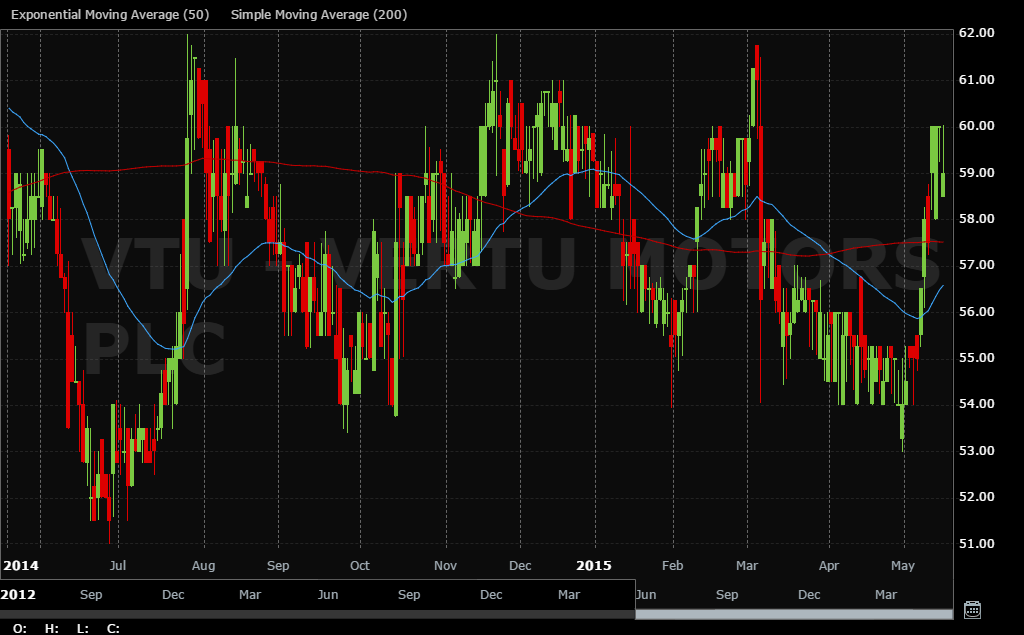
VERTUMOTORSPLC-20150519-014811

The share price has been generally range bound for the past year, can it gain enough momentum this time in order to break out?

On the 23rd July the group released a statement covering the first four months of the year.  They saw continued growth in like-for-like revenues and gross profits, both from the vehicle sales and aftersales activities.  The profitability in the period was strong and head of last year.  It is expected that the trading performance for the year as a whole will be in line with market expectations.

There have been a number of acquisitions and disposals during the period.  In June, the group acquired Blacks Autos which operates a Skoda dealership in Darlington.  This is their first Skoda dealership and operates out of a leasehold premises adjacent to the current Darlington Nissan business.  The total consideration came to £1.5M and included £750K of goodwill.  Last year the dealership made a pre-tax profit of £372K so this looks like an excellent deal to me.

In July the group disposed of its Dunfermline Peugeot dealership, selling the assets to Eastern Western Motor Group.  The dealership made an operating loss last year of £200K from revenues of £6M.  Also the group sold a vacant property in Crewe for £1.1M which equates to the book value of that property.

All in all a decent update and things continue to run smoothly by the look of it.

On the 1st September the group released a trading update covering the first five months of the year.  Overall, the board believes that results for the year as a whole will be in line with expectations.  The group’s like for like new retail sales volumes to private customers grew by 0.4%.  This was below the reported market registration levels that grew 1.5% for the franchises represented by the group and 2.9% as a whole, as they do not include pre-registered vehicles that are included in the official figures.  The group’s like for like new retail vehicle gross profit per unit strengthened during the period.

The group increased like for like Motability sales by 6.4% during the period, gaining market share in this market with total UK sales volumes of vehicles under the Motability scheme declining by 1% during the period.  Motability volumes represented 21.6% of the group’s total net car retail during the period which sounds like a lot.  Although the margins on these sales are not high, these customers provide very high levels of aftersales retention during their three year contract.

The UK commercial van market continues to perform very strongly with total market registrations up 18.8% in the period.  The group’s like for like van sales performed even better than the market, increasing by 22.9% on stable margins.  Following a shift in sales mix with reduced supply to lower margin channels, the group’s like for like fleet car volumes fell by 6.7% but with an improved gross profit per unit.

The strong supply push characteristics of the UK new vehicle market over the last three years have resulted in an increase in the supply of vehicles to the used car market.  This has grown the newer element of the vehicle parc and increased supply, competing with highly attractive finance led offers for new vehicles which has caused the market to return to more normalised seasonal depreciation of used vehicles.  In the period, the group saw like for like sales volumes grow by 4% with like for like gross profit per vehicle declining modestly in line with the board’s expectations.

During the period, the group increased like for like aftersales revenue by 3.8% and gross margins from 44% to 45.7%.  In the high margin service area, like for like revenues increased by 6.4%.  Increased sales of service plans have yet again improved customer retention into the service channel but lower margin fuel sales through the group’s forecourts declined with fuel prices, muting overall aftersales revenue growth but strengthening margins due to a more favourable mix.

So far, like for like new car retail orders for September are up on last year’s levels which gives the board confidence for a successful conclusion to this critical month.  Overall, the UK economy continues to grow, the UK consumer is spending and cars are very affordable so the macro signals all look good for car retailers generally.

This is a decent update from Vertu, the new car sales continue to be disappointing but the all-important aftersales seem to be doing well with the higher margin areas growing nicely.  It looks as though used car profitability is declining somewhat but this seems to be in line with the market.  This does seem like a decent company to me but as I already own shares in Cambria Autos I don’t think I will be jumping in here too.

On the 1st October the group announced the acquisition of SHG Holdings which operates Audi, VW passenger cars and VW commercial outlets in Hereford.  The acquisition introduces Audi and VW Commercials to the group as a new franchise.  In addition, the business also includes two VW group parts distributions operations in Hereford and Gloucester along with a used car and aftersales facility in South Herefordshire.  Prior to this transaction, VW accounted for about 6% of group turnover and but it will increase to 9% going forward.

The consideration paid is £12.8M which has been settled in cash from existing resources.  Further consideration of £1.5M is deferred for two years and will be payable under certain conditions.  The business comes with net assets of £4.3M and generated profit before tax of £1.5M last year so the board expects it to be earnings enhancing in its first full year of ownership.  The price paid for this doesn’t look too bad but expanding into VW sales is an interesting move given the current scandal surrounding the car maker.


GlaxoSmithkline Share Blog – Q1 Results Year Ending 2015

GSK have now released their Q1 results for the year ending 2015.

GSKincome

Overall revenues were broadly flat when compared to Q1 last year as a £430M decline in global pharmaceutical revenue was offset by a £260M increase in consumer healthcare sales and a £135M growth in ViiV Healthcare revenue.  Cost of sales increased, however, to give a gross profit some £351M lower than last time.  Other costs also increased with other operating expenses going up too, but this was vastly counteracted by the £9.3BN profit made on the sale of the oncology business.  The group also made £843M on the disposal of an associate but the tax bill was some £1.701BN higher due to the profits on these disposals which gave a profit for the quarter some £7.319BN higher at £8.038BN.  Core EPS for the quarter fell by 16% to 17.3p.

GSKassets

When compared to the end of last year, total assets increased by an incredible £17.345BN.  This was driven by an £8.764BN increase in intangible assets, a £5.952BN growth in cash, a £1.488BN increase in goodwill and an £896M increase in receivables, somewhat offset by the £947M fall in assets held for sale (obviously converted into cash).  Liabilities also increased during the period as a £7.252BN increase in “other” non-current liabilities which relates to the potential requirement to purchase the minority stakes in the joint ventures, a £1.751BN growth in current tax payable, a £1.329BN increase in deferred tax liabilities and a £634M growth in payables was partially offset by a £620M decline in long term borrowings to vive a net tangible asset level of £6.196BN, an increase of nearly £5BN and a much healthier looking balance sheet after the Novartis transaction.

GSKcash

Before movements in in working capital, cash profits nearly halved to £691M when compared to the first quarter of last year.  An increase in working capital, principally due to the inventory acquired from the former Novartis vaccine business, and a lower amount of tax paid meant that the net cash flow from operations stood at £370M for the quarter, a fall of £557M.  The group was still free cash flow positive during the quarter, though, with a net £231M spent on tangible assets and £120M on intangibles.  The cash flow was really affected by the Novartis deal, however, with a net £6.62BN being received from the purchase and sale of businesses.  On top of this, there was also £564M brought in from the disposal of joint ventures and £255M from the sale of equity investments which meant that before financing, the cash flow was a massive £7.46BN.    The group used £645M to repay some loans and £924M was distributed to shareholders as dividends but this still left a cash flow for the quarter of some £5.678BN to leave a cash pile of £9.834BN, although it is worth noting that the tax bill arising from the disposal is yet to be paid.

Core operating profit in global pharmaceuticals fell by 20% to £1.256BN.  Respiratory sales declined by 9% to £1.408BN.  In the US they were down 22% which reflected a 1% volume growth counteracted by a 23% negative impact on pricing, reflecting new contracts agreed in 2014 in response to competitive pressure in markets where Advair and Breo Ellipta compete.  Sales of Advair were down 21%, Flovent sales fell by 38% and Ventolin sales were down 24%.  The falls in sales of the latter two reflect the net negative impact of true up adjustments to accruals for returns and rebates, excluding the impact of this, sales were down 6% for Flovent whilst Ventolin underlying sales grew by 13%.  Breo Ellipta recorded sales of £14M whilst Anoro Ellipta, launched in Q2 2014, recorded sales of £9M.

European respiratory sales were down 4% to £392M with seratide sales down 11%, reflecting increasing competitive pressures and the transition of the portfolio to the newer products.  Relvar Ellipta, approved for both COPD and asthma, recorded sales of £16M whilst Anoro Ellipta, with launches now underway in many countries throughout the region, recorded sales of £2M.  Respiratory sales in the international region grew by 5% to £433M with emerging markets up 7% and Japan up 1%.  In Emerging markets, sales of Seretide increased by 6% while Ventolin grew by 8%.  In Japan sales of Relvar Ellipta of £9M, together with strong growth in Veramyst and Xyzal more than offset the 27% decline in Adoair due to a strong comparison in Q1 last year.

Oncology sales for the first two months of the year were down by 18% to £216M.  Sales in cardiovascular, metabolic and urology drugs fell 8% to £218M.  The Avodart franchise fell by 7% with 13% growth in Duodart offset by a 15% decline in Avodart.  Sales of Prolia fell by 33% due to the agreement in Q2 last year to terminate the joint commercialisation with Amgen in several European markets, Russia and Mexico.  Immuno-inflammation sales grew 19% to £60M with Benlysta by far the largest contributor.  Sales in other therapy areas fell 9% to £525M.  Augmentin sales declined 3% and dermatology sales fell by 11%, with both being impacted by supply constraints due to capacity limitations.  Relenza sales were down 25% reflecting Japanese government stockpiling in Q1 last year which was not repeated this year and sales of rare disease products fell by 10% as a result of generic competition to Mepron in the US.

Established product turnover fell by 20% to £650M.  Sales in the US were down 42%, primarily due to a 75% fall in Lovaza sales due to generic competition.  Europe was down 14% with Seroxat sales falling 33%, reflecting increased generic competition and international sales were down 8% reflecting lower sales of Seroxat in Japn due to generic competition and supply constraints and the impact of price pressures to Zeffix and Hepsera in China.  Core operating profit in ViiV Healthcare increased by 55% to £318M with sales increasing 42% to £446M with the US up 66%, Europe up 35% and international up 9%.  The ongoing roll-out of Tivicay resulted in sales of £112M and Triumeq, now launched in the US and Europe recorded sales of £81M.  Epzicom, which benefited from use in combination with Tivicay, increased by 2% but Selzentry sales fell by 9%.  There were also continued declines in the mature portfolio, mainly driven by generic competition to Combivir and Lexiva.

Core operating profit in vaccines fell by 31% to £161M but sales grew by 10% to £699M.  In the US, reported growth of 14% reflected strong growth in Hepatitis vaccines which benefited from variations in CDC stockpile shipments and the replenishment of wholesaler inventory levels.  Rotarix, up 12%, also benefited from the replenishment of wholesaler stock levels but this growth was partially offset by lower sales of Infanrix due to the return to the market of a competitor.  In Europe sales grew by 4% on a reported basis but fell on a pro-forma basis due to a 9% fall in Infanrix which was impacted by the introduction of a competitor vaccine in 2014 and the phasing of shipments in some countries.  Sales of hepatitis vaccines fell by 4% and Cervarix sales were down 27%, partly due to the phasing of shipments.  These declines were partly offset by a 27% increase in Boostrix sales driven by better supply in comparison with Q1 last year.  International sales grew by 13% on a reported basis and 3% pro-forma, benefiting from the phasing of shipments of a number of products.  Synflorix sales grew 12% as a result of phasing, and hepatitis vaccines grew by 20% driven by the phasing of orders in the Middle East, but Boostrix sales fell 25% reflecting the phasing of orders in Brazil and the Middle East and Fluarix sales were down 75% due to the phasing of shipments in Brazil and Asia Pacific.

Core operating profit in consumer healthcare increased by 53% to £182M with sales up 24% to £1.381BN, benefiting significantly from the first month’s sales of the former Novartis products.  On a pro-forma basis, growth was 8% reflecting the strong launch of Flonase OTC in the US.  Other launches during the period included Fenbid Chewable in China, Sensodyne Repair and Protect Whitening in the US and Germany, and the rollout of Sensodyne mouthwash.  US sales grew by 47% with Flonase being the main driver, holding an 11% market share after just 10 weeks from launch.  Oral Health sales gave a strong performance with growth of 14%, driven by Sensodyne.  Skin Health also delivered strong growth, aided by 27% growth of Abreva, boosted by stocking patterns but Tums supply suffered some disruption to stocking supply during the quarter.
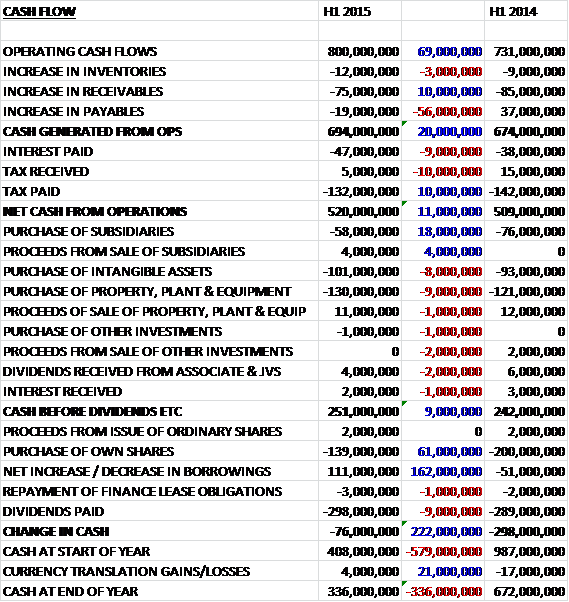
Sales in Europe were up 32% with oral health doing well, reflecting strong performances from both Sensodyne and Aquafresh following an improved supply position, new advertising in key markets and the roll out of Sensodyne True White in the UK.  Wellness also showed growth as regional respiratory brands Beechams and Coldrex benefited from a stronger cold and flu season but nutrition and skin health both saw sales decline reflecting disruption from stocking patterns and some supply shortages.  International sales grew by 12% with China, India and Turkey all showing double digit increases to sales, in particular in oral and skin health.  Wellness growth was impacted by a decline in Panadol sales due to a challenging competitive market in Australia and a tough comparator quarter in Latin America following supply improvements last year.  In nutrition, Horlicks was up 4% with strong consumption growth in India partially offset by some retailer destocking.
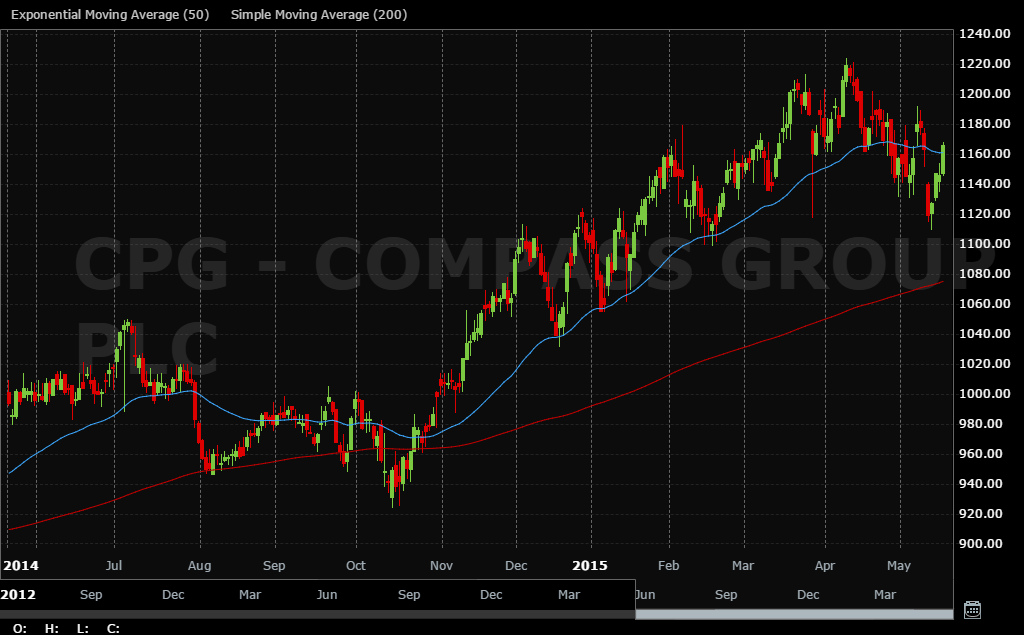
Sales of products launched in the last five years accounted for £303M with particularly strong contributions from Tivicay and Triumeq in ViiV, a solid increase in Benlysta sales in immune-inflammation and the more than doubling of Relvar/Breo Ellipta sales to £41M in respiratory.

There are still a lot of potential drugs in the pipeline with around 40 in phase two and three development.  In vaccines, the group acquired meningitis prevention Bexsero and Menveo which are both expected to contribute to profits.  There is also a decent opportunity for Shingrix, the Shingles vaccine that recently published phase three data that demonstrated overall efficacy of over 97% and there are more than 20 new vaccines in development including potential protection against hepatitis C, RSV, typhoid, Group B Strep and MenABCWY (whatever that is!),  Within pharmaceuticals, the company continues to expect to see declines in sales of Advair but due to new products, respiratory sales are expected to return to growth in 2016 with levels at or above current sales by 2020, which seems like quite a long time.

In HIV treatment, the recent launches of Tivicay and Triumeq have surpassed expectations and there is clear scope to develop multiple dolutegravir based regiments for the treatment of the disease over the next few years.  Progress has been made to develop ViiV’s pipeline with several promising assets in development.  Due to this improvement in prospects, the group has decided that it will retain its full existing holding and will now not be initiating an IPO of a minority stake in contrast to what was reported previously.

The group now has three major restructuring programmes underway: the transaction integration, restructure of its global pharmaceuticals business and the group-wide major change programme started in 2012.  The group continues to expect to deliver £1BN of annual synergies following the Novartis transaction and has now identified opportunities to accelerate the delivery of the programme.  As a result, over half of the total savings are now expected in 2016 with the programme expected to be mostly complete in 2017, two years earlier than initially thought.  In Consumer Healthcare, cost savings of £400M are being targeted with a similar amount expected in vaccines where it has become clear that the acquired group has higher operating costs than initially expected.

The restructuring of the global pharmaceuticals business is expected to deliver about £1BN of annual cost savings to be delivered by 2017 with approximately half due next year which should mitigate ongoing changes to the pharmaceutical margin and support investment in recent and new launches.  In total then, the group expects all restructuring to deliver annual cost savings of £3BN with total cash charges expected to be £3.65BN with non-cash charges of £1.35BN.  So far, the group has paid out £1.3BN, mostly in cash relating to these changes.  The majority of the restructuring is expected to be complete by 2017 and going forward, it will be simplified into one single programme.

Apparently in certain circumstances, Novartis has the right to require GSK to purchase its 36.5% shareholding in the Consumer Healthcare joint venture at a market based valuation.  This right is exercisable from 2018 to 2035.  As a result, there is an “other” liability of £6.204BN to cover this.  Equally, the other shareholders in the ViiV Healthcare joint venture have a similar clause with Pfizer having the option to request an IPO for its 11.7% stake and Shinogi having the option for GSK to acquire its 10% shareholding in 2017, 2020 or 2022.

As already reported upon, GSK and Novartis have contributed their respective Consumer Healthcare businesses into a joint venture in a non-cash transaction.  GSK has an interest of 63.5% and majority control.  In addition, GSK acquired Novartis’ global vaccines business for an initial consideration of $5.25BN with potential milestone payments of up to $1.8BN, the first of which saw them pay Novartis $450M in March.  The final part of the deal involved the divesting of GSK’s Oncology business for a consideration of £10.4BN with the profit on disposal after tax hitting £7.342BN.

It is notable that the board have changed their allocation of the funds from the Novartis transaction, reducing the amount that is being returned to shareholders.  This is because the pricing environment is becoming more difficult and there are a number of situations where either much less cash will be coming in to the group or they will have to pay out a great deal of cash.  These include the above mentioned put options of the partners in the ViiV healthcare and Consumer Healthcare business and the possible introduction of generic Advair in the US.  This year there are a number of headwinds that include the dilutive effect of the transaction and continuation of the issues that faced the group at the end of 2014.  Following this year, it is expected that performance will improve with revenues and earnings expected to grow from 2016 to 2020.

As already mentioned, the group are looking to prioritise the use of cash to prop up the level of ordinary dividends during a period of falling profits, and to invest in more rapid delivery of synergy benefits and growth opportunities.  As such, the group have announced that it will pay dividends of 80p per annum for the next three years and to return 20p per share to shareholders in a special dividend in Q4 as a result of the cash received from Novartis, which is substantially less than originally mooted.

Going forward, core EPS in 2015 is expected to decline at a rate in the high teens on a constant currency basis, primarily due to pricing pressure in Advair, the dilutive effect of the transaction and the inherited cost base of the Novartis businesses.  In 2016, there should be a significant recovery in core EPS with a double digit percentage growth as the headwinds experienced this year diminish and the synergy benefits of the transaction contribute more meaningfully.  From 2016 to 2020 the compound annual growth rate is expected to be in the low to mid-single digits with vaccines growing at mid to high single digits, consumer healthcare growing at a rate of mid-single digits and pharmaceuticals growing at low single digits.  The introduction of generic competition to Advair has been factored in to this analysis but there is no assumption of premature loss to any of the other key products and includes contribution from mepoluzimab and Shingrix that are currently in the pipeline stage.

Due to the deal with Novartis, net debt at the end of the quarter stood at £8.098BN, a vast improvement from the £14.377BN at the end of last year and the £13.66BN at the same period last year.  The group has declared an unchanged Q1 dividend of 19p (compared to Q1 last year) and the 80p announced for the year represents a yield of 5.5% at the current share price which seems pretty decent.

Seretide/Advair is still by far the largest drug by sales, at £898M with a number of others hovering around the 180M mark, including Avodart, Infanrix, and Epzicom, all of which haven’t changed much year on year.  This remains the basic problem with GSK, for some time now they have been reliant on one drug and now we see that in their largest market, pricing pressures are underway that could seriously undermine earnings going forward and the replacement drugs, Bero and Anoro Ellipta are clearly still in their infancy despite having promise.  Having said that, the Novartis deal really shores up the balance sheet and the retention of a lot of the capital from this deal is probably a sensible idea; ViiV healthcare seems to be doing very well and drugs Tivicay and Triumeq seem as though they could be real earners for the group.  In addition the 5.5% dividend yield should underpin the share price despite the year of decline that the group is no doubt entering.  A decision on this company is quite difficult for me, I have sold a portion of my holding by retain some shares which were supposed to add some ballast to my portfolio.

On the 7th May the group announced that Manvinder Singh Banga will join as non-executive director.  He will succeed Deryck Maughan. Manvinder previously worked as president of global foods, home and personal care at Unilever and is currently also a non-executive director at M&S and Thomson Reuters.

GLAXOSMITHKLINEPLC-20150514-115028

The decline in the share price has clearly set in and there does not seem many signs of a reversal.   I am sorely tempted to sell out here completely.

On the 22nd June the group announced the divestment of its meningitis vaccines Nimenrix and Mencevax to Pfitzer for a total consideration of £82M including some deferred consideration.  These two vaccines are sold outside the US and had sales of £34M in 2014.  The divestment became necessary due to competition concerns following the acquisition of meningitis vaccines Menveo and Bexsero from Novartis.