Cambria Automobiles Share Blog – Interim Results Year Ending 2015

Cambria Automobiles has now released its interim results for the year ending 2015.

cambriaincome

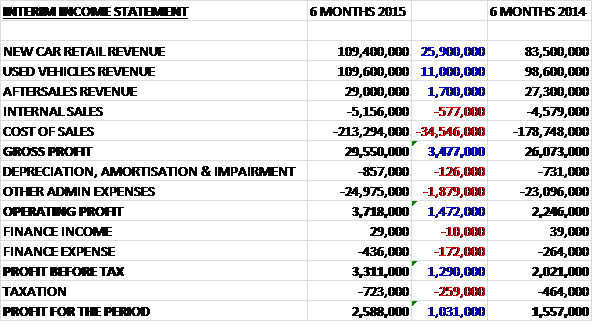
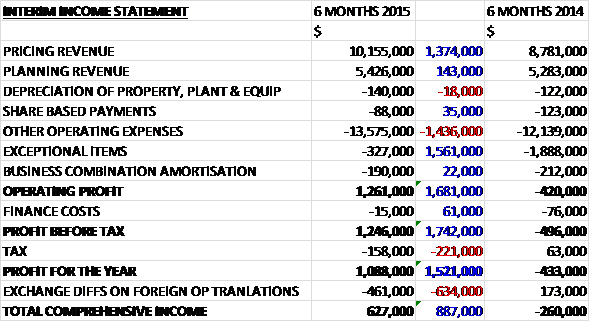
When compared to the first half of last year, revenues increased across all three sectors with new car sales up £25.9M, used car sales up £11M and aftersales increasing by £1.7M.  Cost of sales also increased to give a gross profit some £3.5M higher.  Admin expenses were also up slightly and finance expenses were up, reflecting the interest on the loans drawn down last year and increased consignment stock interest charges, to give a profit before tax some £1.3M higher before the tax payment meant that the profit for the period stood at £2.6M, an increase of £1M when compared to the first six months of 2014.

cambriaassets

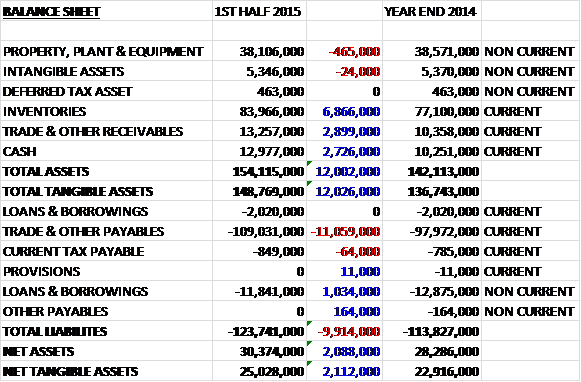
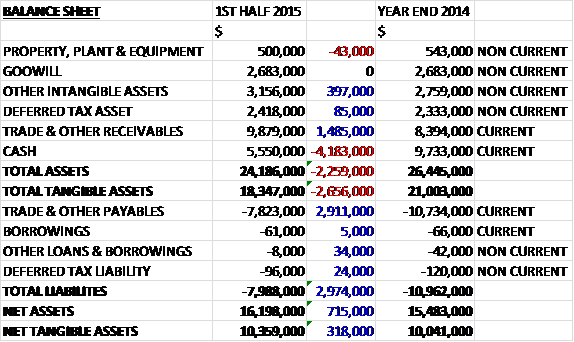
Total assets increased by £12M when compared to the end point of last year, driven by a £6.9M increase in inventories, a £2.9M growth in receivables and a £2.7M increase in cash, partially offset by a £465K reduction in the value of property, plant and equipment.  Liabilities also increased as an £11.1M increase in payables was partially offset by a £1M fall in loans and borrowings.  The end result is a £2.1M increase in net tangible assets to £25M.

cambriacash

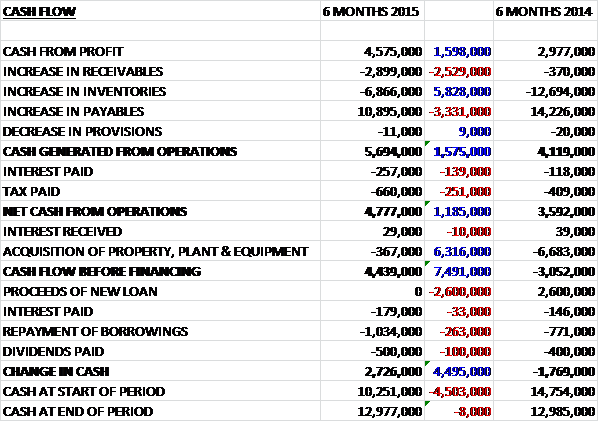
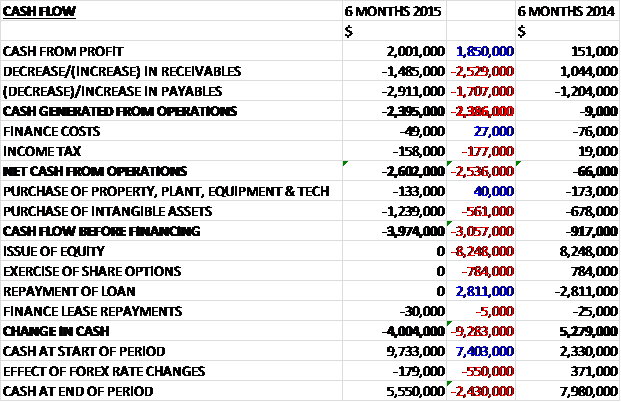
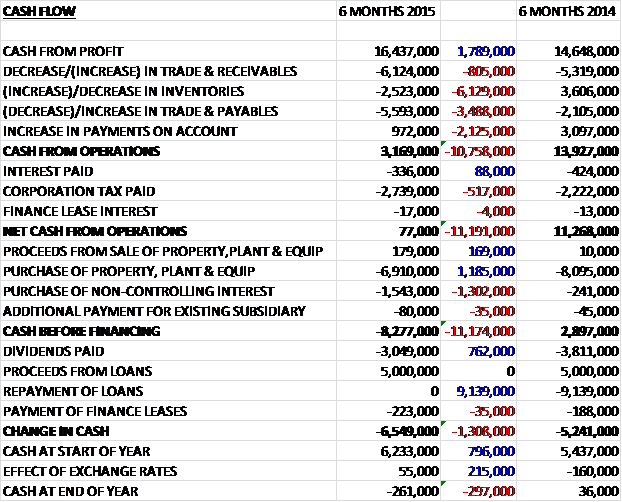
Before movements in working capital, cash profits increased by £1.6M to £4.6M.  A large increase in payables was not entirely offset by increases in receivables and inventories and after higher interest and tax payments, the net cash from operations stood at £4.8M, an increase of £1.2M.  Capital expenditure only accounted for £367K as there were no acquisitions during the period so there was an impressive free cash flow of £4.4M, of which £1M was used to pay down debt and £500K was spent on dividends to give a cash flow for the half year of £2.7M to increase the cash pile to £13M which was incidentally almost exactly the level of cash at the end of the first half of last year.

New car gross profits increased by £1.6M, although gross margin fell slightly to 6.6%.  Sales grew by 15.6% to 5,362 units, and like for like sales volumes increased by 8.8% when the acquired Barnet outlet is discounted.  This performance compares slightly favourably to the 8.2% year on year increase in new car registrations in the UK as a whole with the private registrations element of the market increasing by 6%.  The group’s sale of new vehicles to private individuals increased by 12.7%, supported by strong consumer offers from the manufacturers.  New commercial vehicle sales increased by 35% to 511 units whilst new fleet sales increased by 36% to 266 units which is a trend that is expected to continue.

Used car gross profits grew by £1M with the margin remaining steady at 9%.  Sales grew by 2.9% to 7,106 units with like for like sales flat year on year, although profit per unit increased by 7.7%.  Aftersales profits increased by £800K with the margin increasing slightly to 42.8% with service hours increasing by 4.4% year on year but showing no growth on a like for like basis.  As seen above, capital expenditure was fairly low during the period but a planning application has been submitted for the substantial redevelopment of the Barnet facility for Jaguar Land Rover acquired last year to create a state of the art dealership.  The refurbishment is likely to cost about £5M and will be incurred next year.

The board are still actively pursuing acquisition opportunities to strengthen the group’s position in luxury and premium brand cars.  In the past they have concentrated on acquiring and turning around underperforming dealerships but they are now in a position to consider acquisitions which are immediately earnings enhancing.  The performance in March was ahead of plan and the previous year and the board are confident that this momentum will continue to deliver an improved performance across all of its activities.   March saw a record level of car registrations In the UK and the current economic landscape with low interest rates and a favourable exchange rate against the Euro allowing manufacturers to continue to deliver strong consumer offers which should ensure that volumes in the new car market in the UK remains robust.

As already announced, after the half year end, the group acquired the Land Rover franchise in Swindon from TH White for a total cash consideration of £7.56M which included £3M in goodwill payments.  The group intends to draw down a new £1.6M loan in respect of the freehold property acquired with the balance satisfied by the existing financing facilities.  This new dealership represents the second Land Rover outlet acquired by the group and will be relocated to the current Jaguar dealership already owned by Cambria in the town.

Net debt stood at £900K at the end of the half compared to £700K at the same period of last year.  After a 50% increase in the interim dividend, the shares now yield 1.1% on an annual rolling basis with the board intending to maintain a progressive dividend policy for the full financial year as long as the payment of the dividend does not detract from the primary aim to utilise available fund to continue to grow the business.

Overall this was a fairly good update.   Profits were up and net assets increased to improve what is an already strong balance sheet, although it should be noted that there is a large amount of operating lease payments payable that are off the balance sheet.  The cash generation was excellent during the period although again there is a bit of a caveat as the capital expenditure during the period was very low and the group has announced that it expects to spend £5M on developing the Barnet Land Rover outlet alone next year.  Operationally, like for like new car sales were slightly ahead of the market but used car sales and aftersales were both flat year on year, albeit with increased profits.

It is perhaps a bit harsh, though, to compare profits on a like for like basis given the fact that the group’s strategy is to buy new dealerships to increase its profits.  Also, the new car market in the UK continues to be very strong with a record March this year.  The prevailing economic conditions mean that this performance is likely to continue in the immediate future.  Finally, the dividend increase is welcome but still not much to get excited about.  Overall I have very mixed feelings about an investment here.  As long as the favourable market conditions continue, the group is likely to continue to do well.  I may look to add if the opportunity presents itself, although for now I will wait to see what Vertu’s update tomorrow brings.

On the same day the group announced that a company controlled by Chairman Philip Swatman purchased 85,000 shares at a value of just over £50K and he now owns 250,000 shares in the group.  This is a good vote of confidence and I am very tempted to buy in here.

On the 8th September the group released a trading update covering the year as a whole.  They have continued to perform well in the second half of the year and results for the year are expected to be ahead of current market expectations.  Trading in the first eleven months of the year has been substantially ahead of the same period last year on both a total and like for like basis.  New vehicle unit sales were up 9% but up only 1% on a like for like basis.  Unit sales to private retail customers were up 9.3% (2.1% LFL) with gross profit per retail unit improving by 15.3% (LFL 1.6%).  Used vehicle sales also performed well with unit sales 4.5% (1.3% LFL) ahead  and gross profit per unit up by 8.1% (LFL 6.7%) which has significantly enhanced the profit derived from the used car part of the business.  Growth in the aftersales operations has also continued, with hours sold up by 8% (2% LFL) year on year.

Both the Barnet JLR dealership acquired in July 2014 and the Swindon Land Rover dealership acquired in April 2015 are integrating well and are contributing in line with expectations.  Heading into the important September trading period, the new car order book is building well reflecting strength in the market as a whole.

It is always nice to see an “above expectations” trading update.  The new car sales look a little slow but the contribution from the acquisitions looks very good and that increase in the second hand profit per unit looks very good to me.  I am very happy to continue holding here.

Air Partner Share Blog – Final Results Year Ending 2015

Air Partner has now released its final results for the year ending 2015.

aipincome

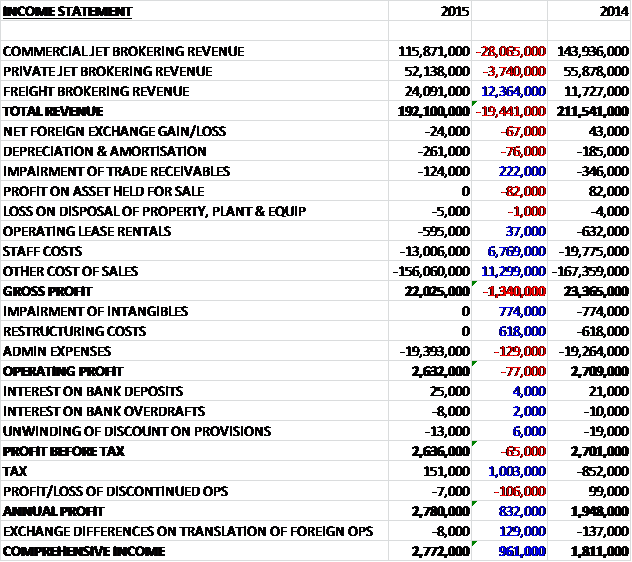
Overall revenues fell by £19.4M as a £12.4M increase in freight brokering sales was more than offset by a £28.1M decline in commercial jet sales and a £3.7M fall in private jet revenues.  Cost of sales also fell, however to give a gross profit just £1.3M below that of last year.  Underlying admin expenses increased slightly but there was a lack of impairments and restructuring costs that occurred last year which meant that profit before tax fell by 65K to £2.6M.  Due to a tax rebate this year compared to a tax payment last year, however, the profit for the year actually increased by £832K to £2.8M.

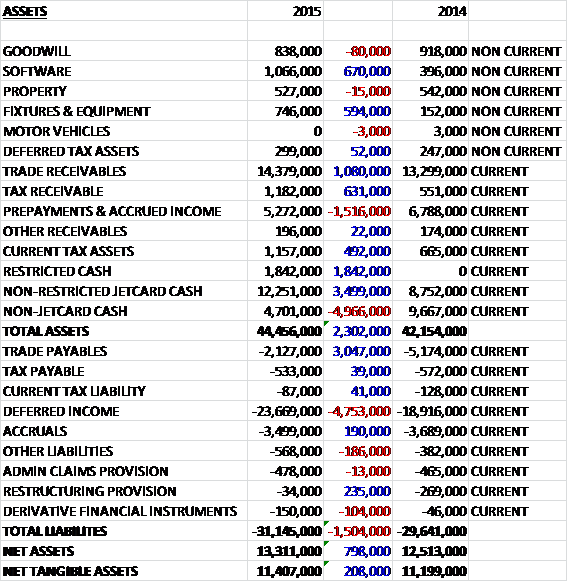
aipassets

When compared to the end point of last year, total assets increased by £2.3M, driven by a £3.5M increase in non-restricted Jet card cash, a £1.8M growth in restricted cash and a £631K increase in tax receivable, partially offset by a £5M fall in non-Jetcard cash and a £1.5M decline in prepayments and accrued income.  Liabilities also increased during the year as a £4.8M increase in deferred income relating to the increased Jetcard sales was partially offset by a £3M fall in trade payables.  The end result is a net tangible asset level some £208K higher at £11.4M.  It should be noted that the fall in non-jet card cash was driven by a number of ad hoc commercial jet projects in Germany and the servicing of a major government aid contract in the final quarter of the year, which have had a temporary effect on cash balances.  There are also £2.4M of operating leases not included on the balance sheet but this relatively modest figure should not cause too much of a problem.

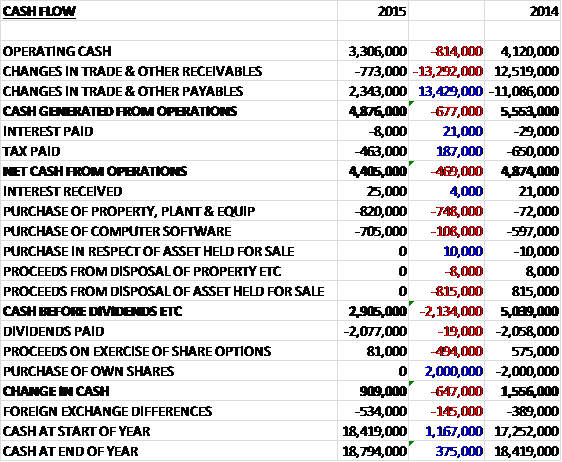
aipcash

Before movements in working capital, cash profits fell by £814K to £3.3M.  The operational cash flow was then improved by an improved payables situation and a reduction in the amount of tax paid so that net cash from operations fell by £469K to £4.4M.  This was more than enough to pay for the tangible assets and CRM software to give a free cash flow of £2.9M.  The bulk of this was spent on dividends to leave a £909K cash inflow for the year which seems like a decent performance.

In Commercial Jets, the reduction of the cost base, the recruitment of new staff and improved trading conditions has led to some confidence in the outlook for the division after a poor year.  Private Jets continued to progress, driven by the popularity of the Jetcard  product and the Freight division showed strong improvement from the low base of last year as the global economy continued to improve and the group have added to the sales team in this division.

Underlying operating profit at the Commercial Jet business fell by 31.6% to £2.7M.  The reduction was due to few material one-off contracts, particularly in the UK and the US, together with the impact of a reduced tour operating programme in the French business.  The CEO has now personally taken responsibility of the UK commercial jet division and a number of steps have been taken to re-focus operations, reduce costs and invest in new, experienced staff.  These actions have apparently contributed towards the improved trading performance in the second half of the year.  During the year Italy achieved its highest ever profits as a result of a successful tour operating programme and Germany achieved its strongest ever set of results due to a number of car launches.

Despite the reduction in tour operating revenues in France, strong progress was made in Italy and Austria with an increased programme in France for 2015 indicating that the set back there may be temporary.  Oil and Gas activity produced consistent revenues compared to last year with a 24% increase in gross profit with a good contract win in the second half of the year with a major exploration company.  During the year, worldwide government relationships continued to generate contract wins but generated lower levels of profits that the group expects will continue going forward.

In Private Jet broking, the underlying operating profit fell by 51.3% to £800K.  The amount of deposits on Jetcard increased to £14.1M from £8.8M last year.  Revenues from the card are not recognised until the customer has flown the hours so despite a 153% increase in new deposits and a 2% increase in renewals from existing customers, utilisation increased by just 3% year on year.  The increased deposits this year bode well for revenues next year, however.  In ad hoc brokering, the picture has been more difficult.  The US business suffered as a result of decreased flying by one of the group’s major corporate clients and in Europe the overall market has contracted slightly reflecting uncertainty in the Eurozone.  The group has taken action to reduce the cost base in these areas to mitigate these trends.

The Freight broking division made an underlying operating profit of £400K, an improvement on the £100K loss made last year.  This growth reflects new business wins generated by the investment made in more sales staff.  The Red Track technology which aids the aircraft on the ground business, and the continuation of the work with government global aid agencies has helped build strong relationships with freight forwarders which has been a key contribution to the turnaround seen in the division.

Some examples of the contracts that have been undertaken by the group include flights chartered for football teams  where they source the aircraft, arrange the arrival and departure process, brand the interior of the plane with the team colours and deliver bespoke catering to meet the nutritional needs of the players.  Departure times are flexible due to the possibility of the matches going in to extra time.  Another contract involved the hire of a private jet for a wedding.  The jet was stocked with the bride’s favourite food and champagne, some 50 guests were flown in by VIP aircraft and after the wedding itself, the bride and groom were flown off to their honeymoon with the jet dressed with “just married” headrest covers.  When the couple decided they wanted to extend their honeymoon for a couple of days, the group arranged the private jet flight home (how the other half live, huh?!).

At the other end of the scale, following the outbreak of Ebola in West Africa, the group flew over 100 aid flights to the region along with building equipment that was used to build five treatment centres.  Over a period of nine weeks, the group flew a client’s 20,000 guests from different airports to a product launch in Greece which included gate buffets at airports, direct transport of luggage to hotels, and en-route hotel check in.  Another project involved a jet card owner who booked an aircraft to the French Alps that could land near their favourite ski slopes and carry their ski equipment with the service including a weather watch for the client and 20 minute check in.  In Madagascar, following a power blackout, the group flew a generator system from a UK warehouse to the affected region, including a 500Km truck journey to arrive at the destination on time.

Although the aviation market can suffer as a result of geo-political uncertainties, for Air Partner this can be an opportunity, for example, the movement of troops and equipment in military conflicts, evacuation of personnel form disaster zones, the transport of aid and the repatriation of citizens in response to politically driven immigration programmes.  Overall, though, demand for commercial passenger traffic and cargo is growing globally, but this is not the case in Europe due to the ongoing difficulties being faced by certain Eurozone members.  Freight traffic is one the rise generally.  Similarly, the private jet outlook is mixed.  The US is a strong, albeit competitive market while the picture in Europe is less buoyant, shrinking by 0.5% when compared to 2013, partly as a result of the instability in Russia and Ukraine

One issue that has the potential to adversely affect aircraft broking is that the rise of technology has enabled some customers to book their flight without using a broker and there are some companies attempting to offer this solution, cutting out the need of a broker at all.  Often, though, passenger needs are challenging and jet itineraries are often complex and subject to change which is something that currently can only be managed be experienced brokers.  The group has also seen operators looking to charter aircraft direct to customers which could be an issue if it is a trend that continues to increase.   The main risk in the short term, however, remains global economic conditions with charters continuing to be impacted by economic instability in major world markets.

The main reason that the group managed to improve profits when compared to last year is the tax rebate.  The group has received £500K from an R&D tax claim arising from its investment in technology projects, £200K from a one-off tax credit arising from the treatment of Jet Card deposits in the US, and £200K from the recognition of deferred tax assets from capital allowances and losses in France.  Although some of these are one-offs the group is actively reviewing its tax structure going forward which might results in further improvements to the amount of tax paid.

There have been a number of board changes.  Tony Mack retired from the board at the last AGM but remains as life president of the company, whatever that means.  Gavin Charles left the business from his role as CFO with Neil Morris, the former group financial controller, being appointed as his replacement.  Non-executive director Chuck Pollard resigned in December after spending five years in his role in order to take up a position of CEO at Arthur J. Gallagher International.  He is replaced by Peter Saunders.  Peter is also non-executive director at Canadian Tire Corp, Godiva Chocolates, Total Wines and Jack Wills having been former CEO at Body Shop, so that is quite an eclectic list but he brings experience in marketing and customer service.

So far this year, trading is in line with expectations with an improvement seen in France and the momentum generated in Italy continuing, and taken with the level of forward bookings, including the large oil and gas project that will commence this year, the board begin the year with a degree of optimism.  After a 10% increase in the total dividend paid this year, the shares are now yielding an impressive 6.2% and the P/E ratio stands at 13.4, which doesn’t seem too bad.  Unfortunately I could not find any broker estimates for next year.

Overall then, this is a mixed set of results characterised by a very poor first half of the year, followed by improvements in the second half.  Profits were actually up but this was due to a tax rebate and the lack of the restructuring costs that occurred last year.  Net assets increased slightly, which was encouraging and despite a fall in both the operational and free cash flow, the group remains nicely cash generative.  The commercial jets division suffered due to less large one-off contracts and a poor performance in the French travel agency business.  The private jet profits fell due to less usage from a major US client and general malaise in Europe, but increased jet card deposits bode well going forward.

There are a number of headwinds, the fact that there are some users cutting out the involvement of brokers is concerning and the market remains susceptible to general economic conditions, plus the ongoing problems in Russia is affecting private jet usage there.  So far this year, however, trading has been decent with a large oil and gas contract won at the end of last year and an improvement in conditions in France driving the performance.  The dividend yield is excellent, and it seems fairly well covered by earnings so I am happy to remain holding here.

AIRPARTNER-20150511-025435

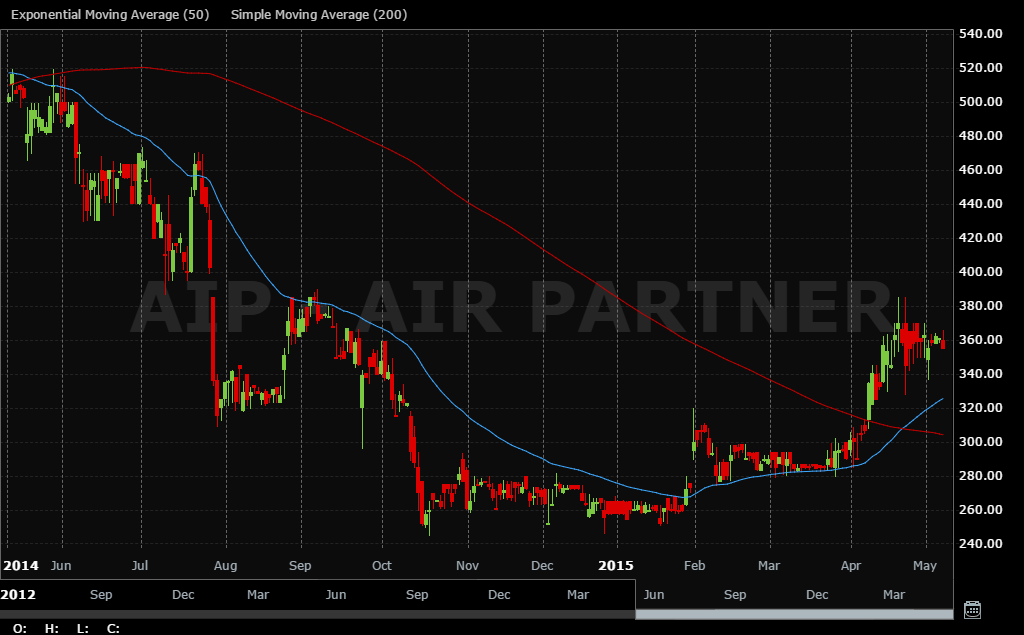
The chart continues to look promising too, the shares have punched up through the 200 day moving average and are well up on their lows at the start of the year but remain considerably lower than at the beginning of 2014.

On the 13th May the group announced the acquisition of Cabot Aviation Services for a total consideration of £1.2M, £600K of which will be paid in cash on completion with the other £600K payable in Air Partner shares over the next five years.  Cabot’s main business is acting as an agent and broker to airlines and other aircraft owners such as banks, operating lessors, manufacturers, insolvency practitioners and individuals to dispose of their surplus aircraft.  IT also advised clients on the acquisition of aircraft and their fleet management process.  Air Partners’ existing aircraft remarketing operations are predominantly in the short-term wet lease market but the acquisition adds significant aircraft sales and dry lease expertise to the group.  The acquired company will continue trading as Cabot, retain its CEO and Chairman and absorb Air Partner’s current remarketing operations.

Cabot achieved a profit before tax of £383K in 2015 and should be earnings enhancing to the group during the current year ending 2016.  This seems like a great acquisition at an attractive price so should add value going forward.

On the 1st May it was announced that after retiring from the board and becoming life president of the company, Tony Mack sold all of his 700,000 shares which had equated to over 7% of the total equity of shares which is a substantial amount.

On the 4th June the group released an AGM statement.  Trading so far this year has been at a similar level to the end of last year and given the forward bookings, the board remains optimistic about their prospects for the rest of the year.  The recent Cabot acquisition is starting to show clear benefits to the group’s customers.  While there is limited visibility, the group has made a solid start to the year and is maintaining a positive net cash position.  A decent update, but it has to be said that there is not that much to get excited about here.

On the 31st July the group gave a trading update covering the first half of the year.  Trading has been in line with expectations and pre-tax profit is expected to be at least £2M compared to £1.1M in the first half of last year.

On the 19th August the group announced the acquisition of Baines Simmons Ltd, an aviation safety consultant, for a total consideration of £6M with £5.4M initially in cash and a further £600K of deferred consideration payable in January 2018 dependent on performance criteria.  The acquisition has been funded from a combination of existing cash resources and a £3.6M debt facility provided by RBS.  Baines Simmons achieved a profit before tax of £700K last year and the group expects the acquisition to be earnings enhancing in its first full year of ownership.

Baines Simmons specialises in aviation regulation, compliance and safety management, advising clients across civil and military markets such as KLM, SAS, Thomas Cook, British Airways, Virgin Atlantic, the Isle of Man government, BAE, the MoD, Rolls Royce, the RAF, Airbus, the European Aviation Safety Agency and the UK Military Aviation Authority.  Following the acquisition, the business will continue to be managed by its current executive team and will report its results as a new segment.

Baines Simmons assists clients by de-risking complex organisations, ensuring that high safety performance standards are an integral part of an organisation’s approach to business.  They designed, built and continue to support the Isle of Man Aircraft Registry on behalf of the Isle of Man government.  Since 2007, over 800 aircraft have registered and airworthiness surveyors have completed over 2,200 surveys, recommending Certificate of Airworthiness for issue, renewal or export.

Overall this looks like an interesting acquisition.  It is nicely profitable and seems a good complimentary business are for the group to be involved in, although whether there are many synergies to be had is debatable given it sounds like it will continue to operate pretty much as its own business.

Sainsbury Share Blog – Final Results Year Ending 2015

Sainsbury has now released its final results for the year ending 2015.
SAINSBURYincome

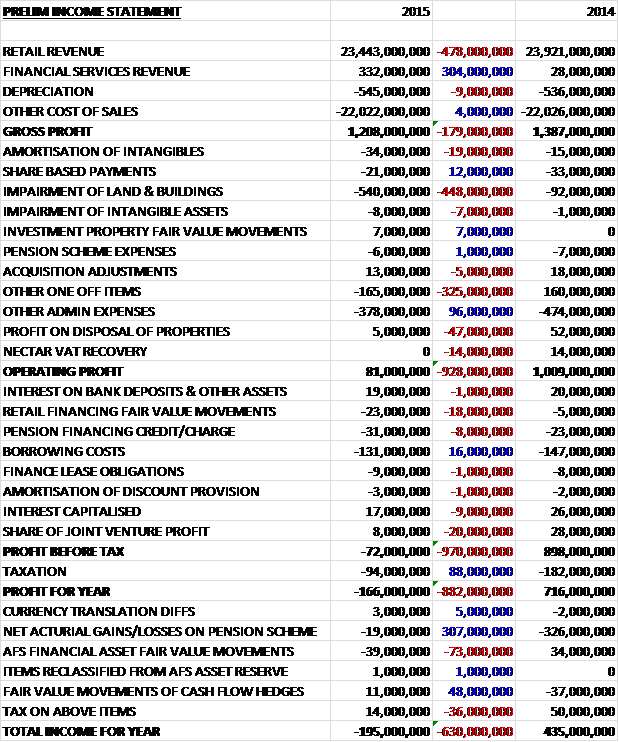
Overall sales fell when compared to last year as a £304K increase in financial services revenue, reflecting a whole year of ownership of Sainsbury’s Bank, was more than offset by a £478K decline in retail revenue.  Cost of sales was broadly flat year on year to give a gross profit some £179K lower than in 2014.  We then see underlying admin expenses fall somewhat but the real damage is done by the £540K impairment of land & buildings, and the £165K of other one-off items to give an operating profit of just £81M, a decline of £928M when compared to last year.  Profits at the joint ventures collapsed by £20M and various increases in finance costs were offset by a reduction in tax to give an overall loss for the year of £166M, a negative £882M swing when compared to 2014.
Sainsburybalance

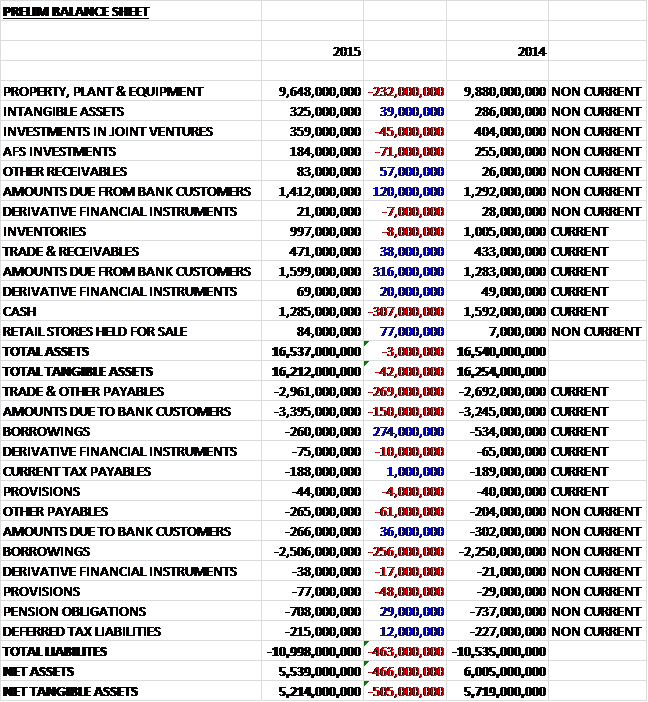
When compared to the end point of last year, total assets fell by just £3M as a £307M decline in cash, and a £232M fall in property, plant & equipment was mostly offset by a £436M increase in the amounts due from bank customers and the £77M increase in the value of retail stores held for sale.  Liabilities increased during the year, driven by a £269M growth in current payables, a £114M increase in amounts due to bank customers and a £61M increase in non-current payables was partially offset by a £29M fall in pension obligations to give a net tangible asset level of £5.214BN, a £505M collapse when compared to 2014.
sainsburycash

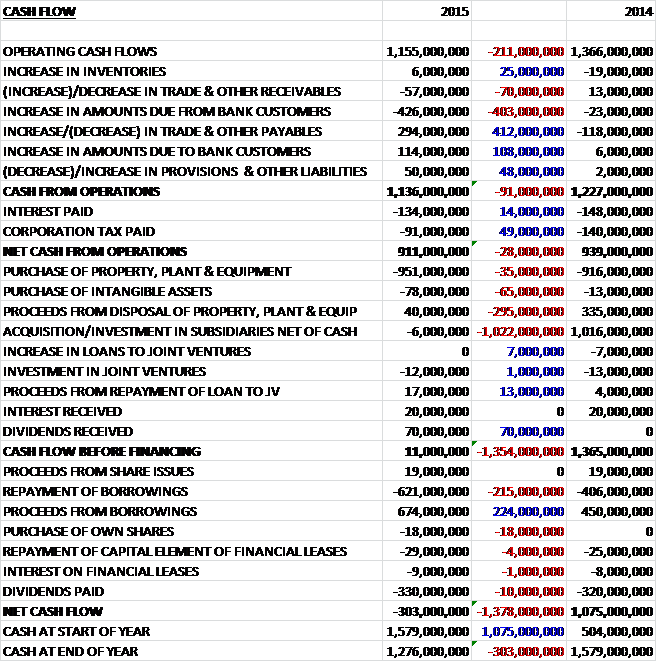
Before movements in working capital, cash profits fell by £211M to £1.155BN.  After an increase in the amounts due from bank customers was offset by an increase in payables and a hike in the amount due to bank customers, the net cash from operations of £911M was some £28M lower than in 2014.  This cash does not cover the capital expenditure but when £40M of proceeds from the sale of assets, £70M of dividends and some proceeds from the joint ventures are taken into account, the cash flow before financing stood at £11M.  The payment of dividends was then the main cause of the £303M cash outflow recorded during the year, although the cash pile of £1.276BN at the end of the period seems to give decent coverage.

There is no doubt that this has been a difficult year for Sainsbury, underlying profit before tax fell by nearly 15% to £681M and market share declined by 25 basis points to 16.5% with increased competition from discounters.  Underlying operating profit at the retail operation stood at £604M, a decline of £154M when compared to last year as like for like sales fell by nearly 2% due to continued challenging market conditions and retail price deflation and the group invested in the customer offer in order to remain price competitive, partially offset by £140M worth of cost savings.  The underlying operating margin declined by 58 basis points to a rather thin 3.07%.

Underlying operating profit at the financial services operation was £62M, an increase of £38M when compared to 2014, mainly due to lower market savings rates which resulted in a reduction in interest payable, along with increased lending and lower bad debt levels.  In January 2014, the group took full ownership of Sainsbury’s Bank and they are part way through the transition to become a standalone bank.  During the year there was a 13% increase in the number of Sainsbury credit cards being used in store and whilst reduced advertising activity has resulted in overall customer awareness of the bank declining slightly, the number of active accounts has increased by 6% to 1.7M.  The loans business had a good year with a 13% year on year increase in sales volumes and the travel money business saw sales growth of 24% and they opened their 168th travel money outlet.

Due to increased competition, car and home insurance sales volumes declined during the year but pet insurance grew by 64%.  The ATM estate grew by nearly 7% and the bank’s website visitors grew by over 12% to over two million visits per month.  Unfortunately it seems that the costs of transferring the bank are higher than initially expected with costs expected to rise by between £80M and £120M going forward, taking overall spend to between £340M and £380M.  The migration of savings customers is hoped to occur in 2015 but this cost overrun is considerable and disappointing.  The tier 1 capital ratio fell from 13.6% to 12.7% reflecting the increased customer lending and one-off costs from the bank transition.

Underlying operating profit in property investments stood at £15M, a decline of £1M year on year.  Despite the £900M decline in the property valuation, the group is looking to maximise the value of the property assets by working with partners to deliver new residential, leisure and commercial opportunities whilst adding trading space to the estate.  They are delivering 1,500 new homes across London, partly through the £500M project with Barratt at Nine Elms.  This project will deliver 737 new homes, a new Sainsbury store, restaurants and office space.  Plans have also been developed for a replacement store at Whitechapel Square alongside 600 new homes and improved public space surrounding the station.  These mixed use development schemes are expected to deliver profits of around £200M over the next two years, which sounds like a good return.

The problems facing grocery retailers have been well documented with a structural shift in the way people do their shopping with smaller, more frequent convenience shops combined with larger online orders which is continuing to cause volumes in large, traditional supermarkets to decline.  Around a quarter of the group’s stores will have some under-utilised space over the next five year (about 6% of the total space).  Half of this will be used to expand the clothing and general merchandise offer with the remaining space being used for concession partners such as Argos, who will open concessions in ten supermarkets this year; and Timson, who will bring their products to more supermarkets.  GP and dental surgeries are another option and have proven popular so far.

One area that Sainsbury continues to outperform its rivals is that of perceived quality and provenance.  So far, some 3,000 own brand products have apparently been improved and the group was named drinks and seafood retailer of the year at the industry awards and in-store bakery retailer of the year at the bakery retail awards. The own brand offering accounts for just under half of all food sales but it underwent a small decline year on year despite the premium own brand increasing sales by nearly 5%.  The group have invested some £50M into lower prices of products and expect to invest another £150M during this year.

The convenience stores have done well during the year, plugging into the new trends detailed above and sales were up 16%.  The group are targeting this as an area for growth and plan to add between one and two new convenience stores a week to the portfolio after opening 98 during the last year.  The online offering is also being expanded, with better delivery slots and a “dark store” for online orders only on track to be opened in Bromley by Bow in 2016.  Although the rate of online growth has slowed due to increased competitor aggressiveness, there was still a 7% increase during the year.  The Netto trial continues with five stores now opened and a total of 15 expected by 2016.

One area that management has earmarked for growth is non-food.  Clothing and general merchandise grew sales by over 9% and the growth strategy focuses on increasing non-food presence in stores.  The trial of selling clothing online has been extended to a number of regions across the country, including London and the South East with a full roll-out of the offer expected in 2015.

There have been a number of one-off charges incurred this year.  The store pipeline was reassessed in order to determine whether they have the potential to make decent returns in the new grocery environment which resulted in the decision that some sites will no longer be developed.  As a result, a charge of £287M was recognised that included £256M of property write-downs, a £1M impairment of goodwill and £30M of onerous contract provisions.  In addition, a £341M charge was recognised with respect to unprofitable stores that are currently trading.  This included £284M of property write-downs, £7M intangible asset impairments and onerous lease provisions of £50M.  Additionally there was restructuring costs of £15M, costs of £53M to transition the bank to a new platform and £17M in compensation made to employees transitioning to the defined contribution pension scheme after the closure of the defined benefit scheme to future accrual.

The group is taking some action to try and shore up the balance sheet.  So far some £140M of operating costs savings have been delivered with a total of £500M expected over the next three years.  Core capital expenditure this year was £947M but the group are reducing this to between £500M and £550M in each of the next three years, concentrating on the convenience stores.  As a result of operational efficiencies, retail working capital has been improved by more than £300M and the dividend policy is being set making sure there is cover at two times underlying earnings.  These actions have been counteracted by a £900M decline in the value of the group’s property due to a reduction in market rental values.  The pension scheme continues to be a small drag on earnings with contributions of £49M per year until 2020 agreed at the last valuation, the next one of which is due this year.

Going forward, the group expects like for like retail sales to be negative again next year, driven by continued challenging conditions and food price deflation and contribution from new space is expected to be slightly lower than this year.  Cost inflation is expected to be between 2% and 3% with efficiency savings of about £200M.  The bank is expected to deliver mid-single digit year on year growth in underling operating profit and capital injections to the bank next year are expected to be about £80M.  The share of profit from the property joint ventures is expected to be slightly lower next year and losses on the Netto, Mobile and I2C start-ups are expected to remain around £9M.

At the current share price the underlying P/E ratio stands at 10.5 but this increases to 12.2 on next year’s consensus forecast which seems about right to me.  After a 24% cut in the dividend, the shares currently yield 5% but this falls to 4.1% on next year’s forecast as the group maintains the two-times underlying profit dividend cover.  Net debt stands at £2.3BN which compares favourably with the £2.4BN recorded last year (including bank debt) and undrawn borrowing facilities of £1BN.  Next year, net debt is expected to show another small improvement due to improved working capital controls.

There is now doubt that this has been a difficult year for the group.  They recorded an overall loss with a reduction in underlying profits and there was a fall in net assets as payables increased and the property impairments took their toll on the balance sheet.  The cash flow seems a little better with operating cash flow marginally down as the group kept tight control on working capital and free cash flow was broadly neutral, although the dividend payment pushed the group to a cash outflow.  This is not an unusual state of affairs for Sainsbury though and there seems to be a decent level of cash available.  Trading-wise, market share fell and margins were down as continued fierce competition, along with changing shopping habits affected the group.

The group is looking to stem the lost business from the large supermarkets by focusing on non-food items and concessions which seems a sensible enough strategy, although whether anyone will want to visit an out of town department store that sells groceries is open to debate.  The bank seems to be trading well but the increased costs of transferring it to the new platform is a real blow.  Going forward, next year sales will probably fall further and the bank will need an £80M capital injection so next year is unlikely to show any improvement so I don’t see this as a good investment at this time.
SAINSBURYJPLC-20150508-103544

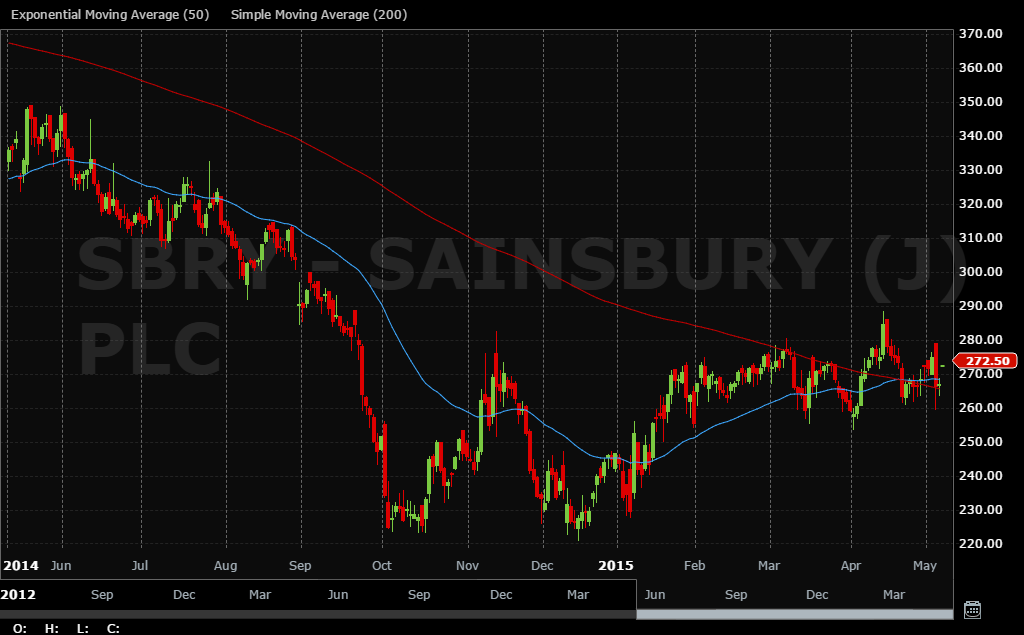
After recovering from the lows at the end of last year, the share price now seems to be trending generally sideways.

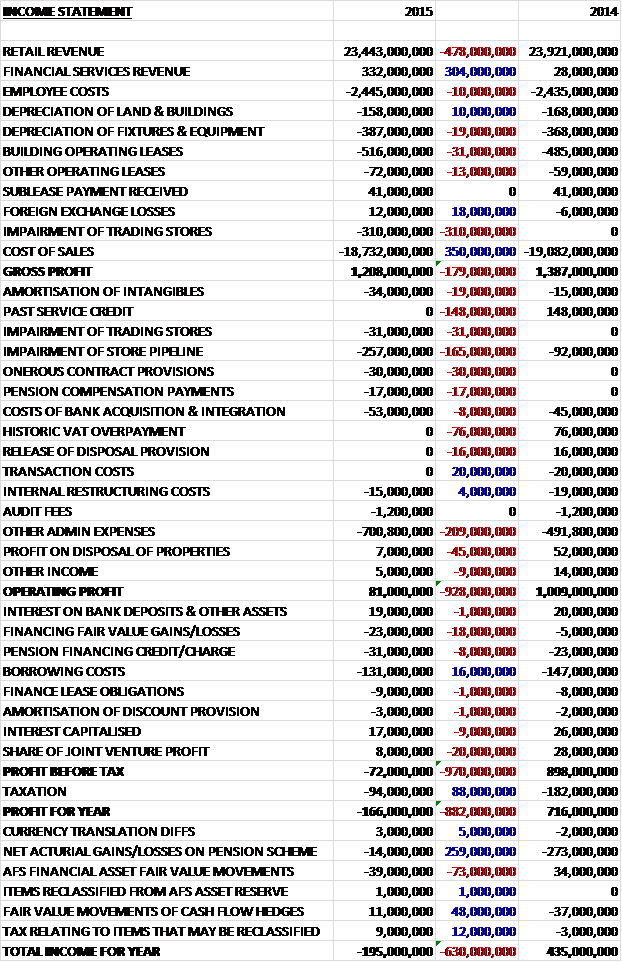
Sainsbury has now released its annual report so there are a few items that have some more detail, starting with the income statement.
SBRYincome

This is a real mess with all the one-off costs.  We can see a better split regarding where they sit within admin expenses and cost of sales which shows that underlying cost sales actually fell year on year with the underlying admin expenses increasing considerably.  There don’t really seem to be many other new items of note, although the increase in provisions seen on the balance sheet seems to be due to onerous leases relating to the closure/cancellation of stores.
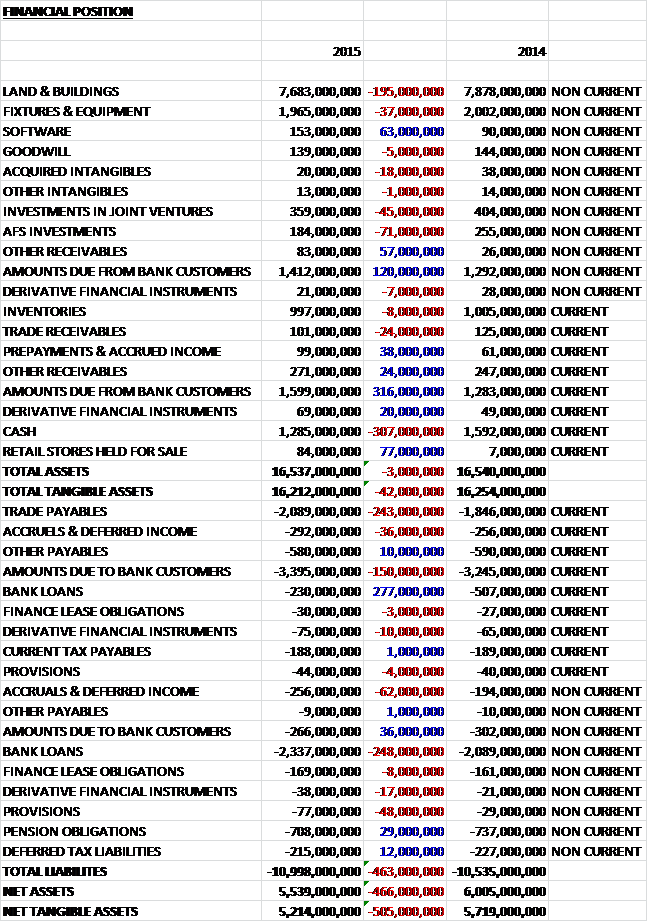
SBRYassets

The balance sheet always has more detail in the annual report – I don’t know why different receivables/payables can’t be listed in the prelim results as I feel this split is quite important.  Gere we can see that the growth in intangible assets is due to the investment in software and the increase in current receivables is due to prepayments and accrued income, along with “other receivables” rather than trade receivables.  As far as current payables are concerned, the increase is due to a hike in trade payables, and accruals partially offset by a fall in “other payables”.

I find it interesting to look at KPIs as this gives an idea of what management is prioritising and in Sainsbury’s case it makes an interesting read.  They benchmark their price and quality perception against Asda, Tesco and Morrison’s and although their quality perception is highest amongst those four, their price perception is lowest.  Also, they measure product availability at their stores and whilst the supermarket gained a “gold” rating, the rating at the convenience stores was just “bronze” which suggests this is an area that needs prioritising.  Sales growth in another area being prioritised and whilst clothing and financial services both grew faster than last year, grocery and general merchandise did not.  Other items include EPS, operational cash flow ROCE and gearing, all of which deteriorated during the year whilst cost savings improved.

Another area that only becomes apparent once the annual report is published are the huge operating leases that the group has for its stores.  These are debts that are not included on the balance sheet and really add a different slant on the balance sheet strength.  As we have seen, the group has £5.5BN of net assets but its operating lease commitments are £9.796BN and they increased by £769M year on year which could be cause for concern with some £585M of operating leases due to be paid over the coming year.  The group also has some £164M of future capital expenditure commitments and £13M for intangible asset purchases.

Overall then, a little more information but the core premise still remains – I find it hard to justify an investment here with market conditions as they are and the large amount of operating leases just confirms this as far as I’m concerned.

Sainsbury has now released a trading update covering Q1 2016.  Excluding fuel, like for like sales fell by 2.1% which was worse than the 1.9% average over last year.  Trading conditions are still being impacted by strong levels of food deflation and highly competitive pricing which have led to the falls seen despite a growth in both transactions and volumes as customers benefit from investments made in price and quality.  The board are apparently encouraged by some of the early trends that are being seen in their key trading and operational metrics.

During the quarter the group introduced new products in several categories, including areas such as produce and speciality bread and have improved their seasonal fresh offer in time for summer.  They are on track to deliver all of their planned quality improvements.  The bank saw travel money grow strongly at over 40% and was named best card provider at the Moneyfacts awards.  Clothing sales grew by 5% and the clothing online offer proved popular enough to roll it out nationwide over the summer.  The group now has 20 grocery click and collect sites and remains on track to have 100 by the end of the calendar year.  Groceries online had a record week during the quarter with 256,000 orders and it has increased the number of delivery slots available.  Three Argos digital stores were opened during the period with ten on course to be opened by the end of H1, and the convenience business remains in double digit growth after ten more convenience stores were opened.

Overall then the headline figures look pretty disappointing but it is good to be reminded about some of the initiatives being sought by management and the fact that volumes are up has got to be encouraging.  I still feel that it is too soon to buy back in here though.

On the 11th June the group announced that CEO Mike Coupe was acquitted by an Egyptian court of all charges brought against him as a representative of the company which hopefully brings an end to a rather bizarre story.

On the 29th July the group announced that Celesio, the owner of Lloyds Pharmacy will acquire Sainsbury’s pharmacy business for £125M.  In addition, Sainsbury will receive commercial annual rent payments from Lloyds for each location.  In all they have agreed to acquire 281 pharmacies including 277 in store and four located in hospitals.

On the 30th September the group released their Q2 trading update.  I suppose the headline figure is that like for like sales (excluding fuel) declined by 1.1% in the quarter which compared favourably with the 2.1% fall in Q1.  Both volumes and transactions grew as the decline in average basked spend in supermarkets continued to stabilise.  Whilst he market is clearly still challenging, with food deflation impacting many categories, progress is being made.

Taste the Difference volumes grew by over 4% over the quarter with some improvements being made to the taste and texture of the juice ranges and improved ripeness and quality of the avocados.  Promotional activity was reduced in favour of lower regular prices and the accuracy of the demand forecasting is improving which is driving better availability and lower than expected levels of waste.  The group did announce a 4% pay rise for its staff which is the highest annual pay increase for over a decade – no doubt this is being done for a) propaganda reasons and b) to mitigate the drastic effect the new minimum wage directives will have when they are introduced.

Some 27 convenience stores were opened during the quarter so they are still expanding in this area.  Online grocery orders increased by over 15% and they increased the number of click and collect sites to 52.  They also launched the Tu clothing website nationwide and the first six weeks of trading have significantly exceeded their expectations with the majority of customers choosing to collect their orders in store.  Clothing as a whole grew by nearly 13% with the back to school range proving particularly popular.  Sainsbury Bank opened its 200th travel money bureau during the quarter and saw its best ever month for travel money in July with a 35% year on year increase in transaction volumes.

Year to date the group have traded reasonably well with both sales and cost savings ahead of expectations.  Should current market trends continue, the board expect their full year underlying profit before tax to be moderately ahead of consensus forecasts.

This is an interesting update, things do seem to be improving and at a faster pace than expected.  Despite volume increases, sales value do continue to fall on a like for like basis but this is slowing.  Sainsbury just got interesting again in my view.

Havelock Europa Share Blog – Final Results Year Ending 2014

Havelock Europa has now released its preliminary results for the year ending 2014.

havelockincome

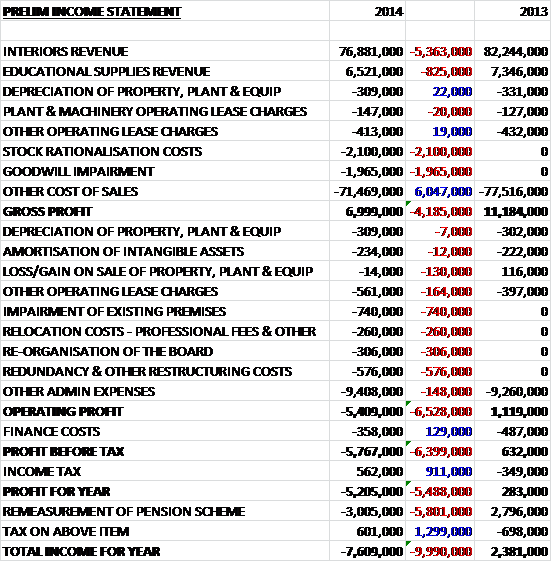
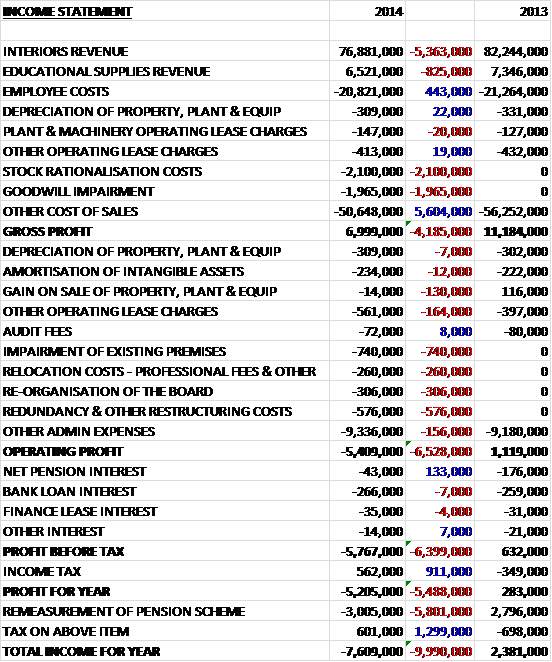
When compared to last year, revenues declined considerably with interiors sales down by £5.4M and education supplies revenue falling by £825K.  Underlying cost of sales fell by a similar amount but we see a £2.1M stock rationalisation cost and a £2M goodwill impairment impacting results to give a gross profit some £4.2M lower than in 2013.  We then see various admin costs increasing with several one-off costs here too including a £740K impairment of premises and a £576K charge relating to restructuring and redundancy.  There was some respite with a small reduction in finance costs and there was an income tax rebate (the group does not expect to be in a tax paying position for a significant period of time) to give a loss for the year of £5.2M, a £5.5M reversal on last year.

havelockassets

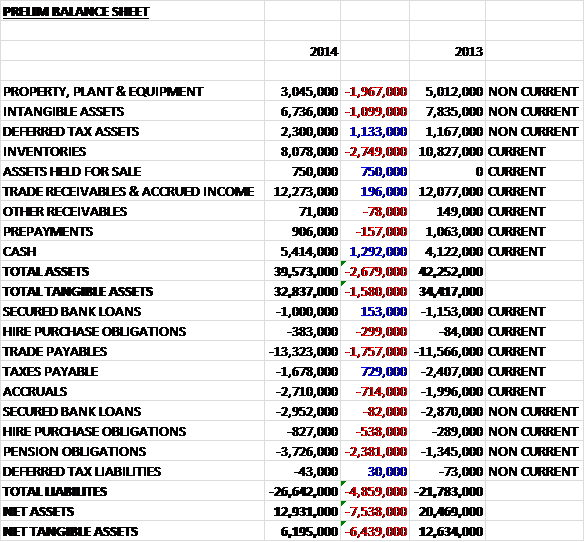
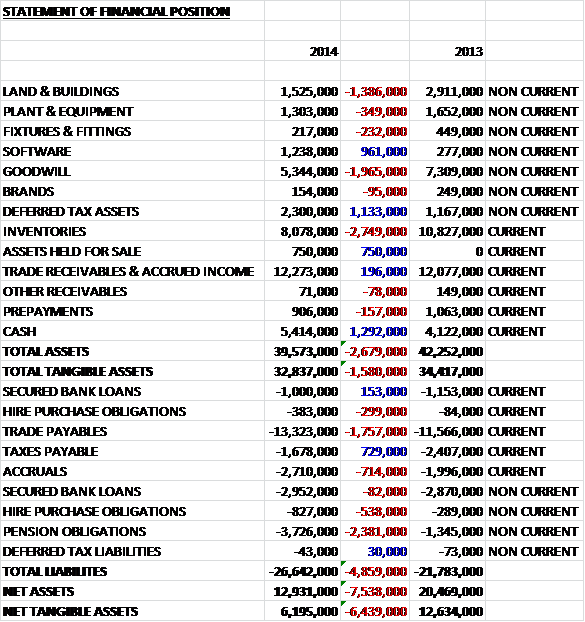
Total assets fell by £2.7M when compared to 2013, driven by a £2.7M decline in inventories, a £2M fall in property plant & equipment and a £1.1M fall in the value of intangible assets, partially offset by a £1.3M increase in cash levels and a £1.1M growth in deferred tax assets. Liabilities increased during the year with a £2.4M increase in pension obligations, a £1.8M growth in trade payables and a £714K increase in accruals, only being partially offset by a £729K reduction in taxes payable.  The end result is a net tangible asset base that more than halved to £6.2M, a disappointing performance.

havelockcash

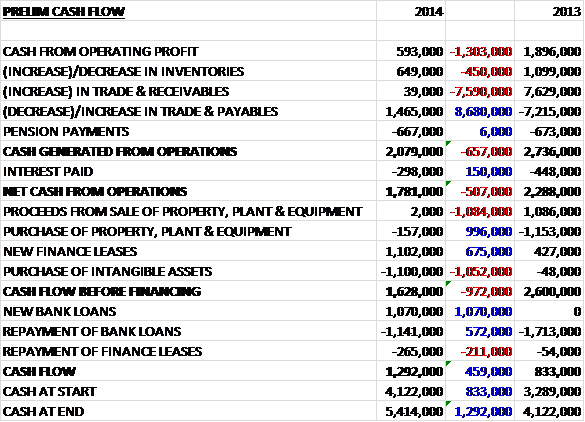
Before movements in working capital, cash profits fell by £1.3M to just £593K before a large increase in payables and a smaller interest cost meant that net cash from operations was £1.8M, a fall of £507K when compares to last year.  There was very little in the way of capital expenditure and the purchase of intangible assets, relating to the new ERP system was paid for with new finance leases (which are now fully drawn).  Even if we discount the finance leases, we still get a positive free cash flow of £500K.  After the different financing operations where finance leases increased and other loans remained broadly similar, the group posted a £1.3M cash inflow, although this is flattered by the increase in payables that suggests the group is delaying payment to conserve cash flow.
The interiors business posted an operating loss of £1.3M, a negative swing of £3.4M when compared to last year as both Financial Services and Education showed a reduction in activity.  In Retail the group had a strong year with the development of an Eastern European supply chain helping to complement the existing capabilities in China and the UK.   During the next year the group aim to develop the new customer relationships established with a number of major retailers into significant sales.  Within Financial Services, a number of the group’s customers are evaluating their offering which has led to reduced opportunities from their estates, although this was mitigated somewhat by the new three year framework contract with the Post Office.

The recovery in Education forecasted for 2015 has begun to start and management expect to benefit from this throughout the new year and Healthcare, underpinned by two major orders secured during the year, is expected to start delivering significant sales in 2015.  The increase in international sales was achieved by the continued development of the relationship with a major Australian retailer and by partnering with a number of established UK customers’ overseas operations.  The design process of the ERP system is complete and the build phase has commenced with the system remaining on course to be implemented during Q4 2015

The Educational Supplies business posted a loss of £2.6M, compared to a £258K profit recorded last year.  The Teacherboard business had a challenging year with reduced opportunities in universities, schools and interiors with the fall in sales also reflecting the withdrawal from the sound, light and seating business at the end of October.  The group continues to develop its web-based sales offering and good progress was made against this at least, during the year.

The sale of the Dalgety Bay premises and lease of the new premesis in Kirkcaldy was completed with Fife council towards the start of April 2015 and the head office relocation is on plan for the start of May.  The £700K of proceeds from the4 sale will be reinvested in fitting out the new head office.

As can be seen, there were a number of one-off costs to affect the group this year.  There was a £750K impairment charge relating to writing down the carrying value of the Dalgety Bay site that was sold.  There was a £2.1M provision against the carrying value of surplus stock which was disposed of after rationalising the stock holding policy so that they carried less stock.  It is a shame that this stock could not have been sold and it seems that this forced disposal could be due to the sale of their previous facility.  An impairment of £2M was recognised against the carrying amount of goodwill in relation to Teacherboards ltd, there was a £306K charge relating to compensation for loss of office and fees related to recruitment of a new finance director and £576K of redundancy costs and other costs incurred in the restructuring of the business.

One area of brightness is international sales, which exceeded the board’s target of being 10% of group revenue with a new target of 15% being set.  Healthcare revenue is currently small but this is another area of growth and in the near term, this is planned to grow to 5%.  Financial Services is expected to become more challenging and after accounting for 43% of revenues in 2013, this is expected to fall to below 30% in 2015 but Education is expected to rebound strongly over the next two years with the group working hard to try and make this improvement sustainable in the long term.

Going forward the Financial Services and Retail markets are expected to be challenging but the opening order book of £25M against the £14M at this time last year looks good and the head office move along with the ERP system should bring significant benefits to the group. The board expects that the upturn in the Education sector will more than offset the decline in the Financial Services sector but the continued reliance on second half orders means that visibility for the whole year remains difficult. Trading at the start of the year, however, has been in line with expectations.

After the end of the year, the group agreed a new £5M overdraft facility that should offer some much needed headroom.  Unsurprisingly given the performance there is no dividend this year and the lack of profit makes valuation on a P/E basis rather pointless which is exacerbated by the fact that I cannot find any analyst predictions for future.  The group is in a net cash position of £200K compared to net debt of £300K last year.

Overall then this is certainly a disappointing update but one that was largely expected.  The loss for the year did not make good reading but it seems this is mainly down to one-off costs with the £2.1M provision for surplus stock being particularly disappointing.  The cash generation was not too bad with a positive free cash flow recorded despite the ERP investment but this is flattered by favourable working capital movements, in particular increased payables.  It is the balance sheet where the group has felt most of the pain, though, with net assets more than halving due to the stock write-off, impairments against the previous office, an increased pension deficit and higher payables.  It does seem as though, the board may have “kitchen sinked” the bad news.  Operationally, the financial services decline has been difficult for Havelock but the education division is expected to improve and the group has a much better order book than this time last year which does offer a glimmer of hope that the worst may be over here – I will watch to see if a recovery might be underway.

HAVELOCKEUROPA-20150506-101959

After a steady decline, the chart seems to have levelled off.  It is too early to call a recovery but this might be one to watch.

On the 5th May it was announced that the group appointed David Ritchie as CEO.  He joined the company in 2013 as commercial manager having previously worked for Balfour Beatty and Wimpey.  Additionally, it was announced that the move to the new head office has been completed as scheduled.

Havelock has now released its annual report which gives a bit more detail to the prelim results.

hveincome

The only real things of interest is the extra detail for the finance costs which shows that the decline is due to a reduction in pension interest.hveassets

There is a bit more detail with regards to the assets.  We can see that the decline in property, plant and equipment was across the board with a particularly large fall in the value of land and buildings.  There is also a bit more detail with regards to the intangible asset mix, which is almost entirely goodwill.  Finally, within receivables, there was a small increase in trade receivables offset by a decline in prepayments and other receivables.  Offset against the £6.2M of net tangible assets, it is also worth noting that the group has some £2.2M in operating leases off the balance sheet.

There are also some examples of the projects that the group has undertaken that I like to read about as it give some more detail about what they have been up to.  Some of these include a new M&S store in Hong Kong where the group was responsible for ordering and delivering every item required from M&S approved suppliers with 98% of the fixtures and fittings being made by Havelock, enough to fill 16 shipping containers.  The group also worked to fit out a North Face store next to Wembley stadium and the fit out of a new concept between House of Fraser and Café Nero where the ground floor of the coffee shop in Cambridge features House of Fraser tablets where customers can shop whilst drinking their coffee.  In the House of Fraser branded 1st floor, customers can view products and try them on.  If the concept rolls out further, the group may benefit from further orders.

The group manufactured and delivered from 4,338 fixtures and 19,143 display ads for Boots’ Christmas range, along with nearly 3,000 photo kiosks and also fitted out store rebrands and new openings which makes the retailer an important customer of the group.  Another project was Primark’s first store opening in the Netherlands with three further stores in Germany.  The group acted as an installation contractor for 7 Tesco general merchandise stores along with the main general merchandise hub.  In Australia, the group commenced on a project with a new client – Kmart.  This year nine stores were refitted but there are a total of 190 across the group as a whole and in 2015 the group expects to undertake a growing amount of work for them.

During the year the group undertook the refurbishment of Lloyds Banking office in Fife which is used by more than 1,200 staff and a new branch in Manchester.  Also in financial services, the group fitted out and office for Halifax in Edinburgh that employed “challenger digital” technology.  In Education the group supplied, designed and installed the furniture, fittings and equipment for a new primary school in Burntisland and also in East Irvine which despite difficulties such as the flooding of the local river was delivered on time.  The first phase of student accommodation blocks in Edinburgh was completed during the year where the group was responsible for the design and development of all bedroom furniture as well as fitting out the loose furnishings in the lounge, window blinds and bathroom accessories.

I find it quite interesting to have a look at the KPI’s to see what management are prioritising.  Here we have revenues and profits split by segment, along with EPS as far as financial performance indicators are concerned along with waste to landfill and accidents per hour worked.  Pretty standard stuff really, with the only improvement being probably the least important with landfill tonnes per £1 of revenue reducing.

So, a bit more of interest but nothing really to change the overall story here.  On the same day, however, the group also announced the resignation of Andrew Burgess as non-executive director, apparently due to a new full time role overseas.  He has indicated that he intends to retain is 19% shareholding in the company.  This is interesting news, perhaps he sees that the turnaround work is done?  As long as he is not selling his shares, I do not see this as a negative and I am tempted to take a little position here for any recovery potential after the comment about the order book at the full year results.

On the 5th June the group released an AGM statement.  The head office move was completed during May to a location nearer the factory.  Demand in Retail and Financial Services in currently subdued but the board are encouraged by good levels of activity in the Education and International Sectors.  Forward visibility for the second half, particularly within the Retail sector, remains limited which makes a full year prediction difficult.  The group is taking action to ensure that their cost structures remain competitive and are streamlining processes to deliver improved profit margins, aided by the new ERP system that goes live at the end of the year.  So, there doesn’t really seem to be much to get excited about here.

On the 1st September the group announced a profit warning and some changes to the structure of the company.  Following a review, a number of immediate changes have been announced that include reducing staffing levels by 10% and the sale of Teacherboards to Sundeala for £1.358M.  The planned changes will reduce operational gearing and deliver annualised cost savings of £3M but is expected to reduce group operating profits in the short term.  Last year Teacherboards made a profit of £160K and had net assets of £1.6M and before the completion of the sale, the group managed to get £678K cash out of the business in the form of a “pre-completion dividend”.

The consideration will be used to reduce net debt which stands at about £3.1M.  Some £1.258M of the consideration was paid on completion and the balance of £100K will be paid on the finalisation of the completion accounts.  In addition, the group announced that demand in the retail and financial services sector remains subdued and the results for the year as a whole will be materially below previous guidance.

This is clearly disappointing for holders, but I have to say that the profit warning has not really come as a shock.  There does not seem to be any point in owning the shares at the moment as I can’t really see any coherent strategy for growth.

Avon Rubber Share Blog – Interim Results Year Ending 2015

Avon Rubber has now released its interim results for the year ending 2015.

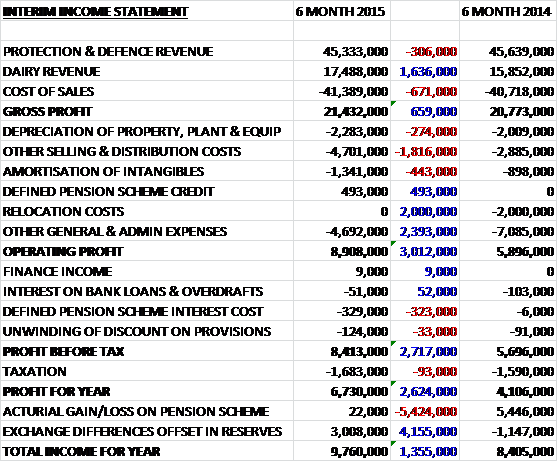
avoninterimincome

When compared to the first half of last year, revenues increased as a £1.6M growth in dairy sales was partially offset by a £306K fall in protection and defence revenue.  Cost of sales increased slightly to give a gross profit some £659K ahead of last time.  Distribution costs increased but admin costs fell during the year which included the lack of a £2M relocation cost that occurred last year and a £493K pension scheme credit this year to give an operating profit some £3M higher.  We then see an increased interest cost on the pension scheme and a slightly increased tax bill to give a profit for the half year of £6.7M, an increase of £2.6M compared to the first half of 2014, although the underlying profit increased by a much smaller amount.

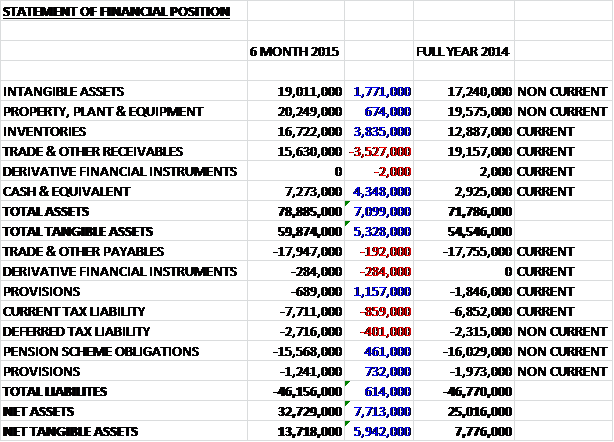
avoninterimassets

When compared to the end point of last year, total assets increased by £7.1M driven by a £3.8M growth in inventories, a £4.3M increase in cash levels and a £1.8M growth in intangible assets, partially offset by a £3.5M decline in receivables.  Liabilities fell during the period as an £859K growth in current tax liabilities and a £401K increase in deferred tax was more than offset by a £1.9M fall in provisions due to the payment of £1.6M with regards to property obligations and £471K being paid with regards to facility location – the remaining provisions are all for property obligations.  The end result is a £5.9M increase in net tangible assets to £13.7M – this looks to be a good performance.

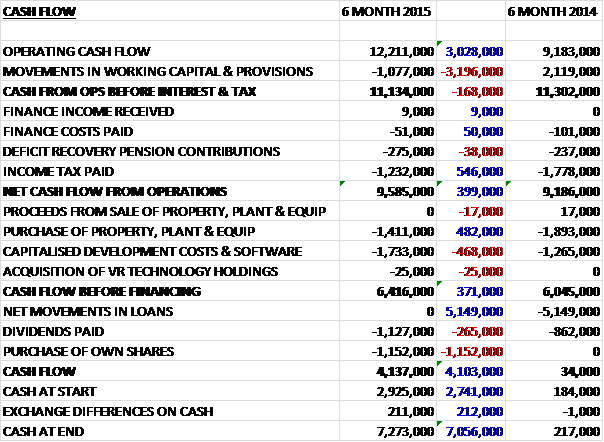
avoninterimcash

Before movements in working capital, cash profits were some £3M higher than during the first half of last year at £12.2M but adverse working capital movements meant that cash from operations fell by £168K to £11.1M.  This was reversed by a decline in tax paid so that net cash from operations stood at £9.6M, a £399K increase.  Of this cash, £1.7M was spent on development costs and £1.4M was used to acquire property, plant and equipment which led to a very healthy free cash flow of £6.4M, up by £371K.  Roughly equal amounts of this cash was used to pay dividends and purchase their own shares to give an excellent six month cash flow of £4.1M that meant the cash pile at the period end was £7.3M.

Profit at the Protection & Defence division was £6.2M, a £1.5M increase when compared to the same period of last year, although it should be noted that this includes £2M of exceptional relocation costs relating to the Lawrenceville facility that occurred in 2014 and if these are removed, there was a £500K decline.  The decrease arose from the mix of product shipped, being heavily DOD biased, whereas the comparable period had a heavy non-DOD weighting.  The DOD contract enables the group to fulfil other orders as and when they arise and meet the DOD’s demand in periods when other orders are lower.  The division benefited from cost savings following the consolidation of the US sites, increases in sales to Fire customers as the new Deltair product gained traction and AEF enjoying a successful period.

As touched on above, M50 respirator sales to the DOD were significantly higher than in the first half of last year, increasing from 58,000 to 112,000 systems.  During the period a further order was received for 160,000 masks which means that there is good order coverage well into 2016.  The group did not deliver any M61 filters during the period, compared to 162,000 pairs last time as a competitor qualified its filter and fulfilled its first order, which seems like a concerning development.  In the long term, the board believe end user demand will grow but obtaining shore term visibility of future orders is challenging.  Having said that, some further filter requirements are expected in the second half of the year.  Last year included the delivery of the 52,000 C50 order but sales to foreign military, law enforcement and first responder customers reduced year on year but there has been a decent level of enquiries for the respiration protection products and the pipeline of individually smaller sales opportunities has grown with the group poised to deliver a richer mix of sales in the second half of the year.

There was a strong growth in sales to the North American Fire market following the release of the new Deltair SCBA.  The product is designed to meet new US regulations and to deliver enhanced operational performance and it has been well received by the market and remains one of only four units to receive approval to date.  The number of enquiries has given the group confidence that the product can continue to enhance its market share further.  Other DOD spares sales were lower than in the same period of last year reflecting the timings of orders and delivery schedules.  Order intake has been positive and higher levels of revenue in this area are expected in the second half of the year.  The industrial escape product, launched in 2014, was well received in oil and gas markets and AEF saw a continuation of the high level of order intake experienced last year.  In total, the order intake during the first half in the division totalled £47M and at the period end, the closing order book stood at £38M.

The funded development programme with the US Air Force to design and test the MM53 Joint Service Aircrew Mask progressed well with the prototype product passing the customer’s design review during the period.  The customer expects the production phase of the programme to commence in 2017.  The Emergency Escape Breathing Device received NIOSH approval in late 2014 and the group expects to hear from the US Navy with regards to an order in the second half of the year.

Profit at the Dairy division was £3.3M, a £600K increase when compared to the first half of last year.  The group grew in all of its markets, supplemented by the positive translation effect of the stronger US dollar with an increasing proportion of higher margin Milkrite sales also contributing to the increased profit.  Globally, milk prices have remained at acceptable levels and farmer input costs have been favourable meaning that there has been less pressure on farmer revenues and margins and therefore normal levels of demand for the consumable products.  In Europe, Milkrite’s market share increased as a result of the increased sales force, enhanced technical support and larger distribution network.  The Impulse Air mouthpiece vented liner continued to gain traction with its market share increasing from 2.6% to 3% over the past six months.

In the US, the Milkrite Impulse Air mouthpiece vented liner continued to perform well, with its market share increasing from 21% to 22% during the period.  The Cluster Exchange Service was launched in the US and Europe in 2014 and growth rates are exceeding expectations.  By the end of the period, it was servicing 342,000 cows on 1,100 farms.  The service enhances the value of each direct liner sale made and should lead to a more robust and sustainable business model.  In China, year on year revenue grew strongly against a weak comparator period.  In many other emerging markets, including Brazil and India, the number of dairy cows being milked using automated milking processes is growing rapidly which is adding to the market potential for the products sold.  A distribution centre was opened in Brazil during the period to serve the South American market with the first sale being made late during the period and the start-up is expected to make a positive contribution to profit by 2017.

Trading is normally weighted to the second half and it is believed that this will be the case this year.  There is a strong forward order book in Protection and Defence and it is expected that the momentum in Dairy will continue.  The board therefore expects to meet market expectations for the full year.

After a 30% increase in the interim dividend, the shares are currently yielding just 0.8%, increasing to 1% on the consensus forecast for the full year.  There is a net cash position of £7.3M, a good increase when compared to the £5.5M of net debt at the end of last year and a £2.9M increase when compared to the end point of last year.  There is also plenty of headroom with £26.5M of undrawn bank facilities available.

Also today the group announces that after fifteen years at the company, the last seven of which were as CEO, Peter Slabbert is stepping down from his role and is leaving Avon Rubber on the 30th September.  He is apparently leaving for a change in lifestyle but this is a bit of a blow as he has no doubt been an exceptional CEO.

Overall then this has been a fairly decent updates.  Underlying profits edged higher, net assets improved considerably and the strong cash generation continues apace.  The excellent performance in the dairy division, driven by lower farmer inputs, new products gaining traction and increased orders in China was partially offset by a slightly disappointing performance in protection and defence with a new competitor meaning that M61 filter orders ceased, although the second half is expected to improve with the new emergency escape breathing device expected to secure orders from the US Navy.  The dividend yield remains low but there is a large amount of net cash that could be used to invest into the business or return to shareholders.  The retirement of the long standing CEO is a bit of a blow so I hope the successor will be able to continue with his success.  I remain holding the shares with an eye on the performance of the defence business.

AVONRUBBER-20150505-102455

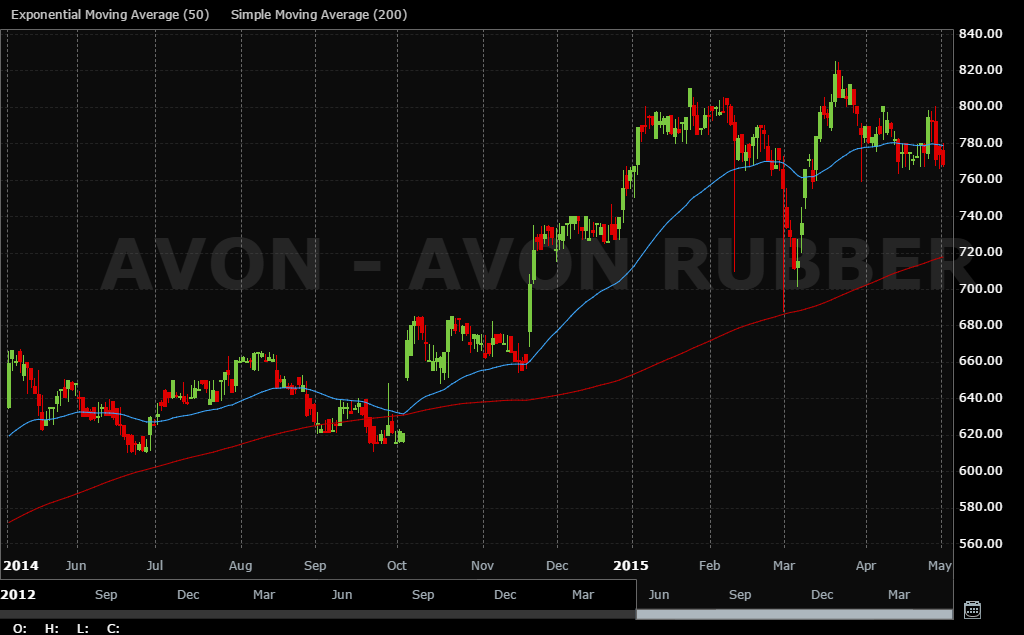
There has been some recent weakness in share price with a sideways trend so far this year but the long term uptrend based on the 200 day moving average is still intact.

On the 6th August the group announced that they are acquiring InterPuls for a cash consideration of €25.75M along with the acquisition of €4M of net debt belonging to the company.  Interplus is a family owned company in Italy that has developed a range of specialist milking components, including pulsators, milk meters, automatic cluster removers and vacuum pumps.  In addition to traditional milking components, they are also expending into high-tech sensors and devices to monitor the life cycle of a cow, analysing milk production, reproduction and health data to provide critical management information to increase the operational efficiency of the farm.  The acquisition generates goodwill of just under €20M and profit before tax was €2.3M last year.  The group expects the acquisition to be significantly earnings enhancing in 2016.  It should broaden their product range, client base and geographic reach and seems a decent if slightly expensive acquisition to me.

On the 2nd September the group released a trading update.  In the Protection and Defence division, as expected, deliveries of the mask systems to the DOD remained at a similar level to that seen in the first half of the year and the group received their first M61 filter order of the year for 123,000 pairs which will be partially fulfilled before the year end.  The non-DOD markets have performed well without the benefit of any significant individual impact orders.  A number of high value opportunities are in the pipeline and they now expect to see the benefit of these orders next year.  The flexible fabrications business is expected to show a strong second half of the year.  The development programme with the US Air Force for the JSAM MM53 continued to progress well and they have been awarded additional funding to support the next year of testing with a production contract expected to follow thereafter.   The integration of HUDstar Systems is progressing well and positive benefits are expected next year.

In the Dairy division, the positive momentum generated in the first half of the year has continued and trading remains strong.  Take up by farms of the Cluster Exchange Service remains at encouraging levels in both North America and Europe.  The continued positive performance in both areas of the business therefore leads the board to expect that the outturn for the current year will be in line with current market expectations.

On the 1st October the group announced the appointment of Rob Rennie as CEO from December.  He has held a number of positions at Invensys, with the most recent role being president of the energy controls group, a division with annual sales of more than $400M.  This group included Eurotherm, a supplier of industrial and process control, measurement and data management solutions.  He was the driving force behind the evolution of Eurotherm and was part of the team that sold Invensys to Schneider Electric in 2014.

On the 6th October the group released a statement covering trading in the year a whole and the year has ended strongly.  This was primarily driven by the receipt and rapid fulfilment of a late order for respirators from a customer in the Middle East.  This, together with strong trading in the American law enforcement market, leads the board to expect the adjusted operating profit for the year to be significantly ahead of current market expectations.  A number of high value Middle Eastern opportunities remain in the pipeline and the board expect to see the benefit of these orders in 2016.

This sounds like a great update to me, with the promise of further next year.  I suppose the only mitigation is whether these orders will be sustainable on an ongoing basis but nonetheless, really pleased with this update and surprised the shares have not gone higher.

On the 9th October the group announced the acquisition of the Argus thermal imaging camera business of EV2 technologies for £3.5M in cash which will be funded from existing debt facilities.  Argus is a designer and manufacturer of thermal imaging cameras for the first responder and fire markets with revenues of £5M last year.  It is expected that the acquisition will be modestly earnings enhancing in the current year and it is a strategic addition to the fire and first responder product range and should generate longer term product development opportunities for the protection and defence business.

Matchtech Share Blog – Interim Results Year Ending 2015

Matchtech has now released its interim results for the year ending 2015.

matchtechincome

Revenue fell when compared to the first half of last year as a £1M decline in engineering revenue was only partially offset by a £324K increase in professional services. We also see cost of sales fall, however, to give a gross profit some £331K higher. There was then a £379K increase in share based payments with the remainder of the underlying admin expenses broadly flat but £710K in acquisition costs and £220K in restructuring costs, partially offset by a £287K fall in finance costs meant that profit for the period fell by £668K, a bit of a disappointing result actually.

matchtechassets

When compared to the end point of last year, total assets fell by £7.7M driven by a £9.6M decline in trade receivables, somewhat offset by a £1.9M increase in other receivables. We also see a fall in liabilities due to a £7.6M fall in payables and a £1M decline in borrowings which means that net tangible assets increased by £1.2M to £40.2M. This is a very strong balance sheet currently but this is likely to change once the acquisition is taken into account.

matchtechcash

Before movements in working capital, cash profits fell by £436K to £6.8M. Payables and receivables broadly cancelled each other out and after tax and interest, both of which were lower than last year, the net cash from operations came in at £5.3M, a decline of £37K. This was easily enough to pay for capital expenditure which mainly related to leasehold improvements, and free cash flow was an impressive £4.9M which filtered through to a cash inflow of £1.2M for the year after dividends.
Overall NFI was up 2% with contract NFI increasing by 3% and contract margins improving from 7.4% to 7.5%. NFI conversion declined to 24% from 28% and Permanent fees were broadly flat year on year
Underlying operating profit at the Engineering division fell by £300K to £4.7M. The business saw NFI increase by 5% with contract NFI up 3% and permanent fees up 17%. Infrastructure NFI increased by £1M to £4.8M with a very high demand for skilled engineering personnel in the sector driven by continued investment in highways maintenance schemes and new build rail infrastructure, along with a recovering property market. Energy NFI fell by £300K to £2.1M with the well documented challenges in the oil and gas market being partially mitigated by focussing on Power, Nuclear and Renewables markets where NFI was up 43%.
NFI increased by £200K to £1.8M in the General Engineering sector that fed off strong growth in the UK’s high-tech manufacturing sector. Automotive NFI fell by £100K to £2.1M with a steady performance in the UK as the group worked with clients on their innovative and global sourcing strategies. NFI at the German business fell by £100K to just £200K but the business has been downsized and it is now at a broadly break-even level. Aerospace NFI was flat at £1.7M as a downturn in design requirements was offset by increased demand for manufacturing skills as the sector moves its focus into the build phase. Maritime NFI fell by £100K to £1.5M with the sector being adversely affected by the previously announced closure of shipbuilding at Portsmouth Naval Base.
Underlying operating profit at the Professional Services division increased by £300K to £1.8M. The NFI declined by 3% to £8.5M with contract NFI up 2% and permanent fees down 10%. Technology NFI was up £100K to £5.8M with growth below expectations considering the macro-economic recovery. The group expects the shortage of permanent staff will lead to an increase in demand for temporary labour. The electronics market remained busy while the fall in the price of oil has affected Controls and Automation and the group has re-aligned its structure in order to capitalise on an improving market, focussing on higher value roles and offering a niche service that will better appeal to a demanding customer base in a mature market.
NFI at Barclay Meade fell by £200K to £2M and after a review, the board believes that the London operation that serves non-engineering and technology clients has not gained enough traction to be viable over the medium term. As a result, this part of the business will be closed. NFI at Alderwood fell by £200K to £700K due to the uncertainty in the apprenticeship sector due to the potential changes in government funding that has affected the volumes of staff being recruited, something that is likely to continue until after the general election.
During the period, the group won a six year contract with Southern Water to provide them with engineering, operational and head office staff. They have also extended an existing contract with BAE for a further three years to provide engineering and technology staff across the company. After the end of the period, the group acquired Networkers International for approximately £57.9M. The acquisition adds telecoms recruitment to the group’s activities and also adds a substantial and profitable overseas operation with offices in Africa, Asia, Europe, the Middle East and the Americas. The consideration was paid for with £29.3M of cash and equity of £28.6M
Based on trading in the first two months of the new year and continued close cost management, the board expects the results for the full year to be in line with expectations with an additional four months contribution from the acquired company. At the end of the period, net debt stood at £1.9M, a reduction of £8.6M when compared the same point of last year. After the post period end acquisition, net debt stood at approximately £45M with the group entering into a £30M three year loan with HSBC. After the 5% increase in the interim dividend, the shares now yield 3.9%, increasing to 4% by the end of the year at current estimates.
Overall then this was a bit of a disappointing update. Although profits were down, this was only due to the acquisition costs and an improving net asset level was offset by a fall in operational cash flow, although the group still generates substantial amounts of free cash flow. Operationally, there has been slower than expected growth with both the problems affecting the oil and gas industry and the upcoming general election causing a drag on results. The purchase of Networkers after the period end is transformational for the group and should give Matchtech the chance to enter several new markets. For the moment, though, I think I will remain uninvested here until more progress is made with the acquisition and trading improves.

On the 17th April it was announced that CEO Brian Wilkinson purchased shares to a value of £193K to give him a holding of 45,000.

On the 31st July it was announced that non-executive director Stephen Burke tendered his resignation and will step down with immediate effect.  No reason was given for his resignation and he had been with the company since 2006.

On the 6th August the group released a trading update covering the full year. Overall, profits should be in line with current market expectations and will include a maiden four months contribution from Networkers International.

At Matchtech total NFI increased by just 1% to £45.4M. Both contract and permanent NFI increased by 1% and within contract a 2% increase in Engineering NFI was partially offset by a 2% fall in professional services NFI. Within permanent, a 27% increase in engineering NFI was mostly offset by a 14% fall in professional services NFI. During the four months at Networkers, total NFI was flat year on year with a 3% increase in contract being offset by a 7% decline in permanent NFI. The second half of the year was impacted by the closure of the Barclay Meade London operation which had not gained enough traction to be viable over the medium term.

Investment in headcount at the end of last year did not translate into the expected increase in client demand so it was reduced again during the second half of the year but combined with the continued management of other overheads, profitability is expected to be in line with expectations.

Net debt stood at £35.5M at the end of the period compared to £3.1M at the end of last year, mainly as a result of the acquisition. The integration of Networkers has started well and the board is confident of achieving its targets for overhead savings by the end of 2016, although this is expected to incur integration costs of around £1M both in 2015 and 2016. In addition, the board has accelerated its plan to integrate certain sales teams and from August the IT businesses of both companies will have a common leadership.

At the start of the new year, the group will integrate the engineering business and looking ahead the board’s plan is for group NFI to return to growth in the second half of 2016 with further growth over the medium term. Clearly the first half of 2016 is not expected to be particularly strong then and this update is rather lacklustre overall in my view given the buoyant state of the UK job market – still this was broadly what was expected given earlier updates so no real surprises.

Kalibrate Technologies Share Blog – Interim Results Year Ending 2015

Kalibrate has now released its interim results for the year ending 2015.

kalibrateincome

Revenues increased when compared to the first half of last year with a $1.4M increase in Pricing revenue and a $143K growth in Planning sales. Operating expenses also increased but the large reduction in exceptional items helped operating profit increase by $1.7M. After a slightly higher tax bill, the profit for the half year stood at $1.1M, a favourable swing of $1.5M, almost exactly the same as the reduction in exceptional items.

kalibrateassets

When compared to the end point of last year, total assets decreased by $2.3M driven by a $4.2M fall in cash, partially offset by a $1.5M growth in receivables. Liabilities also fell during the period due to a $2.9M decline in payables to give a net tangible asset level of $10.4M, a $318K increase when compared to the end of 2014.

kalibratecash

Before movements in working capital, cash profits increased by $1.9M before an increase in receivables, relating to a few transactions that closed near the year end, and a decrease in payables meant that there was a cash outflow of $2.6M from the operations compared to an outflow of $66K this time last year. After capital expenditure and a small amount of finance lease payments, the group lost $4M in cash during the six month period to give a cash level of $5.6M at the half year point which seems to be quite a disappointing performance.
During the period the group did not lose a single customer with 100% client retention which is really rather impressive. The group also managed to sign an additional four of their clients onto both their pricing and planning services, bringing the total using both up to 31. Good progress has been made in expanding the global footprint by adding clients in the new markets of Mexico, Brazil, Kenya and the Philippines with India, Mexico and Kenya all announcing that they are planning on deregulating their markets.
Revenues at the Pricing division increased by 16% as a result of new license sales and selling into both new and existing clients but underlying operating profits fell by $128K to $874K. The group now has 22 managed services clients, an increase of 10 from the start of the year and the focus remains on converting existing clients as well as adding new customers to the managed services offering and they are in the process of increasing operational and sales resources to support this growth potential. Planning revenues increased by just 3% but underlying operating profit increased by more than $200K to $904K driven by a 43% growth in North American business that was offset by declining revenues in Japan due to a reduction in site count in the country. There has been increased interest in Europe where the business has signed agreements to conduct market studies in Ireland and Finland.
Geographically the group achieved a modest 5% revenue growth in North America with the 43% increase in planning sales as a result of cross-selling planning products to existing pricing clients and generating new revenue from additional data reselling to existing clients. The pricing division saw a slight decline in revenues in the region as several clients move to the SaaS model instead of the perpetual license up front model. Revenue in Europe increased by 60% due to the previously mentioned large contract with the major oil company and the signing of several new planning deals in Finland and Ireland. Revenues in the rest of the world fell by 13% year on year as the Japanese market declined due to the reduction in sites to survey, offset by some improvement in market studies in Africa. With the deregulation trends continuing in various countries, the group sees growing demand for both the pricing and planning product lines in the rest of the world with an expansion of the client base in Malaysia and new market studies in Kenya and Morocco. In addition the group completed a consulting consignment for a client in Mexico regarding the deregulation plans in that country which they hope will lead to pricing and planning opportunities there.
In September the group introduced the Kalibrate Cloud platform that houses all of their pricing solutions in one cloud based platform and during the second half of the year they expect to add their planning software product onto the platform. The group has devised the “7E” process that combines information amassed in their data warehouse to provide a score upon which clients can benchmark the seven elements that make retailers successful in their marketplace – pricing, location, brand, facility, operations, merchandising and market. This score allows them to provide strategic consulting advice alongside their software products. The bi-product of providing market planning service throughout various geographies enables the group to amass data that they can utilise to support their clients within the 7E process or allow them to sell the data to other third parties. Most notably, they have up to date traffic statistics at over four million traffic points in North America and various other countries around the world.
The group have now fully implemented their first major multi-country managed services contract for a major oil company’s petroleum retail network that is generating about $2M per annum in recurring revenue. During the year the group also managed to move 9 clients representing $2.9M in bookings from the historic perpetual license structure to the SaaS platform which has helped achieve about $20.7M in annual recurring revenue, up from $19.6M at the start of the year. The order book has increased by 13% to $23.6M at the period end.
The market that the group operates in has recently experienced a significant decline in the market price of petroleum products, along with a collapse in the price of crude oil. In environments such as these the integrated refiners/retailers can experience capital pressures which may lead to delays in capital spending. So far the group has not experienced any effects on its business but it something that management are keeping a close eye on. The group has announced that it plans to invest across the business over the coming years to strengthen the sales and marketing efforts, increase product development resources and adding resources to support growth in the managed services business. These investments are likely to increase the cost base for the company going forward.
As they enter the second half of the year the board remain confident that the group is on track to meet expectations for the year as a whole. The decline in oil price has actually improved margins for many fuel retailers and the group enters the second half of the year with a strong deal pipeline and is on track to meet expectations for the year as a whole. Net cash at the period end stood at $5.6M, some $4.1M lower than at the end of last year and no dividends were proposed during the period.
Overall then this seems to be a solid if rather unexciting performance. Underlying profits were broadly flat and net assets increased slightly, although there was a cash outflow at the operating level which is possibly caused by the move onto the SaaS system for some clients that involve less upfront cash. The fact that the group had 100% client retention during the period is impressive, the order book is improved and there seems to be some decent opportunities in Mexico, Malaysia and Kenya but the reduction in the oil price has the potential to be an issue and the board of flagged up an increased cost base for next year so there could be some headwinds. In conclusion, this is a company that I quite like but progress seems to be a bit slow so far for me.

On the 17th March the group announced that it had secured a contract with NIS in Serbia, one of the largest vertically integrated energy companies in South East Europe with operations in Bosnia, Hungary, Romania, Bulgaria and Serbia.  NIS will utilise the group’s retail network planning and location analysis solution to optimize performance of its network of retail outlets that will help it decide where to build or remodel its retail sites.  This deal adds three new countries to Kalibrate’s list.

On the 15th July the group released a trading update covering the full year ending 2015.  Overall the board expects EBITDA to be in line with expectations.

During the year the group has secured multiple new contract wins which have been secured largely on a SaaS basis which offers longer term client relationships of about three to five years and higher overall gross margins.  At the same time they have been converting a number of existing perpetual license clients to SaaS based agreements.  This acceleration has had some short term impact on the revenue and cash generated during the year, however.  Annualised recurring revenues at the year-end stood at $21M compared to $19.6M at the same point last year and the group’s order book increased by 15% to $41.1M.  The cash balance at the same point in time stands at $4.6M.

The group has seen revenue growth in both core geographies and new markets with new perpetual license wins in Q4 with two new North American and one new European fuel retailer.  The group has secured new clients for its Planning services in Bosnia, Bulgaria, Chile, the Czech Rep, Ireland, Kenya, Mexico, Romania and Serbia and has also begun to deploy its pricing services in Brazil.

Overall this is a decent enough update in my view but it will be interesting to see what effect the move to SaaS contracts has had on cash flow.

Kalibrate Technologies Share Blog – Final Results Year Ending 2014

Kalibrate Technologies is a provider of price management and optimisation solutions to the fuel and oil & gas wholesale industries.  The pricing division offers a comprehensive fuel pricing solution that leverages historical price, volume, competitor and market intelligence to optimise wholesale and retail fuel pricing strategies.  The group’s location solutions allow clients to maximise capital investments across their store network through market and demand analysis, forecast and demand analysis across a number of revenue categories and competitive assessments.  They were admitted onto the AIM exchange in November 2013 having been listed by the former parent company, Eurovestech and are headquartered in Manchester. They have now released their final results for the year ending 2014.

kalibrateincome

Revenues rose when compared to last year with a $3.1M increase in pricing revenue and a $1.5M growth in planning sales.  We also see staff costs increase by $2.7M and other underlying operating expenses grow by $1.4M but exceptional items relating to the IPO meant that operating profit fell by $1.3M when compared to 2013 which became a $1.2M decline after finance costs but the reversal of a tax credit that occurred last year (mainly due to the recognition of previously unrecognised tax losses) meant that profit for the year fell by $3.1M to $195K, although as we have seen, this is down to non-underlying items.

kalibrateassets

When compared to the end point of last year, total assets increased by $9.1M driven by a $7.4M increase in cash levels, a $1.3M growth in internally generated software and an $847K increase in trade receivables.  Liabilities fell during the year as a $2.7M loan owed to the previous parent company was paid off, which was partially offset by a $2M increase in accrued expenses and deferred income.  The end result is an $8.7M growth in net tangible assets to $10M and the $1.3M worth of operating leases are well covered here by assets.

kalibratecash

Before movements in working capital, cash profits fell by $1.1M to $1.4M but an increase in payables meant that cash generated from operations increased by $1.8M to $3.2M before this was eroded slightly by higher finance costs and tax so that net cash from operations came in at $2.8M.  This was enough to cover the $1.6M expenditure on intangible assets and the $233K spent on property plant and equipment to give a free cash flow of $966K.  We then see the effect of the equity issue which raised $8.2M that was partly used to pay off the loan with the rest resulting in a cash inflow of $7.1M to give a cash pile of $9.7M at the year end.

Progress has been made in increasing recurring revenues during the year which grew by $4M to $19.6M and the opening year order book stood at $22M compared to $16.3M at the end of last year.  The existing client base has now grown by 12 to include 230 customers.  There has also been some expansion into new geographies with a new office being opened in Thailand to support the Southeast Asian business and a new office being opened up in Melbourne, Australia.  During the year the group also contracted with a third party offshore development team in Vietnam which should help accelerate the rollout of new supplementary solutions including further mobile technology and the development of new products.

The global fuel retail market is a highly competitive one and client’s exposure to price volatility and a constantly changing environment ensures Kalibrate’s products and services remain relevant.  There is deregulation of fuel pricing in certain countries with the continuing emergence of compliance frameworks and future plans in some areas to deregulate represents an opportunity for the group to expand into these countries with the biggest potential prizes being China and India.  The group has successfully completed their contract with the US Government’s National Renewable Energy Lab and the evolution of alternative fuels as a viable alternative to traditional fossil fuels continues with many operators now considering how best to position themselves to supply their consumers with these new fuels.

Underlying operating profit at the Pricing business was $1.6M, flat when compared to last year.  Revenues did increase by 20% though driven by new client wins and improved sales into the existing client base with North America performing well.  A number of clients were added in Western Europe and the rest of the world grew strongly, albeit from a relatively low base.  Underlying operating profit at the Planning business was $1.4M, an increase of $300K when compared to 2013 with revenues growing by 16%.  Growth has been achieved in North America, Japan and South Africa together with new areas such as South East Asia and Africa.  The European planning business also expanded during the year and this is seen as a more important revenue stream in the future.

Geographically, revenues in North America grew by 30% and this region represents just over half of total sales.  The pricing business won a number of new clients included a convenience retailer with more than 400 sites, and an East Coast based 300 site fuel retailer who was previously just a planning client.  The data reselling business grew modestly and initial benefits are being seen after an increase in marketing efforts.  Europe makes up about a quarter of total revenue and sales increased by a modest 2% with the region delivering a stronger second half performance than first half. During the year new pricing contracts were won in Germany, the Netherlands and Spain and the group was selected by a major Finnish retailer to provide both pricing and planning solutions which is the first time a combined solution was sold to a new client.  Operationally the group also completed a nine-country implementation of their software to a European retailer with more than 2,000 fuel sites.

With the rest of the world making up the remaining quarter of revenues, sales here grew by 17% year on year.  The core planning businesses in Japan and South Africa remained strong and was supported by growth in Oceania where the group won a SaaS Pricing contract with a 200 store retailer in New Zealand, and South East Asia where they delivered a substantial planning project across Malaysia as the country prepares for deregulation.  The group also signed a combined pricing and planning contract in Morocco where their new client was keen to benefit ahead of that country’s deregulation, thereby gaining a first mover advantage in that market.

During the year the group finalised a multi-year contract with one of its existing clients to provide managed services for the petroleum retailer’s entire fuel pricing process and procedures.  Also the group won a multi-country managed services contract with a global oil company under which the client will outsource the management of their entire pricing structure to the group.  This represents the largest single client ever by value and will generate about $2M per annum over the multi-year term and the contract commenced in July 2014.  To date the client has already started to see the benefits of moving to the new platform.

During the year the group launched Kalibrate Cloud which is a cloud based service that will incorporate all of their existing products and services together in one place.  Historically the pricing product has been sold through the sale of an upfront perpetual license to a client but there is a trend for IT departments to outsource niche solution offerings and as such the group are positioning themselves to sell more SaaS subscriptions in the future which should help ensure long term client partnerships, enhance forward visibility and increase recurring revenues.  As part of this strategy, they are also looking to convert existing clients to a managed services offering.  This year the group cross sold their products to nine more clients so that 27 now take both pricing and planning solutions with 14 taking the managed service offering – the management reckon there is the potential for 100 of these type of contracts possible in the medium term.

I quite like it when an annual report has a case study regarding a contract.  Here we have a major oil company operating in South East Asia who is looking to benchmark the characteristics and performance of its retail network against best in class global fuel retailers.  The contract involved benchmarking across 44 leading retailers across the globe with a subset of the data including outlet counts, facility characteristics, brand and volume performance and the client could compare performance across these factors against retailers from the US, Japan and Malaysia.  The outlet share position was plotted for each of the retailers in the study as compared to the optimal outlet position, defined as the point beyond which the retailer would start cannibalising its own network and the client discovered that it was cannibalising its network at a greater rate than the other retailers and opportunities were highlighted for financial improvement for the retail network.

The group makes the majority of its revenue in North America and one European client makes up 9% of sales which would clearly be a loss if they were to disappear.  The group does also seem to have quite a lot of receivables that are overdue, with £2.8M this year compared to £1.1M last year, although apparently they relate to a number of independent blue chip customers.  There is also some sensitivity to exchange rate changes with a 10% change in the US Dollar against the Euro would impact the result to the tune of $199K.  The group is susceptible to an economic downturn which may have an adverse effect on the demand for their services.

At the IPO Neville Davis was appointed as non-executive director.  He has a background in general management and finance within the technology sector with experience working with growing technology companies looking to achieve growth via both organic and acquisitive means.  Since then the board has been further strengthened by the appointment of Nick Habgood.  He is a founder of Azini Capital, a private equity firm that is one of Kalibrate’s major shareholders.

Going forward, with the cautiously improving global economic outlook, the board are going into the new year with confidence that they will be able to deliver against their objectives in the year ahead.

The shares currently trade on a hefty underlying P/E of 23.8 but this reduces to a more sensible 17.1 on N+1 Singer’s forecast for next year.  There are currently no dividends being paid or forecasted.  Net cash at the year-end stood at $9.6M compared to a net debt position of $500K at the end point of last year, mostly due to the equity fundraising at the time of the IPO.

Overall this is a mixed start to listed life for the company.  Profits were down but when the IPO costs and last year’s tax credit was removed, they were broadly flat.  Net assets improved due to the equity issue to give a decent looking balance sheet and operational cash flow improved, although looking closer this seems to be a result of favourable working capital movements, to give a free cash flow of nearly $1M.  This is an interesting niche and there are certainly opportunities for the company to grow with deregulation in more countries (most recently Malaysia and Morocco) giving scope for geographical expansion and the ability to cross sell their services to existing clients also offering a route to growth.  In conclusion then, I do like this company but might wait to see how they bed in to life as a listed entity.

Goodwin Share Blog – Interim Results Year Ending 2015

Goodwin has now released its interim results for the year ending 2015.

goodwininterimincome

Overall revenues increased year on year driven by increased Pacific Basin and other Europe sales with mechanical engineering up £1M and refractory engineering increasing by £695K.  We then see an increase in depreciation offset by a fall in amortisation and other cost of sales so that gross profit was £1.5M ahead of last time.  A small increase in distribution expenses was then offset by an increase in other operating expenses before a slightly lower finance expense meant that profit before tax increased by £1.2M which reduced to a £751K increase to £10.5M after higher taxation increased year on year.

goodwininterimassets

When compared to the end point of last year, total assets at the half year point were some £12.1M higher, driven by a £6.2M increase in receivables, a £4.4M growth in property, plant & equipment and a £2.5M increase in inventories which was partially offset by a £1.3M fall in derivative financial assets. Liabilities also increased during the period due to a £7.1M increase in bank overdrafts, a £4.9M growth in other loans and a £1.5M increase in derivative financial liabilities, somewhat offset by a £4.8M fall in payables to give a net tangible asset level of £71.2M, a healthy £4.3M increase and a very strong balance sheet.

goodwininterimcash

Before movements in working capital, cash profits increased by £1.8M to £16.4M but a huge outflow of working capital meant that cash from operations fell by £10.8M to £3.2M, which after an increased tax bill meant that there was barely any operational cash flow, just £77K.  Clearly this was not enough to cover capital expenditure of £6.9M and a £1.5M purchase of non-controlling interests to give a cash outflow of £8.3M before financing.  £5M of new loans covered the dividends but there was still a £6.5M cash outflow for the year and a negative cash balance of £261K at the end of the year but management expect to see an improvement in the cash flow position by the year end.

Mechanical engineering profits were £11.4M, an increase of £200K when compared to the first half of last year and profits at the Refractory Engineering division were £2.4M, an increase of £700K when compared to the first half of 2014.  The fall off of activity in the oil and gas industry due to the lower oil prices reducing investment at oil companies continued during the period.  The group started the year with a record work load of £101M but this steadily decreased as the order input fell behind sales output.  This decreasing work load makes it likely that performance in the second half of the year and next year will not be as good as the first half of this year.

The investment in new machinery at Goodwin International is starting to provide benefits and is allowing the group to diversify into markets such as the UK defence industry.  The Refractory division continued to grow revenue and profits which is expected to carry on in the coming years.  During the period the company acquired the Indian partners’ 20% equity in Goodwin Pumps India and Gold Star Powders India which are both now 100% owned by Goodwin.  In the second half of the year the group hopes to win more project engineering business for the foundry and machine shop from both civil markets and UK defence markets.

Goodwin does not pay an interim dividend so the yield remains at 1.9% from the final dividend.  At the end of the period the group has a net debt of £15.4M compared to £14.9M at the same point of last year, although it was just £4.1M at the end of the year.

Overall then this is a mixed update as profits increased across both sectors and net assets improved but the cash flow was a bit of a disaster due to a large increase in receivables and a fall in payables meant there was precious little operational cash flow and certainly no free cash flow, although this was flagged up in the last update.  The real problem is the falling order book due to the beleaguered oil and gas industry cutting expenditure which is likely to mean that second half performance will not be as strong as this half, a trend that is likely to continue into next year so I will keep a watching brief for now.

On the 13th March the group released a management statement covering trading in Q3.  Revenues in the first nine months fell by £5.4M and profit before tax was down £700K to £17.3M.  The trading situation is starting to ease down associated with reduced capital expenditure by the oil and gas companies and tighter market pricing.  I think that means things are getting worse, and in Q3 trading was certainly not good as at the half year point, profits increased year on year but now they have fallen.


GDWNChart

The chart looks pretty horrible, definitely one to wait and watch for now.

Goodwin Share Blog – Final Results Year Ending 2014

Goodwin has two segments.  Mechanical Engineering involves casting, machining and general engineering.  The group produces a wide range of dual plate and axial nozzle check valves to serve the oil, petrochemical, gas, LNG and water treatment markets.  Other markets include high alloy castings, machining and general engineering products which typically form part of large construction projects such as power generation plants, oil refineries, offshore structural components and bridges.  Goodwin International, the largest business within the division also undertakes specialised CNC machining and fabrication work as well as manufacturing and designing the nozzle check valves.  Noreva also designs and manufactures the valves and both businesses purchase the majority of their castings from other group companies.  At Goodwin Pumps India, the group manufactures a range of submersible slurry pumps for end users in India, China, Brazil and Africa.  Esat Antennas designs and builds bespoke radar antennas to the global market of major defence contractors, civil aviation authorities and border security agencies.

The Refractory Engineering division involves powder manufacture and mineral processing.  Goodwin Refractory Services develops, manufactures and sells investment casting powders, waxes, silicone rubber and machinery for use in jewellery casting, aerospace, tyre moulding and the compressor wheels for turbochargers.  Hoben international manufactures cristobalite that it sells into the group jewellery casting manufacturing companies and ground silica that goes into casting powders.  Dupre Minerals focuses on producing exfoliated vermiculite that is used in insulation, brake linings and fire protection products including textiles that can withstand high temperatures.  It also sells consumable to the shell moulding casting industry.

Goodwin has now released its final results for the year ending 2014.

goodwinincome

Revenues increased when compared to last year with a £2M growth in Refractory Engineering and a £1.8M increase in Mechanical Engineering.  We also see an increase in staff costs and depreciation, offset by a fall in other cost of sales so that gross profit increased by £4.3M.  Distribution expenses increased and there was a £1.5M negative swing in the fair value movement of derivatives and we also see an increase in other admin expenses, offset by a net £400K fall in the money spent on R&D (related to higher efficiency electricity generation allied to CO2 capture) due to increased government grants, and a £1.5M favourable shift with regards to foreign exchange gains so that operating profit increased by £3.4M.  We then see a reduction in bank loan interest and a small fall in tax due to the patent box relief, lower corporation tax in the UK and the revision of prior year estimates to give a profit for the year of £19.6M, an increase of £4M when compared to last year.

goodwinassets

When compared to last year, total assets increased by £9.5M, driven by a £6.8M growth in plant & equipment, a £6.5M increase in land & buildings and a £1.7M growth in the value of derivative financial assets, all partially offset by a £2.6M fall in assets under construction and a £1.9M decline in trade receivables.  Liabilities fell during the year due to a £9.6M decline in loans and borrowings, partially offset by a £1.8M increase in payments received on account and a £1.7M growth in trade payables.  The end result, when we take out goodwill, is a net asset level of £69.1M, an impressive £15.1M increase when compared to last year.

goodwincash

Before movements in working capital, cash profits increased by £4M to £28.7M before favourable movements in working capital meant that cash from operations was £34.7M, an increase of £16.4M when compared to last year and this became an operational cash flow of £29.1M after paying tax and interest.  This was easily enough to pay for the £15.1M of property, plant and equipment and the £241K cash spent on paying the non-controlling interest, partially offset by the £201K dividend received from an associate, mainly relating to Jewelry Plaster Ltd, to give a decent free cash flow of £14M.  This was used to pay off £8.8M of loans and £3.8M in dividends and there was still a positive £1.1M cash inflow for the year to give a cash pile of £6.2M at the year end.  This is an impressive performance.

Mechanical engineering profits were £19.3M, an increase of £400K when compared to last year and Refractory engineering profits were £3.8M, an increase of £600K when compared to 2013.  When compared to last year, revenues in the US more than doubled with Europe providing the other growth area whereas revenues in the Pacific basin and the rest of the world declined.  The group is quite well diversified as far as foreign sales are concerned with the largest potential issue being a 1% appreciation of the Dollar against Sterling which would reduce profits by £85K.  As far as interest rates are concerned, a 1% increase in the base rate would reduce equity by £124K.  As well as these risks, the main concern is that the group is susceptible to the economic cycles of its markets with the current problems being experienced in the oil and gas industry a case in point, although no customer accounts for more than 10% of turnover.

The improvement in profit came from the energy market sector remaining buoyant during the year with Goodwin International and Goodwin Steel Castings working nearly flat out.  After struggling last year, the refractory division has improved despite continuing difficult market conditions and has delivered a 7% increase in sales and a 19% increase in profits and the board are hopeful that this trend will continue into next year.

It is worth noting that there is £500K of deferred consideration to pay on the acquisition of Noreva GmbH.  There are also capital commitments totalling £4M at the year end and after the balance sheet date, a further £8.7M of capital expenditure has been approved by the board so it looks like costs may be increasing next year.  The group are likely to have to invest further in their super nickel alloy casting manufacturing capability as well as in certain other projects in order to sustain future growth in exports.  This expected growth in also likely to result in increased working capital needs so even more cash will be required.

During the year the group sold the rights that it acquired in 2011 to distribute vermiculite from a Ugandan mine with a net book value at disposal of £557K.  This resulted in no profit/loss but did produce a cash receipt of £265K and £292K of adjustments to trading balances.  As far as shareholdings are concerned, the shares are quite tightly held by the directors with the Goodwins owning 46% and the next biggest shareholder is J. Ridley who owns 7%, there does not seem to be a large institutional shareholding.

Outside the oil & gas and power generation industries, the mechanical engineering division continued to target work for large construction projects and the group order workload at the end of the year was 10% higher than at the end of last year at £101M which bodes well for the start of the next year.  At the start of the new year, however, there has been a noticeable slow-down in order input from the oil and gas industry due to major oil companies slowing down their capital investment programmes in response to the falling oil price.

At the current share price the shares trade on a rather cheap looking 8.3 but there are no broker forecasts to determine a future looking ratio.  After a 20% increase in the ordinary dividend (excluding the special dividend), the shares are now yielding 1.9%.  At the end of the year, net debt stood at £4.1M, a considerable improvement on the figure of £14.1M this time last year and there is unutilised bank facilities totalling £37.3M so plenty of headroom in this regard.  The group is targeting a debt to equity ratio of 30% so net debt is expected to increase in the coming year as the approved capital projects are financed.

Overall then, this is an excellent set of results, profits improved across both sectors, there was a good increase in net assets as debt was reduced and fixed assets were increased and the business is strongly cash generative with a huge amount of free cash, aided by favourable movements in working capital that is likely to reverse next year due to the growth expected.  A lot of capital expenditure has been approved for last year which will result in a greater demand for cash and although the order book was at a record high, the start of the year has seen a slow-down in orders from the oil and gas industry so despite the excellent results I think I will hold off buying the shares until the situation within the oil and gas industry clears up, as this is the largest market for Goodwin.