Telford Homes Finance Blog – Full Year Results 2014

Telford Homes has now released their final results for the year ending 2014.

telfordincome

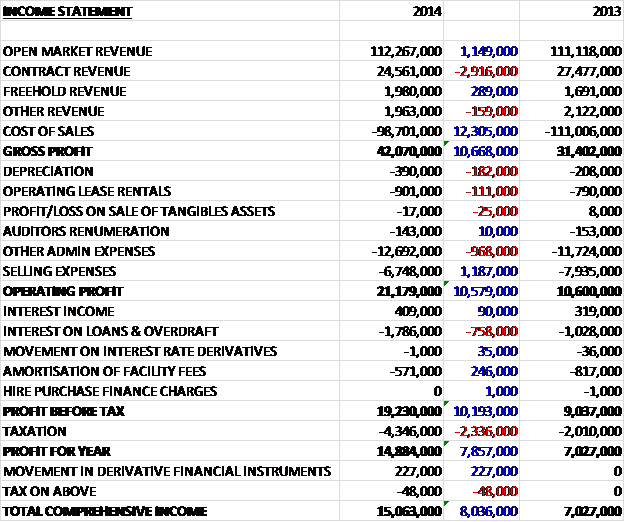
Overall revenues declined when compared to last year with a £1.1M increase in by far the largest sector, the open market, offset by a £2.9M decline in contract revenue. Cost of sales also declined, in part due to the lack of inventory write down that cost £1.9M in 2013, to give a gross profit some £10.7M higher than last year. We also see an increase in admin expenses, mainly due to higher employee costs in constructing increasing numbers of homes, counteracted by a decrease in selling expenses which are expensed as they occur and not necessarily when revenue is recognised when the homes complete (mostly relating to agent’s commission), so that operating profit is a similar £10.6M higher. There was a £758K increase in loan interest and a more than doubling tax bill to give a profit for the year twice that of in 2013 at £14.9M.

telfordassets

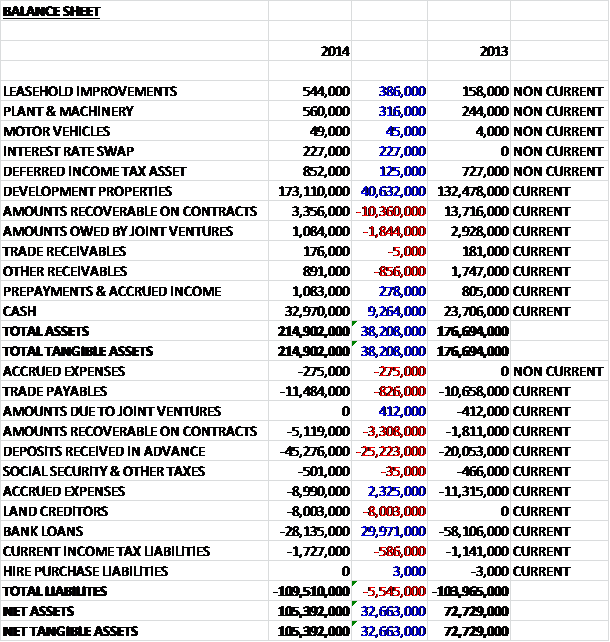
When compared to the end point of last year, total assets increased by £38.2M driven by a £40.6M hike in development properties and a £9.3M increase in cash, somewhat offset by a £10.4M reduction in amounts recoverable on contracts(occurring when costs incurred and profit exceed progress billing) and a £1.8M fall in amounts owed by joint ventures. Total liabilities also increased as a £25.2M increase in deposits received in advance, an £8M growth in land creditors and a £3.3M increase in amounts recoverable on contracts were mitigated by a £30M fall in bank loans and a £2.3M decline in accrued expenses. This all meant that net assets (there are no intangible assets) jumped by £32.7M to £105.4M.

telfordcash

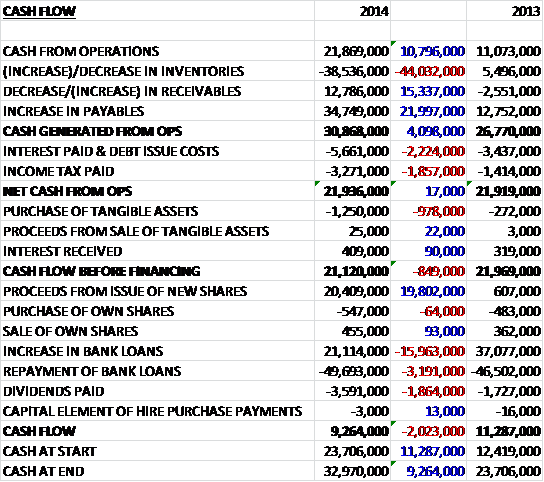
Before movements in working capital, at £21.9M cash profits were some £10.8M higher than last year. A large increase in inventories was offset by favourable movements in receivables and payables so that cash generated from operations was £30.9M, a £4.1M increase on 2013. There was higher interest and tax paid so that net cash from operations was actually flat on last year at £21.9M. Only £1.3M was spent on the purchase of tangible assets and free cash flow was £21.1M, a slight fall. The group then seems to have shuffled debt around so that a £20.4M placing was used to repay some bank loans and pay £3.6M of dividends so that the cash flow was £9.3M and the cash levels at the end of the year were £9.3M. It is pleasing to see debt reduced but a placing of shares was needed to do it.
During the year the group exchanged contracts for 515 open market properties and increased the forward sold position and including contract revenue from affordable housing the value of secured but unrecognised revenue at the end of the year was £341M, despite the lack of any significant development launches in the second half of the year. After the end point of the year, however, the group launched Stratford Central which includes 157 open market apartments, 148 of which have already been sold generating more than £70M and with the development expected to be completed in 2018, these are forward sales four years in advance.
Better than expected sales prices were a factor in the profit increase experienced by the group with the gross margin standing at a record 31.9% with the Avant Garde joint venture giving a gross margin in excess of 40%(although only half of profits were attributable to Telford) and the operating margin increasing from 9.7% to 17.1%. As well as the increased sales prices, the group has benefited from a good control on construction costs but inflation in London construction costs is likely to take effect going forward as activity across the city increases.
As far as customers are concerned, roughly equal splits go to owner-occupiers, UK based investors and overseas investors with a slightly higher proportion going to owner-occupiers than in previous years. The group has a policy of marketing each development to UK based buyers before going overseas. The average price of a Telford home is £400K with underlying price inflation in the areas the group are active being between 10% and 15% and with significant undersupply of homes in London, it is easy to see why the prices increase at such a rate. The group is focused on relatively affordable areas of inner London and most of their customers tend to take fairly small mortgages with no sales being made on the Help to Buy scheme which is good as the scheme is clearly susceptible to political changes. The group also seems to provide customers with the service they are looking for as they have received a 98% customer recommendation rate in an independent survey
In September the group purchased its Horizons development in Tower Hamlets for a consideration equal to a variable percentage of the open market sales proceeds that are achieved from the future development. So far an advance of £4M has been paid to the vendors with the remainder settled after individual completions and likely to come to around £20M. In addition the group has entered into a contract to purchase land that is conditional on obtaining planning permission. If granted, the value of the contract is £27.8M. The total development pipeline is expected to generate revenues of £875M, a 40% increase on the position at the same point of last year and £45M has already been received in the form of deposits. During the year the group achieved planning consent for 47 homes and a new church at Hackney Square in Frampton Park, 101 homes and a new school at Vibe in Dalston , 181 homes in Stratford Central and after a planning appeal, 18 homes at Allcroft Road in Camden
As far as financing is concerned, the group has a £120M loan facility extended to 2016 with three banks. To date, £29.6M of this facility has been used and interest is charged at a fairly hefty LIBOR + 4%. This facility is used to acquire development land and undertake site construction. One of the joint ventures, Bishopsgate Apartments, had a £43.1M development loan facility with HSBC which was paid off this year from the proceeds of the now completed development. In addition the group raised £20M of new equity from a combination of existing and new shareholders which was invested in the pipeline of new developments. Despite having a lot of headroom, it is anticipated that the group will increase the £120M loan facility in the latter half of 2015 to support further growth.

telfordpicture
There are a number of risks that affect the group that are out of their control. The economic conditions in the UK, and in particular London have a big effect on the housing market, although it should be pointed out that London has one of the most robust housing markets of any city in the world. Any interest rate changes could also have a profound effect both as potential house buyers being put off by higher rates and the more direct effect of the increased cost in borrowings. A 1% increase in interest rates would increase costs for the group by £452K. To combat this, they have entered into an interest rate swap which effectively fixes interest rates on £50M of borrowing for two years. As well as on the demand side, a potential risk is an increase in costs on the supply side and getting land at the best price is critical in maintaining margins. Due to the long term nature of this business, if the group has stocked up on relatively expensive land when times are good, if there is a down turn they may find it hard to make much margin on the resultant home sales. Another risk is the political landscape, which can have direct and indirect effects on trading.
Going forward, the strong pre sold position, with over 150 homes sold already in this year’s launch at Horizons and Lime Quay and the increase of the development pipeline gives a good visibility over future profits and given a stable market, pre-tax profits are expected to increase next year and more than double by the year end 2018.
At the current share price the P/E is 13.7, falling to a rather cheap looking 11.5 on next year’s estimates. There is a policy where the group pays out one third of earnings in dividends so after an 80% increase in the pay out the shares are currently yielding 2.5% which improves to 2.9% on next year’s forecast, which seems like a fairly decent return. At the end of the year the group was in a net cash position of £4.8M, a vast improvement on the net debt of £34.4M at the end point of last year, although the board expect debt to increase as more work is undertaken and more sites are added to the development pipeline.
Overall then, Telford homes seems to be a company going places. Profits are almost double that of last year, net assets are increased by more than the extra cash received from the share placing and although, slightly below that of last year, free cash flow is at a pretty decent rate. Going forward, there is good earnings visibility and the group is expanding, although it sounds as though there will be some reliance on new debt which might be a concern given any interest rate changes. The shares seem good value on a P/E ratio basis and the dividend yield is fairly decent so I might look for an entry point at this company.

Vertu Motors Finance Blog – Interim Results for Year Ending 2015

Vertu has now released their interim results for the year ending 2015.

vertuincomeinterim

When compared to the first half of last year, revenues increased across all businesses with used vehicles up £95.5M, new car retail up £92.5M, new fleet up £48.8M and aftersales increasing by just under £10M.  Cost of sales also increased to leave gross profit ahead by some £22.3M.  After the increase in operating costs and share based payments, operating profit was nearly £4M higher than in the first six months of 2014.  Movements in vehicle stocking interest and a reduction in loan costs were offset by a £822K increase in tax to give a profit for the period of £10.1M, an increase of £3.4M compared to last time.

vertuinterimassets

I have used the comparison with the same point of last year as opposed to the end point of the year due to the seasonality of trading.   When compared to the half year point of 2014, assets are up by £105.3M due predominantly to an £81.6M increase in inventories.  Other contributions came from a £7.1M growth in goodwill, a £6.8M increase in cash levels, a £4.5M growth in receivables and a £4.3M increase in property, plant and equipment with the only major decline an £810K fall in the pension asset due to a fall in corporate bond yields.  Liabilities also increased during the same period, almost entirely due to a £93.7M increase in trade and other payables, somewhat mitigated by a £1.9M reduction in borrowings.  Overall then, net tangible assets increased by £6.1M to £123M.
vertu interimcash

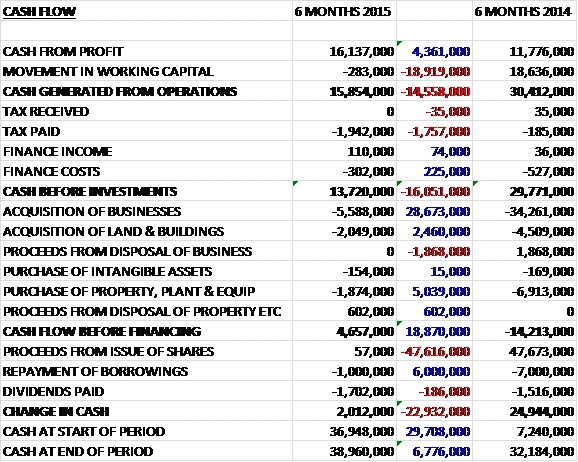
Before movements in working capital, cash inflow was £16.1M, an improvement of £4.4M when compared to last year.  There was a lack of the major increase in working capital that happened last year, though, as increased inventories were offset by a decline in payables, so cash generated from operations was £15.9M, almost half that of the first six months of 2014.  The tax bill this year was much higher but finance costs were slightly lower to give a net operational cash flow of £13.7M.  Of this, £5.6M was paid on the acquisition of new businesses and £2M on the acquisition of land and buildings, along with another £1.9M spent on property, plant and equipment.  The group did manage to receive £602K of cash on the disposal of a property (a former dealership property in Nottingham), however, to give a free cash flow of £4.7M.  Of this, £1.7M was spent on dividends and £1M on loan repayments so that the resultant cash in flow during the period was a decent £2M.

Service revenues grew by 4.4% during the period reflecting growing used car sales and higher customer retention along with higher spend per customer due to a better conversion of identified and required repair work to sales with video being utilised to help customers visually understand the repair and maintenance work to be undertaken.  The further roll out of this technology is expected to further increase sales conversion.  In addition, the group now have 64,321 live own branded service plans compared to 39,040 this time last year and increasing service plan penetration is a key objective of the group.  Elsewhere in aftersales, there was a 7% increase in accident repair revenues and a 1.9% growth in sales from parts operations with profits and margins rising across both channels, partly as a result of the better quality of remaining accident service centres after the recent closures.

New car retail sales volumes increased by 11.8% on a like for like basis compared to an 11.3% increase in UK private car registrations  as manufacturers continue to target the UK over continental Europe and a combination of improved UK economic factors and enhanced fuel and tax efficiency of new cars keep demand high.  Core margins fell from 7.5% to 7% during the period reflecting this focus on volume but this increase in volume meant that profits in the sector rose overall.  Motability volumes returned to growth with like for like volumes up 5.7%.  Although relatively low margin, it is an important market due to the positive impact on after sales demand for the three years following purchase.

New fleet car like for like volumes grew by 12.4% compared to a market growth of 9.4% and new commercial van volumes rose by 28.6% compared to 13.6% in the market as a whole but margins slipped from 2.2% to 2.1% and dealerships are increasingly employing dedicated local business specialists to provide additional after sales opportunities.

The used car market remained stable during the period and the latest data suggests that demand has increased despite the constraints on supply and highly competitive new car offers.  During the period like for like volumes grew by 11.6% which is thought to be considerably ahead of the market as a whole.   These gains have been driven by the marketing strategy including TV, radio, press and internet.  Used car pricing has continued to increase as a result of constrained supply after reduced levels of new vehicle sales during the downturn of 2008-2010 hence the averaged used car selling price rose by 4.2% during the period, also impacted by the inclusion of higher value franchises such as Land Rover which is likely to continue going forward.  Used vehicle gross profit per unit increased by 6% during the period with gross margins increasing from 11.1% and 11.4%, boosted by profits on disposal of part exchange vehicles and continued improvements in stock management and sales process.

During the last six months, the UK automotive sector has continued to experience favourable market conditions with the new car market showing further growth and the used car market maintaining stable pricing with modest growth.  Servicing demand is increasing as the recent year’s growth in new car sales flow back into service departments for regular service and warranty work.  In addition, increasing numbers of used car customers are being retained for servicing due to the growth in sales of service plans where customers pay for services either upfront or on a monthly basis.  This September, service revenues grew by 8.6%.

The board anticipates that full year results will be in line with expectations with a strong trading performance in September of 9.3% like for like new retail volume higher than the 5.9% increase in UK private registrations along with an 8.6% September growth in service revenues. The relative strength of both the UK economy and Sterling means that European manufacturers are likely to continue to direct high volumes of vehicles to the UK as they seek to manage European factory overcapacity.  This is clearly a positive trend overall but it does impact on margins to generate the volume required.

During the period the group opened a net five new outlets and as far as acquisitions are concerned, they acquired Hillendale, representing a Land Rover dealership in Nelson and a Jaguar dealership in Bolton for a total consideration of £7.9M including £2M of shares in Vertu issued at 58.64p with the remainder coming from cash.  The excess over the net asset value of the acquisition is £6.9M.  In August the group acquired part of the business of Addison Motors trading as Benfield Alfa Romeo, Benfield Chrysler, Benfield Jeep and Benfield Fiat Service centre in Newcastle for a total consideration of £398K funded from cash reserves.  There is apparently a strong pipeline of acquisition opportunities going forward.  Last year’s purchase, the Farnell Land Rover group made a substantial contribution to the growth in profit.

As well as business acquisitions, the group has also been acquiring property and land on which to expand organically.  During the year they acquired a leasehold property in Newcastle which it opened in August as a Fiat Brand Centre, representing Fiat, Alfa Romeo and Jeep and it now has three dealerships in this area of the City.  In addition, they acquired another leasehold property in Newcastle in which they opened their first Infiniti dealership.  This outlet is located within 10 miles of the Nissan factory in Sunderland where the Infinity Q30 model range will be manufactured from next year and it is the only Infinity sales outlet in the whole of the North East of England.  Conversely the group closed an accident repair centre in Birmingham to allow capacity to be increased for retail vehicle sales in the central Birmingham location, which is interesting considering the higher margins for service centres.  They continue to operate 10 accident repair centres.

After the end of the period the group acquired a freehold dealership property in Leeds for £5M which will become their premier Land Rover dealership.  In Birmingham the group closed its Bristol Street Motor Nation used car operation to free up the premises to be used as an additional vehicle compound for the growing Ford commercial fleet business, which is adjacent to the site.  As far as board changes are concerned, Peter Jones starts as Chairman on the 1st January 2015.

At the end of the period net cash stood at £34.4M, an improvement on both the £25.7M of net cash this time last year and the £31.4M figure at the end point of 2014.  An interim dividend of 0.35p has been announced which is a 16.7% increase on last year and represents a 1.5% dividend yield for the full year at the current share price.

Overall then, this is a good set of results.  Profits are up and seem to be healthy across all business sectors, net assets have increased and there is a decent free cash flow.  The fortunes of the group are closely linked to those of the UK, and to some extent mainland Europe so the question has to be asked as to whether this situation is likely to continue for the foreseeable future.  Despite this slight concern, though, I see Vertu as a quality outfit and I will attempt to look for an entry point.

On the 16th October it was announced that the new Chairman, Peter Jones has doubled his share holding to one million shares which equates to 0.29% of the share equity.  The transaction cost him £56,810 but as he is new I guess he is probably expected to be acquiring some of the equity.

On the 5th November the group announced that it had acquired The Taxi Centre and Easy Vehicle Finance, who source vehicles for the private taxi sector.  The group is based in Scotland and employs 8 people.  The total consideration was £700K of which £200K is in the form of Vertu shares.  Despite the acquisition coming with a leasehold office property, there is clearly a net liability as goodwill for the transaction is £1.1M.  In addition to this, there is an earn-out arrangement whereby the vendor will earn 20% of the pre-tax profits of the Taxi Centre over a three year period.  In the year to Dec 2013, the acquired group made EBITDA of £400K and management expect it to be earnings enhancing in its first year.  This seems like a decent small, niche purchase to me.

On the 10th November the group announced that it had acquired Gordons Ltd that consists of two Ford main dealerships in Bolton and Wigan along with two satellite operations in Walkden and Horwich.  The group will pay £11M in cash for the acquisition and Gordons comes with considerable assets including four freehold properties valued at £6.9M.  Indeed, no Goodwill was paid on the acquisition.  During 2013, Gordons generated revenues of £76.7M and an operating profit of £300K with the dealerships expected to be earnings neutral in the first full year of ownership and earnings enhancing during the year ending 2017.  This transaction increases the representation to 22 Ford outlets in total and although they do not seem to be very profitable at present, the price paid seems good bearing in mind the assets gained and once Vertu has worked its magic, margins at the acquired outlets should improve.

On the 2nd January the group confirmed the appointment of Peter Jones as Chairman as Paul Williams retired after seven years as Chairman.  Peter has been Commercial Director of Inchcape and CEO of Brammall and Lookers so he seems to come with some considerable pedigree.

At this point I thought I would try something different and take a look at the chart.  Since the start of 2014 the trend seems to be trending between about 52p and 65p and definitely seems range bound.  After a brief upturn in October, the share price definitely has downwards momentum and it will be interesting to see if there is support around 55p.  If so, it could be a decent entry point.

Vertugraph


On the 5th March the group released a pre-close trading update. In 2014 there were nearly two and a half million new car registrations in the UK which was the highest amount since 2004.  The five months ending January 2015 saw a tightening of trading conditions from the recent highs and while the new car market continued to grow, in January the private retail market for new cars fell by 5.1% which was the first decline for a number of years.  The high market sales volumes continued to be driven by the push of new cars by vehicle manufacturers into the UK due to the combined effects of the weakness of the Eurozone’s new car demand and the strength of Sterling against the Euro.

Apparently retailers have been self-registering vehicles to achieve the growing volume targets set by vehicle manufacturers which has clearly created a disconnect between actual sales to private customers and official registration levels with those self-registered vehicles being sold to private customers as used vehicles which is how the group is explaining its 0.5% like for like increase in new car sales against the 5.4% official increase in private registrations recorded by SMMT.  Some good news is that the like for like gross profit per unit has slightly increased.

Like for like commercial vehicle sales grew by 16.7% during the period against an 10% increase in UK commercial van registrations as a whole and the group maintained its like for like profit per unit.  The UK used car market saw a more typical seasonal deprecation cycle after a period where margins had been holding up well and margin pressure increased in the period as a consequence.  Against this background, like for like sales of used vehicles grew by 6.4% but gross profit per unit declined slightly during the period.  The group increased like for like revenues in each of its major aftersales channels and overall they grew 1.8% in the period with margins strengthening slightly.

Since the end of last year, the number of sales outlets increased by 11 with the Gordon’s Ford dealerships acquired trading in line with plans whilst it undergoes integration into the group.  One of the dealerships will relocate next month to a new purpose build freehold property and a location acquired as part of the acquisition will be sold for £700K.  In December the group disposed of a Nissan dealership in Altrincham which realised cash of £700K.  In January, the opened a Renault and Dacia dealership in Nottingham with a Honda motorcycles sales and service outfit being built on the same property.  In addition to the new premises, the group is redeveloping and improving a large number of dealership properties which will result in an increase in capital expenditure levels in the near term.

The board believe that the results for this year will be in line with current expectations with a significant net cash level.  The UK new car market seems to be stabilising at a high level after a long period of growth whilst the used vehicle market is likely to see an increase in the volume of cars entering the market which should increase sales numbers but weaken margins.  March remains the most important month for the profitability of the motor retail sector and current evidence suggests that this March may be a record month for total UK new vehicle registrations with the group’s like for like order book currently running ahead of the prior year.  Meanwhile the board continues to examine further acquisition properties.

Whilst a record profit for the group is clearly positive, there are some notes of caution here.  Whatever the cause, the sale of new cars seems have slowed somewhat to just 0.5% and used car margins are now being squeezed.  Added to this is the fact that the UK new car market seems to be levelling off, albeit at a high level and the group are going to be increasing capital expenditure next year which leads me to believe on the limited evidence we have so far, that next year may not be another record year.  There is no doubt that this is a quality investment but I feel there may be some short term issued to overcome first.

Also on the 5th March it was announced that finance director, Michael Sherwin had purchased 13,141 shares at a cost of just under £7,500 to leave him with 361,326 shares.  Whilst it is nice to see directors putting their money where their mouths are, this is quite a modest purchase for a man who owns more than £200,000 of the stock and earned a total of £440,000 (including bonus and benefits) last year.

Conversely, on the same day we see Schroders selling 6,717,787 shares netting them £3,822,421 which rather dwarfs the director purchase.  After the sale, Schroders now own just under 3.5% of the company’s shares which is not a ringing endorsement.

On the 6th March it was announced that CEO Robert Forrester joined his finance director in buying some shares, this time 17,451 at a value of just under ten grand.  Again, nice to see, but peanuts to a man who owns £3,778,930 of the company’s shares already and does not really change my opinion at the moment.

On the 1st May the group announced the acquisition of Bury Land Rover and Bradford Jaguar.  Bury Land Rover was acquired from Pendragon for a total of consideration of £7M, all of which represents goodwill paid and was settled in cash from the group’s reserves.  In 2014 the dealership showed revenues of £41M and EBITDA of £1.5M and the board expects the acquisition to be earnings enhancing in the current year.  The group already operates the Jaguar dealership in the same territory.  Bradford Jaguar is being acquired from Lancaster PLC for a total consideration of £900K, including £750K of goodwill and will be settled in cash from existing resources.  In 2014 the dealership had revenues of £14.7M and made a loss of £150K.  The board expects the acquisition to be earnings neutral in the current year and earnings enhancing from then on.  Following these acquisitions the group now owns five Land Rover dealerships and two Jaguar outlets.  The price paid for the Land Rover dealership looks quite high but this is a profitable outlook so should be good for the group going forward.


Conviviality Retail Finance Blog – Interim Results Year Ending 2015

Conviviality Retail has now released its interim results for the year ending 2015.

convicialityincome

When compared to the first half of last year revenues fell by £766K due to the closure of underperforming stores but a larger fall in cost of sales meant that gross profit was some £3.1M higher. During the first half of the year, the only one-off cost was a £531K restructuring charge compared to £3.3M worth of costs relating to the IPO that occurred last year. We also see a £381K share based payment this year and other operating costs were £2.7M higher relating to increased costs at company owned stores to give an operating profit of £2.7M compared to a small loss during the first half of last year. Finance costs were significantly lower than last time but there was a tax charge as opposed to a rebate that meant the profit for the period was £2.1M, a £3M positive swing when compared to the first six months of 2014.

convivialityassets

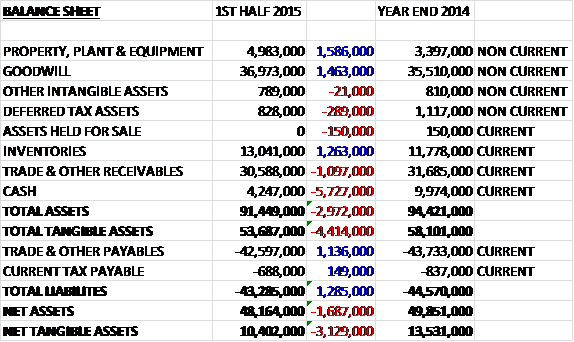
When compared to the end point of last year, total assets at the half year point fell by just under £3M as a £5.7M decline in cash levels and a £1.1M fall in trade and other receivables were partially offset by a £1.6M increase in property plant & equipment, a £1.5M growth in goodwill and a £1.3M increase in inventories. Total liabilities, what little there are, also fell mainly due to a £1.1M decline in trade and other payables to give net tangible assets of £10.4M, a decline of £3.1M.

convicialitycash

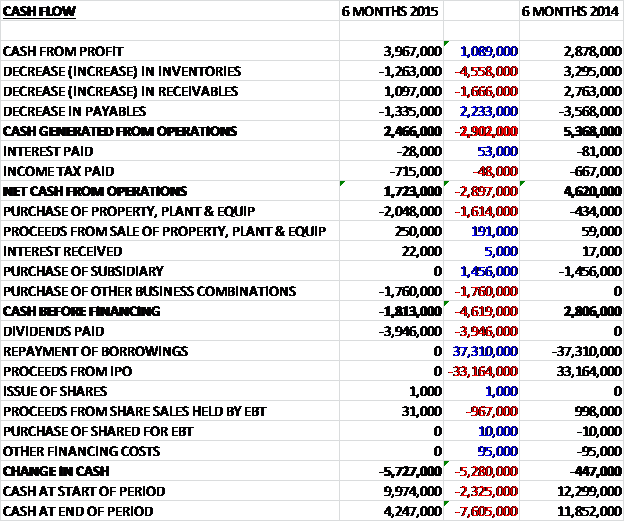
Before movements in working capital, cash profits were £1.1M higher than in the first half of last year but this was eroded by a decrease in payables and an increase in inventory so that cash generated from operations fell by £2.9M to just £1.7M. All of this cash was spent on the purchase of property plant and equipment, mainly relating to increased investment in the franchisee estate and logistics capabilities so that the £1.8M spent on the purchase of Rhythm and Booze sent the cash flow before financing to a negative £1.8M. As well as this, the group spent £3.9M on dividends so that the cash outflow for the period was £5.7M to leave just £4.3M at the end of the period. Clearly this is not a sustainable position as there is no free cash flow let alone enough to pay those dividends.
During the period, there has been an improvement in the quality of franchisees as underperforming ones are closed and successful ones expand. The logistics capability has been transformed, with replacement wracking in the warehouse completed that will improve the efficiency of the store pick operation and adds more capacity to support expansion. The off-licence franchisee margin increased 0.4% to help average franchisee profitability grow 6.4%.
One initiative that has been launched over the period is a price led grocery range to drive larger basket sizes. The group is very strong in their core traditional off-license category and as well as trying to drive grocery purchases, management have been focusing on improving the wine offering, hence the previous purchase of Wine Rack which also gives them scope to tailor the store offering depending on the area that it is located in. Other areas earmarked for growth are expansion in to new geographies and the launch of BB Warehouse on a trial basis in Wakefield. This format is designed to attract bulk purchase customers and there are plans to expand the trial over the next year.
On the 2nd May the company acquired certain assets of RNB stores including 26 outlets for a total consideration of £1.7M, of which £1.4M was goodwill. They subsequently acquired a further five stores for £180K. All stores were rebranded from the previous Rhythm and Booze brand to an appropriate Conviviality fascia. The acquisition allows the group to increase its presence in an area that it is underrepresented. During the period directors Keith Webb and Diana Hunter exercised and sold large numbers of shares, which in the case of the CEO came to a value of more than £1.3M. Amanda Jones has joined the company as COO
After the end of the balance sheet date the group announced that it will be commencing a trial to launch Bargain Booze in Scotland with the Scottish Midland Co-operative Society as the exclusive Scottish franchisee. The trial is expected to be completed by June and if it proves successful stores will be rolled out across Scotland.
Christmas trading was decent with growth of 2.6% over last year and franchisees saw trade coming into their stores during the weeks when shoppers would have traditionally visited supermarkets, an indication of the increasing trend for shoppers to buy convenience and local. So far in the second half the group is trading in line with expectations and the decent trading over Christmas gives the board confidence for the rest of the year.
An interim dividend of 2p was declared which, when added to the final dividend of 6p represents an impressive yield of 6.4% at the current share price. Overall this was a bit of a disappointing update. Profits have not really made much progress but it is the cash flow that seems to be more problematic and the group just doesn’t seem to be churning off much cash. Sure, the dividend yield is very good but unless the operational cash flow can improve, I can’t see it being sustainable. There are some interesting ideas to expand with the BB Warehouse and the incursion into Scotland being the most exciting but until some progress is made on cash flow, I am waiting on the side lines here.

On the 20th January it was announced that Close Asset Management had purchased 186,460 shares at a value of about £290K to take their holding up to 5.2% of the total share capital.  The transaction actually took place last November so this is not really recent news but it is a bit of a vote of confidence from them nonetheless.

On the 23rd January it was announced that Milton Group, relating to their multi cap income fund and diverse income trust had sold 1,253,309 shares worth more than £1.6M.  They still own more than 9% of the total share capital but this is rather disappointing.

On the 29th January we saw another shareholder selling some of their shares with Henderson Global Investors selling 1,200,806 shares at a value of about £1.6M.  The continue to hold 10.24% of the total equity but this is another disappointing sign.

On the 4th February it was announced that the group had purchased GT News for a net cash consideration of £6M.  This does not include any net assets so this will probably all be in the form of goodwill.  The acquired group has 37 stores in the East Midland and Yorkshire which the group expect to help drive logistics and marketing efficiencies.  GT News made a profit of just £400K on revenues of £57M and management expect the acquisition to be earnings enhancing during the year ending 2016.

On the 16th February it was announced that Henderson had continued their sell off of the group with a sale of over one million shares valued at around £1.7M.  This is a pretty huge sale and leaves them  with 8.58% of the total share capital.  Whether they have finished their sale if of course, the question.

On the 24th February it appeared that some of these large institutional sell offs had been purchased by Premier Fund Managers.  With a 500,000 share purchase in January, and another 500,000 share purchase in February, they have spent about £1.4M on CVR shares so far this year to bring their total holdings up to 8.7%.

On the 11th May the group released a trading update covering the year ending 2015.  Revenues are expected to be £364M, an increase from the £355.7M recorded last year despite the phasing of new store openings being later than expected and the continued heavy discounting and competition in the market.  EBITDA is expected to be slightly ahead of market expectations and they expect to end the year with more than £1M of cash.  Retail sales are in line with last year with like for like Bargain Booze sales down £1.7M and Wine Rack sales up just 0.1%.  The year saw some 21 existing franchisees opening additional stores and 35 new franchisees joined the group with a good pipeline of stores during the next year.

To further support the franchisees, the group has invested in store fascias, modernised their brands and become more connected with their customers through use of social media and digital marketing.  In April the Click and Collect service was piloted and the app, which launched in December, has already achieved over 19,500 downloads.  Overall this is a decent update, but doesn’t really do much to excite.

On the same day the group also announced the appointment of Ian Jones as non-executive director.  Ian has spent over 30 years in the retail industry and was previously retail director at Homebase, before which he served on the operating board of Sainsbury.  He has apparently been involved with Conviviality since 2013, advising the board on supply chain and operational matters such as the reconfiguration of the Crew distribution centre and the decision to bring the transport function in house.


International Greetings Finance Blog – Interim Results Year End 2015

International Greetings has now released their interim results for the year ending 2015.

intlgreetincome

When compared to the first half of last year, revenue fell by more than £1.5M as increases in European and USA sales were offset by a £3M decline in UK revenue and a £900K fall in Australian turnover, although on a constant currency basis, revenues increased slightly. The cost of the UK efficiency plan seems to be reducing, and indeed only £300K of it was in the form of cash. Other cost of sales also fell but gross profit was still some £661K lower than in the first half of 2014. We also saw selling and admin expenses fall and there was a small increase in other operating income so that profit at the operating level actually increased on last year. There was also the lack of the accelerated amortisation of loan fees and a fall in finance costs, somewhat mitigated by a collapse in income tax credits before a flat tax charge meant that the profit for the year stood at £2.2M, an increase of £935K on the first half of last year.

intlgreetassets

Due to the heavy seasonality in earnings I have used a comparison with this time last year for the balance sheet comparison. When compared to the half year point in 2014, total assets increased by some £8.1M driven by a £7.9M increase in trade & other receivables, along with a £2.2M increase in the value of property, plant and equipment somewhat offset by smaller falls in the other assets. Liabilities also increased with nearly every type of liability increasing, in particular other financial liabilities increasing by about £1.7M, the bank overdraft increasing by 1.4M and borrowings up £700K. The result is a net tangible asset increase of £3.1M to £26.4M.

intlgreetcash

Before movements in working capital, cash from operations increased by £181K to £6.6M but a huge increase in receivables meant that the cash lost from operations was £46.4M, an increased loss of £7.5M and after tax and interest was paid, the outflow was £8.1M. The group then spent £1.5M on businesses acquired and £1.3M on the purchase of tangible assets so that the cash outflow before financing was £51.7M. In order to balance the books somewhat, there was a net £48.2M in capital facilities, offset by a £4.2M reduction in loans and some £829K of dividends sent to non-controlling interests to give a cash outflow at the half year point of £8.6M, although a cash flow analysis at this stage does not tell us much due to the working capital movements relating to Christmas trading and differing phasing year to year.
UK profits were £2.7M, an increase of £900K when compared to the same period of last year as the project to invest in printing equipment starts to show in improved performance. There was also a good performance from the Chinese Christmas cracker manufacturing operation where 74 million crackers were delivered, exceeding targeted efficiencies and going forward the group are looking at further automation at the factory.
Europe profits were £823K, an increase of £144K when compared to the same period of 2014 as the previous investment in the high definition printing facilities and the acquisition of Enper underpinned growing levels of gift wrap production and sales growth. USA profits were £617K, a decline of £88K when compared to the first half of last year despite improved sales, although the death of US CEO Rich Eckman may have affected performance somewhat, however, the process to recruit a replacement is progressing well.
Australian profits were £594K, a £769K collapse when compared to the first half of 2014 as the group invested in growth with new customers, product categories and channels, which affected margins. The board are encouraged by the prospects now offered through establishing these new opportunities for expansion. The regions where the group are improving profit performance are the ones where they have made investments in manufacturing equipment and the group are now appraising whether to invest in the US marketplace to match the same technological platform. Apparently this year there has been some order slippage so that sales will be more weighted to the second half than usual.
Banking facilities have been renegotiated with improved terms and an increased maturity profile out to 2018. The underlying tax rate fell due to reductions in the UK rate and the continued use of tax losses in the US and there remains $3.8M of unrecognised losses in the US and £300K in the UK. The acquisition has already been integrated into the Netherlands business with expected synergies to occur next year. Overall trading activities during the first half were in line with expectations with a strong order book in place for the rest of the year. Orders are already beginning to build for next year.
Net debts at the end of the half year point stood at £89.9M, an increase from the £84.8M recorded at the same point of last year which is a bit disappointing although is probably being used to finance the increased working capital and was in line with expectations with the programme to reduce year end net debt on track. There will be no interim dividend this time, which seems sensible given the continued high debt levels but the board intends to review this position as they expect to get closer to their target of year end net debt to EBITDA below two times.
Overall then, this seems like a decent update with a fairly flat profit outcome and a slightly increased net asset base. Trying to determine cash flow at the half year point is a bit of a fruitless exercise due to the seasonality of orders and changed phasing of cash inflows so I will have to take management at their word that net debt will be lower at the year end. Operationally, after investments in equipment in the UK and the Netherlands, performance in these regions are good but the Australian profit fall is a bit of a concern. All in all, I still like this company and might look again at the end of the year but for now there just seems to be a few uncertainties holding me back.

On the 28th January the group released a statement covering trading in Q3 that includes the all important Christmas period.  The group performed well with results in line with expectations.  In Wales the new giftwrap manufacturing facility was completed on time and to budget with the facility already producing significant volumes efficiently.  The Dutch operation achieved record sales and production volumes with the acquired Enper business now fully integrated.  In the US, record sales levels were achieved with growth across all channels underpinned by managing the short term operational challenges reported previously and the group’s sales of licensed products have included over three million products featuring Disney’s Frozen.  All in all, a good update for a very important period.

On the 21st April the group released a trading update covering the year ending 2015.  Progress has been made in Q4 that means the financial performance for the year will exceed current market expectations and the good operational performance, lower financial costs and an improved mix of tax rates will significantly enhance earnings per share.  Debt reduction has also been significant with substantial reductions in working capital meaning that the target of bringing the ratio of year end debt to EBITDA to below two times has been achieved a year ahead of schedule (although the improved working capital situation could be temporary).  The board are now confirming that the company will return to the dividend list with a final dividend being declared.

The UK and European businesses delivered strong results, underpinned by savings achieved by the execution of the capital investment programme in the UK and excellent integration of the acquired Enper business in Europe.  This performance has helped compensate for the challenging conditions faced by the Australian joint venture.  Top line growth in the US remained strong but there is apparently scope for margin and efficiency improvements going forward and Gideon Schlessinger has been appointed CEO of the US operation after the death of Rich Eckman.  Gideon has experience in developing businesses with US and global retailers.  This all seems very positive and I have purchased my first shares in this company.


Vertu Motors Finance Blog – Final Results 2014

Vertu Motors owns and operates a number of vehicle dealerships, the group also sells used vehicle warranties which are in house products that can be taken out over 12, 24 or 36 months with income received at the start of the policy and initially recognised as deferred income.  They have now released their final results for the year ending 2014.

vertuincome

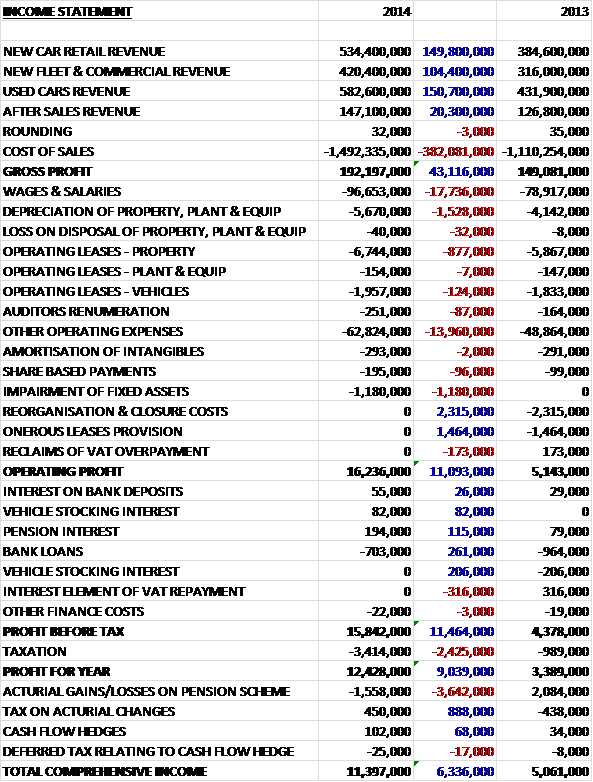
Revenue was up considerably across all sectors and cost of sales increased to a lesser degree to give a gross profit some £43M higher.  Operating costs also increased with staff costs increasing by £17.7M due to increased commissions from improved profitability, increased headcount to take advantage of higher demand levels and further investment in contact centres and central functions to support the group’s growth.  Other expenses were up nearly £14M, partly as in line with other retailers, the group experienced increased occupancy costs such as rent and rates.  There was a one-off impairment of fixed assets relating to four vacant properties, which cost the group £1.2M but this was offset by the lack of £2.3M of closure costs and £1.5M in onerous lease costs that occurred in 2013.  Overall, operating profit was up £11.1M which is a good performance.  As would be expected, tax was higher but finance costs fell, mainly due to lower interest charges so that the profit for the year stood at £12.4M, a remarkable increase of £9M when compared to last year.

vertuassets

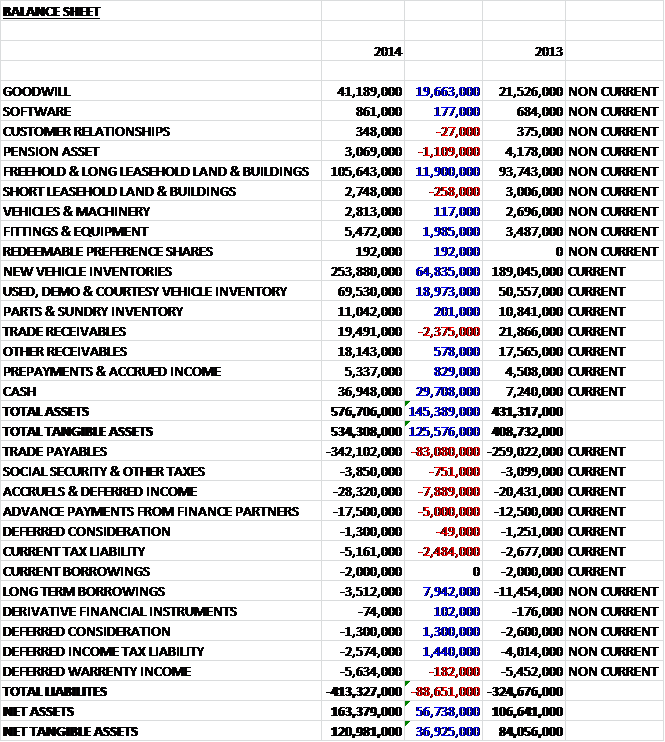
When compared to the end point of last year, total assets increased by £145.4M.  The increase was driven by an £83.8M increase in inventories, a £29.7M growth in cash levels, a £19.7M hike in goodwill and an £11.9M increase in freehold buildings, partly due to the group purchasing the freehold of two leasehold properties.  Liabilities also increased, predominantly due to an £83.1M growth in trade payables but increases in deferred income and advance payments from finance partners also took their toll, somewhat offset by a £7.9M fall in borrowings.  The resultant net tangible assets increased by £37M to £121M as the group issued more shares to pay for the acquisitions, although it is worth noting that the group also has £80M of off balance sheet operating leases.

vertucash

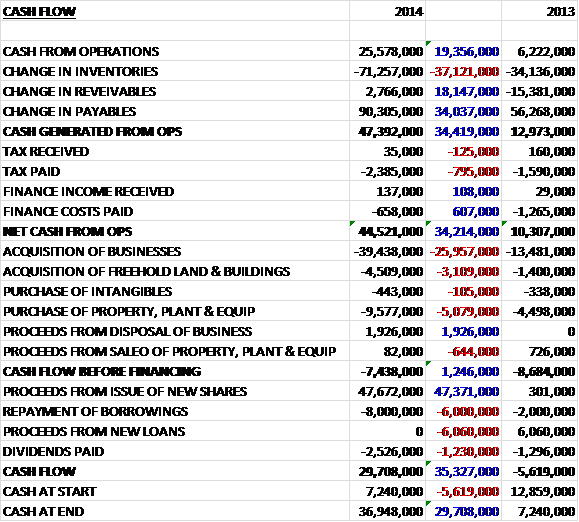
Before movements in working capital, cash profits were an impressive £19.4M higher at £25.6M.  A huge increase in payables, partly due to accelerated receipts from manufacturers and consumer finance partners only partially offset by a big increase in inventories meant that after working capital is taken into account, cash generated from operations jumped up to £47.4M.  After tax and finance costs, this stood at £44.5M, a jump of £34.2M when compared to last year.  The bulk of this cash was spent on the acquisition of new businesses with £39.4M spent on this.  Property, plant & equipment accounted for £9.6M as the group opened new outlets and refurbished existing ones and the acquisition of land and buildings cost £4.5M so that the cash flow before financing was an outflow of £7.4M.  In order to pay for this, plus £8M worth of loan repayments and £2.5M in dividends the group issued new shares which netted £47.7M to give a positive cash flow of £29.7M and a cash figure of £36.9M at the end of the year.  It is worth noting that this level of cash represents the annual reduction in working capital prior to a plate change month (March) and the year-end cash level is about £15M higher than the normalised cash balances throughout the rest of the year.  Despite this, though, if it wasn’t for the acquisitions, which admittedly are part of the group’s strategy, there would be a very strong fee cash flow figure here.

The after sales sector makes up by far the most profitable business with margins in 2014 standing at 43%.  Next are used cars with margins of 10.8%, then new cars at 7.6% and finally new fleet and commercial with thin margins of just 2.4%. The online space is an increasingly important part of the business and the group operates a number of websites around the Bristol Street brand and have recently invested in them to include enhancements to the online service booking facility and vehicles sold due to leads generated from the websites increased by over 2,000 to 11,410.  In addition, Vertu have entered into a partnership with Haymarket Media to jointly operate “What Car Leasing” which allows external franchised dealerships to advertise on the platform for a monthly fee in exchange for sales leads for new cars on personal hire contracts.

During the year, new retail car volumes sold grew by nearly 20% on a like for like basis which was stronger than the 15% achieved by the UK market as a whole.   Volumes of sales on the Motability scheme fell by 1% on a like for like basis as other, higher margin, markets were favoured but due to the strength of the market, investment is being made in the sales team.  Like for like group sales of new fleet vehicles increased by 9.5% against the UK market of 5.6% and sales of commercial vehicles were up 29.2% against 15.1% and although margins remain slim in these products, a focus on local SME’s is driving it upwards slightly.  Group like for like used vehicle sales were up 7.1% and the UK market as a whole remained stable despite some slippage from used car sales into new cars as customers felt more confident about the economic outlook.  Further developments to deliver greater sales include a new contact centre to undertake follow up calls to customers who have visited a dealership but did not make a purchase.

Like for like revenues in all aftersales activities increased by 4.3% with service revenues increasing by 6.8% with slowly strengthening margins (an impressive 43.1%).  The accident repair sector stabilised during the year after a period of contraction in demand as capacity reduction rebalanced the supply/demand levels.  Revenues in Vertu’s accident repair centres grew by 5.6% on a like for like basis and margins improved to a massive 65% in the nine centres the group owns.  Further margin improvement is being sought due to better measurement and monitoring of paint usage.  The revenue for the supply of parts grew by 3.4% on a like for like basis and parts represent about 27% of total aftersales profitability.  The sector benefits from increased volumes at the group’s service and accident repair business and it is also a distributer of parts to other businesses.  The group now has over 55,000 customers paying monthly for service and MOTs via their three year plan products and service plans sold on behalf of the manufacturers are helping the Vertu take business from independent suppliers.

In the past the group has been acquiring volume franchised dealerships in order to grow a scaled automotive retail group.  This year they have diversified from this strategy with the Jaguar Land Rover acquisition detailed below.  They also acquired their first VW dealerships to further diversify their outlets but this represents a broadening of the franchise competition rather than a change of direction.  Therefore the basic strategy of the group is to acquire a diverse range of dealerships, absorb them into the group, increasing profitability through synergies and increased customer retention which then leads on to more high margin after sales work.   There is apparently a strong pipeline of acquisition opportunities across a number of manufacturers, including the possibility of adding new franchises to the portfolio.

During the year the group made a number of acquisitions, the largest being Albert Farnell which consists of three Land Rover dealerships in Leeds, Bradford and Guiseley and was purchased from Co-Operative Group Motors for a cash consideration of £31.2M and the acquisition included £17.4M of Goodwill.  In the eight and a half months since acquisition, it contributed some £3.8M to operating profit.  In July the group acquired Boston and Lincoln VW from Lookers Motor Group for a cash consideration of £3M, which included just £270K of goodwill.  Another acquisition was Brookside, representing three VW dealerships in Nottingham and Mansfield, for a cash consideration of £1.7M.  This acquisition comes with a neutral net asset base so pretty much that whole consideration is for goodwill.  In the three months after acquisition, Brookside made an operating loss of £462K.  There were a few other, smaller, acquisitions which included a Hyundai dealership in Edinburgh acquired from the Phoenix Car Company and another from Archers of Edinburgh.  In January 2014 the group acquired Sheffield Nissan and Volvo from Harratts of Wakefield.  The total consideration for these smaller acquisitions was £2.9M which included £300K of goodwill.

vertu-low-res1-

During the year the group also made a disposal, selling its three loss making heavy truck operations, the Iveco and aftersales outlets in Bristol, Swindon and Gloucester, to Aquila Truck Centres Italia for a cash consideration of just under £2M and 192K of preference shares in Aquila.  The group lost £2.3M in net assets, mostly relating to inventories, in the disposal so there was no profit made here.  As well as the acquisitions there were also new openings with a new SEAT dealership, one new Volvo dealership, which is a new brand for the group and a new Nissan outlet, which makes Vertu one of the largest Nissan dealerships in the country with ten outlets.

March is the most significant month for UK automotive retail due to the plate change and its impact on new car demand and the seasonality of servicing.  This March, just after the year end, UK new car registrations to the retail market grew by nearly 21% with the group’s like for like sales volumes growing at a similar rate.  New vehicle margins were slightly lower than last year due to increased discounting but the increased volume more than made up for the margin shortfall.  In addition to this, profitability at the acquired groups improved.  In March and April the group’s like for like used retail volumes were up 14.5% and margin was maintained which meant a decent profit uptick overall.  Service probability since the year end has run ahead of last year and continues to benefit from the customer retention initiatives.  The outlook for the new car market in the UK is favourable but growth in the private market us expected to be at lower levels than this year.  Continental demand remains weak, despite some Western European markets showing signs of improvement, which means European manufacturers are likely to continue targeting the UK in order to manage European over capacity, particularly as a strong Sterling gives them an even better margin.

There are a number of risks that could potentially affect the business.  Profitability is influenced by the economic conditions in the UK such as unemployment and consumer confidence along with fuel prices and tax levels.  As most outlets rely on just one or two manufacturers, they are susceptible to any problems with these suppliers and the group seems to be making moves to mitigate this risk by acquiring dealers who specialise in different car marques.  Another risk is the value of used cars, which can fluctuate depending on supply and demand and any reduction would lead to write-downs against the value of the group’s used car inventory.  Regulations have been relaxed regarding restrictions on the number of dealers operating within a territory which could add competition to the franchised dealer network.  Finally, the group is susceptible to exchange rate changes as manufacturers could adjust prices depending on Sterling against Euro and Yen fluctuations in particular.

After the end of the balance sheet date the group disposed of a disused property at Haydn Road, Nottingham for cash proceeds of £600K and with a net book value of £600K, no profit was earned on the disposal.  In May the group acquired Hillendale Group which operates a Land Rover dealership in Burnley and a Jaguar dealership in Bolton for £8.2M (£6.2M in cash and £2M in shares).

At the current share price the P/E ratio is 14 which is similar to that of last year.  On next year’s forecast, the ratio falls to 11.6 which is historically low for this company, suggesting some upward potential in the share price.  There is a modest dividend on offer here with the shares yielding 1.4% at the current price after the pay-out increased by 14% this year, it increases to 1.6% next year.  At the end of the year net cash stood at £31.4M, an increase from the net debt of £6.2M recorded last year, although this is of course due to the issuance of new shares for cash.  Nevertheless, the balance sheet is very strong.

This has been a good year for Vertu, profits are up, as are net assets, although this is due to the issue of new shares that increased cash available for purchases.  Operational cash generation was very strong and although the dividend yield is modest, further improvements to cash income could give room for increased pay outs.  The strategy of acquisitions is likely to continue and there is likely to be further diversification into other franchises.  The fortunes of the group clearly depend to some extent on external forces but with a strong UK outlook and weak demand in the rest of the EU, the current trend is likely to continue for the time being, albeit with growth likely at a slightly slower rate.

International Greetings Finance Blog – Final Results Year Ending 2014

International Greetings designs, manufactures and distributes gift packaging and greetings, stationary and creative play products and has customers around the world, with Walmart being a major one. It is worth considering that a portion of the group is owned by non-controlling interests with the directors and their immediate relatives having an interest in nearly 50% of the voting rights, and this year their interests accounted for £718K of profits. They have now released their final results for the year ending 2014.

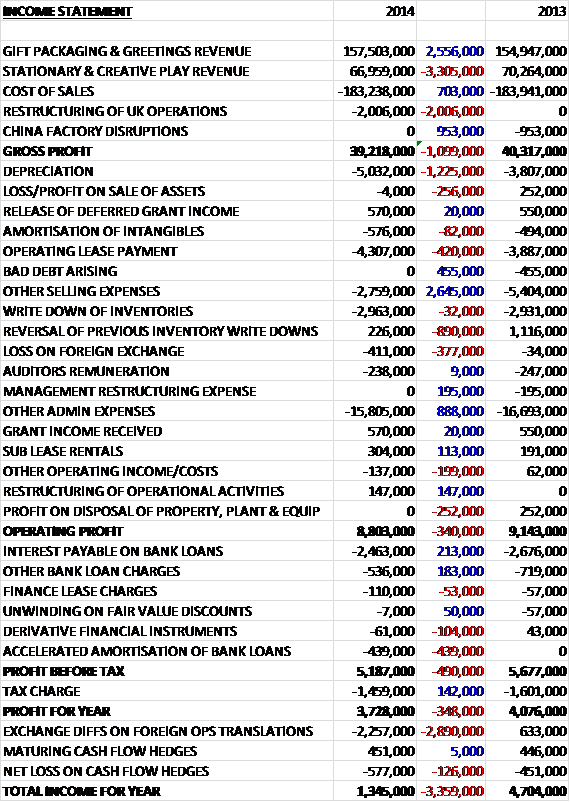
greetingsincome

Overall, revenues fell when compared to last year as a £2.6M increase in Gift Packaging and Greetings sales was offset by a £3.3M decline in Stationary and Creative Play turnover but on constant currency basis, revenues actually increased by 0.4%. Cost of sales fell slightly and the £950K charge for the Chinese factory disruptions due to a strike did not repeat, although there was a £2M charge for the restructuring of UK operations including a major upgrade to the Wales factory (the bulk of which is accelerated depreciation on redundant assets and only £800K is to be paid out in cash for redundancies), to leave gross profit some £1.1M lower than last year, although when the one-off costs are discounted, it was broadly the same as in 2013. Depreciation and operating lease payments increased but there was no bad debt arising, and other selling expenses fell by £2.6M. Compared to last year, some non-cash items were lower as the reversal of previous inventory write downs fell by £890K and the loss on foreign exchange increased by £377K but other admin expenses fell by £888K which couldn’t prevent operating profit falling by £340K. As far as finance costs were concerned, loan interest and tax payments fell, offset by a £439K accelerated amortisation of bank loans to give a profit for the year of £3.7M, a decline of £348K compared to 2013.

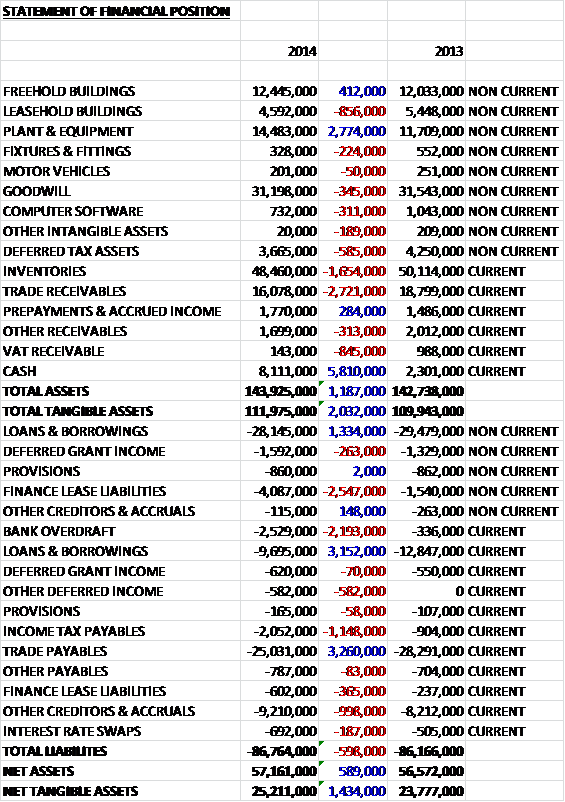
greetingsassets

When compared to last year, total assets were just £1.2M higher driven by a £5.8M increase in cash levels and a £2.8M growth in the value of plant and equipment. These increases were partially offset by a £2.7M fall in trade receivables and a £1.7M decline in inventories. Liabilities also increased as finance lease liabilities were £2.9M higher due to two new finance leases being entered into to fund new printing machines in Wales, income tax payables were £1.1M lower and other creditors and accruals fell by just under £1M, offset by a £3.3M reduction in trade payables and a near £1M fall in borrowings so give a net tangible asset level some £1.4M higher at £25.2M, although it is worth noting that there are £21.8M worth of operating lease payments not on the balance sheet.

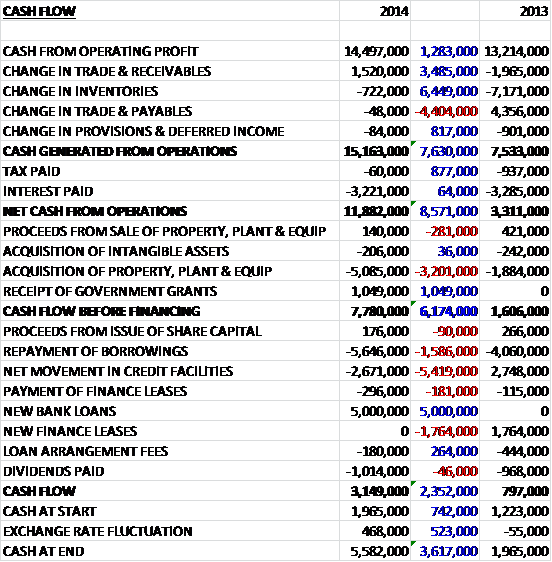
greetingscash

Before movements in working capital, the cash from profits was £14.5M, £1.3M higher than last year. A tight control on working capital, particularly a fall in trade receivables meant that cash from operations increased by £7.6M to £15.2M. After a nominal amount of tax was paid due to the Australian business taking tax relief against last year’s write off of bad debt and some £3.2M in interest, net cash from operations came out at £11.9M, an impressive increase of £8.6M. The bulk of this cash was spent on the acquisition of property, plant and equipment (£5.1M, an increase of £3.2M) and the group benefited from a £1M government grant to give a free cash flow £6.2M higher at £7.8M. The group uses much of this cash to pay back loans, with £646K spent on net borrowing repayments and £2.7M in credit facility reductions. The rest, just over £1M, was spent on dividends to give a cash inflow of £3.1M which is a very decent performance.
Before exceptional items, profits in the UK were £3.5M, a fall of £500K when compared to last year. During the period the group completed an upgrade to their printing capability in Wales which was completed on time and within budget. This investment will result in a consolidation of their three operations there and it is expected that one of those sites will become available for sale with a net book value of £1.25M. The group also completed investments at their facility in China including semi-automated processes for cracker manufacturing and enhanced production capability in gift bags. During the year the group withdrew from a non-core product category in generic books under the Alligator brand in order to focus on the larger licensed product segment. Growth occurred with online customers in the UK, including Ocado and Amazon.

crackers4
European profits were £2.6M, a £1.4M increase when compared to 2013 this was despite a difficult market and having established relationships with the 10 largest retail groups in the region, the group are looking to expand further. In Mainland Europe the they enjoyed record volumes despite the difficult overall market conditions as they increased their market share, helped by the new equipment installed last year in the Netherlands. Profits in Australia were £2.1M, a £300K reduction on profits before exceptional items in 2013 as last year’s investment in the logistics facilities in the country was somewhat undermined by the slowdown in the Australian economy.
USA profits were £3M, a decline of £800K when compared to last year. This fall was due to very difficult trading conditions in Q4 due to the extreme weather that occurred in the country during that period. Until that point, trading was at record levels in the region as sales developed well throughout the year. The knock on effect of the weather meant that higher margin every day product sales in the US were largely rescheduled and below expectations. The company invested in some automated case packing equipment in their Savannah operation which became fully operational in Spring and should enhance production efficiencies.
No customers accounted for more than 10% of total sales which is good to see and there are still £2.2M of unused tax losses in the US and £300K in the UK which will keep tax below the rate it should be for some time, although it is worth noting that as these are used up, the tax bill is likely to increase. One risk that affects the company is that the business remains highly seasonal with more than half of profits made around the Christmas period so a poor performance around this time would have a devastating effect on the group’s prospects for the full year.
This year some 56% of revenue was made on Christmas products and they increased by £5.8M compared to 2013. Meanwhile everyday product revenue fell by £6.5M compared to last year which was the same overall trend that occurred in 2013 when compared to 2012. In the future the group intends to improve margins by increasing the balance of own brand and non-Christmas products. Another effect on margins is the increasing level of FOB business delivered direct to customers at Chinese ports, especially to US and Australian clients. This business has lower gross margins than the more traditional offering but is a way to drive volumes and reduce risk and costs associated with delivery which can actually improve net margin.
After the end of the balance sheet date the group announced that it had acquired the trade and certain of the assets of Enper Giftwrap for €1.9M. Enper is a giftwrap manufacturer in the Netherlands with sales of €5M and the acquisition will allow the group to widen its customer base in a core product category.
Sadly during the year, CEO of the US operations, Rich Eckman passed away after a battle with cancer, he was with the company for 14 years. Going forward, having completed the first year of a new three year plan, the board expect to achieve double digit cumulative average growth in earnings per share, they are reducing debt and apparently have identified opportunities to grow.
At the current share price, the P/E ratio stands at a decent 14.2 but based on next year’s prediction, this ratio falls to a very cheap 8.1 but there were no dividends announced for the year however when leverage is reduced from the current 2.4 times EBITDA to 2 times, the board will consider re-introducing dividends. At the end of the year, net debt stood at just under £37M, an improvement of £5.1M compared to last year with about £1.4M of this down to weaker exchange rates. Overall then an OK set of results. Profits barely moved but this seems to be largely due to adverse weather in the US and the impact of investment in the factory in the UK, which should benefit the group going forward. Operational cash flow is strong, and it is good to see this being used to play down debt, which is still quite high. Whilst decent progress is being made here, I am not going to buy just yet and will hold of for further news.
Red24 Finance Blog – Interim Results Year Ending 2015

Red24 has now released its interim results for the year ending 2015.  The group is now organised as a single unit so profits are measured geographically which is a bit of a pain.  They have still published revenue figures split by sector, though, so I have used those here.

red24incomeint

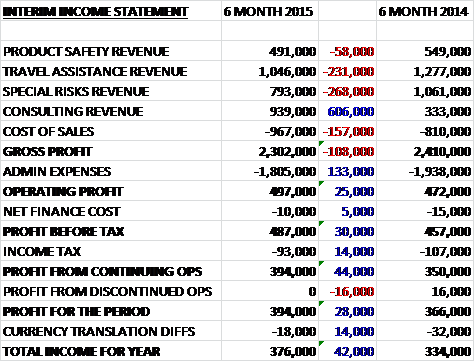
Overall revenues increased with as a £606K increase in Consulting sales was partially offset by declines in all other sectors.  Cost of sales also increased, however, to drive gross profit down by £108K.  Admin expenses declined from last year, however, to reverse the fall in gross profit and at the operating profit level, the result was some £25K higher.  Small reductions in finance costs and tax payment (as less profits were made in South Africa) meant that the profit from continuing operations was £395K, a £44K improvement on last year and a £28K improvement when the profit from discontinued operations is added on to the 2014 results.

Red24assetsint

When compared to the end point of last year, total assets increased by nearly £250K driven by a £212K increase in trade and other receivables and a £118K growth in cash levels, somewhat offset by a £122K reduction in investments as the group sells part of its stake in Linx.  Liabilities saw a small increase due to a £105K growth in trade and other receivables, somewhat offset by small falls in various other liabilities to give a net tangible asset level of £3.6M, an increase of £127K over the past six months.

Red24cashint

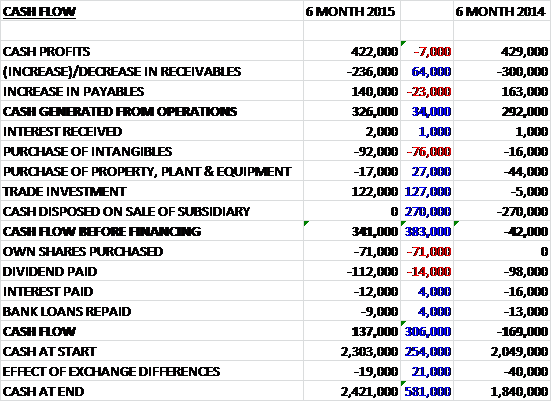
Before movements in working capital, cash profits were only £7K lower at £422K but a smaller increase in receivables than during the same period of last year meant that cash generated from operations was £34K higher at £326K.  The group spent £92K on intangibles and £17K on tangible assets but this was paid for by a £122K cash inflow relating to the sale of part of the stake in Linx so before financing, free cash flow was a healthy £341K. The group spent £71K on share purchases and the bulk of the rest of the cash was spent on dividends with the resulting cash inflow of £137K a £306K reversal on last year which is a fairly pleasing result.

UK profits were £324K, more than double the £152K figure recorded during the same period of last year.  South Africa profits fell by £133K to just £62K during the first six months of this year.  US profits, at just £8K, are modest but they did increase by £5K.  Travel assistance maintained revenues during the period but this is the revenue stream that will be most severely affected by the exclusion of the identity theft service that was given to HSBC.  The Special Risk business has been fairly busy so far this year with a larger number of smaller crises while the newly opened Munich office is meeting expectations, although revenues suffered somewhat due to the lack a major incident in Syria that occurred last year.  Consulting revenue has been excellent so far this year as demand for both close protection and evacuation planning services has increased with a Far East client needing a large evacuation of several hundred staff from North Africa.  The product safety business showed a decline in revenues despite the launch of an analytical tool and new training modules, possibly reflecting a maturing market.

There were contract wins to support business travel clients in Oceania and to support medical assistance clients in North America which will help mitigate the debilitating loss of an HSBC contract which will have an adverse effect on the level of recurring revenues in the second half of the year and beyond, although the board are confident about the ongoing prospects for the business.  It would be useful to know some background on why the bank has decided to stop taking the identity theft service and while the board see their offering as in tune with customer demand rather than the more “compensatory” approach from their competitors, this was obviously not the case for HSBC.

There has been a hint from management that they may be on the lookout for acquisitions, particularly in overseas markets so this could be something to keep an eye on.  Going forward, the group are winning a number of new contracts and seeing steady growth in response work on existing contracts but apparently the UK regulatory environment is not conducive to their customers releasing new financial services.  Despite this, however, the board see a recovery from the loss of the HSBC contract as fairly speedy.

Lorraine Adlam has joined the board as a non-executive director.  She has worked with high growth companies in the insurance markets in the past and was previously Chairman at Howden Insurance Brokers.  She should be able to identify new opportunities.  A small increase to the interim dividends means the shares are yielding 3.4% at the current share price, increasing to 3.7% on next year’s estimate.

Overall then, we see a small profit increase but only due to the good performance from the consulting business as the other sectors seemed to struggle, net assets increased due to a hike in receivables and operating cash flow was up due to a better control of working capital.  Indeed, the cash flow was pretty good with spare free cash flow at the end of the period.  The group are obtaining cash from the sale of the Linx investment in instalments but I can’t seem to find a total receivable from this deal.  The main issue during the period, however, is the loss of the identity theft HSBC contract which will really kick in during H2 and continue in to next year.  Until there is evidence that the group can replace this lost revenue, I find it hard to contemplate buying in here so I will continue to monitor the situation.

On the 11th February the group released a trading update.  They stated that prospects improved over recent months with a number of new business wins and a busy quarter for operational responses in the special risks area.  As a result the board now expects the company’s financial performance for the year to be ahead of current expectations with a similar momentum expected to be carried into the new year.  The enhanced travel tracker product will be launched at the business travel show later in the month.  The product enables clients to monitor and track their travelling personnel on a 24/7 basis and is expected to lead to a growing number of opportunities.  I like this update and have decided to use it as a trigger for buying some shares.  I could probably wait a few days and get them slightly cheaper but I don’t want to miss out!

On the 27th April the group released a trading update covering the year to 2015.  Trading in the latter part of the year continued to improve, particularly in the consultancy and special risk sectors, which means that financial performance for the year as a whole will be ahead of expectations.  The loss of the HSBC contract announced previously has been mitigated by reduced costs and new contracts with both new and existing clients.  There has also been a significant increase in the year end cash balance with net cash of £3.2M, achieved through improved working capital management and the improved trading performance.  The current year has started well with new contracts with insurers in both the product safety and special risk areas.  The enhanced travel tracker product has been well received and the board expects growth in sales of the product in the coming year.  Recent sales in Germany and Australia have also exceeded expectations and this trend is expected to continue.

This is a very positive statement that gives me confidence in my holding here.

On the 1st June the group announced the acquisition of RISQ Worldwide from Michael Haughey for an initial consideration of £267K which could increase by £485K depending on the performance of the acquired group in 2016 and 2017.  RISQ has been established for eight years and has offices in Singapore and Hong Kong.  It specialises in corporate investigations, business intelligence, employment background screening and bribery act compliance.  Going forward, Michael will sat on and head the group’s business in Asia.  Last year, RISQ posted an operating loss of £170K on revenues of £679K but in the current financial year, the performance has improved and the group is in a profitable position with a number of new contracts with blue chip clients which should further enhance earnings.

The group has a significantly different product range which should provide a good opportunity for cross selling that should improve the performance of both businesses and will give Red24 an established presence in the Asia market.  Overall then, this seems like a fairly decent acquisition at an affordable price.

Compass Finance Blog – Final Results Year Ending 2014

Compass has now released their full year results for the year ending 2014.

compassincome

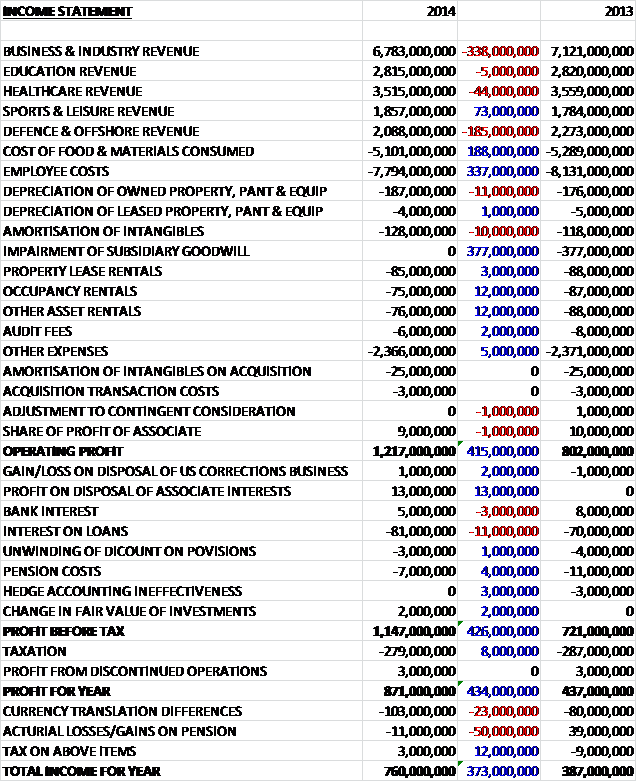
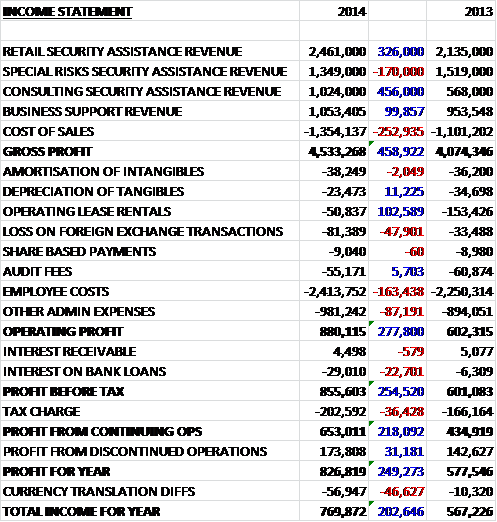
Revenues across most business sectors fell with Business and Industry down £338M and Defence & Offshore falling £185M. The only sector to increase sales was Sports and Leisure, up £73M, although it should be noted that this predominantly shows the effect of Sterling strength as constant currency revenues were 4.1% (2.1% like for like growth) ahead of last year. Some major costs also fell with the cost of food and materials down £188M and employee costs some £337M lower. This year also benefited from the lack of a £377M goodwill impairment that occurred in 2013. This all meant that operating profit was some £415M higher than last year with the profit for the year £434M higher at £871M which was flattered by last year’s goodwill impairment but still higher on an underlying basis.

compassassets

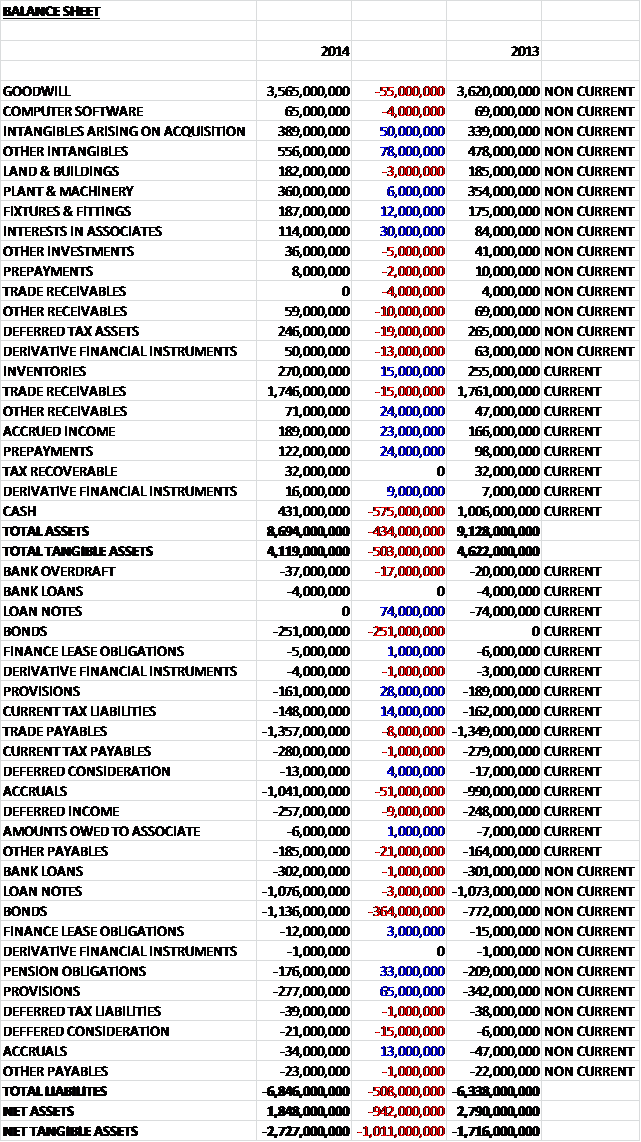
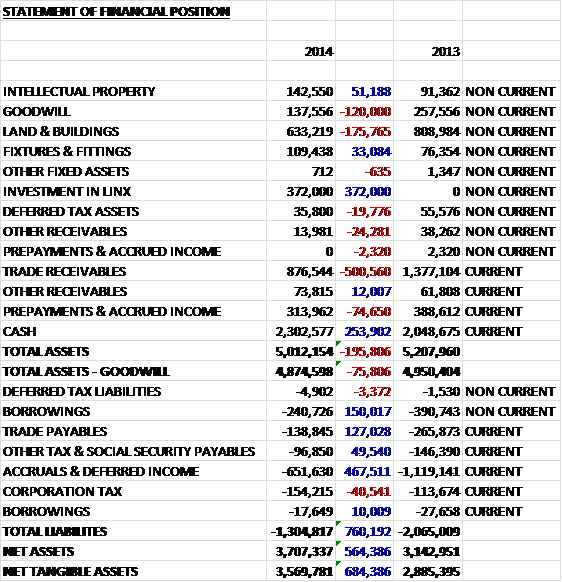
When compared to last year, assets fell by £434M driven almost entirely by a £575M reduction in the cash levels, partially offset by some increases in the value of tangible assets. Conversely, liabilities also increased driven by a more than £600M increase in bonds, offset by a £65M fall in provisions. This meant that net tangible assets collapsed by over one billion pounds to a negative £2.727BN which seems a bit precarious even for a company of the stature of Compass.

compasscash

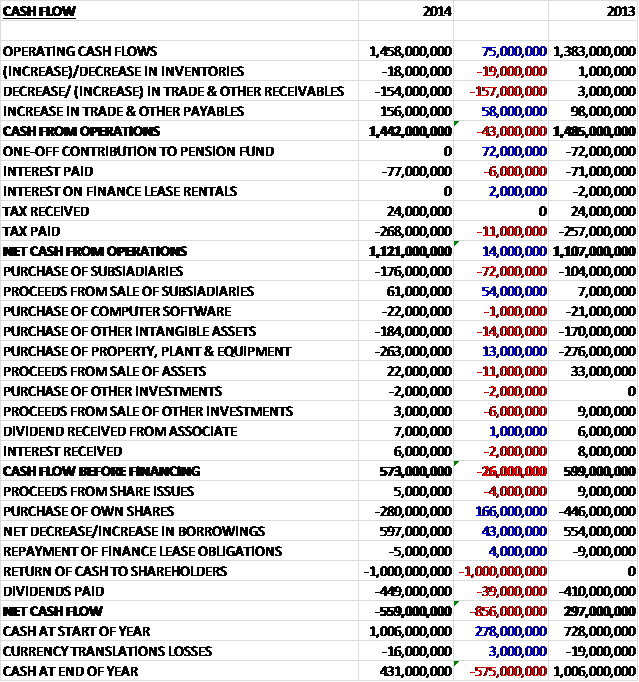
Before movements in working capital, cash from operations was £75M higher than last year but this was reversed by an increase in receivables so that after working capital movements, operating cash flow was £43M lower. Tax and interest reduced this further but the lack of a one-off £72M payment to the pension scheme that occurred last year meant that net cash from operations at £1.121BN was £14M higher than in 2013. A net £115M was spent on acquisitions, just over £200M on intangible assets and a net £241M was spent on tangible assets. This left a free cash flow of £573M. The bulk of this was given back to shareholders, in total £1.449BN was returned and another £280M was spent on share buy backs which is expected to complete during 2015. Clearly this is much more than the free cash flow so the group took out another £597M in new loans which still left a cash outflow of £559M. I am not sure I really understand the rationale of taking out new interest baring loans to return cash to shareholders.
Before exceptional items, operating profit at the North American business was £666M, an increase of £9M on the previous year or £49M on a constant currency basis. During the year continued progress on efficiencies and leveraging of the overhead base have partly been reinvested in the business to support organic growth. In the Business and Industry sector, there were good levels of new business wins including contracts with Amazon.com, T Mobile and SAP as well as the provision of support services to United Technologies – like for like volume remained flat. Organic revenue growth in the Healthcare sector was solid with good levels of new business wins. In the food service business there were new contracts with the Parkland Health and Hospital System and Baptist Housing senior living in Canada. New support service contracts included NYC Health and Hospital and the CJW Medical Centre.
Good organic revenue growth in the Education sector was driven by increased participation and new business wins including food contracts with McGill University in Canada, Rowan University and the Rochester City Schools District. New support services contracts included the Sacred Heart University as well as the provision of additional services to Texas A&M. The Sports and Leisure business delivered double digit organic revenue growth due to good new business and high attendances at sporting events. New contract wins in this sector included the NHL’s Phoenix Coyotes, the Columbus Clippers and Texas A&M Athletics. The service business to the remote sector delivered decent organic revenue growth.
There is a good pipeline of contracts across all sectors but the growth of the business is supported by the retention model where a semi-independent team takes a pre-emptive approach to retaining contracts by engaging with clients early and proactively negotiating contracts and in North America, where this approach has been embedded, retention rates are above the group average so this process will be further rolled out across the other territories.
Operating profit before exceptional items at the Europe and Japan business was £409M, a fall of £11M on last year. There has been good levels of new business in the UK, Spain and across the Nordics but the planned exit of some uneconomic contracts have impacted retention rates during the year. A new contract was won with the Ville de Cannes and the Philharmonie de Paris and contracts with Chelsea FC and Somerset House were retained in the UK. Other retained contracts include ENI in Italy, Lundbeck in Denmark and the International School of Luxembourg.
The rate of like for like volume decline slowed compared to last year but the group has seen differing trends across the region. In North East Europe, like for like volume is broadly flat but in the UK, Germany, the Netherlands and Southern Europe, volumes were negative. Meanwhile, there has been some pressure on volumes in France and Italy but Japan remained unchanged. Progress on efficiencies and cost reduction helped combat some of these volume falls and on a constant currency basis, operating profit actually increased by £5M.
Before exceptional items, operating profit at the Emerging Market business was £226M, a decrease of £16M on 2013. In line with expectations, Australia delivered flat organic revenue growth due to the slowdown of the offshore and remote sector. In contrast, Education and Healthcare continue to see good levels of new business with a contract win with Children’s Health Queensland to provide services at the Lady Cilento Children’s Hospital. In Brazil, there were good new business wins across all sectors including food service contracts with Usiminas and Vale. Moderate pressure on volumes is being compensated by improved retention and an increase in first time outsourcing. Elsewhere in Latin America there has been good organic growth driven by several large new offshore and remote site contracts, including Bechtel in Chile.
Strong organic revenue growth in Turkey was driven by new business wins and like for like revenue growth. New contracts included the food service provision for Aksa, a food and support service contract with BP along with the retention of Philip Morris and Bosch. Elsewhere in the region the group have further developed their relationship with Chevron and have a freed a new international agreement, retaining the Angolan business. There was also a large contract win in South Africa to provide food to Netcare, a chain of 52 hospitals. India and China both delivered good double digit growth driven by strong new business wins. The group won food service contracts with Intel and Capgemini in India and with Lenovo and Tencent in China as well as several international schools including the International School of Beijing.
In May the group disposed of its retail cleaning business in the US. It was sold for £31M, with £24M received in cash at the time of the sale which generated a loss of £1M. The group completed a number of small acquisitions during the year on which they spent £138M, of which £107M was spent during the year and the newly acquired companies contributed £3M to profits. After the end of the balance sheet date the group acquired East Coast Catering, a Canadian company that provides accommodation, food and support services for remote sites in the energy and mining sector. The acquired group generated revenues of £28M last year.
The group can be susceptible to general economic conditions as like for like volume and therefore organic revenue growth can depend on the number of people at the client’s site. The group concentrates on the largest costs, the cost of food that makes up one third of costs and labour, which makes up the bulk of in unit costs. This year, organic revenue growth sat at 4.1%, the lowest percentage for at least three years but still fairly decent. Although the historic litigation relating to the supply of UN contracts it is worth considering that litigation involving the group’s competitors over the matter is still ongoing.

RA_banner
During the year Carol Arrowsmith joined the board as a non-executive director. She was previously a partner at Deloitte and Vice Chairman of their UK business. The other addition was Paul Walsh who succeeded Roy Gardner who retired as Chairman.
Looking forward, the pipeline of new contracts is healthy and the board expect to see further good performance in all regions. As far as investment is concerned, the group are looking to invest cash in growing organically, returning cash to investors and to invest in small to medium sized infill acquisitions. It was also pointed out that due to a full year of the higher debt levels, finance costs for next year are likely to be around £115M compared to loan interest of £81M this year.
Quality doesn’t come cheap and at the current share price the shares trade on a P/E ratio of 22.6, falling to 20 on next year’s estimates. At the current share price, after the total dividend was increased by 10.5% the yield stands at 2.4%, rising to 2.6% on next year’s estimate as the group look to grow dividend in line with constant currency earnings. Net debt at the end of the year nearly doubled to £2.331BN. So, this was a solid year for the group. Although the headline profit figures were down, they were up slightly on a constant currency basis with the North American business performing particularly well. I don’t fully understand the logic of taking out new bonds just to return cash to the shareholders, I believe this would have been better provided out of free cash flow as and when it becomes available, so that was disappointing. The values are also fairly full but this share acts as a bit of ballast to my portfolio so while I will not be buying any more I am certainly holding on to my shares for the time being.

On the 5th February the group announced a trading update covering Q1.  Organic revenue grew by 5.7% with strong levels of new business and good retention rates across all regions.  North America had a strong start to the year with the trends seen in the second half of last year continued into the first quarter of 2015.  There were good levels of new business wins, unusually high retention rates and an improvement in like for like sales in some sectors.  Europe and Japan returned to growth, driven by good new levels of new business wins and better retention and like for like revenues, whilst still negative, are improving.  Emerging markets enjoyed double digit organic growth as a continued trend to outsourcing counteracted volume pressures in some countries due to poorer economic outlooks and an expected decline in the Australian offshore and remote sector.

Although sterling weakened against the dollar in the quarter, it continued to strengthen against many other important currencies such as the Euro, Yen, Aussie Dollar and Brazilian Real.  In all, currency movements had a negative translation impact on revenues to the tune of £40M and profits by £2M.  Going forward, management maintained their positive expectations for the full year but the economic outlook is uncertain in some of their markets and the lower oil prices may impact the offshore and remote business.  Overall, though, this is a good outlook and gives me confidence to keep holding my shares, which have performed very well recently.

On the 6th February it was announced that Chairman Paul Walsh had purchased 5,000 shares at a value of £56,650 and he now owns 16,411 shares in the company.

On the 25th March it was announced that another director purchased shares, this time non-exec Carol Arrowsmith purchased 3,342 shares at a value of about £40K.  She now owns 7,438 shares in the company – it is good to see another director buying up shares.

On the 30th March the group released a trading update.  So far in the first half of the year, organic revenue grew by 5.5% and operation profit margin improved by about 10 basis points.  In North America, there was a strong first half with organic revenues up around 8% with a good amount of new business wins and unusually high retention levels with some improvement in like for like revenues.  It is expected that operating margin will increase by 5 basis points in the region.  Europe and Japan returned to growth despite a mixed economic backdrop across the region with the performance reflecting increased focus on organic growth and the investments made in the sales and retention teams.  Organic revenue growth is likely to be around 0.5% reflecting improving levels of new business wins and retention with recovering (but still negative) like for like volumes.  Due to the continued focus on efficiencies it is expected that operating margin will improve by around 10 basis points.

In the Emerging region, strong levels of new business wins in emerging markets are expected to deliver around 14% organic growth which should offset the decline in the Australian offshore and remote sector with organic growth in the region as a whole expected to be about 8%.  Due to the weakness in like for like volumes in some markets and the pressures in the offshore and remote business, it is expected that operating margin in the region will decline by around 10 basis points.  During the period, Sterling weakened against the Dollar but appreciated against most of the other key currencies which when taken together should have a positive translation impact of £35M on revenue and £5M on profit for the half year.  If these rates continue for the rest of the year, foreign exchange translation would benefit full year revenues to the tune of £323M and profits by £31M.  Going forward, expectations for the full year remain positive but the economic environment in some of the emerging markets is uncertain and lower commodity prices are impacting the offshore and remote business.  Despite this, there is a good pipeline of new contracts and the continued focus on organic growth and efficiencies gives the board confidence in achieving another year of delivery.

All good stuff, I am surprised the foreign currency translation is so positive and the improvement in margins in Europe is good to see.  I am very confident holding these shares at this point.

Red24 Finance Blog – Final Results Year Ending 2014

Red24 is a crisis assistance company that provides a range of security and business support services, offering preventative and reactive advice to avoid or manage security and business risk.  The security assistance segment provides preventative and reactive security advice whilst the business support segment comprises the provision of advice on product safety, particularly within the food industry.  The products are distributed through financial services companies and they are listed on the AIM exchange.  Red24 has now released its final results for the year ending 2014.

red24income

Revenues increased across most sectors with Consulting up £456K and Retail Security up £326K, slightly offset by a £170K fall in special risk security.  Cost of sales were also up to give a gross profit some £459K higher than last year.  Employee Costs and other admin expenses were higher during the year but operating lease rentals fell by just over £100K to give an operating profit £278K higher.  An increase in interest payable and tax, due in part to an increasing proportion of earnings being made in high tax South Africa, gave a profit from continuing operations of £653K, a growth of £218K when compared to 2013 and with the profit from the discontinued operation added to the total, this came to £174K for the year, some £249K higher than in 2013.

red24assets

When compared to the end of last year, total assets fell by nearly £200K.  This decline was driven by a £500K collapse in trade receivables, a £176K fall in the value of land & buildings due to foreign currency adjustments and a £120K decline in goodwill due to the disposal, somewhat mitigated by the £372K new investment in Linx and a £254K increase in cash levels.  Liabilities also fell during the year due to a £468K reduction in accruals & deferred income (services invoiced in advance), a £160K decline in borrowings and a £127K fall in trade payables to give a net asset value, discounting goodwill, of £3.6M, an increase of £684K on 2013. It is worth noting, however, that there were £3.4M worth of office equipment operating leases not on the balance sheet, along with £70K of land and building leases.

red24cash

Before movements in working capital, cash profits fell by £86K to £861K before a large decrease in receivables, as the average credit period fell from 80 days last year to 55 days in 2014, pushed the cash generated from operations up to £1.1M, an increase of £439K.  The group spent £104K on intangibles, £73K on tangible assets and lost £270K of cash with the disposal but before financing, the cash flow was still a decent £640K, an increase of £888K compared to 2013.  The group repaid £75K worth of loans, forked out £29K on interest and was still able to pay £206K in dividends to give a positive cash flow of £329K against a neutral position last year.  This is pretty decent, although it must be pointed out that the group had a favourable flow of working capital and spent much less on capex.  It should also be noted that £433K of that cash is held with banks in South Africa and subject to South African exchange control legislation.

In July the group sold its share in Arc Training International for a 25% stake in Linx International and it is therefore been treated as a discontinued activity in the above accounts.  Linx international is the company that purchased Arc Training and they provide security consulting services. The board felt that this would prove more beneficial to shareholders in the long term.  Arc Training was a profitable business, generating just under £60K last year and £159K the year before so it is a bit of a shame they couldn’t keep hold of it as it was a fairly hefty chunk of overall profits.  It has become apparent that Red24 and Linx have some cultural differences and the exchange of directors has not yield as many benefits as initially thought and has been terminated.  As such it has been decided that Linx and their principle shareholder, David Gill should acquire the group’s stake in Linx which will be put to vote at the next AGM.  So, basically, Linx has just purchased a profitable part of the Red24 business and Red24 are left without a stake in the enlarged company.

The Security Assistance business gave a result of £1.4M, a £237K increase on last year.  The retail unit saw revenues grow by 15% as it benefited from additional sales staff.   The products in this division are provided to banks and insurance companies to supply to their customers and the major clients are HSBC and AIG, although Liberty Mutual has been gained as a new client.  The Consulting business, which provides customers with support in terms of reports, planning and training and a range of response services saw turnover nearly double during the year.  The service is used by corporate HR departments and the board are investing in this sector in the coming year.  The Special Risk unit provides support to customers facing crises and acts for a number of insurance companies.  Despite a busy year with a major incident in Syria, turnover fell in 2014 as some clients renew at lower income levels as their own revenues have not reached their expectations.  The board see opportunities for the business in Germany and are investigating the opening of an office in Munich.

The Business Support business includes the product safety advice service, the environmental advisory service and the cybercrime product.  It had a result of £184K, a decline of £17K when compared to 2013.   At the product contamination service, revenues grew by more than 10% as more insured businesses in the US became aware of the benefits available to them through their insurer.  The group are intending to develop a number of new training services during the next year or so.  The environmental services business doesn’t generate revenues as such but is instead part of the other offerings supplied by the group.  The group are developing a cybercrime business to supply the UK market.  In the US about half of businesses insure against cybercrime but this figure is only 5% in the UK so there appears to be a clear market as awareness of the issue grows.

Within the Security Assistance business, two distributors accounted for more than 10% of group revenue with one accounting for 23.4% and the 10.4%.  Clearly the group is very dependent on these distributors which is a bit of a concern and a key risk going forward.  The group also seems to be rather exposed to currency fluctuations.  A 10% appreciation of the Rand against Sterling would see the cost of operations in South Africa increase by £158K, somewhat mitigated by a £78K increase in their Rand assets.  Likewise, a 10% depreciation of the US dollar against Sterling would reduce profit by £100K which are large swings for a company of this size.
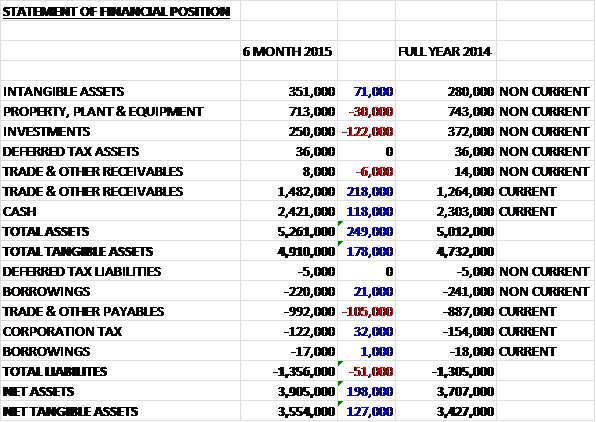
Going forward management see significant opportunities in Europe that can be serviced from the prospective office in Munich which are likely to become apparent during the second half of next year but the first half of the year is unlikely to receive the benefit of the major assignment in the Middle East that boosted the first half of this year.  Currency issues remain a problem as about half of revenue is received in US dollars but about half of all costs are incurred in South African Rand.  The group are therefore looking to incur more dollar costs and have taken steps to purchase forward 60% of the forecast Rand requirements for next year.
red24

At the current share price the shares are trading on a P/E ratio of 9.9 which seems rather cheap.  The dividend yield currently stands at a decent 3.5% after a 15% increase was announced for the final dividend, rising to 3.8% on next year’s estimate.  Net cash at the end point of the year stood at £2.04M, up from the £1.63M recorded at the end point of 2013 and the only debt is a South African bank loan used to fund the purchase of an office building in Cape Town.

We can see then, that profits have made some progress and the net asset situation is improving due to the lower accrual liabilities but the net asset level is pretty much zero once the operating lease liabilities are taken into account.  The cash from operations improved but this was due to good control of working capital rather than any operational improvements  but there is a decent free cash flow as the capital expenditure fell this year and the dividend is covered well by cash.  Despite this cash cushion, there are a number of risks here.  The group is susceptible to currency fluctuations but the main risk seems to be the small number of large customers that the group relies on.  Should one of these leave, there could be issues.  Operationally, there seems to be good prospects for growth both through the new German office and the cybercrime business in the UK but at this time the risks are just a bit too high at the moment and I am a bit uneasy about the confusion surrounding the Linx deal.  Definitely one to watch, though.

Pure Wafer Finance Blog – Full Year Results 2014

Pure Wafer reclaims and reprocesses silicon test wafers in the UK and the US. The group is also involved in the design, manufacture and installation of photovoltaic systems in the UK and they are listed on the AIM exchange. They have now released full year results for year ending 2014.

waferincome

When compared to last year, revenues were down across all divisions with UK Wafers falling $149K, North America Wafers down $328K and UK Solar sales collapsing by $567K to just $278K reflecting the impact that change in the UK government backed feed-in tariff continues to have on the solar market. Cost of sales also fell but not by as much and gross profits were some $717K lower. Admin expenses also showed a $447K decline but the pre-exceptional operating profit only showed a $780K improvement on last year due to depreciation and amortisation falling by $1M, partly due to last year’s $700K increase due to a review of the useful lives of solar development assets. Exceptional redundancy costs meant that actual operating profit was only $520K better at $3.6M. Interest on bank loans was broadly cancelled out by foreign exchange gains and income from derivative financial instruments and a small tax credit helped to push the profit for the year up $644K to $3.7M. A decent increase but this was only due to lower amortisation costs.

waferassets

When compared to the end point of last year, total assets increased by $3.5M, driven by a $1.8M growth in the value of plant and machinery and a $1.7M increase in cash. Conversely liabilities fell as a $1.4M decrease in loans was only partially offset by a $513K increase in deferred grant income and a $309K growth in trade payables. This has resulted in net tangible assets up some $4.4M to $30.3M.

wafercash

Before movements in working capital the cash profits were down $284K to $6M. After an increase in receivables as the average credit period for sales increased from 57 to 63 days with some $1.6M overdue, cash from operations was down $276K to $5.6M but a much lower interest paid than last year meant that net cash from operations, at $5.5M was some $346K higher. The group then spent $3.6M on property plant & equipment, somewhat offset by a government grant to give a free cash flow of $2.6M, down by $1.2M on 2013. The group then paid back some bank loans and still ended the year with a cash inflow of $1.7M. Despite there not being much progress on cash flows from last year, there is still a comfortable amount of cash being generated.
UK Wafers saw a result of $1.5M, a reduction of $700K when compared to last year and North America Wafers showed profits of $3.1M, an increase of $700K compared to 2013. Overall there was a 6% growth in the mature 200mm business but 300mm volumes remained flat as pricing pressures, which have now stabilised, impacted volumes in the second half of the year. The loss at the UK Solar business was $207K, an improvement of $750K compared to last year. Due to the further reduction in revenues, the business has been restructured to bring its costs base back in line with anticipated revenues.
The group has one customer who accounts for $6.4M of revenues, but no others that account for more than 10%. During the year there has been some pricing pressure due to the USD/YEN exchange rate favouring Japanese competitors which has now stabilised and tight cost control has meant that this has not had an adverse effect on profitability. The strength of Sterling has had an adverse effect of $200K on the year’s cost base.
With high utilisation levels at both plants, the group has implemented a programme to increase 300mm capacity and it is now fully operational. The group also invested in leading edge measuring equipment. As part of the restructuring that took place in 2009 there are a number of warrants issued to a number of people covering up to 22% of the total share capital and RBS also hold warrants covering nearly 3M shares, 750K of which have already been exercised. Operating leases increased considerably to $12.2M relating to a 99 year lease of land at the Swansea premises and the lease of land and buildings in Prescott, Arizona.
Going forward the board see the market as a whole growing driven by internet capable technologies such as TVs and home appliances and demand for mobile electronic devices such as tablet PCs and smart phones. Due to these trends, the group’s customers continue to invest in additional capacity and technology advancements which gives rise to wafer reclaim opportunities. Since the year end demand for the group’s services has remained strong with opportunities for growth in Asia and the large foundry sector and with good cost control, the board expect to make further progress during 2015. Given the high level of investment and capital, the board see new competitor risk as unlikely but sales are dependent on the continuation of industry growth, which, if not sustained could give rise to reduced sales volumes.

pure-wafer
There have been a number of board changes over the past year. Stephen Boyd has stepped down as chairman due to other business commitments but he remains on the board as a non-executive director. His post has been taken up by Peter Harrington. Richard Howells has taken over as CEO, he was previously the CFO of the group. His post has been taken by Huw Lewis who has experience within the technology industry and in the financial structuring and management of international companies.
At the current share price the P/E rating is a very undemanding 4.8, but this increases to 7.4 on next year’s forecast. At the end point of the year the group moved into a net cash position on $1.5M from a net debt position of $1.6M last year which has prompted management to look at providing a maiden final dividend of 0.43p per share that represents a yield of 0.7% at the current share price with the predicted interim dividend bumping this up to 1.1% next year.
Overall then, I see this company as being a bit of a mixed bag. Profits were up on last year, but this was only due to a reduction in amortisation and would otherwise be lower. Net assets were up due to strong increases in the value of fixed assets, and an increase in cash along with a reduction in loans, but here too it is perhaps not as positive as it initially seems as the group has taken on much larger finance leases, which are kept of the balance sheet. There is a decent cash flow, and although it is not that different from last year, the reducing debt has given rise to lower interest payments and the company was able to spend quite highly on capital expenditure, pay back some bank loans and still have a positive cash flow. Operationally, it seems that there has been some recent pricing pressure which has now stabilised and the UK solar business is making a smaller loss, although it remains to be seen as to whether there is a future here. Finally, there seems to be a large number of outstanding warrants on the shares which might lead to dilution in future. On a P/E basis the shares are very cheap and although modest, the introduction of dividends is good but there seem to be a number of reasons to keep me on the side lines for now.
On the 27th November the group released a trading update. Trading was in line with market expectations and recent engagement with customers in the US and Asia has been particularly positive. Nothing else was added so nothing seems to have changed.
On the 22nd December the group announce that their facility in Swansea had suffered fire damage and it is anticipated that production at the site will be affected and in the interim some production will be moved to the Arizona site temporarily. A further announcement will detail the full scale of the problems but although the group is insured, this is sure to cause some short term disruption.

On the 25th February the group gave an update on the situation with the fire. The group was comprehensively insured which included a 3 year business interruption cover.  It is anticipated that it may take up to a year for full scale production to recommence.  The Prescott facility is currently undertaking a qualification process with a number of Swansea’s customers which will enable some of the production to be switched which should take place from May onwards.  The interim results will include an impairment charge of $15.3M in respect of the loss estimated to have been incurred due to the fire.  While the assets are insured and the insurers have accepted liability, any reimbursement is a separate economic event for accounting purposes and is only recognised when the claim has been quantified and agreed by the insurance company which is not expected to happen before the end of the year.

On the 1st May the group released a statement covering the insurance claim.  Negotiations with the insurers have now concluded and the board believe they have reached satisfactory settlement terms.  The claim comprised of replacement costs of property, plant & equipment and three years business interruption with a cash sum settlement being agreed.  The board is now not planning on resuming operations at Swansea but to continue operations in Arizona, instead electing to return some cash to shareholders.  The settlement represents a discount to the potential full cost of reinstatement of the Swansea facility, including compensation for business interruption.  There are also a number of significant liabilities which will need to be settled with regards to the closure of the Swansea site.

The board believes the settlement will enable a return to shareholders at a value significantly higher than the average price of 60p per share that the company’s shares have been trading at but it is unlikely to be more than 125p per share.  Given that by the time the Swansea facility is up and running, many customers are likely to be entrenched with the competition, this really seems to be the most sensible course of action and quite an amazing result for shareholders, of which I am sadly not one.

On the 12th August the group released a trading update.  They have confirmed the disposal of the fire damaged property in Swansea and the assignment of the 99 year lease to Breathless LLP.  It is also confirmed that all outstanding obligations under Government grant funding have been settled and all redundancy liabilities have been substantially settled following the expiry of the statutory consultation period.  Based upon current information, the board now estimate the return of surplus funds resulting from the insurance settlement will be in the region of 140p to 145p share which is significantly higher than yesterday’s closing price!  In addition, the underlying profits for the year at the remaining Prescott facility are in line with management expectations with the facility currently running at record levels of productivity and high utilisation.

Clearly this is great news for anyone holding the shares from yesterday and although there might be some further improvement in the share price, I suspect most of the good news is now factored in here.