API Finance Blog – Final Results Year Ending 2014

API is a manufacturer of speciality foils and packaging materials serving markets in Europe, North America and Oceania from production operations in the UK and the US.  The main markets for the products are consumer goods and printed media.  The laminates business includes metallised film laminates, holographic laminates, aluminium foil laminates and Fresnel lens laminates and markets include tobacco, wines, confectionary, health, beauty and personal care.  The foils products include metallic hot stamping foils, pigment foils, holographic foils, coding foils and holographic lamination film and markets include wines, confectionary, greetings cards, magazines, footwear and office products.  The products under the Holographics sector include custom holographics, holographic overlays, tamper evident seals and scratch off foils.  Markets include premium branded goods, dutiable goods, pharmaceutical goods, tickets and vouchers.  API has now released their final results for the year ending 2014.

apiincome

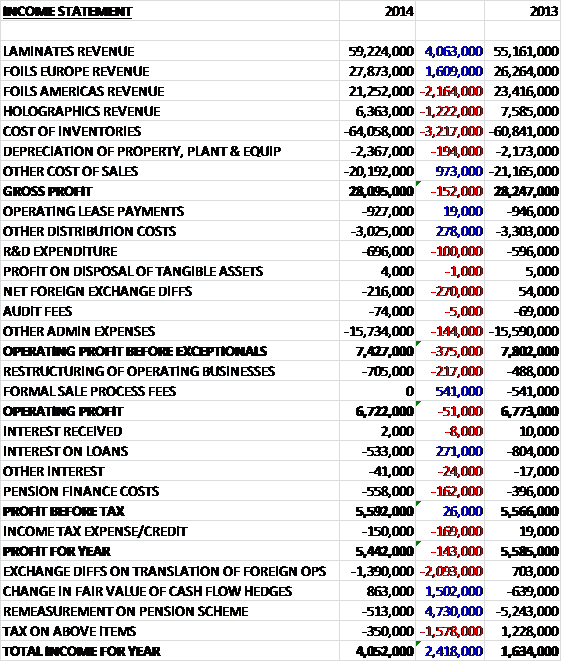
Revenues increased in the Laminates and European Foils business but fell in the Americas Foils and Holographics business.  Cost of inventories also increased to give a gross profit some £152K lower than in 2013.  A fall in distribution costs was counteracted by an increase in Admin expenses so that before exceptional items, operating profit was £375K lower than last year.  The lack of a sale process fee that occurred last year meant that actual operating profit was just £51K lower at £6.7M.  The group spent over £1M on loan interest and pension costs but the interest was £271K lower than in 2013, counteracted by a nominal tax charge (compared to a small rebate last year) due to historic losses.  There remains £2.1M of tax losses in the UK and $4.1M in the US.  This meant that the profit for the year, at £5.4M, was £143K lower than in 2013.

apiassets

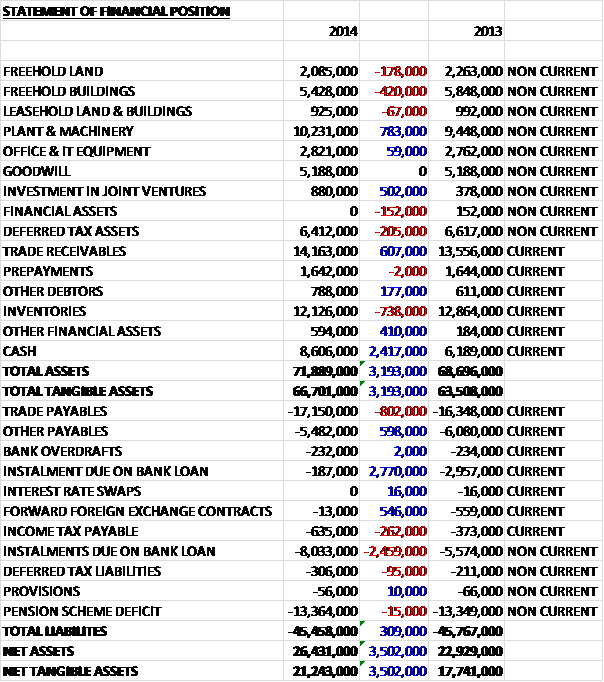
When compared to the end point of last year, total assets increased by £3.2M driven by a £2.4M increase in cash levels, a £600K hike in trade receivables and a £783K growth in plant and machinery, somewhat offset by a £738K reduction in inventories and a £420K fall in the value of freehold land.  Liabilities remained fairly flat as an £802K increase in trade payables was offset by a £598K fall in other payables and a £546K decline in forward foreign exchange contracts.  Overall, net tangible assets increased by £3.5M to £21.2M.

apicash

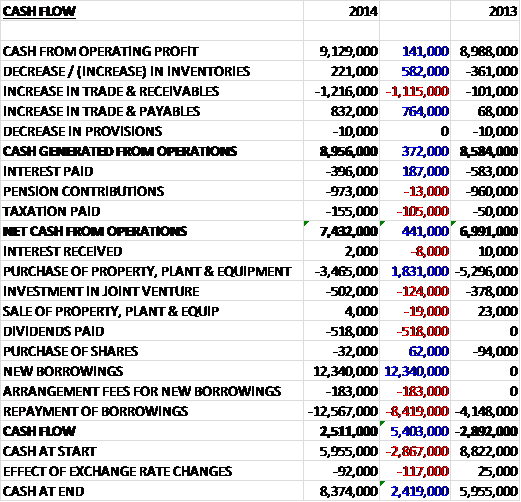
Before movements in working capital, cash profits were £141K higher at £9.1M.  An increase in receivables was broadly counteracted by other working capital movements so that cash generated from operations increased by £372K to just under £9M.  The group spent almost £1M of this cash on the pension scheme and just under £400K on interest to give a net cash from operations of £7.4M.  Nearly half of this, £3.5M was spent on the tangible asset purchases including two new foil metallisers and a new IT system, and half a million pounds was spent on joint ventures, relating to API Optixin the Czech rep.  There was also half a million spent on dividends to result in a cash inflow of £2.5M which is a pretty decent result.

Laminates made a profit of £6.7M, a £200K increase on last year.  During the first half of the year the laminates business experienced lower demand due to a net adverse churn of customer packaging specifications moving between laminate and non-laminate constructions and a reduced volume on one of its key supply positions.  In the second half this was more than compensated by the commencement of bulk shipments against the major new supply contract produced on the newly installed laminator and revenues were 25% higher than the comparative period last year.  Operating costs in the business increased due to higher spend on plant maintenance and sales & marketing.

Foils Europe made a profit of £2.1M compared to £2M in 2013 despite some disruption caused by the reorganisation of the UK operations (along with a £200K one-off cost).  The Polish distributer managed to double sales during the year, further progress was made in Italy and there was an increased contribution from Germany.  These gains were offset by lower revenues in the UK and Australia, which was hit by a factory closure at a key client in the label sector. The board has now approved capital investment for expanding the Livingston manufacturing plant as it is now fully loaded following the repatriation of volume from the failed Chinese joint venture.

Foils Americas made a profit of £1.7M, a decline of £200K compared to last year.  The decline was due to a sharp fall in orders in Q4 in the metallic pigments sector due to reduced conversion activity at one key customer.  Sales of decorative foils were also lower than last year due to a slow-down in the US during the harsh winter period.  These declines were mitigated by a more favourable sales mix to higher margin products, lower raw material costs and a partial reversal of last year’s reduction in inventory.

Losses at Holographics widened from £275K in 2013 to £724K this year as a long standing supply arrangement ended after a customer took production in house and the timing of shipments on another contract impacted year on year comparatives.   Despite these increasing losses for the year, most of the damage was done in the first half and cost cutting initiatives enabled Q4 to break even.  Going forward, the target remains to increase API’s presence in the security and authentication market but progress has been slower than expected and undermined by the loss of one particular supply position but investment has been made in the division, including in the Czech joint venture.

There are currently two customers in the Laminates segment who represented over 10% of total revenue with one accounting for as much as £22.8M.  It seems to be a real potential issue for the group that they are a number of key clients and they are very reliant on a few supply contracts as can be seen in some of the lower sales in some sectors this year.

api

Going forward, the board expects the stronger second half trading to continue into next year but it is unclear as to how long Foils America will be affected by reduced demand from metallic pigment customers.  The board believe that any impact on the results should be compensated by the elimination of trading losses at Holographics and the benefit from last year’s restructuring at Foils Europe, however.  Foils Europe continues to experience steady overall demand whereas recent activity in the decorative foils market in North America appears somewhat slower than usual.  At the laminates business there is a good pipeline of new business projects which it is hoped, will improve performance going forward.

The group is currently in a position of £154K of net funds compared to £2.6M net debt last year.  At the current share price the P/E ratio is a very cheap 7.1 rising to 7.6 on lower earnings forecasts next year.  At the current share price the dividend yield stands at 4% rising to 4.3% next year which seems pretty decent.  The business is cash generative, net assets are increasing and there is a good dividend yield but the loss making Holographics division and the slow-down at the Americas foils business makes me reluctant to dip in here until it is more clear as to whether demand will improve in the near future.

On the 3rd September the group released a statement that indicated the duration and severity of the down-turn at the Foils Americas business was greater than expected and the unit is likely to post a small loss for the year.  The losses at the Holographics division seem to have reduced and the unit is now break even but this is not enough to compensate for the losses at the Americas Foils business and results this year likely to be behind those of last.  This is clearly not good and I am staying out of the shares.  I will only update this blog now if things change with regards to trading.

Well, after deciding these shares were not for me, as of the 22nd January we now have some major news.  Cedar, a subsidiary of Steel Partners has announced that it will make an offer for the company of 60p per share.  This morning the shares were trading at 47p so this is quite a premium.  The group is already the largest shareholder in API, holding 32.3% of the total share capital.  In addition to this, Cedar has received letters of intent to accept the offer for further shares that brings their holding up to 62% and if they receive enough to make this up to 75% then they will procure a cancellation of the admission of the API shares to trading on AIM.  I have to say this seems to be a good opportunity for existing shareholders to exit a company that seems to be going nowhere for a decent premium on the last closing price.  The board of API suggest that investors do nothing and see what happens.

On the 9th February it was announced that the acceptance condition of the offer has been satisfied and that all other conditions of the offer have either been satisfied or waived such that the offer has become unconditional.  It seems this is pretty much all over.

James Halstead Finance Blog – Final Results year ending 2014

James Halstead has now released their final results for the year ending 2014.

halsteadincome14

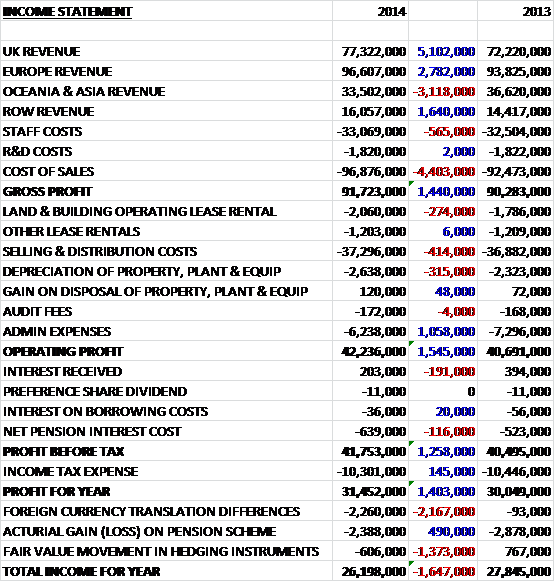
Revenues improved across most regions with UK revenue up £5.1M and ROW revenue up £1.6M, somewhat offset by Oceania & Asia sales which were down £3.1M on last year.  Staff costs increased slightly and cost of sales also increased to give a Gross Profit some £1.4M higher than last year.  We also saw an increase in depreciation and selling/distribution costs which were broadly offset by a fall in admin expenses to give an operating profit £1.5M higher.  An increase in pension costs and a reduction in interest received were counteracted by a slightly lower tax bill and the final profit for the year was £31.8M, some £1.4M higher than in 2013.  A steady rather than exceptional performance.

halsteadcash14

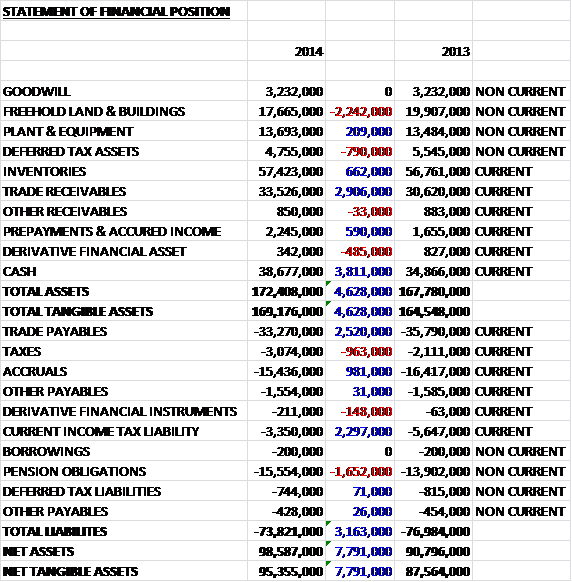
Total assets increased by £4.6M when compared to the end point of last year driven by a £3.8M increase in cash levels and a £2.9M hike in trade receivables, somewhat offset by a £2.2M fall in the value of land and buildings.  Liabilities fell £3.2M during the year as a £2.5M increase in trade payables, a £1.3M growth in tax liabilities and just under £1M in accruals were partially offset by a £1.7M increase in pension obligations which gave a net tangible asset level of £95.4M, a decent £7.8M increase over 2013.

halsteadcash214

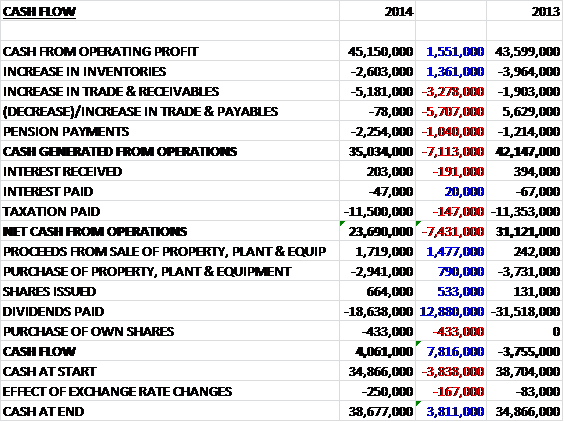
Before movements in working capital, cash profits were some £1.5M higher than in 2013 at £45.2M.  Adverse working capital movements, however, particularly a large increase in receivables and a swing to a decrease in payables, along with a £1M hike in pension payments meant that cash generated from operations was £35M, down by £7.1M when compared to last year.   An increased tax bill meant that net cash from operations was actually £23.7M, £7.4M lower than in 2013.  Of this cash, only £3M was spent on capital expenditure with the purchase of some property, plant and equipment and the group also made £1.7M by selling off fixed assets.  The vast bulk of the operational cash flow (£18.6M) was spent on dividends and even there the group enjoyed a £4M cash inflow to give a balance of £38.7M at the year end point.  Despite the less than stellar growth this year this company is still throwing off a lot of cash in the form of dividends.

The group has had a good split of different projects and is even active in Iraq where they have supplied flooring to the Baghdad Medical Hospital and General Hospital of Samawa along with temporary flooring for the workers on construction projects in Qatar.  In India the group has supplied products to the Aditya Birla Memorial Hospital in Jaipur.

In the Nordic regions sales were on a par with previous years and there has been good progress with the introduction of product manufactured at Teesside.  During the year the group have installed the most Northerly Polyflor in the world in Longyearbyen in student apartments.  Objectflor in Europe has seen a sales growth of nearly 4% despite a contracting market with slight erosion to margins which has led to a 5% decline in profits at the division, although winning the accolade of “Best Quality Product” at the Domotex exhibition in Germany can’t do any harm.  In France the group enjoyed a turnover some 9% ahead of last year and have installed flooring in the Louis Vuitton HQ in Paris and the Monaco government offices and despite the tough market conditions in the country, management expect continued growth in the country.

Homogeneous-2000pur-210-x-95

In China projects for new builds have been buoyant but in Australia and New Zealand these projects have been scarce.  Australian turnover was on a par with last year but margins have suffered and profits in the country declined considerably, although margins have begun to recover in the second half of the year.  New Zealand did not fare well as turnover fell by 6% with the shortfall felt in commercial sheet vinyl due to the lack of school and hospital projects.  This did mean, however, that margins improved as these are low margin products and the group made a modest profit in the country where they have won a three year contract with Housing NZ to supply flooring for social housing.

In Canada the group sold flooring to the Royal Bank of Canada’s retail outlets, the Rogers retail chain and Goodlife Fitness gyms along with larger one-off projects at the new hospital in Montreal, the McGill University Health Centre.  The performance in the latter months of the year showed some improvement as emerging markets continue to demand fashion retail outlets which makes this a fast growing sector.  The new financial year has continued with positive growth as some confidence has returned to many markets which hopefully can be sustained.

At the current share price, the P/E ratio stands at 18.5 reducing to 17.6 on next year’s forecast which is not too bad considering the big cash pile the group is sitting on.  A final dividend of 7p (17% increase) gives a yield of 3.6% rising to 3.8% next year on consensus forecasts which again, is pretty decent.  This is not a bad update, with steady profits, an increasing asset base and positive cash flow which is predominantly spent on returns to shareholders but it appears that the group is finding growth harder to come by with some of their markets in the doldrums.  A decent dividend yield, however, encourages me to continue holding these share for now, however.

On the 5th December the group released a trading statement covering the first five months of the year.  It is expected that this year will be a new record in terms of turnover and profit and so far this year the group are 5% ahead of last year with regards to sales with growth in both the UK and overseas. The half year results are expected to be in line with expectations.

On the 30th January the group released a statement covering the first half of the year.  Following the good statement last time, it was confirmed that sales were around 6% ahead of the same period last year.  The recent weakness in the Euro is not helpful for their exports but the low price of oil and strong Sterling performance have a compensatory effect regarding input costs.  Confidence in the full year is unchanged and remains positive.  This sounds good, I have added to my position here.


Glaxosmithkline Finance Blog – Q3 2014

GSK has now updated the market on its performance in Q3 2014.

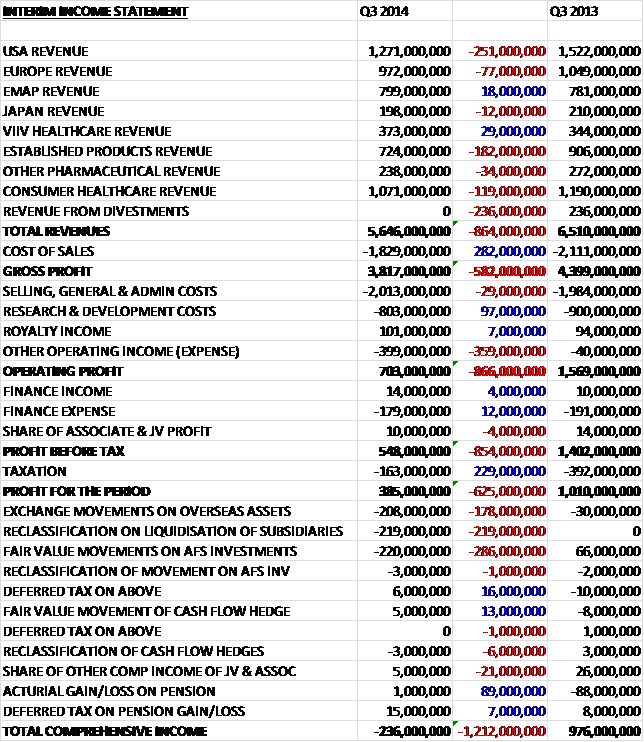
gskincomeq3

Revenues fell across most markets with US sales down £251M, Established product revenues down £182M and European sales decreasing by £77M.  The only sectors to improve over Q3 last year were ViiV healthcare, up £29M and Emerging Markets, up £18M.  Cost of sales also fell but gross profit for the quarter fell by some £582M.  General and admin costs were broadly flat whilst R&D costs fell but these were dwarfed by a £359M increase in “other” operating costs which included a £114M charge to account for an additional year of US branded prescription drug fee.  Taxation, as would be expected, fell by £229M to give a profit for the quarter of £385M, a vast £625M reduction on the total in Q3 2013.

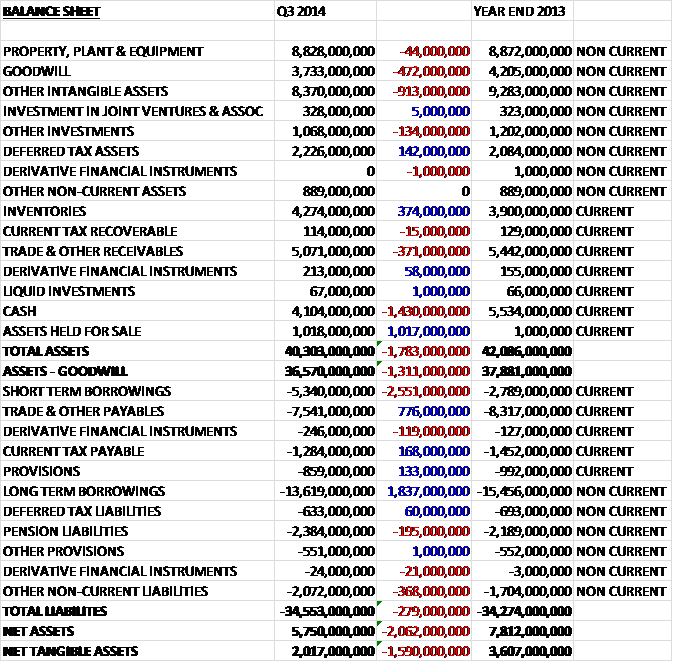
gskassetsq3

When compared to the end point of last year, total assets at the nine month point of 2014 collapsed by £1.783BN.  This fall was driven by a 1.43BN decline in cash, a £913M fall in other intangible assets, a £472M reduction in Goodwill and a £371M decline in the value of receivables.  These falls were partially offset by a £1.017BN increase in assets held for sale, mainly relating to £936M in relation to the Novartis transaction, and a £374M hike in inventories.  Liabilities increased somewhat during the period driven by a £714M increase in borrowings, a £368M increase in other liabilities and a £195M increase in pension liabilities, partially attributable to the stronger dollar in relation to US pensions, counteracted by a £776M decrease in trade and payables.  Overall then, this all meant that net assets collapsed by more than two billion pounds to £5.75BN.

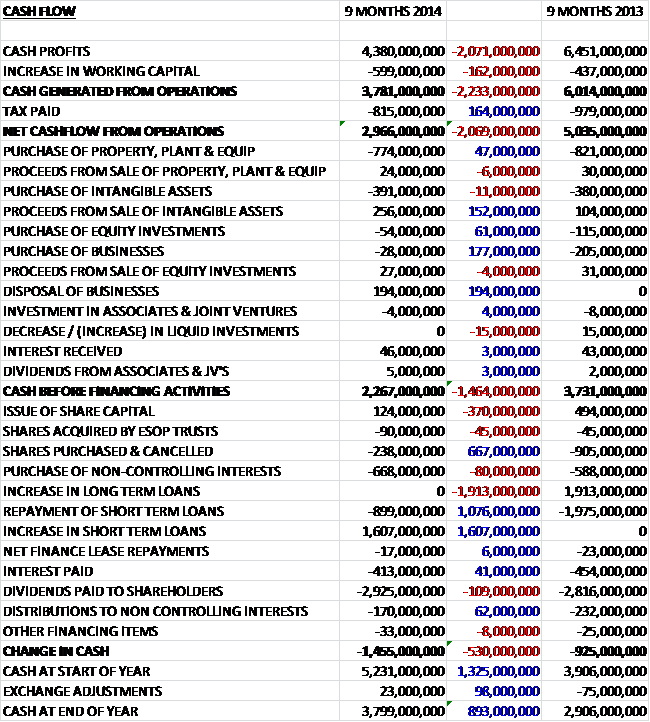
gskcashq3

Before movements in working capital, cash profits were down by more than two billion pounds at £4.38BN.  After the increase in working capital and the tax was paid, the net cash income from operations was just under £3BN, a £2BN fall when compared to the first nine months of 2013.  Of this £3BN, £774M was spent on property, plant and equipment; and £391M was spent on intangible assets before £256M was recouped by flogging off intangible assets and £194M from the disposal of a business.  The group also spent £668M on the purchase of non-controlling interests relating to 25% of the Indian subsidiary and 30% of the Indonesian Consumer Healthcare business not already owned, and £238M spent purchasing and cancelling shares.  GSK also brought in some cash by gaining over £700M of new loans.  After £3BN was spent on dividends the overall result was a £1.455BN outflow of cash to give the group £3.8BN of cash at the end of the period.  It can be seen from this cash flow that although there is a fairly strong operational cash flow, the dividends are not covered by cash flow and the total outflow was some £530M worse than last year.

Respiratory sales fell 8% this quarter.  Seretide/Advair revenues fell by 13% to £976M, Flovent/Flixotide sales decreased by 6% but Ventolin sales increased by 16%.  Relvar/Breo Ellipta, now launched in the US, Europe and Japan saw sales of £15M.  The US was particularly badly hit with sales down 18% reflecting the continued price and contracting pressures.  The increase seen in Ventolin sales included benefits from wholesaler and retailer stocking patterns and favourable adjustments to previous accruals for returns and rebates.  European sales were down 3% reflecting increased competition but sales in Emerging markets were up 13% benefiting from a strong comparative performance in China as the effects of the government investigation are annualised.  In Japan, sales grew by 3% with growth from Veramyst and Xyzal offsetting declines in Adoair and Flixotide.

Oncology sales grew by an impressive 35% to £311M.  In the US, revenues grew by 44% driven by increases in Votrient and Promacta sales along with the newly launches Mekinist and Tafinlar.  In Europe, sales increased by 26% as Votrient sales increased by 5% and Promacta sales grew by 33%.  In Emerging markets sales grew by 33% and in Japan they were up 19%.  Cardiovascular sales fell by 3% as a 24% increase in Duodart sales was counteracted by a 4% decline in Avodart sales, a 41% collapse in Levitra sales and a 31% decrease in Prolia sales due to the agreement with Amgen to terminate the joint commercialisation in a number of European markets, Mexico and Russia.  Regionally, sales in the US fell 18% and European sales fell by 1% but these falls were partially offset by a 15% increase in Emerging Markets and a 14% hike in Japanese sales.

Immuno-inflammation sales grew by 46% but remained small at £65M. This was driven by a 14% increase in Benlysta sales.  Other Pharmaceutical sales fell by 8% reflecting generic competition to Dermatology products in the US, and a 54% decline in sales of Mepron following the start of generic competition in March.  ViiV Healthcare sales increased by 18% with the US up 32%, Japan up 48% and Europe increasing by 12%, somewhat offset by a 13% decline in Emerging Markets.  The ongoing roll out of Tivicay resulted in sales of £78M and Epzicom, which benefited from use in combination with Tivivay increased by 13%.  Selzentry sales, however, fall by 6% during the quarter.  The launch of Triumeq is now well underway and registered sales of £9M.  These increases were offset by a 48% fall in Combivir sales and a 58% collapse in the sales of Trizivir.

Established Product sales fell by 14% with declines in all regions except Emerging Markets which benefited from an improved performance in China.  Generic competition to Lovaza, down 58%; Seroxat, down 11% and Valtrex, down 29% all contributed to the decline.  Vaccine sales were flat with sales in the US falling 3% following the return of a competitor product, offset by strong performances in Emerging Markets and Japan.  Infanrix was down 12% with declines in the US reflecting the return of a competitor vaccine that experienced supply problems in 2013.  Boostrix sales increased by 37% with growth in all regions but in particular, benefiting from the phasing of tenders in Emerging Markets.  Cervarix sales declined by 17% due to declines in Emerging markets; Fluarix sales fell by 8% reflecting the later phasing of seasonal shipments; sales of hepatitis vaccines fell by 6% due to supply constraints that affected the US and Emerging markets in particular; Rotarix revenue was up 2% due to a strong performance in Japan and Synflorix sales grew 34% reflecting the phasing of tenders in Emerging Markets.

Consumer Healthcare turnover fell by 3% in the quarter and was adversely impacted by a number of supply problems and a continued slow-down in emerging markets.  The supply issues will continue until the end of the year but steps have apparently been taken to combat them.  Wellness sales fell by 8% due to supply issues that affected Smokers Health products particularly badly.  Oral Health sales grew by 2% as the continued growth of the Sensodyne brand was partially offset by a decline in Aquafresh.  Nutrition revenue grew by 4% driven by an 8% increase in Horlicks sales, particularly in India.  Skin Health sales fell by 13% due primarily to supply interruptions to Bactroban in China and sales of new products accounted for 8% of turnover during the quarter.  In Q4 2013, Breo Ellipta was launched in the US for COPD and Relvar Ellipta was launched in Europe for COPD and asthma in Q1 2014.  Tivcay was launched in the US and Europe and Triumeq was also launched in both territories during Q3 2014.

There have been a number of movements in the pipeline this quarter.  A malaria vaccine candidate has been submitted for EU regulation; Fionase, an allergy relief, has received FDA approval for over the counter sales in the US; FDA approval has been received for Arnuity Ellipta (Asthma), Triumeq (HIV) and Promacta (Anaemia); Triumeq has also received EMA approval for use in the EU and a number of potential treatments have received good Phase III results but the darapladib atherosclerosis and Tykerb adjuvant BC programmes were stopped.

The main problem for GSK is that the contract changes to Advair have affected US sales more than was expected and the rate of the decline is expected to continue for the foreseeable future.  This is the one major blockbuster drug that the group have and the declining sales really are a major problem.  In the quarter Advair sales were £976M with the next most important drug the vaccine Infanrix selling just £212M (itself in decline).  Additionally sales in Consumer healthcare seem to be being affected by supply issues but conditions in China have improved and ViiV Healthcare seems to be doing OK.  In response to the declining Advair sales the group have reduced costs in admin and R&D and expect to be able to make £1BN in annual cost savings at an initial cost of £1.5BN.  Due to some of the new Respiratory products, however, the group expects the division to return to growth by 2016.

At the end of the period the group had provided £500M for various legal and other disputes.  During the period the People’s court in China ruled that GSK China had offered money or property to non-government personnel in order to obtain improper commercial gains and had been found guilty of bribing non-government personnel.  As a result of the court’s verdict, the group has paid a fine of £301M to the Chinese government which will hopefully draw a line under the problems in the country.

In April the group announced a transaction with Novartis involving Consumer Healthcare, Vaccines and Oncology.  A new Consumer Healthcare business will be created with GSK having a 63.5% majority interest.  In addition GSK will acquire Novartis’ vaccines business excluding flu vaccines for $5.25BN with potential milestone payments of up to $1.8BN and ongoing royalties.  GSK is also divesting its Oncology portfolio for a cash consideration of $16BN, of which $1.5BN depends on the results of an ongoing clinical trial.  The transaction is expected to be completed during the first half of 2015 and the group are also expecting to be able to divest some of the pharmaceuticals in their Established Products portfolio.

Going forward this year the board expect core EPX on a CER and ex divestment basis to be broadly similar to that of 2013.  Currency problems continue to affect the group and the strong Sterling has had a negative impact on core EPS of 8% and if exchange rates were to remain unchanged it is thought that core EPS in Q4 will be adversely affected by 7%.  This year there were a number of one-off costs.  Restructuring charges of £113M (compared to £83M) included £12M under the Operational Excellence Programme and £81M under the Major Change Programme.  Legal charges of £318M (£73M) primarily involved the fine paid to the Chinese authorities.

Net debt currently stands at £14.788, an increase of £2.143BN on the same period of last year.  The quarterly dividend has been kept the same this quarter and the expected full year dividend of 80p which represents a yield of 5.5% and the board has signified that they expect to maintain the dividend at this level into next year.  Despite the decent yield, there is no doubt that GSK has a lot of issues at the moment, most concerning is the reduction in the Advair sales.  The group also seems to be losing cash and it must be possible that the dividend is potentially in trouble if a new blockbuster drug is not found.  For the time being, though, I am continuing to hold.

On the 5th November the group announced that it had filed regulatory submissions in the US and Europe for mepolizumab for approval as a maintenance treatment for patients with severe eosinophilic asthma.

On the 4th December the group announced that none of the bids received for some of its Established Products Portfolio were worth pursuing so there goes that idea then.

On the 28th January it was announced that European Commission clearance was received for the Novartis deal.  As part of the approval, the group have to undertake certain conditions.  The group has agreed to sell its meningitis vaccines Nimenrix and Mencevax on a global basis which generate sales of £36M.  In addition, they have agreed to sell their NiQuitin smoking cessation products and Coldrex cold and flu products in the EEA, its local Panodil pain management and Nasin cold and flu products in Sweden and Novartis’ cold sore business in the EEA.  These products together generated £109M in 2013.

On the 4th February the group released their Q4 statement.  As I am going to start a new thread for the full year results I thought I would do a short update here to cover the latest developments.  Overall core operating profits were down by 9% on a constant currency basis compared to Q4 2013.  The fall seems to have been driven by US pharmaceutcials, Japanese vaccines and Emerging markets with Europe and Consumer Healthcare showing small growth and ViiV being the stellar performer with profits up 43%.  The non-core earnings were much lower due to the fact that the sale of Ribena was included last time and there were some major restructuring charges of £457M. Net debt stood at £14.4BN compared to the £12.6BN last year although cash generation improved in the fourth quarter reflecting working capital improvements and a strengthening US dollar.

The dividend for the year is 80p which represents a yield of 5.3% at the current share price and the company expect to keep this the same next year too.  Some of the headwinds facing the group are likely to adversely affect performance during 2015, particularly in the first half  but a stronger performance is expected in the second half.  Overall, these are difficult times for GSK but there is a decent pipeline and a good yield for the time being so I am holding my shares.

On the 5th February the group announced that it had agreed the sale of its 7.9% stake in Genmab for £194M.  Since the divestment of the Oncology portfolio to Novartis, the group consider this stake to be a non-core asset.

On the 6th February the group announced that overall survival results from COMBI-d demonstrated a statistically significant reduction in the risk of death for the combination of dabrafenib and Trametinib compared to dabrafenib monotherapy in patients with metastatic melanoma and no safety concerns were observed.  Completion of this study was a requirement for the FDA’s accelerated approval for the combination in the US.  The final data will be submitted to regulatory authorities in the coming months.  This sounds like a positive result for a product that will be divested to Novartis with the rest of the Oncology portfolio.

Tristel Finance Blog – Full Year Results Ending 2014

Tristel has now released its results for the full year ending 2014.

tristelincome14

Revenues increased across all business sectors with Human Healthcare up £2.6M, Contamination Control up £282K and Animal Healthcare increasing by a more modest £24K.  Cost of sales also increased but not by much and Gross profits were an impressive £2.4M higher than last year.  Both depreciation and amortisation fell when compared to last year but wages increased by £587K and there was a foreign exchange loss compared to a gain in 2013.  The big difference, however, was the lack of a £2.2M restructuring cost that occurred last year as some assets were impaired and the headcount was reduced, but other admin expenses were £524K higher to give an operating profit some £3.6M higher before a tax bill reduced the increase over 2013 to £2.6M to give a profit for the year of £1.3M.

tristelassets14

When compared to the end point of last year total assets were some £2.3M higher driven predominantly by a £2M increase in cash levels and a £211K increase in inventories, only partially offset by a £224K decrease in deferred tax assets.  Liabilities also increased when compared to last year as trade payables were up £486K, deferred income was up £440K and tax liabilities increased by £347K.  Overall net tangible assets increased by £1.2M to £5.8M.

tristelcash14

Before movements in working capital, the cash income was a decent £2.7M, up by £2.1M from last year.  An increase in payables was predominantly responsible for an even more healthy net cash from operations, up £2.6M top £3.3M.  Less than a third of this cash was spent on capital expenditure with £677K going on tangible assets, including the addition of 20,000 square feet of warehousing space in Newmarket, and £479K on intangibles.  The only other major expenditure was the £272K paid out in dividends to give a positive cash flow of just under £2M which is a very decent performance.

Human Healthcare profits were up over £2M to £8.3M with increasing revenues from both the UK and the rest of the world.  Animal Healthcare profits were up £37K to £507K with the increase coming from outside the UK.  Contamination Control profits were up £158K to £595K with increases coming from both the UK and other countries.

A lot of the growth seen over the past couple of years has been from overseas markets, growing by 61% and 33% in 2013 and 2014 respectively.  The overseas operations are now cash positive and the board anticipate much of their future growth to come from these areas.  The group currently has direct operations in New Zealand, China, Hong Kong, Russia and Germany.  The products the group produces require the continued purchase of consumables and enables their clients to minimise capital spend and infrastructure investment.

The group is very reliant on one customer with26% of sales coming from just the one client (presumably the NHS) which was an increase on the 19% it accounted for last year.  There is a risk that during an economic downturn, there could be a cut back on the supply of funds to the NHS which may impact on the group.  As a new ten year lease was agreed on their HQ, the group now have £2.3M repayable under operating leases, £296K of which needs to be paid within a year and this represents quite a large increase on the total previously incurred.  Going forward, the group have committed to the acquisition of £300K worth of items, one new item of manufacturing equipment and a new Enterprise resource planning system.  Management remain optimistic for the foreseeable future and they are anticipating entry into new product segments shortly.

After serving on the board for three years, Christopher Samler, the chairman is stepping down and Francisco Soler is taking over on an interim basis.  This is a bit of a shame as there is no doubt that Mr. Samler has presided over a very successful turnaround for the group.

tristel-wipes-system-large

At the current share price the shares are yielding 2% rising to a respectable 2.6% on next year’s consensus.  The shares are not exactly cheap on a P/E basis with the current ratio being 25.3, lowering to 19.2 on next year’s forecasts.  This is clearly a good set of results for the group.  They have successfully transformed themselves out of a collapsing market and now seem to be expanding well.  The main thing to note from these financial tables is that the cash intake seems very healthy.  Out of the £2.7M before working capital movements, only about £1M went on capex with the rest available for dividends/acquisitions/hoarding.  At this share price, though, this growth seems to be priced in and it is a shame to see a successful chairman leave.  Finally, there is still a reliance on the NHS, all of which makes me think I might dip in if the price falls at all but am happy to hold at these levels.

On the 3rd October, Franciso Soler, the interim chairman and largest shareholder sold 350,000 shares which takes his holdings don to 10,624,988 shares and 26% of the issued equity.  This is not a big sale in the grand scheme of things but it’s never good to see.

On the 16th December the group released a trading statement that indicated the strong trading highlighted at the final results has continued.  In the last six months, revenues are expected to be greater than £7M and pre-tax profit to be no less than £1M which is a £300K increase on the same period of last year.  Growth came from all areas of the business, both within the UK and elsewhere.  This is a a decent update and I am more than happy to continue holding.

Matchtech Finance Blog – Full Year 2014

Matchtech has now released its full year results for the year ending 2014.

matchtechincome14

Revenues have improved across both businesses with Engineering sales up £18.1M and professional services revenue up an impressive £24.6M. Wages and salaries increased by £2.6M and other cost of sales were up £33.4M to give a gross profit some £6.6M higher than last year.  The Amortisation charge is considerably higher than in 2013 due to the amortisation of intangibles acquired with the business purchase and there were also unfavourable movements in the share based charge, foreign currency translation and other admin expenses, although there was no repeat of the £425K restructuring charge that occurred last year to give an operating profit £3.8M higher.  Fairly modest increases in finance costs and a larger tax hike meant that the annual profit for the year was £1.6M higher at £9.1M.

matchtechassets2014

When compared to the end point of last year, total assets increased by £5.3M.  This increase was driven by a £2.5M growth in trade receivables, a £1.7M increase in acquired intangibles and a £1.6M hike in goodwill.  Liabilities reduced during the year predominantly due to a £7.7M reduction in the loan and a £1.4M fall in taxation liabilities, somewhat offset by a £3.6M increase in contractor wages to be paid.   This all meant that net tangible assets increased by a decent £7.3M to £39M.

matchtechcash2014

Before movements in working capital the cash profits were £15.7M, some £3.6M better than last year before an increase in receivables was broadly counteracted by an increase in payables, the group then spent £642K on interest payments and some £2.8M on tax to give a net cash from operations of £12.3M which was a £3.8M improvement on 2013.  There was not much in the way of capital expenditure but the £4.2M spent on the acquisition was paid for by a similar amount gained from the issue of new share capital.  The group then spent £4.5M on dividends and still managed to post a £7.5M cash inflow.

Contractor numbers only increased by 100 during the year but Net Fee Income (NFI) has grown by 14% over the same period driven by wage inflation and placing candidates in higher pay rates.  The group have found that as the UK economy improves, candidates are receiving multiple job offers and counter offers from incumbent employers which is increasing the time to hire somewhat and slightly reducing permanent fees.  There is some investment taking place with a plan to increase headcount in the Engineering business during the first half of next year.

Engineering reported a profit of just under £10M, a £1.4M improvement on last year but the German office continued to struggle with a loss this year of £373K increasing from the £106K loss in 2013.  Infrastructure was the strongest performing area with a 36% increase in NFI due to major investment in rail, highways, utilities and building structures.  Network Rail announced £38BN of funding into engineering projects and the Highways Agency delivered record spending which helped increase confidence in the sector and an increased activity was seen in both permanent and contract recruitment.  Aerospace NFI grew by 17% as the design and engineering phases of the Airbus A380 and A350 moved into volume manufacturing.  Automotive NFI was up 5% and there were sustained high levels of investment from JLR and increased levels of interest in UK automotive capability from developing nations.  Energy NFI was flat year on year as the Nuclear division recorded strong growth but Oil and Gas was impacted by stalling North Sea investment.  The Maritime business was impacted by the planned completion of the QEC aircraft carrier build phase in Portsmouth with NFI down 7%.

Professional Services reported a profit of £2M, a £660K hike on last year’s numbers.  Excluding the £1.8M contributed from Provanis, the underling NFI grew by 13% with contract NFI up 11% and permanent fees increasing by 13%.  Technology increased NFI by 27% (8% on a like for like basis) and is predominantly contract based.  The business concentrates on high margin low volume business and has expertise in several niches such as Control & Automation, Electronics & Systems, Software Communications, Business Intelligence, ERP and Project Management with the acquisition increasing the group’s penetration into the ERP market.  Professional Staffing NFI was up 19% with a strong growth in permanent fees.  The business also operates within skill specific markets with a focus on Procurement, Finance, HR, Sales, Marketing and Training.  Within the team, there is a capacity to increase productivity within the current staffing levels before any further investment in headcount is needed.

The largest client accounted for just under 8% of revenues  with the majority occurring under the Engineering segment and clearly the group would feel the loss of this customer but no client accounted for more than 10% of earnings which adds some protection.  There is also some exposure to any potential interest rate hikes with a 1% increase affecting profits by £285K, although the group seem to be making decent progress in bringing borrowings down.   During the year Andy White stepped down from the board after spending 24 years at the company, he was also a substantial shareholder but has been reducing throughout the year.

During the year the group acquired Provanis for a total cash consideration of £4.3M.  Provanis is a technology recruitment business with niche expertise in the Oracle applications marketplace which seems like a good addition to improve revenues in the Professional Services business.  The acquisition comes with £1.6M of Goodwill and was paid for by issuing new equity.   Since the acquisition period in July, the acquired group has contributed £13.2M to revenues and a gross profit of £1.8M and including the £579K amortisation of intangibles have contributed £276K in profits.  It seems a bit strange that some of the acquired intangibles have been immediately amortised – does this mean the group has overpaid for the acquisition?

Net debt at the end point of the year stood at £3.1M which is a vast improvement over the £10.5M of net debt recorded at the end of 2013.  At the current share price the shares are yielding a not so shabby 3.7% after a 14% increase in the final dividend, rising to 3.9% on next year’s consensus.  At the current share price the P/E ratio is 15.6 but this falls to a rather undemanding 13.3 on next year’s consensus.  Overall this is a good set of results for the group.  Profits are up due to increased sales across both businesses; net tangible assets increased as the group paid off its debt and there was an increased positive cash flow from operations.  As the cash was used to pay off the loan, if all things stay the same, the debt should be paid off next year and once this is done, it will be interesting to see what is done with the cash.  It is a shame that the German business is still struggling and the group are obviously dependent on the recovering UK economy but I see some more value here and am tempted to top up.

On the 14th November the group released a statement covering Q1 2015.  NFI in the period was up 3% with contracts up 2% and permanent up 7%.  They have invested to accelerate growth in the Engineering business by increasing headcount and the board is confident that the outlook for 2015 remains in line with previous expectations.  Not a bad update, but could have been better.  I am still looking to top up but the share price seems to be in decline so I would like to wait for that trend to be broken.

On the 28th January the group released a statement covering the first half of 2015.  NFI was up 2% compared to the same period last year with a 6% increase in Engineering income offset by a 5% fall in professional services.  Contract NHI was 2% higher than last year, driven by Engineering that saw a continued strong demand for contractors, particularly within Infrastructure and the Power and Nuclear markets whose NFI was £600K and £300K higher respectively.  This was somewhat offset by a £200K reduction in Maritime NFI following the closure of shipbuilding at Portsmouth Naval Base and a £500K fall in Oil and Gas NFI due to the well publicised weakness in that industry.  Permant fees were also up 2% as Engineering NFI was up 22% including 60% growth in infrastructure, 40% in general engineering and 25% in maritime.  This was counteracted by a 10% fall in Professional Services as penetration into the group’s non-core markets proved challenging.  Overall, the board expects results for the full year to be in line with expectations.

Also on the 28th January it was announced that Adrian Gunn who has been CEO for eight impressive years is stepping down immediately.  He has taken the decision in the light of the group’s acquisition of Networkers International (more on that shortly).  Brian Wilkinson, who has been Chairman for the past year will take up the role of CEO with current senior independent non-executive director, Ric Piper, assuming the role of interim non-executive Chairman until a replacement can be found.

Finally, on the 28th January the group announced it’s proposed acquisition of Networkers International for 34p and 0.063256 Matchtech shares per share of Networkers.  At the current share price this values the group at £57.9M and the cash portion should come to around £28.6M to my reckoning, which is to be financed from an HSBC loan facility of £30M, which doesn’t seem to leave much room for maneuver.  Under this agreement, current Networkers shareholders would hold about 17.9% of Matchtech equity.  The acquisition will have a number of benefits for the group, including adding some new markets both in terms of industries and most interestingly, in the form of its international presence.  The directors expect the acquisition to be earnings enhancing in the first full financial year.

The Newtworkers directors are suggesting that their shareholders accept the deal and indeed,  Matchtech already have the agreement of 72.9% of the shareholders so this looks like a done deal.  As well as the new markets, another benefit should come in the form of the higher pricing points and profit margins of Networkers.  Matchtech have a gross margin of 10% but Networkers enjoys a gross margin of 17% so hopefully some of this will rub off on the enlarged group.  On the downside, this deal may increase exposure to the beleagered oil and gas industry, although Energy and Engineering only makes up 16% of NFI.

Overall then, this has been a very busy day for Matchtech.  Having been concerned about the slowly declining share price I had already sold off half of my holdings here which now seams timely.  As far as the update is concerned, the results were OK if nothing special and the decline in Professional Services is a concern and makes me wonder if the group might give up on this side of things given the acquisition.  The early loss of Adrian Gunn is a bit of a blow as he is clearly very talented but I guess his decision is understandable.  The acquisition seems to be a bit of a gamble.  Certainly the new international markets look exciting but this is going to load a lot of debt for a company the size of Matchtech which puts some pressure on future performance.  I am currently happy to hold on to the remainder of my shares to see how things develop but if it looks like I might be able to buy back in for cheaper I might off load the rest with a view to buying back in when it is clearer how the acquisition is progressing.

On the 2nd April it was announced that Neville Goodman, the chairman of Networkers has joinded the board of Matchtech as a non-executive director.  He is also currently a director at Apogee and NRG Consultants.


Tesco Finance Blog – Interim Results 2015

Tesco has now released their interim results for 2015.

tescoincomeinterim

There is no denying that this is a poor set of results.  Revenue in the UK fell by £600M when compared to the first half of last year.  In the overseas markets, the performance was just as bad with Asian revenue falling £438M and Continental Europe down £427M.  The revenues at the bank did fare better, posting a £23M increase and the fall in the cost of sales did partially mitigate the falling revenue but gross profit was down by more than a billion pounds.  Admin expenses actually increased during the period to give an operating profit of £347M, down by an eye watering £1.22BN.  Due to the lower profits, taxation did fall and there was a much lower loss from discontinued items but the profit for the year stood at a paltry £6M which was £814M lower than in H1 2014.

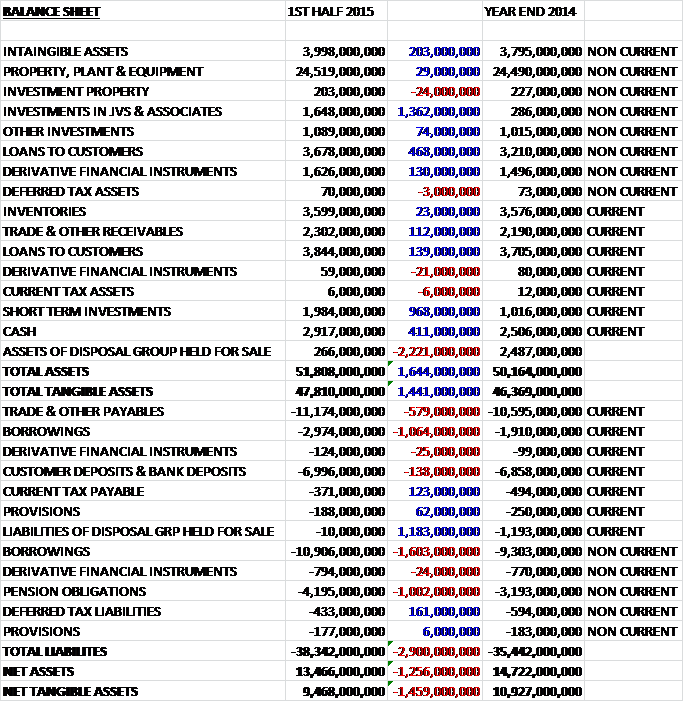
tescoassetsinterim

Total assets increased by £1.644BN driven by a £1.362BN increase in joint venture investments relating to the Chinese business, a £968M growth in short term investments, a £468M increase in the value of loans to customers and a £411M hike in the cash levels somewhat mitigated by a £2.221BN fall in the assets held for sale.  Liabilities also increased during the six month period with borrowings up a massive £2.667BN, a one billion increase in pension obligations due to a reduction in real corporate bond yields, and a £579M increase in payables which was somewhat counteracted by the £1.183BN reduction in liabilities held for sale.

tescocashinterim

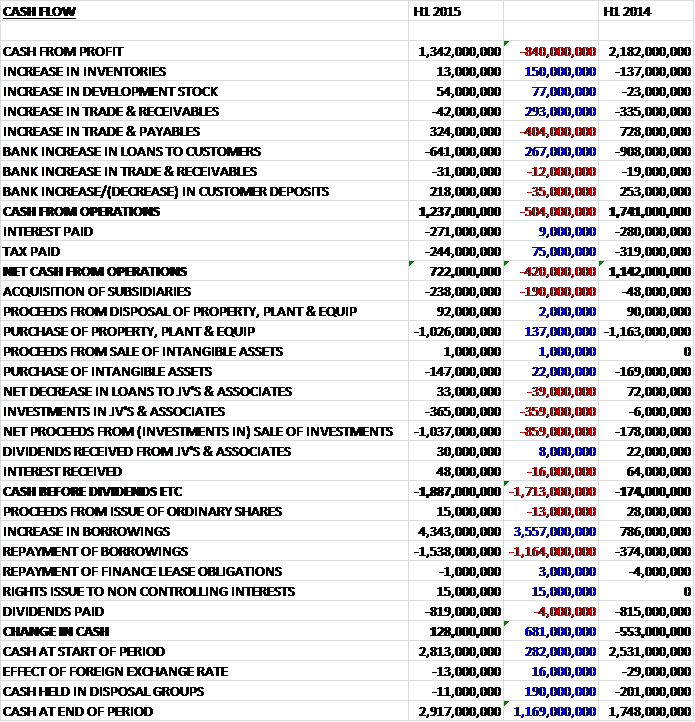
Before the movement in working capital, cash profits collapsed by £840M to £1.342BN.  Working capital movements did not change this figure much as a large increase in bank loans to customers were counteracted by increased customer deposits and payables which meant the cash from operations stood at £1.237BN, a £504M decline.  After tax and interest was paid, the net cash from operations was £722M which didn’t even cover the £1BN of new tangible assets purchased let alone the £1BN investment, £238M spent on acquisitions, £365M invested into joint ventures and £819M spent on dividends.  In order to pay for all this the group took out £2.8BN of net new borrowings to give a rather arbitrary £128M increase in cash.  This is clearly not a sustainable situation.

UK trading profit fell by £632M to just under half a million pounds.  This period has seen the continued trend towards convenience stores and online retail and Tesco’s relative performance fell short of initial expectations.  The decision to reduce the level of couponing activity impacted sales in the short term and like for like sales fell by 4.6%.  The group are intending to open another 500K ft2 of new space, mostly in Express and One Stop formats.  In total, 262 store refreshes were completed in the first half of the year but the group are reducing their capital expenditure which will slow this programme down going forward.

Asian profits fell by £54M to £260M, held back by difficult market conditions across the region.  Market conditions in Korea remained challenging with a higher number of enforced Sunday closures under the DIDA opening regulations.  In Thailand the political system improved with the ending of the curfew but the environment remained uncertain for customers and sales were also impacted by increasingly competitive convenience sector. The performance in Malaysia was impacted by low customer sentiment and more recently by protests against Western businesses.  The group opened 600K square feet of new space and intend to open a similar amount next half.

European trading profits increased by £21M to £76M on falling sales but positive like for like sales were seen in the Czech Rep, Hungary and Turkey.  The profit increase was predominantly due to a lower depreciation charge following last year’s asset impairments but further profit growth was held back by increased pressure on sales in Ireland and Slovakia.  In Ireland in particular the market remained challenging with intense competition from the discounters.  In Poland the group managed to maintain market share but the market as a whole was hit by lower customer confidence after sanctions were announced against Russia. In Hungary and the Czech Rep, the performance was supported by strong clothing sales.  In Turkey, an improvement in like for like sales was seen across the first half of the year.  Tesco continued to limit capital expenditure in the region, opening 200K square feet of new space and closing a similar amount of underperforming stores.

Tesco Bank profits improved by £14M to £102M driven by strong lending growth.  Customer accounts in the core banking products grew by 14% and the launch of personal current accounts in June completed the portfolio.  The result included a further £27M increase in the provision for PPI claims and broadly growth in the bank’s underlying trading profit for the full year will be offset by investment in the current accounts.

The group previously announced that the six month profit guidance was overstated due to the accelerated recognition of commercial income and delayed accrual of costs.  It has been determined that this issue also impacted previous statements and the profit before tax for last year was overstated by £70M and in prior years by £75M.    Now the FCA has commenced an investigation which is likely to result in significant legal and other costs and potential fines or penalties against the group, along with some potential third party claims.  Due to all the issues affecting the group, management have declined to offer a full year profit guidance at this time.

In may the group completed the formation of a new venture with China Resources and it has exchanged its Chinese retail and property interests plus cash of £334M (including £77M due to be paid next year) for a 20% interest in the new venture.  In March an agreement was entered into with Tata to form a 50:50 joint venture in India (Trent Hypermarket Ltd which operates the Star Bazaar retail business).  An investment of £85M has been recognised in regards to this.  In April the group acquired Sociomantic Labs, a German based digital advertising provider for £124M including £38M of deferred consideration.

Tesco have flagged up the potential for employee claims over changes to the calculation of holiday pay in the UK and variable pay in Korea, so this should be watched carefully.  Due, I suspect, to the revelations about the over statement of profits, the Chairman has announced plans to leave and is “preparing the ground to ensure an orderly process for his succession”.

Net debt at the end of the period increased by £984M to £7.491BN.  The interim dividend was cut from just 4.63p to 1.16p and at the current share price if the final dividend is not cut this still represents a yield of 6.6%.  It seems very likely that the final dividend will be cut, however, and if it was reduced by the same percentage as the interim dividend, it would be 2.53p and represent a total yield of 2.1% which is rather poor.  This is clearly a difficult time for Tesco.  They are having problems across all of their markets and have also been hit by the mess involving income recognition which is likely to result in further costs.  It really is difficult to see any silver linings at the moment, unless the performance in some of the European markets is a sign of a recovery there.  I am certainly not going to invest further given the current uncertainty but might as well wait it out with my current shares.

On the 29th October the group confirmed that it has been notified by the Serious Fraud Office that it has started an investigation into accounting practices at the company and in light of this investigation, the FCA has discontinued its own investigation.

On the 9th December the group released a profit warning stating that due to the changes and investments made trading profit for the year will be under £1.4BN.  They have retrained the entire team due to the revenue allocation scandal and have invested further in service and product availability to try and win back some lost business.  This is clearly bad news but not totally unexpected I would say.

On the 8th January the group released a trading statement covering Q3 and Christmas trading.  Overall, like for like sales excluding fuel fell by 3.8% in Q3, an improvement over the 4.8% decline in Q2 but worse than the decline in Q1.  The performance improved throughout the quarter, however, and culminated in a decline of just 0.6% over the Christmas period.  In the UK there was a 4.2% decline in Q3 and a 0.3% decline over Christmas.  Asian sales were hit by a 5% decline with a poor performance across all territories but things were slightly better in Europe with a decline of just 1.2% over the quarter.  Indeed sales in the Czech Republic were up 2.9%, Hungary was up 1.4% and Turkey up an impressive 6.7%, although Ireland remained a drag.  The group trading profit guidance of no more than £1.4BN remains in place.

In the UK the group has seen a strong improvement in satisfaction in store, aided by the introduction of more than 6,000 new customer facing staff members.  Like for like volume growth in fresh food over Christmas was positive for the first time in five years.  General merchandise showed a positive sales growth over Christmas and Black Friday promotions resulted in the highest week of sales on record for Tesco Direct contributing to a 22% like for like sales growth in online merchandise.  Convenience and online grocery sales also increased with a 4.9% and 12.9% increase respectively over Christmas.  As mentioned, market conditions across Asia remained challenging with performance in Korea suffering from more enforced Sunday closures and performance in Malaysia especially poor.  There was an improving trend in Thailand, however, as the impact of political disruption became annualised.  Sales at the bank increased by 3% due to a broader product range in mortgages and loans, although this was partly offset by a more competitive insurance market.

Dave Lewis also used this update to outline some of his plans for structural change in the group.  They included the appointment of the CEO of Halfords, Matt Davies as the new CEO of the UK and Ireland business – he will start on the 1st June.  There will be a restructuring of central overheads, simplification of store management structures and increased working hour flexibility which is expected to deliver cost savings of £250M at a one-off cost of £300M.  The decision was made to consolidate head office locations, closing Cheshunt in 2016 and making Welwyn Garden City the new HQ and to close 43 unprofitable stores.  In addition the decision was made to revise the store building programme, close the company defined benefit pension scheme, reduce capital expenditure to about £1BN, dispose of Tesco Broadband and Blinkbox to TalkTalk, loo at offloading the dunnhumby business and not pay a final dividend for this year.

To some extent this is another disappointing update with declining sales but the improved performance towards the end of the quarter is cause for some cautious optimism and the measures taken to improve profitability in the medium term certainly suggest the group’s issues are being tackled so for the first time in a long time I am a bit more optimistic about my shares here but not quite enough to buy any more this time, although once the market euphoria over the update has died down I may try and pick up a bargain here.

On the 17th February the group announced the appointment of John Allan as chairman.  He will join at the start of March and be paid a fee of £650K per annum (not bad work if you can get it!).  He has previously been CEO of Excel and then CFO of Deutsche Post.  More recently he was chairman of Dixons Retail and oversaw a quadrupling of the share price before the merger with Carphone Warehouse.

On the 4th March it was announced that Byron Grote will be joining the board as non-executive director and Gareth Bullock will be retiring from the main board to concentrate on his role on the board of Tesco Bank.  Byron is currently non-executive director at Unilever, Anglo American, Standard Chartered and Akzo Nobel but will step down from the Unilever board at the end of April.  He was previously CFO of BP from 2002 to 2011.

On the 20th March the group announced a deal whereby it took sole ownership of 21 superstores from the joint venture with British Land along with £96M in cash in return for Tesco’s stake in three shopping centres, three retail parks and three standalone stores.  The acquired stores were subject to RPI indexed rent increases and the group will continue to lease the stores that British Land acquired at market rents not subject to RPI  indexed increases.  This seems like a good deal to increase the proportion of stores owned as freeholds which can only be good in the long term.

Air Partner Finance Blog – Interim Results 2015

Air Partner has now released its interim results for 2015.

airpartnerincomeinterim

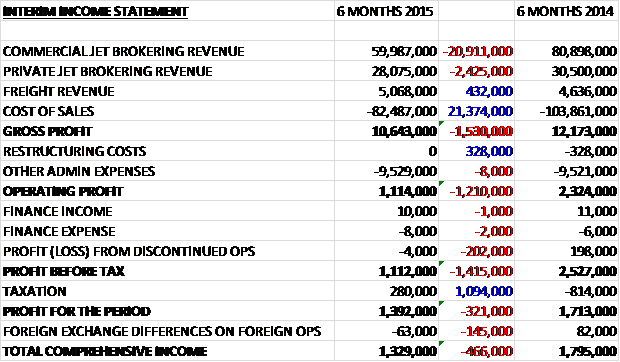
Commercial jet brokering suffered a fall in revenues of £20.9M when compared to the first half of last year and private jet brokering sales fell by £2.4M.  Revenues at the freight business actually improved, up £432K.  Sales improved across all geographic markets except France and Germany.  Costs of sales were also down but gross profit still fell by £1.5M.  The lack of restructuring costs were somewhat offset by the lack of £200K worth of profit from the discontinued Fuel business to give a profit before tax some £1.4M lower.  The group actually got a tax rebate during the first half of this year due to £750K of an R&D tax claim recognised during the period which meant that profit for the year wasn’t so bad, down £321K at £1.4M.

airpartnerassetsinterim

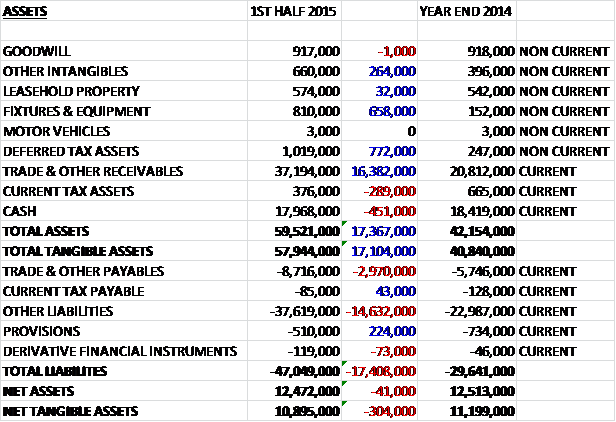
When compared to the end point of last year, total assets were up £17.4M driven almost entirely by a £16.4M increase in receivables and a much smaller increased in deferred tax assets and fixtures & equipment.  Total Liabilities also increased due to a £14.6M hike in “other” liabilities and a £3M increase in payables.  This all meant that net tangible assets fell by £304K to £10.9M.

airpartnercashinterim

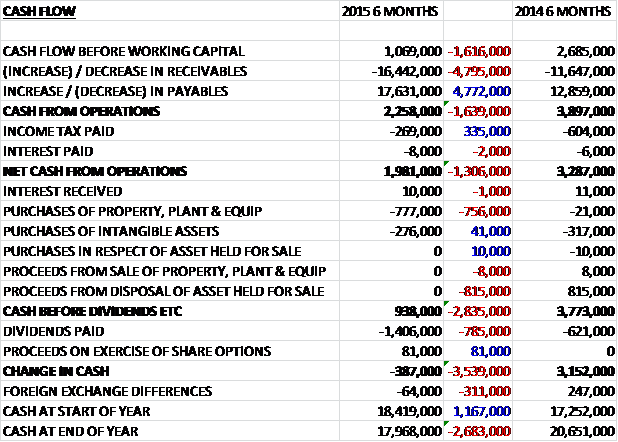
Before movements in working capital, cash profits were down by £1.6M to just £1M.  A large increase in payables was broadly offset by an increase in receivables and the tax paid during the first half of this year was about half that of last year so that net cash from operations, at just under £2M was some £1.3M worse than last year.  The group then paid £777K for property, plant and equipment and £276K on intangible assets, relating to software, which were both covered by the cash from operations before a £1.4M payment on dividends meant that there was a £387K outflow of cash in the half year.  Given that the group finished the year with £18M in cash, it seems they can afford to pay those dividends but the outflow was some £3.5M worse than the inflow during the same period of 2014.

During the first half of the year Commercial Jet Brokering showed a segment result of £1.1M, a decrease of more than £800K from the first half of last year.  Last year the group benefited from a number of large one-off contracts that were not repeated this year which has led to the decline in profits.  Action has been taken to reduce the division’s costs but on the plus side the group is seeing growing sales outside of the core government and military contracts with Tour Operating being particularly strong in the UK, Austria and Italy.  Oil and Gas activity provided decent revenues with a particularly strong performance in the UK and the US with a 227% increase in sales in the States.  Finally, there was a greater amount of customer activity in the automotive industry through new car launches.

Private Jet Brokering profits fell by £400K to £590K which reflects the investment that the group has made in its sales team.  The market remains challenging, especially in Europe but Italy and Switzerland have delivered strong performances.  The strong performance of the Jet Card bodes well for the future here and as the customers start to use the pre-paid hours held on their cards, the board expect to see improved profitability.

The Freight segment produced a result of no profit, a £21K improvement on last year which reflects new business wins and the investment made in new recruitment which led to a 32% growth in newly acquired business after a large government contract came to an end.  The contract for the UK’s Department for International Development has been extended for another year which has involved supplying aid flights to the Middle East.  Areas that have shown growth have been automotive and freight forwarding.

The Jet Card initiative seems to be doing well after the group has strengthened the sales teams in both the UK and the US.  Deposits on the card are at an all-time high and £5M of the cards were sold during the period to give a record deposit on the card of nearly £12M.  The roll out of the CRM IT system is now complete having cost £300K and the group has also implemented a complete IT upgrade which has taken the total technology spend during the period to £1M.

The interim dividend has been increased by 10% to 6.66p per share which seems to suggest a yield of about 7.7% at the current share price, which is a very good return.  Due to the nature of the business, there is limited visibility for sales but the board remains confident that expectations for the rest of the year will be met.  There is no doubt that this is a disappointing set of results for the group.  Profits at both of the main businesses have declined, mainly due to less governmental work.  The net assets also fell and the group recorded a cash outflow.  The cash levels, however, are decent and the yield is very good so this was not a disaster but I feel I would rather wait until the group starts growing sales and profits before investing.

On the 15th October it was announced that a large shareholder, Richard Griffiths had sold shares so that he now owns less than 5% of the company which is not exactly a ringing endorsement.

On the 4th December the group released an interim statement.  Trading in both the Commercial Jet and Private Jet divisions continues to perform in line with expectations and during the period the Commercial Jet division undertook a number of large projects including a programme of car launched with a major European manufacturer involving the movement of over 20,000 passengers to various press launches.  The smaller Freight division has performed ahead of expectations due to work arising from assisting aid agencies in West Africa. This seems to be a good time to test the waters here so I have bought some shares.

On he 14th January it was announced that investor Richard Griffiths had sold a substantial amount, perhaps most, of his shares to bring his holding from above 4% of the company to below 3%.  It seems Richard doesn’t see the share price going anywhere soon.

On the 30th January the group announced that since the last update the Commercial Jets division put in a better than expected performance over a traditionally quiet period.  The board still expect full year profit to be in line with current expectations though.  All in all, this sounds promising and I am happy with my holding here.

On the 13th March it was announced that non-executive director Grahame Chilton would be stepping down from the board having spent nearly two years with the group.  He  has accepted the role of CEO at Arthur J Gallagher Intl and as such will no longer have the time to devote to Air Partner, which is fair enough.

Asian Citrus Finance Blog – Interim Results 2014

Asian Citrus has now released its full year results for 2014.

asiancitrusinterim14income

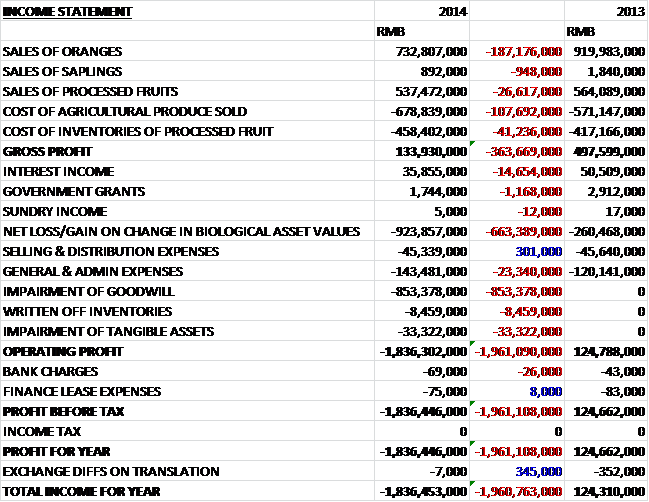
When compared to last year revenues were lower across all products with oranges down £18.7M due both to lower yields and reduced sales prices, and processed fruits some £2.7M lower.  Cost of sales were up with the cost of agricultural produce up by £10.8M, mainly due to depreciation and increased use of fertilizer and pesticides, and the cost of processed fruit inventories were up £4.1M to give a gross profit down by an eye watering £36.4M. Interest income was down £1.5M and general/admin expenses were £2.3M higher due in part to the loss on the disposal of plant and machinery along with written off inventories.  The big movements, however, were the non-cash charges.  The net loss on biological assets was some £66.6M higher and there was an £85.3M impairment of goodwill due to current business conditions at Beihai BPG.  This meant that the loss for the year was a massive £184M, a £1961M reversal on last year.

asiancitrusinterim14assets

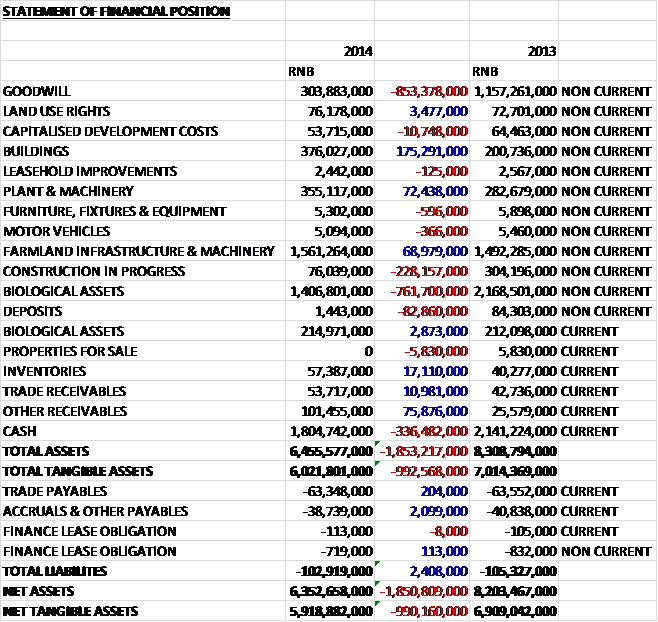
Overall total assets fell by £185.3M when compared to last year.  This was driven by an £85.3M fall in Goodwill, a £76.2M reduction in the value of biological assets, a £33.6M fall in cash levels and a £22.8M reduction in the value of construction in progress, some of which was transferred to the Buildings asset.  Liabilities were down by just £241K due to a £210K fall in accruals and other payables.  Overall, net tangible assets were some £99M lower at £592M.

asiancitrusinterim14cash

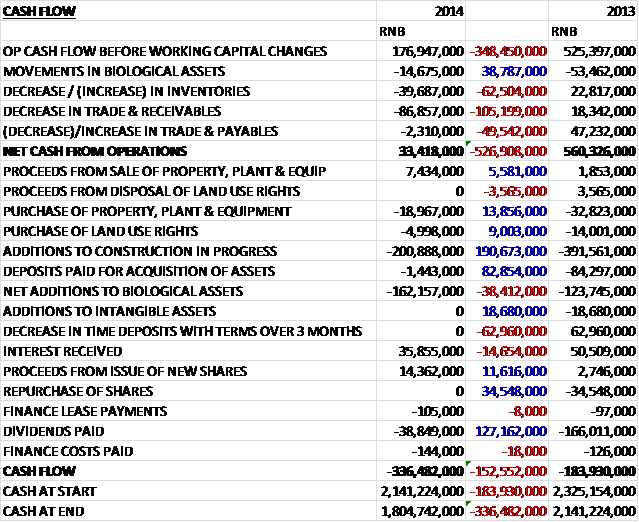
Before movements in working capital the cash generated from operations fell by £34.8M to £17.7M.  An increase in inventories and decrease in receivables meant that net cash from operations deteriorated further by £52.7M to £3.3M.  The group reigned back its cash spending in many areas but despite nearly halving still spent £20.1M on new constructions.   The next largest spend was the £16.2M paid for biological assets which is clearly more cash than the group is getting from operations so cash flow this year was an outflow of £33.6M, some £15.2M less than in 2013 to leave a still fairly comfortable £180.5M in the bank at the year end.

The loss recorded for the fruits themselves was £96M compared to a £3.2M profit last year.  The production yield at the Hepu plantation declined by nearly 18% due to the replanting programme to replace the existing winter orange trees, the continued impact of the citrus canker outbreak and the impact of frosts in the first part of the year.  This was combined with a 3% decrease in the average selling price and increased costs due to the inclement weather to reduce growth margins at the plantation from 43% last year to 13% this year.

At the Xinfeng plantation the production yield decreased by 4% and the gross profit margin collapsed from 33% to 3% due to reduced sales, the persistent heavy rainfall and the dyed oranges being sold by other suppliers in the area which negatively impacted sales prices.

Processed fruit profits were just £1.3M, down from £13.9M in 2013 as revenues of juice concentrates declined due to a decrease in sales of juice concentrates, a fall in fruit juice trading and a decline in the selling price of these products due to the competitive market.  The new plant in Baise City, Guangxi completed a successful trial production but it takes three years for the plant to run at full capacity.

The group are looking at methods to reduce the cost of pesticides and fertilisers, exploring new export opportunities and changing the product mix in order to improve margins.  They have also been collaborating with scientists to provide advice on production and product improvements and to attempt to find ways to recover from the citrus canker outbreak, which is still causing issues for the Asian Citrus

After the reporting date Typhoon Rammasun caused widespread damage to the group’s assets which has caused inventories to be written off by £846K, impairment of property plant and equipment to the tune of £1.6M and further impairment of biological assets of £1.2M.  The typhoon destroyed all banana trees planted in 2013, damaged some infrastructure and caused a significant volume of premature fruit drop from the orange trees in the Hepu plantation.  Also, it caused a temporary suspension in activities at two of the fruit processing plants.  After the damage had been cleared, 220,000 banana trees were re-planted with an expected harvest by the end of 2015, although it will take several years for the Hepu plantation and harvests to fully recover.  The weather problems didn’t end with the typhoon as production at the Hunan plantation was delayed due to the impact of frosts but is scheduled to begin in 2016 with oranges initially, and grapefruits to follow.

There have been a number of changes in the board make up over the year.  Mr. Tong Wang Chow, Peregrine Moncreiffe and Mr. Ma Chiu Cheung have all stepped down to be replaced by Mr. Ng Hoi Yue, Mr. Tonh Hung Wai, Mr. Chung Koon Yan, Mr. Ho Wai Leung and Mr. Ng Cheuk Lun.  Importantly, the positions of chairman and CEO are now held by two different people, as opposed to just the one last year and now Mr. Ng Ong Nee is CEO.  Hopefully the new CEO will attend the AGM unlike the outgoing director who was apparently too busy.

Due to the poor performance this year, there has not been a dividend announced.  There seems to be a plethora of problems happening to the company at the moment.  Heavy rains have leached nutrients from the soil, caused the outbreak of citrus canker that has not yet been eradicated; frosts have delayed the start of the new plantation and the typhoon has destroyed all the banana trees.  This makes me wonder whether planting banana trees in typhoon affected areas is really a good ideal.  Also, prices have been lower for both bananas and juices and the value of biological assets continues to fall.  The cash buffer is still fairly decent but the operating cash flow at the moment doesn’t even cover the cost of biological assets.  I still see potential here but things seem to be against Asian Citrus at the moment so I am holding off.

On the 7th November the group announced the results of negotiations over the winter orange contracts for the upcoming crop.  So, is it good news?  Well, it’s ACHL so of course it’s now.  The good news first – the average selling price at the more important (for winter oranges) Xinfeng plantation increased by 2.6% when compared to last year but the quantity supplied at 113,600 tonnes, represents a fall of 7.8%.  This is being blamed on “cryogenic freezing rain”.  Wow, that sounds pretty nasty… Also, frosts have apparently affected the Orange blossom.  At the much maligned Hepu plantation, the selling price has collapsed by 40% as canker ravaged oranges don’t look too good apparently.  The price is almost inconsequential though because the group only managed to sell just over 7,000 tonnes after Typhoon Rammasun took its toll, representing a 71% decline.  Clearly as a result of the above there will be a reduction in revenue and profit generated for the year ending 2015.  I keep waiting for a point where these shares become investable and the inherent value tied up in the group is released but I continue to wait after this update.

On the 30th January the group released an updated trading statement.  As already mentioned, the turnover and profits will be lower than the corresponding six month period last year.  The winder orange crop at Hepu managed just 7,146 tonnes, which was in line with the previous indication.  Hurricane Rammasun caused widespread crop loss resulting in a 71% decrease on volumes achieved last year.  The winter crop at Xinfeng was 103,847 tonnes, below the previous guidance of 113,600.  The crop here was affected by the cryogenic freezing rain damaging the fruit blossoms and the high temperature and drought from September to December.  In total, production of winter oranges decreased by 25% to 110,993 tonnes.  In addition to this, the average selling price also fell, down by nearly 3% on last year.  The cause of the reduction is blamed on Typhoon Rammasun and the previously unmentioned Typhoon Seagull along with the poor appearance of the fruits following the Canker outbreak.  Profitability was also impacted by a higher volume of fertilizers and pesticides following the typhoons and the canker – these costs are likely to continue in the short term.

As far as the processed fruits were concerned, unfortunately they did not provide much joy either.  Production was down some 17% to 23,952 tonnes and there was additional margin pressure.  No reasons were given for these particular declines.  So, we have the following.

  • Typhoon Rammasun
  • Typhoon Seagull
  • Cryogenic freezing rain
  • High temperatures and drought
  • Citrus Canker
  • High costs and lower realised prices
  • Processed fruit volumes declining
  • Reducing margins on processed fruit.

This is all very terrible bad luck and I don’t see any hint of a light at the end of the tunnel.  I have decided to stop updating on this company but may take another look if some of these issues can be overcome.

On the 3rd February the group announced that Huge Market Investments had sold 17,400,000 shares in the company.  After the transaction they hold 54,426,722 shares or the equivalent of 4.36% of the total share capital.  They must have taken quite a loss on this sale so this is not a vote of confidence.

Havelock Europa Finance Blog – Interim Results 2014

Havelock Europa has now released its interim results for 2014.

havelockincomeinterim

Interiors revenue fell by £1.8M compared to the first half of last year and a small increase in Educational Supplies revenue and a £1.4M fall in the cost of sales can’t prevent gross profit from being £300K lower.  Admin Expenses were broadly the same, despite a £300K reorganisation charge with finance costs and tax charges reducing slightly to mean that the loss for the period was only £60K higher than in the first half of 2013 at £1.8M.

havelockassetsinterim

When compared to the end point of last year, total assets fell by £870K driven by a £1.9M fall in cash and a £1.2M reduction in receivables; somewhat offset by a £1.6M increase in inventories and a £750K rise in deferred tax assets.  Conversely, liabilities increased during the period, mainly down to a £1.2M increase in the pension obligations due to an increase in the scheme’s liabilities, and a near half million pound increase in borrowings.  The result of this is that net assets were some £2.9M worse at £17.6M.

havelockcashinterim

Before movements in working capital, there was a cash outflow of £1.3M, £320K worse than during the same period of last year.  A slightly adverse movement in working capital meant that this loss widened to £1.9M, or some £650K worse than in 2013.  The group then paid a small amount in interest and intangible assets before a net £453K of new loans meant that the cash outflow finished at just under £2M to leave the group with £2.2M in cash at the period end.  Clearly this is disappointing.  The first half of the year is always worse but the lower operating cash flow than last time is a bit of a concern.  Further pressure is placed on the cash position because the group have entered into a contract for £1.2M of capital expenditure.

During the first half of the year, the Interiors business made a loss of £854K, a £218K improvement on the same period of last year despite reduced revenues due to delays to the school building programme.  In the financial sector the group won a major new contract with ISS for Barclays with work similar to the work being undertaken for Lloyds and TSB and discussions are ongoing with other prospective financial sector clients.  In Retail the group gained a new UK supermarket customer and work there includes the refurbishment of food stores and Havelock has delivered its first significant order for a major Australian retailer and additional orders are in manufacture.  Despite the delays, the group is building a significant order book for next year end beyond in the Education sector and the first major projects have been completed in the student accommodation market.

During the first six months of the year, the Educational Supplies business made a loss of £245K, some £178K worse than in the first half of 2014 due to delays on new school projects and the fact that apparently schools are using discretionary cash flow to upgrade canteens after the Government decided to give all primary pupils free school meals.  The Stage Systems have been impacted by the move away from higher margin work to lower margin sound and light projects and in order to address this change, the group are looking at reducing the cost base which is expected to give rise to restructuring costs of £380K.

In May Finance Director Grant Finlay resigned from his role after being at the business for nine years.  He was replaced by Ciaran Kennedy who has 20 years of financial and operational experience at PLCs.  Going forward achieving expected results in the second half of the year is dependent on the finalisation of orders and delivery schedules for the fourth quarter.  In to 2015 the board expect further opportunities to develop in Financial Services as some major customers revise their high street offering.

Net debt stood at £2.6M, an improvement from the same point of last year but a deterioration when compared to the end point of 2013, predominantly due to an increase in manufactured inventory for delivery in the second half of the year.  As would be expected no dividend will be paid.  Overall then, the loss for the half year is broadly similar to 2013, net assets fell due to increased pension liabilities and a reduction in cash and the near £2M of cash outflow in the first half of the year was worse than in the same period last year.  The new supermarket and bank clients are promising but I would have thought Lloyds and TSB have broadly finished their rebranding.  In conclusion, I don’t see much evidence of the company moving forward and I can now sell out at a point that broadly breaks even so I have decided to sell my holdings here.

On the 30th January the group released a statement covering trading for the full year ending 2014.  Results are expected to be in line with expectations and while turnover and profit are both expected to be lower than last year, some progress has been made on diversifying revenue streams with the international business delivered more than the original 10% of sales.  In retail the group delivered a number of initiatives for their existing customer base and developed some new customer relationships which should translate to work next year.  A number of financial services clients are re-evaluating their strategy which led to reduced opportunities during the year.  Next year the group are expecting to benefit from the new framework contract secured with ISS and a further three year contract with the Post Office.  Education activity is beginning to show signs of recovery and there is now a total order book of £25M at the end point of the year, £5M of which is for 2016 delivery.  The new ERP system is on target and should be ready for implementation in Q4 2015.  There was a £1.4M net cash position at the end of the year but next year the board expect the pension deficit to increase significantly following a decline in corporate bond yields.  In other news, Eric Prescott has agreed to step down during 2015 and the search is on for his replacement.

I am pleased to have sold out previously as the share price performance since then has been poor.  I have mixed feeling about this update though.  There is little doubt that this has been a poor year which will be reflected in lower profits and the decline in bank business along with the significant pension liabilities coming their way are certainly signs for concern.  The education business seems to be improving, however, and there seem to be a number of retail initiatives that will come to fruition next year.  Also, the fact that Prescott has been forced out is probably good for the group as they have certainly underperformed under his leadership and some new blood will probably help.  I am still not invested here but I will keep a close eye on this company going forward as I see some potential value.

On the 30th March it was announced that after Eric Prescott left as CEO, the group appointed David Richie as Chief Operating Officer.  He joined the group in 2013 as Commercial Manager after spending 15 years at Balfour Beatty.


President Energy Finance Blog – Interim Results 2014

President has now released its interim results for 2014.
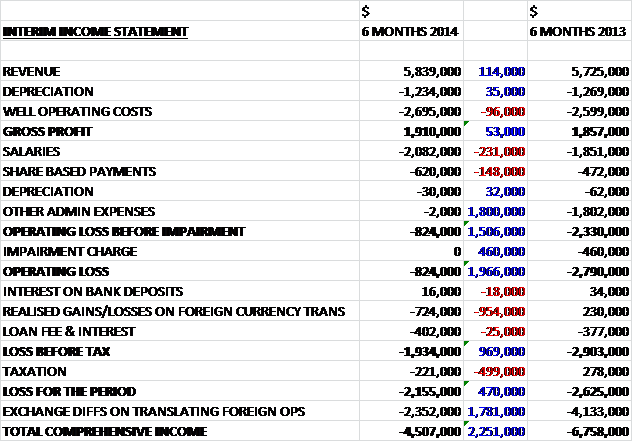
presidentincomeinterim

When compared to the first half of last year revenues were broadly similar, increasing by $114K as increased production was counteracted by a slight decrease in oil prices in Louisiana and whilst depreciation was slightly lower, this was offset by a $96K increase in well operating costs which gave a gross profit of just $53K more.  There was a $231K increase in salaries and a $148K hike in share based payments but other admin expenses were much lower reflecting a $1.8M capitalisation of costs relating to the Paraguay drilling campaign to give an operating loss of $824K, a near $2M improvement over the first half of last year which also included a $460K impairment charge relating to the relinquishment of the PEL 132 license in Australia.  Finance costs increased, though, driven by a near $1M adverse swing in realised foreign exchange transactions and taxation was half a million dollars more so that the loss for the period was $2.2M, an improvement of $470K over the first six months of 2013.
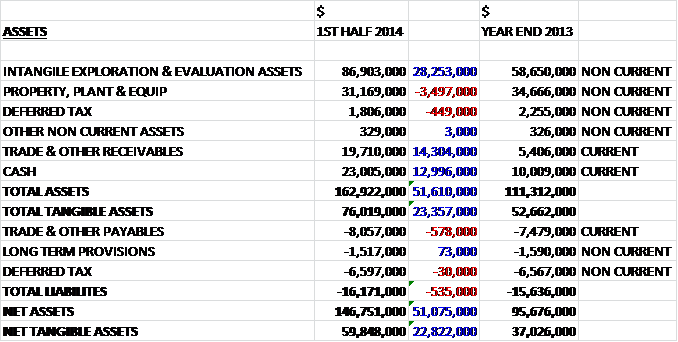
presidentassetsincome

When compared to the end point of last year, total assets increased by $51.6M driven by a $28.3M increase in intangible exploration assets, a $14.3M growth in receivables relating to prepaid exploration expenditure and a $13M increase in cash levels, only partially offset by a $3.5M reduction in property, plant and equipment. Liabilities were broadly similar with the $535K increase almost entirely due to an increase in payables.  This means that net assets were $51.1M higher than the end point of 2013 but until the results of the well are known, those exploration assets could be impaired.
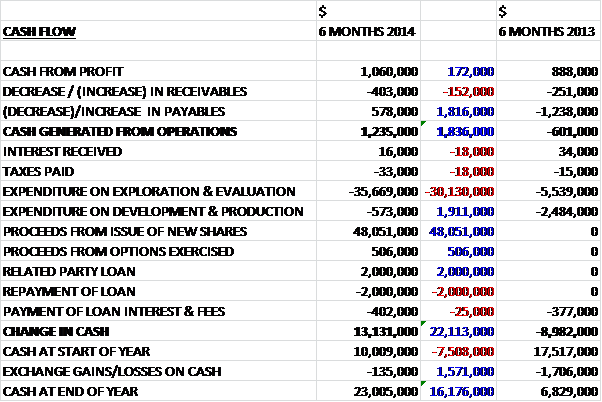
presidentcashinceom

Before movements in working capital, cash profits of $1M were $172K higher than in the first half of last year.  An increase in both receivables and payables, with the latter increasing by more meant that cash generated from operations was $1.2M compared to an outflow of $601K in H1 2013.  The main origin of cash was the issue of new shares, however, which netted the group $48.1M.  The vast bulk of this was spent on exploration and evaluation, accounting for $35.7M with just $573K being spent on development and production with a further $402K being spent on payment of interest and fees on loans.  This resulted in a cash inflow of $13.1M with the cash position at the half year point being $23M.

At the moment Paraguay is the core focus for the group.  The most recent seismic identified two structural play fairways each containing two petroleum systems.  The first is the Cretaceous system and is an extension of the Palmar system in Argentina.  The second is an underlying Palaeozoic system that was identified during the recent Jacaranda drilling that has charged the producing fields in Bolivia and Argentina.  The group have entered into an 18 month contract with Schlumberger for project management and drilling services and a rig has been contracted.  The results from the Jacaranda drill, although disappointing, did confirm the presence of a thick live source rock of Devonian structural leads identified across all three of the concessions.  In addition, a possible unconventional source potential was identified with technically recoverable resources in the Palaeozoic areas of the Paraguayan Chaco of 67Tcf of gas and 3.2BN barrels of oil.

After the end of the period date, the group also announced that it had farmed in to the maximum 80% interest at the Hernandarias Concession and as a consequence, President now operates the entire Pirity Rift basin.  It was also discovered that the Devonian shales area is estimated to hold between 20 and 28 Tcf of gas in place in shale and that this formation is expected to be present in significant thickness throughout the group’s acreage and that the formation shallows to the north and is expected to be in the oil window.

In Argentina the operator at Puesto Guardian has sought to focus on cost efficiencies given the difficult political and economic situation in the country.  After the period end, President took control of 100% of the concession and has become the operator which takes the Proved and Probable reserves up to 13 mmboe.  The concession is now contributing $150K in cash per month to the group and a reserves audit should confirm the results of the 2013 well stimulation campaign by the end of 2014.  At the other two concessions of Mattoras and El Ocultar, processing of historical data and lab studies are underway.  Average net production for the period increased from 153 to 171 bopd and post-acquisition, the current net production is 300 bopd with the average realised prices increasing by $3 per barrel to $74.

In Louisiana, average production remained consistent at 218 boepd but average realised prices fell from $108 per barrel to $102.  After the period end, a new discovery well drilled at East Lake Verret, the Eagle Crest well, established gross initial production in August of 492 bopd and 2,312 mcf of gas per day.  The group has a 3% royalty at Eagle Crest and a 12% working interest coming into effect following well pay out, expected to be mid-2015.  They also manage production handling at the well which generates additional income.  Additional exploration prospects at both East Lake Verret and East White Lake are being evaluated and current production in Louisiana is averaging about 230 boepd prior to the inclusion of the new well.  In Australia, the group’s PEL 82 block is continuing to be technically evaluated and is the subject of farm out discussions.

Clearly the results of the current drilling campaign in Paraguay are going to be the catalysts for the group.  Management have done a good job talking up the prospect and it does seem as though the current well being drilled is the best bet for some hydrocarbons.  In Argentina and Louisiana, there seems to be a decent job being done of increasing production but the recent oil price will not do the group much good.  At the moment I feel it is a case of waiting for the results of the latest drill but I feel no need to invest further at this time.

On the 1st October the group announced that it had completed the first stage of drilling on the Lapacho well and has cased the well to a depth of 3,200m, approximately 1,100m above the projected start of the target reservoir.  The timing of the well is on track with target depth still expected to occur on approximately the 11th November with the target reservoir not expected to be intercepted until towards the end of the drilling timetable.

On the 20th October the group announced that it had made an oil discovery in the Lapacho well.  They have found two conventional oil bearing pay zones in the Devonia Icla Formation at a depth of 3,926 metres.  This formation was not the original target of the well and the well is now setting casing at the base of the Icla Formation at a depth of 4,127m before drilling ahead to test the target underlying Devonian Santa Rosa Formation.  Side wall cores are bleeding live oil in the type of light oil and condensate and flow testing will be conducted at the end of November when the well reaches final target depth.  Given the good matrix porosity and the abundant natural fractures, hydrocarbon flow rates are expected to be commercial on a stand alone basis.  The size of the discovery is still to be determined but seems to extend over at least the crest of the large underlying Santa Rosa structure.  The drill remains on time and within budget with TD to be reached around the middle of November.

At the previously drilled Jacaranda well, a long interval of liquid hydrocarbon saturation has been identified in the Jacaranda structure lying within the Devonian shales of the Los Monos/Icla Formations.  The liquid hydrocarbon saturation occurs between a depth of 4,150 and 4,400 metres and appears as a continuous saturation of 250 metres within the shales.  This find increases the chance of success to discover liquid hydrocarbons in conventional sandstone reservoirs below 4,000 metres.  Therefore, after the Lapacho well is finished, the group intends to re-enter the Jacaranda well to deepen it in order to encounter the same Icla sand liquid bearing pay zones as just discovered at Lapacho below the current TD at Jacaranda.  The costs of this will be met out of the Company’s existing cash reserves and would mean that the tapir prospect will be addressed at a later date.  There is clearly still a long way to go before commercial production is a reality but things finally seem to be happening for President and I am pleased to hold not the shares have returned to a break even point.

On the 17th November the group updated the market regarding progress on the Lapacho well.  The well has now been drilled to a depth of 4,490m since setting casing at 4,125m.  They have now drilled the upper section of the Santa Rosa Formation and considers it is drilling a series of gas or gas/condensate sands.  Management are encouraged by a constant background gas ranging from 3% to over 12% in the circulated drilling mud to surface throughout the drilling of the hole.  The group now plan to drill to the base of the Formation to a depth of 4,600m.  Due to the extended drilling period, a further announcement will be made towards early December.  This seems pretty hopeful if rather uncommittal, it is also clear that the drill is taking quite some time to complete (no reasons were put forward for this).  The market did not like the update but I see it as a wait and see situation at this time.

On the 1st December the group released a statement covering the Puesto Guardian transaction.  Due to the seller urgently requiring cash, President will immediately pay $800K to the seller and the deferred consideration of $1.9M and a 5% overriding royalty on production will be cancelled.  Therefore the total price paid for the 50% ownership of the concession is $5.8M as opposed to the contingent sum of $17.9M agreed previously.  The group have also completed an intial review of the concession with supports the company’s view that there is a strong potential for significant production and reserves upside.  This is all good, positive stuff on an unplanned acquisition but I am a bit concerned that last time a positive update on Argentina was followed by disappointing news in Paraguay, which is the real potential prize here.

On the 10th December the group released an update for the Paraguay drilling campaign.  The Lapacho well reached TD at 4,543m in the Santa Rosa formation with 418m of the 600m target interval drilled.  Hydrocarbon shows have been encountered throughout the formation thickness extending to TD with a background gas of up to 20% and trip gas of up to 48%.  The full logging program was restricted due to difficult downhole conditions but from the logs obtained, the well generated 54m of clean sandstones with individual sand bed thickness up to 10m, most of which appear to be hydrocarbon bearing.  Some additional 30m or so of additional sandstone is expected in the undrilled target interval section below current TD, suggesting a total thickness of more than 80m of Santa Rosa reservoir at this location.

Management value the resources at approximately $12 per boe for natural gas and $25 per barrel for liquids.  The rig is now progressing to open hole well testing operations and a multi-rate test is planned to commence in the next few days to determine fluid type, flow rates, pressures and permeability.  On completion of the Santa Rosa test, the separate shallow discovery in the upper Icla formation will be tested and an update with the initial results is planned in 10 days, on Christmas week.  This is encouraging stuff but the real confirmation comes with the test results, so not so long to wait now.

On the 11th December the group announced a significant increase in reserves at the Puerto Guardian area.  1P Proven oil reserves increased by 333% from 2011 estimates to 9.1 MMBbls; 2P Proven and Probable oil reserves increased by 114% to 14.1 MMBbls; 3P Proven, Probable and Possible oil reserves of 17.5 MMBls were shown and Contingent resources of 3.2MMBbls, 8.9MMBbls and 16.5MMBbls respectively related to concession extensions for which application is being made.  The group are looking to start development work on the concession in earnest in Q1 2015 with a view to increasing production so this update seems pretty positive.

On the 29th December the company sneaked out a statement regarding the all important information on the flow rates of the Paraguay drill.  Unfortunately it seems this endeavour has been beset by problems.  Hydrocarbon flow testing has been hampered by mechanical failures due to poor hole conditions but the presence of mobile gas condensate was confirmed in the Santa Rosa formation.  With the Icla rest not being valid, a re-engineered well design and re-drill of the Lapacho x-1 well will be required to established sustained commercial flow rates.

At the Santa Rosa test, the well initiated flow at a rate of 107 barrels per day but the test had to be prematurely terminated after producing just 14.2 barrels of fluid due to a serious mechanical failure in the bottom of the test string that prevented inflow.  After a check confirmed the blockage, a check trip was performed and elevated gas readings of greater than 20% total gas was encountered.  Given the deteriorating hole conditions and high risk of hole collapse under an extended testing program it has been decided no to attempt a repeat of the test but to suspend the open hole section for later re-drilling by side tracking.  Despite the problems with this test, given optimal drilling techniques, management are of the view that Santa Rosa can be commercialised.

At the Icla test, during two flow periods a total of 110 barrels of gas cut formation water with no traces of oil were obtained but the higher salinity of this water does not correspond to the characteristics of the Icla Formation, but instead indicates it came from the overlying Cretaceous Pirgua Formation above 3915m.  This suggests that this is not a valid test of the Devonian hydrocarbon bearing interval previously evaluated.  The cementation of the 7″ liner was executed successfully but the cement bond log shows poor quality cement over the Cretaceous Pirgua Formation which immediately overlies the Icla Formation.  It is concluded that communication exists with these overlying sands annd given the cost of mobilising equipment for a squeeze job and generally low chance of success of these operations, the interval was suspended for future re-entry.

It is thought that the Hernandarias has the two intervals at a shallower depth so the intention is to attempt drills here instead.  Line clearing for seismic in Hernandarias has been completed and planning for a new round of seismic acquisition is underway.  The rig will be released with a view to resume the drilling program in the summer of 2015.  The company’s cash flow from Argentina and Louisiana when combined with the loan facility provides financial flexibility (whatever that means).  So, this is all terribly disappointing and it seems we will have to wait until mid 2015 for any further news on Paraguay.  The highlights on the RNS are not helpful in my view, so my “highlights” as I understand them are as follows:

1.  Testing on the Santa Rosa formation failed due to mechanical failure on the drill –

2.  Testing on the Icla formation failed due to the lack of proper cementing on the top of the formation, causing it to be contaminated by the non oil bearing sands above.

3.  Hole conditions are such that it had to be capped, ready to re-enter at a later date

4.  The next drill will occur at Hernandarias where these formations are nearer the surface.

5.  The cash levels and financing requirements are unknown.

6.  There remains a huge amount of potential for a commercial discovery in Paraguay.


Understandably the shares have tanked on this news but I still hold out hope that a commercial discovery will be made so I am not selling out at these levels.

On the 8th January the group announced that Harvison Capital Management had sold 2,360,217 shares to bring their interest down to under 4% of the issued capital, which is not a great vote of confidence.

On the 8th January the group gave an update on the Louisiana operations.  For 2014, there was an estimate operating profit of $5M with an average production level of 225 boepd and a 2014 exit rate of 230 boepd.  The effect of lower oil prices is being mitigated by reduced operating expenses and the continued utilisation of tax losses and new producing wells.  The resilience of the operations is largely due to the present and forthcoming contributions from the two existing non-operated producing wells at East White Lake and East Lake Verret.  In particular the Eagle Crest well at East Lake Verret.  This is a large well, producing about 1,000 gross boepd with revenue set to increase further as a result of the farm-out terms agreed which enable President to be fully carried for all drilling expenses, receive a 3% gross royalty override, a further 12% working interest on pay out of a capped level of drilling costs and fees from an underlying Production Handling Agreement.

Currently the group benefits from the GRO and received a net contribution of $18K per month for processing facility fees.  At the current production levels it is expected that President will become entitled to its further 12% working interest in mid 2015 which will increase the group’s share of production to 150 boepd (from just 30 boepd).  Another benefit is that the group can continue to utilise tax losses to keep the effective tax rate at zero  for the next three years or so and $200K per annum in management expenses has also been taken out.  The group are likely to update on the Argentina operations next month but realised prices in the country remain robust at over $77 per barrel.  Although this update doesn’t make up for the disappointments in Paraguay, cash generation in Louisiana seems to be quite robust.

On the 15th January the group announced that due to the lower oil price environment (and no doubt partly due to the disappointment in the 2014 Paraguay drilling programme) CEO John Hamilton, COO Dr. Richard Hubbard and non-executive director Dr. Michael Cochran have stepped down.  As a result, Peter Levine will become CEO as well as executive chairman and Miles Biggins who is the current Commercial Director will become the new COO.  As the oil price has fallen and made it less easy to justify large exploration programmes, the group is now focusing on their producing areas and as such Carlos Morales has joined as Manager of the Argentine operations.  He is a senior operations geologist and petroleum engineer having been with YPF for 16 years including as the geologist on President’s Puesto guardian fields.

On the 26th February it was announced that Norges Bank sold over 3.5M shares in the company at a value of about £505K.  They now own 3.21% of the company and this is not a ringing endorsement of the company if they are willing to sell so much at such a modest price.

On the 27th February it was announced that Harvison Capital Management sold nearly four million shares at a value of about £550K.  they now own under 3% of the share capital of the company.  I am not too sure who they are but they seem pretty keen to get rid of a fairly high number of shares at this low price and being the second large sale in as many days, the omens do not look great here.

On the 3rd March the group announced that the partner in the Pirity Concession, Petro Victory, has initiated court proceedings against the group.  Management believes that the claims made (I am not sure what they are) are without foundation and that Petro Victory continues to be in default under the relevant joint operating agreement having failed to pay its contribution to the work programme amounting to $1.8M.  As a consequence of this, the group has the right to require that Petro Victory transfer its interest in Pirity at a discounted value as of the 3rd March.  This is all starting to get rather messy.

On the 4th March the group released an operational update on its Paraguay and Argentina assets.  After last year’s focus on Paraguay, it seems that Argentina will now be the subject of the group’s attentions.  It seems that only 8% of the 9 MMbbls pf proved oil reserves at the Puesto Guardian concession in Argentina are being produced which suggest there is potential for further production from the proves reserves as well as from the further 8.4 MMbbls of provable and possible oil reserves.  Since acquiring a 100% interest in the concession the group has carried out further analysis and is now ready to embark on a multi aspect work programme including a combination of work-overs and new wells.  In addition, the company will commence a farm-out process of a potentially significant gas prospect which was identified more than three years ago but was not targetted until President took control of the concession.

The phase 1 programme involves the work-over of up to 10 shut in wells with proved oil resources, expected to commence this Spring.  A rig has been sources that will carry out at leas the first part of this programme with the expected uplift in production benefiting from the government’s recently announces incentive scheme of an additional $3 per barrel realisation price for each increased barrel produced over the existing production.  The phase 2 programme is currently targeted to start during the latter part of 2015 and is subject to adequate finance being in place.  It consists of 17 new wells to be drilled targeting proved oil reserves.  The locations have already been identified and current projections are that after between $25M to $30M of development finance, the phase two programme will become self funding.

Application is being made under new legislation relating to unconventional hydrocarbons recently enacted to obtain extended license terms over the group’s concessions.  It is hoped that they will be approved before the end of 2015 and if granted the end date of the Puesto Guardian concession would become 2050 and the result would likely be an increase of 16.5 MMBbls in the proved, probably and possible oil reserves that currently stand at 17.5 MMBbls.

Preparations are being made on a farm-out process, starting in March for the 100% owned deep Palaeozoic gas prospect at the Martinez Del Tineo field in the Puesto Guardian concession.  It is assessed that this prospect had unrisked recoverable prospective resources of 570 Bcf of gas and 14.5 MMbbls of condensate with an NPV10 value of $1.03BN at historically low prices and initial interest has apparently been shown by “major industry players”.  Realisation prices in Argentina are currently $70 and production continues to show a modest operational profit.  The group is continuing to undertake studies to evaluation the prospectivity in the Palaeozoic at the wholly owned Matorras and El Ocultar concessions that are adjacent to Puesto Guardian.

In Paraguay the group commissioned a 600km 2D seismic acquisition programme on the Hernandarias concession targeted to commence in Spring with results expected two months later.  The analysis of this year’s drilling results confirm that the block is very prospective.  There are three leads, Boqueron, with a possible 160 km2 trap area, Labon with possible 35 km2 trap area and Tuna with a possible 40 km2 trap area and are all considered to present information to contain the Devonian and Silurian packages identified in the Jacaranda and Lapucho wells, although at shallower depths of between 2000m and 3000m.  As recently announced the partner on the Pirity concession has failed to pay about $1.8M to contractors which President has covered for the time being but little more is likely to happen until the court process has been concluded.  The group production for the year as a whole averaged 430 boepd with Louisiana contributing 225 boepd.  There were cash levels of just $1.4M at the end of January with $10.4M drawn under the $15M IYA loan facility which leads on to the next announcement…

Also on the 4th March the group announced fundraising that involved the firm placing of over 29M shares and a proposed placing of 43M shares at 12.5p per share together with 1 warrant for every 1 new ordinary share subscribed for which have an exercise price of 18.75p per share and a three year exercise period.  The proposed placing should raise $14M and will be used to fund the commissioning of the 2D seismic survey across the Hernandarias concession in Paraguay ahead of a potential farm out; the commencement of multi aspect work on the Puesto Guardian concession in Argentina and to support the working capital position of the company through to 2016.  As part of the fund raising the $15M IYA loan will be extended for a further year.

Overall then a lot has happened for President over the past couple of days.  The situation with Petro Victory is not ideal and a bit of a distraction but the plans for Argentina sound like a good idea.  The fund raising.  By my calculations the potential dilution of the fund raising will be about 18% which is not catastrophic but another potential reasons not to own the shares.  I actually sold out here last week as I didn’t like the long wait for information and I felt (still do) that there is little potential here until the oil price improves despite the fact that the Argentinian price does not seem to be directly correlated to the market price.  I will keep a close watching brief here for now.

On the 9th March the group announced that it had been assigned the first 40% of an up to 80% interest in the Hernandarias concession.  It has $15.4M remaining to spend to earn the full farm in entitlement with the $4M allocated to the purchase of 600km of 2D seismic as a use of funds from the placing counting towards this total.  Also, the company has received a certificate of good standing from the Vice Ministry of Mining and Energy of the Ministry of Public Works and Communication in relation to the Pirity concession stating that as operator of the block, President has fulfilled all of its obligations and has complied with all filings and reporting obligations and the annual work programme.

On the 8th April it was announced that Baillie Gifford, an investment manager, had sold shares to take their stake below 5%.

On the 12th May the group released a statement that the dispute between themselves and Petro Victory had reached an amicable resolution and all claims and actions have been discontinued.  There is no indication of what that amicable resolution involves.