Gemfields Finance Blog – Full Year 2014

Gemfields is a miner of coloured gems, specifically emeralds and amethysts from Zambia and Mozambique rubies.  The group’s assets include Kagem Mining, a 75% owned (the Zambian government owns the other 25%) producer of emeralds which happens to be the world’s largest accounting for 20% of global production; Montepuez Ruby Mining, a 75% owned (25% by Mwiriti) ruby licence in Mozambique thought to have the potential to produce about 25% of the world’s rubies when up and running; Faberge, acquired in 2013 that enables the group some control over the end users of the gems they mine; Kariba Minerals, a 50% owned (50% ZCCM Investments) amethyst mine in Zambia and various exploration licences covering emeralds, rubies, sapphires and garnets in Madagascar.  They have now released their full year results for 2014.

gemfieldsincome

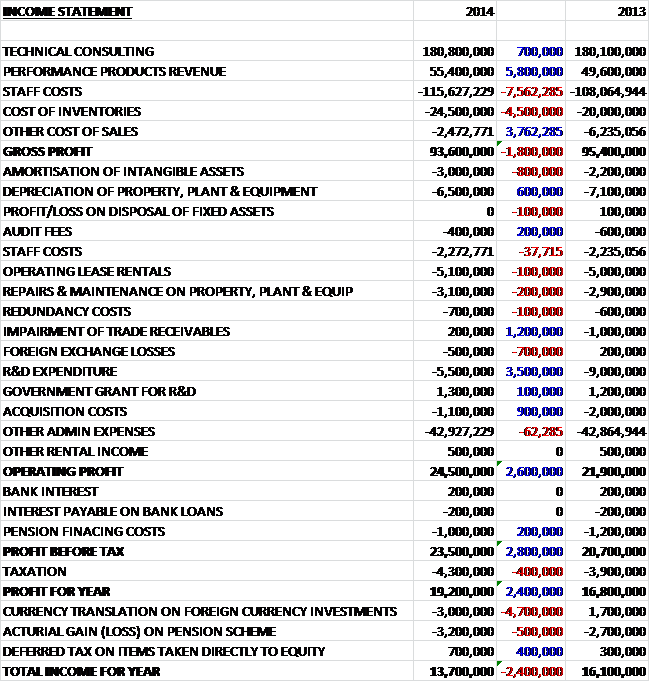
Revenues were up across all business sectors with Zambia revenue more than doubling to $87.8M and Mozambique posting a maiden £33.5M revenue.  There was a $29.8M increase in purchases/inventory and a $6.7M increase in royalties and taxes but the gross profit was still some $71.4M higher than last year.  Labour costs increased by $8.9M with rent and marketing costs also increasing to give a profit before tax some $56.4M better than last year before a $17.3M increase in tax meant that profit for the year increased by $39.1M to $16.3M.
gemfieldsassets

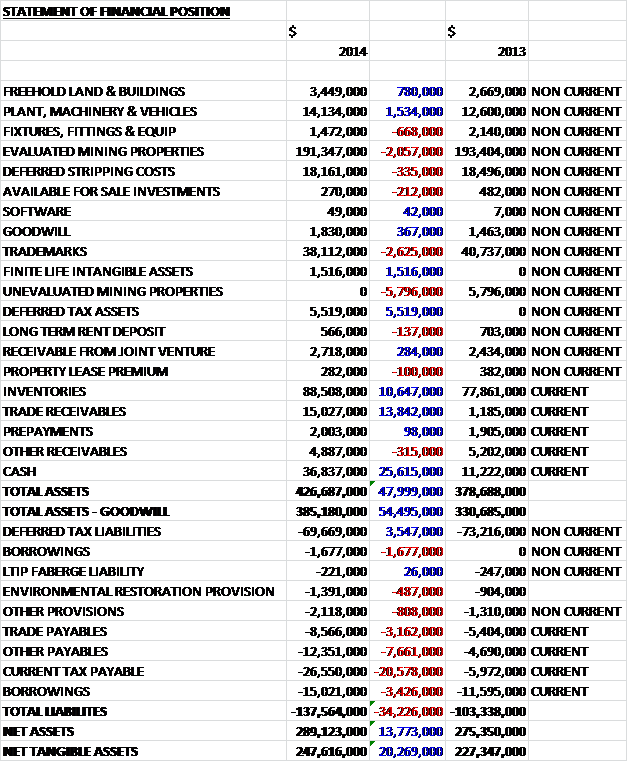
When compared to last year, assets increased by $48M, driven by a $25.6M increase in cash, a $13.8M growth in trade receivables and a $10.6M increase in inventories, partially offset by a $5.8M reduction in unevaluated mining properties as properties were evaluated and transferred to tangible assets.  Liabilities also increased during the year, mainly due to a $20.6M increase in current tax payable and a $7.7M growth in other payables.  These changes meant that net tangible assets increased by $20.3M to a healthy $247.6M.

gemfieldscash

Before movements in working capital cash profits of $62.5M were some $59M ahead of last year.  A large increase in receivables and a near doubling of tax was offset slightly by an increase in payables so that net cash generated from operations was $45.7M, a $64.5M reversal on last year.  Out of this cash the group purchased $3.7M of intangible assets, $8.7M of tangible assets and spent $7.6M on stripping costs (costs incurred in opening up new ore areas) to give a cash flow before financing activities of $25.5M.  A maiden dividend was paid to the Zambian government, which was counteracted by a net $5M of new borrowings to give a very strong cash inflow of $26.1M compared to the $25.8M outflow in 2013.

The market for coloured gemstone is robust and there is a rising consumer demand in globally, particularly in the US, China and the EU.  This has led to an increase in price for emeralds, which the group expect to see continuing

Profits in Zambia amounted to $28.3M, an increase of $21.4M over last year.  During the year Kagem completed its third high wall push back and commenced its fourth in order to extend the pit size by a further 75 metres and to open up new areas of ore for future production.  The programme is expected to deliver four years of open pit ore production and increase the overall rate of mining.  Decent volumes of ore and gemstone production were achieved in the first half of the year but the second half was impacted by high rainfall, grade volatility and delays in initiating the fourth phase of the pushback programme.  During the year gemstone production fell by 33% to 20.2M carats of emerald and beryl.  There is a trial underground mining project at the mine but ground conditions have been challenging, slowing the rate of the project.  A total of 184,935 carats were produced, less than half that of last year and due to the continued viability of open pit operations, it is likely that in the short term underground mining is only going to continue on a trial basis.  During the year, $2.9M was invested in new mining and other equipment at Kagem, including the washing plant and security arrangements.

Exploration-wise at Kagem, in Libwente it has been established that the Mesoproterozoic Muva sequences containing pegmatites, quartz and quartz-tourmaline has high levels of potential and at Fibolele a second phase of bulk sampling identified gemstone producing structures.  Kagem held three emerald auctions and completed one direct sale of material during the year.   The first auction held in Zambia auctioned higher quality stones where all 583,448 carats were sold generating $31.5M and achieving $54 per carat.  The second auction held in Zambia was of lower quality rough emeralds and beryl and saw 4.94M carats being sold generating $16.4M of revenue at $3.32 per carat.  The third auction saw 620K carats of higher quality emeralds being sold, generating $36.5M at $59.3 per carat.  The direct sale involved 11,286 kg of Kagem’s lowest quality beryl that had failed to sell at auction for $3.5M.  After the end of the balance sheet date, another auction was held for lower quality emeralds and beryl which raised $15.5M at an average price of $3.61 per carat, which was a decent improvement over the last lower quality material auction.

At the Kariba amethyst mine, the Zambian governments transferred its 50% stake to ZCCM Investments, in which they own an 87% holding.  A number of factors have impacted the mine’s development and both joint venture partners have provided a further $200K during the year after providing $1.25M each in the prior year for new equipment and improved infrastructure and as of the end of the year, all of the major rehab, capital and construction projects have now been completed.  These improvements have led to the quantity of commercial and medium quality production increasing by 70%.  After positive bulk sampling results, a new virgin area lying between the two older pits is now being mined and a new CCTV system has been installed.

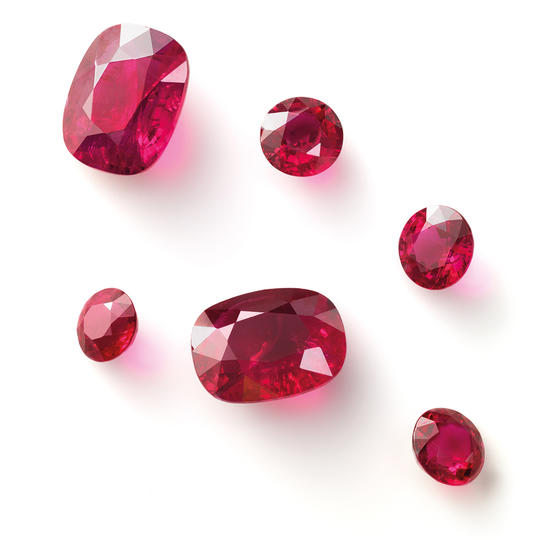
Profits in Mozambique were $14.4M, an improvement of $19.4M over the loss incurred in 2013.  Bulk sampling during the first part of the year concentrated on the Maninge Nice, Central and Glass A areas but during Q4, there was a shift in focus towards the newly discovered Mugloto area where the overall grade is lower but the quality of rubies is higher, the result being a decline in the total number of carats mined but an increase in overall value.  In total approximately 6.5M carats of ruby and corundum were extracted and the total cash operating costs were $10.9M and cumulative project expenditure stands currently at $34M with a resource and reserve statement expected by mid-2016.  The first auction for rough ruby and corundum was held in Singapore and comprised both high and lower quality material.  In the auction, 1.82M carats were sold and revenues of $33.5M were generated at a price of $18.43 per carat which means that the revenues from this first auction alone have nearly covered the costs of the whole project.
ruby

One problem the group has been having with the Montepuez ruby mine is that of security.  The license area is big and the stones are close to the surface which has encouraged illegal mining on the site.  The improved security arrangements involving the local security team, external security contractors and the Mozambique police have been reasonably effective in reducing the numbers of illegal trespassers compared to when the group took the license over.

Losses in the UK were $32M, an increase of $16M compared to the losses last year.  Faberge losses were $15.1M, a deterioration of $7.8M compared to the losses in 2013.  During the year the division underwent a successful transition with efforts focused on containing costs, improving product flows and increasing customer understanding with the group also looking to leverage Faberge’s global growth potential.  The division has created a number of new designs and launched several events and advertising campaigns in order raise awareness in the brand, including raising a considerable amount of money for charity.  In April, a significant marketing event was hosted in Harrods which generated record monthly sales for the Faberge concession in the store.  The division’s cost to the group remains within budget and new products were well received by customers across key markets.

Other profits, relating to traded auctions, sales and marketing offices, were $20.7M, an improvement of $22M when compared to the small loss last year.  The first standalone traded emerald auction held in India saw 145,952 carats of high quality traded rough emeralds sold generating $8.5M at $58 per carat.  The second traded emerald auction, also held in India, comprised of high quality Zambian and Brazilian emeralds and saw 268,000 carats sold generating $13.5M.  Following the presidential election and the resulting improving security environment the group now expects to increase activity in its exploration assets in Madagascar next year.

There are a number of risks that coma along with this kind of business.  As with any commodity business, the group is affected by gemstone prices and demand which are linked to world economic conditions.  Operating in Africa comes with political and security risk and tax changes could be enacted with little warning.  Only last year the Zambian government decided that all auctions had to take place within the country.  There is a risk of theft from the mines, as has been seen at the ruby mine in Mozambique in recent years.

The group has a number of capital commitments outstanding including $4.7M for the purchase of mining equipment in Kagem, $26.3M for the overburden removal in Kagem and $3.6M for the purchase of mining equipment in Montepuez.  The group has a major shareholder in the form of PRF, a subsidiary of Pallinghurst Resources, who own 47.9% of the group which gives them some influence over the Gemfields, although an agreement has been set out whereby they are manages autonomously and operated for the benefit of its shareholders as a whole.

After the end of the balance sheet date the group entered into a joint venture with EWGI in order to progress opportunities in the Sri Lankan sapphire and gemstone sector via three Sri Lankan subsidiaries which will be 75% owned by Gemfields.  Under the agreement, the company has a 75% interest in 16 exploration licences for a consideration of $400K.

At current share price the P/E ratio stands at a hefty 47.8 but this reduces to 17.8 next year, still on the high side but there is a lot of growth factored in.  There is no doubt that this has been a good year for Gemfields.  The Zambian operations continue to be profitable with more recent auctions obtaining better prices and the Ruby mine in Mozambique seems to be making good progress with the first auction revenue already covering project costs.  The net assets increased by $20.3M and there was a very strong cash inflow which is always good to see.  It is still early days for the ruby mine though, and the thefts are a bit of a concern.   Additionally, there seems to be a lot of overburden removal to be factored in, although this could be normal as I don’t have the knowledge of the industry to decide.  Overall then, this seems to be a great looking business, although probably fairly priced, which I may look to enter on any share price weakness.

On the 14th November the group released a statement covering the first quarter of the year.  The Kagem mine yielded 6.3M carats with operating costs of $1.48 per carat, an increase on the $1.06 per carat during the same quarter of last year.  The fourth phase of the high-wall pushback programme continued to progress well but illegal mining activity within the boundaries of the licence continue and the group are working with key ministries to combat the issue.   August saw an auction of lower quality rough emerald and beryl with 11.6M carats being sold, generating revenues of $15.5M.  The average price was $1.34 per carat but increased to $3.61 per carat when the sale of the low grade beryl was excluded.  The next auction is schedule for the 17th November.

At the Montepuez ruby mine the core infrastructure is largely in place and progress was made towards formalised mining.  About 2.9M carats were extracted during the quarter as part of the bulk sampling operation, which was flat year on year due to the lower grades of ore being mined.  This also helped explain the increase of unit operating costs from $0.62 per carat last year and $1.48 per carat this quarter.  Unlicensed mining activity and asset loss remained a problem during the period but the ongoing security efforts have resulted in an improvement in the situation.  The next auction for rubies is scheduled to take place in Singapore in December.

Faberge saw the value of its orders increase by 50% when compared to the same quarter of 2013 and operating costs were 26% lower.  The division also completed the relocations of its Geneva boutique.  The business introduced a new product category, Objects, with product launches expected in the second half of 2015.  At the end of the period the group held cash of $32.2M with total debt of $25.1M including the outstanding balance of $15M at Kagem.  Overall market conditions remained upbeat with ongoing enthusiasm from customers although during the period, the president of Zambia passed away which has the potential to cause some instability in the short term.

On the 18th November the group issued a statement covering their auction of higher quality emeralds in Lusaka.  The group sold 530K carats generating revenues of $34.9M, and although this was slightly lower than the last auction of higher quality emeralds, it does represent the second highest achieved to date and the overall value of $65.89 per  carat was a record.

On the 9th December the group issued a statement covering the auction of higher quality rubies in Singapore.  The auction sold 62,936 carats and achieved sales of $43.3M at a remarkable $688.64 per carat.  As part of this auction, an exceptional  40.23 carat rough ruby was sold, with the price remaining undisclosed. The next ruby auction will take place before the end of June and will consist of lower quality ruby and corundum.  The sales achieved at this auction represent the highest ever that the group has conducted which is clearly an excellent achievement but it will be some time before another auction of high quality rubies takes place.

On the 15th December the group announced the completion of the acquisition of two individual ruby licences in Mozambique.  The licensed will be controlled by a new joint venture, of which Gemfields owns 75% with the other 25% being owned by the vendor, EME Investments.  The group paid $3.5M for the two licences, both of which border the existing Montepuez ruby deposit and cover 19,000 and 15,000 hectares.

On the 17th February the group released a statement covering Q2 2015.  The Kagem mine produced 5.8M carats of emerald and beryl compared to 3.9M carats in the same period of last year.  The grade of 190 carats per tonne was lower than the 224 carats achieved previously due in part to the bulk sampling at the new pits of Fibolele and Libwente.  Total operating costs increased by $4.4M due to increased mining activity and unit operating costs increasing from $1.85 per carat to $2 per carat.

The fourth phase of the high-wall push back programme in the main Chama pit continued to be advanced with a total of 4.1MT of waste rock moved during the quarter and it now looks like the project will be completed ahead of schedule.  After contributing to the understanding of underground mining conditions in Zambia, the trial underground mining project at Kagem was put on care and maintenance and will lead to a detailed underground mine plan.  In the interim, there is flexibility to extend the open pit operations with further push backs.  The exploration and bulk sampling activities at the new Fibolele and Libwente pits are progressing well but illegal mining within the boundaries of the Kagem licence are not yet resolved and the group continues to work with key minitries to put an end to the problem.  The next emerald auction will be of lower quality rough diamonds and beryl and is scheduled to take place during the last week of February.

The Montepuez ruby mine produced 3.4M carats of ruby ans corundum compared to 2.3M carats during the same period of last year.  The grade of 34 carats per tonne compared to 64 last time was partly due to the processing of lower grade portions of the washing plant stockpile.  Total operating costs were $5.7M, an increase of $3.4M due to the increased mining activity and unit operating costs fell to $5.24 per tonne with the increased scale of mining driving efficiencies.  Bulk sampling at the project continued to provide positive results and further insight into the geology of the deposit and with the core infrastructure largely in place, progress is being made towards formalising mining.  Due to the size and nature of the license, illegal mining activity and asset loss remains a key challenge but new infrastructure, a significant security presence and ongoing efforts have resulted in a strong improvement.

During the quarter the group completed the acquisition of controlling interests in two additional ruby deposits in the Montepuez district of the Cabo Delgado province in Mozambique.  The licenses are valid for an initial period of 25 years and a new company was formed with the Mozambique government in which Gemfields has a 75% controlling stake.    The two licenses do not border each other but do share a boundary with the existing Montepuez deposit and cover 18,400 hectares and 14,900 hectares respectively.  The next ruby auction will be of lower quality rough ruby and corundum and is scheduled to take place in India in March.

Faberge seems to have struggled during the year.  With a short term shift of focus to various key initiatives set to be rolled out during the second half such as the new updated jewelry collections along with a material decrease in sales from Ukraine and Russia due to the political developments in the region, the value of orders agreed during the period fell by 12% when compared to the same period of last year.  Operating costs were 5% lower, however and the business is about to unveil four new watch collections created in collaboration with two leading Swiss manufacturers which will be introduced at the Basel World jewelry and watch fair in March.

In Sri Lanka, a trading license has been obtained and a token shipment of sapphires was made to the group in London.  They are in the process of establishing initial infrastructure in Sri Lanka and initiating preliminary geological assessments in areas of interest.  At the end of the quarter the group has cash levels of $49.2M and outstanding debt of $30.3M which compares very favourably to the $7.1M of net cash held at the end of last quarter.  The board remain upbeat about growth and development in the sector and this along with the increase in cash, potential step up in Ruby production and the new sapphire venture seems to suggest there are still exciting times ahead for the group but I feel with just the lower quality auctions coming up and the difficulties at Faberge, there could be some short term turbulence so I am keeping a watching brief here for now.

On the 2nd March the group announced the results of the rough emerald, beryl and amethyst auction.  The emerald auction saw $14.5M generated at an average value of $3.72 per carat which is a new record for the lower quality stones.  The downside is that they only managed to sell 3.9M carats, or 39% of the stones offered with the rest not receiving bids.  The amethyst auction was the first to be held in Zambia and it saw 27.7M carats of higher quality amethysts offered with the majority being sold at 1.77c per carat, generating $450K.  The auction of lower quality rubies is taking place later this month.  Whilst the price generated per stone is very good, it is a little disappointing to see that the majority of the emeralds did not sell.

Safestyle Finance Blog – Interim Results 2014

Safestyle has now released its interim results for 2014.

safestyleincomeinterim

When compared to the first half of last year, revenues increased by £6.6M and cost of sales increased by £3.8M to give a gross profit some £2.8M ahead of the same period last year. Operating profit also increased, driven by an increase in salary costs due to the annual pay award and auto-enrolment, and increased marketing costs due to TV advertising. Finance income fell slightly and tax was somewhat higher to give a profit for the year of £6.6M, an increase of £648K when compared to the first six months of 2013.

safestyleinterimassets

When compared to the end point of last year total assets were up £7.7M driven by a £5.6M increase in cash and a £1.9M growth in trade and receivables. Liabilities also increased, due predominantly to accrued dividends increasing by £4.3M. The net result of this is a tangible asset increase of £2.8M to £2.1M.

safestyleinterimcash

Before movements in working capital, cash profits for the first half of the year were £9.5M, a £1.4M increase on the same period of last year. This was reduced by an increase in receivables, although this was less than last year and due to seasonal fluctuations, and a £656K increase in tax paid meant that net cash from operations stood at £6.3M, some £1.7M better than in the first half of 2013. Capital expenditure was only £661K and finance leases just £93K so that there was a £5.6M positive cash flow during the period, although £4.3M will be paid out in dividends. This still represents a very decent cash flow, however.
During the year the group continued to increase market share, up to 8.24% from 7.85% at the end of last year and underlying EBITDA was up over 12%. During the first half of the year installation volumes were up 8% with average unit sales price up 1.5% to £503. The continued focus on expansion in the South East was evident, where sales were up 21%. The group has undergone some operational efficiencies which is an effort to combat some headwinds including the increased price of glass and TV advertising along with a regulatory change that requires insurance backed guarantees for all domestic glazing installations.
Going forward, the expectation for the market as a whole is of modest volume growth for the rest of 2014 and going in to 2015. With a focus on increased geographical penetration and market share gains, the board expect to report further progress in sales, profit and cash flow growth for the full year.
An interim dividend of 3.1p has been declared which, together with the final dividend already paid represents a yield of 4.7% which is pretty decent. This is clearly a good set of results, profits were up, net tangible assets increased and there was a good, positive cash flow with cash left over even after the dividend payment. The net tangible asset level is still a bit precarious and the increasing cost of raw glass is a bit of a concern but things seems to be going well for the group and I am thinking of making an initial purchase.

Typical!  A couple of days after I purchased shares in this company, director Kiran Misra sold 1,470,000 shares to bring his total down to 2,418,889 shares representing 3.11% of the company.  This is clearly not great news but it should be noted that Kiran has sold shares before and has no intention to dispose of any more over the next year.

On the 13th January it was announced that Chris Davies, director of the company and his wife had purchased 25,000 shares at a cost of £42,125 to give him an interest of 145,000 shares in total.  After Kiran’s sale it is good to see another director giving the company a vote of confidence.

On the 26th January the group released a year end trading update.  The company has traded well with revenues increasing by 9% to £136M and profits before tax in line with expectations at about £16.7M.  The group grew market share from 7.85% to 8.48% within a slightly contracting overall market and manufactured 7% more frames and undertook 4.7% more installations than last year.  The order book at the year end increased by 3%.  The group finished the year with a cash level of £8.5M, an increase of £3.3M compared to the end point of last year and going forward a continued focus on the South of England is expected to drive growth and enable them to out perform the market in 2015.  Overall this is a pleasing update that bodes well for the final results released in a couple of months time.

Safestyle Finance Blog – Final Results Year Ending 2013

Safestyle sells, manufactures and installs replacement PVCu windows and doors for the UK homeowner market. The group has now released its final results for the year ending 2013.

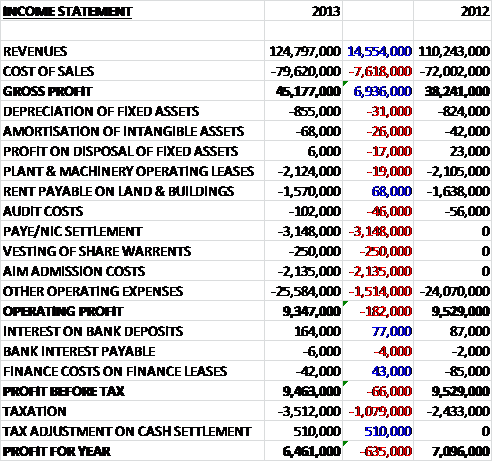
safestyleincome

Revenues increased by £14.6M when compared to last year and an increase in cost sales meant that gross profits were up nearly £7M to £45.2M. Operating expenses increased somewhat but the operating profit, down just £182K, was affected by a £3.1M tax settlement and £2.1M of AIM admission costs. The group then made a bit on bank interest and the profit before tax was broadly flat when compared to 2013. There was a higher tax bill this year, though, so the profit for the year was down by £635K to £6.5M, which is not a bad result considering the one-off costs that occurred during the year.

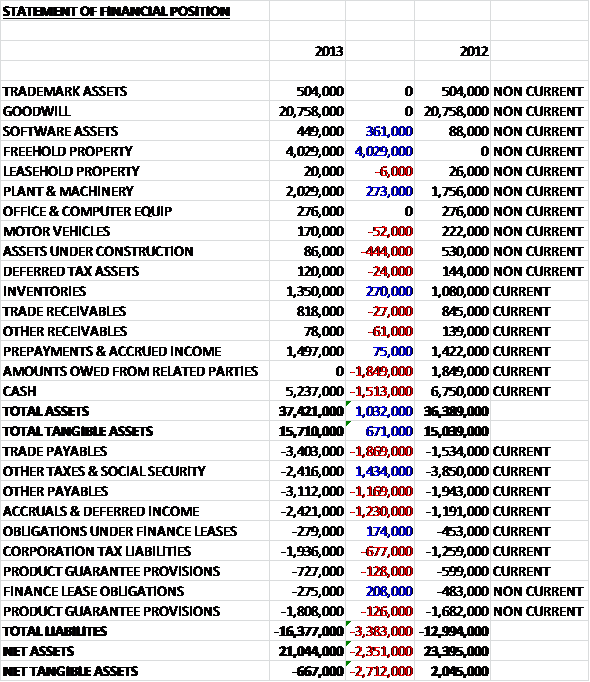
safestyleassets

When compared to last year total assets increased by £1M, driven by a £4M growth in the value of freehold property as the group purchased the freehold at the head office in Bradford and the manufacturing facility in South Yorkshire, somewhat mitigated by a £1.8M reduction in amounts owed from related parties and a £1.5M fall in cash. Liabilities also increased during the period driven by a £1.9M hike in trade payables, a £1.2M increase in accruals & deferred income and a £1.2M growth in other payables. This meant that net tangible assets fell by £2.7M to a negative £667K which seems a bit precarious. The chairman suggests the balance sheet is robust but if we take away the goodwill, I do not agree with him.

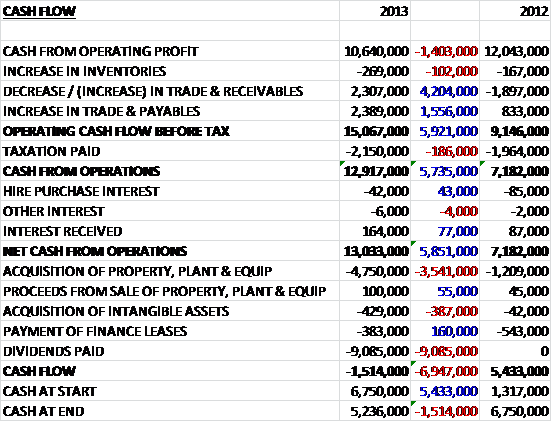
safestylecash

Before movements in working capital, cash profits fell by £1.4M to £10.6M. A beneficial movement in both receivables and payables, slightly offset by a marginally larger tax bill meant that net cash from operations was up £5.9M at £13M. Of this cash, over £5M was spent on capital expenditure with the bulk spent on the acquisition of property, plant and equipment. The remaining cash was spent on £9.1M worth of dividends which took the cash outflow to £1.5M and left the group with £5.2M of cash at the year end. This seems like quite a comfortable cash flow but was flattered by the favourable movements in working capital.
There was a 7.5% growth in the volume of frames installed, a 5.5% increase in the average unit price and a 4.2% growth in average order value. As far as marketing is concerned there is a growing contribution from TV and digital marketing which reduces reliance on canvassing methods after new digital marketing infrastructure was delivered in 2013 that resulted in a 10% improvement in web lead volumes and the cost per lead generated has fallen by 21%. The group has the capability to increase capacity without investing further in manufacturing which should be a good point going forward.
As part of the IPO the group has issued warrants to Zeus Capital for 3% of the total share capital which is exercisable at any time between the 1st and 10th anniversary of the admission to AIM. Another one-off cost is the £3.1M paid to HM Customs to settle a previously unprovided payroll liability. This liability related to 2004/2005 and the directors had previously received advice that they were not liable but the decision was made to settle to avoid a lengthy drawn-out process and to draw a line under the issue as the group joined the AIM exchange.
The group seems to have quite a lot of operating lease commitments on motor vehicles with £1.4M expiring within the year and they are rather exposed to the UK economic performance and that of the housing market. The board see that with improving home owner sentiment, coupled with progress being made within the company they are well placed to see a period of further improvement. Order intake in the first two months of the new year has been strong and there is an encouraging start to the year. Market share increased to 7.85% during the year which actually represents a market leading position in a very fragmented market. The main target is to expand into the South of England.
The group has been making investments in IT infrastructure and manufacturing systems and have completed the first £800K phase of a £1.55M two stage investment to upgrade their PVCu equipment with the second phase scheduled for implementation in 2014 along with further investment in the IT infrastructure. Alongside this, two new sales offices and installation depots have been created in the South East.

safestylelogo safestyle-doors-product-rangeupvc-003-s4-chatsworth
At the current share price the 5.5p final dividend represents a yield of 3.2% but based on next year’s forecast this increases to 5.2%. Discounting the one-off costs the underlying P/E is a good value 11.7, falling to 10.9 on next year’s forecast. At the end point of the year net cash stood at £4.7M, a decrease of £1.1M on the end point of 2012. So, after IPO costs and the cash settlement are taken out, the underlying profits improved on last year but if Goodwill is removed then the balance sheet is looking a bit precarious at -£667K and before movements in working capital, cash profits were down but the capital expenditure was easily paid for out of operating cash and dividends were nearly covered which makes me think the spectacular yield is safe. I do think this could be a good investment but am just a bit nervous about the negative net tangible assets.

Photo-Me International Finance Blog – Interim Results Year Ending 2015

Photo-Me has now released its interim results for the year ended 2015.

photoincomeinterim

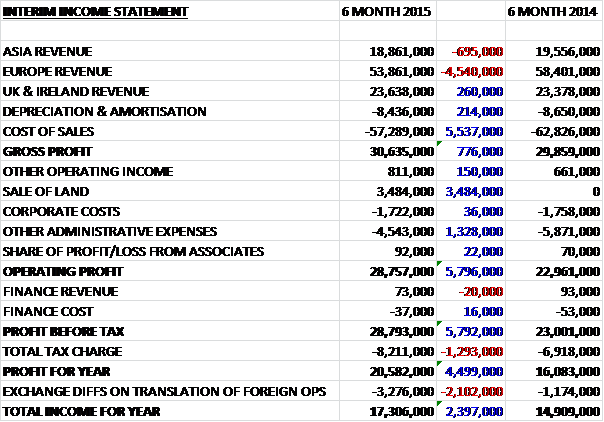
These results have been changed to reflect the new segmental split.  Overall revenues were down on the first half of last year with Asian sales falling £700K, European revenues declining £4.5M due to currency issues and the declining minilab business, and UK and Ireland sales increasing by £260K.  Cost of sales also fell, however, so gross profit was some £776K higher.  Admin expenses fell by £1.3M and there was the one-off profit from the sale of vacant land at the Bookham head office, which was £3.5M and helped profit before tax increase by £5.8M before a higher tax bill meant that the profit for the half year was some £4.5M higher than the same period of last year at £20.6M.  Underlying pre-tax profits increased by 10% to £25.3M.  It is worth noting that the first half of the year is traditionally strongest for the group in terms of profits.

photoassetsinterim

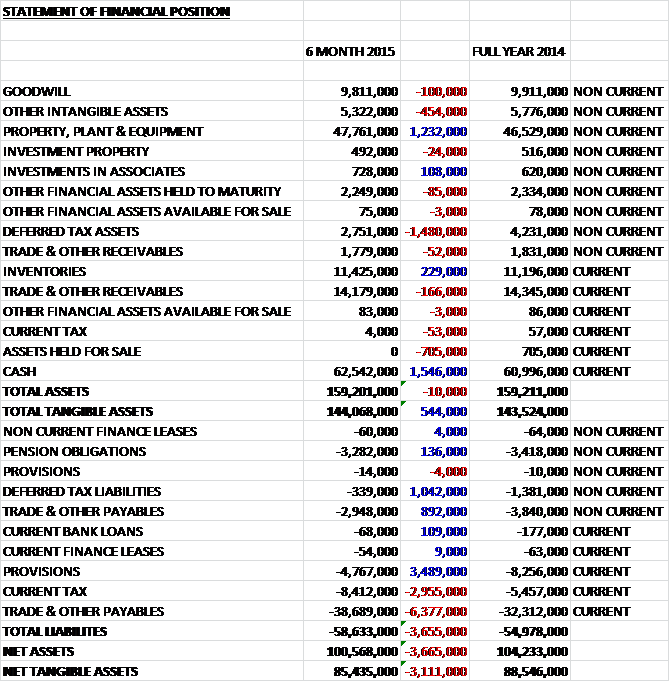
When compared to the end point of last year assets remained unchanged as a £1.2M increase in property, plant & equipment and a £1.5M increase in cash was counteracted by a £1.5M fall in deferred tax assets and the elimination of £705K of assets held for sale (obviously moved into cash).  Liabilities, however, increased during the same period as trade and other payables increased by £6.4M and current tax liabilities were up £3M, somewhat offset by a £3.5M decrease in provisions and a £1M fall in deferred tax liabilities.  Overall, this meant that net tangible assets decreased by £3.1M to £85.4M.

photocashinterim

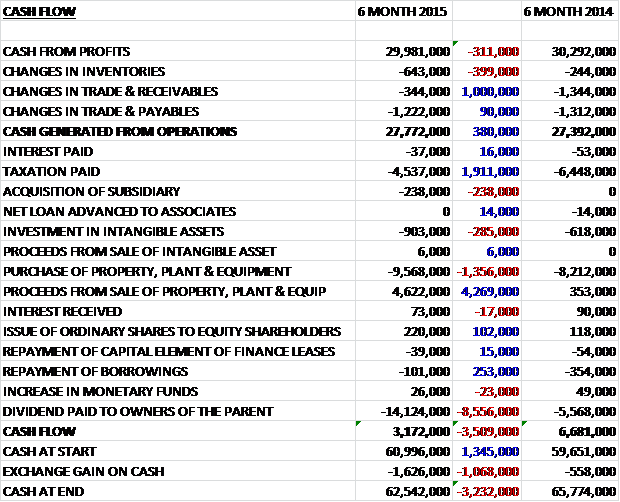
Before movements in working capital, cash profits were down £311K to just under £30M.  After working capital was taken into account, however, the cash generated from operations was £27.8M, a £380K improvement on the first half of 2014.  Somehow, the group managed to pay nearly £2M less in tax but spent more on capital expenditure (£900K on intangibles and £9.6M on tangible assets).  There was small acquisition at £238K and the sale of land netted £4.6M in cash to the group which helped it to a £3.2M cash inflow after £14.1M was paid in dividends.  Had the group not sold the land, dividends would not quite be covered by considering there was a £62.5M cash pile at the end of the half-year, this is not really a concern at the moment.

Asian and ROW underlying operating profits were £3.5M, an increase of £1.2M compared to the first half of last year.  The group now operates in eight countries with the latest additions being Vietnam and the US with testing ongoing in Thailand.  The bulk of the profits in this division are made in Japan and these were 50% higher on a constant currency basis.  The outlook in the country is good as the Government is introducing new e-ID cards for every resident in Japan from 2016 which could use photos from the group’s booths.  There will be a trial of two laundry units in Japan in early 2015 as the region is seen as a promising market for the machines.  Gradual progress was made in China where sales rose 40% on a constant currency basis but the roll-out has been slowed down as the group re-sited unprofitable units to better locations which halted the losses from the country that occurred last year.

Europe operating profits were £18.4M, an increase of £200K when compared to the first half of 2014.  The relative poor performance was due to adverse currency movements.  The photobooth estate increased by 5% year on year with the main growth areas being France, Germany and Switzerland with the higher margin Starck booths increasing to 2,118.  The roll-out of the laundry product continued to progress well and at the end of the period the group had sold 370 units (53 during the period) and operated 374 (an increase of 172).  The results from the units in France and Belgium were decent and for the more established machines, takings increased by 22%.  During the period, sales at the laundry business unit were £2.9M, an increase of £1.3M.

The laundry units are being pushed into Portugal and Ireland and the gradual expansion of manufacturing capacity in Hungary is going to plan.  The group also has a new design for the Starck kiosks which is expected to be launched next year and a new chrome finished Starck photobooth has been developed for higher end locations.   Work continues on the 3D figurine photobooth, which sounds intriguing, and an upgraded poster machine.  Additionally, the group is trialling a carwash concept, initially targeting Carrefore supermarket sites and will report further plans for the concept in 2015.

UK and Ireland operating profits were £5.1M, an increase of £800K when compared to the first half of last year.  The growth in photobooth numbers was 5.7% year on year while there was a 29% reduction in amusement machines which do not generate much revenue.  The growth in profits from the photobooths was partly as a result of the absorption of the Morrison estate into the portfolio.  There were 32 laundry units in operation at the end of the period, 18 of which were in Ireland and initial results are apparently promising.

During the period the group acquired Copyphot, a small company operating photobooths in Switzerland.  The group paid £402K in cash for £402K of net assets which seems a good deal to me.  The momentum in the business as a whole is good and it is performing in line with expectations.  The board are confident for the outlook of the business over the rest of the year and remains optimistic about future prospects, especially in relation to the opportunities for the laundry business.

An interim dividend of 2.34p per share, representing a 30% increase, was declared which, not including any special dividends, give a yield of 3%.  The group ended the period with a staggering £64.7M of net cash compared to £63.1M at the end point of last year.  Underlying profits were up overall, and would have been even higher had the currency movements been more favourable but net assets fell due to an increase in trade and payables, perhaps as a result of seasonable changes.  Before working capital movements are accounted for, the cash profits fell slightly on the same half of last year but here is still plenty of cash for the capital expenditure requirements with the rest spent on dividends.  There remains a huge cash pile and the new products offer decent growth prospects, it is also good to see China achieve a profit.  This company represents my largest holding and given the slight stutter in operational cash generation I am not buying more but I am happy to hold all the shares I have in anticipation of further growth and more special dividends.

On the 14th January it was announced that Schroders sold 648,530 shares worth about £1M to leave them with just under 18% of the total share capital.  It is a shame to see them selling but they retain a large holding and unless there are any further shares, this is still quite an endorsement in the company.

On the 26th February the group announced a trading update covering Q3.  Profit before tax in the quarter was 12% ahead of the comparative figure last year and if reported at a constant currency basis, was even stronger, increasing by 19%.  Turnover at a constant currency basis rose by just 3% so on a reported basis that probably fell again.  The roll out of the laundry product continued to progress well with a total of 898 units deployed so far with the group apparently on track to deploy about 2,000 by the end of 2015.  The expansion of the manufacturing capacity progressed with a second production line operating in Hungary since mid January.  The results from France and Belgium saw machines that had been in operation for more than a year increase turnover by 21% year on year.  Ireland and Portugal have also been targeted with 45 machines now in operation there with Ireland delivering the highest average monthly turnover per machine of any country with the machines being located on petrol stations and near campsites.

The group is also trialing 25 new Starck booths which incorporate a 3D figurine photobooth which it plans to launch in the second half of 2015 – not much use for passport photos perhaps but quite an exciting novelty product nonetheless.  The carwash concept trial is continuing at five sites and has already received strong interest from a supermarket chain in France.  The group remain optimistic that the concept can be rolled out with a further report at the final results stage.  Despite the strengthening of Sterling against the Euro in particular continuing to provide headwinds, management are confident of delivering results at least in line with expectations for the year and is committed to a 30% increase in the total dividend for the current year.   This is all good, exciting stuff and I am confident to keep holding what is my largest holding.

On the 21st May it was announced that Norges Bank had sold 374,199 shares at a value of about £533,196 to take their holding down to under 3%, which is a shame.

Conviviality Retail Finance Blog – Final Results Year Ending 2014

Conviviality Retail is the UK’s largest off-licence and convenience chain and has 595 stores in England and Wales operating under the Bargain Booze, Wine Rack and Thorougoods brands through a network of franchises who are responsible for running the stores and driving sales.  The group has a strong presence in the North West with scope for expansion elsewhere in the country.  The product mix is 57% alcohol, 30% tobacco and the remainder other impulse buys.  Conviviality Retail has now released its final results for the year ending 2014.

convivincome

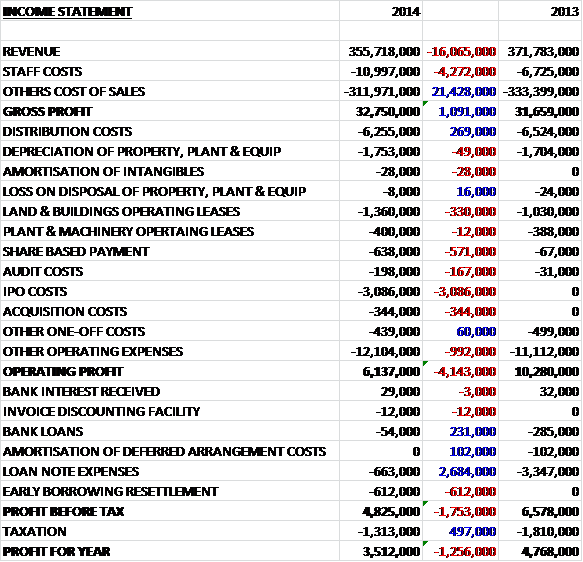
Revenues fell by £16.1M when compared to last year predominantly due to the closure of underperforming stores but a larger reduction in cost of sales meant that gross profit was some £1.1M higher.  Operating costs were also higher and there was just over £3M in IPO costs which helped bring the operating profit down by £4.1M to £6.1M but the £2.7M reduction in loan note expenses and a near half a million pound fall in tax meant that the profit for the year was £3.5M, a reduction of £1.3M on 2013.

convivassets

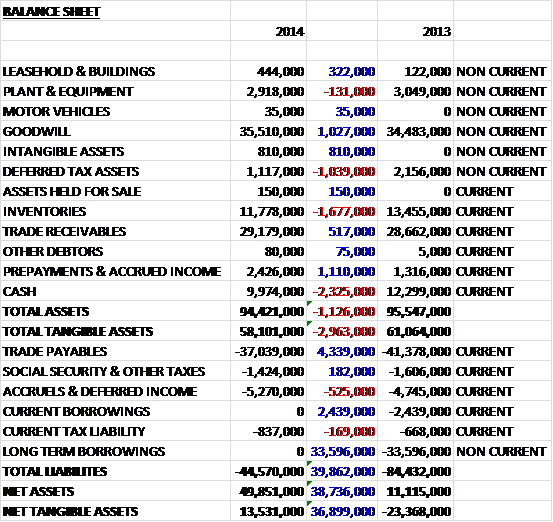
When compared to last year, total assets fell by £1.1M driven by a £2.3M fall in cash levels, a £1.7M reduction in inventories and a £1M decline in deferred tax assets, somewhat offset by a £1M increase  in Goodwill.  The £150K worth of assets held for sale relate to owned stores that are being marketed to potential franchisees which have subsequently been disposed of.  Liabilities fell considerably as the group used its IPO proceeds to pay off £36M of debt and trade payables fell by £4.3M.  This meant that net tangible assets increased by £37M to £13.5M.

convivcash

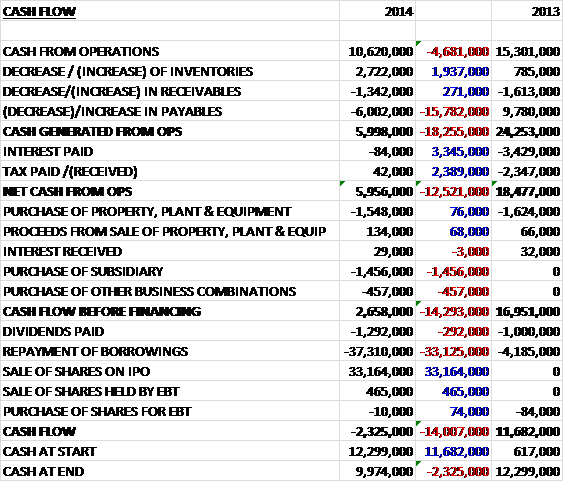
Before movements in working capital the cash profits were down £4.7M to £10.6M.  A huge swing to a decrease in payables meant that cash before interest and tax was just under £6M, an £18.3M collapse from last year.  The group paid far less interest, though, due to the repayment of debt and actually got a cash tax rebate so the net cash from operations was down £12.5M at just under £6M.  About £1.5M of this cash was spent on capital expenditure and a similar amount was spent on an acquisition and another £1.3M on dividends.  The IPO cash didn’t quite cover the repayment of all the loans and there was a deficit of £4.1M which explains the £2.3M cash outflow compared to the £11.7M inflow last year.  Despite the outflow of cash, this would be a cash inflow if there were no loans to pay back (as is the case next year).

At £12.43M, EBITDA was on a par with last year.  During the year 62 stores were closed which impacted sales by £15.7M.  The opening of new stores was slower than planned and the group ended the year with 595 stores, 11 fewer than planned but average weekly sales were £430 higher per store.  The group have now concluded the bulk of the store closures.  Management have identified the North East and the South as areas with expansion potential and stores were opened in Longbenton, South Shields, Ramsgate, Stevenage, Broxbourne and Leighton Buzzard.  Going forward, the group only spent the second half of the year as a public listed company and only in the final quarter did the board see the benefits really coming through with improved franchisee engagement so it will be interesting to see how this goes next year in the first full year.

The shops have a decent pricing offer with promotional pricing some 15% lower than the Supermarket’s convenience stores.  The ever-important franchisees are incentivised by being offered equity in the company depending on store performance and the full allocation this year is expected to be 1.2M shares.

During the year the group purchased LCL Enterprises (Wine Rack) for £1.7M in cash.  The acquired group came with £930K of net assets so they only paid £720K in goodwill.  From the acquisition date in August 2013, Wine Rack has contributed £7.6M in revenue and £100K in profit before tax.  This seems modest but the small acquisition cost suggests it may be worthwhile. After the end of the balance sheet date, the group acquired 31 stores from Rhythm and Booze, a subsidiary of Bibby Retail for £1.85M in cash, of which £200K is deferred, which added another £100K of profits.

The current Chairman, David Adams stepped into his role when Roger Pedder retired in January this year.  At the same time two new non-executive directors joined in the shape of Steve Wilson and Martin Newman. This seems to be a period of some board room turmoil as Franchisee director Keith Webb resigned in July for personal reasons.  One risk facing the group is the continued convenience expansion of the major supermarkets, continuing to increase competition, although this is being mitigated somewhat by the focus on alcohol but relying on products such as alcohol and tobacco means the group is somewhat exposed to the whims of the government who may introduce new regulations around these products.

If we ignore the one-off costs, the underlying P/E ratio at this share price is 14.3, reducing to 12.2 next year.  At the current share price the yield is a very decent 5.5% increasing to 5.7% on next year’s forecast. There was a net cash balance of £10M at the year end.  Overall then this was a decent update.  Underlying profits seem to be doing OK, although growth is not stellar.  The balance sheet looks much better now the loans have been paid off and there is a decent cash flow if the payback of these loans is taken out.  There are some risks, though, as mentioned above and I think I would like to see some more progress made on revenues before jumping in.

Molins Finance Blog – Interim Results 2014

Molins has now released its interim results for 2014.

molinsinterimincome

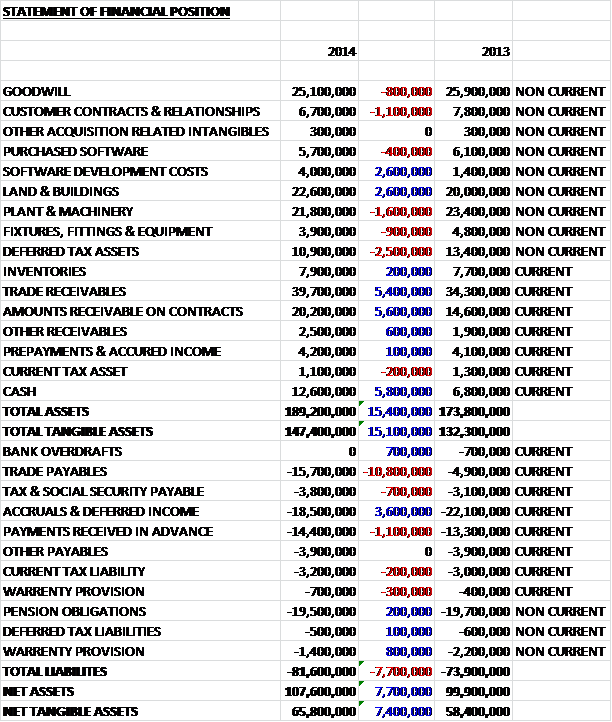
Scientific Services revenues increased slightly and packaging machinery sales remained fairly flat but Tobacco Machinery sales collapsed by £8M.  Cost of sales also reduced but gross profits were some £1.1M lower than in the first six months of 2013.  Distribution costs increased, offset by a fall in admin expenses but operating profits for the half year were zero and the overall loss for the half year was £200K, a fall of £900K when compared to the first half of 2013.

molinsinterimassets

When compared to the end point of last year, total assets were £3.6M lower driven by a £6.5M fall in cash levels and a £2.9M decline in receivables, somewhat offset by a £4.4M increase in inventories and a £1.2M growth in tax assets. Liabilities increased during the period entirely due to a £4.3M increase in pension liabilities with other liabilities falling.  This led to net tangible assets falling by £5.6M to £19.7M.

mollinsinterimcash

Before movements in working capital, cash profits of £1.3M were £1.5M lower than in the first half of last year.  An adverse movement in inventories, plus a slightly higher tax payment meant that there was a net cash outflow of £3.5M from operations, a reverse of £4.8M when compared to last year.  The group then spent £1M on capex and £1.3M on development costs, plus the dividend payment which helped push the cash outflow to £6.5M which reduced cash levels to £8.5M at the end of the half year – clearly a disappointing and unsustainable result.

Scientific Services profit was £700K, a £600K increase on the first half of last year.  Sales of process and quality control instruments grew with demand remaining strong for quality control instruments in their main markets and demand for cigarette smoke capture machines ahead of last year.  The group launched a new instrument for the testing of e-cigarettes which has received some strong market interest, resulting in some initial orders and sales of the newer carton testing and air sampling products increased during the period.  Order intake for lab based analytical services was slightly ahead of last year with work secured from some new clients with increased activity from e-cigarette manufacturers.  Despite the increase in profits, sales actually fell due to a large order that was received in the first half of last year and there remains uncertainty over US regulation but the division seems to be making progress with new orders and reduced costs.

Packaging Machinery profits were flat year on year at £100K.  Actual sales for the division grew somewhat but the result was affected by adverse currency movements.  The UK specialist engineering and machinery business made progress in increasing its customer base, particularly in the pharmacy and healthcare sectors.  The group has produced new “hygienic” versions of current machines which have produced some initial orders and the new Singapore office is performing well.
Tobacco Machinery losses were £200K, a collapse from the £1.3M profit recorded last time.  This disappointing result reflects the adverse market conditions in some of the main markets with the division experiencing reduced order demand and aftermarket activity with two large orders to the Middle East and Eastern Europe being deferred.  Looking ahead the business is continuing with its product development initiatives with commercialisation of the Alto cigarette making machine and the launch of a new cigarette packing machine expected to have a positive impact over the medium term.

The latest valuation of the UK pension scheme shows a deficit of £6.3M.  At the actuarial valuation in 2012 there was a funding deficit of £53M with an agreed level of deficit funding set at £1.7M per annum, to increase over the next years until being reassessed in 2015.  Apparently the full year trading performance will be weighted towards the second half but the board is “mindful” of the strength of sterling and current market conditions for the Tobacco Machinery division.

An interim dividend of 2.5p represents no change on last year so the yield at these prices is 6.9%.  For the first time in a while the group is in a net debt position and at £900K this compares unfavourably to the £5.6M net cash position this time last year or the £5.2M recorded at the end point of 2013.  This is clearly a disappointing set of results with lower profits, lower net assets and a cash outflow.  The Tobacco Machinery business really seems to be struggling due to market conditions but if these two deferred orders come good, that should help.  I am still remaining on the side lines until earning show some improvement.

On the 10th October the group released a trading update.  Apparently market conditions and geopolitical instability has resulted in weaker order prospects and delays to expected machine deliveries in the Tobacco Machinery division with the Scientific Services division also affected by tobacco customers delaying orders for instrumentation following strong orders in the first half of the year.  As a result, management expects profit for the year to be below market expectations but are holding the dividend at its current level.  One glimmer of light was the Packaging Machinery division where both order intake and sales are ahead of last year.  This is a pretty hefty profit warning from levels that were not really that great last year and following the poor first half, this is not going to be pretty.  This looks less and less like a decent investment so I will only update again when something changes for the better.

Sainsbury Finance Blog – Interim Results 2015

Sainsbury has now released their interim results for year ending 2015.

sainsburyincomeinterim

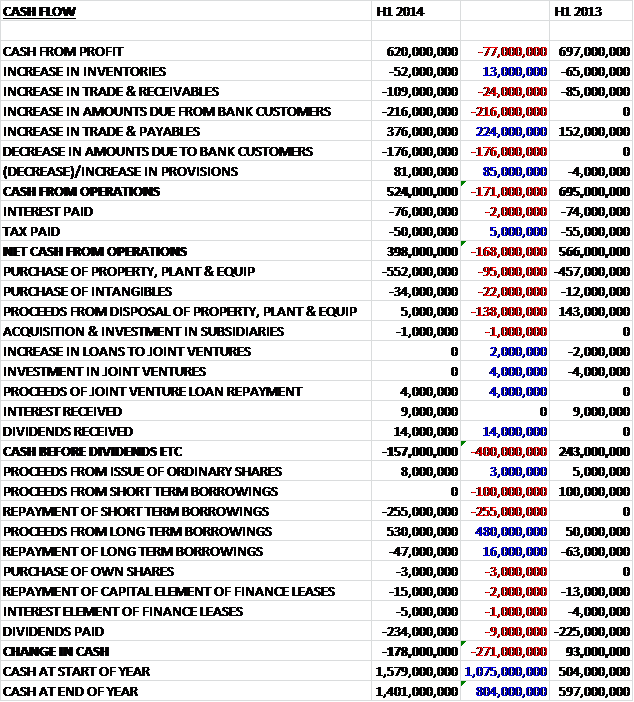
Although retail revenues fell by £187M, this was counteracted somewhat by a maiden revenue from the bank but a £310m charge for store impairments meant that gross profit was some £211M lower than last year.  There were more one-off costs in admin expenses related to the write-downs in property values and admin expenses themselves also fell to drive the group to an operating loss of £234M, a £723M reversal from last year.  Changes to finance costs and income broadly offset each other and due to lower profitability, lower tax was paid but the loss for the first six months of the year was £344M, a £684M fall when compared to the first half of 2014.

sainsburyassetsinterim

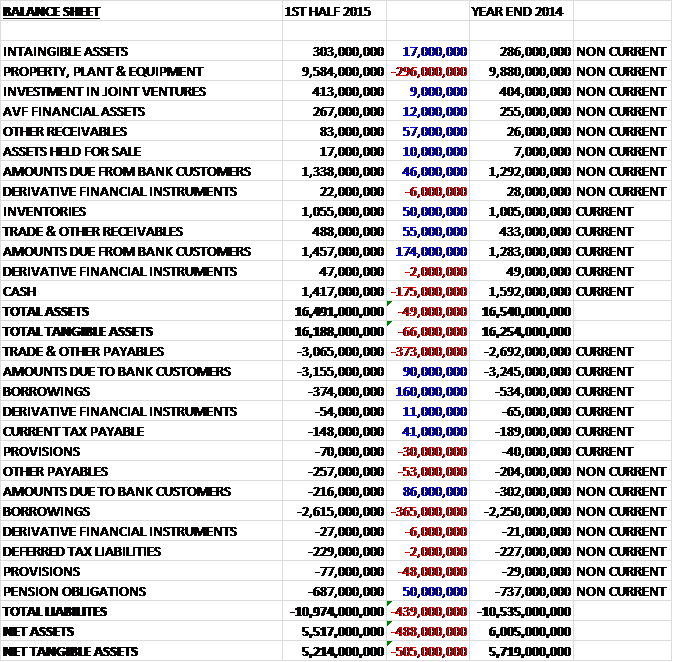
When compared to the end point of last year, total assets fell by £49M as a £296M fall in the value of property, relating to the previously mentioned impairments and a £175M decline in cash levels were somewhat offset by a £220M increase in amounts due from bank customers and a few other smaller increases.  Liabilities increased considerably during the year as borrowings increased by £205M and trade & payables increased by a hefty £373M to give a net asset level down by nearly half a billion pounds at £5.517BN.

sainsburycashinterim

Before movements in working capital, the cash from profit was down £77M at £620M.  Adverse changes in working capital, particularly in regards to the newly set up bank, meant that cash from operations before tax was £524M, a £171M reduction from the first half of 2013.  This was eroded further by interest and tax so that net cash from operations was £398M, a fall of £168M.   Sadly this cash was not enough to cover capital expenditure which was £552M on tangibles and £34M on intangibles.  The only other major expense was the £234M spent on dividends (clearly not covered by cash) and a net £228M of new loans flattered the cash flow somewhat but the group still had a £178M outflow despite the new borrowings.  At £1.4BN, the cash levels were healthy, however.

This was a period where there were a number of one-off items affecting results.  Underlying profit before tax was actually £375M which was much better than the actual profit figures bit still some £25M behind the same period of last year.  A £287M charge was recognised against property that will no longer be turned into stores after the group decided there wouldn’t be a decent return on the investments and £341M was recognised against currently unprofitable stores already built.  The amount of new space being opened per year is going to decline from 500,000 sq feet this year and next to 350,000 in 2017/2018 with eight new supermarkets and over 100 new convenience stores per year.  The three start-ups, including the mobile service, I2C and Netto are expected to make losses of about £10M this year.

Underlying retail profits before tax were £332M compared to £380M this time last year and it is disappointing to see that sales in Q2 fell by a sharper rate than in Q1.   Clearly the food business performed poorly during the year but there were pockets of good performance as the premium own brand offering increased by 4% year on year.  Non-food seems to be doing rather well with clothing and general merchandise both growing at over 5% per annum and the group sees these areas as significant drivers for growth going forward and it seems management are targeting a more department store look for some of the larger supermarkets.  Another growth area is convenience stores and during the year convenience sales grew by 17%.  Online orders increased by 9% during the period, held back somewhat by unprofitable customer activity.

Underlying bank profit before tax was £35M, an increase of £23M on last year.  The increase is due to a higher total income and favourable bad debt levels (an improvement from 1.3% to 0.8%).  The bank is currently being transferred on to a new platform which is expected to be up and running by winter 2015 with cards and loans migrating across by summer 2016.  New credit card accounts grew by 55% year on year and new loan accounts increased by 16%.  Following the successful re-launch of pet insurance, sales of that product increased by 86% year on year.  Travel Money also had a good half year with sales up 20% and 21 new bureaux were opened during the period.

These are undoubtedly difficult times for the UK supermarkets.  The market is changing faster than at any time in the last three decades as customers are shopping more frequently and buying less each time, favouring a combination of online shopping and convenience stores.  This means that some of the larger out of town stores are becoming less and less competitive.  Sainsbury apparently has smaller stores located on more dense populations than some of the competition, but this change is still going to affect them and management see this trend increasing going forward.  Sainsbury are not even holding up against the rest of the market, with their market share falling to 16.7%.  It is also notable that there are no sale and leasebacks in the first half of this year.

So what are Sainsbury doing to halt the decline?  They are continuing to improve the quality of their own-brand offering and simplifying prices, but perhaps most importantly targeted price investments are to begin immediately with approximately £75M being invested in the second half of this year and the same amount being spent in the first half of next year which will apparently be paid for through efficiencies in the value chain.  The group have also identified 25% of the total store portfolio that due to declining volumes will have under-utilised space which is likely to be taken up by non-food offerings.  The group are also going to trial smaller convenience stores with a range focused on food to go and are looking at larger convenience stores to improve their offering.

During the period the first Netto store was opened and the group are still on track to open 15 stores before the end of the year which should give them a way to tap into the discount market.  The group have identified a number of areas where costs can be cut and hope to generate annual operating cost savings of more than £150M going forward.  Additionally capital expenditure is going to be around £950M this year due to investments in convenience but by next year this is expected to fall to less than £550M per annum.

The interim dividend of 5p remains the same and represents a stonking 7.4% yield at current share prices.  It is worth noting that going forward management are re-aligning the dividend to be covered two times by underlying earnings and based on forecasts the yield for the full year 2015 comes out at 5.8%, still a good return but lower profitability in the coming years will reduce this further.  The current net debt stands at £2.382BN, which was very similar to the level recorded at the end point of last year and close to the expected £2.4BN at the end of this year.  Sainsbury expects profitability to be lower still in the second half of the year.

Despite the declining share price it is difficult to recommend further investment in Sainsbury.  They are in a rather difficult position as their brand relies on the perceived higher quality and provenance.  In order to achieve this, however, margins are thinner than some of the rivals and the group are likely to lose out on a race to the bottom with the likes of Tesco and Asda.  Despite the problems in the grocery sales, non-food seems to be a decent growth driver for the group and the bank seems to be off to a good start.  Whether the mobile business will be a success going forward remains to be seen.  Whilst I am not buying shares at this time, I am holding on to the ones I have (probably a mistake) but if the yield remains above 4% it seems to be a decent income play for the time being.

On the 7th January the group announced a trading update for Q3 which included Christmas trading.  Total retail sales excluding fuel fell by 0.4% but like for like sales were down 1.7%.  This was a better performance than in Q3 but worse than Q1.  This is clearly not a good result, but there were some areas of growth.  The premium own brand range grew by 5% and Christmas items seemed to do well with mince pies and turkeys up 8% year on year.  The trend of more frequent and local shopping continued and there was a 16% growth in sales at the convenience offering  with the biggest Christmas for online sales to date.  General Merchandise traded well and clothing sales were up nearly 10% year on year.  The outlook for the rest of the year remains challenging with food price deflation likely to continue and the board currently expect like for like trading in Q4 to be similar to that of the first half – about a 2.1% decline in other words.  So, the update was not good but not unexpected so I am holding on to the shares for now.

On the 16th January Sainsbury announced that it had replaced PWC as auditor with Ernst and Young.  No reason was given, but it seems to be the trend with Supermarkets at the moment after Tesco said goodbye to KPMG.

On the 17th March the group released a Q4 trading statement.  The headline figure was that like for like retail sales were down 1.9% excluding fuel.  During the quarter there was volume growth across the food business and an average uplift of over 3% on the products that have seen price reductions and like for like transactions grew.  The group have implemented their value simplicity programme which replaces one-off promotions with continued lower prices.  The general merchandise and clothing business performed well, up more than 6% on the same period of the previous year.  There was a 14% growth in the convenience business with the opening of 23 new stores and the online business saw order numbers increase 14% as customers can now click and collect their online grocery orders from over 100 sites.  The bank grew sales of its loans by 21% and Argos digital stores were opened in ten of the supermarkets.

It is expected that the market will remain challenging for the forseeable future with food deflation likely to continue for the rest of the calendar year and competitive pressures continuing.  The board believe that the group should be able to outperform their supermarket peers.  That will remain to be seen but it does sound as though progress is being made.  In the near term, though, things look tough and after selling out earlier in the year, I will remain on the sidelines for now.

On the 27th April it was announced that David Keens will joint the board as non-executive director, replacing Gary Hughes who previously announced his retirement.  David was the finance director at Next from 1991 to 2015 and seems an excellent appointment given his success there and Sainsbury’s desire to growth their non-food sales.

On the 29th April the group announced that CEO Mike Coupe was involved in a court case in Egypt.  When Mr El. Nasharty bought the group’s interest in the ill fated Egyptian joint venture, he paid with cheques that bounced.  He is now claiming that Mike was in Egypt in July last year and seized the cheques.  Mike was convicted in his absence in a court case that he was apparently unaware of for an offence that took place while he was in the UK.  This is a rather strange distraction but does rather re-iterate the potential danger of doing business in countries that do not have such an advanced justice system.

Molins Finance Blog – Final Results Year Ending 2013

Molins is a technology and services group that provides instrumentation, machinery and analytical services to the tobacco, consumer goods, healthcare and pharmaceutical sectors. In Scientific Services Arista labs, based in the US is a tobacco and smoke constituent analytical lab and Cerulean, based in the UK develops, sells and maintains process and quality control instruments for the tobacco industry. In Packaging Machinery Langen, based in Canada, the Netherlands and Singapore is a designer and manufacturer of cartoning machinery, case packers and robotic solutions; and Molins Technology, based in the UK is a specialist engineering supplier, developing innovated technology and associated packaging machinery. In Tobacco Machinery, Molins Tobacco Machinery designs and manufactures secondary tobacco processing machinery. The group has now released its final results for the year ending 2013.

molinsincome

Revenues increased across all of the businesses but with cost of sales also increasing, gross profit was only some £1.3M higher than last year. This was counteracted by the lack of a one-off credit on the pension scheme (due to UK employees ceasing to accrue benefits in the scheme), somewhat offset by lower reorganisation costs so that the operating profit was exactly the same as in 2012. When compared to last year, there was a £600K higher interest cost on the pension scheme, somewhat counteracted by lower tax so that the profit for the year, at £3.5M, was £300K lower than last year.

molinsassets

When compared to the end point of last year total assets were up by £1.3M in 2013. This was driven by a £1.8M increase in trade receivables, a £1.7M growth in the levels of cash and a £1.4M increase in prepayments and deferred income, somewhat offset by a £4.6M reduction in deferred tax assets. Conversely liabilities fell during the year, broadly driven by a £13.6M collapse in pension liabilities as higher investment returns led to an improved valuation, and a £1.7M fall in deferred tax liabilities which were somewhat mitigated by a £3.9M increase in loans, a £2.2M increase in trade payables and a £1.2M growth in deferred income and accruals. The end result was an impressive £9.3M increase in net tangible assets at £25.3M.

molinscash

Before movements in working capital the cash profits were flat on last year at £7.4M. An increase in receivables was predominantly responsible for operating cash flow before reorganisation being some £2.1M lower than last year at £5.8M before this was eroded further by £700K of reorganisation costs and a £1M tax bill to make the net cash from operations £4.1M, £2.5M worse than in 2013. Of this cash, £1.9M was spent on tangible assets, £700K was spent on an investment property and £2.2M was spent on development expenditure. Clearly operational cash flow hasn’t covered these expenses, let alone the £1.1M spent on dividends so the group needed to take out £4.2M more in loans to give a positive cash flow of £2.3M.
Scientific Services operating profit increased by £700K to £1M but underlying profits were £1.1M, down by £100K when compared to 2012 as Cerulean’s strong performance was offset by activity at Arista. The growth in sales at Cerulean was driven by improvements in their largest market, China, and good progress was also made with the multinational cigarette companies. The business uses its experience to advise customers on issues relating to quality control in production and lab environments and it benefited from a large order from a customer in North Africa to design and fit out their new labs, incorporating the Molins technology.

alto-float-large_494x200
Sales at Arista were hit due to the fact that no regulatory testing was required in the US during the year due to ongoing delays in the confirmation of a testing regime. There were, however, orders secured for a variety of testing requirements for cigars and the growing e-cigarette market. As well as developing products for the tobacco industry, Cerulean also continued to develop its product range for a variety of industrial applications with progress in sales for its carbon tester and enzyme sampler. At Arista there was a focus on the development of the business with non-regulatory tobacco testing and non-tobacco markets. Cerulean started the new year with an order book similar to that of last year but the competitive environment has become more challenging after the two main competitors were taken over by the same company. The outlook for Arista is rather uncertain with no firm indication of when further regulatory testing will be required.
Packaging Machinery profit increased by £100K to £1.5M with lower margin projects and increased sales and marketing costs due to the new office in Singapore, offsetting the profitability from increased sales. Langan’s order intake was at a similar level to last year as increased momentum in Europe counteracted reduced sales in North America. Molins Technology performed well during the year with order intake increasing significantly when compared to recent years and good progress was made in broadening the customer base. Particular progress was made in the pharmaceutical sector with orders for new machinery and engineering solutions as well as for repeat applications and the business ended the year with a much improved order book. As a whole the division entered the new year with an order book some 10% above last year but order prospects during the first half of next year are not as strong as last year but progress is expected to be made due to increased margins going forward.
Tobacco Machinery profits fell by £700K to £2.9M. Overall order intake was slightly ahead of last year with increased orders for new and rebuilt machinery compensating for a reduction in aftermarket orders. The increase in machinery orders was most notably apparent in Asia, North America and South America and the division benefited from being able to provide relatively short lead times. Sales of spare parts fell by 15% reflecting mainly softer demand in Asia. The division received its first orders for its new filter making machine and several others are in the pipeline. The business entered the new year with a slightly reduced order book but with good prospects for machinery orders and an active aftermarket requirement
During the year the packaging machinery division established both a sales and a service operation in Singapore and a sales office in Thailand and the Tobacco Machinery division focussed on market developments in the Middle East and Africa. The division also launched a new filter making machine and completed the development of the Alto making machine, which produces 10,000 cigarettes per minute and will begin trials in 2014.
Pleasingly the group is well diversified and no single customer makes up more than 10% of revenues. The group entered the new year with an order book at a similar level to last this year and whilst the board remain mindful of the uncertain economic and regulatory environment they are cautiously optimistic that the group will continue to progress.
At the end of the year the group had net funds of £5.2M compared to £7.4M at the end point of last year. At the current share price the P/E ratio is a suspiciously cheap 4.5, rising to a still cheap 6.5 on next year’s forecast. There was no change in the payout but at the current price the shares are yielding a remarkable 6.9% and according to forecasts this is likely to remain the same next year. This really is an impressive return but it seems the market is a little sceptical about the sustainability of the dividend. Overall this was a mixed set of results with profits fairly flat and the operating cash not fully covering costs before dividends but an improvement in the pension valuation meant that net assets improved over last year. The Scientific services division looks like it might struggle going forward until further moves are made on US regulation. Despite the good valuation, it seems to me that momentum is not really with the group so I will wait on the side lines for the time being.

Braemar Shipping Services – Interim Results 2015

Braemar has now released its interim results for 2015.

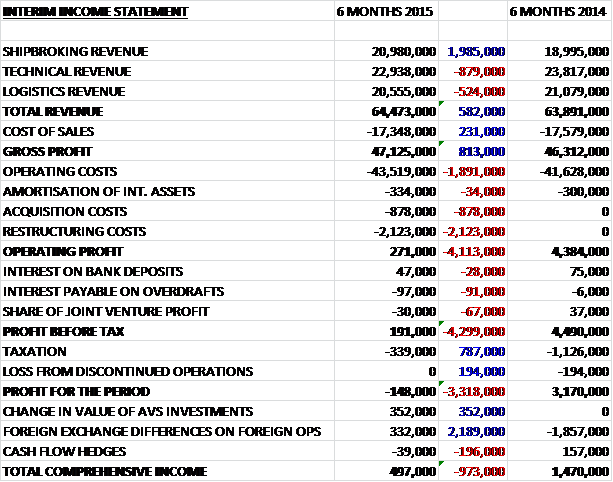
braemarinterim2015

Although shipbroking revenue was up nearly £2M, this was partially offset by falls in technical, now including the old Environmental business, and logistics revenue.  Cost of sales were slightly lower than in the first half of last year, so this helped the gross profits up by £813K.  This increase was reversed by a £1.9M increase in operating costs, however, and the one-off £2.1M of restructuring costs and £878K of acquisition costs pushed operating profit down to £271K, some £4.1M worse than in the first half of last year.  Some increases in finance costs were more than offset by a £787K reduction in taxation and the lack of a loss from discontinued operations that occurred last year so the loss from the year ended up at £148K, a £3.2M reversal on the same period of 2014.

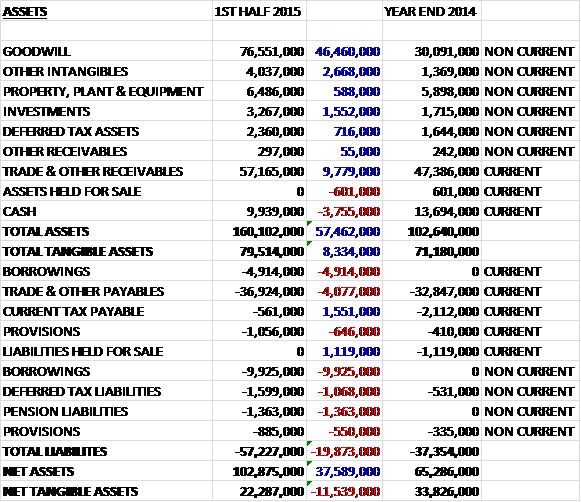
braemarinterimassets2015

When compared to the end point of last year total assets soared by £57.5M.  This was predominantly driven by a £46.5M increase in goodwill related to the acquisition with smaller causes being the near £10M increase in receivables, the £2.7M growth in other intangibles and the £1.6M increase in the value of investments.  Liabilities also increased when compared to the end point of 2014.  Borrowings shot up by £14.8M, payables were up £4.1M, pension liabilities grew by £1.4M and deferred tax liabilities increased by just over a million pounds.  Although net assets increased, due to the huge increase in goodwill, net tangible assets actually fell by £11.5M to a rather measly £22.3M.

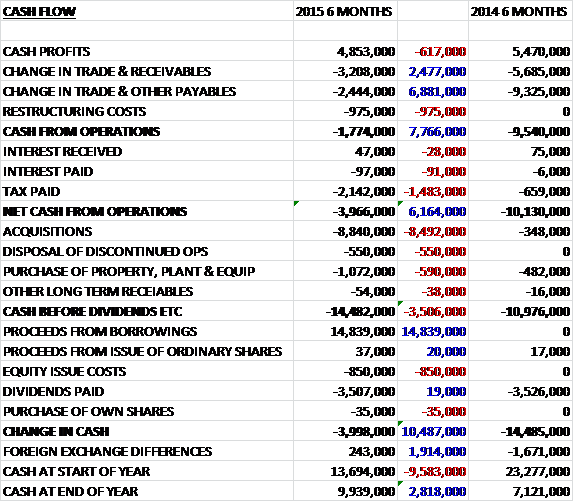
braemarinterimcash2015

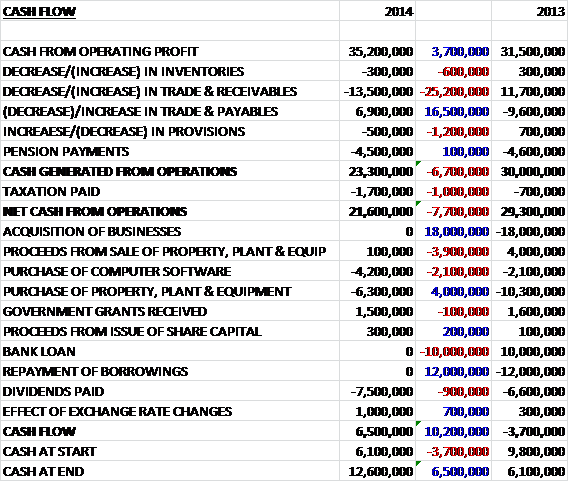
Before movements in working capital and restructuring costs, cash profits were some £617K lower than in the same period of last year at £4.9M.  Although lower than last year, changes in receivables and payables still drive this into negative territory and the near £1M of restructuring costs meant that there was a £1.8M cash outflow from operations.  Clearly the £2.1M spent on tax exacerbated this further and there was a net cash outflow of £4M from operations –not a good result but still £6.1M better than last year!  The group spent about £1M on capital expenditure and somehow managed to spend a net £550K on a disposal.  The big destination for the cash, however, was the £8.8M spent on the acquisition.  There was a further £850K spent on equity issue costs and the group still decided to pay £3.5M in dividends.  Even after the £14.8M of new borrowings there was still a £4M outflow of cash for the half year, although the second half is always stronger cash-wise due to bonuses and dividends being paid in the first half of the year.

After £2.6M of exceptional items, Shipbroking posted an operating loss of £1.5M compared to a profit of £850K last time.  Before amortisation and exceptional items, however, divisional operating profit increased by £300K to £1.4M (£100K of which can be attributable to ACM).  The total forward order book increased by 12% over the last year to $56M, but revenues were affected by the weaker dollar to the tune of £1.4M.  Despite fluctuating market conditions, one year time charter rates and vessel prices have improved since the first half of last year which suggests a cautiously optimistic outlook for the division.

Technical operating profits this year were £2.3M, a decline from the £3.4M during the first half of 2014.  The decline was due to weaker oil and gas exploration activity in the Far East and difficult comparatives due to the strong performance this time last year.  The marine warranty surveying and engineering consultancy was affected by the slowdown of activity in Asia and the business environment has become increasingly competitive.   The hull and machinery damage surveying business performed steadily throughout the period and the number of new instructions were comparable to last year despite fewer claims globally.  The offices in Europe, America and the Middle East region performed well while the office in the Far East saw a decline in activity.

The loss adjusting business performed well in the Far East office and the recently established Middle East office also received a number of high profile assignments in the period.  The new business received a good mix of onshore and offshore assignments and the group has been included in the panel of adjusters for a number of major offshore construction projects.  The engineering consulting business continued to operate on the construction of six LNG carriers and this project moved from the design phase to construction during the period.  The North American office was appointed to the role of “Owner’s engineers” to the first significant LNG bunkering project aimed at vessels that use the gas as a bunkering fuel.  The Environmental business, recently moved into the Technical division experienced routine levels of business with no major projects.

After £300K of exceptional items, logistics operating profits were £728K compared to £1.3M in 2014.  The main reason for this was given as the sale of the Tours business.  The ship agency business experienced weak market conditions in Europe in the first half of the year but the volume of trading was steady.  A new office was opened in Houston and serves to compliment the other services the group offers from the city.  The freight forwarding business underwent some management changes, reducing costs.  It finished the first half strongly, and started the second half well.
Clearly the major event that occurred during the period relates to the acquisition of ACM Shipping for a total consideration of £51M (£10.1M in cash and £40.8M in new shares).  The net assets of ACM only came to £4.6M so a huge goodwill of £46.4M was recorded as a result of the transaction.  The acquired business contributed £1.8M in revenues and £144K in profits during the one month that it has been part of the group.  There have been a number of one-off costs relating to the acquisition, including some redundancy payments as the cost base is decreased.  Indeed, the group now expect to make about £4M in annual savings which was more than expected.

Going forward, the reduced cost base and full contribution from ACM is expected to lead to a stronger second half of the year and the board’s expectations for the year as a whole remain unchanged and are supported by the early indications of trading in the second half.  There is now slightly more financial risk here.  The group has taken on debt for the first time in a long time and ACM also came with some pension liabilities.

At the current share price the shares are yielding and impressive 6%, but the pay-out remains the same as last year.  Whether this level of shareholder return is sustainable is of course open to debate.  This half of the year has been somewhat difficult for the group, one-off costs meant that it made a loss but underlying profit was also down, predominantly due to problems in the Asian oil and gas market for the technical consultancy business.  Net tangible assets also took a dive and the group now has a net debt position whilst cash flow was pretty dire.  The acquisition is clearly the most important event, and quite a bit seems to have been paid on it.  Having said all that, the second half is likely to be an improvement and will be interesting to see how much ACM contributes to the bottom line.  The dividend yield is exceptional and I am happy to wait to see how the acquisition beds in.

On the 13th January it was announced that the Chelverton UK Equity Income Fund had purchased 50,000 shares (worth just over £200K) to bring their holdings above 3% to 3.12% of the total voting rights.  It appears that other Cheverton funds also hold shares and the group as a whole is interested in 3.71% the total share capital.  As an income based fund they are clearly attracted by the generous dividend yield on offer here.  It is run by David Horner and David Taylor and whilst year to date the fund is down 1.66%, over the last 3 year it has grown by 74%.  All in all, a decent vote of confidence.
On the 15th January, the group released a statement covering trading in the majority of Q3.  As anticipated, shipbroking performance improved significantly compared to the first half of the year, reflecting the inclusion of ACM and the cost reduction actions taken as the business has been integrated.  The merging of the two broking teams continued in line with their plans and the board are encouraged by the progress made.  The weak oil price seems to have had a positive effect on Braemar as freight rates have increased and demand for oil tankers have increased.  The logistics and technical divisions performed in line with expectations with continued improvement in the freight forwarding business and a strong performance from Braemar Engineering.  The full year outlook remains unchanged so overall a decent update.

On the 28th January the group announced that it had sold its freehold headquarters in Marylebone to Greenhouse Sports Ltd for £9.5M, a gain of £5.5M over the book value of the property.  After the acquisition of ACM, this office no longer has enough space to hold the enlarged staff contingent  so they will be moving to One Strand, Trafalgar Square on the 2nd February.  This seems like a good price for the building.

On the 2nd February it was announced that Jurgen Breuer, a non-executive director has purchased 5,000 shares valued at £23.3K which nearly doubles his holding to 11,000 shares.  There seems to be quite a log of good news flow so I have added to my position here.

On the 2nd March it was announced that Majedie Asset Management, on behalf of their UK Equity Fund and UK Smaller Companies Fund, have purchased 106,952 shares at an approximate value of £500K to give them more than 5% of the total company.  This seems like a substantial purchase so it is good to see some confidence from the institutional world!

On the 30th March it was announced that Majedie had topped up a bit more and purchased 24,890 shares at an approximate value of £107K.  This now gives them 5.07% of the total share holding.

On the 9th April the group announced some changes to the board structure.  After being in the position for 12 years, Graham Hearne is retiring as Chairman to be succeeded by non-executive director David Moorhouse who has been at Braemar since 2005.  Denis Petropoulos is stepping down from the board but remaining on as president of Braemar Asia, Johnny Plumb is retiring from the board to focus on his independent consultancy interests and Tim Jaques is retiring having served as non-executive director of ACM since 2010.  In addition, Finance Director Martin Beer is also stepping down in order to spend more time travelling with his family.  He will be succeeded by Louise Evans who was formerly Finance Director at Williams Grand Prix.  In other news, the integration of Braemar and ACM is now largely complete which I suppose is why there is such upheaval at the board level at the moment.


Ricardo Finance Blog – Final Results Year Ending 2014

Ricardo has now released their final results for the year ending 2014.

ricardoincome2014

Revenues were up across both business sectors but Technical Consulting seemed to struggle for an increase, up just £700K as the division was constrained by the late phasing of new orders while Performance Products fared much better, increasing sales by £5.8M.  Sales fell in the UK and Japan but increased in the other markets.  Staff costs and cost of inventories both increased, however, to give a gross profit some £1.8M lower than last year.  Admin expenses were down, however, as the group spent less on R&D and there was a reversal of last year’s trade receivable impairments.  Finance costs were broadly similar to last year and a slightly larger tax expense couldn’t prevent the profit for the year from being some £2.4M higher than in 2013 at £19.2M.

ricardoassets2014

When compared to the end point of last year, total assets increased by £15.4M driven predominantly by a £5.8M increase in cash levels, a £5.6M growth in receivables on contracts and a £5.6M hike in trade receivables.  Liabilities also increased during the year predominantly due to a £10.8M increase in trade payables, only partially offset by a £3.6M reduction in deferred income.  The outcome was a net tangible asset level of £65.8M, an increase of £7.4M on 2013.

ricardocash2014

Before movements in working capital, cash profits were £35.2M, £3.7M better than in 2013.  A large swing to an increase in trade receivables and a £1M increase in the amount spent on tax meant that net cash from operations was some £7.7M lower than last year at £21.6M.  Of this cash flow, £6.3M was spent on tangible assets and another £4.2M on computer software which left £7.5M to spend on dividends and a surplus of £6.5M to double cash levels to £12.6M and as the group is debt free, this represents their net funds.  It is clear that dividends are comfortably covered by cash flow and levels are building up again which could indicate a hike in dividends or another acquisition in the future which is a good situation to be in.

Underlying operating profits at the Technical Consulting business were £17.8M, a fall of £700K when compared to last year as a large programme was ramped down and not fully replaced by new contracts, although order intake has improved in Q4 from the US in particular.  The UK business has worked on a range of multi-year programmes and has secured good new business in various sectors and a focus on cost management has helped the UK remain the main driver of profits.  In Germany a new Managing Director was appointed and a number of new contracts were won in the motorcycle, large engine and marine sectors in particular.  In the US business has built momentum in the second half with strong growth in the passenger car and commercial vehicle sectors and in Asia the Chinese business has started to deliver a number of large locally won contracts including a mixture of hybrid vehicle, engine and transmission activities.    Ricardo-AEA had a good year and has seen growth in both international and private sector clients.

Activities in the government and environmental sector have been driven by long standing agreements between Ricardo-AEA and various government bodies.  Despite UK government pressure on budgets, the group has secured a number of major contract wins including large projects with DEFRA and DECC.  In Europe the group are working with the EU Commission on a range of future potential green vehicle initiatives.  The business has also expanded its customer base internationally, for example the contract win in Saudi Arabia focused on air quality improvement in Riyadh.

Passenger car projects continue to be driven by global emissions legislation and during the year demand remained strong with large multi-year contracts from OEMs in the US, Japan, China and the UK.  Significant contract wins have included a range of diesel and gasoline design and development programmes ranging from three cylinder to V8 configurations.  The group also won hybrid installation and development programmes for China based vehicle manufacturers.

In the Performance Vehicles and Motorsport arena, long term contracts tend to also result in orders for the Performance Products business.  The group has seen continued demand for products for competitive motorsport and performance versions of existing vehicles.  In the motorsport arena, projects were largely focussed on the design and development of products for subsequent manufacture as part of the Performance Products business, predominantly transmission and driveline products, ranging from individual components, electronics modules and control units to entire systems.

In Motorcycles the group has seen strong growth this year driven by the need for a reduction in CO2 emissions together with an increasing demand for high performance motorcycles in developing markets.  Ricardo has entered into a partnership with Exnovo in Italy and have seen a growing interest in e-bikes.  During the year significant multi-year contracts have been won in Japan, China and Germany.

Activity in the commercial vehicles sector has picked up due to legislation and new product development for global application with strong engagement in the US and Japan in particular.  There has also been a growing interest in the after treatment and fuel cell capabilities that the group acquired with the purchase of a new technical facility in California.  The group sees the areas of fuel economy improvement, system optimisation and hybridisation as having growth potential.  Contract wins have included control and electronics hardware design and development as well as engine design, development and testing across light and heavy duty configurations.

Activity in the off-highway sector continues to be driven by emissions legislation.  During the year stage IV emissions standards were introduced into Europe which reduced activity as manufacturers had already got their vehicles compliant.  The focus in the coming years will be on assisting clients with EU, US and Chinese legislation for 2020.  The highly successful TaxiBot programme for IAI in Israel continued during the year with the ongoing delivery of the wide-body version of this advance pilot controlled taxiing system.  In addition the group has also launched its TorqStor flywheel energy recovery system.

In the Defence sector the group has made a number of new contract wins in addition to the continuation of some long-term contracts.  There has been increasing activity in Europe, the Middle East and Asia and this includes the development of future 4×4, 6×6 and 8×8 vehicles.  In the UK there has been increasing demand for the Total Systems Optimisation approach focussing on optimising vehicle architecture to minimise costs and maximise fuel efficiency.  In the US the group has continued with the delivery of the FANG vehicles for DARPA.

The rail sector continued to perform strongly and like the performance vehicle sector, activities led to long term manufacturing contracts for the Performance Products business.  The group has continued to develop a broad geographic spread with a variety of programmes taking in Tier 1 equipment manufacturers, rail operators, rail equipment manufacturers and governments.  Projects have included monorail driveline design and research into energy storage systems and the use of alternative fuels such as natural gas.

The Clean Energy and Power Generation sector has seen the majority of its activity in the large engine area for power generation with less activity in the renewable energy sector and there has been increasing levels of activity in fracking applications for the oil and gas sector.  Going forward, management are targeting growth in the Transport and Security, Energy, Scarce Resources and Waste sectors.

Underlying profits in the Performance Products business were £7.9M, an increase of £1.8M when compared to 2013 and order intake increased by £21M to £67M.  This year saw the launch of a new product called IGNITE which is the first Ricardo software product targeted outside of internal combustion engine applications.  It is a systems engineering tool for ground vehicle performance and fuel economy simulation, which is a growing area of opportunity for the group.  In the defence sector the delivery of Foxhound vehicles has been concluded with the delivery of some 376 vehicles.  In high performance vehicles, the demand for engines from McLaren for its supercars continued and Ricardo now supply power units for the new 650S and the P1 hybrid models and the group also continued to supply dual clutch transmissions to Bugatti.  In motorsport, the group has had manufacturing orders from Formula 1 customers and transmissions for the Japanese Super GT, GT3 and the Renault World Series Championships.  In addition, the group has also been producing Porsche Cup transmissions throughout the year.

Engines

Rail activity performed strongly through the continuing supply of monorail transmissions for clients in Brazil and Malaysia.  Going forward the new multi-year engine supply agreement with McLaren will generate about £40M per annum in revenues from 2016/2017 onwards.  The group also signed a multi-year production supply contract with another customer starting in 2015/2016 with total contract revenues expected to be more than £35M.

Ricardo has placed contracts for a £4.5M capital spend which has not been provided for on the financial statements.  During the year demand from US, Chinese and Japanese customers grew strongly but activity levels from UK based customers reduced and Germany remained challenging with losses incurred at a similar level to last year

Ricardo has developed a number of interesting products and services over the past year.  One is TorqStor, a self-contained flywheel energy storage system in order to create more efficient off-highway vehicles.  The product seems to enable a fuel saving of about 10% and does not require any significant increase in machine complexity or maintenance requirements and the group is currently in discussions with a number of OEM and Tier 1 partners.  Another project is work on a new generation of military vehicles.  In partnership with Morgan Advanced Materials and Ultra Electronics, the Cougar post-design service programme which covers the Mastiff, Ridgeback and Wolfhound vehicles could last for as long as seven years.  The programme will see the consortium deliver an annual service contract under which they will provide a team of experts to offer technical and project management services to support the fleet of more than 600 vehicles.

One of the main drivers of growth for the group is increasingly stringent emissions legislation.  In the US, Nitrogen Oxide limits have been recently reduced to one fifth of the previous level for off-highway vehicles.  Ricardo have been working with South Korea’s Doosan Infracore to develop their existing engine for compliance with the new regulations which involved the removal of the DPF unit to be replaced with Ricardo’s own Ultra-low spot Twin Vortex Combustion System (TVCS). Which resulted in a dramatic reduction in particulate matter and a high efficiency SCR system was added to target the NOx.  The end result was the achievement of the emissions targets within a good margin and improvements in fuel consumption.  A number of other companies are also using Ricardo’s TVCS technology including JCB, Lombardini and many more confidential clients.

Ricardo also undertakes environmental consultancy work.  During the year they were appointed by the ArRiyadh Development Authority in Saudi Arabia to deliver a waste management strategy in order to minimise the amount of waste heading to landfill.  The group have also worked with Johnson Matthey on the development of its carbon management programme.  With recycling targets in Europe beginning to come in to force and commercial companies increasingly focused on the need to secure the resources they require, resource efficiency and waste management services are very much in demand.

The order book is at a very healthy level with £142M of business compared to £121M at the end point of last year.  Some 35% of these orders are for passenger car projects and 25% are for motorsport projects with 50% of the total orders in the Engines sector.  As mentioned previously, the group has received a multi-year engine supply arrangement with McLaren which will deliver revenue for many years from 2016 and in May the group signed an additional multi-year production supply contract with another customer.  Despite diversifying somewhat since last year, one client still accounts for over 10% of group revenue.

At the end of the AGM, Michael Harper, the current chairman is retiring after spending 5 years in the role and 11 years as a non-executive director.  After joining the board in January, it is intended that Michael will be succeeded by Terry Morgan.  Terry is currently the Chairman of Crossrail, the Manufacturing Technology Centre and the National Skills Academy for Railway Engineering

The group is currently in an enviable position of having net funds of £12.6M compared to £6.1M at the end of last year.  At the current share price a 9% increase in the dividend yields 2.4% increasing to 2.6% on next year’s estimates, which is decent if not that exciting.  At the current share price the P/E ratio is 17.4 falling to 15.5 on next year’s forecasts, which seems fairly good value considering the quality of the company.

Overall then, profits are up, net assets have increased due to a hike in receivables and cash levels and the cash flow is positive, and although lower than last year due to adverse working capital movements, the cash is more than enough to cover capital expenditure and dividend payments, giving a decent surplus on top.  Operationally, performance products seems to be doing particularly well with the McLaren deal giving some good visibility to earnings and the generally increased order book bodes well for the future too.  Currently Ricardo is a well-run company with very good prospects going forward.  It represents one of my largest holdings (behind only Photo-Me and GVC) but I am sorely tempted to add here.

On the 29th October the group released an interim management statement covering Q1 of this year.  There has been a good start to the year with order intake up by 8.5% representing a good mix of business with a particularly strong start in Asia.  The order book at the end of September was £142M, the same record level seen at the end of last year.  Significant orders in Technical Consulting include a large commercial vehicle project for a new Asian customer, and further power generation and passenger car work in the UK.  Ricardo-AEA is continuing to develop overseas and has been very busy bidding on a range of new international opportunities.  Additionally the group have completed a small bolt on acquisition in the shape of Vepro Ltd, an expert in motorcycle chassis, powertrain integration and prototype build that will contribute about £1.5M of revenue per year.  There was no indication of what Ricardo paid for this business but overall this is a positive update following positive comments at the year-end last year.

On the 3rd November the group announced that the new Chairman, Terry Morgan had bought his first 10,000 shares in the company.