TT Electronics Finance Blog – Interim Results 2014

TT Electronics has now released its interim results for the year ending 2014.
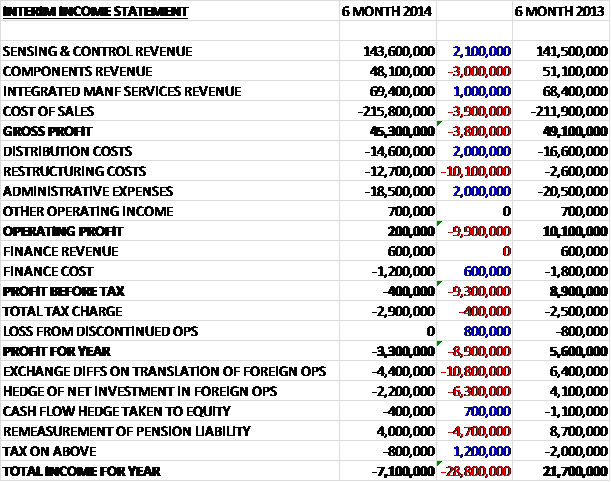
TTincomeinterim

Overall revenues remained flat as small increases in Sensing & Control sales, and Integrated Manufacturing Service revenues were mitigated by a £3M reduction in Components revenues.  Cost of sales increased, though, so that gross profits were £3.8M lower than during the same period of last year.  A £2M reduction in both Distribution costs and Admin costs were dwarfed by a £10.1M hike in Restructuring costs so that operating profit collapsed by nearly £10M to just £200K, although it is worth noting that there would have been a slight increase in operating profit were it not for the one-off costs.  Finance costs improved on the first half of last year but were still higher than finance income before a £400K increase in taxation meant that the loss from the half year period was £3.3M compared to a profit of £5.6M in the first half of 2013.
ttassetsinterim

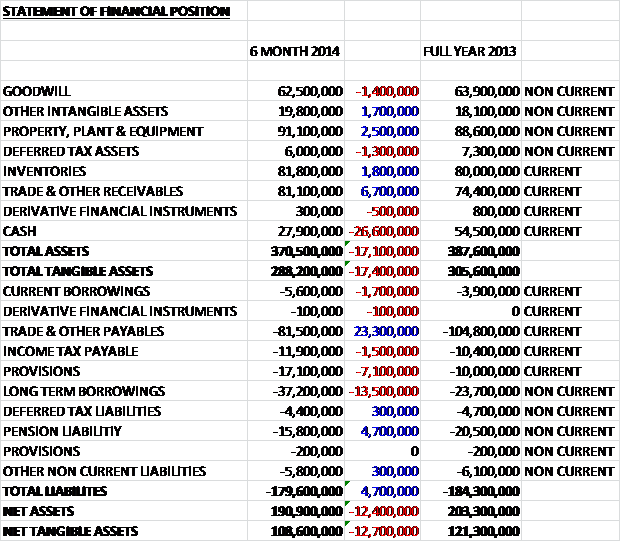
Overall assets fell by £17.1M when compared to the end point of last year.  This decrease was driven by a £26.6M collapse in the cash levels, somewhat mitigated by a £6.7M increase in receivables, a £2.5M growth in the value of property, plant and equipment and smaller increases in other intangibles and inventories.  Liabilities also fell, driven by a £23.3M reduction in payables and a £4.7M fall in pension liabilities, counteracted by a £15.2M increase in borrowings and a £7.1M growth in the value of provisions.  Overall this still meant that net assets fell by £12.4M to £190.9M.
ttcashinterim

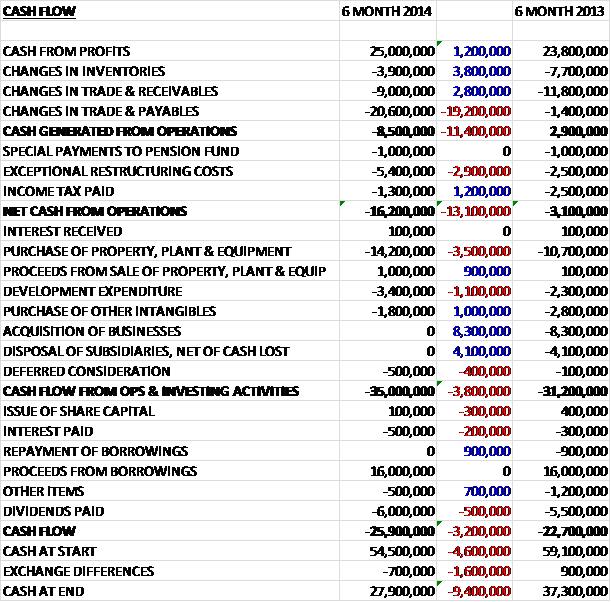
Before movements in working capital, cash profits at £25M were £1.2M higher than in the first half of last year.  Unfortunately adverse working capital movements, in particular a £20.6M reduction in payables due to significant supplier payments, meant that there was an £8.5M outflow of cash from operations, £11.4M worse than in 2013.  This outflow widened to a £16.2M outflow after payments to the pension fund, restructuring costs and tax.  On top of this £14.2M was spent on property, plant and equipment which included a new signal conditioning product line in the Resistors business and expansion of the Romania facility, but this was broadly accounted for by a £16M increase in borrowings before a £6M spend on dividends pushed cash flow to a negative £25.9M, £3.2M worse than in the first half of 2013.  Matters improved last time in the second half but this is still a disappointing result.

Under the Operational Improvement Plan a number of sales offices have been closed and line transfers from the California facility to Mexico have progressed, although the transfer of some product lines has been put on hold in order to fulfil a customer order with the transfer of those lines now expected to be made in 2015.  One issue that the group have found is that the proposed transfer of manufacturing from the German factory to Romania has come up against trade union disapproval whilst the Romanian site has already been approved by some customers.  Another issue is that of currency movements.  During the period the strong pound reduced revenues by £10.6M and operating profit by £1.1M.

The Sensing and Control business has made some investments in new product development, increasing capabilities in R&D and establishing a team focused on Microelectromechanical Systems (MEMS).  This technology enables very small, low power sensing devices and innovation in this area is likely to improve the offering of next generation pressure sensors.  Operating margins in the division have fallen from 6.6% in the first half of last year to 4.6% in the first half of 2014 and operating profit declined by £1.6M due to this £2.5M R&D investment and production inefficiencies as lines are moved to new factories.  Revenue growth came from a strong demand in the transportation market, including a better performance from the Austrian business. The second half of the year is expected to benefit from a significant customer order.

The market for Sensing and Control products should remain robust due to increased emissions regulation and the drive for industrial power efficiency.  The group launched a new product, a next generation torque sensor, during the period which enables improved efficiency for power steering systems and in the second half of the year the group has plans to move to the commercialisation phase of their chip stacking technology for power modules.  They are also planning to enhance their position sensing portfolio with the addition of a rotary sensor and expand the pressure and temperature sensor offerings into industrial applications.

The Components division enjoyed an increase in margins from 2% to 7.7% and profit increased from £1M to £3.7M due to a better overall mix of products and efficiency across the business, as well as some one-off orders received before the US factory closed.  Revenues, however, declined during the period as a good performance from the Magnetics and Resistors business was offset by programme delays in other areas and a reduction in volume associated with the closure of a loss making connectors business in the US.  The Connectors business launched its next generation connector product addressing the increasing deployment of integrated power and data communications systems in soldier equipment.

Margins in the IMS division deteriorated from 4.1% to 3.7% during the half year and operating profit fell by £200L to £2.6M as UK sites were consolidated and some production was moved to Romania and the group suffered from adverse currency movements.  During the year the business won new work from Shanghai Avionics supporting production of airborne avionics systems used on the C919, China’s first domestically produced airline.  The group also established a design facility in North Carolina to support defence and aerospace customers with specialised technical expertise and product support.  During the period a facility was closed in Wales and manufacturing was moved to Romania.

In all the group spent £10.2M on the improvement plan which included the moving of production from California to Mexico and costs relating to the proposed transfer of manufacturing from Germany to Romania.  Other restructuring costs of £2.5M arose from the consolidation in the UK and the establishment of a Romania facility for the IMS division.  Last year a triennial valuation of the UK pension scheme found that there was a £19.1M deficit, which was an improvement from the £39.4M deficit identified in 2010.  An agreement was made that contributions of £4.1M, £4.3M and £4.5M will be made over the next three years to reduce the deficit.  Additionally the company set aside £3M over the last three years to be used in reducing the long term liabilities of the scheme.

After the end of the balance sheet date the group announced the acquisition of Roxspur, a UK supplier of temperature, flow, pressure and level sensors together with calibration services in segments such as oil and gas, power generation, water management and materials processing. There was an initial consideration of £7.5M in cash with further £2.5M payable in cash in 2016.  The acquisition will be immediately earnings enhancing.

At the end of the period, net debt stood at just under £15M compared to a net cash position of nearly £27M at the end of the year due to the working capital outflow and capital investment.  The board have increased the interim dividend by 6.2% to 1.7p per share which I suppose they have to do but I would have maybe kept it the same to conserve cash.  The restructuring seems to be really affecting the business at the moment, and it is sometimes hard to see how it is doing without all the noise.  Both the IMS and Sensor and control divisions have seen margins eroded due to the changes and the Components division seems to have had its results flattered by one off orders.  The decline in net assets is disappointing but the underlying reason for this seems to be cash outflow due to the big chunk of supplier invoices paid during the period so might be temporary.  The pension deficit also seems to be a bit of a drain on cash in the short term.  In the medium term, these could well end up being a good investment but I feel there is just too much short term uncertainty to take the plunge at this time.

On the 21st August, director Sean Watson purchased 216,000 shares at 171p a share which seems like quite a vote of confidence.

On the 4th November the group released an interim management statement covering the first 10 months of the year.  The group has now made a final agreement with the unions in Germany and under this agreement certain lines will be moved from Werne to Romania but some manufacturing will remain in Germany for service and specific highly automated production.  The overall heacount at Werne after the completion of the programme will reduce by about 45% to approximately 300-325 compared to the original target of 220.  The site will continue to be used as a centre of excellence for engineering and product development as originally intended.  Taking this into account, the cost of the European programme will reduce by £1M to £25M but significantly the annual cost saving going forward will be just £3.5M as opposed to the previous estimate of £6M.  There have also been a number of costs this year relating to this disruption and these inefficiencies are expected to continue in 2015 with the first benefits of the programme now expected in 2016.

The closure of sales offices in Japan, France and Italy was completed on schedule by June and benefits of £1.3M per annum are being delivered in the second half.  The transfer of manufacturing from Fullerton in the US to Mexico is also progressing but as previously announced some production line transfers have been put on hold in order to fulfil a significant customer order with the transfers being made in 2015.  The expense for R&D in Sensors and Controls has increased by £2.3M year on year and the group are conducting an in-depth review of historical R&D spend and amounts carried on the balance sheet so it looks as though there may be some impairments imminently.  There has also been a move to lower margin products in the division which have been offset this year by a significant one-off order from an existing US customer.  As a consequence of these points, it is anticipated that performance will be materially lower in 2015.

The group is carrying a net debt of £30.7M but the board still expect an improvement in working capital before the end of the year and this year, underlying revenue growth over the same period of last year has been 3% but the performance for 2014 as a whole will be towards the lower end of current expectations.  It seems to me that this restructuring is more complex than management originally expected and it is difficult to think about investing here before the bulk of these changes have been successfully implemented.

On the 18th November the group announced that Finance Director Shatish Dasani has stepped down after six years of service.  Until something changes here I don’t see much point in investing so this will be my last update of this company for a while.

On the 13th February it was announced that Aberforth Partners had sold 92,000 shares at a cost of about £109,000 to brink their interest down to 15,862,203 shares, just under 10% of the total equity.

 

GVC Holdings Finance Blog – Interim Results 2014

GVC has now released its half year results for the year ending 2014.

gvcinterimincome14

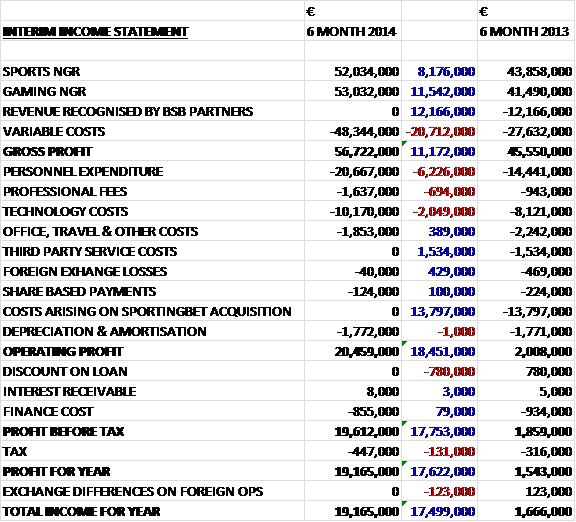
Both sports and gaming revenues are up, with Gaming revenue doing slightly better, increasing by €11.5M.  Variable costs were also up but Gross profit improved by €11.2M over the first half of last year. The group increased some costs with personnel expenditure up €6.2M, professional fees increasing by €700K and technology costs up €2M.  Conversely, there were lower office and travel costs, less foreign exchange losses and the lack of €1.5M in third party service costs.  The real improvement over last year, however, was the lack of nearly €14M in costs relating to the Sportingbet acquisition.  Overall operating profit was up by €18.5M before slightly higher taxes and the lack of a discount on a loan meant that profit for the half year was a very healthy €19.2M, some €17.6M more than in the first half of 2013.

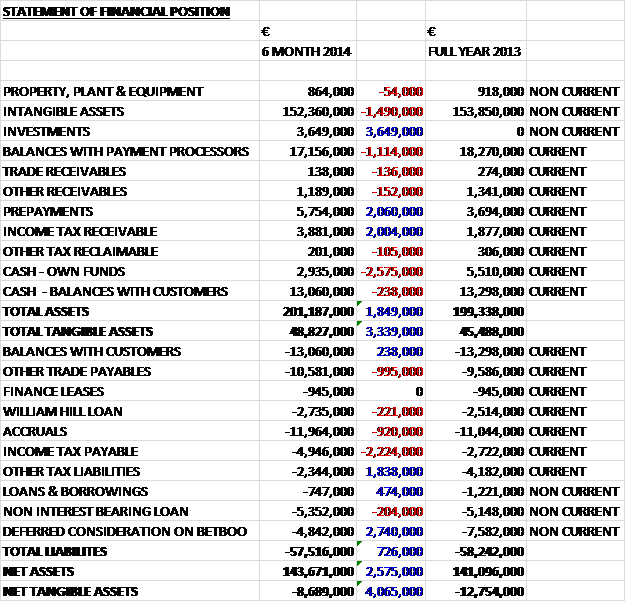
gvcinterimassets14

Overall total assets crept up by €1.9M as the €3.6M invested in Betit and €2M increases in both prepayments and income tax receivables were partially offset by a €2.8M fall in cash levels, a €1.5M reduction in intangible assets and a €1.1M decline in balances with payment processors.  Conversely, total liabilities showed a small decline as a €2.7M fall in deferred consideration and a €1.8M decline in other tax liabilities were partially counteracted by a €2.2M increase in income tax payable.  Overall this led to net assets increasing by €2.6M to €143.7M.

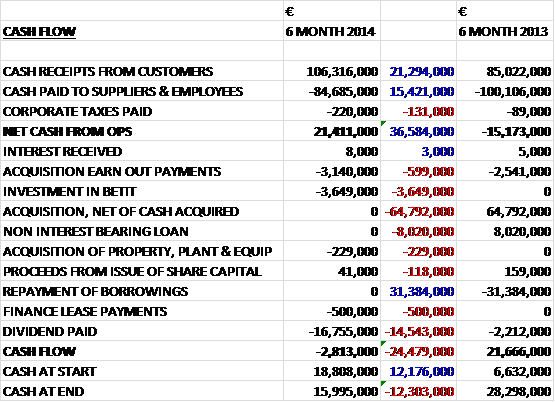
gvcinterimcash14

A combination of more cash receipts from customers and less paid out to suppliers and employees meant that net cash from operations was a very decent €21.4M compared to an outflow of €15.2M in the first six months of last year.  Of this cash, €3.1M was spent on contingent consideration and €3.7M was invested in Betit.  Half a million was spent on finance lease payments relating to computer hardware for the data centres but the rest, some €16.8M, was paid out in dividends.  This meant that there was a €2.8M cash outflow in the half year to end the period with €16M.  This cash flow statement shows just how cash generative the group is.

Previously the group announced that it had paid €3.5M for a 15% stake in Betit.  There is a call option to acquire the balance of the outstanding shares that can be exercised between July and September 2017.  The minimum call price is €70M and the actual price would be determined by the mix of revenues between regulated and non-regulated markets.  If the call option is not exercised, Betit may require the group to acquire the shares at a certain price.

Overall wagers are up 38% to €694M and the current number of active customers have increased by 22%.  The Latin American business continued to grow well and is the market leader in the region for sports betting.  Across all businesses in-play now amounts to 70% of wagering with mobile now accounting for 22%, up from 8% in the first half of last year before GVC made investments into this part of its offering.  Going forward the group is looking to further enhance the mobile product and sports book next year.  There has been a strong start to Q3 with trading per day 20% higher than in Q3 last year.

The group has announced an interim dividend of 12.5c plus a special dividend of 2.5c which to my calculations gives an annual yield of 8.8% at the current share price – still an incredible distribution.  Cash flow is very strong, the world cup has seemed to add considerable numbers of new customers and that dividend pay-out is very impressive.  Risks remain as the group operates in many grey areas with Turkey of particular concern but overall this seems a good investment even at these prices.

On the 16th December the group released a trading statement covering much of the final quarter of the year.  Net Gaming Revenue for Q4 to date averaged €660K per day, an increase of 26% on the same quarter of last year; there was a sixth successive quarter of growth in deposit values with this quarter being 20% higher than Q4 last year; and investment in the mobile development is bearing fruit with Mobile Gross Gaming Revenue up 150% to €168K per day.  Trading was strong across all major territories and brands and the board believes that this strength provides a good foundation for continued growth in 2015.  Market expectations for the full year will be at least matched in 2014 but it is worth baring in mind that 2015 does not have a major sporting event on the scale of the world cup.  Overall a very pleasing update.

On the 12th January the group released a pre-close trading update.  In Q4, total NGR was up 22% when compared to the same quarter of 2013 but fell slightly when compared to Q3.  There was a record level of sports turnover in the quarter, up 11% on Q4 2013 and NGR for the year was £224.6M, up 23% on last year.  An interim dividend of 12.5c was declared which was an increase of 8.7% on last year.  A decent update, but this was priced into the shares.

On the 14th January it was announced that investor Richard Griffiths had sold 522,026 shares worth about €2.5M to leave him with just under 13% of the total share capital.  This is quite a substantial sell from a well known investor and I hope he is not intending on selling much more of his holdings.

Naibu International Finance Blog – Half Year Results 2014

Naibu has not released its half year results for the year ending 2014.

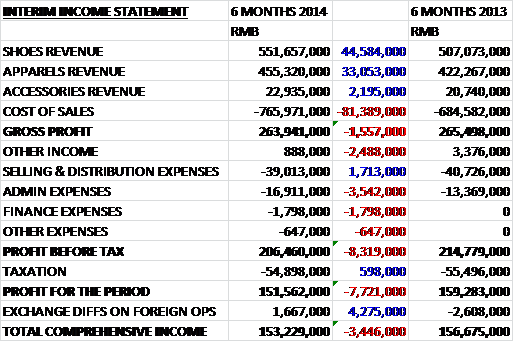
naibuincomeinterim

Revenues increased across all categories when compared to the first half of last year, due to increases in volumes sold as unit sales prices remained the same, but cost of sales increased by a greater degree to give a gross profit some £156K lower than last year, presumably due to the increased numbers of outsourced product being sold.  Due to increasing admin expenses because of the the redundancy packages for the lost factory lines, a foreign exchange loss due to the weakening HK Dollar, and a reduction in other revenue  (interest income), the reduction on last year increased with profit for the period of £15.2M lower to the tune of £772K.

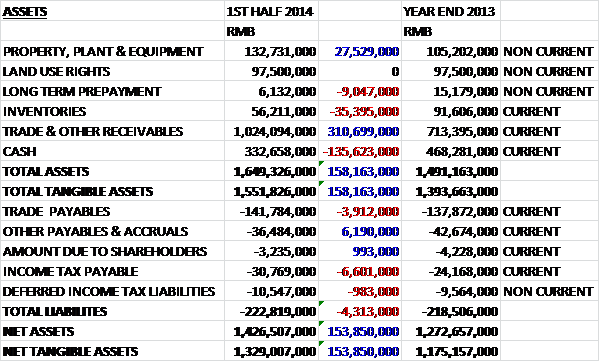
naibuassetsinterim

When compared to the end point of last year, total assets increased by £15.8M.  This increase was almost entirely driven by a £31.1M hike in the value of receivables, somewhat offset by a £13.6M reduction in cash and a £3.5M fall in inventories.  Liabilities were fairly flat as a £619K fall in accruals was counteracted by a £760K increase in tax liabilities.  Overall then, net assets increased by £15.4M to £142.7M.

naibucashinterim

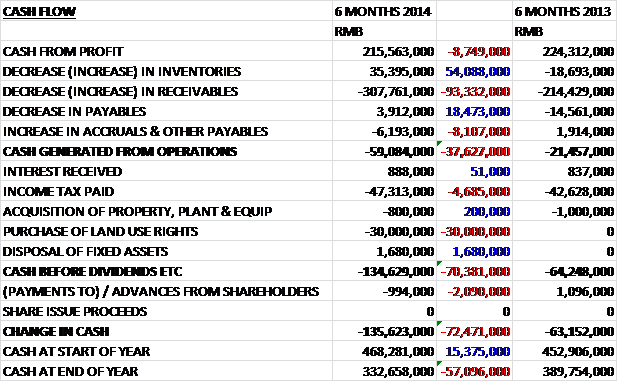
Before movements in working capital, the £21.6M cash income was £875K lower than during the same period of last year.  Unfortunately this was obliterated by a £30.8M increase in receivables which meant that there was a £5.9M outflow of cash from operations, some £3.8M worse than last year.  On top of this, the group paid £4.7M in tax and £3M to purchase land use rights for the new factory which all contributed to a pretty poor £13.6M outflow of cash during the period to leave the group with £33.3M left in the bank.

Apparently due to increasing competition, a number of smaller players have now exited the market which means that the board are expecting some recovery in their end markets.  The market remains highly competitive, however, as foreign brands have stepped up their business expansion into second and third tier cities.  The group has now adopted a more prudent approach to expansion by growing existing stores and cutting back on new store openings.  The current store portfolio stands at 3,192 stores with 170,000 square metres of sales space.  They are developing a new brand based on a European fashion concept that is expected to launch in 2015.

As previously announced the new Quangang plant did not commence production due to a lack of skilled workers.  Somehow, Naibu has now managed to lease the factory out at an annual rent of £600K.  Quite what the company renting the factory is going to do with a facility that it can’t fill with staff is a bit of a mystery.  In the meantime, the company has made arrangement for their OEM suppliers to continue making the products that would have been manufactured in the Quangang plant.  In Dazhu County, the group has paid the second instalment of £3M for land use rights and expects to pay the remaining £2.2M upon granting of the certificate in Q1 2015.  The land is in the process of being prepared and it is expected that the facility will be operational in Q2 2016.

Part of the cause for the huge increase in receivables was the inexplicable decision to extend credit terms to distributors to 120 days.  Apparently this has not resulted in any accruals of bad debts which seems very unlikely in my opinion.  In order to help their network partners reduce their operating cost pressures, the group has been granting subsidies to distributors for store refurbishments, which have apparently helped increase sales.  It is interesting to note that the group is granting subsidies to their customers and extending credit terms to their suppliers and are getting squeezed in the middle.

Net profit for shoes was £7.2M, a fall from the £7.8M recorded last year.  Net profit for Apparel and Accessories was £8.4M, an increase of £300K over the same period of last year.  Due to the declining cash position, and presumably because there is little hope of any of those receivables turning into cash, the board have elected not to pay an interim dividend this time.  So, what do we have here?  Despite the increasing profits, the decision to extend credit terms with their customers means there is a cash outflow from operations.  Due to this, the dividend has been stopped and one of the main reasons for holding the share has been removed.  I really do want to believe in this company but it is looking more and more likely to me that there is about to be a massive write-off of bad debts (even though this is denied by Naibu).  I will keep my small holding but I really can’t advocate buying the shares until the uncertainty about those receivables has been sorted out.

On the 17th October the group released a statement that reported some errors in the financial accounts.  The cost of decoration and machinery for he Quangang factory was £2.6M and not £260K as stated.  Also, the figure of construction in progress relates to Quangang and Dazhu, not just Quangang as stated.  This does not really inspire confidence but at least the errors have been highlighted.

On the 24th November the group informed the market that since the half year point there has been a slowdown in sales of Naibu products that has led to some overstocking by distributors.  The company is now intending to introduce a limited programme of discounting in order to “reduce the overstocking within the distributor system”.  Therefore there is unlikely to be a dividend this year as they address this issue but they may start paying them again in 2015.  This all seems very convenient and I have pretty much given up on finding any value here.

On the 2nd January the company announced that Zhen Li has resigned as CFO.  This is yet another ill omen.

On the 9th January it was announced that the non-executive directors have requested suspension of the company’s shares pending clarification of its trading position.  Not really much of a surprise, this, but it looks as though they are finished.

On the 18th February it was announced that the UK based non-executive directors have been unable to contact any of the Chinese executive directors.  In order to clarify the situation they have appointed KPMG to prepare a report on the group’s financial position.  The non-executives have asked CEO Mr Lin to co-operate with KPMG but as they cannot find him, he has not indicated that he will do so!  Further announcements will be made in due course.

On the 29th April the non-executive directors released an update.  They have been unable to obtain the co-operation of Chairman Huoyan Lin to progress the appointment of KPMG to review the financial positon of the group and have therefore appointed a leading Chinese law firm to initiate legal action to gain control of the operating subsidiary of the group and the associated accounts.  They have been able to contact Lin but his lack of co-operation means that his employment contract has been terminated, along with that of VP of production, Congdeng Lin.  The company’s shares remain suspended but at least actually speaking to one of the executive directors seems to be progress. I still find it unlikely that there is any value left in this company, however.

On the 22nd May a statement was released that said the non-executive directors felt a resolution would not be reached before the 6 month AIM deadline in July, the NOMAD has resigned and there was little prospect of appointing another one.  Therefore the AIM listing will be cancelled on 22nd June with a private dealing facility a possibility going forward (I won’t hold my breath).  What a total shambolic disaster.

Dechra Pharmaceuticals Finance Blog – Full Year Results 2014

Dechra has now released its full year results for the year ending 2014.

dechraincome14

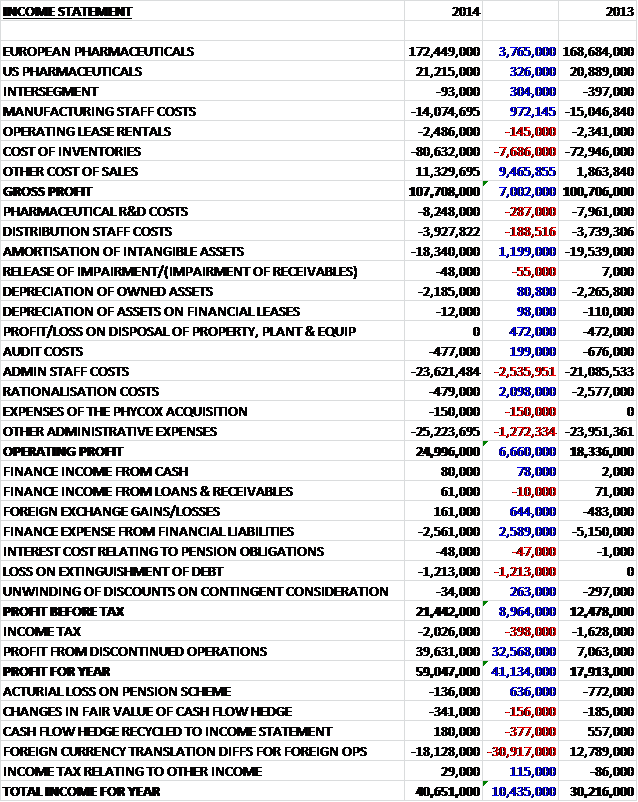
Revenues across both business segments increased, with European pharmaceuticals up £3.8M and US pharmaceuticals up £300K. Revenues also increased across most product categories with Food Animals the only one to show a decline.  Manufacturing staff costs reduced slightly but the cost of inventories was up £7.7M.  Other operating costs were well down, however, so the gross profit was some £7M higher than in last year.  An increase in admin staff costs and other admin expenses were mitigated by a £2.1M fall in rationalisation costs and a £1.2M reduction in the amortisation of intangibles, which remained high at £18.3M, to give an operating profit £6.7M higher than in 2013.  Finance costs fell despite a £1.3M loss on the extinguishment of debt to give a profit before tax of nearly £9M.  The overall numbers were distorted by a £32.6M gain on the sale of the discontinued operations so that the profit for the year was £59M, up by £41.1M on last year.

dechraassets14

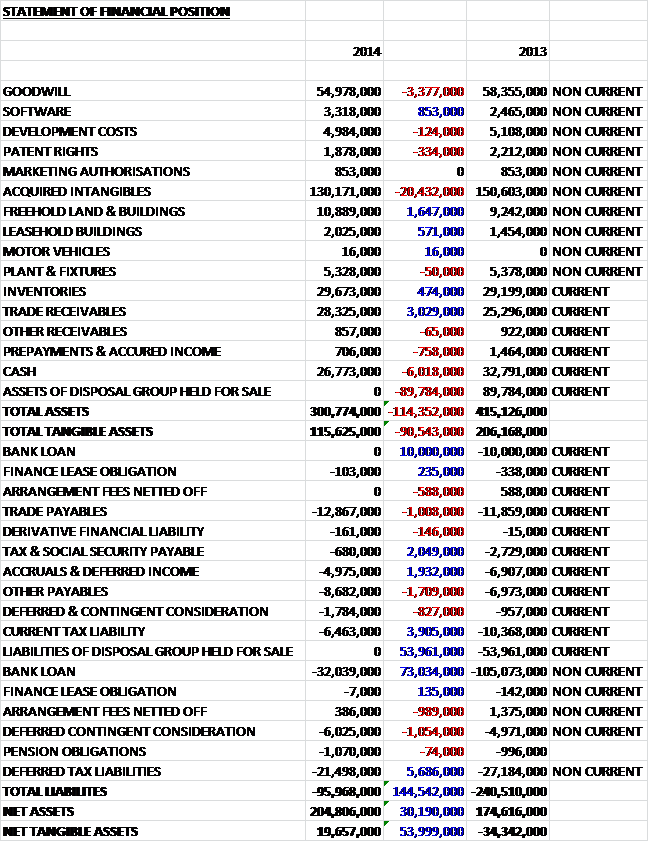
Overall total assets fell by £114.4M.  This reduction was driven by the sale of the £90M of assets for the services group held for sale.  Other large falls included a £20.4M reduction in the value of acquired intangibles which related to amortisation of development costs and product rights at the various acquisitions made in the past, a £6M fall in cash levels and a £3.4M reduction in the value of Goodwill.  These falls were only partially offset by a £3M increase in trade receivables and a £1.6M increase in the value of land and buildings.  Total liabilities also fell, down by £144.5M driven by an £83M reduction in the bank loan, the £54M of liabilities disposed of with the disposal group and the £5.7M fall in deferred tax liabilities, with the only substantial increases being a £1.7M hike in ‘other’ payables and £1M increases in both trade payables and deferred consideration.  Overall this meant that net assets increased by £30.2M to £204.8M.

dechracash14

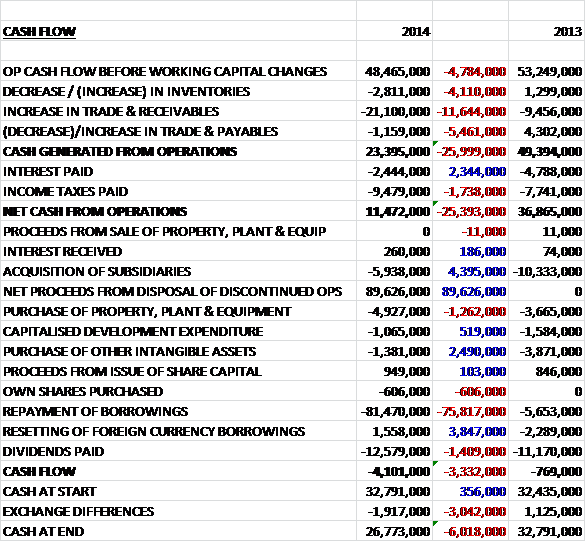
Before movements in working capital, cash from operations was £4.8M lower at £48.5M.  There was a pretty disastrous movement in working capital, however, particularly a £21.1M increase in receivables that seems to be related to the disposal of the Services group, the exact details of which I have failed to understand, that meant cash generated from operations was only £23.4M, less than half that achieved last year.  Interest payments halved but an increase in the income tax paid meant that net cash from operations of £11.5M was £25.4M lower than in 2013.  This cash flow comfortably covers capital expenditure of £5M towards property, plant equipment; £1.1M of development expenditure and £1.4M of other intangible assets.  It also nearly covers the £5.9M spent on the acquisition of subsidiaries.  The group received nearly £90M from the disposal, the bulk of which was spent on reducing borrowings by £81.5M.  The rest was then spent on dividends of £12.6M to give a cash outflow of £4.1M.  The cash from operations does not seem to cover dividends which is disappointing.

Operating profit for European Pharmaceuticals was £49M, a £3.2M increase on last year.  Despite this increase, there were some issues with Vetoryl sales momentum slowing down due to the phasing of sales in Italy and the unavailability of a drug necessary to diagnose Cushing’s disease.  Apart from in the Netherlands, the defence strategy against generic competition for Felimazole proved successful.  The main issue, however, was the decline in Food Animal products due to the reduction in the prescription of antibiotics and increased competition in the Netherlands.  Sales of Cardisure increased by 32% and it is rapidly approaching one of the five most important products for the business.  Another good performance was the 11% increase in the Equine range driven by a second half recovery of Equipalazone and a strong growth in the sales of HY50.

Operating profit for US Pharmaceuticals was £6M, an increase of £400K on last year.  Some key products performed strongly including Vetoryl, with sales up 24%, Felimazole with sales up 19% and Dermapet with sales up 11%.  There were no sales of Animax, however, due to supply issues which reduced sales overall by £1.5M. The performance of Felimazole was particularly good considering it is now competing with a number of low cost human generics

The strong performance of medicated shampoos was further enhanced by the recent launch of MiconaHex in the US.  Other plus points have been Cardisure, a cardiovascular product has increased sales by 32% across the EU; Comfortan, an anaesthetic, has grown sales by 40% and Vetropolycin has been re-launched in the US following the resolution of a long term supply issue.  A number of products acquired through Eurovet that were marketed through distribution partners have been taken in-house, enabling the group to retain the full margin and contracts with the previous partners ended in December, allowing the group to market Forythron in France and Sweden, and Atipam and Sedator in the Nordics.

Sales in Food animal antimicrobials fell by 7.3% this year due to a very competitive environment and a global focus on antimicrobial reduction.  The Netherlands saw the largest decline and was the only European market to suffer an overall fall in revenue.  This is predominantly due to the fact that Dutch vets reduced their antimicrobial usage by 50% due to government pressure.  The board suspect that the group has further exposure to this trend, particularly in Germany where they have a strong market position.

During the year the group achieved approval in the US and the UK for Osphos, a new equine product that controls navicular syndrome that should go on sale in the first half of 2015.  The product was also submitted for approval in the EU, but because the horse is a food producing animal in much of Europe, the approval process takes more time.  Navicular syndrome occurs in approximately 6% of horses and causes pain and lameness in the forelimbs.  Other new introductions have included: Buprenodale, a generic Buprenorphine injection launched in 16 European countries; Felimazole tablets 1.25mg, for hyperthyroidism in cats was launched in 12 European countries to try and counteract increasing generic competition; and MiconalHex+Triz, a dermatological shampoo was launched in the US to compete with the leading brand whose patent recently expired.  In countries where the group does not have a direct presence, Felimazole tablets were launched in South Korea and Canada whilst Sedator and Atipam were launched in Israel.

As far as the pipeline is concerned, dossiers have been submitted in the US and EU for a new canine endocrinology product, a clinical trial is underway for a second canine endocrine product, studies are ongoing for a canine dermatology product and canine ophthalmology product, Osphos has been submitted in Australia and Canada, but unfortunately clinical trials for a feline endocrinology drug were suspended due to concerns over the formulation.

In the long term there are two major factors affecting the food animal market, which makes up 18% of group sales.  There is increasing global demand for animal protein which in turn feeds demand for food animal drugs but as touched upon earlier, this is tempered by an increasing regulation of antimicrobial use due to the potential for drug resistant pathogens to develop.  This has been most keenly felt in the Netherlands but it is likely that the rest of the EU and the US will follow suit in time.  Spending on companion animals is growing globally and pet ownership is also growing in both developed and emerging markets.  In addition, pets are generally living longer than in the past which in turn creates more demand for companion animal pharmaceuticals.

The group are actively looking to expand into new geographical areas where they have achieved critical mass.  Trading started in Italy in March of this year and is the first major territory to be entered into since the US in 2004.  Sales in that country have so far been in line with expectations.  The group is also looking into entering Canada and they have appointed a country manager in Montreal and trading is expected to start in January 2015.  Management have apparently identified other potential markets and intend to start trading in another new territory in 2016.

The group have made investments into the liquids, creams and ointments manufacturing suite, tablet compression machines and the encapsulation production line.  The application to the FDA for the approval of the new canine endocrinology product prompted an FDA inspection of the sterile injectables facility in Skipton where the product will be manufactured.  The group have invested a significant amount of resources and effort into ensuring that the facility meets the standards required.  They have also moved the manufacture of Cardisure and Forthyron to the facility after they were brought in-house from outside manufacturers.

The new enlarged central European distribution centre in Denmark was opened in November after a €2M investment.  The facility has more than doubled in scale and tripled the group’s pallet handling capacity.  It creates a logistics hub that will fulfil the medium term distribution requirements, eliminates third party storage and handling costs and improves efficiency.  The group has also started to transfer their Specific pet diets to a new external manufacturer and following the transfer, an improvement in quality, palatability and on time delivery has been observed.  There has also been an investment into the IT platform that the group uses.

During the year the group acquired certain trade and assets of PSPC Inc for a total consideration of £8.4M.  The principal asset is a product called Phycox, a patented nutraceutical which competes in the US joint health supplement market and there is also another product in the final phase of development.  There is only £84K of goodwill being paid so the price seems fair, without knowing about the products in any more detail.  A contingent consideration (included in the £8.4M total) of £900K was paid after the successful registration of the new product and there remains another £2.5M of contingent consideration payable after a certain number of sales.  The group also paid out a further £10M of contingent consideration relating to the Dermapet acquisition, mainly due to a milestone sales target being hit.  There remains another $6M of consideration payable relating to this purchase.

The transformational event that happened this year was the disposal of the Services group for proceeds of £91.2M which relates to a profit on disposal of £38.7M.  The group are actively looking and have been in discussions with other companies with a view to acquire them but the valuations have apparently been too high.

At the last AGM, Neil Warner stepped down as Senior Independent Non Exec director and Ishbel Macpherson has taken over the role.  In January, Ed Torr stepped down as an executive director following 17 years with the business, he will continue to work as a consultant for the group.  Current trading is in line with expectations with growth consistent with that seen in the second half of the year.

At the end of the year net debt was just under £5M, a vast improvement on the £80.1M recorded at the end of last year and gives the group many more options for taking the company forward.  The current P/E ratio is 34.3, falling to 20.3 next year on analyst’s predictions for EPS which is not cheap.  The board have announced a dividend for the year of 15.4p, a 10% increase on the dividend last year and the dividend yield currently stands at 2% which again, is nice to have but not exactly high yielding.

This has been a fairly good set of results for Dechra, the supply problems in the US seem to have improved and it is good to see them take a number of products in-house to maintain market share.  The generic competition for Felimazole is a concern as this is an important product for the group but they seem to be handling this well.  Perhaps more concerning will be the impact when the German government decides to restrict the antimicrobial drugs.  The diversification into Italy and Canada seems like a good move to me and the new Equine product looks promising.  The disposal has also meant that the debt has been slashed which clearly makes this a less risky investment although the falling operational cash flow is a bit disappointing.  The shares are not exactly cheap on a P/E or dividend yield basis though so I rate these as a hold.

On the 14th January the group released an update covering trading in the first half of the year ahead of the interim results that are due on the 23rd February.  Group trading during the period was in line with management expectations with revenues increasing by 12% on a constant currency basis against a soft comparator period last year.  European pharmaceuticals increased sales by 7% on a constant currency basis but only 0.5% on a reported basis.  Sales of companion animal products were ahead of expectations with equine and diet products also performing strongly.  These gains were offset by the continued pressure on vets to reduce antibiotic prescribing for food producing animals, however, particularly in Germany and the Netherlands.

US revenues increased by 59% on a constant currency basis (54% reported) which was predominantly attributable to the acquisition of Phycox, the launch of Osphos in Q1 and the relaunch of two Ophthalmic products following the resolution of the supply issues and all products have performed in line with expectations.  During the period the group opened a subsidiary in Canada which should enhance growth going forward.  In Q2 of the year the group obtained approval in all of their European territories for TAF spray, a FAP differentiated generic antibiotic aerosol to treat superficial wound infections.  Due to the strength of the recent revenue growth in the US, management are strengthening sales teams there and so far in the rest of 2015, the group is performing within expectations.

Overall, this is a good update.  It is particularly pleasing to see such strength in the US and the end to the long running saga of supply interruptions.  In Europe, the drag of the food animal products due to antibiotic prescription pressure looks unlikely to change any time soon but in all, I may look to add if there is any price weakness.


Laura Ashley Finance Blog – Interim Results 2015

Laura Ashley has now released their half year results for the year ending 2015.

lauraincome

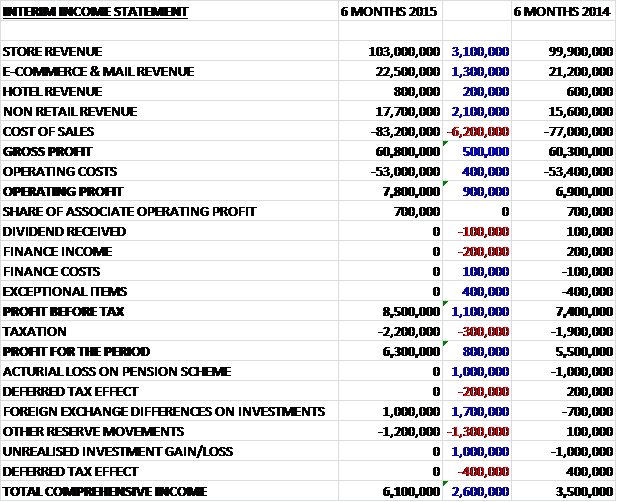
Revenues were up across all sectors with non-retail revenue showing a particularly good improvement, up £2.1M to £17.7M.  Cost of sales also increased to give a gross profit some £500K higher than during the first half of last year.  Operating costs actually fell during the period so operating profits were nearly £1M higher before the lack of any exceptional items, offset by a £300K higher tax bill, meant that the profit for the year was up by £800K to £6.3M.

lauraassets

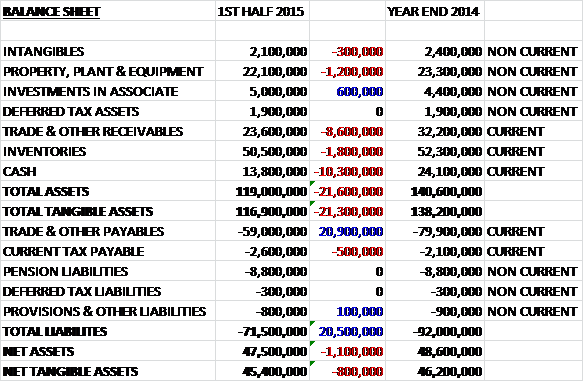
When compared to the end point of last year, total assets in the first half of this year fell by £21.6M.  This was driven by a £10.3M fall in cash levels, an £8.6M reduction in trade & receivables, a £1.8M decline in inventories and a £1.2M fall in the value of property, plant and equipment.  Liabilities also fell, driven by a £20.9M reduction in trade and payables to give net tangible assets of £45.4M, a modest £800K fall on the situation six months ago.

lauracash

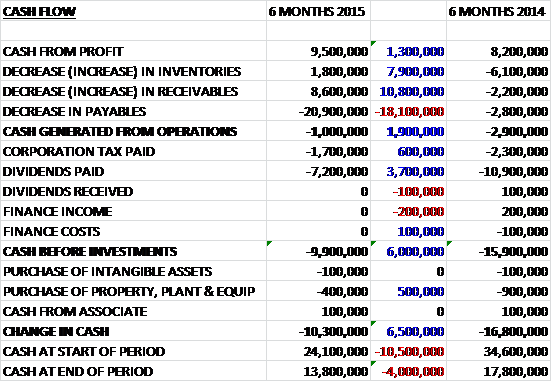
Before movements in working capital, cash profits were some £1.3M higher than during the same period of last year at £9.5M.  A huge decrease in payables, possibly the “other payables” on the book at the year-end, meant that there was a £1M cash outflow at the operating level.  This seems to be seasonal, as the same thing happened last year before payables evened themselves out and was £1.9M better than in the first half of last year.  By far the largest destination for the cash was dividends, which at £7.2M were £3.7M less than in H1 2014 and the £1.7M spent on tax was some £600K better.  Capital expenditure pretty much halved during the period to a paltry £400K, all of which meant the group had a cash outflow of some £10.3M, £6.5M less than last time.

During the period, retail stores contributed £7M, a £600K increase on the same period of last year and e-commerce retail contributed £4.6M, an increase of £500K.  Two new stores were opened in the UK and three were closed, reducing total selling space by 1.3%.  E-Commerce now represents 18% of total UK retail sales.  Like for like furniture sales were down 1.2% but new ranges have been launched for the second half which it is hoped will halt the decline.  Like for like Home Accessory sales were up 4.3%, which significantly outperformed the market, driven by lighting and gifts.  Like for like Decorating sales were up 1.3%, which modestly outperformed the market and the best performing products were curtains and paints.  Like for like Fashion sales were broadly flat during the period, which was an underperformance compared to the rest of the market.

In the first half of this year, the hotels made a loss of £100K, double the loss made in the first half of last year.  The group have recently partnered with another hotel, this time in Windermere.  The Belsfield is a 62 room hotel that has been entirely decorated in Laura Ashley products and customer response has been good.  There is no real indication of what the group is planning to achieve with these hotels, which do not seem to be breaking even yet.  During the period, non-retail items made a contribution of £6.6M, a £700K increase on the first half of last year.  There was an increase of 10 franchised stores, with additional ones being opened in Japan, Australia, South Korea and Russia.

The board have approved an interim dividend of 1p per share which represents a stonking full year dividend yield of 7.3% at the current share price.  Trading at the start of the second half of the year is up 8% on a like for like basis, so it would be good if this performance can continue.  Laura Ashley is an odd beast really.  The international franchises really seem to be driving what little growth there is.  Trading in the UK stores seems OK, but nothing to get excited about.  That dividend yield is something to get excited about, however, and it seems that the group’s main purpose is to give cash back to shareholders to the extent that there is virtually no capital expenditure.  I am not sure what the strategy is with the hotels – are more being sought?  Are they going to make the company money or just showcase their products.  Who knows, there was very little in the way of narrative in the interim report.  Overall I am more than happy to collect the dividends but it would be good to know more about their strategy going forward.

Tower Resources Finance Blog – Interim Results year ending 2014

Tower Resources has now released their interim results for the year ending 2014.

towerinterimincome

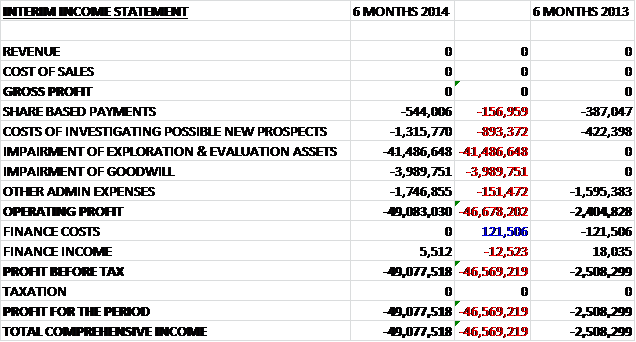
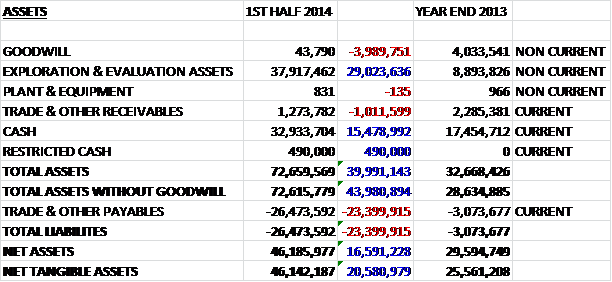
As there were no sales or cost of sales, the operating loss is made up of admin expenses.  By far the largest of these was the non-cash impairment of exploration assets relating to the failed Namibia drill.  Another non-cash item was the $4M impairment of goodwill, which was attributable to Neptune Petroleum in Namibia.  The cost of investigating new prospects was £893K higher than in the same period of last year with share based payments and other admin charges also increasing somewhat on last year to give an operating loss of £49.1M which due to the lack of any finance costs this period was also the loss for the half year, some £46.6M worse than in the first half of 2013.  It seems to me, though, that the profit and loss account is pretty useless to use to analyse Tower.

towerinterimassets

Overall, assets more than double to $72.7M driven by a $29M increase in exploration & evaluation assets and a $15.5M hike in cash due to the share placing.  This was only partially offset by a $4M reduction in the value of goodwill and a $1M fall in receivables.  Liabilities also increased, up $23.4M predominantly due to an increase in payables on the Namibia well ($21.8M).  This all meant that net tangible assets increased by $20.6M to $46.1M.

towerinterimcash

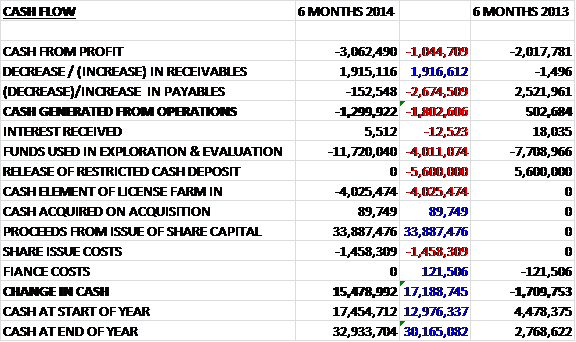
The cash flow statement is more useful for analysing the shape of the company.  Before movements in working capital, the group has a cash outflow of $3.1M, some $1M worse than in the same period of last year.  A decrease in receivables and a modest decrease in payables meant that cash spent on operations was $1.3M, $1.8M more than in H1 2013.  The group needed to issue further share capital which brought in a net $32.4M.  The bulk of this cash ($11.7M) was spent on exploration and evaluation, with another $4M used to farm into a license.  This meant that at the end of the year there was still $33M in the bank, an improvement of $15.5M on the start of the year.

The first half of the year was clearly dominated by the lack of a hydrocarbon find at the Welwitschia-1 well offshore Namibia.  The drill itself was beset by a number of operational issues and delays which meant that the decision was made to plug and abandon the well having drilled to a depth of 2,429 metres after finding that the shallower targets were non-reservoir.  Work is ongoing to obtain a full understanding of the results but the group have stated that the prognosed sands in the late Cretaceous and early Tertiary sections were absent and there were no indications of hydrocarbons while drilling and that the amplitude anomaly seems to be related to lithological variation.  There remains a desire to assess the remaining prospectivity of the block, specifically the untested deeper Albian carbonate sequence that was not reached due to the delays and cost over-runs of the well.

As of the end date of these accounts, the group had paid $11.4M in relation to the Welwitschia well and has since settled a further $13.9M.  Repsol, the operator of the well has submitted further claims which indicate another $7.5M is being sought.  Both Tower and the other non-operating party are disputing certain of these costs and this $7.5M is some $5M higher than that estimated by the operator.  The extra costs are due to the delays and operational problems mentioned above and it seems fair to me that these extra charges should be paid by Repsol as the operator – we shall see how this goes.

During the year, as reported on previously, the company acquired Rift Petroleum in consideration for the issue of 550 million shares.  The acquired group was a private exploration company focussed on the offshore South African region with additional licences located onshore Zambia.  The acquisition gives Tower a 50% interest in two South African offshore areas with a number of oil majors such as Exxon, Total and Shell active in adjacent blocks. The primary asset is a 50% non-operated interest in the Algoa-Gamtoos licence alongside operator New Age Energy Algoa.  It covers seven blocks and nearly 12,000 km2 between two areas that have been farmed into by Exxon and Total.  The license consists of three prospective basins, Algoa, Gamtoos and Outeniqua and the mapping of seismic is ongoing.  Rift Petroleum also had rights to acquire a 50% interest in any exploration right granted to New African Global Energy over the SW Orange Basin area covering three blocks and 27,500 km2.  In addition, Rift owned an 80% Operating interest in two blocks onshore Zambia (blocks 40 and 41) and finally, negotiations were initiated in Ethiopia and are ongoing.

The application for the license renewal at Algoa-Gamtoos is scheduled to be submitted by November of this year and the results of the 3D seismic are going to be used to re-map the existing leads and provide the basis for a farm-out process but it now looks like the group will not be in a position to drill the first well on the license until mid to late 2016.  The first deep-water well to be drilled offshore South Africa was spud in late July in a block adjacent to Algoa-Gamtoos which should be complete by November.  Any success with that well would provide encouragement for the potential of the basin that continues into the Algoa-Gamtoos license area.  At the second South African license area, where Tower has a potential for a 50% interest, recent data shows the potential for large deep-water turbidite oil plays and large synrift traps that would require a seismic acquisition to map further.

The partner in Towers 80% owned Zambia blocks is Blue Square Oil and Gas and the license comprises of several thousand metres of Permian to Jurassic age sediments.  During August, extensive geological field study work across both blocks was undertaken, including rock sampling of potential reservoir rocks and geochemical analysis of potential source rocks.  The results of this analysis should be completed by year end.

The group agreed to farm in for a 15% interest in Block 2B in Kenya which is operated by 30% owner, Taipan Resources.  The remainder of this licence is held by Premier Oil.  In consideration for the farm in, the group paid $4.5M in cash, 9M in shares and a further contingent payment of $1M on spud of a second well.  The block is estimated to contain mean gross unrisked prospective resources of 1,593 mmboe and the first Badada-1 prospect well is due to be drilled by Q1 2015.   This well is due to be drilled to a depth of 3,500 metres and is targeting prospective resources of 251 mmboe in Tertiary and Cretaceous reservoirs with an expected gross well cost of between $20M to $25M.  On an adjacent block a well encountered an upper gas bearing interval which tested gas at a maximum rate of 6 M cubic feet per day from a 25 metre net pay interval.  A deeper test was inconclusive with a small gas flare and oil recovery in small quantities.  The next well that was drilled on that block is scheduled to be complete by early November of this year.  The Badada well is targeting different sands but the results may be relevant.

There has been no activity for Tower in Western Sahara but an application to extend the expiry date of the license to December 2020 has been submitted.  Kosmos energy is due to drill a prospect well within the disputed area towards the end of this year, however, so the results of that may be interesting.  In Ethiopia, negotiations are due to commence shortly for two blocks in a frontier basin and the group continues negotiations in Madagascar to obtain a license for Block 2102.

In Cameroon, Tower was the preferred bidder for the offshore Dissoni block which is located in the Rio del Rey basin and negotiations have continued throughout the year.  The block is located in an area of proven oil production and there is already one shallow discovery there with the potential to find sufficient additional resources to make a commercial development viable.  There is also a higher risk potential in the deeper section that has not been successfully imaged to date.  There is significant competitor activity nearby with both Glencore and Parenco planning new seismic in adjacent blocks. If successful with the bid, Tower would look to acquire 3D seismic in H1 2015 with drilling to potentially follow in 2016/2017.

The placing of 550 million shares for the acquisition of Rift Petroleum raised proceeds of £19.3M and £820K was raised via a modest draw-down on the EFF agreement with Darwin that resulted in the issue of 19 million new shares.  After period end, the company issued a further 10 million shares as part settlement for consulting services.

Overall then, this update is dominated by the failure in Namibia which meant that my initial stake is now looking rather poor.  There seems to be enough cash to cover the costs of this well but more will need to be raised before the end of the year to drill the Kenya prospect, which is the next one on the horizon.  For now, then, it seem to me that there will be several quiet months before more can be learned about the Kenya resource before drilling should start early next year.  There is no point selling out now, this was always going to be a risky punt so it’s a case of wait and see for now.

On the 8th October the group updated the market regarding the drilling campaign in Kenya.  The operator (Tower has a 15% interest) has signed a letter of intent with the Greatwall Drilling Company of China to contract a land rig for the planned Badada-1 well onshore Block 2B in Kenya.  The well is expected to spud between mid December and mid January and should take about 70 days to drill.  It is planned to be drilled to a depth of between 3,000 and 4,500m to test primary Tertiary age reservoirs and potentially secondary upper Cretaceous age reservoirs.  Management estimate a mean gross unrisked resource of 169mmboe.  Taipan predicts an additional 405mmboe of gross mean unrisked  resources in the four prospects and leads immediately adjacent to the Badada-1 well.  In total in the block 19 leads have been identified with total estimated gross mean unrisked prospective resources of 1,593 mmboe.  Gross well costs are estimated to be between $20M and $25M with between $3M and $3.75M attributable to Tower.

On the 18th November the group announced that the operator of the Badada-1 well in Kenya has received formal notice from the High Court of Kenya of a temporary injunction preventing the company from working on the well.  Co-respondents in the lawsuit are the Kenyan Cabinet Secretary, Ministry of Petroleum and Premier Oil. The board are confident that the injunction will be revoked so that they can progress to a projected spud in early January.  This all seems very ominous and I feel it is hard to justify and investment here until the uncertainty has lifted.

On the 27th November the group announced that a court order has allowed the operator of the Kenyan well to continue work at the site.The court also ruled that any related petitions against the respondents are to be consolidated and heard as a single petition at the next hearing scheduled for the 10th December.

On the 12 December the group confirmed that a court ruling allowed them to continue work on the Badada-1 well site with a further hearing scheduled after the projected completion of the well which will not affect the drilling timetable.  The operators have executed a contract with Greatwall for the GW-190 land rig and have also contracted Norwell Engineering to manage the drilling operations.  Drilling itself if expected to start in early January with the well expected to take about 70 days with costs net to Tower of between $3M and $3.75M.  The well is designed to test the Tertiary age reservoirs and the total depth is planned to be between 3,000 and 4,000 metres.  Local companies have been contracted to provide well site services such as logistics and road repairs and the operator has embarked on a number of initiatives including clean water projects and medical care for the local community, no doubt to improve their standing come the final court ruling.

On the 19th December the group issued a statement covering the disputed costs for the Namibian well.  The group has reached an agreement with Repsol so that they will pay another cash payment of $3M to contribute to the increased costs which represents a $4.7M reduction against the previous estimate.  Following this payment, Tower now have a cash position of $7.5M and is fully funded for its part in the Badada-1 drill.  With this out of the way and the run up to the drill in Kenya now underway, I am tempted to pick up a few shares at this price.

On the 31st December the group sneaked out an announcement covering the grant of options to directors, the management team and consultants.  Overall 78.7M shares were granted at an exercise price of 0.70p per share.  The options will vest in three equal tranches in 12, 24 and 36 months.  This brings the total number of outstanding options to 209.2M shares, representing more than 5% of the share capital of the company, which seems like quite a lot.

On the 7th January the company announced that the GW-190 rig had spudded the Badada-1 well onshore Kenya.  The well is planned to be drilled to a total depth of between 3000 and 4000 metres to test Tertiary age reservoirs analogous to those in the Lokichar basing where Tullow have made discoveries.  It is expected that the well should take 70 days to complete drilling and Tower will be updating the market every two weeks throughout the drill, which is a pleasing change to the lack of updates last time.

As promised Tower have released an update on the Badada-1 well drill on the 21st January.  So far the well has been drilled to a depth of 918 metres MDBRT (Measured Depth Below the Rotary Table, whatever that means) intersecting the Neogene sequence.  A 20 inch casing point has been set 298m MDBRT and the well is currently drilling ahead to the next casing point.  It is planned to be drilled to a total depth of between 3,000 and 4,000 metres in order to test primary targets in Tertiary age reservoirs and is expected to take up to 70 days to complete.  Another update will be made in about two weeks after further progress.  There is nothing much to note really but nice to have an update nonetheless.

On the 4th February the group released another statement covering progress at the drill.  They have now drilled to a depth of 1,647 metres MDBRT.  13 3/8 inch casing has been run to 1,644 metres and cemented in the 17 1/2 inch hole and the well is currently preparing to drill ahead with the 12 1/4 inch hole section to the next casing point which expected to be at TD.  Not a huge amount of interest but nice to be kept up to date.

On the 18th February the group released another statement covering the progress at the Badada-1 well.  It has now been drilled to a depth of 3,372 metres, intersecting the Neogene sequence.  Preparations are underway for the logging of the hole section between 1,644 and 3,500 metres and is expected to be completed within a few days.

On the 23rd February it was announced that following completion of the logging operations, the well will be plugged and abandoned as a dry hole.  The drill was completed in less time than expected and under the gross budget of $25.8M so that is something I guess.  The well encountered a thick and untested Neogene age succession in the Anza basin and although commercial hydrocarbons were not found, minor gas shows and traces of heavier gas molecules indicate the presence of a thermogenic source rock.  Drilling results suggested that the section here is sandier than had been expected and the development of sealing claystones is less than had hoped.  The partners will be evaluating the results of the well to assess the remaining prospectivity in this large area.  So, this is all rather disappointing but not totally unexpected and I do appreciate them getting straight to the point in this update.  My holding here is pretty much worthless so I guess I will have to wait and see what happens next!


On the 19th March the group have released a corporate update.  The portfolio now has limited financial exposure with no drilling commitments and discretionary programmes being cut.  The current cash balance is around $4M after paying in full for the Kenya well.  Due to the undervaluation of exploration assets, the board are apparently alive to the opportunity for consolidation as well as the attractiveness of building a wider low-cost, high-impact exploration portfolio.

In Kenya, the operator is in talks with the Kenyan ministry of energy regarding how best to complete its evaluation of the remaining prospectivity of Block 2B.  Badada-1 was the first well to target Tertiary rather than Cretaceous age source and reservoirs within the Anza basin.  The information gained from the well should enable the group to make better predictions of seal and source for any future drilling which reduces risks.  Despite being a duster the well took only 51 days and came in slightly under budget with $3.8M net to the group. Financial commitments are fully met and they do not expect significant additional expenditure this year with any additional drilling likely to require a farm-out.  The injunction rumbles on, however, but with a hearing expected shortly the named parties believe the claims have no merit.

In Zambia, where the group is operator with an 80% interest, the company has completed all of its initial period commitments.  During August, the group completed a programme of geological fieldwork in blocks 40 and 41 of the Zambezi basin as part of the initial period work programme.  The results of this work will be submitted to Zambian Ministry of Mines and Energy in the coming weeks and initial results are encouraging and indicate that the elements for a working petroleum system are present.  The three year second period has been split into three on year periods which would involve further field work, minor gravity data acquisition and interpretation and then potentially a 2D seismic programme.  Tower will be looking for partners to fund these surveys in 2017.

In Namibia, following resolution of their dispute with the operator, Repsol, regarding final drilling costs the company continues to evaluate the remaining potential in the license.  The well completed in June failed to reach the deeper Albian Carbonate targets identified previously and attention is now focussed on a reassessment of the potential here in the light of extra geophysical data obtained from the well during the reassessment period.

In South Africa, where the group has a 50% interest, concerns about the regulatory environment have been lessened by the government’s decision to consult further with the industry.  On the Algoa-Gamtoos block, the processing and interpretation of 3D seismic data acquired during the year has continued.  The first renewal application to the exploration right has been submitted to the Petroleum Authority and it is expected to be granted in the second half of 2015 and the hope is to be in a position to start drilling in 2016/2017 with Tower’s preferred option being to farm out part of its interest in advance of that time.  Adjacent to the group’s block, Total spudded the deep water Brulpadda 1 exploration well in August but due to technical issues with the rig, drilling was abandoned with a view to returning in 2016.  An application to convert the SW Orange Basin TCP into a three year exploration right has been submitted with a formal response to the application expected later in the year.

In Cameroon, Tower was selected as preferred bidder on the shallow eater Disonni block and negotiations regarding the production sharing contract are now entering their final stages.  The block is located in the under-explored Rio Del Rey basin which is an extension of the Niger Delta systems and offers the group access to potentially lower risk prospectivity combined with material upside in deeper gas/condensate plays.  The priority on signing the agreement will be the acquisition of 3D seismic in H2 2015 and a partner will be sought to share the group’s financial commitment and provide additional technical input.

In the SADR, there has been some recent activity in the Aaiun basin where the CB-1 exploration well was drilled in the Morocco awarded offshore Cap Boujdour block.  The well encountered 14 metres of net gas and condensate over an interval of about 500metres.  The discovery was non-commercial and the well was plugged and abandoned.  The result could be promising, though, as the well has established a working petroleum system with de-risks the plays along this part of the Atlantic Margin.  Whether the group will ever be able to drill on its concession, however, is a key question given the disputed nature of the country.  In Ethiopia, the company has decided to withdraw the application made for blocks AB3 and AB6 and in other news, the group will not be reviewing its £20M EEF with Darwin.

Shaft Sinkers Finance Blog – Interim Results 2014

Shaft Sinkers have now released their interim results for the year ending 2014.

shaftinterimincome

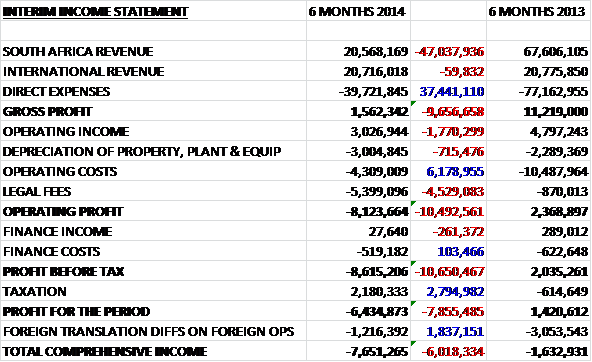
Revenues took a big hit during the first half of the year.  Sales from within South Africa collapsed by £47M to just £20.6M whilst International revenues were flat.  Direct expenses nearly halved to £39.7M to give a gross profit some £10M lower at £1.6M.  Operating income fell by £1.8M and was broadly counteracted by the depreciation of the tangible assets.  Operating costs fell by £6.2M but this was counteracted by a £4.5M increase in legal fees.  This is certainly taking its toll on profitability and the operating loss increased by over £10M to £8.1M.  There was also half a million pounds of operating costs before the group got a tax rebate of £2.2M due to the loss making South African operations which meant that the total loss for the half year was £6.4M, a swing of £7.9M on the small profit made during this period of last year.

shaftinterimassets

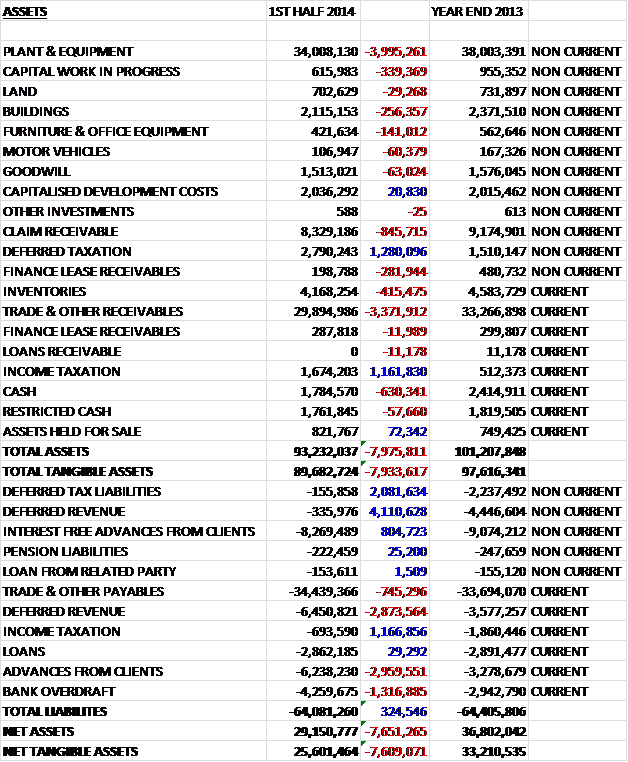
Overall assets fell by just under £8M when compared to the end point of last year.  This was driven by a £4M fall in the value of plant & equipment, a £3.4M reduction in trade & receivables, and an £800K fall in the value of claims receivable.  These decreases were only partially offset by a £2.4M increase in taxation assets.  Liabilities were broadly flat during the same period, down by just £300K as reductions in deferred revenue (£1.2M) and tax liabilities (£3.2M) were offset by increases in bank overdrafts (£1.3M) and advances from clients (£2.2M).  The result is a net tangible asset base some £7.6M lower at £25.6M which is clearly not good.

shaftinterimcash

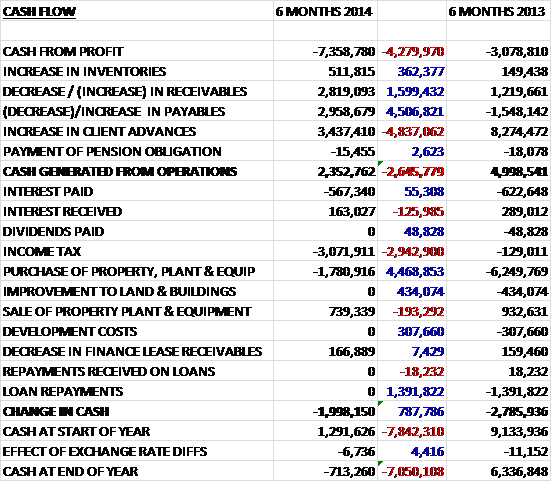
Before movements in working capital, the cash loss from operations was £7.4M, some £4.3M worse than during the first half of last year.  Favourable movements in working capital, however, including a decrease in receivables, increase in payables and an increase in client advances meant that the cash generated from operations was £2.4M, less than half that received in the first six months of 2013.  The bulk of this cash was actually paid on income tax which was some £3M and £2.9M more than last time which relates to higher taxes paid in India; and capital expenditure, which was at least £4.4M less than in the same period of 2013.  The group did manage to scrape together £700K by flogging off some equipment but this could not prevent the cash outflow being £2M.  This is poor but at least it was £800K better than the outflow in H1 2013.  Clearly Shaft have a lot on their plate at the moment but it does somewhat annoy when their published statement of cash flow is incorrect due to a typo.  The correct figures are above, not those quoted in the interim report.

During the first six months of the year, South Africa losses widened to £11.2M.  The decline has several causes including the termination of a number of contracts (notably Impala 16, Impala 17 fridge shaft,  Moab and Hernic Ferrochrome); the impact of strike action, safety stoppages, adverse currency movements and poor performance at Styldrift.  Following the end of the strike in June, imminent changes to the terms of a number of contracts and some recent contract extensions, revenues in the country are expected to stabilise in the second half of the year.  During the year the Impala 17 contract, which has long been loss making was converted to a cost reimbursable contract for a limited time until October.  At this point, it will be retendered.  Performance on the project was hampered by safety stoppages which contributed to a 4% reduction in South African revenues.  Work at Impala 16 was suspended for most of the period due to strike action but after the strike ended, work levels are starting to return to normal.  Unfortunately, however Impala declared force majeure at Impala 16 due to the strike action, but the group believes it may be able to recover certain costs from the client.

Although Styldrift made progress during the period, with sinking completed in the main and service shafts, this was offset by hoisting constraints and the lack of available cash.  Due to the underperformance and the fact that rates did not cover costs incurred, the project recorded significant losses during the period which reduced South African revenues by 4%.  Due to the lack of cash, the client chose to purchase some of the project assets and negotiations are ongoing in order to convert the contract to a cost reimbursable one.  The project for Afplats, at least, continued to perform well and is now ahead of schedule with the main shaft now more than 1000m deep.  Afplats awarded the group an extension for continuing the sinking of the shaft to 1307m which is expected to run until mid-2014.  The work for Lonmin was affected by the strike action and the group was prevented from working on the project for a considerable time.  After the end of the strike, management expect to be up to speed by Q4 this year.

During the first half of the year, International profits fell by £2.6M to £5.8M.  Progress has been good at Kibali Goldmines where sinking is progressing in line with expectations and the main shaft has reached a depth of 500m.  Operations at Hindustan Zinc delivered an improved performance compared to last year but remained significantly behind schedule and as a result the financial performance was below management expectations.  The signing of the Kazchrome contract will improve revenues going forward. The METS division performed slightly below expectations due to the reduction in workload and the lack of any new contract awards.

As previously announced, the group has secured a short term loan facility with Hillside Investments which resulted in a bridging loan of £3.5M coming in to the group while the convertible loan agreement is prepared for approval that should bring in another £5.7M.  This means that the group should have sufficient cash to meet its debt repayments, which require a payment of £2.9M this December.  The Eurochem proceedings continue to hang like a dark cloud over everything Shaft does.  There is no further news on this front but an outcome is likely to be forthcoming in 2015.

The order book stands at £191M, down from £238.2M at the end point of last year with a pipeline of £802M of outstanding tenders, including a number in South Africa.  After year end, however, new contracts have added £47M to the order book.  The outlook for the second half of 2014 is for an improvement on the first half of the year.

Net debt currently stands at £3.6M, a £2M increase on the end point of last year and clearly it is not appropriate to announce a dividend at this time.  There is no getting away from the fact that these are terrible numbers.  This has resulted in the cash squeeze, and the Indian tax bill has really not helped in this regard and the measures set about above to tackle this.  There are also a number of operational problems at some of the projects, clients have cancelled work, the order book is not as healthy as it was and the bid pipeline is at its lowest level for some time.  In addition, should Eurochem win their claim, the group will not be trading which is something that seems to be weighing on client sentiment.  So, why would anyone want to buy shares in Shaft?  Well, the immediate cash problem seems to have been sorted, there was a new international contract win (albeit for a related group) and the strike action in South Africa seems to be calming down.  If, and it is a big if, Shaft survive until the Eurochem verdict and they win it, these shares will be very cheap.  I have made a VERY risky small purchase on these grounds.

On the 29th August the group announced that it had been awarded a six month extension by Impala at Impala 16.  The contract has a value of £3.7M and relates to development work on a number of levels within the shaft complex and comprises drilling to excavate the levels as well as removal of waste rock via an underground railway. The contract is on a labour rates basis with a performance based element.

On the 13th February 13th the group released a statement that effectively said they were going bust.  There is unlikely to be any value left for shareholders.   This could be seen coming a mile off and I have made progress in that I managed to get out with some equity intact but I should not have made that risky punt – this has been a bit of a learning experience.

On the 17th February the shares surprised no-one by being suspended on request of the company.  I suspect this will be the last SHFT update!

Gem Diamonds Finance Blog – Interim Results 2014

Gem Diamonds has now released their interim results for the year ending 2014.

gemdinterim

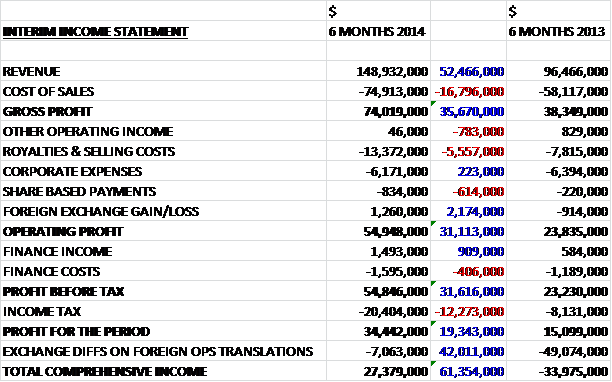
Revenues were up considerably, increasing by $52.5M to $148.9M.  Cost of sales were up too, but not to the same degree so gross profits were some $35.7M higher than during the same period of last year.  Other operating income collapsed to $46K and there was a $5.6M increase in royalties and selling costs, somewhat counteracted by a small reduction in corporate expenses and a $1.3M gain due to foreign exchange differences to give an operating profit $31.1M higher than in the first half of 2013.  Finance income and finance costs broadly cancelled each other out before a $12.3M hike in income tax gave an overall profit for the period of $34.4M, an impressive $19.3M more than in the same period of last year.

gemdinterimassets

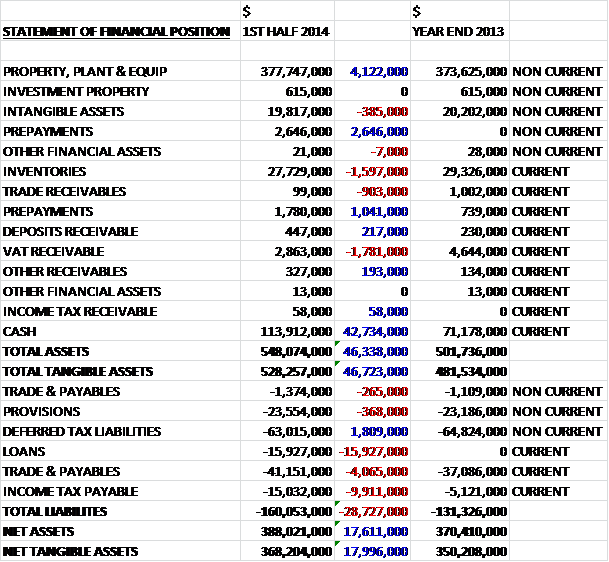
Total assets increased by $46.3M when compared to the end point of last year.  This was mostly driven by a $42.7M increase in cash levels, but other increases included a $4.1M growth in the value of property, plant and equipment and a $3.7M increase in prepayments, which are the waste costs to be covered by the contractor over the term of the new contract, somewhat mitigated by a $1.6M decline in inventories and a $1.8M fall in VAT receivable.  Likewise, liabilities also increased with the largest being a $15.9M new loan, a $9.9M increase in current tax payable and a $4.1M increase in trade and payables.  This left net assets being some $17.6M higher at $388M, which looks rather good to me.

gemdinterimcash

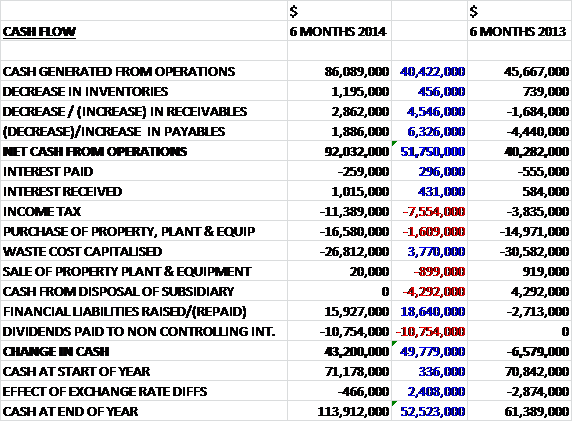
Before movements in working capital, cash profits nearly doubled to $86.1M.  Favourable movements in receivables and payables meant that net cash from operations was a massive $51.8M higher at $92M.  The largest expenses for the cash was $26.8M of waste cost capitalised, $3.8M less than in the first six months of last year; $16.6M sent on tangible asset capex, up by $1.6M which related to development at Ghaghoo, the coarse recovery plant at Letseng and the resource extension drilling; $11.4M of income tax, some $7.6M higher; and $10.8M on dividends to the Lesotho government.  The group also gained some $16M in cash from new loans which seems quite strange to me considering this resulted in a $43.2M increase in cash levels to $113.9M.  This is a seriously good result, the group is swimming in cash which makes it difficult for me to understand why it is taking out loans unless an acquisition is being lined up.

Letseng sold 53,799 carats during the period compared to 47,065 during the same period of last year and the price per carat increased from $1,741 to $2,747.  Of the ore sourced, 36% was from the Satellite pipe with the remainder from the Main pipe.  The Alluvial Ventures plant continued to run during the period and the contract was extended to the end of 2015.  In addition, the installation of the secondary and tertiary crushers last year led to significant improvements in the fragmentation and blasting process, which increased plant throughput and helped lead to the increase in carats produced.  Waste mining was 2% higher than in the first half of last year and in order to keep up, larger mining equipment consisting of two CAT excavators and trucks were commissioned in May.

During the period, Letseng negotiated a new contract with its mining contractor, MMIC, resulting in improved unit costs for the next eight years.  The new coarse recovery plant project remains on track for completion in Q2 2015 for a total of $13.2M, of which $7.7M is expected to be spent in 2014.  The X-Ray sorters have been ordered, which will ensure improved recovery of high value diamonds and improved x-ray scanners for personnel are planned for Q3 this year.  Work to improve throughput and diamond breakage has been approved and phase one of the project has commenced and is planned to be complete by Q1 2015, which will deliver an increase in treatment capacity of about 250,000 tonnes per annum as well as further reducing diamond breakage.  Of the $4.7M expected to be spent on this project, $3.6M is expected to be spent this year.

During the period, five tenders were held for Letseng’s production resulting in rough diamond tender revenue of $147.8M.  Higher quality diamonds due to lower breakage and increased production from the Satellite pipe has resulted in the increased revenues seen in the period.  The focus at the mine going forward will be continual improvement of current operations and costs, delivery of the Coarse Recovery Plant, delivery of phase one and two of the Plant upgrade, optimising waste stripping profiles in order to maximise timing of moving from open pit mining to underground mining in the satellite pipe, and continual refinement of future phases of projects.

At Ghaghoo, 2,400 carats have been recovered so far during the commissioning of the plant which have included a 20 and two 10 carat stones.  The production tunnels are progressing within kimberlite on the first production level at 154 metres below the surface where high volumes of water from basalt fissures have been encountered which has contributed to difficult mining conditions and has necessitated the procurement of additional pumping capacity and the drilling of additional bore holes but is not expected to impact production in 2015.  Drilling of the second ventilation hole is complete and the third and final hole has been drilled to a depth of 121 metres and was completed in July.  So far, $82M of the total budget of $96M has been spent with the balance being spent in the second half of the year.

Going forward, the focus at the mine will be the build-up of production to 60,000 tonnes per month, continuing underground development to ensure production sustainability, designing and developing a long-term water management system, determining the next phase of expansion and optimising the sales and marketing arrangements.  A sale of Ghaghoo’s initial production is scheduled to take place before the end of the year.  The marketing and manufacturing business contributed $2.4M in additional revenue to the group and 377 carats of Letseng rough diamonds were extracted for polishing and manufacture at Baobab, with 371 carats of rough diamonds being received from third parties for analysis and manufacturing, for which Baobab charges a fee.

As reported on previously, the group has released a revised resource and reserve statement.  Letseng indicated resource base increased in carat terms by 127% to a total of 3.2 M carats with an average grade of 1.73 carats per hundred tonnes.  This increase is a result of the extension of the indicated depth classification from 100m below the mining face to 350m below as a result of infill drilling programmes, improved estimation techniques and detailed geological studies.  Due to the substantial improvement in indicated resources, an increase in the Letseng reserve base is also noted, increasing by 64% to 2.3 M carats.  This increase means that the 21 year life of the mine open pit is entirely contained within the reserve.

Going forward, the board have approved capital projects of $40.5M in respect of continued development of Ghaghoo and $19.2M relating to various projects at Letseng.  The second half of the year should see the strong diamond price maintained with continued growth in demand from Asian markets, along with strength in traditional markets.

The new debt incurs interest at the South African interbank rate plus 4.95% which makes it all the more curious that the group has taken it out given the large cash reserves, in my opinion it indicates that the board have an eye on an acquisition.  The company is still on target to pay its maiden dividend in March 2015 based on the full year results.  There is a very strong net cash position of $98.4M, an increase on the $71.2M at the end point of last year.  Overall, this is a very good set of results, the Letseng mine is powering ahead and seems to be very cash generative, despite the capital expenditure that has taken place.  Over the next year, more will be spent improving operations at Letseng and bringing Ghaghoo up to speed.  The presence of large quantities of water is a slight worry but the group seem to be on top of this.  I am pleased with my share purchase here and happy to hold.

On the 1st October the group announced that they had sold the 198 carat white diamond for $10.6M which seems like a decent rather than spectacular price

On the 6th November the group released an interim management statement covering Q3 2014.  Although the prices received for Letseng’s high value production remained healthy at $2,603 per carat, compared to $2,582 in Q3 last year, the market for both rough and polished diamonds declined towards October but the group expect prices at Letseng to remain resilient for the rest of the year.  The commissioning of new earthmoving equipment at Letseng has resulted in a 5% increase in waste mined over the same quarter of last year but the number of carats produced fell by 1% due to a vertical conveyor on Plant 2 being replaced and a higher percentage of ore being sourced from the Main pipe.

The new Coarse Recovery Plant project remains on track for completion in Q2 2015 for a total budget of $12.5M and the XRT sorters arrived in South Africa in October.  The design of the Personnel Control Centre is well advanced and includes an X Ray scanner which has already been tested for accuracy and health & safety. The civil contractor has commenced work as planned and the other contractors are scheduled to mobilise in Q4 of this year.  The Plant 2 Phase 1 upgrade project has been approved for implementation and is on track to be completed by Q1 2015.  It is planed to deliver an increase in treatment capacity of 250,000 tonnes per annum as well as further reducing diamond damage.

In Botswana development is currently progressing in four production tunnels withing the kimberlite on level 1.  The significant volume of water flowing in from a fissure within the Basalt country rock has been managed efficiently and the final sealing of the fissure is in progress.  The tunnels in the old sampling level were intersected during August and they are now accessible and have been dewatered, fully inspected and made safe.  The second ventilation hole has been completed and work is progressing to link it with the first hole.  The significant intake of water has impacted planned development rates and the monthly production rate is now likely to be achieved by the end of Q1 2015.  A training slope has been developed on Level 0 which will be used to provide ore to complete the optimisation of the treatment plant during the latter part of this year.  At the end of the period, 4,028 carats have been recovered from Ghaghoo and it has been decided to hold the initial sale alongside the Letseng sale in February 2015 to allow existing customers to participate.

All in all it is not a bad update but the softening market for diamonds is a concern and although the prices at Letseng are expected to hold  up, the lower quality Ghaghoo diamonds could suffer.  Also although the water problems seem to have been overcome it is a bit disappointing that production has been delayed.  Nevertheless I have decided to top up on the share price weakness.

On the 29th December the group announced that non-executive director Gavin Beevers had purchased 14,800 shares at a cost of abut £25K.  He now owns just under 160,000 shares so this is a nice vote of confidence.

On the 7th January it was announced that the Capital Group’s Smallcap World Find fund had sold 19,850 shares so that it’s holding went below the 5% threshold, which is a shame.

On the 27th January the group released a trading update for Q4 2014.  During the quarter the Antwerp Diamond Bank announced its closure which led to concerns over the availability of liquidity in the rough diamond market, weakening market sentiment during the period that led to downward pressure on prices during the period which is likely to continue into Q1 2015, although the high quality of Letseng’s output offers some resilience.  Operationally at the mine 25,525 carats were recovered, a 9% fall when compared to Q4 last year due to falling grades despite the new machinery allowing a higher quantity of ore to be processed.  At the three tenders during the period, 31,614 carats were sold at $2,140 per carat, a fall of 18% on the price per carat this time last year but is still slightly above the $2,043 average per carat achieved during the whole of last year.

During the quarter, 13 exceptional rough diamonds were extracted including a 299 carat yellow diamond which was sold into a partnership arrangement in January with Letseng to share 50% of the polished uplift.  Other highlights were a 113 carat white diamond sold on tender for $5.8M and a 90 carat white diamond sold for $4.2M. Mainly due to the yellow diamond, some $15.2M worth of diamonds remained in polished inventory at the end of the year compared to $2.9M at the end of last year which affected the overall group revenue to the tune of $12.3M.  The new Coarse Recovery Plant remains on track for completion in Q2 2015 for a total budget of $12.1M and the majority of the equipment is now on site with construction underway.  The plant will optimise the treatment of the high value, coarse fraction of ore and is expected to improve the recovery of the high value Type 2 diamonds.  Implementation of the Plant 2 Phase 1 upgrade project commenced in Q3 and is on track to be completed by the end of Q1 2015 following a planned three week implementation shutdown.  This project is expected to deliver an increase in treatment capacity of 250,000 tonnes per annum.

In Botswana the development of Phase 1 at Ghaghoo has continued to progress well.  Three kimberlite tunnels on the first main production level have been fully developed to the northern orebody rock contact while the fourth is nearing completion.  The sealing of fissure water intersected by the basalt country rock has been completed and a significant amount of work has been done to enable any future water intersections to be handled efficiently.  The training stope and access tunnels in the kimberlite on Level 0 have continued to provide ore for the plant during the commissioning period and will continue to do so until replaced by steady production from level 1 later in 2015.  By the end of December, 10,167 carats had been recovered but the grade averaged out at just over 21 cpht compared to the expected 27 cpht.  The grade was negatively impacted by highly diluted ore derived from the margins of the pipe and normal plant inefficiencies during commissioning.  During the latter part of the period, the grade improved and management expects the anticipated grades will be achieved when production ramps up.  The initial sale of about 10,000 carats will be held in Botswana and Antwerp during January and February 2015.

At the period end, the net cash position of the group stands at £73.6M and the group is still on track to declare its first dividend to shareholders at the announcement of the final results in March.  Although the long term prospects of the group remain very strong, there is no doubt that the altogether unexpected weakness in the diamond market will have an effect on profits.  Management expect it to continue into Q1 and I have sold out until there is a little less uncertainty about the prices going forward.


Interserve Finance Blog – Interim Results 2014

Interserve has now released its half year results for the year ending 2014.

interserveincomeinterim

When compared to the first half of last year revenues increased across all sectors with some notable increases being a £217M hike in UK support services, a £35.5M increase in International Support Services revenue and a £45M increase in UK Construction revenue.  As would be expected, the cost of sales also increased, up £271.9M so that Gross profit was some £34.7M higher.  Admin expenses were up £18.9M and there were also a number of one-off costs including £7.6M in transaction costs, £3.6M of integration costs and a £5.6M increase in amortisation of acquired intangibles.  The share of joint venture profit fell by £1.6M during the year which incidentally was the same amount that Operating Profit fell by.  Finance costs increased by £1M but these were largely mitigated by a reduction in tax expense so that the profit for the year was £23M, £1.7M less than in the first six months of 2013 but when the one-off acquisition costs are considered, this is not a bad result.

interservebalanceinterim

Total assets increased by a massive £472.6M when compared to the end point of last year.  This increase included a £139.1M hike in the value of Goodwill and a £76.7M increase in other intangible assets.  There were also some large tangible increases with receivables some £204.8M higher and cash £41M higher.   Most of these increases were due to the Initial acquisition and in fact, only deferred tax assets fell – down £17.4M to just £3.6M.  Liabilities also increased during the period, driven by a £272.2M increase in bank loans and a £177.6M growth in trade and payables, this was somewhat mitigated by a £26.6M fall in bank overdrafts and a £7.2M reduction in pension obligations, which now only stand at £500K.  Overall then, net assets were up by £58.2M to £428.5M but due to the large increases in intangible assets, net tangible assets fell by a disappointing £157.6M and are now negative to the tune of £73.9M.

interserve cash interim

Before the movement in working capital, cash profits were up £8.4M to £40.2M.   This is before working capital changes primarily related to the acquisition, although a £25M increase in hire fleet capex didn’t help.  This drove the net cash from operations down by £46.4M to an outflow of £20.5M.  The group also received about half of the amount of dividends from associates and joint ventures than it did this time last year but also nearly halved the non-hire fleet capex.  The largest expense was clearly the £226.5M spent on the purchase of Initial which was paid for mainly by a £207.2M receipt from the US loan note placing.  Other cash came in due to £74.2M of proceeds from new shares and a £65M increase in bank loans.  All this meant that the group still managed a positive cash flow of £68.4M despite the £22.1M paid out in dividends.  To be honest, the acquisition is such an upheaval during the half year that not much can really be taken from the cash flow statement during this time.

UK Support Service profit was up £8.6M to £33.9M which was driven by increased revenues as the operating margin remained stable at 4.2%.  Strong organic growth came from existing clients and new contract wins in the defence, automotive, real estate and government sectors.  Future workload for the division increased by £700M to £5.8BN during the period.  Highlights during the year included mobilising a five year contract with the BBC, valued at more than £150M to provide facilities management and security services at over 150 buildings; winning a £322M contract with the MoD to manage the National Training Estate over a five year term with an option to extend for another five years (the group had already previously had a contract with the MoD); building on relationships with existing clients to win additional work with the Foreign & Commonwealth office, Mercedes-Benz and CBRE; and winning three Community Work Placement contracts worth £19M covering Yorkshire, Devon, Cornwall, Dorset and Somerset.

International Support Services profit was up £800K to £3.2M.  Revenue was up strongly, partly as a result of the Adyard acquisition but due to a change in the business mix following this acquisition and competitive pressures, margins reduced to 4.3%.  Future workload declined £15M to £149M which is rather disappointing but highlights during the period included a three year contract extension to the long standing logistics and oilfield service contract with Occidental Petroleum; a new three year contract to provide Qatar Shell with a range of mechanical services, including the replacement of large sections of piping and an upgrade to structural supports; and a five year facilities management contract with ExxonMobil.

UK Construction profit was up £600K to £8M.  Demand in the market is beginning to improve but margins remain tight at 1.9% as supply chain pressures feed through.  Revenues were boosted by the Paragon business acquired last year which increased momentum and won new contracts from Facebook and Markel and helped future workload increase by £400M to £1.4BN.  About two thirds of the work is derived from framework agreements and repeat business relationships.  The group started work on the Haymarket development in Edinburgh and the Co-Op building in Newcastle during the period.  Other highlights included winning a £150M PFI contract to build seven secondary schools across Herts, Luton and Reading; the awarding of a contract to build a high energy proton beam cancer therapy facility for the Christie NHS trust in Manchester; winning a contract to build a new £55M sports centre for the Uni of Birmingham; the completion of JLR’s new Engine factory near Wolverhampton; and the completion of the Endeavour Centre in Portsmouth.

International Construction profits fell by £1.4M to £4.3M despite a small increase in revenues to give a reduced margin of 2.4%, but the group is starting to see recovery in the Middle East market.  Encouragingly, future workload grew by £28M to £227M with highlights including a £323M contract in a joint venture with ELEC Qatar to build Doha Festival City, which will become Qatar’s largest retail development; further works contracts for Siemens and NCC in the development of Qatar’s power network; the commencement of a £160M extension to Dubai’s Mall of the Emirates; and a contract to build a new field services complex for Halliburton in Abu Dhabi as well as work with DP World, Dubai’s Taj Hotel and the RIVA group.

Equipment Services profits were up £5.5M at £14M which represents both a revenue and margin increase to a decent 15.4% when compared to the same period of last year.  Capital expenditure rose significantly as the group increased investment in the equipment fleet and in new branches in South Africa, the US and Panama.  In Asia there was a strong performance in Hong Kong, driven by infrastructure sending and the group also performed well in the Philippines with further investment in the power sector expected.  There was strong growth across the Middle East but demand in Australia was affected by the completion of a number of energy projects and a slowdown in the mining sector.  The UK performed well, boosted by projects such as the Resorts World Casino in Birmingham.

The recovery in the US was somewhat slower than anticipated and Government investment remained sluggish but the expansion into California is bearing fruit with ongoing work on a number of sizeable developments in the Bay area and San Francisco.  In addition, the continued expansion into Latin America opened up new markets in Colombia and Panama.  Highlights included the supply of heavy duty support equipment for the construction of a new Terminal Complex at Abu Dhabi international airport; a new transport hub providing transport of pilgrims to Mekka; the supply of 1,300 tonnes of equipment for the Mall of Egypt project; and providing the shoring towers for the Sultan Qaboos Mosque in Oman.

The contribution of investments fell by £300K to £700K.  Highlights included a further £3.1M investment into the Haymarket project in Edinburgh; financial close on the redevelopment of the Co-Op building in Newcastle; being appointed preferred bidder to build seven schools in the UK and a centre of excellence for the Scottish National Blood Transfusion Service; being selected by Southampton NHS Foundation Trust as its long term development partner; and securing a £9.6M investment from the Scottish Partnership for regeneration in urban centres as a co-investor in the Edinburgh Haymarket development.

As mentioned in previous updates, the most important event this year was the acquisition of Initial Facilities from Rentokil.  The acquisition cost £249.7M and seems mainly to be designed to increase facilities management exposure to private companies.  The acquisition came with just under £110M of net assets with the goodwill paid being some £139.8M.  Since acquisition, Initial has contributed £160.6M to revenue and a £7.7M loss after exceptional items.  The integration is well underway and the anticipated synergies remain on track with Initial winning new contracts with Exterion and Dairy Crest during the period.

After the period end the group protected around 35% of the pension scheme liabilities from fluctuating interest rates, inflation and longevity risk through a buy-in agreement with Aviva.  Trading conditions in the group’s main market continue to improve and going forward, they are positioning themselves to take advantage of sustained market improvement by investing in skills, infrastructure and fixed assets which will obviously have an effect on short term cash flow.  The future workload for the group stands at £7.5BN, which compares favourably to the £6.4BN at this point of last year.  It has been announced that David Thorpe will retire from the board at the end of August and he will be replaced as Remuneration Committee chairman by Keith Ludeman.

At the end of the half year, net debt stood at £243.1M, an increase of £204.5M when compared to the end point of last year.  A dividend of 7.5p per share (an increase of just over 10%) was declared which makes the rolling annual yield 3.3%.  It is clear that this is an important year for Interserve with the acquisition being very material to the group.  It is a case of wait and see really to see how Initial integrates and whether it is worth the extra debt taken on board.  The profit this half is not bad when the acquisition costs are stripped out with the Equipment Services sector doing particularly well.  It was disappointing to see net tangible assets slipping into net tangible liabilities.  In conclusion, though, I am happy to continue holding here.

On the 21st August the group announced a new joint venture between Interserve and Shanks to build and operate a new waste treatment facility in Derby under a 27 year, £950M PPP contract.  Interserve will start building the £145M Mechanical Biological Treatment facility and an on-site gasification plant which Shanks will operate along side Derby’s existing waste management facilities.  The new plant is expected to be completed by 2017, at which point both Shanks and Interserve will inject £18M of subordinated debt into the joint venture.

On the 12th November the group released an interim management statement covering Q3 and a bit more.  The group performed in line with expectations with organic growth in Support Services, UK Construction and Equipment Services.  International Construction continued to struggle somewhat but the market seems to be improving. Pleasingly the integration of Initial Facilities has largely been completed and expected synergies remain on track.  During the period the group won contracts with Hyundai Engineering and Construction (UAE), Qatar Foundation, Kempinski Hotel (Oman), Hong Kong Zhuhai Macao Bridge, Ministry of Justice, Derbyshire County Council, Southampton City Council, Warner Bros, Debenhams, Scottish Power, Northern Powergrid, Crossrail, Royal Opera House, Prince Charles Hospital and British Airways.  All in all a decent update with no real suprises.  As an aside, it is mentioned that the Financial Reporting Council has removed the obligation for companies to provide quarterly management updates so given Interserve’s usual terse updates, I suspect they will dispense with this annoyance going forward which is a bit of a shame.

On the 5th December the group announced that they had acquired the Employment and Skills Group (ESG), a UK based provider of vocational training, skills and employability services from Ares Capital for £25M.  ESG provides training and employment services for Government and employers and also provides vocational training in three further education colleges in Saudi Arabia.  The transaction is being funded from the existing debt facilities and is expected to be accretive in 2015.  The price paid doesn’t seem high but it will be interesting to see how much the group makes from the acquisition.

On the 18th December the group released a statement detailing a new contract for the provision of probation and rehab services.  A new partnership has been created  with Addaction, Shelter, P3 and 3SC to manage services in Manchester, Merseyside, West Yorkshire, North Yorkshire, Humberside and Hampshire covering over 40,000 offenders each year.  The collective contract values are worth £600M over seven years so represents a significant contract.  Despite this good news, however, I have decided to sell out as I am concerned about the effect that low oil prices will have on the Interserve business in the Middle East.  I still consider this company to be a quality investment but feel there may be some short term downside.  I will continue to update on progress here.

On the 7th January the group released a trading update.  It stated that they were performing in line with expectations.  The integration of Initial Facilities is well advanced, as is the preparation for the mobilisation of probation services which are commencing at the start of February.  The group has also formed a joint venture with the Rezayat Group in Saudi Arabia to provide facilities management services in the region.  With the guidance for full year trading remaining the same, this is a robust update and I will continue to monitor proceedings from the sidelines.

On the 22nd January the group released a statement that Standard Life Investments had purchased 476,902 shares which would have been at a value of over £2.4M.

On the 29th January it was announced that another institutional investor had bought some shares.  This time Henderson Global Investors purchased 250,000 shares worth about £1.3M.  It seems that someone things these shares bay have been oversold.

Glaxosmithkline Finance Blog- Interim Results 2014

GSK have now released their half year results for 2014.

gskincome

Revenues fell almost across the board with the exception of ViiV Healthcare, which was broadly flat when compared to the same period of last year.  US sales, consumer healthcare and established products were hit particularly hard, down by £458M, £290M and £511M respectively.  Cost of sales fell by £483M but Gross Profits were still down to the tune of £1.432BN.  Royalty income was down £53M following the conclusion of a number of royalty agreements but fairly substantial decreases in admin and R&D costs meant that operating profits were £815M lower than in the first half of last year.  Finance expenses and taxation also fell but the total profit for the half year was still some £692M lower than during the first half of 2013.

gskbalance

Overall total assets fell by a massive £3.236BN.  This was driven by a £2.371BN collapse in the level of cash, a £539M reduction in goodwill, an £870M fall in other intangible assets and a £442M reduction in trade receivables, somewhat mitigated by a £1BN increase in assets held for sale relating predominantly to assets involved in the Novartis deal.  Likewise, liabilities also fell when compared to the end point of last year as trade and payables fell by £1.368BN and borrowings were down by £595M.  This was not enough to increase net assets, though as they were some £976M lower than last year with net assets without goodwill down by £437M to £3.170BN.

gskcash

Before movements in working capital, cash profits were down £1.263BN at £2.660BN before an increase in working capital, predominantly due to stock building, and broadly similar taxes meant that net cash flow from operations was down £1.265BN at £1.693BN.  The group then spent £473M on tangible assets and £270M on intangibles.  A disposal of a business added £194M to the coffers but £669M was spent on non-controlling interests.  The group managed to repay £204M in net borrowings and spent a net £124M on buying back shares.  After all this, GSK also managed to pay out £2.169BN on dividends which is clearly not sustainable at these levels as the £2.332BN cash outflow for the six months attests.  There is still £2.858BN of cash left but another six months like this will soon wipe that out.

Respiratory sales fell by 9% to £3.113BN. The group’s main drug, Seretide/Advair fell by 14% to £2.134BN, which is a little concerning.  Flovent sales also fell but Ventolin sales were up 11% and Xycal also increased revenues.  The bulk of this fall was due to a 24% decline in Advair sales in the US due to increased competition.  Sales of Seretide in Europe fell by 4%, again on the back of increased competition whilst in emerging markets, respiratory sales were flat, although discounting China, emerging markets grew by 3%.  In Japan respiratory sales fell by 4% as flat Advair revenues, increases in Xyzal sales and the launch of Revlar Ellipta were more than outweighed by falls in the rest of the Respiratory portfolio.

Oncology sales in the first half did well, up 33% to £556M.  Votrient sales increased by 36% to £188M and Promacta sales were up 33% to £103M, partially counteracted by falls in Arzerra and Tykerb revenue.  The division was also boosted by launches for Tafinlar and Mekinist.  In the US, Oncology was up 36% driven by increases to Votrient and Promacta.  In Europe, Oncology grew by 31%, led by an increase in Votrient sales.  In Emerging Markets and Japan, sales in the first half grew by 42% and 10% respectively.

Cardiovascular, Metabolic and Urology sales fell by 2% to £474M as an increase in Duodart/Jalyn sales was counteracted by falls in Avodart and Levitra.  On a regional basis, US sales collapsed by 19% whilst sales in Europe, Emerging Markets and Japan all increased.  Immuno-inflammatory sales grew 42% from a low base to £88M, predominantly made up of US Benlysta sales, up 24%.  Other therapy areas grew by 4% to £1.197BN, primarily reflecting government stockpiling of Relenza in Japan which more than doubled revenues during the half year.  This growth was partially offset by generic competition to Dermatology products.  ViiV Healthcare sales increased by 9% to £663M with the US up 20%, Emerging Markets down 6%, Japan up 17% and Europe down 1%.  There were increases in Epzicom/Kivexa, Selzentry and Tivicay revenues, partially mitigated by declines in Combivir and Trizivir due to generic competition.  Established product sales fell by 18% to £1.510BN with declines seen in all regions.  Generic competition to Lovaza drove sales of that product down 54%.  Other drivers to the decline were Seroxat/Paxil, Valtrex and Zeffix.

Sales of vaccines grew by 4% to £1.424BN with US revenues up 9%, Emerging Markets increasing by 10%, Europe sales down 1% and Japan revenues collapsing by 27%.  US sales were flattered by favourable comparisons with the first half of last year whilst the emerging market performance primarily reflected the phasing of sales of Boostrix and Rotarix.  Boostrix sales increased by 45% reflecting growth in all regions with sales in the US benefiting from competitor supply issues and in Emerging markets by phasing of tenders.  Cervarix sales fell by 28% due to declines in Japan whilst sales of hepatitis vaccines fell by 9%, in part reflecting phasing of shipments in the US and Emerging Markets.  Infanrix revenues grew by 9% where most of the growth came from the US which benefited from a favourable comparison with the first half of last year.  Rotarix sales were up 24% to £189M due to tender shipments in Europe and Emerging Markets whilst Synflorix sales were up 7% reflecting the phasing of tenders in Emerging Markets.

Consumer Healthcare sales were down 2% to £2.149BN reflecting the impact of supply issues, comparison to a strong cold and flu season in Q1 2013 and slowing in some Rest of World markets in part due to economic pressures.  Wellness sales were down 8%, primarily due to supply issues and product recalls that significantly impacted sales of products for Smokers Health, down 31%.  Oral Health revenues were up 2% as the continued growth of Sensodyne was offset by a 17% decline in Aquafresh, impacted by supply issues in both Europe and the US together with competitive pressures.  Nutrition sales grew 10% with Horlicks up 9% due to strong growth in India and Boost, up 12%.  Sales of Skin Health products were down 11% primarily due to lower sales of Bactroban in China.

Over the half the year the group has seen another step change reduction in Advair market share and it is apparently clear that these pressures are likely to continue.  Therefore there is some urgency in the desire to diversify the Respiratory portfolio with recent releases of Breo, Anoro and Incruse.  So far Breo has a 70% Medicare coverage and Anoro a 30% coverage.

As announced earlier as part of the transaction with Novartis, there will be a new joint venture created that will include the Consumer Healthcare brands of both businesses with GSK having 63.5% of the ownership.  Additionally, GSK will acquire Novartis’ vaccines business (excluding the flu vaccines) for $5.25BN with a potential milestone payment of $1.8BN plus ongoing royalties.  GSK will also divest its Oncology portfolio and partner rights for future oncology products to Novartis for $16BN, $1.5BN of which depending on the results of an ongoing clinical trial.  The transaction is expected to complete during the first half of 2015.

The investigation in China is continuing and it seems that the US department of Justice and the UK Serious Fraud Office are also investigating the group with the SFO opening a criminal investigation into the group’s commercial activities.  Overall the provision for legal disputes was £500M and the legal charges for the half year stood at £155M.  The group is also battling the strong pound and if exchange rates were to stay the same, the group predict an adverse impact of EPS in 2014 of 12%.

During Q2, there were a number of developments in the drug pipeline.  Breo for asthma was filed in the US and in the second half of the year, the group expect an FDA regulatory decision on the ICS monotherapy product for asthma and the IL-5 antagonist mepolizumab will be filed with regulators for severe asthma. Also, Eperzan/Tanzeum was approved in the US and EU and other approvals include FDA approval of Incruse for COPD in the US, EMA approval of Anoro for COPD in Europe, EMA approval of Arzerra for first line treatment of CLL in Europe and Japan approval of Anoro for COPD and EMA approval of Mekinist for melanoma in Europe.

This week, Tanzeum, the new weekly treatment for diabetes will be launched in the US and good progress is being seen for the recent oncology launches, Tafinlar and Mekinist.  There are apparently 30 assets that have the potential to be first in class drugs and management are confident that they can deliver a regular flow of new products over the next few years as the group becomes less dependent on Seretide/Advair.  The group have started a process to divest some US and European assets in the established products portfolio, which currently account for sales of about £1BN.

Net debt at the end of the half stood at £14.423BN which was an increase of £1.778BN from the end of last year.  This is certainly very disappointing and quite a substantial amount which has been caused by both the strength of Sterling and lower profits.  Also, the group have now stated that they will be unlikely to deliver sales growth this year and that core EPS will be broadly similar to last year.  Also, due to the poor cash flow expected, there will be no more share repurchases this year.  The quarterly dividend this quarter is 6% higher at 19p to give a rolling dividend yield of 5.5%, which if sustainable, and the cash flow seems to suggest it’s not, is a good return.  Overall, though, this has been a very disappointing half year for the group.  The decline of Advair is particularly worrying and it is imperative that GSK find drugs to replace it.  The Novartis deal is interesting but it is a shame that the main performer so far this year, the Oncology products, will be flogged off.  Overall, I am less comfortable holding this share than ever before but for now I will continue holding.

On the 22nd August, the group announced that it had received FDA approval for Triumeq, a new single pill regiment for the treatment of HIV for use in the US.  The drug interferes with the way that the virus replicates and GSK are waiting for approval from a number of other markets too.

On the 3rd September the group announced that the EU had followed the FDA in giving approval for Triumeq for the treatment of HIV in Europe.

On the 8th September the group announced the results of two phase III asthma studies of mepolizumab.  The objective of the MENSA and SIRIUS studies was to evaluate the impact of the drug on a number of key end points, with patients receiving mepolizumab achieving a statistically significant reduction in the frequency of significant asthma attacks compared to a placebo in MENSA, and a statistically significant reduction of daily oral corticosteroid dose in SIRIUS.  Treatment with mepolizumab also enabled patients to experience improved quality of life and improved asthma control.  GSK is looking towards global filings of mepolizumab for severe eosinophilic asthma before the end of the year, so these results look good.

On the 19th September the group announced that a Chinese court had found that GSK has offered money or property to non-government personnel in order to obtain improper commercial gains, and had been found guilty of bribing non-government personnel.  As a result, GSK must pay a fine of £297M to the Chinese government which will be funded through cash reserves.  GSK have apparently taken steps to rectify the issues at the Chinese subsidiary, including changing the incentive program for its sales force by decoupling sales targets from compensation and significantly reducing engagement activities with healthcare professionals.  Whilst this is a sizeable fine, I believe it is very good that it has been sorted out so quickly.  Hopefully GSK can now put this behind them and that the damage done to them in China is reparable.

On the 25th September the group announced that Sir Philip Hampton will join the board as Non exec director from January 2015.  The idea is that he will eventually succeed Christopher Gent as Chairman from September.  Philip has been chairman RBS since 2009 and has previously been Chairman of Sainsbury and Finance director at LloydsTSB, BT, BG and British Steel.